
Where is the world economy heading? In my opinion, a large portion of the story that we usually hear about how the world economy operates and the role energy plays is not really correct. In this post (to be continued in Part 2 in the near future), I explain how some of the major elements of the world economy seem to function. I also point out some relationships that tend to make the world’s economic condition more fragile.
Trying to explain the situation a bit further, the economy is a networked system. It doesn’t behave the way nearly everyone expects it to behave. Many people believe that any energy problem will be signaled by high prices. A look at history shows that this is not really the case: fighting and conflict are also likely outcomes. In fact, rising tariffs are a sign of energy problems.
The underlying energy problem represents a conflict between supply and demand, but not in the way most people expect. The world needs rising demand to support the rising cost of energy products, but this rising demand is, in fact, very difficult to produce. The way that this rising demand is normally produced is by adding increasing amounts of debt, at ever-lower interest rates. At some point, the debt bubble created to provide the necessary demand becomes overstretched. Now, we seem to be reaching a situation where the debt bubble may pop, at least in some parts of the world. This is a very concerning situation.
Context. The presentation discussed in this post was given to the Casualty Actuaries of the Southeast. (I am a casualty actuary myself, living in the Southeast.) The attendees tended to be quite young, and they tended not to be very aware of energy issues. I was trying to “bring them up to speed.” This is a link to the presentation: The World’s Fragile Economic Condition.

Slide 1
–
Slide 2
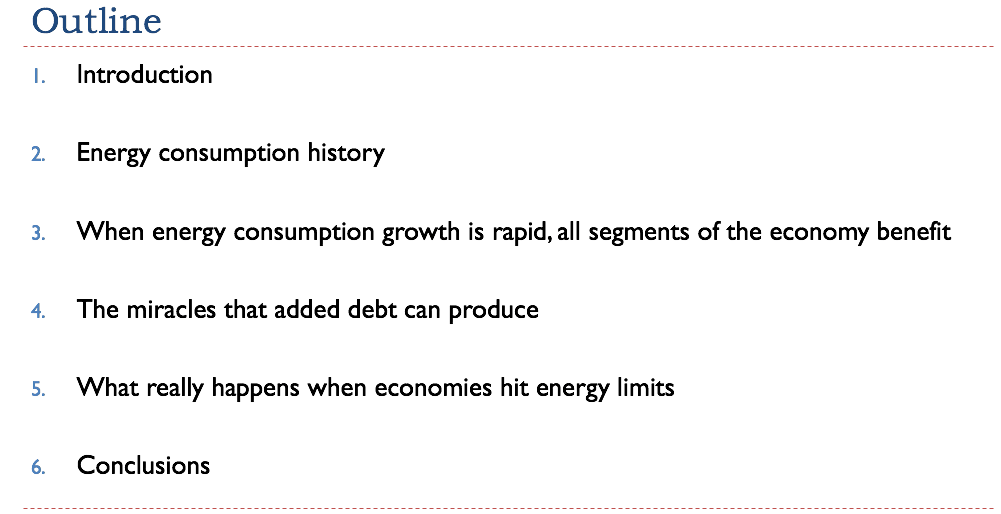
This post covers only Items 1, 2, and 3 from the Outline in Slide 2. I will save Items 3 through 6 for a post called “The World’s Fragile Economic Condition-Part 2.”

Slide 3
Slide 4
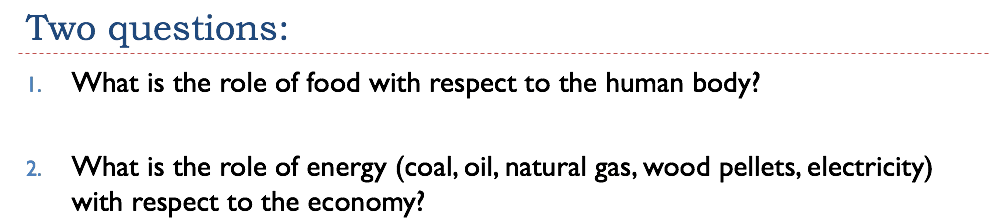
The audience was able to guess that the situation for humans and the economy are parallel. Energy in some sense powers the economy, in a way similar to how food powers humans.

Slide 5
On Slide 5, I am pointing out that changes in the red line, denoting energy consumption growth, tend to come before the corresponding changes in the blue line. This is one way of confirming that energy consumption causes GDP growth, rather than vice versa.
In recent years, countries have found ways of creating GDP growth, without adding true value. This may explain why GDP growth is higher than Energy growth since 2013 on Slide 5. As an example of GDP growth with overstated value, a large share of young people are now being encouraged to purchase advanced education, at considerable cost. This would make sense, if there were suitable high-paying jobs for all of those graduating. It is questionable whether this is the case.

Slide 6
Of course, the issue is not only energy consumption, just as our health is influenced by more than simply what food we eat.

Slide 7
At one time, the emphasis in physics was on systems that are “closed” from an energy point of view. Such systems never grow; they simply decline toward “heat death.”
The real world is made up of many structures that grow and change over time. This growth and ability to change is possible because the energy system we live in is thermodynamically “open,” thanks to flows of energy from the sun, and thanks to fossil fuel energy, which represents stored solar energy from long ago.

Slide 8
The answers to the questions on Slide 8 are easy to guess.

Slide 9
The economy adds new businesses, as citizens see new needs and set up companies to meet those needs. Customers make choices regarding which goods and services to buy, based on their income (primarily wages) and the prices of available goods and services. Governments gradually add new laws, including changes to the way taxes are assessed. The system gradually grows and changes, as the population grows, and as the quantity of goods and services created to meet the needs of that population increases.
One thing to note is that the goods and services produced by the system will eventually be divided among the various players in the system. If one group gets more (say, those receiving interest income), then other groups will necessarily receive less.
Another important point to note is that as new products are added, old ones disappear. For example, once cars came into use, we lost the ability to go back to horses and buggies. There are no longer enough horses; there are no longer facilities to “park” the horses in downtown areas, while at work or shopping; and there are no longer services to clean up after the mess that the horses make.
Without being able to go backward, the system is quite brittle. It would appear that under sufficiently adverse conditions, the entire system could collapse. In fact, we know that many ancient civilizations did collapse, when conditions weren’t right.

Slide 10
The strange interconnections of a networked system make the world economy behave in a different way than we might initially expect. Later in this presentation (in Part 2 of the write-up), I will show some examples of inadequate energy supplies leading to very different results than high prices.

Slide 11
The model of The Limits to Growth looked at how long resources might last, before the growth of the world economy came to a halt from a variety of problems, including a lack of easy-to-extract resources. In some ways, the model was quite simple. For example, the model did not include a financial system or debt. In the single most likely scenario, the base run, the world economy hit limits about now, in the 2015 to 2025 time period. The authors have said that, once limits are hit, the forecast on the right-hand side of the chart cannot be relied upon; the model is too simple to forecast how the down slope might actually occur.

Slide 12
–

Slide 13
The pattern of world energy consumption seems to be one of rapid growth, especially in the period since World War II.

Slide 14
Energy consumption growth is particularly high in the period covered by the red box. In other words, energy consumption growth is particularly high from the 1940s through the 1970s. If the economy relies on energy, we would expect this to be a particularly booming period for the economy.

Slide 15
We can break energy consumption growth down into two components: (1) the portion to cover higher population, and (2) the portion to cover improved standards of living. Looking at this chart, it is clear that “higher population” takes the majority of the increase, except when increases are very large.

Slide 16
I have labelled the three big bumps with my view of what seems to have led to them. The first is early electrification, when street cars were added and when the early mechanization of farming was implemented. The second is the postwar boom and the third is the recent period of globalization, led by China’s major ramp up in coal production.

Slide 17
China’s energy consumption grew rapidly after it joined the World Trade Organization in 2001. The thing that most people don’t realize is that China is reaching limits on its coal extraction. Its coal production seems to have peaked about 2013. Its comparatively tiny amount of wind and solar (shown in orange on the chart) is not making up the shortfall. Instead, China is being forced to rely more on imported energy. Imported energy tends to be higher in cost, and may be limited in supply. For all these reasons, we cannot rely on China to continue to power future world economic growth.

Slide 18
It is not just China that gets only a small share of its energy production from wind and solar. This is also true of the world as a whole.

Slide 19
–

Slide 20
Boxes 1 through 4 show a different model of how the world economy works than that shown earlier (in Slide 9). In Slide 20, the Economy (in Box 3) acts like a giant factory. It uses Resources of various kinds (a few of which are listed in Box 2) to make Goods and Services (a few of which are listed in Box 4). If the Economy is getting to be more and more efficient, Box 4 will expand much more rapidly than Box 2, producing a great abundance of goods and services. If this happens, all of the Resource Providers in Box 1 (plus some I have failed to list) can be rewarded more than adequately for their services, with Goods and Services produced by the economy. The transfer of these Goods and Services occurs through the use of money.

Slide 21
Everyone can get rich at once!

Slide 22
The top line is GDP growth including inflation; the bottom line is GDP growth excluding inflation. Before the dotted line, both GDP growth rates and inflation rates are high; after the dotted line (when energy growth was lower), they tend to be lower.

Slide 23
Interest rates were raised to try to damp down oil and other energy prices. We will see in a later section that reducing interest rates helped hide the fact that energy growth was slower after 1980.

Slide 24
The wages shown on Slide 24 have already been inflation adjusted. Thus, in the period before 1968, wages for both the lower 90% of workers and for the top 10% of workers were rising rapidly, even considering the impact of inflation. Many families were able to afford a car for the first time. After 1980, the wages of the top 10% rose much more quickly than the wages of the bottom 90%.

Slide 25
In 1930, wage disparity seems to have been at about today’s level. Early mechanization had replaced many jobs, both on the farm and elsewhere. Farmers who could not afford the new technology found that they could not produce food cheaply enough to compete with the low prices made possible by the new technology. The growing wage disparity meant that a large share of the population could not afford more than the basic necessities of life. The many people with low wages kept demand for most goods and services low. Oil prices were low, and there was a glut of oil, not unlike what recent markets have experienced. New tariffs were added, and immigration was restricted.

Slide 26
The period before the mid-1970s is when a great deal of the United States’ infrastructure was built. The Eisenhower Interstate Highway System dates from this time period. Many of the oil and gas pipelines and electricity transmission systems in use today were also built in this period.
Once the price of oil and other energy products started rising, it became much more expensive to add or replace this type of infrastructure. Once oil prices rose, more debt at lower interest rates seemed to be needed to keep the economy growing, as I will explain in Part 2 of this write-up.

Slide 27
The least expensive to extract oil supply–US oil supply in the contiguous 48 states that could be extracted by conventional means–was developed first. Alaska production was added when it was clear that the early supply was starting to deplete. It was more expensive, as was North Sea oil, which was also added after early US oil began to deplete.
Once oil prices rose in the 2005-2008 period, companies became interested in developing oil from shale formations (sometimes called tight oil). This oil seems to be much more expensive. It is doubtful that this oil is profitable at today’s prices.

Slide 28
Many people believe that oil prices will rise, indefinitely, with the cost of production. The thing that they don’t realize is that high oil prices tend to lead to recession. When this happens, employment drops, and the average buying power of the population no longer rises–it tends to remain flat or falls. As a result, high oil prices do not “stick.”

Slide 29
We are today in a situation where oil prices have been too low for years. For a while, this situation can be hidden, but eventually low investment can be expected to lead to lower production of energy products. It is even possible that some governments of oil exporters may collapse from lack of adequate tax revenue. Governments of oil exporters often obtain over half of their total tax revenue from taxes on oil production. Adequate tax revenue for these governments requires a high selling price for oil.
The situation with food prices tends to parallel oil prices. This occurs partly because oil is used in growing and transporting food, and partly because of substitution issues. For example, corn can be used to make either ethanol for vehicles or food for people.

Slide 30
M. King Hubbert was one of the early scientists who talked about what appeared to be a problem of running out of oil and other fossil fuels. While I call him a geologist, he really was a geophysicist. The catch was that the physics thinking of the day was mostly about “thermodynamically closed systems.” If closed systems were the problem, then running out of fossil fuels that could be extracted using current techniques was the major issue.
Hubbert and others did not realize that energy supply is part of a larger economic system, which also functions under the laws of physics. The economic system is part of a thermodynamically open system, not a closed system. It gets energy both directly from the sun and from fossil fuels, which provide solar energy stored as fossil fuels.
The issue is how this larger economic system behaves: does it allow the oil prices to rise to a high enough level to extract all of the oil and other fossil fuels that seem to be available? I don’t think it does. But under the “right” conditions (lots of debt growth), the economic system does allow energy prices to rise somewhat. This is what we have seen since the 1970s.
It is extremely difficult to figure out what true costs and true benefits are in a networked system. The standard approach for evaluating the benefit of wind and solar considers only a small part of the system. If the proposed devices do not directly burn fossil fuels and if not too much fossil fuel is used in their production, the usual practice is to assume that the devices must be helpful to the overall system, because they seem to be “low carbon.” This approach leaves out many important costs.
The problem is that wind and solar are not now, and never can be, standalone devices. When all costs are considered, they are simply very inefficient add-ons to the fossil fuel system. These costs include buffering services (using batteries or other storage), the cost of capital, the cost of leases, and wages and taxes. A very high-cost electricity generating system is not likely to be helpful to the economy because such a system is very inefficient. It can be expected to affect the economy as adversely as high-priced oil does.
Slide 31
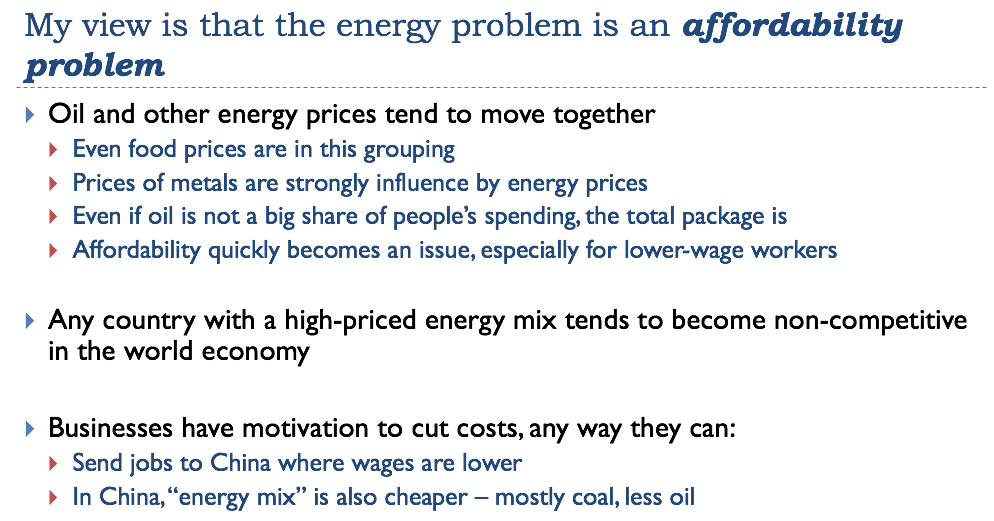
An economy operates best when energy costs are very low because goods and services made with this low-cost energy tend to be low-cost as well. Oil is used in producing and transporting food. Thus, low-cost oil tends to produce inexpensive food.
If energy costs begin to rise in a country, it tends to make that country less competitive in the world marketplace. It also tends to push the country toward recession, because the higher costs are difficult to recover from customers whose wages don’t rise to cover the higher costs.

Slide 32
Many people believe that the amount of fossil fuel that will ultimately be extracted depends on a combination of (a) the amount of resources in the ground, and (b) the technology developed for extraction. While these are indeed eventual limits, I think that a maximum affordable price limit comes much sooner. This depends on how high a debt bubble the economy can sustain. The role of debt will be discussed in Part 2.

Slide 33
One thing that is confusing is the familiar supply and demand curve for energy. Many people believe that “of course” prices must rise if energy is scarce. The catch is that energy consumption affects all parts of the economy. It takes energy to create jobs, just as it takes energy to produce goods and services. Because both supply and demand are affected by a shortage of energy, our intuition regarding how prices should move can be totally wrong.
The word “Demand” is confusing, also, because most energy use is difficult to see. Most energy use is not found in the gasoline we buy at the pump or the electricity we purchase. Instead, energy is used in creating the streets that we drive on, and in building the schools that our children attend. Building new homes and manufacturing cars also takes huge amounts of energy. If energy costs rise very much, the problem is that many people can no longer afford homes or cars. Instead, young people live in their parents’ basements indefinitely. Governments may decide to stop paving some roads, because repaving is too expensive to afford. Reduced demand for oil might be better described as reduced purchases of goods and services of all kinds, because certain groups of would-be buyers find prices too high to afford.
[To be continued in “The World’s Fragile Economic Condition – Part 2”]


“The chief executive of the partly taxpayer-owned Royal Bank of Scotland has said a no-deal Brexit could lead to recession. Ross McEwan, appointed CEO in October 2013, told the BBC any dip in growth would affect the bank’s profits and share price. UK Government Investments holds a 62.4% of RBS shares after the 2008 bailout and subsequent disposals.”
http://home.bt.com/news/uk-news/rbs-boss-warns-no-deal-brexit-could-lead-to-recession-11364299861909
“Tesco has warned that opportunities to stockpile food in order to prepare for a no-deal Brexit are “very, very limited”. Chief executive Dave Lewis said that ensuring supplies of food remain uninterrupted was the “single biggest challenge” facing supermarkets as the UK prepares to leave the EU.”
https://www.independent.co.uk/news/business/news/tesco-food-stockpiling-no-deal-brexit-a8566571.html
“New car sales crashed by 20 per cent last month, the worst performance for the British motor trade since the collapse of Lehman Brothers bank, the financial crisis and the dislocation of the world economy ten years ago. It means that car sales this year in the UK are now running much lower than expected…”
https://www.thetimes.co.uk/article/car-sales-run-into-trouble-with-20-slump-3s2vg2qtm
Car sales down in China and the US as well:
“Major auto makers, with the exception of Fiat Chrysler, posted lower U.S. sales last month behind the ongoing slump in the car market and softer retail demand, even amid elevated incentive levels, signaling an anticipated second-half slowdown continued in September.”
http://www.rubbernews.com/article/20181003/NEWS/181009978/auto-sales-fall-as-second-half-slowdown-takes-root
https://wolfstreet.com/2018/10/02/september-auto-sales-carmageddon-ford-gm/
https://wolfstreet.com/wp-content/uploads/2018/10/US-auto-sales-2018-09.png
I suspect a lot of those Tesla sales were booked because they rolled them out of the tent … onto a parking lot… they are not actually sold
It means that car sales this year in the UK are now running much lower than expected, a mixture of tepid consumer confidence over the uncertainty of Britain’s secession from the European Union, made worse by the continuing confusion about the future of diesel engine cars.
Oh? And I thought it was because people are broke….
The UK is hanging from a very thin thread….
https://surplusenergyeconomics.wordpress.com/2018/07/20/131-not-about-brexit/
All the gangsta rappa ‘people of colour’ have nice shiny new cars in London, from my observations – maybe they are the hope of the UK economy…… Teresa may, after all, assures us that ‘the best is yet t come’ for Britain. 🙂
Car sales worldwide are worrying. If interest rates are rising, one of the first tings to be cut back on are car sales. This quickly feeds back to job opportunities.
“Could” lead to recession? It’s a certainty.
http://livedoor.blogimg.jp/laba_q/imgs/8/b/8bef9828.jpg
I am thinking… Fentanyl for anyone in one of those scooters…
Or better still…. employ them as moving targets at rifle ranges…. perhaps dress them up with reindeer horns to make it more real?
This is a win win for everyone involved.
Seriously – anyone riding around in one of those is a very sad git … and better off dead… a 308 round through the temple… humane…. totally humane….
Those scooters have enabled more Americans to get even fatter as the scooter becomes their crutch. The only time I would have no problem with someone getting around in a scooter is if it was a thin person who physically had little use in his/her legs.
https://youtu.be/uq7lW2c6XYc
https://nataliaantonova.files.wordpress.com/2013/12/cannot-handle-the-hysterical-laughter.gif
https://upload.wikimedia.org/wikipedia/commons/e/e0/Fentanyl_lollipops_Actiq_400_mcg.jpg
Probably wearing ‘lets do it’ shoes, and ‘lets eat it’ stretch denim
here another delusional guy
Is the world getting better or worse | Steven Pinker
https://youtu.be/yCm9Ng0bbEQ
Was 2017 really the “worst year ever,” as some would have us believe? In his analysis of recent data on homicide, war, poverty, pollution and more, psychologist Steven Pinker finds that we’re doing better now in every one of them when compared with 30 years ago. But progress isn’t inevitable, and it doesn’t mean everything gets better for everyone all the time, Pinker says. Instead, progress is problem-solving, and we should look at things like climate change and nuclear war as problems to be solved, not apocalypses in waiting. “We will never have a perfect world, and it would be dangerous to seek one,” he says. “But there’s no limit to the betterments we can attain if we continue to apply knowledge to enhance human flourishing.”
here some reality of the world
Nearly 1/2 of the world’s population — more than 3 billion people — live on less than $2.50 a day. More than 1.3 billion live in extreme poverty — less than $1.25 a day.
-1 billion children worldwide are living in poverty. According to UNICEF, 22,000 children die each day due to poverty.
-805 million people worldwide do not have enough food to eat. Food banks are especially important in providing food for people that can’t afford it themselves. Run a food drive outside your local grocery store so people in your community have enough to eat. Sign up for Supermarket Stakeout.
-More than 750 million people lack adequate access to clean drinking water. Diarrhea caused by inadequate drinking water, sanitation, and hand hygiene kills an estimated 842,000 people every year globally, or approximately 2,300 people per day.
-In 2011, 165 million children under the age 5 were stunted (reduced rate of growth and development) due to chronic malnutrition.
Well, TWP, until their parents learn that their is more to life than sex, and practice contraception that doesn’t need the pill or condoms, that’s their Fate. Hard luck.
And, until their own damn ‘elites’ actually feel that they have a responsibility towards their fellow human beings……
If the growth of the world population is stalling, maybe we could have somewhat better world despite the ageing populations, see Japan.
We do not need to build the new infrastructure for the additional numbers of the pepole, just to maintain the current state and shrink from the bigger into smaller world.
As long as the system is operating, we can have a better world for a while before collapse. Not everywhere on the Earth, but, surely, there are places where this is possible.
I am not sure that shrinking is possible.
We end up with way too large of a dependent population, and that population thinks that it needs a huge amount of health care and its own living quarters (separate home, assisted living or nursing home). This becomes far too costly for the rest of the population to handle. The younger generation has the same view, because otherwise the older generation becomes a burden on the younger generation.
In order to be able to shrink back, it seems like we need a population that is sufficiently healthy to work, up until the time they die. If this is the case, children may be willing to take parents/grandparents in, to help with child care and other chores. The foods in the Standard American Diet are disabling, as well as leading to an earlier death. This is at least part of the US problem.
Also, an urban landscape in the US (and elsewhere) which discourages, or makes impossible, the use of one’s own limbs to move around.
In the UK, the fattest people are the working class who never go anywhere except in their cars, even to the local school 5 mins walk away. I see it every day.
Fat mum, fat dad, and horrible fat kids – health disasters. And they deserve it.
Producing the kids makes one think of ‘Clash of the Titans’. Ghastly thought…… 🙂
It’s the fat kids who horrify me – no sport, no running around even, reaching adolescence and realizing you’re only laughed at by the good looking. A form of child abuse.
Under “shrinking” I understand leaving behind what can not be used anymore/upgraded and stick to the things that can serve longer for a while, e.g. leave big houses and move into smaller ones, or occupy just a part of the house, where the inhabited part is well insulated from inside etc. and thus improve the ergonomy of the everyday life, so that you do not need to care and maintain things that you do not have energy for.
We can shrink in a certain way. My opinion is that Jesus healed in that way: as the humans are energy dependent beings, bringing the human being in line with his/her energy level (i.e. when you are older or weaker due to an ilness, you have less energy), can save you life. You just have to give up various unnecessary things. Live on smaller scale. You do not have to travel much anymore, you do not have to be so much socially active, as all this requires a lot of energy.
Not “shrink back”, but “shrink” into a new smaller scale.
We also need to shrink what we are eating to more plant foods, with less processing, and less animal foods, and less processed foods of all kinds. What we eat needs to match our energy consumption. If we are fairly fit, our pulse rate will probably drop to under 60.
I am not sure that socially active is an issue. Socially active needs to be with a small clan, within short walking distance.
I once was rejected for a blood donation when my measured pulse rate was 30. That was in my younger, very fit days! I got a full heart checkup after that and was pronounced, very healthy. I do believe that people can stay active and healthy. Sweating is very good for you. It helps to rid the body of toxins. Work is good for you, even in older age. Those who try to avoid work and sweating….are those who typically die younger.
Socially active is often an issue, when your family or relatives still believe in the growth, but you simply do not have energy even socialize with such people. Their way of life looks to you very exhausting, as you need to spare the energy for basic tasks ensuring survival.
This is also often the reason for divorces: you simply do not have energy for realizing the project of marriage and family in the way you agreed with the person you married.
In the UK, new infrastructure is needed to deal with the mass of immigrants and the higher birth-rate among people of foreign origin – madness.
ABC news (Australia)
http://www.abc.net.au/news/2018-10-04/world-vulnerable-to-another-financial-meltdown-warns-imf/10337490?section=business
So, the IMF joins the Bank of International Settlements and, er, Gordon Brown in sounding the alarm. Global trade and manufacturing are slowing and I noticed that global equity issuance is down:
“The total number of global equity issuances fell sharply from 1,344 in Q2 2018 and 1,288 in Q3 2017 to just 1,129 in Q3 2018.”
https://www.forbes.com/sites/greatspeculations/2018/10/03/slump-in-global-equity-underwriting-volumes-over-q3-will-hurt-results-for-investment-banks/#2d42adaa52dd
President Putin’s Q&A at the Russian Energy Week International Forum
The forum is taking place in Moscow on October 3–6. Its main theme is Sustainable Energy for the Changing World.
The forum will be attended by representatives of the largest international companies and organisations, and leading experts. About 60 business events will be held within the framework of the official programme.
* * *
Speech at the plenary session
President of Russia Vladimir Putin: Friends, ladies and gentlemen, colleagues.
I am very happy to welcome the participants and guests of the Russian Energy Week. This time, we have a record number of participating experts, people interested in power engineering – nearly 10,000, or more precisely 9,500 participants. You came here to hold an open and trust based discussion on the issues of the global energy agenda.
Russia is one of the most powerful players on the global energy market. We are among the leaders in oil and gas production and export, as well as in terms of power generation and coal mining. It is highly important for us to keep track of global energy trends in order to use our competitive advantages efficiently and, together with other countries, create a common energy space and a common energy future.
We believe that progress in global energy, as well as the stable energy security of our entire planet, can only be achieved through global partnership, working in accordance with general rules that are the same for everyone, and, of course, through conducting transparent and constructive dialogue among market players which is not politically motivated but is based on pragmatic considerations and an understanding of shared responsibilities and mutual interests.
The balance of supply and demand in the oil market reached owing to the agreement with OPEC reaffirms the correctness of this approach.
Russia will continue promoting dialogue of oil-producing countries to ensure the stability of the oil market and create conditions for the sustainable development of the sector and implementation of long-term investment plans. Indicatively, the demand for oil will be growing in the foreseeable future, primarily in the Asia-Pacific region. It is also growing in Europe and of course, in America.
I think Russia’s responsible partnership approach stands out and is understandable to everyone. Russia is implementing it in the gas market as well, providing an example of reliability and predictability. Our advantage is not limited to the tremendous deposits of natural gas. We also have delivery systems and the pipeline infrastructure, which together with low cost ensures the stable positions of pipeline gas in the market.
At the same time, as we know, trade in liquefied natural gas (LNG) is also increasing. In the past decade its consumption almost doubled.
Russia is an active participant in the LNG market. We are putting into operation new producing and processing capacities, carrying our strategic plans for the development of transport infrastructure, including the Northern Sea Route, and building an ice-breaker fleet that will allow us to organise year-round transit of ships, including gas carriers, in the Russian Arctic.
One more major area of the world’s energy sector is the coal industry, which has been demonstrating positive dynamics again. Just a decade ago few people believed in the prospects of this energy carrier but now we are seeing a steady growth in the demand for coal, first and foremost in the Asia-Pacific region. It is very important for Russia to consolidate and enhance its presence on this dynamic market.
We have already made a number of strategic decisions in this area. We are expanding the capacity of the Baikal system and the Trans-Siberian Railway, building up seaport infrastructure and working to make coal mining more effective and safe. And, of course we will pay special attention to eco-friendly technology of its transportation and consumption, including in electricity generation and other areas.
We will continue upgrading heat generation in Russia on a large scale and introduce digital solutions in the national power grid. We see these measures as a response to global challenges that are facing the electricity generation industry as a whole.
Accelerated demand for electricity in the world is forecasted for the next 20 years. Experts believe its consumption will double by 2040 while the demand for primary energy – oil, coal, gas and other sources – will grow by about 30 percent. Such trends are opening up opportunities for increasing both the exports of electricity and its production technology.
We have one more priority: to preserve the lead in such high-tech sector as the nuclear power industry. Today, Russia is actively building 25 energy units at nuclear power plants in 12 countries. In all we have 36 such energy units in our portfolio. We will be consistently working to increase the number of export orders in the nuclear power industry, complying with the highest requirements of environmental and industrial security
A separate ambitious task for the future is the development of renewable energy sources, especially in remote, difficult-to-access areas of this country, such as Eastern Siberia, and the Far East. This is opening a great opportunity for our vast country, the world’s largest country with its diverse natural and climatic conditions.
Friends, in conclusion I would like to tell you the following: sustainable and steady development of the energy industry is a key condition for dynamic growth of the world economy, enhancing living standards and improving the wellbeing of all people on our planet.
Russia is open to cooperation in the energy industry in the interests of global energy security and for the benefit of the future generations. And we certainly rely on active dialogue on these subjects and cooperation.
Thank you for your attention.
To be continued.
Interesting!
I didn’t realize
Russia seems to be ahead of everyone else in the Nuclear field right now (or is China doing some too?). Japan and France are falling behind.
Japan wanted to pilot smaller unattended reactors in USA at one point. I’m not sure what came of it, although I did not bing it.
I read somewhere and forget where that China plans to build several hundred small nuclear power plants.
Yes, for heating northern cities in China.
I looked up what the World Nuclear Association has to say. http://www.world-nuclear.org/information-library/current-and-future-generation/plans-for-new-reactors-worldwide.aspx
I count 50 nuclear power plants under construction. Of these, 15 are in China; 7 are in India; 4 are in Korea; 4 are in Russia; 2 each in Japan, Bangladesh, Belarus, Pakistan, and Slovakia. There are quite a few countries with one reactor under construction including Finland, France, Argentina, USA, and Turkey.
It is not easy to see which countries are building these reactors, but it would seem like China is behind quite a few.
OIL (BRENT) PRICE COMMODITY
85.89 USD +1.25 (1.48%)
great news…
oil producers will be gearing up to provide us with more energy resources…
we need FF not “alternatives”…
Hint: It is not going up because of surplus energy.
We will see if this happens at +100.
Time will tell– but resources always trumps.
yes, actual real physical resources eventually trump arbitrary human financial constructs such as “price”…
Yep–
We will be in new territory with oil for the first time.
Gail may be right on price.
We shall see.
People start fighting over what is available.
Balancing price between supply and demand is not an artificial human construct. It is created by the laws of physics.
Highest the price has been for a while!
Kate Raworth has got a lot of attention with her book Doughnut Economics: Seven Ways to Think Like a 21st-Century Economist
https://www.amazon.com/Doughnut-Economics-Seven-21st-Century-Economist/dp/1603586741
She has even made an animation of her way of thinking https://www.kateraworth.com/animations/
I like her doughnut model but switch off when I hear terms like ‘zero carbon transport systems’.
“Getting back within planetary boundaries calls for reducing total resource consumption, and redistributing it away from the richest,” she says.
Good luck with that!
Overcoming the laws of physics!
If you think the economy is a ‘doughnut,’ then discarding the laws of physics is just so easy. ….. 🙂
It’s october 3rd!!! Whew. That was a close call. Well, I’m off to buy my turkey!
um, uh…
October 29 is a Monday…
https://www.youtube.com/watch?v=zMJdxX6Lw9Q
‘South Australia’s giant Tesla battery confounds critics’
People said it was a waste of money, but as you will see in the video the huge Tesla battery packs perfectly adjusts as needed for energy demand vs. conventional grid electronics which erratically adjusts. See the graph shown part way through the YouTube video to see the comparison. This is a huge success and a big way towards defeating the objection of renewables intermittency.
Excellent, now we only need to make renewables+battery packs cheaper than coal.
And extension cords long enough to run my machines way out in the sticks; maybe overhead wires like trolley buses?
I suppose the question is, “How long does the battery really last, if it is being used this extensively?” Also, how many batteries would we need, just to handle the huge variations that are taking place? How much coal and other backup, is needed for longer-term intermittency than the fast changes that the battery is good for. Part of the longer-term intermittency is the summer-winter intermittency. Also, the need for higher generation in the evening than is generally available from wind and solar.
CEO Matt Howell tells Ray Hadley the price hike would be like a motorist … go down the same track as South Australia and buy a giant Tesla battery. “The largest battery in the world… would power this smelter for all of eight minutes.
https://www.2gb.com/energy-grid-at-crisis-point-as-power-prices-surge-160-times-the-usual-rate/
Yes – it is awesome – how much did it cost?
And it would provide power to a single aluminum smelter for …. drum roll please…….
https://luccav.files.wordpress.com/2015/05/drum-roll.jpg
…. 8 minutes… 8 MINUTES!!!! 8 minutes…..
http://ipicturee.com/wp-content/uploads/2013/12/luis-suarez-wallpaper-001.jpg
Now please F789 off…. I do not come to FW to read MSM spin….
Before you go…. could you wipe the dog sh it off my shoe…. and I could use another coffee… a touch of cream… two sugar… zap it for 30 seconds in the microwave … these coffee machines never heat the water enough…..
A good day would be one where I wake up … open ZH… and see that Elon Musk has overdosed … and his carcass is festering in a morgue…. and the Tesla share price went to 0.
What about bitcon?
30 yr note up bigly today. Not good!
3.20%
I would guess that it is time for TPTB to do their whack-a-mole and knock this rate down…
unless “they” have lost control…
but “we” know they haven’t…
because it’s October the 3rd…
When I look at Daily Treasury Yield Curve Rates from treasury.gov, I find at the end of 10/03/2018
10 year = 3.15%
20 year = 3.24%
30 year = 3.30%
These are all the highest that they have been recently.
The WSJ shows a 10 year yield of 3.186%. This, too, is very high.
I see a post about the spike in long term interest rates on the Economic Collapse Blog.
http://theeconomiccollapseblog.com/archives/we-just-witnessed-the-biggest-u-s-bond-crash-in-nearly-2-years-what-does-this-mean-for-the-stock-market
We Just Witnessed The Biggest U.S. Bond Crash In Nearly 2 Years – What Does This Mean For The Stock Market?
Kanzi the bonobo lives in America and has learnt how to build a fire, light it using matches and toast marshmallows on it. It shows just how like us some primates really are.
https://youtu.be/GQcN7lHSD5Y
with this video show that chimpanzee are really our closet cousin
https://www.zerohedge.com/news/2018-10-02/uk-university-bans-clapping-performances-avoid-triggering-people-anxiety
At times I felt that humans really need to go the way of the dodo…
then next Species will take place of us
https://youtu.be/EMbWDRzqNhc
so story remains the same
I think this approach is cheating!
I can hardly wait for the sequel “Ape Makes a Frying Pan” to come out.
LOL!
Next step in evolution- put fire out by peeing on it.
It can feel quite suffocating this era – the endless initiatives and directives that superficially appear to be rooted in virtues like empathy and kindness but in fact more often stem from a desire to control and to feel morally superior.
Suffocating is a perfect description.
There can be no debate, the facts are Elon is great, Obama is a Saint, brexiteers are idiots and Trump has caused all our problems.
Everyone seems to be looking to be offended, and slogans are truth.
Time to go sailing!
Quite.
You clearly yearn for the day when clan McGibbs can- with woad-painted bodies – leap into their (home-made, eco-friendly) war coracles, clashing spears against their shields, yelling their terrifying war cry.
To hell with empathy! To the strong -life! To the weak – death (or slavery if they are particularly pretty, with good child-bearing hips)!
Isn’t modern life dreadfully dull?
*Dreadfully* dull. How sweet it would be to unleash a hoard of medieval Scottish warriors on the sanctimonious, self-important, do-gooding think tanks of today. 😀
Ah, well – there is some consolation to be found in the creature comforts of 2018, at least.
Mel Gibson’s political views are best ignored
Mel is spot on with one of his political comments…. about the hooked nose people
Give them all a ‘Lochaber smile’.
Very nasty thing from Scots history.
Are you going native, Mr Gibbs?
Inhale that peat smoke, deeply now…… 🙂
http://3.bp.blogspot.com/-74_T6xgsc5s/VaBkTayT3BI/AAAAAAAAFKM/z4RakjdzS_g/s1600/This%2Bis%2Bnot%2BSparta%2B4.jpg
Good grief!
Reap and sow….
I have been observing parents of late…. little Bobby refuses to listen … and mommy says… little Bobby don’t do that… of course Bobby continues to act out… then mommy says if you do that again you are going to get in trouble… Bobby looks at her and knows the drill… he’s got about 10 more shots at it before there are any consequences… and the consequences are like white noise to Bobby by now and involve mommy screaming STOP that Bobby!!!
And this is what you end up with … a world full of f789ing idi ots…
Dogs and children…. are not that different. They are easily controlled. The thing is… there need to be consequences… immediate – consistent … consequences
Ha I watched exactly the same events yesterday in a cafe; by the end the little shi.ite was yelling orders to his parents/caregivers/what-evers. It is school holiday time over here and I just know the older ‘children’ in this scene were school teachers. Sad times.
Heaven forbid little Bobby should need to encounter a little sternness…. it might scar him for life….
This is where Koombaya leads us….
Yep: slap a biting puppy on the nose hard enough when very young, for a clear reason it can understand, and it grows up into a very good dog.
Don’t do it at the right time, and in the right way, and it grows up into a dog that needs to be put down.
The fault? The owners.
This is why Fentanyl should be sold in family-sized jars….
Actually … re-thinking my thoughts on tax….. in addition to providing funding to those without the means to educate themselves…(one shot only….) I am ok with subsidizing Fentanyl (family sized jars)…
I would suggest a new and improved retail brand name : Cull
What I don’t understand … is why someone … does not pick up and AK47…. and spray the audience… surely this sort of nonsense must push stressed out people over the edge????
What better statement can you make that with a few clips of ammo… and a quick trigger finger????
I demand to be entertained. Properly entertained.
but then you wouldn’t be entertaining us
A Peak Prosperity groupie posted this YouTube link asking if Chris Martenson has ever heard of this before. First off do these people even connect the dots before they board the Hopium Train? How are you going to achieve the following with a collapsed global economic system, probably a lot less humans and a lack of cheap fossil fuel energy to make the transition work?
————————————————————————————————————————————
The Third Industrial Revolution: A Radical New Sharing Economy
https://www.youtube.com/watch?v=QX3M8Ka9vUA
“VICE
Published on Feb 13, 2018
SUBSCRIBE 9.8M
The global economy is in crisis. The exponential exhaustion of natural resources, declining productivity, slow growth, rising unemployment, and steep inequality, forces us to rethink our economic models. Where do we go from here? In this feature-length documentary, social and economic theorist Jeremy Rifkin lays out a road map to usher in a new economic system.
A Third Industrial Revolution is unfolding with the convergence of three pivotal technologies: an ultra-fast 5G communication internet, a renewable energy internet, and a driverless mobility internet, all connected to the Internet of Things embedded across society and the environment.
This 21st century smart digital infrastructure is giving rise to a radical new sharing economy that is transforming the way we manage, power and move economic life. But with climate change now ravaging the planet, it needs to happen fast. Change of this magnitude requires political will and a profound ideological shift.”
Too many things in this story go wrong. Too much capital required; too low return on capital. Capital cannot really replace everything; in fact, it creates greater wage disparity. Humans think we can fix all problems but, in fact, we cannot. We create new myths that are completely false. Part of the myth is that humans are in charge. We are not.
‘…… social and economic theorist Jeremy Rifkin ….’
Say no more.
Rifkin has been an unpaid advisor to the European Union since 2000. He has advised the current president and the past two presidents of the European Commission and their leadership teams. Rifkin has also served as an unpaid advisor to the leadership of the European Parliament and prominent European heads of state – including Chancellor Angela Merkel of Germany – on issues related to the economy, climate change, and energy security.
Rifkin is the principal architect of the Third Industrial Revolution long-term economic sustainability plan to address the triple challenge of the global economic crisis, energy security, and climate change.[1] The Third Industrial Revolution was formally endorsed by the European Parliament in 2007 and is now being implemented by various agencies within the European Commission.[2]
Rifkin has been advising the leadership of the People’s Republic of China in recent years. The Huffington Post reported from Beijing in October 2015 that “Chinese Premier Li Keqiang has not only read Jeremy Rifkin’s book, The Third Industrial Revolution, but taken it to heart”, he and his colleagues having incorporated ideas from this book into the core of the country’s thirteenth Five-Year Plan.[3] According to EurActiv, “Jeremy Rifkin is an American economist and author whose best-selling Third Industrial Revolution arguably provided the blueprint for Germany’s transition to a low-carbon economy, and China’s strategic acceptance of climate policy.”[4
https://en.m.wikipedia.org/wiki/Jeremy_Rifkin
It is too bad that Rifkin has the story pretty much wrong. Of course, if he had the story right, no one would have given him those lofty posts.
Spot on Gail!
Rifkin tells the Emperor that his clothes are nice, but not quite right, but that the other invisible suit would be even better – happy Emperor.
Rifkin is probably behind the EU’s ‘Project Stardust’. ‘Smart’ cities, wind turbines, etc.
What a joke.
Equivalent of alchemists advising bankrupt medieval kings…..
I like your analogy, “Equivalent of alchemists advising bankrupt medieval kings…..”
Too many people are certain that we know everything.
I know people who actually believe that after the die-off… a utopian society will emerge of the chosen ones (not sure how you get on that list…) complete with iphones, renewable energy and organic only food.
In a way… I want the end to come…. just so I can imagine the shock, fear and disbelief they are experiencing when the power goes off… and the nightmare kicks in….
I cannot think of anything more amusing…
Then again … I have always experienced a little bit of joy when I have read of elites being humiliated when they were beaten in wars…. what joy to see an emperor treated like a dog….
greetings finite worlders it looks like a plan B is not on the cards and predictions of when the collapse will happen are impossible to predict
Limits to growth had 12 models. One of those models, the “standard run” or, alternatively, the “business as usual” model was the one that 40 years of historical data tracked/followed. And according to that model the global economy will collapse by 2030.
https://www.scientificamerican.com/article/apocalypse-soon-has-civilization-passed-the-environmental-point-of-no-return/
https://www.scribd.com/document/379418787/Is-Global-Collapse-Imminent-An-Updated-Comparison-of-The-Limits-to-Growth-with-Historical-Data-Turner-2014
https://www.smithsonianmag.com/science-nature/looking-back-on-the-limits-of-growth-125269840/
https://imgur.com/a/ZUUkN4c
The authors of limits to growth do not claim that the charts are correct, after limits start to hit. They are only what the incomplete model calculates (without a financial system or debt). A collapsing world economy could make the right half of the chart (starting well before 2030) quite different from what is shown.
They forgot to mention
https://coto2.files.wordpress.com/2011/03/3-spent-fuel-rods-in-pool1.jpg
As a global trade hub, Singapore has a reputation as ‘canary in the coalmine’:
“The private sector in Singapore slipped into contraction in September, the latest survey from Nikkei revealed on Wednesday with a PMI score of 49.6. That’s down from 51.1 in August, and it falls beneath the boom-or-bust line of 50 that separates expansion from contraction. Individually, there were sharp declines in both output and new orders – while export sales also tumbled further.”
https://markets.businessinsider.com/news/interestrates/singapore-business-pmi-falls-into-contraction-nikkei-1027585256
And an interesting insight into how bewilderingly complex and interconnected the financial system is now:
“South Korean money market funds (MMFs) have suffered huge capital outflow due to growing worries over a financial crisis in Turkey, data showed Wednesday. The MMFs had a combined 91.27 trillion won (US$81.5 billion) under their management as of Friday, the lowest since January 5, 2015, according to the data from the Korea Financial Investment Association.”
http://english.yonhapnews.co.kr/news/2018/10/03/0200000000AEN20181003001400320.html
I wonder if they really know what is the cause of what. The article goes on to speculate:
singapore has no indigenous energy resources
so must keep pedalling faster & faster than everyone else just to keep going
Makes on think of a large island just off France……
be fair
they do have some indigenous energy
just not enough
Singaporeans have none at all
Worrisome!
Life getting very expensive for a number of countries now:
“Economists predicted inflation in Argentina would reach 44.8 percent by the end of 2018, compared to an expected 40.3 percent estimated last month, a central bank poll showed on Tuesday.
“Economists also expect Argentina’s gross domestic product to contract 2.5 percent by the end of 2018 compared with a previous estimate of a contraction of 1.9 percent last month, the monthly poll said.”
https://www.nasdaq.com/article/argentina-central-bank-sees-higher-yearend-inflation-as-economy-contracts-20181002-01271
“Risks to Zambia’s inflation have heightened as the copper producer effects a long overdue fuel price hike effective midnight of 02 October… The kwacha has lost 22% in value year to date as dollar demand soared in light of negative sentiment and a strong dollar environment. The rise in pump prices is expected to cause a spiral cost push effect that will push inflation higher.”
https://zambiabusinesstimes.com/2018/10/02/zambias-risks-to-inflation-heighten-as-fuel-prices-are-hiked/
“The International Monetary Fund (IMF) has called for further monetary tightening by Tunisia to tackle the North African country’s record levels of inflation. Tunisia’s inflation rate stabilized at 7.5 percent in August, unchanged from July, after hitting 7.8 percent in June.”
https://uk.reuters.com/article/us-tunisia-economy-imf/imf-calls-for-further-tunisian-interest-rate-rise-to-curb-inflation-idUKKCN1MC1AW
“Turkey’s rate of inflation surged to nearly 25 per cent last month as the crisis engulfing the country’s currency hit consumers with huge increases in prices… Turkey’s lira has lost 40 per cent of its value so far this year amid the dispute, and now shoppers are feeling the effect, according to data from the Turkish Statistical Institute.”
http://www.cityam.com/264442/turkey-inflation-rate-hits-25-per-cent-lira-takes-another
“An increase of 44.4% was registered in the Producer Price Index in the Iranian month of Shahrivar (Aug. 23-Sept. 22) compared with the similar month of last year, the latest report of the Central Bank of Iran announced. The PPI (using Iranian year to March 2017 as the base year for the first time) stood at 157.8 in Shahrivar, indicating a 9.4% rise compared with the previous month.”
https://financialtribune.com/articles/economy-domestic-economy/94187/central-bank-of-iran-puts-producer-inflation-at-444-sep-2018
“Philippine annual inflation rate likely continued to climb in September, keeping the pressure on the central bank to raise interest rates further to prevent consumer prices from spiralling out of control. The consumer price index in September was seen to have risen by 6.8 per cent, a Reuters poll of 12 economists showed, faster than the 6.4 per cent increase reported in August, due to rising global oil prices…”
https://www.businesstimes.com.sg/government-economy/philippine-inflation-seen-moving-closer-to-7-in-september-poll
Iran has big problems with an inflation rate this high!
People in these countries are living with very little muscle on the bone…. so inflation at these levels slashes into what little flesh and fat there is…. existence gets grimmer by the day…
When do we get our next immolation?
We don’t have the same problem in the west… these two could endure a fair bit more inflation before they would be able to walk again….
http://livedoor.blogimg.jp/laba_q/imgs/8/b/8bef9828.jpg
I think you could survive a few months only on the left calf.
Savings disappear. I expect that some monthly payments don’t keep up, pension payments especially, but perhaps wages as well.
And the way the IMF structures their loans you can bet that Argentina will come back for more bailouts and those future bailouts will just be enough to pay payback the interest much like Greece. And when Argentina can’t make those payments the IMF will go in and selloff their assets.
There’s a word for this predatory lending…… Oh I know “Loanshark” !
“The Italian deputy prime minister, Matteo Salvini, has threatened to sue Jean-Claude Juncker for damages, accusing the EU president of pushing up Rome’s cost of borrowing by likening Italy to Greece.
“Salvini, who is also Italy’s interior minister and leader of the far-right League party, was speaking after Juncker’s comments helped send the yield on Italian benchmark bonds to a four-and-a-half year high of 3.4%, while shares in Italian banks plunged.
“He said the rising cost of financing Italy’s debts was the fault of EU officials who had spooked investors and increased the gap, also known as spread, between Italian and German borrowing costs.””
https://www.theguardian.com/business/2018/oct/02/italian-deputy-pm-threatens-to-sue-eu-boss-over-budget-criticism
“Leaders of the medieval enclave of San Marino are preparing to ask the International Monetary Fund for a €250m (£222m) loan to bolster its banks, still weighed down by bad debts 10 years after the global financial crisis.
“The microstate, which is landlocked within central Italy, has struggled to recover from the effects of the 2008 crisis…”
https://www.theguardian.com/business/2018/oct/03/san-marino-plans-ask-imf-bailout-banks
“The money laundering scandal engulfing Danske Bank A/S has Denmark’s political establishment on edge.
“After living through the crisis of 2008, and the populist wave that followed, some of Denmark’s most prominent political figures say it’s now imperative that voters aren’t left with the same sense of indignation that they felt roughly a decade ago.”
https://www.businesstimes.com.sg/banking-finance/danskes-crisis-and-the-populist-fallout-the-bank-risks-igniting
“Credit ratings agency Moody’s has warned that Europe remains highly vulnerable to a fresh economic downturn despite all its work to fight off crises over the past few years. The report comes as tax and spending plans by Italy’s new government present the latest potential threat to the region’s markets. Moody’s said that Europe “is not ready to cope with another major slump stressing the financial system”.”
https://news.sky.com/story/europe-not-ready-to-cope-with-another-crisis-says-moodys-11515191
https://paullegard.files.wordpress.com/2014/01/cartoon-plugging-holes.jpg
http://resources1.news.com.au/images/2013/06/28/1226671/596197-130629-lobbecke.jpg
A borrowing cost of 3.4% is still very low, all in all, considering Italy’s many banking problems.
Uh-oh….
Hong Kong’s private home prices marked their first decline in 29 months only days after Hong Kong banks announced hikes in raising their benchmark lending rates for the first time in more than a decade. The city’s notoriously high home prices are expected to soften further as the Chinese yuan faces the risk of further depreciation amid an escalating Sino-US trade war.
Property price indices published by Hong Kong’s Rating and Valuation Department for August 2018 indicated that the prices of used homes dropped by 0.076 percent to 393.9 last month, from 394.2 a month earlier. Homes smaller than 430 square feet (40 square metres) on Hong Kong Island fell most steeply – dropping 2.5 percent to HK$17,232 (US$2,201) per square foot from HK$17,671 per square foot on average.
While the declines were slight, they signaled the end of a 29-month property bull run which has endured since March 2016, in what UBS Global Wealth Management in a recent report called “the world’s most overvalued housing market.”
https://www.mingtiandi.com/real-estate/china-real-estate-research-policy/hong-kong-home-prices-fall-for-the-first-time-in-29-months/
good grief, 430 square feet fetches almost $1,000,000 USD! overvalued is an understatement.
Wow! Not likely to be an area where many would-be families buy homes. I would expect the number of children being born (excluding cross-border babies of non-residents) to be very low.
‘…….they signaled the end of a 29-month property bull run which has endured since March 2016…..’
What happens after the running of the Bulls is the capturing of the fools.
Like the running of the bull’s in our home town, Pamplona.
Watching fools getting gored for playing with irritable beasts is always a good lesson in life’s realities.
A cunning stratagem, Xabier!
“Spain’s Basque region is seizing on Brexit as it tries to persuade highly skilled workers to move back home from Britain and redress a brain drain caused by a 2008-2014 economic slump.
The Basque autonomous region, a manufacturing heartland, said it wanted to attract some of the more than 125,000 Spanish-born professionals resident in Britain with perks such as income tax breaks and the chance to work with other professionals and academics in related fields.”
http://infosurhoy.com/cocoon/saii/xhtml/en_GB/news-summary/spains-basque-region-woos-professional-exiles-as/
Salaries are mostly awful, so the tax breaks would need to be substantial. Basques in exile don’t mind the gloomy London weather as much as Andalusians.
Would The U.S. Be Able To Endure Another Financial Crisis? Former FDIC Head Says Maybe Not
http://www.wbur.org/onpoint/2018/10/01/2008-financial-crisis-fdic-sheila-bair
https://www.godlikeproductions.com/sm/52d222e9.gif
Bernie didn’t have to do him like that though
https://i.redd.it/kg1z8jrirtp11.png
bernie sanders remind me of guy from russia
in previous century
https://youtu.be/WsmMFWaVqoA
It now appears that the more cynical take was indeed correct, because just one day later, Amazon announced that it would cut stock and bonus awards to pay for the raises.
https://www.zerohedge.com/news/2018-10-03/amazon-ends-stock-bonus-awards-pay-raises
lol
I really … really … really …. cannot stand liberals….
My latest encounter involved a liberal who thinks paying 35%+ tax is fine…. rather than the flat 15% paid in Hong Kong.
Little do they realize that most of that tax money ends up getting wasted … and that the reason why most people are poor in western countries is because they are lazy and/or stuuupid f789ing idi ots.
M Fast is constantly amazed — as an Asian born person – by the lack of initiative displayed by the downtrodden in NZ…
Recently the tail of a hurricane hit the Nelson area — the govt – in its infinite wisdom decided to help the ‘downtrodden’ and paid welfare bums to work in clean up crews ….they got their welfare + minimum wage on top….
I guess ‘work’ is a relative concept… because what we observed were – as expected — able bodied people who really should not be on welfare to begin with (NZ has a shortage of agricultural workers… so there are jobs)….. standing around smoking and doing as little as possible ….
This is all enabled and fueled by my 35% tax rate….
And look at this – 350k for the head of the Queenstown Council — this is a f789ing town of 30,000 permanent residents!!!! Oh … the pressure of the job!!!! https://www.odt.co.nz/regions/queenstown/pay-rise-36-council-chief-executive
Enabled by the 35% tax rate … and my crazy rate payments….
I am all for supporting people with educational opportunities…. but throwing money at the poor — just breeds more of the same….
And given nett energy is dwindling …. I would like to recommend the following: if you are on welfare you get one shot at improving yourself…. you get a loan/grant to educate yourself … learn a trade … get a degree… whatever…. if you blow it …. Fentanyl for you…. no second chances.
Did I mention I had drinks with a buddy who has a dozen+ yrs with the hooked nose people…. MD level… comes from a very poor family in the UK… mother raised 5 or 6 kids…(similar to my story) he recognizes the resource depletion problem…. and was suggesting we have to clear the lower decks of the Titanic … get some of the weaklings off… dead wood…. so that we can keep the ship afloat awhile longer… (you wonder if this is an idea coming down from the hooked nose people themselves…)
Absolutely…. Fentanyl is the way to go…. clear the vermin out of the lower decks asap… I want another month… another year…. oh WTF… if it buys me another hour…. I support this
And before I go … I am hoping Michael Moore has a massive stroke … preferably by the weekend.
Is it ok to say that?
I think it is….. I know it is…..
https://pics.me.me/i-hate-conservatives-but-i-really-f-cking-hate-liberals-matt-7023547.png
35%? Do you live in a tax haven?
NZ.
https://www.facebook.com/NATIONALVIDEOTHEWORLD/videos/338739253563056/
I’m guessing there are no tunnels coming up.
Impressive and very colourfull.
Land of the Gypsies.
well land of the gypsies have some beautiful lands
https://youtu.be/FY8LO8Dus64
plus Gypsies made nuclear power and
have decent space program
Too cold to be over run with people?
yeah and big wild bears who
chew your body for fun
didnt goldilocks have that problem?
This looks like India. Way too many people for the transportation system.
its bangadesh
From far enough away Bangladesh looks exactly like India.
According to the World Bank, the per capita income of Bangladesh is $ 1,516.50 in 2017. The corresponding number for India is $1,939.60.
Bangladesh’s population is only 12% as large as that of India, which is part of the reason we don’t know the country as well. Bangladesh’s energy consumption is .20 ton of oil equivalent per person per year (based on BP data for 2017), while India’s is .56 ton of oil equivalent per person per year. For comparison purposes, energy consumption per capita for all of Africa (including some fairly prosperous parts) is .36 ton of oil equivalent.
BP does not count locally gathered energy such as sticks and animal waste burned as fuel.
So Bangladesh is smaller and poorer than India.
From far enough away
homo sapiens look same everywhere
Same if you get close enough.
doomsters knuckles aren’t as sore as the rest
They are all… and I mean all… stuuuupid.
Depending on the country in question the world economy is one of holding its breath, gritting its teeth, throwing in the towel, staggering on, sliding below the waves or burying its head.
A combination of all is often evident; what isn’t evident is a breath of fresh air!
Today I am lucky enough to be working in an isolated beachside retreat on a sunny spring day with a rising tide, a long black coffee and plate of chips. I like being amongst people enjoying the day who think all their tomorrows will be more of the same. Anyway, I trust we all (here on OFW) got through October the 2nd huh?
All is well here in Hong Kong — the smog was rolling in from across the border and was burning my lungs as I ran some stairs early this morning ….. I love the smell of smog in the morning … it smells like…. BAU’s fart…. and when BAU farts…. it means The Beast Lives!!!!
Come on China …. keep it up … Burn More Coal!!!!
Yes, be SUPER SMART, BURN MORE
We’re doomed,” says Mayer Hillman with such a beaming smile that it takes a moment for the words to sink in. “The outcome is death, and it’s the end of most life on the planet because we’re so dependent on the burning of fossil fuels. There are no means of reversing the process which is melting the polar ice caps. And very few appear to be prepared to say so.”
Hillman, an 86-year-old social scientist and senior fellow emeritus of the Policy Studies Institute, does say so. His bleak forecast of the consequence of runaway climate change, he says without fanfare, is his “last will and testament”. His last intervention in public life. “I’m not going to write anymore because there’s nothing more that can be said,” he says when I first hear him speak to a stunned audience at the University of East Anglia late last year
https://www.theguardian.com/environment/2018/apr/26/were-doomed-mayer-hillman-on-the-climate-reality-no-one-else-will-dare-mention
Really?
Let me interrupt your delusion:
How Inconvenient is that Truth?
For my country (Poland) it’s the best time in history. Unemployment is at 3 decades low of 3.4% (2.5% in my city), and that’s after 1 million Ukrainians came in in the last 4 years. After inflation wage growth exceeds 5% yoy. Lowest paid jobs like store cashiers, or in fast food now earn 9 dollars per hour adjusted for PPP. I’m just afraid that it will end soon 🙁
Just build the debt bubble ever higher!
The Oil Industry Needs Large New Discoveries, Very Soon
Market participants and analysts are all focused on the imminent oil supply gap that is opening with the U.S. sanctions on Iran just five weeks away.
But beyond the shortest term, a larger and more alarming gap in global oil supply is looming—experts forecast that unless large oil discoveries are made soon, the world could be short of oil as early as in the mid-2020s.
The latest such prediction comes from energy consultancy Wood Mackenzie, which sees a supply gap opening up in the middle of the next decade. At the current level of low oil discoveries and barring technology breakthrough beyond WoodMac’s assumptions, that supply gap could soar to 3 million bpd by 2030, to 7 million bpd by 2035, and to as much as 12 million bpd by 2040.
https://oilprice.com/Energy/Crude-Oil/The-Oil-Industry-Needs-Large-New-Discoveries-Very-Soon.html
No “elephants” for quite a while (2000 last).
The main reason for lower discoveries is that spending on exploration has drastically plunged since the 2014 oil price crash.
“That is not true, discoveries were falling in the high price years since 2010 and the reason exploration is down is as much to do with a shortage of any kind of prospects, not just cheap ones.”
The easy oil is gone
Oil discoveries peaked in the 1960’s.
Every year since 1984 oil consumption has exceeded oil discovery.
In 2017 oil discoveries were about 7 billion barrels; consumption was about 35 billion barrels
Of the world’s 20 largest oil fields, 18 were discovered 1917-1968; 2 in the 1970’s; 0 since.
https://imgur.com/a/6dEDt
Our problem is just as much coal as oil, IMO. We need coal to average down the overall energy price.
Even when oil was over $100… not much was happening
https://assets.bwbx.io/images/users/iqjWHBFdfxIU/icbkDFACM4iA/v2/800x-1.png
anyone want to survive after bau collopse
will also have another thing to lookout for
called Brain-Eating Amoeba
ttps://www.nytimes.com/2018/10/01/science/brain-eating-amoeba-death.html
btw pretty scary Amoeba species
https://youtu.be/Thp5O-i7Sgc
If it is not one disease, it is another, it seems.
plus its thrive in bodies of warm freshwater, such as ponds,
lakes, rivers, and hot springs
this also found in the soil near warm-water discharges of industrial plants, and in unchlorinated or minimally-chlorinated swimming pools
OIL (BRENT) PRICE COMMODITY
85.01 USD+ 0.06 (0.07%)
Pretty flat today–
But over 85
Just saw Dow up 140.
What a sleazy, low charka bunch.
Seemed to hang out with thugs.
Martin at least had a sense of humor.
Switzerland: The cradle of populism
When back in March, Steve Bannon embarked on his tour to unite Europe’s populist parties, he gave his first public address in Zurich.
Switzerland is where the anti-globalist fightback began, he told his audience, when its people said no to joining the European Community in a referendum in 1992.
Now it may retreat further still, as the Swiss prepare to scrap international treaties in favour of national laws.
https://youtu.be/3yiSa4aepRM
swiss people are getting scared of black and brown people
Fed up with them would be a more apt way of putting it
wish they would equal fed up of
bankers
arms company who sell weapons to tyranny gov
No one is fed up with the glue that make industrialized civilization stick.
1. BURN MORE COAL!
2. DROP MORE BOMBS!
3. CREATE MORE DEBT!
BAU IS MORE!
https://c1.staticflickr.com/9/8246/8491125952_c2c7c854d8.jpg
It really is… it is a derivative of More… which is also … good… it is what every single human wants…
If anyone disagrees with you …. offer them 10 billion dollars… see how they react
Consider that further…
If you want to leave a Green Groopie flailing and drowning in an ocean of hypocrisy…. tell them that if they want to be greener …. they should go to work and demand a pay cut…. so that they buy less sh it….
Or ask them if they won a billion dollar lottery… what would they do with the money (trick question — they’d have to answer – I would turn it down….)
https://sd.keepcalm-o-matic.co.uk/i/we-live-in-a-world-full-of-idiots.png
https://static.guim.co.uk/ni/1417194692855/Asylum_Seekers_Datablog.svg
Switzerland, and other countries starting with sw is quite open.
Artificial Intelligence: The Robots Are Now Hiring
Some Fortune 500 companies are using tools that deploy artificial intelligence to weed out job applicants. But is this practice fair?
https://youtu.be/8QEK7B9GUhM
Wow! Pretty soon Corporations will be able to hire only “pure” psychopaths
. What an achievement! by homo sapiens
There is no such thing as artificial intelligence.
Can we stop referring to the programing of computers by humans as AI…. please … it drives me f789ing insane… it makes me want to pick up an AK47 and end random humans pathetic lives… just for the fun of it
Saudi Arabia puts world’s biggest solar power project on hold
https://www.dw.com/en/saudi-arabia-puts-worlds-biggest-solar-power-project-on-hold/a-45706685
OPEC ‘powerless to prevent’ oil prices jumping toward $100 a barrel this year
https://www.cnbc.com/2018/10/01/oil-prices-opec-powerless-to-prevent-prices-surging-to-100-a-barrel.html?__source=sharebar|facebook&par=sharebar
“There is nothing normal or natural about the recovery in the US and world economies. Everything that has happened, all the recovery and growth, has been done with a decade’s worth of free money. This situation is abnormal, unnatural and without precedent in at least 5000 years.”
https://www.smh.com.au/money/borrowing/reality-check-the-era-of-interest-rates-at-5000-year-lows-is-ending-20181001-p5072n.html
“Our research strongly indicates long term US interest rates are at a secular decision point, one that is likely to eventually be resolved by significantly – if not surprisingly — higher borrowing costs over the next one to several quarters.”
https://www.forbes.com/sites/johnkosar/2018/10/01/get-ready-for-a-big-increase-in-interest-rates/#25d3ae0b6c71
“Oil jumped to the highest level in nearly four years as a slowdown in American drilling added to concern over supply losses from Iran and Venezuela… “The supply situation looks fragile indeed,” said Norbert Ruecker, head of macro and commodity research at Julius Baer Group Ltd. in Zurich.”
https://www.rigzone.com/news/wire/oil_surges_to_highest_since_2014_as_global_supply_concerns_mount-01-oct-2018-157074-article/
I hope that there are higher wages to somehow make the higher interest rates and higher oil prices affordable. I am not holding my breathe, however. Maybe if the problems can be shifted outside the US.
I wonder who we will attack first – Venezuela or Iran?
I hadn’t thought of that.
Think of all of the unprofitable businesses that can be financed, if there is no minimum bound on profitability. Today’s WSJ says,
What could possibly go wrong?
Not surprising! Like money buying money. How can this hold together?
Back in the day my kid sister thought nickles were more valuable than dimes because nickles are bigger. So every week I’d go to the store and get all nickles and she’d get all dimes and we’d trade each other. My mother caught wind of my good fortune and beat the living daylights out of me for stealing from my sister.
My mother should be turned loose on wall street armed with a coat hanger and a big wooden spoon.
Rates are the lowest they have been since the beginning of the Bronze Age?
So Andy Haldane, Chief Economist of the Bank of England, has claimed:
http://uk.businessinsider.com/interest-rates-since-3000-bc-2015-2?r=US&IR=T
Or maybe he was making a more general point about debt. It’s unprecedebted, but so is industrialism. You can’t have one without the other, or at least not unless you can start all over and do better.
I am actually a little confused. It looks as if the attempt to place the current era of interest rates in historical context originally came from a chap called Michael Hartnett of Merill Lynch back in 2015. I assume that Andy Haldane must have picked up on the research and used it in a subsequent speech.
“Interest rates are at 5,000 year lows. We are in the midst of the longest deflationary expansion on record and by 2050, for the first time in human history, the world’s senior population will outnumber children. These are just a few of the transformational trends recently identified by Financial Thought Leader Michael Hartnett and his team at Bank of America Merrill Lynch Global Research. In an exclusive interview Hartnett explains what they mean for the global economy and investors.”
https://wealthtrack.com/hartnett-transforming-world-themes/
I think Michael Hartnett was homing in specifically on the weirdness of this post-2008 era of central bank-stimulated growth – the hundreds of interest rate cuts, trillions of asset purchases, trillions of negative yielding bonds etc (don’t have exact figures to hand).
I know that Michael Hudson has written on the topic of interest rates long ago.
https://michael-hudson.com/2000/03/how-interest-rates-were-set-2500-bc-1000-ad/
Excerpt:
Another excerpt:
This is an article I found on long term and short term interest rates.
https://www.businessinsider.com/chart-5000-years-of-interest-rates-history-2016-6
This is a chart:
https://amp.businessinsider.com/images/576443ef52bcd024008ca10c-960-720.png
“Italian Finance Minister Giovanni Tria’s effort to promote his government’s new fiscal strategy ended in failure on Monday, with the head of the European Commission warning of a Greek-style crisis and the nation’s bonds dropping to their weakest level in more than four years.”
https://www.bloomberg.com/news/articles/2018-10-01/france-warns-italy-to-stick-to-rules-as-tria-offers-reassurances
“The eurozone economy may face a sharper-than-expected slowdown, key economic indicators suggest, after Italian populists roiled markets by pushing ahead with a wallet-busting budget. Movements in money supply, a key indicator for future GDP growth, have raised concerns about the economic outlook for the bloc.”
https://www.telegraph.co.uk/business/2018/10/01/eurozone-slowdown-gathers-pace-italy-budget-upset/
“EU citizens will no longer be given priority to live and work in Britain, in a radical overhaul of immigration policy after Brexit which Theresa May said “ends freedom of movement once and for all”… The announcement of the tough new system comes before a speech by the former foreign secretary Boris Johnson, a harsh critic of the prime minister’s Brexit plans, which had been expected to dominate the third day of the Conservative party’s conference in Birmingham.”
https://www.theguardian.com/uk-news/2018/oct/02/eu-citizens-lose-priority-under-post-brexit-immigration-plans
“House prices in London have fallen for the fifth quarter in a row as high prices, stamp duty changes and Brexit uncertainty put off buyers. The average price of a home in the capital fell by 0.7% in the third quarter, compared with the same period last year, to £468,544, according to Nationwide. It followed a 1.9% drop in prices in the second quarter.”
https://www.theguardian.com/money/2018/oct/02/london-house-prices-stamp-duty-brexit
More debt is helpful, however. Cutting back debt becomes a big problem.
“After shying away from the international financial market, Egypt may well be forced by heavy funding needs to tap it just as turbulence pushes up rates, threatening to undermine its deficit-cutting ambitions. The country, which has borrowed heavily from abroad since it drew up an economic reform program with the IMF in 2016, faces a tough foreign repayments schedule over the next two years as well as a rising bill from relentlessly more expensive oil imports.”
https://uk.reuters.com/article/us-egypt-economy-analysis/egypt-faces-borrowing-crunch-as-foreign-debt-market-sours-idUKKCN1MB3LJ
“The President and Chairman of Groupe Ndoum, Dr. Papa Kwesi Ndoum, has called on Ghanaians to have confidence in the country’s financial sector… His comments come at a time when there is a seeming loss of confidence in Ghana’s financial institutions due to the challenges some are presently facing. Seven local banks have collapsed within the last one year, as government moved to sanitize the sector.”
https://www.ghanaweb.com/GhanaHomePage/NewsArchive/Financial-crisis-Ndoum-asks-Ghanaians-to-stop-panic-withdrawals-689200
“For economic watchers, Central Bank of Nigeria’s [recession] warnings are not coming as a surprise considering that the issue of economic contractions, when juxtaposed against the nation’s N22.4 trillion debt stock and shrinking reserves, show clearly that Nigeria is in dire straits. Worse still, the passage and full implementation of annual budgets have constantly been immersed in the dirty waters of politics at the expense of the economy.”
http://sunnewsonline.com/economy-in-dire-straits-as-cbn-alerts-of-2nd-recession-in-2-years/
“South Africa may be driven to the International Monetary Fund if its rising debt goes unchecked without the buffer of savings or new sources of tax revenue, the country’s National Planning Commission said. Debt is increasing against a backdrop of weak economic growth and higher joblessness, a diminishing global-market presence and weakening investments.”
https://www.bloomberg.com/news/articles/2018-10-01/south-africa-may-need-imf-help-if-debt-keeps-growing-npc-says
Oil prices are not high enough for exporters, like Nigeria.
Former oil exporters (including Egypt, Syria, Yemen) have a hard time doing well economically.
“Factory activity plunged from Asia to Europe in September, reflecting how few countries are left unaffected by a U.S.-led shake-up of international trade policies.
“Chinese manufacturers said output took a hit amid the worst contraction in export orders since 2016, leading similar trends across Taiwan, Vietnam, and Indonesia. Confidence continued to plummet at Japanese firms, while euro-area factory output struggled as companies voiced concerns over global protectionism.”
https://www.bloomberg.com/news/articles/2018-10-01/global-factories-feel-the-pain-from-trump-s-war-on-free-trade
“Worldwide manufacturers reported the first fall in global export orders for over two years in September, according to the latest PMI surveys. The slowdown in trade acted as a further drag on factory output, order book growth and hiring.”
https://seekingalpha.com/article/4209266-world-exports-fall-first-time-2-years
“Christine Lagarde used a speech in Washington on Monday to drop the broadest possible hint that the IMF would cut its global growth forecast when it unveils its latest health check on the world economy next week.”
https://www.theguardian.com/business/2018/oct/01/imf-chief-warns-of-economic-slowdown-on-back-of-trade-disputes-christine-lagarde
My guess is that the reduction in growth with be in small tenths of a percent.
The world growth rate, based on PPP weighting that gives disproportionate weight to China, India, and other developing countries, seems to be at 3.9% now. Maybe the new forecast will be 3.7%. The IMF doesn’t like to change very much in a downward direction.
I should have said “forecast” reduction in growth.
“Party polarization [in the USA] is even worse than most people think, according to a new Michigan State University study.
“And neither party can shoulder the blame, as it doesn’t matter which party is in charge, said Zachary Neal, associate professor of psychology and global urban studies.
““What I’ve found is that polarization has been steadily getting worse since the early 1970s,” he said. “Today, we’ve hit the ceiling on polarization. At these levels, it will be difficult to make any progress on social or economic policies.””
https://msutoday.msu.edu/news/2018/democrat-republican-divide-is-worst-its-ever-been/
Interesting that political polarization has been worsening since the peaking of conventional crude oil production in the US. Divided we fall…
“Interesting that political polarization has been worsening since the peaking of conventional crude oil production in the US. Divided we fall…”
Divided we fall – nice double meaning there!
😀
https://imgur.com/a/kt2N9Dq
When there was lots of money (energy) for the government to divide up in the form of do-good projects, it wasn’t too hard for the political parties to agree. A rising tide did indeed lift all boats.
Once we are faced with the opposite problem–too little money (energy) to divide up–then no one can agree. The self-organized system gives us great wage disparity. Businesses cannot make high enough earnings, without huge tax cuts. Governments cannot collect enough taxes to cover all the promises they have made previously. Pension plans become un-payable. The question becomes: Who gets left out?
Re polarisation, I keep thinking of the WB Yeats quote David Korowicz uses at the start of ‘Trade Off’:
“Turning and turning in the widening gyre. The falcon cannot hear the falconer; Things fall apart; the centre cannot hold; Mere anarchy is loosed upon the world.”
I fear the central banks’ inability to work collaboratively, as they did in 2008, now that international relations have soured and turned protectionist, will be our undoing when the next crisis strikes.
OIL (BRENT) PRICE COMMODITY
84.95 USD +2.26 (2.73%) 06:00:00 PM
So comrades—–
yyyyyyyyyyyyaaaaaaaaaaaaaaaaaaaaaa!!!!!!!!!!!!!!!
great for energy (oil) production…
the world needs more energy of the not-alternative kind…
this could be just what BAU needs…
to be continued…
Then again, some really cheap stuff is available, but no one seems to want it:
Canada heavy crude discount hits widest level on record
https://www.nasdaq.com/article/canada-heavy-crude-discount-hits-widest-level-on-record-20180924-01158/amp
There are definitely pipeline constraints affecting how much oil can be shipped from Canada. Some can be shipped by rail, but at a discount, because of the higher cost. This is an article about the pipeline constraints. https://oilprice.com/Latest-Energy-News/World-News/Canadas-Oil-Producers-Optimistic-On-Overcoming-Takeaway-Constraints.html
Sydney’s housing bubble, one of the most magnificent in the world, is deflating further. So far this year, home sales volume has plunged 18.5%, according to CoreLogic. And prices have followed. In September, this is what happened compared to a year earlier:
Prices of single-family houses dropped 7.6%;
Prices of “units” – condos in US lingo – fell 2.6%;
Prices of all types of homes combined fell 6.1%,
Prices at the most expensive quarter of the market dropped 8.4%;
Prices at the least expensive quarter of the market fell “only” 3.3%.
CoreLogic’s Daily Home Value Index is now down 6.3% from its peak on September 10 last year:
https://wolfstreet.com/2018/10/01/australia-sydney-melbourne-house-price-condo-unit-bubble-new-construction-supply/
https://wolfstreet.com/wp-content/uploads/2018/10/Australia-home-prices-Sydney-2018-09-30.png
It’s happening as well in the US. Zerohedge posted an article yesterday why some are paying $7K-10K a month rent vs buying a home. The reason? Because they think the trend is deflating home prices.
If housing prices are falling, can defaulting debt be far behind?
Ok, I guess tomorrow is the big day. I’m on pins and needles here. So much anticipation. I wonder if I will be able to slee….p to…..nigh……,,,,
I have a early dermatology appointment.
I wonder if the roads will be clear?
We all got some skin in this game.
So far, things seem pretty normal. I suppose something could happen later today.
so far, stock market up 143 points on Dow, in anticipation of adonis’ prediction.
I predict there will be more predictions.
A Fast Eddy, see I told you so story !
“Dramatic Drone Footage Reveals Full Extent Of Indonesia Tsunami Devastation; Death Toll Climbs” https://www.zerohedge.com/news/2018-10-01/dramatic-drone-footage-reveals-full-extent-indonesia-tsunami-devastation-death-toll
“Food and clean water are in extremely low supply, and many people continue to loot the markets and other places in search of food,” said Radika Pinto, area manager for World Vision. “Access and security are making it challenging to start distributing relief supplies.”
It has been mentioned in things I have read (since the first big oil price collapse in 2009) that the timing of the peak and collapse in oil price may shorten. Well it has been some time since I revisited that assertion. if one looks at the chart below one can certainly see the first big collapse that occurred in 2009. The run-up in oil price resumed again until the second collapse that occurred in 2016. That is a span of 7 years.
WTI is $75 now . If one looks at the trend of the oil price rebound, it looks like we can expect a ceiling of about $85 before oil prices hit the skids again. Extrapolation says that could occur in another year or two. So, it does look like oil price run-up and collapse will begin to occur over ever shorter and shorter spans of time. So the first run was 7 years, the current may be 3.5 years, the coming one maybe 1 year. Not sure what the implications of that are but, the trend certainly seems to be there.
https://smallcaps.com.au/wp-content/uploads/2018/05/WTI-crude-oil-USD-price-chart-2018.jpg
Yes, I do believe we will have a bumpy ride on this downward slope of civilization. The oil price will go up and then collapse, rinse and repeat until there is no longer a global market for crude oil.
The question is how well the economy will stay together on this downward slope. Some economies could be cut out all together.
See Venezuela !
Here’s another Hopium feel good story from a supposed expert and my answer to him:
https://srsroccoreport.com/the-amazing-amount-of-solar-power-needed-to-run-the-u-s-transportation-sector/?PageSpeed=noscript
—————————————————————————————————————————
Dr. George W. Oprisko | October 1, 2018 at 12:24 pm | Reply
More Rubbish!
We at Public Research Institute analyzed energy consumption and use in the US.
We created a carbon neutral energy model of the US economy which provides energy sufficient to run
the industrial sector, and the transport sector, including electric vehicles.
We found that emplacement of 6Kwe of PV on the roof of every house, 50 Kwe of PV on the roofs of every farm, a 1Mwe direct drive Wind turbine on every farm, conversion of all housing to Passivhaus standard, of all commercial buildings to energy efficiency half that of the bullit building in seattle, and 95% of all ton-miles on double tracked electrified rail, provided all
the power required.
Our energy model in *.xls format is available to anyone interested.
Summaries are available upon request.
INDY
Rodster | October 1, 2018 at 3:56 pm | Reply
You failed to analyze that the global economic system needs fossil fuels or it collapses. Remove fossil fuels from the equation and energy producing countries collapse because they make revenue on fossil fuel sales which fund government programs and services. See Venezuela. No one discounts alternative energy but to scale it in order to replace fossil fuels is fantasy and just feel good stories.
Right! The alternative energy needs to replace the taxes fossil fuels pay today. Not likely that will happen. Also, making all of the “stuff” (electric trains and tracks, PV, Wind turbines, buildings built to Passivhaus Standards) requires a huge amount of fossil fuels. Nowhere is that in the accounting, I expect.
Also, the wind turbines have short lives. So do the battery backup for wind and solar. Solar may be better, if in the right location (not near tropical storms; not near smog.) So there is a never-ending need to make more.
I didn’t figure out how all of the farm equipment would be replaced with electric.
“I didn’t figure out how all of the farm equipment would be replaced with electric.”
He based it on hopium or as JMG likes to call it “technological superstitions”.
https://www.zerohedge.com/news/2018-10-01/oil-surging-and-so-are-gas-prices-pump
Also saw an article earlier today with industry forecasters saying it could go to $100 / barrel citing Iranian oil going off line due to US sanctions. Looked for it but couldn’t find it again. I guess it didn’t fit today’s narrative of the new NAFTA deal and stocks up 200+ points.
Following Gail’s way of thinking (what consumers can afford vs. what producers need $) some wheels will likely be coming off the wagon soon.
I don’t think it will make it to $100. Here is why: Oil made it to $140 in 2007 but, only was able to rebound to about $110 before collapsing again. Now we shouldn’t expect much more than about (3/4 of $110 or about) $85 tops before the price collapses again. This is pure extrapolation of trends. But, better than pulling numbers out of the sky.
Another point I’d like to make too is that the price ultimately fell farther in 2016 (into the $20s) than it did in the 2009 collapse (into the $30s). So, if that trend continues the 2019/2020 collapse may see prices below $20/bbl.
I agree that your approach seems as reasonable as any.
bit like skimming a flat stone across a pond–theres the first bounce then the rest get progressively smaller until the stone sinks
Well, at least we get to so see how much SA can pump.
I’m curious, as this game gets smaller.
Well, we get to see—This is new territory, as it is actually a oil shortage, not a distribution problem.
The Permian should give a bump early to mid next year, if my production people are correct, when the transportation issues get worked out.
I understand that there are natural gas pipeline issues in Pennsylvania, limiting natural gas production as well. Someday, these issues may be fixed.
http://www.witf.org/news/2018/09/zinke-talks-liquified-natural-gas-exports-and-pipeline-constraints-in-pa-visit.php
We don’t hear about the non-oil ones as much.
Zinke was also rambling about having the US Navy blockading Russian oil and gas shipments.
https://www.washingtonexaminer.com/policy/energy/ryan-zinke-naval-blockade-is-an-option-for-dealing-with-russia
What a swamp monster.
I agree with Gail’s theory that oil has reached its maximum affordable price. All other indicators of high oil price can be ignored because the affordable price has been exceeded. Furthermore, as the global economy continues its decay, the affordable price
will continue to decline. Something will snap soon (1 to 2 years).
In terms of oil supplies, we have passed beyond the carefree era of sustainable sustainability, crossed the threshold into unsustainable sustainability, and are plunging full steam ahead towards sustained unsustainability, which will likely be followed by a renewed appreciation for the teachings of Thomas Malthus and David Ricardo.
And renewed appreciation for a Really Strong Drink……
What we also see is the currencies of the emerging economies, which had hitherto been responsible for driving oil demand-growth, deflating substantially versus the $, in which oil is traded, of course.
And some nations, like India, have an ‘ad valorem’ VAT on petrol and diesel – in other words more tax is imposed as prices go up. So in some of these nations oil at, say, $85 p/b is going to feel like substantially more.
Actually, the collapse in oil prices happened in the second half of 2008. In 2009, oil prices started their long upward trek again. The highest price came on July 3, 2008, with spot WTI prices reported at $145.31. The lowest spot price came on December 23, 2008, at $30.28. https://www.eia.gov/dnav/pet/hist/RWTCD.htm
I remember back around that time Bill O’Reilly on Fox News was imploring/demanding energy companies to lower their prices at the pump so as to help out “The Folks”.
Little did he understand, that is the price that energy producers need to continue pulling the stuff out of the ground and to research new ideas and technologies for future exploration.
its the skimming stone on water thing
crank
polluting
revolution
doxing
mangle
None of these words is censored. But my poor innocuous comment did not go thru. Every 3rd comment or so has to wait for moderation. Instead of moderation, I crave instant gratification.
I don’t pay any attention to my post being moderated. What I have to say is really not that important in the grand scheme of things. To me it is just therapeutic to add entries into this blog. As it is about the only place I can vent without being reviled by my colleagues.
try spelling H it ler correctly. that’ll get your comment some jail time. not sure about uncle joe, though.
“it is about the only place I can vent without being reviled by my colleagues”
Now that I know, I’m afraid you’ll have to pay me a large amount of money not to revile you. I expect a 15 dollar bill by the end of last week, then, or there’s gonna be a revilation such as you’ve never seen.
“try spelling H it ler correctly. that’ll get your comment some jail time. not sure about uncle joe, though.”
Tis true. Joe was far worse than the other fellow – he had no sense of humour.
Gail’s list is an interesting subject in itself:
https://baudoom.wordpress.com/2018/09/15/blog-review-gail-tverbergs-our-finite-world-not-a-peak-oil-blog/comment-page-1/#comment-39
Garth, the way your icon moves from left to right across my screen with each of these minimalist posts is reminiscent of the solar eclipse photo sequences that appear from time to time in the newspapers. You may have perfected a brand new art form.
Thank you. It’s going to be the new Japanese flag when the Chinese bring the re Vol ution to your adopted country and make me Emperor-regent, so it’s good that you already like it.
You may be right there. We’ll need a new flag when we end up joining EGEACPS (the Even Greater East Asian Co-Prosperity Sphere). Or when the Green Party get into power.
No need to worry, Japanese culture will be shared. The Japanese get to keep the chrysanthemum, the Chinese will take the sword.
By the way, not a lot of people noticed, but PM Abe announced his new cabinet today, and they are a shoddy looking bunch of 19 mostly tired old men, plus a woman to preside over Gender Issues, arrange the ikebana and serve the tea at cabinet meetings.
https://www.straitstimes.com/sites/default/files/styles/x_large/public/articles/2018/10/02/colin-jc2-2.jpg?itok=VxdiWnYJ×tamp=1538492004
Japanese politics is always hard for Western minds to understand, especially since we are no longer turning Japanese, all these decades later.
They look like retired bus drivers….
looks like a extra wide escalator
The men are all wearing the same uniform. The one woman has fairly different clothing.
“Emerging Markets Slammed By Soaring Oil Prices”
https://www.zerohedge.com/news/2018-10-01/emerging-markets-slammed-soaring-oil-prices
But the problem may be especially acute in Turkey, where energy makes up roughly two-thirds of the nation’s current account deficit. Addressing the threat of soaring prices, last week, Turkish Finance Minister Berat Albayrak said the only long-term solution was greater energy independence, and he pledged to boost renewable sources of energy.
https://nataliaantonova.files.wordpress.com/2013/12/cannot-handle-the-hysterical-laughter.gif
Does Turkey produce wind turbines and solar panels? Batteries to balance wind turbines and solar panels? How does buying goods from different overseas suppliers create energy independence? What does Turkey produce in the way of energy for balancing the wind and solar panels? I see a little coal, but not much else. There is a big upfront cost with wind and solar. How does this get paid?
It’s just politicians being politicians by telling people what they want to hear. They never count the costs. If they did the US Government would not be paying $10,000 for toilet seat covers.
https://www.washingtonpost.com/business/capitalbusiness/the-air-forces-10000-toilet-cover/2018/07/14/c33d325a-85df-11e8-8f6c-46cb43e3f306_story.html?noredirect=on&utm_term=.3cab33f053b2
But these toilet seat covers are fully gender neutral, and multipurpose; they can be left with the seat either UP or DOWN.
So long, but it has been thousands of years——
http://www.desdemonadespair.net/2018/09/walking-on-venezuelas-last-glacier-its.html
Probably not thousands of years in this case.
Studies of lake sediments indicate that the Humboldt and other glaciers in the Northern Andes are transient tropical glaciers whose main accumulation period started only about 800 years ago, with the onset of cooling down to the Little Ice Age.
The last main ablation period for these glaciers began after the Younger Dryas cooling ended about 11,500 years ago. (ablation: the opposite of accumulation—refers to all processes that remove snow, ice, or water from a glacier or snowfield. )
By the time of the holocene climate optimum about 6000 years ago the glacial valleys were ice-free and dry. After that they reappeared and disappeared several times before starting their main recent accumulation about 800 years ago. They have been generally ablating now for about 300 years with some ups and downs.
They sit on the northern limit of the ITCZ (Intertropical Convergence Zone, known by sailors as the doldrums or the calms; the area encircling Earth near the Equator, where the northeast and southeast trade winds converge) which makes them highly sensitive to changes in climate, not just temperature but the multidecadal and multicentury variation in latitudinal extent of the ITCZ, which leads to substantial changes in precipitation.
OIL (BRENT) PRICE COMMODITY
83.09 USD +0.40 (0.48%)
Getting up to nosebleed height! Price is higher in Euros, too.
https://www.nytimes.com/2018/08/20/opinion/what-does-it-mean-to-be-human-dont-ask.html
Big ideas from the philosopher Martha Nussbaum. If our ideas of human rights are values, wich are conditioned upon the abundance of fossil fuels (as the historian Ian Morris argues in his book Forragers, Farmers and Fossil Fuels), wich giant steps would then have to be taken to arrive at the new mindset Nussbaum is advocating?
«The world needs an ethical revolution, a consciousness-raising movement of truly international proportions. But this revolution is impeded by the navel-gazing that is typically involved in asking, “What is it to be human?”»
…giant steps in production of surplus energy…..
With less surplus energy, we end up going back to the lifestyle of the Old Testament. Women spent all of their time raising children, because so many would die before maturity.
Men were valued for their physical strength. In fact, one of the reason for wars seems to have been to obtain slaves, if we believe Against the Grain by James C. Scott.
Most of the fancy ethics of philosophy seems to be about “what do we do with surplus?” It’s been nice to be able to consider this question. More realistically the historical question has been “Given that there is not enough to avoid stupefying levels of suffering, who then shall suffer and how will we justify it?”
Lately I have been noticing more and more, just how short sighted and narssisistic people really are. Maybe its got something to do with the feeling I have, of living within a simulation hypothesis.. how on earth doesnt people see how close we are to a total global economic system failure.. aka shtf collapse. Whats wrong with people?
Instead of being capable of having an adult conversation about anything really.. People try to move through the grocery que.. just a little bit faster.. road rage.. when the traffic jams at the next red lights.. social media idiocy.. and even more ego mast. R bation with even more social media.. the little bit larger kids bullying the smaller kids.. boys bragging about the bikes their fathers just bought.. to the kid with no bike.. those kinds of things have been catching my eye.. just wondering are we headed exactly where we should be heading..
Lemmings running off the cliff.
Not a clue how the hour is late, and the situation dire.
Its not just philosophy that plays around with concepts that are fully dependant of surpluses. Its all science in general that do that. Political sciences especially, sociology, economics.. the very structure of these so called sciences are twisted and rotten.. without surpluses they wouldnt exist at all.. but are these sciences self aware and conscious of what they are and why.. nope.. instead lets just produce the next fancy theory of post-post modern economics.. because.. because.. its fancy.. and therefore the very concept of what science is.. of what science should be.. why it was tolerated to exist.. long-forgotten
But a few moments more.. and the Lemmings are off the cliff.. all long-forgotten
Glad to hear you back, Van Kent. I agree with you, the spectacle of the masses around us is ghastly. And we as a species are definitely an embarrassing failure. Well, since we are doomes, let’s cheer a bit.
Blonde Beast – I hadn’t thought to that.
“Let there be no doubt, the budget that the Italian government is about to pass is a remarkable act of economic self-harm. It could take a long time to repair… Italy’s public debt stands at more than 130 percent of GDP — the largest in the euro zone after Greece. For the past few years, Italy has benefited from ultra-low interest rates thanks to the European Central Bank’s quantitative easing. The ECB is now pulling back from net purchases…”
https://www.bloomberg.com/view/articles/2018-09-29/italy-s-extraordinary-act-of-self-harm
“Italy’s powerful deputy prime minister Matteo Salvini said Saturday “I do not care” if the European Commission rejects a budget plan that would worsen Rome’s already mammoth debt burden. “No one in Brussels can tell me it is not time,” the head of the far-right League party told a meeting in the Italian capital. “If Brussels says I cannot do it, I do not care, I will do it anyway,” the outspoken leader vowed.”
https://www.thelocal.it/20180930/defiant-salvini-i-dont-care-if-eu-rejects-budget
“Uncertainties over Brexit are causing business activity and optimism levels in the financial industry to fall sharply. A survey of 100 leading financial firms found a “widespread” deterioration in sentiment, with investment managers reporting a “striking loss of momentum” since the start of the year. Profits tumbled in several sectors, with investment managers reporting the steepest drop since the financial crisis…”
https://www.thetimes.co.uk/article/brexit-jitters-hit-confidence-in-finance-sector-lf836vltv
What keeps the economy going is more debt. Of course, if no one is buying that debt, it becomes a problem. Interest rates could rise.
“Hundreds of thousands of Brazilians rallied for and against controversial front-runner Jair Bolsonaro ahead of next week’s presidential elections, in what some analysts called a worrying sign of society’s deep divisions. Much of the country is now polarized between the corruption-racked leftist Workers’ Party and former army captain Mr. Bolsonaro, who is known for his offensive comments about women and gay people.”
https://www.wsj.com/articles/massive-election-rallies-reflect-deep-divisions-in-brazil-1538335168
“Jair Bolsonaro, Brazil’s firebrand right-wing presidential candidate, said on Friday that he would not accept the outcome of next month’s election if he loses, as polls suggest he will.
“From what I see in the streets, I won’t accept any result that is not my election,” the populist politician told Brazilian broadcaster TV Band.”
https://www.dw.com/en/brazils-jair-bolsonaro-says-hell-accept-election-result-provided-he-wins/a-45684836
It seems like we see the same issue of divisions around the world.
“Billionaire investor Stanley Druckenmiller warned that dollar-denominated borrowing by emerging markets, like Turkey, Argentina and others, meant they already are facing “a shrinkage of liquidity” as the US central bank raises interest rates.”
https://economictimes.indiatimes.com/news/international/business/doomsayers-begin-to-see-cracks-in-healthy-world-economy/articleshow/66013796.cms
“Emerging Asia economies that were already under stress amid a Federal Reserve policy-tightening cycle, stronger dollar and global trade tensions are bracing once again for a resurgence in inflation pressures as oil and gas prices tick higher.”
https://www.bloomberg.com/news/articles/2018-09-30/for-emerging-asia-s-tightening-plans-oil-is-one-more-headache
“The Philippines’ outstanding debt hit record high of 7.104 trillion pesos (131.498 billion U.S. dollars) in the first eight months of 2018 on the back of high foreign borrowings amid the issuance of yen-dominated debt bonds.”
http://www.xinhuanet.com/english/2018-09/29/c_137501917.htm
“Sri Lanka on Saturday imposed a raft of measures to restrict imports with immediate effect to try to take pressure off the rupee, which is hovering at a record low, the Finance Ministry said in a statement…
“The Sri Lankan rupee fell to an all-time low of 169.40 per dollar on Thursday on dollar demand from importers and from banks to facilitate foreign bond outflows.”
https://www.thestar.com.my/business/business-news/2018/09/29/sri-lanka-imposes-measures-to-ease-pressure-on-rupee/#wdx0PfdgPYr751c2.99
“Pakistan raised its key rate to the highest in three years, making it Asia’s most aggressive interest-rate hiker this year as the country’s finances continue to dwindle. The target policy rate was raised for the third straight meeting to 8.5 percent from 7.5 percent, the State Bank of Pakistan said in a statement on Saturday.”
https://www.bloomberg.com/news/articles/2018-09-29/pakistan-raises-rate-to-highest-in-three-years-amid-imf-talks
“Turkish manufacturing activity hit its lowest level in nine years in September, contracting for the sixth consecutive month, as output and new orders slowed on the back of a currency crisis, a business survey showed on Monday.”
https://www.nasdaq.com/article/turkish-september-pmi-lowest-level-since-march-2009-20181001-00113
A PMI of 42.7 is significantly contracting!
“Increased uptake of commercial loans may plunge Kenya into a debt crisis, a parliamentary advisory team has warned. The Budget Office, a professional unit within the National Assembly which advises legislators on financial, budgetary and economic matters, is worried the contraction of expensive loans will put pressure on Kenya’s dollar reserves.”
https://www.nation.co.ke/news/Expensive-loans-expose-Kenya-to-debt-crisis/1056-4784020-ne5bg2/index.html
We need to start a long list of all of these countries with potential debt crises.
I see that the US stock market is up 272 points today, reflecting the optimism after the new Nafta deal. Somehow, the US is supposed to keep rising, while other countries fall by the wayside.
“Beijing will likely take steps to mitigate the impact of the trade war with the U.S. as recent economic indicators from China point to a slowdown, an economist said on Monday.
“”We were calling for some slowdown, but the degree is much more than what we expected,” said Jeff Ng, chief economist for Asia at Continuum Economics, a research firm.”
https://www.cnbc.com/2018/10/01/beijing-will-act-on-slowdown-amid-us-china-trade-war-economist.html
“Even if trade tensions between the U.S. and China can quickly be ironed out, Asia is stuck with a much deeper problem: The trade boom of years past may be hard to replicate in years to come. If anything, the sputtering export engine will continuously lose torque.”
https://asia.nikkei.com/Opinion/Asia-s-trade-problems-run-deeper-than-tariffs
I liked this paragraph:
Fast Eddy … on coddling…
So…. we were doing a fairly harsh hike yesterday involving at one point ‘1000 steps’ …. and a good mate of mine was telling me how he had his 5 year old son take this on recently… he struggled but he made it…. fantastic!
I was telling someone else about this over dinner and they were aghast… forcing a 5 year old to hike like that is just unacceptable….
Well… I am 54 and I did it… is that unacceptable?
F789 coddlers…. they breed weaklings… fairies… twerps… dweebs… wimps…
Sparta had it right.
Still wearing that bike helmet?
8 Reasons Children of the 1970s Should All Be Dead
https://flashbak.com/8-reasons-children-of-the-1970s-should-all-be-dead-323/
For my 8th birthday back in 1978 I got a .22 rifle and bullets. Still have it to this day.
Driver’s License at 14
We could smoke in High School in designated areas
Went to work at 15
Bought a dirt bike (motorcycle) with $ I’d made from mowing yards at 11.
Etc…
Chris Hedges’ new book “America: the farewell tour” is quite excellent. Hedges’ writing is unfailingly succinct and backed up with sources, and he has obviously done his research in the field, which is especially impressive given the subject – the rotting underbelly of the US. So far as I can tell he is still a greentopian at heart, but some of his views are quite collapse-y. Quote from the chapter I’m reading now (Gambling):
“Slot machines cater, like the games on computers and phones, to the longing to flee from the oppressive world of dead-end jobs, crippling debt, social stagnation, and a dysfunctional political system. They shape our behavior with constant bursts of stimulation. We become rats in a Skinner box. We frantically pull levers until we are addicted and, finally entranced, by our adrenaline-driven compulsion to achieve fleeting and intermittent rewards. Behavioral psychologist B. F. Skinner found that when pigeons and rats did not know when or how much they would be rewarded, they pressed levers or pedals compulsively. Skinner used slot machines as a metaphor for his experiment.27
The engineers of America’s gambling industry are as skillful at forming addiction as the country’s top five opioid producers—Purdue Pharma, Johnson & Johnson, Insys Therapeutics, Mylan, and Depomed. Slot machines, which account for 85 percent of all gambling revenue,28 replicate the effects of pharmacological opiates.
Roger Caillois, a French sociologist, wrote that the pathologies of a culture are captured in the games the culture venerates.29 The old forms of gambling—blackjack or poker—allowed the gambler to take risks, make decisions, and even, in his or her mind, achieve a kind of individualism or heroism at the gambling table. It was a way to rise above a monochromatic existence. It was a way to assert an alternative identity.
Machine gambling, however, is an erasure of the self. Slot machines, as the sociologist Henry Lesieur wrote, are an “addiction delivery device.”30 They are electronic morphine,31 “the crack cocaine of gambling.”32 They are about creating somnambulism, putting a player into a trancelike state that can last for hours. It is a pathway, as Schüll points out, to becoming the walking dead. It feeds “the death instinct,” the overpowering drive by a depressed and traumatized person to seek pleasure in a self-destructive activity that kills the organism.”
I agree.
But Hedges makes most very uncomfortable, as the groundless nature of late stage capitalism is unsettling.
They need a story and a enemy.
Wolff & Hedges:
When the returns to capitalism were adequate, it was possible to “spread the wealth around.” Once the returns to capitalism are too low, we end up with a situation where employees are treated badly. Wage disparity becomes too high. We end up with a very divided world.
very neatly summed up in few words
I concur!
And gambiling has made it’s way into video and computer games dubbed “loot boxes”. It’s become such a widespread problem that parts of the EU have banned the practice of loot boxes which the EU calls a form of gambling.
man i really like chris hedges
recent in a interview he said that both parties in usa
have backstabbing the working class people
https://youtu.be/x_aOVnbrdUQ
What I think Gail has been teaching instead is that the energy resources to power that high pay working class life are no longer available. But I doubt that she sees the very increased wage disparity as the solution to that loss of energy. By comparison, Hedges seems to be living in the 50’s. To increase demand, workers have to be paid more, but I think we’re past where the old fashioned union system can help us. Like the teachers, the workers need to take direct action themselves.
it’s not like there’s much choice in the matter. you either have the energy, or you don’t.
I can’t argue. But to follow on Gail’s point about the need for awe a couple days back–she conflates that with “outside” entities, which I don’t–whatever force we’re talking about is energy. I know that from a physical materialist POV, that is nonsense. Energy is oil or coal. I contend (and maybe Gail occasionally does) that energy is more than the physical, while also dependent on it. I know such views annoy, disgust and turn off, and I promise to keep them to myself unless the conversation drifts in their direction.
if someone announced a sustained fusion reactor breakthrough, would that change things? would it keep hope alive for those aware that cheap energy is on the wain?
yes and no…
it would be a temporary help to the declining surplus energy…
but eventually, the diminishing returns of all other resources, and the expanding population, would be catastrophic…
the world economy is in a lose-lose situation…
the end is near (late 2020s, or 2030s)…
Can new energy technologies save the planet? Ask the sperm whale.
https://thetyee.ca/Analysis/2018/09/26/Sperm-Whale-New-Energy-Technologies/
“real change, he writes, “may require active suppression of fossil fuel use, such as by restricting the amount of fossil fuel that can be extracted.”
not bloody likely. modern humans are soaked in fossil fuels, in fact, we’re made of the stuff. when it goes, we go too. beforehand, because the complex system we rely upon to get it will collapse first.
“York has checked the evidence and it strongly suggests that market economies aren’t using solar, wind or geothermal to retire oil, gas or coal, but to boost overall energy consumption.”
Makes sense. Gail says the same thing.
I’m old fashioned. Gail avoids dogmatism to a fault. So I’ve tried to pick up on directions she seems mostly to hint at before moving on to a million other complexities. What I think she’s saying is that only coal makes sense economically. I don’t need convincing. Maybe Gail is soft pedaling coal because she doesn’t want to be taken for a crank coughing up the nastiest, most polluting fuel to a world obsessed (probably correctly) with pollution and climate crisis.
But the problem isn’t coal; it is “development,” an enterprise solely dedicating to the erasing of awe. Land has no magic; it is only real estate. With a mindset like that there is no form of energy that wouldn’t wreck the planet. On the contrary, with awe for the land, there is no form of energy –even coal–that wouldn’t work adequately. My 2 cents.
Coal is used to generate the majority of our electricity globally….
What would you have us burn instead?
As for kkkklimate krisis … that is a load of sh it.
Let us not forget the holy trinity that PROVES my point:
https://www.youtube.com/watch?v=Sl9-tY1oZNw
https://www.nationalreview.com/2015/10/c
lim
ate-c
hange-no-its-not-97-percent-consensus-ian-tuttle/
https://www.washingtontimes.com/news/2017/feb/5/c
lim
ate-ch
ange-whistleblower-alleges-noaa-manipula/
Studies showing a wider range of opinion often go unremarked. A 2008 survey by two German scientists, Dennis Bray and Hans von Storch, found that a significant number of scientists were skeptical of the ability of existing global climate models to accurately predict global temperatures, precipitation, sea-level changes, or extreme weather events even over a decade; they were far more skeptical as the time horizon increased. Most did express concerns about global warming and a desire for “immediate action to mitigate climate change” — but not 97 percent.
https://www.nationalreview.com/2015/10/climate-change-no-its-not-97-percent-consensus-ian-tuttle/
The climate change debate went nuclear Sunday over a whistleblower’s explosive allegation that the National Oceanic and Atmospheric Association manipulated data to advance a political agenda by hiding the global warming “pause.”
In an article on the Climate Etc. blog, John Bates, who retired last year as principal scientist of the National Climatic Data Center, accused the lead author of the 2015 NOAA “pausebuster” report of trying to “discredit” the hiatus through “flagrant manipulation of scientific integrity guidelines and scientific publication standards.”
https://www.washingtontimes.com/news/2017/feb/5/climate-change-whistleblower-alleges-noaa-manipula/
“The old forms of gambling—blackjack or poker—allowed the gambler to take risks, make decisions, and even, in his or her mind, achieve a kind of individualism or heroism at the gambling table. It was a way to rise above a monochromatic existence.”
that is an accurate summation…
(my) gambling on sports is an intellectual endeavor to outwit the competition…
a newer form of gambling, but the same stimulating essence…
and just as ultimately inconsequential as any other human endeavor…
Equating the value all endeavours to that of gambling proves that you believe the opposite of what you said. Edgy nihilism overcome by the very ego that gave rise to it!
With the greatest respect to Jupiviv, I can’t see how pointing out the ultimate futility of all human endeavors equates to “equating the the value of all endeavors.” Whether something is ultimately inconsequential and whether something has value are two quite separate issues and never the twain shall meet. Consequence is “out there” in the real world while value is “in our minds”; it’s a personal or a social and therefore ultimately a psychological concept.
As E. Tory Higgins wrote in his seminal and epoch-making philosophical, psychological and sociological essay “What is Value?”:
Value is the experience of a force of attraction toward something or repulsion from something. This experience includes the hedonic experiences of approaching pleasure and avoiding pain, but the hedonic viewpoint alone is insufficient for three major reasons. First, what people find attractive or repulsive is not restricted to experiences of pleasure and pain. Indeed, they will take on pain for the sake of establishing what’s real (truth) and managing what happens (control). Second, the hedonic viewpoint is silent on the critical difference between the promotion focus concern with gain/non-gain (growth and advancement) versus the prevention focus concern with non-loss/loss (safety and security). Third, and perhaps most important, the hedonic viewpoint provides a very limited understanding of where value comes from. It fails to appreciate the importance for value of the fit or non-fit between different ways of being effective that makes people “feel right” (or “feel wrong”) about what they are doing. It also ignores the contribution of engagement strength to the intensity of positive and negative value. Because of engagement strength, a person can currently feel good or bad and yet the value of something else can be intensified in the opposite direction of how they feel.
And who are we to disagree?
Also, there’s nothing wrong with edgy nihilism provided it’s executed beautifully, and both David and Eddy are consummate artists in that respect. Ditto, showing of one’s ego, which is another type of performance art with which non-lobotomized humans keep themselves and their fellows entertained while waiting for Godot, Santa Claus, God, Collapse, or the results of the next big game.
“Whether something is ultimately inconsequential and whether something has value are two quite separate issues”
Only if values are solipsistic, which they cannot be since we and our values are caused by our environment. And what does ultimate futility mean in any case? If it refers to a universal like death, then ipso facto it cannot be applied to specific things.
Edgy nihilism always implodes upon itself because that is its explicit goal (as your quote indirectly affirms).
Yes, you do have a point about edgy nihilism. And I would even suspect the same to hold for common or garden nihilism. Over many years of observation, I have seen nihilism employed far more often as a pose and as a coping mechanism more than as an intellectual stance.
Thinking again about consequences and consequence, I realized that earlier I had been assuming they referred to the results or the effects of actions without considering the other common meaning of “consequential” = “significant” or “important”. Now significance and importance are value judgements, so when david wrote “and just as ultimately inconsequential as any other human endeavor…”, if he was using “inconsequential” in the sense of “insignificant”, then I can see how your critique of his position could be valid, because “significance” is in the mind of the thinker, just as values are.
I don’t see how solipsism comes into this discussion. Whether only I exist and the outside world and other minds are products of my imagination or not, it doesn’t change the fact that only I am capable of holding my values. In a world of multiple individuals, regardless of whether they are each “caused by the environment” (whatever that phase may mean), each individual holds a distinct set of values and these values change over time. A person can change one or more of their values either as a result of their experience (caused by the environment they experienced?) or as a result of self reflection and contemplation of the question of why they hold value A or why they value B so highly.