
Where is the world economy heading? In my opinion, a large portion of the story that we usually hear about how the world economy operates and the role energy plays is not really correct. In this post (to be continued in Part 2 in the near future), I explain how some of the major elements of the world economy seem to function. I also point out some relationships that tend to make the world’s economic condition more fragile.
Trying to explain the situation a bit further, the economy is a networked system. It doesn’t behave the way nearly everyone expects it to behave. Many people believe that any energy problem will be signaled by high prices. A look at history shows that this is not really the case: fighting and conflict are also likely outcomes. In fact, rising tariffs are a sign of energy problems.
The underlying energy problem represents a conflict between supply and demand, but not in the way most people expect. The world needs rising demand to support the rising cost of energy products, but this rising demand is, in fact, very difficult to produce. The way that this rising demand is normally produced is by adding increasing amounts of debt, at ever-lower interest rates. At some point, the debt bubble created to provide the necessary demand becomes overstretched. Now, we seem to be reaching a situation where the debt bubble may pop, at least in some parts of the world. This is a very concerning situation.
Context. The presentation discussed in this post was given to the Casualty Actuaries of the Southeast. (I am a casualty actuary myself, living in the Southeast.) The attendees tended to be quite young, and they tended not to be very aware of energy issues. I was trying to “bring them up to speed.” This is a link to the presentation: The World’s Fragile Economic Condition.

Slide 1
–
Slide 2
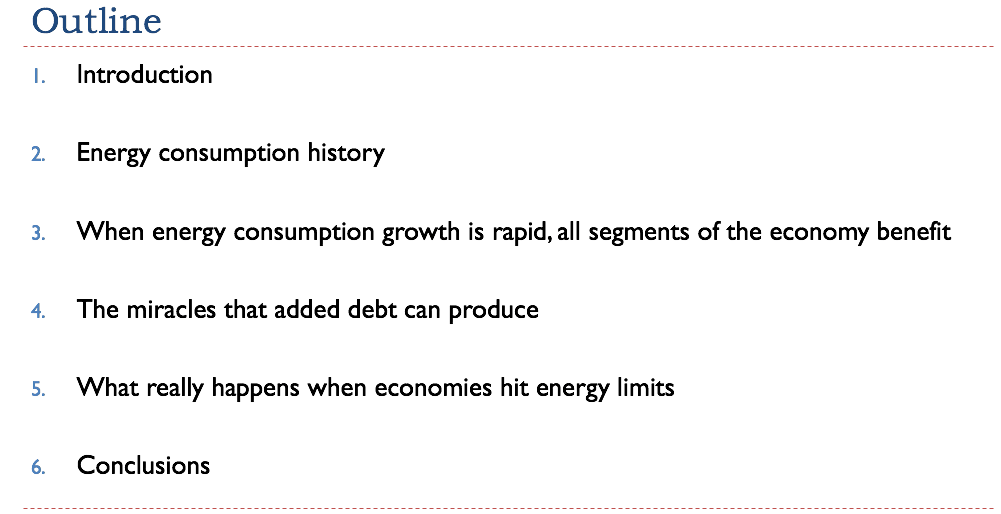
This post covers only Items 1, 2, and 3 from the Outline in Slide 2. I will save Items 3 through 6 for a post called “The World’s Fragile Economic Condition-Part 2.”

Slide 3
Slide 4
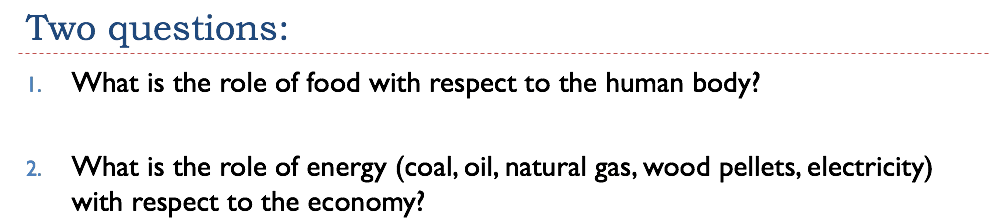
The audience was able to guess that the situation for humans and the economy are parallel. Energy in some sense powers the economy, in a way similar to how food powers humans.

Slide 5
On Slide 5, I am pointing out that changes in the red line, denoting energy consumption growth, tend to come before the corresponding changes in the blue line. This is one way of confirming that energy consumption causes GDP growth, rather than vice versa.
In recent years, countries have found ways of creating GDP growth, without adding true value. This may explain why GDP growth is higher than Energy growth since 2013 on Slide 5. As an example of GDP growth with overstated value, a large share of young people are now being encouraged to purchase advanced education, at considerable cost. This would make sense, if there were suitable high-paying jobs for all of those graduating. It is questionable whether this is the case.

Slide 6
Of course, the issue is not only energy consumption, just as our health is influenced by more than simply what food we eat.

Slide 7
At one time, the emphasis in physics was on systems that are “closed” from an energy point of view. Such systems never grow; they simply decline toward “heat death.”
The real world is made up of many structures that grow and change over time. This growth and ability to change is possible because the energy system we live in is thermodynamically “open,” thanks to flows of energy from the sun, and thanks to fossil fuel energy, which represents stored solar energy from long ago.

Slide 8
The answers to the questions on Slide 8 are easy to guess.

Slide 9
The economy adds new businesses, as citizens see new needs and set up companies to meet those needs. Customers make choices regarding which goods and services to buy, based on their income (primarily wages) and the prices of available goods and services. Governments gradually add new laws, including changes to the way taxes are assessed. The system gradually grows and changes, as the population grows, and as the quantity of goods and services created to meet the needs of that population increases.
One thing to note is that the goods and services produced by the system will eventually be divided among the various players in the system. If one group gets more (say, those receiving interest income), then other groups will necessarily receive less.
Another important point to note is that as new products are added, old ones disappear. For example, once cars came into use, we lost the ability to go back to horses and buggies. There are no longer enough horses; there are no longer facilities to “park” the horses in downtown areas, while at work or shopping; and there are no longer services to clean up after the mess that the horses make.
Without being able to go backward, the system is quite brittle. It would appear that under sufficiently adverse conditions, the entire system could collapse. In fact, we know that many ancient civilizations did collapse, when conditions weren’t right.

Slide 10
The strange interconnections of a networked system make the world economy behave in a different way than we might initially expect. Later in this presentation (in Part 2 of the write-up), I will show some examples of inadequate energy supplies leading to very different results than high prices.

Slide 11
The model of The Limits to Growth looked at how long resources might last, before the growth of the world economy came to a halt from a variety of problems, including a lack of easy-to-extract resources. In some ways, the model was quite simple. For example, the model did not include a financial system or debt. In the single most likely scenario, the base run, the world economy hit limits about now, in the 2015 to 2025 time period. The authors have said that, once limits are hit, the forecast on the right-hand side of the chart cannot be relied upon; the model is too simple to forecast how the down slope might actually occur.

Slide 12
–

Slide 13
The pattern of world energy consumption seems to be one of rapid growth, especially in the period since World War II.

Slide 14
Energy consumption growth is particularly high in the period covered by the red box. In other words, energy consumption growth is particularly high from the 1940s through the 1970s. If the economy relies on energy, we would expect this to be a particularly booming period for the economy.

Slide 15
We can break energy consumption growth down into two components: (1) the portion to cover higher population, and (2) the portion to cover improved standards of living. Looking at this chart, it is clear that “higher population” takes the majority of the increase, except when increases are very large.

Slide 16
I have labelled the three big bumps with my view of what seems to have led to them. The first is early electrification, when street cars were added and when the early mechanization of farming was implemented. The second is the postwar boom and the third is the recent period of globalization, led by China’s major ramp up in coal production.

Slide 17
China’s energy consumption grew rapidly after it joined the World Trade Organization in 2001. The thing that most people don’t realize is that China is reaching limits on its coal extraction. Its coal production seems to have peaked about 2013. Its comparatively tiny amount of wind and solar (shown in orange on the chart) is not making up the shortfall. Instead, China is being forced to rely more on imported energy. Imported energy tends to be higher in cost, and may be limited in supply. For all these reasons, we cannot rely on China to continue to power future world economic growth.

Slide 18
It is not just China that gets only a small share of its energy production from wind and solar. This is also true of the world as a whole.

Slide 19
–

Slide 20
Boxes 1 through 4 show a different model of how the world economy works than that shown earlier (in Slide 9). In Slide 20, the Economy (in Box 3) acts like a giant factory. It uses Resources of various kinds (a few of which are listed in Box 2) to make Goods and Services (a few of which are listed in Box 4). If the Economy is getting to be more and more efficient, Box 4 will expand much more rapidly than Box 2, producing a great abundance of goods and services. If this happens, all of the Resource Providers in Box 1 (plus some I have failed to list) can be rewarded more than adequately for their services, with Goods and Services produced by the economy. The transfer of these Goods and Services occurs through the use of money.

Slide 21
Everyone can get rich at once!

Slide 22
The top line is GDP growth including inflation; the bottom line is GDP growth excluding inflation. Before the dotted line, both GDP growth rates and inflation rates are high; after the dotted line (when energy growth was lower), they tend to be lower.

Slide 23
Interest rates were raised to try to damp down oil and other energy prices. We will see in a later section that reducing interest rates helped hide the fact that energy growth was slower after 1980.

Slide 24
The wages shown on Slide 24 have already been inflation adjusted. Thus, in the period before 1968, wages for both the lower 90% of workers and for the top 10% of workers were rising rapidly, even considering the impact of inflation. Many families were able to afford a car for the first time. After 1980, the wages of the top 10% rose much more quickly than the wages of the bottom 90%.

Slide 25
In 1930, wage disparity seems to have been at about today’s level. Early mechanization had replaced many jobs, both on the farm and elsewhere. Farmers who could not afford the new technology found that they could not produce food cheaply enough to compete with the low prices made possible by the new technology. The growing wage disparity meant that a large share of the population could not afford more than the basic necessities of life. The many people with low wages kept demand for most goods and services low. Oil prices were low, and there was a glut of oil, not unlike what recent markets have experienced. New tariffs were added, and immigration was restricted.

Slide 26
The period before the mid-1970s is when a great deal of the United States’ infrastructure was built. The Eisenhower Interstate Highway System dates from this time period. Many of the oil and gas pipelines and electricity transmission systems in use today were also built in this period.
Once the price of oil and other energy products started rising, it became much more expensive to add or replace this type of infrastructure. Once oil prices rose, more debt at lower interest rates seemed to be needed to keep the economy growing, as I will explain in Part 2 of this write-up.

Slide 27
The least expensive to extract oil supply–US oil supply in the contiguous 48 states that could be extracted by conventional means–was developed first. Alaska production was added when it was clear that the early supply was starting to deplete. It was more expensive, as was North Sea oil, which was also added after early US oil began to deplete.
Once oil prices rose in the 2005-2008 period, companies became interested in developing oil from shale formations (sometimes called tight oil). This oil seems to be much more expensive. It is doubtful that this oil is profitable at today’s prices.

Slide 28
Many people believe that oil prices will rise, indefinitely, with the cost of production. The thing that they don’t realize is that high oil prices tend to lead to recession. When this happens, employment drops, and the average buying power of the population no longer rises–it tends to remain flat or falls. As a result, high oil prices do not “stick.”

Slide 29
We are today in a situation where oil prices have been too low for years. For a while, this situation can be hidden, but eventually low investment can be expected to lead to lower production of energy products. It is even possible that some governments of oil exporters may collapse from lack of adequate tax revenue. Governments of oil exporters often obtain over half of their total tax revenue from taxes on oil production. Adequate tax revenue for these governments requires a high selling price for oil.
The situation with food prices tends to parallel oil prices. This occurs partly because oil is used in growing and transporting food, and partly because of substitution issues. For example, corn can be used to make either ethanol for vehicles or food for people.

Slide 30
M. King Hubbert was one of the early scientists who talked about what appeared to be a problem of running out of oil and other fossil fuels. While I call him a geologist, he really was a geophysicist. The catch was that the physics thinking of the day was mostly about “thermodynamically closed systems.” If closed systems were the problem, then running out of fossil fuels that could be extracted using current techniques was the major issue.
Hubbert and others did not realize that energy supply is part of a larger economic system, which also functions under the laws of physics. The economic system is part of a thermodynamically open system, not a closed system. It gets energy both directly from the sun and from fossil fuels, which provide solar energy stored as fossil fuels.
The issue is how this larger economic system behaves: does it allow the oil prices to rise to a high enough level to extract all of the oil and other fossil fuels that seem to be available? I don’t think it does. But under the “right” conditions (lots of debt growth), the economic system does allow energy prices to rise somewhat. This is what we have seen since the 1970s.
It is extremely difficult to figure out what true costs and true benefits are in a networked system. The standard approach for evaluating the benefit of wind and solar considers only a small part of the system. If the proposed devices do not directly burn fossil fuels and if not too much fossil fuel is used in their production, the usual practice is to assume that the devices must be helpful to the overall system, because they seem to be “low carbon.” This approach leaves out many important costs.
The problem is that wind and solar are not now, and never can be, standalone devices. When all costs are considered, they are simply very inefficient add-ons to the fossil fuel system. These costs include buffering services (using batteries or other storage), the cost of capital, the cost of leases, and wages and taxes. A very high-cost electricity generating system is not likely to be helpful to the economy because such a system is very inefficient. It can be expected to affect the economy as adversely as high-priced oil does.
Slide 31
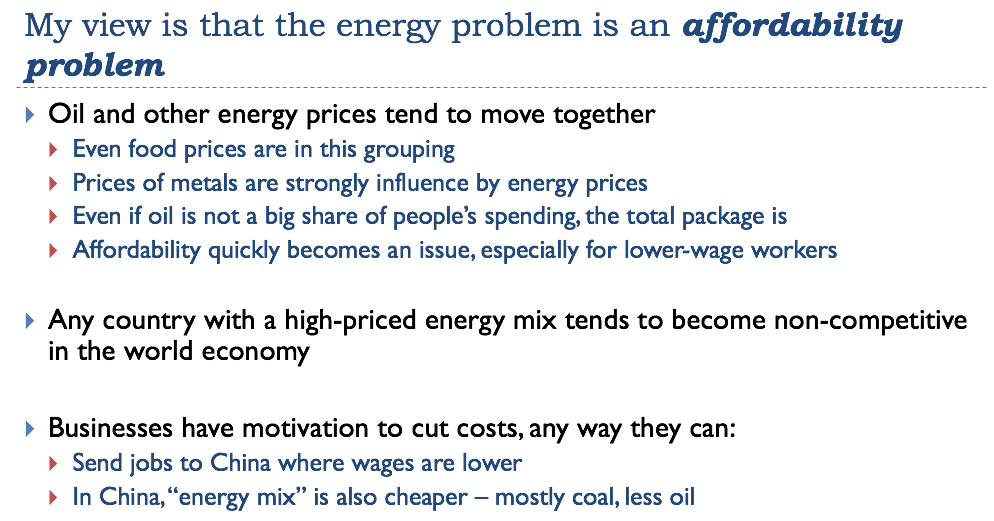
An economy operates best when energy costs are very low because goods and services made with this low-cost energy tend to be low-cost as well. Oil is used in producing and transporting food. Thus, low-cost oil tends to produce inexpensive food.
If energy costs begin to rise in a country, it tends to make that country less competitive in the world marketplace. It also tends to push the country toward recession, because the higher costs are difficult to recover from customers whose wages don’t rise to cover the higher costs.

Slide 32
Many people believe that the amount of fossil fuel that will ultimately be extracted depends on a combination of (a) the amount of resources in the ground, and (b) the technology developed for extraction. While these are indeed eventual limits, I think that a maximum affordable price limit comes much sooner. This depends on how high a debt bubble the economy can sustain. The role of debt will be discussed in Part 2.

Slide 33
One thing that is confusing is the familiar supply and demand curve for energy. Many people believe that “of course” prices must rise if energy is scarce. The catch is that energy consumption affects all parts of the economy. It takes energy to create jobs, just as it takes energy to produce goods and services. Because both supply and demand are affected by a shortage of energy, our intuition regarding how prices should move can be totally wrong.
The word “Demand” is confusing, also, because most energy use is difficult to see. Most energy use is not found in the gasoline we buy at the pump or the electricity we purchase. Instead, energy is used in creating the streets that we drive on, and in building the schools that our children attend. Building new homes and manufacturing cars also takes huge amounts of energy. If energy costs rise very much, the problem is that many people can no longer afford homes or cars. Instead, young people live in their parents’ basements indefinitely. Governments may decide to stop paving some roads, because repaving is too expensive to afford. Reduced demand for oil might be better described as reduced purchases of goods and services of all kinds, because certain groups of would-be buyers find prices too high to afford.
[To be continued in “The World’s Fragile Economic Condition – Part 2”]


India’s U-Turn Destroys Trump’s Anti-Chinese ‘Quad’ Strategy
http://www.moonofalabama.org/2018/10/indias-u-turn-destroys-trumps-anti-chinese-quad-strategy-.html
well india and usa are not friend since
the days when Henry Kissinger said Indians are bastards
https://scroll.in/article/803484/when-hillary-clintons-foreign-policy-mentor-henry-kissinger-called-indians-bastards
once usa even try to nuke india
https://www.hindustantimes.com/delhi-news/revealed-pak-us-blackmailed-india-with-nukes/story-SqSsw5gGV2z4Fwg5JVxnKI.html
India comes across as very dependent on energy imports, and this dependency is growing rapidly. It seems to be trying to support these imports with growing debt, but this isn’t working well.
https://gailtheactuary.files.wordpress.com/2018/06/india-energy-consumption-by-fuel-plus-consumption-to-2017.png
“Turkish President Recep Tayyip Erdoğan reiterated on Saturday that Turkey’s economy was strong and Ankara was determined to reach its goals using its own solutions. “There is no economic crisis, only manipulative moves. We will achieve our country’s goals with our own solutions and our own programs,” Erdoğan said at the 27th Consultation and Assessment Meeting of the ruling Justice and Development (AK) Party.”
https://www.yenisafak.com/en/news/there-is-no-economic-crisis-only-manipulative-moves-erdogan-3462804
“Sudan slashed the official value of its currency against the US dollar by more than half on Sunday, the third devaluation this year in the face of a mounting economic crisis. The move came just weeks after President Omar al-Bashir replaced the government over its failure to curb economic woes including soaring food prices.”
https://www.enca.com/business/sudan-sharply-devalues-currency-economic-crisis-bites
“Yemen’s Oil and Mineral Ministry has denounced the looting of the country’s oil resources by Saudi Arabia, saying the move is a blatant violation of international law. The ministry said in a statement on Saturday that Saudi Arabia transports Yemeni oil to the Arabian Sea through a pipeline which extends from the Rub’ al Khali desert to Hadhramaut and al-Mahrah provinces south of the country.”
https://www.presstv.com/Detail/2018/10/06/576241/Yemen-Oil-Ministry-Saudi-Arabia
“In an open letter, over 50 Iranian economists warned of a collapse in the Iranian economy, stating that the severe inflation of the rial has hit a high it had never reached in the past 75 years, since World War II.”
http://english.alarabiya.net/en/News/world/2018/10/07/Iranian-economists-The-country-is-suffering-highest-inflation-rates-since-WWII.html
Sounds like a mess in all four of the countries you show articles about. Cannot help demand for world goods and services.
The drums of death beat louder by the day
https://www.raspberrypi.org/app/uploads/2016/09/giphy-3-1.gif
Didn’t know you could play!
“Venezuela’s government has announced the creation of a new police force to strengthen border controls as thousands of people continue to flee the country’s spiralling political and economic crises.”
https://www.aljazeera.com/news/2018/10/venezuela-forms-migration-force-thousands-continue-fleeing-181006065251002.html
“Far-right congressman Jair Bolsonaro pulled off a thumping win in the first round of Brazil’s presidential election following one of the most polarizing campaigns since the country returned to democracy three decades ago.”
https://edition.cnn.com/2018/10/07/americas/brazil-presidential-election-intl/index.html
As expected…. the voters look for a saviour… and saviours tend to be more extreme as economies sink
At least the people in the police force will get jobs out of this!
Yes, but will they get paid? That’s the real problem.
I don’t get it… shouldn’t they just let people flood over the borders? Perhaps they could convince the IMF to bail them out and stop the flood ….
“The past week may be the one that blew the lid off yields in the world’s largest bond market, with the 10-year benchmark climbing the most in almost two years Wednesday and the selling pressure showing little sign of reversing since. Traders are responding to a seemingly critical mass of evidence in favor of higher rates.”
https://www.bloombergquint.com/onweb/new-era-of-rising-rates-finally-dawns-on-u-s-treasury-investors#gs.MH_P85Y
“When bonds sell off — yields rise — it has the effect of repricing trillions of dollars of medium and long-term debt and funding right across the global economy… So the pain of Fed rate hikes is always felt somewhere in the world, because the US dollar is the global reserve currency, too, and the primary source of hard-currency funding. Which is why Deutsche Bank strategists noted this week that every Fed rate-rise cycle had ended in crisis somewhere in the world, with the global financial crisis 10 years ago the most recent.”
https://thewest.com.au/business/markets/theres-just-too-much-debt-in-the-noisy-global-economy-ng-b88982552z
Someone else understands the problem with the Fed raising interest rates! Where will next crisis appear?
The Fed can see the brick wall ahead… yet they are heaving more coal into the boiler…
They must see another obstacle on the track before the wall…and the only way to get past it to hit the wall… is to maintain very high speed
https://i.telegraph.co.uk/multimedia/archive/03437/Vatican03_3437322b.jpg
great picture, FE.
“China’s central bank on Sunday announced a steep cut in the level of cash that banks must hold as reserves, stepping up moves to lower financing costs and spur growth amid concerns over the economic drag from an escalating trade dispute with the United States.”
https://uk.reuters.com/article/us-china-economy-rrr-cut/china-slashes-banks-reserve-requirements-as-trade-war-imperils-growth-idUKKCN1MH0RQ
“China stocks fall despite central bank policy easing.”
https://www.ft.com/content/58baa638-caa4-11e8-9fe5-24ad351828ab
China attempts to keep the debt bubble going!
Mac10 is livid (as usual):
“China is now in the impossible situation of trying to ease monetary policy while controlling the currency.
“The Trump trade war is imploding China’s economy, forcing the PBOC to ease monetary policy… creating a massive divergence with U.S. monetary policy. This in turn is putting tremendous downward pressure on the Chinese currency. Ironically, despite being labelled a “currency manipulator” by Trump, the Chinese are stepping in to SUPPORT their currency by drawing down their limited dollar reserves. In other words, Trump is “right” that they are manipulating their currency, just in the exact opposite way he believes. The net effect of all this buffoonish amateurism is driving the trade deficit with China WIDER.
“US President Donald Trump’s trade policy has backfired, as the country’s trade deficit in goods with China in August jumped to a all-time high amid tumbling soybean exports and a halt in crude oil shipments to China.
“Experts warned that if the US doesn’t scale back the escalating trade war with China, the Trump administration would have more to lose, as US exports continue to dwindle due to retaliatory tariffs while the country’s consumption-driven economy further expands imports, eventually taking a toll on the US economic outlook.”
“Trump isn’t just driving the China-U.S. trade deficit wider, he has driven the overall U.S. trade deficit to 2008 lows. Because that’s how we win now, by losing.
“#Winning!!!”
http://ponziworld.blogspot.com/2018/10/breaking-point.html
Isn’t the US’ deficit spending a big part of what causes the big gap between its imports and exports?
“The financial crisis saw almost the complete meltdown of the global financial system, requiring considerable state interventions to stave off the crisis. While recovery has picked up in Europe, the European banking system is not as robust as it may seem, warns a new report, mounting concerns that current non-performing debt levels could see another crisis unfold.”
https://www.consultancy.eu/news/1946/europes-banking-system-is-not-as-robust-as-it-may-seem
“Last week, the populist Italian coalition produced a 2019 budget showing an increase in the deficit. That means Italy will need to borrow more money, on top of the 132% debt-to-GDP it already owes. In response, Italian borrowing costs jumped from 2.9% to 3.3%. This matters, as even a small rise in debt servicing interest rates, adds up to a lot when you owe €2 trillion. Shares in Italy’s two largest banks, UniCredit and Intesa Sanpaolo fell over 10%.”
https://www.breakingnews.ie/business/why-italys-volcano-of-debt-is-a-big-threat-874233.html
“Italian assets slumped yet again on signs that the government’s confrontation with the European Commission over its budget won’t be resolved anytime soon. Yields on benchmark 10-year bonds rose above 3.5 percent for the first time in four years…”
https://www.bloomberg.com/news/articles/2018-10-08/italian-bonds-drop-as-government-and-eu-set-for-deficit-showdown
“Analysis by Sky News of the paths of different recessions throughout UK and US history has found that the UK’s recovery is now comparatively weaker than the American recovery after the Wall Street Crash of 1929.”
https://news.sky.com/story/uk-recovery-is-slower-than-us-after-great-depression-11521000
“British businesses are the most anxious they have been about Brexit since the 2016 referendum, with more bosses reining in hiring and investment plans, a study has found. The accountancy group Deloitte has warned that worries over the long-term impact of Brexit are mounting.”
https://www.theguardian.com/politics/2018/oct/08/brexit-anxiety-for-businesses-at-highest-since-referendum
“The European Central Bank has given euro zone banks until 2022 to limit their reliance on their London operations for booking trades and loans following Britain’s exit from the European Union, the Financial Times wrote on Monday. The ECB, as the euro zone’s top banking watchdog, has long said banks will have to phase out the so-called “back-to-back” booking of EU trades in London… A spokeswoman for the ECB declined to comment.”
https://www.euronews.com/2018/10/08/ecb-gives-banks-until-2022-to-limit-reliance-on-london-ft
California has a larger GDP than Britain.
But lets be honest– the USA would be even more third world without California.
Gonna miss you like the devil.
Rising use of plastics to drive oil demand to 2050: IEA
Global demand for petrochemical feedstock accounted for 12 million barrels per day (bpd), or roughly 12 percent of total demand for oil in 2017. The figure is forecast to grow to almost 18 million bpd in 2050.
Most demand growth will take place in the Middle East and China, where big petrochemical plants are being built.
But the IEA report said government efforts to encourage recycling in order to curb carbon emissions would have only a minor impact on petrochemical growth.
“Although substantial increases in recycling and efforts to curb single-use plastics take place, especially led by Europe, Japan and Korea, these efforts will be far outweighed by the sharp increase in developing economies of plastic consumption,” it said.
Under the IEA’s most aggressive scenario, recycling could hit around 5 percent of high-value chemical demand.
https://uk.reuters.com/article/us-petrochemicals-iea/rising-use-of-plastics-to-drive-oil-demand-to-2050-iea-idUKKCN1ME2QD
Goodbye camel and goat hair products: hello synthetics! ‘Development’ is a wonderful thing…..
“Under the IEA’s most aggressive scenario, recycling could hit around 5 percent of high-value chemical demand.”
5% – Wow!
Why would bloomberg publish something … that they know is impossible to achieve?
Come to me MOre Ons… I have lots of rat poison for you
China stocks fall despite central bank easing
CSI 300 slides 3.7% and renminbi weakens with investors unnerved by trade tensions
2 HOURS AGO
Ouch!
Report is aparently out – am I reading this right? 2.7C degree increase above pre-industrial levels by 2040? What does that entail.. 1.4 degrees above current levels?
let me try again – the report states potential 1.5C or 2.7F increase by 2040
The report says, “The IPCC accepted the invitation in April 2016, deciding to prepare this Special Report on the impacts of global warming of 1.5°C above pre-industrial levels,” so that is what we are talking about.
The report then goes on to say, “Human activities are estimated to have caused approximately 1.0°C of global warming, above pre-industrial levels, with a likely range of 0.8°C to 1.2°C.”
So we seem to already be at 1.0°C of global warming. This report has to do with limiting the total to no more than an additional 0.5°C. Perhaps the answer is, “Don’t bother trying.”
I am wondering what kind of response this report will get. The report contrasts the difference between 1.5 degree and 2.0 degrees of global warming. Will the ridiculousness of what is being asked for to reach a 1.5 degree expected increase in expected climate change really start to sink in?
According to What did the latest IPCC report on climate change actually say?
Will countries look at the report and say, “No way!” I see that Australia with its coal use and exports is already saying that. Australian government backs coal in defiance of IPCC climate warning
There are also questions about the report’s focus on getting rid of nuclear and backing so-called renewables instead. Attacking Nuclear As Dangerous, New IPCC Climate Change Report Promotes Land-Intensive Renewables According to this article:
Why would the MSM rant on and on … about something … that is impossible to stop … if indeed it were not a hoax?
If a giant asteroid were headed for earth hitting in 20 years — and there was nothing that could be done about it … does anyone think this would make the headlines?
I f789ing despise stu pidity
Just checking on what’s allowed and what’s not re the internet while in Yangshuo…
Google – not allowed
FB – not allowed
Twitter – not allowed
Duck Go Go – not allowed
Youtube – not allowed
Bing – allowed
Skype – allowed
VPN – unable to connect to get around the bans
P.orn sites – not allowed
Recall the summary of the book El d e rs of z ion….
Take control of the media and use it in propaganda for our plans
Create entertaining distractions
Corrupt minds with filth and perversion
Did I mention that a friend’s 5 year old daughter asked M Fast the other day while in Hong Kong if M Fast ‘has s.ex’
Imagine what children are looking at on their phones…. or friend’s phones…. they must be viewing the most degrading content….. and talking about it
The Chinese may be onto something.
I found using the Internet in China to be a headache. All of the major US news sources were also blocked, besides the sites you list.
If a site is created through WordPress, but does not use WordPress in its URL, it seems to go through. Thus, a WordPress blog that just uses the default title is blocked. If a person pays to have his or her own title, such as “OurFiniteWorld.com,” it can be read in China. But it becomes impossible to add new blog posts, because these require using URLs that include WordPress.
yet kfc is biggest fast food company in china
iphone biggest buyers come from china
so please stop this shit fast eddy the Chinese are morally corrupted
as everyone on this planet
That wasn’t my point.
They are not blocking these sites to protect their citizens.. they have their own sites that perform all the same functions from controlling thoughts to monitoring all communication.
Yet more MSM lies… demonizing the Chinese…. Putin now has company….
https://www.zerohedge.com/news/2018-10-07/homeland-security-backs-apple-amazon-denial-chinese-spy-chip-infiltration
5 hours ago
It was a stupid claim to begin with.
1) You can’t simply “glue” a tiny chip to a motherboard and have it interface/monitor address and data buses. The physical bus connections must be made.
2) The size of a grain of rice will take an incredibly small battery to power it or it will have to be physically connected to system power somehow.. Good luck with that. If a microscopic battery, good luck having it last any period of time.
3) It might be monitoring WiFi but, again, power is required. Then the chip, tied to nothing (buses), only using WiFi, will have to get the data out onto the Internet through many software layers, back to the nefarious actor’s place. Nope.
4) The motherboards would have to be designed to interface with the “spy” chip. Sure, they can do it but very doubtful that they did.
5) Pumping massive quantities of data out of a system without it being detected relatively quickly won’t happen.
6) And from the article: “the testers found a tiny microchip, not much bigger than a grain of rice, that wasn’t part of the boards’ original design.” Yes, no interface method. Stupid claim.
Then we see a govt troll step in with mockery …
5 hours ago
remove
Unfortunately, you have no idea what you’re talking about.
5 hours ago
(Edited)
remove
Yeah, exactly. I have a Masters in EE. One of my current jobs is to design ASICs and FPGAs much like this “device.” Although I’m doing mixed signal FPGAs, not purely digital.
What are your qualifications?
Donald Trump urged Spain to ‘build the wall’ – across the Sahara
Donald Trump suggested the Spanish government tackled the Mediterranean migration crisis by emulating one of his most famous policies and building a wall across the Sahara desert, the country’s foreign minister has revealed.
According to Josep Borrell, the US president brushed off the scepticism of Spanish diplomats – who pointed out that the Sahara stretched for 3,000 miles – saying: “The Sahara border can’t be bigger than our border with Mexico.”
Trump wooed voters in the 2016 election with his promise to build a “big, beautiful wall” across the US/Mexico border, which is roughly 2,000 miles long.
A similar plan in the Sahara, however, would be complicated by the fact that Spain holds only two small enclaves in north Africa – Ceuta and Melilla – and such a wall would have to be built on foreign territory.
https://www.theguardian.com/us-news/2018/sep/19/donald-trump-urged-spain-to-build-the-wall-across-the-sahara
lol
btw Trump hasn’t even built the wall on the Mexican border.
I’m not sure the dude can even read.
But, seems to be making late stage capitalism work–
https://www.sfgate.com/news/article/Judicial-ght-exposes-country-hovering-near-13287345.php
this is why he has highest iq in the universe
https://twitter.com/realdonaldtrump/status/332308211321425920?lang=en
If somebody uses words like “losers”, then s/he does not have a high IQ. Those “losers” often secure profits of the winners. Moreover, there is an increasing number of losers.
Entertaining.
Strange!
Michael Moore makes some good points. One of his insights that I had also shared was that there is generally a grain of truth and real intention to the craziest sounding Trump pronouncement. So there will be no 3,000 mile wall across the Sahara, but there will be a move to separate the north geopolitically from the south. North of the Sahara is Muslim and brown, while and south is Christian and black. I don’t know what the advantage of this division is to whom. Would the African continent be stronger split in two or not? There is oil in the north as well as the south. Some ideas and projects for greening some of the desert (using purely natural means) have been floated. The interest seemed to be coming from the “south” more than from the north. I’m sure there are many considerations that I don’t know about.
Nuclear pasta in neutron stars may be the strongest material in the universe
A strand of spaghetti snaps easily, but an exotic substance known as nuclear pasta is an entirely different story.
Predicted to exist in ultradense dead stars called neutron stars, nuclear pasta may be the strongest material in the universe. Breaking the stuff requires 10 billion times the force needed to crack steel, for example, researchers report in a study accepted in Physical Review Letters.
“This is a crazy-big figure, but the material is also very, very dense, so that helps make it stronger,” says study coauthor and physicist Charles Horowitz of Indiana University Bloomington.
Neutron stars form when a dying star explodes, leaving behind a neutron-rich remnant that is squished to extreme pressures by powerful gravitational forces, resulting in materials with bizarre properties
https://www.sciencenews.org/article/nuclear-pasta-neutron-stars-may-be-strongest-material-universe
we need this kind of energy to save our bau
Ugo Bardi’s latest post:
https://cassandralegacy.blogspot.com/2018/10/could-donald-trump-be-last-emperor-in.html
“The rise and fall of empires looks like a chemical reaction, flaring and then subsidizing, as a reaction running out of reactants — then restarting when new reactants have accumulated. For empires, the reactants might have been mineral resources — it may well be that Sargon’s empire was the result of silver having become a standard medium of exchange in Mesopotamia. With silver, Sargon could pay his soldiers. With his soldiers, he could steal more silver. And, with more silver, he could pay even more soldiers — and there you go: the road for glory and murder is open.”
Ugo often gets it right.
But comrades—-
Daily CO2
October 6, 2018: 405.42 ppm
October 6, 2017: 403.03 ppm
Has a “universal” effect-and we are at a yearly low point.
If we only could place bets on CO2-stocks… I would place an insignificant bet on CO2 reaching 407.81 ppm on October 6, 2019.
On second thought, make that 407.84 ppm.
October 6, 2018: 4.05 parts per 10,000
October 6, 2017: 4.03 parts per 10,000
sweat is pouring down my face…
my hands are sh-shaking…
I can hardly control my typing…ei09fum
I think I might pass out…
I’m in a state of total fear…
how will I sleep tonight?
and what will I do if and when it gets to 5.00 parts per 10,000?
This will make you feel better
What is the tolerance in your measurements? What is the 95% confidence level that your answer is within 1 standard deviation of the true value?
Oh gawd… this reminds me of 10+ years ago when every summer I expected a tipping point where the permafrost in the Arctic was all going to melt releasing billions and trillions of tonnes of methane and we’d all be extinguished…. and then there would be a year of record ice freeze… and I’d feel somehow … disappointed … when I should have felt relief
Funny how when G Dweepers are given evidence of the ho ax ….. they get angry … they dig in harder and deeper on the delusion …
It’s almost as if they WANT it to happen — and they are disappointed that it is not and will not
There is absolutely, positively, with out a doubt going to a collapse in energy demand.
Subtract seven billion from the per capita side of the equation.
This is the chart that Ugo Bardi shows
https://irows.ucr.edu/papers/irows34/irows34_files/image004.jpg
from this paper https://irows.ucr.edu/papers/irows34/irows34.htm
I would argue that we now have an international world economy. The scale of the graph is Megameters (meters x 10^6). This would seem to be equivalent to adding a recent point equal to 149 on the chart based on total land mass (or perhaps a little less, if Antarctica and perhaps a few other small parts are not yet included).
An oldy but a goody folks with this paragraph er sentence the most important in the entire piece:
“Change is going to have to come from a collapse in energy demand. People will have to change their lifestyles.”
What Really Killed Soviet Union? Oil Shock?
Larry Hagman, the late U.S. actor that played the bombastic oilman JR Ewing, often quipped that the TV soap opera Dallas brought down the mighty Soviet Union.
“The opulence, the consumerism, the food, the cars — these things made them want more than their governments provided them,” claimed Hagman.
Academics, who had not foreseen or predicted the Soviet Union’s rapid meltdown, now argue that the Reagan Doctrine probably forced the empire’s demise. According to this theory, Moscow’s inefficient centrally planned state just couldn’t keep pace with U.S. military spending and went bankrupt.
But that’s not how Doug Reynolds and an increasing number of analysts now view the Soviet collapse. The 52-year-old U.S. economist, who taught energy economics in the Republic of Kazakhstan during the fall, says the Red Empire just ran out of fuel.
CUBA AND NORTH KOREA: ENERGY ORPHANS
With the official collapse of the Soviet Union in 1991, both North Korea and Cuba became energy orphans.
The Soviet Union once shipped vast amounts of oil and fertilizer to both oil starved nations. In turn they exported their political allegiance and waves of anti-imperialist rhetoric.
When this energy system fell apart, North Korea and Cuba suddenly became global laboratories for how nations might respond to peak oil or massive disruptions in oil deliveries, writes Oxford history professor Jorg Friedrichs.
Their response is also a study in dramatic contrasts. North Korea’s one per cent resorted to vicious repression coupled with nuclear threats while Cuba tapped into 19th century agricultural traditions and demonstrated much resilience.
For decades North Korea used its Soviet oil subsidies to build a highly industrial agricultural system. In order to grow enough grain in an unseasonable climate, it heavily invested in machines and irrigation systems as well as cheap fertilizer to restore depleted soil resources.
North Korea poured so many fossil fuels into its industrial farming system that the nation’s per capita energy use in 1990 was twice that of China’s, says Friedrichs.
When oil imports stopped in 1991 along with cheap fertilizers, Korea’s elites directed scarce fuel supplies towards the military and heavy industry, effectively starving agriculture. Korea’s one per cent, in other words, saved fuel for tanks to defend the regime but not for tractors to feed its hungry peasants.
While the Hermit Kingdom’s well-fed rulers proclaimed a “Let’s Eat Two Meals A Day” campaign, rice and corn production dropped by 50 per cent between 1991 and 1998.
A calculated political famine then swept away nearly a million peasants or three to five per cent of the population. For ordinary people, the trains stopped and homes went cold in the dead of winter. Children grew thin and sick.
North Korea’s poor still live with recurring food shortages and a menu of endless political repression.
North Korea survived economic collapse and the disappearance of cheap oil by investing its remaining energies in protecting the status quo and dabbling in nuclear experiments.
As one observer noted, North Korea remains a land of two solitudes: “depressing poverty, pervasive food and medicine shortages, and crushing manual labour. Defending this grim reality is frightful military might in the form of ballistic missiles, hordes of armoured vehicles, long range artillery and one million soldiers.”
Or as Freidrichs concluded, “Korean-style totalitarian retrenchment is without doubt one possible response to a severe energy supply disruption.”
Cuba, however, replied much differently to a 70 per cent drop in oil imports, which precipitated massive wage losses and unemployment. Cuban economists compared the oil shock to an airplane falling from the sky and called it “the special period.”
Without Soviet oil, fertilizers and food imports, the caloric intake of most Cubans dropped from 2,600 to a lean 1,000 a day.
In response, Cuba abandoned state-owned farming (the Soviet equivalent of agribusiness in North America) along with its attendant tobacco and sugar monocultures.
Faced with a grave emergency, the government turned to small farmers and “organicos” (small urban plots) to re-energize its agriculture with human muscle, clever thinking and small open markets. (Farmers are well paid in Cuba.)
Dire necessity and not “ecological consciousness” drove Cuba to develop the world’s largest organic farming movement largely supported by the island’s barrios or tightly knit neighbourhoods.
People raised rabbits on rooftops and planted organic gardens on empty lots. Compost centres provided soil while traditional knowledge provided ways to combat pests with natural products instead of oil-based chemicals.
So energy transitions driven by shortages can come with different political faces. North Korea’s elites choose to starve its people and protect the powerful. In contrast, Cuba’s rulers abandoned Soviet rhetoric and sought solutions among their own people and in a restoration of small farms and a relocalization of food markets.
Concluded Friedrichs: “Countries with a strong authoritarian tradition may follow a North Korean path of totalitarian retrenchment. Countries with a strong community ethos may embark on Cuban-style socioeconomic adaptation, relying on their people to mitigate the effects of peak oil. It is of course possible to imagine other reactive patterns, such as the mobilization of national sentiment by populist regimes.” — Andrew Nikiforuk
When oil production, and its all-important revenues peaked, the Soviet Union lost the energy mojo that glued its empire together. The empire’s collapse was, in other words, another curious tale about energy transitions.
The numbers alone are convincing. Soviet oil production dropped an astounding 50 per cent between 1988 and 1995 from 12 million barrels to seven million barrels. (Under Putin it has returned to 10-million barrels.) As oil drained from the Soviet machine, the nation’s stability morphed into Russian chaos and a temporary political renewal.
Satellites of the Soviet Union also went into energy descent. Deprived of cheap oil and subsidized fertilizers made from cheap natural gas, North Korea experienced a famine and Cuba fell into an economic and agricultural crisis known as “the Special Period.”
Now, Reynolds is no crank or gadfly. The energy economist, who also worked as a mechanical engineer in the U.S. military, teaches at the University of Alaska. In his view energy, not money, makes the world go around. He also believes that the Soviet collapse holds valuable lessons for every modern economy dependent on imported oil.
The Soviet collapse, for example, demonstrates that “alternative energy technology has too little potential and takes too long to institute through an economy to be of any use during an oil crisis,” says Reynolds.
Nor is Reynolds the only thinker looking at the empire’s failure from an energy looking glass. Yegor Gaidar, director of the Moscow-based Institute for Economies in Transition, argues that both oil and grain played key roles in the fall of the Communist empire.
When flows of gold and silver to 16th century Spain dried up, it lost an entire empire. And when flows of oil and gas revenue dropped dramatically for the Soviet Union, it lost control over eastern Europe without “losing on the battlefield for 50 years.”
Soviet downfall
The fall of the Soviet Union, wrote Gaidar in a 2007 paper, “should serve as a lesson to those who construct policy based on the assumption that oil prices will remain perpetually high.”
Engineer, blogger and author Dmitry Orlov would mostly second that conclusion. He experienced the collapse first hand and attributes much of the chaos to peak oil.
“The Communist regime was so corrupt and stealing as much as they could that they didn’t pay attention to the system. It was on autopilot,” said Orlov in a recent talk.
Yet the story of how peak oil in a closed society precipitated the financial and geographical undoing of a major superpower remains a largely untold energy tale.
Like the United States, Russia was a global oil pioneer in the 19th century. While U.S. entrepreneurs such as John D. Rockefeller turned Pennsylvania’s black gold into a refining monopoly in the 1870s, Sweden’s Nobel brothers (yes of that Nobel fame) put their straws into the fields of Baku in Azerbaijan.
(The great French essayist Alex de Tocqueville noted as early as 1835 that Russia and the United States would some day (“by some secret design of Providence”) hold in their hands “the destinies of half the world.” He had no idea that the “secret design” would be their singular petroleum luck.)
But the Soviet Union didn’t really begin to spend its oil in a concentrated way until after the Second World War. That’s when communists began to burn petroleum, well, like Americans by building cars, tractors, MIG jets and concrete cities.
Just like U.S. petroleum joyriders, the Soviets also invested their oil surplus in Big Education (math and science), Big Medicine, Big Science (space programs) and a sprawling military-industrial complex.
“The same things that worked for us in the United States worked for them,” says Reynolds. “They had incentives and big bonuses. It wasn’t a dead economy. It was a unified state economy.”
(Orlov sarcastically compares the two superpowers to two quarrelling oil rich brothers that wanted more or less the same stuff — “things like technological progress, economic growth, full employment, and world domination — but they disagreed about the methods. And they obtained similar results, each had a good run, intimidated the whole planet, and kept the other scared. Each eventually went bankrupt.”)
Empire glue
Oil, however, shackled the whole damn empire together. Cheap petroleum kept eastern Europe under communist control while oil export revenue paid for essential grain imports along with bottles of vodka for state elites.
The union’s oil abundance also saved it from two global oil price shocks in 1973 and 1981. Those volatile events sent most of the western world (including the United States) into recession, debt and as well as an ever increasing dependence on foreign oil.
As oil prices rose in the 1980s, the Soviet Empire behaved like any incompetent petro-state: it pumped more oil to generate more revenue in order to build more infrastructure to consume more oil. It also wasted an enormous amount of petroleum, men and rubles in a vain attempt to conquer Afghanistan.
At the same time it subsidized the energy needs of North Korea, eastern Europe and Cuba. Europeans of all stripes flocked to East Berlin to catch the cheapest flights to India in the 1980s and all thanks to Soviet fuel subsidies.
But in the mid-1980s, Soviet oil production topped off at 12 million barrels a day due to poor management, old technology and lack of investment. And then oil production started to drop. As oil fields ran dry, the authorities spent more cash to coax more petroleum from aging reservoirs with massive water flooding programs.
But these technological fixes didn’t put much of a dent in the nation’s oil depletion rates.
After Soviet oil peaked
Just before Soviet oil production peaked in 1988 (the event walked hand in hand with a major drop in oil prices), the empire realized that it no longer had enough black gold to pay its bills.
In full panic mode, “the dynamically developing world superpower” (as experts then called it) started to borrow heavily to prevent a bread famine due to oil-spending industrialization schemes that pushed 80 million farmers into Soviet slums. “But peak oil pushed the Soviet Union into an abyss,” says Reynolds.
To save oil for its own needs, Moscow even started to charge eastern Europe hard currency for its oil and at global prices. “Without the free oil, the eastern European economies went into a tailspin,” says Reynolds. Shortly afterwards the whole Soviet machine disintegrated as well.
So oil scarcity lead to debt, which feed an economic down turn (and lower GDP) that eventually resulted in currency devaluation along with a dramatic drop in oil consumption of 50 per cent from 1988 to 1995.
“Oil production managed to go up as long as oil reserves were relatively abundant,” wrote Reynolds in one paper.
“However, once scarcity increased substantially, the communist system saw declining oil production which in turn could have caused their inefficient economic system to finally decline… They experienced peak oil in the system they had and they collapsed.”
To Reynolds the collapse of the Soviet Union offers a variety of disquieting lessons for the United States, Europe and Japan.
All now face economic stagnation and rising debts associated with rising oil prices due to the depletion of light oil reserves around the world.
The first lesson, says Reynolds, is that an oil price shock will stop an economy the same way an empty fuel tank will stall a car. “There are not a lot of substitutes for oil,” says Reynolds.
At the same time, big complex structures tend to fall apart when energy flows contract, adds Reynolds.
The Soviet Union broke up; eastern Europe crumbled; and the Warsaw Pact dissolved as energy drained from the system like blood from a wound. Reynolds wonders if the European Economic Union and the United States can survive peak global oil without dissolving into smaller entities.
Slow to adapt
Another hard lesson has to do with alternative energy sources. None could replace the power density and versatility of oil. The Soviets researched solar and wind but couldn’t scale them up fast enough to make any difference during an oil shock.
“Change is going to have to come from a collapse in energy demand. People will have to change their lifestyles.”
Fourth, free markets can play a role in revitalizing the energy sector. In response to the collapse Russia privatized its energy assets and added new technologies that temporarily revived oil production.
But then Vladimir Putin nationalized the nation’s oil wealth to consolidate his hold on power. Russia remains a petro-state dependent on its oil and gas revenues.
But free markets did not change the nation’s energy system by inviting more renewables or by encouraging sound energy conservation.
“The former Soviet Union did not solve its energy crisis by using alternative energy, but by simply reducing its use of energy. This bodes badly for our own ability to depend on alternative energy,” adds Reynolds.
Last but not least, oil shocks promote social inequality. “The Russians had hyperinflation and massive unemployment. You also had the enrichment of the rich.”
To Reynolds, volatile and higher oil prices have thrust the world into an uncertain energy transition.
“A likely road map for the future can be discerned by studying events before and after the collapse of the Soviet Union.”
https://thetyee.ca/News/2013/03/13/Soviet-Union-Oil/
That’s a mess piece of article full of time sequencing inaccuracies and failed logic, for starters the Perestroika turn around started well before above stated time lines. Soviets supposedly aimed developing renewables is a joke statement given the demonstrably achieved world premier successes then (Russian continued up to this date) in the nuclear energy arena, ..
I’m not saying their peak in Soviet conventional oil extraction and large foreign aid outflows (often with dubious reciprocity value) were not an important issue to wobble of their system, but the underlying problem laid elsewhere, namely the West simply could resort into much higher debt debauchery and thus weasel out of 1970s turmoil..
I contributed on the topic more relevant summary just on previous comment page:
https://ourfiniteworld.com/2018/09/23/the-worlds-fragile-economic-condition-part-1/comment-page-18/#comment-188849
“Without Soviet oil, fertilizers and food imports, the caloric intake of most Cubans dropped from 2,600 to a lean 1,000 a day”
The results!!
https://www.washingtonpost.com/lifestyle/wellness/castros-cuba-a-public-health-phenomenon-in-the-90s-showed-the-benefits-of-national-weight-loss/2016/12/01/c179c6fe-b68d-11e6-b8df-600bd9d38a02_story.html?utm_term=.30fd2479c162
Hmmmm… I wonder what they were using to power the pumps that watered the gardens…
Depleting the fresh water aquifer under Havana.
Regarding “Change is going to have to come from a collapse in energy demand. People will have to change their lifestyles.”
The issue is that the collapse in energy demand comes from a loss of jobs that pay well. It comes from globalization, so that those making the goods and services we use earn only $20 per month, so that they cannot afford to be purchasers of those goods and services. Or, worse yet, jobs are replaced by automation, leaving no demand. Or government services are cut way back, collapsing demand.
You got the “collapsing demand” part right. What you didn’t realize is that it is involuntary collapsing demand that is already happening.
A collapse in energy demand comes very easily, when prices rise disproportionately to the wages of a large share of the population.
The Soviet Union reduced energy consumption by shutting down much of its manufacturing. This was inefficient, relative to that of the West. Probably this inefficiency, besides the low oil prices (preventing reinvestment), was what did the system in.
This is one chart I put together years ago:
https://gailtheactuary.files.wordpress.com/2013/12/oil-consumption-as-pct-of-1985-consumption.png
This youtube video unintentionally summarises the techno-disney-topian perspective on industrial civ collapse:
https://www.youtube.com/watch?v=eT4shwU4Yc4
“THEY have the ultimate power in the universe,
And before it gets better
It’s getting worse.”
Brilliant! 👍
I cringed and skipped to the end
https://search.aol.com/aol/search?s_it=webmail-hawaii1-basicaol&q=Yuval%20Noah%20Harari%20on%20the%20Future%20of%20Humanity
He seems not to have read FW? I’m thinking that this is craziness. (But then JMG is talking about thousands of years of further, albeit altered, civilization!) What would support all these people being so well served by AI?
Harari interview:
https://www.theguardian.com/culture/2017/mar/19/yuval-harari-sapiens-readers-questions-lucy-prebble-arianna-huffington-future-of-humanity
What is the biggest misconception humanity has about itself?
Lucy Prebble, playwright
Maybe it is that by gaining more power over the world, over the environment, we will be able to make ourselves happier and more satisfied with life. Looking again from a perspective of thousands of years, we have gained enormous power over the world and it doesn’t seem to make people significantly more satisfied than in the stone age.
Is there a real possibility that environmental degradation will halt technological progress?
TheWatchingPlace, posted online
I think it will be just the opposite – that, as the ecological crisis intensifies, the pressure for technological development will increase, not decrease. I think that the ecological crisis in the 21st century will be analogous to the two world wars in the 20th century in serving to accelerate technological progress.
As long as things are OK, people would be very careful in developing or experimenting in genetic engineering on humans or giving artificial intelligence control of weapon systems. But if you have a serious crisis, caused for example by ecological degradation, then people will be tempted to try all kinds of high-risk, high-gain technologies in the hope of solving the problem, and you’ll have something like the Manhattan Project in the second world war.
+++++++
Exactly. Sometimes you read something and know instantly that there is truth to it.
Though i do wonder if harari himself might have some glimpses of insider knowledge.
Preposterous statements.
What was the average lifespan in the Stone Age? That information alone should give an indication of how relentlessly hard life was back then.
We are so spoiled by IC now that we even complain about it without ever realizing the copious amount of prosperity that is shoved down our myopic minds through our flappy mouths and sensitive and brittle egos.
To people complaining about IC – get a goddamn clue.
Yes, that and:
BURN MORE COAL!!!
They complain … and if you suggest they take the bus instead of their car .. they look at you as if you have lost your mind….
I am still waiting for a Green employee to come to me and ask me to reduce his salary …. so that he can consume less.. waiting … and waiting….
Carl Sagan, Stephen Hawking and Arthur C. Clarke
– God, The Universe and Everything Else
Stephen Hawking, Arthur C. Clarke and Carl Sagan (via satellite)
discuss the Big Bang theory, God, our existence as well as the possibility of extraterrestrial life.
https://youtu.be/HKQQAv5svkk
funny thing in this video these guys thought
think our civilization could be collapse by nuclear weapons
another scientist know what overpopuation
will do to this planet
https://youtu.be/qkaobW8UNXo
I think that the existence of polygamy is one of the major causes of rising world population. With polygamy, rich men can have several wives; poor men (who could not afford them in the first place) have no wives. Rich men tend to take in young girls and get them pregnant at an early age. This is a major contributor to the high birth rates in Africa and the Middle East. This is a map of countries that allow polygamy.
https://ipfs.io/ipfs/QmXoypizjW3WknFiJnKLwHCnL72vedxjQkDDP1mXWo6uco/I/m/Legality_of_polygamy.svg.png
Of course, without adequate resources to feed all of the additional mouths, and some minimal level of health care, the many resulting babies would not survive. Women in these situations obtain their “value” by the number of children they have. I found an article a few weeks ago about IVF being used by some of the wealthier women to help increase their family size.
Why is Sweden black on that map?
Black is for countries where “Polygamy is illegal and the practice is criminalized.” Green is “only legal for Muslims.” Light blue is “Polygamy is legal.” Dark blue is “Polygamy is illegal but not criminalized.” I would expect that there is, in practice, still a significant amount of polygamy, even though the government may be discouraging the practice.
Polygamy is allowed in Sweden if married before moving here.
Our most famous case a dude who had the government buy him three apartments ($1.6M) for him, his three wives and 16 kids. So much for only practiced by wealthy males.
Wow! I never heard of that one. We have all heard about high level politicians (like Trump and JFK) with girl friends on the side.
https://www.google.se/amp/s/www.thelocal.se/20170919/did-a-swedish-council-buy-apartments-for-a-man-and-his-three-wives-nacka/amp
“Polygamy is normally illegal in Sweden, but such marriages are considered valid if the couples married in a country where it is allowed, if they married voluntarily and had no links to Sweden at the time.”
Same with child marriage..
Hi Gail! With respect to the map, where did you find it? I looked up this one, where countries in the former Sovietnionen is dark blue https://en.m.wikipedia.org/wiki/Polygyny#/media/File%3ALegality_of_polygamy.svg
I found it at this link, which is from a Wiki. I have no idea how accurate it is.
https://ipfs.io/ipfs/QmXoypizjW3WknFiJnKLwHCnL72vedxjQkDDP1mXWo6uco/wiki/Legal_status_of_polygamy.html
It is possible that one is a more up-to-date version of the other. I expect the farther back a person goes, the more often that polygamy is legal.
Polygamy can only influence birth rate if it involves pregnancy in women who would otherwise not reproduce. It will not change the number of babies per woman.
I hadn’t realized the extent to which polygamy was an issue, until I read Secular Cycles by Turchin and Nefedof.
Polygamy tends to move up the age gap between generations, because older, more wealthy men take several wives, most of whom are much younger than themselves–young teen agers. Women (really girls) start having babies earlier. The women have little “power” relative to the older men. They can’t say no to sex. or suggest the use of contraceptives. Over the longer span, the women tend to have more children.
Also, reading about recent situations with polygamy, women in these situations get their status by how many children they bear. As in Biblical days, women without children can be divorced, for lack of offspring.
When men are limited to one wife apiece, less wealthy men cannot afford to have wives. This tends to leave a lot of unmatched women as well. (Some of these, of course, do have children through temporary relationships.) Men who do get married, tend to wait until they are more financially responsible. Thus, they and the women are both older. Starting having babies later tends to reduce the number of children.
If we add the modern situation of wives working outside the home (other than in tending a garden and children), wives find that they do not have time for a large number of children. They cannot afford a house big enough for a bedroom for each child – a consideration no one ever thought of, years ago.
JMG makes a point I’m finding helpful: despite there being radically varied cultural styles, we do better (he implies) by not insisting they all get homogenized into one. So if polygamy works well enough in one place, we can probably depend on time to alter it where it stops working, and leave it alone otherwise. Even so, I can’t accept female genital circumcision. Just one of those “non negotiables.” Regarding that particular issue, I’d be cool, and bide my time to jump on any bandwagon that will promote change. There are sure to be many of various sorts.
How about male genital mutilation? Not as extreme — however it surely should be considered child abuse…. how about we let the child decide when they are 18?
my thoughts exactly
Women deciding when and if and how many and with whom they have children influences birth rate, not if they share husband.
Division by zero “physics”. Nope!
Nature does not divide by zero.
The real scientists Nikola Tesla, Alfvén, Faraday and Maxwell would call that garbage “pseudoscience by crackpots”.
and issac newtown, Ibn al-Haytham ,aryabhatta ,
would have call your scientists garbage also
it all perception
Newton
Einstein, himself, was critical of his own work in relativity theory. Just because I am critical of relativity theory does not imply that everything Einstein produced in his heyday was garbage.
Einstein described Maxwell’s work as the “most profound and the most fruitful that physics has experienced since the time of Newton”.
https://en.m.wikipedia.org/wiki/James_Clerk_Maxwell
So do me a favor and cut out the hyperbole:
https://robertlindsay.wordpress.com/2010/06/29/india-is-a-shithole/amp/
whole planet is shithole courtesy of homo sapiens
Actually BAU in the Nordic countries is quite clean, decent, safe and picturesque.
And unsustainable.
Indeed!
Let’s enjoy it while it lasts!
👍
I think that collapse by nuclear weapons is still a real possibility. When there is not enough cheap-to-extract resources to go around, countries tend to fight over them. This could be the cause of a final war. Or we could have a financial collapse, and the indirect result (some time later) could be massive explosions of spent nuclear fuel.
https://www.bbc.com/news/science-environment-45653099
Tomorrow IPCC will release a new report, 4 years in the making. In short.. we are f678cked.
But more interestingly, tomorrows report will recommend to world governments to cut coal and NG use, starting immediately.
Sounds like a good way to collapse the world economy.
Nope, it’s all an orchestrated hoax to make the plebs consume less of the dwindling resources – without feeling that they are being robbed of prosperity. Guilt is such a strong incentive to accept ever shittier conditions.
Let me get one thing straight. It will not affect the life style of the elites – the least. The mouthpieces, too, will continue to live like kings while spreading the FUD – and getting richly compensated for the “efforts”.
Be ready for another serious bout of climat3 alarmism, taxation, over-regulation, doom and gloom. However, this time western govts have to act. In China, however; yes baby, let’s continue:
BURN MORE COAL!!!
(and natgas)
“Nope, it’s all an orchestrated hoax to make the plebs consume less of the dwindling resources – without feeling that they are being robbed of prosperity.”
Wait…”they” are trying to hoax us into thinking that dwindling resources leads to less consumption? Those bastards!
Not really, it depends who you mean by that. For TPTB; fat chance, old money still rules. 😎
As for the consumerist plebs, yes. The lord and savior Al Gore will show you some graphs and charts while you bend over and enjoy the carrots. 🥕
“For TPTB; fat chance, old money still rules.”
Let me guess – bunkers, robot armies and bathing in the blood of innocent plebs to replenish youth. When the system that creates, sustains and protects one’s wealth or influence collapses, they do likewise. Ditto for bunkers and robots – without globalised industrial economy they will cease to function after a while.
Consider the lone cow, great with calf, ruminating the remnants of the last bale of hay on a barren heath.
The system is already collapsing. But my dear humanoid brethren, yes, first collapse cometh to you, and then much, much, much later to TPTB.
Nope, it’s a cunning plan how to force austerity actionable on personal level among the unwashed..
It’s actually work in progress, you can’t buy bigger engines or park inside major metro areas already. Sooner or later this would move into food (approved) variety and other segments.
The preoccupation with GFC_vXY kind of event is foolish game, instead the near mid term future will resemble slow boiling authoritarian nightmare. Granted in the meanwhile some peripheral regions falling out of the map completely, interesting to debate, but little to now effect on core JITs..
Yep, kiss good bye to that juicy steak in the inevitable near-term future, just around the corner on the road to dystopia. Indeed, farewell and say hello to austerity and forced veganism.
But hey, it will be good health for you, well, as long as the natgas and oil powered agriculture can sustain the output. When that inevitably is over too, then it’s a combination of veganism and starvation. How about that ye’ all carnivores? Get used to it, suxx0rz’! 🥕🌽🥦🥔
Yes folks, TPTB are winding down the great experiment in the petroleum filled Petri dish.
It was fun while it lasted, but now the elites have run this little party past midnight and the unwashed are still clinging to the leftovers in their houses and fiefdoms. Time to call in the mercenaries – Politicians and MSM. Climat3 angst to the rescue. 👍
Authoritarian nightmare… i m thinking more like a dolf or Josef s than diesel banned in cities and subsidies to solar.
Don’t worry Kant CC will and IS collapsing the precious world economy as we type….
Too bad it’s right in front of our face and we don’t see it.
How IPCC language gets watered down.
https://www.google.com/amp/s/www.washin … -bad-news/
An early leaked draft of the report said there was a “very high risk” that the world would warm more than 1.5 degrees. But a later draft, also leaked to Climate Home News, appeared to back off, instead saying that “there is no simple answer to the question of whether it is feasible to limit warming to 1.5 C . . . feasibility has multiple dimensions that need to be considered simultaneously and systematically.”
Compare that weasel wording with this straight forward statement.
https://www.google.com/amp/s/www.washin … story.html
The document projects that global temperature will rise by nearly 3.5 degrees Celsius above the average temperature between 1986 and 2005 regardless of whether Obama-era tailpipe standards take effect or are frozen for six years, as the Trump administration has proposed. The global average temperature rose more than 0.5 degrees Celsius between 1880, the start of industrialization, and 1986, so the analysis assumes a roughly four degree Celsius or seven degree Fahrenheit increase from preindustrial levels.
I suppose you can read the second statement a lot of ways. I read it to say: we are in for 4°C raise and such small scale ideas are ineffectual. I don’t know the solution, but this ain’t it, something MUCH bigger is needed.
This is not a problem we can fix. We do not have any alternatives that really work, at least in the direction that they have been looking.
That’s unfortunate. One must be mindful the IPCC is a consensus building group that settles for the “,lowest common denominator” of agreement. Even organizations with scientific expertise, such as, the likes of Exxon Mobile, have input (no matter what vested interest they may have).
BTW, we are fooling ourselves to think the climatic system is a linear system. Evidence is showing otherwise with current trends and research results.
Your Insurance industry is already taking notice
Flood insurance premiums may sink South Florida before the rising sea does | I
Indicating that change is in the air, a FEMA spokesperson said Friday that the agency plans to announce a risk-rating “redesign” next year that “will allow us to better reflect the resilience and vulnerability of homes and other structures covered under the NFIP.” It would begin in 2020.
“This is a big game-changer,” Wayne Pathman says. “South Florida is ground zero, in many studies, for the economic impact of sea-level rise. So I’ve said many times that the tip of the spear of this economic issue is insurance.”
Rather than focusing on how high the sea level will be in 2060 or 2100, more concern should be on the economics, Pathman told The Palm Beach Post Editorial Board. “Because those things are already changing.”
The move to so-called “risk-based assessments” will likely jack up the cost of flood insurance to as much as wind-storm insurance “or more” in the next five to 10 years, said Pathman, a Miami attorney who is also chair of the Miami Beach Chamber of Commerce. He sees rates rising 25 percent to 60 percent in the near term, and more after that.
In high-risk areas — and much of Florida is a high-risk area — real estate will get more expensive. The higher costs will ripple through banking, bonding and taxation. It might not be long, Pathman warns, before “30-year mortgages will be a thing of the past.”
Put it together, and investors could start bailing on South Florida long before the waters arrive. “Once risk-based assessment takes hold, it sends a message to the world that this place is too risky,” Pathman said at a community meeting reported by WLRN
http://www.sun-sentinel.com/opinion/fl-op-editorial-sea-level-rise-insurance-premiums-20180629-story.html
The National Flood Insurance Program has been a giveaway program for years. It has been tweaked somewhat to help, but government programs tend to have a definite, “Let’s help the economy along,” bias.
Additionally, my recollection is that Florida is one state that has endorsed rules that encourage more averaging in rates for homeowners coverage than really makes sense.
Gail, we can also say that aabout other numerous giveaway programs.
Likely because private corporate firms are unwilling to bear the high risk.
Such as
Citizens Property Insurance Corporation (Citizens) was created in 2002 from the merger of two other entities to provide both windstorm coverage and general property insurance for home-owners who could not obtain insurance elsewhere. It was established by the Florida Legislature in Section 627.351(6) of Florida Statutes as a not-for-profit insurer of last resort, headquartered in Tallahassee, Florida, and quickly became the largest insurer in the state.[1] The company has no connection to Louisiana Citizens Property Insurance Corporation, the equivalent entity in Louisiana, or several similarly named “for-profit” subsidiaries in the Hanover Insurance Group.
That’s besides the point of the article..
I would like to see the article you mention.
I live in South Florida and would like to read it myself.
I think that indirectly I am thinking about the Citizens Property Insurance Corporation. This is the Wikipedia article about the company.
https://en.wikipedia.org/wiki/Citizens_Property_Insurance_Corporation
The article says,
If there had been a major hurricane, these small companies likely couldn’t have paid the claims in full, at least in the early years. Perhaps now they can. The major companies do not want to put their other policyholders are risk.
It becomes difficult to price hurricane insurance, although it is pretty clear that insured properties right on the ocean are at higher risk than those on higher ground, away from the shore. Florida had four hurricanes one season, and has been spared for quite a while since.
https://www.lutheranfranciscans.org/
…this is interesting. (I found it here https://en.wikipedia.org/wiki/Evangelical_Lutheran_Church_in_America)
The most beloved apostle of Jesus Christ was the celibate John. He also wrote apocalypse.
And what happened to the two Slovak catholic priests who recently unveiled a memorial tablet to a catholic priest who lived with a woman and their 3 children at a parish in the village in the depopulating central Slovakia:
https://www.youtube.com/watch?v=xFaP2KZ6Pao
Logically, both of them were suspended by their bishop:
https://spectator.sme.sk/c/20928353/two-catholic-priests-suspended-after-publishing-a-book-on-celibacy.html
There seem to be a whole lot of different religious groups, each adapted to the needs and situations of a particular time and place.
My father grew up in Madagascar, the child of Lutheran Missionaries. In fact, he was born in Madagascar. The religion brought to Africa was no doubt a variation on what was taught elsewhere. The God Is So Good song I posted a link to previously is a song that was used by different types of African missionaries, in different languages.
Each time and place needs a religion for that time and place. That is why religions keep changing. Our current religion seems to be, “We humans can save ourselves through technology and hard work.”
The point for me is how religions change vis-a-vis population changes. Especially, when the human beings are energy dependent creatures.
The social structures of the populations that face energy limits desintegrate, i.e. marriages break up, generations become alienated, the number of single individuals is rising. The point about the celibacy is, that it accepts the truth about the limited existence of the human species. That is why celibacy must be taken into account by every religion, if peace is to be maintained within the populations, and this is even more important when the populations face the serious truth of energy constraints.
The religions that do not value celibacy are easily overcome by those that value it: that is why judaism was overcome by christianity. And buddhism is more attractive than christianity for many people today facing the desintegration of the ephemeral world created by the vast amounts of energy of the fossil fuels, the energy of the previous higher populations before they declined etc.
Buddhism is not a religion.
https://www.azquotes.com/picture-quotes/quote-i-see-no-contradiction-between-buddhism-and-christianity-i-intend-to-become-as-good-thomas-merton-70-51-18.jpg
Tt is o.k., because the last stage is atheism. So the line judaism – christianity – buddhism – atheism is about the move from religion to philosophy, i.e. giving up efforts to influence the higher power in favor of doing what is possible within the given limits.
When you wrote “higher power” I got confused, because I was certain you meant TPTB and not the god figure. I guess the Scandinavian atheism runs deep in me.
Buddhism is a method to see through the confusion of our mind, senses, desires, the smoke and mirrors, present everywhere and nowhere. And of course a way of escaping the Nietzschean ‘eternal recurrence’.
Indeed it is a way for men who does not find appeal in the bread and circuses of BAU for sure, but needs a living nonetheless.
https://www.azquotes.com/vangogh-image-quotes/38/83/Quotation-Friedrich-Nietzsche-There-are-two-different-types-of-people-in-the-world-38-83-60.jpg
When the world of the previous generations based on energy from wood, coal and oil is desintegrating and you live in the era of nuclear and natural gas. And there is nothing to surpass the last two fuels. Everything seems to be without a perspective: you do not have energy to preserve the past and to build something superior to that, too. This is the dilemma of todays people: YOU ARE STUCK IN THE DISAPPEARING HUMAN WORLD.
You see, I never wanted the human world. For me it is basically worthless. The faster it goes away, the better. Indeed, I want to understand the mechanisms, the essence of reality. This human form is severely limiting what I would like to understand and to feel, experience.
https://www.azquotes.com/public/picture_quotes/14/6f/146f2bbbd300fb78b3ecc82945dd6c62/thomas-wolfe-464399.jpg
“You see, I never wanted the human world. For me it is basically worthless. The faster it goes away, the better.”
– this is ridiculous, as the human world infrastructure and its energy flows are needed for your survival
How do you want it? Either BAU is part of ‘human world’ or it isn’t?
The problem with verbose people like you is that they usually are not very clear thinkers, but enjoy writing about their vague perception of reality clouded by imprecise semantics.
“verbose people like you” – as the human reality is disappearing and being temporarily replaced by machines, in the end, all words will be empty, as there will be no human beings to use them for communication. Like the texts of the ancient died out civilizations.
I hadn’t thought about it that way.
Unless religion is all there is, and philosophy is a religion too.
Humanoids; prepare for the inevitable downgrade onto irrelevance.
https://cdn.shopify.com/s/files/1/0535/6917/products/adaptationdemotivator.jpeg
Buddhism is more a philosophy than a religion, although the god-botherers who need a crutch to get through life will interpret it that way.
I expect that part of the reason that the Catholic Church supported celibacy was because there were already population constraints. Families had (excess) sons and daughters who needed jobs, but could not inherit land or marry someone who had inherited land. The church could provide employment for them. It was a lot easier to do this, for a large number of people (excess children), if they would take vows of celibacy and poverty. If they received large salaries, and married and had families, they would add to the problem that needed to be solved.
Thanks. Makes sense to me now.
I don’t see how anyone can really predict how things will turn out when the credit bubble bursts, the trucks stop running in time, and a well-armed population- the latter which sets us apart from other societal collapse scenarios whereby the military had been able to dampen some of the extreme chaos- at least temporarily.
In the Great Depression,70% or more of the people were already self-sufficient, there was less complexity etc, and most people probably less than one generation removed from the farm with tighter family and community units.
Today, 95% of the population is helpless, dependent on just-in-time delivery of food and removal of waste, government subsidies through SS, pensions, and entitlement minded more than ever, and unable and unwilling (too much hardship) to revert to self -sufficiency.
This “toxic brew” could argue for an ultra-violent spontaneous event whereby the Black Friday fights at Wal Mart over non-essentials like big screen TVs would transform into all-out fights to the death in local community apartment complexes, whereby every person would be considered an immediate competitor for resources and to be shot on sight. Remember, there is no sense of community. I don’t even know my neighbors in my apartment complex section/stairwell!
Furthermore, trying to establish local more self sufficient communities would be difficult. Even now, I would love to move to a smaller, self-sufficient community, do my share of the farming, animal husbandry chores etc., but the problem is, there are too many weirdos out there. I don’t want to join a hippy commune in which everyone thinks “all you need is love,” or a religious fanatical group, nor do I want to join a preppers-gone -wild place where all they do is focus on guns, patrols, and building defenses, or just plain out druggies whose only interest is producing Met and growing pot. My understanding is most tight-knit communities, if they indeed exist, will resist newcomers anyway, even professionals or highly skilled people- doctors, engineers, electricians etc.
I for one, am very skeptical about these FEMA camps. I cynically ask myself, “which way is the barbwire facing?” In- to keep prisoners, or out- to prevent people from looting what really is a cleverly disguised government supply depot needed by the military to sustain martial law?
I simply don’t like any of the options.
I am afraid you are right. Unless things are happening that we don’t understand.
Yup. I’m in a village that had a high sense of community at the start, and now is overrun by people with a different sense of community–one more dependent on money–than the oldsters. They will be less resilient, more dense, more brutal, more demanding under emergency circumstances than the oldsters. They’re going the wrong way in every sense.
But what would have happened had we explained from childhood how to behave more rationally?
‘…will resist newcomers anyway, even professionals or highly skilled people – doctors, engineers, electricians etc.’ Hmmmm…
They will reject them because they will be next to useless without their modern props; farmers, builders, plumbers, hunters, scrap metal merchants, naturopaths/herbalists, ex-military will be the useful people/skill-sets. Especially older ones who can make-do with what is available and don’t just order parts for replacement. Cuba would seem to be a case in point.
I work with some professionals, and meet with many others; they are specialist to the point of absurdity and are often unable/unwilling/ un-interested in gaining other skills when money has always worked to solve problems for them.
Again, what credit bubble bursting are we talking here?
Given the evidence, we have already established the global gov-CBs nexus is currently way past any type former organic credit bubble bursting event anyway. We have been on deliberate prop up program of the system for quite some time already as all the major players (US,EU, Asia, Gulfies, RoW) came together to furnish the system with enough debt, credit, liquidity..
In other words we happen to reside inside some managed virtual economic plane, how they are going to proceed further into the future is unknown from our ants vantage point.
It could be triage of non systemic countries, societies and channeling the resource path elsewhere, to the core and among the chosen production-consumer group. And or combined with selective debt jubilees, also obfuscated mandate for pushing austerity, e.g. via k-limaa-te related scams etc.
Simply, there are ample methods and reasoning not taking the past models (understanding of debt) seriously anymore.. we are in different world now.
We will find out. Maybe TPTB can hold things together for a little while. They did better than expected last time.
The credit bubble keeps the US energy flowing; forget your other asset-valuations. This issue is not of the virtual plane. Shale/oilsands energy is propped up on life support and will be exposed as a capital destroying ra.t hole as funding is with held. Maybe the US govt will prop it up for longer, but this has the shades of the collapse of the USSR written all over it.
When the shale sh*ts itself watch the he.gemon go looking for trouble. The entire Russia and/or Iran narrative is a psychops preparation for the domesticated Anglo’s.
Yes, the energy flow question is one of the core pillars, that has been generally agreed upon here many times.
However, I’d posit the USSR collapse example is not much relevant, as it was driven by different situation and conditions. Remember, the US and West are the host nations of the global order, most notably in finance, debt/credit instruments. While the USSR was always at best just junior partner a somewhat competing subset in the global scheme, lesser player locked inside the rules of domination of others. That’s the fundamental crucial difference always to remember.
And as we know by late 1970s and early mid 1980s the plan was to simply out spent the USSR on fraudulent debt increase. Hence why the seemingly run away train of that era on overcoming the 1970s stagnation, suddenly there was enough capital for off shore drilling (EU/Alaska), and onshore advanced oil drilling-recovery techniques etc.
USSR simply knew and internally acknowledged defeat in such skewed game, hence the late mid 1980s Perestroika action plan which was response to opening of Chinese regions to capitalist enclaves as well as Eastern block countries flirting with western credit and investments (Poland, Hungary, Yugo..).
The deal was to let be incorporated into the global system in the Chinese style, but this transition process has been probe attacked via the 1989 “revolutions” hence the West got even much better deal, everything on the plate (labor, resources, infrastructure, ..) for almost free, not much equitable sharing as previously assumed (and promised) occurred.
If you like the one liner summary, the Pirates simply outfoxed the gullible.
They tried it at the same junction in China and failed, hence return to the “fair deal” different strategy and more revenue sharing and technology transfer plan had to proceed in the 1990s-2000s there.
“I would love to………….do my share of the chores…. ”
Well Mr.Hubbs I’ve often wondered if they were folks like you that would fit in around here. I’ve got 100 rows with a drip irrigation header ready to grow some food or crop to sell but there is no one to work it.
We need a geezer farm. All geezers have bad days but they don’t all have them in the on the same day. These animals are here every day. One of these mornings I’m not going to get up. The dogs and chickens and goats will still be hungry
I’d do an RV park thing but everyone would have to use a .compost toilet like the Humanure Handbook by Joe Jenkins. I’ve got three wells all on different electric services and I’ve kept the water on for 4 households for forty years. Keeping life going is plenty video game for me. Check out berryfarm.com and contact me if it looks interesting.
I know what you mean about the kookie thing and thats the other hold up.. I don’t have the energy to deal with the delusionstanies. I’m sorry their brains are damaged. I’m sorry for the people that build in flood plains but I got my hands full already.
The herd is about to get culled but in the mean time there are better and worse places to be. The Old Religion believes, it’s not whether you win or lose but that you die trying.
It’s akin to policy makers using the interest rate weapon to slay the dragon of high energy prices. Apparently what worked in the last century is of little or no use today due to the economic pollution of debt.
I hadn’t thought of debt being like pollution. Return on capital spending has been falling lower and lower, so true return on debt seems to keep falling.
Dr. Tim looks at de-growth:
https://surplusenergyeconomics.wordpress.com/2018/10/06/136-the-challenge-for-government/
—
I guess it dissects nicely the expected trends for next ~10-15yrs. Now I speculate towards the latter stage of this time window with the prosperity (as shown on graphs) falling markedly bellow 1970s proportions, bigger shocks – societal resets are likely to finally appear and alter the trajectories substantially..
Anything worthwile would be a plan or policy or institution infrastructure, that would acknowledge that
1. a. collapse is coming b. sooner to some c. but when GFC vol.2 hits with full force, no bank or currency or government that will be left standing
2. There are different stages in collapse.
Stage 1: Financial collapse. Faith in “business as usual” is lost.
Stage 2: Commercial collapse. Faith that “the market shall provide” is lost.
Stage 3: Political collapse. Faith that “the government will take care of you” is lost.
Stage 4: Social collapse. Faith that “your people will take care of you” is lost.
Stage 5: Cultural collapse. Faith in “the goodness of humanity” is lost.
= one part of Chicago is in Stage 1. as another part of Chicago is already in Stage 3 etc. etc.
3. Therefore what we would needed are plans for each stage. Its not about governments or government policy as such. Its about having a plan in general for each stage. Currently all plans are about governments, federal reserves, military, “and bury your head in the sand untill the storm blows over” -plans. But as GFC vol.2. will make large scale plans impossible.. What would be needed are local plans that could be implemented by regular folk, with the resources then available to them
4. Local plans like this:
Stage 1. Tax available citizens and create a Public Bank.. within hours of GFC vol.2, use digital currency if electricity is still available
Stage 2. Create co-ops.. gardening co-ops.. in the like of Russian Dachas in 1990 and 1991, thirty or so gardeners could differentiate their personal expertise, for the benefit of them all
Stage 3. Create militia, provided by the gardening co-ops
Stage 4. Ask yourself, what would Fast Eddy do, and do that
Stage 5. Go hibernate like Norm
Sorry, I just don’t understand the over fixation on the GFCv2.0 event, there could be likely several steps in between and afterwards.
I agree with your point of wide gamut of collapse stages not going on the same pace. Everything is indeed differentiated on the timeline, and local wise..
In terms of local plans, “Dachas” meant as second place of residence or summer house or perhaps as just small agri plots in the ownership of poor to average income people can be still found in some token places within the Western and industrialized world, notably Baltica, CEE, Russia, Balkans, perhaps even some parts of Holland and France. But for the most part nowadays it’s completely unknown impossible concept for the largest metro areas such as London, Paris, not mentioning the sub/urban situation in the US.
Moreover, it’s hard to quantify the potential of people actually doing “victory gardens” or the “dacha” thing vs more expedient trend of abandonment of cities and proper countryside re-localization or dispersion. It will be mostly inter connected with the govs propensity and capacity to continuously supply urban areas with at least some energy, food, water.
Interestingly enough expected riots in some places won’t take even weeks or months to start a blaze, while in some places perhaps years or decade or two..
And again while the US tends to score among the worst on the list ever, in actual reality the can kicking effect of some countries triaged away way sooner might surprise us, not mentioning the already demonstrated weaponization for local order (e.g. Katrina).
Therefore, as first precautionary step, I’d certainly not risk anything like French (ghettos and weak gov), Italian (ghettos and weak gov), Spanish (ideology civil war prone) or Greek (fuel heavy logistics and defenseless to next mega migrant wave) urban areas.. Not sure on the German speaking countries as their docile pop will take early measures of brutal austerity relatively in calm mood, although larger cities at today’s sad stage (mosques everywhere) obviously should be avoided as well.
Looking at his post, Dr. Tim just doesn’t understand why the economy cannot shrink back. He is obsessed with the EROEI story (from Charles Hall), but the EROEI story is too limited to be of much help. In fact, it tends to be misleading. It looks like there is just a minor problem, when there is a huge problem, coming at us from several directions at once.
What is happening is that we are reaching diminishing returns in many directions, simultaneously, including returns to capital investment. The economy tends to grow too slowly, and tends to fall over, like a bicycle that goes too slowly. It becomes impossible to repay debt with interest. The debt bubble tends to collapse, and all asset prices tend to fall. Commodity prices also tend to fall. It becomes impossible to extract oil, gas, and coal, because citizens are unable to afford goods and services made with fossil fuels (and even more expensive renewables).
I do not know how long this debt problem/lack of adequate returns problem can be hidden. This is what determines how long until we have until GFC 2.0 pulls the economy down.
We are perhaps all talking too much past each other.
Dr. Tim clearly presents a viewpoint and quantified analysis by which large segments of the pop are already under the condition of “managed” de-growth since the year ~2005 ! While the global aggregate demand is still somewhat rising thanks to the buildup of China, RoW etc. Now, we don’t know what is going to happen at the threshold of no aggregate growth at all, because this boundary could be again obfuscated by some “temporary phenomenon” like several countries sliding from the systemic equation for ever, others fencing out some quasi autarky trade blocs, or at least attempting and what have you.. Also Dr. Tim hints at some monetary even down the road, so in such turmoil “no growth” situation or deep realization eventually won’t matter much as the system already cascades, fractures, and re-adjusts on the go to something else, different entity and mode of operation.
Dr. Tim’s future forecasts he shows on his charts seem to me to be way too optimistic, however he justifies them. I don’t think he is talking US only. He lives in the UK, I believe.
Tim also thinks that the aftermath of this …is survivable….
He is living in DelusiSTAN.
“Hot Economic Warfare: Scrambling For Rare-Earth Minerals”
https://www.zerohedge.com/news/2018-10-05/hot-economic-warfare-scrambling-rare-earth-minerals
Infinite growth on a finite plant. What could possibly go wrong?
I thought that at least part of the problem with rare earth minerals was that their extraction tends to be terribly polluting. Despite the name, there seem to be moderately large supplies of these minerals, but developed countries don’t want to mess with the pollution involved. The article mentions cobalt, too. This is in a different category.
There is certainly a lot of truth to the story, though. We will quickly come to overuse any mineral in short supply. We decided we couldn’t/ didn’t want to use as much fossil fuels. The substitutes quickly go into short supply, too. We don’t understand how quickly, though. And part of the reason they go into short supply is because of other issues, such as pollution that is too difficult to deal with, or cutbacks on international trade.
“And part of the reason they go into short supply is because of other issues, such as pollution that is too difficult to deal with, or cutbacks on international trade.”
…and of course it all takes money to go find and extract those minerals and deal with the pollution. The global economic system is getting wobbly once again just like in 2008.
Interest rates keep rising rapidly.
https://www.treasury.gov/resource-center/data-chart-center/interest-rates/Pages/TextView.aspx?data=yield
US Treasury says yield on 10 year bond is up to 3.23%. It was only 3.05% on Tuesday. A month ago, on Sept. 9, it was 2.90%. These changes will be harmful to the mortgage market, I expect. And they could adversely affect stock prices.
https://www.zerohedge.com/news/2018-10-05/deception-about-catch-david-einhorn-unleashes-elon-musk-compares-tesla-lehman
‘Lehman threatened short sellers, refused to raise capital (it even bought back stock), and management publicly suggested it would go private. Months later, shareholders, creditors, employees and the global economy paid a big price when management’s reckless behavior led to bankruptcy.’
‘Meanwhile, the brand is in trouble. The blocking and tackling of the Model 3 rollout is leaving customers unhappy. There have been lots of reports of delivery snafus and poor quality cars. There are anecdotes about TSLA accepting full payment for cars and then not delivering them. There are many stories of cars (even Model S and Model X) in service shops for months for lack of spare parts. With so many new TSLA cars on the road, the problem is overwhelming TSLA’s limited service infrastructure. The Model 3 is the least reliable car on the market.’
I wonder if the ’emperor has no clothes’ moment for Tes.la, that is getting closer and closer, is the event that will trigger a loss of faith in asset valuations, then leading to the whole house of cards collapsing. It would be ironic…well IMHO.
Great article!
One of the sections I liked:
Isn’t it enlivening to stand on the precipice, the winds of Destiny blowing in your face, knowing that this is to be on the cusp of disaster, but alive? !
Isn’t this better than slumbering in deluded complacency? !
Isn’t every moment all the more precious?!
‘Cease man to weep, to mourn, to wail/ Enjoy the shining hour of sun!/ We dance along Death’s icy brink/ But is the dance less full of fun?’ (‘The Kasidah’)
Perhaps if you’re a homesteader it is cause for inspiration. For most, it’s an abstract, additional stresser in their rat-race existence.
I would agree that if our knowledge served only as an additional stressor, then it would be far better to be ignorant.
ah, the winds of Destiny are blowing as strong as ever…
every day, we are nearer to our inevitable fate of the nothingness of eternal death…
and there may be a growing awareness of the certainty of human extinction…
but the winds blow warm…
after human extinction, all of the stress of human existence will be gone…
though for now, some of us can gaze knowingly at the massive spectacle of the wobbling tower of BAU…
the tower stands shakily in the strong wind of Destiny…
for now…
at least until October 29…
a Monday…
My husband’s birthday is October 29.
it may be a very special day…
(but does adonis think so?)
Agreed in principle, Xabier, and yet, even carrying this awareness, one can still so easily get swept up in the petty dramas of day-to-day life, I find. Perhaps I should start meditating.
Some of the greatest saints of the Dark Ages lived on wind-swept Northern islands. Didn’t one dig a hole so that he could see only the sky, and no temptations? 🙂
take a temptation or two into the hole with you.
Not to mention that too much certainty about the acuity of such awareness inevitably leads to disappointment and possibly also the same error in the opposite direction.
There is of course no certainty, but the probabilities are stacking up…….
“On a long enough timeline, the survival rate for everyone drops to zero.”
“Danske Bank Shares Plummet As More Details On $234 Billion Money Laundering Scandal Emerge”
https://www.zerohedge.com/news/2018-10-05/danske-bank-shares-plummet-more-details-234-billion-money-laundering-scandal-emerge
“Largest US Mattress Retailer “Mattress Firm” Files For Bankruptcy”
https://www.zerohedge.com/news/2018-10-05/largest-us-mattress-retailer-files-bankruptcy
More defaults at IL&FS:
https://www.google.com/amp/s/www.livemint.com/Companies/031yWBcGEaPZAE1ExZiZzI/ILFS-misses-more-debt-payments.html%3ffacet=amp&utm_source=googleamp&utm_medium=referral&utm_campaign=googleamp
Knowledge brings fear.
— Mars University motto
I checked to see who IL&FS is. https://www.ilfsindia.com/about-us/
According to the web, “We develop high quality infrastructure and financial solutions to catalyze India’s growth.”
One heading says, “Partnerships, innovation and empowerment for sustainable infrastructure development”
Nice photos of wind turbines
Wikipedia says
Another article says that up to 700 mattress stores will be closed; Simons and Serta are listed as the largest creditors.
So much for the habit of keeping your money in the mattress because you don’t trust the bank.
The trick is keeping it in yours, not the manufacturers.
😅
Are lithium vehicles a fire hazard? Let’s find out!
If airlines don’t want lithium batteries, there is a question whether we want them in our vehicles–especially if electric bicycles are charged in our homes and electric cars are charged in our garages.
But it s the best we have, that scales.
The Japanese first commercialized it in the early 1990’s— it been a while comrades.
Hello Gail,
I think we have to remember that there are various Lithium Ion battery chemistry configurations. Some are more volatile than others. We carry lithium ion batteries in our cell phones, as CMOS batteries in our computers, electric watches, etc. While you can search on “Tesla battery pack fire” and score several hits you can then try it with “Bolt battery pack fire” and you won’t find any hits. Why??? It’s a matter of chemistry and how the packs are managed.
One of the other things to keep in mind is that Tesla is aiming to break the $100/kwhr barrier and eventually go to $50/kwhr. If you can get a 1,000 cycles out of a pack, that’s $0.10 and $0.05 /kwhr, respectively for storing excess solar and wind energy. A123 was able to achieve 7,000 cycles several years ago. While A123 cells are not being used, it points to the fact that high cycle lifes are possible with the lithium chemistry.
I’ve often drawn the analogy that we are in the 1920’s of aviation with respect to battery storage. Higher energy densities and safer chemistries are being worked on and we are seeing the results with longer range EVs with costs per unit coming down. I drive an EV and get about 45 miles per 10 kwhr or about $1.00 of electricity; some of it directly from solar. The money I save from not buying gasoline can be used to buy a replacement pack further down the road.
I think you need to seriously think of **how** renewables and batteries will replace oil as it dwindles. We could eventually see a time where oil based equipment and tools are only used from some major projects while everyone else will be using renewables in some fashion or other. I no longer drive using gasoline and I don’t miss it. No long lines before a hurricane or after natural disaster. No oil changes!! No fan belts. No timing chains. No spark plugs. No compression rings wearing out. Also, the smoothness and acceleration make driving a pleasure!!
I seriously think you need to project our energy usage based on adapting renewables and battery storage with an eye on decreasing costs; much the same way that decreasing costs and government subsidies fostered cheap airline flight today. Somewhere there will be a crossover and I don’t think it is that far away. It’s one of the reason that GM is using the Bolt as a “test bed” for development of their future drive trains for their other models. They see the writing on the wall with regard to fossil fuels and if they want to be relevant in the transportation field, they need to change with the times.
Have you talked with anyone from GM about how they see us transitioning from a fossil fuel based to renewable based transportation systems? I think it would be a very interesting discussion.
What you say is interesting. Indeed, batteries can offset the extreme variability that goes with wind and solar. But without extremely huge quantities, it doesn’t offset the more normal variability–the night to day variability and the seasonal variability, especially if sun from the summer is to be stored from summer to winter. It still needs a lot of fossil fuel back up for this purpose, and will pretty much forever.
We have been subsidizing renewables for an awfully long time. Allowing them to “go first” on the grid is a big subsidy in itself. They seem to be a long way from needing a subsidy. I would like to see them and their batteries go without any subsidy, including the going first subsidy. I will believe it when I see it.
Hello Peter…
please allow me to offer a not-Gail reply:
“I’ve often drawn the analogy that we are in the 1920’s of aviation with respect to battery storage.”
the 1920’s had 8 decades of cheap FF ahead…
“I think you need to seriously think of **how** renewables and batteries will replace oil as it dwindles.”
they rely on cheaper FF to be produced so they can’t “replace oil as it dwindles”…
“I seriously think you need to project our energy usage based on adapting renewables and battery storage with an eye on decreasing costs; much the same way that decreasing costs and government subsidies fostered cheap airline flight today.”
again, 8 decades of cheap FF “fostered cheap airline flight”… costs will be increasing on everything made with natural resources, because of the diminishing returns on extracting natural resources…
“Have you talked with anyone from GM about how they see us transitioning from a fossil fuel based to renewable based transportation systems? I think it would be a very interesting discussion.”
in my wise ash opinion, Gail would learn almost nothing and GM would be shocked at the details of the discussion…
I seriously think you need to reread all of Gail’s articles…
or do you just read to enhance your confirmation bias?
Those are good points, David!
I hear what you are saying and I can see your point. I’ll offer you this: How many jet fighters, aircraft carriers, Abrams tanks would it take to alternatively buy enough solar and wind generation to be totally self sufficient in the USA? There is no economic profit from a tank or jet fighter in of themselves. So what productive use do they serve? It can be argued – none but self defense always comes into play.
According to Exxon – Mobil, world oil production will start to decline after around 2040. Oil will still be pumped in the decades after that. This generally means that if demand stays high, citizens will either pay a higher price or seek an alternative. I think that electric based transportation will be that alternative along with bicycles and public transportation. Costs have come down for solar cells and wind turbines and they will continue to come down through technological advances. For instance, lithium iron phosphate batteries have an energy density of around 90 whr/kg. I have read reports of where that density has increased into the 400 to 500 whr/kg range. The theoretical maximum is in the range of 1500 to 3000 whr/kg. Here is something on recent battery development: https://www.sciencedaily.com/releases/2018/08/180806104319.htm
About a year or so ago, Gail said she could not see Lithium Ion battery costs getting below $150/kg. GM is currently at $153/kg for production cost. Musk is shooting to getting the pack cost down to around $100/kg (https://cleantechnica.com/2018/06/09/100-kwh-tesla-battery-cells-this-year-100-kwh-tesla-battery-packs-in-2020/). You add to that longer battery life, higher energy densities, cheaper and more efficient renewables and there can be an economic scenario that makes sense even with dwindling FF resources. Will technology “save us”? I don’t know but I do know that people are working on “solutions”. It will be interesting how this all plays out and hopefully it will not be in a macabre way. My concern with this site is that renewables are being downplayed using conventional economics.
I drive an EV and get an average of around 45 miles on 10 kwhr of electricity. Some of which is from solar. With gasoline creeping up close to $3/gallon, the savings is roughly $2/gallon. It looks like I will drive it about 9,000 miles this year. If I compare it to a 30 mpg SUV, that’s 300 gallons and $600 saved each year. I ran the numbers for a Leaf, and somewhere near 100K miles, I would have saved enough to replace tits 24kwhr pack ($5600).
I think this is one of the reasons why China is going toward EVs in a big way and GM is using the Bolt as their gateway to a fleet of EV offerings beginning in the early 2020’s. They see the dwindling resources and see the need for getting food and supplies from point A to point B. There is limited upside to FF and a lot of potential to renewables with cheaper battery storage. We’ll see what happens. We’re living in interesting times.
Oh where have you been King of R e Tards? I see you are more re t ar ded than ever
“I no longer drive using gasoline and I don’t miss it… Also, the smoothness and acceleration make driving a pleasure!!”
yes, EVs are quite excellent…
and they exist because of the FF industry…
you may not use gasoline, but you use a car whose entire manufacturing process is dependent on FF…
and the entire worldwide infrastructure for producing electricity is dependent on FF…
it’s no big deal that you don’t seem to get this…
ps: I would encourage you to post here MORE, not less…
we need more replies like yours, to have easy targets for rebuttal…
thank you for your above post…
While we use a lot of FF today, the shift is to renewables for tomorrow. Like you, I drive an EV and have greatly enjoyed the experience. I don’t miss using an ICE except for long trips as I don’t own a Tesla but could plan a trip based on the existing network of Level 2 and 3 stations.
How do you manufacture a car with less FF input and then with extremely little to none? Those that can answer that question will be manufacturing tomorrow and those that can’t will be hurting or out of business. While Gail is conservative with a lot of things as they are, I think we are at the bottom of an “S-curve” with respect to renewables. I understand that the west Texas area is powered a lot by renewables/battery storage and that the Australians want another one of Musk’s battery storage stations. Each time I drive out west, I see more wind farms and my local PV installer is very busy even after experiencing head winds from the local utilities.
I remember reading where someone was trying to extract Lithium from sea water. That might be a game changer. Whether that will happen or not, I do not know. I know that FF’s will be peaking this century; sooner than later.
What is my response to the peaking of FF’s and resources? What do I need to do to lessen my use of FF’s? My answer so far is to drive electric, weatherize, recycle, and install renewables. Am I energy self sufficient? NO, but could be. What do I have to do to become energy self sufficient? or Do I need to become energy self sufficient? What is my local utility doing to become self sufficient and thereby future proofing itself into future viability? What should we be doing as a society to shift from FF to renewables? If you can answer any of these, you can consider yourself to be useful to others who will be asking these same questions.
I wonder if gold will ever be extracted from the sea as well, but hey, lets start with the plastics first. Anyway we have just about finished extracting the fish huh?
I agree on “just about finished extracting the fish.” The situation is sad.
What difference does it make if YOU are “energy self sufficient”?
Whatever you are yapping about is a part of the problem, can you see? Is your mental myopia really that severe you can’t even squint through your own blurred perception of physical reality?
Yes, your electrical trinkets and gizmos ARE the problem NOT the solution for mankind.
People like you are the worst of the worst. Evangelizing your wastefulness and then zooming online to share your shallow thoughts.
Hey, just smoke some some weed with Elon, Gore and DiCaprio instead of wasting comment space here!
I much rather read other commenters that I can agree or disagree with. Yours are just delusional and boring.
99% of fire hazard are related to fast charging..
So, you don’t have to engage in that optional behavior, running instead ~ 30% to 85% degree of discharge followed by slow charge is more than good enough for most people at this stage anyways..
Is electric car worth the extra expense? It depends, perhaps better option for next ~15yrs is natural gas/LPG car or diesel, who knows, the sequential future is unknown, but if you are in the position of owning several carz per family is definitely wise to have one fully electric. Although, nothing is certain in this world, so be ready for expropriation action aimed at alt fuel vehicles by govs within that time horizon as well.
We always have problems maintaining a steady supply of electricity. These will only get worse in the future. Counting on electricity for a long time in the future is wishful thinking.
Yes, indeed specific regions even within some industrialized countries are running unreliable grid now, so what about the future.. But more importantly there are various modes of electrified-assisted transport and obviously the smaller less power demanding preferred option the better prospect to feed it off grid or on seriously un reliable grid, long term, ~8-12yrs of longevity should be realistic estimate with some spare parts set aside.. Some people even buy entire setups twice (thrice) and harden the the second unit for storage against EMP situation (natural or man-made). Surprisingly still within budget of most average people, but you have to get your priorities straight first, abandon frivolous purchases and activities..
Now, the eternal summation question, but is it worth the effort after-all?
And again it depends..
The need for replacement parts and for food and water becomes a problem very quickly. It is necessary to keep the whole system operating. Perhaps, a local system can be kept operating, but somehow you have to meet your ongoing needs, which cannot entirely be forecast and saved up for.
For marginal countries in the North American orbit, where the local currencies get devalued every minute, I was suggesting using the US dollar as currency–it would be relatively stable–and using the local currency as a back-up for the poorer or alternative populations. That currency would be artificially stabilized and would be merely for local use to buy no-frills essentials with a local flavor? Producers would benefit by the stability but would have to sacrifice some profit. A slight variation on the Cuban model? No need to print new currency. Just agree to set values.
somebody was asking what is most popular song of india in 2017
here it is
https://youtu.be/8qs2dZO6wcc
one thing i am noticed in music of all the world
the Cultural homogenization of lyrics
in 90 percent of all music that produce in the world today
the lyrics revolve around same thing like girls,drugs,booze
We seem to have forgotten about how to produce songs about the wonders of nature.
China has put together government sponsored songs about how wonderful China is. We haven’t been putting together “America the Beautiful” or anything similar for a very long time.
Now that we believe that humans are in charge of everything (even though they really aren’t), we have developed a very strange, depressed view of the world. For young people, especially, the world is a very depressing place.
How about this favorite at our family get togethers?
https://hymnary.org/text/god_is_so_good_god_is_so_good
“Now that we believe that humans are in charge of everything (even though they really aren’t), we have developed a very strange, depressed view of the world. For young people, especially, the world is a very depressing place. ”
That produced some great music for about a decade before we gave up even on that:
https://www.youtube.com/watch?v=nrIPxlFzDi0
Does anyone else see a connection between 70s peak oil and musical decline?
One notable song before the early 1970s is “We Shall Overcome,” which Wikipedia says is a gospel song that became associated with the Civil Rights Movement in 1959. Back when we seemed to have unending energy to share, civil rights views were popular, at least with part of the population.
Some songs from the 1960s include
Unchained Melody by the Righteous Brothers and I want to hold your hand by the Beatles.
Back in the 1970s, songs were still pretty upbeat. You light up my life and Love will keep us together.
In the 1980s, we started getting Michael Jackson with Beat It.
It seems like the change may have come when the economy was really hit. That was when interest rates were raised in 1981 to nose-bleed levels, and when energy consumption per capita began to fall. It wasn’t the oil drop per se that caused the problem. It was when it came back to hit the economy through interest rates that squeezed the economy down.
https://gailtheactuary.files.wordpress.com/2018/09/5-the-laws-of-physics-require.png
In the 60s the feeling was the past and present are bad but the future is a shimmering galaxy waiting to be colonised, so there was a kind of gritty hope which enabled the kick-as music. Our present is a comfortable prison for middle-class-and-up youth. The corporatised, efficient, soulless, vulgar music prevents them from thinking about an increasingly uncertain and scary future.
No, but this is obvious:
“The corporate grip on opinion in the United States is one of the wonders of the Western world [….] No First World country has ever managed to eliminate so entirely from its media all objectivity, much less dissent.”
— Gore Vidal, A View from the Diner’s Club, 1991
That was nice but I prefer the Madison Square Garden version from 1969. Mick Taylor years were the best. Strange that it wasn’t included on the album “Get yer Ya-Ya’s Out”.
I checked and “I can’t get no Satisfaction” dates from 1965. I suppose we have two different threads going on simultaneously. Part of it was that the underclass realized that it was possible for things to change. They didn’t have stay the way they were. Lyndon Johnson, with his “Great Society” plans, took office in 1963.
From 69 here: https://www.youtube.com/watch?v=56-hpX6FQDQ with Mick Taylor. Original was with Bryan Jones.
http://www.overthinkingit.com/wp-content/uploads/2008/09/rs-500-us-oil-production1.jpg
We have a slightly different version of that song….
God is so good,
God is so good,
God is so good,
he’s so good to me.
He plunked me down in the western world
And I get to enjoy the spoils
That we realize by torturing and murdering
Those he put into the third world
God is so good,
God is so good,
God is so good,
he’s so good to me.
He gave humans the intelligence
To enslave and torture the beasts
And I get to eat veal and foi gras
At every meal if I so choose
Yes… good is SO good.
So Good to ME!
I think that the big issue is that the missionaries brought sanitation and a certain amount of basic medicine to Africa/Madagascar. At the same time, they told villagers that the teachings of the Medicine Men should be disregarded. For example, the Medicine Men said that if a woman had twins (or triplets), only the strongest one should be nursed. This should be disregarded, because with modern medicine, it was possible to keep multiple children alive.
Religious leaders also taught trying to get along with ones’ neighbors. So the much higher population could be tolerated. Trade could also be tolerated.
The indirect result of all of this “help” was exploding population. With the assistance of the West, the Carrying Capacity of Africa was raised manyfold. I suppose that this had started even before all of the missionaries came. It probably started when the various countries started colonizing Africa, and imposing order (a use of energy) that Africa had never known.
The West didn’t have the foresight to see that rising African population wasn’t necessarily a good thing.
The economy as a dissipative structure seems to look for ways to dissipate energy. In Africa, this seems to happen by adding more population, rather than providing a higher standard of living. When my father went back to Madagascar to visit in his later years, he thought that the standard of living had deteriorated.
Christ that is a terrible song. Not that I’m culturally insensitive, because I’ve heard Indian classical music which is beautiful. The focus seems to be on “endless melody” rather than modality or counterpoint. Anyway, just as a palliative to that piece of shyt:
yeah Indian classic music is best compared to
https://youtu.be/MUZgDS-1v4M
modern indian garbage music
Classic Indian music is nice. I heard some, and saw some dances, when I visited India.
I could show you Spanish folk songs going back 500 years all about……girls and wine!
Oh, and money.
My favourite Sephardi song is about a bride complaining that her wedding presents aren’t good enough: finally, she is promised ‘a pretty little slave to run alongside you’, and she shuts up!
“Mounting concern about the inflationary impact of falling US unemployment has sent tremors through global financial markets amid fears that the long post-financial crisis rally in asset prices is nearing its end.
“The effective interest rate on 10-year benchmark US bonds reached their highest level for seven years after the latest snapshot of the American labour market showed fewer workers claiming jobless benefits.
“Shares on Wall Street fell sharply as investors predicted that the monthly official payroll report out on Friday would show that the drop in unemployment was leading to pressure for higher wages…
“Asian markets followed suit on Friday with Tokyo, Hong Kong and Seoul all in the red. Although the US dollar took a pause ahead of the payroll numbers, currencies in Asia Pacific were under pressure again against the greenback. The Australian dollar hit a 32-month low of US70.59c… The Indian rupee fell to an all-time low against the dollar on Thursday morning of 73.77, while in Indonesia – host for next week’s annual meeting of the International Monetary Fund – the rupiah plunged to a 20-year low.
“The Federal Reserve has already raised interest rates eight times in the past three years in order to head off the threat of higher inflation, but its chairman, Jerome Powell, said on Thursday the economy could expand for “quite some time”.”
https://www.theguardian.com/business/2018/oct/04/world-markets-rattled-by-us-inflation-concerns
“The spread between junk bonds and long-end U.S. Treasuries shrank to the narrowest since 2007 on Wednesday as the government debt sold off sharply, and analysts are closely watching to see if that could signal a coming end to the credit cycle.”
https://www.reuters.com/article/usa-junkbonds/us-junk-bond-spread-over-treasuries-narrows-to-post-crisis-low-idUSL1N1RX16P
“The jump in interest rates on Thursday may be just the beginning, Jim Grant, editor of a closely followed market newsletter, told CNBC… Grant, a frequent critic of the Federal Reserve, blamed central banks for a “huge distortion” of interest rates because they pushed them down for the better part of 10 years. He thinks that will have consequences for the economy because people have borrowed at false prices.”
https://www.cnbc.com/2018/10/04/interest-rates-may-be-in-early-stages-of-a-persistent-rise-jim-grant.html
So, to recap, we have:
*Continued ratcheting up of interest rates in the US causing other currencies to weaken relative to the $ and forcing other nations to raise their rates
*Demand-destroyingly high oil prices
*Unprecedented levels of global debt
*Stocks and property hopelessly overvalued on the back of ten years’ artificial central bank stimulus
*Ever-worsening energy and resource constraints; the climatic complications that dare not speak their name; loss of biodiversity; destruction/pollution of the environment etc. all acting as what David Korowicz calls ‘axial stressors’ on the financial system
*The rise of protectionist trade policies, which are already dragging down global manufacturing and exports
*Increasingly fractious, polarised and unpredictable internal politics and international relations
Looks to me like the stage is set for GFC 2.0.
I agree but I think GFC 2.0 is going to look more like 1929. There are no more rabbits left in the hat.
The sequencing is unknown, it will likely proceed more like as follows:
– “regular recession”
– GFC v2.0
– “recession/stagflation”
– GFC v3.0
..
There is a lot of ground yet to cover before reaching the trully SHTF ripe times of mid late 2020s – early 2030s..
Ok. Thanks for that. Now I can try to relax a bit for the rest of the month and enjoy my vacation. I tend to be a long-decline type of guy, with the caveat that black swans can thrust some locations over the cliff overnight. Location and luck.
Actually, the above could be a false hope sorry. I’m only trying to decode reality from the acting shadows of the big players and I could be wrong. But I think I’m not after all..
As China-Russia (+ few westerners and RoW) are actually just studiously working on long term step by step separation from the legacy system, demonstrably not in any abrupt revolutionary way, although poked quite intentionally every single day into some premature unwise action.
That speaks volumes to me, that there is lot of steam in the dying system still, perhaps for up to almost two decades of muddling through. Most credible theoreticians settled on mid 2020s and later threshold for the real action, so go figure. Obviously, mild recession, stagflation or another GFC ver_XY might well occur before that, don’t be fueled by such detour – delay, it won’t be the real deal yet..
Harry, I agree!
“The controversial budget plans of Italy’s populist government are hanging on an economic premise that looks too optimistic. A week after releasing an initial deficit target, the coalition finally unveiled the figures underpinning that aim. It sees growth of 1.5 percent in 2019, followed by 1.6 percent and 1.4 percent in subsequent years. By comparison, the median in Bloomberg’s latest survey is for expansion of no more 1.2 percent.”
https://www.bloomberg.com/news/articles/2018-10-04/italy-hangs-its-budget-plan-on-an-unrealistic-view-of-economy
Some interesting insights here into the vulnerabilities of the Italian banking system:
“Italian banks have been restructuring in recent years, raising capital to fund disposals of bad debt and cutting costs. But loan losses and negative interest rates hurt earnings and mean returns do not cover their cost of equity. Market stress is meanwhile driving up the cost of funding.”
https://dailytimes.com.pk/306294/italian-banks-face-twin-challenges-of-capital-and-funding/
From Arctic to Indian Ocean: First shipment of Russian liquefied natural gas arrives in India
One of Russia’s largest gas producers, Novatek runs the Yamal LNG project. It comprises natural gas production, liquefaction, and shipping. It is a joint venture of Novatek, France’s Total, China’s National Petroleum Corporation, and the Silk Road Fund. The controlling stake in the enterprise belongs to Novatek. Twenty percent each is owned by Total and CNPC, and the remaining 9.9 percent belongs to the Silk Road Fund.
Since the launch of production at the Yamal LNG plant in the Russian Arctic, Novatek has shipped more than 1 million tons of liquefied gas. A total of four brand new and powerful LNG carriers now shuttle to and from the project’s terminal of Sabetta. Eleven more vessels of the kind are currently under construction.
The ships have powerful icebreaking capacities and are able to ship along the Northern Sea Route in Russia’s Arctic waters, mostly year-round.
Novatek plans another large-scale LNG project, called Arctic LNG-2. The project’s capacity will be over 18 million tons of LNG per year. The company also wants to begin construction of the first LNG train in 2022 or 2023.
https://www.rt.com/business/422482-russia-lng-cargo-india/
Yep, I wrote about that few weeks ago, there is new gigantic shipyard for such vessels on the Russian Pacific shore..
plus russia is also give my country s-400
https://www.bbc.com/news/world-asia-india-45757556
and make 6 nuclear power plants in india
https://www.euronews.com/2018/10/05/india-russia-agree-to-develop-six-nuclear-power-plant-projects
That is recent information!
The devil is in the details with LNG. Importing high-priced LNG is like importing high-priced oil. It tends to make electricity produced with it unreasonably expensive. You can’t run an economy on it. The energy supply needs to be cheaper, especially if it is imported.
The Brits on their barren and depleted island had better change their tune towards Russia, one might think?
“Crude oil prices continue to climb.. Recent price moves bear a strong resemblance to previous price spikes in 2007-2008 and 2010-2012… Prices in Indian rupees are already at the same level that they peaked in 2008 and on the way to the record set in 2013… Only the strength of the dollar against other currencies is masking how high prices have become in oil-consuming countries outside the US…
“The oil market has become locked in an upward price trend… Hedge funds and other money managers have accumulated bullish long positions betting on a further rise in prices amounting to almost 1.2 billion barrels of oil.”
https://www.reuters.com/article/oil-prices-kemp/rpt-column-oil-prices-enter-the-danger-zone-for-consumers-kemp-idUSL8N1WK3S6
“People are losing patience.” This is footage of a mob in Odisha, India trashing a petrol station in protest at rising prices:
https://www.facebook.com/ashrafm.medu/videos/1984581341632093/
this is why indian gov cut price of petrol
ttps://timesofindia.indiatimes.com/business/india-business/government-effects-rs-2-50/-litre-cut-on-petrol-diesel-asks-states-to-follow-suit/articleshow/66069154.cms
Timely!
Doesn’t help the long-term supply of petrol. Businesses need to cover their costs.
One 23-year-old woman from Wales – who did not wish to be named – said she had been left scarred for life after having BBL surgery in February in Turkey.
Three months after the procedure, infected holes appeared on her buttocks.
“I couldn’t walk properly for ages,” she said.
“To be honest, when the holes came it was better as the fat was leaking out, which made it possible to walk again.”
She said her buttocks were leaking for three months, “soaking all my clothes”.
She added: “It smelled. I had to bandage it up every day.
“I honestly wish I could go back. I was happy with my body before. And now I paid a stupid amount of money to look like this.”
https://www.bbc.com/news/health-45731191
https://ichef.bbci.co.uk/news/624/cpsprodpb/5EFA/production/_103241342_kimk.jpg
Price Hikes Crush Philippine Family Budgets
As prices of everything from oil to rice soar in the Philippines, Maria De Guzman has scrambled to adjust. Her food bill has jumped 60 percent over the last year and now represents about half of monthly living expenses, prompting her family to scrimp on movies and even drive their car less.
“We don’t go out anymore,” said De Guzman, a 32-year-old university teacher in Manila. “These are things that we want to do, but we cannot. Even if it’s pay day, you don’t have money. It’s already spent or budgeted.”
Consumers are cutting back on purchases of non-essential items, switching to cheaper products and changing routines. A consumer sentiment index contracted for the first time in more than two years, a worrying signal in a country where private consumption makes up about 70 percent of gross domestic product.
https://www.bloomberg.com/news/articles/2018-10-03/inflation-nation-price-hikes-crush-philippine-family-budgets
Way too many Emerging Market countries are doing poorly, indirectly because of higher energy prices and the US raising interest rates.
Too much disposable income. There seems to be a need to be different from other women, in a way that strikes me as strange.
If you seek a mate, you must differentiate……
The half of the general practitioners in the districts of the eastern Slovakia is in the pensioners age. If they decide to retire, the system collapses.
https://kosice.korzar.sme.sk/c/20925029/v-obvodnych-ambulanciach-ordinuje-polovica-lekarov-v-dochodkovom-veku.html?ref=trz
Yeah, all the young doctors came to Germany! It is so sad. Slovakia is such a beautiful country.
The fun part is when the yoke was just to toil on the “ethnic” German well being, it was nearly bearable, given the novelty of attraction to new consumer trinkets in exchange for a while, despite the WWII connotations of such human condition.
However, nowadays even the factory floor lowlife very well grasps he is in essence daily supporting the elevated living standards of incoming migrants living of this work transferred through MNCs homeland in Germany and so on. That’s huge part why Poland, Hungary, .. having second thoughts about the EU these days, not only on the most visible plane of refusing to take relocation of even a single migrant as pressed from the suicide hell bent Berlin-Paris-Brussels.
Similarly, the idea that the top of their higher skilled – salaried expats (e.g. doctors) won’t consider going home given the perceived deteriorating future of their kids is also amusing, returning to home countries is actually growing trend..
I guess it will be confirmed at Dr. Tim’s numbers eventually, as the per capita prosperity tends to fall faster in the former West..
This is a problem. I run into a lot of foreign-born doctors in the US. They tend to be younger.
They try to solve the problem by importing the physicians mainly from Ukraine, but they set so strict so called complementary exams, that the Ukrainain physicians who are interested in working in Slovakia, could not pass them.
https://vzdravotnictve.sk/aktuality-sk-ukrajinski-lekari-nezvladaju-slovenske-skusky/
There is a lot of foreign physicians in Slovakia:
https://spectator.sme.sk/c/20383836/most-foreign-doctors-are-among-general-practitioners.html
I have a friend who teaches at the medical faculty in the capital of Brtislava. He visited me last weekend with 2 Japanese students of medicine who study on their faculty. There is an increasing number of students from Japan who study there. This year, there are 15 of them in the first year.
“The Jessenius Faculty of Medicine in the central Slovak town of Martin has many foreign students, so patients are used to foreigners, according to Kapustová. Previously they had mostly students from Arab countries, while today there is a large community of students from Scandinavia, particularly from Norway.”
This would be a huge loss in terms of entertainment value:
https://www.bloomberg.com/news/articles/2018-10-04/duterte-signals-readiness-to-step-down-if-he-has-serious-illness
Que the Americans poisoned me and now I have cancer just like they did to Hugo Chavez.
has anyone seen the soaring bond yields 3.19 % on the 10 year my prediction for the collapse still stands it looks certain to be in october maybe the 12th yippee the deflationary death spiral cometh !!!
Do you think you could get them to hold off until at least the 22nd? I am scheduled to return from visiting family in the US on the 19th. I would hate to be stuck there when TSHTF.
Don’t worry. We have a few more years left. Keep an eye on total world crude and condensate totals. When it goes negative for a year, look out.
I hear you, but I am more worried about near time economic crash as in 1929. When that happens, I could see the airlines cancelling flights because they can’t buy/pay for fuel. It will be a moment when everything kind of freezes-up.
Nope, Jason is probably most correct, furthermore it’s completely different situation to 1929, as there is total gov-CBs control nowadays, the system is already on support crutches, everyone of structural importance knows that, and even tries to game that.
As I predicted and it’s now evidently unfolding the global triage will manifest also in the process of 1.5/2.5/3rd world upper classes moving the money to the core, hence yet another delay effect for the final crash. Even Gail conceded finally, that we have to wait to see how high could be the debt/credit bubble blown..
Obviously from zoom out macro view it will be intermingled effects of the following key thresholds: resource depletion and its cost of production (ECoE), lack of consumer buying power/appetite, non reversible demographic shifts, and gov-CBs mishandling some crucial crossroad ahead..
Timing, sequencing, and regional resources (incl. social) will be the most important thing determining the near-mid term profile of the crash per given locale.
Some regions are absolutely wrongly handicapped. For example, in case of next slightly bigger ~5-15M migrant wave out of food shortage deprived MENA bound to Europe, would be very disruptive for the BAU, another still somewhat medium size wave of ~25-50M would likely mean civil war in Europe, not mentioning even higher yet very probable influxes..
It certainly seems like you’ve given this a lot of thought but I’m inclined to think that any control TPTB think they have over events is an illusion. It seems to me that the world has been running purely on momentum for some time now. I don’t doubt that they will try to do triage but it will be like playing whack-a-mole and in many cases may actually make matters worse (for us, maybe not immediately for them). At least we have a front row seat for the time being.
The CB interventions is real. Therefore TPTB is real. MSM is bought and paid for. Therefore TPTB is real. Etc….
The glewrmingg is a failed hoax to curb the unbound consumerism. This sucker will be run to the ground, hard. FE-style.
El Trumpo marks the end of collapse:phase-2. The bumpy plateau is starting to slope downwards into phase-3.
Yes baby, BURN MORE COAL!!!!
(And natgas)
Yep–
Hopefully a few more years, but not a given.
Auto Production And Sales Plunge In Germany, Brazil
Following the recent dreadful auto sales numbers out of the United States, both Germany and Brazil have posted extremely weak auto production and sales numbers, prompting more questions about the state of the global economy.
https://www.zerohedge.com/news/2018-10-04/auto-production-and-sales-plunge-germany-brazil
https://www.zerohedge.com/sites/default/files/styles/inline_image_desktop/public/inline-images/zee%20germans_0.jpg
September U.S. Auto Sales Plunge, Most OEMs Miss Pessimistic Estimates
https://www.zerohedge.com/news/2018-10-02/september-us-auto-sales-plunge-most-oems-miss-pessimistic-estimates
Funny you should post that. On my way to repair a customer’s yesterday I passed three used car lots that are no longer in business.
We add this to US and China’s situations, we have a truly dismal situation.
When I look up Japan, I find https://www.marklines.com/en/statistics/flash_sales/salesfig_japan_2018
Sept 2018 /Sept 2017 -2.0%
Sept 2018 YTD/ Sept 2017 YTD -0.9%
I tried to look up India car sales for September, but I did not find an overall percentage increase/decrease. https://www.drivespark.com/four-wheelers/2018/car-sales-report-september-best-selling-cars-brands-india-026601.html
I can deduce from what I found that it was a decrease. According to the report,
Complications relating to the introduction of the ‘Worldwide Harmonised Light Vehicle Test Procedure’ are skewing the figures somewhat but September sales are down 20% yoy in the UK, 31% in Germany, 13% in France and 25% in Italy.
“Western European car sales dropped 23 percent overall in September (yoy), according to LMC Automotive data… “The seasonally adjusted annualized rate of Western European sales plunged 39 percent from August.”
http://europe.autonews.com/article/20181005/ANE/181009765/w-european-car-sales-fall-23-on-wltp
Perhaps they will make up for lost ground in October–or not.
OIL (BRENT) PRICE COMMODITY
86.09 USD -0.01 (-0.01%)
Pretty flat.
But 90 soon?
Inquiring minds want to know—–
oil producers want to know…
and then there’s this ladies and gentlemen:
President-Elect of Mexico’s Bombshell: Economy in ‘Situation of Bankruptcy’
And why are Bank of Mexico executives and employees resigning in droves?
By Don Quijones | 24 September 2018
WOLF STREET — Around 200 central bank employees, including 20 senior executives, have left their posts at the Bank of Mexico (Banxico) since presidential elections on July 1 handed a resounding victory to populist Andrés Manual Lopez Obrador (or AMLO). Unsurprisingly, their sudden departure has a lot to do with money.
One of AMLO’s manifesto pledges was to…
https://www.winterwatch.net/2018/10/president-elect-of-mexicos-bombshell-economy-in-situation-of-bankruptcy/
Obrador is going to curb the handouts to the oil honchos.
Of course they are scattering—-
Strange! I know that Mexico is in trouble financially, but capping salaries at a low level is nothing I remember running into before.
If one takes a longer view—-
I lived in Mexico a short while ago.
According to the WSJ, U.S. Stocks Fall as Government-Bond Selloff Ripples
The argument that shale oil production is being constrained by limited pipeline capacity seems like a Catch 22- or a pathetic act of disinformation. It would make sense for shale oil drillers to weigh costs of transport into their overhead, meaning they should cut back on production which would allow them to optimize profit per barrel delivered- less truck or rail transport demand means lower costs. It seems they are instead being financially “bullied” to deliver as much oil as possible to service their debt. A crowded theater with only one exit in a fire.
The higher costs of trucking/rail due to high demand would make the debt problem even worse.
When pipeline capacity is limited, relax and wait and pump only what you can profitably ship, it would seem.
Could this pipeline be completed just as shale oil production has peaked and starts to decline? Incredibly poor planning.
Paradoxically, once the pipeline is completed, that will encourage the frackers into a drilling frenzy to produce oil to service their debt, not to manage long-term profit or longevity. The depletion of the Permian will be accelerated.
Your analysis of the situation may be right. The drillers need to extract as much as they can, to meet their debt obligations, indirectly pushing prices down lower.
There are a lot of questions about the pipelines – will they really be built; will too many be built; will there really be oil/gas for them for long.
This lack of pipeline space seems to be a problem almost everywhere, including oil from Permian shale; natural gas, especially out East but perhaps in the Permian too; and oil from the Canadian oil sands.
World consumption can fall by 90%, but the consumption of the top 10% will more than make up with the lack of consumption of the rest dollarwise.
Forget about maintaining a 8 billion pop,. and concentrate on only 800 million, and suddenly all the questions in this blog becomes moot.
Not really. The bottom 90% need to consume enough to meet their daily needs. And the government needs to consume enough to meet its promises. These are the deal killers.
Would “getting rid ” of 90% save much of non-renewable resources?
the global fuel supply system depends on full capacity running, or close to it
as I see it, producing just enough fuels to support a small elite cannot be economically sustainable in a modern industrial sense. The cost of fuel for a private jet would be astronomic were it not for the quantities produced for commercial aircraft
In a medieval context, it alters of course—but then you have to have armies of skivvies as alternatives to light switches and furnaces—ie lighting candles and heaping wood on open fires.
and horses pulling coaches of course
this is my take on downsizing for what it’s worth
https://medium.com/@End_of_More/you-wont-like-downsizing-975571bc846d
Kanye West Jumps on Table at Detroit College to Rant About Leaving Elon Musk Alone
https://jalopnik.com/kanye-west-jumps-on-table-at-detroit-college-to-rant-ab-1829489198
World economy at risk of another financial crash, says IMF
https://www.theguardian.com/business/2018/oct/03/world-economy-at-risk-of-another-financial-crash-says-imf
seems to be an awful lot of people borrowing from the IMF
I can never figure out who pays money in
IMF says here https://www.imf.org/en/About/Factsheets/Where-the-IMF-Gets-Its-Money
The quota is given by a formulas that depends on (1) GDP of the country, (2) openness of the country, (3) variability of the country, (4) reserves, and (5) compression factor (presumably allows the big countries to pay less)
The site also says, “2010 quota reforms doubled quotas to SDR477 billion.” So anything above that is borrowed.
This link gives the quotas in millions of SDRs and in % of total. https://www.imf.org/external/np/sec/memdir/members.aspx
The USA has a quota of 82,994.2 million SDRs, which is 17.46% of the total.
Japan has a quota of 30,820.5 million SDRs, which is 6.48% of the total.
China has a quota of 30,482.9 million SDRs, which is 6.41% of the total.
Germany has a quota of 26,634.4 million SDRs, which is 5.60% of the total.
France has a quota of 20,155.1 million SDRs, which is 4.24% of the total.
UK also has a quota of 20,155.1 million SDRs, which is 4.24% of the total.
Italy has a quota of 15,070.0 million SDRs, which is 3.17% of the total.
There are many poor countries with quotas, including Ukraine, Venezuela, Yemen, and Somalia.
“One has to be surprised at the equanimity of both U.S. policymakers and world financial markets about the deepening Italian economic crisis. This is particularly the case considering that, unlike Greece, Italy is too big an economy to fail for the euro to survive and too big and costly an economy for its European partners to save… Italy has the world’s third-largest sovereign debt market with more than $2.5 trillion in outstanding government debt.”
https://thehill.com/opinion/finance/409680-the-italian-crisis-will-be-like-greeces-on-steroids
“Greek banking shares are down sharply amid investor fears over lenders’ needs to reduce their large stock of bad loans resulting from the financial crisis.
“The index of bank stocks was down 10 percent in Athens on Wednesday. Piraeus Bank led the losses, at about 27 percent….”
http://www.ekathimerini.com/233240/article/ekathimerini/business/greek-bank-shares-tumble-amid-fears-over-bad-loans
“Just as Iceland looks back at a decade of recovery since its financial and economic collapse, the north Atlantic island is once again grappling with an existential challenge for one of its key industries. Tourism and the foreign cash it provides was instrumental in digging the 340,000-person nation out of its deep hole. Now, the industry is cooling fast and problems are mounting for its airlines after years of rapid expansion. Rewind to 10 years ago, and a similar tale could be told about the nation’s banks.”
https://www.bloomberg.com/news/articles/2018-10-04/a-decade-after-financial-collapse-iceland-faces-a-new-crisis
“Primera Air, a Denmark-based airline owned by Icelandic businessman Andri Már Ingólfsson, has filed for bankruptcy and ceased operating, RÚV reports. Arion Banki has lost the equivalent of millions of US dollars in the venture. The sudden collapse on Monday left passengers stranded on both sides of the Atlantic…”
https://grapevine.is/news/2018/10/03/icelandic-bank-loses-millions-in-airline-bankruptcy/
The situation in Greece is worrisome as well!
Italy and its banking crisis are things we should be worried about. A failing EU would be a big change.
https://www.rt.com/news/440286-france-butchers-vegans-rt/
I am going to attack vegetable vendors… they are supporting the murder of carrots!!!
Meanwhile … in Yemen… the children are starving … and dying from disease…. is anyone protesting?
The weak … inherit f789 all…. and they swallow that line of spin about inheriting the earth… id iots
Evolution might favor ‘survival of the laziest’
If you’ve got an unemployed, 30-year-old adult child still living in the basement, fear not.
A new large-data study of fossil and extant bivalves and gastropods in the Atlantic Ocean suggests laziness might be a fruitful strategy for survival of individuals, species and even communities of species. The results have just been published in the Proceedings of the Royal Society B by a research team based at the University of Kansas.
Looking at a period of roughly 5 million years from the mid-Pliocene to the present, the researchers analyzed 299 species’ metabolic rates — or, the amount of energy the organisms need to live their daily lives — and found higher metabolic rates were a reliable predictor of extinction likelihood.
“We wondered, ‘Could you look at the probability of extinction of a species based on energy uptake by an organism?'” said Luke Strotz, postdoctoral researcher at KU’s Biodiversity Institute and Natural History Museum and lead author of the paper. “We found a difference for mollusk species that have gone extinct over the past 5 million years and ones that are still around today. Those that have gone extinct tend to have higher metabolic rates than those that are still living. Those that have lower energy maintenance requirements seem more likely to survive than those organisms with higher metabolic rates.”
https://www.sciencedaily.com/releases/2018/08/180822092709.htm
According to some primitivist blogger post that I read years ago, hunter-gatherers were very leisurely. I’ve always taken that to heart in the face of our rat-race society.
The lower metabolic rates are surely the way to go. If there is any future for the human species, it will be slower.
This is interesting. Applied to humans: fossil fuel based civilizations will go extinct faster than civilizations based on agriculture, which in turn dont beat the long period humans survived as forragers?
Fossil fuels make possible the tool-making and information dissemination which accelerates both extraction and consumption – literally, a fast burn: RIP Civilised Mankind.
Right!
the industrial revolution has been the supernova of humankind
one massive flash of heat and light—-and then dark retraction whence we came.
agriculture was just a way to keep the party going for more humans. it was that, or mass killings to keep the hunter-gatherer populations under control. probably a bit of both, with the agriculturalists killing off as many (no good, lazy, interloper) hunter-gatherers as they could find in their vicinity.
Some of what these researchers found sounds to me a whole lot like what H.T. Odum wrote about, with respect to ecosystems being self-organized around available sunlight and any other energy source. They tend to self-organize in a way that maximizes the useful energy available.
The article says,
This seems to be pretty much the same result.
Humans have the advantage of using energy from stored sunlight, in the form of burned biomass and burned fossil fuel, plus perhaps a small amount of nuclear energy, in addition to the energy we get from food. With this supplemental energy, we can do things that other species cannot. But then the human economy burns out quickly, as the fossil fuel becomes too expensive to extract quickly enough to keep the system going.
That is why hibernation offers survival advantage even though an animal has to gorge himself in preparation.
i go for hibernation
see you all next march
The weak get their 6 ft of earth, on the whole……
!!!!!!
only when the hole is filled in
The “strong” get their 6 feet under also…
the same nothingness for eternity…
just to state the obvious…
“India is facing an “economic crisis” due to its huge oil imports, two local TV channels cited Transport Minister Nitin Gadkari as saying on Thursday, ahead of a meeting of key ministers to discuss the falling rupee and the nation’s widening trade deficit. India, the world’s third biggest oil importer, depends on overseas markets to meet 80 percent of its oil needs.”
https://economictimes.indiatimes.com/news/economy/policy/india-facing-economic-crisis-due-to-huge-oil-imports-transport-minister/articleshow/66067886.cms
“The financial squeeze on India’s farmers is set to worsen because of record high fuel prices and surging costs of fertilisers, posing a challenge to Indian Prime Minister Narendra Modi in an election that must be held by May.”
https://www.reuters.com/article/us-india-farmers-protests-analysis/deepening-farm-crisis-in-india-could-hurt-modis-re-election-bid-idUSKCN1MD2CZ
“India’s housing market has struggled for growth in recent years and if the central bank raises interest rates this week, there could be a further slowdown in the sector, experts told CNBC. A rate hike would “definitely have a negative impact” on the housing market outlook, Ramesh Nair, CEO and country head at real estate services firm JLL India, told CNBC.”
https://www.cnbc.com/2018/10/04/india-rbi-decision-higher-rates-wont-help-sluggish-housing-market.html
Things not so great over the border, either:
“Islamabad needs to arrange a whopping $20 billion instantly to avoid a major financial crisis…
“Foreign currency reserves of Pakistan have plummeted to a hazardous level of $9.04 billion that provides import cover for only around one and a half month. And “the trade deficit of $30-35 billion is completely unsustainable,” said Citi Head of Public Sector, Middle East, Pakistan & Levant, Head of Banking, UAE and Oman Naveed Kamal.
https://eurasiantimes.com/pakistans-economic-crisis-worsens-experts-warn-starvation/
No kidding! High cost of fuel and fertilizer is a big problem, especially if prices of food have not been skyrocketing.
Get ready for more farmer suicides
https://www.aljazeera.com/indepth/features/2015/05/india-shocking-farmer-suicide-epidemic-150513121717412.html
Like I’ve been saying, India will be the first major nation to go down. 1 bn densely packed people and 80% of oil imported is a recipe for disaster. Also Modi seems like a wannabe Trump, so that can’t be helping either.
the law (mine own) is brutal and inflexible:
If a nation does not produce sufficient energy from within its own borders to satisfy the needs and aspirations of its people, it must beg buy borrow or steal it from somewhere/one else, or sink back to the level that the available energy supply will support
You can apply that to any country in any era, and it fits.
From the same article: «”India is presently ahead in innovation, entrepreneurship, technology, research and development. There is a huge potential in Indian petrochemical sector, but we need import substitutes, pollution-free, cost-effective and indigenous ways to go ahead,” he added.
While blaming OPEC countries for the current increase in oil prices, he said, “One day they will find there is no market for crude oil.”
The minister added that the government had taken a decision to increase production of ethanol, which is important for the country. “As this is the time for India to find solutions for import substitutes, the chemical industry must work towards finding the solutions to curb imports of crude oil at rising prices,” he said.
The minister also announced the government’s plans to start a pilot project in Mumbai, Navi Mumbai, Pune and Guwahati to run electric buses on methanol derived from coal.»
India imports a whole lot of coal. The boats are powered with oil. I am not sure that electricity from methanol, which in turn is from imported coal makes any sense whatsoever. Why not just burn the coal for electricity directly? And what make you think that electricity is any more secure than oil? It is out frequently.