
Almost everyone seems to believe that our energy problems are primarily oil-related. Electricity will save us.
I recently gave a talk to a group of IEEE electricity researchers (primarily engineers) about the current energy situation and how welcoming it is for new technologies. Needless to say, this group did not come with the standard mindset. They wanted to understand what the electricity situation really is. They are very aware that intermittent renewables, including wind and solar, present many challenges. They didn’t come with the preconceived notion that oil is the problem and electricity will save us.
It wasn’t until I sat down and looked at the electricity situation that I realized how worrying it really is. Intermittent wind and solar cannot stand on their own. They also cannot scale up to the necessary level in the required time period. Instead, the way they are added to the grid artificially depresses wholesale electricity prices, driving other forms of generation out of business. While intermittent wind and solar may sound sustainable, the way that they are added to the electric grid tends to push the overall electrical system toward collapse. They act like parasites on the system.
We end up with an electricity situation parallel to the chronic low-price problem we have for oil. Prices for producers, all along the electricity supply chain, fall too low. Of course, consumers don’t complain about this problem. The electricity system also becomes more fragile, as we depend to an ever greater extent on electricity supplies that may or may not be available at a reasonable price at a given point in time. The full extent of the problem doesn’t become apparent immediately, either. We end up with both the electrical and oil systems speeding in the direction of collapse, while most observers are saying, “But prices aren’t high. How can there possibly be a problem?”
Simply removing the subsidies that come from Production Tax Credits doesn’t fix the situation either. In one sense, the problem reflects a combination of many types of direct and indirect subsidies, including state mandates and the requirement that intermittent renewables be allowed to go first. In another sense, the problem is that, in a self-organizing economy, energy prices (including electricity prices) can only rise temporarily. The increase in energy prices is made possible by a growing debt bubble. At some point, this debt bubble collapses. Raising interest rates, as the US is doing now, is a good way of collapsing the debt bubble.
Furthermore, the subsidies for intermittent wind and solar discourage other innovation because they lead to terribly low wholesale prices for innovators to compete against, particularly in areas where hour by hour competitive rating is done. The ultimate problem is that if one type of electricity production is subsidized (even if in subtle ways), all electricity producers must be subsidized. Governments cannot possibly afford such widespread subsidies.
A PDF of my presentation can be found at this link: An Electricity Perspective on the Fragile State of the Economy. In this article, I offer some comments on these slides.
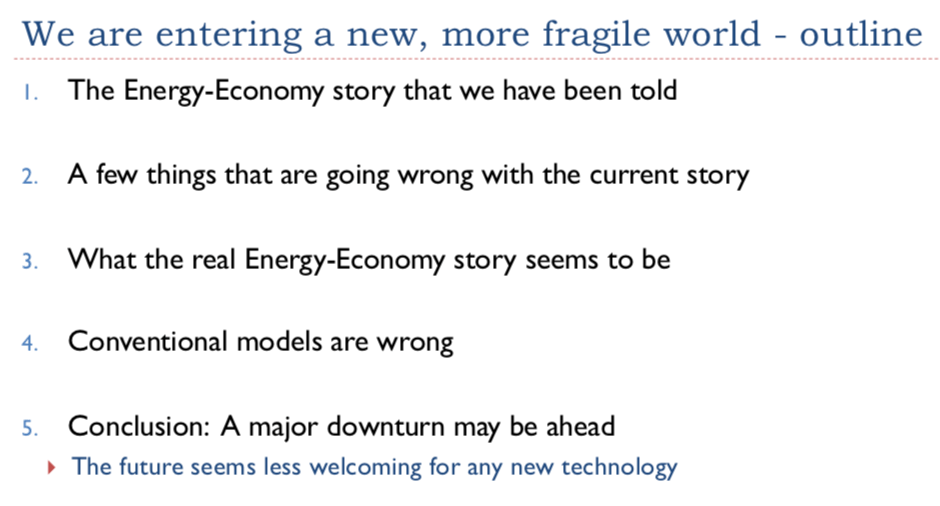
Slide 2.
–

Slide 3.
–

Slide 4.
We have all heard the story on Slide 4 so many times that few people stop to question whether the story is really true. My analysis suggests that it may be mostly wrong.

Slide 5.
The big take-away from this slide is that electricity companies planning for new generation should expect much higher electricity prices in the future. I discuss some of these items separately, on Slide 6.
By way of background, the US Energy Information Administration publishes “levelized cost of electricity” estimates that companies producing electricity are expected to use for planning purposes. When new generating capacity is added, planning needs to be started several years in advance. This is why what is being published now is the EIA’s calculation of expected wholesale costs (at a 2017 price level) for 2022.
Current wholesale prices for “dispatchable” electricity (the opposite of intermittent electricity) seem to be in the 3 to 4 cents per kWh range in the continental US, so all of the amounts shown assume that electricity prices will be much higher in the future. This thinking is in parallel with the “high oil prices will save the oil industry in the future” view that is prevalent in the oil industry. This thinking has helped keep the prices of shares of energy stocks up: “Even if there are problems now,” the thinking goes, “certainly higher prices in the future will fix the situation.”
CCS = Carbon Capture and Storage. CCS techniques are designed to remove a specified percentage of the CO2 generated when coal or natural gas is burned to provide electricity. The unwanted CO2 is stored underground. If the CO2 escapes, it can suffocate the population in the surrounding area. I would not make bets on the technique’s widespread adoption.

Slide 6.
Slide 6 shows a wholesale cost comparison for some particular pieces from Slide 5. All of the costs shown are very high compared to current prices. Wholesale prices tend to be in the 3 to 4 cents per kWh range because of the low cost of fuel (2 to 3 cents per kWh) and the low cost of already built generation. With recent changes in regulations, new generation is expected to be very expensive.
With respect to wind, there are two reasons why variable wind can be sold in Power Purchasing Agreements (PPAs) for 2 to 3 cents per kWh. The first is the substantial subsidies that have been available, making this pricing arrangement profitable to wind producers. The second is the low value that intermittent electricity provides to the grid. In fact, prices locked into these PPAs are slightly below the bottom of the range of expected future natural gas prices (Figure 1, below). This suggests that the primary value of wind generation is to replace natural gas as a future fuel.

Figure 1. Median PPA prices compared to forecast future natural gas prices. Chart by Department of Energy (Chart 54) in its 2017 Wind Technologies Market Report.
Somehow, miraculously, the EIA forecasts that the value of this intermittent wind will rise to 4.1 – 7.8 cents per kWh. In Figure 1, above, this would compare to 41 to 78 $/MWh, which is above the forecast gas price range.

Slide 7.
Notice how low and stable the green coal line is, compared to natural gas prices.
Natural gas comes from two types of producers: (1) those drilling specifically for natural gas, and (2) those drilling primarily for oil, and producing natural gas as a (mostly unwanted) low-value byproduct from drilling for oil. The second type of producer is willing to almost give away natural gas. If it becomes necessary to rely on production from companies whose primary focus is on natural gas production, prices will need to be higher.
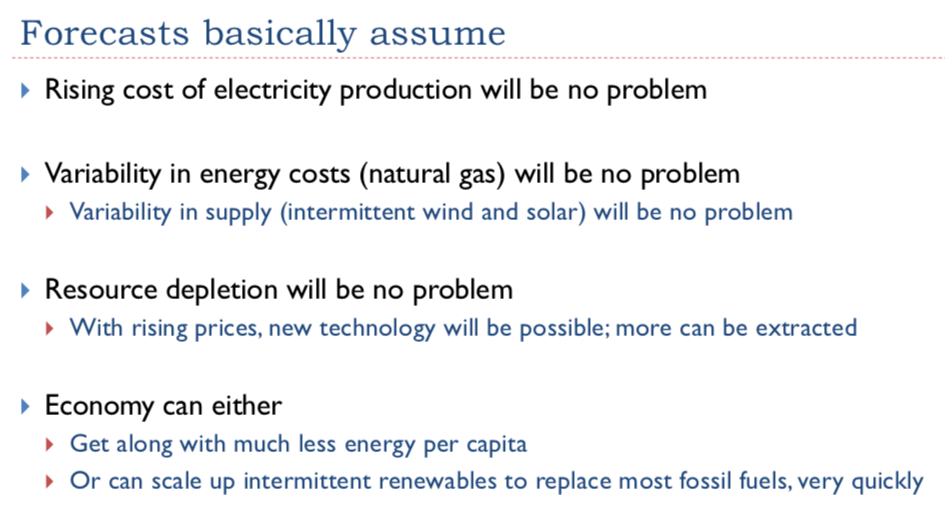
Slide 8.
These are all very important assumptions that are not really true.
There is one reason why it might make sense to somewhat believe the first item, “Rising cost of electricity production will be no problem.” This has to do with the cost-plus type of electricity pricing (“regulated pricing”) that is used in some states of the United States. When cost-plus pricing is used, higher costs can, in theory, be passed on to consumers. The catch is that higher electricity prices tend to raise the price of finished goods and services. If wages are not rising rapidly enough, this can lead to an affordability problem. Industrial users of electricity are especially likely to cut back their electricity demand because higher prices make their products less competitive in the world economy.
After the talk, I decided to look at this situation a bit more closely. This analysis strongly suggests that since 2000, increased globalization has been playing a major role in holding down US demand for electricity. If there is an opportunity, industrial production will move to jurisdictions where the total cost of production (including wages, benefits, electricity costs, and other costs) is lower, even if there has not been a big increase in industrial electricity prices.
If we analyze US electricity consumption by type of user (Figure 2), we see that industrial electricity consumption rose rapidly until the late 1970s, plateaued between 1980 and 1999, and began falling in 2000. This pattern suggests that globalization is an issue. Early globalization sent US manufacturing to Western Europe and Japan. Later globalization sent manufacturing to lower-wage countries, predominantly coal-consuming countries of Asia.

Figure 2. US Electricity Consumption Per Capita, by Type of User, based on EIA data.
US labor force participation rates started dropping about 2000, similar to the drop in industrial demand for electricity. Thus, in recent years, globalization seems to be affecting residential consumers as well as industrial consumers. The impact on residential consumers is indirect, through job competition with global markets.
If analysts who estimate the required quantity of new generating capacity ignore the impact of globalization, their models are likely to give high estimates of the amount of new capacity to be added. If more generating capacity is added than is needed, it can be expected to push electricity prices downward, especially in competitive rating jurisdictions.

Slide 9.
As I will discuss later in this presentation, the economy operates based on the laws of physics. Because of this, it is impossible for the economy to change in ways that politicians would like.

Slide 10.
–

Slide 11.
Most of us have seen stories in the news about Macron and the Yellow Jackets. Can we really assume that citizens will accept higher carbon taxes, without protest?

Slide 12.
Industries get very unhappy when their electricity rates rise, making them uncompetitive with producers in other countries. The rates we are discussing are UK industrial electricity rates, so are a little higher (perhaps 1.5 times higher) than the wholesale prices discussed on Slides 5 and 6. If the price of 8.3 cents per kWh for industrial electricity is a big problem today, how can countries possibly withstand much higher rates, based on higher carbon prices or based on required technology that is much more expensive?

Slide 13.
Suppose a worker gathers reeds and uses them to make baskets. If his production per hour falls, he will have fewer baskets to sell in the marketplace. He cannot expect the price of each basket to rise to make up for his lower production.
For some reason, economists seem to have overlooked this obvious problem. There is no reason to expect that the buyer will be penalized for the higher costs of the energy industry. These higher costs look much like growing inefficiency. In the real world, the seller is generally penalized for falling efficiency. Why do we have so much confidence that the price per barrel of oil can rise, or the price per kWh of electricity can rise, if the price of baskets that a less-efficient worker makes doesn’t rise?

Slide 14. Chart by EIA. More detail on Renewable Energy available on Slide 18.
Slide 14 (made by the EIA) disturbs me. Coal production is dropping off rapidly, but the replacements we have are far from ideal.

Slide 15.
Coal (and nuclear) are the products that have historically kept US electricity prices low. Replacing coal with fuels that are much higher in cost and more variable in availability seems likely to be problematic. Industrial users are likely to be especially distressed.

Slide 16.
The United States has been fortunate enough to have very low natural gas prices recently. A major problem is that these prices are not really high enough for companies extracting natural gas as their primary business. If we really need to depend on natural gas, we will likely need much higher prices. In particular, natural gas prices will need to be high enough for natural gas companies to have bond ratings that are above junk ratings.
The question comes back to, “Can electricity prices really rise very much, without causing major problems?”

Slide 17.
Nuclear power represents a surprisingly large share of electricity generation. Slide 14 shows that in the US, its generation is higher than the sum of all types of renewables combined and almost as high as that produced by natural gas.
Yet nuclear has a lot of problems. It is perceived as dangerous (probably correctly so). Trying to correct the problems with being dangerous leads to a huge increase in the cost of new generation. Businesses in this field, such as Westinghouse, have gone bankrupt. The question of how to dispose of all the spent fuel is still a problem. Also, the many aging reactors will be difficult to replace.
There is also a problem with wholesale rates being too low for nuclear, when electricity rates are competitively set. To work around this problem, some areas use capacity auctions, which are intended to offset the inadequate funding for electricity providers providing backup electricity capacity. One catch is that a capacity auction is, in some sense, needed for every member of the supply chain. Just asking electricity generating companies to bid on providing capacity doesn’t guarantee that the full supply chain will be available.
For example, for natural gas, the capacity auction bid would typically reflect the cost of adding new units for creating electricity from natural gas; such capacity is inexpensive. A more expensive part of the supply chain would be the cost of adding extra natural gas pipeline capacity that is used only a few days a year, when it is very cold or hot. Furthermore, natural gas providers need to be profitable enough to continue to obtain loans at reasonable interest rates. So, even if capacity auctions are provided, they aren’t designed to fix the problems of the whole supply chain.
Furthermore, there has been a recent court ruling that these capacity payments are illegal. I mention in Slide 17 that the UK is affected. In fact, it is the entire European Union that is affected by this ruling. So, even with the best of intentions, member countries of the European Union cannot collect capacity charges to try to offset the underfunding problems caused by giving intermittent renewables grid priority and other subsidies.

Slide 18.
Slide 18 shows that in the US, the only types of renewable generation growing to any significant extent are intermittent wind and solar. Very high subsidies have helped push these types of generation along.
Parts of these subsidies are being phased out, but other, less visible subsidies remain. The fact that intermittent wind and solar are given priority on the grid, when they happen to be available, is a huge subsidy. Also, renewable mandates mean that generation is being added that is not really needed, lowering prices that the self-organizing competitive pricing system creates for backup electricity providers. This is part of the reason for the unprofitability of many natural gas, coal, and nuclear companies.

Slide 19.
In order for intermittent wind and solar to truly be dispatchable, the way other electricity providers are, there needs to be long-term storage for intermittent providers. A big part of the problem is seasonal matching of generation. For example, in a northern area, the main need may be for heat in winter, while intermittent generation may occur primarily in summer. Somehow, the variable wind/solar will need to be stored from summer to winter.
A post by Roger Andrews gives an idea of what the cost of the battery backup needed to solve this seasonal matching problem would be. His calculations indicate that adding sufficient batteries for seasonal matching can be expected to raise generation costs by more than an order of magnitude.

Slide 20.
–

Slide 21.
Most of the things we associate with rising energy consumption per capita are things we associate with a growing economy. Most people want these things.

Slide 22.
Slide 22 shows amounts I calculated from information from various published sources. These include energy consumption estimates by Vaclav Smil in Energy Transitions: History, Requirements and Prospects for older years and BP Statistical Review of World Energy amounts for more recent years. Population estimates are by Angus Maddison.
Based on this slide, most of the growth in world energy consumption ends up being reflected as population growth. It is only when energy consumption growth is very high that the living standards portion (in other words, the energy consumption per capita portion) grows very much.

Slide 23.
The big economic growth bulges that the world economy has experienced are easy to see on Slide 23. One of these is centered around 1910; another is centered around 1970. A third, smaller bulge is centered around 2010; it already seems to be disappearing. This growth bulge was made possible by China and other Asian countries as they ramped up coal production. Now this growth in Asian coal supplies is fading.

Slide 24.
The troughs, where the growth in per capita energy consumption falls to zero or slightly below, represent major problem times for the world economy.

Slide 25.
When a person looks back, the times when oil prices were high (1974-1980, 2008 and 2011) were near energy consumption per capita growth peaks. They were in times of high energy supply, not low. Many favorable outcomes occurred at peak times, including increased cooperation and higher returns on investments.

Slide 26.
Collapses of all kinds occur near troughs in energy prices. Often, these collapses are followed by wars that might be interpreted as resource wars.

Slide 27.
Many of these signs are ones we have been seeing lately. There were calls for tariffs before the US Civil War. Tariffs were increased in the 1920s, to try to reduce competition from abroad. Limits were also placed on immigration during the 1920s.

Slide 28.
When I talk about a vector, I am talking about a combination (really, a weighted average) of many different kinds of somewhat similar inputs. Thus, the energy vector reflects the combination of energy of many types, including human labor sold as labor, in a particular economy. The complexity vector represents the many types of specialization and growing complexity that allows resources (including energy resources) to be used by the economy. The debt vector indirectly represents promises of future goods and services made with energy products. Much of the debt vector needs to be repaid with interest. If the economy is growing rapidly, this is not difficult. If the economy is stagnant, this becomes a problem.
Many people think that oil or crude oil has particular significance. I see the economy operating as an overall whole. Each machine needs to have the particular fuel it uses. Companies decide to build factories in a particular part of the world based on an area’s overall cost level and the stability of its supplies, not based on the price of a single fuel.

Slide 29.
Slide 29 shows my view of how the economy works. As long as the debt level is growing rapidly enough, commodity price levels can be bid up to a high level, allowing increasingly complex goods and services to be produced, using an increasingly complex delivery system. At some point, the increasingly complex system for producing goods and services produces an excessive amount of wage disparity. About the same time, the cost of production tends to rise, as diminishing returns becomes an increasing problem.
The combination of rising production costs and an increasing share of the population with low wages soon creates a variety of problems. The economy tends to grow too slowly, so that debt cannot be repaid with interest. At the same time, the increasingly impoverished non-elite workers cut back on the goods and services they purchase. This might happen if young people find that they need to live with their parents longer, for example.
If interest rates are raised, this speeds up the failure of the system. Eventually, the economy, or a major portion of the economy, tends to collapse.
The big issue that tends to bring an end to economies is the increasing wage and wealth disparity that comes with growing complexity. As long as everyone is fairly equal, no one is squeezed out of buying goods such as homes, vehicles, and other expensive purchases. As businesses and governments get larger and more hierarchical, an increasing share of workers find themselves with low wages. These low wages adversely affect the economy in many ways:
- It becomes difficult for governments to collect enough taxes.
- Demand for commodities (such as those used to make homes and vehicles) tends to fall too low, leading to low prices for commodities.
- Overthrown governments become more common.
- Low-wage individuals become susceptible to epidemics because they do not eat well.

Slide 31.
The orange Energy Services line in the chart at the right shows the UK’s trend in the price of energy services since 1700, on an inflation-adjusted, efficiency-adjusted basis. The trend in these prices has been almost continuously downward. As long as the cost of energy services is downward, it is possible to add increasing amounts of these energy services, because they become ever more affordable. These energy services allow more goods and services to be produced. This seems to be a major factor underlying economic growth.
Diminishing returns, with a resulting increase in the cost of energy services, tends to be the “spoiler” in this system. In theory, rising complexity can be used to work around these higher costs. In fact, increasing complexity is helpful for a time. Eventually, however, the growing wage and wealth disparity that comes with increasing complexity tends to bring the system down. With the growing complexity, the system no longer has enough high-wage workers who can afford the finished products that the system creates. The many low-wage workers cannot make up for this lack of affordability. The number of new homes and new vehicles sold begins to fall, as a result.

Slide 32.
Interest rates, as well as the debt that is available because of low interest rates, play a surprisingly large role in commodity prices. The issue seems to be that debt is used to finance most large purchases, such as factories, schools, homes, and vehicles. If interest rates are low, it is possible for consumers to afford many more of these large purchases than they could otherwise. Once interest rates rise, the entire economy tends to shrink back. Debt bubbles tend to collapse.

Slide 33.
–

Slide 34.
Research into complex systems that seem to grow without outside help is a fairly new field. Clearly the economy is such a system. New businesses are added, as individuals see the need for a new product and a way of producing that product in a way that consumers can afford it. New consumers are added over time, as young people grow older and set up their own homes. Governments gradually add laws to regulate the system. Taxes are an important part of the system as well, and tax laws also change over time.
The thing that people don’t stop to think about is the fact that the system cannot really go backward. If a product is no longer needed (buggy whips, for example, for horse drawn carriages), it will no longer be produced. So, the situation is a little like removing the lower rungs of a ladder, as a person climbs up the ladder. This inability to go backward makes it difficult to adapt to falling supplies of any kind of commodity, including energy commodities.

Slide 35.
The vast majority of researchers do not understand the important role that energy plays in operating the economy and making it grow. These self-organizing systems (dissipative structures) absolutely depend on energy consumption. In fact, economies seem to depend upon increasing energy consumption per capita.
At some point, all dissipative structures (including hurricanes, plants and animals, economies and many others) come to an end. This is the way that a finite world can keep adapting and changing. New dissipative structures form and indirectly take the place of the previous dissipative structures. These new structures vary in structure from the previous dissipative structures. If the new structures are not well adapted, they quickly collapse, allowing room for yet other dissipative structures to form. The replacement of economies in this manner acts as a form of evolution, just as plants and animals evolve.

Slide 36.
Researchers tend to create models that fit their own preconceived notions of how the economy should work. This approach, plus the peer review process, tends to produce a lot of papers with the same (often wrong) assumptions.

Slide 37.
These should be fairly self-explanatory.

Slide 38.
This is probably the most important reason that economies tend to collapse. Most people miss the affordability connection because they interpret “Demand” to be something that anyone can do, without thinking about the affordability aspect. Without sufficient income, a person cannot demand a new home or new car, or gasoline from a fuel station.

Slide 39.
There have been many articles written in recent years about growing wage and wealth disparity. In fact, in the US, wage disparity seems to be back at the level it was before the Great Depression of the 1930s.

Slide 40.
Slide 40 tries to explain a paradox. Energy prices don’t really rise, as production falls too low. Instead, the complex system behaves in a strange way, causing commodity prices to fall because of growing wage disparity and debt bubble collapses.
One way of understanding the situation is by understanding that energy consumption is required for jobs that pay well. If insufficient energy supplies are available at a low price, the vast majority of jobs available will be low-paid service jobs. There will, of course, be a few managers and business owners. But these few managers and owners cannot, by themselves, generate enough Demand for goods and services made with energy products to keep commodity prices up. This is why the system tends to fail.

Slide 41.
I have been following oil since 2005, so I have had a chance to hear the discussion evolve. Oil prices were clearly too high for some consumers back in July 2008, when the sub-prime housing debt bubble popped in the United States. By early 2014, I started hearing that oil companies were very unhappy about the low price level available in 2013. In fact, some companies were sufficiently unhappy that they began cutting back on investment in new fields. It was not much later that oil prices dropped further, making the low-price problem even worse for producers.

Slide 42.
It is surprising how large and long-lasting an impact the collapse of the central government of the Soviet Union in 1991 had on its long term energy consumption. The collapse wiped out a large share of the industry of the Soviet Union and its close affiliates. The Soviet Union was an oil exporter, so the low oil prices of the 1980s were one reason for its collapse. Prices were not high enough for adequate reinvestment in new fields.

Slide 43.
One common inaccurate assumption is that oil prices rise primarily in response to the rising cost of oil production. If a person looks at the data, it becomes clear that interest rates have a huge impact on prices. This seems to happen because the purchase of high-value goods with debt (such as factories, homes, cars, and buildings of all kinds) seems to have a very significant impact on total Demand. Lower interest rates make these high-value goods more affordable. (Quantitative Easing (QE) is a way of reducing long-term interest rates; it also seems to affect oil prices.)
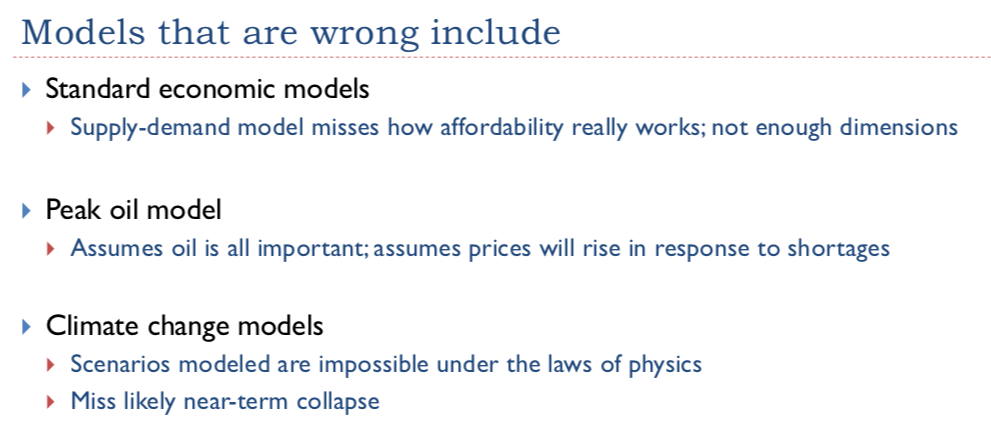
Slide 44.
Since I made up this list, I can add another model to the list that seems to be wrong. The Human and Nature Dynamics (HANDY) model of Safa Motesharrei gives an inaccurate assessment of the likely future path of the economy because it leaves out both diminishing returns and long-term population growth.
In every case, the researchers put together models that represent only a part of the way the world’s self-organizing economy actually works. They pick out a few aspects that they think are important, but they miss other important aspects. This selection significantly affects the outcomes predicted by their models.

Slide 45.
Some readers may be familiar with the Energy Returned on Energy Invested (EROEI) model. This is a model that is sometimes used to justify the reasonableness of selecting certain substitutes for oil, such as the use of intermittent wind and solar. As with all of the other models, the model gets some things right, but it also gets a lot of things wrong. Without understanding how the economic system really works, it is hard to see what goes wrong with the model.

Slide 46.
–

Slide 47.
These are all disturbing signs.

Slide 48.
World leaders act in ways that they feel that those who vote for them would like. In some sense, they are trying to save their own part of the world, even if they create increasing problems elsewhere.

Slide 49.
It is difficult for any new technology to get a foothold in a situation where energy prices of all kinds tend to be low. In addition, the pressure seems to be in the direction of reducing energy prices further, even if this means less energy production of all kinds.

Slide 50.
The world has become increasingly globalized in the last thirty years. Because of the greater interconnectedness, if a collapse occurs in the near future, it could be much worse and more widespread than prior collapses. The adverse results could exceed those of the Depression of the 1930s or the Great Recession of 2008-2009. We have no guarantee of being able to preserve either the oil system or the electricity system. The population of the world could fall dramatically; the economy may need to organize again in a new way without either oil or electricity. We live in interesting times.


Just wanted to say that for some strange reason I find the comment section here at OFW much more enjoyable recently. It seems a bit more polite, mature, and on topic. I hope it continues in 2019.
All of these things are self-organized. I can’t really take credit, I am afraid.
Excessive exploitation and then depletion of a certain “resource” inadvertently resulted in a better world/comments section. Does that hold for cheap resources/energy? I guess it depends on how one defines “better”.
For me ‘better” is less noise and commotion. I work remotely and visit the office in Warsaw once per week if needed. While I appreciate that there is a lot to offer in the city, I prefer standing in my yard in the small village where I live listening to the breeze thru the birch trees and seeing the stars at night.
https://www.youtube.com/watch?v=h_bUcNjmuSk
I miss him
Russian oil peak in 2020 -Russian Government
https://ria.ru/20181228/1548875074.html?fbclid=IwAR3Glixofx1Mr4WCrfCTZ9On1fb-3j_QEC6VZKKhqlVS8Pg13q-Ik-wzMcc
I have heard stories about Russian oil peaking “next year” for many years. I think the situation is the same as everywhere else in the world: as long as producers can be convinced that prices will rise (in the future, if not now), those funding the producers are willing to commit more funds for future production.
China has been different. Most of its production has been unconventional, so it needed a higher price. It decided early on that it really couldn’t afford to compete with international prices on its unconventional oil. So it really did cut back early on.
IEA: Russia’s oil output to reach its peak in 2020
http://vestnikkavkaza.net/news/IEA-Russia%E2%80%99s-oil-output-to-reach-its-peak-in-2020.html
Russia’s Peak Oil Production Could Be Just Three Years Away
https://oilprice.com/Latest-Energy-News/World-News/Russias-Peak-Oil-Production-Could-Be-Just-Three-Years-Away.html
Russian Oil Production Outlook to 2020 -Oxford Energy
https://www.oxfordenergy.org/wpcms/wp-content/uploads/2017/02/Russian-Oil-Production-Outlook-to-2020-OIES-Energy-Insight.pdf
The story seems to be, “Cut the tax rate, if you want more oil produced.” This is very much related to what I keep saying about EROI needing to be measured by the level of taxes that can be paid. Oil (and other energy companies) start lobbying for lower taxes when costs become too high. This is also related to the US tax cut.
What I found particularly puzzling is that this is not the first official .ru msm talking about their domestic peakoil (conventional).. Partly this could be explained as acknowledged PR campaign for extra expenses needed for un-conventional reserves in the Arctic (commissioning nextgen nuclear fleet of ice braker-tankers etc), however even that is a bit of stretch given the Russian realities, or simply the worm has just turned and they feel empowered-invincible in comparison to their sorry situation 20-30yrs ago when completely demoralized.
But it could be also some tactical-strategic head fake, in effect openly admitting peakoil therefor spotlighting the weakness of their sparring partners, since they are the only nation with industrial scale NPPs capable of MOX fueling (recycled). And or even perhaps feel confident enough about some prototyping higher level stuff like fusion already etc., but that’s speculation let say ~2% probability.
Child deaths from opioids nearly tripled in recent years, says Yale study
https://news.yale.edu/2018/12/28/child-deaths-opioids-nearly-tripled-recent-years-says-yale-study
Coming back to Gail’s main article and being an electric engineer by training, I would like to point out that electricity is the flow of electrons from high potential to low potential. For the layman, if there is place with excess electrons and another place will a deficiency of electrons, the electrons will flow from the high electron density to the low electron density area if a wire is connected. That is electricity. Therefore, you need to have a place with high potential to a place with low potential.
Electricity is NOT a source of energy but a transmission medium. You need to something to create the potential difference. In a battery, it is the chemical process. Have a look at https://physics.stackexchange.com/questions/184848/how-is-a-potential-difference-created-between-two-points
This “making of potential difference” is the main issue or elephant in the room that no one wants to look into. It is either too difficult to understand, told not to understand (propaganda) or just could not be bother with facts. That is the big picture.
Chemical process in a battery, nuclear fission in NPP, photoelectric effect in solar cell, magnetic induction in electric generator all requires some form of work to be done. There is no free lunch and nature does not care about it. Someone has to turn the crank of the generator, position the solar cells towards the sun or prepare the chemical or nuclear fission.
So, even for electric cars, you still need to find a way to create the big potential difference. That is the biggest elephant in the room that many refuse to acknowledge. Maybe they think that electricty comes out magically from the wall without any work done. Yeah.. maybe that is the reason because they did not think about the generation of electricity. It is just too dificult to understand or maybe too magical
Well said CTG. Although if I were to essentialise your point even further: the advantage of more efficiency over less is contingent on the potential for converting the freed up work (viz electricity) to a) future work b) more present work. Neither of those things can be caused solely by the freed up work.
Yes. I was talking about the generation part. You are talking about the consumption. It is usually the generation part that is confusing people. Electricity is not a source of energy but just a transmission of energy. EV can never be more efficient than ICE because of too many conversions. Natural Gas / Coal / Oil generating electricity, transmitting across to charging stations, charging the battery and then powering the wheel. At each stage, there is a loss.
For those who cannot understand is that you use a solar panel to charge a battery and then use that electricity to warm the water. In a normal hot weather, it might be better just to use concentrated solar power (i.e magnifying glass type of contractor or solar oven) to heat water.
I think that the same issue may work with robots. The robots look very efficient, but the overall structure needed to build and maintain the robots leads to a situation where the complexity added to the system exceeds the benefit gained otherwise by the system.
Gail, that’s true based on current technology. But of all things, current technology is the most likely to change. We know animals and plants self replicate. So does the entire industrial plant. But there is no reason that eventually we should be able to make robots that take less effort to replicate than planting a seed. See Drexler’s Engines of Creation for a discussion of how far this kind of technology can go. I.e., nanotechnology.
Ah, a techno-cornucopian. I agree with you, but not in the way you might imagine!
Have you looked at the work of HT Odum? He makes the outstanding argument that technology is a function of energy. No energy, no technology. Little energy, little technology.
Furthermore, Joseph Tainter tells us that civilizations inevitably collapse when their complexity exceeds their resource base. Technology is a form of complexity.
Fossil fuel is arguably in decline. We need to adjust our technology level to that suitable for our energy level. That means technology will inevitably decline as energy does.
So I agree, current technology will change… downward!
I think the trick is to ride that downward curve, rather than vainly attempt to keep the curve pointed upward.
I agree with you, Jan, that our technology level has to fall as our energy level falls. I am doubtful that we can ride the downward curve, however. I am afraid the effect may be too close to catching a falling knife.
Yea, with your teeth. While jumping up and down. On one foot. On a balance beam. With both hands tied behind your back. While whistling “The Flight of the Bumblebee.” While looking behind you, at what others are doing, in case they’re trying to take the knife away. With their teeth.
No one said it would be easy. But one has to try, no?
we can still have some technology even without external sources of energy but technology MUST have RESOURCES! That is why “renewables” will fail, not enough resources to build, maintain & repair them.
We can nap stones using only human muscle & our technological knowledge to form them into tools, same for clay or wood. Technology is not welded to fossil resources but raw materials are essential or that technology (knowledge) is worthless.
People have been living in the far north for thousands of years before we had fossil resources but now the far north is much depleted thanks to overhunting, overfishing & excessive extraction of resources, the far north will support fewer people than in the past & even then, they were one bad storm from starvation.
Not only did people living in the “temperate” zone have more resources, storeable grains, domesticatable plants, iron, coal, domesticatable animals, they also had far fewer DISEASES!
I think it was mainly DISEASES that kept the south from advanced civilizations, now it’s overpopulation & exploytation from the north. How advanced can a peoples get if half their population is disabled by diseases & paracites? then add no coal, metal ores, domesticated plants or animals & it’s no wonder they remained “primitive” for so long.
We have documented how disease & religion set civilization back in Europe, I suspect the same for much of tropical Africa & Asia.
It seems too many people still confuse technology with resources, technology is not a “resource” & technology cannot replace declining resources, I wonder if the people who keep pushing for transitioning to “renewables” will ever learn the difference?
So far, it doesn’t look like it.
Perhaps TPTB force them to push “renewables” to keep the masses quiet & buying into that technology, good for PROFITS, for now.
As for the future, yes, we should keep trying to find ways for at least some of us to make it through the bottleneck & relearn the technology of our ancestors & preserve the useful knowledge we gained during the fossil resource age & most of all, we must preserve those BOOKS that have that knowledge in writing.
Too many of the people who once had that knowledge & those skills are gone, only the books they left behind preserves that knowledge.
Save those books & preserve literacy! Your children will need them.
Depleted resources and roads running everywhere, making it hard for animals to travel, are two of the issues we need to worry about today.
I agree with you about diseases being a huge problem in the warm, wet areas of the world. There is a need for a higher birth rate in these areas, just to “stay even,” with all of the diseases being passed around.
Also scale. Making just a few cars with robots is not attractive.
As an example, GM and F shut a model down way before sales to to 0.
If your electricity comes from fossil fuel, then yes. In such cases, EVs are just ICEs with extremely long tailpipes.
But we only have hydropower here, so it makes more sense, from a CO2 perspective.
Aw man, that is a horrible waste!
Electricity is a very high grade of energy, containing a lot of embedded energy in its production and management. It is not really that easy to gave electrons all going in the same direction, at the same intensity and flow rate! Heat is a very low grade of energy. It doesn’t take much to rub molecules together.
So yea, anyone who uses PV panels to heat water is pretty foolish. There are so many other ways, from the simple and trivial, to the sublime, of getting heat.
We had a wood-fired water heater when I was growing up. It looked like a bullet-shaped wood stove, but the entire fire chamber was surrounded by a water jacket. If any of us wanted a shower, we had to go build a fire, first.
I wish I could find one of those…
In addition you have a self dis charge problem. At scale this really becomes a problem on its own. People usually notice this when they use a battery charges device infrequently but in reality the self discharge is happening all the time. Just less obvious when you charge it often.
I lived without electricity and running water for a year in Micronesia.
(got rain off the roof, into a split bamboo, then into a 55 gallon drum).
Traded fish I speared for other things. But used metal shafts for the spears, and surgical tubing.
OMG! How did you charge your EV? How did you charge your smart phone? Did you watch TV by candlelight?
Good point!
yup
no matter how many heads you bang—you can’t get it through, that ”electricity” of itself is useless without the means to put it to work
NP,
Is there a simple bar graph chart ( that is accurate, which is why I ask others instead of relying on my own search, because I am no expert in this field) which demonstrates the useful work can be derived from each end stage of power production and delivery?: ICE vs PV vs wind etc and which incorporates the energy required not only to build each system and but the costs to sustain each system?
My 14 yr old daughter asked me if we would have flying cars in the future. I answered probably not, because the fuel inefficiency is too high, plus regular cars benefit from a lower cost now that huge energy expenditures have already been made to construct roads, although I can not say how much will be expended in order to maintain them. We could not drive 60mph getting 25 mpg if we were driving over gravel roads or mud trails!
ICEs require the construction of cars, building of roads, drilling and refining, transport of fuels etc but also how much useful work is ultimately captured from each BTU of fossil fuels driving the car? The best example I understood was the fact that a Lycoming 160 HP aircraft engine in a Piper Warrior wastes a lot of fuel just cooling the engine! There is a startup cost for road construction but also maintenance costs. Is this too complex a system to be interpreted by a chart?
Don’t have to necessarily play the role of contrarian again, but the old school aircraft engine example is perhaps not exactly the relevant one, as these piston engines had the fuel consumption as third, fourth rank priority; the top priority was obviously reliability-safety. This segment is basically dead as the rich are flying jet turbines only nowadays, and the very few yet not enough rich (<$2M per copy) pilot inhabitants of this planet are flying ~converted diesel engines (jet fuel) in twin setup.. can't recall the exact specs but with 4-6 people on board flying the consumption is more or less equal to highway limousine (per head/seat).
” wastes a lot of fuel just cooling the engine! ”
I too am an electrical engineer. Spent much of my life considering thermal problems. A piston aircraft engine uses the prop wash to cool the engine. I don’t exactly know how you would compute it, but the fuel loss from cooling the engine would be small.
i read somewhere, a while back that the net efficiency of a car in moving people from A to B is about 2%
I’ll try and find the ref if I can
I’ll be interested in whatever you dig up. That strikes me as considerably too low, depending on the denominator.
If they’re comparing the efficiency of a human riding a bicycle to a petrol automobile, perhaps! Nature evolved ATP to be pretty efficient.
You likely will need both electric transmission power lines and devices that use electricity. If you are generating the electricity using wind or solar, you probably will need an inverter as well, if the devices use alternating current. It is difficult to keep all of these things working.
It will be interesting to see how long modern semiconductors, especially microprocessors, will exist.
Such things are not difficult to repair, if they don’t require programming changes. Power transistors are ubiquitous and easily salvaged from broken equipment. Newer inverters with digital displays may not be as useful as older ones with simple LED “on or off” lamps.
The oldest inverter technology employed “vibrators” (no, not THAT kind!) that were electro-mechanical devices that interrupted the direct current so that it could power a transformer. These are the sorts of things that The Tinker could put together in a well-equipped garage.
I worked in a large wafer fabrication plant. It is pure fantasy that these plants will be functioning post collapse. I don’t blame people because they don’t know what is happening inside.The materials used are unique and difficult to get; it requires a super super long supply chain; high grade raw materials and of course abundant electricity and water.
I have a few world-changing patents as well in semiconductor manufacturing. I know perfectly well what is going on inside there.
This is a very simple machine.
https://www.researchgate.net/profile/Hanns-ulrich_Habermeier/publication/248556076/figure/fig5/AS:269841806393367@1441346708284/State-of-the-art-MBE-system-for-oxide-thin-film-growth-Courtesy-of-J-N-Eckstein.png
In order to save cost and provide features to electronic devices, many of the systems have integrated circuits in which the programs, codes, etc are embedded into the chip. Unlike the 1970s where you have discrete devices, you can change the spoilt transistor out. However, it is just not possible to do it now. With multi-layer printed circuit boards, fine wiring lines, it is not possible to repair modern (post 2000) electronic circuit boards easily.
It is wishful thinking of many people to think they can salvage parts in a post collapse world and make it work (probably yes in Hollywood movies but in reality, not exactly)
I didn’t actually work in one, but worked next to one when at Tektronix’s Computer Research Laboratory. We took a tour, and were working on automation software for them.
I agree completely that wafer fabs are perhaps the pinnacle of human achievement, and won’t exist if energy goes to pre-1970 levels or so. In a “hard crash” scenario, they could go away quickly. In either a “stair step” or “continuous” scenario, they cold be around for a couple post-decline decades. Especially if, when decline becomes clear, engineers start designing for a post-decline world.
But whether there will be a ready supply of scavenged parts is a big, open-ended question.
A lot of us seem to agree that, in either a fast crash or a slow decline scenario, a lot of people will be “going away.” That means there may well be a lot of salvage material available.
This is true of a lot of consumer electronics, but when any significant power is involved, the power transistors are generally still off-chip, due to dissipation constraints. And it does take decent equipment and technique to repair multi-layer boards. No doubt, a lot of them will be trash.
But the most likely to fail components with the shortest MTBF are the off-chip power components, and those are generally not too difficult to get at. I’ve even replaced SMD transistors, but anything more than three pins is getting beyond my expertise.
Those who say something cannot be done should not interrupt those who are doing it. 🙂
At least one of the views I hear relates to the sun transmitting so much energy that it should be no problem at all for us to harvest and use it for our own needs. The belief seems to be that all that is needed is a device with a sufficiently high EROEI, and the problem is solved. There are many issues with this view, including the fact that electricity that is not of the right “quality,” and available at the right time and place, isn’t what is needed. Making all of these adjustments tends to be extremely energy intensive.
I get so sick of hearing, “If we simply paved Arizona and New Mexico with solar panels, we could power the entire world!”
Not the least “issue” with “this view” is, what about all the living things who previously used that sunlight to live?
I, for one, would rather die, if my existence required killing all the wildlife and plants in Arizona and New Mexico.
we are going to collapse so we might as well prepare for it physically and mentally which means training your body to survive on less ,i began years ago and the body can survive on less of quite easily. As long as you can have a supply of water that is safe to drink you can survive for months without food
“… you can survive for months without food”
bears do this when they hibernate for the winter…
by gaining hundreds of pounds of extra weight and then sleeping all the time…
not recommended for human beings…
If you starve and have only clean water to drink, what’s the merriment of being alive? Life without whisky is insufferable in in collapse times, and beyond that is pointless, IMO.
Some wishful thinking on this part. If you are without food for one week, you will survive but you are so weak that you cannot do anything at all. If you want to survive, you need modern infrastructure like hospitals, food, etc. If you are found without food for 1 week, you will be so weak that you need to go to hospital and they have to feed you slowly so that it does not damage your stomach. You cannot just simple eat and eat because you have not eaten for so long and god knows what happens to your enzymes.
So, when civilization collapse and you are without food for 10 days, you will die quickly if you find yourself magically in a all you can eat buffet.
Clean water – how many places on earth where you can easily find clean water? Very few and if they can be found, it will be at places with low human density. Within 20km radius from any large city, it is not possible or if it is, you need electric pumps and the population is so high that you will die from some other things before you get to the water. Unless you are desperate, anyone wants to drink from the Hudson River or Ganges?
Well, that should be on your doomstead criteria list then, right?
We managed to find a site with two streams, both coming out of undeveloped, public wild parkland.
How many people here are actually working toward such goals, and how many prefer to just keep living an untenable existence, while claiming “we’re all screwed?”
Keep thinking of Maslow’s Hierarchy. You’re going to need air. You’re going to need water, You’re going to need food. You’re going to need shelter.
Without those four things, moving up the hierarchy will be difficult, because the ones with those things will be soaking up all the excess sex and companionship. 🙂
As usual with people there is the pesky problem – the ability to create shortcuts to their advantage. Near water stream legacy industrial waste site issues aside, even the MiddleAge era peons and nobles alike knew that drinking alcohol reduces greatly any cross contamination from sewage into drinking water etc. So, as long people can produce wines, liqueur and beers this angle will be somewhat covered. Obviously, for peoples lacking or loosing such skillz (perhaps even for religious reasons) tough luck.
Tea works too. But you do have to have the energy to heat the water.
Got about 220 litres of pear cider bubbling away right now!
But it’s actually worth more to us to double-ferment to vinegar, which is an excellent preservative.
To get similar preservative qualities from alcohol, it would have to be much more concentrated, which requires time and energy. Our pear cider is probably no more than 4%-5% alcohol, but will double-ferment to vinegar with a pH below 4.0, enough to preserve fruits and vegetables indefinitely.
And until “the crash” happens, tourists will give us $10 for a 350ml jar of pickled green beans to put in their cocktail drinks.
Yep, historians kind of agree now that even the pre teen children during middle ages where constantly on the ~5% alc “booze” supply, where/when available.. This kind of vanished with the govs-church schooling slowly taking over since ~16-18th century.
Thanks for your detailed write up, I’m not in that phase yet, as taking care of diverse mix of fruit varieties (cider vs. juice vs. table) was not my priority up to this date (and sadly to my detriment).. so just rely on ordinary small orchard.
You don’t need all those varieties. In fact, some of that selective breeding has turned out to be detrimental.
Like wine grapes, cider apples and pears have been bred for high sugar content, which makes for high alcohol content. But these are not necessarily the best for a small sustainable homestead!
I’m using primarily “cattle pears” for cider: large, low-sugar, high-tannin pears that I’m sure were bred for feeding livestock. They don’t taste good. The best human food use we’ve found is pear crisp — with extra added sugar!
But they produce a long-lived cider, and the resulting pomace (cider press cake) is also long-lived. I also pressed some sweeter pears, and the pomace rapidly become mouldy. But I’m still slowly feeding the “cattle pear” pomace to goats, one round a day, busted up and spread in their feeders.
The sweeter, mouldy pomace got shovelled into the chicken yard, where even they are ignoring it.
You don’t need 7%-8% alcohol in order to disinfect water; 4% does just fine!
Of course, if your goal is to soak tourists $15 a bottle for artisanal farmstead-crafted perry — or if you intend to distill to Williams — then you need to pump that alcohol up! That’s what Seckel pears are for, but because they lack stone cells typical of most pears, we find them more tasty in canned pear sauce than in perry.
During the industrial revolution in the UK, it was the boiling of the water for the wort that produced sterile conditions in beer that people were drinking. It was low alcohol around 2 – 3%. It was then replaced by tea – again boiled. Drinking from wells was dangerous unless boiled though that was not necessarily known at the time. It was just known that drinking beer meant you didn’t get sick.
There isn’t a tradition of drinking cold water in China, precisely for the reason you mention. Water is always boiled for tea, or else drunk hot. When I visited Petroleum University in Beijing, hot water that had been boiled was picked up in thermoses by each department for tea in the morning.
https://gailtheactuary.files.wordpress.com/2015/03/gail-china-2.jpg
Some small daily amount of carbs (preferably 100g) will keep you moving and able to gorge if opportunity would arise.
Do note that carbs are not found in nature easily. You need some processing to get carbs. Be it rice, wheat, etc, you need processing like milling, cooking, etc.
I would think carbs is easier aquired than fat or protein.
In scandinavia lichen, roots of burdock, reed etc, some of these containing 15+% carbs, like potatoes. Of course 100g/day is still not so slow starvation, but if it is temporary you could probably get two weeks of good performance to find a fatty animal or someones food cache.
In most plant sources of carbohydrates — including potatoes — the carbs are bound up in cellulose, which must be broken down by cooking before the carbs are very useful.
The exceptions are fruits, which have a lot of free sugar. But they don’t grow year-round.
I don’t think one would live for long on raw potatoes. Humans don’t prominently feature fermentation in their digestion, unlike ruminants, horses, camelids, and other herbivores, who employ bacteria to break down cellulose so they can get at the carbs.
Get Ready for Europe’s Next Crisis
https://www.barrons.com/articles/europe-economic-crisis-is-coming-51545951011
For much of the past decade, the euro area has been an anchor dragging down the global economy. It is in danger of being so again.
The European Central Bank, the European Commission, and European politicians have repeatedly made destructive choices at the expense of Europeans and the rest of the world ever since the first rumblings of the financial crisis. The consequences have been catastrophic unemployment, especially among the young; rising poverty; and—perversely, given their stated objectives—government debt burdens that are increasingly difficult to sustain.
At the same time, Europe’s domestic weakness has curtailed spending on goods and services from its trade partners; instead, they have been forced to absorb the resulting glut of excess European productive capacity.
Sometime around 2015, it seemed as if Europe had finally turned a corner. None of the bloc’s fundamental problems had been fixed, but the generalized financial panic had stopped, and monetary stimulus had begun to kick in. The depreciation of the euro helped by boosting exports, and the collapse in oil prices helped by reducing spending on imports, although the bulk of Europe’s recovery was driven by rising domestic spending on consumption and investment.
Now, the brief and overhyped “euroboom” of 2017 has completely faded. The latest official data show the euro area growing at the slowest annual rate in more than four years. Real gross domestic product grew at an annual rate of just 1.2% in the first nine months of 2018. The bloc grew 2.7% in 2017, 2.1% in 2016, 2% in 2015, and 1.6% in 2014.
It would be easy, but wrong, to attribute the slowdown to temporary idiosyncratic factors. Italy’s borrowing costs have been elevated since May, for example, while German vehicle exports were temporarily hit by the introduction of new pollution standards for diesel engines. In fact, the slowdown is broad-based across all of the biggest economies—Germany, France, Italy, and Spain—which together account for roughly three-quarters of the bloc’s output. (The hit to the French economy from the recent “yellow vest” protests won’t show up in the GDP data until the fourth-quarter numbers are published next spring.)
Worst of all, Europe’s slowdown is being driven by a steady and grinding reduction in the growth rate of private consumption, rather than some temporary volatility in investment spending or the trade balance. French consumer spending is growing at its slowest rate since the beginning of 2013. Italian consumption has flatlined and is in danger of shrinking outright. The deceleration of private spending is most extreme in Germany, with consumption growing at its slowest pace since the financial crisis. Spain is the strongest of the big four economies, but it, too, has experienced a notable slowdown relative to its average since 2014.
Consumption is ultimately what makes business investments profitable, so if European consumers keep cutting back, European businesses will either have to sell more abroad as exports or cut investment. Either choice would be bad news for the rest of the world. Producers elsewhere would lose out if global consumers were forced to absorb the glut of excess European production, while investment cuts would reduce European demand for imports.
Recent surveys of European businesses suggest the situation is only getting worse. IHS Markit reported that “backlogs of work fell for the first time in almost four years” in December as businesses adapted to “the reduced inflow of new business.” Focusing on Germany, Markit’s survey found that business “optimism was the lowest recorded for over four years,” marking a “stark contrast from the situation this time last year.” In France, Markit’s “latest flash data pointed to an outright contraction in France’s private sector for the first time in 2½ years.” In Italy, “output fell at the fastest pace in 67 months.” Spain is a relative bright spot in terms of actual orders and activity, but even there, “business expectations were at their lowest level since June 2013.”
Other macro data suggest that the danger for Europe is more likely recession than overheating. Consumer prices excluding food, energy, alcohol, and tobacco have consistently been growing just 1% each year for the past six years. There has been no upward trend, despite the ECB’s previous commitment to restore inflation to its target of “below, but close to, 2%” and its subsequent asset-purchase program. Moreover, unemployment remains crushingly high across much of the bloc. (The major exception is Germany, but even there, the official jobless rate is depressed by millions of low-paid part-time workers.)
These are the kinds of conditions that normally make policy makers cautious about inadvertently pushing their economy into recession. Europe’s incomplete monetary union makes it especially fragile, and for all of the reforms made since 2011, the integrity of the common currency has not been tested by a broad-based downturn.
Yet the ECB seems convinced that its job is done. At its most recent meeting on Dec. 13, the central bank confirmed that it would stop adding to its bond portfolio by the end of the month. The next step would be to start raising interest rates, perhaps as soon as next summer.
Admittedly, the ECB has not committed to tighten on a fixed schedule and ECB President Mario Draghi emphasized in the postmeeting news conference that officials chose to “keep optionality as a dominant feature” of their policy stance. According to him, their future choices will depend “on the situation of the economy” rather than arbitrary concerns about the calendar or the size of the balance sheet.
The problem is that Draghi will be retiring next year. In the worst-case scenario, he would be replaced by someone as incompetent as his predecessor, Jean-Claude Trichet, as part of some grand compromise to appease politicians in Northern Europe. The likelier outcome is that Draghi’s replacement would have sound economic judgment, but lack the Italian’s skills at getting what he wants out of a diverse group of independent-minded officials. With Europe’s economy slowing down, this is a risk to watch.
one things for sure i wouldn’t want to be a politician when the ponzi ends
Politicians think they understand what Ponzi scheme is but they will fully comprehend what it will do to them. So, they will never try to understand it.
Bill Sodomsky made a comment at SRSROCCOREPORT and this is very appropriate for those those do not really understand what is happening in the financial world.
Quoting the first few lines
“Simply put, you CANNOT taper a Ponzi Scheme. To keep the current system functioning, ever-increasing debt MUST be added. The masses are too indebted already to add their fair share and TPTB know that by continuing to print they will eventually destroy the currency and it may not be on their terms”
Many people know that the current system is a Ponzi system. However, probably all of them don’t realise the implication of a general Ponzi scheme which is always true. It works until it does not. There are many factors that causes a Ponzi to collapse and the “everyone” who is predicting the collapse is using their own reasons for it. It is correct for all of them but it is the case of “3 blind man with an elephant”. Everyone is right but they are not seeing the macro picture.
This contradicts the staircase collapse because these people cannot see the macro view or the bird’s eye view of the entire system. It is probably their work, their exposure that does not allow them to see the big picture. Those who can see the big picture, most of them have cognitive dissonance or normalcy bias that nothing bad will happen to me/US/my country/ my people.
Ponzi requires constant and ever growing input. If they stops, the whole thing collapses. There is no argument on this and this has been the case time immemorial. So, what makes our current system so different that people are willing to give it a pass – “saying that it is a ponzi scheme but doees not suffer the consequences of a ponzi scheme” ? Possibly their minds were shut off as the consequence is just too great to fathom or too horrific.
Pushing paper around to make wealth is not real wealth. The underlying wealth is the energy. A country cannot be a service economy. Can everyone be a barber, manicurist or a banker? Who is going to plant the food, produce stuff that people use? If that person says “import food”, then you can confirm that this person does not possess the ability to view things on a macro level. It is unlikely that he will understand what you are saying because he thinks that his country is a self-sufficient island with no external interaction.
Energy prices is the proxy for the global consumer. Debt exploded from 1970s and that is a proxy of decline of oil. Collapse started in the 1970s but like what older people say “candle burn the brightest/hottest” before it burns out. Using debt to supplement energy, these are the last shots of the heroin to the blood stream in increasing doses until the person dies. When energy prices go down, the consumers are pulling back, voluntarily (in Asia possibly) or involuntarily (in Western developed countries likely). This is totally not good for the Ponzi scheme.
Coming back to Gail’s presentation on electricity. There is one point that people did not take note seriously – “paying the electric bill”. It is getting more expensive over time and it is the same with crude oil, the consumption goes down but unlike oil, prices of electricity is not elastic. There is a lot of sunk costs (power plants) and it is not easily traded worldwide. Electricity is always local, thus, there are no index (unlike WTI/Brent) that people can keep track. We cannot know if the usage of electricity locally as they are not published. For every household that has gone dark (foreclosure, moved back to parents, etc), the usage of electricity is reduced. Do you think with so many dark apartments everywhere in the world (property bubble), rich people are dumping whatever money they have into properties as most people have the mentality that property is a good hedge against inflation.
Take Japan as an example, after Fukushima, nuclear was stopped and they have to import oil/gas to generate electricity. It was a “lucky” (or unlucky if you have a doomer perspective) that their industrial production was not surging, population was not surging (actually declining quickly) and there were many empty dwellings. You can easily search the news for what is happening in Japan. Thus, their “burden” on getting the oil/gas in to generate electricity was significantly lower than expected and keeps on getting lower and there is really no need for them to restart the NPP.
Everyday around the world, many people are dropping out either by going to the countryside, homeless or committing suicide. It is an increasing trend but it is not really reported as it is considered depressing. It is just an extension of what started in 1913, 1970s, 1987, 2000, 2008 or 2011 (depending on when you think the whole thing started). It has been on a “staircase” collapse since those days if you want to view it that way. Anyhow, the staircase has to terminate at ground floor and I can say that we are probably 1-2 steps away from ground floor.
As I have state many times, those who come to OFW are those who are at least educated (or being aware), is comfortable financially and at least middle class or above. If you have no money, you will be working like crazy in 3 shifts just to make ends meet and will definitely not have the capability to understand what is happening. They are like to be concerned on the next meal than oil prices. We don’t mix around very much with other social classes, whether it is above or below us because our circle of friends are also in that social strata.
Our family and I are holidaying in Bangkok and we see lots of people around, shopping, eating, buying and enjoying themselves. They are of the same strata as we are and we are so accustomed to them that we take it for granted that everything is OK (normalcy bias). However, like in any other cities that I have visited, I hunted around the alleyways and observe, there is a huge class of people who are at the fringe. I term them the invisibles. They are washing the dishes, sweeping the floors or worked outside of large cities supporting the cities. Without them, the city collapses but they are invisible. They are the ones who suffered the most. Yes, they are still part of the system and they consume but they are getting poorer. By sheer number, they are the largest comsumer. Example each small bike purchasing only a few liters of petrol per week but when you multiply that by millions of bikes, it will outnumber the cars (think bacteria and elephants). As this group of people shrink, it will impact the Ponzi scheme.
We don’t know about them because they are out of sight and out of mind. We prefer not to care about them because they are “below us”. So, everything is fine and dandy until something breaks.
Happy Holidays everyone. Like Greg said, enjoy the day, stop and smell the flowers and think that it is a blessing that you have the genetic defect of being able to see the big picture.
“This contradicts the staircase collapse because these people cannot see the macro view or the bird’s eye view of the entire system.”
What happened in 08/09? That wasn’t total collapse, it was a staircase step down and things have not been the same since. I think it’s Gail that argues things have been declining since 1980, but maybe that’s not staircase but slow collapse.
Here’s an analogy; As a person ages they reach a point in which certain systems are not working as needed but the person’s till alive. In fact, it’s amazing how degraded a person can get and still be alive. Civilization is the same way. It’s a long way down before it doesn’t work any longer.
“As a person ages they reach a point in which certain systems are not working as needed but the person’s till alive. In fact, it’s amazing how degraded a person can get and still be alive.” until the heart or kidney or liver fails…..
Our status quo has lost the hair, toes, fingers in the 1970s, the arms and legs in the 1980s, 1990s and in 2007/2008, lost the eyes, one lung, half a liver, spleen, and one kidney.
Each failure is a staircase down. It may not impact you but it does impact others (lower social strata). So, the step down did happen but you did not know about.
If you are very familiar with the financial system, then you will realize that how “scr*wed” we are. Internet banking, transfer of funds. Nobody has a lot of money on hand. Nobody has enough food for 1-2 weeks.
“Nobody” is a pretty inclusive term. Mormons, in particular, are supposed to have a year’s worth of food on hand. We are not Mormon, but we do have at least half a year’s worth of food stored, which we periodically use, rotate, and re-stock.
A person needs roughly a tonne of food a year, but that is “wet” weight. You can store grains and pulses for a long time, adding water when you cook them.
They used to say you needed to have at least three month’s worth of expenses in savings. But if an economic crash is going to essentially wipe money out, I think the new rule-of-thumb is to have at least three month’s worth of food stored.
When I say nobody, it literally means the general population not specific groups at the outskirts of towns. It is just not possible to keep more than 2 weeks of food in a standard apartment or house unless you have the space and money to do it. Method the people have neither. Furthermore there is the will and a spouse who is unlikely to agree with what you think/say
Jan+CTG> that’s why the “survivors” of any lasting effect (be it short lived) from the industrialciv areas are not going to be predominantly of military background but rather more of diy tinkering leaning ways such as rescue, forestry, hunters, small scale agri, professionals with open mind to other branches and hobbies..
Obviously before we get there, non disguised mil-police dictatorship, nuclear war etc. comes first with ~95% probability, enjoy..
There are some 15 million Mormons in the world, hardly some “group at the outskirts of towns.”
Of course, many of them may be “jack Mormons,” who don’t carefully follow the church’s rules, but because of those rules, Mormons have an extensive network of people helping others store food, specializing in freeze-dried food, etc. (I realize freeze-dried food is not sustainable, but they also have other options.)
You can store a lot of rice and beans in even a small apartment. We have a large portion of our year’s supply in a dozen feet of metro shelving, including home-canned meat.
So you may be right that a majority of the general population does not have such a practice, but please don’t tell me it is not possible! How is your food supply doing? Are you working on it, or just bitching about it?
So you may be right that a majority of the general population does not have such a practice, but please don’t tell me it is not possible! How is your food supply doing? Are you working on it, or just bitching about it?
I don’t bother prepping. I am in Asia and living in a city because there is where my business and work is located. Knowing the “interconnectedness” of the system, there is no point in preparing. I know what is coming, just don’t know when it will be coming. I am curious to know the trigger only.
We have about a years food It takes up surprising little space and cheep to buy a 10kg bag of rice and a 10kg bag of flour cost less than 20 bucks in my market so that is 1 dollar a kg. Tomatoes are 1 dollar a L and sugar and peanut butter are cheep.
We are surrounded by fish plants so the canned fish is basically free.
The problem is that people have lost the skill set to prep cheep foods.
I can attest that I probably lost at least 1/2 a liver during 2008 / 2009. I agree with the stair step collapse and that its begiinings were likely the early – mid 70’s with US peak oil.
I’m typing from my phone so cannot post the link but there is an excellent article over at Zerohedge about how Brexit is part / symptom of the energy collapse.
Great comments CTG
https://i.imgur.com/Dr6Xnmb.gif
Thanks, CTG! You make a lot of good points. You are right about a staircase collapse being very difficult/almost impossible when what we are dealing with is a collapsing Ponzi Scheme. At the same time, the way this works out is not exactly obvious. There are many “moving parts.” Perhaps a new version of QE can keep things going a bit longer. Or perhaps one country starts a war with several other countries. Even if the general pattern is sort of obvious, how it actually works out in practice is less clear.
I agree that “too many working parts” are obfuscating the collapse because the “staircase collapse” is not so obvious.
I am not a big fan of staircase collapse. However, if one, JMG for example, really insist on it, then this can be modified as there is no rights or wrongs. Everything is like the 3 blind man and elephant. Everyone insist they are right but in fact everyone is right because they cannot see the big picture, the really really big picture.
The key thing that we need to be aware of is “law of diminished returns”. Implementing QE at this late stage may not be effective at all. In fact, it could be detrimental.
Thomas Malthus, the real Thomas Malthus was not wrong. It is just that he got it too early when all others are totally not aware of it.Technology can delay the inevitable but it does not solve it. Agriculture does not solve the problem faced during Malthus’ time. It just delayed it and made it worse. FF made it even worse but the underlying issue/concept like overpopulation was not resolved in the natural way (i.e. predator/victim).
The same thing goes for the financial side – Debts. It was not addressed but compounded. It was made from bad to worse and worst.
Eventually one day, the reckoning will arrive. However, there are people who will say that these “soothsayers” have been saying this for the past so many years and they will be wrong again. To me, these people who criticize the “soothsayers” are really the rejects of nature, the mo.rons or the ones without brains, which incidentally is a large group of people. They do not see the long term or the short term. Basically, they are “I live only in the present and I don’t care about the past or future”. In the past, nature would have culled them but because of improvement in medicine and agriculture, those people survived and flourished. Can you imagine a peasant thousands of years ago say “Those barbarians tried so many times to conquer the city but failed. They will never succeed. haha..”. Until the day the fort was breached and everyone was wiped out.
Will the SJWs, etc that is engulfing the west survive when nature takes over? Not at all. These crybabies will be the first to go and will nature care? Not all.
Nature bats last and nature will have its last laugh
CTG, I don’t disagree there can be a sudden massive collapse, but it probably builds slow, then from stair step events, much the way the previous ice age melt occurred. At some point a massive amount of water washed out into the Atlantic.
The stairs case dropped started when humans started using fire……. that is what aliens studying humans will say when they find out that humans devastated the entire planet. So, is that long enough for a staircase? One foot is already at the last step in the 1970s and the next step is about to touch the floor of the last step.
JMG was not wrong. It is just that our perception was that the stair case is happening now and we are at the first few steps of a long staircase down.
“Simply put, you CANNOT taper a Ponzi Scheme.”
when a Ponzi scheme ends, there can be a small amount of “winnerz” (or none) and a large amount of “loserz”, but life goes on for all the participants…
looked at in another way:
perhaps the world has one or more Debt Ponzi Schemes…
but it is a secondary level of reality layered above the primary level of energy and work…
maybe the weight of the crashing Debt Ponzi destroys the primary level…
or not…
By any extension, humans are always susceptible to Ponzi schemes. That is human nature even for professionals. Those who were bitten before will be bitten again and again. It all boils down to two simple things – greed or desperation. You don’t need to be highly educated to know Ponzi schemes. It is just that you think it will not impact you or the impact will be low for you because you are richer. However, there are many others who need the money and that is a big loss. In this case, the main cause is greed.
Desperation is when you really need to have the high yield. You take the risk and you lose.
However, on the country or global level, it was never thought of as a Ponzi scheme. If they don’t think that it is a Ponzi scheme, it will not be. They will try their best to frame it otherwise. Their job and salary depends on it and they will never say it is a Ponzi.
Shale oil, tar sands are all Ponzi schemes. Needing ever larger investments to keep the current investors happy.
Pension funds, SS, government debts, etc are all Ponzi schemes.
You can even view personal debt as Ponzi, You need to borrow more and more just to satisfy your current demands and debts.
Ponzi is just basically a “disregard of the exponential function”
I hear radio ads for retirement investments yielding 10% with ZERO risk!
Wow!
I hear radio ads for retirement investments yielding 10% with ZERO risk!
I want… I want…. how to sign up? 😉
Young people today especially disregard the problem. The big question is, “Can I afford the monthly payment?” Also, “If I pay back the educational loan slowly enough, part of it will be forgiven.”
Perhaps the “affordable” monthly payment to get on the frivolous consumption groovy train (for everybody with a pulse) is the actual UBI project for our time. Empirically, that’s what happen in the wake of 2008/9 structural support under the pillars of the system provided by everybody (US+EU+China+ few smaller players..) via QE. It was meant to trickle down into affordable monthly payments..
Very well put! Always a pleasure to read you here, CTG.
Thank you JMS. Have a great holiday. Smell the flowers and enjoy the day. All the best to you and your family in 2019
Applause to CTG and of course to Gail and all the other contributers of this outstanding blog!
All the best for you for 2019.
Thank you all!
Saludos
El mar
from the Sauerland
(Part of Germany)
Thanks to everyone! Even questions based on misunderstandings are helpful. They help me understand what is confusing about the situation we are in.
Everyone keeps talking about oil, peak or not. The more immediate problem is peak water. Rivers are being pumped dry, aquifers are being depleted. Unlike oil, there is no substitute for water.
That’s true, but there is a *lot* of seawater. Takes considerable energy to run it through reverse osmosis but if you have plenty of energy, you can make fresh water this way and pump it inland as far as you wish.
Processing water/reverse osmosis/infrastructure inland/pumping/energy involved, are all under the headline of increasing complexity and another contribution to declining net energy. According to Tainter’s ‘Collapse of Complex Societies’, societies become more complex as they try to solve problems.
Adding to that complexity is the fact that the water we drink generally has minerals in it. Drinking water without minerals doesnt work well. Our bodies need magnesium added back into water that has gone through osmotic filters. It probably needs other minerals as well, such as calcium. Trees and plants need the water in the form nature usually provides it.
Minerals are sometimes added to RO water mostly to improve the taste. Or it is blended with other water. Water chemistry has to be controlled or the water eats up the pipes like happened in Flint. But the minerals we get out of drinking water is small compared to what we get from food.
Rainwater is really low in minerals. Plants do fine on rain, they extract the minerals they need from the dirt.
“declining net energy.”
True. Reverse osmosis is not the thing to do if you are short on energy.
Actually, electricity *will* save us . . . If it is cheap enough. Around a cent per kWh is low enough. That leaves out a lot of options. I don’t know how it could be done. My best efforts on power satellites got the cost down to around 3 cents a kWh. Ed Kelly got about the same for StratoSolar.
The agency that oversees federal workers has some advice for the 800,000 furloughed workers who are entering a seventh day without pay: Try bartering for your rent payment.
The Office of Personnel Management on Thursday provided sample letters that furloughed workers can send to their landlords in case they can’t make their rent payments. One of the letters suggests the cash-strapped workers could barter handyman services in exchange for rent money.
Well, a taste of things to come…sooner than later..you are on your own kids..
Let’s see what happens when the food stamp checks aren’t I. The mail…..
but Bill…
will there still be BAU FULL THROTTLE, BABY!
Bill?
The Chickens are coming home to roost….
Trump issues executive order freezing federal workers’ pay in 2019
https://www.cnn.com/2018/12/29/politics/trump-executive-order-federal-workers-pay-freeze/index.html
Trump told lawmakers he planned to scrap the 2019 pay bump for federal workers in August, saying the federal budget couldn’t support it. In addition to the 2.1% pay increase, the executive order also cancels a yearly adjustment of paychecks based on the region of the country where workers are posted, called the “locality pay increase,” that was due to take effect in January.
But we can afford tax cuts for the very wealthy!!!
The pitchforks are going to be very busy when the butcher cuts appear during the next crisis!
Till then…BAU FULL TROTTLE, Baby…Happy New Year!
2019 will be a ride…2020 is when we hit the WALL
https://m.youtube.com/watch?v=Qeg5SfkY4iY
https://www.bloomberg.com/news/articles/2018-12-28/mercury-limits-on-coal-plants-no-longer-appropriate-epa-says
‘Mercury Limits on Coal Plants No Longer ‘Appropriate,’ EPA Says’
“The three most common forms of mercury (elemental, inorganic and methylmercury) can all produce adverse health effects at sufficiently high doses. … Mercury can damage human health because it is toxic to the nervous system — the brain and spinal cord — particularly the developing nervous system of a fetus or young child.”
Except for when it’s delivered in vaccine shots in the form of thimerosal (or thiomersal), apparently. Then it’s perfectly healthy, according to medical opinion.
Yeah, that’s a pretty weird idea in the medical field, at least in my opinion. There is a theory (Theory of Opposite Sub-Verses, available at Amazon.com) that postulates that in each individual the DNA to support it’s particular thought level, is at the same thought level as it’s companion 5th dimensional form of matter, consciousness (or as some refer to it, the soul). Both have to be at the same thought level (utilizing the body to ascend to higher thought levels over that lifetime and successive fusings with life forms), but if damage occurs to the brain (mercury as one example), then the thought level the DNA supports drops, creating an imbalance between the two thought levels, and at some threshold of imbalance part of the consciousness dislodges from the body (and the person can no longer make eye contact). Still one soul, consciousness, but part is thereafter in the body and part is out and that is autism. The greater the amount outside the body, the more severe the autism. At least that’s the theory. So if a child is borderline autistic, it’s very possible these shots can put the kid into full autism.
My Father may not have been formally diagnosed as Autistic in 1930 at 3 years of age, but the doctor forced him to make eye contact over a number of different office visits. It worked to pull him out of that state and he was able to look people in the eye for the rest of his life. The idea of forcing eye contact is to bring the 5th dimensional consciousness that is dislodged back into the 3rd dimensional brain/body. With enough repeat sessions the thought levels of both should level out again, but it has to be done as soon as the problem is noticed or it becomes permanent.
This is one reason why people think these shots lead to autism, because it causes a brain injury. In fact, I think it’s Norway that will not allow inoculations to include mercury.
Royal Bank Of Canada Worries ‘Only Rich Able To Buy Homes These Days’
https://www.huffingtonpost.ca/2018/12/23/housing-affordability-canada-2018_a_23625782
just a temporary little problem…
when the housing crash comes (maybe in the 2019 global recession), they will be way less expensive…
of course, rising unemployment will be the next problem for housing affordability…
It depends on the city you live in Houses start at 50k in Halifax
https://i.redd.it/s3kdvokbwv621.jpg
Xmas gift?
is it returnable?
Don’t know whether to laugh or cry over this one. But interesting to know who the absolute believers are.
https://hbr.org/2017/05/saving-the-planet-from-ecological-disaster-is-a-12-trillion-opportunity
The authors of this article must have talked to the organizers of the de-growth conferences. These conferences take thousands of people from around the world, to talk about new high-tech (and high-priced) solutions to today’s problems.
I also remember a study of the peak oil problem sponsored by Lloyds of London several years ago. It identified money-making opportunities for insurance companies, coming from peak oil.
From the article: “he says, ultimately “technology is a resource-liberating force.” It could help us solve our resource constraints.” – Technology isn’t a force. By itself – it isn’t liberating. It is the energy behind the technology that is the liberating force. Technology uses energy – it doesn’t create anything. Technology is just a name given to a process where humans use energy to rearrange resources into forms that are useful to us. It isn’t magic. The cheaper and more dense the energy base is, the more technology you can have. Energy gives rise to technology not the other way around.
There are so many problems with that article I don’t even know where to start. It is a physicist nightmare. The word sustainable appears at least 15 times in that article. Circular appears twice. Its perpetual motion plain and simple.
http://66.media.tumblr.com/tumblr_m89eok9Zh01rd25aso1_400.gif
Well at least your not seeing sounds and hearing colors. 🙂
Most of the time anyway—-
and this is the best Harvard can offer?
I think they must have a sideline advising Saudis on an oil free economy for 2030
In society where modern conditions of production prevail, all of life presents itself as an immense accumulation of spectacles.
Everything that was directly lived has moved away into a representation.
— Guy Debord, La société du spectacle
The danger is people believe that kind of propaganda. When the people should be mentally and physically preparing themselves for a very harsh, very difficult future. So many will be blindsided by what lie ahead. And the blame for it all will be misdirected.
Nevertheless, I doubt humans would learn a lesson from this anyway. Secular cycles seems to suggest otherwise. We are doing the exact opposite of learning from blunders of the past; we keep repeating the same mistakes but, on increasingly larger scales (and now globally).
Enjoy each day as it comes. Smell the roses, look at the flowers, the animals. Spend some time on the porch. It doesn’t get any better than that.
Frankly, being guilty as charged, frivolous opulence during these Christmas at max anyway, I purposely dialed down the gift bonanza, however the opulence somehow did leak out on its own volition in other way to my surprise. Hence overdose on dark chocolate, quality home made cookies etc. We are surplus gorging animals, it’s hardwired, it’s sick. Please don’t reply with accounts of st. monkish attitudes and charity marathon runs to these sins and urges.. lolz
The problem isn’t outflow; it’s income.
Want to do something really daring? Cut your income!
There are lots of ways to do this besides going to your boss, saying, “Boss, I think I need a negative raise.” You could take a lower-paying job closer to home. You could negotiate working fewer hours. You could start a home-based business.
In any of these cases, you’ll have extra time — time Lean Logic author David Fleming calls “slack time.” You can use this time to grow food, which is untaxed income!
You can even start a housing non-profit, and “pay yourself” in housing for the volunteer work you do for the non-profit. That will require working with others — you generally need at least three members/directors to form such an entity.
My personal cash income is under $2,000 per year.
one day I shall move into a high rise apt block and grow my own food in window boxes
will keep my feel doomsters informed of my progress—until i become too weak to type.
or, having cut my income to the point where I can’t pay my rent. I’m thrown out onto the street
The art of “lean living” is to always stay one step away from that.
If you think you need to stay ten steps away from that, someone will notice and come take nine of those away, anyway!
Whereas, if you have it figured out how to stay just one step away, all those who are struggling to be ten steps away will not be able to tell the difference, and they’ll leave you alone.
This is also called “possum living,” because opossums play dead when threatened. But they’re still breathing, and they’ll jump up and run away as soon as the threat has gone away.
Another scenario is that banks may lose the ability to track your mortgage, in a hard economic crash. It actually happened in 2008, when assets were flipped so rapidly that people actually lost track of who they owed their mortgage to. Some people went months without a payment being accepted, cheques returned as “not deliverable!” One court even ruled that the mortgagee was free, because the banksters could not provide a paper trail as to whom the money was owed.
Of course, I would not count on such scenarios as a strategy, but I think they’re coming.
i do too
but I’m fortunate to have no debts and own my own home. I know I’m in the minority.
Most in my position put it down to hard work etc etc–they don’t take kindly to anyone with the affrontery to point out that it was the short era of oil-luck that we’ve been fortunate to live through that provided what we have and lifted us out of serfdom and oppressed peasantry.
This is why my grandkids ignore me good humouredly and do what they do—maybe I AM wrong, and they will succeed as I did, but I look at their obstacles and can’t see it—but they have a different perspective obviously.
They are all successful at the present time, some outstandingly so,, and I want them to stay that way.
maybe every grandparent has had the same attitude.
I’m thrown out onto the street
I’m assuming you are a resident of the US———-
there are lots of homeless brits too
I’m skeptical that individual belt tightening makes much difference. A huge cultural shift, involving a critical mass, might though. Individual behavior (if done without too much front loading of expectations, and made to be attractive to others rather than preachy) might lead toward the latter. Anybody’s guess.
I don’t think that even a huge cultural shift would make a difference. We need to develop a whole new way of doing things that uses more human and animal energy and less burned biomass and fossil fuels. We need to shift our use of land resources so that there are more biomass areas and more wild animals in those biomass areas. We also need more tame animals that we use to provide labor, and ways of training those tame animals to provide labor. We need a government system that goes with low energy, and a transportation system that goes with low energy (dug out canoes, perhaps). Usually, these new ways of doing things are developed by adding complexity to a previous system. Now, we need a much less complex system. We probably need to collapse and build back up.
I’m always troubled by the concept of “we”
in case it includes “me”
I think it was Ben Franklin who said, “Surely, if we don’t hang together, we shall all hang separately.”
Collective action is the only thing that has any hope of success. But not so much that it attracts attention from moneyed interests… I’m talking about the community or neighbourhood level.
You must be young enough to not have retirement or pension income coming in. Because I can guarantee you that such “passive income” will be among the first to be cut. Trump’s already talking about cutting Social Security. (You have to give him credit for saying what other politicians certainly must understand, but refuse to acknowledge.)
People who expect to live past retirement age better get busy making themselves invaluable to young people.
lol
wrong again.
I’m lucky enough to have several pension streams, and I know what keeps them flowing steadily. I am lucky too, to be 100% fit, so don’t need medical assistance—–yet.
If I happen to visit someone in my local hospital—I don’t see sick people, I see a colossal energy sink which is unsustainable. (Maybe I’ve been in OFW too long)
I also am fully aware that no pensions (like hospitals) are ultimately affordable because they are a call on future energy and prosperity—and future prosperity is 100% dependent on FF’s.
If FFs collapse before I do, it’s game over for me, and millions of others, though most will deny it’s happening
Again, this cannot be grasped by the majority of people one might risk discussing this with. Pensions are a ‘universal right’—-ignoring the fact that they have been that only for a century (in UK)
I absolutely do not believe in the ”collective ‘we’—hence my comment. I have great neighbours, and we would all help each other in a crisis. But if the help circle got wider, that help would dissipate,
A universal crisis might also strain things too.
Well, it certainly makes a difference to the belt-tightener!
Thanks Gail. I’m SO into your scenario. Many senior Third World natives were born into a somewhat similar system. and our parents even more so. But it’s actually FW that keeps me dancing around it without full immersion.
Restraining Factors:
– an immense amount of industrial equipment is available to be used that needs some industrial education to use
– nuclear waste management
– need for antibiotics to ward off pandemics
– cultural unpreparedness for such a simple system
– a full collapse could be harder to recover from and innovate around than doing those within a functioning industrial system
– without any prior preparation or reforestation, helpful devices like dugout canoes and water wheels made from would could lead to severe depletion of an already depleted forestry.
– a collapse will likely lose knowledge that a simplified system would need. (I’m thinking of how it helped that monks stored Grecoroman knowledge during the Dark Ages…
If we could get the billions of students now wasting time in schools to work on a simplified culture, I wonder if that wouldn’t help, or wouldn’t allow us to eat our (industrial cake) and have it too? If every HS graduate had a working knowledge of Ind tech up to, say, 1918, how might that work? Vehicles before then ran on alcohol.
If we are to avoid losing past knowledge, we must preserve their BOOKS!
There are books out there that tell us how things were done in the past, how to make a still, how to make a small boat, (a dugout is terribly wasteful of wood! Most of the tree is just thrown away!) how to grow food without chemical fertilizers, how to train oxen, how to take care of chickens, sheep, goats, cattle etc, how to make leather, how to saw wood in a pit, how to preserve food, etc etc etc.
Books don’t need electricity to be able to read them, books don’t need fancy printing presses to be produced but the old way is much slower, E-books will be worthless without electricity to power their readers or computers.
We also need to save little things we need but won’t be able to produce in the future like steel sewing needles, sizzors, drill bits, hand drills, plastic buckets, they never rust, scyths, plowshares, screws, nuts, nails, bolts etc.
We take so much of what we have now for granted, that we could forget to stash them up for when their production will cease or be greatly reduced.
It is really an incredibly large number of things we need to stash away. Everything is made using supply chains. If there is a break in any of these supply chains, our ability to make the goods disappears. If we want electric cars, we need high tech materials from around the world. If we want to make a computer, we also need high tech materials. If we want to keep road paving machines in working condition, I expect that there are parts we would need to store away. We tend to think too narrowly. We forget all of the intermediate products that are just as important as the end products we see.
It also shouldn’t be impossible to switch the culture to one of constant repair–a repair and maintenance culture that ritualizes daily repair activity.
It’s counterproductive to try and figure out what exactly “we” need to store for another day, and how to do it. I see no reason why books wouldn’t be helpful as a store of knowledge and technical processes. I wouldn’t crack any of the books myself. I pretty much don’t read. But that doesn’t rule out their usefulness to others and indirectly to me.. So the only problem I see there is thinking that the solutions WE come up with are good for all. It’s really powerful to do what you love, and have others react to that or not, to leave a lot of wriggle room for variety and the unexpected or unconsidered. A self organizing whole has too many inputs to figure out. I have a halfassed way to fix the road by my house for free, but that doesn’t mean a more technical and scaled way couldn’t work better or complement what I do. Billions of children wasting away in schools could be freed up to do a lot of work. All manner of things seem conceivable and potentially exciting, but getting them going from a standing position is super hard. Just the same, I believe in trying. My religion is try-ism, where the only sin is to not to try due to a thought or a mood. Undoubtedly, there are points where trying is up against real limits. But discouragement, and failure to convince others or to see tangible results (as far as you know) shouldn’t be among them.
True. The culture needs to change, and unhappy warriors won’t have much of an effect toward that goal.
I suppose culture is constantly changing, but telling the public to cease the rat-race and do more with less seems to be an impossibility
“Yesterday the United Arab Emirates reopened its embassy in Damascus. Bahrain will follow next. Kuwait will reopen its embassy in January. Oman never closed its embassy in Damascus. Of the Gulf countries only Qatar, allied with Turkey, and Saudi Arabia have jet to announce a revival of their relations with Syria. Before the war on Syria started, the UAE and other gulf countries financed several large investment projects in Syria. These will be revived and help the country’s economy back onto its feet. Egypt is expected to follow the move of its Gulf sponsors.
Underlying the UAE move is a strategy of countering Turkey’s neo-ottoman ambition. Syria is (again) seen as the bulwark that protects the larger Arabia from Turkish marauders. It signals to Turkey that any attempt to take over more of Syria will be resisted by the Gulf states and possibly even by Egypt’s army. Egypt is, together with Russia, mediating between the Kurds and the Syrian government.”
https://www.moonofalabama.org/
Here is a good recent post from “shortonoil” from the peakoil blog:
It is true that shale operators are getting greater production per rig in barrels per day per rig. That, however, does not negate the high decline rate of these wells, and it is their high decline rate that will bring about the demise of the industry! To keep production constant the decline of old wells must constantly be replaced. In December of ’18 it is projected by the EIA that shale will produce 8.032 mb/d. Since the decline rate average is constant at 17.8% (89% over the first 5 years) per year per well, in 2019 the shale industry will have to bring 1.43 mb/d of new production on online to keep production constant.
Each rig can now bring online 679 barrels per day, so it will require 2,106 rigs (1.43 million /679) to just replace the decline of 2018 in 2019. In November the industry had 1,208 rigs running; in 2019 rig count will have to increase by 74% to just keep production even with 2018!
This is a typical Red Queen scenario where the industry has to run faster and faster to just stay in the same place. With HY now approaching 8% (and that market getting very tight) and the industry having no free positive cash flow with WTI at $45/ barrel, and the industry now having to put in operation an additional 898 rigs in 2019 to match 2018 production, shale has hit the wall. Shale production growth is no longer capable of overcoming its own decline, and the decline in conventional production. The world is now Peaking.
Plausible, but for how many years already we heard about IMMEDIATELY COMING reversal in y/y rig count, instead they pumped up various debt/financing schemes..
And now with ~ $45 oil pricing, drop in shale production will mask depletion concerns again, chances are it will be just blamed on the recession, hence no understanding – reaction for more years to come..
Debt is a promise of future products made with energy. As long as people believe the story that oil prices will continue rising, they will keep bidding up the price of oil and gas company stocks, and this will permit additional debt.
The end comes when this pricing view cannot be maintained any longer. We are getting to this point, but it is not yet certain that it is permanent. Prices may need to fall somewhat farther to guarantee a permanent drop in oil rigs. Falling prices come with recession, so we should expect recession to be an indicator of “peak oil,” or of “peak energy consumption per capita.”
Peak oilers and economists have confused matters with their discussion of high oil prices at peak. This is nonsense as far as I can see. Low prices and fighting of various kinds (even wars) are characteristics of reaching limits of energy supplies.
Oil prices did spike. Over $140/bbl. Oil at $140 that was a peak oil moment. The moment where oil passed out of bounds of what the economy could handle. We are, in a way, past peak now. Running on essentially momentum from embedded energy of the past. It is what came after the spike (a dramatic drop in oil prices) that was unexpected. The thought that oil prices could rise without end was not true. From about 2008 on we have been living in an oil energy world that is out of the bounds of both classical economics and peak oil theory. Perhaps we can call this the “era of peak affordability”.
You are right saying that $140+ was the peak moment. I would call it call the peak oil price moment. Now, even a lower oil price is above what the economy can handle.
The peak quantity of oil pumped comes when prices fall too low, for too long. We seem to be about that point now. Or perhaps it takes more contraction in demand and recession to bring prices down even farther to reach that moment.
My guess is that peak supply will come about now, because OPEC and its allies plan to cut supply to get prices up to a level closer to what they want. The plan now seems to be to cut PEC production by 0.8 million barrels per day, and non-OPEC allies will cut by an additional 0.4 million barrels per day, starting in January, making a total cut of OPEC and its allies of 1.2 million barrels per day.
ExxonMobil Headed for Worst Year Since 1981
https://www.rigzone.com/news/wire/exxonmobil_headed_for_worst_year_since_1981-26-dec-2018-157788-article/
What a coincidence you mention (merino) wool. I have been a follower of Shugemery (“Shug”) on his YouTube channel for several years now. During the summer, he is literally a clown, but don’t let his demeanor fool you. During the winter, he is an avid winter camper —and he knows his sh-t!
https://www.youtube.com/watch?v=CTuGJgka1qc&t=922s
https://www.youtube.com/watch?v=RLn54AF9kKo&t=545s
https://www.youtube.com/watch?v=jRq8zrAUPTU&t=468s
https://www.youtube.com/watch?v=RLn54AF9kKo&t=77s
It is a biologic constant that when you get older, you are less able to tolerate the cold.
Since the dollar may inflate away to worthlessness in a few years, I have even thought of acquiring some cold weather gear just in case, for example:
Wool hat by Aerial…https://www.etsy.com/shop/KnittyGritt…
Boreal Wool Shirt…http://lrbushcraft.com/lester-river-b…
Steger Mukluks….https://www.mukluks.com/Yukon/product…
Kahtoola Ice Spikes….https://kahtoola.com/product/microspi…
Blackrock Down Beanie…https://www.blackrockgear.com/hats
Outdoor Research Cirque Pants….https://www.outdoorresearch.com/us/en…
Outdoor Research Meteor Mitts….https://www.outdoorresearch.com/us/en…
Minus 33 gloves….https://www.minus33.com/wool/merino-w…
Possum Down gloves….http://zpacks.com/accessories/possum_…
I have heard this before, but don’t really understand it.
I would agree that there is a tendency for older people to get more lethargic, and thus generate less energy. But “a biologic constant?” I recall nothing of this in my formal and informal studies of biology.
In my experience, this is highly individual. We have a young German student living with us. He is constantly cold, and so is my spouse.
On the other hand, I call 10°C (50°F) “T-shirt weather.” I wear shorts well into October, think it was early November this year. I worked outside for several hours yesterday in about 5°C (41°F) with drizzle, wearing a flannel shirt and no jacket. In the winter, I’ve been told I’m “good in bed,” but I don’t get puffed up about it, because it simply means I’m a good bed heater. In the summer, it’s “EEEWWW!!! You’re all sweaty! Get away from me!”
I come in wearing wet flannel, and my spouse says, “Get that thing off you so you can warm up!” “NO!” I reply, “I’m drying it out!” I could save a bundle as a human clothes dryer.
I attribute this to living in the back of my truck in a ski-area parking lot every winter weekend for 18 years when I was teaching skiing. I went through a lot of shivering, which turned out to be good training.
How do I do it? Well, its a bit embarrassing. I’m an engineer and citizen scientist, not normally a “woo woo” type. But when I feel chilly, I “think warm thoughts” and then I’m not so chilly any more.
Perhaps this skill could be taught? Perhaps there’s a chunk of change in it for me somehow? Don’t know.
I probably could have been one of them Buddhist monks, sitting next to a frozen lake, counting the number of frozen robes I can thaw. Another missed lucrative career opportunity.
The problem with goose down is that when it gets wet, it loses its insulative capabilities, especially in a sleeping bag. When goose down is dry, it indeed is much more efficient as an insulator especially on a weight and compressibility basis than artificial fillers (lamilite) such as what is in Wiggy’s sleeping bags. https://www.wiggys.com/
Wool is great as a winter garment because, like lamilite, it still maintains thermal insulation qualities when wet, as opposed to say cotton or down, which are terrible once they get wet.
Old people can not regulate /maintain their core body temperatures as well as younger people. This is just medical fact. Old people therefore don’t tolerate the cold (or heat) as well as young adults.
I have done a fair amount of high backcountry winter cross country. Once could not find a cabin above 12000 ft in Colorado….and had to emergency bivouac out in the open….never been so tired in my life and so cold. Got down to -25 I guess, plus wind. In addition to my feet freezing when I put them in my boots the next morning ( a deadly mistake….do not ever leave your boots outside your sleeping bag at night) A buddy had some minor frostbite on some fingers in the morning.
Ironically this was the same pass that Alferd Packer went out with 5 other men and he was the only one who returned. He was tried and found guilty for cannibalism.
In 1968, students at the University of Colorado Boulder named their new cafeteria grill the “Alferd G. Packer Memorial Grill”, with the slogan, “Have a friend for lunch!” Students can order an “El Canibal” beefburger, and on the wall is a giant map outlining Packer’s travels through Colorado.[16] It has since been renamed the Alferd Packer Restaurant & Grill.”
Proud to say I have eaten there!
Back to the cold….wool socks are all I will wear. Staying dry in winter conditions is essential. Layer, and if during the collapse, utilize natural wool when Possible. Goose down “inners” for inside your parka, should never be allowed to get wet, and don’t sweat on them. Never over warm yourself while exerting. Layer!
“Proud to say I have eaten there!”
were you alone?
or else…
who did you have for dinner?
I dined there with a vendor. Happy to say that I am strictly a non human carnivore.
Alferd’s Confession.
“Old Man Swan died first and was eaten by the other five persons about ten days out of camp. Four or five days afterwards Humphreys died and was also eaten; he had about one hundred and thirty three dollars ($133). I found the pocket book and took the money. Some time afterwards, while I was carrying wood, the butcher was killed—as the other two told me accidentally—and he was also eaten. Bell shot “California” with Swan’s gun and I killed Bell. Shot him. I covered up the remains and took a large piece along. Then traveled fourteen days into the agency. Bell wanted to kill me with his rifle—struck a tree and broke his gun.”
Upon being convicted , “ the presiding judge, M. B. Gerry, said:
Stand up yah voracious man-eatin’ sonofabitch and receive yir sintince. When yah came to Hinsdale County, there was siven Dimmycrats. But you, yah et five of ’em, goddam yah. I sintince yah t’ be hanged by th’ neck ontil yer dead, dead, dead, as a warnin’ ag’in reducin’ th’ Dimmycratic populayshun of this county. Packer, you Republican cannibal, I would sintince ya ta hell but the statutes forbid it.”
The court record. “Alfred Packer, the judgement of this court is that you be removed from hence to the jail of Hinsdale County and there confined until the 19th day of May, A.D. 1883, and that on said 19th day of May, 1883, you be taken from thence by the sheriff of Hinsdale County to a place of execution prepared for this purpose, at some point within the corporate limits of the town of Lake City, in the said county of Hinsdale, and between the hours of 10 A.M. and 3 P.M. of said day, you, then and there, by said sheriff, be hung by the neck until you are dead, dead, dead, and may God have mercy upon your souL”
I ran across I guy complaing that it it was sooo cold in the UK people were freezing to death I asked him how cold it was he said 0c… cant fix stupid so I just said nothing.
ECB sees global economic slowdown in 2019
https://www.reuters.com/article/us-ecb-policy/ecb-sees-global-economic-slowdown-in-2019-idUSKCN1OQ0KX
From article:
“Looking ahead, global economic activity is expected to decelerate in 2019 and remain steady thereafter,” the ECB said.
“Global inflationary pressures are expected to rise slowly as spare capacity diminishes.”
____
This story sounds pretty flakey. I don’t see where the inflationary pressures are coming from. Higher interest rates work the opposite direction. Diminishing returns tends to make costs higher but it doesn’t make the ability to pay for those costs higher.
“Looking ahead, global economic activity is expected to decelerate in 2019 and remain steady thereafter,” the ECB said.
ECB saying “After this little bump in the road in 2019, everything will be fine thereafter. Nothing to see here; please move along.”
University of California: Environmental Science & Technology (Malyshkina 2010)
1. It Will Take 131 Years to Replace Oil with Alternatives
2. World oil production will peak between 2010-2030
3. World proven oil reserves gone by 2041
https://www.scribd.com/document/394656677/Future-Sustainability-Forecasting-by-Exchange-Markets-Basic-Theory-and-an-Application-Malyshkina-2010
A global energy assessment (Jefferson 2016)
An extensive new scientific analysis conducted by the Former Chief Economist Michael Jefferson at Royal Dutch Shell published in Wiley Interdisciplinary Reviews titled “A Global Energy Assessment 2016” : says “that proved conventional oil reserves as detailed in oil industry sources are likely “overstated” by half.” & “punt bluntly,the standard claim that the world has proved conventional oil reserves of nearly 1.7 trillion barrels is overstated by about 876 billion barrels. Thus, despite the fall in crude oil prices from a peak in June 2014, after that of July 2008, the “peak oil” issue remains with us.”
The World in the 21st Century is faced with huge challenges that go far beyond, but importantly include, energy challenges on the supply, access, and use sides. So severe are these challenges, mainly arising from the demands of a rapidly increasing human population on the Earth’s limited resources, that the future existence of large numbers of people may be threatened with extinction. In that sense, we may be observing the twilight of the Anthropocene (Human) Age.
https://www.scribd.com/document/394043449/A-Global-Energy-Assessment-Jefferson-2015
Projection of world fossil fuels by country (Mohr, 2015) Fuel
Over 900 different regions and subfuel situations were modeled using three URR scenarios of Low, High, and Best Guess. All three scenarios indicate that the consistent strong growth in world fossil fuel production is likely to cease after 2025. The Low and Best Guess scenarios are projected to peak before 2025 and decline thereafter. The High scenario is anticipated to have a strong growth to 2025 before stagnating in production for 50 years and thereafter declining.
https://www.scribd.com/document/375110317/Projection-of-World-Fossil-Fuels-by-Country-Mohr-2015
IEA Chief warns of world oil shortages by 2020 as discoveries fall to record lows
https://www.wsj.com/articles/iea-says-global-oil-discoveries-at-record-low-in-2016-1493244000
Saudi Arabia’s Energy Minister Warns of World Oil Shortages Ahead
https://www.wsj.com/articles/saudi-minister-sees-end-of-oil-price-slump-1476870790
There will be an oil shortage in the 2020’s, Goldman Sachs says
https://www.cnbc.com/2018/11/09/goldman-sachs-there-will-be-an-oil-shortage-in-the-2020s.html
Wood Mackenzie warns of oil and gas supply crunch
https://www.ft.com/content/a1eb0e58-d7a4-11e8-ab8e-6be0dcf18713
Imminent peak oil could burst US, global economic bubble – study
https://www.theguardian.com/environment/earth-insight/2013/nov/19/peak-oil-economicgrowth
German Military (leaked) Peak Oil study: oil is used in the production of 95% of all industrial goods, so a shortage of oil would collapse the world economy & world governments
https://www.scribd.com/document/387459134/german
Definition, definition.. it’s all relative.
Are the people now leaving Venezuela just in mode of avoiding mild discomfort or are they surely escaping malnutrition and certain death?
How long before humanitarian food aid is no longer provided to Africa at all?
Are the protesting people in France just in mode of avoiding mild discomfort as their wages/social handouts buy less than few yrs ago or are they truly bordering on starvation? Why aren’t there also the Italians, Brits, Asians or CEErs out in the streets arranging traffic blockades as well?
You see in all above cases it’s all very fluid, muddy terrain, different trigger – threshold levels, most likely we need extra 5-10yrs to evaluate the ongoing slow collapse progress properly.
It seems that even Gail entertains some sort of post bottleneck scenario (if only toward showing its gross limitations). 🙂 But that goes in contradiction to other lessons from her that have sunk in well.
1) A new cheap form of energy–and we tend to downplay what havoc that would cost to non energy resources–would need to use existing infrastructure to be affordable.
2) 8 billion people in a hyper networked industrial civilization don’t just go away nicely post collapse, allowing a few hardy, self-sufficient souls to make a go of it. With so large and unprecedented a global population, and so large and complex an economic system, the human mind can’t take in what a collapse affecting the heart of the civilization would look like. So…
3) To have some chance of working, a (relatively) post collapse scenario would have to use the current social, physica (and maybe political) infrastructure that we have now. It would have to look and feel very much like how it does now. People wouldn’t abandon cities and go do homesteading in the bush. Not enough bush, for one thing. Since it takes more energy to run a central government (and since it also produces apathy and passivity), government would become much more participatory and local. Individualism would also be tamped down, and groups and “tribes” would need to work together. And since the quality of the land would be critical for the welfare of relatively deindustrialized networks, there would have to be great cooperation as to the welfare of the broader landscape–coasts, fisheries, watersheds, etc. I agree that a lot of scrounging and tinkering would be involved, but it would involve some sort of educational backing, as well as strong local government support.
3) “post collapse”, big cities would be abandoned… cities can only exist when there is enough surplus energy to bring in food and clean water and bring out waste…
people would have to live close to food production and clean water…
this surely means a massive population reduction…
you’re correct that governments would have to be more “local”…
each governing a localized area of food production and clean water…
it’s hard to say what sizes “local” governments would be…
but “post collapse”, the world will be very different (obviously!)…
I do leave the door open for some group of post-collapse survivors. I would envision the type of post-collapse government would be pretty simple; it likely would be a single leader for all of the people in a small area, leading as a king or dictator would rule. There wouldn’t be enough energy for a great deal of input from others, I don’t think.
It is hard for me to see current infrastructure being used for very long. We won’t be able to heat or cool these homes, or direct fresh water or electricity to these homes. People who still remain will want to be closer to possible food sources. They will camp near the food that they are looking for.
I don’t know what is possible. I do know that our pre-human ancestors lived through several ice ages. If they could do that, surely some of us today could live though rapidly changing conditions, in some way.
I’ve made it through bitter cold many times.. fleece is one of the greatest inventions ever, and Aaron Feuerstein should be given a nobel peace prize for refusing to patent it.
Almost as good as wool!
Down is what everything else is measured by.
For a moment they saw the nations of the dead, and, before they joined them, scraps of the untainted sky.
— E.M. Forster
I agree there will be some post-bottleneck scenario. Sure. But, the problem I struggle with in my mind is how long will it take to go from where we are now to where the next equilibrium will be? We have a very long way to fall so how far will we fall back? Just like we are in resource overshoot right now, we could just as well fall to a point well below the remaining resource base – call it resource undershoot,
But, all of that is really moot to me. Why? Because I just see this period of dark ages (barbarism, starvation, pestilence and disease) that persist even long after I am gone. This period of time is what I call undershoot.
“Because I just see this period of dark ages (barbarism, starvation, pestilence and disease) that persist even long after I am gone. This period of time is what I call undershoot.”
The Bible if one believes in it, has a passage where it says that in the future, times would be so hard that the “living would envy the dead”.
Could you please clarify your overshoot/undershoot scenario? Whatever I’m seeing looks like a very (blessedly) gradual change. So much so that the majority of people think that life is proceeding smoothly and normally. A few of us, though, have long sensed existential scarcity and just can’t believe the profligacy of our culture. So we cringe everytime we use a sheet of paper towel, and find ways to use the same piece several times. It becomes second nature to do so. And even then we feel like we’re living in abnormal luxury,
My hope is that we can stabilize the culture somewhere around the consciousness of that minority, and work like dickens to make it physically sustainable and palatable. That lifestyle has to work on three levels: economic, environmental and aesthetic.
This new order has to be greatly localized, calling for intensive, proactive land use (comprehensive) planning at the local level. It all seems doable, the hitch being how to get a critical mass to join in. That could require a miracle. Although Gail could be correct that kings and dictators would do. I prefer the critical mass scenario myself.
An example might be Easter Island. The population started with about 20 people, it peaked at perhaps 20,000 and fell to something like one or two thousand. The fall might have taken two or three generations while the warriors went at each other with sharp rocks.
With 90-95% of the people gone, the environment recovered to some extent and with the improving conditions, the pressure for war was reduced.
This is from memory because I have not read up on the subject recently. But I think a fall to one in ten or one in 20 is a reasonable expectation for a collapse that took out the energy and transportation infrastructure.
All your ‘solutions’ seem to have a blinding place already – the South island of NZ. WE welsome any of you who want to party through hell because that’s what we do every day…. HAHAHA
NZ?
have you ever tried looking through online obituaries for a middle aged guy named Eddy?
What Populists Do to Democracies
According to our research, populist governments have deepened corruption, eroded individual rights, and inflicted serious damage on democratic institutions.
https://www.theatlantic.com/ideas/archive/2018/12/hard-data-populism-bolsonaro-trump/578878/
Is the problem populist governments, or are populist governments simply a symptom of too little energy consumption per capita leading to too much wage disparity?
i would say a symptom of diminishing returns
and the key diminishing returns are those in the energy sector where net (surplus) energy is declining…
net (surplus) energy is “the one ring that rules them all”…
I think it is a mistake to leave out “per capita.” It is population growth that is the killer.
Whether or not it is “net” is a matter of preference. Getting energy consumption from gross to net adds jobs. It also provides a lot of tax revenue for governments. I don’t see a whole lot of point to making an adjustment from gross to net because our method of calculating this amount has a lot of deficiencies. For example, is it “correct’ to equate intermittent electricity to other electricity? Is a hoped-for forecast of future returns equivalent to actual returns on fossil fuels? The cost of governmental services (such as roads and schools) is high, but it is normally left out of all of the calculations.
Also, there are many different boundaries that can be used in the gross to net calculation. Is the gross to net (a) simply pulling the energy product out of the ground, (b) getting the energy products properly refined and delivered to the industrial user, or (c) getting the energy products to end products that humans can really use? If it is (c), this pretty much defines the whole economy. Item (a) was chosen, because it was an item that graduate students could collect data on. I personally think (a) is as misleading as it is helpful.
I think the concept of surplus energy is important, but I would define it in terms of taxes that the energy sector can provide to governments around the world. Any energy sector that depends on constant subsidies is not providing surplus energy to the overall system.
Quote Tim Morgan:
Money is a human artefact, which we can create at will. But money has no intrinsic worth, and commands value only to the extent that it can be exchanged for goods and services. The real function of money, therefore, is to act as a claim on the output of the real economy. Creating more of these monetary claims adds nothing whatsoever to the quantity of goods and services for which they can be exchanged.
Everything – literally everything – for which money can be exchanged is a product of energy. In pre-industrial times, the energy basis of the economy was confined to human and animal labour, and the nutritional energy inputs which these outputs required, The harnessing of exogenous forms of energy, starting with fossil fuels, leveraged this equation without changing its fundamental dynamic.
Whenever energy is accessed, some of that energy is always consumed in the access process. The driver of prosperity, then, isn’t the gross amount of energy to which we have access, but the net or surplus quantity which remains. This is why the Energy Cost of Energy, abbreviated here as ECoE, is a critical determinant of economic performance.
Quote Gail Tverberg: I would define surplus energy in terms of taxes that the energy sector can provide to governments around the world.
Tim Morgan’s definition of surplus energy is much broader than Gail’s. (sorry!)
We can disagree. I have seen enough of EROEI calculations not to really believe them. Tim’s ECoE calculations are supposedly different. I have a hard time believing that they are much improved. Real world proof, in terms of taxes paid, gives a much clearer view, in my opinion.
I prefer the time to energy payback as a metric. Power satellites came in at under 3 months.
The problem is that the measure of “energy consumed” is woefully inadequate. In real life, it is necessary any energy-producing product to pay back (1) its full cost of production, including adequate wages for human workers and adequate returns if money is borrowed or obtained as a stock investment (2) pay taxes on its profits, so governments have adequate funding. I would argue that (2) is one of the major uses of “surplus energy.” Too many people look at a very narrow measure. On this basis, the “energy payback” looks great. But it really isn’t.
““energy payback” looks great. But it really isn’t.”
Gail, I was very careful in accounting for the project profit. Besides a very fast energy payback, producing and selling power satellites it made an enormous amount of money, enough to pay lots of taxes. Using robots in space does not change the economics a lot, reduces the peak investment because you don’t have to provide shielded living areas. Of course, the company has to develop assembly robots. I don’t know how to estimate either the cost or the time, but it should be a relatively small part of the startup cost.
Not saying people will ever deploy power satellites, but they do look like a route to relatively cheap energy.
Time seems to be one of the big things we are lacking. Tadashi’s estimate seems to be, “Not before 2040.”
“2040” There is a very good chance that smarter than human AI will exist by that date. How that would change the picture is beyond even the SF writers.
AI doesn’t create energy, unfortunately. It uses energy.
“AI doesn’t create energy”
If the AI is any good, it will tell us how to cheaply tap sources of energy. There is no lack of energy when you consider even the amount of sunlight hitting the earth.
I ran into a proposal a while ago for converting 90% of sunlight to electrical energy. It wasn’t obviously wrong, just hard to implement.
Until fairly recently, 100% of the Sun’s energy went into powering the earth’s biosphere and weather systems, apart from the portion that, thankfully, found its way back out into space. In that respect, there isn’t really any extra available for an extensive industrial technological civilsation.
In that case, you should be a fan of power satellites. We could also put a sunshade at L1 to compensate.
Beautiful!
Very nicely put. I get so upset when people suggest that all we need to do is “pave over” Arizona with solar panels, in order to “solve” our energy crisis. As if nothing else had been using that sunlight.
It’s a zero-sum game, folks. Whatever 7.7 billion of us do, takes from other life.
We behave as if we are the only thing that matters to our ultimate peril.
You can talk about not enough energy, or too much debt, but ultimately, it’s going to be too much hubris and arrogance that does us in.
i made a new year resolution to stop repeating myself
but I’ll break it in a good (masochistic) cause
sunlight hits the earth and delivers 100w sq/m
before we used FFs–that allowed a global population of 1bn
If you wanted to use a tree to build a house, you had to wait 50 years till the tree produced enough wood to do that (using 100w rule)
If you wanted to build a cathedral—you had to pay 000s of workers to use their sunlight quota to cut stone for you, and move it, via their food intake from that 100w/sq M
that didn’t change till FFs began to be used 250y ago and multiplied our food/energy supplies that allowed everything else to take place
we now have 7.5 bn, and they are still hungry
Nit-picky, I know, but I think you’re off by an order of magnitude, there. Average insolation is over a kilowatt per m^2.
Agree with the rest of your post, though.
Also at the risk of repeating myself, here’s an “energy primer,” put in terms of fossil sunlight and social power.
as I understand it, insolation is about 1 kW in optimum conditions–ie, clear sky, sun directly overhead in tropics/equator.
this can never be ”average”. We have to live 24/7 at every latitude
“1kW”
That’s correct. You can do a little better by putting your PV at 20 km, but not much. If you go into space the insolation goes up to about 1.365 kW/m^2. In GEO the PV (or whatever) is in sunlight 99% of the time.
The usual peak to average ratio for the best places on earth is about 1/5th. Which is why power satellites make physical sense (if not economic sense) even after losing half the power in the microwave link to the ground.
https://upload.wikimedia.org/wikipedia/commons/c/c7/Global_Map_of_Direct_Normal_Radiation_01.png
with almost no net (surplus) energy by then…
AI will literally be powerless to do anything to benefit humans…
I second that – diminishing returns!
Rare glimpse of a couple bitcoin geniuses
https://www.dailymail.co.uk/news/article-6532783/US-Bitcoin-trader-strangles-girlfriend-death-Philippines.html
Sears may be down to its last 24 hours. Iconic retailer likely liquidates if no bid comes in tomorrow.
https://www.cnbc.com/2018/12/27/sears-may-need-to-liquidate-if-no-bid-comes-in-by-tomorrow.html?__source=facebook%7Cmain
Two things:
1. Fast Eddy please come back.
2. Tony Seba is wrong, but rich people love him.
We have to figure if there was anyway conceivably possible, surely FE would have been posting dozens of times a day. That’s the other side of the coin to being anonymous – if something happens to a poster, there’s no way of verifying it unless a friend or relative posts an update.
More globule warmuuung?
FE is fine. He is still occasionally posting at Surplus Energy Economics.
is the tone/style of writing similar to his past?
perhaps there might be a person who would think it was fun to take over his screen name…
RIP, late great Fast Eddy…
he will be back this place attracts realists and the vast majority who get
it are always on this site
I think it’s better to just accept that we have seen Peak Fast Eddy earlier in 2018…
his word resources were pumped out too fast, and his supply is totally depleted…
now, alternative word resources such as Jan and Keith are filling the gap…
the world is always changing!
you cannot step in the same river twice…
The system of comments is also a self-organizing system. It depends to some extent on the energy level of commenters, and also on my energy level in answering the comments.
It seems like the extent to which a particular commenter is active ebbs and flows. If a person has a particular view he/she wants to express, if that view doesn’t catch on, after a while the commenter may give up and go somewhere else.
I don’t worry about “fixing” the comments, except to try to keep very strange and negative comments down. We need some comments with somewhat utopian views, if for no other reason than to hear what others are thinking. Also, to see whether there are some advances and other ideas that we aren’t keeping up with.
I think of myself as a realist. In a way I suppose people like stories like Tony Seba’s because it makes them feel there is something to look forward to. I just never really needed that. I live for the moment and enjoy the present for what it is. I don’t need people like Tony to show me how incredibly lucky I have been to have lived at such an amazing time in human history.
LOL!
‘A kick in the stomach’: massive GM layoffs leave workers distraught – and angry
https://www.theguardian.com/business/2018/dec/27/general-motors-ohio-auto-car-layoffs?CMP=share_btn_fb&fbclid=IwAR02QxgY-W3PYxiI8Bbn90Hwkc4v5thNojd0jYv2izqqAzC9LLZ9EXwc0Bs
GM is probably skittish about ever doing anything that will cause it to have to ask to be baled out again, fearing it won’t happen, especially with Trump in office. So, better to lay people off and change course on models made to stay up with the times. It was a business decision, plain and simple with no way around it having ramifications on people’s lives. I’m sure it wasn’t done with malicious intent.
JCPenney stock falls below $1 for the first time ever
https://www.cnn.com/2018/12/26/investing/jcpenney-stock/index.html
HA HA! Now, it’s a penny stock! 🙂
This doesn’t sound good!
How fake is the world today?
Ever hear of a click farm? Well according to Wikipedia a click farm is a form of click fraud, where a large group of low-paid workers are hired to click on paid advertising links for the click fraudster (click farm master or click farmer). The workers click the links, surf the target website for a period of time, and possibly sign up for newsletters prior to clicking another link. For many of these workers, clicking on enough ads per day may increase their revenue substantially and may also be an alternative to other types of work
Then click farms turn around and sell their likes and followers at a much higher price. According to the Daily Mail, “BuyPlusFollowers sells 250 Google+ shares for $12.95; InstagramEngine sells 1,000 [Instagram] followers for $12.00; and AuthenticHits sells 1,000 SoundCloud plays for $9.00.”
https://en.wikipedia.org/wiki/Click_farm
If this isn’t evidence that we are deep into diminishing returns I don’t know what is.
Strange!
Yesterday, Dow up over 1,000 pts. Today, Dow down over 400 pts.
Yesterday oil way back up – today back down over a buck for WTI & Brent.
Which all means there is a lot of uncertainty in the markets. Investors like to have firm footing and with all the odd political stuff going on, the footing is soft and shifting. Expect a lot more uncertainty until the situation w/T if finalized one way or another.
The Dow ended up over 260 pts., after being down over 400 pts. earlier in the session. It’s a wild ride these days.
“If there only was a sign”
Sven Henrich
https://pbs.twimg.com/media/DvbhDEqUYAAnTW-?format=jpg&name=medium
This seems to be charting techniques applied to $SPX data. The $SPX seems to be an option fund associated with a S&P 500 index fund.
Ok.
Revolution in US is inevitable, says jailed Russian businessman Viktor Bout
https://www.rt.com/russia/447380-us-revolution-looming-bout/
Revolution? I doubt that. Americans could start a revolution. But, it would run out of energy mighty quick when the food supplies are cut off. Sorry the government has an off switch for that. If revolution breaks out, it would be might short.
People in the US seem too complacent to make much of a fuss. Whether their situation is good, bad or terrible, people here tend to just take it. If they claim ‘the people’ should get more it’s labeled communism and their labeled communists. If they claim the spoils should be spread around more equitably, they’re labeled socialists and forced to shut up. So all they can do is be ok with a widening wealth gap and live the best they can in a society suffering from declining net energy. Essentially what’s happening is the wealthy are getting wealthier, while the rest have less and less as time passes. By the time this situation is done, the richest will be in 2 mile long gold plated yachts chalk full of tasty treats served by slaves and the rest will be living in their vehicles.
The peculiar thing about Americans as society is this rehashed “splendid isolation” phenomenon where WWI/WII and following proxy wars, foreign interventions touched them very lightly in per capita comparison vs. Europeans, Asians etc.. This pent up
long drawn lucky series will have to end one day – clash with reality and it is most likely going to be dispersed thought internal revolution of some sort.. perhaps around the boundary of ~2025-45 window or what have you. I’d assume it’s going revolve around sketching out domestic resource distribution vs pop aka forming of early prototype fully open feudal phase.
It seems most Americans today are largely uninformed, overweight, out of shape , arm chair quarterback and TV junkies. Hardly the type to have the stamina to undertake a multi-year act of revolution. In the mid 1860’s Americans were mostly farmers. They grew their own food and were in better physical shape than they are today. I could be wrong but, I think Americans were better equipped for revolution then than we are now.
“I think Americans were better equipped for revolution then than we are now.”
Agree. Gone soft. It sets up an interesting situation too as far as post collapse is concerned. Presumably hard labor will once again be required of the majority that make it through any kind of bottleneck. Only those capable of putting in hard physical labor days tiling soil, milking cows, whatever is required will be accepted into commune’s pulling together to survive. I can see it will not be a task many will adapt to or even be able to put in a single hard day’s work, let alone day after day. “Get up and get to work for 10 hours or no meals. That’s our rule.”
Communes post collapse? Communes now might be better. Undocumented Mexican immigrants live 15 to an apartment. They work in shifts and so can alternate use of beds. They look after each others’ kids.; They share cars. Not for me by any means, but that’s as good as a commune. We can’t afford any kind of bottleneck/post industrialist society, or else all nuclear hell will break loose.
“So the first thing we know about 2019 is that it’s going to look a lot like 2018. JMG”
Um, that is the same line he uses nearly every year for the past decade. His zealous ideologues are just praying for the STHTF so he can finally be proved right, fifteen years and counting.
so then you are saying that he has been correct for 15 years?
that’s a good track record…
though I have my qualms with many of his thoughts, he does support his claim well that disruptive historical changes move slower than most persons realize…
one of my points was that I think 2019 has an elevated % chance that it will be a year that is an exception to his routine claim…
Not sure what you mean here but JMG is not expecting “collapse” any time soon. Although, for some people, it may feel like collapse a lot sooner, JMG expects the collapse to take centuries. He dismisses claims that “this time it’s different” but I don’t think he’s factored in the fact that this “civilisation” IS very different from past ones in terms of the interconnectedness between societies within the civilisation, and the fact that it consists of so many different societies and cultures (even though there may be an underlying economic culture that is the same everywhere).
“… I don’t think he’s factored in the fact that this “civilisation” IS very different from past ones in terms of the interconnectedness…”
others have convinced me of this also…
he may have researched “all” past civilizations and found that they all had a “long descent”…
but yes, this global civilization IS different… especially more complexity…
this time could be different… could be a “fast collapse”…
Lol…if JMG thinks “collapse” will take centuries he is in fact just pointing out that all things including ind civ will end sooner or later. That is 100% true, as is the fact that the Pope is Satan.
Also, the length of descent isn’t relevant at all. What matters are the causes of collapse. Past civilisations didn’t collapse over centuries. Rather, they collapsed roughly at the same rate as the current one is doing to a less complex state, once the causes of erstwhile complexity disappeared. Present level of tech and infrastructure cannot be maintained at a less complex state for anyone, minus causes for current degree of complexity/scale.
Expecting collapse to take centuries obviously doesn’t tell the full story. JMG’s ideas on this can be found in his book, The Long Descent. Suffice it to say that he expects the collapse to go through stages, in what he terms a catabolic collapse. I don’t expect it to take centuries but I do expect it to go through stages, though we may not recognize discrete phases.
Agree to some extent.
On the issue of non recognizable stages, well it depends. For example in rapid succession of events like revolution, war, weather instability, say at least each per decade, additional stuff like large part of economy reshuffling onto natgas and huge demand destruction per specific segments of society (elderly + young + expensive care treatments) THIS ALL might in aggregate NOT look like proper stages but in effect it would be. Mostly people would blame the misfortune and new condition on some specific key event they liked to pick up, e.g. political reshuffle-revolution, end of private carz epoch etc.
I take the year 1970 (the collapse US conventional oil production) as the start of the collapse, So, to me we have been in this predicament for almost 50 years now. All kinds of tricks have been used over the years to mask diminishing returns. Two income families. Bringing women into the workplace. Children working summer jobs. Using debt to paper over systemic problems. Rolling loans into more loans. Stock market bubbles. Moving from the gold standard to dollars, the petro-dollar then, to credit cards. All the while ignoring monopoly and anti-trust laws.
Then, manufacturing moved overseas to exploit cheap labor (slavery). And more recently, loaning huge sums of money for college loans, zero percent interest rates, bailing out monopolistic banks and corporations, massive money printing have extended and pretended that everything is fine. Countries around the world are subsidizing energy and food costs. The US is subsidizing farming (mostly factory farms anyway), renewables, EV’s all with debt.
Meanwhile, energy (oil, coal and NG) is becoming more difficult to find, more expensive to produce. At the same time the prices of oil continue to fall! Yes, classical economics is breaking down. The old “supply vs demain pricing” of classical economics no longer applies to energy products. It is this disconnect from reality that is occurring in the energy sector that is the canary in the coal mine. At some point the energy to run this carnival ride will become so unprofitable that it must cease. Already some big coal companies are folding. COAL companies are failing!!! And peak coal was 200 years away? Our cheapest energy source is cracking before our eyes. Producing steel without coking coal is going to be one hard nut to crack.
So, the elephant in the room is here: if resource extraction is not profitable – it will stop. We are at this juncture now. Resource extraction is not profitable. Stocks are violently looking for stability. Oil cannot find a stable price. NG has been volatile for years. Once credible, trustworthy government bodies like the FBI, CIA, Supreme Court, Congress and the Executive branch are in complete disarray (if not outright corrupt). This is diminishing returns. We are living it. Society is holding together with duct tape and bailing wire – and it shows, it is global in scale and snake-oil salesman are everywhere trying to graft one last profit off the system before it blows up. Everywhere I look, the evidence is clear to me physical reality meets hopes and dreams is about to be tested.
Where is FE when we need him?
Mrs FE found out about the harem he had scattered around the world
he is now the lead soprano in the eunuch’s choir
Thomas Malthus has been on Surplus En Econom recently
TM 2.0, slightly diffetent mood? Maybe new medication.
Yes, before long the comment section will read like the bumper stickers on the backside of a Prius.
Nice, critical assessment of the Teslatunnel
If one does not dwell on the details, some ideas seem great. Geee, why hasn’t anyone thought of this before – sort of thing. Well, maybe it has been thought of before and discarded due to lack of profitability.
looks like the PPT plugged up the hole that had appeared on the dam, this proves that their are two forces operating one that wants to destroy the status quo and start again and another that wants to keep it as it is .Well unfortunately the system is unsustainable and is going the way of the dodo. With our days most surely being numbered let us enjoy what precious time we have left Ke Sara Sara .
I don’t think so Adonis. The 26th and 27th are going to be huge up days because of corporate pension funds rebalancing their portfolios to include more stocks due to the bond routs. $50B is being reinvested, alll known ahead of time due to a Wells Fargo report and also documented in Zero Hedge.
I can see how rebalancing of portfolios at the end of the year might lead to huge up days, temporarily.
JMG gives his 2019 predictions:
https://www.ecosophia.net/the-dark-places-of-the-future/
“So the first thing we know about 2019 is that it’s going to look a lot like 2018.”
while this has indeed proven to be accurate for many years, late stage 2018 seems to be indicating that 2019 very well may be one of the exceptions to the rule…
a severe downward exception, to be sure…
it’s perhaps worth the time to read…
his “predict next year” thinking has some merit…
“Definition: a “doomer”; any bipedal animal with a functioning brain.”
I resemble that remark! It seems the more you try to look at the big picture to more doomerish things look. Best to stay glued to the iPhone.
https://peakoil.com/forums/viewtopic.php?p=1410013#p1410013
A comment on the article shows how ignorant people are:
“The fact that Opec can cut production and we can put sanctions on Iran, without raising oil prices, should tell you the world is nowhere close to peak oil production. Sorry doomers, we have a few decades to go yet.”
1) This person thinks classical economics still applies to oil and oil prices.
2) Opec said they cut production but the numbers from SA showed increased production.
3) This comment assumes that oil prices are low because there is plenty of cheap oil left and ignores the possibility that the economy cannot afford the oil at the current price
4) Good luck with those decades of oil left. Sure there will be oil left … .but it will be unprofitable to extract.
https://oilprice.com/
Brent went up today ~4 bucks but WTI only went up .42 cents. Dow bounced back 1086 points. Who the heck knows what’s going on for it to be this volatile, or the plunge protection team got busy.
or maybe:
– by pensions funds which waited until the very last minute to buy up to $64 billion in stocks as part of their quarter-end rebalancing.—
But, who knows?
For those of you too busy to invest the time to watch the 1 hr video on the upcoming transportation disruption, here is a link to the PDF version of the report: https://static1.squarespace.com/static/585c3439be65942f022bbf9b/t/59f279b3652deaab9520fba6/1509063126843/RethinkX+Report_102517.pdf
Executive Summary:
We are on the cusp of one of the fastest, deepest, most consequential disruptions of transportation in history. By 2030, within 10 years of regulatory approval of autonomous vehicles (AVs), 95% of U.S. passenger miles traveled will be served by on-demand autonomous electric vehicles owned by fleets, not individuals, in a new business model we call “transport- as-a-service” (TaaS). The TaaS disruption will have enormous implications across the transportation and oil industries, decimating entire portions of their value chains, causing oil demand and prices to plummet, and destroying trillions of dollars in investor value — but also creating trillions of dollars in new business opportunities, consumer surplus and GDP growth.
The disruption will be driven by economics. Using TaaS, the average American family will save more than $5,600 per year in transportation costs, equivalent to a wage raise of 10%. This will keep an additional $1 trillion per year in Americans’ pockets by 2030, potentially generating the largest infusion of consumer spending in history.
We have reached this conclusion through exhaustive analysis of data, market, consumer and regulatory dynamics, using well-established cost curves and assuming only existing technology. This report presents overwhelming evidence that mainstream analysis is missing, yet again, the speed, scope and impact of technology disruption. Unlike those analyses, which produce linear and incremental forecasts, our modeling incorporates systems dynamics, including feedback loops, network effects and market forces, that better reflect the reality of fast-paced technology-adoption S-curves. These systems dynamics, unleashed as adoption of TaaS begins, will create a virtuous cycle of decreasing costs and increasing quality of service and convenience, which will in turn drive further adoption along an exponential S-curve. Conversely, individual vehicle ownership, especially
of internal combustion engine (ICE) vehicles, will enter a vicious cycle of increasing costs, decreasing convenience and diminishing quality of service.
before a more detailed response, I will cough up this:
where are the moon colonies and fusion reactors?
surely they should be here by now…
“moon colonies” Sigh. The moon is an awful place to do just about anything. But it looks less and less likely that humans will go into space at all. The reason is pure economics. If you have anything to do in space or on the surfaces of moons or planets, robots are the way to go because they cost a small fraction of what it takes for human life support.
Back in 1975 when the L5 Society was formed, there were no robots that could do what humans are good at. Now there are or will be soon. Humans just can’t compete with robots and AI. Human moon colonies may happen, but it will be long after the robots have built everything humans need in space.
“Humans just can’t compete with robots and AI.”
robots and AI just can’t compete with humans…
see how easy it is to just say things?
“… will be soon.”
that’s far-fetched techno-optimism…
“will be soon” is my point about fusion reactors…
I’m sure there were some Seba types who were lecturing 20-30 years ago about their appearance before 2020…
had there been anything of commercially usable value/profit on the moon, colonies would have been established within a decade of the first landings
this maybe sums up space exploration/settlement:
https://medium.com/@End_of_More/mission-to-mars-d57055fa6f34
We need to get output of the economic system into the hands of the non-elite workers, to keep the system going. It seems like if the output of the system is devoted to robots and AI to do things in space or on the moon/planets, there is very little in the way of goods and services that will get back to non=elite workers. The vast majority of the benefit of these devices will come in the form of wages for the elite workers who build these devices. Also for owners of these devices, as they appreciate in value (?) and provide whatever services they are supposed to perform (?).
If a government is to be supported, the activities that are developed need to provide taxable revenue. A fairly large share of that taxable revenue needs to go to the government. Otherwise, the government, like the non-elite workers, will be starved. I don’t see how this arrangement will provide taxable revenue to the government in any reasonable timeframe.
I agree, Gail. All this talk of robots and AI as if they will just fall out of the sky. These things require very high tech capabilities (jobs) to construct (jobs) and maintain (jobs). Thus, they require a fully functioning JIT industrial supply chain (jobs). But, the robots will destroy the very thing they need to be function – jobs. It is circular logic to think robots and AI can work. To build and maintain AI and robots means full employment, mining and energy and resources to perform the work.
Further, if one is to suggest that robots will do all the resource exploration, discovery and mining too….then that is one heck of a big chasm to cross and a lot of technical know-how and energy to produce such an autonomous army of robots. Then, something breaks, then what? Build more robots to diagnose and fix the broken robots? Surely proponents of AI and robots can see the error of circular logic of all this. Just like solar and wind and renewables – it is a dog chasing its own tail.
“We need to get output of the economic system into the hands of the non-elite workers, to keep the system going.”
Gail, I appreciate your thinking on the subject, but I have no suggestions as to how this outcome might be accomplished. AI and related seems likely to displace even the elite workers. The system, including the companies, seems to have a life of its own. I have thought about the far side of the singularity for many years. it’s a tough place to go.
https://edoras.sdsu.edu/~vinge/misc/singularity.html
AI is extremely difficult to do very well. One of my sons worked on a program that was intended to help de-bug computer programs that other programmers were trying to write. Even with a lot of effort, it was hard to make it work even passably well.
“AI is extremely difficult to do very well.”
I agree. The most advanced AI around is the neural network methods that learned how to play GO. AI of this kind gets very good, very fast if it is the kind of learning problem that can be used to train AIs.
could that be Peak AI?
just playing an inconsequential game…
there’s no guarantee that AI will be a world changer…
in fact, AI research is racing against the declining net (surplus) energy of our remaining FF resources…
I think AI is guaranteed to lose that race…
Here is why I think there is no real AI.
Because my excel program is soooo DUMB….when I need to do complex things, I have to do some serious macros or programming.
“The disruption will be driven by economics. Using TaaS, the average American family will save more than $5,600 per year in transportation costs, equivalent to a wage raise of 10%. This will keep an additional $1 trillion per year in Americans’ pockets by 2030…”
where’s the cost calculations for 100 million autonomous EVs? (at what, half a million per car?)
because around “rush hour” in America, there are probably about that many vehicles on the road at the same time.
I will guess the cost to build these will be about $1 trillion per year…
and where have I seen that figure before?
and, is anyone really going to debate that these costs will not be passed on to the consumer?
total savings to consumers = zero at best…
fascinating TaaS article
thanks for the link.
To sum it up concisely, the writers seem to make the common error of equating transportation with wealth creation —ie, our prosperity will be ok as long as we have wheels.
And of course that it has been wheels that provided our prosperity in the first place, not the other way round.
Freeing up ”driving hours” will add $trn to GDP because drivers will be working ”elsewhere”—no mention as far as I could see, that ”work” requires energy input, which will not be available in 10/20 years time
the entire piece, summing it up, is an exercise in constantly adding 2+2 to make 5, expecting the free ‘one” to come from some as yet uninvented source
eg, batteries/vehicles running for 1 million miles by 2025/30 ish, as if the battery itself is the only part that ”runs and wears”
that seems to have been arrived at by using the same moores law of computing and applying it to vehicles, with no substance behind it
I agree Norm. Folks seem to think our modern way life is somehow rational and sound with a solid foundation. But, it isn’t. It is like putting central air conditioning in a ram-shackle barn that is about to fall down. All these pie-in-the-sky AI solutions are not going to be helpful (or even needed) once diminishing returns really starts to bite in the coming years. Solar, wind and AI are not going to fix shrinking profits, soaring debt, insolvent pensions, loss of wages and jobs. This is caused by diminishing returns. You cannot stop or prevent diminishing returns. It is part of the physical laws which govern life on Earth. We had our day in the sun – and that time has passed. It is unfortunate But, it is what it is. Some of you folks seem to believe you can make something from nothing – that is just a song.
Collapse comes from lower spending. We need something that goes the opposite direction: gets more wages into the hands of non-elite workers, including people who are now truck drivers and cab drivers. We need a system that creates evermore affordable automobiles, and ever more roads, and ever more homes. Otherwise, we end up with ever more wage disparity, as an ever-smaller share of workers can afford to buy and use cars.
It is only when everyone, including the riches billionaires, choose to ride in autonomous EVs, that they make sense. Then nearly all of us can work on building the new enhanced roads that they will require to actually operate.
Folks, remember too that all of this “stuff” (renewables, EVs, robots, AI etc) is predicated on the future of availability and profitability in the mining and energy markets. This is not assured.
Right!
The problem with giving the non elite workers more wealth is that it also drives up GROWTH & DEMAND for more OIL, WOOD, NAT.GAS, METALS, FOOD, HOUSING etc etc & resources are limited!
Your solving one problem & creating even more, larger problems.
De-growth is the only solution left to us, our numbers must & will decline, we have already ruled out a rational controlled decline & have “chosen” instead to fight for the last bit of resources all the way to up collapse resulting in the deaths of billions of us.
More growth is not the solution, it’s our worse problem.
I think it is an illusion that it is possible to have “de-growth” that is different from collapse.
When I went to one of the (huge) degrowth conferences, the plenary sessions were filled with basically inefficient ways of doing things that we are doing now. For example, I remember a film showing the development of an elaborate substitute for a waste water treatment plant. A great deal of earth moving was done, and many plants were brought in from a distance, to create a system that would theoretically recycle water naturally.
Admittedly, creating such systems would lead to quite a few jobs, for people with bulldozers, for people traveling long distances for plants, and for people designing the systems. There are several catches I see:
1. The system humans design will never be as good as the systems nature designs. Nature’s systems are self-organized; they constantly change in response to changing climate conditions, plant diseases, hunting of animals in the area, and other natural changes. Human systems will require constant redesign work, to meet whatever changing conditions there are. There will always be jobs for humans, trying to “fix” our new complex manmade system that is trying to imitate nature.
2. It is an illusion that this approach uses less energy. The energy it uses comes from different parts of the economic chain, so it “looks” better, from the point of view of those counting kWh of electricity. If it is necessary to pay the planner a high wage for his services, his high wage will go to meet his needs and desires, such as a nice car, nice home, good schools for his children, taxes to pay for upkeep on the roads. All of the adjustments needed in the future will need to be made by humans as well. These humans will also need wages and transportation to find new plants, animals, and other amendments. I remember that the cost of the whole system was more than the standard sewage processing cost. So it wasn’t a cost savings approach. It also used much more land, so it wasn’t land saving either.
3. Who is going to pay to do all of this stuff? It doesn’t make any sense for investors to do this, without large subsidies, because it can’t compete with regular sewage treatment plants. This is true, whether the arrangement is financed with debt or equity.
4. If our real problem is that non-elite workers and those who are not working at all are much poorer, then governments will be in terrible shape. They won’t be able to provide subsidies, no matter how much they would like to. They will be under pressure to do the low-priced alternative: simply dump the untreated sewage into the river or stream without treatment. This is really the low-energy alternative as well. But this approach does not provide all of the high tech jobs.
——
All of this doesn’t answer the overall question either, of what the economy would look like. I see de-growth causing a huge debt-bubble collapse and low commodity prices. This is what brings the system down.
YAY, GAIL!
You rock, girl!
I keep saying this in different ways, and just keep getting beat up over it.
Humans see themselves as apart from nature, and they have largely built their habitat to enforce and preserve that illusion.
If I have one bit of advice for anyone hoping to make it through the bottleneck, it’s “get out and work with nature,” with the goal of earning your own way within the natural system. In other words, taking personal control of your food and energy supply. Better yet (especially if you are “of a certain age”) find others to team up with to accomplish this.
“By 2030, within 10 years of regulatory approval of autonomous vehicles (AVs), 95% of U.S. passenger miles traveled will be served by on-demand autonomous electric vehicles…”
By 2020, 95% of U.S. electricity will be produced by fusion reactors…
by the way, there is still no proof that any autonomous vehicles will become capable enough to be allowed onto all roads…
not to mention the near perfect weather that is required…
perhaps there will be some short distance fixed routes with “enhanced” roads that allow safe travel of these vehicles…
and perhaps they will be charged by the electricity produced by fusion reactors…
maybe there will be one of these cars by 2030…
or 2040…
or 2050…
Did they answer the question abou t how will EVs work in cold climates?
No you say? Then throw the report in the trash.
I have always wondered how EV cars heat the passenger cabin.
easy
but it halves the distance
Of course using grid powered cab heaters and engine/battery heaters before driving is mandatory in colder climates.
https://upload.wikimedia.org/wikipedia/commons/thumb/7/75/Standheizung-Schweden.jpg/250px-Standheizung-Schweden.jpg
https://electrek.co/2018/01/02/electric-car-range-affected-extreme-cold-they-start/
“I didn’t change my driving habits (I drive at about 118 km/h in good conditions) to get to the location and ended up arriving at the cottage with 177 km left – meaning that I used about 223 km worth of range in cold weather to travel 150 km. That’s 48% more energy than in ideal conditions.”
We put a Webasto diesel hot water heater in our EV conversion, run by biodiesel. It powers just the heater core. A tank of biodiesel lasts an entire winter.
No, it isn’t going to save civilization as we know it. It is a coping strategy.
Various modes and their combination has been tried throughout past decades:
-resistor heating
-inverter heating
-traction components waste heat loop heating
-fossil fuel/diesel burner loop heating
-wearable/bodily heating e.g. gloves/apparel..
..
.
So, on such wide scale of possibilities it’s impossible to give some standard answer, basically if you insist upon – want to warm up or keep metal box with windows (wearing t-shirt in winter time lolz), you should check you psychiatrist first, it’s insane concept to begin with.. besides the key point is to heat front/rear windows and batteries not the pilot/occupants, that’s secondary, tertiary concern..
“the key point is to heat front/rear windows and batteries not the pilot/occupants, that’s secondary, tertiary concern..” – (In my most pompous British accent) So your saying my car isn’t there to pamper me? Tertiary … me…tertiary? I beg your pardon!
You just bring a small bag of coal and pop it inside the heater…patent pending
Says Facebook brainwashed millennial…”autonomous vehicles are going to reduce traffic since we will not need as many cars on the road. Everyone will share vehicles on a taxi basis.”
Question posed to Facebook idiot…
“What about rush hour? Everyone will want to get somewhere at the same time. How will that work? It seems you will still need the same number of,cars?
Facebook idiot….”Oh…I hadn’t thought of that.”
The rush hour problem only works if the cars are filled to capacity. This is difficult to do, with the widely disbursed living and work arrangements and the use of limited access highways. If everyone lived along the same two or four lane road, it might be possible for the cars to work like little busses. Of course, if everyone were that close together, they could walk. Or if bicycles were available, they could ride them.
We have been at this numerous times already. As inrushing waves of deep recessions, revolts, wars, migration waves, demographic slump, and climate/water availability havoc will simply triage(force abandonment) people away from the most outrageous forms of non serviceable living patterns bit by bit.. Unpopular message to hear yet very probable..
We need more jobs like truck driver and taxi driver. In fact, these jobs need to pay well. It is the lack of jobs that pay well for non-elite workers that is a big problem. This works the wrong direction.
” 95% of U.S. passenger miles traveled will be served by on-demand autonomous electric vehicles owned by fleets, not individuals, in a new business model we call “transport- as-a-service” (TaaS).” – So, no more care dealers, no need for auto parts stores, all the current ICE parts suppliers would go out of business, no need for rental cars, no more individual auto insurance, no need for a garage. Sounds great. But, what about all those jobs that will be lost? All that job loss will mean that people will no longer have a destination to travel to or money to travel with.
As the industrial economy continues on the path of diminishing returns, more and more people will continue to lose their jobs. This will eliminate the need of transport to get to work. There will be no destination so TaaS will be useless.
“CE parts suppliers would go out of business, no need for rental cars, no more individual auto insurance, no need for a garage. Sounds great. But, what about all those jobs that will be lost?”
Some people don’t understand how integrated the auto industry is with the world’s eCONomy. They i.e. Govt’s and Lawmakers want clean and safe transportation and think that removing gasoline powered vehicles is the ANSWER! Well, it’s not. Just look at how terrible the economy functions when car sales are down. Banks can’t make loans if there are no buyers for cars or trucks. This all shows how BOXED in we are with fossil fuels. To keep the economy moving forward depends on how much energy you give it and if the energy consumption becomes too low the economy stalls or goes into reverse. Not having the ability for individuals to buy and drive gas powered transportation would collapse the system because people would be out of work and have no money to buy things to keep the economy running.
there is a basic similarity between ourselves and the ancient Egyptians that few have noticed
The Egyptian climate delivered a surplus of primary energy–ie food, requiring planting and harvesting for a limited time period
the rest of the time the Egyptians had little to do—so gradually the business of tomb building evolved, which effectively became the prime ”industry” of the people. tombs were built, then left to eternity so to speak—ultimately pointless. But it occupied the workforce
Tomb builders were paid in food btw
then in our own time, we too began to have surplus food supplies, so we started using excess labour to build ultimately pointless things too—basically transport systems, which also occupied the workforce
forgot to add to above
—the bigger the tombs, and the more they built, the richer Egypt became—so naturally, the Egyptians saw their wealth as a result of tomb building/god pleasing—so they built more and more
just like our wheels in fact
People need to be kept busy doing something, even during the times of the year when their labor is not needed, or in general, if there are robots doing the work of humans. Japan has more robots per capita than any other country. At the same tames the government needs to create make-work jobs to keep people who would otherwise unemployed occupied. This runs up the debt level.
zackly
I agree, all the people buying (loans) and driving cars (instead of sharing) is what keeps people employed and keeps the wheels on the wagon a little longer.
Stocks surge on Wall Street, rally back from Christmas Eve beating
Markets staged a miraculous comeback Wednesday following stocks’ worst-ever Christmas Eve. The Dow posted biggest daily point gain ever.
https://wgntv.com/2018/12/26/stocks-surge-on-wall-street-rally-back-from-christmas-eve-beating/
IC is invincible!
BAU FULL THROTTLE, BABY!
Hang on folks…we are on the edge….the Plunge Protection Team has the morning off…
It’s touch and go
https://m.youtube.com/watch?v=ZCFsA0GKLx4
Stocks fall after disappointing consumer confidence report as Dow loses almost 400 points
A gauge of consumer confidence declined sharply in December, missing expectations and weighing on stocks.
The Dow lost 396 points, or 1.73 percent, to 22,482 in morning Thursday trading. The Standard & Poor’s 500 declined 46 points, or 1.88 percent, to 2,421.
The Nasdaq lost 121 points, or 1.85 percent, to 6,433, putting it in a bear market, or at least 20 percent from its most recent closing high of 8,109.69 on Aug. 29. The tech-heavy index fell into a bear market on Friday, but recovered on Wednesday.
The Russell 2000 – an index of small-company stocks that remains in a bear market – slipped 22 points, or 1.66 percent, to 1,308 in morning trading.
The Conference Board said Wednesday that its widely watched index of consumer confidence dropped to a reading of 128.1 in December from 135.7 in November. That marked the least optimistic level since July
We need some CONFIDENCE…it’s all attitude…
The stock market is more or less a casino. Not much to read from day to day movements.
I agree that the stock market is a casino. Free markets are an illusion. Insider trading is likely rampant. Money is create by and Interest rates are set by a privately owned cartel. What could possibly go wrong. Too bad the same cartel can’t create energy.
Breaking news:
The stawok market has rebouned and rallied, everything is absolutely fine, and Tesla stawok is still a great buy instead of being a ponzi scheming, bankrupt maker of defective hipster bait cars
I read that Elon was giving tours of his driving tunnels the past few days. The demonstration was apparently packed with people waiting their turn on a joy ride through the underground tunnel. Crowds were packed waiting for a turn to joy ride under terrestrial road traffic, How is this going to relieve traffic congestion? It seems rather ironic that people are creating congestion to enjoy a ride on something that is supposed to reduce congestion.
Should be fun
as i understand it, cars will have to descend in lifts to the tunnel—on something like a conveyor bucket principle, so won’t there be a queue waiting to get on the conveyor lift?
and off the other end
if I’ve missed a trick here feel free to fill in the missing part
Don’t worry about how you get into (and out of) the tunnels. Just focus on the drive underground, under the congestion. See how wonderful it is? So what if there is congestion before and after you bypass the congestion. The idea is you bypassed the congestion which according to Musk is draining the energy and life out of communities.
^ tongue in cheek response
i will sleep more soundly tonight
knowing that
Why not just as well build a normal car tunnel that everyone can use?
Nothing Elon builds is normal.
Come on Norm, you are trying too much to apply critical thinking to this problem.
Surely you know that Musk will milk gov agencies for billions, the come up with the next Eisenstein gizmo, the Musk vertical rapid car transporter. His stock will then go up and he can bilk…I mean milk gov agencies for more billions.
It will be like getting on a car ferry except slower.
For cost…see the big dig Boston
If the vehicle has to be put on a lift to go down, that’s going to be a slow process. Anymore than a few dozen and it’s not worth it unless the distance warrants a time savings. But then the time savings needs to be offset by the cost of going through the tunnel. So what’s probably going to happen is it’s going to be expensive, so only the crème da la crème use it reducing number of cars. In other words, it’s not a solution for most people.
Needing a lift (elevator) to go down sounds like a deal-killer, I agree. We need solutions for the whole population, not just a few elite.
seems to me, Elon has come up with the tube idea, but not access to it
I seems like we have a tough time maintaining above ground roads as it is. How then is it going to be economic to build and maintain new underground tunnels that are many miles long. Also, if one tunnel needs repair, how is the traffic diverted? Is the whole tunnel shut down? With roads you can bypass sections with temporary tarmac.
It seems that ideas today are not as bright as they were 30 or 40 years ago. Peak good ideas?
Falling Oil Prices May Spark New Debt Crisis
https://oilprice.com/Energy/Oil-Prices/Oil-Below-50-May-Spark-New-Debt-Crisis.html
I wonder how you feel Tony Seba’s predictions contrast with yours? By my account, his analysis seems at odds with quite a few of your main points.
This is rubbish. There are so many problems with “Clean Energy” so I will just hit three big ones. Not only is there is no clean way to make solar panels, wind turbines and batteries; there is no way to make enough of them either. And they sure cannot be produced without fossil fuels. Second, solar and wind are intermittent and therefore not comparable to fossil fuels. Third, transportation runs on liquid fuels rebuilding that is out of the question at this late stage. We don’t have the time or resources to do it. Even if we did, energy demands double every 20 to 30 years in a healthy economic environment. So even if the electric demands of today could be replicated with solar and wind in 20 to 30 years, the “demand” will have doubled again leaving “renewables” still falling short. It is like burning up precious resources running on a treadmill to nowhere.
Agree with the proviso regarding demand, which is scheduled / slide to stall incl. most of the third world during 2020-30 anyway due to maturing demography..
The only viable “solution” to buy time is some kind of “heavy remix” of existing infrastructure and consumption patterns, for example illustrated by ebikes + train combo, but for that you need intelligent policy & public, lasting peace and what have you, mostly none conforming conditions of the future at hand..
ebikes can’t work in cold places with snow and ice. Not that they would be likely to work on a massive scale anywhere at all.
Are you serious about that? Bikes work nicely in snow on lower tire pressure and with spikes, also warming few cubic cm of batts as serious concern? well that has been solved hundreds yrs ago already.. by primitive methods.
Sorry people are just predominantly lazy and tunnel vision oriented, that’s large part of all these “inevitable outcomes” anyway..
Bikes, including e-bikes, are likely to need repairs as well.
We won’t have more bicycles than we have today. The number will fairly rapidly decline, as some need new parts (tires, especially), and others are cannibalized. In ten or twenty years, the number of bicycles still operating will be very low.
I am a bike enthusiast…because I like to ride them not because they are the answer to our energy problems. However, I will say that bike manufacturing uses much less energy then a comparable motorcycle or scooter. Ebikes started as bikes with motors, and kits are available to make a normal bike an ebike. Lastly, if one were to venture into many small towns throughout the third world you would notice that most people use bikes, scooters, and motorcycles as their primary modes of transportation. Those people are already living in a lower energy world. I suspect we will still have bikes and ebikes which are just bikes with a small motor and a battery because parts can be made from a machinist shop and entire bikes can be fabricated using mainly aluminum tubing. That’s of course assuming our species doesn’t go extinct.
Setting up factories of any kind will be a challenge, I expect. Supplies will pretty much need to be local. Perhaps recycled materials, or locally available, readily available ores. I am not sure where aluminum tubing would come from. Then comes the problem of heating these materials to a high enough temperature and shaping them to the right shape. Cutting down trees and making those trees into charcoal will bring down available biomass supplies pretty quickly, I expect.
I bike (without an e) year round at latitude 59, what is the problem?
“I suspect we will still have bikes and ebikes which are just bikes with a small motor and a battery because parts can be made from a machinist shop and entire bikes can be fabricated using mainly aluminum tubing” – Wow just wow. A small motor from a local machine shop? Really? Battery? From the local ______? You talk like the resources to make batteries, aluminum and motors are literally growing on trees. If your statement is true then I suspect we will have ICE vehicles for along time too because they are just cars with a motor. And those parts can be made from a machinist shop and the entire car can be fabricated using mainly steel parts.
Folks have zero appreciation for how many people and how many countries and how much cooperation it takes to produce machinists equipment, motors, copper, neodymium, aluminum and steel. Zero!
I am by no means a techno-cornucopian, but I am a pretty good scrounge, and can use what I scrounge.
I predict the return of a valued profession that has been missing for some half-century or so: The Tinker.
They could fix things. They could put things together that were never intended to work together. They could re-use semi-raw materials, even metals. They could mine landfills. They could repair machinery, with hand tools, if necessary.
I think a lot of the disconnect between those who predict a hard, fast crash, and those who see a longer, prolonged crash, as that the first group doesn’t know about The Tinker. They think the only way you can have a bicycle (for example) is if you have all the links in all the supply chains that currently supplies bicycles.
Whereas the people in the second group probably know, or are, A Tinker. They know how to renew gears. They can vulcanize rubber. They know how to turn enough old, broken bicycles into a smaller number of serviceable ones.
This is not to say The Tinker can defeat entropy. This is not to say that human population can stay the same, or even decline gently and slowly. This is not to say that renewables can maintain today’s grid.
But consider that intermittent power suits The Tinker just fine. She’s got a welder and a Bridgeport mill that she can fire up whenever the sun is shining or the wind is blowing. And when the wind is not blowing and the sun is not shining, she can repair shovels and axes with hand tools, by candlelight, if necessary.
The problem is, as civilization “grew up,” The Tinker was replaced with The Engineer, who requires a cubicle, standardized test procedures, and industrial methods — and an SUV to take kids to soccer and a wide-screen TV in his suburban home.
Some engineers have the skills and personal philosophy needed to become A Tinker. Many do not.
So I suggest you all either do whatever you can to become A Tinker, or get to know one, and support them well.
It helps if the Tinker has other, similar devices that he can take apart for parts. Otherwise, it seems like he soon runs out of the materials he needs to fix a tractor or car or pump.
Of course. This will not work for BAU, but it might for BAU minus one. And later, something even less might work for BAU minus two. Lather, rinse, repeat.
I see a way for some people to get through a bottleneck event. I never propose anything as a way Life As We Know It™ can continue. And let’s face it, a lot of people are not going to make it through a bottleneck event. This will ensure a supply of materials for The Tinker.
With some luck, and the unwilling cooperation of many who will just “go away,” humans might be able to stair-step back to ox carts. I think this is the sort of future John Michael Greer talks about, which others mis-read to mean that there will be no crash for a long time.
No, there will be a continuing crash for a long time.
DNA evidence indicates that some 70,000 years ago, there were fewer than 1,000 breeding pairs of humans alive. We bounced back, with a vengeance! I think human extinction is more likely than continued BAU, but I think “muddling through” for a small portion of today’s humans is much more likely than either of those two.
Most of those commenting here seem to be infected with American bipolarism: it’s either extinction, or BAU. The extremes illustrate the means. Consider what might be possible as a middle path, for a small minority of those alive today. Then do what you can to be in that minority.
bit like the old knife grinder, who appeared about every 6 months and used the pedal arrangement on his bike, diverted by a belt to a grinding wheel, so he lifted the bike onto its stand and just sharpened all kinds of blades by pedalling and getting nowhere.
he vanished about 50 years ago I think—hard to say, people just don’t show up anymore, and get forgotten over time
but to dwell on his essential occupation, which was removing steel as a kind of ”renewal”—which of course is a self limiting function.
there is no possible way he could have ”renewed gears” because to do that requires heat input and metal addition to rectify wear and tear. The tinker was essentially mobile. You cannot do that as a mobile function. I’ve employed mobile blacksmiths/welders, but their function is very limited at my garden gate.
I’ve had gears renewed. Don’t even think about a tinker doing it.
the concept of using a welder when the wind is blowing lost me completely—but I am open to explanations that don’t contradict the laws of physics. I daresay I’ve missed something there. One assumes the workpiece is brought to the turbine. A turbine big enough to power a welder certainly wouldn’t be portable,
My favourite axe is hand forged and a work of the blacksmith’s art and I treasure it—but if it needed repair it would need to go back into the forge—assuming I could find one able to fix it.
Doing it by candlelight with hand tools defeats my imagination and rudimentary knowledge of metalworking—but, as always I’m open to explanations.
Agreed!
Candle light is not going to power a Bridgeport Mill and welder.
Read much? Or do you always read just a few words, then jump right into a comment?
What I said was that you can fire up a welder or a mill when the wind is blowing or the sun is shining. And no, not forever. But perhaps for a generation or two.
No, intermittent power is not going to work on a national, or even regional, grid. But it will serve a small village or farmstead just fine.
We just bought a 55-year-old tractor. No electronics. Always park it on a hill, and it doesn’t even need a battery. With light, necessary use, some TLC, and intermittent electricity, it might continue for for another 55. We’ve got a couple of them: one can provide the electricity needed to repair the other, powered by vegetable oil.
We are entering a world where certain things will be quite valuable to certain people, and useless to many others. You sound like you’re one of the “others.” Fine! More left for the rest of us!
Just don’t tell me I can’t do what I’m already doing.
Jan, I think Cuba is a good example of collapse slow motion style. And they have been maintaining all those glorious 50s era American cars there’s all this time. They find away to keep them running. There is a guy like that near me….can fix nearly anything.
Thank you!
I get a lot of crap from those who can’t imagine anything other than a quick and deadly crash. I had forgotten that Cuba is a pretty good example of a different way things could devolve.
Of course, Cuba is not without other problems.
We talked to one of the cab drivers in Cuba. Cab drivers make liberal use of ordering replacement parts for their cars, generally through Europe, because of limitations on what is sent directly from the US. They don’t make much of anything themselves.
The outsides of the cars are the bright colors they are because they paint them with house paint, in those colors.
Needless to say, Cubans don’t have a problem with salt on the roads rusting out the outsides of the cars, the way people in Northern climates did, back when these cars were used in areas where salt was used on the roads. The bodies soon rusted out, in such areas.
If Amazon still works for spare parts and fresh paint, and we can keep roads clear without using salt, perhaps this approach will work.
That must have been difficult to write, with your tongue thrust so far into your cheek!
Yea, it’s going to be a different world without eBay and Shamazon. I’ve been looking for a part for a 1982 tractor for a month now… many places say they have it, and even charge my credit card, then say they can’t get it. (They do refund the credit card.)
Now, when I see that part advertised by a dealer, what I’m thinking is that dealer knows Farmer John down the road used to have one of them tractors, and mebby he can go get the part off it for him.
But it’s just a steering part. The engine is fine. Maybe I’ll set that tractor up permanently with the PTO generator on it. That’s how A Tinker tinks.
yep
I would have thought the travelling tinker could fix that in no time with his bag of tools
It’s all a matter of return on investment. And by “investment,” I mean “my time.”
I’ve worked out a plan for renewing the part. For now, it’s more efficient for me to be looking for the part, than making it.
Come March or so, I might have to start making a new one.
Or not. Part of “lean logic” is that your personal time flows to where it is most needed for your personal needs, not as dictated by some boss’s plan.
I am reminded of those arctic-living programmes on tv—where the people living in that area make a big thing about living ”off grid” and away from civilisation and so on—they don’t need ”people’
I confess to watching those sometimes with fascinated amusement
particularly when they use chainsaws, tractors, boat engines (ammunition?????)
excuse meeeeeee???
most of them would be dead in a week without that outside support from the rest of us
E-bikes are also made to pedal. We will just have to pedal. Unless of course you decide its a nice day to stay home and maybe play some pool and work on the home brew.
Good way of putting the problem!
There is no electricity generation from solar or wind, just energy transformation, from which we get intermittent electricity. Who needs intermittent electricity? We need electricity when the sun does not shine and the wind does not blow. When the sky is cloudy for days or weeks, or no wind blows for days or weeks, this transformed solar and wind energy into electricity is gone… We need really HUGE STORAGE THAT CAN NOT FAIL AT ALL. Otherwise we will freeze to death or there is no water pumped, storage in refrigerators, simply no electric devices functioning.
He does not know what he is talking about, it was already discussed here.
I agree, it has been discusses ad nausea on here. Fast Eddy has a copy and paste rebuttal. But, I will refrain from doing so. It really boils down to the physical reality that you cannot build a “perpetual motion machine”. And essentially that is what Tony is suggesting we can do. To be blunt, it breaks the laws of physics to do what Tony Seba suggest we do.
Renewable and sustainable. If you hear these words used to describe replicating modern energy consumption levels – this is perpetual motion. It is a myth, a lie, a violation of the laws of physics. Photosyntisis, yes somewhat sustainable (not entirely). But, cities, highways, bridges, electric grid, EV’s, heating, A/C, industry, mining, transport….uhhhh…no!!! Not sustainable, not renewable.
Greg, I just watched that hour-long presentation. Can you point out where Tony “breaks the laws of physics”? I must say that some of the economics, such as the fall of oil prices, follows Gail’s model closely. The interesting item is putting close to $10k in the pocket of every family that owns a car.
If he is right on cars, I suspect there will be a considerable lag in falling demand for jet fuel. I don’t see an obvious way to get around the use of oil for plastics and related products.
The people responding in the negative to the video are making gross assumptions about the content of his observations. The guy has made some very interesting economic points, devoid of global warming or peak oil nonsense. Personally I would only wish that folks wouldn’t comment unless they actually listed to the guy before spouting more “ad nauseam” dogma.
doesn’t he have his own blog where his worshipers can leave their comments of high praise for his incredible delineation of the absolutely positive future of autonomus EVs for centuries to come?
because obviously he has done all of the calculations about the upcoming decline curve of the net (surplus) energy contained in the remaining FF resources which is the essential energy required for the build-out of his grand conceptualization… right?
don’t tell Tony that surplus energy is in its unstoppable decline…
it might alert him to the fact that he is mostly wrong…
and that would be sad…
I’m inclined to remain unswayed by your comments when you use phrases like “global warming or peak oil nonsense”. Perhaps physical reality doesn’t move you but it moves the rest of the world. Any notion that the world can go on as normal because renewables are “clean” or sustainable or declining rapidly in price is wishful thinking. Ecological collapse is upon us and climate change alone is likely to render all dreams about the future as untenable. Why waste time chasing an impossible dream?
I used to believe those types of videos too. Perhaps one day you too will see the light and understand that technology uses energy and does not create energy.
MG = Greg Machala. A good thing that he agrees with himself! The way I see it, one is either part of the problem or part of the solution. Greg/MG appears to be the former.
“… one is either part of the problem or part of the solution.”
a very trite and unconvincing little sentiment…
Seba’s thinking is lightweight compared to the detailed articles on OFW…
“By my account, his analysis seems at odds with quite a few of your main points.”
that’s because the main points of OFW are much better developed and thought through than his are…
I can see IP addresses, and it doesn’t appear to be true. There are other clues as well–different styles, different topics.
No, I am not MG I always post with the same name. Good grief. I just place my opinions and leave it at that. I avoid arguing as it is pointless. It has taken me 15 years or more to reach my conclusions about solar and wind power, it isn’t something a person can figure out overnight. This is especially true today where there is a steady stream of pro renewable propaganda that keeps people believing that it can do more than it can.
Taking one for the team, thanks Greg. FE was prompt in delivering bus tickets back to Deluistan. As Morris Berman has pointed out, Manichean thinking is quite ubiquitous. Gotta love those “solutions”
The intermittency problem of renewables was fixed in South Australia with giant Tesla Batteries. Do a Google search on it. Supposedly has already saved something like 45 million dollars. When the energy is needed at night, the big batteries seamlessly pick up the slack even better than the previous system of having fossil fuel sourced energy.
One night = a few hours. That is not enough.
How many places on Earth can provide conditions where all days are without clouds and enough water is present? I think this is the crucial problem: you either have sun or water. But you need them simultaneously. For hygiene, for drinking, for food production. Energy and water for robust industrial and agricultural purposes, not just your poor home appliances and some snacks.
Electricity is just one part of the energy needs of the human species. And solar energy is clearly in conflict with the availability of water. You can not have abundant water supplies a and bundant sun energy simultaneously, as you can not manipulate the weather, so that it rains during the night and the sun shines during the day.
Good point!
A small band aid was put over the intermittency problem. It certainly doesn’t fix the whole intermittency problem. Alternative fixes to this intermittency problem would have been incredibly expensive. The catch is that preventing the use of an alternative incredibly expensive approach is not sufficient.
The real test is whether the price of delivered electricity can be brought down to a low enough level that firms operating in Australia can compete in the world market. If the price of delivered electricity is very variable and high (as it seems to be ), then this approach doesn’t really fix the overall problem.
“The intermittency problem of renewables was fixed in South Australia with giant Tesla Batteries.” – If you believe that, you are lost in the propaganda.
That battery can run one Aluminum plant for about 1000 heart beats.
That is not what I would call a wise investment
I hope this grandstanding pied piper is around when BAU goes down..He deserves to suffer..
See when he is searching for the right words… How he is working hard inventing the story… And avoiding the words that would destroy his lies…
…ehm…you know… – he is such a bad speaker.
Ever heard Richard Branson in action? Strange – the man can hardly talk.
Last I looked, Dow up over 500 pts., so may have been a correction or this could be a temporary rally.
The Plunge Protection Team to the Rescue…double clicks on the mouse and is back on track…Ye with little Faith
https://m.youtube.com/watch?v=2lqdErI9uss
And BS walks
It just another tremor before the big one. 🙂
PPT has been called in and on full alert. It seems to be working as the Dow is up close to 900 pts.
Yes, it does.
And now we know why the Dow soared over 1000 pts today. According to ZeroHedge a $64 billion buy order was placed. https://www.zerohedge.com/news/2018-12-26/why-stocks-are-soaring-massive-64-billion-buy-order
Anyone remember the Twilight Zone clip Fast Eddy posted a long time ago about how Gold will be worthless in the future because they figured out how to make it in mass. Well, surprise..surprise !
“Breakthrough: Chinese Scientists Turn Copper Into ‘Gold’
https://www.zerohedge.com/news/2018-12-23/breakthrough-chinese-scientists-turn-copper-gold
“The new material will be of little use for counterfeiters since its density remains the same as copper, therefore making fake gold bars with it would be worthless.”
The question then becomes: What are the conductive and other properties of this new (if it is that) metal? Could it be the process they used simply turned the copper a gold color?
With the creation of such materials with ideal characteristis for given purposes, the metals like gold, silver, platinum etc. will become practically worthless: too heavy, too energy intensive to produce, process etc.
Bombarding copper with superheated ionized argon has sounds real cheap.
I think they just perfected a technique to alter the chemical properties of copper to make it more resistant to oxidation and corrosion. A lot less fantastic than the headline suggests.
“Anyone remember the Twilight Zone clip Fast Eddy posted a long time ago…”
who is this Fast Eddy?
he must have posted a VERY long time ago…
Paul has used numerous names in posting here, currently known as Davidin100millionbilliontrillionzillionyears, perhaps? 🙂
so who is this Paul?
I doubt his writing style is anyway near as semi-autistik-OCD-ish as mine…
FE is definiately not posting here anymore. if he was, Keith and Jan would disappear.
You would not be able to tell if we were here or not. FE posted like a machine.
As I said before, the system of comments is self-organizing. If one prolific commenter leaves, other commenters become more prolific.
Boy, Suppose Whales would be happy to have our problems…
Japan whale hunting: Commercial whaling to restart in July
https://www.bbc.com/news/amp/world-asia-46682976
It said it would withdraw from the International Whaling Commission (IWC), the body tasked with whale conservation.
Commercial whaling was banned by the IWC in 1986 after some species were driven almost to extinction.
Officials in Japan, an IWC member since 1951, say eating whales is part of the country’s culture.
For many years Japan has hunted whales for what it calls “scientific research” and to sell the meat, a programme widely criticised by conservationists.
Wednesday’s announcement had been expected, but conservation groups warn the move will have serious consequences.
It means Japan will be able to freely hunt species currently protected by the IWC, like minke whales
According to Japan’s Asahi newspaper, whale meat makes up only 0.1% of all meat sold in Japan
A statement by Japan’s government said the IWC was not committed enough to one of its goals, of supporting sustainable commercial whaling.
It accused the IWC of being focused only on the aim of conserving numbers
Japan has caught between about 200 and 1,200 whales each year, saying it is investigating stock levels to see whether the whales are endangered or not
Japan offered a package of measures, including setting up a Sustainable Whaling Committee and sustainable catch limits “for abundant whale stocks/species”.
The proposal was voted down. Since then there has been talk of the country simply leaving the body so it will no longer be bound by its rules.
What mine is mine, what is yours is negotiable….works every time…
At one time, Passenger pigeons were so numberous that they darkened the sky from horizon to horizon.
They were shot from trees while nesting or roosting, they were caught in nets, they were shot down from the sky by the barrel & millions of barrels full of Passenger pigeons were shipped back east as food.
Where are they now?
A few stuffed examples exist in museums, the rest are now extinct.
At one time the Passenger pigeon was the most numberous bird on the planet, now there are NONE.
The whales are on their way to join them, their baleen cannot distingwish between krill & plastic, with a belly full of plastic & starving, they wash up on our beaches, dying, soon they too will be gone along with millions of sea birds who also cannot tell plastic from food.
as others have pointed out (especially that Fast Eddy guy, RIP), it’s too bad that so much plastic is dumped into the rivers of third world countries and makes its way into the oceans…
while almost no plastic from first world countries gets into the oceans…
(if that’s proven true; I’m not sure)…
is that some ugly irony or what?
Plastic particles in the oceans is a temporary problem. Almost ten years ago I sat through a lecture where a guy proposed genetically modifying corn by adding 5 genes from microbes that eat methane. The entire atmosphere passes through the US corn crop every year. This would clean out the methane and grow (very slightly) more corn.
We can either design microbes that eat plastic or if we don’t, they will evolve. (Some of them already nibble on plastics.)
Of course, there are downsides . . . .
Interesting that first world countries send their trash to third world countries for “recycling.” How is this really done, at least by some?
Good old Steve is on a roll! From the comments section of the previous article:
“Models for the world going forward include Syria, Venezuela, Haiti and North Korea.
Best case scenario is a few places are enclaves while the rest is reduced to barbarism. Worst case scenario is everything reduces to barbarism.
Oh, and the cars are going regardless of what anyone wants. They go by way of voluntary choice or ‘the other way’.
The upshot of the Syria war (which is why I pay attention to it) is that an enlargement of this war beyond a certain, indeterminable point will result in a crisis that would put the entire world on a stringent- and likely permanent energy diet.”
best possibilities for “enclaves” are areas with lots of their own FF, wood, arable land and fresh water…
do Russia and the USA lead the list?
Low Population growth:
https://www.brookings.edu/blog/the-avenue/2018/12/21/us-population-growth-hits-80-year-low-capping-off-a-year-of-demographic-stagnation/
How does this relate?
https://www.nytimes.com/2018/12/17/us/politics/homelessness-increases-seattle-new-york-.html
I love articles like this where they contradict themselves in their own headline..
Yes the headline leads one to think it is propaganda. The NYT no less. It is all downhill from here.
And there will come a time when the Plebs realize that those in charge have been lying to them all this time. This current eCONomy cannot support, higher cost of living increases. Didn’t someone else post an article how there are Hollywood low level actors who are sleeping in their cars or are homeless? Unfortunately for them those in charge have distracted them with TV and Sports but one day the lightbulb will go off, though it may be too little too late for them.
It’s not “low” enough, just slowing our growth still leaves us GROWING.
You don’t just “slow” the growth of a cancer, you stop it’s growth & in the case of the human cancer, reverse it.
That unfortunately won’t happen, we will destroy what ever we “need” to destroy to FEED THAT GROWTH. Humans are a CANCER, it will not stop growing until FORCED TO, “mother” nature is not kind to those of her creatures who overshoot their resources.
New article on Steve from Virginia’s blog, and none to soon! Elegant and trenchant, as usual.
https://www.economic-undertow.com/2018/12/25/collapse-something-or-other/
“That we cannot afford our economy is its immediate vulnerability. Asymmetries within the lending regime such as maturity mismatches make it fragile. The regime depends on a marginal agent or class of agents that sets conditions for all the others. Keynes notwithstanding, a certain level of borrowing restraint, something short of universal borrowing has little affect on the system as a whole. Small leaks- or water over the top of a dike will not damage it but one small leak too many will wash the dike away. In the same way, a small percentage of non-performing loans or defaults is tolerable to the system, a portion of lender reserves and equity is set aside to resolve these as they appear. Then, there is one default too many for whatever reason … this is disaster! The ‘capital’ structure of the lender is upset; this calls into scrutiny the capitalization of all other lenders that are similarly situated. Uncertainty is rapid and corrosive, given time it widens into a self-amplifying spiral of insolvency. This is what occurred in 1929 and 2008 and what looks to be underway right this minute.
Compounding the problem, the marginal borrower is impossible to identify or for immediate institutional convenience is disregarded. The one leak with the potential to destroy the dike can be one of any number. Globalization has rendered the marginal agent opaque; official denial and central bank happy talk permits known problems to fester. The marginal borrower can be an individual or a firm, or a class of borrowers like Chinese peer-to-peer lenders, Italian footwear manufacturers or Spanish residential real estate speculators and the banks that supply these with funds. Eventually, all of them together become marginal. Structured finance operates outside the reach of policy makers at the same time are tightly bound to all the others by way of swaps, corresponding- and exchange lenders, counterparty agreements, derivatives-based hedges and money markets. Like a flood, marginality propagates outward, with the ‘new’ marginal borrowers becoming major banks, dark money pools, bond- and derivatives market makers, national governments and foreign exchange. In any event, agents cannot be compelled to borrow and in a crisis refuse to do so. Insolvent, zombie-like walking dead firms which continue to borrow/lend in the aggregate are lethal to the regime: they can only offer the (fraudulent) appearance of a cure while delaying the inevitable reckoning. Accounts cannot be overdrawn indefinitely, it is impossible to borrow out of debt. “If something cannot go on forever, it will stop,” says economist Herbert Stein. No amount of marginal borrowers can rescue a system that is foundationally bankrupt.”
I advise people not to take the survey at the bottom of the link above. The reason why is that info. sets up a template of information that will be used to categorize you politically and target you for donations for various political objectives. It can also be used by an opposition party to determine which candidates to target as enemies via the selections you made. For example if you picked a certain liberal candidate for presidency, then the opposition party will use that information to target that candidate to reduce that candidates’ viability with a hate campaign.
It’s a survey created by the owner of the doomsteaddiner.net blog (Reverse Engineer). If/when “they” want to use your politics to frack you up, “they” will do it physically, directly and without much reference to your online activities.
If you want to protect your privacy, never use/visit FB/Twit and withhold all personal info from anything else you write or interact with on the net. Also, edit your hosts file to preemptively block anything you don’t specifically intend to see/read:
http://winhelp2002.mvps.org/hosts.htm
good stuff…
“This is what occurred in 1929 and 2008 and what looks to be underway right this minute.”
if this is what occurred in 2008, then this is a recoverable situation…
unless economic conditions have deteriorated too much since then…
in which case, worse than 1929 is in the cards…
we perhaps look on ’29 and ’08 as separate events
instead we should perhaps see them as the skimming stone of global economics, linked by our collective energy input
each time the falling flat stone hits the water, bounces up to the next fall, hits water again—bounces, each time gradually losing momentum until on the final water strike, it doesnt bounce, and sinks without trace
that’s all folks
apparently the plunge protection team has been convened by Trump due to the big losses in DECEMBER in the stock market this is getting serious
yes… 2019 looks like economic trouble for millions of people…
but… remember…
predicting dates is no longer legally allowed…
any date-predicting withdrawal symptoms?
did you go to rehab?
There is no PPT. The very existence of such a govt. agency would destabilise and then drastically alter the nature of the market. If they were willing/able to create such a thing they might as well have gone *full* Pinker+Kudlow. MMT, virtual energy/resource generation, bitcoin standard, 50% discount on delivery by drone… endless possibilities.
Uhm, not so fast, as argued clearly on previous page, the macro level global stabilization scheme is already in place, at least since the last crisis round (2008/9) as the global QE steps were clearly performed in global synchro fashion, step-wise timing etc.
For the short term PPT end of it such ample evidence is lacking, but it’s likely the phenomenon of for much trees not seeing the forest proper. Specifically, the nexus of “dark money pools” sloshing through various tax heavens and key fin market hubs is evidently used not only for scheming the profits in the end, but for making work the whole process. The places are the same, the people are the same, at least in the visible plane (cadre of hired enablers ala Jean Claude’s nation tax heaven hosting site + Brussels top politician function). Hence the PTT is a plausible one..
And again it’s most likely a cartel, including factions, changing of tactics and strategies, adaptions to public mood etc. Simply, they could function merrily for ~200-500yrs, but crash out in the last phase when facing severe OFW/depletion head winds..
QE wasn’t done by a cartel. Money printing essentially=getting speculators to trust the market again and hoping that trust trickles down to the wider public. Without potential for real growth, the project is DOA.
If “they” have some techno-disney-topian enclaves with 500y warranties lying around somewhere, they have nothing to do with the PPT. In fact that would give them even more reason to let it all end.
Firstly, I didn’t write in the first paragraph about the QE operation that it has been done by the cartel. The fast response and synchronicity of the QE global wave onslaught is well described and settled, sorry you can’t dismiss it now. Yes, performed by “public entities” definitely in the visible plain, but quite likely also demanded and shaped by the cartel.
In the second – third paragraphs I simply observed and speculated, given and knowing A – is true and not being the first such bail out in history anyway (+other evidence), one can also say B – that also the daily market operations are influenced (more likely owned) by the same cartel anyway.
We know with enough preponderance of the evidence that at least since 15/16th century the ruler’s of the core areas are at the minimum co-dependent on the int/global financial cartel. And in many circumstances it was NOT only co-dependency but rather almost full control at least at crucial economic crossroads, especially since late 18th century for most of the ares, in some specific regions/cases even much sooner..
and this:
https://www.breitbart.com/entertainment/2018/12/25/melania-trump-is-classic-for-christmas-in-gucci-coat-louboutin-stilettos/
how far can they go at Breitbart with the fake news?
what are the 1% wearing this Xmas?
Commodities and Recession:
the interesting case of gold and platinum…
platinum has often been at a higher price per ounce than gold; a recent high was $1855 in 2011. Now gold is $1275 and platinum is $791, for a difference of $484. From memory, I think this is the biggest difference to the plus side for gold ever.
what is apparently happening (not too con spear acy theory-ish) is that most commodities fall in price in times of recession, but the price of gold is always being repressed by TPTB, so it keeps its value because there is always an upward pressure to its price.
what’s the big deal here?
the last time gold surged to a much higher price than platinum was in the recession of 2008/2009. Note that the upward rebound of platinum mentioned above was in the “recovery” year of 2011.
from this, I would conclude that there will be a severe global recession in 2019, and in fact it will be worse than 2008/2009 and the “recovery” will be minimal to nonexistent.
S&P to go below 666?
yes, that was the March 2009 low, wasn’t it?
another part of my 2019 global recession prediction is that it may have some manipulated numbers…
so even though the majority of common persons may feel the effects of the recession, the 1% may not be in “recession”…
stocks are a large part of the wealth of the 1%…
so even though stock markets may continue down, TPTB may feed them enough to avoid their 2008 losses…
With all the share buy back, is that comparison possible?
here’s the graph for gold:
https://www.cnbc.com/quotes/?symbol=%40GC.1
I think that shows a very unusually low variance in its price since 2013…
how is that best explained?
without con spear acy theories?
Gold is being iced down on the launch pad.
How about diamond which can be produced en masse at industrial scale. Imagine people are impressed by crystalline coal.
I would love to have coal power plants burning that piece of worthless low-grade crystal coal.
“Smell that? You smell that? Diamonds, son. Nothing else in the world smells like that. I love the smell of BURNING DIAMONDS in the morning.
http://www.dmia.net/wp-content/uploads/Are-Diamonds-Flammable-e1472315962456-732×380.jpg
https://www.hollywoodreporter.com/features/meet-entertainment-workers-living-cars-housing-crisis-1169781
‘L.A.’s Housing Crisis Hits Hollywood: The Entertainment Workers Living in Their Cars’
“Noelle, 25, who is using only her first name because she signed a no-publicity clause for one of her jobs, is one of the 15,748 Angelenos currently living in his or her vehicle, according to the Los Angeles Homeless Services Authority. Their ranks are growing amid a worsening income inequality and homelessness crisis: As of January 2018, 9,117 vehicles were being used as homes, up 600 from 2017.”
a sign of the times…
for the sake of our precious Earth, I hope all of those homes are EVs…
EV’s are not as ecofriendly as you might think.
A lot of fossil resources go into producing those EV’s AND their BATTERIES, then the electricity they charge them with has to be BURNED usually COAL OR NATURAL GAS, in the west, it’s NUCLEAR, NATURAL GAS or hydroelectric but in the end, their still burning fossil resources because those generators & uranium need OIL to exist, OIL to mine their raw materials, OIL to transport it to the mill, OIL to refine the ore & OIL for the energy needed for manufacturing & OIL to transport the finished product to where it’s being used.
OIL is in EVERYTHING we use or consume, there is no escaping fossil resources in a modern, high tech civilization, not even EV’s can escape OIL!
EV’s are only “clean” where they are being used, their very dirty where they are being made, no different than a ICE.
Perhaps in the long run, a EV will burn less OIL in it’s lifetime than a ICE.
thank you, Sheila!
that was an impressive rannt…
and totally correct…
perhaps these people can’t afford the EVs that they think would make them “green”, and maybe most live in ICE homes…
a sign of the times…