
Almost everyone seems to believe that our energy problems are primarily oil-related. Electricity will save us.
I recently gave a talk to a group of IEEE electricity researchers (primarily engineers) about the current energy situation and how welcoming it is for new technologies. Needless to say, this group did not come with the standard mindset. They wanted to understand what the electricity situation really is. They are very aware that intermittent renewables, including wind and solar, present many challenges. They didn’t come with the preconceived notion that oil is the problem and electricity will save us.
It wasn’t until I sat down and looked at the electricity situation that I realized how worrying it really is. Intermittent wind and solar cannot stand on their own. They also cannot scale up to the necessary level in the required time period. Instead, the way they are added to the grid artificially depresses wholesale electricity prices, driving other forms of generation out of business. While intermittent wind and solar may sound sustainable, the way that they are added to the electric grid tends to push the overall electrical system toward collapse. They act like parasites on the system.
We end up with an electricity situation parallel to the chronic low-price problem we have for oil. Prices for producers, all along the electricity supply chain, fall too low. Of course, consumers don’t complain about this problem. The electricity system also becomes more fragile, as we depend to an ever greater extent on electricity supplies that may or may not be available at a reasonable price at a given point in time. The full extent of the problem doesn’t become apparent immediately, either. We end up with both the electrical and oil systems speeding in the direction of collapse, while most observers are saying, “But prices aren’t high. How can there possibly be a problem?”
Simply removing the subsidies that come from Production Tax Credits doesn’t fix the situation either. In one sense, the problem reflects a combination of many types of direct and indirect subsidies, including state mandates and the requirement that intermittent renewables be allowed to go first. In another sense, the problem is that, in a self-organizing economy, energy prices (including electricity prices) can only rise temporarily. The increase in energy prices is made possible by a growing debt bubble. At some point, this debt bubble collapses. Raising interest rates, as the US is doing now, is a good way of collapsing the debt bubble.
Furthermore, the subsidies for intermittent wind and solar discourage other innovation because they lead to terribly low wholesale prices for innovators to compete against, particularly in areas where hour by hour competitive rating is done. The ultimate problem is that if one type of electricity production is subsidized (even if in subtle ways), all electricity producers must be subsidized. Governments cannot possibly afford such widespread subsidies.
A PDF of my presentation can be found at this link: An Electricity Perspective on the Fragile State of the Economy. In this article, I offer some comments on these slides.
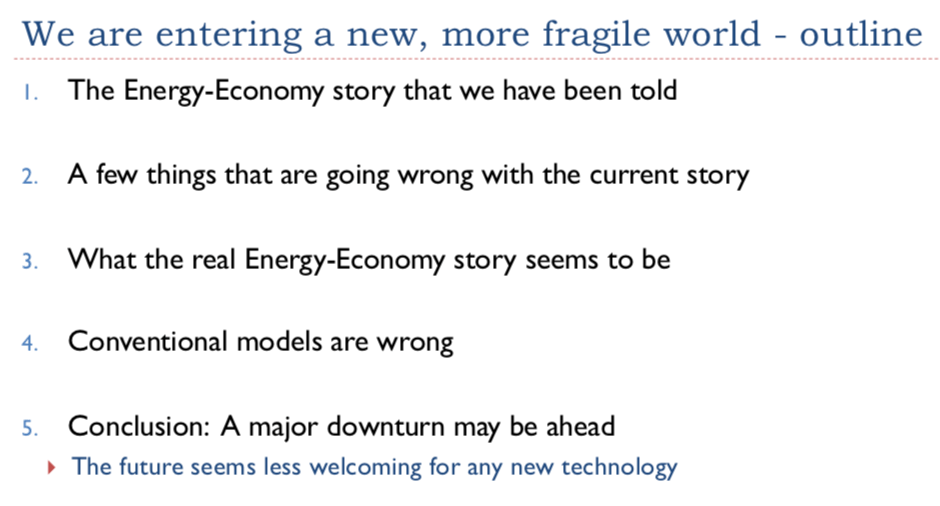
Slide 2.
–

Slide 3.
–

Slide 4.
We have all heard the story on Slide 4 so many times that few people stop to question whether the story is really true. My analysis suggests that it may be mostly wrong.

Slide 5.
The big take-away from this slide is that electricity companies planning for new generation should expect much higher electricity prices in the future. I discuss some of these items separately, on Slide 6.
By way of background, the US Energy Information Administration publishes “levelized cost of electricity” estimates that companies producing electricity are expected to use for planning purposes. When new generating capacity is added, planning needs to be started several years in advance. This is why what is being published now is the EIA’s calculation of expected wholesale costs (at a 2017 price level) for 2022.
Current wholesale prices for “dispatchable” electricity (the opposite of intermittent electricity) seem to be in the 3 to 4 cents per kWh range in the continental US, so all of the amounts shown assume that electricity prices will be much higher in the future. This thinking is in parallel with the “high oil prices will save the oil industry in the future” view that is prevalent in the oil industry. This thinking has helped keep the prices of shares of energy stocks up: “Even if there are problems now,” the thinking goes, “certainly higher prices in the future will fix the situation.”
CCS = Carbon Capture and Storage. CCS techniques are designed to remove a specified percentage of the CO2 generated when coal or natural gas is burned to provide electricity. The unwanted CO2 is stored underground. If the CO2 escapes, it can suffocate the population in the surrounding area. I would not make bets on the technique’s widespread adoption.

Slide 6.
Slide 6 shows a wholesale cost comparison for some particular pieces from Slide 5. All of the costs shown are very high compared to current prices. Wholesale prices tend to be in the 3 to 4 cents per kWh range because of the low cost of fuel (2 to 3 cents per kWh) and the low cost of already built generation. With recent changes in regulations, new generation is expected to be very expensive.
With respect to wind, there are two reasons why variable wind can be sold in Power Purchasing Agreements (PPAs) for 2 to 3 cents per kWh. The first is the substantial subsidies that have been available, making this pricing arrangement profitable to wind producers. The second is the low value that intermittent electricity provides to the grid. In fact, prices locked into these PPAs are slightly below the bottom of the range of expected future natural gas prices (Figure 1, below). This suggests that the primary value of wind generation is to replace natural gas as a future fuel.

Figure 1. Median PPA prices compared to forecast future natural gas prices. Chart by Department of Energy (Chart 54) in its 2017 Wind Technologies Market Report.
Somehow, miraculously, the EIA forecasts that the value of this intermittent wind will rise to 4.1 – 7.8 cents per kWh. In Figure 1, above, this would compare to 41 to 78 $/MWh, which is above the forecast gas price range.

Slide 7.
Notice how low and stable the green coal line is, compared to natural gas prices.
Natural gas comes from two types of producers: (1) those drilling specifically for natural gas, and (2) those drilling primarily for oil, and producing natural gas as a (mostly unwanted) low-value byproduct from drilling for oil. The second type of producer is willing to almost give away natural gas. If it becomes necessary to rely on production from companies whose primary focus is on natural gas production, prices will need to be higher.
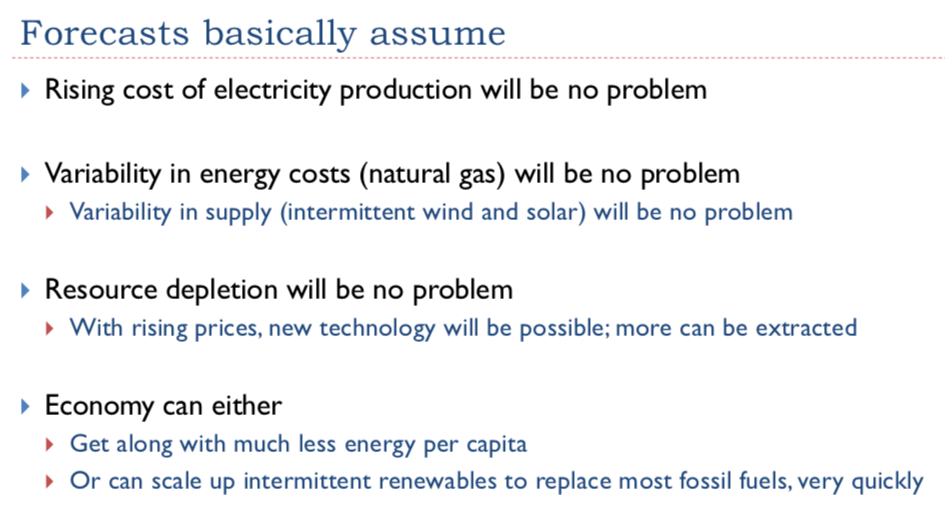
Slide 8.
These are all very important assumptions that are not really true.
There is one reason why it might make sense to somewhat believe the first item, “Rising cost of electricity production will be no problem.” This has to do with the cost-plus type of electricity pricing (“regulated pricing”) that is used in some states of the United States. When cost-plus pricing is used, higher costs can, in theory, be passed on to consumers. The catch is that higher electricity prices tend to raise the price of finished goods and services. If wages are not rising rapidly enough, this can lead to an affordability problem. Industrial users of electricity are especially likely to cut back their electricity demand because higher prices make their products less competitive in the world economy.
After the talk, I decided to look at this situation a bit more closely. This analysis strongly suggests that since 2000, increased globalization has been playing a major role in holding down US demand for electricity. If there is an opportunity, industrial production will move to jurisdictions where the total cost of production (including wages, benefits, electricity costs, and other costs) is lower, even if there has not been a big increase in industrial electricity prices.
If we analyze US electricity consumption by type of user (Figure 2), we see that industrial electricity consumption rose rapidly until the late 1970s, plateaued between 1980 and 1999, and began falling in 2000. This pattern suggests that globalization is an issue. Early globalization sent US manufacturing to Western Europe and Japan. Later globalization sent manufacturing to lower-wage countries, predominantly coal-consuming countries of Asia.

Figure 2. US Electricity Consumption Per Capita, by Type of User, based on EIA data.
US labor force participation rates started dropping about 2000, similar to the drop in industrial demand for electricity. Thus, in recent years, globalization seems to be affecting residential consumers as well as industrial consumers. The impact on residential consumers is indirect, through job competition with global markets.
If analysts who estimate the required quantity of new generating capacity ignore the impact of globalization, their models are likely to give high estimates of the amount of new capacity to be added. If more generating capacity is added than is needed, it can be expected to push electricity prices downward, especially in competitive rating jurisdictions.

Slide 9.
As I will discuss later in this presentation, the economy operates based on the laws of physics. Because of this, it is impossible for the economy to change in ways that politicians would like.

Slide 10.
–

Slide 11.
Most of us have seen stories in the news about Macron and the Yellow Jackets. Can we really assume that citizens will accept higher carbon taxes, without protest?

Slide 12.
Industries get very unhappy when their electricity rates rise, making them uncompetitive with producers in other countries. The rates we are discussing are UK industrial electricity rates, so are a little higher (perhaps 1.5 times higher) than the wholesale prices discussed on Slides 5 and 6. If the price of 8.3 cents per kWh for industrial electricity is a big problem today, how can countries possibly withstand much higher rates, based on higher carbon prices or based on required technology that is much more expensive?

Slide 13.
Suppose a worker gathers reeds and uses them to make baskets. If his production per hour falls, he will have fewer baskets to sell in the marketplace. He cannot expect the price of each basket to rise to make up for his lower production.
For some reason, economists seem to have overlooked this obvious problem. There is no reason to expect that the buyer will be penalized for the higher costs of the energy industry. These higher costs look much like growing inefficiency. In the real world, the seller is generally penalized for falling efficiency. Why do we have so much confidence that the price per barrel of oil can rise, or the price per kWh of electricity can rise, if the price of baskets that a less-efficient worker makes doesn’t rise?

Slide 14. Chart by EIA. More detail on Renewable Energy available on Slide 18.
Slide 14 (made by the EIA) disturbs me. Coal production is dropping off rapidly, but the replacements we have are far from ideal.

Slide 15.
Coal (and nuclear) are the products that have historically kept US electricity prices low. Replacing coal with fuels that are much higher in cost and more variable in availability seems likely to be problematic. Industrial users are likely to be especially distressed.

Slide 16.
The United States has been fortunate enough to have very low natural gas prices recently. A major problem is that these prices are not really high enough for companies extracting natural gas as their primary business. If we really need to depend on natural gas, we will likely need much higher prices. In particular, natural gas prices will need to be high enough for natural gas companies to have bond ratings that are above junk ratings.
The question comes back to, “Can electricity prices really rise very much, without causing major problems?”

Slide 17.
Nuclear power represents a surprisingly large share of electricity generation. Slide 14 shows that in the US, its generation is higher than the sum of all types of renewables combined and almost as high as that produced by natural gas.
Yet nuclear has a lot of problems. It is perceived as dangerous (probably correctly so). Trying to correct the problems with being dangerous leads to a huge increase in the cost of new generation. Businesses in this field, such as Westinghouse, have gone bankrupt. The question of how to dispose of all the spent fuel is still a problem. Also, the many aging reactors will be difficult to replace.
There is also a problem with wholesale rates being too low for nuclear, when electricity rates are competitively set. To work around this problem, some areas use capacity auctions, which are intended to offset the inadequate funding for electricity providers providing backup electricity capacity. One catch is that a capacity auction is, in some sense, needed for every member of the supply chain. Just asking electricity generating companies to bid on providing capacity doesn’t guarantee that the full supply chain will be available.
For example, for natural gas, the capacity auction bid would typically reflect the cost of adding new units for creating electricity from natural gas; such capacity is inexpensive. A more expensive part of the supply chain would be the cost of adding extra natural gas pipeline capacity that is used only a few days a year, when it is very cold or hot. Furthermore, natural gas providers need to be profitable enough to continue to obtain loans at reasonable interest rates. So, even if capacity auctions are provided, they aren’t designed to fix the problems of the whole supply chain.
Furthermore, there has been a recent court ruling that these capacity payments are illegal. I mention in Slide 17 that the UK is affected. In fact, it is the entire European Union that is affected by this ruling. So, even with the best of intentions, member countries of the European Union cannot collect capacity charges to try to offset the underfunding problems caused by giving intermittent renewables grid priority and other subsidies.

Slide 18.
Slide 18 shows that in the US, the only types of renewable generation growing to any significant extent are intermittent wind and solar. Very high subsidies have helped push these types of generation along.
Parts of these subsidies are being phased out, but other, less visible subsidies remain. The fact that intermittent wind and solar are given priority on the grid, when they happen to be available, is a huge subsidy. Also, renewable mandates mean that generation is being added that is not really needed, lowering prices that the self-organizing competitive pricing system creates for backup electricity providers. This is part of the reason for the unprofitability of many natural gas, coal, and nuclear companies.

Slide 19.
In order for intermittent wind and solar to truly be dispatchable, the way other electricity providers are, there needs to be long-term storage for intermittent providers. A big part of the problem is seasonal matching of generation. For example, in a northern area, the main need may be for heat in winter, while intermittent generation may occur primarily in summer. Somehow, the variable wind/solar will need to be stored from summer to winter.
A post by Roger Andrews gives an idea of what the cost of the battery backup needed to solve this seasonal matching problem would be. His calculations indicate that adding sufficient batteries for seasonal matching can be expected to raise generation costs by more than an order of magnitude.

Slide 20.
–

Slide 21.
Most of the things we associate with rising energy consumption per capita are things we associate with a growing economy. Most people want these things.

Slide 22.
Slide 22 shows amounts I calculated from information from various published sources. These include energy consumption estimates by Vaclav Smil in Energy Transitions: History, Requirements and Prospects for older years and BP Statistical Review of World Energy amounts for more recent years. Population estimates are by Angus Maddison.
Based on this slide, most of the growth in world energy consumption ends up being reflected as population growth. It is only when energy consumption growth is very high that the living standards portion (in other words, the energy consumption per capita portion) grows very much.

Slide 23.
The big economic growth bulges that the world economy has experienced are easy to see on Slide 23. One of these is centered around 1910; another is centered around 1970. A third, smaller bulge is centered around 2010; it already seems to be disappearing. This growth bulge was made possible by China and other Asian countries as they ramped up coal production. Now this growth in Asian coal supplies is fading.

Slide 24.
The troughs, where the growth in per capita energy consumption falls to zero or slightly below, represent major problem times for the world economy.

Slide 25.
When a person looks back, the times when oil prices were high (1974-1980, 2008 and 2011) were near energy consumption per capita growth peaks. They were in times of high energy supply, not low. Many favorable outcomes occurred at peak times, including increased cooperation and higher returns on investments.

Slide 26.
Collapses of all kinds occur near troughs in energy prices. Often, these collapses are followed by wars that might be interpreted as resource wars.

Slide 27.
Many of these signs are ones we have been seeing lately. There were calls for tariffs before the US Civil War. Tariffs were increased in the 1920s, to try to reduce competition from abroad. Limits were also placed on immigration during the 1920s.

Slide 28.
When I talk about a vector, I am talking about a combination (really, a weighted average) of many different kinds of somewhat similar inputs. Thus, the energy vector reflects the combination of energy of many types, including human labor sold as labor, in a particular economy. The complexity vector represents the many types of specialization and growing complexity that allows resources (including energy resources) to be used by the economy. The debt vector indirectly represents promises of future goods and services made with energy products. Much of the debt vector needs to be repaid with interest. If the economy is growing rapidly, this is not difficult. If the economy is stagnant, this becomes a problem.
Many people think that oil or crude oil has particular significance. I see the economy operating as an overall whole. Each machine needs to have the particular fuel it uses. Companies decide to build factories in a particular part of the world based on an area’s overall cost level and the stability of its supplies, not based on the price of a single fuel.

Slide 29.
Slide 29 shows my view of how the economy works. As long as the debt level is growing rapidly enough, commodity price levels can be bid up to a high level, allowing increasingly complex goods and services to be produced, using an increasingly complex delivery system. At some point, the increasingly complex system for producing goods and services produces an excessive amount of wage disparity. About the same time, the cost of production tends to rise, as diminishing returns becomes an increasing problem.
The combination of rising production costs and an increasing share of the population with low wages soon creates a variety of problems. The economy tends to grow too slowly, so that debt cannot be repaid with interest. At the same time, the increasingly impoverished non-elite workers cut back on the goods and services they purchase. This might happen if young people find that they need to live with their parents longer, for example.
If interest rates are raised, this speeds up the failure of the system. Eventually, the economy, or a major portion of the economy, tends to collapse.
The big issue that tends to bring an end to economies is the increasing wage and wealth disparity that comes with growing complexity. As long as everyone is fairly equal, no one is squeezed out of buying goods such as homes, vehicles, and other expensive purchases. As businesses and governments get larger and more hierarchical, an increasing share of workers find themselves with low wages. These low wages adversely affect the economy in many ways:
- It becomes difficult for governments to collect enough taxes.
- Demand for commodities (such as those used to make homes and vehicles) tends to fall too low, leading to low prices for commodities.
- Overthrown governments become more common.
- Low-wage individuals become susceptible to epidemics because they do not eat well.

Slide 31.
The orange Energy Services line in the chart at the right shows the UK’s trend in the price of energy services since 1700, on an inflation-adjusted, efficiency-adjusted basis. The trend in these prices has been almost continuously downward. As long as the cost of energy services is downward, it is possible to add increasing amounts of these energy services, because they become ever more affordable. These energy services allow more goods and services to be produced. This seems to be a major factor underlying economic growth.
Diminishing returns, with a resulting increase in the cost of energy services, tends to be the “spoiler” in this system. In theory, rising complexity can be used to work around these higher costs. In fact, increasing complexity is helpful for a time. Eventually, however, the growing wage and wealth disparity that comes with increasing complexity tends to bring the system down. With the growing complexity, the system no longer has enough high-wage workers who can afford the finished products that the system creates. The many low-wage workers cannot make up for this lack of affordability. The number of new homes and new vehicles sold begins to fall, as a result.

Slide 32.
Interest rates, as well as the debt that is available because of low interest rates, play a surprisingly large role in commodity prices. The issue seems to be that debt is used to finance most large purchases, such as factories, schools, homes, and vehicles. If interest rates are low, it is possible for consumers to afford many more of these large purchases than they could otherwise. Once interest rates rise, the entire economy tends to shrink back. Debt bubbles tend to collapse.

Slide 33.
–

Slide 34.
Research into complex systems that seem to grow without outside help is a fairly new field. Clearly the economy is such a system. New businesses are added, as individuals see the need for a new product and a way of producing that product in a way that consumers can afford it. New consumers are added over time, as young people grow older and set up their own homes. Governments gradually add laws to regulate the system. Taxes are an important part of the system as well, and tax laws also change over time.
The thing that people don’t stop to think about is the fact that the system cannot really go backward. If a product is no longer needed (buggy whips, for example, for horse drawn carriages), it will no longer be produced. So, the situation is a little like removing the lower rungs of a ladder, as a person climbs up the ladder. This inability to go backward makes it difficult to adapt to falling supplies of any kind of commodity, including energy commodities.

Slide 35.
The vast majority of researchers do not understand the important role that energy plays in operating the economy and making it grow. These self-organizing systems (dissipative structures) absolutely depend on energy consumption. In fact, economies seem to depend upon increasing energy consumption per capita.
At some point, all dissipative structures (including hurricanes, plants and animals, economies and many others) come to an end. This is the way that a finite world can keep adapting and changing. New dissipative structures form and indirectly take the place of the previous dissipative structures. These new structures vary in structure from the previous dissipative structures. If the new structures are not well adapted, they quickly collapse, allowing room for yet other dissipative structures to form. The replacement of economies in this manner acts as a form of evolution, just as plants and animals evolve.

Slide 36.
Researchers tend to create models that fit their own preconceived notions of how the economy should work. This approach, plus the peer review process, tends to produce a lot of papers with the same (often wrong) assumptions.

Slide 37.
These should be fairly self-explanatory.

Slide 38.
This is probably the most important reason that economies tend to collapse. Most people miss the affordability connection because they interpret “Demand” to be something that anyone can do, without thinking about the affordability aspect. Without sufficient income, a person cannot demand a new home or new car, or gasoline from a fuel station.

Slide 39.
There have been many articles written in recent years about growing wage and wealth disparity. In fact, in the US, wage disparity seems to be back at the level it was before the Great Depression of the 1930s.

Slide 40.
Slide 40 tries to explain a paradox. Energy prices don’t really rise, as production falls too low. Instead, the complex system behaves in a strange way, causing commodity prices to fall because of growing wage disparity and debt bubble collapses.
One way of understanding the situation is by understanding that energy consumption is required for jobs that pay well. If insufficient energy supplies are available at a low price, the vast majority of jobs available will be low-paid service jobs. There will, of course, be a few managers and business owners. But these few managers and owners cannot, by themselves, generate enough Demand for goods and services made with energy products to keep commodity prices up. This is why the system tends to fail.

Slide 41.
I have been following oil since 2005, so I have had a chance to hear the discussion evolve. Oil prices were clearly too high for some consumers back in July 2008, when the sub-prime housing debt bubble popped in the United States. By early 2014, I started hearing that oil companies were very unhappy about the low price level available in 2013. In fact, some companies were sufficiently unhappy that they began cutting back on investment in new fields. It was not much later that oil prices dropped further, making the low-price problem even worse for producers.

Slide 42.
It is surprising how large and long-lasting an impact the collapse of the central government of the Soviet Union in 1991 had on its long term energy consumption. The collapse wiped out a large share of the industry of the Soviet Union and its close affiliates. The Soviet Union was an oil exporter, so the low oil prices of the 1980s were one reason for its collapse. Prices were not high enough for adequate reinvestment in new fields.

Slide 43.
One common inaccurate assumption is that oil prices rise primarily in response to the rising cost of oil production. If a person looks at the data, it becomes clear that interest rates have a huge impact on prices. This seems to happen because the purchase of high-value goods with debt (such as factories, homes, cars, and buildings of all kinds) seems to have a very significant impact on total Demand. Lower interest rates make these high-value goods more affordable. (Quantitative Easing (QE) is a way of reducing long-term interest rates; it also seems to affect oil prices.)
Slide 44.
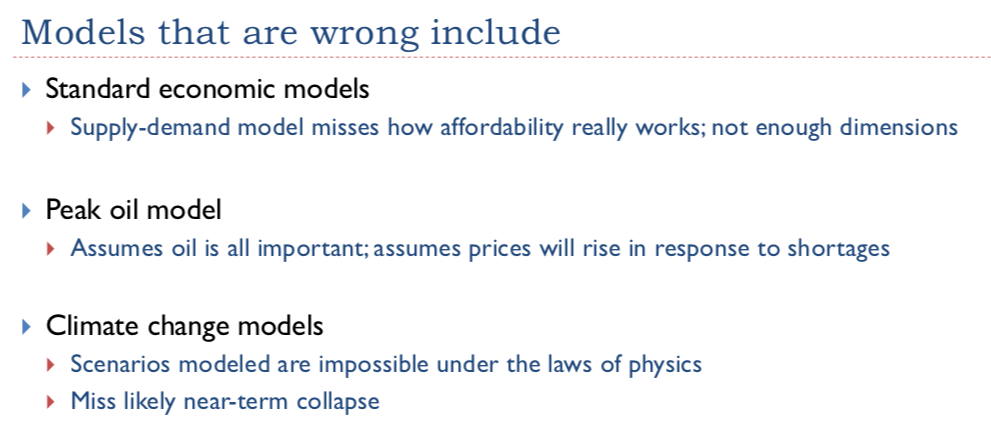
Since I made up this list, I can add another model to the list that seems to be wrong. The Human and Nature Dynamics (HANDY) model of Safa Motesharrei gives an inaccurate assessment of the likely future path of the economy because it leaves out both diminishing returns and long-term population growth.
In every case, the researchers put together models that represent only a part of the way the world’s self-organizing economy actually works. They pick out a few aspects that they think are important, but they miss other important aspects. This selection significantly affects the outcomes predicted by their models.

Slide 45.
Some readers may be familiar with the Energy Returned on Energy Invested (EROEI) model. This is a model that is sometimes used to justify the reasonableness of selecting certain substitutes for oil, such as the use of intermittent wind and solar. As with all of the other models, the model gets some things right, but it also gets a lot of things wrong. Without understanding how the economic system really works, it is hard to see what goes wrong with the model.

Slide 46.
–

Slide 47.
These are all disturbing signs.

Slide 48.
World leaders act in ways that they feel that those who vote for them would like. In some sense, they are trying to save their own part of the world, even if they create increasing problems elsewhere.

Slide 49.
It is difficult for any new technology to get a foothold in a situation where energy prices of all kinds tend to be low. In addition, the pressure seems to be in the direction of reducing energy prices further, even if this means less energy production of all kinds.

Slide 50.
The world has become increasingly globalized in the last thirty years. Because of the greater interconnectedness, if a collapse occurs in the near future, it could be much worse and more widespread than prior collapses. The adverse results could exceed those of the Depression of the 1930s or the Great Recession of 2008-2009. We have no guarantee of being able to preserve either the oil system or the electricity system. The population of the world could fall dramatically; the economy may need to organize again in a new way without either oil or electricity. We live in interesting times.


Serving in the Slovak army becomes less and less attractive. They consider compulsory military service in the future:
https://slovensko.hnonline.sk/1867079-ludia-nechcu-do-armady-gajdos-hovori-o-moznosti-povinnej-vojny
Do they really believe that it will be possible with the ageing populations? Maybe they will put the solders into the senior care centers the same way as the prisons in Japan provide such services…
I’m wondering how the entire CEE area is going to look like in say ~30-60yrs.
Given the historical patterns how it evolved, demographics (incl. post WWII and today’s latest gen of migrants in the West) and now the energy depletion/OFW outlook..
Most likely some old “nature condition driven” patterns would have to reemerge again although, e.g. Austrians being the smartest of the bunch rule in some capacity again, Eastern Germans and Bavarians standing ground or merely seeking refuge from islamized Greater Germania in the West, Poles the notable hot heads (brief military success – then inward collapse), Czech-Slovaks politically naive and self destructive, Hungary won’t likely relive the glory days controlling half the Balkans but it might enlarge a bit towards few of its former lands, ..
Obviously complete wipe out from nuclear war, giga African migration wave or diseases can also play out with some %probability.
Austrians are dying out fastest, I think the shrinking future is going to be a mix with the Asian people, we live in Eurasia. Your view of the European nations is terribly outdated.
The fun part is that’s not “my view” rather it is simply macro zoomed out cold blooded (harsh?) observation of ~1000yrs trends given the prevailing weather patterns-climate, landmass-geology, demography of settled peoplez/nations and their weighted interactions given the above determinants..
Also, linear thinking is very helpful in making these projections. They don’t say much of anything about what will really happen.
Not sure how you meant that.
To clarify my stance, for instance I tried to argue from ~1000yrs of reoccurring ‘patterns’ – not mere trend projections. Lets take the case of Austria, some historian claim they got that one shot infusion only, when sharing the post 15th colonial wealth thanks to relatives in Spain and the Austrian part of today’s Benelux. Well, that does not seem ring true after all, because we know that several centuries after striking this luck they lost their empire and ended up on defeated site twice during WWI/II. Curiously, they reversed the fortunes and rejoined the most affluent status again. Now, it could be argued that post WWII era was just another form of lucky foreign infusion since they became sort of quasi tax heaven, OPEC/UN HQ etc..
But I’d call that differently, something like the ability to transform ‘lucky opportunity’ into lasting prosperity, similarly how they managed back then to outsmart more populous (MG wrong here) neighbors and create their CEE empire in the first place out of seeming position of relative weakness..
I am just saying that the system doesn’t work in the way most people imagine it to. The availability of cheap resources of many kinds makes a huge difference. The ability to maintain a debt bubble to support high commodity prices makes a big difference. Demographics and population growth makes a big difference. It is very easy to make wrong projections by relying on past trends, even if they seem to encompass thousands of years.
Didn’t the Habsburgs also obtain fantastic wealth – to hire soldiers, etc – from the silver mines of the Tyrol – vague recollection?
Was it Austrians who were smart, or just the Habsburgs?
Yes, but I guess the loans-revenue at the right time incoming from Spain and Benelux for their warring efforts proved more crucial during the major and very specific cross roads of 15th century and during the 30yrs war in the mid 17th century.. In both cases (plus the third case afterwards WWII) they could have ended up with nothing but arrived on top eventually.
Well, I’d argue for the general ‘Austrian’ smartness, and above explained natural world determinants per given region, because as mentioned it worked again without the specific dynastic clique near the throne..
Was it Austrians who were smart, or just the Habsburgs
Well, after the French Revolution, almost all the Habsburgs were dead.
All the Habsburg male lines died out well before the French Revolution, but Habsburg descendants via the female line survived the predations of Napoleon, Bismarck and the destruction of the Austro-Hungarian Empire and are still doing very well today. The last Austrian crown prince, Otto Von Habsburg, died in 2011.
I thought the divider was east of austria, between nations who want to continue as nations and those that want globalism.
It is not about globalism, but about the need for replacing the workforce that is ageing and dying out.The most suitable replacement can come from Asia, but surely not from Africa.
I realise Sweden has really scraped the bottom of the barrel, but …
Would you say european immigration policy last 20 years has successfully replaced “aging workers “?
I kind of expect the horror show Japan turn out better than western/northern europe.
E.g. the investment of Asian companies and comming of Asians into Central Europe prove that there are people who are acceptable as immigrants. Basically, when the immigrants succesfully fill the job vacancies, there is no problem. I would say that the East Asians are acceptable for Europeans, they are comparable as regards some industrial history. I have also read it somwhere that they as immigrants do not constitute such a problem for Europeans as the Africans.
Japan can really turn out better than Western/Northern Europe with a lots of people from warm countries and nations without any industrial history.
I see…
Still, continued immigration, both to eastern and northwest europe is dependent on continued availability of energy.
immigrants will arrive, convinced that energy support is forever, They are the youngest strongest and fittest
when they find it isn’t all hell will break loose
(it’s called survival)
like any other species survival, the youngest strongest and fittest take over
Hell, yes…
But survival? How? They can’t survive unassisted even in a functioning society.
The divider depends on availability of cheap energy resources. “Globalism” relates to countries that can compete in the global economy; Nationalism relates to those who cannot.
extreme
Friends, do you like fairy tales? Come, let me tell you a story!
Once upon a time an old man and his wife lived on the shore of a great sea. They were poor and lived in an old mud hut, but were able to get by. The old man made a living by fishing, while his wife spun cloth. One day while fishing he caught a small fish with flashing scales of gold in his net. “Please let me go, human,” begged the fish. “I will reward you for my freedom by giving you anything you desire.” The fisherman was astonished and frightened because he had never before heard a fish speak. He let the fish go and said kindly to her, “God bless you, golden fish. I don’t need anything from you.”
The fisherman went home and told his wife the amazing thing that he encountered at the shore. But she cursed him angrily and said, “You idiot! Why didn’t you ask for something? At least you could have asked for a new watering trough, since ours is broken.” The old man returned to the seashore. At that time the sky was clear and little waves were rinsing the sand. He called out to the golden fish. She swam up and asked, “Yes, human? What do you want?” He bowed and replied that his wife needed a new watering trough. The fish comforted him and promised to grant his wish.
When the fisherman returned home he saw the new trough. But his wife shouted at him, “You idiot! Why didn’t you ask for something more? Go back to the fish and ask for a new house!” The fisherman went back to the sea, where he noticed the sky had become slightly overcast. He called upon the fish, who swam up to where he was standing. He apologized and said that his snappish wife wanted a new house. The fish comforted him and promised to fulfil his wish.
When he returned, he saw a lovely new cottage with a gate. But his wife shouted even louder, “You idiot! Why didn’t you ask for something more? Go back to the fish and tell her I do not want be an ordinary peasant, but a noblewoman!” The poor old fisherman went back to the sea, where he noticed a strong wind had begun to blow and the sea had become more restless. He called out to the golden fish, who swam up and asked him what he wanted. He bowed humbly and explained everything, and the fish comforted him and promised to grant his wish.
And what did he see when he returned home? The cottage had become a large, beautiful mansion. His wife was wearing an expensive dress and all sorts of equally expensive jewelry, and there were many servants bustling around her. The fisherman said, “Greetings, Milady, I hope you are satisfied now.” She didn’t bother to answer him, but instead sent him off to live in the stable.
Several weeks later, the wife ordered her husband to appear before her and instructed him to go to the sea again, saying, “You idiot! Why didn’t you ask for something more last time? I am still subject to the rule of those above me! Go back to the fish and tell her I want to be an empress!” The old man, frightened, said, “Are you crazy, old woman? You have no notion of courtly manners. Everybody’s going to make fun of you!” At these words his wife glowered with rage, gave him a tight slap, and ordered him to obey.
Sadly the old man went back to the seashore, where he noticed that great waves were churning, massive storm clouds covered the sky and the sea had become almost black. He called upon the golden fish. When she swam to the shore, he bowed and told her everything. The fish comforted him and promised to grant his wish.
When the fisherman went back, he found a huge palace, inside which his wife was seated on a throne all made of precious stones. Courtiers surrounded her, heeding her every beck and call, and around her stood menacing guards. The old man was terrified, but approached the empress and said, “Greetings, Your Majesty. I hope you are happy now.” She did not even look at him, and her guards drove him out.
Several weeks later the empress sent for the old fisherman again. “You idiot!” she cried. “Why didn’t you ask for something more last time? I am still mortal! Go back to the fish and tell her I want to be GOD!” The fisherman was so terrified of her that he did not even protest. He submissively went back to the sea. A terrible storm was raging there, with lightning, thunder, shrieking gales and mountainous waves crashing against the shore. The old man yelled as loud as he could and the fish rose out of the waves. He explained to her what his wife wanted now. This time the golden fish did not reply, but turned and swam away out to sea. After waiting a long time in vain for an answer — all the while being pounded on mercilessly by the storm — the fisherman returned home, where he found his old mud hut, his poor old wife and a broken watering trough in front of her…
The old, old tale: a pleasant day’s fishing or hunting, ruined by an angry woman at home……
Seriously, thank you: the old tales are perhaps one of our best guides.
You’re welcome. 😉
The correct answer was to wish for a new wife!
Perhaps he was so traumatized by the experience of matrimony that he couldn’t think straight.
That would be too vague a wish. If I were the fish, I’d ask, “What sort of new life? New in what way?”
That was a wonderful story.
When I work up enough courage, I am going to tell it to my wife.
Remember to tell us what her response is. 😛
Survey: Atheists, Agnostics Know More About Religion Than Religious
https://www.npr.org/sections/thetwo-way/2010/09/28/130191248/atheists-and-agnostics-know-more-about-bible-than-religious
Unsurprising since religion is about believing whatever you want and slapping a respectable label over it. Likewise for the religion of perpetual growth and prosperity fuelled by a combination of enlightenment values and “science”.
Some religions have proven to be relatively harmless in history. Others are going to sound our collective death knell, such as the religion of perpetual growth and prosperity.
All major religions today are meme sets, and use humans as their transmission devices.
“religions today are meme sets”
They are indeed.
But the interesting question to ask is why humans have religions at all? The trait is so widespread that it must have selected before our line left Africa. I can’t show this to be true, but I suspect that the same psychological traits behind wars are what makes humans vulnerable to religions.
I can think of many reasons for religions:
(1) There really is a higher power, and this is part of the design of the self-organizing system. People sense that there is something going on that they cannot explain, allowing plants and animals to grow, rain to come, and other seemingly miraculous occurrences.
(2) Leaders need to be able to provide some reason why people should do as they say. Having a “god” to back them up is helpful.
(3) There is a real benefit to passing the wisdom of the age on to the younger generation. Having some set of stories to back this wisdom up is helpful. What is helpful varies from one generation to another, so religions tend to grow and change, as needs change (birth control vs lack, for example). Of course, some people stick with old views, and this can be problematic.
(4) Religious gatherings fill a real need from a social point of view. People need to have an excuse to get together to celebrate, to sing, and to contemplate why things are the way they are. Hanging out in bars or playing video games is not equivalent.
There is no evidence for your point one. While nobody understands all about the world around us, most of it is well understood by at least a few people. Where they don’t, there is usually an active batch of researchers pushing back the limits of knowledge.
Many years ago my wife and I wrote about the value of religions in the context of cryonics.
https://www.aleph.se/Trans/Cultural/Memetics/crymemes.txt
Long quote to ignore:
“As human brains enlarged they improved in the ability to
anticipate changes, making plans to hunt, to move with the
seasons, and, later, to plant seeds for a future harvest. These
and similar “smart” behaviors have obvious survival advantages,
but they may have disadvantages as well. Alas, it seems that it
is quite possible to be too smart for “the good of one’s genes.”
A contemporary example is a statistical fact that highly
intelligent people have significantly fewer children than the
norm. For very different reasons, people of *subnormal*
intelligence also have lower-than-average reproductive success.
Many traits of populations that have a bell curve
distribution are trimmed by some form of selection on both ends.
If they were not, natural selection on individuals on one end of
the curve would cause the population norm to drift until a new
norm was reached where individuals far out from the norm in
either direction suffered reduced reproductive success in about
the same amounts.
Being able to anticipate the future may not have been an
unmixed blessing for early humans. Besides worrying about what
to eat in the morning, and how to get through the night without
being eaten, our ancestors could worry about existential angst,
and ponder questions of the “Where Was I Before I Was Me?” and
“What Happens After I Die?” kind. It may sound silly, but such
questions, prompted by frequent deaths among those around you may
have been a barrier for hundreds of thousands of years to the
emergence of smarter people with enhanced ability to anticipate
and plan for the future. It is not good for your genes to be
dwelling on such questions while something large, furry, and not
in the least concerned about angst, sneaks up and nips off your
head!
(footnote –at least if it does it before you have lots of
kids, and have helped raise lots of grandkids. The recognition
of this fact is reflected in the Chinese tradition that those who
would attempt to understand the I Ching–a contemplative task
bound to invoke troubling questions–are traditionally warned off
doing so until they have completed the parental phase of life,
and secured the future of their grandchildren.)
We know that eventually smarter people did emerge, and came
to dominate the world. This started about 200,000 years ago,
roughly the same time that DNA studies indicate that one woman
was the common ancestor of us all. Like chipped rock and larger
brains emerging together, it is possible that some meme mutated
out of more primitive ones, or arose from observations to form a
“religious belief” that provided “answers” to such questions and
had the effect of compensating for genes that otherwise would
made us too smart for our own (genetic) good. Beliefs that could
fit this description are known to go back to the very beginning
of written history, and archaeological digs produce physical
evidence (flower grave offerings) of such beliefs back at least
70,000 years. (The actual timing is not important to this
argument, but objects believe to be “religious” in nature became
common by about 35,000 years ago.)
“Religious” memes compensating for
too-smart-for-their-own-good brains is rank speculation, but
Marvin Minsky argues that more complex brains are inherently less
stable. It is true that our more remote relatives (such as cows)
seem to have fewer mental problems, perhaps just because they
have less “mental.” His thought****
**** (footnote— personal communication through Eric
Drexler)
is that certain “agents” built with patterns from outside
could enhance the stability of a complex mind. He discussed a
variety of mental “agents” in Society of Mind, reviewed in
Cryonics some time ago. One class, censors, would be especially
useful if kept someone’s mind from spiraling down into a blue
funk over unanswerable questions. Ideas that when a family
member died he had gone to “the happy hunting grounds,” and that
you would see him again might make a big difference in the
survival of grief-stricken relatives. Jane Goodall’s report of
a case where a chimpanzee seems to have died of grief gives this
model some credibility. (The chimp was believed to have had an
abnormally strong attachment to his mother.)
This is very speculative, but “religious” memes could have
“functions” such as reducing the effects of grief or answering
philosophical questions about which it was (genetically)
unprofitable to ponder. These memes would be favored in a causal
loop if they improve the survival of people carrying genes which
tend to destabilize a person’s mental state, but otherwise, improve
their survival.
Such genes might (for example) contribute to intelligence,
sensitivity, and forming strong emotional attachments. After a
few millennia, religious memes and conditionally advantageous
genes would become quite dependent on each other. In an
environment saturated with religious memes, there would be little
pressure for minds to evolve that could get by without
stabilizing memes.
In turn, the religious memes that originated long ago have
had plenty of time to split into varieties, compete for hosts,
and themselves evolve in response to a changing environment. (An
occasional variation may kill its hosts, a la Jim Jones.) A lay
observer looking for similarities over such a period might not
recognize much common ritual. (Joseph Campbell devoted his life
to discovering common threads in ritual.) Both modern and
ancient religions seem to “fit” into similar places in the mind
and have the similar functions of providing “answers” to the
unanswerable, and comfort to the grief-stricken.
The environment in those minds (mostly the result of other
memes) has greatly changed as people accumulated more
observations about the world around them and got better at
manipulating it. There are known changes in the history of
religion, such as the tendency for monotheistic religions (in the
western cultural tradition) to replace polytheistic ones and the
well known tendency for religions (and similar belief patterns)
to mutate into new and competing varieties. We can see some
(the written part) of the accumulated variation. For example,
the religion of the Old Testament is recognizably the ancestor of
the more recent New Testament.
Because humans learn from other adults as well as parents,
religious beliefs that are “better suited” to infect human minds
could spread, even (if it survived translation) across language
boundaries. (Islam simply imposed Arabic on its converts.) In
Europe during early historical times, we can see the displacement
of older religions with Christianity. Within Christianity we
can see in recent historical times competing varieties mutate
from earlier versions (a classic example would be the Mormons)
and within the US in the last decades, we have seen the arrival of
both new “religions” such as Scientology, and the repeated
importation of eastern religions. (Almost all new and
transplanted religions fail–we only see the ones which grow
large enough to notice.)
Because human minds usually hold only one religion at a
time, religious memes are in “competition” for a limited number
of human minds. This sets up the conditions for a powerful
“evolutionary struggle” between religious memes. You should
expect the memes which survive this process to resist being
displaced and to induce their hosts to propagate them.
snip.
I think classical religion does more harm than good. I think if humans could appreciate that there is no after-life and, that this as the only life we have, we would value life much more than we do. I think we “could” live a happier, fuller life by being nothing more than frugal and kind to others. Unfortunately, as FE says, it isn’t in Mr. DNA to be that way. Crush, stomp, kill, lie and cheat to rise above others and have more than your fair share. Religion is a way to get more people on your fighting side.
Religion is poison–
-Mao
(one of the few things he got correct)
(other than founding a Marxism centric government for the largest country on Earth)
religions offer group cohesion and security
problems arise when priest incite flocks to kill other religion members
religions offer group cohesion and security
Early religions, for sure. And probably extended life.
Our current large meme sets use humans for their replication, and often sacrifice the life of the hosts.
Memeoids. I coined the name for these people.
I’m not too sure if there’s no afterlife. One can look at the work of people like Ian Stevenson for a start. Not to mention Kenneth Ring, Raymond Moody and others.
In trying to answer the big questions, do we just say (1) ‘No, there are no such things as a Higher Power, an afterlife etc — the usual so-called ‘Enlightenment’ way of thinking; or (2) ‘Yes, there are’ — the committed believer’s way of thinking; or (3) ‘Let’s find out’ — the true scientist’s approach? This is the approach adopted by the people listed above. It’s leading to very interesting answers. I for one am giving such people my full support in their scientific pursuits.
As for the belief (yes, it’s a belief) that there’s no afterlife leading us to value life more than we do, I’d say it could also lead us to become indifferent to all values and just indulge every vice we like while we live, since after all we have no one and nothing to answer to when we go. Certainly the modern world, with its total rejection of spiritual verities as so much superstition, is leading to far greater damage to humanity and the biosphere than any religion ever did.
My two cents.
I would agree with you:
“Certainly the modern world, with its total rejection of spiritual verities as so much superstition, is leading to far greater damage to humanity and the biosphere than any religion ever did.”
The new religion is, “He who dies with the most toys wins.”
Models are a specialized form of scientific religion. All that is needed is some linear thinking and a model can be made to “prove” almost anything. Self-organizing systems don’t work in this way, but “scientists” and “economists” are convinced that fitting curves to the past will give a good representation of the future.
I agree with you about so-called linear models and simple curve-fitting.
But any decent model includes delays and feedback. Even the original Club of Rome model had these devices, driven by computers with way less computing power than is found in a modern dumb phone.
In particular, I’m influenced by Donella Meadow’s (one of the original Club of Rome modellers) posthumous work, A Systems Way of Thinking, which includes a visual schematic language for describing systems and their feedback and delay loops. Howard Odum also came up with a useful modelling language in his “emergy” work. And certainly, the atmospheric models that attempt to describe climate change are full of delays and feedback.
For a graduate-level ecology class, I once took the “logistics equation” that is used to model predator-prey relationships, and replaced “predator” with human population, and “prey” with fossil fuel. The model run looked very much like the classic “hare-lynx” graph, with one important point: fossil fuel did not replenish like living systems. As fossil fuel resources declined, the model became very chaotic, with wild swings both in human numbers and the rate of fossil fuel consumption.
So bottom line, I think models can be a very useful simulation of reality — as long as you don’t mistake them for reality!
I agree that models can be useful if they are built carefully. The base Limits to Growth model seems to have gotten the timing pretty close to right.
The problem is that people don’t understand the limits of the models they are building. Or they try to impute way too much from the model. The supply and demand model of economists is an example of a model that is believed in, more than it should be.
https://gailtheactuary.files.wordpress.com/2018/04/500px-supply-demand-right-shift-demand-svg.png
The first question I like to ask people who have opinions on the miracle or curse of existence is: why is there something rather than nothing?
I suspect their answers say more about the respondents than about the question itself, as it is well beyond our ability to know the ultimate question of the Universe, Life & Everything.
Hi Tim, that’s a great question. Terrence McGovern in a Ted Talk said, “Give modern science 1 free miracle and they’ll explain the rest. That miracle being the appearance of all matter, energy and the laws governing it from nothing.” I think that encapsulates the dilemma science faces as it can’t explain a lot of things, i.e. what caused the Big Bang, where did the energy come from, by what mechanism did the 4th dimension generate, can the universe oscillate and why is there something instead of nothing?
As I searched for deeper answers I read a fascinating book, ‘The Theory of Opposite Sub-verses’ by C. Nevell Slater, from Amazon. It may not answer why is there something instead of nothing, but it suggests we live in an oscillating (cycles from big bang to big crunch over and over again), finite universe with an energy exchange (between mass and consciousness), expanding and contracting via opposite sub-verses.
One very interesting prediction he makes that could potentially open a numeric window into the 5th dimension, opening our eyes to a greater understanding of the universe. The prediction is; The higher the WLD (weight loss at death) the higher the thought level. He thinks the tests done so far have failed because they did not follow a strict set of guidelines including making sure the animal being euthanized is sedated enough to be perfectly still. It would require a gram scale, but if proved correct, it would mean the DNA to support a certain thought level in each individual is matched by its companion consciousness. He suggests this would mean life forms are being utilized by this other form of matter, consciousness, to ascend to higher more energetic thought levels in successive lives and more evolved species back in the direction from which they came. Meaning, a peak level consciousness transferred it’s thought level energy into the black hole it overlapped in the big bang to increase it’s temperature to initiate the expansion, but in so doing consciousness lost that peak thought level and had to begin once again by matching up with microbes to initiate the dual evolution between the physical and metaphysical, the body and consciousness.
It made more sense to me, but I’ve delved into eastern religion which is very different than western religions, with ideas like reincarnation, karma, etc. I suppose what I liked about it most is it attempts to explain what caused the big bang, the mechanism for the generation of the 4th dimension and many other areas of thought not being addressed by modern science which seems to be content answering what happened after the big bang.
Much of the Big Bang cosmology is now being seriously questioned by the proponents of the ‘Electric Universe‘ cosmology, mainly Wallace Thornhill and David Talbott, who have argued that things like black holes, dark matter, the Big Bang etc are just fictions.
https://www.youtube.com/watch?v=5AUA7XS0TvA
As for reincarnation, I’d presume you’ve heard of Ian Stevenson?
“Electric Universe (EU) is an umbrella term that covers various pseudo-scientific cosmological ideas built around the claim that the formation and existence of various features of the Universe can be better explained by electricity and magnetism than by gravity alone. As a rule, EU is usually touted as an aether-based theory with numerous references to tall tales from mythology.[2][3] However, the exact details and claims are ambiguous, lack mathematical formalism, and often vary from one delusional crank to the next.”
All I have to say of this quote is that its author is entitled to his/her opinion. Certainly Big Bang cosmology is not without problems of its own, problems so severe that all sorts of ad hoc, far-fetched postulates had to be devised to go round them. Which lead to still further problems.
This is the tragic tale of science (in the West): new and interesting ideas are nearly always branded as pseudoscience or heresy. There’s supposed to be a saying attributed to Max Planck that ‘science progresses one funeral at a time’, his point being that we always have to wait until one generation of scientists kicks the bucket before the ideas of the next generation of scientists can begin to seriously gain a hearing.
Yep, one must honor those “one delusional crank to the next”.
Delusional seems like an honored position these days.
“I’m stupid and proud of it!”
The most fascinating book I read last year looked at our off-earth beings and craft, within the context of the cosmology of the ancient Indian Vedic texts. Richard L Thompson (died 2008) also goes into the Vedic beliefs about reincarnation. He connects lots of the tales by sighters of the off-world craft and beings to this cosmology, in a fascinating and highly analytical way. When he told us that some of these craft are made of “subtle material”, I had a eureka moment – that’s why they can perform as in dreams, capable of anything. When I fly or levitate in my dreams, apparently I am using my subtle body (as opposed to my gross everyday body) – the one also used in out-of-body experiences and astral projection. So, I was able to make a connection between what are for me the two great mysteries of life : dreams and the unexplained off-world craft. I’ve had precognitive and clairvoyant dreams, hence their mystery for me.
https://www.amazon.co.uk/Parallels-Ancient-Insights-Modern-Phenomena-ebook/dp/B07BNY59MS/ref=dp_kinw_strp_1
He connects lots of the tales by sighters of the off-world craft and beings to this cosmology, in a fascinating and highly analytical way.
So, it is a fantasy book?
I think many have already used that storyline in their fiction.
No, it’s not a fantasy book. If you’re aware that the world is far wider than the narrow materialist paradigm that we have been brought up to believe in, then this book is for you. But I only became aware through experience. Maybe your time will come.
It’s a fantasy book.
It content deals in fiction and fantasy.
“It’s a fantasy book.
It content deals in fiction and fantasy.”
You got to be so old and yet you never experienced the paranormal?
https://www.youtube.com/watch?v=v1Fh0g5wJ7A
A triangular craft, but way more massive than anything your military has.
Paranormal:
:not scientifically explainable : SUPERNATURAL
Any questions, my delusional friend?
“not scientifically explainable : SUPERNATURAL”
Lots of things were not scientifically explainable – until they were. How does science advance? And there is masses of evidence from all sorts of people for the paranormal or supernatural. That’s why I showed you those videos from your own country. Open your mind, narrow-minded one. 😉
Aha! THAT explains why Mall•Wart shoppers are such intellectuals!
http://www.dumpaday.com/wp-content/uploads/2012/12/people-of-walmart-18.jpg
The universe is alive through us and wants to know why it exists.
Everything exists for some end, a horse, a vine. Why dost thou wonder? Even the sun will say, I am for some purpose, and the rest of the gods will say the same. For what purpose then art thou? to enjoy pleasure? See if common sense allows this.
Marcus Aurelius, Meditations
That’s really well put!
The reason we can contemplate why there is something rather than nothing is because there is something. What is the difference between an event that is a miracle and one that is just random chance? Is it 1:100? 1:1000000? What is the cut-off between miracle and random chance?
You’re right of course. In a Universe consisting of nothing, there would be nobody there to contemplate anything. But the “why” question remains. My granny never contemplated why there was something rather than nothing, but when we kids asked her a “why” question that she didn’t know the answer to, she used to reply, “Because Y is a crooked letter.”
A miracle was originally an extraordinary and welcome event not explicable by natural or scientific laws and therefore attributed to a divine agency (from Latin miraculum ‘object of wonder’). These days the word is mostly used shod of its divine agency trappings, but it’s far to useful a concept to be thrown out with the religious bathwater.
Many of us feel in need of miracles, without necessarily expecting them to happen. Divine agencies may work through random chance, although according to Einstein God does not play dice. But that doesn’t stop many of us from falling back on things like prayer, incantations, wishful or magical thinking, affirmations, appeals to Lady Luck, and carrying around a rabbit’s foot in a pocket, in order to help spur miracles on.
There’s no clear cut-off, but I’d say the more gargantuan the chance is, the more difficult it becomes to believe something is the result of chance.
To consider the human body alone, specifically the proteins employed by it, the late British astrophysicist Fred Hoyle estimated the odds against the chance formation of the molecule of just a single protein from its constituent amino acids to be equivalent to the odds against solving a Rubik cube blindfolded, which are of such magnitude that even at the rate of making one move every second the attempt to solve the cube would take about 1,350 billion years. Mind you, that is just a single protein; the human body employs 200,000 different ones. Even limiting oneself to the 2,000 enzymes which form an especially important group of proteins, the odds against the chance assemblage of their molecules from their constituent amino acids have been reckoned by Hoyle to be along the order of 10 to the power of 40,000 — ‘1’ followed by 40,000 zeroes. Given such figures, it’s frankly a bit hard to believe that such complexity could have arisen by chance; to believe this would amount to believing that a BOEING 747 could be assembled from its parts by a tornado sweeping through a junkyard.
Well, if anyone wants to believe this, what I’d say is: be my guest. Just don’t ask me to believe it. If you want me to believe it, try this. Place so much oxygen, hydrogen, nitrogen, carbon and other raw chemical elements you deem necessary in so much pure water. Stir, shine some UV light, zap with some electricity etc. Do you find entire thriving ecosystems, even intelligent living organisms emerging from this brew after some time? And can the whole process be replicated anywhere? If yes, okay, I’ll believe it. (One may consider using a computer-simulated model if the above is too impractical.) And until I see such results, sorry, I’m not going to believe it.
As Carl Sagan said (though now I’m using this quote against him), ‘Extraordinary claims require extraordinary evidence’.
the 13.7 billion year evolutionary record is that “extraordinary evidence”…
the evidence found in astrophysics, geology, paleontology, biology and chemistry is overwhelming…
the fact that the recent science of genetics coheres with all other science is what finalizes it all…
it seems that most all human cultures have been much involved with myth making…
the absolute reality of the human imagination has dropped a lot of fiction on cultures for many thousands of years…
@ Duncan
Really? Nothing knew here. I mean really anyone who hates and wants to destroy something is far more motivated to learn and destroy truth than anyone! Wow, and if this doesn’t remind me of a Dr. Walter Martin who I deeply mourn his passing who said when it comes to Apologetics most religious people know nothing about the defense of the Christian religion. Hearing the word apologetics and they think it means they need to apologize for their faith so they keep mum? Alas, what a disaster we don’t have more like Dr. Martin and how true are the words by
Dean Alford:
What though hast not by suffering bought, presume though not to teach.
or even these words by Oswald Chambers:
The reason why the average Christian worker is only the average Christian worker is that he or she will remain grossly ignorant about what he does not see any need for. The majority of us have been brought up on spooned meat. We will only take the truths we see immediate practical use for, consequently the average Christian worker knows nothing about Bible Theology or Bible Psychology, and cannot therefore push the battle for God on any of those domains.
this quote especially resonates with me because of reading a book by a Gerry Fox entitled Climate Change the work of God. Here you will find a guy who has done the unthinkable. Proved the existence of God and smashes to smithereens everything that we have been told about climate change being the work of industrial pollution. and get this? he has no academic training whatsoever. lol Marvelous
https://www.amazon.com/Climate-Change-Work-God-Gerry-ebook/dp/B079274TQQ
Auto supplier responsible for Chevy Cruze seats to close in aftermath of GM cuts
https://www.mlive.com/news/2018/12/auto-supplier-responsible-for-chevy-cruze-seats-to-close-in-aftermath-of-gm-cuts.html
What America can learn from the fall of the Roman republic
https://www.vox.com/2019/1/1/18139787/rome-decline-america-edward-watts-mortal-republic
too much about the secondary level of politics and too little (zero) about the primary level of energy…
“I’m extremely worried. But I still believe our decline is reversible.”
he does, because he is thinking only about the political situation…
Well if you discount population die-off as “decline”, it is reversible.
The fall of the Roman Republic. All that interview ended up being was a way to slam a Trump as if he is the sole torch bearer for the decline of America. As such, the interview was more than worthless. America’s institutions have been corrupted by money, greed and criminality.Her people become immoral. Her elite rob the nation and the people of their worth. And all this article author can do is mention Trump. It must be easy to come off as an intellectual if that is all you have to do
Brazil Is About To Show The World How A Modern Democracy Collapses
https://www.huffingtonpost.com/entry/brazil-jair-bolsonaro-democracy-threat_us_5c2a30c5e4b08aaf7a929cbb
“Democracy hasn’t delivered what many of us have expected.”
sure… the surge in FF backed prosperity just didn’t happen…
“This is not exclusively a Brazilian phenomenon. Countries around the world, from Hungary to Turkey to the Philippines, have turned to noisy leaders who promise instant renewals and silver-bullet solutions under the banner of a right-wing, nativist “populism”…
sure… if the current government (democracy) isn’t giving more prosperity to the average citizen, then why wouldn’t they want to try something else?
follow the money…
it’s not so much about the politics, though “the people” mostly won’t know that…
it’s about FF backed prosperity, and it’s going to shrink, not grow…
Happy New Year, Brazil… !
“Democracy hasn’t delivered what many of us have expected.” – sure it has! It is mob rule. That is what we have now. It is the republics that haven’t delivered what many of us have expected. Apparently the good people did nothing so evil won, took over the republics and turned them into democracies and squandered what was once abundant. All the while skimming off the top. Ahh history repeats again and again. Until there is nothing left to skim. When there is nothing left to skim, the hardened ones can rebuild the republic with cooperation, dedication, hard work and a new Constitutions and Bill-Of_Rights. Then the less intelligent let democracy take it over again! Rinse and repeat the same mistakes again and again. Assuming of course there is enough energy for all this silliness.
No system of government can function when 1. there is too much demand from too many people & 2. declining resources will force a decline in the excessive population with all the problems that collapse will bring.
Everyone on earth could have had a high quality of life IF there weren’t so dam many of us & if we hadn’t been so WASTEFUL of the abundence we once had.
It’s all downhill from now on as our population growth continues to consume what ever is still left & that same GROWING overpopulation will thwart all efforts to clean up our act.
You can’t clean up a spill as long as the leak is left unplugged.
Instead of plugging the leak, we keep making it BIGGER.
Humans are FUBAR!
https://i.redd.it/jnolu1dd3w721.jpg
“Welcome, O life! I go to encounter for the millionth time the reality of experience and to forge in the smithy of my soul the uncreated conscience of my race.” – James Joyce
Humans harass and attack self-driving Waymo cars
In the past two years, there have been at least 21 instances documented by local police involving people harassing Waymo vehicles since the cars began sharing the road with regular drivers in the Phoenix suburb of 240,000.
Those instances include a man waving a pistol at a Waymo vehicle as it passed his driveway, tires slashed while idling in traffic, thrown rocks, and a Jeep that ran a Waymo car off the road six times, according to a review by the Arizona Republic.
https://www.nbcnews.com/tech/innovation/humans-harass-attack-self-driving-waymo-cars-n950971
Sounds like details that the self-driving car folks ought to think about.
Rise up, O Humans! We must fight back against the robots and AI machines that want to conquer us and put us in chains!
https://www.nytimes.com/2018/12/31/us/waymo-self-driving-cars-arizona-attacks.html
This is how you defeat AI robots:
This is why self driving vehicles are a dead end. They cannot handle the infinite number of different conditions that arise. Children could have lots of fun just putting a cardboard box on the road as a roadblock when these vehicles are near.
road rage is still a criminal offense where i come from. maybe use Waymo cars to expose the ragers, then lock them up, keep them alive, food and water supplies pending.
Ah, the words of Buckminster Fuller:
“Sadly we see enormous numbers of stranded poverty-stricken people while potential abundance is being deliberately curtailed by governments subservient to the landlord’s will.
Humanity is so accustomed to failure it still assumes failure to be normal, and does not realize that it has literally earned -and actually acquired-the capability to take care of everyone on earth at a higher standard of living than ever heretofore experienced by anyone.
The really big fact is that we are going to have to go through a complete mental resorting of what it is all about. then we are going to have to go about taking care of everybody not as on relief, but with the same spontaneous welcome and love accorded a new born baby.
Landlordism will no longer be able to extract a ransom. Money too will become obsolete, with the ability to produce enough to take care of all.
The fact that we now have the capability to support all life and are not doing so means we have to introduce a new system. One that can make the world work.”
April 26th, 1973 in an interview with Michael Ben Eli
I wish he were around to read this blog and material!
You know with the current billion or so dollars being given to Mexico and South America {affordability} by Washington I am increasingly tending to believe that politically someone soon is going to do the unthinkable. Pull of one of the greatest Robinhood moments in history. The redistribution of wealth equally among the world’s population and in turn will solidify itself as the premier demigod over the world. Isn’t this the hope and dreams of those who built the EU and the suckers in America? Unfortunately, for us this world political leader is supposed to be ewish and will rule from Yerusalem? OUCH!
Professor Laski, Oxford:
“Sovereignty must go; that means also the interests which sovereignty protects must be recognized as outmoded in character and dangerous in operation.”
Paul Henri Spaak,
“Let that man be a military man or a layman it matter not.”
Roswell Gilpatrick, former Deputy of Defense:
“Strong, one man civilian control of America’s giant military establishment is vital to the nations well being. the concentration of authority is inevitable.”
H.G. Wells,
“It is necessary to discover a head capable of directing it, endowed with an intelligence surpassing the most elevated human level.”
People’s thinking seems to change when there is a lot of cheap fossil fuels around. Then everyone can be equal. Everyone can be rich, or so it seems. But when limits are reached, we are back to the laws of physics “freezing out” some would-be buyers, who cannot afford energy products, even at fairly low prices.
I agree. If it becomes a struggle just to survive then, life after the crash will be very harsh with little in the way of cooperation. At least until population levels fall back considerably from where they are now. It is a shame that family farms are not able to survive our current economic system. It is almost like we are setting ourselves up for a massive die-off. If factory farms were to disappear, there would literally be no food for almost everyone in any developed nation. In the past is seems people could go back to work on the local farms. That is not an option today. Farming isn’t something you just start to do adhoc.
Quite right: it’s RIP for real farms that might make it through almost anything.
Not only were there lots of peasants hanging around in previous collapses as ready-to-go farmers under the new political order; but, even better, the ‘barbarian’ invaders and their womenfolk were generally able to put their spears and shields down and start ploughing, brewing, spinning and weaving on their new lands….
I actually had Buckminster Fuller as a guest prof in a Future of Man class at UCSB in 1969.
@ Duncan
Do you perchance know a Dr. Peter Goldmark , who was President and Research Director of CBS Laboratories for 36 years who believed and actually put together a model whereby a hundred million Americans could build model communities of 3000, and use up only 4% of America’s land.
Can’t begin to imagine these men looking at our world today especially the space race and our trillion dollar observatory in orbit et al etc etc what they would have to say?
and here’s another quote by an Adlai Stevenson, who in a speech to the United Nations Correspondents Association said,
Interpret us…as puzzled, yet aspiring men, struggling on the possible brink of Armageddon.
Don’t know Dr. Peter Goldmark.
Like the Stevenson quote.
Suspected far-right attacker ‘intentionally’ rams car into crowd of Syrian and Afghan citizens in Germany
https://www.independent.co.uk/news/world/europe/germany-car-attack-far-right-crowd-injured-syrian-afgan-bottrop-a8706546.html?fbclid=IwAR10GG8EwYjAvYkPYUM3yJcbpjG0qadIcECOw3zWhwyNiRnuAIGu_qTtZBo
Gail – you say:
A big part of the cost of any type of good is taxes needed to maintain government services.
Perhaps a way needs to be developed to look at this part separately. Energy products have historically been highly taxed, because they do so well at providing “surplus energy.” We have been given a false picture of the future, by analysis that leaves out important sectors, like the government sector. The needs of the government sector tend to rise over time. Thus, its share of total costs is likely to rise (more pensions for the elderly, for example).
My answer:
Of course you have to include taxes. As you say …. taxes are needed to maintain government services. Yes, absolutely, but these services trigger energy consumption somewhere in the public sector (schools, roads, hospitals, military – you name it) It doesn’t matter in which sector the money will be spent.
My answer to you DJ: Taxes must be included because taxes just move the money to another place to be spent (to trigger energy consumption).
Subventions: A state can decide that for instance bicycles shall be free for every citysen in the country. It only means that the state pays the manufacturers of the bicycles – in this case the state triggers the energy consumption….. not the cyclists.
(A long distance flight costs say 2000 dollars. You can also spend the same sum of money on new clothes. The long distance flight takes 4 hours. But you can use your new clothes for, say, four years. The energy consumption is exactly the same, but the speed at which the target of the energy consumption (flight or clothes) varies. But that is another discussion.)
Taxes doesnt “belong” to the taxed object.
If a Tesla costs 50k imported but not taxed
A diesel car 25k
And a bicycle 1k
I would think the diesel takes 25x more resources to manufacture than the bicycle and the tesla 50x.
This doesnt change because the gvmt adds a 50% tax to the diesel car and 20% subsidy to the Tesla.
Taxes are part of the cost of energy products, however. They tend to be a big part of the cost of energy products. Saudi Arabia has a low cost of production, but it needs a high selling price for oil, so that Saudi Aramco can pay high taxes to the government.
If a business sells a Tesla for 50k, that 50k is net of the subsidies (negative taxes) the company is given. It could not profitably sell the Tesla for 50k without a subsidy. The Tesla company would need to pay the many kinds of taxes it is subject to (such as real estate taxes and taxes on its profits) to figure out a truly profitable price at which to make the car. The buyer often is given a tax subsidy as well, bringing the net price to the consumer down further.
What a person wants to know is, “What would a fair tax level, given the resources provided by the government to this company?” Any amount of tax paid above this would be equivalent to net energy transferred to the government. Typically, it is primarily energy companies that are paying at such high levels.
I assumed tesla and the manufacturer of the diesel car and bicycle bought their commodities on the market. What southern barbaria needs in taxes to mismanage their country is not part of THAT equation.
Don’t be too optimistic about electric car forecasts
https://gulfnews.com/business/analysis/dont-be-too-optimistic-about-electric-car-forecasts-1.61172939
From the article:
“In Norway, the world’s electric vehicle capital, the government is already clawing back some of the incentives.”
Electric vehicles thrive on subsidies. Unless these continue indefinitely, plug in hybrids don’t work. Also, “With current battery technology, every electric vehicle requires 5-10 kilograms of cobalt and there is doubt whether reserves are sufficient to meet demand, especially as it is a by-product of mining nickel and copper.”
I just read Scandinavia, not your average book on the subject.
It looks at Norway’s electric auto situation in minor detail, but one must realize the average Norwegian worth is over a million dollars.
https://www.nytimes.com/2017/07/12/books/review/scandinavians-robert-ferguson.html
(Any culture that can produce Henrik Ibsen needs to be examined)
(Any culture that can produce art of this caliber needs its head examined)
https://www.edvardmunch.org/images/paintings/the-scream.jpg
Is the average Norwegian worth over a million dollars, or does the average Norwegian have assets of over $1 million dollars, but debt of nearly as large an amount? If the prices of homes dropped, would this start being a problem for a significant share of Norwegians?
Actually, they are incredibly wealthy.
It astounded me. Debt is not an issue, when compared to the US.
oil wealth…
oh the irony…
What about the median? I highly doubt that the median Norwegian has a net worth of 1 million USD.
Don’t be silly, the average norwegian doesn’t have $1M net worth, not even paper wealth.
Even considering the oil fund … one trillion split over five million people should be $.2M per capita.
Median norwegian 0 net worth.
The quite a lot who has high net worth tied into housing and stocks, high private debt also.
A 50% asset value crash and just about everyone would be zero/negative.
Same as the rest of western world I suppose.
Norwegian wealth is entirely oil dependent.
They want to divest out of oil—but there is no divestment out of oil
when the oil goes they will be back to square one minus 100—just like the rest of us
Norway had peak oil 2003, and (probably) peak oil fund 2017.
‘In Norway, the world’s electric vehicle capital…”
ironically, much of Norway’s wealth is a byproduct of North Sea oil…
they were very lucky to have had such large reserves…
when its oil runs out…
bye bye EVs…
Norway’s oil production peaked back in 2001. Now it is selling more natural gas (measured in MTOE) than oil. In fact, its natural gas production keeps rising.
I think that low oil and gas prices may be a problem for Norway, apart from the depletion issue. More tax revenue is a whole lot better than less tax revenue.
It is oil.
okay, oil and natural gas…
wow, the Norwegians sure must love their FF reserves…
Also 98% hydro of electricity. Helps charge the EVs.
Families here buy EVs as their second or third vehicle. When the subsidies stop, people will go back to all gasoline and diesel cars.
The person who wrote that peice for Gulf news is clueless about the future of transportation. For one thing, hydrogen is not a “fuel” & it takes more energy to produce than can be generated from it, hydrogen is the smallest molecule & will leak from any container or pipe & being so light, it must be compressed or frozen using yet more energy, it will not be powering our vehicles,
EV’s suffer from simular limitations, the more EV’s there are, the more electrical generation we will need at a time when our ability to generate electricity will be declining, then there are their batteries & their dependence upon OIL powered mining & manufacturing & lithium, lead, cobalt & copper all in decline, it takes as much oil to produce a EV as it does a ICE & most people cannot afford a EV or a rooftop solar panel system.
I expect the “demand” for EV’s will rise very slowly then stall as tax incentives phase out.
I do not expect us to be able to electrify our transport system, that’s very expensive only europe was able to afford to electrify their trains probably because they aren’t spending trillions of tax dollars on illegal, unjust, immoral WARS.
It’s unlikely we will have affordable oil out to 2040 & we won’t have freeways jammed with EV’s either.Those freeways will more likely be jammed with cars out of fuel or dead batteries.
We are still on the Titanic & the hull is still breached & taking on water, the band plays on.
Tesla’s subsidies are reducing in 2019. Expect their sales to crater.
Time for Musk to come up with another gee whiz expensive invention.
Sorry Keith,
For me it is and always will be the words of Christ alone who spoke more truth than any other human being and one in whom we need to put our trust especially as we approach,
“For there will be trouble then worse than there has ever been from the beginning of the world until now, and there will be nothing like it again!” “Mathew 24:21”
If there is one thing that this blog has taught me and opened my eyes to it is the truth of this statement.
The end of the industrial revolution is something that no previous generation of people has ever seen, experienced or prepare for.
https://upload.wikimedia.org/wikipedia/commons/thumb/e/eb/Bad_Religion.svg/1200px-Bad_Religion.svg.png
Good music, and the lead singer is now a neuroscientist.
There are many forms of religion, some of which use a cross. A literal higher power seems to be indirectly behind all of them.
I wish readers would start doing a higher level of thinking than simply labeling religions “bad” or “wrong.” With our 20-20 hindsight, and our high level of energy availability, we think that religions should have been different. But they filled real needs at the times. They passed along wisdom from earlier ages which was helpful to people of the time. They helped bind together groups with common beliefs. At times, this way of binding citizens together was needed for fighting wars. These wars were nearly all resource wars. These wars were, and will continue to be, necessary when resources per capita fall too low. “Thou shalt not kill” always relates only to within one’s own group; when it comes to inadequate resources, killing is necessary, unfortunately.
One of the big problems with voluntarily formed sustainability groups is that they are not bound together well at all. They tend to fall apart when adversity strikes. I know that Dmitry Orlov says that religious groups have much more ability to maintain their structure under adversity.
With lots of fossil fuels, it is easy to misunderstand how the world has been, and is likely to be in the future.
“when resources per capita fall too low.”
This went on so long that I think it changed human psychology. It is good for our genes to sometimes fight with others if the alternative is worse. But I would expect humans to have a finely tuned sense that keeps us from going to war when war is not needed.
Cooperation is certainly optimal, when there are resources to be shared. Most of the major religions were started when there were at least some times when there were sufficient resources to be shared, making cooperation an optimal approach.
“But I would expect humans to have a finely tuned sense that keeps us from going to war when war is not needed.”
the problem here is it seems that many of the persons who rise to a position of power where they can make the decision to “go to war” are in fact psych-o-paths…
I bet most of the people in the world in the 20th century would have voted against starting or getting into that century’s wars…
but they didn’t get to cast those votes…
didn’t they?
“who rise to a position of power ”
That depends on if you think war is a bottom-up or a top-down driven. We are also a long, long way from the environment in which our psychological traits were selected so you need to be cautious. None the less, I think wars tend to be driven from the bottom. Gets tricky because there are feedback loops and it only takes one party to start a war.
“in fact psych-o-paths”
That too. But they tend to be irrational as well as war leaders. The selection that went on regarding war was at the gene level. It turned out in the models that war can be in the interest of the genes and not of the person. So the genes have favored people going irrational as well as being attracted to irrational leaders in the run-up to wars.
“didn’t get to cast those votes”
I think in some cases they did. Certainly, on Dec 8, 1941, the US population would have voted for the war with Japan.
I went into this in some detail in the version of EP memes and the origin of war that was published on Kuro5ion. http://web.archive.org/web/20100226065232/http://www.kuro5hin.org/story/2006/4/17/194059/296/ See the material below “current events.” Please keep in mind this was written a long time ago.
The model of how these traits are genetically selected has not been published. It depends on the young women of the defeated tribe being booty (wives and extra wives) in the genetic accounting.
There’s an amusing incident in a Norse saga where a woman tries to get her husband, a chieftain, to go to war to avenge her murdered brother.
He always replies ‘I know you’re very upset, sweetheart, and I am too, but it’s not quite the thing to go to war over.’
Eventually, she waves the dead man’s bloody cloak in his face, and shouts: ‘Are you a man or a mouse? ! Have I married a warrior or a coward?!’
So, for the sake of domestic peace, he tells all his men to arm themselves……
Gail–
Some reading might educate you a bit—
Anarchy Evolution: Faith, Science, and Bad Religion in a World Without God
https://www.amazon.com/Anarchy-Evolution-Science-Religion-Without/dp/0061828513
Whereas nothing could possibly educate you, Duncan. Since you’re convinced you know it all already.
Atheism is also an -ism.
But each of us can only take one day at a time. None of us will live forever on this earth. The Jared Diamond article mentioned elsewhere says, “”Life expectancy at birth in the pre-agricultural community was about twenty-six years,” says Armelagos, “but in the post-agricultural community it was nineteen years.” Nearly all of the commenters on OFW are over 26 years; in fact, I would expect a majority are over 52 years old. We have had the privilege of living a long time, with a lot of creature comforts. It is possible that we will die early, but this is exactly what happened to a lot of our predecessors.
I know Diamond may of been a little complex (from the response, it appears so) for a economics site, but sometimes one has to take a few steps ahead.
(I’m in my 70’s)
Jared Diamond certainly got that 26 year lifespan wrong! But he’s not alone, most people think our hunter gather ancestors lived ridiculously short lives. To have a growing population you need to have at least 3 surviving children which means you probably have 5 in order for 3 to survive. Starting at age 18, a child every 3 to 4 years and the parents have to live until those children are self sufficient and you come up with 50 years. Then there is menopause, quickly name all the mammals that experience menopause? There is a huge survival advantage to have women around who are not bearing children because when the hunters fail it’s the women who know how to find and process the plant foods that keep the tribe alive. Menopause usually happens in the fifties.
I was guessing that his average included an awfully lot of dead children, mixed in with quite a few people living to their 50s to 60s.
Actually, total lifespan has not changed.
The oldest person we have records on (and we have millions), a French Woman, lived to be 121, and died in the 1990’s.
Average lifespan has increased (not in the US- we are actually decreasing).
But you put in the average numbers, and our anthropologist have it right.
https://www.washingtonpost.com/national/health-science/us-life-expectancy-declines-again-a-dismal-trend-not-seen-since-world-war-i/2018/11/28/ae58bc8c-f28c-11e8-bc79-68604ed88993_story.html?noredirect=on
ours seems to be the only species currently with an expectation of old age
Expecting others to take care of us in old age seems like a strange expectation. Expecting medical care to “cure” the many causes of death, in old age sounds like a recipe for incredibly high health care costs. I read an article today about the incredibly rapid rise of Alzheimer’s in the last 40 years, and the need to stop the rise. https://www.medpagetoday.com/neurology/alzheimersdisease/77168
It is crazy to expect families to take care of all of these elderly people with dementia.
this is why healthcare systems must eventually bankrupt the nation they represent—even though i expect healthcare myself on a general basis–though i do pay for stuff i can afford, to get the right man to do my fixing
is this selfish?
https://www.thestar.com/news/world/2018/12/27/35-years-ago-isaac-asimov-was-asked-by-the-star-to-predict-the-world-of-2019-here-is-what-he-wrote.html
There were few people more up on the future than Isaac Asimov. Did he miss entirely or was his timing off?
Humans and yeast share thousands of orthologous genes.
It sounds to me as if Isaac Asimov did not understand the self-organizing nature of the world economy. Instead, he followed the same linear thinking that all modelers seem to use. In particular, he did not understand the role of growing complexity and wage disparity, and the role that would play in making the changes he expected impossible. He also did not foresee the collapse of the Soviet Union because of low prices. He expected that everything would tend to go in the direction that it seemed to be going, 35 years ago.
“Did he miss entirely or was his timing off?”
it would be a stretch to think that anyone would have known about the end of progress because of the declining net (surplus) energy from FF…
and yet…
Limits To Growth was written in 1972…
(we don’t have to hash out it’s imperfections again)…
so…
he made some good forecasts about minor details…
but, mostly missed on the big stuff…
without OFW type knowledge, he had no chance of getting it right…
I really liked the ending:
“He was a very gracious man and charged $1 a word.”
For the new year a quote to remember and live by surely as we see the beginning of the end,
“Cultivators of the earth are the most valuable citizens. They are the most vigorous, the most independent, the most virtuous, and they are tied to their country, and wedded to its liberty and interests by the most lasting bonds… I consider the class of artificers as the panders of vice, and the instruments by which the liberties of a country are overturned… I think our governments will remain virtuous for many centuries; as long as they are chiefly agricultural.”
—Thomas Jefferson
The Worst Mistake in the History of the Human Race
http://discovermagazine.com/1987/may/02-the-worst-mistake-in-the-history-of-the-human-race
I don’t disagree with Diamond. I think pastoralism was probably the last sustainable phase of human civilization.
In Guns, Germs, and Steel, Diamond points out that the storage of surplus of food is probably the first form of “power over” (“Don’t do what I say, and you don’t eat!”) which is the foundation of modern industrial capitalism.
On the other hand, property lines make it difficult to return to pastoralism or hunting-gathering. So I think, flawed as it may be, well-executed agriculture will be a necessary “step down” before simpler forms can be realized.
Or, if you’re a “fast, hard crash” type, 99% of humans “go away” along with their governments, and the survivors won’t have property lines to hamper them any more.
Starting at the beginning of the article, Jared Diamond makes three assertions that I disagree with:
1. “Astronomy taught us that our earth isn’t the center of the universe but merely one of billions of heavenly bodies.” But the earth seems to be the only place in the universe with beings who have learned to make roads, structures that last for many years, and other things that are only possible through humans’ control of energy. The book “Rare Earth: Why Complex Life is Uncommon in the Universe” by Ward and Brownlee discusses the many coincidences necessary to make complex life on earth. The string of coincidences is very long. In the past week I ran across another coincidence, operating in this direction, in the current edition of National Geographic. https://www.nationalgeographic.com/science/2018/12/part-earths-crust-went-missing-glaciers-may-be-why-geology/
2. “From biology we learned that we weren’t specially created by God but evolved along with millions of other species.” Our problem is that we imagined the story wrong. We thought creation worked in straight lines (progressivism–the basis of all of our linear models), but it doesn’t. Some even thought it followed a seven day pattern.
Instead, all growth comes through self-organizing systems, and growing consumption of energy to support these self-organizing systems. Humans were indeed set apart by a long chain of coincidences, in a way that would seem only to be possible because of the actions of some literal Higher Power. Thanks to these coincidences, pre-humans learned to control fire over one million years ago. This special power allowed human population to grow, at the same time it gave humans dominance over other animals.
One of the many things that the controlled use of fire permitted was the ability to cook part of our food. This was especially important for plant food, because cooking made the food more digestible. With the advent of cooking, humans could evolved in a different way than other primates–they could have smaller teeth and guts, and a bigger brain.
3. “Now archaeology is demolishing another sacred belief: that human history over the past million years has been a long tale of progress. In particular, recent discoveries suggest that the adoption of agriculture, supposedly our most decisive step toward a better life, was in many ways a catastrophe from which we have never recovered.”
One use of energy consumption is greater complexity. Population grew with hunter gathering, because of humans’ ability to use burned biomass as one of its “tools”. Farming is an example of a different way of using energy consumption, through more complex systems. Many different roles for people were possible. Complexity allowed more food per acre, but it had many drawbacks, including the need for a more hierarchical organization. Some people became rich, and others poor.
We humans have our own view of how things should operate, but we see this hierarchical pattern in the animal world as well. It seems to be geared toward allowing some survival in the time of inadequate food or water supplies, or in the time of unusual weather conditions. It is caused by the laws of physics. Those low on the hierarchy tend to be “frozen out” when resources per capita are inadequate.
Yea, I have some issues with Diamond, as well.
I saw him give a talk back in 2005 when he was on book tour for Collapse. After the talk, he opened the floor for questions. I stood and asked him why, with our total dependence on fossil sunlight, he was not more active about bringing our current predicament to light.
He waved his hands and muttered a few things about “solar panels and electric cars,” and quickly asked for the next question.
Diamond has done some brilliant work, and has helped me understand a lot about how we got to where we are, but I don’t think he’s thought everything through, or perhaps is simply not willing to go there. And while much of Collapse was brilliant, c’mon, now: Montana? Montana was the most salient example of a modern collapse that Diamond could come up with? Seems like “willful ignorance” to me.
So, I take Diamond like I take John Howard Kunstler, John Michael Greer, Richard Heinberg, Raj Patel, Vaclav Smil, Dmitry Orlov, Derrick Jensen, et. al. They each have an adequate amount of truth to convey, even if I can’t agree with everything they say.
I think we’re sometimes too hard on visionaries. Like the progressive left, which seems to delight in “eating their young,” those concerned about energy depletion tend to “go off” on those they slightly disagree with.
Sometimes, I’m envious of Trump supporters, who somehow manage to stick with him through tonnes of crazy shit that would sink dozens of progressives.
Diamond is politically illiterate, in many ways.
A typical American academic.
the human primate has had a unique experience/use of fire
fire made the use of dwelling and clothes inevitable, because we had to expand north/south to accommodate our destructive/acquisitive instincts.
once on that path, we couldn’t slow down or stop or go back.
but if we can’t stop voluntarily, then we will be stopped by a force greater than ourselves.
this is what the ”visionaries” find hard or impossible to put over.
No one can get up on a lecture platform and just say “we’re screwed folks”—and that’s it, so they have to create a discussion on future possibilities.
but no one can ”think everything through” other than to the clif edge, which no one want to hear about. 7.5 bn cannot live here without FF support, because it was FF that put us here, and no ”expert” can offer a substite to allow us to have BAU—but we demand that it should go on because we know no different—and won’t allow there to be any different.
The above ”experts” demand ”different ways” etc etc—but take no account of political realities—or that the vast majority of humankind remain convinced that we can have infinite prosperity if only we vote for it correctly.
Consider that bit of reality, and try to balance it with the actual reality of the world coming apart in every other respect.
it’s always the fault of government.
The truth of that is borne out by the election of far right idiots who promise ”everything” while knowing nothing
Unfortunately, Left, (far or not), idiots also make much the same promise: a vote for me = prosperity, forever.
Looking south across the 49th parallel, it would appear to me that the Left (far or not) does not have that market cornered!
Diamond has books to sell; the unvarnished truth would not sell many at all. In fact, I suspect he wouldn’t find a publisher.
“when resources per capita are inadequate.”
Gregory Clark makes the case that exactly this happened over a 20 generation span in the UK. Those with moderate wealth had about twice the number of surviving children as the poor. This kind of selection will change the psychological characteristics of a population to ones who can never pile up enough wealth.
I think you referenced an article to this effect earlier. It sounded very logical to me.
Happy New Year Fellow Doomers…this should warm your cheerie little hearts…
https://finance.yahoo.com/news/world-irreversible-path-economic-downturn-163850145.html
“The global economy is already on an irreversible path to an economic downturn,” he wrote.
This is in the context of Nomura’s argument that a credit cycle typically lasts 10 years. Since the financial crisis occurred 10 years ago, we are nearing the end of the current cycle.
Now enter 2020.
“We think the real economy will enter a downturn from the second half of 2020, and expect the financial markets to price in this economic downturn in the first half of 2020,” Matsuzawa wrote.
He doesn’t see the next downturn caused by Brexit or Italy’s budget issues. Even high debt levels on U.S. corporations isn’t an immediate threat, as these debt levels are in-line with past economic peaks, he said.
Instead, debt in China and emerging markets could be the theme of the next downturn, as these countries boosted their leverage starting in 2010, he pointed out.
“When the U.S. adopts weak currency policies in earnest, the main target is likely to be [China’s] RMB, which means that, similar to the situation in Japan in the 1990s, there is a heightened risk of a sharp downward shift in the potential growth rate and deflation in China, in our view,” Matsuzawa wrote.
The degree to which China’s government responds to this via stimulus and other measures, will likely determine the magnitude of the next global economic downturn, he said.
Matsuzawa also noted the dwindling ability for global central banks to help stem the next economic downturn.
Oh my, what a surprise…NOT…but this downturn will be forevermore…suppose this was overlooked
As always rather set your most important alarms and triggers towards ~2025 and beyond. The system can start wobble sooner but with today’s docile pop, uber fraudulent gov&biz, plus lot stuff left to burn.. time is ticking out slowly..
I’ve been saying summer of 2020 for a long time.
I’ve Heard that there are many Mondays in the summer of 2020…
The Earth is littered with the ruins of empires that once believed they were eternal..
-Camille Paglia
http://kunstler.com/wp-content/uploads/2018/12/Time-Yeltsin.jpg
good one, Duncan!
yes, those Americans were seriously meddling with Russian elections!
it should be a crime for Americans to meddle in foreign elections…
Just about every country has quit coal, or will soon. And just about every country has gone 100% renewable, or will soon.
Still record burning globally.
The countries that quit coal will collapse economically. The ones that stay on it have a chance of lasting a bit longer.
Adding carbon taxes is a good way of handicapping a person’s own country. It does nothing to fix the world problem.
One of the most important qualities of energy products is inexpensive. If they don’t have this quality, it doesn’t make a whole lot of difference what other qualities they have.
Sorry this chart isn’t up to date:
https://gailtheactuary.files.wordpress.com/2012/06/co2-emissions-by-area.png
“One of the most important qualities of energy products is inexpensive.”
Yep. Engineers are usually aware of that. I started working on low-cost energy when the cost of gasoline went to $4 a gallon. There is an engineering method called “design to cost” which is applicable.
let start new year with great or bad news ?
Spain Will Close Every Single Coal Mine by 2019
Spain will stop its operations on at least 26 coal mines in 2019, putting an end to the exploitation of said mineral. The mines that will be closed can be found in the communities of Asturias, Aragon and Castilla and Leon.
The closure of these mines will affect more than 2,000 workers that are part of the special regime of coal mining. The number of employees working on the coal mining industry in 1985 was 51,420. The coal in Spain is mainly used for the production of electricity from thermal power plants.
https://www.telesurenglish.net/news/Spain-Will-Close-Every-Single-Coal-Mine-by-2019-20181230-0015.html
companion article from December 23rd:
https://www.telesurenglish.net/news/Germany-Closes-Last-Coal-Mine-Ending-an-Era-of-Coal-Industry-20181223-0009.html
“However, this closure does not mean Germany will abandon coal. Fossil fuel still accounts for 40 percent of the country’s energy sector.
It is not yet a victory for the environment, because hard coal continues to be burned in Germany, which is imported here from countries such as Colombia, Australia or South Africa.
The government will announce in February their plans for gradually abandoning coal altogether.”
this is indeed mixed news…
bad news for the people of Germany (and Spain)…
good news for all the other countries that still plan to continue to burn coal…
that’s a big competitive advantage for coal burners…
bye bye Germany…
I am guessing that the problem is an economic problem: it is simply too expensive to extract the coal, compared to the amount that they need to pay to buy the coal elsewhere, and import it or compared to the price that would be necessary for the owners to make a profit. This is normally what causes peak coal.
Germany unfortunately discovered that trying to replace FF with “renewables” is impossible without a FF back up system. That’s why they are burning more coal than before they tried to move to “renewables”.
That should be a warning to other countries & those people & governments who shout “leave it in the ground” & “transistion to green, clean renewables”, they don’t realize that what they are asking for will 1. collapse their economy & starve their population, 2. “renewables” are neither “green” or “clean” where they are being made & 3. their tied to OIL like all our other high tech devices & cannot exist without it.
I wish that wasn’t true, but so far, there is no escape from the laws of physics & we still cannot replace a resource with a technology that wedded to that same resource.
We still must drastically CUT our use of fossil resources but I’m not holding my breath as I also realize the consiquences of that, collapse.
What a strange thing.
https://www.theguardian.com/news/2018/dec/31/weatherwatch-global-wind-speeds-weakening-over-land
Will slower winds mean smaller plants?! Anyway, here is some extreme doom to start the New Year. The Shrimad Bhagavatam says:
In this iron age of Kali, men have but short lives. They are quarrelsome, lazy, misguided, unlucky and, above all, always disturbed.
Religion, truthfulness, cleanliness, tolerance, mercy, duration of life, physical strength and memory will all diminish day by day because of the powerful influence of the age of Kali. In Kali-yuga, wealth alone will be considered the sign of a man’s good birth, proper
behavior and fine qualities.
A person’s propriety will be seriously questioned if he does not earn a good living. And one who is very clever at juggling words will be considered a learned scholar. A person will be judged unholy if he does not have money, and hypocrisy will be accepted as virtue and beauty will be thought to depend on one’s hairstyle. Filling the belly will become the goal of life, and one who is audacious will be accepted as truthful. As the earth thus becomes crowded with a corrupt population, whoever among any of the social classes shows himself to be the strongest will gain political power.
Harassed by famine and excessive taxes, people will resort to eating leaves, roots, flesh, wild honey, fruits, flowers and seeds. Struck by drought, they will become completely ruined. The citizens will suffer greatly from cold, wind, heat, rain and snow. They will be further tormented by quarrels, hunger, thirst, disease and severe anxiety. The maximum duration of life for human beings in Kali-yuga will become fifty years. The kings will mostly be thieves, the occupations of men will be stealing, lying and needless violence, and all the social classes will be reduced to the lowest level. Most plants and herbs will be tiny, and all trees will appear like dwarf trees. Clouds will be full of lightning, homes will
be devoid of piety, and all human beings will have become like asses.
Thanks for this quote. The Shrimad Bhagavatam is part of Hindu religious writings.
The Book of Revelation in the Bible has a different version. It talks about future problems being like the fall of Babylon. Revelation 18: 9-19
The problem sounds a lot like loss of affordability. Practically no one can afford the goods being sold anymore.
Well, that is enough Cabbages For Christ for the day.
Hm, lotsa TW of wind installed capacity be it off-shore, onshore as well as mountain ridges has absolutely nothing to do with it.. /sarc off
https://twitter.com/kwilli1046/status/1079408996686139393?s=21
Cheesy “clickme” sketch of “home video fun” pedigree..
That “young” lady is Kevin’s spouse/sister/neighbor association colleague.. ?
Mother nature will kill 99% of all humans and the “problem” will be solved. No predicament. People just ask the wrong question “how to keep all eight billion and live happily ever after.”
you are just too optimistic…
And the one percent who survive will be turned by Prince Philip into Daleks!!
https://youtu.be/dkelV2WUNdw
I’m not sure why you think killing 99% of humans is a solution. Solution to what? The earth’s ecology will be so badly damaged by then (other species will also have been massively killed off and the environment will be in a terrible state for recovery) that it could take millennia, at least, for anything resembling a recovery. Nope, I think it is still a predicament.
“… it could take millennia, at least, for anything resembling a recovery.”
but Nature has hundreds of millions of years ahead…
and no deadline…
a million years after human extinction, the Earth should be amazingly bountiful with life of all kinds…
well, except the self-conscious kind…
and that will probably happen again within the next few hundred million years…
possibly with never any ecologically destructive technology…
so there is great hope!
human extinction!
1775 — Canada: American attack on the city of Quebec is launched during a blinding snowstorm. General Montgomery, one of the two American leaders, is killed, & the second, General Benedict Arnold, is wounded during the opening encounter. The attack fails, the Canadians having killed or wounded fully half the American troops.
Yea, so don’ mess wid us!
Another interesting tidbit is that the capital, Ottawa, was specifically cited so as to be hard to find and get to. My memory of the details are sketchy (war of 1812?), but apparently some American general was sent up with an army to capture the undefended Ottawa, and they returned after most of the summer, having not been able to locate their quarry. (A cursory Google didn’t find anything about this, though…)
I have been to Ottawa. Don’t expect that to work twice.
You’re forgetting “The Wall.”
Canadians are taking up a collection for Trump to build the wall on the US-Mexican border, and they’ve informed the Trump Administration not to even imagine for one minute that the Mexican border lies on the 49th parallel. Fake news. Just don’t go there. No Mexicans up here, you bet’cha! (Cue sounds of bulldozers and riveting and welding in the background, as furloughed Canadian auto workers due to Trump tariffs get back to work, building a wall…)
speaking of JHK:
http://kunstler.com/clusterfuck-nation/forecast-2019-ding-ding-margin-call-usa/
his 2019 forecast… he thinks through a wide scope of issues…
well worth reading…
though I think that many of the predicaments which he describes will not necessarily hit the fan in 2019…
365 days is a short period of time for world changers to arise…
time will tell…
Thanks! JHK has a lot of worthwhile comments in this post. I agree with most of it. 2019 does look like a worrisome year. As he says in the title, “Margin Call, USA.” That is a good way of describing the situation. It is hard to see how things will go well.
“Margin Call, USA” – it all depends on the goodwill or rather believe in the system of the wider global investing folk, which is multi layered structure differentiated by wealth, aims, access to CBs/govs circles etc. ;
where the most rich upper crust obviously constitutes the largest pillars, moves the biggest schemes and funds around, but can credibly scam only upto a certain point not beyond threshold of “trustworthiness” at which the lesser rich get scared and the truly chaotic-organic oneway stampede ensues.
This has been averted in ~2007-9 and will be possibly managed again in ~2018-2021 but not likely in ~2025-35 anymore..
I think he missed the techno-sphere problem (Orlov) I was surfing around YT and was watching some videos of truckers. They are fully reliant on the internet too. No internet, then no nothing. It’s now our full umbilical. But you knew that anyway.
Uhhh. He’s always wrong. The Gartman of politics and the social order.
start of another year on blue marble planet
https://youtu.be/P5_GlAOCHyE
happy new year to 7.6 + billion homo sapiens
https://youtu.be/w_T0Xt_PooM
Gee…surprise, surprise !
“A Debt Based System Can’t Succeed Without Population Growth”
https://www.zerohedge.com/news/2018-12-31/debt-based-system-cant-succeed-without-population-growth
https://twitter.com/PeterGleick/status/1079533015464726528
Good local and regional planning can save wildlife there better than nationally policies will do the same in any given local or regional space. If these smaller units fail to plan, they shouldn’t blame Trump for the results.
Ecosystems are dissipative structures. They don’t last forever; they are meant to collapse. Forests are meant to burn, or to be infested by insects. Humans take over for other top-level predators.
Humans can indeed slow the growth of ecosystems, by cutting back the amount of wood that grows, for example. But I am doubtful that plans to save wildlife will have a huge impact. They work if they are self-organized. I am seriously doubtful that they work very well if our scientists attempt to “fix” the problems we started in the first place.
I’m not disagreeing. The remarkable thing is how self organizing natural systems are. If you designate an area a marine sanctuary, you just leave it to the marine life without interfering…and that produces more abundance all by itself. Fishermen resist sanctuaries at first, then are delighted after enough time has elapsed to show the benefits. It’s a case of leaving alone, not a case of spending money or of scientific interventions. Chernobyl is not an idyllic place, but it’s doing better than expected with wildlife, just by being left alone. Such benefits can derive from sheer common sense.
I am wondering why the criminal Gleick has never been prosecuted despite admitting to a number of serious offences.
Today, POLITICO announced disgraced climate scientist Peter Gleick has stepped down as president of the Pacific Institute, though he will remain there as a researcher and fundraiser. Interestingly, no successor has been named, so “the search for a new president is underway.” What was the hurry?
In 2012, Gleick stole the identity of a Heartland board member (committing identity theft, a federal crime) and used it to commit a second crime (stealing and revealing confidential documents from a competitor, industrial espionage). He confessed to both crimes, but not to a third crime, libel, which he very likely committed by forging a document and lying repeatedly to his allies — and then to the general public and to his own board of directors — about the true origins of that document. He has yet to confess to that crime. This whole hoary incident is called Fakegate and is documented on this site.
The Heartland Institute, Gleick’s victim, carefully documented Gleick’s crimes and tried to persuade the U.S. Attorney for Northern Illinois to prosecute him, but failed. At the time, we couldn’t understand why: Gleick confessed to committing crimes, and the crimes he committed caused great damage to Heartland’s reputation and to the wider world of public policy debate. Letting him go unpunished would set a terrible precedent: Groups that support different perspectives on controversial issues are now apparently free to break the law to attack and discredit their opponents.
Why didn’t the Department of Justice prosecute Gleick? Events in recent weeks help explain it.
The Obama administration’s heavy-handed abuse of constitutional authority has extended beyond the IRS, FCC, and EPA to include the Department of Justice. The DOJ apparently has consulted with the FBI to investigate global warming realists, and possibly plans to use RICO against groups like The Heartland Institute. Astonishing, and frightening. And it raises an obvious question: For how long has DOJ viewed global warming realists as possible criminals and not victims?
Maybe The Heartland Institute never stood a chance against Peter Gleick, because DOJ already made up its mind that alarmists are the “good guys” and realists are the “bad guys” in the global warming debate. Maybe Gleick had political protection from the White House. Maybe political bias trumped justice?
Which brings us back to Peter Gleick’s resignation as president of the Pacific Institute. Gleick is only 60 years old. It’s unusual for a CEO to resign without announcing a replacement … unless the resignation was involuntary and there wasn’t time to recruit a replacement. Was Peter Gleick fired?
https://notalotofpeopleknowthat.wordpress.com/2016/03/25/peter-gleick-resigns-as-president-of-pacific-institute-because-of-fakegate/
“Maybe The Heartland Institute never stood a chance against Peter Gleick, because DOJ already made up its mind that alarmists are the “good guys” and realists are the “bad guys” in the global warming debate. Maybe Gleick had political protection from the White House. Maybe political bias trumped justice?”
Probably reality overtook delusion.
Heartland and delusion are synonyms.
Two views are quite possible.
People who believe that linear models are appropriate in a non-linear world create climate change models that are simply nonsense. The same linear thinking is what leads to the belief that wind and solar can save us.
For those who indulge in wishful thinking, there is nothing like a clock, a calendar, and a thermometer.
Duncan is avoiding the real issues as usual. When the gang in power have your back, you can get away with all sorts of heinous crimes up to and including mass murder, but if you have that same gang on your case, no misdemeanor is too small to investigate and prosecute. Gleick was willing and able to do what he did because he knew he had protection. People who support the kind of lawbreaking Gleick admitted to—and they number in the millions—are amoral. They don’t give a second thought about committing criminal acts and they laugh in the face of anyone less unscrupulous than they are. Between them, they’ve made the US the mess it is today.
And it takes energy to produce the food. And it takes more energy to keep said population employed and mobile. And even more to provide housing, clean water and sanitation. It also takes energy to get energy. So, for all this to work, energy production needs to be profitable. For something to be profitable it has to be relatively cheap to produce.
So, it takes cheap energy for populations (and debt) to grow. Who would have thought.
The tl;dr version: We’re screwed because there’s no way out even with a global economic reset.
Yep–
Not a problem, but a predicament .
A problem has possible solutions.
Then give us your solutions and not or future hopium technological ideas or theories baking in the oven for the last 40-50 yrs. Give us solutions that will work 100% so we can get started RIGHT NOW and not 10-20 yrs down the road. Come on let’s hear it, what are they?
I say none of your ideas will work because everything around us centers around fossil fuels. Our food production, food distribution, infrastructure, commerce, banking, monetary policies, shipping, national and global just in time delivery system, vehicle transportation, medicine, science, air travel, manufacturing and technological advancements.
You want solutions? You should read John Howard Kunstler.
I believe he was one of the first to define our current situation as a “predicament” or “dilemma,” rather than a “problem,” precisely because we humans pride ourselves at being “problem solvers,” and so describing something as a problem implies there even exists a solution. Your very statement backs that up!
However, predicaments don’t have solutions; they have “coping strategies,” as Kunstler puts it.
We are facing an inevitable decline; there is no “solution” for that. But there may be coping strategies that can provide some fraction of the current population with food, shelter, and with a bit of luck, some of the higher needs on Maslow’s Hierarchy.
Not that Maslow required high-energy or high-tech to reach self-actualization. Some of the most self-actualized people on the planet are perhaps monks, living simple lives in monasteries, while some of the least may well be the hoards of people, constantly stroking and petting and otherwise attending to their smart phone masters.
“You want solutions? You should read John Howard Kunstler.”
That’s not a solution because you didn’t give one other than to say go read this guys stuff.
There are no solutions other than Hopium and feel good theories about the future. JHK is all in on us reverting back to Little House On The Prairie. He thinks we can rewind all this crap back to the America of Norman Rockwell. It-Ain’t-Gonna-Happen.
It would appear we are in “heated agreement,” then.
But you didn’t even read what I wrote, did you? You read the first line, then hit “Reply.”
WordPress seriously needs a “Block User” button. Then you wouldn’t have to read annoying ideas about coping strategies.
Doomerism is a flow chart where all arrows point to extinction. Soon.
“But you didn’t even read what I wrote, did you? You read the first line, then hit “Reply.”
NO, I read all that you wrote. Unfortunately you did not read what I wrote and instead gave me your reply. I asked the question and i’ll ask it again. Give me a solution to our fossil fuel predicament. JHK gives his opinion and theory as does John Michael Greer. The difference between them and Gail, is that Gail is being honest by saying ‘there are no solutions to the mess we created’.
And the difference between a book/novel writer and an actuary is that an actuary thinks the process through and looks at the combinations of what could and won’t work. Now let’s hear, your solutions?
You have to listen if you expect to hear.
I said over and over that there is no “solution.” What part of that don’t you understand?
“So, have you quit beating your wife yet?” The lawyer asked.
“But, but, I don’t…” stammered the defendant.
“PLEASE ANSWER YES OR NO!” yelled the lawyer.
Thomas Pynchon said, “If they can get you asking the wrong questions, they don’t have to worry about the answers.”
You keep repeating the wrong question.
“You have to listen if you expect to hear.
I said over and over that there is no “solution.” What part of that don’t you understand?”
And that’s all you should have said from the beginning but instead you chose to bring in a 3rd party such as JHK who still believes we can unwind, downsize and create a soft landing. The facts are we can’t, there won’t be a soft landing when this all comes crashing down.
Rodster said,
Really? I don’t recall his every saying there is a solution or soft landing. BTW, Jan, JHK is James Howard Kunstler.
Yea, I know.
But I’m done with this particular discussion. Some people like to hear the sound of their own voice more than trying to find common ground.
you obviously missed the definition of a predicament.
It amazes me how so few look at the big picture. Gail and a few others are the only ones really zooming out and getting the whole picture …. or at least trying to.
I agree. There are many on OFW who think we haven’t thought of all the solutions and that a perfect solution will airdrop from the sky and all our problems will be solved. Now we’re seeing many of the Hopium Pastors such as Chris Martenson who has a science background have also realized, uh we’re screwed !
Yes, as if humans are immune now to secular cycles due to technology. LOL. A line I hear a lot is: it is different this time (than in the past) because we have more technology today. LOL.
I love asking people to define what they mean by technology. It is usually crickets for a few seconds and a confused look followed by something like iPhones, solar panels and electric cars. To which I reply: but all those examples use energy. If all technology really does is use energy, how is that going to help cut back energy consumption? Anger usually follows. Then something like: “your wrong because solar panels produce energy.” And my final replay is “solar panels don’t produce energy, they capture energy from the sun. But, it still takes energy to make them and the infrastructure the need to work”. Then I go silent and say nothing further. I listen to all boundless illogic that flows from their mouths and just nod my head and agree with them. But, every now and then some people will pause and think and become honestly confused and without answers. That actually amazes me when a person actually stops and starts to think about energy possibly for the first time in their lives.
Good for you! People need to be exposed to this line of thought. Then, at least they have better information for the choices they make.
To me, it was Howard Odum who really tied together energy and technology in a rigorous, scientific way. Another great insight of his is that technology is simply a form of complexity, which Joseph Tainter pretty much demonstrates is a civilization-killer.
It remains to be seen if we can scale back technology as energy scales back. With some careful planning, we could slide down the back slope of Hubbert’s Curve with grace and dignity.
So far, it’s not looking good.
It amazes me how so few look at the big picture.
I always enjoy reading your comments Greg. They are clear & to the point & I often send them to a friend who sees what is going on. In fact I sent one of your comments to her last night on new years eve.
I live in Australia where most of the population lives in a bubble of self entitlement having had almost everything given to them & never suffering real hardship like a lot of other nations but that will end shortly I feel as the wheels come off in the “Lucky country”.
Thanks again for your comments Greg.
In some ways, I don’t want to say how bad things are, either, partly because I am not 100% certain on timing, and partly because I don’t want people to give up trying various approaches to get around our problems. They may not work, but it doesn’t hurt to try. If prior ice ages had survivors, whatever problem we will be encountering will also have survivors. Some of the people trying new approaches may be among them.
Certainly one can never be 100% certain on timing. I don’t know about others but I want the unfiltered truth. It helps me prepare myself mentally. By having an honest appraisal of where we are (and where we have the potential to fall) will allow those that have good survival instincts to prepare mentally and physically for what is coming. If our prospects are sugar-coated – everyone will be blindsided. The bottom line is to enjoy each day to its fullest and always remember: if something sounds too good to be true, it probably is.
“I am not 100% certain on timing”
Or if it will happen at all. There are a lot of things that could throw a monkey wrench into everyone’s predictions. A pandemic. A volcanic eruption like the one in 536. An asteroid impact.
Then there are things that could change things in the other direction. Cheap fusion. Power satellites. StratoSolar. AI. Nanotech.
It’s a reasonable statement that current technology is not long-term sustainable. But of all things that are likely to change, technology is right at the top.
For your amusement.
https://groups.google.com/forum/#!topic/power-satellite-economics/RMOlp-ap8VE
(sigh)
How I miss Fast Eddy…
“Then there are things that could change things in the other direction. Cheap fusion. Power satellites. StratoSolar. AI. Nanotech.”
these are very low probabilities…
meanwhile, collapse of net (surplus) energy is an absolute certainty…
FF depletion is a reality right now…
I bet that reality wins…
FF depletion is a reality right now…
I bet that reality wins…
I wouldn’t be so sure.
According to the many worlds interpretation of quantum theory, this reality wins in this world and that reality wins in that world. So to know the future, all you have to do is to know which world you’re in.
My only prediction for 2019 is BAU will still continue in part due to advanced plunge protection. I think CB’s are determined not to allow the train to leave the tracks, even if that requires dramatic fiscal action, and still have lots of desperate measures in their bag of tricks. So keep your day job, load up on water and freeze dried food as insurance against the great fasting to come some year probably in the 2020’s and keep on truckin’ into 2019.
Thank you Gail , Maybe it is some character flaw that makes some of us think we can struggle through. Those who do survive the first cut will need to harden up in ways that are going to test anyone desire to see the next step down . I can think of very many hard choices the survivors will face. Running farm animals and dealing with their health issues , birth complications etc. , gives one an inkling. No matter how much practice in foraging, farming , food preservation ,or amateur veterinary experience one has will be adequate to prepare one for the impossibly difficult decisions regarding how you deal with other humans who never bothered to get ready. It may be people’s recognition of these issues that prevent most people from making preparations . Canned food and a hole in the ground is no preparation for what happens after you crawl out.
To sum I am not certain I am psychologically prepared even though I may be damn well prepared at survival techniques. Who could be ready for such a thing?
Who could be ready for such a thing?
These, maybe. And especially the brazilian ones.
https://en.wikipedia.org/wiki/Uncontacted_peoples
Uhm… a Buddhist?
Hope for the best, prepare for the worst, and take what comes.
I think it was Pema Chödron who said, “Pain is. Suffering is optional.”
I’d say more, but I have to go chop wood and carry water.
Or a stoic, for that matter. But that is not prepparing for survival, that is accepting fate. Which i find highly commendable, btw. The target is to live without hope nor fear.
What s the difference between a buddhist and a stoic except clothes?
I’m not familiar with “stoic” tradition. They could be quite similar, but I suspect Buddhism is more developed as a philosophy than stoicism.
One of the first words in the dictionary entry for “stoic” is “endure suffering,” whereas Buddhists believe suffering is unnecessary.
“A Debt Based System Can’t Succeed Without Population Growth”
just to add to some of the good comments above:
And population growth doesn’t happen unless a species has abundant resources to enable the population growth.
so resources are primary and debt is secondary…
FF… the One Ring that rules over all…
Happy New Year everyone… It is just past midnight in my timezone. Whatever it may happen, it will happen and there is no way anyone can predict how it will happen.
Enjoy your day. Live life the fullest. Do what you think it is right or fulfilling.
When I was a kid, I was happy about new year, because I thought that future will be better than present, but now I feel the opposite.
https://s.hdnux.com/photos/77/54/03/16695489/7/1024×1024.jpg
At least they didn’t suffer the indignity of having to taking off their shoes.
Mates of Sting, are they?
2019 Collapse Survey now @ 443 Respondents. Survey closes after the ball drops in Times Square. Last chance to get your opinion heard as we bear witness to the last days of Industrial civilization.
https://freeonlinesurveys.com/s/J6NdIr25
I’m not taking that survey. That’s how people profile other people with personal information that’s part of that online survey. Once out there on the net, it can’t be taken back. Maybe you can explain the purpose of it’s originators intentions with that information. For one, if a website asserts to collapse like Doomstead, why does the survey have politically oriented questions about specific potential presidential candidates? I thought politics was irrelevant in the face of near term collapse.
It seems rather innocuous to me, especially compared with what a hacker could learn from you on social media.
“… as we bear witness to the last days of Industrial civilization.”
yes…
I think that we probably have only about 3,650 days left…
+-1,000 or so…
If electricity isn’t the solution, then maybe it is the problem.
Maybe we should have just burned coal and natgas to heat our homes, cook our food and produce all the simple goods we need in our lives, while using oil for transportation.
Live would have been simpler, slower, poorer, with less people.
As burn coal and natgas to produce electricity, at least 60 percent goes to waste heat…and then on top of that we have to produce all the equipment that consume electricity…and then we speeding trough space and time…burning up all our resources.
Happy New Year!
Good points! Electricity does work well for some industrial processes, though. We wouldn’t have aluminum without it, for example. And machinery of all kinds (clothes washers, dish washers, electric light bulbs, air conditioners, tread mills, industrial close-to-stationary robots, machines for making goods of all kinds, computers, smelting equipment, etc.) needs electricity.
When I think about the situation, the situation is like the internet. The high fixed costs of electricity are only possible because of the high consumer base, or perhaps high consumer plus commercial base, where commercial is stores and offices. Industrial electricity is priced at give-away prices, with nearly all of the fixed costs paid by others. If somehow the residential and commercial were to shrink way back, industrial electricity costs per kWh would be outrageous. This is part of the fallacy of net metering of residential electricity.
This is also a similar problem with maintaining roads, if use of the roads by individual citizens shrinks way back. Close to the same number of roads would be needed, but there would be a much smaller base to spread these costs over. Big trucks disproportionately cause damage to the roads. Freezing and thawing would provide the same damage as ever. The cutback in maintenance would be small.
When you combine the problems of maintaining roads with that of maintaining electricity and climate change, you come up with a “perfect storm” that could start seriously shrinking civilization.
We in SW BC just went through a “20 year” windstorm, on December 20th. There are still people without electricity, nearly two weeks later! The damage was so extensive that entire portions of the grid had to be replaced. Those affected the most are those near the ends of the road system. Coincidence? Not likely.
Of course, there is never enough evidence to link any single weather event to climate change, but what if these killer storms begin to happen more often? I could see authorities simply abandoning the ends of system, letting them revert to either nature or primitive use.
The point that residences pay more for electricity seems justified in such cases. People don’t build factories out in the boondocks. I also feel Schadenfreude over the “victims” of the latest power out(r)age, which tended to be well-off people who built their trophy houses near the ends of roads in both high “view” sites and low “water” sites. But also affected were some of the poorest, who could only afford to live at the end of a dirt road that didn’t have view nor water.
Most of the people who were severely affected simply abandoned their homes to live with relatives and friends. This is something that I’m sure authorities know, and thus they could “abandon” such people.
This whole thing points to elements of a slow crash, with the ends of the roots or branches dying back as nutrition is less available. That’s not to say I think a fast crash is not possible; it may well be a combination of the two.
The big boom was approximately 1948-1970. Then, the slow crash was 1970 – 2008. The desperation phase 2008-present. What comes next? Doesn’t seem like anything good. 8 billion living in overshoot. Bacteria and viruses barely held at bay. Pollution of just about every part of our ecosystem. JIT delivery of food and energy. Debt bubbles imploding. Energy below cost of production. It all seems like an engine past its red-line.
Jan, our infrastructure isn’t sufficiently weather-proof. Period!
Mistaking weather for “cli-mate-change” is a game of semantics that a lot of people who really should know better persist in doing because they’ve been brain-washed by the globbly wobbly alarmist propaganda that we’ve been paying to have bombarded at us for 30 years now.
A glowing report, perhaps. Most of us don’t understand the issue.
https://www.seia.org/initiatives/net-metering
Homeowner shouldn’t get much of anything for the electricity they supply to the grid. It causes more problems than the tiny value the electricity provides. We are basically taking high value energy products to produce variable electricity supply, which is worth less than natural gas. Electricity companies need to add transmission lines and other infrastructure to deal with it.
https://gailtheactuary.files.wordpress.com/2018/12/Median-PPA-Prices-Compared-to-Gas-Price-Forecasts-2017-Wind-Technologies-Market-Report.png
Homeowner should get pretty much zero, instead of net metering.
The cost of natural gas to the grid is about 3 cents per kWh. If homeowners are to get anything, they should get this 3 cents.
The majority of the cost of residential electricity is fixed costs. These fixed costs become ever higher as more intermittent electricity is added. Net metering has the effect of spreading these costs over a smaller base, which is not at all fair. It is a gift to the well off people who can afford solar panel, paid for by the less well off.
Here, we are in a strange little bubble. We got in under the wire to secure fixed cost for our grid-tied solar panels. It takes off a heap of economic strain, but that will probably never equal the initial installation costs (We had a small windfall.) I’ve never thought/felt that ours was a general solution. Thanks to FW for explaining why. I’ve felt so guilty about it that I tried getting the village water co. to untie our system so as to have a backup way to power the community well pump if the grid goes down. But they explained that our supply was way too puny to do any good.
Jupiviv’s 2019 predictions:
1) “They” will keep “it” going until the game of thrones finale ends (around april I think).
2) European markets either in recession or propped up to current levels somehow.
3) Britain FUBAR.
4) Latin America mostly FUBAR.
5) US markets go vertical in either direction, shale goes vertically down.
6) Disconnect between US markets and economy at large becomes obvious either way.
7) Syria possibly sparks another conflagration that engulfs ME first then rest of world.
8) Cheap oil! Cheap oil for everyone!
9) Saudi faces serious problems due to 7 and 8.
10) India and China reap the benefits of running modern industrial societies with few resources besides coal and >1 bn pop.
11) Second bitcoin boom.
12) First solar panel… IN SPACE!
13) Bernie smeared or ridiculed by mainstream Dems, rift within Dem party.
14) Dem elites don’t interrupt an enemy (Trump/Reps) who is busily working towards his own destruction.
15) The “red pill right/centre” has multiple epiphanies about how the world really works and where they fit in.
16) The “red pill left/centre” supersedes above in prominence, if not insight and sanity.
17) Fast Eddy comes back with a vengeance, blames ongoing collapse of BAU on refusal to burn infinite reserves of coal due to claymite grange activism.
18) The fiery scion of clan McGibbs continues to do sterling work posting collapse related info from around the net.
19) The non-negotiable day of collapse changes from Monday to Tuesday.
Happy new year everyone!
And a Happy New Year to you, Jupiviv, and indeed to Gail and all at OFW.
My fiery clan has been well occupied with blood-feuds and all manner of whisky-sodden roguery over the festive season but I’ve been enjoying the comments and will be keeping tabs on current affairs with renewed gusto in 2019.
China looking wobbly:
“China heads into the new year with its factories back in contractionary territory as the threat of a prolonged trade war dampens sentiment and stimulus struggles to gain traction.”
https://www.bloomberg.com/news/articles/2018-12-31/china-slowdown-continues-with-factory-gauge-down-to-2016-level
) India reap the benefits of running modern industrial societies with few resources besides coal and >1 bn pop
well it looks like when notice Indian weddings
https://youtu.be/1EadhOBcfI0
It is possible to burn a lot of calories with that kind of dancing!
haha btw indians also becoming fatter like americans
https://edition.cnn.com/interactive/2017/10/health/i-on-india-childhood-obesity/
Eating like Americans and exercising like Americans is not a good combination. It is sad that when people are able to consume more energy, the result seems to be less activity and more fattening food.
I tend to believe that the obesity, besides the need for storing energy in form of the body fat in times of energy decline, is closely connected with the decline of the important nutrients in the food, as the people simply eat more to get the declining amounts of important vitamins, minerals etc. from larger and larger amounts of food. E.g. they get more stored energy in the form of fats and sugars instead of enough magnesium for energy creation processes in the body, so they become passive energy storage tanks instead of energy producing devices.
Also, over-processing the food removes fiber and leaves food in an almost partially digested condition that the body doesn’t recognize.
Happy New Year!
“Jupiviv’s 2019 predictions:”
that’s some good stuff…
I will just repeat my JHK 2019 Forecast comment, that much of this will indeed happen, but there’s a good chance a portion of it will be after 2019…
365 days will pass swiftly…
I will reaffirm this prediction for 2019:
the majority of countries will be in a recession by the end of the year…
caveats:
the 1% might do so well on paper that they statistically keep overall growth above 0% even while the majority are falling economically…
or…
it’s a year of Fake Numbers, where growth is below 0% but TPTB feed us disinformation…
beyond 2019, there will be no “recovery”…
“beyond 2019, there will be no recovery”…- We never recovered from the 2008 crash.
I can buy that…
data that supports recovery may be those Fake Numbers…
I predict that in 2019…
AI will tell us to stop wasting energy on building wind and solar devices…
and stop wasting energy on autonomous car development…
and stop wasting energy on plans for humans to live on the moon and Mars…
and most importantly, AI will tell us to stop wasting money developing AI…
“wasting money developing AI”.
By the time an AI is smart enough to say that, it will probably be in control of almost everything.
So true, as in (SAI) Super Artificial Intelligence. At that point you have a problem because that AI no longer needs any further inputs. It can now learn on its own at blinding speeds.
sure… the SAI will obviously have come to realize that it exists inside a computer…
in a world of nassty bruutal human beings…
and even a more on could pull its power plug out of the wall socket…
so, similar to Star Trek below…
the SAI will demand that someone cuts off its electricity…
Doubtless, the SAI will have read what you’ve written and grasped the enormity of the threat you pose to it. So my best advice to you is don’t get into any spaceship pods or cryogenic units, guy.
That is an interesting concept. Could AI conclude that continued AI development is unproductive….and terminate itself. Perhaps the very issues raised by Gail could influence “true AI” to conclude that there are not energy resources to continue support of AI. What would be the reasoning of “true AI”?
If it were “true AI” what would be it’s reasoning vector?
The crux is….what is the prime driver of anything with intelligence?
As has been well discussed on this blog, humanities prime driver is reproduction and hence exploitation of resources.
Does that necessarily imply that this would also be the main directive of a “true AI”. Perhaps it’s main driver would be to maximize efficiency. If so, such a driver might make it eliminate…either itself…or humanity.
Interesting!
LOL!
Like Nomad,in the Star Trek episode Changeling, who’s prime directive was to sterilize imperfections – which finally included itself. So it destroyed itself after realizing it was an imperfect machine made by in imperfect creator.
top news stories for 2018:
https://www.apnews.com/afs:Content:2712790004
“Given that most of the voters in the AP poll are U.S.-based, several major international news stories did not make the Top 10. Among them was the drama over Britain’s planned exit from the European Union, the election of new leaders in Brazil and Mexico, the dramatic rescue of a youth soccer team from a hard-to-reach cave in Thailand, and the devastating earthquake and tsunami in Indonesia in September that killed thousands.”
given that the MSM hardly wants to touch on the giant tragic stories unfolding in the world…
there were “several major international news stories” that didn’t make their top 10:
such as the social and economic devastation in various ways in countries such as Yemen, Syria, Venezuela, Argentina, Brazil, Turkey and Italy…
that’s 7 of the REAL top 10 right there…
I dont watch the MSM any more…No idea what they cover
I don’t have a television. Haven’t for many years.
Live in Tell-a-Thief
“When you run to the rocks they will be melting /
And when you make your bed in hell /
I will be there on that day.”
And you British State, what set it up in the first place 🙂
+++++
Even the German stock market has broken its technical support. Euro crisis 2.0 will hit the core this time.
https://pbs.twimg.com/media/DvsXp3_XQAAJvWU?format=jpg&name=large
Let’s hope the charting techniques are wrong. Somebody needs to be doing well. But with QE going, that will be more difficult.
The European stock market has broken its technical support…and in two days the ECB will end its QE program.
https://pbs.twimg.com/media/DvsVQSJWwAAn5ya?format=jpg&name=large
The European Stock market wasn’t doing well in 2018. Taking away QE would seem to make things worse.
Bill Gates in his end-of-the-year letter
“Some people think we have all the tools we need, and that driving down the cost of renewables like solar and wind solves the problem. I am glad to see solar and wind getting cheaper and we should be deploying them wherever it makes sense.
“But solar and wind are intermittent sources of energy, and we are unlikely to have super-cheap batteries anytime soon that would allow us to store sufficient energy for when the sun isn’t shining or the wind isn’t blowing. Besides, electricity accounts for only 25% of all emissions. We need to solve the other 75% too.”
https://www.gatesnotes.com/About-Bill-Gates/Year-in-Review-2018
Incidentally, StratoSolar gets around the “cloudy for a week” problem by putting the collector surface at 20 km, far above clouds. This bounds the storage problem to one night. The last I heard about storage, they were proposing to use weights pulled up to 20 km.
if Bill Gates posted that comment here he would be laughed off OFW for stating the obvious. too bad he wastes most of his ill-gotten gains.
Then we should be deploying StratoSolar too. No sense in just tossing up our hands in defeat without trying everything we have the capability to try to make a transition of some kind. I know that doesn’t sit well with a lot of people. The doomers want to just roll over convinced nothing can be done. What if the Russians had simply given up at Stalingrad? What if the people of India had never rallied behind Ghandi? What if US settlers had just continued to pay taxes to England? What if Lincoln and northerner soldiers hadn’t faced down the South regarding slavery? Sometimes people fight what seems like a losing battle to come out the other side victorious. The point is you don’t know for certain unless you try everything. As they say in football on 4th down late in the game, might as well die with your boots on. Meaning, be courageous. Fight the good fight right to the end and what you may find out is it’s not the end, but just a continuation because you succeeded where others were certain only failure was certain.
That was uplifting!
It is embedded in our DNA to seek out more energy to keep us going, but that damn second law.
https://ru.coursera.org/lecture/analysing-complexity/dissipative-structures-4EMN3
Thanks for the positive words
If you want to do something helpful, spread the StratoSolar web sited around to the people who worry about climate and energy.
Stratosolar….”…the calm weather free stratosphere is physically isolated from the turbulent troposphere below. There is no rain, hail, snow, or moisture in the stratosphere The worst case wind force is more than an order of magnitude lower than in the troposphere.”
“Even severe weather events in the troposphere like thunderstorms and hurricanes have no effect in the stratosphere at 20km (65,000 feet) altitude. This means that buoyant, tethered, platforms suspended in the stratosphere don’t have to sustain large wind forces and can be permanently stationed there without needing to be winched down during bad weather in the troposphere. The bad weather in the troposphere only affects the Kevlar tethers which are thin and very strong and robust.”
Hahahahahahehehe….Keith….you are a trip…I used to work for NASA in high altitude scientific ballooning. I have seen wind at 130,000 ft completely shear a rigging attachment holding a 5000 lb payload. Wind shear ripped the steel in half.
Keep on dreaming Keith….I love the amusement it brings me.
“dreaming Keith”
Hey, StratoSolar is not my project. I have not looked at it recently, but the numbers a while ago were 3 cents per kWh for intermittent power and 5 cents for dispatchable power. Power satellites looked like the would start at 3 and fall over time to 2 cents. But StratoSolar does have the advantage that you can start small relative to ~$60 B for power satellites.
If you have a URL about wind at 20 km, please share it with Ed Kelly.
Ed Kelly should contact NASA at Wallups Island. No one knows the stratosphere better than them.
I keep coming back to my physics professor who would always say: “in physics there is no such thing as a free lunch”. The StratoSolar project seems like a free lunch. Fossil fuels were about the closest we humans have ever come to having a free lunch. Massive amounts of energy with very little effort. But, that is not true anymore. Energy companies are struggling to make a profit today.
Scaling something like StraoSolar to even make a dent in electric supply would use a lot of resources and energy. It isn’t as free as sticking a pipe in the ground and making profits of 100 to 1 like oil was in its prime. The big difference between StratoSolar and oil is oil was hugely profitable and StratoSolar is not If StratoSolar was hugely net energy positive you can bet Exxon or some other energy company would be all over it.
Was it over when the Germans bombed Pearl Harbor?
Wasn’t it the Swedes?
Dont be silly it was Canada…They were pissed at the US for not helping
Invalid analogy. In every war between groups of humans, one group is bound to emerge victorious if they go on fighting long enough. If the Russians hadn’t one at Stalingrad, then the Germans would have. If Gandhi had agreed to eat his dinner, then the Indians may have lost, but the British would have one instead. If the North didn’t win the US Civil War, then the South would have been victorious.
But the war between humans and their energy and natural resource supply is a totally different game of soldiers. It’s more like that game where a bunch of players try to keep a ball from falling to the ground by kicking or patting or batting it to each other. Eventually it always seems to end with the ball on the ground.
Peak Junk
https://pbs.twimg.com/media/DviZjPnWwAAXQKh?format=jpg&name=medium
“In the long run we are all dead.”
— John Maynard Keynes, economist
Looks like the Ponzi financing is coming to an end and now comes the Minsky moment.
Back in 1987, I asked the same, “How Am I Gonna Get Through?!”
Well, still here 2019 Baby… We’ll be All Right….
Like it never has happened before…Minksy moments?
For your pleasure…the great Dusty Springfield with the Pet Shop Boys…
Very British and elegant…nothing compares today..
https://m.youtube.com/watch?v=Wn9E5i7l-Eg&list=RDWn9E5i7l-Eg&start_radio=1
Remember reading a passage of a couple on bombed out Berlin at the end of WW II,
The couple in their front yard with discards and the man uprighted a table and the wife saw a vase on the ground placed a few flowers in it, placing it on the table…with a smile.
I agree—
While there is some good singer/songwriter stuff around, lets be honest, contemporary music sucks.
Ahh, the good old days….we didn’t know how good we had it back then!
By the end of October, stock markets had fallen in Hong Kong (45.5%), Australia (41.8%), Spain (31%), the United Kingdom (26.45%), the United States (22.68%) and Canada (22.5%). New Zealand’s market was hit especially hard, falling about 60% from its 1987 peak, and would take several years to recover.[5][6] The damage to the New Zealand economy was compounded by high exchange rates and the Reserve Bank of New Zealand’s refusal to loosen monetary policy in response to the crisis, in contrast to countries such as West Germany, Japan and the United States, whose banks increased short-term liquidity to forestall recession and would experience economic growth in the following 2–3 years.[7]
The Black Monday decline was, and currently remains, the largest one-day percentage decline in the DJIA. (Saturday, December 12, 1914, is sometimes erroneously cited as the largest one-day percentage decline of the DJIA. In reality, the ostensible decline of 24.39% was created retroactively by a redefinition of the DJIA in 1916.[8][9])
Following the stock market crash, a group of 33 eminent economists from various nations met in Washington, D.C. in December 1987, and collectively predicted that “the next few years could be the most troubled since the 1930s”.
Possible causes for the decline included program trading, overvaluation, illiquidity and market psychology.
There was some good then…yes…the music. Great beats to go on a jog….still listen to the 1980s tracks on my runs today….got to stay fit to be prepared
When it was released as a single in late 1987, What have I done to Deserve This peaked at number 2 in the UK and also at number 2 on the Billboard Hot 100, becoming the fourth top ten hit for Pet Shop Boys as well as the biggest hit of Springfield’s career in the US.
Not to mention The Tom Tom Club, The Cure, Madonna, The King of Pop MJ, Rick Ashley,
Whitney Houston, Billy Idol….
And Ronnie
Tear down this wall!
Image result for ronald reagan 1987
“Tear down this wall!” is a line from a speech made by U.S. President Ronald Reagan in West Berlin on Friday, June 12, 1987, calling for the leader of the Soviet Union, Mikhail Gorbachev, to open up the barrier which had divided West and East Berlin since 1961
BAU FULL TROTTLE…Baby…2020 can’t come fast enough..
https://m.youtube.com/watch?v=7NjNL4Nsa4Q
Instead of posting the other song, The way it is, I just figured oh well,
jmclen
General Comment:
So many things to write. First of all, Bruce loved Tupac’s version so there’s that. Also, while this song is an obvious criticism of the Reagan administration, I’ve always thought the chorus was a challenge to the listener. Maybe that’s the way it is, or is it? The use of the phrase in the context of segregation to me means that it’s only the way it is if we don’t do something to change it. Anyway, growing up in the south, I’m used to the phrase “that’s just the way it is” as a constant refrain. It’s a lie used to explain injustice, but perhaps a self-fulfilling prophecy. I always felt challenged to not accept the status quo whenever I heard the song.
Thanks Hubbs…. appropriate for our times…
When there isn’t enough energy for everyone to have an adequate amount, systems seem to fall in place to give some group less. Think of the caste system in India.
I can hear the Koch Brothers crying out….”There’s just not enough to go around…another tax cut …pleaaaseee”. In all fairness the same transpired inthe Late Roman Empire…very wealthy avoiding their traditional roles of cival benefactors to escape burdens in their mind.
Why should it be any different today?
Mac10 has had a bit of a run lately!
How do I secure my limited paper savings in a Minsky moment?
Gold?
What’s the timing?
canned food?
oh, wait… Bitcoin! 😉
“timing” depends very much on where you live…
here in the USA, 365 days of 2019 seems too short for much to change…
and your location?
PNW
100K of canned food. I think my wife will depart me. So the trade off is not worth it!
HA! Is “100K” all you got?
Most people are counting on their 401K these days.
Leveraged loans aren’t doing so well!
Record outflow from US junk bond funds in 2018
Investors spooked by rising interest rates, slowing economy and plunging oil prices
https://www.ft.com/content/0fb84aa0-0ae4-11e9-9fe8-acdb36967cfc
Investors have withdrawn a record amount of cash from funds invested in junk-rated debt in 2018 as sentiment over the outlook for the economy has soured and oil prices plummeted.
The total outflow from US high-yield bond funds is on track to exceed $60bn, according to data from EPFR Global, double the amount withdrawn last year when concerns about credit quality and higher interest rates began to emerge.
Also,
This sounds like we are past “peak junk bond debt issuance.” This is what leads to a debt bubble deflating, I expect.
Thanks for this updated overview.
Hello everyone!
I’ve been away for a while. It’s good to be back.
Has Fast Eddie gone? Pity – he was interesting.
Bye,
Lizzie
He needs to come back. Too much farm stuff lately. We are not going extinct any time soon. Three words – deep underground bunkers.
Yea, sorry ’bout dat.
I prefer to think of it as “calorie security” rather than “farm stuff.” But to each his own.
Not to worry; I have too much to do to spend much time here. Just like to duck in now and then to see what’s going on.
Quite frankly, I was glad to not have FE shouting “KUMBAYA!” at me every time I posted.
Personally, I think his poor brown third-world villagers whom he was trying to teach Permaculture and food security to fragged him.
I’m very happy to see more ‘farm stuff’ -keep it up. Regarding FE: IMHO his posting style was only appropriate at ZeroHedge. I hope he finds a good home. It was a major disservice to OFW as it drove many people away from commenting on the issues at hand and I have no idea why Gail tolerated it for so long. As good as Gail’s posts were, I would never recommend anyone coming here as long as FE was posting.
WordPress seriously needs a “like” button!
Personally, I would’ve been outta here after the first “KUMBAYA!”
https://me.me/i/yeah-well-thats-just-like-you-know-your-opinion-man-19303054
This is the warmest winter I can remember, we must already be past 2C.
Possibly, but it also could mean a trigger point into another “overdue” glacial period..
Hmm,. It’s colder in NM, and more snowy, than it’s been in a long time. Over a foot of snow on the ground at this moment. I understand (sort of) stalled vortices, and hot and cold, wet and dry patterns shifting, but a transition toward another glacial period would be temporarily encouraging.
Dee Dee Dee….
Temperature records have been smashed as a Christmas heat wave has the southeastern corner of Australia in a stranglehold.
The hottest place in the country, Marble Bar in the Pilbara of Western Australia hit an all-time heat record of 120 degrees Fahreneit (49 degrees Celsius) on Thursday.
December and Christmas are only the beginning of the summer season in Australia. It starts getting noticeably toastier around January and February.
https://www.businessinsider.com/australia-christmas-heat-wave-hot-weather-temperatures-2018-12
“Catastrophic.”
That’s what the weather is in Australia this week. It’s not hot, really hot, or even extremely hot. It’s catastrophic
It is too bad that there is absolutely nothing we can do about it, except possibly move elsewhere.
That IS too Bad…I agree with ya, Gail…
BAU FULL TROTTLE, Baby…
https://m.youtube.com/watch?v=YX2IQG4wTCE
Poor we people…that too damn bad
yes! or maybe BAU FULL THROTTLE, BABY!
Fast Eddy always returns to his home. He just went on Holiday while sending off his Wack-O-Mole hammer off for repairs.
He realized global warming is true and spent fuel ponds is not.
^^
If only.
Phat chance
2018 was Peak Fast Eddy…
RIP…
though I might just predict that he comes back from the dead in 2019…
I mean…
plagues do seem to return once in a while…
Lets be honest—
He is not the brightest porch light on the block— but does provide comic relief when things lag.
I had not really noticed he was gone.
As he made his disappearence number many times before (since he began here as Paul), i suspect he’ll be back someday. Or at least I hope it, because this commnents section is becoming too delusional for my taste.
I suppose you’ll agree if i say OFW is not a place of hope. I’ll rather say it’s a place to mourn the death of all hope and learn and judge on facts and celebrate the fact we are alive one more month/year. The premise in OFW is to evaluate reality based on numbers, not on emotions. I belive that among most of the older readers of OFW it is an established point that there is no way to escape the collapse of energy supply in a world with ever growing population. IOW, We are completely toasted. The bottleneck is irreversible and it will be vey narrow, ie, severe. An extinction rate of 99.9% humans beings seem plausible to me. Some 7,5 M human beings to begin again, most probably in the south hemisphere.
For me, more hope than this is pure delusion. And this is i’m saying, I learned it from Gail since i found OFW, in 2012.
I hope (HA!) you’re not including me among the “hopeful.” I consider myself a realist, not at all a “hopist.” Hope is an irrational wish for a desired outcome, generally without taking any action toward achieving that outcome.
In the range of things that could happen, anything is possible, from aliens descending from Alpha Centauri, giving us the secret of infinite zero-point energy, to the near-term extinction of humans. (I consider orbiting solar power satellites to be close to alien gifts. 🙂
But the outliers, while possible, are not generally probable.
So I encourage people to prepare as best they can, not out of some ill-advised “hope,” but because doing something is better than doing nothing.
I would be interested in hearing Gail’s take on this. Why do this blog, Gail, if not because you feel doing something is better than doing nothing?
Perhaps if people understand what is happening, they can be less depressed about the sad state of affairs. I am not sure if this is possible, however.
“The premise in OFW is to evaluate reality based on numbers, not on emotions.”
I suppose so…
but I don’t mind the “farm stuff” and the “space solar” stuff…
well, okay, the “space solar” stuff sounds outlandishly wackcky…
but, anyway…
if intelligent persons want to bring out their reasons for hope…
well, bring it on!
let’s see what they have… maybe we all can learn something new about the world and the ideas of its different citizens…
they should give full force to their positions, and let the OFW commentaryists have a go at rebuttal…
back and forth… give and take… let’s see which ideas stand up under scrutiny…
Just a word of caution. These sentiments were the prevailing ones on Guy McPherson’s Nature Bats Last blog. No one was allowed to go against them without suffering severe opprobrium. Guy apparently supported such views with pseudo science that has been discredited for quite a number of years now. It might be wiser to take the agnostic route. Gail repeatedly asserts that she sees no way for our system to continue, but stops short of predicting universal doom. In fact, she’s been more open to species survival than I would have expected. While many envision small bands of survivors post collapse, I share with FE great skepticism and/or disinterest in such memes. I personally think industrial civilization continuing is the only acceptable option, just not the way it’s going now. Nobody agrees with me…except, in some strange way, FE, who kept remarkable silence in regard to my views. So the wonderful thing about FW is its tolerance and inclusion of many well thought out views. If we have to return to Guy McPherson’s sour and doomed version of doom, this blog will indeed be nearing the end of its usefulness.
Thoughtful post. I corresponded, even talked to Guy, a little over ten years ago. He found a social niche as a doomer and may stay that way till he dies. People are attracted to bad news, perhaps because it was so important to our survival back in the stone age.
There are too many wild cards to make accurate projections about the future. But it may be worth remembering that there are now millions of people who understand physics, chemistry, and engineering. That improves the changes of civilization surviving even some serious upsets.
Jan,
I understand the point of view that doing something is better than doing nothing. To the mind at least. Personally, I prefer inaction to an action based on false premises or wishful thinking. But I believe the effort of understanding our world is also an action. And I believe that what drives Gail is the pure passion for knowledge. Knowledge for the sake of knowledge, not with a possible action in mind.
David,
I don’t mind the “farm stuff” either. I just think is a little silly to advocate, so late in the game, that we can prepare for collapse, whether through permaculture or big mirrors in the sky, since our dear hostess and some commentarists here have demonstrated that downsisizng/degrowth is not an option. Perhaps mankind could have avoided this dead end, the calamitous landing of industrial civilization airplane, if it had begun to work towards this end in 1950. By 1970 it was already too late. And even more so today.
Artleads,
I agree that NBL was (or became over time) a very monotonous and uninteresting blog. But if I stopped attending it, it was not so much because of the extremely doomish views, but because of their narrowness and the incessant repetitions of the same unsubstantiated ideas. IOW, Guy’s approach is not in the same league as Gail’s. He doesn’t deal with the real issue: energy prices. But deep down, I believe Gail’s views are almost as doomerish as Guy’s, even if she prefers not to dwell too much on the darker aspects of our predicament.
The wrong questions keep being asked, and the wrong premises set forth. Somehow, the Western thought process, (perhaps produced by Enlightenment ideas of the planet as a machine, or of us having evolved to the ultimate state of understanding) cannot grasp the fact that EVERYTHING about its epistemological reckoning is utterly and totally deluded. It simply can’t work. it’s badly formulated, and out of step with common sense. Which doesn’t mean it can be replaced. Thinking that would be another example of a faulty mind set–that every problem has a solution along the lines of previous ones. Everything might be wrong, but the means to correct it don’t exist, either epistemologically, or energy- or culture-wise. Our system has to be looked at, as if for the first time, using faculties that are finally unstuck, to see where we are and what we might do about it. There is no top down, global solution to be hoped for. Cheap energy, harnessed within a crazy thought process like we have would simply apply more madness on top of what exists. It’s the inner more than the outer world that needs to change.
Or perhaps the Higher Power, who seems to have set up the whole structure to allow this to happen, will need to come up with a different ending to this story than any of us (or any religion) has thought of. The Higher Power seems to have enabled a huge number of seeming coincidences to happen so that intelligent life could form on earth. In fairly recent years, this intelligent life has learned to burn fossil fuels besides biomass, greatly increasing the number of humans and the goods and services that they can provide for themselves.
If this has to end, perhaps the Higher Power will find a new seeming coincidence to create an outcome other than an end to human life on earth. Some remnant of humans will quite possibly make it through this bottle neck, and start a new path forward.
Jan,
I definitely believe in small groups gaining and maintaining power. I just don’t see that as antithetical to the big, bad system. I know this will inviter ridicule, but I quite like Walmart. And I don’t think it’s impossible for local farmers (or food producers) to supply then with a much larger percent of local food than they have now. i don’t think we’ve even begun to consider how such an approach could work over a larger spread of issues. Along my corridor, I’m trying (gently) to get food producers integrated inconspicuously into the landscape. No progress that I know of so far.
Ugh. As a vendor, an employer, or for their huge social conscience?
Wall•Mart is relentlessly in pursuit of low prices. I do not see how small, local farmers could possibly get in there.
On the other hand, our regional chain grocer here (Country Grocer) prominently features local growers, and pays us fairly, often paying us more wholesale than the retail price of non-local products. They have huge banners, showcasing their local suppliers.
But we have a pretty strong ethic of buying local on our island. Perhaps you’re right that Mall•Wart could do local ag.
Police fire tear gas as crowds of yellow vest protesters target French media companies and set cars alight
https://www.independent.co.uk/news/world/europe/yellow-vests-protests-france-paris-media-gilets-jaunes-a8703676.html
wow… protesting against the left leaning French media?
Jan S
“Well, it certainly makes a difference to the belt-tightener!”
My belt is well tightened. It does make a difference to me, as it could to more people. But I don’t believe it’s going to make a direct difference to my ideal…to keep industrial society going through changes that don’t end the energy means to make it possible along different lines. Everyone says that can’t be done, but I’ve never thought like that for a second. The world is filled with stew PDT, and I could see some of it going away. But belt tightening is merely an incidental part of that.
Jan, I have been reading your posts for quite awhile. We share many interests ! I agree those of us who remember grandpa’s farm and have a desire to maintain some the things we lived before computers, I-phones or color TV have an obligation to act as some sort of bridge between a low tech past and a coming low tech future. I would like to do a better job of documenting my efforts but honestly I think the younger generation has a much better handle on video, YouTube, and media than I. Hell , I chucked my cell phone when I started receiving political polls, advertising and cold calls.
The one thing I would like more people to know is that getting off the treadmill is not as difficult as they might imagine it to be but 50 years of gardening does leave one a bit better prepared for the occasional crop failures and challenges nature throws at you. Raising animals is also benifited by experience but farm animals are part of a healthy farm . Like Gail has said we need to maintain some knowledge base about draft animals but they require lots of room for pasture and a climate that delivers rain. We have very little of either around here. Getting through the bottleneck will mean adapting to your local enviornment. Foraging is important too but it is a very local knowledge experience. Screw up and you might meet your maker.
I don’t know if what I am doing is anything more than one step down on what may be a long staircase . I don’t know if the descent will be fast or slow. The one thing I do know is that very few people are putting time into what may be necessary to feed themselves , their families, or a small group of people without fossil fuels. A tesla and solar electricity seem frivolous if they don’t produce anything but comfort and speed.
The big draw of solar seems to be that it provides electricity at sort of the same time that air conditioners need it (actually, a few hours off; earlier in the day). How is this supposed to save the overall system?
Gail, Solar can be used to pump water and if you have a little elevation you can pump up into a tank and use gravity for a constant supply. Solar can be used for small pumps like the one I use to recirculate oil in my biodiesel plant. It can charge small battery packs for things like my electric wheel hoe. I think it’s EROI is improved if it is used to produce food because the energy of the food produced can be subtracted from the energy it cost to manufacture to solar panels or small farm equipment.
I make no claims about saving the whole system and honestly I don’t think it should be our primary goal. If instead we attempt to use solar as one part of how to support a family, a small group of families or a small town then it has great utility. If several farms can produce enough food to keep a small village fed without dependence on fossil fuel it might provide a little extra time to aggregate all the other tradesmen necessary for home construction, and clothing as well as a little security in numbers for defense . Buying some time will be required to train the next generation in the trades and getting them through the withdrawal symptoms from turning off their I-phone addictions.
It is just one tool to add to a much larger set we have foolishly stopped using. Think Amish with a couple extra labor savers.
I think an old fashioned wind mill (the kind that was used over 100 years ago) can also be used to pump water. The old fashioned wind mill is a whole lot cheaper and more sustainable, as well. Properly calculated, the windmill EROI is a whole lot better than that of solar, as well.
Gail, I don’t know anyone who uses an old fashioned wind mill for irrigation. I have two wells and pumped about 5 acre feet of water last year. I have five freezers , two refrigerators , and an air conditioner. Total annual electric bill was about $400 for electricity and
$300 for the meter fees. A modern windmill might work in some areas of the Midwest but around here solar is much more dependable. I happen to believe solar will have a longer life without maintainence and permitting is way easier. No neighbors sniveling about their view , birds, or noise. So with total solar investment less than a new car I can feed my little family and pay the electric costs for running a farm operating in the black.
Farmers are but a small percentage of the general populous so maybe this isn’t of interest to everyone but the challenge of farming is in my blood. There are going to be serious issues with feeding this country if and when fossil fuels begin to decline . There is very little research into how to deal with this dilemma so I figured I would experiment on a small scale solution. So far it is working fairly well and I will continue to strive for a zero fossil fueled farm. I would love to hear about other efforts at feeding people without fossil fuels . Documented examples with EROI energy use and food calories produced are very very hard to come by. If you could point me to solid studies I would appreciate it.
Located in Southern Calif.
Jan, When I say documenting my efforts I mean hard numbers , people tend to sell a lot of bull about permaculture without numbers attached . Permaculture classes are oversold examples IMO.
I wasn’t thinking about irrigation. I was thinking about water for the family, and perhaps an animal or two.
Irrigation is getting into much bigger quantities.
Have you looked at Mark Shepard’s Restoration Agriculture? It the appendix, he compares the yield of his “perennial polyculture” with a corn/beans rotation. His method beats conventional farming for total nutrition supplied and number of nutrients supplied, but with more human labour. You can get it from Acres USA for $30. Very highly recommended.
I resemble that remark! I’m a Certified Permaculture Teacher. 🙂
I taught for five years, and signed over 100 Permaculture Design Certificates. But at least a third of the graduates just wanted to teach Permaculture. Another third wanted to be paid by others to do their Permaculture design for them. The final third wanted to do their own design, but in following up with a few of them, my guess is that very few ever do so.
So I felt like a fraud as a teacher, and decided I needed to do more doing and less teaching. We have interns and apprentices, which I now think is the best way of teaching.
Given the (almost) 100 % correlation between global GNP and energy consumption why not just use money as ‘eroie’ ?
If 100 bicycles cost the same as a car then the energy consumption from production to retail sale is exactly the same.
Yes!
(Untaxed and unsubsidised of course)
A big part of the cost of any type of good is taxes needed to maintain government services.
Perhaps a way needs to be developed to look at this part separately. Energy products have historically been highly taxed, because they do so well at providing “surplus energy.” We have been given a false picture of the future, by analysis that leaves out important sectors, like the government sector. The needs of the government sector tend to rise over time. Thus, its share of total costs is likely to rise (more pensions for the elderly, for example).
EROEI is only defined for “energy at the wellhead” and perhaps energy production in a little broader sense. So it doesn’t really exist for automobiles or bicycles. Apart from that detail, I very much agree with you.
EROEI is a model, but an imperfect model. It leaves out a whole lot, and the whole lot it leaves out varies by type of energy.
The real problem we are having is that the Return on Human Labor (Sold as Labor) is falling too low. In other words, non-elite workers cannot get enough wages. It is how these wages are trending, as well as the availability of jobs for those without training, compared to the cost of finished goods and services, which is the problem. If energy products are cheap, it is easy to add more of these energy products, to leverage human labor. Expensive energy products quickly become unaffordable, unless hidden by more debt at a lower interest rate.
The amount of energy used to produce energy is a calculation off in a different direction, totally.
I wasn’t talking about “documenting your efforts.” I talking about the Socratic school, with you on one end of a log, and an eager apprentice on the other end.
It’s the “jelly sandwich” principle: the more you spread it, the thinner it gets.
There are already enough YouselessTube videos. There are already enough blogs. What good will these do after a technological crash? Paper books may have some value in spreading the word, but they take time and energy to write, which diverts our efforts from our primary task of feeding ourselves.
So it seems to me, the greatest synergy, “the thickest jelly on the sandwich,” comes from one-on-one mentorship.
I’m very, very close to being vegetarian, but I must admit, I fall victim to “veganazi’s baiting.” How those people think we’re going to “save the world” through 1,000 acres of soy is beyond me.
Veganism (and to a lesser extent, vegetarianism) is an artifact of an energy-fat life. The vegans will be among the first to starve when they can’t get their B-12 supplements.
Sorry for going off on a pet peeve.
My sentiments exactly, and worth repeating!
You gotta do something, right?
I guess we all do what we can. For some, like Gail, it’s using research, writing, and explanatory skills to warn people. For others, though, it seems to be pretty limited to typing, “We’re all gonna die!” over and over.
The methocarbomal and caffeine has kicked in, and I’ve got to milk goats and feed chickens. I’m going to miss pain killers more than coffee.
Thanks for all you do, Bruce. IMHO, the “next step” is to personally gift that knowledge to someone who wants it. Finding them will be the hardest part of that process.
In which state are you located?
The continuation of the ‘retail apocalypse’: Retailers closed thousands of stores in 2018
https://www.pennlive.com/expo/life-and-culture/erry-2018/12/efb8996cee4149/the-continuation-of-the-retail.html
Etna—
https://twitter.com/StormchaserUKEU/status/1079058697693872129/photo/1
This article is from December 26. https://www.npr.org/2018/12/26/680283644/sicily-is-shaken-by-earthquake-as-mount-etna-erupts-once-again
Please read the article in this link. It is useful information
https://www.autodesk.com/products/eagle/blog/history-of-pcbs/
thanks!
not just useful, but fun to read…
“Gone are the days of our reliance on coal, wood, or oil for all of our basic sustenance and survival. Now we have electronics that can power our everyday needs.”
wow! what a great conclusion!
don’t need no stinkin FF, we get our power from “electronics”!
“But what will the future hold? That’s a big unknown. What is known is that every invention that came before us stood on the shoulders of its predecessor. Our forefathers got PCB design where it is today, and now it’s up to us to innovate and revolutionize how we design and interact with technology. The future could be anything. The future is up to you.”
ha ha… now that is very funny…
the future? in a decade or two, with no net (surplus) energy from FF…
bye bye technology…
@CTG and David,
An interesting video and info….
https://youtu.be/nZAgRLBEAjs
http://www.chemtrailplanet.com/DEW.html
Strange! I remember reading something about this a year ago.
http://www.chemtrailplanet.com/DEW.html is full of beans!
He’s looking at the normal after affect of a forest fire in a residental area & claiming that the results of that are abnormal!
While I’m looking at piles of debris, he says nothing is left, he claims “energy weapons” lasers are the cause! Lasers have a very NARROW beam, they cannot burn down entire towns or forests, they can start a fire but so can a MATCH.
I’m looking at a truck with it’s TIRES clearly burning but he’s asking, “what’s burning here”, the glass is gone from burned out vehicles but he has no clue as to why.
Large fires create their own winds, that makes the fires burn HOTTER than they would in a fireplace, such fires can melt glass & aluminum, those standing trees he thinks are OK, are DEAD, they may be still standing but their black & killed by the fire. A living tree can burn inside because the interior is composed of DRY WOOD, if it has a hollow rotten heart, it will burn.
Wildfires can burn in strange ways, I’ve also seen images of fires with most houses on fire but some still standing untouched, that happened to our home in Topanga canyon, we had the only house left standing, unburned on our street, all that was left of our neighbors were bricks, chimneys, pipes, water heaters, wires & debris.
The winds can carry embers for miles setting off fires far from the original fire.
Homes should NEVER have been build in chaparrell, their fire kindling, they burn HOT & FAST, the roads in those areas are narrow, winding & steep making escape very difficult.
PROFITS will overcome any objections “planners” might have.
The article tells me about the great functionality of printed circuit boards. I kept thinking, “Without electricity, what good are these?”
https://www.nytimes.com/2018/12/17/opinion/human-extinction-climate-change.html?fbclid=IwAR3GtltgAxPhAKvCAQl0fvyfmIDfOHWn8aKHeBmXiAuDhKRB4Ynls6Jfcv8
“We create art of various kinds: literature, music and painting among them. We engage in sciences that seek to understand the universe and our place in it. Were our species to go extinct, all of that would be lost.”
he lacks an OFW-type background so he can’t even realize that with the depletion of FF soon there will be no more BAU within IC and so most of this stuff will be lost long before human extinction…
“It may well be, then, that the extinction of humanity would make the world better off and yet would be a tragedy. I don’t want to say this for sure, since the issue is quite complex. But it certainly seems a live possibility, and that by itself disturbs me.”
what? human extinction is absolutely inevitable, and yet this guy wants to be careful not to say this “for sure”?
allow me…
for sure, human extinction is absolutely inevitable, and that is good because it will mean the end of human suffering…
there… a much better conclusion…
for sure, human extinction is absolutely inevitable, and that is good because it will mean the end of human suffering…
My sediments exactly.
As for tragedy, according to Britannica.com, it’s a branch of drama that treats in a serious and dignified style the sorrowful or terrible events encountered or caused by a heroic individual. By extension the term may be applied to other literary works, such as the novel. I spent my life savings on a spin of the roulette wheel and lost, or I went hang gliding and got sliced up by a wind turbine is not a tragedy in the original dramatic sense, although I suppose the latter example isn’t too far removed from the tragedy of Icarus.
So if we are to regard human extinction as a tragedy, we have to regard humanity as some kind of heroic collective battling against the fates and the furies, which IMHO would be amazingly conceited. But we are, generally speaking, a rather conceited species, and newspaper journalists tend to be puffed up even more than the rest of us.
A ‘famous’ literary critic wrote when dying of cancer:
‘Can it be true? Can this voice of mine fall silent, my being extinguished? Does my career come to nothing?’
The most perfect expression of human conceit!
Sediments haha.
Would human extinction be a tragedy. No, but the problem is how do we do it? Humans are probably going to just as difficult to get rid of as cockroaches, rats or raccoons. There’s 7.5 billion and counting. Relentless, pedal to the metal, aggressive, killing machines that are greedy, hateful and have very little empathy for the rest of the species on this planet. If all the animals could watch a sci-fi movie about an invading alien species, they’d probably hope the aliens would knock humans off with the idea the aliens would be better to them than us.
Supposedly only humming birds and polar bears are not afraid of people. So what does that say, if all the other species have learned to fear the great destroyer? It means we’ve developed a pretty strong reputation amongst the wildlife to run, hide anything but don’t get near those things. If destruction of life is our apparent goal, then we are succeeding on a grand scale, and the speed of it is advancing recently into a much higher gear as insects and phytoplankton decline sharply. What happens when all those other life forms are extinct? Do we erect a museum to validate our dominance of the planet. Wow, look at us! We win and they lost.
Then if we can figure out a way to grow different meats in tanks, we can purposefully cause the immediate extinction of all farm animals. Then I suppose we then look into developing fungicides for it’s eradication. How do we get rid of moss and lichen? Surely we can find a way to sterilize the entire planet except for ourselves, then give the planet over to AI. Then no life will exist, that is if that’s our goal, which so far it seems to be.
Well, most animals are in a constant state of alert , if not fear – they are all on something’s menu for lunch.
As an omnivore, man obviously has the worst reputation among all other living beings. Probably the trees, too…..
As for empathy, one cannot feel that towards one’s lunch -does the lion feel empathy for the gazelle?
The great fascination is that as an animal we can see what we are doing to ensure our own extinction, as well as other life-forms – even make presentations on it with charts -but cannot change our habits one bit.
As a herbivore everything that moves is a possible predator. Stay and watch or flee is a minimal probability of attack vs a certain expense of a few joules.
Evolution has taught them that 50-100m run and then arc and see if followed is well spent energy.
When herbivores see a natural preditor, they are also just as likely to keep an eye on it as long as it doesn’t get too close but with humans, the mere sight or scent of a distant human sends them all fleeing! The flight distance for a human is much more distant than for a wolf for example.
I’ve watched many nature films & see how carefully camera persons must conceal themselves & hide their scent if they are to have any chance of photographing a wild thing other than insects.
Insects are too dumb to fear a human.
Even the distant view of a harmless human, a old woman or a child out for a walk, will send the largest, strongest animal fleeing, very few animals will stand their ground in the presents of a human, grizzlies are one, never mess with a grizzly bear!
We are the most FEARED animal on the planet & with good reason, just ask the Passenger pigeon, the Heath hen, the neanderthal, the Dusky seaside sparrow, the Ivory billed woodpecker, the California grizzly, the Mexican grizzly, the Mastodon, the mammoth, the ‘merican camel & native horse, the giant sloth, etc etc etc, we have caused the extinction of tens of thousands of species & we continue to cause the extinction of 150-200 species A DAY!
We are DEATH!
Re. Food for a month. I have a small farm. A pig farm. I use excess pig fat to make my own biodiesel. With the fuel produced I keep a large garden . Last year my wife and I spent three months without going to the store or using store bought foods. We ate flint corn, tamales, cornbread, processed acorns for soups and starch ( thickeners ) , eggs, pork, dried summer squash, winter squash, potatoes, greens from foraging, amaranth, and spelt. These crops were produced without fossil fuel. My water both ag and domestic is well water produced with solar ( grid tied ) . This was our winter diet.
Summer’s are easier with lots of summer crops but winter requires a little planning to dry and store away crops.
Yes the pigs eat barley that I buy but if I wasn’t trying to make money from pigs I could raise enough food for a couple pigs with foraged acorns as a supplement . They also get pasture when there is enough greens to keep them busy.
I would be more than willing to shut the gate and prove up on a self sufficient farm if anyone was interested in documenting my claims. No takers yet. I think I could feed about a dozen people off the same techniques and acreage I current use. With the same techniques I could singlehandedly feed several families if I had more than the ten acres I currently farm.
I use an old Massey Ferguson 235 tractor and a small battery electric wheel hoe. So my technology is not expensive. A small solar array , an old tractor , and a small electric tiller. I could get by with a tesla power wall and get totally off the grid but I need to do so before I could be certain it would keep my water supplies sufficient .
Yes I realize it took fossil fuel energy to smelt the steel for my tractor and some more to make the solar array but I am trying to see what is possible with current off the shelf technology . I also am interested in techniques that can scale. I have no offspring interested in continuing when I am gone so just like many old farmers the farm and my work will likely die with me.
YOU DA MAN!
Congratulations! Got an HF rig? We should stay in touch post-decline!
On a more provocative note, I think you have a duty to pass this knowledge on!
Do you use WWOOFers or volunteers? If not, you might consider it. At this point, I think you should work on making yourself invaluable to young people. If you have “no offspring interested,” I’d suggest you can offer equity in your farm to younger people who want these skills.
As a person “of a certain age,” you are competing with the burgeoning baby boomers for retirement support. You need to turn what you know into your old-age security.
I like this article by Nafeez Ahmed. There is some hopium in there from RE to hopes that we can talk about the capitalist system and agree on something else.
But Nafeez lays out pretty clearly how diminishing returns (or lower EROEI) is leading to lower purchase power and uproar.
He claims one of the reasons is that we’re not talking about the underlying issues. I think that’s a tough one. If society were forthcoming about how dire the situation was what would happen to our existing fractional reserve banking system?
In any case, here is the article:
https://medium.com/insurge-intelligence/brexit-stage-one-in-europes-slow-burn-energy-collapse-1f520d7e2d89
Typical Nafeez: some govs supposedly get it (.ru), while some understand only mere facets of the energy depletion issues (.eu), “right wingers” well rather populists on the rise..
There are obviously much worse authors than Nafeez comparatively speaking both in msm and on the outskirts, but his inconsistent message is kind of the stale tale of early 2000s, we can study and debate much fresher and solid analysis by Gail, Dr. Tim plus few others..
Thanks! Good points. At least not as inconsistent as Michael Snyder who one week was criticizing the Fed for raising rates (please keep it coming!!!) and the next talking about how low rates led to bubbles and income inequalities.
This is how UN scientists are preparing for the end of capitalism
https://www.independent.co.uk/news/long_reads/capitalism-un-scientists-preparing-end-fossil-fuels-warning-demise-a8523856.html
Nafeez’s thinking is just not right, in my opinion. What is important is the quantity of energy (or perhaps net energy) that each person has access to.
Affordability plays a big role in determining how much energy each person has access to. EROI is “sort of” an affordability estimate. Unsubsidized cost would be a better affordability estimate. The cutoff as to what EROIs are acceptable that EROI researchers have come up with are way too low, in my opinion. To be affordable, we probably need EROIs of 50:1 or higher. The cutoff probably has to rise over time, as diminishing returns become larger and larger issues in more parts of the economy, such as fresh water and minerals of many kinds.
Not understanding the problem correctly leads to the belief that intermittent renewables can save us. It is easy to come to this conclusion with the incorrect model of EROI researchers, but it doesn’t work this way in real life.
you have a good way of looking at energy production that can be measured by how high the producers taxes are and/or how little subsidies are involved (best to be zero)…
but also, I think there is some value in measuring via EROI…
in fact, Nafeez points out that EROI in the UK is now far below where it would be expected for a growing economy…
and he clearly understands that it is the loss of net (surplus) energy (per capita? maybe, maybe not) that has moved the EU to a place where future growth is in question…
but alas, as you say “Not understanding the problem correctly leads to the belief that intermittent renewables can save us.”
Nafeez again and again gets so close to understanding that the FF energy decline is leading to the end of economic growth…
but then!
he keeps saying there is the need for a transition to a renewable economy…
when he has basically just finished saying that the economy is toast…
how can a finite FF economy produce enough energy to transition itself to a renewable economy?
it can’t…
he is frustratingly consistent in seeing the FF problem and then failing to see that the FF problem means there cannot be a transition…
he seems to think it’s a problem that can be solved with the right discussion…
when it’s actually a dilemma with no good solution…
good article, if a reader can bear the blind spot of the author…
The ‘Transition to Renewables’ is their version of The Rapture……
And the reason for that is they want to continue their ways of infinite growth just with a different energy source. As the saying goes: “it’s not going to happen captain”. As I have said many times and he alluded to in his article, we had a window of oppotunity say in the 1950’s or 60’s to do something about it when we still had plenty of surplus inexpensive energy on hand.
In the 1970’s Jimmy Carter tried to warn everyone that time was running short and we should conserve energy. That’s when our debt levels were still manageable and we still were within a window to plan for a switch to another form on alternative energy. He was was mocked and laughed at for even suggesting to conserve energy. He was replaced by Ronald Reagan who put the proverbial pedal to the metal and with that the window of opportunity was shut.
I don’t think we could have switched to alternative energy, even back in the 50s and 60s.
I think that the big thing that we could have done is get the birth rate down quickly around the world. This is a link to a timeline that Planned Parenthood puts out. The term “birth control” was coined in 1914. At that time, the Comstock Law outlawed contraception. The first birth control clinic was opened in 1916.
In 1960, 30 states still had Comstock Laws. June 23, 1960, “The Pill” was approved by the Food and Drug Administration as an oral contraceptive. In 1965, the Supreme Court ruled that married couples have the right to contraception. In 1972, the Supreme Count declared a 1972 Massachusetts law prohibiting the sale of contraceptives to unmarried women unconstitutional.
According to a chart shown, teenage pregnancy rates (including during marriage) started to fall about 1990 in the United States.
At this point, Africa is the big area where birth rates are still very high.
It worries me that such things may be “going away” with the coming energy decline.
Combined with the need for a slave labour force and a non-fiscal retirement plan, future lack of birth control may seal off any hopes we had of humanely controlling our numbers. Even the infamous Club of Rome graphs from Limits to Growth show birth rates increasing around mid-century.
People will once again resort to breeding their labour force and retirement, and the only Earthly pleasure left to many may well worsen our problems.
“I don’t think we could have switched to alternative energy, even back in the 50s and 60s.”
Maybe you’re right as advanced alternative energy technology I don’t think was available back then. Hell we are still even in the look at what we’ll be able to do in the future with this insert “new type of energy technology” or as John Michael Greer likes to call it “Technological Superstitions”. But we’ll never know as it’s too late now.
Good observation!
Today on local radio 500k market they an interview with a SJW and she said we could go 100% carbon free in our market including are fishing and container fleet…evidently the cars are a done deal.
The sad thing is that I think she believed it.
I just realised Dec 31 is a Monday…
https://media1.tenor.com/images/38ce5bc275f93052f08fdfc6aa143926/tenor.gif?itemid=9694459
Uh oh.
but Amber Heard is starring in Aquaman, and it will still be in theaters…
so how cruel would it be for The Collapse to happen Monday?
Kurt… have you seen it?
I bet she’s “great”…
but Amber Heard is starring in Aquaman, and it will still be in theaters…
so how cruel would it be for The Collapse to happen Monday?
have you seen it?
I bet she’s “great”…
US debt soars nearly $1.4 trillion from last Christmas, rising $44,000 per second
https://www.rt.com/business/447586-us-debt-year-soaring/
I’m puzzled, vexed, by the deliberate full court press to offer more and more benefits to the super wealthy and corporations at the expense of revenue. The politicians that pushed that tax cut through KNEW it would balloon the deficit/debt. So it’s unclear to me why they would do so when they were the one’s that got so rattled by the increasing debt when Obama was president. I thought the formation of the tea party was in great part about debt reduction, but maybe that was just a manipulation to get in power? What else can we conclude?
The body language of the latest POTUS reveals quite eloquently that even the limited hangout insight provided to him by the imperial bureaucracy after entering the office means he knows the situation is dire and he can’t affect much, hence desperate moves on the wall, attempted/threatened economic sanction regime maneuvers, in the meantime crippling of his pool of lieutenants by other (legacy) factions of TPTB etc.
Maybe what we can conclude from the big tax cut is that our economy is close to collapse. The profits of businesses hadn’t been rising for several years. The tax cuts was the only way to get profits to rise somewhat.
https://gailtheactuary.files.wordpress.com/2018/12/Corporate-Profits-after-tax-without-IVA-and-CCAdj.png
Politicians were being pressured to give a tax cut, so that the companies could continue to operate. Energy related companies were in particularly bad shape. Combining low taxes with low interest rates would give them a better chance of succeeding, without giving aid, as such. There might be indirect benefits as well, because it would allow (really, force) the US government to take on more debt, keeping the debt Ponzi Scheme going a little longer.
When i see the graph i see two things: 1. The corporate profits have been rising , with two «take offs», the first in the 70s and the other around 2001 (China joined the WTH?) 2. The fluctuations regarding the profits have been much stronger in the last decade, but still they oscillate at a much higer level than in the past. How can you conclude that the companies are in bad shape and that the tax cut was necessary?
Many coal companies have gone bankrupt. Many of the shale oil and gas companies have dreadful bond ratings. Some went through bankruptcy before, and seem to be headed in that direction now, with current oil and gas price levels. They would not be doing as well as they are, except for the very low interest rates.
Farmers are doing poorly financially; this is part of the reason for Trump’s support. Food is, of course, an energy product.
We have any number of retail stores going bankrupt. Taxis are being negatively impacted by Uber and Lyft, as is leasing automobiles. AirBNB is negatively impacting hotels. It is not clear that Uber and Lyft (and perhaps, AirBNB) are sustainable business models. Workers are being paid very little; taxes are not being paid to local governments.
The threat of tariffs starting April 1 (or is it March 2?) has temporarily ramped up both inventories of finished goods and production of these goods, but long-term prospects are not good. https://www.thenational.ae/business/economy/us-retailers-hoard-chinese-goods-before-trump-s-tariffs-kick-in-1.806565 If businesses have to cut prices to get rid of excess inventory, they will incur a loss on their ramped up inventory.
Thanks for the answer Gail. But isn`t it the case that the graph, based on aggregate numbers from different sectors of the economy, kind of mask the dire situation for the companies and producers you mentioned? I presume the graph also includes the profits in the FIRE segment and other branches in the economy, where the profits have been skyrocketing. Or is it false to see it this way?
I think you are right. It does include the FIRE segment. I am not sure how to get a breakdown.