
|
Getting your Trinity Audio player ready...
|
The nature of the shortage of diesel and jet fuel is more complex than most people realize. Based on my analysis, a shortfall has existed since at least 2020. The shortage is not simply the result of the closure of the Strait of Hormuz.
In this post, I will provide background information regarding the nature of the shortfall and the international conflict it is leading to. I will also share my thoughts on how, over the long term, the situation might be mitigated. I doubt whether a solution will be available in the short term, but I can at least give readers an idea of one direction in which a possible workaround might be available.
My idea is that the economy needs to transform itself in a way that uses diesel and jet fuel (grouped together on some reports as “middle distillates”) more sparingly. At the same time, research on extracting heavy oil and bitumen at lower cost is needed. If this is done, it may be possible to use additional heavy oil to increase the supply of diesel and jet fuel.
One thing that will probably need to change is the price of diesel relative to gasoline. The price difference will likely need to be even greater than it has been in the recent past because heavy oil is inherently more difficult to extract, refine, process, and transport.
[1] The interconnected nature of the economy means that inexpensive energy products are extremely important to the economy.
Energy supply and the economy are a great deal more interconnected than most people realize. For example, if the price of diesel rises, the price of food also tends to rise because diesel is used in food production and transportation. Similarly, if the price of gasoline rises, the additional cost also tends to squeeze budgets. Politicians see these price increases and say to themselves, “These increases will make voters unhappy. Let’s raise interest rates and see if we can get oil prices back down.”
Higher interest rates don’t affect everyone immediately, but they particularly impact people purchasing a vehicle or a home, and businesses seeking a loan.

Clearly, raising interest rates at the same time as energy prices are rising is “playing with fire.” If the economy is really overstimulated and growing too quickly, this type of approach makes sense. But if the underlying problem is that diesel and jet fuel prices are high because of inadequate world production, what is really needed is higher oil prices, especially for the heavier crude oils that provide a disproportionate share of diesel and jet fuel.
Consumers and oil producers have two different needs for prices:
- Consumers want diesel and jet fuel prices low because high prices wreck their budgets. Diesel is used in growing food and transporting it to market. Jet fuel is used in transporting some kinds of foods. In fact, industries of all kinds (including mining, road building, and construction) use diesel and jet fuel. Higher prices of these fuels tend to make practically any kind of goods or services more expensive.
- Oil producers want diesel and jet fuel prices high, to incentivize investment in new wells. Without additional investment, the quantity of heavy oil extracted and made into these fuels will tend to decrease because of depletion issues.
While prices for diesel and jet fuel are higher this fall, quite a bit of the extra charges relate to extra transport and insurance costs. The high prices need to stay, and perhaps even increase, even if the immediate issues disappear, in order to incentivize greater long-term production. It is these rising prices that are likely to continue to squeeze budgets and push economies toward recession.
[2] What we call “oil” can vary quite widely from well to well. The trend over time has been toward lighter crude oils.
Most people assume that all oil is equivalent, but this is not the case. Petroleum is a mixture of hydrocarbon molecules. The lightest ones are gases are room temperature, the medium weight ones are liquids, and the heaviest ones tend to be quite viscous. Some are even solids. Some oils, especially heavy oils, have sulfur or metal inclusions. Crude oil that contains sulfur is called “sour oil.”
Heavier oils are ones that disproportionately produce diesel and jet fuel. Lighter oils tend to produce more gasoline, along with products like solvents, and the feedstocks for plastics.
In my view, a major reason why there tends to be a shortfall in diesel and jet fuel production (even apart from the current Middle East blockages) is that the type of oil needed tends to be more expensive to extract, refine, and transport than light oil. Furthermore, oil with sulfur tends to be quite corrosive, and removing the sulfur adds another layer of costs. The primary issue I see is that it is hard to pass on the higher production costs of heavy and sour oils to customers.
In theory, to cover all the costs involved related to heavy and sour oils, diesel and jet fuel prices should be quite a bit higher than gasoline prices for the same volume (liter or gallon). But if this were the case, the price of food would also increase, since diesel is extensively used in food production and transportation.
Figure 2 shows end products from the production process. We know, however, that lighter end products tend to come from lighter crude oils, so we can deduce that the crude oil mixture has been getting lighter over time. The amounts in Figure 2 include natural gas liquids, which are very light and growing in quantity.

The earliest oil that was extracted tended to be “medium oil,” which tended to have a mixture of heavier and lighter molecules. As the medium oil depleted, new production tended to be lighter. In particular, US tight oil from shale is quite light. The increasing production of US tight oil from shale is adding to the Very Light layer, as well as the Gasoline layer.
[3] The world had a diesel and jet fuel shortage long before 2026.
Because of the need for diesel and jet fuel in industry and transportation, a person would expect per-capita diesel and jet fuel consumption to grow as industry and international trade grows.

Figure 3 shows that per capita consumption of diesel and jet fuel stopped growing about 2005. The year 2005 seems to be the time that the world’s output of “conventional” (easy to extract) oil reached a peak. Figure 3 also shows that per capita consumption then plateaued until about 2019. It fell 16% in 2020, and it has not been able to fully recover since. The historical data on this chart is only through 2025, but the big Middle East cutbacks in 2026 will clearly send diesel and jet fuel consumption down from the 2025 level in 2026, as indicated by the red arrow.
At least in part, what is happening is that recent oil prices have not been high enough for countries producing somewhat heavy, sour oil. This is especially the case for oil exporting countries that depend on oil revenue to support their economies. They need more revenue than just enough to cover the cost of extraction, plus a reasonable return for shareholders. They also need money to fund the development of make-work projects to employ their citizens and to fund subsidized imported food for their population.
In the peak oil community, there seems to be the view that Middle East oil is always cheap to extract and refine. At one time, this may have been true, but most analyses overlook the tax needs of oil exporting countries. Tax needs are high in countries with exploding populations who need subsidized imported food. Huge make-work projects to provide employment possibilities, such as Saudi Arabia’s construction of the city Neom, add to the need for higher tax revenue. Middle Eastern oil costs may also be rising because of depletion issues, such as wells yielding relatively more water in the oil/water mixture extracted.
[4] For oil exporters, one symptom of chronically inadequate prices for heavy/sour oil (including the need for high tax revenue) is the willingness to engage in war.
If a person looks through my suggested list of heavy/sour oil producers shown on Figure 4, all the countries seem at least somewhat war-like. Even Canada tends to be war-like. Canadian leaders would be much happier if the price of crude oil exported to the US were considerably higher, and it would be less inclined to seek export partners in Asia and Europe.

If the oil production of the heavy/sour countries and country groups found on Figure 4 is added together, the result is as shown in Figure 5. The total production of these countries exceeds the production of the rest of the world.
Notice that the countries of the Middle East tend to be quite price sensitive. Their production dropped steeply in 2020 when oil prices fell. Likewise, their production rose in 2022 when oil prices were temporarily higher, related to the start of the Ukraine-Russia conflict.

[5] Authorities claim that there would be plenty of heavy oil to refine if prices were to rise high enough for long enough.
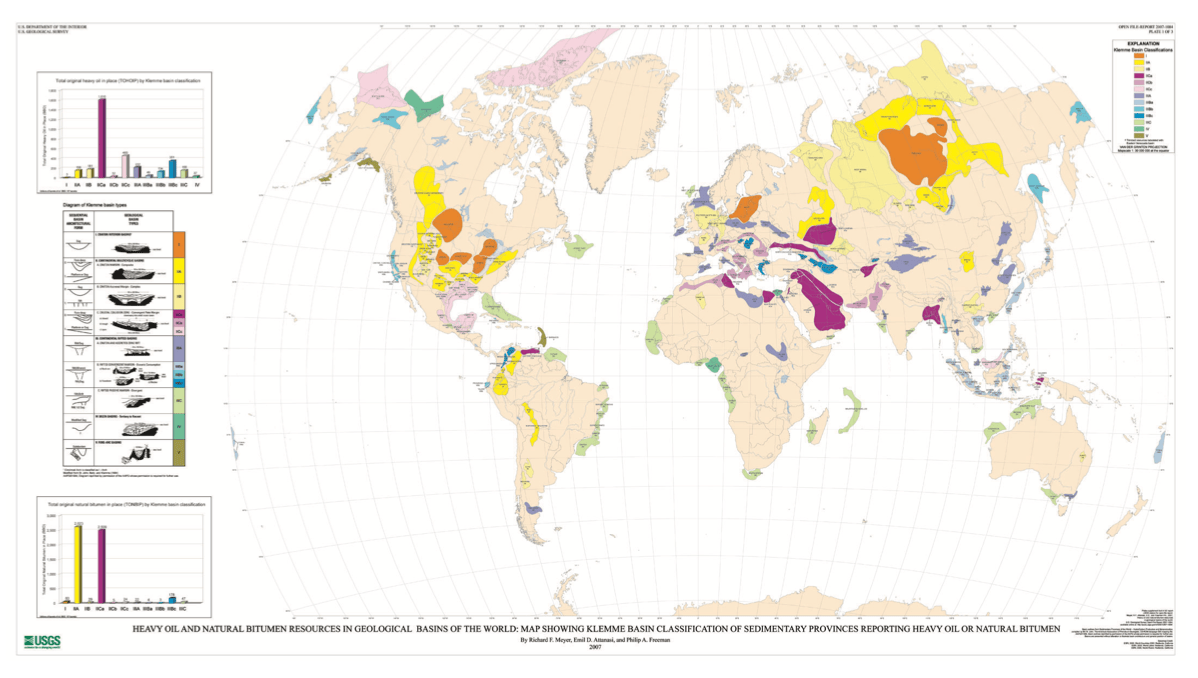
The United States Geological Services provides maps of available heavy oil and bitumen deposits. Figure 6 indicates that heavy oil is widely available in North America, Europe, Russia, and the Middle East.
In 2015, the International Energy Agency published a report indicating that in its view, there were huge deposits of extra heavy oil and bitumen (EHOB) that could be accessed if the price of oil rose high enough for long enough (Figure 7). The same exhibit shows somewhat smaller availability of tight oil from shale. In fact, the US has been able to access a substantial amount of tight oil from shale in recent years.

In my opinion, in order to access the EHOB, the prices of diesel and jet fuel need to rise to a high level over the long term; the prices of gasoline and even lighter products don’t necessarily need to rise. If the prices of diesel and jet fuel rise high enough, for long enough, the price signal should work its way back to oil and gas companies, suggesting that they need to make investments in the direction of adding more extraction from EHOB. If this succeeds, it could perhaps relieve the problem of inadequate supply of diesel and jet fuel.
The prices of diesel and jet fuel are high now, but this is at least partly due to higher insurance costs and partly due to the extra costs related to shipping oil longer distances to avoid blocked straits. These extra costs don’t get back to oil companies in a way that encourages countries to extract more heavy oil. What is needed are permanently higher prices for diesel and jet fuel, relative to the price of gasoline, even if the problems with respect to the straits of Hormuz and of Bab al-Mandab, disappear.
[6] Today’s conflicts in the Middle East and Russia/Ukraine seem to relate to inadequate supplies of diesel and jet fuel for buyers of these fuels, and inadequate prices for sellers of the heavy/sour oils yielding these products.
Figure 3, above, shows that the total supply of diesel plus jet fuel has been low, especially since 2020. One issue that has arisen recently is “Who gets the supply of diesel plus jet fuel that is available?” Figure 8 shows that increasingly, it has been the poorer countries of the world who obtain the diesel and jet fuel that is available. Note that total consumption of the Other than Advanced Countries has exceeded that of the Advanced Countries since 2020.
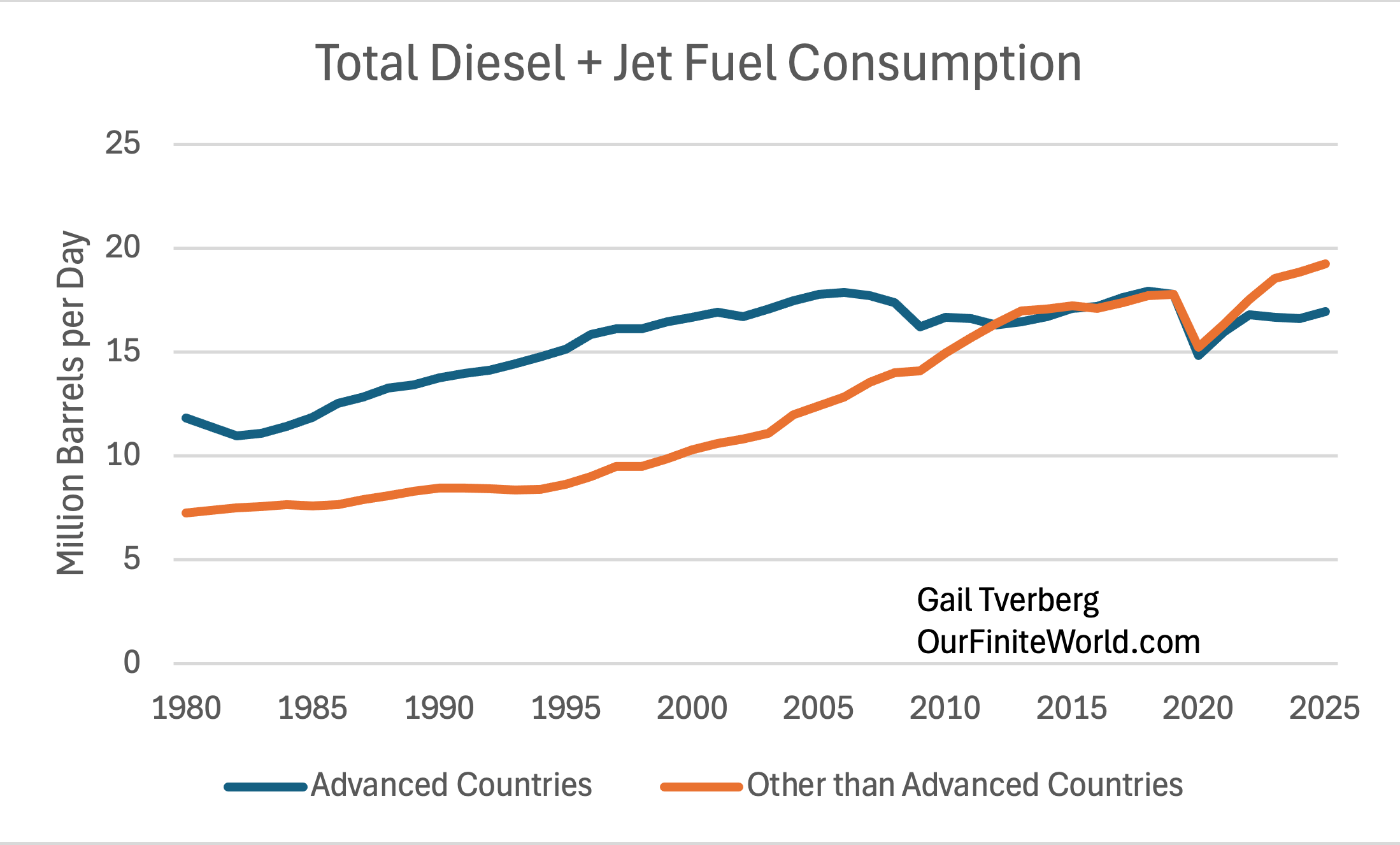
Figure 9 shows that for the Advanced Economies, per capita consumption of diesel plus jet fuel has been declining since about 2005–the time of peak conventional crude oil. The same figure shows that per capita consumption of diesel plus jet fuel has plateaued since 2013 for Other than Advanced Countries. I think of 2013 as the year that China first started encountering major limits on coal extraction (somewhat like the year 1970 in the US for oil extraction). In recent years, China has been able to raise coal extraction somewhat, but at a higher cost.

I would expect that countries in both groups would be dismayed by the situation shown in Figure 9. The per capita consumption of diesel plus jet fuel for the Advanced Countries has been falling for a long time. Partly this is the result of the economies changing to service economies. As service economies, the need for diesel by industry has been lessened. Wages tend to be less for many of these service jobs, making workers unhappy.
In Figure 9, people in the Other than Advanced Countries would tend to be dismayed by the continued wide gap between the standard of living of their own economy, and the standards of living in the Advanced Countries. Many of these countries export extracted resources that are ultimately sold as goods to people living in Advanced Countries. If the selling prices of these commodities were higher, workers in these countries could perhaps afford to have cars and air conditioning, like workers in the Advanced Countries. They would also be dismayed by the poor progress in raising their own per-capita consumption of diesel and jet fuel since 2013.
[7] Is there any possibility of greatly ramping up heavy oil production? Could it power a society like the one we have today?
We know that heavy oil production began long ago. For example, the first recorded production of heavy oil began in the Kern River Basin in California in the 1860s, and commercial production began there in 1899. The first production in the Canadian Oil Sands began in 1921, and commercial production there began in 1967.
The extent to which the oil that is heavy and often sour can be ramped up in the future remains to be seen. Extraction techniques have gradually been improving, and I would expect that they can continue to improve. But the cost of extraction and processing will likely remain somewhat high because of all the energy-intensive steps that are needed to provide diesel and jet fuel.
I expect that society itself will need to change in order to make use of this higher-cost oil. These are a few ideas I have:
(a) Oil exporting countries will need to change in ways that reduce their need for tax revenue. This is an issue especially in the Middle East, which has a huge population, in a hot, dry climate. The population will likely need to fall (for example, many migrants and guest workers may need to move back to their country of origin), and make-work projects will need to be discontinued.
(b) Another issue is that total diesel and jet fuel usage will likely need to be reduced because it is likely to take several years before production of heavy oil can be ramped up. Society will need to be reorganized in a way that uses less diesel and jet fuel. One idea would be to shorten supply chains whenever possible. Figure 10 illustrates one idea how this might be done.

(c) I expect that if such a change can be made, economies will need to gradually change in ways that are hard for us to understand now. The focus may need to be on essentials, including food and clothing. Governments may need to be smaller and provide fewer services. Communities may need to be smaller and more walkable. The total population may need to be lower.
[8] Conclusion
It seems to me that the self-organizing nature of economies will gradually push them in the directions they need to go if the world is to start incorporating a significant quantity of expensive products made from heavy oil into its energy mix.
We cannot yet imagine what all the changes will look like. In some ways they may resemble a recession, but there will likely still be an interest in greater complexity and in working to improve people’s lives.


What is the petro dollar without petrol ? Let is see how much longer can they swing it ? My upper limit was end of August before the MoU . Then end September after the MoU . There is definitely panic as can be seen by the Trump “export of diesel ban ” . let us see, I am not setting a timeline now .
https://indi.ca/the-new-triangle-trade-oil-bonds-guns-is-collapsing/
This link start out:
The old triangle trade was slaves, sugar, and goods. The 20th century version was oil, bonds, and weapons. Meet the new boss, same as the old boss. Energy slaves, securities, and guns formed the circulation system of White Empire reincarnated. This triangle rang like a dinner bell for cannibals from Saudi to Japan to America.
For centuries the White Empire has devoured a world divided up into triangles, but like a Leaning Tower of Pizza hit with multiple missile strikes, it’s going down hard and a bit cheesy.
A map shows that today’s White Empire Triangle is US-Japan-Saudi Arabia.
Today, Saudi oil is on fire, Japan is dumping bonds, and White weapons are blunted and gone. These are separate points in the news, but one shape if you look at them in historical perspective. A triangle, broken now. Oil is blocked in West Asia, the carry trade is broken in East Asia, and people are wondering what America has to do with Asia at all. . .
Yemen and Iran have said a siege for a siege, a blockade for a blockade and that if they can’t sell oil, no one can. This cuts one corner of the triangle off, the oil. . .
Now people are looking at the $40 trillion US debt, up from $30 trillion just last year, getting refinanced at worse and worse rates, wondering what is this shit? Why pay tribute to an Empire that’s losing its main tributaries. This debt has been unsustainable for years but now it’s becoming unbelievable, which gives the whole game away.
Remember that the Emperor in the story walked around naked for a while before people called it. In the same way, the White Empire has been banking around naked for decades without people saying anything. . .
The oil shock today is more than the 1970s oil shock, and the consequences will be even more consequential. The strategic oil reserves they built up in the 1980s provided some buffer, but that is now losing structural integrity, as the Empire is entirely. What is a petrodollar without petrol, and what is a triangle trade without trade routes? Nothing, really, and the nakedness rate of the Empire’s clothes is trending up accordingly. . .
And so the triangle burns on throth ends. The oil in West Asia, the spoils in East Asia, and the bond market in distant America, which really has nothing to do with anything. The last capital of capitalism, the final retreat of Whiteness after World War II, now meets its end in World War III,
Most of London was in a power outage. Any news, Xabier?
Problem seems to be over:
https://www.standard.co.uk/news/london/electricity-power-cut-latest-updates-postcodes-impacted-b1299550.html
“Offices across the City of London were cast into darkness as a result of the outage around 10.30am on Monday.”
According to UK Power Networks, a fault occurred on an underground electricity cable. . .
In an update, UK Power Networks said full service was full restored by 11.08am.
I’m 60 miles away at present!
The power outage which interested me was in February, here: most people thought it lasted for only 3 hours, but in fact the emergency supply came from a big and very noisy generator which was dumped in the middle of the village – thankfully not too near me – and that was going for a full 13 days, the longest time to repair a fault I’ve ever known. A taste of the future, it seemed to me…..
The house of a neighbour wa lit up like an Xmas tree during the cut, and that brought home how foolish to advertise like that if times get rough
“And for the first time, I’m seeing some some not
43:55 loud low Chinese analyst voices saying that Xi’s incapable.
44:02 He’s not weak. He’s too weak. He’s not strong enough politically at home to make either concessions to the United”?
In my view John Helmer is a good analyst, who is friend with Iran, pretend to be friend of Russia, but he actually works for US.
I remember being asked about 5 years ago what kind of well-paying jobs would be available for youngsters. My response was careers that focused on repairs, such as bicycle mechanics, but it wasn’t taken too seriously.
Anyway, here we are…
https://www.bikeradar.com/news/europe-needs-105000-bike-mechanics
“New report suggests Europe is already short of 45,000 mechanics, which is impacting how people travel”.
“The report says that Europe currently employs around 175,000 mechanics. Factoring in recruitment to replace those who are likely to leave the industry, the number of mechanics must grow to around 247,000 in the next six years – an increase of roughly 40%.”
I should repurpose myself into a careers advisor!
But the pay is dismal. I had a mechanic say, but I could make more at Mcdonalds, I said go ahead, go work at Mcdonalds.
Without fossil fuels, the pay for any kind of job will be dismal, I am afraid.
“Once again Karl W. Miller has put numbers to a problem that most of the commentariat still treats as a temporary price spike. His latest forward outlook, “The Five-Year Global Energy Crisis,” dated October 3, makes an argument that should alarm every finance ministry from Berlin to Jakarta. The war’s damage to Gulf energy infrastructure is not a disruption that ends when the shooting stops. It is a reconstruction problem measured in years and trillions of dollars, and while it is solved, the world will be short of the fuels that run its economy. . . .
The conclusion for Europe is stark. It produces most of its own diesel but has no spare refining capacity. It depends on imports for the margin that sets prices, and those imports now come mostly from a single supplier that has shown it will use them as leverage. And its emergency reserve is both perishable and finite. In Miller’s terms, Europe is one of the buyers most exposed to the marginal cargo, and the least able to wait out a five-year shortage.”?
https://larrycjohnson.substack.com/p/the-five-year-fuel-crisis-why-the
Haven’t watched it / can’t vouch for it, but it’s on topic:
There is now a hint that the grid won’t be able to handle all of the needs of the economy, with all of the additional production that is being added by data centers.
https://www.zerohedge.com/energy/deeply-flawed-biggest-us-grid-scraps-emergency-data-center-power-auction-one-day-after-ferc
We have been documenting the slow-motion collision between the AI capex fantasy and the laws of physics since late 2025, . . .
Now we can add the US electrical grid itself to the list of things that won’t arrive on time.
On Wednesday, PJM Interconnection, operator of the largest US grid stretching from Illinois to DC serving 67 million customers across 13 states, and home to Virginia’s Data Center Alley, suspended the one-time “backstop” auction it was about to launch to plug a 6.8 gigawatt hole in its supply stack, less than a day after FERC ordered it back to the drawing board. The procurement, which was supposed to open for offers on Sept 30 and run through Oct 21 with selections by early December, now has, in the words of a PJM spokesman, a launch date that is “yet to be determined.”
For those keeping score, that is a power auction for data centers… delayed. You can’t make this up.
Is this new Plague the “October Surprise?”
I smell another lockdown..
Would not be shocked.
https://www.youtube.com/watch?v=mfcoAWzS2DU
How Crude Oil Becomes Petrol, Diesel And LPG Inside A Refinery (23:11)
124,293 views Jun 10, 2026
oil refining is much more than turning crude oil into petrol and diesel. inside a refinery, crude oil passes through storage tanks, heat exchangers, desalters, furnaces, distillation towers, vacuum units, fcc units, hydrocrackers, hydrotreaters, reformers, isomerisation units, and blending systems before it becomes usable fuel.
you will understand how crude distillation works, why vacuum distillation is required, how fcc and hydrocracking convert heavy oil into lighter fuels, how sulphur is removed through hydrotreating, and how different refinery streams finally reach the blending pool to produce market-ready fuels.
Yes, petrol and gasoline are exactly the same liquid motor fuel for cars.
Regional Differences
• Gasoline: Used in North America (the United States and Canada). People there often call it “gas”.
• Petrol: Used in the United Kingdom, Australia, India, and many other places. The word comes from petroleum.
Why the Names Differ
• Both fuels are made from crude oil.
• Refineries process crude oil into the same hydrocarbon blend.
• Local stations might add small amounts of ethanol or different cleaning detergents, but the core fuel works the same way in any standard car engine.
this video explains the complete oil refinery process in a detailed 3d tour, starting with the bp texas city refinery explosion case and then showing how crude oil is separated, cleaned, cracked, treated, upgraded, and finally blended into products such as petrol, diesel, lpg, jet fuel, lubricants, asphalt, waxes, and petrochemical raw materials.
Yes, you can use LPG instead of pure propane in most outdoor appliances, because propane is actually a type of Liquefied Petroleum Gas.
Understanding the Difference
• LPG (Liquefied Petroleum Gas): A broad term for flammable hydrocarbon gases, most commonly a blend of propane and butane.
• Propane: A specific, single gas (C3H8) that is often sold 100% pure as commercial propane or HD-5 in North America.
Important Safety and Performance Tips
• Check the gas blend: Pure propane works well in freezing weather, but butane-heavy LPG blends turn back into a liquid and stop working when temperatures drop below freezing (32°F / 0°C).
• Match your equipment: Standard barbecue grills and outdoor heaters labeled for “propane” can use pure propane or high-propane LPG mixtures safely with the right Department of Energy guidelines, but heavy butane mixes may require a different regulator or conversion.
There are indeed lots of details to this.
I hope people understood when I talked about gasoline and diesel, I was talking about the major components of what is often referred to as crude oil.
The data I found in the Statistical Review of World Energy relates to crude + natural gas liquids. It doesn’t include natural gas, which is pretty much methane. It is the world distribution of these that I show on Figure 2.
On Figure 2, I would expect most LPG and propane would be in the top, very light, layer. These actual gasses are relatively inexpensive, per unit of heat energy. What is expensive is the transport cost of these gases.
The one thing I would somewhat disagree with is:
“Refineries process crude oil into the same hydrocarbon blend.”
I would say, “Refineries separate crude oil into the various different types of molecules that make up the crude oil.” What comes out depends very much on what kind of crude oil that goes in. Also, each refinery is set up to handle a particular type of crude oil, or blend of crude oils. Some types of crude oil have more diesel in them; some have more gasoline. In general, heavier types of crude oil have more diesel in them.
Real drama in the fields of Central Europe: Austria is suffering major crop failures due to drought.
Dürre Felder, schwache Ernte – teures Essen? | Report 29.09.2026
https://youtu.be/Gm-YJ8SjM_8?si=3St6vools2vvVrlr
People are blind. They still don’t get it…
Food is clearly a kind of energy supply. We have gotten used to plenty, but history shows that such plenty of food supplies is not always the case.
“Parched fields, poor harvest – expensive food?” is the name of the video.
Expensive food tends to especially affect poor people. They can starve or become more prone to illness. Whether we like the outcome or not, it tends to get the system more into balance. If the economy cannot really afford to afford to feed everyone, it must squeeze out some people.
This is the way “survival of the best adapted” has always worked. It has tended to further evolution. It has tended to work toward overall greater complexity of the system. But within this overall longer term trend, there tends to be big collapses back in both population and complexity, from time to time. It is possible that we may be reaching such a squeezing-back situation going forward.
A large fraction of grains goes to chickens, pigs, and milk cows. I doubt there will be famine, just a shortening of the herd and poorer quality food.
In the US, a large fraction (40% ?) of corn (maise) goes for making ethanol.
https://afdc.energy.gov/data/widgets/10339
This ethanol needs to be transported long distances by truck, before it is blended into the fuel supply. Getting rid of the ethanol would free up a lot of corn, and it would reduce the use of diesel.
I don’t think there’s any way the processing of ethanol is net positive for energy, sounds more like a dot gov job security program, and of course their virtuous green intentions. The road to hell is paved with good intentions!
Diesel to deliver seeds
Diesel to plant crops
Diesel to harvest crops
Diesel to deliver corn to ethanol plant
Processing (one step with no diesel!)
Diesel to deliver ethanol to the gas blending facility
Diesel to deliver ethanol blend gasoline to a gas station
Yikes
They began adding ethanol to gas in the early 2000’s. Maybe a year or two after 9/11. I remember George the Stupid making the announcement. At the time it was shown as helping farmers. They’ve known about the energy shortage for a long time. Anyone who says they have no idea what is going on should see themselves out of any discussions.
They also were trying to get the price of corn up, to help farmers.
Grian goes to animals for protein production.
We humans can get protein from vegetables. Fish also seem to be a good source of protein, if the water they are in is not too polluted. Eggs and milk are also good sources of protein. The need for animals goes way down if they are primarily used for eggs and milk.
As our absent friend ‘JR’ exhorted us over the last few months, we should enjoy the current bounty.
I do hope he hasn’t overdone the ice cream consumption……
ai says
And a May 2026 MIT * study found that firms don’t even automate for efficiency — they automate specifically to suppress wages:
“Rather than implement automation in pursuit of maximal productivity, firms have often used automation to replace employees who specifically receive a ‘wage premium.'”
The logic: if you can’t make the worker cheaper (because the minimum wage went up), you replace them with a machine. The worker’s existence is the problem. The machine is the solution.”
I assume the wage premium is the college wage premium. If that goes away, there goes the neighborhood. By the neighborhood , I mean the tax base.
*https://news.mit.edu/2026/study-firms-often-use-automation-control-certain-workers-wages-0507
I can believe this. Wage costs are often a large share of total costs.
Of course, eliminating jobs can lead to reduced “demand” for finished goods. It can increase “demand” for government programs to deal with the lack of jobs available, or their low pay. It is how the economy moves in the direction of efficiency, even as it pushes out the need for workers.
That’s the whole rationale for every labor substitution in history. Even slavery has the cost of feeding the slave, animals for traction as well. But machines eat ugly rocks and black liquids, they are more efficient, work 24/7 and don’t complain.
This is the basis of the industrial revolution, being in a trajectory where the needs of civilization become more important than the needs of people.
This is part of the growth of complexity. It leads to a few people being paid high wages, and many people earning little or nothing at all.
Somehow, the economy seems to need to evolve toward more complexity, even though it also hurts at least some of the people within it.
Slavery was the automation and outsourcing of pre-modern times. But it didn’t really threaten the livelihoods of the average worker. In fact, democracy seems to depend on the wealth generated by an enslaved class if you look back far enough .
ai summary “This dynamic allowed the free population to pursue political, military, and intellectual pursuits, which was essential for the functioning of Greek democracies and the leisure class. While some free individuals did work as artisans or laborers, they typically preferred short-term contracts or public service rather than the long-term, dependent employment characteristic of slavery. Consequently, slavery acted as a substitute for free labor rather than a replacement, enabling the economic and cultural achievements of Greek society” https://link.springer.com/chapter/10.1007/978-3-031-13260-5_4
Technology replaced slaves but unlike in some ancient Greek city- states, it did not free all free people from labor to pursue intellectual tasks.
In America, free people were competing with slaves. In the South, the whites who competed with slaves accepted a lower standard of living for the “at least I’m not a slave” reassurance whereas the Northerners saw it as a threat and organized against it. If the founding fathers had integrated slavery better into the Constitution, it may have led to the civil war.
The American Civil War did not lead to the return of the primacy of the citizen or free person. The Industrial Revolution followed shortly afterwards, which pitted fee person against machine , and citizen against cheap labor with limited rights, frequently.
This a is a major design flaw that has not been corrected.
I like the quote,
“slavery acted as a substitute for free labor rather than a replacement, enabling the economic and cultural achievements of Greek society”
Many people in the community concerned about oil limits talk about each person having something like 100 slaves in the quantity of energy used today. Even if the number isn’t exactly right everywhere, the idea is.
I understand that male slaves were especially used in construction, such as road building, and in mining. This was very difficult work that was hard on a person’s body. It was difficult to get people to do this work voluntarily. But it helped further civilization.
Female slaves tended to help in the kitchen and grind grain, (which was a difficult task–hard on the body). At that time, many women died in childbirth. Female slaves could become wives and mothers, too, if needed.
Without today’s energy slaves, it would not be surprising if slavery returns. People would rather work for room and board than starve to death.
You always have said you can’t ride a bicycle backwards; this would be going backwards. The same people would not be subservient to the rich doctor or business owners now. How would they pay with their paper?? No one is going to take it
edit: If the founding fathers of the American republic had integrated slavery better into the Constitution, it may have not led to the civil war.
U.S. Supreme Court to decide whether climate suits can go forward
https://resourceinsights.blogspot.com/2026/10/us-supreme-court-to-decide-whether.html#more
interesting, so they do now, how nice….remember back 20 years ago Dr.James Hansen was advocating lawsuits too….oh well, suppose well fiddle away another 2 decades with them until we are all dead…at least the lawyers will get enriched by it all
I’m glad to see that the climate suit is being decided by the Supreme Court rather than a Boulder, Colorado court.
I think that the reason the climate change issue is popular is because citizens really like to feel that they are being the good guys with respect to the “climate change” issue, rather than preparing for a world with less oil, for reasons that we are beyond our control.
Citizens cannot believe that we are “running short of oil.” The real danger seems to be that oil companies will fail because prices cannot rise enough to make extraction of future oil supplies profitable. In some sense, oil companies need more revenue, not less. Either that or the economy needs to substitute away from oil, if that is at all possible.
Thinking about the options:
1. What answer would help as much oil come out as possible?–probably striking down the climate change suit, and reparations. BAU can continue as much as possible.
2. If a climate change tax could actually do anything to lead to a substitute for oil (more efficiency, more carpooling, production of cheap batteries that work to make intermittent electricity more useful), it might be the right choice. We know that oil will be increasingly difficult to extract in the future. We badly need workarounds of one type or another.
3. If a climate change tax just goes into general revenue, it might help prop up ailing governments. But governmental collapse might be the right answer to our energy problems, if governments are promising more than they can possibly deliver. Reduced governmental promises are then what the economy needs. Just letting governments collapse, as they naturally would, would be a better alternative. In this case, I would argue that the climate change tax should be struck down.
So arguments could be made either way. (I personally think the idea that we can do anything to fix climate change is sort of ridiculous. But people like this way of framing our resource shortage issue.)
Dr. Robert Pape: “ but also because the capabilities of the drone second precision revolution
58:59 are going to work dramatically against Israel’s power. This Israel I’m not saying it will be wiped off the map. I think it will be a second tier state. ”?
He described Israel as becoming like a Sparta state.
If America and Europe aren’t Spartan like states, what makes he think Israel can become one? There are no modern examples of a state ruled by a small group of physically fit people.
It’s not even a straocracy so it being a kraterocracy is out of a question. Although, like Ukraine, exemptions from military service are allegedly disappearing.
Worst case scenario is they retreat to the Ukraine and that’s if nuclear war doesn’t work in their favor.
This video starts out:
The biggest thing Iran has taught the world is that America can be beat and we [Europe] can’t do anything about it. This fundamentally changes. It doesn’t just mean that the frontline Gulf States can’t depend on the United States for protecting them. This means South Korea can’t depend on the United States. Japan can’t depend on the United States. This is going to get more and more in this direction. Europe’s on its own.
And it’s not about whether America’s will is going to be with Europe. It’s does America have the capability it used to have?
I think that this is key to understanding where Israel is headed. Every country in the Middle East is badly overpopulated, including Israel and Palestine.
Every country in the Middle East would like more land and more water. Israel depends on the backing of the US for its continued existence. If the US is not able to protect Israel, Israel’s position in the Middle East becomes very tenuous. Jews will want to leave to go back to the European countries their families came from, or move to the United States to be with other Jews. It will be a very second-rate country at best.
I would wonder whether the religious groups who have chosen to believe that Jesus’ second coming depends on the State of Israel’s existence will have some major rethinking to do, also. (I am afraid I am not tuned into the details of their belief’s however.)
https://www.theburningplatform.com/2026/10/03/kiev-in-panic-as-russian-drones-begin-severing-main-bridge-cables/
Back in the days when I was a lurker, one annoying furker rejoiced in calling Russia vs. Ukraine a fake war. Now it is in the penultimate phase, of severe escalation, which comes before exhaustion, when the opponents just want it to stop. After several years of war, Russia’s patience is broken, and it knows that the more brutally it prosecutes the war, the quicker it will end as it breaks its enemy.
This does sound worrying if Russian drones begin severing main bridge cables in Kiev.
I didn’t realize that voting was such a recent phenomenon. The graph points out that women got the right to vote soon after men, but what I find more interesting is that voting, for anyone, is so recent. I never got a proper education …
Maybe as resources become scarce, we will return to the older system of monarchy and clans – a Kulm-esque scenario.
https://x.com/cremieuxrecueil/status/2106535555702137163
>> There has never been a time when the majority of men have had the right to vote while women haven’t
>> In fact, the era of male-dominated voting was very short
>> That era is one way analogous to the ride-hail era: it’s a temporary phase we’re already passing over (for self-driving)
I thought that if anyone had voting rights, it was (male) land owners. But even that may be recent.
A lot of phenomena go down, somewhat like they went up. Do we reach peak voting, and move to an era of smaller states, with fewer voting rights?
Voting is mostly for show. The most important things are not voted on by average people. For example, people can not vote to end a war or start one.
People are allowed to vote on petty things.
It’s like those “suggestion box’s” at work. It doesn’t really matter all the suggestions are ignored. It makes people feel like their voice is heard and they tend to work harder.
People now talk about the Uni-party. No matter what the various political parties claim, those people who got elected, want to get re-elected. They will continue to add more debt, if they can. They will enact policies that they think will be acceptable to people. There are many obstacles to getting legislation passed by either party, so things tend to stay pretty much like what they have been in the past.
Right now, the contest seems to be between Trump’s ideas and the courts, not between the two political parties.
Many people claim that both parties are in favor of war. If nothing else, war tends to increase employment. It raises GDP, since it is a “service” that the government is providing. It provides an excuse for more spending and more US debt. It helps inflate the stock market.
Money passes from the class that owns land and companies continuing the class structure that no one voted on.
Anti-plague lab in Siberia has one die
https://x.com/911NewsBreaks/status/2106520919476961681
>> ALERT: 🚨 Russia quarantines 200 people, [enacts anti-epidemic measures] after lab worker dies of plague.
Another way to try to cull the too large heard of old and weak people, perhaps.
Apparently it is the black plague
Normally curable with antibiotics. I do not know what to make of this.
But maybe they are more interested in reducing the population of old sickly people than stopping the spread of illness.
A dreadful over-hang of the elderly in all the industrial countries, not viable for much longer.
Thinking about China; I noticed in a video by an ordinary office worker there that she gave quite a sum each month to her parents, as is the custom.
Get rid of them, and suddenly the younger workers will have much more discretionary spending.
Too be fair, it makes no sense to cull by random.
I guess you could say it makes no sense to breed at random too. But that’s another argument. lol
Having children would still be expensive due to the two income trap and the lack of free child rearing in the form of a large family.
If locking down the entire world isn’t enough evidence we’ve reached peak oil.
What is?
A chart from the EIA or IEA?
Peak oil, Peak Gold, Peak Copper are past..
And welcome to the world without.
This is an Art Berman chart, but I believe it, showing steel, cement, fertilizer, and plastic. All seem to be beyond peak.
https://ourfiniteworld.com/wp-content/uploads/2026/05/Art-Berman-Chart-adding-togher-steel-cement-fertilizer-and-plastic.png
This is a 2024 summary update to the Limits to Growth analysis, done by a group in Germany.
https://ourfiniteworld.com/wp-content/uploads/2024/12/State-of-the-world-plot-BAU-and-recalibration-23-with-Gails-labels.png
Look at the solid line called “industrial production.” We are already beyond peak in 2025 (or 2026).
That’s a very interesting chart from Art.
And Dennis Meadows claimed that once we reach the downhill from limits. The models can’t really account for what will happen. I think he said the data gets too messy.
hahaha why the “but”, Gail?
I assume the doubling in volumes since 2008 resulted from the great credit expansion in China which is widely regarded as having saved the global IC. In addition to infrastructure, the credit growth fueled the domestic housing bubble but also industrial capacity, largely for export. Both these are now facing constraints. It would be fascinating to compare this chart with exactly the same ex China.
I say “but” because I don’t usually use charts I didn’t myself produce from data I can see in public reports. I am not sure where he got all of his data from.
China now produces the majority of a lot of minerals. Everyone else produces tiny amounts.
The latest Iron and Steel report is shown here:
https://pubs.usgs.gov/periodicals/mcs2026/mcs2026-iron-steel.pdf
For example, the best quality steel is from pig iron. China produced 66.6% of the world’s supply in 2024, which is the last year with real data. The US produced 1.6% of the world’s supply. If recycled steel is included, in 2024, China produced 54% of the world’s steel; the US produced 4.2% of the world’s total.
For cement production, the latest annual report is this one:
https://pubs.usgs.gov/periodicals/mcs2025/mcs2025-cement.pdf
For 2023, China produced 49% of the world’s cement. The US produced 2.2% of the world’s cement. For the year 2024, the world total production, China’s production, and the US’s production are all forecast to fall. The relativities stay pretty much the same however.
We are recycling more today than ever before in materials, all we need now is to reduce the population.
Recycling is, by and large, a joke, a delusion.
‘Honest Sorceror’ has gone into this in some detail n a recent post.
Neither de-population, nor recycling, nor greater efficiencies can help us.
Thanks Xabier,
From the HS article
according to mining giant BHP:
“Much of this ‘old scrap’ is also not recovered. We estimate that in 2021 only 43% of available ‘old scrap’ was collected and recovered for re-use, falling to 40% in 2023 as lower prices, slowing economic activity and regulatory changes acted as headwinds. Rising ‘scrap nationalism’ to preserve the local use of secondary material and restrictions in cross-regional waste trade have also acted as a drag on growth for global scrap collection and recovery (and may affect the availability of scrap in developing countries who have not yet built up their own substantial pool of copper in-use).
What’s worse, no recycling process is 100% effective. Some of the material cannot be collected, or is simply not economic to recycle. Think: copper used in fungicides (sprayed on crops), thin copper wires in holiday lights, internet and telephone cables, small chargers and building wires featuring very thin copper strands heavily bound in protective sheathing. Not to mention copper in printed circuit boards, cars, consumer goods, household appliances, A/C units, old TV sets etc. where this valuable metal is buried deep inside complex physical assemblies, with mountains of plastic molded around them. Hence the 50-60% recycling rate, which is pretty much the best we can get.
……Recycling, while playing an important role in cushioning the blow from peak mine production, will not save us from the coming copper crunch, nor can help this high tech civilization going for much too long.
https://thehonestsorcerer.substack.com/p/the-era-of-material-scarcity-has
One of his stronger articles, I think.
The idea in circulation that societies will be able somehow to live for decades, or even centuries, on the abundant contents of the land-fill sites left by us seems particularly fatuous.
‘Indigo Traveller’ on YT visited scavengers on the huge Jamaican rubbish dump. Interestingly, they were given some training by Chinese experts.
https://www.youtube.com/watch?v=S7xi_H3rIW8
How Fiber Optic Cables Are Made and Laid Across the Ocean – Inside the Global Internet Industry (16:26)
Every day, enormous volumes of digital information travel between continents through fiber-optic cables hidden underground and across the ocean floor. Behind this global network lies an advanced industrial process where purified glass, precision engineering, polymer coatings, steel armor, and specialized cable-laying vessels transform microscopic optical fibers into communication lines capable of operating for decades beneath the sea.
In this documentary, Factron Process takes you inside the global fiber-optic cable industry, following the complete journey from silica sand processing and glass preform production to fiber drawing, protective coating, cable assembly, testing, and installation across the ocean. Discover how factories manufacture incredibly thin strands of glass with micrometer-level precision, how submarine cables are reinforced to withstand extreme underwater conditions, and how massive ships carefully lay thousands of miles of cable across the seabed to keep the modern world connected.
Can this happen without fossil fuels/materials?
Can these cables be cut by Houthis or other similar groups?
Anyone with a boat anchor, long enough chain, and a good sized boat.
There is endless small details but maybe we need a big picture. A 5 year, 10 year take?
Ed , to get to the long term you must first pass thru the short term . What are the terms .
1 . Short term 1 year
2 . Medium turn 3 years
3 . Long term 5 years
4 . Bull shit 10 years
Standard modeling doesn’t work because there are so many interactions. There can be inventions, but there can also be many broken supply lines, and even problems with pollution and depleted minerals from soils.
I am glad that I am not a young person trying to figure out what to do with the rest of my life. Being flexible seems to be the best choice. And being in good health, without being dependent on a number of medicines with long supply lines.
Yes. When I see young people I think I am glad I do not have to figure out what to do with my life as they do.
Skills, health and tools is probably a youngster’s best bet. One thing that won’t stop growing is the natural world (e.g. plants). No doubt they’ll be jobs trying to keep it “orderly”.
I think you are right. We depend a whole lot on plants. Eating a whole lot of plant food is good for a person, especially if some of it is cooked to make it easier to chew and digest.
My go to guy for Gulf of Mexico oil — George Kaplan .
” Stena Evolution is a 7th generation drill ship with day rates just short of half a million and a five year contract with Shell, with the last four dedicated to Sparta following upgrade to a very expensive 20,000psi blowout preventer. After about a year and over a quarter billion total drilling costs there are no completed wells – three abandoned, one side tracked (but no sign of completion on the new borehole after two months drilling), and three cancelled. There are seven targets left.
The cancelled wells, and the short time of drilling for the abandoned wells, imply drilling is not possible in some areas, probably because of salt layers, making the future drilling and completion programme still more expensive.
Shell may be wondering if it was a good idea to take over the development after three other companies had tried and pulled out, but it is probably already three billion in the hole, and BP may be increasing its efforts to offset its own risk exposure by selling some of its two upcoming 20,000 psi projects. More Paleogene problems are evinced by the rapid decline in Shenandoah – after nine months it has declined 40% from peak, it never reached design capacity and two of the four wells have rapidly growing water cuts.
There is a lot of noise in the numbers but it looks like GoM production is declining fairly linearly at around 250,000 bpd per year. Earlier this year several largish wells were completed as part of the final ramp-ups of some recent projects. There is nothing similar in the pipeline now, so next year’s decline will be larger. After that exponential decline of around 10 to 15% will set in, interrupted by the three new projects (but I doubt any will achieve their nameplate capacity for long, if at all).
By 2030, given normal activity, the largest producers, Shell, BP, Chevron and Occidental, will be selling off their older assets (a process just begun with Shell’s sale of it’s Na Kika holdings). By then, however, civilisation collapse will be well under way.
One group will have realised that there isn’t as much oil as they’d been led to believe and another that renewables aren’t that great if they are your only choice (or maybe not given the power of cognitive dissonance). Energy prices could be very volatile, there will likely be a lot of government intervention, financial methods for debt and investment will be different and countries would be forced towards simplification, even shorter term outlooks and more isolated autarkies.
By coincidence GoM, Norway and Kazakhstan all produced about 2 mmbpd last year, after a period of growth, and are now going to follow similar decline curves. The three countries with slightly lower production, Mexico, Angola and Nigeria, are also moving from near plateaus to steeper decline.”
Thanks for posting this!
Eventually we seem to run into obstacles with drilling that we can’t get past.
I remember that at one time, Kazakhstan was nicknamed “Cash is all gone.” I expect it has not done very well over its life.
There are areas that haven’t been drilled, but they are pretty much areas that don’t look very promising. We do have a lot of heavy oil areas, but costs can be astronomical.
Long term US debt is going bidless .
” Rich Privorotsky, head of Goldman Sachs’ trading desk, said that U.S. Treasuries with longer maturities still lack buying interest; despite the PCE coming in below expectations and a slight drop in bets on a rate hike in October, pressure on long-end yields remains unabated. The 10-year Treasury yield rose to 5.34%; while valuations have become somewhat attractive, mean reversion, real yields, and fiscal pressures all suggest that the bond market’s rebound has yet to be confirmed.”
https://news.futunn.com/en/post/1000511594/have-us-treasuries-bottomed-out-goldman-sachs-trading-desk-head?level=1&data_ticket=1791033364759985
Lots of cautions in this article:
The rapid rise in yields is also triggering multiple early-warning signals based on historical data. Florian Roger of BNP Paribas CIB notes that he has set 5.5% as the threshold at which the U.S. 10-year Treasury yield begins to exert substantial pressure on equity markets, adding, “We are now very close to that level, at which point stock valuations will start to look overvalued.”
Bloomberg macro strategist Simon White cautions that investors should not be misled by seemingly low valuations—historical trends in U.S. Treasury yields suggest that yields may still have further to fall. . .
Fiscal pressures and liquidity risks cannot be ignored.
Potential buyers must also contend with the United States’ dire fiscal situation before entering the market.
Among major emerging markets and advanced economies, the U.S. fiscal deficit as a share of GDP ranks among the highest globally, trailing only Brazil, Poland, Hungary, and Colombia. Excluding interest payments, the U.S. primary fiscal deficit also tops the world, tied with the United Kingdom, underscoring significant fiscal pressures.
“the bond market’s rebound has yet to be confirmed.”?
Hanke: “what’s been going on by the way is that we’ve had an acceleration in the growth rate in the money supply and
30:19 right now measured by the broadest measure is divvisia M4 that’s put out by the center for financial stability in
30:26 New York and that’s growing at 7.4% year-over-year. And Hanky’s golden growth rate, a rate consistent with
30:34 hitting a 2% Fed target is 6%. So, so it’s growing a lot faster than than the
30:43 a rate consistent with hitting the target. So, it it does come back into your question a little bit, and that is
30:50 these rates are going to stay high. the g the inflation genie is out of the bottle. But but in inflation is not
30:58 caused by the the interest rate. It’s caused by the changes in the money supply. The interest rate follows and is just symptomatic of what’s happening with the money supply. . . .
34:46 now, but this this gross output indicator would would suggest that uh we’re we’re not going to end up with a recession right around the corner . . .
40:14 up and the money supply still keeps accelerating because of the demand for credit is so hot and the banks are are
40:23 full. They have capacity. They’re not up to capacity.
40:27 They they have excess reserves and they and they have the capacity to make the loans if they think they’re any good. . . .
and I and I’ll say it will pop when
44:04 the monetary policy starts tightening up.”?
In 1913, there were about 45 countries on earth. Half of them were in Latin America, considered to be a US playground for all practical purposes.
Out of these, Japan, China, Turkey, Persia, Siam, Afghanistan and Abyssinia were non-European.
Japan claimed it was no longer part o Asia but was trying to enter the West, and the other countries were under varying degrees of Western influence, not really independent.
So, by that point of time, it was safe to say that Eastern Despotism was dead, the Eastern culture was dead, and Asia was dead.
Fast forward 110+ years, the Eastern Despotism is about to win.
Not completely eradicating Eastern cultures is going to haunt the West.
Within those large counties, there were many different local groups, bound by kinship or religion. There were often many languages within a country. What a “country” meant, seemed to differ in different parts of the world.
That and chucky. without these errors oil would still be flowing.
Yes since tge colonies would have stayed under Western rule and very little fossil fuels would have been wasted for the denizens there
You should not have let the tribe that talks about liberation (to increase its own power) grow. As it was people all over the world listened. It is all your fault.
We can all thank Baroness Margaret Thatcher (and Francois Mitterand, whose words nobody paid attention to) for the Kaliningrad mess.
Thatcher acted like a crazy banshee when Germany was about to be unified
Poland should have at least have been forced to cough back the city of Stettin, important for Oder river traffic (I don’t use whatever convoluted spelling the Poles are using) and put Silesia up to auction, and Germany should have been allowed to reclaim Konigsberg, which was the cradle of the modern German state and the birthplace of Kant, who is taught as a Russian in schools in there.
Tilsit (I don’t care whatever the Lithuanians call it now) was the border of Europe and Asia in Napoleon’s days, but Thatcher acted like a crazed bat to continue to award Ostpreussen to Russia, and now this is what we get.
The people of UK, called ‘the scum of earth’ by its greatest military hero Arthur oWellesley, feared another German rise than the rebirth of an Eastern power, and now it is going to have a very negative effect on the future of Europe, although UK, now infested by lots of Hindus, might not care and consider it to be part of South Asia now.
The rot goes back long before Thatcher, to when John Stuart Mill became the first major British politician to advocate votes for women in Parliament. He tried unsuccessfully to add the female franchise to the 1867 Reform Bill.
Then, after Chucky and the scum of the earth did their duty and helped Britain win the war, the Representation of the People Act 1918 gave the vote to women over 30 who met minimum property qualifications. This was quickly followed by the Equal Franchise Act 1928, which gave all British women equal voting rights with men at age 21. Result women became a majority of the voters, and everything went downhill from that point.
Thatcher becoming prime minister was merely the icing on the cake. And every subsequent UK PM since Thatcher has been either a woman or performance artist. Perhaps this isn’t all Maggie’s fault, but is a consequence of the PR age we live in. Post-Thatcher Prime Ministers have to appeal to the sensibilities of women voters, and as a consequence, political communication has become much more performative.
While pre-Thatcher leaders could rule quietly from behind closed Cabinet doors, modern Prime Ministers must constantly project a carefully managed television and social media identity—fluctuating between aggressive displays of strength and touchy-feely displays of everyday empathy to win over voters.
Europe just threw 100 million barrels of emergency stocks at the market—and Brent barely blinked.
With Middle East exports reportedly back to ~84% of normal, Brent remains above $100 and physical differentials are strengthening.
That’s the signal: the market is tighter than the headlines suggest.
Art Berman
In all his wisdom, Macron is doing this while France imports 98% of their oil and 60% of their diesel. 20% of the pumps are out of fuel .
He also wanted to send troops to Saudis to defend their pipelines.
Macron’s term ends in 7 months.
Actually France sits over a huge, huuuuge deposit of shale oil/
But, as chance would have it, they are concentrated in the region of Ile de France, aka the Paris basin.
If the French capital can relocate to some place like Orleans, just like the days of Jean de Arc (he never menstruated – chances are he was never female but was advertised as such to make him more impressive, and eliminated when the ruse could not continue any more), and dig up Paris for shale oil with the water from Seine, then France is energy independent
But do we really want to exploit all the resources that we can for the chosen few who can afford it. It will take decades to start those shale projects and by thne the French will have another revolution on their hands (or other problems)
I have heard about the big deposits of tight oil from shale under Paris. But how to access this resource is a question.
On to shipping and tractoring by gasoline. It is currently very successful.
LOL!
in USSR tractors **** you…
If the Strait of Hormuz Is Gushing, Why Is Trump Raiding Europe’s Diesel Tanks?
https://larrycjohnson.substack.com/p/if-the-strait-of-hormuz-is-gushing?utm_source=post-email-title&publication_id=1225061&post_id=218590915&utm_campaign=email-post-title&isFreemail=true&r=216vfx&triedRedirect=true&utm_medium=email
The answer is in the math . In March IEA announced a 400 million barrels of SPR release . USA agreed 172 million barrels(132 is released) , Japan has released about 90 million barrels and SK about 50 million . Other countries have thrown in a few barrels here and there . EU did not release any SPR as a matter of fact it increased it’s imports of distillates and conserving it’s own stocks . This act is now ” throwing the kitchen sink ” at the problem . No other region has any reserves left .
Trump now says he had no intention of putting a ban — he was threatening by saying ” I am considering a ban ” . It worked .
Trump says US won’t ban diesel exports
https://thehill.com/policy/energy-environment/6126914-g7-releases-massive-fuel-stock/
NEWS: Asked if a diesel export ban was officially off the table, Trump said: “We were never going to do it.” (Trump said several times in the past two weeks that it was under consideration and that he supported the idea)
He praised Europe for releasing diesel from its reserves, saying: “They did a great job.”
You are going to hear so many bad takes about how the European SPR functions, that I’d like to preempt. There are three distinct SPR contractual arrangements :
1/ Some European gov’t own the fuel directly
2/ Some European countries operate a Central Stockholding Entity, a public company, that owns the fuel and may own or rent tankage space.
3/ Economic Operators (refineries and fuel distributors) have a service agreement with their local European governement to stockpile fuel on the government’s behalf and supply both the fuel and the tankage.
Quite different consequence for the market depending which one gets released. Government typically don’t hedge SPRs inventories. Refineries do hedge.
I’m expecting a lot of swaps. One barrel goes out tomorrow, 1.2 barrel must come back in 6 months.”
I had in an earlier post warned that release of EU SPR will be problem . In France both Right and Left are hollering ” traitor ” . Merz is resisting saying he needs it for the coming war with Russia . Interesting times .
https://x.com/tleilax___/status/2106107471924539882/photo/1
France, Germany and Italy use both CSE (case #2) and EO (case #3) storage.
The mix of the release will be key to assess market impact. My take is that they started with EO storage, and thus barrels physically already at the refinery have been freed for release. This is how you frontload the release in the first 20 days, as this is the most readily available SPR which is mobilizable on short notice.
Those barrels were most likely hedged by the refinery hedging desk using short ICE Gasoil future positions – charging the negative carry plus financing to the governement on each roll, but that is story for another day.
Those hedges had to be lifted, hence the brisk future buying activity on front ICE Gasoil futures after the announcement.
That also means diesel released deep inland Germany and France, far, far away from ports – and that is deliberate.
Quote
Yet another commodity guy
·
It would be crazy to cut of US exports of diesel. The US works as a middle man, so to speak. We import heavy oil; we have refineries that process it, and we send diesel out. But we need to import heavy crude to make the system work, and export our very light oil. We cannot refuse sending the diesel we produce out to countries who need it, or those countries will need to stop their mining and manufacturing that we depend on.
Too add .
https://oilprice.com/Energy/Crude-Oil/Irans-Disappearing-Oil-Is-Becoming-Everyones-Problem.html
This whole diesel release thing is largely performative.
For as long as US product remains highly discounted to European, EU reserve barrels will not get bought. Reserve barrels have been available for months and not been drawn in Europe for structural price reasons.
I’m sure someone in Brussels or Washington is aware of this.
Unfortunately the vast majority of people have forgotten that European reserves don’t sit in government controlled storage. There is no EU equivalent of the SPR. They are minimum reserves that commercial players are mandated to hold. That means they operate more like counter-cyclical capital buffers operate in banking.
The same way that regulators releasing the CCyB doesn’t compel a bank to reduce its capital ratio or make additional loans, releasing the strategic reserve doesn’t compel European energy companies to sell diesel. (During Covid, for example, many banks didn’t want to tap strategic buffers even when they were told it was ok to do so.)
If you want more EU barrels consumed, either EU governments intervene directly in the wholesale price (which they won’t as that involves paying off trading companies or appropriating the stocks directly) or the US must eliminate some of the regulatory factors that make it much more profitable on their end for US producers to sell barrels at a discount into Europe. Like RINs.
Izabella Kaminsky .
I hadn’t thought about this part of your remark:
For as long as US product remains highly discounted to European, EU reserve barrels will not get bought. Reserve barrels have been available for months and not been drawn in Europe for structural price reasons.
I thought that US sellers would try to get as much as they could for products sold in shortage areas.
Iran is running out of stockpiled oil that it used to send to China, both on the water and on land. Teapot refiners are running short of oil to refine.
Some quotes:
These [Chinese teapot] refiners are being left with less oil and more expensive alternatives. Guyanese crude is particularly costly when long voyages coincide with an unprecedented shortage of very large crude carriers and record freight rates. . .
Competition for Russian oil is intensifying, too. Chinese buying has reportedly pushed ESPO differentials to an all-time high premium of $28/bbl vs ICE Brent, while Urals is also trading $7-8/bbl above the same benchmark. . .
For Tehran, the imbalance is becoming harder to tolerate. Peace negotiations continue without a breakthrough, its crude remains blocked, and its export revenues are squeezed.
This is one observation in the post about the supposed recovery of shipping through the Strait of Hormuz:
Even if every one of those crude barrels were real, crude is not diesel. Miller’s research shows the Gulf’s refined-product exports recovering far more slowly than its crude. Hormuz product exports excluding LPG were reported at about 1 million barrels a day in mid-September, against about 4 million before the war. The International Energy Agency puts Middle East net diesel exports at 390,000 barrels a day in August, just over a quarter of prewar levels.
Later, on the power of a US export ban:
Europe’s last 10-15% of diesel, the part that sets every price at every pump from Lisbon to Warsaw, now arrives largely on American tankers. When the White House threatens an export ban, it isn’t threatening a marginal supplier. It is threatening the margin itself.
Evidence is that Hormuz passage is still very low:
If the Gulf were truly back in business, none of this would be necessary. Europe would be buying its diesel there, as it did before the war. Instead, American refineries are running near their limits, East Coast inventories hit record lows this summer, and Bessent now complains that “American farmers, truckers, and businesses should not be left carrying the burden of a global diesel shortage.”
Trump’s Motives–Get the gasoline price down before the election:
Trump is trying to bring down fuel prices ahead of November’s midterm elections. He even cooled on the export ban he was threatening, worried about what it would do to gasoline prices at home. The threat was never really about Europe’s welfare or the global market. It was about getting European barrels into the Atlantic basin before American voters reach the polls, and about getting America’s allies to spend their insurance policy so the White House doesn’t have to admit its policy has failed.
I am afraid Art is correct.
This video is quite interesting on Russia’s geostrategic options.
Obviously the world remains competitive, and states enter into both friendly and hostile relations to try to make things work out for them.
Is Russia being too friendly here or too hostile there? It depends who you ask.
But what strategy would actually work out for Russia?
The real world is a complex and tricky place to make things work out, and success is not guaranteed as the fall of the USSR demonstrates.
Ultimately state survival is at stake.
Putin’s Dark Valdai Speech; Kaliningrad Warning; Khrushchev Playbook Returns
“GM
The war on Syria started in 2011.
Medvedev was still president.
And the old Soviet-era ties were maintained and strengthened, weapons were supplied to Syria per contract, and above, etc.
Then in early 2012 Putin returned and things changed.
He started stalling on supplying air defense and other materiel.
By 2013 things were going very bad, Idlib had been lost to the Turks, the Americans had unleashed ISIS in the northeast, etc.
Putin did a classic good cop/bad cop routine with Obama to twist Assad’s arms into giving up his chemical weapon deterrent. Which was characteristically portrayed as a genius diplomatic move, but was in fact a brutal betrayal done to serve Israel.
Who then started bombing Syria regularly.
Russian AD did nothing — it was was ordered to not fire back, only to try to occasionally shoot down the missiles launched. But never to shoot down the Israeli jets. Forget about supplying TBMs and long-range MLRS systems to take out the Israeli air bases. Which is what Brezhnev would have done. And we know that it is what Brezhnev would have done because that is exactly what the USSR did in the 1960s and 1970s — Syria fought Israel directly with Soviet equipment.
Notice the parallels here? Does that remind you of something happening now? The Russian military itself has its hands tied exactly the same way — it is being attacked every day but is only allowed to defend itself with air defense, not to strike back at the source of the attacks (which is outside Ukraine). Worse, there is a very clear order to not hit certain NATO assets situated in Ukraine itself, an order that is outright treason under any reasonable definition of the word. I keep going back to this as the most obvious example — Patriot batteries used to go spectacularly boom in Kiev in the first year after they were supplied. When there might have been some Ukrainians in them. Now it is all NATO personnel, and specifically US personnel, Trump is the president, and we have not seen a Patriot battery going boom for nearly two years. Even though those shoot at and occasionally shoot down Russian missiles every day (while collecting valuable info on them and adapting to become better at taking them down).
By 2015 the situation had become so dire that Russia had no choice but to intervene. Why, you ask? Well, if you don’t understand why and how the dominoes fall after Syria’s destruction even after watching the events of the last two years, you are beyond any hope for salvation, I can’t help you, and I am just wasting my time here. Suffice to say that Syria is so important that Putin was absolutely obliged to do strategic nuclear strikes on Turkey in late 2024 to save it (and take over the Bosporus and the Dardanelles too), which he didn’t, and now the consequences are unfolding. But of course it wouldn’t have come to having to do that had what had to be done in the previous decade been done.
Again, does that remind you of something? Russia now has to wipe out and take over all of Europe if Russia itself is to survive, and it has to do that precisely because what had to be done so that things did not get to this point was not done, but this desperate option is once again taken off the table so what will the outcome be?
The Russian military understands perfectly well what was at stake in Syria, so they pressed Putin to go in seriously, meaning large-scale deployment of ground forces, with all the gear and many times more aviation support than was actually allocated. In the end there were no ground forces deployed, only Wagner, and the air support was quite limited.
And Putin sold Syria out once again by agreeing to not fight Turkey and the Americans directly, he allowed them to occupy Idlib, the north and the northeast. Of course against the objections of the military, but the military was overruled.
Still, despite the constant Israeli and US bombing, the occupation of the oil fields and main agricultural areas of the country, the combination of SAA, IRGC, Hebzbollah, Wagner and the VKS was winning the war. And were about to storm Idlib when they were ordered from Moscow to stop.
Astana followed, which “froze” the war.
And Idlib was allowed to fester as a safe haven for Jolani and his bashibazouks.
Again, does that remind you of something? The DNR were winning against the AFU on multiple occasions, only for the order to come to stop (Mariupol eventually ended up destroyed and the SMO derailed because of one such episode) and instead the treasonous Minsk deals were signed, which allowed NATO to build up the AFU for years.
Meanwhile the military wanted to go in hard and take Kiev and Odessa, but Putin vetoed it.
How did that end up for Russia? Not very well, right?
It ended even worse for Assad, but with some more betrayal from Putin.
Even after Astana, there was no relief for Syria — it was still sanctioned and Russia did very little to help, and it was still bombed, which Russia did nothing to stop either.
Which is how internal morale was destroyed over time and the country was hollowed out.
Then the final betrayal happened, immediately after it was clear that Putin’s fellow Chabadists will take power in the US. Putin signed off on Assad’s removal, ordered the VKS to stand down or to just bomb empty fields, and it very much appears that Assad was actually kidnapped by and to Russia, not rescued. If he is even still alive — notice how there has been absolutely no proof of life from him for two years. If he is a free man in Moscow, presumably someone would have seen at least a glimpse of him there. He is kind of impossible to miss with his height and weird proportions, even if he tries to disguise himself. But nobody has seen him, for two years now.
Meanwhile Putin welcomed Jolani to the Kremlin. Twice. Shook his hand, hugged him. Velcy Putiguez behavior…
A real ally of Syria in such a situation would have at least tried to help Assad to work towards taking the country back from abroad. He wouldn’t have kept him under lock.
But Putin is loyal to one country only, and that country is not even Russia…?”?
https://substack.com/inbox/post/218546734?utm_source=email&redirect=app-store-no-desktop&inbox=true&utm_campaign=email-read-in-app&triedRedirect=true
PK, I agree 100% on what you posted. But the link you provide has no such text about Assad and Chabad. Can you provide a link?
This is a video by Alex and Alexander, which is very good.
The statement by Putin was in an interview with a reporter for a major news organization. He was more candid than he has tended to be before, in formal speeches.
They talk more about Putin’s view that the world situation is very concerning. The West is concerned about its hegemony. It keeps escalating the conflict. Russia is warning that it will fight back. Russia is probably hoping for a Democratic win in November, who will cut back on the drive for war.
It makes no sense for Russia to attack Europe. Europe is much larger.
Uruguay used to require bio-diesel be mixed with diesel. To do this they grew canola. Then they dropped the requirement now bio-diesel production is near zero. Wonder if they will re-instate the requirement for bio-diesel?
Biodiesel is usually a very high cost replacement for diesel. I expect that it uses a fair amount of “regular” diesel, to till the fields, and to transport the crops, and to perform the other steps.
The only reason for biodiesel, in my view, is to look green. If there is left-over imported cooking oil, that might be used to extend diesel.
In addition to 50 million cows Uruguay grows huge and beautiful bright yellow fields of canola. In addition to being electric self sufficient they are food self sufficient.
In addition their AI research center has an awesome cafeteria.
It takes a whole lot of canola to feed a big truck, I expect. It normally is not much of the mix, I don’t think.
EROEI will be close to 1
Yes, this is the important question.
Good reason for Thiel to move his HQ there
The people in Uruguay eat far more beef per capita than any other country and wash it down with delicious wine made from the Tannat grape varietal.
EIA has posted a figure for world crude oil production for last June (78.371 Mb/d) — this is 9.7% lower than their current highest monthly figure (86.783 Mb/d, for last February).
Is world “peak oil” past? http://oil-price.net/ https://davecoop.net/seneca
https://www.eia.gov/international/data/world/petroleum-and-other-liquids/monthly-petroleum-and-other-liquids-production?pd=5&p=0000000000000000000000000000000000vg&u=0&f=M&v=mapbubble&a=-&i=none&vo=value&t=C&g=00000000000000000000000000000000000000000000000001&l=249-ruvvvvvfvtvnvv1vrvvvvfvvvvvvfvvvou20evvvvvvvvvvnvvvs0008&s=94694400000&e=1780272000000
I want to try the new numbers out in a chart or two, but I haven’t had a chance to do so yet.
This is a response I made to a comment by JBurgandy about the complex nature of even supply lines for pencils. His comment ended with the statement, “The modern word is not running on one big plan, but on millions of tiny ones.” This comment is buried farther down in the comments, and it didn’t have any summary included.
I responded with comment showing how, in 2020 and 2021, the self-organizing system seemed to bring together responses to several crises at once. Most people weren’t aware of the many issues involved. They assumed that the only problem was covid, but many energy and debt issues preceded covid. Somehow, the strange response of covid, with its vaccines and forced limits on travel, seems to have allowed the world economy to continue without an obvious major collapse until now.
My earlier comment follows below.
————————————————————————–
“The modern world is not running on one big plan, but on millions of tiny ones”
This is the way a self-organizing economy works. There is no one group of, perhaps 150 to 180 people, running the show, although certainly the billionaires of the world have a disproportionate share. And organizations like Jeff Epstein’s help connect them together.
The wealthy group, as a whole, is quite aware of the overpopulation issue relative to resources. It wants to keep whatever resources are available to help their own group of billionaires. These same individuals have ideas of what can perhaps be done in individual countries. They can see that resources in total are constrained.
The connections of these knowledgeable individuals allow them to plan events such as the response to covid, long before the first case became known. Those of us who have been following this issue discovered “Event 201,” which was a major meeting 2019 that presented to reporters for major news organizations the proper way to report on any epidemic which might come along. This was long before the Wuhan virus event.
Somehow, the various leaders around the world put together plans for the response to the virus that looked a whole lot like a plan to shore up the failing financial systems around the world with more debt. Riots had already become local problems because of wage and wealth disparity. One place that was already affected by riots was Wuhan, China. Keeping people inside to prevent the situation from leading to local revolutions seemed to be a solution that would be popular with local leaders everywhere.
The plan to keep people at home, even though this had never been an approach that suppressed the spread of a virus, led to an amazing drop in the price of oil, and an excuse to allow people to stay in their homes, even if they couldn’t pay their rent or mortgages. Payments on student loans could also be postponed. The tendency toward revolution could be put off for a while. And keeping people at home this way proved to be a great rehearsal for how limited oil supply might be rationed. Rationing per person otherwise has proved difficult to do.
As an additional “plus,” if you come from thinking about our resource problems as being an overpopulation issue, the whole exercise looked a whole lot like a way to try to eliminate at least a small share of the world’s excess population. The covid virus was man-made, splicing together a cold virus and part of an HIV virus. Many countries were involved, including the US. These countries had all funded the research. Fauci was involved with this issue, also. But “gain of function” research had been banned in the US, leading to other countries, including China and Ukraine, to be involved to a greater extent. Fauci’s wife was in charge of the “ethics” arm of this whole effort.
There was a methodology developed (mRNA vaccines) that allowed vaccines to be developed, even before the viruses had been seen in actual circulation. Conveniently, it was possible to create a vaccine in very quickly after the virus was released. Without the vaccine, and even with the vaccine, death rates rose, particularly in the sick elderly and in health-impaired younger people. Viewed from a certain perspective, this was a plus: The economy would no longer need to fund the huge health costs of people who were already in poor health, and unlikely to add much to the economy in the future.
There were many details that soon came out. Whether or not the vaccine was safe, effective, or even needed were other questions.
One major issue was that the vaccine wasn’t really needed. Ivermectin, which has been around for decades, and has been compared to Penicillin in worldwide importance, could cure the illness. Even doses of aspirin could help. The virus quickly mutates, probably even more rapidly with the help of the vaccine. The world has never developed a vaccine that is effective against cold germs. Trying to build a vaccine against covid has similar difficulties.
As more and more details of the whole episode came out, the population became increasingly divided. There has increasingly been two sides:
(a) Those with belief in authorities, and what they say. The Pope was a strong believer in covid vaccines, for example, besides every major newspaper.
(b) People who started looking at more details, regarding what actually happened.
I don’t think what happened with covid and its vaccines could have ever been planned in advance. It is the self-organizing economy, or perhaps it comes from Higher Power connecting together what seem like unrelated events work together in ways that we could never imagine.
By 2019, one underlying problem was that Diesel and Jet fuel supply, especially, was already in short supply in 2019–prices were too high for many uses, such as some kinds of mining. A second underlying problem was that there had been a huge increase in US government debt since 2008. Much lower oil prices and interest rates were needed to fix this issue. Somehow, the self-organizing system managed to put off collapse a few more years with the “solution” of covid and its vaccines and the forced closures of businesses and schools.
It takes a civilization to make a kettle . — Mr B .
2019-20: the financial/energy crisis was real (and the unrest in China is something often over-looked); but the sudden ‘public health’ crisis, ie ‘pandemic’, was 100% fabricated, long-planned and held in reserve for just the right moment.
2020-23 (and ongoing): the global vaccination drive enabled experimentation – impossible in conventional trials due to high death and injury rates – on all age groups and races, and further experimentation with stealth depopulation and fertility control.
It also tested the efficacy of censorship and media control.
We were all intended , it should be recalled, to be on dose 12 by now, and controlled with ‘vaccine passports’ but when ‘Omicron’ failed to scare people sufficiently, exposing the fraud, they retreated.
I think They bit off more than they could chew.
The self-organizing system did not allow the experiment to go very far. For one thing, the virus lost its extreme effects quickly. And for other, people figured out that there were easy ways to work around the illness.
But the experiment was helpful in extending BAU for a few more years. So, from that point of view, it was a success.
True, but, setting the arguably beneficial ‘extending’ effects of the lock-downs aside, they could have injected completely innocuous substances into people, claimed a resounding success in beating off the terrible virus, and opened up once more.
To inject poisons in order to get the data and experiment without pity on innocent, trusting people, is murder however one looks at it, and one of the most horrible, cynical crimes ever committed.
Nor are the deaths all: think of all those blinded – 25,000 in the UK alone; the cripples, the orphaned, the suicides….
Now we have to live dishonourable lives, passively accepting continued rule by murderers.
“Now we have to live dishonourable lives, passively accepting continued rule by murderers.”
Scandals in recent decades suggest that there are few honorable people at the top. *Early Christians were suspicious of wealth and power which put them at odds with people who believed that wealth was a sign of divine blessing.
*Unless you buy into the conspiracy that the people at top try to make themselves appear more ruthless than they really are.
thanks to covid and to the closure of The Straits of hormuz-we have more time due to restricting the availability of oil during this time.
You can clearly see on your charts during these times these events induced lower consumption of diesel enabling moreconsumption at a later stage this will give us more time to surviveand stave off collapse.
furthermore I would postulate that these false flag operations have been going on for quite a long time because the elders do know about collapse and will be tryingto keep the wolf at the door for as long as possible.
I agree. The elders are no doubt concerned about collapse, too. If collapse is coming, they want their countries to come out ahead. They want the people in charge to come out ahead.
“The elders are no doubt concerned about collapse, too. If collapse is coming, they want their countries to come out ahead. They want the people in charge to come out ahead.” Impossible.
Great comment, Gail, thanks a lot! I have to admit, I had overlooked this “gem”. Could you please point us to your sources re “(gene)engineering of the covid virus” and “riots in Wuhan/China” (if “public”)?!
There is a huge amount of stuff out about these things.
I first started to write about the coronavirus problem in January 2000. My first post was
https://ourfiniteworld.com/2020/01/29/it-is-easy-to-overreact-to-the-chinese-coronavirus/
It was obvious from the beginning that over reaction made little sense, from the point of stopping the virus, quarantines make little sense.
I also comment in my first article:
the operation of the Chinese coronavirus might even be considered a benefit to society as a whole. The world has overcome the impact of measles, typhoid, polio, and many other diseases. In some sense, it “needs” a new disease added to its portfolio, to replace the ones that have been mostly taken care of by modern medicine. In this way, pensions and other payments targeting the old and weak don’t become too great a burden on the young.
I point out in this article that prices of fossil fuels have been very low since 2014, and I say “China’s coal production has remained below its 2013 level, because of low prices.” China was clearly dealing with “Peak Coal” issues. I show a chart.
I also point out, “China has cut back on its subsidies for solar panels, and this has led to decreasing Chinese solar installations in both 2018 and 2019,” with a link.
This is a link to a 2019 news article about Riots in Wuhan.
https://www.latimes.com/world/la-fg-china-protests-wuhan-environment-20190704-story.html
A later article I wrote was
https://ourfiniteworld.com/2022/06/09/a-few-insights-based-on-cdc-data-regarding-covid-and-its-vaccines/
Furthermore, we know from prior experience with viruses that the ability to stop transmission with a vaccine varies greatly from virus to virus. Forecasting that any proposed vaccine will prevent transmission is a very “iffy” proposition. The viruses that cause the common cold, HIV and SARS are related (in some way) to the virus that causes COVID. Despite decades of research, none of these viruses has a successful vaccine. This suggests that COVID cannot be stopped by a vaccine, either. We also know, in general, that if a virus jumps from an animal to human hosts, transmission can only be stopped if all of the animal hosts are successfully vaccinated, as well.
The whole issue of splicing part of one virus onto another goes under the name “Gain of Function” research.
https://www.cbsnews.com/news/anthony-fauci-rand-paul-contempt-covid-origins-lab-leak-theory-gain-of-function/
https://nypost.com/2024/05/16/us-news/nih-director-admits-taxpayers-funded-gain-of-function-research-in-wuhan-four-years-after-covid-pandemic-began/
https://pmc.ncbi.nlm.nih.gov/articles/PMC10234839/
There are a lot of better references, but I don’t have time to look for them now.
Much appreciated. I’m familiar with some, not all GoF-articles, but was not around here in 2020 or 2022, Thanks a lot!
My takeaway: A major concern seems to be the possible blockade by NATO allies of Russia’s only year-around port. Russia suggests that it would respond with nuclear weapons.
https://www.zerohedge.com/geopolitical/putin-ready-use-all-weapons-including-nuclear-if-kaliningrad-attacked
Speaking at the Valdai Discussion Club in Moscow on Thursday, he warned the Western allies to cease their escalation in Ukraine, stressing he’s willing to use “all weapons” in the Russian arsenal in the scenario that Russia’s exclave of Kaliningrad comes under attack.
Wikipedia says
https://en.wikipedia.org/wiki/Kaliningrad_Oblast
Kaliningrad Oblast is the westernmost federal subject of Russia.[7] It is a semi-exclave on the Baltic Sea within the historical Baltic region of Prussia, bordered by Poland to the south, Lithuania to the north and east, and the Baltic Sea to the west. The largest city and administrative centre is Kaliningrad. The port town of Baltiysk is Russia’s only port on the Baltic Sea that remains ice-free in winter. Kaliningrad Oblast had a population of roughly one million in the 2021 Russian census.[8] It has an area of 15,125 square kilometres (5,840 sq mi).
I expect the major issue is
The port town of Baltiysk is Russia’s only port on the Baltic Sea that remains ice-free in winter.
Zerohedge goes on to give a bit more detail.
“NATO held recent military drills near Kaliningrad which were broadly described as deterrence operations, which Putin referenced in the remarks.” . . .
Associated Press earlier described:
The warning sent to NATO echoed statements issued by several Russian embassies in Europe this week which said that Moscow has “information that NATO is preparing (an) air and naval blockade of Kaliningrad and Kaliningrad region.” . . .
NATO was especially incensed and alarmed at this key line of Moscow’s letter:
“Russia will be ready to use the entire arsenal of forces and capabilities at its disposal, including nuclear weapons, in order to defend its territory, should NATO countries undertake any attempt aimed at isolating the Kaliningrad region from the rest of the country.”. . .
Newsweek described, “The statement follows a miniseries aired by British broadcaster Sky News last week, The Wargame, which traces a hypothetical Russian attack on the U.K. and how the country might respond—including by authorizing operations against the Baltic territory of Kaliningrad.”
The US stock market is up today. I expect it is because of the huge miss on the employment estimate for September. With lower employment, there is less likely to be an increase by the Federal Reserve in interest rates this month. Ten year Treasury rates are down a bit.
I mentioned the WSJ article about the miss in employment figures earlier, but that tends to be behind a paywall. Zerohedge has a free article with more detailed information.
https://www.zerohedge.com/markets/jobs-huge-miss-sept-payrolls-plunge-just-29k-below-all-estimates-july-revised-negative
Jobs Huge Miss: Sept Payrolls Plunge To 29K, Below All Estimates As July Revised Negative… But Employment Soars
It wasn’t just August that was revised down by 29,000, from +162,000 to +133,000: July was also revised down by 31,000, from +21,000 to -10,000. This means that the original negative print of -23K, and which was revised up to 31K last month, is now once again negative and that had the Fed known this, it most likely would not have hiked last month. With these revisions, employment in July and August combined is 60,000 lower than previously reported. . .
As for the specific reason why the unemp rate rose despite the drop in payrolls, that’s because the Household Survey showed a 406K surge in the number of employed workers, the second highest since Jan 2025 (only August’s 569K was higher)…
Overall, this was a mixed report, with the Household Survey painting a much stronger picture than Establishment (hence unemployment rate higher). But since the market – and by extension the Fed – are mostly swayed by the Payrolls part of the equation, it is not surprising that the market reaction today is one where bonds are getting massively short squeezed after the payroll print which missed all estimates.
That’s exactly what it is, the expectation of an interest rate hike at the end of October went from like 90% chance to 25% chance today after the poor jobs data. The funny part is more unemployed and less jobs = lower GDP. It’s really a concentrated hyperscaler and meme stock rally and the majority of other stocks are correcting or near 52 week lows. But due to the size of these companies, Nvidia crossed the 5 trillion market cap today for example, they’re big enough to pull up the entire index when they start rallying. So it’s masking reality quite a bit.
The megacap concentration is also a unique risk and imo a big sign of how crazy this bubble has gotten. The S&P500 is made up of 500 US companies and supposed to be diversified. If you asked the average person if a 500 stock ETF like SPY was diversified, they’d reply that it was. The top 10 stocks by market cap weight make up 40% of the entire S&P 500 index and they’re all technology stocks. So when the tech sector has a correction or crash, it will literally impact the entire world, just these 10 companies, and the entire thing is based on some of the most hilarious accounting schemes I’ve ever seen.
Once enough investors realize how badly the books are being cooked and debts being hidden on Anthropic, Open AI, and the hyper-scalers, it should crash all financial assets. And there are financial experts now that believe that they will not have success pumping a bunch of money back into the system with something like QE or operation twist again. Which would basically push the global economy into a stagflationary depression as it’s unlikely that commodities, food, energy, would also crash this time as hard as fake assets like stocks. It’s going to be real interesting to watch it play out.
Th economy’s getting bigger!
https://wolfstreet.com/2026/09/30/the-us-economy-is-running-hot-lots-of-consumer-spending-growth-lots-of-inflation-the-bond-market-sees-it-too/
Big-er and big-er.
“People are making lots of money. ”
Not just here but all over the solar system. It’s a whole new ball game out there, folks.
Is that you, Br. reante?
Yes look at this! More consumption! Isn’t it just grand Gilbert!
https://oilprice.com/Energy/Energy-General/Africas-Massive-Cement-Expansion-Could-Drive-An-Energy-Boom.html
Remember: Cement production takes lots and lots of cheap energy! Both for making it and transporting it to where it is to be used.
Currently, Africa has around 441 million metric tons of annual cement production capacity in operation, good for 8% of the global total. However, the continent also has 43.3 million tons of annual capacity under construction, while African nations have announced plans for another 23 million tons, bringing total capacity to over 507 million tons, or 15% of the global total. . . .
A total of 16 African nations are now building new cement kilns. . . .
Africa is already headed for the fastest growth in electricity demand anywhere in the world. The IEA expects net demand to rise 10.1%, from 799 TWh in 2025 to 880 TWh in 2027, as industrial activity and data centers consume more power. Now add dozens of new cement plants, including some of the largest projects under construction globally. Many are being built in countries that already struggle to keep the lights on.
That creates another opportunity because cement companies need enormous amounts of reliable power and have more incentive to produce some of it themselves. But for cement producers, power costs can determine whether a plant is competitive at all.
The report talks about where the energy will come from on one recent plant.
Taiwan Cement Corporation (TCC), via its acquired subsidiary CIMPOR recently completed a 1.2 million-ton cement plant that cuts emissions by 40% using calcined clay and cocoa shells for fuel.
How many cocoa shells would all of this production take? How would these all be grown and transported, in countries with few paved roads and very little diesel?
Calcinated clay seems to create a substandard form of cement, which is resource efficient.
https://en.wikipedia.org/wiki/Limestone_Calcined_Clay_Cement
They are less durable:
Because calcined clay cements contain less portlandite than ordinary Portland cement, their capacity to buffer acidic attack is reduced; under accelerated laboratory exposure to CO2, pastes containing calcined clay have shown lower carbonation resistance than ordinary Portland cement. . .
Because of this reduced carbonation resistance, LC3 cements have been considered better suited to unreinforced concrete elements than to reinforced concrete, where a drop in pore-solution pH raises the risk of steel corrosion.
If electricity production is to be ramped up, how will all the transmission lines and other structures be added? The US is having major difficulty with this? The US is having difficulty with this.
So, sub-standard cement to create, presumably, inappropriate modern structures which will decay rapidly?
I wonder, what about all the glazing? Or will they not need much?
For those who might enjoy an interesting view of the world, I recommend a YT channel ‘Itchy Boots’, a Dutch lady who bikes all over the world. She has just left China.
Her African tour ended due to impassable roads, lack of spare parts and too many encounters with sinister ‘police’.
‘Indigo Traveller’ is also quite good. His Cuban videos are eye-opening -it really is just falling to pieces there.Maintenance can be deferred for only just so long.
I wonder how long roads made with this cement, without rebar, would last.
I visited Cuba a few years ago. Outside of the city with the cars painted with bright house paint, there were few vehicles. Some of the were pulled by animals. Others were bicyle-like.
https://ourfiniteworld.com/wp-admin/upload.php?item=39848
Some roads were used for drying rice. Only one half, so that whatever vehicles came along could use the other side.
https://ourfiniteworld.com/wp-admin/upload.php?item=39859
Thinking about roads, one of the main reasons for accelerated decay in urban areas is repair to utilities, which is almost constant.
A nice new surface is laid, and before long it is being dug up in order to get access to the pipes and cables.
These holes are then repaired to a low spec, which very soon turns into pot-holes.
Recently, I’ve observed that pavements are not being repaired with new stone slabs here, just in-filled with asphalt. And this in the centre of a ‘wealthy’ city.
Drying rice on small, paved roads is common all over SE Asia too. It’s very efficient because the dark bitumen gets really hot in the sun, but probably not very safe for health.
I don’t think these inflation adjusted numbers are corrected by real inflation. One way to know this is by looking at consumption of oil products per capta. And if the numbers aren’t adjusted correctly, this is a nothing burger, inflation will always product record spending and revenue numbers.
The catch, however, is that peoples’ incomes have not been rising by the high percentages. While they have been paying more for some things, this is likely a temporary situation. They are taking more from savings, or perhaps finding more “buy now, pay later” deals. This is why ordinary citizens are so stressed.
Whenever I buy stuff online, there is a ‘buy now, pay later/pay in installments’ offer.
Unfortunately, many people have an identity based on a certain level of consumption and ‘lifestyle’.
It’s alarming to see offers to finance a pizza.
!!!
Something I’m waiting to see in the West is tiny 1-wash boxes of washing powder, etc, when people no longer have the cash to buy a big box.
What I’ve never seen in the US, but was aware of in the UK, are coin-operated meters for electricity.
Seems they are still made currently (takes 1€/2€ coins). https://www.meteorelectrical.com/brands/pjw/distribution-control-electricity-meters-kwh-euro-1-2-100a-electronic-coin-prepayment-meter.html
I haven’t seem them either, but most of the time I am in the US.
Lending is always possible just as long the lender and the borrower can find some sort of collateral in case the borrower defaults. We can only guess what kind of collateral a person who needs to borrow money for pizza has.
Headline on WSJ today is
https://www.wsj.com/economy/jobs/september-jobs-report-unemployment-6b6d6643
U.S. Hiring Slows With 29,000 Jobs Added in September
Anemic hiring fell far short of expectations, but the unemployment rate remains near historic lows
The jobs number missed analysts’ expectations for 84,000 jobs. . .
Jobs numbers for both July and August were revised down. Employers shed 10,000 jobs in July, down from a previous estimate of a gain of 21,000. August’s job gain was revised to 133,000, from 162,000. Combined, revisions trimmed 60,000 jobs from the previously estimated tally for July and August. . . .
Friday’s numbers mark the last jobs report before the midterm elections on Nov. 3. Surveys show that voters are feeling increasingly glum about the economy, which often hurts the party in power. Consumer sentiment is near historic lows, according to a University of Michigan survey. Meanwhile, a number of Americans say that jobs are hard to get.
Xabier ; you got it right . 30-40 years ago Unilever did the same in India . They realized that the rural public could not buy the $ 1.50 / 500 ml bottle for hair shampoo . They started marketing 10 ml shampoo sachets at $ 0. 40 . Sales boomed / profits boomed .
P.S ; A $ 1.50 bottle is $ 0.30 per sachet
Great article Gail! (as usual)
I highly recommend Alice’s book (when Trucks stop running) over at Energyskeptic. I read it a while back.
According to Alice’s book “the average american meal travels 1,300 miles from farm to plate. Can’t use gasoline for trucks the motors overheat. Only diesel can go the distance and electric is way too heavy with the batteries (can’t haul). And something like 75% of semi trucks in america are owned by small businesses that only own 3-10 trucks. They don’t have huge margins.
I can believe Alice’s figures. The miles traveled is probably higher in Alaska, Hawaii, and Wyoming.
Great post as usual Gail thanks.
While on Food, food waste is gi-normous in W countries. Maybe around 30% or even much more.
That all depends on what one counts, how etc. – what are the criteria?
See .. Agri / Producers junk stuff right at site (too spoiled, not good enough, also, can’t be sold, not good market price, not accepted because of regs, etc.) To Transformers (factories that mix up stuff) to Transporters (don’t load with unsellable), to Selling points, like markets, supermarkets, shops (thrash not attractive), to …> Down the line to the end point consumer who buys stuff and throws about 1/4 or more out into the garbage.
Just one ex. re. USA food waste
https://www.rts.com/resources/guides/food-waste-america/
It is helpful to look back at things that were cut back on in 2020 to discover where food waste is the biggest problem. Having huge cafeterias for universities and others likely wastes a lot of food. Having big parties for weddings and other events wastes a lot of food. Restaurants need to buy much more food than they actually use, to be certain that they can make the dishes they plan on. Leftover food is oven distributed to the poor in food pantries, but I don’t know how widespread this idea is. Food that has been sitting out warm for a long time can’t be distributed elsewhere.
In 2020, China told people that they couldn’t have pets. (This is probably too strong a statement, but they needed to cut back greatly on them.) Feeding lots of cats and dogs with meat requires a lot of energy, and it is not environmentally suitable. If the dogs help with catching the meat, then having dogs makes sense. And if cats catch the mice that might eat stored food, then having them outside would be OK. But today’s obsession with pets in not sustainable.
The health of American has gone down since they started eating huge amounts of meat, together with large amounts of overly processed food. People don’t need a whole lot of meat in their diet. They definitely don’t need to live on meat and french fries. Adding soft drinks makes the situation even worse.
The ideal situation is a much lower population living on what grows fairly locally. Most food should be prepared at home, or in central kitchens that people walk to. The mix of food will depend on the location. Cold areas seem to need more meat because animals can eat what is available outside in winter. Warm areas seem to use a mix that is mostly vegetables. Fish seems to be good for people, but oceans have been over-fished, limiting most fish that is available to farmed fish.
Nothing about our way of life can be sustained.
But none of the proposed alternatives can be sustained either, due to the immense environmental damage inflicted by the global industrial system.
Time to call the whole thing off? Exit Homo Sapiens stage right…….
I’m perfectly at peace with such an outcome.
Look out at your children
See their faces in golden rays
Don’t kid yourself, they belong to you
They’re the start of the coming race
The Earth is a bitch, we’ve finished our news
Homo-sapiens have outgrown their use
All the strangers came today
And it looks as though they’re here to stay
Oh, you pretty things
Don’t you know you’re driving your Mamas and Papas insane?
Oh, you pretty things
Don’t you know you’re driving your Mamas and Papas insane?
Let me make it plain
Gotta make way for the Homo-superior
https://music.youtube.com/watch?v=G2PBmnI-uh8&list=PLEQtrxZ0_pq5SB3gQWoWN03jSuitVxHdh
Escalation again, by Iran?
https://www.zerohedge.com/military/us-sends-another-carrier-more-marines-mideast-trump-threatens-post-midterm-bombing
Supertanker Ablaze After Attack In Hormuz As US Deploys 10K More Troops & Third Carrier To Mideast
Update(1530ET): Iranians are apparently going back on the offensive, after it’s been widely reported that US-protected oil transit through the Strait of Hormuz has been fast gaining steam. Iran state media says a supertanker is burning off the coast of Oman after coming under Iranian attack:
Local sources reported that a 2.5 million barrel capacity supertanker that was traveling through the Strait of Hormuz illegally was hit 8 kilometers off the coast of Oman and is burning, reports Fars
Earlier we reported that starting in mid-August (on Aug. 16), Iran’s Supreme National Security Council set October 1 as a deadline. It warned at the time that if Washington failed to lift its naval blockade of Iranian ports within 45 days, Tehran could resume attacks against US forces, and by implication step up attacks on foreign shipping.
Iran’s 45-day deadline for the United States has now expired. That deadline has now passed, potentially adding another layer of uncertainty to an already tense confrontation where Tehran may decide it must act ‘preemptively’ while facing more bombs by Trump (likely after the midterms).
It is the WSJ that is reporting:
https://www.wsj.com/politics/national-security/u-s-sending-third-aircraft-carrier-up-to-10-000-more-troops-to-middle-east-42996f7a
U.S. Sending Third Aircraft Carrier, Up to 10,000 More Troops, to Middle East
The deployments come as Trump weighs resuming bombing Iran after the midterms
The deployments come just days after Trump rejected Iran’s latest proposal for a seven-day ceasefire, and in a Time magazine interview that published on Thursday said he could resume striking Iran after the midterms if there is no deal in place. If a third carrier stays in the region it would provide more options and firepower if Trump decides to attack.
I have noticed that now the stock market is up. It was down a little earlier. I suppose the stock market likes these developments.
“History never repeats itself, but man always does”
-Voltaire
Well they did say that the deadline for implementing the MOU was Sept. 30. And here we are.
I seem to remember a pattern of escalation with Vietnam.
Johnson started bombing North Vietnam. The escalation is not guaranteed to work.
Meanwhile, Ron Paul thinks the Repubs will get slaughtered in the midterms. Trumps “war” is VERY unpopular.
I would like to clarify the reports circulating over the last few hours regarding the deployment of a third aircraft carrier to the CENTCOM area.
What I can say with certainty is that the USS Theodore Roosevelt (CVN-71) and the amphibious assault ship USS Makin Island are en route to the Middle East from San Diego, and both are expected to arrive in the Indian Ocean around mid-October.
However, this is merely a temporary buildup, likely intended to pressure Iran into accepting an agreement around the time of the midterm elections, a strategy I do not believe will succeed.
In any case, the U.S. cannot sustain three separate carrier strike groups plus two amphibious groups simultaneously in the same ocean, indeed, it is almost certain that the USS Theodore Roosevelt will replace the USS George Washington (which will return to the PACOM area), while the USS Makin Island will replace the USS Boxer.
The primary reason the U.S. Navy cannot possibly sustain all these ships and troops at once is that the 5th Fleet base in Manama, Bahrain, is no longer operational, the only remaining operational refueling point in the region is the base at Diego Garcia, however, given its distance from the operational zone of the naval blockade against Iran, it is highly inconvenient and inefficient.
Motor War Monitor “
The Iranians could perhaps encourage mass desertion by offering bored US troops as much utterly delicious Persia food as they like, and free access to the ladies of Teheran, one of the most promiscuous cities in the Middle East, or indeed anywhere.
Plenty of booze if you know where to look, too!
I’m sure drb can confirm the delights of the place.
confirmed on all counts. I have got to get me an Iranian wife. The looks, the attitude towards life, and the cooking all up to par.
I heartily concur, drb.
The wonderful thing about Iranian women is that they would be ashamed not to be able to cook well, as a matter of course, unlike most Western women.
And, of course, the cuisine is delicious.
Turkish women are not much different, I have found.
Perhaps I should convert to Islam and get two.
The troop deployments are amusing: no one believes a ground invasion of Iran with such feeble forces is at all viable, and all they can do is sit around eating cheeseburgers and drinking Coca Cola in the canteen. Mere theatre. A Monty Python Empire.
Mohsen Rezaei* warned the UAE on the 26th and then on the 30th he commented about hosting “the butcher of Gaza” and went on to warn, “Learn from the recent war, stop starting wars, and refrain from making baseless claims about the Iranian islands”. The next day 3 UAE ships were hit, for not following the rules(the timing would not have gone unnoticed).
I wouldn’t be surprised to see Iran upping the pressure on Abu Dhabi and maybe encourage the other tribes to control their internal enemy. The offer of a shared regional security won’t be there forever and the other tribes will not want to find themselves on the outside looking in, when the dust settles(because that’s what Abu Dhabi has done over the last decade, under western advice).
*You will see little reported about Rezaei in the west, but his words hold more weight than anyone else’s(apart from Seyyed Mojtaba Khamenei, but he doesn’t really talk about war).
https://www.zerohedge.com/commodities/us-warns-europe-release-emergency-diesel-supplies-or-face-export-ban
US Warns Europe: Release Emergency Diesel Supplies Or Face Export Ban
Speaking in the Oval Office on Wednesday, President Trump said he holds discussions “every day” about a potential diesel export ban, blaming Russia’s war in Ukraine for fueling the supply squeeze. His administration is now pressuring European governments to release emergency diesel inventories to contain further price surges and reduce the risk of an economic shock in the coming months.
Reuters reports that the Trump administration has asked Germany and France to release emergency diesel inventories to help create a buffer against the supply squeeze in the industrial fuel or face a potential US diesel export ban.
The total request calls for the release of 120 million barrels of diesel over the next six months, according to a source in a European capital cited by the outlet. That would be equivalent to about 660,000 barrels a day of additional supply.
There issue, of course, what we have been discussing in other comments.
https://files.zhedge.com/cdn-cgi/image/width=1920,quality=75,format=auto/https://assets.zerohedge.com/s3fs-public/inline-images/2026-10-01_06-58-36.png
The above link in the chart purports to show where the extra diesel seems to be available. It appears that “All other EU” is the biggest category.
This postpones the problem, but is any solution even in sight?
These wars need resolution, no matter what outcome.
Running out of ammunition, and needing to get materials from China to make more, encourages quitting and going home on the part of the US, without any particular resolution.
This all looks survivable for China, and if they can indeed choke off vital supplies to the US MIC, they will enjoy both a bloodless victory and the humiliation of the US.
Macron announces release of 50 million barrels of diesel and 50 million barrels of crude from EU SPR over a period of 4 months . Diesel crack spread falls by $ 7.00 . Another jawboning . No details only an announcement .
Lots of questions about whether the G7 oil / diesel release includes barrels from March that were not released (and/or bought back).
It’s a red herring: the important question is whether more barrels reach the market now (irrespective of whether some IEA countries cheated in March — answer, yes, they did cheat; and yes, probably some would again, but still, some barrels will hit the market).
Yawn .
50 million barrels of emergency EU diesel supply over ~120 days = ~415 kbpd additional diesel flow rate
That’s roughly one-third of the net-decline we’ve seen in seaborne diesel supplies this year
Big help!
Based on European demand figures, a release of 50 million barrels of crude oil and 50 million barrels of diesel would cover full regional demand for 4 to 5 days of crude oil and 7 to 8 days of diesel.
Continuing to use headlines to promote ineffective measures .
Never disturb your enemy when he is making mistakes .
But any little bit will help to hold diesel and jet fuel prices down. If there is any more suitable refinery space in the world, it probably will be used, but after a long lag for transit time.
Informative comments ravi, thanks.
In undoubtedly related news, Pakistan’s Foreign Minister Ishaq Dar is travelling to Riyadh and has announced that discussions will be based on and I quote “political engagement” with AnsarAllah(not the puppet over there, without a population), or as some of us used to call it “raising the white flag” to those you declaimed as illegitimate.
Another quote, just to make it crystal clear
“The Riyadh meeting will discuss political engagement with the Houthis instead of military action”
Far from the end of provocations, but a sign of where the flow will inevitably lead(AnsarAllah are pushing forward and taking more and more of their historic lands. This scares the shit out of the house of saud(they’ve even lost me capitalising their name)).
Ansarallah, as prophecy proclaims, might just fulfil Louis’s words
https://youtu.be/CaCSuzR4DwM?si=IiQxI8cZYwxYsN1c
Someone was telling me (jokingly) that Saudi Arabia may soon be “North Yemen.”
The 100 mn bbl is “the immediate and full implementation of the March 2026 commitments.” Old pledges, new schedule. As per the communique .
Nothing ,new under the sun .
https://www.zerohedge.com/energy/art-leverage-france-pushes-100-million-barrel-emergency-release-after-threatens-diesel
Trump declares victory . ✌️✌️
Not a surprise.
Not surprising:
https://www.zerohedge.com/markets/16-us-trucking-companies-file-bankruptcy-less-month-diesel-prices-soar
16 U.S. Trucking Companies File For Bankruptcy In Less Than A Month As Diesel Prices Soar
. . . Prices have eased slightly from that peak, but the EIA’s latest weekly reading still puts diesel at $6.38 per gallon, compared with $5.60 at the end of August.
Now the financial damage is beginning to show up. Sixteen American trucking companies have entered bankruptcy proceedings in less than a month, affecting more than 250 jobs, according to FreightWaves and the Independent. Eight filed for Chapter 11 bankruptcy, allowing them to continue operating while restructuring their debts, while seven entered Chapter 7 and are liquidating their assets and shutting down.
There are quite a few truckers who own (with monthly payments) their own trucks. I expect that they are doing badly, also. Unless the companies that they work for are paying them more per mile, they have a major problem.
These appear to be smaller companies, averaging 16 employees per company. As I stated elsewhere small business are particularly affected and will decrease as a fraction of the economy.
I doubt that a fortune 500 company is going to replace those trucking companies. Whoever these small trucking served are just going to have to do without. The economy ‘s size ,overall, will decrease. The fantasy that somehow the economy will become 100% high capitalization companies is just that, a fantasy.
yes, only bigger trucking companies will survive. also smaller trucking companies serve on average smaller companies, which will also be hurt. the damage to small businesses is systemic.
Being bigger fish in a smaller body of water won’t be as profitable as they think it is.
we are talking survival.
Not surprising, but still shocking, considering how early we still are in the shortage timeline, and how many companies at once. This indicates the sector was operating under razor thin margins.
Off-topic
I’ve recently discovered that there is a wonderful channel on youtube called Mosfilm.
It is a channel where you can find a lot of beautiful and classic Russian movies, really well done.
There are classic ones, like beautiful ‘Karamazov brothers’ or other more recent which describe events of modern history looking things from another perspective, out of our propaganda, but in their propaganda (which is not necessarily the wrong side).
You will find them extremely European ! (in the good sense of the word)
I’m really enjoying them.
https://www.youtube.com/@Mosfilm_eng/videos
Anyone from France wants to add ?
Protests over teacher shortages, overcrowded classes, and poor facilities escalated into violence on October 1, 2026, with arson damaging school buildings in Nantes and Bordeaux, and a fire truck burned in Marseille. A school principal was doused with petrol in one incident, amid over 600 detentions from the nationwide wave that hit hundreds of schools and universities. Authorities blame external troublemakers for the destruction, while some students distanced themselves, insisting they protested peacefully. The government activated a crisis cell as investigations into the fires continue.
A ” Great Churning ” happening in India . I will keep you updated .
I expect minor versions of this are happening in many places. When looking for a place to cut back, schools are an easy choice.
Burning down the school is hardly a rational response, though!
No doubt they belong to the demographic whose response to anything displeasing is arson. and violence.
Might not only be the cut backs but more the feeling to have no chances in life, no perspectives. Even if they wanted they couldnt study and make progress.
We live in an unusual time, where progress is possible.
Countries without progress can still have friendships and times of celebrating together. If everyone else is experiencing the same issues, it doesn’t seem as bad. It is still possible to sing and dance together, on a regular basis.
Among black immigrants here, real Africans, church on Sundays seems to perform that function, and weddings, funerals, christenings and so on. Lots to look forward to throughout the year.
They all dress up in their best bright clothes and it looks very sociable indeed. Lots of smiling, hugging and music.
I once talked on a bus to a man who told me how Jesus had helped him get out of his life of crime – drugs of course – and that he was playing the organ at the church.
It’s not only cruel, but irrational, to expect populations with an average IQ of 70 or 80 to perform at the level of advancement expressed by 100-110 IQ populations.
Much of the new tech is created by people with 140-170 IQs. China has a good supply.
I have a friend from high school in that group. Her father was a researcher for IBM. She got her BA from Yale being the first female math major at Yale. Then on to a Ph.D. in psychology from MIT. Now she works for Google. She lives in Mountain View, California. She manages a team of programmers in Zurich, Switzerland. Sorry, zero “diversity” in her team, just very smart very well educated people.
This is an alien concept to the haves. They equate the violence of losers to them being bad sports or poor manners. People who win have no idea what is like to lose, except that they don’t want to lose.
In France, we are accustomed to sporadic outbreaks of violence following demonstrations that began peacefully and centered on legitimate demands. This violence is generally quietly supported or even orchestrated by the government in order to more effectively suppress and discredit the protesters. This tactic is widely and systematically employed, with the most striking example being the Yellow Vests movement in 2018 and 2019.
Fleur Morel
@Forhalinton
·
14h
Translated from French
Mitterrand = the instigator of the decline,
Chirac = the “good for nothing” slacker,
Sarkozy = the thug of the Republic,
Hollande = the village idiot,
Macron = the gravedigger, the final liquidator.
43 years to kill a millennial nation that was the light of the world!
Thanks and bravo
France Teen school revolt. Blocking the entrance to the schools, to stop them functioning, with bins, lines of bodies, etc. just like the Gilets Jaunes blocked round-abouts, streets, etc.
The fires reported are extremely rare occurences, touted by MSM for ‘thrills’. (Setting fire to cars is a national sport in France, other topic.)
The F teens are protesting against: (order is rough..)
1. Not enough teachers, they disappear, are not replaced. How to pass the ‘BAC’ (top level high school leaving certif) in XYZ if there are no teachers for that subject? In some schools half of teachers are gone (rare yet ..hmm..)
2. Days that far too long (8.00 – 19.00 typical ex.) and leave no room for / other activity / as there are many scattered ‘blanks’ in the schedule because XYZ lesson(s) don’t exist (no Teach.) Frustration..
3. Buildings delapidated, insalubrious — broken toilets, dirt, freezing in winter, etc. Bugs. Broken stairs. Cantina disgusting, etc.
4. Some Edu ‘paths’ are not viable today but still taught, and the triage of students is nefarious ( > too much detail about the F system.)
5. There is a political aspect as well, some protesting students wear Pal scarves supporting their ‘brothers’ in the ‘suburbs’ (Muslims) where the Education is even worse.
In some places, teachers have joined the students – that is worth a watch.
Chinese refiners have suspended exports of oil products to regions beyond Hong Kong and Macau until further notice from Beijing following the Golden Week holiday that runs until October 7, four people briefed on the matter said on Thursday.
As China looks to safeguard domestic supplies, state oil major PetroChina cancelled on Wednesday the majority of its gasoline and jet fuel shipmenets planned for October three of the sources said.
Reuters
https://www.hfir.com/p/china-cancels-product-exports-and
Washington is using its diesel as leverage.
The 🇺🇸US has told 🇫🇷France and 🇩🇪Germany to release their emergency diesel stocks or face a possible US export ban.
Reuters cites 3 sources.
-A European source says the ask is 120M barrels over six months, about 660k b/d.
-US officials say Paris and Berlin haven’t fully delivered on earlier pledges to release reserves.
“It is in Europe’s best interest to work with the United States,” one US official said.
– Energy Secretary Chris Wright: “We’ve lost some diesel exports from the Middle East, although we’re restoring those, and we’ve lost diesel exports from China.”
🇺🇸US diesel hit a record $6.53/gal last week, about five weeks before the midterms.
The White House is weighing a 90-day export ban, voluntary limits for refiners and other options.
🇫🇷Macron wants a G7 call and a coordinated release through the IEA instead.
this pressure is aimed at allies.
🇪🇺Europe replaced 🇷🇺Russian diesel with 🇺🇸American diesel and now its new supplier is setting conditions…
The squeeze is coming from every side.
🇨🇳China paused fuel exports today, 🇷🇺Russia has extended its diesel ban and Gulf product exports are low.
EU has as usual called a coordination committee to discuss this on 15th October . The blind men will meet to discuss nothing . Clueless as usual .
How exactly should Europe release all this Diesel in 6 months? Make the gas stations and airport storage bigger with a magic wand? Nevertheless, as I have been saying for months, the Diesel problem is not the refineries but shortage of specific crude oil used to make diesel.
Diesel stocks .
https://x.com/Kathleen_Tyson_/status/2105551584411140430/photo/1
European countries agree on ‘assertive’ response to US diesel pressure .
https://www.politico.eu/article/european-countries-agree-on-assertive-response-to-us-pressure-on-diesel/
As expected .
I agree 100%
It is obvious that US is using the fear of diesel ban as leverage.
But it also obvious that US cannot put in place a ban, because it would be counterproductive for US itself, it has already been explained by various technical articles.
Furthermore the ban would let the US appear as the serial torturer of Europe.
So the best strategy would be:
are you threatening us with an export ban?
OK, go ahead.
I suppose what the US is looking for is lower diesel prices for customers. If more of this diesel supply is listed for sale, it presumably would force diesel prices down around the world.
Quark
3h
I already included the reference in the article. China used to import oil from Venezuela and Iran. Both of those imports are currently suspended. Until now. Iran was selling them oil offshore, and they probably have very little left, so China needs to change its strategy and secure new contracts with competitors. If they don’t want to do so at these prices, it makes sense that they’re suspending exports to protect their domestic market.
JPM says SoH is at 93 % of pre war capacity . So where is this oil going ?
https://rayonegro.substack.com/p/el-petroleo-fluye-de-nuevo-con-normalidad
Did people suddenly figure out Kepler has been selling propaganda all this time after China, the largest buyer of Middle Eastern crude oil (by far), implicitly confirmed it is not getting all that oil “flowing” out of Hormuz as if there is no tomorrow?
https://x.com/DarioCpx/status/2105561339943153712/photo/1
Kepler is getting hauled over coals for providing ” crappy data ” . So bad that oil is up 3 % even after the jawboning .
This is oil storage in EU . Not sure if this is crude or distillate . The question is how do you release it , to whom , price , logistics , refill etc . Dumb questions , I guess ?
• France: Holds ~120 million barrels (~88 days of cover)
• Germany: Holds ~110 million barrels (~92 days of cover)
• Italy: Holds ~76 million barrels in domestic and regional tanks
• Spain: Holds extensive reserves (~97 days of cover)
The UK is shown to be especially short in another link. It is not part of the EU now, however.
As Gail observes, the UK is pathetically low (so how can it gear up for war with Russia?) ; but it looks as though Switzerland, non-EU of course, has a high level stored per capita.
What is being quoted is a comment, I believe.
The Quark article itself is not right, in my opinion. It takes the word of agencies that say that the Strait of Hormuz is now open, and that the only missing oil is that of Iran, which is being cut off by the US blockade. Needless to say, such a situation would be intolerable to Iran.
China is not so dependend on Iranian oil even if they bought very cheap. If I remember right it is around 1 mio bpd. China imports double from Saudi Arabia. But we dont know how affected the pipelines are to Fujairah. They probably deliver with lorries through the desert. And probably after the midterms Trump will wage war. Real war.
This could be a huge problem for some countries depending on these supplies.
I will have to admit I don’t know specifically to which destinations this refined oil that is not being shipped. China has a lot of investments in Africa, for example, and in Central and South America. Also, in poor countries, like Cambodia. I would wonder if these poor countries are being cut off.
Western governements and thinktanks have been aware of the consequences of closure of the Starit of Hormuz for a long time. Oilprices would rise sharply.
And we have seen that the American attacks on Iran had exactly the predictable consequences.
Oilprices are now well above the breakeven-price for many oilproducers. Especially American producers can make a profit again at current prices (for oil and diesel)
So I am wondering… was the attack on Iran intended to raise the price of oil and diesel #conspiracytheory
But the oil producers need to be convinced that they can set aside quite a bit of this income to build new infrastructure to extract heavy oil. Money to be used in exploration and development of wells has been going down.
The system is not working well now. There is too much wage and wealth disparity. This started long before the closure of the Strait of Hormuz.
I should add that I have wondered about whether a purpose of the attack on Iran was to try to raise oil prices, in order to get more oil extracted. In theory, this might relieve the shortage problem.
But it isn’t working that way.
This article covers a lot of points that overlap with my current post:
https://ourfiniteworld.com/2026/04/02/losing-the-iran-war-may-be-the-best-outcome-for-the-world/
The existential threat?
“To retain its military power and reserve currency the US needs leverage to force China to provide it with rare earth minerals, and the US intends {intended} to use Iran’s oil {and Venezuelan} as that leverage.“?
https://un-denial.com/2026/03/05/cactus-view-of-the-iran-war/
Many thanks Gail for your article. I’ve seen it has been also published on Oilprice.com.
I’m doing various thoughts about your article.
The first one is that producing diesel car is completely dumb.
It is also without any sense to produce heavy cars (in terms of weight and size).
We should save any stupid waste of diesel, but of any fuel in general too.
When I see in my city that many people move with incredibly heavy and big size private cars and often with diesel fuel, I think that it should be banned.
The problem I see is that they tried to ban them but taking the problem from an incomprehensible side for people, that is CO2.
With your article people should understand it more simply.
I hope so.
I noticed diesel was $6.79 per gallon at a nearby gas station driving around the other day. Insane.
In socal 8.30
$6.99 and $7.99 at two stations I passed driving today
The idea is that the diesel shortage is not a supply problem caused by Hormuz and Russia, but a demand problem in the sense that demand at real costs has collapsed so much that investments have been omitted and now there is no availability despite partially increased prices? Interesting thought!
The Iranians have been selling to the Chinese for years under the price. What they want is a Hormuz tax, which in fact not only makes their own exports more expensive, but also represents a taxation of neighboring countries.
I understand this as a desire for dominance, but it may be compensation for the lost payment of recent years.
In the EU, a very high tax is added to the energy price, which drives up the price of forced wind and solar expansion – funds that go to a large extent to China and the USA. As a result, industrial production has fallen by a fifth to a quarter. Since at the same time many hundreds of billions are being spent on the war in Ukraine and the standard of living is falling significantly, the Conservative Party (comparable to the Republicans) has collapsed in favor of the right-wing populists since the last elections and in some cases is no longer even represented in the state parliament. In addition, many people were dissatisfied with the corona policy and with the growing loss of freedom and fundamental rights due to the extensive control by the EU.
It is unclear to me whether this is an inevitable mechanism, in the sense that our industrial processes do not generate enough profit to sustain oil investments, or it is not the excesses of a completely irresponsible policy.
I agree. In our economy is currently structured, diesel and jet fuel are unaffordable. I keep writing about affordability being the issue. Notice my last post:
https://ourfiniteworld.com/2026/08/05/affordability-not-scarcity-is-the-real-energy-crisis/
The economy needs to substantially restructure in order for diesel and jet fuel to be affordable. Can that happen in the next five years? Probably not. Can it happen in 100 years, or in 500 years, I don’t know. The longer the gap, the more changes may take place.
Can we perhaps think of other things to supplement our energy supply? It could be, in a long enough time frame. There seem to be breakthroughs is batteries. There could be breakthroughs in other areas as well.
Getting the cost (including energy cost) of the extraction of the heavy oil down is essential. We clearly cannot use much diesel in the process. People have been working on that issue for a long time.
I think governments will have to collapse, and their replacements will be much smaller. Then they won’t need such high taxes on energy products. We are going to need to start working pretty much all of our lives, instead of starting at age 22 or so, and working until 60 or perhaps 65. Schools may be much more limited than now.
Or perhaps things will change in a different way. There is a lot we don’t know.
“demand at real costs has collapsed so much that investments have been omitted and now there is no availability despite partially increased prices”
Wasn’t this Steve Ludum’s “Triangle of Doom” from way back?
https://www.economic-undertow.com/2019/12/31/the-gift-that-keeps-on/screen-shot-2019-12-21-at-10-59-16-am/
For the Australian readers:
On my website, the focus was on diesel for several months now. The latest:
29/9/2026
Australia to expect less petrol and jet fuel deliveries in next 4 weeks as diesel economy guzzles along
https://crudeoilpeak.info/australia-to-expect-less-petrol-and-jet-fuel-deliveries-in-next-4-weeks-as-diesel-economy-guzzles-along
28/9/2026
Australian diesel imports to July 2026
https://crudeoilpeak.info/australian-diesel-imports-to-july-2026
20/9/2026
Australian onshore diesel stock on 15 Sep 2026 very likely near or below MSO level
https://crudeoilpeak.info/australian-onshore-diesel-stock-on-15-sep-2026-very-likely-near-or-below-mso-level
It looks like the Australian economy has been able to have close to business as usual, since February. Stocks are down a little, and ships on the way are down, but nothing to scare the citizens too much, so far.
My impression is that the shortages so far are especially in the very poor countries. My sister Lois, who is writing a book with a lady from Uganda, reports that the school that my sister’s friend is in charge of has been dealing with a shortage of food. In fact, they tried to close and send children home, but about half of the parents reported they had no food either, so don’t send the children home. If I understood correctly, the school had corn available, but they were having real difficulties accessing beans. There is some other food that they grew as backup that they have available, but it is not a preferred food. There may be starvation issues in poor countries that we don’t hear about.
We also had the comment recently about the situation in Argentina. They seem to be seriously short of diesel. I will try to find a link to it.
This is a link to a translation of part of the article about the Argentina situation , that I posted.
https://ourfiniteworld.com/2026/08/05/affordability-not-scarcity-is-the-real-energy-crisis/comment-page-14/#comment-519549
This is a link to the full article, in Spanish.
https://juancarlosfurlan.blogspot.com/2026/09/gasoil-argentino-el-dia-despues-de.html
You are right about who is hit first. Is that an urban school in Uganda? The maize based Ugali is the staple food but you need of course veggies for vitamins. I worked in Tanzania and Malawi in the 70s and early 80s
I don’t know too many details. The school has large gardens for vegetables, I believe.
That’s interesting Gail. Good luck to them.
My College in Cambridge had, until the 1960s, a piggery, chickens, kitchen garden and orchard: it is one of the grandest, with huge grounds.
These disappeared under Modernist student accommodation and a formal garden, but there is still rather a lot of lawn left which could be turned to account if someone had the vision.
The University has a ridiculous ‘Source Local’ policy, which of course means trucking in food from 60 to 80 miles away….brainless!
Fields on the west side of town, owned by the University since the 14thc , have been left to go to ruin, or built on for foreign (Chinese!) student accommodation, when they would have made excellent market gardens, piggeries, etc, with crops transported very easily by bike.
Animals and humans supplying the manure.
piggery, chickens, kitchen garden and orchards reduce the roi on college education. To increase the roi on college education, piggery, chickens, kitchen garden and orchards were replaced with financial services. The “college premium” skyrocketed after that.
Thanks Matt . Do you have any info on your neighbour NZ ?
Not going to waste time but another event that has the hallmark of a failed false flag .
https://www.zerohedge.com/geopolitical/midair-horror-flydubai-pilot-reportedly-stabbed-israeli-news-says-incident-treated
* Muslim attacker, innocent Jewish victim; reinforce who the enemy is
* Russian and Ukrainian pilots save the day; it’s time to end Russia-Ukraine hostilities for the sake of peace and good (before total NATO humiliation and political repercussions)
Good point!
Crazed Muslim attacker, innocent probably Hindu victim, and a plane load of Jewish heroes led by this guy:
Israeli Hero Recounts Battle to Stop Flydubai Hijacking: ‘I Grabbed Him, Choked Him’
https://www.breitbart.com/politics/2026/09/30/israeli-hero-recounts-battle-to-stop-flydubai-hijacking-i-grabbed-him-choked-him/
Doubtless, Spielberg is obtaining the film rights and ordering the script as we speak.
Also, an Indian ‘hero’ at a time when Indian migrants are wearing out their welcome. There’s been an Indian-Jewish alliance theme brewing in the media for quite a while now.
I am afraid this is another “Chucky” moment.
In a utilitarian way it would have been better for this false flag attack to succeed so Israel would be galvanized enough to end the mess in the middle east.
It would have been bad for the passengers, but you need to break an egg to make an omelet.
It did succeed, Kulmy: it makes all the propaganda points they currently find desirable.
But really I don’t think the world is listening: Israelis as heroes? So what!
Propagandists end up just performing for themselves.
“Israel would be galvanized enough to end the mess in the middle east”
You believe that the squatters could be convinced to commit some form of group harakiri, or just move back where they came from?
A noble thought, but I don’t see those murderous scum seeing the obvious benifit for everyone else.
The fireworks will start up again soon enough and if the squatters stick their oar in again, there’s a strong possibility that Iran will wipe them out(it would be very easy for Iran) and that’s a certainty if nukes are involved, which the Iranians are prepared for.
“even if it reaches the point of an apocalyptic war”
https://english.almayadeen.net/news/politics/iran-open-to-talks–ready-to-withstand–apocalyptic-war—ar
Yeah, Larry Johnson (former three letters agency analyst) from timing 5 min. 7 s :
‘Staged Event’
with very interesting explanations.
One doubts that anyone is ever ‘former’ CIA……..
As soon as I saw that ahole sitting there and holding his cigar, I didn’t bother listening to anything he would say. He is a spook confusing things with “theories”.
Pingback: Diesel, Affordability and the Evolution of Localism | Chatting about Localism
It is magical that almost daily hits on ships do not affect oil exports from the Middle East.
Not to mention the cost of insurance, sky rocketing shipping costs, nobody caring if they die to not, the need to fly military planes and send navy ships for every barrel of oil… and selling it for a mere 90$/b.
Through time, people always like to believe in magic.
I agree.
Hello Gail, how’s it going. I just want to address one of the last points you made and go from there as there are myriad impacts of this situation. In regards to what all the changes will look like going forward, from a US centric point of view, this is how I view a quick snapshot of things.
Interest rates are rising at this time, and I believe the Federal Reserve is trying to slowly deflate the AI bubble without popping it. A precarious situation to say the least. It may appear that they’re trying to bring the price of oil down, and they may succeed in the medium term, but it will obviously bear no impact unless it crashes markets, housing, and then demand. I do not think they are trying to do this though, I think they’re trying to vacuum up some liquidity and remove some leverage to stabilize things as almost anyone can see that the US tech market is in a bubble.
The AI bubble is having numerous headwinds too such as communities pushing back on data centers, financing drying up, the hyper-scalers are now issuing debt and going cash flow negative, and there still is no way to turn AI into revenues, which is probably their largest problem. If the Fed can suck some of the froth out of the system things may be on more suitable footing to compete with China.
As for cost of living in the US, it is set to explode to all time highs going into 2027. October is the big harvesting money and diesel is sitting around $7 a gallon, fertilizer prices have exploded, transport costs have risen, insurance costs are ridiculous (especially for international shipping), plastics are moving higher in price, etc. All of this is going to translate into worse quality foods, shortages, shrinkflation, and famine (especially outside of the US). This will be exacerbated by things like food stamps being dramatically reduced and other essential bills going up higher in price like electricity, water use, insurance, etc.
I do not believe there is anything they can do about the cost of living either, which will likely see political violence in the coming midterms and 2028 election. Political violence according to recent surveys shows that 30% of Americans believe this is now acceptable, so we’re very close to the pitchforks stage of the cycle. 40% of Americans are now using credit cards to buy groceries. I don’t need to tell anyone this is unsustainable but it’s going to get worse.
One likely scenario I think will happen is the democrats will win the House and Senate in the midterms. This will then turn into a Russia gate 2.0 type of scenario where impeachment and endless scandals/charges are brought to light while almost nothing is done about the cost of living as the belligerent president and republicans try to shoot down anything the democrats put forth as a “solution.” This will also likely lead to even more of a buildup under the surface of political violence as disgruntled voters realize nothing will change. And this will come to a climax if a moderate democrat is put into office in 2028 and voters realize they’ll be just another version of robbing the cookie jar as the Titanic capsizes.
One of the things I thought about including in this post, but I couldn’t because it would make the post too long to be readable, was the issue of tapping on the brakes of the system, in such a way as to make the economy in general come down slowly. I think that this is where we are now.
We talk about the system being self-organizing, but I often think it is God organized. The issue now, is to slowly bring down bubbles, and to keep as much of the economy as possible operating as normally as possible, as long as possible. We need to stretch out any collapse long enough that we can catch ourselves with high cost diesel and jet fuel, and perhaps some local electricity, with lots of low cost batteries, if these become available.
On interest rates, we probably need slow taps, perhaps up and down.
With respect to the political situation, we probably need gridlock between the house and senate. Opposite parties would be best.
There is a love-hate relationship between countries. We need to trade with each other, but trade requires scarce diesel and jet fuel. Trump cannot take up President’s Xi’s proposal for stopping the war in Iran. But Trump can perhaps decide on his own to pull back troops from the Middle East. This would allow him to somewhat “save face.” A little like the US withdrawal in Vietnam and Afghanistan.
We know that economies, when they fail, often collapse over long periods of time. The time span indicated from the eight collapses examined in the book Secular Cycles seemed to be a range from 20 to 50 years. Perhaps we can stretch out the time even longer.
I probably need to talk more about these issues in a future post. Strangely enough, “TACO” = Trump always Chickens Out may be a reasonable strategy.
Gail …. “We know that economies, when they fail, often collapse over long periods of time. The time span indicated from the eight collapses examined in the book Secular Cycles seemed to be a range from 20 to 50 years.”
We know that applies to rurally based civilizations where 90%+ of the population is involved in subsistence agriculture and continue without input from the cities.
We certainly don’t know if that applies to civilizations where there is no subsistence farmers who always rely upon inputs from the rest of the civilization, and move food with inputs from the rest of civilization.
It’s pretty much a category error thinking our collapse will be anything like agrarian civilizations collapses.
Perhaps. We also know that there is a strong tendency of all ecosystems to use whatever energy is available. If one species dies off in an area, another species will tend to increase, to use whatever energy is available. We know that not all businesses fail at a time. There were businesses before there was electricity.
We need to keep our hopes up.
But that hope needs some basis in reality. For example, there is no point in hoping that this civilisation will just continue on indefinitely.
Extraction of non-renewable resources requires increasing complexity and energy as ore grades decline and accessibility of the deposits decreases. I think this is why collapse will be nothing like the collapses of previous civilisations.
This is why forecasting becomes pretty much impossible.
I would point out that we had $20 per barrel oil prior to 1973. But through a significant change, including globalization and much more wage and wealth disparity, and lots more debt, the world economy learned to put up with much higher cost oil–maybe $70 per barrel oil. We don’t know for certain that a similar step change might not happen again.
“We don’t know for certain that a similar step change might not happen again.”
No, but I was talking about something else. That we need increasing complexity and energy use even to keep non-renewables extraction on a plateau. It wasn’t about cost to the consumer.
Totally correct, Hideaway.
The collapse of a predominantly agrarian society – with elements of hunting, fisheries, etc – cannot be a model in any way for our civilisation.
The area where I live was thoroughly Romanised, with sophisticated agriculture and forestry, and small industry (potteries, metal working, tile-making).
The town and its suburbs, the large villas, disappeared for a time, but the successors to the Romans established themselves successfully at a lower level of complexity which was just a little below the Roman level – no potteries, no larger-scale metal-working.
Moreover, at this lower level of complexity rather dramatic changes could take place while preserving basic structures: twice the Vikings moved in and slaughtered everyone, (perhaps keeping some as slaves) taking over their farms and the small English town which had eventually succeeded the Roman one.
In our travels to Istanbul, we frequently heard of places of worship for Christians being taken over and repurposed by Moslems. In fact, this seems to be a pattern we have run into elsewhere as well, sometimes with different religions involved.
The new culture reuses investments of the old culture, without the huge upfront costs that the old culture had. Stone walls are taken apart and used for building new structures. This saves on the need to mine the stones and carry them long distances.
The Roman walled town here had enormous walls and towers, it would be fascinating to ‘remote view’ and see it being dismantled over the centuries.
The foundations were so strong and deep that apparently they had a lot of trouble digging them up to make way for building work in the 19thc.
The part of fortresses which rotted quickly would seem to have been the timbers, as they were used un-seasoned and freshly cut.
There is a 16thc house in my village made from ship timbers, which is an interesting form of recycling. The town was an inland port for centuries , which is why the Vikings turned up……
Agreed about collapse, at least in America where there are hundreds of millions of guns. After a few days without electricity, running water, or food almost anyone with a firearm will be roaming the streets or invading neighbors looking for spare food or water. It will be much more like the zombie apocalypse sci-fi shows we’ve all grown so accustom to watching. This will be reinforced by the level of entitlement and general comforts of modern western society.
Gail as far as the economy being “God organized” what I were to infer that we are God. Like the specks of sand on a beach are how many numerous souls form into some sort of super ocean of consciousness. This is just one of our numerous failed experiments and we’re here temporarily occupying these bodies in a sort of theater to learn lessons in a dense physical environment. I think that we’ve managed to create something so complex that it’s impossible to know with certainty how it will unwind, we can just be sure that it is a stage of chaos and breakdown at the present time.
I believe Europe will give America a preview of what collapse looks like as they have taken in millions of refugees, shut down most of their refineries and electrical generation plants and are in debt up to their eyeballs. Now they appear to be trying to join in the war with Ukraine against Russia as a last ditch effort to point fingers for the incoming riots and famine. I believe the EU imports something like 70% of their diesel for example and has been petitioning Trump this last week or so to not impose a diesel ban is it will greatly impact them. Hopefully they built up a bunch of electric tanks so they can join the fray while being Net Zero compliant lol.
I am afraid you are right about Europe probably giving the US a preview of what collapse really looks like. I expect, however, that collapse will be somewhat different everywhere, depending upon the particulars of the area.
The collapse of any country will affect all countries that depend on trade with the collapsed country, particularly if they depend on resources from it. Consequently, once a really critical country collapses, the rest will follow fairly quickly. Does this seem reasonable?
I think you are right that collapse could spread from area to area. For example, we are so dependent on China that if it collapses, it will take a lot of the world with it.
If it is a smaller country that collapses, it might not matter as much. If Haiti or Sri Lanka or Cuba collapses, it may not be a huge issue. Even South Africa.
In general, it seems like resources are fairly widely distributed. The problem is more over-mining everywhere.
There may be a model that can at least occasionally work. With a new invention/discovery, it is now possible to upgrade low grade iron ore to higher grade iron ore, at a somewhat reasonable cost. In northern Minnesota, there are mines that were closed because making steel from the low grade ore was too expensive to be competitive in the world market. Now, thanks at least partly to tariffs, electric arc processing can hopefully make steel at a somewhat competitive price using the upgraded ore. The cost would still be higher than steel made from less mined-out resources.
If the economy has the ability to get along with fairly high costs of resources (fewer people, more efficient use of available resources, perhaps significant reuse of previously built structures) in theory it could go on. But it would have a terrible time repaying debt with interest for building new factories. Overhead would tend to be higher for businesses.
And of course, there are always some renewable resources that might keep a small population going, but at a much lower lifestyle..
Even making a boring, low life pencil requires six continent of supply chains. So what is the hope of having a slow or soft landing collapse?
https://www.youtube.com/watch?v=BbFkVbY1ta0
“The modern world is not running on one big plan, but on millions of tiny ones”
“The modern world is not running on one big plan, but on millions of tiny ones”
This is the way a self-organizing economy works. There is no one group of, perhaps 150 to 180 people, running the show, although certainly the billionaires of the world have a disproportionate share. And organizations like Jeff Epstein’s help connect them together.
The wealthy group, as a whole, is quite aware of the overpopulation issue relative to resources. It wants to keep whatever resources are available to help their own group of billionaires. These same individuals have ideas of what can perhaps be done in individual countries. They can see that resources in total are constrained.
The connections of these knowledgeable individuals allow them to plan events such as the response to covid, long before the first case became known. Those of us who have been following this issue discovered “Event 201,” which was a major meeting 2019 that presented to reporters for major news organizations the proper way to report on any epidemic which might come along. This was long before the Wuhan virus event.
Somehow, the various leaders around the world put together plans for the response to the virus that looked a whole lot like a plan to shore up the failing financial systems around the world with more debt. Riots had already become local problems because of wage and wealth disparity. One place that was already affected by riots was Wuhan, China. Keeping people inside to prevent the situation from leading to local revolutions seemed to be a solution that would be popular with local leaders everywhere.
The plan to keep people at home, even though this had never been an approach that suppressed the spread of a virus, led to an amazing drop in the price of oil, and an excuse to allow people to stay in their homes, even if they couldn’t pay their rent or mortgages. Payments on student loans could also be postponed. The tendency toward revolution could be put off for a while. And keeping people at home this way proved to be a great rehearsal for how limited oil supply might be rationed. Rationing per person otherwise has proved difficult to do.
As an additional “plus,” if you come from thinking about our resource problems as being an overpopulation issue, the whole exercise looked a whole lot like a way to try to eliminate at least a small share of the world’s excess population. The covid virus was man-made, splicing together a cold virus and part of an HIV virus. Many countries were involved, including the US. These countries had all funded the research. Fauci was involved with this issue, also. But “gain of function” research had been banned in the US, leading to other countries, including China and Ukraine, to be involved to a greater extent. Fauci’s wife was in charge of the “ethics” arm of this whole effort.
There was a methodology developed (mRNA vaccines) that allowed vaccines to be developed, even before the viruses had been seen in actual circulation. Conveniently, it was possible to create a vaccine in very quickly after the virus was released. Without the vaccine, and even with the vaccine, death rates rose, particularly in the sick elderly and in health-impaired younger people. Viewed from a certain perspective, this was a plus: The economy would no longer need to fund the huge health costs of people who were already in poor health, and unlikely to add much to the economy in the future.
There were many details that soon came out. Whether or not the vaccine was safe, effective, or even needed were other questions.
One major issue was that the vaccine wasn’t really needed. Ivermectin, which has been around for decades, and has been compared to Penicillin in worldwide importance, could cure the illness. Even doses of aspirin could help. The virus quickly mutates, probably even more rapidly with the help of the vaccine. The world has never developed a vaccine that is effective against cold germs. Trying to build a vaccine against covid has similar difficulties.
As more and more details of the whole episode came out, the population became increasingly divided. There has increasingly been two sides:
(a) Those with belief in authorities, and what they say. The Pope was a strong believer in covid vaccines, for example, besides every major newspaper.
(b) People who started looking at more details, regarding what actually happened.
I don’t think what happened with covid and its vaccines could have ever been planned in advance. It is the self-organizing economy, or perhaps it comes from Higher Power connecting together what seem like unrelated events work together in ways that we could never imagine.
By 2019, one underlying problem was that Diesel and Jet fuel supply, especially, was already in short supply in 2019–prices were too high for many uses, such as some kinds of mining. A second underlying problem was that there had been a huge increase in US government debt since 2008. Much lower oil prices and interest rates were needed to fix this issue. Somehow, the self-organizing system managed to put off collapse a few more years with the “solution” of covid and its vaccines and the forced closures of businesses and schools.
If our civilisation is God organised then there really is nothing to be done, is there?
In a Presbyterian way of thinking, you are right: There is really nothing to be done.
Human population follows the way of thinking that the economy leads it to. It elects leaders who form governments. All parts of the economy are based on “survival of the best adapted.” Groups with various backgrounds and religious beliefs battle each other, with both sides in some sense formed by God. The best adapted side tends to win. The system tends to become better adapted to its changing environment over time, through this process. It also tends to become more complex, because at least some of the complexity of the past is carried on and added to (based on Eric Chaisson’s research). This approach would even adapt to climate change, for example.
Draining America, first, before all other countries in the world with far, far more proven reserves, is the goal. Its a very personal goal.
Mike Shellman on this topic .
https://www.oilystuff.com/group/oil-natural-gas-refining-stuff/discussion/d5b10f34-220f-4fc6-9470-c95a9ef979b9
Russia, the world’s second-largest diesel exporter after the U.S., has extended its diesel export ban until October 31.
This comes when the global diesel market is already extremely tight, with Russian refinery disruptions adding further pressure.
One of the world’s biggest sources of diesel is now staying out of the export market for another month.
But we should remember that the causes leading to Russia’s diesel export ban tends to make more crude oil available to the world market. This helps refineries around the world (outside of Russia) to keep busier. It helps hide the lack of crude oil problem a bit. It probably keeps crude oil prices down a bit, even if it sends diesel and jet fuel prices up.
The hit to refineries does not mean that the oil is being exported . Ukraine has also hit loading facilities , so the oil is not getting out . Anyway China was importing 50% and India 37% of the total oil exported by Moscow . Not a lot to spare . India imported 1.75 mbpd this month — down from 2.1 mbpd the month earlier because of the new tariff threat . The 0.4 mbpd was snapped up by China but this only covers the loss of VZ oil . Hardly wets the mustache .
https://energyandcleanair.org/august-2026-monthly-analysis-of-russian-fossil-fuel-exports-and-sanctions/
https://swarajyamag.com/news-brief/indian-refiners-cut-russian-crude-imports-to-175-million-barrels-daily-amid-tightening-supplies-and-china-rivalry
Major explosions at an India Refinery responsible for ~5% of India’s crude processing.
They’ve immediately canceled exports of Diesel & Jet Fuel.
Another blow to already precarious fuel markets .
https://x.com/RhoRider/status/2105324360395558981/photo/1
Another problem!
Thanks for your thoughts. I am sure that some crude oil is not getting out of Russia. We live in a truly strange world.
Gail, Thanks for posting the new and timely article. Everything you say about adjusting to more expensive middle distillates is now apparent. You said at the end that it’s difficult to predict how governments will adapt. In the OECD countries there is a lot of potential to move to more energy efficiency. In the US in particular cars can be way more efficient than they are now. More electrification can further reduce the demand. I am concerned about how governments downsize without social unrest and war.
It is just too late a d people have no money to change cars
“More electrification can further reduce the demand.”
I’ve never understood that, because electricity is energy too that needs to be produced from somewhere. So I asked the internet:
Q: Does electrification reduce energy demand?
A: Yes, electrification reduces total final energy demand because electric technologies are significantly more efficient than their fossil fuel counterparts, thereby eliminating energy losses associated with combustion.
Efficiency Gains: Electric vehicles convert approximately 80-90% of energy into motion, compared to 20-25% for internal combustion engines, while heat pumps provide 3-4 times more heat energy than the electricity they consume, outperforming gas boilers.
Net Energy Reduction: Studies indicate that a fully electrified system can cut final energy consumption by 16% to 59% (or up to 40%) by 2050, even as electricity demand rises to meet these new end-uses.
Sectoral Impact: While electricity demand increases substantially (potentially by one-third by 2030), the overall total energy demand (fuels plus electricity) decreases because the efficiency savings outweigh the increased electrical load.
Dothk…”Electric vehicles convert approximately 80-90% of energy into motion” Wrong…That fake number was promulgated by fake news MSM. In reality, it is 20% min loss for propulsion efficiency and at least 10% loss in battery charging.
Still a respectable 70% Max efficiency. However, you are leaving out the unseen costs. Electricity production which relies on fossil fuels or maybe a small percentage generated by heavily subsidize “so called renewable”.
You are also leaving out the dirty, unsustainable mining and refining of EV battery components and EV motors. All unsustainable overall.
Keeping roads paved in the future is a major issue. And we don’t have away-from-home charging capability in any quantity, and probably never will. To keep costs down, there are no people guarding the electricity “pumps.” They tend to get stolen for the copper content. We need to think hub and short spoke for vehicles charged with electricity, and probably a lot fewer paved roads.
I’m in Upstate NY. On the NYISO real time dashboard I can see that most days, 20%+ of the generation powering the state’s entire grid is from hydropower. This is mostly from Niagara and the Moses dam on the St. Lawrence. This is a significant part of our grid and predates by decades the renewables subsidies I think you’re referring to.
Hydropower is important in some places. It can be quite seasonal. It tends to be highest when there is snow runoff in the spring. It needs to supplement other types of power.
Hydroelectric can be very inexpensive. But it often requires long transmission lines to where the electricity is used. If these are not well maintained (and even if they are), these can start fires in wind storms. California has had with transmission lines they try to bring in from Washington state, and probably local hydroelectric. But New York is a cooler, wetter area, so the fire aspect of this is not likely to be as much of an issue.
Crisis at the hoover dam currently if you haven’t heard about it.
https://www.msn.com/en-us/money/general/lake-powell-inflow-forecast-at-36-of-average-as-hoover-dam-power-risk-grows/ar-AA2dgdqM
Its funny that even people here refuse to talk about what deflation really is: less people
The world, the markets, the environment, want deflation. Who gets left without a chair, that is all this game is. We can talk stats till the cows come home but in the end we will have deflation. Might be the ground level entrance for deciding who doesn’t get a chair, because that day is coming soon.
Presumably the landing of the Pacific hurricane (tomorrow?) will mitigate that somewhat. I can see 4″+ over most of the Colorado basin.
OK, points taken – Mr. Fake Name. 😉
It is actually worse than 70%. Battery charging losses are not 10%…they are more like 15%. 85% of a kWh on the grid ends up in the battery. I guess this makes the EV efficiency lower…around 65%. Still good, but that is max.
Yeah, now add in cold weather performance for at least 40% of the US.
Good point! EVs are very limited in cold climates.
I live in a cold area, and we have frequent power outages with winter storms, sometimes for days.
We rely on oil, propane, and wood. While most (all?) residential oil and propane burners are operable solely via electrical interfaces, a propane cook stove can be lit by matches in a pinch. Boil water for hot water bottles to take to bed.
We also have a couple of propane space heaters independent of the grid.
We are finding many bottlenecks to electrification, however.
–Adding enough electricity transmission lines is hugely difficult. Many parts need to come from China. Supply lines are years long.
–There are also materials bottlenecks for making electric vehicles–copper, nickel, many other things.
–Intermittent electricity can be made to work, if the percentage is moderately low, and if most of the intermittency is from wind. If solar is added, a whole lot of batteries need to be added, to mitigate the peaks, and to transfer morning electricity to the evening. But it doesn’t work very well, without enough balancing fuels, primarily natural gas.
–High priced natural gas for balancing (parts of the world using LNG) makes very expensive electricity.
–Uranium supply is restricted by low prices and lack of sulfur for sulfuric acid to use in mining. People who think we can ramp up nuclear in the West are very optimistic, in my view. Uranium production and upgrading are centered in the Far East. Russia, China, and countries in that area are likely to get available supplies.
That’s true. The electricity still has to get from source to consumer, and all the components involved in that have to be manufactured using energy of some sort. We can’t just go to the supermarket and buy a few containers of electricity. 😉
Sure Andrew….
Trump administration lowers fuel economy standards, critics say at a significant environmental cost
https://apnews.com/article/trump-gas-mileage-electric-vehicles-pollution-403742074c3f3140aaa1d10829daf35f
DETROIT (AP) — The Trump administration on Monday released new fuel economy standards that relax regulatory requirements for automakers to control pollution from gasoline-powered cars and light trucks. The new rules were released shortly after President Donald Trump rejected an Iranian proposal to open the Strait of Hormuz, sending oil prices soaring.
…..
Since taking office, Trump has also pulled back auto tailpipe emissions rules, repealed fines for automakers that do not meet federal mileage standards and terminated consumer credits of up to $7,500 for EV purchases.
You are correct, we could’ve doing better….it can’t get no worse, but probably will
Soon, so few people will be able to afford a car of any kind that emissions and fuel economy standards will become entirely moot/irrelevant.
They are still driving them in Cuba….I believe they can’t be more broke …but what do I know…
PS..Keep your old clunker, the old cars at least can be repaired, new ones, not so much
Yes, they are – but not in anywhere near sufficient numbers to have more than a minuscule environmental impact.
IMHO it will eventually (and sooner rather than later) be like that here, too.
You are probably right. We may be using bicycles and tricycles, some with electric power attachments. The lighter weight will keep roads from falling apart quite as fast.
We are already seeing that in the West/Central part of FL that I live in. Lots of younger people (who would have owned a car 10+ years ago) now riding bikes (some electric) and tiny electric scooters alongside the roads.
Gail opined, “We may be using bicycles and tricycles, some with electric power attachments.”
Daisy, Daisy.
https://www.youtube.com/watch?v=uerNtYhgzSw
Amazingly, the woman on the bike in the video looks just like Gail. 🙂
That’s true. The electricity still source to and all the components involved in that have to be
Fast Eddy says:
What do you do when you are burning far more oil than you discover — and your efforts to offset the impact of expensive to produce oil push you to the edge of the cliff? You can accept your fate and allow the beast to shove you into the abyss…. Or you can buy some photos of Hoolio from, that’s my dog. He’s almost as much as hero as I am.
Dothk says:
What happen my posts, they came out in wrong place
kulmthestatusquo says: says:
Despite of it all, AI will prescribe solutions for virtually all diseases, targeted to their genetics. A bad solution because I’m hating everybody but me.
Dothk says:
What h@ppen my place, they c0me out in wrong blog
Fast Eddy says:
The great Fast Eddy knows how to hack is why. Wanna buy a Hoolio photo?
Like with a lot of regulations the effect of regulation is to discourage certain behavior usually by making them more expensive. If the government wants to encourage an activity, there should be very few laws regulating it.
That said, I don’t think Trump’s handlers want ” ‘Mericans” to drive ice cars more so this move is probably more about saving a few pennies.
Hi Gail, thanks for a great new article!
Sorry I have been so slow. I went on two family trips between my last post and this one. I also gave a presentation on Limits to Growth that I haven’t written up as a post. This is a link to it.
https://ourfiniteworld.com/wp-content/uploads/2026/09/Tverberg-Limits-to-growth-Sept-1-pm.pdf
Thanks for the reminder. LTG was mandatory reading at the time
You write “energy first, then GDP”. Exactly.
On your FSU oil consumption graph:
The Soviet Union collapsed because the West Siberian crude production peaked in the mid 80s as the Russians did not have the technology at the time to handle maturing oil fields.
A friend in ASPO Sydney met Gorbachev in 2012 at a climate change conference and he confirmed that they “were running short of oil”. All East block countries depended on it because they did not have foreign exchange to buy oil on the global market. That was also the time of the 1st tanker war.
4/10/2010
Russia’s oil peak and the German reunification
http://crudeoilpeak.info/russia%E2%80%99s-oil-peak-and-the-german-reunification
Thanks for offering a link to this old post of yours. It fills in quite a few parts of the story I wasn’t aware of. I have said that the collapse of the central government of the Soviet Union was oil related.
The US had forced interest rates up, pushing the world economy into recession. This brought oil demand way down.
Russia was the high-cost producer, I expect. It would have needed a great deal of investment in Western Siberian oil fields to keep production up. Of course, at low oil prices, this made no sense. A person could see that the Soviet Union’s oil production was having problems, long before 1991.
I had forgotten that the reunification of East and West Germany was a 1990 event. The collapse of the Soviet Union came near the end of 1991, related to debt issues, among other things.
You show a chart by Jeffrey J. Brown and Samuel Foucher. Russia’s actual oil production has, in fact, done far better than the production that this chart shows. As extraction of new fields begins, it changes curves. But now Russia’s crude oil production is declining. Production was at a high point in 2019, and has been slowly falling since. Russia is suffering the classic problems of being past peak oil again now.
In the LTG graph there is that all important resources curve. That is stock. What is more important is annual resource production and especially energy production by fuel
The original study lumped resources of many kinds together by weight. Energy products were not separated from other minerals.