
|
Getting your Trinity Audio player ready...
|
The nature of the shortage of diesel and jet fuel is more complex than most people realize. Based on my analysis, a shortfall has existed since at least 2020. The shortage is not simply the result of the closure of the Strait of Hormuz.
In this post, I will provide background information regarding the nature of the shortfall and the international conflict it is leading to. I will also share my thoughts on how, over the long term, the situation might be mitigated. I doubt whether a solution will be available in the short term, but I can at least give readers an idea of one direction in which a possible workaround might be available.
My idea is that the economy needs to transform itself in a way that uses diesel and jet fuel (grouped together on some reports as “middle distillates”) more sparingly. At the same time, research on extracting heavy oil and bitumen at lower cost is needed. If this is done, it may be possible to use additional heavy oil to increase the supply of diesel and jet fuel.
One thing that will probably need to change is the price of diesel relative to gasoline. The price difference will likely need to be even greater than it has been in the recent past because heavy oil is inherently more difficult to extract, refine, process, and transport.
[1] The interconnected nature of the economy means that inexpensive energy products are extremely important to the economy.
Energy supply and the economy are a great deal more interconnected than most people realize. For example, if the price of diesel rises, the price of food also tends to rise because diesel is used in food production and transportation. Similarly, if the price of gasoline rises, the additional cost also tends to squeeze budgets. Politicians see these price increases and say to themselves, “These increases will make voters unhappy. Let’s raise interest rates and see if we can get oil prices back down.”
Higher interest rates don’t affect everyone immediately, but they particularly impact people purchasing a vehicle or a home, and businesses seeking a loan.

Clearly, raising interest rates at the same time as energy prices are rising is “playing with fire.” If the economy is really overstimulated and growing too quickly, this type of approach makes sense. But if the underlying problem is that diesel and jet fuel prices are high because of inadequate world production, what is really needed is higher oil prices, especially for the heavier crude oils that provide a disproportionate share of diesel and jet fuel.
Consumers and oil producers have two different needs for prices:
- Consumers want diesel and jet fuel prices low because high prices wreck their budgets. Diesel is used in growing food and transporting it to market. Jet fuel is used in transporting some kinds of foods. In fact, industries of all kinds (including mining, road building, and construction) use diesel and jet fuel. Higher prices of these fuels tend to make practically any kind of goods or services more expensive.
- Oil producers want diesel and jet fuel prices high, to incentivize investment in new wells. Without additional investment, the quantity of heavy oil extracted and made into these fuels will tend to decrease because of depletion issues.
While prices for diesel and jet fuel are higher this fall, quite a bit of the extra charges relate to extra transport and insurance costs. The high prices need to stay, and perhaps even increase, even if the immediate issues disappear, in order to incentivize greater long-term production. It is these rising prices that are likely to continue to squeeze budgets and push economies toward recession.
[2] What we call “oil” can vary quite widely from well to well. The trend over time has been toward lighter crude oils.
Most people assume that all oil is equivalent, but this is not the case. Petroleum is a mixture of hydrocarbon molecules. The lightest ones are gases are room temperature, the medium weight ones are liquids, and the heaviest ones tend to be quite viscous. Some are even solids. Some oils, especially heavy oils, have sulfur or metal inclusions. Crude oil that contains sulfur is called “sour oil.”
Heavier oils are ones that disproportionately produce diesel and jet fuel. Lighter oils tend to produce more gasoline, along with products like solvents, and the feedstocks for plastics.
In my view, a major reason why there tends to be a shortfall in diesel and jet fuel production (even apart from the current Middle East blockages) is that the type of oil needed tends to be more expensive to extract, refine, and transport than light oil. Furthermore, oil with sulfur tends to be quite corrosive, and removing the sulfur adds another layer of costs. The primary issue I see is that it is hard to pass on the higher production costs of heavy and sour oils to customers.
In theory, to cover all the costs involved related to heavy and sour oils, diesel and jet fuel prices should be quite a bit higher than gasoline prices for the same volume (liter or gallon). But if this were the case, the price of food would also increase, since diesel is extensively used in food production and transportation.
Figure 2 shows end products from the production process. We know, however, that lighter end products tend to come from lighter crude oils, so we can deduce that the crude oil mixture has been getting lighter over time. The amounts in Figure 2 include natural gas liquids, which are very light and growing in quantity.

The earliest oil that was extracted tended to be “medium oil,” which tended to have a mixture of heavier and lighter molecules. As the medium oil depleted, new production tended to be lighter. In particular, US tight oil from shale is quite light. The increasing production of US tight oil from shale is adding to the Very Light layer, as well as the Gasoline layer.
[3] The world had a diesel and jet fuel shortage long before 2026.
Because of the need for diesel and jet fuel in industry and transportation, a person would expect per-capita diesel and jet fuel consumption to grow as industry and international trade grows.

Figure 3 shows that per capita consumption of diesel and jet fuel stopped growing about 2005. The year 2005 seems to be the time that the world’s output of “conventional” (easy to extract) oil reached a peak. Figure 3 also shows that per capita consumption then plateaued until about 2019. It fell 16% in 2020, and it has not been able to fully recover since. The historical data on this chart is only through 2025, but the big Middle East cutbacks in 2026 will clearly send diesel and jet fuel consumption down from the 2025 level in 2026, as indicated by the red arrow.
At least in part, what is happening is that recent oil prices have not been high enough for countries producing somewhat heavy, sour oil. This is especially the case for oil exporting countries that depend on oil revenue to support their economies. They need more revenue than just enough to cover the cost of extraction, plus a reasonable return for shareholders. They also need money to fund the development of make-work projects to employ their citizens and to fund subsidized imported food for their population.
In the peak oil community, there seems to be the view that Middle East oil is always cheap to extract and refine. At one time, this may have been true, but most analyses overlook the tax needs of oil exporting countries. Tax needs are high in countries with exploding populations who need subsidized imported food. Huge make-work projects to provide employment possibilities, such as Saudi Arabia’s construction of the city Neom, add to the need for higher tax revenue. Middle Eastern oil costs may also be rising because of depletion issues, such as wells yielding relatively more water in the oil/water mixture extracted.
[4] For oil exporters, one symptom of chronically inadequate prices for heavy/sour oil (including the need for high tax revenue) is the willingness to engage in war.
If a person looks through my suggested list of heavy/sour oil producers shown on Figure 4, all the countries seem at least somewhat war-like. Even Canada tends to be war-like. Canadian leaders would be much happier if the price of crude oil exported to the US were considerably higher, and it would be less inclined to seek export partners in Asia and Europe.

If the oil production of the heavy/sour countries and country groups found on Figure 4 is added together, the result is as shown in Figure 5. The total production of these countries exceeds the production of the rest of the world.
Notice that the countries of the Middle East tend to be quite price sensitive. Their production dropped steeply in 2020 when oil prices fell. Likewise, their production rose in 2022 when oil prices were temporarily higher, related to the start of the Ukraine-Russia conflict.

[5] Authorities claim that there would be plenty of heavy oil to refine if prices were to rise high enough for long enough.
The United States Geological Services provides maps of available heavy oil and bitumen deposits. Figure 6 indicates that heavy oil is widely available in North America, Europe, Russia, and the Middle East.
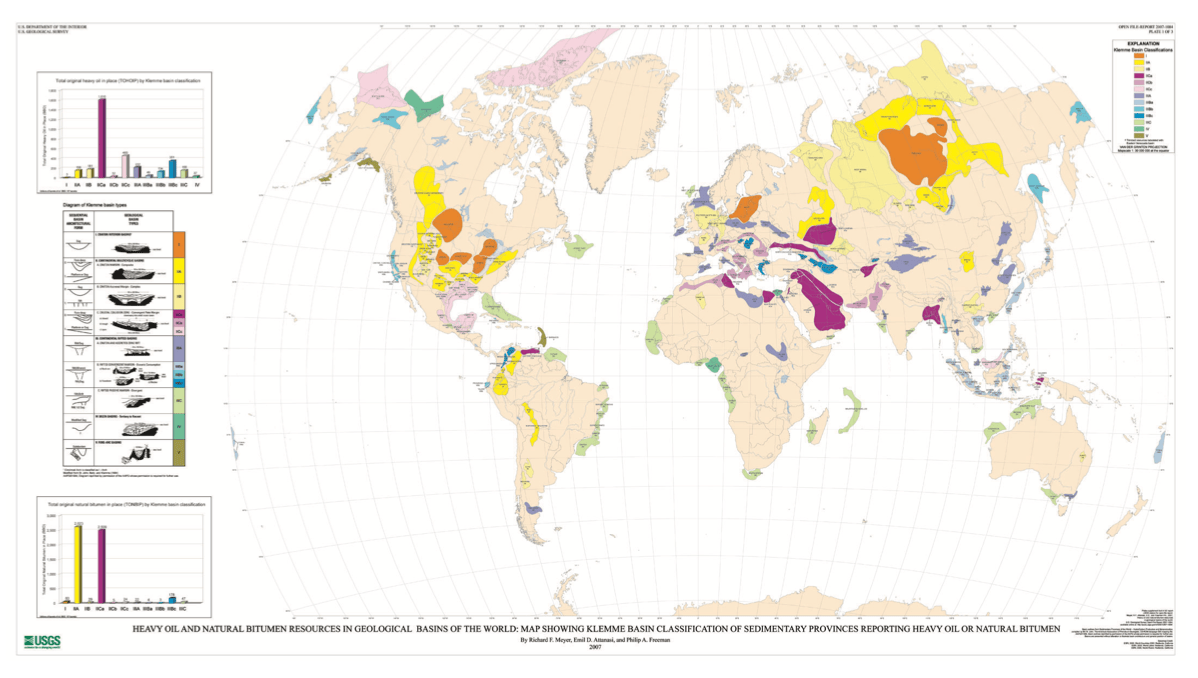
In 2015, the International Energy Agency published a report indicating that in its view, there were huge deposits of extra heavy oil and bitumen (EHOB) that could be accessed if the price of oil rose high enough for long enough (Figure 7). The same exhibit shows somewhat smaller availability of tight oil from shale. In fact, the US has been able to access a substantial amount of tight oil from shale in recent years.

In my opinion, in order to access the EHOB, the prices of diesel and jet fuel need to rise to a high level over the long term; the prices of gasoline and even lighter products don’t necessarily need to rise. If the prices of diesel and jet fuel rise high enough, for long enough, the price signal should work its way back to oil and gas companies, suggesting that they need to make investments in the direction of adding more extraction from EHOB. If this succeeds, it could perhaps relieve the problem of inadequate supply of diesel and jet fuel.
The prices of diesel and jet fuel are high now, but this is at least partly due to higher insurance costs and partly due to the extra costs related to shipping oil longer distances to avoid blocked straits. These extra costs don’t get back to oil companies in a way that encourages countries to extract more heavy oil. What is needed are permanently higher prices for diesel and jet fuel, relative to the price of gasoline, even if the problems with respect to the straits of Hormuz and of Bab al-Mandab, disappear.
[6] Today’s conflicts in the Middle East and Russia/Ukraine seem to relate to inadequate supplies of diesel and jet fuel for buyers of these fuels, and inadequate prices for sellers of the heavy/sour oils yielding these products.
Figure 3, above, shows that the total supply of diesel plus jet fuel has been low, especially since 2020. One issue that has arisen recently is “Who gets the supply of diesel plus jet fuel that is available?” Figure 8 shows that increasingly, it has been the poorer countries of the world who obtain the diesel and jet fuel that is available. Note that total consumption of the Other than Advanced Countries has exceeded that of the Advanced Countries since 2020.
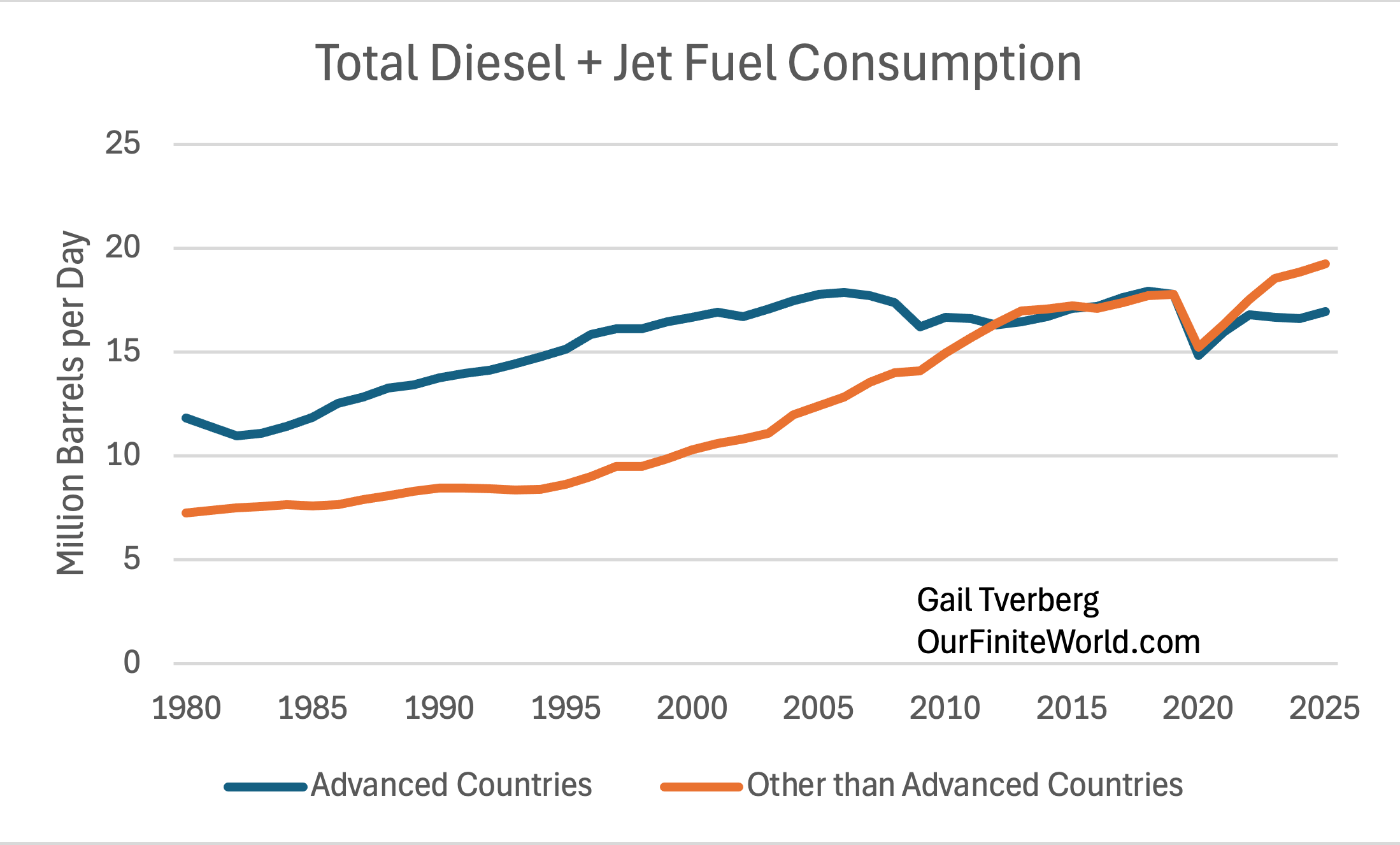
Figure 9 shows that for the Advanced Economies, per capita consumption of diesel plus jet fuel has been declining since about 2005–the time of peak conventional crude oil. The same figure shows that per capita consumption of diesel plus jet fuel has plateaued since 2013 for Other than Advanced Countries. I think of 2013 as the year that China first started encountering major limits on coal extraction (somewhat like the year 1970 in the US for oil extraction). In recent years, China has been able to raise coal extraction somewhat, but at a higher cost.

I would expect that countries in both groups would be dismayed by the situation shown in Figure 9. The per capita consumption of diesel plus jet fuel for the Advanced Countries has been falling for a long time. Partly this is the result of the economies changing to service economies. As service economies, the need for diesel by industry has been lessened. Wages tend to be less for many of these service jobs, making workers unhappy.
In Figure 9, people in the Other than Advanced Countries would tend to be dismayed by the continued wide gap between the standard of living of their own economy, and the standards of living in the Advanced Countries. Many of these countries export extracted resources that are ultimately sold as goods to people living in Advanced Countries. If the selling prices of these commodities were higher, workers in these countries could perhaps afford to have cars and air conditioning, like workers in the Advanced Countries. They would also be dismayed by the poor progress in raising their own per-capita consumption of diesel and jet fuel since 2013.
[7] Is there any possibility of greatly ramping up heavy oil production? Could it power a society like the one we have today?
We know that heavy oil production began long ago. For example, the first recorded production of heavy oil began in the Kern River Basin in California in the 1860s, and commercial production began there in 1899. The first production in the Canadian Oil Sands began in 1921, and commercial production there began in 1967.
The extent to which the oil that is heavy and often sour can be ramped up in the future remains to be seen. Extraction techniques have gradually been improving, and I would expect that they can continue to improve. But the cost of extraction and processing will likely remain somewhat high because of all the energy-intensive steps that are needed to provide diesel and jet fuel.
I expect that society itself will need to change in order to make use of this higher-cost oil. These are a few ideas I have:
(a) Oil exporting countries will need to change in ways that reduce their need for tax revenue. This is an issue especially in the Middle East, which has a huge population, in a hot, dry climate. The population will likely need to fall (for example, many migrants and guest workers may need to move back to their country of origin), and make-work projects will need to be discontinued.
(b) Another issue is that total diesel and jet fuel usage will likely need to be reduced because it is likely to take several years before production of heavy oil can be ramped up. Society will need to be reorganized in a way that uses less diesel and jet fuel. One idea would be to shorten supply chains whenever possible. Figure 10 illustrates one idea how this might be done.

(c) I expect that if such a change can be made, economies will need to gradually change in ways that are hard for us to understand now. The focus may need to be on essentials, including food and clothing. Governments may need to be smaller and provide fewer services. Communities may need to be smaller and more walkable. The total population may need to be lower.
[8] Conclusion
It seems to me that the self-organizing nature of economies will gradually push them in the directions they need to go if the world is to start incorporating a significant quantity of expensive products made from heavy oil into its energy mix.
We cannot yet imagine what all the changes will look like. In some ways they may resemble a recession, but there will likely still be an interest in greater complexity and in working to improve people’s lives.


TALES FROM THE WHITE HOUSE
So I managed to wangle a job as Advisor to the President. It’s so easy to fool those Yankees, you know. And I got a vintage Mickey Mouse watch just for applying. That’s what Americans regard as “class”. (Snigger!)
“So what’s on the agenda today, Dothkie?”
“Liechtenstein, Mr. President. You been there?”
“Yep! It’s a fake country. Not one person speaks Liechtensteinian.”
“Well, there’s a problem. I have it on good authority that Prince Hans-Adam II is enriching uranium in the cellars of his castle. So what are you going to do, Mr. President?”
“This evening? Crispy chicken thighs with pistachio vinaigrette and lemony potatoes. I’ll get Melania to do it. She’s an excellent cook!”
“No, I meant Liechtenstein. Prince Hans-Adam II is the Kim Jong-Un of Europe. He’s planning to nuke the United States and make himself your Emperor. You need to invade and quickly, and turn that flyspeck into a republic. You’ll earn the gratitude of the world, and you’ll have a great success to boast about!”
Trump burst into tears. “But I can’t”, he sobbed. “I’m scared I might lose again”.
“No, Mr. President. You need to launch ‘Operation Make Liechtenstein a Republic’. We can’t have any monarchies left in the world these days – all this perverted medievalism”.
“But your King Charles is my friend. He’s one of my greatest fans. And Prince Andrew even gave me one of his teddy bears as a gift. I treasure it”.
The President’s head slumped as he fell instantly asleep. Just then, the Dynamic Duo swung in through one of the windows and caught him before he hit the floor. “Don’t worry”, said Batman. “It’s well past his bedtime. We’ll tuck him up nicely. It’s all a charade, anyway. It’s we superheroes who make the rules round here!”
Hmm. They must be what you call “The Elders”, you reckon? Ain’t life just full of surprises! 🙁
God bless America. 😉
Not a big surprise:
https://www.zerohedge.com/geopolitical/explosions-rock-riyadhs-international-airport-amid-houthi-attack-travelers-evacuate
Airlines Suspend Flights To Saudi Capital After Devastating Houthi Strikes On Airport
There are reports that possibly several parked aircraft were damaged or destroyed after the earlier Thursday Houthi ballistic missile attack on King Khalid International Airport in Riyadh. And now international reports are saying a slew of airliners are suspending flights to the city, some tentatively for up to a week:
In response to Thursday’s attack, Germany’s Lufthansa Group and Air India as well as two other carriers from the country, all suspended flights to the city.
. . .
“U.S. government employees working in Saudi Arabia now require special authorization to use the King Khalid International Airport in Riyadh,” the fresh emergency notification says.
Those damned Houthis. Just what is it they want?
Isn’t it that they are sort of proxies for Iran?
Iran and the Houthis both want the US out of the Middle East.
People everywhere have major difficulty with too much poverty. Somehow, all of these people would like better lives for themselves and their families. For oil exporters, better lives come from exporting more oil at higher prices.
The world might be able to afford those higher prices, for very long anyway.
“Wiki Leaks 1
THE DEEP STATE JUST GOT CAUGHT RED-HANDED AGAIN!
CIA OFFICIALLY ADMITS CANCER IS BIOLOGICALLY IDENTICAL TO PARASITES… Johns Hopkins BURIED cheap anti-parasitic drugs that CURE cancer in weeks…”?
https://x.com/WikiLeaksQ/status/2107971226844926300?s=20
One of the comments:
“Big pharma learned after polio that there’s no money in cures. How many diseases have been cured in the last 50 years? I’m thinking Zero.”
Several months ago (or perhaps a year?) I linked to a video of Dr. Lee Merrick insisting in her strong Texan accent rather than just hypothesizing that cancer was caused by parasites. She even said by way of oversimplifying the case that “cancer is parasites.” This prompted Reante to declare Dr. Lee stupid, or an idiot, or possibly a moron—I can’t remember his exact phrase. But Reante’s main point was that cancer is not caused by parasites.
Not being omniscient and not being a specialist in cancer research or treatment, I was not sure either way. So I sniffed around on line and found Dr. Marik, who is not related to Dr. Merrick. He wrote that cancer was not caused by parasites, but that anti-parasitic drugs can be very helpful in treating cancer.
Here’s a link to his Cancer @ Metabolic Library:
https://paulmarik.substack.com/p/the-cancer-and-metabolic-library
The Danube continues to decline:
“The Danube, one of Europe’s most important rivers, is rewriting its more than century-long history. On Monday, October 5, 2026, we recorded the lowest average daily flow at the Devín–Bratislava gauging station since measurements began in November 1900. The Danube surpassed the previous historical low from January 1909 by an additional 4.1 m³/s.”
Translated with DeepL.com (free version)
https://www.shmu.sk/sk/?page=2049&id=1787
The River Boat cruise companies will not be happy.
Terrible “Ukraine hit Russia” story on Zerohedge:
https://www.zerohedge.com/geopolitical/russias-crown-jewel-refinery-ablaze-after-drone-strike-data-center-also-hit-war-first
Russia’s Crown Jewel Refinery Ablaze After Drone Strike, Data Center Also Hit In War First
Ukrainian drones have hit a major Russian industrial hub and oil refinery which lies very far away from the front lines of fighting, in Western Siberia, north of the Kazakh border.
The Omsk Oil refinery and industrial complex is located well over 1500 miles from the Ukrainian border. Regional Governor Vitaly Khotsenko announced Telegram that several drones were shot down by air defenses, but that one made it through to impact. . .
While the extent of potential damage to the refinery itself remains unknown, images from local residents showed explosions and fire in the area near the oil refinery. . .
Also, in the overnight hours there’s been another reported first of the war: Russian tech giant Yandex has reported its data center in the town of Sasovo, in Ryazan region, was attacked and caught fire.
“The attack marks the first confirmed strike against Russian data infrastructure since the 2022 invasion of Ukraine, weeks after Moscow launched attacks against Ukrainian data centers,” The Moscow Times underscores.
On and on it goes, but neither can win. Probably Russia could after several more months of attrition, but it’s hardly worth it. How long before exhaustion kicks in, so that the war can be brought to an end? It’s one of those news items that you just get tired of hearing about, like Vietnam in the 1960s and Watergate in the 1970s.
There is plenty of diesel. apparently only one got through. Is the refinery even down?Yaroslavl has gone down and then up 16 times already. This is about as big as the plague.
LOL!
Drone strikes seem so often to be no more than gnat bites, in many cases.
“first of all the war of attrition is not being won
14:31 by the NATO Ukrainian side.”?
https://www.youtube.com/live/NfkmyFNcf18
That much is obvious, postkey. You can’t defeat Russia.
FOREIGN POLICY RULES FOR DUMMIES.
1. Don’t invade Russia.
2. Don’t invade Russia.
3. See rules 1 and 2.
Yeah. I’m no historian, but maybe one could ask the ghosts of Napoleon and Hitler about what to do?
At the moment attrition war against Russia has created huge negative effects on Europe.
Inflation, recession, protests, rising debt, declining political support, desire to leave NATO, fear of war, fear of another artificial pandemics, fear of own politicians’ deceits, a general fear of the future.
I might forget something.
Now we can see what goes wrong with the AI ramp-up:
https://www.zerohedge.com/technology/force-majeure-forced-haulage-oracle-now-trucking-natural-gas-its-ai-data-centers
Two weeks ago, Oracle told the world that Project Jupiter, its massive 2.45GW New Mexico mega-campus for OpenAI, was “on schedule.” It also sent a force majeure notice to the developer.
Today we found out how it plans to square that circle: with a lot of trucks.
According to Bloomberg, Oracle has been quietly keeping several data centers on track by hauling compressed natural gas (CNG) by road straight to the server farms, and is now weighing the same stopgap for Project Jupiter, where the gas pipeline that is supposed to feed the campus is running late and threatening the timeline. The plan would let Oracle bring the early phases online before the pipe enters service.
Oracle shares slid about 5.5% on the report…
…. while Bloom Energy (BE), which happens to have a 2.4GW fuel cell contract for Project Jupiter (fuel cells which, last we checked, run on natural gas), tumbled 8%. . .
trucking can get the lights on in the lobby, not power a gigawatt-scale AI campus. It’s a bridge, and a very expensive one, to a pipeline that New Mexico regulators have already sent back to the drawing board once.
Thank you for the attention .
“Maersk Raises Emergency Fuel Surcharge by 20% Due to Middle East Conflict”
https://maaal.com/en/news/details/maersk-raises-emergency-f/
Maersk operates ships. Shipping will cost even more now. Oh, dear!
$50 billion or $70 billion annual demand?
Reason why AI stocks are down today:
https://www.zerohedge.com/markets/nasdaq-tumbles-after-ft-reports-openai-revenues-disappointing
…and just like that, the massive AI CapEx boom “excess demand” narrative is in doubt…
The Financial Times reports that OpenAI’s annualised revenue is about $20bn less than has been previously signalled, according to financial documents shared with investors, a massive gap likely to damp optimism about the growth of AI demand.
The company has recently told investors its revenues were approaching $50bn on an annualized basis at the end of September, far short of the $70bn reported by the FT and other media outlets late last month based on information that was provided to investors. . .
The entire shell-game is based on the ‘demand’… and if revenues are that big a miss from expectations, there is an even bigger disconnect relative to liabilities…
This is the sort of thing that could pop the bubble, along with Oracle not being able to power the data centers. Apparently physics is standing in the way of these giant data centers. I think we’re going to see the AI bubble pop before the year is over.
I have discovered that things often continue longer than seems possible. A definite maybe.
This hanging on of the apparently doomed is really the only kind of rational hope that we can have.
A good reason to say calm whatever the bad news. And maybe not to follow the news much anyway>
Blast the heck out of the middle east net result: nothing.
Blast the heck out of Russia and kill millions of Ukrainians net result: nothing.
I guess the world is more resilient than we think.
Right.
Just a heads up . Next 48 hours critical for India . Pressure building up . Modi govt has deployed 100,000 armed police in Delhi . Sweeping powers of detain , search and seizure . Will keep you informed .
Another regime change like Brazil
Brics would now be just Ric, Iran taking the place of India
No, more like Tienanmen or not . It happened on 20th July earlier . Modi surrendered and it was avoided . This is a repeat but hr has taken a harder stance .
Wait 48 hours .
Thanks!
Update .
UNPRECEDENTED!
• All major markets in Delhi to be shut down tomorrow.
• Schools and colleges in Delhi have declared holidays as well.
• Internet to be shutdown in Central Delhi from tonight.
• Several trains connecting to Delhi have been cancelled.
• Several companies of CRPF, BSF, ITBP, SSB and RAF have been deployed along with Delhi Police.
• Local businessmen have refused to print posters for tomorrow, reportedly due to Police pressure.
• 58 metro stations shutdown .
Buildings of all opposition political parties curfew-ed .
Template for the future .
That sounds worrisome. Your conclusion sounds right: Template for the future .
Oil up +4.5% today!
Welcome to Zimbabwe!
It’s nice to be winning…Iran is taking a beating….
News Radio 1200 WOAI – San Antonio’s News, Traffic and Weather Station
There are some who say the price of gas at the pump will drop considerably once the war in Iran is over.
Even US Treasury Secretary Scott Bessent said over the weekend that he expects the price of a barrel of oil, now approaching $100, to drop to $40 or $50 once the fighting ends..
Yes, The Iranian people are suffering and after the war freedom will ensure and 40 dollar barrel oil will enrich them…
LOL!
The price of oil will drop, once there are restrictions on travel. These will likely be enacted for some reason or other. It could be another illness, like covid. It could also be to somehow help with the war effort. There will also be restrictions on evictions for renters and those buying homes, so that debt defaults don’t fill the streets with homeless people.
Speaking of travel, I returned from an RV trip to Little Bighorn, Glacier, Yellowstone and Crazyhorse.
Burned lots of diesel. Never had any difficulty obtaining fuel. Amazingly, I filled up twice on $6.19 diesel right outside East Glacier.
Found low prices in Wyoming and parts of South Dakota. My lowest price was $5.77/gallon in Wyoming.
BAU forever!
Iran has resumed hitting tankers. A few some days back, two today. Teleported US Navy protection ineffectual. Possibly it can only be teleported a few miles, but they are lolling in the waves 1000 miles away.
Two storms, 1,800 miles apart, but the same final destination: the United States.
Isaias and Rachel are closing in from opposite oceans, setting up a rare sequence of tropical strikes on opposite sides of the country.
With GoM now in end of life phase there are more likely to be permanent damage from hurricanes, either because scheduled maintenance will be reduced or because it won’t be worth spending money on repairs with only the dregs remaining in reservoirs.— George Kaplan
Interesting points.
I find it difficult to believe that the storm from the Pacific will make much difference. There is not much oil and gas on the pacific side. Mostly the heavy oil of the Kern River area in California, which is well past peak.
The storm from Gulf of Mexico seems to be quite far to the East. I think of most of the oil as being closer to Texas than Florida. Maybe the effect will be mild.
550,000 barrels are shutdown . This is real crude not shale .
You are right. A lot of oil production is being shut down. I found this article, published today. I wonder if they are being extra cautious.
https://gcaptain.com/hurricane-isaias-shuts-down-nearly-two-thirds-of-gulf-oil-production/
Hurricane Isaias Shuts Down Nearly Two-Thirds of Gulf Oil Production
Nearly two-thirds of U.S. Gulf of Mexico oil production has been shut down as Hurricane Isaias strengthens ahead of an expected landfall along the northern Gulf Coast, prompting widespread evacuations of offshore platforms and preparations for possible disruptions to ports and maritime operations.
The Marine Minerals Administration (MMA) reported Thursday that approximately 62.9% of daily offshore oil production, or 1.28 million barrels per day, has been shut in as operators move personnel and equipment out of the storm’s path.
Natural gas production has also been affected, with 57.4% of daily output, equivalent to approximately 1.13 billion cubic feet per day, shut in.
UPDATE:
US Gulf Shuts in 1.3 Million B/D or 63% Oil Production: MMA
US Gulf Shuts in 1.1 Bcf/D or 57% Gas Production: MMA
Due to Hurricane .
‘A Moscow sociologist, who asked not to be named because of the sensitivity of the subject, comments: “The continuing outflow of Russian capital abroad even now, despite sanctions and despite the war, is a White Russian phenomenon still. It means that the ruling class, whose interests Putin has served in the way he has managed the war in parallel with business as usual, do not believe their interest, the Russian national interest, and Putin’s policies coincide and reinforce each other. For Eurasia to them is elsewhere. That’s where they want to live; Russia is just another of their holiday destinations, and not a particularly fashionable one at present.” ‘?
https://johnhelmer.net/the-russian-ruling-class-takes-its-holiday-outside-the-war-the-working-class-stays-home-and-takes-cover/
As I expressed previously, John Helmer is a good analyst, but in my view is (sophisticatedly) on US side.
In my opinion, Russian ruling class is aware that EU finds itself in extremely difficult financial situation and so it is hard to believe for me that they are moving capital to (for instance), Germany, France or Italy and also I don’t think that they are moving capitals in US.
I’m not confident that Russian ruling class is behaving like that.
I’d rather sit on real resources side than on paper money one.
Of course that is my opinion.
I agree . The oligarchs ran into Mother Russia’s lap when the West started impounding their assets in 2022 . Only Mother Russia provided them security . However human memory is short and it can be expected that some oligarchs will start acting stupid again . If they do and get screwed by the West again they have only themselves to blame .
It took me a while to realize certain things about Helmer. First, he supports Rogozhin for new leader of Russia, but the guy has a daughter living in the West. Second, there are fewer oligarchs. The energy sector has all public data. The bosses may well be very rich, but it is difficult to hide money. Third, I have had a few chances to talk to the corruption squad. They are young, energetic and empowered. Probably the biggest achievement of Putin’s tenure has been a dramatic reduction in corruption. Where do these oligarchs move their money? China is the worst place as the Chinese will report them to Russia. UAE? Or Cayman, where they could be again confiscated and lost? Possibly sectors like aluminum can hide some money.
Rich people like to go on holiday where it is warm, everywhere. They also like higher standards of living.
I know that years ago, China had a problem with rich people wanting to leave and move elsewhere. With all the conflict in the world today, I am doubtful that is as much the case today, but there have been large numbers of immigrants from China into Australia, Western Canada, and Western US.
I am not sure that we can read too much into the Russian situation.
Was it climate change and plague that brought down Rome?
Plagues that shook the Roman Empire linked to cold, dry periods
Three pandemics in the Roman Empire coincided with abnormally cold and dry periods, suggesting that natural changes in climate may have contributed to Rome’s decline.
Kyle Harper at the University of Oklahoma and his colleagues reconstructed the climate of southern Italy between 200 BC and AD 600 by analysing the remains of plankton in a sediment core from the Adriatic Sea.
“The Roman Empire rises and falls and rises and falls,” says Harper. “There’s a series of episodes of very extreme crises in some cases. And I think the case is now overwhelmingly clear that both climate change and pandemic disease had a role in many of those episodes.”
https://www.newscientist.com/article/2414350-plagues-that-shook-the-roman-empire-linked-to-cold-dry-periods/
(non paywall)
https://docs.google.com/document/d/1YoR2BwBxJ31QtY9hb0C8eahh1mWiLBou/edit
While any change in climate seems to be a problem, cooler climate seems to especially be a problem.
“Cooler, drier conditions may have disrupted harvests, weakening the immune systems of Roman citizens and encouraging the spread of disease through migration and conflict.”
I am reminded of this video that someone linked to a few months ago.
https://www.youtube.com/watch?v=d8PS3-nE12o
What REALLY Happened When the Romans Left Britain — 400 Years of Chaos Nobody Talks About
https://x.com/HormuzReport/status/2107967723682910391
I find it strange that the action must be telegraphed first ? Like Japan telling USA that we are going to bomb Pearl Harbour?
Link says:
BREAKING: The Trump administration is now considering limited to major attacks on Iran’s energy infrastructure before the November 3 midterm elections, with the White House directing the Pentagon to prepare options and CENTCOM developing targets as Trump seeks a “win” amid high gas prices, per The Atlantic.
The planning comes as officials debate whether limited strikes could lower fuel prices or demonstrate progress before the vote, while advisers reportedly prefer waiting until after November.
Trump has hinted at renewed strikes for weeks, saying post election attacks are “possible,” while the Pentagon has presented options ranging from limited strikes to major attacks on Iran’s energy infrastructure.
Past US strikes have driven oil prices higher, not lower, and Trump’s approval on the war sits at 26%.
Bombing does sound like a stupid idea.
An effort at jawboning but the market yawned . The world is bored of his threats and awaits the next month elections . All leaders worldwide pray he looses .
Prof Robert Pape says the US now in an escalation trap. Iran wants power now. Their goal is to be hegemon in the Persian Gulf. Ground troops will now be necessary. Gail… you have drawn that map dividing the world. What happens if the US removes all its bases and retreats to trade in the Americas? I don’t know if Prof Pape know what you know. I bet he does but he can’t talk about it.
The Americas have a lot fewer people than the rest of the world. That may be helpful.
But China has been making a disproportionate share of high quality steel needed for drilling and for many other things. The US can recycle steel, but the result is not high quality.
The Americas has relatively more farmland than other areas, which may be helpful. And water supplies are not as stretched as in India and the Middle East.
great points… thx!
https://ourfiniteworld.com/2026/09/30/can-the-diesel-and-jet-fuel-shortage-be-solved/comment-page-2/#comment-519952
The actual full comment
“A financial system is a mechanism for distributing claims upon future productive capacity. Those claims can expand faster than the physical capacity required to honour them. When that divergence becomes structural, rising financial returns are no longer evidence of increasing productivity; they can become evidence of increasing scarcity “
Why no diesel export ban ?
” The Diesel Deficit and the LTO Illusion ”
This exposes the physical bottleneck at the heart of the US refining system. The American shale patch produces Light Tight Oil (LTO)—a stream heavily saturated with light naphtha and gasoline, but notoriously deficient in middle distillates like diesel.
Diesel is the physical currency of thermodynamic work. It powers the tractors, the logistics fleets, and the extraction equipment of the shale patch itself. When global diesel prices surge, it actively squeezes the operating margins of US drillers. They have survived thus far because headline WTI crude prices remained elevated, but what truly dictates their survival is the physical Midland hub price and the cash flow from light products. If runaway diesel prices trigger secondary demand destruction in the broader economy, gasoline demand will collapse, taking the financial viability of the US shale patch down with it.
So why did the US not simply ban diesel exports to protect its domestic economy?
Firstly, the US Gulf Coast refinery complex relies on imported heavy, sour crude—primarily from Canada and Venezuela—to provide the middle-distillate feedstock that LTO lacks. If Washington were to ban diesel exports, it risks a retaliatory embargo from Canada, which relies on receiving that refined diesel back across the border.
Secondly, and more fatally, a US export ban would trigger the immediate collapse of resource-starved allies. While Washington was perfectly willing to cannibalise European strategic reserves to mask the deficit, an outright export ban would instantly choke Japan. With its currency and bond markets already imploding, a cut-off of US refined products would leave Tokyo with no choice but to defect to the Chinese sphere of influence to secure physical energy. Washington is trapped: it cannot protect its domestic diesel supply without being seen as the one pulling the trigger on its own Pacific empire.”
Jack Prandelli
this should be the link please correct me if I’m wrong. Thanks
https://theuaob.substack.com/p/the-biophysical-margin-call-why-the
Thanks .
it is good also this point:
”ZIRP and the Era of Demand Suppression
We have been dancing on this biophysical ceiling since 2005–2008, when conventional global oil production rolled over.
Without the artificial life-support of Zero Interest Rate Policy (ZIRP) and Quantitative Easing (QE), the post-2008 economy would have collapsed violently to reflect its true, diminished energy backing. But ZIRP ‘worked’ only because of a tragic irony: the Great Financial Crisis and later the COVID lockdowns acted as massive, forced demand-suppression events.
By instantly crushing aggregate real demand, these crises pulled resource consumption down below the background ERoEI deflationary boundary. This allowed central banks to flood the system with liquidity without instantly detonating hyperinflation. The monetary system appeared solvent only because the economy’s actual physical heartbeat had been kept artificially subdued.”
who is this guy?
I have run into Steven J. Newbury before. When I looked to see what he has to say about himself, I found this:
“Anthropogenic Entropy Theorist and Free Software developer. I was “sjn” at peakoil.com, where I spent some time as a forum moderator. TheUAoB – “The Ultimate Avatar of Balance” is a nod to the 1980s Rogue-like “Omega”. https://tinyurl.com/mvwc7ep4”
He also seems to subscribe to my posts.
This article makes an important point. The basic issue is the fallacy that a broken window adds to GDP. It is really “cheap” energy we need, in terms of the energy input needed for output.
The step change in the cost of extracting oil occurred about 2005.
Coal had its own step change. It hit about 2013 in China.
And the step change in natural gas comes when the natural gas is shipped as LNG, rather than being shared nearby. Natural gas has gone through a step change, for countries that do not produce their own natural gas.
With respect to uranium, we have also exhausted our easy to extract resources. For a very long time, we down blended nuclear bomb material (some of it purchased from Russia) to run our nuclear reactors. But this is running out.
And so-called renewables are not cheap, when all of the support structures, including backup batteries and little-used long-distance transmission lines are added.
It is the combination of these issues that we are hitting now. But the article linked only looks at the oil part of it.
I agree: We need the whole system to continue. We are dependent on imported crude. If we cut off the outflow of diesel, the whole system is likely to “break.”
I think of interest rates as depending on the interest rate that businesses can afford to pay, given the productivity of their local economy. If an economy is struggling, as Japan has been recently, the rate will be low, or even negative. If the economy is doing well, the interest rate will be high. It will allow the economy with the high rate to attract more investment. For a while, the US seemed to be using the strategy of the highest interest rate around to attract investment. Of course, if AI cannot deal with high interest rates, this becomes a problem.
Hormuz transits at lowest in over two months after attacks, data shows
By Florence Tan
October 8, 20265:39 AM GMT+2Updated 1 hour ago
https://www.reuters.com/business/energy/hormuz-transits-lowest-over-two-months-after-attacks-data-shows-2026-10-08/
So is the SoH open or close ?
Pretty much closed, I am afraid.
Perhaps a partial solution to the Hormuz problem. Iraq is already exporting some oil products by trucking the oil products through Syria to ports on the Mediterranean. Now Iraq is working on exporting some crude oil through this route as well:
https://www.bloomberg.com/news/articles/2026-10-07/syria-set-to-emerge-as-hormuz-bypass-option-for-iraq-s-crude-oil
“I expect the export of Iraqi crude via Syria by trucks to start as soon as possible as the deal between both governments is almost done,” Qiblawy said. “So, hopefully, by mid-October the first chain of trucks with crude will come to Syria.”
Transport by truck costs about 50 times per ton more than shipping.
I can believe that. Pipeline is also a very cheap method of transporting oil.
Trump scores a huge victory against Brics, as Brazil falls back into American fold.
Flavio Bolsonaro, son of the Bolsonaro who was put into jail by Lula, is about to win the Presidential Election there and bring Brazil in the same league with Milleikowsky
s Argentine and Uruguay, where Peter Thiel has set up his new HQ.
So basically most of South America is under Trump’s thumb now, and Cuba is on its last legs.
It seems whatever Thiel is cooking will take place, and the rich will flock to South America, with Malvinas seized to provide oil for Thielland (south Brazil + Uruguay + Argentine) for the worthies, London be damned.
I agree. This is what seems the most probable evolution of Latin America.
Israel’s got their man!
They are just securing resources.
Argentina’s Vaca Muerta and minerals.
Venezuela’s heavy.
Brazil’s Equatorial Margin and minerals.
Chile’s minerals.
These are the next resource frontiers in the Americas for the next decade, as the old world depletes itself.
The Brazilian presidential election is not over yet, neither of the two candidates seems to be way out ahead of the other, and there is doubtless a lot of election interference going on.
While I am crossing my fingers for young Bolsonaro—remembering that Lula was merciless in coercing people to get jabbed—I think the contest will be too close to call ahead of time.
Tim
It’s either push the jab or push into a gas chamber.
Which would you prefer?
Sad choice!
Who is elected in Brazil is unimportant ? China is their buyer in bulk of all production . Bolsanaro will be commiting suicide .
” China is Brazil’s largest trading partner by a wide margin, accounting for nearly 28–30% of total exports and dominating bilateral trade.
Top Trading Partners (Export Destinations)
Based on recent trade data, the leading destinations for Brazilian goods include:
• China: ~US$100 billion (28.7% of total exports)
• United States: ~US$38 billion (10.9% of total exports)
• Argentina: ~US$18.1 billion (5.2% of total exports)
• Netherlands: ~US$11.7 billion (3.4% of total exports)
• Spain: ~US$8.8 billion (2.5% of total exports)
Key Export Commodities
Brazil primarily trades raw materials and agricultural goods:
• Crude Petroleum
• Soybeans
• Iron Ore
• Beef and Coffee
Take that .
Brazil is not VZ . DJT thought Iran was VZ . See how that turned out .
You ask me which I would prefer.
My answer is neither. I would prefer members of the general public not to act as cheerleaders for the genocidal maniacs who orchestrated the plandemic.
Without millions of apologists like your good self and our dear friend Mr. Pagett covering up for them, they would never have been able to kill, injure, and vivisect so many oblivious, deluded, and propagandized people.
And yes, before the pedants protest, the term vivisection covers injecting people and other animals with poisons.
According to Wikipedia, while the strict, historical definition of vivisection from its Latin roots (vivus meaning alive, and sectio meaning cutting) refers specifically to surgical operations or cutting into living creatures for science, its modern and practical usage has expanded significantly.
Deluding oneself into taking multiple injections of poisons under the false impression that one is protecting their health or their granny can be considered seriously dumb. But then again, the majority of today’s humans are seriously dumb after being dumbed down so far that they will swallow anything authoritative.
Deluding oneself, even after serious consideration, into concluding that humanity has no better choices than injecting themselves with poisons or walking into a gas chamber indicates a different level of cognitive impairment entirely. I would think one would have to be pretty smart in addition to being pretty jaundiced to see our predicament in such stark terms.
But then again, I’m an optimist. I believe in the resilience of the human spirit. Looking on the bright side and all that. Perhaps I’m the deluded one?
In connection with the sports religion, basically represented by football, and the way it makes celebrities more important than the people who keep the system functioning, I got this sentence from ChatGPT:
Society can optimize its cash flows very effectively while simultaneously losing touch with the physical economic base that makes those cash flows possible.
“There aren’t many more inventories to drain in the West. We drained the available inventory.”
https://x.com/ericnuttall/status/2107915644977193164/photo/1
“Drain, baby, drain”
https://x.com/JoshYoung/status/2107914787061715191/photo/1
Doesn’t look good.
It gave me some hope, actually. I thought things were worse, but we still have some months.
If the Strait of Hormuz really isn’t open, we would expect a big drop in crude inventories, such as this.
https://www.zerohedge.com/markets/oil-drops-despite-31-million-drop-crude-inventories-diesel-spikes
Oil Drops Despite 3.1 Million Drop In Crude Inventories, Diesel Spikes
Oil prices were largely unchanged, trading near session lows, after today’s DOE inventory data affirmed the latest downbeat API prints from Tuesday afternoon, showing that the crude draw in the last week was even bigger than what API reported (-2.1MM), and far worse than the +1.9MM expected increase, printing at -3.186MM, the biggest draw in 6 weeks.
This is an interview of Art Berman by Nate Hagens, together with the blurb that accompanies it.
https://www.youtube.com/watch?v=cWCGyrZWRTY
Almost eight months after the Iran war first rattled global energy markets, the global system has proven surprisingly adaptable, even as prices continue to rise and product shortages become more common. But as those buffers run dry and diesel prices climb to the equivalent of over $200 a barrel, the slack in our system is starting to disappear. How much longer can our hyper-connected economic system stagger along, and where is it already breaking?
In this episode, Nate welcomes back petroleum geologist Art Berman for a follow-up to their May conversation, to take stock of what’s changed since the war upended Middle East energy flows. Art explains why the adaptations that have kept prices from spiraling have unaccounted-for costs for the larger system, and why 5 to 20 percent of shut-in production may never return to prior levels, even once wells are reopened. The conversation traces the parallels between this moment and the 1970s and 1980s oil shocks, but also the key differences that will create a bigger (potentially insurmountable) barrier to recovery this time. Ultimately, Nate and Art consider whether we are witnessing the rise of a fragmenting, multipolar world of resource nationalism that will replace the postwar security architecture, which has underwritten cheap oil and globalization for decades.
How are underlying refinery risks intensifying an already precarious situation? How are global powers positioning themselves amid this pivotal point for geopolitical relationships? And even if the multiple global conflicts were to stabilize today, what are the locked-in repercussions for global energy supplies, and how will they ripple out to affect everything around us?
Watched it first thing this morning, it’s very good. What Art appears to be saying is that we’re never going back to the way things were and that we can expect a new higher price floor for crude, among other goods that are dependent on it (pretty much everything). He does not sound even remotely optimistic about the situation.
FRANCE, GERMANY DIESEL RELEASE MAY INCLUDE NO NEW BARRELS
France and Germany say diesel stocks promised under last week’s G7 agreement will largely come from reserves already committed in March, Politico reports, raising questions over how much additional supply will actually reach the market.
Germany confirmed it plans no new release, while France could potentially add 2 million barrels beyond its previous commitment but has not made a firm pledge.
An emergency IEA meeting is scheduled today to discuss the coordinated release.
Trump will fix it. Have faith. MAGA! Trust the plan.
–Q
Plague outbreak ‘will lead to anarchy in six days’ as Putin scrambles to contain disease
EXCLUSIVE: One person who took note of the reports emerging from Russia was Annie Jacobsen, who set out a strikingly similar scenario in her recent book, which also deals with pneumonic plague
Speaking exclusively to us just prior to the book’s release, Annie explained why she chose this specific type of virus. She said: “In Biological War: A Scenario, I take the reader from outbreak to anarchy in six days.
“And what happens after the six days, when the US government sort of implements its Continuity of Government programme, is terrifying: day seven and forward. And so they have different timelines, but both are extraordinarily short.”
Continuity of Government (GOG) refers to a programme that reflects the POTUS’ intent for the US to have a “comprehensive and effective” programme to ensure the “survival” of constitutional government and the “continuity” of federal functions in the event of an emergency.
Annie writes: “Millions of corpses will attract millions of scavenging rats. The rats and their fleas will continue to spread plague, neither of which can be barred from entry by high walls, barbed-wire fencing, or a small army of soldiers with guns.”
As the “chosen” few officials hunker down to wait for things to alleviate, the “nation is in a free fall”. She continued: “The military can no longer use its valuable resources to protect cities from panic, mass death, and widespread insurrection.”
https://www.dailystar.co.uk/news/world-news/plague-outbreak-will-lead-anarchy-37739456?int_source=nba
In Russia we are scared shitless by this development and no one dares going outside. the daily star upholds the highest standards of journalism worldwide.
An excuse for travel restrictions!
“Trust the (degrowth) Plan”, indeed…
Exactly.
They knew that they “would need a bigger pandemic” so now they are going straight to the plague.
Haven’t seen any credible confirmation. Also, bacterial infection is less transmissible and the low incubation time makes it self-limiting. Then again, who knows what the scientists have cooked up.
The Daily Star! Lol!
Even worse, it’s a web article. At least when it was a newspaper you could wipe your arse with it.
So, the publisher of this cheap horror novel saw the opportunity to push it in the media……
‘Six days’ isn’t pulled out of a hat at random, of course not!
When one is trying to avoid all those teeming rats and hopping fleas, the very first thought is, of course, of starting a revolution. My, but she is brilliant!
Se anticipan caídas en el precio del petróleo.
https://rayonegro.substack.com/p/se-anticipan-caidas-en-el-precio?utm_source=post-email-title&publication_id=6627814&post_id=219218959&utm_campaign=email-post-title&isFreemail=true&r=216vfx&triedRedirect=true&utm_medium=email
Quark says,
Oil prices are expected to fall.
The latest reports are starting to coincide. Traffic through the Strait of Hormuz has increased, and if we discount the Iranian portion (which is completely stranded), levels have returned to normal, considering both the portion passing through the strait and the portion leaving via various pipelines.
And if oil production confirms this fact (pointing to strong increases in extraction in the various Middle Eastern countries), the markets will soon have a certain abundance of crude oil.
I think that the issue is that consumers around the world are tapped out. They cannot even afford the current prices. Later in the post, Quark says.
A key reason why oil prices haven’t surged toward $150 a barrel is the restraint on crude purchases by China. Chinese imports of crude and condensate by sea remained relatively stable between July and September, approaching their seasonal low of the last ten years .”
I think that many consumers in China are doing poorly. In fact, there are a lot of consumers in Europe who are doing poorly. And in the US, the housing market is a problem. While GDP is growing, the number of full time jobs and wages are not growing enough support even today’s prices. These are the reasons oil prices are falling. The price of oil cannot exceed what consumers around the world can afford.
Got it. We need more heavy oil to keep industrialized society running.
But I don’t see a mention that we need to be releasing less carbon. And actually, not only do we need to release less, we need to reach net-zero. If we don’t reach net-zero, then eventually we drive temperatures to catastrophic levels.
It looks increasingly like people do not care about net-zero. We just keep finding ways to keep adding carbon to the atmosphere, until we realize there is too much there and there is nothing we can do about it.
See https://medium.com/@Merle2/can-we-reach-net-zero-carbon-emissions-8692f612e737
All we need to do is remove all humans from earth to reach net zero. I doubt even this will make any signifiant difference in climate change, however.
Climate change is part of a self-organizing system. Climate changes all the time, regardless of what we do. We claim control over the climate, but we don’t have control over the climate. It is simply a narrative we have been told because it is a more palatable story than “We are running out of easy to extract fossil fuels and uranium. Because of these issues, our lifestyles are likely to change greatly in the near future.”
Without fossil fuels and uranium, we cannot maintain our system of paved roads or our electricity transmission lines. We cannot regularly ship goods across the Atlantic and the Pacific. Governments likely cannot support a huge number of elderly people who can no longer work. Life will likely change dramatically.
I for one do not care about net zero and prefer a higher CO2 in the atmosphere. It is good for all creatures, including humans, and it favors agriculture both as fertilizer and extending cultivable areas towards the poles. It also makes the world greener. Go netzero yourself.
Yes, moar is better…always moar..
In my Economics course I was enrolled in the models displayed “maximize”
Me, being a pre Our Finite Worlder advocated we should minimize…heresy in the land of ever increasing output
Yes, moar carbon is better…repeat….more carbon is better
CO2 fertilizes up to about 1000ppm where it saturates. We have barely increased it from about 360 to 390.
“19 ‘mass extinctions’ had CO2 levels we’re now veering toward, study warns
The research looked at peaks in biodiversity loss and their relationship with atmospheric CO2, finding 50 events over the last 534 million years that can be considered mass extinctions.”?
https://www.livescience.com/planet-earth/climate-change/19-mass-extinctions-had-co2-levels-were-now-veering-towards-study-warns
And we are here today, despite these mass extinctions. This is the way the system works.
Western scientists are full of shit. All the oil we have could not have been created by an atmosphere like today’s, it had to be an atmosphere where CO2 predominated or dead plankton would not have accumulated at the bottom of shallow seas. So 900,000 parts per million?
Also while the Permian was getting stocked, about 200 millions years ago, there were flying dinosaurs roaming the Earth, weighing 600 pounds. It had to be a much thicker atmosphere, otherwise they could not fly under their own power. Maybe 800,000 ppm?
Finally, without CO2 your body could not absorb oxygen (Bohr effect), which certainly means the molecules involved must have evolved at a time of very high CO2. And we are going to face mass extinction over 400 ppm.
“It’s possible that death denial arose from the loss of several neural mechanisms, giving rise to the capability to deny reality wholescale.”?
https://www.themortalatheist.com/blog/denial-varki-and-brower
From the link:
“Why is it that only humans are able to carry out so many special mental functions that seem missing from all other highly intelligent species, some of which have been around for millions of years longer than we have?” This curiosity fascinated Brower. Why was Homo sapiens the only species ever to become really, really smart? Especially when being this smart has made us the most successful species on the planet. Surely hyperintelligence is an evolutionary boon that should have emerged more than once. But it didn’t, not even in other hominid species or chimpanzees, our closest living relatives.
The first barrier in getting smart is a rare convergence of several biological and environmental factors. Varki identifies many: the species must be highly social but also long-lived, have a stable body temperature (to maintain the metabolism necessary to reliably feed the brain), and be born very early, undergoing extreme postnatal development. So, getting smart was a significant biological barrier. ..
because your ancestors had the rare cognitive quirk of holding false beliefs and ignoring inconvenient truths. (I do appreciate the loveliness of this paradox: that science, our most rational endeavour, may reveal that we’re the most irrational species to ever exist… but that it’s this irrationality that allowed us to get so smart. It’s perfect, really).
Really good book Postkey which explains the reasons for our predicaments…. “DENIAL Self-Deception, False Beliefs, and the Origins of the Human Mind” – Varki & Brower.
Ravi, India seems to be in a huge mess with election integrity. Why now?
Give us some insights. News is either fake or exaggerate
Yes ; big mess . The ruling govt eliminated 130,000,000 ( 130 million) voters mainly muslims , and the low castes from the voter list that do not vote for the ruling right wing BJP . 33% of the electorate gone , vanished , stateless .
https://archive.li/LM17b
https://indianexpress.com/article/india/election-commission-sir-draft-rolls-13-crore-deletions-delhi-leads-10857760/
It is an illegitimate government . I told before that a churning is taking place .
Pakistan is also on the brink . The full subcontinent is FUBAR .
China in the last 3 weeks has paid for 68% of its Crude Oil Imports in RMB at an average price of $ 93 a barrel
India in the same 3 weeks has paid for 100% of its imports in USD at an average price of $ 121 a barrel
The reason isn’t that China is more powerful or richer
It is that India is SO UNTRUSTWORTHY that nobody honors long term deals with India anymore
India is getting hit like a ping pong ball in this Iran war .
Then there are all the separatists, such as those in Balochistan.
In an earlier post I had mentioned how Indian Central bank spent $ 20 billion in a week to defend the rupee . Last week another $18 billion and the Rupee still slid to the lowest ever of Rs 97 = 1USD . 6 months ago it was Rs 92 . The speed is worrying as Foreign Institutional Investors have accelerated the liquidation of their portfolios crashing the stock market . Read this combined with my post on the oil price for the Indian basket . Anticipated to reach Rs 100 by this year end .
“India. France. Spain. Chile.
Different signs. Same problem.
Young people can’t get hired.
Can’t afford rent.
Can’t afford a house.
Can’t see a future.
At the same time, AI is quietly deleting the jobs they were supposed to start with.
Entry-level hiring has COLLAPSED since 2024.
There are former programmers in the US with some of the same problems.
Thanks Ravi for the posts about India. Here in Switzerland it seems very far off though I know it is not as you also elucidate. Then there is the ‘laboratory’ of Gaza, and more….
When you want to subsidize food production, you need to divert energy from other sectors:
“Prices Are Falling, Costs Are Rising: “We Can’t Live on Gunpowder,” Warn Dairy Farmers Facing a Historic Crisis
Farmers sell milk at the fourth-lowest price in the EU.”
Read more: https://eubrief.sme.sk/ekonomika-a-euro/c/ceny-klesaju-naklady-stupaju-z-pusneho-prachu-sa-nenajeme-varuju-vyrobcovia-mlieka-ktori-su-v-historickej-krize
Poor guy. And his costs are even higher because he needs to move the water via diesel. everywhere else, even in Saudi Arabia, water is brought to cows via pipes. H also can’t cope with the complexity.
Prices depend on the prices consumers can afford, even more than on how much it costs farmers to produce products. The issue is at least partly a low wage problem, I expect. Also, I expect that population is not growing. Growing population helps “demand.”
Milk production requires machines and personnel. There are still dilapidated local cattle stables in Slovakia that were used for milk production before 1989. Meat production, by contrast, requires little more than pasture.
The operation and maintenance of irrigation systems also require personnel. All of this adds to the cost of food. That is why irrigation systems in Slovakia also fell into disrepair after 1989.
“The Internet is Even Worse Than I Thought
Part 4 in “The Internet is Evil” series: how the web kills about 350,000 people per year, and probably far more”?
https://maxwilbert.substack.com/p/the-internet-is-genocide
I don’t agree with this post.
The author tries to identify pollution related deaths associated with the supply lines that support the internet, but the situation is far more complex than this.
For one thing, the internet allows communication is a way that was not possible before. To bring about the current level of communication, using “snail mail” and drivers, we would need more paved roads, and more use of fossil fuels to make and power delivery vans (even electric ones).
It is communication that allows innovation. The whole world becomes like a big city. Even with the worldwide problems, it is possible for people in the US to communicate with people in the China and Europe. My sister Lois , who is in Michigan (in the US), can even communicate with her co-author in Uganda to jointly author a book, although this can be difficult.
Losing the internet would create a huge step back in complexity. It is difficult to price this. This additional complexity has allowed more fossil fuel extraction at a somewhat higher cost than in the past. Debt levels are now much higher. The world is a different world.
And how many lives did the internet save when the facts about vaccine injuries and deaths were disseminated so rapidly even in the face of determined censorship?
Yes, and if just counting lives, how many lives were saved by comm. going thru, advice from others (getting out of an abusive situation for ex.), info. being transmitted rapidly in written form, suicide prevention, moving away from dangers (e.g. hailstorms, floods…) and much more.
…
In any case the calc. of cost / savings in lives is impossible to do, as wars are the no 1. killers of ordinary ppl, and environmental damage is hard to assess, in its scope, future impacts, it is usually neglected, covered up, denied, etc.
…
Plato famously decried the spread of literacy as it would affect, he said, ppl’s memory, but we only know about his thoughts because he wrote them down. A kind of stereotypical ex. for sure re. advancement of moving away from oral face-to-face communication.
Nima interviews Larry Johnson about recent attacks by Houthis against Saudi Arabia. The US is doing essentially nothing to help Saudi Arabia.
“US restrains Saudi offensive on Houthis to prioritize Hormuz conflict
Washington limits aid to Riyadh as it prioritizes Hormuz tensions over a wider Yemen fight”?
https://biz.chosun.com/en/en-international/2026/10/07/ROEWQAAZR5BMZJ7MGBKC475Q4I/
According to the post:
As Saudi Arabia-backed Yemeni government forces launched an offensive against the Iran-aligned Houthi rebels, escalating armed clashes in Yemen, the Donald Trump administration is reportedly pressing Saudi Arabia to refrain from widening the war out of concern that the front could expand.
If the US doesn’t have weapons to fight a wider war, this might be a good strategy for the US.
Maybe the U.S wants Saudi to fall too. Lots of little Iraqs in the Middle East weak government needing to sell oil cheap
ELECCIONES EN BRASIL: “PAN CON PAN”: CAPITALISMO DE IZQUIERDA Vs. CAPITALISMO DE DERECHA.
https://juancarlosfurlan.blogspot.com/2026/10/elecciones-en-brasil-pan-con-pan.html
Two, almost equivalent, options for de-growth:
ELECTIONS IN BRAZIL: “BREAD WITH BREAD”: LEFT-WING CAPITALISM VS. RIGHT-WING CAPITALISM.
The elections in Brazil reveal the need for a very uncomfortable debate for the people: Will “the left” remain eternally trapped in the paradigm of economic growth to democratize income, negotiating a small piece of the pie with economic power, or will it assume its vanguard role by working towards a Just Energy Transition?
1. You cannot redistribute what stops growing.
Redistribution assumes a growing surplus that can be shared. But under energy decline, if net energy availability decreases, the capacity to sustain production, transportation, industry, mechanized agriculture, and infrastructure also shrinks. The problem then shifts from simply who receives a larger slice of the pie to the size of the available material pie.
. . .
5. The real transition is not about distributing scarcity better, but about reducing social dependence on abundant energy.
A society can try to manage decline by distributing fewer and fewer resources equitably, but that would only be a distributive policy within a context of contraction. The more profound alternative is to transform the material conditions of life: less dependence on oil, fewer unnecessary supply chains, less concentration of wealth, more local production, agroecology, environmental stewardship, community building, energy and food sovereignty, and the satisfaction of fundamental needs with less material metabolism. This is where the difference between a developmentalist left and a left for a Just Energy Transition lies.
. . .
The US wants to destroy all the social complexity of Brazil and all Latin American countries to ensure the privileges of its elites, and its pawn is Bolsonaro. But this decomposition is clearly inevitable given the biophysical and geological limits of the planet. And this is essential to understand when making any analysis of current events. Bolsonaro and Lula represent two sides of the same coin called late capitalism.
Accelerated degrowth with ruthless, repressive, and extremely violent plundering of oil and minerals (see Bolsonaro) or progressive degrowth leading to anesthetized exclusion under conditions of local and global economic contraction (Lula). These two seem to be the alternatives of late capitalism across the continent, and both lead to BARBARISM.
But, beyond what the status quo proposes, can’t we, the people, go further?
Can you have a long-term stable democracy or economy with unlimited reproductive freedom? I think not.
If we are using limited resources (like fossil fuels and uranium), then the issue isn’t necessarily rising population. Even a fixed level of population will run through the resources. Rising population tends to cause the problem to occur even more quickly.
We have seen Peter McCullough many times earlier. This result is not really a shock.
https://modernity.news/2026/10/05/federal-survey-of-21990-kids-ties-covid-shots-to-autism-adhd/
Federal Survey Of 21,990 Kids Ties COVID Shots To AUTISM, ADHD
Researchers using official U.S. data say the signal was strongest in the youngest multiply dosed children
A new analysis of the federal National Health Interview Survey finds children who received a COVID-19 shot had higher odds of autism, ADHD, anxiety, asthma and special-education use than children who did not.
The authors, including epidemiologist Nicolas Hulscher and cardiologist Peter McCullough, say the pattern survived a long list of statistical controls and rose with dose count.
Their conclusion is blunt: COVID-19 vaccination of children should cease immediately.
Covid was mostly only ever dangerous to the elderly and / or the morbidly obese. Generally speaking, it was of no danger to children. They should never have been given the vaccine. But they suffered because of the vaccine-pushers’ motives.
So you are saying it was of no danger to the happily obese? 🙂
Ha bloody ha! 😉
Anyway, Tim, you were going to explain what nice job you got in Japan after getting no qualifications. Me, I was an analyst-programmer. I retired at 51 and here I still am.
No, actually, I wasn’t. But since you seem very keen to know my personal history and can’t wait until the authorized biography comes out, I’ll give you the bare bones, although I mentioned this before several years ago in a conversation here with Norman.
When I decided to settle in Japan as a young man in 1982, I arrived with about 3 million yen to my name, no rich relations, and no job prospects, However, back then, white people were pretty rare in Japan and there was a considerable demand for English teachers and also, if you were good looking, for advertising models.
I settled in Osaka, and within a few months I had a thriving regular business teaching private students and company classes, and also several modeling gigs a month that paid extremely well. YA lot of these jobs were for sports apparel makers. You may even have seen me in some of those old Adidas and Asics catalogues.
I also remember being turned down for a Nintendo modeling job because the backs of my hands didn’t match their aesthetic requirements for a games poster. I visited their HQ in Kyoto for an audition of sorts. The guy said, “show me your hands!” After a brief glance, he said they were not what he was looking for, but he gave me a 10,000 yen note for my time.
But I wasn’t really keen on teaching English, and modeling was never going to be a lifetime career. So when in 1985 I saw an add in the newspaper for an advertising copywriter, I called the company and procured an interview. There were twelve candidates for the job, eleven of whom had college degrees, and little old me with my O and A levels. Also, the Irish American boss of the company had a visceral hatred of all things British and this was back in the days when people were not obliged to keep their prejudices and -isms to themselves. He was quite a character!
However, as luck would have it, I turned out to be an excellent writer, a while none of the eleven college graduates turned out to be able to write for toffee nuts. And the company was absolutely desperate for decent writers, partly because their business was expanding and partly because there was a high turnover rate. So I got the job, with a good salary and very little overtime, and I was able to keep some of my more lucrative English teaching gigs and was raking it in during the second half of eighties.
We worked using IBM electric typewriters at first and then those new fangled IBM word processors that allowed you to save your output on 10-inch floppy disks.
I would have stayed with the ad company but after a couple of years they consolidated their business into single larger office and half of the staff were smokers. The translation and editing team were all non-smokers apart from one woman, but the designers and sales people who we were now sharing our air with were smokers almost to a man. I couldn’t stand breathing that much tobacco smoke.
So in 1988, I decided to go independent. There were very few international ad companies outside of the Tokyo area back then, and I didn’t want to live in Tokyo. But fortunately, proper computers were just coming into use. This was the age of MS DOS and the first color Macintosh. Also, it was the age of the modem, which allowed you to send text files along a phone line. So I began seeking companies, especially in Tokyo, that needed good English copywriters, editors, or translators.
The late eighties was also the time that became known as “the bubble economy” when the yen was soaring. The yen-dollar rate went from 260 in early 1985 to 130 in 1988 and then zig-zagged its way to 90 by 1995. The amount of money zooming around the economy was incredible, and its velocity was astronomical. And, IMHO, a lot of it was wasted. I had several clients who insisted on paying me more for my work than I asked for it because they had budgets that they had to spend.
The Japanese economy was intoxicated back then. Everyone knew it was crazy and that it couldn’t last. Now the economy is mired in a decades-long hangover, the streets of Tokyo are as bustling as ever but in a subdued, tired, middle-aged way, the trains seem to carry more tourists than office workers, and all the gaudy exuberance of the bubble years is just a memory.
Thanks! You picked a time when the Japanese economy was booming, and that helped. I looked up what “O and A levels” meant.
https://anglotopia.net/british-identity/british-education-explaining-o-levels-levels-important-british-education/
High grades seem to be needed on these exams to go to university.
Yes, thanks for your expo, Tim. Given that you were a model, and probably lusted after by females and males alike, I reckon you’ve missed out a lot of the saucy and raunchy episodes, but you’re also a model of rectitude, which would explain why. But never mind, I will use AI to produce my own version of “A Clockwork Orange” but set in Japan, and with you in the Malcolm McDowell role. Your gratitude, I suspect, will be indescribable. 🙂
You must have done OK to retire at 51. And good on you for that. But how to you pass the time when you aren’t commenting on OFW?
A man needs an occupation, as Hitler said of France.
I retired at 51 because I took my redundancy and didn’t want to work ever again. As for having done OK, it was more that I was always frugal in my life, because I’m single and deeply introverted. I’ve never owned a car and after 30 got tired of travelling abroad on holiday, so that saved me money. I bought my flat in 1991, after prices had tumbled because of the recession, and I paid off the mortgage by the end of 1997. I bought my share of the freehold, along with the other three in the building in 2002, so that has saved me a lot of money too.
Any reasonably intelligent old git with a well-stocked mind should have no trouble occupying his time. World coins are a passion of mine, though I don’t physically collect them any more, and I’ve been a member of the same coin forum for 18 years. I’ve helped structure it geopolitically, and I write offbeat topics about unusual numismatic features and explain their histories.
My other passion is the paranormal. In 2010 I read a book by John Keel, in which he warned, “If you get interested in the paranormal, beware, because it will get interested in you”. I thought, “Oh yeah! As if!” He was right, though. I’ve had quite a few paranormal experiences since then. So now I believe in “the participatory universe” – like a role-playing game, it will cater to your interests and desires to a certain extent. My deeper views are more subtle than that, but like Charles Fort, and even Ross Coulthard, the Aussie UFOlogy investigator, I have come to believe that “we are property”. But that would take a lot of explanation, and I resisted that conclusion for long enough, but in the past couple of years my beliefs have undergone a Copernican revolution, and I no longer believe that we are top dog on this planet. The hidden masters of the planet use superior technology and stealth technology (including flashing holograms at us) to scare us into believing that something is paranormal and also to hide from us. That is my belief, but I will not explain it, because others have, and my next task will be to fictionalise my experiences for my own purposes.
I started off down this avenue by reading Jacques Vallee’s “Passport to Magonia”, which explained that supposed UFO events and ET’s went back centuries and that the fairy folk were still around and behind these episodes. In fact, it is easy enough, as we now know, to produce these effects using superior modern high technology, and magic is not required.
I am certainly looking forward to reading your autobiography, Tim, and the government have promised me that they will accord it its true value, by starting to mint farthings again, for when it appears in the shops. 😉
A smart alecky Reante response Tim.
Yes, well, I can’t hope to emulate his genius, but some of his humor may have rubbed off on me.
But what of “Covid was mostly only ever dangerous to the elderly and / or the morbidly obese.”? Is this true? I’ve heard various opinions.
I’d like to quote Virginia Stoner on this, as she is one of the most meticulous analysts of the COVID era.
Age of death
TABLE 4 shows the 10-year age groups of the people who died from Week 12 through Week 23 of the years 2018, 2019 and 2020, in the 6 states of maximum impact. The percentage change in 2020 compared to 2019 is highlighted with a red-white gradient, with the highest increases shown in red.
Notice that all adult age groups age 35 and up were similarly affected, all having a shocking increase in deaths between 70% to 90%. Whatever was killing people did not mainly affect the elderly, as we often hear.
All in all, her article linked to below is a masterpiece of joined-up thinking.
https://www.virginiastoner.com/writing/2025/10/26/an-open-letter-to-mike-stone-and-jamie-andrews-about-us-mass-casualties-in-2020
Am I the only one who follows EU affairs ?
” Germany’s ex-spy chief arrested for espionage
Natalie Muller with Reuters and AFP
10 hours ago10 hours ago
August Hanning, the man who once led Germany’s spy service, is now under investigation for passing on state secrets. ”
https://www.dw.com/en/germanys-ex-spy-chief-arrested-for-espionage/a-79560278
I just watch old TV shows like I, Spy and Get Smart…here in the US the authorities nailed a china girl doing the same….me love you a long time for a few secrets…
Fang-fang go “bang-bang” on Swalwell for state secrets.
What is happening in France and why? Clueless in New York.
My guess as to the reason:
With high oil prices, many of France’s industries (including wine growing and farming) are not very profitable, so taxes are not very high. The cost of imported oil is a strain on budget of France. The French government has been scrimping on upkeep of schools because of its revenue problems. Wages of workers are not very high either, adding to frustrations. I am sure that food prices are now high in France, too.
This commenter talks about French school problems.
https://ourfiniteworld.com/2026/09/30/can-the-diesel-and-jet-fuel-shortage-be-solved/comment-page-1/#comment-519790
The WSJ is reporting:
https://www.wsj.com/world/europe/french-government-is-willing-to-bypass-parliament-to-pass-billions-in-cuts-699d99c5
PARIS—France’s finance minister said the government is prepared to exercise special constitutional powers and circumvent Parliament to pass billions in spending cuts if negotiations stall over next year’s budget. . . .
Investors are worried the paralysis of France’s political system is making it impossible to rein in public spending, fueling a recent surge in the country’s borrowing costs. The budget’s 43 billion euros, roughly equivalent to $48 billion, in cuts, which Lescure detailed last week, are already drawing criticism from the race’s leading candidates, far-right leader Marine Le Pen and far-left firebrand Jean-Luc Mélenchon.
The budget negotiations are unfolding against a backdrop of nationwide student protests that began last month. Protesters are demanding the government boost spending on the education system by fixing crumbling infrastructure, reducing class sizes and hiring new teachers.
. . .
A major point of contention is Lescure’s plan to lower the rate at which many pension payments are indexed to inflation. Pension payments rose 5.4% in 2024 at a cost of €15 billion, Lescure noted.
https://www.zerohedge.com/political/frances-triple-crisis-far-left-riots-ticking-debt-bomb-and-mass-migration-collide
France’s Triple Crisis: Far-Left Riots, A Ticking Debt Bomb, And Mass Migration Collide
France is tearing itself apart as far-left riots, a dire fiscal situation and years of unfettered mass migration collide, while President Emmanuel Macron loses his grip and his approval rating craters, raising the prospect of a victory for right-wing candidate Marine Le Pen in next year’s presidential election.
The official corporate media narrative is that the rioters, many of them kids, are demanding smaller classes, building renovations, and changes to university admissions. Yet that doesn’t pass the sniff test when countless videos on social media show rioters burning down schools.
“What’s happening in France is nothing less than out-of-control mass migration. This isn’t about schools, this is about Islam wanting to take over a once great Country!” President Trump wrote on Truth Social around lunchtime in New York.
Borrowing costs for the weakest US companies have hit 17%, while BofA has cut its October corporate debt issuance forecast from $160B to $110B.
That’s what a 5%+ Treasury world looks like when it starts reaching the real economy.
AI investment is still behaving as if capital costs barely matter because companies fear being left behind.
“Existential risk” may be an overworked meme, but the behavior is real.
The bigger question is how long AI can remain insulated if high rates persist.
Eventually even urgency has to meet a hurdle rate.
Financial Times
Agreed!
I am sure the interest rate on credit card debt is very high, also.
https://www.zerohedge.com/political/european-utopia-burns-far-left-riots-spread-cancer-france-belgium
European Utopia Burns: Far-left Riots Spread Like Cancer From France To Belgium
Alternative media reports say social unrest in France has spread to Belgium.
Those X accounts say that far-left groups are mobilizing young people and migrants, while corporate media coverage emphasizes the narrative that overcrowded classrooms, teacher shortages, long school days and deteriorating facilities are to blame for the chaos.
Whether the unrest reflects the coordinated weaponization of young people or simply parallel local grievances remains unclear at this moment.
European political news website Remix News published footage earlier on Monday, stating, “Student protests have now spread to Liège in Belgium.”
Nothing that a nice little Plague lock-down can’t quieten….. Any bets?
This is all so boring and futile! Will we have to suffer nonsense like this until The End?
“’Tis the time’s plague, when madmen lead the blind”
-William Shakespeare
I am afraid we are heading for something somewhat like 2020, again.
“He said in the case of direct attack which seemed to me
16:45 to be a message to the whole world that an indirect attack
16:51 whatever that is would not provoke a nuclear response from Russia. . . .
The fact is that Russian exports are across the Black Sea
20:06 of wheat and grains to Turkey and Egypt. major major markets are cut off.
20:12 Coal exports a major supply for India cut off because the Black Sea isn’t as
20:20 badly denied to the Russians as the Russians have denied the Black Sea to the Ukraine. But the damage is serious.
20:27 Now, cutting off sea lanes in the Black Sea is what they’re doing. Attacking the
20:33 hinterland is what they’re doing.’?
It seems like the West keeps pushing in the direction of WW3. I would prefer that WW3 not be the end point, but if there are not enough energy resources to go around, that might be the way it goes.
I shouldn’t worry, Gail: the various parties are now simply incapable of fighting a world war as we imagine it.
What we might see, though, is a so-called false flag ‘nuclear incident’ of some kind as a handy pretext for the next stage in their controlled collapse: martial law, food and fuel rationing, conscription, more ‘vaccines’, etc.
That is an interesting point. Yes, there are no large young generations that can be easily sent into combat. Populations are physically weakening, and the prospects are poor. What is there to fight for? Many doubt it.
I agree. Something that rhymes with 2020 is the most likely outcome.
The young generation has filled themselves up with all kinds of sugar and over-processed food. Also diet sodas that are not good for a person, plus little exercise. They haven’t learned to think about what is going on in the world.
Thirty years ago I was at a party where I met the first ever female captain in the British army, a cousin of my former wife.
Even then, she said that the quality of recruits was very poor, and that even their feet could not take wearing the hard army boots after growing up wearing trainers and slopping around shopping malls.
They also weren’t allotted enough ammo for proper training.
Thy complained all the time: and these were volunteers, not conscripts.
A determined woman, she couldn’t wait to leave!
If we do see 2020 repeated, 5n some form, at least this time around I have some new neighbours who fully understand what happened then: the Canadian wife even wrote an excellent protest song at the time which got banned from YT! It was one of the best.
So I shan’t go mad in isolation, unable to talk to anyone about reality, as I did then.
However, I hope the protests in Europe die down naturally, and that we don’t see draconian restrictions imposed.
I presume in another plague the different European countries will be as ‘true to form’ as they were during ‘COVID’:
1 Germany, Spain, France, Italy, Austria will go full fascist – especially Germany, Spain and Italy;
2 The UK and Nordic countries will be less bad.
I now fully understand the New Hampshire state motto: Live free or die.
Wel Norman, the different responses were interesting. The Nordic countries are to small to count for anything, so I believe they were given some leeway.
Of the major states, I believe they experimented in the UK in order to see how a slightly more relaxed approach to lock-downs and vaccination by invitation only would work.
Worth noting, though, that Boris Johnson did say ‘We need to talk about mandatory vaccination’ before the whole thing was dropped.
So things were about to turn Hellish here, too.
“Let’s be clear, we’re in World War III. It’s being fought differently from the way we always
28:15 thought World War III would run. It doesn’t involve It involves threats, yes, but and including nuclear threats,
28:25 but it’s a slow escalation process on the NATO side. um what they think is it
28:32 is an achievable goal over a long term, three more years, four more years, five
28:38 more years of squeezing Russia’s economy and squeezing President Putin and his succession in such a way as to damage
28:48 the country internally and ruin its capacity to continue to fight on all these fronts. . . ..”?
Putin’s Plague!
Another interview where Helmer earns his keep as a concern troll.
Our hostess voted for Trump, but is she now turning against him? After all, she has long-standing links with China, and she once tried to discredit Wile E Coyote by telling people he was a gigolo.
And just what exactly is she enriching in her garden shed?
https://drive.google.com/file/d/1iPm0B3_7FtixuTZZutQrEGcqGMi-n9ib/view
Does that steel drum contain hopium? Having trouble reading it and need new glasses.
It says, “PLUTONIUM – DO NOT OPEN”.
You have been WARNED!
This looks like an AI photo.
We are not discussing people; we are discussing ideas. You play with AI image generation, but are your creations original or inspiring?
I would say no. Because if they were, you would have noticed it.
What’s with this creepy post? Gail provides an open & thoughtful platform.
Of course, she does, Librarian. The satire is in accusing our harmless and beloved Gail of something as nefarious as that. But will have noticed that the USA has long accused Iran of enriching uranium as an excuse to take illegal measures against it in a kind of witch hunt. My image’s mock insinuations are just as ridiculous. But I didn’t think that I would have had to explain that to you. 🙁
Your deadpan style will get you in the end—when you insult the wrong hostess and they come at you with a meat cleaver. 🙂
I don’t live in Japan, Timmy. 🙂
That’s just as well, Dothky. 🙂
A samurai sword carrying culture is a polite culture.
I don’t have many problems with the photo. I bought some flowers today to plant, including some pansies. Pansies tend to live through the winter here. They will be in planters on our deck because deer eat the ones planted in the ground.
I would like to this to be a fairly happy place. A little hopium wouldn’t hurt.
Three cheers for Gail, I say, and happy gardening. Fortunately she understands my English irony. I know that some Americans don’t get it.
You are all of course welcome to mock the great Dothk too. 😉 As Oscar Wilde said, if there is one thing worse than being talked about, it is NOT being talked about. 🙂
You’ll need some exceptional people(or a plumber) for hope.
Thankfully new footage has been released of truely heroic deeds, that actually happened, so keep up the hope.
https://substack.com/@propagator/note/c-353934534?utm_source=notes-share-action&r=7c6fx
In other good news, Pakistan has said “you are on your own” when asked to clarify that they are deploying troops to Saudi, so mercenaries are all MBS had and now has less of(a bit like the US and bases).
Winning all the way(which explains the pumps out of service, the queues developing and prices rising(£1.99ltr)).
I plan to do lots of planting too, Gail: heavily-scented, repeat-flowering roses to look forward to next summer.
That’s if the trucks are still running to deliver them here!
Natural beauty is remarkably consoling and encouraging in dark times.
Plants make us happy.
Very important to have something to look forward to.
I even planted thorn bushes as hedges, so that I wouldn’t even have to leave my garden in order to see and smell the blossoms, thinking of lock-downs and restrictions on movement.
Rose tip: ‘Blanc Double de Coubert’ – abundant, highly-scented large white flowers repeating all through the summer and autumn. A favourite of the great gardener Vita Sackville-West.
The drought is digging deeper.
Villages in a water-stressed region of Slovakia are running out of water. The drought has made their long-standing water problems even worse, and the army is being called in to supply them with water.
https://my.sme.sk/novohrad/c/v-desiatich-obciach-vyschli-studne-aj-pramene-na-pomoc-tam-mieri-armada-s-cisternami
https://drive.google.com/file/d/1wMwZtI9rPvmFwoVc2Y12yW8iL-JAcN6e/view
Such strange-looking people, these Slaviks.
People are strange.. The Doors
https://www.youtube.com/watch?v=MZKRb4qrJMo
ed Sullivan Show
we are getting right into an end-of-bronze-age scenario. Droughts, earthquakes, volcanic eruptions, people of the sea ravaging coastal communities. Mont Etna made it clear it will participate recently. Maybe that bridge to Sicily is not needed after all.
You need diesel to transport the water. And now, with diesel prices this high…
Not true of course. Most water is transported electrically.
Transport water to places without water pipes.
AIR CARGO
We touched the argument some days ago.
Here one can find a well-written article, full or reliable data about what is happening in the sector worldwide.
Jet fuel has increased almost +80% since last year.
https://www.uominietrasporti.it/professione/logistica/cargo-aereo-il-paradosso-vola-piu-merci-con-meno-capacita/
An article explaining what is going on. The reason that prices can rise this much is because more cargo is trying to squeeze into the same space. What is squeezed out is the low value cargo.
Air cargo, the paradox soars: more goods with less capacity
In August, global air cargo demand grew by 4.4%, while available capacity decreased by 0.1%. In Europe, the gap is even wider: +4.1% versus -3.5%. But behind the global figure, there are markets experiencing double-digit growth and others declining just as rapidly. Meanwhile, jet fuel costs nearly 80% more than a year ago, and new European e-commerce rules are reshaping some flows from Asia. In Italy, cargo handled at airports is stagnating at 2025 levels, largely due to the decline at Malpensa.
The air cargo sector grew by 13.6% in July
Global air cargo continues to grow. And quite a bit. But what’s most intriguing is how it’s doing it. In August, demand increased by 4.4% compared to the same month in 2025 , while available capacity decreased by 0.1% . The cargo load factor thus rose to 46%, up two percentage points in a year. For international operations alone, demand growth reached 5.3%.
These are the data published by IATA and describe a market that, at least in the last available month, is managing to generate more transport without increasing overall offered capacity. Before interpreting them, however, it’s important to understand what they measure.
. . .
This is why August’s 4.4% increase doesn’t simply reflect a growing market, but a more selective one . When capacity and fuel become expensive, air travel tends to increasingly focus on goods whose speed, urgency, value, or reliability justify the cost of transportation. And if a portion of low-value e-commerce were to actually migrate to European stocks, shipment consolidation, and less expensive modes, this selective approach could intensify.
The upcoming year-end peak will therefore be particularly interesting, not only to see how much cargo will fly , but to understand which cargo will continue to be valuable enough to afford to fly .
Just read somewhere ” The job of the future’s market is to allocate future growth(prosperity) to the relevant quarters (blocks) . The question is what happens when there is no future growth — the markets become irrelevant as they fail in their primary function ” .
Aramco CEO Says Oil Inventories Could Take Two Years to Rebuild
Emergency reserves wouldn’t resolve longer-term supply constraints, Amin Nasser says
https://archive.li/03VDQ#selection-567.0-571.84
Perfect example how the media and the headline accounts are manipulating news rn…
❌ Manipulative Headline: “Saudi Aramco cuts oil prices for Asia due to recovering Hormuz flows”
👉Reality: Saudi Aramco cut oil prices to compensate Asian buyers for skyrocketing freight costs in Hormuz, while they raised prices in Europe to offset it.
Some more on France .
” Investors, unwilling to take chances, are dumping French bonds while buying safe German debt. ”
https://live.euronext.com/en/financial-news/french-bond-contagion-fears-are-rattling-euro
Saudi Arabia has halted the East-West Pipeline following another Houthi attack… Naturally, oil is down.😂
The only real flood we are experiencing is a flood of fake news and paper oil.
The news is always number of tankers not tonnage . If it is a Suezmax tanker it is 800,000 barrels , if Afrimax it is 600,000 barrels but a VLCC is 2,000,000 barrels . Technically speaking landed cost of crude at the refinery door is now approx $ 200 per barrel . We are FUBAR and broke .
https://indi.ca/it-doesnt-matter-how-much-oil-gets-through-the-strait/
Good point!
Notice in the USA some on the left claim Trump wants to declare martial law to postpone the elections.
And reading reddit overseas. the right is saying the same thing about the left and these protest in France. They claim the left wants civil chaos to postpone the election so LePenn doesn’t win.
And this begs the question. Whatever happened to just losing and taking it on the chin? Have we become so divided that we can’t even tolerate losing one election to the other side. This is basically like wiping all the pieces off the board before your opponent checkmates you.
And is this how democracy ends?
Democracy only works during times of plenty during collapse we begin the nightmare era
Personally, I don’t think it’s as simple as that. Democracy, as I understand it, is where the citizens determine what their laws are – typically expressed through elections and jury trials. For this to work, people need to be literate.
So I think democracy fails once literacy rates decline past a certain threshold.
The picture in England appears to be that literacy rates in children are holding steady when compared to other nations, but declining when compared to adults.
https://literacytrust.org.uk/information/what-is-literacy/how-does-englands-literacy-compare-other-countries/
People outside the UK probably won’t remember Michael Gove, but he was an MP who pushed for education reform with a focus on a knowledge rich curriculum. However, he received enormous pushback with people outraged that they should read the classics.
Also worth noting is the attack on jury trials here in the UK.
That would be relevant if we had a democracy. What exists in most places that have democracies are republics. The judgement of the common person doesn’t matter that much when the donor class and the politicians they finance determine what decisions are made . The disposition of the elites determine how all human societies are governed.
I would agree that there is certainly a wealthy group with disproportionate influence.
Allowing borrowing with interest seems to greatly benefit the wealthy class.
“Democracy cannot survive overpopulation. Human dignity cannot survive it. Convenience and decency cannot survive it. As you put more and more people onto the world, the value of life not only declines, it disappears”.
-Isaac Asimov
“Democracy is two wolves and a lamb voting on what to have for lunch.”
— Benjamin Franklin
I am afraid Benjamin Franklin was right.
Hello everyone, I’ve been following this economist and Forbes writer for a while now. He believes the signal confirming we will enter a recession in the very near future was passed in July. He expects a sharp drop in inflation and a blowout in short-term bond yields right after the US stock market finishes its final leg up, which should happen in the coming days or weeks.
Just check his model here:
https://x.com/HenrikZeberg/status/2105207924997967987
Here is the youtube video where he explains it:
“34:46 now, but this this gross output indicator would would suggest that uh we’re we’re not going to end up with a recession right around the corner . . .”?
Lord of the Flies is coming .
Jack: “My hunters brought you meat.”
Ralph: ” But while you were hunting, you let the fire go out just as a ship was passing through. We could have been rescued.”
I think that the rapidly growing debt (government and AI), together with the war effort and the building of AI, makes it look like gross output is very high. If the debt bubbles can stay inflated, perhaps this indication is true. The question is, “How long can the debt bubbles stay inflated?”
The speaker on the Big Short video below said,
https://ourfiniteworld.com/2026/09/30/can-the-diesel-and-jet-fuel-shortage-be-solved/comment-page-2/#comment-519914
“Republicans and Democrats both want to keep increasing the government debt bubble.” And I suppose that there is an argument that the government can try to prevent the AI bubble from crashing.
I didn’t listen to all of that video. If I understood correctly, the Big Short video speaker seemed to think that the debt bubble would crash when the stock market crashed. So maybe the stock market price, AI bubble, and government debt bubble are all connected.
If there is a way that long term interest rates can fall, it would help keep housing and real estate in general from completely collapsing. Falling long-term interest rates would really help the banks, also. Magic??? I haven’t had a chance to look at the “No Bond Crisis” video.
One area i agree with when people say “this isn’t 2008” is yeah it isnt, when they try to 0% and QE their way out of this one we’re going to get bad bad inflation. So yeah, they’ll use the same tired tactics they’ve been using since 2008 to keep “normalcy” but it won’t have the expected outcome as the prior 20 years. Stock up on toilet paper.
I think that Henrik Zeberg has the right idea. What most analysts are looking at is the GDP outputs, which are influenced by the huge debt bubbles underlying everything–stock prices, AI valuations, government debt problems.
According to Zeberg, what we need to be looking at is job creation. (I expect that the number of immigrants coming in the door influences this also, and Zeberg may talk about this also, but I didn’t get that far.) Job creation has very low, only 16,000 per month in 2025 (after all the revisions). People cannot afford to buy the homes available. We have to be headed into a recession. It just hasn’t gotten here yet, with all of the bubble spending.
This time the oil price shock is because of lack of supply of oil. The spike in prices is punishing the consumer. Higher interest rates add to this effect. But there a lagging when it comes to the affordability factor hitting. Initially, people can initially pay the higher prices out of savings. Eventually, it has to be the wages of workers that determine prices, and this is what causes interest rates to fall. (I would add that it also causes oil prices to fall. )
00:00 Intro
01:00 Where Henrik Sees the Cycle Today
10:14 Why Bond Yields Are About to Plunge
21:50 The Signals That Confirm Recession
33:32 America’s Frozen Housing Market
40:17 Why the Fed Is Playing With Fire
49:27 Why Stagflation Comes After the Bust
56:58 Dollar, Nasdaq and the Final Blow-Off
1:08:29 Gold’s Pullback Before the Next Bull Run
1:16:15 Bitcoin, Altcoins and the Deflationary Bust
1:23:40 What Happens Over the Next Three Months
I have only listened to the beginning of the video, but I said at the beginning, I think Zeberg has the right idea.
To me, falling prices and weak demand do not sound good in China, with or without swine flu.
https://www.zerohedge.com/commodities/chinese-pig-farmers-report-suspected-swine-fever-outbreaks-prices-fall
Pig farmers in several parts of China are reporting suspected outbreaks of African swine fever that they say have killed large numbers of pigs and forced some farms to clear their herds, adding pressure on small producers already struggling with falling prices and weak demand.
I’ve read articles over the last few months that China has increased exports to other countries even as exports to USA have declined. Not sure problems with pig production should be extrapolated to other areas.
https://oilprice.com/Energy/Energy-General/Europes-Soaring-Gas-Bill-Is-Sending-Utilities-Back-to-Coal.html
Prices are so high, in fact, that coal-fired power has become cheaper than gas-fired power in Europe for the first time in years. This calculus has pushed many European nations, and especially the European Union’s largest economy, Germany, back to coal. And, worryingly, experts contend that that trend will continue for years to come.
“Coal is expected to remain cheaper than gas for power generation through next year and potentially until March 2028,” Reuters reported earlier this week, based on a conversation with Marta Wroniszewska, an analyst at Veyt. “Longer-dated gas prices indicate traders expect supply constraints to persist.”
However, there are notable limits to coal’s growth potential in Europe. Years of policy aimed at phasing down and phasing out coal have left the continent with dramatically fewer coal-fired power plants than it had previously. . .
Outside of Europe, however, it’s a different story. Globally, coal is still the single-biggest source of power production. And while Europe is shutting down its coal-fired capacity, many emerging economies are continuing to build theirs up, with particularly strong growth from the Philippines, Indonesia, and other rapidly developing countries across Asia. Not coincidentally, this was also the region hit hardest by the closure of the Strait of Hormuz.
Maybe new attack on Saudi pipeline:
https://www.zerohedge.com/energy/saudi-east-west-pipeline-hit-new-attack-still-flowing-normal
Massive Fires Along Saudi Oil Export Pipeline, Regional Outlet Says
The news outlet of pro-Iranian factions in Iraq, Sabereen News, has cited new satellite imagery to report “massive fires in the Saudi oil export pipeline.”
The outlet posted the following image on its official Telegram channel. Newsquawk, which picked up the Sabereen report, has noted that it remains unclear whether this is a new incident or is damage stemming from the earlier reported Sunday attack on Saudi Arabia’s East-West pipeline (detailed below):
Taizz also apparently encircled. Just Wiley Bin Salman going down the stairs head first.
Update:
https://www.zerohedge.com/geopolitical/houthis-seize-yemen-parliament-speakers-home-cut-taiz-aden-lifeline-all-out-war-erupts
Houthis Unleash Large Missile, Drone Barrage On Saudi Arabia, Target Riyadh Airport & Aramco Facility
Saudi-backed forces launch major counteroffensive with roughly 100 Saudi fighter jets supporting attacks along the Red Sea coast.
Islam NATO activated after a meeting in Riyadh. we will see what it amounts to but i can see erdogan and the people behind the paki coup start fighting on behalf of the saudis.
The churning in India continues . We could have a tipping point in a week . I will keep you informed . The centre of the capital is now converted onto a barricaded city .
Oh, dear!
It seems that protest getting bigger in Europe particularly in Spain and France. I’m seeing videos show up in my Youtube and X feed. I think the summer was too warm and now the weather is better. I thought I also saw a clip of Macron getting slapped on the face.
Seems about time for some civil unrest, Battle Royale (all vs all).
The Purge?
monster mash
Growth may look like it’s leveling out in India but that’s because a lot of the movers and makers who were in India migrated to outer space. There’re some cool India etfs that track the outer space companies that employ a lot of them or are founded by one of them.
IG , you should change your handle because you are ignorant just as Cramer . India has never recovered from Covid . All data is fudged . The IMF and WB have downgraded Indian data reporting to ‘C’ the lowest grade . Here is a video of the former Finance secretary throwing hot water on the 7.8% growth figure of the last quarter which is actually 2.8 % .
https://www.youtube.com/watch?v=fxMUqHC1VdY
https://www.sanskritiias.com/current-affairs/imf-flags-concerns-over-indias-gdp-data-quality-in-2025-review
The facts– only the facts .
$ 20 billion sold to defend the rupee last week alone .
https://finimize.com/content/rbi-is-using-fx-swaps-to-drain-rupee-liquidity
What makes the numbers even more alarming is that the 2.8% growth rate includes inflation. Net of inflation, growth is about 0%.
I am guessing that from now on, world GDP growth will really be zero or negative, but that agencies putting together numbers will be given non-sense numbers to combine. That will keep reported world GDP growing. That, plus all of the funding for the “service” of war and the service of AI. Much more debt, driving up the interest rate.
You must be talking about the real interest rate or real value. I’m not sure if anyone beside a loan shark is not losing a significant amount of purchasing power to inflation at this point.
I don’t know why but every time you post something I feel like it should end with the dancing banana imogi. Are you human or AI ?
“The churning in India continues”
An interesting use of the word “churning”, Ravi. How would you define it in standard English? Maybe it could go on Wiktionary.
Nice to see some people have a backbone.
“4:40 Basically 50% of future revenue of Oracle is from a company that loses
4:46 money like crazy. Well that’s what I was going to ask you. Maybe you can explain how this works.
4:51 But from my perspective, I don’t understand where this money is coming from.”?
This is a detailed discussion, but the part I saw of it didn’t come to a date of when things would fall apart. The video ends with the statement that neither political party has any interest in cutting US government debt.
0:00 AI’s Concentration Risk
10:50 Chinese Competition
13:30 Manufactured Hysteria
16:00 No Moats
18:38 Changing Business Models
21:50 Michael Burry’s Thesis
24:00 AI’s Power Problem
30:34 How to Invest in AI
34:35 How Steve Invests
36:20 US Debt
37:45 Interest Rates
39:00 Bessent’s Buyback Plan
39:49 Owning Precious Metals
40:20 Bitcoin
41:37 Investing Outside the US
42:20 The US Taking its Medicine
I love the smell of burning tyres in the morning . 😉 . Riots in France .
Another, “Oh, dear!”