
The Wall Street Journal recently ran an article called, Glut of Capital and Labor Challenge Policy Makers: Global oversupply extends beyond commodities, elevating deflation risk. To me, this is a very serious issue, quite likely signaling that we are reaching what has been called Limits to Growth, a situation modeled in 1972 in a book by that name.
What happens is that economic growth eventually runs into limits. Many people have assumed that these limits would be marked by high prices and excessive demand for goods. In my view, the issue is precisely the opposite one: Limits to growth are instead marked by low prices and inadequate demand. Common workers can no longer afford to buy the goods and services that the economy produces, because of inadequate wage growth. The price of all commodities drops, because of lower demand by workers. Furthermore, investors can no longer find investments that provide an adequate return on capital, because prices for finished goods are pulled down by the low demand of workers with inadequate wages.
Evidence Regarding the Connection Between Energy Consumption and GDP Growth
We can see the close connection between world energy consumption and world GDP using historical data.

Figure 1. World GDP in 2010$ compared (from USDA) compared to World Consumption of Energy (from BP Statistical Review of World Energy 2014).
This chart gives a clue regarding what is wrong with the economy. The slope of the line implies that adding one percentage point of growth in energy usage tends to add less and less GDP growth over time, as I have shown in Figure 2. This means that if we want to have, for example, a constant 4% growth in world GDP for the period 1969 to 2013, we would need to gradually increase the rate of growth in energy consumption from about 1.8% = (4.0% – 2.2%) growth in energy consumption in 1969 to 2.8% = (4.0% – 1.2%) growth in energy consumption in 2013. This need for more and more growth in energy use to produce the same amount of economic growth is taking place despite all of our efforts toward efficiency, and despite all of our efforts toward becoming more of a “service” economy, using less energy products!
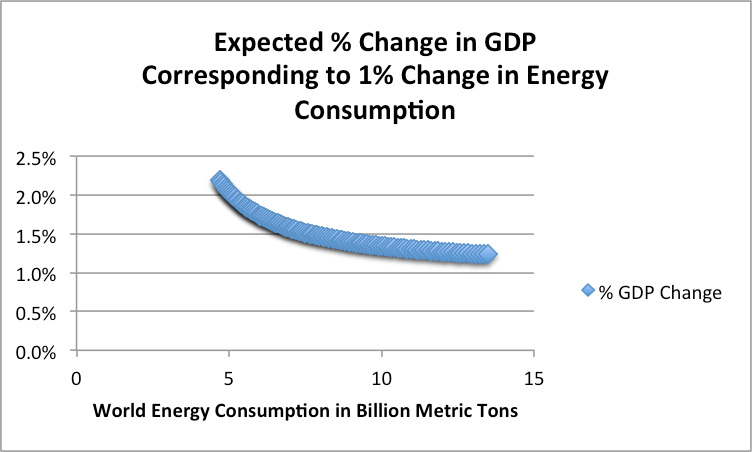
Figure 2. Expected change in GDP growth corresponding to 1% growth in total energy, based on Figure 1 fitted line.
To make matters worse, growth in world energy supply is generally trending downward as well. (This is not just oil supply whose growth is trending downward; this is oil plus everything else, including “renewables”.)

Figure 3. Three-year average percent change in world energy consumption, based on BP Statistical Review of World Energy 2014 data.
There would be no problem, if economic growth were something that we could simply walk away from with no harmful consequences. Unfortunately, we live in a world where there are only two options–win or lose. We can win in our contest against other species (especially microbes), or we can lose. Winning looks like economic growth; losing looks like financial collapse with huge loss of human population, perhaps to epidemics, because we cannot maintain our current economic system.
The symptoms of losing the game are the symptoms we are seeing today–low commodity prices (temporarily higher, but nowhere nearly high enough to maintain production), not enough jobs that pay well for common workers, and a lack of investment opportunities, because workers cannot afford the high prices of goods that would be required to provide adequate return on investment.
How We Have Won in Our Contest with Other Species–Early Efforts
The “secret formula” humans have had for winning in our competition against other species has been the use of supplemental energy, adding to the energy we get from food. There is a physics reason why this approach works: total population by all species is limited by available energy supply. Providing our own external energy supply was (and still is) a great work-around for this limitation. Even in the days of hunter-gatherers, humans used three times as much energy as could be obtained through food alone (Figure 4).

Figure 4
Earliest supplementation of food energy came by burning sticks and other biomass, starting one million years ago. Using this approach, humans were able to gain an advantage over other species in several ways:
- We were able to cook some of our food. This made a wider range of plants and animals suitable for food and made the nutrients from these foods more easily available to our bodies.
- Because less energy was needed for chewing and digesting, our bodies could put energy into growing a larger brain, thus giving us an advantage over other animals.
- The use of cooked food freed up time for such activities as hunting and making clothes, because less time was needed for chewing.
- Heat from burning plant material could be used to keep warm in cold areas, thereby extending our range and increasing the total human population that could be supported.
- Fire could be used to chase off predatory animals and hunt prey animals.
Our bodies are now adapted to the need for supplemental energy. Our teeth are smaller, and our jaws and digestive apparatus have shrunk in size, as our brain has grown. The large population of humans that are alive today could not survive without supplemental energy for many purposes, such as cooking food, heating homes, and fighting illnesses that spread when humans are in as close proximity as they are today.
Our Modern Formula For Winning the Battle Against Other Species
In my view, the formula that has allowed humans to keep winning the battle against other species is the following:
- Use increasing amounts of inexpensive supplemental energy to leverage human energy so that finished goods and services produced per worker rises each year.
- Pay for this system with debt, because (if supplemental energy costs are cheap enough), it is possible to repay the debt, plus the interest on the debt, with the additional goods and services made possible by the cheap additional energy.
- This system gradually becomes more complex to deal with problems that come with rising population and growing use of resources. However, if the output of goods per worker is growing rapidly enough, it should be possible to pay for the costs associated with this increased complexity, in addition to interest costs.
- The whole system “works” as long as the total quantity of finished goods and services rises rapidly enough that it can fund all of the following: (a) a rising standard of living for common workers so that they can afford increasing amounts of debt to buy more goods, (b) debt repayment, and interest on the debt of the system, and (c) an increasing amount of “overhead” in the form of government services, medical care, educational services, and salaries of high paid officials (in business as well as government). This overhead is needed to deal with the increasing complexity that comes with growth.
The formula for a growing economy is now failing. The rate of economic growth is falling, partly because energy supply is slowing (Figure 3), and partly because we need more and more growth of energy supply to produce a given amount of economic growth (Figure 2). With this lowered world economic growth, the amount of goods and services being produced is not rising fast enough to support all of the functions that it needs to cover: interest payments, growing wages of common workers, and growing “overhead” of a more complex society.
Some Reasons the Economic Growth Cycle is Now Failing
Let’s look at a few areas where we are reaching obstacles to this continued growth in final goods and services. An overarching problem is diminishing returns, which is reflected in increasingly higher prices of production.
1. Energy supplies are becoming more expensive to extract.
We extract the easiest to extract energy supplies first, and as these deplete, need to use the more expensive to extract energy supplies. We hear much about “growing efficiency” but, in fact, we are becoming less efficient in the production of energy supplies.
In the US, EIA data shows that we are becoming less efficient at coal production, in terms of coal production per worker hour (Figure 5).

Figure 5. US coal production per worker, on a Btu basis based on EIA data.
With oil, growing inefficiency is shown by the steeply rising cost of oil exploration and production since 1999 (Figure 6).

Figure 6. Figure by Steve Kopits of Douglas-Westwood showing trends in world oil exploration and production costs per barrel.
Thus, it is for a fairly recent period, namely the period since about 2000, that we have been encountering rising costs both for US coal and for worldwide oil extraction.
The extra workers and extra costs required for producing the same amount of energy counteract the tendency toward growth in the rest of the economy. This occurs because the rest of the economy must produce finished products with fewer workers and smaller quantities of resources as a result of the extra demands on these resources by the energy sector.
2. Other materials, besides energy products, are experiencing diminishing returns.
Other resources, such as metals and other minerals and fresh water, are also becoming increasingly expensive to extract. The issue with mineral ores is similar to that with fossil fuels. We start with a fixed amount of ores in good locations and with high mineral percentages. As we move to less desirable ores, both human labor and more energy products are required, making the extraction process less efficient.
With fresh water, the issue is likely to be a need for desalination or long distance transport, to satisfy the needs of a growing population. Workarounds again involve more human labor and more resource use, making the production of fresh water less efficient.
In both of these cases, growing inefficiency leaves the rest of the economy with less human energy and a smaller quantity of energy products to produce the finished goods and services that the economy needs.
3. Growing pollution is taking its toll.
Instead of just producing end products, we are increasingly finding ourselves fighting pollution. While this is a benefit to society, it really is only offsetting what would otherwise be a negative. Thus, it acts like an item of overhead, rather than producing economic growth.
From the point of view of workers having to pay for higher cost energy in order to fight pollution (say, substitution of a higher cost energy source, or paying for more pollution controls), the additional cost acts like a tax. Workers need to cut back on other expenditures to afford the pollution control workarounds. The effect is thus recessionary.
4. The amount of “overhead” to the world economy has been growing rapidly in recent years, for a number of reasons:
- The amount of overhead is growing because we are reaching natural barriers. For example, population per acre of arable land is growing, so we need more intensity of development to produce food for a rising population.
- With greater population density and increased bacterial antibiotic resistance, disease transmission becomes more of a problem.
- Increasing education is being encouraged, whether or not there are jobs available that will make use of that education. Education that cannot be used in a productive way to produce more goods and services can be considered a type of overhead for the economy. Educational expenses are frequently financed by debt. Repayment of this debt leads to a decrease in demand for other goods, such as new homes and vehicles.
- We have more elderly to whom we have promised benefits, because with the benefit of better nutrition and medical care, more people are living longer.
5. We are reaching debt limits.
As economic growth has slowed, we have been adding more and more debt, to try to mitigate the problem. This additional debt becomes a problem in many ways: (a) without cheap energy to leverage human labor, there are not many productive investments that can be made; (b) the addition of more debt leads to a need for more interest payments; and (c) at some point debt ratios become overwhelmingly high.
At least part of the slowdown in economic growth that we are seeing today is coming from a slowdown in the growth of debt. Without debt growth, it is hard to keep commodity prices high enough. Investment in new manufacturing plants is also affected by low growth in debt.
Reasons for Confusion in Understanding Our Current Predicament
1. Not understanding that all of the symptoms we are seeing today are manifestations of the same underlying “illness”.
Most analysts think that the economy has stubbed its toe and has a headache, rather than recognizing that it has a serious underlying illness.
2. Academia is focused way too narrowly, and tied too closely to what has been written before.
Academics, because of their need to write papers, focus on what previous papers have said. Unfortunately, previous papers have not understood the nature of our problem. Academics have developed models based on our situation when we were away from limits. The issues we are facing cover such diverse subjects as physics, geology, and finance. It is hard for academics to become knowledgeable in many areas at once.
3. Models that seemed to work before are no longer appropriate.
We take models like the familiar supply and demand model of economists and assume that they represent everlasting truths.

Figure 7. (Source Wikipedia). The price P of a product is determined by a balance between production at each price (supply S) and the desires of those with purchasing power at each price (demand D). The diagram shows a positive shift in demand from D1 to D2, resulting in an increase in price (P) and quantity sold (Q) of the product.
Unfortunately, as we get close to limits, things change. Both wage levels and debt levels have an impact on demand; the quantity of goods available is also affected by diminishing returns. The model that worked in the past may be totally inappropriate now.
Even a complex model like the climate change model being used by the IPCC is likely to be affected by financial limits. If near-term financial limits are to be expected, IPCC’s estimate of future carbon from fuels is likely to be too high. At a minimum, the findings of the IPCC need to be framed differently: climate change may be one of a number of problems facing those people who manage to survive a financial crash.
4. Too much wishful thinking.
Everyone would like to present a positive result, especially when grants are being given for academic research that will support some favorable finding.
A favorite form of wishful thinking is believing that higher costs of energy products will not be a problem. Higher cost energy products, whether they are renewable or not, are a problem for many reasons:
- They represent growing inefficiency in the economy. With growing inefficiency, we produce fewer finished goods and services per worker, not more.
- Countries using more of the higher cost types of energy become less competitive in the world market, and because of this, may develop financial problems. The countries most affected by the Great Recession were countries using a high percentage of oil in their energy mix.
- The amount workers have available to spend is limited. If a worker has $100 to spend on energy supply, he can buy 100 times as much in energy supplies priced at $1 as he can energy supplies priced at $100. This same principle works even if the cost difference is much lower–say $3.50 gallon vs. $3.00 gallon.
5. Too much faith in, “We pay each other’s wages.”
There is a common belief that growing inefficiency is OK; the wages we pay for unneeded education will work its way through the system as more wages for other workers.
Unfortunately, the real secret to economic growth is not paying each other’s wages; it is growing output of finished products per worker through increased use of cheap energy (and perhaps technology, to make this cheap energy useful).
Increased overhead for the system is not helpful.
6. An “upside down” peak oil story.
Most people in the peak oil community believe what economists say about supply and demand–namely, that oil prices will rise if there is a supply problem. They have not realized that in a networked economy, wages and prices are tightly linked. The way limits apply is not necessarily the way we expect. Limits may come through a lack of jobs that pay well, and because of this lack of jobs, inability to purchase products containing oil.
The connection between energy and jobs is clear. Good jobs require the use of energy, such as electricity and oil; lack of good-paying jobs is likely to be a manifestation of an inadequate supply of cheap energy. Also, high paying jobs are what allow rising buying power, and thus keep demand high. Thus, oil limits may appear as a demand problem, with low oil prices, rather than as a high oil price problem.
In my opinion, what we are seeing now is a manifestation of peak oil. It is just happening in an upside down way relative to what most were expecting.
Conclusion
One way of viewing our problem today is as a crisis of affordability. Young people cannot afford to start families or buy new homes because of a combination of the high cost of higher education (leading to debt), the high cost of fuel-efficient new cars (again leading to debt), the high cost of resale homes, and the relatively low wages paid to young workers. Even older workers often have an affordability problem. Many have found their wages stagnating or falling at the same time that the cost of healthcare, cars, electricity, and (until recently) oil rises. A recent Gallop Survey showed an increasing share of workers categorize themselves as “working class” rather than “middle class.”
It is this affordability crisis that is bringing the system down. Without adequate wages, the amount of debt that can be added to the system lags as well. It becomes impossible to keep prices of commodities up at a high enough level to encourage production of these commodities. Return on investment tends to be low for the same reason. Most researchers have not recognized these problems, because they are narrowly focused and assume that models that worked in the past will continue to work today.


#DimishingReturnsStrikes! THE BREAK UP OF THE UNITED KINGDOM before 2020
Hi all, UK 2015 general elections results just in and it’s a MASSIVE RESULT with MASSIVE IMPLICATIONS.
Basically the Scotts north of the English border just voted for the break up of the United Kingdom by completely ditching Labour and voting en masse for the Scottish National Party. In England the majority voted for either the Conservatives or United Kingdom Indepedence Party, which is growing enormously, approx 50% of the vote in England! The Liberals were obliterated OFF THE POLITICAL MAP. It was a bloodbath for Labour, Liberals in both Scotland and England.
The SNP have warned the majority elected Conservative English that if Cameron goes ahead with his promised IN/OUT of EU referendum end of 2017 (he promised this if he was elected and he will be held to that promise), SNP warned they will immediately trigger a 2nd referendum in Scotland guaranteeing the break up of the UK whilst “they attempt” to apply for EU membership which we know is currently facing hell on earth with Greece, Ukrain, Russia et al.
Most voters in England want out of the EU. Can you all see where this is heading? Because we know that dimishining returns will continue to obliterate the Western hemisphere.
This is the logical entropic conclusion of diminishing returns being played out, the break of nation states into smaller tribal units refusing to be ruled, dictated to by those far away.
Here’s an ominous warning by an analyst via Market Oracle http://www.marketoracle.co.uk/Article50561.html
“The bottom line is that Britain is on the path towards ever more ferocious nationalism, whilst it has started with Scottish nationalism but it won’t end there! and the end won’t be pretty! Therefore the voters of the UK need to recognise this trend trajectory and ensure that nationalism has no part in power for it will have highly destructive consequences. Whilst Scotland is already well along that path as we saw the emergence of Nationalist storm troopers repeatedly shouting down any opposing opinion during the election campaign.”
The bottom line is the United Kingdom is FINISHED, the 300 year union is over.
All main party leaders aside from Prime Minister elect have or are in the process of resigning. UKIP leader Nigel Farage will resign and return after a short break to commence the next phase of the attack. UKIP and right wing English conservatism/nationalism is rising.
Incredible times….
Go UKIP, Scotland, Wales, Cornwall throw off the yoke of English oppression.
Four out of five residents of Cornwall, it seems, receive social security payments to live . Some oppressive yoke!
Things are certainly getting strange!
When you get a moment have a scan through this doc if not already, one hell of a read. It’s basically a think tank linked with the Ministry of Defence (UK) Strategic Trends Programme “Global Strategic Trends – Out to 2045”
In it they predict some wild times ahead, bascially most of the stuff and more we talk about. Shocks, scenarios etc. They also spookily predicted the Nepalese earthquake! Plus the rise of nationalism or tribalism into smaller units exactly as we’re starting to see.
https://www.gov.uk/government/uploads/system/uploads/attachment_data/file/348164/20140821_DCDC_GST_5_Web_Secured.pdf
Diminishing returns in the West, versus South East Asia resource competitors and the dynamic between Western dominance, China, India et al.
Go grab a coffee, tea, cake or whatever, put your feet up and read through. Packed with juicy intel, everything from demographics, gender, urbanization, resources, environment, health, transport, information, education, automation and work, corruption and money, identity and the role of the state, defence spending and capabilities etc.
Systems engineer’s dream come true.
There’s some good stuff in there but US energy independence by 2030 and driverless cars ubiquitous by 2045? Seems the MOD may have missed Gail’s diminishing returns thesis…
The UK says 40% rise in oil, gas, and coal by 2045. Well all is rosey
Thanks! I downloaded it and will take a look at it.
Interesting stuff. Very.
I’d direct attention to the chapter on Russia, in the Geographic section:
In the ‘Shock Box’, it ‘warns’ that a major ‘authoritarian undemocratic state’ might be induced to collapse, fragment and probably fall into civil war, as a result of ‘ sanctions and international isolation’. Given the context, this abstract statement clearly refers to the Russian Federation.
This is conformation of the ultimate game plan behind the Ukrainian civil war, led by the US: the destruction of the Russian Federation.
Worth noting that this plan, as described in the British report, envisages encouraging the various regions and ethnic and religious groups, of the Russian Federation to rebel.
In other words, to create another Syria.
As our Anglo-American empire goes down, it will deliberately create civil wars, chaos and suffering, for reasons of ‘security’; quite apart from the financial/ecological/resource/global warming disasters which are upon us.
Exactly! Heightened “zero-sum” winner takes all politics, given the West is facing imminent debt/energy deflation. The goal will be to blow up/sabotage rival economies in the hope they can maintain some sort of global hegemony or multipolar world. The West, (really we mean Washington) will not go down without a fight, I’ve always said this. I also believe this is why we’re seeing increased military activity in US urban areas in prep for civil unrest. Authorities understand exactly what’s coming when any number of strategic shocks strike and they will probably hit from unexpected places, black swan type of shocks.
If anyone thinks for a second the anglo-saxon empire is about to simply roll over and die, without putting up Custer’s last stand, think again.
The goal will be to blow up main strategic rivals, so we’ll see tensions between US, UK, EU, Israel, Iran, Brazil, Russia, China, India, Russia, Saudi Arabia, et al. Everyone will be fighting over Africa resources.
“Demand for resources of all kinds is likely to increase out to 2045, as the world’s population rises to around nine billion. While the demand for food is expected to grow, some countries are likely to experience significant declines in agricultural productivity. Water shortages are likely to be particularly acute in many areas, exacerbated by increasing demand and climate change. In the 2045 timeframe, coal and hydrocarbons are likely to remain the most important sources of energy, with renewable and nuclear energy likely to make an increasing contribution.”
Gail, when you get a knock at the door by men in black, don’t blame me, unless they’re offering you a job, then make a recommendation 😉 The NSA are probably monitoring this stuff as we speak.
By the way I think it’s absolutely insanity to blow up Russia “again” Putin will never EVER allow that to happen before taking the West down with him. The USSR was humiliated once and stomped on, China and Russia are unifying and this is Washington’s worst nightmare on earth. These two nations combined will be near impossible to stop by zero-sum politics.
I am debating whether this is propaganda, or the possibility that the UK MoD actually believes the content. If the latter, the recent oil price excursions should provide a wake-up call. The really weird stuff is all the ranting about terrorism, and groupthink on cryptocurrencies, while ignoring the mass slaughter going on in various parts of the ME, and the organised criminality in western financial centres.
UK Election …
“Biggest gainers in terms of vote share: UK Independence Party up 9.5 percent; SNP up 3.1 percent; Green Party up 2.8 percent.”
I suspect that Green policies may be a higher priority next time around.
“The life and death of planet earth” by Oliver Sacks illustrates that even if there were no apparent problems, human life like that of all species is finite – its day came and so it will go.
However there is something special about humans – we have a capacity for self consciousness. The process of expansion of awareness must be natural since we can find personal meaning to our lives beyond those of mind and body – which we all know will perish.
We revere art – it is completely purposeless, music moves us to tears, it is simply sounds.
There is something eternal in some art – the reflection of fully awakened consciousness. Unfortunately most of humanity is lost in the semi awake collective mind and needs of animal existence, hypnotised by current fads and will probably never act differently even when faced with their extinction. Perhaps that is also fine, as nature is reckless and abundant – look at all the fruit that falls and rots on the ground.
Dear John Burman
I highly recommend for your reading pleasure Ten Windows: How Great Poems Transform the World, by the poet Jane Hirshfield. Just published in the US.
I’ll quote from the dust jacket:
‘Poetry’, Jane Hirshfield has said, ‘is the language that foments revolutions of being.’ In ten eloquent and highly original explorations, she unfolds and explores some the ways this is done–by the inclusion of hiddenness, paradox, and surprise, by a perennial awareness of the place of uncertainty in our lives, by language’s own acts of discovery; by the powers of image, statement, music, and feeling to enlarge in every direction. The lucid understandings presented here are gripping and transformative in themselves. Investigating the power of poetry to move and change us, becomes in these pages an equal investigation into the inhabitance and navigation of our human lives.
Back to me. Art has been defined as the ‘organization of information’. Mozart organized sounds. I looked at some simple postcard paintings last Saturday which organized the visual field presented by early morning on a river. Jane Hirshfield shows us poems which organize, among other things, our possible emotional responses to events in the world around us.
Don Stewart
China’s exports fall 6.2% in April against a forecast rise http://www.bbc.com/news/business-32639974
There is no way oil consumption is rising.
Just like copper and coal and just about every other commodity demand is not rising.
We now have an oversupply of Americans NOT in the workforce, a record number.
“Americans Not In The Labor Force Rise To Record 93,194,000″
http://www.zerohedge.com/news/2015-05-08/americans-not-labor-force-rise-record-93194000
Pingback: Today’s News May 8, 2015 | The One Hundredth Monkey
Pingback: Today’s News May 8, 2015 | Fiat Planet
I understand all the issues but even with personal action I can’t help but feel powerless, for instance I managed to do 8 out my 10 weekly trips to work without using my car and yesterday I saw the news saying that car sales broke a new record compared to 2014 in my country.
To simply put it reminds me of a story told by a japanese manager, where a little hummingbird tries to save the entire forest from the bushfire a few drops at a time…
only the mercy of the gods and spirits of the forest brought the rain to save it inspired by this little bird but of course this is just a moral tale.
Mike – there is no point in not driving your car. In fact you should drive it more. And you should trade it in for a new one.
Think about what happens if people reduce driving and consuming.
We will definitely enter a recession. That means layoffs so even less driving and consumption.
That leads to even more layoffs and even less driving and consumption.
You see where this is going right?
We got onto this treadmill to hell many years ago – and now there is no getting off without collapsing civilization.
We MUST grow.
Otherwise you won’t have a car at all – you won’t have a job – you will have trouble finding food to eat
Haven’t we heard this before?
https://en.wikipedia.org/wiki/Overproduction#Inevitability
Nice find.
As they say, Marx got just about everything right about capitalism…
Pingback: Why We Have An Oversupply Of Almost Everything | JPPress
Pingback: Why We Have An Oversupply Of Almost Everything | What I An Reading
Wonderful! I haven’t finished but want to tell you how please I am to see you pick up on Mahli’s work on the metabolism of civilization. I think it’s a very important piece of sustainability science/analysis. I’ve been spreading Mahli 2014 as far and wide as I can. And thanks for the graphic showing the declining increase in GDP per unit of energy. Maybe more later after I’ve read the entire post.
Pingback: Why We Have An Oversupply Of Almost Everything | State of Globe
Pingback: Why We Have An Oversupply Of Almost Everything | ZombieMarketsDevelopment
Pingback: Why We Have An Oversupply Of Almost Everything | ZombieMarkets
Pingback: Why We Have An Oversupply Of Almost Everything - UNCLE - UNCLE
One thing we will never have enough supply – L-A-N-D.
Especially land near where people who do matter live.
Greg Chadwick says: You noted that “The use of cooked food freed up time for such activities as hunting and making clothes, because less time was needed for chewing.” My take on that is that our ancestors weren’t smart enough to walk and chew gum at the same time.
A lot of recent research seems to say otherwise on top of all the other problems Gail points out on top of it we seem to be getting dumber too!
Are people dumber than they used to be? Were previous generations mentally sharper than us? You may have suspected that people are getting stupider for quite some time, but now we actually have scientific evidence that this is the case. As you will read about below, average IQs are dropping all over the globe, SAT scores in the U.S. have been declining for decades, and scientists have even discovered that our brains have been getting smaller over time. So if it seems on some days like you woke up in the middle of the movie “Idiocracy”, you might not be too far off. Much of the stuff that they put in our junk food is not good for brain development, our education system is a total joke and most Americans are absolutely addicted to mindless entertainment. Fortunately we have a lot of technology that does much of our thinking for us these days, because if we had to depend on our own mental capabilities most of us would be in a tremendous amount of trouble.
Sadly, this appears to be a phenomenon that is happening all over the planet. As a recent Daily Mail article explained, IQ scores are falling in country after country…
Richard Lynn, a psychologist at the University of Ulster, calculated the decline in humans’ genetic potential.
He used data on average IQs around the world in 1950 and 2000 to discover that our collective intelligence has dropped by one IQ point.
Dr Lynn predicts that if this trend continues, we could lose another 1.3 IQ points by 2050.
One IQ point does not sound like a lot, but when you go back even further in time the declines become a lot more dramatic. For example, a psychology professor at the University of Amsterdam named Jan te Nijenhuis has calculated that we have lost a total of 14 IQ points on average since the Victorian Era.
And we don’t need a professor to tell us that this is true. Just go back and read some of the literature from that time period. Much of it is written at such a high level that I can barely even understand it.
There is other evidence that people are getting stupider as well. For instance, SAT scores in the United States have fallen significantly in recent years…
There appears to be a disturbing trend in American high schools. If we judge the quality of education by the scores that students get on their SATs, then it appears that things are getting worse.
Since 2006, the overall average SAT score has fallen by 20 points, dropping from 1518 to 1498 in 2012. Scores are also down in each of the three categories tested, with reading dropping 9 points, mathematics dropping 4 points, and writing falling 9 points. It’s a fair bet that students aren’t becoming less intelligent, so exactly what is going on?
http://www.zerohedge.com/news/2014-08-25/dumb-dumber-scientific-proof-people-are-getting-stupider
The IQ of the people who do matter are increasing.
The rest can go and eat dust.
Even during the Belle Epoque, only less than a few million enjoyed the joys of modern civilization. Most of the rest lived in slums and tenements.
Read Greg Clark. Our ancestors are the successfuls, not the slum dwellers.
If size is all that matters then the computers of 1970 that filled large rooms were much smarter than your cell phone. But in fact the transistors being small and close together allow fast communications and computation. Tight compact and fast is also a path to smart.
The SAT is useless as it gets changed from time to time.
If you are saying low IQ people reproduce faster than high IQ people then I can understand how the population as a whole can have declining IQ. So those societies that decide to limit the reproduction of low IQ people and encourage the reproduction of high IQ people will have an advantage after 10 generations.
Are the currently any countries that sterilize people with severe cognitive deficits?
A surprisingly small difference, 4%, in the reproduction rate of those above average and those below average will move the populations IQ by 1 point in two generations, 60 years.
How many dual doctor couples that you know have more than 2 children? Dual lawyers, dual professors?
I think The Lomokome Papers (Herman Wouk) had the best idea.
I have never read that book.
From the Internet search that I was able to do, I was not able to understand what you mean, Jan Steinman … However, I would expect that some old-fashioned science fiction story from 1945 would NOT provide much in the way of “better ideas.”
The realities that there are nothing by the dynamic equilibria between different systems of organized lies operating robberies results in hyper-complicated situations in which there are NO “best ideas.” My main points are that while I agreed with almost everything that Tverberg stated in her article above, the sociopolitical situation is WAY WORSE, because she tends to deliberately NOT focus on the degree to which civilization is actually controlled by enforced frauds. Since those are the realities, “solutions” to those problems will emerge out of things that “we” can NOT adequately model. Natural selection commensurated the incommensurables, and artificial selection systems are more and more doing that too. People resolving their conflicts by backing up deceits with destruction generate resolutions to those problems which nobody wanted, like their resulting vector product being different than all the vectors that added into that result.
By the way, the article above was republished on the Doomstead Diner, as well as on Zero Hedge, which are two Web sites that I tend to regularly visit.
I REPEATED my kind of blah, blah, blah there:
THE PARADOXICAL “SUCCESSES” OF ENFORCING FRAUDS makes all of the problems correctly identified in the article above orders of magnitude worse, and way more politically impossible to resolve. Since the EXISTING human ecology and political economy were based upon the social “successfulness” of the maximum possible deceits and frauds, we were rushing into the walls of limits to growth on a finite planet as fast as we can, and will bounce off of those limits over Seneca cliffs whose bottoms we can not currently see …
Ctuzelawis’ Law of Reasonable Warfare.
An astronaut is stranded on the moon. A rescue mission takes some time. When they get there, no astronaut, just a furiously scribbled diary, which they chalk up to anoxia delirium.
In the papers, the tale of lunar inhabitants is told. Two sides discover a “mutually assured destruction” doomsday device that would erase all the enemies without a trace, and both sides have implemented a “fire on warning” system.
But wise savant Ctuzelawis comes to the rescue, with a plan for “virtual warfare,” by which a panel judges the two sides’ war preparations, and declares one or the other the winner. In each war, the tech advances and volunteerism is assessed. Their “excess” population is randomly put to death as part of the process, which reduces population pressure… until the next “virtual war.” (This is the part that I was reminded of.)
The astronaut apparently throws a wrench in the works, and the reader is left wondering… the “official line” of anoxia delirium, or did the lunar creatures end up offing each other?
TLDR
Blair, I agree. There is no world system. There is just layer upon layer of individuals and groups seeking to keep what they have and take more. They will saying anything no matter how preposterous to stay at the top of their local heap.
For instance, the sheer speed and wide range of change that has China vs. Global underwent in just past 15yrs was unpredictable, the BAU was esentially prolonged to achieve these goals. It’s impossible to know what comes next, the forces at play are of enormous scale and momentum. Under slightly different regime (full time opression) the world can easily pull another couple of rabbits out of the proverbial “hat of the future” – it’s scary but there are several options left how the make this insanity last several decades longer..
http://cassandralegacy.blogspot.it/2015/02/fooling-peak-oil-one-more-time-can-we.html
Gail’s angle about the financial system limits hitting first is just one of plausible scenarios, and given “known” human nature up to this point I’d put it in the drawer of slightly less probable options. Simply, domesticated people are now on terminal mission to terraform this planet to the fullest potential of likely total ireversible destruction, I’m afraid we are not done yet, and mere financial system can be massively tweaked or entirely overhauled to serve this more important goal..
World, I agree. Gail sees the finance system going down and that is the end. I believe martial law and government force can kick the can down the road until the oil wells run dry and the last ton of coal is burned. It will be a far different system but it will burn fossil fuels until they are gone.
Given the 70th anniversary there has been lot of re-runs of older WWII documentaries and few premier brand new ones. The history quite helps put things in proper perspective, something very similar to “total war” on economy-society will likely be attempted at the latest stage, and we are not even there yet, so we are perhaps talking decades to go. Few years back I was of the illusion, perhaps as many resource pesimists out there, we would just marily snap into another paradigm, but most likely it will be long grinding depressing reality of keeping (parts of) BAU for ever shrinking pool of people (elite consumers and enablers).
One of the highlights of these documentaries and movies, was the grim reality on the streets of Berlin in the end of april 1945, while several of the top nazi honchos were already escaping like rats trying separate surrender-escape deals with Americans, Swedes etc., the local youngsters, civilian fanatics were still fighting the red army for each meter near the gov bunker as the entire city was already encircled.
The parallel I see is as follows, the red army = entropy, the top nazis = bau preachers and system owners-gate keepers, and the fighting youngsters till very last minute represent most of us domesticated human ape fools..
World, few people are willing nor able to do something new. They prefer to do the same old thing even if its time has come and gone.
We do not even have car pooling yet! My Dad car pooled in the 1960s. So, plenty of slack left. Let me know when more than 50% of commuter cars have more than one person in them, yes, US centric. I also see new style developments that have office building, strip mall, and apartment building all within walking distance, i.e. Raleigh, North Carolina.
The elites in former colonies are precisely the descendants of those who worked for the colonial power, and an enemy of the ordinary people.
They always survive. They ahve better survival instincts and they have higher IQs. So they are superior.
You seem to be in awe of the ‘elites’ — like a rock groupie. Do you hang at Davos picking up autographs and posting sightings to social media?
Guess what. Elites are no superior. Nor do they necessarily have a higher IQ than many people in the general population.
And when the collapse comes they will almost certainly be at a disadvantage. Because they have been able to pay people to pamper them. And going forward there will be no way to pay minions so they will need to fend for themselves.
I reckon I’ll have George Soros as my shoe shine boy. Jamie Dimon will be the butler…
You make a valid point. The Western elites are basically terminal.
Nobody knows what the next system looks like because our present system in various guises has been around 500 years.
I’m looking forward to the seeing the new Mad Max movie but I do have a keen eye for Hollywood propaganda.
Fast Eddy, sorry to bring a bit of realism here, given human nature, there will “always” be elites. The “respect” is due since in the latest run we discuss they were able to bamboozle people for decades and centuries. Yes, there will be reshuffling on the ground as this current 70-80yrs cycle and the 300yrs supercycle resets, but to expect something else than void being filled pretty soon by other system of “human farm” is beyond naive.
Unless you are in your very low teens and your life expectancy goes as high as 80-90yrs, chances you will be still living under the jackboot of skilled opressor, perhaps more local-regional not global. Grow up.
This is an extinction event in case you haven’t read my earlier posts – but we can play along anyway.
Yes, there will no doubt be elites post-collapse, but they will not be the same elites that dominate today’s world.
The post collapse world will be localized, violent and chaotic. War lord-types are likely to run the show.
The Fed will not exist so the men who currently run the world will be out on their asses.
Why do you think they are scurrying around like rats on a sinking ship trying to keep afloat for as long as possible?
Yes, indeed, they are doing whatever they can
ThinkProgress
This Billionaire Tried To Get University Scientists Fired For Doing Their Job
BY KILEY KROH POSTED ON MAY 16, 2015 AT 1:16 PM
Despite a growing body of scientific research connecting oil and gas activity to a dramatic spike in earthquakes across several U.S. states, some industry leaders are fighting this characterization. Harold Hamm, billionaire CEO of Oklahoma City-based Continental Resources, told a dean at the University of Oklahoma last year that he was so displeased by the university’s research on the topic that he wanted certain scientists dismissed, Bloomberg News reported.
In an email to colleagues dated July 16, 2014 and obtained by Bloomberg, Larry Grillot, the dean of the university’s Mewbourne College of Earth and Energy, said that he had met with Hamm, a major donor to the university, to discuss his concerns about earthquake reporting by the Oklahoma Geological Survey (OGS), which is housed in the university. “Mr. Hamm is very upset at some of the earthquake reporting to the point that he would like to see select OGS staff dismissed,” Grillot wrote, adding that Hamm indicated he would be meeting with Oklahoma Gov. Mary Fallin (R) to discuss moving the OGS out of the university.
http://thinkprogress.org/climate/2015/05/16/3659750/oil-billionaire-fracking-earthquakes/
Even war-Lords have to borrow money from someone to go fight other war-Lords. The bankers will continue to do just fine.
If money is a representation of energy and there is no energy going forward then….
I am reading http://www.nytimes.com/2011/08/21/books/review/1493-uncovering-the-new-world-columbus-created-by-charles-c-mann-book-review.html?_r=0
At one point it was mentioned that there was a massive deforestation problem in the UK in the 1600’s
World population was around 500,000 at the time. World population is 7B+ now.
When the oil stops how long will it take for 7B people to rip through whatever forests remain to keep warm and cook their food?
In the 1600’s there were still vast forests in the Americas to plunder. Coal had not yet been yoked, nor had oil or natural gas.
The discovery of these energy sources allowed humans to kick the can down the road considerably.
Shale oil has added a measly 6+ years, which is confirmation that the can is very close to the end of the road.
In the 1600’s there were not that many people, and enormous untapped resources — now there are enormous amounts of people and the resources are tapped out (virtually all of what is left requires sophisticated machinery and energy to extract)
In light of this I see no role for bankers going forward.
Take a look at subsistence societies – there are very little if any surpluses — therefore there is no role for banking.
You breed your cows, and pigs and chickens and you sow your soil without machinery or industrial fertilizers and pesticides, and you produce barely enough to see you through your short harsh life.
We are not going back to 1600 and starting over. That is not possible.
We are going back to 1600 without the skills or knowledge or mind set of how to live like that. Those people had the benefit of generations of evolving to live off the land.
We on the other hand are cogs in a modern economy, even our farmers do not have the skill sets of those of the 1600’s. This is like throwing a 5 year old into a collapse world on his own and expecting he will survive.
There will be chaos and violence and suffering and starvation — I do not see a role for bankers in any of this.
FE, The WSJ agrees with you
Easy money is driving up the price of stocks, bonds, houses and other assets in a era without historical precedent.
http://www.wsj.com/articles/the-federal-reserve-asset-bubble-machine-1431386994
aith in the Fed’s easy-money policies has encouraged a dangerous complacency. The mantra on Wall Street is that good economic news is good news for the markets, but that bad news is also good news, because it will encourage the Fed to keep rates lower for longer. This has led to one of the longest rallies the U.S. stock market has ever experienced, without even a 10% correction. Returns since 2012 are the highest for any three-year period in recorded history, after adjusting for the risk of holding stocks.
The Fed’s approach has spread to central banks in Europe, Japan and China, creating a new world in which investment decisions are guided by the availability of easy money, not opportunity. Over the past three years, global stock prices have risen rapidly despite tepid economic growth. Oh well, the central bank responds: We target consumer prices, not assets.
This job description is outdated, because the task is largely done. In emerging nations, the average annual growth of consumer prices now hovers around 5%, down from a peak of 116% in 1994. Add in the rich countries, which are generally more stable, and global inflation has fallen to 2% today from near 20% in the early 1970s.
Central bankers are still fighting to control consumer prices, only now for the opposite reason. Rather than raising interest rates to contain consumer spending and inflation, they hold rates down to encourage spending and induce inflation, because the global inflation rate of 2% is dangerously low in their view. The fear is that slowly rising prices will tip into falling prices. The boogeyman is not hyperinflationary Germany of the 1930s, but deflationary Japan of the 1990s, when the country fell into a downward spiral of falling prices, weak demand and stagnant growth.
Japan taught the world two lessons: that consumer price deflation is bad for growth and that it is hard to shake. Both are inaccurate. Before World War I, many nations experienced deflation, sometimes driven by weak demand and leading to weak growth, but as often driven by rising productivity and accompanied by strong growth.
A recent Bank for International Settlements study on the postwar period found that long bouts of deflation were exceedingly rare, but short bouts were common. More important, average annual GDP growth was roughly the same regardless of whether prices were rising or falling. The upshot: Consumer price deflation is not necessarily bad for growth.
One problem is that the world changed faster than the Fed. Trade has jumped to 60% of global GDP from 40% in 1980, and increasing competition puts downward pressure on consumer prices. The forces of expanding supply from China to Mexico are pushing the global average inflation rate down to a level that looks scary low only when compared with the 1970s highs. In fact, consumer price inflation is still above the long-term average, dating to the year 1200, which is 1%.
But global competition wields the opposite effect on asset prices. The opening of financial markets means that many more buyers are bidding up prices for stocks in New York, or real estate in Miami or bonds in Chicago. The result is that central banks are unleashing easy money to fight an imaginary villain, consumer price deflation, at the risk of feeding a real monster, asset price inflation.
Every major economic shock in recent decades has been preceded by an asset bubble: housing and stocks both before Japan’s meltdown in 1990 and before the Asian financial crisis in 1998; stocks before the U.S. dot-com bust in 2000; housing again before the crisis in 2008. Strikingly, even as asset prices were climbing before the busts of 2000 and 2008, the Fed kept monetary policy loose because consumer prices were rising only moderately. That is the same excuse we hear now, amid a price boom in stocks, houses and bonds.
The real problem – the one that perhaps sees us come out of the hurricane’s eye and into the cataclysm – is that the central banks appear to have no way to fight the next recession when hits.
The stimulus bazooka has been fired (see China ghost towns) … interest rates are at 0 or negative… trillions have been printed.
As corporate earnings falter and then stumble, what mechanisms can be deployed to reverse this as we try to avoid the deflationary collapse that would result if millions were laid off?
We can paper over a lot of things but we cannot paper over a stampede of job losses because that will be like letting wolves into the sheep enclosure… it will cause panic.
And panic means the oars get pulled in and what little money the people have doesn’t get spent.
If the sheeple don’t spend then it’s time for Mad Max to rev his engine.
No doubt the central banks will do everything to delay that moment.
Instead of Bernanke’s money from helicopters (even the stupidest amongst us would understand that if helicopters were prancing spewing billions of dollars into the air that something was not right) how about the central banks print money — channel it to corporations with the understanding that it be used to purchase stocks (already happening) but with a surety to not lay off people (or even keep hiring people).
This well and truly would be the same as hiring millions of people to dig holes and fill them in — paying them good salaries – and claiming the economy is finally fully recovered.
it must be fun to work in the think tanks tasked with kicking the can. Any idea, no matter how hair-brained, gets heard.
In fact, I bet there are think tanks staffed with imbeciles and clowns.
People who have not a clue about economics or finance — because the last thing you want is an economics PHD advising because they are less likely to be able to think out of the box and come up with ideas that violate the rules of their game.
You want someone who is ignorant of the rules and who simply comes up with suggestions that buy a little more time.
Perhaps we need to ignore that Google research on renewables. We need to think differently.
Putting on my dunce cap might I suggest that we print 50 trillion dollars and have China manufacture billions of solar panels and give them out to every person on the planet.
Then another 100 trillion to subsidize Tesla cars so that everyone could afford one
Imagine the growth spurt we’d get from something like that.
The coal mines that are closing due to low coal prices would open and expand. Australia would get its mojo back and would be ripping iron and copper and other minerals out of the ground to feed the furnaces in China.
We could earmark another few trillion for charging stations and new coal fired electricity plants to fuel these new EVs.
The plastics industry would be rocking in response to this massive EV solar roll-out.
The knock on effects globally would be monumental as this would put money in pockets everywhere. People would be building houses and buying more stuff and eating out and taking trips and buying more stuff and living extra large.
God Damn! Where do I sign up for one of these think tanks. I have found a calling
Are you posting under a new alias again, this time under “Fast Eddy” having been previously posting under “Paul” & “Tolstoy’s Degenerate Grandson”?
Something resonates with the way and frequency of post under those 3 alias names.
You’re missing one more alias. 😉
“Are you posting under a new alias again, this time under “Fast Eddy” having been previously posting under “Paul” & “Tolstoy’s Degenerate Grandson”?
Something resonates with the way and frequency of post under those 3 alias names.”
You’re missing one more alias. 😉
Waiting for our “Paul” to adopt the alias
“Don Hoe”
Ha!
Question that I have is why does he keep changing aliasees all the time?
An illusion of privacy? Boredom? Personality disorder?
“An illusion of privacy? Boredom? Personality disorder?”
An Analysis? Heres mine. Fast eddy having ran both you and boy from the hood into the dirt in discussions you are wary of actually debating him- too much pain. So you stoop to this. Jan your better than this. Your friend not so much.
This sentence no verb. My better than what?
schizophrenia?
We lumped that in with “personality disorder,” but now we are having second thoughts, as my invisible friend thinks it should be separate. NO, IT SHOULDN’T! YES, IT SHOULD! SHAWDUP, YOU FAKIR! HEY, YOU’RE THE ONE WHO STARTED THIS! C’MON, YOU WANNA PIECE OF ME! %*&@#$!
“Question that I have is why does he keep changing aliasees all the time?”
Question I have is why its any of your business officer krumpky?
So step out of the shadows and have the courage to debate, share worldviews without hiding behind all these different alias names, changing them every two seconds. It’s as if you engage in debate, launch attacks on other worldviews, take it too far then feel you have to change names to start over.
Here’s an idea, have the courage to share, discuss, debate ideas using your real name. This isn’t some dodgy forum where you have to hide behind the shadows, it’s actually ok to share different worldviews, open discussions, debate, much of what’s said is intelligent and well thought through.
What I like about this community is it’s not a war of minds, it’s an intellectual, civil community with open minds. Look at the hostile garbage on other forums where it’s war, trolling etc.
Gail and others seem to do just fine sharing their real identities, or at least those who have an alias tend to stick with the same alias showing some kind of consistency.
“debate ideas using your real name”
Id sooner walk through Detroit counting hundred dollar bills. Your hostility toward FE is contrary to free expression of ideas. Anonymity works toward free expression of ideas not against it. Your attempt to characterize your attack on FE to behavior supporting free expression of ideas is lame. You are consistent in your behavior when attacking ideas you do not agree with. When frustrated intellectually you use revert to ad hominan attacks like the one above. IMHO this is the antithesis of an individual who supports free exchange of ideas.
Who are you trying to kid “Alia Sees”? You’re Paul, TGS, FE
Passing yourself off as someone else defending yourself is nutty.
[moderator_hat_on]While this is quite entertaining, please play nice in the sandbox, kids!
I’m going to start deleting name-calling and ad-hom attacks.
I’m not pointing fingers — there seems to be an equal distribution.[/moderator_hat_on]
Daniel – I guarantee you — that is not me (and I am sure the moderator can confirm this).
I have no need to defend myself — my positions on these issues stand on their own – as anyone who posts drum banging, mantra chanting, kumbaya tainted drivel knows.
I am interested in the messages rather than the messenger. If this were a physical community of people in a shared physical space, then I would be much more interested in the “Who” as well as the “What are they saying”.
It isn’t – so again, I don’t care who has what alias. I am interested in the discussion around points of view – and, CRUCIALLY, the reasons behind that viewpoint.
I like being a Simple Kiwi, because I, Simon James, am a 6th generation New Zealander (known colloquially as Kiwis after the native flightless bird which is only found in NZ) who tries to keep things simple.
Sometimes, people use aliases to be deceptive, sometimes using multiple names in even the same thread.
Thank you for revealing your identity and your reason for choosing an alias. Aliases don’t bother me too much, but when someone changes them quite often, I begin to wonder, “What are they trying to hide?”
Damn your clever!
Lol~!
The common denominator is a psychological condition (likely caused by numerous concussions suffered playing various barbaric sports) that removed cognitive dissonance and the normalcy bias mechanisms… and the utter rejection of ‘kumbaya’
Are you posting under a new alias again, this time under “Fast Eddy” having been previously posting under “Paul” & “Tolstoy’s Degenerate Grandson”?
Something resonates with the way and frequency of post under those 3 alias names.
Reply
I quite like the Fast Eddy moniker.
Tiny Bubbles makes me feel fine, makes me happy, makes me fine, makes me warm all over. Love you till the end of time….
The oil wells will never run dry.
Financial collapse wipes out our ability to produce the complex machinery needed to extract the oil that remains.
Also we are already we are seeing oil reserves abandoned because:
OIL IS BECOMING TOO EXPENSIVE TO EXTRACT
It emerged this week that the drilling of wells in the North Sea has crashed by around 50% this year, compared to the year-ago period. The reason for this is simple: the cost of extracting oil in North Sea has quintupled over the last decade, discouraging companies from investing within the region. http://www.fool.co.uk/investing/2014/07/18/surging-north-sea-project-costs-are-putting-the-regions-future-at-risk-tullow-oil-plc-premier-oil-plc-xcite-energy-limited/
I could see open pit coal extraction still happening with people using picks and buckets to continue mining these resources – but that would be very localized. Most of the good/easy stuff is gone – so I don’t see another mini coal-driven industrial revolution.
And your point is?
Look at certain industrialzed parts of the EU already, 50% + youth unemployment, drop in energy demand in dozens of % and overall consumption patterns. Plus aging population and other factors. This overall trend will slowly take over the entire planet like a virus. The precise sequencing though is beyond my paygrade, perhaps the US and MiddleEast will follow first, then larger Asia or it happens in different order. Anyhow, this process is likely to proceed as “managed descent” for couple of decades or at least it will be attempted to be managed by the system owners..
My point is that when collapse comes the oil that is in the ground will remain in the ground.
As for a soft-landing type scenario I cannot see how that is possible.
We have been in the eye of the storm for 6+ years now. And the hurricane is approaching.
Interest rates are at 0 in most OECD countries and we have printed trillions of dollars during this period.
And now we are beginning to push on a string with the two biggest economies facing recessions.
When that happens there is non way out. The Keynesian methods of stimulus and lowering interest rates are exhausted.
This time as corporate profits plummet the central banks will be powerless. There will be a deluge of layoffs which gain pace and volume much like a snowball rolling downhill.
Once this starts it will be unstoppable and it will be fast. As in days, at most weeks.
As companies recognize that the Fed cannot come to the rescue again they will pump out pink slips by the millions.
We have had a slow painful 6 year walk to the top of a massive cliff – and we are approaching the edge. There will be no gentle descent.
That is why the central banks are doing anything in their power to buy BAU more time – they don’t care about the consequences of their actions because they know we are dead no matter what.
An analogy would be granny is told she has 6 months to live but if she takes this new potion it will definitely kill her, but it will likely keep her alive for a year.
We all want to believe that collapse will be nothing more than a exciting adventure on our way to some sort of sustainable world.
That really is utter nonsense and wishful thinking. But hey, if it makes some people feel better then why not.
Interesting to read and watch some of Chris Nelder’s from the late 2000s or later..
http://www.zdnet.com/article/waiting-for-the-punchline/
http://www.zdnet.com/article/economic-theory-and-the-real-great-contraction/
I stopped reading here:
“And instead of doing the real work of prepping — like figuring out how to produce our own food and renewable energy, decarbonizing our economies, using and consuming less, and knitting together functionally useful communities — we’re sitting alone in our living rooms, watching apocalypse porn like Doomsday Preppers, or laughing at the whole phenomena along with The Simpsons.”
1. Renewable energy is BS.
2. Consuming less would result in the total collapse of the global economy in a flaming deflationary death spiral
3. Decarbonizing – I assume he means burning no fossil fuels. Again, that would collapse the global economy. Also I assume he thinks that his renewable energy paradise would grow on trees and not be build using millions of tonnes of coal and other fossil fuels.
I have blasphemed the Green God. What is my punishment? Do I get Jihadded (do I get strapped to a solar panel and roasted?)
All bow down to the Green God even though he’s a false as all the rest.
I guess this is the point where we essentially differ. I agree with Ed and others who think we simply shift to the next stage of control, which will discard the twin fantasies of finance & democracy. (See Radical Marijuana’s comment on the essential, rooted fraud & violence underpinning our social systems.)
Of course, the “next stage” is nothing more than a return to traditional means of control utilized for eons before economic surplus allowed the use of deception in the form of self-government, free will, self determination, etc. These techniques form the bases of classic secular “life-lies” (coined by Ebsen) that work in concert with ecclesiastical myths embraced by billions who hold dear the belief in Santa, Jesus, et al.
The advantage for us who know what’s going on is that first worlders are a little rusty on the concept of the iron fist. As a refresher, let’s review the 3 tenets of counter-insurgency ie conducting war against civilian populations:
1. divide populations into opposing factions & groups
2. reward key constituencies who support the central authority
3. terrorize the opposition
If one is aware, they will recognize of course that these very techniques are used today in the West, but in a much more subtle form. Once the velvet gloves are dropped, it will become finally evident to all.
Now, how does one front-run such a scenario? Well, obviously media & propaganda are going to be critical components; the call to unity in the form of certain “sacrifices” which will have to be made. You know, quaint notions like liberty, fraternity and equality. Get the picture?
Think of the opportunities being part of the process that divides, isolates and advocates acquiescence? What about being party to dispensing rewards to supporting factions? And to the more violent, being a member of state sanctioned terrorist groups who snatch, torture and murder opposition members to instill conformity?
It’s all there for anyone who is willing to see it – grasp & embrace the future. The oil will continue to flow, it’s just the entire working effort of mankind aka “the economy” will be directed towards mining the precious juice to enable elites to maintain control and reward supporters. The rest will be left to die in the homes and along roadsides like the pitiful Irish during the famine.
B9 – your post would indicate that you think that BAU can continue once the dust settles.
BAU, even a tamped down version, requires fossil fuels, particularly oil.
How do you see oil production continuing when we are already seeing oil companies pull in their oars because there is no point in finding and extracting oil that costs far more than the economy can afford.
Or am I mistaken and you see the post-collapse world as resembling Game of Thrones played out amongst a setting of abandoned mega mansions and office towers?
Simply Reshuffle.
As the US goes under in domestic turmoil, perhaps fragmentation – implosion ala former CCCP, the world moves on, in particular the Gulfies go under the protecting arm China-India-Russia, core of Europeans attempt some lite version reich ver4.0 etc. There will be flow of fossil energy and capital, albeit quite restricted in compariso with the good old days.
Doom here and there, not the end of the world YET, that’s restricted for later date.
That is utter nonsense and yet more wishful thinking. Do you just make stuff up because it makes you feel better?
We cannot at this moment pull what remains in the ground out now because it costs too much — yet magically we will be able to do that post collapse.
Wave a wand and everything will be the same — just on a smaller scale.
Utter utter Twilight Zone level ridiculousness.
I used to think that, too. But now, I’m not so sure.
If you look at classic hyperinflations like the Weimar Republic, the government was printing money to get itself out of trouble.
We now have a case where the government is printing money to get a particular industry out of trouble. The government prints money that finances new holes in the ground that can’t otherwise be financed. Those drilling the holes go bankrupt, and others buy their cash flow at pennies on the dollar. Inflation doesn’t happen, because the money was never really in circulation. The money “appears” to get the hole drilled and fracked, then “disappears” in the bankruptcy.
I’m not particularly convinced of this myself. I’m just trying to observe what is happening, and describe how it has happened. Wile E. Coyote has been spinning his legs after running off that cliff what, ten years ago? Something is keeping him up there in the air, and that something might be able to continue for at least a bit longer than many are predicting.
Humanity will go out with a whimper, not a bang. People will be scooping tar sands out with their hands and loading it into ox carts before succumbing to our addiction.
Dear Jan and Others
I am in the process of studying Capra and Luisi’s The Systems View of Life. Several things are, I think, relevant to the question of whether humans are doomed to continue on the linear trajectory they have followed for the last few centuries.
One of the main themes of the book is the failure of Newtonian mechanics to explain many important phenomena. For example, when Electrodynamics was first developed, there were efforts to reduce it to Newton’s model by positing the existence of something called ‘ether’. It fell to Einstein to finally kill the ‘Newtonian’ explanation of Electrodynamics, and show that fields were physical entities in their own right and could travel through empty space. Many of the doomer ‘proofs’ are similar to Newtonian mechanics…the world and humans are mechanical models and consist of aggregations of very tiny pieces of matter.
I recommend reading Dmitry Orlov’s current reflections on exactly what happened when the Soviet Union collapsed. Some things went away, some things changed, and some things remained more or less the same. The Soviet system was not the most important thing in life. Is Gail’s great fear that the US government will collapse overblown? Might the collapse of the US government be a sine qua non for the changes we will have to make?
After a review of complexity theory and thermodynamics, Capra and Luisi conclude (page 180):
In static systems, self-organization and the resulting emergent properties are relatively simple concepts, well explained by chemistry and physics, but in dynamic systems the processes of self-organization and emergence are subtle and complex; and their outcomes are often unforeseeable, both in biological and in social life. In a way, this carries a positive message. New structures, technologies, and new forms of social organization may arise quite unexpectedly in situations of instability, chaos, or crisis.
The systems view of life is essential for understanding these phenomena. Instead of being a machine, nature at large turns out to be more like human nature–unpredictable, sensitive to the surrounding world, and influenced by small fluctuations. Accordingly, the appropriate way of approaching nature to learn about her complexity and beauty is not through domination and control but through respect, cooperation, and dialogue. In fact, Ilya Prigogine and Isabelle Stengers gave their popular book Order Out of Chaos the subtitle Man’s New Dialogue with Nature.’
Can humans be as smart as microbes? On page 162 Capra and Luisi describe the recent discovery of nanowire connections between microbes separated by hundreds of feet of soil. ‘Some of these networks are extraordinarily dense and look strikingly like neural networks. Indeed, research has shown that the biochemical processes in these microbial communities is completely analogous to brain chemistry.’ The function of the nanowire network is to optimize the utilization of oxygen by the community of billions of microbes.
Will we recognize that plowing the microbial networks out of existence using fossil fuels may not be the smartest idea humans ever had? Out of the ‘instability, chaos, and crisis’, will some humans figure out that ‘respect, cooperation, and dialogue’ are the best responses?
Given that we will all go through some ‘instability, chaos, and crisis’, it seems to me that the best strategy for an individual human family is to focus on the fundamentals, and to examine histories such as Orlov gives us of the collapse of the Soviet Union, the survival, change, and extinction of certain of its characteristics, and the emergence of new structures to replace the old.
Don Stewart
@ Don Stewart
Now you’re talking! In relation to ED, more specifically QED, Richard Feynman is one of my all time heroes, not that I understand any of it.
When you get time watch Peter Thiel’s presentation which kind of eludes to what you talk about. Optimistic, pessimistic, deterministic, non-deterministic futures.
Wish we were both thirty years younger and a couple thousand miles closer, Don. It would be a hoot going through collapse with you!
By the way, my friend Diana Leafe Christian (Creating a Life Together, Finding Community), the maven of intentional community, was once Capra’s personal assistant, around the time he was writing Mindwalk.
Jan, I know what you mean about being 30 years younger! After an afternoon of pounding in posts on my doomstead garden I’m sitting on my porch swing with an aching back looking at your island wondering how many turkeys you need for a pair of your goats. Ever tried to put goats in a kayak?
Goats hate getting wet. Good luck with that one!
Are you on one of “our” islands? Because Homeland Security would probably take a strong interest to goats crossing imaginary lines in the Salish Sea by kayak. (Sounds like a line from a Steely Dan song…)
I’m on that big island to the west of you that has the provincial capitol. Nice to know there’s a self sufficient community so close. When things get ugly I’ll be over for a visit.
Better make it sooner than that.
By the time “things get ugly,” we’ll have scuttled the ferries at the docks and we’ll have posted sentries at the other landing points. 🙂
International goat smuggling, what is this world coming to?!
“International goat smuggling, what is this world coming to?!”
Oh Ed you are so naive. This has been going on for years. I was on a bus from India to Nepal once upon a time. The bus crossed the border into Nepal having paid the baksheesh to the local officials- taxes basically. A half mile later the bus pulled aside and the driver and several goat smugglers quickly loaded the roof of the bus with a herd of goats. It was clear to me that this herd had entered Nepal from India the other way a couple hundred meters from the border crossing. I was shocked- shocked I tell you. Goats need to be issued biometric chips to stop this sort of cruel and baksheesh defeating goat smuggling. Only in this manner can the world be freed of the scourge that is international goat trafficking.
The only “international goat trafficking” that has happened here was when our goats got loose and walked out on the highway, bringing a car with California plates to a halt.
I’d happily trade places.
I’d much rather be 70+ now and winding things down….
Jan
I have stayed in Diana’s small cob house. She’s a nice lady.
Don Stewart
Jan – I think Stein’s Law applies — ‘What cannot continue – will stop’
The only question is when.
It defies the laws of the universe to assume that we can continue to print money in order to extract oil that is economically not feasible to extract.
Or that we can print money and feed that to companies to keep them operating forever – even though they are not solvent.
Communist Russia tried this system — it eventually fails.
I think that Russia was able to keep going for many decades only because they had enormous amounts of oil and gas. I think so long as the main driver — cheap to extract energy mainly oil – is available, any system can sputter along indefinitely regardless of how inefficient it is at allocating those resources.
The problem is that we are not finding any cheap to extract oil — and we are on the brink…
The central banks are doing everything possible to keep this game going — but at some point they will fail… keeping in mind this crisis did not start in 2008 rather it started in around 2000 (or as I have argued – the 1970s when costs were incurred to secure overseas oil sources) — so this has been going on for quite some time already.
How long it will continue is impossible to say — but one thing that is certain… once it busts up the reason for the bust up is we are not finding any more cheap to extract oil …
And we need cheap to extract oil + a fully functioning financial system to extract that oil — neither will exist therefore BAU cannot exist on any level post collapse.
Not sure if anyone will be scooping tar sands out with buckets or no because there would be no way to transport it to where it is needed. And for the life of me, I can’t imagine anyone will be living in the extremely cold hellhole where the tar sands are extracted:
https://fragileandwild.files.wordpress.com/2012/04/lenz-syncrude-e28093-framed1.jpg
I said nothing about “forever.” I merely noted that perhaps dumping money in the market, then watching it go away in bankruptcy is a way of creating a “bumpy ride down,” as opposed to a swift “end to everything” crash.
Growth is over. We agree.
Petroleum is in decline. We agree.
Where we disagree is the extent to which human greed and creativity will toil to squeeze as much out as possible, as opposed to throw up our hands and say, “Sheesh! We have to leave half of it in the ground!”
I agree that we can bump along the bottom for some time —we’ve been doing that for quite a few years already — but the camel’s back is bending — at some point when the unbearable ounce is added… it will snap.
At some point I believe the financial system collapses and we get a very rapid descent.
Global petroleum is in decline, agreed. It will be interesting to watch who can make optimum use of petrol going forward. The Walmart greeter commuting 50 mile in his F250 pickup or the Indian software engineer commuting with seven others 10 miles in his turbo diesel VW van?
And the winner is…
http://currentops.com/ships/USN
https://www.google.com/maps/d/viewer?msa=0&mid=zSsVCpdSzpMk.kE9fIao5R92c
the owner of the aircraft carriers all over the world with further relocation possibilities depending on geopolitical situation.
I think Gail has made it quite clear in an earlier article that neither will have access to petrol — because when the financial system collapses there will be no petrol.
Perhaps that article link could be posted to refresh memories
The issue with respect to access to oil is likely to be a financial one. If banks are closed, it becomes very hard to buy oil. It even becomes hard for companies operating in international markets to buy oil if they have credit problems–something that we are not very far away from.
The idea that geological decline is what determines availability is a favorite of peak oilers. But it doesn’t really reflect the way the system works. The system needs to have an adequate amount of oil to keep operating. When it stops operating, changes occur in many parts of the system at once. Oil supply is likely to decline much more quickly than standard decline models forecast.
According to the hillsgroup study, oil will be at 12 dollars a barrel in 2020. My current thinking is that this will represent a sort of choke point in history. What will survive after the 2020 choke point. According to the hillsgroup, all oil except oil from legacy fields will be gone. I hope to be around in 5 years to see what type of world we are entering. I would expect car use in the USA to be diminishing if not mostly gone and as Steve Ludlum says, when the car goes away the people of the USA will believe that the world has ended. When the car goes away, whenever that may be, we will of necessity be faced with the seneca cliff. When cars go so do big ag, the higher ed system, the transportation system, the medical industrial complex, suburbia. It’s hard to see what will be left. The world is still not awake to the fact that we are not really paying for the oil that we are currently using. The oil has lost value and we are in depletion. A more accurate way to say it is that we are not paying the value oil currently has.
I suspect the economy will collapse long before we end up in the position suggested by hills.
Company earnings are contracting. Central banks giving them money so that they don’t implode surely can’t go on for a lot longer. At some point you end up with shells of companies filled with workers who are getting paid but have little to do.
The laws of physics will at some point impose themselves on this situation.
Something like that will be de rigeur as long as collapse isn’t too steep. Sovereign governments can cover any debt incurred in their own currency. So not just companies will be paying out to stand still. the government will have to do it for all workers. They can. They also can keep infrastructure necessities going. The economy will be tanking, but people will still need to eat and clothe themselves. Governments can see to it enough food is there and enough transport is there and enough medical facilities are there etc. Since it’s credit money, just cyphers in bank accounts there will be no limit to how much it costs. It will be a lesser cost than doing zero about it! The currency will decline in worth every day, but it will not matter, not one bit.
Weimar Germany couldn’t.
Ah, that old canard! Weimar Germany, if one does their homework would know that the crisis was triggered by war preparations payable in other countries’ money.
It’s not what I am writing about.
However the lesson is; Don’t borrow in foreign currencies.
I recall an interview with a financial honcho some years ago — he said the point at which you need to be concerned about a country is when other countries will no longer loan it money.
You absolutely cannot run the printing press and monetize your debt.
Japan will eventually find out that this only works for so long.
If this were possible then why doesn’t Liberia or the Congo just print their way to prosperity?
What you suggest is a perpetual economic motion machine. Not possible.
Fast Eddy, You really need to get up to speed regarding what is happening in the real world regarding money. We are all prey to the Big Lie which sells a fairy story about money.
Most of your queries are just silly, so start learning!
Ok — let’s start with Lesson One:
Sir, if as you say a country can simply print an endless stream of money and never worry about debt, then can you explain to your humble student why it is that so countries like Liberia, The Congo, Haiti, and many others are mired in abject poverty?
Surely if it would appear that based on your rules of money that all they would need is a high quality Xerox machine, some ink and some paper. And they should be able to increase their standards of living to that of a Qatari.
And if this is the case why are there not charities that specialize in raising money to buy Xerox machines, ink and paper for poor countries? Why do I not see a donation box at Wally’s World when I go there to buy more shovels every few days?
What have I got wrong Sir?
When you are in a hole. Stop digging!! In my other posts here I have explained quite a lot about modern money mechanics. What you have just written is such rubbish it seems you are having a lend of me. Even the Big Lie is not as base as that, it has a veneer of plausibility.
Hole? I see only bright sunlight from where I am.
Please feel free to explain why Haiti cannot simply print itself to prosperity?
Because my recollection of your comments re: money were that as long as a country prints it’s own currency and runs no debt in a foreign currency, then they can have eternal prosperity.
Perhaps you should ring up the presidents of the poorest countries of the world and offer your advisory services.
Eternal is your word. I don’t say eternal. In any case what I am saying is what ACTUALLY HAPPENS today with money. It’s not a theory, its factual.
So you are free to draw those conclusions, but it’s eminently silly to do so.
Governments don’t print money, they mint coins and print banknotes which amount to c.3% of the money supply, M1 money. So called free money is another misnomer. It is money created to pay debts. It changes numbers in bank accounts at the Fed. The banks shift those numbers to their clients private accounts and then it becomes money, convertible stuff. You create money every time you use your credit card, but it’s bank money which is created as loans and deleted when loans mature. Only the interest paid sticks.
Any country, even Haiti can do what the USA or UK or Norway can do as long as it is monetarily sovereign. It cannot go bankrupt in its own currency. But if it goes mad doing so the world will see that and its government will lose credibility. Something no country can afford. Credit is from credere, to believe. As long as the government is believed it will be OK. That’s what happened to Weimar Germany and Zimbabwe . The governments lost credibility and their money tanked.
Any clearer now?
That is a major change in position.
Of course a country can engage in QE for a certain period without major repercussions.
Look at the US or UK or Japan.
They will never go bankrupt but at some point they will collapse their economy.
And then they can stand atop the heaping rubble and proudly proclaim ‘Yes – we are living like Somalians but we are not bankrupt!’
And Somalia and Haiti could also print money and say ‘hey look — we are all muti-millionaires in our own currency — and we are not bankrupt — but we live like dogs because our currency is considered worthless by the world’
This is not about bankruptcy — this is about prosperity.
If you print massive amounts of your own currency then you will at some point be left destitute because you cannot engage in significant levels trade (see banana republic) — nobody will accept your trillion dollar note because it is not worth the paper it is printed upon.
If you cannot engage in trade then forget about all the things that require a credible currency including most consumer goods which you cannot of course produce domestically.
I haven’t changed my position. You just haven’t understood, but you now do seem to have started at least to understand. Trouble is one cannot explain it all exhaustively in a single blog. It’s taken me a year to get my head around it!
Now you also need to understand that federal budgets should always be in deficit. The budget surplus mantra is just another part of the Big Lie. It’s an accounting identity. The total government sectoral balance always equals the total private sector balances plus exports.
So when the government runs a surplus the private sector is necessarily in deficit. That is what Austerity is, increased unemployment etc.
I have previously explained that government debts are not debts at all and are neutral. It’s not something we will leave to our children. Governments erroneously do borrow but it is completely unnecessary particularly in foreign currency. That way lies more trouble. Governments do hold foreign currencies, but thats just for trading purposes.
Private sector debts area different matter. We have been conned into excess borrowing to speculate on housing.The masters of all this are the Banks. We are – including politicians even economists. just amateurs.
“Private sector debts area different matter. We have been conned into excess borrowing to speculate on housing.The masters of all this are the Banks. We are – including politicians even economists. just amateurs.”
I still don’t understand anything about finance or debt, but the above touches a nerve. I’ve been saying that land use determines the state of the environment, And that it is housing development in particular that has brought it down.
My government is 18 trillion dollars in debt. Each month millions of people like me get digital dollars in their bank accounts from this government. We trade those digital dollars for gasoline, food, medical care. As long as the stores and businesses take my digital dollars life is good.
At some point my share may be too small to buy much or the stores may not take any of them. Large, powerful, well organized countries can juggle their money like this. There is no way to unwind this so we are all in for a crash at the end.
Yes of course …. it all eventually ends badly … the bigger, more important the economy — the longer it can go on.
I eagerly await QE4 out of the US … I am not ready to rewind back 300 years yet.
I recall that Japan had a similar policy of workers going to work with little to do. They would suit up, go to the office, and sit at their desks until closing time. That went on in the 1990s. By the time I visited in 2001-2, many of those office workers (mostly male) still had their suits on, but were a bit rumpled as now they were hanging out in the big public parks in Tokyo with little to do. Errie stuff.
sometimes get the impression—that as long as everyone has wheels–things will be fine.
folks are in for a nasty surprise
“sometimes get the impression—that as long as everyone has wheels–things will be fine.
folks are in for a nasty surprise”
Indeed – FUNDAMENTAL to Gail’s position is that the original Peak Oilers view of gradual decline and very expensive oil is wrong because of economic contraction (diminishing returns) and unaffordability leading to systemic global financial collapse aka THE END. The economies of scale will NEVER get back up.
I sometimes wonder if people actually read what Gail has posted.
No doubt some people are new and have not read the archives … but many people posting have been here for some time so surely have seen the well-researched and supported articles that have been posted.
Yet the facts are ignored and we get koombaya retorts with absolutely no basis other than ‘that’s what I think and hope for, therefore that’s what I will post’
This is really a disservice to this blog and disrespects the audience – most of whom are on this blog because we tire of reading this sort of nonsense in the MSM or on other blogs whose entire basis is koombaya.
There is nothing to be learned from arbitrary spewing of verbal diarrhea. All it does is clutter up the blog with a stinking sodden mess and it forces others to have to change the baby’s diapers.
Fast Eddy, that’s understood.
But still most of the signs out there as seen from our mere mortals vantage point scream that the BAU will continue some more! Simply put, there is still too much money on the floor in this current world arrangement. Moreover countries like China, Russia and Gulfies need extra time to move on their particular pet projects be it in global finance, infrustructure, weapons, domestic reforms etc. China is on the way to rule the world when it’s ready, maybe in 10-25yrs time, only when US-EU are much further down the drain of their own making. There is now rush for these people who are already richer (and powerfull) than god. Obviously, some idiots (hothead factions within US-EU) might act desperately in derailing the applecart prematurely, but this is low probability at the moment, since everybody just loves the money..
There is some historical military planner who says the only choice a nation has is war now or war later. For the rising BRICS later is better. For the falling west now is better. Hopefully, the bride money and treat of “accidental” death from China and Russia will keep the western rulers from starting a war.
Good point Edpell.
Perhaps this has been mentioned already, but isn’t in fascinating how China, Russia and Gulfies around 2011 stopped increasing their recycling via US treasury buying (and offloaded some), while at the same time NON EARNERS midget economies like Belgium (likely front financial companies inside) bought those several hundreds of billion$ instead, simply stunning..
http://econimica.blogspot.cz/2015/05/the-feds-backdoor-qe-central-bank.html
And given the ukraine – sanctions and destabilization of north african coast in Libya and further east Syria, it tells rather sad story, that the EU/EUR project was in no way emancipations of standalone Europe as some still believe, but just a mere sidekick diversification project of the same global elite cabal. Now, from that we can further deduct the high probability of further throwing europeans under the bus in not so distant future.
Hm, perhaps there is still time to hack up some hair brain relocation plan.
If you can help me solve this equation then I will consider your arguments.
HOW HIGH OIL PRICES WILL PERMANENTLY CAP ECONOMIC GROWTH For most of the last century, cheap oil powered global economic growth. But in the last decade, the price of oil has quadrupled, and that shift will permanently shackle the growth potential of the world’s economies. http://www.bloomberg.com/news/articles/2012-09-23/how-high-oil-prices-will-permanently-cap-economic-growth
HIGH PRICED OIL DESTROYS GROWTH According to the OECD Economics Department and the International Monetary Fund Research Department, a sustained $10 per barrel increase in oil prices from $25 to $35 would result in the OECD as a whole losing 0.4% of GDP in the first and second years of higher prices. http://www.iea.org/textbase/npsum/high_oil04sum.pdf
BUT WE NEED HIGH OIL PRICES:
The marginal cost of the 50 largest oil and gas producers globally increased to US$92/bbl in 2011, an increase of 11% y-o-y and in-line with historical average CAGR growth. http://ftalphaville.ft.com/2012/05/02/983171/marginal-oil-production-costs-are-heading-towards-100barrel/
Marginal oil production costs are heading towards $100/barrel http://ftalphaville.ft.com/2012/05/02/983171/marginal-oil-production-costs-are-heading-towards-100barrel/
Steven Kopits from Douglas-Westwood said the productivity of new capital spending has fallen by a factor of five since 2000. “The vast majority of public oil and gas companies require oil prices of over $100 to achieve positive free cash flow under current capex and dividend programmes. Nearly half of the industry needs more than $120,” he said http://www.telegraph.co.uk/finance/newsbysector/energy/oilandgas/11024845/Oil-and-gas-company-debt-soars-to-danger-levels-to-cover-shortfall-in-cash.html
Sanford C. Bernstein, the Wall Street research company, calls the rapid increase in production costs “the dark side of the golden age of shale”. In a recent analysis, it estimates that non-Opec marginal cost of production rose last year to $104.5 a barrel, up more than 13 per cent from $92.3 a barrel in 2011. http://www.ft.com/intl/cms/s/0/ec3bb622-c794-11e2-9c52-00144feab7de.html#axzz3T4sTXDB5
In summary, we need high oil prices if we are to continue to extract oil, but high oil prices mean we collapse.
Unless you work out how to address this problem then you can forget about China’s new empire and all the rest.
Because there will be no energy which means there will be nothing that even remotely resembles civilization as we know it.
What we will remain will be a world of people dying from radiation poisoning and cancer on ox carts eating grass and tree bark.
“An analogy would be granny is told she has 6 months to live but if she takes this new potion it will definitely kill her, but it will likely keep her alive for a year.”
Good analogy Fast Eddy. The central banks with a nod from TPTB are working the financial situation to buy more time, not to try and develop some long term sustainable fiscal policy. They know these measures are desperate due to declining net energy, that can no longer generate growth the old fashioned way. It’s like a lid on a boiling pot – keeping the lid on as long as possible before some financial shenanigan goes south and the whole shebang cracks wide open. I agree, once it does look out because the ledger sheet won’t have any more wiggle room to bring this sucker back into coherence.
Radical Marijuana!
Question: why do guys like you, Paul, et al always change your handles? I’ve been B9K9 forever; it helps when someone wants to search. I’ve been entirely consistent over the years.
Anyway, you (and Trav777) are perhaps the only two posters that created an ‘a-ha’ moment for me. Your contribution was “usury backed by violence”; the analog of course also being true is “violence backed by usury”.
Actually, the second iteration is probably the original construct. Warriors first emerged amongst the earliest proto-humans, but they had neither the interest nor inclination to deal with boring bureaucratic responsibilities. Thus were born the scribes, the gnomes, the money changers, the bankers. But as Trav pointed out, at the end of each cycle, the king kills the banker, since he holds ultimate power.
Anyway, if you understand ‘usury backed by violence’, combined with ‘will to power’ and ‘iron & blood’, along with a little sprinkling of physics and the nature of diminishing returns, well, then you “get it”. And if you really do get it, you have no one to blame but yourself for not taking full advantage of that powerful knowledge.
You’re kinda radical, like those people who want to legalize marijuana 😉
Are you aware of the scientific study “How Dependent is Growth from Primary Energy ?” by Gaël Giraud and Zeynep Kahraman?
It’s available here: http://econpapers.repec.org/paper/msecesdoc/14097.htm
Abstract :
“Except for specialized resource economics models, economics pays little attention to the role of energy in growth. This paper highlights basic difficulties behind the mainstream analytical arguments for this neglect, and provides an empirical reassessment of this role. We use an error correction model in order to estimate the long-run dependency ratio of output with respect to primary energy use in 33 countries between 1970 and 2011. Our findings suggest that this dependency is much larger than the usual calibration of output elasticity with respect to energy. This strong dependency is robust to the choice of various samples of countries and subperiods of time. In addition, we show that energy and growth are cointegrated and that primary energy consumption univocally Granger causes GDP growth. The latter confirms and extends the results on cointegration and causality between energy consumption and growth already obtained in Stern”
Yes Thierry,
but the discussion is buried in OFW comments of 1 year ago.
Worth repeating Gaël Giraud’s findings, though. I had summarized in 3 points:
– The elasticity of energy (by volume) to GDP is around 60%, not 8 to 9% as understood by orthodox theory that simply applies the cost-share method (the cost of Energy in total GDP). By the way, he also found that the elasticity of capital would be around 12%, well below the 30% orthodox theory considers, which could raise the issue of the legitimacy of its compensation at current levels.
– Beyond a simple correlation, it shows a co-integration, that is to say that there is a biasing force between the two data sets, and that the restoring force is very powerful because the longer they may diverge does not exceed one year and a half. Moreover, note on the chart of Jean-Marc Jancovici that the curve (GWP/TOE) tends to return quickly on trend right after the shocks of the 1970s or 2008, for example.
– Causality is unambiguous: it is the change in energy consumption that always preceeds the change in GDP (which is thus in the same direction and is of similar magnitude); there is no example where it would be a prior increase in GDP that would increase energy consumption, for example. Moreover we can check that oil production in particular is always at maximum possible allowed by economic and technological conditions (and allowed by geology and political stability).
In a networked system, it seems to me that while you might expect the use of energy to cause growth, there would be a feedback if diminishing returns started affecting the system as a whole. In that case, the wages of workers would drop, and they could not afford to buy the high-priced energy. So there is really causality both directions, but the more direct causality goes is in the direction of energy leading to the production of more goods. This is why a person would expect co-integration, not just causality. It is sort of a “chicken and egg” problem.
It seems like most economists have not figured out the economy is a networked system.
I have the advantage of being about to sort through comments to find earlier comments relating to Gaël Giraud. These are some links related to his work that have been mentioned:
http://theshiftproject.org/this-page/exploring-the-link-between-gdp-and-energy
You can see the video and slides below (but its in french), 5th in the list : http://theshiftproject.org/fr/cette-page/ateliers-du-shift-du-6-mars-2014
I found only this presentation (from a conference at Momentum Institut) which doesn’t clearly show all findings above, and contains a last part about volatility, which purpose was to show that the stock indexes are not good indicators at all of the health of an economy (different topic): http://www.institutmomentum.org/wp-content/uploads/2014/06/gael-giraud.pdf
I found a more complete presentation where you can see all above points in parts I & II (forget about the part III): http://www.slideshare.net/fullscreen/PaulineTSP/lien-entre-le-pib-et-lnergie-par-gal-giraud-ads-20140306/1 (this one was made before and the study was made on 20 countries only, at that moment-March-, and then completed to 50 countries in June, that’s why I didn’t find at once)
These may be in French.
Thanks Gail,
WRT causality, Gaël Giraud said it was a purely statistical result, based on which parameter moves first, and then checking that the other parameter was moving shortly afterwards, in same direction and with similar amplitude, IIRC. I remember Gaël Giraud used the words “unambiguous” and “always”.
In case of an increase, it’s easy to imagine that the demand is raising first, then more energy is required before being able to increase production. Sounds logical.
In case of decrease, we would expect the declining demand to impact the production first, which in turn would lower the energy consumptions. I suspect some inertia and inventories are playing a role here.
I also suspect these results to lose validity and become increasingly erratic as we’re getting closer to the hard limits of the system. Eventually the figures are all dropping anyway.
Pingback: Why We Have an Oversupply of Almost Everything (Oil, labor, capital, etc.) - Deflation Market
What if the body could no longer, through its combined actions and behaviors, obtain the glucose needed to energize all of its molecular reactions? In other words, the combined efforts of society, without using debt to obtain energy surpluses, is in the hole by a substantial margin. When debt can no longer spur growth or lay claim to energy surplus, starvation ensues. What mechanisms then come into play? Tens of millions out of work and trillions borrowed from the rest of the world by way of a petrodollar tax to feed the metabolism. Are fracking and tar sands the dirty equivalent of burning fatty acids and amino acids as a last ditch effort to get energy? Is Main Street being liquidated in favor of a tightly knit core group seen essential to the survival of the nation during trying time, just as a body tries to maintain the essential organs. Trying times that will eventually result in an emaciated nation with distended belly and palpating heart. Perhaps not only is crude oil peaking, but the net energy it provides is inadequate to sustain the long established metabolic needs. Now growth ceases, interest is no longer paid, salaries fall and debt is used to get enough energy to maintain the metabolic needs of society. But what happens when all nations are starving and credit dries up? Then the periphery, Main Street, is shut down, liquidated so that all energy can be shunted to the essential functions of government, military/police, transportation, food production and utilities. They’ll be last to go as we sit idly in our homes with nothing to do but await our meager rations and endure a hopeless situation.
Unfortunately for us, if we are in the initial stages of starvation, there won’t be any new game or untapped resource gradients coming our way, only what we can steal from equally desperate competitors. We are starving, the build-up of debt proves it, debt that will be defaulted upon, not be repaid with some new found fossil fuel bonanza. It’s going to be a hard pill to swallow realizing that technological society is subject to the same forces and laws that define the ecosystem. The fatty acids are being converted to glucose and ketones as we speak to maintain some semblance of normalcy as our wealth/fat is drained. Eventually essential metabolic activity will cease in a key area like the heart or diaphragm and that will be THE END.
“Are fracking and tar sands the dirty equivalent of burning fatty acids and amino acids as a last ditch effort to get energy?” This is a great analogy.
It is less accurate, in so far as opioids withdrawal is rarely fatal, but I also like the fossil-fuel addiction analogy, wherein the early Texas gushers are pure diamorphine and the tar sands krokodil.
Weird, when I’m signed into reddit, your blog post appears on the front page(#12), when in incognito mode chrome, nowhere to be seen on the front page. Anyways, /r/economics has discussed this blog post. Thanks for all your efforts at OFW.
http://www.reddit.com/r/Economics/comments/355edo/why_we_have_an_oversupply_of_almost_everything/
Hi Gail – this is a fantastic article and I really like your presentation of data from the BP Statistical Review of World Energy. However, I think there’s another way to think about the trends seen in Figures 2 and 3. Rather than increasing inefficiency, I would say that a primary driver for the slowdown in growth of world energy consumption is increasing efficiency, e.g. vehicles with better mpg, electronic devices that consume less electricity to perform the same functions as earlier models, etc. This would naturally lead to the apparent diminishing returns of growth in GPD for each additional unit of energy consumed. In order to get the same increase in energy consumption that one would get with less efficient cars and electronics, one would have to sell more units of the higher-efficiency models. But as you point out, the demand is not there.
I would also have to disagree with your comments about living in a “win or lose” world. Microbes do us a lot more good than harm. Not only do microbial organisms drive much of the biogeochemical cycles that facilitate life on this planet, they do a lot of work in our guts processing food for our bodies. In fact, there are 10X more bacterial cells in and on our bodies than there are human cells. In the rest of your article you argue that our perception of economic reality is limited by our ability to understand complex systems. I’d have to say much the same for our perception of ecological reality.
I think that your points about historical (and contemporary) usage of supplemental energy to increase competitive advantage are quite salient. Our ability as a species to expand and grow has been entirely dependent on our ability to find creative new ways to extract and consume energy resources from the planet. But I’m a little confused about your section “Our Modern Formula For Winning the Battle Against Other Species” where you state in point 4 “The whole system ‘works’ as long as the total quantity of finished goods and services rises rapidly enough…” and then “the amount of goods and services being produced is not rising fast enough…” But isn’t the very title of your article about how we have an oversupply? Don’t you state that the limits to growth are marked by low prices and inadequate demand? If that is true, how can we expect the amount of goods and services being produced to rise? If demand is weak and prices are low, of course production will in turn be weak. Perhaps that’s your point.
I think your points about diminishing returns and growing inefficiencies in the production of coal, oil, minerals, and fresh water are important – but, I think we are overlooking key details by examining trends in ensemble, i.e. globally, rather than by region. For example, of course the cost of oil exploration and extraction has gotten significantly higher in the US. We started extracting oil roughly 100 years ago and as you said, we hit all the easy wells first and now are left with the stuff that is harder to get. But Saudi production costs are dirt cheap by comparison to the US. This gives Saudi Arabia and other low-cost producers a huge amount of leverage against US and other high-cost producers. We’re seeing this leverage being used right now with the low cost of oil. The disparity in production costs by region enables low-cost producers to undercut the business of high-cost producers. Shale oil producers in the US are struggling right now because of this. I think this is more about strategic geopolitics than growing systemic inefficiency. In my opinion, these kind of manipulative actions by low-cost producers will ultimately do them detriment in the end. Ironically, it was their manipulation of oil prices to all-time highs that enabled the development of higher-cost production techniques. In my opinion, manipulating oil prices to kill competition will just drive the development of non-petroleum energy sources that are beyond the reach of the manipulators, leading to a collapse in their market.
Your points about economic “overhead” and debt limits are spectacular! I believe using debt to finance things is pretty much the worst idea ever. Thanks a lot Keynes. My feelings on this matter are summed up very well by this video: https://www.youtube.com/watch?v=d0nERTFo-Sk. “Real savings come first if you want to invest.”
I’d like to wrap up by sharing a bit of optimism. Humanity has endured far darker times than we are experiencing today. Perhaps you are right and the global economic order is beginning to unravel, but I don’t think it’s any kind of apocalyptic, end-of-the-world scenario. Perhaps I’m just a bright-eyed 26 year old, but I think there’s a tremendous amount of opportunity at hand, despite all the problems we’re facing. If the system does fail, that gives us the chance to come up with a better one.
“If the system does fail, that gives us the chance to come up with a better one.”
If you mean by “better one” pre-industrial XVI century lifestyle with exception of a lot less forests, lot less wild animals and much more exhausted soil, no more fossil fuel and other minerals to be extracted, much more polluted environment and 6 billion overshoot humanity – and only then – you are right.
I see many new souls here approaching the conversion process.
I try to be neither optimistic nor pessimistic in general about the future. But there are some bright spots.
If one assumes that there will be fewer people, and that one will be among the survivors, then there may be a lot of pre-constructed resources available. It won’t be necessary to mine and refine metals (for example) if one can strip parts off cars. It won’t be necessary to fell trees (for example), if one can retrieve dimensional lumber from unused buildings.
A lot of people with “bug out bags” take this to the extreme, assuming that die-off will be quick, and then they can survive on “dead people’s stuff.” I think the basic premise is not untrue, but that it will be more gradual.
This is what the “survivors” may look like. Indeed, the third world may be more adaptable than us soft, spoiled westerners.
http://www.Bytesmiths.com/Personal/DonkeyCar.jpg
You are right, Jan. There will be a lot of recyclable resources from our current industrial base. In my opinion it will take less than 20 years to strip them and waste. What I meant was the target state of civilization.
oh but what a good 20 years!
I don’t think so, especially considering that “quite a bit” of die off will occur. Consider any current “developed” country today, with a quarter of a fifth of current population, “mining” the remains of current civilization will for sure last for quite some time, especially for things like glass, metals, plastic, etc.
My turn to play devil’s advocate … our modern buildings cost some 7 percent per year to maintain – about half to central services, but weeding, cleaning gutters, painting and all the other things I tend to think of as stupid stuff costs a lot, or takes lots of labour. So the building lifetime of sixty years comes with conditions. Similarly for the roads.
I’m not arguing that we can continue to use all our existing buildings in a sustainable manner. But they can serve as a source of materials that will be much more handy than going out and digging up ore and smelting it.
What we should do is “downgrade” those buildings — strip useful materials and build easier-to-maintain structures out of them. Glass windows, for example, can be embedded in mud (cob) structures. There are mud houses in Europe that have lasted 500 years! All you have to do is keep a sound roof, which is simply an exercise in re-thatching it with sedge every other year or so.
Oh please, that’s just ridiculous. Everything we’ve built isn’t going to suddenly drop off over a cliff and disappear into the chasm of history. Life will not return to some kind of “pre-industrial XVI century lifestyle” if our current global economic system undergoes failure. People won’t magically forget how to built cars, computers, airplanes, and everything else.
I have no idea what you mean by “many new souls here approaching the conversion process” but in my opinion the only thing that needs conversion here is your attitude. People have been predicting the apocalypse for several thousand years and it has consistently failed to manifest. Even the worst events in human history – the collapse of the Roman Empire, the Black Death, WWI, WWII, etc – did not stop the evolution of society. I don’t really like this term I’m about to use, but one could call it all “creative destruction.”
I should also like to point out that life on this planet, not just human life, is quite a bit more resilient than you might realize. I’d venture to say that forests, wild animals, and soil would be recovered and thriving again in about 200 years if human society did somehow catastrophically collapse (which it won’t). Besides that, human society doesn’t need to collapse for natural resources to recover strength and biodiversity – we just need to change the way we operate. And the first step to doing that is believing we can.
Dan – how do you build cars and computers when you have no energy?
Perhaps you think post-collapse we will be in a better position to solve the problem I present below? i.e. we will figure out how to extract energy and run some form of BAU even though it is not possible to run an economy when extraction costs are too high
HOW HIGH OIL PRICES WILL PERMANENTLY CAP ECONOMIC GROWTH For most of the last century, cheap oil powered global economic growth. But in the last decade, the price of oil has quadrupled, and that shift will permanently shackle the growth potential of the world’s economies. http://www.bloomberg.com/news/articles/2012-09-23/how-high-oil-prices-will-permanently-cap-economic-growth
HIGH PRICED OIL DESTROYS GROWTH
According to the OECD Economics Department and the International Monetary Fund Research Department, a sustained $10 per barrel increase in oil prices from $25 to $35 would result in the OECD as a whole losing 0.4% of GDP in the first and second years of higher prices. http://www.iea.org/textbase/npsum/high_oil04sum.pdf
BUT WE NEED HIGH OIL PRICES:
Marginal oil production costs are heading towards $100/barrel http://ftalphaville.ft.com/2012/05/02/983171/marginal-oil-production-costs-are-heading-towards-100barrel/
The marginal cost of the 50 largest oil and gas producers globally increased to US$92/bbl in 2011, an increase of 11% y-o-y and in-line with historical average CAGR growth. http://ftalphaville.ft.com/2012/05/02/983171/marginal-oil-production-costs-are-heading-towards-100barrel/
Steven Kopits from Douglas-Westwood said the productivity of new capital spending has fallen by a factor of five since 2000. “The vast majority of public oil and gas companies require oil prices of over $100 to achieve positive free cash flow under current capex and dividend programmes. Nearly half of the industry needs more than $120,” he said http://www.telegraph.co.uk/finance/newsbysector/energy/oilandgas/11024845/Oil-and-gas-company-debt-soars-to-danger-levels-to-cover-shortfall-in-cash.html
Sanford C. Bernstein, the Wall Street research company, calls the rapid increase in production costs “the dark side of the golden age of shale”. In a recent analysis, it estimates that non-Opec marginal cost of production rose last year to $104.5 a barrel, up more than 13 per cent from $92.3 a barrel in 2011. http://www.ft.com/intl/cms/s/0/ec3bb622-c794-11e2-9c52-00144feab7de.html#axzz3T4sTXDB5
This is as good as it gets Dan. Enjoy your final months. When collapse hits, the nightmare begins.
Dan, I didn’t mean to hurt your feelings. If you felt that way, I’m sorry.
What I meant was that I also believed in BAU for the most part of my life. I was the child of Enlightment, and science (mainstream version) and all the might of human race. At some point I turned my eyes on thermodynamical approach to economics, politics, biology, history and many other disciplines of science. And it really changed my worldview. I’ve been on this path for a few years now. That’s what I referred as ‘conversion’. Read this blog in full, the comments and linked books and other sources and you’ll change your mind, as I did.
No hurt feelings here. Please allow me to offer my own apologies for leaving you with the impression that I believe in “business as usual.” On the contrary, I believe that a huge amount of change is necessary to build a sustainable economy. If we do not begin a serious commitment to transitioning to renewable energy sources and away from fossil fuels, it is my opinion that there will be dire economic and social consequences in the not-too-distant future (i.e. my lifetime). That said, I do not believe in apocalyptic collapse. I could be wrong, but I hope I’m not wrong as I’d rather not live through that.
Regarding the collapse of the Roman Empire, much of their technology was lost with the collapse. We only recently figured out how to do marine concrete, for example.
How to do a “Foundation” is one of the things I think about.
Fair point – maybe we’ll collectively forget how to do a few things in the event of a systemic collapse. Let’s hope it doesn’t come to that!
Snell and Calahan (Building Green) has a whole chapter on that. It could be done entirely by hand, although shovels and wheelbarrows would speed things.
“People won’t magically forget how to built cars, computers, airplanes, and everything else.”
Can you build any of these things? No ? Me neither. You cant forget what you dont know.
Your agument is “same as it ever was”. Only none of these items you mention have existed for very long. What allows them is very complicated and intricate systems dependent on each part of the system functioning. Do you believe in math? Do you understand doubling period in relationship to population? Or is that understanding “creative destruction”?
If I may be so forward the basis premise of this blog is to seek a understanding of the unprecedented exponential growth of our species that fossil fuels has brought about. I have no desire to propagate doom. I do believe in science. I do believe in math. and I do believe that our world is finite. Is belief in the sciences “creative destruction”?
“And the first step to doing that is believing we can.”
To some extent I agree with this statement. Belief allows possibility. This possibility only exists within the physical laws of our universe. If I was to believe I could get in shape that belief could allow me to do so if the physics allowed it. If I was to to believe i could flap my arms and fly to Venus…
“we just need to change the way we operate.” A few photo voltaics perhaps? A hybrid in the garage? Do the math if you dare. Stay in denial if you choose. Funny that most here all have backgrounds in the hard sciences. The very sad part is we as a species have never demonstrated the capability to live within our means of the resources of the planet. Never. Yes now we are like rats in a grain silo where the rat poop is thicker than the grain but even when the there was more poop than grain.
Do you see me as out of touch because I believe that collapse is inevitable based on science? I see you as out of touch because your paradigm does not allow the possibility of collapse. I would hope we could still drink a cup together and live in the same community even so.
You’re right, unfortunately I don’t know how to build a car, computer, or airplane. But I do know how to purify proteins, lipids, and nucleic acids. I know how to clone genes and make transgenic organisms. I know a few other things too. I assume there’s some people out there who don’t know how to do these things but do know how to build cars, computers, or airplanes.
I don’t know why you seem to think my argument is “same as it ever was” because I don’t think I implied that we can sustain our current economic system. In fact, I don’t think we can sustain our current economic system. I think it needs to change. But again, I don’t think that change requires collapse. Is collapse possible? Yes, I believe it is. Do I think it is imminent? No, I don’t. Collapse can result in change, but it is not a necessary condition for change.
Regarding math – the truth of mathematics exists independently of my belief in it.
Obviously, belief will be constrained by physical reality. Based on your statement, I’m pretty sure we’re in agreement about this. Like you said, belief allows possibility. Possibility does not necessitate reality.
I rather disagree with your statement “we as a species have never demonstrated the capability to live within our means of the resources of the planet.” On the contrary, I think for the vast majority of our history as a species we did alright. It’s only in the last couple thousand years that we’ve really gone bonkers with the “living beyond our means” thing.
And frankly, I’m okay with that. The universe is a big place and I don’t think that humanity will remain confined to this one little planet for much longer. I’m all for expansion! I think the key is to develop technology that detaches our ability to expand from the painfully finite resources we currently employ, such as petroleum, which as far as we know only exists on this planet (as far as we know) thanks to a few billion years of life. Yeah, minerals are finite too, but there’s plenty more of those in the universe. Maybe we’ll eventually run out of asteroids we could mine, but if we let the threat of running out of something stop us from doing things, then what’s the point of life? Time is a finite resource (for us mortal beings), but we don’t let that stop us. Maybe I’m being a little facetious here, but still my point remains – life is about growth in a finite world.
I don’t think it’s unreasonable to believe that collapse is possible – certainly I believe that. All I’m really trying to say is that I don’t think we should see the threat of collapse as some final doom of humanity. Maybe you don’t see it that way? At any rate, I agree it would be quite nice to drink a cup together and live peacefully in the same community in spite of our philosophical disagreements.
I can appreciate your skill in molecular biology. But it’s been my observation that people who are very knowledgeable in a specialized field sometimes think they know a lot about other specialized fields, while not having “paid the dues” of the high degree of training they’ve achieved in their own field.
There is a whole field of historical ecology that refutes your statement that “for the vast majority of our history as a species we did alright.” What we’ve done throughout human history is the equivalent of “slash and burn” existence, which is fairly typical of K-selected species. We’ve extirpated megafauna. We’ve destroyed forests. We’ve ruined farmland via salination. And then we move on.
The difference between then and now is that we’ve run out of areas to move on to. We’ve filled the Earth. And with the lever of 250,000,000 years of solar energy that we’ve half-used in a couple hundred years, we’ve been able to fool ourselves into thinking our big brains have let us away with violating basic ecological principles, when really we just discovered a big bank account that we’re merrily running down to zero. William Catton calles these “ghost acres” that we’ve been able to “move on to.” Except, they’re going away, too.
“I know how to clone genes and make transgenic organisms”
Not being familar with your discipline I may be off base on the hardware. Can you make a petri dish? Can you make a gas chromegraph? Can you keep the grid up to power your equipment your computers ecetera?
“In fact, I don’t think we can sustain our current economic system.”
A transmission fails in a auto the auto ceases to function.
A heart fails in cow, the cow ceases to function.
When a condition that is fundamental to a organism or entity ceases to exist that entity ceases to exist.
Now I see you used the word “current” which implies that a tweak is possible that will make sustainability possible, that a fundamental problem does not exist.
It seems apparent to me that you understand that throughout our species history we have increased our population exponentially. It seems apparent to me that you understand the resources of the planet are finite. What I present as the truthful situation is that our entire “system” not just economic is the result of using up of the resources of the planet and this is fundamental to our very existance. This is easily demonstrated in the ten calories of fossil fuels used to create one calorie of food . From what I read of your statement your ok with our species exponential growth. This represents a fundamental difference in our philoshophies. For instance I believe that our species migrating to another planet would be inapropriate. We were blessed with a beautiful planet, we used it up instead of finding sustainability, why would it be appropriate for us to continue this behavior.? Us getting to another habitable planet is not currently possible. I find the idea that we will somehow find a way when all of our “achievments” are simply being clever to exploit resources to be flawed.. Nor if their is other intelligent life do I think it would be allowed.
“life is about growth in a finite world.”
I cant understand this statement. I would say growth is death in a finite world. I find your belief that we will automatically expand outside the boundaries of this planet as a entitlement to have fundamental serious flaws both spiritually and physically. Who knows I could be wrong. You at least make some sense. You propose that collapse will not occur because we will colonize space. I see the possibility of us colonizing space to be even more remote than all of the other non contenders cold fusion ecetera -not going to happen whether we believe in it or not. Frankly I find your offering of space colonization as a alternative to collapse to be fantasy. Reality is what we have is this planet.
“At any rate, I agree it would be quite nice to drink a cup together and live peacefully in the same community in spite of our philosophical disagreements.”
Thank you. I appreciate this very much. Ultimately our situation is the result of aggressive consumption. If we are to survive as a species I see the “changes” that need to be made as acknowledgment of compassion toward that which sustains us. Living peacefully not just with other humans but the planet. Compassion towards other humans is a good quality in my opinion as truly if your heart goes out to the children we must change our ways.. The possibility exists for us to change, it is remote, improbable but it exists. We will find sustainability or we will become extinct. By far the greatest probability is extinction. We shall see if not us the children.
I can hear Mother earth, and every form of life on the planet cheering loudly hoping that this is the moment they have been waiting for for many thousands of years.
The birds seem to be singing more vociferously, the frogs croaking is reaching a crescendo of joy… the winds are howling and the rains hammering down harder than ever.
All life is watching… and waiting… and hoping…
Will this be the chance to rid the planet from this vile beast known as man once and for all?
Has the beast brought about it’s own extinction?
http://i.imgur.com/FeBrZ94.jpg
It is amazing how logic goes out the door when hopium is challenged.
Here is the most amazing example of this. You have a company that had good intentions pouring nearly a billion dollars into green energy. You have top scientists in charge stating with reasons a 7 yr old could be made to understand, that renewable energy is NOT feasible.
I have passed this to some very intelligent people and many of them (not all) disagree with the conclusions.
As you say, believing in something does not overcome the laws of physics. If solar energy were to go from the current 0.17% of power generation to anything significant, the earth would be plundered of resources like never before — and the costs would be gargantuan (i.e. the amount of energy needed to make this happen would be off the charts)
Yet in spite of this people will insist the future is solar powered.
Heck I used to think that solar was the way of the future – until I looked more closely at it and reached the obvious conclusion that it is an exercise in futility that is actually worsening the pollution problem and wasting precious resources.
Some people get dug in on a position that they cannot support with evidence because to change their mind would lead to despair.
Cognitive dissonance to the rescue!
Renewable energy ‘simply won’t work’: Top Google engineers
http://www.theregister.co.uk/2014/11/21/renewable_energy_simply_wont_work_google_renewables_engineers/
http://techcrunch.com/2011/11/23/google-gives-up-on-green-tech-investment-initiative-rec/
Two highly qualified Google engineers who have spent years studying and trying to improve renewable energy technology have stated quite bluntly that whatever the future holds, it is not a renewables-powered civilisation: such a thing is impossible.
Both men are Stanford PhDs, Ross Koningstein having trained in aerospace engineering and David Fork in applied physics. These aren’t guys who fiddle about with websites or data analytics or “technology” of that sort: they are real engineers who understand difficult maths and physics, and top-bracket even among that distinguished company. The duo were employed at Google on the RE<C project, which sought to enhance renewable technology to the point where it could produce energy more cheaply than coal.
Even if one were to electrify all of transport, industry, heating and so on, so much renewable generation and balancing/storage equipment would be needed to power it that astronomical new requirements for steel, concrete, copper, glass, carbon fibre, neodymium, shipping and haulage etc etc would appear.
All these things are made using mammoth amounts of energy: far from achieving massive energy savings, which most plans for a renewables future rely on implicitly, we would wind up needing far more energy, which would mean even more vast renewables farms – and even more materials and energy to make and maintain them and so on. The scale of the building would be like nothing ever attempted by the human race.
In reality, well before any such stage was reached, energy would become horrifyingly expensive – which means that everything would become horrifyingly expensive (even the present well-under-one-per-cent renewables level in the UK has pushed up utility bills very considerably).
A way to look at this impossibility for renewables to save much is the “Cubic Mile of Oil” comparison. It’s in Wikipedia.
So our annual oil consumption is just over 1 CMO. For renewables to match that would require 200 Dams each the size of China’s Three Gorges Dam,[building 4x a year for 50 years] or 2600 nuclear power plants, 5200 coal fired plants, 1,600,000 wind turbines,or 4.6 billion solar panels.
Sobering statistics. The clincher is that the oil consumption is not static, so if it took 50 years to build 200 dams it would still fall short of what oil consumption might be like in 50 years, probably double under BAU. The CMO of oil is also only part of the total energy consumption as we have to include coal and gas etc. Including existing renewables the total yearly energy consumption is close to 3 CMO.
This is clearly an impossible task. There are not enough sites to build more Three Gorges Dams, let alone 200. The mineral and supplies need for the power plants, wind turbines etc are too scarce already.
There is no room for hopium, no room for a steady state economy, except one totally destroyed.
Collapse is a given.
But no one plans for how to manage the change. Not planning for change means change will occur unplanned.
We can do better than that, but it seems only after we see the whites of the eyes of collapse will realisation dawn, and that will be very late, probably way too late.
Thanks for this. This supports the Google conclusions.
Which begs the question, if I were a highly intelligent person capable of inventing Google, before I wasted nearly 1 billion dollars on a renewable energy project, wouldn’t I have first commissioned a study that looked at a) why renewable energy has not caught on in spite of hundreds of billions of dollars of investment and b) basic information that is readily available on wikipedia providing exactly the same conclusions that the Google team reached after blowing all that cash.
One could say this was hubris. But I don’t think so – you’d have to be borderline megalomaniac to think you could overcome this:
4 Three Gorges Dams,[14] developed each year for 50 years, or
52 nuclear power plants,[15] developed each year for 50 years, or
104 coal-fired power plants,[16] developed each year for 50 years, or
32,850 wind turbines,[17][18] developed each year for 50 years, or
91,250,000 rooftop solar photovoltaic panels[19] developed each year for 50 years
Perhaps Google can spend some cash trying to work this problem out:
Cost of extracting oil is over $100 per barrel.
$100 a barrel sale price means growth stops and civilization collapses.
Maybe Elon Musk could give us the answer.
John
The plan is very simple. Big walls, plenty of stored food and lots of guns and ammo. Enough to last several years. The provision of these necessities is well within the capability of the people who are currently in control of our economy. So why should they be concerned.
All of the mugs in the street, on the other hand, have every reason to be concerned. They should exercise this concern through the ballot box and demand the government sever the relationships to big business. The extent we can do this before the event will largely determine how long, how deep and how painful the collapse will be.
There might be available a supply of clean, solar energy at 3 cents a kWh, falling over time to less than a cent per kWh. It’s an old idea, solar power satellites, with some new technology from Reaction Engines, and some old ideas from microwave power transmission guru William Brown. It’s still a bit uncertain though, the traffic into space may be too hard on the ozone layer.
Time to trot this out once again:
Renewable energy ‘simply won’t work’: Top Google engineers
http://www.theregister.co.uk/2014/11/21/renewable_energy_simply_wont_work_google_renewables_engineers/
http://techcrunch.com/2011/11/23/google-gives-up-on-green-tech-investment-initiative-rec/
Two highly qualified Google engineers who have spent years studying and trying to improve renewable energy technology have stated quite bluntly that whatever the future holds, it is not a renewables-powered civilisation: such a thing is impossible.
Both men are Stanford PhDs, Ross Koningstein having trained in aerospace engineering and David Fork in applied physics. These aren’t guys who fiddle about with websites or data analytics or “technology” of that sort: they are real engineers who understand difficult maths and physics, and top-bracket even among that distinguished company. The duo were employed at Google on the RE<C project, which sought to enhance renewable technology to the point where it could produce energy more cheaply than coal.
Even if one were to electrify all of transport, industry, heating and so on, so much renewable generation and balancing/storage equipment would be needed to power it that astronomical new requirements for steel, concrete, copper, glass, carbon fibre, neodymium, shipping and haulage etc etc would appear.
All these things are made using mammoth amounts of energy: far from achieving massive energy savings, which most plans for a renewables future rely on implicitly, we would wind up needing far more energy, which would mean even more vast renewables farms – and even more materials and energy to make and maintain them and so on. The scale of the building would be like nothing ever attempted by the human race.
In reality, well before any such stage was reached, energy would become horrifyingly expensive – which means that everything would become horrifyingly expensive (even the present well-under-one-per-cent renewables level in the UK has pushed up utility bills very considerably).
I think you got these two statements in the wrong order, so I re-ordered them for you. 🙂
Ha, if you believe that, then why do you bother with EcoReality? What’s the point for you to spend time developing “a model of co-operative, sustainable land habitation and land use” if you think we can’t institute serious change short of complete societal collapse?
This is a reply to Fast Eddy but the reply button vanished.
Obviously the problem that the Google engineers found is economic. For some value of “works” solar does that. It’s just too expensive, which means it uses too much in terms of materials and labor. Now, if you are going to try to use solar, you obviously want to put it where you get the most sunshine. Unfortunately, the atmosphere filters out some of the light and half the time the Earth is between the solar collectors and the sun.
If you put the collectors in space, particularly GEO, then you get at least 5 times as much sunlight over a year. Getting the energy back to earth via microwave beams will cost you close enough to 1/2. If the collector cost per unit area (including transport) is the about the same, the cost of solar power from space will be about 2.5 times lower than it is from ground solar. That gets the cost per kWh down to less than coal. It also comes down all the time, eliminating the need for storage.
For the assumptions they made, the Google engineers were correct. Make different assumptions and you get a different answer.
“If you put the collectors in space, particularly GEO, then you get at least 5 times as much sunlight over a year. Getting the energy back to earth via microwave beams will cost you close enough to 1/2.”
Can you provide references that indicate:
1. This is possible
2. This has been done
3. What the cost is to deliver energy to earth using this method
While we are at it, why not just run a pipe to the sun and suck heat directly to earth and power massive steam turbines creating unlimited amounts of electricity?
Again, no reply button for Fast Eddy
1. I suggest you read the Wikipedia article on power satellites
2. Not yet. If it had been done we would not be in all this trouble with energy and carbon.
3. It’s not worth doing if power satellites can’t undercut coal so the cost of energy will be 3 cents per kWh or less.
http://ieeexplore.ieee.org/xpl/articleDetails.jsp?tp=&arnumber=7046244&queryText%3DSolving+economics%2C+energy%2C+carbon+and+climate+in+a+single+project
If you can’t get though the paywall, there is a preprint copy here.
https://drive.google.com/file/d/0B5iotdmmTJQsc2htUG5yVTczT2xBME1GOGhzWlBaWkg5R29v/view?usp=sharing
Oddly enough the current proposal is to use steam turbines, a thermal cycle anyway.
The article analyzing the mass of a thermal power satellite is in press. If you want to see it email me and ask. hkeithhenson@gmail.com
I’ll tell you what — when the first unit of energy is delivered to earth at a price that is competitive with what I am currently paying for electricity, please feel free to bother me.
I tell the same thing to those who believe thorium, fusion, deep sea frozen gas, solar, or any other of the dozens of other supposedly cheap sources of energy are imminent.
Ever seen that sign at a bar that says ‘Free Beer – Tomorrow’
In this case tomorrow is fast approaching – there will be no free beer (or alternative energy) – there will be an unimaginable nightmare
“This study revealed that while the business case for SBSP cannot be closed for construction to begin in 2007, the technical feasibility of the concept has never been better and all science and technology development vectors appear to indicate that there is credible potential for SBSP to be built within a strategically relevant period of time.”
from http://www.nss.org/settlement/ssp/library/final-sbsp-interim-assessment-release-01.pdf
Space-Based Solar Power As an Opportunity for Strategic Security
Phase 0 Architecture Feasibility Study
Report to the National Security Space Office
October 10, 2007
PASADENA, Calif. – April 20, 2015 – Northrop Grumman Corporation (NYSE:NOC) has signed a sponsored research agreement with the California Institute of Technology (Caltech) for the development of the Space Solar Power Initiative (SSPI). Under the terms of the agreement, Northrop Grumman will provide up to $17.5 million to the initiative over three years.
from http://www.globenewswire.com/newsarchive/noc/press/pages/news_releases.html?d=10129649
The cynic in me says that’s a nice PR exercise for a weapons manufacturer to appear to be going green don’t you think?
17.5 million dollars does what – get their logo onto the print materials and web site?
By comparison, BP spent many times that on advertising their Beyond Petroleum tag line… which was also a PR exercise.
To put this in perspective, the CEO of this company’s salary was: $11.70 mil per year — and 51.36 over 5 years http://www.forbes.com/lists/2012/12/ceo-compensation-12_Wesley-G-Bush_9NF5.html
Add a series of 0’s after the 175 and then one might be persuaded that this was a serious attempt…
If we want to kick the can then we better do it very quickly — given what is at stake one would expect an effort exponentially beyond that of the Manhattan Project.
Look at what the Fed has thrown at shale oil – hundreds of billions have been churned out to underwrite what is a very short term extension of BAU. This demonstrates that the cash is there — even if the technology buys only a few more years.
If outer space power generation had been identified as feasible, don’t you think the PTB would be directing massive amounts of investment and manpower at this?
I suspect these token gestures are regularly trotted out by the PTB to fuel the hopium pipe.
The masses need to be able to read headlines about the latest energy saviour otherwise they begin to panic.
Look at all the subsidies for solar – and here is where we are on that front:
http://reneweconomy.com.au/wp-content/uploads/2014/04/bernstein-energy-supply.jpg
Yet based on the headlines one would be forgiven for believing that solar was a significant source of energy!
Rome fell but by then the who’s who of Rome had fled to well-fortified Ravenna, and from there eventually to island fortress Venice where they stayed for another 14 centuries.
You read different books than I am.
Sage words from one so young. Its your world, you are the only one here with the time and energy to make a go of it. As you rightly point out, the impending, lets call it reset, has been driven by a flawed culture of power worship. Power is useless without compassion. We confuse use of the hammer with use of the scepter. The forms are similar, but not their effect on human economies and our habitat.
Reblogged this on Wissenswertes and commented:
There are boundaries of the real-world economy which cannot be overcome with money.
“We hear much about “growing efficiency” but, in fact, we are becoming less efficient in the production of energy supplies.”
It seems that you make a ton of unfounded assumptions. First, that you can extrapolate from the past 40 years (aka 1969 – 2013)—a time period far too small to make the sweeping generalizations and extrapolations that you do. From this you assume that economic growth is caused by an increase in energy consumption, when it is clear that that is only one aspect of economic growth. Economic theory (which, judging by your unfair condemnation of academics, you don’t put much faith in) holds that three things can increase production in an economy: increases in labor, increases in capital, and improvements in technology (known as “Total Factor Productivity”). You focus exclusively on oil, which only has to do with capital. Economic growth in a developed economy must come from improvements in technology (such as one that can get more energy out of the less material, much like how human respiration is a more efficient energy producer than is an internal combustion engine). Of course, based on the fact that your entire blog is focused on oil, this is not surprising. You should remember to look in the mirror when you claim that most researchers are being to narrowly focused in their economic analysis.
“First, that you can extrapolate from the past 40 years (aka 1969 – 2013)—a time period far too small to make the sweeping generalizations and extrapolations that you do.”
http://gailtheactuary.files.wordpress.com/2012/03/world-energy-consumption-by-source.png Is this period long enough?
I don’t know… What claim do you want to support with it?
No solar energy here… or is my eyesight failing and I can’t make it out the microscopic line?
https://gailtheactuary.files.wordpress.com/2012/03/world-energy-consumption-by-source.png
I disagree that oil “only has to do with capital”. Oil is everything, the master resource! You need the energy in oil to do modern day labor and you need the energy in oil to create “technology”.
Well said, the entire system in which we live, in all it’s high tech glory was made possible by cheap and plentiful oil.
That doesn’t mean you can just make up your own pseudo-economic theories using convenient data and logical fallacies.
“pseudo-economic theories ”
This statement implies that economic theories have any real substance. The real substance of all that is “economic” is resources. The rest is pixie dust. That pixie dust will definitely addle your brain. Particularly if you have a lot invested in it.
“you can just make up”
Did Gail not get the proper credentials to invent economic theory? Personally I see Gail’s addressing economics in terms of resources to be the only lucid economic theory I have ever heard. I think its very kind of her to try to explain why most of faux science of economics has serious and fundamental flaws.
In our society their are many segments where there are relationships that are presented as truth. These relationships are then compressed and cited as fact and used to further extrapolate other relationships. If any of these relationships are questioned the compressed kernal is refered to as absaloute. Further relationships are established, compressed, kernals created. Many many layers can be formed. This is a paradigm and there is nothing wrong with it as long as the structure is open to honest critique so that it can maintain its basis with reality as things change or further understanding comes. Problems, often serious problems arise when people mistake the relationships for the physical world and lose the ability to uncompress these kernels.
Invariably the response from those who are deeply invested in these belief paradigms have certain characteristics and tactics.
The primary characteristic is disrespect. The primary tactic is citing kernels that have inherent fallacies. The commonest disrespect is implying that anyone questioning the belief paradigm is ignorant of the relationships. Usually this falls back on a sneering reference to the compressed kernels often many layers deep and the buzzwords and acronyms that surround them but many types of disrespect can be demonstrated often with a strong emotional content. By falling back on each preceding kernel and demanding that the fallacies of that knot be unraveled all progress toward the truth is stopped and a example is set for what happens to those that dare to question. In some belief paradigms there is a a different form of disrespect anyone who questions is not just characterized as stupid but as evil. Regardless a open examination of what constitutes the truth is not allowed and this is intentional.
Gails examination of a particular kernel -supply and demand – has evoked a response. Color me surprised.
“3. Models that seemed to work before are no longer appropriate.”
The idea that supply and demand is a model that may no longer work is the same as saying that 2 + 2 = 4 is a model that may no longer work. The supply and demand model pictured there has assumptions that make it work that way. If you ignore those assumptions, you’ll never find a real-life market that mirrors the stereotypical supply and demand graph. Supply and demand is a simple mathematical construct (just as much as the number line is a mathematical construct). Sure, the real economy changes—but that does not mean that supply and demand may no longer be true.
http://i.imgur.com/SHt9wjT.jpg
That thought that mathematics exists independently of my belief in it applies differently to economics. Paul Samuelson said economics was an “old fashioned religion”. It is thus very destructive to rational thought in a scientific way. However not every economist falls prey to its misconceptions. There are those who have discovered Modern Monetary Theory. This so called theory is not so much a theory but an explanation of the true workings of modern macroeconomics.
Here’s a good beginning for anyone interested;
http://moslereconomics.com/wp-content/powerpoints/7DIF.pdf
It nurtures a very different approach to policy settings and can be very beneficial for the populace if adopted.
Well stated
You’re right, oil permeates all of today’s society. That does not mean that it transcends any economic definition. Oil may be—though is not necessarily—needed for the implementation of improvements in technology. Invention and innovation (the finding of new scientific knowledge and the application of that new knowledge to something useful like production, respectively) may be influenced by “oil” but are nonetheless independent of oil.
More importantly, an increasing the amount of oil someone invests in production means using more capital in production—because you have to buy the oil (unless a company is 100% vertically integrated, which is unlikely)—you invest capital—NOT labor—into your business when you buy more oil for it.
I hear this a lot. It appears to have no basis in fact.
Where does “invention and innovation” come from? Thin air?
No. It comes from human brains, which many cornucopians believe are limitless.
And yet, the human brain and the support system it is attached to require some 2,000 kilocalories per day in order to “invent and innovate.” Some 90% of those kilocalories come from fossil sunlight sources!
Capital is “the means of production,” which is typically not consumed during production.
Of course, David Holmgren argues that fossil sunlight can be used to create capital, such as when one uses earth moving equipment to build a dam to “catch and store energy.”
It seems clear to me that most of our use of fossil sunlight is not used to create capital, but rather is used as a consumable resource. When you make a plastic bucket out of fossil sunlight, you’re creating capital. When you deliver goods on a FexEx truck, you’re consuming resources just as surely as if that truck were pulled by a horse eating oats. (Except that, unlike the truck, the horse is also a horse factory for producing more horses.)
That first world humans need oil to live as they do (i.e. metabolize what they eat, etc.) does not have any direct economic implications. You would need to write a book even to scratch the surface in supporting that claim.
Okay, now I’m mystified.
If we didn’t spend 1,800 calories of fossil fuel in order to obtain the 2,000 calories we need to live, where would that input come from, then?
I am not disagreeing that humans need oil to supply as they do; it is just ridiculous to suggest that because oil is important in the macroeconomy its market is of a wholly other nature.
“Oil may be—though is not necessarily—needed for the implementation of improvements in technology.”
Improvements in technology require a functioning economy. The universities churn out engineers need oil to function, research labs need oil to operate, manufacturing requires oil, transportation of products requires oil … from start to finish we need oil if we are going to have advancements in technology.
There is a reason we did not have iphones in 1750…
We didn’t have iPhones in 1750 because we didn’t have electricity—we did have oil and coal though. I can only imagine how betrayed Franklin, Tesla, and Edison feel right now.
You would never have heard of Franklin, Edison or Tesla if it were not for cheaply extractable fossil fuels
I would extend that a bit to include all fossil fuels. The agriculture industry is tied to natgas for nitrogen fertilizer, and of course, electricity is still tied to coal in most places — and to natgas in most places where it isn’t tied to coal. (Yes, hydro produces a lot of electricity, which I’d submit is then tied to oil in the machinery required to maintain the dams and generators.)
Eugene,
may I suggest you to try this one:
http://www.manicore.com/anglais/documentation_a/energy.html
and why not this one too:
http://youtu.be/yocSl-PG3vU
First time here, eh? 🙂
Keep in mind that you are reading the latest installment of a process that has been evolving for years.
I invite you to look back over past entries to see many, if not all, of those “assumptions” explained.
• Eugene said:
Funny how you’ve managed to rewrite economic history such that it fits your own preconceived notions. Both Smith and Ricardo eventually settled upon a cost-of-production theory of value, in which the three constitutent cost-elements in commodities were the wages of labor, the rent of land, and the profits of capital.
In your rewriting of economic history, however, land costs somehow managed to get completely written out of the equation.
• Eugene said:
The cost to produce oil doesn’t only have to do with capital. If we use the Smith-Ricardo formulation, it has to do with the cost of labor, the cost of land ( which is determined by the abundance or scarcity of natural resources) and the cost of capital.
• Eugene said:
But when it doesn’t?
As Hannah Arendt noted in On Violence:
Rewriting economic history? You are simply holding on to what economists historically thought. Ignoring economic developments since Smith & Ricardo ridiculous, but that is beside the point. You are conflating value and production—a theory of value is only a tool in describing production.
You said, “The cost to produce oil doesn’t only have to do with capital. If we use the Smith-Ricardo formulation, it has to do with the cost of labor, the cost of land ( which is determined by the abundance or scarcity of natural resources) and the cost of capital.”
This IS capital—the labor IS capital and the land IS capital. The Smith-Ricardo theories that you mention don’t negate economic theory of production, and vice versa. Researching the Solow Model might be a good idea; it essentially holds that production is equally to total factor productivity (a measure of innovation in the economy) times a function of capital and of labor, both of which feature diminishing returns.
And when you say that there are times when economic growth doesn’t come from improvements in technology in a developed economy, I can’t imagine what else it could be. The amount of capital needed to produce the same amount of growth would be astronomically high, as well as for increasing the amount of labor to an astronomically high level (both of which would only get closer to an asymptote, and that huge increase in labor would inevitably lead to worse living conditions).
I think this blog could benefit from some meaningful research into the Solow Model of economic growth.
Economic growth comes from a continued to supply of cheaply extractable energy. Period.
And we are out of that.
Marginal oil production costs are heading towards $100/barrel http://ftalphaville.ft.com/2012/05/02/983171/marginal-oil-production-costs-are-heading-towards-100barrel/
And growth has ended. And the central banks are printing trillions trying to defy that reality.
All the technology in the world will not change the math.
The sky is falling too! Give this a read… Economic output always falls before an industrial revolution—even the one that was fueled by all of the cheap oil that you claim is more sacred than life itself.
http://www.jeremygreenwood.net/papers/3rdIR.pdf
I have a quick peak at the paper — and here’s the deal I am offering:
If you can tell me how we solve this, I will read the whole thing.
THE END OF CHEAP OIL Global production of conventional oil will begin to decline sooner than most people think, probably within 10 years. Feb 14, 1998 |By Colin J. Campbell and Jean H. Laherrre http://www.scientificamerican.com/article/the-end-of-cheap-oil/
HOW HIGH OIL PRICES WILL PERMANENTLY CAP ECONOMIC GROWTH For most of the last century, cheap oil powered global economic growth. But in the last decade, the price of oil has quadrupled, and that shift will permanently shackle the growth potential of the world’s economies. http://www.bloomberg.com/news/articles/2012-09-23/how-high-oil-prices-will-permanently-cap-economic-growth
HIGH PRICED OIL DESTROYS GROWTH
According to the OECD Economics Department and the International Monetary Fund Research Department, a sustained $10 per barrel increase in oil prices from $25 to $35 would result in the OECD as a whole losing 0.4% of GDP in the first and second years of higher prices. http://www.iea.org/textbase/npsum/high_oil04sum.pdf
BUT WE NEED HIGH OIL PRICES:
The marginal cost of the 50 largest oil and gas producers globally increased to US$92/bbl in 2011, an increase of 11% y-o-y and in-line with historical average CAGR growth. http://ftalphaville.ft.com/2012/05/02/983171/marginal-oil-production-costs-are-heading-towards-100barrel/
Marginal oil production costs are heading towards $100/barrel http://ftalphaville.ft.com/2012/05/02/983171/marginal-oil-production-costs-are-heading-towards-100barrel/
Steven Kopits from Douglas-Westwood said the productivity of new capital spending has fallen by a factor of five since 2000. “The vast majority of public oil and gas companies require oil prices of over $100 to achieve positive free cash flow under current capex and dividend programmes. Nearly half of the industry needs more than $120,” he said http://www.telegraph.co.uk/finance/newsbysector/energy/oilandgas/11024845/Oil-and-gas-company-debt-soars-to-danger-levels-to-cover-shortfall-in-cash.html
Sanford C. Bernstein, the Wall Street research company, calls the rapid increase in production costs “the dark side of the golden age of shale”. In a recent analysis, it estimates that non-Opec marginal cost of production rose last year to $104.5 a barrel, up more than 13 per cent from $92.3 a barrel in 2011. http://www.ft.com/intl/cms/s/0/ec3bb622-c794-11e2-9c52-00144feab7de.html#axzz3T4sTXDB5
THE PERFECT STORM (see p. 59 onwards)
The economy is a surplus energy equation, not a monetary one, and growth in output (and in the global population) since the Industrial Revolution has resulted from the harnessing of ever-greater quantities of energy. But the critical relationship between energy production and the energy cost of extraction is now deteriorating so rapidly that the economy as we have known it for more than two centuries is beginning to unravel. http://ftalphaville.ft.com/files/2013/01/Perfect-Storm-LR.pdf
Civilization is about to end. Permanently.
Because there is no solution to the above.
High technology would never have happened – nor will it continue to happen – without cheap to extract oil.
I might add that technology has lead to what will be an extinction event.
It was the cause of the green revolution which allowed the population to explode.
It was what created the spent fuel ponds which will kill us post BAU.
Technology solves NOTHING. It just walks us to the top of a bigger cliff ensuring that the crash is exponentially worse.
But hey, it was nice while it lasted 🙂
There is growth. The wealthy will price the rest out from valuable real estate. Uber will reach $20 billion.
If the population is reduced and survivors living in Somali refugee living standard, more energy for the worthy to spend.
You are making absolutely not sense.
That’s an interesting deal, Fast Eddy. Can’t say I am going to take it up, though—if it is as tough a problem as you say it is (one that, according to you, doesn’t have a solution), I shouldn’t waste my time trying to figure it out, since “civilization will end” before I could get to it.
If you cannot answer it then you are admitting that your theory makes no sense.
That formula blows up the computer.
It makes E=Mc2 about as significant as Paris Hilton getting hauled in for a coke violation.
It is proof that collapse of civilization is imminent.
I eagerly await my Nobel Prize for physics!
Too bad Tolstoy’s Degenerate Grandson isn’t here.
Then we could see the sparks fly as Positivism meets Apocalypticism.
I prefer to refer to myself as Fast Eddy going forward
I thought you were Paul’s degenerate winky? 🙂
Paul? Is that you?
Eugene said:
http://i.imgur.com/8dHkoRs.jpg
Progress.
That is the catchword that needs to be banished from language if anyone survives this calamity.
Progress = burning out the planet’s resources.
In the post collapse world anyone who attempts ‘progress’ should be put down like a rabid dog. All engineers must be exterminated.
Going forward the word Devil should be replaced by the word Edison. Or Jobs. Or Ford.
This is an uphill battle, though, given the prevailing zeitgeist of the United States.
As John Gray has noted, Marx and Hegel, just like the current crop of neoliberal/neocons, “followed Judaism and Christianity in seeing history as a moral drama whose last act is salvation.”
And as Arthur Schlesinger Jr. noted:
🙂 … I’ll just pick the simplest issue … how does an economist describe a commodity that is both essential to the economy and has no near substitutes eg electricity, oil as a transport fuel?
Easily… Markets for commodities like oil and electricity are easier to describe than most products because the markets feature (for all intents and purposes) identical products. Simple microeconomic theory (supply and demand) suffices (especially when there are no clear substitutes), as it is simply a matter of marginal cost vs marginal benefit. Monopolies distort the market a little, but they are easy enough to model.
Curious – I would have described this as a “binding constraint”, and I’d guess that your thought process would lead you to advise a factory owner to ring up his electricity supplier and offer him enormous sums of money every time the supply failed?
Well, a simple supply and demand curve would expect oil prices to get very high if the marginal cost of oil gets very high. I don’t know what you’re trying to get at… This is Intro to Microeconomics right here.
I will read that as “No”
Introduction to Liebig’s_law_of_the_minimum here
http://en.wikipedia.org/wiki/Liebig%27s_law_of_the_minimum
Eugene – skip the grade 9 economics lessons and check out reality:
HOW HIGH OIL PRICES WILL PERMANENTLY CAP ECONOMIC GROWTH For most of the last century, cheap oil powered global economic growth. But in the last decade, the price of oil has quadrupled, and that shift will permanently shackle the growth potential of the world’s economies. http://www.bloomberg.com/news/articles/2012-09-23/how-high-oil-prices-will-permanently-cap-economic-growth
Oil prices cannot be sustained at $100+ It is simply not possible.
The global economy was built on cheaply extracted energy and it is dying now that we have roun out of new sources of cheap oil.
“The slope of the line implies that adding one percentage point of growth in energy usage tends to add less and less GDP growth over time,”
Not so at all. Exactly the reverse is true.
E.g.: In the USA energy consumption has been declining per capita for the past 30 years — as GDP of course continued to grow.
USA from 1979 to 2009…
[] Real GDP per capita: +58.8%
[] Energy consumption per capita: -14%
[] Cost of energy as % of GDP: -35%
[] Energy consumption per real dollar of GDP: -47%
As economies develop the same is seen on the world-wide scale…
http://blog.scrivener.net/2012/04/doing-math-for-economist-versus.html
The effective definition of economic development is “increasing productivity”, which is getting more from *less*.
The same is even more true for consumption of physical materials. http://blog.scrivener.net/2009/04/save-earth.html.
During the roman empire, Italy exported part of their energy needs to Egypt in exchange for grain. Italy at that time was deforested, oddly like how America has no textile factories left.
The decline of manufacturing means declining energy use in America per capita. We exported our energy usage for better wealth creating opportunities.
There has been no decline in manufacturing in the USA, it is at the highest level ever.
https://research.stlouisfed.org/fred2/series/OUTMS
So that’s not the reason for the decline in the energy/GDP ratio
What’s happened in manufacturing is that Increasing productivity has decreased the number of jobs involved. This makes the country richer, not poorer. It is the exact same process that occurred in agriculture a century earlier, reducing employment in farming from 50+% of the population to less than 2% while greatly increasing the quantity and quality of food and slashing its price, making us all today very much better off. (Unless you think you’d be better off having to grow all your own food to eat instead of having a supermarket to go to.)
As to the departure of textile manufacturing, if you drive through the Silicon Valley of the Northeast, Mass Route 129, you will find one former textile factory after another converted into being a factory producing high tech.
A nation’s capital plant is finite — it can stitch cheap shirts and shoes or produce valuable high tech. But not both. Choose one.
Dear Jim Glass
‘unless you want to grow your own food rather than go to the supermarket’
Well…those who are smart WILL grow their own food. The less than smart go to the supermarket.
http://growyourowngroceries.org/your-huge-advantages-over-big-commercial-growers/
Don Stewart
Consider that the money you spend on food is taxed via income taxes. The labour you spend growing food is not. At least, not yet. 🙂
http://www.zerohedge.com/sites/default/files/images/user3303/imageroot/2014/06/20140623_PMI.jpg
You make a number of empirical claims which are simply not true.
To set the record straight, here is a graph from information published by the U.S. Energy Information Agency. As it shows, your claim that “In the USA energy consumption has been declining per capita for the past 30 years” is false.
http://i.imgur.com/eT3WPRP.jpg
And as the following FRED graph shows, your claim that “GDP of course continued to grow” is also false. While per capita GDP in the United States has been more or less flat for the past 10 years, the real median household income has declined.
http://upload.wikimedia.org/wikipedia/en/e/e2/US_GDP_per_capita_vs_median_household_income.png
As it shows, your claim that “In the USA energy consumption has been declining per capita for the past 30 years” is false.
No, it shows my numbers are correct — the numbers came from the EIA and are in that graph — from 1979 until today energy consumption/GDP has fallen substantially, as is plain to see on that graph.
Moreover EIA projects further declines going forward, 2012-2040 annual rates of GDP growth of 2.4%, population growth of 0.7%, and total energy use of 0.3%.
These work out to a further decline in energy use/GDP of 44%, and decline of energy use per capita of 11%, by 2040
Jim
As you say, the more advanced an economy becomes the higher the ratio of GDP to energy usage. But the real reason for this has more to do with the way that GDP is measured than the efficiency in production. In an advanced economy such as the US the bulk of the GDP calculation comes from what should be defined as overhead ie. bankers, lawyers, insurance clerks etc.etc..
In reality a 16 year old on minimum wage flipping burgers at McDs is contributing more to net production than a banker turning over $1B a year. But thats not how the GDP figures are calculated. This miscalculation of what is real domestic product is not some small error correction that can be dismissed. It now forms the bulk of the statistic.
It takes more and more growth of energy to produce growth in GDP. While it is true that GPD has been growing faster than energy, the differential has been becoming less and less. This is a problem!
I am leaving for Cuba tomorrow, and up to my ears in things today. I won’t be able to respond to as many comments as I would like, I am afraid.
Cuba!? I’m really intersted to hear how their organic agriculture is coming along. Is the ‘special period’ still in effect?
I hope to see for myself what is happening. I am not sure to what extent I will really be able to do so however.
It takes more and more growth of energy to produce growth in GDP. While it is true that GPD has been growing faster than energy, the differential has been becoming less and less.
Again the EIA says differently. It’s projections for 2012-2040, annual growth rates…
GDP, 2.4%
Population, 0.7%
Total energy use: 0.3%
That works out in the end to a 2040 reduction of 44% in the energy use/GDP ratio, and a 11% reduction in GDP per capita, compared to 2012.
I tend to agree that it is our economic system that is unravelling as we approach limits to growth. An interesting perspective on this conundrum of falling prices is the Austrian business cycle theory that argues it is the years of interest rate suppression by the global central banks that has led to excessive malinvestment and eventually a surplus of production. Here’s a link on a recent article regarding this: https://mises.ca/posts/blog/the-problem-isnt-overproduction-its-malinvestment/.
Gail is confusing two phenomena: 1. growing long term extraction cost . 2. today’s short-term low cost which is due to low interest rates.
Low interest rates caused inflation in real estate and commodities from 2001 to 2008 but it also subsidized energy/real estate investment and production.
The key equation is this one:
Some on the left — some (but certainly not all) of the disciples of Marx and Keynes — take this as an article of faith, asserting that it always works this way without fail.
Austrians, on the other hand, stake out the opposite extreme. They argue it never works. Ludwig von Mises, for instance, wrote in Austrian Business Cycle Theory that when banks create new money that:
Both schools, of course, are wrong. They are both guilty of propagandizing half-truths. The reality is that sometimes the formula works and sometimes it doesn’t.
The trick is to figure out why it works sometimes, and other times it doesn’t.
Governments wouldn’t have needed to suppress interest rates for years, if there had been profitable investments to make at higher interest rates. We have been facing limits for years. The formula I describe in the post isn’t working–it isn’t putting enough growth through, so that interest rates have to be lower, in order for the economy to not collapse completely.
Pingback: Why Demand is Collapsing for Everything | Doomstead Diner
“In my opinion, what we are seeing now is a manifestation of peak oil. It is just happening in an upside down way relative to what most were expecting.”
Correction Peak “cheap” Oil
Great article as usual, have shared via https://twitter.com/AgritechMedia
China isn’t buying anywhere near as much of everything anymore. And the rest of the world hasn’t been growing consumption for 6 years now.
Therefore there is a glut of everything.
One need not look further than the record lows on the Baltic Dry Index to understand that global trade is withering.
All the PTB’s printing and all the PTB’s ZIRP, apparently have limits in how long then could keep Humpty alive, but they cannot put him back together… and he’s on his death bed.
Like Noah, who was the son-in-law of Lamech, the Bush of the day (his wife Naamah is Lamech’s daughter, something the bible hides but is known to every Jewish scholar), the PTB will at least put someone of its own for safety while the rest of the world dies.
Don’t get me started on the TTP and the TTIP, please …. grrr
I’m going to take issue with how you titled this article.
We do NOT have an OVERSUPPLY, what we have is UNDERDEMAND. If we really had “oversupply”, everybody would be flying around in their own Gulfstream V Private Jets with the .01%.
In fact, right in the beginning of the article you acknowledge this is the fundamental problem:
” Limits to growth are instead marked by low prices and inadequate demand. Common workers can no longer afford to buy the goods and services that the economy produces, because of inadequate wage growth. The price of all commodities drops, because of lower demand by workers.”- GT
There is an appearance of a “supply glut”, because the DEMAND is collapsing. In reality of course, we have a supply SHORTAGE. Short on Energy, Short on Minerals, Short on Water, Short on Arable Land, SHORT ON OIL (YO HO BW HILL. LOL)
Rather than titling it as:
Why We Have an Oversupply of Almost Everything (Oil, labor, capital, etc.)
the more accurate title is:
Why Demand is Collapsing for Everything
Just a friendly suggestion. 🙂
RE
There’s a very obvious problem with titling the post “Why Demand is Collapsing for Everything,” and that is that this title makes an empirical claim which is false, as this graph readily illustrates:
http://www.api.org/~/media/oil-and-natural-gas-images/gasoline/whatsup-hi-res/world-liquid-fuel-consumption.jpg
Gail’s claim that energy consumption is not increasing rapidly enough to keep the aggregate global economic and financial system from experiencing a Minsky Moment, an event which of course would cause gobal oil demand to collapse, is a very different claim than saying “Demand for Everything is Collapsing.”
If I am reading Gail correctly, her theory holds that dark clouds are gathering over China and most of the developing world, and it is only a matter of time before they experience the same sort of Minsky moment the US and Europe experienced in 2007/8.
This is something which I agree very well could happen.
But it hasn’t happened yet. In fact, just the opposite is happening, the speed at which gobal oil demand is increasing actually accelerated in Q1-2015.
One should refrain from false empirical claims, because they have a tendency to discredit one’s analysis and theorizing.
If the IEA is correct then demand for 2015 will be 93.6m barrels per day, up from 92.5m b/d in 2014. That rise of 1.1m b/d pales in comparison to growth of 3m b/d during 2010.
Global demand grew an average of 1.76% per year from 1994 to 2006, with a high growth of 3.4% in 2003–2004, so viewed from that perspective current demand growth is also tepid.
This article suggests we are seeing a disconnect between demand for paper-oil and demand for physical oil:
“Tens of millions of barrels are struggling to find buyers in Europe with traders of West African, Azeri and North Sea crude blaming poor demand.
“The deep disconnect between the oil futures and physical markets looks similar to the events of June 2014 when the physical market weakness became a precursor for a futures price crash.”
http://wtaq.com/news/articles/2015/may/06/oils-bull-run-hides-a-deep-disconnect-crude-traders-warn/
I would suggest that at this stage the picture is too murky to draw any conclusions about what is really happening to demand, and I do wonder how accurately the IEA can distinguish between oil bought for storage and oil bought for consumption.
I fail to see how demand for oil can be growing when the majority of the world is on the verge of economic collapse.
Unemployment rates are in the double digits in most countries.
Corporate profits are trending lower. GDP is projected to be dropping
Keep in mind these numbers are probably much worse than reported because ‘when things get really bad – you have to lie’
I don’t care to decipher oil figures. Common sense tells me there is a demand problem
Fat eddy
I feel you may be a little parochial in your assessment. As you say the western world is teetering on the edge of recession but that does not apply to developing countries. China may not be racing along at the kind of growth rates it has in the recent past but it is still growing at 7 percent. They are producing over 10 million cars a year many are going to their own middle class who have never owned a car in the past.
It is the developing world that is pushing up oil consumption. It is yet to be seen how long this trend will continue as the developed countries descend further.
FYI: I am not in the US.
Japan: hanging on by a thread. http://www.zerohedge.com/news/2015-04-30/usdjpy-nikkei-tumble-after-bank-japan-disappoints
China: if they are growing at all the numbers are more likely closer to 1% than the 7% claimed. http://www.bloomberg.com/news/articles/2015-04-13/china-s-export-engine-loses-steam-adding-to-slowdown-pressures
EU: most of the region is in a deep depression. Unemployment is brutal. Even Germany is barely growing — because China is barely growing.
Russia: basket case due to sanctions and low oil prices
Brazil: barely growing because China is not building ghost towns.
Australia/Canada: commodity prices have crashed – they are barely growing – because China isn’t building ghost towns
The US and the UK are actually two of the cleaner shirts in a pile of laundry that is smeared with dog crap. They are sick and dying as well, but there are countries that are far worse off.
Fast eddy
Anaemic as you have pointed but it is still growth. At least in most cases. Therefore it is not at all surprising that oil consumption is also continuing to grow.
I had also thought that the 2008 peak was the top point in oil consumption. I was wrong. For the moment the growth is still happening. I think the coming blow up in the financial system will in fact initiate the final peak. We will see.
Based on the Baltic Dry index – which is in financial circles agreed to be the barometer of global growth — there is no growth happening.
The fact that all commodity prices – not only oil – have collapsed would also confirm that there is no growth.
Corporate profits are declining year over year in most instances – that indicates recession
Yet another bellwether for global growth is Caterpillar – they have been collapsing for quite some time now http://www.zerohedge.com/news/2015-04-22/caterpillar-its-second-great-depression
Rule of Thumb – the government and central banks are making up virtually all numbers because if they published the truth, the sheeple would go into shock and start stuffing cash into mattresses and/or buying gold and silver.
Jean-Claude Juncker : ‘When it becomes serious, you have to lie’
http://www.telegraph.co.uk/news/worldnews/europe/eu/10874230/Jean-Claude-Juncker-profile-When-it-becomes-serious-you-have-to-lie.html
The worse the situation gets, the bigger the lies we will be told. The situation is worsening by the day.
Rule of Thumb 2: If the government and central banks, through their MSM propaganda machine publish data that will damage confidence, assume a) that the actual number is worse than what they have published and b) understand that they are priming the stimulus pump and go long the stock market by purchasing an index fund.
@Fast Eddy
All the world’s smarties are in America and England. So the growth will increase in these countries because the world’s money is looking for safe haven.
Much of the growth seems to be going to the oil producers themselves. Thing is, it’s being pissed away in air conditioners and construction, not factories they could bring in revenue.
http://www.energypost.eu/trouble-oil-paradise-domestic-challenges-saudi-energy-market-global-implications/
You can Cherry Pick Data all you like. Here’s the latest Gas Consumption figures from Italy.
http://1.bp.blogspot.com/-NvN1KaOxdJ4/UuGKXYTpM1I/AAAAAAAAKB8/j009d-0L_2c/s1600/Italy_Oil_Gas.png
Pretty obviously, as the end consumers of the product have less credit with which to buy it, the demand will drop.
Your credibility is non-existent.
RE
Your buying power decreases. Food is way up. Housing is way up. Fuel is way down. Where do you spend your money? Myself -eat ramen- live in a cardboard box -and cruise the strip. I dont know the price of coke and hookers so maybe there is better value to be found.
You are right–Why Demand is Collapsing for Everything would be a great name for the article. Unfortunately, it is a little late. Or maybe I can put it out again, under the new name later.
I took the liberty of Retitling the article on the Diner version. 🙂
RE
For those of you who missed it, here’s the Latest Collapse Cafe Video with Gail, Steve & RE 🙂
https://www.youtube.com/watch?v=qqoRH4LbwWs
RE
Thanks for doing this YouTube Video. It is a good one, with just the three of us (Reverse Engineer, Steve Ludlum (aka “Steve from Virginia”), and myself).
I embedded the video on my Presentations/Podcasts page. You can find it there as well–also an MP3 audio version.
The Human Extinction Survey is now UP on the Diner Blog!
Your opportunity here to weigh in on this most important question of our time.
Results will be published after sufficient records have been accumulated.
RE
Reblogged this on Energy, Economy, Ecology… and Humanity and commented:
Again, Gail Tverberg manages to present valuable perspectives on our present energy, economy, and ecology predicament.
Nice article, but might I suggest two philosophical (not data-based as I am not sure how I would go about demonstrating it from data).
1) Our globalized world makes it difficult to look at country-based metrics and make sweeping generalizations. With several billion Chinese and Indians in the process of industrialization and modernization, and our economy tightly tied to their output, I’m not sure we can make statements about either stagnation or capital glut. Rather I think we have inadequate distribution between economies that are still mixing. Much in the same way northern manufactures flooded south in this country, if I had focused an analysis solely on northern states, I might have missed the overall growth to the country. I wonder if we are in a scenario similar to the British immediately preceding and following the american revolution. Investing in ship building in Britain in the 1700’s was an expensive proposition. But investing in the cheap united states was full of opportunity, but dangerous to figure out ways to get the returns out. Eventually the capital flows happened. Perhaps what we have here is an over-investment in the united states, and an under-investment in china and India.
2) Lack of redistribution (whether by economy or government policy) leads to an accumulation of capital. If tax rates were doubled, there would be substantially less capital, and substantially more expenditures. Taken to an extreme and you have too much spending chasing too little output, and a lack of investment to expand the output. This would naturally lead to inflation. Business that have to either pay more in taxes (which result in programs the employee people — like construction), or pay their workers more would have less money to invest.
Perhaps a combination of the two are more to blame than energy / GDP.
As a final note, I didn’t see energy efficiency as an argument. If I’m an order of magnitude more efficient with energy / human in 2015 than we were in 1955, what does that mean for this analysis? If developing economies are much less efficient in their energy usage, perhaps the investment that needs to happen to correct this is improving the efficiency of energy use in developing countries, thus creating the markets that can sustain the growth without requiring an infinite growth in energy output.
http://www.eia.gov/forecasts/aeo/er/early_intensity.cfm
I think is the relative graph. It doesn’t matter how expensive the energy is. It matters how much of I have to use to produce the same amount of goods & services.
Mike
Michael, you raise some very good questions, questions which I have asked myself and tried to answer to my own satisfaction.
I would agree that US peak oilers, like almost all those who live in the United States, tend to be notoriously US-centric. This sort of egocentricism and American exceptionalism is not only terribly off-putting, but also has a tendency to distort their analysis.
Peak oilers also tend to proclaim their predictions as if they had already happened, as if their own speculations were sure truth. But this tends to be a habit of the human race, so I’m not sure the fact we see it manifest in peak oilers says anything about the peak oil tribe.
But beyond these failings, I don’t see much evidence to suggest that “what we have here is an over-investment in the united states, and an under-investment in china and India.”
China, for instance, is expriencing the same sort of malinvestment and rapid run-up of private debt which many believe shipwrecked the US and Europen economies in 2007/8.
http://i.imgur.com/hlURgv5.jpg
http://www.nakedcapitalism.com/wp-content/uploads/2015/05/RTEmagicC_AliciaGH_3.png
The Chinese economy is slowing, and much of what happens now of course will depend on how the Chinese government reacts. Will it, for instance, implement a round of monetary easing, pushing the private debt levels even higher? Or will it go the opposite direction and try to get a handle on malinvestment? And if China does choose the monetary easing route, will this only kick the can down the road, to a later day of reckoning?
To your second point I have also given considerable thought. Is what we are seeing just another crisis of capitalism, an “overacumulation of capital” in Marx’s words, or a “lack of aggregate demand” in Keyne’s words?
If it is, then some sort of redistrubitive scheme would of course work.
When everything works the way it is supposed to, then the following formula is operative:
But when this formula ceases to work, as you note all an increase in money supply creates is inflation. This is what we are seeing, for instance, in Venezuela and Argentina.
To me, the key question is: “What causes the above formula to stop working? Gail believes it is because the cost and effort to produce energy has become so great that it places too great a burden on the production process for it to operate as it has thus far during the age of carbon.
I tend to agree with her, and in this post she marshalled some pretty convincing empirical evidence to make her case.
As to your third point — the argument concerning the improvement in the efficiency of energy usage and the notion that “perhaps the investment that needs to happen to correct this is improving the efficiency of energy use in developing countries” — I hope you realize that the United States is, with a few minor excptions, the biggest energy hog in the world. To call for developing countries to improve their energy efficiency when the US is so energy profligate is, I believe, a tough sell in the developing world.
And as far as lowering energy consumption in the United States, that proposition is rife with problems too.
Many have conducted empirical investigations into the energy provisioning process and have concluded that the imagined improvements in energy efficiency are illusory. I’m not so sure I agree with this conclusion entirely, because there are just too many functioning societies in existence which operate on a fraction of the per capita energy usage that US society operates on.
To me, the problem is more fundamental. As Robert L. Heilbroner summed it up, it is not to be found in “the ‘facts’ of economic life,” but in “the principle or structure ‘behind’ the facts.”
Perhaps no one has written more compellingly about this than Reinhold Niebuhr in The Irony of American History.
The entire ethos of the “American way of life,” Niebuhr explains, by definition is the ever-increasing consumption of material goods. From its very inception America was seen by the early Protestants as that “Promised Land” which would flow with “milk and honey.”
And of course we believe our immense prosperity is not because we’re lucky, but because we are so good. “There is no question,” declared Calvin, “that riches should be the portion of the godly rather than the wicked, for godliness hath the promise in this life as well as the life to come.” From this derived the belief that all human problems can be fixed with increased material prosperity.
But the belief that all human problems can be solved with more material properity, with greater and greater material consumption, does not place its “finger upon an unsolved problem of our democracy,” Niebuhr argues.
So is not what you are asking for an end to the “American way of life”?
…maybe the evolution of the “American way of life”. Lets face it, we are in a rut – a very comfortable rut, but a rut nonetheless.
Thanks for your reply.
Regarding American energy efficiency, I think you are confusing waste of production & distribution, versus consumer waste.
When I leave all the LED lights on in my 3000 square foot home I live in by myself I am personally very wasteful. But the energy/lumen output is actually quite efficient. And getting more so as there is continued focus on efficiency, renewable production, and smarter distribution.
Developing countries tend to have much less energy usage because of lower “standards of living” (in quotes because it is debatable that 1 person living in a 3000 square foot house and driving everywhere is somehow a “better” standard of living).
If I were to wave my magic wand and give every Chinese person the American lifestyle, and use their current energy production and distribution mechanism, I would consume more energy per capita than we do in the united states. (Europe, I believe, is even more efficient).
http://graphics8.nytimes.com/images/2013/10/18/business/18oct-economist-tyson2/18oct-economist-tyson2-blog480-v3.png
This shows the US government investment in infrastructure as a % of GDP from 1970 through the present. Basically a decline from 10% of GDP to under 1% of GDP.
http://www.economist.com/news/finance-and-economics/21607831-variable-benefits-investing-infrastructure-bridges-somewhere
China is more in line with what we did in the 1970s. Around 8% of GDP. But China is coming from a hole quite a bit deeper than the united states. Basically spending to “catch up”, yet still only spending about what we were doing in the 1970’s, after 200 years of investment of our own.
I’m not sure they can efficiently spend it any faster, but you can make the argument that if their ultimate goal is to match the united states, then a substantial increase will required to close the gap in short order.
India is even further behind.
The point of all this is that if I look across the world, the biggest gaps in opportunity (people under-employeed, under-educated, under served) are in areas where substantial public and private investment is still required. Areas where that investment has been done have a wealth of capital.
The truth is that while money is fungible the ability to spend it isn’t. You need projects, people with ideas, governments with accommodating regulation, infrastructure to support that private investment. So we sit in a world awash in money with no easy way for it to positively affect the areas that need it.
That’s okay. I’m sure we could always use another sexting App from silicon valley.
Mike
“So we sit in a world awash in money with no easy way for it to positively affect the areas that need it.”
That is a feature our monetary system. I’d guess your “money” reads “I promise to pay” … AKA debt.
From the article:
Two weeks ago the Shanghai Containerized Freight Index (SCFI), which tracks shipping rates from Shanghai to the world, fell off a cliff: down a breath-taking 67 percent from a year ago. Wolf Richter thought it was a statistical fluke.
It was no fluke. In the next two weeks the SCFI for Northern Europe fell another 14 percent, an all-time low. Wrote Richter: “Something big is going on in the China-Europe trade.”
http://www.thenewamerican.com/economy/markets/item/20829-china-export-shipping-declines-by-two-thirds
That kind of drop in shipping is scary. A person wonders what is going on in Europe (besides the Euro being very low, relative to the Yuan).
Another quote from the article:
“And the Baltic Dry Index, which tracks shipping rates for raw materials worldwide, shows a similar decline, from 1,484 in December to 575 on May 6.”
To pick on James’ analogy (or is it a metaphor? an allegory?) in which our economy is a sick and starved person at an advanced stage, I’d say that our patient’s intestinal transit seems to come to a standstill.
As on the other hand we seem to be short on efficient substances to transfuse, this drop in metabolism likely augurs badly. Unless quick implementation of very special treatment with new drugs (any idea?), there’s no remission to be hoped for.. If the transit doesn’t start again soon, the physical powers will deteriorate very fast, from now on.
_________
Back to the boats: an interesting article (by the author of the “Baotou Dystopian Lake”) about the container ships and the strange ((half unmanned) world in which they move:
“The invisible network that keeps the world running”
http://www.bbc.com/future/story/20150209-the-network-that-runs-the-world
And yet, amazingly, this Bloomberg article reports that China is importing record quantities of oil.
http://www.bloomberg.com/news/articles/2015-05-08/china-oil-imports-defy-refining-slowdown-as-purchases-at-record
Although it does concede that, “This probably exaggerates the underlying demand trend, as a considerable proportion of the imports is likely to have been channeled into building inventories.”
Does anyone know how the IEA, or any entity monitoring the data, would effectively separate out demand stemming from inventory building and demand stemming from ‘real’ economic activity?
There were mass layoffs at factories in 2008 that resulted in riots in China at the time e.g. http://www.businessweek.com/globalbiz/blog/eyeonasia/archives/2009/07/rioting_chinese.html (little of this made its way into the news)
China is a powder keg. The government either delivers prosperity and jobs – or it loses the mandate from heaven.
They responded in 2008 with the mother of all building schemes which has resulted in a credit crisis as most of what was built was not needed leaving massive insolvencies. Money printing is papering over these problems.
But with exports crashing a fresh crisis is brewing. Surely factories must have millions of idle workers on their books.
Perhaps the PBOC will print money and loan it to industry who will use it to keep workers on the job.
Or maybe they will launch even more infrastructure projects that are not needed.
Surely they must do something. If they stand by and watch their exports collapse then we will soon start to circle the drain.
At some point, no matter what they do, it will not have any impact. You can pay 100s of millions of people $50 a day to dig holes and fill them back in but there are limits to insanity.
China; So the government gets kicked out. Somthing new or old comes in or some combination of the above. Again. Realities are faced. Again. I say China is looking better than the rest of the world with the possible of rainforest in Bali for possibility of a sane transition to the realities of our species situation. I know the Chinese like pork but long pork I think not so much. China is China it has identity it is not fractured. They can all back to slopping rice shoots in the mud. How many from the western world can say the same?
If any significant country collapses, the entire global economy collapses. That’s what you get when you have a globalized world where every financial institution is linked.
If China collapses into violence the global supply chain comes unhinged. And the global economy would grind to a halt
The key part starts on page 56 with an example of what happens when you pull one of the legs from the table http://www.feasta.org/2012/06/17/trade-off-financial-system-supply-chain-cross-contagion-a-study-in-global-systemic-collapse/
China is monetarily sovereign so it can spend without restriction [the limit is the worth of their economy]. All these ghost cities etc are not a financial burden on China. It’s paid for out of their central bank for free!. So although it looks extreme that’s only because we don’t understand how modern money in a credit based economy works.
It helps that a lot of folks think that it is better to put their savings in empty real estate than in the bank. That only works if this is a permanent situation–there are buyers for all of this empty real estate. But too often, the cities are badly overbuild, for the factories that are needed. Also, Daqing is located next to Daqing oil field, which is declining. The price of real estates is declining in Daqing and the cities with too many factories. People don’t want their savings locked into declining assets. So they sell the condos, and put the money in the (now available) stock market instead. That makes the price of condos drop more.
I don’t see that’s a problem. Although it might seem bizzarre, the central government could keep more in work by demolishing the substandard housing and building again anew. There are a lot of people in China to keep employed. Any employment crisis is worth avoiding and to have “free” money makes for a simple solution. We really are at that stage, just consuming not creating.
John,
your word “substandard” makes me think of the way we in developed countries are using the safety, sanitary and quality norms/rules, more and more to artificially push business than to actually improve the security.
Increments in the constraint levels are adjusted to just sufficient to oblige people to renew their stuff (or buy some device newly mandatory), but not too much in order to let room for a future increment that will force people to buy anew again almost the same device, or make an expense to upgrade and match the new standard.
In some cases it’s even become a marketing strategy, such as for i-things; the standard not being dictated by law here, though, but by prestige. For automobiles, it’s a mix of both.
Of course it favors the big companies, and therefore accelerates the concentration, as the small businesses cannot afford the bureaucracy to follow-up the update-bombing of ever changeing rules.
Incidentally, the rules are dictated by the big players, via lobbies.
Herbert Stein had something to say about what China is doing: ‘What cannot go on — will stop’
Wiemar Germany tried this and it failed. Others have throughout history with similar results.
There is no such thing as a perpetual economic motion machine – if there was then Ethiopians would be living like Singaporeans.
The question is: when does the stop happen? And is the first domino China, Japan, the EU…
They are not thinking far enough ahead. Neither are most of the rest of us.
They cannot create land (except for a very limited amount of reclamation which is very vulnerable to tsunamis, etc).
A real estate will always be worth something, no matter what.
You are not making sense, sorry. Land can be used and reused. It doesn’t go away although it can be degraded to worthlessness. China is certainly doing that from what I have read, but not reducing the supply.
I would say a “productive” real estate.
And even that may well decline as population declines.
If, as some here believe, there is a sharp population crash, having enough land for the survivors will not be a problem, and therefore, land will decrease in value. It could go as far as losing the concept of land ownership altogether, and we may return to a tribal existence, where small groups of people defend a vaguely-defined region, which they use in common for pastoralism and hunting-gathering.
I could live with that.
I can believe that neither the factory floor nor their dormitory was heated in winter–one of the complaints in the article. Heating doesn’t seem to happen nearly as much as in the United States.
And yet, people survive!
Heating is more necessary if you have a sedentary life-style, and/or not enough calories.
I’ve gone a winter in the “tropics of Canada” (SW BC) without heat. I wouldn’t call it pleasant, but I’m still kicikin’.
I’m reminded of an ancient alcohol thermometer I saw in an office. It was set in a wooden frame, and IIRC, 15C bore the legend “Healthy Temperature”.
Living with minimum heating can be done, but sometimes heat is necessary to maintain good health. Cold can bring all sorts of problems if you have no prior experience.
One reason I showed only world data is because I agree that country by country data is distorted. Economists seem to like to look at country by country data, though, and exclaim how well their country is doing, without looking at how Saudi Arabia is doing, or the extent to which imported goods from coal producing countries is affecting the results.
I would have to think about your item 2). We have whatever goods and services that have been produced. We can only allocate them differently, through taxes or otherwise. The important things for getting more goods and services produced seem to be (a) rising debt and (b) cheap-to-produce energy, which can be used to leverage human labor to produce more goods per worker. More capital that comes from foregone consumption would act differently, I expect.
Dear Gail
I want to comment on the second point. Bear with me while I lay a little groundwork.
Assume a simple society…such as a clan of hunters and gatherers or small agrarians. There are a few nuclear families who both tend to their own needs and also cooperate in certain ventures such as hunts or harvests. There is very little, if any, money exchanged within the group. The group may trade items with other groups, but what is traded tends to be high value stuff which is easily portable, and is not a large portion of the total.
The members of the group are representative of Marshall Sahlin’s Original Affluent Society, and work perhaps 3 or 4 hours per day. Someone in the group invents, or more likely, someone in the group observes an innovation in another group, which seems to promise that the innovation can increase the groups ability to harvest. Something such as building an irrigation system, or planting a community orchard, or building a granary. Suppose the group agrees that everyone shall be required (probably by moral suasion rather than brute force) to give some labor to build the new infrastructure. So, for a couple of months, everyone works 4 or 5 hours per day, instead of 3 or 4, and the infrastructure is built. Then, perhaps everyone goes back to working perhaps 2.5 to 3.5 hours per day, or perhaps the Red Queen captures them, population increases, and they all end up working 5 or 6 hours per day.
As the society gets more complex, it finds that it is necessary to invent money to facilitate the exchange of goods between people who do not know each other very well, and thus have no emotional debts to each other. In the nature of the ways of money, some individuals will accumulate money, while others won’t have very much. But let’s assume that people are still working 5 or 6 hours per day. Thus, it becomes possible for a village or an individual to borrow money to entice strangers to work on some new infrastructure which they believe will once again increase production. And once strangers are involved, then a large part of the payoff from the new infrastructure will be, not more leisure or less arduous work, but more money though commercial transactions. The foundations for a debt based economy have been established…surplus labor and materials which can be mobilized by the promise of money paid to strangers, along with interest paid to the person who loaned the money.
Harari identifies ‘optimism about the future’ as one of the key determinants of whether economic growth (money exchange) will be fast or slow. Peasants have always been notoriously conservative. They squeeze a nickel ’till that old eagle grins’. The captains of industry in late 19th century America, on the other hand, were boundlessly optimistic. Yes…90 percent of the railroads failed, but a few railroad magnates became fabulously wealthy. So the conservatism which was the foundation of the 19th century Progressive movement in the rural US fell before the financialization and industrialization drive of the captains of industry.
We might identify a couple of threats to the continued growth of the industrialization enterprise:
First, perhaps the doomsayers are right…diminishing returns all the way around.
Second, perhaps there are no resources which can be mobilized. This is related to diminishing returns, but with a twist. Perhaps the long term unemployed people in the US are essentially just waste…they cannot be mobilized to build the 21st century equivalent of a granary. Perhaps the financialization of the economy has destroyed the real collateral so that no loans are now actually possible. Perhaps Nicole Foss was right about the ‘musical chairs’ with only one seat for each hundred participants.
Don Stewart
Proxies for embodied energy and resources, as important as they seem are wholly inadequate to the task of accounting for economic interactions in complex networks. Public / private cycling of tokens are currently and, arguably, inherently incapable of accounting for most work (domestic, social maintenance, non-compensated information arbitrage), the cost benefits of which are simply externalized.
To avoid catastrophic collapse we need to fist understand the potential that exists (as you mention in your example of the value of long term unemployed – I know many unemployable and unproductive people who are nonetheless employed) Specifically we need to discriminate between a coachable and un-coachable population? How do you desgn and build a democracy? a nation? a new culture? a new technology? a new economy? What patterns emerge in this consideration? How is the scepter like the hammer?
What we are missing in all of this great discussion and references to deeper thinkers than me is that economies, as we understand and emply the concept today, utterly lack compassion. The collapse we face is a consequence of this lack. This is why we still harbor that barely detectable hope, dare I say belief, in an intelligent universe, should I say God?
Dear Steven Rodriguez
Harari makes the point that the founders of the great religions were uniformly ‘spiritualists’ who detected a deep connection between humans and the rest of Nature. In the case of Christianity, Harari blames the Scholastics for turning what had been a ‘spiritually based’ religion into a set of propositions which must be obeyed and believed on pain of hellfire.
‘Spirituality’ is difficult for me to differentiate from modern neuroscience. Right down to how infants learn to differentiate sounds and optical effects only by interacting with the world, including other humans. Jesus, we may remember, said ‘Let him who is without sin cast the first stone’, and everyone walked away. Today, I fear people would line up to cast stones, and pay a handsome sum to cast the first one.
If we think that there is a good chance that everything will fall apart, then I think that Albert Bates has the right advice: ‘Find the Others’…from Stephen Spielberg’s movie Close Encounters of the Third Kind.
Don Stewart
Concerning the discussion near Figure 2, it’s interesting to note that the time expected to double consumption of energy and maintain a 4% annual growth rate in GDP decreases with time. If GDP in 1969 was about 7.8, growing at 4% per year, then the time expected to double energy consumption in 1969 was about 60 years, while in 2013, the expected energy consumption doubling time had decreased to about 25 years.
Great post, Gail
Thanks for the observation and the calculations. All of this is evidence of diminishing returns.
Dear Gail and Finite Worlders
Companion reading to this piece can be found in John Michael Greer’s just posted piece. Particularly notice the section beginning:
‘Catch #2 is subtler, and considerably more dangerous. Oil, coal, and natural gas don’t leap out of the ground on command. They have to be extracted and processed, and this takes energy. Companies in the fossil fuel industries have always targeted the deposits that cost less to extract and process, for obvious economic reasons. What this means, though, is that over time, a larger and larger fraction of the energy yield of oil, coal, and natural gas has to be put right back into extracting and processing oil, coal, and natural gas—and this leaves less and less for all other uses.
That’s the vise that’s tightening around the American economy these days. ‘
Gail’s conclusion that we have an affordability issue is echoed by Greer.
Don Stewart
Really, it is more than oil, coal and gas that must be put into this extraction process. It is additional human labor as well. We are getting less and less efficient, in every way. That is not the way to produce economic growth!
Too much capital and too much labor, or too little to invest in, too little work that produces value. Yup. The politicians solution more of the same. They are stuck in quantity is the only thing. They need to think about the quality of what is being done.
Actually, I think to some extent our economy has gotten too obsessed with quality. Health care that allows a few more 90 year olds to live to age 91 is in some sense better, but to what extent will the population as a whole be able to pay for it? How important is it, really? How important is it that every very premature baby live, even in a disabled state? Perhaps we should have done as some (probably underdeveloped) countries, and set a lower limit on birthweight. Below that, any baby is considered stillborn, even if the baby theoretically could be saved. These babies never show up in statistics by country of survival rates of babies.
This is a diminishing returns kind of thing. We can raise the quality of anything, but only at a price. In some sense, the 1900 level quality would be perfectly good for most purposes, but our new system has become adapted to high quality goods of all sorts.
This reminds me of the following passage from Oscar Wilde’s Lady Windermere’s Fan:
The old graph applies.
We can always raise quality, but beyond a certain “reasonable zone”, it becomes exponentially prohibitive.
http://www.theoildrum.com/uploads/12/nateFig1a.jpg
That is a good graph.
We are all living on borrowed time
That is called e-u-g-e-n-i-c-s.
Until a few years ago when they heard the e world they screamed Nazi.
But it is now clear that Human Biodiversity directs us to eugenics , culling the less productive via nonviolent means.
Gail, yes, yes. At some point it is sadistic to the under weight child to provide care that will only allow years of misery before an early death. Some things are worse than death. The same at the old end of the spectrum. I have no interest for myself in being hooked up to machines unconscious dying of terminal whatever. It is no value to me and no value to my family. It is a value to the doctors and hospitals but I am willing to let them suffer a smaller third vacation house.
I would add we do not all need PhDs to work at McDonald’s. We do not need to spend 10X the rest of the world on the death industry for planes that can travel 12,000 miles in one hour.
Bird Blue http://uk.reuters.com/article/2015/05/06/us-health-birdflu-funds-exclusive-idUKKBN0NQ1VZ20150506
Millions of birds culled in a massive coordinated effort relying on the BAU communications network.
Post collapse people will be starving so they will be loathe to cull food sources.
And even if they could work out that birds needed to culled, how to coordinate this before the fire of an epidemic was lit?
Spanish Flu bah…. we are packed like rats these days…
Gail
A very insightful post.
One item i particularly agree with is the basic tenet that our wealth is the sum total of what we produce. Over the last 40 years most of the jobs and hence wages in developed nations have swung from being involved in direct production to being predominantly overheads. We have managed to achieve this by two practices, increased use of energy intensity and outsourcing production to developing countries. However the consequence of these practices are just now coming into play.
Firstly the increasing relative cost of energy is and will continue to erode the advantages of high energy intensive manufacture. Also, the resulting dislocation of the labour force is considered by most individual industries as an externality. The problem is, that when all industries move in the same direction at the same time it ceases to become an externality.
The second practice of offshoring of manufacture has even more significant implications. Economists continue to monitor the health of the economy on the basis of what we consume. In the past this has been a good measure, because consumption was a proxy for production. But ever since globalisation this is no longer the case. Economists spruiking an increase in consumption are unwittingly increasing the rate at which wealth is bled off from the rich nations to the developing world. Without commenting either way on the fairness of this change it is the real reason that the developed world is becoming considerably poorer in relative terms. So we have cheap goods but no money to pay for them.
Thanks for your comments–they are helpful. I would add that automation has been an issue as well. Businesses can now automate many different processes, getting rid of their need for labor. So businesses can produce goods with practically no workers. This doesn’t really work–we need to leverage human labor. If we have a large number of unemployed workers, we can theoretically pay them with government subsidies (although this doesn’t work very well, because people need to have something meaningful to do), but this would imply that businesses using automation should pay high taxes for the privilege of automation. Needless to say, this isn’t happening.
Gail,
Thanks for reminding Sismondi’s proposal, that every worker replaced by a machine should get a share of the profit generated by the machine.
As you say, this is not happening. Machines are implemented actually because they can generate more profit, but for the owner only.
Even in China:
“China Builds Country’s First Factory Filled With Only Robots
Humans aren’t welcome here – Charles Liu, May 6, 2015”
https://thenanfang.com/first-zero-labor-factory-built-prd/
I’m reminded of the Mongol Empire circa 1200AD, and their conquest of China. Soon after China was occupied, Kublai Kan introduced both taxation and paper money, and declared an exchange rate of 50:1 on the old Chinese currency. Materials and food “requistioned” for the Army were, of course, paid for with paper.
They were quite well organised in their own way. Probably had the first proper Central Banker.
“Oversupply” of Oil you say?
Haven’t you made your living from telling everybody we are going to “run out of oil?”
You are too funny. Obviously you don’t know what your talking about, or you just regurgitate what the banker/gov’t media want you to. I guess you will say we are drowning in oil one day, and we are almost out of oil the next. LOL
Actually, this is how chaotic systems behave, and even more so when resources are constrained.
https://www.google.ca/url?sa=i&rct=j&q=&esrc=s&source=images&cd=&cad=rja&uact=8&ved=0CAcQjRw&url=http%3A%2F%2Fanimal-kid.com%2Fsnowshoe-hare-and-lynx-graph.html&ei=R9lQVcfCCcaoogTTg4GgAw&bvm=bv.92885102,d.cGU&psig=AFQjCNF-xm7j3jQZdIuHqPPU4Md9EvcSJw&ust=1431448239312783
I’ve been saying that Central Banks have made the system less stable. What did you think would happen?
Dan, it is about timescales and what we are talking about. Cheap oil, expensive oil, oil in the ground that no one will ever extract. Time wise today, this year, the next ten years, 50 years, and more.
For cheap oil it peaked let’s call it 2005. Expensive oil that can only be produced if the government rigs the banks peaks this year 2015(?). Oil in the ground 10x what has been used so far so if we ignore the detail of getting it out we are in fine shape for 200 years.
Honest market oil peaked 2005. We got a bounce up from dishonest manipulated market oil to a peak this year and excess and numerous bankruptcies. Hard to say if the government will do another round of fraudulent “investing” in exotic oil/gas or will let the market rule short term. Long term there is no fooling reality by moving chairs on the deck of the Titanic.
Quite a seminal study I would say. In the community now there is an unconscious sense of unease. Naturally the PTB are smiling and pushing for more shopping and buying to be done to mask reality.
I’ve been telling everyone we are in deflation, but Gail has put that in a perhaps unexpected way -too many goods for the market to work as expected. A lot of what we see is evidence of an end of civilization condition. That is;- conspicuous consumption but no real wealth produced. The widening of the gap between the 0.1% and the 99.9%, for no good reason except paranoia. The wealthy are cutting their own throats by this inequality. Banking is again out of control. Some say derivatives etc amount to $1.4 quadrillion, some, like Rickards $700 trillion but even that is 10x the total world economy. This cannot last. George Monbiot points out the loss of our soils and its catastrophic consequences.
The worst of it is that no one is making plans, plans to manage the decline of our civilization, already under way I think since 1971 when we went into overshoot, and into credit money.
“The worst of it is that no one is making plans” true. None has the needed span of control. There is no system on a planetary scale. Two neighboring countries US and Mexico can not even coordinate plans. The EU can not make plans that do not crush parts of itself. The BRICS can not make plans that deal with overshoot and over population they are committed to a technology utopia as salvation. Maybe Iceland has a plan?
No the wealthy are not cutting their arm by doing that.
They will watch 99% of humans killing each other in their bulletproof mansions, guarded by drones and mechanical soldiers who do not feel pain.
Picture straightening in progress: Excess debt means companies contract; increases unemployment; pushes down wages; and that contracts or weakens demand.
It is more complicated than that, but you get the point.
Most of the derivatives are owned by the 0.1% and they keep each other afloat. The rules are rewritten for them so the bomb will never explode.
Dear Gail and Finite Worlders
A few comments.
‘Unfortunately, we live in a world where there are only two options–win or lose. We can win in our contest against other species (especially microbes), or we can lose. ‘
Most species co-exist with other species. While there may be fierce competition for survival at the level of the individual, very frequently the survival and flourishing of the ecosystem is dependent on the flourishing of many species. For example, bison and elk and wolves and trees and streams and fish and microbes all need each other to keep Yellowstone Park healthy.
While humans changed the characteristics of the flora and fauna of Australia dramatically, it has been argued that for ten thousand years the Aborigines managed a thriving ecosystem, using fire among other tools. I have never heard anyone claim that the Aborigines thought that ‘everything else must die so that I can flourish’.
‘Use increasing amounts of inexpensive supplemental energy to leverage human energy so that finished goods and services produced per worker rises each year.’
Comment: Humans also selected plants and animals for survival which fit into their scheme of human dominance. For example, we selected cows instead of wooly mammoths, and corn instead of other weedy species of plants. In the Botany of Desire, Michael Pollan shows that the question of whether humans selected tulips, or tulips selected humans, has no unambiguous answer.
https://www.youtube.com/watch?v=OIChx00z7aw
(You will get the gist of the argument in the first few minutes.)
Nevertheless, I will stick with the notion that humans selected cows rather than the numerous other large herbivores. The evidence is that the process of human selection has actually reduced total productivity. That is, the Americas supported far more large animals before humans settled on these continents. Human management has been destructive of biocapacity.
Similar effects can be found in grain fields and in the soil. Humans select grain for survival and do their best to kill everything else with herbicides and plowing and weeding. The net result is a biomass per acre considerably less than that found in a natural prairie. In the soil, humans have killed much of the soil food web biomass in Iowa through plowing and herbicides and pesticides.
The point is that there is not simply some ‘normal’ amount of biomass supported by photosynthesis. Humans have, by their actions, aided and abetted by fossil fuels, destroyed a considerable portion of the biomass which was here before homo.
Comment on your reference to the Wikipedia article on The Maximum Power Principle.
The concluding sentence in the Wikipedia article states ‘Bejan and Lorente (2010) claimed that all the proposed optimality statements (min, max, opt, and design) have limited ad-hoc applicability, and are unified under their own proposed Constructal law of design and evolution in nature.’
I have suggested several times that Bejan’s book on the Constructal Law may give you a useful perspective. In brief, energy tends to flow more easily over evolutionary time. For something like chips in 1960, evolutionary time was measured in months. Over the last few billion years, the ability of living things on Earth to use photosynthesis has multiplied several times. Bejan’s book will give you a more dynamic view of the evolution of systems which use energy, I believe.
Bejan does NOT prove that evolution must always be speedy. Chips may be reaching limits, and plant photosynthesis may be reaching limits. On the other hand, it may be that genetic engineering will greatly increase the efficiency of plant photosynthesis, and start a new cascade of developments. For example, Bejan gives graphs showing the energy efficiency of moving mass across the Earth. Airplanes are more efficient than other land mechanisms. But current airplanes may be approaching practical limits.
Here is a diagram for an upcoming conference which may give you a better picture of where the Constructal Law fits in the grand scheme:
http://www.clc2015.eu/about-the-conference
Here is the Wikipedia article giving a broad view of the Constructal Law:
http://en.wikipedia.org/wiki/Constructal_law
Finally, suppose we take seriously this claim from the above referenced article:
‘The constructal law asks the question: Why does this design arise at all? Why can’t the water just seep through the ground? The constructal law provides this answer: Because the water flows better with design. The constructal law covers the tendency of nature to generate designs to facilitate flow.[18]’’
Much of human life is about the flow of dopamine. Is it possible to use the flow of energy which courses through our bodies to more effectively manage dopamine? Today, we use very clumsy methods such as expensive cars and houses and highly destructive armies to try to move the dopamine needle. Is there any inherent reason why we, or some non-homo descendant, or some other species entirely, should not evolve more efficient methods for moving dopamine? The Constructal Law would, I think, predict as much.
Of course, the constructal law, even if true, does not prove that all 7.3 billion humans will have an easy time of it. Homo has gone through bottlenecks before, and may be about to enter another one.
Don Stewart
Your capsule of dopamine is perfect! We do have temperance problems. What strange creatures the earth has spawned. The potential of our appetite vastly exceeds the productive potential of our habitat. Funny about potential, though. We can be trained. What is the difference between a coachable and un-coachable population? How do you build a democracy? a nation? a new culture? a new technology? a new economy? That is where I see the train going. where TFW is going?
I perhaps should say that individual members of a species can win or lose, at a given point in time. Thus, winning vs losing leads to higher and lower birth/death rates. Growth in population represents winning; decline in population represents losing.
Also, as a complex adaptive system, the economy can either grow or shrink. Shrinking doesn’t work–it leads to collapse. It is the networked system we must maintain. Banks particularly are subject to collapse. Other businesses fail as they lose the support of banks for important functions such as providing funds for payroll checks.
Gail
There is an optimum balance between cheetahs and gazelles. As a general rule, there will be about an order of magnitude difference as one moves up the food chain. One tenth the weight of cheetahs as gazelles.
One of the things that so scares real scientists about the current ‘sixth extinction’ is the fact that humans have the ability to move the needle very far in the direction of human benefit in the short term. For example, Nate Hagens shows a graph that the weight of humans and their domesticated animals is now 50X the weight off wild animals. (I don’t know if Nate considers the weight of soil dwelling critters.) It is not clear if such unbalancing of the scales will lead to an extinction event involving humans…but it is certainly quite possible. And scientists continue to push the envelope…see the recent work to breed bacteria which seek out cancer tumors and, when they sense a quorum, secrete substances which color the urine.
I have made the point a number of times that there are two ways to respond to chronic disease. One way is the ‘natural way’…figuring out why cancer used to be so rare, and living accordingly. The other way is to increasingly engineer interventions which let humans do exactly what their reptilian brain encourages them to do, and fix the fallout with the engineered interventions. We consistently choose the latter option.
Your statement that ‘it is species against species’ is only true in a world which is engineered to be different than the world created by Nature (and God?). In a Natural world, cheetahs and gazelles will co-exist in some sort of balance. Wolves and bison once existed in a balance, but humans killed almost all the wolves and the bison, and replaced the bison with cows. We are still learning how to more or less replicate the wolf/ bison ecology with wholistic grazing…which is dependent on lightweight electric fencing.
Looked at with a microscope, the soil is a very violent place. Everything eats everything else. But if you step back and look with the eyes of a soil scientist, such as Elaine Ingham, you see a pattern we might call ‘cooperation’. Bacteria and fungi have to be eaten by nematodes which have to die to deposit packets of nutrients in root accessible form so that plants can capture sunlight and make sugars which they use both for themselves and to feed the bacteria and fungi. Nature works in circles at the large scale.
When I have used the word ‘cooperation’ in the past, a firestorm of objections have arisen. Many people can only see the ‘red in tooth and claw’, and don’t understand the large cycles. If there is a better word than ‘cooperation’, then just use that better word.
Don Stewart
The graph by Paul Chefurka; it’s about Vertebrate Biomass:
http://peakoilbarrel.com/wp-content/uploads/2015/04/Terrestrial-Vertebrate-Biomass.jpg
“ugly bags of mostly water…” and a labile pool of sequestered carbon
Getting rid of domesticated animals would seem to go a long way toward solving our problems.
I dunno.
Obviously, the way most of them are managed conventionally, with feed hauled to them and manure hauled away, yes!
But where else can you find something that will go out and gather current sunlight energy for you, then turn it into a form you can eat?
I hear the tired old argument all the time about how “expensive” it is to feed animals and then use their products. But if the alternative is humans having to eat grass, I’d say it’s pretty durned efficient to employ these animals to go out and gather sunlight for us!
How did they ever train us to plant things (using petroleum), fertilize them (using natgas), harvest them (more petroleum), and haul them to feedlots (more petroleum)! Those animals are damned clever! But I prefer to let them go out and do the fertilizing and harvesting, then come when I call, and give me sweet milk and eggs.
Goats will eat omost anything green and be OK. Using fossil fuel to make grain then feeding that to animals is a huge waste. If there is grain it wont be used to feed animals in the future. Nowadays most are not just feeding their goats just off of grass but if the goats can make it off of plants and the humans cant eat those plants goats would seem to be a obvious asset. Learn to love goats. A goat can be justified a dog….
Another popular graph:
http://rewilding.org/rewildit/images/xkcd-land_mammals.jpg.662x0_q100_crop-scale.jpg
with some critters:
http://i.imgur.com/rD90eE4.png
with bacteria:
http://i.imgur.com/UeGY9E6.jpg
from: http://mic.com/articles/84681/this-is-exactly-how-much-weight-humans-take-up-on-earth-compared-to-other-animals (where one can check the image credits)
This didn’t seem to make it on the last article so we’ll try again:
EXTINCTION EVENT – SPENT FUEL PONDS
Once the fuel is uncovered, it could become hot enough to cause the metal cladding encasing the uranium fuel to rupture and catch fire, which in turn could further heat up the fuel until it suffers damage. Such an event could release large amounts of radioactive substances, such as cesium-137, into the environment. This would start in more recently discharged spent fuel, which is hotter than fuel that has been in the pool for a longer time. A typical spent fuel pool in the United States holds several hundred tons of fuel, so if a fire were to propagate from the hotter to the colder fuel a radioactive release could be very large.
http://www.ucsusa.org/nuclear_power/making-nuclear-power-safer/handling-nuclear-waste/safer-storage-of-spent-fuel.html#.VUp3n5Om2J8
According to Dr. Kevin Crowley of the Nuclear and Radiation Studies Board, “successful terrorist attacks on spent fuel pools, though difficult, are possible. If an attack leads to a propagating zirconium cladding fire, it could result in the release of large amounts of radioactive material.”[12] The Nuclear Regulatory Commission after the September 11, 2001 attacks required American nuclear plants “to protect with high assurance” against specific threats involving certain numbers and capabilities of assailants. Plants were also required to “enhance the number of security officers” and to improve “access controls to the facilities”.
The committee judges that successful terrorist attacks on spent fuel pools, though difficult, are possible. If an attack leads to a propagating zirconium cladding fire, it could result in the release of large amounts of radioactive material. The committee concluded that attacks by knowledgeable terrorists with access to appropriate technical means are possible. The committee identified several terrorist attack scenarios that it believed could partially or completely drain a spent fuel pool and lead to zirconium cladding fires. Details are provided in the committee’s classified report. I cannot discuss the details here.
http://www.cfr.org/weapons-of-mass-destruction/nuclear-spent-fuel-pools-secure/p8967
If any of the spent fuel rods in the pools do indeed catch fire, nuclear experts say, the high heat would loft the radiation in clouds that would spread the radioactivity.
“It’s worse than a meltdown,” said David A. Lochbaum, a nuclear engineer at the Union of Concerned Scientists who worked as an instructor on the kinds of General Electric reactors used in Japan. “The reactor is inside thick walls, and the spent fuel of Reactors 1 and 3 is out in the open.”
http://www.nytimes.com/2011/03/16/world/asia/16fuel.html
If you don’t cool the spent fuel, the temperature will rise and there may be a swift chain reaction that leads to spontaneous combustion–an explosion and fire of the spent fuel assemblies. Such a scenario would emit radioactive particles into the atmosphere.
Pick your poison. Fresh fuel is hotter and more radioactive, but is only one fuel assembly. A pool of spent fuel will have dozens of assemblies. One report from Sankei News said that there are over 700 fuel assemblies stored in one pool at Fukushima. If they all caught fire, radioactive particles—including those lasting for as long as a decade—would be released into the air and eventually contaminate the land or, worse, be inhaled by people. “To me, the spent fuel is scarier. All those spent fuel assemblies are still extremely radioactive,” Dalnoki-Veress says.
It has been known for more than two decades that, in case of a loss of water in the pool, convective air cooling would be relatively ineffective in such a “dense-packed” pool. Spent fuel recently discharged from a reactor could heat up relatively rapidly to temperatures at which the zircaloy fuel cladding could catch fire and the fuel’s volatile fission product, including 30-year half-life Cs, would be released. The fire could well spread to older spent fuel. The long-term land-contamination consequences of such an event could be significantly worse than those from Chernobyl.
http://science.time.com/2011/03/15/a-new-threat-in-japan-radioactive-spent-fuel/
I believe there are close to 4000 active spent fuel ponds across the planet.
Today there are 103 active nuclear power reactors in the U.S. They generate 2,000 metric tons of spent nuclear waste per year and to date have accumulated 71,862 tons of spent fuel, according to industry data.[vi] Of that total, 54,696 tons are stored in cooling pools and only 17,166 tons in the relatively safer dry cask storage. http://www.psr.org/environment-and-health/environmental-health-policy-institute/responses/the-growing-problem-of-spent-nuclear-fuel.html
Here’s what where the radiation spreads from a single plant
https://theoldspeakjournal.files.wordpress.com/2012/04/misc1.jpg
Like I said, this is an extinction event. That is why the PTB are doing nothing. There is no point in preparing for the post- collapse world.
Because the planet will be poisoned.
maybe.
maybe not.
If it goes down like that and im bleeding out my eyes in agony, ill adopt a appropriate action, but until that happens I will proceed as if there is a possibility of non extinction. The fuel pools are a abomination but we will just have to see.
Nothing is of course 100% certain. Perhaps the PTB have a way to deal with this.
But ultimately they appear to be doing absolutely nothing to prepare for post collapse… so I take that as a message that nothing can be done.
In the meantime, I’ve finished up my 6 years of bucket listing and seen most of what I want to see (thanks Mr Bernanke for that 6 years) – I continue with planting more fruit trees, laying out more garden beds, and splitting massive amounts of wood while I still have the conveniences of BAU to assist.
I am very negative on what post collapse looks like and I don’t think there is much chance of surviving (or if I survive is it a life worth living) but the work does push the little monster back there saying ‘you’ll soon be dead or starving mate, what cannot go on will stop, and there is nothing you can do about it or what comes next’
http://www.zerohedge.com/news/2015-05-09/transformer-explosion-indian-point-nuclear-facility-near-new-york-contained
Somebody should be asking questions about maintenance and testing at the site. Some miss the point about Fukushima … everything worked pretty much the way it was supposed to. Some might say they got lucky.
This is not a map of Fukushima Radiation spreading across the Pacific. This is a map of the estimated maximum wave heights of the Japanese Tohuku Tsunami by modelers at NOAA. In fact, tsunamis don’t even transport particles horizontally in the deep ocean. So there is no way a Tsunami could even spread radiation (except maybe locally at scales of several miles as the wave breaks onshore). Dear VC reporter, I regret to inform you this cover image could be the poster child for the importance of journalistic fact-checking for years to come.
http://www.enviroreporter.com/investigations/fukushima/a-radioactive-nightmare/
Where the breeze blows and the gentle ocean currents lap against far off shores — is where the radiation will spew forth for decades when the ponds are left to rust and explode.
It does not matter what the image is — it does not change the facts — and the facts have been well-stated and well supported.
Extinction Event Ahead.
Check the NOAA site. The graphic has nothing to do with radiation. It actually represents maximum wave heights propogated by the tsunami after the quake.
Splitting hairs … if it makes you feel better then fabulous…
But it does not change the tune … thousands of spent fuel ponds… each one = to thousand of Hiroshima bombs… that will keep spewing toxins for decades.
Saturday Night is Movie Night at Fast Eddy’s:
One reason for an oversupply is that both governments and the banking sector have planned and are still planing for growth to continue for decades to come. 2 years ago I did this post:
27 May 2013
World car production grows 3 times faster than global oil supplies
http://crudeoilpeak.info/world-car-production-grows-3-times-faster-than-global-oil-supplies
In relation to global warming, we are also in overshoot mode
16/5/2013
Half of oil burnable in 2000-2050 to keep us within 2 degrees warming has been used up as we hit 400 ppm
http://crudeoilpeak.info/half-of-oil-burnable-in-2000-2050-to-keep-us-within-2-degrees-warming-has-been-used-up-as-we-hit-400-ppm
The Bank of Canada has calculated that at current oil prices of $60/barrel one third of global oil supplies would be uneconomic. I have put it in a graph in this recent post:
2/2/2015
Peak affordable oil
http://crudeoilpeak.info/peak-affordable-oil
Thanks! I expect that even more oil would be unaffordable than your post suggests, because oil exporters depend on tax revenue from high oil prices. The way these charts of extraction costs are put together, they omit the impact of government dependence on oil for taxes. (When comparisons of oil to electricity costs are made, they invariably leave out the need for government tax revenue from oil. Subsidies to electricity from renewable energy sources act in precisely the opposite manner as taxes on oil revenue.)
Gail genius, you find all sorts of interesting missing pieces. Oil pays government, RE costs governments!
Generally the subsidies on oil and other fossil fuels are much larger than those for renewables. It is just that they are better hidden with RE subsidies being visible in electricity bills or going directly to producers and oil subsidies hiding in reduced tax rates for oil companies in many countries. Globally fossil fuel subsidies are around half a trillion $ pa and renewable subsidies are around 120$bn pa
http://www.greenpeace.org.uk/newsdesk/energy/news/iea-11-charts-show-how-world-could-get-fossil-fuels
It is not clear why the largest and most profitable companies on the planet ie big oil would need massive tax reductions in the USA, power wins I guess for the moment.
Energy return on solar is roughly 1: 1:02.
Energy return on oil is perhaps 1: 12
What I don’t understand is why solar is subsidized at all given those returns.
That is money down the drain.
But hey, if it keeps the sheeple believing that they will still have their Teslas and iPhones and washing machines and central AC beyond petroleum, and it keeps stops mass panic as people realize that there is nothing once oil peaks (and it has almost certainly peaked) then the subsidies to the solar industry are a wise investment.
Solar is not much different than god. Just as people want to believe there is life after death, so too do they want to believe there is life after petroleum.
We’ve even got an oil company playing on that — BP — an oil company! Totally ridiculous
AAAGGGGG!!! Why does there have to be massive taxes on everything and any sum less than total confiscation is called a subsidy?
I thought the fact that oil pays governments, RE costs governments was obvious to everyone, from the day I first looked at this. It struck me as strange that EROEI calculations completely omit this problem, also, leading in my view to very distorted results.
This is a tax map for oil by Barry Rodgers from 2013. Rates go up to 90% of pretax profits.

Governments regularly adjust the factors, depending on oil price, but the basic idea is to get all that they can from oil companies. Governments of exporters especially count on this revenue to fund their budgets. If they don’t get this revenue, it is a major catastrophe–if not immediately, in not a very long time. The Former Soviet Union failed, after the price of oil dropped. Venezuela and Nigeria are doing very badly now.
We need to put more emphasis on growing our capacity for understanding and practicing efficient use of resources rather than on indirect proxies for efficiency such as arbitrage, pricing and economic growth that rely on flawed public private cycling of tokens incapable of accounting for most work (domestic, social maintenance, non-compensated information arbitrage), the cost benefits of which are simply externalized.
Pingback: Why We Have an Oversupply of Almost Everything (Oil, labor, capital, etc.) | Damn the Matrix
I agree with your overall analysis, but I am puzzled by your statement after presenting Fig. 1 .
> The slope of the line implies that adding one percentage point of growth in energy usage tends to add less and less GDP growth over time
The data is a remarkably good fit to the line (y = 6.8899x – 17.394) , so the slope of the line (dy/dx = 6.8899) is a constant. That doesn’t imply what you say at all. Can you explain?
It’s because of the gradient of the line, not the goodness of fit of the model to the data.
The problem has to do with varying percentage growth rates of x and y, when we are dealing with a straight line fit. You will notice it, if you work out the actual numbers.
I noticed the problem earlier, when I wrote the post http://ourfiniteworld.com/2011/11/15/is-it-really-possible-to-decouple-gdp-growth-from-energy-growth/
Yes there seems to be a contradiction between the suggestion in this post we need more energy for increasing GDP over time. But the post you refer to tend to say the opposite. It shows there is a small decrease of energy intensity of GDP overtime (even if not at all sufficient to qualify as decopoupling). This new diagram seems to imply the total opposite to decoupling?
I actually ran into the lack of decoupling issue back in 2011, when I looked at the data then. See my earlier post: http://ourfiniteworld.com/2011/11/15/is-it-really-possible-to-decouple-gdp-growth-from-energy-growth/
I have the same question Palloy has. I do not understand where fig 2 comes from.
Thanks to Fred for answering this question. The problem is the constant in the fitted equation. I believe what we are seeing is the effect of diminishing returns. To the extent that falling EROEI is a problem (and not offset by other factors), it would tend to show up in this fitted curve.
I think the confusion comes when Gail changes from real units of energy and GDP to % change.
Using Gail’s formula for the relationship between energy consumption and GDP in Figure 1:
GDP=6.8899*E-17.394,
A 1% change in energy consumption implies that the new energy consumption, Enew, is 1.01 times the old energy consumption, and the corresponding new GDP is thus:
GDPnew=(6.8899*1.01*E-17.394-GDP)/GDP
And the % change in GDP corresponding to a 1% increase in energy consumption is thus:
%GDP change[1% energy consumption]= (GDPnew-GDP)/GDP
with the following values:
E GDP Enew GDPnew GDP%CHANGE
3 3.3 3.03 3.5 6.3
3.5 6.7 3.535 7.0 3.6
4 10.2 4.04 10.4 2.7
4.5 13.6 4.545 13.9 2.3
5 17.1 5.05 17.4 2.0
5.5 20.5 5.555 20.9 1.8
6 23.9 6.06 24.4 1.7
6.5 27.4 6.565 27.8 1.6
7 30.8 7.07 31.3 1.6
7.5 34.3 7.575 34.8 1.5
8 37.7 8.08 38.3 1.5
8.5 41.2 8.585 41.8 1.4
9 44.6 9.09 45.2 1.4
9.5 48.1 9.595 48.7 1.4
10 51.5 10.1 52.2 1.3
10.5 54.9 10.605 55.7 1.3
11 58.4 11.11 59.2 1.3
11.5 61.8 11.615 62.6 1.3
12 65.3 12.12 66.1 1.3
Hope this helps.
Thank you Fred.
You are right of course. I prefer to put it this way:
For : y = a * x + b
The percentage increase in y for a 1% increase in x :
P = 100 * (y1 – y) / y
= 100 * ((a * 1.01 * x + b) – (a * x + b)) / y
= 1 – (b / y)
So P is dependent on both a and b, and since y is always positive
if (b 1)
and as x increases, P tends to 1
So as time passes, to get a steady percentage increase in GDP you need an increasing percentage increase in Energy.
if b is negative then P is greater than 1
Thanks for answering the question for me. I am headed for Cuba tomorrow, and seem to have too many things piling up at the same time.
I thought about whether to change the figures to allow for the Trade Weighed Value of the US Dollar, but my brain began to hurt, so I gave up … 😉
I think this is one of those cases where the answer is good enough.
I noticed this too and thought I was being stupid until I realised that what is important is not the slope at all but the y-intercept (the – 17.394 bit). That is what leads to what Gail describes.
Any equation in the form y = ax + b where b is not 0 exhibits the same discrepancy between percentage growth in x and percentage growth in y. If b is negative, 1% growth in x leads to a greater percentage growth in y and vice versa.
An attempt to take a bewildering multiplicity of events, occuring in a compex and chaotic world, and fit them into a theoretical framework which makes them comprehensible, yet does no violence to the events.
Excellent, Gail.
Thanks!
Gail,
Here are a couple items to add to your list of “Reasons for Confusion in Understanding Our Current Predicament.”
Most people don’t think in terms of systems so they can’t see the “big picture,” consequently they misdiagnose the illness.
Our species is not primarily logical and rational, so when we’re under duress we tend to revert to “magical thinking” to solve difficult and frightening problems. This psychological mechanism is also subconscious.
You noted that “The use of cooked food freed up time for such activities as hunting and making clothes, because less time was needed for chewing.” My take on that is that our ancestors weren’t smart enough to walk and chew gum at the same time.
That’s funny until one connects the dots. If per capita net energy declines enough that at some point our our ability to cook food is compromised, does that mean that the intelligence of our species will regress? Have we also reached Peak Intelligence?
I’ve read lots of explanations of our predicament and yours is by far the best . Your analysis, synthesis, and the simplicity and clarity of presentation are brilliant. Thank you.
Some claim that, in terms of general problem-solving, humans are already regressing in intelligence. (Human brain size has been decreasing since Lord Byron, who had the largest recorded brain size.)
We have become specialists, dependent on extrinsic knowledge that we get from books, computer text, pictures, schematics, videos — much of it in the form of microscopic magnetic particles on spinning disks. What could go wrong there?
In the immortal words of Lazarus Long:
Somehow, I don’t think many of us would pass Heinlein’s muster.
“Specialization is for insects.”
That’s what we tend to become… ants… 30 tons each! (acc.to Nate Hagens’ calculation).
Gail, thanks for another very good post.
Thanks! I find myself doing a fair amount of rewriting. My first explanation is always too long and complicated. And even after I have rewritten it, I am aware of a other aspects that are too complicated to explain within the same post. So I have other posts I could write, later.
By the way, I think there is some truth to our ancestors not being smart enough to walk and chew gum at the same time.
This article overlooks that a large aid convoy is travelling right now from the macroplanet Gargg and will arrive in a couple of months to rescue our system.
… and they have a book to prove their good intentions, called “To Serve Man.” (With a hat-tip to Rod Serling…)
Very good. Thanks.
Just what we need!
I am highly impressed by your analysis. I think this summation of our problems might be your most incisive yet. Will share.
Brilliant stuff!
Thanks! I keep adding a few more pieces to the puzzle.
“I keep adding a few more pieces to the puzzle.”
What is the second largest purchase a household makes?
Automobile. Healthcare might be up there, if it were “goods” rather than a “service.”
Automobile. Remember those photos of acres of unsold cars post-2008 … lack of demand …
Nice article Gail. You need to move to the top of your homepage. I didn’t realize you posted this. I’m sure everyone else is doing the same.
Rodster, you can register to be notified of new posts, by clicking the “Notify me of new posts via email” box the next time you post. Then, each new article will cause you to get an email.
I am glad that Rodster pointed the problem out, though, so I can get it fixed.
Thanks for pointing out that my new post is not on top. After investigation, I found that my new post has the wrong date on it, for some unknown reason. I am asking WordPress how to fix the issue. In the meantime, I temporarily made the previous post “Private”. That is not an ideal solution. I hope to get a better solution shortly.
With regard to your Figure 3 and its straight regression line, I see 3 distinct regression lines; each with its own dynamics. The first line going from 1968 to about 1980 where there is a rapid decline in energy consumption. This might have its origins in our peaking of oil production in 1972, the two oil embargoes and maybe a repulsion of “fins on a car” extravagance as a carry over from the “Hippie Movement” in the 60’s. The second line is from about 1982 to around 2000 and would coincides with the “Great Bull Market” of the 1980’s and 1990’s. This is where the economy heated up and the Baby Boomers were in their peak spending years ala Harry Dent and his book: “The Great Boom Ahead”. The oil embargoes were a thing of the past and Jimmy Carter’s warning was repudiated by the Reagan Administration. The third line is from roughly.from 2000 to 2013 and shows a neutral situation with reaction to the business cycles. I would attribute this to the increase in the mpg of vehicles, the less driving, the aftermath of the Great Bull Market, the increase in cost per gallon of gasoline, and other similar dynamics. I see more people walking, riding bikes, and taking mass transit either as a reaction to our energy situation, LTG, or because of it.
I see LTG as set of equation defining simple relationships leading to depletion and decline from our extravagant BAU. In context of knowing this, I would rather see us define our problems and seek long term solutions within the context of LTG. I think this is what Robert Hirsch was getting at with respect to his seminal report. My number one example is the modification of the polio virus where it has been injected into the midst of a brain tumor to kill the tumor. Who saw this one coming? Better yet, what did it take in the form of human education, training, and funding to develop this method? How where these people who put this together inspired?
My number two example are the Roman aqueducts that are still in use after 2,000. They built things to last because they could not afford to do less. They built the aqueducts to last.
I also see the Electric Vehicle coming into its own where refueling is done directly or indirectly from the sun. In 2017, several car makers are saying that they will be producing EVs with 200 mile ranges. That is enough miles per charge to get to most spots that I have ever frequented in this area. That should begin to have a downward trend in world fossil fuel consumption. If I buy such a vehicle, why would I want to go back to an FF fueled vehicle?
The numbers say I can economically refuel such a vehicle cheaper than a FF vehicle. How do we build solar cells that use less FF in their construction? We have triple junction solar cells with efficiencies near and above 50%. How do we build them better and cheaper?
The next step would be to make an EV that uses less and less FF to make it. How could that be done? This way you have a way of bringing fruits, vegetables, eggs, meats, fish to market without the use of horse and wagon and a way of distributing these items to and from railroad depots. A 100+ mile EV with a recyclable battery and truck would be a goal to shoot for. How can they be developed?
I’m not ready to throw in the towel on this civilization without a fight and there are others who are working on solutions. I see the decline and know it is coming but I would rather see us explore ideas and implement them without going into “that good night” without a fight.
Peter, you have what I think is the right attitude. In the long run, transportation has to be powered by sunlight, either by batteries or by using synthetic hydrocarbons made using sunlight. Electric vehicles are not pollution free as long as the grid is being fed by coal plants.
Do you have any objections to going off planet for the solar plants as long as it was less expensive than solar on the ground? (And cheaper than coal.)
This was looked at long ago. The idea was to capture sunlight and then microwave it to receptors near big cities. someone pointed out that if there was a problem, you might end up frying the denizens of that city. There is also the military aspect of taking over someone’s command and control of those satellites. It would also be a target for hackers to see had the skills to fry a competitor hacker in another town or city.
The idea did not take off — literally.
Peter, the idea dates back to 1968 if not earlier. Try here, https://en.wikipedia.org/wiki/Space-based_solar_power#Safety You can’t use it as a weapon, and it can’t drift off the rectenna that is sending up the pilot beam.
Yea, right. And the housing market “can’t” collapse. And you “can’t” have a tidal wave and grid down at the same time. And the Earth “can’t” go around the sun. And the sun “can’t” go out in the middle of the day (A Connecticut Yankee In King Arthur’s Court).
Whenever I hear that word (“can’t,” as in: “can’t fail”), my BS detector starts ringing alarm bells.
Speaking as a radio frequency engineer and life-long ham radio licensee, the referenced article seems full of holes. First off, I’m having trouble understanding why the microwave beam power at focus is only 1/4 of the solar irradiation constant. Sounds like an ERoEI of 1:4 over simply having a solar panel at the focus point!
It claims that aircraft will be immune because aircraft are “Faraday Cages.” I guess that’s why they make you turn your cell phone off, rather than just discover that RF energy can’t escape the plane… oh wait… people do use their cell phones when the plane has landed! As one who has spent hundreds of hours using Faraday cages, I’ve lost suspension of disbelief on this one.
Jan, your objections are interrelated. “The microwave beam intensity at ground level in the center of the beam would be designed and physically built into the system; simply, the transmitter would be too far away and too small to be able to increase the intensity to unsafe levels, even in principle.”
You see that in your S meter. For a given transmitter power, transmitting and receiving antennas, the S meter reading (power) is fixed. For a ten GW power satellite, a one km transmitting antenna, and the distance from GEO to the ground, the power level on the ground is fixed by physics at close to 1/4 that of sunlight by diffraction limited microwave optics. Physics is different from the housing market.
“In addition, a design constraint is that the microwave beam must not be so intense as to injure wildlife, particularly birds. Experiments with deliberate microwave irradiation at reasonable levels have failed to show negative effects even over multiple generations.”
I think there _will_ be problems with birds. When the people who ran these experiments went out one really cold night they thought the birds had escaped. They had not. They found all the birds jammed in the microwave horn because it kept them warm. If these things are built, I expect we will see millions of birds roosting on the rectenna on cold nights to stay warm.
Your ERoEI objection of 1:4 over simply having a solar panel at the focus point is easy to analyze. Even best deserts get only about 1/7 of the sunlight you get in space. There is some blockage by the atmosphere, but the big factor is the yearly output compared to the nameplate rating of PV. At best it is 1/5th, where a power satellite is upwards of 95% (that eliminates storage). Further, the efficiency of PV is 20% at best compared to 85% for a rectenna. Finally, rectennas are much less expensive than solar panels. They are 95% open space which cuts the wind loading you have to brace for.
With respect to human microwave exposure in aircraft or otherwise, it’s less than what you get from your cell phone.
The plot thickens!
Obviously we could easily generate unlimited amounts of electricity using this simple inexpensive technology.
But we prefer not to.
Even though we know that the global economy is about to collapse because inexpensive energy is running out.
The question is why.
It must be those dirty oil companies getting in the way.
On the oil companies, I know the guy who is head of strategic planning at ExxonMobil. I have talked to him about Exxon making oil instead of pumping it out of the ground. If it was available cheap enough, he tells me they would buy hundreds of GW of power and make synthetic fuel out of water and CO2 pulled out of the air.
The problem has been that nobody knew how to close the business case for “cheaper than coal.”
It finally dawned on me and a few other guys that between Skylon and an idea that William Brown wrote about in 1992 that we could make the business case.
Unfortunately, there may be a showstopper. The traffic going up and coming back makes NOx which chews up the ozone. It also dumps a lot of water into the stratosphere which takes the NOx out. Which will dominate? Several atmospheric chemistry scientists with NOAA are looking into it.
I eagerly await the breakthrough – I am sure it is just around the corner.
I’ve found that, when something sounds too good to be true, it is.
I see tremendous amounts of embedded energy to get all that stuff into space. Where will that energy come from, when seven billion are clamouring for the last rays of ancient sunlight, just to feed their families? What politician would survive the next election if he proposed such a “Manhattan Project” sort of thing, at a time when population is still going up, and fossil fuel is flat or declining?
Thirty years ago, I might have said, “Neat idea!” But it just looks like something that has missed its window of opportunity, now.
hkeithhenson
Any quantitative #s on EORI for space PV? Any realistic system $/kW installed?
Yes. The main input of energy is the hydrogen used to raise the parts to GEO, both that burned and that used for reaction mass. It takes about 70 of hydrogen for 10 tons of parts delivered to GEO or 7 kg of H2 per kg of parts. It takes 6.5 kg of parts to make a kW of capacity. (If that seems high, it’s because you have to generate 2 kW in space to get one on the ground.) Round numbers, hydrogen is 50 kWh/kg. So the energy invested per kW of capacity is about 50 kWh/kg x 7 x 6.5 or around 2275 kWh. When the power sat is turned on, that takes 2275 hours to pay back the energy invested or around 94 days, a bit over 3 months, or they pay back about 4 times a year. If a power sat lasts 30 years, the EROEI would be around 120 to one, which is up in the class of very good oil wells.
The cost tends to be dominated by shipping. Figure the rectenna at a billion dollars for a 5 GW receiving antenna, or $200/kW. Parts and minor assembly labor in space we estimate at $900/kW. Reaction Engines gives the cost of Skylon at 10,000 flights a year at $120/kg to LEO and an method first proposed in 1992 by microwave guru William Brown looks like it will get the LEO to GEO cost down to around $65/kg. That makes the transport cost about $1300/kW for a total of around $2400/kW. The economic rule of thumb for high utilization (upwards of 90%) power satellites is around 80,000 to one, which puts the cost of power at the rectenna bus bars at 3 cents per kWh, undercutting coal at around 4 cents per kWh.
Transport cost is in this peer reviewed paper,
http://ieeexplore.ieee.org/xpl/articleDetails.jsp?tp=&arnumber=7046244&queryText%3DSolving+economics%2C+energy%2C+carbon+and+climate+in+a+single+project
If you don’t have access through the pay wall, there is a preprint here:
https://drive.google.com/file/d/0B5iotdmmTJQsc2htUG5yVTczT2xBME1GOGhzWlBaWkg5R29v/view?usp=sharing
A thermal power satellite mass analysis is in press, but I can send you a copy if you want to go through it. The concept can really use critical reviews.
There is a potential show stopper, the NOx that the Skylons make both going up and coming back. NOx destroys ozone, but we think the water they also dump in the stratosphere will take the NOx out. This is being looked at by some NOAA guys.
Good questions, thanks.
Well, this might have marginally more chance of success than restoring cryonically frozen heads. Raising the investment funds will be a real problem, though. I wonder if any ZIRP dough would be available?
ZIRP money is all going to failing corporations to keep them alive.
The owners of the Fed would never consider conjuring up a few hundred billion out of thin air and investing it in a fabulous technology that is guaranteed to keep BAU on track — and them in control of the world.
Re: Alternatives to Oil:
Does someone want to add up what surely must be hundreds of billions of subsidies that the solar industry has received — which has resulted in: http://reneweconomy.com.au/wp-content/uploads/2014/04/bernstein-energy-supply.jpg
Most of us know that solar is a bad joke – a colossal waste of money. Yet look at all the gov’t and private funds that have been spent chasing this dream.
So you have to ask yourself – if there are other technologies that are better than solar then why is the funding not pouring in?
The cash is out there — and the venture capitalist who picks the winner will be wealthier than the House of Saud, Bill Gates, George Soros, Warren Buffett, Zuckerberg, the google boys, and King Midas – combined!
Don’t let the facts get in the way of koombaya….
I dunno.
It seems to me that ZIRP money goes into speculative ventures that then fail, leaving some built plant for vulture capitalists to get for pennies on the dollar, thus destroying the money that went in, resulting in low inflation, and yet some progress on risky built plant.
I don’t believe shale oil would ever get built out without this government subsidy. It will be interesting to see how long it can continue. But for the time being, it appears to be a creative mechanism for funding risky energy projects. (By “risky,” I mean “shovel-ready, but lacking capital and unable to guarantee returns.” I don’t think this will work with projects that require a lot of R&D, like space-based solar PV.)
How do company execs trouser QE cash?
Follow the money.
A central bank buys government debt. Prior holders of said debt are forced to invest elsewhere. Some are drawn to the corporate bond market, where a similar process repeats itself: corporate bond yields fall, offering cheap financing to companies, who issue fresh debt and end up holding at least a portion of QE cash.
But what do companies do with this freshly minted lucre? As Andrew Lapthorne, the SocGen quant who works alongside Albert Edwards, pointed out in a quick note to clients on Friday…
According to the latest data, most of it is being used to buy back their own stock, which pushes up equity prices and keeps the whole ‘virtuous circle’ going: higher asset prices and lower volatility by definition leads to cheaper credit. There is again a growing list of corporates which state that they are taking advantage of the current climate by issuing debt to pay for dividends and/or to launch share buyback programmes.
More http://ftalphaville.ft.com/2013/03/15/1424782/how-do-company-execs-trouser-qe-cash/
The beauty of this is that it kills multiple birds with one stone if you are the CEO:
1. It keeps the company from collapsing
2. Shareholders love it when you ramp share prices and continue to pay dividends
3. But the most excellent thing is that as the CEO you generally have share options — and if the strike price is achieved you get to cash out — and you can buy a Tesla for everyone in your family@!
You can also buy a truck load of Goal Zero equipment and store it in the garage even though you know it will not work if you do that — because you have what is known as F&^% you money
You have so much money you could show up at a meeting in a suit jacket, a gimp ball in your mouth and your hairy nether parts dangling while making monkey noises throughout the meeting (and checking your FB account endlessly) — and if he told you to bugger off you could take a dump in the corner of his office then race out the door shouting hee haw hee haw!!!
You could take blocks of $100 bills bound tightly and use them for firewood.
You could go for joyrides through Detroit hurling bills out the window and having your driver take photos of ‘those people’ beating and shooting each other in a frenzy to ‘get theirs’ — then you could upload these photos to Instagram (while enjoying a nip of 100 year old scotch and having a chuckle)
So much money that money has no meaning. You could not spend it even if you tried. Money would be like water coming out of the tap (except in California…)
I’m just a simple county boy. I lost my farm because I couldn’t pay my expenses, not because of any drop in the stock market. How would any company that was turning a profit go broke? I can see exchanging stock for operating capital but how does exchanging company funds to buy back stock help the bottom line?
Most shale companies are making no profit — they exist because QE and cheap money exist — and they stay in business (for now)…
Agree many of these companies are still profitable — so they claim.. it is difficult to know what is really going on due to bending of accounting rules and outright lies compounded by not know what they are doing with the ZIRP money —- but when your profits are descending (there is no doubt about that) as a public company you either wither and die or get bought out (hmmm.. we are withering and dying — can someone buy us out and give us an energy infusion? SOS to the Klingons…)
This free money delays the day of reckoning — and enriches stockholders (including retirees whose pension funds are vested in the stock market) and upper management. And no doubt it keeps companies from shedding workers. Everyone benefits. Until nobody does.
hkeithhenson My compliments on your detailed paper. We share a similar goal of competitive sustainable energy and fuel. Yes I would be happy to review. Send to [my name]@gmail.com without spaces or punctuation.
We already have that: “Tesla performance model equipped with an 85 kWh battery pack is 265 miles”
EVs are already powered by the sun.
Without the sun we would not have the millions of tonnes of coal that go into the extraction, refining and manufacturing of the EVs.
Without the sun it would not be possible to plug an EV into a socket and recharged its battery using electricity that was generated through the burning of coal and gas.
EVs would not and cannot exist without fossil fuels.
Just as a child’s toy could not exist without fossil fuels.
That is why EV penetration is nearly ZERO in all countries even with subsidies… they are amusements for tend-seeking hipsters and status symbols for the green brigade who drive them so they can get laid at Koombaya parties.
http://en.wikipedia.org/wiki/Electric_car_use_by_country
e.g.: US 0.72%
These vehcilces are not solutions. They will never be solutions.
It would cost hundreds of thousands of dollars to build a solar array that would allow you to power an average sized home that had AC, heating and a clothes dryer.
Now image what the cost would be to build a system that could create enough power to recharge a Tesla.
Your sun-worshiping makes about as much sense as the Aztec sun god… actually the Aztec sun god at least makes a bit of sense:
https://www.youtube.com/watch?v=B4diugMg5kQ
Want to save the world? Take a bus. Or better still, walk.
Hi Eddie,
Buses are built using FF. They run on FF. Everything we do has FF backing. If you can slow a sinking ship, you might have a chance of survival. This is what PV and various solar applications are designed to do. In the meantime, we work to build solar applications that are sustainable.
I have pointed out that electric motors have brushes built out of carbon. The bearings can last many generations. The controllers can be as simple as resistor arrays or as complex using electronics.
EVs are a potential way of getting food to market.
You used the example of a Tesla with 265 mile range. The batteries coming out in 2017 will have about 3 times the energy density. In a Tesla, this would be an 800 mile range. In a pickup truck, this would be around a 500 mile range. Not too shabby.
Now how do we build them sustainably? Those who figure it out stand a chance of making some money.
As I have explained – and will explain again – solar does exactly the opposite of what you are claiming.
It does not buy time. It brings the moment of collapse much closer.
Monumental amounts of fossil fuels are burned making these contraptions that generate virtually no nett energy. What goes in is what comes out — if you are lucky and everything goes right and they last as long as we are told they will last (most don’t)
So we are burning up mountains of coal to appease the deluded green brigade who ignore the fact that manufacturing solar panels is causing enormous amounts of carbon into the atmosphere – accelerating global warming.
And these people strut around proud as peacocks with their Teslas and Prius’ and their solar arrays on their mega mansions.
Beyond stupidity.
As the Google project on renewables states:
Even if one were to electrify all of transport, industry, heating and so on, so much renewable generation and balancing/storage equipment would be needed to power it that astronomical new requirements for steel, concrete, copper, glass, carbon fibre, neodymium, shipping and haulage etc etc would appear.
All these things are made using mammoth amounts of energy: far from achieving massive energy savings, which most plans for a renewables future rely on implicitly, we would wind up needing far more energy, which would mean even more vast renewables farms – and even more materials and energy to make and maintain them and so on. The scale of the building would be like nothing ever attempted by the human race.
I would add that imagine if you tried to even convert 10% to solar — off a base of 0.17%… it is not possible, it would be suicide — and even if we did it would serve no purpose. 1 unit of energy in – 1 out.
Like paying people to dig holes and fill them in and calling that economic growth.
What part of that are you having trouble with?
@FE – you might need some vallium before reading this 😉
http://www.theguardian.com/commentisfree/2015/may/25/the-benefits-of-solar-do-outweigh-its-costs-some-have-a-hard-time-accepting-it
“Solar has won. It’s just that some people don’t know it yet.”
Just for the record, I’d favour a more cautious approach, more toward seeing what works where because there are a lot of moving parts in the global economy.
People are realizing that we have a FF problem. The installed based of PV arrays has risen to 184 GW or roughly 76 power plants. A graph uploaded by Kris De Decker shows a hyperbolic increase in PV generation at:
http://www.resilience.org/stories/2015-05-11/how-sustainable-is-pv-solar-power
I have shown that I can power an EV roughly 9K miles a year just based on my lowest monthly generation since my array was installed. It’s being done. The problems are being looked, studied, and solutions are being found.
Tesla is proof that a great EV can be built. The Model “E” , Leaf, and Bolt are supposed to be introduced in the market place during the 2017 model year.. This means that an equivalent pickup truck could be driven 140 miles on a charge. Enough to go out 70 miles into the country side and purchase food and carry it home to a Farmer’s Market.
Figure out what needs to be done to slow the uptake of FF and work on solutions. I do ride a bike when I could have used a car. I’m a bid believer in mass transit and have seen it work in and near large cities but it still relies on FF to create steel and to run the trains and buses.
Batteries are the key and so are more efficient solar cells as well as solar thermal. How do we make things better?
PeterEV Re: “184 GW or roughly 76 power plants” You need to adjust your nameplate power for annual production MWh/year, and for dispatchability. Unless you provide cost effective storage, you must rely on and pay for fossil power to maintain the grid.
What’s new in Fast Eddy’s world on this fine sunny morning in the middle of nowhere?
Well, yesterday…. I was in touch with the wonderful people at http://www.goalzero.com/ with some questions.
How many times will a lithium battery hold a charge? 300-500 depending on dozens of different scenarios… (so my guess is maximum 200 charges – with each charge holding progressively less energy).
And what if you don’t want to start using the gear immediately (i.e. you are waiting for the collapse of BAU before you turn anything on)?
You need to start maintaining them at minimum 40% charge from the time you receive them and you should start using them at the time you receive them. If you store them without charging and using for any significant period of time the batteries will need to be replaced (how awesome is that!)
[Note: Alkaline batteries these days will hold a charge for up to 10 years.]
Conclusion: Goal Zero’s (and anything solar that involves a battery) is a complete and utter waste of money.
And I will go further — I have had some quotes on powering a 1000sf house — just the basics — minimum cost USD30,000.
Salesman tells me ‘Batteries would last 8-12 years – you won’t get the 25 you read about’
Assume again you have to start using them immediately and cannot let them sit idle waiting for the apocalypse. Let’s say you bought such a system in 2008 as the world was imploding — as early as next year you’d be throwing the whole toxic lot into the rubbish and spending tens of thousands of dollars on MORE batteries. (maybe the Fed can print batteries???)
What a great business model for an industry!
Convince the sheeple that they are saving the world (when they are buying dodgy products made by burning tonnes of lignite coal — tell them the batteries will last 25 years when they average 10….at which point they will be fed to bacteria which will return them to the soil as compost!)
It’s time for Joan!
Someone ring up Chris Martenson (on an iphone) and ask him to bring his bongo drums. I’ll drive my Tesla to the Whole Foods Store and pick up a giant jug of peanut butter (grown from organic peanuts that were picked out of the faeces of civet cats in Borneo then chewed to a fine paste and spat into jars by peace loving jungle tribes) if someone will bake some quinoa bread.
I reckon Goal Zero should get the rights to this song:
Too bad we aren’t more focused on NiFe or NiCd technology. They have huge lifetimes — multi-thousands of cycles — and a long storage lifetime — decades.
Their energy density isn’t the best, and so lithium captures the designer’s imagination. But energy density is inconsequential for fixed use. Lithium should be limited to mobile use, in my opinion.
Another thing the solar guy told me was that lithium was the next big thing in storage for house solar systems — but he wouldn’t touch it with a 20 foot pole because it has not been around long enough to be able to evaluate.
And they catch on fire see http://en.wikipedia.org/wiki/Boeing_787_Dreamliner_battery_problems
I suppose that means the the Goal Zero batteries will not even take 200 charges — and they might burn your house down.
The CEO with all the QE money from his stock options could use these batteries for kindling to start his bundles of $100 bills alight. Now there’s a thought
These are better: http://www.sklep.asat.pl/pl/p/file/b82d9c09831c75890e5e8b74dc8829f7/Product-presentation_Sony-Energy-Storage-Station.pdf
I’ve stuck with OPzS as they are tried and true. Trident submarines use them for up to 10 years. The real issue is in having enough grunt to start electric motors as in your freezer. Otherwise I imagine they would function to power low draw appliances for a great deal longer. If they only worked while the sun was shining it would be much better than nothing.
Boaties have started to switch to LiFePo if anyone cares to search for discussion by actual users.
Thanks for this.
I am installing a wetback system in a couple of weeks — it will heat water and a couple of radiator which is sufficient for the mild winters here. We can live without hot water in the summer…
I’ve also got a solar pump that I bought last year — will get that rigged in the creek and use it to push water to 2 x 30,000 liter tanks up the hill which are currently filled off a spring feed… will also get a line directly to the gardens from that which won’t have much head but better than nothing if the pipes up the hill go bad… redundancy is good — drought = death when there is no super market
Beyond that I probably will not bother with the solar gear — if one thing goes wrong the entire system will be buggered because Wally’s World will no longer be open for business.
I think I will redirect that budget to buying a 40 ft container of Duracell batteries — and a large crate of Balvenie 12 yr old.
Except if you are Tesla, and have a factory devoted to making lithium batteries, and very little automobile market for them. Then you make up a story, explaining why they are wonderful for the American People, even though space is not at a premium in fixed locations.
Eddie,
You said: “That is why EV penetration is nearly ZERO in all countries even with subsidies… they are amusements for tend-seeking hipsters and status symbols for the green brigade who drive them so they can get laid at Koombaya parties.”
To paraphrase: “That is why airline flights are nearly ZERO in all countries even with subsidies [for airport creation, air mail carriers, and radio beacons, etc.]… they are amusements for trend-seeking flappers and status symbols for the Icarus brigade who will soar in them so they can get laid at Charleston parties.” Oh… let the 1920’s Roar!!!
You are comparing apples to oranges.
If you want a valid comparison then you need to refer to private aircraft, not commercial airlines which are tools of commerce and trade (like a train or a ship) which foster economic growth which allows BAU to accelerate and continue (allowing us to plunder resources even faster – as is required by the BAU model).
Yes without a doubt Bono flying around on his private jet is a total waste of money and resources just as his driving around in a Tesla would be as well. Both are toys of the wealthy. They require massive amounts of resources to make and operate.
And just like EVs if everyone were to fly around in their own private jet, that would result in a massive plundering of the earth’s resources (see the google research)
What you don’t seem to understand is that there is no way out.
Even driving a petrol car is plundering the earth’s resources.
They are made from smelted metal and petroleum based plastics.
An EV is no different – you still have to burn up the world to make it (they don’t grow on trees) — and they do not run on oxygen — in most cases they are coal-powered climate destroyers (where do you think the electricity comes from when you plug the EV in?)
Are you so thick that you cannot understand this?
There is NO benefit to EV’s. There will never be. They plunder the planet’s resources.
Again, you want to save the world – walk. Go off into the woods and start living like a hunter gatherer. That is about as close as you are going to come to living sustainably.
The minute you take advantage of any good or service produced by BAU then you are a consumer — you are a plunderer – you are part of the problem that you are trying to fix with your fixation on EVs.
You talk the talk, well I invite you to walk the walk. But of course you won’t – you want your chai latte, and your iphone, and your Prius, and your Whole Foods store and your job, and money, and holidays, and a warm heated/cooled home, and your knives and forks and spoons, and your vacuum cleaner, and your toothbrush, and your TV (with cable) and all the other wonderful conveniences that BAU offers.
And you want to feel good and demonstrate that you are saving the world by driving an EV.
Look at me in my Tesla!!!
But please don’t tell me that the parts were made using fossil fuels by the bucket load — please don’t tell me that the electricity was generated by that coal plant – which I just signed a petition supporting its closure because of the climate change thingy.
No don’t inform me of these inconvenient truths. Because I will not listen.
EV green. EV green. EV green. EV save world. EV Green
Your position is reeks of hypocrisy, delusion, ignorance and sorry to say but a fair amount of stupidity — and I do say stupidity because you have a very clear explanation as to why your position makes no sense – yet you continue to hammer away like a donkey butting his head against the wall who does not realize that if he were to simply turn around he could walk free.
Cognitive Dissonance – it is an incredible phenomenon.
Okay Eddie. Fixed it!
To paraphrase: “That is why **airplane flights** are nearly ZERO in all countries even with subsidies [for airport creation, navigation aids, etc.]… they are amusements for trend-seeking flappers and status symbols for the Icarus brigade who will soar in them so they can get laid at Charleston parties.” Oh… let the 1920’s Roar!!!!
You say: “What you don’t seem to understand is that there is no way out. ”
I say who cares??? If you have an EV that can last 1,000,000 miles before the bearings need replacement. An resistor array for controlling the speed can be made of carbon. Wheels can be made of wood with steel rims smelted from charcoal. Who cares about YOUR “no way out”??? You and I will be long dead before that EV gives up the ghost.
I personally think that there will be EV pickup trucks with packs capable of 10,000 cycles and 1,000 mile ranges which works out to be about 9 million miles on a pack made from common elements found in the earth.
You know what? We both **could** be right or we both **could** be wrong. It’s a matter of timing, ingenuity, perserverence, creativeness, education, etc. Who thought we could put a brain tumor into remission using a genetically modified polio virus???
I’m not ready to give up. I want to explore options especially ones concerning foreseeable food distribution and not listen to babble about some futuristic MAD MAX/ neanderthal scenario. I like eating. Even with a Leaf, I could use my array to recharge a pack to travel 20 to 40 miles into the country side to trade for food and bring supplies from a rail depot to the farmer. That’s near term; over the next 8 years.
We are not going to run out of coal, oil or gas in the next say 40 years. We can use that time to build out solar arrays, thermal collectors, explore various battery chemistries and use common materials. I have faith that we can overcome a number of obstacles that could modify our “Long Descent” because we have some very intelligent people working on these various problems who have created a Tesla that is within reach of an 800 mile range. This ain’t our father’s lead acid EV conversion although we could go back to that.
YMMV
No. I am right.
And the Google funded team of top scientists who reached similar conclusions are right too.
1+1=2. Not 3, not 5, not 98765. 2. Always 2.
What would you think if the Google guys were to change their minds?
I came to these conclusions long before the Google project results were announced.
Anyone with a little bit of intelligence, some common sense, and an understanding that there is a matrix that manipulates our every thought and perception – could figure this out.
But most people worship the MSM and they drink the kool-aid (and some people are just plain stupid) so they are unable to see that when the MSM says solar is the saviour — they fail to understand that this is the PTB using their megaphone to lull the restless sheep into a false sense of security.
The last thing they want is the sheep to wake up to the fact that the world is about to end because we are out of cheap energy. Give them a pipe and stuff it with hopium – solar, thorium, deep sea frozen gas, or even dreams of another planet. But absolutely do not panic the sheep by giving them reality.
You know how the green brigade mocks those who believe fracking will give us another century of collapse free living? You know how the PTB have used the MSM to convince the sheeple that this is a truth?
Well the PTB are doing the exact same thing to the Green Brigade.
The joke is on you!
MSM? PTB?
I take it that nothing short of building 15 TW of power satellites (3000 of them) would convince you. In some ways, I can’t blame you. David MacKay’s book, Sustainable Energy – without the hot air, says there are no existing renewable sources that will solve the problem. The book is UK centric, but the problem is similar. Do you think MacKay got it right?
PTB = Powers that Be = the owners of the Federal Reserve and their minions
MSM = mainstream media = propaganda machine
In terms of new energy sources we need something cheap and immediate. Because we are on the verge of a massive collapse and calamity.
I see absolutely nothing that is even remotely near term coming to the rescue.
Obviously neither do the PTB – as evidenced by the fact that they manufactured the shale ‘boom’ to get us a few more years before we (and they) get to eat bark and grass.
I know quite a bit about the early history of the shale boom. Its origin had nothing to do with the PTB; it was a straightforward outgrowth of directional drilling and injecting sand to keep the fracking cracks open. Likewise the sudden drop in cost to get power satellite parts to GEO had nothing to do with the PTB. At least they sure as hell have not be supporting all the pieces yet. I really doubt that there is one of them who has any idea that power satellites could get us out of the energy and carbon crunch we face. For that matter, neither did I until single digit months ago, and the NOx/ozone problem might still be a showstopper.
Assuming it is not (or the PTB don’t care because they don’t go outside) the fastest I can see the first power satellite is 2023. That assumes the Skylon flies as expected in 2021 and production ramps up as fast as 747s did when they were new. Reasonable growth (for a 60% ROI business) has humans off fossil fuels by the early 2030s.
I agree with you that the whole human race is in an awful fix. I would say hopeless because of population growth except for the fact that almost everywhere people have gotten rich population growth has come to a halt. Huge amounts of cheap energy offer a chance for raising the wealth to the point of stopping population growth (don’t ask me how this works because I don’t know).
Do you think we have enough to keep things together that long?
It is a finite world. If you have problems you can’t solve in a finite world, try going outside it to solve the problems. The universe we can reach may not be infinite, but it’s big enough to kick the can down the road for a long time.
The shale boom is a 100% orchestrated play brought to you by the PTB.
The PR campaign telling us that the US was the next Saudi Arabia was directed by the PTB
The QE and ZIRP with which shale could never have happened, were invented by the PTB.
Clearly you get your information from the MSM on this — remember who owns and controls the MSM.
Shale has given everyone 6+ years of sleeping in a warm bed and 3 meals per day. Bow down to Ben Bernanke for that
@ Fast Eddy
AKA, a conspiratorial or devil’s view of history, correct?
I would be delighted if I could believe you about the PTB having the foresight to have developed shale gas. If this were true, all I need to do is convince them power satellites are a good idea and stand back. Well, at least David MacKay thinks they are worth considering. http://withouthotair.blogspot.co.uk/2014/09/solar-power-from-space.html
sorry, NO chance. Look up the Cubic Mile of Oil in Wikipedia. It should convince anyone of the impossibility to make even a small dent in our oil dependence!
John – I will post this but it will not make any difference.
Facts do not matter to the Green Brigade. Common sense does not exist.
They are high on the hopium pipe. They inhabit a silly world, where physics and math do not exist, or do not matter.
You just have to have faith and trust that solar power can save us. It is all about believing, man…
Replacement of oil by alternative sources:
While oil has many other important uses (lubrication, plastics, roadways, roofing) this section considers only its use as an energy source. The CMO is a powerful means of understanding the difficulty of replacing oil energy by other sources. SRI International chemist Ripudaman Malhotra, working with Crane and colleague Ed Kinderman, used it to describe the looming energy crisis in sobering terms.[13] Malhotra illustrates the problem of producing one CMO energy that we currently derive from oil each year from five different alternative sources. Installing capacity to produce 1 CMO per year requires long and significant development.
Allowing fifty years to develop the requisite capacity, 1 CMO of energy per year could be produced by any one of these developments:
4 Three Gorges Dams,[14] developed each year for 50 years, or
52 nuclear power plants,[15] developed each year for 50 years, or
104 coal-fired power plants,[16] developed each year for 50 years, or
32,850 wind turbines,[17][18] developed each year for 50 years, or
91,250,000 rooftop solar photovoltaic panels[19] developed each year for 50 years
http://en.wikipedia.org/wiki/Cubic_mile_of_oil
http://rlv.zcache.com/hopium_just_say_no_premium_magnet-r8fe8f495f29142879185d555fa28a069_adgu2_8byvr_324.jpg
@Fast Eddy
Yeah why can’t they just accept that extinction is nigh and crawl into the fetal position and die. /s
@Eddy – “1+1=2. Not 3, not 5, not 98765. 2. Always 2.”
I seem to recall that Bertrand Russell had a problem with that 😉
“The numbers say” … If this sounds hysterical … good!
It used to be lies, dammed lies , and government statistics. “When things get serious, you have to lie” – Junkers (and probably everyone else in the EU commission).
This matters, and it is getting worse. How do you know the things that matter? Largely from figures provided by government.
Recession? no problem! a lie will fix that! LTG … whatever
The problem here is that when things get serious you need to know. And we don’t.
Credibility in government, any government, is now a problem, for example :
http://www.zerohedge.com/news/2015-05-16/how-japan-became-benchmark-americas-fraudulent-jobs-recovery
Credibility is not a new problem. John Adams had a similar problem with the Pennsylvania Gizette(?) newspaper when he was running for President. Even today, the major political groups have contract writers on staff to either bolster their candidate or to try to tear the opposition apart or both. Even perpetuating lies was a strategy in the “Art of War” to gain an advantage over an enemy. Nothing has changed. You have to listen carefully and do your homework.
I became interested in our energy situation shortly after 9/11. Back then hydrogen fuel celled electric vehicles (HFEV) were being touted over Battery EVs (BEV). Anyone who did just a little bit of homework would realize that HFEVs were not going to happen any time soon. There were too many technical issues that needed to be solved. Yet there was a lot of noise being perpetuated in the media over how great this would all be.
At the same time, BEVs were being dissed in the Main Stream Media. Upon doing some homework and examining GM’s EV1 and Toyota’s RAV 4E, there were less issues and more potential. The Federal Gov’t and the California State Gov’t killed the EVs. “Who Killed the Electric Car” is a fairly balanced documentary film that spreads the blame. The EVs were “killed” but went underground. The hydrogen fuel cell vehicles never took off. GM continued to make profits on spark plugs and fan belts and eventually Tesla resurrected the potential in a dramatic way.from the “underground” efforts of AC Propulsion and Elon Musk’s dream of developing an EV.
Getting back to your concern about finding the truth. It is not easy but having a good BS detector helps. Instead of pontificating, I like to develop a series of questions and see if I can’t find answers. If I read an article, I tend to follow up on any “critics” of the situation. Sometimes you find gold. Sometimes you find someone trying to protect their vested interest. Sometimes there is a bit of truth in both and you have to sift through it to understand the situation. A lot of time, the flies are in a holding pattern over an article. When someone publishes something about how great “X” is and they tout certain numbers, The ones they don’t tout are generally the fly in the ointment. What are they for a given situation. This is where we need to educate ourselves and listen to our critics; especially the ones who provide the numbers of why.
Gail and others are pointing to economic conditions that are based on FF production, supply, demand, and cost. We all know that we are in a major transitional phase of human existence and what comes out on the other side is open to a lot of speculation. How will we transition? Will we collapse into serfdom and another Dark Age? Will we go back to sailing ships with canvas sails? Will we discover better batteries and have electric AirBuses? Will ships tow vast arrays of PV behind them and only use diesel for critical situations? Will there be too much drag, leakage, snapped tow lines, not enough generation, etc.?
Will an economic collapse occur? Will the Gov’t declare a bond holiday; wipe the slate clean and begin again? Will TPTB let everything collapse and watch from their bug out places? Will a Gov’t print money for creating solar arrays and thermal collectors since money is based on energy and FF energy is at a point of dwindling? Can any of this be done? How? What are the things that need to be done? What are the things that need to be discovered? What’s out in fantasy land?
What would you pick to become an “expert” in? What interests you the most? Can you become an unbiased reviewer of your interest? Hope this helps.
Perhaps I sould have said what I _really_ thought. It is somewhat like finding out that 1+1 does not always equal 2 exactly. Or finding out that the pension you were promised is 40% less because 2% per year of it just “evaporated”. Or the reason why you struggled to fit data with economic models for years was because somebody goalseeked the numbers. Then lied. And lied again. I’m around 9 on a scale of 1:10.
Looking at this from another angle, imagine if the MSM were to publish the research that appears on Zero Hedge.
If the masses were told the real story about unemployment, subprime autos, subprime housing, how the stock market is only rising because QE is being used to buy back stocks etc etc etc…
Let’s say the PTB exposed the matrix and told people they were being fed lies from birth — and going forward only truthful information would be disseminated.
What do you think would happen?
We are running out of fossil fuels. There are no replacements for them now. The question comes down to what should we be doing with them now? I am not ready to listen to some Google guy when I already have the numbers that say I can provide enough energy to keep me and my family relatively warm in the winters, drive to the country side for food, and at times have some surplus energy left over.
If I drive an EV 9000 miles a year at the equivalent of 30 mpg, that’s 300 gallons of gasoline I am not using. There are approximately 18 gallons of gasoline that can be derived from a barrel of oil. So by driving an EV, I’ve reduced my dependence on oil by about 16 barrels per year. Do it nation wide for 200 million vehicles and you have made us energy independent by reducing our dependence by 8.7 million barrels a day.
Is this a fix? No way,but it is a start to give us time to find solutions and improve upon what we already have and know. Like for people with brain tutors; now there is the real possibly of being “cured” when a few years ago I know of several people who died of that cancer.
I’m not ready to give up but I also know that time is short. How do you extend that length of time?
I think solar usage has that possibility of extending that time. It’s not a Green Brigade, hippie, any other name calling adjective meant to demean and divide people, etc. but a low ERoI that is useful even after all the gloom and doom scenarios come true.
There are reports in the press that the utilities are seeking caps on intakes of solar power to preserve their out-of-date business models.
Where did the electricity come from to power your Tesla?
At the end of the day you are not saving anything because whatever you saved in oil was burned in coal and/or natural gas.
The same amount of energy is required to move a car 30km regardless of what sort of fuel is used.
You are aware that much of the coal being burned now to generate electricity is of the lignite variety — because the good stuff is gone.
And lignite is the dirtiest there is — dirty coal destroys the environment and is a major contributor to global warming.
So you see, even if the entire global fleet of vehicles were to be converted to EV, nothing would be accomplished — you’d still be burning the same amount of fossil fuels to power your EV dream world.
Well one thing would be accomplished — the billions of tonnes of coal that would be required to generate the electricity for your so-called green machines would result in the world being enveloped in a cloud of smog that would make Beijing’s sky look like a clear day — and we’d no doubt tip the world into a catastrophic change of climate.
Eddie. my cells were made with natural gas, delivered by a gasoline powered pickup, installed by people also drive cars, eat the fish in the sea, and any number of carbon related emitting practices such as leaving the lights on at night or falling asleep in front of a TV — for now.
Natural gas is **currently** abundant. Why use natural gas to take long showers? or power pickup trucks? or create cosmetics? Why not use the gas to build cells that will slow our usage of natural gas, gasoline, and diesel over the long run?
In the meantime, we work to develop more efficient cells, long lasting batteries, and learn to make them out of easily available materials such as carbon, iron, etc.?
Do you have an objection with trying?
Your batteries were not made of or with natural gas.
They were made with various metals and other components that were mined using oil (smelted using coal) — and by machines that were manufactured using massive amounts of fossil fuels.
As for where electricity comes from you are again wrong – king coal is still King Coal
http://upload.wikimedia.org/wikipedia/commons/3/34/U.S._2013_Electricity_Generation_By_Type_crop.png
You are seriously wasting space with these totally ill-informed comments.
If you are going to post and not present yourself as a fool (or a 7 year old) you might want to do a little research first.
If you want to spew nonsense please do so here http://www.peakprosperity.com/
There are plenty of people living in similar fantasy lands over there. Instead of being raked over the coals you will be congratulated for your forward thinking.
Do I have an objection to trying? No. But try something that has at least some chance of kicking the can down the road – EVs are ridiculous nonsense.
I’d rather read that a new fracking technology has been developed that gets the oil out cheaply and without the need for water. And that it can be deployed across the world in all major oil fields getting us another 40 years of BAU. Now that would interest me.
Droning on about EVs is like me saying he wouldn’t it be cool if I was 12 feet tall and more agile than Michael Jordan. I could kick as in the NBA! If only I could perfect that magic potion I am working on in my basement.
And then going on and on and on about the great scoring records I would set.
It’s not going to happen and even if it did — so what?
Eddie,
Good questions and thoughts. Except that we do **not** know what can and can not do to switch ourselves from a petroleum based society to a solar based society using the remaining FF that are likely to peak sometime this century.
I have family and friends that I would like to see transition — peacefully. I’d like to see us have a shot at doing so.
Like I said, my cells provide the fuel that power the EV with some left over to a lot left over for household consumption. If I can do it so can a lot of others. Eventually, economy of scale drives down the price the same way it has always worked. Each month, I get a monthly usage statement which states how much in the ways of carbon I have saved in units of “trees”. So far, its been quite a forest… I wonder how much that works out in the form of natural gas volume that went to make the cells???
Can trees afflicted with pine bark beetles be converted to a natural gas to make solar cells?
Musk’s battery power units are forecast to reach around $100 to 150 per kilowatt as opposed to the current $350 per kilowatt ($3.5K for 10kw of storage). A cycle life of a 1,000 cycles would bring electric rates down from $0.35 per kilowatt hour to $0.10 per kilowatt hour. Raise the cycle life to 2,000 hours, the rate drops to $0.05 per kilowatt hour. Yes you have to take into consideration the cost of an inverter **if** you connect the unit to the AC mains. Appliances will likely transition to DC to save that cost. But we will see.
Will we get there? I do not know. Some of my early childhood friends were afflicted with polio. Salk came along and worked on a vaccine. Now we are using that dreaded virus modified genetically to put brain tumors into remission. With lead acid battery EV conversions, 20 to 40 mile ranges were the norm. Now with Tesla, the ranges are in the mid-200’s; going to 800 miles(?). An 800 mile pack with a cycle life of 2,000 cycles is roughly 1.6 million miles of driving or at 10K miles a year, 160 years of driving; well past the peak of most FF. (A more realistic range would be 800 * 2,000 *0.9 = 1.44 million miles – due to pack degradation; that’s only 144 years of driving.) The American Civil War was 155 years ago. That kind of puts it into perspective.
Techniques have been developed to test batteries and we are seeing 2 to 3 times the range coming out of the labs and into car production. The range of the Leaf is going from 75 miles to over 200 miles in 2017; close to a factor of 3 (assuming pack volume stays the same). What happens with the cycle life?, recyclability? sustainability?
Can these packs be made out of more common substances?
Can they be made easily recyclable?
Can they be made sustainable?
What needs to be developed?
What would it take in the way of solar cell development for us to transition without much worry?
What can be powered by cells now and what do we need to work on to decrease the FF usage?
There are people working to answer those questions. We’ll see if they can answer those questions. Given enough time and resources, I think whey can.
*********************************************
Eddie: If they can not, how do you see your own personal transition transpiring?
*********************************************
May we live in interesting times.
My biggest concern remains the spent nuclear fuel ponds.
If there is no way to manage those (and I cannot see how there can be) then I expect I will be dying from some form of radiation induced disease.
That of course assumes that I do not starve or am not killed in an episode of violence.
I am embedded in a small farming community in an area with minimal population and a temperate climate so these are not massive concerns.
If miracle of miracles we don’t get ponds spewing toxins around the world I’ll live a very harsh existence then die some day (as we all do)
I’ve got my stockpile of excellent books to amuse myself and my excellent wife and some excellent neighbours who all understand the concept of cooperation – pretty much everyone nearby lives off the land to a large extent — all have fruit trees and substantial organic gardens
I agree. We have problems and we seem to be compounding them instead of addressing root causes and finding solutions. But then we are reading the doom and gloom and little gets reported on people like yourself trying to make things better.
The media adage of: “If it bleeds, it leads.” has driven me from the MSM to sites like this where we might try to find common ground for solutions that may or may not work. i appreciate the comments and feedback. I know that there are a lot of people working on solutions and possible solutions. It gives me real hope for real change.
How do you all get to “town” for supplies?
Good luck to you and your neighbors.
That depends on whether the grid goes down, or our oilseed crop fails, or the pasture fails.
To mix metaphors, I like three legs on my safety net. 🙂
And here I was thinking that I was on this site because the author made her name slashing and burning through this koombaya crap where people believe EVs, solar panels, thorium, frozen methane, planting a veg garden and banging on a drum and chanting ‘we shall overcome’
Have you actually read the archived articles on this site?
Because every single one of them is what you would refer to as ‘doom and gloom’
The author eviscerates all of the above and many more post-collapse myths that are spewed forth on sites like Peak Prosperity…
This site is about cold hard facts. And that is why it is without rival when it comes to the discussion of energy and financial crisis.
You are in the wrong place if you are looking for mates to pass around the hopium pipe
We are not running out of fossil fuels! We have already run out of “cheap to extract” oil. Coal and natural gas are rapidly going the same direction. We are reaching diminishing returns on many minerals and fresh water as well. What we have is a price problem. We energy sources that are much cheaper substitutes than we have today. Transition costs need to be considered too, in any calculation. Solar’s problem is a cost problem, especially when transition costs are included.
Anything we do that causes us to go from the “low cost” producer to a “higher cost” producer is going to be a problem. It’s a no-brainer as you have pointed out. The consequence of going from a lower cost to a higher cost is that its uptake is going to be slower to nil unless the cost of the new paradigm can be improved to the point where it becomes the low cost entity. Solar PV is an example when used for transportation. But what do we have as a substitute?
Anecdotally, I’ve seen the number of bicycles parked in downtowns on the rise to where parking spaces are being converted to “bike corrals”. Meaning that the people are using bikes as their transportation means as opposed to cars. The cost of a very good bike with accessories is the equivalent of two monthly car payments. It’s a very good alternative to those who don’t make much. Safety and adverse weather conditions are issues.
I see a lot of bike riders attending Farmer’s Markets but the produce is being brought in by non electric pickups. I assume that while the “farmers” are in town, they will be purchasing items that they can not easily produce out in the country side such as paint, nails, glassware etc.
I see solar as a way to facilitate trade related transportation. It is doable but the ROI is currently near break even with internal combustion engined vehicles.