
The Wall Street Journal recently ran an article called, Glut of Capital and Labor Challenge Policy Makers: Global oversupply extends beyond commodities, elevating deflation risk. To me, this is a very serious issue, quite likely signaling that we are reaching what has been called Limits to Growth, a situation modeled in 1972 in a book by that name.
What happens is that economic growth eventually runs into limits. Many people have assumed that these limits would be marked by high prices and excessive demand for goods. In my view, the issue is precisely the opposite one: Limits to growth are instead marked by low prices and inadequate demand. Common workers can no longer afford to buy the goods and services that the economy produces, because of inadequate wage growth. The price of all commodities drops, because of lower demand by workers. Furthermore, investors can no longer find investments that provide an adequate return on capital, because prices for finished goods are pulled down by the low demand of workers with inadequate wages.
Evidence Regarding the Connection Between Energy Consumption and GDP Growth
We can see the close connection between world energy consumption and world GDP using historical data.

Figure 1. World GDP in 2010$ compared (from USDA) compared to World Consumption of Energy (from BP Statistical Review of World Energy 2014).
This chart gives a clue regarding what is wrong with the economy. The slope of the line implies that adding one percentage point of growth in energy usage tends to add less and less GDP growth over time, as I have shown in Figure 2. This means that if we want to have, for example, a constant 4% growth in world GDP for the period 1969 to 2013, we would need to gradually increase the rate of growth in energy consumption from about 1.8% = (4.0% – 2.2%) growth in energy consumption in 1969 to 2.8% = (4.0% – 1.2%) growth in energy consumption in 2013. This need for more and more growth in energy use to produce the same amount of economic growth is taking place despite all of our efforts toward efficiency, and despite all of our efforts toward becoming more of a “service” economy, using less energy products!
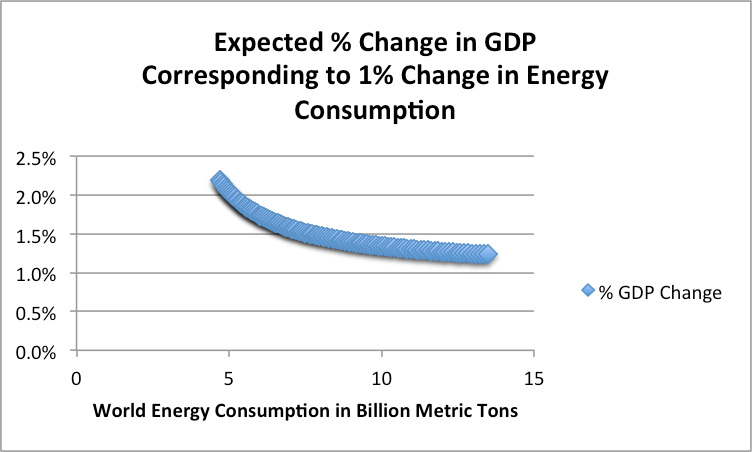
Figure 2. Expected change in GDP growth corresponding to 1% growth in total energy, based on Figure 1 fitted line.
To make matters worse, growth in world energy supply is generally trending downward as well. (This is not just oil supply whose growth is trending downward; this is oil plus everything else, including “renewables”.)

Figure 3. Three-year average percent change in world energy consumption, based on BP Statistical Review of World Energy 2014 data.
There would be no problem, if economic growth were something that we could simply walk away from with no harmful consequences. Unfortunately, we live in a world where there are only two options–win or lose. We can win in our contest against other species (especially microbes), or we can lose. Winning looks like economic growth; losing looks like financial collapse with huge loss of human population, perhaps to epidemics, because we cannot maintain our current economic system.
The symptoms of losing the game are the symptoms we are seeing today–low commodity prices (temporarily higher, but nowhere nearly high enough to maintain production), not enough jobs that pay well for common workers, and a lack of investment opportunities, because workers cannot afford the high prices of goods that would be required to provide adequate return on investment.
How We Have Won in Our Contest with Other Species–Early Efforts
The “secret formula” humans have had for winning in our competition against other species has been the use of supplemental energy, adding to the energy we get from food. There is a physics reason why this approach works: total population by all species is limited by available energy supply. Providing our own external energy supply was (and still is) a great work-around for this limitation. Even in the days of hunter-gatherers, humans used three times as much energy as could be obtained through food alone (Figure 4).

Figure 4
Earliest supplementation of food energy came by burning sticks and other biomass, starting one million years ago. Using this approach, humans were able to gain an advantage over other species in several ways:
- We were able to cook some of our food. This made a wider range of plants and animals suitable for food and made the nutrients from these foods more easily available to our bodies.
- Because less energy was needed for chewing and digesting, our bodies could put energy into growing a larger brain, thus giving us an advantage over other animals.
- The use of cooked food freed up time for such activities as hunting and making clothes, because less time was needed for chewing.
- Heat from burning plant material could be used to keep warm in cold areas, thereby extending our range and increasing the total human population that could be supported.
- Fire could be used to chase off predatory animals and hunt prey animals.
Our bodies are now adapted to the need for supplemental energy. Our teeth are smaller, and our jaws and digestive apparatus have shrunk in size, as our brain has grown. The large population of humans that are alive today could not survive without supplemental energy for many purposes, such as cooking food, heating homes, and fighting illnesses that spread when humans are in as close proximity as they are today.
Our Modern Formula For Winning the Battle Against Other Species
In my view, the formula that has allowed humans to keep winning the battle against other species is the following:
- Use increasing amounts of inexpensive supplemental energy to leverage human energy so that finished goods and services produced per worker rises each year.
- Pay for this system with debt, because (if supplemental energy costs are cheap enough), it is possible to repay the debt, plus the interest on the debt, with the additional goods and services made possible by the cheap additional energy.
- This system gradually becomes more complex to deal with problems that come with rising population and growing use of resources. However, if the output of goods per worker is growing rapidly enough, it should be possible to pay for the costs associated with this increased complexity, in addition to interest costs.
- The whole system “works” as long as the total quantity of finished goods and services rises rapidly enough that it can fund all of the following: (a) a rising standard of living for common workers so that they can afford increasing amounts of debt to buy more goods, (b) debt repayment, and interest on the debt of the system, and (c) an increasing amount of “overhead” in the form of government services, medical care, educational services, and salaries of high paid officials (in business as well as government). This overhead is needed to deal with the increasing complexity that comes with growth.
The formula for a growing economy is now failing. The rate of economic growth is falling, partly because energy supply is slowing (Figure 3), and partly because we need more and more growth of energy supply to produce a given amount of economic growth (Figure 2). With this lowered world economic growth, the amount of goods and services being produced is not rising fast enough to support all of the functions that it needs to cover: interest payments, growing wages of common workers, and growing “overhead” of a more complex society.
Some Reasons the Economic Growth Cycle is Now Failing
Let’s look at a few areas where we are reaching obstacles to this continued growth in final goods and services. An overarching problem is diminishing returns, which is reflected in increasingly higher prices of production.
1. Energy supplies are becoming more expensive to extract.
We extract the easiest to extract energy supplies first, and as these deplete, need to use the more expensive to extract energy supplies. We hear much about “growing efficiency” but, in fact, we are becoming less efficient in the production of energy supplies.
In the US, EIA data shows that we are becoming less efficient at coal production, in terms of coal production per worker hour (Figure 5).

Figure 5. US coal production per worker, on a Btu basis based on EIA data.
With oil, growing inefficiency is shown by the steeply rising cost of oil exploration and production since 1999 (Figure 6).

Figure 6. Figure by Steve Kopits of Douglas-Westwood showing trends in world oil exploration and production costs per barrel.
Thus, it is for a fairly recent period, namely the period since about 2000, that we have been encountering rising costs both for US coal and for worldwide oil extraction.
The extra workers and extra costs required for producing the same amount of energy counteract the tendency toward growth in the rest of the economy. This occurs because the rest of the economy must produce finished products with fewer workers and smaller quantities of resources as a result of the extra demands on these resources by the energy sector.
2. Other materials, besides energy products, are experiencing diminishing returns.
Other resources, such as metals and other minerals and fresh water, are also becoming increasingly expensive to extract. The issue with mineral ores is similar to that with fossil fuels. We start with a fixed amount of ores in good locations and with high mineral percentages. As we move to less desirable ores, both human labor and more energy products are required, making the extraction process less efficient.
With fresh water, the issue is likely to be a need for desalination or long distance transport, to satisfy the needs of a growing population. Workarounds again involve more human labor and more resource use, making the production of fresh water less efficient.
In both of these cases, growing inefficiency leaves the rest of the economy with less human energy and a smaller quantity of energy products to produce the finished goods and services that the economy needs.
3. Growing pollution is taking its toll.
Instead of just producing end products, we are increasingly finding ourselves fighting pollution. While this is a benefit to society, it really is only offsetting what would otherwise be a negative. Thus, it acts like an item of overhead, rather than producing economic growth.
From the point of view of workers having to pay for higher cost energy in order to fight pollution (say, substitution of a higher cost energy source, or paying for more pollution controls), the additional cost acts like a tax. Workers need to cut back on other expenditures to afford the pollution control workarounds. The effect is thus recessionary.
4. The amount of “overhead” to the world economy has been growing rapidly in recent years, for a number of reasons:
- The amount of overhead is growing because we are reaching natural barriers. For example, population per acre of arable land is growing, so we need more intensity of development to produce food for a rising population.
- With greater population density and increased bacterial antibiotic resistance, disease transmission becomes more of a problem.
- Increasing education is being encouraged, whether or not there are jobs available that will make use of that education. Education that cannot be used in a productive way to produce more goods and services can be considered a type of overhead for the economy. Educational expenses are frequently financed by debt. Repayment of this debt leads to a decrease in demand for other goods, such as new homes and vehicles.
- We have more elderly to whom we have promised benefits, because with the benefit of better nutrition and medical care, more people are living longer.
5. We are reaching debt limits.
As economic growth has slowed, we have been adding more and more debt, to try to mitigate the problem. This additional debt becomes a problem in many ways: (a) without cheap energy to leverage human labor, there are not many productive investments that can be made; (b) the addition of more debt leads to a need for more interest payments; and (c) at some point debt ratios become overwhelmingly high.
At least part of the slowdown in economic growth that we are seeing today is coming from a slowdown in the growth of debt. Without debt growth, it is hard to keep commodity prices high enough. Investment in new manufacturing plants is also affected by low growth in debt.
Reasons for Confusion in Understanding Our Current Predicament
1. Not understanding that all of the symptoms we are seeing today are manifestations of the same underlying “illness”.
Most analysts think that the economy has stubbed its toe and has a headache, rather than recognizing that it has a serious underlying illness.
2. Academia is focused way too narrowly, and tied too closely to what has been written before.
Academics, because of their need to write papers, focus on what previous papers have said. Unfortunately, previous papers have not understood the nature of our problem. Academics have developed models based on our situation when we were away from limits. The issues we are facing cover such diverse subjects as physics, geology, and finance. It is hard for academics to become knowledgeable in many areas at once.
3. Models that seemed to work before are no longer appropriate.
We take models like the familiar supply and demand model of economists and assume that they represent everlasting truths.

Figure 7. (Source Wikipedia). The price P of a product is determined by a balance between production at each price (supply S) and the desires of those with purchasing power at each price (demand D). The diagram shows a positive shift in demand from D1 to D2, resulting in an increase in price (P) and quantity sold (Q) of the product.
Unfortunately, as we get close to limits, things change. Both wage levels and debt levels have an impact on demand; the quantity of goods available is also affected by diminishing returns. The model that worked in the past may be totally inappropriate now.
Even a complex model like the climate change model being used by the IPCC is likely to be affected by financial limits. If near-term financial limits are to be expected, IPCC’s estimate of future carbon from fuels is likely to be too high. At a minimum, the findings of the IPCC need to be framed differently: climate change may be one of a number of problems facing those people who manage to survive a financial crash.
4. Too much wishful thinking.
Everyone would like to present a positive result, especially when grants are being given for academic research that will support some favorable finding.
A favorite form of wishful thinking is believing that higher costs of energy products will not be a problem. Higher cost energy products, whether they are renewable or not, are a problem for many reasons:
- They represent growing inefficiency in the economy. With growing inefficiency, we produce fewer finished goods and services per worker, not more.
- Countries using more of the higher cost types of energy become less competitive in the world market, and because of this, may develop financial problems. The countries most affected by the Great Recession were countries using a high percentage of oil in their energy mix.
- The amount workers have available to spend is limited. If a worker has $100 to spend on energy supply, he can buy 100 times as much in energy supplies priced at $1 as he can energy supplies priced at $100. This same principle works even if the cost difference is much lower–say $3.50 gallon vs. $3.00 gallon.
5. Too much faith in, “We pay each other’s wages.”
There is a common belief that growing inefficiency is OK; the wages we pay for unneeded education will work its way through the system as more wages for other workers.
Unfortunately, the real secret to economic growth is not paying each other’s wages; it is growing output of finished products per worker through increased use of cheap energy (and perhaps technology, to make this cheap energy useful).
Increased overhead for the system is not helpful.
6. An “upside down” peak oil story.
Most people in the peak oil community believe what economists say about supply and demand–namely, that oil prices will rise if there is a supply problem. They have not realized that in a networked economy, wages and prices are tightly linked. The way limits apply is not necessarily the way we expect. Limits may come through a lack of jobs that pay well, and because of this lack of jobs, inability to purchase products containing oil.
The connection between energy and jobs is clear. Good jobs require the use of energy, such as electricity and oil; lack of good-paying jobs is likely to be a manifestation of an inadequate supply of cheap energy. Also, high paying jobs are what allow rising buying power, and thus keep demand high. Thus, oil limits may appear as a demand problem, with low oil prices, rather than as a high oil price problem.
In my opinion, what we are seeing now is a manifestation of peak oil. It is just happening in an upside down way relative to what most were expecting.
Conclusion
One way of viewing our problem today is as a crisis of affordability. Young people cannot afford to start families or buy new homes because of a combination of the high cost of higher education (leading to debt), the high cost of fuel-efficient new cars (again leading to debt), the high cost of resale homes, and the relatively low wages paid to young workers. Even older workers often have an affordability problem. Many have found their wages stagnating or falling at the same time that the cost of healthcare, cars, electricity, and (until recently) oil rises. A recent Gallop Survey showed an increasing share of workers categorize themselves as “working class” rather than “middle class.”
It is this affordability crisis that is bringing the system down. Without adequate wages, the amount of debt that can be added to the system lags as well. It becomes impossible to keep prices of commodities up at a high enough level to encourage production of these commodities. Return on investment tends to be low for the same reason. Most researchers have not recognized these problems, because they are narrowly focused and assume that models that worked in the past will continue to work today.


How funny is this http://www.zerohedge.com/news/2015-05-14/saudis-declare-victory-over-shale-just-us-oil-production-jumps-bakken-wells-hit-reco
If there was ever any doubt about who runs the show then this should put that to bed.
The Saudis would have these figures. So whey could they make these asinine statements?
Of course what is happening here is what is known ad Peak Oil. It is the last gasp. And the orders are out to everyone – get as much oil onto the market as possible – keep BAU going as long as possible (but don’t tell the public this — give them spin and circuses)
Because the toxic blow-back of $100 oil can no longer be offset with QE ZIRP and other stimulus.
The oil industry is being eviscerated by these low oil prices which is all good because they have been unable to find any new oil that could be extracted at a reasonable price for quite some years now.
So we are hording as much grain right now because that is all the beast has to live on going forward. The famine is imminent.
Ghost factories of Greece:
http://widerimage.reuters.com/story/ghost-factories-of-greece
The postindustrial future of more and more countries, when the system implodes due to the lack of the cheap energy…
Pingback: Přehlížená energetická revoluce… | Trpasloj
The New Doomsteaf Diner Library is beginning to take shape. 🙂
I am working together with JS from OFW, a Librarian with his own large collections of material to develop the DB. We will hopefully have our catelog up soon, then gradually update with links ot material.
The Form for Submission works, I have tested it. However, if you have a large number of submissions to make, it’s better to create an Excel or Open Office file in the same format as the User Submission Table, and I can simply append them to the table en masse. You can send me the table as a File Attachment in Email. If you do not have my email addy, use the Contact Form on the Diner to contact me.
Be careful with submissions of video links in the Form. A full link will screw up the Formatting. Just drop in the ID Code for the vid.
Your submissions will NOT go up immediately. I will update the Table once a week or so as more submissions come in.
RE
Lots of good comments – always like Paul/TDG/Fast Eddy’s insight. Still, if one is interested in quickly moving to the front of the line to immediately understand how/why the world operates, two Germans & and an Italian spell it out quite nicely:
1862:
“Not through speeches and majority decisions will the great questions of the day be decided … but by iron and blood (Eisen und Blut).”
1886:
“Even the body within which individuals treat each other as equals … will have to be an incarnate will to power, it will strive to grow, spread, seize, become predominant — not from any morality or immorality but because it is living and because life simply is will to power.”
And before that, 1493:
The people of this island and of all the other islands which I have found and of which I have information, all go naked, men and women, as their mothers bore them, although some of the women cover a single place with the leaf of a plant or with a net of cotton which they make for the purpose. They have no iron or steel or weapons, nor are they fitted to use them.
…
As soon as I arrived in the Indies, in the first island which I found, I took some of the natives by force, in order that they might learn and might give me information of whatever there is in these parts. And so it was that they soon understood us, and we them, either by speech or by signs, and they have been very serviceable.
…
I have taken possession of all for their Highnesses, and all are more richly endowed than I know how or am able to say, and I hold all for their Highnesses, so that they may dispose of them as they do of the kingdoms of Castile and as absolutely. But especially, in this Espanola, in the situation most convenient and in the best position for the mines of gold and for all trade as well with the mainland here as with that there, belonging to the Grand Khan, where will be great trade and profit, I have taken possession of a large town…
—
As PT Barnum so eloquently asked “Why give a sucker an even break?” So too the general public, utterly manipulated & controlled with the ingenious canard of ‘self government’. But why agonize, debate or continuously analyze reality when one can simply join in on the action, if only a free-rider?
That’s what I don’t get about this place – just walk away and use your knowledge to your advantage.
I guess the point I’m trying to make is: don’t worry, be happy. Of course civilization was always, from the very get-go, entirely unsustainable, so why cry over spilt milk?. At its core, human civilization is really based on fire. All we’ve done over millennia is to develop mechanical tools that utilized different sources of carbon fuels – living or fossil. And, since we live on a finite planet … well, you get the picture. No fuel, no fire, just like no tickie, no washie.
So too electricity; a simple discovery of current created when mixing a chemical solution (originally brine, now sulfuric acid) and metal (originally copper, now lead). Then Faraday and others got clever and figured out a spinning electro- magnet could create constant current. However, battery technology is essentially unchanged (differing only really in materials), and of course those spinning magnets consume energy. Even hydro takes untold barrels of fossil fuels to build in the first place.
Humanity really hasn’t moved beyond fire and chemical reaction. There is no technology to alter the basic physics of the underlying situation. (Kuntsler covers the notion that technology is separate from energy in “Too much magic”.) Therefore, there is NO solution.
Now, where does that put us? Yes, it’s pretty obvious, even moreso if one can isolate their emotional, belief driven ego from their rationale self so as to not interfere with objective fact. Once you clearly understand the end point, all that is left is how to play the middle game during the journey. And that’s what I’m always advocating: if you get it, why waste time contemplating/debating, when you can be having fun engaging in real time?
Well, nuclear energy is different than either of those, but that’s just picking nits. I agree with your major premise, that we should be “having fun engaging in real time.”
It only stops being fun when you take it too seriously. Pain is; suffering is optional.
Sensible advice.
Although it is difficult to truly have fun when you know that life is going to almost certainly be cut short by decades and you wake up with a a death sentence is hanging over you every morning.
No?
A friend of mine who follows and understands this story recently said to me ‘every time I think about this I find myself getting very stressed out – so I try not to’
In the meantime he is trying to convert to the religion of the solar god recently asking what I think of the new Tesla battery. The atheist in him always wins out though (unfortunately)
What you say is true regardless of our situation, although the odds may change. You could get drilled through the skull with a meteorite or a bolt that comes loose off an airliner. Ain’t none of us gonna get outa this alive, so why worry about the specifics?
Pick up a book by Ekhart Tolle or Thich Nhat Hahn and learn to live in the now.
Jan – I think there are some differences.
I don’t wake up every morning wondering if today is the day a meteorite hits me in the head because the odds of that are close to zero.
I do wake up most mornings – and there is not a day goes by – that I wonder if today is the day civilization collapses.
I am intrigued by (as one is by a traffic pile up) yet I dread that day.
Imagine the electricity goes off forever, the car has its last tank of gas, the shops are quickly emptied of food, security breaks down. Effectively all the comforts of modern civilization are wiped out, almost overnight.
I imagine looking across the valley as I do most evenings, and the small town near the sea no longer twinkles in the night.
On one hand it is difficult to believe that this could happen. Yet it is going to happen.
Kinda like nerves before a big game — only the stakes are so much higher. Into the abyss….
Jan
Or Francis Bacon, Lord Verulam:
‘Sufficient for the day is the evill thereof…. For we ought to be daies-men, and not to morrowes men, considering the shortness of our time…Laying hold on the present day: for future thinges shall in their turnes become present: therefore the care of the present sufficeth.’
From ‘On the Moderation of Cares’ in his ‘Essayes’.
Hate to break it to you Fast Eddy, but every single one of us has a death sentence, good times or not.
And guess what…if you survive middle age, you have the glories of old age to come: diminished sight and hearing, painful bones, mind and body slowing down, adult children tired of you, grandchildren ignore you, friends dying off, incontinence of urine and stool, medical care bankrupting you, fraudsters stealing your money, and finally being taken care of by underpaid, incompetent workers in a nursing home, until you finally get a heart attack or stroke.
But, then again I may be too pessimistic. Maybe money printing and Tesla and Obamacare and bombing the Middle East and organic apples are going to save us all.
If I were pushing past 65 I wouldn’t give a damn.
But I was counting on at least 25 years more of active living– and I’ll be lucky to get 2.
The only consolation is that I have known this is coming for a number of years now so have done a fair bit of bucket listing.
I envy the sheeple who have not a clue what is coming their way. Or those who are able to convince themselves that collapse will not be so bad.
Lucky if you get two? If that’s the case, pick a date by which time you’re sure it will be over, and then if or when that day arrives count all the rest of your days as holidays. For extra points, make your initial day today. Why waste any more than necessary.
Worrying about the inevitable is a tragic waste of time. If or when it gets that bad I plan to exercise the “early out option” by whatever means are at hand.
I’ve been doing that on a regular basis since 2008… an endless bucket list.
That will not make up for the 3+ decades I am going to lose.
Quite right 9K9
And we still live in caves, of a sort, to shelter us on the face of a cruel planet.
And use slaves, although at very great distance from us if we live at the centre of the Empire of Exploitation which is the ‘advanced’ economies.
I happen to be an engineer. Engineers are driven to fix things. Gail makes the case that we are in for an awful time. Is there a group here or elsewhere who is interested in trying to solve the problems?
I’m just one person, and I like to solve problems. See my comment just above this.
I can’t see many of the comments. I think Word press can’t deal with that many. However, if you are interested in working on this project (and it can use all skills sets) then it might be worth commenting here: https://groups.google.com/forum/?utm_source=digest&utm_medium=email/#!forum/power-satellite-economics
I don’t think a techno-fix is in the cards for us.
As energy declines, so shall technology. If we’re lucky, we may still have rotary dial phones in twenty years. Or ox carts. Certainly not solar panels in orbit, beaming power down to earth via microwaves.
Jan, you might be right. If you are, and we don’t build power satellites or some other major source of energy, an awful high fraction of the human race will die, and as a bet, the radiation level will be rather high. If you had a choice between the ox cart world and one with abundant energy, which would you pick? If abundant energy, is your choice, would you do anything to help make it happen?
The horror on the thought of abundant unlimate energy and what the homo consumptionians would do with it…utter destruction!
I would choose the ox cart, and I am doing everything in my power (which isn’t saying much) to keep “abundant energy” from happening.
“Abundant energy” is the problem, not the solution. It has allowed us to co-opt an unreasonable amount of the planet’s resources. “Abundant energy” will not put more copper, molybdenum, or rare earths into the ground. “Abundant energy” will not replete depleted soils. “Abundant energy” will not clean up the ocean dead zones around the mouths of rivers that are awash in artificial fertilizer, itself produced via “abundant energy.”
Humans must learn to live within their natural energy budget: a small portion of the amount of sunlight gathered by photosynthesis. (A large portion must be left to other creatures.)
I see the point but we are many thousands of miles past the point of no return on this.
There is no way to return to the ox cart now that we have 7 billion + people on the planet without an apocalypse of starvation, disease, and violence. 99%+ of all people haven’t the skills to return to the ox cart. There is also the issue the nuclear monstrosities that won’t be manageable post collapse.
I would much rather kick the can if possible with some new found energy source allowing BAU to continue a few more decades or so.
I have no desire to living in a world that resembles ‘The Road’
That’s just my survival instinct talking…
I agree that there is no solution for over seven billion people.
A war can solve the problem. This is what TPTB were doing all over history. Everytime there was a change on the position of hegemon it ended with a war:
Spain (XVI-mid XVII century) -> wars all over Europe every 10-15 years -> France (second half of XVII century) -> 1800-1815 Napolenic Wars -> Great Britain (XIX century) -> (1914-1945) WWI & WWII -> USA (2nd half of XX century) ->… now its time for China, I guess. The change would be bloody, though. Hegemon can’t stop reigning peacefully. “American way of life is unnegotiable”, as one guy said. This time we have A-bombs. It changes the game.
Well there are less posibilities of survival for 7billion when only 1 billion consume what the other 6 billion consume together, and even if we could wipe out those selfish wealthy 1 billion there is potential and willingness on the other 6 billion to become as rich, it is either we learn to share and live bound by our physical capabilities or collapse and learn to live within our physical limits, the smooth decline or the fast collapse.
7 Billion+ hungry people – what will they do?
Let’s take a peak at when overpopulation because a crisis:
Stanford professor Paul Ehrlich made headlines last month when he told journalists that overpopulation and resource scarcity would eventually drive hungry humans to cannibalism. Sensational as that sounds, it’s an old idea: Anthropologist Marvin Harris argued in his 1977 Cannibals and Kings that cannibalism has historically facilitated human population expansion by providing an important source of protein.
http://www.newrepublic.com/article/118252/cannibalism-and-overpopulation-how-amazon-tribe-ate-their-dead
Thousands of miles away on the island of Borneo, native groups are engaged in a far more gruesome conflict, one that – according to British and Asian news reports – includes widespread incidents of headhunting and cannibalism.
After decades of uninformed government policies and economic hardships, these people are resorting to violence.
Reports from British and Asian news correspondents describe machete-wielding gangs of Dayak and Malay men – indigenous peoples of the island – attacking and slaughtering Madurese villagers. Despite the grisly details of these accounts, this would seem yet another example of ethnic crimes such as those seen in Bosnia and Kosovo.
But Schneider asserts that the killings in Borneo are motivated by more than ethnic or religious differences. Instead, the violence represents a combination of traditional practices with long-standing resentment, complicated by the strain of economic decay, land disputes, unfair government policies and overpopulation.
http://www.newswise.com/articles/headhunting-cannibalism-return-to-borneo
I can hear it now — those don’t count because they are savages. We are not savages! We are Europeans, we are civilized!
Europe’s Hypocritical History of Cannibalism
From prehistory to the present with many episodes in between, the region has a surprisingly meaty history of humans eating humans
References to acts of cannibalism are sprinkled throughout many religious and historical documents, such as reports of cooked human flesh being sold in 11th-century English markets during times of famine. Here, an engraving by Theodor de Bry depicts hungry Spaniards cutting down the bodies of thieves hanged by Pedro de Mendoza in order to eat them.
More: http://www.smithsonianmag.com/history/europes-hypocritical-history-of-cannibalism-42642371/?no-ist
Industrial farming is massively reliant on oil and gas to create fertilizers and pesticides. When they are no longer available the soil will require years of organic inputs to repair it.
Also consider how much ag land is reliant on electric pumps for irrigation. Take for instance the vast majority of California’s crops.
As we see from the examples above, when there is not enough food humans have frequently resorted to eating each other.
The only reason we have 7 billion people is because we have oil which has allowed us to feed them.
When the oil stops flowing that will kick off the mother of famines — and it will be global — and there will be no aid agencies to help.
“The horror on the thought of abundant unlimate energy and what the homo consumptionians would do with it…utter destruction”
spot on
This isn’t the first time I have talked about power satellites as a way to cope with energy, carbon etc. and it is not the first time I have seen people who seem to prefer a massive die off as more desirable than solving the problems. The first time I brought up the subject on the oil drum I got similar flack, from what may be the very same people. It got so bad that another blog commented
“If you take a few minutes to read this blog, and again the comments, you find the dissonance on full display. On the one hand you have a person saying that there may be an energy answer after fossil fuels. On the other hand you have lots of people not only saying it is not possible, but directly arguing that a human die-back is more desirable than cheap energy.”
http://www.futurist.com/2009/06/15/energy-and-the-future-space-based-pow…
The very first time I ran into this attitude was in 1975 when Dr. Peter Vajk and his crew was almost thrown out of a Limits to Growth conference in Houston. They really didn’t want to hear about solutions. I am sorry you hate people you don’t know to such a degree that you oppose ideas that might let them live beyond the end of fossil fuels.
Keith – I think you are beginning to lose it…
I think most people here would love a solution that kicks the can. I certainly would.
I do not want to be scraping bark of trees and tearing at grass to make a salad for dinner.
The thing is — we have been chasing ‘Beyond Petroleum’ for many years now. Hundreds of billions have been invested into various schemes including solar, wind, thorium, biofuels, nuclear etc….
You most definitely cannot say we have not tried.
And we have failed.
And while I can understand that you and others do not want to give up hope but let’s be frank – time is short — and there is not a single technology that is going to extend this game.
Look at shale — we are so desperate that we are scraping the bottom of a grimy barrel to squeeze out a few more years.
If there were better options — more feasible options — we would be pursuing them.
The PTB love their yachts and private jets and Champagne and caviar — the love power – do you not think that if there were other options they’d print a few more trillion and throw that money at them?
This is not a Hollywood movie – the hero is not going to arrive to save the day at the last moment.
You need to accept this Keith. There is no way out.
There’s the kick-the-can-down-road scenario. (which I gather GT sees as the best among hideous choices?) And there’s returning to the ox cart. To me, they both appear to be joined at the hip.
— There are no ox carts left (maybe Cuba got the last ones).
— Nobody knows how to build ox carts, and the materials to build them are badly depleted.
— Worst of all, 90% of the people believe in progress, and shun even yesterday’s technology like the plague.
— Therefore there is absent the common sense required to maintain and educate about old technology even while using the new.
— We have to fight like the devil to introduce some common sense (and sense of crisis) among the many to make any headway toward refurbishing the old. The odds are not on our side.
Don’t have time to try and clarify this even to myself. But for now, it seems that I’m leaning toward BAU in as sensitive and thoughtful a way as possible. (It looks to me that this might make a positive though not determinative difference–nothing appears on the horizon to do that.) Meanwhile, putting heart and soul into “long term” strategies to live fossil free on as large a scale as humanly possible. My two very inadequate cents. Back to this later.
Dear Artleads
I seem to remember that you are an artist. If so, I have a challenge for you.
This is from Ten Windows, by Jane Hirshfield, the poet and essayist:
‘Fabric, whether of material or mind, is an interwoven invention: some substance–silk or cotton, wool or image–made stronger, larger than itself, by the dual-natured meeting of warp threat and weft thread. A work of art holds our lives as they are known when fully engaged with the multiple, crossing experience-strands of self, language, culture, emotion, senses, and mind.’
I will argue that any weaver, or person who simply used woven material, a hundred years ago had a very good grasp on what the weaving process, the warp and the weft, did to relatively fragile raw materials. They might not have been able to solve the mathematical equations on the distribution of stress, but they had a muscle memory of how it worked. And they had a word for the result: fabric.
One of our current problems is that we have no words to describe many of the phenomena that science reveals to us. For example, take the question of whether the denizens of the soil food web ‘cooperate’ or ‘compete’ with each other. We can see that, at the level of the individual, life is red in tooth and claw. But looked at from the perspective of soil science, we can also see that the food web itself is in service to a larger purpose…let’s call it Gaia or Gardening. I have remarked on my inability to use a single word to describe what the relationships are. I have done my best to describe them in a paragraph, but perhaps everything would become clearer if we had some word analogous to ‘fabric’, implying a warp and a woof, to describe the relationships. Condensation of meaning is frequently a good cognitive strategy.
At a level higher than the individual, both Mobus and Kalton and Capra and Luisi explain that they are going to have to do a lot of cross-referencing because the relationships are not linear. The non-linearity requires the spilling of lots of ink and makes it necessary to shift a lot of gears.
It’s also true that our ability to perceive is limited by our physical experiences. A boy who was born blind was enabled to see at about the age of 8 years, with surgery. When the doctors asked him what he could see, he said he couldn’t see anything. The doctors moved their hands in front of his eyes…still nothing. It was only when the boy reached out and touched the moving hand that he was able to make the connection between moving his own hand and the light image forming on his retina.
What is the equivalent of the boy touching the moving hand in terms of understanding the realities of our complex world? How could that be codified in some artistic reaching out?
Don Stewart
Dear Artleads
Also see Kurt Cobb’s article today:
http://resourceinsights.blogspot.com/2015/05/stephen-toulmin-welcomes-you-to-end-of.html
Don Stewart
Thanks, Don. I thoroughly enjoyed the article, as I do your posts. As to finding words to describe the complex, I seem to be of little help. What I would aspire to instead is to use my limited vocabulary with poetic license. I want to communicate to people, and people are almost exclusively guided by emotion. (Politicians know this well.) So I use words mostly for their emotional impact. Lame as may be the results, I try to use words as if I were writing prose poetry. 🙂
OTOH, “fabric” is a very useful word. For instance, it’s used very effectively to describe the sweep of the built environment…
Dear Artleads
This exchange got me to thinking about a specific art project. Imagine 4 glass boxes, about a cubic foot each. Lined up on a table. At the beginning of the table is a simple thermometer, which shows the air temperature (perhaps 85 degrees F). The first glass box is adjusted to a carbon dioxide level of 250 ppm, and contains a thermometer. The thermometer reading will reflect the stable state of the solar insolation and the loss of heat through the glass (perhaps 95 degrees F). The second glass box is adjusted to a carbon dioxide level of 350 ppm, and reads perhaps 105 degrees F. The third glass box is adjusted to a carbon dioxide level of 450 ppm, and reads perhaps 115 degrees F. The fourth glass box is adjusted to a carbon dioxide level of 550 ppm, and reads perhaps 125 degrees F.
The boxes begin the day containing a mix of small plants and animals. At the end of the day, the boxes with the high levels of carbon dioxide will contain dead plants and animals.
Put the boxes outside, perhaps, churches and city hall and office buildings.
Something like this has been done in the scientific literature, by simply correlating temperature to carbon dioxide levels. But the adjustment of the temperature to changes in the carbon dioxide level takes centuries. My little art project condenses the time frame to a few hours.
Do you think it would prompt anyone to actually think?
Don Stewart
Thanks for the glass-box examples, Don. Abstractly considered, the idea is elegant. The technology to furnish/equip the boxes would add considerable difficulty, as would the social/psychological technology as to how/when/where to apply the lesson. Schools, certainly. And students would help build and equip the boxes and be enjoined to think about them (various aspects of the project), reaching their own conclusions. The lesson, then, could be enormously broad–an entire semester’s worth of project…
As your Tuolmin article says, you can’t do just one thing. But if you can’t do just one thing, and must work with the entire system, how do you get a grip on a system that is like a greased pole?
As you know, we are dealing with complexity that defies thought and ability to organize (linguistically or otherwise). I find I must get down to essences. The best I can come up with is governed-space-as-system. Governed space–village, town, city, county, etc.,–can perhaps be seen as sub-systems within greater systems. They are governed by such tools as community plans, ordinances, general plans, community supervisors, city councils, etc.. What is the smallest governed-space unit here you live?
I was recently appointed to the water board where I live. Right away I get into trouble. Nobody understands the positions I take. I am alone–not a pleasant sensation. The pump for the community well is old and must be replaced. They are contemplating a sophisticated computerized system that costs a lot but does marvelous things. I ask that we consider replicating the old pump, and even consider a hand pump. They keep talking about keeping up with the times. They are obligated to do a 40 year plan for the water system that considers such emergencies as terrorism. They roll their eyes and suggest writing in something about alien visitation, since it is all so ridiculous. While everybody knows we’re in a drought, attributing any of it to climate change is doubtful. They apparently don’t see the limits of the environment or of the economic system. I thought of quitting, but will attend at least one more meeting.
What does collapse look like?
Fast Eddy this ones for you
Pictures of Greece, gutted out.
http://widerimage.reuters.com/story/ghost-factories-of-greece
From the peak to the fall
Buildings sitting there rusting away. But aside from the fact that I like rust and decay, these structures represent huge amounts of embedded energy. Not using them in some way–for housing or new forms of enterprise–is wasteful.
Wabi Sabi the love of rust and decay via Japan
Rule of Thumb 2: When a bad number is released assume the number is far worse.
Seldom can you find the proof though. This is one time.
Q2 GDP Forecast Cut To 0.7% By Atlanta Fed http://www.zerohedge.com/news/2015-05-13/q2-gdp-forecast-cut-07-atlanta-fed
The US Is In Recession According To These 7 Charts http://www.zerohedge.com/news/2015-05-13/us-recession-according-these-7-charts
Hot off the press
http://www.utilitydive.com/news/how-to-get-to-a-solar-based-future-according-to-mit/396080/
even MIT says
“Only significant breakthroughs in solar technology will solve problems in cost, scaling, and intermittency that currently are preventing it from becoming the dominant global electricity provider, the study reports.”
and that is just electric no mention of transport, farm, chemical stocks!!!
Lots of hopes and ifs in that article.
t pretty much confirms what the google engineers said the only difference is that the google investment was private money and private money recognizes a dud and cuts losses.
MIT is asking for yet more government subsidies to continue flogging a dead horse. That is the problem with using other people’s money (taxpayers) — you don’t care if your experiment makes sense because it costs you nothing to play around in your lab. And it keeps you in a job ideally forever.
I can agree on one thing – the future is most definitely solar – just as the past was. Solar in that the sun will shine, plants will grow and the planet will be warmed.
A solar powered modern civilization is 100% impossible. The world as we know it could never be run on solar panels and batteries. Never.
Thanks for your analysis. The big picture perspective gives the impression of both accuracy and insight. Keep up the good work
BEIJING: Retail sales growth in China fell to 10.0 percent in April, authorities in the world’s second-largest economy said Wednesday, missing expectations and the lowest for nine years.
Read more at: http://economictimes.indiatimes.com/articleshow/47263655.cms?utm_source=contentofinterest&utm_medium=text&utm_campaign=cppst
More evidence that the commodities glut is caused by lack of demand.
China was the driver for 6 years and it is faltering badly. And there is no one to hand the baton off to because all other countries are already hollowed out.
What desperate measures will we see next from the central banks to create more faux growth?
Forgot to mention
Rule of Thumb Two: When a negative result is published assume the real numbers are far worse. I am not buying this 10% nonsense.
Gail, from the latest by Herman Daly:
“When the entropic throughput becomes too large it overwhelms either the regenerative capacity of nature’s sources, or the assimilative capacity of nature’s sinks. That is the main signal that we no longer live in the empty world but now inhabit a full world. Natural resource flows are now the scarce factor, and labor and capital stocks are now relatively abundant. The basic pattern of scarcity has been reversed by a century of growth.” Page 4 in
http://www.worldeconomicsassociation.org/downloads/essays-against-growthism/
Sounds like a short answer to the question in your title for this post.
And another question: Table 9 at http://www.eia.gov/forecasts/aeo/er/early_intensity.cfm (http://www.eia.gov/forecasts/aeo/er/images/figure_9es-lg.png) indicates a good trend (lower energy per unit of economic activity). Is it inaccurate or am I misreading it?
And here we have a preview of the Post – Carbon world is going to look like.
The thing is the police will not be there with their riot gear to stop this. And those with a propensity for violence who are kept under control by the police – well those people are going to be on the loose.
Did someone say they couldn’t wait for the ‘post collapse adventure’ You may want to reconsider after watching this:
Can you spell Constantinople? It lasted a millennium after the fall of Rome. It has only been sacked twice (by the Crusaders and the Turks), and was the capital of Turkey till 1922 and still is the largest city of Europe (although some people try to not include Turkey as Europe).
It is very defensible and well connected thru the sea.
Same as New York, which will be the last refugee of many of the world’s rich and famous.
And how will these elites in their 100 million dollar penthouses get water? How will they get rid of their sewage? What will they eat when the fine food shops empty?
You seriously are living in some sort of la-la land and have not the slightest understanding of what the end of oil means.
Fast, the underground aqueducts from the Catskill Mountains to Manhattan will supply water. The organic farmers of up state that love to supply Manhattan with over priced meat and veggies will be protected by the huge state police force. The trains and river will continue to provide transport of food just as in the last 300 years. Sewage will continue to go where it has always gone far, 50 miles, out in the Atlantic.
A better question is what is the “final solution” for the residences of The Bronx, Staten Island, Queens and Brooklyn.
Water and sewage need pumps. Pumps need electricity and spare parts.
Police protecting people? Really? Have you looked at what is happening to the US police forces? When collapse comes they will be out for themselves and they will be knocking down Jamie Dimon’s door and looting his wine cellar.
Time to throw the normalcy bias out the window – along with the white picket fence and please thank you.
That world is about to end. Chaos and mayhem will replace it
Bit slow this morning… just realizing your post was tongue in cheek 🙂
That’s not as hard as it appears. Maintaining a few hundred people in luxury does not require too much energy.
Kulm, let us not forget the long history of fraternity between NYC and Paris. These two city will maintain the Atlantic community of high culture, civilization, and arts and sciences. As the English sadly starve on their little island, as the warm Mediterranean nations return to a slower and happier lifestyle, as Canada freezes and returns to fur trapping.
I’m so glad that there are no blacks in my country.
I know just what you mean! Native Americans would have been so glad not to get all those whites in their country!
And before “native” Americans, there were bufflos and other species 15000 years ago. Every one comes from somewhere. Homo sapiens comes from Central Africa, where it was born into philogenetic taxonomy/genetic tree.
ktos – I bet that Iraqi’s are wishing Americans had never come to their country. Likewise the people of Ukraine, Syria, Libya, Venezuela, Egypt, Yemen, etc etc etc…
One fact I find most interesting in the videos is the complete lack of tool ownership by the vandals. Not one brought one of those small easy to use auto window breaking tools or simply a sharp rock. To me this represents zero planning, zero foresight and the conclusion they will never get anything.
It would appear that they are getting what they want. Attacking a system that they feel hard done by.
It all started with slavery and let’s not fool ourselves – for the most part the blacks have never been embraced by most of society in the US. Racism remains rampant.
A good friend of mine (black American) had this comment about the spate of brutal police videos:
‘There is nothing new here. This has always been happening. The only difference is that people know have phones with video recorders’
The thing is, there is a huge amount of pent up hatred in this community. And the more they lash out, the more the rest of the community resents them. As the economy sinks this will worsen. Then when it collapses and anarchy reigns the fireworks will really kick off.
Throw in millions of hardened criminals with many millions of high powered weapons who will be on the loose – and you’ve got yourself an adventure scenario that even Rambo would have trouble with.
This is not a boy scout weekend outing. This is a nightmare that is brewing
Nothing to fear from urban mobs. A few choppers will easily take care of them.
Another issue, but this demonstrates how you can trust NOTHING that comes governments and their MSM minions:
Seymour Hersh Details Explosive Story on Bin Laden Killing & Responds to White House, Media Backlash
http://www.democracynow.org/2015/5/12/seymour_hersh_details_explosive_story_on
Seems Seymour is no longer to be trusted either!
Hersh Did Not Break Bin Laden Cover Up Story
http://www.thespywhobilledme.com/the_spy_who_billed_me/2015/05/hersh-did-not-break-bin-laden-cover-up-story.html
There is the issue of the fact that Bin Laden was supposedly already dead in 2001 as stated by Benazir Bhutto (she was killed shortly after)
Refer to the comment at the 2:14 mark: https://www.youtube.com/watch?v=UlV8_etiaqk
Finite World plagiarized http://www.smarteranalyst.com/2015/05/12/why-is-there-an-oversupply-of-everything-from-oil-labor-to-capital/
There will be no more crashes and BAU will rule supreme, although it won’t help most of the humanity.
>Yaawn been reading these doom and gloom predictions since 2009
>Although the doom & gloom media makes it seem like financial crisis are a common occurrence, there have only been two major crisis (1929 & 2008) in the United Sates over the past 100 years, with an 80-year gap between them. That should give you an idea of how rare they are.
Too big to fail policy such as TARP has been a success though. Eight years later, and still not the slightest hint of trouble in the financial sector. In fact, with stricter lending standards, less leverage, and fatter balance sheets, thing are better than they have ever been.
So I would not be losing sleep over a meltdown, although the financial media whose job it is to scare people for ad revenue will try to make you sell your stocks into irrational panic.
>Low rates are sustainable and are a function of insatiable demand for US debt as part of a global ‘flight to safety’ and ‘hunt for yield’. Europe’s QE is helping to push the rates on 10-30 year German bonds close to zero, so money in search of yield is flowing into US bonds that offer a higher yield. Emerging market debt is too risky and tends to have negative inflation adjusted return despite high nominal yields. Also, the left ignores how the Savings and Loan Crisis was caused by rates being too high, not to low, so it’s not like you can squarely blame all crisis on low interest rates. Paul Volcker, who is a hero to the left for raising rates in the late 70’s during his disastrous tenure as fed chairman and then later attacking bankers as an adviser to Obama, caused the crisis.
>There is also a ‘recency bias’ in play in that it’s understandable for people to believe that because a crisis happened just six years ago, there will likely be another one, as the first crisis is still fresh in people’s memories. However, recency is not proof or evidence that there will be another crisis. It’s like predicting immediately after the sinking of the Titanic there will be more disasters like or worse than the Titanic, when in fact, the opposite happened and ocean liners became safer due to increased safety measures and improved technology, and a century later there has yet to be an American or Great Britain civilian peace time maritime disaster as bad as the Titanic. Or, citing America’s then recent use of nuclear weapons against Japan in WW2, predicting nuclear warfare during the Cold War. But despite nuclear proliferation and the one-time use of nuclear weapons, there has yet to be nuclear war.
>The financial media needs to focus on its main priority which is reporting the news instead of front-running crisis, but I guess if there isn’t an actual crisis the alternative is to try conjure one out of thin air.
That guy believes the ’emerging markets’ will not be pretty, except China which has high-IQ people.
Pingback: Ett par läsvärda blogginlägg | Förändringens tid
I’m grateful for the exceedingly clear and understandable statement below:
“What happens is that economic growth eventually runs into limits. Many people have assumed that these limits would be marked by high prices and excessive demand for goods. In my view, the issue is precisely the opposite one: Limits to growth are instead marked by low prices and inadequate demand. Common workers can no longer afford to buy the goods and services that the economy produces, because of inadequate wage growth. The price of all commodities drops, because of lower demand by workers. Furthermore, investors can no longer find investments that provide an adequate return on capital, because prices for finished goods are pulled down by the low demand of workers with inadequate wages.”
But didn’t growth in fact end with screaming high prices — see $147 oil in 2008.
In my mind, that end of growth was effectively reached soon after July 11, 2008 when oil reached a record price — and within a month or so, the economy was collapsing i.e. growth was, for all intents and purposes, over.
And what we have had for 6+ years are desperate attempts to hold off complete collapse by introducing financial gimmicks.
Dear Gail and Finite Worlders
I would like to pull two completely separate writings by two different authors together to see if we can make some sense of what is happening in the world, and perhaps get some basis for speculating about the future.
The first writing is part of Kelly McGonigal’s conclusion to The Upside of Stress:
‘Think about the mindset exercises and strategies described in this book. Choosing to remember your most important values so that it is easier to find the meaning in everyday stress. Having open and honest conversations about your struggles so that you feel less alone in your suffering. Viewing your body’s stress response as a resource so that you can trust yourself to handle the pressure and rise to the challenge. Going out of your way to help someone else so that you can access the biology of hope and courage. Not only are these strategies accessible, BUT THEY ALSO DON’T REQUIRE YOU TO ACHIEVE THE ONE THING THAT MOST PEOPLE THINK THEY NEED TO DO, BUT THAT TURNS OUT TO BE AN IMPOSSIBLE AND SELF DESTRUCTIVE GOAL: TO AVOID STRESS. (my emphasis)
The science also tells us that stress is most likely to be harmful when three things are true:
*You feel inadequate to it
*It isolates you from others
*It feels utterly meaningless and against your will
When you view stress as inevitably harmful and something to avoid, you become more likely to feel all of these things…When I committed myself to the process of embracing stress, I didn’t anticipate the biggest way it would affect my everyday experience of life…I started to feel a flood of gratitude in situations I would also describe as highly stressful….
I trust that what you most needed to hear, you will remember…in the heart, where they encourage you, inspire you, and change how you see yourself and the world.’
My summary: denying stress or fleeing from stress are dead-end strategies. Accepting stress for what it is, skillfully managing the biological form that stress reactions take in our body, and being grateful for the adaptive gifts that the stress reactions confer on us is the path to health.
Now I want to reccomend the second piece of reading. Dmitry Orlov’s account of the recent celebration in Moscow of the end of the WWII in Europe:
http://cluborlov.blogspot.com/2015/05/americas-achilles-heel.html
I want you to pay attention to a few points:
*Note that the Buddhist government official uses Christian symbolism, and hymns are sung. This is consistent with a Challenge response to stress.
*Note the similarities between Putin’s speech and Churchill’s speech after Dunkirk. Neither promises a stress-free way forward. The Evil must be confronted with ‘blood, sweat, and tears’. In Moscow, millions of people called to mind the sacrifices of their parents and grandparents. It wasn’t a shopping day.
I first became really aware of the ‘sacrifice’ angle when I went to a piano concert with performance by a Russian pianist here in Chapel Hill. She gave us a little talk before she played about the horrific number of dead in the Soviet Union from WWII. Later, I saw videos of some monuments near Leningrad (St. Petersburg) which simply listed the names of the Soviet officers who had died in the battles there. Putin is calling that to mind, in his efforts to give Russians and other friendly countries something to stand against: the destruction of country after country by US intervention.
If I look at the position of the US government and the Main Stream Media, it is that ‘everything is awesome…please go shopping’. I would say that the government and media are doing precisely what Kelly McGonigal warns us against.
My comments are not a prediction that Russia and China and other friendly countries will succeed. The US may be able to leverage Ukraine into a nuclear conflagration, in which we all lose. Or the US may somehow strangle everyone who doesn’t toe the official line. I’m not a seer. But I think that the ‘McGonigal strategy’ being pursued by Putin versus the denial strategy of Obama and the media offers us a useful way to look at things.
Don Stewart
I think this celebration of the Victory Day in Moscow was a very strong and clear message to “the West”.
Out of sheer curiosity, I checked if all the leaders of the “BRICS” were attending, and found out that the only absent was Dilma Rousseff, who said she couldn’t come because she was long booked for the wedding of her physician.
http://sputniknews.com/politics/20150510/1021946273.html
Obviously the 70th anniversary of WWII was totally unexpected at that date.
It certainly was a message to the West!
A Russian friend tells me that the mood in Moscow (he was there during the commemoration) was very positive: people who at first were quite scared of the US-led sanctions have adjusted to them, and the spirit is one of defiance to the West and national pride. The annexation of the Crimea is universally seen as an admirable move by Putin, too long delayed.
Business is also booming for importers of food from countries not participating in the sanctions, -buying from Brazil, Argentina, etc – as average Russians adapt to a lower living standard, which is still higher than the dark years (when my friend dug a lot of potatoes!) They were in any case moving away from trade with the EU. Not being able to holiday in the EU is regretted, but they feel it won’t exactly kill them.
So far, Putin is holding it together. The Russian national idea is remarkably resilient and grossly under-estimated by the US planners.
Pingback: Piekolie nieuwsupdate: week 19 | Stichting Peakoil Nederland
THE NEW DOOMSTEAD DINER LIBRARY CATALOG
I have added a new Page on the Diner for Library Information of important collapse resources.
Contributions of resource material to the Library are WELCOME!
RE
http://www.telegraph.co.uk/finance/oilprices/11598230/Big-banks-flag-dangers-of-financial-bubble-in-oil-and-commodities.html
Difficult to understand what is happening here.
Demand is not driving the prices up so one has to wonder if the invisible hand (of the central banks) is involved.
This makes no sense. But then nothing makes much sense these days when it comes to the financial markets
“the Saudi’s shock strategy of flooding the market.” Really? and US shale oil has done what? No wonder you are confused.
Just for a few minutes, imagine oil at $0 per barrel. No exploration, no development, no production, no refinement, no gasoline, and oil company industry nett value = $0. So no stock market.
Now, remind me, how much does it cost to print dollars?
Of course “they” will do whatever it takes to keep the US oil industry pumping, especially if the consequesnces are felt elsewhere. I’m not being judgemental here, it’s just business.
If that is the case then why has oil been allowed to drop by half bankrupted not only the US but global oil industry?
As I have stated in the past, if oil is at $50 it is because the PTB want it there. If they wanted it back to $100 they could do so in literally one day. Simply have their ISIS stooges knock Iraqi production offline. Or better still, allow a token hit on a Saudi field.
The price would go through the moon in the time it would take the algo trader computers to digest that news (faster than the blink of an eye).
The Saudi’s are doing as they always do – they play their role as dictated to by the men with the guns. They feed the spin machine. They know damn well that pumping more oil had absolutely zero to do with killing the shale boom.
The PTB in America created the shale boom. To think that the Saudis would have the audacity to attempt to kill that is simply naive. You do not spit in your master’s face because he’ll come back at you with a barrage of drones through your front door.
I suspect that what has happened is that high oil prices were created to make the shale boom possible. Of course high prices also made other oil plays viable. It was a mad scramble to sink as many wells as possible in one giant 6 year gasp.
That is over. Peak Oil is upon us. Because with oil at $50 or so – exploration is dying. This is as good as it gets.
You’ve answered your own question there, though I doubt that TPTB are as well coordinated as some think. It’s likely much more like Game of Thrones.
This is the way I see it.
if you gave my company the right to print the reserve currency I would rule the world.
If I had that right I would make money by loaning out the money I print. So essentially I would get a piece of every unit of economic activity the world over.
Money would be meaningless to me — I would be after power.
I would decide who gets that money from countries to corporations to individuals and at what rate of interest. In that manner I would control everyone on the planet.
You step out of line and I have my banking minions call in your loan (ask Mr Berlusconi how that all works… ousted and replaced by a dictator from Goldman Sachs)
I would reward loyal subjects handsomely with magnificent salaries, estates, yachts, dividends, share options etc etc… (I would call my system capitalism)
I would make sure military leaders in undeveloped nations kiss my ring by giving them dictatorships (and allow them a piece of the action) — generals in western countries would receive high paying jobs in defense industry companies — speaking gigs at 2050k a pop — political office etc…
I would set up my kingdom to ensure there would be no reason to oppose me – not business leaders, not military strong men. I would give them all a taste of the caviar and Champagne
And I would call my money printing company The Federal Reserve.
And all other central banks around the world would be a subsidiary of my Company because I print the reserve currency.
As we know, wealth is a representation of energy.
It would have been difficult to deploy my strategy during the times of Game of Thrones because there was not much in the way of energy because fossil fuels had not yet been harnessed.
Hence there would not have been much that I could control using this strategy.
There is a parallel between oil in the USA and iron ore in Australia. Thanks to cheap money, the biggest iron ore extractors are overproducing to put weaker and smaller competitors out of business. The Australians are not happy, because their tax revenue is reduced, and the environment gets damaged. A space worth watching IMHO.
“Limits to growth are instead marked by low prices and inadequate demand.” = the human species is loosing energy. The energy can not be costly, that is illogical, as the energy is the means for overcoming distances, processing raw materials, etc.
What happens when we have costly energy resources? It means e.g. that it makes less/no sense to mine harder and harder to get coal, as its value sinks so much that it is comparable to wood. That is the deflation.
Similarily, the value of costly oil sinks so much that it is more economical to use horses/cows for towing etc.
When the price of an energy resource goes up, its value goes down.
The costly oil has little value.
The ups and downs of oil prices is the oscillation between the price and the value. The asumption of “www.thehillsgroup.org” is right that the price of oil will go down together with its value.
The costly gasoline with added value of performance “looks” better than the costly regular gasoline with no special additives.
Adding value is the motto of the economies that can not produce cheaply anymore. They must concentrate on adding value, as the value of these economies goes away with the end of their cheap products.
Adding value is the sign that the era of cheap resources, cheap energy and cheap production goes away.
Advertising is the way of adding value to things that are not needed. Without the propaganda of the advertising industry, i.e. the decision-making based on the hard facts, no one would be taking long-term loans or mortgages anymore, as the diminishing returns would be the naked truth visible to everybody.
OPEC Sees Oil Price Below $100 a Barrel in the Next Decade
http://www.wsj.com/articles/opec-sees-oil-price-below-100-a-barrel-in-the-next-decade-1431347035
The article is usual political fog, but head to the comments below. There are a few comments from Steven Kopits (if this is the guy), quite informed about the oil issues:
https://www.youtube.com/watch?v=HcXkkKeKogM
https://www.youtube.com/watch?v=dLCsMRr7hAg
What is more interesting are the numbers presented by him which contradict the thesis of Gail’s article, quote:
Here’s the situation. There is no material excess oil or products inventory anywhere in the world outside the US. US inventory peaked a couple of weeks ago, and US oil production peaked or will have peaked by the end of this month. US shale production has represented 70% global crude production growth since 2005. So essentially, global oil supply growth and shale production growth are materially indistinguishable.
Global demand is surging. US demand is up 5%, Europe 4%, India 9%, and China 8% and rising. Thus, we are facing surging demand and peaking supply.
Demand will continue to rise sharply for the next 30-60 days (but not much beyond).
Meanwhile. global supply will start to fall of the second half of the year. Thus, we’ll be heading into H2 with really not a lot of excess inventory (cc 150-180 mb), surging demand and falling production. You solve this with demand suppression, ie, high oil prices.
and one more comment below:
I am reasonably optimistic on the return of US shale production. Indeed, I called for the trough of the US oil-directed HZ rig count to bottom on May 8 (last week). I might be off by a week or two, but the shale recession is materially over. My recommendations are built on a hard restart of the shale sector in the next 90 days. However, it takes time to turn the system around, and US production is likely to continue to fall into Q1 2016 notwithstanding.
Meanwhile, we have a potentially large amount of conventional production which could fall off from the middle of the year. As much as 2.4 mbpd could peel away by end of Q1 2016. If that proves the case, I can assure you that we’ll see $100 / barrel again.
Gail, any comments? Will we have another $100/b ceiling or the financial system gives up first?
Yea, I used to be an “inflationist,” too.
But Gail (et. al.) has convinced me that it isn’t the scarcity of oil that is causing problems, it’s the inefficiency of its extraction and delivery.
This is related to that oft-derided “ERoEI.” Because we are using more of the oil to get at the oil, there’s not as much left to run the economy. This means that there are relatively more unemployed people, who cannot afford oil-soaked products at $100/barrel. This means the price can’t stay that high for very long, because there’s only so much oil that the 1% can use, and the 99% can’t afford to use any of it!
These are the sorts of pressures that cause revolutions. I’m really surprised at the Tory victory in Britain. I was expecting the sort of revolt that just happened in Alberta.
If you were exposed at over 1000 years of “God save the King/Queen” message maybe you would vote the same way. The poor Scotland is pushing to the break and it is a riposte? Looks like at least.
RE: there’s only so much oil that the 1% can use, and the 99% can’t afford to use any of it!
Not so 1%, huh? still 18,5 mbpd… doesn’t look like the 99%. It’s the unempoloyed on food coupons, say 20% and growing?
So what’s happened in tiny little insignificant Alberta?
Here in the UK, Labour was judged to be incompetent. In the late 1990s, Blair started off well, but he was later tarnished by Iraq. These days he is regarded as being too interested in chasing wealth. Then came Gordon Brown, who took over as PM in June 2007. He started off well, energetically leading campaigns to tackle flooding, and a foot and mouth epidemic in cattle. Then he dropped hints that he would call an election in the autumn of 2007, to capitalise on his popularity. However, he quickly lost his nerve and denied he had hinting at that. He was then seen as dishonest and weak. He steadily lost the plot – and his confidence – after that. Listen to Lib Dem Vince Cable insult him, in hilarious fashion, in the House of Commons, in November 2007:
http://news.bbc.co.uk/democracylive/hi/historic_moments/newsid_8174000/8174535.stm
Brown now cut a pathetic figure and was said to be taking anti-depressants.
By early 2008 some Labour people were calling for him to resign as leader. When Boris Johnson stood down as Conservative MP for Henley in June 2008, the Labour vote slumped in the resulting by-election, from third (in 2005) to fifth – behind the Green and the Neo-Nazi BNP. Never in my born days had I known Labour perform worse than such insignificant parties:
http://en.wikipedia.org/wiki/Henley_by-election,_2008
Then came the 2008 crash. Brown had been Chancellor from 1997 to 2007. He had long presented himself as an expert on international finance. How had he not seen this coming? So he and Labour got the blame.
Meanwhile the Conservatives had been hugely unpopular since their 1997 defeat. Come the 2010 election, they were still seen as “the nasty party”, and Cameron privately complained about the “toxic legacy” that Mrs Thatcher had left him and the Tory party. By this stage Labour was seen as thoroughly incompetent, but many younger voters still remembered the Thatcher era with hatred, so the Tories could not win a majority either, and a coalition ensued (Tories plus Lib Dems).
Throughout Gordon Brown’ premiership, even though he was Scottish, Labour starting losing ground to the SNP in Scotland. Labour had long been dominant in Scotland, but the old Labour machine was coming to be seen as arrogant, ineffective, corrupt and sclerotic. Alex Salmond and the SNP ran rings around the Labour party. The SNP became, by one seat, the largest party in the Scottish parliament in 2007, beating Labour. In 2011, the SNP was motoring and won an absolute majority in the Scottish parliament.
After their 2010 defeat in the General election, Labour narrowly chose Ed Miliband as its leader over David Miliband. The Tories often reminded the public about how Ed Miliband had stabbed his brother David in the back. Ed Miliband was regarded as geeky and student-like by much of the public. David Cameron constantly reminded the public who had presided over the crash and was to blame for Britain’s huge debts. Miliband veered to the Left in his anti-business statements, but otherwise I could not detect a coherent principled approach from him. Johann Lamont resigned as Scottish Labour leader in October 2014, furiously citing heavy-handed London interference in Scottish affairs – meaning Miliband, of course.
Meanwhile Cameron positioned himself as a moderate, praised the National Health Service and championed gay marriage. Come the 2015 election, previous Lib Dem voters deserted the Lib Dem party in droves, and the Tories managed a majority as the least worse party. Cameron had succeeded in overcoming Thatcher’s “toxic legacy”. In Scotland, the SNP gained 50 seats, and Labour was now left with a single MP in its former heartland and therefore unable to gain a majority in the House of Commons.
That’s how I see it, anyway. In 2010 I had voted Tory. This time I briefly considered voting Green but was unimpressed by the candidates, so I didn’t vote. The Tory held his seat in my constituency, by only by about 170 votes.
I expect “Green” politics to be closer to mainstream in five years time. Also, it is clear to me that the voting system either gets changed or the parties, (Labour, LD, UKIP, Greens) need to do a deal if they really want the Conservatives out. Either way, interesting times ahead.
That’s a very good summary.
We are in a rut. It was once a comfort for me to believe that all my misgivings about the current paradigm, BAU, would be solved by collapse. I no longer enjoy that comfort, though my misgivings remain. Economics based constraints on human potential are the only issue. All the issues we might lump under “reasons BAU must collapse” can be traced to the power (and energy?) we invest in economic formulations and rationals. Every day it is increasingly apparent that those conceits are neither thermodynamically nor spiritually (in the sense meant by Don Stewart) valid.
Misgivings aside, now is not the time to jump into the sink hole. As trenchant as the analysis here, we really have no business, as usual, telling the younger readers here that they should abandon their vision of a workaround in favor our vision of plunging helplessly into the abyss.
To clarify what I was trying to say above, and which others have also noted here in various ways:
Yes we must change our energy patterns for all the reasons Gail and others cites. But we will not change if our leaders tell us there is no use in changing. Those here with longer time in the “business” must behave as leaders. We do not tell those coming up behind us to give up all efforts to prevent catastrophe.
Except for one or two loquacious individuals, I don’t have that impression at all.
Although I’ll gladly debate those who feel there’s some sort of “miracle techno-fix” for our predicament, “plunging helplessly into the abyss” is hardly my style! I hope I haven’t left that impression.
Dear Stefeun and Finite Worlders
A holocaust survivor and professor of psychology has found that 82 percent of holocaust survivors went out of their way to help their fellow prisoners.
Yet quite a vocal group of commenters on this, and other, blogs think that running out of oil and debt is going to result in Mad Max.
Kelly McGonigal takes up the issue beginning on page 153 of The Upside of Stress. A few tidbits:
*Caring (physical, not just mental) creates courage and hope
*Defeat Response is a biologically hardwired response to repeated victimization that leads to loss of appetite, social isolation, depression, and even suicide. Its main effect is to make you withdraw. You lose motivation, hope, and the desire to connect with others. It becomes impossible to see meaning in your life, or to imagine any action you could take that would improve the situation. Not every loss or trauma leads to a Defeat Respone—it kicks in only when you feel that you have been beaten by your circumstances or rejected by your community. In other words, when you think there is nothing left that you can do and nobody cares. As awful as it sounds, a Defeat Response is nature’s way of removing you from the picture so you don’t use up communal resources.
Like the fight-or-flight and tend-and-befriend responses, the defeat response is found in every social species. And yet a defeat response, from an evolutionary point of view, should be an absolute last resort. Therefore, we need a counter instinct that can kick in when we start to despair, to keep us engaged with life when things seem hopeless. That instinct is the tend-and-befriend response…or altruism born of suffering. When you help someone in the middle of your own distress, you counter the downward spiral of defeat.
Among those who did NOT routinely help others, every significant stressful life event increased the risk of dying by 30 percent.
Participants who were genetically biased not to have a tend-and-befriend response got the biggest health benefit of being prosocial. The scientists speculated that caring for others can jump-start the oxytocin system, even if you have a genetic predisposition that makes a tend-and-befriend response less likely. This is consistent with the idea that what you do in life changes the nature of your default stress response. The act of helping others—whether through volunteering or simply connecting to your bigger-than-self goals—can unlock a biological potential for resilience.
Back to me. Again, I heartily recommend reading Kelly’s book for yourself. And then begin to put together your plan to not only survive Peak Everything, but also to help others as you are able. I want to be very clear that I don’t think goals such as ‘I will convince Global Leaders to take bold, decisive action’, or ‘we have to save the 7.3 billion’, are likely to work If we really have a Tverberg style collapse, triage is going to happen whether you want it to or not. Many people will die quickly as they sink into the Defeat Response. You best plan is probably to partner with others who have been working on specific ideas revolving around resilience. I’d recommend getting to know each other right now.
Don Stewart
And you could start by helping us pay down our mortgage, build housing, get a farm store running, help convert our Vanagon to electric drive, help build a commercial kitchen, help set up plastic-free gravity irrigation, make cheese, play with baby goats, and a whole lot more fun!
It’s only a “downward spiral” if you’re a “downer.” Otherwise, it’s a magnificent adventure!
Nice. Occasionally I wonder what the heck I’m doing. Then Don comes along and reminds me.
Just in case some of the more pessimistic people here didn’t notice that — get out and be of service to someone if you want to survive!
Gail has been touting the “peak oil” (scare the people) line for how long now?
She’s made a living from “oil running out.” It appears as if Gail is either ignorant, or she’s simply following orders from her Banker/gov’t masters. Earth is obviously awash in oil. I guess Gail just blows with the wind – today it’s oversupply, yesterday we are all going to die when oil runs out, tomorrow who knows.
I think you are “assuming facts not in evidence.”
I don’t know the details, but Gail is retired, and I’m certain she makes very little (if any) money from her resource-depletion activism.
It seems clear that you’re new here. If you had been following Gail for even a short time, you’d know that she accurately predicted the 2008 financial melt-down and that she has sound and illuminating reasoning behind her statements. I invite you to read back-issues of her blog to better understand the see-saw nature of our current energy predicament.
As for an “Earth awash in oil,” keep in mind that if you dump a bucket of water on a plant, it will temporarily be “awash” in water. But if that was your last bucket of water, the plant will die in a few days.
The current oil glut appears to be a “hail Mary pass” of no long-term significance. See the hare-lynx graph I posted before.
In a college-level ecology class I took, I used the same “logistics equation” used in the seminal hare-lynx studies, and plugged in oil for the hare and humans for the lynx. I got a similar chaotic pattern, except it declined with each cycle, and eventually flat-lined after a dozen oscillations or so.
Although I got an “A” on that paper, it was obviously a very limited model. My concern is that such modelling on a state-of-the-art level is either being kept secret, or it’s just not being done. How could an upper-division ecology undergrad “discover” something with a simple Excel spreadsheet that the world’s petroleum companies don’t understand?
Jan, what is allowed in TV and newspapers is tightly controlled. On the other hand LLNL asked for funding to study the cost of each possible energy system. They did not get funded. One way the elite keeps the truth hidden is to not know the answer themselves.
Ed, if the “truth” of interest is “How do we get out of this mess?” then as near as I can see the elite have no idea either. But that’s a really interesting LLNL story.
Dan – you are out of your depth and making a fool of yourself.
Dear Gail
I’m thinking out loud here. If more of a society’s production is diverted to energy production, there is less for everything else. This means lower living standards for most people. Lowered living standards reduces the demand for non-energy sector goods and services, which will deter investment in the non-energy sectors of the economy. Now for the kicker, as most of the money in circulation is credit created by banks, a reduction in the demand for credit by consumers (as they can no longer afford it, or qualify to be lent it), and a reduction in the demand for credit for investment by non-energy sector industry (as they don’t want or need it) leads to a long term contraction in the money supply, which leads to a contraction of demand. Repeat this cycle a few times and the result is that continually increasing energy costs lead to a deflationary spiral.
I think that the answers tried to date of ZIRP, QE, mark to fantasy (hiding losses), and government borrowing and spending have had only a limited effect to boost the money supply and therefore demand, because energy extraction costs keep on increasing. All these measure would probably have worked if the increase in energy extraction costs were a one off, but as your charts Gail demonstrate they are not. Plus they are limited in potential size as corporations, governments and consumers can carry only so much debt, QE can inflate asset prices only so far before perverting market function and collapsing, and only so many financial losses can be hidden until accidents happen (Ref. Enron).
The recent collapse in the oil price coincides closely with the ending of the latest round of Federal Reserve QE, and a slowdown in China’s economy due to ending of excessive government deficit spending and the debt arising from. The contracting money supply, caused by a lack of credit demand outside of asset markets in the world’s two largest economies, has reduced energy demand sufficiently in the non-energy production sectors that it has led to an oil price collapse. Economists have been blindsided by this as GDP can stay the same if energy extraction costs double, but the extra cost is offset by a decline in the non-energy sectors, or GDP can still grow a little as ZIRP, QE, deficit spending and the hiding of losses, allows the non-energy sectors of the economy to contract more slowly than the costs of the energy sector increase. Further, rising asset prices inflated by loose money with nowhere else to go, often fool economists (and more so their media shills) into thinking that the wealth of society is increasing. This produces the current conundrum of rising GDP, rising asset wealth, but spreading poverty. Rising energy extraction costs are not the only factor, the political decisions of the last 35 years to reward capital over labour, have not helped demand either.
Best regards
Thank you for all your work.
Philip Hardy
I think you are right in sync with what Gail is saying.
I prefer to call it debt rather than credit.
I dunno. Aren’t debt and credit fundamentally different?
I don’t mean to get stuck on semantics (and I argue from the vernacular) but it seems to me that “debt” is primarily cash loans from the finance industry, whereas I think of “credit” as receipt of goods for later payment. The former is generally ridiculously leveraged, whereas the latter is generally just one or two shipment of goods away from getting shut down.
I’m not making this up. Collapse of the finance industry and collapse of commercial credit are at two different levels in Dmitry Orlov’s five-step scale.
Financial system is the circulatory system of our globally interconnected economy organism. If it stops working the system must move to the lower energy consumption level. It means that more and more countries will be sabotage the system – either the ones bankrupting (Greece, Middle East, Ukraine) or the ones being isolated from strategic reasons (Iran, Russia, North Korea). Anyway we are reaching the limits to growth. Something’s gotta give.
Orlov: http://www.zerohedge.com/news/2015-05-12/americas-achilles-heel
It appears we have an oversupply of pollution as well from our infinite growth BAU paradigm.
“The dystopian lake filled by the world’s tech lust”
Black sludge pours into the lake – one of many pipes lining the shore. Hidden in an unknown corner of Inner Mongolia is a toxic, nightmarish lake created by our thirst for smartphones, consumer gadgets and green tech. Dozens of pipes line the shore, churning out a torrent of thick, black, chemical waste from the refineries that surround the lake. The smell of sulphur and the roar of the pipes invades my senses. It feels like hell on Earth.
http://www.bbc.com/future/story/20150402-the-worst-place-on-earth
Bonjour Gail,
Hope this visit didn’t disturb yours…
“French President Francois Hollande is making the first visit to Cuba by a French head of state on Monday*, attempting to carve out a larger role in the Communist-run nation at the time of Cuba’s historic opening with the United States.”
*: with a bunch of executives…
http://uk.reuters.com/article/2015/05/11/uk-cuba-france-idUKKBN0NW0TZ20150511
Gail visits Cuba, and Raoul Castro meets the Pope and says he may embrace Catholicism.
Coincidence? You decide! 🙂
I assume these days the Havana airport was quite messy and overcrowded with all sorts of security services.
You have to be a VIP to make your way through that! 😉
The Havana Airport is surprisingly small. There are only two baggage carousels. The baggage from our charter flight was divided between the two (95% -5%), with no signs explaining the situation. There were a number of security people. They were mostly confiscating Mother’s Day roses and fresh fruit. Like other countries, they don’t let agricultural goods in.
Internet is available with purchased half-hour cards, in the lobby. It wasn’t working yesterday, but is today.
I hadn’t heard that story. From what I have heard here, the version of Catholicism followed here includes some aspects of African religions mixed in. Some believe that dogs have a special place–I don’t think sacred–related to the Lazarus and the dogs story. There are a lot of dogs running loose in downtown Havana. They don’t bother people though. They seem to be well fed by restaurant owners.
Yes the version of Catholicism is deeply rooted in African rituals and worship. In Miami they have a version of it called Santeria.
Soon the former landlords and their blackwater goons will cleanse the dogs. Being americans, the goons will not shoot the dogs. Unemployed dog shelter specialists will put them to sleep, just like those who happened to occupy the properties the former landlords used to own who will be dispatched with less peaceful means.
Indeed, if I lived in Cuba I would be most unhappy about the banker invasion of Cuba that is to come. It seems they have a fairly flat economic hierarchy now. I expect the owning class will in the future require far higher rent from the owning class in Cuba, to the point where the people at the bottom starve.
higher rents from the working class
That worries me as well
I take Gail’s lack of denial as proof. 🙂 🙂
Don, this one is for you:
“Die, selfish gene, die”, by David Dobbs
“For decades, the selfish gene metaphor let us view evolution with new clarity. Is it now blinding us?”
http://aeon.co/magazine/science/why-its-time-to-lay-the-selfish-gene-to-rest/
NB: in my opinion, the title is not good; a much better one would have been “The selfish gene and the social genome”, or “The social life of the selfish gene”.
A few excerpts:
“But a number of biologists argue that we need to replace this gene-centric view with one that more heavily emphasises the role of more fluid, environmentally dependent factors such as gene expression and intra-genome complexity — that we need to see the gene less as an architect and more as a member of a collaborative remodelling and maintenance crew.
(…)
The gene, in short, just happens to be the biggest, most obvious part of the trait-making inheritance and evolutionary machine. But not the driver.
(…)
‘It’s not that genes don’t sometimes drive evolutionary change. It’s that this mutational model — a gene changes, therefore the organism changes — is just one way to get the job done. Other ways may actually do more.’
A shortlist of such dynamics would include some of the evolutionary dynamics being proposed by anthropologists, such as cultural transmission of knowledge and behaviour that allow social species ranging from bees to humans to adapt to changing environments without genetic alterations; and culture-gene evolution, a related idea, in which culture is not the ‘handmaiden’ of genes, but another source of transmissible adaptive information whose elements co-evolves with genes, each affecting the other.
Also in tension with the selfish-gene model are epigenetic changes suggested by recent research, such as methylation and other alterations to chemical wrappings around DNA, that can modulate DNA’s expression without changing its sequence. Such epigenetic changes may provide a way to pass heritable traits down through at least a few generations without changing any actual genes. To be sure, this research is still unproven as a significant evolutionary force. But while it is clearly important enough to pursue, many defenders of the selfish-gene model dismiss it out of hand.
Finally, the selfish-gene model is in tension with various ‘interesting evolutionary phenomena’, as Gregory Wray puts it in Evolution: The Extended Synthesis, ‘that are apparent only at the scale of hundreds or thousands of genes’ — a scale only made viewable during the past decade or so, as we’ve learnt to rapidly sequence entire genomes.
Of these genomic dynamics, perhaps the most challenging to the selfish-gene story are epistatic or gene-gene interactions. Epistasis refers to the fact that the presence of some genes (or their variants) can have profound and unpredictable influences on the activity and effects generated by other genes. To put it another way, a gene’s effect can vary wildly depending on which combination of other genes it finds itself with. (Think Jerry Garcia playing with different musical partners.)
(…)
These regulatory elements now appear to grossly outnumber the actual genes, possibly by as much as 50 to 1. As Yale geneticist Mark Gerstein politely notes, the complexity of these regulatory networks, along with their ad hoc management-team nature, raise the question of what’s being selected: individual genes, as the selfish-gene model proposes, or the management team, by some process still hidden amid all this complexity.
(…)
Perhaps better then to speak not of genes but the genome — all your genes together. And not the genome as a unitary actor, but the genome in conversation with itself, with other genomes, and with the outside environment. If grasshoppers becoming locusts, sweet bees becoming killers, and genetic assimilation are to be believed it’s those conversations that define the organism and drive the evolution of new traits and species. It’s not a selfish gene or a solitary genome. It’s a social genome.”
Dear Stefeun
Thanks…I agree.
Extending the conversation a little bit. Have you read The Automatic Earth’s argument that ‘sustainability is dead, long live resilience’?
http://www.zerohedge.com/news/2015-05-10/resilience-new-black
Thinking about Resilience and Peak Everything naturally leads us to consider stress. And, just in the nick of time, Kelly McGonigal has published The Upside of Stress: Why Stress is Good For You, and How To Get Good At It. I will oversimplify and greatly condense the message, but perhaps you will be led to some opinion about whether it is worth reading.
It’s not Stress that kills, it the Mind-Set with which we interpret Stress.
The Stress Response is our body’s way of preparing us to deal with challenges. If we face a real challenge, the Stress Response is our friend. Stress we cook up in the absence of a challenge remains our enemy. Actually, there are quite different forms of the Stress Response:
‘Different types of stressful situations typically provoke different responses. For example, social stress usually increases oxytocin more than other kinds of stress. That’s good, because it motivates social connection. In contrast, performance stress is more likely to increase adrenaline and other hormones that give you energy and focus. That’s also good, because it’s what you need to do your best. Ideally, your responses will be flexible and fine-tuned, and your body will respond to each stressful situation in a way that best uses your resources. A trial lawyer about to give summary statements should have a challenge response. When she gets home, if her kids are fighting over her attention, a tend-and-befriend response will soothe them and herself. And if the fire alarm goes off in the middle of the night, a fight-or-flight response will get her and the rest of the family out of the house safely.’
Kelly gives us the result of numerous experiments in which the Mind-Sets of people were changed with a little simple teaching, which had long-lasting and far-reaching ramifications. For example, students who were reminded before a test that their stress response was their friend did significantly better than students who were not reminded. And students who are taught tend to internalize the message…it changes their life. Years later, they may have forgotten the details of the two or three minute talk before the test, but their behavior is still different.
Kelly spends some time on Challenge Response vs. Fear Response, which is likely to interest people who are concerned about Peak Everything. The Fear Response (aka ‘flight or fight) and the Challenge Response have different biological signatures. While both have their place, it is likely that the Challenge Response will be more useful to us in many situations requiring Resilience and also in guiding us as we plan for Resilience. Kelly gives us the evidence that we can learn to select Challenge over Fear, in many situations.
I’ll close by just noting that no genetic engineering is involved, just using the brain/ body to control the expression of the genes we already have…make oxytocin or make adrenaline, etc.
Don Stewart
Yes Don,
I know a little bit about Kelly Mc Gonnigal and her theory about stress (thanks to you).
It reminds me very much of Buddhist statements especially the difference they make between pain and suffering. In short, pain is when you crush your toe, and suffering is when you think it sucks that you’ve crunched your toe. (I think this example was given by Dave Pollard http://howtosavetheworld.ca but I’m unable to find the exact quote).
Pain is inevitable, whilst suffering can be alleviated by your attitude (some even say that suffering is a choice). Pain is a physical phenomenon, generally short-termed, and suffering is mental, a perception on which you can have some action, through acceptance; a little bit like the “challenge response”, perhaps.
(sounds nice… haven’t found the path yet..)
Reminds one of the Afghan saying:
‘You are meant to be a human being, not a polo ball: sent this way and that by every blow!’
I would suggest that the legendary tales which formed part of the old (warrior) tribal cultures of Europe, and which recounted the deeds of men and women facing testing and violent circumstances (and often dying – but dying well) served to help people face stress and danger in a positive way.
The old Norse tales in particular are interesting, as they teach both a ‘walking towards trouble’ attitude, and yet also value cunning and craft, loyalty to one’s kin and friends. A very flexible mental attitude, while recognising that there is no peace on earth for Man.
You are correct. Just read an account of the life of the great Native American chief of the Sioux nation, Red Cloud, and the braves tasks were to show skill in hunting, warring with other tribes by stealing property (mainly horses) and killing opponents, and seeking higher status in the tribe by their feats. Seems many cultures operate in the same manner.
Red Cloud is another who co-opted with the system and did relatively well. His descendants still rule the tribe he led, something few Indian chiefs were allowed to do so.
All the money is getting concentrated into a few big and well known companies where the best and brightest of the world work at.
Eventually the world will turn like a massive Chinese empire where a few oligarchs and mandarins basically own everything , and the masses nothing.
I told you. Just 100 years ago, the major nations of world had 60% of their total wealth owned by less than 2% of total population.
Kulm, I would argue the phrase “best and brightest”. How about high symbolic manipulation intelligence but low self serving intelligence. Willing to work 60 hours per week, no children to distract from work, to maximize the wealth of the corporation and its owners. Dying alone and poor. Not what I would call best nor brightest.
But replaceable with the next wave of immigrants.
Not so. I do not see Somali and Yemeni immigrant running high tech divisions.
Surely if North Koreans can develop the first viable fusion reactors the Somalis and Yememis are capable of some high-tech feats?
Perhaps Yemenis can harness the power of kat and we feed it to camels who will power space ship engines into the solar system at the speed of light allowing us to abandon earth ship for greener pastures (which we could also destroy).
I read somewhere that because of their extensive experience eating tree bark and grass that the North Koreans have worked out a fusion reactor that fuses those two energy sources together providing massive amounts of clean cheap electricity. They are about to roll out their own version of the Tesla with a power plant that is fueled by bark and grass. Apparently you can just stuff a few tufts of both into the mini reactor and you can drive 10,000 miles.
They will also be rolling out versions that can power your home, recreational vehicles, trains, planes and submarines.
I have to say, I had my doubts that technology would save the day. But I underestimated the North Koreans.
You should not do the same with the somalians and yemenis.
North Korea can now shoot missiles from subs, something only USA and Russia could do before.
http://www.cnn.com/2015/05/11/asia/south-korea-north-korea-submarine-missile/index.html
They are not comparable to Yemenis and Somalis.
Somalia sent America scurrying out of town with tail between legs.
Did you not see Black Hawk Down?
I’ll be waiting on that breakthrough from North Korea. Be sure to post details
Actually China had such kind of class, Eunuchs. However if they were good they became powerful and rich. Although they were , of course, childless powerful eunuchs adopted relatives to carry on their names and gave their wealth..
A couple of points of disagreement: High complexity of society requires high wages for business and government leaders? The high wages of CEO’s are more like unearned rents. I don’t see any necessity for them. I think a big worry should be the increasing ability of the wealthy to avoid paying taxes, and of politicians in enabling them. You are not taking account of the public good aspect of a lot of government services, such as education, legal system, public health system that goes far beyond the benefit to individuals in the system. These go a long way in preventing more socially destructive problems such as epidemics, civil war, social strife, etc. There is no reason that higher education should be expensive. It isn’t in Germany, or the Nordic countries. I think you are underestimating the benefits of government and overestimating the costs. Perhaps because the United States is such a bad example: Highest health care costs per capita. Lowest quality health care percapita compared to other industrial countries.
Sorry. They are protected politically.
It is fascism (govt+big corporation).
Goebells’ wife had a son with the boss of BMW, who did not participate in the mass suicide of the Goebells family and lived a playboy’s lifestyle for all his life.
That sets apart the worthy from the hoi polloi.
The interest system is set to benefit the big money, and kill the small fish.
It is just that. evolution. The children of CEOs will survive. Their underlings won’t.
The interesting question to me is how much is cultural evolution and how much is genetic evolution. With a steep social pyramid most of the offspring of those at the top have to fail down the pyramid, just not that many spots at the top.
Good point. The pressure at the top is even harsher and brutal. They are no friends nor clan. They just make alliances based on egoistic and somethimes quasi altruistic goals. They are just alpha males. They don’t tolerate competitors.
Well, the airline industry seems to think there is no oversupply!
https://m.youtube.com/watch?v=4v3FNHJ45Bs
Here in Charlotte, North Carolina a 2.5 billion expansion project is underway to meet future growth.
One of many soon-to-be Stranded Assets.
Or they know something we don’t
Looks like take money from the federal government to keep local builders employed. It is a stimulus project. In southern Vermont there is a huge highway interchange that has been under construction for the past 20 years. It is in an area that has little traffic. It is never finished. It keeps changing. Same purpose as your airport expansion.
I work there. I can attest there is too much traffic both on the runways, in the terminals with connecting passengers, and on the local roads with new comers moving here.
Overall, air traffic is booming. They MUST be aware of the oil situation, especially after the 2008 run up. There must be a plan B
Just because governments continue to build more infrastructure and go about BAU does not mean that they know something we do not.
They must go about their normal business as if BAU will go on forever, because if they stop (and what point would there be in stopping?) then BAU will most definitely collapse.
In fact if you look at China, they have taken this to the extremes building literally hundreds of billions of dollars worth of pointless infrastructure. And now they have a massive credit crisis because most of these projects have non ROI.
You do not do something like that unless you are truly desperate.
You do not do something like that if you had a Plan B that allowed for life after death.
Plan B is more likely crowd control when the mayhem breaks out: http://www.dailymail.co.uk/news/article-3013900/Fears-martial-law-special-ops-set-swarm-Southwest-operate-undetected-civilians-ve-deemed-HOSTILE-massive-military-exercise.html
Thank you for the follow up and it is obvious the PTB are transforming the nation to a police state. There are other facets to Plan B, depending on events. How much more the old conventional oil wells can be squeezed. What supply can be be had in new areas exposed by global warming in the Arctic. Also, how the financial House Of Cards can be kicked down the road.
I agree with your assessment from prior posts that Alternative energy is just a PR scam.
I reside here in the South and can count on one hand the number of solar water heaters on roof tops. If we can only do that much up to now, forget about it!
Also, population control fits in the same. NPR had a segment that in India the clinics that fix couples have negligible impact. The numbers are so vast and clinics so few that even if they operate 24/7, the population increase will be about the same.
It remains to be seen if the United States can insulate itself to the demise.
G
Jeremy, I believe most people in the system know less that is how they happily move forward. They believe the curve is ever upward. I do not think it is evil scheming. I believe it is honest planning within the limits of their knowledge and understanding.
Agree: some of the greatest infrastructure investment in the Roman Empire occurred just before the collapse. Vast fortresses became stranded assets withing a few years of being built. The latest technology was deployed in border regions which were quickly overrun, and luxury villas were built in ares that had barbarians knocking at the door practically the next day.
If returns are falling and you want to grow profits then it is time to go large.
Probably true, but it would have to be a federal initiative, since only the fed is not financially constrained to “budgets”. States cannot afford it.
IMO, China is doing the same thing. For their fed there is no problem with ghost cities. And they can pull them down and build them again. The Party has to keep people employed. They understand that as the biggest issue keeping them relevant and in power. Their money comes from nowhere so as long as it appears the economy grows there is no restriction, in their minds. As we know none of this is cost free. Because the environment is always externalised it is excluded in economic arguments. But it’s a dangerous play in a finite world.
The Chinese kick the can down the road just as the US government kicks the can down the road. The cost of acknowledging the situation for either could be swinging from a streetlamp so to be avoided at all costs.
Something Doesn’t Add Up – Strong Jobs, Weak Spending, Sagging Sales
http://www.zerohedge.com/news/2015-05-10/something-doesnt-add-strong-jobs-weak-spending-sagging-sales
More divergence from reality http://www.zerohedge.com/news/2015-05-10/lumbering-us-economy
‘When things get really bad, you have to lie’
The ones worthy enough to have a real job do well.
The rest eat dirt.
“The ones worthy enough to have a real job do well.
Ah you mean the Chinese.
What happened to Blairs long post? I was reading it in chapters. 🙂 While long I saw nothing in it that deserved its deletion. Other contributors post long posts here that ramble on. Why was Blairs post deleted?
Gail, you say over supply which is true. I say under supply of things worth investing in for capital and for labor. As to oil under supply of well to do buyers. It is the combination of under supply on one side and over supply on the other side.
Don’t have any land or money to prepare?
Here is a way one fellow proved that could be done on an island…of Nantuckut, no less!
Was able to go under the radar for 10 years before a deer hunter accidently discovered his underground home following his own Deer Foot Prints in the soil. He had utilized makeshift soles that left these to disquise that a person was on the Boy Scouts property. Afterwards he was ordered to leave…no problem…he had other “properties” elsewhere….including on Nantucket!
http://m.southcoasttoday.com/article/19981204/News/312049965
http://www.ack.net/undergroundtom020912.html
http://www.gettyimages.co.jp/detail/ニュース写真/thomas-johnson-hands-over-a-red-tailed-hawk-talon-to-a-federal-ニュース写真/142392683
During early 20th century Japan, those who wanted to get away from all moved into some island chains named Okinawa.
Of course, on 1945, the US Marines paid an unexpected visit to those who wanted to get away from all.
Them’s the luck and wonder how many are not found.
http://www.openhandweb.org/files/openhand/images/oil_tanker_camels.jpg
“Rex [Tillerson, CEO of Exxon Mobil] knows his company is in liquidation and he’s terrified his stockholders are going to find out.” — Arthur Berman. Is this what Rex sees when he dreams?
from: http://www.dailyimpact.net/2015/05/07/oil-a-fit-of-peak/
also published on the Doomstead Diner, where I found it (Thanks RE!): http://www.doomsteaddiner.net/blog/2015/05/09/oil-a-fit-of-peak/
I would say that such statement applies not only to oil. It looks like the whole economy is currently in liquidation, and the majority hasn’t realized it yet. They should soon find out (inevitably!), but it’s likely to be far too late to implement anything.
Things might unravel very quickly once “the signal” is given.
“The whole economy is in liquidation.” That is an interesting way of putting it, but I am afraid it is correct.
Not Reddit, Imgur, Uber and the old SNSs. Millionaires are still being created, and they wlll laugh when the rest of the world dies.
No.
The rich will be no different than the poor.
They will be in tears when their shares are worthless, their cash in the bank disappeared, their expensive homes of no value. There will be no electricity. There will be no heating. There will be very little food
What you don’t seem to get is that there will be no global economy – no civilization once the collapse hits.
The internet will not exist. Industry will not exist. The world you know will be completely destroyed within days of the coming collapse.
There will be starvation. And misery.
You know what is funny. Most people do not believe that oil is currently a problem. They don’t believe the financial crisis is caused by the lack of cheap to extract oil. They do not accept that a cataclysm is imminent.
But when I ask them what they think would happen if all of the above were correct, to a person, every single one of these people have recoiled in horror and basically said that if that happened we are dead.
Interesting how people who cannot connect the dots understand the implications.
But any who can connect the dots do not understand the implications.
Not that fast.
Even during times of anarchy, where the king resides, there is order.
The rich and powerful tend to congregate with the King.
If you look at Game of Thrones, which is a good depiction of conditions in medieval England ( minus the dragons) during the war of the roses, you will see that no one rested easily, no matter how close they were to the king.
It is just a fiction.
No one rest easily but some of them do survive and thrive to this day. The Duke of Bedford, I believe, dates from the 12th century and there are quite a few baronies dating before Henry II.
Choice is
1. Out-innovate debt/energy deflation – next to impossible, debt/energy deflation are like forces of gravity which gets heavier
2. Do nothing, prepare for social/civil unrest unparalleled in US history since the civil war, this means guaranteed collapse of America as we know it.
3. Trigger global conflict and try to obliterate Russia, China, Iran et al. We all go down.
What will Amerca do?
Mostly #2 with a significant minority in the leadership in favor of #3.
Plus lots of fraud and theft to help the good old boys stay rich until the bitter end.
Choice is
1. Out-innovate debt/energy deflation – next to impossible, debt/energy deflation are like forces of gravity which gets heavier
2. Do nothing, prepare for social/civil unrest unparalleled in US history since the civil war, this means guaranteed collapse of America as we know it.
3. Trigger global conflict and try to obliterate Russia, China, Iran et al. We all go down.
What will Amerca do?
It may not be entirely America’s self interested choice unless we get some better leadership and there seems little chance of that. We get a constant barrage of propaganda from our think tanks
but we never hear what the rest of the world in contemplating!
Future without America
Importantly, Russia is located on the Eurasian continent, with the main part of its territory housing most of the country’s population distant from the oceans and seas. Besides, the average elevation above the sea level practically guarantees protection against flooding even in cases of massive catastrophic events involving powerful tsunami (megatsunami).
The picture in the USA is different. More than 80% of the population lives close to the ocean in areas with low elevations over the sea level. The main industry is also located in such territories. Even relatively weak tsunami with the height of several dozens meters could have catastrophic consequences for the US. The hurricane Kathrin in New-Orleans showed this quite clarely.
Caption:
New Orleans flooded as a result of the hurricane Kathrin feels the consequences of the cataclysm even today 10 years later.
Another feature of Russia is that the main part of its territory in Siberia lies on a thick (several kilometers) layer of basalt. It is believed that these basalt platforms were formed as a result of an eruption of a super-volcano that happened about a quarter of a billion years ago. That is why the hits, even the most powerful ones, will not have catastrophic geophysical consequences.
What about the US? First that draws our attention is the Yellowstone National park located in the caldera of the supervolcano of the same name. The supervolcano, according to the estimates of geologists, is approaching the period of activation, which happens every 600 thousand years. Its last eruption happened approximately that long ago. The power of this volcano is several orders of magnitude smaller than that of the Siberian one. That is why its eruption did not lead to the extinction of life on earth but it did, without doubts, have catastrophic consequences for the American continent. Geologists believe that Yellowstone volcano can erupt at any moment. There are clear signs of its increasing activity. Therefore, even a small push, for example, an explosion of a megaton-sized bomb, might be sufficient to initiate the eruption. The consequences for the US would be catastrophic – that country would simply cease to exist. The entire territory would be covered with a thick (several meters or even dozens of meters) layer of ash.
San-Andreas is another vulnerable zone in the US from the geographical point of view. San-Andreas is a fault of 1300 kilometers in length between the pacific and northern American plates. It is stretched along the seashore in California in places over the land but partially underwater. The faults San-Gabriel and San-Jacinto are running in parallel. This is the area of geophysical instability producing earthquakes up to magnitude 8.5 on the Richter scale. An explosion of a powerful nuclear bomb could initiate catastrophic events leading to the creation of large tsunamis that would destroy the infrastructure of the US Pacific coast.
Finally, we should not forget about the Atlantic and Pacific transform faults. Running parallel to the eastern and western US coast, respectively, they could be the source of large tsunamis that would cause massive damage at a significant distance from the shore.
Detonator for a catastrophe
Thus, the US is quite vulnerable a country from the geophysical standpoint. What remains to do is to determine how to initiate geophysical processes on such a scale. Let us take a look at the history. In 1961, the largest ever thermonuclear bomb was detonated at five thousand meters over the northern tip of New Land (Novaya Zemlya). According to known estimates, its power was 58 megatons. However, western experts came to the conclusion that the total energy was not utilized, since the bomb did not seem to have the coat of uranium-238, which is capable of increasing the power of the explosion at least 50 percent to two-fold, i.e. to more than 100 megatons. Ammunition was made in the shape and size of the 16-ton bomb and dropped from Tu-95 “Bear” airplane. Today ammunition of the same power, according to the opinions of scientists in the Russian nuclear center in Sarov and the authoritative Russian expert in the field doctor of science Igor Ostretsov, could be made within 5-7 ton. That is, it could be easily accommodated in terms of size and weight by heavy rockets (the weight that could be carried by “Satan” – about 8 tons). It is also could be carried by satellites sent to the orbit.
Nuclear Special Forces Only BRICS countries will survive
http://thesaker.is/nuclear-special-forces-only-brics-countries-will-survive/
I agree about the alternative. Option 3 seems most likely to me. Hegemon can’t afford to loose its position without a fight. None of the historical imperia lost its ground without a lot of blood and horror. The only thing which might change the outcome this time is the nuclear arsenals on both sides. Paradoxically it can save us from WW3. I wouldn’t bet on it, though.
The Dark Enlightenmenters believe 1 will be possible, with a combination of 3 via nonviolent means (a la Libya which will only hurt, say, Libyans only).
According to Catherine Austin Fitts, the NSA had 600MHz computers in the mid ’60s, so (if so) they are at least 30 years ahead. She also relates the “Breakaway Civilisation” has exotic technology: invisibility if not outright teleportation, among other stuff.
The seemingly endless disastrous wars don’t seem quite so crazy if they are viewed as cover to subvert US $trillions into the Black Budget.
“According to Catherine Austin Fitts, the NSA had 600MHz computers in the mid ’60s, so (if so) they are at least 30 years ahead. She also relates the “Breakaway Civilisation” has exotic technology: invisibility if not outright teleportation, among other stuff.”
She sounds nuttier than a PayDay bar.
It all depends on the accuracy of your assumptions or presumptions.
” She also relates the “Breakaway Civilisation” has exotic technology: invisibility if not outright teleportation, among other stuff.”
OK sure, now where did I put my tinfoil hat.
http://www.foxnews.com/science/2012/11/13/invisibility-cloak-now-reality-scientists-say/
Interesting, isn’t it? With a few tweaks from the Black Budget…well, who knows?
Dear Finite Worlders
My weekly stolen gems from Charles Hugh Smith’s note to his subscribers. This is a quote from a guy named Keller:
‘Keller blames this in part to the online universe that “skews young, educated and attentive to fashions.” Fashion, entertainment, spectacle, voyeurism – we’re directed towards trivia, towards the inconsequential, towards unquestioning and blatant consumerism. This results in intellectual complacency. People accept without questioning, believe without weighing the choices, join the pack because in a culture where convenience rules, real individualism is too hard work. Thinking takes too much time: it gets in the way of the immediacy of the online experience.’
Back to me. I think it is very difficult to have a serious on-line conversation. My Dinner With Andre cannot happen on-line, it seems. It is possible to try to convince people you are right and others are wrong, but it is very hard to end up smarter than you were before the exchanges began.
Don Stewart
He who controls the money supply and the MSM are all powerful.
I know of not a single person except for some on this blog who are not completely immersed in the matrix.
There is no point in having discussions of anything that contradicts the MSM party line with them because they glaze over or get angry.
Mother takes care of the sheeple. And don’t be calling anyone’s mother a bitch.
Mother, do you think they’ll drop the bomb?
Mother, do you think they’ll like this song?
Mother, do you think they’ll try to break my balls?
Ooooo. Mother, should I build the wall?
Mother, should I run for president?
Mother, should I trust the government?
Mother, will they put me in the firing line?
Oooooh aaah. Is it just a waste of time?
(alternate: Oooooh aaah. Mother am I really dying?)
Hush now, baby. Baby, don’t you cry.
Mamma’s gonna make all your nightmares come true.
Mamma’s gonna put all of her fears into you.
Mamma’s gonna keep you right here under her wing.
She won’t let you fly, but she might let you sing.
Mama’s gonna keep baby cozy and warm.
Ooooh babe. Ooooh babe. Oooooh babe,
Of course mama’s gonna help build a wall.
Mother, do you think she’s good enough — for me?
Mother, do you think she’s dangerous — to me?
Mother, will she tear your little boy apart?
Ooooh aaah. Mother, will she break my heart?
Hush now, baby. Baby, don’t you cry.
Mama’s gonna check out all your girlfriends for you.
Mama won’t let anyone dirty get through.
Mama’s gonna wait up until you get in.
Mama will always find out where you’ve been.
Mama’s gonna keep baby healthy and clean.
Ooooh babe. Oooh babe. Oooh babe,
You’ll always be baby to me.
Mother, did it need to be so high?
Exceptional post. I was hoping to get your view on how governments will react and how that will affect things, because one thing is certain: the governments will do something. I see three major possible policy responses.
1. Austerity. This seems to be the dominant response to crises. It is politically easy to sell since it serves the interests of the rich and the population has been thoroughly propagandized. This should lead to continuation of what you described in your post. I expect govennments to increase taxes and remove services to the working people, partially to pay off the ever increasing army of the unemployed.
2. Quantitative Easing. Austerity means debts can not be paid since there isn’t even nominal growth. The financial system QE works by increasing the price of investment assets and thus functions as a subsidy to the rich and the financial industry. This is a no-brainer, being highly beneficial to the powerful, but too opaque and complex for the general population. Wealth effect means it can also create a few jobs as servants of the rich.
3. Money creation via deficit spending. Governments really don’t like to do this as it leads to increased employement and increases the bargaining power of the working people. However, in the case of existential threat, a genuine democratic movement or a dictator needing to secure his position these will happen. Even Mugabe was willing to use this method to keep his people from literally starving and to stave of a complete collapse after he had destroyed his economy’s productive capacity.
Anyway, I’m hoping for your inputs.
My fear is that what we will end up with is a huge banking crisis, much worse than in 2008. The question then is whether governments will bail the banks out, via deficit spending, or push the problems back on the depositors. I am afraid that they will put the problems back on the depositors, because they already have such high debt loads.
I don’t think austerity is a possibility for most, except to the extent that it is forced by collapsing governments.
I would not be shocked to see more QE. Anything that has a chance of “kicking the can down the road” a big longer will be tried.
The Rubicon was crossed in 2008 and we are have observed what lengths they are willing to go to including total manipulation of all asset classes to prevent another 2008
We will see more of the same, and no doubt even more draconian policies.
When the next crisis does hit we can be certain the central banks will have fired every last bullet, thrown the gun, the kitchen sink, the pots and pans, the forks and spoons and sticks and stones at the demon.
They will have nothing left when the next shoe drops.
QE4 is now guaranteed but it wont have as much impact as QE1,2,3, the alternative is the complete collapse of the system given civilization is now mortgaged off the back of cheap easy acces debt/energy.
Basically diminishing returns is in gravity getting heavier and heavier pulling the ship back down towards earth. Escape velocity can no longer be reached.
For an illustration by analogy this is the US economy (rocket)
Hey, that’s my latest excuse for not having any money in the bank! 🙂
In the recent UK polls, the debt that the banks owe the taxpayer was barely mentioned. When it was raised it was used by the Conservatives as a stick to beat the previous government (Labour), and obviously every time Labour tried to move onto the economy they got whacked.
The point I’m making was that there was no attempt to debate whether any party other than the Labour Party should pay the price for austerity, despite “the economy” as a major factor in electroral choice.
I’d guess that their response would be that whichever government is in power will sell off their bank ownership and extinguish that debt.
“I would not be shocked to see more QE”
The problem for the US and the ECB, is, from what I read, that they are running out of good collateral, ie things to buy. Also they are not stupid – and they now know more QE will not work – the “pushing on a string” has run its course.
Why invest in, for example, a new oil well when you can just buy back your company’s shares with cheap debt, and no risk, as long as QE4EVA continues?
Mr Fan, allow me to introduce Miss Pre-Compost … 😉
http://www.reuters.com/article/2015/05/12/uk-crude-hedgefunds-kemp-idUSKBN0NX02Z20150512
“Hedge fund short covering coincides almost precisely with the rise in front-month WTI prices, from a recent low of $42 per barrel on March 18 to a high of more than $62.50 on May 6, an increase of nearly 50 percent. The spread between the price of WTI delivered in June and December 2015 has halved from $6.16 to $3.08 between the same dates, and since tightened further to just $2.71.”
“The snapback has been a classic case of the speculative community getting it wrong – amassing a record short position and betting heavily prices would continue falling even when prices were already very low.”
Do not worry …
http://www.zerohedge.com/news/2015-05-12/japanese-govt-bonds-are-crashing-after-weakest-auction-lehman
comment:”ml8ml8 Historically, JGBs have yielded around 1% and, combined with 1% deflation, provided a real return of 2%. Do people realize that, if the BoJ attains it’s goal of 2% inflation, then to get a real return of 2%, JGB’s would have to yield 4%? On 10 years, that’s way more than the 100bps pop referenced above. If a 100bps jump would knock a US$100b hole in bank balance sheets, then 300bps would create banking chaos if it occurred in a period of, say, less than a decade.”
“Predictably, VaR shocks offer yet another example of QE’s unintended consequences. As central bank asset purchases depress volatility, VaR sensitive investors can take larger positions — that is, when it’s volatility times position size you’re concerned about, falling volatility means you can increase the size of your position. Of course the same central bank asset purchases that suppress volatility sow the seeds for sudden spikes by sucking liquidity from the market.”
http://www.zerohedge.com/news/2015-05-11/huge-interest-owning-market-protection-vix-call-volume-surges
“I’m not sure if it’s the biggest trade ever, but it’s certainly one of them,” noted Jamie Tyrrell, a VIX specialist on the CBOE floor, as Bloomberg reports almost $100 million worth of options pegged to the volatility of US equities were traded in a split second at 1216ET today. “Someone is interested in owning a lot of protection,” Tyrrell added as just over 1 million contracts were traded, all told, about 54% of the total amount of index options that traded at the CBOE all day Friday. While for every buyer of VIX Calls there is a buyer, the notable push higher in volatility after this trade suggests the trades had characteristics of someone hedging stocks.”
These statements reminded me about the late roman empire as presented in the book The collapse of complex societies, high taxation for peasants, inflation and currency problems… the book is there anyway.
Diocletian as the forerunner to the TPTB – First as God, finally as a grower of cabbages?
Pingback: Why Demand is Collapsing for Everything | P2P Foundation
Dear Gail and Finite Worlders
*We don’t need fertilizers, if we use the microbes
*Microbes enable smaller genetic inheritance
*Microbes reduce required intelligence
*Symbiosis and intelligence and genes and food summary
This will be a provocative statement from the frontiers of what I have learned about what scientists are discovering. Caveat Emptor!
First up, listen to this talk by Elaine Ingham about why soil tests are useless and why there is no soil in the world that is lacking in nutrients. What MAY be lacking in your soil is a vigorous soil food web, based on bacteria and fungi, which liberate the needed nutrients from the soil in the rhizosphere (the area right around plant roots). The bacteria and fungi will come, IF you stop destructive agricultural practices and adopt good agricultural practices. The transition takes about 3 years.
http://soilfoodwebcourse.com/roots-of-your-profits/?inf_contact_key=69435e5c064f9f35258238ca5e8ab2dd8bba66f8c4592b0ba1d9196b63f01cbb
It follows that, IF Elaine is speaking truth, the ‘peak everything’ concerns about peak phosphorus and peak artificial nitrogen are overblown. What we DO need to understand is that, whether we like it or not, we are going to have to adopt a more human labor intensive form of agriculture.
Yesterday I posted a link to Dr. Anna Cabeca’s recommendation of Dr. David Perlmutter’s new book on the links we are discovering between a dysfunctional gut bacteria and chronic disease. Anna speculates that one reason humans can have a smaller genome than earthworms is that humans make effective use of our gut bacteria. We have offloaded some of the protein work that genes encode for onto our gut bacteria. Of course, if we are poisoning out gut bacteria, then we are missing some essential work, because our bodies are not self-sufficient.
Defining intelligence is tricky. But to the extent that intelligence has something to do with getting useful work done, humans have also offloaded some of the intelligence required to flourish in the world onto our gut microbes. Or, alternatively, Mother Nature never found it necessary to evolve certain forms of intelligence in humans because the intelligence was already inherent in the microbes.
Harari, in Sapiens, notes that human brain power may have declined over historical time as we became more social and offloaded more work potential onto networks. I don’t personally know how to make a computer chip, but I don’t need to because there are people in my network who do know how to do it. A good example of off-loading can be found in the social insects, such as ants and termites, who accomplish tremendous feats of useful work using a network of critters with very tiny brains. The intelligence is mostly not in the brain, but instead in the network.
Harari talks about the enormous intelligence which was required for survival in a Hunter- Gatherer world. A subsistence farmer doesn’t need as much intelligence as a Hunter- Gatherer, but still requires much more than most people who live in Manhattan. Therefore, if you listen to the interview on the Doomstead Diner with Gail and Steve from Virginia, listen to Steve describe ‘uneducated agricultural workers from Africa’ and think about what Harari says about intelligence. You can decide who is ‘uneducated’.
But it is true that the content of the education which is required to successfully grow one’s own food, or hunt and gather it, is quite different from knowing how to survive in the Wall Street Jungle. But the evidence presented by Harari is that humans are getting less intelligent as we become more network dependent, and less dependent on our own initiative and our ability to behave symbiotically with plants and animals.
Don Stewart
PS Perhaps we humans aspire to become termites…completely dependent on our network.
gut bacteria … potential new treatment for C difficile
“A new Phase 2 pilot study shows that giving spores of a non-toxic C. difficile bacteria by mouth is effective in stopping repeated bouts of C. diff infection, a major complication of hospitalization. ”
I’m wondering why and how a toxic form of this bacteria came into being … almost like they were fighting back …
I believe that C-diff. that is resistant to antibiotics have been traced to our over use of antibiotics in meat production. Dr. Pearlmutter states that over 100 hospitals in the US use fecal transplants to treat the C-diff.
I’ll watch the video, but this sounds suspiciously like, “We don’t need oil, if we use human imagination.”
I don’t know of a living thing that can achieve transmutation. If you use plants to remove something from the soil, that something must be replaced. There is no more infinite amount of phosphorus (for example) in the soil than there is an infinite amount of oil in the ground. Microbes cannot transmute other elements into missing phosphorous!
Now I’ll go watch the movie, and see if this “magic” is explained somewhere.
Jan
I forget how deeply she gets into the subject in this particular recording. I saw her talk all day in February. Her pitch went like this (to the best of my ability to understand and repeat it).
There are many different possible soil tests. But what most all of them give you is simply the nutrients which are in soluble form, and so available to plants.
But if you look at soil, and determine how much insoluble nutrient is there, you will find perhaps a thousand years worth. In practical terms, a shortage of insoluble nutrients never happens.
Microbes can secrete acids which liberate the insoluble nutrients and leave them in soluble form. The miceobesi form symbiotic relationships with the plants. The plants give the microbes sugars, and the microbes give the plants the nutrients such as phosphorus.
Thus, if you do a soil test, measuring soluble nutrients, you will not get much useful information. The useful information is whether you have enough active microbes to liberate the insoluble nutrients that the plants need. As a practical matter, you need to stop doing practices which limit the growth of the microbes.
For a field which has been under conventional treatment, she recommends cutting fertilizer by 30 percent the first year, then another 30 percent the second year, and another 30 percent the third year, so that in the fourth year and after you are using 10 percent of the fertilizer you started with. I believe the 10 percent is useful in the early spring when the soil is cold and the microbes are not very active yet. After 3 years of good pro-microbe practices, you will have enough microbes to liberate most all of the fertilizer you need. If you use no artificial fertilizer at all, then planting has to be delayed until the microbes become active.
Don Stewart
-Men wealth should be bound to oneself physical capabilities.
-Surpluses should be invested on research and development to improve mankind as a species.
-Stockpile materials only to survive an inminent scarcity situation.
-Wealth to create wealth should be avoid by all means.
Human wealth should be bound to oneself contribution to the tribe and be finite.
Surpluses should be invested on research and development to lessen mankinds impact on the planet.
Stockpile materials only for the good of the tribe and planet.
Wealth to create wealth should be avoided by all means,
Fixed for you.
thank you! English is not my mother language, thanks again
As late as 1910, 2% of Britain owned 75% of the wealth, and 2% of USA, France and Prussia owned 60% of the wealth. Yet the poor of these countries looked like gods to the the people of the colonies (other than Japan, virtually all non-white countries in the world were a colony or a playground of someone else) .
We are just returning to that era. The energy crunch will just make more poor people in the so-called First World. The ex-middle class in the First World will fall to the levels of third world, which frees up more energy for the 0.5%.
Energy is wealth. There will not be much in the way of energy post collapse so I do not see how the elites will maintain their positions
Maybe those who invest in forests (which will be the main energy source post collapse) will do well. Another idea would be to invest in chains and shackles – because pre- fossil fuels slavery was the big thing
I am sorry. It is already decided , by biological imperative, that most of the world will end up like the Little Match Girl.
BAU will not die. It will just shed most of the unwashed and move on to the Promised Land.
The reason America and associated countries do not fall is there is no alternative.
In the past invaders would attack and destroy the competitors. Nowdays virtually the elites of every nation in the world send their scions to colleges in America and England. And they tend to respect and obey the elites of these countries.
Plus, most of the people who are actually able to do anything are concentrated in English-speaking countries (and you know I am not talking about, say, Zambia), and at most a few in France, the Low Countries, Germany, Switzerland, Japan and a few other tiny nations.
The Elites will just pull Atlas Shrugged one day, hiding in chambers where others don’t even know how to find them. When they emerge, the population of world would be greatly reduced and there would be a lot more energy available per capita.
Sorry but that is the truth.
Actually, that slots in with what Catherine Austin Fitts says about the missing US $40 trillion and the “Breakaway Civilisation.”
Dear Gail and Finite Worlders
I have spoken on several occasions about chronic disease and the gut bacteria. I have made the point that there are ‘natural’ solutions and ‘Big Pharma’ solutions. Here is a note from one of the Natural Doctors, Dr. Anna Cabeca. The book she is telling you about is written by David Perlmutter, MD.
(Please be advised that I am NOT vouching for everything that is in the book. First, it is beyond my area of expertise. Second, I haven’t read it yet. Just to indicate that this is a very hot topic, and we face the usual divide between living a healthy lifestyle versus living a poor lifestyle and expecting Big Pharma and Big Medicine to save us.)
One doctor I know emphasizes that each of the three types of dietary fiber plays a key role in micro biome nutrition. That tells you something that all the arguments about carbs, protein, and fat don’t even hint at. It also tells you something when you consider that fiber is generally excluded from industrial foods.
Don Stewart
PS The first sentence, ‘with whom we live symbiotically’, indicates a sharp divergence from Gail’s statement that we are in a death struggle with the microbes.
Even within the confines of the human body, each of us is colonized by more than 100 trillion microbes with whom we live symbiotically.
While we provide an environment that allows these organisms to flourish, they in turn interface with all manner of our physiology, regulating fundamental processes like immunity, metabolism, inflammation, the production of vitamins and neurotransmitters and even the expression of our DNA.
Scientific exploration of these microbes, known collectively as the human microbiome, is now revealing fascinating relationships between, for example, the diversity and types of bacteria living within the gut and a vast array of disease conditions, including:
diabetes (both type 1 and 2)
obesity
allergy
arthritis
Alzheimer’s disease
autism
anxiety
depression
multiple sclerosis
Parkinson’s disease
coronary artery disease
inflammatory bowel disorders
celiac disease
skin disorders
and many, many others.
The empowering part of this emerging science is in the story told by Brain Maker by David Perlmutter, MD.
Learn more about the book here and view it on Amazon here
In these pages you’ll learn how simple lifestyle changes, from food choices to the use of antibiotics to even birth method selection, have a profound effect upon gut bacteria, and as such, will dramatically affect your health destiny – for the better.
We are the best advocates for our health and the health of our families.
Skimming yet another article suggesting that OPEC is trying to destroy the shale industry by flooding the market with oil and pushing prices down to bankrupt shale.
So let me get this correct. Prior to this flooding of the market OPEC members were getting $100 or more for their oil.
Surely they were quite pleased with that result?
And given conventional oil peaked in 2005 and by late 2007 this peak had ramped prices to $147 they would have not had a problem selling all they could pump.
They would also be aware that $147 oil destroys growth and the economy – which they found out soon after when the crash happened and the price of oil collapsed.
They would also be aware of peak conventional oil, and that if shale does not happen the game of civilization is over.
So no, OPEC is not trying to drive down the price of oil to bankrupt shale because that means suicide for OPEC and civilization.
I think there are two reasons the price of oil has crashed:
1. Demand had collapsed as growth has collapsed, particularly in China
2. The strategy was to ramp oil prices to encourage massive investment in shale etc effectively one last great gasp to get as much oil into the system as possible and as many wells drilled as possible before high priced oil tore down the system.
This moment is Peak Total Oil.
We’ll ride along on this for maybe a year. Then the fireworks begin.
Anyone seen the footage of US military forces conducting exercises in a couple of suburban settings in the US…
Getting read for what?
I believe that’s the Jade Helm operations that’s being conducted in several major cities another the US.
Getting ready in case anybody in say Baltimore gets organized.
Going along with Gail’s oversupply theme. We now have an oversupply of Americans NOT in the workforce, a record number.
“Americans Not In The Labor Force Rise To Record 93,194,000”
http://www.zerohedge.com/news/2015-05-08/americans-not-labor-force-rise-record-93194000
How many of those are both over 17 and under 68?
Think of it this way–it makes the unemployment rate lower. Strange!
Pingback: Why We Have an Oversupply of Almost Everything (Oil, labor, capital, etc.) | Achaques e Remoques