
For a long time, a common assumption has been that the world will eventually “run out” of oil and other non-renewable resources. Instead, we seem to be running into surpluses and low prices. What is going on that was missed by M. King Hubbert, Harold Hotelling, and by the popular understanding of supply and demand?
The underlying assumption in these models is that scarcity would appear before the final cutoff of consumption. Hubbert looked at the situation from a geologist’s point of view in the 1950s to 1980s, without an understanding of the extent to which geological availability could change with higher price and improved technology. Harold Hotelling’s work came out of the conservationist movement of 1890 to 1920, which was concerned about running out of non-renewable resources. Those using supply and demand models have equivalent concerns–too little fossil fuel supply relative to demand, especially when environmental considerations are included.
Virtually no one realizes that the economy is a self-organized networked system. There are many interconnections within the system. The real situation is that as prices rise, supply tends to rise as well, because new sources of production become available at the higher price. At the same time, demand tends to fall for a variety of reasons:
- Lower affordability
- Lower productivity growth
- Falling relative wages of non-elite workers
The potential mismatch between amount of supply and demand is exacerbated by the oversized role that debt plays in determining the level of commodity prices. Because the oil problem is one of diminishing returns, adding debt becomes less and less profitable over time. There is a potential for a sharp decrease in debt from a combination of defaults and planned debt reductions, leading to very much lower oil prices, and severe problems for oil producers. Financial institutions tend to be badly affected as well. If a person looks at only past history, the situation looks secure, but it really is not.

Figure 1. By Merzperson at English Wikipedia – Transferred from en.wikipedia to Commons, Public Domain, https://commons.wikimedia.org/w/index.php?curid=2570936
Substitutes aren’t really helpful; they tend to be high-priced and dependent on the use of fossil fuels, including oil. They cannot possibly operate on their own. They add to the “oversupply at high prices” problem, but don’t really fix the need for low-priced supply.
Why supply tends to rise as prices rise
For any non-renewable commodity, there are a wide variety of resources that will “sort of” work as substitutes, if the price is high enough. If the price can be raised to a very high level, the funds available will encourage the development of more advanced (and expensive) technology.
If it is possible to raise the price to a very high level, it is likely that a very large quantity of oil will be available. Figure 1 shows some of the types of oil available:
 I got my idea for Figure 2 from a natural gas resource triangle by Stephen Holditch.

Figure 3. Stephen Holditch’s resource triangle for natural gas
A similar resource triangle is available for coal (from National Academies Press; Coal Resource, Reserve, and Quality Assessments):

Figure 4. Coal resources in 1997, based on EIA data. Image from National Academies Press.
Because of the availability of an increasing amount of resources, we are likely to get more oil, natural gas, and coal, if prices rise. We associate high prices with scarcity; instead, high prices tend to make a larger quantity of energy product available.
The International Energy Agency (IEA) has a different way of illustrating the likelihood of huge future oil supply, if prices can only rise high enough.

Figure 5. Figure 1.4 from International Energy Agency’s 2015 World Energy Outlook.
The implication of this chart is that the IEA believes that oil prices can rise to $300 per barrel, giving the world plenty of oil to extract for many years ahead.
Can consumers really afford very high-priced energy products?
In my view, the answer is “No!” If oil is high priced, then the many things made with oil will tend to be high priced as well. Wages don’t rise with oil prices; most of us remember this from the oil price run-up of 2003 to 2008.
Because of this affordability issue, the limit to oil production is really an invisible price limit, represented as a dotted line. We can’t know in advance where this is, so it is easy to assume that it doesn’t exist.
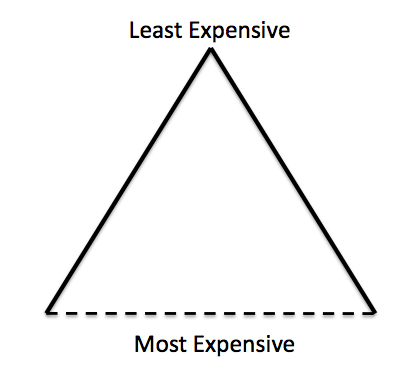
Figure 6. Resource triangle, with dotted line indicating uncertain financial cut-off.
The higher cost of extraction is equivalent to diminishing returns.
As we are forced to seek out ever more expensive to extract resources, the economy is in some sense becoming less and less efficient. We are devoting more of our human labor and other resources to extracting fossil fuels, and to extracting minerals from ever-lower-quality ores. In some sense, we could just as well be putting these resources into a pit and burying them–they no longer help us grow the rest of the economy. Using resources in this way leaves fewer resources to “grow” the rest of the economy. As a result, we should expect economic contraction when the cost of oil extraction rises.
In fact, economic contraction seems to happen when oil prices rise, at least for oil importing countries. Economist James Hamilton has shown that 10 out of 11 post-World War II recessions were associated with oil price spikes. A 2004 IEA report says, “. . . a sustained $10 per barrel increase in oil prices from $25 to $35 would result in the OECD as a whole losing 0.4% of GDP in the first and second years of higher prices. Inflation would rise by half a percentage point and unemployment would also increase.”
Energy products play a critical role in the economy.
Economic activity is based on many kinds of physical changes. For example:
- Using heat to transform materials from one form to another;
- Using energy products to help move goods from one place to another;
- Moving electrons in such a way that light is provided
- Moving electrons in such a way that Internet transmission can be provided.
A human being, by himself, exerts only about 100 watts of power. A human being is also quite limited in what he can do; he can provide a little heat, but no light, for example. Energy products are very helpful for making capital goods such as buildings, machines, roads, electricity transmission lines, cars and trucks.
We can think of energy products, and capital goods made using energy products, as ways of leveraging human energy. If per capita energy consumption increases over time, leveraging of human labor can grow. As a result, humans can become ever more productive–think of new and better machines to help humans do their work. Dips in this leveraging tend to correspond to economic contraction (Figure 7).

Figure 7. World energy consumption per capita, based on BP Statistical Review of World Energy 2105 data. Year 2015 estimate and notes by G. Tverberg.
To have a growing economy, wages of non-elite workers need to be growing.
Our economy is in a sense a “circular economy,” in which non-elite workers (less educated, non-managerial workers) play a pivotal role because they are both producers of goods and potential consumers of the output of the economy. Because there are so many non-elite workers, their demand for homes, cars, and electronic goods plays a critical role in maintaining the total demand of the economy.

Figure 8. Representation of two major parts of the economy by author.
If the wages of these non-elite workers are growing, thanks to increased productivity, the economy as a whole can grow. If the wages of these workers are shrinking or are flat (in inflation-adjusted terms), the economy is in trouble. The recycling process cannot work very well.
If there is not enough economic growth–often caused by not enough growth in energy consumption to leverage human labor–then we tend to get a growing imbalance between the sector on the left with businesses, governments, and elite workers, and the sector on the right, with non-elite workers. Part of this wage imbalance comes from sending jobs to low-wage countries. As jobs are shifted to low-wage countries, the workers of the world increasingly cannot afford the goods that they and other workers are producing.

Figure 9. Representation by author of imbalance that occurs.
If the wages of non-elite workers are not rising sufficiently, rising debt can be used to hide this problem for a while. The way this is done is by allowing workers to buy goods at ever-lower interest rates, over ever-longer time periods. This strategy has an endpoint, which we seem to be close to reaching.
Debt is a key factor in creating an economy that operates using energy.
A generally overlooked problem of our current system is the fact that we do not receive the benefit of energy products until well after they are used. This is especially the case for energy used to make capital investments, such as buildings, roads, machines, and vehicles. Even education and health care represent energy investments that have benefits long after the investment is made.
The reason debt (and close substitutes) are needed is because it is necessary to bring forward hoped-for future benefits of energy products to the current period if workers are to be paid. In addition, the use of debt makes it possible to pay for consumer products such as automobiles and houses over a period of years. It also allows factories and other capital goods to be financed over the period they provide their benefits. (See my post Debt: The Key Factor Connecting Energy and the Economy.)
When debt is used to move forward hoped-for future benefits to the present, oil prices can be higher, as can be the prices of other commodities. In fact, the price of assets in general can be higher. With the higher price of oil, it is possible for businesses to use the hoped-for future benefits of oil to pay current workers. This system works, as long as the price set by this system doesn’t exceed the actual benefit to the economy of the added energy.
The amount of benefits that oil products provide to the economy is determined by their physical characteristics–for example, how far oil can make a truck move. These benefits can increase a bit over time, with rising efficiency, but in general, physics sets an upper bound to this increase. Thus, the value of oil and other energy products cannot rise without limit.
Using hoped-for benefits to set oil prices is likely to lead to oil prices that overshoot their maximum sustainable level, and then fall back.
A debt-based system of setting oil prices is different from what most of us would have considered possible. If wages of non-elite workers had been growing fast enough (Figure 9), increasing debt would not even be needed, because the whole system could grow thanks to the increased buying power of the many non-elite workers. These workers could buy new houses and cars, have more meat in their diet, and travel on international vacations, adding to demand for oil and other energy products, thereby keeping prices up.
As wages of non-elite workers fall behind, an increasing amount of debt is needed. For the US, the ratio of the increase in debt to the increase in GDP (including the rise in inflation) is as shown in Figure 10:

Figure 10. United States increase in debt over five-year period, divided by increase in GDP (with inflation!) in that five-year period. GDP from Bureau of Economic Analysis; debt is non-financial debt, from BIS compilation for all countries.
Thus, the increase in debt has never been less than the corresponding increase in GDP over five-year periods, even when oil prices were low prior to 1970. In general, the pattern would suggest that the higher the oil price, the higher the increase in debt needs to be to generate one dollar of GDP. This is to be expected, if economic growth depends on Btus of energy, and higher prices lead to the need for more debt to cover the purchase of necessary Btus of energy.
We are reaching a head-on collision between (1) the rising cost of energy production and (2) the falling ability of non-elite workers to pay for this high-priced energy.
The head-on collision we are reaching is what causes the potential instability referred to at the beginning of this article, as illustrated in Figure 1. Of course, such a collision has the potential to cause debt defaults, as it becomes impossible to repay debt with interest.

Figure 11. Repaying loans is easy in a growing economy, but much more difficult in a shrinking economy.
Turchin and Nefedov in the academic book Secular Cycles analyzed eight agricultural economies that eventually collapsed. The problem that these economies encountered was exactly the same one we are now encountering: falling wages of non-elite workers at the same time that the cost of producing energy products (food, at that time) was rising. Rising costs were often an end result of too many people for the arable land. A workaround could be found, such as building irrigation or adding a larger army to conquer a neighboring land, but it would add costs.
As the problems of these economies progressed, debt defaults became more of a problem. Governments found it hard to collect enough taxes, because so many of the workers were increasingly impoverished. Often, workers became sufficiently weakened by an inadequate diet that they became vulnerable to epidemics. Governments often collapsed.
In the economies analyzed by Turchin and Nefedov, food prices temporarily spiked, but it is not clear that this was the final outcome, given the inability of workers to pay the high prices. Debt defaults would tend to further reduce ability to pay. Thus, it would not be surprising if prices ended up low (from lack of demand), rather than high. We know that ancient Babylon is an example of one economy that collapsed. Revelation 18:11-13 seems to describe the situation after Babylon’s collapse as one of lack of demand.
11 “The merchants of the earth will weep and mourn over her because no one buys their cargoes anymore— 12 cargoes of gold, silver, precious stones and pearls; fine linen, purple, silk and scarlet cloth; every sort of citron wood, and articles of every kind made of ivory, costly wood, bronze, iron and marble; 13 cargoes of cinnamon and spice, of incense, myrrh and frankincense, of wine and olive oil, of fine flour and wheat; cattle and sheep; horses and carriages; and human beings sold as slaves.
Other parts of the oil limits story that researchers have missed
As I have previously mentioned, most researchers begin with the view that soon there will be a problem with energy scarcity. The real issue that tends to bring the system down is related, but it is fairly different. It is the fact that as we use energy, the system necessarily generates entropy. This entropy takes the form of rising debt and increased pollution. It is these entropy-related issues, rather than a shortage of energy products per se, that tends to bring the system down. See my post, Our economic growth system is reaching limits in a strange way.
We could, in theory, fix our problems by adding infinite debt at the same time that wages of non-elite workers tend toward zero. We could then use this additional debt to fight pollution problems and pay all of the workers. All of us know that this solution would not work in the real world, however.
The two-sided economy I have described in Figures 8 and 9 is one part of our problem. There is a popular saying, “We pay each other’s wages.” Unfortunately, paying each other’s wages does not work well, if the wage level of elite workers differs too much from the wage level of the non-elite workers. A worker making $7.50 per hour in a part-time job is not going to be able to pay the wages of a surgeon making $300,000 per year, no matter how an insurance policy is designed to spread costs evenly. A worker in India or Africa will not be able to afford goods made by human workers in the United States, because of wage differences.
Governments can try to fix the problem of non-elite workers getting too small a share of the output of the system, but this is not easy to do. The real problem is that the system as a whole is not producing enough goods and services. This happens because the high cost of energy extraction (plus related issues–pollution control; need for more education for workers; need for ever-larger government and more elite workers) is removing too many resources from the system. The result is that the economy as a whole tends to grow ever more slowly. The quantity of goods and services produced by the economy does not rise very rapidly. When there are not enough goods produced in total, non-elite workers tend to find that their allocation has been reduced.
If governments attempt to add debt to fix the problems with the system, the addition of debt tends to raise asset prices on the left side of Figures 8 and 9. Unfortunately, the additional debt usually has little impact on the wages of non-elite workers (that is, the right hand part of the system).
Governments have talked about minimum income programs to raise incomes of those who are not elite workers. Whether or not this approach can work depends on many things–how much additional debt can be added to the system; whether this debt will actually raise the total amount of goods and services produced; how tolerant those in the left-hand side of Figures 8 and 9 are of losing their share of goods and services; the impact on relative currency levels.
Research involving Energy Returned on Energy Investment (EROEI) ratios for fossil fuels is a frequently used approach for evaluating prospective energy substitutes, such as wind turbines and solar panels. Unfortunately, this ratio only tells part of the story. The real problem is declining return on human labor for the system as a whole–that is, falling inflation adjusted wages of non-elite workers. This could also be described as falling EROEI–falling return on human labor. Declining human labor EROEI represents the same problem that fish swimming upstream have, when pursuit of food starts requiring so much energy that further upstream trips are no longer worthwhile.
Falling fossil fuel EROEI is a contributor to falling EROEI with respect to human labor, but there are other contributors as well (Figure 12). (My list is probably not exhaustive.)

Figure 12. Author’s depiction of changes to workers’ share of output of economy, as costs keep rising for other portions of the economy.
If our problem is a shortage of fossil fuels, fossil fuel EROEI analysis is ideal for determining how to best leverage our small remaining fossil fuel supply. For each type of fossil fuel evaluated, the fossil fuel EROEI calculation determines the amount of energy output from a given quantity of fossil fuel inputs. If a decision is made to focus primarily on the energy products with the highest EROEI ratios, then our existing fossil fuel supply can be used as sparingly as possible.
If our problem isn’t really a shortage of fossil fuels, EROEI is much less helpful. In fact, the EROEI calculation strips out the timing over which the energy return is made, even though this may vary greatly. The delay (and thus needed amount of debt) is likely to be greatest for those energy products where large front-end capital expenditures are required. Nuclear would tend to be a problem in this regard; so would wind and solar.
To evaluate the extent to which a given energy product tends to raise debt levels, a better approach might be to look at debt levels directly. Another measure might be to compare the required system-wide capital expenditures for a particular purpose, for example, to provide sufficient non-intermittent electricity for the state of California over a period of say, 50 years, using different electricity generation scenarios.
Our academic system of inquiry, with its peer reviewed literature system, has let us down.
Our peer reviewed academic system is not telling this story. Part of the problem is that this is a difficult story. It has taken me most of the last ten years to figure it out.
Part of the problem with our academic system seems to be excessive reliance on past analyses. Once one direction has been set, it is hard to change. Another part of the problem is that the focus of each researcher tends to be quite narrow. The result can be that it is hard to “see the forest for the trees.”
Furthermore, politicians and academic publishers tend to “push” results in the direction of a desired outcome. Grant money goes to researchers who follow the government-preferred fields of inquiry; publishers prefer books that are not too alarming to students.
I am coming at this issue from “out in left field.” I don’t have a Ph.D., although I am a Fellow of the Casualty Actuarial Society, which many would consider similar. I also have an M. S. in Mathematics. I do not work in a university setting. I do not have a strong background in subjects a person might expect, such as geology, economic theory, or physics. I do have a fair amount of practical experience with financial modeling from my actuarial background, however.
My approach is very different from that of most researchers. I come to the problem from the point of view of how a finite world might be expected to operate. I write most of my articles on the Internet, where I get the benefit of comments from readers. Many of these commenters point me in the direction of articles or books I should read, or raise additional issues I should consider.
Over the years, I have become acquainted with many researchers in related fields. These people have generally reached out to me–invited me to speak at their conferences, or corresponded with me about issues they considered important. As a result of this collaboration, I have been able to put together a more complete story than others.
I have stayed away from publishers and funding sources that might try to influence what I say. I have not been taking donations, and do not run ads on my website. The story is one that needs to be told, but it easily gets distorted if the person telling the story is influenced by what will generate the largest donations, or the most grant money.


Gail, article by article you are putting together all the pieces in the big puzzle! Maybe you can do a PhD after all!
Here is some statistical evidence from Australia on what you are saying about worker salaries:
REAL NET NATIONAL DISPOSABLE INCOME
“A broader measure of change in national economic well-being is Real net national disposable income. This measure adjusts the volume measure of GDP for the Terms of trade effect, Real net incomes from overseas and Consumption of fixed capital (see Glossary for definitions). The graph below provides a comparison of quarterly movements in trend GDP (volume measure) and Real net national disposable income. During the December quarter, trend Real net national disposable income decreased by 0.3%. Through the year Real net national disposable income fell 1.2% compared with an increase of 2.8% for GDP.”
http://www.abs.gov.au/ausstats/abs@.nsf/Latestproducts/5206.0Main%20Features2Dec%202015
Note the drop of disposable income at the height of the financial crisis in 2008/09. It bounced back as Australia was entering the 2nd phase of a mining boom as described here:
“The contribution of mining investment to Gross Domestic Product (GDP) grew dramatically from 1.2% in September 2000 to 7.9% in June 2012. There are two significant periods of growth in mining investment shown in Graph 1. The first between December 2004 and December 2008 where the level of mining investment more than tripled from $3,962m to $14,146m. The second between March 2010 and the peak of mining investment at $29,774m in December 2012. Average compound growth in this period was 8.5% per quarter. At its peak, mining investment was still smaller than non-mining investment. Mining investment has since fallen to $18,215m in September 2015. It now contributes only 4.5% to GDP, half the contribution of non-mining investment (9.7%).”
http://www.abs.gov.au/ausstats/abs@.nsf/7d12b0f6763c78caca257061001cc588/78b08abe5e6f2df1ca2570d6001366dc!OpenDocument
It is strange that the Reserve Bank of Australia didn’t see the writing on the wall in February 2008 and increased interest rates. Oil prices were not even mentioned:
“Recent information points to significant inflation pressures. CPI inflation on a year-ended basis picked up to 3 per cent in the December quarter, with underlying measures around 3½ per cent. This was a little higher than was expected a few months ago. Indicators of demand remained strong through the second half of 2007, and reports of high capacity usage and shortages of suitable labour persist. In the short term, inflation is likely to remain relatively high and will probably rise further in year-ended terms, though the Bank expects it to moderate somewhat next year……
Having weighed both the international and domestic information available, the Board concluded that a tighter monetary policy setting was needed now. In future meetings, the Board will continue to evaluate whether the stance of policy will be sufficiently restrictive to return inflation to the 2–3 per cent target.”
http://www.rba.gov.au/media-releases/2008/mr-08-02.html
All this happened only a couple of months after we wrote an article in the Oildrum – when we did everything we could to monitor oil production:
9/10/2007
Did Katrina hide the real peak in world oil production?
http://www.theoildrum.com/node/3052
It is the decline of crude oil production between 2005 and mid 2007 which started all the problems we still have.
Who is letting us down? The media, for example, which are repeating factually wrong narratives:
30/4/2016
Australian Public Broadcaster ABC unable to look at oil statistics
http://crudeoilpeak.info/australian-public-broadcaster-abc-unable-to-look-at-oil-statistics
There is an interesting slide show by Arthur Berman:
http://www.artberman.com/wp-content/uploads/STGS-Presentation-10-MAY-2016.pdf
And a good summary of what is happening with US shale oil companies:
HAYNES AND BOONE, LLP OIL PATCH BANKRUPTCY MONITOR May 1, 2016
http://www.haynesboone.com/~/media/files/attorney%20publications/2016/energy_bankruptcy_monitor/oil_patch_bankruptcy_20160106.ashx
Gail, you’ve done an excellent job of identifying and emphasizing important observations on the situation. I’m pleased I found your blog! After reading it, and drawing on my own studies and background, I am comfortable in suggesting that the current situation is representative of all such situations where humans try to control a very complex, interconnected, dynamic, non-linear, mixed latency system – a task that humans perform abysmally. There is a large body of research demonstrating this. There is also a large body of experience managing such systems through automation, but nothing is perfect. Even the best managed system can have unexpected shutdowns. One simply has to plan for and build in damage control and recovery for such events. The current situation is not a good example of damage control and recovery.
The economy will normally have very large deviations from an optimal band and this has historically been exacerbated by the mechanisms introduced by multiple central authorities. Instead of providing appropriate damping mechanisms, effective feedback, and filtering noise to keep things swinging inside acceptable limits, they allowed the system to deviate wildly and are now trying to bring it back within those limits by providing massive damping on the system, which only keeps it in it’s current state until it tips into a catastrophic end state. As you point out, we are probably too close to that point to avoid the crash, although it could actually be a very long time from now, e.g. Japan’s lost decades. Meanwhile the current controls continue to cause malinvestment and push us closer to the brink.
Please keep up the good work.
Thanks! You describe our current plight very well. I hope you will take time to look at some of my other posts as well.
Gail I have a request. You are the only possible person who could do this. Could you write a article on what the economy is and what it is not. I struggle when people use the word economy. One part of me just wants to scream “Liar”. I do not know whether to just disregard the other part of the communication or try to sift through it to see if their is validity. Do you see my dilemma?
Can you help me? Is their another word we can start to use other than economy that denotes a more valid model? If so I think you should be the one to choose that word and define it. Could you write a article on what the economy is and what it is not and choose a new word to define what IS.
What IS!
What IS!
What IS!
Thanks, I liked this article. It gives a good picture of where we are today. I got a very organic picture of our situation.
An article that Fast Eddy whould approve for those organic prepper farmers. 😀
“Scenes From The Venezuela Apocalypse: “Countless Wounded” After 5,000 Loot Supermarket Looking For Food”
http://www.zerohedge.com/news/2016-05-13/scenes-venezuela-apocalypse-countless-wounded-after-5000-loot-supermarket-looking-fo
“As time went by, desperate Venezuelans grew anxious over not being able to buy food. Then they started jumping over the gates and stormed the supermarket.
“They took milk, pasta, flour, oil, and milk powder. There were 5,000 people” one witness told Venezuela outlet El Estímulo.
People from across the entire state came to the supermarket because there were rumors that some products not found anywhere else would be sold there.
As a result of the massive crowd, the authorities were unable to preserve the peace. “There were 250 people for each National Guard officer… lots of people and few soldiers. At least one officer was beat up because he tried to stop the crowd,” another source told El Estímulo. Other food dispensaries run by the government were also looted by the people. The image below shows a human stampede over rice.
http://www.zerohedge.com/sites/default/files/images/user5/imageroot/2016/05/13/saqueo-Mercado-Mayorista_0.jpg
http://www.zerohedge.com/sites/default/files/images/user5/imageroot/2016/05/13/saqueos-venezuela_0.jpg
This is the scenario often discussed here about what would happen in a collapse with people ransacking grocery stores to get enough food. At a certain threshold of suffering people will start to move together even if that means mass breakage of the law. I like the dumbass officer that tried to stop it – not so smart to go against the grain at that point, especially when greatly outnumbered. What that shows is authority only works up to a point then people take things into their own hands. Police forces are almost always outnumbered but there are usually only one or two people committing a crime here and there, so it’s easy on a daily basis to control the masses. The same goes really as an analogy for banks. They lend far more than their deposits, but once there is a run on the banks there’s never enough money to satisfy the sheer number of withdrawals.
The trouble with things reaching a point of clearing out the stores is no one is now going to show up to fill those shelves again. So from here things will get even worse, that is until order can be restored, the economic situation somehow improved then trust and peace can be restored and the store repaired and the shelves filled again. But let’s say the problem is too widespread and there are no easy answers to fix the major problems, then those people will probably flee into neighboring countries. Should be interesting as a case study to make note of how this turns out. Until then our hearts go out to hungry Venezuelans.
The shelves are NEVER going to be filled again. This is the end of The Road
Good article, read via diaspora social network: I hope you all join it!
https://diasp.eu/posts/4267535
A simple solution could be a ban on compound interest; maybe Islamic finance such as sukuk.
The wrong kind of growth?
http://www.reuters.com/article/us-global-oil-kemp-idUSKCN0Y4069
“The strongest demand growth is coming from India and the United States, where cheaper prices are encouraging motorists to consume record quantities of gasoline. India’s consumption of petroleum products topped 4 million bpd for the first time in the 12 months ending in April, according to data from the Ministry of Petroleum and Natural Gas. Consumption of petroleum products was around 400,000 bpd higher during the first four months of 2016 compared with 2015, an increase of 10 percent (tmsnrt.rs/1YnySYn).”
“Freight demand shows no sign of picking up in either the United States or the rest of the world (tmsnrt.rs/1YnyVU2).”
“The northern hemisphere winter in 2016/17 should be colder than the abnormally warm one in 2015/16, which will increase heating oil consumption (“Colder winter could save distillate market”, Reuters, May 4).”
Thanks Gail for new thoughtful post. You say:
“A human being, by himself, exerts only about 100 watts of power. A human being is also quite limited in what he can do; he can provide a little heat, but no light, for example.”
A pity.
But…
“While sailing in these latitudes on one very dark night, the sea presented a wonderful and most beautiful spectacle. There was a fresh breeze, and every part of the surface, which during the day is seen as foam, now glowed with a pale light. The vessel drove before her bows two billows of liquid phosphorus, and in her wake she was followed by a milky train. As far as the eye reached, the crest of every wave was bright, and the sky above the horizon, from the reflected glare of these livid flames, was not so utterly obscure, as over the rest of the heavens.” [Charles Darwin]
https://en.m.wikipedia.org/wiki/Bioluminescence
stefeun
Oh, but how can that compare to the lights of Las Vegas, our civilization’s triumph? 🙂
We do have many beautiful things to delight us.
Pingback: The Real Oil Limits Story – What Other Researchers Missed | Since 1998 Hitrust.net = Privacy and Protection
Pingback: The Real Oil Limits Story - What Other Researchers Missed - Envision Gold
Pingback: The Real Oil Limits Story – What Other Researchers Missed | Political American
Pingback: The Real Oil Limits Story – What Other Researchers Missed | StrikeEngine
“Unfortunately, paying each other’s wages does not work well, if the wage level of elite workers differs too much from the wage level of the non-elite workers. A worker making $7.50 per hour in a part-time job is not going to be able to pay the wages of a surgeon making $300,000 per year, no matter how an insurance policy is designed to spread costs evenly. ”
This is wrong. Maybe you have deluded yourself by contrasting 7.50 to 300,000. One is per hour, one is per year. Why did you do that? Subconsciously?
Let’s say the surgeon works 2000 hours per year, that makes 150$ an hour. So he earns 20times the wage of the 7.50$ worker. Does it STILL sound dramatic? I don’t think so.
How many hours does the worker need to work to pay for 2 hours of the surgeons time to remove a tumor? 40 hours, that’s one work week, or 2 if he’s part-time as you insist. So, 2 part time work weeks to have your life saved.
WHERE. IS. THE. PROBLEM??? There is none. At least not in this example.
Now if you had said, 20,000 $ for a stay in the ER for observation, no procedures performed, I would agree. But that’s simply FRAUD, plain and simple, enabled by the insurance system.
Your example of the expensive but actually working surgeon is not a problem – and probably such a ratio of 20 is entirely realistic throughout history since the invention of surgery.
A two hour tumor removal surgery in the US for $300? Try $300,000. At 7.50/hour that is 20 years at 2000 hour per year or 40 years at 1000 hour per year.
I was referring especially to the claim that the WAGE OF THE SURGEON is too high to be payed. It is not.
As to all the bills slapped on top of it, I already gave an example. It is fraud enabled by a complex system of insurances, hospitals and the state and has nothing to do with the wage of the specialist.
Let’s take $7.50 times 20 hours per week times 52 weeks. That comes out to $7,800 per year. If the work week is 30 hours, the amount is 50% more, or $11,700. The person with the low income absolutely needs to eat, and needs some kind of housing. There is no way he can afford to use his wages to pay a proportionate share of a surgeon’s salary.
I am still leaving out steps, but you need to add a little thinking on your own. You figure out a budget where a person with low income can really afford to buy health insurance, at today’s high cost. Many states, including Georgia, are not giving Medicaid coverage to relatively low income workers.
Pingback: The Real Oil Limits Story – What Other Researchers Missed | DailyDeceit
Pingback: The Real Oil Limits Story - What Other Researchers Missed | Zero Hedge
Was there an interesting new blog header picture recently, Gail, or did I just dream it?
Seems like it was an accident. It was from an image in your post.
https://gailtheactuary.files.wordpress.com/2016/05/getting-sufficient-oil-out-is-a-price-problem.png?w=940&h=198&crop=1
https://webcache.googleusercontent.com/search?q=cache:kCJ0ekP9wWIJ:https://ourfiniteworld.com/2016/05/12/the-real-oil-limits-story-what-other-researchers-missed/+&cd=1&hl=en&ct=clnk&gl=uk
Sorry. If I designate an image from the post to be used in announcements, such as on Facebook, that image appears on the header. I can take it off after I am done using it. I don’t like it in the header. It never shows up correctly.
Apparently the only elite worker in Gail’s Bizarro World is the govt statistician telling lies.
Example: Every single retailer is going down the drain while China Direct (Amazon.com) gets stronger despite no profits.
Do you think the fired managerial class in those retailers are ever going to get another job?
Gail: “Virtually no one realizes that the economy is a self-organized networked system.”
Thats because your statement is something out of a biology text book. No wonder nobody else realizes it.
What did you say? Or maybe what are you saying, or maybe what do you mean?
Find me a biology textbook that says, “. . . the economy is a self-organized networked system.” Try Systems Analysis instead.
Gail
Check out the blurb for Fritjof Capra’s book and the link to an on-line course he is offering.
From the description of the course:
Systems thinking makes us aware of the fact that the major problems of our time — energy, economics, climate change, inequality —are all interconnected and interdependent. They are systemic problems that require corresponding systemic solutions.
link to the course:
http://www.capracourse.net/about/
blurb for the book:
Partly an enjoyable survey of exciting new developments in systems biology, valuable to any student of biology or science, and partly a bold blueprint for how we might preserve our future on Earth using the systems perspective on life and what sustains it.
This is not STRICTLY a biology textbook, but it certainly includes a lot of biology.
Don Stewart
I found the following at The Automatic Earth by Illargi. It sums up my opinion/overview of our current situation/predicament/state of mind:
“With a growing population and a growing average per capita consumption, both energy demand and pollution keep rising inexorably. And the best we can do is pay lip service. Sure, we sign up for less CO2 and less waste of energy, but we draw the line at losing global competitiveness.
The bottom line is that we may have good intentions, but utterly fail when it comes to solutions. And if we fail with regards to energy, we fail when it comes to the climate and our broader living environment, also known as the earth.
The more we look at this, the more we find we look just like the reindeer on Matthew Island, the bacteria in the petri dish, and the yeast in the wine vat. We burn through all surplus energy as fast as we can find ways to burn it. The main difference, the one that makes us tragic, is that we can see ourselves do it, not that we can stop ourselves from doing it.
Nope, we’ll burn through all we economically can (but we can’t ’cause we’ll suffocate in our own waste first). And if we’re lucky (though that’s a point of contention) we’ll be left alive to be picking up the pieces when we’re done.
Our other big global problem is finance / money / economy. It not only has the shortest timeframe, it also invokes the highest level of denial and delusion, and the combination may not be entirely coincidental. The only thing our “leaders” do is try and keep the baby going at our expense, and we let them. We’ve created a zombie and all we’re trying to do is keep it walking so everyone including ourselves will believe it’s still alive. That way the zombie can eat us from within.
Our debt levels, in the US, Europe and Japan, just about all of them and from whatever angle you look, are higher than they’ve been at any point in human history, and all we’ve done now for five years plus running is trust a band of bankers and shady officials to fix it all for us, just because we’re scared stiff and we think we’re too stupid to know what’s going on anyway. You know, they should know because they have the degrees and/or the money to show for it.
We are incapable of solving our home made problems and crises for a whole series of reasons. We’re not just bad at it, we can’t do it at all. We’re incapable of solving the big problems, the global ones.
We evolve the way Stephen Jay Gould described evolution: through punctuated equilibrium. That is, we pass through bottlenecks, forced upon us by the circumstances of nature, only in the case of the present global issues we are nature itself. And there’s nothing we can do about it. If we don’t manage to understand this dynamic, and very soon, those bottlenecks will become awfully narrow passages, with room for ever fewer of us to pass through.”
http://www.theautomaticearth.com/2016/05/why-we-are-so-bad-at-solving-problems/
Debt, population, and pollution is the refuge of a scoundrel. Its not that its invalid, just that it is trivial. I could have said the same in 1990, or in 2040.
Extinction of the human species is trivial?
You could be right.
Stilgar
Have you seen this? Don Stewart
https://twitter.com/ed_hawkins/status/729753441459945474
Nobody gets it Don. I posted that on my Facebook, they’re too stupid/ uninformed/ nonchalant/ in denial or have ulterior motives. I can’t describe the way I feel. It’s like screaming at a crowd on a railway track when a freight train is approaching and they can’t hear you. The actual dilemma is I’m also on the same track and in a tunnel with no way out. It’s a very strange feeling, I want them to know of the impending calamity but I also know that there is no solution.
“We are incapable of solving our home made problems and crises for a whole series of reasons. We’re not just bad at it, we can’t do it at all. We’re incapable of solving the big problems, the global ones.”
Could be right. Everybody says so. But I’d pay some attention to beauty. If it isn’t beautiful, it probably isn’t good.
Money and debt are the essence of ugliness. So is global homogeneity. So is anything too big. Our best hope is for this gargantuan economy to crash. But there has to be an alternative, which now is nonexistent. The notion of 150 strong should not be overlooked. By hook or by crook, each pod of 150 strong (or something roughly equivalent) should be more self-sufficient than not, and there should be trade between pods. (And pods wouldn’t necessarily have to be geographically separate from each other, although it’s a no brainer to start work with those separate pods–like villages– where they already exist.
It shouldn’t be too hard for every roof in the world to collect rain water, and every backyard in the world to grow food. What is hard to figure is how to deal with the “infrastructure” (meaning more than one thing) of globalized industrial society. But doing the easier things first ought to help.
“Our best hope is for this gargantuan economy to crash. But there has to be an alternative, which now is nonexistent”.
I agree, & we are too far on the downhill slope into the abyss for anything to make a difference now……………………….I also liked your comments on the collecting rainwater on every roof & backyards growing food but also feel this would be meaningless without a reformation of humanities nature alienated psychology.
We come from the earth yet act as if we know all the answers & snub our collective noses at the reality that surrounds our existence every single day of our lives.
Brendon,
I don’t think it’s hard re the rooftop catchment and backyard gardening. Just start in your own community. It doesn’t cost anything to at least make a plan. Then if there is a nonprofit to sponsor a grant, there are countless foundations out there and endless money out there to buy water tanks, seeds, whatever.
The part I don’t understand is how to manage, stop, direct, benefit from the macro economy. I don’s see it as workable without fossil fuels (and of course the planetary biosphere can’t afford it), but it’s still going like crazy. What to do with it before or after it comes to an end?
Where will we end up? Well, there is a school of thought that we end up back at wood as our sole energy source? There is the chance for some biomethane use from various manures and then aerobically compost what’s left. You then put the composted material back on the farmer’s field for plant nutrients but it will only scale so far. It requires significant knowledge being passed down. Plant trees for fruit and nuts to have excellent wood for buildings and furniture. Use small scale agroforestry with lots of fish ponds for protein and irrigation during droughts. We need to basically build the soil, save the floods and survive the droughts while avoiding polluted areas. It’s not impossible but at wood we are talking about our children and grandchildren surviving with a die-off back to say 1/2 billion people worldwide. Definitely, it’s not terrible pleasant to contemplate.
Deforestation was a very big problem pre-industrial revolution in Europe — and then we discovered how to get energy out of coal….
Pre-industrial revolution there was little if any written understanding about environmental issues and the impact of humans on the environment. Easter Island’s Polynesian settlements were just about gone. No one understood how those incredible stone faces got there. We came to understand things like amount of rainfall and temperature and what kind of things would grow on what type of land. Replanting trees when there seems to be so many was not done. People wanted to get to the soil for farming. Environmentalism is fairly old but environmental science is very young and requires an understanding in many fields. So many things about life are interconnected. The first Earth Day was in 1970. Pollution, nuclear power, and population were big issues then. Nuclear weapons testing was moving underground and eventually ended more or less. When fallout was understood suddenly we had an inkling of our ability to affect the entire planet. Yet, we understood the a few yeast cells in sugary water eventually die out because they can’t live in their own waste products, like alcohol. So the model has been around. It was just a question of recognizing it.
In case you hadn’t noticed we have learned NOTHING — we have run through trillions of barrels of oil and mountains of coal in less than 200 years
Oh ya — we are suddenly going to get with the programme and conserve hahahahahaha
.Greeks, desperate to find fuel to stay warm because they can’t afford heating oil that has been ghit with big tax increases, have been taking to the woods and even city parks to cut down trees and now authorities said someone has felled the olive tree under which Plato sat in ancient times. – See more at: http://greece.greekreporter.com/2013/01/17/platos-tree-cut-down-for-firewood-2/#sthash.dMmzhSJd.dpuf
http://www.bbc.com/news/world-europe-21202432
DelusiStan sounds like a mighty fine place
The more things you can do in combination, the easier it seems. I’d combine roof water catchment and gray water outlet with gravity feed to newly planted trees (fruit and nut trees for sure). Synergy seems to reduce effort and affect the brain in optimal ways.
I’m waging a sort of campaign locally to let the invasive weed trees be. No water or effort to plant them needed. Just don’t go cutting them down in the name of ecological purity.
You are right, in the end physical living has no reason or solution. We are born and then die. Either our internal environment propers or withers (look at those around you to see examples) or the same happens to our external environment – we are made of both.
The added pain is that we are the only fully self conscious creatures – we are the river just as it enters the ocean. We are simply here to love and to play the game. The reasoning mind is only a “minder” for the body – and very limited, poor thing.
+10 “we are the river just as it enters the ocean”……yes that describes it perfectly.
It was not our fault u understand it was the pesky DNA, we had no choice.
saps saps
http://abcnews.go.com/US/wireStory/california-governor-proposes-1222-billion-spending-plan-39099504
That’s an article about Gov. Brown’s California budget proposal of 122.2 billion. However no where in the article does it mention past year budget amounts so there’s no way of knowing if that’s more or less. Wouldn’t it seem like the most important part to have some reference to know how 122.2 billion compares to other budget year’s? What I’m wondering is if it’s purposefully left out. Is the writer of the article simply parroting the information provided by the governor to benefit the system by not providing information that may cause us to badly react? Is the publication complicit, that is colluding with State govt. to quell public unrest?
Dear Finite Worlders
Suggested Reading:
http://nature.berkeley.edu/er100/readings/Campbell_1998.pdf
The 1998 Scientific American article by Jean Laherrere and Colin Campbell. How accurately do you think they described the situation almost 20 years ago? Did they fail to anticipate new technologies? Did they fail to comprehend the potential of unconventional oil?
I perceive that they got a lot of things right. I think they missed the feedback loop discovered by the thermodynamic modelers. Namely, that the work capacity which the oil is delivering to the non-oil economy would decline more rapidly than the count of barrels, which would reduce the amount that the non-oil economy could afford to pay. There are, of course, many other things they do not discuss, such as the wages of non-elite workers, the effects of globalization, the effects of climate change (although they mention pollution), etc.
All in all, I think they did us a great service…Don Stewart
They pointed out that we would hit limits, sometime about now.
The think that peak oil modelers got wrong is the shape of oil production after we hit limits. It is much more of a “Seneca Curve” than a “Hubbert Curve.”
Gail
If I understand it correctly, the mathematics that is used in The Hills Group model was not invented when Hubbert (and perhaps Campbell and Laherrere were active). It is enough to recognize the work they did do…without criticizing them for failing to understand more recent discoveries.
Don Stewart
How much time we got left?
shortonoil posted this comment recently:
“From the water cut in Ghawar, as reported by Saudi petroleum engineers, it is a fairly simple calculation to determine the oil seam remaining. Of Ghawar’s original 350 foot seam less than 30 feet of it remain. Ghawar is now well over 90% depleted, and when the water hits the horizontal perforations of those producers it all ends very rapidly. As Matt Simmons said, “as Ghawar goes, so goes the world”
and also from the same page link
“Quite believable, since in 2012, the average world wide producer cost was in the $90. Most of the cost estimates that you read are EBITDA, or cash flow estimates, not profit and loss estimates. EBITDA is the measure that banks use to determine loan eligibility. It merely determines if a loan applicant has enough cash flow to cover the payments. Producers don’t pay the full cost of production to begin with. They don’t pay for the roads that they use, military protection, harbors, worker education, environmental damage, judicial services, legislative services, regulation costs, and hundred of other services that are needed to produce oil. Those additional costs are borne by the society that uses the oil.
The average world producer is now losing money producing oil. They are existing by extracting and turning their primary asset into a positive cash flow, That is, their reserves, and they are doing it by not replacing them. The world’s producers net worth is now declining by an amount that is approximately equal to their gross sales. That is now about $1.6 trillion per year.
This is all about the final phase of the oil age; it ends when producers go broke and can no longer produce oil. Just don’t expect the oil companies, or MSM to tell you that. It would be bad for business! If possible no information is allowed to the public that could be bad for business. It you don’t know that you have been living under a rock”
shortonoil is aka for the BW Hill group of consultants that Don Stewart frequently posts about also.
the hillsgroup is on the web.
http://peakoil.com/production/kuwait-plans-to-ramp-up-oil-production-by-44-before-2020
Sounds similar to what I read here with our Gail!
Not much time left it seems for BAU.
Gail enjoy your vacation, you deserve one after all the work you have produced.
For the rest of us,
Yes, it does fit in with what I am saying. We are hitting a price limit. Most of the new oil sources are not economic, at current price levels. With high price levels, it makes sense to use more and more advanced methods to get more oil out of Ghawar. Once price stays down for a while, this is no longer possible. So I see price as being the limiting factor in what Ghawar producers.
“Of Ghawar’s original 350 foot seam less than 30 feet of it remain. Ghawar is now well over 90% depleted, and when the water hits the horizontal perforations of those producers it all ends very rapidly.”
IF the statement is correct, it is the single most important fact pertaining to peak oil which has ever been published. All other stats pail in comparison.
However, I have not been able to find any other data to substantiate it.
Can anyone else shed some light or add more supporting data to this information?
It is VERY important. Why, because it would be indisputable proof that we are well past peak.
Veggie
Agree with veggie. Confirmation? When gwahar stops producing industrial civilization ends.
And what does ten percent left mean? Five years, ten?
shortonoil also stated there will be no “fracking” in that region because it is geologically very porous substrate. As far as far as confirmation, betcha the Sauds themselves will not do so in any way shape or form. They are in the process of selling public shares in their enterprise! Perfect timing, sell a bag of goods with crumbs on the bottom, pretending there is plenty left in the bag!
The BW Hill group are professionals in that field. You might want to contact them about how they did the determination. If it is correct…like you stated…we will know shortly….pun intended.LOL
Well, looks like we got our boy in:
WikiLeaks Reveal Brazil’s New Coup President Is ‘US Informant’
http://www.telesurtv.net/english/news/WikiLeaks-Reveal-Brazils-New-Coup-President-Is-US-Informant-20160513-0016.html
“The cable from Jan. 11, 2006, states that Temer met with embassy officials on Jan. 9, 2006 to give his assessment of Brazil’s political landscape ahead of the 2006 general election that saw Luiz Inacio Lula da Silva reelected to the presidency.
Temer became interim president after the Brazilian Senate voted to proceed with an impeachment trial against President Dilma Rousseff, forcing her to step down for a period of 180 days.
Temer has been criticized for making clear his intention of pursuing a pro-business, neoliberal program as president, despite the fact that Rousseff and her Workers’ Party were reelected on the basis of a progressive program of social investment and wealth redistribution. “
Dear Finite Worlders
There has been frequent discussion here about the prospects for a really nasty society after the crash, and the prospects for a mutually supportive society after the crash. Here is an interesting article:
http://greatergood.berkeley.edu/article/item/the_compassionate_species
In short, those who are kind and helpful are selected for in human society. HOWEVER, in a Q and A last evening, the Professor said that once people are appointed or elected to high position, they tend to move toward looking out for Number One.
As I look at this, and knowing how gene expression can be altered by so many different events, I suspect that ‘kind and helpful’ is a default state for most people most of the time. But elevation to high office or the collapse of an economy may change gene expression. Which I think brings us around to 150 Strong. We are far more likely to be kind and helpful to people we have a long term relationship with. It is unlikely, post collapse, that many of us would contribute money to relief in some country halfway around the world….These are just my speculations.
Don Stewart
Been talking to someone in m,y village about trying to organize without hierarchy. We’ll just have to see what we can achieve.
But I don’t think it’s enough to be kind and empathetic. Many people delude themselves that they are helping the world by being kind and empathetic to a specific entity, while missing what needs to be done strategically (toward broader scope) to make a difference.
And I hope to see more experiments in organizing 150 strong groups by subdividing much larger entities such as city blocks and neighborhoods.
I agree.
Reading Mason Inman’s ‘Oracle of Oil’ about Hubbert. Fantastic book. Sad to be reminded for how long people have been making sound arguments for change.
Gail
Following up on my comment that your addition of a Marxian level of analysis may be quite useful. Here is another, related, model:
http://www.oftwominds.com/blogmay16/globalization5-16.html
Charles Hugh Smith thinks that a key discriminant is mobile capital vs. everyone else. Mobile capital is what really benefits from globalization. Pretending that the ordinary citizens of the countries involved actually benefit is only a smokescreen. In short, we get a wealthy elite with a flattening effect toward the lowest common denominator for everyone else.
In short, just considering these few options, we can model the world as:
*Nation States (practically an indefensible choice, in my opinion…except for war)
*The thermodynamic relationship between the oil producers and the non-oil economy
*The relationship between elite and non-elite workers
*The relationship between mobile capital and everyone else
*The relationship between the citizens of the reserve currency country and everyone else
If we want to get more esoteric, we could model:
*The relationship between those who have enough and those who think they need more
*Those relatively immune to climate change and those most affected by climate change
*Those who eat whole foods and those who eat industrial foods
Debt shows up in most of these models, but is not generally the driving force. That is, debt is a result of the working out of the relationships. Debt is implied by the model of the physics. If you consider capital to have a debt shadow (double entry bookkeeping), then any model involving built capital will involve debt. Sometimes the debt will be moral…as when someone helps you build a barn and you need to return the favor.
I don’t regard any of these as a ‘Universal Model of Everything’. All of them illuminate a certain way of relating to others and the physical world.
Don Stewart
Thanks! Charles Hughes Smith points out,
This is a different version of the problem I wrote about. It is part of what drive the average world-wide wages of non-elite workers down.
I agree that with the statement, “If you consider capital to have a debt shadow (double entry bookkeeping), then any model involving built capital will involve debt. Sometimes the debt will be moral…as when someone helps you build a barn and you need to return the favor.” This is what gets overlooked in most models.
Debt may not be the driving force, until we reach limits. Then it is, whether we like it or not, and whether it looks that way in the model before limits.
One of the reasons that wages of non-elite workers are not rising is that technology is allowing us to replace humans with relatively inexpensive machines. I think of this as the machines becoming more “elite” than humans in certain sectors. Even if machines don’t really replace workers, and just make them more efficient, the affect is similar. Less workers are required for the same production. In the past, standard of living could rise to soak up the increased production, and new sectors sprung up to soak up workers, but that no longer seems to be happening.
As an example: Imagine the impact on society when vehicles no longer need drivers. Over a short time-frame, an entire sector of non-elite jobs will disappear.
As our current economy is structured, the replacement of humans with machines is a bad thing, especially if you are one of the humans that gets replaced. However, I can imagine the economy changing to where having a machine replace you means that you get to pursue your own interests. Two problems that prevent that panacea from occurring: The current economy does not want to change; and all of those machines depend on cheap energy.
I’m beginning to believe that renewable energy sources can work, but the invested energy interests are doing everything they can to delay the switch, just as the invested economic interests are delaying changes to our economy. My hope is that these attempts will begin to fail in the near future, but I’m not holding my breath.
Many times replacing 2-4 jobs by automation creates a new more advanced job.
So you get unemployment which is financed by taxing the one with a job. For the owner it is better, but not for society.
Of course none of this matters when cheap energy runs out.
I think that 2-4 number is rising. Frankly, if the vast majority of people could choose what they do with their time, not because they need to pay the bills, but just out of interest, it would be a wonderful world. I’m beginning to believe that it is possible, but I don’t see it as likely… Not without a revolution or two.
A year ago, I watched a Youtube video of a self-driving tractor assisting a farmer in harvesting. It would pull up along-side his combine, allow him to empty his grain into it without stopping, and then drive off to the grain storage facility to unload. See that video shook me deeply.
I havent seen any sign of voluntary unemployment. But I can dream of it.
Once spare parts become unavailable, this way of doing things will no longer work. Big downward change, with or without oil.
Metal parts can be fabricated electronics not so much. Farmer are smart and they do this all the time. The question is whether there is energy to run the mill and bar stock to feed it.
It is the economy that collapses that is the problem.
I agree. In fact, that’s kind of my point. As large portions of the workforce are replaced by machines, the economy is going to have a really hard time adjusting.
This isn’t a problem for the far-flung future either. It is happening right now and has been going on for a very long time. Not only are technologies making us more efficient, they are now taking over our decision-making ability, the one real advantage we had over machines.
On the energy side of the equation, I’m not sure that we can argue that humans are more energy efficient, especially when it comes to decision-making. Using an example that Nate Hagens is fond of in his presentations: A human may be more energy-efficient at milking dairy cows than an advanced robotic milking machine, but a simple computer system is much more energy-efficient at deciding which cows should be culled from the herd, how to optimize the feed mix, and any number of herd management decision-making processes. The computer systems that I work with only need 10W of power, some a lot less than 1W, and they cost less than $50, some less than $10.
I don’t think the current economy can deal with the increased unemployment that technology is bringing. We need a massive societal shift, just as we do with energy, and I just don’t see that happening without a fight.
“As an example: Imagine the impact on society when vehicles no longer need drivers. Over a short time-frame, an entire sector of non-elite jobs will disappear.”
Remember ‘Johnny Cab’ in ‘Demolition Man’ with Sylvestor Stallone and Sandra Bullock? Life imitates art, and in this case it won’t be long before most cabs and most truck hauling will be done via driverless vehicles. After getting ripped off by a few cabbies in Italy I wouldn’t mind a driverless cab that simply went the most efficient route and didn’t start the meter higher than the legal limit. Of course someone has to program the cabs and it probably wouldn’t be long before it got programmed to pick 5% less efficient routes, which would eventually turn into driverless cabs driving all over town to run up the tab with some mechanical voice saying, “Look, there’s Trevi Fountain!”
Oh, you dont need to intentionally write bad computer programs…
“Oh, you dont need to intentionally write bad computer programs…”
There is if the owner gets greedy and decides to program cabs to be much less efficient. That’s what I was saying. Meaning a good computer program in this case would pick the most efficient route – follow?
My much less efficient I mean to the disadvantage of the customer – that is a route that will take much longer and cost much more. Well, how greedy is the owner? 5%, 10% – how much inefficiency to program into auto driver route? The more inefficient the more money the owner makes. The reason I ask is people will figure that out and if there are no regulations against it, the inefficiency rate will rise over time. At what point does a regulatory committee finally say, hold on 20% inefficiency is the ceiling. Then an ongoing battle takes place between the cab program writers and regulation. The usual human two step take the greediest path and hope regulation doesn’t stop you, but knowing whenever they do stop you that will be the most profitable driverless cab program you could have achieved.
I joked. You don’t have to write programs that take a longer/slower route, there will be bugs that take care of that.
If I remember correctly, truck drivers are the most prevalent jobs in the US, for people without advanced education. If we add cab drivers as well, the number is very large indeed. Making these vehicles driverless would be a major disaster for employment. We need workers with good-paying jobs.
There are other elite jobs that are in the process of automation as well such as air traffic control. The government will save hundreds of millions of dollars not having to pay their ridiculous annual salaries that in many cases are higher than congress (and they are union contracted to spend 20 hours a week in the break room).
People without jobs buy very little…. surely you can work out how that quickly becomes a problem
Did I say anything to the contrary of not comprehending how people without jobs was a problem? I was merely commenting that there are elite jobs that are in the process of being automated as well and that it’s an interesting process to watch. I have a degree in business and held an elite job for a long time; I understand full well well how this situation works or I wouldn’t be on this forum.
I can’t believe how anyone could come to this site, read about what is happening all over the world with energy, pollution, debt, peak oil, global warming and so on and then write about how driverless vehicles will be commonplace, or even a twinkle in the eye of manufacturers. Seems to me most people here either choose to exist in La La Land, or live there and don’t even know it.
I’m just saying the trajectory is headed towards driverless support vehicles, not that we’ll get there if collapse happens earlier. I have no reservations about collapse is going to happen but when? So it’s a given enough time bit…Keep your hat on – lol.
Such people live in DelusiStan… the deepest darkest part
You miss my point…or rather my time-frame. Machine replacement of human labour has been going on for a very long time. Machine replacement of human decision-making is more recent, but has accelerated greatly in the last decade. This is not a future problem. It has been contributing the the economic problems we have for years and it is getting worse. If we don’t change our economy, machine decision-making will greatly increase the gap between rich and poor and bring on an economic collapse.
My examples of the self-driving car and self-driving tractor are not forward-thinking. There are several self-driving cars on the road right now, from different manufacturers. You won’t be buying one next year, but it won’t be long. The self-driving tractor will become common-place quickly. I mean, the video I mentioned (https://www.youtube.com/watch?v=Ybxhvlyw-X0) was of a self-built system using open source software and hardware. The pieces are there, and not expensive compared to a tractor, for anyone who wants to implement it. Auto-steer is already common-place in tractors. Here is a video from 2012: https://www.youtube.com/watch?v=Qg4Ju1l75mc
I see this as one more factor, along with energy problems, climate change, and a broken economic system, as making for a grim future. It just happens to be one that is close to my heart because I have some expertise in the area.
You miss my point! Yes jobs are lost/have been lost to machines for a couple of centuries. Previously those machines also created more jobs, than they removed. Fossil fuels was the driver not the machines themselves. FF’s are finite as is the minerals, ores and resources to manufacture and maintain them. You are expecting a sustaining future, where we continue innovation and technological progress until everyone is out of work.
The limit is not human ingenuity, it is resources of all kind, whether it be natural or unnatural. Human populations continue to rise while natural world deciles. There is no future for innovation and technology improvements, even efficiency improvements. There are innumerable limits preventing it.
Please point out where I stated that my expectation is for a “sustaining future”. It didn’t happen. Please read the entirety of a comment before replying to it. Doing so will prevent you getting in to arguments with people that largely agree with you, as I do.
Humans need to have their labor be worth something. Otherwise, they tend to get depressed. What is the point of all this education, if all they can do is sit around and play video games, and subsist on a minimum income, assuming the government has the ability to tax the rest of the economy enough to actually provide such an income. (I doubt that this is possible.)
I think of machines as substituting fossil fuel energy (or hydroelectric, etc.) for human labor. This is not good. We do not have a good way of taxing businesses sufficiently to make up for this loss. Wind and solar don’t really work for this purpose–too much delayed in timing, too intermittent, too low return when all costs included, too short life expectancy of products in real world (depends on when replacement parts are no longer available).
Yes, and it has now become accurate to also think of machines as substituting energy for human thought. Also not good.
And as I fill up my digital audio player with podcasts for the day’s grind, one of my regular shows just happens to have an episode on technology replacing professionals: http://www.cbc.ca/radio/ideas/replacing-the-professionals-richard-susskind-1.3542846
I wonder how many goods the machines will buy. One of the functions of professionals is to buy goods, to keep the cycle going.
All of us are beneficiaries of the industrial revolution, but it was pure hell for the workers who had to live through it.
Gail
I have already pointed out that your characterization of King Hubbert is not very accurate. Now I would like to consider your statement:
‘Virtually no one realizes that the economy is a self-organized networked system.’
I suggest you look at this discussion forum:
http://peakoil.com/forums/reserve-replacement-industry-costs-and-the-big-ioc-s-t72559.html#p1310413
You will see a discussion of the huge amount of oil estimated to be remaining in the ground, with two contrasting methods for estimating how much of it can be economically extracted…a financial method and a thermodynamic method. The financial method requires one to forecast price as well as production cost. But the thermodynamic method relies on the ability of a model to predict how the ability of the average barrel of oil to do work in the non-oil economy will behave in the future.
By any definition, the thermodynamic method is not an assumption that we are nearing the end of the supply of oil as estimated by the USGS, and the mechanism which will spell the end of the oil age assumes a self-organized networked system.
Your emphasis on non-elite workers is not included in the thermodynamic method. I believe you are adding a Marxist layer of analysis which may be quite useful. There are lots of people in the world looking at inequality as a detrimental factor in everything from health to economic performance.
Don Stewart
I am looking at how a networked economy really works, both historically and now. Humans are selling their labor (a form of energy) for goods. When the return on their labor falls too low, the economy collapses. This is the EROEI that ultimately falls too low.
EROEI return on fossil fuel energy is a different measure. It tends in the same direction. But it is easy to overstate the importance of fossil fuel EROEI. It is intended as a measure of cost, but it doesn’t work as well as it should, for a variety of reasons. One of the issues is that it completely strips out timing from the analysis. With return on human labor, this is not an issue, because workers are typically paid for their work, within a couple of weeks of the time their labor takes place. When oil and other fuels are used to make capital goods, and are used to make educational institutes and medical care possible, the return is over a very long period. The return on wind and solar is over a very long period, adding to the total. Totally ignoring this doesn’t make sense.
The thermodynamic method assumes that it is lack of supply that is the problem. In a more complete analysis, it is lack of demand that brings the system down. The shape of the curve is quite different. If you don’t care about the shape of the curve, perhaps the analysis you favor is “good enough.”
Gail
You are simply refusing to actually look at how the equations in the thermodynamic model work to arrive at a solution. The solution is the intersection of the cost and the value lines. Forget about EROEI.
If you are going to claim that the EROEI model is conceptually wrong, you have to at least understand how it works.
Don Stewart
Sorry! I meant ‘If you are going to claim that the thermodynamic model is conceptually wrong, you have to at least understand how it works.’
Interesting article, Gail, it touches many areas of thought that for the moment I’m happy to leave as “undefined”. I’ll add a couple of comments though. Your mention of Elite Workers – I’m unsure whether this is self-referential in that where the “middle class” was once defined as having enough income to afford to pay someone’s wages, the Elite Workers may be defined as those able to afford the energy supplies in sufficient quantity to be able to avoid using either their own or others physical lablour.
Another thought: How do you repay debt in a zero-sum economy? I’d guess only by convincing someone to give up their claim on assets to pay your debt?
I note your comments about Capital Investment in energy (a form of deferred gratification vs immediate pain). I suspect there are no easy or good answers to the problems we face.
Gail – excellent post and comments. Thanks, Russ
You are welcome!
With scandinavian taxes even “elite workers” can’t afford the output. An engineer has to work a day to pay a car mechanic for one hour.
An engineer is usually not meant to be in category of “elite workers” nowadays. Perhaps with some outliers in space-defense sectors etc..
In such conditions you have to find some sort of skilled freelance type of car mechanic, meaning with less overhead paying to the system (latest equipment on lease and too many employees at the official car repair shop)..
In general you are obviously right, this is real and pressing phenomenon, the middle class is constantly being squeezed out, and I say good riddance, they voted for the wars and bureaucracies, enjoyed the spoils for the moment they were invited to the table with the masters, now they are even denied the scraps bellow the table, lolz.
Yes, therefore quotation marks. The point is a top-5% salary takes a day paying for a 50% salary doing one hours because of mostly taxes, but of course tools.
“In such conditions you have to find some sort of skilled freelance type of car mechanic, meaning with less overhead paying to the system (latest equipment on lease and too many employees at the official car repair shop)..”
Its much easier to freelance the engineer. That value can be transferred electronically. A quick contract to Bangalore and the product is in your hands.
As far as cheap mechanics the community colleges with mechanic programs can be good bets. I cant really find cheap mechanics that are good any other place. Good mechanics well they cost. I dislike having to fix bad work I have paid for.
🙂
Perhaps everyone becomes poor, if the government takes too much of the total.
Regarding payment of Engineers, there are two rates. The self-employed, acting as consultants earn 3-4 times the rates of those on permanent contracts. It’s a function of the relative bargining strengths.
Mechanics, not so much.
No politician or economist accepts the idea that we live in a finite world. All we hear about in the media is how can we increase growth. Realizing that the world is finite and that there are limits to consumption has been a revalation to me. I am very grateful to Gail for bringing me to understand how false the narrative of everything we hear is. The evident desparation of pols and central bankers to prolong the system through increasingly extraordinary means, shows clearly how correct Gail’s ideas are. Its not a pleasant realizarion, but somehow liberating. Many thanks for your work.
Michael
The money system that was created requires infinite growth, hence the word inflation.
You are welcome. Politicians and media definitely want to hide this problem.
Wow! – an excellent Summary of all your past thoughts with very good examples.
Regarding the EROEI issue if have to add a suggestion for your thoughts: EROEI is often discusses for a single energy (re)source. But one important part of the picture is the EROEI mix or better the substitution –> low-EROEI (PV, Wind, Shale, Tarsands, etc.) resources are supported by high-EROEI resources like cheap coal.
In addition to all what you presented, cheap coal masked parts of the declining total-EROEI. If we assume a total EROEI of 8-10 to continue our civilization every energy resource performing below that EROEI (including storage for intermittent) is a burden for the systems, that has to be supported by extending the use of high-EROEI stuff (like China with its coal). As more we upscale or deploy the use of low-EROEI resources as faster therefore the downturn -> since this is a burden for the system and releases in effect more pollution.
In think this “EROEI masking” in combination with the low interest rates are an additional problem that currently hide the real extend of the progressed dilemma we are already in.
Thanks a lot!
resource performing below that EROEI (including storage for intermittent) is a burden for the systems, that has to be supported by extending the use of high-EROEI stuff
Yes, Ert, so it is! Very well formulated!
We have to use more high EROEI resources, to enable the use of low EROEI resources. Having high cost (= low EROEI) resources puts a country at a competitive disadvantage. Other countries with low cost (= high EROEI) resources can outcompete the high cost (= low EROEI) country.
I am not of the view, “If we assume a total EROEI of 8-10 to continue our civilization.” I think needed average EROEI increases over time. I think those who have come to this conclusion are mistaken.
Also, a resource requiring large front end investment is not at all comparable to one that burns fossil fuels as it goes. I do not favor using EROEI as a measure for comparing resources.
I do not fully agree with your statement.
As the US has fracked a lot, they brought down prices for all barrels including the barrels from saudi arabia. So they have some bad barrels now in the WTI mix but they get the good sweet crude Saudi Barrels at a very low cost. This is a benefit of producing low EROEI resources in the US for the US. If there is a NET benefit, hm, difficult question but I suggest yes.
As we know entertainment, especially the high buck budget sort, has been for decades (and longer) prime vehicle for societal control by “the Elders” as FE calls them, the latest anecdotal evidence perhaps being computer game “Home Front Revolution”. The plot is about mid 2020s chaos when US goes down over its debts to Asians, which in response occupy the East coast areas, and cripple the overall IT infrastructure by backdoor means. Interestingly enough, the US politicians are in this plot OK, while generals are the traitors, hmm. Well, putting all these elements together smells like very nice classic preemptive propaganda piece of above said group..
The quotation from Revelation may seem not quite appropriate, but the interpretation of this part as the lack of demand is o.k. The general view is that something like big explosions, weapons, wars etc. will mark the end of the world. But this view is erroneous. These big fireworks are just the signals and symptoms of the more or less painful implosion of the human population due to the general lack of external energy.
It is not the war that causes hunger, lack of demand etc. The war is just the result of energy collapse. Something like THE COMBINED AND SIMULTANEOUS NUMEROUS SHORT CIRCUITS OF THE IMPLODING SYSTEM?
With the rising price of the energy, we need either another source of cheap energy when the current cheap ones are depleting, or the system implodes into the situation before the onset and effect of the old, depleting energy sources. Or some debt or technology to be able to continue to live with the higher price for a while longer.
Yes, wars, social unrest etc. are the result of energy collapse.
“we need either another source of cheap energy”
God help the rest of life on this planet if this psychologically screwed up bunch of apes ever get their greedy hands on cheap energy..
This cultures warped march of death is already turning everything to toast…………………………………
Brendon, best to keep those thoughts to yourself, folks, like these, will get a tad bit upset about your comment, as seen here.
https://m.youtube.com/watch?v=7kKRKHJ5k8o
Are we missing something? Yes, Gail nailed another great essay for us all to ponder!
Order, I said ORDER!
Yes, well…………………There’s another fine reason to hope we never find cheap energy again………………………
Just try telling them that;
https://m.youtube.com/watch?v=ugwJhpp-Cfw
I am not a student of Revelation. My understanding is that some of the writings are veiled allusions to things that have already happened, at the time of the writing.
This section seems to refer to what happened in Babylon. I don’t favor using the book of Revelation to try to predict what might happen at the end of the world.
I’ve read the whole bible twice and was born/raised under several types of general Christianity. I have two close friends who are pastors and have studied the bible methodically, one of them can actually read the Latin version. From what I’ve gathered, Revelations is a combination of things including predictions for the future and some things that have already passed (the fall of Babylon for example).
That being said, there are many veiled astrological references throughout the entire bible, including Revelations. I believe that some of what is in the book is loosely translated astral projection experiences as they do appear elsewhere in the bible (the silver cord reference for example). In this state the novice can see whatever they can imagine and will likely believe it to be real. I know this because I’ve done the same thing; that doesn’t mean I would write a book full of glossolalia over it however and pretend it’s some divine passages that predict the end times. Whoever decided to include the book of Revelations into the original bible likely had an agenda and it was possibly Roman influenced.
“Our peer reviewed academic system is not telling this story”. Amen. On the other hand our news gathering organizations are not telling this story. Our political leaders are not telling this story. Our industry leaders are not telling this story. Our economics professionals are not telling this story. Our next door neighbors are not telling this story. No one wants to touch it with a barge pole because the implications are unpleasant. It seems our deficiency is in courage not analytical ability.
Well said Vegeholic. I would add the following entities refuse to calculate the cost of switching to RE: federal government, states governments, county governments, town governments, individuals.
Right! Everyone knows how they would like the story to come out, so that is the only story that they can tell.
This simply is not true! They write us a story of driverless cars, drones for our daily purchases and artificial Intelligence and Hyperloop to solve all transportation issues. They write about renewables taking over in a short time, genetic therapy to cure all diseases. What all these stories that pop up so frequently in daily media have in comon, the propose that the solution is only a blink of the eye away. In reality, we are dealing with a huge huge system here. 12x 10e12 tons of carbon have to be removed from the atmosphere and yet IPCC claims that the technology for this will be here in 2070. Electrical vehicles: 1,2 Billion cars alone, not counting the trucks. As the hirsch report points out to change that it will take 50 years Any yet first we make them all electrical and second we make them alle driverless. These are gargantuan tasks in a real world!
All they do is accounting current problems as none issues that will be solved tomorrow if we accept full digitalisation and industry 4.0 to let solve all of these problems for us in some weeks. These are “debt stories” as I would call them in Gail’s terms. They are accounting in a benefit that is occurring in some (distant?) time in the future for today’s not mentioning of the scale of the real problems that stand before such a future..
Anuvagoodwun Gail.
You are the best.
Cheers.
Thanks!
watch the movie the survivalist to get an idea of what to expect life is going to be like
Pingback: The real oil limits story; what other researche...
Gail, article by article you are putting together all the pieces in the big puzzle! Maybe you can do a PhD after all!
Here is some statistical evidence from Australia on what you are saying about worker salaries:
REAL NET NATIONAL DISPOSABLE INCOME
“A broader measure of change in national economic well-being is Real net national disposable income. This measure adjusts the volume measure of GDP for the Terms of trade effect, Real net incomes from overseas and Consumption of fixed capital (see Glossary for definitions). The graph below provides a comparison of quarterly movements in trend GDP (volume measure) and Real net national disposable income. During the December quarter, trend Real net national disposable income decreased by 0.3%. Through the year Real net national disposable income fell 1.2% compared with an increase of 2.8% for GDP.”
http://www.abs.gov.au/ausstats/abs@.nsf/Latestproducts/5206.0Main%20Features2Dec%202015
Note the drop of disposable income at the height of the financial crisis in 2008/09. It bounced back as Australia was entering the 2nd phase of a mining boom as described here:
“The contribution of mining investment to Gross Domestic Product (GDP) grew dramatically from 1.2% in September 2000 to 7.9% in June 2012. There are two significant periods of growth in mining investment shown in Graph 1. The first between December 2004 and December 2008 where the level of mining investment more than tripled from $3,962m to $14,146m. The second between March 2010 and the peak of mining investment at $29,774m in December 2012. Average compound growth in this period was 8.5% per quarter. At its peak, mining investment was still smaller than non-mining investment. Mining investment has since fallen to $18,215m in September 2015. It now contributes only 4.5% to GDP, half the contribution of non-mining investment (9.7%).”
http://www.abs.gov.au/ausstats/abs@.nsf/7d12b0f6763c78caca257061001cc588/78b08abe5e6f2df1ca2570d6001366dc!OpenDocument
It is strange that the Reserve Bank of Australia didn’t see the writing on the wall in February 2008 and increased interest rates. Oil prices were not even mentioned:
“Recent information points to significant inflation pressures. CPI inflation on a year-ended basis picked up to 3 per cent in the December quarter, with underlying measures around 3½ per cent. This was a little higher than was expected a few months ago. Indicators of demand remained strong through the second half of 2007, and reports of high capacity usage and shortages of suitable labour persist. In the short term, inflation is likely to remain relatively high and will probably rise further in year-ended terms, though the Bank expects it to moderate somewhat next year……
Having weighed both the international and domestic information available, the Board concluded that a tighter monetary policy setting was needed now. In future meetings, the Board will continue to evaluate whether the stance of policy will be sufficiently restrictive to return inflation to the 2–3 per cent target.”
http://www.rba.gov.au/media-releases/2008/mr-08-02.html
All this happened only a couple of months after we wrote an article in the Oildrum – when we did everything we could to monitor oil production:
9/10/2007
Did Katrina hide the real peak in world oil production?
http://www.theoildrum.com/node/3052
It is the decline of crude oil production between 2005 and mid 2007 which started all the problems we still have.
Who is letting us down? The media, for example, which are repeating factually wrong narratives:
30/4/2016
Australian Public Broadcaster ABC unable to look at oil statistics
http://crudeoilpeak.info/australian-public-broadcaster-abc-unable-to-look-at-oil-statistics
There is an interesting slide show by Arthur Berman:
http://www.artberman.com/wp-content/uploads/STGS-Presentation-10-MAY-2016.pdf
And a good summary of what is happening with US shale oil companies:
HAYNES AND BOONE, LLP OIL PATCH BANKRUPTCY MONITOR May 1, 2016
http://www.haynesboone.com/~/media/files/attorney%20publications/2016/energy_bankruptcy_monitor/oil_patch_bankruptcy_20160106.ashx
Changes in commodity prices make a huge difference for Australia, regarding future investment and quantity and value of resources in the ground. The economy looks great, as values are increasing. They look not so good, since prices have headed down since 2011.
You are spot on – truly the most clear headed analysis I am able to find. Truly appreciate the scholarship and insight in your updates.
Thanks!
Thanks for the article – have a good break
Gail
Relative to what King Hubbert knew and did not know, you might like to take a look at Chris Martenson’s interview with Mason Inman:
http://www.peakprosperity.com/podcast/97983/m-king-hubbert-limits-oil
Excerpts:
Technocracy that he and a few others founded when the economy was going south. This was in the early 1930’s before Franklin Roosevelt became President. Nobody seemed to really know what was going wrong and people didn’t have particularly good ideas for how to try to turn things around and so they were trying to suggest other ways. They wanted to completely reform the economy. They wanted to have government be in control of production, they wanted to get rid of money and have everything paid for in terms of energy so you would get these energy certificates. A lot of the ideas might be naïve or just wrong but at least they were trying to think deeply about how a modern economy works and how to try to get it working again when it was clearly broken.
It’s not an eccentricity per se but he was very stubborn, which had some good sides to it and some bad sides to it. Even when people weren’t listening to him, he still kept hammering away at these issues about—that growth can’t continue forever, that we’ll run into limits with oil production and that the economy is often shaped by forces that aren’t the best for common people necessarily. Even when people weren’t listening, he still kept trying to get these messages across for decades because he believed that education and rational discussion was the best way to try to change society.
I really came to appreciate his persistence in this. It was remarkable how he never seemed to get bitter that it was difficult to get these messages across. Sometimes when other people did start to get attention for similar ideas, he wasn’t bitter that they were getting a lot of attention rather than he was. For example, in the early 1970’s there’s this report, The Limits to Growth that came out that got a lot of attention. In his talks, Hubbert pointed out this was essentially what he had been talking about for years and the people who were behind The Limits to Growth report, these MIT researchers, they actually said that they got a lot of inspiration from Hubbert. I have a letter that I ran across in Hubbert’s papers from Dennis Meadows, who was one of the leaders of The Limits to Growth report and he was suggesting a collaboration with Hubbert and it never came about, but it’s kind of amazing to think about. What if they had? [laughs]
I got to talk to Dennis Meadows about this and he said he was inspired by Hubbert’s work. But Hubbert, once The Limits to Growth report started to get a lot of traction and was being discussed in all the major newspapers and magazines and so on, Hubbert did his best to try to help people understand what that report was saying. He told a lot of people that this was one of the most important works that he had seen in a long time and could set the stage for a reevaluation of where things are going. Of course, things didn’t really turn out that way but at least he was trying to get people to take this report more seriously and to take the ideas about Limits to Growth more seriously.
Yeah, it was kind of a mixed bag where he was very respected for the work that he was doing in straightforward geology and in helping the industry find more oil. So for example, when he was working at Shell, the technique hydraulic fracking (or “fracking”) started to be used in the late 1940’s and then started picking up speed in the early 50’s but nobody really understood how it worked and there was a big argument in the industry. Shell asked Hubbert “can you figure out how this works?” And he did, and he was the one who first explained correctly how fracking works in a paper that was published back in 1956. He was respected for these kinds of things but then when he would make these oil forecasts, people would say “I don’t know about that.” [laughs] So he was able to leverage his position to get more attention than he might have otherwise, but he still really faced an upward battle to try to get people to take peak oil forecasts and ideas of limits to growth seriously.
Don Stewart
Thanks for the excerpts from Mason Inman’s interview with Chris Martenson. The interview reminded me that prices were also too low in the 1930s, which was another type of collapse situation, but on a smaller scale than the collapse of civilizations. Food prices were too low for farmers to make a profit, and oil prices were very low.
Hubbert was a geologist, and he was good at what he did. But when he tried to move over into the economic realm, I don’t think that he understood the nuances of the situation. What he really needed to fix the situation (temporarily) was more debt, and that came with World War II.
Gail
Relative to Hubbert’s knowledge about money and the economy. He clearly understood that debt is a claim on energy. I doubt that he comprehended the size of the collapse in the supply of money from 1929 to 1933. I believe that was not generally understood until Milton Friedman and Anna Schwartz wrote their monetary history in the 1960s and put together the data.
But he clearly understood a lot. Including things like fracking and oil sands in Colorado and Limits to Growth.
A remarkable man….Don Stewart
PS As for the increase in debt during WWII. The country had a vast reservoir of unused potential…human and natural resources. When Franklin Roosevelt talked about ‘the only thing we have to fear is fear itself’, he was referring to the seemingly obvious answer that putting the idle resources to work was our only necessary task. When the government started running a deficit during the war, they also soaked up a lot of the money with War Bonds and very high taxes. There was also rationing for civilians, so personal debts didn’t increase very much. I haven’t researched it recently, but I expect that fiscal policy had more to do with the elimination of unemployment than any monetary policy. The government deleveraged through the 1950s, but businesses and households began to lever up. For example, automobiles bought on credit became common in 1955. Full employment had already been achieved before the big credit expansion took place.
A large credit expansion when resources are scarce would be quite another matter. I believe the result would be either inflation or mal-investment.
I agree– a big credit expansion is much more beneficial when there are lots of cheap energy resources available than otherwise.
Outstanding post. Well worth the read from the beginning to the end. Very respectfully, JC
Thanks! Glad you liked it.
Henry Ford said it years ago. If I don’t pay my workers well, they will not be able to afford my product.
Exactly. Sending production to Africa or India is not smart. Neither is having robots do the production.
Homing in on reality Gail: good explanations!
A newly exploited energy resource can underpin growth in a particular context for a while. ‘Self-stoking’ expansion has just about kept the global economy as a whole growing this last 7 years because there has been a large new input: of ‘low-cost’ energy needing only low-paid workers to produce it, together with a global market for mass-produced manufacture that could not otherwise wholly be bought by China’s own coal miners and factory hands. Coal in China is now extracted at many times the rate it was when China joined the WTO in 2002 and makes available a massive increase in energy for producing electricity. It looks to me more like 19thC industrial expansion in Britain on low wages during the ‘first globalisation’. And this time it looks like a ‘one-off’. We must wonder about further expansion of globalisation.
If running faster (more energetic) is needed to keep up the same rate of energy input then, it appears the leverage available for industrial and associated services expansion will be reduced.
I wrote this the other day on Ugo Bardi’s blog. Phil Harris May 9, 2016 at 2:30 PM
“Just a back of envelope thought.
“‘Civilisation’ is leverage [leveraged?] from energy. Never mind the apparently small-sounding fraction of GDP it costs now to provide the energy that drives global industrial economies (aka in this context “civilisation”). If it were to cost (energy, materials, time and etc.) double the amount of global industrial organisation to provide the electrical energy needed to cover future industrial output and its ‘civilisation’ (a ‘package deal’) at the rate provided just now, then, I suggest, we would see half the current global economy as a result.
If I got this thought at least half correct I think it is because I read something like it written by Nate Hagens.
best
Phil”
Reply
Ugo Bardi May 11, 2016 at 12:07 AM
“I think Nate is perfectly correct here. Civilization is a metabolic beast. The more food (energy) you feed into it, the more it grows. And it also becomes nasty and obnoxious, but it can be tamed.”
Ugo is more optimistic than I am
Very best
Phil H
I agree that Ugo is an optimist. I wonder what ever happened to the energy-producing kites he used to write about.
We used China’s cheap energy. It is hard to see a potential encore.
thank you gail for doing what you do. this article is one of the best at detailing our situation and predicament.
I was trying to pull the various pieces together in one place, even if the process is somewhat difficult, and the result is a little hard for readers to read. Someone once told me that if I am going to write a book (and I wouldn’t necessarily count on it), I need to first start with a rough draft of telling the story all as a single story. It might be helpful to some readers, too.
I found this work to be exceptional. I can not think of any writer that has had more influence on me.
Enjoy your vacation.
I will have Internet access, so hopefully I can be online somewhat.
I need to read Gail’s latest post, but already had this one copied so am posting it. We talk about collapse a lot here, but it’s actually occurring in Venezuela!
http://www.zerohedge.com/news/2016-05-12/raw-venezuela-looter-burned-alive-while-streets-filled-people-killing-animals-food
Raw Venezuela: Looter Burned Alive, While “Streets Filled With People Killing Animals For Food”
The situation in Venezuela is reaching all out chaos, as crippling socialist policies have resulted in a devastating power and food shortage, as well as looming political instability. This is Caracas today
These are hungry Venezuelans protesting that their children are dying from lack of food and medicine and that they do not have enough water or electricity. As AgainstCronyCapitalism reports, this is a country with more oil than Saudi Arabia, and the government has stolen all th emoney and now they bottleneck peaceful protesters and threaten them with bombs (or haul them to prison and torture them
For whatever it’s worth, the government advertised itself as socialist. They distributed much of the profits to the poor. They are so incompetent they cannot even run an oil economy.
The list of incompetent “oil economies” is likely longer than the success story list.
Should we mention also Nigeria, Libya, Iran, Mexico, Algeria, Saudi, and many others .. they are all in some sort of suspended freefall ..
We could vote on where we expect these economies to be two years from now.
Iran and Mexico have more diversified economies than the other oil countries. I expect they will still be around in two years. Libya was doing fine until it got bombed back to the stone age.
Mexico will follow Venezuela down the shitter soon enough http://www.zerohedge.com/news/2016-02-29/mexicos-oil-giant-posts-record-32-billion-loss-cuts-crude-price-forecast-25
Mexico needs tax revenue from Pemex. They clearly don’t have money for taxes.
True, I wrote it already with such idea in mind, you can also include Norway and others supposedly affluent oil/gas countries, betting on imaginary SWF endowments into the future etc.
Libya failed to secure protection from Russia/China for some reason, basically they were naive enough to get betrayed by some anglo-french-italian promises and we know from history how worthless that commitment usually is, so that’s epic fail on part of Libya, sorry. Qaddafi’s government sharing with its people more wealth than usual is a side issue here..
“Libya failed to secure protection from Russia/China for some reason,”
I am not sure there is protection. Syria is destroyed bombed to the stone ages too. Qaddafis mistake was to propose a gold backed currency. He basically had been accepted as a outlier in the cabal. The pan am plane he bombed that was OK, as long as he paid off the lawsuit in a accepted fiat currency. As soon as he proposed a gold backed currency his fate was sealed. And just where is Libyas gold? Libya had A LOT. It sure disappears fast for a useless relic.
Saudi Arabia is if anything even more socialist. Most Saudi’s don’t work and instead get paid to not overthrow the Family — petrol is cheaper than water….
Venezuela is a sad situation. Its heavy oil is high cost to extract, making it of limited value when prices are low.
It has been spending more than its income for a long time. I suspect that this has helped population rise, more than it otherwise would have. Now electricity from hydroelectric is low, besides oil prices being low, so Venezuela has a double problem. The usual response is to blame the leaders, but I am not sure how much can be done. It is ironic that Venezuela is supposedly one of the richest countries in the world, if it is really possible to extract oil at the high prices that IEA and EIA expect in the future.
Another view on the situation: Washington Brings Regime Change to Venezuela
According to President Obama, the world’s only superpower, the unipower, the exceptional country is threatened by small Venezuela in South America!
In an executive order last year, renewed this year, President Obama declared Venezuela to be an “unusual and extraordinary threat to the national security and foreign policy of the United States” and declared a “national emergency” to counter the “Venezuelan threat” 1.
This manufactured “extraordinary threat” serves as the Obama regime’s excuse for overthrowing President Maduro in Venezuela. It is a Washington tradition to overthrow elected Latin American governments that try to represent the interest of the people, and not the interest of US corporations and banks. I wrote about Washington’s attack on Latin American reformers on April 11 2 and on April 223.
Decades ago US Marine General Smedley Butler confessed that he was “a gangster for capitalism,” imposing the will of New York Banks and the United Fruit Company on Latin American countries by force of arms.
In his book, Confessions of an Economic Hit Man, John Perkins reports the 1981 assassinations of Panama President Omar Torrijos and Ecuador President Jaime Roldos, both of whom got in the way of US corporate interests.
After being duly demonized by the US media, in 2009 Honduras President Manuel Zelaya, who thought that Honduras should be for Hondurans and not for the United Fruit Company, was overthrown in a military coup greenlighted by Obama and Hillary Clinton. The president chosen by the people was replaced with Roberto Micheletti, a tool of US corporations, chosen by Washington.
Washington has been conducting economic warfare against Venezuela in order to undermine President Maduro’s public support. The media is controlled by the elite and blames Maduro for the economic problems caused by Washington.
Washington has succeeded in having its agents among the elite regain control of Venezuela’s National Assembly. A recall attempt is underway against Maduro. It is possible that confused Venezuelans will cut their own throats by returning to power the elite that has traditionally oppressed them.
Venezuela became gun shy after the lockout, and attempted coup off Chavez.
They will not put a foreign power in control of its main economic resources again, they learned the lesson.
How this one unwinds is what is of importance.
All those hydrocarbon will be put to use– it just a matter of who and when.
Let them have their revolution- very few get it right he first time.
You cannot put this one back in the bottle, and it is doubtful Venezuela will become a Client State of the US again.
Coming soon to wherever you are…. important to note – Venezuela has not yet collapsed – there is still petrol and electricity …. most people also still have access to food.
Now imagine you are an organic farmer in Venezuela — you have a couple of cows for manure — chickens for eggs…. don’t count on having them for long when total collapse comes…
Young children would be obvious targets as well…. a hungry animal armed with guns and knives… is the most dangerous animal.
This is a great article.
A period of $5-15 oil prices would be shocking..
But it terms of sequencing, it will be likely preceded by more can kicking attempts.
Perhaps Gail ends up on the advisory team of a maverick hedge fund, similarly as Mr. Howe (of Howe-Strauss fame) recently joined a contrarian hedge fund..
There clearly can be ups and downs, but the evidence suggests that in the end, the direction of prices is likely to be down. I am not sure I have the temperament to be a hedge fund advisor.
Thank you Gail! Simply outstanding work!
Glad you liked the post!
Hi Gail,
“This entropy takes the form of rising debt and increased pollution. It is these entropy-related issues, rather than a shortage of energy products per se, that tends to bring the system down.”
In teaching world dynamics (Forrester ) to student over the decade 2002-2012, in a course which the students learned to write their own models in Excel using Forrester’s ideas, the students repeatedly got the same result as Forrester in their final projects, even when they used much more optimistic assumptions than he – it was almost ALWAYS pollution that brought the system down. I am not therefore very surprised that your own more recent and sophisticated analyses come to the same conclusion.
It is a combination of pollution and debt that bring the system down. We have a huge amount of coal that is theoretically available, if lack of energy were the only problem.
To sum up, the historical growth path humanity has followed, leveraging human labor with fossil energy, is about over. That’s ok, we knew that. The question now is: what do we do next?
Looking at “historical precedents” the only way out is to either grow out of the problem, which seems impossible given the settings (demography, resource pyramid, pollution, reaching hard limits in science etc.). Or just bail out of the system in a way you are always acting step, two or even three before the collapse wave, this is almost impossible to perform as an individual, so you need a consenting community well versed in its specific environment, for a lack of better description in longer term only “primitives” and “monks” survive..
Enjoy the time we have left. If we had a lot of time left, we could perhaps postpone the problem with new technology, at least for a while. But problem looks too close now.
Thanks for your insightful article! I have also been thinking about what we can do but haven’t come to any useful conclusion.
In the current economy that we have, we still have a large percentage of “wastage” that can be utilized, for example, food products. Hence, I think if we can re-design our economy and products such that we can recycle the resources cheaply back to the economy, we still stand a chance of building a sustainable society. This new economy however has to operate within the confines of depending only on the solar energy that we receive from the sun without subsidy from fossil fuels, which is tough.
In any case, we have to get out of the “growth” economy paradigm and into a “circular” economy paradigm and hope for the best.
Humans have over-used resources, as long as we have been humans. We started by burning biomass (for cooking food and other purposes), more that 1 million years ago. We are now adapted to using supplemental energy of some form. Our problem using renewable energy is that we use way too much of it, causing an imbalance. We started wiping out whole species as hunter-gatherers. At least if we are using fossil fuels, we are not taking materials other species are depending on.
A subsidy from fossil fuels is bad, but wiping out forests is even worse. We cannot peacefully co-exist with other species, unless our population is similar to that of the chimpanzees, and we live much like they do– no real houses, clothing, vehicles, etc.
If you believe in a maker then make peace with it.
Then get ready to die.
And while you are waiting — enjoy the little time that remains.
You’ve got a terminal disease – but you will feel great right until the end — act accordingly.
Well said FE.
I really do love the way you word things.
There is only one question. To choose to love and suffer the pain upon collapse but have a degree of substance. Or to avoid the pain and choose emptyness.
If you have around a half a million dollars you should buy yourself a large property with natural resources like wood and wild game and make sure it’s surrounded by BLM land. Get an iron fence surrounded by boulders about a 1/2 mile from your house and make sure that it’s the only way in or out. Put boulders around it and when the grid goes down get ready to saw down multiple large trees coming up the road. Get a lot of guns, food storage, solar power with multiple backup generators, water catchment, a well, a backup well with a solar activated pump, medical supplies, booze, drugs, books, and a couple of aggressive male dogs like rottweilers (and food for them too). When the SHTF you should at least be able to make it until the nuclear ponds begin exploding or global dimming begins taking out your backup food sources (gardens, wild game, etc…).
This is humor right? 🙂
Well done if so if not 🙁
Nope, it’s what I did. My goal is to be one of the last remaining humans when society collapses.
As a goal I suppose its no better or worse than any of the more common goals to which humans aspire.
When the alternative is jamming out to your iPod and laying down on the train tracks I’d rather give it one last fight than give up. It’s in my nature. I also fully expect to get taken out by something I didn’t see coming like tetanus, an infection, or heat stroke.