
For a long time, a common assumption has been that the world will eventually “run out” of oil and other non-renewable resources. Instead, we seem to be running into surpluses and low prices. What is going on that was missed by M. King Hubbert, Harold Hotelling, and by the popular understanding of supply and demand?
The underlying assumption in these models is that scarcity would appear before the final cutoff of consumption. Hubbert looked at the situation from a geologist’s point of view in the 1950s to 1980s, without an understanding of the extent to which geological availability could change with higher price and improved technology. Harold Hotelling’s work came out of the conservationist movement of 1890 to 1920, which was concerned about running out of non-renewable resources. Those using supply and demand models have equivalent concerns–too little fossil fuel supply relative to demand, especially when environmental considerations are included.
Virtually no one realizes that the economy is a self-organized networked system. There are many interconnections within the system. The real situation is that as prices rise, supply tends to rise as well, because new sources of production become available at the higher price. At the same time, demand tends to fall for a variety of reasons:
- Lower affordability
- Lower productivity growth
- Falling relative wages of non-elite workers
The potential mismatch between amount of supply and demand is exacerbated by the oversized role that debt plays in determining the level of commodity prices. Because the oil problem is one of diminishing returns, adding debt becomes less and less profitable over time. There is a potential for a sharp decrease in debt from a combination of defaults and planned debt reductions, leading to very much lower oil prices, and severe problems for oil producers. Financial institutions tend to be badly affected as well. If a person looks at only past history, the situation looks secure, but it really is not.

Figure 1. By Merzperson at English Wikipedia – Transferred from en.wikipedia to Commons, Public Domain, https://commons.wikimedia.org/w/index.php?curid=2570936
Substitutes aren’t really helpful; they tend to be high-priced and dependent on the use of fossil fuels, including oil. They cannot possibly operate on their own. They add to the “oversupply at high prices” problem, but don’t really fix the need for low-priced supply.
Why supply tends to rise as prices rise
For any non-renewable commodity, there are a wide variety of resources that will “sort of” work as substitutes, if the price is high enough. If the price can be raised to a very high level, the funds available will encourage the development of more advanced (and expensive) technology.
If it is possible to raise the price to a very high level, it is likely that a very large quantity of oil will be available. Figure 1 shows some of the types of oil available:
 I got my idea for Figure 2 from a natural gas resource triangle by Stephen Holditch.

Figure 3. Stephen Holditch’s resource triangle for natural gas
A similar resource triangle is available for coal (from National Academies Press; Coal Resource, Reserve, and Quality Assessments):

Figure 4. Coal resources in 1997, based on EIA data. Image from National Academies Press.
Because of the availability of an increasing amount of resources, we are likely to get more oil, natural gas, and coal, if prices rise. We associate high prices with scarcity; instead, high prices tend to make a larger quantity of energy product available.
The International Energy Agency (IEA) has a different way of illustrating the likelihood of huge future oil supply, if prices can only rise high enough.

Figure 5. Figure 1.4 from International Energy Agency’s 2015 World Energy Outlook.
The implication of this chart is that the IEA believes that oil prices can rise to $300 per barrel, giving the world plenty of oil to extract for many years ahead.
Can consumers really afford very high-priced energy products?
In my view, the answer is “No!” If oil is high priced, then the many things made with oil will tend to be high priced as well. Wages don’t rise with oil prices; most of us remember this from the oil price run-up of 2003 to 2008.
Because of this affordability issue, the limit to oil production is really an invisible price limit, represented as a dotted line. We can’t know in advance where this is, so it is easy to assume that it doesn’t exist.
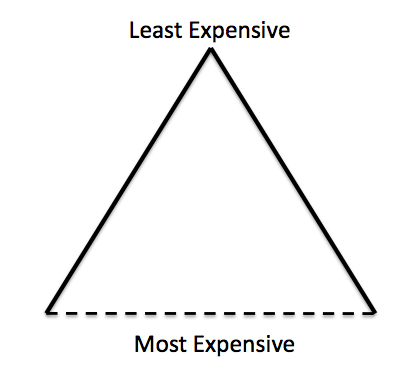
Figure 6. Resource triangle, with dotted line indicating uncertain financial cut-off.
The higher cost of extraction is equivalent to diminishing returns.
As we are forced to seek out ever more expensive to extract resources, the economy is in some sense becoming less and less efficient. We are devoting more of our human labor and other resources to extracting fossil fuels, and to extracting minerals from ever-lower-quality ores. In some sense, we could just as well be putting these resources into a pit and burying them–they no longer help us grow the rest of the economy. Using resources in this way leaves fewer resources to “grow” the rest of the economy. As a result, we should expect economic contraction when the cost of oil extraction rises.
In fact, economic contraction seems to happen when oil prices rise, at least for oil importing countries. Economist James Hamilton has shown that 10 out of 11 post-World War II recessions were associated with oil price spikes. A 2004 IEA report says, “. . . a sustained $10 per barrel increase in oil prices from $25 to $35 would result in the OECD as a whole losing 0.4% of GDP in the first and second years of higher prices. Inflation would rise by half a percentage point and unemployment would also increase.”
Energy products play a critical role in the economy.
Economic activity is based on many kinds of physical changes. For example:
- Using heat to transform materials from one form to another;
- Using energy products to help move goods from one place to another;
- Moving electrons in such a way that light is provided
- Moving electrons in such a way that Internet transmission can be provided.
A human being, by himself, exerts only about 100 watts of power. A human being is also quite limited in what he can do; he can provide a little heat, but no light, for example. Energy products are very helpful for making capital goods such as buildings, machines, roads, electricity transmission lines, cars and trucks.
We can think of energy products, and capital goods made using energy products, as ways of leveraging human energy. If per capita energy consumption increases over time, leveraging of human labor can grow. As a result, humans can become ever more productive–think of new and better machines to help humans do their work. Dips in this leveraging tend to correspond to economic contraction (Figure 7).

Figure 7. World energy consumption per capita, based on BP Statistical Review of World Energy 2105 data. Year 2015 estimate and notes by G. Tverberg.
To have a growing economy, wages of non-elite workers need to be growing.
Our economy is in a sense a “circular economy,” in which non-elite workers (less educated, non-managerial workers) play a pivotal role because they are both producers of goods and potential consumers of the output of the economy. Because there are so many non-elite workers, their demand for homes, cars, and electronic goods plays a critical role in maintaining the total demand of the economy.

Figure 8. Representation of two major parts of the economy by author.
If the wages of these non-elite workers are growing, thanks to increased productivity, the economy as a whole can grow. If the wages of these workers are shrinking or are flat (in inflation-adjusted terms), the economy is in trouble. The recycling process cannot work very well.
If there is not enough economic growth–often caused by not enough growth in energy consumption to leverage human labor–then we tend to get a growing imbalance between the sector on the left with businesses, governments, and elite workers, and the sector on the right, with non-elite workers. Part of this wage imbalance comes from sending jobs to low-wage countries. As jobs are shifted to low-wage countries, the workers of the world increasingly cannot afford the goods that they and other workers are producing.

Figure 9. Representation by author of imbalance that occurs.
If the wages of non-elite workers are not rising sufficiently, rising debt can be used to hide this problem for a while. The way this is done is by allowing workers to buy goods at ever-lower interest rates, over ever-longer time periods. This strategy has an endpoint, which we seem to be close to reaching.
Debt is a key factor in creating an economy that operates using energy.
A generally overlooked problem of our current system is the fact that we do not receive the benefit of energy products until well after they are used. This is especially the case for energy used to make capital investments, such as buildings, roads, machines, and vehicles. Even education and health care represent energy investments that have benefits long after the investment is made.
The reason debt (and close substitutes) are needed is because it is necessary to bring forward hoped-for future benefits of energy products to the current period if workers are to be paid. In addition, the use of debt makes it possible to pay for consumer products such as automobiles and houses over a period of years. It also allows factories and other capital goods to be financed over the period they provide their benefits. (See my post Debt: The Key Factor Connecting Energy and the Economy.)
When debt is used to move forward hoped-for future benefits to the present, oil prices can be higher, as can be the prices of other commodities. In fact, the price of assets in general can be higher. With the higher price of oil, it is possible for businesses to use the hoped-for future benefits of oil to pay current workers. This system works, as long as the price set by this system doesn’t exceed the actual benefit to the economy of the added energy.
The amount of benefits that oil products provide to the economy is determined by their physical characteristics–for example, how far oil can make a truck move. These benefits can increase a bit over time, with rising efficiency, but in general, physics sets an upper bound to this increase. Thus, the value of oil and other energy products cannot rise without limit.
Using hoped-for benefits to set oil prices is likely to lead to oil prices that overshoot their maximum sustainable level, and then fall back.
A debt-based system of setting oil prices is different from what most of us would have considered possible. If wages of non-elite workers had been growing fast enough (Figure 9), increasing debt would not even be needed, because the whole system could grow thanks to the increased buying power of the many non-elite workers. These workers could buy new houses and cars, have more meat in their diet, and travel on international vacations, adding to demand for oil and other energy products, thereby keeping prices up.
As wages of non-elite workers fall behind, an increasing amount of debt is needed. For the US, the ratio of the increase in debt to the increase in GDP (including the rise in inflation) is as shown in Figure 10:

Figure 10. United States increase in debt over five-year period, divided by increase in GDP (with inflation!) in that five-year period. GDP from Bureau of Economic Analysis; debt is non-financial debt, from BIS compilation for all countries.
Thus, the increase in debt has never been less than the corresponding increase in GDP over five-year periods, even when oil prices were low prior to 1970. In general, the pattern would suggest that the higher the oil price, the higher the increase in debt needs to be to generate one dollar of GDP. This is to be expected, if economic growth depends on Btus of energy, and higher prices lead to the need for more debt to cover the purchase of necessary Btus of energy.
We are reaching a head-on collision between (1) the rising cost of energy production and (2) the falling ability of non-elite workers to pay for this high-priced energy.
The head-on collision we are reaching is what causes the potential instability referred to at the beginning of this article, as illustrated in Figure 1. Of course, such a collision has the potential to cause debt defaults, as it becomes impossible to repay debt with interest.

Figure 11. Repaying loans is easy in a growing economy, but much more difficult in a shrinking economy.
Turchin and Nefedov in the academic book Secular Cycles analyzed eight agricultural economies that eventually collapsed. The problem that these economies encountered was exactly the same one we are now encountering: falling wages of non-elite workers at the same time that the cost of producing energy products (food, at that time) was rising. Rising costs were often an end result of too many people for the arable land. A workaround could be found, such as building irrigation or adding a larger army to conquer a neighboring land, but it would add costs.
As the problems of these economies progressed, debt defaults became more of a problem. Governments found it hard to collect enough taxes, because so many of the workers were increasingly impoverished. Often, workers became sufficiently weakened by an inadequate diet that they became vulnerable to epidemics. Governments often collapsed.
In the economies analyzed by Turchin and Nefedov, food prices temporarily spiked, but it is not clear that this was the final outcome, given the inability of workers to pay the high prices. Debt defaults would tend to further reduce ability to pay. Thus, it would not be surprising if prices ended up low (from lack of demand), rather than high. We know that ancient Babylon is an example of one economy that collapsed. Revelation 18:11-13 seems to describe the situation after Babylon’s collapse as one of lack of demand.
11 “The merchants of the earth will weep and mourn over her because no one buys their cargoes anymore— 12 cargoes of gold, silver, precious stones and pearls; fine linen, purple, silk and scarlet cloth; every sort of citron wood, and articles of every kind made of ivory, costly wood, bronze, iron and marble; 13 cargoes of cinnamon and spice, of incense, myrrh and frankincense, of wine and olive oil, of fine flour and wheat; cattle and sheep; horses and carriages; and human beings sold as slaves.
Other parts of the oil limits story that researchers have missed
As I have previously mentioned, most researchers begin with the view that soon there will be a problem with energy scarcity. The real issue that tends to bring the system down is related, but it is fairly different. It is the fact that as we use energy, the system necessarily generates entropy. This entropy takes the form of rising debt and increased pollution. It is these entropy-related issues, rather than a shortage of energy products per se, that tends to bring the system down. See my post, Our economic growth system is reaching limits in a strange way.
We could, in theory, fix our problems by adding infinite debt at the same time that wages of non-elite workers tend toward zero. We could then use this additional debt to fight pollution problems and pay all of the workers. All of us know that this solution would not work in the real world, however.
The two-sided economy I have described in Figures 8 and 9 is one part of our problem. There is a popular saying, “We pay each other’s wages.” Unfortunately, paying each other’s wages does not work well, if the wage level of elite workers differs too much from the wage level of the non-elite workers. A worker making $7.50 per hour in a part-time job is not going to be able to pay the wages of a surgeon making $300,000 per year, no matter how an insurance policy is designed to spread costs evenly. A worker in India or Africa will not be able to afford goods made by human workers in the United States, because of wage differences.
Governments can try to fix the problem of non-elite workers getting too small a share of the output of the system, but this is not easy to do. The real problem is that the system as a whole is not producing enough goods and services. This happens because the high cost of energy extraction (plus related issues–pollution control; need for more education for workers; need for ever-larger government and more elite workers) is removing too many resources from the system. The result is that the economy as a whole tends to grow ever more slowly. The quantity of goods and services produced by the economy does not rise very rapidly. When there are not enough goods produced in total, non-elite workers tend to find that their allocation has been reduced.
If governments attempt to add debt to fix the problems with the system, the addition of debt tends to raise asset prices on the left side of Figures 8 and 9. Unfortunately, the additional debt usually has little impact on the wages of non-elite workers (that is, the right hand part of the system).
Governments have talked about minimum income programs to raise incomes of those who are not elite workers. Whether or not this approach can work depends on many things–how much additional debt can be added to the system; whether this debt will actually raise the total amount of goods and services produced; how tolerant those in the left-hand side of Figures 8 and 9 are of losing their share of goods and services; the impact on relative currency levels.
Research involving Energy Returned on Energy Investment (EROEI) ratios for fossil fuels is a frequently used approach for evaluating prospective energy substitutes, such as wind turbines and solar panels. Unfortunately, this ratio only tells part of the story. The real problem is declining return on human labor for the system as a whole–that is, falling inflation adjusted wages of non-elite workers. This could also be described as falling EROEI–falling return on human labor. Declining human labor EROEI represents the same problem that fish swimming upstream have, when pursuit of food starts requiring so much energy that further upstream trips are no longer worthwhile.
Falling fossil fuel EROEI is a contributor to falling EROEI with respect to human labor, but there are other contributors as well (Figure 12). (My list is probably not exhaustive.)

Figure 12. Author’s depiction of changes to workers’ share of output of economy, as costs keep rising for other portions of the economy.
If our problem is a shortage of fossil fuels, fossil fuel EROEI analysis is ideal for determining how to best leverage our small remaining fossil fuel supply. For each type of fossil fuel evaluated, the fossil fuel EROEI calculation determines the amount of energy output from a given quantity of fossil fuel inputs. If a decision is made to focus primarily on the energy products with the highest EROEI ratios, then our existing fossil fuel supply can be used as sparingly as possible.
If our problem isn’t really a shortage of fossil fuels, EROEI is much less helpful. In fact, the EROEI calculation strips out the timing over which the energy return is made, even though this may vary greatly. The delay (and thus needed amount of debt) is likely to be greatest for those energy products where large front-end capital expenditures are required. Nuclear would tend to be a problem in this regard; so would wind and solar.
To evaluate the extent to which a given energy product tends to raise debt levels, a better approach might be to look at debt levels directly. Another measure might be to compare the required system-wide capital expenditures for a particular purpose, for example, to provide sufficient non-intermittent electricity for the state of California over a period of say, 50 years, using different electricity generation scenarios.
Our academic system of inquiry, with its peer reviewed literature system, has let us down.
Our peer reviewed academic system is not telling this story. Part of the problem is that this is a difficult story. It has taken me most of the last ten years to figure it out.
Part of the problem with our academic system seems to be excessive reliance on past analyses. Once one direction has been set, it is hard to change. Another part of the problem is that the focus of each researcher tends to be quite narrow. The result can be that it is hard to “see the forest for the trees.”
Furthermore, politicians and academic publishers tend to “push” results in the direction of a desired outcome. Grant money goes to researchers who follow the government-preferred fields of inquiry; publishers prefer books that are not too alarming to students.
I am coming at this issue from “out in left field.” I don’t have a Ph.D., although I am a Fellow of the Casualty Actuarial Society, which many would consider similar. I also have an M. S. in Mathematics. I do not work in a university setting. I do not have a strong background in subjects a person might expect, such as geology, economic theory, or physics. I do have a fair amount of practical experience with financial modeling from my actuarial background, however.
My approach is very different from that of most researchers. I come to the problem from the point of view of how a finite world might be expected to operate. I write most of my articles on the Internet, where I get the benefit of comments from readers. Many of these commenters point me in the direction of articles or books I should read, or raise additional issues I should consider.
Over the years, I have become acquainted with many researchers in related fields. These people have generally reached out to me–invited me to speak at their conferences, or corresponded with me about issues they considered important. As a result of this collaboration, I have been able to put together a more complete story than others.
I have stayed away from publishers and funding sources that might try to influence what I say. I have not been taking donations, and do not run ads on my website. The story is one that needs to be told, but it easily gets distorted if the person telling the story is influenced by what will generate the largest donations, or the most grant money.


Kunstler’s latest podcast is with Steve Ludlum, for those who are interested: http://peakoil.com/generalideas/a-chat-with-steve-ludlum-of-economic-undertow-com
The under $75 oil price misses the point – how much of $80 per barrel pays for pensions, roads, wars, education … ???
And how much of the returns paid as dividends to stock markets comes from oil and petrochemical products???
Oil at $45 a Barrel Proving No Savior as Bankruptcies Pile Up
“I don’t think the E&P model in North America is economic and I don’t think it was real economic even at $80 and $100 oil,” Jim Chanos, Kynikos Associates founder and president, said in an Bloomberg TV interview Thursday. “It’s certainly not economic at $45 oil.”
http://www.bloomberg.com/news/articles/2016-05-12/oil-at-45-a-barrel-proving-no-savior-as-bankruptcies-add-up
LMFAO! What a surprise. Bring me a big tub of popcorn and a bucket!
Pingback: Parell de forces | Les CIÈNCIES en BLOC
If it’s done correctly the person could reproduce, but we are very very far from having the technical ability to do this and from understanding our DNA enough to make informed design decisions and avoid a disastrous outcome
Without a spoon I am not hopeful for the survival of almost all who post here.
as long as i’m included in the almost—who cares
that shoulda been excluded
All adds to the mix and it is FUN – remember fun?
as i recall fun always got me in lotsa trouble
i am going to take holy orders and sin no more
There is sinless intellectual enjoyment. but first you have to wear a hair shirt for 50 years to show your dedication. Are u ready to be blessed?
i only trust lady priests with my body
I see, you little pagan you!
http://www.scienceworldreport.com/articles/40025/20160518/scientists-hold-secret-talks-on-synthetic-human-genome-creation.htm
Sometimes it’s fun to post something other than prognostications on our impending doom, like this article on a synthetic human genome. I tried pasting part of the article, but it has a block on that, at least from my end. Anyway, it goes on to say they would be able to at some point grow a human utilizing this synthetic genome without the need for a body. Sounds like a replicant. Anyway, I know collapse is coming but the future could have possibly included people not born the usual way. That conjures up all sorts of strange ideas, like maybe some corporation would invest in these synthetic replicants to train and lease them to the military and or different industries. Their genomes would be synthetic so alterations could be tailored for specific traits.
If you watch the movie, ‘Jacob’s Ladder’ the military experiments with a drug that turns soldiers into psychotic killers, but unfortunately they turn on one another. In this case they could probably develop synthetic genomes to maximize psychotic killing traits that does not include outing their comrades.
I wonder if a synthetic human could reproduce? I guess that depends on how the synthetic genome is written.
Yeah, Venture’s company has already made from scratch microbes. I think it will be easier to build from scratch a new chromosome pair to add the the existing 23 pair in a human at the one cell stage. This would add new functions and or modify/regulate existing functions.
Let loose the dogs of war. It does not need to be human killers. The same with robot killers for the military. Boston Dynamics robot dog packs are not what I want to see coming at me if I am on the battlefield. It will be similar to Germany driving tanks against horse cavalry, a rout, a very bloody rout.
I could easily see this as a natural progression from where we are now. I still see this as destructive growth though. I feel we as human beings peaked in the 50’s and 60’s. Today we are just less human. One example of this is societies fascination with “communication” gadgets (iPhones and Android Phones). Folks become so engrossed in the virtual world of the internet via their phones that even if they were to be face to face with many of their online “friends,” they wouldn’t want to talk to them. They wouldn’t even really know them. We have built our own ecosystem and it is beginning to undergo an evolutionary process very similar to Darwin’s natural selection process. Our human fascination with technology, war and aggression can be seen everywhere. If survival of the fittest is applied to our modern human ecosystem, it means those with the most money and resources will rule the roost. That means large corporations will continue to grow and displace and consume all smaller corporations until you have one very large monolithic powerful corporation (run by psychopaths) that controls all of the human race. A slave labor world of epic proportions forced through genetics and electronic monitoring and controlling. Would make ancient Egypt look like a child’s board game. 1984 on steroids.
I hear that IA robot swarms very quickly learn that poking humans in the eye is a good way to keep them under control.
Here’s one for FE: Problems with decommissioning nuke plants. Quelle surprise, the nuke companies aren’t setting aside all the funding needed to get the job done. http://www.counterpunch.org/2016/05/17/when-nuclear-plants-expire-stick-the-taxpayers-with-the-bill-and-the-waste/
it’s not availability of oil that’s the problem
it’s affordability of oil.
to sustain our oil-economy, billions of us must buy. and continue to buy (and run) the machines that consume the oil.
Without those machines, oil itself is worthless. What we seem to be doing right now is (in a collective sense) exhausting our purchasing power for fuel burning machinery.
Entropy occurs naturally, but for the last 2 centuries we have been putting entropy on a fast track. Destruction of resources has been accellerating for no other reason than to make room for more resource-consumption in order that that too can be consumed faster to further to illusion of money-profit through energy-token exchange.
Thus a billionaire has a billion energy tokens, which he can only “use” to acquire the results of some else’s energy expenditure—a mansion, private jet and so on–otherwise they just sit in the bank.
for the past 100 years we in the industrially developed nations have all possessed the means to acquire machines on a seemingly infinite basis, in which we were required to burn infinite oil.
unfortunately infinity turns out to be finite after all—what we really had was infinite debt instead.
So right now our life-focus is concerned with the production of energy itself.
Ultimately that must lead to a theoretical “economy” that is concerned with delivering only energy, and nothing else.
Which is a pseudo-scientific way of explaining that we go round in ever decreasing circles until we disappear —you-know-where.
The piece of the puzzle not emphasized by Gail but hit over the head time and again until its AN UGLY, BLOODY PULP by Steve Ludlum of the Economic Undertow blog is that most of our use of oil/coal/gas DOES NOT PRODUCE AN ECONOMIC RETURN, and hence cannot serve as a basis for sustaining increases in oil or other resource production. Economically, it’s just WASTE- we burn it (AND IT IS THEN GONE FOREVER) to, as Steve says, “drive in circles between work, home and shopping,” or to heat our homes, or to build homes, to put down and maintain roads for commuting and all this driving in circles, and to gather resources to build same, but houses, roads, vacations, travel, having warm homes, fancy clothes, cheap plastic goodies from Walmart etc. DOES NOT PRODUCE AN ECONOMIC RETURN that can be used to plow back into further resource mining. I think Steve has estimated that the use of oil that actually generates an economic return is like 1 – 4%. The rest is just consumption. As long as the oil etc. was very cheap to get, we could use it simply to expand consumption, and we called this expansion of consumption “economic growth” when actually it was just burning through the cheap pile of resources we learned how to exploit. Steve is fond of contrasting the beautiful Tuscan villlages built to last in the pre-industrial age with pictures of modern suburbs and tract housing to illustrate our so-called “progress.” Now the stuff is getting expensive to get and the actual productive side of the economy that does generate an economic return doesn’t generate ENOUGH returns to support further extraction FOR NONREMUNERATIVE, CONSUMPTION, which is pretty much all we used it for = we are SCREWED.
yup—it’s all perfectly obvious
but—just like the nekkid king, nobody in any kind of authority dares to point it out
These are good points and I recommend Ludlum’s blog as well.
Now, lets ask where does it lead us?
At some point, those societies tuned more to the rhythm of individual instant consumerism are going to pay dearly in somewhat expedient crash/reset event. Lets compare/contrast.
For instance, if you look at certain Siberian/Far Easter cities in Russia, doesn’t have to be necessarily new buildings, but after some renewal/overhaul, the concrete projects of CCCP still stand, sometimes they resemble termite towers as the high rises are designed for central heating and keep the heat inside the cluster of several apartment buildings, thousands of people live on relatively small footprint. I doubt there are many of such examples in Canada not mentioning USA, perhaps something of a bit smaller scale in Scandinavia does exist. Why mentioning this? The energy was invested “wisely” – also they have been insulated more, perhaps new plumbing done in recent decades etc. It’s on a railroad network, should the central heating boiler unit go off in deep sub zero temps, chances are, help will be delivered. In contrast, you will be on your own in many parts of the North/West should the infrastructure incl. trucking deteriorate, age more, while JIT system crumbles around you..
There are also examples in opposing directions as Russians are willing to learn and adopt some of the concepts of bio farming from Europe/US, it’s no joke since there is embargo on imports/exports.
Overshoot.
You should have read Hanson vs McCarthy in the 90s.
ie b4 peak oil!
tagio
When the notorious Casanova wrote his Memoirs, he observed that the English of the 18th century were short-termists, as they built houses designed to last for ‘at most, 200 years’.
He compared this to the stone houses of Italy which were, as you say, able to stand for many centuries more, subject to constant repair with locally-sourced materials.
Another point is that as soon as peasants anywhere get the chance to leave their ancient villages and agricultural work, on the whole they do so.
We have now the future which we, collectively, wanted: the escape from rural labour and hardships, comfort, and regular assured food. From the moment that towns gave European peasants a hope of something better, they did their level best to get to them, hence the struggle of feudal lords to keep people on the land.
Yes “we” have the future we thought we wanted, but to use a term coined by Yves at Naked Capitalisim, it’s a “crapified” future. Industry doesn’t pay for itself (as Ludlum is fond of pointing out) – it is always borrowing in advance and can never stop borrowing in advance so it is driven to build in obsolescence to produce a semi-reliable future income stream, otherwise it would run out of customers as it reached market saturation. I.e., industry is inherently crapification. You know the drill, things are made so that you can’t fix them, you just have to replace them. In the old days GM actually built cars with the idea that customers were supposed to buy a new one every 3 years or so, to get the latest fashionable model. They only gave up on this strategy years after they were hammered by the japanese cars that were built to last for more than 100,000 miles. Good thing we have all this virtual reality now to distract us from real reality.
What you mean we? Paleface!
Well, I feel encouraged by your post. Just reading something that comports with my intuition. I have the profound sense that we don’t have to be in this mess, based on stupidity and waste.
For the 1,999,876,098,876,654,890 time… the nuclear plants are not the issue.
It’s the 4000+ spent fuel ponds. You cannot decommission a spent fuel pond. The fuel must remain cooled in high tech facilities for up to 10 years at which time more high tech machinery lifts them from the ponds and puts them into dry casks.
When BAU goes the rods won’t be cooled for a day – let alone 10 years
Need to shift the spent fuel rod storage into water that is naturally sourced and guaranteed. The ocean, large deep lake, large river. No pump required, will survive the fall of civilization. Here, Indian Point can shift to the Hudson River, Diablo Canyon can shift to the Pacific Ocean, and so on.
Usually, the temporary spent fuel rod storage facility is double/triple secured by means of standalone power unit with enough fuel, and also by passive loop via nearby lake, river, man made water canal etc..
So I’d not worry about this very point that much, as there apparently other more pressing challenges ahead like gutted health/social services, crime wave, gov forced change of ownership etc.
As mentioned previously I ran into a cousin who is an engineer at the big nuclear facility outside Toronto – he’s worked there for 20 years+ on the safety side of the operations…
After Fukushima he told me they added massive diesel powered pumps that can pump water from one of the large lakes in the area so as to be able to contain an accident.
Basically if there is a meltdown like at Fukushima then they would (as they are doing in Fukushima 24/7) turn on the pumps and flood the area with cooling water.
This is a short term solution — diesel will not be available — pumps break and cannot be fixed or replaced…
It is my understanding that this safety system is not applicable to spent fuel ponds due to the scale of those installations. These pumps are specifically meant to pour water on a melted reactor core.
Given you won’t even be able to buy a toothbrush post BAU … I fail to see how 4000+ ponds are kept operational… they have thousands of moving parts…. and keep in mind there will be total chaos — starvation — violence… nobody will be in control…
Of course if you live in DelusiSTAN …. there is no need to worry about any of this… you’ll be joining hands in cooperation and peace — and eating organic granola …. living The Good Life.
Just putting some things into perspective …
http://www.telegraph.co.uk/news/worldnews/asia/japan/10014229/Fukushima-nuclear-plant-struggling-with-rat-problem.html
Some species are evidently bothered less by radiation than others. This is something easy to forget. Or maybe rats are bothered by radiation, but over longer time frames.
Of course if you dumped the lot into the oceans you’d kill everything that lives in the ocean … not such a big deal I suppose (sarc on)
Actually, dumping those spent fuel rods into the mud at the bottom of the ocean is not a bad idea. It’s pretty lifeless down there, and water is a great radiation shield. The Russians have been doing similar things off their north shore, Novaya Zemlya area. The US has dumped off San Francisco and in the Gulf of Mexico, plus other sites, e.g., Marshall Islands in the Pacific.
The problem is transport. The really radioactive assemblies need to be in water 24/7/365, so how to move them to the ocean? It’s probabaly too expensive (dang, that expensive word showes up again). So, being in denial most places saves lots of money. One could argue the folks in the surrounding areas were going to die of starvation anyway, only problem is the radiation hazard for those “lucky” ones able to squeeze through the bottleneck.
Ya there’s nothing in ocean anyway – most of the fish are fished out…
I am sure that dumping 100’s of thousands of tonnes of spent fuel into the oceans would have relatively little impact.
“Problems with decommissioning nuke plants.”
That must a contender for the Most Insane thing I’ve ever read.
I think if we just ignore this spent fuel problem … then it will go away.
Reuters – today’s headline “Too costly to shut”. It seems that Central Banker incompetence extends beyond financing shale oil wells, and impacts other extractive industries. What to do? Tightening up regulations and environmental requirements will push up costs but unless the products are affordable at higher prices things just collapse.
http://www.reuters.com/article/us-australia-mining-idUSKCN0YA2VL
“Major miners are trying to avoid hundreds of millions of dollars in closure costs by selling off pits, as cash is tight due to a prolonged commodities price slump, but the crippling cost of environmental rehabilitation makes it tough to seal deals.”
“Or in some cases, such as in nickel, producers are continuing to produce at a loss to avoid closure costs.”
“As (rehabilitation) looms, the number gets bigger and bigger. It definitely is impacting the agenda of a lot of companies, even the big ones,” said Gavin Buckingham, a partner with consultants EY. In a cautionary tale, China’s MMG Ltd (1208.HK) had to hike its estimate of closure provisions more than 60 percent to $378 million for Australia’s largest open-cut zinc mine, Century, just months before digging its final ton last year as the reality of what would be involved became clearer.”
“The world’s biggest miner BHP Billiton (BHP.AX)(BLT.L) sliced about a quarter of its environmental obligations last year in one fell swoop, cutting its total to $6.7 billion when it cast off several mines into a new company, South32 (S32.AX).”
“Queensland’s government has A$80 million ($58 million) in financial assurance from Rio to cover Blair Athol’s rehabilitation, but Lock the Gate estimates the assurance should be as much as A$160 million, based on the state’s guidelines.”
The high cost of rehabilitation is important. It is not just mines that are affected, but also oil wells and natural gas wells.
My guess is that in the end, most mines, oil wells, and natural gas wells will not be rehabilitated, certainly not as much as they should be. Societal collapse will make it hard to get prices up to a level where it is possible to do this rehabilitation.
FE, the Russians have dumped entire used reactor cores (from submarines, ships, etc.) in the waters off Novaya Zemlya. Americans have traced plumes of radioactive Cs-137 from them that stretch eastward across the Arctic Ocean from those sites. Not saying it’s a great practice, but as long as the plumes stay in the deep ocean, they are not a big danger. If those waters eventually upwell, that’s another story starring bioaccumulation into the food chain. I guess the Russians (and Americans) are counting on radioactive decay rates being faster than deep plume migration. Fission products like 137Cs, 90Sr have relatively short 30-year half lives, and the transuranic metals used as fuel are relatively insoluble.
I guess they didn’t want to risk contaminating any groundwaters on land.
And perhaps that is one of the main reasons for this:
http://farmwars.info/wp-content/uploads/2013/12/Graph2.jpg
And as I have posted previously — there are hundreds of thousands of tonnes of spent fuel sitting in fuel ponds around the world…
Dumping all that into the oceans would surely mean poisoning them forever. It does not take a degree in nuclear physics to come to that conclusion
What´s about liquid hydrogen generated from solar energy to solve the storage problem?
It works! Maybe it is to much expensive.
I recently bougth some Ballard Power shares (no recommendation).
Saludos
el mar
Takes a lot of coal and oil to build the hydrogen and solar infrastructure. Then,more coal and oil to maintain it and the other supporting infrastructure like trucks, cars, roads, buildings, electric grid and bridges etc.
This is my last post that I will make regarding shortonoiil
His latest comment
“Producers can no longer replace the reserves that they are extracting. They are now selling their assets (their reserves) to stay in business. The price only has a few more dollars to rise before enough demand destruction sets in to drive the price back down. That’s what the curve shown above is all about. Since oil powers 38% of the world’s economy when it is gone, so also will be the world’s economy. The industry will then lose the ability to drill a bunch of holes in the ground, and the world will have lost the ability to support 7.2 billion people.
There is no use worrying about; it is a self correcting problem. The petroleum industry is going broke:'”
http://peakoil.com/consumption/peak-oil-where-to-begin
So, that is it a nutshell…no sense repeating it over and over in different papers, blog posts, or thousands of other formats. Does it really matter?
https://m.youtube.com/watch?v=fqlHLaFVwLc
Silly people never make it through my door.
I agree that the oil industry is going broke. All of the difficult to extract types of oil are, in fact, too expensive to extract today.
In fact, a large share of the coal and natural gas producers are also going broke. The whole system is no longer working.
“The whole system is no longer working.”
So, does it make sense to buy another long-playing record?
Gail, would you please at some point address the “semi-autarky” and “neo-regionalism” scenarios before 2050-2100 as well? For example, take Russia, they as some other countries can subsidize expensive oil necessary for running todays infrastructure by other energy carriers like natgas, uranium, hydro, methane hydrates (perhaps at the some point).. The climate change opens some fossil energy projects prospects in the Arctic shelf as well.
In simple terms, it’s a vision of patchy world cooperating and non cooperating state entities, it’s a time of collapsed global trade as we know it today, so no consumerist JIT system, but some international trade still does exist.
I guess people don’t want to discuss this option, because it means very nasty outcomes for large areas of industrial world, but it may guarantee some existence, although be it not as posh and clean for countries like Russia and or splinter states of the former USA etc.
do you guys think that the whole northern hemisphere will be contaminated by radiation after the collapse? It seems like the best place to survive the coming apocalypse is in australia or new zealand.
A hardcore ecovillage seems like the best place, this place seems good?
http://kotarevillage.org.nz/
I live in Norway at the moment, i was thinking of going to an ecovillage in the mountains in northern spain, but new zealand seems like the best choice.
I’m afraid NZ has followed the US
And don’t forget “Crazy Eddie” lives there…more reason not to
The stench of corruption is heavy in the air – from fishing to housing to tax havens. And the media plays along: not asking the really tough questions.
There is no escaping radiation.
yorchichan man that is too depressing, it seems like one cannot win.
You never could – unless you are willing to castrate all undesirables and weed out the worst of the females.
Nature does the job eventually of course but in this case it is too late for the species.
i read a feature on that ecovillage in northern spain too
i had the temerity to point out that the people living there all seemed to be 25 ish–fit and beautiful and many miles from the nearest doctor etc
life aint like that
you mean matavenero? i am 26 myself, I would like to find a place where people are young. the problem with most ecovillages is that they are so expensive to get into that it starts to resemble a retirement home, and not a self sufficient community. matavenero seems good since it is cheap to get a place there and people there are not very wealthy. too much wealth is also not good if one wants to find a lifeboat ecovillage.
hmm no I think i know which ecovillage you are talking about, it is not matavenero. there are many ecovillages in spain since there is a lot of cheap land and abandoned villages there.
Sindre, NZ is horribly corrupt and has a huge property bubble, and it is very difficult to obtain permanent residency status, unless you have millions. The only thing it’s really got going for it is geography. It is not very scientific of me, but I ruled out NZ after I watched Jane Campion’s TV series, “Top of the Lake.” If people in NZ are anything like the rednecks and others portrayed in that series, thank you very much, I’ll take my chances in the U.S., where I at least blend in.
If you want to escape the nuclear problems for as long as possible, consider emigrating to southern Chile, e.g., the area around Puerto Montt. It has a large component of people of German ancestry, as well as Spanish. It is much easier to obtain permanent residency status in Chile. You will have the risk of volcanoes, but in other respects it seems well positioned to ride out climate change problems as well. http://www.doomsteaddiner.net/blog/?s=chia+location+
Good luck.
Corrupt yes, not so horribly though – we are acceptably corrupt
The major city in NZ, Auckland has had its property market manipulated for years because it is the most densely populated area and hence most democratically valuable.
According to my supersecretsources it was Helen Clark (the Labor Party leader) who opened up the floodgates to Asian immigration with the SPECIFIC intent to raise property values and keep the herd happy.
Now there is hell to pay : nobody in Govt wants to make housing “affordable” to basic families for to do would collapse the property bubble.
And Helen Clark is now a serious contender for UN Secretary!!!!
This is total bullshit.
The reason the Auckland – and London, and Vancouver and Toronto and Hong Kong and Singapore and umpteen other property markets raged higher post 2008 — is because of the trillions of dollars of liquidity that was unleashed by the central banks.
That cash – particularly the stimulus cash in China — has been used to bid up property around the world — primarily in major cities.
tagio thanks for the interesting link. Yes south of chile seems interesting, the only downside is the political instability of the region and I hope you are right in that there are many of European heritage in the area. One of the reasons I like Norway is that it is still pretty homogenous society, the more diverse a society gets the more unstable it will be.
I am surprised that nz is so corrupt. Yes NZ seems very rednecky and it is a very mixed country because of the asian immigration which is a downside.
“NZ is horribly corrupt’
Strange… I have always thought it one of the least corrupt places that I have lived in or visited…
Red necks? From my experience no more so or less so than anywhere else…. https://en.wikipedia.org/wiki/Nazism_in_Sweden
You might consider that extreme behaviour is frequently the result of there not being enough to go around… there won’t be anything to go around post BAU … so don’t expect much in the way of kindness no matter where you end up….
Also – you do not need millions to get in — the immigration options are pretty much the same as countries like the US or Canada — you can buy your way in — but if you have a skill that is in demand you can easily get residency.
Then there is the Bastion of absolute purity the meatworks USA.
hate to rain on your parade
but if youre in an ecovillage or whatever, and get a raging toothache, life threatening infection or birth complications (I’m assuming people will still find each other desirable)—then you will be running to the nearest town.
http://www.endofmore.com/?p=578
If you’re lucky to have a doctor in the commune, without the backup of modern medicine systems, he will be able to offer you little more than a tribal witch doctor
ok, i have never said that an ecovillage can fully replace modern civilization.
In terms of survival I think the best option is an ecovillage, I also have the money if I need to go to the hospital.
you also missed a critical point—in survival terms, money doesn’t buy hospital care, or transport to get there.
Dying Infants and No Medicine: Inside Venezuela’s Failing Hospitals
http://www.nytimes.com/2016/05/16/world/americas/dying-infants-and-no-medicine-inside-venezuelas-failing-hospitals.html?_r=0
I fail to see how an eco-village would overcome these problems….
If the hospital is there, and the electricity is there.
The hospital? You really think there will be hospitals post BAU???
http://comps.canstockphoto.com/can-stock-photo_csp5170101.jpg
Is your eco village in DelusiSTAN
i found myself rolling about at the hospital idea too
Very true. We greatly underestimate the threat of infection, having grown up with good antibiotics.
I recently asked friends, who would have died already without antibiotics?
ALL of us, and before the age of 30.
All male, just consider the higher historical risks for females in pregnancy,….
Three times I have escaped death courtesy of modern medicines. I am very grateful, but did rather take it all for granted.
Gene pool won’t miss you.
Dental Health and Disease in the Past
Dental diseases are among the most commonly seen pathological … too that in the pre-antibiotic era these bouts often lead to systemic infection and even death
Dental diseases are among the most commonly seen pathological conditions in archaeological remains and can potentially provide a great deal of information. The dental diseases we see today have always been present, but their prevalence varied dramatically with the staple diet of the population and with the wealth and lifestyle of each individual.
Wear
Surprisingly, one of the biggest problems in Europe, before the Middle Ages was dental wear. Many foods were tough and abrasive and required so much chewing that by the time people were in their thirties they had lost much of the enamel from the chewing surfaces of their molars, exposing and infecting the dental pulps and leading to jaw infections.
By the time people were sixty many of their back teeth had worn away or come out anyway. It was not until the seventeenth century that milling techniques dramatically improved and reduced the amount of grit in the everyday diet. Now we have reached a state where many would argue that we do not work our teeth hard enough to keep our jaws healthy.
Gum disease (Periodontitis)
We take relatively clean teeth for granted, but before the invention and manufacture of toothbrushes most people had thick layers of dental plaque (a layer of bacteria and food debris) covering the side surfaces of many teeth. The constant presence of thick dental plaque with its multitude of organisms generating harmful toxins led to swelling and destruction of the gums and to shrinkage of the jaw bone away from the teeth which then became mobile. The older one became, the more likely it would be that your teeth would become loose and painful. The 10% of the population who are always especially prone to gum disease would have lost all their teeth even earlier than the main population.
Dental Decay (Dental Caries)
Dental caries, in which acid produced by bacteria in the mouth acting on food debris eats cavities into the tooth enamel, and was largely a problem of the wealthy. However it was to become a problem on a huge scale during the eighteenth and nineteenth centuries. Sugar became cheap and available to all. This led to dental decay becoming a universal problem. Toothache, jaw abscesses and dental extractions became a normal part of life.
Toothbrushes and toothpastes developed in the Nineteenth century did little to prevent tooth decay, and it was not until the late Twentieth Century that the addition of fluoride to toothpastes and a greater variation in diet made a dramatic reduction in dental decay suffered by the general population.
Living with dental disease
Age inevitably brought with it an increasing lack of chewing power, frequent discomfort, very limited food choices, shame about appearance, bad breath, and periodic bouts of acute pain and swelling. It must be remembered too that in the pre-antibiotic era these bouts often lead to systemic infection and even death. In the early 1600s the London Bills of Mortality listed the causes of death and “Teeth” were continually listed as the 5th or 6th commonest cause of death. (This does not even include the category of “teething” which was wrongly blamed for the death of many children, since weaning coincides with loss of inherited immunity through breast milk to many diseases.).
Any form of dentistry, other than extractions, was not widely available until the Eighteenth Century and even then it was pretty ineffective. Any anaesthetics other than strong drink were not available until the late Nineteenth Century and so any attempt at dental treatment would have been acutely painful. Dentures were available to those relatively well off, but were mainly cosmetic and were probably a hindrance to talking and of limited effectiveness in aiding eating.
http://www.digitiseddiseases.org/dental_health_and_disease_in_the_past.php
I have a horror of dentistry, but an even bigger horror of ending up like my parents and grandparents, who by the time they were in their 40s were keeping their teeth in a glass overnight. It is in order to avoid that fate that I make sure I go along every three months for cleaning and to check whether I need any fillings. Actually, visiting the dental surgery of today is a much less uncomfortable experience than it was when I was a youngster.
I’ve fought a long defensive campaign against gum disease, and the thing that stopped its advance for me has been daily chemical warfare against the oral flora in the form of the strongest variety of Listerine. I keep stocked up on that because I don’t want to run out post-BAU.
Teeth were the 5th cause of death and now they kill nobody…
Of course dental is among the few health issues archaeologists can study, so it tends to get highlighted in this field. Let’s see it in detail:
Wear: it seems it was mainly due to the use of grinding stones to make flour. Therefore it can be avoided by eating grains, not flour. Btw, what is the benefit of using flour? I understand that Asian cuisine doesn’t use much flour, but rather rice grains. Do they had less of this problem, or nothing?
Gum disease: I have this problem, and at least in my case it seems very much related to the 20 cigarettes I smoke each day, because it acidifies the mouth (I tried Listerine, but I can’t get used to use any “medicinal” substance everyday). But it is simply not true that in ancient times everybody’s teeth were always dirty: when explaining his notion of virtue (which consists in the intermediate state between two extremes, such as prudence vs. temerity/cowardice), Aristotle put some examples and he wrote that people shouldn’t leave their teeth become darkly dirty, nor is it needed they keep them absolutely white. So, I didn’t investigated how but it seems ancient Greeks did had a method for cleaning teeth. The point is rather they didn’t saw any relationship between grime and health.
Dental decay: no sugar post bau, surely much better for teeth.
I am rather concerned by other kinds of illnesses
any where that only wants you if you’re rich and beautiful has a sinisterly familiar ring to it
+++++ Norman. Don’t want to be anywhere where the 0.1% buy their gentleman estates.
The formula for eco-villages seems to be: find wealthy terrified yuppies who know jack shit about living off the land — sell them property and a home — and a membership with the understanding that this will buy them salvation post BAU.
Plenty of takers for that message.
The little time I’ve spent looking into ecovillages leads me to believe there is nothing sustainable about them and they survive by exploiting gullible ecotourists. Would you really want to spend your time sat around a campfire singing kumbaya with a bunch of wannabe hippies anyway?
I once spent six months living in a village in northern Thailand that I suspect was far more self sufficient than any ecovillage. I went stir crazy. Give me civilization or give me death.
Strongly advise you think carefully before committing any money.
I agree 95% of ecovillages just won’t work, I am hoping to find a gem. The whole homesteading with a family will also probably not work, one will be overrun by hungry zombies. If the the collapse is slow enough there might be a chance that some ecovillages will transition to a more sustainable way of living.
move in with non-relatives and you become a food resource
+++++++
+++++++++++++
I have been to plenty of unplugged places around the world – including northern Thailand — and I am 100% with you on this — I would rather be dead than live like that.
This is Crazy Eddy when he hears he has to stay on his homestead in NZ for the rest of his days after BAU ends…so funny
https://m.youtube.com/watch?v=twp5vOKEivA
Even the Thai children I spoke to who’d spent all their lives in the village couldn’t wait until they were old enough to move away to a city.
I fondly recall sleeping on the floor of a hut and waking to see a mother smoke pure heroin crystals while her infant sat next to her….
Sustainable living is a really shitty gig.
I much prefer the Scott Nearing pretend version
No you don’t, Ed, because you are a quitter with much whining mixed in. Unlike you, the Nearings were not afraid to stick with the task at hand and real work, no just squeezing a bottle of Roundup because that was the easy way out. Actually, the did move from Vermont because there was too much BAU…the Ski industry invaded there hamlet and spoiled their ‘Good Life”. Too bad you didn’t take my advice and apply for that stewards position at their place in Harborside, Maine. There Eliot Coleman might of saved you.
But again that would require real consistent work. Best you continue on your path of bucket list, because we know where you’ll end up.
Ah Scott Nearing and his Good Life…. his factory made tools… electric lights .. hospitals… medicines…local police force to protect him… his pick up truck… his warm holidays in Florida…
If you can guarantee me I’d have such a good life with all of the above … I promise not to run into a rock cut at 250km/hr…
The problem with ‘eco-villages’ is that they leave out the single most important aspect of real peasant life: unremitting labour and suffering: pain, injury and an early old-age.
The pride of hereditary peasants lay in their endurance of suffering and being able to take anything.
Somehow, this less pleasant side gets left out of eco-village prospectuses…
I visited an eco village once — panicked yuppies pretending to be farmers (most didn’t actually live there rather they continued to work in the city at white collar jobs and were planning to run for the hills when the SHTF) … actually they had hired a farm manager to do all the farming …
Mind-blowing idjucy….
Firstly, make sure you understand who are the landowner’s in NZ, simply in deeper SHTF situation many of the top “Elders” with their massive entourage would relocate home there, and as a small fish you will be dealt with appropriately. On the other hand, one can argue there might be comparatively much worse choices like certain regions (usually near former industrial centers/hubs) of SAmerica, Europe, NAmerica, Asia.
Bottom line, if sudden crash is in the cards near/mid term, which is not 99% probability from todays vantage point, you can’t win this race anyway, only keep illusions of relatively better standing then others..
Without further details mountains in northern Spain could indeed provide some benefits, not sure about the long term climate viability (water), access to trade routes (and invasions corridors) etc.
hi thanks for informative comment. the one in spain is located here
https://es.wikipedia.org/wiki/Matavenero
the water they get from a mountain stream and since it is so hard to get to it is more defendable. It is also located in a temperate region.
https://www.facebook.com/matavenero-109027232514494/info/?tab=page_info
Although I don’t know much about the food situation, I think they are 50% self sufficient when it comes to that, which is not the best.
—————————————————————————————————
The one thing I like about kotare village in nz is that the leader knows about peak oil and is adamant about being 100’% self sufficient in every way possible. Since it is organized as a trust or something like that I don’t have to be a citizen of nz to buy.
http://kotarevillage.org.nz/
careful, sindre, you can buy, but you can’t stay unless you achieve permanent residency. without that you will be able to visit for like 6 months every year. research it carefully. don’t rely on their information – it’s sales literature.
yes tagio, might be difficult to get permanent residency.
If you are serious about staying alive you need to toss locations like this in the rubbish bin – you will be overrun by the tens of thousands of people who live nearby and have not anticipated the end of the world
You need to move to a place where everyone is living small… where there are not many people — a place like Irian Jaya… or the Amazon …
Of course you would have no idea how to survive in such a place — and I doubt you would be welcome by the people living there …
Sorry to inform you but the ‘Scott Nearing’ good life ain’t the way it’s going to be.
You need to get primitive and fast – if you want a shot at living
This is advice from someone who has relocated to NZ and understands that it is not the solution.
hi eddy, the location of the kotare ecovillage is:
96 Kotare Road, R.D.5
Wairoa, 4195
yes it will be probably overrun by people, although I still think it is one of the better options.
Matavenero in León, in an isolated, mountainous region in the North West Spain. The village is strikingly isolated, and accessible only by a stone footpath, meaning that supplied and building materials have to be winched down on a lift from the carpark high above the community.
The problem here is that everyone is not self sufficient, but I imagine it is easier to fend off a couple of neighbours than to live som kilometers from a town. Also the problem with matavenero is that the whole place will get irradiated from all the nuclear meltdowns worldwide, here it is better with nz or south in south america.
South America is also an option, but I don’t really know the place well.
There are a few places in South America that will be somewhat fine. I see that, at least in Argentina and Uruguay, very many people have come to know about PO. If you speak spanish it is an interesting option. There are very few and small ecovillages, but I can’t recommend any of them.
In my case, I am considering moving to a small town I know, in the Pampa. It has 6000 inhabitants, ten cows per person and big ag is producing more than 10 tons of grain per capita there. It is to expect that when tshf there will still be a lot of soya and some wheat and corn laying around in bagsilos. But there is no river, which is possibly better given I think zombies will go along rivers. Water was hand pumped from wells but now it comes from a hundred miles away, where it is pumped 500 ft. So some solar pumps are needed in local wells (but their water is rather dirty now) until riverside towns get empty and we can move there (they are bigger, so everything is more difficult excepting water). But if there is still much people and we truly need to move there it’s possible we’ll have war
A town like this one can be saved economically: 30 thousand usd in pumps would deliver 5 gallons of water per capita each day, plus more pumps for the cows plus just-in-case. Plus some buckets and steel stuff. It is not impossible I get the 150 thousands that are needed. It doesn’t matter very much this people are not hippies nor sustainability fans, most of them will do what is needed to live. I’d bring a couple of skilly hippies as well.
I am not trying to sell anything to you sindre, just trying to show there are other ways than settling in an ecovillage. Perhaps you don’t need to buy land, just become friend of one of them and you’ll be well received if you come up with the proper stuff at the proper moment. But I tend to believe that preexisting political units can do better than somewhat artificial villages.
I’ve heard in Europe you can cheaply rent a Middle Ages castle owned by the State. That’s a good choice as well
Christian very interesting. Seems like there are a lot of opportunities in Argentine. I know very little about the country. I hope it turns out well for you, I worry that I would be just looked at like an outsider in argentine. If I were to go to south america i would probably go the homesteading route, but this is boring, I want community. It also seems like anything can happen in south america nowadays.
interesting tidbit about the castles.
pintada:
the aqueduct is maintained by the community, but I don’t know enough. I have also heard they had some problems with water supply a couple of years ago. yes you bring up some pertinent issues.
sindre
Where are you from? These people are 90% Piedmontese descendants, and all 50+ years old persons understand Piedmontese language
Community is everything, it’s a prerequisite for family, but I am not sure it requires some strong spiritual connection or whatever of that sort. Of course, much better if you have some family in the community, as I do in this particular town
For those that wish to have a successful post BAU life, recommend highly the book,
“Living the Good Life”, written by Helen and Scott Nearing in essentially pre-industrial conditions in the State of Vermont during the depression era of the United States. A handy detail guide by a couple who actually tackled the challenge at hand for many decades, unlike one here whose claim is relocating from one spot or another because he won’t work.
Readily available for little cash if purchased used
http://www.amazon.com/Good-Life-Nearings-Self-Sufficient-Living/dp/0805209700
It is easy to be a naysayer, but to aim high and succeed is another matter
https://m.youtube.com/watch?v=evBpwQPn8QI
This is completely useless as a guide because the Nearings used cement — they had a pick up truck – they eventually had electricity — they had doctors and medicine and hospitals — they used roads — they had tools made from the best steel made in factories…they sold books and made money to buy stuff – including holidays to Florida in the winter…
NONE of that will be available post BAU.
If you want a guide to surviving post BAU you should watch videos about how primitive tribes live…
https://www.youtube.com/watch?v=p61KqiQZAiw
Oh right — of course — nobody wants to live like that — so go ahead and play make believe and read The Good Life… if it makes you feel better.
No, Crazy Eddy, its not make believe, but is being lived! You really think that comparing two extremely opposite temperate climate regions that developed two different cultures is a valid comparison? No, of course not! The Nearings lived with electricity while in Vermont! You are not only being unfair to judge them at a very advanced old age but it lacks any objectivity. It is impossible to say if any of us will live past our 30’s after the collapse of BAU. So you are just playing mind games here. Do what you wish, after all you earned your new nick name.
Oh, here is the other half of the team, Helen Nearing with Eliot Coleman visiting before her death showing us her no cost system of soil enrichment. I’ll do you a favor and post it for your veiwing education to help you on your own homestead in NZ, because I like you so much. Hope you also took the time to watch the one with Scott Nearing.
Oh, BTW, Eliot is doing just fine up in Maine. His cover crops are enriching the soil, with BAU artificial fertilizers and his stored foods are being stored nicely in the root cellar, no need to buy an electric refrigerator.
https://m.youtube.com/watch?v=Pyd3sYmCPUM
Best get on it now, while we still have BAU and not waste time on your bucket list or you’ll be like this chap, Fast, going no where…
https://m.youtube.com/watch?v=cB5uRYWwYWc
You seem to have not received my message…
Organic Farming >>> more food production >>>> more people >>>> industrial methods to produce even more food >>> more people >>>> chemically produced food further increasing food production volumes >>>> more people >>>> GMO food production that dramatically increased yields >>>> more people
I don’t understand why you celebrate people like Scott Nearing. He was a farmer therefore he was part of the problem.
I fail to understand how you are unable to understand that. One of us is surely stupid.
Of course, it should read without electricity in Vermont, and without artificial BAU fertilizers, silly program that does that.
I can give a first hand account of living in an ‘eco-village’ type situation in New Zealand.
I spent a few months living and working on an established commune in the same neck of the woods where our own Fast Eddy lives now. My original intention was to investigate this as a sensible option for establishing a post BAU life.
My conclusions:
1) As has been stated elsewhere, any system of food production – permaculture or otherwise, is a precarious one if it does not produce staple, energy dense foods. While this community had extensive gardens, most of their calories came from ‘outside’ sources – flour, pasta, rice and potatoes and there was no real provision for a post BAU alternative to this.
2) Village infrastructure was just as dependent on global supply chains as a city suburb. While I was there i was involved in repairs to the water supply system which were effected by recourse to parts bought at a plumbing wholesalers. In this instance and others such as heating and sewerage treatment I saw a lack of ‘real’ self-sufficiency.
3) Village politics are just as nasty as any other community, despite any pretenses to ‘enlightenment’ and new age thinking. This particular community had been founded with a binding religious ethos (see Dmitry Orlov’s theories about community cohesion with a religious type basis) but this had recently devolved and the village spirit was a distorted jumble without the unity one would need in a chaotic post BAU environment.
4) There was no natural geographic or armed defense prepared against surrounding communities who would be very likely to steal the village’s meagre resources.
5) Waiting for collapse surrounded by hippies is tiresome
I spoke to someone from a survival village once — I asked him what the plan was for dealing with the nearly 100,000 people who live withing 50km of their property.
The reply was ‘we have no plan for that — we don’t keep weapons if that’s what you mean’
I didn’t say it but I was thinking — you and your buddies will be tossed out on your asses within a few days of collapse… or more likely you’ll be yoked and sent out to tend the gardens for your new masters
Eddy—I recognised your headprints on the same wall I use
🙂
Recently, we have seen very destructive floods after exceptionally heavy rain in Northern Spain, very destructive of agricultural areas.
‘Exceptional’ weather seems to be becoming rather regular.
Also, a new pattern of repeated summer heat waves, rather than just one big one. Most Spaniards I know are complaining about the prolonged high temperatures
On the plains, water has been over-exploited as everywhere, and poisoned by industrial agricultural run-off and no longer fit for consumption (50% in one area recently tested.)
My ancestral patch in the Pyrenees – Zabaldika in Navarre where my grandmother came from – is still on my list, but really only as a place to go to die with good mountain views guaranteed: aesthetics is important.
On water supply, in old Navarre it was observed that the women had terrible teeth, and the men good ones: women only drank the local water, and men only wine!
Still, without wine, is life worth living?
Availability of Wine = Civilisation = Pursuit/Attainment of Happiness. 🙂
http://thatroundhouse.info/matavenero.htm Seems like the water quality is good in matavenero. “Water comes via an ancient, regularly maintained, aqueduct from a spring in an adjacent wooded valley.”
it looks like a really beautiful place to live, but I still think the best option is nz.
The Spanish mountains are indeed beautiful, although the history is cruel and tragic: nothing but war and massacre for the whole of recorded history except when Rome imposed peace. One of my ancestors ordered the massacre of 10,000 unarmed people, and the way Franco murdered was consistent with Spanish habits, not the unusual crime of a psychopath.
The great problem in Spain is the irrationality of the national temperament, the lack of self-control, self-knowledge, and the persistent hatreds and grudges. They live and think in groups, and individuality is dangerous. Very charming sometimes, (although in some regions the people utterly lack charm)until the tipping-point is reached.
The country people can be in-bred cretins and thugs, above all now when all the brightest have gone to the towns. A Dutch chap who went to farm ecologically in the deep countryside was murdered not so long ago by the locals. When I watched videos he had made of his life and saw the type of peasants he mixed with, I was shocked that he could have been so blind to their obvious brutality: being Dutch he was like an alien and probably couldn’t register it.
Animals, even those that serve their masters so well as hunting dogs, are very badly treated -tells you much about a people and culture. Think North Africa, not Europe.
It’s tempting to search the world for somewhere safe and beautiful to live, but always look at how the people have behaved in the past, and if those traits still seem to operate today…….
beautifully—if sadly put
i can only roll my eyes in despair at the northern europeans who have gone to live in spain as some kind of sunny eldorado—-fine as long as the money/health lasts
Even worse in Bali because 1. a huge discrepancy in wealth 2. westerners have colonized and many continue to treat locals like shit.
This is one of the main reasons I left. I have no desire to be the target of centuries of pent up frustration against the white man
xabier, I have always known Spain is somehow different, mostly from having visited as a young people in the 70s. But I have never been clear on how. Thanks for your post. I had the same feeling visiting outlying towns in Mexico in the 80s.
Dear Sindre;
A “spring” is a red flag for me. Springs have areas where the water percolates into the aquifer from which the water flows. Where is that infiltration zone? How do you know that the infiltration zone is kept clean? How do you know what will happen to that water as the area becomes dryer (or wetter) due to AGW? Who maintains the aqueduct? Who owns the aqueduct? What makes you think that adjacent wooded valley will remain wooded?
My water comes from an artesian source of fossil water. It would take about 10000 years for any contaminant to reach my well.
You need to know all of the geology, and history of your area.
Sincerely,
Pintada
Agree – dying elegantly is important.
And btw – in Bali where I was for 5 days …. May is usually a cool, relatively low humidity month …. not this year… it was sweltering… in keeping with the record temperatures we are experiencing every month…
Of course the arctic temps are roaring — perhaps this peak cheap oil thing is the side show….
I find the rise in temperatures deeply disturbing. And the almost total absence of bees this Spring: plenty for them in this garden, but no visitors. I’m finding dead birds everywhere too, never happened before.
I was turning all of this over in my mind the other day while working, and the image of people frantically trying to keep a building on poor foundations standing (while most are playing with decorating the rooms, etc) presented itself.
In the background, gathering momentum, a giant wrecking ball heading for the house: Climate Change and all of its consequences – repeated loss of crops on a regional scale, disease, civil war and worse…..
I suppose one would have to add a seething wave of pollution rising up to overwhelm the house as well.
Not a pretty picture!
Monsanto about to Be Given a Taste of its Own Medicine?
http://wolfstreet.com/2016/05/17/monsanto-about-to-be-given-a-taste-of-its-own-medicine/
Fast Eddy says:
May 10, 2016 at 1:34 am
Wolfstreet has fewer articles than Zero Hedge – but the quality of the articles is far superior.
It doesn’t seem like anyone can regulate these companies, once they get big enough.
Monsanto has just announced it won’t sell any new soya brand in Argentina. That’s because many people are not buying the seeds they plant (I suppose Monsanto is not the only affected seed designer) but rather using their own crops to plant. I guesstimate this is halving its possible revenues reg. seeds in this country. Hard to believe this reprisal will change people’s minds. This can only happen if new brands prove to be really better elsewhere, because each year there are more species resistant to roundup ready. Here it looks like RR has already reached its ceiling, but it seems that Bayer thinks differently.
Thanks M’sfans,
I’ll take away the disturbing conclusion:
“A Worrying Trend
The reports of Bayer and BASF’s interest in Monsanto are indicative of a deeply worrying trend: the increasing concentration of power and control over the global food chain. In January this year the USA’s two biggest chemical companies, DuPont and Dow Chemicals, announced their intention to tie the knot in a monster-merger estimated to be worth $130 billion. The marriage won’t be fully consummated until the U.S. regulators complete their review of the proposed merger, which is expected to occur towards the end of June. At that point, the global certified seeds industry will become one of the most concentrated markets on planet Earth.”
And… Who controls the seeds controls the rest of the supply chain, until our dishes, why not till our hospital bed (chronic diseases induced by refined flours and sugars)?
And that guy doesn’t want go talk with us??
Pingback: The real oil limits story; what other researchers missed | Doomstead Diner
More bad news
http://thinkprogress.org/climate/2014/05/13/3436923/germany-energy-records/
http://www.independent.co.uk/environment/renewable-energy-germany-negative-prices-electricity-wind-solar-a7024716.html
The article doesn’t mention that the excess wind power produced by Denmark was being sold off at incredibly low prices–far less than the cost of production–to Norway and others. It is a rare occasion when the excess wind energy can be sold off at good prices.
Horrific news.
Because they still need 100% of the infrastructure to produce electricity at night … which means they have to operate two complete systems which makes for some of the most expensive electricity rates in the world!
Idiocy.
I don’t recall any mention of how much coal was burned to make all these ‘renewable’ energy contraptions… I guess they grew on trees…
We need pretty much 100% of the electric grid as well–perhaps even more than 100% when we add renewables. This is a fixed cost–really an increasing cost. There is no cost savings on this part of electricity generation at all.
No, the reality is a bit different, most of the costs which are seen on the consumer side, are the high renewable subsidies (mandated high prices for wind). When they run energy deficit aka slow wind conditions, they simply start up some of their remaining coal power plants (nuclear has been closed) but more importantly also increase import from nuclear neighbors (France, Czech) and Austrian hydro (non market deal currently under EU revision). The above psycho germanic system (to appear saint but paid by others in over stressed infrastructure) completely ruined energy markets in Central Europe and quite likely would eventually lead to some blackouts..
You clearly don’t get it.
Electricity usage is the highest in the evenings.
Solar panels produce ZERO electricity in the dark.
Therefore you need to continue to operate coal powered generation plants from dark till morning otherwise you will have no electricity.
This means you are operating and maintaining two complete power generation systems.
And that is why Germany has outrageously high electricity costs.
Bayer threatens to leave Germany over high electricity costs
http://www.dw.com/en/bayer-threatens-to-leave-germany-over-high-electricity-costs/a-15300384
Rising electricity costs could drive industry away from Germany
http://www.dw.com/en/rising-electricity-costs-could-drive-industry-away-from-germany/a-14835466
Of course in DelusiSTAN solar panels grow on trees and they produce electricity at night.
Compounding the fact that you need to operate two separate generation systems … is the fact that ‘renewable’ energy is massively subsidized….
And as the government tries to wean the Welfare Queen of ‘Renewable’ Energy off of the teat — and make end users pay — we see the consequences — companies simply shift operations to places willing to burn coal and provide cheaper energy.
“The hefty electricity bills are due partly to commodities price hikes and partly to government efforts to subsidize renewable energy. The subsidy costs are now being passed on to users in the form of the Renewable Energy Law (EEG) apportionment, which has risen from 20.47 euros to 35.30 euros per megawatt hour in 2011”
You can ignore reality and build solar farms — but you cannot ignore the consequences — high cost electricity makes businesses less competitive — which means they either move — or they collapse.
Solar Energy is one of the stupidest ideas ever thought of.
Well, yes, as a stand-alone without the fossil-fuel-based infrastructure — but, I still use it, five days a week, to get maybe a few bucks a year worth of grid power — my last deep-cycle battery lasted about 10 months (folks, it’s hard on a battery to keep running it way down, & recharging it every day), & I’m in my third solar panel, in several years — those things are out in the weather, & even there in “Silicon Valley” (Fremont, CA), the results come through.
Gosh, maybe you need more panels. Panels cheaper then batteries now. Do the math.
Question for you…
If we were to manufacture 50 billion solar panels and cover the continent of Africa with them.
How much electricity would these panels produce at night?
State Welfare takes the prize. But one cannot say that in public without an emotive wail: we will overcome etc.
?
You firstly alluded to the notion Germany itself needs to back up it’s over dependent grid on renewables. I’m simply stating the far worse reality – on the ground facts, that German grid is currently propped up by its neighbors and with German nuclear and coal power off it can’t provide for themselves when it’s not windy and shiny. That’s all.
Nobody is disputing the idiocy and havoc of renewables, slow down and chill out..
One if the main aspects that many miss in the renewable’s debate is that we as a people are already bumping up against the hard limits of growth. It is true that given enough time, money and thought renewable energy technology may be able to take care of all of our energy needs, the critical question is do we have the time to get the technology and infrastructure there? We are already reaching massive, unthinkable debt/GDP ratios around the world and the funding apparatus that helps pay for these big infrastructure projects may disintegrate before we are able to develop the technology and infrastructure required.
Unless truly renewable energy were invented it does not matter how much time and money are involved… it is not possible to convert to solar/wind.
Replacement of oil by alternative sources
While oil has many other important uses (lubrication, plastics, roadways, roofing) this section considers only its use as an energy source. The CMO is a powerful means of understanding the difficulty of replacing oil energy by other sources. SRI International chemist Ripudaman Malhotra, working with Crane and colleague Ed Kinderman, used it to describe the looming energy crisis in sobering terms.[13] Malhotra illustrates the problem of producing one CMO energy that we currently derive from oil each year from five different alternative sources. Installing capacity to produce 1 CMO per year requires long and significant development.
Allowing fifty years to develop the requisite capacity, 1 CMO of energy per year could be produced by any one of these developments:
4 Three Gorges Dams,[14] developed each year for 50 years, or
52 nuclear power plants,[15] developed each year for 50 years, or
104 coal-fired power plants,[16] developed each year for 50 years, or
32,850 wind turbines,[17][18] developed each year for 50 years, or
91,250,000 rooftop solar photovoltaic panels[19] developed each year for 50 years
http://en.wikipedia.org/wiki/Cubic_mile_of_oil
https://i0.wp.com/www.theoildrum.com/files/ncmo01_0.gif
A partial list of products made from Petroleum (144 of 6000 items)
One 42-gallon barrel of oil creates 19.4 gallons of gasoline. The rest (over half) is used to make things like:
http://www.ranken-energy.com/products%20from%20petroleum.htm
Renewable energy ‘simply won’t work’: Top Google engineers
Two highly qualified Google engineers who have spent years studying and trying to improve renewable energy technology have stated quite bluntly that whatever the future holds, it is not a renewables-powered civilisation: such a thing is impossible.
Both men are Stanford PhDs, Ross Koningstein having trained in aerospace engineering and David Fork in applied physics. These aren’t guys who fiddle about with websites or data analytics or “technology” of that sort: they are real engineers who understand difficult maths and physics, and top-bracket even among that distinguished company.
Even if one were to electrify all of transport, industry, heating and so on, so much renewable generation and balancing/storage equipment would be needed to power it that astronomical new requirements for steel, concrete, copper, glass, carbon fibre, neodymium, shipping and haulage etc etc would appear.
All these things are made using mammoth amounts of energy: far from achieving massive energy savings, which most plans for a renewables future rely on implicitly, we would wind up needing far more energy, which would mean even more vast renewables farms – and even more materials and energy to make and maintain them and so on. The scale of the building would be like nothing ever attempted by the human race.
In reality, well before any such stage was reached, energy would become horrifyingly expensive – which means that everything would become horrifyingly expensive (even the present well-under-one-per-cent renewables level in the UK has pushed up utility bills very considerably).
http://www.theregister.co.uk/2014/11/21/renewable_energy_simply_wont_work_google_renewables_engineers/
http://techcrunch.com/2011/11/23/google-gives-up-on-green-tech-investment-initiative-rec/
German’s energiewende dictat means in practice EUR100-500 per MWh, that’s uber expensive, way beyond costs of nuclear power including long term fuel storage.
I do understand that Germans don’t wan’t to rely on far away energy imports, they also don’t like the risk of having nuclear plants in densely populated country, since the premier but unspoken risk number one of being carpet bombed yet again in the future is not null, doesn’t make difference by whom US or Russia or somebody else..
That being said, they enlarged the renewables capacity chiefly in wind without dealing with the other issues first or in parallel like energy storage, production peaks, neighbors networks etc.
The problem is more simple and more related to as Gail would say a finite World issue:
I think meridional countries have better chances than septentrional countries to rely on solar as one source of energy, as they get less affected by the change of seasons in comparison to Europe and the US, the the output has to de doubled since the best hours of sunshine are few and the dark hours many, then we should consider rainy and cloudy days plus dust diminishing expousure over weeks. Solar may buy sometime to countries with vast desserted zones but is certainly not going to aid a big share of the northern hemisphere countries, specially not during winter.
It is very easy to oversell the benefit of solar. I agree that using solar makes more sense close to the equator. It also makes more sense, where there is currently no grid electricity, such as in much of Africa. But I think we are kidding ourselves, if we think it will last very long anywhere. Perhaps there will be lighting for a while in Africa, if there are batteries to store the electricity. Once the weakest link of the system fails, there is a major problem.
Updating my solar adventure… the rig was shipped to Auckland and tested… motherboard was kaput…. it has been replaced and shipped back… we will reinstall shortly…
This problem started only one short month after the initial install….
If anyone is relying on high tech gear post BAU … you are hanging from a very thin thread.
“Big Oil Companies Have Already Become Dinosaurs
“A new report details how profound shifts in the global energy market have left the oil majors far behind.
by Richard Martin May 16, 2016
“It’s been a tough couple of years for Big Oil. Battered by plunging prices, the oil majors have seen their profits sink and their prospects darken. BP lost $3.3 billion in 2015; Shell lost nearly $7.5 billion in the third quarter of 2015 alone, its biggest loss in a decade. Even mighty ExxonMobil saw its profit shrink by half in 2015 from the previous year.”
https://www.technologyreview.com/s/601471/big-oil-companies-have-already-become-dinosaurs/?utm_campaign=newsletters&utm_source=newsletter-daily-all&utm_medium=email&utm_content=20160517#/set/id/601473/
The article doesn’t say, “Our economy has become a dinosaur,” but perhaps that is what it should say. The problem isn’t just that oil companies are doing very badly; it is that coal, natural gas (including LNG), merchant electricity, and food are doing badly. We are also seeing big renewables producers, including SunEdison and Abengoa, in severe financial difficulty. We cannot run an economy without energy products, regardless of what people think.
“We choose to go to the moon. We choose to go to the moon in this decade and do the other things, not because they are easy, but because they are hard, because that goal will serve to organize and measure the best of our energies and skills, because that challenge is one that we are willing to accept, one we are unwilling to postpone, and one which we intend to win, and the others, too.”
Gail, Stilgar, and Others
And one more post today from The Hills Group, this one at the Peak Oil site:
‘There are two ways to identify the beginning of the end of the petroleum age. The economic approach, and the thermodynamic one. To be representative of reality they must eventually arrive at the same place, but they need not do so at the same rate. Most people prefer the economic approach because it appears to be simpler. The economic approach, however, can not account for the debt that accumulates outside of the industry that is the result of its decline. Neither can it account for the cost of replacing the reserves that the industry is extracting which they are not now replacing. According to the Etp Model that cost, as a result of the depletion process, is now $2.2 trillion per year, and is accelerating. That is $65 per barrel. By 2025 it will have become $488/ barrel produced. The present $65 figure is approximately the difference between the average full life cycle production cost and the price; and that difference will be increasing exponentially with time.’
I will give you my expansion of the two main points:
*Economics can’t account for the accumulation of debt by consumers and businesses which are not in the oil business. However, as the depletion of oil proceeds, the non-oil economy contracts and tends to accumulate additional debt. The big ship does not turn on a dime. (Gail attempts to explain debt and stagnation through Marxist models of class relationships. Both explanations are interesting. The whole truth need not exclude either explanation.)
*The business about $65 and $488 dollars is the cost which would be incurred to replace each barrel as it is consumed. The assumption is that the current economy has value to the extent that oil reserves are available to be produced in the future so that the economy can function. He is probably not assuming a net salvage value. This is a very doomerish statement. If you check out the Q and A link I posted above, Hill expresses his view that the economy cannot be effectively operated without oil. So…an alternative way to express the cost might be to calculate the current value of the economy and compare that to what you think the value of the economy would be without oil.
Don Stewart
Dear Gail, Don, Slilgar and others reading,
Came across this comment, which I feel is important in regard to BW Hill, shortonoil and the Etp model
Here is how the links are provided. If a quote is derived from our model, the Hill’s Group URL is posted. More than one of our members may put up a post as shortonoil. If it is other than me (B.W. Hill) it has to be a calculation that was arrived at, or at least in part from the Etp model. If you don’t see an URL it is my opinion, and there is not necessarily a calculation involved.
The reason we do that is obvious. A calculations that produces an output is likely to be much more accurate than an opinion. The Etp model is a theory, as in, a theory defined by Webster: “A formulation of apparent relationships which has been verified to some degree: distinguished from hypothesis”
The Etp model has been rigidly defined through its mathematical structure, and is based on generally accepted known physical laws; it is not a hypothesis. Its complete formulation can found in our 57 page report, “Depletion: A determination for the world’s petroleum reserve” available at the site.
The proof of the the Etp model, if comes, will probably not happen until long after we are all dead. Such is the workings of science. As a working, documented, and tested theory, however, it has significant social-economic value. That is my “opinion
http://peakoil.com/publicpolicy/saudi-oil-minister-ali-al-naimi-well-never-cut-production-despite-plunging-prices
Comforting to hear we will probably pushing up daisies when the proof comes!
“According to the Etp Model that cost, as a result of the depletion process, is now $2.2 trillion per year, and is accelerating. That is $65 per barrel. By 2025 it will have become $488/ barrel produced. The present $65 figure is approximately the difference between the average full life cycle production cost and the price; and that difference will be increasing exponentially with time.’”
$488 to replace a barrel of oil in 2025? Ouch. My view on the Hill Group is not to take a stand for or against, but rather to simply take a wait and see approach to see if their projections come to pass as accurate or not.
But it is interesting information, Don & Vince, and I appreciate the opportunity to read more about it.
Anything above $100 a barrel is pure poison to the geriatric economy. Anything below that, utter ruin for every producer, national or private.
No need to wait for pie in the sky production costs. Death’s door is already ajar as it is
I agree!
In the real world, we don’t use much oil to produce oil. We use cheaper energy products to produce oil. I would take their arithmetic with a large grain of salt.
“I would take their arithmetic with a large grain of salt.”
Thanks for weighing in on this topic, Gail.
I have tried without success to explain this issue to Don many times.
But looking at it from a BTU prospective does it matter where the energy came from?
If (or when) it takes more BTUs to pump, refine and deliver a gallon of gasoline to me then is in that gallon, will it still be delivered?
It is the system as a whole that needs to work.
The economy needs to be growing rapidly enough. It cannot have too much debt and too much pollution. These stop the system early on, whether or not the BTUs are short.
If the BTUs are too low on US oil, the goods made using the US mix of fuels will cease to be competitive in the world. Economic growth will switch to China, where the energy mix is much more favorable–less oil compared to coal.
I doubt that whether it takes more BTUs to extract than pump ever becomes an issue. We will have a huge number of BTUs of fuels that we will never use. Whether or not we use more coal BTUs to extract oil (or hydro or natural gas BTUs to extract oil) doesn’t really matter.
I do not use Marxist models of class.
Gail
Quote from Marx lifted from Wikipedia:
‘The development of Modern Industry, therefore, cuts from under its feet the very foundation on which the bourgeoisie produces and appropriates products. What the bourgeoisie, therefore, produces, above all, are its own grave-diggers. ‘
Compare to all your recent articles stating that low wages are the problem.
Of course, something written in 1850 isn’t going to be directly usable in 2016, but the fundamental conceptual categories you are using are very similar to Marx. Marx also predicted that industry would increasingly substitute machines for humans. And that each human, because he produced only a fragment rather than a complete product, had zero leverage in the marketplace. All of these concepts are part of your world view.
Don Stewart
Marx was good at diagnostics but bad at prescribing treatments.
The thing with Marx is…
He failed to understand that socialism/communism is simply a form of Capitalism (BAU) Lite…
Yet he mocks capitalism…
He was both an idiot and a hypocrite.
Interesting that he spent most of his life mooching off of others… he’s very much the model for modern day ‘Champagne Socialists’… talking the talk… then flying business class paid for by the working man…
He surely has to be one of the most over-rated ‘thinkers’ of all time.
http://tpc.pc2.netdna-cdn.com/images/various_uploads/Capital_One_Card_Marx_330.jpg
Don Stewart,
Absolutely correct! To this you can add Marx’s views about the connection between capitalism and the destruction of the environment and you have the complete view of our predicament.
Florin Ilie
Can you describe an economic system that does not destroy the environment… that does not pillage the earth’s finite resources?
Gail, Stilgar, and Others
I thought about cutting and pasting from the dedicated site for discussing the Etp model in order to respond to some statements and questions about it. But such a document would be very long and still wouldn’t cover everything in detail. So…here is the link to a thread from November, 2014 up until today. I include the latest post in the thread, so that you can get some ideas about how the model fits into financial analyses….Don Stewart
http://peakoil.com/forums/the-etp-model-q-a-t70563.html
Latest post:
by shortonoil » Tue 17 May 2016, 09:48:56
Several months ago we made the statement that to continue an adequate supply of production over the next decade would require the formation of $39 trillion of additional debt over that period. That statement appears to have gone viral at other sites relating to petroleum. We have had a number of comments at our site asking exactly how we came up with that analysis. We have promised to respond, and will also post that summation here.
A very interesting analysis, from an economic production and EROEI perspective. Perhaps giving bailouts to ordinary workers rather than to failing banks would have boosted the economy In the long term however we have to recognise that the economy is a subset of an ecology i.e. the latter can exist (and always has existed) without the former but not vice versa. However, my main point is that increasing wages so that “These workers could buy new houses and cars, have more meat in their diet, and travel on international vacations, adding to demand for oil and other energy products, thereby keeping prices up.” isn’t going to work either. We need to develop a new economic model that does not require increased consumption and production in the future. We need to move to something much more closely approximating to a (sustainable) steady state.
This is about as likely as two Tuesdays in a week.
Two Tuesdays will never happen. Maybe three Sundays.
‘”‘These workers could buy new houses and cars, have more meat in their diet, and travel on international vacations, adding to demand for oil and other energy products, thereby keeping prices up.’ isn’t going to work either”
And nothing else can run interconnected global economy. Leading to the conclusion that such an economy was based on a delusion disguised by the material abundance brought by fossil energy. .
I have suggested that the next stage of energy is what’s embedded in the “built” or “manufactured” environment, including what can be rescued from landfills. Someone else thought that the rich and powerful would get there first, leaving the crowd adrift. I don’t know about that, for maintaining order for as long as possible would preclude that.
But short of an insane level of planning for relatively self-sufficient (steady state) “micro” communities, we are left with a vacuum that will be exploited one way or another.
William Bradford, speaking in 1630 of the founding of the Plymouth Bay Colony, said that all great and honorable actions are accompanied with great difficulties, and both must be enterprised and overcome with answerable courage.
They did not have fossil fuels but they provided a haven of religious freedom for those exiled from the theocracy of Boston.
Closer to steady state by dumping 90% of the humans.
Steady state = primitive living at it’s best.
We cannot have a sustainable system with large scale animal consumption. Factory farms are an abomination to the planet. With 7 billion people, which in and of itself is not sustainable, we would need to transition to a mostly plant based diet. Could you imagine all of the obese people in America screaming about “Mah Freedumz!!” if we tried to implement something like that? Furthermore heavy animal product consumption is taxing the health care sector into something that most people won’t be able to afford, even with insurance, in the not too distant future.
In 2012 the world reached the Energy Half Way Point when the petroleum industry consumed half of the global petroleum production to be able to produce, process and deliver petroleum.
In 2017 the ratio will be 6:4 and in 2022 the ratio will be 7:3 in favour of the petroleum industry.
It depends on what you use in the denominator. It you include all of the very expensive to extract very heavy oil and also the tight oil, in theory the amount stretches out endlessly. That is what IEA WEO Exhibit 1.4 that I presented showed. Of course, I don’t believe that the price can go to $300 per barrel.
This based on only crude production. It is also based on the idea that only crude is used as an energy source for the production.
It is a “somewhat” simplified model.
It would be interesting to know what the global BTU production is and how many BTU’s went into the production.
“In 2012 the world reached the Energy Half Way Point when the petroleum industry consumed half of the global petroleum production to be able to produce, process and deliver petroleum.”
So the whole petroleum industry gets tossed into the same can? A lot of Saudi oil costs $2 bucks a barrel. Surely in their case it would more like ~5% of the energy? Even at 10% it’s still worth billions. But tar sands would be quite a bit higher, like 50-70%?
I would think that even if it took 75% of the energy in the oil to produce, process and deliver, if it sold for enough and sufficient barrels sold, it would make a sizable profit. 25% surplus energy from the get go probably translates into a lot of money. I wonder what percentage of energy in Whale oil went to capture prey, process oil and deliver? That must have been very high.
Stilgar and Gail
Here is the direct quote from The Hills Group…Don Stewart
The energy half way point is a critical junction for petroleum production. From that point forward production can no longer be increased utilizing only its own energy content. Increased production beyond that point has to be powered by energy delivered from a secondary source. Thus, any increase in production beyond the half way point would become an energy sink. Its economic value would be limited to acting as a feedstock material for the production of other products, and It would have no capacity to power the NEGs (non energy goods sector) of the economy. The maximum production point where petroleum could act as an energy source was reached when that capacity had fallen to where one barrel had the capacity to produce two. That occurred in 2012. Production above the 2012 time frame must have a negative overall impact on the economy. Whereas, production increases before 2012 added to overall economic activity, production increases after 2012 reduce it. That reduction is now equal to $219/ barrel when production is above the 2012 level.
Glasspoint is using solar thermal to aid oil extraction. Others have proposed nuclear thermal to extract Canadian tar sand “oil”.
This is clear 50% consumed now, 60% consumed in 2017 and 70% consumed in 2022. The Hill stuff has always been opaque to me.
So when we say 30 billion barrels are produced per year is that before 15 billion is consumed and onlly 15 billion iis delivered to society or is that 60 billion are sucked up and 30 billion burn by oil industry and 30 billion delivered to society?
Ed, that’s a really good point. I think to get the full picture you can’t just look at the delivery side. When world production is stated, also look at world consumption for the other side of the equation. On the consumption side is where the extraction quantities have an effect.
We have problem with overuse of resources when we were hunter-gatherers. Our large population is only part of the problem.
Definitely not. This is the way BW Hill counts, but it is not how the real world works. We have problems with (1) marginal producers, and (2) energy used to produce oil is generally not oil. It is something cheaper–usually natural gas, often co-produced natural gas, which is very inexpensive indeed.
In western Canada there is a massive amount of petroleum energy used to explore, drill, and extract oil. 1000 HP diesel drill rigs and fracking rigs (running 24/7) were using so much diesel fuel in the busy days of 2010 – 2014 that the western Canadian refineries were pushed to the max.. Diesel prices were in the $5/gal range.
Once drilled and fracked, diesel tanker trucks would transport the oil from the thousands of Wells which were not connected via small pipelines.
Then thousands of diesel service vehicles ran around like busy Bees keeping everything running. Canadian Natural Resources (CNRL) started construction of a ‘diesel only” refinery in northern Alberta because of the demand.
Won’t simpler explanations suffice. Massive productivity surge, via offshoring, automation, or whatever, cuts wages to the population, who can no longer afford what is produced. Demand declines – no need to invoke oil, energy, anything else.
That would be nice. It would mean a opportunity exists for a reset. It ignores a fundamental truth. As our population doubles again and again sooner or later we hit limits as the planet is finite. If not now then at some point. That is actually quite simple no invoking of anything.. The question is where is that point? A great deal of evidence says now. The next question is will our population recess gracefully? That answer is clearly no.
The productivity surge requires the use of energy products. Human energy is more expensive than fossil fuel energy. We keep moving to the least expensive energy source, even though we need to leverage human energy in order to have buyers for our products.
That’s an interesting last sentence, Gail. It suggests a reason why so much effort is being made to develop robotics. The upfront energy is greater, but once installed and over time I’m sure they’re much more energy efficient than people, but like you say it doesn’t help to have buyers for products. But it also contributes to the wealth divide. Those with vested interests in something like fast food which can be automated with computers and robotics will make money while there are still lots of customers, but the workers who finally through the political process applied enough pressure to make $15 an hour will no longer be employed in that field. Maybe they’ll just be unemployed living with their parents unable to even purchase fast food at the location they once worked. A really harsh consequence to the overall net energy decline.
I’d look at that differently. The more jobs are automated, the fewer peope have some form of financial independence, and the greater number depending on the State.
The sector of the population comprising the middle and working class gets narrower, and these are the people who have a vested interest in making the economy, and society, more productive. You don’t have to be a genius to see how that will work out.
Kill off the useless eaters? Lighten the load on Gaia by 90%.
I would put it this way.
We need energy and materials to build things, and energy and materials to run and maintain them.
First we run out of the former, so large scale works begin to decline. The latter continues for some time, until we reach cost overrun and it no longer makes sense to even maintain the infrastructure.
Offshoring, automation etc. are just mechanisms to keep the game going longer. You basically reduce the wages of skilled labor, and replace them with gadgets and recycled entertainments, and send the major industry overseas. This reduces energy and labor related costs, but it never eliminates them completely.
Eventually, once you’ve exhausted this process, the cost overrun is in the people themselves, who are now old, impoverished, ill, and thereby dependent on welfare, healthcare, and state largesse. Not to mention the debts they have accumulated in the pretense of affording and maintaining things like large cars, large homes, etc. When the people have nothing left to lose, society devolves into civil war between old/young, rich/poor, etc., and people fall back onto old reliable tribal patterns such as race and religion.
No civilization in human history has escaped this entropic process.
I post this because it shows the scale which world temperatures are increasing. April 2016 wasn’t just a tad warmer than the old record, it was .24C worldwide warmer and it was the 7th consecutive record setting month in a row. Andy Pittman quoted below says, “The interesting thing is the scale at which we’re breaking records.”
This goes to my post yesterday that we can’t be sure which direction collapse will come from, i.e. economic, climate or if they dovetail together. If world temperatures continue to rise like they are now then we are in a heap of trouble in the short term, but if it’s mostly an El Nino effect, it may be delayed as this El Nino wanes.
http://inhabitat.com/nasa-reports-april-was-the-seventh-month-in-a-row-of-record-high-temperatures/
For the seventh consecutive month, global temperatures have hit new record highs. Temperatures in April were 1.11 degree Celsius warmer this year than the average April temps for 1951-1980, according to a new NASA report. The duration of the warming trend suggests that 2016 may wind up being the hottest year on record, a designation previously given to the year 2015.
Nasa’s global temperature records began in 1880, and since then, scientists have been studying warming patterns closely. On Saturday, NASA’s Goddard Institute for Space Studies released its latest surface temperature analysis, which shows that April’s temperatures were not just warmer than previous Aprils in history, but hotter by a large margin. The new record set last month broke the previous one by 0.24C (set in 2010), which was 0.87C above the baseline average for April.
The warming streak for the past seven months can be attributed in part to this year’s massive El Niño, which is a band of warm ocean water in the Equatorial Pacific that influences surface and air temperatures around the globe. Although the effects this year were expected to be substantial, 2016’s El Niño phase isn’t the biggest on record, and rapid global warming is also to blame for the consistent record-breaking temps.
Again, the real news here is not that April’s temperatures busted previous records, but that they did so by such a huge margin. “The interesting thing is the scale at which we’re breaking records,” Andy Pitman, director of the ARC Centre of Excellence for Climate System Science at the University of New South Wales in Australia told the Guardian. “It’s clearly all heading in the wrong direction.”
Andy Pitman, director of the ARC Centre of Excellence for Climate System Science at the University of New South Wales in Australia told the Guardian. “It’s clearly all heading in the wrong direction.”
Lol!
I do believe that anthropogenic climate change is taking place. However, things are now going so quickly (look at Alberta), I wonder whether we are just reaching tipping points far faster than expected or whether, in addition to our own climate-changing pollution, the Earth is undergoing one of its massive periodical changes, whose causes will probably remain unknown. In the past we have had rapid onset of ice ages, and there is a folk memory of a great flood.
I enjoyed reading Graham Hancock’s book, “Fingerprints of the gods”, where he theorises about “precession”, etc., and look at how Earth has been subject to momentous and overwhelming disasters. Of course, we can’t know whether any of this is true, but it is entertaining reading, and he does include some startling facts, such as the high mountain lake in South America that contains seahorses – evidently, that lake was once situated in the sea, but something caused part of the sea bed to rise up.
Apparently rapid global warming occurred during the final years of the dinosaurs. I had fun reading a book called “Who lies sleeping?”, which theorised that dinosaurs became humanois, developed industry, and ruined the climate! 🙂 It was entertaining reading, if nothing else. Like Hancock, the author speculates that there was an advanced pre-Ice Age civilisation by referencing some of Earth’s explainables: why were traces of salt found half way up an Egyptian pyramid? (It was presumably once underwater). And so on.
Richard, the following linked article and pasted info. below will help update you on offshore Saudi oil production. The exact oil production for Ghawar I am not sure of, but Ron Patterson at peak oil barrel suggested in one post that the new offshore production was offsetting initial declines from Ghawar. You can go to that site and ask him directly if you like. The big one there is the last listed, Manifa which came online a couple of years ago.
http://www.rigzone.com/news/oil_gas/a/77557/Analysis_Saudi_Aramcos_Rig_Appetite
In a five-year plan starting in 2009, Saudi Aramco is increasing drilling exploration and investment in the oil sector, which includes increasing drilling by a third. A priority has been placed on offshore areas, and the company is presently investing in an effort to increase production capacity by 20%. That includes both development to achieve first production and re-development of producing fields. Major upstream projects include works on offshore fields Berri, Zuluf and Safaniyah. Also under development, Manifa is expected to hold between 10 and 20 billion barrels of oil and is scheduled to come on-stream by the third quarter of 2011.
Fantastic! Drill, Baby, Drill…do it regardless of the cost! No worry they need $100 a barrel to break even….the banks will cover it all with loans. Yep, thank the Lord, plenty of that black too still out there to come up to keep the little guy(s) spinning!
https://m.youtube.com/watch?v=UEyvzyqfJ4o
Vince, great video of the hamster’s. They even made a sport out of it and compete against each other. Hilarious!
Stilgar, Humans share the same quest for speed as are furry friends, the hamsters, so “vital” for survival in the wild. Now being domestic, just a game played usually at dawn or dusk.
Next evolutionary step
https://m.youtube.com/watch?v=bxcX-aJG-4k
Hopefully, these chaps being so tiny can survive on our leftovers.
Shallow water? Thats good news!
No wonder they are going into debt. Do they expect to recover costs at today’s price? Maybe they expect tomorrow’s price to be $120, that would be a profitable outcome in LA LA Land. At present SA is producing flat out and it looks like the newer, much more expensive stuff will only offset declines if at all.
“Manifa is expected to hold between 10 and 20 billion barrels of oil”
Sounds like a lot doesn’t it. However, the world currently burns 32 billion barrels per year. (it’s a 9 month supply).
Couple that with the natural decline rates of the other major world fields, and KSA does not save us. It was noted in previous studies cited here that we need to find a new Ghawar every 4 years to stave off worldwide depletion.
Either that, or you have to get the % of oil extracted from existing fields up, using more intensive methods. This can happen, if prices are high enough. If prices are low, there is no point in trying to get production from existing site, and production starts falling.
Thanks SW. My reading of the data on Ghawar suggested that their production plan was to start at the outer rings of the “bullseye,” and to work inwards drilling new wells to maximise oil recovery, while ideally keeping production near 5M bpd.
Hence the production output was an engineered objective, so without access to all the data and a supercomputer, it’s difficult to know exactly how that all ends.
I’m guessing it happens suddenly, but that’s just a guess.
The Thermodynamics of Depletion
In 2012 we used half of the global crude production to produce a smaller crude production than the year before.
The next year we used more than half of the now smaller crude production to produce an even smaller crude production.
Each year will force us to use a larger part of a declining crude production to produce an even smaller crude production than the year before.
At the same time the portion of crude that generates the economy will decline each year and that from a smaller crude production year after year. This declining portion from a ever smaller crude production must generate enough economic value to keep the economy booming to keep the party going.
In 2035 we would be forced to use the entire crude production… well… at that point the crude we have will be the last barrels of crude that we will ever burn. If we make it that far.
The only problem–the economy must keep growing, or debt will collapse, bringing the whole economy down.
So the story about 2035 is just a story.
Gail, I really enjoyed your time on Reddit and have it bookmark…one response stood out and hope you don’t mind me posting it here.
Have the link so others can scroll and read it themselves
“I subscribe to the fast collapse scenario. I don’t think very many of us will be able to do much of anything to transition to a new economy. So don’t feel bad about not having money–it doesn’t help as much as you think. I see people as becoming much fewer in number. The major business/ job will be farming/food gathering–also getting water”
https://www.reddit.com/r/collapse/comments/4ic5n1/i_m_gail_tverberg_ask_me_anything/
Yes of course Fast Collapse… there is not other.
Which of course raises the spent fuel pond issue… a primitive farming community with no source of energy beyond wood would struggle to manage 4000+ spent fuel ponds…
This leads to the issue of deforestation because it was the manufacture of farming implements and weapons that lead to massive deforestation in Europe pre-industrial revolution.
Sing along….
I understand that (I think). 2035 is a thermodynamic projection of the depletion of the wells. They don’t know how this will end, they have just made some calculations based on thermodynamics… and drawn lines in the sand.
They study the energy and you study the engine. I don’t see a contradiction.
And the BTU’s per barrel is likely declining as the energy cost per barrel also rises. Because of this I think depletion will accelerate with time. Accelerating even more so since we are past the energy half-way point. We know we cannot reach the 1:1 ratio so we know BAU can’t hold together until 2035. If we are at a 10:1 return now and countries are already collapsing, then I don’t think there will be more than two to three years of BAU in the USA and Europe before the financial mess can no longer be hidden or papered over.
Yeah, looks like we’re on the same page. See my comment above…
The mix of energy types worldwide has been changing to keep net energy per capita rising. Coal from China has been terribly important in this regard. Once this retreats, we are in terrible trouble, because we don’t have other options.
It is the total quantity that is important in all of this. The focus on the ratio of one particular type loses sight of this point.
Sure. They look only at crude and put all other energy sources to the side. They consider crude to be the primary energy source that powers the economy. They simplify it and create a model based on crude.
The model provides a value of how much crude can be produced each year if the petroleum industry continues to work at full capacity.
The model also provides a value of the share of crude that the economy receives each year if only crude is used as an energy source.
The model also gives a date when the crude production ratio is 1:1 if only crude is used to power the production.
With the exception of nuclear fuel, crude oil is/was the most energy dense source of fuel mankind has ever discovered. Crude oil can be (once easily) refined into motor fuels and burned quite effectively. But nuclear isn’t a drop in replacement for crude oil. So crude oil, especially conventional crude oil is a very unique resource. Coal and natural gas could cover for losses of crude oil but only up to a point when pollution levels from coal become untenable or natural gas prices (which are historically very volatile) become either too high or low. We need all three fossil fuels now to power economic growth. Crude oil is used as the canary in the coal mine so to speak. It is the master resource from which many other resources are produced.
The Hill’s Group is only looking at Crude Production. They don’t look at crude-substitutes like bitumen or shale oil, since they have a lower energy content.
In 2001 the Crude Producers had extracted half of the extractable crude in the world. Depletion of the wells makes it ever more expensive to produce the next barrel of crude. So after that point the cost to produce crude started to rise… and so did the oil price.
In 2006 we reached Peak Crude production. After that point crude production started to decline.
In 2012 we reached the Energy Half Way Point. At that point the Crude Producers consumed half of the global crude production to be able to produce, process and deliver crude to the non-energy economy.
Out of each barrel of crude produced after that point, the non-energy economy will only receive half… and that portion will decline each year.
In 2035 we will reach the Dead State when the wells are depleted to the point that it takes 1 barrel of crude to produce, process and deliver 1 barrel of crude.
http://www.bloomberg.com/energy
Brent oil just went up over $48 a barrel.
The end consumer must always cover all costs. The crude price should be over $120 today to cover the cost of production, process and deliver of crude to the end consumer.
After the Energy Half Way Point the non-energy economy has been delivered less and less crude to generate economic growth and can no longer cover the cost.
By printing fake energy borrowed from the future to pay for the stuff we can’t afford today! Lol. The system just gets weirder and weirder in its response to the ever-advancing event horizon of doom…
As I explained, reaching the dead state with energy supply is not the issue, whether or not some people attempt to model the situation that way. We reach financial and pollution limits sooner.
In 2035 the thermodynamic projection of the depletion of the wells will reach the Dead State…
I just hope it wont be a thermonuclear end. What is the world going to do if hundreds of millions of hungry Chinese start to move towards the Middle East to take control of the last profitable oil wells left in the world ?
I think the world will already have totally crapped out well before we reach the 1:1 EROEI threshold, since by most estimates it takes at least 5:1 EROEI to run what we have now and EROEI is considered at anywhere between 10 and 12:1 right now, and look at the shit we are already in…
I believe EROEI is a value at the wellhead, when that value drops to 7:1 then the well is closed down.
The crude needs to be processed and delivered as well. The rising water cut in the crude is the main problem. When the EROEI drops to 7:1 and the water cut rises to 40:1 then it costs 1 barrel of crude to produce, process and deliver 1 barrel of crude.
Very interesting information. Looks like we’re redlining it now…
This article seems very well researched, yet completely misses out on one vital point: Climate change. Right now to keep Earth on a trajectory to stay below 1.5C (2C is not really safe), we have to keep >80% of oil in the ground (and all coal).
Go solar, in the Third World it’s now cheaper than coal even before factoring in Climate Change penalties.
“Right now to keep Earth on a trajectory to stay below 1.5C (2C is not really safe), we have to keep >80% of oil in the ground (and all coal).”
Maybe so, but unfortunately telling KSA, Russia, and USA to stop producing their aggregate 25 million barrels per day is like screaming at a brick wall. The BAU economic roller coaster screams on.
Solar is very fossil fuel dependent. It doesn’t solve our problem either.
We are hitting collapse in the near future. In some sense, it will solve our climate change problem, simply because so few people will make it through the bottleneck. On the other hand, it could lead to less global dimming effect, and make thing worse, at least for a while.
This is just wrong, sorry. Please sort out fact from fiction regarding solar power before posting here. Solar is NOT cheaper than coal under any circumstances on this planet.
Be warned. Otherwise Fast Eddy will tear you to shreds. Lol…
May I step in ….
If solar is cheaper than coal then why does China continue to burn epic amounts of coal to make solar panels….
Why don’t they simply use solar energy to power the smelters that meltdown ores to obtain the various metals that are used in making solar panels…
Oh right…. it would be outrageously expensive 🙂
++++++
Sorry to blow up your world but:
Renewable energy ‘simply won’t work’: Top Google engineers
Two highly qualified Google engineers who have spent years studying and trying to improve renewable energy technology have stated quite bluntly that whatever the future holds, it is not a renewables-powered civilisation: such a thing is impossible.
Both men are Stanford PhDs, Ross Koningstein having trained in aerospace engineering and David Fork in applied physics. These aren’t guys who fiddle about with websites or data analytics or “technology” of that sort: they are real engineers who understand difficult maths and physics, and top-bracket even among that distinguished company.
Even if one were to electrify all of transport, industry, heating and so on, so much renewable generation and balancing/storage equipment would be needed to power it that astronomical new requirements for steel, concrete, copper, glass, carbon fibre, neodymium, shipping and haulage etc etc would appear.
All these things are made using mammoth amounts of energy: far from achieving massive energy savings, which most plans for a renewables future rely on implicitly, we would wind up needing far more energy, which would mean even more vast renewables farms – and even more materials and energy to make and maintain them and so on. The scale of the building would be like nothing ever attempted by the human race.
In reality, well before any such stage was reached, energy would become horrifyingly expensive – which means that everything would become horrifyingly expensive (even the present well-under-one-per-cent renewables level in the UK has pushed up utility bills very considerably).
http://www.theregister.co.uk/2014/11/21/renewable_energy_simply_wont_work_google_renewables_engineers/
http://techcrunch.com/2011/11/23/google-gives-up-on-green-tech-investment-initiative-rec/
Replacement of oil by alternative sources
While oil has many other important uses (lubrication, plastics, roadways, roofing) this section considers only its use as an energy source. The CMO is a powerful means of understanding the difficulty of replacing oil energy by other sources. SRI International chemist Ripudaman Malhotra, working with Crane and colleague Ed Kinderman, used it to describe the looming energy crisis in sobering terms.[13] Malhotra illustrates the problem of producing one CMO energy that we currently derive from oil each year from five different alternative sources. Installing capacity to produce 1 CMO per year requires long and significant development.
Allowing fifty years to develop the requisite capacity, 1 CMO of energy per year could be produced by any one of these developments:
4 Three Gorges Dams,[14] developed each year for 50 years, or
52 nuclear power plants,[15] developed each year for 50 years, or
104 coal-fired power plants,[16] developed each year for 50 years, or
32,850 wind turbines,[17][18] developed each year for 50 years, or
91,250,000 rooftop solar photovoltaic panels[19] developed each year for 50 years
http://en.wikipedia.org/wiki/Cubic_mile_of_oil
It’s similar to what I’ve been harping on for over a decade. Most people think the solution to our predicament, is a slightly different version of the same endeavours that placed us here……burning and engineering, but they like to refer to it as “technology”. They assume a different result can be achieved from doing the same thing, that has been a human trait since time immemorial. Its a collective insanity.
Climate change, to the extent that it is likely to be influenced by human activity, doesn’t seem to be our main problem. Impending global economic collapse precipitated by the increasing cost of extracting and processing fuels such as oil and by unsustainably high rates of debt is very much our main problem. And their are a slew of others headed by the still rising population, good old-fashioned industrial pollution, limits to soil, water, minerals, nuclear weapons, and those growing pools of spent fuel rods. The best that can be said of worrying about climate change is that it takes one’s mind off of the gruesome task of worrying about so many other potentially disastrous and intractable real-world problems.
Solar is made from lignite, the dirtiest of coals. Racking up the solar production would actually hasten climate collapse and increase warming very, very rapidly. It would take hundreds of millions, perhaps even billions of solar panels to replace current energy usage. Also solar can’t power vehicles.
great film fast eddie up there with the road and soylent green crackers anyone?
Interestingly … when global collapse hits… this situation is going to look like paradise… there will not be any operational hospital… there will not be any medicines… there will not be any electricity … there will not be any food….
Have a peek at the pre-collapse paradise… put on the Koombaya-coloured glasses before you get started
BARCELONA, Venezuela — By morning, three newborns were already dead.
The day had begun with the usual hazards: chronic shortages of antibiotics, intravenous solutions, even food. Then a blackout swept over the city, shutting down the respirators in the maternity ward.
Doctors kept ailing infants alive by pumping air into their lungs by hand for hours. By nightfall, four more newborns had died.
“The death of a baby is our daily bread,” said Dr. Osleidy Camejo, a surgeon in the nation’s capital, Caracas, referring to the toll from Venezuela’s collapsing hospitals.
The economic crisis in this country has exploded into a public health emergency, claiming the lives of untold numbers of Venezuelans. It is just part of a larger unraveling here that has become so severe it has prompted President Nicolás Maduro to impose a state of emergency and has raised fears of a government collapse.
Hospital wards have become crucibles where the forces tearing Venezuela apart have converged. Gloves and soap have vanished from some hospitals. Often, cancer medicines are found only on the black market. There is so little electricity that the government works only two days a week to save what energy is left.
At the University of the Andes Hospital in the mountain city of Mérida, there was not enough water to wash blood from the operating table. Doctors preparing for surgery cleaned their hands with bottles of seltzer water.
“It is like something from the 19th century,” said Dr. Christian Pino, a surgeon at the hospital.
More http://www.nytimes.com/2016/05/16/world/americas/dying-infants-and-no-medicine-inside-venezuelas-failing-hospitals.html?_r=0
https://static01.nyt.com/images/2016/05/15/world/americas/20160516-VENEZUELA-slide-6J79/20160516-VENEZUELA-slide-6J79-master768-v2.jpg
Be better off dying in the street…
The fall of milk prices in EU is destroying the milk production in Slovakia:
http://spectator.sme.sk/c/20059881/slovak-milk-producers-to-protest-in-brussels.html
http://spravy.pravda.sk/ekonomika/clanok/393198-mlieko-je-uz-lacnejsie-ako-voda/
The peaking debt endangers not only commodities and energy, but also food production…
Falling prices are affecting way too much of the economy. Falling prices don’t work, because businesses have a lot of fixed expenses. There is no way that businesses can cut back enough to deal with falling prices.
New Zealand is a good example.
Farmers shifted to dairy in a big way taking on loads of debt under the assumption milk prices would remain high …. no matter what they do they still have to service those massive debts….
I heard someone on the national radio suggesting they convert to beef…. which is just plain silly and impossible when a farmer has just dropped millions of borrowed money into milking gear and stock….
Thing is, on a dairy farm there are sod all trees off of which money can grow from…:P
I think some of the people on doomer sites like the idea of collapse to thinking it will allow them to satisfy their sexual urges; i.e….young girls….cheap oil has allowed too many the freedoms to just play on the internet all day…
I read recently that hungry girls in Greece are now prostituting themselves for the price of a sandwich. Also talked to a female student not so long ago who said a middle aged guy in the club she’d been in had tried to tempt her back to his place by telling her he had sandwiches there, so maybe he had read it too!
Women in Greece are being forced to sell their bodies for sex for as little as the cost of a sandwich because of the country’s crippling debt crisis .
A new report reveals how more women are working as prostitutes and many are selling sex for as little as €2 (£1.40).
Report author Gregory Lazos of Panteion University in Athens said there are now around 18,500 sex workers in Greece.
He added the going rate for sex has tumbled from €50 (£35) before the country’s financial crisis.
http://www.mirror.co.uk/news/world-news/greek-women-forced-prostitution-the-6921080
I am unable to see the correlation between starvation, violence, disease spent fuel ponds — and access to sexy young girls….
Can you explain further.
Hope this helps, Fast Eddy….you best go for true love
https://m.youtube.com/watch?v=eVw1zs2X3iA
Just for you, Fast Eddy, a sing a long for your next move, so funny,
https://m.youtube.com/watch?v=aTbBvPoxUkk
One of the main themes in the movie you linked to was the young girl exchanging sexual favours for food. Of course, the future depicted in “The Survivalist” was far rosier than that which you envision. There were still trees and rabbits, and nobody was dying of radiation poisoning.
I do believe your future is more likely, but remain to be convinced of your timescale.
Even the movie The Road depicts a rosy scenario – relative to what is coming.
Only if you believe walking through a lifeless landscape whilst starving and trying not to get eaten by cannibals is preferable to death. I know you don’t believe this.
totally agree stillgar the elites dont care not one bit about fhe middle class aslong as their standard of living is not affected
Pingback: Gail Tverberg: Energy limits – what most researchers have missed – Ecologise
https://www.youtube.com/watch?v=KjOP3Y_JUX8
That’s a YouTube video about worst case scenario climate change. Posters I’m sure will like and dislike it, think it makes sense and many will not because that’s the nature of the topic. What I found very interesting is at the 21:00 minute mark he shows a graph that has percentages of energy usage. Cars are only 9%. So all the talk about making a big dent in CO2 emissions by switching to EV’s (presuming they are charged by renewables) with a best case scenario of a complete transition, would not stop 91% of CO2 emissions.
Let’s see according to shortonoil we may have less than five years left to worry about climate change
http://peakoil.com/consumption/rethinking-the-oil-addiction
“Oil may be here for a long time.”
Not much chance of that! Within five years the cost of just replacing what is now being extracted will be about $150/ barrel (extrapolated from Steven Kopits data). The industry can no longer replace their reserves. When the existing fields are depleted out that will be the end, and that will only be a few more years. Oil may be around for a long time, if one has 5 or 6 slaves to bring along, to push the car home if they run out of gas.”
So it comes down to the money after all…right on Gail!
Sorry, Stilgar, I’ve stopped worrying about climate change after the last World Climate Conference in Paris….all fluff.
Fair enough, Vince, but Shortonoil isn’t an oracle, he’s just another person claiming to know specifics about the future. He’s so certain of his projections it’s easy for people to get caught up in presuming their accuracy. His overall idea might be correct, but the timeline could be off. People have been claiming a sharp decline of conventional oil for at least 10 years that I know of and maybe even before I became aware of the ideas surrounding peak oil.
One example is Ghawar. Even though it’s in it’s latter years of extraction, other Saudi offshore oil fields have been tapped that are making up for shortfalls from that oil field. Russia is still pumping out at record levels. It’s just too hard for us to know the exact state of those oil fields without precise information. Iran just came back on board exporting oil after the sanctions were lifted. Kuwait has just announced they will be increasing their extraction to 4mbd. So there are examples of good sources of conventional.
To my view it’s like a horserace between the economic situation via declining net energy from oil and climate change. If you watch that whole video you’ll notice that historically when there has been 400 ppm in Earth’s past, it meant much higher temperatures and sea level than we are experiencing now. That’s because humankind pushed the ppm up so fast the weather system has not caught up yet to that new level. There is a lag time. But assuredly at some threshold it will break loose. Problem is we don’t know when anymore than when all hell will break loose from declining net energy.
Climate change will exacerbate declining net energy and vice versa. Until one makes a definitive move to the downside we’ll just have to be patient to see what happens first on which front. At least that’s my opinion, but it’s in part due to my inclination to ignore short term dire predictions regarding oil because none have come true so far. Some day it will happen but I’m not convinced of the timing. I think it’s good to be cautious because people sometimes run off half cocked making all sorts of plans only to find out it’s still a waiting game. Nothing worse I would expect than for someone in a cave with years of freeze dried food and caches of water watching the clock. For now I’ll enjoy the benefits of surplus energy.
One example of running off half cocked, was a story about a couple I saw on a TV special 8 years ago. She was convinced by Rupert (movie Collapse) that she better quit her job, sell the house, buy a bunch of freeze dried food and hunker down somewhere inexpensive. Her husband didn’t agree with those dire projections and they got a divorce. Here we are 8 years later and BAU is still bumping along. Those are 8 years she could have continued to be married, have some company, and live a regular life with more time to come. I’m not saying you’re going to do something similar, but it’s just good to know that no one knows exactly. what is going to happen. We are all just regular people trying to put the pieces together not know exactly what will happen.
One possible scenario is the whole system sacrifices those that can’t for those that can. So far it’s just been a wider wealth divide, but at some point millions of people will fall off the radar so to speak. Not really connected to BAU like the rest of the people. Defaults occur but they get written off and the whole thing just compresses to lower levels of economic activity, but there are still people with the wherewithal to do all sorts of stuff like snow skiing and travelling. I’m just saying it’s possible. Collapse for all may not be in the cards. We keep thinking if there isn’t growth it will collapse, but you’d be surprised how those in power can crunch numbers in ways we can’t imagine to stave off a sudden collapse so they can continue to enjoy the perks of life. It’s a scarier scenario than full on collapse because the people falling out will suffer a long period of a degradation until they give up or just get use to a paupers life.
Stilgar, I agree completely. I can imagine that after enough fall out of BAU they will no longer be given a paupers life.
I don’t think it is simply all about economics. Pollution, water quality, soil quality, over population, climate change, species extinction, glaciers evaporating, rivers not reaching the ocean, ocean acidification, fisheries depletion and extinction, lakes drying, deforestation, nuclear fallout and energy depletion. Any one or number of which could bring our stinking edifice crashing down. It could be next week, it could be next decade but it’s going down and that’s a natural certainty.
Stilgar, ditto your remark…I, myself, am also one of the lucky ones benefiting from the energy poured upon us in the so called “developed” nations.
For me, both climate change and peak resources are essentially out of my hands.
Not to say that I do not ‘fight the good cause”, contributing member of 350.org and even was in Washington DC a number occasions with Bill McKibben and company to pressure political action.
But that really doesn’t amount to a hill of beans. True, shortonoil is not an oracle, neither is the IPCC. One thing for certain, wait around long enough for physics and chemistry, with other laws of nature…its bound to come true.
I’m also doing my part to ensure climate change continues…. because when I see record temperatures I know that economic growth and BAU have not collapsed yet… temperature is like the barometer for the global economy ….
Tomorrow I will get on a 5 hour flight to Hong Kong … then on Friday I take TWO flights — a long haul to Auckland then a short haul to the south island.
I too understand that my actions are futile — it takes the efforts of billions to keep this carbon behemoth going — so get out there and do you part – buy more useless stuff — trade in your car — take a vacation — turn up the air con ….
Together we can ensure that climate change continues to occur.
Doing my but also 🙂 Visiting the relo’s back in the old country. Last chance to see before it gets completely overwhelmed by climate refugees!
https://upload.wikimedia.org/wikipedia/commons/9/9f/D%C3%A9fense_de_Rorke's_Drift.jpg
As we rejoice in our redoubled efforts to burn up the planet so that we put off the day when the fuel ponds ignite and end all life….
I would like to share an excellent song:
Fast Eddy do you realize that your lasting legacy left here on the planet Earth will more likely be those seemingly countless molecules of greenhouse gas atoms you have intentionally let loose in our atmosphere. Yes, those unlucky enough to succeed our generation will undoubtedly curse us for knowingly having done so….
Please no response by you is needed. I know it already
“What has prosperity ever done for me!!
Fast Eddy in action
https://m.youtube.com/watch?v=7DC4ZdPVp1g
And unless you have spent your entire life living like an animal in the forest then your legacy will be exactly the same as mine.
If you are unable to understand that then you are either a fool, an idiot or a hypocrite.
The difference if I must point out is you relish and go out of your way doing it with sheer enjoyment (sicc)..
“One example is Ghawar. Even though it’s in it’s latter years of extraction, other Saudi offshore oil fields have been tapped that are making up for shortfalls from that oil field.”
The last I heard was that Ghawar provided just under half of Saudi oil production. If you have different figures, I’m all ears.
Ghawar is important for a couple of reasons. It anchors the left-hand-side of the graph of oil field size vs density. Add in a few more fields, do some math, and you have a guess at how the decline will play out. It’s eclipse will mark the beginning of the end of the era of oil. It’s symbolic, and will be the type of event you should remember where you were when you heard the news.
It’s profoundly irreplacable.
Its demise cannot be many more years away…tertiary production methods are the end game of extraction…
This. Peak oil and Climate change are undoubtedly true, and will lead to the fall of industrial civilization this century, likely before mid-century. People under estimate the resiliency of the status quo. Nobody is going to stand by and let everything fail at once. Fail it will, at a pace historians will call fast, but Im betting it will be stairstep, and take decades. We’ll colonize oil producers with the army and declare martial law at home before we let let “this sucker go down”.
The supply and demand of the currency market is one that Gail hasn’t addressed (that I have noticed) as it relates to the purchasing of oil. In the ‘Secular Cycles’ book she mentioned one of the signs of a collapse is the dilution of the countries currency. The USA manages to temporarily avoid this by forcing, through military threat, that all purchases of oil be made in dollars. Yet this has an entropy effect as well since the decline of other nations economies leads to less purchasing of dollars.
“hoarding” of dollars according to Steve:
http://www.economic-undertow.com/2016/01/04/a-look-to-2016/
The United Nations published a report about a decade ago stating that rearing cattle produces more CO2 gas than cars. Think about that for a minute. I recall seeing even newer data that states livestock (all types) now account for more greenhouse gases than the entire transportation sector. People don’t realize it but we’re doing more harm to the planet by eating meat than driving cars; one hamburger is the equivalent of one month’s worth of showers for example. Furthermore the deadzones in the ocean that are popping up all over the place are a direct result of factory farm runoff (nitrogen). We’re barely beginning to scratch the surface at how badly we’re damaging the environment but clearly we have tipped the limits on what the biosphere can handle.
For KSA to sell part of its oil business, essentially per-selling future oil, they would have to openly disclose what it is they are selling. What reserves exist. I do not see them ever doing that.
Uh they just lie like every corporation on the planet and in particular various energy constructs lie about the companies prospects. What planet do you live on? There is no disclosure. Get the money and run.
You are certainly living on your own alien planet, if a buyer will simply “take the word” of the vendor when it come to stock on hand. It’s called due diligence. The only way something like this would be purchased without a comprehensive due diligence report, is if they in turn, lie to their stock holders. That is where the fraud will lie. With the banks and corrupt/incompetent company execs (BHP has form in that regard). The seller can’t force someone to purchase. So I think Ed is perfectly justified to assume, that SA would not allow an independent survey of their reserves.
Like Enron? Like CHK? Like MF global? Need I go on? Buyers buy financial instruments every day they know nothing about. It is certainly the norm . Even if they evaluate the metrics the buyers dont understand them. Metrics can and are cooked. If you are a CEO and dont cook the metrics the shareholders fire you and get another guy in who will. Their are no “independents” certainly not in the task you are talking about. Its not like they are counting chickens. There is no penalty for being wrong. Everyone understands its a WAG. The well paid surveyor provides a number. Do you really think that number would be allowed to be a surprise?
Now you say there are no independents, that all are corrupt. Due diligence again. There would have to be a conspiracy, corruption agreed upon. Incompetence is another matter. I doubt very much if there would be a single investor. Not all would be corrupt or incompetent and SA would at some stage have to reveal something of their stated reserves and business practices. I see SA finding very difficult to sidestep that.
What has occurred is a logical progression. If I might use a metaphor.
What would happen if the olympics stopped testing for doping? A portion of the participants would immediately dope. Their performance would improve. Some would win. Then other participants would dope to be competitive. Some who consider it cheating would persevere without doping for awhile but they would not be competitive. After some time only those that used anabolic steroids would be left.
This is where we are with our corporate CEOs and owners. There has been no one enforcing for a long time. The honest CEOs are simply not competitive (and there were some) because it is much much easier to fudge metrics than to create genuine results especially in this business environment. The governments of the world are themselves blatantly cheating on their metrics. If the numerator doesnt go up tweek the denominator down. There are so many ways to do this to the data starting at the data collection point and all processing along the way that if the culture rewards cheating it is a virtual certainty. If you have any background in statistics you know this. The Stock holders ( the real ones not a dude that bought a couple shares because cramer told him to)want the stock price to go up. That is considered performance. A non competitive CEO will be fired and a cheater brought in.
There is no penalty for cheating. Cheating is in fact rewarded with vast sums of money. This also applies to the data handlers all along its path. Honest contributors are discarded. A true representation of the facts via the numbers is not valued. If the number needs to go up it goes up. If it needs to go down it goes down.
“Now you say there are no independents, that all are corrupt. Due diligence again. ”
I see are you going to hire a PI to bug the independents conversations with the entity he is not supposed to represent?
“I doubt very much if there would be a single investor.”
Like their was not for enron? What percentage of investors in energy corporations do “due Diligence”. What percentage of investors look at and understand the metrics let alone evaluate the source of those metrics? In evaluating the source of the metrics how is the data stream protected along its whole journey? If the “independent” is evaluated is the evaluator evaluated?
Due diligence does not exist.
Venezuela is becoming a case study in poorly managed decline.
Don’t their elites realize that the absolute rules of any system are:
1) keep the people fed
2) keep them showing up to work
3) keep the currency from inflating out of control
Really sad. We are a pathetic species, we never learn a thing. I have zero sympathy for human beings as this collapse continues.
Right up there with the folks who want governments to declare fossil fuels illegal. In their mind it is easy to just replace it all with solar and wind. Really sad.
The elites are not in control. The ideas of the revolution chanting golden age is coming bernie supporters with five kids are not in control. It is a finite world. We are hitting limits. The idea of control is what makes our soon to be extinct species parasites instead of contributors to the planetary body. Not one of us is in control. Not one of us can protect our loved ones. Our collective egos will be crushed as well as our individual ones. Our accomplishments are in reality only a tribute to our parasitic nature.
Venezuela’s real problem is the same as other oil producers – they need $100 oil to continue to produce…
The key difference is that because they do not kiss the ring — they get no assistance from the El-Ders… therefore they get hung out to dry and will soon become the first failed petro state.
I think Venezuela is no longer useful to the global powers. Kissing a ring or not, they will be kicked off the train. As quietly as possible of course. However, if Venezuela were to discover a large source of conventional crude (I have a funny feeling) the USA and Europe would be spreading “democracy” and sending “aid” to help them.
I would agree with that. The weak will have their fingers stomped on as they try to board the life-boats…
Venezuela – with it’s low grade reserves has nothing to offer… + the government has given the middle finger to the El-Ders…. Venezuelans are on their own….
The easiest way to look at the thermodynamics of oil production is perhaps:
The net energy gain of each barrel of oil produced determines the value of each barrel.
As the net energy gain on each barrel shrinks, so does the value of each barrel produced.
The net energy gain and value of each barrel tends towards zero.
The Canadian Oil Sands are probably worthless too.
Worthless is a relative term.
Yes the tar sands will likely not be extracted.
Yes the deep water oil will likely not be extracted.
As Gail points out so well it takes high eroi oil availability to extract low eroi oil.
If gwahar, the mother of all high eroi. goes thats the end of all of it.
I would guess a five to ten year period of Venezuela scenario then a total stoppage once gwahar goes.
At least Venezuela still has something to cook their cat with.
If mankind had any worth they would contain the nuclear waste as well as they can now. Both for the children and for the other species. We have no worth . We are a parasite. We have no respect. We will kill the host.
That’s who we are. We are doing our best in being what we are.
Not sure if this post made it earlier…. but anyway…
Kinda like you have a piece of land that produces 50kg of grain … and now it will only produce 25kg… and next year it will produce only 12.5kg….
Yes, that’s basically what I’m saying. The only problem is that I don’t know what I’m saying. My explanation is still crap !
I will try to better next time.
Oil Industry Threatened By Hollowing Out
http://www.forbes.com/sites/michaellynch/2016/05/15/oil-industry-threatened-by-hollowing-out/#74be2bda4975
Huge numbers (about 450k) of oil industry employees have been laid off in the past year and while this is to some extent unavoidable, the manner in which they are being done is potentially damaging. Although many of those laid off are support workers and the less-skilled, some companies are apparently buying out the contracts of their oldest, and thus highest paid, workers.
employees, since they are usually the most expensive, and this is a practice that is not uncommon in industry (and indeed, academia) but can be as counterproductive as a simple “last hired, first fired” rule seen in many blue-collar jobs (auto manufacturing, coal mining) where labor unions prefer such an approach. This practice is, I would argue, fundamentally flawed primarily because it presumes salary represents the cost, not the value, of the employee. Research suggests that practice is the source of competence more than genetics, and what applies to tennis and golf should be equally relevant to petroleum engineering.
In the Rodney Dangerfield movie, “Back to School,” Rodney the businessman explains to a professor that business is not about economics and formulas, it’s about dealing with people, schmoozing the city councilman to get a zoning variance, bribing the health inspector to overlook minor variations, etc. And there is a significant truth to this dichotomy between teaching and practice, especially in the business schools that focus more on mathematical analysis and less on teaching case studies.
As shortonoil wrote recently in a comment on Peakoil website
“So low in fact that the world’s oil producers net worth is declining at about the same rate as their gross sales. They are not replacing their reserves, so what they are selling is their assets. Isn’t that wonderful news; the oil industry is going broke at $1.5 trillion per year? Happy Days are here again”
It gets better…can’t get no worse!
I think that your analysis is a little academic. Having worked in the oil industry until a couple of years ago I saw no ‘buying out of contracts’ or even ‘last hired, first fired’. If there was no ongoing work you got fired – whoever you were. There was little thought for the future.
Trevor….the fella at Forbes wrote it….as far as being accurate or the truth….take or from were it comes. I do remember our Gail issuing the same warning/concern regarding skilled workers. My own gut feeling the oil industry knows darn well it is in the process of liquidation of its asset base, so why be concerned of its workforce?
The increase costs are indeed startling and shortonoil wrote a comment that I myself could not believe….best not post it myself…..too much!
Sorry, Vince. I should have said that Forbes’s analysis was a bit academic. In my experience the oil industry is quick to fire experienced people, either directly or indirectly through contractors, and is then surprised when there are few people available when there is an upturn. It happens every time.
Also since the vast majority of economists still trot out the nonsense that it is ‘overproduction’ by Saudi Arabia that is the cause of the oil glut and therefore low prices, I don’t take much notice of what any of them say.
R.I.P MANKIND
You showed no thought for the Future,
(Although you had it in you to do so);
So the Future had no need of you……
If someone or some group reduces the human population by 99.9% via engineered virus will we honor them as thoughtful future thinking or damn them for killing almost all humans alive?
That’s why I’m not really prepping like our nutty Fast Eddy….no matter where you are something bad will more that likely fall on you if your name is on the “bullet”. The ancients built/worshipped Last Luck (Fortuna) that turned the wheel of events. Sometimes its just on the cards dealt…no complaints by me, I’m looking at the big 60….all gravy every day I live care free now….
Shortonoil recent comment …also known as the hills group which provides consultation if you are in need.
With the cost of replacing the oil now being extracted increasing by 50% per year, in five years, it will will require 52% of the world’s total GDP to replace what is being consumed. Instead, Platts focuses on “dead parrots”!
Completely ignoring “WHY” oil is used in the first place has become the modulus operative of the industry cheerleaders. They are telling us not to pay any attention to the fact that oil powers the world’s economy, and we need not focus on how well it is doing that; ignore it, there are “resting” parrots to take under consideration.
Instead, they say, let’s focus on the recapitalization of shale oil, even though it was a completely worthless $trillion Ponzi scheme to begin with. Let’s ignore the fact that the Oil Production System is now dying from its own entropic decay. There are armless Knights, and man eating rabbits running around.
Everyone believes that the creators of Monty Python were brilliant. All that they did was copy the antics of the petroleum industry?
http://peakoil.com/business/debunking-the-myths
I doubt we will see past 2020…
You left out the part about my endless bucket list… this month I played in an old timers hockey tournament and am currently doing the rounds seeing old friends in Bali and Hong Kong…. might go skiing in June and August… with another overseas trip possibility in July… and ya… I have a shed full of food, tools, gold, guns and ammo … I also have a throne and a crown packed away for when I become the local warlord.
Nahhh, did not forget because even if you are doing those things how much can you really be savoring it all? After all it is a bucket list…like a terminally I’ll patient awaiting their final hour! Yep, you are definitely “nutty” having a throne and crown stashed away…delusion s of grandeur! Don’t get me wrong, please keep posting here, we need some entertainment from this harsh reality. Still betting you’ll be pulling up stakes and moving on from NZ!
So funny….as Don Stewart suggested the future is being located on a small simple refinery.
https://m.youtube.com/watch?v=BXmMRlQtnP8
Fast Eddy last move….and you are in the right neck of the woods…good luck Eddy!
Did I mention that I have a chariot and horses… and a solar disco ball… including accommodation for the concubines when the mandate from heaven comes through…. I also have a vehicle arriving next week capable of 250km/hr+ which will deliver me into the rock cut at sufficient speed to terminate the suffering…. I’ve got this well thought through with contingencies for all outcomes…
Small scale refinery —- like I said — in DeluiStan — if you can imagine it — it is possible. You can even hunt unicorns in one of the more remote provinces of that country
Tim Groves you must have misread the article! The author does not mention using edible food at all!
If you can compost it, you can digest it. Ideal biogas ingredients are those materials of which you have a plentiful, convenient and consistent supply, so you can make steady and useful quantities of biogas. Nearly any combination of vegetables, food scraps, grass clippings, animal manure, meat, slaughterhouse waste and fats will work as long as your recipe contains the correct ratio of carbon and nitrogen. Avoid using too many woody products, such as wood chips and straw, which contain large amounts of lignin (a part of plant cell walls resistant to microbial breakdown), which tends to clog up the digestion process.
Of course, one can use grass clippings, or perhaps other like grown weed
So, please read the article in length before jumping to conclusions.
It is a very good read even if you elect not to built your own biogas refinery.
Come on Fast Eddy you are already there, knee deep in the stuff!
DYI and so simple a nut can’t FCK it up
http://www.motherearthnews.com/renewable-energy/other-renewables/biogas-generator-zm0z14aszrob.aspx
A 600-gallon biogas generator in Oregon turns 15 pounds of food waste into cooking fuel daily. As food and yard waste decompose, methane and carbon dioxide are created, inflating the rubber bladder to create the pressure necessary to supply a gas burner. This biogas generator was designed by Hestia Home Biogas. Find out more at HestiaHomeBiogas
See, all Eddy has to do is DREAM
https://m.youtube.com/watch?v=tBQffWg8oWA
See Eddy…that there is gold coming out oy your ohole!
Biogas generator? After SHTF, who will be afford to waste 15 lbs. of food daily—apart from Aunty in Mad Max 3?
Tim, see my reply above
Anyone who wants to stay alive for more than a few months after TSHTF are going to use all available food scraps for compost to return energy to the soil. Without an active food web in the soil you won’t be growing anything.
It is really tempting to buy some big, long Put options on some of these oil companies. When BP’s stock price plummeted during their oil spill I made 250% on one and 460% on another inside of 2 weeks. Too bad I was only using a few hundred bucks and not my life savings.
You start getting too many people making big put options, and the derivative system seems likely to fail unless the government allows the use of other funds–probably bank deposits–instead, or props it up itself.
I concur that not everyone can ride the same train. That said, I don’t see too many large corporations making public bets yet that the oil market is about to crash in the next year or so. When it does though it’s likely the train’s last stop and probably won’t be paid out. When Chevron or Exxon Mobil stock prices go to zero all hell will break loose.
Another way to look at the thermodynamics of oil production.
The global energy input to produce a barrel of oil is rising.
The energy net gain on that barrel is declining.
The energy value of that barrel is falling.
The price of that barrel must fall.
The Brazilian off-shore wells might be worthless as well.
Hmm…..
The “barrel” of “oil” as provided to the customer still has the same energy content as before. Only the energy-input to produce that barrel has gone up – but that is another problem (i.e. the net energy gain as you wrote). So the statement “the energy value of that barrel is falling” is not correct / misleading in that context.
And why the price of the barrel must fall is completely not understandable to me. Oil is a versatile master resource, more worth than the same joules of coal. If the producer has to spend more joules (i.e. $$$) to produce the barrel of oil – it should be more expensive.
Another issue would be affordability – but then we are at the core of Gails article.
Well… I’m still searching for a precise way to formulate this. That was perhaps a bit sloppy way to say it.
I guess that oil could be produced as a luxury item for joy rides. But oil would no longer drive global GDP growth. Oil production would be an energy sink that consumes more energy than what it provides.
The energy input to produce a barrel of oil is rising.
The net energy gain on that barrel is declining.
The declining net energy gain of that barrel determines its falling price.
You are somewhere where the ETP model of the Hills Group is going to…. I still have problems grasping that.
Of course the net energy gain is declining (as a total – in view of the world), but that should not affect the “barrel of oil” as a product, as it will become scarcer and still is a “barrel of oil” when provided to the customer.
So I think that the price will only decline if the affordability of oil decreases faster than the shrinkage of supply. But if supply sinks faster than affordability (i.e. no crisis) the price should rise, but later cause a crisis. In effect the falling net energy gain will cause systemic problems that later (eventually) cause the falling price… but not directly.
BAU Lite —- is impossible
We either continue to grow the economy – which means we increase the extraction and burning of fossil fuels…
Or we collapse into a very primitive state — with forests as the energy supply — until we cut down every last tree
Required reading/watching:
Ert
Suppose that the amount of GDP which the non-oil economy can produce is a direct result of the amount of work which that economy can do with oil…the ratio is fixed or is changing slowly in predictable ways.
Then, as the amount of work potential being delivered falls, the amount of GDP which the non-oil economy produces will decline. As the GDP declines, the amount available to purchase oil declines. And, according to the Etp math, the GDP declines more rapidly than the oil production. Thus, unless some of the relationships change, the price per barrel must fall. Since the cost per barrel is increasing, the oil industry will lose money at an accelerating rate.
Now, if the Central Banks have a loose money policy and if Wall Street believes that oil prices ‘must’ recover eventually, then wealthy people will invest in oil futures and money will continue to be invested in oil in the short term. Money may also be invested in more capital intensive projects, especially fracking which is a relatively short term project. But the money so invested will never yield a return and, in fact, will be returned at cents on the dollar.
I emphasize ‘unless some the relationships change’. BW Hill, for example, says that he has changed the direction of their firm’s consulting business toward local oil markets using simplified refineries. And it is always possible that the ‘waste heat’ generated by the economy could be pared down through drastic reorganization…by a ‘slash and burn’ dictator or some sudden gaining of enlightenment on the part of consumers. Such measures could extend the oil age, but could not reverse the decline.
For example, new field development is now at a very low point. The industry is bringing new production on-line at a rate less than 5 percent of current production. (You can search some of Hill’s recent posts for specific numbers). That means that the oil companies are basically going out of business. Such behavior conserves the companies, but it is like saving a retail company by selling off the inventory. It doesn’t save it for very long. If Wall Street concludes that XOM and Chevron are going out of business, there are also grave repercussions in terms of the price of the stock.
Don Stewart
@Don
Thanks for your reply.
What I don’t grasp is that the ETP model doesn’t include energy substitution. Oil is still primarily used for (private) transport and quite less for industrial and petrochemical applications. A lot of the private transport is ‘stupid’ travel, which can be avoided without basically no effect to the GDP. Additional use of coal may make out for the lost work-potential of high-EROEI oil.
For me a important question how private car ownership and usage will be an important point (huge oil consumer). Also how commercial traffic transport is structured will be interesting. At certain points delivery/production chains will/must relocate if the transport costs rise to much. Of course this affects product prices, since some of the existing infrastructure has to be replaced. But here the pace is important, since all infrastructure (e.g. plants) have to be replaced at times.
Therefore the speed of change (i.e. remaining oil-dependency of the system) may be an important variable in the feedback mechanism of the ETP model.
Also, if oil companies loose money… if to much fail, and to much supply is destroyed to fast – must not the price rise? Or does the company fail, but someone else is sucking up the assets and continues producing of the existing well base?
ert
Oil is the largest primary source of industrial energy. The Etp model demonstrates that, if things continue on their present course, the primary energy from oil will decrease. Would it be possible to substitute coal for some of the things oil is doing? Well…we used to have coal driven ships and locomotives. But there is no indication that we are shifting back that way. The Etp model DOES NOT assume that only oil is used to produce oil. It just measures the energy going in and the energy coming out. Some of the energy going in is natural gas and some is coal and some is nuclear. (Warning. I read this somewhere. Skepticism about my knowledge is warranted.) IF the Etp model has correctly identified that the oil companies (including the national oil companies such as Saudi Aramco) are forced to produce as much oil as they can in order to generate cash flow, all the while they are not covering their full cost, then the oil companies are subsidizing the rest of the economy.
But ‘the rest of the economy’ tells itself fairy tales about ‘trying to crush the plucky American frackers’ and publishes stories about ‘cheap resources indefinitely into the future’ and doesn’t actually do anything to adapt.
The result (assuming that the above story has it straight), is a head-on collision with a brick wall wherein the economy tanks and banks fail and governments fall. That would not be a good environment for trying to move the deck chairs on the sinking ship.
BW Hill thinks he has identified an opportunity in the form of much simplified oil refineries. There was a story within the past year about ancient Russian refineries which still operate and use very simple methods. They do not maximize the yield of a variety of products out of the barrel, but they can produce burnable fuels cheaply. Such a solution does not require much in the way of foresight. Nobody has to make a strategic plan and make a bunch of assumptions about whether the particular thermodynamic equations in the Etp model are actually reflective of the real world. Hill might be on the right track.
Don Stewart
like this (last half)
I think it depends on what you are refining, whether it can be done cheaply. If you are starting with very heavy oil, you may up with mostly asphalt like substances, with simple refineries. If you are refining mostly lighter oil, it can be done pretty cheaply.
Not very long ago we had quite a number of these simple refineries along the East Coast, but they ran into financial problems and closed. The high quality oil that needs such simple refineries (then from Africa and Europe) is very high priced relative to the low priced oil that needs expensive refineries. Even when the cost of refining was added in, those operating the heavy oil refineries did better–natural gas used in cracking is very cheap, regardless of what EROEI calculations suggest.
Now that those refineries are closed, the tight oil can’t go to them.
@ Gail, great post as usual connecting the dots.
Things are getting worse and worse for Saudi Arabia strategically. Personally I agree with other comments on here, that the WORLD’S LARGEST oil field Ghawar is running out faster than anyone dare to believe. This is PEAK OIL whichever way you dress it, this is very physical, finite limits. You don’t switch to unconventional from conventional if you have an abundance of easy access energy, you just don’t. We all knew from day 1 that fracking was nothing more than a temporary stop gap, never an energy panacea.
Well, here we are folks, moment of truth has arrived because I’ve just received this in my inbox.
Wed, May 18th at 12:00 PM in Washington DC
Conference: “The End of the U.S.- Saudi Special Relationship?
https://twitter.com/AgritechMedia/status/731796082745835520
That would NOT be happening in a world swimming with oil, YES TODAY we might have a surplus where debt is the problem but I believe by 2020 it’s game over as fracking runs out and fast along with conventional which is sinking taking nations with it, one by one they will fall.
I slightly disagree with Gail in that I believe we already have reached peak cheap conventional oil.
https://twitter.com/AgritechMedia/status/731796082745835520
I know nothing about thermodynamics, but the logic is easy enough to follow.
It costs energy to produce energy.
As the oil wells deplete, the energy cost to produce energy rises.
As the energy cost to produce energy rises, less energy is received per every energy input.
Less energy gain equals less economic value.
Less economic value equals lower price.
At some point 1 unit of energy costs 1 unit of energy to produce.
At that point oil will be good for nothing.
The Orinoco Oil Sands in Venezuela, might be the oil barrel that costs one oil barrel to produce today.
I partly differ. A barrel of Oil can still provide more economic value as the same energy or ‘carbs’ measured in coal. Therefore if the oil-recovery and processing endeavor is powered by cheap nearby coal with a EROEI of 30-40, then oil with an EROEI of 1 (or lower) can still be extracted and provide a benefit for the economy.
I suppose oil production powered by coal could have some economic benefits when oil has an EROEI of 1 or lower.
To cross the Atlantic or Pacific Ocean might be more economic to do on a M.S than on a S.S. But still… it would be a very different world than today, when oil no longer is the energy source that provides us a net energy gains.
Absolutely – and that Oil begins to crack we see already in regard to shale and tar sands. In net effect both endeavors are already subsidized by high-EROEI energy sources (like coal) when put into relation with the current suggested (and growing) EROEI to maintain society (somewhere around 8-10).
Of course there are other effects and delays at play.
According to their study we reached energy half point in 2012, when it took 1 barrel of oil to produce 2 barrels of oil. From that point an increase in oil production could only be possible through the cannibalization of other energy recourses.
I just started to read their study and see that I have been using “misleading” words to try to explain this. An besides… it’s a very difficult paper to read.
Take a look at it:
http://thehillsgroup.org/petrohgv2.pdf
Yes, it is confusing. I’ve even read a large post in a German peak-oil forum + huge comments regarding the ETP model (http://www.peak-oil.com/2015/11/das-etp-modell-der-hillsgroup-eroi-des-oelfoerdersystems/), but the essence still partly escapes me. As I remember hopefully correct, the ETP modell misses the energy substitution aspect (e.g. coal) of the game and primarily focuses purely on oil.
While I think, that the ETP model has lots of valid points (especially the purchasing power of the customer base), I still can’t see the price of the barrel as provided to a customer constantly decrease in price – as the barrel itself is still a barrel of oil with the same energy content and the same versatility.
The idea behind the energy half point is as I understand it:
The petroleum producer has already consumed half of that petroleum barrel.
The economy only receives half barrel of petroleum… and declining.
At the end of the report there is conclusion of their study that explains their findings.
Hungry Venezuelans Hunt Dogs, Cats, Pigeons as Food Runs Out
http://es.panampost.com/wp-content/uploads/hambre-en-Venezuela.jpg
Ramón Muchacho, Mayor of Chacao in Caracas, said the streets of the capital of Venezuela are filled with people killing animals for food.
Through Twitter, Muchacho reported that in Venezuela, it is a “painful reality” that people “hunt cats, dogs and pigeons” to ease their hunger.
People are also reportedly gathering vegetables from the ground and trash to eat as well.
The crisis in Venezuela is worsening everyday due in part to shortages reaching 70 percent. This to go along with the world’s highest level of inflation.
The population’s desperation has begun to show, with looting and robberies for food increasing all the time. This Sunday, May 1, six Venezuelan military officials were arrested for stealing goats to ease their hunger, as there was no food at the Fort Manaure military base.
The week before, various regions of the country saw widespread looting of shopping malls, pharmacies, supermarkets and food trucks, all while people chanted “we are hungry.”
The Venezuelan Chamber of Food (Cavidea) said many businesses only have 15 days worth of inventory. Production has been effected as a result of a shortage of raw materials, as well as exhausted national and international supply resources.
Supermarket employees confirmed food does not arrive at the same rate as it did before, and that people’s inability to get enough is a daily struggle.
Supermarkets are registered into a system in such a way that they are not permitted to sell Venezuelans food 15 days since their purchase of the same product. As a result, long food lines have formed all over the country, with many people reselling their share to earn an “extra income.”
“As we are forced to seek out ever more expensive to extract resources, the economy is in some sense becoming less and less efficient.” More than “some sense,” efficient is a completely accurate description—thermodynamic efficiency. The cost to do any work is increasing.
The point of “economic growth” is to get more and better goods to more people, not simply to see nominal increases in the meaningless GDP metric (which only measures formal-economy spending, and measures it only in ever-expanding currency terms, and includes spending on war, waste, etc.).
As supply increases, prices should drop. There can never really be an overall “shortage of demand” as the author states here, but only a shortage of market mechanisms allowing prices, supply and demand to realign. Of course we are now stuck with an illusion of “demand deficiency” because of the enormous expansion of global credit/debt since the beginning of Bretton Woods in WWII (and its subsequent collapse in 1971), especially since interest rates began their long decline in 1981..
All this debt fed an EXCESS of debt-based demand that was and is unsustainable. That “phony” demand must and will contract when the expansion of debt ceases, and then contracts. True demand can only be debt-based if the debt is repayable
So when the author says “The real problem is that the system as a whole is not producing enough goods and services” I would say no, not really. The real problem is that the system as a whole is, in part, producing the WRONG amounts and the WRONG kinds of goods and services, at the WRONG prices.
Why? Because much of the so-called “demand” for all this production is not true market demand. Much is produced for, and consumed by, debt-laden governments or their beneficiaries (like the military-industrial complex), a good portion of which does not serve the real and vital needs and desires of the population. And of the remaining amount that IS truly market-oriented demand, even that demand is not all genuine, as it is rooted in the ever-growing creation (out of thin air) of massive unpayable private sector debt, rather than being rooted in income and savings (where all true purchasing power must be rooted).
The simple fact is, the increase in global supply and productivity over recent decades, along with falling global real wages, should have been resulting in meaningful price declines in goods, services and commodities. This has historically been part of the transmission of productivity gains to workers that brings higher real wages and better living standards. Central banking has decided otherwise.
Here is a credible theory on how global warming can trigger earthquakes and volcanoes.
http://qz.com/681239/global-warming-wont-just-change-the-weather-it-could-trigger-massive-earthquakes-and-volcanoes/
The weight of the ice is pinning the faults down? Really? The mass of the faults would have to be much smaller than the ice. These are not solid objects either. Park your toyota on a sand pile. You can still pull out the sand from under the tire.
Faults do not have mass, any more than cracks in walls have mass. Changing the load on a cracked wall might trigger a collapse. The author claims statistical correlation in past climate changes. If his numbers hold up, they are evidence (not proof) for his thesis.
.
If the Toyota’s suspension is on the verge of failure, the shift caused my digging the sand out might trigger the failure.
I heard global warming causes erectile dysfunction, 🙂 Just kidding what do I know. Maybe there are forces at work I dont understand. I feel compelled to mention that removing a load from a cracked wall or a foundation would make failure less likely. Given a identical load path If it does not fail with a load it wont fail with less load. If the load path shifts so that it bears on a weaker path yes that could cause failure.
“If the Toyota’s suspension is on the verge of failure”
Toyotas dont fail. Ever. 🙂
I’ve considered responding to Gail, and suggesting that debt together with entropy and pollution could be worked around. Unfortunately, it seems to me that this no longer matters. Collapse is inevitable, my guess is that we passed the tipping point a couple of years ago. Anyway, here’s something on oil limits:
http://www.zerohedge.com/news/2016-05-14/foundation-financial-markets-took-big-hit-2015
“According to the data put out by the IHS Company published in a recent article from EconomicCalendar.com, the world spent a lot of capital and found 2.8 billion new barrels of oil (and associated liquids) in 2015. This was nice, however the world also consumed a whopping 29 billion barrels that year:”
“As Art shows, conventional oil production peaked back in 2011. What has continued to grow is unconventional oil production. This is the extremely expensive stuff. This expensive oil was extracted and supplied to the market with the help of the Fed and Central Bank zero interest rate and easy monetary polices. These are policies that will not continue indefinitely.”
“As I have stated in several interviews and articles, U.S. oil production is likely to decline 30-40% by 2020 and 70-75% by 2025. The United States will be in a world of hurt as domestic oil production drops like a rock. This will put severe stress on most paper assets (debts)”
You fergot to mention his entire reason for the article- silver going to 300.
Is there not a ZH article that does not endorse bullion?
I wonder if the whole ZH is not a cover for Psych op that somehow there is a solution to the worlds problems -bullion! Another form of collective hypnosis.
That stack of coins in pretty colors will not buy you even one can of beans when industrial civilization ends.
How can you possibly see the end of fossil fuels and think about silver?
Note the comments all about the silver not about the energy.
“You fergot to mention his entire reason for the article- silver going to 300.”
Not exactly. I prefer working with numbers. When I see 2+2=5, the B****t is easy to spot. That’s not to say silver =$300 won’t happen, but if it does, I’d guess there would be better reasons than a shortage of crude oil. So, I’m happy to quote the crude oil text, silver, not so much.
Dear Finiter Worlders
Some weekend thought triggered by some data points from Charles Hugh Smith and Michael Greger, author of How Not To Die:
First up, what is prosperity and where does it come from?
Prosperity Isn’t Money, it’s Solutions
http://evonomics.com/we-desperately-need-a-twenty-first-century-view-of-the-economy-en/
Second, a cautionary tale that whatever it is that capitalism is serving up doesn’t necessarily make us any happier. Are modern people any happier than the Yanamamo? Or are modern people chasing illusions?
Here’s the book’s premise: If intelligence helps with decision-making, smart people should naturally make better life choices… but why are so many of the smartest, most successful people profoundly unhappy? Raj set out to find an answer to this problem, and extensively researched happiness not just of students and business people, but also stay-at-home-parents, lawyers, and artists, among others.
Raj takes readers on a fun and meaningful tour of the best research available on how some of the very determinants of success may also come to deflate happiness. He explores the seven most common inclinations that successful people need to overcome, and the seven habits they should adopt instead.
And guess what? Raj has generously provided two free chapters, exclusively for our MWS community. You can download them by clicking on this link to our dropbox
Third, some deep thinking about scale and complexity and intelligence (about 9 minutes of video):
Evolution of Complexity and Intelligence on Earth
https://www.youtube.com/watch?v=PQJ-hgg71KQ
Fourth, some recent science demonstrating that you really need to be eating your mushrooms:
Ergothineine (EG) is an unusual amino acid. Although it was discovered more than a century ago, it was ignored until recently when researchers found that humans have a transporter protein in their bodies specifically designed to pull EG out of food and into body tissue. This suggests that this amino acid plays some important physiological role. But what? Our first clue was the tissue distribution. EG concentrates in parts of your body where there is a lot of oxidative stress—your liver and the lenses of your eyes, for example, as well as such sensitive tissues as bone marrow and semen. Researchers guessed, then, that it might act as a cytoprotectant, a cell protector, and that’s indeed what was subsequently found
EG appears to function as a potent intramitochondrial antioxidant, meaning it can get inside the mitochondria—the microscopic power plants within your cells. The DNA inside the mitochondria is especially vulnerable to free-radical damage, since many other antioxidants are unable to penetrate the mitochondrial membrane. This is one reason EG may be so important. Depriving human cells of this amino acid leads to accelerated DNA damage and cell death. Unfortunately, the human body cannot make EG; you get it only through food.
What are the best dietary sources of EG? The highest levels by far are mushrooms. Oyster mushrooms have 1000 units, 9 times more than black beans, and the beans are 8 times more than chicken livers.
Now a few tentative conclusions:
*Humans probably have everything we need to be happy without any of the accouterments of modern civilization. The enormous increase in our ecological footprint has not been matched with a proportional increase in happiness per capita.
*The limits of biological complexity are probably related to the ability to move across the landscape (Adrian Bejan’s territory). Two biological entities that cannot move cannot interact.
*The ability of biological organisms to cooperate (as in mushrooms, mitochondria…which were originally free living…, and humans), or alternatively to form ecosystems, is dependent on movement across the landscape as an enabler.
*The ability of humans to construct complex economies is, likewise, dependent on our ability to move both ourselves, our thoughts, and products across the landscape.
Conclusion: The end of transportation fuels would have a profound effect on our ability to move across the landscape, which would have a profound effect on our ability to construct complex economies. Assuming you and I survive the downsizing, we need to keep in mind the lessons learned by the happiness researchers.
Don Stewart
PS If you examine the free download from the Happiness book, you will find that happiness drops off significantly as a person gets older. Yet Charles Smith relates that the best thing that happened to him this week was dinner with his 87 year old mother and her new boyfriend. This reminds me of the scientist who hated means and medians. He wanted to know about the tails of the distributions, because that was where he planned to be.
Sorry, wrong link above. See
https://www.youtube.com/watch?v=YiEo2mDmYTI
Don Stewart
Herrnstein and Murray proved quite convincingly that intelligence, as it can be measured, protects you quite well from misery, as it can be measured.
Thank You Gail for the big picture! You are doing the best scientific work as it should be done everywhere. But is not.
My experience says that our education system does not support research necessary for our survival on a big scale. World science and research is not motivated by our survival but by ‘business’ or ‘entertainment’. Most people’s behavior is not determined by reason but by genetic impulses, tendencies and propensities, and they don’t know this. Until we will not rise our heads above over our primate heritage, we will be doomed to repeated extinctions.
We need completely new education which contains the most important issues for human beings: to survive and to be, as they say, ‘happy’. I have read somewhere in Russian Web that we need to be taught the ‘basic rules of life’.
It is politically incorrect on every level of human interaction to state the obvious facts that there are finite resources, humans are in population overshoot, and all the technology we have mustered cannot change these facts, only prolong the delay of inevitable consequences.
Try mentioning it at your next dinner party, faculty or board meeting. See what happens.
doom, there is this ridiculous idea that AI will provide unbiased answers. Who the hell wants unbiased truth. Mr. CEO your corporations rapes the planet you should shut it down. So much for truth. Mr. CEO I have amassed proof that you are bribing foreign officials in violation of US law. I have sent email to the justice department, DHS, FBI, and all three million share holders. Truth who the hell wants truth!
The truth is AIs will be able to lie without seizing up like Janet Yellen.
Ed, I go to department faculty meetings and the topics are always about the future of this or that, ten, fifteen, twenty years out, new challenges from perceived flat to negative funding, graduate students and younger faculty getting the financial squeeze, etc. Yet no one addresses the fundamentals of why this is so. I can only guess that they must think we will just seemlessly switch over from the power produced by fossils fuels to a new energy source, and/or they really don’t believe their own data on climate change. One guy just published a paper in Nature comparing present-day warming rates to the Paleocene-Eocene Thermal Maximum–today’s rates are much faster, so….
I come very close to saying something, because I’m old and tenured and really don’t give a rat’s ass what they think about me. I have nothing to hide or lose, at this point. So maybe next time they discuss future planning, I’ll let them know just how little time they may have left to play their denial games.
Pingback: The real oil limits story; what other researchers missed | Basic Rules of Life
Below is part of a post by Illargi at the Automatic Earth. I tried to post this yesterday but it didn’t take for some reason so I’m trying again. I’m sure any responses will interpret the following in a way I had never considered or can even find evidence of in the post. I’m just amazed how people respond to things. It’s like people’s minds are off somewhere else and something in a post initiates ideas not even relevant to the post. But that’s life on message boards. In person people do a much better job communicating although the world is still a big mess – go figure.
“With a growing population and a growing average per capita consumption, both energy demand and pollution keep rising inexorably. And the best we can do is pay lip service. Sure, we sign up for less CO2 and less waste of energy, but we draw the line at losing global competitiveness.
The bottom line is that we may have good intentions, but we utterly fail when it comes to solutions. And if we fail with regards to energy, we fail when it comes to the climate and our broader living environment, also known as the earth.
We can only solve our climate/pollution problem if we use a whole lot less energy resources. Not just individually, but as a world population. Since that population is growing, those of us that use most energy will need to shrink our consumption more every passing day. And every day we don’t do that leads to more poisoned rivers, empty seas and oceans, barren and infertile soil. But we refuse to even properly define the problem, let alone – even try to – solve it.
Anyway, so our energy problem needs to be much better defined than it presently is. It’s not that we’re running out, but that we use too much of it and kill the medium we live in, and thereby ourselves, in the process. But how much are we willing to give up? And even if we are, won’t someone else simply use up anyway what we decided not to? Global problems blow real time.
The more we look at this, the more we find we look just like the reindeer on Matthew Island, the bacteria in the petri dish, and the yeast in the wine vat. We burn through all surplus energy as fast as we can find ways to burn it. The main difference, the one that makes us tragic, is that we can see ourselves do it, not that we can stop ourselves from doing it.
Nope, we’ll burn through it all if we can (but we can’t ’cause we’ll suffocate in our own waste first). And if we’re lucky (though that’s a point of contention) we’ll be left alive to be picking up the pieces when we’re done.
Our third big global problem is finance slash money slash economy. It not only has the shortest timeframe, it also invokes the highest level of denial and delusion, and the combination may not be entirely coincidental. The only thing our “leaders” do is try and keep the baby going at our expense, and we let them. We’ve created a zombie and all we’re trying to do is keep it walking so everyone including ourselves will believe it’s still alive. That way the zombie can eat us from within.
We’re like a deer in a pair of headlights, standing still as can be and putting our faith in whoever it is we put in the driver’s seat. And too, what is it, stubborn, thick headed?, to consider the option that maybe the driver likes deer meat.
Our debt levels, in the US, Europe and Japan, just about all of them and from whatever angle you look, are higher than they’ve been at any point in human history, and all we’ve done now for five years plus running is trust a band of bankers and shady officials to fix it all for us, just because we’re scared stiff and we think we’re too stupid to know what’s going on anyway. You know, they should know because they have the degrees and/or the money to show for it. That those can also be used for something 180 degrees removed from the greater good doesn’t seem to register.
We are incapable of solving our home made problems and crises for a whole series of reasons. We’re not just bad at it, we can’t do it at all. We’re incapable of solving the big problems, the global ones.
We evolve the way Stephen Jay Gould described evolution: through punctuated equilibrium. That is, we pass through bottlenecks, forced upon us by the circumstances of nature, only in the case of the present global issues we are nature itself. And there’s nothing we can do about it. If we don’t manage to understand this dynamic, and very soon, those bottlenecks will become awfully narrow passages, with room for ever fewer of us to pass through.”
http://www.theautomaticearth.com/2016/05/why-we-are-so-bad-at-solving-problems/
That is not the case entirely. Since the last nuclear bomb was dropped we haven’t had any more dropped. Of course, we shouldn’t have dropped the first ones and there is plenty of proliferation. So, it’s not a complete solution. We did manage to find substitutes for Freon so we still have an ozone layer. However, that involved only one or two chemical companies. Raul Illargi article is pretty much spot on. Our psychology seems dominated by our reptilian hind brain and the cortex seems to lose out in decisions. We are plagued by the seven deadly sins.
What you’re describing by saying that if we don’t use something someone else will is known as the Tragedy of the Commons. There are many scholars that believe that idea to be propaganda (including people like Guy McPherson) but I stand by it as being a legitimate concern. In a world of finite resources, if you don’t consume that 10 oz. steak then someone else will; never mind that eating one steak is equivalent to a month or two of showers in potable water plus environmental damage. If I don’t have 8 kids then some other person in another part of the country will, and their offspring will consume the resources I was trying to preserve in the first place. And on and on until there is nothing left. Blame westernized culture if you want but the Tragedy of the Commons seems to be a very real theory considering we are now hitting biosphere limitations, energy extraction limits, massive ocean fish depletion, major species extinction, mega-fauna extinction, old growth forest depletion, garbage chains of plastic in the oceans, coral reef die-offs, and on and on.
Absolutely. The solution to the tragedy of the commons is enclosure. Make the commons private property. TPTB are working hard on enclosing water.
That only works temporarily though. Taxing water or refusing it to people will just cause bloodshed. Likewise when it runs low it will cause wars; I always thought China and India would go at it first but California is in rough shape .
The real solution in my opinion is to entirely change our values and culture, which won’t come until a collapse. That or reduce the population by about 6 or 7 billion people.
Let them californians drink Evian.
I believe some poor country, poorer than India, will go first.
When California goes there are going to be tens of millions of people having a mass exodus out of there in every direction.
The solution to tragedy of the commons is small enough groups that all in the group are concerned about the goods that are commonly owned. When groups of 150 or fewer have common ownership of land, I would expect that they would take better care of it, especially if they understand what the issues are. Of course, if the issue is that plowing the land will lead to erosion, and there aren’t many better options (without fossil fuels, and without going back to hunter-gathering), they likely will overuse the land, regardless. Soil problems won’t occur in one generation, but they likely will within a few generations.
Debt can be seen as a problem, but some might see it as an opportunity. It doesnt cost anything to print money, maybe the debt is really a big opportunity to print money
http://www.truthdig.com/report/page2/print_the_money_trumps_reckless_proposal_echoes_franklin_and_lincoln_201605
Although money printing wont in itself solve the fossel fuel energy problems.
Pingback: The Real Oil Limits Story——-Price, Technology, Debt And Demand | David Stockman's Contra Corner
It gets better, because it can’t get no worse!
http://oilprice.com/Latest-Energy-News/World-News/50-Of-Proved-Oil-Reserves-May-Have-Just-Vanished.html
An extensive new scientific analysis published in Wiley Interdisciplinary Reviews: Energy & Environment says that proved conventional oil reserves as detailed in industry sources are likely “overstated” by half
Global reserves have been further inflated, he wrote in his study, by adding reserve figures from Venezuelan heavy oil and Canadian tar sands – despite the fact that they are “more difficult and costly to extract” and generally of “poorer quality” than conventional oil. This has brought up global reserve estimates by a further 440 billion barrels.
Jefferson’s conclusion is stark: “Put bluntly, the standard claim that the world has proved conventional oil reserves of nearly 1.7 trillion barrels is overstated by about 875 billion barrels. Thus, despite the fall in crude oil prices from a new peak in June, 2014, after that of July, 2008, the ‘peak oil’ issue remains with us.”
The study referred to here is: Overview A global energy assessment,
Michael Jefferson
https://m.youtube.com/watch?v=y925oc8bnOs
“…proved conventional oil reserves of nearly 1.7 trillion barrels is overstated by about 875 billion barrels.”
VTP,
That too is significant. And without the economic drive and higher oil prices to go find more, we may have an oil crunch on our hands faster than initially anticipated.
Pingback: The real oil limits story; what other researchers missed – Olduvai.ca