
We have been hearing a great deal about IMF concerns recently, after the release of its October 2016 World Economic Outlook and its Annual Meeting October 7-9. The concerns mentioned include the following:
- Too much growth in debt, with China particularly mentioned as a problem
- World economic growth seems to have slowed on a long-term basis
- Central bank intervention required to produce artificially low interest rates, to produce even this low growth
- Global international trade is no longer growing rapidly
- Economic stagnation could lead to protectionist calls
These issues are very much related to issues that I have been writing about:
- It takes energy to make goods and services.
- It takes an increasing amount of energy consumption to create a growing amount of goods and services–in other words, growing GDP.
- This energy must be inexpensive, if it is to operate in the historical way: the economy produces good productivity growth; this productivity growth translates to wage growth; and debt levels can stay within reasonable bounds as growth occurs.
- We can’t keep producing cheap energy because what “runs out” is cheap-to-extract energy. We extract this cheap-to-extract energy first, forcing us to move on to expensive-to-extract energy.
- Eventually, we run into the problem of energy prices falling below the cost of production because of affordability issues. The wages of non-elite workers don’t keep up with the rising cost of extraction.
- Governments can try to cover up the problem with more debt at ever-lower interest rates, but eventually this doesn’t work either.
- Instead of producing higher commodity prices, the system tends to produce asset bubbles.
- Eventually, the system must collapse due to growing inefficiencies of the system. The result is likely to look much like a “Minsky Moment,” with a collapse in asset prices.
- The collapse in assets prices will lead to debt defaults, bank failures, and a lack of new loans. With fewer new loans, there will be a further decrease in demand. As a result, energy and other commodity prices can be expected to fall to new lows.
Let me explain a few of these issues.
The Need For Energy to Operate the Economy
On a worldwide basis, it takes energy to make the economy grow. This is evident, regardless of what time period we look at.

Figure 1. World GDP in 2010$ (from USDA) compared to World Consumption of Energy (from BP Statistical Review of World Energy 2014).

Figure 2. Three year average growth rate in world energy consumption and in GDP. World energy consumption based on BP Review of World Energy, 2015 data; real GDP from USDA in 2010$.

Figure 3. World GDP growth compared to world energy consumption growth for selected time periods since 1820. World real GDP trends for 1975 to present are based on USDA real GDP data in 2010$ for 1975 and subsequent. (Estimated by author for 2015.) GDP estimates for prior to 1975 are based on Maddison project updates as of 2013. Growth in the use of energy products is based on a combination of data from Appendix A, data from Vaclav Smil’s Energy Transitions: History, Requirements and Prospects, together with BP Statistical Review of World Energy 2015 for 1965 and subsequent.
There is a small gain, over and above that added by energy growth. This gain reflects the impact of efficiency gains and technology changes. Generally, this additional gain is less than 1% per year.
In recent years, a large share of the world’s manufacturing has been moved to developing countries. This shift gives the illusion that the developed countries can get along with less energy to produce their GDP. This is not really the case. The developed countries find themselves with a need for a large amount of imported goods. Their heavily services-oriented economies tend to grow slowly. This is because, with little energy use, it is difficult for these economies to make productivity gains. I have written about this issue in What really causes falling productivity growth — an energy-based explanation.

Figure 4. Total amount of energy used by Commercial and Industrial Sector (excluding transportation) based on EIA Energy Consumption by Sector, divided by Bureau of Labor Statistics Total Non-Farm Employees by Year.
We Run Out of Cheap-to-Extract Energy Products
The amount of a given energy product (whether oil, coal, natural gas, or uranium) depends to a significant extent on the price available. The wide base on the triangle in Figure 5 indicates that if the price is high enough, we can extract a very large amount of any given energy resource. For example, if oil is $300 per barrel, we can extract the huge amounts of oil that would seem to make it possible for the economy to grow for the next 25 years.

Figure 5. We extract the easiest to extract energy first.
In fact, the IEA has even made projections assuming $300 per barrel oil.

Figure 6. IEA Figure 1.4 from its World Energy Outlook 2015, showing how much oil can be produced at various price levels.
The reason why there is a problem if oil prices rise to very high levels is because wages don’t rise at the same time.

Figure 7. Reason why wages don’t grow.
This situation of lower and lower efficiency at extracting energy, as described above, is sometimes referred to as diminishing returns.
We can look at the problem from the point of view of the worker. He must make choices regarding which things to cut back on if energy prices rise, but his wages don’t rise. The result tends to be recession.

Figure 8. A worker must make choices, if prices of goods made using energy products rise, but his wages don’t. These choices lead to recession.

Figure 9. Examples of discretionary goods include vacations using airline travel, new homes, and new cars. Other examples might include restaurant meals and charitable contributions.
Central Banks Can Fix the Problem Temporarily
If wages are too low to buy “big-ticket” items, lower interest rates and more debt can “sort of” solve the problem. The combination makes expensive goods more affordable on a monthly payment basis.

Figure 10. Comparison of world oil supply and price, as changes are made to interest rates using QE and other changes.
Quantitative Easing (QE) allows interest rates to be very much lower than normal. The United States first started using QE in 2008 when commodity prices dropped very low. The combination of the US’s use of QE, and significantly greater borrowing by China to stimulate its economy, helped bring Brent oil prices back over $120 per barrel by 2011 (Figure 10).
Figure 10 shows that, over time, QE has become less and less able to hold up oil prices. The price suddenly started to fall in 2014 when the US discontinued its QE program and China cut back on its growth in debt. Oil is priced in US dollars; the US dollar rose relative to other currencies when the US eliminated its QE program, making oil relatively more expensive for these countries. As a result, citizens of these countries were forced to cut back on discretionary purchases. This is what led to falling commodity prices of many kinds (not just oil) in mid-2014.
Since 2014, other countries besides the US have maintained their QE programs. In fact, Japan and the EU have expanded their programs. Even with very low interest rates, commodity prices remain far too low for most commodity producers to be profitable. This situation could lead to catastrophe because metals, agriculture, and energy are all essential to the economy.

Figure 11. IMF Commodity Price Indices, from September Commodity Market Monthly.
Throughout the ages, there has been a problem with diminishing returns in producing food and other energy products. The standard workaround seems to be greater “complexity.” When complexity is used, specialization and more concentrations of energy are used to try to work around problems. For example, one solution is to make more tools and other capital goods that can be used to leverage the labor of workers. Another approach is to use larger companies with more hierarchical organizations to bring together more resources. For example, if the problem is inadequate food production, perhaps an organized group can build a dam, so that irrigation can be used to produce a greater amount of food on the same quantity of arable land. A third approach is more specialized training for some of the workers.
An unfortunate impact of greater complexity is an increasingly hierarchical society. While some workers benefit, a large number of non-elite workers accrue little benefit. Instead, lagging wages increasingly make the new, better products made possible by a complex economy less affordable.
What Goes Wrong?
There are several things that go wrong:
1. Non-elite workers find it increasingly difficult to buy the output of the economy. Their wages lag behind as more of the wages go to the workers with more advanced training and management responsibility. Because there are so many of these non-elite workers, their “demand” is needed if the prices of commodities are to stay high enough to ensure greater production of these commodities. With only low pay, non-elite workers find it difficult to afford houses, cars, and vacations. All of these use commodities, both when capital goods such as houses, cars, and airplanes are made, and later when these capital goods are operated. Low interest rates may not help these non-elite workers very much, because they lack money for down payments. Without as much demand, prices for commodities tend to fall.
2. Central banks lower interest rates, but not much of the benefit of these lower interest rates actually gets back to the buying power of non-elite workers. Instead, low interest rates tend to lead to higher prices of assets, such as land, existing houses, and shares of stock in companies. Unfortunately, these higher prices of assets do nothing for commodity prices. In order to raise demand for commodities, the buying power of non-elite workers needs to rise, so that they can buy the expensive goods that are no longer affordable.
3. The rate of return on investments tends to fall too low, because diminishing returns lead to ever more energy use (including human labor use) to produce energy products. Since capital goods are made and operated using energy products, the cost of their creation and operation is also raised. Each unit of debt required to finance new capital goods and new energy extraction tends to get lower returns over time. This results in the economy becoming increasingly less efficient, and productivity growth tending to fall.
4. Debt levels tend to rise for multiple reasons. One reason debt levels rise relates to diminishing returns with respect to energy extraction. What is needed when it comes to producing the kind of changes that underlie economic growth (for example, extraction of ores, heating of ores, and transportation of finished products to their destinations) is a particular quantity of energy, as measured in some unit of energy, such as British Thermal Units. If the cost of energy extraction is now five times as high as it was fifteen years ago, the quantity of debt needed to extract that energy may need to be five times as high. If the development process takes 10 years instead of 5, that may further increase the amount of debt required.
It is not only energy products that are affected by the need for a greater amount of debt. Products made using energy products, such as cars and homes, tend to become more expensive as well. If the prices of these products rise, more debt is needed to buy them, as well.
5. Another reason debt levels tend to rise relates to falling interest rates, and the impact that these lower interest rates have on asset prices. With lower interest rates, the purchase of existing buildings becomes more affordable, as does the purchase of shares of stock, so prices tend to rise. Customers buy these items, in the hope that capital gains will give them greater returns than the measly returns available from fixed income investments, and likewise, from new investment in new “productive” assets such as oil wells and factories. Most of this asset-based debt is not productive debt; it is simply obtained in the hope of obtaining capital gains on existing assets as a result of ever-lower interest rates.
6. Relativities among currencies become more important. If the US dollar rises, either because the United States is charging higher interest rates, or because it is not using QE while other countries are, then goods become relatively more expensive outside the US. In this situation, investment tends to fall in countries with perceived lower future prospects–in other words, in countries outside of the US. It becomes harder to keep debt levels up, and thus the buying power of the world economy. Downward pressure on the price of commodities becomes greater because of the loss of debt-fueled buying power.
7. Growth in energy supplies can be expected to slow and eventually begin to shrink, as low energy prices lead to lower new investments. Needless to say, these lower energy supplies adversely impact GDP growth, because of the connection between energy consumption and GDP growth. The countries likely to be affected first by low oil prices are oil exporters such as Venezuela and Nigeria. Many people will not make this connection, because they consider only the apparently beneficial impact of low fuel prices for oil importing countries.
Essentially, the problem being encountered is a physics problem. The economy is a dissipative structure. As it grows, it needs an increasing amount of energy to operate. If the energy is not available, it becomes increasingly subject to collapse. See my post, The Physics of Energy and the Economy.
At some point, we can expect to reach a Minsky Moment. Such a moment involves a major drop in asset prices. We have already reached the corresponding drop in commodity prices that comes with diminishing returns, because fewer non-elite workers are able to buy goods made with commodities, and because of the higher US dollar.
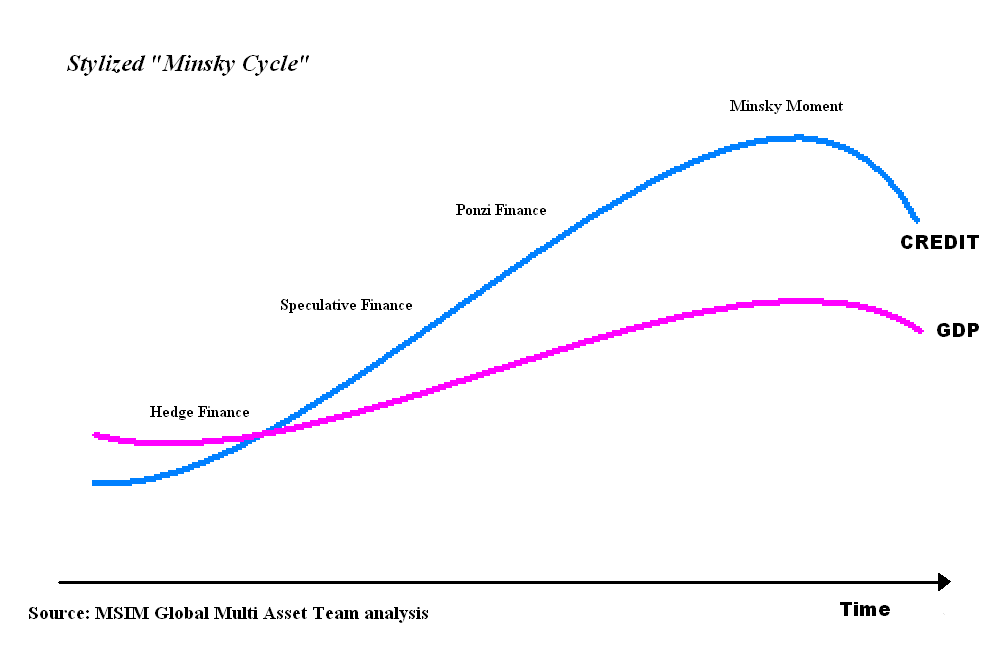
Figure 12. Stylized Minsky Cycle from Wikipedia.
We are waiting now for asset prices to fall to a level corresponding to what these assets can really produce. When this happens, the big drop in commodity prices will transfer back to the corresponding asset prices. For example, the price of land used to extract oil and gas should at some point drop to reflect the lower prices available for these commodities in the marketplace. The price of agricultural land should drop to reflect the lower prices of commodities that can be grown on them, such as wheat, cattle, and hogs. The price of land used to extract metals should drop to reflect the low value of metals. This drop in asset prices doesn’t happen immediately, because everyone assumes that prices are going to bounce back up, and that the system will perform as it always has.
When prices of commodity-related assets drop to a level that reflects their true economic value, we can expect a huge number of debt defaults. This, of course, happens because these assets have been used as the basis for a large amount of debt. It will be difficult to save the financial system, because there will be huge defaults both on bank loans and on outstanding bonds. Banks, insurance companies, and pension plans will all be affected.
Can the Price of Oil Rise above $50 per Barrel?
I am doubtful that the price of oil can rise very high, for very long. Our oil price problem is part of a much larger problem–a slowing economy with low prices for a large number of commodities, including oil. The price of oil can perhaps briefly rise as high as $75 per barrel, but such a high price cannot hold for very long. Rising oil prices tend to lead to recession for oil importing countries, and recessions tend to bring commodity prices back down. The world clearly could not support a price of $100 per barrel before the crash in prices in mid-2014. Once we understand the reason for our low-price problem–diminishing returns and the economy’s tie to the use of energy–it is clear that there is no way out of the problem over the longer term.
In the not-too-distant future, our low commodity price problem is likely to become a low asset price problem. Once this happens, we will have a huge debt default problem. It will also become harder to obtain new loans, because defaults on existing loans will have an adverse impact on the ability of banks to make new loans. Interest rates required by bond markets are likely to spike as well.
The lack of new loans will tend to depress demand further, because without new loans it is difficult to buy high-priced goods such as cars, homes, and factories. As a result, in the long run, we can expect lower commodity prices, not higher commodity prices. Oil prices may ultimately fall below $20 per barrel.


Pingback: Contra Corner » October 17: Daily Contrarian Reads
Does anyone know anything about this? Presumably, David Stockman is linking to my post behind his paywall. May in fact have it up.
The stock market crash in China wiped out 5 percent of the Chinese populations savings since they only had a small portion of their savings in the stock market. The Chinese still took to the streets and protested and rioted… since… well… they are Chinese and they like to riot.
The Chinese authorities moved on to create a massive housing bubble instead. Now… the Chinese population has 75 percent of their savings in the property market… when the housing bubble implodes the Chinese populations savings will be entirely wiped out. The protests and riots we will see when this happens…
The question is: Did China run out of options… or did they do this on purpous ? The Chinese now hold a gun to the head of the global economy. When they pull the trigger all commodity prices will collapse simultaneously and this will take down all other prices as well which will lead to bankruptcies and debt defaults and a financial crisis which will collapse of the global economy.
That seems to be starting to happen right now as Zerohedge reports:
http://www.zerohedge.com/news/2016-10-12/china-pops-its-housing-bubble-car-sales-soar-29
The Politburo seems to have everything under control. They just move from housing to cars… and then to infrastructure… perhaps some more stock market while the ghost cities are being filled… and then back to housing again.
The rest of the world hasn’t been able to grow. China, with all of its coal (and its willingness to look the other way with respect to pollution) has been able to grow when hardly anyone else could. Now, when China slows, the rest of the world is out of options. We were depending on China to pull the rest of the world along.
There is this photo in a National Geographic magazine article on rising China, published some years ago. It shows a young Chinese housewife, nicely dressed in high heals and wearing an apron. She is standing in her shiny clean kitchen full of new appliances, stove, refrigerator, dishwasher, etc. A few others are standing around. The kitchen door is open, displaying a view of gray sky, smog, and factories smoking in the distance. She seems oblivious to the outside, probably just keeping the door open to cool down the kitchen. I guess an AC was still on her wish list.
In the not very distant past, people received housing “free” from their employers. It wasn’t great–no electricity and shared outhouse type bathroom arrangements–but people got along with this arrangement. This arrangement no doubt still exists in the poorer parts of China. Young people I talked to said that they had grown up with this type of arrangement. (This arrangement is still a huge step above India, where often essentially no bathroom arrangements exist in many areas.)
China has made a big bet (using a huge amount of debt) that thanks to all of its industrialization (made possible by the joining the World Trade Organization in 2001), it can upgrade the living standards of a huge share of its people, all at once. In fact, a lot of these people have air conditioners. They are generally window units on the outside of buildings. Otherwise, there are a lot of older buildings where people simply keep the windows open much of the year. You need to wear a coat when the weather is cold, in these buildings. These are photos I took.
High rise apartment buildings under construction in 2011 in Xian.

This is a museum depiction of a Chinese peasant kitchen. The young Chinese person I was with told me that he had grown up in a home similar to this. I expect that this arrangement is the typical “before” the high-rise kitchen photo.

This is a museum depiction of a Chinese peasant bedroom.

A group of us standing outside CNCP Plant 1 at Daqing Oil Field in 2015. Note that several of the windows in the building were open. I would estimate that the temperature was at most in the low 50s at that time; it snowed that evening. We attended a meeting in a conference room and the windows were wide open.
Apartment building with window air conditioners (2011)

All the issues in the world – USA, EU, China, refugees, etc are the symptoms of a failing system. It is not the cause of the failure but symptoms. These symptoms are the same as barbarians at the gates in olden days of Rome or Byzantine. It is because Rome/Athens/Byzantine is weak and the outside influences becomes stronger and dare to challenge them. The question one should be asking is “why did it become weak?” It is the same now – why did we come to thing predicament? It is because we run out of cheap energy and the infrastructure (especially JIT) that we put in place are not meant to function in a high-price energy environment.
You are pretty much correct!
Dallas Police Retiring in Droves, Taking Lump Sum Pensions, Fearing the Money Isn’t There (And It Isn’t)
The Dallas police and firefighters pension fund has just 45% of the money it needs to cover benefits. The fund rates to be out of money in 15 years at the current rate of withdrawals.
For those eligible, the sane thing to do is retire and take a lump sum payout before the money is all gone.
That’s precisely what’s happening, and it is further pressuring the system.
https://mishtalk.com/2016/10/16/dallas-police-retiring-in-droves-taking-lump-sum-pensions-fearing-the-money-isnt-there-and-it-isnt/
https://mishgea.files.wordpress.com/2016/10/dallas-pensions1.png
another of my doomerama points
pensions are a future debt supported by current income.
I am an advisor to the Dallas policemen and firefighters…. having withdrawn and wasted my HK MPF pension.
“We’re trying to address some really alarming numbers,” said Dallas City Councilwoman Jennifer Staubach Gates.
Good luck!
I’m in my 40’s. I wonder if I will get any pension the day I retire.
http://s2.quickmeme.com/img/fb/fb09e0fa0e3cd0b518292a0590652eb249ad122ae92418a8b013f5bcda834f4a.jpg
I wouldn’t count on getting much/any pension. Things are likely to change a lot in 20+ years.
My Houston sources tell me that the economy is deteriorating…. here is an assessment from a Sept. 2016 report…
“The oil bust turned very bad late last year – very ugly – worse than anything anticipated as the downturn began. In many ways, this drilling downturn is worse than the 1980s, particularly in the speed of the decline. It took five years from 1982-87 to achieve the percentage declines in drilling activity that we have seen this time in less than 18 months. And when the Baker Hughes rig count fell through 488 working rigs on March 11, it marked the smallest number of working rigs in the 67-year history of the Baker Hughes rig count. Drilling activity now seems to have bottomed at 404 rigs, and returned to near 500 rigs, but the number still sits close to that previous record low. Future improvement remains uncertain as oil prices hover near $45.
http://www.bauer.uh.edu/centers/irf/houston-updates.php
shows how oil == pensions
cheap energy in general = pensions
Viable, resilient, close-knit local community = no need for pensions.
if a population is ageing, ie living longer than their allotted span, then they have to supported by young fit food producers.
when pensions started there were about 28 workers for every pensioner, and the pension itself was at starvation level. (one quarter of a British pound)
A pension kicked in at 70—and guess what, that was the average age of death.
It also didn’t apply to women (who often lived longer anyway)
now there’s only 4, maybe 6 workers for every pensioner, and many of those work for the government anyway—hence unsustainable.
thus pensions are a product of external energy—namely hydrocarbon fuels
@Norman
What Permaea describes works (or worked before), as in those circumstances you would get no pension and had to work until you probably early death 🙂
So we might try to enjoy life while the circumstances last….. even if it comes with a bitter taste, once you opened up Pandora’s box of the OFW knowledge.
of course
in peasant societies you died before 50 of all kinds of unpleasant things
my point has always been that in our ”peasant” future we will have an awareness of cures for the ills that kill us, but no way of implementing them.
so someone will have to be ”blamed” for that—so the conspiracy nuts will pass around their nonsense just like they do now—virtually no one will accept that its an energy shortage problem
Past ills were blamed on god—just another conspiracy variant. (praying the wrong way)—you got the plague—i didn’t–therefore god has recognised you as a sinner and me as a saint.
Blame it on Bernanke.
http://incogman.net/wp-content/uploads/2008/12/BERNANKE-AS-VAMPIRE.jpg
It helps if the younger generation is at least as large as the older generation. A nation with one child families will have a major problem supporting its elderly unless they work more or less indefinitely.
and as an additional thought—just how would close knit viable communities function in the middle of a city with no food growing facilities?
Foodbanks?
I just got a letter from the mutual pensions insurance company (required by law here, not my idea), about how much I have earned pensions.
They inform; “The longer you work, the larger your pension. You can work until the age of 68. And you can continue working after that as long as you come to an agreement with your employer.”. Yippee!!
If it was possible, I would do a Fast Eddy maneuver, and cash in everything, right away. Alas, it is not.
“If it was possible, I would do a Fast Eddy maneuver, and cash in everything, right away.”
I did that with my life insurance and keep any form of insurance only on a purely essential risk based basis. Other options depend on where you life and what for financial entanglements you have.
Hi guys,
Good comments and questions.
Cities– well, at least many, if not most of them– are unsustainable dead zones, and a bit of a joke, as are large-scale centralized crony capitalist plutarchies– the ones that steal from us all our lives and then give some of our money back in the form we call ‘pensions’.
Over here in Nova Scotia, wintergreen grows like a weed on the forest floor. Apparently, at least according to Wikipedia and a few other sites, it has the active ingredient of aspirin or something like that (been awhile since looking it up). But it has much more than bottles of aspirin. It has nutrition too. What a concept!
~ Caelan MacIntyre
police, fire, emergency, army, and also the various reenactment/role playing crazies able in old trades like metal-smith (pagan, middle ages, napoleonic, ..) will undauntedly inherit the earth and assemble the scraps of today’s civilization to something else according to theirs liking..
elementary high probability prediction, not often mentioned here though..
Of course, taking the lump sum and investing it at today’s low rates is going to still leave the pensioner short.
Caterpillar now faces its fourth straight year of falling sales, the longest decline in its history. Its stock is up 29% this year—the best-performing in the Dow Jones Industrial Average
http://www.wsj.com/articles/how-caterpillars-big-bet-backfired-1476639360
Magic!
Amazing!
http://www.zerohedge.com/news/2016-10-16/where-stimulus-hiding-chinas-fiscal-push-now-bigger-after-global-meltdown
“As the following chart shows, while many were wondering if China would unleash QE (which it has been effectively doing for years, using various liquidity conduits), Beijing has quietly launched the biggest fiscal stimulus in history, one that is even bigger than 2009-10, following the global meltdown.”
According to Evercore ISI, the size of the stimulus is a whopping 4.5 – 5.0% of GDP in 2016, as a result of which there is “no backing away” and expects a “similar push in 2017.”
http://www.zerohedge.com/sites/default/files/images/user5/imageroot/2016/10/16/china%20fiscal%20push.jpg
Alright, so these “emergency measures” are the “new normal”. Due to the nature of diminishing returns they gotta push it harder…add more debt…and on top of that even more debt. TIme is running out. Unfortunately at one point in the near future, “more and more” will not cut it anymore. They will obviously try everything remotely possible to prolong the game: ban cash, force you to spend your money, monitoring people`s lives 24/7 etc. At the end of this final cycle, people will have lost everything. There will not be any pension, any savings left, nothing for future generations to feed on…Let us make history, guys.
It seems like we have a choice of parts of the world that are doing badly. We have China, and its need to keep the economy from crashing. We have several European banks with problems, and the possibility of more countries voting to leave the European union. Also, QE eventually runs into limits on what it can buy, and that should send interest rates back up, deflating the bubble. If the US raises interest rates, that could also deflate the bubble. And we have Japan, with all of its debt, and zero growth, and the failing oil exporters. Not to mention, failing fossil fuel extraction companies, leading to dropping production of fossil fuels, and possible spikes in prices.
You summed up the whole situation very well. The elites are aware of what is coming. It is no coincidence that there has been an orchestrated global anti-cash campaign via op-eds by Ken Rogoff in the past few months. Also we see more and more attacks on the 2nd Amendment and the tightening of gun laws within the EU. Furthermore, funding of mass surveillance is increasing by enormous numbers.The closer we get to final collapse, the more civil liberties we lose.
At some point… whatever it takes…. will not be enough… the moment is edging closer…
You guys need to start realizing that the Oilpocalypse is the Apocalypse. The real one. Track where the last oil on Earth is. The vast majority of it is in the Middle East. And mostly all in one pocket in the Kuwait area. There will be one or two final, cataclysmic wars that annihilate most of mankind, centered in the Middle East.
Which religion predicted that would happen?
And what happens if the war over that oil goes nuclear?
A lake of fire.
https://penzu.com/p/5a59bb84
It is now an empirical fact that Jesus Christ is the son of God.
PS: Sorry if this is repetitive, Gail, but I feel like I gotta spread this word to as many people as I can. At the end are the instructions for who the false Christs will be. Might be croosh.
hey—-
according to a majority vote on here a couple of weeks ago (not to mention my significant other) I was voted god.
I think I should be the one to decide who my son is, don’t you?—it might be Fast Eddy—after all, he has been known to work the odd miracle now and then. (some of them were very odd)
that jesus guy was just a showoff, I warned him he would come to a sticky end—upsetting Romans the way he did.
And I will decide the date and place of Armageddon.
If it kicks off without my say so—all hell is going to break loose—I promise you.
Norman, or Oh my God, please fill us in which one of the end of the worlds you have decided upon
Hinduism – According to the Markandeya Purana, the world will be ended by the Pralay, an all-destroying flood.
Islam – A grand judgment for all, during which believers are distinguished from infidels by producing more sweat, but are eventually given a sweet drink that abolishes thirst eternally.
Hopi – This Native American nation believes the land will be covered in iron snakes, stone rivers, and a giant spider’s web; the seas will turn black, and a huge blue star will crash into the Earth.
Buddhism – Buddha’s teachings will disappear from the Earth, only to be reinstated by a new Buddha.
Mormonism – Jesus Christ will return to Earth at Jackson County, Missouri, and humans will be assigned to one of three heavenly kingdoms.
Norse Mythology – A cataclysmic, all-destroying battle between the gods, known as Ragnarok
Mayan – The Mayan calendar predicted a “great change” would occur in our year 2012, which some interpret as a reference to the end.
Zoroastrianism – The Earth will be devoured by fire, after which sinners will be punished for three days, then forgiven.
i will let you know my decision in due course
just be aware that nobody is getting 70 virgins
What !?!
No virgins??
Oh, my, God, any room for negotiations here? Slightly used Playmates??
you have sinned enough to bring the world to an end
don’t make matters worse
Dang! too much sinning.. At the time I didn’t realize the world would end though.. Oh, well, you win some, you lose some
“Buddhism – Buddha’s teachings will disappear from the Earth, only to be reinstated by a new Buddha.”
http://ih1.redbubble.net/image.9912435.3426/raf,750×1000,075,t,322e3f:696a94a5d4.2.jpg
Don’t expect me to agree to the nailing to the cross bit though….
well if you’re going to start nitpicking———-
crosses are safer these days anyway—-health and safety regulations—human rights–hours per day etc etc
quite comfortable really
Dear God, why are there over 30,000 different branches of Christianity? If you were truly our Lord and Savior, wouldn’t only one type be needed to show us the path to salvation? And what if we lose the geographically selected lottery known as birth and are born to one of those 29,999 branches that is wrong about some tidbit of your one true set of teachings? Do we burn in hell or perhaps just get purgatory or something?
Lastly, the Pope has been promising discounts on purgatory if we follow him on Twitter. Is this true and how much purgatory discount do I get? If I post his Tweets to another social media platform like Facebook will I get a measurable unit of discount, like a year or something? Inquiring minds must know.
http://www.cbsnews.com/news/vatican-get-time-off-in-purgatory-by-following-pope-on-twitter/
don’t ask me—I’m an atheist
Every other major religion seems to have many other “flavors” as well. All of the major religions came into being at about the same time. (I remember seeing a paper on this a while ago.) There seem to be a numberer of common themes in the religions. A think an argument could just as well be made for similarities as differences.
Sumerian, Egyptian, Christian, Greek, the list goes on. Some truths are universal.
“don’t ask me—I’m an atheist”
Did you know there’s a way to level up that particular disbelief?
https://s-media-cache-ak0.pinimg.com/originals/fe/45/9a/fe459a609406159ae325433e2491907b.jpg
I’ve decided that I no longer believe in myself anymore
i understand that mortals get the same problem too
I liked your site. But I missed the transition from we’re fckdue to Jseus will come and save us.
Will read again in a couple of weeks.
How about 70 Turkeys?
Crazy people … for crazy times….
Maybe, maybe not. I would be interested in other views on the subject. If ten people come at the same subject in different ways, and all come to the same conclusion, it would be more convincing.
Some interesting parts to what you’ve wrote. I want to address a few points you’ve made. I was raised in several different branches of Christianity and read the bible several times as well as studied it. I’ve been an agnostic for the last couple of decades as a result of my direct experiences and tested theories.
It is incredibly ignorant and egotistical to proclaim that there are no aliens when we can clearly see millions of other stars in the night sky. The mathematical probability that we are alone in the universe is 1 in 60,000,000,000. While math speaks stronger than personal anecdotes, I have seen and experienced many things beyond my ability to comprehend. I won’t waste my time trying to explain as verbal and written communication are rather poor mediums.
http://www.airspacemag.com/daily-planet/odds-were-only-technologically-advanced-species-universe-are-extremely-low-180958975/?no-ist
Your interpretation of the book of Daniel, and many other portions of the bible, seems like a stab in the dark at a prediction of doomsday. Many, many predictions for doomsday have come and gone, including ones from very advanced societies like you’ve demonstrated with the Mayans. I don’t believe that any society or individual a few thousand years ago, with any degree of accuracy, could predict the fall of mankind.
Many of the things you link with bible verses and doomsday predictions, like the spreading of the Zika virus and droughts, are climate change related and not real predictions from the bible (although confirmation bias breeds total suspension of reality). And since humans populated and abused fossil fuels to get to this awesome spot in the biosphere, it can be successfully argued that it entirely negates all portions of the bible as being valid where it directly encourages human overpopulation and abuse of resources. Further, it invalidates entire books of the bible if not the entire thing outright.
Genesis, specifically, pretty much orders humans to reproduce and deems it as a “good” thing. This idea of ethics is perverted and illusory from the start. This major flaw in logic proves that the bible was written with the desires of primitive men in mind and not an “all-knowing” super deity. Worse, the blame of the fall of mankind on an imaginary being named Lucifer rather than looking in the mirror or at these bible verses in Genesis with scrutiny.
A book with tales in it such as a talking whale or a spontaneously combustible bush, and an almost literal plagiarization of Egyptian/Sumerian stories/symbology that predated it, is not to be trusted with any degree of accuracy on doomsday predictions or a working system of ethics a millennia or more later. There are some historical, astronomical potentially, and spiritual truths in the bible and not a whole lot else. The two versions of God that exist in the text, Yahweh and Jesus, are not at all the same being.
When you start going full-on religious propaganda I had to just chuckle at some of the pictures and cross-religion predictions or graphs. These sorts of verses from sacred texts can be interpreted in a myriad of ways. And then you go crazy mode shortly after that. The amount of mental gymnastics required for you to arrive at your conclusion is, to me, quite startling. Don’t you notice the amount of things you have to “sort of interpret or guess about” in order to believe as you do?
Here’s what I think. God, his disciples, and angels don’t exist anymore than Zeus and his 12 Olympians do. People seek answers and cannot accept this reality the way it is. Much easier to believe that some “god in the heavens” will save us all from death and that he created us in his image. Not true though. The basic flaws in the human skeleton and outlay basically prove that one outright. If we were “intelligently designed” our designer was not very intelligent.
This experience in a physical body and our general ego-driven sense of self-importance that humans have arrived at is wholly because of fossil fuels. We were never ready to responsibly handle the technologies that were bestowed upon us and the current situation is a direct consequence of that. And you are right when you think that this ends in war, likely nuclear.
Short-sighted humans will fight until it’s all gone because that’s all we’ve evolved to understand. It’s not some sort of religious doomsday prediction come true or anything even remotely as interesting as that. We’re just dumb and were following our DNA code. Oh yeah, and we discovered cheap, refined oil and internal combustion engines. So now we’re finishing up our fighting where our food and transportation energy still lie, which is the Middle East.
Humans are like little flickers of light or sand on a giant beach before an ocean. We are nothing in comparison to the incomprehensible infinity of this universe. When we die and are gone from this planet it will go on like nothing ever happened and some new species will rise up to take their random seat at supremacy. I will say that you should be careful what things in this world you accept into your life, including moral codes or beliefs, if you cannot instantly drop them from your mind and walk away. There are many traps for those who have conditioned themselves into belief systems.
Also, I can’t edit my post but I meant a regurgitating whale and a talking snake when I was referencing the bible earlier. That’s what I get for typing a novel without editing a couple of times.
Pingback: Why energy prices are ultimately headed lower; what the IMF missed – Olduvai.ca
Some interesting quotes taken from the following Bloomberg article:
http://www.bloomberg.com/news/articles/2016-10-16/pippi-longstocking-economy-faces-beating-in-low-growth-reality
“Pippi Longstocking is about to get a beating,” said Roger Josefsson, chief economist at Danske Bank in Stockholm. “We’re about to normalize and slow down to a low-growth economy, and it won’t be fun.”
>>>They “ask themselves the question: Is Sweden already entering a period of weak growth when you have a main lending rate of minus 0.5 percent, a QE program, an undervalued krona and expansionary fiscal policy,” he said. “And then they start wondering what should Sweden do when things start to slow down? No-one really goes deep and thinks about what it is that’s slowing down the Swedish economy.”<<<
I doubt these experts will figure it out in time…
http://www.zerohedge.com/sites/default/files/images/user5/imageroot/2014/06/pushing%20on%20a%20string.jpg
With apologies for this being so off subject. I was thinking about this re another blog. It’s another way of looking at “the end of the world.”
I’m not in a position to say yeah or nay about technology per se. Maybe what I think is that electronic technology has gone way too far.
Electric lights were not the end of civilization (that dirty word again). And even the awesome danger of nuclear energy didn’t necessarily seem to take us, as a species, over the edge. (I find it better to work backwards from where we are than to do the reverse.) What seems far more determining for taking us over the edge might be the Internet and the interconnected global electronic web. Just imagine: any set of web information can be hacked from anywhere. This completely removes any sense of stability and comprehensibility within our system. Electronic voting was probably one of the most dangerous assaults ever on “civilization.” I can easily picture voting being entirely manipulatable (word) after this presidential election. And that alone strikes me as fatal to the kind of civilization (however you define it) that we in America experience. Any pace maker can be hacked from across the planet. Any nuclear missile?
The energy equation has something to do with why we got here, but that’s somewhat beyond me to address. In short, the civilizational web we’re in had a requirement to grow to extinction–it was not sustainable, by definition–but web technology seemed to have lit the extinction fuse in a particularly vicious manner.
How to live without the web?
If voting mattered they wouldnt let us do it.
Nor should they.
Maybe voting DOES matter; otherwise all the new legislation to turn back voting rights in the US wouldn’t be enacted. Same re tampering with electronic voting.
“How to live without the web?”
Personally or globally? Regarding the first: Don’t use it or move somewhere where you don’t have it.
The fun part with the web ist still to come. Cheap IoT devices, embedded everywhere with totally skimpy security and no updates whatsoever, because the manufacturer does care, is out of business or wants to sell you the new gadget. The problem: The lifetime of those IoT stuff is easily a decade or even much more.
The increase of complexity overwhelms most people, even those with IT background. Only one example: Try to keep you android tablet / smartphone up to date with the monthly security updates provided by Google…. thats a mess! Then you have your Windows 10 PC with its mandatory updates which can crash your PC or disable certain applications. Also lots of settings are back to default after a “major” update – so you have to check everything…. or do additional backups.
This doesn’t end well…
“’How to live without the web?’
Personally or globally?”
Sorry. I retract the question.
Around 25 years ago, Ralph Ellison (Oracle) was predicting, soon to come, computers that were as easy to use as land phones. Whatever happened to that objective?
Larry was almost right.. We now have mobile phones that are as difficult to use as computers.
Sorry. I meant Ralph. I’m always getting him mixed up with Larry.
Thanks for picking up on this. It’s of course, Larry.
https://en.wikipedia.org/wiki/Larry_Ellison
“Whatever happened to that objective?”
Won’t happen.
Its always the case when you want to hide complexity…. if something goes wrong the whole thing hits you in the face.
Todays computers and smartphones are hyper-functional things, combining the functions of dozens or even hundreds of “historical” (sometimes complicated) applications, devices, books, etc. How should the combination of all in a single multi-purpose device make the combination of the whole thing very simple, even simpler then the simplest entity alone?
For me the software-update / bug-fix question of networked devices is the core. I follow those IT stuff only very basically as it bores me and is a pure time killer…. but still, having a smart-phone I try to update that once and a while to the newest Android OS (CyanogenMod) to secure my data from apps and malware. Still, that all is a time killer – thats the reason nowadays I try to limit the purchase of electronic devices to a minimum or try to run all devices on the same OS.
Looking for a very old article in my files, I found this. No idea where it came from:
“The implied argument: A large population can either produce or consume. In most cases, by far, it consumes, and with devastating consequences. So is our large population to be seen as an unused asset, or is it an absolute detriment?”
It is those pesky resources that are the problem.
It seems that food and fiber are the main resources needed. The immense treasure of organic matter that is burned or thrown into the sea is indeed a problem. This organic matter would be helpful in building soil and growing plants.
The idea this gigantic flow machine is going into the cold entropy night silently in one step is not realistic. Not exclusive list, but people like Kunstler and JM Greer fore told some of the key stepwise dynamics correctly, given the historic path dependencies, geography/raw resources distribution, demography, .. and so on.
I’ve thought naively we have seen The Creepy already in the past via the “early PO panic” actors and their policies such as, Wolfie, Condie, Rumsfeld, Cheney, Madeleine, Jr. .. But now, it’s like daydreaming nightmares, they are so bold (or desperate?) even running a freak show candidate with apparently some advanced neurological disease with the outlook surviving the potential inauguration by ~two years at max, moreover basically with no pressers no real on the ground campaign necessary, weeks long resting-prepping periods between few key TV debates. That’s a novelty in advanced political synthetics and reality prefabrication, thanks to the very latest gen technology, unimaginable short time ago.
While the contestant from the local-nationalist mafia smells the blood in the water, and attempts within the pre-chaotic situation carve a big chunk for himself, now manically flying over several rally events and packed arenas to the roof every day. And he is certainly not the first or the only one “nationalist/deglobalization actor” as we have witnessed from the world stage recently.
In fact this dynamics-oscillations between insular local vs. international span mafias and their turf wars is as old as the modern humanity anyway.
‘Kunstler and JM Greer’ vs Gail and the rest of us….
I am on Team Gail’s side. They are wrong. This will be a financial crisis — and they are by nature rapid events.
Our current situation is comparable to an avalanche which is about to get triggered….
++++++++
I keep hearing that. But it’s always two years away! Meanwhile, Xmas is fast approaching and it appears that there will be plenty of turkey for all. Even FE might get a slice or two.
I bet you are hoping I am wrong. Guess what – so am I.
At this stage in the game, goat-herders and skiers alike must take care not to yodel too loudly.
The big boys got some nice gunnery to set of economic avalanches in a controlled fashion. Except, you’ll most likely be in it’s path. Oh the blinding metaphor, it’s giving me… snow blindness… *boom*
“gigantic flow machine is going into the cold entropy night silently in one step ”
Heard of phase transition much?
What keeps the gigantic machine running? If we are to believe you, only demographics and conforming to historical comparisons.
Or is it non-resilient infrastructures such as JIT logistics and banking/finance which keep the food. fuel and water supplied? The machine you refer to is not as strong or independently inertia-sustained as you would like to think. Every day in thousands of ways it barely keeps its stride. Every bay its knees grow weaker and the ground gets steeper. And it’s not designed to crawl.
“What keeps the gigantic machine running?” How about momentum? Cultural, industrial, legacy oil fields, DNA? I think that most humans are unable to process or reason-out the complexity of all the forces that are in action today.
It is interesting that you refer to banking/ finance as a non-resilient structure because core function of the financial sector is to flexibly allocate resources between different users within the industrial system. In WW2, the US financial sector was able to shift US production from a peace-time consumption based economy to a super-charged war-based economy in a 1-2 year period. I would argue that that is good demonstration of financial flexibility- as well as industrial & social of course.
But today is very different where the financial sector is 2X bloated and corrupted to the gills with legions of political captures doing their bidding. Did anybody go to jail yet from 2008?
You point to a period of almost exponential growth in energy resources to prove your point of financial resilience.
We are not entering a period of energy growth.
You seem to think that human will and acculturation can defeat economic forces:
“i will not starve though I have no food. I will not be thirsty though I have no water. I and my progeny are destined to be successful because we belong to a superior class of people”
“You point to a period of almost exponential growth in energy resources to prove your point of financial resilience.”
No. I am saying that the financial sector has traditionally played a resilient and flexible role in terms of allocating energy, materials, labor, research, etc. Traditionally.
Currently, the financial sector is NOT acting in it’s traditional role. It’s stuck in a trap largely of it’s own making. Zero and negative interest rates are not functional in the traditional role of the financial sector.
And the financials are a massive source of risk to the entire system.
On the contrary — these low rates are what is keeping you alive.
We do enjoy gigantic flow machine as seen from the distance, a macro overview.
Where many existing legacy sub arteries/flows can be and will be redirected and used for national/regional operation when needed.
For example, it seems to me people here assume, the critical infrastructure in places like Russia and or China is over dependent on JIT global imports, both in specialized parts and raw materials. Well, that’s obviously incorrect, firstly such critical parts are forced to be licensed/made domestically in the first place, and secondly many raw materials are pre stocked, and or long term import deals diversified on friend-foe basis. Also usage-consumption patterns could be triaged away, for instance you keep the top talent, spare parts priorities and equipment working the grid, defense, hospitals, key public transport. But in contrast not wasting such resources on keeping passenger car assembly line (robots, cnc, hv transformers, ..) there running in pristine condition.. Not mentioning trade routes are often opened also during war action, e.g. many top western industrialists and bankers (dynasties active today) were still supplying the Reich in the mid 1940s..
In summary such outlook is a very different world then from today’s fabulous frivolous consumer nirvana 24/365, that’s not disputed. We don’t care for the nominal terms, “war economy” or “long emergency” it doesn’t matter. However, what matters a great deal is the fact, it will be at least attempted, and it will very likely work for some time envelope at certain places. A very rudimentary thesis, conforming with historical quasi analogues.
We are not talking about a situation where global trade is continued. The 20th century world wars which you reference as historical analogues were fought when global and regional banking systems were intact, energy resources were cheap and increasing, and where declining powers received aid from stable powers.
This idea of “triaging” you bring up constantly. It assumes a level of governmental control that is not likely to persist. In regards China for example, do you really think that the party can retain control of hundreds of millions of destitute urbanites or press-gang the rural population to continue to produce food for no material gain?
You claim that some stocking of goods and long-term deals can ameliorate cessation of trade. The stocking of goods relates to the same industrial processes you claim can be triaged away. The long term deals you point to are not independent of letters of credit, shipping arrangements, and the continuance of business as usual in all the cities where the ports are. If you think that city in crisis in Northern Queensland is going to organise itself amongst the chaos just so that it can continue coal exports to China then you don’t know nothing.
When I read this excellent comment … I wonder how truly brilliant FW could be … if 95% of the efforts of the RealitySTAN members were not spent on explaining the same things over and over to the Koombayists….
FE. At some point we are going to have to explain the end of BAU to our family and friends. I for one decided when things start to fall apart I’ll break the tragic news. My thinking on this is if there is nothing they can do why burden them? So when the kombayist show up it gives me practice, you got to admit future does a convincing job.
I too am thinking a shipping container full of party supplies is a good idea. We have a dealer selling almost new for $4000 for a 20 footer. Hard to decide if I should wait a month or 2 because decreased shipping means they’ll only get cheaper!
worldofhanumanotg – I guess you do not have a technical degree or training and you have not worked in the JIT environment before. That is why you can write about that is the previous paragraph.
critical parts are forced to be licensed/made domestically – no one can duplicate software found in EEPROMs, PLDs or other chips. They are patented or a company secret. No one knows how to crack them in a reasonable time frame.
secondly many raw materials are pre stocked, – many items have expiration dates or it deteriorates over time. Many things have planned obsolesces. You just cannot keep raw materials. It can rust or the oil can leak out, the chips/semiconductors can spoil, etc.
and or long term import deals diversified on friend-foe basis. – look up “rare earth” and you will know what you say is 100% incorrect.
Also usage-consumption patterns could be triaged away, for instance you keep the top talent, spare parts priorities and equipment working the grid, defense, hospitals, key public transport – too many moving parts. List down how you can get syringes for your hospital. I am in South East Asia. Just 2km away is a huge factory that produces syringes and medical parts (i.e consumables). It is cheaper to do it here than Europe or US. Can your hospital even function if South East Asia is in turmoil and all your syringes are gone? How many are you going to stock? hundreds of millions? Can you even buy that amount now? Who can supply you that amount now? How are you going to pay for that syringes? Where are you going to store the syringes? How about the expiration dates? This is just syringes. How about saline, medication, medical consumables like clips, gauze, etc?
Talents – please elaborate how you are going to do it? Keep talent with guns? monetary rewards? If the hospital has no anesthesiologist, can the brain surgeon, heart surgeon operate? I sincerely doubt that the orthopedic surgeon can be an anesthesiologist overnight.
Your patience must be wearing thin….
You see… these people will not respond to my comments. I have replied to worldofhanumanotg before. He did not comment on my last one too. I believe he/she will not comment on this one too. In a few days time, he/she will come back again and say the same thing. Modus operandi is the same for all these short-lived trolls. If he/she is a strong believer, then put out their action plans, not just some hot air talk.
If we could harness the world’s denial …. we would not require oil.
CTG, worldohanuma has the ferocious ability to stubbornly deny any fast collapse scenario. It’s a state of denial so strong, it might turn out to be a bona fide super power.
I’m afraid your response is very shallow, usually the “white rage” from facing another viewpoint is often the culprit, read my post again.
As I wrote, and you did not react, do you really think Russian or Chinese grid and defense/security apparatus is based on western EEPROMs? Or their critical imports in key heavy industries don’t have prioritized spare parts ready (e.g. control boards), good at least for few years time, especially now with the sanctions jazz all over again.. ?
A little bit of hint for you, do you know that some western companies still have equity stake in Russian oil/natgas resources, it’s usually <20% just for the know-how transfer, while in "triage ready" industries like carz and other fluff, they can run as high as 70-80% western ownership, because it just doesn't matter (in times of less)?
Again, evidently you don't grasp the "historic 101" – when chased by predator you have to only outrun the weaker member of your runners party.. As I detailed previously (post on rail, nuclear energy etc.), where do you have comparatively better/higher availability in terms of public transport, willingness of people pull through rationing, etc. ??
Simply, the next big systemic crash will rearrange the chips on the global and regional table. It's about relative advantage and performance, most likely some advanced countries will turn into hell holes, incl. parts of Western Europe, and quite possibly also inside during the brake up of the US.. So, for instance you discount the realistic possibility a future regional warlord would rather export grain to Asian merchant for some spare parts on infrastructure deals, than trade it to at closer distance to former member of the union, now an arch enemy? You ahistoric guys are into some nasty reality check awakenings..
worldofhanumanotg :
I’m afraid your response is very shallow – give me something solid and technical. Challenge me. I have extensive knowledge in computing, finance, engineering (civil, mechanical, electrical, electronics, microelectronics), physics, chemistry, biology and also management. I love astronomy, history (global, not just local history) and well versed in current political issues. I am an unbiased person who will evaluate based on its merits.
Do you really think Russian or Chinese grid and defense/security apparatus is based on western EEPROMs?
Show me an example. In the quest for efficiency, no one produces locally anymore. If it is used in military, then yes, I agree, they just need “special dedicated systems”. They don’t need their computers to run Windows or their warships to run on Macintosh. Grids are PRIVATELY owned in practically ALL countries in the world. I can assure you that NONE of them are prepared for anything – EMP, Carrington Events, etc. Why? It is just too costly and expensive to redesign the whole thing. Do you think the political people are THAT SMART to think 20 years ago to harden it against EMP? The short answer – NO. If they are that smart, we would have the predicament today
Some parts are hard to find and must be made to order. The tooling/jog to make this is unique. You cannot duplicate the jig. Without the jog, you cannot manufacture the part. With the specific part, you cannot use that machine. Simple as that if you have experience running/managing/repairing machines. By the way, I have more than 15 years managing the most advanced machines in the world – the one that makes the semiconductor chips. The stage (platform) must be controlled to within 5nm (one trillion of a meter). There are no other more complex and sophisticated machine than those. All other machines are “a piece of cake”. No semiconductor, no chips. no electronics and what you have for a world without electronics? Nothing. Name me something that you do everyday (routine) in your MODERN life in a town/city that does not have electronics behind it (directly/indirectly)? Nothing.
Western companies still have equity stake in Russian oil/natgas resources
Check out how Russians screwed Shell/BP 8 years ago when they nationalize Sakhlin gas. Why I know? It was my MBA examination question.
** I am extrmely surprised that you can even say equity stakes are so important. History is littered with nationalization (see SAUDI ARAMCO).
** My conclusion from your sentence above – you have no knowledge of what you are talking about and you are exposed as a TRUE TROLL.
*** Any finance/management/MBA student knows the risk of nationalization. It is part of what you study on “Globalization”
Better/higher availability in terms of public transport, willingness of people pull through rationing, etc
Our population is way too high to implement any form of rationing. We are too interconnected. If we don’t have the efficiency in producing food, we will never be able to feed all the people. If you think that you can feed some but not others, then you are really delusional. Your mentality is like “If I raise my tax 20%, my revenue will increase 20%”. You don’t take into account human feelings and how humans will react to situations when their lives are threatened.
So, for instance you discount the realistic possibility a future regional warlord would rather export grain to Asian merchant for some spare parts on infrastructure deals, than trade it to at closer distance to former member of the union, now an arch enemy?
Tell me how a warlord have the materials, skills and parts to do that? It is 100% true if you watch movies. It shows warlords and all other stuff. Those are movies. Just go into detail like what I tell you below:
http://www.atlrod.com/wp-content/uploads/2013/08/IMG_0299.jpg
Those are large bolts/nuts that are used in large trucks, ships, infrastructures.
Raw material – Iron, coal (heating and coking) and trace amounts of maybe vanadium, molybdenum, etc to make it strong.
Process – melt the ore, make the raw material, pore into molds and let it set. If not, it must be hammered to shaped into the desired shapes.
Machine required – small iron smelter, casting and hammering.
How do you intend to find iron ore? You need to have excavator and knowledge where to find. Note that all the easy ores have been excavated. Only the hard to reach are available. How about transport the iron ore to the smelter – a few miles, hundreds of miles? How to transport? Car? Trucks? Carried by humans ? Do you have enough food to ensure that humans can carry them? Cars – do you have the parts or electronics to ensure that the car/truck moves? Oh, they need fuel. So, where to get the fuel? Biodiesel? How many palm oil or oily plants you need to plant? Maybe the population will just finish up the palm oil or fruits and it will not even make it to become bio-diesel. OK, you use normal diesel? Where to get them? Refinery- where? 500miles away? So, how, you need a tanker to bring the fuel in? Oops, the tyres of the tanker punctured.. oh never mind, I will use a solid tyre. Where to get rubber? Feedstock for synthetic rubber is from refinery. Oops.. refinery is closed… We did not even get into the first part and we are already stuck with “interconnectedness”.
Yes, you can fund a lot of iron around post BAU but you need a lot of work to strip off the paint. There are way too many impurities in it. Some of them are pig iron, mild steel, high speed steel, stainless steel of many grades. You have rust on some. So, can you actually dump all of them into the smelter ? I am not sure but it does not sound right to me.
Asusme somehow you get the scrap iron of even grade and quality to the smelter
Smelter – where do you get the power? Coal? electricity?
I am 100% sure that there are no more “old style” 100-year old furnace anymore that is being used? They may be in museums but not in use. Why? It is just too expensive and inefficent. No company will ever think of using them anymore. They are historic items. New ones produces more and lower cost. So, all producers switch to the best in the market that is electronically controlled and requires lots of electric power, not to run the furnace but to manage the software and controls of the furnace. So, how can one use the modern furnace with lots of parts that are “patented” or electronically controlled.
OK. Never mind, somehow you manage to start up and old style furnace and you have to find coal. Where do you want to find coal? Charcoal? Not possible, not enough trees.
OK. Lets assume coal dropped down from the sky and you have coal, you smelt the iron. How about the mould for the rods? Or maybe you need to hammer it to shape?
Brilliantly, you manage to hammer it into shape and the warlord takes it to the ship (assuming everything else on the ship) is fine. Also assume that the ship is wind-powered. He quick gets his people (no engineers since they are so few around) to put the bolts in. Guess what? The dimensions does not really match. OK, grind it down smaller (how to grind? I am not sure. Flintstones type?). If the dimension is smaller, good, just slot it in. Away the ship go. Not long later, the pin snaps. Why? It is not strong enough. Everything today is precision-machined and has many additives. Why? Cost savings and efficiencies. Many manufacturers use exotic compounds, additives, etc to make products better. So, they can reduce the size and make it compact. Some parts are very small but very strong. Since BAU allows them to make it to precise dimensions, all other parts are produces in the same way so that it is cheaper and has economies of scale.
Just have a look at your mobile phone or notebook computers. The printed circuit board is very tiny and the chips, capacitors are shrunk and packed densely inside it. No one can replace any parts on the PCB. The entire PCB (printed circuit board) must be replaced. Some boards can have 4-5 layers where the wires are criss-crossed from chips to chips. It is not possible just to swap a faulty capacitor as you can short circuit the entire board.
So, worldofhanumanotg, if you mind, go into details on what you have said like I do. Tell me how yours work. I am all ears.
https://gailtheactuary.files.wordpress.com/2014/06/leonardo-sticks-dome-01-b.gif
One more thing. Western companies are not stupid to transfer their technology to other companies if their stake is low at 50%. If a Russian company buys over a US company 100%, then they can have a peek at their technology and grab whatever they have in the company.
If a Western company buys a stake in a Russian company and that company is in Russia, then the management is really stupid to transfer technology to that Russian company.
If a Western company buys 100% of the Russian company, then they may transfer the technology over as the company has become a subsidiary of the Western company. However, there are still many Western company who will just “transfer what is really needed” only.
So, I am really surprised by you, worldofhanumanotg can talk about technology transfer. I have been involved in many technology transfers in my life in semiconductors. They will never give you their best. They will give you the ones that everyone knows.
We have skilled people and we can replicate the process, etc. Why we did not do that? Patent and royalty. If we do that, we will be sued. So, this tech transfer thing is just “formality”. However, the best kept secret in the company, will always be the best kept secret. They will only do “transfer of technology” for the “almost obsolete” technology.
I know because I have gone through a few “technology transfers”. Honestly, we just waste our time at our host’s place. Why? We know the process as it is not the most advanced. In fact, at times, we have to teach the host a few things that they don’t know about.
CTG: you claimed 5nm to be a trillionth of a meter; you’re off by 3.5 orders of magnitude. What exactly were your technical roles in the semiconductor field? I’m pretty sure you didn’t do chip design or lithography design. Perhaps you did plant layout?
Again, this was a non response from you CTG, you didn’t address any of the points.
If there has not been know-how transfer from west to east, how do you explain, that the Chinese now have for example the domestic copy of the whole nuclear power energy chain complex, hi tech fast and commuter trains, certainly not full spectrum yet but large part (good enough) of the micro chip production capability as well, .. Similarly, Russia after decades (thanks to joint ventures with the west) closed very much the gap on the shelf and deep ocean extraction and so on.. As we have now ample evidence from all the involved actors, it was allowed mostly by short term greed, the western CEOs and bankers simply sold out everything for their temporary gain of 5-10yrs bonuses, sometimes in ever shorter time.
Zooming out this is certainly not the first similar process in history, the pendulum between civilizations does snap again, however today we face the rupture in the additional cycle from past few centuries of exponential growth and FW related issues.
So, as several of these longer term cycle collide about now (before ~2035), the rearrangement will be profound and to many/most catastrophic to say the least.
I’m not saying the Chinese-Russians-etc will manage to keep it all intact post crash if the general thesis of FW issues is correct (not disputing it), but on relative comparison vs. the gutted western societies (and never ever developing ROW countries), their chances of managing relative better over mid term horizon are there. That’s all.
The excited reactions to my post simply reveal, there are many people over invested in single outcome probability (overnight instadoom washing away the pain quickly and easily), which is rather insane position to be boxed in both from business as well personal perspective. True, many or most of us here are simply trapped in non pleasant predicament, so what, but that doesn’t mean we are right when automatically discounting other places and their relative arrangements, just deal with it..
meliorismnow – I am trying to make it non-technical. We use scientific notations and I am not sure how many of the readers know about it.
I am one of the group of engineers (US Patent # US 7091104 B2) who have came out with a design about 15 years ago (patent granted 10 years ago) that was responsible for the explosion of handheld devices. In the early 2000s, power consumption of LCD screens is very high and with this design, the power consumption dropped tremendously. Subsequently, the use of portable electronics with LCDs exploded. Yes, I am partly responsible for the exponential usage of resources as electronics industry is very resource intensive.
From the list of inventors, you will be able to guess who I am and from there you can read me CV and what I do. I do mind having my identity revealed to those who simply don’t get it.
https://en.wikipedia.org/wiki/Dunning%E2%80%93Kruger_effect
Yet that person keeps on harping on small issues. There are so many around blogs and website. The more this happens, the more I felt that humanity is more than deserved to be “toasted”. Instead of working together and resolve the issue, some people will just deny the fact and even say the opposite of the fact.
Even as a troll or denier, if I am being presented with facts and if I do some research, maybe Stockholm Effect will take place and you learn from it. However, instead of being impacted, they refuse to see the trees from the forest.
This is exactly like Titanic – “This ship is unsinkable” until it sank. The engineers, the boilerman, the “lower class passengers” know about it but the top people and those who have something to gain will deny until the ship sank.
worldofhanumanotg – if you read carefully what I have written, the Western companies DO NOT transfer their very best over. The Russians and Chinese have techonology but not their very best. They don’t have what it takes to make an Intel i7 chip.
The don’t need any technology transfer. They just take it. Reverse engineer and use it in China. You cannot enforce copyright laws in China as they are not going to let their own company die.
http://www.motorauthority.com/news/1029301_attack-of-the-clones-chinese-copies-of-the-honda-cr-v
They send their people to study overseas and get whatever knowledge they want and come back. All these has got nothing to do with joint venture or taking equity stakes. If they want to get the technology, they can if the country cannot enforce copyright or intellectual property laws. However that does not mean that they will operate it efficiently.
There is NO way that the Chinese or the Russians will survive if the Western world crashes. Where are all the people going to get their food? Work? Even if they manage to get all their equipment, parts and others locally produced, what does it do to them?
Raw materials are sourced from everywhere in the world. Even if USD crash and burns, they cannot buy raw materials from Africa, Australia, Indonesia or other countries. Other currencies may crash too (those tied to USD). It is just too complicated to go to other currencies. Sometimes, it is the system that is not flexible and time is not on your side.
Before we continue, can you just tell me what your background is and how you even been to China or Japan or visited any manufacturing facility, be it in China or in your own country? Are you just an armchair traveller and blogger?
Up till today, you did not even mention what your background is. I have asked for it like 3-4 times. I am being upfront and tell you what my work background is because I was there at GROUND ZERO in 2008 when the financial crisis happened. The entire supply chain just froze. If not for Bernake and its printing press, we would have been dead. Honestly, if it happened in 2008, I will be surprised as I was still “unaware” but it was in 2008 that I suddenly realize that how fragile our systems are. It took me 6 years of research and understand (macro view) before coming to the conclusion that basically we are screwed. Damned if you and damned if you don’t.
I don’t want a collapse. I want to be wrong but as the days passed, it looks like the chances of me being wrong is getting less and less.
https://en.wikipedia.org/wiki/Dunning%E2%80%93Kruger_effect
It is either your brain is wired to understand the “big picture” or you are not. It is that simple. No matter how many times one tell you about this, you will never be able to understand. I have met with so many intellectuals who are so firm a believer in what they are doing that they disregard all other viewpoints, especially those who are opposing theirs. I have already accepted that fact that only a fraction of the people can see the big picture.
Example : if Euro breaks up, then each individual country goes to their own currency. Easier said than done. How about cross border deals and contracts? You have a part made in Germany, a part made in Italy and combine in France and sell to Denmark. You think it is so easy to just re-denominate them? Well, if you are an armchair analyst, then you can say “piece of cake”. If you have worked in the engineering, purchasing, logistics, finance, then it is so intricate and delicate (system-wise, finance-wise etc) that it will take weeks or even months to resolve that. Do we have that kind of “time luxury” in this fact paced world? NO WE DON’T.
CTG, sorry I don’t want to insult you on personal level, but you have started the nonsense of your supposedly technical credentials, and in the same breath claim the Russians/Chinese just copied the 2nd tier, not the best stuff or indigenous leap frogging advacements, lolz.
In that fashion, I’d like to remind you of several basics facts, for example the only habitable outer space by humans is maintained now chiefly only thanks to Russian and to some extent Europen commitment, the US lost most of the capability, while they burn $trillions within their bottom less mil-industrial complex scams like “invisible” ships and jet fighters, which are a joke from operational standpoint.
The Chinese are now able to build several nuclear power stations at once (and export them) including the fuel cycle, so no other subcontracting parties needed.
The Chinese acquired bullet train technology, not only to copy the stuff after the initial joint ventures, but obviously to develop the stuff further on their own and export it.
The Russians are the only world’s entity operating (and building additional) nuclear power plants of ~GWe capacity to burn mixed oxides with plutonium and/or the less enriched uranium fuels, i.e. at least hundreds years of fuel availability secured.
Hm, but that all somehow doesn’t matter, because the west trumps them on a-social media software applications universe, hollywood productions, refined carz with seat fart airconditioning options and Ipods ver. XY, lolz.
CTG and FE’s “Credentials”…… o_O
http://ak-hdl.buzzfed.com/static/enhanced/webdr05/2013/6/10/7/anigif_enhanced-buzz-19337-1370862806-1.gif
http://www.wearyourrecovery.com/store/images/F-677%20Crawl%20back%20under%20your%20rock.jpg
“Industry Credentials” … Ahahaaaaoohhahaha….
http://3.bp.blogspot.com/-tF9ns8Uujus/ToATUMwpARI/AAAAAAAAVOQ/ZWW8FAHLiOY/s1600/SCHANDF0.jpeg
http://www.artberman.com/wp-content/uploads/World-Liquids-Production-and-Oil-Price-in-2016-Dollars-1-1-1024×700.jpg
http://content.realinvestmentadvice.com/wp-content/uploads/2016/04/Oil-Price-Contracts-042616.png
I am afraid I haven’t been following “net reportable crude contracts outstanding.” They evidently were very close to zero around 1999, and are very high now. The maker of the graph seems to think that prices will go correspondingly high–I presume for a very short time, before recession hits.
http://cdn.oilprice.com/images/tinymce/Evan1/ada1055.png
In the US, we have had oversupply of natural gas for a very long time–hence, the early low prices. Outside the US, prices dropped later.
Yes, the Shale revolution started as the Shale gas revolution… still the gas price has doubled since 1999.
Which price are you looking at? Oil and gas prices tend to be low together, and 1999 was definitely a low period. EIA shows the “wellhead price” in 1999 to be $2.19 per MCF http://www.eia.gov/dnav/ng/hist/n9190us3a.htm BP shows the Henry Hub prices for 1999 to be $2.27 per million Btu, which is very similar. Now, NASDAQ is showing a Natural Gas price of $3.24. This is up a lot, including from the beginning of the year 2016, but it is not double the 1999 price.
I don’t have day by day prices in 1999. There may well have been a very low day in 1999, and today’s price is double that. On average, I don’t think natural gas prices are yet up to double the 1999 price, though. Maybe you can show me a comparison where it does come out to double.
I was only looking at the chart above. The gas price fell to 2 USD in 2015 and has now climbed up to 3 USD. The median price from 2009 to 2016 is perhaps 3.75 USD ?
http://content.barchart.com/genericapi/cache/17c8ffd14d3397275411fc657f110a75.png
We are not up to $3.75. The current price is $3.27. Most of the year has been spent in the $2.20 to $3.00 range. Natural gas companies have been complaining about the low price. The current price is still low compared to what companies need.
You are right, the median price from 2009 to 2016 is probably $3.75, and companies have been complaining about it for a long time. Natural gas producers would like their price to be closer to 1/6 the price of a barrel of oil, which is what the energy content is equal to. A price of $120 per barrel of oil would equate to $20 natural gas; $50 per barrel oil would equate to $8.33 natural gas. Natural gas producers have been complaining for a long time about how inadequate the price of their product is. It is expensive to ship because of the large pipelines needed to ship it door to door.
Yes, I see now that the historical price relation on the chart above has been 1:10. I posted a link to a paper that talks about getting more bang for the buck when shifting to gas. When competition takes place between gas and oil over same sectors they believed the gap to close. The paper is from Feb 2014 just befor the oil price collapse.
http://www.reuters.com/article/us-usa-fed-yellen-idUSKBN12E22M interesting article that janet yellen is thinking about increasing demand along with an increase in jobs she calls it ‘high pressure policy and that it will only be temporary.
Here’s some high pressure policy that might not be temporary– starting WWIII with the Russians over Syria:
http://www.informationclearinghouse.info/article45684.htm
Starting a war has always been a fall back when things are going badly at home. Provides an excuse for more borrowing, if nothing else.
and to forget home privations and fuel patriotic fervour
It is good to hear that she is thinking about something other than raising interest rates. That would be the wrong thing to do.
Janet likes to cry wolf…. and cry… and cry … and cry….. she cannot raise rates more than an insignificant amount … because doing so would immediately result in a catastrophe.
I have been talking to the bank about financing a shack on the beach …. they are wondering why I want to aim for the highest level of financing possible …. they are asking me if I’d like to lock in an extra low rate of interest just in case rates rise…
My response – interest rates will never rise because the global economy would implode — in fact NZ rates have a lot of room to run lower because we are nowhere near zirp — I will take the floating rate … I think they think I am a bit touched….
I want to tell them that I am aiming for the highest rate of financing possible because the world is going to collapse soon and I will not be paying them back…. and that I’d like to instead use all cash for my bucket list adventures, end of the world party favours… and other frivalous pursuits while I remain alive….
But I don’t …. because I don’t want to end up like this (I wonder what they would say if I made my intentions clear — being a bank they’d probably not care – so long as they were confident I’d make payments….)
http://sj.blacksteel.com/media/images/animalman60_cover.jpg
Pingback: Le sens du besoin d’un changement de paradigme – absent | Harvey Mead
World Oil Production In Balance, U.S. Natural Gas Production Way Down
http://oilpro.com/gallery/1672/21571
World oil (liquids) output for September was 96.47 mmbpd (million barrels per day) and consumption was 96.39 mmbpd. That resulted in a slight surplus of 80,000 bpd, about as close to balance as it gets (Figure 1). That’s bad news considering that the Brent price of $52 per barrel acts like there are a few million bpd of surplus. So much for the global economy. Art Berman
It seems like it is even worse than what Berman (who is quoting the EIA) is saying. Crude oil stocks seem to be drawing down, so demand seems to be slightly greater than output at this point in time. I am wondering if the mismatch is greater than the EIA thinks it is. http://www.eia.gov/dnav/pet/hist/LeafHandler.ashx?n=PET&s=WCESTUS1&f=W Perhaps world oil supply is lower than the EIA thinks it is.
Also for natural gas, Berman says “U.S. marketed natural gas output fell for the first time since 2005.” It looks to me like every month from March 2016 onward has marketed natural gas production lower than 2015. http://www.eia.gov/dnav/ng/hist/n9050us2m.htm Later Berman explains that the EIA means production for the year of 1016 is expected to be down. Natural gas prices have been way too low for producers, which is the reason for the drop.
A lot of theories will be tested now when the production starts to decline below consumption. The inventories will perhaps soften the impact. But if they start to decline rapidly…
Interesting times ahead. (As long as they don’t start to be too interesting).
The American Standard of Living is NOT negotiable.
Let’s all get up in arms about how Iraq was caused by evil corporate types trying to maintain their power lifestyle.
Let’s conveniently neglect to notice that their lifestyle comes from OUR lifestyle.
If we stop buying things and going places, the economy will run down.
It’s the nature of capitalism, isn’t it? Everybody seems to stop dead at this point. No economist will touch it. Are they right?
Please think about this before you post a comment.
Do you have original thoughts about how the middle class can exert their numerical superiority, by lowering their consumption for moral reasons?
I’d really like to explore the question of how to get more people to Live Small.
Small as in modest, careful. I just read a diary that excused useless gift giving because “it’s the season” and “it feels good, so do it.”
Should we just give up and keep flying to places we could watch video of? Driving to places we could watch video of?
Would it be more fun to watch a well-shot documentary with friends?
The diary title is a quote from George H. W. Bush (41) after considerable badgering about the need for the Gulf War: wasn’t it just to get oil, and couldn’t Americans just learn to conserve?
I think he hit the nail on the head.
We invade to maintain our lifestyle, about which we complain vociferously:
“I need a plasma TV to watch High Definition TV of little Darfur babies starving to death.”
Works for me.
http://www.dailykos.com/story/2006/11/26/274833/-
I expect that works for just about everyone… when it comes right down to it…
I expect you are right. How many people actually realize that their pension plan, for example, is reliant on the exploitation of resources? How many idealistic young people
would even give up the ability to stream video on their phone to avoid a bad outcome
somewhere. I’m no better and prefer the excuse “If everybody else does it, I will.”
In trying to share what little I understand about collapse, I usually find myself talking to a wall. It’s only on two or three blogs that I encounter something different. FW is about the most down to earth and hard-to-refute source of collapse information, and I tend to get less blowback (or slightly more respect) when I use it as reference. FW isn’t that old, and if I can learn something from it, many, many people should also be able to over time. And it’s never a case of everybody changing in some grand transformation; it’s the critical mass that matters. I’ve heard a variety of percentages quoted in relation to critical mass-directed change, the highest being 30% and the lowest 1%. If 1-10 percent of people changing to “voluntary poverty” could swing the rest, then a blog like FW, with its practical, business-like information, could still enable change. But you’d have to give it more time.
There are very few people that want to talk to me about the future anymore. My family, friends, and the people I work with think I’m, at best, a worrier, and at worst, nuts, so I don’t say much. I think many people realize that things are pretty bad but they simply can’t grasp the gravity of the situation. And yes, this site has the best informed commentators. Great perspectives from different walks of life and regions of the world.
For people who think I’m nuts, I just say: “it’s just maths, with these inputs and calculations it’s SHTF ELE. BUT if you can change the maths, then its something else.”
Nobody has refuted the underlying maths..
I’ll have to give that a try. But I know the poor schmuck I say it to will just mumble something about humanity figuring out a work around or some such. I’ve never watched sports but there was a hockey game on tonight and all I could think about was how many liters of fuel it took for everyone to get to it, the amount the players needed to develop the skillset and all the energy required to build and maintain the infrastructure to make that particular game possible. Mindboggling.
we obviously mix with the same people
“Nobody has refuted the underlying maths.”
Odd people. No solar + battery revolution, fast breeder, cold fusion, nano, autonomous, GMO, technology prevails and progress only accelerates?
DJ, my explanation usually includes Alice Friedemanns trucks ,and JIT economy. Then tech miracles are not to be expected..
I’m exactly the same lollll..when I talk about it to my parents (that BAU will soon be coming to an end, and that we will not survive it) they blow a gasket and tell me to stop talking about it or leave…I can only talk about these things with one or two friends…I also have a couple of friends who understand that BAU cannot go on, but are of the BAU-Lite bend…I try and tell them that BAU-Lite is IMPOSSIBLE but to no avail, they just don’t want to understand..As FE said in another comment, anyone still alive 6 months after BAU is over, will wish they were dead..as for myself, I am taking a nice bottle of red wine, going in my garage and turning on the car and then bubye..until that day (which I can’t see being beyond 2020) I take advantage of every day..my favourite motto of the last few years has been Carpe Diem 🙂
When the time comes, breathing a pure nitrogen atmosphere is apparently a painless way of dying. But when you rig your nitrogen tent, you’d better take care not to kill the people who discover what you’ve done. At least stick a sign up at the entrance saying “Pure Nitrogen Atmosphere Inside – Danger!”.
Another painless exit seems to be to consume lots of valerian, which is easily available in supplement form. Red wine with valerian should make for a very peaceful demise. But stock up now while BAU lasts.
I don’t recommend anyone to take their own life or anyone else’s. For one thing, you might miss out on the Rapture! But if needs must, there are gentler ways of going than carbon monoxide poisoning or the Thelma and Louise option.
I’m looking forward to the rapture
gettin hold of all the stuff that’s left behind
It may be better not to talk to people about the problem. They just get upset. There is’t a whole lot they can do to fix it, either, at least in my opinion. There are some other sites that think we can move into a “sustainable future” with few problems.
I no longer waste my breath either. When I first became aware of peak oil, it was all I could think about, seeing as it is the the most momentous predicament humanity has ever faced. I watched again and again as peoples eyes glazed over (if they were polite) or rolled (if they weren’t). Talking about peak oil is a sure way to alienate those around you. My wife tolerates prepping as an eccentric hobby. She doesn’t want to hear about it on a daily basis either.
People with a natural curiosity will eventually find it on their own. Besides, at this stage, ignorance is bliss for most people. I have made my peace with the predicament, but it is a little liking knowing you are living with a fatal disease. It would ruin many people’s enjoyment of the time they have left.
Selfishly, maintaining secrecy about preparations from people geographically close to you is a good idea unless you plan on feeding the neighborhood and/or inviting the marauders over. Even though I may endure some ribbing about being a delusistani, I am grateful to Gail for hosting FW as a safe forum to discuss these issues.
Iranian proverb: ‘It’s good to know the Truth. But best just to talk about pomegranites…..’
“There are very few people that want to talk to me about the future anymore. My family, friends, and the people I work with think I’m, at best, a worrier, and at worst, nuts, so I don’t say much.”
That sounds eerily similar to my predicament/experience.
The trick is to un-brainwash them carefully. Just like that Chinese computer virus slowly hacking it’s way through an ICE in Gibson’s Neuromancer.
Dare to be a little perverse about it, make it a slow grueling process. Death by a thousand (small) cuts.
http://3.bp.blogspot.com/-tF9ns8Uujus/ToATUMwpARI/AAAAAAAAVOQ/ZWW8FAHLiOY/s1600/SCHANDF0.jpeg
See it as payback for all the banalities they made you endure during those “social” and “team building” gimmick events.
That’s probably because there is nothing to talk about….
The story is a hard one to discuss–better to talk about how football team is doing, or the weather.
The hardest thing for me now is keeping my mouth shut, especially when people bring up retirement plans. I think in the next year or two there will be enough disruption in BAU that many more people are going to wake up.
I have a brother-in-law who posts endlessly on Facebook about the wonders of compound interest. He and my sister are childless, but he does have a mentally retarded younger brother he looks after. He recently retired at age 62, and my sister hasn’t worked outside the home for several years. I keep my mouth closed about how this all will work out–discovered that they both get angry if I say anything at all.
I don’t voluntary think that voluntary poverty would help the situation. Maybe 50 years ago, it might have put off the problem for a while, but it is too late now.
We have been struggling with prices too low, and falling production. It looks like we are very close to reaching downturns in oil, coal, and gas production and seeing an upward bounce in price. This can’t last very long, because high prices tend to bring recession on. With recession, we have less demand and lower prices.
I wasn’t saying that voluntary poverty could stave off collapse. All I’m saying is that involuntary downsizing is already happening in many places. Voluntary poverty now when it isn’t obligatory might help involuntarily downsized people cope better.
There is the meme that it’s generally better to spend, since that is good for the macro economy. But most of us can’t afford to do that.
The spending model (which apparently has its merits) rules out the voluntary-poverty-now as a model. The two things appear contradictory. Does that mean that if you can afford it, you spend and, equally, you spend according to what you can afford?
It is always happening in various places…
But overall growth has been increasing. When you see global GDP drop to near 0…. get ready to die.
“But overall growth has been increasing.”
Helpful point to be aware of.
“When you see global GDP drop to near 0…. get ready to die.”
Which is one advantage of being old (already with one foot in the grave, as they say).
On one hand… if I were born 25 years earlier I’d be 75 and in the twilight of my career here on earth…
On the other hand … having realized what we were up against in middle age — created the incentive to do a lot of things that I might have put off …
“I don’t voluntary think that voluntary poverty would help the situation..
But you may be coerced to do so?
Also, as I understand it, we’re not talking about living away from civilization. We’re talking here about using less. The lights go out, but you have several oil lamps to help you out till the lights return. And this happens quite frequently, like it does now for millions and millions of people in war torn places. Same thing with water. Not doing without; just doing with less. The second point is that (as far as I understand it) people will soon have no choice other than to do with less. It won’t be their decision. In many respects, people are living with less now than they did 30 years ago. (It’s just that empire is so stinking rich, it can play mind games with the majority so that they don’t even know they are living with less.) Since it won’t be a matter of choosing to live with less, it will be a matter of how to avoid people going bat…t crazy when the lights go out and the water shuts off. For the latter to occur, pioneers are needed to model fairly graceful ways to live with such limitations before they come on full blast. In industrial society such pioneering is the definition of swimming against the tide. But if salmon routinely swim against the tide, I bet a few hardy humans can do it too.
It will not be living with less – it will be living with nothing.
No energy = nothing
Actually, I was thinking about your statement above:
“The American Standard of Living is NOT negotiable.”
Not about the intricacies of the economic system, about which I know so little. Just to illustrate: someone here mentioned “mopping up liquidity,” and all I could think of was a string mop and a pool of water on the floor and how the water would spread as the mop worked through it. Utterly hopeless!
Same thing with Baltic Dry Index. Bad at Geography, I think Baltic Sea. So I think north, Scandinavia. And why would the sea be dry? Were the ships hauled up on dock?
Sorry FE. I live in a totally different world from you, but I still like it here. And I have zero expectations about survival.
“The loss of certainty that there will be a future is, I believe, the pivotal psychological reality of our time.” Joanna Macy
Exactly: no less, but nothing. Without the external energy applied purposefuly by humans, the world of humans disappears, as other forces in the nature prevail.
When we were apes, we needed no houses, as we live in the warm areas, safely on the trees. As we moved to the ground and colder areas, we needed to build houses, as protection agains the dangers of the nature on the ground and to provide warm shelter for our fragile hairless bodies.
We are the same age FE. I pretty much agree with you on everything but don’t quite have the guts to just say to hell with it and go on a ripper. I have a wife and three boys at home.
That does make all the difference…. I’ve got two kids that we sponsor living with us but that is nowhere near the same as having your own kids
by definition, oil lamps require oil
i may have missed something but that seems to present a problem
even candles are solidified oil
we are used to ”the lights coming back on”—they always have in the past—so they always will.
“they” always fix things
hmmmmmmmmm
Before the modern era, the Japanese used various plant oils for lighting. In my part of the country, this lamp oil was provided by pressing the kernels of the fruit/nuts of a variety of paulownia tree known in Japan as Aburagiri, or in English as the Japanese tungoil tree (Vernicia cordata).
A few years ago, a local historian visited my house and told me that he’d found some of these trees growing wild on the side of a hill nearby on my land. He said that these trees were quite rare these days and these specimens were the only ones bearing suitably large fruit within at least 20km. So we decided to conserve them, expand their numbers and grow some more from seed for planting elsewhere, just as the Chinese do with pandas. As a result, when the lights go out and the petrol stations close for good, I’ll be well placed to produce lamp oil, assuring me a bright future in the dystopia to come.
https://www.google.co.jp/search?q=%E3%82%A2%E3%83%96%E3%83%A9%E3%82%AE%E3%83%AA&biw=1310&bih=776&source=lnms&tbm=isch&sa=X&sqi=2&ved=0ahUKEwj16NS-ot_PAhWnwFQKHTgpD0gQ_AUIBigB
LOL. Wonderful post.. Also, I think Norman missed my point. I was limiting my comments ONLY to this:
“The American Standard of Living is NOT negotiable.”
I am not convinced of this.
“
“The American Standard of Living is NOT negotiable.”
I am not convinced of this.”
Admittedly being only a Google-DJ I thought the american living standard was down-ish since 1970 for bottom 90%.
i take your point about veg oil
the romans used olive oil for everything in that respect, but plant oil will not serve the needs of anything but a fraction of our population
the cheapest light for the peasant was the ”rush light”—which as its name implies was a stem of a rush dipped in oil to give a short period of lighting in a house
if you were too poor to afford that—you stayed in the dark
no doubt your comment was tongue in cheek anyway.at least i hope it was
I bought 30+ 5 litre jugs of lamp oil at the discount shop a few months ago …. let there be light (for the end of world party)
Even though we know (or think we know) the end of BAU means (or probably means) the end of any semblance of civilized living (for those of us without our own private island well stocked with goodies and hidden from Google Earth), most of us still go on living from day to day as if we had a future.
Since we’re aware of trouble brewing, we try to make some sensible preparations, even though we may have already worked out that any preparations we could make will probably be about as effective as building a sand wall on the beach with a bucket and spade to try to to stop an impending tsunami.
They may not teach this in college, but the fact is, to live happily, sanely and successfully as a modern human requires a certain amount of cognitive dissonance.
And no, I haven’t forgotten about the tens or hundreds of thousands of spent fuel rods waiting for the chance to melt down and enrich the biosphere with exotic radionuclides. But until they start melting down, I am not going to let that prospect spoil my day.
++++++++++++++++++
It does take a certain level of mental strength to be able to understand the situation yet continue to stay the course.
Most people would collapse into despair if they were made to understand that there is no future.
I was limiting my comments ONLY to this:
“The American Standard of Living is NOT negotiable.”
I am not convinced of this.
That quote is usually credited to George Bush Senior. It was his line in the sand position prior to the 1992 Earth Summit in Rio de Janeiro and was, as such, a negotiating stance. The Bush position was that the US would not commit to voluntary reductions in its standard of living in order to reduce CO2 emissions from industrial activity. Despite that insistence, the belief that the average US standard of living has declined appreciably over recent decades is widespread.
This year’s Nobel Literature Prize recipient illustrated this sentiment in 2006 in the song Working Man’s Blues:
There’s an evening haze settling over town
Starlight by the edge of the creek
The buying power of the proletariat’s gone down
Money’s getting shallow and weak
Well, the place I love best is a sweet memory
It’s a new path that we trod
They say low wages are a reality
If we want to compete abroad …
https://youtu.be/YPPbQexwTR4
I still think what he said holds true…. if it were possible Americans (and everyone else) would not deviate from the living large course for a second…. got more cash? Buy a nicer car – a bigger house — a boat — another tv…. without a second thought to what the implications for the environment…
Even the greenies are on board with this — they buy an EV — and drag it around … instead of taking the bus… or walking…. their dear leaders fly (business class) to summits and love-ins around the world — to talk about cutting carbon emissions …. then they retire to their ACed 5 star hotel rooms….
The thing is….
Mother Nature does not negotiate when it comes to finite resources…
And the American people are squealing like stuck pigs… they insist that they deserve to live large… they insist that someone make America great again…
At some point when the non-existent negotiations with mother nature break down …. things will turn violent….. 3.6 billion rounds of ammo are waiting for them…
most people navigate using the rear view mirror of history.
even doomsters do it—because we can only see what happened in the past, the preparations we make for the future can be no more than guesses—good or bad.
the only certainty is that we will be sideswiped by something we never saw coming and probably didn’t know existed.
TG, what started decades ago and is still happening is a levelling of the playing field between DMs and EMs. Those who have achieved a good standard of living shoulld ideally be happy with that and seek out deeper values, but what happens is that people want more of the same. Thus, when offered the Greenspan housing equity ATM, that “credit card” got maxed out and then some.That’s one reason there’s no recovery, and instead the next crisis is about to happen.
I am banned here so I don’t think my message will get thru but it is amazing only a Gaijin gets to think about that and the native Japanese do not give a crap.
pensions came into being about 100 years after the industrial revolution got going (burning hydrocarbons)
virtually no one can accept that a pension in 25 years time is entirely and exclusively dependent on continued burning of hydrocarbon fuels now, and for that 25 years.—and beyond
$USD = IOU on future industrial production- most of which will be manufactured when needed- or maybe not manufactured by that time.
I don’t think you understood what i was getting at
Rush light…would take a long time to read a book like that. I’m kind of lucky because I have a great resource right below my house in the winter which is hundreds of seals. They even get hit by cars here when they come up through the woods for some reason. In any case, I plan on rendering the fat of one this winter and making candles with it just to see how it goes. I also plan on seeing what the meat is like. It would be difficult enough to find enough fat to stay alive let alone have the luxury of light at night other than a unique situation like this.
People don’t realize that paying back debt with interest is very closely tied to having a growing supply of cheap energy to leverage human labor, and thus help the economy grow.
This is all well and good. More and more people are becoming aware that the world economy is in deep trouble, and will struggle for decades.
Physics teaches us that things fall apart without new input, but the Earth gets a huge and steady energy input from the Sun. It will last a few billion years more, so there’s time to find other planets to live on.
The world population has increased from 2 billion in the 19th Century to 7 now. Complexity has increased exponentially, but carbon energy has fuelled great progress as well.
We’re not going to go back to using only sticks and stones, because we humans always find new ways to solve problems and progress.
I think you give we humans way to much credit. The law of unintended consequences is going to hit us with a vengeance.
You and too many others give up too easily. The pessimism both on the left and right is astounding! I almost get called a crazy idiot for being an optimist. Human history tells us that in spite of many disasters, we’re not only still here, but have progressed in many ways.
You are not a crazy idiot…. you are just delusional — and you have plenty of company.
As for left and right — those positions do not exist on FW – because FW is the matrix destroyer.
Left and right is for suckers.
One thing I have not done is give up! I intend to fight to the bitter end and spend my days thinking about and doing things that will aid that fight. But at the end of the day, I know there will be no progress in the sense you use the word. The only hope there is, is a mass die off that leaves enough nature intact that those who make it through the bottle neck can
survive. Then there are the nuke plants. We are not facing a disaster but an existential crisis.
Time to take to the sky dear little precious snowflake. *Waves goodbye*
https://s-media-cache-ak0.pinimg.com/originals/4c/a8/65/4ca865afaaf9674fb62b07997ae36ef8.jpg
In a billion years time the sun will gobble up the earth. The broadest definition of “human” you can find only goes back two million years…and that’s stretching the definition of human. A more precise definition could date back only 200K years. Please stop talking about humans in relation to billions of years. Not even sharks or cockroaches, which date back really, really far by human standards, should be discussed in terms of billions of years. Much better to consider how we’re going to get through the next five years!
Animals can’t modify their environment significantly or adapt to it, but humans can. Ok, it’s kinda hard to speculate about billions of years, but it ain’t over in a few decades or less either. Our history teaches us that in spite of many big messes, the human always progresses.
Would you be offended if I were to suggest that this time is different?
How is destroying the very thing that gives us life and taking away our future progress? Finding more and more ways to waste energy is hardly progress.
‘Animals can’t modify their environment significantly or adapt to it, but humans can’
And this is why we are headed for extinction
When animals run up against limits they die-back ….. when human animals run up against limits — they work out ways to overcome the limits — and their population increases
The green revolution is the best example of this.
And because we are so clever we have set ourselves up for extinction.
And most of the planet is going down with us Eddy. A few hundred species going extinct daily, likely all our fault and it really began to kickoff during the industrial revolution. I’d say we done messed up pretty bad in this situation.
“We’re not going to go back to using only sticks and stones, because we humans always find new ways to solve problems and progress.”
Thats the general mind-soothing technique… the problem is only: Its self delusion which leads to non-action and ignores that “some” humans may find a way… but you are certainly not one of those who make it eventually through the bottleneck.
Anyone alive 6 months after BAU is over —- will wish they were dead
FE, that depends… some psychotic people – i think on certain politicians, industrials, bankers and military people – may find it good… they thinking “even more for me”…..
More? More what?
More rat meat?
Go ahead Ert,suggest something better.
Shortonoil from the Hill Group has now taken on that tone, that with technology there could be a way out of our energy predicament. Prior to that his tone was one of there is no way out because NOTHING can replace fossil fuels and there impact to our economy and way of life.
Must have had a big pile of money come in from one of the Koombaya organizations… Dicky must be envious
Doubtful. Probably just self delusion and wishful thinking. Not everyone who changes their mind on things has been bribed, outside of politics anyhow.
Shortonoil from the Hill Group has had a change of tone. He now says that we can find our way out of our energy predicament with new energy technology. In the past this same person has repeatedly said there is NO way out of our energy predicament and it will mean the end of industrial civilization when the oil party ends. Talk about flip-flop !
Here’s his quote:
“Because she does not understand it, she sometimes makes rather egregious errors. It does seem like a lot of what we post here, and other places ends up being the bases of her articles. That is one reason why we are rather selective as to what we post. It is not because we are annoyed about being copied without accreditation (that is almost comical) it is because some of the subjects that we deal with, if miss represented, would be likely to do more harm than good.
It is unfortunate that we must employ self censorship, but the freedom of the internet comes with a price. A constant stream of “we are all going to die tomorrow” is just not generally constructive. We are happy to leave that to Hollywood, and Gail. We will continue to work on developing the best understanding of the present situation as possible, and try to develop alternatives that might mitigate its impact. It is first necessary to understand a problem before it can be addressed.
Progress sometimes seems glacially slow, but it is advancing. What we are hoping for is an avalanche.”
Shortonooil also recently wrote there is no way to run our civilization without oil
“We still have the cannibalization phase of the process to complete. The first part of that will consist of removing the existing “developed” reserves. The industry speaks a lot about reserves, but very few of those are pump ready fields. The remainder will fall back into the resource category. The second part will be the transfer of energy from other sources; coal, NG, nuclear, hydro to supplement petroleum production. That part will bankrupt modern society, if it hasn’t already gone broke, from a collapsed monetary/ financial system. The second part will be where anything that can be converted into a consumable will be converted. It will be where society will literally begin to burn its house down to stay warm in the winter.
The first part is likely to be completed in 6 to 7 years. It will be a period of extreme economic uncertainty, and volatility. The duration of the second part is completely unknown. We have no way of determining how efficiently that process can take place. The first part of that conversions will be financial in nature; stocks, bonds, pension funds, saving deposits; anything to pay for the financially trapped petroleum production process. The second part of the second phase will be the conversion of physical assets into funds to feed the industry. That is not likely to be done very efficiently. Converting an I-phone into an equivalent quantity of petroleum is not likely to produce very good results.
None of these are likely to have distinct boundaries. They will flow from one to the other through a million holes, and processes. They will occur at different places at different rates. Pick your location well. A very few select regions may survive, and act as the kernels for the next civilization. Then again, they may not! If there is any future history to be written this period will be known as the period that was lost in the fog of time!”
BW. On Oct 16 Peak Oil forum The Etp Model Q &A Pt 3
I take it that shortonoil has not noticed the world coal production is already in decline. It peaked before oil consumption.
Also, that we have a price problem on all of oil, coal, and natural gas. Prices can bounce briefly higher, but they can’t stay higher without collapsing the economy.
Not to mention the fact that there is no empirical evidence for the huge resources he claims are needed to extract oil–see the graphs I recently posted regarding US industrial energy consumption and transportation fuels divided between gasoline and diesel and its relatives.
Gail, One of the latest from them…seems he agrees time is short
Readers comment that “The world is currently producing more oil then ever before in history.”
Short replied to the above from the same forum
“No one is replacingng their resersves so what is there is all that there is going to be. So give us the low down on much is there in developed ready to pump fields.
By the way the rate of extraction has nothing to do with how much is there. It has to do with how fast what is there is being pumped out.
Reserves are not being replaced, and haven’t been for a long, long time. Unless its magic there is now less there to be taken than there was 10, 20, even 30 years ago. But we are supposed to believe that there is all kind of oil?
Over the last 30 years 692 Gb of oil has been extracted. A great deal of what has been discovered has consisted of ultra deep water, bitumen, extra heavy, and shale. Oil that at $50 is going the way of the Dodo Bird.”
So really I see no debate between the both of you.
Not much in the way of Koombaya there… so he’s suddenly changed his mind?
Hm, reads like circling around my posts from past months here..
Do you have a link to that? I would like to bring Gee-Had upon the infidel….
http://peakoil.com/consumption/why-energy-prices-are-ultimately-headed-lower-what-the-imf-missed
A quick skim of the comments there reminds me why I don’t like to make forays into DelusiSTAN….. the best we can hope for is to kept them behind the wall out of FW….
Issue a Fat-Wa, O-Eddy!
When Hill accuses Gail’s articles of being “A constant stream of “we are all going to die tomorrow” is just not generally constructive,” I just have to laugh. Gail is a far cry from a Doomer compared to some of the other online blogs or groups that exist. Try reading some Guy McPherson before bedtime and see how you like that. Gail is merely connecting the dots and telling the truth. This is bound to draw hostility from people who don’t like having their worldviews changed.
I’ve read some of Hill’s work. I don’t think he takes all of the factors surrounding our situation into analyzing our complex systems. Economics aren’t an exact science and many things we’ve been taught were under the idea of an infinite world with infinite substitutes. Clearly that is an outright false system, one that TPTB still insist on pushing on us. Likewise drawing oil out of the ground isn’t at all straightforward. People can lie about how much oil is in the ground, be wrong about how much oil is in the ground, and believe that prices will rise forever (making more oil available.). If it’s not economically recoverable it’s staying in the ground and this whole charade ends soon.
Funny thing is… that he said at peakoil.com in the Q&A that when he and the others realizes the predicted predicament which results from the ETP, that he and a lot of the others made life changing decisions…..
He wasn’t more specific… but I think he knows what we know that we don’t have another 20 years to party…. maybe not even 10 years…
Funny thing is… that he said at peakoil.com in the Q&A that when he and the others realizes the predicted predicament which results from his modell, that he and a lot of the others made life changing decisions…..
He wasn’t more specific… but I think he knows what we know that we don’t have another 20 years to party…. maybe not even 10 years…
I find it hard to understand the hostility towards Gail. For example, in his famous graphic “shark fin”, what is described is a drop in two decades, not a sudden disappearance of the global economy overnight. And the next morning all dead!
The Hill group will probably not forgive criticism of his work.
Humans…
No one’s ideas or work are above criticism or scrutiny. Many bloggers and commenters become hostile when their worldviews are challenged. When confronted with facts or strong evidence that flies in the face of their personal worldview they engage in logical fallacies like as ad hominem attacks rather than focus on the real issues.
Who can blame them too? Look at Donald and Hillary bringing infidelity up at debates instead of discuss about any of the real problems we face.
The sign of true intelligence is feeling joy when one is proved to be wrong.
Tango, I agree with his words.
Besides, the Hillary-Trump discussion starts to look with great concern in Europe. Now many of us are not so sure that US democracy is so “wonderful”.
While here in Europe, we should also close the beak (mouth). For example, in Spain we are almost a year without government because the imbeciles of our politicians are unable to pursue the common good: only their particular interests. Now we go for third elections.
Third election? Why not stop voting?
I already do not remember the last time that I it did.
In my tender youth … probably.
” we humans always find new ways to solve problems and progress”
So far.
This Paper (“Oil Extraction and Price Dynamics” by Aude Illig and Ian Schindler) may be interesting for Gail, especially point 4.4 (future oil price dynamics) and the conclusion (5): http://www.tse-fr.eu/sites/default/files/TSE/documents/doc/wp/2016/wp_tse_701.pdf
From the paper: “Our analysis indicates that once the contraction period for oil extraction begins, price dynamics will accelerate the decline in extraction rates: extraction rates decline because of a decrease in profitability of the extraction business.” and “After 2020, we anticipate that non-OPEC oil extraction will fall more rapidly because of the cuts in capital expenses that have taken place in the last two years and accumulated debt of the oil extraction industry [21]. This will cause tension between the extraction industry and the financial sector as they grapple with ways to pay off debt and maintain extraction levels (inter-elite competition). In any case whether it is investors or extractors, this will cause increased social mobility, mostly downward which will put downward pressure on oil prices.”
Also in effect the see lower and lower oil prices, except some short lived spikes.
From the paper:
” During the expansion phase of oil extraction, high prices increased the extraction rate and low prices increased the market for oil. During the contraction phase, our data suggests that high prices will decrease the market for oil and low prices will decrease the extraction rate.”
I am wondering if it is an earlier version of the working paper Ian Schindler sent. I see this one you link to has a September date, and the other one is October.
Coming to a theater near you:
Sylvester Stallone = Financial System
Woman = Industrial Civ
Frank (who is smiling in the helicopter) = Planet Earth
http://www.forexsq.com/wp-content/uploads/2016/08/US-Crude-oil-price-1132×670.png
A line from 2002 ($20) to 2014 ($100) shows the steep rising crude oil exploration and production cost.
Today exploration and development of new old fields have come to an end. We are now in the process of depleting existing reserves.
A Line from 2002 ($20) to 2016 ($50) shows a more modest rise in cost of crude oil production from existing oil fields.
The exploration and development of new fields was energy intensive. Since the oil industry no longer uses the energy to explore and develop new fields, the energy is given to the economy and this is now manifesting it self as an oil glut.
I agree with you that the steep rise in oil exploration and production costs is the primary reason fro the steep rices in prices between 2002 and 2014 (or 2012). The fact that some fields can continue production even at $50 per barrel allows some production to continue. Also, the need for oil companies to retain workers, in the hope that price will rise again, keeps them employing workers, even when times are bad.
Regarding, your last point,
This plays a role, but I don’t think it is as big role as you expect. The fact that oil exporting companies (and others) can collect less taxes is extremely important, too Those taxes would have been used to fund projects. I put together one exhibits showing the impact (or lack of impact) of oil drilling on US industrial energy consumption.

I think the big effect is the cutback in building new homes, once it became clear that fewer people could afford to own their own homes. Now, young people and people with only a high school education are finding home ownership too expensive–move back into apartments, or live with relatives. While there is more use of energy (not necessarily oil energy) for extracting oil, it is hard to see a huge impact.
Transportation is not broken down into separate categories, but we can approximate the split by looking at gasoline separate from diesel and airline fuel. Ships used to use residual fuel oil, but are now increasingly forced to use diesel, so I have combined the categories. Here we also see a situation where there is not a big rise in commercial use.
I think that China is now running into a roadblock on building new homes and factories. This reduces their demand for commodities of all types, and brings down commodity prices.
Chinese Property Owners are in for a Very Rude Awakening, but the Damage Will Reverberate around Globe
http://wolfstreet.com/2016/10/13/chinese-house-price-bubble/
Property mogul: “The biggest bubble in history.”
………………………..
You are probably right that the glut is more a consequence of a slowdown on the economy side. It would have been neat and simple to explain the glut just on the oil industry side.
The oil price collapse reduced the oil industry from a $3 trillion industry to a $1.5 trillion industry in revenues. The oil industry had to cut their spending to the new reality.
Oil exporting nations with falling revenues had to cut into the whole economy which is causing deflationary pressure on the entire economy and resulting to a slowdown on all economic activity.
The deflationary pressure from the fall in the oil price ripples through out the entire global economy. I’m trying to fit it all into my noodle. It is extremely complex.
There has been natural deflationary pressure in the US for at least 17 years (when speculation in US IT exceeded its value to the world). Greenspan stated there was no bubble but things were a bit “frothy” and as soon as deflation indicators popped up we lowered interest rates and brought stimulus/deficit spending. He and Bernanke planned the next bubble in real estate to keep it away. And when that bubble was ready to pop Bernanke was given the reigns to double down again on his ‘doctrine’ against deflation (which was all the bank etc bailouts, more stimulus and deficit spending, and perpetual ZIRP). This all just created more systemic imbalances which continues to degrade the efficiency of the economy. It also makes us less resilient and increases the chances of systemic collapse.
The drop in oil/NG/coal prices is the next leg of a global bubble wanting to pop. On a US level or global level it is not “causing” (monetary/economic) deflation (although it does cause price deflation) it is the result of it. And it’s not easy for central banks and gov’ts to double down again (negative interest rates are even worse than zero and greatly increasing deficit spending will lead to a currency crisis). One way or another, the imbalances will unwind significantly. The question is when and how much is the exposure (to even productive businesses that have poor timing etc).
You turn the Cause and Consequence entirely around to economy side. After all these years of credit/debt expansion and monetary manipulation it’s hard to say which side is the Cause and which is Consequence.
Energy is the economy and the economy is energy. Both must expand endlessly or collapse ?
Doesn’t it make sense to lock in minimum wages to oil prices?
I think that rising minimum wages is sort of what we did in the 1970s, when the first oil shock hit. The problem then was that demand continued to go up, because low-wage people were earning more, and so inflation became a major problem. More women were hired (at lower wages, but still above the minimum wage) and industrial production started shifting overseas, where wages were lower and other fuels were available. A hike in interest rates was used to reduce US demand in the late 1970s, and thus bring world oil prices back down. (It sort of worked, because by the early 1980s, more oil supply came on line in the North Sea, Alaska, and Mexico at a price that was less-high than recent oil price spikes.) Growing wage disparity “held off” until about 1981, when Ronald Reagan took office, and debt started ramping up greatly. The great fall in interest rates started in 1981 to hide our long-term problems. We started using financialization and growth of service industries (education and health care, especially) to hide our loss of manufacturing overseas.
Attention Doomsday Preppers!
Move Recommendation: this will give you a fairly good idea of what a post BAU world would look like… very different from Little House on the Prairie…. the main difference is you would not have the slightest idea how to survive in this world….
https://en.wikipedia.org/wiki/Andrei_Rublev_(film)
https://thepiratebay.org/torrent/10509734/Andrei_Rublev_1966_1080p.BluRay.5.1.x264_._NVEE
meliorismnow said” It requires tons of natural resources to supply the warfighter and tons of resources to rebuild what they destroy.”
What the hell is your point? The military is hardly the only part of the economy that is
squandering resources. If you’re reading this, you are squandering resources at well.
Unlike you the miltary actually serves a purpose.
meliorismnow said ” ME nation-states ( politicians that are U.S. supported -ARBP) are generally very willing to output lots of oil because it keeps their people happy (fed-ARBP) and employed (inadequately -ARBP) and the rulers in power. ”
This is 100% untrue and hasn’t been true since the 1973 OPEC oil embargo.
The price that ME nation-states need to export each barrel of oil to “keep its people happy and employed” has been rising in every ME state. The amount of oil consumed domestically in each functioning ME nation-state has been rising each year. The cost of running oil extraction operations continues to increase each year. In countries where maximum oil production has declined in the last ten years, they suddenly collapsed or were in need of regime change.
meliorismnow said “We’ve certainly been able to strong-arm sweetheart deals for our country like Iran 1953-79 (Operation Ajax) but it only created a bloated society dependent on super cheap oil as could be seen in the crisis to follow.”
Oil around the world increased dramatically between 1953 and 1979 because of the many many applications that oil had beyond an energy source. The whole world became dependent on oil.
The U.S. became very dependent on cheap oil because that is what its infrastructure was built with. The roads are literally paved with petroleum.
Cheap oil is what separates the U.S. from many third world countries in terms of economic output and life expectancy. Many third world countries are just as dependent on “super cheap oil” as the U.S. is. All energy that is used by humans needs to be cheap, otherwise it is not worth using.
“All energy that is used by humans needs to be cheap, otherwise it is not worth using.”
If there were a way we could create an economy with only a tiny amount of high priced oil, which was adapted for special purposes, and all other purposes were covered by cheap energy products, that might work–sort of, at least in theory. Except then, there would not be sufficient economies of scale to make the high-priced oil extraction and distribution really work–we would not be able to keep open pipelines and refineries. So even tiny usages of high priced energy products wouldn’t work, in practice. I would say that high-priced energy is not really feasible, for this reason.
It would be quite simple to have just a handful of refineries in the world each operating at a small % of their current capacity. Already built pipelines and oil tankers would be used until their maintenance exceeded their utility. When that eventuality occurs, we can switch to shipping containers (like we do with everything else) and/or switch back to barrels/drums. By that point the refineries will also probably need replacement and they can be shrunk considerably (with significantly less capital) and placed in line/place with manufacturers that still need oil. Most of what goes into a refinery now is capacity/volume based, whether that’s to accommodate truly massive supply/demand or to gain a couple percent efficiency in various processes. Or we could replace a traditional (larger) refinery and ship the products (as is currently done with many of them) by barrel as well.
I suddenly feel the need for Eddy’s wall again
Koombaya to that!
Who repairs all of the roads and all of the trucks needed to do this? How do you keep the price up high enough to make this economically worthwhile?
You cannot run a refinery at 50% capacity. The refineries are built for high efficiency and a 5″ pipe cannot work with half the oil. It just would not flow. Hope you understand that and you don’t post the same comment again. Forget about changing all the pipes to a smaller sized version. It is just too costly and not practical
If you still insist that you are right, tell me technically how this is done and I will accept what you say. Otherwise, stop copy and pasting what others have said.
Alas …. you have encountered…… the…. https://en.wikipedia.org/wiki/Dunning%E2%80%93Kruger_effect
Great stuff tonight, CTG.
From Eddy’s link:
The phenomenon was first experimentally observed in a series of experiments by David Dunning and Justin Kruger of the department of psychology at Cornell University in 1999. The study was inspired by the case of McArthur Wheeler, a man who robbed two banks after covering his face with lemon juice in the mistaken belief that, because lemon juice is usable as invisible ink, it would prevent his face from being recorded on surveillance cameras. The authors noted that earlier studies suggested that ignorance of standards of performance lies behind a great deal of incorrect self-assessment of competence.
This pattern of over-estimating competence was seen in studies of skills as diverse as reading comprehension, practicing medicine, operating a motor vehicle, and playing games such as chess or tennis. Dunning and Kruger proposed that, for a given skill, incompetent people will:
– fail to recognize their own lack of skill
– fail to recognize the extent of their inadequacy
– fail to accurately gauge skill in others
– recognize and acknowledge their own lack of skill only after they are exposed to training for that skill
Dunning has since drawn an analogy – “the anosognosia of everyday life” – with a condition in which a person who experiences a physical disability because of brain injury seems unaware of, or denies the existence of, the disability, even for dramatic impairments such as blindness or paralysis: “If you’re incompetent, you can’t know you’re incompetent.… [T]he skills you need to produce a right answer are exactly the skills you need to recognize what a right answer is.”
So what you’re saying is that refineries do not have parallel processes and that if one machine or pipe malfunctions the whole refinery has to stop operating? And you’re also saying that you can’t temporarily cease operation of some or all of the processes involved for whatever time you wish to reduce throughput to whatever level you want (with small drops in efficiency)? Do you think that refinery output cannot currently be controlled? That if demand drops then excess product will develop until refineries must be shut down?
In the instadoomerist fantasy land everything and nothing is possible. It’s a simple world of black and white.
Having machinery that can throttle up and down as demand changes – it’s just not fathomable. It simply can’t work. It goes agains their narrative of instacollapse perversions.
Every human is absolutely essential for [BAU] to function, which is the only way left to motivate their pretty pointless parasitic existence of waste and mindless consumerism.
meliorismnow – I did not say that because of a machine or pipe malfunction, it will cease operation. You cannot run a manufacturing plant or a refinery with very low capacity or utilization. The pipes, the cracking column, controls, etc have a minimum flowrate or amount that can be processed. If the flowrate is too low, then safety systems will trigger. The pipes are of certain size and pressure is required to push the liquids through. You have pumps to do that. However, if you run at 50% or even less, then the pumps will have a problem pumping and it may burn out faster. In some instances, they cannot have air (or air bubbles) in the pipes as it can cause a lot of process or transport issue. Some of the racking column, due to its nature and size (drive for efficiency), they are built for say “3000 barrels per process”. So, in other words, they need to put in 3000 barrels per batch to do the cracking and processing. If you use less than 3000 barrels, then you will have issue with the equipment (lower lifespan) and also lower quality of products. The catalyst use are also calculated against max capacity. So, if you change, the equipment may not be able to cater for that.
Futhermore, heating is required for the process. In some processes, you just simply cannot turn off the heater. If you turn off the heater, then it will be very costly (energy and spare parts) to turn it back on again. Many things would go wrong or spoil.
It is the same as a iron mill or smelter. You just cannot let the furnace cool down and turn it back again when you need it 2 days later. It is either “on” or “off”. You cannot do it “on/off” as you like. The energy taken to heat it up is enormous. They can be taken offline for repairs and it is only for a few days or weeks before it is turned up again.
Again, there is also a minimum amount of iron that can be smelted. You cannot just smelt at 50% capacity. Some of the furnaces has a “minimum amount”. Again, in the drive for efficiency and cost savings, the “minimum amount” is high. The computer controls and built in safety features do not allow the machine to operate at threshold lower than the recommended minimum.
I presumed you lived in a temperate climate area and have no experience with instant electric heater where it is common in the tropics. Instant water heater is like a kettle. There is a high current heating element. When you turn on, water flows in and it gets heated up quickly and discharged. Unlike the temperate climate heaters, where the heating is slow, instant water heater produces hot water instant. This is analogous to having it efficient as instant demand is met with instant supply. However, if the water pressure is too low, the unit will NOT work at all. Why? The fact that it is “on demand” means that the heating element is really great in producing heat. If the water pressure is too low, the heating element may burn or cause fire hazard. There is no way one can bypass that feature. Even if it s bypassed, it is very dangerous.
http://www.bidet-superstore.com/v/vspfiles/assets/images/dhc_interior.jpg
Unless you have worked in a manufacturing plant, you will not know what it is happening outside in the real world. Sitting on your chair and wondering why people are so pessimistic is what you all can do.
https://en.wikipedia.org/wiki/Dunning%E2%80%93Kruger_effect
Remember when Titanic sank, it was the engineers, the boilerman who told the captain that the sink is taking too much water and it will sink. The Captain said “Titanic is unsinkable with all the watertight compartments”. Same here same… history repeats. This is totally not surprising to me.
.
Art of War (Fast Eddy version)
It is impossible to win an argument with someone who has the mental capacity of a stupid 10 year old.
Arguing with mental ten-year-olds is not a problem. But achieving anything positive through the argument is harder than getting a camel to pass through the eye of a needle or getting a squeeze of toothpaste to go back into to the tube, and probably less productive too.
“Unless you have worked in a manufacturing plant, you will not know what it is happening outside in the real world.”
https://i.ytimg.com/vi/saRZqGt1pIY/hqdefault.jpg
Oh, btw, there’s a ‘Robot’ for that toothpaste thing of yours. Yes, indeed, it squeezes a squirt of toothpaste into the tube. Of course it, too, can throttle up and down as demand changes.
CTG: You’re right that some traditional smelters can’t shut off without significant planning and effort (or with serious damage). They can modify throughput (just like oil refineries can) with a hit in efficiency (have to keep metal molten, which requires energy and having capital and labor sitting unused). That said, you can alternatively choose an electric arc furnace and operate it much like you would your instant water heater: on demand. This is a great use for unexpected, instantaneous supplies of wind or solar.
Anyway, I’d like to know some of the many things that can go wrong shutting off a refinery at a planned time, as they currently do for maintenance. What spoils exactly? Also, if volumes were to shrink to .1% of present levels, don’t you think processes would get simpler? I’d imagine eventually they’d target the couple products actually needed and the rest would be tar (perhaps cracking to increase those product yields).
Most oil extracted within the United States is quite light. My impression is that initially, most refineries only aimed at separation of the various parts–gasoline, diesel, etc. US cars generally used gasoline, because our oil wells produced a mix that was heavy on gasoline.
Later, when the price went up (say $70 barrel??), it made sense to take some of what would be asphalt, and crack the chains into shorter chains used for diesel or other products.
Canadian Bitumen required cracking all along, if it was to be used for anything other than asphalt. It tends to sell very cheaply relative to West Texas Intermediate, so that even with the cracking operation, the cost of finished products is reasonable compared to the cost from other oil products.
https://consequenceofsound.files.wordpress.com/2014/11/keep-calm-and-keep-headbanging.png?w=1209&h=941
https://www.youtube.com/watch?v=s8WOHN3IqM8
Could meliororisuasis be a troll sent by Shortonoil and Dicky Hineberg to retaliate for the beating that they have received on FW in recent weeks?
The biosphere is going on strike..
“Plants are failing to absorb our carbon emissions, decades before expected” http://www.ecoshock.org/2016/10/life-under-a-damaged-sky.html
let’s not forget, the oceans are also going to go on an oxygen production strike much sooner than expected too, both events will happen at the same time, before 2050. Throw in the fact that ocean acidity will also double, coincidentally, at the very same time.
Add to your mix the fact that world water demand will soon exceed supply by 40%. This is because we will also lose 50% of our soil by 2050, at the same time we run out of 50% of our water supplies. And also happening at the same time, the whole planet will need 50% more food and farmland by then.
That ocean research paper I posted on the last blog had some pretty horrifying details buried in it. The oceans have been absorbing between 1.5 and 5 times as much heat as the air. This is likely releasing much more methane than we can measure, potentially an already unimaginable amount. The fact that 95% of the great barrier reef having coral bleaching is also really, really bad. The biosphere is failing right in front of our faces.
The fact that NASA came out and publicly stated that the CO2 situation is now irreversible in our lifetimes speaks volumes about what’s happening. The rate of change is exponential and should keep hitting new highs every spring (410 last year, I wager 412-415 this year). I think all estimates going forward for catastrophic events will be revised to sooner dates. We’re likely going to hit +1.5 C above baseline for 2016, which puts us just a 1/2 of a degree from hitting the extinction level. Easily achievable in the next few years even if BAU were to collapse tomorrow.
https://youtu.be/22qZQaBhKYI?t=5m45s
Now now Tim. Just because you can’t refute it or understand it doesn’t mean you have to make fun. You’re better to just ignore climate change information as a denier. Besides, you clearly think we’re all hosed in the short term anyhow so how is this stupid video relevant? Does it really matter if you starve because of a collapse in the JIT system, a shortage of fossil fuels, or a heat wave related famine? Picking and choosing what’s considered hazardous to your personal health sounds so religious. Like picking out what bible verses to abide by and then totally ignoring others because they go against your personal belief system. Sorry but I’ll take the words and research of rocket scientists over any hilarious denier arguments.
So you think those particular claims can’t be refuted? I didn’t realize you were putting them out as serious contentions. I thought you were just venting your frustration about the way the world is heading. And you do tend to string your laments together in a litany of doom and lamentation, which is a characteristic you share with Senna.
The oceans have been absorbing between 1.5 and 5 times as much heat as the air.
The mass of the oceans is 270 times greater than the mass of the atmosphere. The top 10 meters of the ocean has the same weight per unit area as does the entire atmosphere above it, which is why the water pressure increases with depth by 1 bar every 10m down. Why, then, should it be surprising or shocking, let alone “horrifying” that a heat reservoir with 270 times as much mass as the atmosphere is absorbing between 1.5 and 5 times as much heat as the atmosphere? I’d be surprised if the oceans were not absorbing dozens of times more heat than the atmosphere is during those times when the planet is warming.
This is likely releasing much more methane than we can measure, potentially an already unimaginable amount.
Diligent scientists can measure trace gasses in tiny concentrations. It is unlikely they would be unable to detect much more methane than they can measure, unless it was some exotic unmeasurable methane or it was hiding somewhere unreleased. Personally, I can imagine the earth with an atmosphere dominated by methane like that of Titan. There’s nothing unimaginable about these rather tame climate catastrophe scenarios that the alarm industry keeps churning out.
The fact that 95% of the great barrier reef having coral bleaching is also really, really bad. The biosphere is failing right in front of our faces.
Massive coral bleaching took place in 1997/98 during the El Nino too and it was reported ad nauseam in the media as being really really bad then too. So while it may be distressing to you, a lot of us elders have been there, done that, bought the Greepeace tea-shirt, and long ago recycled it into a cleaning rag.
Corals reefs are being born and dying all the time. Sea level can rise or fall by 120 meters as the earth moves between glacial and interglacial states. At the end of the Eemian interglacial around 120,000 years ago, the world’s oceans dropped by 20 meters in 5,000 years or 40cm per century, century after century. The sea level rise at the start of the present Holocene interglacial 18 to 12,000 years ago was even faster. Corals only grow at close to the surface of the ocean. So every time the ocean level changes, the coral reefs die and new ones form just below the new surface. Corals have been playing this game for hundreds of millions of years. The Great Barrier Reef in its present incarnation is only 8,000 years old. Over geological time, by migrating in response to sea level change, it has survived even really really bad bleaching and worse.
Me being a skeptical denier and you being a gullible believer in catastrophic climate change, or any other differences in our belief systems, doesn’t alter the facts. And if you spout dodgy facts, I reserve the right to challenge them or to gently ridicule you for trotting them out. Eventually, if you are as clever as you seem to think you are, you will wise up to the fact you’ve been bamboozled by the green-washers. You’ll work it out that we can pollute the environment with poisons and trash to the point where we wreck entire ecosystems, we can alter the landscape to the point of changing grasslands to deserts, and we can drive any species of large vertebrate to extinction without really trying. But we can’t change the global climate significantly by burning fossil fuels. I use that weasel word “significantly” deliberately because, of course, every coal burning smokestack and every working gasoline engine makes a small change to the surrounding environment including generating heat and raising the amount of CO2 in the air, and these small changes can add up to insignificant changes in climate. But this doesn’t change the fact that the earth is now in the autumn season of the present interglacial and is heading inexorably towards the next glacial period, albeit at a glacial pace. It’s a natural cycle and nothing to woe over.
Tim, if in doubt of climate change, then try to check with your own eyes if glaciers and ice sheets stay the same, grow or diminish. http://nsidc.org/arcticseaicenews/
Sure it must be a greenwashing liberal hoax, that we will see an permanently ice free Arctic first time in 36 million years, within our generation..
And its just a liberal hoax, to tax your local business, to have 97% or more scientists accept climate change http://climate.nasa.gov/scientific-consensus/ There is no scientific debate.. and scientists debate everything..
Tim, sure you must be right, though.. I mean, the lengths to which these liberal conspirators go..to hoax you.. to tax your local business.. those bloody liberals!!
Van, I don’t doubt that climate changes. Quite the contrary, I accept that it is changing regardless of anything we do about it AND currently observed changes are well within natural norms. Also, I accept that it has gotten warmer over the last two centuries and there has been some glacier retreat over that period—again, well within natural norms and nothing to be alarmed about.
Paleo records gleaned from ice cores suggest that the temperature zig-zags up and down over the centuries. There is always some warming and cooling going on over different timescales, partly due to the way different parts of the climate system respond to the changing balance of temperature forcing and partly due to statistical noise.
You have a bunch of straw men there and some skill with putdowns, but once again, nothing you say or believe alters the facts one iota. And greenwashing, despite your attempt to deny it, does exist in the real world as a force brainwashing the kiddies. I went through a good few baths in it during my younger days.
Sure it must be a greenwashing liberal hoax, that we will see an permanently ice free Arctic first time in 36 million years, within our generation.
I know that being an alarmist means being able to make hyperbolic future predictions and never having to say sorry when they don’t pan out. But do you seriously believe we’ll see a permanently ice free Arctic? The long dark winter nights up there and the earth’s geography during the current “Ice Age” epoch make that prospect well beyond the bounds of probability. Although a relatively ice-free Arctic Ocean for a month or two in the summer as predicted by Prof. Wadhams is something that happens at the peak of most interglacials.
Oh, and Tim, its kinda neat watching the amounts of fossil fuel use in the world https://www.google.fi/url?sa=t&source=web&rct=j&url=https://www.youtube.com/watch%3Fv%3DCmR8zSE8k1I&ved=0ahUKEwjLoOHx8OTPAhUEG5oKHZ6JBZ8QuAIIGTAA&usg=AFQjCNFqmcsCGC-kmQjnJJcb06lfaGXoNQ&sig2=oZ-E3CmDMzROrwR7nDD_5Q
I mean, to dig up that amount of carbon, day, after day, after day.. nope, can’t affect anything
It does give us jobs, however, which is sort of the thing people would like to have.
And we need to use them faster and faster year after year — or there won’t be any to use at all.
Burn Baby Burn!
I smell prosperity in the air when I look at this!
https://s-media-cache-ak0.pinimg.com/originals/f3/45/df/f345df01c719f7615d1b1b0c11ff017a.jpg
I’m in too minds about whether it was a good idea to start burning hydrocarbons. But just like you I was born into a society that is addicted to doing that on an increasing scale. If out ancestors had not gotten into that habit, we would probably not have been born. In that sense we all have something in common with crack babies. It will probably all end in tears, wailing and gnashing of teeth for us and ours as the party cannot go on indefinitely and none of the solutions for weaning us off of our addiction look survivable.
But what has this to do with catastrophic climate change? All this fossil fuel combustion produces a lot of CO2 which tends to raise the amount of CO2 in the atmosphere (all other things being equal). But the affect of this addition CO2 on the climate is insignificant and nothing to be alarmed about. There, I’ve said it. I’ve performed the Church of Climatology equivalent of refusing to assent to the Holy Trinity and declaring the Mother of Our Lord not a virgin. In short, I’m a denier who deserves to be excommunicated and sent to the inquisition, if the laity don’t stone me to death first.
The reason it’s alarming that the oceans have been absorbing so much more heat than the air is because most of that hasn’t been accounted for in climate change models until recently. It’s also more disturbing because this warm air and water combined seem to be fueling an increase in the intensity of rain events, droughts, record warmest months, and other strange events. Go look at the ocean temperature anomaly right now and you’ll see giant warm blobs of water that are between 1 and 6 C above average. Oh yeah, that’s right. You think all of the data and scientists are lying to trick you into turning in your televisions and air conditioner. Or maybe you might want to get your tinfoil hat adjusted.
Your ideas about methane are cute. You can try and talk your way out of this explanation but I’ll take the word of rocket scientists over your glossolalia.
http://www.thearcticinstitute.org/climate-change-arctic-security-methane-risks/
http://climate.nasa.gov/news/2381/methane-emissions-in-arctic-cold-season-higher-than-expected/
El nino accounted for approximately 10% of the warming we’ve seen in the last 18 months or so. You can try and attribute the recent warming to el nino but you’re about 90% off base.
https://www.carbonbrief.org/analysis-how-much-did-el-nino-boost-global-temperature-in-2015
You seem to do an awful lot of talking and say very little other than passive aggressive insults. I never said I’m brilliant, you either think I am or you perceive me as being pompous. I’m sorry that the modern scientific research angers you so much but you can’t really refute rocket scientist’s research and professional opinions anymore than you can convince me the Earth is flat. When you get to vote on gravity then you can have a vote on weather the climate is changing and weather humans caused it. Until then it is undeniable that the climate is changing and weather humans caused it or not at this point is almost moot.
It is a FACT that the CO2 in our atmosphere is sky rocketing and it started right at the exact same time as the industrial revolution. Very doubtful that it’s a coincidence but again, doesn’t really matter. It’s rising like a banshee either way, even if we want to blame it on something obviously fake like farting. Earth’s combined average core records indicate that our time left on this planet is very short. It’s a real shame that we’re taking the rest of the living planet down with us and calling it “progress.”
I’m certainly not gullible for reading, understanding, and believing that the modern scientific analysis of our situation is grim. In fact, the vast majority of the green crowd, of which I am not a member, is crazy and believes green energy will work or that things can be turned around as far as the economy or biosphere is concerned. Call them gullible if you want, I prefer the word dopey. Many on this blog would call them delusional. You can call me whatever you want but you’re arguing with rocket scientists, not me. I’m just stating the facts and drawing conclusions based on measurable things like core records, CO2 concentration, demographics, and temperature.
Why should “rocket scientists” know any more about climate than anyone else? I would tend to defer to rocket scientist opinion on matters of rocket science, in the same way as I would rely on car mechanics to service my SUV.
But at the end of the day, climatology is not rocket science. So even as an argument from authority, I think the tack you are taking is off base. Top marks for evading the issues, though.
A few years ago, 49 former NASA scientists, or “rocket scientists” to use your chosen idiom, sent a letter disputing the agency’s stance on climate change. Result: they lost their “rocket scientist” AAA rating and were relegated to “denier” and “senile old fool” status and the paradigm churned on as unfazed as a bulldozer running over a bunch of frogs on the road.
“Climate deniers” are often likened to “flat earthers” (as you’ve just alluded) and also to “moon landing deniers”. In fact, of the 12 astronauts who set foot on the moon, only one—Harrison Schmitt—was a scientist. And he is a card-carrying climate skeptic. Here he is speaking at that Heartland conference on why common sense has gone out the window in the debates surrounding the climate issue. Well worth listening to, I would have thought.
https://youtu.be/hYh2g5z9Y4I
Rocket science is difficult and therefore rocket scientists are an authority on matters pertaining to the planet. Someone who can understand the advanced math and physics to launch a rocket into space knows more about weather patterns and climate than you do. They’re an authority on many of these subjects.
Climatology isn’t a real thing Tim. There aren’t a bunch of people who’ve been climatologists for decades. The people who are studying and giving information about climate change have PHD’s in biology, ecology, physics, geology, meteorology, and other advanced degrees that pertain to the biosphere and/or climate. Again, they have the credentials, not us.
Here’s the thing about deniers and religious people: both must engage in advanced mental gymnastics in order to protect their world views. In the case of religious nuts I have actually sat there and engaged in debates with them as they deny fossil records and try to tell me carbon dating is all lies. Like, many of these people didn’t graduate high school but they suddenly know the math required to inform me the dinosaurs all fit onto Noah’s Ark. It’d be hilarious if it weren’t horrifying.
In your case you have to believe that all temperature records have been fabricated, that hundreds of thousands of people are ‘In” on making stuff up, that these same people have an agenda even though they come from dozens of different countries, that CO2 just magically sky rocketed at the same time as human population and fossil fuel use because it’s a “natural cycle,” and many, many other fairly ridiculous things. None of those really make sense. Many of those seem absolutely impossible but since it fits in with your world view you adapt them as truth anyways. Do you also believe core records are fabricated and that oceans were never higher or temperatures were ever warmer? Obviously somewhere along the line you stop accepting science and just decide that you know better.
While you can try to draw the same inference as modern studies in the pharmaceutical industry those have a very clear profit trail. That trail doesn’t seem to exist for the vast majority of studies coming out on climate change. I don’t see people getting super rich off of studying the arctic or oceans. Furthermore the research is comprised of thousands of individuals with no ties to one another in dozens of countries. The magnitude of a cover up on something like this would be impossible to not notice.
We’re likely going to hit +1.5 C above baseline for 2016
If that is true, at lot of people will be sitting up and taking note. Got any references?
“That means February 2016 was the first month in history that global average temperatures passed the 1.5 degree Celsius mark.”
http://www.slate.com/blogs/future_tense/2016/03/01/february_2016_s_shocking_global_warming_temperature_record.html
“The annual averages for the first nine months of the year would hit near 1.27 C above 1880s averages”
https://robertscribbler.com/2016/10/03/abnormal-fall-arctic-warmth-intensifies-september-2016-probably-another-record-hot-month-globally/
I read higher or similar numbers on a couple of other sources but I’m running late for work right now, lol.
@ Tango Oscar
Thanks for spending the time looking up what I should have looked for myself. The increase over baseline depend on where the baseline is drawn. The 1.5 C is as compared to the 1880s, whereas the 1950-1980 average is usually taken as baseline. Either way, I admit recent rapid increases are worrying.
It would take a lot more than 2 C to lead to extinction, unless you mean this would trigger runaway greenhouse. I still expect financial collapse to get me long before climate change.
The collapse of our industrial civilization will be the end of us here. But climate change, or rather ocean acidification, and reduction of phytoplankton thereof, will reduce human habitat to 0%. ELE.
We’ve got a lot of irons in the fire in terms of the pursuit of extinction….
If you look at Guy McPherson’s main page where he compiles a monster climate essay there are several legit sources and one of them went into details about how an increase of 2C will lead to our extinction. It’s not that 2C is too warm for humans or many of the animals but it is too warm for plants to adapt. It would kill our habitat and consequently our food sources. It also wouldn’t happen upon the moment of a 2C breach, rather it would take years after that point for the vegetation and animals to mostly complete a die-off.
The current rate of climate change has been estimated to be 10,000 times faster than the rate of evolution. In other words, we’re already hosed. There is research that suggests the Oceans might’ve already absorbed up to 5 times what the air has in heat. More worrisome is that the Arctic and Greenland have been showing the most alarming temperature increases lately and that’s where all the ice is. If you’re into ocean warming research this is 1 month old and solid.
https://portals.iucn.org/library/sites/library/files/documents/2016-046_0.pdf
Some plants can migrate rapidly, some are tolerant of a wide range of temperatures and all can be moved by humans.
I know Gail does not want OFW to turn into NBL v2, so no more talk on climate change from me for now.
I agree about financial collapse being first although I have been impressed by TPTB ability to prolong things. I never thought we’d make it to the election of 2016 and here we are a month away. I think that hard limits are going to be what causes the actual crash or possibly nuclear war.
Or perhaps we will just reach a tipping point of ignorance stupidity and delusion …. that causes the global economy to implode under the pressure of these monumental forces that grow heavier by the day
In this article are nice graphs: http://arctic-news.blogspot.com/2016/10/pursuing-efforts.html
Pingback: Weekend Reading: Market Breaks Support, Time To Worry? - BuzzFAQs
Pingback: Weekend Reading: Market Breaks Support, Time To Worry? | Zero Hedge
Deutsche Bank To Fire Another 10,000 Bankers
http://www.reuters.com/article/us-germany-deutsche-bank-jobs-idUSKBN12E16T?feedType=RSS&feedName=topNews&utm_source=feedburner&utm_medium=feed&utm_campaign=Feed%3A+reuters%2FtopNews+(News+%2F+US+%2F+Top+News)
Not so good!
High pressure economy, hey I know a world war would boost consumption and employ people.
Pingback: Weekend Reading: Market Breaks Support, Time To Worry? - Monetary Watch
U.S. Military Operations Are Biggest Motivation for Homegrown Terrorists, FBI Study Finds
A secret FBI study found that anger over U.S. military operations abroad was the most commonly cited motivation for individuals involved in cases of “homegrown” terrorism. The report also identified no coherent pattern to “radicalization,” concluding that it remained near impossible to predict future violent acts.
The study, reviewed by The Intercept, was conducted in 2012 by a unit in the FBI’s counterterrorism division and surveyed intelligence analysts and FBI special agents across the United States who were responsible for nearly 200 cases, both open and closed, involving “homegrown violent extremists.” The survey responses reinforced the FBI’s conclusion that such individuals “frequently believe the U.S. military is committing atrocities in Muslim countries, thereby justifying their violent aspirations.”
More https://theintercept.com/2016/10/11/us-military-operations-are-biggest-motivation-for-homegrown-terrorists-fbi-study-finds/
I had always thought they struck out because they didn’t like Paris and Kim… and American Idol…. In some respects I admired them for that…. apparently I was wrong.
http://www.democracynow.org/2016/10/14/is_trumps_rise_a_result_of
10 minute clip. Not too long. Omissions come to mind: 1) A nation state is only possible through cheap energy; 2) As cheap energy supply declines within a nation state, factional conflicts increase; 3) Even in eras of cheap energy, the USA maintained extreme racial and class suppression despite strong movements to correct it.
One possible conclusion is that cheap energy combined with a nation statehood is inherently violent and coercive…and unsustainable. The evils addressed by the video could be partially, but never thoroughly, addressed through cheap energy. A form of living other than a nation state would need to subsist primarily on sunlight and nature…as well as on natural law.
This is what I conclude from my studies on FW.
Oil From $50 Billion Kashagan Field Starts Flowing to Export
http://www.bloomberg.com/news/articles/2016-10-14/oil-from-50-billion-kashagan-field-starts-flowing-for-export
North Caspian Operating Co., which took over running of the field from Eni SpA in 2009, said it’s working to gradually increase production capacity to a target level of 370,000 barrels a day by the end of 2017. U.K. consulting firm Wood Mackenzie Ltd. forecasts only about 154,000 barrels a day from the field on average next year.
……………………………
Spacetime equation.
$50.000.000.000 / 5.000.000 bbl = $1000 a barrel the first year.
This has been under development for a very long time. It is an example of why forecasting oil production has been a problem.
Kashagan, Manifa, Canadian Tar Sands and US LTO are perhaps the last mega projects… at least for a while ?
A reasonable person would think so. The problem oil companies have is that they need projects, so that they can retain their staff. If they let their staff go, they can never ramp back up again. They can’t just take beginning people out of school. Existing staff will leave and find jobs in different fields, if there are no jobs for them. So if at all possible, they will try to find something for them to work on.
$50.000.000.000 / 50.000.000 bbl = $1000 bbl 🙂
Pingback: Články týdne – 14. října | pro investory
Yeeeeeeeeeeesssss
“Within 120 days of the date of this order, the heads of the sector-specific agencies that oversee the lifeline critical infrastructure functions as defined by the National Infrastructure Protection Plan of 2013 — including communications, energy, transportation, and water and wastewater systems — as well as the Nuclear Reactors, Materials, and Waste Sector, shall assess their executive and statutory authority, and limits of that authority, to direct, suspend, or control critical infrastructure operations, functions, and services before, during, and after a space weather event”
https://www.whitehouse.gov/the-press-office/2016/10/13/executive-order-coordinating-efforts-prepare-nation-space-weather-events
I’ll be a monkey’s uncle..
Are they actually going to start preparing for collapse?
What do you think the millions of hollow point rounds that were purchased by the department of Homeland Security are for? Target practice, lol.
A lot of target practice.. 1.6 billion rounds of ammo.. at the height of the Iraq War the Army was expending less than 6 million rounds a month. Therefore 1.6 billion rounds would be enough to sustain a hot war for 20+ years. In America.
Meet your new government http://www.state.gov/m/a/oem/ https://www.doi.gov/emergency/about
I’m not worried, the U.S. government has failed at everything its touched. Their “excellence, integrity, and professionalism” are just code words for inept, obese, and lazy.
“Germany takes steps to roll back renewable energy revolution
“Leaked plans show Berlin halving its goal to expand its northern windfarms because its power grid cannot keep pace
” … While the German government admits that transforming its energy infrastructure is a more complex undertaking than originally thought, officials insist that it remains on track to meet ambitious goals, including a 50% share for renewables in gross electricity consumption by 2030.”
https://www.theguardian.com/environment/2016/oct/11/germany-takes-steps-to-roll-back-renewable-energy-revolution?utm_source=MIT+TR+Newsletters&utm_campaign=6fa1453a2b-The_Download_October_13_2016&utm_medium=email&utm_term=0_997ed6f472-6fa1453a2b-153961373&goal=0_997ed6f472-6fa1453a2b-153961373&mc_cid=6fa1453a2b&mc_eid=662b7fd83b
My usual questions: is there anywhere on Earth which has chronically gotten even 1/3 of its AC “grid power” from IRE (intermittent renewable energy)?
Could the whole system (including hydroelectric & geothermal) exist without the fossil-fuel-based infrastructure?
Denmark sort of comes close, except it is a tiny transit country (5% of the electricity production of Germany!) next to Norway and Sweden, both of which are selling cheap hydropower. It also uses huge and growing subsidies to subsidize its wind industry. The brown layer on the graph is subsidy. The system is clearly not sustainable.
“The brown layer on the graph is subsidy.”
My brown eyes see that as orange, not brown. But that’s the only thing I disagree with.
You are right. Orange is a better description of the color.
Denmark doesn’t just “sort of come close”: 44% of the domestic (grid) energy it consumes is IRE. And the majority of its imports are hydro and wind are also renewable so I’d bet the total consumption mix is 50% RE.
http://www.energinet.dk/EN/KLIMA-OG-MILJOE/Miljoerapportering/Sider/Forbrug-i-Danmark.aspx
It’s not to say such an arrangement is without challenge, especially as it continues to ramp up. The article Gail’s chart came from does a good job explaining those challenges: http://www.pfbach.dk/firma_pfb/references/pfb_towards_50_pct_wind_in_denmark_2016_03_30.pdf
But I think it’s important to mention that Denmark has to import coal so it a) never had energy independence b) electricity was always expensive compared to countries that didn’t need to import coal by barge from across the world. The main problem I see with the Danish system not mentioned by the paper is that, like in Germany, all the cost of greening the grid has been borne by residential customers who appear to only use 3-5% of said energy! Industry has actually seen decreased rates! This is why (expensive) offshore wind is no longer popular in Denmark.
What they need to IMO is appropriately price electricity for industry, allowing them to keep their 9c/kwh rates in times of excess supply (where they would normally export at a pittance) but charge them up near residential rates (44c/kwh) for times when expensive import is necessary. Transition to such a system over 10+ years but do it. Industry will find ways to shift demand and become more energy efficient like residents have.
An energy system that requires subventions instead of being the target of taxation (like oil) is absolutely worthless. Money is in its origin only the tokenization of energy, it always was and still is. If you put more money (i.e. energy) in an energy system than this system delivers you have an energy zinc. But the majority of the Danes think that energy has nothing to do with money – re: Danish politician Hans Christian Schmidt: “Money has nothing to do with energy (penge har ikke noget at gøre med energi)” – so we have to live with it – and actually most of us do.
The point is RE in many places have expected EROEI ratios >10. Unfortunately the energy profit is only returned a decade or more later, unlike oil/NG/coal which is instantaneously captured.
The other unfortunate reality is that in most places we don’t have good hydro resources to act as a “free” battery. That means as RE penetration increases, most places/people will have to learn to adapt to a dynamic supply (instantaneous, daily, and seasonal).
If EROEI really was 10:1 a solar panel that would take 1 year to build and lasts for 15 years would pay back in 1.5 years and then be pure profit.
You’re right. Solar panels are (academically) assumed to last 30 years on average (with 1%/yr average degradation). So more like 3 years until break even energy wise in ideal circumstances. Wind is more like 1 year in ideal circumstances. Financial return is often >10 years out.
And then…. there are … the batteries….
What is the difference between break even and financial return? Is it accounting for a zero interest rate?
Solar is one of the most distorted EROEI scams going on. I have a home built solar system and it was around $75,000 in materials plus labor. You have lots of wires, concrete pouring, inverters, charge controllers, generators + fuel, batteries, a shed to contain it all and we haven’t even gotten to the panels yet. The panels are created using lignite coal (mercury byproduct) and are incredibly resource intensive in things like tin, silver, and zinc. On dark, rainy days we run a generator so propane and diesel need to be purchased yearly.
Your average person, in fact many intelligent individuals as well, are wholly incapable of installing, let alone comprehending or maintaining this system. And they don’t have the money or understanding of what the real energy or environmental costs are. Things only get worse when you try and run this system into the electrical grid (see California for starters).
You’ve thrown a stone at the dream…
http://4.bp.blogspot.com/-LLrmhA6VW4o/TezX-lnHngI/AAAAAAAAAQA/RIPychmfM5I/s1600/Shattered-Dreams1.jpg
And that’s all it would take post BAU for my entire electrical supply to fail permanently. That reminds me, I need to get some posters of Elon Musk for the post BAU party. I’m going to be getting drunk and throwing darts at that guy’s face all night, each time shouting obscenities about how we’re all saved because we’re going to mine asteroids and live on Mars.
The difference is mostly financing as you mention. For solar, there’s also a lot of middle men (including distribution of materials, components, and modules, permitting, surveys, contracts, etc) and physical human labor each of which require a cut that significantly outweighs the energy costs. The installer itself needs to aim for good profitability because in wealthy areas the gov’t or utility can kill the project and in the third world (where often the grid must be created as well) there are security risks.
Can you fill us in on what a day in the life of meliorisnmnow looks like. So you wake up and catch the ‘news’ on CNN…. then what?
Tango: generally speaking residential solar/wind doesn’t make sense except in remote areas far from a grid. Unless you have great conditions, can install it yourself with low risk, and grid tie. With utility installs we have seen several <5c/kwh auctions with no subsidies over the last 1.5 years, which, is cheaper than anything else. It also scales well.
It really makes sense when you live in a country that is willing to waste other people’s money (tax dollars) on subsidizing your solar dream
That doesn’t count all of the costs that the grid has to undertake to try to handle the stuff, or the distorted prices for other electric generation that dumping all of the solar energy on the electric grid causes.
The auctions relate to just for the front end piece. I am not sure whether the ones in question include subsidies. In the US, there are a lot of different kinds of subsidies–local real estate tax exemption, for example. No one seems to figure out what all of these are worth. So I presume at least some subsidies are in this auction amount.
The savings to the electric company from the use of solar would be tiny. It would be the cost of the fuel saved (about 3 cents per kWh), less whatever additional grid costs the electrical company is required to undertake. In some instances, there might also be a benefit of reduced needed to add new electric generation, but this is speculative. Generally, our electrical needs are not growing anyhow, thanks to LEDs, more insulation, flat screen TVs, and industrialization moving off shore.
EROEI doesn’t measure a very large share of total costs. You still have to pay all of the labor costs, all of the interest costs, all of the taxes, and quite a few other charges that are not easy-to-measure energy costs. With solar panels, battery costs, installation costs, and inverter costs are also not included.
Yes. Exactly. Koombaya to that as well
I would contend that EROEI ratios are overstated for renewables because they don’t take into account the timing issue and the big need for grid upgrades; also, the disruption of the whole pricing system and the cost of interest related to delayed electricity generation.
Intermittent electricity works for charging batteries, and for operating desalination plants, but it doesn’t work for a lot of other things. You really need supplemental electricity in the winter; it is very unlikely to be there in adequate supply then.
Just to add… “Renewables” are very technology intensive? Why? To wring out as much efficiency as possible. When technology is involved, the supply chain and the supporting infrastructure is very high. Comparing the traditional Netherlands windmill and the high tech Vestas http://www.vestas.com/en/products/turbines , it goes without saying that Vestes will wring a lot more energy per unit of wind compared to the old windmills of Holland. However, when it comes to maintenance, there is no comparison at all. the windmills of Netherlands, practically anyone can repair it with local materials but not Vestas. Too many parts with exotic materials. the gears are probably controlled by a patented algorithm to detect wind speed. No way anyone can copy that.
There is always the case of people missing out the fact that we are here today because of the efficiencies being wrought out from fossil fuels. Without those efficiencies, we will not even have the food we have on our table today. Once the efficiency is gone, our population CANNOT be sustained.
Pingback: Weekend Reading: Market Breaks Support, Time To Worry? | RIA
“The number of defaults by global companies tracked by Standard & Poor’s reached 133 this week, adding to a count that has already surpassed last year’s total of 113. The ratings agency said the increase is led by the ailing energy and natural resources sector, which has accounted for 71 of the defaults, or 53 per cent of the total…
“S&P said the last time its global default tally was this high at this point in the year was 2009, when it climbed to 234 in the midst of the global financial crisis.”
http://business.financialpost.com/investing/ailing-energy-companies-driving-default-tally-higher-standard-and-poors?__lsa=f89a-85d3
Thanks for the link! Not a huge surprise to those of us following the problem.
meliorismnow said” It requires tons of natural resources to supply the warfighter and tons of resources to rebuild what they destroy.”
What the hell is your point? The military is hardly the only part of the economy that is
squandering resources. If you’re reading this, you are squandering resources at well.
Unlike you the miltary actually serves a purpose.
meliorismnow said ” ME nation-states ( politicians that are U.S. supported -ARBP) are generally very willing to output lots of oil because it keeps their people happy (fed-ARBP) and employed (inadequately -ARBP) and the rulers in power. ”
This is 100% untrue and hasn’t been true since the 1973 OPEC oil embargo.
The price that ME nation-states need to export each barrel of oil to “keep its people happy and employed” has been rising in every ME state. The amount of oil consumed domestically in each functioning ME nation-state has been rising each year. The cost of running oil extraction operations continues to increase each year. In countries where maximum oil production has declined in the last ten years, they suddenly collapsed or were in need of regime change.
meliorismnow said “We’ve certainly been able to strong-arm sweetheart deals for our country like Iran 1953-79 (Operation Ajax) but it only created a bloated society dependent on super cheap oil as could be seen in the crisis to follow.”
Oil around the world increased dramatically between 1953 and 1979 because of the many many applications that oil had beyond an energy source. The whole world became dependent on oil.
The U.S. became very dependent on cheap oil because that is what its infrastructure was built with. The roads are literally paved with petroleum.
Cheap oil is what separates the U.S. from many third world countries in terms of economic output and life expectancy. Many third world countries are just as dependent on “super cheap oil” as the U.S. is. All energy that is used by humans needs to be cheap, otherwise it is not used widely.
Hi Gail,
We are almost on the same page. I am trying to formalize your ideas mathematically. My conjecture is that once oil enters the contraction phase, its price will be a decreasing function of the quantity extracted. The latest version is here:
https://www.tse-fr.eu/publications/oil-extraction-and-price-dynamics.
Thanks for sending a link to your working paper. I started reading it, but will need more time to finish it. Let me get back to you later.
Ian,
You have a very fine paper here. Your article sheds quite a bit of light, both on oil price dynamics and on cost share dynamics. The theorems you state seem correct, and tie in with my observations about how the system really works.
I have been impressed by the p*q = 1 problem. If the price of any kind of good increases, the quantity tends to decrease. Since the quantity of energy products is important in determining production, corporations will do anything–including cutting out the human labor component completely with robots–to keep the total price of a product down. The declining relative cost of supplemental energy has been what has allowed wages of human workers to grow.
I am reminded of the work of Carey King and others on the decreasing cost share of energy products over time. This is an image I cut out from his 2015 article in Entropy “Comparing world economic and net energy metrics, Part 3: Macroeconomic Historical and Future Perspectives.”
There is a striking reduction over time in the cost-share of energy, allowing wages to be higher. Based on what I have seen, the shift to lower cost-share has continued despite diminishing returns in oil extraction because the energy mix tends to shift toward the lowest cost fuels–coal and hydroelectric, in recent years. If diminishing returns were the only consideration (with no shift among fuels) the energy cost-share would likely have started increasing long ago. The fact that the energy mix tends to shift toward cheaper fuels helps keep the energy cost-share down. No businessman would use a high priced fuel, if a low priced fuel is available!
I think your examples are helpful as well. The fact that you can tie in your results with Jevon’s paradox is important as well.
You say, “The reasons for decreased pressure on oil prices in the 1990’s should be the subject of future research.” I think that the collapse of the Former Soviet Union in 1991 is important in decreasing demand for energy products of all kinds, during the 1990s.
Near the end, you say, “A common scenario is that the contraction phase of oil extraction will cause shortages of oil which will cause prices to increase and the market will find a solution.” Rather than saying, “A common scenario,” I would say something like, “A common opinion,” or “It is commonly believed that.”
You mention “equilibrium theory studies steady states” and that you do not use equilibrium theory. I think that if you are looking for something to prove in the future, you could work on disproving the common view that the economy can exist in a steady state. It doesn’t seem to me that such a state can exist. The economy needs to grow, to overcome the twin pulls of diminishing returns and greater interest expense (and dividends) related to greater invested capital.
One tiny detail near the beginning of the paper. You say, “The International Institute for Applied System Analysis (IIASA) on which the International Panel on Climate Change (IPCC) basis its climate change scenarios gives relatively high estimates.” I think the word you mean is “bases” not “basis.”
world war 3 within 24 months is another possibility that will keep the can being kicked down the road
Check out the example involving the EU around page 55. http://www.feasta.org/2012/06/17/trade-off-financial-system-supply-chain-cross-contagion-a-study-in-global-systemic-collapse/
I think world war would result in basically the same scenario …. only it would be around 1000 times worse…..
We will perish even before WW3 can get a foothold. The supply chain and finances will collapse immediately on the day the war starts.
MAD in a completely new way. Peace!
Not just supply chain collapse but there’s simply too many countries that hate the United States to not use nuclear weapons. And once a country other than the United States uses a nuclear weapon, that’s it. America will light up the skies like the 4th of July, taking most of the human race with it. Because, we are after all “exceptional.” President Obama said it himself so it has to be true. We can use nuclear weapons and our leader gets another Nobel Peace prize but if anybody else tries it’s game over.
ww3 within 24 months
what we may see is ww3 start within 24 months and growth will be supported albeit by uncormfortable measures.
I’m not expecting you all to understand this, since you have shown such little understanding since the beginning.
Whenever the threat of deflation, the central banks come in to create newly minted currency to support the price of anything deemed systemically important. They can do so to infinity. We live in controlled markets, we don’t have free markets.
What does this mean? It means that any commodity that is crucial to the system, the price will be supported, and the associated debts will be shifted around.
If the system wants 50, 100, 150 dollars oil, it will get it, guaranteed. Prices are managed from the top down.
Your failure of imagination is the failure of the little person. The person who thinks that things are honest, and must happen in a certain natural way.
No way we get 20 dollar oil. I’m making the call here and now. We will never see 20 dollar oil. If you want, copy this and remember as dolph’s prediction on 10/13/16.
“If the system wants 50, 100, 150 dollars oil, it will get it, guaranteed”
System wants oil to be affordable to the world economy. Increasing the price will only make matters worse. And if CBs give currency to the people to make oil affordable to them, inflation will increase oil extraction costs accordingly. Understand that it’s energy problem, not currency problem.
“We live in controlled markets.” No, we live in manipulated markets. Big difference!
We need more people like dolph to keep the system running, people that believe such narrative. It is quite contrary to what dolph claims: the system already has lost much of its credibility and thus control. There is only one more thing going for the showrunners: a tiny bit of confidence among people that at the end of the day we will all miraculously be saved even though all odds are against us. So what can we expect then? Lies, lies, big lies and even bigger lies. Just take Deutsche Bank for example. As Zerohedge reported on Sep 30:
“In the past few hours, DB stock has staged a dramatic rebound, surging from its overnight -9% lows, to green on the day. What is causing it: after all, aside from a trivial “Dick Fuld-esque” letter by John Cryan to his employees blaming speculators for the plunge, there has been no actual news. The catalyst for the spike is again a rumor. As Bloomberg writes, “there has been trader unsubstantiated speculation – launched on Twitter – that the bank may reach a lower RMBS settlement with the U.S. DoJ than feared.”
Turns out two days later that not only was the $5.6 billion “agreed upon” number, as “reported” by Twitter and then AFP, bogus, but the actual negotiations had not yet even begun.
Or the legendary press conference led by German Chancellor Angela Merkel at the eve of the global financial crisis in 2008:
Germany seeks to reassure savers
German Chancellor Angela Merkel has moved to reassure savers in German financial institutions that their deposits are safe
http://news.bbc.co.uk/2/hi/business/7653317.stm
That was obviously bogus but it helped saving the world at this particular moment.
Doosh bank should just buy Twitter then only allow positive Tweets from Twats regarding Doosh Bank prospects…. the share price would keep rising …. and the problem would be solved.
Sometimes the solutions are so simple — but only after the simple solution has been though of and implemented — that you find yourself thinking – why didn’t I think of that.
This is one of those times
This is what happened to the U.S. media… And now we have that same media, as well as nearly the entirety of the U.S. government, attempting to cover up a candidate’s mistakes in order to get them elected. These kinds of moves, as well as the brazen manner in which they are being committed, demonstrate just how bad things really are. Likely much, much worse than we are being told.
“can do so to infinity”
I somewhat support you. The shepherds can only redistribute wealth, they can’t create it. Along the way they will destroy incentives, and trigger malinvestment. At some point there is not enough to redistribute to avoid misery and then revolt, somewhere there ends infinity.
“The shepherds can only redistribute wealth, they can’t create it.”
This is true but what they can and have done since the previous crisis is facilitated one last burst of growth, which obviously entails the extraction/production of physical resources, ie real wealth, and their conversion into goods and services. On this altar they have permanently sacrificed organic price-discovery and monetary ‘normalcy’. Not really their fault – they had to do *something*.
Today 10/13/16 we have 20 dollar oil.
If the countries make newly minted currency to support something that that consider systemically important, their currency drops relative to other currencies. The people in their country have more money, but it doesn’t buy more goods made by other countries. The plan of creating newly minted currency doesn’t really lead to its intended result.
If each economy was an economy of its own, more currency ( = more debt) would tend to drive up prices. There would be more (false) promises for the future, being used to drive current demand. This funding would tend to drive up commodity prices, and perhaps increase the total amount of commodity production.
Usually, new money is created by banks, when they offer loans to people or businesses. In theory, it can be created by helicopter money (given to individuals), or by the government overspending its tax revenue, raising the government debt. But either of these tends to lower the level of the currency compared to other countries.
See Zimbabwe….
Spotted an article in the WSJ today about our brewing banking crisis that almost strays into David Korowicz territory. I don’t often see ‘mainstream’ articles alluding to the sort of systemic paralysis in which a failure of the banking sector could result:
“An industry that can’t earn more than its cost of capital is an industry destined to shrink. This matters to more than just the banks and their shareholders. When central banks ease the supply of credit, they rely on banks to transmit the benefits to the broader economy by making loans, handling trades and moving money between people, companies and countries. Shrinking, unprofitable banks hobble that transmission channel…
“Those who blame many of the economy’s ills on a wasteful and overgrown financial sector will no doubt cheer this retreat. Everyone else should worry.”
http://www.wsj.com/articles/future-of-banking-looks-darkwhy-thats-a-problem-1476292425
Thanks for the link… indeed the banks are the canaries…
The MSM is hinting at collapse… there’s that article — also Bloomberg has posted a few articles now about how big oil is not even trying to replace reserves hinting at the fact that what is left is too expensive ….
I’ve been amazed generally by how little joined-up thinking there is on this in the media. Investment in oil has been atrophying to the point where new discoveries were at their lowest in 70 years in 2015.
Demand may be stagnating but we still need 90 odd million barrels of the stuff each day. This means that we are headed (assuming the financial system holds together, which is a pretty big assumption, lol) for a catastrophic supply crunch a few short years hence. Yet few are saying this explicitly.
Well, traditionally, messengers with bad news get their heads chopped off.
Newspapers are rather surreal at the moment: for instance, a glance at The Guardian home page and it seems mostly about ever-multiplying gender issues, the usual spook-generated propaganda points about Aleppo, and of course Hilary Clinton’s obvious moral superiority.
I’ve also noted a popular meme to the effect that now ‘we’ are ‘aware’ of soil-depletion,over-population, water loss, poisoned air, pesticide accumulation and acidifying oceans, the energy crunch – oh, and the Sixth Extinction, how could one overlook that? – ‘we’ can ‘solve’ them! It’s just that we weren’t paying proper attention before……
Xabier, this whole ‘raising awareness’ business is hilarious. I look at McKibben and his followers marching for the entirely impossible goal of 350ppm atmospheric carbon (the 400 threshold now having been permanently breached) and see Canute on the beach.
It seems to me that the live McKibben does today with his 350.org is economically much better then his low-carbon lifestyle before he got a big name, and flew to conferences with other big names…. “350.org has the look and feel of an amateur, grassroots operation, but in reality, it is a multi-million dollar campaign run by staff earning six-digit salaries.”… for more, read: https://wattsupwiththat.com/2013/02/15/bill-mckibben-is-not-what-he-seems-to-be-i-catch-him-in-a-lie/
Ironically, the rules meant to prevent collapse (more capital), make it harder to make an adequate return on capital. Banks collapse from one of two different causes!
There are multiple issues involved, but I think the Basel rules requiring more capital for banks are part of the problem. They may be well intended, but they make it harder for banks to earn an adequate profit. I believe that other changes (prohibition of certain activities) also tended to reduce profitability. Low interest rates, and the lack of upward slope on interest rates (between short and long term) are part of the problem as well.
It is hard to see a way out. Pension plans also have a problem, but they tend to have a lot investment in the stock market. They hope that stocks will go up to offset measly bond returns.
Propping up the stock market is a form of helicopter money …. pensioners would be eating cat food (or cats) if not for that policy
Big tax returns are helicopter money as well. My return last year was over 50% of my income and most of it was simply because I had sex a few times. Talk about sending the wrong message to people, lol.
Helicopter Money Would Boost Savings, Not Consumer Spending
Study finds stimulative effect of free money may be overrated
http://www.bloomberg.com/news/articles/2016-10-13/helicopter-money-would-boost-savings-not-consumer-spending
When the choppers arrive, people will obviously be FORCED to spend their money…and thats gonna be the last chapter of the story…
If there is time, I’m sure they will try this. Andy Haldane has already spoken about instigating a cash-less economy with negative interest rates here in the UK, so you’d have to choose between watching your electronic funds dwindle or going out and spending them. Or perhaps we’ll see tax rebates with mandatory spending time-frames.
That’s really very similar to monetary deflation. People would move their savings to investments and assets, especially ones that act like money like gold and silver. It’d be far better to just let the monster unwind and reorganize.
It does not matter: the result is the same – your money/assets are worthless, if you can not buy energy you need.
To have any hope of re-inflating commodity prices to where producers need them to be, we would need a concerted and ongoing campaign of helicopter money in the major economies, which would surely cause all sorts of weird volatility in currency interrelationships, and panic even our complacent, stimulus-addled Franken-markets.
Tampering with complex systems generally tends to garner unforeseen and undesirable consequences. I think we’re already at the point where central bank interventions are analogous to the chemotherapy given to a very weak cancer patient, ie when the patient dies it won’t even be clear which was the final, fatal catalyst.
I fear we would lose the faith in fiat currencies and (ill-founded) hope in a more profitable future that are holding the increasingly creaky system together if the central banks embarked on such a grandiose scheme.
Chemo + cocaine, heroin, HGH, steroids, adrenaline + a lash of the whip every to often….
http://blog.itil.org/wp-content/uploads/2012/12/flogging_dead_horse_what.jpg
Good way of describing the situation:
Kinda like someone who is overweight deciding to go on a diet of McDonald’s food. All they eat are Happy Meals and Chocolate Sundays for every meal….
Eventually they are riddled with heart disease, high blood pressure, diabetes, cancer, and various other maladies…
When they eventually die …. the cause is difficult to identify…. the body is just completely shot through….
that simple truth is just too truthful to penetrate most skulls
I can see the future….
http://www.katiepaterson.org/images/Katie_Paterson_Ancient_Darkness_TV2.jpg
Or perhaps we could just rewind the tape to say 1912… and the oil fields would be full … and we could start over again.
the prayer-mongers i posted about yesterday have arranged just that
I am simply dumbfounded on “cashless society”. It just shows that people have the “silo mentality” where they just think in very narrow terms. Do they know that there are more than 150 countries in the world and many of them cannot be cashless? Even the most advanced country, Japan – is basically cash. I have been there for holidays and most of the items are cash. I did not really use a lot of my credit card.
If UK or for that matter, any country decides to go cashless, does the central know that people will just go to black market or just move money out of the country or even use other currencies? You can buy Japanese Yen, Yuan, etc and use that to transact.
Are these people really think it can work? I mean do they have Unicorn meat for breakfast? Do they really really really think it can work?
I think it is “if we increase tax 20%, our revenue will be 20% higher” type of linear thinking mentality and I am really not sure if they are serious or just joking. If it is serious, then they are seriously mentally incapable.
“if we increase tax 20%, our revenue will be 20% higher”
This is how our government thinks. Why couldn’t they think the same about cash?
(I don’t think you NEED to ban cash if you introduce negative interest rates, most peoples income is just on the account for a couple of days each month.)
Thanks! It seems like back when the US sent checks for stimulus, there were studies showing that people used them to pay down debt, to increase savings, and to buy goods from China. There wasn’t as much increase in purchase of locally made goods as hoped for.
I understand that Elon is lobbying to give them coupons to use to buy Teslas… free Teslas for everyone!
“free Teslas for everyone!”
Time for a new adage: “TANSTAAFT” – “There are no such thing as a free Tesla”.
Misses across the board in China trade data…
China Yuan Exports -5.6% YoY (exp. +2.5%)
China Yuan Imports +2.2% YoY (exp. +5.5%)
China Trade Balance 278.35bn (exp. 364.5bn)
China USD Exports -10.0% (exp. -3.3%)
China USD Imports -1.9% (exp. +0.6%)
China USD Trade balance 41.99bn (exp. 53.00bn)
http://www.zerohedge.com/news/2016-10-12/stocks-usdjpy-plunge-after-dismal-china-trade-data
Somehow, China sort of keeps hanging on, with rising condo prices and apparently more debt.
Further on the Cathay Pacific story….
After announcing first-half results in August that missed analyst estimates, Cathay Pacific Chairman John Slosar said the business outlook “remains challenging” and the carrier warned that premium travel was declining.
http://www.bloomberg.com/news/articles/2016-10-13/cathay-pacific-falls-to-7-year-low-after-profit-outlook-scrapped
Premium travel = primarily corporate travel ….
http://www.gomediafix.com/wp-content/uploads/2012/05/canary-in-coal-mine1.jpg
Interesting about premium travel declining. Asian businesses not doing well.
Galloway 🙂
What will the trigger be for SHTF collapse. Where will the crack become too wide for the CB:s to hold it together any further?
the currency market is much larger than Central Banks. If the currency market begins to revolt against a particular Central Bank, there isn’t a thing said Central Bank can do about it http://www.zerohedge.com/news/2016-10-12/problem-so-massive-even-central-banks-cannot-contain-it
Something to big to fail that is too big to bail..???
Good point!
The purpose of looser monetary policy including NIRP is not just to weaken a currency though, it’s also to boost domestic demand, perhaps more so. Even if the currency markets, it doesn’t make the ECB or the BoJ impotent.
NIRP is already doing a pretty terrible job of that and the ECB’s and the BoJ’s asset purchases have done very little given how huge they are.
When GDP growth starts to fall, as is natural eventually in a world of falling corporate profits and falling investment and central bank actions do nothing or little to prop up crashing demand, that’ll be the collapse.
I am with you there… if corporations continue their profit slide (nearly two years now) unabated… that will trigger total collapse at some point…
We need something that will again ‘float all boats’….. fingers in dams will not work…. there will be too many holes to plug….
Helicopter money will lift all boats, temporarily at least. But it’s gotta be big, at least $1,000 per citizen per month. It’s also the white flag when we see it and a sure sign we at the end game. The vast majority of citizens will spend it, rather than save it since interest is negative anyhow. This would have a massive, compounding effect on the economy. It could also totally destabilize things to the point of creating food or resource shortages.
I’m thinking that it will take hard limits to collapse things as almost everything else can and will be hidden until the last moment. Deutsche Bank goes insolvent, paper it over. Inadequate pension funds to cover retirees, simply raise the retirement age and take out a loan. Corporations can’t hit Wall Street growth targets, simply give them loans to buyback their own shares, reducing their float and effectively lowering their “growth” targets. Voila, everything appears fine to those who don’t pull the hood back.
Hard limits will crash the system and force depopulation. Oil shortages making it so people can’t go to work or heat their homes due to collapsing producers; this would compound job loss and tank the economy very rapidly. Food not being on store shelves a la Greece or Venezuela leads to starvation and riots. Stores like Wal-Mart having empty shelves due to supply chain failure if China were to collapse first. Things of this nature will force people to open their eyes and make it real. And then the government loses control and we all know what happens next.
Other wild cards that I believe could tank the system in the next few years include nuclear war with a country like Russia, China, Iran, or North Korea. All it takes is a few dozen large nukes to go off for a nuclear winter scenario to play out. The grid could have a catastrophic failure or be taken out with something like an EMP attack, which would kill almost everyone in a couple of weeks, tops. And even though it’s not popular on this blog I do believe we are nearing the stages where climate change is going to cause famines and storms beyond our ability to cope with.
It’s also quite likely a few of these scenarios play out at the same time. For example, supply chain failure due to China’s collapse could cause the grid to go down in America when special components can’t be ready at a moments notice, which would play out like the zombie apocalypse.
I interrupt these proceedings for a very important poll:
Given the choice… would you rather be called a a) a troll b) delusional c) stupid
or d) all of the above
Umm.. personally d) all of the above OR weak pathetic fool. Either one works for me just fine.
Let’s add mentally and emotionally incompetent
Think I’d probably opt for stupid. There is a good argument that for the time being ignorance is bliss.
Troll, every single time. In fact I’m a rather skilled one when I put forth the effort. I used to go into forums loaded with Republicans and just copy/paste a giant pro-abortion argument. About 2 days later I’d load the thread up and just chuckle watching them go into a frothy frenzy of mindless, bigoted attacks on me.
Everything that is happening in the world now (economic, political chaos) with power grabs, etc are nothing to the history of human civilization. It just repeats although on a different scale, timeline and intensity
“Sometimes it takes a group of economists to confirm reality. Last year, a team of German academics released a study on the effects of major financial crises on politics, examining 800 elections over 140 years in 20 advanced economies. They found that after such crises, right-wing populist parties and politicians typically increase their vote share by about 30%…
“If that sounds familiar, it’s because we are living through a season of the very same: persistent economic malaise since the 2008 crisis–punctuated by scandal after scandal–has laid bare the ways in which elites collude to create a system that mostly benefits elites.
“Since 2010, there have been major scandals at banks on nearly every continent for every reason: malfeasance, incompetence, complacency…
“People will never love paying taxes. But when they stop trusting the system altogether, the foundations of a country begin to crumble.”
http://time.com/4529456/the-financial-worlds-rotten-culture-is-still-a-threat-to-all-of-us/
But even billionaires are feeling the pinch as energetic limits impose themselves upon us and seek to express themselves financially:
“The world’s billionaires saw their wealth shrink by an average of £215m each last year, as economic headwinds made themselves felt.
“A report published on Thursday by UBS and PricewaterhouseCoopers has found that falling commodity prices helped put billionaires under pressure at a time of stalling growth in technology and finance, the motors of wealth creation…
“The authors said: “Great wealth creation lost some of its momentum in 2015 … It is too early to tell if the past 30 years’ extraordinary period of wealth creation is coming to an end, but it’s clearly slowing.””
https://www.theguardian.com/business/2016/oct/13/world-billionaires-lose-wealth-global-economy-struggles-study
I am afraid reading OFW doesn’t help people trust the system more.
“People will never love paying taxes. But when they stop trusting the system altogether, the foundations of a country begin to crumble.”
How many people (as a share of total population) are expected to be necessary for that to come true? I’ve already stopped “trusting the system altogether”. Can’t believe I’m alone.
according to one less optimistic report there’ s between 600- 700 billion barrels left