
Back in 1776, Adam Smith talked about the “invisible hand” of the economy. Investopedia explains how the invisible hand works as, “In a free market economy, self-interested individuals operate through a system of mutual interdependence to promote the general benefit of society at large.”
We talk and act today as if governments and economic policy are what make the economy behave as it does. Unfortunately, Adam Smith was right; there is an invisible hand guiding the economy. Today we know that there is a physics reason for why the economy acts as it does: the economy is a dissipative structure–something we will talk more about later. First, let’s talk about how the economy really operates.
Our Economy Is Like a Self-Driving Car: Wages of Non-Elite Workers Are the Engine
Workers make goods and provide services. Non-elite workers–that is, workers without advanced education or supervisory responsibilities–play a special role, because there are so many of them. The economy can grow (just like a self-driving car can move forward) (1) if workers can make an increasing quantity of goods and services each year, and (2) if non-elite workers can afford to buy the goods that are being produced. If these workers find fewer jobs available, or if they don’t pay sufficiently well, it is as if the engine of the self-driving car is no longer working. The car could just as well fall apart into 1,000 pieces in the driveway.
If the wages of non-elite workers are too low, they cannot afford to pay very much in taxes, so governments are adversely affected. They also cannot afford to buy capital goods such as vehicles and homes. Thus, depressed wages of non-elite workers adversely affect both businesses and governments. If these non-elite workers are getting paid well, the “make/buy loop” is closed: the people whose labor creates fairly ordinary goods and services can also afford to buy those goods and services.
Recurring Needs of Car/Economy
The economy, like a car, has recurring needs, analogous to monthly lease payments, insurance payments, and maintenance costs. These would include payments for a variety of support services, including the following:
- Government programs, including payments to the elderly and unemployed
- Higher education programs
- Healthcare
Needless to say, the above services tend to keep rising in cost, whether or not the wages of non-elite workers keep rising to keep up with these costs.
The economy also needs to purchase a portfolio of goods on a very regular basis (weekly or monthly), or it cannot operate. These include:
- Fresh water
- Food of many different types, including vegetables, fruits, and grains
- Energy products of many types, such as oil, coal, natural gas, and uranium. These needs include many subtypes suited to particular refineries or electric power plants.
- Minerals of many types, including copper, iron, lithium, and many others
Some of these goods are needed directly by the workers in the economy. Other goods are needed to make and operate the “tools” used by the workers. It is the growing use of tools that allows workers to keep becoming more productive–produce the rising quantity of goods and services that is needed to keep the economy growing. These tools are only possible through the use of energy products and other minerals of many kinds.
I have likened the necessary portfolio of goods the economy needs to ingredients in a recipe, or to chemicals needed for a particular experiment. If one of the “ingredients” is not available–probably because of prices that are too high for consumers or too low for producers–the economy needs to “make a smaller batch.” We saw this happen in the Great Recession of 2007 to 2009. Figure 1 shows that the use of several types of energy products, plus raw steel, shrank back at exactly the same time. In fact, the recent trend in coal and raw steel suggests another contraction may be ahead.

Figure 1. World Product Consumption, indexed to the year 2000, for selected products. Raw Steel based on World USGS data; other amounts based of BP Statistical Review of World Energy 2016 data.
The Economy Re-Optimizes When Things Go Wrong
If you have a Global Positioning System (GPS) in your car to give you driving directions, you know that whenever you make a wrong turn, it recalculates and gives you new directions to get you back on course. The economy works in much the same way. Let’s look at an example:
Back in early 2014, I showed this graph from a presentation given by Steve Kopits. It shows that the cost of oil and gas extraction suddenly started on an upward trend, about the year 1999. Instead of costs rising at 0.9% per year, costs suddenly started to rise by an average of 10.9% per year.

Figure 2. Figure by Steve Kopits of Westwood Douglas showing trends in world oil exploration and production costs per barrel. CAGR is “Compound Annual Growth Rate.”
When costs were rising by only 0.9% per year, it was relatively easy for oil producers to offset the cost increases by efficiency gains. Once costs started rising much more quickly, it was a sign that we had in some sense “run out” of new fields of easy-to-extract oil and gas. Instead, oil companies were forced to start accessing fields with much more expensive-to-produce oil and gas, if they wanted to replace depleting fields with new fields. There would soon be a mismatch between wages (which generally don’t rise very much) and the cost of goods made with oil, such as food grown using oil products.
Did the invisible hand sit idly by and let business as usual continue, despite this big rise in the cost of extraction of oil from new fields? I would argue that it did not. It was clear to business people around the world that there was a large amount of coal in China and India that had been bypassed because these countries had not yet become industrialized. This coal would provide a much cheaper source of energy than the oil, especially if the cost of oil appeared likely to rise. Furthermore, wages in these countries were lower as well.
The economy took the opportunity to re-optimize. Part of this re-optimization can be seen in Figure 1, shown earlier in this post. It shows that world coal supply has grown rapidly since 2000, while oil supply has grown quite slowly.
Figure 3, below, shows a different kind of shift: a shift in the way oil supplies were distributed, after 2000. We see that China, Saudi Arabia, and India are all examples of countries with big increases in oil consumption. At the same time, many of the developed countries found their oil consumption shrinking, rather than growing.

Figure 3. Figure showing oil consumption growth since 2000 for selected countries, based on data from BP Statistical Review of World Energy 2016.
A person might wonder why Saudi Arabia’s use of oil would grow rapidly after the year 2000. The answer is simple: Saudi Arabia’s oil costs are its costs as a producer. Saudi Arabia has a lot of very old wells from which oil extraction is inexpensive–perhaps $15 per barrel. When oil prices are high and the cost of production is low, the government of an oil-exporting nation collects a huge amount of taxes. Saudi Arabia was in such a situation. As a result, it could afford to use oil for many purposes, including electricity production and increased building of highways. It was not an oil importer, so the high world oil prices did not affect the country negatively.
China’s rapid rise in oil production could take place because, even with added oil consumption, its overall cost of producing goods would remain low because of the large share of coal in its energy mix and its low wages. The huge share of coal in China’s energy mix can be seen in Figure 4, below. Figure 4 also shows the extremely rapid growth in China’s energy consumption that took place once China joined the World Trade Organization in late 2001.

Figure 4. China energy consumption by fuel based on BP 2016 Statistical Review of World Energy.
India was in a similar situation to China, because it could also build its economy on cheap coal and cheap labor.
When the economy re-optimizes itself, job patterns are affected as well. Figure 5 shows the trend in labor force participation rate in the US:

Figure 5. US Civilian labor force participation rate, based on US Bureau of Labor Statistics data, as graphed by fred.stlouisfed.org.
Was it simply a coincidence that the US labor force participation rate started falling about the year 2000? I don’t think so. The shift in energy consumption to countries such as China and India, as oil costs rose, could be expected to reduce job availability in the US. I know several people who were laid off from the company I worked for, as their jobs (in computer technical support) were shifted overseas. These folks were not alone in seeing their jobs shipped overseas.
The World Economy Is Like a Car that Cannot Make Sharp Turns
The world economy cannot make very sharp turns, because there is a very long lead-time in making any change. New factories need to be built. For these factories to be used sufficiently to make economic sense, they need to be used over a long period.
At the same time, the products we desire to make more energy efficient, for example, automobiles, homes, and electricity generating plants, aren’t replaced very often. Because of the short life-time of incandescent light bulbs, it is possible to force a fairly rapid shift to more efficient types. But it is much more difficult to encourage a rapid change in high-cost items, which are typically used for many years. If a car owner has a big loan outstanding, the owner doesn’t want to hear that his car no longer has any value. How could he afford a new car, or pay back his loan?
A major limit on making any change is the amount of resources of a given type, available in a given year. These amounts tend to change relatively slowly, from year to year. (See Figure 1.) If more lithium, copper, oil, or any other type of resource is needed, new mines are needed. There needs to be an indication to producers that the price of these commodities will stay high enough, for a long enough period, to make this investment worthwhile. Low prices are a problem for many commodities today. In fact, production of many commodities may very well fall in the near future, because of continued low prices. This would collapse the economy.
The World Economy Can’t Go Very Far Backward, Without Collapsing
The 2007-2009 recession is an example of an attempt of the economy to shrink backward. (See Figure 1.) It didn’t go very far backward, and even the small amount of shrinkage that did occur was a huge problem. Many people lost their jobs, or were forced to take pay cuts. One of the big problems in going backward is the large amount of debt outstanding. This debt becomes impossible to repay, when the economy tries to shrink. Asset prices tend to fall as well.
Furthermore, while previous approaches, such as using horses instead of cars, may be appealing, they are extremely difficult to implement in practice. There are far fewer horses now, and there would not be places to “park” the horses in cities. Cleaning up after horses would be a problem, without businesses specializing in handling this problem.
What World Leaders Can Do to (Sort of) Fix the Economy
There are basically two things that governments can do, to try to make the economy (or car) go faster:
- They can encourage more debt. This is done in many ways, including lowering interest rates, reducing bank regulation, encouraging lower underwriting standards or longer term loans, taking out greater debt themselves, guaranteeing debt of non-creditworthy entities, and finding new markets for “recycled debt.”
- They can increase complexity levels. This means increasing output of goods and services through the use of more and better machines and through more training and specialization of workers. More complex businesses are likely to lead to more international businesses and longer supply chains.
Both of these actions work like turbocharging a car. They have the possibility of making the economy run faster, but they have the downside of extra cost. In the case of debt, the cost is the interest that needs to be paid; also the risk of “blow-up” if the economy slows. There is a limit on how low interest rates can go, as well. Ultimately, part of the output of the economy must go to debt holders, leaving less for workers.
In the case of complexity, the problem is that there gets to be increasing wage disparity, when some employees have wages based on special training, while others do not. Also, with capital goods, some individuals are owners of capital goods, while others are not. The arrangement creates wealth disparity, besides wage disparity.
In theory, both debt and increased complexity can help the economy grow faster. However, as I noted at the beginning, it is the wages of the non-elite workers that are especially important in allowing the economy to continue to move forward. The greater the proportion of the revenue that goes to high paid employees and to bond holders, the less that is available to non-elite workers. Also, there are diminishing returns to adding debt and complexity. At some point, the cost of each of these types of turbo-charging exceeds the benefit of the process.
Why the Economy Works Like a Self-Driving Car
The reason why the economy acts like a self-driving car is because the economy is, in physics terms, a dissipative structure. It grows and changes “on its own,” using energy sources available to it. The result is exactly the same effect that Adam Smith was observing. What makes the economy behave in this way is the fact that flows of energy are available to the economy. This happens because an economy is an open system, meaning its borders are permeable to energy flows.
When there is an abundance of energy available for use (from the sun, or from burning fossil fuels, or even from food), a variety of dissipative structures self-organize. One example is hurricanes, which self-organize over warm oceans. Another example is plants and animals, which self-organize and grow from small beginnings, if they have adequate food energy, plus other necessities of life. Another example is ecosystems, consisting of a number of different kinds of plants and animals, which interact together for the common good. Even stars, including our sun, are dissipative structures.
The economy is yet another type of a dissipative structure. This is why Adam Smith noticed the effect of the invisible hand of the economy. The energy that sustains the economy comes from a variety of sources. Humans have been able to obtain energy by burning biomass for over one million years. Other long-term energy sources include solar energy that provides heat and light for gardens, and wind energy that powers sail boats. More recently, other types of energy have been added, including fossil fuels energy.
When energy supplies are very cheap and easy to obtain, it is easy to ramp up their use. With growing supplies of energy, it is possible to keep adding more and better tools for people to work with. I use the term “tools” broadly. Besides machines to enable greater production, I include things like roads and advanced education, which also are helpful in making workers more effective. The use of growing energy supplies allows growing use of tools, and this growing use of tools increasingly leverages human labor. This is why we see growing productivity; we can expect to see falling human productivity if energy supplies should start to decline. Falling productivity will tend to push the economy toward collapse.
One problem for economies is diminishing returns of resource extraction. Diminishing returns cause the economy to become less and less efficient. Once energy extraction starts to have a significant problem with diminishing returns (such as in Figure 2), it is like losing energy resources into a sinkhole. More work is necessary, without greater output in terms of goods and services. Indirectly, economic growth must suffer. This seems to be the problem that the economy has been encountering in recent years. From the invisible hand’s point of view, $100 per barrel oil is very different from $20 per barrel oil.
One characteristic of dissipative structures is that they keep re-optimizing for the overall benefit of the dissipative structure. We saw in Figures 3 and 4 how fuel use and jobs rebalance around the world. Another example of rebalancing is the way the economy uses every part of a barrel of oil. If, for example, our only goal were to maximize the number of miles driven for automobiles, it would make sense to operate cars using diesel fuel, rather than gasoline. In fact, the energy mix available to the economy includes quite a bit of gasoline and natural gas liquids. If we need to use what is available, it makes sense to use gasoline in private passenger cars, and save diesel for commercial use.
Another characteristic of dissipative structures is that they are not permanent. They grow for a while, and then collapse. Later, new similar dissipative structures may develop and indirectly replace the ones that have collapsed. In this way, the overall system is able to evolve in a way that adapts to changing conditions.
What Are the Likely Events that Would Cause the Economy to Collapse?
I modeled the system as being like a self-driving car. The thing that keeps the system operating is the continued growth of inflation-adjusted wages of non-elite workers. This analogy was chosen because in ecosystems in general, the energy return on the labor of an animal is very important. The collapse of a population of fish, or of some other animal, tends to happen when the return on the labor of that animal falls too low.
In the case of the fish, the return on the labor of the fish falls too low when nearby supplies of food disappear, and the fish must swim too far to obtain new supplies of food. The return on human labor would seem to be the inflation-adjusted wages of non-elite workers. We know that wages for many workers have been falling in recent years, because of competition from globalization, and because of replacement of human labor by advanced machines, such as computers and robots.

Figure 6. Bottom 50% income share, from recent Piketty analysis.
Besides the problem of falling wages of non-elite workers, earlier in this post I mentioned a number of other issues that make the wages of these workers go less far. These include growing government spending, and the growing costs of education and healthcare. I also mentioned the problem of rising debt, and the increased concentration of wealth, as we try to add complexity to solve problems. All of these issues make it hard for “demand”–which might also be called “affordability”–to be sufficiently great to allow commodity prices to rise to the level producers need for profitability.
Prices Play a Very Important Role in the Economy
The pricing system is the communication system of the economy, as a dissipative structure. One use of energy is to create “information.” Prices are a high level form of information.
One big area where prices come up is with respect to the whole portfolio of products needed on a regular basis, which I mentioned earlier (water, food, energy products, and mineral products). In order for the system to continue working, the prices need to be both:
- Affordable by consumers
- High enough for producers to cover their costs, including a margin for taxes and reinvestment
Now, in 2017, prices are “sort of” affordable for consumers, but they are not high enough for producers. Oil companies will go out of business if these low prices persist.
Back in 2007 and 2008, we had the reverse problem. Prices were high enough for producers, but too high for consumers (especially non-elite workers). This is a big part of what pushed the economy into recession.
We noticed back in Figure 1 that quantities of energy products/goods tend to move up and down together. A similar phenomenon holds true for prices: commodity prices tend to rise and fall together (Figure 7). The reason this happens is because when the world economy is moving swiftly forward (higher wages, more building activity, more debt), demand tends to be high for many different types of materials at the same time. When the economy slows, prices of all of these commodities tend to fall at the same time. Inflation tends to fall as well.

Figure 7. Prices of oil, coal and natural gas tend to rise and fall together. Prices based on 2016 Statistical Review of World Energy data.
If prices cannot rise high enough for producers, it is likely a sign that wages of non-elite workers are already too low. The affordability loop mentioned earlier is not being closed, so prices cannot stay up at a high enough level to maintain production.
Most Modelers Overlook the Fact that the Economy Is an Open System
Most energy models are based on one of two views of the world: (1) fossil fuel energy supply will eventually run short, so we must use it as sparingly as possible; or (2) we want to reduce the use of fossil fuels as quickly as possible, because of climate change. Because of these issues, we want to leverage the fossil fuel energy we have, to as great an extent as possible, with energy that we can somehow capture from renewable sources, such as the solar energy or wind. With this view of the situation, our major objective is to create “renewables” that use fossil fuel energy as efficiently as possible. The hope is that these renewables, together with the actions of governments, will allow the economy to gradually shrink back to a level that is somehow more sustainable.
Implicit is this model is the view that the economy, and the world in general, is a closed system. Our current government and business leaders are in charge; they can make the changes they would prefer, without the invisible hand causing an unforeseen problem. Very few have realized that the economy cannot really shrink back very much; past history, as well as the nature of dissipative structures, shows that economies tend to collapse. The only economies that have at least temporarily avoided that fate have shifted toward less complexity–for example, eliminating huge government programs, such as armies–rather than yielding to the temptation to add ever more complexity, such as wind turbines and solar panels.
The real situation is that we have a here-and-now problem of too low wages for non-elite workers. Commodity prices are also too low. Intermittent renewables such as wind and solar are thought to be solutions, but it is well-known that intermittent renewables cause too-low prices for other types of electricity generation, when added to the electric grid. Thus, they are likely part of the low-price problem, not part of the solution. Temporary solutions, if there are any, are likely in the direction of cutting back on government expenditures and reducing regulation of banks. In fact, with the election of Trump and the passage of Brexit, the economy seems to again be re-optimizing.
We also know that dissipative structures do not shrink back well, at all. They tend to collapse, instead. For example, you, as a human being, are a dissipative structure. If your food intake were cut back to, say, 500 calories per day, how well would you do? If you could not get along on a very low calorie diet, how would you expect the economy to shrink back to a renewables-only level? Renewables that can be used in a shrunken economy are scarce; we don’t have a huge number of trees to cut down. We cannot maintain the electric grid without fossil fuels.
The assumption that the economy is a closed system is pretty much standard when modeling our current energy situation. This occurs because, until recently, we did not understand that the self-organizing properties of inanimate systems were as important as they are. Also, modeling of the economy as a closed system, rather than an open system, makes modeling much easier. The problem is that closed system modeling doesn’t really tell the right story. For a discussion of some of the issues associated with this mis-modeling, see the recent academic paper, Is the increased use of biofuels the road to sustainability? Consequences of the methodological approach.


I only saw the second half of this video, but it was most interesting. I recommend giving the second half a look. The claim is that the solid reality we see–like galaxy clusters–is where dark matter is folded. Like origami, space is much larger than it appears. If I apply that theory to the planet, it would seem that we are always looking at a limited part of reality, and that we would understand reality better if we could somehow “unfold” it and spread it out.
NOVA VIDEO on origami:
https://search.aol.com/aol/video?q=%22the+origami+revolution%3C%22+2017&s_it=video-ans&sfVid=true&videoId=78E88B9A9822322A87B878E88B9A9822322A87B8&s_chn=prt_bon&v_t=comsearch-b
The part on origami and galaxy clusters is between about minutes 45 and 49.
Most helpful.
The origami folds, disguising the real size of the reality, reminds me of the parable of the loves and fish–Jesus feeds the multitude after subdividing a handful of loaves and fish to thus distribute and satisfy the hunger of the multitude. What is the meaning of that story?
Is there an origami effect there? Does our perception of physical dimension vary according to how we perceive something?
I saw an interview on Charlie Rose last night. Art photographer Jack Spencer introduces his book: This Land, An American Portrait, He had entertained the thought of naming the book, The Kingdom of Heaven, after a biblical saying that the earth was the kingdom of heaven but that no one noticed it. What if, in a similar way, we don’t see the physical EXTENT of the planet, programmed as we may be to see it as smaller than it is?
What if 7.5 billion people can only fit in a perceptually bigger planet? Could this be a time to somehow “fold out” the folds of the planet?
Oil use per capita, and, per unit of economic growth, has been in steady decline for four decades.
(looks like 1974 was as good as it got)
http://gregor.us/wp-content/uploads/2017/02/US-Oil-Consumption-in-Quadrillion-BTU-1950-2016-e1487287976895.png
I agree that there has been a lot of shift away from oil, to other fuels. I also agree that for hundreds of years, it has been the fact that we could use energy products more efficiently that enabled economic growth. Now, I still think we are coming to a turning point.
“If there was any time in human history to put your best foot forward it’s now, so that you can continue to be part of the economic system that continues. Think of yourself as a dissipative entity and the more energy you dissipate the more luxurious your life will be and vice versa.”
Never having heard of dissipative systems before arriving at FW, it’s a concept not as yet internalized. I hadn’t thought that a dissipative system could equate to individuals doing more positive work that could actually BUILD more.
I also didn’t see a future for “the economic system that continues”. By THE economic system, I guess we’re discussing the one we have now. But just thinking of the nuclear industry alone among lots of others, what would there be in THE economic system to enable repair, clean up, containment, maintenance or expansion of that industry?
RADIOACTIVE
https://search.aol.com/aol/video?q=dub+step+dancing&s_it=video-ans&sfVid=true&videoId=6F441BC076165485B1186F441BC076165485B118&v_t=webmail-hawaii1-basicaol
This is a nuclear link I received, talking about the UK nuclear situation, with the UK leaving the Eurozone. https://www.theguardian.com/science/blog/2017/feb/01/brexit-nuclear-eu-euratom-treaty-clare-moody Apparently, UK will be leaving Euratrom. Eurotrom in an organization that enables nuclear energy use, through nuclear inspections and through some aspects of handling waste products. This is a problem for the UK, because 21% of its electricity comes from nuclear. The UK is host to one of the most important research institutions associated with this organization. All of this is now up in the air.
Thanks. I didn’t know about this at all. And I suspect most Brits also know little. Looking in from the outside, the consideration in the article seem reasonable.
“The government must start at some point to put the national interest ahead of narrow party interest and Euratom would be a good place to start. Euratom is a separate treaty and the government should have the gumption to treat it as such – it requires separate and detailed negotiations. Our nuclear energy, safety and research must not be subjugated to the already chaotic wider Brexit negotiations.”
“Never having heard of dissipative systems before arriving at FW”
Me and you both.
Prior to discovering this blog, a few years ago, I had a theory that aging in living organism is related to increased entropy over time but I can never found evidence to support it.
In fact there is evidence that goes against my theory. like how human metabolism slows down over time, which leads to fat retention. People’s appetite’s stay the same but their body needs less food.
***
Apparently as recent as the 1960s, women being naturally too thin was a concern to a point that there was an advertisement for a product for weight gain for women.
If energy and food was cheaper back then, why wasn’t obesity a widespread social phenomena back then?
” Best Answer: Just imagine drinking about 50 candy bars every day for about 20-25 years. That’s how much sugar there is in soda.
Eating fat doesn’t make you fat. Insulin turns sugars into fat. It’s the only thing it does. There is no fat lobby. The sugar lobby is one of the strongest and most insidious political influences in America.
Source(s):
Diabetic since 2001.”
https://answers.yahoo.com/question/index;_ylt=A0LEVihZUa5Yk0oAsDUPxQt.;_ylu=X3oDMTByOHZyb21tBGNvbG8DYmYxBHBvcwMxBHZ0aWQDBHNlYwNzcg–?qid=20101018085453AAADzxj&p=why%20women%20were%20thinner%20prior%20to%20the%201960%27s
It’s not a question of delusion, it’s a question of resigning yourself to the understanding that the global system itself is not going to crash, merely change. All collapses are individual and local in nature.
The global system can get by with 4, maybe 3 billion people, and per capita consumption 50 to 75% less than it is now. That is a fact.
Beyond that, it’s very difficult and hazy to see.
Another way for people to understand it won’t collapse is because the economy does not run on individuals falling out of the system, but on the one’s remaining in the system. The economy does not know misery, thirst, hunger or any other human malady. It simply works on a basis of barter with currency or acceptable credit and that’s it. Those that can present barter of some kind will endure while those that cannot will simply reduce the overall size of the economy. Just because it may become smaller does not mean it won’t still be an economy.
I really suggest to people to avoid the mindset of waiting for collapse. It’s a waste of time, energy and it creates a sense that nothing matters, but as time goes on you’ll have less in your life if you think that way. However if a couple more decades pass while you’re thinking that way and you’re sitting in a small trailer with a few pieces of clothing living on food stamps and part time work at minimum wage waiting for collapse, at some point you’ll realize just how wrong that viewpoint was, and how it led you down the wrong path. If there was any time in human history to put your best foot forward it’s now, so that you can continue to be part of the economic system that continues. Think of yourself as a dissipative entity and the more energy you dissipate the more luxurious your life will be and vice versa.
Right, this is so important. The system isn’t going to collapse just because one individual collapses, voluntarily or not.
Having said that my sympathies are still with people who make some preparation or another. My sympathies do not lie with the entertained, optimistic masses.
Totally, absolutely, categorically and positively disagree. You are simply suggesting BAU lite. You haven’t been paying attention or chosen not read Gail’s articles.
This system that has been built on cheap and easy FF’s is interconnected……ingredients baked into a cake. The only unknown is timing. Variances will be from what height countries collapse and the old saying “the bigger they are, the harder they fall” will apply.
I suspect a country like Saudi Arabia will find its collapse is final and absolute.
Who will be King of DelusiSTAN?
On one hand we have Doph who leads the BAU Lite Party
Then we have Glenn leading the 50 Buck Party.
Both are totally delusional — but in totally different ways.
Stay tuned!
Very well written and I agree to a big degree.
The interesting thought is for me: When it may be better to reduce the time spend at a job (one doesn’t particularly like) in the system and burn money/savings while enjoy the time. Better than to have saving which are worthless in +x years.
But timing is a bi**h… that’s kind of a ‘problem’.
What is the timing problem?
You work enough for what you want to buy and save the rest of your time for something better.
You are prudent with your private economy, but not in the extreme. If things doesn’t fall apart as fast as you expect you don’t want to belong to the “weaker” quarter.
Basically, all such “anti-social” attitudes as to be understood in our debate as far edge doomerist tendencies are sort of creating this black sheep dynamics. You are an outcast, locked into a corner, waiting for tiny probabilities (in my lifetime such and or such event – threshold must happen). That’s how nature wisely deals with it, correctly, social animals don’t need perma doomers in their ranks, it’s waste of resources and time. Only occasionally, it’s good to have just a few alerted individuals to warn the others from run of the mill avoidable dangers and hazards. Because in the longer run the species are being steamrolled in phase shift changes anyway, most likely through rapid change of the environment (drought, fire, invasive species, ..).
“Another way for people to understand it won’t collapse is because the economy does not run on individuals falling out of the system, but on the one’s remaining in the system. The economy does not know misery, thirst, hunger or any other human malady.”
In one sense the global economy does know hunger because it requires an ever rising throughput of energy and raw materials. We have now passed peak energy per capita and the result of this insufficient nutrition is worsening destabilisation of our financial system, which has been expanding and contorting in an attempt to compensate.
“Those that can present barter of some kind will endure while those that cannot will simply reduce the overall size of the economy. Just because it may become smaller does not mean it won’t still be an economy.”
Self-organising, complex systems, of which the hyper-complex, intricately networked global economy is most assuredly one, do not have a reverse gear and do not just gently settle into lower levels of complexity when they pass a critical tipping point. A failure of the financial system via the inevitable loss of confidence in credit and stock markets is analogous to the failure of the endocrine system in the human body. These systems co-ordinate all functions – they are the ‘regulator’ of all activities. Nothing happens without them. Any surviving economies will be so localised and threadbare that they will hardly be worthy of the name.
“I really suggest to people to avoid the mindset of waiting for collapse. It’s a waste of time, energy and it creates a sense that nothing matters, but as time goes on you’ll have less in your life if you think that way. However if a couple more decades pass while you’re thinking that way and you’re sitting in a small trailer with a few pieces of clothing living on food stamps and part time work at minimum wage waiting for collapse, at some point you’ll realize just how wrong that viewpoint was, and how it led you down the wrong path.”
A more logical position would be to accept that financial collapse is all but inevitable, barring alternative black swans, but that the timing is unknowable and get on with enjoying the hell out of life in the meantime.
“A more logical position would be to accept that financial collapse is all but inevitable, barring alternative black swans, but that the timing is unknowable and get on with enjoying the hell out of life in the meantime.”
Is this different than accepting you are gonna die?
“Is this different than accepting you are gonna die?” Yes, unfortunately, because although the timing is unknowable, all the indicators point to ‘pretty soon’. It is like having a terminal cancer diagnosis – could be months; could be years. This especially sucks if you are a father to young children, as I am. I try not to give that too much head-space but…
According to mindfulness guru Jon Kabat-Zinn, “You have only moments to live.” What he means is that rather than picturing our time as a huge hour glass that is relentlessly dripping sand and may in any case be shattered at any time, we should realize we only have the eternal now. Our past is just memories; our future just hopes, fears, dreams, expectations and other exercises of the imagination. Only the present moment is real.
Or, as Victor Meldrew said to his long-suffering wife one night in bed: “When you think about it, nothing ever exists, in fact. I was working this out in the post office as I was waiting for that woman to finish twanging her elastic bands. The future doesn’t exist because it hasn’t happened yet; the past doesn’t exist because it’s already over. But the present doesn’t exist, because as soon as you start to think about it it’s already in the past. Which doesn’t exist any more.”
https://youtu.be/MUD57_m5J8U?t=4m49s
Tim, the brain forms a model of “now”. It does this for a chunk of time ~100 milliseconds. From the human perspective there is now and then now and then now. At each now we get to choose what action should I take to advance my goals/desires/etc..
Collapse of BAU = Death.
Once you come to terms with the fact that there is no way to alter that outcome…. you will achieve inner peace.
Collapse more has to do with the banking system, and the electricity system. If they both go, we will have a major reset to handle.
Very good post!
Neither living as if there’s no tomorrow or all in prepping is the way to go imo. I would recommend the boring middle-ground approach where you enjoy life, have an economically sustainable living arrangement, a decent job you don’t hate, and be a positive/helpful resource for your friends and family.
Death will come knocking all by itself when your time’s up, no need to sit around and wait for him.
Then again, you could be like the Austrians in 1913 arguing who your next Hapsburg Ruler is going to be.
Well, in reality the historical joke is not on Austrians as they still enjoy one of highest living standards globally.. In fact they managed to be in that club for centuries with just very few and short pause periods.
That holds for some of the other affluent enclaves. Simply, there are several conditions necessary to keep your preferred spot at the top, during all those societal and economic changes, throughout very long cycle periods. One of them is how to rule over other people (directly or indirectly) in the way, they pass their added value to you without too much hassle, sometimes being even so stupid not even noticing what’s going on.
But who was their next Hapsburg Ruler?
Isn’t that what we are disusing?
Actually there was one more habsburg ruler after Franz Josef, Karl I the Blessed (reigned 1916 – 1918).
He tried to become the King of Hungary twice after losing his throne, but because he tried to get Austria out of the war, he was beautified by a former subject of his, Karol Wojtila, and will probably become a saint, the first in his entire dynasty.
The tale of the habsburg family itself is another example of this. They were kind of poor after losing the throne, but Archduke Otto, who was the son of the last emperor, married his oldest son to the daughter of Thyssen Bornemisza, one of Europe’s richest men. Otto also immediately rescinded the morganatic cause , which had enabled his dad instead of the children of Franz Ferdinand to ascend to the throne, so Otto’s grandchildren thru the commoner T-B’s daughter could become Emperors one day if Austria needed Emperors again in the future.
As a result they are still quite wealthy, although Otto’s son separated with T-B’s unattractive daughter after getting what he wated.
“The global system can get by with 4, maybe 3 billion people, and per capita consumption 50 to 75% less than it is now. That is a fact.”
Please explain to me what the day to day living of these people would look like. Are they working? What do they eat? Do they have any technology? Cars? Are we in a “The Postman”/”Little House on the Prairie” type of environment? Is there government, a financial system? Please enlighten us “Doomers”!!
Dolph cannot face reality — so he buries himself in DelusiSTAN —- facts to him are irrelevant.
He will believe what he believes right up until the moment when he begins to starve.
I watched Into the Wild for the 4th time last night…. starvation does seem like such a bad way to go Dolph…. I don’t know what you are so worked up about.
http://media.mnn.com/assets/images/2015/07/movie-screen-shot.jpg.838x0_q80.jpg
but, but…FE, I thought our wilderness moron ate some bad seeds, ones that he later discovered have a toxin they release in the early spring (?) to reduce grazing/grazers. for most of the year it’s OK to consume them. too bad about that guy. he heart was in the right place, but his body was not, trapped by spring floods he could not navigate.
The movie is based on like a page long diary, and the producers didn’t want their hero being an incompetent moron, dying 3 miles from the highway, so they invented some seeds.
There is conflicting info on that… apparently the seeds were tested and found not to be toxic… one theory has it he drank water with shit in it…. or possibly ate toxic mushrooms
https://en.wikipedia.org/wiki/Christopher_McCandless
“After his body was flown out of the wilderness, an autopsy determined that it weighed sixty-seven pounds and lacked discernible subcutaneous fat.”
That’s what awaits all of us….
“he drank water with shit in it” I hate when that happens!
Fast-
Have you ever had a bad case of beaver fever?
All the time
he was an accident waiting to happen. earlier, on a river canoe voyage, he had gotten lost in the reed swamps of the Colorado River delta, and only by luck made it out of there in time before starving. in Alaska, his lucky streak finally ran out.
” collapses are individual and local in nature.”
I would not count on that. It depends to some extent on how globalized the world is.
Hmm.
Globalization has a number of positive side effects such as reducing the number of children women have. But it occurs to me that it’s also a collapse risk factor.
You are Beyond Delusional. Your new address is DerangiSTAN…. it is the name of the prison in DelusiSTAN where they keep the insanely delusional types… you know – the ones that are too delusional … even for DelusiSTAN.
Of course you won’t agree.
“The global system can get by with 4, maybe 3 billion people, and per capita consumption 50 to 75% less than it is now. That is a fact.”
When a person tries to put together all of the pieces, this statement just doesn’t hold. There are too many problems with not being able to get along without systems that are currently in place now, like banks. There are minimum operating levels for a lot of things, like refineries and pipelines. Growth is enabled by “economies of scale.” Reduction in growth is hampered by what I call, “dis-economies of lack of scale.”
Gail every time I read a comment from the BAU-Liters on your blog, I keep on thinking back to your analogy with the Leonardo Sticks from a few years back….pull on one of the sticks and the whole thing collapses…
Today we were having a discussion with a colleague of mine about excess heat in server rooms. He thinks he can use that heat for another form of business. How much heat are we talking about?? Well, the internet and the server rooms for the biggest service providers take up as much electricity as the entire UK economy..
So the internet is not exactly cheap to keep intact. Thats a lot of heat.. The biggest server rooms can be seen with thermal vision from satellites..
Without power it only takes 0.5s before the temperature starts to climbs high enough to shut the servers down. Power off.. 1s.. servers down.. There are all kinds of fail saves. Diesel engines, a few ton flywheels always in motion etc. etc.
But.. as the J-I-T economy falters when the big international banks default, all of the global businesses run their factories, logistics, payrolls, product information from clouds with these same servers rooms. One 15min server room shutdown in an global business results in 6 months of trouble all through the production and service chain..
As the J-I-T economy goes down.. first a tiny tiny power outage.. then a 15 min breakdown.. then a major server room collapse.. then a major logistics nightmare.. then no more payrolls.. then no more shipments coming in to the docks.. then no more trucks to the groceries.. no more diesel to the server room fail safes.. no more internet.. grid down.. and then.. goodbye industrial civilization and 99-95% of the population..
And all we are talking about is a ‘one second’ power outage in one of the major server rooms that starts that particular small chain of events.. how probable do you think a scenario like that is, when all of the international banks default at the same time??
Gail is right, reduction in growth is hampered by “dis-economies of lack of scale”
Dr. Dolph. The economy can last with about 800 million people.
The world operated perfectly in about 1910 with maybe 40 million people owning virtually all of the world’s assets in a world pop of 1.6 billion, with 400m westerners.
800 million will be using much less resources while advancing civilization further.
n 1910 the british governed a quarter of the worlds people, thats around 500m or so. Africa had been parcelled out between the European powers
The world did not function perfectly–research USA labour laws for the 18/1900s–or any of the other empires in existence at that time.
“The” ‘economy’ cannot exist with 800m
“An” economy might—but thats not the same thing at all.
Saying “the” economy assumes a continuation of what we have now, –bau–and that is absolutely not going to happen.
Why?—because if 800m–or 3bn– are left after some kind of crash, they will be convinced that ”someone else” is to blame for their misfortune, who will be perceived to have grabbed the majority of what’s left, and left everyone else to be ”without’.
so the inevitable outcome will be conflict–that will go on until there really is nothing left.
No world is perfect but the world could function well.
The 800m who own most money, means of production, energy supply, patents, technology, etc will not miss the rest.
Those who are likely to be mourning for their misfortunes would have been eliminated during the struggle, whether you like it or not, so there will be no blaming.
civilisation cannot be ‘advanced’ without using ‘resources’
this is why humankind held to the same level of advancement for 000s of years until the 1700s—no one possessed the means to ‘improve’ anything very much–food was produced and delivered by muscle power—that was always the key controlling factor.
when the means was discovered to mass produce iron, the world economy began to advance—until then it remained static.
if we have a future, those remaining will not have any fuel to burn.
without cheap surplus fuel no advancement is possible–technology is meaningless without the means to mass-use it.
da vinci figured out flight–but it had to wait 500 years for an engine.
without the means to power engines, we will not have flight or anything else.
So happy you’re here NP to reply to these nonsensical comments..and this on OFW of all places…I cannot even imagine the efforts you have to deploy to counter the commenters on Resilience (and very often the author of the articles with their pie-in-the-sky ideas loll)
i think of it as fending off altzheimers for another year or two
if its caught up with me come shtf time—i’ll be beyond caring anyway
Well NP it must keep you sharp on your feet…as to when SHTF, we will all wish we have Alzheimer 😉
Not only no fossil fuels — but all trees within a reasonable distance from habitable places will be cut and burned in due course
In this book the Mediterranean is described centuries ago as a wasteland — virtually all of the trees had been cut and used by industry – primarily in ship building and iron works
https://www.amazon.com/Empires-Sea-Battle-Lepanto-Contest/dp/0812977645
Wrong
The prices of houses have not recovered after the crash of 2008, but the apartments reach the 2008 levels in Slovakia and some predict that a bubble can burst:
http://finweb.hnonline.sk/ekonomika/914687-cena-byvania-prudko-narastla-staci-malo-aby-bublina-praskla-mysli-si-odbornik
(The first chart in the article is the price of the apartments per square meter in EUR, the second chart shows the price of the houses per square meter in Slovakia.)
Not even five digits?
US apartment prices are high too. I mention this with some detail in another comment.
U.S. Steel sells its plant in Slovakia to the Chinese
https://spectator.sme.sk/c/20443869/chinese-company-he-steel-set-to-buy-u-s-steel-kosice.html
http://www.symsite.sk/single-post/2017/01/25/He-Steel-Group-of-China-to-acquire-US-Steel-Ko%C5%A1ice
It is possible that we are experiencing the peak of steel, as plastics production rises:
http://www.consultancy.uk/media/Growth-in-global-plastics-production-20725.jpg
Source: http://www.consultancy.uk/news/3279/global-transition-needed-to-a-circular-economy-for-plastics
Then again:
http://gregor.us/wp-content/uploads/2017/02/US-Coal-Mining-Employment-1985-2016-e1487701942292.png
I would say that the invention of plastics started a new era. The more and more widespread use of plastics also contributes to the declining use of coal and iron and the rising use of natural gas and oil for plastics production.
What declining use of coal, except the last two years?
I think that there are a couple of different things going on. One is a switch from underground mines to above-ground mines using earth-moving machines. Another is downward productivity, leading to higher needed prices for coal.
If we look at this link, (which is only through 2011), we see that productivity per miner hour peaked way back in the year 2000 for both underground and surface mining. In fact, it seems to hold both East of the Mississippi and West of the Mississippi for underground mines. For mines above ground mines, the peak in productivity per miner hour came one year later in 2001.
This goes back to the amazing 2000 period when everything changed. Prices of oil and gas started rising after this, making the addition of new machinery more expensive. Also, globalization started becoming more of a force. Why add new machinery to make US mines more productive when the need for energy products would be shifting overseas?
I notice that back in 1969 (when data was collected a bit differently), there was a peak in underground coal mining productivity. There was a lot less above-ground mining back them. Its productivity seemed to be on a plateau between 1969 and 1974, but then started falling. High oil prices would again appear to enter into productivity growth.
I just noticed now that the mining productivity report is in “Short tons of coal per miner per hour.” There has also been a declining Btu content of coal (per short ton) over time. This would affect the Btu content per miner per hour.
I have no idea how people can come up with as silly an idea as a “Circular economy for plastics.” The article says that there is a 95% value loss, in one time recycling. This is an absurd place to start from.
There is a need to continue our fossil fuel way of life, and continue to distribute all of the plastic stuff with a short lifespan. Then, somehow, we need to send around big trucks to pick up the stuff, pick up a small part of it, and use it even though it has little value to the chain.
Steel is a material for capital goods; plastic is a material for toys and wrapping of goods we really want. We could mostly get along without both of those. Remember the 1967 movie, The Graduate? The secret to success was “Plastics.” There are a lot of endocrine disrupters in plastics–they are too close to the chemicals that our own bodies are made from.
Of course, it was right after this that things started falling apart–people started getting much fatter and sicker in the US, for example.
Today, the plastics is used for water, heating and natural gas pipes. When reconstrucion works are carried out, the old iron pipes for water and natural gas are replaced by plastics, copper, aluminium plastic pipes. The iron pipes are used rarely.
The UV stable plastics or aluminium outside is a better option than iron that needs to be painted so that it does not rust. The weight factor in the new cars also favors plastics and aluminium.
The use of iron is on decline, as its benefits are low in comparison to the newer materials. This includes also its energy intensive production from coal that is harder and harder to mine. The natural gas or oil allow us produce the things with better properties, usability, practicality from plastics in comparison to things made from iron using the coal.
The iron becomes obsolete due to its high energy intensive production.
The plastics are more environment damaging, but the poor, despited the prohibition, use it for heating. So, when not considering the pollution, the plastics fulfill both the function of metals and energy in the current world.
The pollution, i. e. the lack of the energy for recycling and preventing dissemination of the human health damaging substances, is the main problem.
The rusting iron waste poses little or no problem, but the environment full of plastic waste releasing harmful substances is a big problem.
The lifestyle of the poorest in Slovakia: the plastic waste right under their apartments
http://ipravda.sk/res/2012/08/16/thumbs/132175-lunik-ix-romovia-nestandard2.jpg
Source: http://spravy.pravda.sk/regiony/clanok/249367-kosicky-primator-odmietol-dalej-platit-romovia-si-lunik-ix-cistia-sami/
€1500/m2?
When the statics of the building is seriously damaged due to the extensive usage and no maintenance, such concrete blocks of flats are demolished:
http://kosice.dnes24.sk/images/photoarchive/sized/700/2014/03/14/buranie-na-hrebendovej-10-.jpg
Source: http://kosice.dnes24.sk/buranie-domov-na-luniku-ix-pokracuje-o-strechu-nad-hlavou-pride-vyse-500-ludi-172097
And the people move to simple shacks:
http://www1.teraz.sk/usercontent/photos/2/0/7/3-2072a72069c3c81e08520681f17e17cb950a7fb6.jpg
Source: http://www.teraz.sk/slovensko/kosice-romovia-lunikix-mslickovo-deti-um/175058-clanok.html
Those in the previous picture – do they live there officially (rent/own) or just squat?
I think Sweden would gain flexibility approaching that standard as a minimum.
Some of them officially, others are various family members, relatives.
MG,
Is Slovakia significantly poorer than Czechia? Having only been to the central Prague I could have got an incorrect impression.
I know Slovakia has a really low minimum pension compared to scandinavia.
No, Slovakia is on the same level as the Czech Republic. The Roma people communities, like those in the pictures, suffer from low qualifications and genetic mutations, i.e. they often perform only low paid jobs and quite a big share of them are physically and mentally handicapped.
Sounds a lot like the Royal Family — except the low paid job part.
I saw this a couple of years ago http://m.imdb.com/title/tt3615116/
In Sweden romas prefer building Artleadish cottages 😉
Eastern european romas are really recent in Sweden, like one day in 2013 you saw the first begging, two months later they were everywhere. I wonder how they will fare in the world first cash free society?
or in a society-less society
We are sooo close to cashless.
I noticed a baby carriage in one of these images, and one or two other “valuable” items left outside. They wouldn’t be safe in my native country (which is very class stratifies, with an uneducated, poor majority). It may be that the people in this link are on a fairly equal level of class and poverty. Is it that they have a sense of community and so don’t steal from each other too much? Or are they hold overs from a more privileged (and “civilized”) lifestyles?
It may be a personal foible, but I don’t like begging. And although I like shanty towns and makeshift structures like these, I I am very demanding about design and form. So I’d use the very same materials, but use them with an “eye.” There would be bucket type compost toilets conveniently distributed, and all that dirt in the yard would be sculpted to cover the compost waste, to optimize rain benefit, to receive the mature compost,and grow stuff with it. I would demand coherent planning with those scarce resources, and there would be no begging. But this is not a formula for self-sufficiency. . Some kind of work, reward or benefit system would be needed too.
The food is not the problem No. 1, as long as the subsidized cheap food exists. You can live even on the bad food, as long as the subsidized healthcare for you exists. Thanks to the affordable healthcare such communities can exist and even thrive. Without the healthcare from the less handicapped part of the society, the machines and the computers, all those mentally and physically handicapped will die.
Artleads,
In western/northern europe they are not allowed to establish permanent buildings, so it is rational to not put to much effort into it.
As I have understood it romas don’t really see a difference between faking a handicap and begging or playing an accordion and begging.
MG,
If you allow low enough housing standard I agree food is not no 1, you could eat on $2/day if choosing cheapest calorie sources.
Healthcare can also be cheap if restricted to antibiotics and urgent dental care.
Housing at current standards costs magnitudes more than food and basic health care.
Ha! I spit my coffee out reading that one Eddy!
“The food is not the problem No. 1”
By conventional first world standards, these people (in the photos) seem to have fallen way behind. I don’t come across many people like this, or have heard of any getting state support, so I don’t understand their situation.
Proof you actually can live in highrise without running water and waste handling. I didn’t see to much balcony gardening though.
Orlov goes full DelusiSTANI (or he got paid to write this…)
A lot of people also find the future too depressing to think about. Yes, it is depressing to think about cities and suburbs with no electricity, running water or functioning sewers, buried in rotting garbage and trash and overrun by feral dogs and armed gangs. It is far more pleasant to escape into a fantasy world where renewable energy saves the day as soon as the fossil fuel industry gets out of its way, or where the fossil fuel industry saves the day as soon as the environmentalists get out of its way, or some other politically motivated nonsense.
One question that doesn’t seem to be asked enough is, What alternative is there that actually works? The answer is surprising: there are hundreds of thousands of people living throughout North America who will be largely unaffected by the dismal scenario outlined above. When the electric grid fails, they won’t even notice. When cities and suburbs became uninhabitable due to filth and crime, they won’t even know about it.
When starving vagabonds come trudging by their homestead, they will be fed a good meal and gratefully move on.
http://cluborlov.blogspot.co.nz/2017/02/prosperous-homesteading.html#more
hahahahahahhahaha x hahahhahahahahahhahahahahhahahahahah x hahahaha.hahahahah.hahahahha x hahahahahahhahahahha
As the dire turn of events come closer by the day, it seems there are surprisingly few people who can keep the big picture intact, what is about to happen, and still keep functioning. Just thought Dmitry wouldn’t be one of the Chris Martensons selling false hope to people. Surprising.
If Alice Friedemann http://energyskeptic.com/ starts preaching about solar trucks/ roadways, that would really ruin my day
Maybe these signals should come as a warning for us, how deep the coming states of denial, rage, bargaining and depression are really going to be in the people we thought we knew
Evolutionary theorist and Harvard professor Robert Trivers explores the science behind these firmly embedded defence mechanisms in his book Deceit and Self-Deception, pointing out that “this is way beyond simple computational error, the problems of subsampling from larger samples, or valid systems of logic that occasionally go awry. This is self-deception, a series of biasing procedures that affect every aspect of information acquisition and analysis. It is systematic deformation of the truth at each stage of the psychological process.” To put it bluntly: we manipulate the truth in order to reduce personal responsibility and validate inaction, condemning our responses to remain inappropriate and ineffective. Trivers points out that “the psychological immune system works not by fixing what makes us unhappy but by putting it in context, rationalizing it, minimizing it, and lying about it…Self-deception traps us in the system, offering at best temporary gains while failing to address real problems.” https://en.m.wikipedia.org/wiki/The_Folly_of_Fools
Dmitry has a wife and a small son. He knows that the simplest approaches have at least a little chance of success. I don’t know Alice Friedmann. Seeing the big picture is hard for a lot of people.
I have been shocked at some questions that well-known researchers have asked me. It has become clear to me that some of them don’t understand debt at all, for example. Or how the pieces fit together into a whole. They have worked on one corner of a large puzzle, but what happens elsewhere is a total mystery. They honestly thing at a high EROEI of solar panels means that they can save the economy, when nothing is further from the truth. At least, Dmitry is smart enough to know that that is not true.
I recall being amazed when Steve Kopits (an excellent oil industry analyst for those who haven’t come across him – very switched on about the rising capex issue) started suggesting that electric cars would solve the problem. At that point I didn’t understand how rare properly joined-up systems-thinking is. Complexity has, as you say Gail, tended to force us into very narrow specialisations.
Mr Cognitive Dissonance stepped up to keep Steve sane.
I see. That’s why his writing quality declined. He was child-free for a long time and his writings were great, but recently they had gone downhill.
Family responsibilities lead to a “need” for a larger sailboat and for extra things that were not needed before, such as more food and clothes for family members. The possibility of obtaining extra revenue by publishing someone else’s writing might become more attractive.
I’m not so sure Martenson can be called a false hope hawker. His approach is not as far down the cliff as some I see on this site. He reminds me of the guy at the door trying to help as many as possible out before the roof of the burning building caves in.
The thing is when you open the door, you find out it’s been shut out with bricks…there is not getting off that roof (unless you jump). We are all stuck on the roof of that burning building…and that is why CM is a false hope hawker..
Wasn’t he already rich? If he just wanted to help he could do it for free.
I watched the videos on the site… it’s a shame he didn’t think this all the way through.
The Mennonites who inherited this way of life definitely have a leg up on the rest of us, but they certainly have more connections to BAU than the author is willing to admit. Who is buying things from the “business operated from the homestead”? Who maintains the roads into town? When the simple tools break down, where do the replacement parts come from and what are they made of?
Even if the Mennonite approach is viable, it doesn’t mean most people or even most homesteaders can just transition into that life. Those families have owned their farms for generations, that’s why they don’t have any bills to pay. I own a homestead, but I’ll have to keep working a town job until I die or the economy crashes, because I had to buy it. With money. Which requires a mortgage.
It’s a romantic idea and God bless anyone who wants to take a shot at it- but to suggest this is a sensible or realistic option is pretty ridiculous. Maybe one in a million could make it work, with an abundance of luck.
Froggman-
Absolutely. Just the skillset and knowledge required takes a lot more time and effort than most people realize even if you have all the tools, and resources on the homestead. Just making hay, if you had the field, scythe and barn, if not dry enough and stored properly can ruin it, and the animals starve that winter.
I’ve been experimenting with a new cold storage room this winter and some stuff froze so I have to make changes. No big deal now but imagine that sinking feeling with no BAU.
It is very surprising that Orlov, of all people, would write what he did.
That reminds on related note as we discussed just few weeks ago the RU .gov scheme luring people (newly western foreigners as well) into resettlement in their depopulated Far East territories, giving them 1ha per person plot of land. It seems to shape up as a big flop, people and several experts are furious, seeing through it as some strange ploy most likely just a propaganda tool, against the squeezed millions of Chinese living on the other side of the empty border who are salivating over it..
One expert said there is roughly ~60M ?! hectares of abandoned agricultural land throughout all Russia, biggest part as the legacy of overnight “market reforms” in early 1990s, which destroyed vertically integrated agro complexes there, also some land has not been cultivated due to earlier mess like the Civil War/Revolution and all that WWI-WWII history. So, he claims if the RU .gov was serious about the plan, they would grant at least dozens acres per person and higher, plus provide credit for tools, lower taxes, and infrastructure.
The trends are exactly opposing, people especially young are moving to big cities in hordes, demography is horrendous, the split away regions like parts of the Baltic, Belarus, Ukraine, .. with not full commitment to Russia proper means there are dozens of millions people outside which could not be integrated into their economy for higher efficiency of scale and market power.
I had a conversation with an Amish man at the St Jacobs market in Ontario a few years ago….the Amish etc… all farm using petro chemicals —- their soil will be just as dead as the next farmer’s without these petrochemicals.
Orlov is delusional if he thinks these people are going to survive the end of BAU.
They will starve — and they will be overwhelmed by radiation — their horses and buggy lifestyles will not spare them
Remember, Orlov has his furnished sailboat that he plans to sail to wherever things look best. He is, in a sense, doing some of the homesteading kinds of things himself. I think he even plans to plant a few seeds in some places, and then come back and harvest the output, IIRC. So he really believes that some of this will work, at least for a short time.
Don’t underestimate the power of hard work alongside frugal living. Most Amish/Mennonites have large families with most choosing to stay ‘in the game’ and not leave their way of life. Yes, they utilize infrastructure. They also pay taxes (not social security or Medicare-which they do not participate in). I don’t know how they finance things but I bet their loan payments go to another community member, not some bank.
The Amish chap I spoke to indicated that he has a lot of kids — and they all need land — therefore he finances purchases the same way everyone else does — a mortgage with the bank.
They are not saints — they are just a bit deluded —- and almost always hypocrites because they do use modern machinery on their farms….
Many drive cars — many drive buggies built on the chassis of autos and pulled by horses.
Some of those things would help. People need to be able to build homes out of only local materials, with the help of friends and neighbors. If they can do this, it helps tremendously. There can be house-building parties, whenever someone else needs a home. Walking for transportation, or at most using an occasional animal to help transport goods helps as well. But this results in a very limited amount that a farmer can actually produce and store up for winter or for seasons when the weather is bad. Trying to transition to this lifestyle will be very difficult at best. But if a few can succeed, I don’t really want to stop them.
In some parts of the USA Mennonites are by far the most wealthy. Better houses, Brand new trucks, Same beards, Not your fathers Mennonites.
What Orlov writes is an introduction to the new book he is publishing, Prosperous Homesteading, which as written not by Orlov but by someone else. I suppose he is getting a “cut of the take.” It is strange what a profit motive will do.
Biggest Gasoline Glut In 27 Years Could Crash Oil Markets
Why is demand suddenly faltering?
But that increase came in order to satisfy rising demand (which, of course, was stoked by lower prices). More demand should have soaked up that excess supply. However, that is where the problem gets worse. Lately, U.S. demand has faltered.
U.S. gasoline demand plunged to just 8.2 million barrels per day in January, and sales were down 4 percent from a year earlier. It was also the lowest level in four years. Weak demand is raising some red flags for the market.
The problem becomes particularly acute when you take into account the fact that refiners have actually cut back on gasoline production in recent weeks. Even with lower refining runs, gasoline storage levels continued to rise.
More http://wolfstreet.com/2017/02/21/biggest-gasoline-glut-in-27-years-could-crash-oil-markets/
http://oilprice.com/Energy/Oil-Prices/Biggest-Gasoline-Glut-In-27-Year-Could-Crash-Oil-Markets.html
Today is Wednesday. Normally we would be getting a new report both on gasoline usage and on stock levels today. I expect that these will be delayed until tomorrow, however, because Monday was “Presidents’ Day”–a fairly minor holiday.
Gail Tverberg said:
For those who live in present day consumerist capitalist systems, it is hard to imagine that any other theories of value besides the price theory of value could exist, much less do exist. It’s like the metaphor of the fish swimming in water, the fish being completely unaware of the water it is swiming in.
Robert Heilbroner observes in “The Problem of Value in the Constitution of Economic Thought,” for instance, that the price theory of value has become so axiomatic and so ubiquitous in present day orthodox economics that:
“There have been five distinct attempts to unravel the value problematic” since the advent of capitalism, says Heilbrone — normative, labor, cost of production, Marxian, and utility or price. All have proved inadequate.
Speaking of the labor, Marxian and price theories of value, Heilbroner says that these theories exclude
But it is the price theory of value that Heilbroner is most critical. After listing three fatal flaws in the price theory of value, he queries:
His answer?
This is a chart that I made a long time ago, showing the relationship between the cost of extraction and the value to society of oil.
For a very long time, the cost of extraction was very low. Then, the difference between the cost of extraction and the price was quite a large subsidy to the economy. Governments could tax oil extraction heavily, and get the benefit of the high “surplus energy” as some might call it.
After a point, the cost of extraction rises. When it rises high enough, it can actually exceed the value to society.
Also, US Quantitative Easing tends to lower where the US dollar floats relative to other currencies. When the value of the dollar is low, the price of oil is high, and vice versa. We end up with the following pattern, where the US use of QE raises oil prices:
Regarding how high the dollar is, we have this chart, with an inverse pattern:
Hi Gail,
You speak of the “value” of a barrel of oil, without ever defining what “value” is.
There are value systems completely different from our own. As Heilbroner notes, these include those of homeostatic, traditional, premarket, and specifically precapitalist societies.
In Mexico there to this day exist remote communites which still pretty much live by traditional, premarket, and specifically precapitalist values. In this essay, the anthropologist Luis Barjau speaks a great deal of these non-capitalist values. Amazingly, 500 years after the conquest, these value systems have survived to some degree in these indigenous communites. There has been some assimilation of Western capitalist consumerist values, but the assimilation is not complete. What you get is what in Mexico is called mestizaje, or a mixing of values and culture.
Would it be possible to “transform” Western capitalist consummerist society to these other value systems?
I believe it would, but not by any other means short of the collapse of our current price/utility value system.
I believe maybe we’re on the same page on this, the only difference being that I do not believe collapse would necessarily spell the end of the world, only the end of the world as we know it. And I for one certainly would not want to live the way that people live in Mexico’s indigenous communities.
Ironically, however, there is an argument to be made that it is these remote, isolated villages with other value systems that might be the ones that stand the best chance of survival of collapse. This seems to have been true when the Roman Empire collapsed, that it was the highly sophisticated urban centers suffered the most.
The Indians are stubborn and resilient, and can manage to get their own way even in the towns: a friend of mine visited the scene of a double murder in Bolivia where two men had stolen from an Indian church.
Apprehended by the Indians, they were buried alive in a big hole which had been communally dug.
He showed me his photo of the policeman standing rather uselessly looking at the freshly dug earth, with a notebook, and a large crowd of very silent Indians looking on……
Climate change, spent fuel rods, etc, permitting, I would put my money on them to survive.
They would probably not be looking for recruits from outside though, to put it mildly.
They are being tolerated for now. But, when the policemen get hungry and know the tribesmen have food, they won’t last too long.
If anyone is serious about studying capitalism as a dissapative system this is worth reading.
http://courses.arch.vt.edu/courses/wdunaway/gia5524/Prew.pdf
It’s worth noting that Ponzi schemes are dissapative. So capitalism has been the greatest Ponzi of all time.
Gail has often mentioned hurricanes in explaining dissapative systems it’s interesting to see how the above article refers to the “core” or eye of capitalism.
It seems so real, solid and sustainable. Everyday I wake up cars and trucks are rolling along the highways and byways and it seems so routine. Yet under the hood things are far from routine. Everything under the hood is designed to overcome forces of nature and clear the way for more growth. Many of the folks commenting here know this will end in its entirety if humans do not find alternatives to the resources we use to combat nature. It is ironic though that nature supplies the resources we use to combat it. Almost like nature is setting us up for the kill.
Last two weeks I’ve had this sense of vertigo, or something.. it all seems so very close now.. and nobody seems to mind
The Fukushima situation seems to be totally out of control http://www.theverge.com/2017/2/17/14652274/fukushima-nuclear-robot-power-plant-radiation-decomission-tepco
No worries.. its just going to take a few decades and a dead pacific, but hey.. you win some you lose some.. one global food source dying.. pheww, who cares about food
Growth seems to be sacking, no matter how much more debt is thrown at it http://ec.europa.eu/eurostat/statistics-explained/index.php/File:Real_GDP_growth,_2005%E2%80%932015_(%C2%B9)_(%25_change_compared_with_the_previous_year)_YB16.png
And we seem to be at peak global debt also just about now
https://youtu.be/Njp8bKpi-vg
The cars and the trucks are still rolling.. but.. not for long..
“Another robot has died in the depths of one of Fukushima’s nuclear reactors”
Making a total of seven. Poor things. I hate it when robots die. Check out this little scene. A man is a prisoner on a prison planet, all on his own. The prison people fly in from Earth every so often to give him supplies. The head warder feels sorry for him and leaves him a female robot called Alicia. But at first, the prisoner hates his robot. Find out why:
https://www.youtube.com/watch?v=8SSoBs9diyk
But he changed his mind, you see. Now watch his reaction when his prison sentence is over, but they have to leave Alicia on the planet, because there isn’t room for her:
https://www.youtube.com/watch?v=vQ6gEt00a-Y
But don’t worry. Robots can be fixed. She got a job in London as a maid. Watch from roughly 24:40 to see her:
https://www.youtube.com/watch?v=yEPHLIFpI3I
The wonders of artificial intelligence. 🙂
Yes, things are definitely worrisome. I read a WSJ article this morning,Banks Retreat From Apartment Market A pullback in lending is forcing builders to scramble for financing to finish projects; ‘I haven’t seen anything this seismically different since 2008.”
The above article talks about the number of apartments being built rising faster than the number of new apartment occupants. As a result, banks are withdrawing from lending to apartment builders, forcing them to move on to more expensive lenders, often in the middle of construction. Also, the direction is toward higher interest rates. The result is a combination of falling rents and the same time the cost of construction is rising rapidly, because of the higher interest rates. This cannot end well.
Also, I note the article,China home price growth cools for 4th straight month as government curbs bite. When I read the article, I realize the title is right–it is just that the rate of increase has slowed, not that home prices are actually headed down, which would be a major disaster (like 2008 in the US–these folks cannot afford the homes, without the benefit of rapid increases in asset prices–falling prices would be a disaster). The rate of increase was 0.2% in January. A few quotes from the article:
It’s about time those luxury apartment builders starting losing their shirts.
For the longest time, they’ve been trying to address housing shortages in urban areas with high-cost buildings who can only be rented at a profit to elite workers.
I really don’t understand this obsession with keeping the prices of property up.
Who benefits from high asset prices?
Does it serve as a tax on the working population (like student loans) to support the non-working population?
I don’t get it.
I doubt luxury apartment builders are really going to lose their shirts.
There is a real estate mogul in the White House. Real estate people tend to look out for each other. There will be a bail-out if things get bad.
“Who benefits from high asset prices?”
The (minority of the) asset-holders and the banks – because loans are secured with the current market value of the asset. Those without asset (they can lend against) are excluded from the game and those who only have one primary asset are under the constant risk of asset devaluation, since they can’t spread their risk.
Rising asset prices are of benefit to those who can increase their level of debt, because of the higher asset prices. We saw this happen in the 2002-2007 period in the US. People would take out second mortgages and use them to finance new cars. Also, the rising asset price makes it look like a person is richer. Some people can actually “cash out.”
They will be bailed out. A luxury which does not extend to the ordinary people.
One thing few people understands is the rule of game is different for the luxury people who are not subject to sound money management.
Buy shares in a TBTF company….
Isn’t interesting how Blackstone knew the timing to IPO and get Fed backing.
https://www.wsj.com/articles/blackstone-wins-fannies-backing-for-rental-home-debt-1485265237
It’s all rigged.
Rental homes. Good for those without down-payments. But adds to the overcapacity for rental property.
and the factor that few mention concerning rental—when you cease earning in retirement—without the means to pay rent you’re in serious trouble
Thanks for posting this. The title is,”The 21st Century World-Ecosystem: Systemic Collapse or Transition to a New Dissipative Structure.” published in 2003. His concern seems to be the extraction of resources from outlying areas, and the damage done to these areas. Thinking about the situation now, I see other concerns that are more immediately pressing. It is hard to see how we now could transition to a new dissipative structure.
I can believe a Ponzi scheme is dissipative. Capitalism may be the greatest Ponzi scheme of all time.
Remove the diesel engine, and it would be gone very shortly.
Yes but the title ends with a question mark. So I guess it’s up to the reader. What it did demonstrate is the periphery collapses ahead of the core. We’re witnessing that.
I find the idea of Earth’s ecosystems being dissipative structures to be profound. It looks like even if the Sun keeps shining, and there is no increase in the sun’s output, the Earth’s ecosystems will collapse on their own due to forces related to entropy, if I understand what Gail has said about the Earth’s biospheres.
There doesn’t seem to be a lot of published material that I could find on the idea of Earth’s ecosystems being dissipative structures so I am still curious as to how you and others came to this conclusion. If there’s more literature you could point to, to help me understand this concept, that’d be great.
P.S. Let’s say the Singularity actually happened. Would autonomous technology also be dissipative structures?
There are a lot of people who believe that ecosystems are dissipative structures.
Self-organization in non-equilibrium systems (G. Nicolis, I Prigogine, 1977) Cited by 9,291 Free PDF of Table of Contents http://tocs.ulb.tu-darmstadt.de/2080928X.pdf
The Thermodynamic Origin of Ecosystems (1981) http://www.nrcresearchpress.com/doi/abs/10.1139/f81-081?journalCode=cjfas#.WK3I47GZMo8
Ecosystem Thermodynamics (2006 presentation) http://www.uni-kiel.de/ecology/users/fmueller/salzau2006/ea_presentations/Data/2006-07-05_-_Thermodynamics_II.pdf
Functional groups of forest succession as dissipate structures: an applied study http://www.scielo.br/scielo.php?script=sci_arttext&pid=S1519-69842004000400020
I got the above list using Google. There seem to be thousands of articles on this subject.
I already had one of those documents on my to-read-list but thanks. I had to do some digging to find what I want more literature on: ecosystems failing due to increasing entropy.
Hello, many thanks for this interesting web-log ourfiniteworld.
There are three different dissipative systems: First natural systems in general, e.g. the universe, stars, planet earth, chemical and biological evolution etc., all driven by a flow of some kind of energy. Second, the economic system of capitalism, which is sustained by a flow of human labor, rather than physical energy. And third, the role physical energy plays in human economy.
Marx was all about to explain painstakingly, how capitalism is different from nature, and different from other modes of human production. In capitalism, humans, in a both conscious and unconscious way, copy the structure of natural systems. The circuit of investment, production and, in case of successfull sale, reinvestment of the surplus value, or in case of a crises, loss of capital, is copying the circuit of reproduction and selection in the Darwinian evolution of species.
The fetish of commodity, just identifies production with a natural process. This identification which please note is essential for capitalism to work, takes place not only in the brains of people, but already in the practical acts of identifying and trading commodities by their value.
Paul Prew, in the chapter linked by JT Roberts, says: “Under capitalism, the transformation of nature into use value takes the form of commodities. This particular mode of meeting human needs is the present source of environmental degradation.” Prew here, in my opinion, confuses nature with human labour. To consider energy as a source of value seems to fall back into a variation of the so called Trinitarian Formula, critisized by Marx in Chapter 48 of The Capital: “Capital—Interest, Land—Ground-Rent, Labor—Wages. Here profit, the specific mark characterizing the form of surplus-value belonging to the capitalist mode of production, is happily eliminated”, (http://www.econlib.org/library/YPDBooks/Marx/mrxCpC48.html). Just that today, energy has taken the role of land.
Marx was living in the time of colonialism. Meanwhile the political map has been largely decolonialized, and at the same time, energy consumption has shifted from mainly crops and wood, which require land for cultivation, to fossil fuels. (https://gailtheactuary.files.wordpress.com/2012/03/world-energy-consumption-by-source.png?w=448&h=269)
Thus, the pyramide of land ownership, where, on a global scale, nations, and private owners like the East-Indian-Company had very large territories, has been replaced by a pyramide of energy. Developed nations have build a fossil-fuel based infractructure (of banking, industry, government, railways, streets, airtravel, electricity grid, water, food supply, medical care, education, even national forrests and wildlife parks etc.). Meanwhile, the poor nations struggle with overpopulation and lack of democracy. Through globalisation, class struggle has largely disappeared from the inside of western nations, where mass strikes still were frequent until the 1970s. Proletarianisation now repeats on a global scale, by the current growth of population in underdeveloped countries.
While natural ressources like land, energy, and many others are essential ingredients of human production, none of them forms the essence of the economic value. The end of oil production would be a major crises but not the end of the system of capitalism.
Each type of dissipative system acts differently. The economy needs to grow, or it will collapse. It needs at least a level amount of per capita energy to continue to grow. If we don’t have at least a level amount of per capita energy, the economy tends to shrink, from everything I can see. Right now, coal consumption worldwide seems to be declining. This is worrisome, from a total energy perspective. If oil joins coal in declining, we are in a lot of trouble. We could not continue our economy without oil production. We need its use in too many ways–for transportation; for chemicals; for agriculture; for lubrication. We don’t have substitutes.
Gail, thanks, only one economist talks about non-elite workers, that is you.
I am not an economist, however–at least by training.
Pingback: Oops! The Economy Is Like A Self-Driving Car | US-China News
Pingback: Oops! The Economy Is Like A Self-Driving Car | The Daily Digest
Pingback: Oops! The Economy Is Like A Self-Driving Car | Zero Hedge
Pingback: Oops! The Economy Is Like A Self-Driving Car - BuzzFAQs
Pingback: Oops! The Economy Is Like A Self-Driving Car | Domainers Database
Pingback: Oops! The Economy Is Like A Self-Driving Car | It's Not The Tea Party
Pingback: Oops! The Economy Is Like A Self-Driving Car | GEOECONOMIST
Pingback: Oops! The Economy Is Like A Self-Driving Car | Earths Final Countdown
Pingback: Oops! The Economy Is Like A Self-Driving Car - Investing Matters
Pingback: Oops! The Economy Is Like A Self-Driving Car | ValuBit News
Interesting and I broadly agree with this analysis. However, remember that the workers don’t have a say in this. They either work or starve. Or marched off to war, same difference. The elite everywhere understand this, which gives them their advantage.
Capital is now fully mobile and artificial. I still see that some here are having trouble understanding this, you live too much in the real world. You have to enter the artificial world, the world of ideas, entertainment, money. All of which are fluid, circulating throughout the world like a carrot being dangled in front of the masses. The world no longer runs as much on energy and materials as it used to. The markets are at all times highs, correct?
This is how it is going to work. We may reach 8, maybe 9 billion people, hard to say if it goes any higher than that. Then net energy will fairly quickly collapse and everyone will be poor, and maybe 3-4 billion people will survive the initial shock, and the system will morph into a post industrial recycling/barter economy which will be stable for a period, but eventually, yes, the terminal decline will set in.
We don’t really know how things will work out. Your views seem to be on the optimistic end of the range.
This short essay by dolph is meant to give everyone a glimpse into what it is like to live in DelusiSTAN.
As with all things in DelusiSTAN… it is complete nonsense.
“terminal decline will set in” – I think it already has. I believe the point of peak energy per capita has passed. In a system that subsist on growth I think it is very unpredictable how contraction will play out. I don’t think it will be a bell shaped curve.
I am with Gail that the economy is an evolving and changing machine with a mind of its own. And it does take energy and resources to make this machine function. If energy and resources do not move through the economy, money will mean nothing.
Gail is also wise to the embedded energy content of our industrial society. And that is another part that can’t really be measured in monetary terms because we simply do not have the resources to replace our infrastructure.
“The only economies that have at least temporarily avoided that fate have shifted toward less complexity–for example, eliminating huge government programs, such as armies–rather than yielding to the temptation to add ever more complexity, such as wind turbines and solar panels.”
Coincidentally, Pence is in Europe letting those leaders know they need to be investing in their military at 2% of GDP to hold up their NATO agreement. Due to some of the metrics you were referring to in your latest article, it’s likely NATO member countries have had to cut back on Defense. Good luck to Pence to get them to match their intended target.
By the way, I’m presuming now that Pence has taken over the position of President because he’s the one meeting with EU leaders and Trump is simply throwing himself a lovefest on the campaign trail again.
The Trump-Pence team is working in the direction of dismantling some of the high-cost things the US has gotten itself into.
Pence may have a better temperament for meeting with EU leaders. Trump, as president, can delegate duties the way that works best in this particular situation. This is another way self-organization tends to produce better results than all of our planning would seem to do.
I did not receive a privileged education, after high school and US Navy A school I have spent the last 45 years educating myself. I supported myself as a farmer and mechanic. I did make sure my children went to school and one is a college professor and one a lawyer.
I see this as one of the problems today, the more intelligent people gravitate to academia, finance, and business and the less intelligent try to keep the real world running.
Good points! If a person looks closely at academic articles, a person runs across a lot of recycled nonsense. Once a wrong idea enters, it never seems to leave. And people tend to gravitate to jobs that pay well, not necessarily the ones that run the world economy in any real sense. I remember one woman telling about the fact that her father had a real sense of accomplishment when he made something with his hands. This feeling wasn’t present, when he simply sent a memo.
When one sends a memo, it is so often an exercise in avoiding responsibility or a real decision, from what I recall of office life.
When making something by hand, you are putting yourself to the the test, and it offers the satisfaction of skilled transformation of material.
Gail, thanks for another great post.
I wonder if what we’re seeing in terms of a self organising system finds parallels in the game of monopoly, or the formation of the solar system.
In monopoly all players start out equal, but things soon go awry as wealth gets concentrated to the point where everything is owned by one player. That’s game over.
In pretty much the same way our early solar system was like a huge asteroid belt with billions of rocks and the gas clouds that accreted into the few planets we have today.
Similarly, as our economies mature, a few dominant global players emerge in many sectors, and their owners become the 1%.
It’s the pareto rule all over again. Human societies have never managed to organise in an equitable way, and they never will, because of the way that self organising systems are shaped. Governments try to smooth things out but all these attempts are either short lived or inadequate. Communism and socialism have no success stories to tell.
The energy inputs needed to keep the whole thing afloat are a separate issue. Their current decline is just showing up the cracks in the system…ie, the workers are far worse off than the capitalists as energy levels wane – but ultimately nobody can escape the collapse of the economy.
The solar system is an open system as well. It self-organizes, so there are definitely parallels.
The game, Monopoly, with its wealth distribution also has parallels. I think that is why the game has been popular for many years.
A bit wet in CA.
https://pbs.twimg.com/media/C5I4pGaUEAA-CE1.jpg
Seems like CA has two modes: floods / drought.
Right!
it seems, some of this article was inspired by the latest article on the technosphere by Dimitry Orlov. The “entity” organising the flow of optimisation -> prices -> information can really be explained as a car without driver but some sort of will (the world as will, last article by JMG). Anyhow, this time you really nailed it down again, Gail.
As of the renewable system, I do not think you use the latest advances in egineering and you also do not apply your thesis of boundary conditoions correctly.
For example the burning of oil for heating can be prohibited or the purchase of ICE cars. That will for sure happen in a not so far future as rationing will be another way of optimising the “invisible hand” Also the flow of information in the form of money will be closely monitored shorty with the abolishment of cash to society. I think you underestimate the use of force that is available to governments today including data they are able to collect today, These measrurements will indeed bring further “downsizing” as this is the only way out, even if some people might fall off the table.
There only needs to be a proper parole for it “net energy deficit” is probably not the correct wording for it but “climate change” will at least for the next 15 to 20 years be sufficient to keep the workers on low wages and many liberaly are attacking the climate change crowd for being the reason why “they” are not being paid enough or the economy does not operate on the closed wage loop any longer…
I do not say that climate change does not exist!
You are right. I did read Dmitry Orlov’s article, called You are not in control. I had also read the article I linked to at the end of the post.
I had written about dissipative structures and open systems before, and thought of a different way to do it.
I am not sure about the rest of your comment. That is not the way I see things working.
Beautiful. I like expecially “the return on the labor of the fish”, which is already close to a proof. And of course the “Most Modelers Overlook the Fact that the Economy Is an Open System”. It is so simple as that. Thanks!
I have been talking about two kinds of EROI for quite a long time, at least among my friends in the EROI world. There is the EROI having to do with the return on human labor, and there is the EROI having to do with the return on fossil fuel energy. In my view, the return on human labor is the one to focus on. EROI on fossil fuel energy has a lot of computational difficulties, particularly boundary issues. The boundaries have to be terribly wide, in an open system. There are also timing issues. Over 60% of the energy consumed seems to be embedded energy, and this is hard to measure.
“dissipative structure model.”
Does that only go one way like the Second Law?
I someone get that life is counter entropic , but I’m not totally buying it.
Duncan: “I someone get that life is…” you meant “sometimes”
Gail: “Trump and Brevity….” she meant “Brexit”
Beware the auto-spell checker! It corrects a misspelled word with insertion of a similar, correctly spelled word, but not the one you intended. Now, you have to even more carefully proof-read your work, yet another example of diminishing returns on complexity.
I fixed the Brevity problem. I think auto spell checker was the problem. It also was a late addition to the post, so got missed in earlier proofreading.
‘I somehow get that life is counter-entropic,but I’m not totally buying it.’
Many people get confused about this ,Duncan,so you are not alone. The key to understanding why life on Earth is not a contradiction of the Second Law of Thermodynamics is that you need to remember that the Earth-Sun system has to be
considered in its entirety. The local (on Earth) decrease of entropy,which is what Life on Earth is,is only possible due to the energy being supplied by the Sun. When the Earth-Sun system is considered ,there is a net increase of entropy,so there is no contradiction.
(Some life forms do not rely on the Sun as an energy source,but they are only a small
percentage of life on Earth,and they are not an exception to the SLT either.)
The Dissipative structure model goes in the opposite direction of entropy, so I suppose it is “counter entropic.” Entropy is generated, but it is outside of the dissipative structure itself. As I mentioned in an earlier comment, one commenter suggested that we should call dissipative structures “generative, self-organizing structures.”
Information, particularly pricing information, is part of the order of the system. When we add intermittent renewables to the electric grid, this produces false price signals, and thus distorts the prices for other energy products. This looks to me like a type of entropy that is being thrown off, damaging the economic system as a whole.
Gail,
I read each of your essays with great interest, but you started this one with a historical falsehood: ‘Back in 1776, Adam Smith talked about the “invisible hand” of the economy.’
No, although Adam Smith did use a metaphor of an invisible hand, it was in an entirely different context and for an entirely different purpose. It was economist Paul Samuelson who mid-twentieth century introduced the idea that economies were guided by an invisible hand and misattributed the idea to Adam Smith.
It’s similar to the assertion that Millard Filmore was the first president to put a bathtub in the White House. A ‘fact’ made up as a prank by H. L. Mencken, passed around repeatedly and seemingly impossible to extinguish.
You mention prices numerous times in your essays. That is the very visible mechanism that guides economies, not any invisible hand.
For more on the historical background of how Adam Smith did use the metaphor of an invisible hand and how he didn’t, I suggest this blog:
http://adamsmithslostlegacy.blogspot.com
As to dissipative structures: among the many errors of mainstream macroeconomics the greatest one has to be having only land, capital and labor as factors of production. Thus treating energy as just another commodity instead of the most important and essential factor of production.
Not to mention they are all subsets of the biophysical environment.
We can argue about the role of Adam Smith. Adam Smith is on British Currency, so some people must have paid attention to what he said. http://www.worldbanknotescoins.com/2015/05/england-20-pound-sterling-note-2007-adam-smith.html
I got my reference using Google–probably not the most authoritative source.
To me, land and labor both represent types of energy, labor is human energy and land represents energy that we get from food or extracted resources. Capital represents debt, and other financial mechanisms. I see these as the basics of how things are produced. Economists just didn’t realize that they were talking about energy. They inadvertently got the story right.
Some Marxist and Austrian economists, however, speak of two types of capital: real (labor, land, energy, etc.) and ficticious (debt, finance, fiat money, etc.).
Go back and read my post What has gone wrong with oil prices, debt, and GDP growth?. You really need to have human labor, supplemental energy sources of various kinds, non-energy resources of various kinds, and rising debt (together with various debt-like instruments). So you really need both. Growing debt is what helps keep prices high enough to encourage energy extraction. This works for a while–as long as the cost of energy extraction is not rising too much.
Once energy extraction costs start rising rapidly, what you have essentially done is created a Ponzi Scheme. All of the debt needed to encourage extraction cannot really be paid back with interest. A major issue is the fact that all of this financialized debt has become the assets of banks, insurance companies, and pension plans. If the debt were simply owed to the King of the world, the King could forgive it all and start over. In fact, this approach was used many times in the past. But with debt now wrapped up in such a financialized way, we have too many institutions that would disappear.
I quite like the idea of an invisible hand. Do they sell them on ebay? Anyway, Scotland has the Loch Ness Monster, Adam Smith, and the Invisible Hand. And the USA has Big Foot. Judging by President Trump’s hair, he’s a sasquatch who has learned to pass as a human. His intellect remains subhuman, unfortunately. After all those rumours of his wandering hands, maybe he would have liked the idea of an invisible one. 😉
“You mention prices numerous times in your essays. That is the very visible mechanism that guides economies, not any invisible hand.” – is it really? What is a price? Have you ever really given this some thought. Is it money? Is it the cost of human labor? Is it energy? I would argue that price is a vague measure and one you cannot really pin down. Sometimes price is money only as in stocks. Sometimes price is human labor. Sometimes price is the energy cost of producing a product or service. Sometimes it is a combination. It is the invisible hand that give price meaning.
“Price” is what is guided by the invisible hand. If reflects a combination of different things: Cost of production; ability of potential buyers to afford to buy goods that directly or indirectly use the energy products (examples, cars and homes); amount of subsidies that the government gives; extent to which cheap debt is available to finance cars and homes; availability of cheap substitutes (or lack thereof). Unfortunately, subsidies greatly distort the outcome, as does allowing intermittent electricity on the electric grid. It results in a situation where the whole electricity system heads rapidly toward failure, because the pricing system drives away the fossil fuel and nuclear backup that the intermittent electricity requires. We end up with a situation like South Australia, and to an extent some other parts of Australia, where blackouts become common, because of inadequate total capacity.
Gail I failed to follow your explanation of your use of the words open and closed systems as related to energy models viewing the economy as a closed system. I missed the implication that those two views of the world are saying that the world is a closed system. In fact the world, our planet IS A CLOSED system. By my understanding of physics and thermodynamics a closed system allows energy exchange with and within the environment but not mass. The earth is a closed system receiving energy primarily solar energy but not mass, OK, we do get the odd meterorite or asteroid but it IS a closed system, at least by classical definitions in physics. An open system by contrast allows energy and mass to be exchanged through boundaries. Then there is in physics the isolated system which allows no exchange of energy or mass. Where I see the train leaving the tracks is bringing the economy into it. I think the economy is obviously a subset of the closed system of the earth. Does that mean that it is a closed system by implication or by association? What is the economy anyway? It is probably a chaotic system and probably fits under the umbrella of Prigogone’s definition of a dissipative structure. Even if we view the economy as a chaotic system capable of reorganization and resets, perhaps another way to view the economy is via another concept in physics, the concept of Control Volumes within the environment of the earth as a closed system, Within a control volume we can allow mass and energy to be exchanged across various boundaries. Here is your quote:
“The assumption that the economy is a closed system is pretty much standard when modeling our current energy situation. This occurs because, until recently, we did not understand that the self-organizing properties of inanimate systems were as important as they are. Also, modeling of the economy as a closed system, rather than an open system, makes modeling much easier. The problem is that closed system modeling doesn’t really tell the right story.”
I personally see the economy as a chaotic dissipative structure capable of self organization within a control volume of the closed system of our planet. I think it is easy to wander off course into metaphysics and metaphor trying to tease out these subtle nuances of something as inscrutable as the economy but when we are talking about energy and the first and second laws, we have to be careful with our terminology.Maybe I have wandered too far off course already! I would agree with you that modeling the economy as a closed system doesn’t tell the right story. What model does? I vote for the dissipative structure model.
If you include solar input and its derivatves which include fossil fuels one might argue for a closed system. Long long ago the existance of this planet as an open was recognized as the more plausible explanation.
It’s not until we started feeling the need to quantify our attempts to unravel and predict that the closed system approach made more sense. Science primarily relies on the divide and conquer appoach to knowledge.mb Maybe, as Gail said, the open system approach is too difficult.
There has been a huge amount of wrong teaching on the subject of open system / closed system / isolated system. An awfully lot of what has been labeled closed or isolated, is in fact “open.” A big part of the problem is that research with respect to open structures is relatively recent. It is not all in English, and it is not necessarily pulled together well into one place. One physicist who has written about the economy as an open structure is Francois Roddier. He writes in French. Another is Eric Chaisson. He shows this progression of different types of open systems, as greater complexity was added, in his book “Cosmic Evolution: The Rise of Complexity in Nature,” published in 2001. All of the things shown in this chart are open systems:
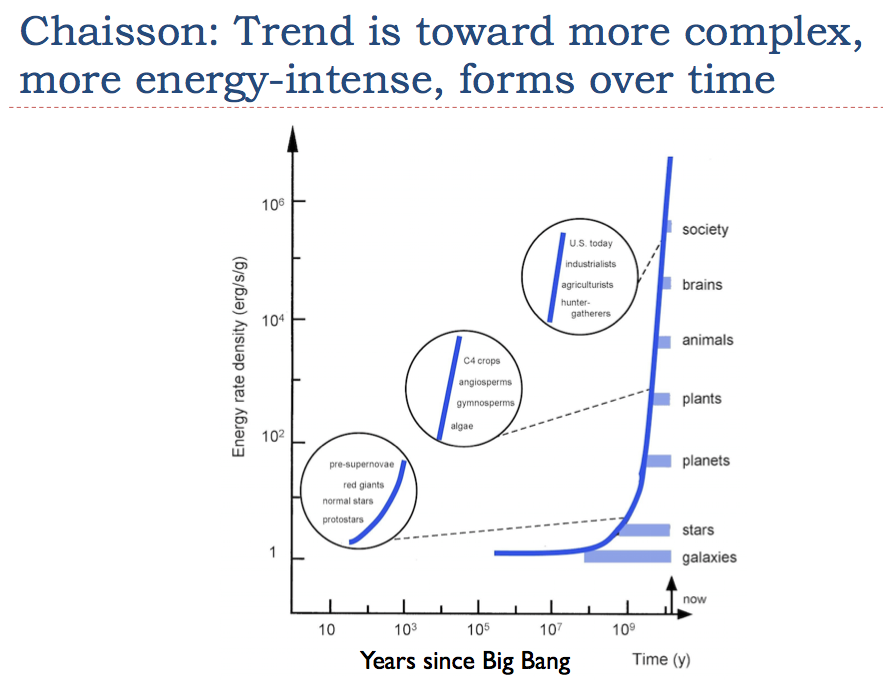
Dissipative structures are ones that self-organize and grow, because of flows of energy. One commenter (latto) suggested that a better name for a dissipative structure would be “generative, self-organizing structure.” The commenter (who comes from the HT Odum school of research) said, “Mother Nature is in the business of self-organizing for maximum power use, developing complexity and life.”
The earth and its biosphere is an open system. In fact, any combination of open systems is an open system. The economy very definitely has a structure and grows, even if it is hard to see for someone who is not very close to the situation.
We have an open system, the sunlight is our input and we output heat in to space.
It’s closed for matter, but open for energy. Problem is sunlight is dispersed when it hits the earth. So you need to harness energy from the closed system (matter) in the form of fossil fuels, to create a concentration system for harvesting the sunlight.
Then you need to figure out how to store the energy (needs more energy from the closed system again) and what happens on the days when the sun don’t shine…Answer: You again have to resort to drawing down from finite material sources of energy.
stating the obvious rains on a lotta folks’ parades y’know
I know. But really, if they don’t won’t their balloons popped then they should stay away.
*want
Pingback: Oops! The economy is like a self-driving car – Enjeux énergies et environnement
Pingback: Oops! The economy is like a self-driving car – Olduvai.ca
The game has changed. It is an automatic pilot economy but not in the way you expect.
Gail think the economy’s engine is the wage of non-elite workers, but https://www.credit-suisse.com/us/en/about-us/research/research-institute/news-and-videos/articles/news-and-expertise/2016/11/en/the-global-wealth-report-2016.html
says most of the wealth is held by the elite workers of the advanced world.
Same thing like 1913 when the top 4% held maybe about 95% of the world’s wealth.
Vilfredo Pareto already proved that 80% of consumption was done by 20% at the top, a century ago.
http://greyenlightenment.com/autopilot-nation/
Read this. We are in an autopilot economy, with no changes.
Right. Wage distributions tend to follow a Pareto distribution. So do the sizes of cities, and a lot of other things.
I wonder what they are including in the Swiss wealth–values of all of the bank accounts held in Switzerland?
One thing to keep in mind is that a lot of wealth is the “flip side” of debt. Wealthy nations are nations with a lot of debt. In fact, this debt can be piled higher and higher, by reselling it in new forms. Values of shares of stock are fairly similar. In this compilation of financial assets, there is mention made of the fact that quite a bit of this is associated with pension and life insurance values. These are clearly “flip side of debt” numbers. In fact, the low interest rates we now have even affect home values.
These assets will “be there” as long as it is possible to repay debt with interest. If there is a problem, they will evaporate.
Interesting article. I would say just a couple of things. First, I agree with you that the Brexit will likely lead to diminished complexity in Britain. But it will not happen in the way that the champions of the Brexit predicted. Their campaign was an emotional response to the emergence of a world of increased diversity and the increased presence of non-English speakers (many of whom are not white) in Britain. However, the practical consequences of a Britain which isolates itself in all respects from the larger world include the collapse of the British economy, which depends strongly on globalism. 85 percent of British GDP is provided by the British service sector. And the majority of this sector consists of the financial services sector. The challenge for British PM Theresa May consists of trying to maintain the flow of goods and services into Britain while keeping the poor people who provided those goods and services out of Britain. I think she will fail.
The same thing can be said of Trump. His plans to “Make America Great Again” will require access to cheap international credit so that he can build military and police spending, build his wall and re-build the manufacturing base of the U.S. – as well as importing the energy resources needed to run things after they are rebuilt. Having insulted most of his potential creditors, I think he will also fail. Then the U.S. will go through a period of, ahem, involuntary simplification.
You may be right. I don’t know if anything can fix the situation we are in. The prior direction wasn’t sustainable either.
There are no good, painless choices left to make.
The problem with open borders is that there aren’t enough decent paying jobs for non-affluent immigrants. The non-affluent immigrants do not assimilate as well as they did in the past, go on welfare. There is resentment that some non-working immigrants receive services that local citizens do not.
” keeping the poor people who provided those goods and services out of Britain. I think she will fail. ” I’m not from England. If I provide a product or service to England, does that entitle me to government services from England, or the right to change English law and customs to help “my people” at the expense* of people who live there?
*There isn’t enough “free stuff” from the government to meet demand.
Increasing complexity (greater division of labor)does turbocharge the economy. It also requires more energy input to maintain. The energy directed into the increased use of automation and computer robotics seems to be occurring by sacrificing the energy (and pay) going to non elite workers.
I see that you agree with me.
S&P 500 Earnings Stuck at 2011 Levels, Stocks up 87% Since
Grounded in some sort of new reality? LOL
The S&P 500 stock index edged up to an all-time high of 2,351 on Friday. Total market capitalization of the companies in the index exceeds $20 trillion. That’s 106% of US GDP, for just 500 companies! At the end of 2011, the S&P 500 index was at 1,257. Over the five-plus years since then, it has ballooned by 87%!
These are superlative numbers, and you’d expect superlative earnings performance from these companies. Turns out, reality is not that cooperative. Instead, net income of the S&P 500 companies is now back where it first had been at the end of 2011.
Hype, financial engineering, and central banks hell-bent on inflating asset prices make a powerful fuel for stock prices.
And there has been plenty of all of it, including financial engineering. Share buybacks, often funded with borrowed money, have soared in recent years. But even that is now on the decline.
Share buybacks by the S&P 500 companies plunged 28% year-over-year to $115.6 billion in the three-month period from August through October, according to the Buyback Quarterly that FactSet just released. It was the second three-month period in a row of sharp year-over-year declines. And it was the smallest buyback total since Q1 2013.
Apple with $7.2 billion in buybacks in the quarter, GE with $4.3 billion, and Microsoft with $3.6 billion topped the list again. Still, despite the plunge in buybacks, 119 companies spent more on buybacks than they’d earned in the quarter. On a trailing 12-month basis, 66% of net income was blown on buybacks.
Alas, net income has been a problem. By now, with 82% of the S&P 500 companies having reported their results for Q4 2016, earnings rose 4.6% year-over-year, according to FactSet. It’s the second quarter in a row of year-over-year earnings growth, after six quarters in a row of earnings declines.
For the entire year 2016, earnings edged up 0.4% from 2015. And revenue inched up 2.4% – in a year when inflation, as measured by the Consumer Price Index, rose 2.8%.
It wasn’t just 2016 that was crummy. Earnings in Q4 2016 were back where they’d been in Q4 2011. This chart by FactSet shows:
Net income as reported on a trailing 12-month basis (dark-blue bars, left scale in million dollars)
Share buybacks on a trailing 12-month basis (light blue bars, left scale)
Buybacks as a percent of net income (green line, right scale).
I added the red line to show how, after a bump in the middle, net income has gone nowhere in five years. And I circled the increases in trailing 12-months net income over the past two quarters to show how puny they’ve been (click to enlarge):
http://wolfstreet.com/wp-content/uploads/2017/02/US-SP500-net-income-buybacks.png
At the same time, over those five years since Q4 2011, the S&P 500 index has soared 87%. Grounded in some sort of new reality? LOL
And it’s even worse. FactSet uses “adjusted” ex-bad-items earnings that companies report under their own metrics. FactSet does not use earnings the companies report under the stricter guidelines of GAAP. These “adjusted” earnings are generally much higher than earnings under GAAP. In some cases, companies might show a big profit on an “adjusted” basis but have a loss under GAAP.
This disconnect between five-year earnings stagnation and soaring stock prices is confirmed by revenues. The S&P 500 price to sales ratio, which tracks stock valuations in relationship to aggregate revenues of the S&P 500 companies, has now reached 1.87, just 8% below its crazy peak back in early 2000 before it all came apart. That ratio was between 1.4 and 1.5 before the Financial Crisis and below 1.0 before 1996 (chart).
More http://wolfstreet.com/2017/02/19/2016-sp-500-earnings-back-at-2011-levels-as-stocks-ballooned-87-percent/
The stock market is totally divorced from fundamentals now:
http://seekingalpha.com/article/4045947-ten-charts-demonstrating-2017-stock-market-euphoria-one
I think of the value of a stock whose future earning are expected to be 1 per year as being 1/i, where i is the interest rate. As the interest rate goes to zero, the value of the stock goes to infinity. That is at least part of the problem.
That’s all nice, but we are in different normal after 2008, namely that today’s paradigm is about global systemic CBs printing %Trillions per month, passing the effort/blame from one to the other in sort of circular joke. So stocks have artificial floor, apart from also sanitizing bonds, derivatives and other many schemes.. This could go on for quite some time..
Thanks for the link. I read this article yesterday, but couldn’t find the link to day when I was looking for it. The rapid growth in the earnings of companies illusory.
I looked at the BEA report on Corporate Profits for all companies – 16A. It gives sort of similar indications to Wolf Richter’s–perhaps a bit more increase since 2012.
The annual profits for all companies are
2011 1817
2012 1998
2013 2033
2014 2152
2015 2088
2016 (3 qtrs) 2064
Maybe this link will work. https://www.bea.gov/iTable/iTable.cfm?ReqID=9&step=1#reqid=9&step=3&isuri=1&904=2014&903=239&906=a&905=2016&910=x&911=1
And related, obviously:
“Global dividends flatlined in 2016, driven by subdued profit growth across various markets. It’s a trend that has led firms to become less generous in terms of the amount of income they return to shareholders.
“The total value of dividends paid across the globe reached a record $1.154 trillion (£930 billion) in 2016, representing just a 0.1 per cent rise compared to 2015. In 2015 global dividends fell by 2.2 per cent versus 2014, which was a record year for global dividend payments.”
http://www.moneyobserver.com/news/20-02-2017/global-dividends-flatline-2016-four-reasons-behind-slump
Thanks! You are correct. There is a nice chart in that article with some helpful numbers, if I want to graph some things.
Thanks for the new article
… the excellent new article… this very clearly explains the situation we are facing in terms that even Glenn and Mark surely should be able to understand.
I think you are a optimist.
“Our Economy Is Like a Self-Driving Car: Wages of Non-Elite Workers Are the Engine”
Gail writes “The economy, like a car, has recurring needs, analogous to monthly lease payments, insurance payments, and maintenance costs. These would include payments for a variety of support services, including…”
“Higher education programs”
It seems like there is a lot less advertising in public places than in the past but whatever advertising there is, is in my neck of the woods is aimed almost exclusively at the elite workers.
Since the “Service Economy” was erected in the late 1970s ad early 1980s,
many businesses have attempted to get by with demand from elite workers only.
There has been a serious attempt to turn as many ordinary people as possible into elite workers by expanding access to higher education. The removal of alternative vocation programs in many areas of the U.S. and silent treatment given by the elite to the concerns of the working class I think was suppose to motivate non-elite workers to “go back to school” and “Get a degree”.
It remains unclear as to how productive money lent to ordinary people has been at created more elite workers who can pay for products and services whose prices have been inflated with debt.
I agree.
I think Georgia was one of the first states to start offer scholarships to students with B averages or better, so that every good student could go to college. Of course, no one stopped to think,”If we educate a huge number more college students, will there actually be jobs for those students that require a college degree?” With the many more people graduating from college, employers could start using the existence of a college degree as a screen for “conscientiousness.” But it didn’t really indicate that the degree was worthwhile. It did keep young people out of the labor market for a while, and it provided a job market for college professors. Otherwise, a lot of the spending was a waste of time, and it burdened a lot of young people with a lot of debt, without really offering them much more wages.
Whenever I talk about higher education, I like to say the problems with it are global.
It is globalization, the expectation of significant growth in the future, that fueled demand for graduates.
A lot of people who believe in a globalized, economic future with significant growth liked–I say the word “liked” because they have become very quiet in recent years–liked to say that “The economy” would become more meritocratic–when all I see it as becoming more hierarchical–when financial troubles come–it is the low-status workers, not necessarily the least productive workers that get fired first. A salesperson who brings revenue into a company but will be fired before elite workers, members of upper management, legal department or accounting/finance. This happens less because of merit and a lot more because of social status. We see this as hierarchical behavior, the average person sees this as corruption because the elite told them that the market economy is a meritocracy.
Meritocratic Myths
https://www.jacobinmag.com/2017/02/elite-universities-class-mobility-northwestern-cuny/
I agree. High priced college education is not a way for the poor to move up.
My wife used to be an elementary school teacher. She was born into wealth, and went to an elite prep school where everyone went on to successful careers as doctors and lawyers and CEOs (teacher was pretty much bottom of the barrel.)
Her first year teaching, in a public school, she was so frustrated because she couldn’t understand how some of these kids were going to get by. She was stressed out all the time thinking she was doing something wrong. It wasn’t until I explained to her that because this was a public school, she had a full cross section of society in her classroom and not all of them were going to end up as “elites” like us. Of the 25 students, there might be one future doctor. There might be one lawyer. But there was certainly a janitor, a career burger flipper, factory workers, some tradesmen, and a future convict or two.
With her background, this never even occurred to her and it absolutely “clicked” once she understood it. She had imagined that all of these children would be like her and her highly privileged peers. But of course in the real world, only about 1/3 of her students would even go to college, and the rest would make up the mass of “common workers.”
The idea that we can somehow lift all of those kids into elite jobs is patently absurd; no economy could function like that. But that seems to be the mentality now. Everyone on the planet will apparently be a computer programmer or an advertising executive… with no one left to take out the garbage.
The problem with that is, that it only shifts everything….. puts more pressure on all without a degree or those with a degree but not top-notch grades and references. As you said – there are only so many jobs for each function or skill.
I think the issue is another: This whole education game removes people from the job-market, hence less unemployment (which is nice for government statistics) – but also depresses wages later due to too much supply (which is nice for the companies)… rigged game.
I am told by some teachers today that there is at least some thought about increasing vocational classes again. I don’t know to what extent this is actually happening.
When I looked back at my high school yearbook, I was shocked to realize that the majority of my classmates (including quite a few “good students”) were home economics, business, agriculture, or industrial arts “majors.” There were only a relative handful (whom I saw everyday in my classes) who were on the pre-college track. When I have gone back to class reunions, there have been many on these vocational tracks who have done quite well. (I am sure, quite a few who did not return to the reunions also, because things didn’t go so well.) Quite a few of the pre-college majors didn’t stay in college long–dropped out to get married, have babies, or for financial reasons. Some them eventually did go back and finish their degrees; a few people on the vocational track later went to college as well.
” am told by some teachers today that there is at least some thought about increasing vocational classes again. ”
There have been a few initiatives. Blue collar or vocational training programs are more expensive to run than a college prep program. A blue collar training program cannot hire a non-expert to do the teaching, it needs to have some capital equipment on hand. Students have to able to acquire tools that cost $$$$. In my state, the paid apprenticeships are selective–this guarantees good salaries by itself.
There are some for-profit vocational programs that don’t provide any experience. such as
Devry, ITT Tech
Unfortunately, many employers no longer want to train.
Even in computer work, employers often don’t want to train, I understand. They would prefer to hire contract workers, if they can get away with it.
I have a sister who has been a carpenter all of her life. She went to college in nursing, started working in the field, and decided she didn’t like it. She visited the local union, and figured out how to work her way up through their apprenticeship program.
There is an over-supply of people with college degrees. I go to a restaurant/bar near a university. The workers are mostly university students. They have a very hard time getting a job having anything to do with their major.
And not everyone can get a college degree. Obama infamously said that blue collar white men were having a difficult time adjusting to the new economy. As if sending their jobs to China and Mexico wasn’t the problem, it was that they hadn’t learned how to program computers. Computer programming is difficult enough that the tech companies don’t even offer to train Psychology or Liberal Arts graduates to do it, let alone laid off factory workers.
Some computer programming jobs are being sent to China, and tech support is being sent to India. Also some programming. So even programming skill does not guarantee a future without jobs changes because your job moved elsewhere.
Another sign that nuclear is going nowhere, as in France.
http://www.theenergycollective.com/shellenberger/2398404/big-bet-nuclear-destroyed-toshiba?platform=hootsuite
Right! I live in Georgia, in the geographical area where two of Toshiba’s nuclear power plants are being built. We have been paying, in advance, for the new power plants for several years in our electric bills. They are still a long way from being finished. The current estimate is 2019 and 2020, but this assumes that the process can be greatly speeded up from what has been accomplished to date. I understand that Toshiba may possibly need a bail-out by the Japanese government, just as the French companies may need bailouts by the French government. This all makes for a relatively speculative situation. Will these plants ever be finished?
I understand that Areva is planning to specialize in decommissioning plants, instead of putting new plants up. Where will all the payments for decommissioning come from? Who will maintain all of the plants that are currently in operation, if these two major players need to leave the business? Is nuclear similar to banks in 2008? Where do we get base load generating capacity, to replace all of the nuclear that is reaching the end of its lifetime?
The nuclear industry around the globe is in peculiar state. As you mentioned in the French case AREVA is about to specialize in decommissioning plants, partly because it’s a niche on the market (where the money is) as those fleets age all over the place and secondly it also relates to quite realistic drop of nuclear baseload share domestically in France into the future as they are not going to renew the entire capacity which took decades and much favorable conditions to appear in the first place.
Also, few days/weeks ago Russians offered to Hungary and other potential clients up to 100% financing for their newest gen3+ NPP model of 1.2TWe output, taking care of the waste fuel and other goodies. Now, part of the reciprocity is the calculation they need some “demo reference installations” outside Russia asap, but the fun part is how is Hungary going to pay for the lease? Well, they momentarily have got some assembly factories for the German EU, also receive some EU related subsidies, and have their agriculture exports. Russia doesn’t need the money for the NPP per se, they need the demo plant out there to lure more clients, so should there be some real EU fracturing, Hungarians are basically going to get almost for free the most modern installation in the world, and pay back the lease with vegetables and salami..
I strongly suspect that the Russian nuclear power plants are not as expensive and complex as the ones AREVA and Toshiba are having difficulty with. We will see what happens. Back when nuclear was first installed, France, Japan, and some other places did the installations quite inexpensively. In recent years, there has been a desire of some builders to try to make the plants more accident-proof. There is a huge cost difference, depending on the approach a company/maker chooses.
I’d not say so, it’s all about “gen3+” specs so the complexity difference is not that big among those contemporary designs, concrete containment is airplane crash proof as well, most of the myriad of passive and active self shutting features are the same etc.
The chief difference though is elsewhere, namely vertically integrated nuclear industries of Russia or South Korea, allowing for higher standardization and work flow due to long term planing and budgeting, the overall commitment to that industry.. Simply put AREVA and Toshiba-Westinghouse allowed to become a mess and inferior product..
That being said, I’m not RU fanatic, for instance they had to recently exchange newly built reactor vessel for another new one (expensive and bit of delay) due to minor industrial accident, x-rays and everything afterwards showed no problem no nicks or scratches, but in this business they have to exchange it for brand new one anyway and eat the loss..
PS I made a typo above it’s meant to be 1.2GWe as in 1200MWe obviously, not terrawatts lolz..
Addendum, was it in an article about NPPs on ZH or Wolf or somewhere in recent days, a story how Chinese were literally swindled by American contractors, they sold their new NPP gen3+ design with half finished project planning and development ready, so the Chinese had to finish it on their own on the go. Now after huge delays they have it likely standardized to relatively rapid deployment, although as we mentioned earlier, the global orders for new NPPs are today ~ 1/3 or less of planned numbers just few years ago..
And it always comes in over budget, and late.
Some what of a good idea on a theoretical level, but humans build them and maintain them.
The same applies to aging coal fired power plants. What will replace them? I have done 3 posts on this topic in the Australian context:
14 Feb 2017
NSW’s privatized giveaway coal plant causes load shedding in extreme weather
http://crudeoilpeak.info/nsws-privatized-giveaway-coal-plant-causes-load-shedding-in-extreme-weather
10 Feb 2017
NSW running low on contingency reserves during hot days
http://crudeoilpeak.info/nsw-running-low-on-contingency-reserves-during-hot-days
28/1/2017
Power Supply in Australia’s New South Wales: how will it cope in coming
heatwave?
http://crudeoilpeak.info/power-supply-in-australias-new-south-wales-how-will-it-cope-in-coming-heatwave
I think the best we can do is not trying to grow an unsustainable system
Electricity is definitely a problem.
F word I just hate all things nuke
I love the way just present the facts and just the facts…Thinking you are old enough to know what I think
Just a minor quibble, but the word “Elite” is starting to really bug me. Just because that’s how they think of themselves we don’t have to go along with it. How about “Parasites” or “members of the parasitic Kleptocracy and their lackeys and toadies instead?
Well, as Abbey pointed out:
“Society is like a stew, unless stirred frequently, the scum rises to the top”
I started out using the term “common” worker in this post. In fact, I think I used “common worker” in another earlier post, and received several negative comments about it. So I switched to non-elite workers.
I expect that nearly all of the readers of this blog are from the elite group. Some of them may not have jobs that now pay elite wages, but they have education that gives them privileges over many other people.
Gail-
I actually live modestly in Mexico.
But I did receive a privileged education.
The chart needs updating to indicate what has happened over the past three years in, for instance, the Permian shale. This is not 2013, and a lot has changed since 2013.
https://s4.postimg.org/j511fg6od/Captura_de_pantalla_669.png
In its latest SEC earnings statement.Pioneer Resources is reporting CAPEX of less than $10 per barrel for the shale wells it drilled during the year.
https://s4.postimg.org/yv3zu1gel/Captura_de_pantalla_670.png
“Break-even price for Pioneer’s average Trend Area-Spraberry well is about $52 per BOE. I’m sure the Saudis are scared to death about that.”
http://oilprice.com/Energy/Energy-General/Pioneers-2-Operating-Costs-Fact-Or-Fiction.html
Nicole Foss says that “the paradox with low-energy-profit-ratio energy sources is they cannot sustain the level of complexity necessary to produce them,” and likens fracking to an alcoholic sucking beer out of a carpet. Seems an apt analogy to me.
Thanks for the link. Companies seem to compute “cost per well” in very different ways, depending on what story they are trying to tell. The story is often, “We are profitable, we can repay loans, or offer stock appreciation, of you give us loans or investment.”
All Shale Stories Are Lies (ASSAL)
All Shale Stories Hype Oil Less Expensive 🙂
++++++++++++++++++++++++++
You gotta love this zinger of Berman’s: “No credible oil and gas analyst believes those claims [made by Pioneer]….”
But I suppose it depends on how one defines “credible.” For Berman, “credible” seems to mean that 5% or 10% of dissident oil and gas analysts that agree with him, which of course means the vast majority of oil and gas analysts are not credible.
ASSAL
it depends upon what the definition of “is” is.—-B. Clinton
Whether or not the Permian basis is able to produce a little oil at a low price, the real issue is the cost of production for the marginal barrel of oil. We cannot replace all depleted oil extraction with the very light oil from the Permian Basin. Show me equivalently good indications for Norway’s oil and for Brazil. Or how about the Caspian sea oil?
There are many moving parts here, and that marginal barrel of oil depends on a good many demand and supply factors.
Speaking only of the supply side, however, it looks like oil (even that not in the sweet spots of the U.S. shale plays) can now be extracted for a cost of $60 to $70.
If the supply of oil from the shale plays proves to be great enough, then that $60 or $70 will be the marginal barrel of oil. And as long as markets are not tampered with (by governments interfering to limit supply), the price of oil will not rise much above that level.
This would leave a great deal of high-cost oil — most conventional U.S., most deepwater, Canadian oil sands, etc. — uneconomical for future investment, and would leave the sunk investment in high-cost oil a loser.
I agree that most oil will be left in the ground. I cannot imagine oil prices rising above $60 or $70 per barrel; in fact, I agree with Art Berman that the likely direction of oil price from here is down, not up. The catch is that the world economy will shrink back on what we can actually extract for available prices. Our limit on oil extraction is a price limit, IMO. The huge amount of oil that we can see is pretty much an illusion, because prices will never rise high enough to extract it.
If I understand your argument correctly, then we are in agreement that there is still a great deal of oil out there to be extracted if the price is high enough.
Will the price of oil get high enough to justify extracting it? I’m intrigued by your theory that it will not. I can discern no factual or logical flaws in your theory, and believe it to be every bit as valid as the orthodox theories.
To sumarize, your theory is that peak oil will not come about because of lack of supply, but because of lack of demand or demand destruction?
My view is that low wages are what is keeping prices low, for a wide ranges of commodities. There is no way that we are going to get inflation-adjusted wages up enough to get prices up high enough to enable the extraction of most of the oil and other commodities are in the ground. A person needs to understand “demand” as what consumers can afford.
I was the one who wrote Section 2 in this academic paper, published in the journal Energy in 2016. The thesis of our paper is that the limit on extraction is a price limit. https://gailtheactuary.files.wordpress.com/2016/09/ke-wang-an-oil-production-forecast-for-china-considering-economic-limits.pdf
And there is disagreement between oil and gas analysists as to where that marginal barrel might be found. As one of the Hunt brothers always used to tell me, “That’s what makes a horse race.”
Take this example from an article in Rigzone yesterday, for instance:
So far, the action seems to be only in the Permian, which is partly/mostly conventional. Bakken had a terrible December, but that may be partly because of winter. With oil in the current price range, the we seem to be building a big inventory of oil. We need higher prices, to get more than the Permian back producing; at the same time we need lower prices, to make oil more affordable for consumers. This is a chart based on EIA data through November, plus their forecasts for later periods.
Gail Tverberg says:
Most new drilling in the Permian, more than 90%, is non-conventional, and has been that way since 2014.
https://s27.postimg.org/g5z8umqk3/Captura_de_pantalla_673.png
You are then equating vertical wells with conventional.
If output of oil in the Permian could still be from old conventional wells, which have not yet begun to decline very much. The horizontal wells could just be adding a smaller amount of light oil to the top.
I understand that part of the reason that extraction from the Permian is more profitable than extraction elsewhere is because the oil is so close to ships/refineries, there is little transportation cost involved. Also, the fact that all of the pipeline system had been built in Texas because of the conventional oil meant that quite a bit of would be overhead had been paid by the conventional oil industries. Without those benefits, other places (outside the US as well as inside the US) will never be able to be as successful as Texas.
Gail Tverberg says:
“Ouput of oil…from oid conventional wells have not yet begun to decline very much”?
Where do you come up with these fact-free empirical claims?
Conventional oil production in the Midland Basin peaked at 656 million barrels in 1974, and by 2007 had fallen to 251 million barrels, I would hardly consider a 62% decline to “have not yet begun to decline very much.”
This decline curve would not be reversed until the shale boom began, slowly in 2007, but really taking off in 2012.
The attempt to attribute the huge and rapid increase in oil production in the Midland Basin to conventional oil has not basis in factual reality. That dog don’t hunt.
https://s31.postimg.org/72ohvu8kb/Captura_de_pantalla_675.png
A statement that starts with “if” is not intended to be an imperial claim. There clearly is a layer of some level that is from the oil wells. I didn’t know how much. If you look at 2000 to 2006, you can see that the conventional oil was declining slowly from a high base. I could believe that 40% of the 2016 production was still conventional.
Probably helping the Permian even more is the built infrastructure for transporting the oil, plus the fact that the production is close both to refineries and ocean shipping. If they were forced to pay something like $10 per barrel for shipping by railroad (as was needed in the Bakken, at least initially), it would raise the costs quite a bit.
The Eagle Ford has mid-stream costs which are certainly no higher than those of the Permian Basin, and perhaps even lower due to its closeness to all the refineries and petrochemal facilities south of Houston. And yet it has experienced almost no uptick, neither in drilling activity nor production, like the Permian has.
Certainly mid-stream costs come into play in places like the Bakken where they are inordinately high. But the Permian vs. Eagle Ford comparison illustrates that there is quite a bit more going on than just that.
https://s24.postimg.org/h64qy99dh/Captura_de_pantalla_680.png
https://s1.postimg.org/5mkxngqkf/Captura_de_pantalla_679.png
The vast majority of oil and gas analysts are in fact probably not credible because most of them have paymasters in the industry who often insist on optimistic projections. You can’t borrow money with pessimistic scenarios.I ‘m not sure what you are referring to with regard to the Permian Shale. I would also be very careful listening to any one company making claims of profitability per bbl unless it is verified by an independent analyst. I personally lost a lot of money on Chesapeake making that mistake. Pioneer I think has the most acreage options in the wolfcamp/spraberry of the Permian. I have read cost per acre have skyrocketed to 60K/acre driving out even big players. Maybe Pioneer can peddle their leases to the guillable. Pioneer got in early with a lot of debt. Their debt to equity is 30. Their PE is -57 and their stock price is way up there as well. THey have negative net income for 2016. The permian is getting a lot of hype but the permian has little to do with the graph Gail provided which was WORLD Capex, not permian capex. World capex and discoveries has fallen off a cliff and that graph has almost certainly steepened since. It appears that a lot of oil companies are circling the drain. Believe their hype at your peril.
I forgot to mention that most of the Permian right now is conventional oil, not tight although after the sweet spots are played out, tight will be what is left. sorry for the omission. Conventional drilling is a lot cheaper so the Pioneer figures may be conventional sweet spot figures. Very hard to know what is truth and what is hype in the oil Bidness.
It’s the last gasp, after shale topped out.
Permian:
At max, about 2 million barrels.
US uses 18-20
World about 80 (I believe)
And that is with Enron Accounting.
About 2020 should see the final peak. If the economy makes it that far, http://oilprice.com/Energy/Energy-General/Is-The-Bakken-a-Bust.html
Let’s hope that December was just a bad weather month for Bakken. It has happened before.
It’s anybody’s guess…
cal48koho said:
This has always been true of the oil Bidness, Dad Joiner and Doc Lloyd being prime early examples.
Since the financialization of the oil Bidness beginning in the 1980s, however, I believe the problem has gotten even worse.
Financialization of the oil bidness happened because of rising costs.
Interesting point!
I recall some years ago watching a clip of the CEO of a shale company mocking comments from Art Berman about the shale industry being a massive Ponze…. I think it was on CNBC… he referred to Berman as a low level flunky .. a know-nothing… it stunk of ‘the CEO doth protest too much, methinks’
That says it all.
Gail Tverberg said:
The elite, however, as this article thoroughly documents, have certainly shown themselves capable of driving demand without the help of workers. As non-elite spending and consumption have declined, the spending and consumption by the elites has increased.
The quesiton is not whether this is economically sustainable, but whether it is politically sustainable.
You seem to be suggesting that the top 20% can, by themselves, create enough demand to keep the economy going. The chart you link to suggests they consume 38% of goods and services. This is not nearly enough to keep the economy as a whole going. The price of oil would drop far below the 50’s, for example. This would not work. Clearly, the top 20% are not going to do all of the work themselves either. Which of them are going to pick the fruit that is grown?
As long as there are elections, people will indeed vote out people who they perceive are acting opposite to their interests. Thus, it may very well be that it is elections that throw out leaders who act contrary to the interests of the non-elite workers.
I don’t know, but when I look at how the lifestyles of the rich and famous have become so excessively opulent and estravagant, and every family that makes over $100,000 per year has to have its McMansion and four cars parked in the driveway, I don’t see the top 20% letting us down in the consumption department.
Kevin Phillips writes a lot about conspicuous consumption in Wealth and Democracy, and although hard statistics are hard to come by for the 19th and ealry 20th centuries, we probably haven’t seen anything like what’s gong on now since the Gilded Age or the Roaring Twenties.
The theologian Reinhold Niebuhr was much more succinct.
As he explains in The Irony of American History, the French Enlightment, the Jeffersonians and the Marxists believed that all human desires are determinate and all human ambitions ordinate.
However, as Niebuhr goes on to point out, they were sadly mistaken:
No matter how opulently they live, they don’t eat enough food for everyone. They can’t fill up enough chairs in MacDonald’s to keep the chain operating. They don’t keep hospitals full. They certainly don’t do enough physical labor for everyone.
It’s easy to stimulate demand. All you gotta do is print and distribute more money to the proletariat. (Distributing it to the banks via loose monetary policy doesn’t always work, although it sometimes does.)
Stimulating production, however, is a much tougher nut to crack.
If a country prints more money, its currency tends to fall relative to other currencies. In total, it is not at all clear that the total amount of goods and services that can be purchased rises by very much. To the extent that it does, it tends to deplete resources more quickly, moving up the date of collapse.
Have you heard about Vilfredo Pareto?
The bottom 80% consumes 20% aggregate.
The top 20% consumes 80% aggregate.
They may not consume 80% of all goods and service, but their spendings support 80% of the economy.
Besides, should not we conserve stuff more? It is commendable that these top 20% are consuming less. I just hope the bottom 80% follow suit.
The “top 20% are consuming less”?
Nah. The very opposite is true. The top 20% have increased their consumption, while the bottom 80% have sucked hind teat.
We need more spending power, which is more demand. That has little to do with conservation.
Pingback: Oops! The economy is like a self-driving car – Enjeux énergies et environnement
Gail In the chart above of income of the bottom 50%, how has France maintained stability compared with the US and China?
Productive workers, a great social net, one of the best health care systems on Earth, good education, appreciation of art and philosophy, a varied media, and a politically iterate population, and a proper tax policy.
Just to start.
And cheap nuclear power, which is rapidly being lost!
There are dozens of extremely cheap, clean, safe, reliable nuclear reactors currently sitting idle in Japan due to widespread fear, loathing and fake news following the Fukushima meltdowns. Prior to 2011, electricity costs in Japan were steady in yen terms for 30 years.
Since the taking offline of all the remaining 50 reactors in the wake of the disaster, the price of electricity to end users has increased by over 20% on the average as the utilities have turned to importing coal and gas as replacement fuels for generating electricity. This in turn has directly increased costs for everybody, including manufacturers, service providers, railway companies, hospitals, schools, and of course individual consumers.
Several reactors have been brought back into service over the last two years, and the current plan is to generate 20% of Japan’s electricity from nuclear by 2030 (against roughly 30% in 2010). But opposition to restarting existing plants and building new ones remains intense, so reaching this goal will be difficult unless the public mood toward nuclear becomes more favorable.
The number I read most recently is that only three reactors are back online. https://www.nei.org/News-Media/News/Japan-Nuclear-Update This article suggests that two more will go online in the fiscal year needed March 18. http://www.japantimes.co.jp/news/2016/11/09/national/japan-regulator-clears-reactors-restart-amid-opposition/#.WKxtNLGZMo8 So the ramp up is very slow.
I can believe electricity prices are higher. Even with the high prices, the prices are low for the companies trying to sell the fossil fuels used for energy generation. This is creating problems for fuel suppliers. This is part of the whole world problem with low fossil fuel prices.
Tim Groves,
What happened at Fukushima isn’t exactly fake newz. It really did happen. The cores really are sitting melted somewhere under the plant itself. The ground water really is pouring over and around them and seeping into the ocean. Japan really does sit in the center of a seismically active zone prone to tsunami and typhoon. Japan really doesn’t know how to deal with this situation and so Japan quite logically shut down its reactors until they can figure out what to do about that. Is a 20% rise in the cost of electricity really that significant considering what it costs to potentially evacuate cities and irradiate millions of hectares of farmland and living space? Not to mention the long term health care costs associated with the unintentional poisoning of innocent citizens, Tepco workers and unborn generations of Japanese people. Hmmm…..
Actually, a 20% rise in the cost of electric is more-or-less equivalent to a 20% loss in efficiency in producing electricity. In fact, it is probably worse than a 20% loss of efficiency, because the power plants were built years ago, and didn’t require any more energy or materials’ resources for building the plants. Most of the cost went back to Japanese workers as wages, and thus could be spent in the economy. The purchase of fossil fuels is sending money to other countries, outside of the economy. There is thus less money spent on Japanese wages, making the “demand” of Japanese workers lower. Instead, the money goes to Australia or Saudi Arabia or somewhere else, helping to prop up their economies.
Also, the limit on fossil fuel supply seems to be an affordability limit. If the price of electricity is 20% higher, it is harder to sell goods on the world market, and receive an adequate return on investment. It is a serious handicap to the Japanese economy.
This is a link I found about the French employment situation. https://www.justlanded.com/english/France/France-Guide/Business/Hiring-employees
Some excerpts:
According to Trading Economics, the overall unemployment rate is 10.0% and the youth unemployment rate is 26.2%. Those people who can get into the paid labor force do well; one problem is that many who tend to get left out. The Economist notes that France compares very poorly to other countries from a business point of view in tax policy (45th in the world) and labor market (37th in the world). (Behind pay wall.)
France has historically had its supply of inexpensive nuclear electricity; the economy no doubt has received a subsidy from this. This benefit is being lost, because power generation is now falling behind. Frances peak in nuclear electricity generation was back in 2005. At one point, France could earn considerable revenue by exporting this electricity to other countries. There have been recent major problems with Nuclear in France. Eighteen of 58 nuclear plants needed to be shut down. France’s big nuclear companies, Areva and EDF, are both in financial difficulty. This article says, France’s Next President may face $3 billion nuclear hangover.” There is now discussion about France possibly leaving the EU.
My summary of the situation: when France built its nuclear reactors, they gave the country a large cheap-energy subsidy. France used this benefit partly to subsidize pay for what would have been lower-paid employees. The ability to do this is now disappearing. French unemployment, especially among youth, is high. At some point, France is going to have to give up its employment subsidies of what would be lower-paid employees. It can no longer afford them. Even though this has not yet happened, there is interest in leaving the EU.
Thomas Piketty explored this in Capital, although he ignored most biophysical realities.
Germany is kicking everyone’s rear end, and still keeping wages high, without the energy surplus France has (so far).
But I agree with your energy analysis.
Being thrive on energy, and die without.
Lets be honest, we have turned oil (actually NG with the Haber Process mostly) into people.
This is not going to work out ell
Maybe relatively speaking, yes.
But Germany’s mercantilist economic agenda and the Hartz Reforms have greatly harmed the economic wellbeing of German workers.
When it comes to wages, the race to the bottom is almost ubiquitous.
https://s15.postimg.org/th8d7fe0r/Captura_de_pantalla_16.png
Germany tops world for shrinking wages
https://www.thelocal.de/jobs/article/31839
Real Wages in Germany: Numerous Years of Decline
https://www.diw.de/sixcms/media.php/73/diw_wr_2009-28.pdf
As German I can confirm that – it’s a big problem even within the Eurozone, as it is the strongest and most productive economy that had lowered its wage base the most (NOT in agreement with the work force – of course).
It certainly makes exports cheap, if you can pay workers very low wages. The costs of all of the intermittent renewables are being dumped on citizens as well.
Note where France comes out in the chart. Having cheap energy is helpful.
The book “Capital in the Twenty-First Century” has certainly sold well. I am afraid I haven’t read it though.
Germany seems to get a lot of benefit from being yoked together with weaker currencies in the Euro. Free floating on its own, I doubt it would do as well.
Good one, Gail. Let’s turn the phrase around, and instead of calling it a dissipative structure, use the term generative, self-organizing structure. Mother Nature is in the business of self-organizing for maximum power use, developing complexity and life. Calling Life a dissipative structure makes our economy sound like an overgrown tailpipe 🙂 Cheers!
There seem to be two sides to everything. We can call a “dissipative structure,” a “self-organizing structure,” and it does indeed point out some of the more important aspects of the structure. It would probably be clearer to readers, if the terminology worked this way.
I might point out that this same problem occurs with “debt.” To a lot of people and organizations, debt represents a “drag on the person/organization’s future ability to spend.” A person with a student loan to repay is less able to purchase a house or car. On the other hand, a pension plan, insurance company, or bank that “owns” the loan considers it to be an asset. Such assets are the foundation the ability of banks, insurance companies, and pensions plans to operate as they do.
Iaato
“Calling Life a dissipative structure makes our economy sound like an overgrown tailpipe.”
But isn’t that exactly what an industrial economy is? It takes in natural resources, burns them up and spews out pollution and entropy as its exhaust.
The economy also spews out debt in its exhaust. Growing debt distorts prices. We should probably consider debt a form of entropy.
Gail Tverberg said:
The classical, and especially the neoclassical (Smith hedged his bets a bit) economists would certainly have us believe this.
But heterodox economists do not accept the notion of the invisible hand, and in fact consider it to be a quasi-religious myth. In this program, both the orthodox and heterodox positions are argued:
Thanks! I suppose if you want to promulgate the idea that governments have great power over the economy, you need to get rid of the idea of the invisible hand.
Perhaps heterodox economists should study dissipative structures.
Economists of all flavors seem to have a lot of wrong beliefs.
I would be very careful about using the invisible hand metaphor, for two reasons.
1) It comes packed with a social and political agenda, as Robert Heilbroner explains in The Worldly Philosopers:
2) It has a religious pedigree, as Michael Allen Gillespie explains in The Theological Origins of Modernity:
The story definitely has religious aspects to it. How can anything grow and organize, without God causing this to happen?
Actually, the “open economy” story is part of a much larger story. Pretty much the whole universe seems to be open, in terms of energy flows. Thus, a person might reasonably conclude that there is a “god” or higher power
behind all of these flows. Humans, and the human brain seem to be the pinnacle of this organization on earth.
In fact, religions seem to be self-organized as well. Over the years, there has been a huge amount of sharing of ideas among the different religions. Many of the basic ideas seem to be developed independently, in many different cultures. There was an academic paper a few years ago pointing out that the major religions of the world seemed to organize at about the same time. The time they organized was about the time that there was enough energy that it made sharing of energy resources, rather than fighting, the optimal strategy, IIRC.
What other people say or think has very little impact on my writing. I try to figure out the story from scratch. Smith’s idea may have been embedded in a matrix of crazy other ideas. (I really don’t know, since I have not read his work.) The fact that this particular idea has been singled out of what he had to say, and has been talked about for over 200 years, is what is important. This, by itself, indicates that there is a kernel of truth to it. It also fits in with a body of physics analysis coming from a very different direction.
Gail Tverberg said:
This resonates of the New Atheists, who believe their belief system is completely original, sprung out of nothing, and owes no debt to the Western tradition. For instance, In the very first minutes of this interview of Ayn Rand, she articulates a similar notion:
https://www.youtube.com/watch?v=zEruXzQZhNI
As Stephen Toulmin explains in Cosmopolis, this idea of “starting from scratch” is part and parcel of the Modernist project:
But as Toulmin goes on to explain, since the 1950s,
Glen, it is a mistake to use Ayn Rand as a spokesperson for the beliefs of the New Atheists, as she was not a member of that sect. The New Atheists were a punk rock outfit consisting of Richard Dawkins, Christopher Hitchens, Daniel Dennett, and Sam Harris. They broke up after Hitchens—the drummer and the “Sid Vicious” of the group—smoked, drank and blasphemed himself to death.
Ayn Rand, while she didn’t believe in the existence of God, would not have got on at all well with these Latter-day Four Hoarse Men of the Apocalypse as her approach to values was very different from hers. They were/are neoatheists, while she was an iconic paleoatheist.
https://youtu.be/H4jUx85kYhI
In the video, Robert Mayhew begins by stating that Rand:
had an original rational disworldly conception of man and values, a heroic view of man, and a rational conception of values; and because of this she rejected God and religion as degrading to man as to his entire capacity to value… Her conception of values was formed completely apart from and in fact was opposed to that of religion. Other atheists by contrast tend to be radically different. They reject God and religion, often for good reasons and sometimes with good arguments. But almost without exception to some extent they accept religion’s monopoly on the whole realm of values… whether they admit it or not. Now this creates a dilemma or a problem for these atheists, and a challenge: Can we be good without God?” Is morality possible without religion? Is anything sacred? These are the kind of questions they raise. Clearly, no such dilemma existed for Ayn Rand.
Whoops: as her approach to values was very different from theirs
Tim,
I for one have always found the internecine knockdown dragouts between atheists to be much more interesting than those between traditional religionists. And one of those knockdown dragouts is the conflict over whether Ayn Rand was the original New Atheist or not.
In this lecture to The Science Network, David Sloan Wilson places Rand squarely in the New Atheist camp (minute 00:23:44), stating that she “was the New Ateist of her day..”
https://www.youtube.com/watch?v=taGhwQfRpbQ
Sloan places Rand in the New Atheist camp because of her stark “departures from reality.” An example of one of these was her belief, which she shares with other New Atheists, that selfish agents can somehow self-organize into an adaptive society.
But as Sloan Wilson said earlier in his lecture:
Another stark departure from reality Rand shares with other New Atheists is the 17th-century “dream of a clean slate,” that somehow we can put all that conceptual and cultural inheritance — all that superstitious religious and philosophical stuff that played such an important part in our evolutionary past and survival — behind us and discover objective truth through reason and formal logic.
https://s11.postimg.org/t3t9nmvdv/Captura_de_pantalla_671.png
Robert Mayhew said:
This is an empirical claim which is a prima facie falsehood. Take Sam Harris, for example:
So if we listen to the entire Ayn Rand interview, it looks like Ayn Rand and Sam Harris are on the same page when it comes to the fact that their “conception of values was formed completely apart from and in fact was opposed to that of religion,” that yes, we “Can be good without God,” and that “morality is possible without religion.”
It’s an age old debate, because as Thomas Jefferson wrote in a letter to Thomas Law in 1814:
In my opinion, Religions are self-organized. They need energy to maintain themselves. A major reason for religions seems to be to pass on understanding what works and doesn’t work in terms of making relationships in this world work smoothly. Thus, religions have some values of “good” in them.
As available energy levels change, what “works best” tends to change. This seems to be one of reason for why young people have left the church. The current view is that technology can save us; there is no need for anything besides more smart toys.
http://combiboilersleeds.com/images/fool/fool-5.jpg
Keith, I posted that video an Mayhew’s comment in the hope of soliciting an interesting reply, and you haven’t disappointed me.
I for one have always found the internecine knockdown dragouts between atheists to be much more interesting than those between traditional religionists.
Me too. It seems that getting God out of the equation creates as many ethical and metaphysical problems as it solves, and that the Devil is in the details, even for those who don’t believe in his existence. And of course, the big question nobody seems to be debating yet is: Have we reached peak atheism yet? Thanks for the videos.
Furthermore, it is not necessary to resort to the use of such a politically, socially and religiously charged metaphor like the invisible hand to make your point about self-organizing systems.
As David Sloan Wilson explains:
My story emphasizes that the economy can collapse, working on its own. That is a fairly different emphasis.
I also suppose that there is a possibility that the God behind the energy flows will save us in a way none of us have expected. If this happens, I do not expect the outcome to follow the narratives of any of today’s religions. The outcome will likely be outside of this universe.
Gail-
Great piece. There is an new show on Netflix called The Kindness Diaries. It is a nice change from doom and gloom. The generosity of some of the poor people, and I mean poor, is something to behold.
While I admire Smith, his economic theories have no basis in reality.
Ask any anthropologist.
Debt, The First 5000 Years is a good place to start.
I am afraid I have not studied Smith’s economic theories. I have read “Debt, The First 5000 Years.” I see absolutely no contradiction with “Debt, The First 5000 Years.” As I said in. “What has gone wrong with oil prices, debt, and GDP growth?“, debt is what pulls the economy along–moves it forward. Most people don’t understand this.
We have had debt between humans since hunter-gatherer days. Whenever there is an agreement to specialize (I will hunt; you will gather), there needs to be an agreement as to how this specialization will be rewarded. This creates a type of debt. This type of debt could be expanded on and monetized, in later years. The time-shifting aspect of debt is hugely important. Debt also helps the price of commodities to rise to the level where it becomes economic for them to be extracted.
Smith based his economic models on delusional anthropology.
Graeber covered this extensively.
Not sure if “share” is the correct thing to look at. I would tend to think that purchasing power would be the important factor. Also the bottom 50% might not be that important in terms of keeping the economy running. I would think the 25% to 75% band would be the key group to look at.
Otherwise, another great post!
Inflation-adjusted wages of non-elite workers is intended to indicate purchasing power of a fairly wide group of people. We can argue about what particular “band” is the right one to look at.
The chart showing the income share of the bottom 50% is the one that appeared in news feeds in the last few weeks. It indicates the general problem. People with little education are having a terrible time supporting themselves and their families in the US. Too many of the jobs available are part time or temporary in nature. They tend to drop out of the labor force. Some turn to drugs or alcohol.
That is true to certain extent, but the poverty rate has not increased dramatically. Income share can be lower if the rich are getting very rich and the poor are treading water. However, decreasing purchasing power would tell you more about what is happening with that particular group. Also, the bottom 25% are at subsistence level and just don’t have much of an effect on the overall economy — they don’t buy houses or new cars or much of anything besides food. Not sure why you would lump them into the calculation.
Hi Gail,
very well done. It really makes the concept of to low wage increase/share of Non-Elite graspable. All through in regard of China I think that even as the share of the low-wagers decreases they gained net-wise a lot. Still, the rising disparity will cause a lot of problems – when (not “if”) the net-raise of Non-Elite workers will stop.
The part “What World Leaders Can Do to (Sort of) Fix the Economy” i found valuable and precise: 1st ” They can encourage more debt.” and 2nd “They can increase complexity levels” is a very good summary for my part. It also shows that if 1. can’t be increased more and if 2. runs into the barrier of diminishing marginal returns – “we” are toast.
At last the part “Most Modelers Overlook the Fact that the Economy Is an Open System” lays bare all the near-sighted dogma there is…. that everything interacts with everything and that when the economic viability is removed from some parts of the industry (e.g. energy) due to law- and policy-making those things will haunt us.
Thanks & all the best to you,
Ert
Glad you liked the post.
I don’t think people realize how harmful all of the Basel rules are to maintaining the growth of debt. There are other problems, hidden away in the Sarbaynes-Oxley Act and Dodd-Frank Regulations, and in well-intentioned climate legislation.
Yes, was wondering about all the coming Basel III? rules, too. The people who push those know whats going on… it somehow seems that someone wants to time the next crisis-cycle…. who knows?
The core problem is, as I understand it, that small borrowers (and business) with little assets and/or a lot of volatility will be harmed – and big companies, the usual shenanigans and states (government bonds) will be (still) fine in that environment.
These new regulations tend to favor big banks/insurance companies over small ones. That is part of the problem.
Another part of the problem is that if regulations require a higher amount of capital, it becomes increasingly difficult to earn an adequate return on that capital. So banks are tempted to go into riskier endeavors, to get around the problem. Also, if certain types of investments are prohibited, such regulation indirectly affect the ability of the organizations behind these investments to get adequate funding (at least partly through debt).
I suppose, too, that the new layer of capital required for banks acts to absorb some of the funding that might go to more productive endeavors (like making “regular” goods and services), as well.
So, here we are – passengers in a car, answerable only to the laws of physics, fated to strive for a state of permanent acceleration and ultimately to disintegrate in short order when energy inputs are insufficient. The survivors of that crash will find themselves trying to scrape a living in a landscape that has been roundly trashed by the entropic flipside of the car’s quest for speed, and pining no doubt for their cup-holders, heated seats and car stereo with built-in Bluetooth.
An excellent overview, Gail. Let’s hope the jalopy has a few more miles in her!
Thanks! We all hope the jalopy has a few miles left. Unfortunately, if there are any temporary solutions, they are in the direction Trump and Brexit are going.