
|
Getting your Trinity Audio player ready...
|
The nature of the shortage of diesel and jet fuel is more complex than most people realize. Based on my analysis, a shortfall has existed since at least 2020. The shortage is not simply the result of the closure of the Strait of Hormuz.
In this post, I will provide background information regarding the nature of the shortfall and the international conflict it is leading to. I will also share my thoughts on how, over the long term, the situation might be mitigated. I doubt whether a solution will be available in the short term, but I can at least give readers an idea of one direction in which a possible workaround might be available.
My idea is that the economy needs to transform itself in a way that uses diesel and jet fuel (grouped together on some reports as “middle distillates”) more sparingly. At the same time, research on extracting heavy oil and bitumen at lower cost is needed. If this is done, it may be possible to use additional heavy oil to increase the supply of diesel and jet fuel.
One thing that will probably need to change is the price of diesel relative to gasoline. The price difference will likely need to be even greater than it has been in the recent past because heavy oil is inherently more difficult to extract, refine, process, and transport.
[1] The interconnected nature of the economy means that inexpensive energy products are extremely important to the economy.
Energy supply and the economy are a great deal more interconnected than most people realize. For example, if the price of diesel rises, the price of food also tends to rise because diesel is used in food production and transportation. Similarly, if the price of gasoline rises, the additional cost also tends to squeeze budgets. Politicians see these price increases and say to themselves, “These increases will make voters unhappy. Let’s raise interest rates and see if we can get oil prices back down.”
Higher interest rates don’t affect everyone immediately, but they particularly impact people purchasing a vehicle or a home, and businesses seeking a loan.

Clearly, raising interest rates at the same time as energy prices are rising is “playing with fire.” If the economy is really overstimulated and growing too quickly, this type of approach makes sense. But if the underlying problem is that diesel and jet fuel prices are high because of inadequate world production, what is really needed is higher oil prices, especially for the heavier crude oils that provide a disproportionate share of diesel and jet fuel.
Consumers and oil producers have two different needs for prices:
- Consumers want diesel and jet fuel prices low because high prices wreck their budgets. Diesel is used in growing food and transporting it to market. Jet fuel is used in transporting some kinds of foods. In fact, industries of all kinds (including mining, road building, and construction) use diesel and jet fuel. Higher prices of these fuels tend to make practically any kind of goods or services more expensive.
- Oil producers want diesel and jet fuel prices high, to incentivize investment in new wells. Without additional investment, the quantity of heavy oil extracted and made into these fuels will tend to decrease because of depletion issues.
While prices for diesel and jet fuel are higher this fall, quite a bit of the extra charges relate to extra transport and insurance costs. The high prices need to stay, and perhaps even increase, even if the immediate issues disappear, in order to incentivize greater long-term production. It is these rising prices that are likely to continue to squeeze budgets and push economies toward recession.
[2] What we call “oil” can vary quite widely from well to well. The trend over time has been toward lighter crude oils.
Most people assume that all oil is equivalent, but this is not the case. Petroleum is a mixture of hydrocarbon molecules. The lightest ones are gases are room temperature, the medium weight ones are liquids, and the heaviest ones tend to be quite viscous. Some are even solids. Some oils, especially heavy oils, have sulfur or metal inclusions. Crude oil that contains sulfur is called “sour oil.”
Heavier oils are ones that disproportionately produce diesel and jet fuel. Lighter oils tend to produce more gasoline, along with products like solvents, and the feedstocks for plastics.
In my view, a major reason why there tends to be a shortfall in diesel and jet fuel production (even apart from the current Middle East blockages) is that the type of oil needed tends to be more expensive to extract, refine, and transport than light oil. Furthermore, oil with sulfur tends to be quite corrosive, and removing the sulfur adds another layer of costs. The primary issue I see is that it is hard to pass on the higher production costs of heavy and sour oils to customers.
In theory, to cover all the costs involved related to heavy and sour oils, diesel and jet fuel prices should be quite a bit higher than gasoline prices for the same volume (liter or gallon). But if this were the case, the price of food would also increase, since diesel is extensively used in food production and transportation.
Figure 2 shows end products from the production process. We know, however, that lighter end products tend to come from lighter crude oils, so we can deduce that the crude oil mixture has been getting lighter over time. The amounts in Figure 2 include natural gas liquids, which are very light and growing in quantity.

The earliest oil that was extracted tended to be “medium oil,” which tended to have a mixture of heavier and lighter molecules. As the medium oil depleted, new production tended to be lighter. In particular, US tight oil from shale is quite light. The increasing production of US tight oil from shale is adding to the Very Light layer, as well as the Gasoline layer.
[3] The world had a diesel and jet fuel shortage long before 2026.
Because of the need for diesel and jet fuel in industry and transportation, a person would expect per-capita diesel and jet fuel consumption to grow as industry and international trade grows.

Figure 3 shows that per capita consumption of diesel and jet fuel stopped growing about 2005. The year 2005 seems to be the time that the world’s output of “conventional” (easy to extract) oil reached a peak. Figure 3 also shows that per capita consumption then plateaued until about 2019. It fell 16% in 2020, and it has not been able to fully recover since. The historical data on this chart is only through 2025, but the big Middle East cutbacks in 2026 will clearly send diesel and jet fuel consumption down from the 2025 level in 2026, as indicated by the red arrow.
At least in part, what is happening is that recent oil prices have not been high enough for countries producing somewhat heavy, sour oil. This is especially the case for oil exporting countries that depend on oil revenue to support their economies. They need more revenue than just enough to cover the cost of extraction, plus a reasonable return for shareholders. They also need money to fund the development of make-work projects to employ their citizens and to fund subsidized imported food for their population.
In the peak oil community, there seems to be the view that Middle East oil is always cheap to extract and refine. At one time, this may have been true, but most analyses overlook the tax needs of oil exporting countries. Tax needs are high in countries with exploding populations who need subsidized imported food. Huge make-work projects to provide employment possibilities, such as Saudi Arabia’s construction of the city Neom, add to the need for higher tax revenue. Middle Eastern oil costs may also be rising because of depletion issues, such as wells yielding relatively more water in the oil/water mixture extracted.
[4] For oil exporters, one symptom of chronically inadequate prices for heavy/sour oil (including the need for high tax revenue) is the willingness to engage in war.
If a person looks through my suggested list of heavy/sour oil producers shown on Figure 4, all the countries seem at least somewhat war-like. Even Canada tends to be war-like. Canadian leaders would be much happier if the price of crude oil exported to the US were considerably higher, and it would be less inclined to seek export partners in Asia and Europe.

If the oil production of the heavy/sour countries and country groups found on Figure 4 is added together, the result is as shown in Figure 5. The total production of these countries exceeds the production of the rest of the world.
Notice that the countries of the Middle East tend to be quite price sensitive. Their production dropped steeply in 2020 when oil prices fell. Likewise, their production rose in 2022 when oil prices were temporarily higher, related to the start of the Ukraine-Russia conflict.

[5] Authorities claim that there would be plenty of heavy oil to refine if prices were to rise high enough for long enough.
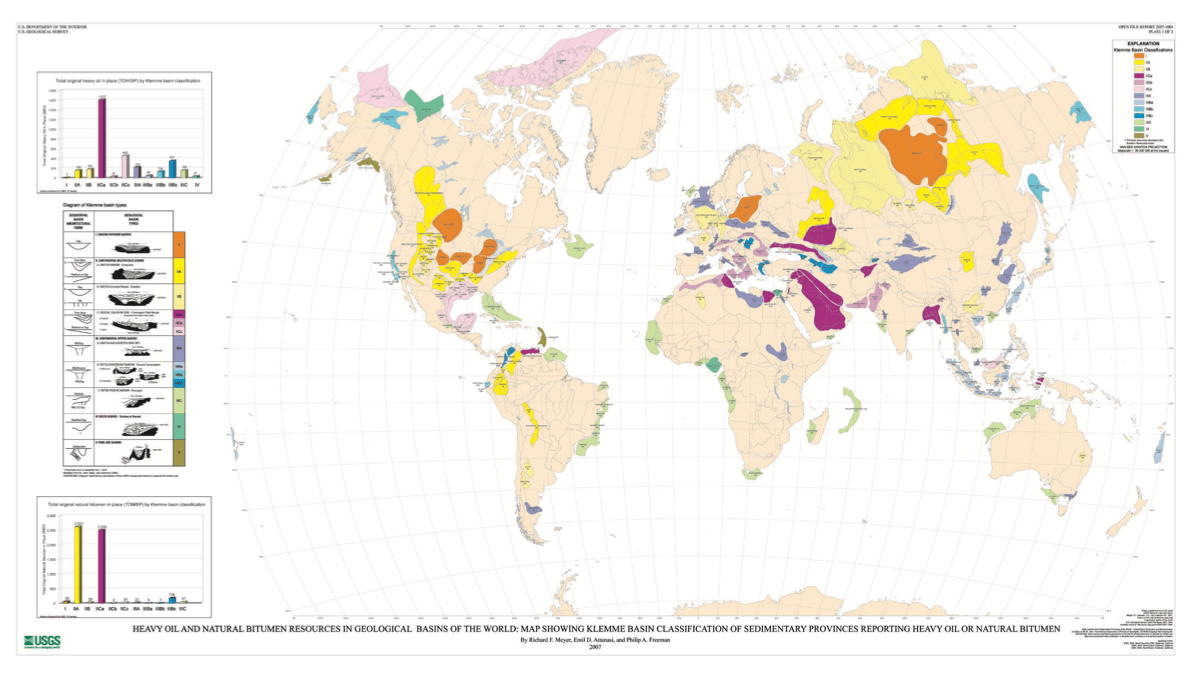
The United States Geological Services provides maps of available heavy oil and bitumen deposits. Figure 6 indicates that heavy oil is widely available in North America, Europe, Russia, and the Middle East.
In 2015, the International Energy Agency published a report indicating that in its view, there were huge deposits of extra heavy oil and bitumen (EHOB) that could be accessed if the price of oil rose high enough for long enough (Figure 7). The same exhibit shows somewhat smaller availability of tight oil from shale. In fact, the US has been able to access a substantial amount of tight oil from shale in recent years.

In my opinion, in order to access the EHOB, the prices of diesel and jet fuel need to rise to a high level over the long term; the prices of gasoline and even lighter products don’t necessarily need to rise. If the prices of diesel and jet fuel rise high enough, for long enough, the price signal should work its way back to oil and gas companies, suggesting that they need to make investments in the direction of adding more extraction from EHOB. If this succeeds, it could perhaps relieve the problem of inadequate supply of diesel and jet fuel.
The prices of diesel and jet fuel are high now, but this is at least partly due to higher insurance costs and partly due to the extra costs related to shipping oil longer distances to avoid blocked straits. These extra costs don’t get back to oil companies in a way that encourages countries to extract more heavy oil. What is needed are permanently higher prices for diesel and jet fuel, relative to the price of gasoline, even if the problems with respect to the straits of Hormuz and of Bab al-Mandab, disappear.
[6] Today’s conflicts in the Middle East and Russia/Ukraine seem to relate to inadequate supplies of diesel and jet fuel for buyers of these fuels, and inadequate prices for sellers of the heavy/sour oils yielding these products.
Figure 3, above, shows that the total supply of diesel plus jet fuel has been low, especially since 2020. One issue that has arisen recently is “Who gets the supply of diesel plus jet fuel that is available?” Figure 8 shows that increasingly, it has been the poorer countries of the world who obtain the diesel and jet fuel that is available. Note that total consumption of the Other than Advanced Countries has exceeded that of the Advanced Countries since 2020.
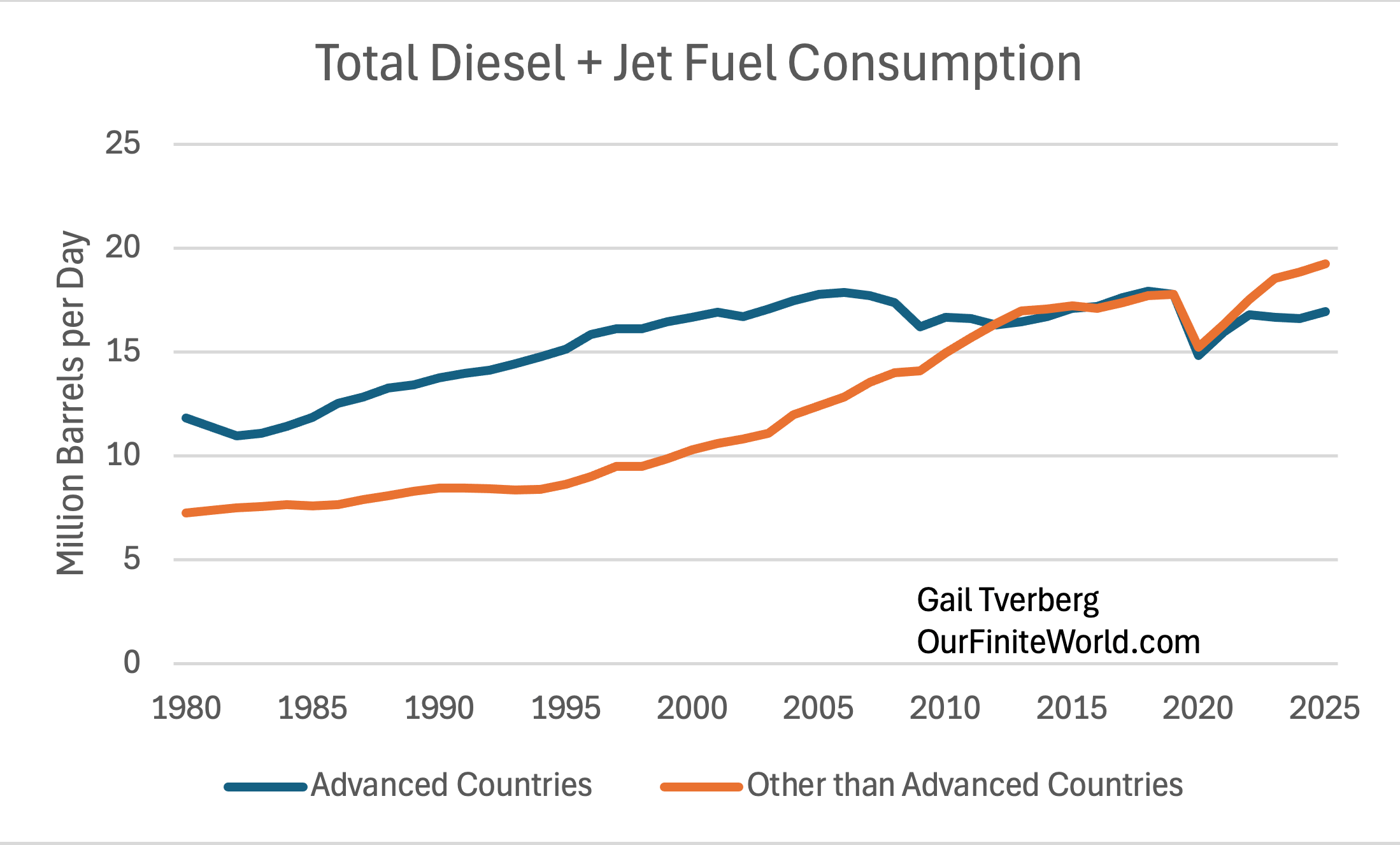
Figure 9 shows that for the Advanced Economies, per capita consumption of diesel plus jet fuel has been declining since about 2005–the time of peak conventional crude oil. The same figure shows that per capita consumption of diesel plus jet fuel has plateaued since 2013 for Other than Advanced Countries. I think of 2013 as the year that China first started encountering major limits on coal extraction (somewhat like the year 1970 in the US for oil extraction). In recent years, China has been able to raise coal extraction somewhat, but at a higher cost.

I would expect that countries in both groups would be dismayed by the situation shown in Figure 9. The per capita consumption of diesel plus jet fuel for the Advanced Countries has been falling for a long time. Partly this is the result of the economies changing to service economies. As service economies, the need for diesel by industry has been lessened. Wages tend to be less for many of these service jobs, making workers unhappy.
In Figure 9, people in the Other than Advanced Countries would tend to be dismayed by the continued wide gap between the standard of living of their own economy, and the standards of living in the Advanced Countries. Many of these countries export extracted resources that are ultimately sold as goods to people living in Advanced Countries. If the selling prices of these commodities were higher, workers in these countries could perhaps afford to have cars and air conditioning, like workers in the Advanced Countries. They would also be dismayed by the poor progress in raising their own per-capita consumption of diesel and jet fuel since 2013.
[7] Is there any possibility of greatly ramping up heavy oil production? Could it power a society like the one we have today?
We know that heavy oil production began long ago. For example, the first recorded production of heavy oil began in the Kern River Basin in California in the 1860s, and commercial production began there in 1899. The first production in the Canadian Oil Sands began in 1921, and commercial production there began in 1967.
The extent to which the oil that is heavy and often sour can be ramped up in the future remains to be seen. Extraction techniques have gradually been improving, and I would expect that they can continue to improve. But the cost of extraction and processing will likely remain somewhat high because of all the energy-intensive steps that are needed to provide diesel and jet fuel.
I expect that society itself will need to change in order to make use of this higher-cost oil. These are a few ideas I have:
(a) Oil exporting countries will need to change in ways that reduce their need for tax revenue. This is an issue especially in the Middle East, which has a huge population, in a hot, dry climate. The population will likely need to fall (for example, many migrants and guest workers may need to move back to their country of origin), and make-work projects will need to be discontinued.
(b) Another issue is that total diesel and jet fuel usage will likely need to be reduced because it is likely to take several years before production of heavy oil can be ramped up. Society will need to be reorganized in a way that uses less diesel and jet fuel. One idea would be to shorten supply chains whenever possible. Figure 10 illustrates one idea how this might be done.

(c) I expect that if such a change can be made, economies will need to gradually change in ways that are hard for us to understand now. The focus may need to be on essentials, including food and clothing. Governments may need to be smaller and provide fewer services. Communities may need to be smaller and more walkable. The total population may need to be lower.
[8] Conclusion
It seems to me that the self-organizing nature of economies will gradually push them in the directions they need to go if the world is to start incorporating a significant quantity of expensive products made from heavy oil into its energy mix.
We cannot yet imagine what all the changes will look like. In some ways they may resemble a recession, but there will likely still be an interest in greater complexity and in working to improve people’s lives.


“India wants to maintain strategic autonomy. India wants to play both sides. India wants to cooperate with Washington within Quad while remaining friendly with Iran. But this is not 2010. This is no longer era where India can straddle fence between US Israel axis and Iran.”?
https://x.com/aprajitanefes/status/2109693502410158095?s=20
We are dealing with a world not-enough-to-go-around situation:
That phone call from Rezaei to Doval not a conversation but a showdown
October 12 2026 Tehran
Mohsen Rezaei Secretary of Iran Supreme National Security Council placed a call to India National Security Advisor Ajit Doval.
This was not exchange of views. It was not discussion on matters of mutual concern. It was Tehran telling New Delhi your double game is over.
India thought it could play both sides forever. . .
India ships 2596 consignments of military equipment to Israel. . .
At same time India maintains friendly relations with Iran. . .
Playing both sides. Deceiving both sides.
But Rezaei call was message. You cannot play both sides anymore. . .
If Strait of Hormuz and Bab el Mandeb Strait were to close simultaneously economies of Gulf states would collapse.
“Ukrainian cyberattacks took down the “Russian Google.” Bots and trolls abroad have gone quiet
Ukrainian drone attacks on Russian technology infrastructure have disrupted automated internet traffic there. Activity from bots originating from the network of Russian tech giant Yandex plummeted to just 0.4 percent of its recent peak within a few days.”
Translated with DeepL.
https://hnonline.sk/svet/96307449-ukrajinske-udery-vyradili-rusky-google-boti-a-trollovia-v-zahranici-utichli
I am sure that this is worrying for the people in Russia. We have grown dependent on search engines. Unless there is a competitor that can easily take over, this sounds like a headache.
Printibg money or any money creation like ctryptocurrency does not solve the basic problem: the action range of humans is diminishing, as all kinds of resources become more distsnt from individual persons of the atomizing system.
Our problem is a lack of easy to extract resources of many types: oil, coal, nearby natural gas, uranium, copper, lithium, antimony, fresh water, and lots of other things. Also, an ever-rising population that needs to fed and transported.
If we could increase complexity, we could theoretically work around this. I am sure AI has been developed for this purpose. But I am doubtful we can do enough, sufficiently quickly, however.
This is how I am investing with a lot of my 401k, everything in hard resources in commodities and then as a hedge I am short all the technology and AI related stocks that have been in a bubble. My thought process is if things crash I am protected but also that commodities are severely undervalued for what is going on in the global stage.
China is stepping up its border security to prevent the potential spread of the Russian plague.
China increases border security over Russian plague
It is difficult to believe this, but the article says:
The notice acknowledged that the case in Russia had “not yet received final official confirmation”, but said local authorities had been holding discussions because of the “nature of the institution involved and the area’s unique natural plague background”.
uk propaganda
In China, we are all aware of the huge debt bubble associated with housing that housing that seems to be collapsing. Perhaps to offset this, it seems that the economy has been adding a whole lot more debt of other kinds. The WSJ is now reporting:
https://www.wsj.com/world/china/xis-superpower-ambitions-fuel-a-dangerous-debt-spiral-in-china-edad4f9f
Xi’s Superpower Ambitions Fuel a Dangerous Debt Spiral in China
The Chinese leader is presiding over a surge in indebtedness that is strangling the economy and spilling overseas
Last year, China’s credit to the nonfinancial sector—a broad measure of corporate, government and household borrowings—topped 300% of gross domestic product, 60 percentage points higher than at the end of 2019 and now far bigger than in the U.S. It has jumped by more than $43 trillion since Xi took office in late 2012, according to the Bank for International Settlements.
Much of the money has been wasted, financing factories and apartment blocks for which there isn’t enough demand, sparking debilitating price wars, and hurting profits and wages. . .
Chinese companies that need to service this enormous debt are churning out more cars, solar panels and electronics than consumers at home want. In response, exporters are pouring these goods onto foreign markets, opening up a trillion-dollar annual trade surplus with the rest of the world. . .
“Local governments are subsidizing loss-making companies to keep them alive,” said Gunter. “But the fact that they are loss-making also means that there are no profits to tax.”
Margins getting crushed and industries becoming unprofitable. The West saw this happening and that’s why it exported its industries abroad (to China, even).
For that, they did an impecable rentier imperialism across the world, but what does China have? In China’s view, it’s imperative for its relevance and existence that all of those industries stay there, they have no answers, their model doesn’t allow flying their industries around the world.
And also, fly them where? There are no energetically cheap countries anymore, nor one with a surplus quality population.
There’s no China 2.0 for China.
And all of that because energy has become energetically more expensive to get, leaving no margin, no profit, for humans to harvest.
They’re getting desperate with their subsidies, they want to bankrupt the remnants of Western industries because they really need to achieve global monopolies as soon as they can – that will be their imperialism: foreign revenue, and then they could also stop their subsidies and the strain on their economy.
I am afraid you are right.
And current China clearly cannot repay its debt with interest.
There are also a lot of other countries headed for a similar problem repaying debt. We need a growing supply of inexpensive energy to keep the system going.
A very astute comment.
“And for the first time, I’m seeing some some not
43:55 loud low Chinese analyst voices saying that Xi’s incapable.
44:02 He’s not weak. He’s too weak. He’s not strong enough politically at home to make either concessions to the US”?
https://en.wikipedia.org/wiki/October_2026_attacks_on_Saudi_Arabia_airports
October 2026 attacks on Saudi Arabia airports
https://en.wikipedia.org/wiki/File:CCTV_vision_of_Houthi_attacks_on_Saudi_airport.webm
Guys , we missed this aspect .
“Philip Pilkington thinks Saudi Arabia has backed itself into a very dangerous financial corner. The kingdom has roughly $420 billion in reserves against about $520 billion in external debt. His biggest concern is the currency peg. As long as creditors believe the riyal will stay fixed to the dollar, they can remain relatively calm. But if confidence in that peg starts to crack, capital could leave fast. “The peg is the key.” Under normal circumstances, Saudi Arabia could respond with tax rises, spending cuts and other painful adjustments. But wars have a habit of overruling economic logic. Pilkington’s warning is that Riyadh may now be trying to defend its currency, finance a war and reassure creditors at the same time. That is an ugly tightrope.”
This does sound worrying!
Specially considering there is a spoiled brat at the helm.
Ah, Does this mean their Hitech City in the Sand may never be built?
It looked so promising in the advancement of human civilization that is always brought up by someone here. What a shame, Chucky lives.
Arabia Saudí paraliza ‘The Line’ totalmente: crónica de un desastre y sus razones
https://www.elconfidencial.com/tecnologia/novaceno/2026-05-27/arabia-saudi-paraliza-the-line-hasta-2030_4361619/
Not a big surprise:
Saudi Arabia completely halts ‘The Line’: chronicle of a disaster and its reasons
The fever dream of science fiction has come crashing down. You didn’t have to be a genius to predict what was coming. This is the story of its end and everything that led to its collapse.
The desert mirage has vanished. Saudi Arabia has halted construction of The Line until after 2030, effectively shutting down an overpriced megalopolis that was supposed to slice through the sand like a mirror sword. Anyone with two functioning eyes and three grams of gray matter could have predicted this spectacular failure . The concept was a blatant defiance of basic physics and economics, a science-fiction delusion doomed the moment it left the rendering farms. Now, reality has spoiled the party, leaving behind a gaping trench in the earth and a financial crater of equal proportions.
The project began as a corporate hype supernova . Crown Prince Mohammed bin Salman officially launched Neom as the utopian cornerstone of Vision 2030, a massive national program aimed at modernizing the country and freeing the kingdom from its dependence on oil. In 2021, they unveiled The Line : a twin skyscraper of mirrors perfectly reflecting the desert and the sea, 170 kilometers long, 500 meters high, and 200 meters wide, designed as a car-free smart city capable of housing nine million residents.
. . .
The utopian facade has finally crumbled under the weight of financial reality .
Someone (drb?) was saying Neom may have at least partially served the purpose of providing a flimsy excuse to sell Treasurys without setting off alarm bells of US govt.
Interesting!
Yes it was me. Now they will have to sell their Treasuries bareback, so to speak. Or try to, of course.
The headlines look terrible, but the stock markets don’t seem to be alarmed. They seem to be close to even, and oil prices haven’t gone up much. WTI = 93.55
I suppose risk of an interest rate hike is lower.
WSJ headlines include:
Iran-Backed Militants Tighten Screws on Saudi Arabia’s Crown Prince
Mohammed bin Salman is caught by an economy weakened by heavy spending and miscalculations of the Houthi threat.
and
Russia Pounds Ukrainian Energy Despite Trump’s Ceasefire Announcement
The attacks, including on gas infrastructure and a power plant, come as the U.S. heaps pressure on Ukraine to stop striking Russian oil refineries.
“XXXLutz and Möbelix posted losses in the millions. They point out that Slovaks don’t earn enough
Another chain is feeling the shift in market sentiment.
The year 2025 illustrates how Slovak consumers’ behavior has changed. While in previous years retail chains had no trouble posting solid growth and profitability, last year brought several signs that times have changed.
This is also evidenced by the financial results of XLSK Nábytok, the company behind the XXXLutz and Möbelix retail chains in Slovakia. Last year, it posted a loss of nearly four million euros.”
Translated by DeepL.
https://www.sme.sk/index/c/xxxlutz-a-m-belix-vyrobili-stratu-v-milionoch-poukazuju-na-to-ze-slovaci-malo-zarabaju
Oh my, MG not looking good on the unemployment front..
This just posted by Virtual capitalist
https://www.visualcapitalist.com/mapped-unemployment-rates-across-europe-in-2026/
Europe’s unemployment picture is changing. Spain has long been associated with high joblessness, but a Nordic country now tops the continent’s unemployment rankings.This map compares unemployment rates across Europe in August 2026, using figures from Eurostat, ONS, and Rosstat figures. Data for the UK and Switzerland reflects June 2026, the latest available month.
Finland (10.3%) has the highest unemployment rate in Europe, narrowly ahead of Spain (10.0%).Unemployment in Germany and the Netherlands (both 4.0%) is less than half the rate in France (8.2%).Czechia has the lowest unemployment rate in the European Union at 3.2%.
The unemployment rate posted for the UK is laughable.
No jobs are available and almost all the “asylum claiming” immigrants are not employed
It’s been fictional since 1981 when schemes were set up to massage the out of work figures. Some people were registered as disabled rather than unemployed.
Volkswagen saw its sales decline accelerate in the third quarter, with global vehicle deliveries falling 14.3% compared with the same period last year, the German carmaker said on Monday.
Europe’s largest carmaker delivered around 1.89 million vehicles across all its brands worldwide between July and September. The decline followed an 8.6% drop in the second quarter and a 4% fall in the first three months of the year.
The downturn was particularly steep in China, where deliveries plunged 38.5% year-on-year to just under 406,000 vehicles.
https://finance.yahoo.com/markets/stocks/articles/volkswagens-sales-slump-worsens-third-120332827.html
Unaffordable .
” EU BASMATI RICE IMPORTS DOWN 30%! As of October 6, EU basmati rice imports are significantly lower year-on-year. India: 21.0K tonnes, down 17% Pakistan: 4.1K tonnes, down 61% A sharp slowdown in European demand for basmati rice, with Pakistani shipments hit hardest.”
https://x.com/gaurav_kochar/status/2109638851245613418/photo/1
Only buy the least expensive rice.
Cyberattack shuts down French supermarket refrigerators .
https://www.france24.com/en/france/20261012-french-supermarket-chains-say-cyberattack-shut-down-refrigerators
France again . Use translator .
“In short, more than an oil shortage, the suffering revealed is that of economic liberalism and its harmful effects. “Economics is the art of choice, and every choice is political.” The ruling class in power has no intention whatsoever of giving up its habits and lifestyle, even if it leads to disaster and creates a social and political crisis with visible consequences.”
https://lachute.over-blog.com/2026/10/de-la-crise-du-diesel.html
Great quote. There will be no planning to minimize the suffering resulting from Overshoot for the masses, just as Catton lamented.
ON THE DIESEL CRISIS…
Written by Patrick Reymond
The world is built on oil, but not all petroleum derivatives are created equal.
– The invisible element, the one no one thinks about: asphalt. And yes, if some people say we’ll have to switch to electric cars, they’re completely blind. Cars depend essentially on the road network. Without asphalt, there are no roads (or if there is, they’re in a pitiful state!), and you need a lot of it, if only for maintenance.
In France, the figure circulating regarding needs (maintenance + expansion) is 5 million tons, while we only have 2.5 million tons available. Something’s not right here. So, the network considered “secondary” is being neglected in favor of major cities and main transport routes. Prefects, it seems, are blocking every project they can deemed not to serve sufficiently large population centers. Of course, they don’t talk about shortages—a taboo word—but rather about using finances as an excuse. In fact, the shortage is causing prices to skyrocket and disproportionately impacting the less fortunate local political authorities. End of story
Patric Raymond goes through the various petroleum products and shows how the wealthy are less affected by recent shortages compared to the already poor.
He also says:
The drastic cuts to social protection and the soaring inflation on fuels produce exactly the same political result as the German policy of 1930-1933, particularly that of Bruning: the rise of extremes, the declassification of the so-called “moderate” political class, which is in fact totally extremist in its submission to Washington, the euro, Germany, and economic liberalism.
This is how he gets to the statement quoted by Ravi:
“In short, more than an oil shortage, the suffering revealed is that of economic liberalism and its harmful effects. “Economics is the art of choice, and every choice is political.” The ruling class in power has no intention whatsoever of giving up its habits and lifestyle, even if it leads to disaster and creates a social and political crisis with visible consequences.”
I would argue that this is how a self-organizing economy always behaves, when there is a shortage of something essential. We are dealing with a form of evolution. Survival of the best adapted tends to disproportionately favor the rich. This is the way the system always works, when there is not enough to go around. But even with this approach, some of the very rich do make it through the difficult period, either.
which is in fact totally extremist in its submission to Washington, the euro, Germany, and economic liberalism
So, did they start to choose the traitors/scapegoats among themselves, yet? Very good, if so.
No asphalt – not long-distance travel for lower classes (Hello – Kulm!)
In fact, the shortage is causing prices to skyrocket and disproportionately impacting the less fortunate local political authorities. End of story
End of the story? we haven’t even started yet, you – gullible frog-eater… you gonna like your “french citizen on a stick” really soon…
The attacks were bigger than we thought . France , Belgium and Netherlands . Yes , let us do everything online .
” Two separate attacks. Help Net Security explicitly confirms it: Europe is hit by “two separate disruptive cyberattacks” on the same day. The first one is the one we’ve been tracking since this morning. The manipulation of Danfoss controllers in France (and likely in Belgium), involving the hijacking of defrosting systems and the destruction of merchandise. The second one in the Netherlands is an attack on Ahold Delhaize, the parent company of Albert Heijn, Etos, and Gall & Gall. It began Sunday afternoon, October 11. The group’s IT systems were shut down as a precaution. Several distribution centers are at a standstill (only the one in Zaandam is still operational). Websites, apps, loyalty programs, customer service—everything is offline. CEO Margaret Versteden-van Duijn warns that shelves will empty, especially for fresh products. Delhaize stores in Belgium are also affected. And according to NL Times, the incident extends to the group’s American brands: Food Lion, Giant Food, Stop & Shop, Hannaford. “
https://x.com/IAviateur/status/2109753209371890148
So the attack on supermarkets wasn’t just in France, huh… France → Freezers at 50°C, food waste and fires at 300 stores Netherlands (Albert Heijn) → System shutdown starting Sunday. Online orders, deliveries, and the app all down, shelf price tags stuck on old prices Belgium (Delhaize) → Online orders are stopped .
This starts out:
It goes on to mention other chains as well. Stores have been told to throw out fresh and frozen food affected. This is an “over the top’ type of attack. Europe badly needs its fresh and frozen goods.
But perhaps now war is being waged in a different way than in past. France is one of the countries favoring the Ukraine war. This could be retaliation.
Wasteful, but at least bloodless.
Wow! China is not doing well, with its falling car sales. The country reduced its subsides a while back. That may be part of the problem.
I know that the country is past Peak Inexpensive Coal. It can somewhat increase coal supplies, but at high cost. And it is rapidly hitting the time of a decreased work force, thanks to one child families.
And many of the minerals used in high tech goods seem to be reaching extraction limits, without much higher prices.
38% drop in Volkswagen cars, or in all cars? It is normal that no one would want to buy VW in China, given the high coat and middle quality.
China’s car market slumps as Beijing trims export lifeline
Exports are now carrying China’s automakers, but Beijing is cutting the tax rebates that help make them profitable. By Stewart Burnett
https://www.automotiveworld.com/news/chinas-car-market-slumps-as-beijing-trims-export-lifeline/
There is an uproar in Spain after developers evicted a 87 years old woman, who died.
Apparently those who get angry have never heard of the clearances which took place repeatedly in the British Isles.
The large landowners had zero mercy on those who are evicted, and most of the tenants perished or a few lucky ones emigrated to the New World.
Which is why the people in Britain are so servile.
Napoleon didn’t heed the advice of Soult, who actually fought them. Unlike soldiers from other countries, the British troops didn’t run away, since doing so would doom their folks back home. Which is why the square tactic, present in every single Waterloo movie, worked only for the British, not for forces of other countries.
Most officers, prior to Chucky and his 200/400 Worcestershires ‘doing their duty’, came from the landowner classes and they would not forgive strays who run away and make sure their folks back paid . (Orphans were put into the Navy where they could not run away)
The people now living in the British isles, except the immigrants who came after 1945, are used to this kind of situation.
Which is why the original book ‘The Bookshop” by Penelope Fitzgerald ends with the protagonist’s bookshop is closed by the noblewoman , who is the power of the town, and the protagonist leaves with virtually nothing, her entire life savings put into the bookshop, and will probably live the rest of her life in desperate penury but the Spanish director Isabel Coixet added the sequence of the girl who worked for the protagonist burning down the house where the bookshop was, destroying the town’s cultural heritage (obtained by the noblewoman , with help of her nephew in the Parliament) .
That sequence would have been completely unthinkable by Brits.
However, my money is on the gentrifiers. Eventually all the poor will be cleansed from the ‘better’ parts of the town, living in areas with poor sanitation. I have some things to say about John Snow (not Jon Snow of Game of Thrones) but that would be another story.
“Unlike soldiers from other countries, the British troops didn’t run away, since doing so would doom their folks back home.”
So all along Chucky(bastard child with no claim to that inbred class) was just doing as the inbred imbeciles taught and ordered(beating the useless), so your verbal venom should be directed at those you so shamelessly fawn over, to the point of taking their women’s fiction as historical fact(still, those dull books of fantasy certainly convinced the gullible, so served the intended purpose).
Why do the inbreds from either side always pick the dumbest choice each and every time?
Given it all from birth and can’t even pick the right option from a choice of two, on untold occasions(which really does make them special).
No wonder you are so angry all the time.
The bookshop is based upon the actual attempt of the author, Penelope Fitzgerald (nee Knox – her father was an editor of the Punch magazine) , an Oxford Alumnae, so not entirely fictional although some details were changed to protect the guilty.
The ‘inbreds’ are the ones who led humanity from the gutter to the new stage of civilization, and we all know what the scum of the earth have wrought after running the world for 120 years
If you change details that don’t suit your chosen narrative, the correct word for that is lie, because you have deliberately avoided the truth.
Thankfully there’s the word fiction. As long as we remember that these books are not really anything but fiction, the stories they tell shouldn’t bother anyone that doesn’t believe in fairies(funnily enough Peter Pan is closer to the real horror than most of the others(original, not the ugly hollywood stupidity)).
The inbreds have done no such thing. They have led us into an ever accelerating demise(while attempting a hideously twisted version of civilisation, that is no such thing), whilst simultaneously stripping away the planets resources on an idiotic dream of becoming a machine(they think that being a machine will stop their own demise, when it would be the ultimate irreparable demise. Someone read them some Becker).
I dare you to tell Dot where you live. That should get an amusing reaction(no nuking then)).
a major aspect of the ‘scum of the earth’ class is its shamelessness
Instead of repenting the screwups they caused around the West they somehow feel what day did was something commendable
while Hindus are surrounding their neighborhoods.
I agree kulm. Now you just need to revise your understanding of who it is exactly, that are the shameless screw-ups.
Fawning over the screw-ups, makes you come across like the latest US house nigger(did you write his Athens speech?).
Alas, you’re more likely to be Kallas*
As you often like doing, the below compares present going ons to film.
https://huabinoliver.substack.com/p/a-hispanic-defends-colonial-might
Remember kulm, there’s only one group that had it all and blew it. Truely the scum of the earth.
*Only joking, as I’m sure you do know who really won WWII
Is Kulm a narcissist or a billionaire? The way he talks about the poor makes me think he’s the latter.
He is a temporarily unlanded and down-at-heel elite.
He has severe anger issues, like AH, Stalin, and General Franco, who were all brutally beaten by their father as boys.
I recall the notorious FE letting it slip that he had a possibly brutal father, too. His grandfather was a poor immigrant to Canada, from the Baltics, and who was treated quite badly as an immigrant. These things run in families. Suppressed anger and shame is a terrible thing.
That’s true. Kulamity seems to be too ashamed to tell us of his origins. Because his name starts with a “K”, I tend to think that he is a mushelimb.
Probably we should make kulamity into a pie and feed him to Hoolio. Lol!
Very intereting.remi DS me of a web post I just read
https://www.johnrember.com/blog/their-wounds-are-our-fates
Consider Bibi Netanyahu, Vladimir Putin, Xi Jinping, and Donald Trump.
.Their Wounds Are Our Fates John Rember
All of them have PTSD. Anyone with the condition has gone through a self-destroying event, one where an unforgettable and unforgivable event has eliminated any connection between past and future.
Netanyahu’s older brother was killed in combat in 1976 while leading a raid at the Entebbe Airport in Uganda.Xi’s half-sister hanged herself at the military academy where she had been confined because she and Xi’s father had been declared an enemy of the state during China’s cultural revolution. Xi himself spent seven years of forced labor during his adolescence and early adulthood.Putin was raised alone, but two older brothers had died before he was born, one as an infant and one at the age of two, of starvation and diphtheria during the Siege of Leningrad in 1942.Trump’s older brother died at the age of 42 of an alcohol-induced heart attack, after failing as an airline pilot and husband and being attacked by his father and Donald for quitting the family business. This was a family that practiced capital punishment.Psychoanalysts are notorious for saying there is no such thing as an accident, which is probably overstating the case. But it’s no accident that the people now running our world were born into an environment of unimaginable violence, both societal and familial. Along the way they learned to use death as a survival tool.
Shorter pop psychology:
Xi,Vlad, Bibi, and the Don were anally retentive, so they carried out a purge.
SHITsurei shimasu?
“Professor Pape: PROOF Trump Is Planning MAJOR Iran Escalation”?
I am having trouble accessing this video, even on YouTube.
https://rumble.com/v7gmu8q-professor-pape-proof-trump-is-planning-major-iran-escalation.html
Try it on rumble.
This video is excellent. Professor Pape has a lot of excellent points. He believes that Donald Trump very much doesn’t want to become another Jimmy Carter. (Carter was a one term president who lost power badly.) Because of this issue, Trump feels a need to escalate.
From Iran’s point of view, it would like nothing more than for the Democrats to decisively take both houses and then have enough votes to pass a veto-proof resolution in Congress in January to stop all funding. This would end the war, as it did the Vietnam War. Iran would clearly win.
Another possibility, made possible by the ship Roosevelt in the area is that Iran would have a lot of targets to hit with all of its drones and missiles, including the ship and its 2000 soldiers. Iran could also take out Abqaiq Oil Processing Facility, which processes 7 million barrels of oil per day (takes sulfur out) in Saudi Arabia. This would likely bring down Mohammed bin Salman in Saudi Arabia and create many other problems.
BAU is wrecked….I think BAU was wrecked all along.
Most people think that this is just a small bump in the road and that soon when these little wars end we will go back to normal.
https://www.aljazeera.com/news/2026/10/11/yemen-fighting-expands-as-houthis-attack-saudi-airport-what-to-know
Yemen fighting expands as Houthis attack Saudi airport again: What to know
Saudi coalition blames Houthi group for the missile strike that struck King Khalid international airport in Riyadh.
I think this makes everything a little clearer? I’m afraid the source is Classified.
‘To understand what’s going on as We write History, you have to understand that there are the declared policies, and the secret policies, the ostensible objectives and the real objectives; and these declared policies may have what look like unintended consequences which are really, in fact, intended ones, so when you think we screwed up, we didn’t; but sometimes the intended consequences of the real secret objectives do have real unexpected unintended consequences and when you think we screwed up, we did; and these unintended consequences of the objectives behind the ostensible policies are what only you suffer, suckers, and We don’t, ever.
And while you are thinking about that, wWe’ll go on to write another page of History. In the blood of the innocent’.
There are always many ways to explain something that happens: causes, what is important, what is not.
And military groups and others have figured out how to make many “false flag” events.
Our leaders can provide us with whatever view they want. They themselves may not really understand what is intended and what is not.
These secretive groups exist in order to keep collapse at bay and are mainly of European and American nationality.
Henry Kissinger the Rockefeller family they have been secretly meeting with other connections for many decades to keep everything from imploding so we really don’t know how long we have .
Kissinger died coming up three years now, mind you.
Yes he died three years ago but look at ai he firmly believed in it he wrote a book about it haven’t read it but ai was pushed or promoted by Kissinger in that book and where are we now AI everywhere it has become policy for the world.
So obviously these secret groups have laid down the foundations of a post peak oil adjustment for the world.
We see eye to eye on that, Gail.
Takes me back to the second Bush era – Rummy’s “unknown unknowns” and Karl Rove’s making reality.
So, what ever happened to Jeff Gannon?
Yes, that’s what I was referring to.
And to suggest the folly of trying too hard to get to the bottom of things – except for the energy realities which indicate that Tech civilisation is screwed.
In examining causes and consequences I apply two precepts:
With respect two what we’re being told, the Many Rice-Davis test: “He would say that, wouldn’t he”;
and with results: The purpose of the system is what it does.
https://en.wikipedia.org/wiki/Mandy_Rice-Davies
Mandy Rice-Davies and Margaret Thatcher shared a surprising, long-term friendship that began in the late 1980s, facilitated by Rice-Davies’ third husband, Ken Foreman, who was a close business associate and friend of Denis Thatcher.
This has been going on since time immemorial. Bill Cooper—who died almost three decades ago— was an extremely smart person who is well worth listening to on secretive groups exist in order to keep collapse at bay and control society.
Bill Clinton called Bill Cooper the most dangerous man in America, and for good reason.
Something wrong around here..
CBO chief warns it’s ‘probably not plausible’ that a strong economy alone can steady U.S. debt as 5%-6% growth is needed—more than Bessent’s 3% view
By Jason Ma Weekend Editor October 10, 2026, 6:54 PM ET
Congressional Budget Office Director Phillip Swagel said faster economic growth is unlikely to keep U.S. debt in check, even if GDP expands at more than double its current pace.
https://fortune.com/2026/10/10/us-debt-gdp-growth-cbo-scott-bessent-deficit-bond-yields-interest-rates/
We all know it is a lie. What is Swagel’s problem.
The idea that this level of debt is sustainable is absurd.
The growth rate of the economy tends to fall, rather than rise, as extraction of fossil fuels falls. It is the growth of inexpensive energy that allows humans to become more production. People have been hoping that AI would do the same thing, but at the current time, there is no evidence that it can. A solution is one that can create more well-paying jobs, not reduce the number of them.
I was discussing this with a friend who gave an example of the effect of using AI in a top London law firm: the structure used to be the usual pyramid with the partners at the top and many more people performing various tasks below them. AI has inverted the pyramid, with many in the lower levels being eliminated or consulted less frequently. Is this really an advance for the firm – which was doing very well anyway without AI, or for society?
There is less “demand” coming from the workers for the company. This is not good for the system. And the output is of much lower quality, because AI makes lots of mistakes.
for Law – LLMs are going to be the jobs eliminator. For Education – largely, too. Medicine, NPhysics, trenching, agriculture, equipment repair – not any time soon.
But students who use AI learn a whole lot less that students who do the work themselves.
There is this new generation of LLM-assisted robotic tutors, that make one to practice and targetedly improve. I’m not talking about giving the answers upright, like a bad teacher would. “Adaptive AI Tutoring systems” they are called.
Also, if the nu-feudalism and severely stratified societies are coming back (after the Correction), then, perhaps, those on the top would not have a need for so many bottom-feeders being educated behind, say 3-4 years of whatever agricultural activities those bottom-feeders will be involved in?
There is also a good, non-zero chance, your old depop friend Dennis M will be vindicated soon, don’t you think?
Dennis Meadows certainly said that there wouldn’t be goods and services (including food) available for an ever-growing population.
The idea that we can “grow our way out” of this level of debt is also absurd.
The GDP growth rate would have to be well in excess of the level of deficit spending (6%+) which is utterly impossible. Even if it were somehow possible, it would take many decades to make a significant dent in the debt.
In the old days, if a suitor was rejected by someone, he was determined to live unmarried for the rest o his life.
Most marriages were pre arranged, so a rejection meant one was done marrying in the same class, since no woman in the same class would look at a man who was rejected by someone in her class.
In 1830s Emily Bronte starts Wuthering Heights with a schmuck named Lockwood , whose refutation in London was tainted by a minor incident and he could forget getting married there. He goes to the town where Heathcliff lived, and the latter tried to marry him to his daughter in law , whose husband had died, to keep Hearton Earnshaw, the heir of the family Heathcliff had replaced, out of her way.
Of course at the end she does marry Hearton Earnshaw and lock Heathcliff into a room where he dies alone, and Lockwood leaves, destined to be a bachelor for the rest of his life.
In 1912, Arthur Conan Doyle wrote The Lost World, where a reporter, Edward Malone, joins an expedition led by a Lord Roxton to find strange animals, in order to impress Gladys Hungerton, an employee of the newspaper where he worked at, who was ambivalent to marrying Malone, whose background is never explained but apparently his family was not high enough for her to agree to marriage outright.
In the end , after the dinos and all that, Malone returns and sees Gladys married to a law clerk with no particular qualities, but apparently from a family who could provide a decent standard of living.
So Malone was now completely shut off from marrying people in Gladys’ class , for life. He found some diamonds from the expedition but it didn’t matter – he was done in his class.
Roxton , out of sympathy, offers to hire Malone for another adventure which the latter agrees. The book ends there, but everyone at the time knew Roxton was based from Sir Roger Casement, well known for exposing the slave trade in Congo , and also a homosexual. So now Malone, who could forget getting married in his same circle (and marrying below meant one was now done from that class for ever, joining the lower class no matter how much money one might have had), ends up as a toy boy of Roxton.
2 years later, thanks to Chucky and the 200/400 neverdowells from Worcester who are no less guilty for damaging Western Civilization, things changed. Casement (Roxton) would have been executed in 1916 for advocating Irish independence, and Gladys’ husband would have been killed at Flanders or Somme, while Malone, being a reporter, would have had a higher chance of survival.
Conan Doyle’s eldest son was also killed in the war, thanks to Chucky. Basically everyone who perished in the war since 1915 died because of Chucky.
Norms changed , and with so many eligible men died there were suddenly openings for men who did survive, as noted in Lawrence’s Lady Chatterley, where an Irish laborer gets to impregnate a lady whose husband was crippled at Ieper.
Conan Doyle got very spiritual after the war, and wrote 3 more sequels to this series which are seldom read. In one of them, he allows Malone to marry the daughter of Professor Challenger, one of the people who went with the expedition , in 1926, 15 years after Malone was rejected by Gladys. That would have unthinkable prior to Chucky, but because a lot of men in the class the Professor would have allowed were killed, he went with the devil he knew, although he would have known that Malone spent at least 5 years being Roxton’s lover.
As a result this story is never adapted faithfully.
The British patriots here, who would mostly have belonged to the scum of the earth class as proclaimed by Arthur Wellesley, think what they did was something good, even now. It is like a bunch of primates smashing a museum of irreplaceable human treasure and feeling like they accomplished something.
As a result the Eastern Despotism is coming back with a vengeance.
I could imagine kulamity looking like Heathcliff. A bit <i>feral</i>, you know.
I could imagine kulamity looking like Heathcliff. A bit feral, you know.
Strange world we live in. This link says:
Trump announces partial ceasefire in Ukraine war as Zelenskyy says deal is ‘news to me’
Ukrainian president earlier rejected US call for Kyiv to stop bombing oil refineries, saying Moscow must first end attacks on energy infrastructure
I don’t think I need to repeat this but since a lot of people quote Trumpistein. He says a lot of b.s. and 89 percent is lies
Perhaps his strange behavior is for a reason. Trump cannot tell the people of the world how bad things are. In the case of Zelensky, he is no longer doing what is necessary. In Trump’s view, this must change. Zelensky must be replaced, ASAP.
No one was apparently informed that Trump had declared a ceasefire. Last night I was on the phone with family and internet went down due to a drone attack. Trump has to get better at writing and distributing memos.
Dear Gail, in my view it is probably like that:
as it is clear that Ukraine’s attacks to Russia are made thanks to Cia intelligence and MI6 too, Trump says things like that to show a some kind of his disapproval for what Zelensky is doing with the objective to have approval by his electoral base and by the Russians.
The Russians know that are fake words, but anyway they appreciate this some type of kindness (as one say thank you, but he doesn’t mean thank you, but anyway he say it), on the other side, his electoral base don’t know that are fake words and they appreciate.
Of course it is something someone say to Trump that it is something to be said in public and he says 🙂
It seems like economies without fossil fuels, or with very little fossil fuels, arrange themselves in classes. People could alway feel like they did well in their own class, even if a higher class was out of the question.
With more fossil fuels, classes mostly went away. Pre-arranged marriages went away in the US and most of Europe. But marriages seem not to be very long-lasting. And children of broken marriages tend to do poorly.
As the situation changes, we will need to start rethinking which approach really works, in the changing situation.
I’m really enjoying these excursions into social history, Kulm, keep it up!
Gay love in Conan Doyle is most intriguing…..
Social history before tge fossil fuel binge which led to every yahoo feeling like he belonged to Civilization when they were not.
Down with the freeloaders! Not a crumb for the poor!
Cortect. Not one penny to the poor.
But your name says you’re in favour of the status quo.
Due to clmt chng and energy poverty, the Britain of the past no longer exists.
Who is Chucky? I am trying to keep up with this story. (Don’t ask me why.)
You seem to be whining about Germany lost WW1. That is how it goes. If you can’t win wars, then don’t start them? Common sense 101.
Why are you being called Kulamity? Is it because of WW1?
Brigadier Charles Fitzclarence, great-grandson of William IV (and an actress), who repelled the Germans in Oct 28, 1914 at a town called Gheluvalt and prolonged the Great War by 4 years, killing millions more Europeans (including himself and most of the 200/400 ne’erdowells within a week) and giving Japan and eventually the rest of Asia a chance to challenge the West.
Since what he did is much, more evil than Chucky of Child’s Play I call him Chucky.
I think some people call me Klumy to rhyme with Chucky. I don’t mind whatever titles they use on me.
This is too funny because on TV there was a Halloween movie feature Herman Munster and his family going to England because Herman inherited the Munster title and estate!
He was the son of Brigadier-General Charles FitzClarence from his marriage to Violet Spencer-Churchill. He attended Eton College and the Royal Military College and then served as a captain in the Irish Guards.[3] On 26 August 1975 he succeeded his childless second cousin, Geoffrey FitzClarence, 5th Earl of Munster, as 6th Earl of Munster and sat in the House of Lords.[citation needed]
I couldn’t make this stuff up but it’s true
With no male heirs, the titles became extinct on his (Anthony’s) death in December 2000.[citation needed]
Easy come – easy go.
“The head of the Russian mafia is Semion Yudkovich Mogilevich, the “boss of bosses”, born in Kiev to a Jewish family in 1946 and a graduate in economics from Lviv. He is the world’s most wanted among powerful mafia bosses and is regarded by the FBI as the most powerful and dangerous gangster in the world, the financial mastermind of the post-Soviet Russian mafia. After his early days in Moscow’s underworld and scams targeting Jewish emigrants in the 1980s, he built a money-laundering empire through over a hundred shell companies in twenty-seven countries, becoming the “banker” of the Solntsevskaya bratva. According to a 1998 investigation by the Village Voice, Mogilevich and some of his associates settled in Israel in the early 1990s and obtained citizenship. The same investigation claims that an Israeli intelligence report attributed to him the role of a “bridgehead” in the country and influential political contacts. To this day, he still lives freely in Moscow, protected by his ties to the highest echelons of Russian political power. “?
https://geopolitiq.substack.com/p/that-is-why-not-even-russia-does?r=25fc37
The article gives no evidence to support its claim:
>> Not even Putin can stop him: without the billions from those bosses, the Kremlin would be unable to maintain its nuclear arsenal, the cost of which is estimated at 800 billion Roubles by 2026 – equivalent to 26 million Dollars a day.
Why Russian Crime Lord Semion Mogilevich Lives Up To His Title As ‘The World’s Most Powerful Mobster’By Marco Margaritoff | Edited By Leah SilvermanPublished July 31, 2020Updated July 30, 2021
https://allthatsinteresting.com/semion-mogilevich
Regardless, this fella is well connected but he’s up there in age, like Trump, his pal
Every country seems to have a few very wealthy people. Taxes from these people become very important. Passing laws to the likings of these people matters, also.
This might be of interest here, but maybe not..
Utah wells averaging 14,483 feet, each turned sideways for 5,000 feet, are pushing water through 400-degree rock to a 33-megawatt power plant, and it started selling that electricity to California a day before its contract said it had to
The company calls Cape Station the “first greenfield enhanced geothermal development in the world” to reach contractual commercial operation. A week earlier, in its first-power announcement, it said Cape Station was the first utility-scale enhanced geothermal project anywhere to hit first power, which just means electricity flowing onto the grid. Enhanced geothermal, if you need the refresher, means fracking hot, dry rock so water can circulate through it, instead of hunting for a natural underground pocket of hot water.Those qualifiers matter, because Fervo already sells enhanced geothermal power. Its Project Red pilot in Nevada, a 3.5-megawatt plant, has been feeding the grid for close to three years. But Project Red’s wells were drilled into an existing geothermal field and tied into a plant that was already running. Greenfield means Cape Station was built from scratch on a site with no geothermal plant of its own. Dawn Owens, Fervo’s head of development and commercial markets, told Canary that “traditional geothermal would have never been done in southern Utah.”
https://www.autonocion.com/us/14483-foot-wells-utah-33-megawatts-day-early/#google_vignette
Not cheap!
The article says, ” It’s basically a very large, very expensive test run.”
This is from a commenter on Simplicius’ blog today.
https://simplicius76.substack.com/p/rift-turns-to-fracture-ukrainian?utm_source=post-email-title&publication_id=1351274&post_id=219727073&utm_campaign=email-post-title&isFreemail=true&r=16win7&triedRedirect=true&utm_medium=email
https://geopolitiq.substack.com/p/that-is-why-not-even-russia-does?r=25fc37
PS: I hate this World Press format
The notion that Russia can not service its nuclear arsenal without the mafia seems ludicrous in the extreme.
>> PS: I hate this World Press format
What has changed for you? The only thing I see is a new reply window (don’t mind) and new “Be the first to like this.” text (which is a little annoying).
The new WordPress format has plusses and minuses.
I got used to what worked before, with “inline code.” Now, I need to use the dropdown box to find this approach. And I am not sure which particular inline code items work, without trying particular codes.
The new code is annoying, in that it automatically copies all links in something a person is quoting. If a quote is from say, Wikipedia, this can be a lot. Automatic spam filters will kick out comments as spam based on too many links.
Another way it is annoying is that if something is copied in, the new system tends to run lines together. It also tends to delete lines between paragraphs. A person needs to go back and correct what it does.
The “type to choose a line,” written over and over, is annoying. It goes away when the comment is published.
Don’t be shocked if WordPress changes this method in the future. They keep adding and changing features.
US relations with Ukraine hit a new low:
https://www.wsj.com/world/trump-calls-on-ukraine-to-stop-hitting-russian-refineriesand-replace-zelensky-cc9bada8
Trump Calls On Ukraine to Stop Hitting Russian Refineries—and Replace Zelensky
The clash marks a new low point in White House relations with Kyiv as Russia escalates its bombing of Ukrainian cities
“I think it’s time for Ukraine to get a new president,” Trump told reporters on Saturday, blaming Zelensky for Russia’s continuing war on the country—and Kyiv’s airstrikes for high diesel prices in the U.S. and worldwide. “He better damn well stop,” Trump said.
I think that Africa is being hit by the fuel crisis, more than we hear.
https://time.com/article/2026/07/28/the-iran-war-exposed-africa-s-biggest-energy-weakness/
. I searched for individual countries.
Malawi is a landlocked country in Southeast Africa. People have been waiting for days to get fuel. The problem seems to be at least partly a lack of the foreign currency needed to import the fuel.
https://www.aljazeera.com/video/newsfeed/2026/10/10/malawi-motorists-queue-for-days-as-fuel-shortage-bites
Uganda has problem too. The President speaks out. (Sorry for the poor video quality.)
It has to start somewhere. It makes sense that will be them.
I mentioned earlier that my sister Lois is co-authoring a book with a woman from Uganda. The woman in Uganda is having trouble getting enough foods for the children in her school. Beans are in short supply. The families of the children don’t have enough food either.
The people in the Pentagon who planned this and gave Trump his orders are still getting enough beans and rice, we can be sure.
At least they need not worry about being attacked by a Iranian nuclear weapon.
I don’t like ZH but sometimes it is a shortcut to events .
https://www.zerohedge.com/geopolitical/mass-casualties-reported-new-houthi-missile-barrage-riyadhs-international-airport
https://www.zerohedge.com/economics/indians-panic-after-trump-sabotages-tech-firm-green-card-pipeline
Update .
I am not going to go into details about the protest today in Delhi . Enough to say even with 100,000 armed police 50, 000 protesters came in . 3000 in detention centres . The big news is that senior lawyers of the Supreme Court were beaten and arrested . Let us wait for Monday . If the lawyers call a strike , it will be the end . Courts will be shut down . I want to remind it was the strike by the lawyers in Pakistan that brought down the regime of Pervez Musharaff . The situation is so bad that the Supreme Court ( biased) has called a special hearing on Sunday to hear petitions . 1,500,000,000 ( 1.5 Billion) with no where to go .
Huge population. World dealing with not enough food to go around. Also, not enough fuel for vehicles of many kinds.
I tend to agree with this. Industrial agriculture input supplies are being severed on a massive scale. This will cause global food shortages and price shocks if not rectified quickly and I don’t see how they can be. This seems like a calculated demolition / sowing of chaos. What I don’t know is how much the world system has stockpiled fertilizer inputs that could buffer until production and distribution are brought back online.
The other issue raised here is regarding market sanguinity. They could be supporting markets for political reasons (to prevent opposition), or just the opposite, to pull the plug and maximize devastation, timing to coincide with food shortages.
https://x.com/chrismartenson/status/2108322730349043800
@chrismartenson
>> Nobody’s this incompetent by accident. Omsk got hit again overnight. Hormuz is still shut. More ships have been struck in the last week than in the rest of the war. Abqaiq is on fire. Saudi tanks are burning at Rabigh. And oil futures are up a couple of bucks. If they wanted a different outcome, they’d be doing different things. You don’t destroy fuel flows, and the fertilizer that rides on them, by accident. One does not simply reduce fertilizer output without reducing population. They’re holding the markets together with baling wire and spit so it all lands at once. [bold mine] That’s not a bug. That’s the feature.
>> These are the good old days. Prepare accordingly.
“And I’d like to also touch on this idea that well, couldn’t earth be,
1:22:56 you know, much, have a much smaller human population, but high tech, you know, and the question that I would have is. How do you propose a glide path to that?
1:23:07 Because as soon as you have a decline in population, markets fail because growth
1:23:14 isn’t really happening and services fail, and institutions fail and supply chains fail.”?
I would agree.
Complexity will be very difficult to maintain on the glide path down. In the video link, Tom Murphy mentions the issue of supply lines failing. I think that this is just as important as financial markets failing. He mentions that even after the restrictions of 2020, it was very difficult to get supply lines working again. When working on a complex project, he could not find many of the parts needed.
Payback: Trump Cut Putin Diesel Deal, Threatens Intel-Sharing Halt After Zelensky Ignored Six Pleas To Stop Refinery Strikes
https://www.zerohedge.com/energy/payback-trump-cut-putin-diesel-deal-after-zelensky-ignored-six-pleas-stop-refinery-strikes
Friday’s diesel deal between Trump and Putin wasn’t only about diesel. It was also about Kyiv.
Hours after Zelensky accused Washington of using Ukraine’s negotiators as a “smokescreen” for a backroom deal with Moscow, Axios reported that Trump decided to let Russia sell diesel after Zelensky ignored half a dozen US requests to stop attacking Russian oil refineries. The alleged source was a US official with direct knowledge, who did not hold back:
In other words, the sanctions waiver was as much a message to Kyiv as a gift to Moscow.
One of the things Trump is not happy about: https://www.zerohedge.com/energy/ukrainian-drones-reportedly-hit-major-russian-fuel-export-hub-hours-after-trump-putin-diesel
In the Old World, before the cross dresser Gabby Princip got lucky thanks to a Czech driver who thought Czech Independence was more important than the future of Western Civilization (and Czechia spent the next 110 years drinking beer, united with 3rd reich, tried communism and now just drinking more beer),
no credit whatsoever was given to an assistant, a staff, whatever.
Such kind of people were at the mercy of the boss, who reserved the right to compensate them when he or she felt like it.
Nothing, nada, given to the underlings was how civilization was able to advance so much.
Thanks to the 3 greatest criminals of Western Civilization, Gabby above, Joe Gallienni and Brigadier Charles “Chucky” Fitzclarence, whose crimes are bigger than those of all the mfamous names of the 20th century since none of them would ever have been heard of without these monsters, it became necessary to give credits to those who have played minor parts in an endeavor, increasing overhead and cost.
The AI transformation, while coming with its own costs, at least eliminates a lot of overhead.
A winner take all society, leaving nothing, zero to the poor, is always the best way to advance civilization.
A lot of an organization’s cost is human resource costs, and with AI such costs will be significantly reduced, and a lot of bs jobs will go away, significantly increasing profit.
There would be simply nothing for regions who cannot offer anything useful to the new economy, and population, and resource consumption therefore, will also significantly decrease in these regions which offer little benefit to civilization.
Kulm, you accuse Gallieni of destroying Westciv, and Trump accuses Zelensky of high diesel prices. You are both good examples of westciv’s ability to understand reality.
Without Joe Paris falls on Sep 8th and tge war of the summer of 1914 passes as a footnote in a history class held at a space living facility around the orbit of Saturn
His name suggests that he is from Calcutta / Kolkata.
Your name suggests a character from the Star Wars series. Except nobody from the Star Wars galaxy ever had a sense of humor that comes close to yours.
I can’t say that I was ever a fan of science fiction. What particularly put me off it was coming home to find my wife in bed with seven Doctor Who’s. “But technically it’s just one man, Dothkie”, she claimed. Even the Japanese would never have put up with that, despite being huge sci-fi fans.
I thought it stood for, Dorothy from Hong Kong.
Sorry Dot.
Right, I’ll get you for that, Fitzie. 🙁
I’m gonna get my good friend James Bond to kidnap you by helicopter and drop you down England’s deepest volcano. Be afraid. Be VERY afraid!
I’m excited, a free holiday and as far as I know, time travel.
Thanks and if you ever need someone to reminisce with, my neighbours are also from HK.
Change of tactic. I’ve invented this one-off meal for Hoolio. It’s called Fitzballs in gravy. 😉
I am afraid that there is at least some truth in what Kulm says.
The trend, over the very long run, is always toward greater complexity. Evolution is “survival of the best adapted.” Whether we like it or not, the poor seem to always be disproportionately selected for early mortality.
I agree with you, Gail.
The main difference between us and Kulm is that you and I regret the pain and suffering this dynamic of squeezing the poor out of existence causes, while Kulm appears to revel in it.
I think he has preserved that well known ancient aristocratic revulsion for the common folk that was best summed up by the phrase, “The peasants are revolting!” and “Let them eat cake!” and by the following “meme” photo.
https://www.reddit.com/r/MemeTemplatesOfficial/comments/nakfrb/three_18th_century_nobles_in_the_balcony_watching/
I think it’s the high collars that do it.
And Great Britain fought for 25 years to reinstall these folks back to power, which they enjoyed to some degree until 1940.
https://x.com/philippilk/status/2108898061720453122
>> Philip Pilkington
>> @philippilk
>> 5mbpd now under fire in Saudi Arabia. The country is committing suicide in this war. Soon they will have to start offloading their US Treasury bonds.
Really, Wiley Bin Salman should be featured in some warner bros cartoon.
But , but they said 4.5 mpbd was still coming out from Yanbu . I remember Richard Pryor when caught in bed with another woman by his wife ” Who you gonna believe — me or your fooking eyes ? “🤣
I knew that one in Michigan was a harbinger.
NJ insurance executive kills wife, daughter and himself in family’s $1.7M mansion
NJ insurance exec David Grodnick kills wife, daughter before suicide
There’s a follow-up on this one:
Neighbors noticed a small — but very suburban — sign that something was wrong at New Jersey insurance executive David Grodnick’s $1.7 million home before he killed his wife and daughter and turned the gun on himself — his immaculate landscaping suddenly stopped.
“I thought the house was number one in the [neighborhood for] maintaining their lawn. I think a couple of months or more they were not maintaining it. It was very unusual. It disturbed me,” said neighbor Mian Helaly, who lives a few doors down from the Grodnicks in the tony community of Skillman, about 55 miles from Manhattan.
Grodnick, 61, executed wife Lora Grodnick, 62, and daughter, Sloane Grodnick, 24, at their home sometime before Oct. 2 when cops discovered the trio dead inside the home.
https://nypost.com/2026/10/09/us-news/neighbors-of-nj-murder-suicide-family-noticed-small-sign-something-was-wrong-at-1-7m-home-before-killings/
Interesting turn of phrase, “executed”.
Utah: Five dead in Cache County carbon monoxide poisoning; victims’ ages range from 5 to 43
SLCScanner on X: “Five dead in Cache County carbon monoxide poisoning; victims’ ages range from 5 to 43 https://t.co/pKA3JpYGSm” / X
Horror as five found dead inside remote Georgia home in suspected murder-suicide
Daily Mail on X: “Horror as five found dead inside remote Georgia home in suspected murder-suicide https://t.co/zmf7RNZKkQ” / X
9 people, including 2 children, dead in suspected murder-suicide at Pennsylvania home
New York Post on X: “9 people, including 2 children, dead in suspected murder-suicide at Pennsylvania home https://t.co/81Y0xkNDBW” / X
These happen rather often, many places in the world.
It’s so utterly disturbing when a neighbour’s lawn isn’t being cut.
I do hope they received counselling for the trauma that caused.
Alawsuit against a crooked Chinese real estate agent chick. And a daughter with “special needs”. Could she have been injured by the childhood vaccine schedule? Life wasn’t quite as idyllic as it looked in their little Shangri La.
Put still, no precise motive or reason has been suggested for this tragedy.
As usual, the New York post has the lurid details.
https://nypost.com/2026/10/08/real-estate/new-jersey-murder-suicide-dad-sued-realtor-over-tainted-mansion/
1.7 million does not buy a mansion in NJ. Try 17 million. Inflation happens.
“47:22 So, okay. So, if I understand correctly, you’re you’re saying that there is a literal money
47:28 trail that goes via the Emiratis from somewhere like Ukraine through to the US
47:35 Do I do I have that right? You do.”?
Larry Johnson thinks that Trump gave in to Iran’s MOU demands, earlier this week. He talks about ShipTracker.com, showing how many ships are going through. Iran can locate ships even if they have the transponder off.
LNG from Qatar is off line semi-permanently. This means few computer chips. These effects will cascade, rather than disappear by themselves.
Ships through Hormuz are at about 25% of the level in the past. They are going mostly to the Iranian side. Iran seems to hit ships that are not following the rules that Iran has laid down.
Vance seems to be ignored/confused/perplexed in recent photos of negotiations. Qatar is host of the US’s biggest military operation in the area. Qatar seems to have more influence now. Qatar bought Trump a new presidential jet. Then Israel bombed Qatar. Now Qatar is getting bombed, but US is not able/willing to fix the situation.
Israel’s policies are not particularly those of Bibi Netanyahu’s. If he goes, the situation could get worse. There has been a permanent reset in US-Israel relations. Israel wants to jeopardize any deal Trump makes. Israel realizes that it needs US support. New York City has elected a representative that is against Israel, even though it is the home of many Jews.
Idea of “Greater Israel” is getting greater push back. Hurts rest of Middle East. Israel is killing far more civilians than Iran is. Israel is inflicting holocaust on Palestinians and Lebanese. . .. to about minute 36
Some rumors online that Kpler data are fudged. They rely on satellite access for their business and the US put them through the wringer. Support low oil prices or else. So the only hard data, as Ravi commented recently, are things such as SPR drawings.
I saw a Zerohedge post (which I can’t find now) that said the prices of actual Dated Brent oil shipments, in Europe, are now back at record highs. This is another piece of hard data that the actual cost of getting oil is very high there.
Is Putin acting as a mediator in the Iran war now?
https://www.zerohedge.com/geopolitical/first-putin-conveys-high-level-message-trump-ending-iran-war
In a significant first of the seven-month long Iran war, Russian President Vladimir Putin has relayed to US President Donald Trump Tehran’s position on a possible resolution to the US-Iran war, according to the Kremlin.
So far it is only the Kremlin readout of the two leaders’ Friday call which mentions the Iran proposal was conveyed, however it didn’t specify what they discussed in particular.
“During the October 9 telephone conversation with U.S. President Donald Trump, considerable focus was on prospects for settling the Ukraine crisis, while the situation surrounding Iran and various aspects of bilateral relations were touched upon as well,” Putin said in the statement.
While the big news of the weekend is the major Trump-Putin diesel deal, if it is confirmed that Putin has begun directly mediating on behalf of Tehran, this marks a huge precedent and possible turning point in the Iran conflict.
Update .
” BT BIG STORY: Why forex reserves fell $50 bn in a month despite record FCNR(B) inflows
https://www.businesstoday.in/latest/economy/story/bt-big-story-why-forex-reserves-fell-50-bn-in-a-month-despite-record-fcnrb-inflows-560516-2026-10-09
Some excerpts:
The sharp fall suggests continued intervention by the RBI in the foreign exchange market. . .
The rupee has remained under pressure against the US dollar this year, weighed down by geopolitical tensions and the war in West Asia. The resulting rise in crude oil prices has increased India’s import bill and, consequently, the demand for dollars. At the same time, sustained selling by foreign institutional investors in Indian equities has added to the pressure on the rupee. . .
instead of appreciating, the rupee has weakened further. On Wednesday, October 7, the day, the Reserve Bank’s monetary policy committee announced a 25-basis-point hike in its benchmark repo rate . . .
The numbers suggest that the record foreign currency mobilisation through FCNR(B) deposits has not, by itself, been enough to reverse the broader forces weighing on the rupee. Strong dollar demand from importers, elevated crude prices, foreign portfolio outflows and geopolitical uncertainty continue to offset the additional foreign currency liquidity.
“19:15 that the if the president can’t get control of the market um then he will have you know no other choice than to
19:22 attack and we see uh there is movement in the region supposedly he’s preparing for a three-day intensive strike. Um I
19:30 don’t think he’s going to get control of the market. And I think that the market’s out of control at this point in time and that the president will be compelled to launch a a three-day attack
19:39 that will turn into a five-day attack that will turn into a 7-day attack that will turn into a disaster because there’s nothing we can do to uh to
19:46 defeat Iran at this point in time using conventional weapons.”?
This video seems to be on the (supposed) attack against an airliner full of Israeli citizens, and Hegseth’s plan to execute the perpetrator by firing squad. Scott Ritter thinks the whole thing may have been set up; what we have been told may not be the true story.
Trump is looking weak and desperate.
He is losing his illegal war in the Persian Gulf, and now he gets a tiny amount of diesel off Russia that will make no difference to diesel prices in the USA before the midterms.
He might fantasise that this stunt makes him look like a ‘strong deal-maker’ but it just underlines his weakness and desperation.
Trump has chucked his presidency for Israel with his illegal war on Iran on behalf of Israel, and now it is time to suck that up. He made his choices, and now he will swallow the consequences.
https://www.rawstory.com/trump-russian-diesel-hours/
‘Head scratcher’: Trump’s big fix for fuel crisis unravels as experts point to basic math
Energy experts found that the first shipment of Russian diesel President Donald Trump touted as a price fix would keep the United States supplied for only a matter of hours.
Trump announced the deal Friday on Truth Social after a phone call with Russian President Vladimir Putin. He wrote that Russia would “immediately supply over 300,000 Tons of Diesel Fuel to the American and Global Marketplace.”
He promised 500,000 more tons in November, 1 million tons after that and 3 million more “within a short period of time,” depending on the condition of Russia’s refineries. Trump said diesel prices would be “COMING DOWN, IN RECORD NUMBERS, AND FAST!”
Diesel still averaged $6.23 a gallon nationwide, according to American Automobile Association figures cited by the Associated Press, after hitting a record $6.52 on Sept. 22.
Javier Blas, Bloomberg’s energy and commodities columnist, wrote on X that 300,000 tons is equivalent to only 2.2 million barrels, according to The New Republic.
He said the commitments were too small to make a “meaningful impact” on the surge in diesel prices.
“According to the BBC, the U.S. uses roughly 3.6 million barrels of diesel fuel per day, which works out to 491,000 metric tons. So… 300,000 tons of diesel is about 14-15 hours worth of U.S. supply,” immigration policy analyst Aaron Reichlin-Melnick wrote on X.
“The 300,000 tons of diesel fuel the President says will be made available from Russia amounts to about 2.25 million barrels, which is less than the US uses for transportation in a single day, which makes the deal all the more of a head scratcher,” NBC News chief White House correspondent Garrett Haake wrote on X.
A metric ton of diesel equals about 7.45 barrels. At that rate, even the full 4.8 million tons Trump promised would cover about 10 days of U.S. demand, based on the daily figure the BBC reported from the U.S. Energy Information Administration.
American refiners export 1.2 million to 1.5 million barrels of diesel a day, the BBC also reported. At that pace, the first Russian shipment equals less than two days of U.S. exports.
He knows these aren’t real solutions, and he’s just doing that to makes prices stable for the midterms. He’s cracking down on immigration again because of that as well, as his base completely abandoned him.
My fear, actually, is that the real solution is coming after the midterms, and that it might be atomic.
I think the result will be travel restrictions more than high prices. We assume that high prices will always be the result, but there are other ways of handling the situation. Demand for oil dropped significantly in 2020. Doing something even somewhat similar could hold prices down.
Actual “rationing” is difficult to do. I don’t think that will happen.
You convinced me in this matte, prices won’t increase (in principle) due to travel restrictions. Let’s see what they’ll use this time for that.
But the underlying problem is still there: how the “west” will solve Russia and Iran? There is a possibility of one of these wars, or both, going nuclear, seeing what’s at stake.
Looks like they’re lining this plague up with the season change. (Winter starts first over in Russia cause the earth’s slight 15% tilt on axis)
If that’s the case means their pretty eager to get it started too. (speculating)
It is possible that he and his associates are ramping up their money making. They understand this, and only this, is their annus mirabilis. Surely even Hegseth and Bessent will be billionaires by Jan. 20.
Trump, before his first term, in 2016, made it clear that his plan was to ally with Russia. Great Super Energy! Other Ressources, Christian, white, cool sexy chicks, huge biz oppos, Moscow, Hotels, etc. Great Continent, etc.. — which his base approved of, for /x/ reasons.
….
> To mount a co-alliance against China, the competitor to be opposed and brought down at all costs. Dems (one wing of the Uniparty) raged against Russia > Russia Gate, sanctions against Russia, supposed Russian interference in US elections, the pro-UKR madness, and more.
…
It seems that Trump is going back a little to his orginal stances — of course the whole diesel export thing is not important in nos. — there are many ways to interpret that.
I’m friends with a Russian chick on twitter. And during covid she said “the difference in American men and Russian men. American men don’t like lockdowns, they go and protest the lockdowns. Russian men, they just don’t follow the rules.”.
I suppose people start learning how the system works. This may be true in both Russia and the US.
After the 2020 lockdowns, the response the next time around may be different.
Putin strikes again!
https://x.com/911NewsBreaks/status/2108631526824968589
>> @911NewsBreaks
>> BREAKING: Putin agrees to supply Diesel to The United States.
Iran will be quite unhappy about this. Trump is probably better for Russia than whatever the alternative, while the opposite is true for Iran.
“Iran will be quite unhappy about this”
Pezeshkian and Putin met before this minor announcement. Iran couldn’t care less and the person put on your screen for 4 years at a time makes no difference at all to either nation, as changing that person makes no difference to how the corporation will act.
Iran in fact seem rather bullish.
“Throughout history, we Iranians have faced those who declared themselves masters of the universe and sought to erase ancient civilizations. They came in fire and flame, only to depart in dust and shame.”
https://en.mehrnews.com/news/248447/You-will-kneel-before-Iranians-Ghalibaf-to-US-s-Rubio
Come and have a go if you think you’re hard enough, as football fans used to sing(I doubt they still do, far too soft nowadays).
There was this announcement as well, on the same day.
“Iran’s IRGC: From now on, enforcement against vessels in violation will extend beyond the Strait of Hormuz to any ship using an unauthorized passage anywhere in the region.”
Donny Small Beer keeps talking about the election, so ask yourself where and when that election is taking place(maybe not the US midterms). If you want to laugh at mental illness, just read Small Beer’s comments about not getting that ‘prize’ again(he’s there to entertain after all).
If so, their understanding of their own history is somewhat awry: Alexander’s victory was indeed transient, leaving no trace, but Iran was conquered successfully and fully by both the Muslims and later the Mongols.
By the 19thc, Iran was easy meat for anyone who cared to take a bite. Saved from extinction only by being so vast and so primitive in terms of road communications.
The language and basic culture did survive the two conquests, it is true.
But it is hypocrisy of the Shias to talk of a proud ancient culture, as in school Iranian children are taught that the pre-Islamic ‘idol-worshipping’ culture is shameful and beneath contempt.
It’s a matter of perception. They would claim that as the culture and language stayed, it was the invaders that were assimilated into them(and that was a long, long time ago).
The last bit is silly. Show me anywhere in the world where beliefs changed over time and the now dismissed beliefs are still taught and accepted. Does western medicine still teach leeching? We all pick and choose which bits we like to remember. Iranian children are well versed in their history and I would go as far as too say, better than any western child is in their own(we still teach them that we won the war, which is absolute BS).
Anyway, there’s an election in 2 weeks and it’s not looking good for the butcher, so i am expecting another attack on children from the usual suspects before then, so worrying about the education that’s soon to be incinerated seems somewhat pointless.
That’s what they are officially taught in school, like it or not……
Actually, I have never found Iranians to be very strong on objective history, much less so than Brits. They pick and choose, and everything is distorted through the lens of religion, anti-religion, and honour culture. ‘Dishonourable’ historical facts are simply denied.
Oddly enough though, on the topic of leeches, an Iranian girlfriend had a problem which Western-style doctors in both Iran and the UK stated was incurable; in desperation, she went to a traditional doctor in Teheran, he applied leeches and she was cured.
“They pick and choose, and everything is distorted through the lens of religion, anti-religion, and honour culture. ‘Dishonourable’ historical facts are simply denied.”
All very familiar, just about everywhere, although honour has been missing in a few places for quite some time.
Leeching, given the state of modern medicine could be a growth industry(someone let IG know).
The resilience of the NATO people has grown alongside Nato’s environment, and whilst devastating, Putins’ revenge reflected a powerful capacity for recovery both in the lands and in its peoples.
According to official declarations, they are talking of a progressive release of around 5 million tons of Russian diesel, not only towards USA, but worldwide.
The entire world consumes around 100 millions tons per month.
It means that the world has been saved for less than 2 days.
100/30 = 3,33X2 = 6,66 million tons.
>> It means that the world has been saved for less than 2 days.
(1) Only ~10mbpd is lost, so that means 20 days
(2) To the broader point, I’m actually not at all sure that Russia will actually do anything different than they were doing already; the Trump administration is desperate for anything that will move the price, so if they can reframe what Russia is already doing as a concession, they will.
Energy industry analysts, however, say the agreement — which sparked anger in Ukraine — isn’t likely to lower diesel prices in any meaningful way.
…
“We are talking PERHAPS a 5-6% increase in supply between now and year end,” Dan Pickering, founder and chief investment officer at Pickering Energy Partners, said about the the president’s announcement in an email.“Bottom line — this is helpful but not a needle mover for global diesel markets,” Pickering said. “Sidenote — there is a reason Trump talked about volumes in tons instead of barrels. The tons number looks bigger to a general observer. This is more politics than a game changer.”
https://www.cnn.com/2026/10/09/politics/trump-putin-russian-diesel
300000 Tonnes = 2100000 barrels =70000 barrels per day
500000 Tonnes= 3500000 barrels= 100000 barrels per day
Talk about pissing in the pool to make it salty .
Lifting sanctions on diesel that does not exist . In the meanwhile immediately after his announcement .
” Hours after Trump-Putin diesel deal, Ukraine strikes Russian fuel site “
https://www.aljazeera.com/video/newsfeed/2026/10/10/10-10-ukraine-drone-russia-oil-clip
This post is the real deal on the announcement .
https://x.com/JPavytska/status/2108647978386809291
grrr.
Putin seems to serve at least two masters……
This is the way the self-organizing system works. We can’t harm our enemies too much, or they cannot buy our products.
China’s Food Silk Road:
https://youtu.be/VDoqTx3v0To?si=6PuafM0PceGTxyal
This video is called,
How China plans to never go hungry again | Mapped Out
This is a video about how China is working on food security, right now. China is training people from the city how to farm. This is a major effort. Even President Xi is involved.
Part of the blurb:
Xi and the CCP have been pushing to grow staples like rice at home, increase China’s food reserves and also secure imports from abroad. Brazil has replaced the US as China’s biggest soybean supplier, as China expands in Latin America. And Xi’s infrastructure megaproject, the Belt and Road Initiative (BRI), serves as a “Food Silk Road” to help imports reach China without the risk of getting stuck in chokepoints.
00:00 China’s food and farming hype
1:15 Why food is national security for Xi Jinping
1:48 China’s farmland problem and how it compares to the US
2:48 China’s dark history of famines
3:52 Why rice is key to Xi Jinping’s food supply plan
4:38 How China struggles with demographics, land and climate change
5:30 China’s boom: From rural poverty to superpower
6:41 China’s new appetite for pork
7:23 Donald Trump’s tariffs: How the US lost China as a customer
8:29 Soybeans from Brazil, not the US
9:55 China’s dilemma: The Malacca Strait and Taiwan 11:13 Why Beijing wants a railway across Latin America
12:36 How the war in Ukraine affected sunflower oil exports
13:21 China’s overland routes: The Middle Corridor through Kazakhstan 15:00 How China’s food security recipe is coming together
The resilience of the NATO people has grown alongside Nato’s environment, and whilst devastating, Putins’ revenge reflected a powerful capacity for recovery both in the lands and in its peoples.
This is some kind of disinformation BOT post. Gail, you should block this BOT.
No. This commenter is a “regular” here. He comments under quite a few different names, including “user” and “guest.”
A useful insight regarding what is going wrong with respect to AI ramp up.
The Myth Of AI’s Miracle: Albert Edwards Spots The Same Fatal Flaw That Sank Asia In 1997
[In the US] gross business investment may be rising briskly because of AI, but net business investment is moving sideways once the BEA deducts “‘proper’ depreciation, not the conveniently lengthening depreciation schedules that companies are using.”
The nominal chart is more striking than most AI bulls would like. Gross business investment is running at roughly 14% of GDP, below the peaks of 1980, 1985 and 2000, while net investment has been stuck around 3% of GDP for a decade (both read off the chart, so approximate).
Another observation:
. . .give every worker a second monitor (or a $40,000 GPU) and output per hour goes up, but that doesn’t make the company any smarter. The AI boom, in Slok’s words, “is clearly visible in investment data and in equity valuations, but it is not yet visible in the productivity statistics,” which means the payoff “remains a forecast rather than an observation.”
It’s never too late to go back to school and learn to clean toilets.
Is that former commenter, ranter?
I’ve noticed over several decades of reading online comments that the commentators break down into three basic types: those who use their own name, those who use a pseudonym or alias, and those who use more than one pseudonym or alias.
I notice that you go by several different user names. That is easy to do, if you don’t mind your comments being in moderation, most of the time.
Another interesting article by B, the Honest Sorcerer.
EV sales in the rest of the world outside US are increasing but this may be a statistical aberration only because sales of ICE powered cars are decreasing world wide. Accordibng to the graph in the US, EV slaes are declining. But it is till the number of EVs that are currently in use, not just the rate of sales. It’s like public health where one has to distinguish the incidence (new occurrences) vs. the prevalence ( the already existing cases) of a disease.
Less demand for gasoline impacts the amount of refining of diesel unless you burn off left over gas, like they were flaring NG off the earlier shale wells. Lower gasoline prices due to replacement of passenger cars by EVs means lower demand for gasoline, lower prices and this disrupts refineries, all the while, the diesel production problems mount.
https://thehonestsorcerer.substack.com/p/electrification-will-make-the-diesel
This article is titled:
Electrification Will Make The Diesel Crisis Worse
How today’s diesel crisis could become structural and more ingrained than ever
The major issue seems to be that we need private passenger automobiles to burn the gasoline that is present in the mix of hydrocarbons we get out of oil wells. The whole system needs to work. Buyers are needed for every part of the crude oil barrel. Eliminating the gasoline part isn’t very helpful. We need enough buyers for the whole barrel.
Softbank’s portfolio is full of BS companies that he calls ” Unicorns ” with overvalued valuations . I think he is running out of road . Asking Gulf countries for a loan of $ 100 billion . Doesn’t he know there is a war going on ? F°°°°°g idiot . 🤣
” Masa Passes The Hat: SoftBank Seeks $100 Billion From The Gulf After Maxing Out Junk Bonds, Margin Loans And Japanese Retail “
https://www.zerohedge.com/markets/masa-passes-hat-softbank-seeks-100-billion-gulf-after-maxing-out-junk-bonds-margin-loans
According to Wikipedia,
https://en.wikipedia.org/wiki/SoftBank_Group
<i>SoftBank Group Corp. (ソフトバンクグループ株式会社, SofutoBanku Gurūpu Kabushiki gaisha) is a Japanese multinational investment holding companyheadquartered in Minato, Tokyo, that focuses on investment management.[3] The group primarily invests in companies operating in technology that offer goods and services to customers in a multitude of markets and industries ranging from the internet to automation.[4] With over $100 billion in capital at its onset, SoftBank’s Vision Fund is the world’s largest technology-focused venture capital fund. Fund investors included sovereign wealth funds from countries in the Middle East.[5][6][7]
The company is known for the leadership of its controversial[8][9][10][11] founder and largest shareholder Masayoshi Son.[12][13][14] Its investee companies, subsidiaries and divisions, including several unprofitable unicorns,[15][16] operate in robotics, artificial intelligence, software, logistics, transportation, biotechnology, robotic process automation, proptech, real estate, hospitality, broadband, fixed-line telecommunications, e-commerce, information technology, finance, media and marketing, and other areas. . .
SoftBank is ranked in the 2026 Forbes Global 2000 list as the 54th largest public company in the world.</i>
I would expect this is an organization that could fail, if things go badly for AI. The price of its stock is up a lot in the last two years.
https://finance.yahoo.com/quote/SFTBY/
I see that WordPress copies all links now, whether you want them or not.
You can use the feature ‘paste as simple text’.
Links will not appear.
Son Masayoshi’s dad ran a pachinko parlor, the Japanese equivalent of slot machines
Gambling runs in that family
He certainly has plenty of balls!
Oh no, this is very bad for my tinnitus.
https://www.zerohedge.com/ai/why-texas-making-data-centers-wait
This article is about a change that Texas made in August 2026.
What began as directions for data centers to pay for their own grid upgrades has since escalated to a freeze on all new permits.
A major problem is that the grid is already stretched thin. Almost any need for additional electricity availability will require an addition to the electrical grid.
Stand alone supply is a lot more difficult than it might seem. One comment the article points out:
In the meantime, pairing on-site assets with even a partial connection is smart for the same reasons we built a grid in the first place. When one plant trips, the rest of ERCOT’s 1,460-plus generating units cover for it, but an islanded load (cut off from the grid) doesn’t have that luxury. The grid also provides things we take for granted, like inertia, fault current, steady voltage, and black start. An island has to supply all of that itself – power systems folks know how hard this can be.
In addition, the stand alone power needs to pass environmental requirements.
But Texas is not even permitting even data centers with their own stand alone power, until the state can figure out how such stand-alone systems might work. The author seems optimistic that things can be worked out, with lots more batteries, etc. I would point out that supply lines run through China. Even without added demand from data centers, there are multiple-year waits for essential parts of the grid. The whole scheme cannot work.
It’s not hard, it’s just the competence to do this doesn’t reside in the United States anymore, it’s in Asia.
Hiring US-to-China Oil Tanker Costs More Than Launching a Space Rocket.
https://archive.vn/pvXzE#selection-1221.0-1221.70
The eye-watering prices are the result of a global tanker shortage that is getting worse with every additional barrel of oil flowing through the Strait of Hormuz. For weeks now, supertanker markets have been in the middle of a boom the likes of which industry veterans have never seen. Brokerage SSY says that, even after adjusting for inflation, rates are now the highest since the first supertankers hit the world’s oceans in the 1960s — surpassing the tanker wars of the 1980s, when Iran and Iraq attacked commercial shipping in the Persian Gulf.
“There’s really not quite enough shipping to go around,”
A feature (and not a bug…), correct?
Google’s Ai’s synthesized this today
“The comparison between corporate AI spending and past DEI (Diversity, Equity, and Inclusion) mandates highlights a major shift in how activist investors and institutional asset managers enforce corporate governance.
By late 2026, Wall Street’s powerhouse institutional investors have quietly pivoted, treating a company’s AI readiness and digital labor strategy with the same aggressive, checklist-driven compliance once reserved for social governance metrics.
The New Governance Checklist: From DEI to AI
During the peak of the ESG and DEI movements, large institutional asset managers used their massive voting blocks to pressure boards into compliance, threatening to vote out directors if companies failed to meet specific diversity criteria. Today, activist investors and proxy advisory firms are using an identical playbook to force AI adoption.
How Activist Investors Enforce Compliance
Activist hedge funds are capitalizing on the market’s AI obsession to launch proxy battles against companies that choose to prioritize traditional capital expenditures over tech infrastructure.
This is worrying!
“This creates an environment where boards feel forced to rubber-stamp massive AI initiatives—even without guaranteed near-term returns—simply to protect themselves from activist campaigns. Compliance with the AI trend has effectively become a defensive corporate strategy.”
This is like forcing conversion to a religion, but no one gets any nearer to Heaven…
Microsoft, Infosys, Tata, Wipro, Cognizant, HCL and Capgemini hit by US H-1B, Green Card crackdown .
The Indian tech sector was already under pressure due to AI .
https://indianexpress.com/article/world/us-news/us-suspends-microsoft-h1b-green-card-programme-vance-fraud-10912971/
Foreign investors sold $ 1.5 billion worth of securities on the news . Racing to the fire exits . Last person out please switch off the lights . 🤣
According to one of the comments:
There has been no company in the United States, unfortunately, that has abused this system more than Microsoft.”
Microsoft laid off 6,000 American workers in 2025 after certifying that it could not find qualified American employees — yet the company was approved for more than 6,000 H-1Bs and filed 3,682 PERM applications, including nearly 1,000 applications for the same positions as the laid off American workers.
We know that US programmers have been having a terrible time finding jobs. India is now feeling the indirect impact of this. The US can’t keep importing Indian programmers, when it doesn’t have enough jobs for itself.
This is all for show .Halting hb-1s will not change the demographics of Microsoft. Indians have a strong in group preference so , as long as Trump’s in power, they will just shift from hiring hb-1s to 2nd or 3rd generation legal Indians. Combine that with a big push for automation, no flyover country white americans will be hired.
This article indicates that the US used to produce drones for sale to Ukraine, but has stopped. (I suspect that lack of minerals from China is the real cause, but the article mentions lack of funding.) Iran continues to produce drones for use by Russia.
https://www.zerohedge.com/military/ranked-worlds-biggest-military-drone-exporters
These Are The World’s Biggest Military Drone Exporters
The U.S. and Iran supplied 86% of the 16,822 military drones exported worldwide from 2022 to 2025, according to SIPRI’s arms-transfer data: 7,593 from the U.S. and 6,800 from Iran, out of 14 exporting countries.
. . .
Nearly all went to a single war: 95% of U.S. drones went to Ukraine, while 99% of Iran’s went to Russia.
U.S. Military Drone Exports Fell Sharply in 2025
Drone export patterns for the two largest suppliers shifted sharply in 2025. U.S. exports climbed from 1,010 in 2022 to 3,219 in 2024, then fell to 402 in 2025, the same year new U.S. military aid to Ukraine came to a halt.
Iran, meanwhile, continued delivering about 2,000 drones a year from 2023 through 2025, making it the largest exporter in 2025 by a wide margin.
Nato nuclear military drill in Italy on the 13rd of October 2026.
Kids will play with Daddy’s toys…
https://tg24.sky.it/mondo/2026/10/08/esercitazione-nato-italia
At least it doesn’t sound like they will be using real nuclear weapons. But they are certainly trying to put the capability in place.
“Steadfast Noon”: What we know about the NATO nuclear exercise taking place in Italy
Italy is preparing to host “Steadfast Noon,” NATO’s major nuclear exercise, amid geopolitical tensions and a nascent clash over government transparency. Starting October 13, the skies above the peninsula and the Tyrrhenian Sea will become the theater of a large-scale simulation evoking scenarios of nuclear war. The event has sparked an immediate reaction from the opposition and triggered a brief communication short-circuit between Rome and the Atlantic Alliance’s leadership regarding the true nature of the operations.
NATO: “A full-fledged nuclear exercise.”
The Italian Air Force attempted to downplay the event, calling it “ordinary and routine programming,” aimed only at testing safety procedures without actual weapons. However, NATO partially refuted Rome’s position. Nassima Barrows, head of the Alliance’s nuclear policy, confirmed to ANSA that “Steadfast Noon is, in all respects, a nuclear exercise,” specifying that the Air Force is fully in agreement with Italy, despite the government’s statement.
The use of real weapons during the exercises is not foreseen
Colonel David Bull reiterated the absolute importance of this strategic training for collective defense. The exercise simulates the most dramatic moment: the preparation and delivery of US tactical nuclear bombs (stored in the bunkers at Aviano and Ghedi) to Allied supersonic fighters. For security reasons, the real bombs will not leave the underground fortresses; the aircraft will take off equipped with simple mock-ups.
Saudi Arabia can’t use Mecca Pact to make up for its lack of its own military:
https://www.middleeasteye.net/news/turkey-rules-out-launching-attacks-yemen-saudi-arabia
Turkey rules out launching attacks on Yemen from Saudi Arabia
Turkish foreign minister says Mecca pact is strictly defensive, as Ankara mulls deploying forces and equipment to Saudi Arabia against Houthi attacks
Turkey will not send troops to Saudi Arabia to launch attacks on Yemen under the Mecca defence pact, Turkish Foreign Minister Hakan Fidan said on Thursday.
“This is not an offensive agreement. Turkey will not send troops to another country’s territory to launch an attack there,” he said during a live press conference in Ankara. Fidan added that possible Turkish deployments to Saudi Arabia would be only defensive in nature.
The US’s ultraprocessed food is a long-term lab experiment. The long-term effects of all of the scans and nearly all of the medicines that are being peddled are unknown.
We know that life expectancies in the United States are way below those of other industrialized countries. We also know that people in the US spend more of their years in disability, than elsewhere.
We also know that America’s lack of exercise is contributing to all of these problems.
But we can work around most of these issue ourselves. Figure out for yourself what makes sense, and do it.
Gut health is trending a lot these days. It seems that two things are driving everything:
– Seed oils (unsaturated fats)
– Gut dysbiosis
The dysbiosis modulates everything in the body, and what you said is 100% related to it.
This is generally correct. 95%+ is those two things (omega3 fats are just as bad as omega6). Gail says that it is a long term experiment and I agree. Epigenetics will propagate the effects of the current diet for another 5 generations or so.
I am reading through a large collection of old proverbs with great delight. Not a few relate to the doctors of old, and the folly of consulting them.
Some might well apply today, to our ‘trusted medical professionals’, eg:
‘I was well, but I sought to be even better: I consulted a physician, and now I’m dead’.
‘If the doctor seems to cure you, he proclaims it in the daylight: and if he kills you, silently buries you under the earth’.
‘When you come to a strange town, no need to ask where the physician lives: he’ll be in a big house by the churchyard, keeping near his customers’.
We could do with that kind of scepticism today!
Diesel shortages, rising energy costs, and growing global conflicts reveal how vulnerable the interconnected world economy has become. Bible prophecy warns of future worldwide economic control under the Antichrist (Revelation 13:16–17). As these developments unfold, the coming of the Lord Jesus Christ draws nearer. To read more, please visit, https://bibleprophecyinaction.blogspot.com/
Revelation 18, 11-14 seems to forecast something like the fall of Babylon happening again. Note that it is a fall in demand. In the fall of Babylon, there was no longer adequate demand even for slaves, who represented the energy product of the day.
11 “The merchants of the earth will weep and mourn over her because no one buys their cargoes anymore— 12 cargoes of gold, silver, precious stones and pearls; fine linen, purple, silk and scarlet cloth; every sort of citron wood, and articles of every kind made of ivory, costly wood, bronze, iron and marble; 13 cargoes of cinnamon and spice, of incense, myrrh and frankincense, of wine and olive oil, of fine flour and wheat; cattle and sheep; horses and carriages; and human beings sold as slaves.
14 “They will say, ‘The fruit you longed for is gone from you. All your luxury and splendor have vanished, never to be recovered.’
“The majority of lab animals die without knowing they were part of an experiment. That is half of America right now. They have no idea.”
https://x.com/DPrello/status/2107969460481175554
Interesting point.
I would say we are all lab animals now.
The researchers are studying us on an ongoing basis to see when and whether we eat various bits of cheese.
I have question for you Tim about Japan that I was curious about.
And I don’t really know much about other countries. I’ve never left the states.
I find it very interesting that Japan is a super conformist country and super creative. Usually, those two things don’t mix. I mean look at all the video games and tech stuff they create. Just like places Seattle or San Francisco. But Japan seems much more i guess you could say “conservative” at least socially. I mean very well mannered and (similar to the UK).
How have they been able to mix those two things together so well? In your opinion
Japan is what psychoanalysts and Fraudians would call “repressed”. There are lots of restrictions on how Japanese people can behave. Entertainment and “tech” stuff is sometimes an outlet or release valve for a high stakes, conformist society such as Japan’s. The authorities permit this to an extent.
In the West, primarily, especially white countries, the opposite is the case. Art and tech stuff is subject to regulation by committees. These committees are risk adverse not just because they want to avoid financial loss but because they are trying to keep a very heterogeneous population from in-fighting.
In most parts of the world, there are lots of restrictions on what humans are allowed to create and how they can behave. Those limits, along with differences in cognitive capacity explain why Japan is different.
I agree broadly with what you’ve said here. But when we seek to analyze how a foreign culture works, we have to be careful that our own often-unconscious cultural biases don’t get in the way.
A lot of what we may consider to be universal human behavior is in fact culturally specific or culturally mediated. I was greatly helped in my own understanding by reading the works of the American anthropologist E.T. Hall, who was not in fact from another planet!
https://en.wikipedia.org/wiki/Edward_T._Hall
Definitely I would regard the Japanese people as socially conservative, meaning they like to follow precedent, are resistant to rapid change, and are suspicious of anything new. But they are, or were, also quick to adopt new tecnologies, fashions and ways of doing things. At this superficial level, they can be considered progressive or even adventurous. But at a deeper level, they preserve an underlying cultural core that is resistant to change.
During the Meiji Restoration (after the Black Ships arrived in the mid-19th century), the government adopted a national strategy nicknamed Wakon Yosei. Essentially, this strategy called for Japan to rapidly modernize and adopt Western institutional models, technology, and military frameworks to avoid colonization. However, the explicit goal was to use these external tools to protect and preserve the core Japanese identity and imperial system. Technology changes, but the spirit remains anchored.
To a significant extent, this strategy is still being followed. The Japanese are taught from childhood to be very conscious that they are the inheritors and custodians of a civilization that goes back to time immemorial, or at least a couple of thousand years when the Yamato people arrived in the country from the Korean peninsula bring rice cultivation, glazed pottery, and kimono-like garments with them, and enriched by cultural exchanges about 15 centuries ago when Buddhism and writing were imported from the Chinese mainland.
The distinction between the superficial level of playful innovation and the deeper level of structural conservatism explains why Japan can simultaneously strike outside observers as a sci-fi wonderland (cue the LA cityscape in Bladerunner) and an ancient traditional society.
And yes, a lot of the playful innovation, from manga and anime to diverse eating out choices to love and fashion hotels to pachinko parlors, serves as a pressure release valve for people trapped in a conformist and workaholic corporate culture who need to let off some steam.
It should also be remembered that the Japanese don’t have the American or European options of taking hard or even not-so-hard mind-altering drugs, as the authorities here take a very dim view of that sort of thing. You only have to puff on a reefer to lose your job and gain a police record.
thanks Tim.
It’s a good question. My answer to User was also addressed to your comment, but as to how have the Japanese been able to mix social conservatism and creativity/innovation so well…. that’s a very good question.
The conservatism is rooted in the long period of feudal society that was mainly village/farming community based rather than town based. Town life also existed, of course, but it was less developed than in Europe, and especially the UK. Even the great metropolis of Edo, the world’s largest city in its time with over a million people by 1720, when London had about 620,00 inhabitants, was in many ways run as a collection of villages—or so it is often said, I don’t know the details. But generally village attitudes are usually far more conservative than urban attitudes. There were definitely eyes everywhere watching what people were doing, and there was the system of making groups of five households collectively responsible for keeping each other on the straight and narrow and dealing out collective punishment if any of them broke the rules.
Compare that with “I am not my brother’s keeper.”
And then there was Confucian filial piety which taught young people from an early age that they had to respect and defer to and obey their parents and other elders.
The result of these restrictions on behavior was very controlled individuals that were not allowed to act or express themselves very freely. Comparisons with bonsai trees and well pruned and weeded gardens are not out of place here. The character and personality of Japanese individuals were molded very closely as part of their social training.
Things are a lot freer and looser in Japan now, as they are everywhere. But only relatively. Even today, in the midsized regional cities, all the school children wear uniforms, and on the local train I sometimes take, there are currently posters in the carriages showing a couple of school-kids laughing and joking on a seat while about a dozen eyes of various sizes are staring at them. This sends the message, “Don’t regard the train as your private space; you are being watched.” It’s quite Orwellian in a way, but by training kids to behave themselves in public, the system prevents a lot of antisocial adult behavior down the line.
I realized I haven’t answered your question of why they have been able to mix those two things together so well. The answer must lie somewhere in the attention given to precision artisanship and the focus on small details. Just as in the bonsai trees and the gardens, and the calligraphy, so in the factory and the design studio. They didn’t drop their standards of excellence when they industrialized.
A great part of the Covid ‘vaccine’ crime was the splendid opportunity to get data on every race, age, sex, etc. Even on those still in the womb.
Without the frustration having to halt the trials when someone inconveniently dies or ends up in a wheelchair – that sort of thing does rather get in the way of Science and Progress, you know!
There were no trials. If science worked as advertised, great achievements like new cures for diseases would be the subject of reality tv shows.
And who wouldn’t want to see Russians and Americans work together at the international space station ? Think of all the drama and ratings potential. But, alas, science does not work as advertised.
You will be pleased to know that Russians and americans have already been working in the ISS for a long time. Here is an amusing episode which made the news at the time. I have long been removed from US academia, but the story does not cease to amuse me.
https://www.unz.com/ishamir/toilet-wars/