
I was asked to give a talk to a committee of actuaries who are concerned about modeling the financial future of programs, such as pension plans, given the energy problems that are often discussed. They (and the consultants that they hire) have been using an approach that puts problems far off into the future. I was trying to explain why the approach that they were using didn’t really make sense.
Below are the slides I used, and a little explanation. A PDF of my presentation can be downloaded at this link: The Mirror Image Problem.

Slide 1
FCAS stands for “Fellow of the Casualty Actuarial Society”; MAAA stands for “Member of the American Academy of Actuaries.” Actuaries tend not to be interested in academic degrees.

Slide 2
I try to explain how a more complex situation can be hidden in plain sight.

Slide 3
It is not obvious that both the needs of energy producers and energy consumers should be considered.

Slide 4
If we look back at what the discussions of the time were, we can see when remarks were that prices were too high for consumers, and when they were too low for producers. See for example my article, Oil Supply Limits and the Continuing Financial Crisis and my post, Beginning of the End? Oil Companies Cut Back on Spending. This latter article shows that companies were already cutting back on spending in 2013, when prices appeared to be high, because even at a $100+ per barrel level, they still were not high enough for producers.

Slide 5
Oil companies tend to extract the cheapest and easiest to extract oil first. Eventually, they find that they need to move on to more expensive to extract fields–even with technology enhancements, costs are rising. There seems to have been a step up in costs starting about the year 2000. The above chart is by Steve Kopits. This EIA data (in Figure 10) also shows a pattern of sharply rising costs about the same time.
The problem, of course, is that wages have not been spiking in the same pattern. As a result, we encounter the problem of prices being either too high for consumers, or too low for producers, as we saw on Slide 4.

Slide 6
The economy is “built up” from many different parts. It includes governments, businesses, and consumers. It also includes people with jobs in the economy, and individuals and businesses making investments in the economy. It gradually changes over time, as new businesses and new laws are added, and as other changes are made. The wages that workers earn influence how much they can spend. The economy keeps re-optimizing, based on the goods and services available at a given time. Thus, slide rules are no longer commonly sold; it is not easy to buy horse-drawn carriages. This is why I show the economy as hollow.

Slide 7
Let’s talk a little about how economic growth occurs in a networked economy.

Slide 8
Clearly, tools and technology can be very helpful in creating economic growth. I am using the term “tools” very broadly, to include any kind of structure or device we build to aid the economy. This would even include roads.

Slide 9
Making tools clearly requires energy. Operating these tools very often requires energy as well, such as energy provided by diesel or electricity. With the use of tools, humans can more efficiently make goods and services. For example, if small parts need to be transported to a business, it is nearly always more efficient to transport them by truck than to deliver the parts by walking and carrying these parts in our hands. Clearly, tools such as trucks also allow us to do things that we could never do otherwise, such as deliver large and heavy parts to users.
Economists often talk about “rising worker productivity,” as if this rising productivity came about because of actions undertaken by the worker–perhaps attempting to work faster. Another possibility would seem to be taking a course on how to work more efficiently. We would expect that most of the time this rising productivity would come about as a result of the use of additional tools, or better tools. Thus, it is really the tools, and the energy that they use, that are acting to leverage worker productivity.

Slide 10
It is not intuitive that adding tools requires debt, unless a person stops to realize that it generally takes quite a bit of resources to make a tool (human labor, plus metal ores and energy products). Using these tools will provide a benefit over quite a long period in the future. A business making these tools has a problem: it must buy the resources to make the tools and pay the workers, before the benefit of the tools actually comes into existence. It is necessary to have debt (or a debt-like financial instrument, such as shares of stock), to bridge this gap.
This same kind of mismatch occurs, even if goods being purchased with debt are not really tools. For example, a home purchased with debt and paid for with a mortgage is not really a tool. The buyer needs to pay interest to a bank or some other intermediary, in order to finance the home over a period of years. Thus, part of the worker’s wages is going to the financial system, rather than to obtain the goods and services he really wants. Financing the home with debt is generally more convenient than paying cash, however. Because of the convenience factor, debt is generally essential for most home purchases. If a new home is being purchased, the builder who builds the home will need to buy lumber and pay workers when the house is built, rather than over the lifetime of the house. Because of this, debt is necessary so that the builder will have the funds to buy lumber and pay the workers.
Analysts coming from engineering and other “hard sciences” often miss this need for debt. Since a person can’t see or touch it, it is easy to think it isn’t needed. Interest payments are important, because they transfer goods and services made by the economy away from workers to other sectors of the economy (such as the financial system, retirees, and pension programs). Thus, they represent a different use for energy products, other than making goods for the use of workers.

Slide 11
Slide 11 shows how an economy produces a growing quantity of goods and services. The three types of inputs I show are
- Energy products and other resources
- Workers
- Tools
I perhaps should include government services, such a roads, as well. If I did, I would show a fourth box down the side. Such a box didn’t fit easily on the slide, so I left it off.

Slide 12
As I noted in Slide 10, it takes debt to be able to have enough funds to pay everyone who makes tools, and in fact, other goods (such as vehicles and homes) that we pay for over the life of the goods. In Figure 12, I show that at least some of those providing inputs to the process receive “Future goods and services, plus interest,” rather than goods that have already been made. In this way, the system distributes more goods and services than would be available through the barter system.
In my notes to Slide 11, I commented that I perhaps should have included a government sector, as a fourth box down the side. That comment is also true here. On Slide 12, we are distributing the benefit of goods and services created, so we probably need to add even more boxes down the side. One of them would be “Payments Under Funded Pension Programs.” Another box would represent payments to individuals who sell appreciated shares of stock and real estate, and hope to buy goods and services with the proceeds of these sales. In the government sector, we would need to be certain that the category is large enough to include goods and services distributed to retiring “Baby Boomers” under Social Security and similar unfunded retirement programs.
People who do modeling can easily lose sight of the fact that we really live in a “calendar year” world. Each year, we can extract only so much oil, coal, gas, and metal ores, and use those resources to make goods and services. These goods and services are generally available for sale the same year. It is easy to add layers and layers of promises of “future goods and services” to the system, without ever checking to see whether the resource base provides enough resources to make promised future distributions of goods and services possible.

Slide 13
Often, it is the owners of resources who are paid in stock or debt. Workers are paid in money (which is a form of debt), but they very often want to spend most of it on goods and services that they can use today.
We can think of debt (and balances in bank accounts) as promises for future energy, and the goods it makes possible. Of course, if that energy isn’t really available, the promise is an empty promise.

Slide 14
There are many kinds of debt, and reciprocal obligations. This is a chart I found recently, giving one person’s view of the amount outstanding today, including a very large amount of derivatives. All of these debts make the assumption that energy will be available in the future so that goods and services can be created to fulfill these various types of promises.

Exeter Pyramid of Debt, created by Dr. Iris Mack.

Slide 15
Debt becomes very important in the whole system, because the higher the debt level, the higher that wages can be. Also, with a higher debt level, commodity prices, such as oil prices, can also be higher. Because more debt seems to make almost everyone richer, governments go out of their way to encourage additional debt, and more debt-like instruments. Of course, if interest rates go up, rather than down, interest on this debt becomes a big burden for borrowers. On Slide 12, the higher interest rates transfer a larger share of goods and services away from workers to other sectors of the economy (such as pensions).

Slide 16
Shrinking debt levels are similar to governmental cutbacks for programs. (In fact, governmental cutbacks in programs often result from shrinking debt levels.) Then fewer workers can be hired, and fewer goods and services can be purchased. The economy tends to shrink–similar to what happened during the 2008-2009 recession.

Slide 17
We often hear about “Supply and Demand.” A better name for “demand” might be “amount affordable.”
I mentioned in previous slides that wages and the amount of debt increase are important in determining the amount affordable. Other items that have a bearing are Item (3) the level of the dollar relative to other currencies, and Item (4) the extent to which productivity is rising. If the dollar is high relative to other currencies, the price of oil tends to be low, because those buying goods made with oil in non-US dollar currencies find the goods expensive.

Slide 18
Slide 18 illustrates the very significant impact that changing interest/debt levels can have on oil prices. Although I don’t mark the point on the graph, the peak in oil prices in 2008 came when US debt levels on consumer loans and mortgages started to fall. (See Oil Supply Limits and the Continuing Financial Crisis for details.) The US began Quantitative Easing (QE) in late 2008, with the intent of lowering interest rates and making debt more available. It was not long after it began that oil prices began to rise. Once QE was discontinued in 2014, other currencies fell relative to the US dollar, and the price of oil again fell.

Slide 19
The situation we have now is very much like a Ponzi Scheme. We need to keep adding more debt to keep wages and commodity prices high enough. At the same time, interest rates need to stay very low, to keep payments manageable, and keep the whole system from collapsing.
The balance sheets of insurance companies, banks, and pension plans include much debt. If these institutions are to make good on their promises to those with bank accounts, insurance policies, and pension plans, it is necessary for this debt to be repaid with interest. Back many years ago, debt jubilees were often given to selected debtors. These are out of the question now, because banks, insurance companies, and pension plans depend upon the future payments that this debt represents.

Slide 20
We like to think that improved technology can add more and more benefit. In fact, technology seems to reach diminishing returns, just as almost any other type of investment does. We make the easy changes (smaller cars, for example) first. Later changes tend to be more incremental. Because of this pattern, we can’t count on huge future changes in technology saving us.

Slide 21
Most people do not realize that the laws of physics determine the way that markets work–for example, the prices at which sales take place, and whether or not there are enough suppliers of a given product in the market place. They assume that as we reach limits, markets will always work as they have in the past. This seems unlikely.

Slide 22
Physics is often taught in terms of what actions are expected in an “isolated” or a “closed” system. In fact, the earth receives energy from the sun. The economy also obtains energy from stored fossil fuels and from uranium. Because of these energy flows, the rules of an “open” system are more appropriate. These have only been studied in recent years. Ilya Prigogine received a Nobel Prize in 1977 for his work on dissipative structures.
What is surprising is that dissipative structures are always temporary. They grow for a time, but eventually collapse. We know that plants and animals have finite lifespans; generally new similar plants and animals replace them. It is less obvious that systems such as ecosystems and economies have finite lifetimes.

Slide 23
Figure 23 shows my idea of how the dissipative structure of an ecosystem might be represented. Its inputs include solar energy, water, air, minerals from the soil, and recycled waste products from plants and animals. There are no real waste products from the system, because waste products are recycled. Ecosystems tend to collapse, when very sharp fluctuations occur. For example, forest fires tend to occur when a large amount of waste wood has accumulated and weather conditions are dry. (Perhaps dry wood and leaves, if they do not degrade rapidly enough, might be considered a temporary waste output that can lead to the demise of the ecosystem through fire, when conditions are right.)

Slide 24
Figure 24 shows my idea of how the economy might be represented as a dissipative structure. One critical part is “other energy,” which makes the economy act much like a rocket. Another critical part of the economy is “tools and technology.” Tools and technology allow the various inputs to be used, and the economy to grow. In a way, they are parallel to the biological systems that allow plants and animals to grow in ecosystems.
With human economies, we have multiple problems that can occur:
[1] Quantity of resources needed for inputs falls short
[2] Population of humans rises disproportionately to inputs of energy and other resources
[3] Waste outputs of various types become a problem
Growing debt is one of the waste outputs. Since we voluntarily seek out debt, we think of debt as an input. But if we think about the situation, debt is really an adverse output. Required interest payments tend to pull funds out of the system that could otherwise be used to pay workers. Also, the rising use of debt tends to concentrate the ownership of “tools” among the already wealthy. Debt can grow for a while, but it has limits, because of the adverse impacts it creates for the economy.
Growing wage disparity occurs because of the increased specialization required by ever-rising use of tools and technology. Some people receive the benefit of advanced education and learning to use tools such as computers; others receive much less benefit. As a result, their wages lag behind. Wage disparity is another limit of the system. If a large share of the workers cannot afford to buy the output of the economy, “demand” falls too low, and commodity prices tend to fall.
Distorted prices (shown on Slide 24) have to do with the changes to prices that occur, both because of added debt, and because we are reaching limits. Prices are not the same as they would be in a pure barter economy. Added debt allows prices to be much higher. As we reach limits, prices can fall below the cost of production. Suppliers continue to produce energy products, at least for a time, until the low prices become a real problem.

Slide 25
There are many reasons why an economy, which acts like a rocket, cannot continue forever.
Many readers have heard of “Energy Returned on Energy Invested” (EROEI). This is a favorite metric of many energy researchers. It is calculated by dividing Energy Out of a system by required Energy Inputs. As I show on Slide 25, EROEI looks at one part of one problem that economies encounter. There are many other problems and parts of problems that EROEI doesn’t consider.

Slide 26
Many believe that renewables can replace “Other Energy.” One reason for this belief is the fanciful claims by some researchers. Another reason for this belief is the apparently fairly favorable EROEI calculations that seem to occur when these devices are examined. These calculations are very limited. They don’t examine the many adverse impacts of adding tools and technology, and the rapid rise in debt that would be required.

Slide 27
Trying to run the economy on solar electricity alone (or solar plus wind plus water) is a futile exercise. One reason is that it would require massive changes to allow long-haul trucks and airplanes to operate on electricity.
Also, electricity is a high-cost energy product. Today, our economy operates on a mix of high and low cost energy products, with low cost energy products keeping the average cost down. Trying to run the economy on electricity alone is a bit like trying to run the economy using only PhDs. In theory it could be done, but it would be expensive to have PhDs waiting on tables in restaurants and delivering mail.
Too often, researchers make models without determining the details of how the system would really need to operate and what the cost would be.

Slide 28
There are many different limits for any kind of system. For example, one limit for humans is having enough oxygen. Another limit for humans is having enough water. A third limit is having enough food. Any of these things are limits. The trick is trying to figure out which one is the first limit, in a particular situation.
EROEI based on fossil fuel inputs was developed when it looked like there would be a shortfall of fossil fuels. If, in fact, our problem is not being able to get the price of fossil fuels high enough, this is a different, more complex, problem.
I think of the ratio that is popularly computed as EROEI as “Fossil Fuel EROEI.” Fossil Fuel EROEI is popularly believed to be a limit, but it is not at all clear to me that it is the first limit. It is also not clear that the limit is any particular number (such as EROEI=1, or EROEI=10).
There is a different kind of EROEI that seems to me to be at least as likely, or more likely, to be the first limit that we will reach. That is the return that workers who are selling their labor simply as labor (without advanced education or supervisory responsibility) obtain. If these workers find that their wages drop too low, this will be a limit on the operation of the economy. Low wages will prevent these workers from buying houses and cars. If the wages of the large number of non-elite workers fall too low, commodity prices will tend to fall, and the system will tend to collapse because producers cannot make a profit at such a low price.
Biologists have been studying the return on the labor of animals for many years, because their populations tend to collapse, when animals are forced to expend too much labor in finding food. EROEI based on wages of non-elite workers would seem to be a closer parallel to the animal return on labor than fossil fuel EROEI.

Slide 29
I have laid out a few of the issues I see with EROEI of intermittent renewables on Slide 29. There are other issues as well. For example, because it is a prospective calculation, it is very easy for wishful thinking to lead to optimistic estimates of future energy production and expected lifetimes of the devices.

Slide 30
Energy researchers have defined “net energy” to be any energy in excess of EROEI = 1. There is a common misbelief that if the economy can continue to produce energy products with an EROEI above 1, everything should be fine. In fact, some studies commissioned by actuaries regarding whether the economy is reaching energy limits seem to be based on an assumption that producing energy products with an EROEI > 1 is sufficient to prevent energy problems in the future. This is not a high threshold. Given such an assumption, our problems with energy seem to be far, far in the future. Pensions can continue to be paid as planned.
On Slide 30, Ugo Bardi is saying that this assumption is not correct. It is not true that the system will crash when the net energy of a particular fuel (here oil) becomes negative. We cannot understand the behavior of a complex adaptive system such as the economy in terms of mere energy return considerations. Clearly, I am not the only one looking at the economy in broader terms than an EROEI ratio.

Slide 31
Where we are now.

Slide 32
It is hard to see any good fixes. Technology reaches diminishing returns. Neither renewables nor nuclear is really working well now.

Slide 33
The standard forecasts seem to be based on the assumption that the economy can grow forever.
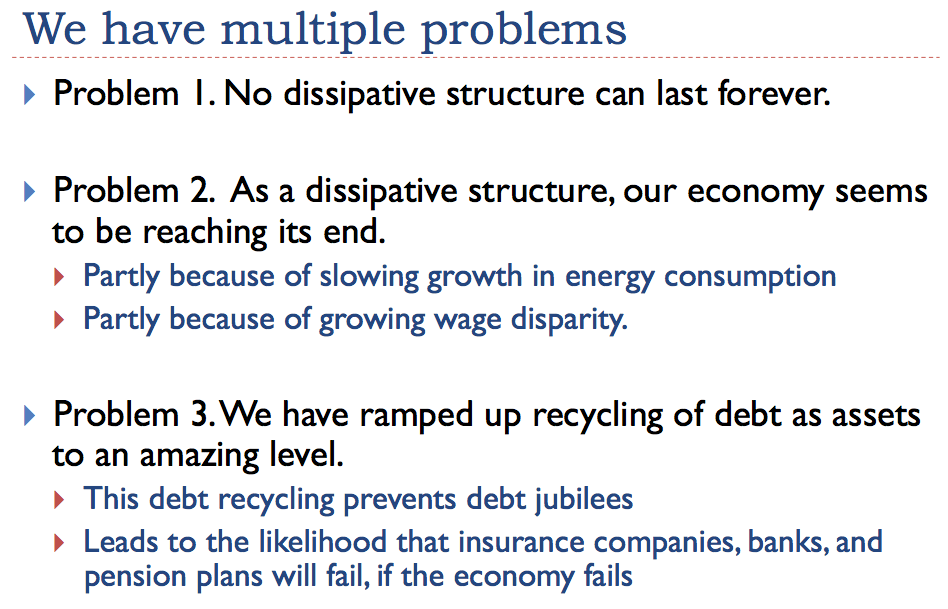
Slide 34
We have many problems that have been missed by recent economic modeling, including models commissioned by actuaries.

Slide 35
Actuaries are involved primarily with insurance companies and pension plans. My concern is that the financial system will be the center of the storm, as we hit limits this time. This will affect actuaries and their work.
Whether or not a new economic system can arise to take the place of our existing system remains to be seen. It certainly is a concern.
Two Observations
- My write-up is probably more complete than the actual one-hour talk was.
- I don’t think that anyone can be “blamed” for the confusion about what EROEI means. Our understanding of how the economy works is gradually evolving. Written documentation about EROEI is found in a myriad of academic papers. The name “Net Energy” seems to give energy in excess of EROEI=1 more importance than it really has.


Right. Its great how that works out, isn’t it?
“What else can you do?”
Its might be more worthwhile to attempt to prepare yourself physically for whatever might come. You can improve endurance and health through diet and exercise. Meds may be available or not…so you want to be aware of that. Often diet and exercise modifications can eliminate or at least lessen the need for prescription drugs. Our FW moderator takes no prescription drugs, I believe.
I keep in shape and eat healthy not to give me a chance post-BAU (actually being fat might be better lol, more fat to burn)….for me it’s all about living the best possible life here and now!
And … no doubt helpful with the Hungarian babes….
https://s-media-cache-ak0.pinimg.com/originals/d5/f9/2b/d5f92bdc4933b0fb7029c6e4577d2bc1.jpg
Hahaha, yep living fully in the here and now 🙂
How long after the power goes, can we expect for the ponds to explode? And how long after that can we expect to live?
I’m deciding on the size of my harem and if it is a matter of just days, it could be a harem of just one. I might even get one to volunteer for that, which makes it a whole lot easier 😉
As soon at the diesel back up system runs out of fuel I would imagine .. if not sooner… if you are the engineer in charge are you sticking around once you realize the world is ending — and you know the diesel truck won’t be coming…
I reckon the engineer doesn’t show up for work preferring to spend his last hours with the family.
FE, I have not done much research in this area. What do you envisage will be the cause of death for those not in the immediate vicinity of power stations? I’m assuming radiation poisoning. Is there really nothing that can be done by way of mitigation in your view?
I’ve posted research that indicates a single spent pond at Fukushima – would — if the pool collapse – release the equivalent of 14,000 Hiroshima bombs…
There are around 4000 ponds around the world…. that’s 56 million Hiroshimas of radiation pouring into the air and water… radiation does not decay quickly… therefore in short order everything anyone eats or drinks will have toxic levels of various radioactive elements in it… every animal killed and eaten will be riddled with cesium etc…. every plant…
To top it off — if anyone is still around they will be in a severely weakened state due to disease and starvation.
‘World Nuclear Weapon Stockpile. Nine countries in the world possess a total of 14,900 nuclear weapons. The United States and Russia account for 93 percent of them. Since their peak in the mid-1980’s, global arsenals have shrunk by over two-thirds.’
We are told that nuclear war would result in extinction ….
Thanks, FE.
I reckon the sooner the ponds exterminate us — the better.
They will put us out of the misery of starvation, violence, rape, and disease that will begin soon after the power goes off.
For those wondering how to know when collapse has stared — there will be no crack of a starter pistol… It starts when your power goes off — you will check the breaker …. then you will wait… and wait … assuming it is just a temporary local problem…. then you will hope…. then many of you will no doubt pray….
But it will remain off…
The food in the fridge will start to spoil… as you wait… and wait…
But it will remain off…
Then people will begin to realize that something is seriously wrong… and then you will know… this is it… it’s show time… it’s the big match … and you will be centre stage….
Perhaps focus more on the Finish babes, as they are largely of the same ethnic group, if you unthink ~1000+ yrs of other influences.. I doubt today’s Hungary or the Balkans or the CEE will be able to defeat the exploits of the next Ottoman Empire.
Eastern europe seems a lot more determined than western europe and scandinavia.
Perhaps, but the large trends are the powerful ones.
Finland is still relatively separated from the idiocy and decadent destruction occurred (irreversibly) in Norway, Sweden, and partly of that case of Denmark.
The Ottoman Empire – Turkey revival is here and it will be huge in long term impact, including their already existing enclaves in Western Europe. Eastern Europe is too broad meaningless definition, because inside of itt you have got very much westernized/germanized Slavic people on one side (few dozens millions), which however don’t truly belong (or are accepted) to neither axis, and the other side clearly more populous Slavic part gravitating towards the East, meaning Russian Central Asia pivoting sphere. Note, as mentioned previously, Hungarians are not Slavic, control only tiny fraction of their former empire, demographically in slump, nevertheless there are some shared long term history lessons with Slavs about the treacherous west, so some ad hoc alliances are possible. Also, Russia after the early-mid 1990s lessons (west not keeping post WWII/cold war treaties) won’t ever again sacrifice heaps of dead soldiers for the CEE region as during the end of WWII, hence CEE will be largely left on their own in the future (well some material assistance at best), both against the crazy imploding West and the Turks and other strands of incoming islamists, plus various global immigrants. Not good. Anyway, Europe will likely fracture at many, more and less visible lines. I just provided few of the interesting ones.
Can she skin rats and make a good soup with beetle seasoning? Too much make up.
Black nail polish only! Who am I kidding. YES YES YES. Please? Dont make me beg.
But seriously the kpop girl with the skull sweater was way better.
On the electric car question, again everything depends on the stability of the grid. With a stable grid they may make sense. Other than delivery trucks, etc., you don’t really need ICE cars for everyone to drive long distances all the time.
But this relates to the question of the core being preserved at the expense of the periphery, which right now it is. As such electric cars may make sense for a short period of time, before the long collapse renders most of the infrastructure unusable.
I don’t dismiss anything out of hand, like some here. I’m pessimistic, to be sure, but in times like these you have to consider all the possibilities. For example, during the past several years, the people who did well were the people who followed the exact opposite advice as the preppers. The preppers headed for the boondocks and found out nobody is there and they are working for a future that doesn’t arrive. Everyone else headed for the city and kept invested in the markets, and they have jobs and wealth, even if it’s nominal, etc.
I’m running on a dual track. On the one hand carrying out my life as if things will hold together, on the other hand preparing myself mentally for whatever might come. What else can you do? According to the laws of quantum mechanics, you never really die, which means you can try to kill your self, but you won’t succeed (seriously).
EVs can add stability, particularly with vehicle-to-home and vehicle-to-grid technology (which is admittedly in its infancy). Even without these technologies, a Bolt’s range will cover 80% of US commuters *weekly* needs (http://www.statisticbrain.com/commute-statistics/) and will fully charge in 9.5h (240V@32A) so third world intermittency would be fine. Furthermore, pretty much all US power companies already have ToU plans to incentivize programmatic demand shifting (which makes all electricity and infrastructure cheaper/kwh) and most have some kind of smart meter that can shift instantaneously. If the ability to maintain the grid becomes challenging, this tech will certainly be leveraged greatly. The wealthy will also have solar panels and powerwalls and therefore be insulated from a brownout-prone grid.
How do you cover the other 20%?
With 6ft of dirt? Most likely, standard of living declines will force the other 20% in line (one of many ways) but reducing gasoline use even by 80% would extend oil resources significantly. Some of them can also charge at work; doubling their range (and this will become very common). Also, the Bolt is today’s tech. There will be EV trucks (that can provide power to remote worksites and tremendous torque and regen), EV tractors, and EV delivery vehicles (including UAVs) in 10 years given no collapse.
I misunderstood you. I thought you said a Bolt covered 80% of a typical travelers needs.
If it could just cover 80% of all commuting done I would say a bus or train would cover 80% of commuting better than an EV.
Correct me if I am wrong… but most EV owners buy these rolling toxic waste dumps because they are mistakenly believing they are good for the environment…..
Of course we know that they are not good for the environment — as I have posted – before they even hit the road they are responsible for releasing 80,000 miles of carbon due to mainly to the energy intensive production of the batteries….
But alas – the Green Groupies are unaware of that — or don’t believe it….
Which begs the question — if one is so concerned about the environment — why don’t they take the bus – or a bicycle — or walk.
Did you hear the one about the environmentalists at the protest — they both drove there in cars.
https://www.youtube.com/watch?v=bcYppAs6ZdI
I can’t think of any one group that I have more disdain for than Green Groupies… If I were Emperor I would feed them to lions.
I think I’ll have another coffee capsule… I heard that they have a special recycling bin just for these in town — now should I roll down there in my two tonnes of metal and plastic and drop them off… or should I just chuck them in the trash….
F789 environmentalists… unless they are living like a hunter gatherer — then they are fake environmentalists…
And get this …
The Green Groupies go to the Mall… and buy more stuff… that they don’t need…
And they get home and they launch into a expletive laced tirade about packaging … some even wail about getting a printed bill of sale…
Such a waste of resources! So harmful to the environment!
These evil companies do not care!!!
It does not occur to these total idiots that
1. Whatever was in the package probably involved 1000x more resources to make it vs the wrapper….
2. They almost certainly did not need what was in the package (last year’s iphone was not cool enough though)
3. The best way to send a message to the evil companies would have been not to have rolled down to the Mall in 2 tonnes of steel and plastic — and to not have bought the item in the first place
Of course if you were to point this out to a Green Groupie they would immediately go on the defensive … they would lash out in anger because that is what they do when their hypocrisy is exposed….
The lions are too good for the Green Groupies… I think a slow painful death would be more appropriate… perhaps burn them on a pyre made of stuff that they bought that is stored in the third garage bay.
This comment goes into the DelusiSTANI Hall of Fame.
You clearly do not understand a word of what Gail has written over the years.
Word association:
Brick
Thick
Not everyone has read everything I have written. Perhaps meliorismnow has read materials put out by the large number of groups that don’t understand that going backwards is not a real option. They seem to think that the economy can successfully shrink. This belief system is extremely common. Instruction is more helpful than indirect name calling. The story may be obvious to you, but it definitely isn’t to everyone else. You might point out, Why Energy Prices Are Headed Lower; What the IMF Missed. There are many other posts as well.
I think I did try to explain this to melmor… a few times…. but as usual with ‘these people’… there was no attempt to debate the issue – no attempt to present facts or logic…. as usual… just ignore the facts….
It’s almost like these people are on auto pilot….. drrrrrrooooneeeee….. drrrrrooonnnneeeeee….
They just keep on plugging away — they have no interest to learn — they have no interest to engage…
Dogs exhibit more intelligence than this. At least you can teach them to roll over… or fetch a ball… they are keen to learn.
Perhaps if I offer melmoriaonow a treat?
http://i.huffpost.com/gen/1804855/images/o-DOG-TREAT-facebook.jpg
At least 10h from home, then 9.5h to fully charge, doesn’t leave much for EV to home or EV to grid.
Can you explain to me why I would want to buy an EV instead of a petrol car?
Seriously – pretend you are a Tesla salesperson and you are pitching me.
Now I already know about the part where if I roll up to the Koombaya Koffee Shop dragging along a 500kg battery made of toxic cancer causing materials — if there are hot babes in the house…. they will be vying for my favours…
So go beyond that…
Why an EV? Why a Tesla? Why not a petrol powered BMW?
The declining quality of the arts:
The current Slovak artists and the former top private TV station in Slovakia deshonouring the great song:
The Original:
https://www.youtube.com/watch?v=P2H6mpUnsLI
The cheap version of today:
https://www.youtube.com/watch?v=4XwZhqFfVWM
Where are those real artists of the past? Well, not enough money, not enough quality…
The original sound of the cover is not present in the given video on youtube, but can be heard and viewed here:
http://strategie.hnonline.sk/media/936674-minuta-po-minute-we-are-the-champions-edicia-chartshow
(Viewing the cover with the turned off sound is simply enough to see how showbiz is declining…)
for me this song by micheal jackson is the best has produced
https://youtu.be/pAyKJAtDNCw
This is something I ponder as well.
The growing use of sophisticated technology (computers) has correlated with a decline in musical quality. I used to think that the story was that computers were making humans lazy but recently I’ve called this narrative into question. The problem is not computers. Early use of computers in music was not heavy handed and was used artistically.
I think globalization has lowered the prices artists could charge for their work, and therefore has illuminated any incentive to put in any real effort into their craft. It’s not a surprise that a Scandinavian country is covering this–many of the musicians popular today have their songs secretly written and produced by the Sweds. Globalization and technology allowed the Sweds to execute the ruthless efficiency that popular music requires because of globalization.
http://scandinaviankpop.weebly.com/
http://knowledge.wharton.upenn.edu/article/behind-the-music-why-a-few-guys-from-sweden-own-your-playlist/
There is also a multicultural aspect to the decline in quality. Multiculturalism, in practice has meant a relaxing of standards.Casting judgement makes someone appear prejudiced or “old” , whether the person is a “old white man” or not. Many people don’t want to appear as bigots or “old” so they don’t say anything.
Hey Gail, how about setting up a conference for your followers? 😉 I’m not too far from Atlanta (also my grandparents summer home, Tucker).
Do you have any conferences in the US on the horizon?
A “Gail” conference is a great idea. Think about it, Gail–an attentive audience and great discussions. I would expect a special appearance from FE, though.
I’ll bring the tin foil.
I haven’t thought about trying to set up a conference. I would need a lot of things to make the conference work — an economy that holds together, a place to hold the conference, and a website to do registrations through, among other things. I think planning would need to start at least six months in advance.
The only US conference coming up is the Biophysical Economics conference in Flathead, Montana in June 18-21. (This is where Charlie Hall lives.) I tried to find a web link to the conference, but I couldn’t find it.
It will no doubt mostly be a lot of technical EROEI papers. I would not recommend it for people who are not “into” this kind of stuff. At this point, the plan is to have a preliminary program ready by April 22.
I like the daily online conference…
A daily online conference is probably the easiest way to go. There would be other things that perhaps could be done:
1. A Saturday lunch get-together for those who are already in the Atlanta Area, at a selected local restaurant.
2. A one day meeting, perhaps near the Atlanta Airport, mostly for people who are not too far from Atlanta. One place where I have attended small actuarial meetings is the Renaissance Atlanta Airport Hotel. http://www.marriott.com/hotels/travel/atlsa-renaissance-concourse-atlanta-airport-hotel/
The hotel was built a few years ago, so is not charging top dollar. It has a lot of conference rooms of various sizes. It is near the airport, so renting a car is not necessary, and it is not paying top price for its real estate.
I’d be up for a meeting near the airport. It would be pretty cool to meet people in real life who really get it and can discuss things on a very high level.
It may be that I should be thinking of some ideas like this. I was “piggy backing” on “peak oil” and “sustainability” groups for a long time. These are dying out. My story is the one hanging on. Maybe I need to be thinking of adding different approaches to talking about/distributing the story.
The way I see it, if (pretty much) everyone is thinking about things wrong, there will never be a “solution”, or at least some sort of mitigation, people will just continue to bark up the wrong tree(s). I think, well, if there is nothing to be done, why even duscuss or research it? So perhaps we need a sort of “think tank” if you will, to get together and brainstorm how to get the right people the right message, and not assume some “Elders” are pulling the strings and nothing is in our control. Some of the people on this blog are “defeatists” (including myself sometimes), but I’m trying to buck that trend.
Keith is not a defeatist… but that is because he is crazee…
There are no solutions.
The world is – unfortunately – finite. And we have reached the limits…
“The world is – unfortunately – finite. And we have reached the limits…”
Absolutely true, but I just don’t see the point of all of civilization sticking their heads in the sand, pretending there is no problem and jumping of a proverbial cliff. I think, but don’t know, that there may be a better option(s), and we should at least explore such options. I know that too sounds crazy, but why not give it a shot?
That is exactly what the CBs are doing — see tens of trillions of dollars of stimulus… see shale oil…. see bail outs.. stock market props… see lending money to insolvent entities so they can make payments on loans that will never get paid back….
That is the ‘solution’ … unfortunately it is short term
The CBs are not sitting on their hands… they are doing ‘whatever it takes’ to keep BAU from dying… they are leaving no stone unturned as they look for ways to delay collapse
This is one of the reasons why I don’t object to studies such as space solar. If people want to look into it, there is in theory some small chance it will work. Also people with permaculture local operations. Maybe they will be somewhat successful for a time. What harm is there in trying?
No harm in trying … there are plenty of people trying a lot of things that are futile…
The thing is…
I do not think anyone here is interested in reading endless clutter on space solar… any more than they would be interested in me posting endless what ifs… and some days… about my solar panel sheep breeding experiments (which are ongoing btw)….
It’s not as if we are on the cusp of making space solar work ….
I think I speak for most people on FW — when we have a system in space — beaming energy back to earth — without a trillion dollar subsidy — then this is worth discussing.
Ifs buts whens are really not at all interesting. It wastes bandwidth
“Maybe I need to be thinking of adding different approaches to talking about/distributing the story.”
I suggest piggy backing on what planning departments are up to. They are usually trying to do any number of impossible things, I have been checking out the premiere planning website (planetizen.com), tending to collect and assemble the projects that have a fairly realistic program vis a vis energy and resource depletion. A FW perspective might make a dent in consciousness here and there.
Here’s a sample:
BABY STEPS TOWARD URBAN RESILIENCE
Measures that are not fossil fuel intensive and recognize global urban trends;
http://www.un.org/en/development/desa/news/population/world-urbanization-prospects-2014.html
URBAN AGRICULTURE tax credit
http://theartnewspaper.com/news/artists-go-large-on-los-angeles-s-/
AFFORDABILITY
http://www.rooflines.org/4790/making_it_easier_to_build_wont_generate_affordable_units/
Gentle Density
https://www.planetizen.com/node/91658/appreciation-gentle-density
Miami’s Giant Pop Up Recreates Downtown Street
https://www.planetizen.com/node/91681/miamis-giant-pop-recreates-downtown-street
The Upside of Flooding
https://www.planetizen.com/node/91729/upside-flooding
Homelessness in Berkeley (see comment)
https://www.planetizen.com/node/91733/homeless-people-and-expensive-housing-cause-identity-crisis-berkeley
NEIGHBORHOOD MICROGRID EXPERIMENT
https://www.nytimes.com/2017/03/13/business/energy-environment/brooklyn-solar-grid-energy-trading.html?_r=0
20 MINUTE NEIGHBORHOOD
https://www.planetizen.com/node/91760/melbourne-australia-plans-assault-sprawl-20-minute-neighborhoods
Autonomous Cars Will Turn Back the Clock on Sustainable Cities
The companies developing autonomous cars are not interested in getting people to walk more or use public transport, but to offer on-demand private transport for the masses, in many cases moving people back to cars.
https://www.planetizen.com/node/91778/autonomous-cars-will-turn-back-clock-sustainable-cities
From the comments, it is my impression that less than half of the readers are actually from the US?
I downloaded the CSV file showing the location distribution of my 1.5 million views in the last year. It said that 39.9% of my OFW viewers are from the US. The next nine countries in readership are UK, 10.0%; Canada, 9.1%; Australia, 5.2%; Sweden, 3.8%; Spain, 3.4%; New Zealand, 2.6%; France, 2.4%; Germany, 2.3%; India, 2.0%.
In total, 219 “countries” were represented. A lot of these are tiny island nations. It is hard to see a country in the world that is not represented. The list includes Haiti, Syria, Somalia, Guam, Yemen, Congo (both parts), Greenland, and Tajikistan.
Of course, my articles are reprinted on several other sites, and sometimes are translated into other languages. These are not included.
It said that 39.9% of my OFW viewers are from the US. The next nine countries in readership are UK, 10.0%; Canada, 9.1%; Australia, 5.2%; Sweden, 3.8%; Spain, 3.4%;
New ZealandFast Eddy, 2.6%; France, 2.4%; Germany, 2.3%; India, 2.0%.There, fixed that for you. 😉
LOL!
I was thinking the same, but then I realized Eddy moves around quite a bit. He may account for anything up to 10% of the total visits.
I also use a VPN frequently …. it confuses the NSA….
Daimler Shareholder Demands Right to Be Naked at Annual Meeting
https://www.bloomberg.com/news/articles/2017-03-29/daimler-shareholder-demands-right-to-be-naked-at-annual-meeting
Arent we naked apes that need clothes and addtional energy for survival in the cold areas?
Many big meetings I have attended have been awfully cold. I needed multiple layers of clothing to stay warm.
I think it’s to keep mold and bacteria at bay, but I could be wrong.
bonjour Gail
ce post est un très bon résumé de tout votre travail, merveilleux !
que pensez vous de cette info
_______________________________________________________
Hello Gail this comment is a very good summary of all your work, supernatural!
That think you of this information
https://rocbalie.wordpress.com/2017/03/30/les-petites-combines-de-la-reserve-federale/
Interesting! Let me show you what little I have figured out from https://www.federalreserve.gov/monetarypolicy/bst_recenttrends.htm
According to the Federal Reserve, the total Asset on its balance sheet have remained perfectly constant since late 2014.
What has happened is a change in the distribution of those assets:
I don’t know how much you follow about the debt limit of the United States government. https://www.treasury.gov/initiatives/Pages/debtlimit.aspx http://www.cnbc.com/2017/02/17/remember-the-debt-ceiling-here-it-comes-again.html
This problem has come up again, and the US government has effectively run out of funds to spend. This is why the green line (Treasury balance) has fallen to close to zero. The Treasury is doing all kinds of things to delay huge problems. One of these things seems to be a slowdown on tax refunds. Many other changes will be necessary, to prevent a government shutdown. Some people believe that congress will fix the problem, but it is not at all clear that the problem will be fixed. (Although we have Republicans running everything, the group is not at all united.) If the Federal Reserve did nothing, the Federal Government’s slowdown in spending would have a hugely adverse impact on the economy.
As far as I can see what is happening, the Federal Reserve seems to be trying to offset this drop with a big increase of “deposits in depository institutions.” It is my understanding that a rising amount of such deposits indicates a large amount of money to lend out (for example, to people who did not get their tax refunds on time). At a higher interest rate, it is not clear that this higher amount of money available to be lent out will “fix” the problem. Also, as the government uses “extraordinary measures” after March 31 (today!) to keep from defaulting on their debt, it would seem as though some form of US debt would fall, creating problems that cannot be fixed using this approach. I would guess–someone may have more ideas on this.
If the government has to postpone spending for very long, the government will shut down, as it has in the past. Then we lose all kinds of services, such as data from the Energy Information Administration and access to National Parks. This is not a good outcome. One way I can imagine financial collapse coming is by the US government shutting down. At first the shutdown will be partial, like it was in the past (some essential services remained, as did Social Security payments to the elderly). Eventually, it would seem like it could be permanent, if these legislators cannot agree on a budget and a debt limit to go with the budget.
“One way I can imagine financial collapse coming is by the US government shutting down. At first the shutdown will be partial, like it was in the past. Eventually, it would seem like it could be permanent.”
Wow – death via self-inflicted paralysis, emanating from the power-centre of industrial civilisation’s last great empire. There would be a certain symmetry in that.
Interesting info. Gail, and definitely an interesting point in time with a debt ceiling of 20.1 trillion coming up fast as the debt is above 20T now. Should prove fascinating to watch the R’s who advocated not raising the debt ceiling during Obama’s two terms decide what’s best during their administration. It’s a majority House and Senate plus the presidency, so the R’s can do what they think is best, but what is that? At the same time they want to strip many departments of funds they also want to increase Defense over it’s already huge budget another 54 billion. We seem to be at a point in which the people are going to increasingly be asked to endure greater austerity to the benefit of the Industrial Military Complex. Why does that sound so familiar, like time echoing from the past, oh yes, Rome many years ago which also had lots of soldiers in foreign lands.
At the same time Trump wants to give Corporations a huge tax break from 35 to 15% and middle class taxpayers a break also, but the CBO will certainly project much bigger deficits and the conservative R’s will not like that so it may come to pass that even Trump’s tax plan goes up in smoke (in addition to the failed attempt to destroy healthcare ins. for 24 million people). Additionally it would also seem likely Trump’s 1T stimulus infrastructure bill will fail as well, as it would increase the deficit/debt.
My Theory is Trump becomes frustrated by the financial situation in DC and takes it out on one or more countries militarily.
mercis
“Electricity is the “high-priced” product per delivered joule of energy”
Electric vehicles are cheaper to “fuel” for a given amount of miles traveled than a gas car. So if the energy in the electricity gets to the EV more expensive than the energy in gas at the pump, the electric vehicle must use a much higher percentage of the energy for transport, versus waste heat. If we all drove electric vehicles there would be less money spent on electricity to power them than is currently spent on oil to power gas vehicles.
“If we all drove electric vehicles there would be less money spent on electricity to power them than is currently spent on oil to power gas vehicles.”
Gail is, once again, correct. It takes more resources to burn a fuel and deliver it on the grid than to just burn it directly as in a car. If everyone drove an electric car, massive improvements and upgrades would need to be made to the electric grid. Electricity would necessarily become much more expensive. Electric cars are also more complex, which is the opposite of what we need.
No, a powerplant+grid+inverter+battery+electric motor is still more efficient than refinery+pipeline+truck+station pump+gas engine. The basis for the ~100mpge rating of EVs is physical reality, not marketing (although the improvement does diminish some when counting infrastructure).
And EVs are MUCH less complex. Closed, fixed motor with no oil. No gearing (simple 1 sp transmission). Free engine braking with nearly free charging. There are different safety concerns but nothing more complex. Now, hybrids are often more complex, especially optimized ones like the Volt (take a look at the different modes the 2016/2017 operates in at different conditions using its planetary gear).
If EV are better in every regard, why are they so expensive to buy?
I have a feeling that despite being to simple you could get ruined by repairs or service.
EVs aren’t better in every regard. More expensive due to the battery and significantly longer to fuel due to the battery. But both situations are improving.
EVs would not exist without govt subsidies… and as we are seeing – even with subsidies and massive propaganda — almost nobody is buying… because they know that they are not reliable.
It doesn’t matter whether EVs “exist because of subsidies”. What matters is will they exist after subsidies run out. We will know that in a few years.
There won’t be any vehicles in a few years. There almost certainly won’t be any people
EVs are for stupid morons who drink the green kool aid.
@Fast Eddy:
What’s your net worth? How much would I have to pay you today to have you sign over your entire net worth to me in, say, five years? Ten?
Currently for collision repair you generally have to go a dealership that is certified to work on them (just about every dealership that sells them that also does repairs) not just due to high voltage concerns for the tech but also avoiding heat treatment (that could degrade the battery). For normal service (brakes, tires, fluids), you can take it anywhere or do it yourself.
https://www.consumeraffairs.com/automotive/tesla_motors.html
http://www.nytimes.com/2013/02/10/automobiles/stalled-on-the-ev-highway.html
There was no statement made about future upgrades. It was just that electricity – is currently – the most expensive way to deliver energy.
Since gasoline engines are very inefficient in their use of energy, it isn’t enough to talk about how much it costs to get the energy to them. You have to add in what do they do with the energy and compare the final result with an electric motor.
Electric cars add complexity in some areas like regenerative braking , but they replace a gas engine with an electric motor, a reduction in complexity and maintenance. Their biggest problem now is refuel time and that they add manufacturing cost with the battery being so expensive. But batteries are coming down in price as are refuel times.
The Electric vs. petrol argument has two sides, but here’s a simple example: I bought a used Ford Ranger with 40K miles for 10K. It now has 190K so that’s 150K driven and it has only needed routine maintenance and a new battery every 6 years. Bought it in 2001, so that’s 16 years of service and it still looks great because it’s kept in a garage when not in service i.e. out of the elements. I use synthetic and change the oil filter using Bosch. It runs like it did when I got it. Fuel is 2.50 or so a gallon and it gets 18 mpg. I can drive 300 miles on a fill up with 20 miles to spare before fueling up again which only takes 5 minutes. I bought it with equity from the house and we paid off the equity loan long ago, so there aren’t any monthly payments except insurance and DMV. I don’t have to worry about a huge battery pack dying out. Figure from talking to other Ranger owners it will last another 110K at least before tapping out. So what is my cost per mile vs. what it would cost for a 30,000 dollars plus EV? See what I’m saying? – it cost a lot less but it’s cost to the environment by emitting carbon was high, but so is an EV unless the energy source is from renewables. Financially it’s a no brainer but for the Earth it’s not, but then again how many people can afford a 30,000 dollar car? Since many people cannot afford an EV, is it practical for society as a whole to convert to EV’s? Not at this point.
Incidentally, I saw a YouTube video last evening with a Tesla owner who had 30 miles left on his batter pack – parked it at the airport and it was dead when he got back. Reason, the battery drains a certain percentage all the time regardless if it’s driven or not. It took a special tow service to tow it back to his house. With a regular car it’s just a matter of getting a jump from AAA or if you have a portable charge unit in your vehicle, which I do. So as things stand my pick is the Ranger but I’m open to a new way of doing things if it’s affordable and practical.
You shouldn’t compare your used Ranger to a brand new EV. In the US, you can buy a used EV for $6-8k (with 60-80mi range) and for most Americans the cost to fuel it will be half of current (low) gas prices. Most people can afford it and they would save money but a) they don’t understand that b) don’t want to limit their range, even if they rarely need it
Granted, if a & b were solved used prices would rise until gas vehicles could compete on total cost of ownership.
As for battery draining overnight, tesla’s are the worst because of active conditioning of the battery (when it is too hot or even too cold) and potentially a lot of monitoring features. These at least can be disabled and under normal conditions would not be a problem at an airport. Furthermore, most metro airports in the US either have EV parking or are getting it soon. I’ve left a LEAF parked for 2 months with no noticeable drain (the older ones’ batteries do degrade quickly in heat though, since they aren’t cooled). You can read more about teslas here if you want: https://teslamotorsclub.com/tmc/threads/how-much-model-x-range-lost-overnight-if-unplugged.83135/#post-1891136
(with 60-80mi range)
Which means buying two vehicles… the toy for going to pick up a loaf of bread … and the real car that is powered by petrol — for everything else.
There are some destinations your EV can’t get you too…for everything else there is your good old-fashioned gas-powered car 😉
Ironically … people buy EVs even though they cannot compare to a petrol powered vehicle… because they think they are doing the green thing…
Tesla Motors’ Dirty Little Secret Is a Major Problem
Think Tesla’s Model S is the green car of the future? Think again.
https://www.fool.com/investing/general/2014/01/19/tesla-motors-dirty-little-secret-is-a-major-proble.aspx
There are plenty of families with two vehicles. Probably the majority of them. You also can rent a car if there is a need to go on a road trip.
I cannot think of a single compelling reason to own an EV:
– it is not green
– it is not reliable
– it is not inexpensive
– the resale value is terrible
– they are expensive to repair
– the batteries do not last and expensive to replace
Can anyone think of a reason to buy an EV?
Governments are subsidizing them. They send out the message that a switch to electricity will save us.
EVnthusiasts has made this into a religious things.
I think most are like me: you buy a car to take you from A to B and just buy the most reasonable car petrol, diesel, electricity, ethanol etc doesn’t matter.
Most probably consider uncertainty with a new type of car a minus, but of course a minority are the other way.
Possibly EV will be the rational choice soon, but probably I won’t be able to afford an EV when “everyone” buys one and subsidies are long gone.
EVs have a simpler design than a hybrid. What reliability issues are they having?
I think it was Jarvis who owns an EV who was posting about endless problems with the vehicle…
http://www.cheatsheet.com/automobiles/are-electric-vehicles-unreliable.html/?a=viewall
Consumer Reports may be the biggest killjoy of all when it comes to taking the luster off many cars that seem appealing when they are new. In its most recent reliability ratings, it puts the boots to such prestigious icons as the BMW 5 series sedan, That’s a car a lot of us think of as an aspirational vehicle, a car for upwardly mobile who want to announce they are on the road to success.
Not so fast, Consumer Reports says. It rates the reliability of the 5 Series “much worse than average” across model years 2006-2008, 2010-2012, and 2015, That means that people who buy one are getting killed by depreciation at trade-in time.
According to Green Car Reports, the latest CR data is equally unkind to electric cars. It lists the 2014 BMW i3 as a used car to avoid because of an unfavorable reliability record. The same goes for the 2013 Nissan LEAF, although the 2014 and 2015 models are rated average or above average. The Tesla Model S is still on the list of cars CR advises against. Even though later models are claimed to have better reliability, earlier cars are still plagued with too many problems, Consumer Reports advises.
http://gas2.org/2016/03/17/used-electric-cars-consumer-reports/
Consumer Reports is telling used-car buyers to largely steer clear of some otherwise popular pre-owned electric cars.
Reliability is the big reason. For example, Consumer Reports lists the 2014 BMW i3 as a vehicle to avoid due to reliability concerns. The 2013 Nissan Leaf gets the same treatment, although the 2014 and 2015 versions are rated at average or above average by the magazine. The Tesla Model S is also not an advisable buy, according to CR, since earlier models had too many issues. Even the 2015 Model S is on the list
http://www.hybridcars.com/consumer-reports-doesnt-approve-of-used-evs/
I reckon that these these negative reports are candy coated…
Why?
It works like this:
The only people who buy EVs are the delusional clowns who believe they are saving the world. They are willing to overlook the endless hassles that are involved with owning an EV such as having to wait for it it to recharge — limited range — etc etc etc..
No rationale person would buy one of these things because they cannot compare to a petrol vehicle. Not even close.
But when you are a saving the world — you ignore the obvious. (of course when you drag two tonnes of metal and battery around no matter what powers it — you are of course saving nothing… but I digress)
So what do you think these EV DelusiSTANIS are going to say when asked if they are happy with their rolling toxic waste dumps?
‘WE LOVE IT!!! BEST CAR EVERY!!! IT IS AMAZING!!!!’
And they will keep on saying that — ignoring the fact that it runs out of battery — particularly if you turn on the heat or AC… or try to drive it in cold weather…
Because they are saving the world!!!
EVs are garbage. They should not exist
Consumer Reports ranks Tesla near bottom for reliability
Consumer Reports has a serious problem with those falcon-wing doors.
The group, which once said a Tesla car was so good it broke their ratings system, has ranked Tesla 25th out of 29 auto brands in its 2016 Annual Auto Reliability Survey.
Tesla’s new Model X crossover — and its signature falcon-wing doors — weighed heavily on the decision.
“The Model X launched with abundant problems, including frequent malfunctions of the falcon-wing doors, water leaks, and infotainment and climate-control system problems,” noted a release from Consumer Reports.”
“What seems to hurt Tesla is just this obsession with adding these surprise and delight features,” Fisher said, in an interview with CNBC. While the Model S and the Model X are built on the same platform, the Model X has so much more “technology, and gizmos and mechanisms and power equipment” that raised red flags, he said.
Tesla, once beloved by critics, ranks near bottom of new Consumer Reports survey
The Consumer Reports’ ranking, released Monday, places Tesla at no. 25 of 29 for reliability, with reviewers saying the automaker’s new Model X SUV “has been plagued with malfunctions,” including with the “falcon-wing doors” that have become its signature.
But the Model X, which first rolled out to drivers last year and now starts at $74,000, was panned by drivers frustrated by problems with doors, locks, latches, power equipment, in-car electronics and the climate system. It ranked last for reliability among a dozen luxury mid-sized SUVs.
https://www.washingtonpost.com/news/the-switch/wp/2016/10/24/tesla-once-beloved-by-critics-plummets-in-new-consumer-reports-ranking/?utm_term=.e38961716087
Now after reading that —- you’d have to be seriously Delusional to plunk down $74,000 on a Tesla….
And these are meant to be the best of the lot of EVs….
How this company stays in business is beyond me…. oh right — government subsidies and just enough stupid wealthy people who believe the hype…
Same stupid wealthy people who also think we will be moving to Mars soon.
Part of what makes EV’s so electronically complex is the nannies that are needed to make it fool-proof. In theory it is a simple design with few moving parts. However, the reality is to make it useable to the average driver there must me a lot of electronic complexity in computers to keep everything in check. A petrol vehicle is complex mechanically and an EV is complex chemically and electronically. The mechanical complexity in petrol vehicles has been well sorted out over its 100 year history so to me that is why they are so cheap and dependable compared to and EV.
With regard to investment in new electricity to handle electric cars, there would be a corresponding societal decrease in investment to procure petroleum.
Yes, and additionally most areas are already overprovisioned due to new additions of cheap gas and wind or solar. And EV owners are very likely to subscribe to a time of use plan, utilizing mostly excess/idle capacity and shifting even most of their non EV loads to it.
“Yes, and additionally most areas are already overprovisioned due to new additions of cheap gas and wind or solar.”
You are living in DelusiSTAN™, Welcome to RealitySTAN™!
tim, melrosesplace is right.There are some areas, where renewable energy sources are connected to the grid, and they provide extra electricity for which there’s no demand. Whether there’s enough of this extra electricity that’s coming from renewable energy sources to charge the existing number of EVs is uncertain. One thing that is certain is that extra electricity is a problem unto itself.The extra electricity is driving electricity prices below the cost of production in areas where it exists. The extra electricity is damaging the grid and has the potential to destabilize the grid. Plugging electric cars could raise demand, raise all electricity prices to where they can cover production costs, and encourage more energy production.
…but they probably won’t.
http://www.theverge.com/2017/3/28/15089806/sweden-ad-self-driving-car-bus-vasttrafik
Proud to be a swede!
Good points! Ride the bus instead of getting a self-driving car.
I addressed gasoline versus batteries, but in terms of natural gas versus electricity for heating, natural gas heating is cheaper.
You certainly would expect it to be cheaper, since electricity is often made using natural gas.
There are now some highly efficient electrical heaters, though. It may be that in some locations, these are cheaper.
The consumer is the happiest they’ve been in 20 years…. but:
https://www.bloomberg.com/news/articles/2017-03-30/death-and-despair-in-white-america
Even if you tried to make this stuff up you’d struggle…
I’d dearly love to meet a happy consumer!
I have never, ever seen a happy-looking person in a shopping mall. Or one walking with a sense of real purpose rather than the aimless mall shuffle. Which is why they are so damn depressing.
I have often, however, seen friends bubbling with delight over a new car, which never ceases to amaze me: just a dangerous and filthy box on wheels. And also over a new house, which just represents 20 years of enslavement. These, one suppose, must be the happy consumers…..
I went through a phase in my twenties of being obsessed by cars and changing mine quite often. I eventually came to realise though that the high associated with owning a new one and admiring its sleek lines would last only for a matter of weeks, after which the car reverted once again to a mere means of transportation and I would begin to obsess about my next purchase.
It is a weird experience to be so ego-invested in a material item. Being around cars that were ‘better’ than mine could be positively painful, especially if they belong to people I knew. Consumption of that sort is a tiresome merry-go-round of want and transitory fulfilment followed by more want, so I am not surprised those wandering around a shopping mall look so joyless, although I’m sure the sterility of the environment plays a part there as well.
Needless to say, now that I am older and wiser and with a family to support, I wish I hadn’t pis*ed away all of that money on baubles.
I first read about how indocririnated our society is (America at least) 10 years ago. It’s taken that long for it to finally sink in. If anyone is interested the book is called “Gaslighting…” (really long title) by Theo Dorpat. Though he specifically addresses indoctrination that occurs in psychotherapy (where it’s supposedly forbidden), one just needs to realize that it happens everywhere else in ones life too.
For many this applies:
http://www.guc.org.au/sites/default/files/styles/large/public/shop-therefore-i-am_0.jpeg
Or perhaps, ‘I desire therefore I suffer’, to give it a Buddhist twist.
For a long time now, white people have cut off their noses to spite blacks. They refuse to share with blacks. Whether this is right or wrong I’ll leave to you.
As a consequence they vote Republican, and Republicans proceed to screw them over.
This is all part of the decline of America.
Give us an example of white people “refusing to share with blacks”.
“Redlining” where banks refuse to lend in black communities. Goes back historically a long way and has been nationally pervasive.
https://en.wikipedia.org/wiki/Redlining
https://michronicleonline.com/2015/10/28/banks-caught-redlining-black-communities/
Re slavery…
This takes the cake… so you throw off the yoke but then you owe your former owner for the loss of assets… driving you into utter destitution ….
The radiation cannot come quickly enough for ‘humanity’
https://en.wikipedia.org/wiki/External_debt_of_Haiti
Not quite as usurious but heading for that ballpark:
https://www.google.co.uk/amp/www.aljazeera.com/amp/indepth/opinion/2017/03/cambodia-rejects-paying-dirty-debt-170321070547291.html
https://www.youtube.com/watch?v=RmwqnqL3Hbg
I have fond memories of attending the roof top bar in the FCC for morning beverages… then loading up a lot of beer into an ice box jumping in a car … stopping in at the ‘Happy Pizza’ place and requesting only the ‘Happy’ component (put that in a bag please…) … driving an hour or two or so out of town (not that cheesy shooting range at the killing field museum)….
Being let off in a village where a soldier opened a large box filled with war-era weapons — choosing an assortment of grenades rocket launchers large machine guns and so on …. heading into a field and opening fire…. the rocket launcher was particularly unnerving … nobody wanted to shoot it because the cost was 200 bucks per bomb…. but finally one of me mates (an American of course) volunteered ‘I’ll shoot that thang’ and kaf789 boom …. smoke and fire … and ringing ears…
I vaguely recall visiting Angkor Wat a few days later… and hearing Khmer Rouge shelling and being told not to wander off the path due to possible land mines… I think that was 1991 or 2… it’s all very vague… the good thing is there were very few tourists around.
The End.
Unfortunately, statistically there is a good reason for this. The kinds of jobs that these people have tend to be temporary. A lot of things go wrong. Quite a few of those who buy will find themselves “trapped” at some point by a mortgage that they cannot afford.
I am not sure there is a good way out of this. Banks who start underwriting these loans will soon end up as unhappy as many of the citizens who take them out. We don’t have a way to make wage disparity go away–it tend to get worse.
Yes. Things once set in motion tend to keep going through feedback loops, etc. FE’s example is a good one. That is not a case of whites sharing equitably with blacks.
1. “Redlining” is based on geography. Statistically, black people are less likely to have full-time salaried jobs, but if loans were assessed in a race-blind manner, many individual blacks would still qualify. These people might have formed a core black middle class for more stable communities to form around, but that didn’t happen because of redlining. So “good reason” is really kind of a stretch here. This makes this come across more like a justification and less like an explanation.
2. Who is it who tended to decide what sort of jobs “these people” tended to have again? We’re talking about examples of white people not sharing wealth with black people. Pointing out that the earlier comment didn’t quite nail the exact nature of the wrong doesn’t change the fact that it was wrong.
There are, and have been for a long time, black people living in predominantly white suburbs, at least in the Atlanta area. I presume that they don’t have a particularly difficult time getting mortgages. They can afford the homes in the neighborhoods they live in. What happened in the early 2000s is that mortgages became available to many more people who would not previously qualified – I don’t know if there was redlining before. This chart shows a history of home prices in the Atlanta area, from a report at this link.
The path that prices followed varied greatly by county. Forsyth, with the highest average home price both at the beginning of the period and the end of the period, had prices in 2012 that were 93% of the 2005-2007 average prices. Forsyth County was 3% black in 2010 and 4% black in 2015, based on US Census Data. The only counties that did better were DeKalb and Fulton counties. These counties are the most central counties. Their ratios of home prices in 2012 to 2005-2007 were 97% and 109% respectively.
Clayton County was a general disaster area for house price values. The county was 66% black in 2010 and 69% black in 2015. 2012 home sales prices were only 36% of the 2005-2007 average. There were many black first time buyers trapped in this situation. Several other counties with 40% or more black populations had huge price problems as well. These include Newton County with 2012 prices at 50% of 2005-2007 prices; Douglas County at 53%; and Rockdale County at 57%.
My conclusion is that buying homes in these poorer suburbs often worked out badly for families. They found themselves trapped with falling home prices and big mortgages. This was not a good situation for these families, many of whom were black. In retrospect, they would have been better off renting.
I saw these figures in the Atlanta newspaper some time ago, and was astounded at how badly home ownership had worked out for many people buying homes in the Atlanta area. It was pretty clear that black home owners were disproportionately affected.
Just watched this program and it left me amazed ….
https://m.youtube.com/watch?v=Cnn3GIbrweI
The site is regarded as one of the most important discoveries from the period in Europe, an insight into the unguessed at material wealth of some, perhaps most, in bronze age Britain. When the scale of the finds was revealed at a recent international conference, “jaws were dropping,” Knight said. The excavation won the “discovery of the year” title in this week’s British archaeological awards, voted for by other archaeologists.
Other unique finds include the largest, best-preserved bronze age oak wheel ever found, woven linen finer than the lightest of today’s fabrics, an old sword cut down into a useful kitchen knife, glass and amber beads imported from the continent and the Middle East, and the five round huts themselves, from the wicker floors to the clay chimneys – not just crude smoke holes – in the thatched roofs, still lying where they collapsed 3,000 years ago.
The unprecedented richness of the finds has revealed how the people lived, what they wore, what they ate, the butchered lamb carcasses they cured hanging from their rafters, the remains of a slaughtered red deer still sprawled on a patch of gravel. They farmed animals and cereal crops, including ancient strains of wheat and barley, and though they chose to live over the water, they had such lavish food sources that they virtually ignored the fish swimming just below their wicker floors.
May provide a glimpse of a Post BAU culture.
Amazing! It wouldn’t hurt to treat our current world as if aliens had come down and started looking at it for the first time.
They of course don’t do videos of the frequent famines every country encountered.
Gail, this is a program featured on Public Broadcasting PBS and is worth watching in its entirety. Of course, these ancient people did not have the advantages we have and lived a much shorter lifespan. That does not diminish the skill and intelligent approach in living their life. Actually, this village, which was maybe a year old, featured in the program was deemed to be probably attacked by neighboring tribe and destroyed..
There was evidence of extensive continental trade of glass beads, sophisticated fabric weaving from plants, canoe boat building, metal work and astronomy knowledge that planting times.
If you get an opportunity watch it Secrets of the Dead, After Stonehenge.
Thanks!
Jeremy, thanks for the link.
As we have seen in the “Ötzi” example, ~early bronze age people were even hiking (and living) in the high alps, actually had enough resources to pursuit some sort of murder or vendetta plot there, according to the evidence found.
Fall in complexity, regression, yes some aspects of that reality would be horrifying from our vantage (spoiled) point, especially during abrupt change. But on the other hand good life on a different spectrum was apparently possible back then as well..
I suggest that tribal history as far as it can be discovered shows that human groups can be both very well adapted to their environment, technically capable and inventive, living within the solar budget, but also horrendously violent and cruel.
Archaeology can tell us next to nothing about the slaughter of prisoners, raids on villages to obtain children and breeding females, particularly if corpses were left out for wild animals to scavenge them. Nor about higher political structures among such tribes, whether voluntary or enforced by dictatorship and hostage-taking. Nor even the domination of tribes by priests and shaman types. And blood-feuds.
Their lives were no doubt full of terror, a generalised anxiety.
Maybe we should ask the ravens and hyenas for the true story……..
But there were celebrations, like we see today in the dire poor regions of the world, such as Brazil’s Carnival. The program did show a fence log wall erected around the huts, so invasion threats posed a concern. In the Middle Ages the Duke and his Castles provided needed. protection from outsiders. We will likely see something of that sort play out if there are any survivors post BAU….nuclear war extinction, or spent fuel rods, Climate Change or a host of others that we can’t even think of, cancer deaths from toxins.
Just ~15-20yrs ago only fools were interested in the money/nervous pit of old castles/heritage monuments. Lot of them were on the market for pennies. Well, times changed, nowadays it’s pretty hard to find decent proto feudal dwelling at the right remote place, decent condition and low price.. As always in important stuff, be early or bust.
Net energy is the energy that industrial civilization can use after subtracting the energy used to provide the energy.
But if any kind of energy use is an (entropy-related) over-all loss of energy, is there anything other than energy loss?
That is a separate point, not related to defining net energy.
Might it be that our current pickle has to do with our (mis)conceptions, as a species, about who we are as a whole, and what our species-wide impact on energy store is, has been, and probably will be?
We want to dissipate energy until we cannot. There is no other way.
At least some of the religions indicate that we should restrain our urges. Not covet our neighbor’s wife or servants or goods, for example. Share what we have, rather than always wanting more.
What exactly the impact is, is not clear. But those who follow these directives may be happier–not get themselves into debt beyond what they handle, for example. Not spend all of their time trying to impress their neighbors with what they have.
I know that this statement is made over and over, “Net energy is the energy that industrial civilization can use after subtracting the energy used to provide the energy,” but I think the substance behind it is less than what people think.
According to an e-mail I (and several others) received from energy researcher Francois-Xavier Chevallerau,
In 2014, according to the IEA, Energy Industry Own Use amounted to 833.44 Mtoe or approximately 6% of the world’s ‘Total Primary Energy Supply’ (TPES) of 13,699.13 Mtoe – meaning an EROI of the global energy mix in the region of 16.7:1. According to Chevallerau, this would more or less correspond to the ‘standard EROI’ definition. The corresponding percentage in 1973 was exactly the same: 6%. So on this basis, there is no change whatsoever over the 20-year period.
If a person takes into account the fact that much more electricity is being created (rather than simply burning the fuels directly–resulting in a significant conversion loss), and that refineries are being set up to “crack” long molecules of heavy oil, plus losses that occur in making coke from coal, and other changes after the actual extraction of the fuels, then the total energy used by the energy system rose from 24% in 1973 to 31% in 2014. I would presume all of the manufacture of intermittent renewable expenditures would somehow need to go into this category as well, but I didn’t see it in the list of losses he included.
—
It is not clear to me that the 6% ratio can ever rise, without the system collapsing. The economy simply rebalances toward less energy intensive fuels. Or it reduces the amount paid to producers of those foods, so that they system keeps prices low, whether or not costs are low. We are now using energy in a more concentrated form. This is what the second set of ratios indicate.
Not Good for Nuclear Power
MARCH 29, 2017 —Nuclear-reactor manufacturer Westinghouse Electric Co. filed for Chapter 11 bankruptcy on Wednesday.
Its parent company, the Tokyo-based Toshiba Corp., reported that Westinghouse had amassed $9.8 billion in liabilities by the end of last year.
The company hopes that a Chapter 11 restructuring can bring it back to financial health. Meanwhile, Toshiba president Satoshi Tsunakawa said the decision was geared toward “shutting out risks from the overseas nuclear business.”
https://www.csmonitor.com/Business/2017/0329/Why-is-Westinghouse-declaring-bankruptcy
Westinghouse has faced other, more specific challenges. For years, Toshiba has been stained by accounting scandals in what Satoshi Ogasawara, who has written a book about the conglomerate systematically falsifying financial results, called “a dubious corporate culture.”
But observers are now casting Westinghouse’s Chapter 11 filing as the biggest sign yet of nuclear power’s rapid rise and fall. “This is a fairly big and consequential deal,” Richard Nephew, a senior research scholar at the Center on Global Energy Policy at Columbia University, told The New York Times.
http://peakoilbarrel.com/
Good new review of peak oil situation.
High price optimists there
I didn’t notice any price assumptions in his forecasts.
Not quite sure. Maybe a “Fellow of Our Finite World” (FOFW).
I was hoping for some material input from them, to no avail. Only heap of pipe dreams, maybes, extrapolations, no substance. Aka unbelievable epic idiotic response from “professors” on their vision of 100% renewables action plan, on which scheming political water boys then try to justify and build their disastrous visions (&kickbacks):
http://euanmearns.com/the-lappeenranta-renewable-energy-model-is-it-realistic-lappeenranta-responds/
This seems to be Euan’s previous post, laying out why the scheme won’t work. http://euanmearns.com/is-the-lappeenranta-ioe-wind-model-realistic/
“The work of Hubbert Flocard and Roger Andrews showed that because of inadequate storage the El Heirro system could never function at 100% renewables.”
http://www.cnbc.com/2017/03/08/tesla-battery-packs-power-the-hawaiian-island-of-kauai-after-dark.html
“…never” may be premature. Tesla’s Power Packs are a new approach to increasing renewable efficiency by feeding power back in during the night. If this approach works not just short term but long term and the numbers continue to crunch out affordably, then 100% renewables is possible.
“In Hawaii, the Kauai Island Utility Cooperative (KIUC) is now drawing energy from 272 Tesla power packs to provide electricity after dark. While the island previously relied on solar and other renewable energy during the day, it had no way to store the sun’s power after it went down.
Using stored energy from Tesla’s power packs is expected to save KIUC 1.6 million gallons of diesel fuel annually, which has traditionally been the way the utility generates power after dark.”
https://cleantechnica.com/2017/03/28/tesla-says-australias-energy-market-rules-outdated-dont-encourage-battery-storage/
“Tesla made a dramatic intervention in Australia’s energy debate two weeks ago when it launched its Powerwall 2 domestic battery storage device, declaring that it could “solve” Australia’s energy “crisis’ by building a 100MWh to 300MWh battery storage array, something it said it could do within 100 days.”
https://www.nytimes.com/2017/01/30/business/energy-environment/battery-storage-tesla-california.html?_r=0
“Just off a freeway in Southern California, 396 refrigerator-size stacks of Tesla batteries, encased in white metal, have been hastily erected with a new mission: to suck up electricity from the grid during the day and feed it back into the system as needed, especially in the evening.”
Another instance of swallowing MSM pablum and not looking beyond the headline…
Now if I am Musk the propaganda king… and I want to convince more investors to give me more money to waste — I need some high profile ‘successes’ …
So what I would do is sell a system at a massive loss — and claim I am the future:
But there are reasons why no companies have so far actually built grid-scale storage in South Australia.
The state’s biggest power provider, AGL, told a Senate Committee last week that it has spent the past month trying to build an economic case for batteries.
AGL says under current market rules, they don’t stand up without subsidy.
In response to South Australia’s power problems, Tesla has been talking about a battery array capable of storing somewhere between 100 and 300MWh. While that’s a measure of storage, the actual output of these batteries isn’t clear.
The example Tesla used in its pitch, an 80MWh battery array in southern California, outputs energy at 20MW.
For context, when South Australia ran short of power on a hot day last month, the Australian Energy Market Operator ordered 100MW of electricity demand be switched off.
Zen Energy estimates a battery output of 100MW would be needed to prevent such load-shedding blackouts, and up to 150MW would be needed to provide the sort of grid stability issues that caused a statewide blackout last year.
That’s not to say Tesla’s idea wouldn’t help, or that it couldn’t provide more batteries. But it is worth bearing in mind when we’re talking about a system “fix” at a certain price.
http://www.abc.net.au/news/2017-03-13/tesla-power-fix-unlikely-despite-elon-musk-pitch/8350026
In summary — the cost is much higher than what Tesla has proposed… there are other battery companies that have looked at this but it has been determined to be ‘not feasible without government subsidies… and finally — because Tesla is a fake company — fake in that profits do not matter — they do not require government subsidies… they can just eat yet another massive loss…
And write it off as ‘marketing’ — they’d prefer to write it off as hopium — but GAAP doesn’t allow that…
It is not difficult to store electricity using lithium batteries — see your mobile phone —- the issue is one of cost.
Tesla should not exist.
Tesla’s Fourth-Quarter Loss Nearly Triples – WSJ
Full-year 2015 loss widens to $889 million from $294 million in 2014. Tesla lost about $666 million dollars in 2016
https://www.wsj.com/articles/teslas-fourth-quarter-loss-nearly-triples-1455140842
Did you hear the one about how the new Tesla model — which does not even exist yet http://www.zerohedge.com/news/2017-03-02/tesla-admits-it-still-hasnt-completed-model-3-beta-prototype
…is projected (by Elon the Magnificent) to outsell both Mercedes C Class and BMW 3 series – COMBINED!
https://www.bloomberg.com/news/articles/2017-03-27/tesla-model-3-ramp-up-aims-to-crush-bmw-and-mercedes
Yep – and we are all going to load onto a Tesla Space Bus for Mars when BAU goes down
Tesla = Colossal Joke.
If you find yourself starting to believe this garbage — do your brain a favour — get a hammer and hit yourself in the head at least 3 times. It will take at least that to knock the idi.ot out of you
I don’t see how a person is going to use the console in the center very much while driving–it is too far from a person’s vision of the road. If the car is not truly self-driving, the screen doesn’t really work.
It will be interesting to see how many ramp-ups and downs these batteries allow before they fail. That will determine how expensive they really are.
Hawaii at least doesn’t have a winter to deal with, so batteries are only needed for day-night time shifting. The real challenge is storing electricity from summer to winter, needed in most of the world.
I would assume there batteries are similar to a mobile phone battery – just bigger…
What is the lifespan of a cell phone battery?
The average life span of a cell phone battery is from 400 to 500 charge cycles. That means the average battery lasts from one to two years. A decrease in the duration of the battery’s lifespan between charge cycles indicates that the battery should be replaced
https://www.techwalla.com/articles/what-is-the-life-span-of-a-cell-phone-battery
Great post Gail!!! I think you really summed up all the factors on this one.
It seems like I keep thinking that I have summed up everything, and then someone comes along and asks for something a little different, and I realize that from the new perspective, there are things I have missed. So the quest keeps going on and on. I think I have summed up quite a bit about what those doing modeling need to know.
Yep feeling very 2007ish on so many levels…
https://www.bloomberg.com/news/articles/2017-03-28/american-household-optimism-about-stocks-at-17-year-high-chart
Wow!
Epic Fake News.
Ties in nicely with the ‘full employment’ Fake News
The Ministry of Truth is on it!
When we replace humans with machines, the machines need more and more servicing staff. We are becoming the slaves of the machines who secure the survival of our species.
The most sophisticated machines are robots. They are at the top of the pyramid, as they unite the most complicated mechanics and electronics.
We do not need more humans, we need more robots for the survival of the degenerating and dying out human species.
U.S. College Grads See Slim-to-Nothing Wage Gains Since Recession
https://www.bloomberg.com/news/articles/2017-03-30/u-s-college-grads-see-slim-to-nothing-wage-gains-since-recession
Salaries are significantly lower – and everything is more expensive….
The U.S. college “educated” middle class demographic is an interesting one.
Has there ever before in history been a class so completely isolated from reality, and so devoted to carrying water for the global elite? The Europeans once had a class like this, perhaps.
Yes, “educated” is the right word. They can memorize a few things but as employers quickly find out, they cannot think analytically at all.
“they cannot think analytically at all.” – Is that necessarily something a person can learn or, is it something you have to be born with the ability to do? And then at the other end of the spectrum you have genius that has no common sense.
My personal opinion is it is learned at play as children. Now that children are put in school at 12 months and given programs of activity they are no longer able to solve problems.
There is something to this, JT. We live in a “milestone culture” where the end goal is everything, and the path is something to be rushed through. This produces students whose entire focus is the piece of paper they get at the end, by any means necessary, rather than actually having a stake in acquiring the knowledge. Young people get labeled as lazy and disinterested, but they’re acting the way they’ve been taught to act. University degrees used to be sought by those who had a genuine interest in a particular field. Now they are sought as some kind of proof of work ethic, almost like a hazing into the adult world, by anyone and everyone. Emphasis on the end goal makes it difficult for students to fully invest in acquiring knowledge for its own sake. People go to college to acquire a lifestyle, not an education.
It looks like that lifestyle is soon to become unattainable, too.
I read that call centers were now asking for college degrees among there applicants. There is no logical reason for such a degree. It is simply a way to use a college diploma as a screening device.
They do as they are told to do by the MSM… just like our generation does.. and the generation before…
The main difference here is that the pie is shrinking …
Lululemon shares plummet as retailer’s outlook fades
Lululemon Athletica Inc.’s shares tumbled 17 per cent in after-hours trading after the yoga wear retailer warned of a sluggish first quarter amid stiffening competition in the so-called athleisure fashion sector.
Despite a strong holiday season, Vancouver-based Lululemon forecast that sales at existing stores – a key retail measure – would drop in the low-single digits in its first quarter.
http://www.theglobeandmail.com/report-on-business/lululemon-posts-higher-profit-but-misses-on-earnings/article34479692/
They’ll roll out the excuses… but the reality is — people are tapped out…. retail is turning into a bloodbath…
Young people especially buy yoga wear. There are no doubt cheap imitations as well.
Athletes are really into yoga wear. My son is an elite hockey player and he and all his teammates wear Lulu..
Hockey players wearing Lulu yoga wear? What has the world come to!!!
Overly optimistic outlooks adopted by Australian Prime Minister John Howard in 2004 have caused gas shortages on the east coast – 13 years later
27/3/2017
Howard’s energy super power stuck in domestic gas shortages
http://crudeoilpeak.info/howards-energy-superpower-stuck-in-domestic-gas-shortages
Yes the situation is getting dire. BAD policies, including privatization, not least … I could go on and on about crass Australian politics/economics since the late 1970s, but what’s the use? South Australia – where I am – is possibly the most rotten apple in the vat, with GM quitting completely come October, so that my locality, Salisbury/Elizabeth, is set to become “rust belt” … not that I think that a “car economy” is long-term viable nor desirable, but “everyone should have a car” (on credit) has been a mantra for decades.
Now it is imploding and there is no turning back to what might have been some different decision decades ago. This applies everywhere and to everyone, at governmental and personal levels (macro and micro, which interact). We are proverbially FFFFFFFd
F789’ed.
Yes that seems to be the underlying issue. We can’t go back and redo what we have done. We can’t run the economy in reverse or scale back. It simply doesn’t work that way. Once a society realizes the predicament they are in, it is too late. No re-start game button.
This
http://www.caproasia.com/wp-content/uploads/2015/08/Professional-Banker-3.jpg
Cannot revert to this
http://www2.maxwell.syr.edu/plegal/tips/t4prod/kinneywq2_files/image015.jpg
Or this
https://www.sciencenews.org/sites/default/files/main/articles/bb_B3RHMA.jpg
If you think about how man progressed… he went from the simple to the complex…. building skills generation by generation …
This does not work in reverse… a modern man cannot be dropped into a primitive situation and be expected to survive… the skills are not there … the time is not there to learn the skills…
It’s like expecting a baby to be able to survive without being taught how to.
And that’s the thing preppers don’t get…
I understand that the brains of hunter-gatherers were larger than today. They no doubt had to memorize a whole lot, including which species were poisonous, and mental maps of routes everywhere.
Good post! People don’t realize that natural gas is a limit in making any kind of transition. Australia is already experiencing the impact.
The word “transition” – the more I think about transition as it relates to our economy today the more I think it has stopped working. Making almost any transition when we are close to limits doesn’t seem to work. When limits are far off transition (like from horse to car) works. If this is the case then there really isn’t much we can do at all.
I think the system will last until soon after global oil production begins to decline. The reason for the decline doesn’t really matter. Oil is so important in the transportation sector, that soon after enough oil isn’t available in commerce at a price that consumers can afford, the economy will be forced to contract. It is simple physics. If less fuel is available to do physical work, less work will be accomplished. The shrinking of the economy is called a recession. Debts go unpaid during recessions. Businesses go bankrupt. Since oil production will no longer be able to be increased due to high cost caused by scarcity, the shrinking of the economy will continue. That could soon threaten the entire banking system, since interest rates are already so low that lowering them more will have little impact.
So look for all kinds of strange government actions, such as negative interest rates, and money creation out of thin air to be paid out to consumers. It might work for some limited amount of time. But eventually the system must collapse.
How far are we from the peak of oil production? You would need a lot more accurate data than I have to determine that date. But I’ll take a wild guess at between 2022 and 2030. Without recent advances in horizontal drilling and fracking, we would be approaching trouble already.
It will last much longer. Triage will be brutal and efficient.
As long as the center of civilization is not affected (i.e. new york ,silicon valley) no collapse.
Right, two key questions, and all we have is guesses:
-when does eroei of fossil fuels become negative (we are approaching but not there yet)
-when do net exports of fossil fuels trend to zero; we are approaching but not there yet; I’m personally of the opinion that exports can drop very, very low, but cannot go to zero
If you think the economy can survive until the point at which it takes 1 unit of energy invested to get one unit of fossil fuel energy back then you haven’t been paying enough attention to what Gail has been saying.
Ditto for the economy surviving until fossil fuel exports are close to zero.
Yes, we can’t get anywhere close to 1:1 EROEI for energy products. If that is the case all you can do is extract it out of the ground and look at the oil. Even, doing that your pump will run out of gas and you won’t even be able to extract the oil an look at it anymore. 1:1 EROEI is perpetual motion machine territory.
I think the issue is total energy, rather than oil. Coal production already seems to be declining. This is a huge problem–much more than most people can imagine is possible. It can bring the world economy down. The focus on oil is misplaced, in my view. This is why the world economy is close to collapse. Even if we decide we want to get rid of coal, it doesn’t matter. We don’t have enough cheap fuels to replace it. Look at Australia’s electricity situation.
Declining total energy use => Economic contraction => Financial armageddon => Die-off/Divine intervention/Extinction/Singularity/BAU Lite/etc.
(Delete according to belief)
I will keep Die-Off and (very possibly) Extinction…..BAU Lite would need Divine Intervention….sooooo not happening 🙂
I would hope everybody here would agree that declining energy use leads to economic contraction. Any fan of Gail’s work should also agree that economic contraction leads to financial collapse in fairly short order, for that is what Gail keeps explaining to us.
I am torn between die-off and extinction myself. (I was being a little facetious with divine intervention and singularity.) Any believers in BAU lite (such as Dolph), ought to explain how they think we get there after financial collapse.
With the accelerating rate at which wages and falling and prices are rising, I see die-off by the mid twenties even without financial collapse.
How could financial collapse lead to singularity? I thought too cheap to meter electricity and run-away innovation was the path to singularity, not soup kitchens.
How could financial collapse lead to singularity?
Cornucopian answer:
Realising humanity is facing total extinction, governments get all the greatest minds in the world together (I’ll have my bags packed and ready) and provide them with unlimited resources to create the AI.
Realistic answer:
It can’t.
It can’t but it would make a great Hollywood movie. Yorchichan you should make a script, sell it to big Hollywood studio and make big money (which you will have to spend quickly, since dead people don’t spend money) 😉 Question is between writing the script, selling it, making the movie….is there enough time left?
Everytime I see a preview of a movie that interests me (like Star Wars for example) I’m always thinking to myself: but will we make it that far so that I can watch it. Star Wars is in December…not sure of my chances 😉
ITEOTWAWKI
Funny you should say that, because I’ve been told a few times that if I wrote a book about what has happened to me since 2010 then I would make a fortune. I once told my recent life story to an author passenger of mine (I drive a taxi, remember) and he said it was the best story he’d ever heard and gave me a £30 tip (on a £10 fare).
The main reason I have no interest in writing a book is exactly what you said: I don’t think I’ll be around long enough to cash in.
I think we have quite a few Star Wars et al. to look forward to. People want to believe in eternal progress and innovation.
the current financial system needs to crash to purge itself of the leeches that are clinging to it sucking the life out of the potential future new growth as the old saying goes ‘out with the old in with the new’ once the old financial system is destroyed, the new financial system will evolve which will be fairer and more equitable for all.Positive interest rates will be gone and negative interest rates will be the norm everywhere .All physical cash will be replaced with digital cash which will eliminate hoarding of cash and with negative interest rates continually charging savers on their digital. money in the bank savers will become spenders.A universal basic income will be payed to everybody, so that the system treats all people equally. This will mean new consumers as the previously impoverished classes of people will have a massive pay rise.A wage increase will naturally reflect in an access to more debt which will propel the oil price to new highs. The logical outcome is a massive increase in debt and therefore higher oil prices which will enable the extraction of the “hard to get fossil fuels”. We are entering A BRAVE NEW WORLD ORDER we just need to accept that our easy ride that was enabled by ‘easy oil’ will be replaced with a hard ride that will be enabled by ‘hard to get fossil fuels’ and solar and wind power.I think this will be the logical outcome A New World Order
You must be assuming that electricity will keep operating. Otherwise, how do you obtain “digital cash”?
(sarc)
Someone will come up with an idea such as this, to try to fix our situation.
” If these workers find that their wages drop too low, this will be a limit on the operation of the economy. Low wages will prevent these workers from buying houses and cars.”
A hundred years ago, Henry Ford knew that he had to pay his workers enough that they could afford to buy a Model T. How did we get to where we are today? They must be putting something in the water.
It was an aberration. Throughout history workers were rarely able to enjoy the fruits of their labor – it was the norm.
The Chinese workers at Foxconn do not get to buy the iphones they are assembling, but they do buy cheaper Chinese knockoff. That’s how the world works now.
In fact if the poorer people can’t buy houses and cars that helps the economy by preserving the resources for more valuable things.
Exactly, the future for some if not many first world economies is impoverishment that redirect diminishing resources to the necessary and the powerful. Theoretically it doesn’t require much resources to keep the people fed and (mostly) able to work; certainly an order of magnitude less than used today. It’s down to whether the powerful can successfully steal the other 90% from the people efficiently and keep control of them efficiently while the surplus slowly winds down to 0%. And if during this process can the powerful transfer humanity (kicking and screaming, no doubt) to something sustainable before we dip below 0% surplus.
Fluoride!
Just kidding.
The businesses decided that there was a chance that they (as businesses) could make money, even if most of the workers were frozen out all together, either by moving production to a country where labor is very cheap, or by using robots. They forgot what Henry Ford knew, or they found it too expensive a plan to follow.
A small bone to pick with Dr. Mack’s drawing of Exter’s pyramid-
https://en.wikipedia.org/wiki/John_Exter#Exter.27s_Pyramid
I wasn’t convinced the numbers really made sense. For example, on the Government Bond/Bill section, the US debt (which seems reasonable) is lower than the “world.” The amount given couldn’t be “rest of the world” either.
I think that $1.55 T figure is a typo, maybe$155T for the debt. Then it may all be incorrect there as the Government Debt is either internal accounting [intra-governmental] loans or Private Sector assets. The pyramid would have to separate out bank customer deposits as assets as well – even though technically they are bank liabilities also.
Interested to see a figure for derivatives. $1.4 quadrillion is a figure I have previously seen but never a breakdown.
I think with that sort of debt there won’t be a jubilee. They will just be wiped out. It’s all insurances anyway. A jubilee is a reset operation which is not the same.
‘The American Academy of Actuaries’
Are they annual awards for actuaries?
Best Male/Female Actuary.
Best Male/Female Supporting Actuary.
Best Foreign Actuary
Etc…
Actually, I think some of the actuarial groups have award of various types. One of them is an unpaid “service” award. I don’t think anyone has considered nominating me. The US actuaries were OK with talking about oil price issues when prices were high, but they are less enthusiastic when the oil prices are low. US pension actuaries (which I am not) seem to generally have staid away from the topic. It is too threatening.
Thanks Gail,
I’d say your peers were easily impressed.
Best,
Cathal ‘Putrid’ Haughian
Gail, I’m very curious about the reaction from your fellow actuaries upon hearing your presentation. Did they just sit there with their mouths open or was there a lively Q & A? If they actually absorb what you’re telling them do you think we’ll see pensions and insurance premiums adjusted? or will they stick to their delusion that this economy goes on forever?
The committee was not very large, about 8 or 10. The former chair of the committee had a lot of negative questions–wind and solar are getting better all of the time; this all can’t be true. Of course, the former chair was the one who had been in favor of the very optimistic estimates developed with the prior methodology.
After several minutes of the former chair asking questions, the (new) chair remarked that former chair would be asking questions all night, if it were permitted.
Afterward, the new chair asked if I could write up a version of my presentation for “The Actuary,” the national UK actuarial magazine. I have been in contact with the staff there–actually they contacted me.
The US economy is rising on expense of other countries.
One thing the strength of dollar helps America is it can make other countries buy dollars no matter how shitty US policies might be, and since other countries are shittier than USA, the rich in these countries buy dollars just to keep ahead of their own countries’ situations.
Generally it is not optimistic, but the elites of USA it will be.
http://greyenlightenment.com/reaction-pacifism-and-realism/
It’s better to conform, make as much dough as you can now by subscribing to BAU and worry about the rest when every other country on earth has collapsed.
Thank you, excellent and insightful, and and is in line with what others who understand “the dilemma” I’m new here, but if this hasn’t been posted, here is a summery of the book “Scarcity, Humans final chapter. ” (I’ll try to insert a link)
Example
or copy and paste
http://www.populationinstitutecanada.ca/keypapers/SCARCITY-by-C-Clugston-19-pg-summary-by-John-Bermingham-May-2012.pdf
a few good summaries in there
“The economic or political problems with which we concern ourselves are merely manifestations of our predicament—they are symptoms, not the disease. Metaphorically, our well is running dry, yet we insist on tinkering with the pump.
If humanity is to avert the global societal collapse scenario outlined in Scarcity we must
obtain more and more from less and less at existing or lower costs—forever”
“Nature suckered us in with temporary abundance; a condition that we perceived as
permanent. ”
and a nice list of myths … including
– Everything is cyclical—with an upward bias
– Plentiful NNR supplies remain to be discovered
– Increasing NNR prices always bring about sufficient NNR supplies
– “Stopping Growth”, “Downscaling”, or “Moving toward Sustainability” are
viable solutions to NNR scarcity
and a fast eddy favourite …
– Post-collapse life will be preferable to our industrial lifestyle paradigm
Welcome Snorp. Gail’s articles are always spot on and, in my view, should be easily understood by anyone with reasonable amounts of practical experience, scientific knowledge and common sense.
Thanks! I remember seeing Chris’ Clugston’s work back at The Oil Drum. We keep moving to lower and lower quality ores for all of our minerals. In theory, if the price could rise high enough, and if we had enough oil to help with the extraction, we could keep extraction of nearly all of them going. The problem is that neither of these conditions hold–enough oil or prices going high enough.
Prices for all minerals seems to move together, depending on the level of worldwide wage and debt.
” we must obtain more and more from less and less at existing for lower costs—forever” – yep I agree!
Thanks for the new article
You are welcome. There will be a quiz in 24 hours.
The pressure is on! Does a pass get one a PHD from the University of Our Finite World…
How about a BS in diminishing returns 🙂
I like that!
That just gave me a thought (because of the double entendre), in a addition to peak “prosperity” maybe we have reached peak BS. One can only hope.
This was fantastic and it answered several questions I had (I’m a new reader, so no complaints about repetition from me!). Gail, I’d like to hear, in any form you can provide, some ideas you have for the conundrum in that direction of religion. I’m a secularly oriented person, though I’ve seen and experienced that some kind of faith (in something) can work wonders when dealing with intolerable/impossible situations. A standard engineering approach to this kind of predicament isn’t up to the task.
“Reinhold Niebuhr, as Cone points out in his book, labeled this capacity to defy the forces of repression ‘a sublime madness in the soul.’ Niebuhr wrote that “nothing but madness will do battle with malignant power and ‘spiritual wickedness in high places.’ ” This sublime madness, as Niebuhr understood, is dangerous, but it is vital. Without it, “truth is obscured.” And Niebuhr also knew that traditional liberalism was a useless force in moments of extremity. Liberalism, Niebuhr said, ‘lacks the spirit of enthusiasm, not to say fanaticism, which is so necessary to move the world out of its beaten tracks. It is too intellectual and too little emotional to be an efficient force in history.’
Niebuhr’s ‘sublime madness’ permits the rest of us to view the possibilities of a world otherwise seen only by the visionary, the artist and the madman. And it permits us to fight for these possibilities. The prophets in the Hebrew Bible had this sublime madness. The words of the Hebrew prophets, as Abraham Heschel wrote, were ‘a scream in the night. While the world is at ease and asleep, the prophet feels the blast from heaven.’”
http://www.truthdig.com/report/item/a_time_for_sublime_madness_20130120
Thanks! Glad to hear your views on the subject.
Religions have been important throughout the ages. They are self-organized, like everything else seems to be, but that doesn’t mean that they are wrong. They certainly serve a function in this world, whether or not we have a true guarantee of future everlasting life.
I expect religions will make a strong comeback as tribes reform in response to the collapse of civilization.
Religions have a genetic foundation because they improved the reproductive fitness of individuals in tribes with religious stories that defined, united, governed, motivated, and entertained the tribe.
A curious fact is that belief in life after death is the only feature common to thousands of religions. Other curious facts are that humans are the only species with religions, and religions emerged simultaneous with the modern human brain, a brain which no other species comes close to in power. All of this and more is explained by Varki’s denial of reality theory.
https://un-denial.com/2016/11/14/on-religion-and-denial/
Alongside this, or in relation to it, was the “birth of meaning”. The primitives, once having a sufficiently developed theory of mind, trafficked in the “meaning” of things.
Here’s the real dilemma, once a “theory of mind” develops in a species, well, what is really happening, and what is consciousness? It is the ability to simulate reality, to simulate oneself in reality. This is the purpose of consciousness. Along with this ability comes awareness of death, a concept alien to every other creature. It must be obfuscated and abstracted at all costs, for it is permanence that allows a conscious entity to carry out goals at all. This, interestingly enough (though axiomatically as well), shows up in the field of Artificial General Intelligence (AGI). You cannot “hide” some mechanism to turn the AGI robot off, as this gentleman has discovered: https://youtu.be/3TYT1QfdfsM
Ultimately, consciousness comes from the universe itself, is a property of the universe, and, in a sense, *is* the universe. It was always there in some form or another, the laws of physics necessitate that. In our universe nothing is ever created or destroyed, it is always there, eternally or cyclically. This, I feel, is the ultimate truth. The paradox is that the very thing that threatens our very being (death) and must therefore be denied, is also nothing more than a symbol. It is the idea of not existing that terrifies us, the idea of nothingness. This is how we get these eastern philosophical ideas like “everything is nothing”, for it is true!! The universe is made up of matter, presumably there is an anti-matter universe somewhere to cancel it out (in fact this must be true, it follows from Newton’s third law). Gravity and dark energy cancel each other out. The positive and negative charges of matter cancel each other out. There is a very deep insight that comes from understanding the Newton’s third law, *everything* must obey it. Love must balance hate, terror must balance awe and so forth. Combine that with the fact that energy can neither be created nor destroyed, and what we have is simply an illusion of sorts. For *nothing* is really created or destroyed, it just changes form.
So one must come to terms that “they” are the universe!! It never “began”, will never “end”. So much of our everyday distinctions are arbitrary, the difference between order and disorder is an arbitrary, albeit necessary, distinction.
I suppose the only missing piece of the puzzle is this: https://en.wikipedia.org/wiki/Quantum_suicide_and_immortality
Either we never die, or death is an asymptote, a state we constantly get closer to but never reach. Terrifying, I know, but it also follows that we must at some point reach an “undefined” state (death?) and “begin” again.
Pulling this all together made me go insane, one has to put all this out of their mind and just go about one’s business. But after all, it follows insanity and sanity also must be in balance, same for ignorance and knowledge, or *any* two opposing forces.
All of this means nothing, and everything.
Or perhaps I’ve gone mad (or not).
We disagree. Consciousness is what happens when there are enough neurons to create a model for self. It’s meatware enabled by mutations.
Hmm, not sure where we disagree.
My reply is too long I guess, so I put it here:
https://test59535.wordpress.com/2017/03/30/the-meaning-of-everything-and-nothing/
I think you should perhaps start working on other things–renewing friendship, focusing on what is positive in life right now. Spending your time worrying about what is ahead is counterproductive.
“Spending your time worrying about what is ahead is counterproductive.”
Isn’t that in some sense what we are all doing here?
I have no friends, I’m not really close to anyone, I don’t really know how to be, so it becomes quite a dilemma!
Timl, although it is ugly to say, most of humanity is idiot. That is a fact. But you are not idiot. Find a way to find consolation and usefulness with this thought 🙂
Thanks. 🙂
There are usually people who need assistance in some way, that you can befriend. You can volunteer to help to people through various charities.
One of the major functions of churches and other houses of worship is to provide a nom-threatening place to make friends. Churches very often do charitable work as well. They often have uplifting music too. Even if they served no other functions than these things, they would be providing valuable services.
Tim,
You seem to be a man with a good mind and good heart. Don’t know your backgrounds. So can’t say where the problem is, in you not relating to other people. Fathers in my country tell something like this to sons. And these same things also start to apply when you grow up doing competetive sports.
Be fair. Keep your word. Don’t be pushy, but know your worth. Don’t take yourself too seriously. Be interested in other people, and their lives. Take care of yourself, do the things that make you happy and feel good. Be a good person. Be a good man. Stand on your own too feet. Don’t be too serious. No need for that. Go out with the people you have common interests, and go out there and have some fun.
People are funny in that most people have an innate desire to like you as a person. Its something hardwired in to peoples brains. They just perhaps haven’t been around you long enough. Had common interests with you. Been doing a common project with you. Trying to score for the same team with you..
Its a wide wide world, you know. With people hardwired to like you. Go out there and have some fun with it..
You have friends on FW.
Thanks. One thing I’ve started to enjoy doing is dropping people little hints about what is really going on in the world, meet them where they are at and let *them* connect the dots if they want to. I don’t direct anyone to this site (unless they seem intelligent), or flat out mention the implications because most people I know would just immediately go into denial and/or stupor mode. I think the more people around me that know, all the better, so I’ve been talking about it more. It helps. I used to figure I had to keep it a secret. What an interesting time to be alive!
“Thanks. One thing I’ve started to enjoy doing is dropping people little hints about what is really going on in the world, meet them where they are at and let *them* connect the dots if they want to.”
Only do that for a$$holes you dont like. If they get it they will be as unhappy and purposeless as all of us.
Blue pill rules.
I don’t agree. It’s kind of like when people when the lotto. Studies have shown their level of happiness does not change, most have no idea how to manage the money and quickly go broke. I think it is the same thing with the red pill, your disposition determines what you do when faced with a sudden change of circumstance. I also know keeping secrets is no good. And I try not to give people more information than they can handle.
Ultimately, some people will handle this information badly, others will handle it remarkably well. For me it forced me to come to terms with my own mortality, and I’m better because of it. The truth really can set you free, but in this world it can be insanely hard to find. That is why I like Gail so much. She is stubborn in her search for what is really going on. She is not indoctrinated like most everyone is, as I suspect of most people on this site.
There is a stray cat that inhabits my part of the world, He is quite the survivor, He has made it four years or so through some incredibly tough winters, I give him a can of tuna now and then, That is my purpose in this life.
Whether or not the belief in the afterlife is true, it is clearly beneficial to humans living on earth today.
I think that there are other things that religions provide. They often are directly or indirects a source of shared stories about “what works” in terms of living a reasonably happy, moderately successful life in the world today.
The Lord’s Prayer includes the statement, “Thy kingdom come, on earth, as it is in heaven.” This is not a prayer about going to heaven after death. It is a prayer about life in the here and now. Life expectancies of religious people tend to be longer, at least in some US studies–I don’t know about elsewhere. I imagine this partly is a “selection” effect. We know that having friends is helpful for people, and getting together in groups at religious-themed events helps in this regard.
Thanks, Gail! I had never thought of that Lord’s Prayer phrase in that way. It had always just been words. Extremely helpful point.
—–
Tim, from your first link, this brought something to mind:
“The alien saw that inherited denial of mortality reality would have caused each human group to believe a life after death story, which over time through transmission errors, became a unique religion.”
My ‘denial’ of death is shared between the personal–me, closest dear ones–and the species. I’m programatically more concerned about the species–not remotely interested in personal prepping. But there is a kind of mystical identification between ‘me’ and the species, for which I work MAO. So immortality for me means ‘immortality’ of the species. I don’t see any kind of an end for the species, irrational as that might seem. Absolute, total denial.
If any religion would guarantee me that I am going to a glorious afterlife…. then I’d throw my bicycle collection in the bin … along with my rowing machine … I’d stop with the vegetable gig….
And I’d sit around all day long eating triple pepperoni pizza, french fries, bacon and cheese sandwiches and drinking a lot of beer….
I would skew those long life results big time!
I eschewed all material possessions once i realised the path humanity was on. I was unusually young, early twenties. Even after timing the crash in 2008 I eschewed materialism in favor of experiences.
I’ve never owned a car, a house or pretty much anything aside from gold, a phone and laptop.
My plan is to survive the initial Reset and relocate to an area that appears stable.
Unbelievably, it appears 2017 will be that year…
Good Luck and say your Prayers,
Cathal
To be controversial here is a new comment on Bedford Hill.
Please note the affordablity issue exposed by EIA charts. If the charts are correct the refiners are the choke point limiting finished product to market at an affordable price. This all makes sense because ultimately refiners control pricing. Just like Walmart will squeeze their suppliers to the point of economic exhaustion. Since affordability is controlling consumption and refiners have no pricing power the poorer quality of crude will continue to drive the market lower.
https://beforethecollapse.com/2017/03/17/charts-of-us-gasoline-sales-the-us-is-bleeding-out-badly-retail-sales-by-refiners-have-collapsed-by-up-to-90-in-some-states/
BW Hill has a mathematical model that predicts maximum consumer price in the coming years exactly. I believe that the low price for oil in the coming years is what will destroy the industry.
The oil companies have sold their gasoline outlets. When prices are low, they are not money makers.
Total amount of gasoline sold in the US was up in 2016 compared to 2015. There has been sales weakness recently.
The point of the argument is that the average barrel is getting lighter. The result is more barrels are being consumed to maintain output. If this is true combined with the additional cost of extracting tight oil or 40,000 foot wells the oil industry is on the verge of catastrophic collapse right now. This isn’t a decade away this is here right now.
Oil depletion is determined largely by the depth of the wells and the water cut. The shale industry is not economically viable, but with free fiat money they can do whatever they want for the time being. This debt will obviously not be paid back. They either know that already or they are insane.
I am sure they know this … but when your back is against the wall you do ‘whatever it takes’
You fight dirty … you pull out a knife….
I can feel the hot breathe of the beast on my neck… his claws rake my throat ever so gently… he is everywhere… and nowhere…. not yet, not yet … he whispers…. but soon enough…. I am close…
A company doesn’t use very much oil to make oil. It uses natural gas, and it uses steel pipes, often bought from China made with coal. Both are much cheaper than oil. Production from shale fields generally doesn’t need “cracking” either, so its refinery costs are a lot less than for heavier oil. The Hill folks don’t really understand what they are doing, so they mix apples, oranges, and tomatoes, to produce a result that they think is reasonable. If the result is reasonable, it has little to do with the validity of the model.
Hi Gail,
I heard that you disagree with those Hill folks 😉 I think it’s a good theoretical model.
But I’m not so sure if empirical analysis is possible anymore, or any statement can be taken at face value by the industry, about shale or refining or anything.
I’ve surmised that the entire industry is lying through its teeth.
This is the End.
To a great extend they simplify the problem – as a product of not understanding it — and people tend to like simple explanations — even if they are not correct.
I suspect that is why they are so frequently referenced.
Oh and thanks for another great post; there will be a few months, perhaps, where people will be interested in the reasons for all things falling apart, and maybe there will be some chance to accept our (1st world for sure) complicity in it.
The last time I did try to explain the situation to anyone – and its been a while now – was using the example of the Mediteranean area as a poster child for resource exhaustion (some people don’t know about Easter Island). The area is known for Grapes, goats and Olives because so much soil has been lost in some areas that these forms of Agriculture are all that are possible. People are getting an inkling of resource constraints in NZ now with regard to water use, but still think regulatory and technical solutions are possible.
People will soon enough learn that fossil fuel = freedom; you can sing and pray all you want, but it is energy availability that gives us choices not national anthems and hymns.
I don’t know whether anyone will care about the reasons for our problems.
That reminds me, an (expensive) book company (NOVA Science Publishers) wrote to me about possibly writing a book for them, and I should write back to them. It is hard to write a book that stays up to date, that anyone will want to buy–especially if they want $150 for it.
Hi Gail. Congrats on another good article, which gradually builds on your earlier ones.
On the matter of you writing a book: when I used to be tempted to write a book (on philosophy in my case) I had the same trouble as you it seems, because no sooner than I had written a first chapter, my thinking had shifted at least somewhat, so I stuck to writing essays and/or “letters to the editor” on this and that, which often got published … similar since I got the internet too … but I’ve never saved any and it’s all gotten too diverse and complex for me to even imagine writing a book now.
On the other hand you have been far more focussed on a particular topic and you have saved what amounts to a building series, so can I suggest what Paul Craig Roberts has done, i.e. he has compiled his essays into book form. This way maybe you could easily “write a book”, perhaps editing-out some repetition, though for some completely fresh reader a straightforward compilation would enable an understanding of your developing thoughts.
What do you think?
Agree – this article is a nice summary of the situation to date.
A book in any format … would be a tough sell…
I’d rather see some ads on the FW site — I’d promise to click all of them at least 5x per day….
If everyone agreed to do the same — perhaps we could choose a location to have a conference…. and all the cash from the clicks could be applied to a bar tab.
This needs to happen!
Ask for an advance on sales… 🙂
I agree with your previous statement on writing books that don’t have happy endings – they won’t really sell well. And our story doesn’t seem like it will have a very good ending at all.
I recently read this http://www.goodreads.com/book/show/3418555-empires-of-the-sea
And it describes the Mediterranean in the 1500’s as a wasteland — along the lines of what you describe.
In many ways our problems with nuclear power mirror our problems with the financial system. The debt piles up in the same way as the spent fuel does, and neither seems to have a workable solution. Plenty of theories, but usually from those with an incomplete picture. In both cases we have taken the benefits that each give us now while turning a blind eye to the costs they will incur in the future.
So when there is a meltdown, then in the same way that Fukushima can’t seem to be dealt with, neither can the problems with Greece et al. Meanwhile, the spent fuel ponds grow ever larger along with the debt, and so we continue to steal from the future to live another day.
I am not sure if the right term is “steal from the future.” It is really make promises with respect to the future that can never be kept.
But you are right, nuclear power has problems similar to the financial system. It took a lot of debt and government guarantees of debt to get nuclear started. In many instances, some securities (really debt) was set aside to pay for costs of decommissioning. But no one ever thought through the adverse results of major problems, including how we would clean up after big problems.
The financial system has shown us before that it can have big problems. It seems likely that it can happen again.
Thanks Gail for another great post.
You are welcome!
Somehow it fits to type this as an extra in that a business can break costs into two categories, direct costs such as labor that increases or decreases with the flow of business. And indirect, nearly unmovable costs such as fixed assets and other financial overhead such as insurance. There might be a special place for the cost of a CEO, like in hell, who takes more from the business as it is failing though. Anyway, a decent level of activity must be maintained to overcome the fixed costs. Not being able to cover all the costs from operations requires more debt and betting on the come. That is these energy companies right now.
Even ceasing operation some of these costs will continue.
Good points. I read that one of the coal companies is declaring bankruptcy, and transferring some of the clean-up costs to the government. That seems to be the way it works.
Thank you Gail for another excellent essay. Your story widens in a good way with each new version. I think you are now very close to describing a full and accurate picture of our predicament.
A few ideas for your next version:
1) If I were an intelligent optimist that did not believe in resource based limits to growth, I might argue that our economic problems are caused solely by the exponential nature of debt, and that after a necessary and unavoidable deflation we will resume a happy growth trajectory. I of course don’t believe this but some do and you might want to confront this meme head on.
2) In my quest for understanding I have found the equivalence of wealth and energy as per Tim Garrett very helpful. This idea is embedded in your story but you might consider making the equivalence of wealth and energy more explicit.
3) An aspect of growth that you might consider adding to your story is that any system that grows exponentially will eventually explode into a hockey stick regardless of how small the exponent is. I have taken many university level math courses but it was not until I created a little spreadsheet to play with this idea that I internalized the reality.
Best wishes and I hope you continue to write.
Thanks for your ideas!
“…any system that grows exponentially will eventually explode into a hockey stick regardless of how small the exponent is.
For an exponential function the value of the function increases by a constant proportion over a constant increase of the input value. A point at which the function explodes into a hockey stick is a fallacy because the input value (time) for which it looks like there is a “point of explosion” can be arbitrarily changed merely by changing the scale of the y-axis.
True, but in nature the difference between 100M and 10B people has more implications than adjusting the y-axis.
The description of an exponential graph as a hockey stick has bugged me ever since I watched “An Inconvenient Truth” >:(
‘after a necessary and unavoidable deflation we will resume a happy growth trajectory’
This is what most people I speak to in finance believe will happen … as one trader (who used to rib me about being a Chicken Little – but who is now ramping up a big ski property Canada as a ‘fall back’ now realizing the sky will fall after all) put it when I asked him what he thought the end game was:
‘there will be a massive crash – everyone will be poorer — but we will recover — like we did after the Great Depression — and every other market crash throughout history’
Here is a really good example of how someone that does not understand the relationship between energy and the economy thinks the only problem is debt.
https://www.bloomberg.com/news/videos/2017-03-28/jim-rogers-says-fed-has-no-clue-will-ruin-us-all-video
Sure thing–if we had more cheap energy to bring to the economy.
There is simply nothing in history to compare our current predicament to! We are in uncharted waters on a global scale never before experienced by humans on this planet. To say “we will recover” from every crash is a very ignorant statement to make.
Yep… if we consider the Great Depression … which would be the best benchmark… it’s not even close…
Ignoring the energy component (which most people do) and focusing on the financial aspects… this is like revisiting 1929… and instead of allowing the market to blow out — the CBs refuse to accept that and do ‘whatever it takes’ including throwing tens of trillions of dollars of stimulus at pushing the markets higher….
The aftermath of 1929 was dreadful…. so if that is the benchmark…
And.. to top it off… the world is a different place with the JIT supply chain and interconnected banking system…
But then I would be labelled a pessimist… or chicken little … for pointing this out…
So I don’t go there
Fast Eddy,
I made the opening chapter available of our concluding synthesis. I’m a bit pissed off; I was hoping we could get into 2018 but it doesn’t appear likely. The US is losing control of the market and I can’t see how things can remain together for much longer.
I’m stockpiling French wine 😉
http://www.beforethecollapse.com/2017/03/17/charts-of-us-gasoline-sales-the-us-is-bleeding-out-badly-retail-sales-by-refiners-have-collapsed-by-up-to-90-in-some-states/
I’m not sure you have any idea what’s going on!
I was writing Fast Eddy
Still true though!
That you’re sure of yourself? That’s definitely true 😉
Plus in 1929, the planet had relatively few humans still (vs today) and was still chock full of resources. Fast-forward a short 90 years later, this planet is chock full of humans and relatively few resources.. Al Bartlett anyone…
Oh there’ll be The GREAT THINNING OUT!!! You can do all the prepping you want but my guess is that you’ll need luck to survive.
The scale of the crisis is what is so frightening; we’re talking a loss of our primary energy source … a 30% loss of the total. The tragic part is that steps to soften the blow can’t be taken because the US no longer has a functional government.
I wonder who in office will just bug out and disappear…
My personal belief is that I won’t make it. It’s just a gut feeling I have.
“The tragic part is that steps to soften the blow can’t be taken because the US no longer has a functional government.”
Very true. I can only hope the intelligence community understands the gravity of the situation. We are effectively leaderless and very vulnerable.
‘the US no longer has a functional government’
Yes – but the US has Don – and he is going to make America great again
https://cdn4.benzinga.com/files/imagecache/1024x768xUP/images/story/2012/donald_trump_-_caricature_29168164412_0.jpg
I know for a fact that I won’t make it since I will be checking out….after living the life that a King from the Middle-Ages could not even fathom, I refuse to live in a world that will look even worse than the movie The Road!!
I’m playing the long game. There is no way to prepare for a insta-collapse of unknown date and origin (what will be the proverbial last straw?), so the best thing to do, counter-intuitively, is prepare for it not to happen.
Given that The Road is the best case scenario… even a post BAU utopia … the wise choice is to go down with the good ship BAU….
Here’s an idea for all FWers:
Why not rent a bus — and take the entire family on a all expenses paid trip — then run it into a wall at full speed. It might seem a cruel act — but you would be doing everyone a favour…
You’d be saving them from rape, murder, slavery, starvation, disease, radiation poisoning ….
https://media1.s-nbcnews.com/j/newscms/2014_15/319671/140412-bus-crash-calif-mn-750_db32df25fab3904c43a6ec4c673bba79.nbcnews-ux-2880-1000.jpg
Fuel ponds..
Virulent strains..
Hordes of people..
A lot of unknowns. The probabilities are, none of us on FW will ‘make’ it.. so, no need to worry about it..
Even though some of the things I say here on OFW are very dark (offing myself by jumping off a 30 storey building when BAU ends, for example) I am not depressed in the least!
For example, just tonight, I went out to a nice roof-top bar in Budapest with some great House Music followed by a nice supper at a cool Japanese restaurant. Beautiful girls everywhere (Budapest is such a great city). The nice thing about “knowing” that this is all about to end soon is that you savour these nice moments provided to us courtesy of BAU.
The other thing is that by “knowing” all this stuff, with the money I have saved up over the last 15 years (have had a nice plump job courtesy of BAU again) which I know I will never get to spend completely, I am less of a Scrooge McDuck (which is my natural state…hate debt and have been debt-free for years)…so between ordering the 30$ wine and 75$ wine, I will go against my nature and order the more expensive one…no sense in keeping all this money that I have saved up which will be worthless in the VERY near future..So basically what I am trying to say is that I plan on taking advantage of BAU till the very end 🙂
‘Beautiful girls everywhere’
Please feel free to mention that the Har- eeem has a few slots available…. if you come across any exceptional candidates….
Lollll FE have you ever been to Budapest? Even run-of-the-mill is exceptional here 😉 As for trying to explain our predicament to them, don’t think that would go over too well even if I told them in Hungarian (what a complicated language lolll)!!!
I was there a couple of years ago … but I did not get to experience the nightlife… Madame Fast was more interested in the Christmas markets 🙁
I really should have gone pre-Mrs Fast…. now I can only live dream… fantasize…
Good points — we can’t even use the Great Depression as the benchmark …. it’s apples and oranges..
The Benchmark is ‘The Road’
Insightful report. Expanding on the ecosystem example is not all of it has ever collapsed. I think something will be here right up until the atmosphere or the sun gives out.
Maybe so.
” I think something will be here right up until the atmosphere or the sun gives out.” – I think so as well. Nature is very resilient. Humans, not so much.
Pingback: Olduvai.ca
Yes, I agree with many others about the big vision Gail has that many others miss. Concerning Manuel’s comment about a solution, perhaps Gail has ideas that she does not wish to share. Everyone has their own portion of responsibility. The Native American activist Russell Means once told me that NAs tried the empire thing and decided it didn’t work. Thereafter they stuck with a tribal organization as a sustainable model. Venice and other city-states also had a long history. Centralized organization is necessarily more unequal, and non-sustainable.
There certainly are positive things we can do today. We can be thankful for all the fancy devices we have today. We can also be thankful for nature, and the many things that it gives today. We can enjoy our friends and families. We can move closer back together, if that might be helpful, in troubled times ahead.
Years ago, we added a screened in porch to our home. We have used it a great deal since. I suppose that if we have problems that are not too severe, but that cut off our heating system/cooling system, we can still enjoy the porch.
Yep, screened porches, especially south west oriented are neat and *affordable hack how the gain some heat and comforts, this easy trick is mostly based on harvesting sun “ground level temp” which is usually at least 1/3 higher then the normal outside temp. Plus there is obviously this effect of adding more m3 space of quasi insulation to your home.
*but as always each additional %gain in efficiency will escalate cost, i.e. the screened porch walls/windows could be made out of plastic, plain glass, plain double glass, double/triple pane gas filled windows, .. One has to carefully decide on the cost/benefits and longevity-serviceability of each option..
Thank you for another interesting and detailed post. Much hard work you put into these write ups. I do appreciate your work so that I might better understand our predicament and how it is impacting many areas of our life as well as our social contracts
You are welcome. I hope that they are not getting too repetitious.
You know I was thinking today, and it occurred to me that one of the reasons why human life is tragic is that you have to make the mistake first to understand the mistake, and then by that time it is too late, because the consequences have already arrived.
This applies to both individual life and thereby to society as a whole. If you are lucky, your mistake causes some unpleasantness and then you become once bitten, twice shy (such as speeding and getting into a car wreck, but no major damage). If you are unlucky, you are maimed or killed.
Now that we’ve made the mistake of resource depletion, there is no going back in time to reverse it.
Another tragic element to humanity: we reach our peak before terminal decline (both intellectually and physically), and while we are at peak we imagine we will remain there forever. Again, note the symmetry between individual life and civilizations a whole.
Interesting thought.
I have long understood that it was inevitable to reach this unsustainable situation, so it does not seem very appropriate to say that humans “have made a mistake,” since nothing else we could have done.
This thought helps me to accept, peacefully and without blaming anyone, the present afflictive reality.
However you are right: when the consequences are already present, it is too late to avoid them.
“However you are right: when the consequences are already present, it is too late to avoid them.” – Kind of like smoking cigarettes.
There is really nothing we can do to reverse resource depletion, no matter when we figure out the problem.
As humans, we do have trouble seeing that our lives are limited. But on the other side of the problem, I think that the idea of giving people pensions for many years, when they are still in good health, is a problem. Adding Social Security back in the Depression temporarily reduced the problem with unemployment. (Glut of workers, like glut of oil!) But it is hard to make pensions to health people a sustainable pattern.
Maybe not so interesting for this audience, but the following figures tell a story about (future) pension ages in Denmark. (I wonder what French, Italians, Greek … voters would react to this?) Has already been passed by the Danish Parliament (Folketing)
BIRTH DATE
AND PENSION AGE
31. December 1953 or before
65 years
1. January 1954 – 30. June 1954
65½ years
1. July 1954 – 31. December 1954
66 years
1. January 1955 – 30. June 1955
66½ years
1. July 1955 – 31. December 1962
67 years
1. January 1963 – 31. December 1966
68 år
1. January 1967 or later
68 years + possible regulations (70 years?)
‘Now that we’ve made the mistake of resource depletion’
I suppose it could be considered a mistake to change from hunter gatherers to ‘Scott Nearings’ ….
But that would imply we had a choice….
Was anyone ever going to say ‘hey – look at this coal — we can light it on fire and use it to keep warm — we can also make wonderful iron farm tools so we can grow more food so we are not hungry — and best of all – we can make really good weapons which we shall use to kill the people in the next valley and take their food and land and women …. but I think that would all be a mistake … so let’s just leave this coal where we found it’
Thanks again, Gail, for another great post.
(I have to add what a good writer I think you are.)
Thanks! I do get a little help from some volunteer editors.
Pingback: Why Energy-Economy Models Produce Overly Optimistic Indications – Enjeux énergies et environnement
I look for your work each month as one of the touchstones for my being. Thank you for such inspiring work.
My question is, considering the necessity of debt as a driver of productivity, how do you see the onerous interest rates from banks issuing credit cards affecting things?
I ask in that I am an entrepreneur, working on really complex business models built around real innovation. I also am 70 years old – and truly cannot qualify for long term debt – as I have no traditional source of income. I have developed a number of software and hardware products over many decades – all innovative in their time, but now no longer competitive. I invested in and retain lots of equipment including a sophisticated server farm, that unfortunately this just gets older by the day – and no longer has investable market value. I think there are many people like me who were the innovators in the 80-2010 decades. But did not get rich.
I use credit card debt minimally to finance the tools and software and operating overhead that is necessary. Mainly because it Is easy to access. But very expensive as usury rates are the norm. Though I am 70, I have a great deal of both vitality and knowledge and enough skills to compete with most younger technology workers. I represent a segment that is growing – people way too capable just to live on social security – but not in major metropolitan areas ( I am in rural Iowa) so opportunities are very scarce – particularly at the level of sophistication I am at in my knowledge and skills.
I believe, my situation will be increasingly normal with an aging population – people who can be really productive because of knowledge and experience, but are anathema to banks, employers and capitalists as we are susceptible to health risks and other realities of aging.
I believe the stagnation in the economy is because there are more and more of us.
The high interest rates on credit cards are a problem. If you have equity in your home, and don’t plan to leave it to someone, you can get a reverse mortgage and increase your spendable income.
I wouldn’t really recommend borrowing on credit cards. The interest rates are just too high.
Otherwise, I suppose what a person does is look for a job, rather than try to borrow money, and use that money to make money. I am not really aware of what kinds of jobs are available in your field. In some fields, there are jobs where you can be employed somewhere else, and work in rural Iowa. With as much work as is being done now on a contract basis, people are perhaps a little less fussy about the age of the applicant.
I’ve been a devoted reader of this site for some years already. And I’m not only a reader but I also share almost all the views and insights of the author. This being said, I have to admit that I’m starting to feel the model of this blog is over (same as our current socioeconomic model), unless Gail changes her approach.
For some time already one has the impression that this is always the same post, over and over, repeating the same ideas, which I already said that I share. Spreading this ideas/concepts/knowledge is very important, and from this point of view this blog is doing a great job, but I miss some other approaches, like dealing with what is to be done.
This is not only about diagnosing the problems we are facing, we also need to discuss possible treatments. If not, what’s the point? I think by now, we all (the readers of this and other sites) understand very well what is happening. Others are just not interested, and we can’t force them to get this knowledge, it’s too troublesome and unpractical for them. So I think next step is not trying to evangelize, since this job is done. Next step is trying to find what we can do about it.
And I say this with all my respect and admiration for you Gail, and acknowledging you’ve done an invaluable job for us, the people who want to understand.
On a systemic level there is nothing to be done. Arguably on a personal level there is not much to be done, although I have not allowed myself to subscribe to that viewpoint.
If there are still things we can do as individuals then each new article Gail puts out is a clarion call to action. If there is nothing we can do then what could be better than trying to deepen our understanding of our predicament via Gail’s articles and sharing thoughts and insights on them in the comments section? Surely there aren’t many places on the internet more intellectually stimulating than OFW.
Manuel, the kind of solutions you might expect, do not exist. The economy is a dissipative system that can not last “ad infinitum”. However, one can try to find a more optimal way of doing things to prolong the duration of the economic system. In that respect, Gail’s blog is of practical use. For example, the previous post was about the convenience of not raising interest rates and finding ways to increase debt. It also demonstrates in previous posts that renewable energies within the electric grid are counterproductive. All these kinds of things are key and it is important for leaders to understand, regardless of whether they finally make use of these tips.
My apologies for my bad English, maybe you do not know that I use the translator.
A greeting.
We can think of BAU as American Idol….
At first it is hugely popular — millions tune in — they just love it and can’t get enough of the karaoke singers — it builds to a massive crescendo where people plan their life around the next episode —- wondering if their favourite will move on to the finale…
But over the years… for whatever reason — people start to lose interest…. the show fades…. sponsorship money dries up due to falling ratings…
And eventually the show collapses into a black hole of nothingness … it can’t even live on through re-runs because everyone knows who won…
Nothing can be done to revive it — once it peaks – it peaks — then it heads downhill….
It is becoming increasingly clear that the determining peak will be that of confidence. After the next financial bankruptcy, the confidence of all economic agents will inevitably break. The crisis of 2008 is very close in time. The contraction will be amazing: nothing will be bought beyond basic needs, will not be invested in business projects, the flow of loans will cease and economic authorities will be powerless to restore it. Implementing compulsory electronic money or helicopter money, for example, will not do anything because these measures will only increase mistrust. The only reasonable doubt is, once again, when. Who knows … maybe we’re all surprised, and there’s still a lot more time than we thought. CBs computers are doing a good job.
And the idiots of my country are still debating about the energy transition, and then some of you wonder in the previous article why Spain lost the empire … lol !!!
Fortunately there is OFW, because otherwise I would go madder than a goat.
As you are Spanish, you should be madder than a goat anyway. I know I am.
Saludos
“I know I am”.
English … speaks clearly.
“Crazier than a goat.”
I do not know if that expression is used in English, but you understand what it means with this image.
http://i.imgur.com/aWFyH.jpg
There are a couple of issues are involved:
1. Regarding what can be done, I expect most of what can be done is religious in nature. We don’t really have new farming methods, or new energy methods, that will solve the problems we are reaching. A lot of readers don’t like the idea of religious approaches, so I put off writing a post on this issue.
2. To a significant extent, what you are seeing is what I am writing, as various groups ask me to talk to them about specific issues. Here, it is actuaries talking about their modeling. This is a topic that is too specialized for most readers, but it is important for a specific segment of the population. If you read it carefully, you may see why the financial system is almost certain to fail. I will be talking to a European Commission related group on April 20, on a different set of issues. I probably will write up that talk as well.
Please, I hope you can persuade the group related to the European Commission, of the importance of avoiding the dissolution of the EU. Remember we are allies and the Chinese are going to eat us with chips
It’s a joke 🙂
Thank you Gail for your new article.
The group is the “Joint Research Centre.” I am afraid that they don’t have much influence on the dissolution of the EU. My talk is part of a workshop on “New Narratives of Energy and Sustainability.”
Gail, thanks for the article.
As always new ideas and concepts presented from different angle.
I’d advice Manuel to focus and perhaps also regarding that #1., as your latest piece seems to make bridges towards ecology and human economy, I sense you might be drifting towards recommendations like certain “taboos” and “good enough principles” should be reincorporated into our societies again. Because that’s promising (~proven) way how to deal with issues such as wage disparity (sane dosage of quasi egalitarianism), recyclable waste outputs, etc..
Do these gigs involve being flown to the conferences on private jets by any chance???
If so… how does one apply for such gigs?
The thing is…
There are no cures…
The patient is riddled with Aids, heart disease, diabetes, brain cancer, dementia, and an assortment of other chronic ailments…
Essentially we are here to debate which of the many terminal illnesses will be the one that kills the patient – and observing what treatments the doctors give to the patient to keep him alive for as long as possible
We are well beyond the point of thinking there is a cure. There is no cure — there is only life support — and that is failing
If you want a more positive spin I suggest you visit the various doomsday sites that promise a utopian outcome post BAU.
Here – as you have seen – the picture is a grim one — splashes of black paint on canvass… representative of disease, suffering, violence, radiation, starvation….
Thank you for another deeply pondered post.
“Hidden in plane sight” is an excellent way of putting it. Although what you are saying is at heart common sense, absorbing the totality of your analysis is somehow quite a slippery proposition. People can usually grasp that infinite growth cannot continue indefinitely on a planet of finite resources but the intractability and immediacy of the problem are apparently harder to digest.
And of course people aren’t going to *want* to accept what you are saying because it is so unpalatable and challenges so many of our most cherished narratives about who we are, how important we are, our place in the cosmos, what sort of future our children can expect etc. etc., so the clever yet dishonest brain will find myriad ways to discount, disbelieve and discredit…
Did any of your actuaries seem to take on board what you were saying?
The leader of the committee asked me if I would write up a version of the talk for the magazine that goes to all actuaries in the UK. This will have to be a fairly short write up–1800 words and two images, or 1700 words and three images.
The former leader of the committee, who was involved with the analyses based on Net Energy using EROEI >1, was present and was clearly quite unhappy.
I especially enjoyed slides 28 and 29: “EROEI seriously overstates the value of renewable energy” and “EROEI calculation not suitable for Intermittent renewables”. When you have a deeper understanding of how “renewables” fit in to our system, these statements are obvious. But, at first blush the math of “renewables” seems to work and thus promotes optimism.
The IEA has put out its own rules for evaluating Life Cycle Analysis (and thus Energy Payback Times) for solar energy. These seem to guarantee that the analyses will be optimistic.
And for wind – energy balance 33 – this claim is based on Life Cycle Analysis which has nothing to do with energy balance. You could call it “raw material balance”
https://ing.dk/artikel/6-mw-vindmoelle-betaler-sig-energimaessigt-tilbage-33-gange-172542
I think this is the standard calculation that most organizations do. It often is based on hoped-for output. If the wind turbine needs to hooked up to a smart inverter, and it runs 24/7/365, so it needs electricity from somewhere else, this is not a cost. All of the cost of transportation of the device, plus all of the concrete, to the site is not included. The wind turbine will need to be maintained by workers who have access to helicopters. Often, separate unites are built for these workers to live offshore, because repairs needed are quite frequent. Of course, all of the long distance transmission is not included. It will likely run at reduced capacity.
‘It is difficult to get a man to understand something, when his life and that of his entire family depends on his not understanding it.’ Fast Eddyism 3/30/2017
The problem, I think, is that many people deal with their own mortality by being an important part of civilization, having a role, making a contribution. So the idea that civilization itself will end is untenable and must be denied. This is where we get these fantasies of colonizing Mars, space based solar, the “renewable energy” belief system, etc. I like this quote from Kafka:
So I think for a lot of people that indestructible “thing” is humanity itself. “It will go on forever” one thinks. No one wants to admit that the final destiny for humankind is annihilation.
Mr DNA does not like the idea of annihilation … not one bit…
Right. US actuaries want to stay as far away from the problems as possible. Only look at impact of storms on rates for insurance coverage.
‘It is even more difficult to get that man’s wife to understand something, when her fantasy that the supply of cosmetics, comfort, and ‘nice things’ in general will be infinite depends on her shutting out some very obvious facts….’
Thanks again Gail. Really great article as usual. I’m glad that you mentioned Physics, sometimes we act as if the laws of physics don’t apply to us, but they are “universal”, they show up everywhere and apply to everything. I recently had an epiphany of sorts and I comfort myself in the fact that my very consciousness is part of the universe, and therefore, because information can neither be created nor destroyed (just like energy – it was there all along), will always be there and always has been in some sense.
I have started to point out this blog to more people. Perhaps there is a new, as of yet known “discovery”, that will allow things to continue as they have, or would have to be energy even cheaper and cleaner than oil. I don’t see anything on the horizon, but I don’t think that means we shouldn’t keep trying to find a way forward. Perhaps if more people understood how useless expensive energy is, and how expensive the “renewables” every one believes in really are, there’d be more people working on the problem, and finding a solution if their can be one.
There actually have been a lot of people working on the problem, for a very long time. What they have come up with hasn’t been very successful.
Nuclear was initially said to be, “too cheap to meter.” I heard today that Westinghouse (building four nuclear reactors in the US) filed for bankruptcy today. Several other nuclear companies are doing badly as well.
It was a single bureaucrat that said nuclear would be “too cheap to meter”, not a nuclear expert.
That may be true, but the statement was certainly widely believed. The optimistic model in the 1972 version of Limits to Growth seems to assume that a major transition to nuclear would be possible (but it doesn’t say so in so many words).
Too cheap to meter describes a commodity so inexpensive that it is cheaper and less bureaucratic to simply provide it for a flat fee or even free and make a profit from associated services. It can also refer to services which it would cost more to itemize bills for the service than it costs to provide the service in the first place, thus it being simpler and less expensive to just provide it in a bundle along with other services.
Although sometimes attributed to Walter Marshall, a pioneer of nuclear power in the United Kingdom,[1] the phrase was coined by Lewis Strauss, then Chairman of the United States Atomic Energy Commission, who in a 1954 speech to the National Association of Science Writers said:
“Our children will enjoy in their homes electrical energy too cheap to meter… It is not too much to expect that our children will know of great periodic regional famines in the world only as matters of history, will travel effortlessly over the seas and under them and through the air with a minimum of danger and at great speeds, and will experience a lifespan far longer than ours, as disease yields and man comes to understand what causes him to age.”[2][3]
Thanks for the quote. I see that optimism isn’t just recent, either!
I would say the energy being released by Fukushima melt down is too cheap to meter. But, very with very undesirable consequences. Nuclear reactions appear to be too difficult for humans to control. The cost comes from trying to control it. Nuclear fusion is even more difficult to control than fission as it is much hotter and more difficult to initiate. Capturing heat energy from a nuclear fusion reaction seems to be akin to capturing the energy in a lightning bolt.
In contrast, natural gas and oil are much easier to handle and control and they readily burn. It seems that all other attempts to capture and control energy (solar, wind, nuclear, geothermal, tide) require additional layers of complexity that are not required with fossil fuels. Hence, they are more expensive and do not substitute well.
“Nuclear fusion is even more difficult to control than fission”
It works pretty well in the sun, but that’s about the sum of it. Perhaps people forget that the sun is in hydrostatic equilibrium, or the implication of that is just not understood. A tremendous force is needed to keep the whole thing going.
Who are we kidding… nothing is going to replace oil.
That’s debatable, there is a huge “hidden – out of sight” infrastructure for running natgas/oil in 24/365 fashion, reliably from source – refinery and distribution to the end consumer. So, in comparison for example home sized geothermal install is just a smallish appliance with additional in/out collectors, which might vary in complexity/size depending on the temp potential (air, water, ..) you are extracting (several methods)..
” home sized geothermal install is just a smallish appliance” – I agree. But, if it were to scale up so every home has one, the infrastructure would become quite large as well.
A lot of the infrastructure for NG is already built too (mostly using cheap fossil fuels). So, that has an advantage as well.
Outside of areas that are geologically active, I don’t know how long geothermal installations will last. My impression is that heat levels gradually fall, making them less efficient.
For reasons I havent cared to learn, only a limited number of homes in my surroundings have gotten permit to install geothermal. I just suppose there was a reason.
If we accept money as tokens for energy I don’t see what is so wonderful about geothermal – you save 10k every year and spends 100k every ten years.
Then they stop working early, because of electricity intermittency. You use a lot of debt to install them. This debt pumps up the system. The interest on the debt is transferred money away from workers.
Of course you use debt.
75k to drill the hole.
75k for the pump.
Current floating interest 1.5%, 1.05% after tax deduction
1.5/year interest
Appx 1k/month lower bill
“Profit” 10k+/year
Values in krona, very rough but not too far off
When the pump breaks after 7-15 years, extend the mortgage and buy a new pump.
I understand you still need electricity to make a home geothermal system to work. So it needs a 24/365 system as well. Solar panels need “smart inverters” that run off electricity 24/7/365 as well.
Well, you don’t. We have heat accumulation system these days for home and midsized industrial applications, lasting days. So, the “peak input” electricity for geothermal system is not needed continuously. And also the electricity being a fraction of previously needed levels (before the geothermal leverage), it could be stored insitu even by not so advanced/costly batteries, or genset powered by various sources etc.
“Could be” implies complexity that we cannot really expect.
Supply chains will break if we lose any important component. This could be electricity, or it could be banks to pay the wages of workers. Needing any electricity is more or less as unworkable as needing a lot of electricity.
I think you are right. It is the complexity that is required in all of these attempts to capture energy that is the problem. It is very difficult the impact of this complexity.
I understand the focus of your audience but at least three nuclear “companies” and their clients are doing great.. , Russia, China, and S. Korea ..
I haven’t really studied the companies in those countries. I know at one point, there were two levels of costs for nuclear facilities: high and low. It is the high cost model that is failing. The low cost model may continue, until the next big accident occurs.
Actually, South Korean nuclear stations are getting old, and they can’t find enough places to store the spent fuel. Plus any nuclear facility in South Korea is vulnerable against North Korean missiles.
The thread is about industrial-managerial capacity to export these units, which S. Korea apparently does with great success. Have not studied their domestic operations, because it follows, if they currently export more modern stuff than legacy domestic situation, they could upgraded at home eventually too..
Perhaps you should, since they nowadays provide the majority of all nuclear installations in the world. I seriously question the approach in your comment. The times have simply changed.
The western “high cost” model means mismanagement, theft, outsourcing, lack of core knowledge, delays and problems. And the supposedly “low cost” model know produces safer technology, on budget and on schedule, as we can see in the latest gen of reactors (and the entire chain of services) from Russia, China and South Korea..
The high-cost model has gone overboard on complexity, I expect.
I don’t think any of the installations can be completely safe. If nothing else, they seem to need electricity from elsewhere for restarts after they are shut down.
I don’t generally associate the word ‘cheap’ when it comes to reactors.. and ‘safe’
Pingback: Why Energy-Economy Models Produce Overly Optimistic Indications via /r/economy | Chet Wang