
The way the world economy is manipulated by world leaders is a little like a giant video game. The object of the game is to keep the world economy growing, without too many adverse consequences to particular members of the world economy. We represent this need for growth of the world economy as being similar to making a jet airplane fly at ever-higher altitudes.

Figure 1. Author’s view of the situation we are facing. World leaders look at their video screens and adjust their controllers to try to make the world economy fly at ever-higher levels.
World leaders look at their video game screens for indications regarding where the world economy is now. They also want to see whether there are specific parts of the economy that are doing badly.
The game controllers that the world leaders have are somewhat limited in the functions they can perform. Typical adjustments they can make include the following:
- Add or remove government programs aimed at providing jobs for would-be workers
- Add or remove government sponsored pension plans and payments to those without jobs
- Add or remove laws regulating efficiencies of new vehicles
- Change who or what is taxed, and the overall level of taxation
- Through the above mechanisms, change government debt levels
- Change interest rates
There are numerous problems with this approach. For one thing, the video game screen doesn’t give a very complete picture of what is happening. For another, the aspects of the economy that can be controlled are rather limited. Furthermore, the situation is very complex–there seem to be several “sides” of the economy that need to “win” at the same time, for the economy to continue to grow: (a) oil importers and oil exporters, (b) businesses and their would-be customers, (c) governments and their would-be taxpayers, and (d) asset holders and the would-be buyers of these assets, such as families needing new homes.
An even bigger problem is a physics problem that is hidden from the view of those operating the control mechanism. Jet airplanes in the real world cannot rise beyond a certain altitude (varying depending upon the plane), because the atmosphere becomes “too thin.” There is a parallel problem in the economic world. The atmosphere that allows an economy to grow is provided by a combination of (a) an increasing supply of cheap-to-produce energy, and (b) increased technology to put this growing energy supply to use. This atmosphere can become too thin for several reasons, including the higher cost of energy production, rising population, and growing wage disparity.
We know that in the real world, a jet airplane cannot rise ever-higher. Instead, at some point, the airplane hits what has been called its “coffin corner.”

Figure 2. Diagram of Coffin Corner by Aleks Udris of Boldmethod. On the chart, Vs is the velocity; MMO is the Maximum Mach Number.
According to Aleks Udris, “The region is deadly. Get too slow, and you’ll stall the jet at high altitude. Get too fast, and you’ll exceed your critical mach number. The air over your wings will go supersonic, you’ll pitch down, the aircraft will accelerate, and your wings will fall off. Also bad.”
What Happens As Coffin Corner Limits Are Reached in the Economic World?
What do world leaders do, as the world economy hits limits? One temptation is for the world leaders in Figure 1 to take their foot off the throttle that is operated by low interest rates and more debt, because they don’t seem to be providing very much benefit anymore. The leaders fear that if more debt is added at low interest rates, it risks creating “asset bubbles” that are easily disturbed if any little bump to the economy occurs. If a big bubble pops, there is a significant risk that the economy could fall down to a much lower level. This is like stalling the jet at high altitude.
World leaders can also use approaches that create situations more like “making the wings come off” the economy. These approaches involve favoring one group over another. For example, a government can give big tax breaks to businesses, but raise taxes on individual citizens. Businesses will ultimately be harmed by this approach, because they depend on individual citizens for their sales. The result is like tearing the wings off the airplane.
Another approach that would tear the wings off the economy involves actions by a different group of world leaders than those shown in Figure 1, namely the leaders from OPEC and Russia. These leaders have different video game screens and different game controllers. They can manipulate the world economy by reducing the supply of oil they provide. With this approach, they hope to increase the price of oil, and thus obtain a larger share of the world’s goods and services through higher tax revenue.
Raising the oil price would benefit oil exporters, but would make goods and services more expensive for oil importing countries. Ultimately, this approach would lead to recession in oil importing nations. The result would likely be worse than the 2008-2009 recession–another way to make the wings come off the economy.
Let’s look in a little more detail at what is happening, and what goes wrong:
[1] Energy plays a huge role in this game, because a growing supply of cheap-to-produce energy allows greater worker productivity.
It takes energy of various types to make the economy grow, because energy is needed whenever we move something, or heat something, or use electricity to operate something. We use energy products to leverage our human labor. For example, we use a truck to deliver a package, rather than walking and carrying the item in our hands. If fresh water is in short supply, we use energy to operate a desalination plant, and thus produce the fresh water we need.
It is generally workers who produce goods and services. If energy supply is inexpensive and readily available, it is easy for governments or businesses to create “tools” to make these workers more productive. These tools include such things as roads, vehicles, machines of all types, and even computers. If the quantity and capability of these tools are increasing, the labor of these workers is increasingly leveraged by the availability of these tools. This is what allows economic growth.
[2] The extent of world economic growth seems to depend primarily on how quickly total energy consumption is growing.
If we look at historical economic growth, we see that the rate of growth of energy consumption seems to play a major role.

Figure 3. World GDP growth compared to world energy consumption growth for selected time periods since 1820. World real GDP trends for 1975 to present are based on USDA real GDP data in 2010$ for 1975 and subsequent. (Estimated by author for 2015.) GDP estimates for prior to 1975 are based on Maddison project updates as of 2013. Growth in the use of energy products is based on a combination of data from Appendix A data from Vaclav Smil’s Energy Transitions: History, Requirements and Prospects together with BP Statistical Review of World Energy 2015 for 1965 and subsequent.
The highest rates of world economic growth took place in the 1950-1965 period, and in the 1965-1975 period. These were both periods of very high growth in energy consumption. As we will see below, these were both periods when the price of oil was less than $20 per barrel, for almost the entire period.
If we look at economic growth over shorter periods, we also see a strong correlation between world economic growth and growth in energy consumption:

Figure 4. World growth in energy consumption vs. world GDP growth. Energy consumption from BP Statistical Review of World Energy, 2017. World GDP is GDP in US 2010$, as compiled by World Bank.
[3] On Figure 4 (above), the widening gap between GDP growth and energy consumption since 2013 could either represent (a) Much greater efficiency in using energy or (b) A problem in measuring true economic growth.
We can see true efficiency improvements in the 1975-1985 and the 1985-1995 periods shown on Figure 3. These were the periods when the world was truly trying to “get away from oil,” after a spike of high prices in the 1970s. Governments around the world were encouraging new smaller cars; electricity generation was being changed from oil to nuclear; home heating was being changed from oil to natural gas or electricity. The new furnaces installed were much more efficient than the old ones. Thus, during this period, efficiency/technology improvements were aiding economic growth to a greater extent than usual.
Now, in the period since 2013, much of the “low hanging fruit” has already been picked. We may still be finding some technology gains, but it seems likely that at least part of the problem is an “economic growth counting problem.” GDP looks like it is growing, but it is really very hollow economic growth. Governments invest in projects of essentially no value, and their investment is counted as GDP. For example, they invest in unneeded roads, in apartments that citizens cannot really afford, in educational institutions that do not produce graduates with wages that are sufficiently high to pay for education’s high cost, and in high-priced medical cures that are unaffordable by 99% of the population. Are these things truly contributions to GDP?
We also find businesses that look like they are growing, but in fact are taking on increasing amounts of debt as they sell off assets. This is not a sustainable model! We encounter energy companies that claim to be doing “sort of” alright, but their profits are so low that they need to cut back on new investment, and they need to borrow in order to have funds to pay dividends to shareholders. There is something seriously wrong with this growth!
[4] The economic “atmosphere” becomes thinner and thinner, when oil prices rise above an inflation-adjusted price of $20 per barrel.
Back in the time period prior to 1973, oil prices were generally below $20 per barrel, in inflation adjusted terms. Since then, prices have tended to be above this level.

Figure 5. Historical oil prices are Brent oil prices in 2016$ from BP Statistical Review of World Energy 2017; $20 per barrel is the maximum price level where oil is truly affordable; and $300 per barrel is the maximum price per barrel that the International Energy Agency seems to believe is possible for the world economy.
When oil (and other energy prices) were very low, companies could add tools to make workers more effective with little expenditure. As a result, the United States saw wages growing much more rapidly than inflation prior to 1968 (Figure 6).

Figure 6. Chart comparing income gains by the top 10% to income gains by the bottom 90% by economist Emmanuel Saez. Based on an analysis of IRS data, published in Forbes.
Once prices of oil started rising, prices of tools (broadly defined) rose. Governments and companies needed more debt to buy these tools. It became more of a burden to add capital goods of all kinds. Governments tried to raise GDP by adding debt, but to a significant extent they ended up with higher debt to GDP ratios rather than the rapid growth they were looking for (Figure 7).

Figure 7. Worldwide average inflation-adjusted annual growth rates in debt and GDP, for selected time periods. See post on debt for explanation of methodology.
The changes in the economy that allowed continued growth (more debt and more technology) tended to push the economy toward more wage disparity, in part because more technology required more training for some of the workers, but not for others. This allowed wages of the workers with special training to rise.
Furthermore, the need to repay debt with interest tended to funnel wealth toward the financial sector, and toward those within the economy who could afford to hold financial assets. These changes left less of the output of the economy for non-elite workers.
Economists never really understood what was happening. They had never thought through the important role that energy plays in the economy. Cheap energy is needed to create jobs. It is jobs, and the wages that those jobs pay, that tend to suffer when oil prices are too high (Figure 8). Thus, high-priced oil has a double impact on the economy:
- It makes goods of many kinds more expensive.
- It reduces job availability and wages.

Figure 8. Average wages in 2012$ compared to Brent oil price, also in 2012$. Average wages are total wages based on BEA data adjusted by the CPI-Urban, divided by total population. Thus, they reflect changes in the proportion of population employed as well as wage levels.
Logic would suggest that the economy cannot really operate on high-priced oil. Lower wages and higher prices do not peacefully coexist! We should expect high oil prices to be very unstable. Even if prices can reach a high level in response to a specific shortage or stimulus, we cannot expect these high prices to be maintained for a sustained period, without added stimulus. Unstable high prices are not likely to give rise to more oil production; they cannot be depended upon.
Economists have never understood this situation. Instead, they have made pronouncements that at some point in the future, they expect that oil would become scarce. Because of this scarcity, oil prices would rise. In their view, when oil prices rise, high-priced substitutes would suddenly become the best option available; somehow, the economy would become able to operate using these high-priced substitutes. (If energy products were not needed for labor productivity, this view might make some sense. In the real world, it does not.)
It never occurred to organizations such as the International Energy Association (IEA) that high oil prices might be a problem for the economy. The IEA has shown exhibits suggesting that oil prices could theoretically rise to $300 per barrel. Of course, at such an elevated price, there would be an almost unlimited amount of oil available to extract (Exhibit 9).

Figure 9. IEA Figure 1.4 from its World Energy Outlook 2015, showing how much oil can be produced at various price levels.
[5] The real enemies of continued economic growth are (a) diminishing returns with respect to oil and other energy production, (b) continued population growth, and (c) increasing wage and wealth disparity.
We seem to be playing a video game where the players don’t understand who the real enemies are.
Diminishing returns with respect to oil and other energy production have to do with the cost of energy extraction rising ever-higher, as more resources are extracted. There are a lot of resources that we can “see,” but that we cannot economically extract, unless prices rise to very high levels.

Figure 9. My version of the resource triangle for oil. Note that oil shale is not the same as tight oil, found in shale formations. Oil shale is kerogen that must be processed at very high temperatures in order to produce oil. This is rarely done, because of the high processing cost. Tight oil is not on this chart. Tight oil probably would be above “onshore heavy oil; oil sands.” It still would disappear, if oil prices permanently fell to $20 per barrel or less.
Continued population growth is a problem because it is really “energy per capita” that matters. Each individual needs food, transportation, and housing. All of these things take energy. Many years ago, when most of the workers were farmers, it was necessary to create ever-smaller farms, as population rose. This clearly would lead to lower food production per farmer, unless some sort of technological breakthrough was taking place at the same time. Today, we have a parallel issue.
Increasing wage disparity tends to be associated with the rising use of technology. When most labor is hand labor, workers truly do “pay each other’s wages.” All wages can be fairly equal. With increased technology, some workers have specialized training; others do not. Some workers are supervisors; others are laborers. Unless the overall output of the economy is rising very rapidly, non-elite workers find themselves increasingly unable to afford the output of the economy. It is this falling “demand” (really affordability) that tends to pull an economy downward.
[6] High oil prices can be temporarily tolerated by an economy, if interest rates are lowered to make this arrangement work.
Clearly, lower interest rates make capital goods of all kinds more affordable to both businesses and individual workers. If we look back at the period since 1981, we see a long period of falling interest rates, acting to stimulate the economy.
When oil prices exceeded $20 per barrel, the economy did not collapse immediately. In “normal” times, lowering interest rates was sufficient stimulus to keep the economy growing (Figure 4).

Figure 10. Ten-year treasuries through Nov. 17, 2017. Chart produced by FRED.
When there is a very big drop in oil prices (as in 2008, related to falling debt levels), then Quantitative Easing (QE) has been helpful (Figure 11). The US began its program of QE in late 2008, when oil prices were near their low point. There were three phases of the US’s QE. The US discontinued the third phase in late 2014, just as oil prices started to slide again.

Figure 11. Monthly Brent oil prices with dates of US beginning and ending QE.
[7] It is quite possible for a disconnect to occur between (a) the cost of oil extraction, and (b) the selling price of oil.
Oil that costs more than $20 per barrel is never very affordable by the economy. It really needs continual stimulus to keep prices at an elevated level. Once debt growth falls too low, the balance between the supply and demand for oil is settled in the direction of the amount of goods and services made with oil that non-elite workers can afford. Prices fall below the cost of production. This seems to be what has happened since 2014.
[8] In fact, since 2014, the selling prices of oil, natural gas, and coal have all fallen below the cost of extraction.

Figure 12. Price per ton of oil equivalent, based on comparative prices for oil, natural gas, and coal given in BP Statistical Review of World Energy. Not inflation adjusted.
It is popular to think that the reason why oil prices are too low is because of overproduction by the United States or Saudi Arabia. When a person stops to realize that essentially the same situation arises for all three fossil fuels, a person begins to understand that there likely is an affordability issue underlying the low prices for all three fuels. The affordability issue, of course, arises because energy supply is not rising quickly enough because (at over $20 per barrel), it is too expensive to be truly affordable. The “atmosphere is too thin” at today’s high cost of energy extraction.
9. Coal production seems to have “peaked” because at today’s low prices, few mines find the extraction of coal profitable.
It is popular in “Peak Oil” circles to believe as the economists do: oil and other energy prices can rise endlessly, because of growing “demand.” Economists have never stopped to think that at any given price, there is an affordability issue for customers. If prices drop too low, there is a profitability issue for those operating extraction facilities.
If we look at the situation with coal, we see a situation where peak production seems to have been reached because of low prices. China has closed down mines because falling prices have made mines that were previously profitable, unprofitable (Figure 13). Coal is the lowest-cost fuel; if it cannot be mined profitably, the world economy has a problem.

Figure 13. China’s energy production, based on data from BP Statistical Review of World Energy, 2017.
In fact, it appears as though we have reached peak coal on a worldwide basis, as a result of low prices (Figure 14). It is hard to see any major production area that can grow substantially in the future, without much higher prices.

Figure 14. World coal production, based on BP Statistical Review of World Energy Data. (For 1965-1980, consumption is substituted for production, because only consumption is given, and imports/exports are likely small.
[10] The world economy needs to be able to keep repaying debt with interest. If world economic growth slows too much, this will not be possible.
We may already be reaching a “too slow growth limit.” Below this growth limit, it becomes impossible to repay debt with interest, especially if interest rates rise. We may already be reaching this point, based on the lack of growth in energy consumption per capita shown in Figure 15. (Also, as noted in Item [3], it seems quite possible that recent GDP growth indications are overstated.)

Figure 15. Average energy prices (averaging oil, coal, and natural gas) versus the total quantity of energy products consumed per capita, based on BP energy consumption data and UN population data. (Prices have not been inflation adjusted.)
Figure 15 suggests that affordability and price go together. When the world economy is growing rapidly, energy prices tend to rise (as does energy consumption). When energy consumption per capita falls, it is a sign that the world economy is not doing well.
One of the things that confuses matters is the very different economic growth results for different parts of the world. If oil prices are low, this improves economic growth prospects from the point of oil importers, such as the United States and China. This is what our video game players are looking at, not the results for the world as a whole. It is oil exporters, such as Venezuela and Saudi Arabia, who are having problems.
If we look at world news, Venezuela may collapse because of low oil prices. Saudi Arabia has found it necessary to take on debt, and has undergone regime change, at least partly related to low oil prices. Norway is proposing that its oil and gas fund no longer invest in oil and gas companies, because it expects that there is a significant chance the oil price will not rise high enough to bring companies back to adequate profitability.
[11] The whole “game” has been confused by a lot of not-quite-correct pronouncements from academic circles.
A lot of well-meaning people have tried to solve our energy problems, but haven’t gotten the story right.
Economists have gotten the story pretty much 100% wrong. Energy is very important for the economy. Furthermore, energy prices don’t rise endlessly.
Peak Oilers have confused matters by talking about oil, coal and natural gas being determined by the amount of technically recoverable resources in the ground. This might be true if energy prices could rise endlessly, but clearly they cannot. By following the wrong views of economists, Peak Oilers have led world leaders to believe that far more resources are available to be extracted than really is the case.
People who call themselves Biophysical Economists haven’t really gotten the story correct either. The Biophysical Economists realized that there was a need for a measure for diminishing returns. They put together a measure which they called Energy Returned on Energy Invested. The measure, unfortunately, only “sort of” works. It gives a lot of wrong answers. It does not suggest that oil prices above $20 per barrel are a problem. It also does not suggest that substitutes for oil that are priced above $20 per barrel are a problem. It tends to give a lot of “false positives” when it comes to the question of whether renewables can be substituted for fossil fuels. It seems to suggest that a particular ratio is important, when it is really the total quantity of an energy product available at a very low price that is important.
I should not pick on the Biophysical Economists. There are many others with academic credentials who produce metrics that really aren’t very helpful. Energy payback time is not a very helpful metric, especially from the point of view of deciding whether or not to use a particular device. It is not the energy that the economy must pay back; it is the full cost of manufacturing the device that needs to be recovered, including human labor costs and taxes. In some applications, the cost of mitigating intermittency may also need to be considered.
Even the standard Levelized Cost of Energy calculations can give misleading indications, if they are used on intermittent renewables without taking into account the cost of mitigating the intermittency.
Conclusion
With all of these issues, it is not surprising that world leaders have difficulty playing the energy and economy game. In fact, it is hard to see any winning strategy.
One of the issues that makes the game impossible to win is the fact that all sides must win. A solution that cuts out the oil exporters is a problem for an economy dependent on oil. Any solution that cuts out the workers is a problem, partly because businesses need workers as consumers, and partly because governments need workers as taxpayers.
The reason I have not included any discussion of renewables is because at this point in time, we do not have any renewables that are sufficiently inexpensive and sufficiently scalable to represent a solution.


Attention Doomies:
http://www.mrsharristeaches.com/wp-content/uploads/2013/06/Mrs-Harris-Teaches-Chalkboard-Quote-You-Cant-Recycle-Wasted-Time-Freebie-Poster-Websize.jpg
How energy makes life possible
By Bill Gates | December 4, 2017
https://www.gatesnotes.com/Books/Energy-and-Civilization
Sounds like a good book….
The reviewer is a fool though
The main disagreement I have with Smil is about how quickly we can make the transition to clean energy. He is absolutely right that Moore’s Law and the speedy advances in software have misled people into thinking all innovation and adoption happens that quickly. Yet I am more optimistic than he is about the prospects of speeding up the process when it comes to clean energy.
Perhaps it’s the insights I have gained from my work with Breakthrough Energy Ventures (a fund that’s investing more than $1 billion in clean-energy innovation), what I’ve learned from experts connected with ARPA-E, or the research I see going on in the labs of the world’s top energy innovators. When I learn about their efforts, I can’t help but feel optimistic about what’s on the horizon—from carbon-neutral liquid fuels to game-changing improvements in energy generation, storage, and transmission.
Bill Gates and Paul Allen went to one of the richest private school in America growing up. That just so happened to be one of the very first schools to buy computers for their classrooms….You won’t ever hear the MSM mention that though..
If I recall Malcolm Gladwell did a chapter on that in one of his books… from Riches to Even More Riches….
Smil is pretty good. But like most he seems to assume that technologies are possible which haven’t been invented yet. Always baffles me. No reason to think things are possible just because someone can gin up a narrative.
The thing is… there are plenty of precedents… so one can understand where people are coming from …
But then there are of course far more precedents for problems that we the great humans … have not been able to solve… no matter how many years and how much cash we throw at them…
Funny how techno utopians ignore that…. idi iots.
UC Davis Study: It Will Take 131 Years to Replace Oil with Alternatives (Malyshkina, 2010)
http://pubs.acs.org/doi/abs/10.1021/es100730q
University of Chicago Study: predicts world economy unlikely to stop relying on fossil fuels (Covert, 2016)
https://www.aeaweb.org/articles?id=10.1257/jep.30.1.117
The world’s astonishing dependence on fossil fuels hasn’t changed in 40 years
https://qz.com/1144207/the-worlds-astonishing-dependence-on-fossil-fuels-hasnt-changed-in-40-years/
This is the IEA’s graph of total primary energy supply (TPES) by type. They give less credit to renewables (including hydroelectric) than the EIA. They probably are right, however. Intermittent renewables only replace fuel, not full electricity. With this counting wind and solar (part of the thin gray other line) only amount to 1% of energy in 2015.
This is a related chart by the IEA, giving some percentages at 1973 and 2015.
He absolutely does not understand the financial end of energy supply. I spoke at a conference in Brussels this year with him, and tried to talk to him about some of the issues. He has a single minded focus on energy. Like Peak Oilers, he believes that the financial system is not important. It will behave as expected, indefinitely. Or if there is a problem, it can easily be replaced.
This leads to the question of … will the CBs be able to hold the financial system together indefinitely … so long as there remains sufficient energy available to keep it operational?
At one point I thought that would be impossible — that at some point they will push on a string…
Yet 9 years out — and anytime we see the slightest puff of smoke — the CBs rush in an are able to put it out with more stimulus….
Perhaps we could stumble ahead for many years by doing whatever it takes…
But what the CBs cannot do is increase the energy available to BAU … it declines by the day… slowly strangling the oxygen supply that keeps BAU alive…
Eventually the oxygen available falls to low … and BAU passes out … then dies….
I am leaning towards the latter in terms of a trigger — but I am by no means made my mind up.
Perhaps the toxic side effects of trying to keep the oxygen levels up will kill BAU….
FWIW, Richard Heinberg explains how he thinks the world can have sustainable development in this 50+ page piece. http://noapp4that.org/wp-content/uploads/2017/08/Heinberg_Theres-No-App-For-That_2017.pdf
He makes some reasonable observations about countries that have succeeded in slowing population growth, and about the technology not being able to do what we would like it to do. But basically he doesn’t understand that the laws of physics don’t quite allow what he is proposing.
Quotes:
Heinberg sinks deeper into DelusiSTAN…
He is unable to (or getting paid not to) grasp the fact that if we are to have an industrial economy it MUST ALWAYS GROW. There is no such thing as a steady state economy unless we go back to living like we did 50,000+ years ago – there is NOT BAU LITE.
How f789ing difficult can this be to understand?????
You won’t like downsizing
That we are entering a period of decline is not in any real doubt, at least not among those with the inclination to think about it. ‘Downsizing’ seems to be the commonly used term, but few really understand what it will really mean.
No one will willingly accept downsizing if it means a meaningful drop in their standard of living. So it remains a vague notion that it might be somebody else’s problem, and nothing too drastic on a personal level. There is a misplaced concept that we will drift into it gradually as oil decline eases us into another mode of living that will not be too far removed from the one that we enjoy now. We want the creature comforts that we have known for less than a century to remain a permanent feature of our imagined future.
Our most recent history shows that the slightest slowdown of our current economy by just a few percentage points brings an immediate chaos of unemployment and global destabilisation. Yet somehow that won’t apply to a permanent ‘downsizing’; that seems to follow a different set of social rules, as if we can do it and still retain a civilised existence.
More http://www.endofmore.com/?p=1464
Shrinking the global economy leads to COLLAPSE of the global economy.
For christ’s sake — when we get a brief recession the masses are moaning and wailing as if the sky were falling …
And they would be right to moan and wail – because if the CBs do not step in with stimulus during recessions we’d be looking down at the clouds.
The masses insist that the gubbimint DO SOMETHING – we are losing our jobs — we need to pay the bills – we need to feed our families!!!! Exactly!!!!
Yet these same people are the screeching — BAU LITE BAU LITE!!! – we demand BAU LITE!!!
Use less energy – buy less stuff – preserve the planet – (but their BAU Lite has iphones and cars and electricity and all the same sh it they despise — just less of it — IDI OTS!)
Well BAU Lite = endless recession…. what is it they do not understand?
Endless recession is not actually endless — growth cannot decline for very long without it completely stopping resulting in total collapse — to the point where you won’t be able to buy a paper clip – let alone an iphone
Richard — I am sure you read FW — if you truly believe this clap trap then you have caught a serious case of mental re ta rdation.
You need to be fitted with a straitjacket … locked in an underground cell… and left there to ponder this situation until you come to your senses.
You are 100% right about Heinberg missing the point that the world economy needs to grow. He blames this problem on leaders with wrong beliefs.
We recently saw a like of people JHK admires; Heinberg wasn’t on that list. He is trying for a different audience–the audience of big donors who might be willing to contribute to a somewhat “happily ever after ending.” In 2015 and 2016, only about 11% of revenues came from contributions (presumably from Resilience readers). Another 4% came from publication revenue, fees, and other income, including investment income. So about 85% came from “Foundation and Community Grants.”
Richard…. you can redeem yourself…. we understand that the bills need to be paid ….so please do continue with your Koombaya Project…..
But I am going to give you the benefit of the doubt … surely you do not believe that BS….. surely there must be a hard core doomer wanting to express himself trapped inside you…
I will give that doomer a way out…. think of a username that borrows from The End of Growth — something only those who would have read it would know…. then use that to post comments on FW… we won’t give you away….
Like?
The reviewer has a good imagination.
It doesn’t seem like Bill is gonna kulm us anytime soon.
Gates omits the fact the Smil says energy transitions will take many years. Like 30 to 50 years or more. And the new energy must present advantages over the previous energy supply.
The article aptly frames a general analysis of recent world situation in a game theoretic analogy:
“… world leaders have difficulty playing the energy and economy game. In fact, it is hard to see any winning strategy. One of the issues that makes the game impossible to win is the fact that all sides must win. A solution that cuts out the oil exporters is a problem for an economy dependent on oil. Any solution that cuts out the workers is a problem, partly because businesses need workers as consumers, and partly because governments need workers as taxpayers.”
Still, what does it imply for the events we can expect in future, ahat can concepts like “solution” or “collapse” mean, and what do they encompass for the economy?
If the economy is a dissipative system, there can’t be any “global solution”; rather, at every point of time, solutions can be at most egoistic, temporal and local, alongside with collapses elsewhere. Until of course, capitalism itself would collapse, either when it is replaced by some other economic system, or because humans die out as a species.
Generally, Capitalism means the trade of goods by their value against money, driven by reinvestment of money in further production of goods. Emerging in the European Rennaissance, trade with Aisa, and in its modern form in the industrial revolution end of 18th century, capitalism turned out as very stable against any global collapse, because it is organized as a complex, self-similar self-organized system. All the time, Competition on the markets is creating winners and loosers, that way self-regulating the economy.
Self-organization repeats itself on the stage of world politics: there is no single world government, but rather several relatively independent nations, which tend to compete against each other economically. If we look at world history, there have always been winning and failing nations, not by accident, on the contrary: exactly by creating failing nations, the other nations can survive, and the system as whole continues to exist.
Examples of failing states, where public order and personal freedom collapsed, replaced by violent anarchies or totalitarian regimes, have been Russia 1917, Germany 1933, or many third world countries after decolonialization. Failed countries then either serve to the world market as supplier of inexpensive raw materials, or of cheap labor; but in this process, a formerly failed countries can first grew back economic strength, and from there eventually turn into a democracy, serving for the industry as a reinvigorated consumer market. Democratic revolutions took place in a number of former colonies in South-america, Asia or Africa, as well as the soviet block countries, then also in the Arab world; at the same time, in each of these regions, a number of countries soon fell back into, or remaind as more or less corrupted, failed states.
Chinese regime tries to appear stronger than ever, projecting ‘one belt one road’, pacific dominance, and world dominance. At the same time, internal economic tensions in China are rising, including real estate and industry debts crises. Some pundits claim that China can’t fail because government controlls the economy in the final instance. However it may be worth while to compare China today with the Soviet Union, which barely seemed able to walk from strength in the 1970s.
For instance, “Brezhnev attempted to provide a decisive answer to the question of the relationship between developed socialism and communism in his speech on the final text of the new Constitution in October 1977. He described mature socialism as a ‘relatively long state of development on the path from socialism to communism’, but went on to say that ‘the knowledge and utilisation of all the possibilities of developed socialism is at the same time the transition to the construction of communism. The future does not lie beyond the limits of the present. The future is rooted in the present, and, resolving the tasks of today—of the socialist present—we are gradually entering tomorrow—the communist future.’ https://books.google.de/books?id=ezGGPIze4ZYC&pg=PA112 Only few years later, Soviet block started to fall apart, giving rise to an economic boom in western countries (e.g. https://en.wikipedia.org/wiki/1990s_United_States_boom); why Ronald Reagan, Margaret Thatcher, or John Paul II today are remembered by many as successfull leaders.
So my hypothesis is the next economic collapse could start in China, eventually leading to a democratic revolution, overhtrowing the communist party regime, followed by civil wars, a decomposition of the Country into serveral independent regions; while some wealthy areas of China may remain democratic, large parts of it will fall back into poverty and corruption. During a Chinese regime change, we may see a short term recovery of the world economy; which of course will just delay the looming global overpopulation and energy crisis. Still, other authoritarian, yet economically strong countries already stand by, to inherit China’s role as the leading oppositional nation, like the Mullah’s Iran, Putin’s Russia or Erdogan’s Turkey.
Thanks for your very fine comment!
I think the question now is whether the collapse of small pieces will continue to work, as a strategy. I hadn’t thought about the possibility that some parts of China might collapse, while other parts would be able to carry on. I suppose in such a case, much of Europe could collapse as well.
If oil prices don’t rise to $100+, we could see much of OPEC collapse. Thus, one of the big issues is keeping oil and other energy prices high enough. Collapsing nations tend to reduce demand. Back in early collapses, this was not an issue. We are having a hard time keeping prices high enough now. How would we be able to keep them high enough in the future.
In my opinion, the thing that allowed China to become a world leader was its supply of cheap-to-extract coal. Now China’s coal production is down, in part because coal prices have been too low. See this article. (Prices are back up somewhat this year, but much like oil, coal needs high prices for extraction.) We need a low priced fuel, such as coal, to help “average down” the overall price of fuel. None of Iran, Russia or Turkey can provide this. Neither can renewables.
The possibility of oil achieving a high enough price just got a nail in the coffin as the R’s get ready to unleash a tax plan fit for a king but not a pauper, and it’s the paupers that are filling up with fuel keeping oil price at least where it is now. Drive those middle classers down a few more pegs and oil price won’t even be able to float where it is now.
I agree. That is a definite problem. The paupers need to be able to afford oil.
“some wealthy areas of China may remain democratic, large parts of it will fall back into poverty and corruption”
so you correlate poverty with corruption, and remaining democratic with no corruption?…very silly
“yet economically strong countries already stand by, to inherit China’s role as the leading oppositional nation, like the Mullah’s Iran, Putin’s Russia or Erdogan’s Turkey”
A west centric view. Yet….the west is dying. The US is literally operating on borrowed time and money.
If oil demand does not slow, the world will need far more oil than the tight oil sector can offer
http://www.petroleum-economist.com/articles/markets/outlook/2017/oil-the-price-is-not-right
“If demand is growing three times as quickly as tight oil output, shale on its own won’t be able to plug the gap.”
Chevron CEO warns US shale oil alone cannot meet the world’s growing demand for crude
https://www.cnbc.com/2017/05/01/us-shale-cannot-meet-the-worlds-growing-oil-demand-chevron-ceo-warns.html
HSBC Global Bank warns 80% of the worlds conventional fields are declining and world oil shortages ahead
https://www.research.hsbc.com/R/24/vzchQwb
Saudi Aramco CEO believes oil shortage coming despite U.S. shale boom
http://www.foxbusiness.com/markets/2017/07/10/saudi-aramco-ceo-believes-oil-shortage-coming-despite-u-s-shale-boom.html
IEA Chief warns of world oil shortages by 2020 as discoveries fall to record lows
https://www.wsj.com/articles/iea-says-global-oil-discoveries-at-record-low-in-2016-1493244000
Nothing is better at being in denial than a human being, so I hope the oil shortage happens just like it’s slated to do as humanity rumbles along in a deep state of denial. It doesn’t even matter how much is written or talked about the topic because it won’t move the collective needle one neuron. That we can count on.
People are almost completely ignoring a looming crisis for oil
http://www.businessinsider.com/the-future-of-oil-supply-and-demand-2016-9
Ignoring? They’re not even paying attention.
we are burning oil at 10 x the rate at which we are finding new supplies
this arithmetic affects different nations in different ways, but overall it throws world confidence off balance
hence commerce has no sound footing, knowing that collapse can’t be far off—all that’s missing is the date.
New supplies of cheap to extract oil, that is. We already know about a lot of expensive to extract oil.
Yes, but there is also the possible extraction rates. Tar sands are a massive resource, but it’s not realistic to get more than 5 M barrels per day. Even with higher prices.
Norman, here’s a link to a very good article that suggests 2020 +/- 1 year as the crunch date.
2020: A Marker For Collapse
It lists additional mainstream sources that support the idea that a massive oil shock is coming around 2020.
thanks for that psile
that article puts the start of the slide as 1970—which coincides exactly with 1969 as the year of maximim oil discovery
That is a very good article. Someone has figured out that the world uses more oil when the price is low than high. The catch is that demand falls when the price is high.
Stop worrying about Chinese debt, a crisis is not brewing…
https://www.ft.com/content/0ca50290-d82c-11e7-9504-59efdb70e12f
Nowadays, with our entitlements crisis much closer, both parties seem to have chosen the slogan “Eat, drink, and be merry, for tomorrow we may die!” Entitlements costing more than we take in in tax revenue? Obviously, we need to make them even bigger! Taxes too low to cover all our spending commitments? Cut taxes! The idea seems to be that if you can push through your pet programs now, by the time the reckoning comes, they’ll be too popular to touch, and the other guys will have to find some way to pay for all your goodies
But there’s one thing we can’t really argue about: This tax bill is going to increase the deficit. Probably not by exactly the $1 trillion that the Joint Committee on Taxation predicted, but close enough. Republicans like to sing paeans to the dynamic effects of cutting taxes, where lower taxes means higher economic growth means more revenue. But we ran that experiment in the 1980s, under President Ronald Reagan, and again just recently in Kansas under Governor Sam Brownback. The results have been pretty consistent: whatever dynamic effects there are, they aren’t big enough to pay for the lost revenue from lower tax rates. Which means that calculating the budgetary impact of cutting taxes is not some arcane art involving lots of exotic economic theory and higher maths; mostly, it’s just arithmetic.
So Republicans should stop crowing about passing a big tax cut; they’ve done no such thing. All they’ve done is cut taxes for some favored constituencies, while raising taxes on future generations. To spend is to tax, as economists like to say; you can fudge the distinction for a while by borrowing, but in the end, the piper is going to come calling for his fee, and someone’s going to have to fork over.
This would be bad enough in an ordinary time, but we are not in an ordinary time; we are looking down the barrel of the greatest entitlement crisis the U.S. has ever faced. Every year, more baby boomers retire, and the strain on Social Security and Medicare rises.
Nowadays, with our entitlements crisis much closer, both parties seem to have chosen the slogan “Eat, drink, and be merry, for tomorrow we may die!” Entitlements costing more than we take in in tax revenue? Obviously, we need to make them even bigger! Taxes too low to cover all our spending commitments? Cut taxes! The idea seems to be that if you can push through your pet programs now, by the time the reckoning comes, they’ll be too popular to touch, and the other guys will have to find some way to pay for all your goodies.
https://www.bloomberg.com/view/articles/2017-12-05/our-broken-politics-only-encourages-deficit-busting
Nah, no need to be concerned….Gail, you are correct…these promises will not be kept.
“The results have been pretty consistent: whatever dynamic effects there are, they aren’t big enough to pay for the lost revenue from lower tax rates.”
The R’s know that and are counting on it, with the goal of raising the debt to the point SS and Medicare are eliminated completely. The R’s goal is to eliminate taxes altogether for the super wealthy and eliminate the entire safety net, solely relying on the lower socio economic levels to pay for Defense (the only thing the R’s want the govt. to pay for). That’s what Paul Ryan and Mitch McConnell are all about as they are big fans of Ayn Rand. They want a gilded America of stratospherically super wealthy minority and the rest working for a minimum wage that effectively gets less and less as cost of living rises. The net effect is they have gone from pushing more tax on to the middle class, to abandoning them in favor of their base.
The US Middle Class is now the minority in America
https://www.forbes.com/sites/eriksherman/2015/12/10/congratulations-american-middle-class-youre-becoming-a-minority/#177e555569c7
Perhaps they have figured out the laws of physics. (unfortunately)
China will be fine…. because China has invented a perpetual prosperity machine!
repayment of interest only
If you want to repay the interest on your housing loan only considering a financial train facing you, you can apply for “repayment of interest only”.
·It can sharply decrease the monthly installment that you have to pay.
·You only need to pay the monthly interest on you housing loan.
·You can determine the period of the payment.
·It is applicable for first-hand/direct first-hand housing loan, second-hand housing loan, commercial property loan and personal consumption loan.
Note: All the contents stated above are for your reference only. Please consult the local branch of China Merchants Bank for further information. China Merchants Bank reserves the ultimate right of interpretation for the contents in this page.
http://english.cmbchina.com/Personal/Loan/
http://images.cmbchina.com/cmbcms/201303/56c4c25d-6460-40fe-8db8-0c975aaaf1f6.jpg
How cheerful!
It seems like I have gotten some phone calls offering to lend “my business” up to $250,000 for any purpose at all, with similar terms–no fixed repayment period.
I’d take the 250k and set the repayment to start in 25 years… there is absolutely no way this goes on for that long….
This is a chart from David Stockman’s recent article.
I think what is happening as we reach limits is that all returns are falling, along with the GDP growth rate falling. Businesses, especially energy businesses, are having a terrible time earning an adequate return on capital. They hope that with the tax cut, they can earn an adequate return, and continue to pay dividends, and be in good enough standing to borrow more debt.
I have talked about the fact that adding debt seems to at least temporarily fix problems. At this point, the consumer and businesses are both reaching the end of the line on adding debt. But if tax rates can be lowered, the government can perhaps still borrow more. Businesses are the ones with the most “clout.” They can yell loudest about needing a tax cut. So the benefit of the tax cuts goes to businesses and to wealthy individuals. If anyone has to be squeezed out of the system, it is the littlest fish in the pond.
One paragraph from article:
Haven’t the author stopped to figure out that the big indebted countries are able to manipulate interest rates down (with QE), and thus allow themselves to get increasingly in debt?
It then says:
I don’t think so. Debt isn’t about savings; it is about promises of future payment for a lot of things that have nothing to do with savings. It is about consumers buying cars and homes; governments barring to pay current expenses; and business selling bonds that will be repaid with future revenue, assuming it exists. It doesn’t depend much at all on “savings.” A country with inadequate bank credit available can get loans from other countries, including the US.
There is a link to the world bank entry for Gross domestic savings (% of GDP) for China, which is 48%. I am afraid I don’t know how this is calculated. It certainly doesn’t mean that workers are saving 48% of their wages (after buying all of the incredible amount of real estate available). If I look down the schedule at other countries, these are a few of the gross savings rates shown for 2016:
Algeria 40.0%
Argentina 15.5%
Australia 23.3%
Bangladesh 25.0%
Belgium 25.1%
Canada 20.0%
Chile 22.4%
Congo Republic 28.1%
Czech Republic 33.6%
Denmark 27.0%
Egypt 5.8%
India 28.9%
Indonesia 35.1%
Iraq 11.8%
Ireland 53.2%
Malaysia 33.0%
Netherlands 30.5%
Panama 41.3%
Philippines 15.3%
Qatar 51.1%
Russian Federation 28.6%
Saudi Arabia 31.5%
United Kingdom 15.1%
United States N/A
Viet Nam 29.1%
Low Income Countries Total 7.3%
Lower Middle Income Total 23.2%
I think the measure doesn’t have anything to do with savings as we usually think of savings. It has to do with building stuff with borrowed funds. China is good at building unneeded stuff with borrowed funds.
More MSM lies…. aimed at calming the sheeple…. China will be just fine… it is a very big and powerful country and it is immune to the law of gravity .. because it says it is… well… because the FT says it is?
hahah thank you for all these answers ^^
Studies show only an increase in economic growth can lead to open and tolerant society’s..Example: California lots of economic growth very open and tolerant. Kentucky the lowest economic growth, not so open and tolerant…
What studies (serious question: I’d like to read them)? Others think too much energy flow leads directly to inequity: Ivan Illich, Energy and Equity (1973).
It is hard to imagine that this ends well:
“A Reuters examination, including a review of court records of cases… shows that across China, unqualified borrowers use fake documents to secure mortgages, while loans deceptively obtained for other purposes are funnelled into property. These frauds are often committed with the consent and encouragement of other parties to the transactions, including lending brokers, property agents, valuation companies and the banks themselves.”
https://www.reuters.com/investigates/special-report/china-risk-mortgages/
Same as what they’ve been doing with commodities over the years.What did Stockman say an economic madhouse.
David Stockman: GOP Tax Plan Is ‘Wish List’ From Businesses, Wall Street
Former Reagan Budget Director David Stockman is warning savvy investors not believe everything they hear from Congressional Republicans who have touted their tax reform bills as a way to stimulate economic growth and job creation by reducing taxes on the middle class and corporations.
“This is an economic dud, it is a political landmine and it is an ideological imposter parading as a Reaganesque supply-chain tax cut when it’s nothing like that,” Stockman told Fox Business Network’s Neil Cavuto.
“It’s a wish list of businesses and Wall Street,” said Stockman, who was the Director of the Office of Management and Budget (1981–1985) under President Ronald Reagan.
, Stockman warned that it could contribute nearly $1.5 trillion to the national deficit if either the Senate or House plan passes.
Republicans have tried to sidestep that argument by pointing to the corporate tax rate reduction, which they say will incentivize business owners to increase employees’ wages, and thereby increase spending, FBN explained
But history shows that when given tax breaks, shareholders and owners will probably invest that money in buybacks and dividends and other returns to capital, FBN reported.
“That’s why Wall Street is foaming at the mouth for this,” said Stockman, who served as a Republican U.S. Representative from the state of Michigan (1977–1981).
“If the White House economist, who’s nuts, who says it’s going to be $4,000 per family in higher wages, if he were correct, Wall Street would be booing day and night. If you’re going to have lower tax costs and higher wage costs, there’s going to be no change in profits per share and none of this excitement.”
To be sure, Trump continued to be a cheerleader for sweeping tax reform.
“Big vote tomorrow in the House. Tax cuts are getting close!” the Republican president tweeted on Wednesday night.
But Trump’s tax reform hopes have begun to encounter resistance in the Senate, where the Republicans’ narrow majority means they have to keep almost everyone in the party on board, Reuters reported.
The Senate version of the tax bill has faced criticism from some Republican lawmakers, including Senator Susan Collins, who helped sink a Republican effort to repeal Obamacare earlier this year.
Senate Republicans have made the risky decision to tie their tax plan to a repeal of the mandate for people to get healthcare insurance under former Democratic President Barack Obama’s Affordable Care Act, exposing the tax initiative to the same political forces that wrecked their anti-Obamacare push.
Republican U.S. Senator Ron Johnson said Trump called him Wednesday night after Johnson announced his opposition to the current Senate plan over what he said were unequal rates for small businesses and non-corporate enterprises known as “pass-throughs,” versus corporations.
Still, Johnson said he was hopeful a final bill could be passed by year’s end.
“I‘m trying to fix it, and I want to vote yes,” Johnson told CNBC, adding that Trump told him he would meet with Treasury officials on the issue. The president’s public schedule did not list any Department of Treasury meetings for Thursday.
Republicans have long promised tax cuts and they see enacting the legislation as critical to their prospects of retaining power in Washington in the November 2018 congressional elections. Despite controlling the White House and Congress, Republicans so far have no major legislative victories from 2017 to show voters.
“The American people have waited years for a fair, simple, and competitive tax code. Right now, in this moment, we stand on the doorstep of delivering,” Kevin Brady, chairman of the tax-writing House Ways and Means Committee, said during the House tax reform debate.
Democrats have condemned both the House and Senate tax plans as giveaways to the wealthy and U.S. corporations, pointing to analyses showing that millions of Americans could end up with a tax hike because of the elimination of popular deductions. Repeal of or cuts to some deductions is a way to offset the revenue lost from tax cuts.
“This is not a tax plan. This is a tax scam,” said Representative Maxine Waters, a California Democrat.
Nonpartisan congressional analysts have also said the provision to repeal the health insurance mandate in the Senate version would drive up premium costs and cause some 13 million Americans to lose coverage. It also sets individual tax rate cuts to expire while reductions for corporations are permanent.
The Senate and House tax plans must eventually be reconciled and merged into a final plan that can pass both chambers before it goes to Trump to sign into law.
“We’ll find a middle ground and we’ll get it to the president’s desk … This is a big deal for us,” Republican Representative Tom Cole told MSNBC.
The main challenge facing Republicans remains the 100-seat Senate, where they can lose no more than two votes from their 52-48 majority if they hope to enact tax reform.
Senator John McCain, a Republican who also voted against his party’s healthcare overhaul effort earlier this year, and his colleagues Bob Corker and Lisa Murkowski, are considered critical votes along with Collins.
Whatever if takes to keep the Show BAU alive!
I was reading this morning about a provision that drafters want in that will allow restaurant owners to require pooling of tips. This way, the tips of service staff can be used to fund the income of dishwashers and others, saving the restaurant owner money. It is likely that in most states, the wages of service staff will go down, including tips, but this is not of concern to restaurant owners.
I am seldom speechless… this is one of those times.
Ok the moment has passed…
Here’s the thing …
People wanted to hang central bankers – and bankers — when 2008 broke…. how could they do this to us!!!!
They were filthy corrupt scum bags… who put the entire world at risk — to line their pockets…
Yet here we are again – same stuff — on steroids….
I guess these guys must have a death wish — they didn’t go far enough in 2008…. they have really done it this time….
But none of these people will think — what is the point of lining your pockets when the actions you take to do this result in Armageddon?
Surely someone at some level would say — no goddamn way we are going to allow this!!!
Kinda like this sort of stuff was never allowed every before…. because it is suicidal.
Anyone with half a brain might stand back and say — something is not right with this story — why are these guys committing suicide….
What is forcing them to drop this ticking bomb into the global economy….
gail i want to ask you why Yugoslavia collapsed ?
i know ethic tensions played a big part in collapse
but did energy issues also played a part in collapse
ethnic
I would imagine they have, but I have not figured out how to analyze the situation. The issue is usually a combination of rising population and resources that are becoming less available, so it would be good to have both population and resource data. Yugoslavia breaking up into at least five parts (more, some of the time) it becomes hard to find a source of the data. The EIA used to prepare information by country, but the new “improved” version is much harder to use. https://www.eia.gov/beta/international/ BP provides data on “big countries,” but it doesn’t provide data with this fine detail. The World Bank has some out-of-date data, arranged in difficult to use form. I have not looked at IEA data–it is at times behind a paywall.
I know Yugoslavia used to mine coal. I would expect that reaching limits of this coal production could have been part of its problem. Also, the break-up of Yugoslavia started about the time that the Soviet Union collapsed. The Soviet Union was a big exporter of oil and natural gas. I would expect that that played a role as well. This clearly played a role in Cuba and North Korea’s problems.
I am sure FE will be happy to see this.
A drop from 3697 Tesla registration to 4 and 2 units after the tax has been removed. See the 2 small blue dots on the right of the big circle?
https://asia.nikkei.com/var/site_cache/storage/images/node_43/node_51/2017/201711/20171116t/20171116teslabubble/8267599-1-eng-GB/20171116TeslaBubble_article_main_image.png
YES!!! I have seen this….. it has brought a great deal of pleasure to my life over the past month since I was made aware of it….
https://i.pinimg.com/originals/5c/d1/72/5cd172ff73f6f7c2580669b4b80e4074.jpg
Soon….We go off a Cliff….Peak OIl 2.0 (This time the wolf is here)
https://imgur.com/a/XgmJI
Conventional crude oil, which even today represents almost 80% of the total, and once its decline is realistically determined, this fraction drags the the others when they are expressed in net energy, because they have very little.
notice the nice smooth downward slope…
notice that the level in 2040 is not zero…
so this graph predicts that The Collapse will not have happened in the next 23 years.
The represents more or less standard “Peak Oil” beliefs. Oil prices will rise endlessly and the system will stay together. This will allow us to get all of the oil out we can see. Oil companies will be able to continue making investments, to get these last little amount out. We can conserve to use these lower supplies. The system never really collapses.
And by 2040 we will not need oil because we will all be driving EVs and using solar power….
It’s a very nice ending….
it’s a wonderful graph…
the colors are beautiful…
the smooth lines are soothing…
in fact…
it’s a magnificently created work of art.
The end of Western Civilization, from China to Europe, to the US, will not occur when oil runs out. The economic and social chaos will occur when supplies are merely reduced sufficiently.
.
Don’t forget: coal consumption is already down. It has a higher EROEI than oil. It is very important in total world energy supply. Too many people look only at oil, IMO. It is total energy per capita that is important.
Guido
Dec 1, 2017 at 7:59 pm
Musk has moved onto his next Hollywood production. He’s going to make a big hole in Chicago (taxpayers’ wallets). Or may be he’ll talk of growing corn on Jupiter.
Whatever will titillate the reporter who’s supposed to hype him up after the 10 course meal and wine and sundries.
This was why the words ‘legerdemain’ and ‘shill’ were entered into the English lexicon.
https://wolfstreet.com/2017/12/01/carmageddon-for-tesla/
Nice!!!!
Cholera Causes
Vibrio cholerae, the bacterium that causes cholera, is usually found in food or water contaminated by feces from a person with the infection.
Common sources include:
Municipal water supplies
Ice made from municipal water
Foods and drinks sold by street vendors
Vegetables grown with water containing human wastes
Raw or undercooked fish and seafood caught in waters polluted with sewage
Won’t have to worry about 1,2 or 3….
When a person consumes the contaminated food or water, the bacteria release a toxin in the intestines that produces severe diarrhea.
Cholera Symptoms
Symptoms of cholera can begin as soon as a few hours or as long as five days after infection. Often, symptoms are mild. But sometimes they are very serious. About one in 20 people infected have severe watery diarrhea accompanied by vomiting, which can quickly lead to dehydration. Although many infected people may have minimal or no symptoms, they can still contribute to spread of the infection.
Signs and symptoms of dehydration include:
Rapid heart rate
Loss of skin elasticity (the ability to return to original position quickly if pinched)
Dry mucous membranes, including the inside of the mouth, throat, nose, and eyelids
Low blood pressure
Thirst
Muscle cramps
If not treated, dehydration can lead to shock and death in a matter of hours.
SOOOOooooooo…. for billions…. this is what the end of BAU — and life – will look like…. spent lying in a pool of vomit and diarrhea…. waiting for the reaper to knock…
https://upload.wikimedia.org/wikipedia/commons/1/12/Patients_suffering_from_cholera_in_the_Jura_during_the_1854_Wellcome_V0010489.jpg
do you think dense countries like India will be more susceptible to cholera?
ps: by dense, I mean both population density and the lack of wisdom that has led to the overshoot of 1+ billion persons in India.
Thanks for clarifying … otherwise I would have assumed you were referring to America…
One would assume places like India will get hit hard —- however keep in mind that when cholera was prevalent — 1800’s — no countries would have been particularly heavily populated…. and yet they were still hammered…
I have posted info on the prevalence of cholera in rural areas last century….
End of the day … population densities are far higher everywhere now … all these people need to sh it…. sh it WILL get into the water table … it will spread … and it will cause a catastrophic global cholera epidemic.
And at the same time while your family is dying around you …. food will be running out … gangs will be on the loose…. total chaos….
Then ….. hark…. hark…. what is that I doth hear? It soundeth like water boiling…. looketh … it is a large cloud of vapour over the nuclear power plant in the next county…. alas… I feeleth like vomiting… looketh here … it is mine intestines cometh out of my body…. Fast Eddyeth was right… the spend fueleth ponds have released thine poisons…. and now I be deathed… oh woh is I…
https://www.youtube.com/watch?v=NEOHFbhWiG0
Remember when Bernanke quit and said – when you know why I have done what I have done — you will understand – and you will thank me … instead of hating me…
This will be the moment when each and everyone of us will need to walk away from the misery and the sickness and the death…. and make our peace with Ben…. say a little thank you for giving us all these wonderful years since 2008.
Thank you in advance Ben…. thank you for doing the best you could… thank you for getting up there and making those speeches… calming the masses…. when you must have felt like having a breakdown…. tell us… were you maxxed out on Xanax and Abilify during those appearances?
https://thumbor.forbes.com/thumbor/1280×868/smart/https%3A%2F%2Fb-i.forbesimg.com%2Figorgreenwald%2Ffiles%2F2013%2F05%2F300px-Ben_Bernanke_official_portrait.jpg
more than india will be Bangladesh
because density in Bangladesh is greater than india
Don’t forget about Typhoid. It isn’t quite as bad (only 25% death rate if untreated) but is spread in the same way as Cholera.
I understand that as recently as the 1950s, children in North Carolina were required to be vaccinated for Typhoid. If it can be a problem in North Carolina, it likely can be a problem in quite a few areas.
And let’s not forget typhus — I know of expats when I lived in Bali who contracted this…
Typhus fever (Epidemic louse-borne typhus)
Cause
Rickettsia prowazekii.
Transmission
The disease is transmitted by the human body louse, which becomes infected by feeding on the blood of patients with acute typhus fever. Infected lice excrete rickettsia onto the skin while feeding on a second host, who becomes infected by rubbing louse faecal matter or crushed lice into the bite wound. There is no animal reservoir.
Nature of the disease
The onset is variable but often sudden, with headache, chills, high fever, prostration, coughing and severe muscular pain. After 5–6 days, a macular skin eruption (dark spots) develops first on the upper trunk and spreads to the rest of the body but usually not to the face, palms of the hands or soles of the feet. The case–fatality rate is up to 40% in the absence of specific treatment. Louse-borne typhus fever is the only rickettsial disease that can cause explosive epidemics.
Tic(k) tock tick tic(k)
http://lem.ch.unito.it/didattica/infochimica/2008_Esplosivi/Immagini/dynamite.jpg
Attention Doomie Preppers…. yes you who are wasting your time and money on building that utopia … that will be overrun by disease, violence, scavenging hungry hordes, and….. The Radiation….
Are doubts starting to gnaw at that back of your brains…. does it feel like you have a flesh eating demon in there… nipping bits of the part that stores your confidence…. are you starting to feel despair …. anxiety…. fear… hopelessness?
There is still time to Live Life Large (LLL) — be brave — do as I have done — f789 the garden … stop wasting time and money on stock piling what will be completely useless sh it….
You might even sell the whole lot — put an ad online ‘Doomstead for Sale’ — plenty of DelusiSTANIS out there with cash …. downsize… or rent … and take the proceeds and … LLL!!!!!
Do whatever it is you have dreamed of doing…. throw the shackles off… demand FREEDOM!!!
What the hell are you waiting for ..
http://static.adweek.com/adweek.com-prod/wp-content/uploads/files/blogs/just-do-it-hed-2013.jpg
Chris Hedges misses peak affordable energy completely.
https://www.truthdig.com/videos/chris-hedges-american-empires-descent-dystopia-video/
And to think .. less than a decade ago I would have read anything from Hedges… and now I just delete it without even checking the headline…
Less than a year ago I believe in ggg wwwing…..
http://www.azquotes.com/picture-quotes/quote-when-the-facts-change-i-change-my-mind-john-maynard-keynes-52-12-54.jpg
https://imgur.com/a/VEJq6
What’s up with this quotes complete with pics? Did these guys really say those things? And if they did, does it matter who said what?
Everybody seems to miss this point. The economists and politicians have tried to keep the need for energy hidden, to the extent they have understood the issue.
It is better that they be kept in the dark….
If we only could design a more equal society and fund some groundbreaking programs for eduction,we would get not just some new Einstein, but another James Young and Edwin L. Drake who would get us some more cheap energi …
https://mobile.nytimes.com/2017/12/03/opinion/lost-einsteins-innovation-inequality.html?referer=https://www.google.no/
I am trying to understand the map. This has to do with children born between 1980 and 1984. How many of them have been able to take out patents, per 1000 population? Children born between 1980 and 1984 are today between 33 and 37. At the time of the study, I would suppose that they would be between 30 and 34. It seems like they would have to be pretty efficient to get patents when they are that young–people seem to be in grad school until they are quite old.
Also, the US “South” (really Southeast) is terrible for patents. I would deduce that if this had been done by race, blacks would have done poorly, since they are disproportionately in the South. The “cold” areas do much better.
“It’s not only a matter of fairness. Denying opportunities to talented people can end up hurting everyone.”
It is an article for more social spending….regardless, of the huge amounts of money thrown at the bottomless pit.
And then We have a black professor advocating that math is racist because of it’s “whiteness”.
The postulate that we never know how many Einstein’s we have missed is unprovable, and claimable, regardless of money spent, or social policy.
The article is worthless.
The New York Time is worthless
The Wind and Solar article in the NY Times you recently linked to was amazingly good. I am wonder if even the NYT is beginning to understand how ridiculous the story is. https://www.nytimes.com/2017/11/07/business/climate-carbon-renewables.html
Or is it that the Central Planners know that the only way to buy a few more months of BAU is to focus efforts on burning more liquid fuels by getting easy money into the hands of the 99 percenters for one last hurrah.
Or perhaps it is the self-organized system itself that is telling us that the only way to buy a little more time is to focus on burning more fuels of all kinds (not just liquid).
If the current leadership attempted to implement policies that went against what is optimum for the self-organized system to survive as long as possible…..
They would be tossed out very quickly … and new leaders would automatically rise to the top … and implement policies that are consistent with keeping BAU alive as long as possible.
The great man theory … is bull sh it.
Good point… it will be interesting to watch how the MSM pivots off of the renewable energy PR… as we are forced to burn more of whatever is left to keep BAU going…
It will be like watching a circle turn into a square….
Fascinating stuff
99% worthless… just like the rest of the MSM…. 1 good article… 99 lies….
Be careful; these are the journals of ‘Correct Thinking’.
Any and all who don’t adhere to the ‘newspeak of the day’ will be sent for re-education.
The current correct thinking includes the Russians did it, Hilary was robbed, Elon will figure it out, the US promotes democratic ideals, North K is a real threat to world peace, capitalism is efficient ..yadda yadda yaaa….go fill in the blanks!
I am increasingly having to be careful what I say around people…. because I risk heretic status…
So I listen …. grin … and almost NEVER dissent.
Increasingly I am just avoiding having to interact with people other than a very close inner circle…
I am thankful for the cholera and the starvation and the spent fuel ponds that are coming … otherwise I would probably be burned at the stake because someone remembered an off hand comment from me mentioning collapse…
“I am increasingly having to be careful what I say around people…. because I risk heretic status…
So I listen …. grin … and almost NEVER dissent. ”
That’s right, a woman is always right, in any argument, especially if she is ” fat, queer, and mentally ill”
“I’m thankful for the cholera and the starvation and the spent fuel ponds that are coming … otherwise I would probably be burned at the stake because someone remembered an off hand comment from me mentioning collapse…”
I’d say you’d have to worry if these people were your neighbors, (likely), fit (slightly less likely) and well-armed (unlikely)
All my neighbours have firearms…. I can appease them with offers of food and booze from the container though….
Did I mention that I had a pile of stuff arrive from Bali the other day …. two big truckloads of sh it…. related to the sale of some property there to a guy who thought he was getting an awesome deal but who does not know the world is ending and that I am going to try to piss his cash away before The Big Event … so what does it matter if it was a deal or not…. bwaaahhhhh hahahaha…..
I digress…. the moving guys reminded me of the lot in that movie Deliverance…. probably amped up on a bit of meth … which really enhanced the overall presentation nicely….
Anyway … the one guy — Zeke? — was telling me about some American dude who had built this mega house worth millions — and they were delivering his gear — and he had some sort of secret door into some underground cellar type deal….
My first whiff of one of these high flyers from the US who are setting up doomsteads here in NZ….
I am sure there are plenty more like this — they are well off the radar though.
What good did Einstein do anyway?
He helped us develop nuclear power
which helped us develop spent fuel ponds
which will power our civilization for millions of years
because nuclear waste is reprocess-able for a long time.
Duh…
Sorry, I didn’t think things through properly.
He and Mr Borlaug deserve some sort of prize….
How about the Fast Eddy Golden Pile of Sh-it Award for significant contributions that will result in the extinction of the human species from the planet.
I like it … a lot….
Well done fellas — can the representatives of Mr Einstein and Mr Borlaug please come onto the stage to accept their piles of golden sh it.
http://sydwalker.info/blog/wp-content/uploads/2010/12/golden_turd.jpg
Coming up next — the awards for the first farmer and the person who first harnessed fire…. stay tuned
In the meantime … a message from the next POTUS
Borlaug, Gates, Fleming did some serious cankicking, did Einstein?
Some might suggest that we never should have kicked the can from the very beginning .. but then that was never a choice…. our mutant brains guaranteed that
“Which will power our civilization for millions of years.
Yes, our cities will be glowing in the dark and empty for millions of years.
We must be thankful for that.
Einstein doesn’t exist anymore so that is irrelevant now.
didn’t he come up with a formula for avoiding your relatives
or something
stealing the idea from Mileva Maric, I guess.
https://blogs.scientificamerican.com/guest-blog/the-forgotten-life-of-einsteins-first-wife/
Translation: The black professor is embarrassed that his race does so poorly in mathematics compared to whites. The black professor is rationalizing this disparity by suggesting that racism is at the root of it.
He will never suggest that racism is why black men are over-represented in basketball, and other sports.
People, but particularly those on the Left, have a very hard time accepting that there are genetic differences between groups of people, meaning that certain groups may be better at certain tasks based because of genetic adaptions and cultural specific sexual selection.
“It is an article for more social spending….regardless, of the huge amounts of money thrown at the bottomless pit.” It’s an article advocating for social spending that will create the kinds of jobs that women (and woman-like men) are qualified for and would like to pursue
Social justice activism, to me, is feminine … I am convinced that it’s driven by displaced maternal instincts…many of these social justice activists don’t have children. They say this is by choice but I also think it is because many of them would not make good mothers or wives, anyway,unlike the religious activists.
Can you explain the difference between “woman-like men” and “man-like men?”
http://static.thefrisky.com/uploads/2010/03/15/barack-obama-feminist-375×500.jpg
Typically , my term refers to effeminate gay men who closely identify with traditionally female roles and activities but my term can also refer to heterosexual scrawny men with who are “sensitive”. These non-traditional type of men are more visible in wealthy areas , where they have the freedom to be different.. Everytime I go into the rich part of town, I come across at least one openly effeminate or “sensitive” man.
Here are some pictures
.http://i0.wp.com/www.dailycal.org/assets/uploads/2017/05/Chris-Gethard_Craig-Blankenhorn_HBO-copy-400×258.jpg
http://cdn.ebaumsworld.com/mediaFiles/picture/2106014/85058103.jpg
Those sorts will not do so well when the chaos starts…
Obama is merely saying he’s a feminist. I have not seen the research that says men who are feminist are “effeminate,” And, as to feminists doing badly post collapse, I had the impression that everyone would be in the same sinking boat then.
Genetic?
How can it be genetic. Blacks are not from a single gene pool. Neither are whites.
Black people are indigenous to many countries — so there is no homogeneous black race.
Why skin is black?
Skin color is due primarily to the presence of a pigment called melanin , which is controlled by at least 6 genes. Both light and dark complexioned people have melanin. However, two forms are produced–pheomelanin , which is red to yellow in color, and eumelanin , which is dark brown to black.
I cannot find any research that indicates black people have a genetic market that makes them less intelligent — or less good at math.
BTW – your ancestors were black
How Europeans evolved white skin
http://www.sciencemag.org/news/2015/04/how-europeans-evolved-white-skin
Can you point to a selective breeding program that identified white people who were good at math and mated them?
I am not aware of one.
I can however point to a selective breeding program that would result in some individuals being super athletes – it is called slavery.
At the end day what it comes down to is environment — and in general… blacks in the US are not raised in conditions that are as good as those of whites…. more whites would be exposed to better educational opportunities than whites.
It really is as simple as that
And that professor is wrong – there is no racism involved.
One final note — white people like to point to this sort of story and claim superiority — it’s kinda like buying the jersey of the championship football team and shouting at everyone — you bunch of losers — I am better than you — I am a follower of ______. I have a jersey!
Sorry but unless you are on the team – you have no right to claim superiority.
Breeding programs
http://faculty.econ.ucdavis.edu/faculty/gclark/papers/Capitalism%20Genes.pdf
https://www.google.se/amp/s/amp.theguardian.com/commentisfree/2015/feb/04/social-mobility-equality-class-society
Can you point me to the part that indicates white humans were bred for intelligence.
FYI – did you know that the only men to ever run sub 10 second 100 metres are the descendants of slaves…
No white man has done. No African has done it.
Culture IS a breeding program!
We can’t pretend that black women, white women, and Hispanic women , etc are all selecting the same kind of men for mates across the races.
And since technological development is typically lower in tropical areas, I’d say brawn was more important anything else. In addition to that, Africa is a really unique place. It’s a challenging place for humans to live. There’s a reason why humans migrated out of there.
Slavery has existed for over a thousand years in Africa and it flourished with Islamic and later Christian civilizations.
Slavery has existed even longer in places like India and China., two of the most populous regions, in the world, and neither places are known for producing word class athletes.
Not the same types of slavery.
The slaves who were sent to the Americas worked the most back-breaking jobs on earth — hacking away in the humidity and heat of sugar cane plantations.
A great many of the slaves sent to Arab nations would have been house servants… most would have done nowhere near the brutal work of the cane slaves.
I am not aware of any breeding programs aimed at creating super human slaves in those countries.
I don’t see any black Arabs wining 100 metre gold medals….
Watch an NFL game — sometimes every player on the field is black…. blacks are only 10% of the population … watch an NBA game…. the dominant players are mostly black… all products of a slave breeding program.
I am not surprised. The slave business must have been kind of a breeding program also, high death rates before, during and after shipping.
Survival of the fittest…. clearing out not on the weaklings… but anyone who did not have the constitution or the endurance required … would have been weaned…
Then those who remained — were bread like Kentucky Derby winners — then their offspring would have been bred like Preakness winners…..
And on and on…
There is no comparable program involving intelligent whites. There is random chance…
From the summary
“The richest male testators left twice as many children as the poorest.”
A correlation between wealth and intelligence is assumed, and also that intelligence is part genetic.
I know quite a few wealthy people — some are intelligent — but a great many of them are just obsessed with power — on major ego trips…
The wealthiest people I know would be skewed more towards the power trip … they are the ones who take the biggest risks…. they are definitely not the smartest ones….
Another characteristic of the most successful people I know is the one of charisma…. they have the ability to walk into a room and own it… everybody loves them…. (I am sure they have read Dale Carnegie’s book multiple times… who the f789 is naturally like that????)
Then of course corruption has been a huge driver of massive wealth … doesn’t take a huge amount of intelligence to have someone beaten to death if they don’t fall in line
One of my brothers is highly intelligent — he skipped one grade in school and was pushed to skip a second — my parents would not allow that — he was a wizard across the board….
He was far superior in intelligence to me…. he went to a top university….
Did I mention I sorted out the airline tickets for brother’s NZ visits?
He looks at my crew of friends – many are very successful — and he has commented that it surely is just brute force … some intelligence… and the willingness to take risks — that drive success… intelligence on its own is not the main driver…
An astute observation …. the way I look at it … if you are too smart — you get the best grades — and you end up pigeon holed into whatever career it is you trained for. Good cash but not great.
Recall the Gladwell book — the guy with the highest IQ on the planet — was tremendously unsuccessful … apparently a 120 IQ does the job….
I know a whole lot of people who are very intelligent — and they are employed as skilled workers – master carpenters — top electricians etc… not exactly flying about in private jets
You are also assuming that there have never been any wealthy Africans — who mated… which is completely ridiculous — they may have not had the material wealth of a European — but there are elites in Africa — and they surely would interbreed….
And plenty of very wealthy people I know are breeding with bimbo models and various other re tar ds…. I know one banker who refers to himself as a ‘modelizer’ — models are his thing…. in fact he married one….
So your entire premise is tossed in the rubbish heap…
Show me a forced breeding program that involved generations of taking the highest IQ whites — and forcing them to hump each other…. then taking only the best of what came of that union … then forcing them to hump the best of the best … and so on…
‘The black is a better athlete to begin with because he’s been bred to be that way, because of his high thighs and big thighs that goes up into his back, and they can jump higher and run faster because of their bigger thighs and he’s bred to be the better athlete because this goes back all the way to the Civil War when during the slave trade … the slave owner would breed his big black to his big woman so that he could have a big black kid …’ Jimmy the Greek – discussing black US athletes
Seems to be a few nigerians running well sub-10
One African… all others are descendants of slaves …
Sprinters – Men’s 100 Metres (World Record: 9.58) by Usain Bolt at the ’09 World Championships)
1. Usain Bolt (Jamaica) – Fastest Time: 9.58 seconds
The 100m Olympic record (9.69) was set by Bolt at the 2008 Summer Games in Beijing.
2. Tyson Gay (United States) – Fastest Time: 9.69 seconds
During the 2008 U.S. Olympic Trials, Gay also ran a wind-aided 9.68 (once the fastest 100 m under any condition).
3. Asafa Powell (Jamaica) – Fastest Time: 9.72 seconds
Asafa Powell ran his fastest time, once the world record, during heats at the 2007 IAAF Rieti Grand Prix.
4. Maurice Greene (United States) – Fastest Time: 9.79 seconds
By the widest margin since electronic timing, Greene ran this since passed world record time in 1999.
5. Donovan Bailey (Canada) – Fastest Time: 9.84 seconds
Bailey returned Canada to glory with his 9.84 record-breaking run at the 1996 Atlanta Olympic Games.
6. Bruny Surin (Canada) – Fastest Time: 9.84 seconds
Surin’s second place finish of 9.84 at the 1999 World Championships was the fastest silver medal time ever.
7. Leroy Burrell (United States) – Fastest Time: 9.85 seconds
Burrell had twice set the world record in the 100 metres with a 9.90 in 1991 and a 9.85 in 1994.
8. Justin Gatlin (United States) – Fastest Time: 9.85 seconds
Gatlin’s fastest time was set at the 2004 Olympics with a gold metal winning 9.85 second run.
9. Olusoji Fasuba (Nigeria) – Fastest Time: 9.85 seconds
Fasuba holds the African 100 metre sprinting mark with a 9.85 at the Doha Grand Prix in 2006.
10. Carl Lewis (United States) – Fastest Time: 9.86 seconds
Track and Field star Carl Lewis has won nine Olympic gold medals and eight World Championship gold medals.
‘The black is a better athlete to begin with because he’s been bred to be that way, because of his high thighs and big thighs that goes up into his back, and they can jump higher and run faster because of their bigger thighs and he’s bred to be the better athlete because this goes back all the way to the Civil War when during the slave trade … the slave owner would breed his big black to his big woman so that he could have a big black kid …’
https://en.wikipedia.org/wiki/Jimmy_Snyder_(sports_commentator)#Racial_comments_and_dismissal
I am sick with envy over this …. it’s so unfair!
The worlds best long distance runners are not kenyan, they are from a specific kenyan tribe.
Wouldnt surprise me if descendants of east african slaves was somewhat breeded. Could as well be “nurture”.
So a black subpopulation is on average 1% faster than the rest of us, which makes all the difference on elite level.
If you have a black dude and a white dude and should predict who will run faster you have better indicators than skin color.
“Can you point me to the part that indicates white humans were bred for intelligence.”
Let me rephrase that for you
“Can you point me to an example of humans being sexually selected for intelligence.”
https://en.wikipedia.org/wiki/Ashkenazi_Jewish_intelligence
Why are so many j ews bankers?
Was there a breeding program that identified those with the markers that would make them good bankers — and forced them to hump each other? I don’t think so.
Or was it environmental i.e. only j ews were allowed to make loans at interest therefore this became a default profession for many of them?
Therefore within these banking families would the there not have been (and continue to be) a strong focus passed down from the parents on learning the skills that would help them in the world of finance?
Many years ago I played hockey with a guy who was senior management with a US investment bank…. I was dating a girl who was in uni who was trying to get a finance internship …. I mentioned this to this guy and he asked for a bit of info on her background (liberal arts)….. he said can’t help with that — we have literally thousands of applications for internships … and the ones who get in were ‘born with calculators’ in their hands ….
Basically they are groomed from a young age to be bankers —- they are sent to math camps in the summer… they have tutors…. they are surrounded by role models who are in finance …and of course they see the rewards that go with careers in finance…. the carrot is in front of them every single day…..
So she did not get the internship — but she was hired by Goldman Sachs when she graduated — because her family was very wealthy — and had connections to other wealthy people… so she was able to get into private banking …. basically on the understanding that she would be able to introduce clients.
Fast Eddy”‘The black is a better athlete to begin with because he’s been bred to be that way, because of his high thighs and big thighs that goes up into his back, and they can jump higher and run faster because of their bigger thighs and he’s bred to be the better athlete because this goes back all the way to the Civil War when during the slave trade … the slave owner would breed his big black to his big woman so that he could have a big black kid …”How come the preferences of the slave owners and the sexual preferences of most women towards black men are practically the same thing? There are certain traits that are being selected for. One trait that is certainly not being selected for is the kind of delayed gratification. that would produce more modestly successful people like accountants and engineers.
With black men, everyone says “go big or go home”.
I
If it were really possible to go back to human labor for all of the sustainable farms that people seem to think we can have, then it seems like these groups would be going out of their way to recruit black members–even if they cannot contribute financially to the enterprises. I don’t think this is happening. They would rather have a 70 year old retired white individual, who can contribute cash and not a whole lot else.
Right — so the black population of the US with respect to genetic markers related to intelligence…
Are in the EXACT SAME BOAT as the rest of the population — it is to a great extent random…
You gets what you gots — luck of the draw….
Which brings us back to environment.
A far larger proportion of blacks are born into poverty – one parent families — ghettos … where a quant trader on $5M per year…. is not exactly a role model (‘WTF is a quant trader homy?’)
And the schools they attend have armed guards on the grounds…
Not exactly conducive to getting high marks… in fact just the opposite
https://i.ytimg.com/vi/KP1x87NMY4w/maxresdefault.jpg
vs
http://mediafoxstudio.com/wp-content/uploads/2017/08/Awesome-Collection-of-Teaching-Jobs-Private-Schools-Usa-In-Form-.jpg
How Family Background Influences Student Achievement
http://educationnext.org/how-family-background-influences-student-achievement/
Think before making ridiculous comments.
Wrong Gail, you would recruit Mexican American immigrants. They are the ones working their you know whats off.
You are right. Mexicans are very hard working. We have a lot of them in the Atlanta area. People like their work and hire them.
Wasn’t there a book on how, in sum total, most ‘innovations’ cost us more than they benefit us.
My favourite sacred cow is antibiotics; we are seeing the anti-biotic resistance building, superbugs evolving, and our own ‘fitness’ as a species declining. What if instead of developing antibiotics we had used our understanding of bacterial strengths and weaknesses to strengthen our natural defences?
The fact that we have more bacterial cells in us than our own tells us how premature we were to place so much faith in these antibiotics. Ahh but I guess the profit motive is hard to resist.
The future belongs to fast evolving bacteria.viruses etc, not to slow and low thinking humans. The only innovation we should keep is the washing machine IMHO.
++++++++++++
And now we live like the boy in the bubble … and those nasty bugs are just biding their time… waiting for the plastic bubble (made from oil of course) … busts…
https://media.wired.com/photos/5934813f714b881cb296d53c/master/w_500,c_limit/bubbleboy1_f.jpg
And then they will feast on our flesh….
Cholera is an infectious disease that causes severe watery diarrhea, which can lead to dehydration and even death if untreated. It is caused by eating food or drinking water contaminated with a bacterium called Vibrio cholerae.
Cholera was prevalent in the U.S. in the 1800s, before modern water and sewage treatment systems eliminated its spread by contaminated water.
Ain’t gonna be no water or sewage treatment — gonna be 7.5 billion people using their backyards at bathrooms…. and no matter how rural you are… that is gonna get into the water table… and it is gonna spread… and as other people pick it up they are going to be dumping their guts out in the backyard… and there will be no treatment available….
Did I mention a trek in Ethiopia some years ago — let’s recount what living in a pile of sh it is like….
So I am with a buddy – and we touch down in Addidas Ababbba…. got a day or so before we head into the wild…. so we ask the hotel for a recommendation for good Ethiopian food…. we were directed to .. if I can recall… Oda Cultural restaurant
https://i1.wp.com/www.momoafrica.com/wp-content/uploads/2017/09/ode.jpg
It was reasonably good…. however the next morning I awoke with a rumble brewing in my belly… we’d flown all the way there for the trek so it was off to the chemist for imodium and a family pack of butt plugs….
Tally ho…. with me and my bloated gut … waddling along with gasses escaping from every orifice in my body…. sounding like an out of tune orchestra….
Every time I would eat something it was off to the bush in search of relief….
And now the punchline!
Along the route …. there were designated areas where one could pitch a tent…. no toilets of course…. so people just walked into the nearby bush …looked for a space that was not already plastered with faeces… and let fly… there were not many unblemished space left believe you me….
Now imagine your guts tied in a knot… and urging you to unload … in the middle of the night…. searching with a flashlight for a spot in the bush…. I do not remember that trip with fondness.
7.5 billion people will be looking for a space to squat…. trust me…. it will get really gross.. really quickly…
And then the diseases will kick off….
I think that in reality, each technological innovation requires more energy for our society. That is to say, that technology is a dead end without cheap, plentiful energy. We now have the hopium that so called “renewable tech” will save us.
If you examine technological advances, man always trumpets the good results, while ignoring the negative ones. Thus, weed killers result in weed resistance. Antibiotics results in more deadly germs. The paperless office results on more paper being used. And so on. Technology is one of those false prophets referred to in The above post.
Even more, increased Technology leads to wage disparity, and workers being displaced by machines. The economic system needs relatively level wages for everyone, so we can truly “pay each others wages.”
I read somewhere once that the technology is limited only by the availability of energy. So, would that mean infinite energy means infinite technological innovation. Neither is achievable of course.
I think technology is also limited by the wage disparity it causes.
Always rather sceptical about these ‘give more to the professional educationalists’ arguments. They always have their hands out.
For example, a very rich alumnus gave about £4 million to my old college, to fund outreach programmes (summer schools, extra tutoring, etc) to promising pupils at state schools in deprived areas of London, to ensure that more places would go to those from poor families.
Result? Only 12 students over 3 years from the many hundreds who were helped. Such a hopeless malinvestment! But he -incredibly -forking out more money as he believes.
Instead, he could have funded any number of quite lavish scholarships for those who couldn’t afford fees.
Better to back a winner than to imagine that the world is full of potential Newtons…..
Back when I was looking at material that was anti-compulsory education, one author made the point that spending lots of money on the educational system is not the best way to reduce poverty–because too much money goes to high salaries for the administrative staff, — and to the teachers. it would be more effective to give the money spent on the students, through the educational system, directly to poor kids and their families.
Bitcoin’s price spike is driving an extraordinary surge in energy use
https://www.vox.com/energy-and-environment/2017/12/2/16724786/bitcoin-mining-energy-electricity
Perhaps it is all about fighting coal price deflation by creating demand …. Burn More Coal just because….. (literally)
How do the Green Grooopies feel about this?
I bet they pull up to the Organic Fair Trade Coffee Shop (today’s brew flown in overnight from a village at the base of Mount Agung in Indonesia) in their hip Teslas (all rattles and shakes and misaligned bumpers and windows + 1200lb batteries)
They greet each other – hey you — hey you — wazz up Brayden? Oh hi Kagan… it’s been a really good week … my crypto investment has doubled again…. That is so kool… good for you… ya, I am thinking of using some of the gains to sponsor a transgender washroom at the civic centre. fantastic… that’s really really good of you…. ya, and I am going to trade in my Tesla and buy a new model…. I might borrow daddy’s jet and fly to Kilimanjaro for a week or two …. Chad and Bennett are joining … and Abigail has promised if she gets her new organic tie dye collection finished in time… ooh that sounds really groovy! Can I let you know tomorrow? Sure… like whatever…. ok gotta run … ta ta… ta…..
ROAR!
https://gyemgh.files.wordpress.com/2013/07/coal-plant.jpg
Kagan? Brayden? Are these real names?
Google ‘hipster names’…. they are on the list 🙂
You should take up writing. In case BAU limps along for another 10 years.
Fast Eddy is under contract to provide content to FW…..
LOL!
And Fast Eddy is loyal although he has been known to moonlight ( with an alias) on other
worthy blogs.
I can think of a good way to save energy: forget bit coin.
Switching to less carbon emitting fuel simply takes some of the “better” electricity that other industry needs. Iceland mentioned earlier that bit coin mining there was driving up the cost of renewable electricity for others.
I don’t buy the numbers…..my BS meter is pegging.
It does sound a bit ridiculous….
The tidal wave of shale, however, is the direct result of extreme market tightness a decade ago, which pushed oil prices up into triple-digit territory. The rapid rise of China and other developing Asian countries in the early 2000s put the squeeze on the market, as conventional production struggled to keep up with demand. High prices sparked new shale drilling in the 2010-2014 period, which, as we now know, brought a lot of supply online. That, subsequently, led to a price meltdown.
https://oilprice.com/Energy/Energy-General/2020s-To-Be-A-Decade-of-Disorder-For-Oil.html
It does not look as if we can repeat this cycle. The economy cannot likely handle 100+ oil again … and I am not sure 100+ oil would encourage much exploration anyway … new discoveries were limited when oil was over 100 for some years….
So perhaps oil would need to push past 150 … hard to imagine that being possible without crashing BAU
http://assets.bwbx.io/images/users/iqjWHBFdfxIU/icbkDFACM4iA/v2/800x-1.png
Causes and Consequences of the Oil Shock of 2007-08 (Hamilton, 2009)
https://www.brookings.edu/bpea-articles/causes-and-consequences-of-the-oil-shock-of-2007-08/
German Military (leaked) Peak Oil study concludes: oil is used directly or indirectly in the production of 90% of all manufactured products, so a shortage of oil would collapse the world economy & world governments
https://www.permaculture.org.au/files/Peak%20Oil_Study%20EN.pdf
“It does not look as if we can repeat this cycle.” – No we certainly cannot repeat it. And we can’t even maintain what we built (see: Detroit, Baltimore, Chicago and Flint).
https://imgur.com/a/vTMZ5
At 27:00 min. it explains how that works:
False Prophets and the End of the Fossil Fuel Age.
We often ask ourselves, “How much longer can this continue?”
People are creatures of habit. They keep doing what they have always done long past the time that their actions continue to be effective. People feel comfortable with routines. So we know that you cannot take a poll to find out when our current economic paradigm will end.
But, there is a way to forecast the end of BAU by observing the behavior of the herd of humanity. Remember, people always need a positive narrative to base their lives upon. In normal circumstances positive narratives are easy to produce. Leaders tell us the economy will grow by three percent and we are happy. But, as circumstances become difficult the positive narratives become less fact based and more belief based. This is something we can all observe.
A sure sign that the end of the current paradigm is soon to collapse is the rise of false prophets. A false prophet proclaims a bright future where none exists. People flock to false prophets because they are desperate for a positive narrative to believe in. During normal times people would typically reject and ridicule false prophets, because fact based positive narratives are availble. But when none exist, the false prophets rise in power and influence.
President Trump and Elon Musk are false prophets. Trump became President because he promised to make America Great Again. In other words, our bright future lies in a rediscovery of our past. Elon Musk promises to take us to a new world. His plan for a bright future is on planet Mars. Neither of these grandiose narratives are fact based. President Trump can’t take us back to when America was the only standing industrial superpower after WW2 and had cheap energy to dominate world markets. Elon Musk can’t create a future where techno dreams reverse the laws of physics. Both these leaders could be considered religious in nature. Two messiahs leading us to two different promised lands. They both have risen to power because of our desperation for positive narratives. Both are proof that we have reached the last desperate moments of our fossil fueled expanding economy.
2018 is the end of our current economic system. The very rules of money will be rewritten.
I think you are right.
Timing is difficult, but it is hard to see how BAU can continue another year.
Now Gail, you’ve been saying that every year. You don’t know. It is a complex adaptive system. Ergo, chaos. We’ve been over this several times. You are entitled to your gut opinion, but you are most probably wrong.
“It’s a complex adaptive system”, that runs on a one-time supply of fossil fuels. 🙂
How close are we to collapse?
The graphs below show the standard resource run projections for collapse according to the W3 Model made famous (or infamous, as the case may be) in the 1972 book, The Limits To Growth. Which for the average person went down about as well as a bomb in an orphanage.
Superimposed on those graphs shows more recent data projections. As you can see, we seem to be following them pretty closely, and if the projections pan out, things come to a head sometime in the next 5-10 years. Perhaps sooner.
https://makewealthhistory.files.wordpress.com/2014/09/ltg-scenarios.jpg
The graphs are from the following publication, Is Global Collapse Imminent? and their implications are explored in more detail there.
The thing is, even if all resources were doubled, and pollution halved, as in the LTG “Double Resource Model”, this brand new lease on life for global civilisationwould buy us only another 20 years before we reached the end of the road again.
http://www.ecoglobe.ch/images/ltg-kimble-double-resources-available.jpg
Overshoot sure is a b.tch.
The trouble with LTG is that we are still in the curves pointing upward phase. If they get the peak right +/-20 years it will be very impressive and have a mainstream impact. 50+ years to late.
Lol. I think you missed the bit where the curves suddenly shoot downwards.
So far the standard resource projection is coming on, or even slightly ahead of, schedule.
Plus another 20 years of ambling along means finding double the resources to maintain the status quo.
I haven’t seen where oil fields are magically refilling, pollution is being conjured away, or soils suddenly replenished with Brawndo the thirst mutilator.
https://static.fjcdn.com/pictures/Electrolytes+great+movie+or+best+movie_7b0836_4756289.jpg
Did you even read the post properly, or the research paper it links to?
Isnt it only the projections that are shooting downward?
” even if all resources were doubled, and pollution halved, as in the LTG “Double Resource Model”, this brand new lease on life for global civilisation would buy us only another 20 years before we reached the end of the road again”
I don’t think people understand this.
The other point I have made is that the LTG model is not realistic after collapse begins. It assumes that the economic system will remain together. It doesn’t consider failing banks, spreading disease, and radiation from spent nuclear fuel. So post-collapse, the model is likely way too optimistic.
Yes this goes along with what Albert Bartlett always said about the exponential function. When you reach the point where you think there seems to be a problem, it is too late, another doubling comes around and your toast.
Imagine the pollution (equivalent to about that of the last 200 years) produced if we magically had double the planets resources to burn in only 20 years time!!!! Exponential growth is a killer.
We are somewhere near the top …. of the green line….
https://307ntl34wci12hk39n1c9pfv-wpengine.netdna-ssl.com/wp-content/uploads/2017/02/unnamed.jpg
http://www.azquotes.com/picture-quotes/quote-what-goes-up-must-come-down-isaac-newton-45-58-80.jpg
https://i.ytimg.com/vi/PjcwGMPLXn0/maxresdefault.jpg
we will gain some small solace that your prediction in about 2012 for a financial collapse in 2015 with a plus/minus error of 3 years will have been correct. believe it or not, this outcome runs through my mind almost daily. but then, so do old Karen Carpenter songs…
I’m on top of the world looking down on creation
and the only explanation I can find…
is BAU tonight, baby!
Rainy days and Mondays always get me down…
and The Collapse, too…
We’ve only just begun… to live…
but The Collapse in 2018 is going to ruin everything!
Timing is difficult. It amazes me that things have sort of stuck together this long.
The signs of diminishing returns are showing up everywhere. It is getting increasingly difficult for the “news” media to put lipstick on a pig. The recent outings of all the sexual predators is perhaps related to diminishing returns as well. Venezuela is toast, as are Yemen, Syria, Egypt, Sudan, Zimbabwe, Afghanistan, Yugoslavia, Libya, Iraq etc. Retail is in bad shape. It is peak everything right now so enjoy. Burn that fuel:
‘The recent outings of all the sexual predators is perhaps related to diminishing returns as well.’
Throw in the incessant drum beat of madness — Tesla semis – Mars colonies – Trump the trumped up Villain …..etc etc etc….
And it does look very much like a full court press to keep the masses minds off of the slaughter that is approaching…
Does anyone have a contact within the El ders…. I am looking for an inside tip on the ETA of the end of the world… it would be useful in Bucket List planning … and budgeting …..
Theo:
“Both are proof that we have reached the last desperate moments of our fossil fueled expanding economy.”
that’s some extreme hyperbole to suggest that Trump and Musk are proof of anything.
“2018 is the end of our current economic system.”
so you’ve given up on 2017?
“We often ask ourselves, “How much longer can this continue?”
“this” has continued for about 9 years.
again, extreme hyperbole to state that “this” can’t continue for 390 more days.
I agree, Gail, the timing is difficult to predict.
But without a Giant Black Swan in 2018, I think this will continue crawling along into 2019.
though I’ve been wrong many times before.
might be fun to see The Collapse next year!
we shall see.
First thanks for the stroll down memory lane with those carpenter songs, now they are stuck in my mind. Lol
Davidx I stand by my earlier comment. I don’t think it’s impossible to get through 2018 without a crisis that will cause the end of our current economic sysrem. I agree that timing of an event that will bring our economy crashing down is close to impossible. The black swan event is by definition unpredictable. But that is not important. I came to my conclusion through a different line of reasoning.
1 The true health of our economy was revealed in 2008. It was close to collapse.
2. No actions were taken to correct the causes of the 2008 crisis.
3. The death of the economy was delayed by massive injections of free money.
4. Therefore, the present economy isn’t structurally any healthier.
5. The free money injections and low interest rates have inflated an even greater debt
bubble.
6. The new debt bubble is too big to be saved by additional free money interventions.
7. Our present precarious economy only functions because of faith in the currency.
8. When faith in the currency fails, the economy will collapse.
9. The critical question is, “When will faith in the currency fail?”
10 The current desperation for a positive narrative is evidence that a shift has begun.
11. It’s the consensus of belief that determines the value of paper money.
12. People don’t really want money. They want resources.
13. The claim of paper money greatly exceeds the supply of promised resources.
14 Those who know this gather and secure resources.
15. The masses are fooled into receiving paper money as a substitute for real wealth.
16. The masses have begun to realize that “something is wrong with the economy”
17. The faith in our currency is unraveling now.
18. The transition from confidence to fear and disbelief is quick.
19. For these reasons I think that before 2018 is over we will see economic collapse.
An event will trigger the eventual collapse but that event will not be the cause.
Correction: Don’t believe it’s possible to get through 2018 without a crisis.
While the claim of paper money greatly exceeds the supply of promised resources, there are timing differences and difference of ownership. The people who need to buy homes, cars, clothing, and the like are seriously short of wages to buy these things.
There is a great oversupply of demands on promised resources. These would include things such as the following:
1. Amounts in bank accounts
2. Values of shares of stock, bonds, ETFs, and Bit Coins.
3. Amounts promised in pensions and in government programs.
4. Values of derivatives.
5. Values of land and buildings on land, including farmland.
The problem we have now is primarily a shortage of demand for finished goods, because of wage disparity, and the many people who cannot afford to buy the things for daily living. This includes people in China, India, and Africa, as well as in the United States and Europe. Instead, many of these people take out debt, in order to buy goods that they really cannot afford. This debt, like other debt is likely to be not repayable in the future. Think of interest only home loans in Australia, for example.
The shortage of demand keeps commodity prices too low, and tends to cause deflation. Deflation is incompatible with the whole debt system that has been established.
These low commodity prices have been temporarily pumped up in 2017 by Chinese debt, but the Chinese debt wall is breaking. They are way overcommitted. They have been allowing a lot of borrowing under false pretenses. https://www.reuters.com/investigates/special-report/china-risk-mortgages/
I don’t think the issue is faith in the currency. I think inability to repay debt with interest that bring system down. Also the inability to pay promised pensions, including Social Security promises. The major way faith in currencies will play a role is in determining where the different currencies “float” relative to other currencies.
The cause of the collapse is falling energy per capita, and the physics problem that causes, including increased wage disparity. Even level energy per capita worldwide (as we have had in the last since 2013) is a problem, because if one country tries to increase energy per capita, other countries must fall behind. Those that fall behind, like Venezuela, Yemen, and the UK, end up with declining standards of living and difficulty repaying debt.
“Instead, many of these people take out debt, in order to buy goods that they really cannot afford. This debt, like other debt is likely to be not repayable in the future.” – I think there is one final card of desperation yet to be played. First, if the Central Banks know the debts are not going to be repaid. And second, if the Central Banks of the world are well connected to global governments. And third, if people still have faith that money is wealthy then, there could be a wave of interest free money and tax rebates for the 99 percenters to spur one last hurrah. I don’t think it would buy much time. But, there may well be nothing else left to try.
Great Analogy
This is one of the best comments I have ever read on FW! Thank You! Theophilus
okay, I’ll try this:
what did he say that makes this “one of the best comments…ever”?
please be specific.
thank you.
I’ll even give an example:
“But, there is a way to forecast the end of BAU by observing the behavior of the herd of humanity.”
how can that statement be defended as being logical?
ps: it can’t, but I wouldn’t mind seeing someone try.
27 days until 2018!!!!!!!!!!!!!!!!!!!!!!!!!!!!!!!!!!!!!!!!!!!!!!!!!!!
I have a feeling that many doomers get “married” to the sudden collapse scenario. They might have invested a lot of time posting, IRL preaching and “figuring stuff out” and wants to say “I told you so”. Maybe Theophilus is a false prophet?
I prefer a more “what you see is what you get” approach, WYSIWYG.
Today is a lot like yesterday, tomorrow is most likely to be the same, with a very minor chance of collapse.
Inequality and unemployment increases, so does GDP. Perhaps GDP numbers can’t be trusted as a good indicator for growth and prosperity?
Stock markets goes through the roof while only a few companies shows a “real profit”. Maybe there is no more room for “real growth” so all the wealthy people just invest in the stock/everything bubble, to keep up with the Gates’s?
Banks have become much more aggressive loaning out cash and leveraging since the last financial crash, the fundamentals are thrown in the bin, but still we don’t crash? I think there might be bursting of the bubble soon, and then what? A great oppurtunity to buy in at the bottom!
There was an article in the WSJ saying that there recently had been a great deal of recent investment by foreigners in the US stock market. This seems to be part of what is driving prices higher. https://www.wsj.com/articles/overseas-investors-finally-join-the-u-s-stock-market-party-1512306001
I suppose that it could mean that the foreigners think that their own currency is going to fall relative to the US dollar. Also, they must think that the tax reforms will be helpful to US businesses.
I am wedded to the idea of a Long Emergency …. which we have been experiencing since 2008…
For me Long Emergency means we are in the final years of BAU — and we are desperately doing whatever it takes to keep the ship from sinking….
If I hit submit on this post — and my comments go live — then the ship is still floating
But I know that one day — no idea when that will be — I will hit submit …. and I will get a page cannot display screen… I will notice that my laptop is using battery power…and that the power has gone off permanently.
That day is the day the the Long Emergency ends.
And that is when I unlock the container — load all chambers — and get ready to fight for my life (while mixing cocktails and opening tins of canned food as I await the right moment to run the car into the rocks)
Well said Mr. Theophilus.
Up to our ash in false prophets.
All this renewable and sustainable might work for the billionaires, but they’ve got to get rid of 6 or 7 billion useless eaters.
I’m with you on the 2018 correction. They have to make a move real soon.
Wait for a real cold spell and turn the internet off.
No credit cards.
No trucks running.
No deliveries to Walmart.
Out comes our 2nd Amendment rights.
Lots of 20 round magazines for lots of ARs, America’s got millions of them.
They can flip off the grid and blame it on a Kim Jong Un EMP. They’ve got that set up now.
Having 20 or 30 million freeze to death is just a drop in the bucket but they got to start somewhere.
We sure live in interesting times
wow…
all of that in 2018?
it will be the best year ever!
I can’t wait…
yyyyyyyyyyyaaaaaaaaaaaaaaaaaaaaaa!!!!!!!!!!!!!!!!!!!!!!!!!!!!!!!!
What Was Once Hailed as First U.S. Offshore Wind Farm Is No More
https://www.bloomberg.com/news/articles/2017-12-01/cape-wind-developer-terminates-project-opposed-by-kennedys-koch
But there are other several offshore wind projects underway, even though Cape Wind is not.
https://www.theguardian.com/world/2017/dec/04/venezuela-to-launch-cryptocurrency-to-combat-us-blockade-maduro-says
Is your peripheral country collapsing? Start a crypto currency! Things get weirder by the day…
thanks, Paul, that’s a very good find.
this is comedy gold…
every top hacker in the world will be aiming for this one…
it would be even funnier if it succeeded…
the bottom line is that most likely the joke will be on them.
The petro will be backed by Venezuela reserves of oil, diamonds, etc. These only have value if the price of oil rises. Otherwise, they stay in the ground. But people don’t understand this.
And is today’s episode of As the World Spins (out of control) we visit Yemen… a country that is out of oil, running short on fresh water… unplugging and imploding…
THIS is what the end of BAU is going to look like – take notes:
http://www.zerohedge.com/news/2017-12-04/houthi-rebels-take-over-yemen-capital-after-killing-ex-president-saleh
YEMEN – AVOID ALL TRAVEL
Avoid all travel to Yemen, as the security situation has deteriorated significantly and foreigners are at extreme risk. Commercial means to exit the country are currently unavailable. If you are currently in Yemen, seek safe shelter and remain there unless you can identify safe means of exit. The Government of Canada’s ability to provide any consular assistance in Yemen is extremely limited. See Security for more information.
Terrorism
The security situation remains fragile and unpredictable. There is a high terrorist threat in Yemen, as terrorists regularly target government buildings. Al Qaida in the Arabian Peninsula has targeted Western interests: commercial establishments, diplomatic missions and tourist sites could be attacked. Maintain a high level of vigilance and personal security awareness at all times. Exercise extreme caution, particularly in areas known to be frequented by foreigners (that is, commercial, public and tourist areas), monitor local developments and follow the advice of local authorities. Register with and carefully follow messages issued through the Registration of Canadians Abroad service.
Terrorist groups also target checkpoints manned by the Houthi rebel group in Sanaa and elsewhere in the country, and target Houthis in general.
Kidnapping
There is a high risk to foreigners of kidnapping, and some hostages have been killed. Maintain a high level of vigilance at all times.
Landmines
Anti-personnel mines and unexploded munitions remain a danger in the southern and eastern areas of the country, particularly around Aden, and in the central highlands. Most have been marked and access clearly delimited. Exercise caution in these areas.
Crime
Weapons are easily available throughout the country and tribes are usually heavily armed. Petty crime such as credit card scams may occur. Carjacking is a serious concern in Yemen. Do not show signs of affluence and ensure that personal belongings and passports and other travel documents are secure at all times. Lock car doors and ensure that windows are closed.
Women’s safety
There have been reports of physical and verbal harassment toward women. Women should travel in groups and should not travel alone at night. Women should wear a headscarf, cover their arms and legs and avoid making eye contact with men in public.
More https://travel.gc.ca/destinations/yemen#security
I notice the Movenpick hotel where I stayed when there a few years ago is ‘Permanently Closed’ … in fact all the hotels appear to be closed https://www.tripadvisor.com/Hotels-g294015-Sanaa-Hotels.html
Starvation:
http://www.aljazeera.com/news/2017/11/yemen-aid-agencies-warn-mass-starvation-171110114648919.html
http://www.aljazeera.com/indepth/features/2017/09/fuelling-yemen-cholera-epidemic-170905090641210.html
One gigantic burst of violence as we fight over what is left…. then the diesel runs out…. and the electricity goes off …. and total starvation (and later radiation)… lay waste to everything.
Yemen is living the nightmare. It seems so distant…. so impossible for that to happen where you are…. but it is actually just around the corner…. and coming soon
And now we pop over to Venezuela…. another country on the cusp of collapse….
No war…. however the pot is boiling so hard I can hear the cover rattling….
Venezuela – AVOID NON-ESSENTIAL TRAVEL
Avoid non-essential travel to Venezuela due to the significant level of violent crime, the unstable political and economic situations and the decline in basic living conditions, including shortages of medication, food staples and water.
https://travel.gc.ca/destinations/venezuela
Of course, part of Yemen’s problem is this one.
They are already past peak oil production. Makes the country very poor.
Bank for International Settlements: the situation in the global economy is similar to the pre-2008 crash era
https://www.theguardian.com/business/2017/dec/03/financial-markets-overheating-financial-crisis-bis
“There are so many lights flashing red that I am losing count.”
And then we have central banks selling QE securities and raising interest rates!
Forget the red lights! Rise to the occasion and tee off on high ticket items for friends and family during this holiday season. Ring in the New Year, 2018 borrowing bucket loads of dough to invest in Bitcoin, blue chip and penny stocks. Why cringe at red lights when all lights point to green? Why sit on the sidelines when you can see everybody else is driving as hard as they can to the investment hoop?! You owe it to yourself, you owe it to your family to leverage to any and all extent you possibly can muster to bolt into the future a wealthier person than you are today. Let the stock ticker symbols be in your favor! +++++++++++++++++++++, not —————————————- (This message has been brought to you by Groupthink, a subsidiary of Sheep Inc.)
May as well join in the party …. Don’t Fight the Fed … sitting on the sidelines is for losers… shorting is for fools….
But be sure to take those double digit gains off the table and waste them …. before the party ends
“The reason I have not included any discussion of renewables is because at this point in time, we do not have any renewables that are sufficiently inexpensive and sufficiently scalable to represent a solution.”
Excellent writeup. My view is that eventually, renewables will be the only thing that matters. You are however, entirely correct in your view of how the world functions today.
I could maybe point out that certain financial arrangements like Insurance appear in GDP because that’s where the profits appear.
You might want to change the last line to “provide a solution within the time available”
I don’t think that renewables present a solution toward keeping our current economy going. Whether or not they can be used to restart a new human economy (likely with the same growth problem as our current one) is unknown.
I think that people think of a solution as meaning that most of the people will still be alive, and we all can continue to live much as today. It is hard to see that kind of solution happening.
‘renewables will be the only thing that matters’
Can you expand on this.
I have not quoted this guy for a long time, but I will have to do so now.
http://greyenlightenment.com/optimism-or-stagnation-a-case-for-both/
Tl, dr, most people can live shitty but the advances will go on.
gail’s chief pony is that because wages are low there will be less consumption. My argument is that the consumption of the top 1% or so of the world is large enough to offset the lack of consumption of the West’s ‘middle class’.
In fact I think it is a good thing, and I would rather see most of the world living like the Tenement dwellers of the 19th century and spaceships fly around.
My ideal scene, which would have taken place if Chuck Fitzclarence did not order that stupid charge back in 1914, would be like this – a colonial official in some third world place calls his child, stationed in some satellite of Saturn, by phone while outside the office a colonial mother mourns for her child who was denied antibiotics, which are only for the civilized people.
Something like that will take place in the future, but not before all the precious resources had been wasted. We took a century to find out that it was not worthwhile to feed Third World, and we might not recover from that mistake.
Have “we” yet decided to not feed and heal the third world, and even bring them “here”?
That will have to change soon. We can’t go on like that, and the resource grab which will extend Civilization by a century or so will take place soon. Richer kids will kill third world ‘refugees’ in their towns for sport.
Goldman Sees U.S. Tax Cut Boosting Growth 0.3% Point in 2018-19
https://www.bloomberg.com/news/articles/2017-12-03/goldman-sees-u-s-tax-cut-boosting-growth-0-3-point-in-2018-19?cmpid=socialflow-twitter-business&utm_content=business&utm_campaign=socialflow-organic&utm_source=twitter&utm_medium=social
Pingback: The Geopolitical Video Game | Zero Hedge
2020s To Be A Decade of Disorder For Oil
https://oilprice.com/Energy/Energy-General/2020s-To-Be-A-Decade-of-Disorder-For-Oil.html
Pingback: The Geopolitical Video Game | Real Patriot News
Pingback: The Geopolitical Video Game – Independent News Media
Dsyno Arnold Dec 3, 2017 2:22 PM
Trade-in value? Buying a used, old Tesla? That’d be like buying a used, old iPhone with a worn out battery. No one wants to do that.
http://www.zerohedge.com/news/2017-12-02/carmageddon-tesla#comment-10765065
+++++++++++++++++
The resale value of the worn out battery si pretty high (obviously, I meant it ironically). The value of the combustion engine vehicle is based on the deflationary price of the oil – i.e. still quite high. But the new battery? The new power plants (and the new power lines) to charge those batteries? Hm…
It’s come to this? Grinch steals Santa suit, hat from back room at mall
https://nypost.com/2017/12/03/grinch-steals-santa-suit-hat-from-back-room-at-mall/?utm_campaign=SocialFlow&utm_source=NYPTwitter&utm_medium=SocialFlow
November’s close marked the 13th consecutive month straight up for global markets. Nothing but up with fewer and ever smaller dips in between. Deutsche Bank’s Reid illustrated the point: “We’ve never had such a run with data going back over 90yrs”. I’d say that qualifies as the worst of time for bears.
The 2016/2017 period saw the largest amount of central bank intervention ever. Ever. Over 8 years after the financial crisis.
https://northmantrader.com/2017/12/03/the-carrot-top/
A person wonders what is going on–too much computer trading or the Plunge Protection Team is fixing everything.
I saw the Hang Send index was up 33% so far this year. I am surprised that any hedge funds still exist — few if any are outperforming the major indices.
Stick cash into an index fund — then take the double digit gains out at the end of the year — and blow them
https://wolfstreet.com/2017/12/03/us-demand-for-electricity-falls-further-what-does-it-mean/
unit472
Dec 3, 2017 at 11:58 am
That is essentially Gail Tverberg’s argument in her blog “Our Finite World’. Energy consumption and GDP are inherently linked and if energy consumption is not rising then the GDP data is fake.
There can be some marginal gains in ‘efficiency’ but the low hanging fruit was picked decades ago when oil prices exploded. With oil, gas and electric prices where they are today it doesn’t make a lot sense to pay $5000 to $10,000 more for an EV other than to virtue signal
Reply
Álvaro
Dec 3, 2017 at 1:27 pm
GDP data is fake since the FED is distorting it with QE. Gail is correct.
Every major monthly US government economic report – employment, GDP, inflation – is little more than a fraudulent propaganda tool used to distort reality for the dual purpose of supporting the political and monetary system – both of which are collapsing – and attempting to convince the public that the economy is in good shape.
I think that your view somewhat overstates the situation. I think every government wants the numbers to look as good as possible. Definitions get changed to help that happen. But there is some kernel of truth in what is being reported. Economic growth now is much lower than it was in the 1950s, 1960s and even 1970s, even with the fixes to the system.
https://tradingeconomics.com/united-states/gdp-growth
We are likely bumping along just above stall speed… otherwise we would stall — and collapse.
sure…
stall in 2018 or 2019…
glide downward in the 2020’s…
the very very very very very slow economic degradation that is seen in “the numbers” suggests that there is room for gliding downward…
but there is an inevitable crash landing ahead…
“soon”, if by soon it is meant a decade or two.
“sooner” if a Giant Black Swan appears.
beware the GBS.
And a calm surface is exactly what Black Swans love to land on…So keep your ears pricked for the sounds of wings flapping!
Economies do not glide.
https://i0.wp.com/www.fivestarsandamoon.com/wp-content/uploads/2016/01/Deflation-Downward-Spiral-Singapore.jpg
I have been receiving regular updates on the progress of Tesla and renewable energy from a good friend…. I try to ignore them….
But the other day after receiving a Koombaya video on the exponential advances in renewable energy…. I could not resist and pasted a couple of bits of research into a reply — the one re: Tesla semis… and Google and Yale reports indicating that there is not enough material in the world to transition to renewables…
This response pretty much sums up why there is no point in trying to explain this to anyone outside of FW….
‘I have zero ability to diligently assess his assumptions or those of the folks whose papers you have shared and which I have finally read.’
Yep – the MSM has told me what to think — and the information you are providing is fake… I reject it — it does not matter that Google spent $50m on that study — and that it was headed up by serious scientists… the MSM is the only credible source on this issue….
What power one has if one controls the MSM…. one can use it to make realities…. throw in the power to mint the world’s reserve currency … and that is some serious control…
The beauty of it is that those being controlled have no idea that they are being controlled.
If you try to explain to them that their reality is 100% contrived… 100% manufactured…. 100% fake…. they may or may not call you nuts — but they are definitely thinking you are nuts….
I wonder how many people on the planet (outside of those involved in manufacturing the realities) actually understand this …. well and truly understand this … a few dozen?
This is comprehensive… nearly absolute control.
Very impressive! True genius!
Would a nuclear physicist argue the best methods for splitting an atom with a 7 year old?
It’s a bit less impressive if you remember how humans generally like being lied to and deceived. In fact, the truth is too bitter for a culture and a species addicted to the sugars of hope- salvation-progress.
good point…
MSM happy talk exists because there is a very large audience for MSM happy talk…
and then the OFW’s of the world exist because there is a tiny audience who prefers to struggle with the realities of diminishing resources and the potential for that decline to turn into collapse…
so here we are…
and, in its own way, this is fun!
“Life is a comedy to those who think, a tragedy to those who feel.” Jean Racine
Yes… humans do tend to get quite angry and bitter if you try to provide them with the truth.
I am sure if one were to adopt that knowledge as part of a business model — one could become very wealthy very quickly.
another great video from Steve Cutts
really we are 7.5 billion are rats
https://youtu.be/e9dZQelULDk
Great stuff!
I almost always avoid cities and crowds.
I usually enjoy driving my car down country roads with music blasting.
I enjoyed some decadent food today…
some might even say BAU today, baby!
I find occasional happiness within the daily pattern of getting up (too early!) for work and interacting with mostly normal persons (but 8 hours is quite enough, thank you).
sometimes life is hard and borderline horrible.
perhaps then, saying that we soon will enter the nothingness of eternal death is an optimistic view.
or not.
but hey, the lights are on tonight and the house is well heated so…
BAU TONIGHT, baby!
Nice video! I still say there is a place for religion–to act as a “weight” in the opposite direction of reinforcing this kind of belief.
US Demand for Electricity Falls Further: What Does it Mean?
by Wolf Richter • Dec 3, 2017
“The weekend started Friday night with layoff news from GE’s power division, in two locations.
First, there was Greenville County, South Carolina, where GE Power is one of the largest employers with 3,400 workers.
Then there was GE Power’s facility in Schenectady, New York, which announced the layoff of an undisclosed number of employees, blaming “a significant decline in orders.”
“Based on the current challenges in the power industry and a significant decline in orders, GE Power continues to transform our new, combined business to better meet the needs of our customers,” GE’s statement said in flawless corporate speak: “As we have said, we are working to reduce costs and simplify our structure to better align our product solutions, and these steps will include layoffs.”
GE Power has a problem: Electricity consumption in the US peaked in 2007 and has declined since, despite population growth of about 24 million people over the 10 years and despite economic growth.
This trend continues in 2017. On Friday, the EIA released its Electric Power Monthly, with power generation data through September 2017. Over these nine months, electricity generation has fallen by 2.6% compared to the same period a year ago. Part of the year-over-year drop in August and September was due to the damaged electric grid in the areas affected by Hurricanes Harvey and Irma.
There are a number of reasons for the decline in demand for electricity, including more efficient heating and air conditioning systems, more efficient residential and commercial buildings, the switch to more efficient lights such as LEDs, the offshoring of power-intensive industries that started decades ago, the rise of rooftop solar, etc.
So the pie is shrinking for utilities. There is now no longer any doubt. But there is another interesting aspect to this phenomenon: How that shrinking pie is getting divvied up among the various sectors of electricity generation.
Regardless of how the pie is getting divvied up, the utilities have a problem: They’re operating in an industry with long-term declining demand. And these are the good times. In the second and third quarter, the economy grew by 3.0% and 3.3% annualized. Yet power generation fell in both quarters. And the utilities know what happens to demand for electricity when the business cycle turns.
https://wolfstreet.com/2017/12/03/us-demand-for-electricity-falls-further-what-does-it-mean/
“There are a number of reasons for the decline in demand for electricity, including more efficient heating and air conditioning systems, more efficient residential and commercial buildings, the switch to more efficient lights such as LEDs, the offshoring of power-intensive industries that started decades ago, the rise of rooftop solar, etc.”
These improvements in efficiency are substantial. We went from an old heat pump for AC and heat to a quad mini split system and even though PG&E raised rates and ended our special low summer rate, our cost per month year round has been much less than it use to be. We even added an artist’s studio with vaulted ceilings and still the total is far less.
In most cases LED’s are about 1/6th of what incandescent bulbs used, and with most people catching on to this the savings are huge as each house usually has a dozen bulbs on in the evening.
I wanted to infuse this because the gut reaction might be that the underlying reason for less utility use is reduced economic activity, but it’s other factors as we can see.
ive just had a LED installed in my kitchen—the effect is aaaaaaamazing for 60w.
now i leave it on all the time
I’m changing my name to Jevons
I think a big reason for reduced demand for electricity is young people no longer buying homes. Instead, they live with their parents, or move into an apartment. The change is giving relatively fewer square feet of heated/lighted space to young people. The number of new homes we built dropped way back, starting in about 2009. Instead, we built more apartments.
‘And these are the good times. In the second and third quarter, the economy grew by 3.0% and 3.3% annualized. Yet power generation fell in both quarters.’
Perhaps Wolf might consider that the GDP numbers are fake…. LED lights and efficient appliances have been around for many years….
Its soo sad the MSM keep hyping two quarters of 3 percent growth…Even though the first quarter was only 1.2%. And overall the yearly will be around 2.4 percent…The other morning on CNN their CNN MONEY pundit said “economic growth was 3 percent quarterly so that is “good”..She just cherry picked quarters. And I read a Business Insider article yesterday that did the exact same thing. . And five percent growth is considered a healthy economy.
“And overall the yearly will be around 2.4 percent…”
and, as has rightly been pointed out, inflation will be about 2.4 percent also.
now, that equals zero, until the 1 percent population growth is considered.
Efficiency gains – that’s the majority of the decrease in electricity demand. The other is solar and wind additions. That doesn’t mean GDP is less, because less energy is being used, but instead GDP can still be increasing, but it does so on efficiency improvements.
How can wind lower electricity demand?
Rooftop solar I can imagine some electricity never reaches the grid. And rooftop solar is big in the US.
The majority of US solar is commercial-scale solar. Commercial solar is more efficient than home solar, and less of a headache for local utilities to deal with. It is only recently that the US has begun keeping statistics on home solar. Prior to 2014, only utility scale solar was included in US electricity data. In fact, a person probably has to check closely, to see whether home solar is included in electricity data reported for recent years..
I tried to look up figures on the two. The only capacity figures I find were from 2015–presumably end of the year capacity figures. These figures showed that 42% of US solar capacity was distributed (home) solar PV. For the year 2015, the share of electricity actually generated was about 36%. Part of the shortfall was no doubt from lower efficiency; part of it may be from under-reporting of home solar. My impression is that the amount generated amounts from home solar are the amounts actually generated, not the amount given to the grid, net of the amount used by the homeowner. Otherwise there would be a bigger difference.
(Also, I don’t know if off grid electricity is reported at all in these numbers.)
The share of generation coming from home solar seems to be falling. For the first 9 months of 2017, home solar electricity generated as a share of total solar amounted to 31% (compared to 36% in 2015). I don’t have more recent amounts of installed generating capacity, however.
I think there is a combination of efficiency improvements and lower standards of living for today’s young people.
Regarding efficiency, I think elimination of the cathode ray tube for televisions and computer monitors was a big improvement that people don’t often think about. Substituting smaller computers for desktops added to the lower electricity use. LEDs are important too. Cell phones don’t use much electricity.
There is also the issue of people (especially the younger generation) getting poorer. They live with their parents longer, often in basement apartments. New homes are being added at a lower rate.

If new homes per capita were calculated, it would be trending downward to a significantly greater extent.
In a sense, while we are adding new population, we are not adding homes for the new population. We are cramming them into existing homes, or into apartments. In fact, it is not clear that we have been adding apartments or stores at the same rate as in the past. Even non-residential spending took a huge dip, and seems to have topped out again.
https://gailtheactuary.files.wordpress.com/2017/12/nonresidential-private-construction-spending_fred.png
I also looked at what happened in industrial, commercial and residential electricity consumption. Industrial electricity consumption has been flat since 2001 (the earliest year shown in the “Electricity Data Browser). This is what happens when an increasing share of jobs are moved offshore.
What had been lifting electricity usage in the 2001 to 2008 period was commercial and residential usage. These flattened out in the period since 2008, which is as we would expect if we stopped adding so much space for these functions.
The fast crash scenario had better hurry up because right now and probably since – pick a date – 2008?, 2001?, 1972??? we have been on a slow crash trajectory that just keeps on a-happenin’.
https://www.theguardian.com/commentisfree/2017/dec/02/nomadland-living-in-cars-working-amazon?utm_source=esp&utm_medium=Email&utm_campaign=GU+Today+USA+-+Collections+2017&utm_term=255077&subid=19258521&CMP=GT_US_collection
Is this not very depending on where you live and what you work with? Americans maybe slow collapsing since 1972, europeans 2001/2008, world per capita maybe just about to peak.
Read my lips. There is NO collapse. The global economy is GROWING.
Gross world product in 2017 is projected at $77.99 trillion, its GDP (PPP) is forecasted at $126.69 trillion. Global economy is 1.62 times greater in PPP terms compare to nominal terms.
http://statisticstimes.com/economy/countries-by-projected-gdp.php
Yes for a great many people life is getting tougher…. but what else is new? Spain was once a country of great wealth — but then it was not. Likewise the country now known as Turkey… and on and on.
Just because it is your life that is suddenly collapsing does not mean that the global economy is collapsing.
For people in China things are absolutely awesome — never has there been such massive wealth created in such a short period of time. The Chinese are everywhere – buying up property in just about every major city in the world – they are living large.
Oh but the middle classes in America and Europe are suffering … so that must mean we are collapsing.
It does not.
The global economy grew again in 2017. There is no collapse.
It does not matter that it required trillions of dollars of debt to fuel that growth – what matters is that it is growing. Nothing else matters.
I do not care than pensioners are eating cat food for dinner – that millions are turning to Oxycontin to numb the pain. Welcome to the third world club people – here’s your free membership. Big f789ing deal. The only thing new about this is that you are now part of what you have previously only seen on an Oxfam commercial (well not quite that bad yet is it… so rejoice… you don’t yet have a full membership)
What matters is that GDP increases — and demand for energy increases. Regardless of the means.
When the global economy stops growing — then collapse will come — to everyone – including those newly minted Chinese millionaires.
And it will be abrupt… and cat food will be highly prized by one and all.
“per capita”
“maybe”
When it stops growing — you will know
It is not possible to cover up the end of growth for very long.
Remember what a recession looks like — loads of jobs being lost — fear — anxiety…. people stop spending…..
That is what the end of growth will look like … and it will be all downhill from there.
We are close.. I suspect very close … but not likely there yet.
Ok, it is straight up. Has only peaked in $, and that is not relevant.
https://data.worldbank.org/indicator/NY.GDP.PCAP.PP.CD
I think that some of the growth being recorded is very “iffy.” Adding growth in sales of Chinese apartment buildings, when all kinds of strange financial deals are being done so that migrant workers can afford to live in them, is iffy. Building of roads and subway systems that don’t have many users is another very iffy source of growth.
In that sense, the result could be turning negative.
Also, I am not sure GDP calculations necessarily reflect the impact of deflation correctly, as happened in much of the world in 2015 and 2016. It seems like the drop in GDP should have been even greater than it was in oil exporting countries, and in countries depending on mining. GDP isn’t intended to evaluate asset price changes; negative asset price changes ( as when US home prices crashed, or the value of Saudi oil in the ground) can greatly affect the economy, but not be reflected in GDP amounts.
https://m.youtube.com/watch?v=aJm3iRPbk98
Exactly Pintada. The idea of a fast crash is easy to imagine but the reality seems to be one of a slow collapse, in which some people do great and many do not. Look at Venezuela; even though it’s collapsed in many ways the top echelon of society are still living it up. So even if it did come to a situation in which the US and other developed countries faltered into shades of deep collapse, the have’s would still do just fine, just as they did in the Great Depression. That’s the harsh truth about what is occurring.
It’s much more painful to be slowly degraded into poverty than it is to suddenly be in that state, because it’s quicker and less arduous to be shot be a firing squad than slow tortured.
But…. the 2008 collapse wasn’t happening either until it happened!
Funny how in spite of that very recent example… people still believe it cannot happen.
There is an element of stuuuupidity involved in being able to embrace that position.
But the depression could be solved just by finding good excuses to waste more resources. This time that won’t work!
Besides it’s all relative. Historically, slow collapses have taken decades and sometimes centuries, and have often even been completely reversed (China or India, say). We will probably start feeling the effects of collapse in real terms by 2040 at most, which is very fast. The elites will prosper only so long as someone, somewhere with access to BAU deems them worthy of such prosperity (in whatever form). For the Venezuelan elite, that is more or less still the case. For the Roman elite in 410 AD, that was more or less the case until Alaric paid a visit.
You are wrongly thinking that the elites’ prosperity is ‘pegged’ to some sort of standard that won’t be lowered drastically or even abolished when the system that allowed it to exist is gone or in decline.
Eight Days
The battle to save the American financial system.
https://www.newyorker.com/magazine/2009/09/21/eight-days
That’s how close instant collapse was….
Has anything been fixed? Nope.
All we have done is increased the amount of stimulus and debt exponentially.
Is there such a thing as a perpetual economic prosperity machine that feeds on infinite debt and stimulus? Nope.
Pedal to the metal is where we are at now — the pedal cannot be pushed any further than that.
When the engine red lines this time… the engine blows into million pieces
The mindset of an addict tells him that the cure is simply doing more of the very thing that caused the problem in the first place. What’s the cure to debt? More debt. What’s the cure to corrupt business practices? More corrupt business practices. What’s the cure for declining productivity? Even more declining productivity.
If you thought 2008 was bad, buckle your seat belts, in 2018 we are driving off the cliff.
What happens when “THE WORLD IS TOO BIG TO FAIL?”
More debt is not a cure … but it does keep the patient alive.
“We will probably start feeling the effects of collapse in real terms by 2040 at most, which is very fast.”
yes!
I often get the sense that many persons don’t think the 2030’s are coming soon.
“Besides it’s all relative.”
I suppose the definition of “soon” is also relative.
Economic collapse causing the destruction of over leveraged debt ridden currencies, including the U.S. Dollar will happen in 2018. Time is up. There’s no more road left to kick the can down.
How the CBs are holding this together is beyond me…. I suppose there are things happening that we are not being allowed to see here…. perhaps TBTF entities have been extended loans that require no payments whatsoever for x number of years….
Stock markets at record highs as well as Bitcoin on the day BAU ends.
https://imgur.com/a/DM2eo
Friday, 27 October 2017
Delaying Chinese Dominance
The 19th Congress of the Chinese Communist Party is over. It was a seminal event. It…
…firmly consolidated political power in the hands of a single man, Xi (no successor was named).
…clearly informed the world that China was now a global superpower (and the US was its only rival).
…would promote a world based on ‘capitalism with Chinese characteristics’ (a capitalism in a Leninist cage) in opposition to Western Democracy.
In short, China publicly announced that it is now in a ‘cold economic war’ with the US for the future of the world. In fact, China was so confident of its eventual victory, it clearly articulated the centerpiece of their effort to accomplish it: one belt one road
It’s an investment of $8 trillion (to start!) to build a global road, rail and maritime system that connects Asia, Africa, and South America (60 countries in total) to China.
Transportation is a natural monopoly. Xi is trying to build a transportation and logistics monopoly on a global scale. It is an undertaking that isn’t only backed by Xi personally, it is now enshrined in the Communist party constitution (!). In other words, it’s going to be built.
By the time the first round of investment is completed, a majority of the global economy will be connected via a Chinese owned, built and/or financed logistical system. As the buildout
continued, the US would quickly find itself disconnected from the rest of the world and on its way to becoming a second tier economy.
http://globalguerrillas.typepad.com/globalguerrillas/2017/10/delaying-chinese-global-dominance.html
Nobody trusts China, not even the Chinese.
If they did, you wouldn’t have rich Chinese parking their wealth all over Canada and America.
Investors see China as confiscating private wealth due to all the heavy-handed state actions in the economic sphere. But they do have a lot of assets- cheap labor, supercomputers, rare earth minerals, etc.
And then they have this-
Just so there’s no mis-understanding about what the DF-41 is capable of-
The DF-41 is currently the most powerful Intercontinental Ballistic Missile (ICBM), developed in China. It is one of the deadliest ICBMs in the world. It is based on an 8-axle launcher vehicle and is similar in concept to Russian road-mobile ICBMs such as Topol-M and Yars. First test launch of this missile was made in 2013 and the second followed in 2014. Some sources report that the DF-41A missile was fielded in 2016 or 2017.
The DF-41 is a solid-fuel missile. It has an estimated range of 12 000 km and carries up to 10 Multiple Independently-targetable Reentry Vehicles (MIRVs). Its range is sufficient to reach all areas of United States, Europe and Russia. It will take roughly 20-25 minutes for the DF-41 from launch to reach targets in the United States. This missile is extremely devastating and can wipe out entire countries.
This missile has internal navigation system with indigenous Chinese BeiDou satellite navigation system update. It could be accurate to 150 meters, or possibly, even more accurate.
The DF-41 missile is carried by Tian HTF5980 special wheeled chassis with 16×16 configuration. This vehicle has some degree of cross-country mobility and can travel over various terrain. Though it is mainly intended to be used on hard surface roads.
http://www.military-today.com/missiles/df_41.htm
More debt… more demand for resources including fossil fuels…
Highways and bridges to nowhere are under-rated.
But the western oligarchs may begin to see the Silk Road projects as a the next big profit opportunity. Not much money or status to be gained from a nuclear “rumble in the jungle” with the Eurasians.
The Iraq War will be costing the US on the order of USD 6-7Trillion for a big pile of nothing. To initiate a world war with the Eurasians is going to be a civilization busting cost somewhere in the 10s of Trillions.
No money there.
“Nobody trusts China, not even the Chinese.” Or perhaps we could say, “Nobody trusts China, *especially* not the Chinese.”
““Data disappears when it becomes negative,” said Anne Stevenson-Yang, co-founder of J Capital Research, which analyzes the Chinese economy. ““When you go around and meet state-owned industry people, everybody laughs at the national statistics, so I don’t know why foreigners believe them.””
https://www.nytimes.com/2016/02/26/business/international/china-data-slowing-economy.html?ref=international&_r=0
IN fact, the way that world GDP statistics are put together, what China reports is given disproportionate weight. It is treated as the largest economy in the world. India is third largest, after the US, so its results are greatly overweighted. I expect its results are not really properly stated either.
The aristocracy adapts.
As late as 1914, because Franz Ferdinand did not marry a royal but married a lowly Czech minor noblewoman, his children were declared not eligible for the throne and a distant relative Karl was declared the new heir.
Fast forward a few decades, Karl’s son Otto, not financially well off after the fall of the Empire and the world wars, declared that the descendants of the marriage between his son Karl and Francesca Thyssen-Bornemisza, daughter of Heinrich T-B who was one of the richest person in the world, were eligible for the throne even though Heinrich’s dad was a commoner who obtained a Baron title by purchasing it. Francesca was quite ugly, and the marriage didn’t work out, but not before she produced the future generations of rich Habsburgs.
Yes, as someone has pointed out, the aristos know how to play the game, and will continue to play it long after today’s civ ends.
after The Collapse, no one will have any records of who is or isn’t an “aristo”.
and no one will care, as the few thousand or million survivors struggle to live and reproduce.
Yes, as someone has pointed out, the aristos and their game will just be one of many fairy tales that will be forgotten as humanity becomes unable to safekeep any historical records as persons will have barely enough energy to obtain food, clothing and shelter.
but hey…
have a nice day!
I agree with you. Aristocrats may try to avoid the problems, but even their wealth cannot save them from lack of antibiotics to kill germs and from nuclear spent fuel ponds.
Permafrost will limit natural gas, oil, and coal extraction:
http://energyskeptic.com/2017/permafrost-will-limit-natural-gas-oil-and-coal-extraction/
“The cost and energy of production in permafrost may mean that reserves are much less than estimated. Especially if they are developed when oil production begins to decline, since the price and declining availability of oil will mean there’s less energy to build roads, towns, platforms for drilling rigs and oil pipelines. And for agriculture, transportation supply chains, and all the other myriad ways oil and gas keep us alive.”
Ultimately it really does come down to EROEI, but applied to the entire economic system and not just the resource extraction. It seems Steve Ludlum from economicundertow.com hit the nail on the head with his “triangle of doom” hypothesis. The only solution is “conservation by other means” (- Steve again). Either we conserve by choice now, or we’ll be forced to do so later.
“Either we conserve by choice now, or we’ll be forced to do so later.”
Very true, and I’ve always admired Steve Ludlum’s perspective on peak oil, however our species seems to only have one gear; pedal to the metal, all out. The reason why is because the drive for profit means if one person isn’t taking that profit someone else will, with the net effect of full acceleration on every front. As an example fisherman in some parts of the ocean are now using electrocution to stun fish to the surface. Unfortunately, the only thing that will slow people down is being forced to by resource constraints.
In the movie Avatar, that native woman describes humankind as being like a baby, and what does a baby do? It demands until there’s no more to receive then it has a fit because it’s reached its limit, and people will do a lot of belly aching when hard limits are reached. Possibly after collapse for those that make it through the bottleneck, they will exhibit a higher level of consciousness to be more in tune with nature rather than simply demanding all it can muster.
So to answer Steve’ point, it will be the latter.
All organisms are essentially the same — the difference with humans is that rather than dying back when we expand to the limits of available resources — we have this genetic defect called intelligence…. that allows us to overcome resource limits so that we continue to expand exponentially.
However our intelligence is ultimately trumped by the finite nature of our world.
Take the greatest innovators of all time — the greatest scientists — put them together working on a fix for peak cheap oil — allow them to name whatever it is they want if they come up with the breakthrough – a trillion dollars? a harem of super models? a trip to Disney Land? unlimited red Smarties? the knowledge that their grandchildren will not starve to death?
Give them any incentive they ask for —- physics are physics…. the rules won’t change.
The most powerful men have been seeking immortality since the beginning of time….
There are limits to such things
Yes, this is the nature of our predicament. The maximum power principle, which drives humans and all other species to go for maximum returns in every aspect. If not, the competition will seize the resource and dominate you. It is more or less a law of nature.
This is why there are no solutions. We are pre programmed to eat the planet, then collapse.
Our problem is too little “demand” to keep prices up. (This is what collapse is about–it is low energy supplies causing income dispersion, more than the phenomenon of “running out.”) Conservation goes the wrong direction.
Unfortunately, Fast Eddy’s “Pedal to the Metal” is what keeps the system going. Once the economy collapses, it is gone. Whatever is not extracted will permanently be left there.
My point is that the lack of demand is itself caused by not enough EROEI for the overall system vs the energy it is consuming. And we are indeed running out of cheaply extractable energy.
Conservation can work if we change the system so that it uses far less energy for anything besides energy extraction, either via austerity or efficiency or both. I think many people think we are doing so already, however we aren’t doing so nearly fast enough to offset the falling EROEI of the whole system, and in many cases doing so in one area has the opposite effect in others.
Perhaps the level of conservation required to keep the system running is so high that it isn’t worth it, which is why before that level is reached the project will be abandoned. If people have to go hungry in order to buy a 6GB GTX 1060, they will probably give the new Wolfenstein game a miss.
Then again, even abandoning such a project would technically be an act of conservation. I think that’s probably what Steve actually meant – he was being glib.
https://www.washingtonpost.com/news/business/wp/2017/12/02/trump-waffles-on-corporate-tax-rate-demand-central-plank-of-gop-tax-plan/?utm_term=.b3e3aa5921fc
Absolute irrevocable proof Trump is completely and utterly insane. Get this, now Trump says he might raise the Corporate tax rate, after spending his entire campaign promising to drop it from 35 to 15% and it is going down instead to 20% in the new tax code, which is 5% above what he originally wanted, so why would he upon being on the cusp of this new tax code finally going through suddenly make a 180 degree turn and claim he might go the other way? He’s insane is the only possible answer.
Or, he is doing what any other sane politician would do in his shoes, which is juking campaign promises to somewhat align with reality and consensus while hoping no one notices.
Can’t say I feel terribly badly about this one:
“Last Minute Provision in Senate Tax Bill Could Devastate Renewable Energy
https://www.utilitydive.com/news/last-minute-provision-in-senate-tax-bill-could-devastate-renewable-energy/511923/
Until recently, the renewable energy industry had been hopeful that the Senate’s tax cut bill would leave in place existing incentives for wind power.
The House’s version of the tax cut bill makes changes in the calculation of the PTC that could “kill” over half of planned wind farms, Tom Kiernan, CEO of the American Wind Energy Association, has said.
Members of the renewable energy industry took some comfort in the prospect that the House provisions would never make it past the Senate, where there is strong support for wind power. Until last week.
It appears that the BEAT provision was inserted in a last minute mark-up of the Tax Cut and Jobs Act in the Senate finance committee on Thanksgiving eve.
The provision means that the Senate bill “keeps the credits alive, but eliminates their value,” Greg Wetstone, president and CEO of the American Council on Renewable Energy, told Utility Dive. . . The BEAT tax would apply starting in 2018, but “credits would be clawed back on [PTC] deals closed as far back as 2008,” Martin said.
JPMorgan has a new short idea: Tesla shares to fall 40 percent in 12 months
https://www.cnbc.com/2017/12/01/jpmorgan-has-a-new-short-idea-tesla-shares-to-fall-40-percent-in-12-months.html
Al Gore: Climate change is a huge business opportunity
The former US vice president Al Gore said in his keynote speech at Slush on Thursday that climate change is a huge business opportunity. The annual startup jamboree opened on Thursday, welcoming 20,000 attendees, 2,600 companies and 1,500 investors to the Finnish capital for two days of frenetic pitching, presentations and deal-making. Opening the event, keynote speaker Gore said he had not come to the annual event in Helsinki to entertain the attendees, but to recruit them to help solve the world’s biggest problems – and to make money on the side. Gore’s big message was that climate change is a business opportunity. In 2004, Gore co-founded Generation Investment Management, which invests in sustainable companies including Proterra, a manufacturer of electric buses.
https://yle.fi/uutiset/osasto/news/al_gore_climate_change_is_a_huge_business_opportunity/9956219
I wonder how Al traveled to Finland….
“Climate Change is a huge business opportunity,” seems to be the way the whole story is pitched. We can have “sustainable development.” Same with peak oil–another business opportunity.
Ties in with the broken window non-fallacy… make new windows .. make new cars… make solar panels… doesn’t matter…
Although you don’t want to get too carried away with the solar thing because it has the potential to collapse BAU…
Love it when folks bring up All Gore
Gore’s Law
As an online climate change debate grows longer, the probability that denier arguments will descend into attacks on Al Gore approaches one.
Here’s a hint. Al Gore could be short, evil and fond of child sacrifice. He could emit more CO2 snoring at night than Christopher Monckton does all year. And his movie could be even more inaccurate than the Great Global Warming Swindle. But this wouldn’t change a thing. What matters is not Al Gore’s character but science. And, in the case of climate change, it’s awfully compelling.
Gore’s source of wealth:
Inheritance – rich father
Sale of Current TV – $70,000,000
Apple stocks – $45,000,000
Google stocks – $30 – 40 million
Everything you use your iPhone or “Google it” you add to his wealth
While the science is not settled, we have enough evidence to develop policy. The precautionary principle must be considered.
Thank you to Jack Dale for this one.
Now enough about GW…Its on par with Telsa…a non significant aspect of the situation
We got bigger things to be concerned about like this on Jersey Shore
https://m.youtube.com/watch?v=b4v4UXF2J3M
Tesla truck ‘will require power of 4,000 homes to recharge’
Tesla’s recently unveiled electric truck will require the equivalent power used by up to 4,000 homes to recharge. Aurora Energy Research said the power needed for the megacharger to fill a battery in 30 minutes would be 1,600kW. Head of Research Richard Howard told ELN: “The ability to charge a Tesla Semi in half an hour suggests the megacharger would need a capacity of around 1.6MW. That is equivalent to the average amount of power used by 3,000 to 4,000 houses. “Rolling out large numbers of megachargers could create challenges for local grid infrastructure, although ‘smart’ charging solutions may be able to mitigate this impact to a degree.” Tesla Chief Executive Elon Musk previously said the megachargers would be powered by solar.
http://www.energylivenews.com/2017/12/01/tesla-truck-will-require-power-of-4000-homes-to-recharge/
ROAR!!!!!
https://saferenvironment.files.wordpress.com/2008/09/pollution.jpg
Businesses pay a “capacity charge,” reflecting the maximum amount of electricity they will use in a time-period. I am sure these kinds of costs would send up the capacity charges for those trying to sell charging services.
Two decades have passed since diplomats from around the world emerged from a conference hall in Kyoto, Japan. Since then global carbon-dioxide emissions have stopped rising. Coal use in China may have peaked. The price of wind turbines and solar panels is plummeting, putting renewable energy within the reach of meager budgets in the developing world. And yet the world’s carbon intensity of energy has not budged since that chilly autumn day in Kyoto 20 years ago. This statistic, alone, puts a big question mark over the strategies deployed around the world to replace fossil energy. In a nutshell: Perhaps renewables are not the answer.
https://www.nytimes.com/2017/11/07/business/climate-carbon-renewables.html
Could it be because fossil fuels are used to make solar panels and wind mills?
Could it be that the population has grown dramatically during that period — resulting in more fossil fuels being burned?
Could it be that alternative energy remains a rounding error in the total energy consumed every year?
Could it be that humans are just stuuuupid donkeys banging their collective heads against a wall forever?
This is the IEA chart of Total Primary Energy Supply (TPES). Wind and solar are part of the very thin gray line at the top. This chart and the next chart are from this link: https://www.iea.org/publications/freepublications/publication/KeyWorld2017.pdf

In fact, this chart shows 1973 and 2015 TPES amounts side by side. The legend on this chart shows what all is included in the thin gray line.
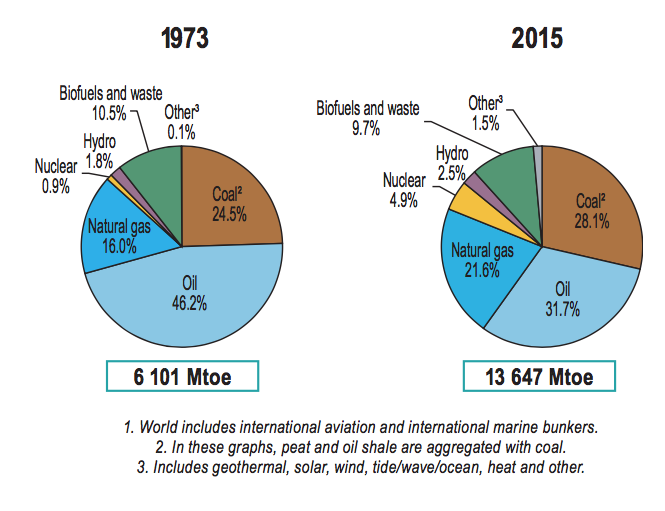
The other category has increased from 0.1% to 1.5%. While this is an impressive percentage increase, the “Other” category is still rounding error in the world’s energy supply.
By the way, “oil shale” is not the same as “tight oil that we get from shale.” It is same category that causes great confusion in EROEI calculations. It is rock that has a little lower energy concentration than a baked potato. It needs to be heated at a very high temperature to release oil (or I believe it can be burned directly, sort of like coal). It got the name “oil shale” long before anyone heard of getting tight oil from shale formations. It has low EROEI (unlike tight oil from shale, which has a much higher EROEI). It is not much used.
Cologne’s administrative court ruled Friday that Germany’s biggest electricity provider, RWE, could proceed with plans to chop down a section of the 12,000-year-old Hambach forest in order to clear space for the company’s open-air coal mine near the Belgian border.
https://www.rt.com/news/410935-germany-to-axe-ancient-forest/
All good. Whatever it takes.
Chop down the entire Amazon if that helps….
According to the article, “Germany is Europe’s biggest polluter, pumping out more than 20% of the European Union’s combined greenhouse gas emissions, according to Eurostat.”
Russia seems to have replaced Saudi Arabia as the market swinger, along with U.S. shale.
An anonymous OPEC source told Bloomberg this week that it was Putin really calling the shots.
http://www.businessinsider.com/forget-opec-putin-is-the-one-really-controlling-oil-prices-2017-11?IR=T
Oh … so the KSA is not forcing oil prices down to try to kill shale after all…. as the MSM has been telling us for years…
MSM = LIES (always)
Vlad “The Bad” Impaler!
Following your logic, the MSM article you reference as proof must also be a lie?
A belongs to set B
A negates the veracity of B
These premises a conclusion does not make.
It was a rhetorical post… Russia – KSA – Shale … are not at war —were never at war … trying to drive each other out of business… as the MSM has been telling us for years
“An anonymous OPEC source told Bloomberg this week that it was Putin really calling the shots.”
I would think that Putin would want much higher prices than what we have now.
so the MSM is telling us that Putin is failing at “calling the shots”?
could be true… who knows?
ps: BAU TONIGHT, BABY!!!!!!!!!!!!!!!!!!!!!!!!!!!!!!!!!!!!
Fail-prone coal and gas plants cannot be relied on to keep the lights on during heatwaves, according to a new analysis that questions the Turnbull government’s promise to shore up summer energy supplies. The report released on Friday finds 11 per cent of the capacity of coal and gas generation failed during the heatwave that struck south-east Australia in February this year, equating to 3600 megawatts.
The government says an over-reliance on renewable energy sources such as wind and solar, which have variable outputs, has left the energy system insecure and vulnerable to blackouts.
http://www.smh.com.au/federal-politics/political-news/summer-has-arrived-and-coalfired-power-wont-keep-us-cool-report-finds-20171130-gzvx56.html
Here’s hoping that Australia has a massive heat wave at some point this summer that results in brown outs and black outs…. exposing the stuuuuupidity of the green grooopies
Maybe Aussies could start building sensibly for their climate: thick walls, domes, wind towers, power-free ventilation? The Gulf Arabs might try that, too. Better than steel and glass coffins. …..
The Australian government is trying to do things about its problems. They are working on a new “National Energy Guarantee,” which will hopefully improve reliability (by requiring dispatchable electricity) while still holding down emissions. This is a link to the government website talking about this.
https://www.energy.gov.au/government-priorities/better-energy-future-australia
According to the article,