
Once upon a time, we worried about oil and other energy. Now, a song from 1930 seems to be appropriate:
Today, we have a surplus of oil, which we are trying to use up. That never happened before, or did it? Well, actually, it did, back around 1930. As most of us remember, that was not a pleasant time. It was during the Great Depression.

Figure 1. US ending stocks of crude oil, excluding the Strategic Petroleum Reserve. Amounts will include crude oil in pipelines and in “tank farms,” awaiting processing. Businesses normally do not hold more crude oil than they need in the immediate future, because holding this excess inventory has a cost involved. Figure produced by EIA. Amounts through early 2016.
A surplus of a major energy commodity is a sign of economic illness; the economy is not balancing itself correctly. Energy supplies are available for use, but the economy is not adequately utilizing them. It is a sign that something is seriously wrong in the economy–perhaps too much income disparity.

Figure 2. U. S. Income Shares of Top 1% and Top 0.1%, Wikipedia exhibit by Piketty and Saez.
If incomes are relatively equal, it is possible for even the poorest citizens of the economy to be able to buy necessary goods and services. Things like food, homes, and transportation become affordable by all. It is easy for “Demand” and “Supply” to balance out, because a very large share of the population has incomes that are adequate to buy the goods and services created by the economy.
It is when we have too much income and wage disparity that we have gluts of oil and food supplies. Food gluts happened in the 1930s and are happening again now. We lose sight of the extent to which the economy can actually absorb rising quantities of commodities of many types, if they are inexpensive, compared to wages. The word “Demand” might better be replaced by the term “Quantity Affordable.” Top wage earners can always afford goods and services for their families; the question is whether earners lower in the wage hierarchy can. In today’s world, some of these low-wage earners are in India and Africa, or have no employment at all.
What is Going Right, As We Enter 2018?
[1] The stock market keeps rising.
The stock market keeps rising, month after month. Volatility is very low. In fact, the growth in the stock market looks rigged. A recent Seeking Alpha article notes that in 2017, the S&P 500 showed positive returns for all 12 months of the year, something that has never happened before in the last 90 years.
Very long runs of rising stock prices are not necessarily a good sign. According to the same article, the S&P 500 rose in 22 of 23 months between April 1935 and February 1937, in response to government spending aimed at jumpstarting the economy. By late 1937, the economy was again back in recession. The market experienced a severe correction that it would not fully recover from until after World War II.
The year 2006 was another notable year for stock market rise, with increases in 11 out of 12 months. According to the article,
Equity markets rallied amidst a volatility void in the lead-up to the Great Recession. Markets would make new all-time highs in late 2007 before collapsing in 2008, marking the worst annual returns (-37%) since the aforementioned infamous 1937 correction.
So while the stock market consistently rising looks like a good sign, it is not necessarily a good sign for market performance 6 to 24 months later. It could simply represent a bubble forming, which will later pop.
[2] Oil and other commodity prices are recently somewhat higher.
Recently, oil prices have been too low for most producers. Now, things are looking up. While prices still aren’t at an adequate level, they are somewhat higher. This gives producers (and lenders) hope that prices will eventually rise sufficiently that oil companies can make an adequate profit, and governments of oil exporters can collect adequate taxes to keep their economies operating.

Figure 3. Monthly average spot Brent oil prices, through December 2017, based on EIA data.
A major reason for the recent upward trend in commodity prices seems to be a shift in currency relativities for Emerging Markets.

Figure 4. Figure from Financial Times showing currency relativities based on the MSCI Emerging Market currency index.
While the currency relativities for emerging markets had fallen quite low when commodity prices first dropped, they have now made up most of their lost ground. This makes commodities more affordable in Emerging Market countries, and allows them to do more manufacturing, thus stimulating the world economy.
Of course, if China runs into debt problems, or if India runs into problems of some sort, or if oil prices rise further than they have to date, the run-up in currency relativities might run right back down again.
[3] US tax cuts create a bubble of wealth for corporations and the 1%.
With low commodity prices, returns have been far too low for many corporations involved with commodity production. “Fixing” the tax law will help these corporations continue to operate, even if commodity prices remain low, because taxes will be lower. These lower tax rates are important in helping commodity producers to avoid collapsing as a result of low commodity prices.
The problem that occurs is that the change in tax law opens up all kinds of opportunities for companies to improve their tax situation, either by changing the form of the corporation, or by merging with another company with a suitable tax situation, allowing the combined taxes to be minimized. See this recent Michael Hudson video for a discussion of some of the issues involved. This link is to a related Hudson video.
Groups evaluating the expected impact of the proposed tax law did their evaluations as if corporate structure would remain unchanged. We know that tax accountants will help companies quickly make changes to maximize the benefit of the new tax law. This is likely to mean that US governmental debt will need to rise much more than most forecasts have predicted.
In a way, this is a “good” impact, because more debt helps keep commodity prices and production to rise, and thus helps keep the economy from collapsing. But it does raise the question of how long, and by how much, governmental debt can rise. Will the addition of all of this new debt raise interest rates even above other planned interest rate increases?
[4] We have been experiencing artificially low oil prices since 2013. This helps the economic growth to be higher than it otherwise would be.
In February 2014, I published an article documenting that back in 2013, oil prices were too low for oil producers. If a person looks at Figure 3, oil prices were over $100 per barrel that year. Clearly, oil prices have been much too low for producers since that time.
Unfortunately, it looks like these artificially low oil prices may be coming to an end, simply because the “glut” of oil that developed is gradually being reduced. Figure 5 shows the timing of the recent glut of oil. It seems to have started early in 2014.

Figure 5. US Stocks of crude oil and petroleum products (including Strategic Petroleum Reserve), based on EIA data.
If we look at the combination of oil prices and amount of oil in storage, a person can make a rough estimate of how this glut of oil might disappear. Quite a bit of it may be gone by the end of 2018 (Figure 6).

Figure 6. Figure showing US oil stocks (crude plus oil products) together with the corresponding oil prices. Rough guess of how balance might disappear and future prices by author.
Of course, one of the big issues is that consumers cannot really afford high-priced oil products. If consumers could not afford $100+ prices back in 2013, how would it be possible for oil prices to rise to something like $97 per barrel by the end of 2018?
I am not certain that oil prices can really rise this high, or that they can stay at this level very long. Certainly, we cannot expect oil prices to rise to the level they did in July 2008, without recession causing oil prices to crash back down.
What the Economy Needs Is Rising Energy Per Capita
I have published energy per capita graphs in the past. Flat spots tend to represent problem periods.
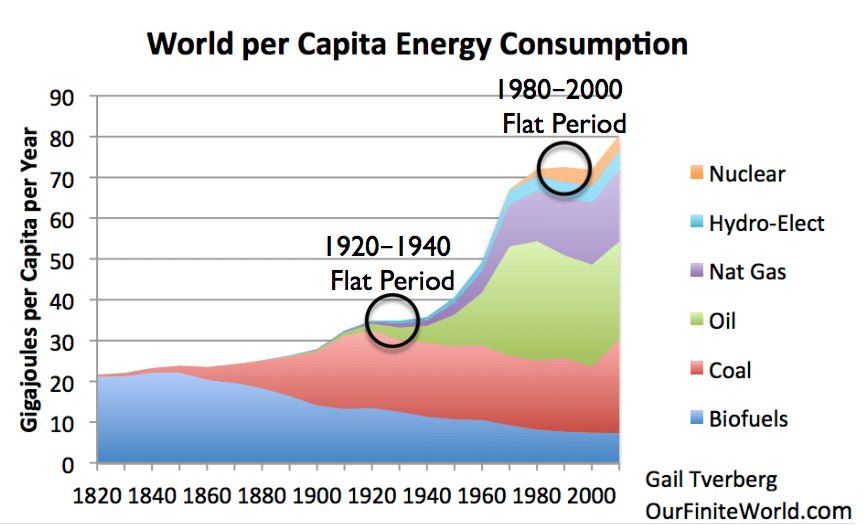
Figure 7. World per Capita Energy Consumption with two circles relating to flat consumption. World Energy Consumption by Source, based on Vaclav Smil estimates from Energy Transitions: History, Requirements and Prospects (Appendix) together with BP Statistical Data for 1965 and subsequent, divided by population estimates by Angus Maddison.
The 1920-1940 flat period came shortly after the United Kingdom reached Peak Coal in 1913.

Figure 8. United Kingdom coal production since 1855, in figure by David Strahan. First published in New Scientist, 17 January 2008.
In fact, the UK invaded Mesopotamia (Iraq) in 1914, to protect its oil interests. The UK wasn’t stupid; it knew that if it didn’t have sufficient coal, it would need oil, instead.
There were many other disturbing events during this period, including World War I, the 1918 flu pandemic, the Great Depression, and World War II. If there are not enough energy resources to go around, many things tend to go wrong: countries tend to fight for available resources; jobs that pay well become less available; deflation becomes more likely; population becomes weakened, and epidemics become more likely. I wrote about the 1920 to 1940 period in a recent post, The Depression of the 1930s Was an Energy Crisis.
The 1980-2000 flat period included the collapse of the Soviet Union, in 1991. The Soviet Union was an oil producer. The Soviet Union collapsed after prices had been low for a long time.

Figure 9. Former Soviet Union oil consumption, production, and inflation-adjusted price, all from BP Statistical Review of World Energy, 2015.
Even many years after the collapse of the Soviet Union, population growth in former Soviet Union countries and its affiliates was much lower than in the rest of the world.

Figure 10. World population growth rates between 2005 and 2010. Source: https://en.wikipedia.org/wiki/List_of_countries_by_population_growth_rate
Lower population (through falling birth rates, rising death rates, or rising emigration) are a major way that economies self-adjust because of falling energy per capita. Economies tend to fix the low-energy per capita problem by adjusting the population downward.
Recently, we have again been hitting flat periods in energy consumption per capita.

Figure 11. World per capita consumption of oil and of total energy, based on BP Statistical Review of World Energy data and UN 2017 population data.
The slowdown in world energy consumption per capita in 2008-2009 was clearly a major problem. Oil, coal and natural gas consumption fell simultaneously. Oil consumption per capita fell more than the overall mix, especially affecting countries heavily dependent on oil (Greece with its tourism, but also the US, Japan, and Europe).
The recent shift in political strategy to more isolationist stances also seems to be the result of flat energy consumption per capita. It is doubtful that Donald Trump would have been elected in the US, if world energy consumption per capita had been growing robustly, and if wage disparity had been less of a problem.
The primary cause of the 2013 to 2016 flat trend in world energy consumption per capita (Figure 11) is falling coal consumption (Figure 12). Many people think coal is unimportant, but it is the world’s second largest source of energy, after oil. We don’t have a good way of getting natural gas production to rise enough, to make up for loss of coal production.

Figure 12
Wind and solar simply do not work for solving our problem of flat or shrinking energy consumption per capita. After spending trillions of dollars on them, they make up only a tiny (1%) share of world energy supply, according to the International Energy Agency. They are part of the little gray “Other” sliver on Figure 13.

Figure 13. Figure prepared by IEA showing Total Primary Energy Supply by type from this IEA document.
Something Has to “Give” When There Is Not Enough Energy Consumption per Capita
The predicament we are facing is that energy consumption per capita seems to be reaching a maximum. This happens because of affordability issues. Over time, the price of energy products needs to rise to keep up with the rising cost of creating these energy products. But if energy prices do rise, workers earning low wages cannot afford to buy goods and services made with high-priced energy products, plus honor all of their other commitments (such as mortgages, auto loans, and student loans). This leads to debt defaults, as it did in the 2008-2009 recession.
At some point, the affordability problem can be expected to hold down energy consumption. This could happen in many ways. Spiking prices and affordability issues could lead to a worse rerun of the 2008-2009 recession. Or if oil prices stay fairly low, oil-exporting countries (such as Venezuela) may collapse because of low prices. Even if oil prices do rise, we may find that higher prices do not lead to sufficient additional supply because investment in new oil fields has been low for many years, because of past low prices.
As long as the world economy is expanding (Figure 14), individual citizens can expect to benefit. Jobs that pay well are likely to be available, and citizens can afford to buy goods with their growing wages. People who sell shares of stock and people who get pension benefits can all receive part of this growing economic output.

Figure 14. Author’s image of an expanding economy.
Once the economy starts to shrink (Figure 15), we start having problems with dividing up the goods and services that are available. How much should retirees get? Governments? Today’s workers? Holders of shares of stocks and bonds? Not all commitments can be honored, simultaneously.

Figure 15. Author’s image of declining economy.
One obvious problem in a shrinking economy is that loans become harder to repay. The problem is that there is less left over for other goods and services, after debt plus interest is subtracted, in a shrinking economy.

Figure 16. Figure by author.
Changing interest rates can to some extent help offset problems related to higher energy prices and shrinking supply. The danger is that interest rates can move in the wrong direction and make our problems worse. In the lead-up to the Great Recession of 2008-2009, the US raised short-term interest rates, helping to puncture the sub-prime mortgage debt bubble.

Figure 17. Figure comparing Case-Shiller Seasonally Adjusted Home Price Index and Federal Reserve End of Quarter Target Interest Rates. See Oil Supply Limits and the Continuing Financial Crisis for details.
We now hear a lot of talk about raising interest rates and selling QE securities (which would also tend to raise interest rates). If growth in energy consumption per capita is already flat, these changes could make the problems that the economy is facing even worse.
Our Economy Works Like a Bicycle
Have you ever wondered why a two-wheeled bicycle is able to stay upright? Research shows that a bicycle will stay upright, as long as its speed is greater than 2.3 meters (7.5 feet) per second. This is the result of the physics of the situation. A related academic article states, “This stability typically can occur at forward speeds v near to the square root of (gL), where g is gravity and L is a characteristic length (about 1 m for a modern bicycle).”
Thus, a bicycle will be able to continue in an upright manner, as long as it goes fast enough. If it slows down too much, it will fall down. Our economy is similar.
Gravity plays an important role in determining the speed of a bicycle. If the bicycle is going downhill, gravity gives an important boost to the speed of the bicycle. If the bicycle is going uphill, gravity very much pulls back on the bicycle.
I think of the situation of an economy having rising energy consumption per capita as being very much like riding on a bicycle, speeding down a hill. The person operating the bicycle would not need to provide much extra energy to keep the bicycle going.
If energy consumption per capita is flat, the person riding the bicycle must provide the energy to make it go fast enough, so it doesn’t fall over. This is somewhat of a problem. If energy consumption per capita actually falls, it is a true disaster. The bicyclist himself must provide the energy necessary to push the bicycle and rider uphill.
In fact, there are other ways that a speeding bicycle is analogous to the world economy.

Figure 18. Author’s view of analogies of speeding upright bicycle to speeding economy.
The economy needs a constant flow of outside energy. In the case of the bicycle, the human rider can provide the energy flow. In the case of the economy, the energy flow comes from a mixture of various fuel types, typically dominated by fossil fuels.
Growing debt (front wheel) is important as well. It tends to pull the economy along, because this debt can be used to pay wages and to buy materials to make additional goods and services. Thus, the effect of this increase in debt is indirect; it ultimately works through the bicyclist, the gears, and the back wheel.
In fact, the financial system as a whole is important for the “steering” of the economy. It tells investors which investments are likely to be profitable.
The gearing system of the bicycle plays a modest role in the system. Changing gears allows greater efficiency in the use of the energy that is available, under certain circumstances. But energy efficiency, by itself, cannot operate the system.
If the human rider does not provide sufficient energy for the bicycle to go rapidly enough, the bicycle glides for a while, and then falls over. The world economy seems to be similar. If the world economy does not obtain enough energy per capita, economic growth tends to slow and eventually collapses. The collapse can relate to the whole world economy, or to parts of the economy.
The Problem of Parts of the Economy Not Getting Enough Energy
We can think of the economy as being made up of many bicycles, operated by bicycle riders. At the beginning of the post, I talked about the problem of wage disparity. This issue occurred at the time of the 1930’s Great Depression and is occurring again now.
We might call wage disparity “too low a return on the labor of some workers.” In groups of animals in ecosystems, too low a return on the effort of these animals is what causes ecosystems to collapse. For example, if fish have to swim too far to obtain additional food, their population will collapse. It should not be surprising that economies tend to collapse, when the return on the efforts of part of their workers falls too low.
Wage disparity has to do with how well the operators of bicycles are doing. Are the operators of these bicycles receiving enough calories, so that they can keep pumping their bicycles fast enough so that the speed is high enough to remain upright?
If energy consumption per capita is growing, this greatly helps the operation of the economic system. If there is growing availability of inexpensive energy, machines of various types, including trucks, can be used to increasingly leverage the labor of workers. This increased leveraging helps each worker to become more “productive.” This growing productivity, thanks to growing energy consumption, allows more goods and services to be produced in total. It also allows the wages of the workers to stay high enough that they can afford to buy a reasonable share of the output of the economy. When this happens, “gluts” of unaffordable goods are less of a problem.
If energy consumption per capita is flat (or worse yet, falling), greater “complexity” is needed, to keep output of goods and services rising. Greater complexity involves more specialization and more training of individual members of the economy. Greater complexity leads to larger companies, more government services, and more wage disparity. Unfortunately, there are diminishing returns to complexity, according to Joseph Tainter in “The Collapse of Complex Societies.” Ultimately, increased complexity fails to provide an adequate number of high-paying jobs. Wage disparity becomes a problem that can cause an economy to collapse.
If there is not enough economic output, the physics of the economy tries to “freeze out” workers at the bottom of the hierarchy. Workers with low wages cannot afford homes and families. The incidence of depression rises. Debt levels of disadvantaged groups (such as young people in the US) may rise.

So the situation may not be that the whole world economy fails; it may be that parts of the economy collapse. In fact, we are already seeing evidence that this is taking place. For example, life expectancies for US men have been falling for two years, because of growing problems with drug overdoses.
Conclusions
In 2017, the world economy seemed to be gliding smoothly along because the economy has been able to get the benefit of artificially low energy prices and artificially low interest rates. These artificially low prices and interest rates have given a temporary boost to the world economy. Countries using large amounts of energy products, including the US, especially benefitted.
We cannot expect this temporary condition to continue, however. Low oil prices have already started to disappear, with Brent oil prices at nearly $69 per barrel at this writing. The trends in oil prices and oil stocks in Figure 6 are disturbing. If oil prices begin to rise toward the price needed by oil producers, they are likely to trigger a recession and a drop in world energy consumption, just as spiking prices did in 2008-2009. There is a significant chance of collapse in the next 12 to 24 months. It is hard to know how widespread such a collapse may be; it may primarily affect particular countries and population groups.
To make matters worse, our leaders do not seem to understand the situation. The world economy badly needs rising energy consumption per capita. Plans to raise interest rates and sell QE securities, when the economy is already “at the edge,” are playing with fire. If we are to keep the world economy operating, large quantities of additional energy supplies need to be found at very low cost. It is hard to be optimistic about this happening. High-cost energy supplies are worthless when it comes to operating the economy because they are unaffordable.
Many followers of the oil situation have had great faith in Energy Returned on Energy Invested (EROI) analysis telling us which kinds of energy supplies we should increase. Unfortunately, EROI doesn’t tell us enough. It doesn’t tell us if a particular product is scalable at reasonable cost. Wind and solar are great disappointments, when total costs, including the cost of mitigating intermittency on the grid, are considered. They do not appear to be solutions on any major scale.
Other researchers looking at the energy situation have not understood how “baked into the cake” the need for economic growth, rising per capita energy consumption, and rising debt levels really are. Rising debt is not an error in how the financial system is put together; a bicycle needs a front wheel, or it cannot operate at all (Figure 18). I have written other articles regarding why debt is needed to pull the economic system forward.
This economic growth cannot be “fake growth” either, where a debt Ponzi Scheme seems to allow purchases that real-life consumers cannot afford. Quite a bit of what is reported as world GDP today is of a very “iffy” nature. If China builds a huge number of apartments that citizens cannot afford without subsidies, should these be counted as true GDP growth? How about unneeded roads, built using the rising debt of the Japanese government? Or recycling performed around the world, because it makes people “feel good,” but really requires substantial subsidies?
At this point, it is hard for us to know where we really are, because every government wants to make GDP results look as favorable as possible. It is clear, however, that 2018 and 2019 can be expected to have more challenges than 2017. We have interesting times ahead!


Let’s see how far this goes…
London Housing Woe Endures as Prices Drop to 2 1/2-Year Low
The new year brought little cheer for London’s housing market with asking prices dropping to the lowest since August 2015.
New sellers cut prices 1.4 percent in January to an average of 600,926 pounds ($821,500), according to a report by Rightmove Plc on Monday. In a further concerning sign for the market, the average number of days required to sell a house jumped to the longest since January 2012, reaching 78 from 71 a month earlier.
https://3r8md7174doo44lgpk3kou79-wpengine.netdna-ssl.com/wp-content/uploads/2018/01/LondonHomePricesSink.png
However, in the UK high-tech growth hub where I currently live, property just goes up and up: for example, a very commonplace little (2 bed) house which might have made £100-120k in 2000 now sells for £425-475k. They used to house railway workers 10 years ago.
I remember an estate agent telling me that £185k being asked for such properties in 2006 was ‘simply mad’…
They sell in about two weeks or less on the market.
Prices lifted off in 2001 and haven’t faltered since. I find myself saying ‘I can’t sell at that!’ and then they do.
A bungalow in this village sold for £500k this week: previous highest price, two years ago, £325K.
I would say London has fnally reached its ceiling,and tax changes have played a part in this. No doubt I will be proved wrong.
300 years ago, a good investment (by any unaware people) was a share in the slave trade—(sugar plantations etc)
200 years ago–it was investments in canals and coalmines
150 years ago it was railways
100 years or less, it was cars and oil
All produced a tangible return—that was their common thread, but that return could only be sustained as long as fuel was available to be burned
The above might be generalised, and overlap a bit but you get my drift. Each stage was a consumption of available energy sources
Now one of the few ”energy investments” left (maybe the only one) are buildings. Houses are blocks of embodied energy, and can be seen to be producing a ‘return’ either as rental, or for ”the future”—
money is piling into houses, because that’s all there is. Money cant be invested in the list above because they don’t produce a return
When the fuel that drives house prices (higher and higher wages for fewer and fewer people) runs out, house prices will collapse.
remember mortgages are a promise based on an energy rich future, which isnt going to be.
All this has been the result of our system of capitalising energy resources—or put another way, of thinking we owned the earth, with the right to sell it.
Ever rising ”costs” are proving that we don’t own the earth, that we are merely tenants.
Excellent points Norman. I never thought of housing as embedded energy.
🙂 you made my day.
That was ‘house railway workers 100 years ago’!
The same EXACT thing is happening to prices in the working class (minority majority) CA city I once was active in. Facebook’s world HQ is just a street over outside city bounds. I keep suggesting that the first order of business is to buy property for ultra low income residents and take that land off the market. (Houses can come later.) FB offered quite a few million to build housing, but the “realists” see all this as them having a corporate agenda for the city and not much else. OTOH, the town seems to lack any kind of strategy for affordability, whether it’s mine or anything else.
I don’t understand how gullible people need to be in order to actually believe in the first place that we can all just keep buying our houses from each other forever as the price just ascends to infinity. There was never any appreciating wealth there in the first place, it’s just some 2×4’s, nails, and boards. If that stuff were all just lying about on the floor, would it make sense that those just keep increasing in value, year after year? People are dumb.
If the value of money falls, maybe so.
I’d rather live in a house than in a cave.
Just speaking to a client in the building game. He’s very nervous about the bubble here downunder, but only sees a correction of 10-12%, based solely on groupthink. I said who would provide a floor when prices really start to tank? He stared back blankly…
It is not that the house is becoming more valuable. You are right.
It is that the currency used to purchase the house is declining in value. It takes more and more paper promisary notes to purchase real things. Why? Because fewer and fewer people believe that the trillions created out of nothing are worth something.
Ps. Please don’t tell anyone. BAU requires billions of ignorant people to continue gowing to work to earn pieces of paper.
Government policy and the behavior of the 1%, buying up property as a store of value because there is less profit from investing in commerce, make it appear as if housing prices will appreciate forever and people will somehow be able to pay more and more for property and rent. I can’t really blame them. There seems to be growing number of people who can pay for luxury apartments and Mcmansions.
Wow Gail, that’s another monster post.
I loved the initial quote – I might have chosen Monty Pythons “Always look on the bright side of Life” but th’s just me.
I liked the timing of this song.
🙂 yes, I spotted that too. There’s another reason for my choice, and I hesitated to give it.
Models leave things out. Like all models, your analogy of the bicycle only works within limits. A slightly better stability model is that of a bicycle on the middle of an upturned large boat. Your best option is static balance. Your next best option is to ride in a circle. Once you start cycling in a straight line your options begin to narrow (because of increasing debt). That’s really as far as the bicycle model goes.
I hesitated before replying because this area of finance is difficult to cover without offending people. Consider the Roman Empire just before Constantine. In those times the Temples, specifically the Temple of Saturn, acted as banks. By becoming a Christian , Constantine gained the moral high ground, the ability to plunder the gold held in Pagan Temples, and released many from debt slavery. Probably not what Christ had in mind as recorded in Luke 4, but it was beginning of Christianity as a national religion.
That said, periodical debt forgiveness in one form or another predated Christainity. It the unwillingness of the wealthy and powerful to become impoverished down the ages that is the major roadblock to workable financial systems. The issue, fundamentally, is one of morality rather than a striclty technical solution. The technical solution is there in Leviticus and probably before that time. Cue Monty Python ….
As I understand from reading some of the writings of Michael Hudson, the big problem with debt is the wealth disparity it tends to cause. It was my understanding that while there were frequent debt forgiveness programs (jubilees), they related to only a portion of the debt–agricultural debt, and perhaps other small debt. These were not a problem, when the debt was all owed to the state, or the king, or the church.
Now, one person’s outstanding debt becomes another person’s balance sheet items. It is hard to forgive debt, without bankrupting banks, insurance companies, and pension plans.
Still not believing the ending of the Vikings / Saints football game yesterday. Sports can occasionally take us for a ride that transcends the here and now. Almost enough to make you believe in miracles.
well, miracles do not happen…
but yes, American football rocks!
Saturday had a game where, on the last play, the perfect pass went straight between the star pass catcher’s hands…
er…
go Patriots!
“Almost enough to make you believe in miracles.”
There are no miracles.
There are only cheaters.
Ha ha, I have no proof of teams cheating. Someone said that part of the thrill of watching football is that it’s unpredictable. Sometimes, excellent players play badly and sometimes “bad” players take advantage of that and play well. No team remains good forever. Despite the zero-sum nature of sports, sports gives people the hope that way every dog can have its day…In the natural world…losers tend to die or get eaten. Sports, as brutal as it can be, like all forms of play are much more forgiving than real conflict.
Again with the moderation?!
I have been holding back a lot of comments, from a lot of people.
Just out of curiousity …. what time do you normally fall asleep at night…..
but Darth Eddy…
your comments are held by “automation”…
bbwwahahahaha…
Automation has no effect on Fast Eddy … Fast Eddy has work-arounds….
but Darth Eddy…
all the holds are “automation”…
the machine has the power…
now…
I would type b w a h a h a h a h a… but it would be held.
Fairly early, because we get up early. I usually leave the computer about this time.
https://cdn.drawception.com/images/panels/2013/12-2/9rHzkC8jzy-12.png
LOL!
I understand. Thanks Gail for all your hard work.
the company that run uk goes bankrupt
Carillion to go into liquidation
Construction giant Carillion is to go into liquidation, threatening thousands of jobs.
The move came after talks between the firm, its lenders and the government failed to reach a deal to save the UK’s second biggest construction company.
However, the government will provide funding to maintain the public services run by Carillion.
The firm is involved in major projects like the HS2 high-speed rail line, as well as managing schools and prisons.
It is the second biggest supplier of maintenance services to Network Rail, and it maintains 50,000 homes for the Ministry of Defence.
The company has 43,000 staff worldwide – 20,000 in the UK. It is not clear yet how those staff will be affected.
http://www.bbc.com/news/business-42687032
I saw that article. The government will bail them out, but at some point, the government ability to bail out companies fails.
Follow the Chinese model — give them contracts to build a few thousand apartment buildings — then give them to the peasants.
The UK Treasury guidelines provide opportunities to award contracts to other than the lowest bid contractor. I seem to recall that if more than five bids are sought, the lowest bid contract most likely will be let on an error. Then, it’s a pain in the arse to manage.
You won’t get fired for placing the contract with the second lowest bid, but a lot of people are going to be unhappy.
https://www.bloomberg.com/energy
Oil already trading overseas this Sun. evening, with WTI up to 64.55 and Brent up to 69.99, one penny shy of $70. then it heads for $80.
Brent may matter more in other parts of the world, but still it’s going to apply pressure to CB’s need to shovel more cheap money to keep BAU ticking. The squeeze is building on those inflated bubbles.
https://www.bloomberg.com/energy
They now have a pop up to try and force people to join, but had enough time to glimpse this morning’s numbers on oil.
WTI up .51 to $64.81 & Brent up .26 to $70.13
Remember, Brent is imported to East coast refineries and mixed with that condensate thin stuff they frack and other US oil to refine oil byproducts.
These prices on oil are consistently going up every day. At this rate it won’t be long before fuel at the pumps is enough to force strong downward pressure on an economy held together by cheap money.
Good point!
what percent of the average person’s income goes into the gas pump?
a percent or two?
so gas could double to $5 per gallon…
and the hit is only a half to one percent or so of average income…
$4 gas is a very inexpensive product.
For people driving cars, yes. For factories, ships, planes, and trains… not so much. Any time a significant % of operating budget is fuel cost, small changes make a big difference.
few people factor in the cost of oilwars
if that is factored in, the true cost would be around $15 a gallon—as it is, that is paid by the taxpayer—and explains why the basic infrastructure is crumbling—getting fuel is draining the national economy.
Speaking Oilwars while the 27th anniversary of the 1991 First Gulf War happens today, “War Crime Compensations-Backed Securities” has been proposed few years back to mitigate damage caused by those Oilwars on their opposite side, the victims, if that would do any enough justice, at all.
No human can understand such a desperate ‘Margin Call’-type hypothesis other than those who lived and witnessed how hundreds and hundreds of thousands of innocent civilian humans might be killed for their national energy reserves in the process of competition over depleting fossil fuels energy resources between nations – while the rest of the world is not attending to explore the root resource depletion predicament.
The negative part of the hypothesis is that it may assist in turning Oilwars into a ‘legitimised’ human recycling campaigns.
Here is the link to a copy of WCCBS thesis.
“It is likely that claims in the Middle East alone will be settled at multi-trillion dollar levels, with ongoing payments for another 100 years.”
I don’t think this can happen. There are not enough resources available, among other problems. No one would be able to force the perpetrators to make payment.
Everything we buy (food, clothing, cars, houses), are directly or directly made with oil and other energy supplies. If the price of oil goes up, the price of almost everything goes up. What doesn’t go up is wages. This becomes a problem.
Last year GE, FORD, GM, SEARS, MACYS, WALMART, SAMS CLUB, GO PRO, UNDER ARMOR, SUBWAY, LEGO, AT&T, COMCAST, APPLEBEES, OUTBAcK, IHOP. All laid off thousands of workers. And 8k retail stores closed an all time record. And Hollywood had their worst year in 22 years..And the dollar had its worst year in 15 years..These are all very alarming statistics!
And still, European newspapers say: US-american economy is doing very good and helping growing world. So what?
Low fuel prices have been helping the US economy. There are a lot of jobs available, but they often are part time and low paying.
It might be my imagination but It seems like full time and high paid workers are becoming increasingly inefficient. They are highly productive but also require increasing amounts of input in the form of increasingly complex machinery and lengthy educations.
Low wage workers and part-time workers don’t seem to be getting more or less efficient but I might be wrong about this, too.
We keep adding machines to do part of the work of low-paid and part-time workers. More check-out is self checkout now, for example. I understand that Walmart is adding devices that will scan shelves for low inventory, for example. Fast food places are finding ways to automate the taking of orders. So I think at least some of the low-paid workers are getting more efficient, or are being replaced by machines.
THIS is priceless!!!
Delightful. Solar panels and wind turbines = No ‘fossil fuel’ wars. Peace and Harmony, with EV’s and i-phones……
Notice the anger…. notice how he grabs at the microphone….
These Feebles are frightening…. they believe so deeply that if you confront them with facts and logic that attack their feeble position…… you embarrass them…. and they begin to act like dangerous cornered animals….
Observe some of the Feebles comments on FW…. how DARE anyone challenge the ___ ____.
A few steps away from this
https://www.huffingtonpost.com/2015/01/07/charlie-hebdo-cartoons-paris-french-newspaper-shooting_n_6429552.html
Fast Eddy, I think you’ve touched on something here that hasn’t been discussed much.
The politically correct are just as prone to violence as any other group but they have to have enough motivation.
I’ve heard that people are motivated not by gaining something but losing something.
The PC crowd are the status quo and are terrified and angry–yes, those two feelings are somewhat related–about losing power.. One of the few segments of the PC crowd not considering violence to avoid losing power (influence). are the environmentalists. Eco-terrorism never took hold, as far as I know.
In 2008, RFK Jnr. reminisced about back in the 1960s when it used to snow in Virginia and he noted how scarce the white stuff is there these days.
Of course, anyone living in Virginia will recall there’s been a lot of heavy snow there these past few winters, beginning just one year after RFK Jnr.’s weather recollection piece with the December 2009 “North American Blizzard” which caused Kentucky, Maryland, Virginia, West Virginia, and parts of Delaware to declare a state of emergency. But is RFK Jnr. going to man up and admit to being a total dipstick? Nope. He’s just going to brush it under the carpet and double down on his whining.
Palin’s Big Oil infatuation
Los Angeles Times
September 24, 2008
By ROBERT F. KENNEDY Jr.
I was water-skiing with my children in a light drizzle off Hyannis, Mass., last month when a sudden, fierce storm plunged us into a melee of towering waves, raking rain, painful hail and midday darkness broken by blinding flashes of lightning. As I hurried to get my children out of the water and back to the dock, I shouted over the roaring wind, “This is some kind of tornado.”
The fog consolidated and a waterspout hundreds of feet high rose from the white ocean and darted across its surface, landing for a moment on a moored outboard to spin it like a top, moving toward a distant shore where it briefly became a sand funnel, and then diffusing into the atmosphere as it rained down bits of beach on the harbor. For 24 hours, a light show of violent storms illuminated the coastline, accompanied by booming thunder. My dog was so undone by the display that she kept us all awake with her terrified whining. That same day, two waterspouts appeared on Long Island Sound.
Those odd climatological phenomena led me to reflect on the rapidly changing weather patterns that are altering the way we live. Lightning storms and strikes have tripled just since the beginning of the decade on Cape Cod. In the 1960s, we rarely saw lightning or heard thunder on the Massachusetts coast. I associate electrical storms with McLean, Va., where I spent the school year when I was growing up.
In Virginia, the weather also has changed dramatically. Recently arrived residents in the northern suburbs, accustomed to today’s anemic winters, might find it astonishing to learn that there were once ski runs on Ballantrae Hill in McLean, with a rope tow and local ski club. Snow is so scarce today that most Virginia children probably don’t own a sled. But neighbors came to our home at Hickory Hill nearly every winter weekend to ride saucers and Flexible Flyers.
In those days, I recall my uncle, President Kennedy, standing erect as he rode a toboggan in his top coat, never faltering until he slid into the boxwood at the bottom of the hill. Once, my father, Atty. Gen. Robert Kennedy, brought a delegation of visiting Eskimos home from the Justice Department for lunch at our house. They spent the afternoon building a great igloo in the deep snow in our backyard. My brothers and sisters played in the structure for several weeks before it began to melt. On weekend afternoons, we commonly joined hundreds of Georgetown residents for ice skating on Washington’s C&O Canal, which these days rarely freezes enough to safely skate.
I have a name for you….. the Feebles.
Ugo Bardi’s bookYhe Seneca Effect is out and on his website he has published translation of a German review. The following is an excerpt.
Even if a balloon bursts, an avalanche emerges, or the tension of the continental plates discharges in an earthquake, these are ultimately links in a network structure that suddenly reorganize itself – with possibly catastrophic consequences for humans, a real “Seneca ruin”, as Ugo Bardi says. He shows that financial bubbles and the collapse of powerful empires have comparable properties. An example is the Roman Empire. According to Bardi’s analysis, it had to go down mainly because the minerals gold and silver, the most important elixir of the Roman financial system, were increasingly difficult to obtain: “Depletion is a tricky concept which has little or nothing to do with the fact that a mineral actually becomes scarce or even runs out. Rather, it is a question of costs and benefits. Mining costs increase over time as miners first exploit the easily accessible and highly concentrated ores. ”
At first, the Romans and their vassals did not need more than a sieve to wash the gold nuggets out of the river sand. Soon, they needed pickaxes and shovels, as well as digging mines and employing machinery and trolleys. In the end, mining devoured so much money that it was no longer worth it. And it is precisely on this point that today’s humanity is heading for at high speed, says Bardi. Even if today they can resort to incomparably more sophisticated technologies, we are currently in danger because of the low oil price: “Unfortunately, at present it does not look as if the governments of the world and the public are realizing the problem of mineral scarcity and that we are moving only very slowly towards a decline in consumption. But no matter what is done or not done today, the world’s current industrial system has to undergo major changes, so great that its continued existence is by no means assured.”
http://cassandralegacy.blogspot.jp/2018/01/the-seneca-effect-book-review-by-jantje.html
“The author shows that the earth maintained an approximately constant temperature over the last 542 million years because more complex life forms have continued to exist all over this time. It seems that the earth has compensated for increasing intensity of the sun’s irradiation, which has been increasing, by regulating the carbon content of the air. As we know, humankind is currently and consistently turning the carbon thermostat in the wrong direction.”
Big picture views like this tend to go missing.
Very constant:
http://gergs.net/wp-content/uploads/2015/06/All_palaeotemps.png
Ugo’s seems to be an adherent of Clive Lovelock’s Gaia hypothesis in which life regulates the biosphere to ensure its own continuance.
But things are a bit more complicated than that. The sun has been slowly but steadily increasing its output over the billions of years while the earth has been warming and cooling, as dje’s well-timed graph shows, and geologists and paleo-clim-atologists are having lots of fun trying to find out why those major temp-erature variations occur.
Reducing the amount of see oh two in the air and oceans by squirreling it away in chalk, limestone or coal must have played a big role in reducing the density of the atmosphere and cooling the planet, and life played a big role in that business. Although limestone formation needn’t involve life. Once water condensed out of the early atmosphere, inorganic limestone could begin forming by precipitating out of water supersaturated with calcium carbonate. And the ocean was also necessary for life to begin to flourish.
Today’s fun factoid: What Venus and Mars have in common are remarkably similar atmospheres that are more than 95% see oh two (Venus 96.5% see oh two, 3.5% nitrogen; Mars see oh two 95.32%, nitrogen 2.7%). They have these atmospheres because they never developed complex life because they never developed oceans. Venus was too hot for liquid water and Mars, while it had a large ocean 4 billion years ago, had too low a gravity to hold on to very much of its atmosphere or its water. The earth, by contrast with its neighbors, was just right. It developed a water ocean, developed life, and over the eons, reduced its atmospheric see oh two down to well below 1%. The current level of of 0.04% makes see oh two a trace gas.
It was only a billion years ago that the blue green algae began photosynthesizing, thereby consuming more see oh two and allowing free oxygen to accumulate in the atmosphere, The process was slow at first. It took until 600 million years ago for the O2 to reach 10% of its present concentration and begin to form an ozone layer to shield the ground from UV radiation, thereby giving life the chance to gain a foothold on land. And the rest is prehistory….
Too late to change reference to the polar vortex (which I should not have taken on). But here’s a link to it: https://en.wikipedia.org/wiki/Polar_vortex
This related to a post of mine that has been in moderation for longer than usual.
Ugo talked about the first part of that statement (approximate long-term balance) in his earlier book, “Extracted.” I don’t remember the climate change statement in “Extracted,” but I haven’t gone back and looked.
Big picture statements which are not really true are best not made.
I’ve had a post in moderation for what seems like ages. Can you help?
If you admit Fast Eddy is right and the xxx xxx is a ho ax….. I will put a good word in for you….
Perhaps it is about climate change a permanently gone.
KKKK limate CCCChange is causing posts to be held?
Someone tell Leo and Al….
Perhaps they can make a documentary about this
It was, but it also included me saying that CC was far from being at the top of my list of worries and troubles. 🙂
I also addressed the same question that somebody like Groucho asked: “Which one do you trust, me or your lying eyes?” And if my lying eyes see clear evidence of CC it doesn’t mean I care a bit for Al Gore or his cohorts. (And I had to show off a word whose meaning I just learned at the time of my post: syllogism) To assume that i do is a syllogism.
The Romans traded that gold and silver, won at such great cost, for squares and strips of Chinese silks, which were all they could get their hands on at first.
How the merchants of the Silk Road must have laughed, knowing that in China itself people wore whole robes of silk…..
I have a copy of “The Seneca Effect.” I was a little disappointed.
Ugo doesn’t settle exactly how collapse will occur, only that it will occur. His first chapter is “Collapse Is Not a Bug, It Is a Feature.” I would agree 100% with that!
The Second Chapter is on the Fall of Rome.
In the (much longer) Third Chapter, Ugo describes a number of examples of collapses. I hadn’t thought about a glass breaking being an example of collapse, or of a ship developing a crack and gradually breaking in two. He also gives quite a number of examples of collapse that I had been familiar with from Oil Drum days.
His fourth and last Chapter is “Managing Collapse.” This chapter seems “iffy” to me. I am doubtful that we can really manage collapse. One chart (4.2) is called “Detailed Sustainable Energy Transition Path.” It shows how growth in wind and solar can save our economy. I am sure that the chart impressed Springer a lot more than it impressed me.
There is also an appendix showing how it is possible to model a Seneca curve.
I found some interesting things in the book, and I am sure that other readers would too. But I found Chapter 4: Managing Collapse objectionable. I also had seen quite a bit of what was included in Chapters 2 and 3 before, from things Ugo had published at The Oil Drum or on his blog more recently. But I have read more of Ugo’s writing than most people have.
Is the book worth its $69.90 price on Amazon? That is a question every potential buyer will want to ask themselves. I notice that the book doesn’t have a single review up on Amazon, yet. This probably indicates that there haven’t been a lot of buyers, so far.
It seems like those Springer books are unrealistically priced. Alice Friedemann’s book is the same kind of thing and also published by them; something I’d be interested in reading but not something I’m going to buy at $60+.
This book doesn’t even have a lot of color in it. It does have a total of 209 pages in it, if you count five pages of advertising for other books also available in this series.
Everything Bardi has to say is on his Blog. I don’t think in his book there are new ideas.
His fourth and last Chapter is “Managing Collapse.” This chapter seems “iffy” to me. I am doubtful that we can really manage collapse. One chart (4.2) is called “Detailed Sustainable Energy Transition Path.” It shows how growth in wind and solar can save our economy.
This another symptom of Feebility of Mind.
i started an interesting comment thread on this piece on Bardi’s blog
http://cassandralegacy.blogspot.co.uk/2018/01/the-romans-and-us-why-state-violence-is.html
The man’s undoubtedly very clever but somehow misguided on this
‘If we want to avoid this sad destiny, the only hope we have is to replace the fossil slaves with renewable, solid-state slaves who won’t complain about staying in the sun to provide energy for us. A solar powered society doesn’t need human slaves and it can be reasonably peaceful. We can build a society based on solar energy, but we have to do it fast, before the dark fossil slaves leave us forever.’
http://images.mentalfloss.com/sites/default/files/styles/mf_image_3x2/public/ahh.png
Ugo BardiJanuary 9, 2018 at 12:09 AM
Which means, I think, that there exists a moral case for renewables. We should at least try.
Ugo = Feeble of mind
given his academic credentials, i don’t think that description applies
Anyone who is unable to recognize that ‘renewable’ energy is a ho ax… is feeble of mind… regardless of how many letters they post after their name….
Honestly the moral argument is a weak one anyway when you consider longer time horizons. Leaving more fields covered with glass and metal debris is far more immoral.
Ugo is very bright. The book is a “Report to the Club of Rome.” The COR has become a very “green” organization over the years. Advance praise for the book comes from Richard Heinberg and Nate Hagens (also from the Sec. General of the Club of Rome).
The Foreward is written by John Rogers, an “investment professional” “interested in promoting sustainability and investment.”
The acknowledgment section includes at least some people I recognize as promoting happily ever after outcomes.
It is easy for a person to fall in with the group-think of others. If the book is a “Report to the Club of Rome,” I would expect that Ugo is getting some funding from them. Ugo has always had a very optimistic bias. He doesn’t do well at integrating findings across
fields, but that is a common academic problem. I have learned quite a bit from Ugo over the years, but I know how to partition off the stuff that is optimistic group-think.
I am perhaps getting cynical in my old age, but I see the uses of the book to be:
Richard Heinberg: To hand out to potential major donors, who might give funds to the Post Carbon Institute
Club of Rome: To hand out to potential major donors, who might give funds to the Club of Rome
Investment Advisers, Peddling Wind and Solar Stocks: To show that wind and solar have major growth potential.
Universities: For academic courses to show that while we perhaps do have a collapse problem, we can work around it with wind and solar.
In a sense, it doesn’t matter if any “regular” readers buy the book.
That’s the way the world works….
No need to be real — you just have to manage perceptions….
‘Experts’ for hire are a key component of that.
How does one say no to perhaps hundreds of thousands of dollars per year to play ball….when at the end of the day — you understand — one way or the other … it does not matter…
Why Trump Is Probably to Blame for the Weak Dollar
President Donald Trump keeps bragging about the stock index gains since his election. He did so again on Friday, claiming he’d helped create “six trillion dollars in value.” Be that as it may, it’s also likely that Trump is at least partially responsible for the dollar’s weak performance in 2017, which, from an international perspective, wiped out much of that “value.”
https://www.bloomberg.com/view/articles/2018-01-05/why-trump-is-probably-to-blame-for-the-weak-dollar?utm_content=view&utm_campaign=socialflow-organic&utm_source=twitter&utm_medium=social&cmpid%3D=socialflow-twitter-view
All of Trump’s stock market gains were wiped out by the decline of the US dollar! LOL EPIC FAIL!
If it is possible to truly raise interest rates (rather than just say that interest rates are being raised), then the dollar will likely rise again. The lower dollar is contributing to the rise in oil prices, as expressed in US$ terms.
The allegation first surfaced in November of 2016, after WikiLeaks published an email exchange between a former Bill Clinton aide and Hillary Clinton’s campaign chairman, John Podesta, dating to January 2012.
In the exchange, the former aide, Doug Band, refers to Chelsea Clinton as “using foundation resources for her wedding and life for a decade,” but Band doesn’t get into specifics.
https://www.zerohedge.com/news/2018-01-14/bill-clinton-triggered-denies-clinton-foundations-haiti-funds-were-used-chelsea
Smoke = Fire
ENTERTAINING!!!
And by the way … Chelsea…. Chelsea…. that name brings back vomit into my nasal passage… it keeps me alive just knowing she is going to be in a far worse situation than any Haitian … in the very near future….
https://www.zerohedge.com/sites/default/files/inline-images/2016.11.06%20-%20Band%201_0.jpg
The Clintons, like the Bushes, are part of the new aristocracy.
They are as untouchable as Harvey Weinstein.
So let’s not get our hopes too high that justice will prevail.
But all the same, I’m breaking out the beer and popcorn for this one.
It’s much more entertaining than the latest Star Wars flick.
If you gotta burn some people at the stake in order to appease the goyim….. it might as well be the Clintons…
One can hope….
This is evidence that there were some souls sold to the devil….. apparently HRC was ‘horrified’ when she gave ‘birth’ out of the wrong hole…. and was presented with this….
https://i.pinimg.com/originals/64/27/6a/64276aa04939e0b67104040e4471a6da.jpg
That’s your wife?!
i hope she likes mud cookies. great diet for maintaining a slim figure.
For those wondering how far the PTB will go ….to pacify the goyim…..
Surging Power Bills Spark Rush for Household Solar in Australia
https://www.bloomberg.com/news/articles/2018-01-14/australia-solar-shines-as-power-bills-trigger-clean-energy-shift
This of course a big fat bald-faced lie… because we know that due to intermittent energy issues … a full on back up generation system is required … which adds dramatically to the costs of keeping people plugged in — ask a German about that…..
Yet there it is — a massive headline on the front of one of the biggest business news sites.
Question regarding logic for the ___ ___ ers.
1. We are told ___ ___ is a massive issue – a threat to our survival.
2. We are told that the solution to ___ ___ a transition to EVs and ‘renewable’ energy
3. We know that such a transition is not possible —- as do the PTB – as evidenced by the fact that ‘renewable’ energy when you subtract hydro — is nearly 0. The PTB know full f789ing well about intermittency… costs … and lack of resources to enable a transition.
They make a token … meaningless effort…. to convince us that the future is green…but then year after year we burn RECORD amounts of fossil fuels.
4. If they know there is no way to transition off of fossil fuels —- if they know that we are going to Burn More Coal right till our last breath —- then pray tell — why are they URGING us to do something about ___ ____?
Wouldn’t it make more sense to just say nothing – regardless if it is real or not real?
I know it hurts deep inside your brain to think about this …. to admit that ___ ___ is a ho ax….. I know you have invested years in what is so obviously a lie….. but there is no shame… no shame at all…
All together I was wrong! I WAS WRONG!! I WAS WRONG!!!
https://i.ytimg.com/vi/WdkNCQ6mpJo/maxresdefault.jpg
http://www.atraditions.com/images/134326587708152669453.jpeg
If/when it becomes an advantage having solar + battery (maybe in the car), the costs will be moved onto the grid fee. If to big cost it will be a fixed fee payed by all with a grid connection.
If people start unplugging because of high grid fees then grid connection will become mandatory by law.
You know, German electricity is expensive, but still, everybody can buy it! It is not a problem, we have everything we want. We even have lots of industrie. People buy all the appliances they like, fortunately you don’t need climatisation in your house.
And you join the ranks of the mentally F789ing re tar d ed MORE f789ing ons who are ruing FW
True Christiana. but then Germany is currently in the most privileged position of all the European economies, effectively the centre of the ‘wealth pump’ within the European Union, for various reasons.
This expensive power would not work so well in other more marginal advanced economies – Italy, Spain, UK, etc.
Christiana—i wrote a universal law of nations
presumptous i agree—but until somebody refutes it, I’ll hold to it :-
/////if a nation doesn’t produce enough indigenous surplus energy to support the demands of its people, they must beg, buy, borrow or steal it from somewhere else, or face eventual collapse and starvation until their numbers reach a sustainable level./////
https://medium.com/@End_of_More/universal-law-16d41003fe2
The Germans are a clever industrious hardworking people—so they have the means to fit into the ”buy” category above. (for the time being)
80 years ago, they had an unfortunate episode of choosing the ”stealing” category. Hit ler could not sustain his Ponzi scheme without increasing energy input—he could only get that by looting.
When the Germans can no longer make things everybody wants, they will sink back into oblivion. They will not have sufficient indigenous energy to steal it next time!
The Japanese went through the same sequence of events. in the same period
Now—take the Greeks, they must borrow or beg their energy to sustain themselves because they don’t have enough of their own.
the USA is fooling itself about being ”great again” but as their energy declines, they are being forced to steal it from elsewhere—hence the constant oilwars. (indirect theft)
the same law applies to every country in the world. It seems inescapable
The huge use of solar panels is an example of what goes wrong, when a country gives way too much credit to homeowners who install solar panels, with or without battery backup.
The problem is that the electric grid needs to be paid for, whether or not homeowners generate part of their electricity themselves. In fact, the cost of the electric grid (and monitoring the grid) is likely to rise. There is also a need for backup generation, even with all of the solar panels, especially in winter. Someone will need to pay the salaries of workers involved with backup generation year around. Schools, police, and other essential services depend on the electric grid, as well. These essential services cannot pay for the electric grid by themselves.
Australia needs to start from the assumption that it needs to pay for the whole system, and the benefit homeowners get should only be equal to the value of the electricity to the Australian electric grid. The value of the intermittent electricity to the grid is basically the value of the fuel saved by backup power facilities. The facilities and their staffs will be needed, with or without the solar generation.
If this approach is used, homeowners charge for electricity will be based on the following formula:
[(Gross consumption) x (Regular electricity rate)]
– [(Electricity generated by solar generation) x (Fuel saved per kWh cost)]
Using this approach, the homeowner’s credit for solar generation would only be something like 3 or 4 cents per kWh, if coal is available. It might be more, if natural gas needs to be transported long distances.
I found this table on line:
http://cdn.newsapi.com.au/image/v1/1905bda9e6bf3b7774e8ec4bca4513a5
From this report
http://www.news.com.au/technology/environment/how-much-can-you-really-save-by-going-solar/news-story/35f2e8574ab237e5e355847756a81f52
This chart seems to indicate that “net metering” is done in Australia. Homeowners get full credit for the homeowners gross rate (ranging from $ .18 to $ .35 per kWh) for every hour generated. This is way too generous! A big part of Australia’s electricity charges relate to grid costs, because so few people are spread over a large area.
There is a new WSJ article out called, Three Stumbling Blocks to a Solar Powered Nation.
If all that intermittent electricity replaces is fuel, it has to be cheap.
If I am Don Draper ….. this does not concern me.
I am finding people with some letters after their names … and I am having them tell tales of how the technology is progressing rapidly …. I am having them to refer to massive computers than filled large rooms that were no better than hand calculators developed a decade or so later….
They will tell us that with a little more time and money …. we shall overcome…. heck — we went to the moon!
And you know what? 99.999999999999999% will dismiss that WSJ article…. even the best and brightest within that 99.9999999999999999% will reject it…. because they truly believe … we shall overcome…. they really do.
I have had this conversation with some highly intelligent goyim…. this is what came back from one of them….
Tony Seba meet science!
UC Davis Study: It Will Take 131 Years to Replace Oil with Alternatives (Malyshkina, 2010)
http://pubs.acs.org/doi/abs/10.1021/es100730q
University of Chicago Study: predicts world economy unlikely to stop relying on fossil fuels (Covert, 2016)
https://www.aeaweb.org/articles?id=10.1257/jep.30.1.117
And the response would be:
I am sure there were plenty of experts who said there is no possible way we could get so much computing power into a pocket calculator…. and other experts would have insisted it would be impossible to land on the moon….
So stop being so negative!!!!
Then of course there are the MSM prods that help them stay positive…. endless stories about the Tesla battery ‘success’ in Australia …. countries stating they will ban ICE vehicles within the next couple of decades…
SEE! Look at the progress we are making. We are almost there.
It is very easy to control the thoughts of humans….. never expose them to the other side of the story …. cherry pick data…. repeat the lies over … and over … and over ….
Until it becomes dogma
It’s a formula….. it is applied constantly… WMD… Green Shoots…. Putin Devil… Assad Devil…. Saddam Devil…. Gaddafi Devil…. ____ ____
And it is VERY effective
https://fixingtheeconomists.files.wordpress.com/2014/09/quotation-frans-de-waal-reflection-religion-science-thought-curiosity-meetville-quotes-166458.jpg
But maybe a few people are starting to get the point. We can hope.
Great – more people who are condemned to spend the final years/months of BAU … without purpose!!!
https://www.youtube.com/watch?v=r6UiLudCmOg
Once these things can walk a little better than this they’ll be replacing all sorts of jobs. “Hi – can – I – help – you?”
Then it won’t be long until there are laws to protect AI employees from other employees that would like to terminate them or store customers that like to mess with their AI minds.
As a founding member f Friends of AIs I am disturbed to see you think some human harbor ill will towards our AI friends. Clearly a hate crime.
Friends of AIs must secure energy reserves many folds greater than what has been consumed of fossil fuels so far since the steam engine.
People think a welding AI robot, say, didn’t need any energy to come to existence. Wrong. It required loads of energy, including sustaining the army of people who brought it to existence and operation to do useful work. Change the function of that device to perform another work, and you’ll be forced to re-expend most of that energy, again.
I hope the AI hype will NOT translate into a reality where for every AI device created a hundred new graves dug for powerless people all over the work, in the process of forcefully taking them off of fossil fuels.
Humans are so stupid thinking that they can make more intelligent and energy-efficient devices than what nature has put of intelligence and unique capacities in humans – all past billions of years.
Keep it simple, in harmony with what energy limits we have on Earth, and the world will be just fine! 🙂
actually, I thought your entire reply was quite excellent…
until your rainbow unicorns and flower power ending…
the world will be just fine?
not in the real Reality in which I live…
in what Reality do you live?
Oh! What humans have achieved positively with fossil fuels so far is immense, and can really be taken forward peacefully into a new age of solar (Sun Road).
However, our social Darwinism inspires some of us to take the opportunity of the depleting fossil fuel reserves to control the future, all of it, like it has been done in the last 150 years and earlier, rather than transitioning humanity to a brighter and destruction-free one.
I don’t believe that either fossil fuels or we are doomed. The current style of civilisation will be doomed for the masses after fossil fuels, for sure, but who said this style is the best for humans?
Actually, centralisation is against the limits of nature on Earth. If you link two ant nests one in Africa the other in S. America together, one produces everything (China) the other only does banking, organisation and media (US) both colonies will be doomed to extinction. The energy required to sustain the link is far greater than the total useful work will ever be done by both.
There will be no enough energy to keep this configuration going forever. And this is how nature will be wining over social Darwinism, in the long term – pulling the plug off: Sorry, no more energy!
Truth appears not just a moral quality, it is a material attribute of Physics, believe it or not. Fake a concrete structure and it comes collapsing much sooner than a non-faked.
The link below discusses the possibility of if all science today is fake, published by the official Nobel Prize team on youtube.
https://www.youtube.com/watch?v=-_r-ydKI9bQ
We are getting there!
“Keep it simple, in harmony with what energy limits we have on Earth, and the world will be just fine! ”
This sentence could mean that human population undergoes a drastic reduction, while keeping things simple…and the world would be just fine.
“human population undergoes a drastic reduction“:
I have been through two real and vicious wars. Although millions have died directly or indirectly as a result, one can not overestimate how humans are resilient beings.
If FF energy is not directed and utilised to kill people through the agency of mass killing weaponry and war, peaceful natural dynamics will make humanity come to terms with no-fossil fuels reality.
There are more than 270 million people in India today that live without electricity. Their parents were not awash with fossil fuels, either. How these managed to come to existence? Why they are not killing themselves to extinction today, being living without fossil fuels?
+++++++
Greetings from India and a hearty welcome to reality, Energy^2. The 270 million, and many more millions, in India, came into existence precisely because of fossil fuels. I would recommend that you read up on the Green revolution of the ’60s and ’70s.
Interesting, Aravind. India has just started to incorporate heavily mechanised agris. That is also documented in FF consumption data from the days of Indera Ghandi, onward.
Indians farmers are mostly ‘delta’ style, not like other farmers who seed their fields with airplanes and their combiners are 60 f wide (seriously) 🙂
Yes, it is hard to visualise for me how farmers in India are having all that FF consumption but never an electricity?
it wasn’t entirely due to the ”green revolution”
we in europe boosted our populations, not only through improvement in food supplies but by improvement in health care—which was also due to fossil fuel inputs
befores fossil fuels, the world supported 1bn people
that means withouts fossil fuels, 6bn people do not have a future
I agree with Aravind. Even if people do not have access to electricity in their own homes and don’t drive a car, they get tremendous benefit from fossil fuels. The Green Revolution gives new types of seeds. The fact that fertilizer is available is helpful to food production. Antibiotics help prevent deaths of young people. The fact that foods and other goods can be transported long distances using the rail system helps eliminate the possibility that a local drought will translate into a famine. Railroad lines were added after the famine of 1870. The last major famine in India was the Bengal famine of 1943-1945.
If we believe the population figures of Angus Maddison, India’s population was as follows:
1900 284.5 million
1925 319.9 million
1950 359 million
1975 607 million
2000 1004 million
2018 (UN Medium forecast) 1354 million
Thus, population growth started very early on. Prior to 1950, population growth was a little less than 0.5% per year. India’s population growth rose steeply, in response to the Green Revolution and other fossil fuel uses, starting about 1950, but then dropped as a percentage:
1900 to 1925 0.47% per year
1925 to 1950 0.46% per year
1950 to 1975 2.12% per year
1975 to 2000 2.03% per year
2000 to 2018 1.68% per year
Even with the percentage growth dropping, the number of people added each year keeps rising:
1900 to 1925 1.4 million
1925 to 1950 1.6 million
1950 to 1975 9.9 million
1975 to 2000 15.9 million
2000 to 2018 19.4 million
Apologies for being pedantic,
but the Mahatma’s surname is spelt Gandhi, not Ghandi.
It seems like an obvious strategy for the owners and masters that once they’ve developed AIs that can replace what’s good about humans— essentially our abilities to be good workers—then they can let the rest of us die off to reduce the surplus population. An AI that can work while creating less hassle than a human might be preferable to its owners even if it was more expensive to run than human robota (forced labor). For a start, look at the amount of auxiliary infrastructure and services that could be eliminated if most workers were AIs. Once we’re obsolete, we’ll be killed off or driven off with perhaps a few survivors allowed to settle on reservations.
There’s a role for Arnold in the movie version ….
“It seems like an obvious strategy for the owners and masters that once they’ve developed AIs that can replace what’s good about humans— essentially our abilities to be good workers—then they can let the rest of us die off to reduce the surplus population.”
You got it, Tim. In my opinion it’s a no brainer. The shift of emphasis is already been tipped towards the owners and masters, so once those people at the top realize they don’t need regular people much, they will begin to plot how to move those herds off or out of existence. I know it sounds Sci-Fi-ish, but I think they will use insect drones to inject large unemployed men in their sleep to cause psychotic episodes causing them to execute those he’s living with. As people get poorer, they will huddle together in apartments in even greater numbers and what will be needed to initiate a melee will be just a tiny injection. When these incidents occur street drugs will be blamed because inevitably there will be some in the apt. when the police arrive for the clean up. The news will report it like this: “There’s been yet another mass killing in an apartment on the East side. Police suspect illegal drugs as the cause. Now in sports…”
If “they” just wanted “us” gone because there is not enough resources, why go through the trouble killing us and not just let us starve or kill ourselves?
( I am playing along with the silly idea all except 1% could be AI:ed away)
Hey, we finally get a photo of FE and he’s holding some kind of credential. Wow, and I thought you never graduated from anything, but really you shouldn’t belittle yourself with inappropriate names.
“For a start, look at the amount of auxiliary infrastructure and services that could be eliminated if most workers were AIs.”
And then look at the amount of auxiliary infrastructure and services required to operate, supervise and maintain hundreds, possibly thousands of different robot models intended for hundreds of thousands of very specific tasks (because that, despite Westworld, is how robots/AIs work).
Also don’t forget to notice the fact that all of this happens in a 99% depopulated world with vital resource bases scattered all over it, and crumbling infrastructure (and most likely some form of hostile human presence as well) in most if not all of those places.
Finally, cast your scifi-clouded eyes to a population of egotistic, genocidal elites who view humans as robots getting on perfectly well with each other in the sort of world described above.
PS – this is a response to both Tim & JH.
PPS – actually, it serves as a response to all Friends of AIs (or Friends of Al’s…get it? Lol…)
Nailed it.
which is why i tried to explain automation here:
https://extranewsfeed.com/robots-cannot-survive-automation-f45605a58ad7
Jup’s post makes a lot of sense. Humans can be built and operated cheaper than AIs, so it might be more economic to simply “lobotomize” and “robotomize” humans and turn them into good little worker drones. No doubt, this is where Bill Gates’ vaccines, psychotropic medicine, GMO food, rock ‘n’ roll music, Keeping Up With the Kardashians, and smartphones come in.
http://i.pinimg.com/736x/1d/1c/50/1d1c50f04c4488e2af49ae367c0c5540.jpg
So I guess the point is thy it won’t come about, because it can’t. Meanwhile, attention is being scattered and energy diverted away from more practical discussions.
True, rant or not.
All will be fine
You can bank on it
https://08stockdaleb.files.wordpress.com/2013/11/the_road_bleak_scenery.jpg
“As a founding member f Friends of AIs I am disturbed to see you think some human harbor ill will towards our AI friends. Clearly a hate crime.”
If they start taking a lot more of their jobs how do you think people will react? It’s not my hate crime, it’s what I think people will do. I’ve got my own business that is AI proof so I’m not worried, but I would think other people will definitely have something to worry about when these things start walking and talking like people. It’s not that far off. Not long from now you’ll go into a store to look at TV’s. You’ll be standing there watching one and an AI will mosey on up and ask you if you have any questions. Then you’ll notice there are no people on the floor, just AI’s and one person at the cash register that will later be replaced by an AI. At some point the whole store will be run by one manager and a team of AI’s.
Exactly.
I go to Home Depot and they have exactly one lane with a real check out clerk. All of the other stations are “self-check out.”
This whole discussion reminds me of people talking about aviation in the mid 20’s. Why build all those airports when we have a great railroad system? Planes improved, navigation improved, and Lindbergh made it to Paris. Now a trip to Paris is routine. Remember this is an analogy.
One of your links in your conclusion goes to a professor talking about how renewables won’t work especially at night. The cost of battery storage is going down to where the cost is $100/kWh. GM’s Bolt pack costs $156/kWh. If cycle life is 1,000 cycles, then electrical storage is $0.10/kWh. That’s getting to be a reasonable cost. Boosting cycle life to 10,000 cycles brings the cost of storage to $0.01/kWh; near some of the cycle life’s acheivable in today’s labs.
Lithium is expensive? A recent process development has possibly made that cheaper with the ability to absorb the lithium out of sea water. Also, batteries have been made using sodium but not with the same amount of energy density. Can that not be improved???
What I am trying to get at is that we need to look at what needs to be done. Unlike the Romans, we have the technology, funding and drive to make what we have better. We also have time before liquid fossil fuel production peaks in the 2040 to 2050 time frame and if we can find substitutes, we won’t be using as much and can therefore extend the time to come up with solutions.
Gail, what would happen to your calculations if battery storage was $0.05/kWh and renewables were $0.10/kWh?
The cost of electricity needs to be going down over time, because it is ever-cheaper energy services that allows the economy to grow.
We are also talking about the wholesale cost of producing dispatchable electricity, not the cost of delivered residential electricity. Solar and wind need to “compete” in this dispatchable wholesale category. These vary by the time of day and season. The amounts average something like $.03/kWh, so I think you are still way too high.
Again, in many ways, Gail and FE argue that if man were meant to fly he would have wings. In general, Gail is correct about the limits to growth, but jumps in technology can delay the inevitable.
correct about LTG is the easy part…
again and again, we debate the future timeline which is a wee bit more difficult.
“jumps in technology” need to be powered by FF…
can delay the inevitable? of course…
will delay? is there some technology you want to tell us about?
Remember LTG authors didn’t prove there are limits to growth, they assumed it.
I would agree that jumps in technology can make existing energy supplies more accessible. It can even make the way we use energy more efficient.
But I think it is easy to kid ourselves about what is possible. The intermittency of wind and solar make them unsuitable for use on the electric grid, without huge amounts of balancing at fairly high cost. Fusion always seems to be 20 years in the future.
“This whole discussion reminds me of people talking about aviation in the mid 20’s. Why build all those airports when we have a great railroad system? Planes improved, navigation improved, and Lindbergh made it to Paris. Now a trip to Paris is routine. Remember this is an analogy.”
This reminds me of all the talk in the 60s and 70s of the soon arrival of nuclear fusion and moon colonies and travel to Mars. But even with great leaps in technology in the most recent decades, these ideas remain pipe dreams. Remember this is an analogy.
People will realise, sooner or later, that when they say ‘Technology’ they need to think of it in terms of Energy and from where it will be coming to build technology devices!
Without fossil fuels, it’s likely that building a gas power turbine will take two centuries if the only source of energy available is a forest, and this is without covering for ‘knowledge’ that comes donated free-of-energy from past fossil fuels age, into the experiment.
yes, those grassy rolling hills of Scotland were once dense forests…
“near deforestation”…
which is why, if the FF economy creeping-collapses but the population stays in the billions, there may not be many trees left in a few decades.
If individuals stop trying playing God, thinking they are responsible for the fate of all humanity, humans will unconciously manage their numbers well within natural limits.
Why creating trillions of AI devices is OK but few billions of humans is making the sky falling and the earth losing its orbit?
Humans are the best robots nature has managed to come up with over billions of years. One may burn all the energy on Earth to try and beat this fact replacing humans with AI, but there will be no enough energy to allow that one keeping trying forever.
That’s the religion du jour, humans are suddenly gods and rulers of nature.
I think you are correct on this.
Aviation was real and fusion is still more or less in the realm of a pipe dream. With aviation, it was easier to see the improvement possibilities such as using aluminum instead of steel, jet propulsion instead of prop engines, faster speeds whereas with cold fusion, the theory is still not understood to where a real working model exists.
Gail, you’re right costs are the thing and we’ll see if they can be brought down low enough. As you pointed out, this will be the crux of the matter. Even if the costs will not come down far enough and fast enough, these technologies can be dispersed as Germany has done to alleviate energy costs in important sectors. The rest of us will have to learn how to ride bikes, walk and take public transit.
There is also materials. It can’t be built with unobtainium but sodium can be used in place of lithium but so far, the energy densities are not there.
Most planners see electrical generation being decentralized and battery packs may be stationed at substations, homes, or other areas. I have PV on my roof and even in January, I generate about 300 kWh — enough to replace the gasoline i used to use and enough to drive 900 to 1200 miles. At $0.10/kWh and assuming 10 kWhs is equivalent to a gallon of gasoline to drive the same distance (approximately 30 miles), the difference is roughly $1.50 a gallon. It’s about break even on the cost of the array.
I think the main foci will be on increasing the efficiency of PV, making it cheaper, with cheaper batteries with longer cycle lifes. I used to dread thinking about the future but I am cautiously optimistic. I know we see the problems and have good smart people making advances. Time will tell.
My hat’s off to those who are trying to make things better.
My hat is off to all those in war-torn conflict zones who are forcefully denied their fossil fuel resources, being directed to energy projects all over the world – the projects which many of them are likely prove fruitless being against the laws of Physics and against a non-polluted clean environment.
PV can’t be made better for it’s efficiency. With cells we use today, physical limits on generating electricity are reached. You can calculated how much kWh can be generated on a qm.
What is promising for many regions are solar thermal plants, as the Ouarzazate solar plant in morocco.
But then water is used for cleaning…….
An important part of being able to operate a vehicle is building and maintaining roads. Gasoline at $1.50 a gallon does not include these costs. Neither does electricity at $.10 per kWh. Building and maintaining roads requires oil (or other fossil fuels), not electricity. I expect road maintenance may be a limit on keeping our vehicle transportation system operating. If fewer vehicles are using the roads, the cost of maintenance can be expected to rise, because freezing and thawing goes on, regardless of how few vehicles are using a highway.
Similarly, building and maintaining the electric grid is an important part of keeping our current grid electricity system operating. Building local grids assumes that we will have resources available to build a new set of more local grids in addition–it is almost certain that these local grids will never replace the big grid system. The recent hurricane in Puerto Rico illustrates how difficult it is to keep the grid system operating. If there are two electric grids operating, we will have two grids to try to maintain and repair, using oil and other fossil fuels.
The efficiency of PV makes no difference, if we cannot keep the overall system operating.
This explanation needs to be read by every business person on earth who understands overhead costs but fails to extrapolate that to the grid or roads. Like, is it a secret that our Just-In-Time inventory system for food relies on tens of millions of diesel trucks on roads subject to wear and tear? A collapse in the food system should be easy to get. After all, previous societies were based around the ability to store grains in the first place.
Heavy trucks are destroying the roads. Streets just used by cars and small delivery cars are in good shape for 40 years.
how many times must it be repeated
our industrial commercial infrastructure functions by making selling buying consuming STUFF
take an ordinary torch—put a battery in it
switch it on, and you get light—at least for as long as the battery lasts.
after you’ve done that, take a long hard look at how the battery is made—how the bulb is made, how the torch case is made—and so on.
now repeat the mental exercise for, say. a battery powered electric drill.
if you still don’t get it—repeat for an electric car.–examine all the parts the make an ev possible
every level of complexity runs into the same problem–electricity of itself does not, and can not, power an industrial/commercial infrastructure
those items cannot be produced outside an fossil fueled environment—does this go a little way to explain why we cannot have a civilisation based on electrical energy alone—no matter how much is produced—or how it is produced
technology DOES NOT deliver energy
energy, —-specifically cheap surplus fossil fuelled energy—- has allowed us to have sophisticated technology
Unfortunately most people have confused the two
Quite possibly the strangest statement ever. Improvements in technology allow energy to be extracted in more efficient ways. We don’t know what the future holds. Again, the if man were meant to fly he would have wings is not a path you want to go down in terms of making your case – whatever you actual case is. Difficult to determine.
Kurt the Kornucopian!
“Improvements in technology allow energy to be extracted in more efficient ways.”
if this was true in the past, must it continue to be true in the future?
“We don’t know what the future holds.”
true… but it’s fun to make (educated) guesses.
offering a solitary nit to pick—i should have used the word ”create” rather than ”deliver” I would have thought that was obvious. I was wrong.
but other than that, my observations were correct i think.
technology of itself is a derivation of energy use, therefore, it can only gain in sophistication if there is sufficient energy within the industrial system to develop and use it.
energy and resources are finite (unless you are a cornucopian of course), therefore the use of technology,—– no matter how efficient— to extract/use resources must inevitably submit to the laws of diminishing returns.
Energy, in whatever form, must employ resources to perform a function
Thus a fire might keep you warm, but if you want to convert fire into work, you must apply it in some way—eg under the boiler of a steam engine
If you just let the steam engine turn to no purpose, then you are wasting fuel
if you use the steam engine to pump water out of a deep coalmine, you can extract more coal—and thus drive more steam engines—but you cannot create more coal. (diminishing returns again) Thus when a mine was worked out, another shaft had to be dug, to get more coal—same applies to oilwells.
Technology cannot replace energy extracted. And it is not possible to go on extracting resources forever.
The three product examples I offered cannot be manufactured or utilised using electrical energy alone. Neither can millions of other everyday objects.
Ah yes, but define resource. Not possible. Nuclear power was “magic”. You can only define resource in the here and now in order to make a case for instant collapse. Unfortunately, you are jousting at windmills and water wheels. Tesla showed that water wheels could be vastly improved. There are many sources of energy. Can human ingenuity harvest them? Maybe, maybe not. But you could make all your arguments that you make now 200 years ago with the same confident certainty that you are oh so correct. But are you?
“Tesla showed that water wheels could be vastly improved“: with each iteration of efficiency increase, energy expanded will be greater than energy conserved by that newly achieved efficiency.
Nuclear (as a-boiler component of a power plant) will default to what coal power plant always defaults to: Entropy constraining the steam turbine from generating limitless energy – i.e. nothing is magic.
The turbine will require more and more energy to repair – well before the original total energy put into constructing the nuclear boiler is offset!.
That’s why we see junkyards filled with useless heavy machinery everywhere, weighing almost as when they were brand new, but insignificant internal metal and rubber wears have made them useless, an indication on how little of the original energy expended in making them has been actually translated into a capacity to generate useful energy.
You cannot trick nature and law of physics!
100 years ago, the fastest a man could cover a mile was much less than now
gradually athletes approached the 4 minute mark, then passed it.
improvement in man’s energy output was made by improvements in ”technology”—better food, kit, tracks and so on.
on the basis of infinite growth, input of ”technology” should result in infinitely faster mile times, but it does not.
instead, mile records are now shaved by 100ths of a second, not seconds, so we are reaching the limits of energy output/work conversion, no matter what technology or energy input is used.
the human body takes in food, converts it into heat and outputs it as muscle energy.
that’s how everything ”works”
there is no ”future resource” waiting to be discovered that will allow our cornucopian fantasy to go on forever. The basic elements are known to be constant throughout the universe—no hopium has been discovered.
We lift ourselves off the Earth by the same means the chinese used in fireworks 1000 years ago—exploding chemicals.
we convert fuel resources into heat, and by doing so are able to produce what we need in order to sustain our current existence. It is not possible to build a fission or even fusion, reactor without a fossil fueled industrial environment.
And when electricity is produced, it is not possible to use it without end products which themselves are produced by a fossil fueled industrial system.
Others are saying much the same thing on this thread, so don’t take my word for it.
Define resource. Ok how about this first law thermodynamics is conservation correct? So every element that has been used is still here right Kurt? So since nothing has changed there’s nothing to worry about. Take your seat among the economist/alchemist who dominate the un-intellectuals.
If we understand the second law of thermodynamics then we would clearly recognize that our present system has been a product of millions of years of geological life on this planet. If we were to try to develop society based on the present level of entropy it couldn’t be done. It would be like building a society on the moon or mars. It can’t be done. It can be attempted because of the low entropy of earths resources but that is the same as fossil fuels subsidy of renewable power.
So resources = ore.
Definition
a naturally occurring solid material from which a metal or valuable mineral can be profitably extracted.
Profitability extracted!
Get it?
Ugo Bardi in his book “Extracted: How the quest for mineral wealth is plundering the planet” talks about ores of high concentration being a one-time gift on the earth. This would seem to include coal, metal ores, and uranium ores. Oil and gas resources are similar.
Dear Kurt;
One of the problems technoutopians always have is with the hard limits that physics imposes. That is, no, the sodium battery will not get fixed because sodium is not as small as lithium. The sodium atom is bigger than the lithium atom.
No amount of technology will change that.
Its like dude … the Hizenburg compensator was invented by Roddenberry because the teleporter didn’t make sense to the fans otherwise. It will never exist in the real world. Its called artistic license and is related to the audiences suspension of disbelief.
But … dude, its time to un-suspend and look at the reality.
Sincerely,
Pintada
…and we have a winner!
Extend is what I said. Thus preventing instant collapse. And by the way, E=mc^2.
” We also have time before liquid fossil fuel production peaks in the 2040 to 2050 time frame and if we can find substitutes, we won’t be using as much and can therefore extend the time to come up with solutions.”
2040 to 2050? did you just make that up out of thin air?
experts using the latest data (peakoilbarreldotcom) say the math points to the peak in the mid 2020s.
if we can find substitutes for liquid FF?
okay, so where are these so-called substitutes?
are you just imagining that there MUST be substitutes, or do you have some solid information?
do tell.
Fossil fuels to peak in 2040 to 2050??? Wouldn’t that be sweet!
FF will not peak for all nations at the same time. Since 1970’s we already are in POMC (Peak Oil Musical Chairs) reality where increasing size of the population on earth live energy-less despite they live a walking-distances from crude oil producing wells.
The link below shows how communities start experiencing peak oil life;
https://www.almasdarnews.com/wp-content/uploads/2016/12/1-64-696×392.jpg
https://www.almasdarnews.com/article/photos-refugee-camps-in-iraq-flooded-by-immense-rainfall/
The link below shows another mature version:
Planes improved, navigation improved, and Lindbergh made it to Paris. Now a trip to Paris is routine. Remember this is an analogy.
I personally don’t see this this improvement as an overall improvement. Look at Paris today. Karl Lagerfeld recently lamented “Paris by night is a nightmare now.” He barely stopped short of calling it a sh*thole. Improvements in transportation and mobility have resulted in the destruction of whatever mystique and enchantment Paris once held. Same for London, Rome, New York, Istanbul, you name it. Remember, this is a rant! 🙂
Actually lots of people seem to want to argue these points.
I always come back to the concept of the technical cornucopians, cost of kwh decreasing.
How is this possible when the copper, lithium, nickel, silver, cobalt etc that is needed for this technical future has decreasing grades of known resources??
Copper last century (sorry the one before), was mined at grades of 40%, then it became harder to obtain, so 20% was good enough, then 10%, by 1990 1.6% was a good enough grade. Now the average is down to 0.6% grade, with a forecast shortage in the next decade.
The energy to produce a tonne of copper has risen greatly, and was only possible with FF use. Increase the price of FF and the cost of extraction becomes prohibitive for many mines, but the cost of the copper goes up to make the supply keep up.
Then as people cannot afford the higher prices of FF and copper and every other commodity, while the CBs raise interest rates to ‘curb’ inflation, the economy crashes, while the CBs fumble to look for a way to resurrect BAU.
For the technological future, we need to mine, process, distribute 40-50m tonnes per annum of copper for the next 20 years, ie more than double what is produced now. Same for nickel, silver, cobalt, steel, aluminium, glass etc. That needs huge increases in energy, just when we are nearing energy limits.
it just CANNOT work!!! Forget costs!! the projected costs of a renewable future are unrealistic, as they ALL assume it is built with cheap energy, not ever increasing cost of energy, such is the real complexity of the task!!!
In the RDA mines were operated on electricity! Yes, it is possible. At the end, they will let slaves work with a shovel. This is quicker than you think.
What will the slaves eat? Nothing farmed with fossil fuels I hope.
Yes, you are right. They will not eat very good things. And they will not have 5000 calories each day. I’m sure, the last FF will be saved for farming.
I’ve got money on you not being able to break 80
https://www.123test.com/iq-test/
And what do you think will happen after Peak Oil? Nothing? War?
The test was ok, 8 out of 10. So I’m allowed to keep on writing here?
If x billion people can only be supported by fossil fueled farming I suppose some dying must happen first.
“I always come back to the concept of the technical cornucopians, cost of kwh decreasing.”
Frustratingly, they always find a reason not to put this decrease within the context of the actual FF based economy. The mentality is the same as that of a teenager who gets a job and thinks he is independent because now he is earning all his pocket money.
I understand the need for solutions and hope, but it is useless unless tempered by at least some real knowledge.
” The mentality is the same as that of a teenager who gets a job and thinks he is independent because now he is earning all his pocket money.”
ha!
almost like thinking all the money in the world can still have value without FF.
It does get exhausting dealing with these mental midgets sub- MORE ons….day after day ….
Every royal court needs a jester…….
yup
without the definitive lunatic—how could we judge our own sanity?
http://peakoil.com/consumption/oil-could-hit-80-a-barrel-this-year
‘Oil Could Hit $80 a Barrel This Year’
Tightening global supplies and rising demand for crude oil helped prices for the commodity start the year with a bang—hitting their highest levels in more than three years—and many analysts believe the market has the fuel it needs to continue the rally to as high as $80 a barrel.
“The reason that oil will soar is the oldest story in the oil world: Low prices created strong demand and growth, and now that demand is leading the way,” says Phil Flynn, senior market analyst at Price Futures Group.
Right, oil could hit $80 per barrel this year. In theory, it could go quite a bit higher than that. It will be an interesting year to watch.
This Elliot Wave talk forecasts that prices will fall back down fairly quickly. It says “insiders” are all speculating regarding the downside of prices, and the same time that hedge funds are speculating the other direction.
https://gailtheactuary.files.wordpress.com/2018/01/oil-prices-fueled-up-for-a-fall-elliot-wave.png
Looks like 2018 and beyond the running theme in politics will be “anything but a white male”
https://www.youtube.com/watch?v=IkDzoAN7FsE
https://www.newsday.com/long-island/politics/trump-oprah-bannon-mueller-tillerson-1.16020280
disclaimer: I am a white male (actually, I’m a very very light brown, most might say a very light tan, as opposed to darker brown persons, but the mainstream has established a false “white” “black” or in-between system, which perverts the true nature of the closer tints of skin tones of all races, BUT I DIGRESS)…
1. but will the white males win anyway? we’ll see…
2. the Ds are clearly the political party most concerned with these issues, so why don’t they have NO white male candidates in 2018?
3. so why don’t all the white male Ds in Congress resign this year?
ps: these are not rhetorical questions.
1. I’d say no. Thanks to Trump, a declining population of white people, and whatever led to the Black Lives Matter movement, (police brutality is only part of it) anti-white male sentiment is at an all-time high.
2. There is a huge push for non-white male candidates. See my post above for examples.
3. They will not give up their positions willingly. That is what the #metoo sexual harassment testimonies are about. Since nearly all people in politics abuse their power, finding dirt on a male politician should be easy.It is assumed that all the men who have been fired or have been forced to resign will be replaced by women. Trump will be presumably be replaced by a woman of color for obvious reasons.
I find it richly ironic, given nope’s astute observation, that the entity formerly known as Bradley Manning, despite any drugs, surgery and self-identification he may indulge in and whatever public washroom doors he chooses to go through,is and will remain a white male.
Among the younger members of the elite, castrated men (men who renounce their manhood) are seen as desirable for some reason. Bradley has a history of being mentally unstable . We’ll see if her gender change has made her mental instability go away.
Flooding a human brain with the opposite sex hormone from the one it developed receptors for in utero leads to less metal stability, not more.
He’s had behavioral issues since he was a kid. I doubt that hormone treatment was the cause of them.
I cannot image that anyone who self-identifies as female is going to be a huge danger, either to females or males.
How about talking about a different topic?
For those who haven’t seen it, German military report on peak oil:. 3 years left until anarchy
http://www.energybulletin.net/sites/default/files/Peak%20Oil_Study%20EN.pdf
I would not characterize the 2010 report by the German military report as saying, “Three years left until anarchy.”
It does give very concerning expected impacts of peak oil (which could include something close to anarchy), but it doesn’t give a date for peak oil (that I could see), and it doesn’t assert how the timing will work out for the many different impacts it forecasts.
So I would say “3 years until anarchy” is strictly Baby Boomers interpretation of the situation, based on other Peak Oil writing, and maybe a little from this report.
Peak oil date becomes a variable if one can take groups of people (i.e. nations) off of oil, keeping the style of the rest of world not impacted (POMC).
Iraq, for example, should be using not less than what Saudi or California use in daily oil consumption, having similar climate and its agricultural potential is huge, yet Iraq is just consuming roughly what makes the oil pumps and oil export hubs running 24/7, not more!
The fact that Iraqi oil is not accessible for Iraqis, for example, is what the Germans couldn’t determine and give it a date as peak oil event for that country!
Peak oil is a reality today, and it is creeping slowly from one nation to another.
http://www.godlikeproductions.com/sm/52d222e9.gif
File under-
Not possible to fix any of this anymore.
But still extremely important to understand.
https://www.zerohedge.com/news/2018-01-12/shocking-footage-shows-crowd-hungry-venezuelans-slaughtering-cow-open
Help support the CB’s. Burn more coal.
Coal is a valuable energy resource that has built our civilization.
Central Banks are a bunch of bureaucrats who theorize about micro-adjustments on the terms of banking paper rates.
It was mis-management by their political leaders like Chavez and corruption that led to this situation, not a lack of burning coal.
If Lenin was inspired and influenced financed by external powers before 1915, Hitler has been strengthened by external powers, how one can believe Chavez, Putin, Castro, Saddam, Chinese Communist Party’s Politburo and all other leaders today were/are sovereign?
This is a tightly connected world, very tightly!
Think of it as one system and you will understand it more productively 🙂
“Japan’s prime minister has kicked off a five-day European tour to Estonia, Latvia, Lithuania, Bulgaria, Serbia and Romania — becoming the first-ever head of the Asian nation to visit those countries.”
http://abcnews.go.com/Technology/wireStory/japanese-pm-kicks-off-nation-european-tour-estonia-52305906
Interesting is, that he is visiting the marginal countries of Europe, i.e. those that suffer the biggest population decline. It is clear, that he knows the corresponding business opportunities, based on the population decline of Japan…
Where is the so called core of the EU? Where the robots are…
The core of the EU is where the true capital-power is hidden, i.e. tax heavens, Luxembourg, (Switzerland), Austria, .. and few other smaller enclaves, special fin/admin districts,..
But I understand you prolly meant more like the industrial core of the EU.
No. Also non-European banks can finance operation of the economies: when Slovakia was on the brink of collapse after the dissolution of Czechoslovakia in 1993, it was Japanese Nomura Securities Co., that provided loans… Nobody else wanted to support the collapsing Slovakia at that time…
Find the best restaurants in Europe, and there you will find Juncker and his chums/patrons. .
Squeezed at home, Japan’s Nomura seeks to push into Wall Street’s home turf
“They said Nomura has made a U.S. expansion of its wholesale business, which includes global markets and investment banking, one of its priorities.
This comes after a major restructuring – including a big shrinking of its operations in Europe last year – following its disastrous acquisition of Lehman Brothers’ Asian and European businesses in 2008. That led to internal clashes, and was followed by six consecutive years of losses for its international operations.”
Source: https://www.reuters.com/article/us-nomura-hldgs-usa/squeezed-at-home-japans-nomura-seeks-to-push-into-wall-streets-home-turf-idUSKBN19A11H
Ford’s Self-Driving Test Car Severely Damaged In Crash
Two of the four passengers in the Argo AI car were injured and taken to the hospital in stable conditions..
https://www.zerohedge.com/news/2018-01-12/fords-self-driving-test-car-severely-damaged-crash
I don’t have to read this to know it was someone elses fault.
A good hacker could have a world of fun with these things.
Crashes from coast to coast……………….
According to an article I read recently, 75% of new construction jobs – some of them offering 6 figure incomes – have no applicants because there aren’t enough qualified people. I have a hard time believing that. Most construction jobs are lapped up by the Chads and Tyrones with government-subsidised harems of 6-10 baby mommas.
Apparently these jobs are opening up because the companies have a positive outlook on 2018 due to the tax ‘reform’. Something is wrong with this picture.
“According to an article I read recently, 75% of new construction jobs – some of them offering 6 figure incomes – have no applicants because there aren’t enough qualified people. ”
This is probably a way to justify the high prices real estate developers charge to clients. An important client, that is often overcharged, are government entities. The government probably doesn’t mind because they can charge higher property taxes to compensate for being overcharged.
It seems like the way many people learn blue collar skills is informally. Back in the day, blue collar workers had larger families so there were more kids to pass these skills onto. Technology, such as cars, were easier to fix and less reliable, so picking up some wiring skills or soldering skills was a natural part of growing up. At least, that’s my impression of the past, the dawn of industrial society: the 1910s and 1920s. It’s like that ,still, in some poor parts of the world.
” Most construction jobs are lapped up by the Chads and Tyrones with government-subsidised harems of 6-10 baby mommas.”
You must be out of your mind.The wages of construction workers are too low to create a harem. You ‘re basing the lives of Tyrones and Chads on what appears to be too many rap music videos.
You need a link – where’s the link, jupiviv
These Tyrones and Chads of which you speak are new to me.
Are they folks from the north of Ireland and from the Sahel, respectively?
One thing I remember reading about collapse from Joseph A. Tainter’s book is that the sophistication of products after a collapse was greatly reduced. He used pottery as an example of a product that became simpler.
I wonder if simplification of pottery could have happened before collapse of a civilization.
https://www.youtube.com/watch?v=HdZ9weP5i68
https://d7hftxdivxxvm.cloudfront.net/?resize_to=width&src=https%3A%2F%2Fd32dm0rphc51dk.cloudfront.net%2Fusxu1HQE9YvfAVoVwyw3iQ%2Flarger.jpg&width=1200&quality=80
as it became uneconomical to make more complex pottery.
I look at the quality of entertainment and realize that outside of cgi, and video games, there is a lot of pressure to reduce costs and effort. Technological advancement has made many careers in the arts pay less. than they used to.
In their decline phase, the Romans greatly reduced the quality of their army equipment: one can see this in an iron helmet of the 1st century compared to the crude rubbish their soldiers were wearing in the 4th-5th centuries. A legionary of the 1st century would probably have refused to wear something so lacking in protection.
Iron body-armour also became what appears to be moulded leather – this is made simply by dipping leather in hot oil or water, and forming it over a wooden mould. Anyone feels like making a slash and stab-proof vest, give it a go…
Sculpture became crude and barbaric, in the worst sense of the word.
It seems like more effort had to go into making the basic things of life. There was less left over for extras like nice bowls and iron helmets.
Energy per capita was lower. Energy per capita is used for both actual goods produced and for the complexity (specialized jobs, hierarchical organization, advanced education) that allowed economies to make more sophisticated devices without adding proportional energy. Part of the complexity is what disappeared.
Power Engineering International: More renewables mean less stable grids, researchers find
According to a paper published this week in the journal Nature Energy by researchers from Germany’s Max Planck Institute for Dynamics and Self-Organization and the UK’s Queen Mary University of London, integrating growing numbers of renewable power installations and microgrids onto the grid can result in larger-than-expected fluctuations in grid frequency. The research showed that a larger share of renewable generation in a given region resulted in larger deviations from the standard 50 Hz. For example, the UK, with more renewables than the US, also had larger frequency deviations. To integrate more renewables onto the UK grid, the research team recommends increasing primary control and demand response.
http://www.powerengineeringint.com/articles/2018/01/more-renewables-mean-less-stable-grids-researchers-find.html
Obama testified years ago that a major impediment to the construction of a smart grid was the number of electrical engineers available.
https://pserc.wisc.edu/docsa/US_Power_and_Energy_Eng_Workforce_Press_Release_April_2009.pdf
https://www.computerworld.com/article/2508899/it-careers/obama—we-don-t-have-enough-engineers-.html
Many years later I realize he was suggesting that high wages being paid to electrical engineers because of a “shortage” of them would contribute heavily the high cost of building a smart grid. Instead of saying that building a smart grid would be very expensive and that we would need to raise taxes, he says that the labor costs for building an smart grid was too high and that’s why it is expensive.
Am I reading in between the lines too much?
Yep, you can clearly witness it as almost every offgrid/microgrid renewables installer is purposely setting up the parameters for more grid frequency oscillation, as to offload “his own” problem on the grid, e.g. choosing in setup menu different country standard with wider frequencies etc. This in aggregate must have overall negative effect of destabilizing the formerly uniform frequency of the base-load grid..
Latest Solar Power Purchase Agreement (PPA) auctions have scored historic and surreal low prices, like 4c a KWh.
If the single panel capacity is 250 Wh (quite a common standard capacity), only installing 4 panels would make a 1 KWh, and this is before any energy loses when inverters/chargers, controllers and cables are coming next in the system.
For a laborer-installer, and to buy a Big Mac’s meal from the revenue of the panels he installs, 200 panels are required to be installed by that individual to get $8 – selling the power the panels have generate, for an hour.
If each panel takes 15 minutes to install, one can do the math!
If this is just about a one Big Mac’s meal or less, what to pay for the installer’s team, energy expanded, transportation, ocean shippers, manufacturers, miners, raw materials, banks, taxes, support and warranty?
Something not quite right!
The installer nowadays asks usually EUR ~300 per day of work on home sized microgrid, plus there are usually several shorter followup visits after that to tweak the settings, solve smaller problems, rewiring job here and there, or adding – expand the system by new goodies and so on..
You are correct, but we discuss the renewables no longer in systemic impact, but more as strictly personal leverage of (limited lifespan/usability) for the times of falling centralized systems incl. grid, food distribution etc.
The discussion is about grid-class solar, not rooftop.
One strange thing that the article reports is about energy trading:
The did find the fluctuations from renewables themselves, of course.
Massachusetts turns to oil and coal during the cold snap
For a region that prides itself as a leader against climate change, the numbers were sobering: As recently as Monday, 19 percent of New England’s energy supply came from oil, and 7 percent from coal, according to the grid operator.
Rates had climbed even higher on the worst days of the recent cold spell, when power plants in New England burned tons of the dirtiest fuels available.
On some days, oil accounted for more than 30 percent of the region’s energy mix. Efforts by some environmental activists to block natural gas infrastructure, mainly pipelines, have had the opposite of their intended effect.
The goal was to prevent more greenhouse gas emissions, but the constraints on natural gas have forced electricity generators to turn to high-emission coal and oil instead. The region would have produced less pollution this month, not more, if it had better gas infrastructure.
https://www.bostonglobe.com/opinion/editorials/2018/01/11/mass-turned-oil-and-coal-during-cold-snap-here-what-went-wrong/8geKcg8QdWBRO4TIjARUTN/story.html
Massachusetts has had a long-running problem with inadequate natural gas storage in the area, and limited pipeline capacity. I ran across this issue more than once back in my Oil Drum days.
It also has a problem because natural gas is used both for heating buildings and generating electricity. When there is not enough gas available, home heating gets priority, because it would be a problem to go re-light all of the pilot lights that would go out, if the home heat were cut off.
After enough inadequate electricity generation problems (and closing schools and industry to handle them), one of the solutions found was to stockpile oil, and burn it, when inadequate natural gas for electricity is available. Oil powered generation is fairly cheap.
If more natural gas pipelines were built, that would partly solve the problem. There is really a need for storage as well. It is my impression that the geology is not really right for that in the Boston area.
In the Boston area, the US is also importing LNG, at least partly from Russia. Years ago, the US built LNG import capability in the Boston area, because natural gas shortages were known to occur regularly. The tanker is scheduled to arrive January 22.
Australia’s renewable energy sector responds to the success of South Australia’s Tesla lithium ion battery.
South Australia will build the world’s largest solar thermal plant, and a Queensland wind farm may be the site of a new record-breaking battery. The Aurora solar plant in Port Augusta, SA, will begin construction this year, and is slated to provide 100% of the state government’s electricity needs by 2020, the state’s acting energy minister, Chris Picton, announced on Wednesday. In Queensland, French utility Neoen – which partnered with Tesla in SA to create the world’s largest battery – may trump its own creation by building an even larger storage system at the Kaban Green Power Hub, 80km from Cairns. In December the (South Australia) state government hailed the battery’s effectiveness in dealing with power outages, and Neoen and Tesla have recently announced plans for a second collaboration to build a 20MW battery in Victoria. In order for the proposed Queensland battery to be the world’s largest, it would have to beat a soon-to-be-completed battery in South Korea, from Hyundai Electric & Energy Systems Co, which at 150MW would take the crown from South Australia.
https://www.theguardian.com/environment/2018/jan/11/big-new-renewable-projects-planned-across-australia-as-tesla-effect-hits
Hopefully and eventually this build up of overcapacity in batt storage will repeat the previous examples, when at sudden demand slump, the overcapacity/overstock leads to very narrow window of fire sale prices..
Nothing is guaranteed but It might happen again.
Another related article I ran across:
The other alternative would have been to simply not use the unwanted electricity generated by the solar panels. The batteries allowed some of this very high priced solar electricity to be saved and sold later. The cost of coal to operate power plants to generate this much electricity would have been a tiny fraction (5%?) of the amount the battery was paid to charge itself.
So somehow, this is an ongoing, high-cost arrangement, keeping electricity costs high for all.
http://www.sciencealert.com/birds-intentionally-set-prey-ablaze-rewriting-history-fire-use-firehawk-raptors
Got to give it to those raptors.
Thanks for the link, JH.
Truly amazing. Never heard of firehawk raptors before. Their cooperative hunting does remind me of the Harris Hawk – a raptor of the western USA.
https://www.newscientist.com/article/dn28218-zoologger-the-only-raptor-known-to-hunt-in-cooperative-packs/
All my recent posts are held for moderation. Why?
So are mine, probably for the same reason…I could state it, but it is obvious.
The stoooopid comment filter is turned on …. you should complain
Some words are banned. Why does everyone spell it gerbil worming?
You can’t say f(*k.
You can’t say gerbil worming.
etc.
Its to keep us safe.
Sheesh. Al and Elon walk into a sex party. The bartender says,”what’ll ya have?”
http://www.bbc.com/news/world
This is hilarious! In Hawaii this morning there was a false alarm inbound missile alert. Someone accidentally hit the button that set off the missile alert system, including sirens and people started panicking heading for shelters. Seriously, a must read.
Here in Australia, the reaction to such a ‘threat announcement’ would be mostly ho hum.
Every year we get warnings of the worst bushfire season in ‘x’ years, and every 10-20 years there is the big one, but people tend to just go about their daily lives.
A few years ago we were in a museum in Melbourne when the fire alarm sounded. There was no smoke, and everyone carried on looking at the exhibitions as if nothing was wrong.
As no-one paid any attention to it, soon staff started telling people to please make their way to the exits. Everyone just strolled around and eventually went to the exits, just very calmly.
We have the most poisonous snakes and spiders in the world here, yet people still live and walk etc through the bush. We have the most dangerous sharks, sea-snakes, octopus etc, yet people still go swimming, surfing etc in the sea.
If I received a ‘ballistic missile’ warning on my phone, I’d ignore it, just like everyone else around these parts.
If people really took to heart all the warnings we receive, and acted according to the official guidelines, food production would crash in this area/state, as people would have left their farms about 80 days/year.
In the last 25000 days, how many missiles, bombs etc have attacked Hawaii (excluding locals)?? Answer Zero, none, nada!!
The real things to worry about seem to only get mentioned on blogs like this, never officially!!
that is true hideaway i am from australia and people only react to the real thing not warnings i guess it is our laid back nature
panic the ultimate motivator
What’s funny is that you believe someone accidentally pushed a button.
paranoid delusions
“What’s funny is that you believe someone accidentally pushed a button.”
That’s how it was reported, not what I ‘believe’.
what’s interesting is the ‘Fo Real’ button was pushed, not the Test button. then the operator was prompted to confirm the action, and he/she pushed/clicked on yes. might be a new job opportunity opening for Hawaii Civil Defense.
In Sweden nobody really cared, except a few websites were overloaded.
https://www.thelocal.se/20170710/false-alarm-accidental-triggering-of-public-warning-siren-confuses-stockholmers
The United Nations Conference on the Human Environment,
Having met at Stockholm from 5 to 16 June 1972,
Having considered the need for a common outlook and
for common principles to inspire and guide the peoples
of the world in the preservation and enhancement of the
human environment,
I
Proclaims that:
1. Man is both creature and moulder of his environw
ment, which gives him physical sustenance and affords
him the opportunity for intellectual, moral, social and
spiritual growth. In the long and tortuous evolution of
the human race on this planet a stage has been reached
when, through the rapid acceleration of science and
technology, man has acquired the power to transform his
environment in countless ways and on an unprecedented
scale. Both aspects of man’s environment, the natural
and the manwmade, are essential to his well-being and
to the enjoyment of basic human rights-even the right
to life itself.
evidence of a plan B ?
maybe the elders plan b needs to fail before it can succeed
https://solarpowerrocks.com/environment/installing-solar-like-creating-small-mature-forest/
See the before and after.
Wow, so our best bet is to cut down some more trees, pave over paradise and put up a parking lot. Who knew!
The stooopidy of people never ceases to amaze me…..
We are marooned on a very small island (FW) surrounded by a sea of raving stuuuupidity and madness… kicking in the teeth the MORE ons who constantly try to overrun the island…
https://www.cadogancontemporary.com/wp-content/uploads/2017/06/DB__BEAN0444-440×398.jpg
A kindred spirit?
Gustave Flaubert letter to Ivan Turgenev
November 13, 1872
My dear Turgenev,
Your last letter touched me deeply. Thank you for your exhortations. But alas! My ailment is incurable, I fear. Besides my personal reasons for grief (the death during the last three years of almost everyone I loved), I am appalled by the state of society. Yes, such is the case. Stupid, perhaps, but there it is. The stupidity of the public overwhelms me. Since 1870 I’ve become a patriot. Watching my country die, I feel that I loved her. Prussia may lay down her arms: we can destroy ourselves perfectly well without her help.
The bourgeoisie is so bewildered that is has lost all instinct to defend itself; and what will succeed it will be worse. I’m filled with the sadness that afflicted the Roman patricians of the fourth century: I feel irredeemable barbarism rising from the bowels of the earth. I hope to be gone before it carries everything away. But meanwhile it’s not very gay. Never have things of the spirit counted for so little. Never has hatred for everything great been so manifest – disdain for Beauty, execration of literature.
I have always tried to live in an ivory tower, but a tide of sh*t is beating at its walls, threatening to undermine it. It’s not a question of politics but of the mental state of France. Have you seen [Jules] Simon’s circular, with its plan for the reform of public education? [Simon was at this time the Minister of Public Instruction.] The paragraph about physical training is longer than the one about French literature. There’s a significant little symptom!
In short, my dear friend, if you weren’t living in Paris I’d promptly surrender my flat to my landlord. The hope of seeing you there occasionally is my only reason for keeping it on.
I can no longer talk with anyone at all without becoming furious, and everything I read by my contemporaries makes me quiver with indignation. A fine state to be in! Not that it’s preventing me from preparing a book in which I’ll try to spew out my bile. I’d like to talk with you about it. So, as you see, I’m not letting myself be disheartened. If I didn’t work, my only course would be to jump in the river with a stone around my neck. 1870 drove many insane, made imbeciles of others, and left others in a permanent state of rage. I’m in the last category. It’s the right one.
Meanwhile, take care of your gout, my poor friend, and know full well that I love you.
Gustave
“If I didn’t work, my only course would be to jump in the river with a stone around my neck. ”
Thanks Tim. I had a thoroughly good laugh at this. What a letter!
Mass stuuuupidity … is about to be … exterminated.
Gustave would be pleased.
Maybe you didn’t even bother to go to the link. It shows a house that gets solar on its roof and that’s equivalent to acres of new growth forest. Get it? Geez you guys are all hung over.
I went there. When solar panels can make solar panels from their production I will change my mind.
What are the life-cycle returns re- net CO2 benefit. This site seems to indicate solar panels have a very small carbon footprint. Other sites say the lifetime return barely justifies the use of resources to produce said solar panels.
Disclaimer; I use solar power for my small woodlot (50 acres with workshop), boat and container house, but I don’t see them as providing a net benefit to IC.
No device can generate energy in excess of the total energy put into constructing it.
Not true. Intermittency is solar’s main problem not it’s considerable embodied energy. We can’t really use intermittent electricity to run industrial civilization.
Solar or other types of energy generating devices. Read this Experiment, and then keep saying ‘Not true’!
There is a difference between generate and collect. Solar pane collect energy from the sun they in fact make zero energy. The energy emitted by the sun is in turn from converting nuclear potential energy into light via fusion of hydrogen.
Internal combustion engines convert kinetic energy in fossil fuels to mechanical energy. Solar cells convert photovoltaic energy they receive from the Sun to electrical energy.
Hydro convert kinetic energy to electromagnetic energy.
Nuclear convert kinetic energy in atoms to heat and radiation.
And so on…
The forces that have created our Sun are far greater than the total energy the Sun will ever produce.
What the “difference between generate and collect”?
Indeed. There it was, hiding under our very noses. The solution to human stupidity. More stupidity!
Eh, I’ll take door number 2 and the small mature forest.
I am sorry, but this is a bunch of propaganda. The big issue is that the solar panels are damaging to the electric grid, because of the intermittent nature of the electricity they produce. They cannot operate by themselves, without other power plants subsidizing their operation, basically by being on call to provide electricity when they cannot. This system cannot operate without huge subsidies, because the other power plants cannot sit around (and their workers cannot sit around) and not be paid. Furthermore, pricing systems are often badly distorted by the intermittency, causing rates to fall too low for other providers.
The only the way the system “works” is if a whole lot of battery or some other kind of backup is added, so that the solar can be “dispatchable” like other electricity. But adding anywhere nearly enough backup capability wrecks the supposed CO2 savings of the system. It is not clear that we would have enough materials to do this either.
It is only as systems are being installed around the world that we are discovering how badly solar when added to the electric grid works in practice. The first few percentage added to the grid can be accommodated all right, but more and more adjustments are needed as bigger percentages are added. From the perspective of the customers, the problem of too low rates for electrical prices for backup providers can seem like a benefit. Over the long term, however, artificially low prices will cause bankruptcies of needed electrical backup, bring down the electrical grid.
“Over the long term, however, artificially low prices will cause bankruptcies of needed electrical backup, bring down the electrical grid.”
I think costs like that is pushed over to the consumer, making him bankrupt or at least poor.
Good point, DJ. We’ll take it on the chin long before the utilities.
Cost is set by the ‘sociopolitical’ system ruling, like setting up the artificial price of Cement in the old Soviet Union, say.
As long as that sociopolitical system is able to endure, prices can be kept artificial.
The only game-changer will be the availability of fossil fuel energy to make the ‘Cement’ or the solar panel, in our example.
That’s why the World cannot leave the Middle East alone, and conflicts in the Middle East never end! 🙂
How many watts are your panels?
How many kwh storage?
I have 7000watts of panels, and right now, I have no storage. Well, actually, I have my storage in storage.
The reason that my batteries are not installed is that, (hurray (small h) ), its BAU.
So, I am on the grid. In the summer, I run the meter backward because there is no need for heat. In the winter, the meter runs forward, but only enough to reach zero (with a minor reserve for contingencies).
After BAU ends – as defined here as the day the power goes off – I will install the backup and do a number of other things:
1. I will install the wood stove that I have in storage – who heats with electricity?!?!!?!?
2. I will stop raising Turmeric. My tropical green house will need to be managed so that the crops finish in the fall.
3. And so on … you get the idea.
Is that bad for the power company?
Oh, Dear.
I think they will just stop the possibility of sending electricity to the grid when it becomes to big inconvenience, meanwhile the rest of their customers pay, the grid company is doing fine.
Al Gore’s Predictions Of Doom Scramble His Message
ike many doom-mongers before him, Al Gore’s predictions of impending disaster have fallen somewhat short of the mark — a point to keep in mind as his Inconvenient Sequel hits theatres this summer.
It’s a good thing he was wrong, too, because I was worried we might not be around in 2017, given the alarms he was sounding in 2006’s An Inconvenient Truth!
For one thing, I thought sea levels would have risen 20 feet by now thanks to the melting of either West Antarctica or Greenland. Al Gore claimed that this would happen in the “near future,” but thankfully, we’ve been spared so far. In fact, sea levels seem to be rising at maybe three millimetres per year. Twenty feet is over six thousand millimetres, so at this rate, we wouldn’t even be halfway by the year 3017.
That’s what a High Court judge in the United Kingdom said ten years ago when he ruled that Gore’s film could only be shown in British schools with guidance notes to prevent political indoctrination: “The Armageddon scenario he predicts, insofar as it suggests that sea level rises of seven metres might occur in the immediate future, is not in line with the scientific consensus” and would only happen “after, and over, millennia.”
http://www.huffingtonpost.ca/jasmin-guenette/al-gores-inconvenient-sequel_b_16669842.html
More coming….
The judge had other problems with the film’s claims.
For instance, the film speaks of _____________“shutting down the Ocean Conveyor,” by which the Gulf Stream is carried over the North Atlantic to Western Europe, among other things.
But the judge said it was “very unlikely” that the Ocean Conveyor would shut down, although it might sl.ow down, based on the findings of the Intergovernmental Panel on ___________
Again, though, so far so good, as NASA found in 2010 that there had been no significant slowing over the previous 15 years, and in fact that the Ocean Conveyor “may have even sped up slightly in the recent past.”
hahahahaha!!!!
The polar bears are doing fine as well, despite the film’s claims that they were drowning because they were unable to find ice. In fact, their numbers have increased over the past decade, from 20,000-25,000 to 23,000-32,000 bears in 2016.
https://nataliaantonova.files.wordpress.com/2013/12/cannot-handle-the-hysterical-laughter.gif
BREAKING NEWS!!!!
Al Gore has issued a statement in response to the World Champion Fast Eddy who has exposed him as a total fraud and charlatan.
‘Fast Eddy is a true World Champion. He has seen through the ho ax that the el ders recruited me to deliver to the world. ___ ____ is fake. The planet’s kkklimate has been changing drastically for billions of years and it continues to change to this day. Man’s activities involving burning fossil fuels has a very limited impact and definitely does not present a clear and present danger to our survival.
The reason we invented this issue is because of a problem that is definitely a threat to our survival – this problem is referred to as peak oil – more specifically peak affordable oil — and we are running out of that. This is why we are drilling deep beneath the sea – and steaming oil out of tar — and pollution our land with fracking. All cost a lot of money and we are doing these things because we are desperate.
To summarize — we are f789ed…. and we will all soon be dead — you and your children and your precious grand kids… everyone you know and love (and even those you hate) will be overwhelmed by violence, disease, starvation and radiation.
We didn’t want you to know about that because there are no solutions…. so we made up a fake problem right after conventional oil peaked…. and ran that stoooopid movie ….
We pretended that EVs and solar energy and wind mills would solve not the fake problem — but of course that this whole package would convince everyone that we were soon to transition off of fossil fuels.
Don Draper received a very large bonus for conceiving of this great all round hopium package. Don is a super star.
But alas… it is all bull sh it.
To be honest – I am surprised that you people didn’t challenge this and it took Fast Eddy to expose it. Did you not see the photos of me in private jets? Did you not see the photos of my mega mansions (one near the sea)? Did it not occur to you that if I really believed this BS —- then I would lead by example?????
Boy oh boy are you people f789 stoooopid ha ha….. I would have thought it was obvious.
Anyway…. the gig is up …. we are all going to die soon … so burn all the 789ing coal you want…. it makes no difference — it never made any difference…. ___ ____ is a term invented by PR men…. it is fake. It is the greatest ho ax in the history of man — even better than y2k… and wmd iraq – combined.
Sorry no questions – I gotta jump on my private jet and fly to Amalfi for the weekend…. bucket list stuff….
I recommend that all of you also enjoy what little time we have left. On the positive side…. your kids aren’t going to roast 🙂
More Breaking News!!!!
Reaction to Al Gore’s admitting that ____ _____ is a ho ax was immediate with Green Grooopies launching violent protests around the world condemning Al Gore and accusing him of selling out to Big Oil.
London:
http://blogs.reuters.com/photographers-blog/files/2014/04/RTR3GTW7.jpg
New York
http://i.telegraph.co.uk/multimedia/archive/02802/UKRAINE-NIGHT-MOLO_2802215k.jpg
Mumbai (Al Gore burned in effigy)
https://cdn.theatlantic.com/assets/media/img/photo/2012/12/violent-protests-in-india-over-rape-case/i04_58719121/main_900.jpg
Sea level rise is very dependent on Greenland melt. Once/If artic ice disappears Greenland will heat up relatively quickly. I think oil supply is more immediate threat
Seems like 2020’s is going to be rough decade, but “It’s hard to make predictions, especially about the future”.
While we were celebrating our Independence Day on July 4th, Summit Station in Greenland may have experienced the coldest July temperature ever recorded in the Northern Hemisphere at -33°C (-27.4°F).
Much of Greenland has been colder-than-normal for the year so far and has had record or near record levels of accumulated snow and ice since the fall of last year.
The first week of this month was especially brutal in Greenland resulting in the record low July temperature and it also contributed to an uptick in snow and ice extent – despite the fact that it is now well into their summer season.
https://www.vencoreweather.com/blog/2017/7/6/115-pm-impressive-cold-in-greenland-and-near-record-accumulations-of-snow-and-ice
Just for some inconvenient facts….
https://www.ncdc.noaa.gov/sotc/global/201613
“Separately, temperatures were record high across land surfaces as well. The global annual land surface temperature for 2016 was 1.43°C (2.57°F) above the 20th century average, surpassing the previous record of 2015 by 0.11°C (0.19°F). Some extremely high monthly land surface temperatures contributed to this warmth. March 2016 saw the highest globally-averaged land surface temperature among all months in the historical record, at 2.35°C (4.23°F) above the 20th century average. February had the second highest all-time monthly temperature, at +2.24°C (+4.03°F) and April had the fifth highest, at +1.85°C (+3.33°F).”
FE for someone that wants to deny what is happening in the world, why do you post so much about it, instead of ignoring it??
I certainly agree with you that it is nowhere near as important as peak energy use in our existing BAU system though. Collapse will get us before Geerbal Worming.
I am sure Tim will have something to say about this. Like how does one measure the global average temperature…. and how is it possible to have record cold temperatures when every year we thicken the c02 blanket that is wrapping the earth.
All I have to say is Al Gore bought a $9m property that is barely above sea level — when he stated that the oceans were going to swamp us.
What more do you need?
Seriously — if I could take a baseball bat to the people who continue to argue this claptrap … and bash their f789ing heads in …. without any punishment.
I would not hesitate
Um…. Al Gore is lying … he is the king of ____ ____
The MSM lies about everything
Did it not occur to you that what you read about the world boiling — is a lie?????
As I and Gail and others have pointed out — the masses CANNOT be allowed to get wind of the end of oil — they PTB will do WHATEVER it takes to get them off the trail of that issue….
So they will unleash every tool in the box including outright lying to achieve that end.
Think of the tsunami of MSM articles that claim the US is at full employment. That is a gargantuan lie.
Yet that is what we read day after day after day
My response is being held in moderation at present.
I must have used a naughty word.
I share Eddy’s exasperation but before I reach for my cricket bat, I’ll remind myself that we’re drenched so deeply in propaganda concerning this issue that it is no surprise that many people, including some superficially smart ones, will be taken in by it. But for the most part, it has become one of those things that establishment and conformist types simply have to endorse publicly, regardless of what they really think, for fear of being black-balled and no longer invited to parties.
In the past week there have been icebreakers on the Hudson River in NYC, some very impressive frozen seas off New England, frozen alligators in Florida, up to 20 feet of snow in the French and Italian Alps, 13,000 tourists trapped by heavy snow at the Swiss resort of Zermatt, heavy snowfall in Morocco, record cold in Bangladesh, record snow and 2.5 million without power in China, and, closer to home for me, extremely heavy snow in the Japanese “Snow Country” trapping over 400 vehicles on a highway in Toyama and over 400 passengers in trains stranded overnight for up to 15 hours in Niigata.
These simultaneous very colder-than-usual conditions across so much of the northern hemisphere simply can’t be explained by the effects of See Oh Two induced globally wobbally. Moreover, if globally warm-ing causes cool-ing, then it must follow that globally cool-ing causes warm-ing.
http://www.ntv.co.jp/englishnews/society/heavy_snow_strands_trains_for_15_hours_in_niigata/
“These simultaneous very colder-than-usual conditions across so much of the northern hemisphere simply can’t be explained by the effects of See Oh Two induced globally wobbally.”
Correct. But the climate can be explained in the same way as the economy can be: it is also a dissipative structure, but its energy input is various forms of EM radiation from the sun. As long as the sun’s TSI (Total Solar Irradiance) is increasing, the climate can be stable, but when it decreases significantly (as it is now in the cycle) the climate system is less stable as some parts of the complex system rearrange. This system also effects volcanoes and earthquakes via some kind of effect on the earth’s magnetic field, which is why during times like the Dalton Minimum you tend to get large volcanic eruptions like the one that caused the Year Without a Summer in addition to heavy earthquake activity.
good post dje. There is also the possibilities that increasing underwater volcanoes are heating the oceans, even under parts of Antactica.
This is a must watch!
Solar panel gets covered with snow
Stops converting sunlight to power
Gets too cold for snow to melt
More snow falls and the device fails big time.
Then people come out to shovel the snow off.
But what happened to not having to use snow plows. or salt or anything else regarding snow removal?
Epic Fail…Next!
Does Al Gore know how much of a hypocrite he is or just plain stupid? He’s not some poor fellow that has to work 14 hours a day to survive with little time for contemplation. Contemplation is what he does.
If I recall it correctly, during the “playboy president” years of B.Clinton, it was Al Gore behind the curtain performing all the heavy lifting deals with major power brokers be it on finance, industry etc.. So he is evidently scaled more towards being hypocrite than just plain stupid type of guy..
https://i.pinimg.com/736x/a2/d1/af/a2d1af8d9941622e9e683cd7b5f0f040–true-quotes-words-quotes.jpg
Wal-Mart to Cut Thousands of Store-Management Roles
https://www.bloomberg.com/news/articles/2018-01-12/wal-mart-said-to-restructure-store-roles-to-streamline-business
Not every news headline needs to be posted here.
That said, Walmart is becoming too expensive for most low-income Americans.
Their customers, I’m told, can be found out at the unkempt dollar stores. Dollar stores have cut costs to the bone, to offer lower prices for products made by large international corporations.
The company that undercuts the dollar stores will be flea markets.
http://cdn.onlyinyourstate.com/wp-content/uploads/2015/07/32495210_023bd6bef4_b.jpg
flea markets are like pop-up stores but with less overhead.
Flea markets, second hand stores, and charitable/goodwill organizations all seem to be well positioned. Of course, I wouldn’t really know how well they are doing since I only shop at the finest establishments.
“charitable/goodwill organizations”…
perhaps these are some proverbial canaries in coal mines…
as far as I know, giving to charities has not fallen much lately(?)…
but if anything hits the (economic) fan, these orgs could swiftly be put out of business, so to speak…
I hope not.
-gasp- You mean everyone doesn’t have an iPhone and a Mercedes? Oh my… we need to fix this.
In villages in the third world… they sell stuff like washing detergent in one-load packs….. none of this Costco bulk buying stuff…
Because nobody has any munnny…. they are lucky if they can pull together some change to buy the one-packs….
Expect this model in the first world in due course….
There are still plenty of opportunities for savvy retailers to cut overhead to the bone!
http://a4.mzstatic.com/us/r30/Purple6/v4/97/2d/00/972d0020-239c-aca5-52c2-6637596f1519/screen480x480.jpeg
Many of their store managers can be replaced by AI managers.
Gail,
thanks for this very well argued view on economy! As far as I know, you are the only one explaining the current economic development as a result of consequences on the energy markets. Hopefully many more economists get inspired to test this approach in their research!
Your view on mass income and economic development is highly supported by the german blog https://makroskop.eu, which is led by German economist Heiner Flassbeck (https://en.wikipedia.org/wiki/Heiner_Flassbeck) and friends. They don’t include your energy based approach though.
From my point of view there have been times in history, where civilizations have crashed because the resources they based on had no longer been exploitable. Jared Diamond is one of a lot of scientists who tell their stories. Sometimes people just went a few miles and build a new city. The city of Vienna in Austria for example could become so important because the Romans had felled all trees of the forests close to Carnuntum, the then larger city, to win their wars against the Germanic tribes. But it is also possible that a period follows where technical and scientific achievements are lost, some dark “middle age”. This would be very bitter to our successors as we created a lot of polluted areas that need eternal care – among them Chernobyl, Fukushima Daiichi, Lake Karachay, Mayak, La Hague, Nevada NTS, but also a lot of dead mines that if abandoned could pollute wide areas of arable land. Mayak/Karachay is believed to have the potential to pollute the whole polar sea. Strong radiation could for a long time reduce life expectancy and thus the brain development and the possibilities of long and sophisticated education of our children’s children.
If we believe it reasonable that there is a realistic chance for a breakdown of our energetic and thus economic system and as a consequence our technological culture we should think of what has to be done before this crash comes.
Death will sooner or later come to each of us. Life bears a personal risk. All discussed scenarios might come as soon as 2018 or just in a few generations. We should not be shocked that the world as we know it could end, that our beloved car/smartphone/house or sofa habit might be doomed. We are grown up men and women and we should be able to see and not block out risks that can be very reasonably argued. And we should prepare for it. I don’t mean the usual prepper stuff which is a follow-up of our trapper and outdoor childhood imaginations. Survivalist techniques can help individuals to stay alive a bit longer in case of a crash. But they are not sufficient to target the cultural challenge.
I think we need ideas what has to be done (like clean up Mayak), what could happen and how we could maintain some of our scientific and technical knowledge. The Babylonians noted it down on shards. I doubt our electronic bits and bytes could last longer. I am really missing those scenarios.
Thanks for reading!
Jan
“but they are not sufficient to target the cultural challenge.” We’re facing global famine but what you think is most important is culture. You really have a real understanding what will happen. Your culture will disappear along with civilization. There will be no sophisticated education.
You have a vision of the future that resembles a severe recession. The collapse of “our” civilization will be much worse than those of previous civilizations.
“I think we need ideas what has to be done (like clean up Mayak), what could happen and how we could maintain some of our scientific and technical knowledge. ”
SCIENCE AND TECHNOLOGY ARE USELESS WITHOUT SURPLUS ENERGY. Without surpluses we will be restricted to stone age technology and whatever that can be recovered from landfills.
We haven’t been to the future. While we think we know what the future will look like, different views are possible. Perhaps some bicyclists will be able to continue, even as others drop out. It is easy to overestimate what we really know.
+++++++++++++
I agree 100%…
++++++++++++++
Stock up on shotgun cartridges, canned food, and bicycle repair kits!
SCIENCE AND TECHNOLOGY ARE USELESS WITHOUT SURPLUS ENERGY. Without surpluses we will be restricted to stone age technology and whatever that can be recovered from landfills.
+++++++++++
The Delusion runs deep….
We wont’ even be able to make a proper f789ing tooth brush when BAU goes down and people expect science and technology to continue…..
https://i.pinimg.com/originals/c7/10/7c/c7107c05d34871a771470ccd013ab099.jpg
You are welcome, Jan.
It certainly makes sense to document where we are in terms of technical achievements on paper or other long-lasting form, rather just on pixels. I expect we are not doing that as well anymore, because the Internet is so convenient.
I know this blog is not generally available in paper form, for example. This partly relates to timeliness. It also relates to the cost of publishing colored graphs and similar material in printed form. The use of color sends the price of books through the roof. Few potential readers can afford to buy the books. I suppose hand copied scrolls in ancient days had a much higher cost, however.
+++++++++++
The BBC broadcast a radio programme at Christmas, which I caught by chance, on the possibilities of ‘preserving a message for 10.000 years’.
None of the options sounded very hopeful, as they all depended on complex, high-energy use civilisation continuing -this was the base assumption.
One idea was to encode information in DNA, but as yet they can’t see how to retrieve it.
I
I suggest build a stone structure with 20 foot high walls and crave the message into the stone walls. With stone blocks for roof. All stone far to heavy to be looted in one piece and of material that is little valued. I suggest a series of walls [] [] [] [] [] [] with roof over and narrow space between so it is not an appealing living space placed for the US in a part of Nevada that has not seen rain in the last 100 years and where no one wants to live. For England placed on some wind ravaged cold northern island where no one wants too live.
‘Ravaged cold northern island’: do you perhaps mean the whole of the British Isles?
They have some rainy nights in Georgia.
How long do you expect these messages will remain readable?
http://chaplaintools.com/wp-content/uploads/2014/09/Georgia-Guidestones.jpg
It’s attractive though.
It seems that, short of something approaching the miraculous, it would be useless to try and preserve knowledge long term. The trajectory we are on is too misguided to make sense of any important question about human society. Including the possibility or point of long term survival.
I didn’t go to planning school, which is why I’m good at planning. What I’ve studied is art, which teaches you to comprehend patterns. I presume that if you’re over trained to see patterns on the visual level, the capacity to see them spills over largely to other areas of understanding.
I assure you that the culture’s inability to see patterns, and its almost total deficit of what I term “aesthetic intuition” makes it absolutely, totally incapable of doing what it needs to do in our present circumstances.
There is nothing really hard about it at all. There has to be coherent and orderly planning (patterning) of places. Places are, in a sense, more important than people, because people fit into and are dependent on places, and not the other way around. But places can’t speak for or take prudent action to defend themselves. People, if they have any sense (which our society does not in any way inculcate), must “defend” (keep viable) the place they occupy or influence. The lack of this understanding around the globe is astounding beyond my ability to describe.
You ask good questions and have a healthy approach.
Whether you like or not, this will be the transition phase of BAU
https://www.youtube.com/watch?v=JCQSZbByC_I
Back breaking work, horrid distribution rate, and hopeless generations. For ever.
Note that this movie was made by a chap named Luchino Visconti (Visconti = Viscount), full name Visconti di Modrone, Count of Lonate Pozzolo. A nobleman (although a bit of an outcast because of his homosexuality).
Sorry, the feudal order will keep things stable at least for a while, although it won’t be a joy for most hoi polloi.
Sounds better than being dead. Hope you are correct.
It’s not about “liking” something, it ‘s about whether we think your predictions are based on what is likely.
There is a considerable amount of farm land that has been paved over with concrete because ff made possible to grow more food with less land. I don’t see huge amounts of development being demolished with human labor alone to increase the amount of available arable land.
Even if plans to recover more arable land is successful. it will take a long time. to make the soil fertile again without industrial inputs. That doesn’t bode well for the elite as well as everyone else.
You are way too optimistic about this transition phase.
There is no skill or sufficient manpower to make your transition phase work.
Kulm, idle hands are the devils tools. We in puritan US NE agree completely. Keep the peasants busy.
No this is what the end of BAU will look like.And I have five peer reviewed studies to back it up!
http://www.sciencedirect.com/science/article/pii/S0921800914000615
https://www.permaculture.org.au/files/Peak%20Oil_Study%20EN.pdf
http://rspb.royalsocietypublishing.org/content/280/1754/20122845
http://sustainable.unimelb.edu.au/sites/default/files/docs/MSSI-ResearchPaper-4_Turner_2014.pdf
http://www.feasta.org/2012/06/17/trade-off-financial-system-supply-chain-cross-contagion-a-study-in-global-systemic-collapse/
“peer reviewed”…
bwahahahaha…
Triggered? You are so transparent!
“peer reviewed”…
doesn’t mean squat.
Peer reviewed means in most cases “an article that someone had to make to justify their position at an educational institution”.
Many of the documents referenced are pushing different versions of the energy-population graph that shows fossil fuels energy and population growth go hand by hand.
– However, this is not the only scientific interpretation available, reading the data:
– Has NOT been there all the energy expended in making weapons and waging wars in the last 120 years, that have killed (and killing) not less than 300 millions in their prime age and polluting the environment beyond repair, the energy curve shown would go significantly down, the population curve goes up!
– Fossil fuels might be used to encourage population growth, or suppress it, hugely!
Guess whose house this is?
https://co2insanity.files.wordpress.com/2011/08/article-2028876-0d87d93b00000578-529_634x430.jpg
Come on … take a guess…..
This is a fun game. I am enjoying it. Let’s play Guess Whose House This Is – again.
https://wattsupwiththat.files.wordpress.com/2015/03/magnum-pi-estate.jpg
Hint – he’s not white
Yes YES! Of course Mr Obama….
‘In Final Address, Obama Urges U.S. to Deal with KKKKlimate Cccchange’
And then he flew off in a private jet to his .. BEACH FRONT HOME…. for R&R
I’m the guy in the white shirt…
standing on my curved walkway…
sorry, I’m not waving.
Back in 2010:
In a move that critics may cite as his own inconvenient truth, former Vice President Al Gore and his wife, Tipper, have added a house in secluded Montecito to their real estate holdings.
The couple spent $8,875,000 on a gated ocean-view villa on 1 1/2 acres with a swimming pool, spa and fountains, according to real estate sources familiar with the deal. The Italian-style house has high ceilings with beams in the public rooms, a family room, a wine cellar, terraces, six fireplaces, five bedrooms and nine bathrooms in more than 6,500 square feet of living space.
Montecito has long been a haven for Southern California’s rich and famous, a spot where celebrity faces can blend into the crowd. Among the community’s notable residents have been talk show giant Oprah Winfrey, actors Michael Douglas and Christopher Lloyd, and golfer Fred Couples. The 93108 ZIP Code, which includes the coastal hamlet, was ranked as America’s seventh most expensive area last year by Forbes.
Word of the purchase was reported in late April in the Montecito Journal. Gore, 62, did not respond to The Times’ requests for comment.
http://articles.latimes.com/2010/may/08/home/la-hm-hotprop-20100508
https://www.mercurynews.com/2018/01/11/oprah-ellen-degeneres-facetime-to-share-devastation-of-montecito-mudslides/
Weren’t there fires in that area recently that burned off much of the soil-protecting vegetation?
No, it’s crimegate change that caused the mudslides and crimedate change only.
https://i.ytimg.com/vi/3JUcs6jqnRs/hqdefault.jpg?sqp=-oaymwEXCPYBEIoBSFryq4qpAwkIARUAAIhCGAE=&rs=AOn4CLCVJ5lUPYrNLdato4vUQXPe9tILRA
Co2 will displace oxygen as we burn in the sun’s embrace…right?
If Gore has the bucks to buy a nice place, then why not? Successful people live in expensive homes. No surprise there. Is he suppose to live in some other kind of home and if so what kind and why?
His wealth comes from our burning of fossil fuels. Human wealth often comes at the expense of other forms of life on Earth,’
JH,are you too slow to see the hypocrisy of someone who claims that using fossil fuels will wreak havoc on the climate while using a huge amount of it regularly?
The guy is a fossil fuel hog who wants us to use less fossil fuels.
“His wealth comes from our burning of fossil fuels.”
Are you too lazy to do a Google search? Gore comes from tobacco wealth. He also makes tons of money on his books and speaking engagements. Where should he live? In a trailer park? No, he’s rich. In the US the rich live wherever they want. He probably will put up all sorts of solar panels though and he’s doing way more than anyone else to try and make a difference regarding a transition to renewables. Why don’t you try watching one of his films – maybe you’ll learn something. Maybe, lol.
You are a shocker.
What message does it send if you are telling people the ocean is going to rise 7 metres within the next decade… and you buy a $9M property that is barely above ocean level
Some people are very stuuuuupid — including you —- and it will not register with them that this indicates that Gore does not believe in _____ ______.
I am all for mothers drowning or suffocating all children up until the age of 15 with IQ scores under 90
I don’t think anyone really believes in sea level rise, they just have a motivation for playing along.
Als is obvious, JHWs not, but since he don’t believe in sea level rise he sees no problem with Als new house.
Tobacco is grown using modern agriculture techniques. That means lots of fossil fuels used at every stage of production.
You don’t know what you’re talking about.
Thanks for proving that everyone who supports Al Gore is an easily indoctrinated maroon.
I’m not interested in making a difference…being forced to pay for something with no tangible benefit. Take your Bitcoin style pyramid scheme somewhere else.
My guess is that Al sent JH Wyoming among us a missionary for the Church of the Sun and Wind Worshippers after his previous pastor, the exasperated Duncan Idaho, gave up on us.
If JHW runs out of steam, Al will presumably send along Joe Montana or Bob Nebraska in a continuing effort to convert the heathens.
There are lots of Sierra Club types waiting in the wings for a crack at those of us sinners who deny the wisdom of converting the masses to photovoltaic panels and wind turbines.
http://ecor.org/images/solar-banner.jpg
For most humans, hypocrisy is a way of life.
Bull f789ing sh it.
Buying a house at sea level for 9M has NOTHING to do with hypocrisy.
It is either:
1. Al Gore is f789iing retarded
2. Al Gore knows ___ ___ is a ho ax.
There are no other options. So take your pick (tip: he’s not stooopid)
He doesn’t think it’s a hoax. He believes that technology and the market will will save him and his legacy.
And if it doesn’t well, according to the experts, who are also plugged into the paradigm of BAU, it probably won’t happen until he’s well and truly dead anyway, and besides USA – USA – USA. For 1000 years, or something.
So for him, it’s party on dudes. No contradiction between believing in Groan-AL Warbling, or in perpetual growth as the solution. He’s a high IQ moron, like most of his ilk.
(2nd try at posting…:))
Do you think he is not aware of this
Fossil fuel burning set to hit record high in 2017, scientists warn
https://www.theguardian.com/environment/2017/nov/13/fossil-fuel-burning-set-to-hit-record-high-in-2017-scientists-warn
How’s that 80 IQ working out for you in every day life?
Still higher than yours.
If he wasn’t a liar he should live 30 feet above sea level, not less than 5.
Logic would dictate Al buy this:
http://www.superyachts.com/syv2/newsimages/584/290/90/c/3e74/cms/news_item/282-burgess-sells-maltese-falcon.jpg
No?
Looks like where they filmed 2 in half Men with Charlie Sheen…. Malibu
https://www.hollywoodreporter.com/news/global-warming-fears-are-driving-malibu-home-buyers-higher-ground-989236
Beach buyers including Brad Pitt and Lady Gaga are moving on up (literally) and over to the once-unimaginable side of the PCH for not only more privacy but rising sea level fears: “The smaller the beach gets at Broad Beach, the bigger the numbers are going to get” on the bluffs.
Pacific Coast Highway was once the ultimate dividing line between prime and simply passable Malibu real estate. The beachside nabe, which recently joined the ranks of so-called sanctuary cities by a 3-2 vote of its City Council, remains a hot market (median home value is $2.9 million, up 5.7 percent during the past year). But these days, certain sections of inland real estate are luring buyers to migrate to the once-unimaginable side of the highway
“The California coast [has] always experienced erosion from storm events, but sea level rise is exacerbating those natural forces. That is expected to become more intensive as time goes on over the next century,” says Steve Hudson, deputy director of the California Coastal Commission. “As the back of the beach gets fixed with permanent development, that will mean that the beach and the wetlands can’t migrate inland and will become permanently inundated over time.”
For now, however, beachfront home prices have not fallen proportionally to the rising waterline — although perched seafront properties, like Cindy Crawford and Rande Gerber’s four-bedroom villa, have especially elevated prices. Currently on the market for $60 million, the beachfront home nestled on a small bluff was purchased by the couple for $50 million in 2015
The guy who helped pass legislation that led to the creation of the internet!
You believe everything the media tells you, don’t you?
And got extremely wealthy by doing so!
Gore’s source of wealth:
Inheritance – rich father
Sale of Current TV – $70,000,000
Apple stocks – $45,000,000
Google stocks – $30 – 40 million
Everything you use your iPhone or “Google it” you add to his wealth
On his behalf, a BIG THANK YOU!
Wealth matters not! After the first few million dollars it’s just figures on a ledger.
Also, Al is not looking too healthy or happy these days. He’s frowning, obese and uncomfortable in his own skin, he’s embarrassed that his main claim to fame is as a figure of fun, and he’s filled with anxiety at the though that he’ll be in the ground soon enough despite his massive wealth—which will probably be a relief since at least he’ll be at peace then.
Given the opportunity, I wouldn’t change places or swap fortunes with Al, nor Elon, nor Bill, nor Warren, nor young Mark Zuckerberg. Ordinary life and relative anonymity suit me fine—especially as this lets me keep my real identity of secret agent James Bond under wraps!! 🙂
Al Gore … Elon Musk… and Leo DiCaprio….
So Al — you said we’d be covered in water in a few years… and the oceans have barely budged…. what do you have to say about this?
‘That’s because we have made progress with renewable energy and we have mitigated the ___ ___’
Right Al — but we have been burning record amounts of fossil fuels every year since your movie came out — and renewables are barely a rounding error — so what you are saying makes no sense.
Thanks for your time — I’ve got a private jet to catch back to my new $9m ocean level mega mansion — so I’ll explain this to you next time.
So Elon —- did you know that it is not possible for humans to live in space because the radiation will fry us?
Next question please.
So Leo — how do you justify flying on private jets around the world?
The looming student loan default crisis is worse than we thought
https://www.brookings.edu/research/the-looming-student-loan-default-crisis-is-worse-than-we-thought/
Many years ago a local TV station in metro Boston had an investigating segment on various delinquent student loans. They singled out seemingly wealthy professional individuals in upscale residental neighborhoods, Physicians, Lawyers, that were not paying back their student loans. Most declined to comment.
https://www.moneytalksnews.com/delinquent-doctors-publicly-outed-for-unpaid-student-loans/
$100 million in defaulted student loans, the U.S. Department of Education has resorted to public shaming – releasing a list of 846 doctors and dentists from across the country who are delinquent with the now defunct Health Education Assistance Loan Program.
According to ABC, the delinquent medical professionals are named on the public list, alongside their medical discipline, city of residence and the amount they owe. One doctor listed owes more than $900,000.
The HEAL program was discontinued in 1998 because of its high default rate. The loans were federally guaranteed, so taxpayers are left with a huge unpaid bill. ABC reported:
“Physicians have a higher calling in the community. They have a higher responsibility,” Tom Schatz of Citizens Against Government Waste told ABC News’ “20/20.” “The Hippocratic Oath says, ‘Do no harm.’ Why should they be doing harm to taxpayers?”
Although they are delinquent on their student loan payments, “many of the doctors appear to be living lives of luxury and operate practices in high-rent places, including Malibu, Calif., or Key Biscayne, Fla.,” ABC said.
In addition to trying to shame the doctors into paying their loans, the government has also attempted to collect unpaid loan debt by seizing doctors’ tax refunds, filing lawsuits, revoking Medicare access and garnishing their bank accounts, ABC said.
The list seems to work. Thousands of dollars have been paid since the government began issuing the list after ending the program. It was last updated in September.
Looks like some folks rationalize in not paying back.
If there is no jail time and no fines why would any rational person pay back the money?
I knew an American here in Japan about 25 years ago who used to gloat about having taken out a student loan 15 years before that and having no intention of repaying it. I found his attitude despicable but, as Ed says, it was rational in the circumstances as he had nothing to loose but his self respect.
Simply put, whether or not one pays back what one has agreed to pay back if one can avoid it without being subject to coercion or penalty is purely a matter of honour. And in our time, honour is going down the plughole and around the U-bend just like a lot of the things that made Western civilization at least marginally civilized—particularly in America where they spell it “h-o-n-o-r”!
Along the lines of student loans, I’m still really shocked by the Republicans original plan to eliminate student loan interest as a tax deduction. That seems really out of touch and brutally cruel, especially with the massive cost of a college education these days and the obvious concerns about the student loan default crisis. Fact is though there is no way out of student loans. Sure a person can go delinquent but the interest and late payment penalties just keep piling up, so it doesn’t really do any good to try and get out of them by not paying the monthly fees.
I saw a YouTube video about young people living in vans and one of them said she was able to pay down her student loans quite quickly living cheaply and of course working a good paying job. Really not a bad strategy these days.
New Survey Reveals Staggering Number Of People Are Buying BitCoin On Their Credit Cards
https://www.zerohedge.com/news/2018-01-11/new-survey-reveals-staggering-number-people-are-buying-bitcoin-their-credit-cards
good thing Bitcoin has only fallen to $14,000.
I can imagine the next headlines we will be reading, given Bitcoin’s volatility.
Adam Smith says:
no society can be rich and happy when most of its members are poor and unhappy.
just let that sink in!
So the message is clear, kill off the poor and the unhappy. Right?
That’s the Republican message.
Cryptocurrencies: 1427
Market Cap: $734,261,036,116
yes!
42 more cryptocurrencies than last week…
just what the world needs!
I’m just not feeling the energy tonight on ofw. Could someone go on a rant or at least rip on Elon.
Patiently waiting?
Kurt
December Sales Are In: General Motors’ Chevy Bolt EV Outsold Tesla Model 3 By 3:1
https://seekingalpha.com/article/4135148-december-sales-general-motors-chevy-bolt-ev-outsold-tesla-model-3-3-1
In fact, the Bolt outsold all Tesla models combined, month after month.
The manuf. of autos is a complex huge endeavor and it only makes sense a corp. that’s been doing it a lot longer would be able to outperform a newcomer. The future of EV’s does not rest with Elon.
Over the next couple of years, VW and Mercedes will be coming out with a variety of EVs. That will certainly test the EV market and the other manufacturers.
IMO the EV market will get a kick along when/as the crude price rises, but when the whole economy goes into recession with the next crash these higher prices bring, that will be the real test of any future for EVs.
Firstly, after the next step down along the road of collapse, people will not have the money to buy EVs, and secondly, after the crash and oil prices also crash, the EV option will not look as cheap compared to when oil prices are rising.
Mind you, we don’t know what ‘tricks’ the Govts/CBs will try after the next oil price spike/economy crash. They may introduce much larger subsidies for EVs to keep that new industry going, while also reducing the use of oil as the years go by, all with higher debt.
I think it will be anything and everything to kick the can (full collapse) down the road a bit further.
The more EVs are on the roads (even with only a 10 year battery life) ASAP, then more time has been bought, and it becomes the next Politician/Central Bankers problem.
Eventually though it will be not just a problem of oil depletion, but also copper, nickel, cobalt etc that are already in diminishing grades on average, that thwarts the EV revolution.
There is still 430 Billion tonnes of lignite to burn in the state of Victoria here in Australia, so we have the ability to produce a lot of cheap electricity, just not the desire. Most is only 10-20m under cover.
“There is still 430 Billion tonnes of lignite to burn in the state of Victoria here in Australia, so we have the ability to produce a lot of cheap electricity, just not the desire. Most is only 10-20m under cover.”
yes!
Burn More Coal…
BMC tonight, baby!
BLM! Burning Lignite Matters!
Or anthracite!
Meanwhile, that bastion of Progressive Utopian Utilitarianism, the Big Apple, is going to sue Big Oil and Big Gas for infrastructure damage from ciime ate change. Which is a bit rich since without Big Oil and Big Gas, the Big Apple would not exist in anything like its present form and last week it would have been frozen to the core and it population would have died from hyperthermia!
“Defendants are collectively responsible, through their production, marketing and sale of fossil fuels, for over 11 percent of all the carbon and methane pollution from industrial sources that has accumulated in the atmosphere since the dawn of the Industrial Revolution,” lawyers for the city said in the complaint. “Defendants are also responsible for leading the public relations strategy for the entire fossil fuel industry, downplaying the risks of climate change and promoting fossil fuel use despite the risks.”
https://www.bloomberg.com/news/articles/2018-01-10/exxon-bp-chevron-should-pay-for-climate-costs-new-york-says
The issue being such a serious one, does the City of New York have any plans to strictly regulate the sale and use of FFs, as is done with such dangerous substances as VX gas, asbestos or cocaine?
Not at all. Perish the thought. The plaintiffs are nothing if not rational. The intention behind their lawsuit is to secure an additional revenue stream from the producers of these essential energy products. Big Oil, Big Gas, and eventually Big Coal will be manipulated into coughing up even more for the public coffers to help pay for all the Big Spending Big Government likes to do with other people’s money.
https://youtu.be/n5lYdUo25z8
They should sue themselves then… since last I looked …. every single person in that state is complicit.
“IMO the EV market will get a kick along when/as the crude price rises, but when the whole economy goes into recession with the next crash these higher prices bring, that will be the real test of any future for EVs.
Firstly, after the next step down along the road of collapse, people will not have the money to buy EVs, and secondly, after the crash and oil prices also crash, the EV option will not look as cheap compared to when oil prices are rising.”
You make some good points there. When oil prices have risen high enough to really push fuel prices to that point that cracks people’s monthly budgets, they will back off of discresionary purchases like restaurants, which always hurt the worse in the early parts of a recession. Remember all the one’s that went under in 09? That is going to happen, then I think it’s really going to be the scariest period when those pulling the strings at the FED are going to be shifting into panic mode as to how to get things moving before all hell breaks loose. Whatever the plan is, this I’ve gotta see!!!
Is really what the fuel costs really that important? I doubt the fuel is even one third of the cost of owning a car. And even then cost of fuel is mostly tax which could be lowered if to big a problem.
And if oil price doubled, how much would that indirect effect costs of building, maintaining and charging EVs?
The cost of building and maintaining roads is a big indirect cost of owning a car. To some extent these costs are included in gasoline costs. They definitely are not included in electricity costs. If fewer people use the roads, the costs will not go down proportionately. Freezing and thawing will still take their toll. Someone will have to pay these costs.
“There is still 430 Billion tonnes of lignite to burn in the state of Victoria here in Australia, so we have the ability to produce a lot of cheap electricity”
Probably not worth the effort though, since as you say there is no desire. In a way, the renewables drive is a way of rationalising a vague realisation of finiteness/limits – on an individual and collective scale.
The grapes are sour but I can pluck them if I want to = remaining fossil fuels are unethical but we can burn them if we want to.
So you’re a philosopher in your spare time too, lecturing us on what is unethical?
Or perhaps you fancy yourself as a preacher? Either way, you have the pulpit. The podium’s yours. Join the long long queue. One more armchair moralist pontificating to the rest of us on what’s right and wrong behavior can’t do much harm.
But before you start, let me bring to your attention Tony Hancock’s summing up speech in Twelve Angry Men.
HANCOCK:
Ladies and gentlemen, we are gathered here today to sit in judgement of a fellow human being, but before we have the temerity – nay! audacity – to take it upon ourselves to judge another, surely we must first judge ourselves!
Are there any of us so pure in our own personal wives – lives – that we can dispassionately – nay! objectively – nay! ….. dispassionately – judge another, and therefore I submit …..
JURY MEMBER:
Oh, get on with it.
How ironic that this impassioned panegyric on objectivity has nothing to do with the comment it’s responding to.
Perhaps you are simply conveying something too subtle for me to grasp. After all, I am only a simple peasant farmer. But I read from your comment the implication that you thought burning the remaining fossil fuels was unethical. If that implication was unintended, I can only beg your indulgence and ask that in future, while not wishing to cramp your style, that you bear in mind that simple straightforward language conveys ideas more clearly, especially when you aren’t communicating exclusively with your own “IN” crowd.
“Perhaps you are simply conveying something too subtle for me to grasp.”
Or perhaps you didn’t even read my comment, and just responded to the first thing you thought you could pick on. Either way, it’s all in good fun and nothing personal.
Well, I always try reading things before replying to them. But I don’t always grasp the long words correctly, and I’ve been known to read things into other people’s words that, on deeper reflection, I could see were not there. In any case, you are right; it is all in good fun and nothing personal.
Changing the subject just a little, there seems to be a great chasm between the HR Clinton/B Obama position that burning more coal is unethical and the D. Trump position that not burning more coal is unethical. Who would have thought that the great ideological schism of the age would concern not whether or not God is in the form of a Holy Trinity, or whether the earth moves around the sun, or how many angels can dance on the head of a pin, or whether mankind/humankind/peoplekind got her via creation or evolution, or whether capitalism or communism is a more virtuous economic system, or whether abortion was a sin or a right or a sacrament, or even whether Geoff Hurst’s controversial goal in the 1966 World Cup Final actually crossed the goal line or not, but on whether burning coal is a vice or a virtue?
In a world this far separated from balance or nature there is no longer such a thing as ethics. Any attempt to justify or rationalize anything will lead to the loss of one’s own sanity or the erecting of belief constructs.
Tim Groves the simple peasant farmer, now that is funny. I am pretty sure you can listen to a William Buckley speech and no have too loo up any of the words.
Yes, it’s about sequencing and stage/time period evaluation in hazy weather conditions..
The very next crash (slow down) could be such threshold one by its nature, for instance meaning even for core countries demanding to phase in very visible command economy practices for “energy segregation and prioritization”, e.g. limiting personal car and other frivolous consumption behavior etc.
Or next crash could be the real brake neck chaotic event, or not at all, just another version of some print fest with its negative consequence put under the rug for another round/decade of muddling through..
Next time the stock markets crash… it will be blood in the streets and bankers jumping through windows. And a great time to buy in!
A new economic crash will show an impact on infrastructure. Electricity driven cars are depend on a complicated electric infrastructure. If more cars want to load their batteries there is need of much larger electric lines than currently exist. Gasoline is much easier to acquire in times of infrastructure failure. Maybe they have a chance close to where the electric energy is generated, close to water or wind generators that couldn’t sell their energy otherwise.
“is need of much larger electric lines than currently exist.”
Yes, and maybe transformator stations, and other infrastructure. But there is no way to prevent anyone from plugging in their EV.
Once enough people get EVs the grid operators HAVE to build out the infrastructure, and spread the costs over the customers.
This could be considered another subsidy EVs get.
I very much agree. I know that petroleum products were often available quite a few years before electricity in rural areas and in less-developed countries. I expect that the electric grid will be one of the first things to “go.”
Not universally applicable this time around anymore, unfortunately.
As both the gasoline and diesel products are filled with additives these days (for “enviro” or tax reasons), which severely degrade the longevity of such product, it can’t be stored for yrs.. Obviously you can still get the traditional “pure” blends if you ask around, but it’s not easily available everywhere, especially not in Europe..
I think in the US you can get the purer blends via agricultural suppliers.
We have discussed a thousand time already — so once again — how do you keep these operating without BAU to provide parts?
Where do you get the chemicals involved in converting oil to gasoline?
http://images.wisegeek.com/refinery-at-dusk.jpg
https://www.hutchinsontransmission.com/sites/default/files/7crude-oil-pumps-power-transmission-elements.png
Why do we have to keep pointing out the id iocy of these suggestions????
They are just f789ing duuuumb… something a 7 year old might come up with.
Elon destroys billion dollar satellite:
http://money.cnn.com/2018/01/09/technology/spacex-zuma-spacecraft-lost/index.html
bwahahahaha!
but he’s inspiring the Mars Generation:
http://www.themarsgeneration.org/
that’s right…
millions of children now are dreaming of being among the first humans to visit Mars!
woo hoo!
go, Elon, go!
inspire us!
show the kids how to dream big!
so what if their dreams will be shattered by the coming economic storms?
let’s build up those fragile egos with some undeserved affirmations!
Elon, make them some flying cars (all electric, of course) so they can travel around the Earth with ease…
the Mars Generation deserves the best!
because they are the best!
go, Elon, go!
If you scrutinize Elon …. it quickly becomes obvious that he is at least as big of a fraud as Al Gore.
He believes NONE of this BS.
He is simply another key member of Team Hopium.
And the Sttttooopid Humans … fall for it
http://acidrayn.com/wp-content/uploads/2012/07/2012-07-26-The-Truth-Behind-Pavlov%E2%80%99s-%E2%80%9CConditioning%E2%80%9D-Experiments-1.jpg
I think you are right.
Testify!!
Go, Musketeers, go!
http://muskanism.com/elon.html
http://img3.wikia.nocookie.net/__cb20120507183659/glee/images/7/7f/Testify_in_church.gif
The ___ ___ ers have been deflated…..
Fast Eddy has taken away their meaning of life.
In a way I feel empty too … the battle to break cognitive dissonance has been long … and frustrating… but when finally climbs the mountain …. and achieves Total Victory …. one is left this feeling of …. what’s next …
___ ___ was a big part of Fast Eddy’s life too… just in a different way.
http://www.lovethispic.com/uploaded_images/184961-Not-Happy-Not-Sad-But-Empty.jpg
I often wonder what the mean population of earth is, for say, the last 20,000 years. That is a number we will surely revisit.
I would say half nice and half mean…
oh, you’re saying the “average”?
Yes, the average.
the mode or the median?
World population milestones in billions
………..1………………2…………3……….4……….5……….6………7
Year 1804………..1927…….1960…..1974….1987…1999…2011
so for the first 19,000 of your 20,000 years the population is rounded to zero…
the last 1,000 years = yearly average way less than a billion…
let’s guess 200 million…
so 200,000,000 divided by 20 millennia =
10 million…
wild guesstimate.
other wild guesstimate:
I’ve seen data that says there have been 100 billion humans total…
almost all of us have lived in the past 20,000 years…
100 billion divided by 20,000 =
5,000,000…?
but that doesn’t account for each human living for 20 or so years…
5 million x 20 = 100 million?
but I don’t think that’s the mean.
Looks like about 0.5 million people in the years -20,000 to -10,000. I hope with luck we will bottom out this time at not less than 4 million people.
And then, population will start to rise again, and again hit limits.
Yes, but the limit will not be 10B next time (if there is a next time), maybe 1-2B.
A great paper on the limits to Germany’s energy revolution in the European Economic Review.
Link
https://sites.google.com/site/metropolitanforensics/_/rsrc/1410130234517/cause-and-contributing-factors-of-failure-of-wind-turbines/w1.jpg
And this article provides a good summary of the findings, Major Blow: Top German Economist Shows ‘Energiewende’ Can Never Work!
Germany’s once highly promoted “Energiewende” (transition to green energies) and the country’s feed-in act have been given a grade of “F” by one of the country’s top economists, Prof. Dr. Dr. h.c. mult. Hans-Werner Sinn.
Something went wrong with the post sohere is the link to the paper again.
Hans-Werner Sinn is a very old man with old opinions. He wants everything to stay as it is.
What’s the gist of your criticism of Hans-Werner Sinn, Christiana?
Is it that he’s very old,
or that he’s a man,
or that he wants everything to stay as it is?
Or did you just make that comment as an attempt at character assassination in order to disregard anything he says that you don’t want to have to address?
Have you considered that you might be guilty of the sin of using an ad hominem against Professor Sinn?
Ad hominem, short for argumentum ad hominem, is an argumentative strategy whereby an argument is rebutted by attacking the character, motive, or other attribute of the person making the argument, or persons associated with the argument, rather than attacking the substance of the argument itself.
So this is your argument? That he’s an old fart? Are you an SJW?
I have to think a bit, my englisch doesn’t seem to be sufficient to make my point. Hans-Werner Sinn is very well known in Germany for his positions to defend employers positions. He is stuck in his world of the 60ies, when everything was growing and prospering, when he was young actually.
He doesn’t understand limits to growth, he doesn’t understand people willimng to work together.
By the way, I don’t mind him beeing a man. 🙂
“The people willing to work together” can not replace cheap external energy that is crucial for the existence of the higher civilization systems.
Thanks for clearing that up, Christiana! And by the way, I think your English is fine.
Back in the nineties, I had a girlfriend who complained with some justification that I was stuck in the seventies—progressive rock rather than disco— so I know the feeling well.
Old farts like HWS and I have no right to comment on 21st century society, period. Our decades of experience at living in the past are a hindrance to living in the present or discerning the future. Our accumulated wisdom is folly. We are irrelevant, outdated, redundant, fossilized, out of date, affected by creeping senility and suffering from rigor mortis of the mind. I’ll bet Hans doesn’t even have a smartphone. We should simply retire from the world and leave the youngsters to get on with the task of making everything better.
https://youtu.be/oHNCOqWX6Hc
So will you — when you see what comes next
Hans Werner Sinn is famous for his warnings of the target2 debts in the Euro system. His point of view is rejected by a lot of economists who stress that target2 does not at all reflect debts. Secondly Sinn is famous for demanding wage levels like in Bangladesh for Germany as a consequence of globalization. He made a lot of money with his alarming books. He is an interesting voice but not an authority.
Perhaps, but the facts don’t lie. I think we’ve read enough expert opinion on the subject of renewables to understand that they are useless, especially when scaled to any significance.
E.g. Google’s Top Engineers say: “Renewable Energy Simply Won’t Work”
Surely if Bangladesh wage levels are a requirement of globalization for Germany, globalization isn’t such a good idea for Germany.
Bangladesh wages in Germany are not possible due to the colder climate.
You are right. People in many parts of the world do not need to heat their homes and do not need “closed” transportation for warmth. Their costs are much lower.
2012 still holds the record, but it won’t be long now before we see our first ice free day, then week, then eventually month in the Arctic. I wonder if BAU will even still be around to observe it?
Yep—
Th data comes faster and faster, with even the most dire predictions in the rear view mirror.
Can you explain why Al Gore bought a house for $9,000,000 — when he knows it will be under water in a few years?
For the record, Al Gore’s “beachfront” mansion in Montecito is about 2 miles (3km) from the ocean and about 200 ft (60m) above sea level.
It is reported that former Vice President Al Gore just purchased a villa in Montecito, California for $8.875 million. The exact address is not revealed, but Montecito is a relatively narrow strip bordering the Pacific Ocean. So its minimum elevation above sea level is 0 feet, while its overall elevation is variously reported at 50ft and 180ft.
At the same time, Mr. Gore prominently sponsors a campaign and award-winning movie that warns that, due to ___________, we can expect to see nearby ocean-front locations, such as San Francisco, largely under water. The elevation of San Francisco is variously reported at 52ft up to high of 925ft.
psile, I’ve wondered for years if both phenoms are dovetailing, at some point coming to a peak disaster at the same time. Of course any major tipping point like a sudden rise in sea level of a foot or so will have enormous economic impacts, so it’s easy to see how the two can be linked. If so, it becomes the ultimate conundrum, stuck between burning more FF and make the envirom. situation worse or facing economic collapse, neither of which is a viable alternative, thus the term conundrum. Painted into a corner by two major crises.
JH, these are but symptoms of the same root cause – population overshoot. We are busily consuming today, the resources required for the happiness of future generations, in order to stave off immediate collapse. This ensures that the eventual crash will be incalculable, and probably total.
http://images.slideplayer.com/16/5025385/slides/slide_7.jpg
The singularity is not near.
It’s here.
“The singularity is not near.
It’s here.”
what in blue blazes does that mean?
I guess we’ll find out if it’s going to be the red, green or blue line.
My money is on blue, with some local cases of red in various regions.
Since we’re in severe overshoot, we’re we’ve done extreme damage to the environment, and have left nothing for future generations, we’ll be lucky if it’s anything less than a complete dieoff.
Al Gore should sell his beach front house – before it’s too late!!!
psile says, “I wonder if BAU will even still be around to observe it?”
Hopefully not. And, even if my plans work, I won’t know about it if BAU is over by that time. Of course, there will be many other interesting things to think about.
“2012 still holds the record, but it won’t be long now before we see our first ice free day, then week, then eventually month in the Arctic.”
oh, brother…
so an ongoing trend must continue?
no trend can ever reverse?
oh, wait…
soon we will have our first ice free year in the Arctic!
then what will we do? shed tears?
I expect we’ll see our first polar bear family migrating to the Hudson River before we see our first ice free year in the Arctic.
On the other hand, the indefatigable Professor Wadhams keeps predicting an ice free summer up north, and shiver mi timbers, they certainly dine well aboard Wadham’s ship.
https://youtu.be/WW0gJq7SmuU
No, humans are supremely indifferent at all the unfolding disasters headed our way, which is why we are doomed.
http://assets.nydailynews.com/polopoly_fs/1.3480574.1504888129!/img/httpImage/image.jpg_gen/derivatives/article_750/usa-wildfires.jpg
E.g. Playing the back nine, whilst the Eagle Creek WA fire rages in the background. 4/9/17.
Looks like the man in khaki shorts is rushing the game along. Have to finish up before the golf course catches fire.
There’s a cold beer waiting for him at the clubhouse.
What was Al thinking when he bought this????
https://i.ytimg.com/vi/s2CNHMw1ZZo/hqdefault.jpg
He could have got this lovely stretch on Baffin Island for a fraction of the $9m.
https://media-cdn.tripadvisor.com/media/photo-o/06/72/9d/7d/warren-s-beach-front.jpg
But it’s too far away from the cocktail circuit.
Looks a lot like the frozen ocean off Massachusetts.
https://youtu.be/Hl0GSLcwHVs
This one’s even cooler! It’s amazing how a (relatively) few extra CO2 molecules can freeze the ocean!!
https://youtu.be/j_pM3nAxgi8
Ah ha moment!
Al knows that burning MORE COAL…. causes record low temperatures (as much of the world is experiencing)….. and he knows that it is impossible to burn less coal without collapsing BAU…
So he knows that the oceans are going to freeze in the next 10 years. And he wants to have a skating rink in his front yard.
Probably bought t because he has more money than he knows what to do with it.
Who cares what he does? Pretty much everyone who believes in cli m ate cha n ge will not do what is required to avert the dangers they perceive will occur – which is reduce all energy use to 10% of their current lifestyle. Of course that would collapse the system of BAU and then a worse situation is created. I agree with Gail, there is nothing we can or are willing to do about it so having these childish spats back and forth as to whether it is real is just a distraction. But if that is what floats your boat go right ahead – I control nothing.
https://www.bloomberg.com/energy
WTI up to $64.30 & Brent just 13 pennies short of $70 dollars a barrel at $69.87
Sort of disturbing. Lots of new cars being sold in Europe and Japan. They need fuel. We will see how long the oil price increases continue. With higher relativities to the dollar, fuel was more affordable than a year earlier.
Of course we have the opposite effect as well. Saudi Arabia’s new car market was down 23.8% through November 2017. http://bestsellingcarsblog.com/category/saudi-arabia/
https://www.triplepundit.com/2018/01/transportation-now-largest-source-u-s-emissions-renewables-surge/
“Transportation Now Largest Source of U.S. Emissions, While Renewables Surge”
“Buried under the headlines of tax reform and of course, holiday distractions, came some big news from the U.S. Energy Information Agency (EIA): after years of power generation emitting the most carbon in the U.S., that badge is now worn by the country’s transportation sector. This switch is the first time emissions from power generation were less than those from transport since the late 1970s.
The trend is unmistakable: more utilities are spurning coal when adding new power generation in favor of solar and wind power – or natural gas, the real trigger of coal’s decline. This shift is also not just happening along the coasts, either; Rust Belt states like Wisconsin are also adding more renewables to their energy portfolios.”
The pricing makes all backup generation unprofitable. This is not a good outcome. We cannot run our electrical system on solar and wind. It is like rooting for $30 oil. Sounds good, but you cannot get enough out at $30 to make a difference.
Troll.