
Many people, including most Peak Oilers, expect that oil prices will rise endlessly. They expect rising oil prices because, over time, companies find it necessary to access more difficult-to-extract oil. Accessing such oil tends to be increasingly expensive because it tends to require the use of greater quantities of resources and more advanced technology. This issue is sometimes referred to as diminishing returns. Figure 1 shows how oil prices might be expected to rise, if the higher costs encountered as a result of diminishing returns can be fully recovered from the ultimate customers of this oil.

Figure 1. Chart showing expected long-term rise in oil prices as the full cost of oil production becomes increasingly expensive due to diminishing returns.
In my view, this analysis suggesting ever-rising prices is incomplete. After a point, prices can’t really keep up with rising costs because the wages of many workers lag behind the growing cost of extraction.
The economy is a networked system facing many pressures, including a growing level of debt and the rising use of technology. When these pressures are considered, my analysis indicates that oil prices may fall too low for producers, rather than rise too high for consumers. Oil companies may close down if prices remain too low. Because of this, low oil prices should be of just as much concern as high oil prices.
In recent years, we have heard a great deal about the possibility of Peak Oil, including high oil prices. If the issue we are facing is really prices that are too low for producers, then there seems to be the possibility of a different limits issue, called Collapse. Many early economies seem to have collapsed as they reached resource limits. Collapse seems to be characterized by growing wealth disparity, inadequate wages for non-elite workers, failing governments, debt defaults, resource wars, and epidemics. Eventually, population associated with collapsed economies may fall very low or completely disappear. As Collapse approaches, commodity prices seem to be low, rather than high.
The low oil prices we have been seeing recently fit in disturbingly well with the hypothesis that the world economy is reaching affordability limits for a wide range of commodities, nearly all of which are subject to diminishing returns. This is a different problem than most researchers have been concerned about. In this article, I explain this situation further.
One thing that is a little confusing is the relative roles of diminishing returns and efficiency. I see diminishing returns as being more or less the opposite of growing efficiency.

Figure 2.
The fact that inflation-adjusted oil prices are now much higher than they were in the 1940s to 1960s is a sign that for oil, the contest between diminishing returns and efficiency has basically been won by diminishing returns for over 40 years.

Figure 3.
Oil Prices Cannot Rise Endlessly
It makes no sense for oil prices to rise endlessly, for what is inherently growing inefficiency. Endlessly rising prices for oil would be similar to paying a human laborer more and more for building widgets, during a time that that laborer becomes increasingly disabled. If the number of widgets that the worker can produce in one hour decreases by 50%, logically that worker’s wages should fall by 50%, not rise to make up for his/her growing inefficiency.
The problem with paying higher prices for what is equivalent to growing inefficiency can be hidden for a while, if the economy is growing rapidly enough. The way that the growing inefficiency is hidden is by adding Debt and Complexity (Figure 4).
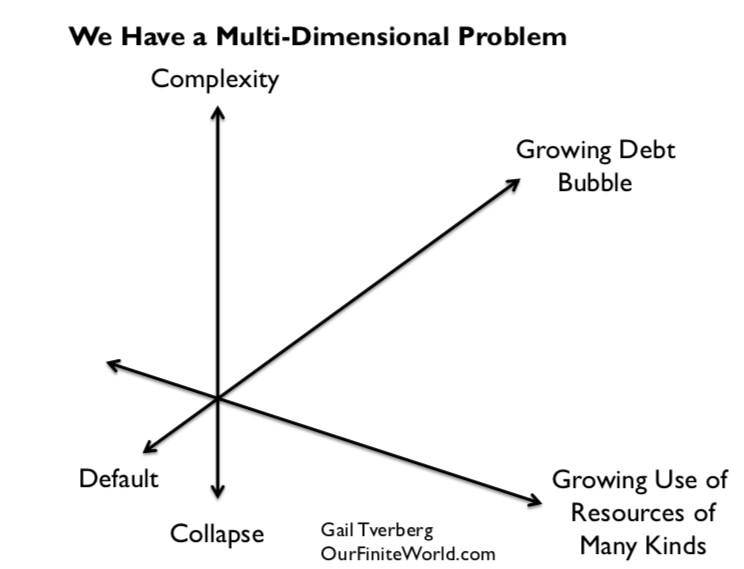
Figure 4.
Growing complexity is very closely related to “Technology will save us.” Growing complexity involves the use of more advanced machinery and ever-more specialized workers. Businesses become larger and more hierarchical. International trade becomes increasingly important. Financial products such as derivatives become common.
Growing debt goes hand in hand with growing complexity. Businesses need growing debt to support capital expenditures for their new technology. Consumers find growing debt helpful in affording major purchases, such as homes and vehicles. Governments make debt-like promises of pensions to citizen. Thanks to these promised pensions, families can have fewer children and devote fewer years to child care at home.
The problem with adding complexity and adding debt is that they, too, reach diminishing returns. The easiest (and cheapest) fixes tend to be added first. For example, irrigating a field in a dry area may be an easy and cheap way to fix a problem with inadequate food supply. There may be other approaches that could be used as well, such as breeding crops that do well with little rainfall, but the payback on this investment may be smaller and later.
A major drawback of adding complexity is that doing so tends to increase wage and wealth disparity. When an employer pays high wages to supervisory workers and highly skilled workers, this leaves fewer funds with which to pay less skilled workers. Furthermore, the huge amount of capital goods required in this more complex economy tends to disproportionately benefit workers who are already highly paid. This happens because the owners of shares of stock in companies tend to overlap with employees who are already highly paid. Low paid employees can’t afford such purchases.
The net result of greater wage and wealth disparity is that it becomes increasingly difficult to keep prices high enough for oil producers. The many workers with low wages find it difficult to afford homes and families of their own. Their low purchasing power tends to hold down prices of commodities of all kinds. The higher wages of the highly trained and supervisory staff don’t make up for the shortfall in commodity demand because these highly paid workers spend their wages differently. They tend to spend proportionately more on services rather than on commodity-intensive goods. For example, they may send their children to elite colleges and pay for tax avoidance services. These services use relatively little in the way of commodities.
Once the Economy Slows Too Much, the Whole System Tends to Implode
A growing economy can hide a multitude of problems. Paying back debt with interest is easy, if a worker finds his wages growing. In fact, it doesn’t matter if the growth that supports his growing wages comes from inflationary growth or “real” growth, since debt repayment is typically not adjusted for inflation.

Figure 5. Repaying loans is easy in a growing economy, but much more difficult in a shrinking economy.
Both real growth and inflationary growth help workers have enough funds left at the end of the period for other goods they need, despite repaying debt with interest.
Once the economy stops growing, the whole system tends to implode. Wage disparity becomes a huge problem. It becomes impossible to repay debt with interest. Young people find that their standards of living are lower than those of their parents. Investments do not appear to be worthwhile without government subsidies. Businesses find that economies of scale no longer work to their advantage. Pension promises become overwhelming, compared to the wages of young people.
The Real Situation with Oil Prices
The real situation with oil prices–and in fact with respect to commodity prices in general–is approximately like that shown in Figure 6.

Figure 6.
What tends to happen is that oil prices tend to fall farther and farther behind what producers require, if they are truly to make adequate reinvestment in new fields and also pay high taxes to their governments. This should not be too surprising because oil prices represent a compromise between what citizens can afford and what producers require.

Figure 7. Illustration indicating that the world has already reached a point where no oil price works for both oil suppliers and oil consumers.
In the years before diminishing returns became too much of a problem (back before 2005, for example), it was possible to find prices that were within an acceptable range for both sellers and buyers. As diminishing returns has become an increasing problem, the price that consumers can afford has tended to fall increasingly far below the price that producers require. This is why oil prices at first fall a little too low for producers, and eventually seem likely to fall far below what producers need to stay in business. The problem is that no price works for both producers and consumers.
Affordability Issues Affect All Commodity Prices, Not Just Oil
We are dealing with a situation in which a growing share of workers (and would be workers) find it difficult to afford a home and family, because of wage disparity issues. Some workers have been displaced from their jobs by robots or by globalization. Some spend many years in advanced schooling and are left with large amounts of debt, making it difficult to afford a home, a family, and other things that many in the older generation were able to take for granted. Many of today’s workers are in low-wage countries; they cannot afford very much of the output of the world economy.
At the same time, diminishing returns affect nearly all commodities, just as they affect oil. Mineral ores are affected by diminishing returns because the highest grade ores tend to be extracted first. Food production is also subject to diminishing returns because population keeps rising, but arable land does not. As a result, each year it is necessary to grow more food per arable acre, leading to a need for more complexity (more irrigation or more fertilizer, or better hybrid seed), often at higher cost.
When the problem of growing wage disparity is matched up with the problem of diminishing returns for the many different types of commodity production, the same problem occurs that occurs with oil. Prices of a wide range of commodities tend to fall below the cost of production–first by a little and, if the debt bubble pops, by a whole lot.
We hear people say, “Of course oil prices will rise. Oil is a necessity.” The thing that they don’t realize is that the problem affects a much bigger “package” of commodities than just oil prices. In fact, finished goods and services of all kinds made with these commodities are also affected, including new homes and vehicles. Thus, the pattern we see of low oil prices, relative to what is required for true profitability, is really an extremely widespread problem.
Interest Rate Policies Affect Affordability
Commodity prices bear surprisingly little relationship to the cost of production. Instead, they seem to depend more on interest rate policies of government agencies. If interest rates rise or fall, this tends to have a big impact on household budgets, because monthly auto payments and home payments depend on interest rates. For example, US interest rates spiked in 1981.

Figure 8. US short and long term interest rates. Graph by FRED.
This spike in interest rates led to a major cutback in energy consumption and in GDP growth.

Figure 9. World GDP Growth versus Energy Consumption Growth, based on data of 2018 BP Statistical Review of World Energy and GDP data in 2010$ amounts, from the World Bank.
Oil prices began to slide, with the higher interest rates.

Figure 10.
Figure 11 indicates that the popping of a debt bubble (mostly relating to US sub-prime housing) sent oil prices down in 2008. Once interest rates were lowered through the US adoption of Quantitative Easing (QE), oil prices rose again. They fell again, when the US discontinued QE.

Figure 11. Figure showing collapsing debt bubble at the time US oil prices peaked, and the use of Quantitative Easing (QE) to stimulate the economy, and thus bring prices back up again.
While these charts show oil prices, there is a tendency for a broad range of commodity prices to move more or less together. This happens because the commodity price issue seems to be driven to a significant extent by the affordability of finished goods and services, including homes, automobiles, and restaurant food.
If the collapse of a major debt bubble occurs again, the world seems likely to experience impacts somewhat similar to those in 2008, depending, of course, on the location(s) and size(s) of the debt bubble(s). A wide variety of commodity prices are likely to fall very low; asset prices may also be affected. This time, however, government organizations seem to have fewer tools for pulling the world economy out of a prolonged slump because interest rates are already very low. Thus, the issues are likely to look more like a widespread economic problem (including far too low commodity prices) than an oil problem.
Lack of Growth in Energy Consumption Per Capita Seems to Lead to Collapse Scenarios
When we look back, the good times from an economic viewpoint occurred when energy consumption per capita (top red parts on Figure 12) were rising rapidly.

Figure 12.
The bad times for the economy were the valleys in Figure 12. Separate labels for these valleys have been added in Figure 13. If energy consumption is not growing relative to the rising world population, collapse in at least a part of the world economy tends to occur.

Figure 13.
The laws of physics tell us that energy consumption is required for movement and for heat. These are the basic processes involved in GDP generation, and in electricity transmission. Thus, it is logical to believe that energy consumption is required for GDP growth. We can see in Figure 9 that growth in energy consumption tends to come before GDP growth, strongly suggesting that it is the cause of GDP growth. This further confirms what the laws of physics tell us.
The fact that partial collapses tend to occur when the growth in energy consumption per capita falls too low is further confirmation of the way the economics system really operates. The Panic of 1857 occurred when the asset price bubble enabled by the California Gold Rush collapsed. Home, farm, and commodity prices fell very low. The problems ultimately were finally resolved in the US Civil War (1861 to 1865).
Similarly, the Depression of the 1930s was preceded by a stock market crash in 1929. During the Great Depression, wage disparity was a major problem. Commodity prices fell very low, as did farm prices. The issues of the Depression were not fully resolved until World War II.
At this point, world growth in energy consumption per capita seems to be falling again. We are also starting to see evidence of some of the same problems associated with earlier collapses: growing wage disparity, growing debt bubbles, and increasingly war-like behavior by world leaders. We should be aware that today’s low oil prices, together with these other symptoms of economic distress, may be pointing to yet another collapse scenario on the horizon.
Oil’s Role in the Economy Is Different From What Many Have Assumed
We have heard for a long time that the world is running out of oil, and we need to find substitutes. The story should have been, “Affordability of all commodities is falling too low, because of diminishing returns and growing wage disparity. We need to find rapidly rising quantities of very, very cheap energy products. We need a cheap substitute for oil. We cannot afford to substitute high-cost energy products for low-cost energy products. High-cost energy products affect the economy too adversely.”
In fact, the whole “Peak Oil” story is not really right. Neither is the “Renewables will save us” story, especially if the renewables require subsidies and are not very scalable. Energy prices can never be expected to rise high enough for renewables to become economic.
The issues we should truly be concerned about are Collapse, as encountered by many economies previously. If Collapse occurs, it seems likely to cut off production of many commodities, including oil and much of the food supply, indirectly because of low prices.
Low oil prices and low prices of other commodities are signs that we truly should be concerned about. Too many people have missed this point. They have been taken in by the false models of economists and by the confusion of Peak Oilers. At this point, we should start considering the very real possibility that our next world problem is likely to be Collapse of at least a portion of the world economy.
Interesting times seem to be ahead.


Pingback: Low Oil Prices: An Indication Of Major Problems Ahead? – TradingCheatSheet
Pingback: Low Oil Prices: An Indication Of Major Problems Ahead? | StockTalk Journal
Pingback: Low Oil Prices: An Indication Of Major Problems Ahead? | Newzsentinel
Pingback: Low Oil Prices: An Indication Of Major Problems Ahead? – Wall Street Karma
Pingback: Low Oil Prices: An Indication Of Major Problems Ahead? | Real Patriot News
Pingback: Low Oil Prices: An Indication Of Major Problems Ahead? - Novus Vero
Pingback: Low Oil Prices: An Indication Of Major Problems Ahead? | peoples trust toronto
Pingback: Low Oil Prices: An Indication Of Major Problems Ahead? — WITSNEWS
Pingback: Low Oil Prices: An Indication Of Major Problems Ahead? – iftttwall
Pingback: Low Oil Prices: An Indication Of Major Problems Ahead? – TCNN: The Constitutional News Network
Pingback: Low Oil Prices: An Indication Of Major Problems Ahead? – Viralmount
The decline in U.S. life expectancy is unlike anything we’ve seen in a century
https://www.popsci.com/life-expectancy-declining?src=SOC&dom=tw
Cannabis use is associated with a substantial reduction in premature deaths in the United States.
Cannabis use is associated with decreased rates of obesity, diabetes mellitus, mortality from traumatic brain injury, use of alcohol and prescription drugs, driving fatalities, and opioid overdose deaths. These data suggest that Cannabis use may decrease premature deaths.
The analysis predicts an estimated 23,500 to 47,500 deaths prevented annually if medical marijuana were legal nationwide.
Cannabis use prevents thousands of premature deaths each year, and Cannabis prohibition is revealed as a major cause of premature death in the U.S
https://scholarworks.iu.edu/dspace/handle/2022/21632?fbclid=IwAR2vNDnt48U3Awv1s6BXf6iwpnPpRc9ya_qwNp3sooqogJDGBvqehCBGpjo
https://media.giphy.com/media/2Y8Iq3xe121Ba3hUAM/giphy.gif
https://www.acc.org/about-acc/press-releases/2017/03/09/14/05/marijuana-use-associated-with-increased-risk-of-stroke-heart-failure
‘Marijuana Use Associated with Increased Risk of Stroke, Heart Failure’
“Using marijuana raises the risk of stroke and heart failure even after accounting for demographic factors, other health conditions and lifestyle risk factors such as smoking and alcohol use, according to research scheduled for presentation at the American College of Cardiology’s 66th Annual Scientific Session.
Comparing cardiovascular disease rates in these patients to disease rates in patients not reporting marijuana use, researchers found marijuana use was associated with a significantly increased risk for stroke, heart failure, coronary artery disease and sudden cardiac death.”
Not so good!
An Insightful piece about the mechanics and dynamics of homelessness in Dublin, and the role played by Airbnb.
https://www.theguardian.com/cities/2018/nov/29/empty-dublin-housing-crisis-airbnb-homelessness-landlords
BELOW ARE EXTRACTS – NOT MY WORDS.
The Dublin charity Inner City Helping Homeless (ICHH) carries out unending outreach work with the city’s rough sleepers and also does its best to help families who simply cannot find anywhere to stay.
The Irish government’s plan to restrict Airbnb rentals to 90 days will not tackle the fundamental problem in central Dublin. “A landlord could still rent somewhere on weekends through the year,” ICHH says. “They could make enough money from that not to go through the worry of getting a permanent tenant.” ICHH believes the cap should be 40 or 50 days. Colleagues have heard from people evicted by landlords who claimed they needed to refurbish or redevelop their flats, only to see their former homes advertised on Airbnb, “with no refurbishment done. Nothing.”
Of Airbnb:
The company’s role in the housing crisis is not just a matter of flats booked online by tourists; in a particularly surreal twist, ICHH increasingly uses Airbnb to find emergency accommodation for homeless families. “That’s a regular thing,” says ICHH. “In the first six months of this year, I think we spent €30,000 on families coming to us late at night, when homeless services had told them to go and sleep in a police station. They come here with their children at half eight, half nine at night, and we have to jump on with an Airbnb or a short-term let, and pay the money just to get that family somewhere for a night.”
Not for the first time, I get the strong impression that one of the key things standing in the way of any resolution of Ireland’s housing crisis is that the status quo aligns with an array of powerful interests. Landlords benefit from endlessly rising rents; hoteliers receive millions of euros to put up homeless families. ICHH puts the problem in simple terms: “Homelessness is a massive business for a lot of people, so why would they want it to end?”
The worrying thing about this is all the excessive amount of money going into housing and private lets. That’s asset price inflation, of course. That money in normal times would be paid to your average Joe, who, not being homeless, would go out and spend it on tangible items that keep the economy growing.
Instead, we find more people being made homeless, the disparity between rich and poor increasing, and money being sucked out of the regular economy by inflation of real estate prices. This is exactly the sort of situation that will imminently help trigger a new economic DEPRESSION.
Meanwhile, those left out grow restive, as we saw during the recent Paris riots. I wouldn’t even rule out revolutions in the West, in the 2030s, but revolutions are just as liable to hurt the little people as the rich and the plutocrats – Stalin and Mao provided good examples of that.
I hadn’t thought about this aspect of AirBNB. If it is possible to rent our an apartment as almost hotel space (without paying the taxes) on weekends for a high rate, then why bother with monthly rentals at a low rate. Of course, the hotels have problems with too high vacancy rates and the cities don’t get the tax revenue they need.
I believe it is nov 29.
my mistake there is no plan B therefore no elders maybe just a ship of fools
given what we know here at OFW…
we should not be on that ship…
I am guessing FE knows something we don’t and has gone ‘into his bunker to hunker’.
Those Adonis warnings may have hit home?!!
my guess is remote Mexico locales with poor to no internet. he could also get himself and mrs. fast in trouble in those places, like dead tourist. “we want your money, your Rolex and your wife’s jewelry, gringo”.
I have no idea. His last comment was on November 22, which was Thanksgiving Day in the US.
Gail, Alberta select is now $18 per barrel. It will be interesting to see the companies and government try to keep jobs and production going. I’m sure when oil supplies get critical government and industry will partner up and who know maybe they can keep things going for a few more years here in North America?
Brent is about 60–
OIL (BRENT) PRICE COMMODITY
60.17 USD +1.56 (2.66%)
It has fallen from over 80——-
Price update: Alberta crude now $10 per barrel!
Crikey! I gather the industry expanded before the price-crash and some of that new production has only recently come on line, which is contributing to the glut and keeping prices low. The difficulty/expense of transporting the oil out of Alberta also seems to be depress prices.
Transportation and quality—–
A hard gig with current conditions.
1984 —
“Sam, I’m not gonna take any questions in this photo opportunity here. I’m just thinkin’ of looking pretty for the cameras.”
— Bad Acting President Ronnie Reagan & Rightwing Think-Tank Darling to Talking Head Sam Donaldson
The year 1984 was the perfect occasion to ask what novelist Thomas Pynchon calls “the perennial question of whether the United States still lingered in a prefascist twilight, or whether that darkness had fallen long stupified years ago, & the light they thought they saw was coming only from millions of Tubes all showing the same bright-colored shadows…”
I’m guessing that with a few more ‘too high/too low’ price cycles we’ll see the big oil companies buying up the unconventional oil producers which may, for a while, bring price stability as the conventional oil producers seem to be able to turn the taps up for price control purposes. Surely that won’t always be the case, but for how long?
I am not sure whether the big companies will buy up the little ones, or whether they will take over the leases that the little ones previously had. These companies have lots of debt, that is generally poorly rated. The selling price of their stock is too high, relative to the value of the companies. It is hard to see how the big companies would be able to obtain a suitably low purchase price for the companies. The companies really need to default on their debt and see their share prices drop.
Yes; that’s kind of what I was referring to – the big players buying up the smaller bankrupt ones for pennies on the dollar. If the big operators control the full spectrum of oil sources they can manage it such that they can minimize the costs associated with unconventional oil production; even if they operate unconventionals at a loss it’d just be a fraction of their total revenue stream and they can better control price swings. How much time that would buy the world is the question.
I was under the impression that small companies were more efficient at managing stripper wells and smaller fields. So, if big companies were to take that over, it would seem like the profitability of these stripper and shale wells would be even worse.
I think that that may be an issue. Big companies can handle huge projects, but their overhead tends to be higher.
I think you are correct. I used to work at a global oil company who bought up several smaller companies each year. What tends to happen is top-down standardization so that all these smaller incorporated units must conduct their work in the same way, not very efficient on the ground level.
Gail,
Assume an asset currently attractively priced, actually overpriced relative to income stream. It is sold at a profit in exchange for dollars which seem to represent debt on an enterprise that already has more claims on it than assets. What does one do with the paper profits? Or, are there no real profits and never were in terms of assets producing income? Is it a game of musical chairs where debt is passed around so one asset appears to be making a profit but the aggregate is a loss making proposition?
45% or so corn is used to make ethanol which only works as it is mandated; it is important to farmers as it is a continuous, year round market and as the corn is used locally transportation costs are less. If that stops the 45% is marginal revenue, the value of the underlying asset, land, drops substantially when the income can’t cover debt service on leveraged land, again the expensive cost of liquidity. This is not a pleasant thought to the land owner but again the issue is finding an alternative for the paper capital received for the land. It becomes a trading game and those are very difficult plays.
All ideas are welcome.
Dennis L.
Debt bubbles do pop, if conditions change.
“Global trade growth will continue to decelerate in the final quarter of 2018, the World Trade Organization said. Further “moderation” in WTO trade-growth projections is due to an overall decline in export orders, the WTO said in its latest World Trade Outlook Indicator report released on Monday. Production and sales of automobiles, electrical components and agricultural raw materials are below trend, according to the report.”
https://www.hellenicshippingnews.com/wto-says-global-trade-growth-to-weaken-further-in-fourth-quarter/
“There’s a cloud hovering over the G-20 meeting of global leaders, which starts in Buenos Aires on Friday. The world economy is slowing, threatening an end to the long recovery from the financial crisis… These concerns raise an important question among aficionados of a multilateral world: If the economy entered a new downturn, would national leaders – in the age of U.S. President Donald Trump – be able to orchestrate a global response?”
https://www.bloomberg.com/opinion/articles/2018-11-29/g-20-imagine-donald-trump-during-a-financial-crisis
“…would national leaders – in the age of U.S. President Donald Trump – be able to orchestrate a global response?”
Not with Trump, at least I don’t think so. He’s too interested in his own mojo to take part in something with other leaders. Trump ultimately wants all the credit, and that’s hard to do when other leaders would deserve credit also. Trump would want to dictate the terms and start name calling any leader that didn’t agree with his plan. “Hamster nose”, “Giraffe neck”, “Loser attitude”, “Horse face”, “Gebra” and so on. Why would other leaders want to take part in that?
https://www.channelnewsasia.com/news/business/china-says-wto-faces–profound-crisis—urges-reform-10963420
China says WTO faces ‘profound crisis’, urges reform
China on Friday urged the World Trade Organization (WTO) to close loopholes and correct practices by some member states that damage global trade, warning of a “profound crisis” facing the institution’s existence.
I think that the World Trade Organization will be losing power and influence, and perhaps disappear altogether in the next few years.
“Economic expansions never go on forever. As the United States’ long, slow recovery from the Great Recession stretches past the decade mark, regulators and economists are starting to get a little jumpy.
“So where’s the bubble that will trigger the next downturn? Housing, like the last time? Corporations up to their gills in debt? Or something else economists haven’t even spotted yet?
“Certain indicators already show softening, from capital expenditures to to manufacturing sentiment to residential construction. The question is whether that’s just a cooling off — or the beginning of a steeper slide.”
https://edition.cnn.com/2018/11/27/economy/economic-risk-factors/index.html
“Sales of new U.S. houses dropped in October to the weakest pace since March 2016 as rising borrowing costs and elevated prices keep buyers out of the market. Single-family home sales fell 8.9 percent from the previous month, to a 544,000 annualized pace, according to government data Wednesday. That was below all estimates in Bloomberg’s survey of economists…”
https://www.thegazette.com/subject/news/nation-and-world/new-home-sales-fall-in-october-20181128
“In a cautionary note from the Institute of international Finance, Reuters explains that non-financial corporate debt has hit a new record high as a decade of businesses borrowing their way out of recession continues. Debt among non-financial corporations across the globe rose to a record high of $75 trillion in the second quarter, driven mostly by China and the United States, the Institute of International Finance said in a report.”
https://www.fxstreet.com/news/iif-global-corporate-debt-hit-record-high-in-2018-h2-reuters-201811282319
Wow! The improving supply, no doubt came from the fact that people who were trying to sell their homes had them on the market longer.
“China’s coal imports are set to slump in December as traders and utilities wind back purchases following signals from Beijing that it will stop clearing shipments until next year, trading companies and utilities told Reuters… domestic coal prices have eased in recent months, even as China enters its peak demand season over winter, with utilities sitting on record coal stocks amid a slowdown in electricity demand growth.”
https://www.gulf-times.com/story/614380/China-December-coal-imports-set-to-slump-on-new-cu
“Chinese steel producers ran up losses for the first time in three years in November as prices slid into a bear market on weak demand and near-record supply, ending years of solid profit margins. Traders and analysts say that as the world’s second-largest economy cools and it faces higher risk in a trade war with the US, its steelmakers are likely to feel more pain unless China launches fresh stimulus measures.”
https://www.businesslive.co.za/bd/companies/2018-11-27-party-is-over-as-chinas-steel-mills-brace-for-hard-times/
“China is likely to see sales of excavators, loaders and dump trucks — proxies for the country’s infrastructure and building sectors — fall 7-8 percent next year… The expected downturn in demand underscores a major challenge facing Beijing even as it looks to fast-track infrastructure projects to support economic growth, which has cooled to its slowest pace since the global financial crisis and is facing mounting pressure from U.S. tariffs.”
https://uk.finance.yahoo.com/news/construction-machine-makers-brace-weaker-china-sales-economy-045638248–finance.html?guccounter=1
“The sluggish growth recorded in recent [Chinese] economic data, alongside downward pressure on the price of crude oil and ferrous metals, have added to the market’s anxiety about deflation, the Securities Daily reported. Pan Xiangdong, chief economist of New Era Securities, believes that investors should be wary of deflation risks when the price of crude oil and ferrous metals are declining at the same time.”
http://www.atimes.com/article/market-concerns-grow-over-potential-deflation-risks/
“China’s financing units for local governments, already grappling with bloated debts, now face an even bigger predicament — a build-up of credit guarantees that leave them vulnerable to surging defaults.”
https://www.bloomberg.com/news/articles/2018-11-28/risks-mount-in-china-town-builders-1-trillion-debt-guarantees
China adopted an agrarian non-growth economy for several thousand years. It wasn’t a perfect system (heck, name me one that is), but during that period of time it did provide a large portion of humanity with a reasonably civilised way of life. Jewish communities thrived in China for centuries without ever suffering any persecution. And from at least the 10th century AD China never sought to dominate anyone else politically (the Mongols and Manchus don’t count). But then in recent history the upstart West, having found ways of harnessing the power of fossil fuels and having been held in thrall by an elite that has no understanding of the word ‘enough’, came with guns and cannons to proselytise to the Chinese that their traditional ways of life and thinking were so backward (yeah, sure) they failed to give rise to ‘progress’, to ‘democracy’, to ‘science’, and what have you. Seeing the advanced technology the West possessed, against which an agrarian culture really had no means of defending itself, the Chinese in the end realised they had no choice but to trade in their traditional cultural modus operandi for that of modern industrial ‘civilisation’.
Turns out it’s a very poor trade-in and all that talk of ‘democracy’ and ‘progress’ is just a fat pile of poo. To think that once SHTF China’s going to have to endure another round of traumatic adjustment involving untold suffering and mortality, as she did in the late 19th and early 20th centuries.
Sigh.
I expect that the situation is more complex than you think. Wikipedia says, “Chinese history has alternated between periods of political unity and peace, and periods of war and failed statehood”. https://en.wikipedia.org/wiki/History_of_China This sounds a whole lot like collapses to me.
There were certainly different dynasties, and many different factions within these dynasties. I think that a person has to look at China as more of a collection of closely related economies, some of which prospered to a greater extent than others over the time span. The common written language of China allows quite a large number of groups to communicate with each other through writing, even though their spoken languages are quite different.
Also, Genghis Kahn (1162-1227 CE) was an important Mongolian emperor. His exploits no doubt affected China as well.
It is really hard to pay back debt with interest with deflation!
China has a problem with coal prices becoming too low for local producers. (This is what peak coal is all about.) The article says,
Thanks Gail. I mentioned deficit spending in a previous post, and a brief explanation may be helpful here.
Back in the day, 2000BC or so, in some ways civilisation was stable. The instability inherent in the interest bearing financial systems was managed by statewide debt forgiveness and land transfers at 30-50 year intervals. Vested interests did not want to lose the accumulated benefits of usury hence occasionally there would be problems.
I might argue that Democracy was invented to balance the abilities of creditors and of debtors to seek redress for debt mismanagement.
To understand where we are today, first realise that the Great Crash of 1929 and the poverty of the 1930’s were precursors to the oil-fuelled expansion of everything that seems to be peaking at present. And that peaking brings a ton of luggage with it, not least that exponential growth can continue forever.
That expectation “build it and they will come” today requires discounted cash flows with interest rates near zero percent. When interest rates are negative, just about anything built will be profitable given sufficient time. A new form of insanity.
The governments form the single largest buyer in the modern economy. With the tax payers credit card, governments can buy whatever they think they want crowding out the free market it need be. They have convenient excuses eg debt doesn’t matter because we owe it to ourselves. If you are in government that may be true, because governments rarely declare bankruptcy, but that’s not the case with commerce.
Commerce is surviving because their free manket losses are moved onto the governments, or onto the Central Bank’s balance sheets. At some point, probably when oil production is forced into decline, a reckoning will have to be made. Then we will re-learn the lessons from 2000BC.
We probably will learn that governments can and do collapse. We have lived in a world of large countries covering many square kilometers or miles, all speaking a common language. In fact, many people have learned English as a second language.
Longer term, we cannot expect that situation to hold. International trade will crumble. Central governments will crumble. It has been the availability of growing energy consumption per capita that has allowed these large, centralized government to take over. Once it becomes clear that they cannot really pay their obligations (payments to retirees, for example), their days will be numbered, I am afraid.
We know there are solutions to the problems of debt, some involve war unfortunately. I would expect that international trade would decline in line with the GDP of the various interconnected nations. But decline, particularly fuel based energy driven declines will be hard to manage. What happens to the car industry? Suppose you know that in 30 years there will be no petrol, or that diesel fuel will be rationed and reserved for commerce, would you buy a new car?
The system goes downhill in a lot less than 30 years. Also, I think your statement, ” I would expect that international trade would decline in line with the GDP of the various interconnected nations,” is optimistic.
Growth in international trade led the increase in world GDP. Decline in international trade is likely to lead the decline in GDP. When it is clear that there are not enough resources or jobs to go around, everyone tries to gain an advantage by hoarding more for themselves. The just in time system we have put together can’t really work, without a huge amount of international trade. Everything is likely to start unraveling, early on.
We may not have that great a difference in opinion if we get into specifics, eg my question about the car industry, above. That, in turn leads to confidence, and that brings us back to the financial system. that is something that could change very quickly.
FWIW, I’m trying to track per capita US productivity on a per year basis, and the derivative varies quite a lot. I’d suggest there is no need to panic just yet.
Pingback: Over onze eindige wereld en gratis miljarden belastinggeld voor Shell | Paradoxnl's Blog
Gail, great work. WTI seems to be bouncing around $50.
https://www.bloomberg.com/quote/CL1:COM
From the chart, it is always straight down and then a tough climb up. It looks like someone is trying to raise the price, although it is difficult (from the looks) and when it is at the top, it falls down again. I am not surprised if it is sustained below $50, it will be going down very fast and very hard.
I think the price of oil will bounce around, going up until feedback from non-elite consumers sends it back down, then price headed back up when there is less supply. But overall the price over time as we head down the ladder will get less. It will have to keep dropping as purchasing power declines to keep moving the volume produced. For many years we have been using more than is discovered, using reserves, and in that sense we are past peak.
The Bloomberg commodity index seems to indicate falling commodity prices from already depressed prices since the commodity price collapse in 2014 just as Gail says.
To compensate for falling commodity prices, the commodity exporters will be forced to devalue their currencies to lower their labour costs. The workers become poorer and can no longer afford to consume imported goods.
https://pbs.twimg.com/media/DsqsDEYW0AAy8pA?format=jpg
I received an email today from someone in South Africa talking about how poorly their country is doing. South Africa seems to be one of the countries that needs high commodity prices. It is another country on the “worry” list.
Such a huge mass of dirt poor there who couldn’t afford those high prices.
They are on the road to Rhodesia anyone with brains are gone
The Greenpeace activists say that we should finish the coal age:
https://t1.aimg.sk/magaziny/VJMgx4EwQYvVuRFuQ0NkQw~Aktivistka-Greenpeace-na-a-obnej-ve-i-Hornonitrianskych-ban-Prievidza-v-Nov-koch.jpg?t=LzB4Njg6MTQ4OHg5MDcvMTIwMHg2MzA%3D&h=yqDhWg1fXXkXTszgeUpFxg&e=2145916800&v=3
The activists went up to a mining tower in Nováky and beat the rescue units.
https://tech2.org/slovakia/the-activists-went-up-to-a-mining-tower-in-novaky-and-beat-the-rescue-units/
The police was called and the complaints were lodged by the mines.
But where should we go? They do not know… One thing is sure: they should be put into mental hospital, when they also reject nuclear… And methane in natural gas is actually a far more potent greenhouse gas than carbon dioxide, they repeat…
This night was -6 grades Celzius outside here in Slovakia and they propose me using renewable solar and wind…
https://www.greenpeace.org/usa/global-warming/renewable-energy-future/
They are definitely not mentally o.k….
Believe you mean “WE” are …not OK that is…catch 22…
We all use solar energy – but stored in the form of natural gas, coal or oil millions years ago. Let us ask those Greenpeace folks for storage solutions: they have no such things.
We need storage, not renewables, as renewables are everywhere.
Greenpeace folks, please, show us how to store those nice renewables cheaply for long periods of time. Common, please, do the right thing!
Most European Green activists, and the radical Left, want a modern society with all the trimmings, but without the use of the very fuels that made -and still make – Modernity possible. Nice plan….
See how long all those EV batteries last in -6C weather.
When do you think collapse can happen?
I think collapse is a process. According to the analysis by Turchin and Nefedov of eight historical collapses in the book Secular Cycles, the length of the historical collapses took was from 20 to 50 years. I doubt that collapse will take that long this time. The timing could vary somewhat by country, however.
I think the world has, in some sense, already started the collapse process. I think peak coal in China is a big part of the problem. It would do poorly, with or without tariffs. Tariffs seem to have been part of the picture both in the 1857 collapse and in the 1920s. They are simply one part of the collapse scenario.
Some countries seem to be ahead of others. Venezuela and Greece come to mind. But there are a lot of others that don’t make the front pages. The countries of the Middle East cannot maintain their economies for long, at today’s low oil prices. When oil prices are high, oil exporters are able to tax the companies heavily. These funds are the primary source of the many programs that these countries have for their people, including food subsidies and job creation programs. These exporters may start collapsing, possibly in the way the Soviet Union collapsed in 1991, because of low oil prices. Or they could see their leaders overthrown, and the countries start to disintegrate.
I agree that a systemic collapse is a process not an event or as the saying goes. “First you go broke gradually, then all at once”. A collapse as you stated, is unpredictable. No one knows when that final straw is the one that breaks the camels back.
What we do know for a fact is as you keep adding straws there will come a point where the camel gives out. The global systemic collapse we all know is eventually coming because math says that 1+1=2 and not 12 as the Federal Reserve wants us to believe. This collapse can happen at any time including it could take years or even decades before it all comes crashing down.
Ive youre living in a tent city–or in your car, collapse has already happened
If youre a Kalahari bushman, then collapse will never happen
everything on that basis is relative
Wasn’t the gov’t rounding up the Kalahari and relocating them so companies could extract resources off of their tribal lands? Or, was that another tribe?
First you lose your job. Then you must sell your house. Then you get a poorer paid job and rent a cheaper house. Then you lose that poor job and the cheaper house. Then if your family or government can’t give you food and shelter, you are living in the street/tent/car. Then you OD on opioids. The slow collapse comes to one person at a time, not to an entire nation all at once.
i think that is what i was trying to say
Volvo740: I was wondering when we would see “the curves” start to bend down.
If you plot US production of conventional crude over time, that started to bend down in 1970. In 2009 EIA stopped publishing those figures and switched to using Crude + Condensate (from gas wells) despite a barrel of condensate not having as much energy as a barrel of Crude. If they hadn’t done that you could easily see that Crude production is now at 60% of Peak production. This didn’t happen by accident, and it proves EIA/USG knows the truth of Peak Oil. They have known it at least since Hubbert advised Congress in 1974 https://people.sunyit.edu/~barans/energy/pdf/M.%20King%20Hubbert%20on%20the%20Nature%20of%20Growth%201974%20Congressional%20Testimony.pdf
Yes, I’m aware of the redefinition of oil to include just about anything. I guess I’m waiting for the moment when they are out of tricks. But it’s possible they will just lie then. Why tell the truth?
Pretty soon they will include scotch Whiskey and Johnson’s baby oil in their “all liquids” totals..Anything oily that burns..
It is really the total that matters, including coal and natural gas, as far as I am concerned. In fact, it is the total per capita that matters. We have to keep growing supply to keep up with growing population.
But when crude peaks, everything will peak, regardless of how much coal, or natural gas is in the ground. Crude oil is the base that made 20th century possible.
U.S. car sales. Peak 1974. 11,424,000
All light vehicles appear to have peaked in 2016 (17,464,000) but my data doesn’t go back as far for this category.
1945-70 was the imagined American dream
in 1970 the USA went unto oil deficit and that’s when the nightmare started
Actually, the US has been importing oil for a very long time. I believe it is since the 1920s, but I don’t have the time to look up the information now. I believe a person has to compare consumption with production, to figure this out.
What happened in the 1970s was a big increase in the price of imported oil. That was where the problem occurred.
The first US imports of crude oil were during the first world war, but it was exporting far more petroleum and petroleum products than it imported at the time (significant exports to Europe including to its own armed forces there, in contrast to modest imports from Mexico). The US did not become a *net* importer of crude oil until the second world war, and even then for many years more it exported more petroleum *products* than its crude oil imports.
I am only going by the pieces of data I have seen on the EIA website. It didn’t tell about product exports, but they very well could have happened.
The US was the worlds swing producer up until they peaked in 1970 and could control the price of oil….After that OPEC took over as swing producer..
Is it not possible that low oil prices will be followed by high oil prices if and when governments panic and print helicopter money to try to pull their economies out of a depression? These high prices won’t of course stimulate new supply because the money will be worthless.
The oil price is not low currently..It averaged 19 dollars during the entire 20th century.
https://imgur.com/a/WHl0rvN
The money has to
(1) Get back to the people who really need it (non-elite workers, retirees, etc.), and
(2) Not disturb the relativity to the US dollar.
These can be tough issues to fix.
When I said that debt bubbles were what allowed oil prices to rise, what you are talking about is pretty close to what actually happens. When there is enough money (debt, really) added to the system, part of it goes to pay workers wages, so that they can afford to buy more. Part of goes directly to buying goods and services made with commodities. This is what keeps pulling prices up. The problem comes when the investments made with the new debt do not produce enough value to repay the added debt with interest.
(The difference from what your are talking about is that it is not just “money” without interest that is added to the system. Nearly all the debt that is added has the obligation of some positive return later. Even the sale of shares of stock (which aren’t really debt) have an obligation for some long-term benefit to the holder. If a person attends college with debt, there is the expectation that the college degree will be of sufficient benefit to make this worthwhile, with some added value as well, to repay the interest on debt.)
Debt that can’t be paid, won’t be paid.
Many debts are never expected to be repaid in full. Fiat money is that kind of debt, as are the interest-bearing bonds of fiat money issuing governments. People (and nations) hold them not in the expectation of getting the principal paid back, but as financial savings and hedges.
Currency-issuing governments have the options of debt deflation or inflationary stimulus (through low or negative interest rate policy and “easy money” via the banking sector, or through direct public fiscal stimulus). I know which one they’re going to take in the long run.
Social inequality and hardship will be the hallmark of the countries whose governments opt for austerity and deflation, or which are so dependent on imports that the money that matters most to them is not the money that they create.
Supply constraints will be observed in countries which stimulate sufficiently. And they’ll work them out the usual way.
The economy got inflation years ago when (1) Energy consumption was ramping up very rapidly and (2) Lots of women were entering the workforce. There was a whole lot of demand for what then were fairly affordable products.
Ramping up inflation is easier said then done. If no one has confidence in a currency, then it is easy to get hyperinflation. Japan has been trying for years to get inflation with little success.
“At this point, we should start considering the very real possibility that our next world problem is likely to be Collapse of at least a portion of the world economy.”
Yikes! Another great post, Gail.
One planet says to another: “I think I’ve got the human virus,” the other says: “Don’t worry it never lasts long.”
Great article Gail!
BTW some time back I was wondering when we would see “the curves” start to bend down. I think you said that we would never really see that, but it looks like coal is collapsing and also Ugo had a post on diesel and that graph looks pretty grim IMO.
Cheers!!!
Just saw your earlier comments on Ugo’s numbers.
The curves in Ugo’s article bend down near the end because of ragged report date information by different groups reporting to the voluntary data base. If you use the “massaged” numbers from organizations that provide data to the public, they normally fix this problem for you. We have very little idea of what is in this data base, or how it has changed over time.
I would be interested in Gail’s take on catastrophic cascading failure as applied to civilization. Firstly our society and all it parts and functions are very complex. Secondly, our systems are stressed. Thirdly, our systems are highly,or even completely, interrelated. Fourth there is little resilience in some critical systems. We are utterly dependent upon systems that never existed previously.
When previous civilizations collapsed there was a high degree of independence from the centre the majority of consumption was of local products, trade was for the extra. I keep hearing collapse will be a process not an event. I suggest there will be an event or events that completely change our perceptions. We will go to bed one night and wake to a different world.
I think that you are right about the possibility of catastrophic cascading failure. Our whole economy is dependent on just in time systems. David Korowicz has done extensive analysis of how quickly an economy could collapse, from only a “small” disruption, such as the loss of population because of an epidemic. We know that strikes by workers can very much disrupt an economy.
I still doubt that the changes will happen overnight, unless someone sets off a nuclear weapon, or makes a major change of a similar type. It still will likely take weeks to months.
Thanks, You have been on the money with your predictions so far. Where I have been consistantly blindsided by the effeciveness of wilful blindness, you seem to have it well worked out.
Duncan Idaho: Time will tell when a actual shortage arises (maybe next year).
This will be a new experience for us humans, and we will see if business models hold.
This is a typical viewpoint of the rich US population. But most of the world’s population has ALWAYS experienced actual shortages – Africa, Central and South America, India, Asia, where the people have NEVER owned cars and other gasoline-powered machinery, let alone 6 litre V-8 gas-guzzlers and leaf-blowers to keep the golf course tidy.
The business models will never hold under actual gasoline shortages. The US frackers have NEVER made a profit, and now have a collective debt of $280 billion. This situation could only come about because the big banks have agreed to let it happen, presumably because the Fed has told them it is better to get the stuff out of the ground and keep the economy running, even if it doesn’t make a profit, than to hit actual shortages and Collapse.
This doesn’t say much for the intelligence and maturity of humans, but then we know that already from the response to Climate Change, deforestation, species loss, radioactive pollution and a whole host of other calamities that all adults can understand. No other species is responsible for all of these short-sighted decisions, only Homo sapiens – “wise Man”, what a joke.
“This doesn’t say much for the intelligence and maturity of humans…”
yes, it does…
BAU must be propped up, regardless of almost any cost…
or else there will be severe devastation to 7+ billion of us…
and your prosperity and mine would quickly become poverty and/or a brutal shortened life…
BAU = life, and its end = death…
therefore we must choose life…
It really isn’t a choice. The Earth has only so much resource. Once it is used, the remaining resources become harder to find and extract. It is basic laws of physics. You can’t choose the physics you like and discard that which you don’t. .
if youre a godbotherer you can
Thanks, that’s a new word for me, godbothered.
Famous clip from my generation. (uncensored)
https://www.nytimes.com/2018/11/26/opinion/corporate-debt-bubble-att-ge.html?fbclid=IwAR1od_t-x_j_LIXpikOLJsRTQy4yB93J2_1dN-SkKQqSQ26ZrxF9LhmXa64
Cheap credit allows growth, even if it is only growth through acquisition of another company.
The peaking of oil production comes in phases and applies to different countries and different types of oil. The conventional oil peak (inability to grow production) around 2007-2008 caused the oil price spike in 2008 (plus additional Chinese demand for the Olympic Games). The response of the system was QE1-QE3 which financed the US shale oil boom – with the unwanted side-effect of an asset bubble. Interestingly, oil prices went up despite additional amounts of shale oil. But after a period of import substitution (2 mb/d) that oil could not be used in US refineries and not exported. So inventories clogged up, one reason for the drop in oil prices in 2014. Then the export ban was lifted. So we see all sorts of tricks to bypass the conventional production plateau.
I had an exchange of letters with the Australian Prime Minister John Howard in 2004-2007. I personally met him a year ago and handed over this paper to him, showing that he was wrong and we were right. He looked through me as if I were glass. Even now he hasn’t understood a thing.
31/10/2017
Howard’s Energy Policy Failure 2004
http://crudeoilpeak.info/howards-energy-policy-failure-2004
Update is here:
18/9/2018
What happened to crude oil production after the first peak in 2005?
http://crudeoilpeak.info/what-happened-to-crude-oil-production-after-the-first-peak-in-2005
What I have learned from you, Gail, is the affordability problem.I liked your graph connecting the peak oil prices with a declining trend. I have put it here (2nd graph from top)
http://crudeoilpeak.info/oil-price-analysis
The affordability differs from country to country, depending on tax policies, economic growth etc.This means your work has to be done region by region
The latest example we see in France:
28/11/2018
European oil consumption after North Sea Peak Oil
http://crudeoilpeak.info/european-oil-consumption-after-north-sea-peak-oil
I think that a big reason for the run up in oil prices in the 2002-2008 period was the added demand of China. This added demand was made possible by its entry into the WTO, its coal production, and its run-up in debt. Also, in the first part of the 2002-2008 period, the low short-term interest rates of the US helped. When they were raise later in they period, the debt bubble broke, and prices crashed. Of course, this was what the Federal Reserve intended. (Perhaps not quite as bad a crash as the economy got, however.)
The affordability by country depends to a significant extent on how high the currencies are floating relative to the dollar. The use of the Euro in multiple countries causes a problem for those countries whose currency would be floating lower, if they were free, such as Greece. Germany has received a subsidy from where the Euro was floating, allowing them to do better.
Good god they are truly clueless…Lets hope the replacements are smarter
Gail, are you familiar with the concept of “air barrels”?
It appears to be a scam by which big refineries and shippers with excess storage capacity can manipulate (depress) bitumen prices to their advantage, and to the disadvantage of producers and governments that depend on bitumen royalties.
This is yet another way that oil prices can be kept artificially low.
It appears to me that both tar sands and shale oil are currently subsidized by a continuous stream of bankruptcies. While I’m not exactly weeping crocodile tears over all the stupid investors who are losing their shirts, this “pump and dump” financing seems to be yet another way to defy basic economics to keep the oil flowing.
(Because of excessive noise postings, I will not be notified of replies to this comment.)
According to the link,
“While the Alberta government is pressing for more pipelines, the Enbridge Mainline to the U.S. is running almost five per cent below capacity due to chaos created by “air barrels” and a “lack of integrity” in the shipping process.”
I have a hard time seeing that operating 4.5% below capacity is a huge problem. As the article explains, businesses “need” to overbook, to make certain they actually have space available when it is needed. There always needs to be a little unused space in every system, if it is to operate efficiently. This doesn’t sound like much of a true problem to me.
I would be interested to see some specific predictions–or assignments of probabilities to various outcomes, and their timing–for
(a) a 2008-style recession,
(b) a global Depression, or
(c) general economic and political collapse
within
(1) the next year or two
(2) the next ten years, or
(3) [whatever time frame you care to name]
The moral hazard with “doomsters” is that decades may pass while they continually predict doom for the near future. Of course a recession is bound to happen sooner or later, so meaningful predictions need to go beyond vague eventualities.
Will the price of oil rise or fall by (fill in a particular date here)? A simple question, which a prediction will (in retrospect) either get right or wrong. Intelligent people can be found on both sides (rising vs. falling over the next few years). Of course this will depend on numerous economic, political, military, and technological factors that are difficult to anticipate–that is why predictions are hard.
(a) 2019
(b) 2022-2025
(c) 2030 or so
I like your approach, and it got me thinking that everyone who resides somewhere on the scale ranging from extreme doomer to extreme hopium-user should participate in your survey. The closest thing we have to this already is the market and my interpretation of the low interest rates that we have is there is a lot of fear out there.
2019 looks like the year we are going to see some bigger problems arising, because of debt defaults and failing major businesses in various parts of the world. Ultimately the EU is likely to fall apart. I don’t think that that is likely as soon as 2019. It might happen in 2020 or 2021, though.
I think war, or war-like behavior, could become part of the problem. We could have some countries trying to take down the Internet or the electricity systems of other countries, for example.
Epidemics may play a bigger role than people understand. I know that China has a problem with a virus affecting its pigs right now. In the US, we just had romaine lettuce recalled. In the US, microbes are developing resistance to many of the commonly used antibiotics. We can’t expect parts of the world to go downhill, and the rest of the world to stay away from the many microbes that are making their rounds.
That is something we all here would like to know. Unfortunately, the global economy is almost as complex as a living being and is proving unpredictable too. We do know that it takes energy (fossil fuels) to power our economy 24/7. If energy becomes unaffordable and unprofitable at the same time then, we are in danger of losing our source of power. We are there now. All that is left is faith and momentum.
Timing?
It’s really quite unimportant: all one has to know is that we, in the advanced economies, are on the Collapse curve, and have been since the 1970’s.
We are in collapse – economic and ecological – and every good thing we enjoy now,and can be reasonably confident of enjoying tomorrow when we wake, is a reprieve to be cherished and enjoyed.
Above all, since 2008.
I agree, Xabier. Clearly we are reaching the limits of what financial mutations can do to offset the diminishing returns problem, and we have been on borrowed time since 2008.
The suffocating complexity and societal craziness that are presaging our descent into collapse proper can make it hard to stay in the moment and cherish what we have now but it is certainly worth trying.
Yet we all understand why house prices are low in some high unemployment areas; there is no bid. This may even be the case where some overcrowding is occurring.
Pingback: Interesting times ahead….. | Damn the Matrix
Reblogged this on Swiss Coaching Partners.
Thanks!
Interesting times seem to be ahead.
Very interesting—–
Time will tell when a actual shortage arises (maybe next year).
This will be a new experience for us humans, and we will see if business models hold.
We have had some distribution issues, but this will be actual supply issues—
Don’t expect the problem to look like a shortage. Expect the problem to look like a glut of supply, because there are not enough buyers.
You sound like a person who has been listening to the Peak Oil story too long.
In our system we’re always looking to price a product to match supply and demand. In France it’s $7 bucks a gallon. In US 3.50.
It would seem like the lineups to the pumps that we had with the oil shock is not going to happen if people can’t afford the product. They may revolt though or want a quota system rather than price.
The shortage would still be noticeable by seeing an actual production peak in the data.
But I agree that it will be interpreted as weak demand.
In the 1930s, the problem was an oil glut. The same thing will happen now. OPEC will decide to cut back production because prices are too low.
Weak demand needs to be understood as a lack of affordability. This is indeed the problem.
Current maximum price could be around 80 dollars per barrel. Couple months of that price, and Europe’s PMI indexes plunged.
We keep hearing reports of poor GDP growth during the 3rd quarter too.
The ‘It’s weak demand because, hey, we’re all going Green and Renewable! ‘ narrative is very well-established in the media currently.
Oh. and ‘The economy is de-materializing, so this energy-thing doesn’t matter so much anyway’ meme.
“Young people don’t even want a car.” Yeah, right. Good one!
Now we have to contend with information overload. Non-stop ringing of phones with offers that we are not slightly interested in. Emails filled with all kinds of junk. Advertising filling up the edges of the web pages we are trying to read. If I watched TV, I am sure there would be lots of ads. Programs like Excel add so many “features” that they become unusable.
IEA Chief warns of world oil shortages by 2020 as discoveries fall to record lows
https://www.wsj.com/articles/iea-says-global-oil-discoveries-at-record-low-in-2016-1493244000
There will be an oil shortage in the 2020’s, Goldman Sachs says
https://www.cnbc.com/2018/11/09/goldman-sachs-there-will-be-an-oil-shortage-in-the-2020s.html
Growing demand for oil will lead to shortage and high prices in 2020s
https://www.newscientist.com/article/2185046-growing-demand-for-oil-will-lead-to-shortage-and-high-prices-in-2020s/
German Military (leaked) Peak Oil study: oil is used in the production of 95% of all industrial goods, so a shortage of oil would collapse the world economy & world governments
https://www.scribd.com/document/387459134/german
Imminent peak oil could burst US, global economic bubble – study
https://www.theguardian.com/environment/earth-insight/2013/nov/19/peak-oil-economicgrowth
You sound like a person in denial..LOL
These folks are a little confused. They do not understand how the economy works.
The global economic bubble could burst because of an affordability crisis, and that will send down the production of all fuels simultaneously, not just oil.
I would not be surprised if OPEC decides to cut back oil production at its meeting in December. This will still not “fix” the low price problem, because the low price problem is really a low wage problem.
If we look at the recent protests in France, the main theme seems to be the decreasing
ability of average people – across all classes – to afford the products and services available;not just the diesel price-hike, which was the ostensible pretext for the revolt.
Decreasing ability of the 99% to afford the goods and services that the economy can create is the problem we are facing everywhere. This is why radical leaders get elected. This is why there are protests regarding anything that seems to operate in the same direction. Bringing in low-wage workers from Africa and other parts of the world makes people unhappy, too.
I was surprised that Macron got elected in the first place.
Something just occurred to me. As big oil companies go bust, I bet the US government and/or the Fed will be forced into the oil business. Since they have unlimited fiat money to spend, they could postpone the collapse for a while. US gov. = socialism in the end days.
Oh, that’s already been done. Canada just bought a leaky, 60-year-old pipeline for $4,500,000,000, which will require about $7 billion in upgrades that the investment community was unwilling to provide to the seller, Kinder Morgan.
The first petro-state bail-out?
“US gov. = socialism in the end days.”
perhaps…
for now, US shale oil production is still running at perpetual losses…
so somewhat indirectly, the near zero Fed interest rates had/have fed this “private” industry with the debt it needs to stay in business…
yes, in the (near) future, US gov/Fed will be forced into greater support for what could be an industry heading for bankruptcy…
In the past, collapses have hit some parts of the world and not others. The game now, I am sure, is to keep collapse as far away from our shores as possible. The US and Canada at least start with fairly good resource to begin with. Europe and Japan are in much weaker shape.
Yes, but the Canadian tar mining is a disgrace that can be witnessed from space. A crime basically.
I personally found the Kern River heavy oil fields in California a whole lot more problematic, and I have seen both up close. The climate at Kern River is part of the problem.
https://gailtheactuary.files.wordpress.com/2018/11/kern-river-photo.jpg
No it is a giant oil spill clean up It cleans up well and trees grow on it
“If the number of widgets that the worker can produce in one hour decreases by 50%, logically that worker’s wages should fall by 50%, not rise to make up for his/her growing inefficiency.”
That sums it up perfectly.
You capitalist think so narrowly—–
Duncan- it’s obviously you don’t own a business, who’s intent it is to earn a profit. Otherwise, you’d understand the aforementioned quote perfectly.
Even in the cradle, babes are exposed to that naughty capitalist thinking.
See Saw Margery Daw Johnny shall have a new master.
He shall have but a penny a day. Because he can’t work any faster.
I can’t be the first person who has noticed this difficulty.
A brilliant analogy Gail.
It could also be phrased as
as worker 1 goes to 50% efficiency then a second equally inefficient worker must also be employed to make up the short fall. Effectively doubling the wage cost of widget production.
Gail
You write “Businesses find that economies of scale no longer work to their advantage.”
Econmies of scale have been critical in the development of industrialisation, not least in thedigital / chip-based industries. Could you enlarge a little on what is happening in the industrial world?
best
Phil
Someone else may have better information than I do on what is happening in the industrial world. Clearly, Amazon is taking over a lot of what previously was being done by brick and mortar stores, taking advantage of artificially low shipping prices.
If the whole economy is flat or shrinking, it becomes much harder to find ways opportunities to take advantage of economies of scale. Instead, the only growth business gets to be taking down buildings that are no longer needed.
I’m not so sure Amazon’s model is superior to Walmart. Walmart’s profit is massive and Amazon is hardly making any profit. It’s also not clear that putting each product in a box is more efficient…. But it sure is convenient.
Saves a lot of time driving from store to store, trying to find the product a person is looking for. The on line reviews are helpful as well.
Of course, if a person is looking just for basics, Walmart is likely to have them. They have indeed done well.
Pingback: Low Oil Prices: An Indication of Major Problems Ahead? – Olduvai.ca
Interesting times indeed, Gail. You make a point about the hit our food supply will take in your conclusion. This has been one of my primary concerns over the past few years, especially given that so many of us are entirely dependent upon the energy-intensive industrial food systems. I live in an area that still considers itself ‘country close to the city’ on the outskirts of the Greater Toronto Area but has witnessed suburban expansion at an alarming rate at the expense of some of our region’s very limited arable lands (the fact that most of our farms are dedicated to GMO corn and soybean to feed the ethanol industry is a whole other kettle of fish). It has concerned me greatly that we have forfeited our food production capabilities while chasing the holy grail of ‘infinite growth’. Overshoot and collapse seems baked into the equation…I’m not sure cheap energy can save us from ourselves.
All of the ethanol is being used to dilute the gasoline supply, so there is no chance of shortage there (for now). Corn and soybeans are also being used as animal food.
If we put our efforts to growing plant food that we could eat directly, (and soybeans and corn of the right kinds qualify), we could feed the population with a whole lot less acreage than we do now.
https://cassandralegacy.blogspot.com/
‘For Whom is Peak Oil Coming? If you own a Diesel Car, it is Coming for you!’
As a follow up to your latest great article, Gail, is the above linked article. Quite a good read. I’m not going to copy/paste because there is plenty to read, suggesting peak diesel fuel was in 2015. Good graphs.
Interesting. I’m a big fan of both Ugo Bardi, and of diesel engines.
But at least in SW Canada, diesel fuel is still competitively priced. Back in 2008 or so, when diesel was C$1.50 a litre, we were making biodiesel, but with “farm diesel” currently at about C$1.15, it hardly makes sense to make biodiesel.
I am less than certain about the numbers. Yoshua posted this comment when the article was brought up previously:
“World middle distillate production according to BP
year total world middle distillates(Thousand barrels daily)
2014 33,809
2015 34,271
2016 34,350
2017 35,307
Ugo Bardi’s presentation might be incorrect.”
There are no doubt differences from data base to data base as what is combined into categories. BP says “Middle distillates consist of jet, heating kerosenes, gas and diesel oils (including marine bunkers).”
I am not certain what is where, and how much certainty we have about the coding of the JODI data base. JODI is a voluntary compilation that doesn’t balance to anything, as far as I know. The devil is in the details. Ugo’s post is basically third hand information based on a compilation using JODI data.
Thank you Gail for adding a cautionary note to Ugo’s post on the JODI database. I read his post with alarm and then spent several hours trying to verify the numbers and of course fell into a La Brea Tar pit of data depression. I was not able to trace annual numbers in the various categories and it made me wonder why that was. Are we dealing with deliberate obfuscation or just poor organization or compilation issues. There was another very important point not mentioned by the post comments or by you that merits mention. The issue is that with globalized maritime transportation moving from bunker fuel to low sulfur diesel #2, we may see relative shortages impacting other transportation sectors long reliant on that diesel #2 and see upward price pressure on low sulfur diesel stocks especially if diesel production is in a secular decline which may or may not be true. Face it. Diesel is what does the WORK of an industrial society, not gasoline. Raising the cost of that work has obvious consequences. The other issue is defining middle distillates which are called middle because they tend to be removed from the middle of a distillation column in a refinery . There are heavier and lighter middle distillates but the bulk of WORK done in society tends to be by the heavier middle distillates like diesel, kerosene, bunker fuel etc. The lighter middle distillates like the various liquids like butane and pentane and naptha don’t perform societies work directly per se so I must wonder which fractions of the middle distillates are in decline? The other obvious issue is whether this ban of high sulfur fuels by 1 Jan 2020 will hold.
We will see how this bank on bunker fuels works out in practice. I would not be surprised to see the implementation date slip. More of the would-be bunker fuel would need to be refined for diesel.
I know that the very heavy portion can be used for asphalt, or it can be refined to make other products, including diesel. When oil prices were very high in 2007 and 2008, there seemed to be a push to use concrete for roads, so that more of the asphalt could be refined for other products. This is US data for asphalt “supplied” – consumed. No point in making asphalt for roads, when coal can be used to make concrete, and the price is competitive. Asphalt Product Supplied dropped by almost half.
https://gailtheactuary.files.wordpress.com/2018/11/us-asphalt-and-road-oil.png
Similarly for petroleum coke. It got refined for other products, when the price of oil rose.
https://gailtheactuary.files.wordpress.com/2018/11/us-petroleum-coke-supplied.png
There is a great deal of fuel switching that can be done, if oil prices rise, or if interest rates rise. Either one squeezes finances.
If we look at US distillate fuel oil, we see a big dip about 1981 and a smaller one about 2008.
https://gailtheactuary.files.wordpress.com/2018/11/us-distillate-fuel-oil-supplied.png
Here there were also big opportunities to use other fuels. In the 1981 period, there were a lot of homes burning oil for heat. A lot of oil was being burned for electricity. More recently, there was still a lot of oil being burned for heat, especially in the Northeast. Also, natural gas can be used instead of oil for drilling oil and gas wells, at a considerable cost saving. So this is another opportunity for switching away from an expensive fuel to a much less expensive fuel.
I think it is total energy and total energy per capita we need to look at. Some of these other breakdowns are simply confusing. It is very easy to switch the type of fuel used. With oil being the most expensive of the fuels, any stationary use of oil is likely to be switched to something cheaper.
https://www.businessinsider.com/elon-musk-boring-company-abandons-la-westside-tunnel-plans-2018-11
‘Elon Musk’s Boring Company axes plans to build a massive tunnel under Los Angeles’
“The decision came after several local residents groups sued the city over its plan to exempt the project from environmental regulations, and The Boring Company settled with them.”
if oil production rises indefinitely
then debt can rise indefinetly
which defines Ensteins comment—that genius has limits but stupidity does not
I live Northern New York where 30-33 percent of households have a net worth of less than $15000. I suppose this could include people that have $85,000 in assets and $100,000 in liabilities,so they would have something. Still, there is a significant portion of the population that is unable to more fully participate in the economic or social life of the region. And it is hard to imagine the region as a whole prospering without finding a way of bringing at least some of this demographic along. To some extent this group has been here all along, but the 2008 Financial crisis seems to have made it worse, and perhaps is the leading edge of what you are describing as far as declining affordability of our working class folks.
If there were more cheap energy products around, economic growth might have been more even.
As it is, cities have recently prospered, but the countryside has not. The US has tended to prosper more than other countries.
I don’t know of any way to fix this situation, however. The danger is that an ever-increasing share of the population ends up with “not enough.”
I wonder if silver and gold is included in the commodities as you were writing about commodities likely to fall?
I have a hard time seeing how there will be much to buy with silver and gold. That seems like the major problem. If there is food produced, it is likely to be eaten by those producing the food, for example.
I do agree that the price trends of gold and silver may be somewhat different from other commodities. You might look at what their price trends were in 2008, as one clue as to how well their prices might hold up.
I think their value will hold up as long as there is tradable surplus to be traded.
This surplus does not really need to be on an aggregate level. Arguably there is no real “surplus” today anyway (not if we were to treat everybody equally), yet currency and metals have value := so it follows there only need to be functional PARTS of a society that need to have tradable surplus ?
Ah well i don’t know… Just guessing here
My concern with silver and gold is that, since they are not a basic human need, their intrinsic value is related to industry. If industry itself begins to fail, will silver and gold still have any intrinsic value?
Rome survived for a couple hundred years while their currency was debased from nearly pure silver to under 10% silver. One could argue that debasement caused the fall of Rome, or that it proved that the silver content of currency is irrelevant, as long as a strong government is behind it.