
Financial markets have been behaving in a very turbulent manner in the last couple of months. The issue, as I see it, is that the world economy is gradually changing from a growth mode to a mode of shrinkage. This is something like a ship changing course, from going in one direction to going in reverse. The system acts as if the brakes are being very forcefully applied, and reaction of the economy is to almost shake.
What seems to be happening is that the world economy is reaching Limits to Growth, as predicted in the computer simulations modeled in the 1972 book, The Limits to Growth. In fact, the base model of that set of simulations indicated that peak industrial output per capita might be reached right about now. Peak food per capita might be reached about the same time. I have added a dotted line to the forecast from this model, indicating where the economy seems to be in 2019, relative to the base model.1

Figure 1. Base scenario from The Limits to Growth, printed using today’s graphics by Charles Hall and John Day in Revisiting Limits to Growth After Peak Oil with dotted line at 2019 added by author. The 2019 line is drawn based on where the world economy seems to be now, rather than on precisely where the base model would put the year 2019.
The economy is a self-organizing structure that operates under the laws of physics. Many people have thought that when the world economy reaches limits, the limits would be of the form of high prices and “running out” of oil. This represents an overly simple understanding of how the system works. What we should really expect, and in fact, what we are now beginning to see, is production cuts in finished goods made by the industrial system, such as cell phones and automobiles, because of affordability issues. Indirectly, these affordability issues lead to low commodity prices and low profitability for commodity producers. For example:
- The sale of Chinese private passenger vehicles for the year of 2018 through November is down by 2.8%, with November sales off by 16.1%. Most analysts are forecasting this trend of contracting sales to continue into 2019. Lower sales seem to reflect affordability issues.
- Saudi Arabia plans to cut oil production by 800,000 barrels per day from the November 2018 level, to try to raise oil prices. Profits are too low at current prices.
- Coal is reported not to have an economic future in Australia, partly because of competition from subsidized renewables and partly because China and India want to prop up the prices of coal from their own coal mines.
The Significance of Trump’s Tariffs
If a person looks at history, it becomes clear that tariffs are a standard response to a problem of shrinking food or industrial output per capita. Tariffs were put in place in the 1920s in the time leading up to the Great Depression, and were investigated after the Panic of 1857, which seems to have indirectly led to the US Civil War.
Whenever an economy produces less industrial or food output per capita there is an allocation problem: who gets cut off from buying output similar to the amount that they previously purchased? Tariffs are a standard way that a relatively strong economy tries to gain an advantage over weaker economies. Tariffs are intended to help the citizens of the strong economy maintain their previous quantity of goods and services, even as other economies are forced to get along with less.
I see Trump’s trade policies primarily as evidence of an underlying problem, namely, the falling affordability of goods and services for a major segment of the population. Thus, Trump’s tariffs are one of the pieces of evidence that lead me to believe that the world economy is reaching Limits to Growth.
The Nature of World Economic Growth
Economic growth seems to require growth in three dimensions (a) Complexity, (b) Debt Bubble, and (c) Use of Resources. Today, the world economy seems to be reaching limits in all three of these dimensions (Figure 2).
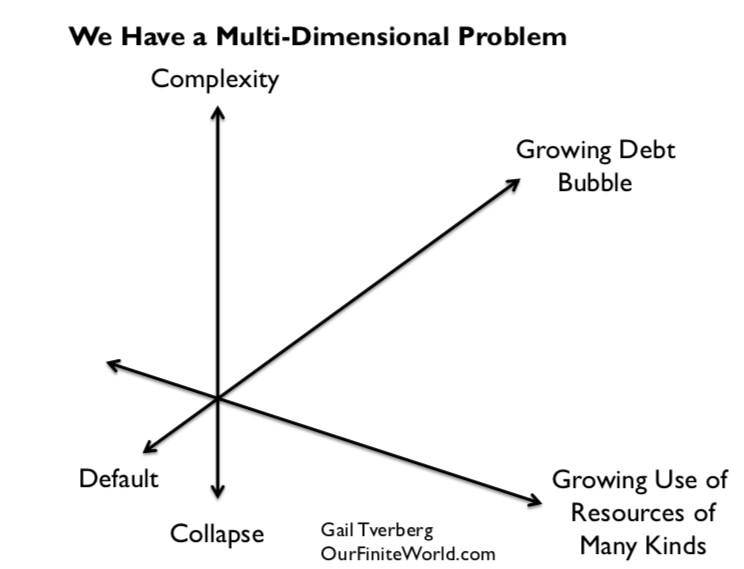
Figure 2.
Complexity involves adding more technology, more international trade and more specialization. Its downside is that it indirectly tends to reduce affordability of finished end products because of growing wage disparity; many non-elite workers have wages that are too low to afford very much of the output of the economy. As more complexity is added, wage disparity tends to increase. International wage competition makes the situation worse.
A growing debt bubble can help keep commodity prices up because a rising amount of debt can indirectly provide more demand for goods and services. For example, if there is growing debt, it can be used to buy homes, cars, and vacation travel, all of which require oil and other energy consumption.
If debt levels become too high, or if regulators decide to raise short-term interest rates as a method of slowing the economy, the debt bubble is in danger of collapsing. A collapsing debt bubble tends to lead to recession and falling commodity prices. Commodity prices fell dramatically in the second half of 2008. Prices now seem to be headed downward again, starting in October 2018.

Figure 3. Brent oil prices with what appear to be debt bubble collapses marked.

Figure 4. Three-month treasury secondary market rates compared to 10-year treasuries from FRED, with points where short term interest rates exceed long term rates marked by author with arrows.
Even the relatively slow recent rise in short-term interest rates (Figure 4) seems to be producing a decrease in oil prices (Figure 3) in a way that a person might expect from a debt bubble collapse. The sale of US Quantitative Easing assets at the same time that interest rates have been rising no doubt adds to the problem of falling oil prices and volatile stock markets. The gray bars in Figure 4 indicate recessions.
Growing use of resources becomes increasingly problematic for two reasons. One is population growth. As population rises, the economy needs more food to feed the growing population. This leads to the need for more complexity (irrigation, better seed, fertilizer, world trade) to feed the growing world population.
The other problem with growing use of resources is diminishing returns, leading to the rising cost of extracting commodities over time. Diminishing returns occur because producers tend to extract the cheapest to extract commodities first, leaving in place the commodities requiring deeper wells or more processing. Even water has this difficulty. At times, desalination, at very high cost, is needed to obtain sufficient fresh water for a growing population.
Why Inadequate Energy Supplies Lead to Low Oil Prices Rather than High
In the last section, I discussed the cost of producing commodities of many kinds rising because of diminishing returns. Higher costs should lead to higher prices, shouldn’t they?
Strangely enough, higher costs translate to higher prices only sometimes. When energy consumption per capita is rising rapidly (peaks of red areas on Figure 5), rising costs do seem to translate to rising prices. Spiking oil prices were experienced several times: 1917 to 1920; 1974 to 1982; 2004 to mid 2008; and 2011 to 2014. All of these high oil prices occurred toward the end of the red peaks on Figure 5. In fact, these high oil prices (as well as other high commodity prices that tend to rise at the same time as oil prices) are likely what brought growth in energy consumption down. The prices of goods and services made with these commodities became unaffordable for lower-wage workers, indirectly decreasing the growth rate in energy products consumed.

Figure 5.
The red peaks represented periods of very rapid growth, fed by growing supplies of very cheap energy: coal and hydroelectricity in the Electrification and Early Mechanization period, oil in the Postwar Boom, and coal in the China period. With low energy prices, many countries were able to expand their economies simultaneously, keeping demand high. The Postwar Boom also reflected the addition of many women to the labor force, increasing the ability of families to afford second cars and nicer homes.
Rapidly growing energy consumption allowed per capita output of both food (with meat protein given a higher count than carbohydrates) and industrial products to grow rapidly during these peaks. The reason that output of these products could grow is because the laws of physics require energy consumption for heat, transportation, refrigeration and other processes required by industrialization and farming. In these boom periods, higher energy costs were easy to pass on. Eventually the higher energy costs “caught up with” the economy, and pushed growth in energy consumption per capita down, putting an end to the peaks.
Figure 6 shows Figure 5 with the valleys labeled, instead of the peaks.

Figure 6.
When I say that the world economy is reaching “peak industrial output per capita” and “peak food per capita,” this represents the opposite of a rapidly growing economy. In fact, if the world is reaching Limits to Growth, the situation is even worse than all of the labeled valleys on Figure 6. In such a case, energy consumption growth is likely to shrink so low that even the blue area (population growth) turns negative.
In such a situation, the big problem is “not enough to go around.” While cost increases due to diminishing returns could easily be passed along when growth in industrial and food output per capita were rapidly rising (the Figure 5 situation), this ability seems to disappear when the economy is near limits. Part of the problem is that the lower growth in per capita energy affects the kinds of jobs that are available. With low energy consumption growth, many of the jobs that are available are service jobs that do not pay well. Wage disparity becomes an increasing problem.
When wage disparity grows, the share of low wage workers rises. If businesses try to pass along their higher costs of production, they encounter market resistance because lower wage workers cannot afford the finished goods made with high cost energy products. For example, auto and iPhone sales in China decline. The lack of Chinese demand tends to lead to a drop in demand for the many commodities used in manufacturing these goods, including both energy products and metals. Because there is very little storage capacity for commodities, a small decline in demand tends to lead to quite a large decline in prices. Even a small decline in China’s demand for energy products can lead to a big decline in oil prices.
Strange as it may seem, the economy ends up with low oil prices, rather than high oil prices, being the problem. Other commodity prices tend to be low as well.
What Is Ahead, If We Are Reaching Economic Growth Limits?
1. Figure 1 at the top of this post seems to give an indication of what is ahead after 2019, but this forecast cannot be relied on. A major issue is that the limited model used at that time did not include the financial system or debt. Even if the model seems to provide a reasonably accurate estimate of when limits will hit, it won’t necessarily give a correct view of what the impact of limits will be on the rest of the economy, after limits hit. The authors, in fact, have said that the model should not be expected to provide reliable indications regarding how the economy will behave after limits have started to have an impact on economic output.
2. As indicated in the title of this post, considerable financial volatility can be expected in 2019 if the economy is trying to slow itself. Stock prices will be erratic; interest rates will be erratic; currency relativities will tend to bounce around. The likelihood that derivatives will cause major problems for banks will rise because derivatives tend to assume more stability in values than now seems to be the case. Increasing problems with derivatives raises the risk of bank failure.
3. The world economy doesn’t necessarily fail all at once. Instead, pieces that are, in some sense, “less efficient” users of energy may shrink back. During the Great Recession of 2008-2009, the countries that seemed to be most affected were countries such as Greece, Spain, and Italy that depend on oil for a disproportionately large share of their total energy consumption. China and India, with energy mixes dominated by coal, were much less affected.

Figure 7. Oil consumption as a percentage of total energy consumption, based on 2018 BP Statistical Review of World Energy data.

Figure 8. Energy consumption per capita for selected areas, based on energy consumption data from 2018 BP Statistical Review of World Energy and United Nations 2017 Population Estimates by Country.
In the 2002-2008 period, oil prices were rising faster than prices of other fossil fuels. This tended to make countries using a high share of oil in their energy mix less competitive in the world market. The low labor costs of China and India gave these countries another advantage. By the end of 2007, China’s energy consumption per capita had risen to a point where it almost matched the (now lower) energy consumption of the European countries shown. China, with its low energy costs, seems to have “eaten the lunch” of some of its European competitors.
In 2019 and the years that follow, some countries may fare at least somewhat better than others. The United States, for now, seems to be faring better than many other parts of the world.
4. While we have been depending upon China to be a leader in economic growth, China’s growth is already faltering and may turn to contraction in the near future. One reason is an energy problem: China’s coal production has fallen because many of its coal mines have been closed due to lack of profitability. As a result, China’s need for imported energy (difference between black line and top of energy production stack) has been growing rapidly. China is now the largest importer of oil, coal, and natural gas in the world. It is very vulnerable to tariffs and to lack of available supplies for import.

Figure 9. China energy production by fuel plus its total energy consumption, based on BP Statistical Review of World Energy 2018 data.
A second issue is that demographics are working against China; its working-age population already seems to be shrinking. A third reason why China is vulnerable to economic difficulties is because of its growing debt level. Debt becomes difficult to repay with interest if the economy slows.
5. Oil exporters such as Venezuela, Saudi Arabia, and Nigeria have become vulnerable to government overthrow or collapse because of low world oil prices since 2014. If the central government of one or more of these exporters disappears, it is possible that the pieces of the country will struggle along, producing a lower amount of oil, as Libya has done in recent years. It is also possible that another larger country will attempt to take over the failing production of the country and secure the output for itself.
6. Epidemics become increasingly likely, especially in countries with serious financial problems, such as Yemen, Syria, and Venezuela. Historically, much of the decrease in population in countries with collapsing economies has come from epidemics. Of course, epidemics can spread across national boundaries, exporting the problems elsewhere.
7. Resource wars become increasingly likely. These can be local wars, perhaps over the availability of water. They can also be large, international wars. The timing of World War I and World War II make it seem likely that these wars were both resource wars.

Figure 10.
8. Collapsing intergovernmental agencies, such as the European Union, the World Trade Organization, and the International Monetary Fund, seem likely. The United Kingdom’s planned exit from the European Union in 2019 is a step toward dissolving the European Union.
9. Privately funded pension funds will increasingly be subject to default because of continued low interest rates. Some governments may choose to cut back the amounts they provide to pensioners because governments cannot collect adequate tax revenue for this purpose. Some countries may purposely shut down parts of their governments, in an attempt to hold down government spending.
10. A far worse and more permanent recession than that of the Great Recession seems likely because of the difficulty in repaying debt with interest in a shrinking economy. It is not clear when such a recession will start. It could start later in 2019, or perhaps it may wait until 2020. As with the Great Recession, some countries will be affected more than others. Eventually, because of the interconnected nature of financial systems, all countries are likely to be drawn in.
Summary
It is not entirely clear exactly what is ahead if we are reaching Limits to Growth. Perhaps that is for the best. If we cannot do anything about it, worrying about the many details of what is ahead is not the best for anyone’s mental health. While it is possible that this is an end point for the human race, this is not certain, by any means. There have been many amazing coincidences over the past 4 billion years that have allowed life to continue to evolve on this planet. More of these coincidences may be ahead. We also know that humans lived through past ice ages. They likely can live through other kinds of adversity, including worldwide economic collapse.
Note:
[1] Note that where the dotted line for 2019 is placed is based on where I see the 2019 economy relative to the downturn in industrial output per capita, based on a number of kinds of evidence, not all of which is cited in this article. The 1972 base model would give a slightly different timing of the downturn, a few years earlier. Also note that while the original “The Limits to Growth” book is no longer in print, Limits to Growth: The 30-Year Update by the same authors is available for sale.


Pingback: 2019: World Economy Is Reaching Growth Limits; Expect Low Oil Prices, Financial Turbulence – ProTradingResearch
Pingback: 2019: World Economy Is Reaching Growth Limits; Expect Low Oil Prices, Financial Turbulence | Real Patriot News
Pingback: 2019: World Economy Is Reaching Growth Limits; Expect Low Oil Prices, Financial Turbulence – TradingCheatSheet
Pingback: 2019: World Economy Is Reaching Growth Limits; Expect Low Oil Prices, Financial Turbulence | StockTalk Journal
Pingback: 2019: World Economy Is Reaching Growth Limits; Expect Low Oil Prices, Financial Turbulence | Newzsentinel
Pingback: 2019: World Economy Is Reaching Growth Limits; Expect Low Oil Prices, Financial Turbulence - open mind news
Pingback: 2019: World Economy Is Reaching Growth Limits; Expect Low Oil Prices, Financial Turbulence | COLBY NEWS
Pingback: 2019: World Economy Is Reaching Growth Limits; Expect Low Oil Prices, Financial Turbulence – Conspiracy News
Pingback: 2019: World Economy Is Reaching Growth Limits; Expect Low Oil Prices, Financial Turbulence – Nation and State
Pingback: 2019: World Economy Is Reaching Growth Limits; Expect Low Oil Prices, Financial TurbulenceSince 1998 Hitrust.net = Privacy and Protection | Since 1998 Hitrust.net = Privacy and Protection
Pingback: 2019: World Economy Is Reaching Growth Limits; Expect Low Oil Prices, Financial Turbulence | Naijafreetree Worldwide...
Pingback: 2019: World Economy Is Reaching Growth Limits; Expect Low Oil Prices, Financial Turbulence – Wall Street Karma
Pingback: 2019: World Economy Is Reaching Growth Limits; Expect Low Oil Prices, Financial Turbulence – iftttwall
Pingback: 2019: World Economy Is Reaching Growth Limits; Expect Low Oil Prices, Financial Turbulence - NewsBanc
https://www.washingtonpost.com/health/2019/01/12/we-had-no-idea-she-was-pregnant-call-details-woman-giving-birth-vegetative-state/?utm_term=.1ff5762f4f17
‘We had no idea she was pregnant’: 911 call details woman giving birth in vegetative state’
How come? Didn’t she have morning sickness? Didn’t she get cravings?
My theory of how and why this vegetative state woman got pregnant has to do with slow collapse. That is, someone working at the hospital that was maybe a late night cleaning person/guy, realized he didn’t make enough money to start a family, and the only chance he had was to get this comatose woman pregnant. So he asked her one day if she’d like to have a kid and she said nothing. He took her silence as a green light. He figured if he ever got called into court, he could claim it’s a man inherent need to procreate, to move forward his lineage, his DNA. But that his wage and future prospects of making a sufficient wage to start a family was unlikely. So he took the only opportunity available. She didn’t reject him and the relationship, although lacking two way conversation, was pleasant. He also figured the child would be taken care of, i.e. given up for adoption.
What is probably going to happen is he’s going to be one of the legal parent’s of the child and either bring the kid up or pay something monthly. As long it’s what he wanted, there’s no harm as long as he never comes out of the coma. If she does, she’s going to mad as heck and then look out.
“But the 29-year-old new mother at the center of the crisis unfolding at Hacienda HealthCare a few days after Christmas was a special — and especially dangerous — case: She had been in a persistent vegetative state since 1992.”
So she was around 2 years old when she became vegetative? And they have kept her alive all this time? Unheard of. Sherlock smells false news.
Wow, you know, that vegetative state stuff is going way too far if that’s the case. I knew someone once that knew a family with a young boy that hung himself, either on purpose or accidentally. Anyway, he had been in a vegetative state in a hospital for two years!
All I could think of was the hospital was sure making a lot of money on the emotions of the situation. Common sense says, if the person doesn’t come out of a comatose state within say 90 days, all bets are off, pull the plug. But there’s no time limit to the benefit of the hospital. Think about it, it’s a whole room so that’s big bucks, it’s day after day which really adds up and it doesn’t take much to care for the person and there aren’t any complaints, like this meal was awful or anything like that, so it’s just money heaped upon money for the hospital.
You’re talking massive amounts of money, from 1992 till now. Only a billionaire could afford it.
I am a retired physician who spent the last year doing wound care in nursing homes and I can tell you some stories about what goes on. Unfortunately, most are based on second information, but I quit at one nursing home in particular because of all the drugs and a case of a male worker caught sexually assaulting a patient. Four residents were expelled in one month, three of them women in their 20s /30s for failed drug tests. I suspect, but can not prove, that these female patients, drug addicts, were handing out sex to the male employees in exchange for drugs. As you know, drug counts are carefully kept, or supposed to be kept. However, narcotics scheduled for one patient can be withheld and diverted to another resident in exchange for sex.
Finally, when my 14 year old daughter showed me this article, I said I’ll bet she was in a car accident or something like drowning victim and young.
It is one step away from necrophilia.
Not to condone this, but it is difficult for people are generally well off to imagine how desperate people. operATE;
In simpler societies, there was a social incentive to bully or sacrifice these people so they would not create problems later on.
Having an unprecedented number of desperate people around is just asking for trouble.
we are all inclined to stay alive for as long as is possible/practical
are you going to volunteer for euthanasia despite being fit and healthy.
I would volunteer when I’m not—but so far I am—who’s to say when I cross over from one to the other?
The people working in nursing homes earn low wages. If the facilities do not have mechanical devices for moving bedridden patients, they often hurt their backs trying to lift people who are too heavy for them to lift. There certainly is the opportunity to have bad situations arise.
I knew a neighbor who wanted to call the State of Florida for Nursing Home violations and abuses. He died shortly after due to prostate cancer. How about the story of the Nursing Home where a retired WWII Vet needed oxygen and the Staff was laughing he was gasping for air, he later died.
https://www.usatoday.com/story/news/nation-now/2017/11/18/veteran-dies-calling-help-gasping/876787001/
I hope and pray I never windup in a Nursing Home.
The majority of workers there tend to be women. I thought women are nurturing and compassionate. Why would they let someone on their watch die out of malice?
Let me guess…this was a “race” thing, right?
from the comments on the video
“I have a feeling this has something to deal with racism. I noticed that both of the nurses were African American/Black. They must have known that the man was in the WW2 and fought for America.”
Looks like I was right.
“I hope and pray I never windup in a Nursing Home.”
I went to one and came away with the attitude, they’ll never get me. Life needs to be about more than just existing. I also think they are places for people with no faith. But if you assert to having a soul, then why suffer. Do as they did in Logan’s Run, go for Renewal. Get on the other side, they review your life, you digest it and claim you’ll improve, you help some other souls then at some point you’ve built up enough credits and they send you back down into a womb. By the time you’re really conscious you’ve forgotten all about the transition, in part because baby’s have a chemical that eliminates memory. Think about it, you can’t remember anything before about age 3-4. But this all requires some faith and many don’t have it. For those that think this is the only life they will ever live I suggest they end up in a nursing home and suffer whatever indignities come their way until the bitter end so as to have experienced as much life as possible.
Nope.avi, I assure you there is more than enough inhumanity to go around. Poorly paid and trained people, who are in a dysfunctional system anyway, can treat anybody badly, regardless of racial composition one way or another.
I used to work in nursing “homes” way back in the 1960 to 1980’s. I too remember what went on there.
Too few aids, too many patients is just asking for abuse & neglect. The pay was very low, the work hard, DIRTY with no benifits. We were expected to shove food into their mouths as fast as possible, too many patients choked, we had to get them up, change their diapers which we had to make up from rags before our shift started, dress them & some were taken to showers. The patients were too often drugged out to keep them quiet.
The food was cheap & they made “puddings” out of stale bread for desert . Ugh!
I remember how they were warned when an inspection was coming up, nurses & aids who were off had to come in to make it look like there was more staff on hand than they usually had, they even wanted us AIDS to wear nurses caps so we would like like RN’s – CRIMINAL!
Fortunatley the aids refused!
They had us clean the place up real good before those WORTHLESS “inspections”.
I was strong then, I could lift a lot of weight & I took care to lift in a manner that protected my back, we had no mechanical assistents for lifting them & the beds were all hand cranked to raise the heads or foot, that too was hard on our backs.
I have told my doctor I do NOT want to be “kept alive” I WANT DOCTOR ASSISTED “SUICIDE”. In Oregon, that’s suppose to be LEGAL.
Some person in a persistent vegitative state for more than 90 days should have the “plug” pulled or euthanized when there is no reasonable chance of a MEANINGFUL recovery, just breathing, peeing & pooping is not “recovery”.
I expect that when we collapse, the “vegatables” will cease to get “watered” & they could end up becoming the new “mystery “meat”.
Don’t knock it, when starvation hit Europe during the black death, human meat was hung in the butcher shops, disguised of course but people knew what it was, if your hungry enough, you WILL eat ANYTHING!
Workers’ compensation claims from nursing homes have historically been very high. I no longer am in a place where I see claim information, but I know that it used to be a problem.
Not all nursing homes are this way. Before my mother passed away, she was in a nursing home in Minnesota that seemed to be quite nice. But of course, it was away from family members. She needed the help of a strong person or a lifting device to get her from her chair to the wheelchair to the bathroom. None of the children were able to provide this kind of assistance. One time, when she was visiting her condo from the nursing home, I tried to help her to use the bathroom. We both ended up falling on the floor. Fortunately, neither of us broke any bones.
Assisted living facilities take people that are not as severe in terms of their impairments. They tend to be nicer places.
Assisted living places are nicer because they are VERY EXPENSIVE. Most of us in our declining years cannot afford such places especially those without families to help with the expenses or to keep an eye on them so their not abused or taken advantage of.
Most of us never had 6 figure incomes, we can’t pay thousands of dollars a month that these places require, what savings we have would quickly be exhausted then they get thrown out for lack of funds, then where do they go?
I saw one video that showed where some people end up when their money runs out, put out ON THE STREET in a WHEELCHAIR!
She was “black” of course & a kind “black” man took her back inside the hospital because she was not only in a wheelchair but just in a thin patients gown on a dark & freezing night, she was also obviously mentally disabled.
I will have to take care of myself until I cannot then I have a 45 cal “solution”.
“Workers’ compensation claims from nursing homes have historically been very high. ”
I think we’re not really in that world anymore. The third world is actually still slightly better as an ideal. There’s still an underclass of sorts that get no benefits and are paid relatively little. It was hairy, and she was not happy, but I somehow got people to look after my mother at her home (with me absent) without her slipping into the worst kind of destitution. The “helpers” in turn tended to have children who would accommodate them in old age. But that system is changing more and more, and we need something new.
as an older person still very fit and active, I’d like to think that there will be ‘something new’, but I cant figure out what it might be.
i have contemporaries who are in care—some have been for years. Whatever assets they had have been used up in doing that, now they are reliant on the (temporary) wealth of the state. When that fails……….???
old age seems to offer three choices:
1 stay fit or die trying (rowing machines are deathtraps, but I don’t care)
2 be cared for and die slowly
3 die as inconveniently as possible
3 applies to everyone in the end anyway
if one is unfit then care represents energy input by other people. In a caring (rich) society, this is ok for a few years, in an uncaring one, its best to move on the ‘3’ as soon as possible.
This level of social care has only existed during our era of fossil fuel usage, effectively for only 2 generations in uk. Before that, things were very unpleasant indeed.
If it’s any comfort, we will see malnutrition and shortage of the drugs and surgery that over-extend life now, leading to quite rapid death from simple infections and changes in temperature, so an awful old age will not be quite the threat it is to us now.
“I’d like to think that there will be ‘something new’, but I cant figure out what it might be.”
My neighbor is in and out of the hospital. She can barely walk. If she goes back to the hospital within 90 days, they’ll put her in a nursing home (at whose expense is unknown). Fo around 6 months now, I’ve been getting her mail down the road and taking it to her. Last night she called, asking (uncharacteristically) for a favor to go to the village store and pick up three tubs of sherbert that were being held there for her. It was freezing, and there were piles of slippery snow on the road, and I wondered why anyone would want sherbert on a night like this. But my wife drove me to the store. (I had loaned my 23 year-old car out to another neighbor whose car broke down.) The sherbert lady slipped me (unbeknownst in the snowy confusion) $5 beyond the price of the product (for which she also overpaid me). I’m hoping not to be asked for too many more favors. I have a wonderful, able partner, and seem to be able to do without villagers’ help. I go on tirelesslessly about the serious times acomin, and how we need to get involved in preparing, but the response is frustrating. If people could hear me, though, instead of continuing their ignorantly blissful foolishness, our village might weather a future storm or two.
I wonder if he perp drives a pu$$y wagon
Male perps might but female perps would drive a dick wagon, fair is fair after all.
But as long as we can get silicone dicks, I’ll stick to those, they don’t get you pregnant & their always “ready”.
But to return to the subject at hand, the economy is toast!
We have an economy dependent upon endless growth, any nutter would know that’s impossible to sustain but economist are “nutters”.
How can anyone believe we can kill millions of jobs that people must have to support this economy & replace them with machines or outsource their jobs?
Clearly we cannot & the economy shows it, big, substantial shops are closing all over the
country, the homeless population is growing, the death rate for pregnant women & children is growing & the greedy “titans” of industry are drooling for the day when they can replace more of us with self driving cars & trucks & robots flipping burgers.
Have these MORONS ever realized that bots won’t be visiting their place of business anytime soon if ever?
Or are these MORONS going to “milk this cow” until she’s dried out then retreat to their luxury bunkers to wait out the collapse to crawl out to rule again, “rule” WHAT?
Gail, what do you think of continuously expanding role of government in economy? This is direct inefficiency growth and a headwind for economic growth, isn’t it?
I think the expanding role of government is almost inevitable. Governments are themselves dissipative structures. They will grow as long as energy is available to them to allow them to grow. The aging population means that there is an ever-growing population of retirees to look after. And growth in complexity leads to a need to supervise ever-more activities.
Growing energy consumption by governments is just one of the reasons why non-elite workers get squeezed out of having money to buy homes and cars, and have families. Governments need to get taxes somewhere, so they put in place regressive taxes (sales tax, and the US Social Security “contribution” for example) that will squeeze the poor especially hard.
Every civilized state above a certain threshold of population and wealth seems to end up with a top-heavy bureaucracy (in earlier times, priests), which becomes a vested interest, accelerating decline and eventual collapse -there seems to be no alternative to this, however we explain it.
Tainter—–
its as if you own a mansion
you then need servants to clean it—protect it, –and more energy to support it and so on.
I’d like to get a copy of Adrian Goldsworthy’s ‘How Rome Fell’, to see if he addresses Tainter’s thesis, I suspect not.
His ‘Pax Romana’ is very good for how the Empire actually worked in its prime, and ‘Antony and Cleopatra’ is excellent. A change from reading about peasant life……
“Federal Reserve Chairman Jerome Powell, in his early days on the U.S. central bank’s board of governors, argued frequently and forcefully for an end to the bond purchases undertaken to support the recovery from the financial crisis, transcripts of policy meetings from 2013 released on Friday showed.
“The release of the transcripts from the Fed’s eight policy meetings in 2013 gives more insight into policymakers’ thinking and deliberations during and after the 2007-2009 financial crisis and recession.
“The year 2013 marked a turning point in Fed policy as it took its first steps to end the massive support it had provided, including cutting interest rates to near zero and accumulating more than $4 trillion in bonds and mortgage-backed securities.
“The bond-purchase program, known as quantitative easing and designed to keep a lid on long-term borrowing costs to help stimulate the economy, was hugely controversial and had its critics within the Fed itself…
“A key source of tension, then as now, was that the Fed saw one path forward, and the markets saw something entirely different.
“Last month, Powell sent markets tumbling with a message that the bond-shedding program is on “auto pilot” and then. Last week, he sent markets soaring when he said the Fed was listening to concerns and would be flexible…
“The 2013 transcripts show Fed officials generally, and Powell specifically, misjudged markets ahead of the taper tantrum.”
https://uk.reuters.com/article/us-usa-fed-2013/powell-sought-fast-end-in-2013-to-feds-bond-buying-program-idUKKCN1P522P
“Should political deadlock in Washington again bring the world’s biggest economy to the brink of a debt default, the U.S. central bank has a playbook that includes options one policymaker once labeled “loathsome,” but, perhaps, necessary.
“The policymaker was Jerome Powell, now the Federal Reserve chairman and a Fed governor in October 2013 when a political debate over federal spending brought the country to the verge of reneging on trillions of dollars of financial obligations.
“To prepare for that possibility, two Fed staffers penned a memo outlining nine actions the Fed could take if failure to raise the U.S. debt ceiling triggered a debt default…
“Options included several that policymakers readily supported, including expanding ongoing bond purchases and providing emergency lending.
“Two were far more controversial: purchasing Treasuries with delayed coupons in an effort to take them out of the market, and swapping Treasuries that weren’t in default for those that were.
“Those actions, Powell warned, would carry huge “institutional risk.”
“…the very idea that such tools were being considered was deemed such a bombshell that when the Fed published minutes of the meeting a few weeks later, after the immediate threat of default had been averted, the specifics of the most controversial options were omitted.
“Even some five years later, the full memo has not been released.”
https://www.reuters.com/article/usa-fed-2013-default/if-us-again-risks-default-fed-has-loathsome-playbook-idUSL1N1ZB1D5
This move to unfund the govt. is happening right after the Dems took over the House. So it’s a strategic maneuver to control their decisions to his liking. It’s for that reason Trump has no incentive to fund the govt. He’s going to play this out for as long as he can. There is nothing in the constitution that says the president has to sign something to fund the government, so he’s not going to do it, not even if they give him the money for the wall. At least, that’s my view of it.
That’s why I say Trump’s life is in danger. How long till he get’s totalled?
Then Pence takes over.
and half the country will be celebrating for days, maybe weeks…
uh, not celebrating incoming Pence…
no matter how different Pence will be as the next POTUS, there will be no course correction for the looming recession and End of Growth…
same downward course even if a Dem becomes POTUS in 2020…
same downward course even if Yellow Vests come to the USA…
the noise for the USA to turn to socialism will also grow louder, but the same downward course applies here as well…
at some point in the near future, there should be a tipping point of knowledge where it becomes understood by the common person that the End of Growth is here…
the vast majority are certain that infinite prosperity can be voted into office
over years of face to face conversation, this is the only conclusion one can draw
utterly stupid, but that’s the way things are
then it’s hooray for the jesusfreaks
Pence is seen as someone in waiting till trump makes his final mistake, then Pence prepares the WH for the second coming
already we’ve had Pompeo saying he’s awaiting the rapture.
We find numerous logistical challenges in our studies and modeling of the population readjustment that is approaching. Our top scenario is Operation Rapture. The Rapture “explains” how the billions of souls will go to meet their maker. Whether those souls go up or down, the result is a smaller number in the capita side of the energy per capita equation.
After Operation Rapture there will be plenty of energy for those left behind.
Only if the economic system stays together. If it falls apart, the smaller number of people will not be able to make our current infrastructure operate. We can’t make it operate now with sufficient profit (and small enough pollution) to keep it going. What makes us think that a smaller group could do any better? The total amount of energy available will be close to zero; it doesn’t matter how small the population is.
If the current economy collapses from lack of cheap energy resources, how is the smaller group supposed to build a new economy? How do they raise enough draft animals, for example?
I expect they won’t as most of them will have been eaten, same for grain seeds.
Survivors will have to do the back breaking work of farming by hand using hand tools just as the Chinese did generations ago.
If you can find it read “Farmers of fourty centuries” by F.H. King.
Farming without animals or machinery is very hard WORK!
Farming the old way left nothing go to waste, everything was saved & used, night soil & dredging from the canals was put onto the land, ALL organic “waste” was returned to the land.
The danger with any coup or Revolution, which my friends like to call it, that no one ever considers in the company of others is that the new leaders might be even worse than what we have now.
If Trump is removed violently, it will be clear that the new leader or leaders will have less reservations about killing political opponents.
If it happens it will set a precedent and it will be a clear sign that collapse is happening.
In less complex societies settling disputes with violence is more common.
Once the killing of political opponents started in Republican Rome (with the beating to death of a major politician by another, with a chair leg in the Forum!) it quickly became common practice, although most killings were of smaller fry in order to seize their property and pay off debts to soldiers and to political campaign lenders. Watching the US degenerate today is simply fascinating…….
Good points.
But the precedent was set a long time ago, Kennedy bros. slaughtered in daylight for daring to alter (-replace? – perhaps just clean out) large part of the legacy/perennial deep state. It’s largely culture driven and dependent, pirate-ranger-gangster mentality in action..
Again the US is only a host entity, sort of a substrate for a given role, which is now likely past the useful lifespan. The owner’s of the system mostly don’t live, visit doctors or school their children in the US. It’s just elementary to observe..
“If Trump is removed violently, it will be clear that the new leader or leaders will have less reservations about killing political opponents.”
It will not be clear to the average low-intelligence citizen, who will be told (and will swallow it) that the assassination was carried out by Burkina Faso or the Freemasons of Iceland, or some such nonsense.
after economic collapse, civil chaos will be inevitable
Trump isn’t strong enough to deal with that, but others are
the military will side with whoever pays their wages (they always do)
the no-neck trump supporters will back whoever shouts loudest about jesus and in no time youll have a theocratic dictatorship—maybe under Pence
Its happened before
Handmaids Tale anybody?
Trump is a failed real estate developer and TV personality.
No one will touch him financially except the Russians.
From this cognitive point, I don’t think it matters.
May possibly be the perfect late stage capitalism leader.
if he’s bumped off, the story will be that it was the Russians… to silence him…
it’s always “the Russians”…
I don’t think that I would have released this much information.
perhaps he is just a slow learner, and will eventually catch on.
More concern about leveraged, corporate loans:
“…A growing chorus of global leaders spent 2018 warning that the leveraged loan mountain was getting dangerously large and inviting comparisons with the financial crisis a decade ago.
The Bank of England, Australia’s central bank, the International Monetary Fund and members of the US Federal Reserve have raised red flags over so-called leveraged loans, which are offered to companies already in debt but often come with few strings attached.
“In October last year the Bank’s financial policy committee, which monitors the health of the financial system, pointedly raised the spectre of the 2007-08 credit crunch. It said the “global leveraged loan market was larger than – and was growing as quickly as – the US sub-prime mortgage market had been in 2006”.
“As with the sub-prime crisis, the bank added, underwriting standards had slipped – in other words, risky corporate debt was too easy to get right now. “Given the decline in underwriting standards, investors in leveraged loans are at increasing risk of loss,” said the Bank.
“The key question now is whether a bubble in a different corner of the debt market could trigger a market panic. “A quote wrongly attributed to Mark Twain fits here: history rarely repeats, but it does rhyme,” said Rasheed Saleuddin, a research associate at the University of Cambridge’s Judge Business School.”
https://www.theguardian.com/business/2019/jan/12/subprime-timebomb-back-companies-lighting-the-fuse
https://wolfstreet.com/2019/01/10/fed-paid-banks-38-5-billion-in-interest-on-reserves-in-2018-slickest-annual-wealth-transfer-from-taxpayers-to-banks/
I’m sure they meant the slickest annual wealth transfer from workers to retirees.
Those are who investments are very important to.
Actuaries put together models saying that there would be huge amounts of wealth to transfer to retirees, without understanding how the system really works.
Hi Gail, thanks for the new post. I’d appreciate your thoughts on Orlov’s latest: https://www.patreon.com/posts/23727644
Typical Orlov rant, i.e. USA/West = bad…Russia, China, Iran = good. He doesn’t see the over all problem or the big picture taking everything down, including the main players in the East. Which is a lack of cheap and abundant energy.
Well, I don’t follow him regularly, but his basic message was comparing USSR collapse with the unfolding trajectory for the USA.. That the “victory for Asia” might be relatively short lived and sour grapes in the end is an area where he is not going very often or in detail..
But again the sequencing and timing is unknown, and although old historical parallels are not tight fit, something like Byzantium v2.0 carrying the civ a bit farther, be it sort of echo boom only anyways for few more decades after Western implosion is not zero probability hypothesis, albeit relatively small chance indeed.
I’ve read enough from Orlov to detect a certain “GLEE” in his musings when the USA collapses.
couldn’t be posted bellow:
The oil price was one of the top factors for the USSR implosion, not the key or single driver. The biggest failure was the internal debacle to govern and mount serious (asymmetric and cunning) response to US post 1970 / 80s debt print fest, the Glasnost-Perestroika* reform attempt was in later stage misdirected in sort of typical “color revolution grand finale” with foreign meddling, hence Soviet old weak hardliners faction vs. Yeltsin & oligarch boyz coming in..
*in contrast similar economic maneuver eventually managed and kept the country in China & few other Asians since the late 1970s – mid 1980s, while Putin & his boyz had to slowly wrestle at least some of the major sections of the country back from foreigners during past 20+ yrs
The US actions on interest rates was indirectly what dropped oil prices.
Remember when school shootings in the US were so unusual that the big-mouthed narcissist Bob Geldof even wrote a song about one?
https://www.youtube.com/watch?v=-Kobdb37Cwc
Just look at those tramps, back there in the 1980s!
We’ll be eating RAT if we are lucky….according to his Kingship FE….
https://m.youtube.com/watch?v=QUmSuoiud44
Hope FE is doing OK….BAU is sputtering….
Good point.
The title is “The Year the Planet Flipped Over.” In some sense, I am saying the same thing. I think 2018, in retrospect, will be peak and 2019 will be a step down. Or perhaps, at most, there will be a one year delay in the process.
Orlov looks for winners and losers, given where we are now. I didn’t really evaluate his list. I think that the populists may win, ultimately, and overthrow governments. Or governments may collapse from within, like the Soviet Union. Government shutdowns can’t really restart. And the European Union may fail.
His final paragraph is
I am not very sure which countries will be the winners and losers, near term. I do think alliances will be rearranged. We cannot count on China being our friend. Europe is in deep trouble as is the Middle East. The US seems to be farthest ahead now, so, in that sense, it has most to lose. The year 1990 was the year immediately preceding the collapse of the Soviet Union in 1991. In that sense, 2019 may very well be like the year 1990. Quite a few neighboring countries were already feeling major pain, as the Soviet Union was feeling severe pressure from long-term low oil prices.
Note that the downturn in oil consumption sometimes comes even before 1992 (the collapse was at the end of 1991).
https://gailtheactuary.files.wordpress.com/2013/12/oil-consumption-as-pct-of-1985-consumption.png
https://gailtheactuary.files.wordpress.com/2013/12/oil-consumption-as-pct-of-1980-consumption.png
The USSR collapse due to peak oil and an oil shortage its easy to prove..Also the CIA accurately predicted it around a decade before..
https://www.scribd.com/document/389023088/Impending-Soviet-Oil-Crisis-CIA-1977
Peak Oil And The Fall Of The Soviet Union: Lessons On The 20th Anniversary Of The Collapse
http://www.businessinsider.com/peak-oil-and-the-fall-of-the-soviet-union-lessons-on-the-20th-anniversary-of-the-collapse-2011-5
In 1989 three things happened.
1.) natural gas production increased. How was it able to increase if there was internal economic turmoil?
2) Oil production decreased. How can natural gas production, which uses similar engineering, capital and labor as oil production, go up while oil production goes down. The only way for that to happen is if there was no new oil reservoirs to exploit. The reason oil production went up again in 1996 was due to a new technology, not available in the 1980s, called tertiary oil production, also called enhanced oil production (EOR).
3) the Ruble devalued by a magnitude in 1989. What other possible reason could have caused the devaluation in that exact year?
And your claim Gail of long term low oil prices is baseless and bogus..
https://imgur.com/a/Qe0j5Ww
USSR collapse was due to low oil prices. Admittedly, production in the area that exploration and drilling had been done had peaked, but if the price had stayed high, the USSR would have had funds to drill elsewhere. Its later production is higher. I am using BP data here.
https://gailtheactuary.files.wordpress.com/2019/01/cis-energy-production-by-year-to-2017.png
CIS Oil, Natural, Gas and Coal production dip at pretty much the same time, as shown in the above chart. I don’t understand your statement about Natural Gas production increasing while oil production decreases.
What is different is the export pattern. Oil was exported a lot earlier than natural gas. Exports dropped off after the peak year in oil production, which was 1987. The collapse was in 1991. I don’t notice anything happening in 1989.
https://gailtheactuary.files.wordpress.com/2019/01/cis-oil-consumption-production-exports-to-2017.png
Natural gas was not really exported until the early 1980s. There were pipelines and long-term contracts, which no doubt made the pattern a little different. I would expect that in the early years, natural gas that could not be used locally was simply flared (even if it was a byproduct of oil drilling). Natural gas is so difficult to ship that it was considered a waste product at one time. No one counted flared gas.
https://gailtheactuary.files.wordpress.com/2019/01/cis-nat-gas-consumption-production-exports-to-2017.png
You are going a bit far, if that’s addressed for me, I never wrote here nor implied Gail’s argument is “baseless and bogus” – read it again..
The Western economies weaseled out from their 1970s stagnation via massive print fest (and geopolitical subversion), hence also the funds available for (technology) shelf drilling UK/NOR etc.
If you did not get the related other point, lets explain it again, in contrast the Chinese grasped (and acted on) the reality of sanctioned and cornered socialists-communists economies facing uphill impossible battle against bottomless global credit money. Also thanks to their offshore Chinese folk diaspora got the idea lets ease on the past dogmatic theory a lets have mixed economy instead, i.e. ~free market and state controlled sector together under the single political umbrella.. That’s exactly what happened, they opened up zones for foreign investors, and the rest is history, no regime/statehood collapse.
In contrast ~similar Soviet/Russian maneuver ~mid 1980s was a failure, and in its latest culmination stage (Yeltsin) was directly color revolutionized by the West, hence the era of mineral rights transferred to the West, which was later trimmed step by step, and in many cases completely reversed (Putin).
So, it’s evident apart from objective “stressors” there was a chain of self inflicted errors on the part of the Russian govs control leading to a very dramatic collapse event pictured on these horrific graphs and “enjoyed” daily by the local population.
Perhaps I’m too hard on them, and some sort of mild (deep) recession and partial secession process (like dropping Ukraine/Kazakhstan/Belarus/..) would be necessary and inevitable at any event for any “best case” transformation period possible.
I have a simpler explanation for the collapse of the USSR. It happened because Mr. Gorbachev tore down that wall.
The rest is history, and spy thrillers have never been the same since.
From time to time Zero Hedge has a good article, this one seems apropos.
https://www.zerohedge.com/news/2019-01-11/scenarios-collapse-world-utterly-unprepared
“Something Biblical Is Approaching” – Here Are The Scenarios Of The Collapse
“Scenario I: Global Depression:
“In a depression, everything that has been driven the economic expansion goes into reverse. Asset markets experience severe contraction (in excess of 50 percent), credit becomes restricted, corporations and households de-lever fiercely, and global trade flows stall (for more details see Q-review 2/2018). GDP falls dramatically, between 10 to 25 percent. Unemployment skyrockets. The standard means of stimulus by central banks and governments are exhausted without any notable improvement in the economic environment.”
Scenario II: Systemic Meltdown
“Systemic crisis would mean that the global financial melts down due to an existential deficit of trust between counterparties within the system. Before 2008, a systemic meltdown was mostly a theoretical construct. However, in mid-October in 2008, global leaders were faced with the possibility that banks would not open on Monday. The interbank markets had frozen, because no one knew the amount of the losses banks carried on their books. The global financial system was grinding to a halt. Politicians and central bankers saved the day by guaranteeing bank deposits and by providing capital and extraordinary guarantees to keep the important financial institutions standing and credit flowing.”
Scenario III: The fairy tale
“Could this all be averted somehow? We’ve been pondering this for two years now, and our resounding answer is no. The leverage in the system usually results in a crash at some point, and asset bubbles very rarely deflate in a controlled manner. However, CBs can probably still postpone the inevitable, if they could re-start QE programs or find some other way to push artificial central bank liquidity into the financial markets.”
https://goldismoney2.com/attachments/deer_eating_popcorn-gif.82500/pcorn-gif.82500%2F&f=1
amidst all the doom
there must be time to stop, and laugh, and reflect on the sheer weirdness of the human mind. and take in the depth of certainty held by many people
https://www.theguardian.com/science/2019/jan/09/flat-earth-cruise-nautical-navigation
Full steam ahead, and off the edge!
haha What A Wonderful World
https://youtu.be/A3yCcXgbKrE
This belongs here
Doomer preppers….your worries are over
Costco sells out of 27-pound mac-and-cheese bucket with 20-year shelf life
Costco has blessed us with a 27-pound “Storage Bucket” of the ooey-gooey good stuff containing 180 servings. This gluttonous golden opportunity is helpfully listed under “Emergency Kits & Supplies” on the Costco website online reviews for the $89.99 item are all raves: “Good stuff! We bought this for our grandson. He was here the day it arrived. We opened it and made it. Very pleasantly surprised. I have made it a couple of different ways. You can’t mess it up. Have purchased it again, and will continue to use it,” says MimiO
https://nypost.com/2019/01/11/costco-sells-out-of-27-pound-mac-and-cheese-bucket-with-20-year-shelf-life/amp/
Yummie…I’m all prepared..easy peasy
“Something Biblical Is Approaching” – Here Are The Scenarios Of The Collapse
https://www.zerohedge.com/news/2019-01-11/scenarios-collapse-world-utterly-unprepared
Posted the same article further down before seeing your post.
The article gets the story pretty close to right, until it gets to the end. Then it comes up with:
How about “driven by a growing supply of very cheap energy”? Resiliency doesn’t just happen, except in Zerohedge, Resilience, and a whole lot of other articles we read.
The true resiliency of human populations historically has resided in their ability to:
1/ Fall back to a very basic life of simple agriculture, hunting and fisheries with modest energy requirements, and
2/ Move somewhere better.
Modernity has destroyed 1/ almost everywhere, and as for 2/ this is now a very over-crowded planet.
Exactly.
Another part of the situation was the fact that people were trained for work that was pretty portable. A farmer could farm a few miles away; a merchant could sell goods in a different town. Now, work is very specialized. Without electricity, a whole lot of work would disappear.
smh, you haven’t watched Survivor , the reality tv series, OR
The Walking Dead or many of the numerous post-apocalyptic tv shows or movies that show humans can bounce back from catastrophes with clothes, modern technology, and modern social norms.
As a student of society the ‘social norms’ bit really irks me; having ethnically diverse survivor groups with modern feminist sensibilities seems a tad unrealistic.
or asked where mad max gets his petrol from
Who wants to be part of a collapsing EU?
“The City of London Corporation has just voted 60 votes to 31 AGAINST a PeoplesVote.
This is the most powerful body in the city of London and they believe Brexit must proceed.
Is it possible that they simply don’t want any more uncertainty? A People’s Vote would be subject to the same levels of propaganda, as the Referendum so they couldn’t guarantee the outcome. Withdrawing Article 50 would be preferable.
The EU was brought into being on the assumption that wealth and prosperity would be forver if we did so
the EU is falling apart because that isn’t so
I tried to explain it here:
https://medium.com/@End_of_More/the-european-union-was-a-construct-of-infinite-prosperity-7a401c225171
Right on, Norman. You’d like to be wrong about our fossil fuel dependence doing us in and about renewables not being able to save us, not now not ever. Personally, I’d like you to be wrong as well. But based on our current knowledge, I think you and I are both going to be disappointed.
i agree
the European powers fought each other till 1945
then in 1955 the EU kicked off on the basis of ‘wealth forever’
now we’re reverting to traditional activities again
Great article Norman, thanks for sharing.
thanks Frank
Goldman Sachs is the counter part to Deutsche Banks derivatives book…according to trader hks55 (Twitter) who worked in the financial industry.
So what happens when DB no longer can pay?
https://pbs.twimg.com/media/Dwl2DSYUcAAyHmV?format=jpg&name=medium
My instinct as a lay person tells me that they will never let DB collapse (unless it is part of a more sinister plan). My wild theories have been aroused by the Corbett Report’s 3 part series on World War I produced several months ago which should be seen by everyone. It seems that the root cause was England’s distrust or fear of an up and comer Germany. Better quality manufactured items, a railway from Iran and oil fields to Germany, etc. All of which leads me in my cynical way of thinking that the English “Rothschilds” have pre-wired demolition charges for DB thru derivatives to act as the ground zero for a new monetary system, which if did occur, would be the mother of all financial convulsions.
DB simply can’t be allowed to collapse. It would be terminal.
https://sc.cnbcfm.com/applications/cnbc.com/resources/files/2016/09/28/imf%20spillover.jpg
Lots of interconnections!
No that’s what complexity looks like 🙂
(singing)
Haben Sie gehoert das Deutsche Bank? Badda boom, badda boom, badda bing bang bing bang bong….
This doesn’t sound so good. We can hope (probably wishful thinking) that Germany will bail out Deutche Bank’s derivatives and everything will be fine. But I don’t think we can count on it.
Gail I know you said wishful thinking but even with a printing press would that be possible and have the euro or even the EU survive?
Lord knows what is going to happen when the UK leaves in March.
I’m thankful Harry is tucked away on an island full of whiskey to keep up the reporting until the lights go out.
I don’t know. I never expected QE last time around. It is possible that someone has something else up their sleeve, or that there will be a lot more QE.
Thank you for the vote of confidence, Dan. 🙂
“Lord knows what is going to happen when the UK leaves in March.”
I am equally baffled. There is no easy way forward and no ‘solution’ that will not anger millions of people. The whole thing has become poisonously divisive, socially and politically, and economically parlous.
There are protesters from both ends of the political spectrum marching on the streets of London, sporting yellow vests today. Most confusing:
“Both right-wing and left-wing demonstrators donned yellow vests and marched through the streets of London on Saturday, attending two very different anti-government protests.
“While several hundred pro-Brexit campaigners rallied outside St James’ Park station wearing the high-vis vests made famous by anti-fuel tax protesters in France, several thousand anti-austerity activists also adopted the yellow jackets for a march from Oxford Circus to Trafalgar Square.
“Both groups told The Independent they saw a connection between the French movement and their own frustrations and demands. And both groups insisted the other side had hijacked the true spirit of the gilet jaunes.”
https://www.independent.co.uk/news/uk/politics/yellow-vests-london-uk-protest-march-austerity-brexit-right-left-wing-a8724851.html
‘Yellow vests’ everywhere now: Monty Python politics…….
It is as vacuous as occupy wall street.
If I’m not mistaken DB has been already for some time no longer owned directly nor controlled by Germany anyway, the control is partly shared with some offshore funds and various investors what have you. The .de gov’s alluded to your point of no longer backstopping it at all costs..
Different thing would be some sort of systemic support, lifting all boats, incl. DB among other conduits of the debt machine.., like another global QE round or similar schemes..
How we all think now, in an energy glut that enables relative abundance in the Western world, is starkly different to how our minds would operate under scarcity. Research has shown that if a human experiences scarcity, valuable mental processes such as strategic and long term planning, social intelligence and lateral thinking are heavily affected in favour of focusing on what the body needs in the short-term, producing a different set of behavioural schemas. Under a scarce environment then, you would quite simply be a different person to the one that has thus far lived in comparative security and stability.
An interesting parallel that can be drawn is that of an energy-rich civilization; energy allows for increased complexity of social roles, services and technologies, and allows greater permissiveness due to the growing distance between the individual and their means to survival. An individual’s daily life is divorced from what sustains them and becomes embroiled in their own corner of the complexity. As less net energy enters the civilization’s thermal system, these complexities contract and break-down, and the individual is brought closer to their means to survive due to the collapse of their support systems and supply lines.
The mind may see the same dynamic at play; while in abundance, the brain has enough spare energy for nuance, abstract thought and permissiveness as it isn’t occupied with finding food, processing it, and maintaining shelter and warmth. As scarcity takes hold, the more complex processes are shut off in favour of these survival processes; like a smartphone preserving charge. Many of us who hold certain ideologies or frames of mind now, regardless of our knowledge of the coming collapse, will see their minds change rapidly when actually faced with it, producing individuals who think in the complete opposite manner than before the collapse hit. The point to make here then, is we should ideally be more reticent. Entrenching yourself in one ideological position or another before the resource base that shapes those ideologies changes, is leaving yourself vulnerable to an inability to adapt to new realities.
Mullainathan, S., & Shafir, E. (2013). Scarcity: Why having too little means so much. New York, NY: Times Books.
Shah, A., Mullainathan, S., & Shafir, E. (2012). Some consequences of having too little. Science, 338, 682–685.
Good advice. To be open minded and accept everything that happens (i.e. not denying phenomena that are contrary to beliefs) is also good advice for life in general.
Pink Floyd legend Roger Waters is considering a performance of The Wall along the US-Mexico border.
http://loudwire.com/pink-floyd-roger-waters-the-wall-us-mexico-border/?fbclid=IwAR3LfGOoNCI64tHGCbFJZL5x2G9tVquI91V68javKLxnBK5dwFjqSHWnjBc
strange days?
Undoubtedly Mr. Waters and his entourage would fly in to this cross border gig in personal jet, he can then trully sympathize wit the Mexican’s oil shortage problem now..
/sarc off
From its namesake, perhaps an even more appropriate song, depending on your point of view, but if you have no borders, you have no country, unless of course you are an island.
On the Turning Away (of illegals)
Roger made great music but has unrealistic ideas on achieving equality. In fact believing in equality is where it all goes wrong. Start with trying to achieve equal height for all. Maybe take from the high and give to the low.
https://i.imgur.com/V59Qy4f.jpg
I think Trump is looking at the state of Mexico’s oil exports. Having a new Venezuela on our border in the near term could be a scary prospect to some.
When Mexico goes into full collapse, many tens of millions of Mexicans will attempt to flood into our country.
Mexico recently has declared a crisis and is deploying the military to defend their oil industry against thievery.
Mexican citizens have been warned that they will have to pay higher prices for gasoline.
“Drivers Running on Empty Say Mexico Must Fix Fuel Shortage” from Bloomberg…
“Across central Mexico, drivers are running on empty or lining up for hours at service stations, as the government’s efforts to rein in fuel theft compound a nationwide gasoline shortage. More than one-fourth of Mexico City’s 400 gasoline stations are facing problems, Mexico City mayor Claudia Sheinbaum said in a Twitter video, while assuring viewers that supply would normalize Wednesday. The states of Mexico, Hidalgo, Jalisco, Michoacan, Guanajuato and Queretaro are among the worst affected.”
I personally am delighted with joy knowing that illegal immigrants are getting welfare, housing and free health care while I struggle to pay ever higher medical costs, and will never receive benefits I have been promised.
I always wonder if there is a valid “incidental indicator” which might correlate with fuel scarcity or high prices, specifically bicycle sales. How is the bicycle industry doing? My understanding is that on already paved roads, it is the one of the most energy efficient modes of transportation assuming you live in moderate climates, etc. and doesn’t cost energy much to produce relative to cars.
But it is generally not substitutable for other transportation, in the US. Instead, it is mostly an add-on by people with extra time and money.
Old China moved everything by wheel barrow, human backs or sometimes, ox cart. The Chinese wheel barrow is different from what we use in that the wheel is in the center of gravity with large crates on either side. They could carry bulk goods or people on those wheel barrows. Other countries use bicycles with a cart in front or rear to move goods & people, mainly in the towns & cities.
Such means many not be “suitable” now but when fuel becomes scarce & EV”s fail, it will look more attractive.
I remember reading that such wheel barrows could move on very narrow roads. These were easier to maintain than wider roads. The road cost is the big overhead item.
Sorry, but that’s self inflicted wound, the US rail network, incl. sub urban used to be one of the best and densely made prior ~1920s. And that would be relatively trivial to upgrade into additional e/bike transport capability for the last mile for daily commuters, e.g. redesigned the wagons, adding transport ones etc. To reintroduce it now everywhere is likely impossible, although in previous decades ~1970s there might have been windows of opportunity to put it back at least into some key areas..
As a former resident of Mexico, one must improve your literacy on the subject.
While I have not lived there, Growing up in Texas, being educated in Texas and working for much of my career in Texas, I have probably worked with more Mexicans than you.
My two best friends are married to Mexican immigrants, now citizens of the US.
They fled the crime and violence. One of my neighbors that I knew all of my life went to Veracruz to staff his fathers factory and married a gal there.My father was born and raised outside of Del Rio and could tell you the origin and meaning of Spanish names for any Texas town and Cities.
BTW….two brothers, immigrants from Scotland, ancestors on my fathers side of the family, came the what was the Bastrop Colony, bought 3000 acres, and became citizens of that part of Mexico at the time. They also both fought in the Tx revolution. One was in a Tx Ranger regiment…got wounded in the leg in an engagement. The other fought in General Sam Houston’s army at the battle of San Jacinto where they captured General Sant Anna in a surprise attack.
I have known Mexicans who spoke of the farms they left and the small towns they left…and long to return to. I have had college buddies searched and threatened by the Ferderal police.
My neighbor drove down to the west coast and lived in a fishing village for weeks.
Don’t lecture me about Mexico.
Unfortunately history has shown fear is a very strong motivator. Trump has successfully created a world to fear for his followers. Whether it be illegals, democrats, or even school kids, they are all after the republicans to force change upon them. This has created a passionate following of people looking for Trump to protect them..
Baby has his head in the sand. Of course we have infinite energy and infinite resources here in the US…and always will…And California can give sanctuary to all the billions of people who wish for it in the world.
Fear however is not always irrational- most of the time it actually has some grounding. Are you arguing that Democrats wouldn’t want to force change by having their policies enacted, or that illegal immigrants don’t break laws that ultimately cost the country money? Trump’s message would simply not resonate without a kernal of truth. If it is the reality that people feel their interests are threatened, then capitalizing on that politically will be a successful strategy.
It’s amazing!!! In this shining city on a hill filled with shiny happy people holding hands, and with nothing to fear but losing one’s livelihood and being thrown out on the street, bankrupted by medical bills, raped or murdered in or out of one’s bed, or upsetting someone by using the wrong gender pronoun, and with almost the entire mainstream media propaganda system demonizing him as The Great Dictator, this one orange-haired apelike creature with the aid of nothing more than a Twitter account has managed to mesmerize the deplorable half of the nation into hallucinating “a world of fear” that only exists inside their heads.
Ha ha – Trump is nothing more and nothing less than a peg in the lineage of poor leadership, false promises, and shirking of the ability of telling people the truth. Everyone on the lower rungs go after the “leaders”. Trump is not a messiah he is just the orange lemon that wanted the job for all the wrong reasons (ego) holding the bag.
News flash they all suck and he sucks and whoever comes next is going to suck.
I’m posting from my $45 walmart phone and provide links but look up Nixon tapes transcripts specifically discussing health insurance.
That will let you know how much they suck.
Tim,
Seriously look it up
Nixon Tape Health Insurance
Read it and read it well. We’ll discuss capitalism and health care. I use that term loosely. Bear in mind it’s a $4 trillion industry / yr in the US.
You want to know why I’m a doomer its because I’m tired of being a slave.
No, Trump is not the messiah. And yes, they all suck. That’s a very reasonable and defensible view.
But there is plenty to fear in the world and plenty of Americans are in fear. Trump didn’t create these fears. He merely responded to them masterfully.
Having said that, I don’t have a dog in this fight, but I like Trump in spite of his more obvious failings. I admit I like him for some of the wrong reasons. For instance, I like him because I dislike his political enemies, because so much of the opposition to his existence (not to his policies, per se, but because he’s the one pushing them) is hysterical, and because I think he’s being treated unfairly by the media. I’m perverse that way.
I also like the idea of bringing home US troops from Syria, Iraq and Afghanistan. I saw Clinton bomb Serbia into submission, Bush 2 invade Afghanistan and Iraq, and Obama destroy Libya. I haven’t seen Trump launch any fresh wars or invasions and I’ve heard that he’s not a war-hawk. Of course, time will tell.
As for Nixon, I picked this up from Wikisource:
This is a transcript of the 1971 conversation between President Richard Nixon and John D. Ehrlichman that led to the HMO act of 1973:
John D. Ehrlichman: “On the … on the health business …”
President Nixon: “Yeah.”
Ehrlichman: “… we have now narrowed down the vice president’s problems on this thing to one issue and that is whether we should include these health maintenance organizations like Edgar Kaiser’s Permanente thing. The vice president just cannot see it. We tried 15 ways from Friday to explain it to him and then help him to understand it. He finally says, ‘Well, I don’t think they’ll work, but if the President thinks it’s a good idea, I’ll support him a hundred percent.’”
President Nixon: “Well, what’s … what’s the judgment?”
Ehrlichman: “Well, everybody else’s judgment very strongly is that we go with it.”
President Nixon: “All right.”
Ehrlichman: “And, uh, uh, he’s the one holdout that we have in the whole office.”
President Nixon: “Say that I … I … I’d tell him I have doubts about it, but I think that it’s, uh, now let me ask you, now you give me your judgment. You know I’m not too keen on any of these damn medical programs.”
Ehrlichman: “This, uh, let me, let me tell you how I am …”
President Nixon: [Unclear.]
Ehrlichman: “This … this is a …”
President Nixon: “I don’t [unclear] …”
Ehrlichman: “… private enterprise one.”
President Nixon: “Well, that appeals to me.”
Ehrlichman: “Edgar Kaiser is running his Permanente deal for profit. And the reason that he can … the reason he can do it … I had Edgar Kaiser come in … talk to me about this and I went into it in some depth. All the incentives are toward less medical care, because …”
President Nixon: [Unclear.]
Ehrlichman: “… the less care they give them, the more money they make.”
President Nixon: “Fine.” [Unclear.]
Ehrlichman: [Unclear] “… and the incentives run the right way.”
President Nixon: “Not bad.”
I receive my Health Care from Kaiser Permanente precisely because the incentives are to hold down the extent of overcare.
In the US healthcare system, the tendency is to do way to much. Doctors want to see their patients again and again; they do not really want to get them well. At least Kaiser has the incentive to get patients well, in as inexpensive a way as possible.
If you think about it, every single private practice doctor has an incentive to make as much money off each patient as he/she can. This is true, whether the patient is operating separately or as part of a group. The whole system is built around, “We have a pill or a surgery for anything that can possibly go wrong. We can keep patients alive, long after common sense would say treatment should have stopped. Don’t worry about eating healthy food or exercise. We can fix any problem.”
Tim +++++++++++++++
Here on Our Finite World I hope we have a consensus that there is a limit to the number of people the world can support and a limit to the number of people North America can support. I believe we are beyond the carrying capacity by a factor of four in North America. So, allowing immigration is just offering to starve some of the bottom 70% already present in favor of some new immigrants. A sick deal.
as long as they don’t all try to cling to an upturned OFW
I’m not sure a friendly, open borders mentality can survive collapse BD.
Trump has let the best response and reasoning to curtail illegal immigration escape him and he will never be able to use it even if he understood or believed it. Trump has campaigned and boasted of the endless wealth to be had (i.e. infinite growth on a finite planet or within our own borders), resources are dwindling and are in jeopardy something he denies, he attacks the people that are raising the alarm on decreasing water resources, insect and phytoplankton losses, etc.. The ecology is being stretched to its limits. In short the barn is full and we simply don’t have the resources.
If the right would recognize that you can’t have your cake and eat it to and that there is such a thing as shortages, climatic change, amd in general a very real limit to carrying capacity then he could make the argument that we simply don’t have the resources.
I agree how many do we let in? 30 million, 7 billion? There has to be a limit and I believe we’ve met that limit years ago (decades). We are on fumes skidding into a disaster.
Make no mistake I’m no Trump fan and I absolutely abhor his leadership style and rhetoric. However I agree that illegal immigration needs to be checked. Unfortunately our leaders are not and will never be honest as to why.
“Make no mistake I’m no Trump fan and I absolutely abhor his leadership style and rhetoric. However I agree that illegal immigration needs to be checked. Unfortunately our leaders are not and will never be honest as to why.”
I agree and have a similar viewpoint. With the partial sort of wall they already have, it’s like the politicians are saying, “You can’t come in illegally, but if you’re real determined and force your way in and make a life of it, we’ll let you stay.” Which is a bunch of double talk. Either have a wall or don’t, but if they are going to have one, have one that does the job right.
A wall will not keep them out, IMHO, they climb over it, they dig under, they cut away the bars, they will get in, what is needed to to ENFORCE the laws we already have on the books.
ILLEGAL IS STILL ILLEGAL why do we allow them in, give them OUR JOBS & OUR LIMITED HOUSING if it wasn’t benefiting the CORPORATIONS that OWN this government?
Want to end illegal immigration? Take away the JOBS they were ILLEGALLY GIVEN, REMOVE THEM from the HOUSING they were ILLEGALLY allowed to rent, REMOVE THEIR CHILDREN from ILLEGALLY entering our schools for a free education on our dime but most of all, STOP GIVING CITIZENSHIP to the children of illegal immigrants who sneak in or force their way over the border to give birth!
The 14th amendment was intended to give citizenship to the children of slaves who were not even considered “human”, it should NOT be applied to the children of illegal immigrants.
Those who DEMAND open borders & an end of ICE are asking for DISASTER & the end of our country.
Walls are not the answer. The elimination of incentives (Yes I’m talking to trump and his illegal maids and construction workers, etc). Accomations, etc as well like school enrollment, healthcare, and so on. The problem is that TPTB on both sides use these immigrants but we are beyond capacity.
We as the western world especially the US needs to acknowledge we have caused many of the problems these people are fleeing from and reconcile that fact.
Of course in the end as resources become more scarce we’ll have to kill them and take what we need.
Smedley Butler had it right, the military is there to serve corpoate need and consumer greed.
I would have to disagree with the argument that walls don’t work- see the Hungarian border fence- constructed quickly and well manned, it has stymied the flow of migrants across the entire length. Ultimately the incentive derives from the relative lack of risk at attempting to cross a border: guards aren’t shooting at them yet. We will all suffer a breakdown of our ethical frameworks post-collapse anyway so I see little point ‘reconciling’ our own governments’ role in their movement now when so much conflict is on the horizon. It’ll be a zero-sum scenario and that’s where Trump is ahead of the curve.
To delve into politics, many liberals do not want to address the ongoing meddling by U.S. foreign intelligence and military operations that have kept many countries destabilized instead of merely being poor
BECAUSE
they see a political opportunity to IMPORT voters who they can mold into future progressive voters, therefore gaining a permanent political majority,
because they think more workers willing to work for less (can’t convince a domestic labor force to work for less and no one is buying the hogwash about educating oneself into a good job anymore) will……..somehow…….save the social security system and the retirement plans of many senior citizens…many of whom don’t have children.
lASTLY, and this is merely speculation, but the people who are a strange combination of neoconservative, and far left, see the sabotage of weaker countries is an important step towards eliminating the nation-state, another significant barrier to human trade overcoming racism. To the people who share neoconservative and far-left views, they nation-state is an outdated institution along with marriage, and religion. and other social norms.
Dan, no method works 100% but the more effort made to stop illegal immigration the less there will be. It does not need to be perfect. The Israelis use automatic triggered machines guns to create kill zones around their walls. The walls plus auto kill plus human snipers seems to work well in Israel.
Wall building is great for GDP!
so is building solar panels, and putting marginal students through graduate school. and providing healthcare for people who are very sick/weak, and allowing millions of refugees to enter a country.
Think of all of the jobs it creates. I certainly hope that the steel is US sourced, all the way back to the ore pulled out of the ground.
How about a nice tasteful wall covered in solar panels on the south side?
As long as some way can be found to stop people throwing stones at the panels, it’s a win-win scenario.
Political leaders cannot be honest.
Neither can writers of text books.
Neither can most people who pretends that our problems are merely political in nature.
What are the “enlistment rates” of the non-governmental border volunteer militias these days? Anyone know?
The US is nation state yes?
Could you please point to where its border is?
If there is no enforcement of a border then does one have a border or a nation in the long run?
I think what is not being stated is that a wall is needed with very big gates to allow people in legally.
So is this cartoon depicting less illegals or less enforcement of the laws in detaining illegals.
There is one other issue at hand, that is the issue of magnetic pole shift which is underway and which has occurred approximately every 200,000 years, so not exactly at times which human history has recorded the effects and consequences of. During this time our magnetosphere (that which shields us from solar flares etc) is depleted. The last time solar activity disruption happened and which was recorded was in the 1859 time-frame and this disrupted telegraph services. Certainly these are nacently changing times. Thank you for this thought provoking post.
I am afraid I don’t know anything about this subject. But our economy has become very dependent on everything staying the same, because of its complexity. If we were simply picking up sticks of wood off the forest floor and burning them, we wouldn’t care about the magnetosphere’s effects at all.
Indeed, when camping, it is worthwhile to consider the tradeoffs between having to gather huge amounts of wood for an open inefficient campfire, which may require bringing a saw or an axe, vs the efficiency and ease of gathering fuel from twigs, bark, pine cones, and dried leaves. Of course, the energy to lug this thing around needs to be taken into consideration. No way is it practical if you are trying to carry it on a thru-hike of the Appalachian Trail, but if you are car camping where there is no weight penalty, it can be nice.
https://www.amazon.com/EcoZoom-Versa-Rocket-Survival-Stove/dp/B005GQZ4O0?SubscriptionId=AKIAILSHYYTFIVPWUY6Q&tag=duckduckgo-d-20&linkCode=xm2&camp=2025&creative=165953&creativeASIN=B005GQZ4O0
I made my (not very portable) rocket stove out of concrete, pearlite, an old bucket, and some cardboard tube and wire lath I found. I will now sing Kumbaya next time I use it.
I find it amusing how the Central Banks and the financial markets loosely throw out the term “Recession” because that’s what they fear. Ironically, that’s not what they fear. What they do fear is at best a “Global Depression” and at worse a total global collapse of banking, finance and the markets. I guess not trying to use scare words, helps keep the public from going into full panic mode because that nearly happened in 2008 and the problems according to many economists are far worse than it was in 2008.
As a girlfriend said: ‘I wish they’d stop using that awful ‘recession’ word: I mean, it just makes things worse doesn’t it ? And then people won’t come to my gallery and buy art!’
That was her response to 2008!
I’m always interested to find out how people came to find this blog in the first place; it can’t be said that it’s particularly flashy and entertaining, so much as it depressing. But I think it does represent an example of stellar systems thinking and a profound understanding of our nature as humans and organisms, and how our collective behaviour, our ideologies- all that- is essentially a product of our resource and energy conditions. I came to this realisation in an awkward fashion, being interested in society first, and working backwards into economics and biology, and when it all came together, it was like being hit by a thunderbolt. I thought at the time that I was one of the very few who had come to the conclusion we, as well as our civilizations, are fundamentally driven by fragile energy inputs, but I’m glad to have found a place that has proven me wrong in that respect- there are lots of us. I’m glad too that many seem to be preparing as best they can for when system breakdown begins in earnest.
Thanks Gail, for giving us risk-averse people a home.
I suppose actuaries are particular aware of future risks that other folks cannot see in front of them. You may know that I originally started writing under the pen name, “Gail the Actuary.”
Actually not many of us here. Probably less than 50 in total? Among th 7b+ people
for every commenter you might get 100 drive-byes
I’ve lurked like crazy here on OFW for at least the past 4 years (spent most of my time on TAE before that… until Nicole Foss bailed on it anyway). Your comment made me decide to post for the first time.
Cheers!
once you comment you can’t stop
some have to go into rehab eventually
naming no names
I’m going by the assumption there are a lot of lurkers- but it’s true, I think Harry McG is about 70% of all comments..
Harry is the Doomer’s version of Drudge. On a good day he’s truly prolific.
I get a surprising number of e-mails and phone calls from people who never comment publicly. Also, when I meet people in gatherings outside of setting where I would expect readers of energy blogs, I run into a lot of people who come up to me and say, “I have been reading your website.” A lot of these people are not readers of the comments, however. They read the posts, and consider that enough time devoted to the topic.
“They read the posts, and consider that enough time devoted to the topic.” Probably for the best!
@ CTG
Read an interesting essay over at the Saker blog and immediately thought of you CTG. Your view of the supply chain and the interconnectivity of everything is becoming a very serious issue for the US Military:
The essence of the problem, according to the retelling of the columnist of the Reuters agency Andy Home, who obtained a copy of the September report of the US Department of Defence on the situation concerning key deliveries necessary for the American army, is reduced to one important figure. More than 300 (!) key elements necessary for the normal functioning of the US Armed Forces and defensive industry are under threat: American producers are either on the verge of bankruptcy or were already replaced by suppliers from China or other countries because of the deindustrialisation of national economy and the relocation of production to the countries of Southeast Asia.
Mr. Home gives as a striking and clear example the amusing (of course, if you are not a US military man) fact from the report: it turns out that the last American producer of the synthetic threads necessary for the production of army tents “died” quite recently. This means that in the event that the US will fall under such a “textile embargo”, for some American soldiers they will seriously face the prospect of sleeping in the open-air. It is difficult not to notice that such a prospect looks slightly humiliating for an army that claims to be the most hi-tech on the planet.
The situation could be considered as funny if it didn’t affect such a wide range of requirements of the Ameri
enjoy….
Welcome Frank
I have a similar story. My background is in Christian ministry. Like you my journey to understand the underlying causes of our declining civilization has lead me here. I check this website almost daily to read the ongoing comments about finite world resource issues.
Gail’s has a rare ability to look at an overwhelming complex system and identify the fundamental drivers. She can see through the fog of data and extract the truth. She is humble to a fault. Gail has no political agenda that I am aware of. Gail provides valuable information and analysis and distributes it free of charge. Most importantly, she is able to communicate these ideas in a way that even I can understand.
The comment section of Our Finite World is a battleground of ideas, where only the strong survive. Many of the regulars who post here provide additional information and analysis that explore a wide range of practical responses. We have some of the gloomiest doomers contending with die hard delusional optimists; and everything in between.
So sit back and make yourself at home. It’s good to have your company.
yup
we have yet to reach peak doom that’s for sure
Thanks for the kind words Theophilus- I’d like too to contribute analysis when I can but I’m afraid my days are a bit busy recently. Gail is a gem to be sure- I’ve been lurking for years so she’s a celebrity in my eyes, and her impartiality is refreshing. I’m sure most others with the same information would have sunken into a ‘We’re all going to die’ mantra, but GT still comes out with new insight all the time.
Drug overdose deaths skyrocketed among women
https://www.cnn.com/2019/01/10/health/drug-overdose-deaths-women-cdc-study/index.html
I think that there are many parts of the story of growing overdose deaths by women. The view that there is a pill to fix every problem pervades the entire medical system and the population buying the drugs. Some of these drugs are addictive. They have interactive effects. And there are huge numbers of women who find it impossible to find a stable home situation, with low wages for both men and women. Income tax rates tend to be higher for married couples than singles, discouraging marriage, particularly among the low income folk. Wage disparity is a much greater problem, now that more women have college degrees, because high income women tend to marry high income men.
Low income women tend to self medicate with drugs. So do higher income women, if they have medical issues that cause pain. Overall, there end up being a lot more deaths from overdoses.
I lost an ex girlfriend a few months ago to an opioid overdose..I went to high school with her..She had a small child as well..And she wasn’t some trailer trash either..Her parents house had its own basketball court inside it..Her family was extreme wealthy..Just saying this because it shows it can happen to anyone these days..
A sister of a one of my sisters-in-law died unexpectedly a few years ago. She had teenage children. An autopsy revealed that the problem was a drug interaction effect. If I remember correctly, both of the drugs involved were commonly sold over-the-counter drugs taken for fairly medical conditions that occur frequently. (It is possible that one was a common prescription drug.)
A woman I know (married with a teen-age son) who was undergoing treatment for brain cancer became addicted to the pain killers she was being given. She had a terrible time going through withdrawal symptoms, at the same time she was continuing cancer treatment.
Part of the problem is that pharmaceutical firms aggressively pushing strong, new opioids into the market-place in the 90’s deceived doctors thence their patients both about the addiction risk they posed and their long-term efficacy, with the result that they were absurdly over-prescribed. A lot of people picked up habits back then.
Here is a shockingly disingenuous Purdue commercial for OxyContin from 1998:
And here’s how it turned out for some of the pain patients featured in Purdue’s campaign;
In the 19th century, wealthier people were often set on the path of opium addiction in consequence of medical prescriptions for pain relief. ‘Mama’s special tonic’, etc.
The wife of Lord Clark (of ‘Civilization’ fame) used to be quite hard to deal with in the mornings until she’d had her special cocaine nasal spray, prescribed by her physician as medicine. Everything one could wish for; wealth, fame, beautiful houses and art collections…..
until about 1963 (I think) cocaine was a prescribed medication in uk, and we didn’t have a drug problem
then they banned it and we got a drug problem overnight (literally)
What fraction of these drug overdoses are actually suicides?
“It’s no secret that our Federal debt has more than doubled since the onset of the last recession in late 2007. It’s gone from $10.1 trillion to $23.6 trillion. That’s a 134 percent increase in just 11 years!
“And now Trump’s business tax cuts are pushing that debt higher still. It’s now at 114 percent of GDP. It was only 69 percent of GDP in late 2007. In fact, government debt has been roughly doubling every eight years or two administrations…
“At a similar, near-doubling rate, it could be as high as $39 trillion at the beginning of 2025… Doesn’t seem possible, does it? $39 trillion!?
“But when you consider the impacts of the large corporate tax cuts in the deep depression I expect we’ll see between 2020 and 2023/2024, that dizzying figure doesn’t seem all that impossible after all.
“Consumer debt has only come back to slight new highs at $14.2 trillion and the financial sector debt has declined $2.1 trillion since its peak in 2008.
“Corporate debt has gone up the fastest—49 percent—in the Fed-engineered, low-rate environment. It’s gone from $10.1 trillion, or 68 percent of GDP, to $15 trillion, or 73 percent GDP. $7.35 trillion of that is loans. $7.65 trillion is corporate bonds.
“But the big factor has been the corporate bonds stimulated by massive QE and lower than market rates…
“Most people aren’t aware that these have gone up more than government debt. They’ve gone from $2.95 trillion at the beginning of 2008 to $7.65 trillion in late 2018, heading towards $8.0 trillion-plus. That’s 159 percent as of now, greater than the growth of the Federal debt.
“The worst part is that much of that has been used for leveraging earnings through stock buybacks that shrink shares rather than grow capacity and sales/earnings—and not for expansion of capacity. The corporate tax cuts also didn’t increase capital spending as was projected!
“It’s the same phenomenon around the globe—from China to Turkey—with corporate debt growing the fastest thanks to low rates and the plentiful dollars and euros printed to bail us developed countries out of our last debt crisis…”
https://born2invest.com/articles/trend-global-debt-more-concerning/
“…investment-grade and high-yield corporate bonds have registered over US$65 billion net outflow in the 10 weeks to Dec. 31. That marks a record high. In other words, investors are dumping corporate bonds.
“Many countries, especially emerging markets, have posted staggering credit expansion after the 2008 financial crisis.
“The credit to private non-financial sectors in developed and developing markets surged above US$160 trillion in the first quarter of last year. It accounts for 244.9 percent of GDP. Both figures hit a record high. That shows private non-financial sectors are having extremely high leverage, and the bubble is building up.”
http://www.ejinsight.com/20190111-high-debt-levels-fed-tightening-may-trigger-another-crisis/
“Cracks are already forming. In December, borrowing in the high-yield bond market came to a standstill. Deals in the leveraged loan market are also delayed from a lack of interest from mutual funds and collateralized loan obligation managers, the largest buyers of leveraged loans. These events signal trouble ahead for highly indebted companies seeking more financing.
“Wall Street banks have significant exposure to corporate debt… In a crisis, these exposures could serve as a channel for contagion in a highly interconnected financial system dominated by large banks.”
https://www.nytimes.com/2019/01/10/opinion/shutdown-economy-recession.html
“The odds of a recession have grown to the highest level in seven years, according to a monthly poll by The Wall Street Journal. Economists surveyed by the Journal are seeing on average a 25 percent chance of a recession within the next 12 months… The outlook for 2020 is even dimmer with 56.6 percent of the economists foreseeing a downturn to start in the presidential election year.”
https://www.cnbc.com/2019/01/10/probability-of-a-recession-rises-to-highest-in-7-years-wsj-survey.html
The handwriting is on the wall. Even an economist can see it.
“Even an economist can see it.” 😀
Clearly, there need to be buyers for all of this high-yield debt. At some point, people figure out that even with the higher interest rate, the total yield, including the chance of debt default, isn’t enough.
But we really need the debt level to keep increasing, to keep the system going.
“British lawmakers are set to vote on Prime Minister Theresa May’s much-maligned Brexit deal on Tuesday, with less than three months to go before the U.K. is set to leave the European Union.
“Remarkably, May’s template to exit the bloc faces virtually certain defeat.
“That leaves the prospect of a complete collapse of government, a disorderly exit from the bloc or even the entire Brexit process being scrapped altogether over the coming weeks.”
https://www.cnbc.com/2019/01/11/brexit-vote-parliament-set-to-decide-outcome-of-mays-withdrawal-deal.html
“France’s response to “yellow vest” protests could be a turning point for euro zone bond markets if it kicks off an era of increased public borrowing in the bloc and loads additional debt on to a market already nervous over the removal of ECB stimulus.”
https://www.reuters.com/article/us-eurozone-bonds-fiscal-analysis/frances-yellow-vest-protests-could-shake-up-euro-zone-bond-markets-idUSKCN1P50IJ
“Italy’s far-right interior minister, Matteo Salvini, has said that Italy and Poland could trigger a “European spring” that could break the dominant “Germany-France axis” as he strives to forge far-right alliances before the European parliamentary elections in May.”
https://www.theguardian.com/world/2019/jan/09/matteo-salvini-says-italy-and-poland-could-build-new-europe
To be really effective and get blocking vote to oppose EU Commission they need to get 1/3 of seats in EU parliament (elections soon). Obviously there are other EU and national levels where they could apply the force..
But so far it’s premature to call it seriously disruptive as the true ownership remains intact: (offshore CAPITAL)->GERman->French->(eu) axis controls everything and it will stay that for a while..
“European Spring” name comes up again!
“Automakers [in India], hit by the liquidity crisis among non banking financial companies (NBFCs), want the government to take measures to stem the reduction in credit for dealers and customers.
“The Society of Indian Automobile Manufacturers (Siam), the industry lobby, has written to finance secretary A.N. Jha about the continued decline in sales from the lack of credit. The NBFC crisis was triggered by the crisis at Infrastructure Lending and Financial Services Ltd (IL&FS).
According to retail sales data released by FADA, passenger vehicle sales during the first three quarters of the current fiscal (April to December) declined 2% year-on-year…
https://www.livemint.com/Auto/jyBIgAxD4nR3PCxduP8UDJ/NBFC-liquidity-crisis-hits-Indias-auto-industry-hard.html
If India’s auto sales, as well as China’s, are declining, the world really has a problem. There are supposed to be growing countries in the world. Do we need to look to Eastern Europe as the world’s salvation? I can’t imagine that it would be enough.
By nominal GDP, Poland’s economy, which is the largest in Eastern Europe, is only the world’s 24th largest, placing it just ahead of Belgium. It is just one fifth the size of the UK’s.
The Czech Republic and Romania are way down in 49th and 50th place respectively.
We are all out of viable engines with the potential to meaningfully pull forward global growth, it would seem.
“It is just one fifth the size of the UK’s.”
And California’s is larger than the UK- 5th largest on the planet.
The USA would be even more third world without CA.
California is leading the US fast to third world status.
“Norway’s oil regulator reduced its forecast for production this year, predicting crude output could drop to the lowest in three decades before recovering in 2020.
“NPD says oil output was affected by new developments becoming more complex than anticipated and that fewer than expected wells have been drilled. Director General Bente Nyland added in an interview that delays and issues on new projects in 2018 would continue to affect output this year, forcing a reduction in the production forecast.”
https://www.bloomberg.com/news/articles/2019-01-10/norway-regulator-cuts-forecast-for-oil-gas-production-in-2019
Kinda funny, they normally forecast increased production each year in face of terminal decline from the peak around 2001. Now they forecast a decrease in the face of a big increase in the coming years from the giant Johan Sverdrup field that may produce as much as 500k barrels a day.
Wow! And this goes with planned production cuts in Saudi Arabia. Also, US fracking activity seems to be off.
Germany SLOWDOWN: Merkel’s economy dented as manufacturing falls at fastest rate for 4yrs
https://www.express.co.uk/finance/city/1066185/Germany-news-economy-finance-money-slowdown-manufacturing-PMI-survey
My opinion is that this reflects not only the world economy situation, but, also, the declining availability of the suitable workforce in Europe: the Germanys industry simply can not accept more orders.
Also, the high cost of electricity in Germany is affecting the ability of Germany to attract suitable workers, if not affecting the price of electricity for industrial production. (High cost of electricity are disproportionately paid for by workers, rather than industry.)
Furthermore, exports to UK and China are likely down. Adding pollution controls hurts auto pricing, apart from other disruptions, I would expect.
Gail, I’m afraid you don’t appreciate the full scope of it.
What has happened through recent decades is that increasingly large part of the Western Europe and most of the CEE are basically integrated part of the overall German economy, be it suppliers or branches.. There are also ~free riding subsidized consumers like Greece/S.Italy/.. to top it up for fun, no offense.
This is obviously reflected in the employment question, ~everybody in Europe is in the final analysis working for Germany (and owners of capital sloshing through Germany), including (still not enough) of the poor Ukrainians inside CEE factories.
Thanks for the additional information. Makes sense. Germany is the hub, taking in parts made in Eastern Europe (made with coal and nuclear), and selling them to other places within the EU as well as to China. In getting to this position, it helped that Germany’s currency was relatively high. Also, it helped that they were able to bring in workers from Eastern Europe at low wages.
Now things aren’t going so well. The traditional buyers, including people in Greece and Italy, can’t afford the goods that are being made. Even the workers in Germany cannot afford the goods, nor can those in the UK. China isn’t doing well either. More recent new workers, from Africa and the Middle East, didn’t work out so well.
Yes, we are sort of reaching saturation threshold everywhere.
And it’s moving quite rapidly now, too.
It will be interesting to see whether the German ‘yellow vest’ movement gets off the ground this year, as promised.
Nissan Leaf sales collapse in Ontario after incentive axed
https://driving.ca/nissan/leaf/auto-news/news/nissan-leaf-sales-collapse-in-ontario-after-incentive-axed
According to Nissan Canada, it sold 695 electric vehicles in Ontario in August. By November, those sales dropped to 10. That’s not a typo. The company literally sold 10 of its Leafs.
Where are the hypocrite Greenies? Why aren’t they helping their environmental cause and buying electric vehicles? It’s the same reason Al Gore preaches cl.mate cha.nge meanwhile spending close to $30,000 a year on his electric bill to power his McMansion and that was in 2006. It’s do as I say, not as I do.
Perhaps those Greenies know better…Rodster….realize it’s all just smoke and spin!
Like Gail has professed, it’s all based on Physics…Science….
And it doesn’t change the body of evidence of the outcome….Yes, I agree with Gail,
Not much we can do about it with 7.8 billion two legged consumption and desiring the Good Life of the American dream.
https://i.imgur.com/4OTb5rI.jpg
We’ve screwed up this planet, why not screwup another one?
which is why i wrote this piece about Mars:
https://medium.com/@End_of_More/mission-to-mars-d57055fa6f34
Just below the surface, there could be trillions of Mars Bars.
Apparently those damn Martians nuked their own planet and had to come here. 😉 There’s no going back.
https://www.amazon.co.uk/Death-Mars-Discovery-Planetary-Massacre-ebook/dp/B00SUIQDGO/ref=sr_1_1?s=digital-text&ie=UTF8&qid=1547216645&sr=1-1
Lol… that means Venus is next. Someone should inform Musk he is space-colonising in the WRONG direction.
Venus? Population Explosion in no time 😉
China is now rolling dice:
https://www.cnbc.com/2019/01/10/moodys-china-is-pushing-untested-policies-amid-slowing-growth.html
if it works at all, it will be merely temporary…
Russian Official Cancels US Visit, Saying ‘Second American Civil War’ Is Underway
https://www.newsweek.com/russia-cancel-visit-american-civil-war-1287282
sure, he is worried about all the Yellow Vests here…
The very beginnings of fracture lines are appearing. Unlike a war that basically was divided along the Mason-Dixon Line, this one will be entirely about class. The first civil war had class underpinnings but this one will know no boundaries.
I think he’s right. Maybe we haven’t reached a point of warfare in the streets, but there are definitely two US’s now, much like there were before, during and afgter the Civil War. One part of the country is watching Fox News. The other part is watching MSNBC. People watching one don’t watch the other. It’s not like people say, “Well, we’ve watched Fox for a while, let’s tune into MSNBC now.”
One camp thinks you know what is a hoax, the other takes it quite seriously. One camp adores war and wants more and the other thinks we should be more peaceful. One camp thinks Russia is our friend, and the other doesn’t. One is racist and the other isn’t. One thinks there should be more tax cuts for the super wealthy, and the other doesn’t. One side doesn’t think Americans deserve affordable healthcare, while the others do. And on and on it goes along divided ideologies. At this point it’s a psychological war that keeps getting more and more entrenched. The two sides are locked into their positions and there doesn’t seem to be any interest on either side to meet in the middle.
But it keeps getting worse. Now the R’s are using Fox News as a propaganda station. There is no difference between that TV station and the R party. They have melded together. One could say the same about the Dems and MSNBC. How does a country ever extricate itself from this situation? It looks permanent. I even wonder if the country will get divided into two halves. One half will have no other races, except white, and in that half people not super wealthy will be slaves to the rich, and go off to war as a badge of honor to protect the super wealthy. There will be no healthcare unless someone makes over 5 million a year, and those making over 1 million a year will pay no taxes including no sales tax. They will carry with them a special card that excludes them from taxation. Their president will Paul Ryan and reading Ayn Rand will be required in school. Christianity as a religion will be the only one allowed.
The other half will be a mix of all races. The rich will be taxed high to help pay for healthcare for all. A small army/navy/airforce will only defend, not attack other countries. All religions will be welcomed. Social security payments by citizens will not be used for tax cuts, only being used for its intended purpose; retirement.
America should just divorce itself before things get worse..The northeast can join Europe..The northern states can join Canada..And the west coast can have their own country..And the religious right can have the south and rustbelt to turn into the “Handmaid’s tale”..A right wing military/religious dictatorship with guns and god in every school..And they can force their young woman into breeding stock for the “faithful”..And they can finally fulfill Hitler’s ultimate solution with an all white Aryan state..
The language in this is way over the top, but it does have some truth to the way the forces are operating.
Of course, the West Coast (“left coast”) is very energy dependent. It can’t survive on its own. Its technology seems to some to create salvation for everyone, but it doesn’t; instead, it creates a lot of homeless people who are very unhappy. It creates the possibility of epidemics in closely packed cities.
The error, always, is to suppose that your ‘camp’ whichever it is, is inherently superior – in all respects – to the other side.
With a little perspective, corruption, self-interest, self-delusion and plain ignorance are seen on all sides, and the voices of reasonable, sensible, well-informed people are simply drowned out.
Both the ‘Left’ and the Republicans in the US are doomed, as they represent out-dated ideologies working with assumptions unsuited to the era of collapse which we face, and which cannot deliver what they promise.
Physical reality will triumph over ideologies, and over mankind.
The Trump Wall sounds like an unneeded appendage, until a person starts to figure out that Mexico is very likely to have a similar outcome to Venezuela in the very near term because its oil exports are heading to zero, and the price obtained for these exports is way too low. We know that people from Venezuela have started to spill out into surrounding countries. It would seem as though Trump is trying to prevent a similar situation.
I don’t think that there is any issue with the Mexican people being “bad.” They tend to be very hard working, if jobs are available, and their culture is not that different from that in the US. The problem is too little resources per capita when US population is rising because of growing immigrant population.
+1 “…out-dated ideologies…unsuited to the era of collapse…we face…”
I can tell that you come from a Democrat’s perspective. The deal killer is that there is not possibly enough energy per capita to allow what you are talking about in the last paragraph. The government will collapse quickly. The idea looks great, from a point of view of what is right, and what most religions teach, and how we should treat each other. If we had sufficient resource per capita, we could do all of these things, as well as spend huge amount of resources on pollution control and fighting climate change. All of these ideas are unfortunately just ideas of a bygone era, an era of growing energy consumption per capita. It is impossible for those who are doing fairly well financially to see the situation from the point of view of the many who can see the direct impacts of too little energy consumption per capita from their front-row perspectives.
Quite true Gail: in the era of growth and energy abundance, it was possible to make a plausible case for government action, welfare, and other programmes, in many social areas; and it could indeed all be funded.
The Left in Europe, particularly, still has this basic attitude, a hang-over from the past: here’s a social/medical/educational problem, now give us the funding, and we will have a better society.
They are acting on the assumption of immense societal wealth which is no longer valid, whatever one may think of the causes they espouse, which are often very decent.
The movements which are insulted as ‘populist’ are in fact ,in many respects, deeply conservative, looking back to the days of abundance and seeking to revive them: alas 1960 was a long time ago…..
“It is impossible for those who are doing fairly well financially to see the situation from the point of view of the many who can see the direct impacts of too little energy consumption per capita from their front-row perspectives.”
They and their neighbors are the direct beneficiaries of the supply side economic policies used to prop up the global economy. They are given more resources than they can consume. From their perspective, “we” are consuming too much—fossil fuels, government services, etc.
They assume everyone lives nearly as well as they do and are shocked by what many people at the bottom have to do without.
At the same time, a small reduction in their wealth terrifies them. The Tea Party and Occupy Wall Street were all reactions to a small reduction in wealth for the upper classes.
Affluenza is real social phenomenon, it comes with , psychological disorders the notable of which include bulimia and suicide.
this is why violence is the first response to major wealth/asset/energy reduction
the violence doesn’t stop until the reductions have reduced below the point where violent activity is possible
Zimbabwe has just double the cost of fuel–the result is likely to be violence–until there’s no more energy left for that
then collapse is likely
for a long time Zimbabwe has been our future on a small scale
Ocasio-Cortez and her leftist followers’ real agenda for America.
https://i.imgur.com/TXcbe8e.jpg
How many times has the human population doubled? Comparisons with cancer (Hern 99)
These observations support the hypothesis that the human species has become a malignant process on the planet that is likely to result in the equivalent, for humans, of ecosystem death, or at least in a radical transformation of the ecosystem, the early phases of which are being observed.
https://link.springer.com/article/10.1007/BF02436121
Growth for the sake of growth is the ideology of the cancer cell. Edward Abbey
Good old Catus Ed.. ,miss ya RIP
They cannot see that growth for the sake of growth is a cancerous madness, that Phoenix and Albuquerque will not be better cities to live in when their populations are doubled again and again. They would never understand that an economic system which can only expand or expire must be false to all that is human.”
― Edward Abbey, Desert Solitaire
“It’s a great country: you can say whatever you like so long as it is strictly true–nobody will ever take you seriously.”
― Edward Abbey, Desert Solitaire
In the first place you can’t see anything from a car; you’ve got to get out of the goddamned contraption and walk, better yet crawl, on hands and knees, over the sandstone and through the thornbush and cactus. When traces of blood begin to mark your trail you’ll begin to see something, maybe. Probably not.”
― Edward Abbey, Desert Solitaire
One last one…But you NEED this road….I know I was talking to a madman.
But if the illness/cancer kills the host, ah, that’s the rub.
Yes, that’s basis of the old grand theory where humanoids act as mere terraforming agents, who just switch the Earth (thanks to tapping into fossil fuels, mineral and overall accumulated abundance) into another environmental stage/age/epoch, not the first species known to perform exactly such “re-formating” function given the knowlage of paleontology,geology,..
This theoretical branch then divides upon is that just natural evolution process or are we in effect sort of laboratory experiment for some upper macro living organism (above Cosmos).. And that also leads into various ~theological stuff etc.
To a ‘Divine MInd’, working and evolving over immense periods of time, the damage inflicted on the Earth by industrialised mankind, clearly moving it with incredible rapidity to a new -and from our point of view impoverished and hostile – state, would be a mere blip.
And, as the experience of life for the majority of human beings has always been one of pain and anxiety, a struggle to maintain position in the primate hierarchy – fear of famine, disease, enslavement, etc, it is perhaps not to be regretted that we will likely all but disappear…….
Love the words “Gail Tverberg says: January 10, 2019 at 3:42 pm The big driver seems to be changes in weather conditions”.
Notice China and Russia joined in ionospheric modification, per experiments in the fall of 2018? This following the US’s immense potentials of HAARP program results. Military, surface weather, maybe even volcanic causation .Climate has a zillion cycles, but weather is the telling tale to economies. Great EOY article; you are my economic balance sheet. Love is the only answer.
The cold weather was early in 2018. I don’t think that experiments in the Fall of 2018 would have an impact. It would have to be the fall of 2017.
Have no opinion on HAARP but have definitively negative one on the idiotic wind farms in the NorthSea/BChannel, Baltic and on the continent as well. It surely altered weather (wind) patterns through out the year. If you watch animated meteosat info a lot it’s quite apparent in the specific direction – vector of these monstrosities there is always noticeable “slowdown” and peculiar action on the wind/air mass as it is “trying to go around” these obstacles. It’s basic stuff like putting enough small stones into running river/creek.. it alters things downstream..
One of the details people overlook.
There are studies of the extent to which wind farms alter the wind available to downwind wind farms. This limits how close these wind farms can be placed together.
Upwind wind farms can reduce the energy production of downwind turbines. New research shows turbines reduce wind speed for up to several miles behind them.
Gail, You may not have seen this?
https://sustainable.unimelb.edu.au/publications/research-papers/is-global-collapse-imminent
“The results show that the world is tracking pretty closely to the Limits to Growth “business-as-usual” scenario. As the MIT researchers explained in 1972, under the scenario, growing population and demands for material wealth would lead to more industrial output and pollution. The graphs show this is indeed happening. Resources are being used up at a rapid rate, pollution is rising, industrial output and food per capita is rising. The population is rising quickly.
So far, Limits to Growth checks out with reality….”
Regards,
Andrew Jeeves
Thanks very much for mentioning this paper. I did see it back in 2014, but had forgotten about it. I saw your comment earlier, but waited to respond until I had a chance to reread the paper.
As I reread it, there are two things that jump out. One is his reference to the downturn in per capita industrial production starting about 2015, based on the model. I am saying that we seem to be at this point in 2019. I would be interested in seeing updated calculations.
The other point is something that I had not focused upon previously, and that is what EROI is used for in the model, and how it is calculated. I would describe it as “energy consumption in, versus energy production out, in the same calendar year.” This calculation as described in the paper makes perfect sense to me. This is the calculation being used by Prof. Charles Hall and others on fossil fuels. But it is not at all the calculation that Hall and his followers are using on wind, solar and other so-called renewables.
If a person does the calculation correctly, the ratio is terribly high energy input, relative to output, for so-called renewables, because the capital investment (both devices and transmission lines) are both very front ended. For example, for solar, for the year 2018, the capital investment would include the energy resources used to make the all the solar devices and the related transmission lines worldwide. If batteries and inverters are needed, these must be included in calculating the energy expenditure as well. The output would be the puny intermittent electricity output generated in 2018, from all of the solar devices that had been put in service in all years, up to and including 2018. It makes no sense to put in an estimate of how long these devices will last in the future anywhere in the calculation.
It is the fact that the investment is so front-ended that kills the arrangement and leads to falling EROI for energy generation for all types of energy combined. Also, if the problem is low energy prices, there are likely to be lots of governments failing, sooner rather than later, so the idea that the devices might be around in 20 years doesn’t make sense. It certainly is not part of the calculation. The critical thing to determine, as far as I can see, is when total output per capita is starting to drop, and this makes sense only on a calendar year basis.
The thing to look at is productivity, real GDP/Capita, and even then, there are problems with nominal GDP because of varying estimates of inflation. I tend to be cautious in estimating exactly what is happening because of this. see here:
https://www.zerohedge.com/news/2019-01-12/are-soaring-restaurant-prices-sign-inflation-much-higher-data-suggest
“…that is, unless it’s really a breadcrumb suggesting that the true rate of inflation in the US economy is actually much higher than the official data would suggest. Of course, if that were true, then it could create serious headaches for investors and participants in the real economy – because not only would the Fed be pressed to accelerate rate hikes, but it would also presumably trigger a damaging repricing in Treasury yields that could ignite a replay of the “Shocktober” market rout. In light of this, we’d like to highlight once again a report published back in 2017 by Devonshire Research Group which analyzed what its authors described as chronic underreporting of US inflation data. Back then, Devonshire suggested that the true rate of inflation could be as much as three times higher than the official rate. They listed a number of reasons why this might be true, starting with the notion that outdated inflation gauges like the CPI had ceased serving as a “financial tool” to be utilized by investors, and had instead become a “policy tool” used by central bankers to justify their hyper-accomodative monetary policy.”
Note that electricity production, TWh in the USA is essentially flat from 2007, or in gradual decline since then despite annual increases in workforce ~0.5% and population ~0.8%.
https://www.eia.gov/electricity/data/browser/
Future generations will be asking – You knew about this for 40 years and you did what? about it.
I’ll reply, I tried telling you but you.did.not.want.to.know.
I expect that the countries that added a lot of wind and solar are especially bad off in this regard. The US is not doing well either. Look at how poorly industrial energy consumption is doing. There are some efficiency gains, but a lot of industrial production is moving elsewhere.
https://gailtheactuary.files.wordpress.com/2015/09/us-per-capita-energy-consumption-by-sector1.png
https://gailtheactuary.files.wordpress.com/2019/01/electricity-retail-sales-by-sector.png
https://gailtheactuary.files.wordpress.com/2019/01/us-electricity-consumption-per-capita-by-type-of-user.png
I see that you are at the Melbourne Sustainable Society Institute. Is Graham Turner still there? How does a person go about contacting him?
https://i.redd.it/81b9z4gxim921.png
Going to the Mall is just sooo 1990s!
Without cars, young people can mostly play online games with their friends, or look at their facebook pages. You won’t find many of them at malls, except perhaps in restaurants.
The malls have become dominated by stores selling clothing for women. Closets are full. Women don’t need more clothes, especially expensive clothes. Styles tend to be radical, to convince people that their previous clothes are out of style. Older women (who more often have a car and money to spend) may feel ridiculous in these clothes.
When I worked in “silicon valley” back in the 80’s & 90’s, I enjoyed going to the mall.
All indoors & out of the weather, free parking with easy to enter & leave spaces, greenery, music, lot’s of shops, benches to sit on & rest, even free entertainment at times, what’s not to like?
Of course those strip malls didn’t like them, “mom & pop” shops, what few there were, didn’t like them & customers loved them.
But then came the INTERNET and all that changed.
Now we never have to leave home, we can shop the world for what we want or need & have it shipped right to our front door.
Big box shops killed the “mom & pops” the internet killed the malls, the decline of oil will kill our economy & most of us.
(Composed on “Note Pad”.)
i think they call it progress
I think too much complexity helped kill the stores too. It seems like there is a need for very specific parts and items. Finding the right store that sells these things is a head ache. If everyone shops in a general store, and a person goes there often, shopping is easy. Even if a person has few choices, the shopper simply picks from the few choices available, without too much problem.
From your picture
TOPEKA, Kan. (WIBW) – Bad news continues to come from Topeka’s West Ridge Mall.
Multiple stores have announced that they would be closing within the next few months.
13 NEWS reported in August that Washington Prime Group, the owner of the West Ridge Mall, had listed West Ridge as a non-core property.
That means it’s not profitable and could go into foreclosure.
Since then several people have contacted 13 NEWS – asking about rumors that leases were not being renewed, saying stores were leaving.
Stores expected to leave soon
Kitchen Collection
Motherhood Maternity
Riddles Jewelry
Stuff 4 U
Stores that have left in the past year
Burlington Coat Factory
Gap
Kwan Wah
Sears
Amy McCarter, the VP of marketing and communications for the Topeka Chamber of Commerce says this isn’t a unique situation for a mall in America.
“Unfortunately the trend we’re seeing here in Topeka is nothing unusual across the nation as far as trends in shopping and retail specifically that malls are not as healthy as they used to be, kind of generally speaking.”
The mall sent 13 NEWS a statement saying, “We are committed to the community and offering our guests a dynamic place to shop, dine and spend time together.”
The Spin machine never ends
They have moved online, ha ha.
Sears looks to be going out of business so that should add to more vacant mall property.
Maybe we will not survive the collapse of modern society. Chaos, resource wars may lead to irredeemable destruction, pollution, and depletion. Much of higher life forms may suffer the same fate. What can survive in a radio-active contaminated world, when nuclear power stations are no longer functioning, and the wastes uncontrolled?
“The other problem with growing use of resources is [*indeed*] diminishing returns, leading to the rising cost of extracting commodities over time.”
Ultimately human physical labour will have a higher EROEI than oil, and other resources used for mechanisation.
Therefore humans can *not* “likely live through other kinds of adversity, including worldwide economic collapse.”
End HISstory.
BTW, the unsatiable People in Power have never heard of Ford who paid his workers so that they can buy his cars.
“Ultimately human physical labour will have a higher EROEI than oil, and other resources used for mechanisation.”
Meaning that “human resources”–skill, energy, know how–is part of an undervalued extension to IC?
perhaps it is undervalued, but that’s not what I felt was the main thrust of his comment…
ultimately human physical labour will be the main source of energy for (non-I) C(ivilization)…
meaning dirt poor humans in dire poverty barely staying alive long enough to procreate…
the “end of oil” is certainly survivable…
but I wouldn’t want to be in that experiment…
and I’m 60-ish, so I think I won’t be involved…
I hope…
Education is very misguided. No doubt, done better (were that possible), you could get more sophisticated labor out of humans. But it’s likely that any change in the quality of human labor depends on better connection between silos than we have now.
Education is a way of entertaining children so the parents can work. It also keeps the kids out of the work force. It could be done more efficiently, but that is not necessarily the point.
Children seem to learn very well in unstructured settings from siblings as well as others. In other societies, this allowed the vast majority of “education.”
Actuaries have traditionally not had their education programs operate through universities. They take much more of an “on the job learning” approach, plus reading (and taking test on) written material in syllabuses provided. While there is an outlet for peer reviewed papers, these are not given more credence than other papers and client indications. There are no limits one what kind of outside sources a person can consider, when trying to solve problems.
Up till now, it has been fairly customary to put prisoners to work–free of cost or poorly compensated. Their education tended to be disregarded. I think that formula should be changed. Prisoners should be educated and children put to work. Prisoners treated like beasts are very low quality producers. While children could produce while learning, improving both production and education. In fact, prisoners, well monitored, could be learning along with children, while trained to protect and supervise children who are working. Well it could be considered anyway.
The issue the comes up with job training is that fact that we have too many people trained for practically every job, now. This is especially true for jobs requiring a college education.
When retraining programs have been tried, they haven’t been very successful. One WSJ article says, Retraining Programs Fall Short for Some Workers
“The issue the comes up with job training is that fact that we have too many people trained for practically every job, now.”
Nothing can work on a top down national scale like this. The planners are too removed from the location’s economic system (if it even has a system, there being such universal dependence on a central one.). And the work that everyone needs to do is repair (forever) the things that serve them. That and creating housing out of trash and discard, relatively free of cost. The macro system cannot work indefinitely. The fact that it’s all we have (due to the traditional surfeit of energy) suggest some kind of transitional coping strategy to use what’s here in a different way. Like you say, turning failed malls into housing, etc. All this kind of conversion require skill, but I doubt that these skills can be tailor made or learned from outside a relatively localized community. And of course local communities need to find a way (locally-enough) to get food. What I think a central organizing system would need to do is to see that the local ones work well enough to not cause too much trouble beyond their borders.
A study of tribal life across the globe certainly confirms that human beings can survive, just on the edge, in truly dismal environments, which have been depleted by the actions of their ancestors: such as semi-deserts caused by agricultural over-exploitation and deforestation in an earlier phase of civilization -very common in the Near and Middle East, Central Asia, parts of Spain and Italy, Greece, etc.
Canada’s goal of 500,000 electric cars on the road by 2019 !!
We just missed that goal ————— by 400,000 cars.
If anyone thinks people anywhere are going to change their habits or lifestyle to extend BAU I take this is a clear sign that’s not going to happen. My last electric car was $40,000 with all the incentives it only cost me $20,000 plus free fuel (free charging stations everywhere) and still very little uptake. FE was right we do have a fatal flaw in our DNA
It’s not just our unwillingness to change our lifestyle, it’s the UNAFFORDABILITY of EV’S that I see as the major problem.
For decades now, thanks to Clintons NAFTA, CAFTA, WTO & GATT, corporations have abandoned workers in the high cost of living USA & moved production to where there is virtual slave labor & no worker or environmental protections like Mexico, Korea & China.
Read the label of the things you buy, their not being made here & haven’t been for many years.
When workers are forced to take low wage, dead end jobs, they are not going to be buying EV’s or much of anything else that’s not essential.
We once had manufacturers of TV’s like Magnabox & Zenith that begged the government for tariff protections, they refused & now those companies & many others are gone along with millions of good paying jobs.
Greedy corporations & their demand for more PROFITS set in motion the downward spiral of income for the non elite working class & even collage grads who are finding themselves “flipping burgers” for minimum wage while struggling to pay off those expensive collage loans. Visa workers & illegal workers are cheaper than collage grads & the not cheap enough workers here.
Chasing the cheapest labor overseas or automating has also destroyed their “consumer” base, what is plan “B” when they can’t find even cheaper labor who also won’t be patranizing their businesses?
I think we are seeing the result of this, a stagnant economy but then there is a LIMIT TO GROWTH.
With rising costs for raw materials, energy & a declining “consumer” base, more companies will be forced into bankrupsy & closing leaving more people unemployed & fewer “consumers”, a self feeding downward spiral.
Now add to this tens of thousands of unskilled, poor, needy, non English speaking illegal immigrants & I see a recipe for collapse.
(I also cannot afford to buy an EV and aside from that, their still tied to OIL!)
Very true, but I have observed in London that all the new immigrants from Africa are driving around in shiny new cars.
Of course, they can’t really afford these things, but for now the financial and leasing system is still providing them.
And of course they, like the whole of the lower class in Britain, have ample clothing made in the factories of Asia…….
London is really fascinating for sociological observation at the moment.
lol
it surely is
Like all cities, London will increasingly become a hellhole when collapse starts to encroach on its external inputs that keep it afloat.
LOL! Only $20,000! How many have $20,000 to spare (even on credit) to buy a car? I’m what you would call ‘middle class’ – I can just about keep my 10 year old diesel car serviced, taxed, fuelled and insured given all of my other financial obligations. If EVs come down to $1,000 a car then I’ll become interested.
“P&E Gets AIG-ed: Moody’s Downgrade Triggers $800MM Collateral Call, Liquidity Crisis”
From zerohedge.com
pG&E utility on verge of bankruptcy.
This is the beginning of the end for reliable power in California. Human arrogance knows no end as we see it in action here. CA will kill its own reliable power with solar and arrogance.
“And speaking of the financial crisis, while Lehman was the spark, its was the bailout of AIG that really precipitated the most violent part of the 2008 crisis. While most analysts see PG&E as an isolated case, now that the biggest California utility is on the verge of insolvency and bankruptcy, and is about to have its own AIG moment, one wonders just how “contained” this particular shock to the system will be.”
One thing is clear, however: the shock to California residents, or rather their wallets, will be most unpleasant, as their rates are about to surge one way or another.”
This collapse may come sooner than we want.
I am afraid you are correct.
At some point, there will be real proof that intermittent electricity, with a lot of imports from outside the state, is an extremely expensive approach. I expect that this is part of it.
I am not sure if derivatives could be affected, but wholesale electricity is traded from state to state, and there are derivative markets attached. If PG&E is not able to provide (even if temporarily), then there will be a call for much more electricity from outside the state.
Alabama has approved rate increases for Alabama Power and Light. The utility is upgrading from “wet” coal ash processing to a “dry” coal ash processing process, among other things.
At least they are not shutting down coal plants. It would be amusing to see high tech ultimately flee California due to utility intermittency and flee to places like Texas or Alabama. It is said that Huntsville Alabama is becoming a new high tech area.
Fed Chairman Powell says he is ‘very worried’ about growing amount of U.S. debt
https://www.cnbc.com/2019/01/10/fed-chairman-powell-says-he-is-very-worried-about-growing-amount-of-us-debt.html?__source=facebook%7Cmain
Detroit, Greece, Puerto Rico, Venezuela, next comes the large countries like the US and China..
I’m sorry. I thought growing debt was a necessary condition. Now I’m confused!!
I wonder about that too. Till I can get it clearer, I assume the following:
– There is no timely alternative to the global economy run on fossil fuels now.
– If fuel prices drop, fuel production becomes uneconomic to produce
– Since the economic system is driven by fuel prices, the entire economy is jeopardized by low prices
– The entire financial system is run on debt (and the growth of debt?)
– If low fuel prices drive down debt, can more debt increase fuel prices?
– So are debt, fuel supply all different aspects of the same thing?
Sorry. This is so tangled and unsystematic (not adding up in an elegant way) that I’ll forget it in the following seconds. Mostly, what is the order and systematic arrangement of the above? Or how are the elements better explained and ordered top to bottom?
Basically, because we are reaching diminishing returns on resource extraction, we are experiencing a resultant drag on economic growth, To compensate for this, the powers that be are resorting to debt growth to paper over the drag due to these resource constraints. That has “worked” so far in the sense that everyone thinks that everything is still awesome or will soon be awesome. This debt can only delay the inevitable though. The question this article addresses is, “is what we are seeing in the macro economy an indicator that debt isn’t working anymore?”
Or we need growing debts, but we can’t admit that. (Just like we usually don’t admit any of the other predicaments either).
Yes, admitting that there is a problem is the first step. Debt is an addiction. When someone has an addiction the problem is the solution, and the solution is the problem. To an alcoholic the next drink is both a solution and a problem.
Growing debt is required to keep inflating a dead economy. At the same time, growing debt is unsustainable and cannot be paid back in the long run. What are we to do? My advice to those who have the power to do so…. Crash the economy now!
If we crash the economy now, we will leave the most amount of resources and supporting ecological health for the civilization that will follow ours. May God bless them and give them the wisdom not to repeat our mistakes.
If the civilization following ours is hunter-gatherers, which I expect it will be, they won’t care about the wealth we leave behind.
lets hope there’ll be something to hunt and gather
Mushrooms, rodents.
in order to have infinitely growing debt, there must be an infinitely growing supply of energy input in order to service that debt, or am I being too simplistic here?
If I take out a 25 yr mortgage, I have to put in 25 years of labour to pay off that debt
if I don’t or can’t, then the debt defaults.
There may be many reasons why I can’t—illness, laziness, unemployment. but the end result is the same—default.,
If an elderly relative dies and leaves me a fortune, I can pay off my debt—but I am in effect using the results of the previous energy input of someone else. I can live it up for a few years,
Nations run on the same basis—infinite debt based on the assumption of infinite energy input.
If the nation is lucky and finds oil, as the uk did in the 1980s, then debts can be serviced for a few more years—but eventually, the oil runs out and we return to square one.
But in the meantime everyone has got used to living the high life, but with the oil gone its necessary to borrow more money to pretend things are OK—so debt becomes income.
which is of course crazy
Thanks. So Gail might help us if she didn’t describe debt as such an unqualified need (good), but instead as a desperate short term solution, and one that we should simultaneously be trying to extricate ourselves from. I believe the theory is that the current situation had to happen, and for a reason. But if we change it, then that had to happen too, and also for a reason.
debt is essential—in that if i didn’t buy my house, the builders would be out of work
so we have to keep the debt/consumption system going
“If an elderly relative dies and leaves me a fortune, I can pay off my debt—but I am in effect using the results of the previous energy input of someone else. I can live it up for a few years,”
This is basically what’s going on. In the 80s you could buy a house on a single income. In the 90s/2000s you needed a double income. Now, when people at my age (mid 30s) get a mortgage they normally have to get their parents to put their house up as collateral. I guess the next thing is to make a multi home collateral package, where your aunts and grand uncles chip in their old houses. And then what?
you climbed the ladder
so you’ll slide back down the snake
Live in boarding houses. Or share space in a dormitory. Take over unused shopping malls, and put up a large number of people there.
With all the work needed to support living arrangements, the birth rate tends to drop far below replacement.
“Live in boarding houses. Or share space in a dormitory. Take over unused shopping malls, and put up a large number of people there.”
If I had a choice, I’d choose living in an RV over this. Gives you lots of the benefits of privacy and autonomy you get in a house.
“With all the work needed to support living arrangements, the birth rate tends to drop far below replacement.”
There are third world societies (especially in the African Diaspora) that fiercely persecute homosexuality. As a way to comport with my liberal views, I propose a compromise: 1) Stop overt, public demonstrations of gay sexuality; 2) Stop overt, public demonstrations of straight sexuality. Simply make sex less of a subject of public culture. Keep it to yourself. Focus on community survival instead; 3) Narrow the scope of female dress alternatives. Reduce the incentives to focus on female sexuality through titillating, sexually objectifying attire. And while this would impact women more than men, there would be a requirement to keep ,male attire within similar bounds too. But this would be done through persuasion rather than through coercion. My theory is that this will naturally tend to reduce population.
Our whole system is based on the belief of infinite very cheap energy. A lot of people see infinite energy from the sun, and perhaps from the wind. They do not realize that capturing it, and putting it into the form that we really need, adds a whole lot of costs, even if all we are trying to obtain is electricity that is available 24/7/365. Trying to make it substitute for energy use that comes directly from burning coal or oil, or for the raw materials that we get from fossil fuels, can’t really done without infinite investment, if it can be done at all.
I see the reason for the need for rapidly rising debt to be tied to three different things:
(1) The need to transfer property from one person to another, rather than to share it in common, or only transfer it upon death. Debt allows payment over the productive life of the property, making property transfer affordable.
(2) The rapid increase in capital goods, to make the world economy operate as it does. These capital goods need to be paid for over their lifetimes, to make them affordable. “Saving up” for them greatly delays purchasing these devices. These devices are often very helpful for productivity.
(3) The need to provide for a growing number of seniors, as health care allows longer life expectancies, often in a disabled state. This debt-like obligation is generally not funded. Instead, there is an indirect expectation of ever-higher taxes to fund this, leaving young people ever-poorer.
Debt is the hot air in BAU’s ballon.
If there is not enough debt, the balloon will not inflate enough to keep flying.
But if there’s too much debt, the balloon will burst during flight.
And the rising cost of obtaining energy means that it becomes progressively harder to to keep the air in the balloon hot.
In this analogy, the peripheral countries and pension recipients can be compared to the sandbags and other ballast that have to be thrown out from time to time in order to keep the balloon aloft.
Those are good analogies!
A call for moderation. 🙂
So why not start the living in cars now? And what would that do to debt in the macro society?
Living in cars would cause mortgage debt to collapse. But it would leave more money to spend on other things. Of course, living in cars, there would be no place to put more stuff that a person bought.
The Tiny House movement is challenged by space to store things too. I’m a somewhat neat pack rat, in that I have an impulse to arrange a hopeless amount of junk I think will be useful in art. I’m good at fitting a lot of things into a small space. But then I can’t find anything.
“Detroit, Greece, Puerto Rico, Venezuela, next comes the large countries like the US and China…”
no…
next comes all the small and medium countries that are economically between Venezuela and China/USA…
if those are dominoes, that’s a long line that has to fall…
Mexico will fail completely in the near future.