
Financial markets have been behaving in a very turbulent manner in the last couple of months. The issue, as I see it, is that the world economy is gradually changing from a growth mode to a mode of shrinkage. This is something like a ship changing course, from going in one direction to going in reverse. The system acts as if the brakes are being very forcefully applied, and reaction of the economy is to almost shake.
What seems to be happening is that the world economy is reaching Limits to Growth, as predicted in the computer simulations modeled in the 1972 book, The Limits to Growth. In fact, the base model of that set of simulations indicated that peak industrial output per capita might be reached right about now. Peak food per capita might be reached about the same time. I have added a dotted line to the forecast from this model, indicating where the economy seems to be in 2019, relative to the base model.1

Figure 1. Base scenario from The Limits to Growth, printed using today’s graphics by Charles Hall and John Day in Revisiting Limits to Growth After Peak Oil with dotted line at 2019 added by author. The 2019 line is drawn based on where the world economy seems to be now, rather than on precisely where the base model would put the year 2019.
The economy is a self-organizing structure that operates under the laws of physics. Many people have thought that when the world economy reaches limits, the limits would be of the form of high prices and “running out” of oil. This represents an overly simple understanding of how the system works. What we should really expect, and in fact, what we are now beginning to see, is production cuts in finished goods made by the industrial system, such as cell phones and automobiles, because of affordability issues. Indirectly, these affordability issues lead to low commodity prices and low profitability for commodity producers. For example:
- The sale of Chinese private passenger vehicles for the year of 2018 through November is down by 2.8%, with November sales off by 16.1%. Most analysts are forecasting this trend of contracting sales to continue into 2019. Lower sales seem to reflect affordability issues.
- Saudi Arabia plans to cut oil production by 800,000 barrels per day from the November 2018 level, to try to raise oil prices. Profits are too low at current prices.
- Coal is reported not to have an economic future in Australia, partly because of competition from subsidized renewables and partly because China and India want to prop up the prices of coal from their own coal mines.
The Significance of Trump’s Tariffs
If a person looks at history, it becomes clear that tariffs are a standard response to a problem of shrinking food or industrial output per capita. Tariffs were put in place in the 1920s in the time leading up to the Great Depression, and were investigated after the Panic of 1857, which seems to have indirectly led to the US Civil War.
Whenever an economy produces less industrial or food output per capita there is an allocation problem: who gets cut off from buying output similar to the amount that they previously purchased? Tariffs are a standard way that a relatively strong economy tries to gain an advantage over weaker economies. Tariffs are intended to help the citizens of the strong economy maintain their previous quantity of goods and services, even as other economies are forced to get along with less.
I see Trump’s trade policies primarily as evidence of an underlying problem, namely, the falling affordability of goods and services for a major segment of the population. Thus, Trump’s tariffs are one of the pieces of evidence that lead me to believe that the world economy is reaching Limits to Growth.
The Nature of World Economic Growth
Economic growth seems to require growth in three dimensions (a) Complexity, (b) Debt Bubble, and (c) Use of Resources. Today, the world economy seems to be reaching limits in all three of these dimensions (Figure 2).
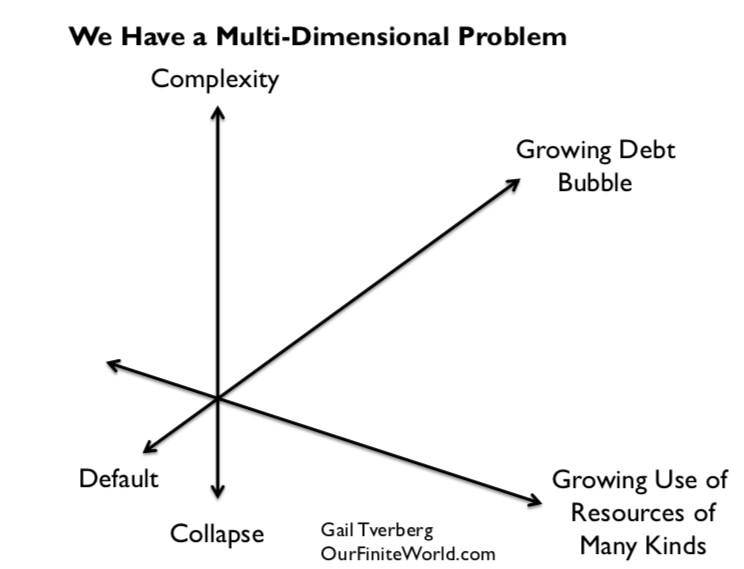
Figure 2.
Complexity involves adding more technology, more international trade and more specialization. Its downside is that it indirectly tends to reduce affordability of finished end products because of growing wage disparity; many non-elite workers have wages that are too low to afford very much of the output of the economy. As more complexity is added, wage disparity tends to increase. International wage competition makes the situation worse.
A growing debt bubble can help keep commodity prices up because a rising amount of debt can indirectly provide more demand for goods and services. For example, if there is growing debt, it can be used to buy homes, cars, and vacation travel, all of which require oil and other energy consumption.
If debt levels become too high, or if regulators decide to raise short-term interest rates as a method of slowing the economy, the debt bubble is in danger of collapsing. A collapsing debt bubble tends to lead to recession and falling commodity prices. Commodity prices fell dramatically in the second half of 2008. Prices now seem to be headed downward again, starting in October 2018.

Figure 3. Brent oil prices with what appear to be debt bubble collapses marked.

Figure 4. Three-month treasury secondary market rates compared to 10-year treasuries from FRED, with points where short term interest rates exceed long term rates marked by author with arrows.
Even the relatively slow recent rise in short-term interest rates (Figure 4) seems to be producing a decrease in oil prices (Figure 3) in a way that a person might expect from a debt bubble collapse. The sale of US Quantitative Easing assets at the same time that interest rates have been rising no doubt adds to the problem of falling oil prices and volatile stock markets. The gray bars in Figure 4 indicate recessions.
Growing use of resources becomes increasingly problematic for two reasons. One is population growth. As population rises, the economy needs more food to feed the growing population. This leads to the need for more complexity (irrigation, better seed, fertilizer, world trade) to feed the growing world population.
The other problem with growing use of resources is diminishing returns, leading to the rising cost of extracting commodities over time. Diminishing returns occur because producers tend to extract the cheapest to extract commodities first, leaving in place the commodities requiring deeper wells or more processing. Even water has this difficulty. At times, desalination, at very high cost, is needed to obtain sufficient fresh water for a growing population.
Why Inadequate Energy Supplies Lead to Low Oil Prices Rather than High
In the last section, I discussed the cost of producing commodities of many kinds rising because of diminishing returns. Higher costs should lead to higher prices, shouldn’t they?
Strangely enough, higher costs translate to higher prices only sometimes. When energy consumption per capita is rising rapidly (peaks of red areas on Figure 5), rising costs do seem to translate to rising prices. Spiking oil prices were experienced several times: 1917 to 1920; 1974 to 1982; 2004 to mid 2008; and 2011 to 2014. All of these high oil prices occurred toward the end of the red peaks on Figure 5. In fact, these high oil prices (as well as other high commodity prices that tend to rise at the same time as oil prices) are likely what brought growth in energy consumption down. The prices of goods and services made with these commodities became unaffordable for lower-wage workers, indirectly decreasing the growth rate in energy products consumed.

Figure 5.
The red peaks represented periods of very rapid growth, fed by growing supplies of very cheap energy: coal and hydroelectricity in the Electrification and Early Mechanization period, oil in the Postwar Boom, and coal in the China period. With low energy prices, many countries were able to expand their economies simultaneously, keeping demand high. The Postwar Boom also reflected the addition of many women to the labor force, increasing the ability of families to afford second cars and nicer homes.
Rapidly growing energy consumption allowed per capita output of both food (with meat protein given a higher count than carbohydrates) and industrial products to grow rapidly during these peaks. The reason that output of these products could grow is because the laws of physics require energy consumption for heat, transportation, refrigeration and other processes required by industrialization and farming. In these boom periods, higher energy costs were easy to pass on. Eventually the higher energy costs “caught up with” the economy, and pushed growth in energy consumption per capita down, putting an end to the peaks.
Figure 6 shows Figure 5 with the valleys labeled, instead of the peaks.

Figure 6.
When I say that the world economy is reaching “peak industrial output per capita” and “peak food per capita,” this represents the opposite of a rapidly growing economy. In fact, if the world is reaching Limits to Growth, the situation is even worse than all of the labeled valleys on Figure 6. In such a case, energy consumption growth is likely to shrink so low that even the blue area (population growth) turns negative.
In such a situation, the big problem is “not enough to go around.” While cost increases due to diminishing returns could easily be passed along when growth in industrial and food output per capita were rapidly rising (the Figure 5 situation), this ability seems to disappear when the economy is near limits. Part of the problem is that the lower growth in per capita energy affects the kinds of jobs that are available. With low energy consumption growth, many of the jobs that are available are service jobs that do not pay well. Wage disparity becomes an increasing problem.
When wage disparity grows, the share of low wage workers rises. If businesses try to pass along their higher costs of production, they encounter market resistance because lower wage workers cannot afford the finished goods made with high cost energy products. For example, auto and iPhone sales in China decline. The lack of Chinese demand tends to lead to a drop in demand for the many commodities used in manufacturing these goods, including both energy products and metals. Because there is very little storage capacity for commodities, a small decline in demand tends to lead to quite a large decline in prices. Even a small decline in China’s demand for energy products can lead to a big decline in oil prices.
Strange as it may seem, the economy ends up with low oil prices, rather than high oil prices, being the problem. Other commodity prices tend to be low as well.
What Is Ahead, If We Are Reaching Economic Growth Limits?
1. Figure 1 at the top of this post seems to give an indication of what is ahead after 2019, but this forecast cannot be relied on. A major issue is that the limited model used at that time did not include the financial system or debt. Even if the model seems to provide a reasonably accurate estimate of when limits will hit, it won’t necessarily give a correct view of what the impact of limits will be on the rest of the economy, after limits hit. The authors, in fact, have said that the model should not be expected to provide reliable indications regarding how the economy will behave after limits have started to have an impact on economic output.
2. As indicated in the title of this post, considerable financial volatility can be expected in 2019 if the economy is trying to slow itself. Stock prices will be erratic; interest rates will be erratic; currency relativities will tend to bounce around. The likelihood that derivatives will cause major problems for banks will rise because derivatives tend to assume more stability in values than now seems to be the case. Increasing problems with derivatives raises the risk of bank failure.
3. The world economy doesn’t necessarily fail all at once. Instead, pieces that are, in some sense, “less efficient” users of energy may shrink back. During the Great Recession of 2008-2009, the countries that seemed to be most affected were countries such as Greece, Spain, and Italy that depend on oil for a disproportionately large share of their total energy consumption. China and India, with energy mixes dominated by coal, were much less affected.

Figure 7. Oil consumption as a percentage of total energy consumption, based on 2018 BP Statistical Review of World Energy data.

Figure 8. Energy consumption per capita for selected areas, based on energy consumption data from 2018 BP Statistical Review of World Energy and United Nations 2017 Population Estimates by Country.
In the 2002-2008 period, oil prices were rising faster than prices of other fossil fuels. This tended to make countries using a high share of oil in their energy mix less competitive in the world market. The low labor costs of China and India gave these countries another advantage. By the end of 2007, China’s energy consumption per capita had risen to a point where it almost matched the (now lower) energy consumption of the European countries shown. China, with its low energy costs, seems to have “eaten the lunch” of some of its European competitors.
In 2019 and the years that follow, some countries may fare at least somewhat better than others. The United States, for now, seems to be faring better than many other parts of the world.
4. While we have been depending upon China to be a leader in economic growth, China’s growth is already faltering and may turn to contraction in the near future. One reason is an energy problem: China’s coal production has fallen because many of its coal mines have been closed due to lack of profitability. As a result, China’s need for imported energy (difference between black line and top of energy production stack) has been growing rapidly. China is now the largest importer of oil, coal, and natural gas in the world. It is very vulnerable to tariffs and to lack of available supplies for import.

Figure 9. China energy production by fuel plus its total energy consumption, based on BP Statistical Review of World Energy 2018 data.
A second issue is that demographics are working against China; its working-age population already seems to be shrinking. A third reason why China is vulnerable to economic difficulties is because of its growing debt level. Debt becomes difficult to repay with interest if the economy slows.
5. Oil exporters such as Venezuela, Saudi Arabia, and Nigeria have become vulnerable to government overthrow or collapse because of low world oil prices since 2014. If the central government of one or more of these exporters disappears, it is possible that the pieces of the country will struggle along, producing a lower amount of oil, as Libya has done in recent years. It is also possible that another larger country will attempt to take over the failing production of the country and secure the output for itself.
6. Epidemics become increasingly likely, especially in countries with serious financial problems, such as Yemen, Syria, and Venezuela. Historically, much of the decrease in population in countries with collapsing economies has come from epidemics. Of course, epidemics can spread across national boundaries, exporting the problems elsewhere.
7. Resource wars become increasingly likely. These can be local wars, perhaps over the availability of water. They can also be large, international wars. The timing of World War I and World War II make it seem likely that these wars were both resource wars.

Figure 10.
8. Collapsing intergovernmental agencies, such as the European Union, the World Trade Organization, and the International Monetary Fund, seem likely. The United Kingdom’s planned exit from the European Union in 2019 is a step toward dissolving the European Union.
9. Privately funded pension funds will increasingly be subject to default because of continued low interest rates. Some governments may choose to cut back the amounts they provide to pensioners because governments cannot collect adequate tax revenue for this purpose. Some countries may purposely shut down parts of their governments, in an attempt to hold down government spending.
10. A far worse and more permanent recession than that of the Great Recession seems likely because of the difficulty in repaying debt with interest in a shrinking economy. It is not clear when such a recession will start. It could start later in 2019, or perhaps it may wait until 2020. As with the Great Recession, some countries will be affected more than others. Eventually, because of the interconnected nature of financial systems, all countries are likely to be drawn in.
Summary
It is not entirely clear exactly what is ahead if we are reaching Limits to Growth. Perhaps that is for the best. If we cannot do anything about it, worrying about the many details of what is ahead is not the best for anyone’s mental health. While it is possible that this is an end point for the human race, this is not certain, by any means. There have been many amazing coincidences over the past 4 billion years that have allowed life to continue to evolve on this planet. More of these coincidences may be ahead. We also know that humans lived through past ice ages. They likely can live through other kinds of adversity, including worldwide economic collapse.
Note:
[1] Note that where the dotted line for 2019 is placed is based on where I see the 2019 economy relative to the downturn in industrial output per capita, based on a number of kinds of evidence, not all of which is cited in this article. The 1972 base model would give a slightly different timing of the downturn, a few years earlier. Also note that while the original “The Limits to Growth” book is no longer in print, Limits to Growth: The 30-Year Update by the same authors is available for sale.


“As Mark Twain never said, “It ain’t what you don’t know that gets you into trouble. It’s what you think you know for sure that just ain’t so.”
“Over the course of this year and next, the biggest economic risks will emerge in those areas where investors think recent patterns are unlikely to change.
“They will include a growth recession in China, a rise in global long-term real interest rates, and a crescendo of populist economic policies that undermine the credibility of central bank independence, resulting in higher interest rates on “safe” advanced-country government bonds.”
https://www.channelnewsasia.com/news/commentary/2019-economic-forecast-global-growth-recession-outlook-11120286
“Global policy uncertainty at record levels, Deutsche Bank says. A gauge of global policy uncertainty is “flashing red” amid anxiety on Brexit, the US government shutdown and the Sino-American trade war.”
https://www.ft.com/content/426be508-18de-11e9-b93e-f4351a53f1c3
“Global debt grew 3.9 percent in the third quarter of 2018 compared to a year earlier and was up 0.7 percent compared to the previous quarter, the Institute of International Finance said in a report on Tuesday…
“As a percentage of global gross domestic product, debt of non-financial corporations ticked up to 92 percent, the highest level on record, the report said.”
https://uk.reuters.com/article/uk-global-economy-debt/global-debt-ticks-up-just-shy-of-record-high-iif-idUKKCN1P92I6
Global debt needs to rise more than 0.7% in a quarter to pull the economy along, I am afraid.
I have a question. If debt grows continuously at, say, four percent a quarter, does that mean in 18 quarters (4 1/2 years) global debt will double (using the Rule of 72)?
Notice that debt was up 0.7% relative to the previous quarter. The annualized rate is about 2.8% per year. If debt were growing at at 4% per quarter, it would be growing a whole lot faster than anything we have seen recently.
Thanks. I was reading it as 3.9% in a quarter instead of in a year.
“Downward pressure on prices, especially outside Tier 1 cities, is making it increasingly difficult to induce families to invest an even larger share of their wealth into housing. Although China may be much better positioned than any Western economy to socialise losses that hit the banking sector, a sharp contraction in housing prices and construction could prove extremely painful to absorb.”
This sounds like a disaster in the making! Construction is a big user of resources. A contraction in use of resources by China will bring commodity prices down around the world.
Also, Ken Rogoff is one of the authors of “This Time Is Different,” which discusses how debt bubbles have turned out badly through the ages. He doesn’t understand how badly this one could turn out, I am afraid.
“JPMorgan Chase & Co.’s bond traders just reported their worst quarter in a decade a day after Citigroup Inc. said it was also pummeled by market turmoil. Revenue from fixed-income trading, typically the biggest contributor to the company’s markets business, plunged 18 percent in the fourth quarter to the lowest since the depths of the financial crisis as wild markets kept clients on the sidelines.”
https://www.bloomberg.com/news/articles/2019-01-15/jpmorgan-debt-trading-revenue-plunges-to-lowest-since-the-crisis
“…the Bank of Merrill Lynch Fund Managers’ Survey from January, which finds investors with the gloomiest outlook on corporate profits since 2008.
“A net 52% of investors expect global profits to deteriorate over the next year, a “major reversal” from just 12 months ago when a net 39% saw profits improving.
“The survey also saw the second-biggest two-month collapse on record in global inflation expectations, and the worst outlook on the global economy since July 2008…”
https://www.marketwatch.com/story/investors-havent-been-this-bearish-about-global-profits-since-the-financial-crisis-say-baml-survey-2019-01-15
“According to the S&P/Experian Consumer Credit Default Indices, which the companies said in a press release represent a comprehensive measure of changes in consumer credit defaults, the composite rate rose six basis points from December to 0.89 percent. The bank card default rate rose 25 basis points to 3.34 percent, while the auto loan default rate jumped 10 basis points to 1.03 percent. The default rate on first mortgages was three basis points higher at 0.67 percent.
“What’s more, S&P Dow Jones Indices and Experian said that all five of the metropolitan statistical areas showed a higher default rate in December of 2018.”
https://www.pymnts.com/economy/2019/experian-default-loan-rates-consumer-credit/
Something is clearly wrong. Higher interest rates and selling QE securities are parts of the problem. Also, tax cut is in the rear view mirror.
As the fourth quarter incoming data massacre confirms at least a serious recession if not something leading to GFCv2.0 is looming on us. You guys called it first on the merits not mere permadoom generalizations, I recall ~6months ago discussions here around taking place about the slowing-stumbling Asia/Pacific as front loading the global events..
China has been having problems for a while, but not reporting it in its official figures, among other things.
“The partial government shutdown is inflicting far greater damage on the United States economy than previously estimated, the White House acknowledged on Tuesday, as President Trump’s economists doubled projections of how much economic growth is being lost each week the standoff with Democrats continues.”
https://www.nytimes.com/2019/01/15/us/politics/government-shutdown-economy.html
“China’s economy is slowing. The downturn may be the result of recent events — the trade war with the U.S., or retrenchment in China’s real estate and infrastructure sectors. But it may also be the latest manifestation of a trend that began a decade ago. And it may signal that China’s entire system of authoritarian state capitalism is less effective than many had believed.
“Recent data suggest that consumption is falling, indicating rocky times ahead.”
https://www.bloomberg.com/opinion/articles/2019-01-15/china-economy-now-slowed-by-stimulus-used-in-great-recession
“China’s GDP growth may be significantly slower than official estimates suggest and its economy more vulnerable to external shocks than widely believed, a global business think tank has warned… Economists in China and abroad have long suspected data is massaged upward, often noting that full-year gross domestic product hits Beijing’s pre-set targets with suspicious regularity.
“The governor of northeastern Liaoning admitted in 2017 that the industrial province had falsified data for years.”
http://www.digitaljournal.com/news/world/china-s-growth-data-may-mask-economic-risks-research-group/article/541022
“China’s central bank on Wednesday made its biggest daily net cash injection via reverse repo operations on record, more evidence that authorities are shifting to policy easing to counter a slowdown in the world’s second largest economy.”
https://www.businesstimes.com.sg/government-economy/china-central-bank-injects-record-net-us83b-in-open-market-operations
Perhaps it will help for a while!
Or it could be peak coal in China.
“Australia will see the world’s biggest house price declines this year, according to one of the world’s major credit ratings agencies…
“In a research report released on Wednesday, Fitch Ratings forecast Australian house prices would decline a further 5 per cent this year, on top of a 6.7 per cent decline from the peak so far, making Australian housing the worst performer out of 24 countries for the second consecutive year.”
https://www.abc.net.au/news/2019-01-16/australia-to-see-worst-fall-in-house-prices/10720406
“…after a decade of near continual growth Hong Kong’s property market is about to join a global downturn that is buffeting markets including London, Vancouver, Sydney and Shanghai.”
https://www.channelnewsasia.com/news/asia/from-sizzle-to-fizzle–hong-kong-s-red-hot-property-market-cools-11128872
Historically, there has been home price inflation, but if the debt bubble collapses, we will be seeing a lot of deflation. This is hard for the financial system to handle. Also, people lose the equity that they thought had built up in their homes.
doesn’t the End of Growth almost guarantee this?
lower house prices, lower equity, loss of wealth?
isn’t it similar to lower commodity prices and/or lower values of stocks/pension funds?
“News that the European Central Bank wants euro zone banks to set aside more money for their soured loans sank shares in Italian lenders and sparked a rebuke from one of the country’s top politicians on Tuesday.”
https://uk.reuters.com/article/uk-eurozone-banks-writedowns-ecb/ecbs-guidelines-on-bad-debts-hit-italian-banks-irk-rome-idUKKCN1P90UT
Trouble for banks in UAE:
“Lenders in the United Arab Emirates will come under pressure this year as a property and retail slump take its toll. One of the country’s smallest banks is being bailed out, problem loans are expected to rise this year and lenders are exploring mergers to stay competitive.
“Slow property sales, higher interest rates and a rise in lending amid improved economic growth could mean provisions jump as much as a quarter, according to analysts.”
https://www.bloomberg.com/news/articles/2019-01-16/cracks-start-to-show-for-u-a-e-banks-as-bad-loans-set-to-rise
All of these oil exporters can be expected to have problems. And Italy too, if bank rules are changed.
Watched briefly the event in the UK Parliament yesterday evening, noticed for what is worth, one of the peculiarly renown establishment tv journalist had this apparent “..animal fear..” in his eyes, probably connecting some of the basic dots, that this is really revealing the vulnerability of the United part in Kingdom, as there are now too many factions competing..
~100+ yrs after the empire’s coal peak, ~70+ yrs after handing most of the empire out to the US, ~40+ yrs after joining the EEC/EU, .. , how long before the N Irish, Scots go separate ways again.. ?
Anyway, regarding Brexit the bottom case and highest probability up to this point is still further rounds of obfuscation dancing, delays, and eventually partial capitulation to some ordered status from the EU.
“European Council President Donald Tusk has hinted that the UK should stay in the EU, after the prime minister’s Brexit deal was rejected in parliament.
“”If a deal is impossible, and no-one wants no deal, then who will finally have the courage to say what the only positive solution is?”, he tweeted.”
https://www.bbc.co.uk/news/world-europe-46887188
Another on the telly – “Jean-Claude” again seen ever so slowly boy kissing these various flown in PMs in Brussels as they prepared for meeting, it’s not mere (post-)heavy alcoholism or linked dementia known behavior, that guy is certainly briefed at least on some basic level of OFWs related stuff. No it must be the crippling paralyzing pain, posture-pretending to help steer hundreds on millions of European into descent somehow in soft landing style, an impossibility.. That was the perhaps one of the few items we agreed upon with FE/TM – some of the Elders or their top lieutenants know the contours of predicament..
This is perhaps, partly, why they have embraced and sown through the media the ‘greedy Boomers who took everything’ and ‘entitlements are excessive’ memes – preparing for the retrenchment to come.
And of course, Macron’s ‘You people expect something for nothing!’ Not to mention the absurd ‘Work is dignity, even if you are half-starving!’ Conservative attitude in Britain.
But they will find that expectations simply cannot be managed in that way, and certainly not while immersing people in advertising that says it is all there for the asking, just a click away.
The only thing that might work in such a scenario is a revolutionary spirit of sacrifice, as per Bolshevik Russia,and that does rather jar with attempts to maintain consumerism.
Ironically, the young Left Radicals of Europe imagine that ‘revolution’ will mean more consumer goodies (‘clean and Green’ too), not fewer, once they’ve drained the rich.
And the older generation still want to retire at 55 to watch the young girls at the beach and destroy their livers…..
Oh dear, there will be so many disappointed faces at the children’s party when the wrappings come off.
Correct.
Well, the urban young left radicals might surprise us eventually, when the time is ripe, but I doubt it. On practical terms cross comparing with previous generations they lack that hands on approach availability and drive of say early 20th or 1848 or any such date.
What is it going to look like perhaps more like ending up with broken toy (IC) in their hands, not much of a victory vs. hands on country side oriented agriculture reconstructionists, who are going to be obviously limited by other factors enviro/pollution/legacy overpop/feudal bandit-ism challenges etc..
Political correctness does not really exist in Asia. We are still who we are, as nature intended.
https://www.zerohedge.com/news/2019-01-14/apa-warns-traditional-masculinity-can-hurt-boys
Do we homo sapiens ever learn ?
Calhoun mouse experiment
======================
In the early 1960s, the National Institute of Mental Health (NIMH) acquired property in a rural area outside Poolesville, Maryland. The facility that was built on this property housed several research projects, including those headed by Calhoun. It was here that his most famous experiment, the mouse universe, was created. In July 1968, four pairs of mice were introduced into the habitat. The habitat was a 9-foot (2.7 m) square metal pen with 4.5-foot-high (1.4 m) sides. Each side had four groups of four vertical, wire mesh “tunnels.” The “tunnels” gave access to nesting boxes, food hoppers, and water dispensers. There was no shortage of food or water or nesting material. There were no predators. The only adversity was the limit on space.
Initially, the population grew rapidly, doubling every 55 days. The population reached 620 by day 315, after which the population growth dropped markedly, doubling only every 145 days. The last surviving birth was on day 600, bringing the total population to a mere 2200 mice, even though the experiment setup allowed for as many as 3840 mice in terms of nesting space. This period between day 315 and day 600 saw a breakdown in social structure and in normal social behavior. Among the aberrations in behavior were the following: expulsion of young before weaning was complete, wounding of young, inability of dominant males to maintain the defense of their territory and females, aggressive behavior of females, passivity of non-dominant males with increased attacks on each other which were not defended against.
After day 600, the social breakdown continued and the population declined toward extinction. During this period females ceased to reproduce. Their male counterparts withdrew completely, never engaging in courtship or fighting and only engaging in tasks that were essential to their health. They ate, drank, slept, and groomed themselves – all solitary pursuits. Sleek, healthy coats and an absence of scars characterized these males. They were dubbed “the beautiful ones.” Breeding never resumed and behavior patterns were permanently changed.
The conclusions drawn from this experiment were that when all available space is taken and all social roles filled, competition and the stresses experienced by the individuals will result in a total breakdown in complex social behaviors, ultimately resulting in the demise of the population.
Calhoun saw the fate of the population of mice as a metaphor for the potential fate of man. He characterized the social breakdown as a “second death,” with reference to the “second death” mentioned in the Biblical book of Revelation 2:11. His study has been cited by writers such as Bill Perkins as a warning of the dangers of living in an “increasingly crowded and impersonal world.”
https://en.wikipedia.org/wiki/John_B._Calhoun
I am afraid that over population does this to US populations as well.
yep-
1978 — Iran: Beloved & Respected Comrade Butcher Shah (installed & CIA-supported CIA puppet) flees Peacock Throne, leading to Islamic overthrow.
I read this same passage a few years back and found it absolutely fascinating.
For awhile, I would tell others about Calhoun and his experiments in hopes of spurring on a conversation about what implications it had for humanity as a whole. Most of the time I would get either a blank stare, or a smile and nod in agreement as to how interesting it was. But almost never any discourse on what it meant for humanity.
Sometimes I think about it, and I worry that people are either willfully ignorant or in denial about the reality in which we live. I know the people I spoke to were intellectual enough to comprehend Calhoun’s experiments and how they potentially relate to human society, but they’d shut down any conversation about it as if it were some sort of uncomfortable social taboo (e.g. discussions about criminal conspiracy, graphic violence, or sexual deviancy).
Perhaps our inability / unwillingness to even contemplate collapse (save for in fantastic Hollywood motion pictures, courtesy of directors like Michael Bay… *kabloosh, kablamo, kapow, more explosions!!!*) is, in part, what dooms us to collapse in the first place (well, that and the immutable laws of entropy)?
Cheers,
-GBV
Very interesting. I feel we are to a degree experiencing the same issues. (Western) people have their basic needs well covered, there are people everywhere, all the social roles (jobs) are filled. Society has become a place where you are robbed of responsibility and you are brought up to believe others will make your bed and clean up your mess.
Our wealth has made us think that there is no longer a need to discipline children or teach them how to function well with others, just employ more social workers to talk problems to death and invent medicines to keep the uneasy children at bay. The invention of the “smart” phone keeps people from meeting and discussing real things, it also robs many children of their innocent childhood.
I agree. Devices and programs of various sorts substitute for normal human interaction. This started early I expect, first with the radio, and then with television. Air conditioning encouraged people to be inside all the time. Women going back to work encouraged reducing time with families.
There was a riot recently at a centre to help disturbed migrant African youths integrate in Basque society: they tried to hang their teacher…..
The behaviour exhibited by those mice sounds a little too familiar for comfort..
The reviving ‘Ultra-Right ‘(really ‘National Catholic’ ie Francoist ) movement in Spain is actually demanding the revocation of ultra-feminist gender laws as a condition of entering into alliances, because they are inspired by hatred of men – and that is quite true.
Really, the feminists of the West have gone to far with their ‘toxic masculinity’ obsession: even old-school feminists have spoken against it, but it is fast becoming a legislative norm.
Meanwhile, Gillette is attempting to use the nausea-inducing term to flog shaving products:
https://www.forbes.com/sites/willburns/2019/01/15/is-gillettes-disingenuous-lecture-the-best-a-man-can-get/#764534211c67
Yes unsustainable overpopulation and slave labour click farms are “who we are”. The *real* traditional lifestyle will return soon, and it is equidistant from socialist/hippie and social conservative/alt right fantasies.
its the only thing that makes sense a planned depopulation by the elders to coincide with the coming deflationary world we will soon be living in
CRUCIFIXION OF RONALD MACDONALD
They are getting everyone!
https://2.bp.blogspot.com/-VOTXfo6pG90/XD4Rix0B2bI/AAAAAAAAWGM/po2fJp8rD4QSAYRzOqCkEbcQ58ZFqxm7QCLcBGAs/s320/Screen%2BShot%2B2019-01-15%2Bat%2B11.54.57%2BAM.png
https://i.redd.it/e667sowpioa21.jpg
I have had llamas.
Very different animals—–
I saw one that was guarding sheep kill a bear in about 10 seconds…I now have a great deal of respect for them.
https://www.businessinsider.com/russian-media-nuclear-torpedo-can-destroy-the-us-europe-the-world-2019-1
Wow, you guys have got to read about this; “A Russian professor told a Russian paper that the new torpedo could create waves 1,300 to 1,600 feet high and wipe out all life nearly 1,000 miles inland with an alleged 200-megaton nuclear warhead.”
I’d be interested to see what others here think, but I’m not convinced a wave that big could be generated even with a huge nuclear weapon. My thinking goes like this; if a massive underwater earthquake magnitude 9 can initiate a tsunami that is only say 20 feet high, how is a nuclear bomb going to generate one so much higher? The force involved in earthquakes is much greater than a 200 megaton nuclear warhead. But the article did say Russia has a habit of exaggerating, so should we take this latest scare report out of Russia with a grain of salt or is there something to it?
depopulation planned by the elders
If it is possible to generate that high a wave, I suppose as ways to go, it’s not too bad. One minute you’re high and dry, the next you’re underwater so deep the pressure change shocks you into unconsciousness, the air in your lungs expands, well I won’t go into all that. Let’s just say its fairly quick and for tens of millions. Quick way to eliminate large sections of population.
I saw the James Bond movie rerun, with Roger Moore, Moonraker. The bad guy’s dream is to release these capsules into the upper atmosphere, and as they descend they release a toxin that knocks people off. His space station has men and women pairs that are physically superior and whose offspring will seed a new generation on Earth to start over. Each capsule eliminates 100 million people, or ten for every billion. So guess how many he has in this 1979 movie; answer 50, so at the time there must have been approx. 5 billion people. And here we are in 2019 with 7.7 billion. Quite a huge increase.
As I thought about this movie more, it didn’t seem that bad and idea he had, at least the part where the population of the planet gets eliminated and replaced by a new, much smaller population. Much easier on Earth’s resources and biosphere, fauna, other life-forms, forests etc. It made me look at that movie much differently than I had when first watching in 1979.
When it comes to governments and the media they either own or collude with – propaganda within, truth without.
Highest-ever daily average See Oh Too | Maua Loa O bse rvatory
2019 (as of January 12, 2019)
413.45 ppm on January 12, 2019 (NOAA-ESRL)
Nice start to the New Year!
(feel honored- as homo sapiens you are unique– none have lived under such conditions.)
so good!
I doubt it’s doing anything, but if it is “real”, then it’s delaying the next iyce ayge…
which would be far worse than some worming…
I totally agree.
The one thing it is definitely doing is helping the plants to grow.
At current concentrations, it’s a limiting nutrient in most types of soil.
I know this rankles the greenies, but greenery really digs this gas.
https://plantsneedco2.org/html/WoodyFourLevelsOfCO2Enrichment.jpg
Pay no attention to the man behind the conifers!
Too bad there is absolutely nothing we can do about it.
It feels too good to burn something and feel the warmth. Or drive in a car in the rain. Or open a box from Amazon. Or the acceleration at takeoff on your way to your vacation destination. You look out the window and see small cars and houses. And you just feel -wow! I made it this far. I hope my daughter gets to experience this too. Life is pretty good after all. It’s like crack. Voluntary reduction is a pipe dream.
True story. We’re at the apex of civilization. Best time to be alive if you ask me.
Sit back and enjoy the journey. There will be plenty of time for fretting later…
As much as anything, the problem is the desire we have to keep our children alive. It is the fact that (a) we have so many births and that (b) people live so long that messes up the system. I notice you don’t say, “I am going to help the system long by not seeking medical treatment for my daughter, or for myself. I am certainly not going to extend the life of my elderly parent.”
Also, our tendency toward wage disparity is a problem. We need to be wiling to take the lowest paid jobs ourselves, and encourage our children to get them. If one child is educated, make certain that that child marries a much less educated spouse. That will help keep down the growing wage disparity problem we have among households that is caused by educated men marrying educated women. When few women were educated, this was not a problem.
Fearing Brexit doomsday, Britons stockpile supplies and learn to grow their own food
https://www.theglobeandmail.com/world/article-fearing-brexit-doomsday-britons-stockpile-supplies-and-learn-to-grow/
Then the Brexiters will inherit the Earth. At least what’s left of it…
gotta worry about the prepper who tells everyone he’s prepping
My two cents: good for “prepper” Britons!
Of course, prepping doesn’t resolve any problems in the short-term. And those “preps” they’ve purchased will run out eventually. But I still see it as a positive in that those people who do prep for any potential crisis (be it Brexit, a natural disaster, etc.) help by making themselves one less person in need when everyone else is panicking/scared/short-sighted/etc.
It may be all for naught, or it might just be the edge needed to take some pressure off of the “system” when something bad inevitably happens.
Just think how resilient the “system” would be if everyone actually “prepped” just a little bit! Sadly, most people don’t even have 72 hour kits, which local municipalities constantly push their citizens to have in place in case of emergency…
Cheers,
-GBV
I see food-prepping as a way of supplementing state-issued rations, which would almost certainly be inadequate in a real emergency. Just one extra good meal in the week would lift one’s spirits a lot. Leaving enough energy to go out and trap squirrels…..
I also encourage everyone to take on some degree of “prepping” simply from a moral point of view. People should take some responsibility for themselves and their needs, rather than expecting the State to step in and do everything for them.
Many of my socialized Canadian brethren don’t seem to agree with me, however 🙁
Forethought, self-reliance; how unfashionable they are.
Canada used to be seen, 100 yrs ago, as the land of self-reliance, like Australia and New Zealand.
100 years ago—if you werent self reliant in most of canada you would be dead
The latest post on Energyskeptic has nice potted histories of the North Korean and the Cuban responses to crisis.
I quite like Alice: ‘Life is tragic, let’s not indulge in wishful thinking’ Friedrmann.
Neither country is doing very well now. They both have long-term energy problems that are hard to fix. Both have somewhat limited their population growth in response to the lack of energy growth. Cuba has a much better job than North Korea, however.
Cuba population 1985 10,083,000
Cuba population 2018 11,489,000
Cuba population % increase +13.9%
North Korea population 1985 18,877,000
North Korea population 2018 25,611,000
North Korea population % increase +35.7%
World population 1985 4,873,782,000
World population 2018 7,632,819,000
World population % increase: +95.1%
Historically. it has been helpful that the US has granted asylum to people from Cuba who appear on US shores, helping to keep a lid on population. The issue is of course, energy per capita. Living in a warm country with a huge amount of theoretically arable land help as well.
I’m having serious difficulty in reconciling Jorgan Randers’ earlier work with what he is currently professing in his latest report for the Club of Rome:
“The dual adoption of the UN Sustainable Development Goals (SDGs) together with the Paris Climate Agreement, both in 2015, represents a global turning point… Humanity’s grand ambition is surely to aim at an inclusive and prosperous world development within a stable and resilient Earth system. This human quest is to attain as many of the SDGs as possible by 2030, and then continue following a sustainable global trajectory well beyond the next 12 years. This report has identified one such possible, smarter pathway to success through five transformative and synergistic actions.”
The authors see these lofty goals as achieveable on the completion of five elements:
– Accelerated renewable energy growth (will probably irk Gail!)
– Accelerated productivity in food chains (higher yields almost always necessitate fertilisers derived from fossil fuels)
– New development models in the poorer countries (*energy growth required)
– Active inequality reduction (*energy growth required)
– Investments in education for all, gender equality and family planning (*energy growth required)
I do wonder whether ‘experts’ are permitted to share bad news anymore with their respective thinktanks, or are their perspectives really so utopian?
You can see the report here:
https://www.stockholmresilience.org/download/18.51d83659166367a9a16353/1539675518425/Report_Achieving%20the%20Sustainable%20Development%20Goals_WEB.pdf
I understand that Jorgen Randers played a very minor role in the original Limits to Growth study. I believe he was a graduate student who wrote an appendix on agriculture, or something like that. The name of a different graduate student appears on the German version of the 1972 Limits to Growth study, rather than his name.
I consider his book 2052 to be pretty close to entirely wishful thinking. I wrote two posts on the subject.
https://ourfiniteworld.com/2013/09/25/why-i-dont-believe-randers-limits-to-growth-forecast-to-2052/
https://ourfiniteworld.com/2014/01/13/why-eia-iea-and-randers-2052-energy-forecasts-are-wrong/
Thanks Gail- I read a little of 2052 and it didn’t compute for me either, but I suppose palatable thinking makes gainful employment.
Randers writes what readers want to hear.
Gee, that also sounds like a lot of politicians I know & it looks like 2020 will bring out more of the same, people gushing about what we dearly want to hear, more jobs, higher wages, free health care, better & more affordable housing, free energy, cleaner water & air & on & on & on, I keep hearing the same LIES every two years & i’m sick to death of it!
I’m one of those weird people who want’s to hear the TRUTH & how to deal with REALITY, not hopeless wishful “thinking”.
In the mean time we keep doing the very things that will prevent up from ever realizing that dream, more humans, more consumption, more wealth going to the top 1%, more waste, more automation, more outsourcing, fewer jobs at lower pay, more immigration & a growing dumbing down of our schools, promis them everything but deliver the same BS!
There is no “fix” for population overshoot & no amount of technology can replace declining resources!
We really are as dumb as yeast in a petri dish.
Love your blog Gail & thank you!
Humanity’s grand ambition is eating and reproducing.
And going to the eternal Paradise in the heavens!
I know my Mother is is hanging on at 96 and still remembers all her medications to take!
Her primary concern is our little lapdog doggie, Cricket, a chiwawa/terrier mix, and Religion…the hereafter…. Purgatory is a prime concern….though she had a saintly life!
The power of belief!
My father age 85 just got home from his third or fourth heart bypass surgery. That plus the raft of pills he consumes is costing Medicare a fortune. But we’re all supposed to be happy that they are keeping these people alive! My mother keeps calling with the “good” news. The irony is we will probably collapse and die off just as we are reaching our goal of immortality!
good stuff, Frank…
“– Active inequality reduction (*energy growth required)”
but Frank, you missed on this one…
there will indeed be a great reduction in inequality…
just not in the direction which the UN assumes…
and it will happen with declining net (surplus) energy…
yes, it’s true that in the next decade or at least in the 2030s, there will be very little economic inequality, because almost all humans will be dirt poor and in dire poverty…
the UN just lacks the “vision” to see the coming “equality”…
Right you are David!
Trickle down economics; the problem is the evaporation rate is way higher than the trickle down rate!
Interesting observation!
Rolls-Royce enjoys record car sales after US tax cuts
https://www.ft.com/content/5c8fb398-142d-11e9-a581-4ff78404524e
Holy shit look at HIM, literally a caricature of capitalists
https://i.redd.it/kpte9gq07ha21.png
Looks like a US repug—-
(could be a bit fatter, and he would fit in)
That’s what the Yellow Vests in France are all about. They realize that’s what the Globalists are doing to them and their families. It’s what started “The Arab Spring”.
Caricature of a capitalist, or a typical older British builder, probably municipal road works department. You have to put a lot of work in at the pub to attain such a fine figure…….
Yep, an eight pints a night man. Looks like a pregnant walrus.
You’d think someone with that much wealth would be taking better care of their health.
The irony is that he probably thinks that he is ‘living well’.
Pingback: 2019: World Economy Is Reaching Growth Limits; Expect Low Oil Prices, Financial Turbulence - Deflation Market
Sad to report…as we PEAK, and the population continues to expand we find this trend…
Human Trafficking Reaches ‘Horrific’ New Heights, Declares U.N. Report
https://www.npr.org/sections/goatsandsoda/2019/01/14/684414187/human-trafficking-reaches-horrific-new-heights-declares-u-n-report
Exploitation comes in many forms
Sexual exploitation remains the most common form of human trafficking, at 59 percent of all victims, says Me. But there are many other types of exploitation. Forced labor is the second most prevalent form of trafficking, at 34 percent overall and 82 percent for men, with the greatest prevalence in southern, east and west Africa, and the countries of the Middle East.
Types of forced labor run the gamut from agricultural to domestic work — as well as mining, including for gold, diamonds and minerals, especially in sub-Saharan Africa.
And there are still other reasons why traffickers prey on people, says Me. One is organ removal for medical transplantation, with the report citing estimates of between 5 and 10 percent of all kidney and liver donations worldwide derived from trafficking.
Wait till it really hits the fan…taste of what is to come….not good😰
Human energy is a form of energy. Slave labor has been with us for all of recorded history. If there is an energy shortage, slave labor is a very partial workaround. No local worker wants to work at a very hazardous job for low wages, but perhaps a slave can be forced to do the work. It is a way of forcing wages down, corresponding to the way other energy costs are being forced down.
Yes, more openly visible forms of (&near-)slave labor are coming back.
Historically this has been dealt with only two interlocked ways, acute-shocking pop misalignment (shortage) for given region and or plus the factor of available technological solution for given task with raw resources and energy to feed it.
Now we have the combo of abundance of pop and limits on the non depleted energy inputs. This will eventually trigger the pop shortage (die-off) but without the high tech and raw energy easily available around anymore.
So, it’s a “step down” process but more like uneven cascade, lets say several floors of stairways falling apart at the same time, in order to continue descent you need to perform some serious physical skillz to traverse into the other still somewhat functional leg of the stairway zone bellow the damaged one.
That’s similar to previous precedents how many species eventually left the scene for good, desperately hanging on to last available sanctuaries. From long distance macroview this appears as single strike “die out” event, but it’s not if you zoom in (human life – several generation’s perspective)..
Here in Florida there is a step up in human trafficking and at the airport in the restroom notices on what to do and the signs of a victim. Ticket agents are also trained to recognize someone that is being victimized. Seems young women are being preyed upon here in the USA via Social media, lured by fantasy of exciting big city life. First they are “escorts”…and it’s downhill from there.
Years ago I remember a citus corporate operation was busted for holding captive it’s workforce! They charged it’s laborers exorbitant prices at the company store and for rents.
One individual lamented…”I just understand, worked here all month and they are saying I OWE them money!!!” Can’t leave until it’s paid off”.
We are in for some of these episodes, unfortunately.
people have always exploited other people
Yes, but there is exploiting and there is outright, suffering and it’s only past peak, Norman
Read George Orwell, Down and Out in Paris and London….
“The plongeurs, again, have a different outlook. Theirs is a job which offers no prospects, is intensely exhausting, and at the same time has not a trace of skill or interest; the sort of job that would always be done by women if women were strong enough. All that is required of them is to be constantly on the run, and to put up with long hours and a stuffy atmosphere. They have no way of escaping from this life, for they cannot save a penny from their wages, and working from sixty to a hundred hours a week leaves them no time to train for anything else. The best they can hope for is to find a slightly softer job as night-watchman or lavatory attendant.
And yet the plongeurs, low as they are, also have a kind of pride. It is the pride of the drudge—the man who is equal to no matter what quantity of work. At that level, the mere power to go on working like an ox is about the only virtue attainable. Débrouillard is what every plongeur wants to be called. A débrouillard is a man who, even when he is told to do the impossible, will se débrouiller—get it done somehow. One of the kitchen plongeurs at the Hôtel X, a German, was well known as a débrouillard. One night an English lord came to the hotel, and the waiters were in despair, for the lord had asked for peaches, and there were none in stock; it was late at night, and the shops would be shut. ‘Leave it to me,’ said the German. He went out, and in ten minutes he was back with four peaches. He had gone into a neighbouring restaurant and stolen them. That is what is meant by a débrouillard. The English lord paid for the peaches at twenty francs each.”
Boy, was I fortunate not to endure that kind of life!
Quite recently a gypsy family gang in the UK actually pleaded in court, accused of more or less enslaving rural workers: ‘This isn’t fair: everyone’s doing it!’ Such touching innocence….
I know you are simply stating a hard headed truth, but some won’t see it that way (if that matters). Since the only legally sanctioned form of US slavery has been that of Africans (and since it is also a hard headed truthy that Africans have the strength to endure much of slavery) some will assume that the slavery you’re talking about is a return to the African slavery of the past. White people, who have never been legally enslaved, will see the issue differently from black people, who have. Pushback from the latter (just for the impartial truths you mention) can therefore be expected, whether or not it matters to white people in general. It is simply a human reaction to enslavement, and one that all black people share, whether or not that matters to anyone else. In other words, black people would rather see the whole world burn to ashes than to be enslaved as before.
white people have been legally enslaved or served as endentured “servants” for owing money in the not too distant past. slavery was not invented in the americas, it was transfered here from european colonialists, starting with the conquered native americans, viz., “our hero” Christopher Columbus.
While we’re on the subject, let’s not forget the noble savages of America. A Wikipedia article states:
In Pre-Columbian Mesoamerica the most common forms of slavery were those of prisoners of war and debtors. People unable to pay back a debt could be sentenced to work as a slave to the person owed until the debt was worked off. Slavery was not usually hereditary; children of slaves were born free.
Most victims of human sacrifice were prisoners of war or slaves.
First Nations of Canada routinely captured slaves from neighboring tribes. Slave-owning tribes were Muscogee Creek of Georgia, the Pawnee and Klamath, the Caribs of Dominica, the Tupinambá of Brazil, and some fishing societies, such as the Yurok, that lived along the coast from what is now Alaska to California. The Haida, Nuu-chah-nulth, Tlingit, Coast Tsimshian and some other tribes who lived along the Pacific Northwest Coast were traditionally known as fierce warriors and slave-traders, raiding as far as California and also among neighboring people, particularly the Coast Salish groups. Slavery was hereditary, with new slaves generally being prisoners of war or captured for the purpose of trade and status. Among some Pacific Northwest tribes about a quarter of the population were slaves.
What I’m suggesting is that we are part of a system for which African slaves by the millions provided the formative energy. The institutions that favor or deny the vast majority of Americans (and citizens of industrial civilization) come out of that history of African slavery. I’m also saying that if those institutions favor people you know best, you will tend to look at the issue of slavery abstractly and indulge comparisons to far away placed and distant times that are not part of the present system. In other words, you have the luxury of calm reflection about the broad global history of slavery. Black people–for black slavery affected the entirety of Western Civilization and brought on African colonization–don’t have the luxury of making these comparisons. Would it be equally acceptable to reflect on the efficacy of making soap with Jewish flesh? There might have been some economic consideration over that perhaps. If I’m in a drawing class and start doodling swastikas, my Jewish instructor might not have a calm and and reasoned response to it. Feathers tend to get ruffled. So I wonder what’s the point of talking about such things to the populations involved? Do want to ruffle their feathers? Do you not care? You might be talking dispassionately about the economics of labor or of soap, but they won’t see the subject the way you do. Why should you not include their expected reaction? If you did, then you could decide whether the subject helped or hindered the communication you want to share?
I would have said African slaves provided the energy resource for products that people wanted to buy–ie sugar cotton and tobacco, where no mechanisation was possible. ie the southern states of the USA. Native American people didn’t make good slaves, while Africans were immune to European diseases.
But that is to ignore the other two sides of the slave triangle.
the market for those products was Europe, which didn’t have the climate to produce them.
What Europe did have was coal and iron which were themselves produced with slave labour. It wasn’t until 1842 that child (under 10) labour was banned in the UK–long after we’d banned the slave trade. My father went down the mines at 14—still a child in today’s terms
Miners were paid wages, yes, but only at bare subsistence levels.
Coal and iron provided the weapons and chains by which Africans were enslaved, but it was Africans who captured and sold Africans to Europeans. That bit is usually ignored. They were then sold to plantations, who then sold goods to Europe.
The great triangle
But it could only function so long as the coal and iron were being produced to keep the system going—they were the driving force.
Norm, African (Western) slavery has been going on since the 16th century. Where does coal come into the picture during that time? But it’s also not a question of who captured the slaves for the European trade. Those vendors may have stigmatized those they captured by social status or tribe, but surely not by skin color. One can’t usefully cmpare stigmatization of millions of people by skin color with what the African vendors accomplished. African vendors didn’t drive the ideology of western slavery; they were dealing with different issues that are not remotely comparable. Are people of any stripe or color nice to one another? it would seem not. But that is not the issue. We have a racialist system of stigmatization and marginalization now, and that has produced extreme sensitivity and resentment around the issue of African slavery. If you bring up slavery without much qualification, the human tendency among the marginalized is to take it personally. You should know that. That isn’t a matter of moralizing. It is practical and strategic knowledge to have. If you go poking a wasp nest with a stick, the wasps will turn against you, and will generally not be sympathetic to any cause you might have. And we generally have a cause of some kind, conscious or unconscious. What could it be in this case?
Art
i try to keep my comments purely observational if i can, though having just words in print so to speak, it’s not always easy to judge how they will be received by such a wide variety of readers. I’m certainly not moralizing on any of it—or that is not my intention. Apologies if it inadvertently comes across like that. I plead guilty to pontificating sometimes.
to try and deal with the slavery thing,
African barbary pirates were raiding remote European coastal villages from at least the 15th c onwards to capture slaves to sell in African markets, long before the American market for slaves opened up, They ran the ”slave business”. Fair skiined white slaves were highly prized, as you can imagine.
when the trade reversed and Europeans went south to Africa to get slaves, they bought them from the people who knew that business who just carried on as before, and adjusted their supply routes and quantities. Whereas they used to trade in hundreds, Europeans wanted thousands. It was a business opportunity not to be missed. They caught them like zoo animals, and caged them to build up a shipload. Europeans played no part in that. They just turned up with the ships.
There was no ideology involved, anymore than saudi muslim ideology doesn’t get in the way of shipping oil to China where muslims are being oppressed.
Effectively, northern lighter skinned Africans caught darker skinned equatorial Africans.
It was in effect, trading in energy resources, no different to the way we now put oil in ships and transfer it to where it’s to be put to use for productive purposes for profit
As to the use of coal: The one thing the African slave traders didnt have was guns. Western coal and iron supplied them in quantity.
Again, to correlate to oil—we couldn’t access deep oil until we began to use sophisticated drilling equipment.
When we supplied slave traders with guns, they were able to capture more African slaves.
The similarities of using advancing technologies seem obvious. You use ‘technology’ to extract more energy from a given source—which is what we are doing right now as we scramble for deeper and deeper oil reservoirs.
To the African slave trader in the 18thc, the musket and gunpowder was the latest technology available and they made full use of it. They were not so naive as to trade slaves for beads and mirrors.
It was that technology that drove the trading triangle of guns–slaves–sugar/tobacco. Slavery was a business, slaves were just one of the commodities traded at that time.
We now live in another time.
It’s wrong to backdate our our sensitivities onto another time I think, by the same token I don’t berate myself at the thought of 6yr old children down English coalmines helping to kickstart the whole messy business.
If Gail’s dispassionate mention of slavery was meant to educate in this manner, it could be helped by a more in depth explanation. I am always curious as to what’s the narrative people’s comments support. Many comments serve the interest of determinism to the exclusion of intention.
slavery was just a primitive form of surplus energy usage
debt bondage was a different thing—one could put oneself into debt bondage to pay off a debt that could not otherwise be paid
There are all kinds of situations where people work/have worked for very close to no wages. People helping out on permaculture farms don’t receive much pay beyond room and board. A lot of college interns have been paid nothing (but I believe that a stop has been put to this). If they want college credit for the barely paid job, they have to pay the tuition and fees to support getting the college credit. This makes the net pay negative.
I know that when my grandmother came over to the US a young teenager (14 years old?) around 1910, she went to work as a maid in someone’s home. I am sure she didn’t get paid much of anything. If she did, it went to paying the debt associated with coming over on the boat from Norway. She learned English living with the family, which was a major benefit from her point of view. She later was able to go to a few years of high school, and then go to a normal school for more advanced education.
Oh but Tim, they were all so close to the Great Spirit, this can’t be true! Who wrote this history – white people?! 🙂
There are rather horrifying figures on the number of migrant children who disappear, while supposedly under official supervision -bribery and collusion?
At least the age-old African and Asian eunuch trade (despite the late FE’s interest in reviving harems) is no longer with us: average 25% mortality rate, but worth it for the 800% increase in the value of the slave….
i think he did revive one–then Mrs FE found out
“The US Treasury Department keeps running into a big issue as it auctions off the swelling amount of new government debt: The market just isn’t that interested… So what does this all mean? Put simply, it suggests that demand for Treasurys may struggle to keep up as the US deficit continues to grow.”
https://www.businessinsider.com/next-financial-crisis-market-flashing-scary-new-parallel-to-last-one-2019-1?r=US&IR=T
“While many investors are fretting over what stage of the business cycle we are in, the global monetary system is collapsing — with a whimper… Central bankers have bought growth by sacrificing financial stability.”
https://www.ft.com/content/271f4a2e-17d5-11e9-9e64-d150b3105d21
Thanks Harry, your morning dose of realism always makes my day!
You are welcome, Flipper!
How many can afford to buy US Treasuries, if the output of the economy is not enough?
“…it suggests that demand for Treasurys may struggle to keep up as the US deficit continues to grow.”
Don’t they just change the rate of return to make it more enticing? Of course that has limits too, but just saying in the short term…
“This financial year, 2018-19 could end up being the worst year for [India’s] farm incomes in almost two decades, government data indicates in a revelation that emphasises the gravity of the ongoing agrarian crisis.”
https://www.hindustantimes.com/india-news/worst-price-slump-in-18-years-shows-scale-of-farm-crisis/story-P2niBeuqAcaxgms3HmFCTK.html
I think India is still mostly agrarian, so this is definitely a sign of collapse in the (very?) near future in that region. Another commentator mentioned Pakistan somewhere, which I believe is hostile to India and similarly chock full of people. A crisis in either one of those countries is unlikely to remain endemic for long.
There have certainly been some significant signs of discontent with violent fuel protests and recently a nationwide strike, instigated by the trade unions, which may have had as many as 200 million participants.
https://economictimes.indiatimes.com/news/politics-and-nation/unions-claim-success-in-two-day-all-india-strike/articleshow/67464576.cms
And there’s a new Gandhi biopic about to hit the big screen. That should help stir up passions on the sub-continent.
Amazing the power of the biopic. Mel Gibson’s ‘Braveheart’ set back English/Scottish relations by about two centuries.
The new film about Robert the Bruce -although more accurate – looks to do just as much harm, with the character of ‘The Black Douglas’, who practically tears out English hearts and eats them on screen……
then he did The Patroit to do the same for USA UK
Gibson hates brits—that’s obvious
but we’re low on his hatred list
Mel is probably still sore about that Guardian journalist reviewing one of the Mad Max films who wrote that Mel sported a hairstyle that only an Australian would consider fashionable.
The problem is too low food prices in India. This is another form of too little profit on the production of energy. The problem shows up everywhere, including the farms of the United States and a lot of farms around the world. People have always modeled inadequate food production as leading to high prices, but this is not what the problem is. Plenty of food gets produced, but the prices are not high enough for the farmers to make a living at it. Also, the prices are too low for the government to tax the farmers by much at all. The government tends to fail because of low taxes. Farmers tend to have poor health because of their low returns; this happens because they do not eat well. In India, they probably would eat mostly rice; in the US they would live on Burger King hamburgers. Neither one sustains life well. People become more vulnerable to epidemics. It is the epidemics that tend to reduce population. Failing governments and failing banks also play a major role.
Another example of low prices for energy. In this case, it is food energy produced by farmers.
“Hundreds of thousands of Afghans have returned in the last year of a severe economic crisis-ridden Iran in their home. According to the International organization for Migration (IOM), left 2018, more than 773.000 Afghans in Iran, which borders the war-torn country.”
https://www.newsarticleinsiders.com/due-to-severe-economic-crisis-hundreds-of-thousands-of-afghans-in-iran-to-leave
A different immigration problem!
You know things are getting pretty bad for a nation when Afghanistan starts looking more economically promising.
Good point!
“Despite more than a decade of efforts to rebalance the economy and wean itself off the stimulus introduced in the wake of the 2008 financial crisis, China remains addicted to ever-higher levels of debt and construction.”
https://www.ft.com/content/328d82c8-14e6-11e9-a581-4ff78404524e
“China on Tuesday signaled more stimulus measures in the near term as a tariff war with the United States took a heavy toll on its trade sector and raised the risk of a sharper economic slowdown… Some analysts believe China could deliver 2 trillion yuan ($296.21 billion) worth of cuts in taxes and fees, and allow local governments to issue another 2 trillion yuan in special bonds largely used to fund key projects.”
https://www.cnbc.com/2019/01/15/chinas-finance-ministry-says-to-step-up-fiscal-expenditure-this-year.html
Whether these “key projects” will have any benefit, besides providing jobs, is very doubtful. When this happens, the day of reckoning is postponed for a while, because workers have jobs, and demand can stay high for a little while longer. For example, unneeded roads can be built, or unneeded rapid rail can be added. These help hold up commodity prices besides providing jobs. But ultimately, the lack of real benefit from the added infrastructure causes the system to fail. The economy doesn’t add more finished goods and services that are of real benefit for the workers. They are not all that different from unwanted toys that get thrown out. But this infrastructure needs constant repairs. If the new roads and new trains operate nearly empty, they can never repay their costs.
Japan has been using this approach for years. China has been as well. Wind and solar worldwide seem to be in the semi-worthless infrastructure category as well. They are delusions that make people think the system can continue operating.
A beautiful new road tunnel opened a kilometer down the road from my place. I have no idea how much the tunnel and the associated 2km of new road cost to build, as it was done progressively over a 25 year period. But the construction company guy who gave the locals a tour of the site during the tunnel boring stage told us that the architectural plans for the tunnel had cost 800 million yen = around US$8 million.
The beautiful new tunnel and road get around 50 – 100 vehicles per day, saving their occupants around ten minutes and a little fuel compared with the alternative routes. At this rate the project should pay for itself within a few centuries or millennia.
By the way, Tim lives in Japan.
Unfortunately, more debt is the way the system works. The increased debt needs to lead to increased use of very low-priced energy products, and because of this, more production of goods and services (created with energy products under the laws of physics). If the energy system starts being too high cost relative to what is produced, or has too much of its costs up front, the whole system tends to collapse.
If more debt is the way the system works, and we accept that there are limits to growth/debt/etc. (well, most of us here accept that anyway), that suggests that collapse is unavoidable (again, something most of us here probably accept to be true).
My question(s) would be: what is the benefit of delaying collapse? What is the increased harm we may do to ourselves or others to advocate for the system to continue to grown and become more indebted?
If I saw more people preparing for collapse, I might be convinced to agree that delaying collapse for awhile would be beneficial. But for the most part, I generally see people digging themselves into deeper debt. It makes me worried that holding off on collapse is only making things worse in the long run… 🙁
Cheers,
-GBV
Some of us would like to live a while longer. The earth will recover, regardless. In the long run, most of us won’t be here.
I was afraid you’d say that.
Perhaps I’m wrong, but it would seem that our desire to live a while longer – at least in the harmful / consumptive way we live now (i.e. BAU) – is probably only increasing the pressures/problems that future generations have to deal with…
I don’t have any children (yet), but for those of you who have children and grandchildren, isn’t there a sense of concern that every moment that BAU continues, their future looks a little less bright (if it isn’t pitch black already)?
I guess one could argue that, were BAU to end soon, many members of those future generations would never be born, or wouldn’t likely last long if they were. Not sure what’s worse – being born into the suffering that is collapse, or not being born at all? I guess shows like “The Walking Dead” deal with the moral dilemma of that question whenever a character finds out they’re pregnant in the zombie apocalypse…
i too have grandchilden
they regard me as a doom laden old git—they on the other hand (some of them anyway) are wildly successful.
I can do nothing other than applaud their success while they help people to consume like crazy, and make money doing so. People pay them well for their creativity—which I get a real kick out of.
There’s nothing like seeing a beautiful building and knowing your offspring created it. You look around it and walk away feeling ten feet tall.
It’s like having a memorial to your ‘line’ which is going to outlast your lifetime and theirs.
Part of the old genetic thing I suppose.
You want it to go on, for them.
For a little while it’s possible to forget that it can’t go on.
it’s a treadmill we are all on i’m afraid
I have some cousins that are younger Millennials (high school/post secondary age). My worry is that they’ll (soon) get pulled into some crazy conflict and have to fight some God-forsaken war somewhere… all so Boomer-aged (and a bit older) folk can live their unsustainable, consumptive lives for a little bit longer (as if they haven’t already had more than enough of a wonderful life, the likes of which few humans will probably ever enjoy again).
Suspect there are quite a few Boomer-or-older readers that frequent OFW, so sorry if that sort of thinking offends anyone here. But from what I’ve seen, everyone loves to espouse how much they sacrifice and do for their offspring / future generations… but a lot of it is BS; few are willing to give up their standard of living and make a real sacrifice so that future generations can even have a shot at existing.
Can’t wait to see what happens as the pressure on socialized medicine continues to grow as a result of an aging population (many of whom never ate right, took care of themselves, or were proactive about their own health because they expected socialized medicine / health insurance to take care of them!).
“The annual inflation rate in Tunisia reached a near-30-year high in 2018, prompting questions on the viability of the country’s financial policies… Experts said the inflation rate, combined with the rapidly declining value of the Tunisian dinar, blurred lines between lower and middle class and could fuel instability.”
https://thearabweekly.com/social-discontent-fuels-concern-instability-tunisia
“Several people have been killed and some 200 arrested during protests in Zimbabwe, two days after the government raised the price of fuel in an attempt to tame the worst economic crisis in a decade.
“Police fired tear gas in the capital of Harare and second city Bulawayo, where protesters barricaded roads, burned tyres and chanted songs against President Emmerson Mnangagwa, who increased fuel prices in the hope of easing a currency shortage.”
https://www.smh.com.au/world/africa/fuel-protests-turn-deadly-as-zimbabwe-faces-unfolding-economic-crisis-20190115-p50rey.html
The un-affordability problem again! They need Yellow Vests.
For me it will always be Rhodesia. And not one tear shed for them. They made a bed now sleep in it.
was listening to a prog from S Africa today—they want to do the same thing, take back the land from white farmers
We thought Zim was bad enough, wait till s africa goes the same way
But if people live in their cars, won’t they have more money to spend?
I suppose so. It is a little hard to keep looking neat and properly dressed, living in a car, however.
The comment about cars was meant for Gail and somehow got misplaced here. I was trying to do do many things at once. @ Norm: Just hoping wiser heads prevail in SA!!!!!
I hope so too
but in the end, resource scarcity will drive people to see land as a wealth asset, and they will just take it. (why should they have it when we haven’t?)
In taking it they will wreck it of course, just as in Zim.
that has been the driving force for every scale of invasion since the concept of owning land came into being
Friends of my parents are stuck in a farmhouse on the Western Cape. They are impecunious and it represents their sole asset. They are desperately trying to sell it, so that they can retreat to the safety of Australia for their retirement, but with no luck.
Meanwhile they are subjected to repeated break-ins by impoverished residents of the ever expanding local township, and there is the very real risk of violence. I feel so bad for them – what a horrible predicament to be in in your seventies.
while in no way seeking to make light of their situation in the cape, we might see it as part of the ebb and flow of human tides
in uk, the Romans were here for about 300 years—everything seemed in order and at peace pretty much (if one ignored the wild men north of the wall)
then one day the Romans upped and left, and the country was plunged into centuries of chaos, no doubt with thousands of situations as you describe, people being left to their own devices.
the signs of it are occuring again, as policing beomes to expensive for the community to support. As it becomes obvious that police are not going to respond to criminal acts, our lives will become less secure here too.
More coal production with better pay instead for SA? I know of places that could really use more coal in exchange for water.
zimbabwe used to be a net energy producer
the usa used to be a net energy producer
what’s happening in both countries is just a matter of timing and scale
the end result will be the same
“Turkey’s calendar-adjusted industrial production index contracted for a third consecutive month in November and at an escalating pace of 6.5% y/y, data from national statistics office TUIK showed on January 14… Looking ahead to the likely December IP growth data, preliminary foreign trade figures indicated a prevailing weakness, Goksen also said.”
http://www.intellinews.com/deepening-downturn-in-turkey-indicated-by-november-industrial-output-data-154660/
“As previous economic heavyweights like Turkey, Brazil and South Africa face crippling inflation amid recession in pockets of the globe, Argentina, one of the world’s southernmost states, is in the grip of a serious economic crisis…
“The Argentinian peso has plunged, resulting in shooting inflation and low purchasing power. It takes more than 1,000 pesos ($27) to take a taxi from the Ezeiza International Airport in Buenos Aires to the downtown of the capital, compared to only 300 pesos five years ago.”
http://www.globaltimes.cn/content/1135727.shtml
Ouch! Turkey is one of the many countries with problems as US sells QE securities!
“Germany’s economy witnessed lackluster growth in 2018, according to flash data released Tuesday, in line with expectations… Destatis noted that the German economy had grown for the ninth year in a row, “although growth has lost momentum.””
https://www.cnbc.com/2019/01/15/germany-2018-gdp-data.html
“A no-deal Brexit would be an economic and social “catastrophe”, a senior banking industry leader has warned. Stephen Jones said leaving the European Union (EU) without an agreement could lead to a 1930s-style economic depression, with widespread job losses, homeowners unable to afford their mortgages, and mass defaults on loans.”
https://www.independent.co.uk/news/business/news/no-deal-brexit-crisis-banks-economic-social-uk-finance-theresa-may-eu-a8727901.html
“This week’s collapse of Greece’s coalition government comes at a at a delicate time for the country’s suffering financial sector.. Greece’s banks have survived the country’s economic depression but they have paid a heavy price: they are barely profitable … Not only is the eurozone economy slowing, but exports to Turkey have been hit by that country’s economic crisis.”
https://www.ft.com/content/1dad7a10-17df-11e9-b191-175523b59d1d
Profit is what tends to disappear for banks, oil companies, and most other corporations. Wages are what tend to disappear for individual citizens; tax revenue is what tends to disappear for governments.
All of these indirectly depend on having energy consumption per capita high enough (really net of what is needed for reinvestment) for the system to work.
when the Greek crash happened 3 years ago, it was obvious that no amount of borrowed money could save their economic system because they were in a state or permanent energy deficit
One worry is that the widespread depression could spread far outside the UK. Too many connections!
I think it will be fine…Correct me if I am wrong but the UK buys more and pays more to the EU than it sells…I live in Canada and London is closer to me than Vancouver. Now would be a good time to expand markets.
For the life of me I dont understand why they import people if they are worried about unemployment.
The permanently unemployed in Britain are, a lot of them, unemployable – chronic illness, mental deficiency, lack of work ethic.
Many of the imported workers are ready to go and eager, and even if they don’t work they boost total demand.
The real problem for the working class is gig jobs, zero-hour contracts – ’employed’ but it’s unstable work, poorly paid, depressing.
I fear many of those will be going in the next year or two whatever happens with Brexit.
In Russia from 1 of Jan we are getting garbage collection reform. Garbage collection price is up 60-500%. Streets are full of garbage. Lot of towns are awash with garbage. Too costly. It’s not a problem for Moscow or Saint Petersburg but for 70% of towns in Russia new tariffs are pain in ass. From 1 of Jan taxes on all services & productions are up from 18% to 20%. This price of oil (below $80) leading Russia into a mess. Russia need oil price up double fold. So do Saudi Arabia. Current price leading many oil dependent countries into collapse. Very unfortunate but that’s the way it is.
Yep, it’s not fun and not fair for Russians to be always on the receiving end of struggle.
Now imagine there are even IC countries no longer having control over their municipal water, heating, food, most of the industry, schools, .. , not mentioning overall political sovereignty. Russia was very close to that few decades ago, would you like to return to that path, I guess no..
I’m no Putin fanatic but rural Russians can endure living std. drops much better and longer than American or w. European counterparts. City dwellers everywhere (but especially Asia) are fracked.
What Sergey likely referred to is sort of double edged sword. It’s obvious that Russians living in big metro areas or close to mil-industrial complex are having in many respects near (minority full) Western standards and amenities. However, if you go further down the pyramid scale of such centralized state entity, smaller and periphery located areas, people noticeably still suffer most from the 1990s shock (and previous decades of slower development). It’s sort of tax paid on the altar for the current ~independence and previous gov mistakes, understandably lot of people ask what they have to do with that crap, they just want to live a bit more nicely (looking at western *debt fueled opulence).. unfortunately that’s the plight of the “underdog”..
*obviously lot of today’s consumerism in Russia is also charged on credit, but the Russian banks have to back it up usually with real resources vs. the frivolous print fest still ongoing in the West
It really helps if people are able to produce their own food. This tends not to be the case in cities.
The calorie part becomes very important. Permaculture tends to focus on vegetables/fruit/nuts/meats. Most people today get most of their calories from grains. Keeping the grain system going becomes impossible, with all of the processing and transportation. People need potatoes (or sweet potatoes) in their diets. Also, I do not know if some grains are more amenable to local production and processing. Rice seems to have been used around the world locally, for a long time. If a grain needs to be ground, this adds an item of complexity. If it has a hull around it that is hard to remove, this adds another element of complexity. Corn seems to be overly demanding of fertilization inputs, unless we can do like the American Indians, and put a fish in every hill of corn raised.
Sweet potatoes are a win win The leaves are tasty and nutrient dense.
I second your love of sweet potatoes zenny- they’re pretty dope.
I grow sweet potatoes myself. My major problem is that rabbits like to eat the tops when the plants are young.
I have to guard my sweet potatoes with fences and nets as best I can against the boars, the crows, and the monkeys. Also, once I start digging them up, I have to lift them all in one day. If not, the aroma of sweet potatoes wafts up and down the valley and every critter and varmint is alerted to their existence, meaning they are sure to be raided in the night.
I very much agree that current oil prices will lead many oil dependent countries into collapse. This is a possibility that modelers never considered. They had the idea that “of course” prices would rise, and the whole economic system would continue to exist.
Without adequate “surplus energy” transferred to the government through taxes on would-be profits from high-priced oil, the government needs to figure out another way to get the revenue to keep up garbage collection. Besides keeping the area neat and free from disease-producing germs, providing garbage collection provides jobs to workers, and the wages they earn further circulate through the economy, to buy bread and pay taxes, for example.
The catch in charging for garbage collection (or any other previously free service) is that if citizens pay for this service, the funds that they have to buy new homes, cars, weddings for children, and all kinds of other things, becomes smaller. They cut back in other areas. So on a net basis, the additional work being added doesn’t really add to total economic output. It does help keep up demand for oil, because it allows the garbage trucks to operate, and it gives workers funds to pay for their own transportation to work. But the economy becomes more vulnerable to collapse, because of the low net income of way too many citizens, because they are forced to pay for mandatory services such as these.
effectively
it means that local authorities remain convinced that they can extract cash from their citizens forever
The paradoxical situation of the municipalities:
Here in Slovakia, the municipalities face a paradoxical situation: they need taxes from their inhabitants. But, when their inhabitants, who are getting poor, stop to pay the corresponding local taxes, they do not dare to collect them in a law inforcing way like via a distrainor, as when you take something from a person who has got almost nothing, you scare her or him, so they can move elswhere. The result of this is, that they can lose the inhabitants and the corresponding tax share received from the state. That way, recovering taxes is like kiling your population. Who would do that?
The solution is clearly enslavement of all residents who owe taxes: no escape. Send them to work in (4th Reich) Germany and remit the money?
Sending the ill and old people to Germany? I guess they have them, too…
Right! If taxes are too high. Similarly, it the price of electricity is too high, businesses will leave. This is why high priced energy systems don’t work.
https://uploads.disquscdn.com/images/b19bfc327edd44804a6fcade2c9397fa0a1865e7294af79fbe8d71d04802ea08.jpg
Getting some catharsis, are we? Some temporary relief from the unbearable knowledge of who’s in charge?
https://socialnewsdaily.com/wp-content/uploads/2018/02/screen-shot-2017-02-10-at-2-36-50-pm.png
Actually, Bush Co. and his comrades were worse.
Planning the New American Century for 20 years, with insiders, made them effective.
Never voted for a Dim or Repug.
Pepsim Pepsi Lite
It’s because I remember my own gut reaction to Dubya, and also to Margaret Thatcher when she was in power in Blighty, that I’m so tolerant of the Trump-bashers.
I HATE to entertain the thought that The Bush people were only doing what they had to do, geopolitically speaking, but still the question nags me: WHAT IF Saddam Hussein had been left in power and had been allowed to bestride the Middle East like a Colossus?
https://rlv.zcache.com/the_rhodes_colossus_poster-r497fd78f60764f1f86ae1dca190c332e_wvg_8byvr_540.jpg
there used to be an old refrain, sung to the tune of the Red Flag:
The working class
can kiss my ass
I’ve got the foreman’s
job at last
With many predecessors that seemed plenty odd, I always wondered just how bizarre a president could be and still remain in office. Now I have my answer; Full tilt, over the top, never to be exceeded again, no matter what behavior anyone could possibly conjure up, been done, log it into the book of records, ipso facto.
But at the end of the day, the leader’s personality, character and ideosynchracies are just showbiz—part of the circus provided for the plebs along with their bread. These things pale into insignificance beside the policies the leader implements. The fact that so much energy is being focused by so many people on Trump’s character failings rather than on his policies is an indication of how dumbed down our formerly Glorious Western Civilization has become—or how successful the Mao-worshiping Inscrutable Chinese Communists have been at turning half our population into Self-Hating Westerners who want to remove statues of George Washington, Abraham Lincoln, Bismark, Napoleon, the Duke of Wellington and even Charlie Chaplin from their pedestals.
https://i.pinimg.com/originals/68/79/e2/6879e219d54bbe0cb4db4339e2db6196.jpg
Its late stage capitalism.
We are going to get the likes of Trump, as Rome got Caligula.
Caligula was fun and colourful: Trump is just so dull.
The dictator that Americans seem to secretly yearn for is yet to come: then, ‘Resistance’ won’t be a social media game, but a death warrant.
all the pieces are in place for the American Fuhrer to arise
The urbanisation and diversification of North America may mean the new ‘fuhrer’ is a Democrat. If we don’t see significant disruption before Jan 2021, when I think Trump might be voted out because of economic rumblings, he might escape being in office during collapse and having to be actually repressive, rather than simply being repressive in the minds of far left utopians.
“or how successful the Mao-worshiping Inscrutable Chinese Communists have been at turning half our population into Self-Hating Westerners”
There is no more glaring case of western self-hatred than calling half the western population self-hating for their politics. The destruction of unsettling memories set in stone is as western as the strawman fallacy.
It’s also interesting how “cultural conservative” bs in the Trump era relies upon waxing incredulous at all criticism of Trump’s character, even if it accompanies other criticism. It’s almost like the people doing that are *not* being objective and emphasising the need to transcend Trump derangement syndrome.
Not so, Jup. If the political views are self hating, then self hating is an apt description of the person holding them. And it isn’t self hating to point that out, but quite the contrary.
The half our population I’m referring to includes the portion that wants to eliminate national border checks so that the West can be inundated by a never-ending flow of Third-Worlders who will dilute and eventually replace the indigenous population, the portion that wants to eliminate toxic masculinity unless it is practiced by butch lesbians, the portion that wants us to stop using fossil fuels and nuclear power and run our countries on solar panels and windmills, and the portion that wants to eliminate affluence, subtlety, beauty and freedom of speech and thought, and bring us all down to a dystopian level of existence no higher than exists inside their own crude, cramped, tortured and blighted minds. It’s because I love Western Civilization that I hate what has happened to that half of our population.
What unsettling memories set in stone are you referring to, Jup? Surely not those statues of early US statesmen and Civil War heroes? A lot of them were set in bronze. And nobody alive today can possibly remember anything they did at first hand. So why, prey tell should they be unsettling?
https://www.washingtonian.com/wp-content/uploads/2012/03/14423264_aaf8a95f06_b_1.jpg
The indigenous population of America was replaced many years ago.
Good points Tim.
Neil- best not to be complacent enough to allow a repeat then I suppose.
Neil, you have a valid point and I did misuse that word. It would have less incorrect to have referred to the present majority culture as the present majority culture. Indigenous people are generally considered to be the first people to have lived in a given location or region. In America, that would mean the Native Americans. But hang on a minute. This is where it gets interesting. Almost all the peoples who lived in the part of America we now know and love as the US of A prior to the European settlement, were nomadic. And they didn’t keep reliable written records. And they often made war on each other or invaded each others’ territory. So in many cases it’s difficult to say who were the first people to have lived in a given place. And if we are talking about the indigenous people of North America as a whole, since there is genetic evidence two separate waves of migration from Siberia, only descendants of the first wave can be truly considered indigenous Americans, nez pas?
When I was a lad in Blighty, long long ago, I was good friends with a young lady born in London to Pakistani immigrant parents and as much a Cockney as I am. She used to refer to me by the nickname Indigenous Tim, because from the general standpoint of the “new Commonwealth” immigrants, we Anglo Saxons and Celts were the indigenous population. I didn’t have the heart to tell her that the Beaker People were here long before us and that the first people to inhabit Great Britain, well before it was an Island, were totally unrelated to the current “natives”.
More recently it has been postulated from DNA analysis that first known “modern” (post glacial period) Britons, who lived about 10,000 years ago in a cave near Cheddar Gorge, had “dark to black” skin.
or how successful the Mao-worshiping Inscrutable Chinese Communists have been at turning half our population into Self-Hating Westerners…
Pretty sure it isn’t the Chinese Communists who are responsible, Tim.
EUROPA – The Last Battle
That’s all very well and fascinating. There are always at least two sides to any conflict and at least two accounts of history that are invariably at variance with each other and neither of them totally accurate. But when it comes to WW2 and all that, I prefer to stick with boring old AJP Taylor rather than go in for JRR Tolkien-style myth-making.
I think bath house Barry and his husband win that prize.
I expect that history books never wrote down the idiosyncrasies of earlier presidents. In recent years, we have expectations of how women are to be treated, and how presidents behave in meetings, but these same expectations may not have existed historically. Politician have had lady friends (not their wives) through out history. We have heard about physical brawls in legislatures. History is full of would-be kings killing an older sibling to gain the right to the throne. Our expectations are based on the situation since energy consumption per capita has been pretty high.
we would get Pence instead!
unless Pence’s dad got frightened by the sight of a woman and he didnt get born either
Are we now at peak civilization ?
https://cassandralegacy.blogspot.com/2019/01/what-happened-in-2015-that-changed.html?fbclid=IwAR10JgPikUR-viLg13VphDFZRZ3404llU9itdogVjH4fqajnlWWRMzQbCGg
Ugo’s title of the article is “What Happened in 2015 that Changed the World? Peak Civilization?” He shows this Cement chart.
https://gailtheactuary.files.wordpress.com/2019/01/worldcementproduction_ugo-bardi.jpg
Back in 2012, I put together this chart, using points at 5-year intervals:
https://gailtheactuary.files.wordpress.com/2014/01/tverberg-estimate-of-future-energy-production.png
Maybe I wasn’t too far off. Or may my chart is of the energy that is actually being used to make industrial products, as opposed to being lost somewhere in the web of making energy. We clearly have a problem about now, if cement is what is used to make homes and roads.
“Peak Cement is not alone another major peak was detected by Antonio Turiel for diesel fuel in 2015.
And, of course, we know that another major commodity went through a global peak in 2014: coal.”
I think the pattern is quite clear…
I predict Peak Yellow Vests in 2019…
End of Growth is here…
Maybe Yellow vests will continue into 2020, however.
Don’t despair.
As Yellow Vests are becoming more or less mandatory for any outside activity, for spurious reasons of Health and Safety (ie to avoid litigation), I can foresee room for further growth.
Most absurd example was a builder I employed inside my house, who rushed to put on his vest before an inspector arrived. ‘Why?’ I asked. ‘So that you can see me while I am working!’
As he is pretty big and was banging away with a sledge hammer, it wasn’t exactly necessary: but he would have been fined £100’s if the inspector had caught him without one on.
But peak panic is yet to come!
Oh, yes, definitely things are moving in the direction but not there yet for peak panic. I suppose that will be the big kahuna of panics, as there will be more people than ever before panicking on a scale never before seen on this planet. Would be interesting to know the exact future time and day of peak panic and to be there to laugh real hard.
There is a cement plant in my surroudings which mines a hill for calcium. Recently, they turned a part of this hill into a sancturay, providing a scenic overlook:
https://www.youtube.com/watch?v=J2EgBKBnMKw
https://www.krizbutkov.sk/
Infiniti concept EV breaks down on way to debut
https://www.detroitnews.com/story/business/autos/foreign/2019/01/14/new-infiniti-qx-inspiration-concept-detroit-auto-show/2547686002/
How much do capital gains taxes (STM, LTM) figure into taxable revenue for the US Treasury? It seems that large swings in the markets create more buying and selling and therefore more revenue for the IRS. Large swings could in fact be beneficial as long as they don’t get too big and spook the investors. Thus, with the PPT, maintain a “churn” in the range of 20% max in the indices? (Of course is this not a huge covert wealth transfer from joe 6 pack’s pension plans, IRAs, 401Ks to Wall Street/CEOs/insiders as well as the Treasury?)
And if so, how much extra income does this generate in the big picture?
Jason Burack http://www.wallstreetformainstreet.com recently suggested these tax revenues were important in keeping the budget “under control.”
BTW, I understand that IRAs are not taxable to the individual until they are withdrawn, but the churn diminishes the long term cummulative nominal gains.
A lot of stocks are held by pension funds. They are exempt from capital gains taxes.
https://www.investopedia.com/articles/markets-economy/083116/how-capital-gains-tax-works-pension-funds.asp
“Despite U.S. President Donald Trump launching a high-stakes trade war against Beijing last year, China on Monday announced that its 2018 trade surplus with Washington was its largest in more than a decade.
“China’s surplus with the U.S. grew 17 percent from a year ago to hit $323.32 billion in 2018, according to government data. It was the highest on record dating back to 2006, according to Reuters.”
https://www.cnbc.com/2019/01/14/china-2018-full-year-december-trade-exports-imports-trade-balance.html
Mac10 says re China’s deficit with the US:
“The trade war hit the U.S. far harder than it hit China – particularly agriculture, autos, and industrials. Throughout this time, China’s trade deficit with the U.S. has continued to widen inexorably to record highs. Which is why the narrative that Trump’s trade war is bringing down China is a total fabrication.
“Much of the consumption side of the tax cut flowed to Chinese exports to the U.S. The real reason China is buckling is due to the higher cost of capital and the strong dollar. Both consequences of the tax cut which raised the global cost of capital/interest rates.”
http://ponziworld.blogspot.com/2019/01/why-trump-o-nomics-failed-disastrously.html
Daddy gave Don 400 million.
Don lost most of it.
Not his gig.
Was pretty good being mean on TV.
I am afraid that the author of this blog may understand what is happening.
This is another recent post that is good. Some overlap.
http://ponziworld.blogspot.com/2019/01/the-1929-crash-revisited.html
Mac10 is pretty consistent in his message. Maybe eventually his “big picture” prediction will come true.
A daily read.
How does he keep this going daily?
I don’t know. You’ll have to ask him
Hi Gail,
I perused the above article which you provided a link to, and if I understand it correctly, the author (“Mac10”) is comparing the events/environment that led up to the 1929/1930s market crash to what’s going on in the US financial markets today.
But the first thing that popped into my head – likely because I frequent Martin Armstrong’s blog far too often – was capital flows and how different (but similar) today’s global economy is compared to the 1920s/1930s. If I know my history (and I admit, I’m no scholar!), the US economy was booming/flourishing more than any other economy back in the 1920s… and as other industrial economies in Europe experienced difficulties and turned to nationalism/tariffs/tax increases/etc. (the same thing the US seems to be doing today?) to bolster their sagging economies, the US economy experienced a sharp decline.
It’s often said that history rhymes but doesn’t repeat. I sometimes worry that people often look to history and think the same events will play out when the underlying dynamics have changed/shifted. That leads me to the thought that, if “Mac10” is correct in noticing similarities between the 1920s/1930s and now, might he not still be wrong by looking at the situation in a skewed manner (e.g. the US today is the Europe of the 1920s/1930s, and China today is the US of the 1920s/1930s)?
Any insight you or anyone else on the blog has would be educational to be sure, as I’m somewhat knowledgeable about the Great Depression from a North American point of view, but pretty clueless when it comes to what was going on in Europe around that time (at least economically).
One more question that is somewhat related to this topic – what thoughts to you (or anyone else) have regarding the idea that the US equity markets might be a “safe haven” for capital if the Euro starts to break apart in 2019/2020? The Automatic Earth soured me on ponzi finance and stock markets a long time ago (and I’ve generally kept my distance since then), but I have to admit I’m intrigued by Armstrong’s idea that you might see a “slingshot” to the upside in the DOW and S&P when the Euro starts blowing apart, as European capital will rush into those markets given they will be perceived to be more safe than anything in the Eurozone.
Or in other words, the DOW and S&P might end up being the best looking horse in the glue factory…
Thanks to all who take the time to read/reply!
-GBV
“the DOW and S&P might end up being the best looking horse in the glue factory…”
I suppose that might be true. But six months later, you likely will still be looking at a collapsing financial system. You will not really get the benefit of your gains. Or, alternatively, you will have your money, but nothing to buy with your money. I really think that a collapsing financial system is more likely.
If you think it is fun to try to get gains, even though you may never have a chance to take advantage of them, go ahead and bet (a smallish share of your total invested assets) on how you think the situation will work out.
Personally, I don’t really play the markets… but I do worry that my Boomer father is putting a substantial amount of his retirement funds at risk in said market 🙁
Probably silly of me to imagine that, if Armstrong were correct and the US markets did “slingshot” upwards, he would cash out and enjoy his “winnings”. If anything it would probably only encourage him to invest more and think that he has some sort of financial acumen when the reality is it has nothing to do with him or his choices…
On the plus side, he’s got his house paid off and he’s allowed me to goad him into some sustainable living / permaculture projects. So hopefully all is not lost.
Thanks for the response,
-GBV
PS – “Or, alternatively, you will have your money, but nothing to buy with your money.” Does that mean you’re advocating what others (like Nicole Foss at the Automatic Earth) suggest in removing one’s assets from the financial system and investing in hard goods and/or sitting on cash physical cash?
I recommend diversification.
I am not sure that the hard goods you buy will be all that helpful either. Gardening is hard work. You need a lot of knowledge, seeds, water, soil amendments, and tools that don’t wear out. You need some way of protecting your crops from insects, disease, birds and four legged predators. You need a backup, if you get sick or break a leg. You need a way of watering your plants if there is not enough rain. You need some way of preserving crops until the next year. Somehow, you need clean water to drink and enough calories to eat, without someone taking it away from you. If you are willing to put in a lot of work, maybe you can make a go of it, especially if you are part of a larger group. But I wouldn’t recommend it for a novice.
Hi Gail,
Thanks for your continued responses.
Gardening can be tough, yes, and I suspect we’ll continue to have failures as time goes on (this year’s yield wasn’t very spectacular, save for the various cherry/grape tomato plants that overwhelmed the garden). But I have to imagine doing something towards self-sustainable living is better than doing nothing – anything we can grow puts food on our table that we would otherwise have to source from a grocery store or local farmer / farmer’s market. That food would likely have to be purchased with cash… cash which we might not have access to as easily in the (near?) future 🙁
Cheers,
-GBV
“China’s surplus with the U.S. grew 17 percent from a year ago to hit $323.32 billion in 2018, according to government data.”
That percentage is also the same 17% the US deficit grew due to the massive tax cuts. Just a coincidence, but still it’s interesting that just like the trade surplus was suppose to be reduced by tariffs, so also it was suppose to be lower deficits (according to the White House) due to greater economic growth by way of the tax cuts.
Apparently in both cases the opposite occurred, they got worse.
The art of selling the sheep in a way they vote against their own best interests is an art-form gaining momentum. Classes in DC were planned to sell that technique, but what they found is its so easy, there’s no need for teaching it.
Good observation. I wonder if the increase was also driven by manufacturers, retail, etc.. stocking up before tariffs kicked in?
I think the phenomenon of stocking up has kept both imports and exports for the US and China higher than they otherwise would have been. The question is, “What happens when the stocking up effect goes away?” The US tax cut impact goes away at the same time. We also have Brexit.
Survey now with 600 Respondents, 212 from r/collapse, 136 from Cassandra’s Legacy, 99 from TBP, 76 from the Doomstead Diner, 17 from Economic Undertow, 13 from Our Finite World. 75% with a Bachelor’s minimum, 13% Doctoral level. Survey still OPEN, you can still get your opinions in and be counted with the 600.
The Charge of the Light Brigade
By Alfred, Lord Tennyson
I
Half a league, half a league,
Half a league onward,
All in the valley of Death
Rode the six hundred.
“Forward, the Light Brigade!
Charge for the guns!” he said.
Into the valley of Death
Rode the six hundred.
II
“Forward, the Light Brigade!”
Was there a man dismayed?
Not though the soldier knew
Someone had blundered.
Theirs not to make reply,
Theirs not to reason why,
Theirs but to do and die.
Into the valley of Death
Rode the six hundred.
III
Cannon to right of them,
Cannon to left of them,
Cannon in front of them
Volleyed and thundered;
Stormed at with shot and shell,
Boldly they rode and well,
Into the jaws of Death,
Into the mouth of hell
Rode the six hundred.
IV
Flashed all their sabres bare,
Flashed as they turned in air
Sabring the gunners there,
Charging an army, while
All the world wondered.
Plunged in the battery-smoke
Right through the line they broke;
Cossack and Russian
Reeled from the sabre stroke
Shattered and sundered.
Then they rode back, but not
Not the six hundred.
V
Cannon to right of them,
Cannon to left of them,
Cannon behind them
Volleyed and thundered;
Stormed at with shot and shell,
While horse and hero fell.
They that had fought so well
Came through the jaws of Death,
Back from the mouth of hell,
All that was left of them,
Left of six hundred.
VI
When can their glory fade?
O the wild charge they made!
All the world wondered.
Honour the charge they made!
Honour the Light Brigade,
Noble six hundred!
RE
“Deutsche Bank AG held frequent talks with the government and its main domestic competitor over the past months as concern mounted that Germany’s largest lender may not be able to emerge from its crisis without outside help.
“Representatives of Deutsche Bank had 23 discussions with officials since the new government was formed in March, most of them between Deputy Finance Minister Joerg Kukies and Chief Executive Officer Christian Sewing as well as supervisory board Chairman Paul Achleitner, according to a Finance Ministry letter seen by Bloomberg.”
https://www.bloomberg.com/news/articles/2019-01-14/deutsche-bank-is-said-to-intensify-outside-talks-over-strategy
“Slumping production in Italy added to ominous signs for the European economy, days after Germany slid closer to recession.
“Italian industrial output fell 1.6 percent in November. That matched a similar trend in huge output declines in Germany, France and Spain. The continued disappointing run of numbers is undermining hope that the current slowdown will stabilize rather than turn into something more worrying.”
https://www.bloomberg.com/news/articles/2019-01-11/italy-keeps-europe-on-a-downer-amid-recession-scare-for-germany
“Italy’s European Affairs Minister Paolo Savona was on the wires last minutes, via Reuters, noting that the European Union (EU) economic crisis is already underway…
“And so it begins. As we move towards the European Parliament elections in May, expect Italy to head the vocal tirade against the current administration. The rhetoric will only ramp up as populists look to make their voices heard ahead of votes.”
https://www.forexlive.com/news/!/italys-savona-says-that-eurozone-economic-crisis-is-already-underway-20190114
“… noting that the European Union (EU) economic crisis is already underway…
And so it begins. As we move towards the European Parliament elections in May…”
alas, the European Spring cometh…
I bet we see Yellow Vest riots in many EU countries…
not that it will stop the EU recession…
Another scary result!
The only one that counts is the last
“In Parliament, lawmakers are mired in gridlock over Britain’s departure from the European Union, with no clear path forward. In Washington, President Donald Trump stormed out of a meeting with congressional leaders who oppose his border wall, hardening a standoff that has shut down much of the government for longer than ever before.
“Two governments paralyzed. Two populist projects stalled. Two venerable democracies in crisis.”
https://economictimes.indiatimes.com/news/international/world-news/brexit-us-shutdown-two-governments-across-the-atlantic-in-paralysis/articleshow/67510231.cms
“Uncertainty over Brexit and the economy have led demand for Britain’s financial services to shrink for the first time in five years, with no immediate sign of an improvement, a survey by business group CBI and PwC showed.”
https://www.cnbc.com/2019/01/14/brexit-takes-a-toll-on-britains-financial-sector-outlook-weak.html
“To date, about $450 billion in taxpayer money has been committed, either lent or directly invested under TARP to banks and corporations, according to Treasury Department data.”
So 1% of that could open up the government and put people to work…I smell a rat…A demon rat
“As the global economic outlook darkens, American banks have an unenviable job: Convincing a jittery public that the US economy remains strong and can keep growing…
“Bank profits suffer when the economy stumbles and businesses are scared to borrow. They become especially vulnerable when a recession hits and some customers aren’t able to pay back loans.”
https://edition.cnn.com/2019/01/13/investing/stocks-week-ahead/index.html
“TARP, the U.S. government bailout program born of the financial crisis a decade ago, lives on today as economists warn of a new recession. Congress authorized the Troubled Asset Relief Program in late 2008 to stabilize the financial system with up to $700 billion — later reduced to $475 billion.
“To date, about $450 billion in taxpayer money has been committed, either lent or directly invested under TARP to banks and corporations, according to Treasury Department data.”
https://www.bloomberg.com/news/articles/2019-01-12/u-s-bailout-from-last-recession-lives-on-as-downturn-risks-rise
“To date, about $450 billion in taxpayer money has been committed” that money was not there to commit. It wasn’t there in 2008 and it isn’t there today. It is just another promise that is piled on to the debt burden of past promises. None of this money can actually be spent to produce real products and services because the energy and resources (required to do that) are no longer profitable to produce. So, I think a lot of this “money” just wound up building another phony stock market bubble. Yet another promise of future prosperity.
That money could of build a beautiful wall with money left over for shrubbery’s and AI activated gun towers
“China’s export and import figures were much worse than expected in December, underscoring the rapid weakening of the Chinese economy…
“The December figures give the first indication of the full impact of the US-China trade war.
“Total exports fell to US$221.25 billion in December, down 1.4 per cent from November, and 4.4 per cent from the same month in 2017, according to data from China’s General Administration of Customs…
“Total imports fell to US$164.19 billion, a fall of 10 per cent from last month and down 7.6 per cent a year earlier… Analysts had expected a 4.5 per cent rise, according to the Bloomberg survey.
“The drop in imports is another bad sign for the Chinese economic outlook, indicating a rapid weakening of Chinese domestic demand.”
https://www.scmp.com/economy/china-economy/article/2181951/china-trade-data-worse-expected-bad-news-economy
“Markets tumbled around the world on Monday after China reported its …trading data…
“The data was attributed partly to the country’s ongoing trade war with the US, but exports to the rest of the world also fell.
“Naeem Aslam at Think Markets said the numbers were “devastating” and “got all the alarm bells ringing once again”.”
https://www.independent.co.uk/news/business/news/china-trade-war-us-trump-slump-global-markets-ftse-a8726606.html
Still can’t get over that 10 PERCENT drop in imports for China in December vs. an expected rise of 4.5 percent – a 14.5 PERCENT divergence between expectation and reality for the global economy’s primary engine of growth.
Wow!
Thank you Harry for keeping me/us updated! Hope that you will continue your work. I would personally never be able to find all that information. Wonder how you do it.
You are most welcome, Neil. There is so much intelligent discourse on OFW – I hope I am catalysing it with these updates more than I am swamping it.
I just can’t tear myself away, as the plot is ever thickening and I really enjoy the feedback. Years of practise have made me fairly adept at sifting out the relevant stories, so it is not at all time-intensive for me.
Yes Harry, I’m lost without your updates on the world ….please continue…Gail’s site has gotten better….wonder where FE is….maybe he got LOST!?
In a Supermarket…..LOL
https://m.youtube.com/watch?v=Ag6GccWDqAs
The CLASH….
I’m all lost in the supermarket
I can no longer shop happily
I came in here for that special offer
A guaranteed personality
I wasn’t born so much as I fell out
Nobody seemed to notice me
We had a hedge back home in the suburbs
Over which I never could see
I heard the people who lived on the ceiling
Scream and fight most scarily
Hearing that noise was my first ever feeling
That’s how it’s been all around me
Hope he finds himself!
“Yes Harry, I’m lost without your updates on the world ….please continue…Gail’s site has gotten better…”
Yes, Harry I agree with Uncle Bill. They are very informative & I thank you for sharing them.
Me too Harry, you are a wonder but you Scots are made of strong stuff, iron brew no less. We live in such INTERESTING times, a real turning or even rebellion as suggested by Chris Hedges. Gail thank you too your research leads to much interesting discussion, your articles truly enlightening and a place for us decenters to truly engage on a global scale AGAINST the globalists😊😊😊
Bless you all for the kind words.
Overheard on the news today/yesterday, supposedly Trump now threatens to crush Turkey’s via economic levers if they attack in northern Syria on their own, i.e. not exactly in line with his/US specific desire. Apart from the fact Turkey up to point helped (arms, supplies, medical..) those various freak rebel groups on the ground and also ran their own air strike campaigns against Syrian govs and civil infrastructure for years.
The times have changed quite fast indeed, threatening the biggest and most capable NATO partner (quasi partner after surviving the US sponsored coup and deals with Russia).
This smells like desperation..
Every day a surprise, as the facade of stability and dominance crumbles. No one can say the immediate future won’t be entertaining if one can manage a certain detachment.
Still, what is more common than yesterday’s friend and ally becoming tomorrow’s enemy?
Pity there will be no one to write the history of these time, nor anyone to read it.
It might possibly survive as some kind of myth or legend, told in the shadow of the great wind turbine god-images…..
Erdogan’s supporters, the ‘Greater Turkey’ crowd, will simply see this as confirming their view that the US has always been the enemy of Turkey, and it may just strengthen their leader.
the Don may not put a horse’s head in Erdogans bed, or threaten to break his legs, but the thought processes are exactly the same
and the longer this goes on, with no one pushing back, the more irrational and vicious he will become, assuming more and more power
The current POTUS appears to be under complete and total attack by the Deep State—the US one, not the Turkish one. He seems to be out to oust them and they seem to be out to oust him by hook or by crook. Of course, this could well be an act. Trump may be paying Hollywood hasbeens to bad-mouth him on live TV. And Mueller may be only pretending to investigate the Don in order to boost the latter’s popularity among the Deplorables. Stranger things have happened.
And on 15 July 2016, that same US Deep State also orchestrated a failed coup d’etat against the President of Turkey. The Don may be thinking about putting a horse’s head in Edrogan’s bed, but his predecessor Obama was entertaining the idea of putting a bullet in Edrogan’s head, and he was previously responsible for the torture and killing of Libyan leader Muammar Gaddafi on 20 October 2011.
Obama also developed a kill list of known as the Disposition Matrix. He would frequently drone down death on men, women, children and furry animals as long as it was in a good cause!! And he was considered a saint by these same Hollywood types and got a Nobel Peace Prize, apparently for being half black and elected.
But Trump, Trump, Trump… We get it. You don’t like Trump. You’re with the Deep State on this one. Jolly good. Glad we cleared that up.
++++++++
Obama was found of wedding parties…If Don was to take the same love on Caravans the tards would be screaming blue murder.
“and the longer this goes on, with no one pushing back, the more irrational and vicious he will become, assuming more and more power”
Are you talking about Trunp or Edrogan?
Are you talking about Trunp or Edrogan?
Two leaders only possible during this late stage period.
Trump
sorry—misplaced the subject of my comment slightly
LOL
Pingback: 2019: World Economy Is Reaching Growth Limits; Expect Low Oil Prices, Financial Turbulence – Real Conservatives Unite
Hi Gail, with the recent turmoil in markets along with the government shutdown, could there be a complete collapse this week or does the turmoil need to last longer?
I don’t think any of us really know the answer. My guess, however, is that the turmoil needs to last longer. It seems to take time for things to come apart. We could start seeing big signs of problems quite soon, but I think things have to be a fair amount worse before there is the possibility of a complete collapse. Volatility seem to be mostly what is ahead in the near term.
Pingback: 2019: World Economy Is Reaching Growth Limits; Expect Low Oil Prices, Financial Turbulence | WeAreChangeTV.US
Ugo Bardi doesn’t seen to know that you cannot replace a resource with a resource dependent technology! Technology is NOT a resource!
Oil, coal, nuclear, wood, & natural gas are.
No, we will not “transistion” to “renewables” other than muscle, wind mills, water wheels & wood!
I was one of those 36% who agreed that “renewables” are just a pipe dream.
The EROI calculation doesn’t work the way he is using it!
Excessive faith in limited models leads to wrong answers!
And then we have people like Euan Mearns who go out and gather data from two islands that tried (and failed) to go renewable.
http://euanmearns.com/an-update-on-the-king-island-renewable-energy-integration-project/
What happened? Why didn’t it work? Ugo?
for Ugo, the term is “whistling past the graveyard”. the denial is strong.
I gather large part of it might be the proverbial “deep look into the abyss” – Italy serves as the one of the first canaries in the coal mine, and it seems to be ahead on many fronts, political realignment ongoing (national gov already made up from alt parties), the migrant crisis, .. simply the collapse stages are getting more visible and closer-personal over there.
Although because of the northern industrial base and mid/southern agriculture they will be propped up longer than say in comparison to Greece or Portugal..
Italy is certainly looking into the abyss, and the poverty of large agricultural regions has never been resolved: add increasingly violent, truly desperate migrants to that and politically we get what we see today.
The agricultural output of Spain and Italy (and Spain, the work done by African migrants, and I believe a lot of Eastern Europeans in Italy) is of great importance to Europe and above all the northern states, and will not be lost willingly.
The Club of Rome would really like a favorable result. So would his other book publishers and students.
«So, maybe you are one of those people who feel it is their duty to pester the discussions on this subject with your favorite statement that goes as “renewable energy plants are built using energy coming from fossil fuels, therefore will never be anything but fossil fuel extenders.” Then, know that not only you are wrong, you also understood nothing of the concept of EROI, and, finally, you are also a minority even among the minority of the millennialists of the Web.»
The latest post from Ugo Bardi!
https://cassandralegacy.blogspot.com/2019/01/the-future-as-seen-by-doomers-it-will.html?m=1
I don’t think that Ugo really understands EROI, and how it has to be used. There are way too many simplifications/enhancements done in EROI studies, the way I see it. The only way that makes sense to me is in the context of Limits to Growth modeling. EROI has to be calculated on a calendar year basis–that is, energy expended during 2019 versus output in 2019. It also needs to be done for the world economy as a whole. Graham Turner refers to this in his paper, Is Global Collapse Immanent? The output of the economy can be expressed in industrial output per capita and in food per capita. Once we get to the point where industrial out put per capita and food energy per capita are declining, we are in deep trouble. We need new energy sources that can, in fact, increase the economy’s overall EROI ratio.
Renewables are so front ended and so unavailable when needed that they are of little value to the system, when valued on this basis.
By the way, does anyone know how I can contact Graham Turner? I tried what seemed to be his email at unimelb.edu.au but the message bounce back.
perhaps contact through this site:
https://www.researchgate.net/profile/Graham_Turner3
?
Thanks. I sent a message.
Alice Friedemann has a sharp response to Ugo at peak oil.com
“If you look at the link to “understood nothing” it is a straw man argument making the case that renewables will work because their EROI is much greater than 1.
No, the real reason they can’t possibly be sustainable is that every single step of their lifecycle depends on fossil fuels, for which there is no electrical substitute in manufacturing and transportation, and epoxy and other components are made out of fossil fuels as a feedstock. For example:
Electricity simply doesn’t substitute for all the uses of fossil fuels, so windmills will never be able to reproduce themselves from the energy they generate — they are simply not sustainable. Consider the life cycle of a wind turbine – giant diesel powered mining trucks and machines dig deep into the earth for iron ore, fossil-fueled ships take the ore to a facility that will crush it and permeate it with toxic chemicals to extract the metal from the ore, the metal will be taken in a diesel truck or locomotive to a smelter which runs exclusively on fossil fuels 24 x 7 x 365 for up to 22 years (any stoppage causes the lining to shatter so intermittent electricity won’t do). There are over 8,000 parts to a wind turbine which are delivered over global supply chains via petroleum-fueled ships, rail, air, and trucks to the assembly factory. Finally diesel cement trucks arrive at the wind turbine site to pour many tons of concrete and other diesel trucks carry segments of the wind turbine to the site and workers who drove gas or diesel vehicles to the site assemble it.”
Friedemann is interesting– and doesn’t fit most analysis.
Emotion and a quite natural desire to be hopeful blinds Ugo Bardi to this truth, as far as I can see.
as I commented on Ugo’s piece—it’s not renewable energy that’s the problem, it’s renewable ”stuff”
Hi Gail, try his LinkedIn Profile:
https://www.linkedin.com/in/graham-turner-35b05220/
I tried this also, at your suggestion.
Thanks Gail for your remarks. BTW my use of an exclamation mark behind the my sharing of Bardis article was a sign for surprise, not for consent. I have never thought much about energy and physics before starting to read your blog, and I learn new things everyday following the discussion in the comment section. But from my lack of basic knowledge on the subject follow many questions and a lot of insecurity when I listen to the discussion about energy politics. En example from a debate in Norway recently. An engerydirector at the University in Bergen makes this assumption:
Reports like the World Energy Outlook overestimate the need for primary energy in the future, because the transition to renewable energy reduces the demand for energy. The reason beeing, she claims, that RE deliver the needed energyservices like light, heat and motion/transport more efficient than fossil fuels do. The director states that on average only 40 percent of the primary energy is converted to electrisity in coal-fired power plants. And she further claims that in the field of transportation the need for energy, after a full transition to EV based on RE, will only be 25 percent of todays fossil fuel driven combustion engines.
I understand that this view is flawed in many respect and that she among other things probably hasn`t thought probably true the aspects concerning intermittency, storage, backup. But what is the relationship between the concept of EROI and the concept of energy efficiency associated with the energy conversion technology?
https://energyeducation.ca/encyclopedia/Primary_energy
One of the big issues with EROI (as calculated by those doing most analyses) is that the calculation has little connection to the EROI that implicitly underlies the Limits to Growth model. The big issue is that intermittent wind and solar seem to have negative net energy, if properly evaluated. Hydroelectric, as available in Norway, most likely is better, but because hydroelectric is not available in huge quantities everywhere, it is basically irrelevant on a world basis. Also, Norway needs to import most of the food and other goods it consumes. From the point of its imported goods, hydroelectric is irrelevant.
With respect to correcting current EROI calculations of intermittent renewables, to make them similar to those underlying the Limits to Growth modeling, I see several issues.
1. Timing. In the economy, the need for energy output, relative to input, is more or less instantaneous. In a sense, the ratio we are concerned about might be called a Power Returned on Power Invested ratio. It makes no sense to put together a model of how much electricity a solar panel or wind turbine can provide over its lifetime, and then make a comparison of that output to the energy used in making the solar panel or wind turbine back at the beginning. What needs to be compared is output of all devices (whoever added to the system) during a particular year (or month or day), relative to inputs in the same year or month to day. Using a model approach, as is currently done, makes EROI look vastly better than it really is, simply because the system is growing.
2. Total added infrastructure changes required and output changes (+ and -), not just the added devices. The calculation needs to be a whole lot broader than at the individual solar panel and wind turbine level. The issue is how the economy needs to change to accommodate this new devices. Obviously, new batteries, inverters, and long distance transmission lines need to be included in the “Energy in” part of the calculation. Subsidized intermittent energy tends to knock fully paid for and still usable devices, such as nuclear plants, off the grid. This tends to reduce total energy out of the combined system. This loss of useable output needs to be reflected in the EROI calculation to give a fairer view of the overall impact of the system. Also, infrastructure added by governments needs to be included. This might include bigger, stronger roads, to accommodate huge turbines being installed in distant locations. Helicopters (and the oil they use) that are needed to services these wind turbines also need to be included in considering energy costs. Furthermore, the extent to which all of these additional changes to accommodate wind and solar doesn’t stay constant. It tends to grow, as the percentage penetration of these devices increases. The reason why this item was left out of early EROI calculations is because at a very small level of intermittent penetration, the issue didn’t seem relevant.
3. Needs to consider a system with endless rebuilding of renewables. As a practical matter, we cannot make actually make, install, and service solar panels and wind turbines with the outputs of these devices. For example, we cannot make cement (used in roads and in base of wind turbines) or asphalt (used in roads) with output of solar and wind turbines. But people who think we could transition to renewables this we could. Somehow, modelers need to make a model of a robust enough system that it, in theory, could replace wind turbines ever 20 years, batteries as often as needed, solar panels, every thirty years, and provide all of the other essentials for the system. It would really be the net energy out of the system that would matter, on a calendar-year basis. But this would be pretty much negative because the growth rate would have to be so high that the investment each year would vastly exceed the output of the installed system. I expect that this step will be a deal-killer.
4. Needs to consider ongoing depletion. While wind and solar use less fossil fuels directly, there certainly are other depletion issues involved. For example, lithium extraction is water-dependent. How much future capital investment will be needed to work around the problems? For example, to actually extract lithium, will desalination plants need to be built, and the water be pumped uphill to where it is needed?
5. How rapidly does the new system need to be ramped up, to make it really work? I have talked about the economy depending on a growing debt bubble. It also depends on non-elite workers getting adequate wages to pay for their own needs, including the ability to have homes and families. We know, or should know, that a big part of what makes an economic system fail is the plight of the non-elite workers, as the structure of the system gradually changes to give the elite workers too much of the total output of the system. These elite workers benefit in two ways (a) they tend to be paid high wages, and (b) they benefit from the time-shifting function that needs to take place to make this heavily front-ended energy system work. In particular, the elite workers are the ones who disproportionately benefit from interest on debt, and from capital gains and dividends on shares of stock. The system needs to be built out in such a way that it grows rapidly enough that it can keep the whole time-shifting apparatus going (debt bubble growing, in other words). In fact, experience in the last 200 years shows that total energy consumption per capita needs to be rising. In fact, the economy needs to be growing rapidly enough that it can repay debt with interest, and provide dividends to stockholders. At the same time, the system must provide enough net energy to provide adequate wages for the non-elite workers. If not, they will revolt and overthrow the system. This issue is another deal-killer for intermittent electricity.
Thanks for clarifying remarks, and thanks for using so much time on a slow learner.
I figured I needed to figure these things out for myself. The folks who are writing the EROI calculation papers are doing the calculations wrong. It has never occurred to them that what they are doing is inconsistent with Limits to Growth modeling, or that it matters.
So I need to try to convince them that what they are wrong, and that, in theory, there is a way to fix the calculations. I expect that they will be much slower learners, if they are willing to learn at all. They want to write their next academic papers on the same basis that the past ones have been written, without my interference. This is not a way to make friends.
@ Sven Røgeberg
When will we be able to tax green energy as much as we tax fossils? Does Ugo Bardi have any prophecy on that? Remember, governments have to feed the hungry and poor. They need all the money they can get.
Exactly my point! If these devices are really providing surplus energy they will be
1. Adding to tax revenue
2. Increasing productivity of workers
Always being on the take is a big problem.
I would be interested in seeing the trend in industrial output per capita in places that have adopted intermittent renewables in a big way. Hawaii comes to mind. Also California and the European Union. The UK might be looked at separately. I think Germany’s impacts can only be understood looking at a wider base, including quite a bit of Europe.
Way to go Gail. I just hope and pray that your site does not get bogged down with useless wisecracks and goes down the toilet like Zero Hedge has. I have shared your site with my brothers, all three mechanical engineers, and with my daughter’s high school civics teacher whom I am very impressed with how takes time to email the course content, testing schedule to parents, and who replied to my personal email to him. In retrospect, I am guilty of dumping some non-contributory comments here, but at least try to ask a few questions.
Believe it or not, I do do some moderation of comments. We no longer have overweight barely clothed black ladies bouncing up and down, for example. And some commenters have disappeared completely.
It helps that the site appeals to a fairly intellectual group of people. This group of people is generally well behaved.
Ah gee, I “missed” those!
Any barely clothed guys show up here?
“Black” is beautiful too!
I expect our economy is close to collapse.
We are TRILLIONS in debt, debt that can never be paid back, Trump is busy crippling the government & employees are now applying for unemployment, refusing to come to work since their not getting paid others are looking for another job, our national parks are getting trashed & gutted, our EXPENSIVE, illegal, unjust, immoral wars continue unabated, we are “friends” with the worlds worse dictators & terrorist, our energy supply is stagnant & will soon go into decline- again, more frackers are cutting back on CAPEX & this will lead to a decline in “oil”, more countries are moving away from the dollar to buy oil from Iran, even that giant of electronics, Apple, is losing sales, the market for iphones is full & they cost too much for “consumers” who have been forced into low wage, dead end, jobs.
Too many of the rich have gotten rich off the sweat & low wages of their employees but without “CONSUMERS” for their products & services, how much longer can “they” profit?
We will be much worse off than the Russians were when they collapsed, most of us could not grow even a fraction of the food we need so most of us are also toast.
Another great subject Gail, thank you!
“We are TRILLIONS in debt, debt that can never be paid back, Trump is busy crippling the government & employees are now applying for unemployment, refusing to come to work since their not getting paid others are looking for another job, our national parks are getting trashed & gutted, our EXPENSIVE, illegal, unjust, immoral wars continue unabated, we are “friends” with the worlds worse dictators & terrorist, our energy supply is stagnant & will soon go into decline…”
Sheila- you say these things as if they were moral choices or value judgements that our leaders have made as independent humans with free will, but as this blog keeps reminding everyone, things run far more determinstically. If current civilization with all its complexity is indeed unsustainable, it is perhaps best that the blow is being lessened now by trimming the branches. It will cause pain in the short term, but as it cannot be sustained, it is necessary and will happen regardless. Blaming individuals you dislike will garner you no further understanding of the situation; the dynamic at play is the only thing that is relevant.
“the dynamic at play is the only thing that is relevant.”
That’s a good way of putting it.
“Sheila- you say these things as if they were moral choices or value judgements ”
This might be a stage of grief…but maybe she is just an emotional person.
Baby Doomer here keeps posting partisan drivel despite what he has been told.
There’s no getting through to people who choose to understand our predicament as a political problem. They really believe that there are political solutions.
Very true, as far as I can see. Politics should never be seen in terms of providing solutions, but rather as expressions of relative abundance or scarcity.
“Trimming the branches” ? Are you talking about mass genocide?
It should be clear that I wasn’t- I was referring to complexity and therefore people’s livelihoods. If we do that now, they may have time to adapt to lower energy lifestyles, which may save them more pain in the long term.
while i accept that your meaning is well intentioned, and things will come to that in the end,
what you describe is what pol pot did. (and Stalin and Mao)
such things have to be enforced, because no one will accept them willingly. Who is to decide on ”complexity”? It means going to a factory making computers and sending the workers out into the fields. I always looked on my job as ”important”—I certainly enjoyed it. I wouldn’t take kindly to someone coming along and telling me I’d been re designated to farm hand or something. And my car is being scrapped and I won’t be allowed to have another one.
the brain surgeon’s job is complex. But uses vast resources to do his job. Is he to be demoted to garbage collector because he will save more lives (and resources) that way?
a seemingly fatuous comparison perhaps, but in an energy-scarce world, it will be a choice that will have to be made and more importantly –enforced.
The people who do the enforcing are always unpleasant, to put it mildly.
It’s easy to say “adapting to lower energy lifestyles”, but that is what it means in practical terms.
You’re not alone in your thinking, all the climate protests going on at the moment are ”doing the right thing”—but they all expect BAU to last forever.
Just by using some kind of ‘alternatives’—nobody is quite sure what they are yet
To be clear Norman, I’m not advocating these things be done, because I recognise the discussion as purely academic; people will not willingly give up their livlihoods, nor would I want to force them to. I am only stating that their survival past the bottleneck might well depend on just that.
i was agreeing with you
it will come to that
As humans, we naturally see things through ethical, political and religious lenses.
Seeing oneself as more-or less a locked into an energy-flow dynamic with a sealed fate is not a very comfortable thought to the tool-making, fantasy-weaving, primate……
Most civilized peoples have believed that collapse occurs because of an offence to the gods or god; and going forward the response we make en masse will be just as irrational and useless: Marx will save us, or ‘real capitalism’, or a return to religion, or patriotism, or just cutting the throats of all the bankers, white people, etc.
Cutting the throats of enough “others” may well save some people if humanity gets into a game of serious musical chairs. At the end of BAU we can’t expect the sort of chivalry to prevail that we are told occurred while the Titanic was sinking. In that respect at least, civilization has already collapsed.
Yep, the “pirate” vs “hive” mentality and conditions given different infrastructure priorities will most likely manifest in dissimilar collapse sequencing for the US. Although, for the longer term there are already within North American dispersed many capable people to run good ~pastoral/lower complexity civ/economy..
Cultural factors will be immensely important, and the Russian capacity to endure even with huge losses and great suffering demonstrates that (although my own view is that the ecological catastrophe will condemn most human efforts to failure).
The problem will be structures: when Western Rome fell, the Church provided the institutions -simple but durable – through which more capable, brighter, people could operate. By the 10th century they were able to revive civilization on a broad base throughout France, Spain, Italy, etc.
And of course, even in the darkest and most disordered times, agricultural knowledge and craft ability was very widespread, unlike today when the capable are very scattered and tiny in number in comparison to the greater population: moreover, modern economics does everything to drive them into the ground in the short-term, much as late-Roman farmers were driven into slavery by their bankruptcy in the face of impossible taxes as the state sought to maintain its armies.
Yes, the missing or corroded enough social structure pillars / pivot points is important concern and this runs all over across the world today.
It depends on the profile of the collapse, but I’m afraid the continent is destined to be unrecognizable in mere decades from now, where to find cohesive purpose to anything make to last these days.
Besides, one can easily imagine the major posh Parisian avenues to be partly burned down, partly remodeled into Mosques and bazaars, the Eiffel tower without daily paint touch ups mostly laying down with cattle munching the high grass around, river banks with mostly fallen bridges shuttered from unattended floods etc. Perhaps even this is optimistic leaning scale scenario of some pseudo medieval urban settlements with 1/10th – 1/25th of former peak pop levels, as humanity could atrophy way beyond that.
Well, worldof, The Eiffel tower would make the Mother of All Minarets,don’t you think?
Ah, the joy of hearing those holy, melodious, broadcasts every few hours: I never did like Edith Piaf, by whom we were tortured in French lessons…… 🙂
Xabier,
That is an important point about churches providing structure, even as governments collapsed in the past.
One problem with today’s churches is that congregations are geographically disbursed. If transportation is difficult, the members of the church won’t be able to get together. Also, churches have also lost the vast majority of the younger members. They don’t have the time or money to participate.
The churches that seem to be strongest seem to be the nuttiest. Those preaching the “prosperity gospel” for example. Belonging to the church will make you rich.
Edith Piaf! In art school days, with French philosophy all the rage, we gave her a pass. Today, she’s the epitome of heart twisting dreariness. But I too agree about churches. They only need to set the tone. They can make important symbolic gestures. There are perhaps more capacious “churches” in secular society these days. And those can do as much or more heavy lifting than regular churches. But churches can lead. Every church could provide a small amount of RV parking space for the most impoverished and challenged AMONG THEIR PARISHIONERS. then schools, then work places,k then malls…
It would be interesting to see how the Amish fare post-collapse.
Pingback: 2019: World Economy Is Reaching Growth Limits; Expect Low Oil Prices, Financial Turbulence – Olduvai.ca
Pingback: 2019: World Economy Is Reaching Growth Limits; Expect Low Oil Prices, Financial Turbulence – Forex news forex trade
Pingback: 2019: World Economy Is Reaching Growth Limits; Expect Low Oil Prices, Financial Turbulence – forex-4you.com, الفوركس بالنسبة لك
Pingback: 2019: World Economy Is Reaching Growth Limits; Expect Low Oil Prices, Financial Turbulence -
Pingback: Today’s News 13th January 2019 | The One Hundredth Monkey