
Financial markets have been behaving in a very turbulent manner in the last couple of months. The issue, as I see it, is that the world economy is gradually changing from a growth mode to a mode of shrinkage. This is something like a ship changing course, from going in one direction to going in reverse. The system acts as if the brakes are being very forcefully applied, and reaction of the economy is to almost shake.
What seems to be happening is that the world economy is reaching Limits to Growth, as predicted in the computer simulations modeled in the 1972 book, The Limits to Growth. In fact, the base model of that set of simulations indicated that peak industrial output per capita might be reached right about now. Peak food per capita might be reached about the same time. I have added a dotted line to the forecast from this model, indicating where the economy seems to be in 2019, relative to the base model.1

Figure 1. Base scenario from The Limits to Growth, printed using today’s graphics by Charles Hall and John Day in Revisiting Limits to Growth After Peak Oil with dotted line at 2019 added by author. The 2019 line is drawn based on where the world economy seems to be now, rather than on precisely where the base model would put the year 2019.
The economy is a self-organizing structure that operates under the laws of physics. Many people have thought that when the world economy reaches limits, the limits would be of the form of high prices and “running out” of oil. This represents an overly simple understanding of how the system works. What we should really expect, and in fact, what we are now beginning to see, is production cuts in finished goods made by the industrial system, such as cell phones and automobiles, because of affordability issues. Indirectly, these affordability issues lead to low commodity prices and low profitability for commodity producers. For example:
- The sale of Chinese private passenger vehicles for the year of 2018 through November is down by 2.8%, with November sales off by 16.1%. Most analysts are forecasting this trend of contracting sales to continue into 2019. Lower sales seem to reflect affordability issues.
- Saudi Arabia plans to cut oil production by 800,000 barrels per day from the November 2018 level, to try to raise oil prices. Profits are too low at current prices.
- Coal is reported not to have an economic future in Australia, partly because of competition from subsidized renewables and partly because China and India want to prop up the prices of coal from their own coal mines.
The Significance of Trump’s Tariffs
If a person looks at history, it becomes clear that tariffs are a standard response to a problem of shrinking food or industrial output per capita. Tariffs were put in place in the 1920s in the time leading up to the Great Depression, and were investigated after the Panic of 1857, which seems to have indirectly led to the US Civil War.
Whenever an economy produces less industrial or food output per capita there is an allocation problem: who gets cut off from buying output similar to the amount that they previously purchased? Tariffs are a standard way that a relatively strong economy tries to gain an advantage over weaker economies. Tariffs are intended to help the citizens of the strong economy maintain their previous quantity of goods and services, even as other economies are forced to get along with less.
I see Trump’s trade policies primarily as evidence of an underlying problem, namely, the falling affordability of goods and services for a major segment of the population. Thus, Trump’s tariffs are one of the pieces of evidence that lead me to believe that the world economy is reaching Limits to Growth.
The Nature of World Economic Growth
Economic growth seems to require growth in three dimensions (a) Complexity, (b) Debt Bubble, and (c) Use of Resources. Today, the world economy seems to be reaching limits in all three of these dimensions (Figure 2).
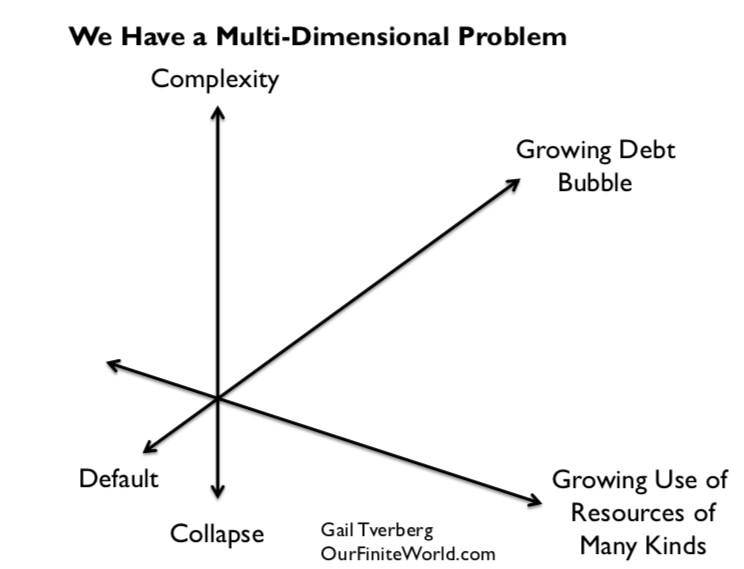
Figure 2.
Complexity involves adding more technology, more international trade and more specialization. Its downside is that it indirectly tends to reduce affordability of finished end products because of growing wage disparity; many non-elite workers have wages that are too low to afford very much of the output of the economy. As more complexity is added, wage disparity tends to increase. International wage competition makes the situation worse.
A growing debt bubble can help keep commodity prices up because a rising amount of debt can indirectly provide more demand for goods and services. For example, if there is growing debt, it can be used to buy homes, cars, and vacation travel, all of which require oil and other energy consumption.
If debt levels become too high, or if regulators decide to raise short-term interest rates as a method of slowing the economy, the debt bubble is in danger of collapsing. A collapsing debt bubble tends to lead to recession and falling commodity prices. Commodity prices fell dramatically in the second half of 2008. Prices now seem to be headed downward again, starting in October 2018.

Figure 3. Brent oil prices with what appear to be debt bubble collapses marked.

Figure 4. Three-month treasury secondary market rates compared to 10-year treasuries from FRED, with points where short term interest rates exceed long term rates marked by author with arrows.
Even the relatively slow recent rise in short-term interest rates (Figure 4) seems to be producing a decrease in oil prices (Figure 3) in a way that a person might expect from a debt bubble collapse. The sale of US Quantitative Easing assets at the same time that interest rates have been rising no doubt adds to the problem of falling oil prices and volatile stock markets. The gray bars in Figure 4 indicate recessions.
Growing use of resources becomes increasingly problematic for two reasons. One is population growth. As population rises, the economy needs more food to feed the growing population. This leads to the need for more complexity (irrigation, better seed, fertilizer, world trade) to feed the growing world population.
The other problem with growing use of resources is diminishing returns, leading to the rising cost of extracting commodities over time. Diminishing returns occur because producers tend to extract the cheapest to extract commodities first, leaving in place the commodities requiring deeper wells or more processing. Even water has this difficulty. At times, desalination, at very high cost, is needed to obtain sufficient fresh water for a growing population.
Why Inadequate Energy Supplies Lead to Low Oil Prices Rather than High
In the last section, I discussed the cost of producing commodities of many kinds rising because of diminishing returns. Higher costs should lead to higher prices, shouldn’t they?
Strangely enough, higher costs translate to higher prices only sometimes. When energy consumption per capita is rising rapidly (peaks of red areas on Figure 5), rising costs do seem to translate to rising prices. Spiking oil prices were experienced several times: 1917 to 1920; 1974 to 1982; 2004 to mid 2008; and 2011 to 2014. All of these high oil prices occurred toward the end of the red peaks on Figure 5. In fact, these high oil prices (as well as other high commodity prices that tend to rise at the same time as oil prices) are likely what brought growth in energy consumption down. The prices of goods and services made with these commodities became unaffordable for lower-wage workers, indirectly decreasing the growth rate in energy products consumed.

Figure 5.
The red peaks represented periods of very rapid growth, fed by growing supplies of very cheap energy: coal and hydroelectricity in the Electrification and Early Mechanization period, oil in the Postwar Boom, and coal in the China period. With low energy prices, many countries were able to expand their economies simultaneously, keeping demand high. The Postwar Boom also reflected the addition of many women to the labor force, increasing the ability of families to afford second cars and nicer homes.
Rapidly growing energy consumption allowed per capita output of both food (with meat protein given a higher count than carbohydrates) and industrial products to grow rapidly during these peaks. The reason that output of these products could grow is because the laws of physics require energy consumption for heat, transportation, refrigeration and other processes required by industrialization and farming. In these boom periods, higher energy costs were easy to pass on. Eventually the higher energy costs “caught up with” the economy, and pushed growth in energy consumption per capita down, putting an end to the peaks.
Figure 6 shows Figure 5 with the valleys labeled, instead of the peaks.

Figure 6.
When I say that the world economy is reaching “peak industrial output per capita” and “peak food per capita,” this represents the opposite of a rapidly growing economy. In fact, if the world is reaching Limits to Growth, the situation is even worse than all of the labeled valleys on Figure 6. In such a case, energy consumption growth is likely to shrink so low that even the blue area (population growth) turns negative.
In such a situation, the big problem is “not enough to go around.” While cost increases due to diminishing returns could easily be passed along when growth in industrial and food output per capita were rapidly rising (the Figure 5 situation), this ability seems to disappear when the economy is near limits. Part of the problem is that the lower growth in per capita energy affects the kinds of jobs that are available. With low energy consumption growth, many of the jobs that are available are service jobs that do not pay well. Wage disparity becomes an increasing problem.
When wage disparity grows, the share of low wage workers rises. If businesses try to pass along their higher costs of production, they encounter market resistance because lower wage workers cannot afford the finished goods made with high cost energy products. For example, auto and iPhone sales in China decline. The lack of Chinese demand tends to lead to a drop in demand for the many commodities used in manufacturing these goods, including both energy products and metals. Because there is very little storage capacity for commodities, a small decline in demand tends to lead to quite a large decline in prices. Even a small decline in China’s demand for energy products can lead to a big decline in oil prices.
Strange as it may seem, the economy ends up with low oil prices, rather than high oil prices, being the problem. Other commodity prices tend to be low as well.
What Is Ahead, If We Are Reaching Economic Growth Limits?
1. Figure 1 at the top of this post seems to give an indication of what is ahead after 2019, but this forecast cannot be relied on. A major issue is that the limited model used at that time did not include the financial system or debt. Even if the model seems to provide a reasonably accurate estimate of when limits will hit, it won’t necessarily give a correct view of what the impact of limits will be on the rest of the economy, after limits hit. The authors, in fact, have said that the model should not be expected to provide reliable indications regarding how the economy will behave after limits have started to have an impact on economic output.
2. As indicated in the title of this post, considerable financial volatility can be expected in 2019 if the economy is trying to slow itself. Stock prices will be erratic; interest rates will be erratic; currency relativities will tend to bounce around. The likelihood that derivatives will cause major problems for banks will rise because derivatives tend to assume more stability in values than now seems to be the case. Increasing problems with derivatives raises the risk of bank failure.
3. The world economy doesn’t necessarily fail all at once. Instead, pieces that are, in some sense, “less efficient” users of energy may shrink back. During the Great Recession of 2008-2009, the countries that seemed to be most affected were countries such as Greece, Spain, and Italy that depend on oil for a disproportionately large share of their total energy consumption. China and India, with energy mixes dominated by coal, were much less affected.

Figure 7. Oil consumption as a percentage of total energy consumption, based on 2018 BP Statistical Review of World Energy data.

Figure 8. Energy consumption per capita for selected areas, based on energy consumption data from 2018 BP Statistical Review of World Energy and United Nations 2017 Population Estimates by Country.
In the 2002-2008 period, oil prices were rising faster than prices of other fossil fuels. This tended to make countries using a high share of oil in their energy mix less competitive in the world market. The low labor costs of China and India gave these countries another advantage. By the end of 2007, China’s energy consumption per capita had risen to a point where it almost matched the (now lower) energy consumption of the European countries shown. China, with its low energy costs, seems to have “eaten the lunch” of some of its European competitors.
In 2019 and the years that follow, some countries may fare at least somewhat better than others. The United States, for now, seems to be faring better than many other parts of the world.
4. While we have been depending upon China to be a leader in economic growth, China’s growth is already faltering and may turn to contraction in the near future. One reason is an energy problem: China’s coal production has fallen because many of its coal mines have been closed due to lack of profitability. As a result, China’s need for imported energy (difference between black line and top of energy production stack) has been growing rapidly. China is now the largest importer of oil, coal, and natural gas in the world. It is very vulnerable to tariffs and to lack of available supplies for import.

Figure 9. China energy production by fuel plus its total energy consumption, based on BP Statistical Review of World Energy 2018 data.
A second issue is that demographics are working against China; its working-age population already seems to be shrinking. A third reason why China is vulnerable to economic difficulties is because of its growing debt level. Debt becomes difficult to repay with interest if the economy slows.
5. Oil exporters such as Venezuela, Saudi Arabia, and Nigeria have become vulnerable to government overthrow or collapse because of low world oil prices since 2014. If the central government of one or more of these exporters disappears, it is possible that the pieces of the country will struggle along, producing a lower amount of oil, as Libya has done in recent years. It is also possible that another larger country will attempt to take over the failing production of the country and secure the output for itself.
6. Epidemics become increasingly likely, especially in countries with serious financial problems, such as Yemen, Syria, and Venezuela. Historically, much of the decrease in population in countries with collapsing economies has come from epidemics. Of course, epidemics can spread across national boundaries, exporting the problems elsewhere.
7. Resource wars become increasingly likely. These can be local wars, perhaps over the availability of water. They can also be large, international wars. The timing of World War I and World War II make it seem likely that these wars were both resource wars.

Figure 10.
8. Collapsing intergovernmental agencies, such as the European Union, the World Trade Organization, and the International Monetary Fund, seem likely. The United Kingdom’s planned exit from the European Union in 2019 is a step toward dissolving the European Union.
9. Privately funded pension funds will increasingly be subject to default because of continued low interest rates. Some governments may choose to cut back the amounts they provide to pensioners because governments cannot collect adequate tax revenue for this purpose. Some countries may purposely shut down parts of their governments, in an attempt to hold down government spending.
10. A far worse and more permanent recession than that of the Great Recession seems likely because of the difficulty in repaying debt with interest in a shrinking economy. It is not clear when such a recession will start. It could start later in 2019, or perhaps it may wait until 2020. As with the Great Recession, some countries will be affected more than others. Eventually, because of the interconnected nature of financial systems, all countries are likely to be drawn in.
Summary
It is not entirely clear exactly what is ahead if we are reaching Limits to Growth. Perhaps that is for the best. If we cannot do anything about it, worrying about the many details of what is ahead is not the best for anyone’s mental health. While it is possible that this is an end point for the human race, this is not certain, by any means. There have been many amazing coincidences over the past 4 billion years that have allowed life to continue to evolve on this planet. More of these coincidences may be ahead. We also know that humans lived through past ice ages. They likely can live through other kinds of adversity, including worldwide economic collapse.
Note:
[1] Note that where the dotted line for 2019 is placed is based on where I see the 2019 economy relative to the downturn in industrial output per capita, based on a number of kinds of evidence, not all of which is cited in this article. The 1972 base model would give a slightly different timing of the downturn, a few years earlier. Also note that while the original “The Limits to Growth” book is no longer in print, Limits to Growth: The 30-Year Update by the same authors is available for sale.


Shale Boom is Slowing, Oil-field Bellwether Warns
CEO of oil-field service company Schlumberger warns of ‘tough year in North America’
U.S. shale production is poised to slow down this year as drillers reduce their budgets in response to lower oil prices, the head of the world’s largest oil-field services company said Friday.
Schlumberger Ltd. Chief Executive Paal Kibsgaard said on a call with investors that the recent decline in oil prices had prompted a more conservative approach among the world’s oil producers, a dynamic he said was particularly pronounced in the U.S.
Mr. Kibsgaard said the budgets of U.S. shale drillers, who are customers of Schlumberger, could be slightly down in 2019, especially in the early part of the year. That means the rapid production growth seen in the U.S. in 2018 will slow, he said.
“We could be facing a more moderate growth in U.S. shale production in coming years,” Mr. Kibsgaard said during the company’s fourth-quarter earnings call.
Some frackers have already begun scaling back next year’s drilling plans amid weak crude prices. U.S. oil prices had fallen more than 30% in recent months. They topped $53 per barrel Friday, which would be their highest close since early December, but are still low enough to force many shale companies to pull back on spending.
Producers Chesapeake Energy Corp., Diamondback Energy Inc., Parsley Energy Inc. and Centennial Resource Development Inc. either plan to operate fewer drilling rigs in 2019 or recently lowered production plans, the companies have said in public statements and filings.
The cuts so far have been modest, and shale drillers remain on track to push U.S. crude production to new highs this year, though not at the same rate of growth seen in 2018. The Energy Information Administration said Tuesday it expects oil production to reach an average of 12.1 million barrels daily in 2019 from an average of 10.9 million barrels last year.
As a result, Schlumberger said it would spend between $1.5 billion and $1.7 billion in 2019, down from $2.2 billion in 2018. The reduction is primarily due to slowing activity in the U.S., Mr. Kibsgaard said. It reported fourth-quarter revenues in North America of $2.8 billion flat from the same period of 2017, but 12% lower than the third quarter of 2018, as activity slowed in the U.S.
Mr. Kibsgaard said he expected drilling activity to pick up outside the U.S., but shale producers will likely spend within cash flow and focus on drilled but uncompleted wells instead of drilling new ones.
“I think it’s going to be a fairly tough year in North America,” he said.
https://www.wsj.com/articles/shale-growth-slowing-oil-field-services-giant-says-11547832801
First the article says, “U.S. shale production is poised to slow down this year as drillers reduce their budgets in response to lower oil prices.”
Later it quotes Mr. Kibsgaard as saying, “Mr. Kibsgaard said the budgets of U.S. shale drillers, who are customers of Schlumberger, could be slightly down in 2019, especially in the early part of the year. That means the rapid production growth seen in the U.S. in 2018 will slow.”
So the article seems to be saying slower growth, not contraction. But then the article ends by saying, “I think it’s going to be a fairly tough year in North America.” Here, I think he is talking about drilling activity from Schlumberger’s perspective.
Alexandria Ocasio-Cortez’s 70% tax on the super-rich is more popular than Trump’s tax cuts, new poll shows
https://www.businessinsider.com/a-70-tax-on-the-super-rich-is-more-popular-than-trumps-tax-cuts-2019-1?fbclid=IwAR2WAD3tK2Tm7Rwy6kUqf3cjfc38zDk70IIxat2LSHroy56yRO0NiT1BDeE
https://imgur.com/a/Jvbw6fi
What’s interesting is the proposed tax cuts for middle income earners used during the most recent elections, went mute after the elections and no such tax cut ever came to the house or senate floor for a vote. So the most politicians can do is suggest ideas that help middle income earners as a way to manipulate them to vote their way, but never amount to anything because the over-riding goal is to assist the super wealthy, who I guess must need lots of help. So the 70% tax on the wealthy is probably a backlash to being manipulated and for the numerous decades of taxation reduction for the wealthy, while deficits/debt ballooned and infrastructure degraded.
Short term thinking of gains, by our rich friends, who are not the brightest porch lights on the block.
“So the 70% tax on the wealthy is probably a backlash to being manipulated…”
yes, and probably due to feelings that the current system (the American form of capitalism, or whatever you want to call it) is no longer economically benefiting the middle class but is harming them…
the psychology is fascinating… but no surprise that this proposed tax is popular…
moving forward, there may be a massive push by the middle class for reforms that are more in the AOC socialist mold… (Yellow Vests, anyone?)…
and the upper class likely will push back hard to keep the present system…
the 2020 POTUS election may be a turning point… or not…
again, this should be fascinating viewing, as all sides push for their desires, all the while uselessly as the problem is not political, but due to declining net (surplus) energy, which can’t be voted against…
You know what happens when you try to stick the super rich with a 70% tax bill?
They move. Because, you know- you’re super rich, and can afford to.
Where too?
Unless you are on some island hideaway, with marginal protection, you have good rates here.
Why do you think they didn’t leave even when it was 90% in the 1950’s?
Most are sociopaths, in it for the rush.
Probably true. Except quite a few other places are not good destinations either.
Well, it’s impossible to mandate ~70% tax bill on the “rich”, ever heard of tax heavens in Europe and or off shore and Asia ?! This could succeed only in case of simultaneous revolt-reset across all these hideout, and that’s impossible..
Yes you can tax some quasi rich which do appear on the news like the various tech companies, but the wealthy bankers standing behind the curtain are always two, three steps ahead of any possible political action against them. They are vulnerable only to collapse proper of whatever nature.
The 70% tax is smoke and mirrors. 70% tax on income….define income. Ther is a reason why our tax code has just a couple of pages of Why you have to pay tax and hundreds of pages on why you do not have to pay tax. The rich will never pay 70% tax, even if it is on the books.
It worked so well in France
Japan’s robot hotel lays off half the robots after they created more work for humans
It turns out even robots can’t enjoy job security
https://www.theverge.com/2019/1/15/18184198/japans-robot-hotel-lay-off-work-for-humans
sorry japanese robots will not save old people of japan
robots are very far to defeat any species on earth
https://youtu.be/YFR4a9vcri4
Great idea. Piss off the robots. That always ends well…Not one sex bot in sight so they may be safe for now.
OIL (BRENT) PRICE COMMODITY
62.90 USD +1.75 (2.86%)
Moving up, but has a long way to go—–
I see the WSJ lead article is “Stocks Climb on Signs of Easing U.S.-China Trade Tensions.” Perhaps our problems have been resolved. Peak coal is no longer an issue. We just need to talk more nicely to each other.
Except for the detail that world concrete cement is falling, led by falling consumption in China.
https://gailtheactuary.files.wordpress.com/2019/01/worldcementproduction_ugo-bardi.jpg
And China’s imports of iron ore to make steel products are down.
https://gailtheactuary.files.wordpress.com/2019/01/china-iron-ore-imports-increase-over-prior-year-zerohedge.jpg
Also its sales of automobiles and cell phones are down. But maybe all that needs to be fixed is the leaders of the two countries ironing out their differences, and world economic growth can proceed as before.
Cement is incredibly energy intensive, and a major part of infrastructure.
To Take Down Fossil Fuels, We Must Abandon Capitalism
https://truthout.org/articles/a-farewell-to-glaciers-coral-reefs-and-rainforests/
“A radical restructuring of the entire fossil-fuel based economy means those who have all the power today would be rendered obsolete.”
We all have power – in our cars, in our domestic and industrial electrical sockets etc. When the system collapses, we all are obsolete…
well said, MG…
“A radical restructuring of the entire fossil-fuel based economy means…”
dire poverty for all humans…
but hey, if that is what is needed to “Take Down Fossil Fuels”…
and Save The Planet…
well… who thinks that would be a good thing?
not me…
“The stock price of Tesla has dropped by 7.14 percent in pre-market following the release of CEO Elon Musk’s letter. The struggle of the car marker demonstrates the lack of fundamentals in the U.S. stock market which may lead to the decline of the Dow Jones…
“On January 18, Elon Musk revealed in a letter sent to the company’s employees that approximately seven percent of the firm’s workforce will be let go to fund the increased production rate of the Model 3.”
https://www.ccn.com/how-teslas-7-stock-drop-shows-dow-jones-isnt-in-the-clear/
That’s interesting; reducing workforce to fund greater production.
I was puzzling over that, too, Chrome. I can see how reducing employees would reduce costs but less clear on how it would accelerate production.
Perhaps Elon has been at the Ambien again:
“…he did admit to using pills to go to sleep, often taking Ambien. ““It is often a choice of no sleep or Ambien,” he told the New York Times.
“And the paper reported that board members are concerned that the drug doesn’t always work to help Mr Musk sleep but instead fuels the late-night tweets in which he often makes some of his more unusual or controversial statements.”
https://www.independent.co.uk/life-style/gadgets-and-tech/news/elon-musk-tesla-tweet-private-drugs-sleeping-pills-crying-new-york-times-a8495531.html
More and more Indian workers to arrive in Poland
Up to 25,000 people are awaiting Polish work visas in the embassy in New Delhi, India, Dziennik Gazeta Prawna (DGP) daily wrote on Monday.
People from India, Nepal and Bangladesh are waiting to come to Poland. “These are people recruited by Polish companies that have valid work permits issued by provincial offices,” wrote the daily.
According to the newspaper, some of them have unsuccessfully tried to register their visa applications for as many as eight months. “The problem is staff shortages. The consular department at the Embassy in New Delhi employs four people, which is why the consulate has issued only 3,500 work visas since the beginning of the year.”
“Not only is there great interest, but also various types of fraud stand behind the big inflow of applications. Local agents register in the system and then try to resell the visas,” the director of the press office of the Ministry of Foreign Affairs and former consul in New Delhi Artur Lompart told PAP.
As provided by the daily, the visa’s outsourcing can be a good solution. It means that requests can be processed by external companies.
https://www.thefirstnews.com/article/more-and-more-indian-workers-to-arrive-in-poland-2171
one thing to say demographic is destiny
Poland looks to be one of the few bright spots in the global economy, currently.
And the source country, like Philippines government, love these Overseas Foreign Workers (OFW) programs. Agencies that source these workers make a killing. The Philippines even collects a departure tax from its workers at the Manila Airport. Revenue from these OFWs is reportedly 20% of the Philippine Government Tax Revenues. The host countries’ (e.g., Saudi Arabia, UAE, Qatar, etc., ) corporations love this supply of cheap labor.
Although that situation is changing, certainly in Saudi. This article is from July 2018:
“Hundreds of thousands of expatriates have been leaving Saudi Arabia as the economy stagnates and the authorities impose more fees on foreign workers.
“The collapse in oil prices has seen the biggest Arab economy losing much of its appeal to expats previously lured by petrodollars. According to figures released in April by the Directorate General of Passports in Riyadh, an average of more than 1,500 foreign workers have left the country every day since the last quarter of 2016.”
https://www.theweek.co.uk/94989/why-expats-are-leaving-saudi-arabia-in-droves
Lots of Latinos (sorry Latinxes, must be PC) left Spain after 2008.
The Gypsies, Roumanians, Arabs and Bulgars remained…..
Leaving a sinking ship?
A lot worked in construction, and also factories that closed in consequence of the 2008 crisis. Moroccans tend to be very low-wage agricultural semi-slaves all over Spain.
I hadn’t thought about people moving from India, Nepal, and Bangladesh to Poland, but if jobs are available that pay reasonably well, I am sure that the type of travel makes sense. I imagine that these folks might fit in reasonably well Poland. If they can afford an airline ticket (even through contributions from family and friends), they are in better shape economically than people coming over from Africa on boats. We have quite a few people from India in the US. Many of them seem to be from the better educated classes. They often seem to fit in fairly well.
I guess that the reason is that the Central Europe is not so much spoiled by the false promieses of the green energy – the Central Europe due to its poorer situation could not afford the experiments with the costly green energy. As you have stated several times, the Western Europe energy prices are too high.
Paradoxically, the result of this Western Europe green folly is that the Central Europe simply can not be more green, as the energy system of the Europe would collapse due to the fact that the Central Europe with its coal and nuclear and coal plants practically provides the back up battery for the Western Europe green energy!
Right!
And the same also regards the (anti)immigration: if the Western Europe is more open to the immigration, the Central Europe MUST hold the opposite view. Otherwise the system collapses. That way the more nationalist views in the Central Europe are of systemic origin: there is a need for some immigration due to the population decline. On the other hand, the population in the colder areas is sustained by the elevated energy use which has got its limits based on how much energy is produced in the given year.
When the Western Europe starts to punish the Central Europe for not being enough green or proimmigrant, the European Union collapses.
The views regarding the green cars are already damaging the economy of the European Union, as these limits are valid for all EU countries, not just for the Western Europe:
https://phys.org/news/2018-10-emission-eu-car-sales-september.html
https://www.fleeteurope.com/en/taxation-and-legislation/europe/features/eu-fails-agree-co2-emission-limits
“When the Western Europe starts to punish the Central Europe for not being enough green or proimmigrant, the European Union collapses.”
I agree. Lots of ways for the EU to collapse.
“We have quite a few people from India in the US. Many of them seem to be from the better educated classes. They often seem to fit in fairly well.”
Asians tend to have jobs in IT & finance, mostly. What happens when the economy can’t afford those jobs to the current extent, and they start competing with a larger swath of the n-ative population?
I think you are right. Most of the Indians I have encountered are in IT and finance. They are well educated professionals in fields that have done well.
Every kind of profession is now reaching the saturation point. I have received emails from young people, wondering what to study, to find another job in a field that is better, from the point of view of less competition for jobs, or less problem with contract jobs rather than full time employment. So even these fields are reaching saturation.
I suspect a lot of them wil be coming for IT related work. There is a noticeable uptick in the online help wanted (pracuj.pl) for IT/programmers of all stripes. And lots of new companies from abroad setting up offices here often not in Warsaw but in Kracow, Gdansk, Wroclaw. I suspect it is much cheaper to lease office space outside of Warsaw.
The economy here is actually still doing rather well. I have been here for 15 years now. It is interesting to be in a country that for the moment is still on the rise as opposed to decline (like back in the US).
They moved in large numbers to the UK, so why not Poland, I suppose?
I doubt they will be welcomed by the mass of the people though: Poles have told me how shocked they are by the numbers of Africans and Asians in England.
Bangladeshis in particular are very hard, honest workers.
This may not work well.
Ahh, potholes are seen in the road ahead for affordable EVs….Elon needs to read OFW…
Tesla cuts 7% of its workforce, saying there’s a ‘very difficult’ road ahead
In an email to employees, Musk notes that the company faces a “very difficult” road ahead in its long-term goal to sell affordable renewable energy products at scale, noting the company is younger than other players in the industry.
“Tesla will need to make these cuts while increasing the Model 3 production rate and making many manufacturing engineering improvements in the coming months,” Musk said in the company update.
“Attempting to build affordable clean energy products at scale necessarily requires extreme effort and relentless creativity, but succeeding in our mission is essential to ensure that the future is good, so we must do everything we can to advance the cause,” he added.
https://news.yahoo.com/tesla-cut-workforce-around-7-101600461.html
Imagine that…freebees are being discontinued
Earlier this week, the company discontinued the cheapest versions of its Model S sedans and Model X SUVs. And Musk said on Thursday that the firm would also ditch its customer referral program , which rewarded perks likes six months of free charging, as it was “adding too much cost to the cars.
Musk said. “This quarter, as with Q3, shipment of higher priced Model 3 variants (this time to Europe and Asia) will hopefully allow us, with great difficulty, effort and some luck, to target a tiny profit.
Elon, depending on Lady Luck ….hmm…, Hope it works for you, she can be very harsh lady.
A recent exchange on another forum:
Me: “Green energy is highly intermittent and backup is expensive – that’s why Germany is turning away from the Energiewende.”
A German: “Where did you got that ‘information’ from? From the MAD Magazine?”
Me: “site:ourfiniteworld.com energiewende”
The German: “site: bundesregierung.de energiewende”
Me: “Governments are not to be trusted. They indulge in worthless propaganda.”
The German: “So we have a new CT now, the Energiewende CT. Your CT fully met the creation matrix of all CTs, means, no knowledge about the matter available, but tons of daftly ideas and claims. If you think the Energiewende is a fake, then Sir, you are an idiot.”
Me: “No insults, please. It’s against the forum rules!”
“Obtaining information about this week’s crackdown in Zimbabwe has been greatly complicated by the internet shutdown imposed by the government on Tuesday…
“But Isaac’s eyewitness account has been echoed by other witnesses, activists, doctors and lawyers contacted by the Mail & Guardian.
“Most would not speak on record, expressing fears of arrest or worse. They described a nationwide pattern of executions, indiscriminate assaults and home invasions, committed either by state security forces or by armed, plainclothes militia supervised by security forces…
“When Mnangagwa succeeded Mugabe, he promised to make fixing the country’s spiralling economy his first order of business. But the promised economic and political reforms never came, and foreign investors were discouraged by the disputed election in July last year, and the killing of six protesters by soldiers in the wake of that election.
“Now inflation is running at 30% — compared with just 5% in the last weeks of the Mugabe regime — and forex is almost impossible for people to come by. The value of the bond notes, a pseudo-currency designed to supplement the US dollars in circulation, has plummeted…”
https://mg.co.za/article/2019-01-18-00-vicious-crackdown-in-zimbabwe
“Two million people are internally displaced, corruption is widespread and mismanagement rife.
“Sudan is in the grip of a long-running economic crisis that has its roots in the secession of South Sudan in 2011 and the loss of oil reserves to the new and troubled southern state. Spiralling inflation has hit Sudan’s embattled middle-classes. A cut in the subsidy for bread – the proximate cause of protests in place like El-Gadarif – was merely the spark that ignited deep-seated anger and desperation.”
https://www.theguardian.com/global-development/2019/jan/17/change-in-peoples-hearts-sudan-crossroads-omar-al-bashir-protests
In Facing Mass Extinction, We Must Allow Ourselves to Grieve
https://truthout.org/articles/in-facing-mass-extinction-we-dont-need-hope-we-need-to-grieve/
Gotta love the CC proponents who air travel far and wide and use fossil fuels to report their findings and relay the consequences of burning FF’s. Hopefully he’s not running up a $1000 home electric bill like Al Gore.
Still doesn’t change the Physics and body of evidence. Gail is correct we can’t really do anything about it with 7.8 plus people roaming on the planet
Historically, in our history as homo sapiens, our population has been 1-10 million, with a near extinction 70,000 years ago.
Of course, we had a healthy ecosystem, and mass resources.
That is not the case today.
7.8 billion? I would laugh, but it really isn’t that funny.
“In Facing Mass Extinction, We Must Allow Ourselves to Grieve”
meanwhile, there are multitudes of bacteria and viruses that are ending the lives of many humans every day…
do bacteria “grieve” about ending so many lives?
this writer may not go there, but human extinction seems to be the simplest solution…
but I don’t think there’s any need to “grieve” that our species eventually will become part of that “mass extinction”…
The dis-connect is obvious whe. You read this sh_t
“Reporting on the catastrophic impact of climate disruption for this book involved trips to the front lines of collapsing geo- and biospheres and interviews and reports about near-apocalyptic scenarios: about rapidly thawing permafrost, the release of methane into the atmosphere, the flooding of coastal cities, the increasing likelihood of billions of people dying in the not-so-distant future.”
Lots of trips….costing lots of dough, expending lots of FF.
Then…more.
“Back home from Denali, I had to continue to find a way to balance what I was experiencing. I resumed my weekend forays into the nearby Olympic National Park.”
The author is clearly of the elite class that can move around the world, and play….at will, consuming tremendous resources while doing living his life of pleasure.
The hypocrisy here is stunning…”Grief is praise, because it is the natural way love honors what it misses.” My acceptance of our probable decline opens into a more intimate and heartfelt union with life itself. The price of this opening is the repeated embracing of my own grief. Grief is something I move through, to territory on the other side. This means falling in love with the Earth in a way I never thought possible. It also means opening to the innate intelligence of the heart. I am grieving and yet I have never felt more alive. I have found that it’s possible to reach a place of acceptance and inner peace, while enduring the grief and suffering that are inevitable as the biosphere declines.”
He is what can be called and “Eco Justice Warrior” (EJW)
He supposedly grieves while living the super consuming life. By traveling the world…and the he convinces himself that his “grief” is actually worship.
He is as fake as the guy in a suburb house.
I am doing some work at the Halifax ship yard tomorrow…I will tell the lads not to waste time on the new Ice breakers.
The Ice is thick now and the polar bear population is expanding…The problem was the make good rugs.
Not enough energy per capita.
“Corporations globally will increasingly default on debt as economies slow while borrowing costs and political strife escalate, according to a quarterly survey by the International Association of Credit Portfolio Managers.
“The group’s credit default index sank in the fourth quarter to the most negative reading in more than nine years, worsening sharply from the prior quarter and indicating a broad-based call for rising debt defaults over the next 12 months.”
https://uk.reuters.com/article/iacpm-survey/corporations-increasingly-seen-defaulting-on-debt-survey-idUKL1N1ZG0YY
“British manufacturers are being forced to build up financial buffers in preparation for a no-deal Brexit as the cost of stockpiling goods and materials puts companies under strain.
“Measures taken by manufacturers to prepare for a disorderly exit include creating cash cushions and taking out working capital loans to cover the costs of stockpiling.”
https://www.theguardian.com/business/2019/jan/18/uk-manufacturers-hard-brexit-stockpiling-santander
“[UK] Borrowing on credit cards is expected to plunge to the lowest levels since 2007 in the three months before Brexit, according to the Bank of England, in another indication of stresses facing the UK economy.
“According to the latest quarterly health check on credit conditions from Threadneedle Street, high street banks forecast borrowing on plastic will decline in the first quarter by the most since records began 12 years ago.
“It comes amid growing concern over consumer spending… Its gauge for mortgage lending also dropped to -17.5 in the final quarter of 2018.”
https://www.theguardian.com/money/2019/jan/17/uk-demand-for-credit-cards-and-mortgages-falling-fast-warns-bofe
The public surprisingly perceptive if this survey is anything to go on:
“Nearly half of UK consumers expect 2019 to bring a financial crash that is worse than 2008, according to wealth management firm Spearvest.
“The survey of 1,000 people on their economic views for 2019 found that 44 per cent foresee a financial crisis that is worse than that experienced almost a decade ago.”
https://www.ftadviser.com/your-industry/2019/01/17/financial-crisis-and-housing-crash-expected-for-2019/
Wow! And how much the UK spends affects total world demand. Too little spending equates to too low commodity prices.
“If there’s a serious recession on the horizon, the world’s central banks may have trouble fighting it.
“Central banks took dramatic and unorthodox steps to prevent economic collapse during the financial crisis. They slashed interest rates, and in the years that followed spent trillions on bonds as part of an effort to spur growth.
“One decade later, global central banks are only starting to reverse those moves.
“Interest rates in developed economies remain incredibly low; in some places, they’re even negative. The Federal Reserve is unloading some of the bonds it bought, but central banks in Europe and Japan have not yet done so…
“Put simply, the central banking system is “running out of ammo,” according to Ed Yardeni, president of investment advisory firm Yardeni Research…
“There may very well be limits to what monetary policy can accomplish,” Yardeni said. “And it may be a mistake to tell the public they can fix all of our problems.””
https://edition.cnn.com/2019/01/17/business/central-banks-next-recession/index.html
“The European Central Bank is expected to wait until the fourth quarter to raise its deposit rate, later than thought just a month ago, according to economists in a Reuters poll, who also said the chances of a euro zone recession have grown…
“The ECB is now expected to raise its deposit rate, currently at -0.40 percent, to -0.20 percent in the fourth quarter and wait until early 2020 to raise its refinancing rate from zero to 0.20 percent.”
https://uk.reuters.com/article/uk-eurozone-economy-poll/ecb-rate-hike-to-be-delayed-as-recession-risks-rise-again-reuters-poll-idUKKCN1PC00L
“The Reserve Bank [of Australia] could be cutting interest rates within months amid new warnings house prices in Sydney and Melbourne could fall by more than 20 per cent and pull down the national economy…
“Capital Economics economists Marcel Thieliant and Ben Udy said they expect prices to fall by an average of 15 per cent across the nation’s capital cities, making it the deepest and longest fall in prices on record.”
https://www.smh.com.au/business/the-economy/growing-fears-rba-will-have-to-cut-rates-to-stop-tumbling-house-prices-20190118-p50s5b.html
Australia isn’t doing any better than the UK!
The ECB knows just how precarious it all is.
Really weird rates! An economy cannot be doing well, to have such interest rates.
NEW: Buzzfeed News is reporting that Robert Mueller has evidence Trump directed Michael Cohen to lie to Congress about the extent of the deal to build a Trump Tower in Moscow.
https://www.buzzfeednews.com/article/jasonleopold/trump-russia-cohen-moscow-tower-mueller-investigation
https://imgur.com/a/wUHBfft
And what does that have to do with collusion in the election?
not the question– just pointing out another lie by Don the Con.
I find having him as “leader” rather amusing.
Not a bad thing in late stage capitalism, as going down faster may leave more resources for the survivors, if any.
Or maybe your beloved Don will make the US collapse slower.
But it will cost you the environment plus some claymate change.
Only skimmed through this quickly, but…
https://www.zerohedge.com/news/2019-01-18/skeptics-shred-buzzfeed-over-trump-tower-scoop-journo-admits-he-hasnt-seen-evidence
Well now, if Buzzfeed says it, that means it is indisputable!
Cuban food shortages (beware: conservative bias ahead)…
https://www.breitbart.com/latin-america/2019/01/17/they-starving-us-death-cubans-protest-food-shortages/
this quote is quite interesting:
“Many of the country’s current economic difficulties are also a result of the ongoing collapse of the Venezuelan economy, which has long subsidized the Cuban economy through generous oil exports in exchange for medical workers and helping develop a repressive state security apparatus.”
so Creeping Collapse from Venezuela to Cuba?
Breitbart is comedy at best, right wing propaganda as its center.
Castro died of old age.
If Cuba was getting its oil from Venezuela, yes, creeping collapse to Cuba is quite possible.
I contacted Alexandria Ocasio-Cortez On Twitter for help.
China’s debt is exploding!
https://imgur.com/a/EBdk5XB
Actually, China’s debt level is flattening relative to GDP recently. This becomes a problem, because the world as a whole needs rising debt to GDP..
“What goes widely unnoticed is that China is already in crisis. No, it’s not the sort of hold-on-for-dear-life collapse the US had in 2008 or the surprising, ferocious meltdowns the Asian Tiger economies experienced in 1997.
“Nonetheless, it’s a crisis, complete with gutted banks, bankrupt companies, and state bailouts. Since the Chinese distinguish their model of state capitalism as “socialism with Chinese characteristics,” let’s call this a “financial crisis with Chinese attributes.”
https://www.business-standard.com/article/international/forget-trade-war-china-already-in-crisis-with-bankrupt-firms-gutted-banks-119011701187_1.html
The ending is
“The government—obsessed with social stability—isn’t allowing the debt bomb to detonate. Lehman moments might be terrifying, but they’re also cleansing, an opportunity for the market to scrub out the bad stuff and clear room for new. Beijing, by stopping that from happening, is allowing the waste to rot and fester, likely enlarging the costs of the unavoidable cleanup.”
Posted without comment
https://www.zerohedge.com/news/2019-01-17/art-berman-exposing-false-promise-shale-oil
“In contrast to the EIA economists, Opec has some real oil people covering US and the rest of the world”s production.”
We shall see–
If it were possible to get the price up higher, I am sure that more could be extracted and the shale reserve estimates would be less far off. The problem is that the price doesn’t really rise enough.
Ocasio-Cortez’s first House floor speech becomes C-SPAN’s most-viewed Twitter video
https://thehill.com/homenews/media/425860-ocasio-cortezs-first-floor-speech-quickly-becomes-most-viewed-c-span-video?fbclid=IwAR2KFnZ4r7q46v93pFXRMM5qA0uRC-Wrg372mCj5b9VjEVChmu6SyOyQR6Q
we know that there is a continuing decline in net (surplus) energy from FF, and there is an accompanying decline in the prosperity of the average human…
with capitalism (and the greater energy provided by conventional 20th century FF), there was a benefit to the average human…
now, Americans (rightly or wrongly) are more and more judging that (the American form of) capitalism is not a benefit, but actually the cause of their declining prosperity…
in light of this, socialism of the AOC variety will be surging in popularity in the coming years…
until it becomes widely realized that the problem wasn’t political after all…
the new POTUS in 2021, probably a D, will own the collapsing economy…
I remain convinced that capitalism, in its different shades, is actually the only system. No matter how far left one goes, socioeconomic asymmetries between individuals will exist derived from special knowledge, experience, good fortune and talent. The politics of redistribution *can* be reasonable- this is where taxation plays its part, but unconstrained socialism or even communism are utopian at their foundation, and their promises will never fulfilled. What you get instead is a Frankenstein’s monster of capitalism that is centrally planned, slow, and inefficient-leading to much worse circumstances for all. If the American people want to try that, they’ve truly lost all wisdom.
A mix of state and private appropriation and usage of finite resources (especially FFs) delivering consistently abundant ROIs for 200 odd yrs while also ignoring or shifting the costs of doing so elsewhere, is the only system for globalised industrial societies. And that isn’t long for this world.
To call this system capitalism is to ignore the fact that the value of the *actual* capital (resources) is ultimately not of our making or under our control. Pure socialism never happened. There were only various kinds of allocation of “capital”, some of which were successful depending on circumstance and competence.
Bingo!
We have a winner.
Communism was close, but even it suffered from cronyism at the top. humans cannot seem to overcome their basic behavior, e.g., Orwell’s “Animal Farm” (a great book read in high school for the wrong reasons–it was thin and easy to read.)
The value of the resource will never be under *our* control, as if we were to make a conscious decision in determining its value; the value derives from relative abundance or scarcity of the resource, so I’m not sure what your point is. Socialism is less about determining value and more about collective ownership- this is where I see the issue, in the notion of horizontal organisation, the reality of which in nations that attempted communism was just vertical ownership of a different type.
“The value of the resource will never be under *our* control, as if we were to make a conscious decision in determining its value; the value derives from relative abundance or scarcity of the resource, so I’m not sure what your point is.”
And if the resource is abundant enough the source of its value and its relation to the value we create by using it can be obscured. That obscuration is the basis of the global industrial civ, which is now coming apart.
It is meaningless to distinguish between capitalism and socialism in terms of hierarchy, because they are inseparable from the industrial era. Pure capitalism is as illusory as pure socialism.
What we’re seeing is anything but the middle of the road. Instead people are seeking extreme left or right leaders in a desperate attempt to jolt the economy back into GDP rocking machine they once could all depend on to stay ahead of the game. Now too many are falling behind or just barely making it paycheck to paycheck. Get use to extreme positioning and to Twitter type campaigns utilizing the net as a gateway to generating popularity, like Cortez is doing now. She learned the Twitter routine from the Don, but it’s an opposite message on the far left. If people get angry enough they might just vote someone like her into the oval office. Any kind of desperation is conceivable in these latter days of the oil age. Of course none of it will work, one way or the other, because the metrics are squeezing down.
Churchill made the point in the 1930’s that the worst possible scenario would be to see violent swings from Right to Left; with every swing, antagonisms grow and rationality (what there is of it!) declines.
Sorry, but both sides aren’t equal..The radical left brought us the internet and silicon valley..The far right brought us WW2..
To suggest that one extreme is better/worse than the other is ridiculous. Both are capable of some terrible things; if we were wise we’d all be working towards a more moderate/centrist philosophy that encourages (not coerces) working together and cooperation rather than divisive partisanism.
You do know that Hitler was a tree hugging vegan and a rabid lefty.
Vegan yes, lefty “überhaupt nicht”, please read up on national socialism.
Err- Churchill was on the far right, good at war, not much else.
Not ‘far-Right’ at all, that’s a Leftist view -‘he who isn’t with us is a fascist, etc’: first and foremost an aristocrat, and imperialist, but philosophically he hit the nail on the head many times – one always has to try to find a compromise, except when you need to dig your heels in and bash the buggers, ie the little Austrian and his Continental friends…..
Hey, he helped in the War effort.
The people in the UK got rid of him immediately after.
Right wing nuts are not good for keeping your economy together.
And then voted him back in in 1951 with more constituencies.
Solar is such a joke..
All of it can’t be quite this bad.
I have some “bullet-proof” solar PV panels that are widely used on sailing/motor boat surfaces. they are flexible and you can literally step on them with deck shoes. you don’t need the “solar roadways” panels, which are expensive. but maybe on cruise ships you need that level of toughness? sounds like a PR move.
ANYTHING that can be sold to dupes will be sold to dupes even something as expensive & useless as solar panels & wind turbines.
I know they are OK for small applications like my solar powered watch but “renewables” cannot live up to their hype & trying to produce enough of them to prove their failure is a waste of resources, money & time, time we don’t have to waste on futile & expensive technology when it’s RESOURCES we are short of & DEMAND we have too much of.
We REALLY NEED a LEADER with the gumption to RATION FUEL, stop the production of wasteful RV’s, SUV’s BIG TRUCKS, commercial & personal aircraft & water craft & to ban the use of fuel burning yard maitenance machines. ( I just DESPISE & HATE those dam NOISY, DIRT BLOWERS!)
But that will never happen as we are RULED by greedy corporations who only care about PROFITS. BAU until we drop, baby!
The resources we are short of are “inexpensive to extract resources.” There is a gracious plenty of expensive to extract resources. We can also make expensive substitutes.
The demand we need is demand for oil that costs $120 per barrel or more. There is a gracious plenty of demand for oil costing $20 per barrel or less.
It is easy to think our problem is a problem with gasoline at the pump, but it really is a much different problem. Most of our energy usage is well hidden in other kinds of goods and services we buy. For example, it takes a lot of energy (especially oil) to grow and transport food. Also, automobiles use oil and other energy products to manufacture. Making roads and stores both take a lot of energy, including oil.
The problem we have now is that oil and other energy products are too expensive to produce relative to what consumers can afford to pay for end products. In other words, there would be a lot of oil available, if consumers could afford homes and cars and road made with $100 or $120 per barrel oil. I call this an “affordability” problem. In the language of economists, it is a “demand” problem.
What happens with the problem we have not is the opposite of the one you are thinking of. There tend to be gluts of energy products such as gasoline, because of lack of affordability. Young people (and others) cannot afford cars. There is no need for rationing, unless it is rationing of cars and homes and roads made with energy products. It is the end products that are not affordable, so they don’t get purchased. Roads continue to have potholes. The rich people who can afford cars can afford the gasoline, so that is not the problem.
Oil is a finite gift of billions of buried dead things & time, millions of years of time, heat & pressure, so why are we so foolish as to extract it as quickly as possible especially when the price their getting for it is less than the cost of it’s extraction?
I cannot understand WHY we are trying to use up this precious resource as fast as possible, what’s the rush? do they actually believe the “rapture” is at hand? “They” had to have KNOWN this resource is limited, so what’s the rush? Their burning off natural gas in the Baken while in Europe they face a gas shortage.
We have NOTHING that can replace these resources, especially not resource dependent “renewables”.
I suggested rationing because the rich can buy as much as they want but they should be also forced to use less, but rationing would reduce donations to politicians so instead, the lower classes will be forced to cut back.
We waste fossil resources in millions of ways, single use plastics being the worse.
“Consumers” need cheap oil, the economy needs cheap oil but producers now need expensive oil.
We keep worrying about the supply but refuse to address the ever growing demand & all we seem to do is work hard to find ever more “innovative” ways of feeding even more humans & that would take even more oil & land. There will come a time when no amount of money will get us the resources we need.
How much longer can producers keep extracting while losing money?
How much longer will banks keep giving them loans?
What’s plan “B” when there isn’t enough affordable oil to meet demand?
Retreat to their bunkers?
The price has of oil needs to be kept up high enough for producers, or it gets cut off. The same thing is true for natural gas and for coal.
The problem is that we cannot find a way to keep these prices high enough. Somehow, we would need to subsidize all of the would-be fossil fuel producers. We would also need to subsidize the governments of the would-be fossil fuel producers, because if there were truly an “energy surplus”, they would be receiving tax revenue on the produced oil. Exporters would especially benefit. So we would need to subsidize both the companies and governments of Venezuela and Saudi Arabia, for example. This is not something easy to do.
How long is unknown. The question is how long the Plunge Protection Team can keep manipulating financial markets sufficiently to see prices up, and whether the increases will raise prices sufficiently. I just posted this chart in response to another comment. Oil prices respond to the same things that stock markets respond to – more funding to buy them. It is a financial game at this point.
https://gailtheactuary.files.wordpress.com/2019/01/global-stocks-vs-global-central-bank-balance-sheet.jpg
There are few things I have heard of that are as utterly STUPID as a solar road.
Elon Musk’s Blue Mountains tunnel idea and cost dismissed by engineers as a ‘dream’
http://www.abc.net.au/news/2019-01-18/elon-musk-tunnel-idea-killed-off-by-engineers/10722930
This is the end
Beautiful friend
This is the end
My only friend
The Australian property bubble burst is picking up, soon the B O O M!
Investor home loans hit lowest level in nine years
The share of investors in Australia’s home loan market has dropped to its lowest level since October 2009, as the supply of housing in major cities starts to rebalance at a time where banks have tightened lending requirements in the wake of the royal commission.
Investor mortgage lending fell 4.5 per cent in November, sending the total to $9.3 billion from $9.9 billion in October, official figures on Thursday showed. Investor lending is now down 22.6 per cent on the same time last year.
Total housing finance fell 2.5 per cent for the month to $29.1 billion in seasonally adjusted terms, much worse than the consensus of economists’ expectations – with an average 1.2 per cent drop having been forecast.
https://au.res.keymedia.com/files/image/auction.jpg
Owner-occupier lending didn’t improve, down 1.4 per cent for the month.
But the focus is clearly on the investor lending segment, which makes up only 32 per cent of total lending in seasonally adjusted terms – the worst figure since October 2009 when it dipped below 32 per cent.
With house prices having fallen 4.8 per cent across the country, the weakest conditions in a decade, and the biggest market of Sydney down 8.9 per cent in the past 12 months, banks have become more concerned about loan-to-value ratios and refinancing.
Four in 10 loans rejected
An analysis by Digital Finance Analytics reveals that about four in 10 mortgages were rejected in December and that mortgage brokers, who act as an intermediary between lenders and banks, are claiming concerns about the findings of the Hayne royal commission are adding to the nervousness.
However, Nab chief economist Ivan Colhoun said that if it was just banks tightening up on lending then the fall in investor borrowing would have been noticed in cities outside of Sydney and Melbourne.
“Other states aren’t sharing the same recent experience. Indeed some are going in the other direction – South Australian investor approvals are clearly rising and Queensland too and Western Australia’s owner-occupier numbers are possibly beginning to recover.
“This is important as if it was credit tightening that was driving developments, then we would expect the states to be showing more similar trends.
“We think the drop off in investors could be them responding to their own city’s fundamentals,” Mr Colhoun said.
Digital Finance Analytics also noted that there had been a sharp fall in investor applications as appetite for investment property eases.
Big drop in the value of loans
Westpac’s Matthew Hassan said the average loan size is what has changed most. “The six months to November saw a 5.8 per cent drop in the value of owner-occupier loans but just a 1.5 per cent decline in the number of loans.”
While the investors have fled the big markets of Sydney and Melbourne, the figures for November showed that first home buyers are building as a part of the overall home lending market.
The number of first home buyer commitments as a percentage of total owner-occupied housing finance commitments rose to 18.3 per cent in November from 18.1 per cent in October.
The weaker numbers are consistent for November – a month when the spring property market traditionally starts to ease back.
Election uncertainty
Auction clearance rates were in the low 40 per cent range during November, clearly reflecting the lower appetite from banks to lend and investors to borrow.
Lending for the construction of new dwellings was down 2 per cent while lending for the purchase of new dwellings was up 3.4 per cent. Lending for established homes was also down 1.1 per cent.
PWC chief economist Jeremy Thorpe said the housing finance data reflects investor concerns about obtaining finance in the tighter post-royal commission environment.
“This has been exacerbated by the potential for depressed capital growth with the current house price correction and post-election uncertainty about the market environment,” Mr Thorpe said.
Always used to wonder who would *pop* first… Australia or Canada…
I think Oz has got the march on Canuckistan. But both will be U G L Y ….
Some Hong Kong Stocks Sink 70% as Wave of Selling Hits
Bloomberg News
January 17, 2019, 5:34 PM GMT+10:30
Hong Kong sinks in waves
BAU tonight baby
OFW
May don’t bother going to Davos.
Trump don’t bother going to Davos.
Who bothers with globalism?
(or maybe as a Haiku)…
Davos cries for more
Leaders sadly look away
End of growth is here
«Civilisation is in crisis. We can no longer feed our population a healthy diet while balancing planetary resources. For the first time in 200 000 years of human history, we are severely out of synchronisation with the planet and nature. This crisis is accelerating, stretching Earth to its limits, and threatening human and other species’ sustained existence. The publication now of Food in the Anthropocene: the EAT– Lancet Commission on healthy diets from sustainable food systems 1 could be neither more timely nor more urgent.»
https://www.thelancet.com/journals/lancet/article/PIIS0140-6736(18)33179-9/fulltext?utm_campaign=tleat19&utm_source=HPFeature
Good luck, Lancet Commission, with arresting the indebted rat race society that infests the entire planet and makes wasteful and energy intensive food an imperative.
Oh yeah, where is the anti-conceptionist propaganda? I don’t believe I’ve ever seen a public service announcement, an ad, or a viral tweet campaign to stop humans from making new children. PS, Republicans tend to fight such discussions and suggestions with a religious fervor.
No problem, we just need some more sustainable growth…
The problem with children is like that of kittens, their really cute when little but then they grow up to become PEOPLE & we certainly don’t need more people!
The democons are just as guilty as the repugligon’s when it comes to our illegal wars & lax immigration policies, “both” of those CORPORATE PARTIES represent large corporations & the uber RICH, not the poor working class who are constantly forgotten & IGNORED in favor of the rich “middle” class.
Now there are thousands MORE MIGRANTS walking up from Hondourus, with their hands out expecting us to give them our non existent jobs, our non existent affordable housing & our inadaquate social services, haven’t they heard about TRUMP?
As long as this government keeps ALLOWING them in and ALLOWING them to get & keep OUR JOBS & HOUSING, they will keep coming!
Wouldn’t you if you were in their situation?
“We can no longer feed our population a healthy diet while balancing planetary resources. For the first time in 200 000 years of human history, we are severely out of synchronisation with the planet and nature.”
perhaps this is true but…
in 200,000 years of human history, I bet a majority of those humans had poor diets…
just eating whatever they could scavenge…
ps: the dark chocolate I just ate was quite delicious…
https://www.focus.de/politik/ausland/sanktionsdrohungen-gegen-deutsche-firmen-us-botschafter-weiter-in-kritik_id_10187464.html
Disregarding the Trumpy main thrust of the article, the conclusion part said that European natgas production rate falls faster than previously expected by the industry, (hence NordStream2 urgently needed w/out US meddling).
That’s hinted by the OMV guy, so Austrians as lukewarm Russian friends are spilling the beans and or just drumming up the biz case.. nevertheless the natgas midterm looming shortage for Europe is real concern anyway.
Like it or not, the Euros are dependent on Russian NG.
The idea that they are going to be supplied any other way is delusion.
Hillary would of been a Euro nightmare.
But, Dims and Repugs — Pepsi, Pepsi Lite
Imports of LNG from the US are a pipe dream. Natural gas producers need higher prices to be profitable enough to survive. When you add shipping costs to the higher than current prices paid for the extraction of natural gas, the price of the LNG shipped from the US gets to be too expensive to work in Europe.
What we are short of is cheap energy products, not just any energy products. Pipeline natural gas is a lot cheaper than LNG in most cases.
https://i.imgur.com/PLn0E3f.jpg
What we have to fear is collapse, with low oil and other commodity prices. It doesn’t look like a problem, but it is even worse than high oil prices.
I watched a talk by Rupert Read at Churchill college. He’s what FE would call a green groupie, but is a good doomer nonetheless. He mentioned if we’re not experiencing fear and sorrow, than we are not paying attention. He also mentions those dreaded cooling pools, all at a major university. (at the 1 hour mark) Don’t flame me for posting a greenie video,
The only thing you have to fear Duncan, is that the progressive value system is becoming anachronistic- the preserve of sheltered first-world city dwellers who keep becoming disappointed when less fortunate people tell them their utopia isn’t working out.
I thought this was interesting.
UK banks will have to publish ‘living wills’ to ensure ‘orderly failure’
Bank of England moves to prevent repeat of lenders going bust during financial crisis
https://www.theguardian.com/business/2018/dec/18/uk-banks-will-have-to-publish-living-wills-to-ensure-orderly-failure
stock market crash has begun in hong kong losses as high as 81% investors are baffled as to why this could be the beginning of the end
Business Insider says, A bunch of stocks in Hong Kong crashed 70% without warning — and no one really knows why.
Maybe she’s born with it, Maybe it’s Western Intervention..
https://i.imgur.com/JDulRhv.jpg
And some claim that Cli.mate Ch.ange was responsible for that. It’s nothing more than a good ‘ol dose of American meddling, interference, chaos, violence and war.
And not really enough cheap energy to go around. Someone needs to be cut back.
“It’s nothing more than a good ‘ol dose of American meddling, interference, chaos, violence and war.”
yes…
and let’s point out to our friends with political biases that seem to lean towards the D libs being the good guys and the R cons being the bad guys:
Libya, Yemen and Syria all “happened” in 8 years of Obama…
Maybe he can see it, Maybe he just can’t…
In this instance it’ll be seen as ‘America’ rather than any political party. Iraq was of course the Republican administration’s doing only. /sarc
Hm, the global list of NPP ~reliable vendors(& clients) shrunk again..
Nuclear plant in Anglesey suspended by Hitachi – BBC News
https://www.bbc.co.uk/news/business-46900918
https://www.theguardian.com/business/2019/jan/17/hitachi-set-to-scrap-16bn-nuclear-project-anglesey-wales
This is the one we need to pay attention to because it’s an indicator of global economic activity. The question is if this is a result of the Trump trade war?
“Global Economy Flashes Red As China Shipping Rates Collapse”
https://www.zerohedge.com/news/2019-01-15/global-economy-flashes-red-china-shipping-rates-collapse
This is the chart that really caught my eye.
https://gailtheactuary.files.wordpress.com/2019/01/china-iron-ore-imports-increase-over-prior-year-zerohedge.jpg
The above chart indicates that China has been in trouble since early 2017. We got a hint of this when China stopped accepting quite a bit of what other countries were sending to them for recycling in January 2018. If there had continued to be sufficient “energy profit” in the system, China would have found it profitable to take the waste, use some of their coal to process its, and pay adequate wages to workers for their services. The US and other countries subsidize exporting recyclables to China/India/etc. However, even with these subsidies, the whole recycling chain was evidently not profitable enough to work. Recycling needed even higher subsidies than were being provided.
Cutting way back on recycling services, however, leaves ships empty when they return from delivering goods to the US and elsewhere that previously sent recycling back on the return voyage. This means that shippers needed to raise their rates after January 2018 if they were to have enough funds to operate their ships close to empty on return trips from industrialized countries. The Baltic Dry Index charts in the Zerohedge post show a spike in prices in mid 2018. But keeping these shipping prices up becomes a problem for price sensitive heavy cargos, such as iron ore. It becomes non-economic to ship iron ore at the higher shipping costs. So iron ore shipments get cut back. They were already at risk, with China’s peak coal problem.
Great stuff, thanks.
Exhibit7, this depicts obviously too fast ride down the elevator shaft to be merely excused as the economy supposedly shifting from heavy industrial output into “services” as it is often claimed.
Scratching NZ off my bugout places…
“It’s is official, the seas around New Zealand in 2018 were the hottest on record.
While it might sound nice for your summer dip, scientists are warning the warming waters – fueled by c c – could have “catastrophic” impacts on our marine life.
A record-breaking marine heatwave last summer was the key driver of 2018’s hot temperatures, with parts of the Tasman Sea as much as 6C higher than average at times.
Those scorching seas saw anomalies such as snapper in Fiordland, and Queensland groper around Northland. It also saw high mortality rates for both the salmon and mussel farming industries.
https://www.nzherald.co.nz/nz/news/article.cfm?c_id=1&objectid=12187629
But here in South Florida we have another problem…Spetic Tanks!!!
A $3 billion problem: Miami-Dade’s septic tanks are already failing due to sea rise
Ripping out every septic tank and laying down new pipes to connect the homes to the county’s sewer system won’t be cheap. The latest estimate put the price tag at $3.3 billion.
“Who has that?” said Commissioner Rebeca Sosa, who called for the study. “We need to act as fast as possible. We need to get as much assistance as we can from the federal government, from the state.”
That $3.3 billion price tag doesn’t cover commercial properties, an estimated $230 million cost, Yoder said. The county’s current general obligation bond includes $126 million to extend sewer services to businesses. Yoder said the plans are in the design phase.
For now, anyone who wants to connect their property to the county’s sewer system has to pay out of pocket. The report cites the average price as $15,000, but Yoder estimated that in septic-reliant areas like Pinecrest, it could cost around $50,000 per home to tap into the sewer system.
That’s cash most residents don’t have on hand, Haggman said, which is why the county is exploring other ways to help residents out.
“We have options, but I think that’s a good area for more conversation,” she said.
Compost toilets perhaps!?….
https://www.miamiherald.com/news/local/environment/article224132115.html
Living on a sand bar that is barely above sea level is at least part of the problem.
I see Wikipedia says this about Sea Level Rise:
Global warming didn’t seem to be noticed until after 1930 or perhaps 1980, depending on how a person looks at things. So sea level rise seems to have preceded global warming by 50 or 100 years. But global warming being the cause does make good headlines.
I fear we are all ‘living on a sand bar just above sea level’…
I live next door in Broward County…Miami Dade is not a “Sand bar”,
Sea level rise is accelerating and will impact various coastlines differently, some more than others. Already posted this article regarding flooding
FEMA confirmed to the Miami Herald that it is looking into switching to risk-based pricing in 2020, which would end the subsidies most coastal communities enjoy on their flood insurance premiums and show the true dollar cost of living in areas repeatedly pounded by hurricanes and drenched with floods — like South Florida.
“That means insurance is about to become very expensive, and it kind of sounds the bell that these are high-risk areas,” said Wayne Pathman, a Miami-based land use attorney and chair of the city’s Sea Level Rise Committee
https://www.miamiherald.com/news/state/florida/article215162440.html
This is just the start
Local governments forecast sea level rise in the range of 2 1/2 feet to more than 6 feet by the year 2100. The city is fighting back with a multiyear plan that could cost up to $650 million. That includes raising roads — with about eight miles elevated to date and another 78 expected to be in the future — adding new stormwater pump stations, raising seawalls and other measures
https://www.ozy.com/rising-stars/can-she-keep-miami-beach-above-the-rising-sea/91782
Right now it’s all cash in and grab before the SHTF…. Downtown Miami highrise boom is going strong…looks like downtown Manhattan!.
Oh course, the profiteers will be long gone with pockets full of cash….living elsewhere!
on the subject of care in old age, this is a must listen
https://www.bbc.co.uk/programmes/m00021qh
I remember reading articles earlier about the elderly in Japan turning to crime. I am not sure that being sent to prison was mentioned as the desired outcome.
I know that when I was a jury member, I heard testimony from a police officer about the issue of increased attempts to get into jail in the fall/early winter in the US, for precisely the reason of providing free room and board. I think the officer was talking about people whose only home was their automobile trying to get into jail. This was a murder trial, and all of the folks involved were far below the poverty threshold.
If jails provide free health care (something that US jails are not very good at), then I can see that free healthcare, room and board would be a worthwhile option.
Also, when I visited Japan 1.5 years ago, I heard about the country’s two tier pension system for the elderly. It primarily serves those people who can afford to make the required annual payments into the system. People with contract jobs (rather than full time, permanent jobs) often do not have the funds to pay the annual contributions. Our local guide on the bus tour was telling us that he was a contract worker and was having difficulty making the required payments. The Japanese economy apparently is moving increasingly toward contract workers for part of the employment. These workers don’t get as good benefits, including our equivalent of Social Security.
The phrase used by prisoners-to-be is “three hots and a cot.”
@ Gail
About contract workers this is exactly what is occurring at my own company here in Canada. Never seen anything like it in my life, but yes, increasingly we are hiring only by contract and temps. We are also suffering from credit holds after credit holds. it makes trying to get anything done frustrating. Take for example having to run out for specialized cap screws. Difficult to find and then when I did find the cost wow! 3.95 each though for us it was reduced to 2.50 each for a total of $70.00 for 26?
Furthermore our engineers are being told to work on / find new revenue streams rather than working on improving current machines.
This is sad for the many workers who get stuck working on temporary and contract jobs. It is hard to plan for the future in such an environment.
FBI: Man wanted to attack White House with anti-tank rocket
https://www.woodtv.com/news/national/fbi-man-wanted-to-attack-white-house-with-anti-tank-rocket/1707474690?fbclid=IwAR13zhuZy0fTJcN13r4FTEa8Tyu-8xWWtsGaVLf9rS9SX0n7OGQwVP-zgz0
“Singapore’s exports recorded their worst decline in more than two years in December as shipments of electronics and pharmaceuticals plunged, official data showed on Thursday. The unexpected decline comes despite ongoing trade talks between the United States and China to defuse trade tensions…
“Non-oil domestic exports in December fell 8.5 percent from a year earlier, data from the trade agency Enterprise Singapore showed…”
https://www.cnbc.com/2019/01/17/singapore-economy-december-exports-post-worst-fall-in-2-years.html
“Japan’s core machinery orders slowed sharply in November in a sign corporate capital expenditure could lose momentum as a bruising U.S.-China trade war spills into the global economy.
“The slight 0.02 percent decline month-on-month in core machinery orders, considered a leading indicator of capital expenditure, was well below the median estimate for a 3.5 percent increase and marked a slowdown from a 7.6 percent expansion in October.”
https://japantoday.com/category/business/Japan%27s-November-machinery-orders-stall-in-worrying-sign-over-business-spending
“The year-on-year growth of nominal GDP [for China] — or the economic expansion pace unadjusted for inflation — will slow by more than 2 percentage points this year, according to UBS Group AG, from the 2018 level hovering near 10 percent.
“That’s because the rapidly weakening factory inflation will weigh on the economy-wide price pressures.”
https://www.bloomberg.com/news/articles/2019-01-17/buckle-up-china-investors-this-gauge-flags-a-tough-year-ahead
Inflation is a “boon” to economies because it makes it easier to repay debt with interest. It is associated with high energy consumption per capita growth and high debt growth.
Going back downhill, we seem to get the reverse phenomenon.
If Europe and China aren’t really growing, it is hard to have markets for the goods that Japan is producing.
But tariffs are not expected to be added until April. This should still be a “building inventory” period, I would think.
“Home sales in the US slumped in December…
“Sales dropped by almost 11 percent, the biggest decline for any month since 2016, Redfin said. Previously hot metropolitan areas are cooling fast. Prices dropped 7.3 percent in San Jose, California.”
https://www.irishtimes.com/business/commercial-property/home-sales-in-us-slump-in-december-1.3759967
“Vancouver’s housing market is looking more fragile than Toronto a year after policy makers tightened mortgage lending to slow a boom…
“Sales in the west coast city plunged 32 per cent last year, driving benchmark prices down 6.5 per cent over the past six months, according to Canadian Real Estate Association data released Tuesday. Toronto also saw sales fall sharply, but by half as much as Vancouver.”
https://ottawacitizen.com/real-estate/in-canadas-housing-slowdown-vancouver-proves-to-be-the-weakest-link/wcm/408f9c02-3584-4ed8-b3a8-99f318f2b565
“[UK] Surveyors’ expectations for house sales in the next few months are the most negative seen for 20 years, a report has found.
“An overall net balance of 28% of surveyors expect sales numbers to fall in the next three months rather than increase – the most downbeat reading since records started in October 1998, the Royal Institution of Chartered Surveyors (Rics) said.”
https://www.mirror.co.uk/money/worst-house-price-slump-20-13865162
I wonder how banks will do in such a climate.
“The number of residential properties sold in December was the lowest for that month in seven years, figures from the Real Estate of Institute of New Zealand show.
“The number of houses sold in New Zealand fell 12.9% year on year…”
https://www.odt.co.nz/business/number-houses-sold-drops-129
I should add New Zealand to the UK and Australia group of countries with growth problems.
Wow!
“Global growth is slowing and the world economy is headed for a recession in 2019 unless something happens to give it renewed momentum.
“The OECD’s composite leading indicator fell to just 99.3 points in November, its lowest since October 2012, and down from a peak of 100.5 at the end of 2017…
“The OECD composite leading indicator has been weakening consistently for the last year and now points unambiguously to a contraction ahead.
“Most of the world’s major economies outside the United States showed clear signs of slackening growth in the fourth quarter of 2018.
“Even in the United States, the Institute for Supply Management’s manufacturing index for December showed the sharpest deceleration in growth since the recessions of 2008 and 2001.
“Global trade volumes showed signs of slowing towards the end of 2018…
“Air freight through Hong Kong International Airport, the world’s busiest air cargo hub and a proxy for global trade, was down 1.6 percent year-on-year in the fourth quarter.
“Air freight volumes in Hong Kong were down by a massive 5 percent in December compared with the same month a year earlier, according to the Civil Aviation Department…
“A soft landing is still possible but a hard landing is more likely unless something happens to kickstart global growth.”
https://uk.reuters.com/article/uk-global-economy-kemp/commentary-global-economy-is-headed-for-recession-idUKKCN1PA1R7
“The possibility of a global recession ranks as the top concern on the minds of corporate leaders as they head into 2019, according to a new survey of chief executives from the Conference Board, a business research group.
“That is a dramatic reversal from a year ago…”
https://www.wsj.com/articles/ceos-say-recession-is-top-worry-for-2019-11547672460
“A combination of the China trade war and government shutdown could be enough to tip the U.S. economy into recession this year, according to Torsten Slok, Deutsche Bank’s chief international economist.
“The stark warning comes amid emerging signs that the world’s biggest economy is slowing down as gauges of manufacturing and consumer sentiment have fallen in recent weeks.”
https://www.bloomberg.com/news/articles/2019-01-17/deutsche-bank-sees-danger-of-a-u-s-recession-soon-as-this-year?srnd=economics-vp
The big question becomes one of timing. Is the recession going to come this year, or will it wait until 2020? Some parts of the world already seem to be in recession.
It all feels rather like one of those fickle, delayed sneezes – the urge builds and then unexpectedly wanes and then builds some more, and then wanes and then builds yet more…
And then suddenly the entire body is overwhelmed by the most almighty sneeze(!), which is messy and upsetting for all concerned.
Sounds like my bowel movements. 😉
Sadly I am going with now
Don’t know if anyone has posted this great article, but:
http://www.doomsteaddiner.net/blog/2019/01/02/how-business-as-usual-has-been-pursued-since-2006-by-escalating-fraud-and-environmental-vandalism/
“The so-called authorities are referring to gross output of all liquid hydrocarbon fuels (much of which is NOT actually crude oil). This is very different from the net output of conventional oil back in 2006 (essentially all of which was crude oil)
When true peak oil hit 12 years ago, various oil “authorities” such as the EIA then decided to add natural gas condensates to the “crude oil” total, which had not been included in previous reckonings. If, say, this amounts to 5 million barrels per day, then current proper oil output should be reduced to 100-5= 95 million barrels per day. We need to compare apples with apples.
The so-called authorities also then decided to add gross output of all unconventional oils (shale oil, tar sands, heavy oil, super deep water oil, biofuels etc) to the “crude oil” total, ignoring the fact that many such oils, eg shale LTO are nothing like crude. The UC component has certainly increased substantially over the past 12 years as a result of frenzied “Red Queen” activity (running ever faster just to stay in the same place). If, say, gross UC oil production now amounts to 15 million barrels per day and if the average EROEI of unconventional oils is 3:1 (it is actually less than unity in the case of most biofuels) then the net useful amount from UC oils is actually 10 million barrels per day (because 5 million barrels is used to produce 5×3=15 million barrels and 15 minus 5 is 10). So to get the true amount of gross conventional crude oil we must subtract 10 from 95 and we get 85 million barrels per day. Is this then the actual amount of useful conventional crude we have available today? Er, no.
Well past peak, the EROEI of conventional oil declines, then eventually plummets. We do not know precisely the global EROEI of conventional oil now but if we use the oft quoted figure of 10:1, this means we use 8.5 million barrels to generate 85 million barrels and our true net output of conventional oil now is (to round out) 85 minus 9 = 76 million barrels per day.”
Thanks for that math, yes it’s important to regularly repost truth about this scheme.
In my book this is also linked with these tiny y/y gains in efficiency of using/wasting energy, and there is also the mega trend of slowing demand as the pop growth is slowing in Asia. This sort of tug of war of colliding mega trends is obfuscating the situation, has been expected, misused by ~govs/industry, …
but obviously this murkiness can’t stay around for ever, perhaps it’s likely only ~25yrs phenomenon at best, so I guess way before ~2030 the contours of facing the limits will be more apparent and leaking into the public debate. Yet again it could be overshadowed by something big like huge depression, war etc.
World oil supply, including NGLs, declined by 350,000 barrels per day in December.
This is what the IEA is showing for world oil supply by quarter.
https://gailtheactuary.files.wordpress.com/2019/01/iea-world-oil-supply-through-3q2018.png
World oil supply is way high in the third quarter of 2018.
This is what the IEA is showing in terms of oil supply /demand balance though the second quarter of 2019.
https://gailtheactuary.files.wordpress.com/2019/01/iea-oil-supply-demand-balance-image-december-2018.png
This chart shows supply exceeding demand in the 2nd, 3rd, and 4th quarter of 2018. In fact, demand seems to exceed supply by over 1 million barrels per day in the 3rd quarter of 2018. Fourth quarter supply is shown as only down slightly, relative to third quarter supply. A 350,000 barrel drop in supply in December would be consistent with the 4th quarter of 2018 supply being down only slightly, relative to the 3rd quarter. The demand for so much oil is not there. The world cannot afford to buy as many goods and services made with high priced energy products as are nowbeing produced. The world’s problem is an affordability problem with respect to finished goods like automobiles and cell phones and new homes.
My expectation is that 2018 will prove to be the year with the highest oil production. Oil production will fall in 2019 because of inadequate demand and low prices.
The source for this stuff is https://www.iea.org/oilmarketreport/omrpublic/
The material shown at this link changes every month, so if you wait a few weeks, the material at this link will be different.
It’s all lining up lads;
Australia: Retail fall ‘worst in 20 years’
https://cdn.newsapi.com.au/image/v1/8d06294c96ee1dfbeace6d6d729e8e4e?width=650
One of the nation’s leading corporate restructuring experts, Ferrier Hodgson partner James Stewart, is warning that the collapse in shopping centre traffic in the two weeks before Christmas is the worst he has seen in more than 20 years, raising the prospect of more retail failures this year.
At a time when most retailers should be swollen with cash from a buoyant trifecta of Christmas, Boxing Day and New Year’s sales, the latest data has revealed a slump in visitations.
Shoppertrak, an analytical tool widely used in the retail sector, particularly by shopping centre landlords, showed foot traffic in the last two weeks of 2018 was down 15 per cent and 23 per cent respectively.
“I have been working in the retail space for 20 years now, and I can’t ever remember those sorts of numbers for Christmas,’’ Mr Stewart told The Australian.
Consumers did their shopping early?
Nope, they’ve just run out of money. This is one of the most expensive countries in the world to live in, mainly because of the high cost of accommodation, renting or buying. For most people, wages are stagnant, so not much left over for discretionary spending after trying to make ends meet, and keeping a roof over your head.
Fed’s Kashkari says financial system safer; audience disagrees
Kashkari made the comments in a public debate held by Intelligence Squared U.S. in New York City, in which he and Harvard University professor Jason Furman defended the notion that the financial system is safer than it was 10 years ago.
A live audience in New York, however, was unconvinced. After the 60-minute debate they sided, by a 22-point margin, with the pair that took the opposing view. It was not clear which part of Kashkari and Furman’s views they disagreed with.
https://www.reuters.com/article/us-usa-fed-kashkari-idUSKCN1PB001?utm_campaign=trueAnthem:+Trending+Content&utm_content=5c3fed6f04d3017cadeabd13&utm_medium=trueAnthem&utm_source=twitter
Ken Rogoff’s team won the debate. He is the one saying that too much debt is dangerous.
It is not clear that there is a truly winning side.
The debt must be repaid in some way. With the declining abilites of the human species due to the ageing populations and genetic mutations, the demise of the cheap energy, it is clear, that the debt can not be repaid in a traditional 1 : 1 way. The process of the debt repayment must be managed so that less is repaid without crashing the system. That way the collapse is postponed. The collapse will not come from the collapse of the human population, but from the collapse of the machines, infrastructure and the supply of their fuels that keep the human populations alive.
I believe that was one of the main reasons for ZIRP. Trump comprehends that we have to have 0% interest rates or close to it because it cannot and will not be repaid. We are not even pretending anymore.
new US record oil production:
https://www.cnbc.com/2019/01/16/oil-markets-economic-slowdown-and-opec-supply-cuts-in-focus.html
“The EIA also said U.S. crude production rose to a record high of 11.9 million barrels per day last week, as crude exports jumped close to record highs near 3 million bpd.”
too bad there’s lower net (surplus) energy per barrel…
if not, we would be heading for another “Roaring Twenties”…
“Output is expected to grow to a new record of more than 12 million bpd this year, with U.S. turning into a net crude exporter in late 2020, the EIA said on Tuesday.”
and there’s that… if anyone wants to rehash whether or not the US is (or will be) exporting more than it imports…
Brand new Cadillac and Wranglers will help with that ~11.9mbp /sarc off
Hedge fund billionaire Ray Dalio: ‘Capitalism basically is not working for the majority of people’
https://www.cnbc.com/2019/01/16/bridgewaters-ray-dalio-capitalism-is-not-working-for-most-people.html?__source=facebook%7Cmain
Fox News Debuts Premium Channel For 24-Hour Coverage Of Alexandria Ocasio-Cortez
https://www.theonion.com/fox-news-debuts-premium-channel-for-24-hour-coverage-of-1831814505?utm_medium=SocialMarketing&utm_content=Main&utm_campaign=SF&utm_source=Facebook&fbclid=IwAR2UwnXCpfZI6LCiFuP1Bg1HvDPB_LBUgUhUOM21Xb0aqeNAL3MKTmidntk
Fortunately, this is an Onion article!
I want to see more of her dance videos.
https://www.cnn.com/2019/01/04/politics/ocasio-cortez-dancing-video-trnd/index.html
Global debt ticks up, just shy of record high -IIF
Debt reached $244.2 trillion, compared to $235.1 trillion a year earlier and $242.5 trillion in the second quarter, the data showed. The nominal record high stands at $247.7 trillion in the first quarter of 2018.
https://www.reuters.com/article/global-economy-debt/global-debt-ticks-up-just-shy-of-record-high-iif-idUSL1N1ZF1KD
The World Is Drowning in Debt -Barrons
https://www.barrons.com/articles/the-world-is-drowning-in-debt-51547581143
Orlov 5 stages of collapse update
https://cluborlov.blogspot.com/2019/01/the-five-stages-of-collapse-2019-update.html
Well, I think you should let it thru, Gail. I mean, this current post of your is scary enough. Personally, I do expect we’ll all still be here in 34 months’ time – the only real question is what the economy will look like. 🙁
Does this fellow have any background at all?
Also, has he been making similar assertions for years, like Guy McPherson?
No one can know when things will fall apart for each of us. Timing will be different for everyone. Some may never know anything has changed at all (primative tribes). Logically the most leveraged persons will be first and hardest hit.
I am wondering if these are stages of a partial collapse. It the economy really collapses–loses electricity or the financial system, it seems like things will fall apart quite quickly.
The Aliso Canyon blowout vented almost 100,000 tonnes of methane into the atmosphere before it was plugged.
The impact on the climate is said to be the equivalent of the annual emissions of half a million cars.
Researchers say it had a far bigger warming effect than the BP oil spill in the Gulf of Mexico in 2010.
First detected on 23 October, the leak came from one of the 115 wells connected to a massive underground natural gas storage facility, the fifth largest in the US.
https://www.bbc.com/news/science-environment-35659947
Isn’t this basically the Clathrate Gun hypothesis?
And hasn’t that hypothesis basically been debunked since 2017?
*****
A USGS metastudy in 2017 by the USGS Gas Hydrates Project concluded Gas Hydrate Breakdown Unlikely to Cause Massive Greenhouse Gas Release,
“Our review is the culmination of nearly a decade of original research by the USGS, my coauthor Professor John Kessler at the University of Rochester, and many other groups in the community,” said USGS geophysicist Carolyn Ruppel, who is the paper’s lead author and oversees the USGS Gas Hydrates Project. “After so many years spent determining where gas hydrates are breaking down and measuring methane flux at the sea-air interface, we suggest that conclusive evidence for release of hydrate-related methane to the atmosphere is lacking.”
*****
I’m sure Guy McPherson disagrees with the USGS metastudy, though…
“we suggest that conclusive evidence for release of hydrate-related methane to the atmosphere is lacking.”
That’s how the Permian mass extinction went into high gear. In fact, 4 of the previous 5 extinction events all occurred due to first from CO2 emissions followed secondarily by methane emissions. It’s methane that’s the great accelerator.
Caveat: I’ve seen the article claiming extinction within 18-34 months and that’s absurd. Someone’s gone off the deep end with that prediction.
Methane is, of course, the main component of natural gas. Some people think that natural gas will save us, because there seems to be so much of it around (including as methane hydrates). Also, burning methane releases less CO2 to the atmosphere than burning coal, so it seems to be favorable environmentally. But extracting natural gas, shipping it around the world as LNG, and piping it to homes all seem to contribute to escaping methane gas to the atmosphere. There are lots of leaks in the system.
That’s how the Permian mass extinction went into high gear. In fact, 4 of the previous 5 extinction events all occurred due to first from CO2 emissions followed secondarily by methane emissions. It’s methane that’s the great accelerator.
You write as if you know these things for facts, almost as if you had actually been around to witness these extinction events and make observations. But you weren’t there and you can’t know. Nobody can. All we have is science as a candle in the dark that allows us to look at available evidence, make judgements about what it means, and then make hypotheses about what may have happened and what may have been the causes.
So it would be great if you could manage to be a little more modest, a little more cautious, and a little less conclusive in your assertions about what happened hundreds of millions of years ago.
Incidentally, in the case of the Permian mass extinction of a bit over 250 million years ago, the current leading hypothesis is that it was caused by “massive volcanic eruptions that spewed more than 4 million cubic kilometers of lava over what is now known as the Siberian Traps, in Siberia, Russia. Such immense and sustained eruptions likely released huge amounts of sulfur dioxide and carbon dioxide into the air, heating the atmosphere and acidifying the oceans.”
This DOESN’T mean that that is what actually happened. It just means that based on the evidence that has been analyzed so far, it’s a credible possible cause of what happened.
How big is over four million cubic kilometers? If it was made into a single cube, that cube would measure 160 km x 160 km x 160 km. Aye, that’s a ponderous cube. If humanity could create such a cube of molten lava or cause a lake of it to spew out and form at the surface of the Earth, we could certainly precipitate a ginormous humongous mass extinction.
I’m going to be worried about this all the time now. I don’t know how I’m going to get any sleep.
https://phys.org/news/2018-09-end-permian-extinction-earth-species-instantaneous.html
How would you feel about a global, 1 child policy to help slow down the population growth?
https://www.quora.com/How-would-you-feel-about-a-global-1-child-policy-to-help-slow-down-the-population-growth/answer/Jack-Alpert?ch=1&share=e01d99f4&srid=hhiSQ&fbclid=IwAR2aX_vBVvVYg6ol16P-88UVb2tZCG-O0qjWl3iW-3v_Rputna-cYvA4i84
then 2 people reach old age with less than 1 carer to look after them
Also, the biggest job is tearing down infrastructure that is no longer needed, like stores, offices, and homes. Roads, pipelines, and electricity transmission lines are still needed, but cannot be kept up with the depleted resources. The financial system collapses, as do pension plans.
What i don’t get is why anyone would tear down existing infrastructure if it can be used or economically maintained. And even if it couldn’t, why waste energy tearing it down instead of letting it crumble by itself?
because they believe in an infinite world that can be remade into something better think sustainable buildigs and infrastructure
Also, people need jobs of some sort. Maybe they design robots to do the job of tearing down buildings.
sustainable = immortal, that’s why it’s a goal for those in denial.
Letting it crumble is what is happening in Detroit. The city cannot afford to pay out funds to demolish abandoned, failing structures until an entire block is abandoned and a developer shows interest.
When the city does demolish a structure; any contiguous neighbor can purchase the newly formed “side lot” for $100. That makes it tolerable to remain the last on the block on a street where: 25% homes have already been demolished, 50% are abandoned and stripped and 25% owned and occupied.
Across this street and listed on the city website tracking demolitions is the contract to demo two single homes that have been stripped to frame and roof; the accepted bid was $7000 to demolish each which was posted to be completed by August 2018.
The eerie beauty of a barn in stages of collapse is lost when you see it at such scale in an urban environment.
Interesting!
The building on a lot is demolished, leaving an empty lot. Where does a “side lot” come in?
A side lot comes into play if there is a neighbor, next door. From his point of view, the site with a demolished building is potentially a side lot, where his children might play.
So a side lot (to make sense of it) would be narrow lot–sort of shotgun style, deep and narrow.
With no carers, no old age…..
i’ll just keep chasing my carer if she’s fanciable
hint: get a small desk.
No point in instituting such a policy this late in the game; just let nature take its course.
I think you are right.
https://www.bbc.com/news/science-environment-46863146
Greater complexity:
‘Concerns over increase in toxic brine from desalination plants’
“There’s been a major expansion of desalination plants around the world over the past few years, with almost 16,000 now operating in 177 countries. A number of small countries, such as the Maldives, Malta and the Bahamas, meet all their water needs through the desalination process. But the success of the technology is coming at a price. This new study estimates these plants discharge 142 million cubic meters of extremely salty brine every day, a 50% increase on previous estimates.”
“There is an increase in the temperature of this zone of the sea, together they decrease the dissolved oxygen level, which is called hypoxia and that impacts the aquatic life in that zone.”
“High salinity and reduced dissolved oxygen levels can have profound impacts on benthic organisms, which can translate into ecological effects observable throughout the food chain,” said lead author Edward Jones, at Wageningen University, in the Netherlands.”
“Efforts are now being made to minimise the impact of the brine. Scientists believe a large number of metals and salts in the effluent including uranium, strontium as well as sodium and magnesium have the potential to be mined.”
Our advanced technology can only ever be a very crude intrusion into a system which far exceeds our comprehension and , if we can in some way comprehend it, ability to ‘manage’.
Human technology needs to be kept to a level which makes unintended consequences localised and brief – the clever humans are poisoned and die out, not the ecosystem.
https://m.phys.org/news/2019-01-australian-state-oxygen-rivers-fish.html
‘Australian state to pump oxygen into rivers as fish die, January 15, 2019 by Rod Mcguirk’
Yet more complexity by way of the law of unintended consequences.
“Up to a million dead fish were found floating last week in the Darling River in western New South Wales state and the state government announced that 1,800 more rotting fish had since been found in Lake Hume in the state’s south. An Australian state government on Tuesday, Jan. 15, 2019 announced plans to mechanically pump oxygen into lakes and rivers after hundreds of thousands of fish have died due to low water levels and high water temp.”
“I agree. Collapse comes early to some segments, somewhere. The young people dying of drug overdoses and suicide are signs of collapse, for at least some, early on.”
Even for those not young with jobs making the bills I think the pressures are mounting as far as reduction in disposable income to make all the bills and this is having a downward effect on people’s moods (of people we know). Once we get to some distinct markers of collapse, we’ll see people really going at each other. Not something I’m looking forward to. It’s starting to feel like a pressure cooker of sorts, in which incrementally the situation gets steadily worse, but like an ever changing dream people readily accept the changes but become increasingly stressed. People can only take so much then something has to give, and I think that’s why your post, Gail, is a warning sign to society as a whole. This late stage of the oil age is not the joyride it was on the way up the bell curve.
I think young people are especially being hurt by the way things are turning out for them. The older folks tend to be doing less badly, so far, as long as they have their jobs or pensions.
Might be so, for now, but my understanding is that the majority of baby boomers – since 54% or so have less than 50k in retirement savings – will need pensions that the younger workers cannot afford to pay for, given our inverting population pyramid and a lack of well-paying job opportunities.
but baby boomers (me!) rode the gravy train for 5 or so decades…
AND most have had (will have) a chance for decent retirement opportunities…
if it falls apart in coming years, well, “we” lived through perhaps the best half-century ever…
“young people” most likely at least suspect that this past lifestyle availability is going away…
no housing affordability (no growth in equity), no pension plan (no possibility of retirement)…
and…
if there’s a choice, young people will abandon “future wealth” before they sacrifice in the present year…
probably this will be forced upon them…
too low wages, so no (retirement) savings, just living paycheck to paycheck…
Rode the gravy train for 5 decades (growing debt massively all the while), yet still don’t have the necessary resources/resiliency to retire.
And (Boomer) people wonder why some young people have such a chip on their shoulder and/or show disrespect towards the elder generations… 😐
Troubled utilities:
“Eskom Holdings SOC Ltd., South Africa’s struggling power utility, expects to report a loss of more than 15 billion rand ($1.1 billion) in the year to March 31, a record for any state company.
“The anticipated loss, revealed by Chief Financial Officer Calib Cassim at a tariff application hearing in Cape Town on Monday, will exacerbate Eskom’s already dire financial position — it is saddled with 419 billion rand of debt — and increase pressure on the government to help bail it out.”
https://www.bloomberg.com/news/articles/2019-01-15/eskom-heads-deeper-into-financial-crisis-as-it-faces-record-loss
“If Pacific Gas & Electric Co. follows through with its bankruptcy announcement, the country’s largest utility would record the third largest default in the U.S. investment-grade corporate bond market since 1998.”
https://www.marketwatch.com/story/pges-slide-into-bankruptcy-would-mark-third-largest-investment-grade-default-since-1998-2019-01-15
Wow!
it is only possible to ”buy” energy when there is surplus energy in the overall system
As we run into negative system energy, then buying it will cease to have any commercial meaning, because money is a token of energy exchange—for money to exist there must always be more energy in circulation than money
“..running into negative system energy, ..no commercial meaning.. ”
Do you addressed this “other side of the moon” in the book or papers or just the current initialization stages?
I’m wondering for how long can autarky attempts and or sort of barter like global/wider regional trade system hacks last (and or other possible responses)? Months, years, decades?
Despite today’s obvious uber complexity and cross dependencies in trade/JITs, I’m still not convinced on the Universal Instantaneous Collapse Scenarios (UICS).
Do you address / did you addressed / -sorry 5g networks are frying my brain..
there can’t be universal instantaneous collapse
it must come piecemeal for different regions and different people
if you’re living on the streets right now, your collapse has already arrived—ie you do not have enough energy reserves to remedy your situation, and our ”commercial / social infrastructure” isn’t going to fix things for you in any permanent sense
in that context you are living in energy deficit, call it a negative energy system, just staying alive with no prospects of accumulating a surplus that will keep you solvent into a comfortable old age, or keep you healthy in the present other than by the charity of others (you don’t have a job, so charitable support is all there is).
Scaled up to a national or world situation the same rules apply. Venezuela for example. Some differences but broadly speaking the same situation. A basket case with no future in the way they expect the future to be.
They have oil, but they built their life expectations on a high price, now fewer and fewer people can afford to buy their oil energy, so their money-system is collapsing
Greece is the same—but with zero indigenous energy resources, but kept alive by the charity of richer EU nations, incurring debts that cannot possibly be repaid. Greece is no different to the homeless man on the streets in fundamental terms, kept from total collapse by charity.
The Greek economy is running on ‘negative energy’.
They remain convinced that some dark forces are at work—not so. Instead of energy surpluses, they now have the opposite, a negative state which can’t last very long.
Write off the Greek debts. Fine. But that doesn’t alter the BAU demands of the Greek people.
Same applies to most other nations—probably all nations in the long run
I don’t pretend to know everything about every detail on this–these are just my own observations and logic.
I agree. Collapse comes early to some segments, somewhere. The young people dying of drug overdoses and suicide are signs of collapse, for at least some, early on.
I agree that by definition there will not be universal instantaneous collapse, as clearly bits of the global economy are already collapsing whilst the totality continues to function, but for the majority of the world’s population there will be a rapid loss of socio-economic complexity that will feel like a universal instantaneous collapse.
For me the uncertainty lies in how much damage the global economy can ship before something vital gives and how long that process will take.
ah
thats the bit we don’t know
Accumulating a surplus.. yep
Btw in case of Greece if they eventually happen to be connected to that SouthStream natgas pipeline they don’t have to be necessarily the next beggars in line, perhaps opportunity for leverage through off season produce for exports, but it’s not for maintaining today’s (oily) standard level that’s for sure.
depends where the gas is coming from
I know of a house near me, where they had been cut off from electricity supply for unpaid bills, but had managed to persuade the house next door to connect a live cable—ie a 3 pin plug at each end of a long wire, so that a live socket was connected to a ”dead” socket thus powering the house with external electricity
dunno how long that friendship lasted.
but the similarities are obvious
First off, Greece was picked clean by the Robber Barons aka The EU. They never received charity instead were given loans the IMF, ECB and The EU knew full well, Greece was incapable of paying back their bailout loans with interest. So the EU sold off their assets. To this day, Greece is still in a Depression.
Lastly, collapse is not an event but a process much like beach erosion.
which more or less sums up my comments on Greece—
11 million people borrowed $11 billion to stage the olympic games, a very neat equation—the stadiums are now derelict, nobody made them do that.
a complete waste of money
the greeks falsified their national accounts in order to qualify to join the eu—that is on record—any ”robbing” has been incidental after that,
the fundamental situation is that greece doesnt have indigenous energy to support itself
i thought i made it very clear that collapse is a process in different places at different rates
I think of the situation this way: Farmers will not want to sell to outsiders, unless there is a surplus, beyond what farmers want to trade among themselves. Barter would all that would be necessary for this arrangement.
Although historically, rulers have created a ‘surplus’ by taking what they want and leaving the farmers with less than they would have liked.
Widespread malnutrition was their fate, just enough to enable them to labour when needed.
This was the case in the great estates of Southern Spain of the 1930’s, when the Left battle-cry was ‘Bread for our children!’
Or like the farmers of Northern Italy, who grew wheat and maize for landlords, but were left with only ‘maize and ditchwater’ to live on
On the whole, what farm workers have wanted has never mattered one bit – like slavery, it’s not a consultative process……
Consumers cannot afford electricity made with high-priced coal, even if the coal isn’t very high-priced.