
Financial markets have been behaving in a very turbulent manner in the last couple of months. The issue, as I see it, is that the world economy is gradually changing from a growth mode to a mode of shrinkage. This is something like a ship changing course, from going in one direction to going in reverse. The system acts as if the brakes are being very forcefully applied, and reaction of the economy is to almost shake.
What seems to be happening is that the world economy is reaching Limits to Growth, as predicted in the computer simulations modeled in the 1972 book, The Limits to Growth. In fact, the base model of that set of simulations indicated that peak industrial output per capita might be reached right about now. Peak food per capita might be reached about the same time. I have added a dotted line to the forecast from this model, indicating where the economy seems to be in 2019, relative to the base model.1

Figure 1. Base scenario from The Limits to Growth, printed using today’s graphics by Charles Hall and John Day in Revisiting Limits to Growth After Peak Oil with dotted line at 2019 added by author. The 2019 line is drawn based on where the world economy seems to be now, rather than on precisely where the base model would put the year 2019.
The economy is a self-organizing structure that operates under the laws of physics. Many people have thought that when the world economy reaches limits, the limits would be of the form of high prices and “running out” of oil. This represents an overly simple understanding of how the system works. What we should really expect, and in fact, what we are now beginning to see, is production cuts in finished goods made by the industrial system, such as cell phones and automobiles, because of affordability issues. Indirectly, these affordability issues lead to low commodity prices and low profitability for commodity producers. For example:
- The sale of Chinese private passenger vehicles for the year of 2018 through November is down by 2.8%, with November sales off by 16.1%. Most analysts are forecasting this trend of contracting sales to continue into 2019. Lower sales seem to reflect affordability issues.
- Saudi Arabia plans to cut oil production by 800,000 barrels per day from the November 2018 level, to try to raise oil prices. Profits are too low at current prices.
- Coal is reported not to have an economic future in Australia, partly because of competition from subsidized renewables and partly because China and India want to prop up the prices of coal from their own coal mines.
The Significance of Trump’s Tariffs
If a person looks at history, it becomes clear that tariffs are a standard response to a problem of shrinking food or industrial output per capita. Tariffs were put in place in the 1920s in the time leading up to the Great Depression, and were investigated after the Panic of 1857, which seems to have indirectly led to the US Civil War.
Whenever an economy produces less industrial or food output per capita there is an allocation problem: who gets cut off from buying output similar to the amount that they previously purchased? Tariffs are a standard way that a relatively strong economy tries to gain an advantage over weaker economies. Tariffs are intended to help the citizens of the strong economy maintain their previous quantity of goods and services, even as other economies are forced to get along with less.
I see Trump’s trade policies primarily as evidence of an underlying problem, namely, the falling affordability of goods and services for a major segment of the population. Thus, Trump’s tariffs are one of the pieces of evidence that lead me to believe that the world economy is reaching Limits to Growth.
The Nature of World Economic Growth
Economic growth seems to require growth in three dimensions (a) Complexity, (b) Debt Bubble, and (c) Use of Resources. Today, the world economy seems to be reaching limits in all three of these dimensions (Figure 2).
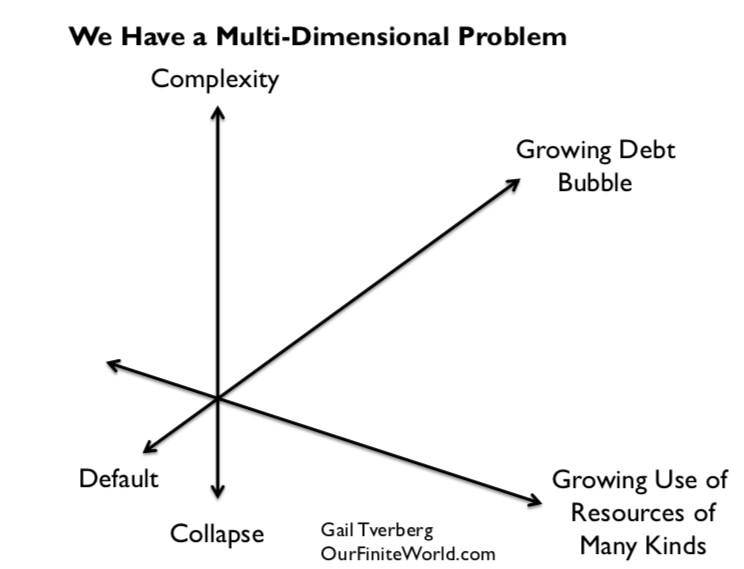
Figure 2.
Complexity involves adding more technology, more international trade and more specialization. Its downside is that it indirectly tends to reduce affordability of finished end products because of growing wage disparity; many non-elite workers have wages that are too low to afford very much of the output of the economy. As more complexity is added, wage disparity tends to increase. International wage competition makes the situation worse.
A growing debt bubble can help keep commodity prices up because a rising amount of debt can indirectly provide more demand for goods and services. For example, if there is growing debt, it can be used to buy homes, cars, and vacation travel, all of which require oil and other energy consumption.
If debt levels become too high, or if regulators decide to raise short-term interest rates as a method of slowing the economy, the debt bubble is in danger of collapsing. A collapsing debt bubble tends to lead to recession and falling commodity prices. Commodity prices fell dramatically in the second half of 2008. Prices now seem to be headed downward again, starting in October 2018.

Figure 3. Brent oil prices with what appear to be debt bubble collapses marked.

Figure 4. Three-month treasury secondary market rates compared to 10-year treasuries from FRED, with points where short term interest rates exceed long term rates marked by author with arrows.
Even the relatively slow recent rise in short-term interest rates (Figure 4) seems to be producing a decrease in oil prices (Figure 3) in a way that a person might expect from a debt bubble collapse. The sale of US Quantitative Easing assets at the same time that interest rates have been rising no doubt adds to the problem of falling oil prices and volatile stock markets. The gray bars in Figure 4 indicate recessions.
Growing use of resources becomes increasingly problematic for two reasons. One is population growth. As population rises, the economy needs more food to feed the growing population. This leads to the need for more complexity (irrigation, better seed, fertilizer, world trade) to feed the growing world population.
The other problem with growing use of resources is diminishing returns, leading to the rising cost of extracting commodities over time. Diminishing returns occur because producers tend to extract the cheapest to extract commodities first, leaving in place the commodities requiring deeper wells or more processing. Even water has this difficulty. At times, desalination, at very high cost, is needed to obtain sufficient fresh water for a growing population.
Why Inadequate Energy Supplies Lead to Low Oil Prices Rather than High
In the last section, I discussed the cost of producing commodities of many kinds rising because of diminishing returns. Higher costs should lead to higher prices, shouldn’t they?
Strangely enough, higher costs translate to higher prices only sometimes. When energy consumption per capita is rising rapidly (peaks of red areas on Figure 5), rising costs do seem to translate to rising prices. Spiking oil prices were experienced several times: 1917 to 1920; 1974 to 1982; 2004 to mid 2008; and 2011 to 2014. All of these high oil prices occurred toward the end of the red peaks on Figure 5. In fact, these high oil prices (as well as other high commodity prices that tend to rise at the same time as oil prices) are likely what brought growth in energy consumption down. The prices of goods and services made with these commodities became unaffordable for lower-wage workers, indirectly decreasing the growth rate in energy products consumed.

Figure 5.
The red peaks represented periods of very rapid growth, fed by growing supplies of very cheap energy: coal and hydroelectricity in the Electrification and Early Mechanization period, oil in the Postwar Boom, and coal in the China period. With low energy prices, many countries were able to expand their economies simultaneously, keeping demand high. The Postwar Boom also reflected the addition of many women to the labor force, increasing the ability of families to afford second cars and nicer homes.
Rapidly growing energy consumption allowed per capita output of both food (with meat protein given a higher count than carbohydrates) and industrial products to grow rapidly during these peaks. The reason that output of these products could grow is because the laws of physics require energy consumption for heat, transportation, refrigeration and other processes required by industrialization and farming. In these boom periods, higher energy costs were easy to pass on. Eventually the higher energy costs “caught up with” the economy, and pushed growth in energy consumption per capita down, putting an end to the peaks.
Figure 6 shows Figure 5 with the valleys labeled, instead of the peaks.

Figure 6.
When I say that the world economy is reaching “peak industrial output per capita” and “peak food per capita,” this represents the opposite of a rapidly growing economy. In fact, if the world is reaching Limits to Growth, the situation is even worse than all of the labeled valleys on Figure 6. In such a case, energy consumption growth is likely to shrink so low that even the blue area (population growth) turns negative.
In such a situation, the big problem is “not enough to go around.” While cost increases due to diminishing returns could easily be passed along when growth in industrial and food output per capita were rapidly rising (the Figure 5 situation), this ability seems to disappear when the economy is near limits. Part of the problem is that the lower growth in per capita energy affects the kinds of jobs that are available. With low energy consumption growth, many of the jobs that are available are service jobs that do not pay well. Wage disparity becomes an increasing problem.
When wage disparity grows, the share of low wage workers rises. If businesses try to pass along their higher costs of production, they encounter market resistance because lower wage workers cannot afford the finished goods made with high cost energy products. For example, auto and iPhone sales in China decline. The lack of Chinese demand tends to lead to a drop in demand for the many commodities used in manufacturing these goods, including both energy products and metals. Because there is very little storage capacity for commodities, a small decline in demand tends to lead to quite a large decline in prices. Even a small decline in China’s demand for energy products can lead to a big decline in oil prices.
Strange as it may seem, the economy ends up with low oil prices, rather than high oil prices, being the problem. Other commodity prices tend to be low as well.
What Is Ahead, If We Are Reaching Economic Growth Limits?
1. Figure 1 at the top of this post seems to give an indication of what is ahead after 2019, but this forecast cannot be relied on. A major issue is that the limited model used at that time did not include the financial system or debt. Even if the model seems to provide a reasonably accurate estimate of when limits will hit, it won’t necessarily give a correct view of what the impact of limits will be on the rest of the economy, after limits hit. The authors, in fact, have said that the model should not be expected to provide reliable indications regarding how the economy will behave after limits have started to have an impact on economic output.
2. As indicated in the title of this post, considerable financial volatility can be expected in 2019 if the economy is trying to slow itself. Stock prices will be erratic; interest rates will be erratic; currency relativities will tend to bounce around. The likelihood that derivatives will cause major problems for banks will rise because derivatives tend to assume more stability in values than now seems to be the case. Increasing problems with derivatives raises the risk of bank failure.
3. The world economy doesn’t necessarily fail all at once. Instead, pieces that are, in some sense, “less efficient” users of energy may shrink back. During the Great Recession of 2008-2009, the countries that seemed to be most affected were countries such as Greece, Spain, and Italy that depend on oil for a disproportionately large share of their total energy consumption. China and India, with energy mixes dominated by coal, were much less affected.

Figure 7. Oil consumption as a percentage of total energy consumption, based on 2018 BP Statistical Review of World Energy data.

Figure 8. Energy consumption per capita for selected areas, based on energy consumption data from 2018 BP Statistical Review of World Energy and United Nations 2017 Population Estimates by Country.
In the 2002-2008 period, oil prices were rising faster than prices of other fossil fuels. This tended to make countries using a high share of oil in their energy mix less competitive in the world market. The low labor costs of China and India gave these countries another advantage. By the end of 2007, China’s energy consumption per capita had risen to a point where it almost matched the (now lower) energy consumption of the European countries shown. China, with its low energy costs, seems to have “eaten the lunch” of some of its European competitors.
In 2019 and the years that follow, some countries may fare at least somewhat better than others. The United States, for now, seems to be faring better than many other parts of the world.
4. While we have been depending upon China to be a leader in economic growth, China’s growth is already faltering and may turn to contraction in the near future. One reason is an energy problem: China’s coal production has fallen because many of its coal mines have been closed due to lack of profitability. As a result, China’s need for imported energy (difference between black line and top of energy production stack) has been growing rapidly. China is now the largest importer of oil, coal, and natural gas in the world. It is very vulnerable to tariffs and to lack of available supplies for import.

Figure 9. China energy production by fuel plus its total energy consumption, based on BP Statistical Review of World Energy 2018 data.
A second issue is that demographics are working against China; its working-age population already seems to be shrinking. A third reason why China is vulnerable to economic difficulties is because of its growing debt level. Debt becomes difficult to repay with interest if the economy slows.
5. Oil exporters such as Venezuela, Saudi Arabia, and Nigeria have become vulnerable to government overthrow or collapse because of low world oil prices since 2014. If the central government of one or more of these exporters disappears, it is possible that the pieces of the country will struggle along, producing a lower amount of oil, as Libya has done in recent years. It is also possible that another larger country will attempt to take over the failing production of the country and secure the output for itself.
6. Epidemics become increasingly likely, especially in countries with serious financial problems, such as Yemen, Syria, and Venezuela. Historically, much of the decrease in population in countries with collapsing economies has come from epidemics. Of course, epidemics can spread across national boundaries, exporting the problems elsewhere.
7. Resource wars become increasingly likely. These can be local wars, perhaps over the availability of water. They can also be large, international wars. The timing of World War I and World War II make it seem likely that these wars were both resource wars.

Figure 10.
8. Collapsing intergovernmental agencies, such as the European Union, the World Trade Organization, and the International Monetary Fund, seem likely. The United Kingdom’s planned exit from the European Union in 2019 is a step toward dissolving the European Union.
9. Privately funded pension funds will increasingly be subject to default because of continued low interest rates. Some governments may choose to cut back the amounts they provide to pensioners because governments cannot collect adequate tax revenue for this purpose. Some countries may purposely shut down parts of their governments, in an attempt to hold down government spending.
10. A far worse and more permanent recession than that of the Great Recession seems likely because of the difficulty in repaying debt with interest in a shrinking economy. It is not clear when such a recession will start. It could start later in 2019, or perhaps it may wait until 2020. As with the Great Recession, some countries will be affected more than others. Eventually, because of the interconnected nature of financial systems, all countries are likely to be drawn in.
Summary
It is not entirely clear exactly what is ahead if we are reaching Limits to Growth. Perhaps that is for the best. If we cannot do anything about it, worrying about the many details of what is ahead is not the best for anyone’s mental health. While it is possible that this is an end point for the human race, this is not certain, by any means. There have been many amazing coincidences over the past 4 billion years that have allowed life to continue to evolve on this planet. More of these coincidences may be ahead. We also know that humans lived through past ice ages. They likely can live through other kinds of adversity, including worldwide economic collapse.
Note:
[1] Note that where the dotted line for 2019 is placed is based on where I see the 2019 economy relative to the downturn in industrial output per capita, based on a number of kinds of evidence, not all of which is cited in this article. The 1972 base model would give a slightly different timing of the downturn, a few years earlier. Also note that while the original “The Limits to Growth” book is no longer in print, Limits to Growth: The 30-Year Update by the same authors is available for sale.


Yes Sir….invest in the LONG TERM…..come now….what can ever go wrong?
Just ask the experts…..like back in a decade ago…
Ten years later…..
https://finance.yahoo.com/news/jpmorgan-erdoes-long-government-shutdown-154740631.html?bcmt=1
The economy will never recover much of the losses from the government shutdown, JPM’s Erdoes says
My hope is that people will see through this, not because it’s a perfectly rosy picture out there, but because the most important thing for us at JPMorgan Chase is really helping people invest for the long term,” Erdoes said. “To come in and out of the markets and think you are going to time that is a very challenging thing to do. Very few people succeed.”
Erdoes, whose unit oversees more than $2 trillion in assets, sees an opportunity to allocate a portion of a portfolio to emerging markets. She emphasized that this would be a long-term play.
“The statistic that’s always on the forefront of my mind is people who try to time the markets — if you put money in the markets 20 years ago and you just closed your eyes, you would have tripled your money. If you missed the top 10 days over 20 years, you would have only grown 50%. Now, that’s not a bad outcome. Here’s the bad outcome: If you missed the top 20 days, you’re flat. If you missed the top 30 days, now you’re half the money you put in. And it just gets consecutively worse from there.
Sure….yesterday will mirror tomorrow…simple isn’t it?
When the SHTF most will be without a clue at the real cause.
You gotta have FAITH!
https://m.youtube.com/watch?v=6Cs3Pvmmv0E
EIA Annual Energy Outlook 2019:US crude oil production projections
https://www.eia.gov/outlooks/aeo/index.php
https://imgur.com/a/c66vyXO
I tried to figure out what the EIA is assuming for low oil prices and high oil prices. They seem to be gearing off 2017 prices. These were $50.80 for WTI and $54.12 for Brent. The low price is assumed to be about 92% of this price by 2050, in 2018 $, or about $47 to $50 per barrel by 2050. The high price scenario seems to assume a relatively of about 2.62 to 2017 prices in 2050. So those prices seem to scale up to $136 to $142 per barrel in 2050.
I would agree that how high the price can be raised determines how much can be extracted. In general, the higher the oil price can be raised, the more that can be extracted. The problem we encounter is that the prices don’t go up by themselves. They are being held up now by a debt bubble, and that bubble is pretty much at maximum capacity. If the price rises any more, the debt bubble will pop, and prices will come back down.
So even the $47 to $50 per barrel range is probably high.
I have commented previously that the IEA (International Energy Organization) in some of its publications seems to be assuming that prices can rise to $300 per barrel in inflation adjusted prices. If that were really true, there would be no oil problem, and no energy problem. In that case, we could assume BAU forever, and our sole problem would be climate change. In a networked economy, the situation doesn’t work that way.
If memory serves, Gail, I think you were suggesting back in 2015 or 2016 that $20/barrel of oil is where oil should/would be without all the debt & Wall Street hype shenanigans that were going on in the world back then (and still to today I guess)? Or am I confused and mistaking something I read on someone else’s blog as your words?
Either way, where do you see prices falling to if the debt bubble starts to deflate?
I have been saying that oil basically is not affordable, unless hidden behind falling interest rates and rising debt, when its inflation adjusted price is over $20 per barrel. The cost of producing oil has risen to well over $20 per barrel, because we extracted the easiest to get resource first.
https://gailtheactuary.files.wordpress.com/2018/09/26-in-the-1970s-oil-became-unaffordable1.png
Whether oil will fall back to the $20 price level is not certain. It could, in fact, fall lower than $20 per barrel. Or the financial system could break down altogether. There are a lot of things we don’t know for certain. At $20 per barrel, producers would quickly go bankrupt and governments of oil exporting countries would fail. So very little oil would actually be produced at this price level.
During the mid/late 20th century (1960–1999), a barrel of oil cost $19 on average; during the years immediately prior to the Great Recession (2000–2008), the average price of a barrel of oil had increased to $47; and during the years immediately following the Great Recession (2010–2012), the average price of a barrel of oil had further increased to $81. During the same three time periods, the average price of a metric ton of copper increased from $3,085, to $3,713, to $6,817; the average price of a metric ton of iron ore increased from $36, to $57, to $124; and the average price of a metric ton of potash increased from $114, to $185, to $343. (Prices are inflation adjusted.)
The simple fact is that we cannot grow our global economy and improve our global material living standards on $50 oil, $6,817 copper, $124 iron ore, and $343 potash like we did on $19 oil, $3,085 copper, $36 iron ore, and $114 potash. It should come as no surprise that our Non Renewable Resource-dependent global economy experienced the Great Recession during 2009. Nor should it come as a surprise that we have yet to recover from the Great Recession. Nor will our industrialized and industrializing economies ever recover, so long as price levels associated with the vast majority of Non Renewable Resources remain at their inordinately high levels.
Christpoher Clugston, Scarcity: Humanity’s Final Chapter
https://www.brookings.edu/bpea-articles/causes-and-consequences-of-the-oil-shock-of-2007-08/
https://blogs.wsj.com/economics/2009/04/03/did-the-oil-price-boom-of-2008-cause-crisis/
http://www.iea.org/textbase/npsum/high_oil04sum.pdf
https://www.imf.org/external/pubs/ft/oil/2000/
“I would agree that how high the price can be raised determines how much can be extracted. ”
Gail, no matter how much money you spend to extract a FINITE resource, there will come a time when it’s simply not extractable any longer no matter how much money you throw at it, there are LIMITS.
Those fracking producers have been losing money for years ever since oil collapsed below $147 a barrel down to $35 a barrel, no company can stay in business while endlessly losing money.
They need oil to be over $70 a barrel, we can’t afford oil that’s over $70 a barrel, I see trouble ahead.
Keep a close eye on the rig count, when it falls, it’s over!
I agree that the issue is an affordability problem. I expect that even $70 per barrel is too high for finished goods.
I see that today’s rig counts are up.
http://phx.corporate-ir.net/phoenix.zhtml?c=79687&p=irol-rigcountsoverview
“Juan Guaidó, the self declared ‘opposition leader’, is just a telegenic stand in for the right wing leader Leopold Lopez, who in 2014 was jailed after inciting violent protests during which several people died. Lopez, now under house arrest, is a Princeton and Harvard educated son of the political and financial nobility of Venezuela, which lost its position when the people elected a socialist government. Lopez is the man the U.S. wants to put in charge even while he is much disliked. A U.S. diplomatic cable, published by Wikileaks, remarks that he “is often described as arrogant, vindictive, and power-hungry”.”
Putin: Foreign interference in Venezuela’s internal affairs grossly violates international law
https://www.rt.com/news/449630-putin-foreign-interference-in-venezuela/?utm_source=browser&utm_medium=push_notifications&utm_campaign=push_notifications
Folks…no I’m NOT making this stuff up…REALLY….it doesn’t get better than this…
Billionaires get a massive tax cuts….so Uncle Sam gets deeper and deeper in debt..
So, this Billionaire solution to out of work Federal Employees?
Wilbur Ross says he doesn’t understand why federal workers are turning to food banks in shutdown
.S. Commerce Secretary Wilbur Ross said on Thursday that he doesn’t understand why some federal workers who have been furloughed or are working without pay during the ongoing partial government shutdown are having to turn to food banks and homeless shelters to feed themselves and their families.
“I know they are, and I don’t really quite understand why,” Ross said in an interview CNBC.
Ross, whose net worth in 2016 was estimated to be $2.9 billion, said those workers should seek loans because “the banks and the credit unions should be making credit available to them.”
“True, the people might have to pay a little bit of interest,” Ross added. “But the idea that it’s paycheck or zero is not a really valid idea.”
“Put it in perspective, you’re talking about 800,000 workers,” he said. “And while I feel sorry for the individuals that have hardship cases, 800,000 workers if they never got their pay — which is not the case, they will eventually get it — but if they never got it, you’re talking about a third of a percent on our GDP. So, it’s not like it’s a gigantic number overall.
Yep, wasn’t it Stalin who once said, “When one person does it’s tragic, one tens of thousands die, it’s a statistic.”
Afraid that the Upper Crust is so out of touch now, they are living in virtual reality.
Boy, I’ll hold the flashlight when the mob goes looking for them….
https://news.yahoo.com/wilbur-ross-says-doesnt-understand-federal-workers-turning-food-banks-shutdown-154529250.html
Hm. when it comes to that, the mob will likely found only empty office space, the rich will be already inside their neofeudal well protected hideouts incl. private armies and or renegade sections of the former US mil seeking new employers. Besides Mr. Ross with ~3B net worth ranks as some sort of ~third tier in the pecking order of the true owner’s of the global system, so perhaps he might be eventually facing the alerted pop as you say, the bigger cats might just dump him on the street for fun.
Yep, tell us how you feel please.
But firstly reveal what you don’t like specifically? That Mr. Ross and his strata of lesser billionaires likely comes from a small fish pond in the grand scheme of things? That seriously rich and powerful are likely to attempt hands on neofeudal seclusion for themselves at some point, incl. private mercenaries and very likely part of the former “national” military? Sorry these are all only benign reflections on past human performances to bottleneck, collapse events..
Ross reflects the disconnect. He might as well said, “Let them eat cake!”, like Marie Antounette. It’s that same disconnect that makes them think Obamacare is an awful thing most people hate. No, we don’t. For my wife and I as independent contractors, healthcare was about 1200 a month and is now 1800, each. On top of our other expenses we couldn’t afford it and I lived with a hernia for two years, then Obamacare/California Care allowed me to get that operation for $2500 out of pocket and my wife and I both got colonoscopy’s – both of us had pre-cancerous polips removed – if left that way we both would have developed colon cancer but now we can keep contributing to GDP.
I fail to see why the right is so filled with hatred for regular hard working folk. They seem to think we love abuse and seek more. No, we don’t.
Obama also set up HARP I & II. We used Harp II to refinance and it cut our payments by 800 bucks a month plus it had faster amortization, i.e. higher principal payments right off the bat.
So as much as the right thinks Obama was the worst, he’s actually the only president to have ever done anything that has positively impacted our lives. He also helped regulate the credit card industry which has helped all Americans.
Now, how they sell people on voting against their own best interests is not a mystery. They sell them on social issues – they hate gays, transgenders, and people with pre-existing medical conditions and they love to spend hundreds of billions more on defense and send poor people’s kids off to die and get permanently maimed. Somehow these positions over-ride people’s need for healthcare or help with their mortgage, or interest in less taxation at their pay scale. It’s really an amazing psychological feat they pull off.
Well, I hated it because my premiums went from $450 to $900 per month, and my deductible rose from $3,500 to $12,000.00. Glad it worked out for you, but I got taken behind the woodshed. I don’t have any love for either side of the political spectrum, though. Actually, it has taken me a long time to come to my senses about the government and America in general. Essentially, the “America” of my youth no longer exists as far as values, social mores, social contract, etc. It took a long time, but I finally wised up and realized my only proper loyalty or group identity is as a member of my family. It was essentially a shift from a Western European, nation state view of the world to a tribal world view. In this case, my “tribe” is my family. As for everyone else, “Not my people, not my problem.”
“For my wife and I…” X Incorrect usage.
A preposition is *always* followed by an Object phrase.
“For my wife and me….” = Correct.
We see this error a lot nowadays. People seem to be afraid of object pronouns (me. him, her) and think it incorrect to use them, but the fact is that a clause can have only one subject.
“He gave it to I.” X
“He gave it to me.” Correct.
Let’s lay off the language corrections. We have a lot of people for whom English is not their native language. We also have people who never paid a lot of attention in English courses, paying more attention in science and other subjects. As long as what the person is saying is understandable, and has useful content, the comment is OK, as far as I am concerned.
Who decides what’s correct usage and what ain’t?
In the UK—home of the mother of Parliaments and birthplace of English as she should be spoken—it used to be “me and my ole man/old woman” for the ordinary commoners, and “my husband/wife and I” for the snobs, the gentry, the aristocracy and royalty. If everyone had spoken the same lingo, the country would have ground to halt long ago.
The US government I guess finally runs like a U.S. corporation. Runs up massive debts, pay yourself massive bonuses, leave everybody else, who dutifully overwork out of fear of unemployment and impoverishment, holding the bag.
Trump has ripped off everything he has touched.
Seems a good analysis—–
yup
even he didnt expect the USA on his bankruptcy list
Russia and key allies vow to stand by Maduro in Venezuela crisis
Attempts to force Venezuela’s president from power are illegal, says Russian senator
https://www.theguardian.com/world/2019/jan/24/juan-guaido-venezuelas-opposition-leader-declares-himself-interim-president
Yea, coups are not going to happen with support.
Venezuela – U.S. Again Tries Regime Change Which Is Again Likely To Fail
https://www.moonofalabama.org/2019/01/venezuela-us-again-tries-regime-change-it-is-likely-to-fail.html
Just when I hear all these bad things about Maduro, etc, then this. And you wonder why the truth is so elusive?
Anyone have a comment tothe validity of this?
On the upside, Pence has not yet accused Maduro of gassing his own people or of feeding his opponents feet first into an industrial shredder.
Apart from that, it looks like another front has opened up in the reflated Cold War between the US and Russia. And with Putin giving Maduro material, military and moral support, it would be impossible for Trump to back down in his support for ousting Maduro without being accused of being Putin’s sock puppet.
Life is good at the very, very top….but remember the higher you are the bigger the drop
Billionaire hedge bankster buys a penthouse in the Tower of Babel..thinking he’ll get to heaven that way….
Citadel’s Griffin buys New York condo for record $238 million
https://finance.yahoo.com/news/citadels-griffin-buys-york-condo-record-238-million-035839244–sector.html
NEW YORK (Reuters) – Ken Griffin, the billionaire founder of hedge fund Citadel, has paid $238 million for a penthouse condominium overlooking Manhattan’s Central Park, a spokesman for Griffin said on Wednesday, in a deal that sets a record for a U.S. home sale.
Griffin has closed on the unit in the 79-story residential tower, which is under construction for an estimated cost of $1.4 billion at 220 Central Park South.
Perfect city Gothom….the show place for imagery riches….
About 83 percent of the units are under sales contracts, with closings scheduled through 2020, according to Vornado, which declined to comment on Griffin’s purchase.
The Wall Street Journal first reported the purchase by Griffin, who first signed a contract for the condo in 2015.
Griffin, who publisher Forbes estimates is worth $9.9 billion, in November paid $58.75 million for a four-level penthouse in Chicago, the most ever for a home in that city, according to media reports.
Public records show Griffin has spent close to $250 million for land in Palm Beach, Florida, the Journal said
Yep…the Pitchforks know where to strike….I’ll be eating CAKE
He’s going to regret that purchase when Gozer the Gozerian (a.k.a. Gozer The Destructor, Gozer The Traveler, Volguus Zildrohar, Lord Of The Sebouillia) arrives in one of the pre-chosen forms!
https://www.youtube.com/watch?v=7aW8oyTgA60
“Not necessarily! There’s definitely a… very slim chance we’ll survive.”
Sounds like our chances, post-BAU 🙂
https://www.zerohedge.com/news/2019-01-23/texas-power-prices-explode-dallas-freezes
The article reports:
https://gailtheactuary.files.wordpress.com/2019/01/average-electricity-spot-prices-at-norcrott-texas-hub-zerohedge.jpg
This is an example of the way the wholesale electricity system works in many places that use wind and solar. Prices vary all of the place, depending upon the amount of wind and solar available relative to the demand for electricity at the time and the accuracy of forecasted energy needs. Here, home heating was especially in demand. All producers get the same wholesale price, whether they are producing baseload nuclear or coal or natural gas in efficient baseload plants or in fairly inefficient peaking plants.
The wholesale price needed by producers, averaged over the year, is probably something like 50 dollars per megawatt Hour (equivalent to 5 cents per kWh). This wholesale price includes fuel, other costs of the particular provider, taxes, and at least some transmission line costs. Looking at the chart, a person can see that there is no way that the average of the ups and down prices will come out to 50 dollars per Megawatt hour. The only ones, other than the wind and solar providers (who have their subsidized arrangements) that can withstand this environment are those operating “peaking” natural gas plants. These are relatively inefficient plants that operate only during the spikes. They can turn on and off quickly. Other providers, from baseload natural gas, to coal, to nuclear, are gradually being driven out of business.
Besides peaking plants jumping in, the other thing that would tend to hold down prices is industrial suppliers who sign interruptible power contracts, agreeing to cut their electricity back when prices are high.
As far as I can see, the system worked as it was supposed to. There have not been big blackouts reported, as far as I could see. The high price hour of electricity averaged $118.77, which wasn’t all that high, in the whole scheme of things (only a little over twice what the average should be). It doesn’t bring the average price up to the level where other producers need it. The fact that prices haven’t been as high as the temporary spike to $140.22 since last April can be viewed as problem, because backup producers have been suffering through an awfully lot of low wholesale electricity prices. Consumers generally do not see all of these fluctuations, because their pricing is different–a whole lot higher (to include distribution to individual homes and billing) and a lot less variable.
“For at least a year, a growing chorus of financial analysts and CFOs has predicted that a recession is going to hit the US sooner than later—perhaps even by the end of 2019.
“Now Deloitte, a global accounting and auditing firm, has chimed in to say that the worrying signals are growing.”
https://qz.com/1527291/a-global-accounting-firm-is-telling-brands-to-prepare-for-a-recession/
I like the chart in this article, because it sort of explains the trends the economy has been on.
https://gailtheactuary.files.wordpress.com/2019/01/deloitte-increase-and-decrease-in-return-during-business-expansion.jpg
The thing that makes it hard to reproduce is the fact that they use a nonstandard definition of return on assets.
Since 2012, there are signs the economy has been squeezed. The return shouldn’t be falling.
“To understand part of why China’s downturn looks different this time, you have to understand how Chinese consumers have changed.
“In short — like the rest of their country — they’re way more in debt than they used to be. According to analysts at Autonomous Research, household debt has grown nearly twice the pace of income since 2008.”
https://www.businessinsider.com/chinese-consumers-debt-load-worsens-slowdown-2019-1?r=US&IR=T
“Disposals of bad debt in China are reaching levels not seen in nearly two decades as the banking sector grapples with an onslaught of poor-quality loans that amounted to about Rmb1.75tn ($258bn) last year.”
https://www.ft.com/content/fea6ed72-1ee6-11e9-b126-46fc3ad87c65
“After decelerating to its slowest pace in six years in 2018, South Korea’s economy is set to further brake in 2019.”
https://asia.nikkei.com/Economy/South-Korea-s-economy-forecast-to-grow-at-slowest-rate-in-7-years
“The beleaguered Australian dollar faces another threat in addition to slowing global growth and the U.S.-China trade war: an addiction to real estate has created a debt mountain.
“After being the worst-performing developed-nation currency in 2018, the Aussie is set to extend losses this year as a near-record level of indebtedness at households make it more likely the Reserve Bank of Australia will cut interest rates to support the economy…”
https://www.bloomberg.com/news/articles/2019-01-23/-doom-loop-of-debt-threatens-to-send-aussie-back-to-crisis-lows
Adelaide breaks its all-time h e a t record, hitting 46.6C, in extreme Australia he a twave – 2,500 camels dying of thirst shot
http://www.desdemonadespair.net/
Further proof that the East is no different than the West. They have learned well from the West and their monetary, banking and finance practices mirror the West. It’s been said countless times that this time it’s different because ALL the eCONomies around the world are doing the EXACT same stupid stuff and everyone is up to their eyeballs in debt.
Whenever that day comes that the SHTF, this is all going to come down together and good luck putting Humpty Dumpty back together again.
“[UK] Manufacturers’ hopes for their export businesses are at their their lowest ebb since the 2008 global financial meltdown amid sustained Brexit uncertainty, according to the Confederation of British Industry (CBI).”
http://www.cityam.com/2720
“French business activity fell unexpectedly this month, pulling back at the fastest rate in over four years in the face of weakening demand and the impact of anti-government protests, a survey showed on Thursday.
“Data compiler IHS Markit said that its preliminary composite monthly purchasing managers index (PMI) fell to 47.9 points from 48.7 in December, confounding economists’ expectations on average for an improvement to 51.0.”
https://uk.reuters.com/article/uk-france-economy-pmi/french-business-activity-weakest-in-over-four-years-in-january-pmi-idUKKCN1PI0TT?il=064/manufacturing-sector-flattens-most-recent-quarter
“Germany’s industrial woes carried into the new year as factory output contracted for the first time in four years.
“The poor reading for the IHS Markit Purchasing Managers’ Index in January will reinforce fears about the health of both the European and the global economy. That’s been a key talking point at the World Economic Forum in Davos this week, where the IMF cut its outlook and said an escalation of trade tensions could add further damage.”
https://www.bloomberg.com/news/articles/2019-01-24/german-manufacturing-enters-deepest-economic-slump-in-four-years
“Prime Minister Giuseppe Conte brushed aside fears Italy is headed for a recession, insisting that economic growth could climb as much as 1.5 percent this year and ruled out any need for a budget adjustment to meet targets.”
https://www.bloomberg.com/news/articles/2019-01-23/italy-s-conte-rules-out-budget-adjustment-as-recession-looms?srnd=politics-vp
Economists always seem to assume that things will get better. 48.9 was already contracting!
“A third of African countries have unsustainable debt positions and the continent must reduce its reliance on foreign funding for projects that don’t help them service loans, Zimbabwean Finance Minister Mthuli Ncube said.”
https://www.bloomberg.com/news/articles/2019-01-23/african-borrowers-face-risk-of-debt-tipping-point-ncube-says?srnd=markets-vp
“The Arab countries should be fully prepared for a potential economic crisis that may start in 2020…
“Arab countries should not entirely rely on the United States as a global economic crisis is expected to hit in 2020, said Talal Abu-Ghazaleh, chairman of Jordan-based Talal Abu-Ghazaleh Organization for professional services and education. The next economic crisis in 2020 is expected to be worse than the 2008 global financial crisis…”
http://www.xinhuanet.com/english/2019-01/24/c_137769013.htm
But we need growing debt to pull the economy forward!
“…there’s the distinct possibility that many …elderly people [in the US] just can’t afford to retire.
“Whether their nest eggs were wiped out in the housing crash, or they just didn’t save enough, or whether their kids don’t make enough money to support them, the decline of retirement seems like an ominous development.”
http://www.fortune.com/2019/01/23/americans-retirement-senior-workers/
“Unconventional mortgages — the likes of which were criticized for their role in the financial crisis — are making a comeback.
“These loans are aimed at buyers facing circumstances such as not being able to provide standard proofs of income, the Wall Street Journal reported. And they’re on the rise — even amid higher home prices and interest rates.”
https://therealdeal.com/2019/01/23/slippery-slope-unconventional-home-mortgages-are-on-the-rise/
My version of article’s conclusion: Everything would be fine, if we could keep growing population rapidly. Who cares about population per arable land, or energy per capita?
“Governments are continuing to run up huge debt levels, with emerging countries helping push the total global IOU to 80 percent of gross domestic product [GDP].
“The worldwide tab through 2018 is now up to $66 trillion as measured in U.S. currency terms, about double where it was in 2007, just as the financial crisis was beginning to unfold, according to Fitch Ratings’ new Global Government Debt Chart Book released Wednesday.
“”Government debt levels are high, leaving many countries poorly positioned for financial tightening as global interest rates begin to move higher,” James McCormack, Fitch’s global head of sovereign ratings, said in a statement.”
https://www.cnbc.com/2019/01/23/government-debt-tab-hits-66-trillion-80percent-of-global-gdp-fitch-says.html
Yep, that’s exactly the violent “services” wave on the LTG graph, at some point, most likely during initial collapse sequencing these gov’s related services (not only the directly provided but also the gov coordinated ones as well !) are going implode quite fast.
Let it contemplate and internalize what that actually means, not pretty.
Florida Couple Allegedly Stole $5M to Prep for ‘Fall of US Government’
http://www.newser.com/story/270326/couple-allegedly-stole-5m-to-prep-for-fall-of-us-government.html
Now don’t go getting any ideas anyone.. 🙂
Free room and board!
I curious what OFWers think of the shutdown. It’s clearly rationing consumption at the moment.
Question 1a: Is the real purpose actually to ration resources? (tinfoil..)
Question 1b: Milder version: Is it engineered to be able to blame the coming recession on the shutdown? (less foil)
Question 2: If it persists for much longer, could it be that the system not longer supports “turning on” that group to go shopping again?
The highest ambition of the integrated spectacle is still to turn secret agents into revolutionaries, & revolutionaries into secret agents.”
— GUY DEBORD, 1988
My opinion is if the wheels come off the bus in the economy, the Dims (under Pelosi’s leadership) will have become equal share partners to the scapegoating that will occur. I would also offer that the elites in both parties could care less about the government employees and so are satisfied to save resources and government money.
I could care less about gov employees. I did not see any of them shedding a tear for me when I got laid off.
It is rather funny to see all the teeth gnashing and chest thumping from the .GOV workers over a couple delayed paychecks. During the financial crisis they sure didn’t pass over any opportunity to seek additional raises and benefits paid for by the rest of us even though we got financially hammered.
The shutdown is also hiding usual reports on things like GDP growth. It even hides the number of new homes sold. No matter how badly the economy does, no one will report on the situation. It becomes almost like China, with its false GDP forecasts.
It also puts the EPA out of action. No chance of a court challenge on it either.
It is interesting that the USA shutdown was initiated by Trump due to the population issue: the uncontrolled immigration leads to chaos, no immigration leads to depopulation. It may seem to be a dilemma, but the controlled immigration is the only solution against chaos: only those who are really needed are permitted to enter. Not those who are escaping the poverty. Lowering the energy/resources per capita via uncontrolled immigration is bad.
The question remains whether the costly massive concrete or iron wall is the solution? I guess that some refurbishment of the existing barrier can have the same effect, depending on the specific terrain etc. No need for such megalomaniac uniform solutions.
That’s an interesting point because it’s absolutely clear by now that at least some faction of the upper EU nomenclatura has been pushing the immigration wave as solution for the abysmal overall demographic trends. And more perversely not as new incoming workers but simply as enlarging the substrate onto which attach more debt and consumption.. aka supporting frivolous growth pattern.
So, this planning might rhyme at some level in the US and elsewhere indeed.
Exactly: in Spain, the unemployment rate among new immigrants of working age is between 45% and 100% (the latter are the gypsies, but of course they are working unofficially..); but all of them boost demand, working or not.
The other aspect is that, as in the health service in the UK, even unskilled or low-skill immigrant workers are needed in large numbers to keep the system running: cleaners, caterers, porters, security bouncers, etc.
Of course, they, with their families, contribute to the pressures on the system and contribute to the decline of prosperity per capita – very hard to adjust satisfactorily.
The UN seems to be insisting on the right to migrate regardless of whether productive work can be found for the new arrivals.
When world energy consumption per capita was growing rapidly, allowing migration looked like a great idea. Unfortunately, it doesn’t work now.
Existing barrier Have you seen it. In places it would not keep a cow out. We have better fencing to keep animals off our highway.
Building a concrete or iron wall does not solve the problem. Such highly inflexible barriers are usually not good. E.g. the Berlin Wall had to be demolished one day, too. If there is an urgent need for low paid workers, such initiatives are doomed to failure.
If there is a need for jobs that pay reasonably well for workers, building the wall could provide such jobs however, especially if the steel or concrete were made in the US, and if additional debt indirectly funds the higher wages. Building the wall would tend to bid up the price of the fossil fuels needed to build the wall as well. In a way, building the wall is a stimulus program for the US economy, sort of like adding roads (mostly not really needed) or declaring war on some poor country.
With Washington underwriting a coup and civil unrest/war in Venezuela, I hope they understand the increase in refugees that will be coming north. Better get cracking on wall construction or the US will resemble Germany. And maybe open the government back up so the Coast Guard gets paid to stop the rubber dinghy flotillas.
All of these solutions become complex if you look at them closely. Our young people need jobs that pay reasonably well. If we let in highly trained individuals from overseas (perhaps educated in our universities), this adds to the glut of educated young people looking for jobs. Keeping them out reduces jobs at universities, because a fairly big share of advanced degrees are offered to those from overseas.
The place where workers are really needed is in the “non-elite worker” category, where jobs are paying dreadfully. Adding more from abroad may allow more people taking jobs at the bottom of pay scales, such as nursing home workers, fruit and vegetable workers, and workers at fast food restaurants. This is where there is most opposition to adding more immigrants.
I think he started it because that is what Rush Limbaugh and Ann Coulter demanded him to do..
the don didn’t foresee this when he ran for POTUS
but now he’s into it, he can see a way to grabbing what he wants—ie full control of everything, with himself as dictator.
and I don’t exaggerate.
All it takes is a ”emergency”—
already civil unrest is building up. How bad does it have to get before he takes ”emergency powers” to control the situation? Don’t forget he’s commander in chief of the military. When rioting in the streets starts, his reaction is certain.
Soldiers fall in behind whoever pays their wages.
He makes it very clear that he wants nor takes advice from anyone—hence the revolving door in the WH. Everyone has to swear personal loyalty to him
(does that remind you of anyone?)
Couldn’t happen?
The USA is a debt based economy, predicated on infinite growth. That makes collapse certain. There is no social safety net, that makes hardship certain
The people are fully armed, that makes violence certain
The nation seems riven with theocratic, geographic economic and racial division, that makes secession into separatist states certain.
Post fossil fuels, the USA is too big to hold together as a single entity.
Government response can only be a violent one, Imagine it with Trump leading it—or maybe worse, with Pence having replaced him and shoving Jesus down everybody’s throats. That is certainly what Pence is waiting in the sidelines for, waiting to grab Trump’s seat. That’s why he nods at everything Trump says.
It defiantly helps Don the Con to grab power.
While not the brightest porch light on the block, that he understands,
Oil Discoveries Recover, But Still Far From Replacing Output
Still, new finds won’t be enough to alleviate concerns of a supply shortage by the middle of the next decade.
Even if explorers were to discover about 10 billion barrels of oil and gas this year, they would only replace about 21 percent of the volumes that will be produced globally, up from 18 percent last year, said Nils-Henrik Bjurstrom, a product portfolio manager at Rystad.
https://www.bloomberg.com/news/articles/2018-06-26/oil-discoveries-recover-but-still-far-from-replacing-output
Hm, another pointer towards ~2025-30 threshold for kaboom years..
Indeed: this is the last Golden Decade, or maybe less. Even for the self-pitying in the core economies who think they are ‘poor’ and hard-done-by….
Interesting yes, that’s about the only good thing to say about living through the beginning of the end of global civilisation.
https://oilprice.com/Energy/Crude-Oil/Saudi-Arabia-Well-Pump-The-Worlds-Very-Last-Barrel-Of-Oil.html
‘Saudi Arabia: We’ll Pump The World’s Very Last Barrel Of Oil’
“I don’t see peak [oil] demand happening in 10 years or even by 2040,” Amin Nasser, president and chief executive officer of Saudi oil giant Saudi Aramco told CNN Business’ Emerging Markets Editor John Defterios on the sidelines of the World Economic Forum in Davos this week.
“There will continue to be growth in oil demand … We are the lowest cost producer and the last barrel will come from the region,” Nasser told CNN.
This caught my attention because he’s talking about the last barrel of oil. However, Saudi oil reserves estimates have only ever gone up, so it’s interesting he at least admits it’s a finite resource.
At least he admits there will be a “last barrel”, which is a concept pregnant with foreboding implications that nobody at Davos is interested in exploring publicly.
South Korea supplied oil to North Korea and didn’t tell anyone
https://news.vice.com/en_us/article/43zymn/south-korea-supplied-oil-to-north-korea-and-didnt-tell-anyone
Elon Musk Sent an Email to Employees at 1:20 in the Morning, and It Just May Signal the End of Tesla
Musk is trying to get his people to buy into the mission of ‘saving the world’ by working themselves to the bone. It’s not going to work.
https://www.inc.com/justin-bariso/elon-musk-sent-an-email-to-employees-at-120-in-morning-it-just-may-signal-end-of-tesla.html?fbclid=IwAR31BWD17GwciC36C7pDozsdSuzxqPYSw-Mdy9ZWw6EegzPjeyCCdP7OJK8
Well if there is no profit in their business model … that is what happens. That is what will happen to all business models as diminishing returns gets worse.
Poor Elon. His rocket blew over, too:
https://www.theverge.com/2019/1/23/18194398/spacex-starship-prototype-wind-damage-boca-chica-texas
Too Many Americans Will Never Be Able to Retire
Without more babies and immigrants, the country won’t be able to support its aging population.
https://www.bloomberg.com/opinion/articles/2019-01-23/america-needs-more-young-workers-to-support-aging-population
Adding to the problem will only make is WORSE! You do realize I hope, that the US is already very overpopulated AND those babies & immigrants will also grow OLD & need care, care we won’t have for them. We
Adding to the problem will only make is WORSE!
You do realize I hope, that the US is already very overpopulated AND those babies & immigrants will also grow OLD & need care, care we won’t have for them. We MUST STOP GROWING!!!!
PLEASE WORDPAD, ADD a EDIT BUTTON!
I should be able to hit “Cap Lock” without the dam message being POSTED before I was through composing it!!! “Cap Lock” is NOT “enter”!
“New details have emerged related to a phone call between President Trump and his Turkish counterpart Tayyip Erdogan on Sunday over the US planned Syria troop pullout, which Turkish presidential office sources say Trump reaffirmed his commitment to carrying out. Unknown up to this point was a segment of the conversation reportedly focused on the devastating ISIS suicide attack on an American patrol deep inside Manbij in northern Syria last Wednesday, which killed four Americans and 15 others.
Turkish sources say President Trump agreed with Erdogan’s assessment that the rare Jan. 16 attack was a “provocation” carried out in order to influence Trump’s Syria pullout decision”.
https://www.zerohedge.com/news/2019-01-22/i-wont-back-down-trump-agreed-erdogan-isis-bombing-was-intentional-provocation
So this is the same guy that was supporting ISIS by buying their stolen oil but he is going to finish them off for us?
Asking for a friend
https://www.bbc.com/news/world-middle-east-34982951
Trump and May are the absolute worst choices of world leaders during this time of economic uncertainty. Seems Satan has his plans well thought out…
Trump does have one good attribute – he isn’t getting much done.
Wasn’t he a ok TV host?
I mean, he is really good at ripping people off, and losing money—
but lets look on the bright side!
He did get a lot of government employees laid off.
That’s true. His one big deal so far is the massive tax cut he gave himself and his wealthy friends (that has caused the deficit to rise 17% higher than 2017).
BS on The Trump comment. I see the “ Trump is bad” crowd is all preaching to the choir.
It’s all opinion. If you like something Trump has done, sound off. Let’s hear about it. But it can’t just be he’s running interference in DC, it has to be something with substance.
One thing I do like is he’s at least trying to get a better deal with China to reduce trade deficits. No other president I’m aware of tried that. The problem is it’s a little late, meaning this situation took many decades to reach this point – people have gotten use to cheap stuff from China. Even if some of those products started getting made in the US, how do you now force US consumers to pay more for products, while at the same time so many are living paycheck to paycheck?
At this point, Trump is reducing the amount the government outgo by not paying workers and subcontractors. In a sense this is a plus, because trying to go to the debt market and raise as much debt as would be needed would become increasingly impossible, especially if QT is going on. There would simply be way too much US debt for the market to absorb.
Well as he proclaims he is the king of debt and was for a strong dollar before he was for a weak dollar. Then QE and the stock market was a giant ugly bubble but now it is the greatest market ever. With deficits exceeding a trillion $ I haven’t heard much talk about the debt, but what do I know.
I don’t think debt is on their radar.
Jesse, I’m sorry I triggered you. I guess I haven’t warmed up to the flip flopping, childish behavior, and being governed by tweet.
If it makes you feel any better I don’t see anybody or ideas the dems are floating as being positive either.
Trump wanted the job therefore he gets the flak. However, I’m not prone to hand over my allegiance very easily. It must be comforting in some sick way to be so easily led. Not sure that will be a good survival skill post collapse, but to each his own.
Jesse wasn’t “triggered”, Dan. He was merely making a valid observation while expressing his disapprobation with the Trump bashing chorus that has been egging each other on and high-fiving each other on this thread. Were you, on the other hand, just a little bit “triggered” by Jesse’s rather mild comment. Seriously, where were you for eight years of Reagan, twelve years of the Bush family, eight years of Clinton and eight years of Obama? If you were living under a rock all that time, you’re forgiven. They were all horrid and horrible and horrendous presidents and their collective actions are a major reason why things are currently as messed up as they are now. Trump can’t clear up that mess, but he has been no worse than any of his recent predecessors and far better than some, and he has the added bonus of being entertaining. It’s an amazing phenomenon that his antics seem to be triggering so many people. The US is ripe for splitting and Trump is the wedge in the crack that only needs to be tapped lightly to cleave the block in two. The nation is bleeding and battered and he’s the salt poured into all the social wounds that stimulates those raw pain nerves. Best of all, the national psyche is poisoned and he’s the vomit inducing substance that is causing it vomit up all the poison it’s been imbibing and ingesting all these decades. No wonder so many people are permanently “triggered” by his presence on the scene.
The S&P 500 is on its next leg down? Wars are bullish. Venezuela?
https://pbs.twimg.com/media/DxioYnGWsAIE1Ci?format=jpg&name=large
Doesn’t the shutdown need to be ended first?
Elon Musk’s Cartoonish Spaceship Blown Over By A Gust Of Wind
https://www.zerohedge.com/news/2019-01-23/spacexs-cartoonish-looking-starship-hopper-blown-over-gust-wind?fbclid=IwAR1jfviAqn7A1RuyUjPTdZMNk-GV-3Nc1IwIA24NisyP12rH-PDmgeUhteI
https://www.godlikeproductions.com/sm/c3549d16.gif
Orlov is got some hopium going.
http://cluborlov.blogspot.com/2019/01/the-future-of-energy-is-bright-part-ii.html
Interesting and possible? Yes. Going to happen? No
Orlov in the link that Mark posted is pushing nuke power as the logical answer to the world’s energy woes. Orlov debunks wind and solar and the other niche energy sources. He is almost certainly correct on those renewables but he glosses over the negatives of nuke power which are obvious and well understood. All of these sources deliver only electrons powering products and machinery produced from fossil energy. A windmill cannot replicate itself or build a solar panel or a NUCLEAR CONTAINMENT dome for that matter. Orlov says that nukes will get built regardless of what the public wants because they are a better alternative than anything else out there. Orlov is known for strong opinions strongly stated. As an experienced boatbuilder I made some criticisms of his “houseboat that sails” on his site and his ad hominem rebuttal disappointed me. Intermittent renewables and dangerous unaffordable unpopular nuke plants have about as much chance or replacing fossil energy sources as Orlov’s houseboat does of sailing across an ocean.
There are a lot of people who support nuclear. I know that Prof. Charles Hall has been a supporter of nuclear. Vaclav Smil may be also. If you overlook the problem with spent fuel, nuclear is about as good as we have. You have to build them fairly cheaply, though. Trying to prevent every disaster runs up the time and the expense involved. People don’t realize how many people die indirectly because of some of the other fuels. Nuclear has a pretty good track record, in many ways.
Disagree.
One of the outputs of nuclear power is waste that needs to be kept safe / isolated for 24,000 years (Plutonium-239; though apparently Uranium-235 has a half-life of 700 million years!?!), which if I’m not mistaken, is double the time it’s been since the Neolithic Revolution when hunter-gatherer humans began a wide-scale transition to agriculture.
This blog constantly suggests that BAU is in jeopardy, and that humankind is disillusioned in believing they have any real control over the dynamics of finance/energy in our world today. It would seem to me that believing we can control all the negative outcomes that arise from being caretakers of highly dangerous radioactive materials for 24,000 years is the height of hubris 😐
Also, along the same line of the argument that we don’t use solar power to mine the rare earth minerals used to make solar panels / solar panel factories, I’ve never seen a nuclear-powered excavator that would dig up the uranium/plutonium needed to power itself and other nuclear power plants 😐
As far as nuclear being “about as good as we have”, what about hydroelectric and tidal?
Yes, they are restricted by geography, but perhaps our view that we can live anywhere we want and have ridiculous amounts of power provided to us on demand via an electrical grid is part of the problem…
The half life is 24,000 years.
And we have tons of the stuff, and don’t know what to do with it.
Maybe Jesus will save us?
Maybe we are just intellectually deficient.
Waste not want not. Bill gates wants to “burn” all those pesky radioactive nuclides in some new-fangled reactors to solve our energy problems permanently. He’s going to get to it just as soon as he and Melinda have finished immunizing humanity against every conceivable infectious disease from asthma to zika and made MS Windows bug proof.
Perhaps, you have to hang out more frequently on this forum.
I’ve been pointing out for years that nuclear waste can be reprocessed in these so called breeder reactors. Essentially, you have a traditional fleet of NPPs and smaller adage of specialized ones for mixed oxides reprocessing spent fuel which is “closing” most of the waste cycle. It’s not theory, it’s not a lab experiment, it’s not a mere pilot, it already exist, although not full scale implementation for the entire industry yet. Unfortunately for many of us, only happening in Russia, since France abandoned their advanced nuclear for the renewables ideology (and pirate action vs Libya/ME etc). On the other hand China approached their NPPs program as sort of technology neutral testing ground, basically having diverse installations from almost every major technology design provider available. They are about to make the final evaluation (likely already did) where and how to proceed next, and approval of new projects hints the path chosen..
So, above we have example of ~3x vertically integrated countries in some respects (large science – industrial projects) and very different paths and outcomes. But very likely at least two of them reached ~same conclusion.
In summary, but does it matter by now, in terms of timing, not sure. The likelyhood of nuclear/biogerm warfare within next few decades is relatively quite high, so any complex hitech solution is a road to nowhere in that particular scenario. On the other hand, there is still enough uranium, coal, natgas, ores, .. to patch together something lasting, obviously not for ~8B souls and their contemporary behaviour and aspirations..
Apart from the default one, stretching the BAU, in short the outcome is basically threefold: total annihilation war; or industrialism continues in some trans regional pockets for few more decades or centuries; or perhaps the very low possibility where some sort of ~peaceful fast implosion collapse into very primitive conditions for very few (likely non human) survivors takes place.
Obviously, such joyfull report landing on your desk makes you a bit dizzy, hence the Jean Claudes of the world looking like headless chicken these days..
It takes a working complex system to do the reprocessing. There is a whole lot to be reprocessed right now. Shipping the spent fuel to a central location would be a nightmare. Setting up several reprocessing centers would require a lot of cost/trained workers/energy consumption. I cannot imagine it really happening in today’s economy.
Orlov argues this in one of his replies to criticism.
“You are confusing physics with economics. There is no reason why a closed-loop energy infrastructure based on U->Pu->close to 0 waste fuel cycle is incompatible with steady-state economics.”
So IMHO, technically correct, but never gonna happen.
When I read the first sentence, well, you know……
“…although not full scale implementation for the entire industry yet.”
That’s really all I needed to read, thanks. Gail covered anything else I would point out, though I would add that a frequent “hang-outer” on this forum should know there is a difference between what is possible and what is feasible…
OK, I tried to have that above post short.
So, Russians now display full commitment to it, research, testing and pilot plant has been done, it was basically just stalled out project (~1985-2000s) and revamped – upgraded into operation recently. But they don’t run it for their entire NPP fleet yet (capacity issue), it will take at least a decade for more such sites to be finished. Chinese are likely on board, lets see development in 2020s on that front. France scraped their version of this project at highly (almost finished) stage, others no serious activity on this, although they might at some point export their nuclear waste for reprocessing-disposal, among the first clients will be likely the closest ring of the same-compatible NPPs, for example running in Finland, CEE, MENA, .. etc.
Not sure about Gail’s response (if nor tied to immediate OFW crisis ). It doesn’t work as 1:1 NPP for each MOX reprocessing site, there is much higher ratio, therefor few new installations necessary.. True, logistics is always an issue, and obviously if ever, western/foreign NPPs waste would ever possibly join such project as the last one, so enough of domestic and friendly nuclear waste to fill that space. Besides Russia signed 80bcm natgas export deal with China recently, if you add EU-Balkans-Turkish bound exports (~200bcm,), it’s obvious they are going to replace-curb-limit domestic usage in favor of such int trade deals, hence build up of nuclear sector instead.
Obviously “all mine fancy talk” is filed under the scenario of no major global war, no universal instant chaos scenarios, no uncontrolled depression collapse and so on intervening near/midterm.. There is simply some probability to it as for any other major outcomes discussed here.
I have no idea what the economic issues would be, but it seems like commonsense to distribute nuclear waste all over the land–buried deep, retrievable, distributing the risk, improving technical capacity through a monitoring system. There must be good reasons why it isn’t done, but I’ve never heard what they are.
Part 1 is a good read:
«But I have also looked at the economics of it, and have discovered that there is only one situation where wind generators and solar panels make sense: where the need for power is very modest and there is no electric grid to connect to. They are also pointless as far as replacing fossil fuel energy, because they cannot be manufactured, transported and maintained using anything other than energy and materials from petrochemical sources.»…
«Now let’s do the math. A 1.5kW (that’s 1500 Watts) gasoline-powered generator on Alibaba is $250 US (and you know you’ll need one for those windless, sunless days). A 200W solar panel kit is also around $250. And a 400W wind generator is $300. Suppose you need to be able to count on having 1kW of power, generated “renewably” to the greatest extent possible, if you please. Well then, based on my numbers, you will need 33 wind generators and 33 solar panels, for a total outlay of $15,000 US. Batteries, cables, masts, solar panel frames, battery racks, charge controllers, inverters, etc., are not included, but they will add up to almost as much. Labor for installation and maintenance is also not included, and it is likely to be again as much. You are then looking at an outlay of $45,000 for 1kW. If you are in California, with its outrageous electricity rates ($0.1523/kWh), this will pay for itself in about 300000 hours, or 33 years.
Or you could just spend $250 on a 1.5kW gasoline-powered generator and be done with it. The $45,000 you save would buy you more than 10,000 gallons of gasoline (in California, which has the highest gas prices in the US). The generator consumes somewhere around gallon every 4 hours, giving you around 45,000 hours (or 5 years) of continuous operation at full power. You will need to replace the generator sooner than that, cutting into your savings somewhat, but on the other hand you are unlikely to have to run the generator flat out 24/7.
I am quite sure that you could scale up this calculation to any size and the results would be similar, and the economic results bear this out: nobody has ever managed to keep electricity rates internationally competitive by going this route.»…
« I understand that for many people “green tech” is a matter of faith, and I do not wish to hurt the feelings of the faithful. I submit to you that there are major problems with fossil fuels in terms of their above-ground availability and affordability, rosy pictures drawn by certain petroleum geologists and energy information agencies notwithstanding (they have to feign optimism in order to continue to get paid). I also submit to you that wind, solar, biomass and other such “green” technologies do not offer a solution (but do offer a way to squander even more natural resources and to waste people’s money while making them feel green and virtuous). Add to this the fact that the burning of fossil fuels is causing major environmental problems. To top it off, take on board the fact that affordable, reliable electricity is the sine qua non of civilized existence.»
https://cluborlov.blogspot.com/2018/12/the-future-of-energy-is-bright-part-i.html?m=1
“The $45,000 you save would buy you more than 10,000 gallons of gasoline (in California, which has the highest gas prices in the US). The generator consumes somewhere around gallon every 4 hours, giving you around 45,000 hours (or 5 years) of continuous operation at full power.”
And you’re just going to store 5 years of gasoline… where? And will it even be good by the time you use it? Even non-ethanol based fuel that has been treated with a product like STA-BIL is probably only good for 12 – 24 months, if you are lucky.
I’m not trying to argue that “renewable” energy sources don’t have their drawbacks – they do, and they are big ones at that. But I always saw their value in being able to harness power when fancy chemical processing/refining of fossil fuels goes the way of the Dodo, as you can’t store infinite amounts of fuel forever…
“I always saw their value in being able to harness power when fancy chemical processing/refining of fossil fuels goes the way of the Dodo” – Doesn’t it take “fancy chemical processing” to make solar panels and other “green energy” products? Sure, solar panels will last after fossil fuels are gone…until they or their supporting infrastructure breaks. But, after that, it all goes the way of the Dodo.
I think that’s the point I was trying to make – fuel is a consumable good that expires, while a solar panel / fixture is a physical asset that (theoretically) should last for quite some time (well past the expiry date of your fuel). It won’t solve the world’s problems today, but it might give you a leg up post-collapse as you navigate into the non-BAU future…
I think it varies with the fuel. Coal stays pretty much the same, I believe. Natural gas is a fuel. If you keep it trapped well enough, it stays the same, I think. (But my chemistry background is very limited.) Wood doesn’t expire, but it does get eaten by insects, and it can regrow.
Propane will last indefinitely. Therefore for a storable liquid or gas fuel, it is the absolute best.
Gasoline is the one fuel that I am certain will degrade. Electricity, of course, has to be used immediately, but it is not a fuel.
Otherwise, the big advantage of fossil fuels is that they are storable.
Definitely agree.
Coal, natural gas, wood – all fuels that my folks are now using on their property (dare I say homestead? No, it’s not there yet…), or that I’m looking into for longer-term energy solutions.
My father had a diesel truck for awhile, which I viewed as a good thing given that diesel can be made to last a bit longer than gasoline (I believe, anyway). But he’s since switched to a gasoline powered truck – so much for diesel! 🙁
You also need to have devices that are operating. If your furnace breaks, you likely will not be able to replace it. If your irrigation pump breaks or your sump pump to keep your house dry breaks, you had better have spare parts that you can swap in yourself. The life expectancy of most pumps is not very long.
If your light bulbs stop working, don’t count on getting replacements. If your hot water stops working, that is likely the end of it. If your batteries on your watch or computer degrade, or those acting as backup for your solar panels, don’t count on replacing them. And so on. Don’t count on the internet, of course.
One has to wonder how many replacement parts and/or excess sump pumps, light bulbs, etc., are sitting on Walmart / Target / Parts Source / etc. shelves that won’t get bought up at any price if we have a massive deflationary event.
I’m pretty sure that if I’m sitting on a lot of cash when that event rolls around, I should be able to pick up lots of spare parts / extras for a song and a dance. Yes, those parts will eventually run out, but perhaps by that time our society will have changed to a primarily recycling/fixing/reusing one out of necessity.
When we say things like “If your furnace breaks, you likely will not be able to replace it”, I think we’re taking too extreme a view of collapse, as if everything will stop all at once and all the stuff/things we’ve over-manufactured for the past decade will just spontaneously combust. As Norman said in a comment somewhere above (and I’m paraphrasing here), collapse won’t be uniform in all places all at once.
Collapse will happen at different times/speed, even on a smaller scale state/province level. I’m sure some spare parts / extra devices / etc. will be available, perhaps even for barter. Wages will likely be lower, but then multi-generational families will likely start living together to pool resources, which may lead to interesting outcomes/solutions.
Collapse is simplification on a grand scale, not necessarily the end of everything (or the end of all furnaces anyway! 🙂 ).
(I can’t believe I’m making this argument… I wish my friends/family, who always dismiss me as a “doomer”, were here now to see me being positive/optimistic!!!) 🙂
Quality well pump is going to last you decades, but necessary addon electronics for it, not so much.., especially in very moist and or high swing seasonal temp zones (-30/40C)..
Or you can risk the alt. combo of quality long lasting pump and no electronics attached, only human “logic” operated, but chances are you fail it, despite tending it gently at one point anyway and damage it beyond possible repairs.
Plus there is the underlying issue how to feed it with electricity all that time.
Sump pump, there are workarounds available for passive-manual dredging.
Overall, yes all the human tools and gadgets, have that pesky little problem of not working anymore at some point. We have passed some nicely quasi balanced level of low(ish) input repairable infrastructure, tools–trades-resources nexus just around entering the “enlightenment era” so roughly prior 18th century.. To get that balance “theoretically” back ~1/5th of today’s pop is needed but given the enviro damage likely way less perhaps 1/10th should be the preferred outcome. Obviously few volunteers for that, and many would argue this is too optimistic fall back scenario anyway..
I once rented an island off the coast of Honduras. On the island was a house that could sleep 8. The refrigerator and stove ran on propane. The lights were powered by batteries that relied on solar power to charge them. The toilet used sea water and the drinking water came from roof run-off. Bottom line..solar was good for lights only. The solar panels and batteries couldn’t generate enough electricity for the stove and the refrigerator…Of course the island breeze was great all year round. In other climates you’d have to add the expense of a heater and / or AC to your list of things solar can’t adequately power. You’d also have to add water pumping stations for clean water and sewage. And of course if you live somewhere outside the tropics you’d have to warm up the water for showers, laundry, etc… Of course once we add electronics such as TVs., printers, computers, etc..the power demand just keeps growing and solar panels, batteries, and inverters just keep getting more inadequate for the task.
Lots of things we take for granted in the civilized world. Things that rely on oil or other dense hydrocarbons to create, maintain, and to run our BAU. Heck..you can’t even have solar panels without hydrocarbons. Solar is cool…for things like charging flashlights you don’t use everyday. I truly wish it were otherwise. Billions will suffer because of it.
He’s Russian so I guess being a ‘know nukes’ guy would come natural.
USSR/Europe and Japan continue to wage herculean efforts to contain the disasters of their meltdowns,and they’re still releasing toxins to varying degrees. The debate continues to rage as to whether nuclear waste is either deathly toxic or actually good for you. Somebody will probably make a case for nuclear waste being plant food at some point..
I’m sure that reactors can be made in a more simple and safe way in contrast to the past 75 years of design, but they will be hard to build, let along scale from both an economic and industrial feasibility standpoint. Furthermore, we’re still stuck with the 300? 400? standing reactors that are full of spent fuel and tenuous futures as safe entities in our environment.
One other issue is blantant wastefulness of privateering in the energy industry. Commissioning nuke reactors would probably entail various funding schemes that result in cost overruns and no guarantee of reactors being built.
Orlov is Russian, but I believe in his book “The Five Stages of Collapse” he mentions that he didn’t grow up most of his life in Russia; a lot of his observations come from the contact he had with family members who remained in Russia.
Sometimes it makes me cautious about his viewpoints, as I worry he has an idealized version of Russia and what it stands for in his mind, rather than the (likely) reality that Russia/Russians aren’t really different from the rest of the world.
That being said, I really did enjoy his “Five Stages…” book 🙂
True, he’s a great alt. media voice, but he is in business for himself as much as anybody else
I think of solar panels as helpful if you are in a place which has virtually no paved roads and no real possibility for manufacturing. All you concerned about is for the kids who go to school to be able to read by light at night, and the lights you are using have solar charged batteries. Perhaps you want to charge your cell phones as well.
Solar panels won’t run any sizable business 24/7/365 without a huge amount of batteries to store energy from summer to winter. I don’t think that Dmitry’s calculation even includes this problem. The situation is really worse than Dmitry says, in places that aren’t on the equator.
Solar panels certainly won’t give a nation paved roads, no matter how many panels there are. We can’t make either concrete or asphalt with them.
You get hold of a panel for cheap, and now you have a lightbulb and phone charging. It is so obvious that if all you have are dirt roads and a panel, and that becomes the norm all over the world, then when that panel breaks, or when the bulb burns out – that’s it.
Solar panels are actually a very good buy right now. For the same price I paid for 275W panels 5 yrs ago, you can get 330w panels today. Last summer I had a power bill of $0 for three months running with a 8.4 kW system. This powered two freezers and a fridge, in addition to everything else. Panels will last 20-30yrs hopefully. Inverters may fail, hence it is a good idea to have replacements. The solar panel power only decreases about 1% per year, so you you should get a good 20-30yrs of production out of them. I think they are a good power backup for a collapse scenario.of course, you have to address how to keep your system running when the grid goes down.
There is also a dumping problem with them, because China doesn’t want them. Look at the drop in solar additions in China’s investment chart. China is a huge manufacturer of these solar panels. It needs to unload them somewhere else, if it can’t use them internally. It has cut its own payments .
https://gailtheactuary.files.wordpress.com/2019/01/china-quarterly-investment-in-solar-and-wind-bloomberg.png
Source: https://data.bloomberglp.com/professional/sites/24/BNEF-Clean-Energy-Investment-Trends-2018.pdf
The other issue is that electricity companies are giving you way too large a credit for the benefit they provide. The benefit that they provide basically reduces their fuel need. They still need backup generation, and all of the distribution and billing costs. If they add more than a small amount, they need to add batteries to work around the evening problem of all of the supply going off grid at the same time, when the sun sets.
The way the overly large credits are being financed are primarily (1) amazingly large tax credits (being phased out by 2022 for homeowners but not commercial users), (2) a pricing scheme that tends to drive nuclear, coal, and baseload natural gas out of business (but not right away), and (3) hidden subsidies in electricity bills of other users, who do not have solar panels. One of the issues is that most electricity costs are fixed. Giving overly large credits to solar customers requires other customers (often the less wealthy) to pay more for their electricity.
The system helps make the rich richer. It tends to make the overall system fail, over the longer term, but not immediately.
Sven, I’m afraid you did not get the cited paragraph part1 by Orlov at all.
He is very right, many people doing renewables since ~1970s, reached similar conclusion eventually despite the seeming progression.
Orlov boiled it down great: no grid option and modest means only!
That’s it, that’s the ONLY way it may help benefit you.
It’s no way meant as industrial civilization energy backbone replacement..
Hence those calculation’s are nonsense; you need bit of light hours, few liters circulated, that’s all for the day.. forget about multi kW appliances running 24/365..
https://www.youtube.com/watch?v=mbMnsNuXhJo&t=1201s
Trying to digest this podcast. I know nothing about Estulin. Liberal banking cartel realizes the post Bretton Woods era is coming to a close. Hints at fight over resources and liberal banking elites recognizing limits to growth.
China is not Russia’s friend- which is what I have always suspected at @29:00
Any comments?
USSR planned nuclear attack on China in 1969
The Soviet Union was on the brink of launching a nuclear attack against China in 1969 and only backed down after the US told Moscow such a move would start World War Three, according to a Chinese historian.
https://www.telegraph.co.uk/news/worldnews/asia/china/7720461/USSR-planned-nuclear-attack-on-China-in-1969.html
China is using Russia to antagonize and keep the US at bay while they continue their resource grabs in the S. China Sea, Africa, South West Asia, etc.
I think the Russians are smart enough to know they are being used as pawns and have to realize it will only be a matter of time before the Chinese begin wanting more and more of its resources and land.
1969 wasn’t that long ago and that’s not something the Chinese will soon forget either.
daniel estulin believes in the peak oil theory but he is in the camp of conspiracies and secret societies and does not realise that the ponzi is ending google his name with peak oil you will find a good article from 2005.
Interesting! I listened to part of the podcast. If Estulin understood where we really are it might make his views different. The Ponzi ending is really different from peak oil.
Just a little bump in the road….from the movie The Big Short
https://m.youtube.com/watch?v=PgGLgygsqus
Well, ten years later we hear…
BofA Says Don’t Believe the Hype on a Housing Collapse
“Don’t believe the narratives of a housing collapse,” economist Michelle Meyer wrote in a note to clients on Tuesday. Meyer said the challenges facing the sector “should only be a slight drag on growth” and that “the recent decline in mortgage rates is well timed, ahead of the spring selling season.”
Sentiment among U.S. homebuilders rose last week for the first time in three months amid a decline in borrowing costs, even as home sales have slumped. “We suspect that potential homebuyers who may have been scared from the market during the period of rising rates in the fall could see it as an opportunity to jump back in,” wrote Meyer
https://finance.yahoo.com/news/bofa-says-don-apos-t-172147754.html
Surprise, surprise…whatever it takes Ladies and Gentlemen…
Not unless we get an announced turn around in QT and US interest rate start going down again. It would also help if China were doing better.
More debt bubble and !ore asset bubble…just what the Economists order…what could go wrong in the short run?…..the long run..forgetaboutit
“Canadian manufacturers and wholesalers recorded sharply lower sales in November, adding to evidence the nation’s economy entered a soft patch at the end of last year.
“Wholesale sales dropped 1 per cent in November, the biggest one month decline for the sector since March 2016, Statistics Canada reported in Ottawa on Tuesday. Factory sales were down 1.4 per cent, the largest drop since January. Both sectors also recorded declines in volumes.”
https://www.bnnbloomberg.ca/factory-and-wholesale-slump-confirms-canadian-economic-slowdown-1.1201944
“Investors are becoming increasingly nervous that Australia’s 27 years without a recession is being tested by global economic tremors.
“The risk of a sharp slowdown in China and simmering trade tensions between the US and China leave Australia exposed – on top of a potentially damaging correction in real estate prices.”
https://www.abc.net.au/radio/programs/worldtoday/global-tremors-put-australias-recession-free-record-at-risk/10742136
“Japan’s exports fell 3.8 percent in December from a year earlier, hit by slowing demand in China, as the trade balance shifted back into deficit for the year, the government reported Wednesday. China’s economy has slowed most quickly than anticipated recently…
“Vibrant growth in the U.S. and China, among other regions, is vital for Japan’s export-oriented economy.”
https://abcnews.go.com/beta-story-container/Business/wireStory/china-slowdown-crimps-japans-exports-government-data-show-60558135
Australia’s 27 years without a recession has been down to 2 things:
colossal reserves of basic raw materials
its position close to Asian users of those materials.
there’s no ‘economic wizardry ‘ involved. When the far eastern markets (mainly China) stop buying their iron and coal Australia will collapse, and the Aussies will demand to know why.
They are as unknowing as most people about what keeps nations solvent
Good point!
“They are as unknowing as most people about what keeps nations solvent”
Perhaps even more so as we’ve been living in a fantasy cocoon of comfort for so long in Australia most folk can’t remember any hardship whatsoever.
I was talking to our work garbage collector & we started talking about financial events after he asked me if our company new car sales had picked up. I said no, still pretty dead.
He was quite switched on but seems to think it won’t be as bad as 1929. I pointed out about energy issues & the interconnected global world we now live in compared to back then.
Even people who seemingly get the situation don’t seem to understand the reasons why & think things will bounce back.
We are like stranded fish in a tidal pool waiting in hope for the tide to return & replenish us but not knowing it won’t.
thanks
good to have Aussie input on this
never been there, but Oz has always seemed to have the best of all worlds there, civilised lifestyle, good climate, nice, but tough people, but ultimately dependent, or so it seems, on the country as a whole being a supermarket for everywhere else—food, raw materials etc etc
the standard of living appears to be based on that premise, which obviously has its limits.
Everybody trades themselves up to those limits and expects to stay there forever. That is going to be crunch time for all of us because it’s unsustainable.
we may be reaching those limits round about now I think
every nation is convinced that ”their” way of life must be maintained irrespective of anywhere else—which is where resource wars come from
I don’t see Australia as being in a position to wage much of a resource war, however.
lol
i was thinking more of the big hungry countries to the north—eyeing Australia
the Japanese tried and failed to make that final leap in 1942
“we may be reaching those limits round about now I think”
I feel so. It’s like watching a train wreck in slow motion here. The general population has no idea the whole thing is about to derail but it’s fascinating in a morbid kind of way to witness their arrogant fall of grace.
no worries
just think of yourselves as being like Canadians but more bloody minded (and you can also play cricket very well—which mystifies most people)
Not to be rude to any Aussie readers here, but you forgot to add “overweight” and “racist” (apparently both a bit of a problem in the Land Down Under, at least from some articles I read awhile back). Also, they seem to struggle in telling the difference between a knife and a spoon…
Raciest for sure.
My brother had a business there, and has a Philippina wife, and experienced overt racism.
Plus, they can’t hold their liquor. We Guam people could put them under the table.
Still pretty interesting that a garbage man would connect declining auto sales to a slowing economy or as an indicator of impending recession / depression.
That’s what I thought but as my boss said, you can never tell a book by its cover
A friend in Australia responded:
There you go…. and we are gradually being taken over by China because we are in a recession right now but no one is saying so and our assets are for sale. Australian government could not negotiate themselves out of a paper bag, and are naive children trying to convince the world they are all grown up. Original thinking no longer exists they are copy cats of what the rest of the world does regardless of whether it is successful or not.
When I came to this country it had the 3rd highest standard of living in the world, a positive balance of payments and was self sufficient – all of that is called strength and a healthy foundation…. then we got the academic dick heads in and they took us down the path to where we are today, totally reliant and subservient to foreign powers. Living way above our means for this lavish lifestyle by selling ourselves into penury…. no better than Jamaica for all our resources.
GBV, absolutely right on.
Yes, we are to an extent racist & certainly overweight & also I could add lazy to a large degree too. I’m actually a New Zealander who came here 30 years ago & so I have been lucky to live the good life.
Artleads,
All so true from my observations. I like the term academic dickheads, that sums them up beautifully.
We used to make our own motor cars here until very recently & back in the 1940’s & 50’s & even into the ’60’s made aircraft engines & aircraft under licence. Now we’re flat out making a biscuit tin.
Yeah but we can dig a nice bloody big hole for ya.
When everything is over get in and we will cover it over.
She’ll be right. No worries, no worries at all.
We rely on the good old U.S to save us (sarc)
“The government shutdown, the longest in history, comes with a hidden revelation: Millions of Americans are financially unprepared for the next economic downturn. Worse, they are highly vulnerable, with few protections available to them.
“Ten years after the financial crisis, the economic recovery has left millions behind with little to no savings, and the government shutdown serves as a preview for what will happen once unemployment rises from 50-year lows.”
https://www.marketwatch.com/story/government-shutdown-exposes-a-harsh-truth-most-americans-are-unprepared-for-the-next-recession-2019-01-22
economic systems have no built in surpluses now
people are gradually finding that out
*some* people are gradually finding that out. The rest will never know what hit them.
Just got and finished your book Norm. It was $1 to load onto my Kindle reader, have a coffee on me buddy.
the ‘finding out’ is bound to be a gradual process that will speed up over time
glad you enjoyed reading my book—
That is basically the problem. Even computer system for forecast future stock prices will soon be figuring this out.
Mark Twain said something like, “It’s not what you don’t know that gets you into trouble — it’s what you know for sure, that just ain’t so.”
Or, when asked how he went bankrupt, replied, “At first, very slowly; then, very quickly.”
(Don’t try to tell this to most Americans.)
This doesn’t sound like what we were being told earlier……………..hmmmmmmmm
“The largest oilfield services company in the world says that shale drilling activity is slowing, creating an uncertain outlook for 2019.
The recent volatility in oil prices has created “less visibility and more uncertainty” on spending by shale companies in 2019, Schlumberger’s CEO Paal Kibsgaard said on an earnings call on January 18.
Shale drillers are “generally taking a more conservative approach to the start of the year, again delaying the broad based recovery in the E&P spend that we expected only three months ago,” he said.
Kibsgaard said that spending from the shale industry could be flat or down this year relative to 2018. That could translate into lower drilling activity, while E&Ps focus on drawing down the enormous backlog of drilled but uncompleted wells (DUCs). Companies working through DUCs could keep production aloft even as drilling slows, but output would likely fall relative to 2018, while decelerating further in 2020”.
https://www.zerohedge.com/news/2019-01-23/warning-signs-flash-us-shale
Central Bank impotence has been a real theme in the news of late:
“Business leaders in Davos aren’t thrilled about the global economic slowdown. But they’re even more worried about how central banks will respond.
“”What scares me the most longer term is that we have limitations to monetary policy, which is our most valuable tool,” Ray Dalio, the billionaire founder of hedge fund Bridgewater Associates, said Tuesday at the World Economic Forum.
“Central banks took dramatic and unusual steps to prevent economic collapse during the 2008 financial crisis. One decade later, most of the world’s big central banks are only just starting to reverse those moves, limiting their ability to respond to a new downturn.
“Interest rates remain at historically low levels, giving central banks little room to make new cuts. Now that the economy is softening, it’s probably too late to get rates much higher.
“The only bank that has any room to maneuver is actually the Federal Reserve,” said Axel Weber, chairman of Swiss bank UBS (UBS).”
https://edition.cnn.com/2019/01/22/economy/central-banks-global-economic-slowdown/index.html
“Given the high level of leverage of consumers, corporations, and governments, the financial system has become addicted to the Federal Reserve providing excessive liquidity; with the reverse now occurring, bad things are starting to happen in the financial markets.”
https://www.forbes.com/sites/adamstrauss/2019/01/22/with-quantitative-tightening-asset-price-deflation-has-arrived-time-to-sell/#a96863469d0f
“The end of quantitative easing will increase the risk of countries defaulting on their debt and may start a “game of political chicken” in the eurozone if Italy needs a Greek-style bailout, Credit Suisse has warned.
“Government debt levels have climbed since the financial crisis on the back of an unprecedented period of low interest rates.”
https://www.telegraph.co.uk/business/2019/01/22/eurozone-faces-risky-game-political-chicken-debt-fears-rise/
“A debate over whether China’s central bank should directly bankroll state spending is flaring up among bureaucrats and economists in Beijing as the Chinese government is under growing pressure to find new ways to arrest a deepening economic slowdown…
“Beijing’s traditional way of pumping liquidity into the banking system is not working as effectively as expected to bolster economic activity.”
https://www.scmp.com/economy/china-economy/article/2183192/debate-china-quantitative-easing-heats-growth-slows
I realize Italy has its financial problems and even met an Italian when my wife and I were there in 2016 who talked about it, but with all the millions of people that go to Rome, The Vatican Museum, Florence, Naples, Cinque Terre, Milan and Venice it’s hard to understand how such a little country could not be awash in money. But maybe there is corruption? I mean their cabbies are making money, the hotels, the restaurants the museums, the cafe’s, the other transport systems, the airports, so why are they broke?
Their economy uses a lot of oil in their overall energy mix. That’s certainly hurt them. You can see how their oil use (thence economic activity) has withered in the higher prices we’ve seen this century.
Single currency membership has prevented them from strategic devaluing. The South has always been dirt poor and a drag on the more industrialised North. Plummeting birthrate. Way too much debt v GDP. Vulnerable banks needing repeated bail-outs.
Corruption, as you say, too.
The end of quantitative tightening already seems to be happening, even though it hasn’t been announced. This is an article that talks about it. https://www.zerohedge.com/news/2019-01-16/real-reason-why-stocks-are-surging
This is a chart from the article:
https://gailtheactuary.files.wordpress.com/2019/01/global-stocks-vs-global-central-bank-balance-sheet.jpg
A Canadian woman has launched a writing contest for her luxury home
https://www.bbc.com/news/world-us-canada-46913322
“Her health has left her confined to the upper floor of the home, making living there “unbearable”.”
“In the UK, a couple who launched a raffle for their “megahome” in Hampshire were criticised that the substitute cash prize was too low when they did not to sell enough tickets to give away the mansion jackpot.”
Well, the people invent various ways how to get rid of the immovables that have become their burden…
One married couple in Slovakia, who tried to organize a lottery in a village (where, by the way, a landslide damaged a part of the village), got a fine from the authorities amounting to EUR 32.000.
https://kosicednes.sk/tema-dna/jedinecna-hra-o-dom-sa-skoncila-manzelia-dostali-pokutu-32-tisic-eur/
I think I’ve posted Steve Ludlum’s latest article before, but it bears repeating:
“That we cannot afford our economy is its immediate vulnerability. Asymmetries within the lending regime such as maturity mismatches make it fragile. The regime depends on a marginal agent or class of agents that sets conditions for all the others. Keynes notwithstanding, a certain level of borrowing restraint, something short of universal borrowing has little affect on the system as a whole. But, some percentage of economic agents must borrow with a fraction of that borrowing deployed to service and retire existing debts. Small leaks- or water over the top of a dike will not damage it but one small leak too many will wash the dike away. In the same way, a small percentage of non-performing loans or defaults is tolerable to the system, a portion of lender reserves and equity is set aside to resolve these as they appear. Then, there is one default too many for whatever reason … this is disaster! The ‘capital’ structure of the lender is upset; this calls into scrutiny the capitalization of all other lenders that are similarly situated. Uncertainty is rapid and corrosive, given time it widens into a self-amplifying spiral of insolvency. This is what occurred in 1929 and 2008 and what looks to be underway right this minute.
Compounding the problem, the marginal borrower is impossible to identify or for immediate institutional convenience is disregarded. The tiny leak with the potential to destroy the dike can be one of any (very large) number. Globalization has rendered the marginal agent opaque; official denial and central bank happy talk permits known problems to fester. The marginal borrower can be an individual or a firm, or a class like Chinese peer-to-peer lenders, Italian footwear manufacturers or Spanish residential real estate speculators and the banks that supply these with funds. Eventually, all of them together become marginal. Structured finance operates outside the reach of policy makers at the same time are tightly bound to all the others by way of swaps, corresponding- and exchange lenders, counterparty agreements, derivatives-based hedges and money markets. Like a flood, marginality propagates outward, with the ‘new’ marginal borrowers becoming major banks, dark money pools, bond- and derivatives market makers, national governments and foreign exchange. In any event, agents cannot be compelled to borrow and in a crisis refuse to do so. Insolvent, zombie-like walking dead firms which continue to borrow/lend in the aggregate are lethal to the regime: they can only offer the (fraudulent) appearance of a cure while delaying the inevitable reckoning. Accounts cannot be overdrawn indefinitely, it is impossible to borrow out of debt. “If something cannot go on forever, it will stop,” says economist Herbert Stein. No amount of marginal borrowers can rescue a system that is foundationally bankrupt.
… this is after hundreds of trillion$ have been borrowed around the world already. The simple fact of the trillions suggests the managers are inept and perhaps insane. Our debts have grown beyond human scale, even the billionaires all together cannot hope to retire them, in fact their borrowings have contributed significantly to the total. Along with their managers, these stupendous debts fade to irrelevance in the practical sense; they can never be repaid. They are empty claims against resources that have long since been converted into useless waste. Machines that are dependent upon credit for their very existence cannot repay, certainly not labor which is feeble; which is otherwise depreciated, subordinated and oversupplied.
This is all part of the current crisis, it may indeed be its entirety. Whether the markets are repricing (in)competence, (in)solvency, systemic bankruptcy or perhaps all of the above; it is too soon to tell.”
https://www.economic-undertow.com/2018/12/25/collapse-something-or-other/
Basically, the world waits till the moment as “the US alliance” is no longer preferred host nation of the global debt system, what happens afterwards is unknown, it could be anything from nuclear, biogerm wars to mere econ/social implosion and attempted lower plateau elsewhere with at least some JITs stabilization for few selected powers and their respective population.. for a while..
Understandably nothing exciting to visualize (and act upon) for anybody concerned vs. today’s opulence and cat fights, hence the very protracted and dragged timeline so far..
Lots of people are depending on this system, for their bank accounts and for their pensions. A person wonders what part will fail first. Derivatives seem like a likely candidate, but just plain rising default levels could push the system over.
Schlumberger: Warning Signs Flash For U.S. Shale
The largest oilfield services company in the world says that shale drilling activity is slowing, creating an uncertain outlook for 2019.
Schlumberger’s chief executive also warned that the shale industry could see other problems going forward that could be even more significant. Shale drilling suffers from a precipitous decline in output soon after a well is completed. After an initial burst in output, wells see a rapid decline in production. This is not news; it has characterized shale drilling for years.
But this dynamic appears to be a growing problem, one that could soon catch up with the industry. “It is also worth noting that with the continued growth in U.S. shale production, an increasing percentage of the new wells drilled are being consumed to offset the steep decline from the existing production base,” Kibsgaard told shareholders and analysts on Schlumberger’s earnings call. “The third party analysis shows that in 2018, this number was 54% of total CapEx and is expected to increase to 75% in 2021, clearly demonstrating the unavoidable treadmill effect of shale oil production.”
Beyond that, well interference is also a mounting problem. Drilling wells too close to one another can cannibalize production, raising costs and leading to less overall output. That becomes a larger problem over time after companies pick over the best acreage. Additionally, the length of laterals and the use of frac sand and other proppants have reached the limits of what they can achieve. “We could be facing a more moderate growth in U.S. shale production in the coming years than what the most optimistic views have been suggesting,” Kibsgaard warned.
https://oilprice.com/Energy/Energy-General/Warning-Signs-Flash-For-US-Shale.html
All true baby doomer. M&A of the small shale players seems to be picking up in the shale patch by the big boys who have upstream and downstream businesses as well as conventional crude to mix in with the thin volatile frac oil and hide the money losing in the opaque paperwork and letters to investors. This should keep fracing going for a while that is until the rest of their business model falls apart. But what else is Exxon or BP supposed to do? Get into money losing production sharing arrangements with unreliable and fragile National oil companies in the ME? I suppose it is the lesser of 2 evils and hoping to hang on until oil prices finally go through the roof and save them.
https://www.nytimes.com/2019/01/22/business/dealbook/world-economic-forum-klarman.html
Excellent article but I always find it fascinating how the Elites who got rich off the backs of the Plebs are now worried about social unrest. I bet not one of them would give back their wealth to the poor. It’s all words, symbolism over substance. I recently read a Hugo Salinas Price interview and he too said that he was worried about the future. His remedy to bring the world back into balance is for the “poor” to accept that there will always be two claases, i.e. the Rich vs the Poor.
Sometimes you just can’t makethis stuff up. That’s how the Elite think and people are starting to get fed up with the BS, hence why we’re seeing protests perculating aroundthe world.
Zimbabwe is quickly turning into another Powder Keg and the Gov’t is fighting back the protest with violence.
violence is the point
below a certain level the poor will kick off and demand ”more”
while the rich will not surrender anything unless forced to do so—usually at the messy end of a guillotine
then in the space of a single generation, things are pretty much back where they were, apart from a few missing heads
getting rid of aristos creates job vacancies, rapidly filled by guillotine operatives
“violence is the point”
Indeed!
I do hate it when people say “violence solves nothing”; violence solves everything!
That’s why our governments use it against us in such a heavy-handed manner.
don’t think i was quite saying that in the context you mean
i may have missed one or two—but violent revolution causes an immediate upheaval and apparent change–but after a generation or less, the aristos who’ve been bumped off are replaced with another lot
a case in point is Russia, the obscene spending of the ruling class on palaces and such by the royals—then look to Abramovich, with a 12000 ton private yacht, etc etc,
The Tsars fed on the resources of the nation
The current crop of aristos do exactly the same thing
China is taking the same path, oppression of those who do not conform–after a violent revolution last century
take any state, particularly (but not necessarily) the oil rich ones, and the same rules apply
In Africa, when the colonists were removed, the locals just moved up a notch
IMF Chair Christine Lagarde cuts global growth forecast for 2019 to 3.5 percent
https://www.cnbc.com/2019/01/22/imf-chair-lagarde-cuts-global-growth-forecast-for-2019-to-3point5-percent.html
do you think she clutched her pearls?
anyway…
they always seem to cut their “growth” forecast, but never dare to forecast actual recession…
I think the historical record shows that recessions always start months before TPTB admit to it…
keep that in mind throughout this year…
IEA Chief: EVs Are Not The End Of The Oil Era
Electric vehicles (EVs) today are not the end of global oil demand growth, nor are they the key solution to reducing carbon emissions, Fatih Birol, the Executive Director of the International Energy Agency (IEA), said during the ‘Strategic Outlook on Energy’ panel at the World Economic Forum in Davos on Tuesday.
According to Birol, analysts need to put things into perspective and consider that five million EVs globally is nothing compared to 1 billion internal combustion engine (ICE) cars.
https://oilprice.com/Energy/Energy-General/IEA-Chief-EVs-Are-Not-The-End-Of-The-Oil-Era.html
https://www.cnbc.com/2019/01/22/us-cancels-trade-planning-meeting-with-china-source-says.html
‘US cancels trade planning meeting with China, source says’
•The White House has rejected a trade planning meeting with China this week due to outstanding disagreements over intellectual property rules.
•Should Beijing and Washington fail to agree on a permanent solution by March 1, President Donald Trump has said he will reinforce punitive tariffs.
You’d think from the latest articles, that the US & China had pretty much agreed on enough points in their dialogue to draw the conclusion the trade war was imminently close to being over. Ah, no, it’s not as we can see from the above article. My view on this is the same as it is for North Korea, although different situations, the Asians are great at pretending to agree, but in reality that’s only to placate a person or country into thinking things are rosy when in fact they are no closer to a deal. It’s the fine art of lulling the opposition into a state of complacency, then when asked to sign, they say, oh, not so fast, maybe we talk over some more.
And that idea that China will go on a spending spree to even out the trade deficit – Just more jockeying to pretend it’s all good. Guaranteed that’s a ploy. They might buy some stuff but as the months pass the trade deficit will be right back to where it has been recently.
Right. Doesn’t look good.
Americans Have Lost Faith In Their Ability To Move From Poverty To Riches
More than two-thirds said it’s no longer commonplace for hard work to be a path from poverty to wealth, according to a new World Economic Forum poll.
https://www.huffingtonpost.com/entry/american-dream-world-economic-forum-poll_us_5c4583b7e4b027c3bbc33c48?utm_source=reddit.com
Moving from poverty to riches requires the expenditure of energy. During the boom period when energy consumption was growing rapidly, it was perfectly possible to move from poverty to riches. Now it is not any more. In fact, the moves for young people are generally the other way.
This is a statement about energy consumption per capita, and how it is trending. It is not a statement about faith in a system, or leadership.
I agree it’s about energy per capita…
but the average person doesn’t know that…
People are starting to believe in fairy tales. That “other peoples money” can be used to raise everyone’s standard of living. Ignoring that the “other people” will go broke and no longer be able to subsidize the rest. Ignoring the fact that it isn’t money that makes prosperity – it is resources (and in a large part energy resources) that allow prosperity.
“Americans Have Lost Faith In Their Ability To Move From Poverty To Riches”…
therefore their faith is moving towards the AOC type socialist agenda…
“Exclusive: A new Axios/SurveyMonkey poll finds that 74% of Democrats (and people who lean Dem) would consider voting for Ocasio-Cortez if she were old enough to run for president. (She’s 29; you have to be at least 35.)”
end-game economics are hammering the average American…
many are looking for change…
“Many are looking for change…” – Yes, American’s are looking for unicorns and fairy tales to save them. It is cheap energy and resources (and only that) which has the power to create positive changes. Not politicians. Not promises. Not hope. Not dreams. If you could vote for prosperity we would have that in spades by now.
nevertheless, the majority do vote for prosperity
even though they might not admit it
Record private jet flights into Davos as leaders arrive for climate talk
https://www.theguardian.com/global-development/2019/jan/22/record-private-jet-flights-davos-leaders-climate-talk?fbclid=IwAR0zeg7DuT-ZmU7qWFq71Y0LnTny84d47cGhjrGRTzLNjotHb3SKZ6m4Hgo
They will help the climate get worse!!
Yeah, but if you’re wealthy flying first class on commercial flights is just so pedestrian. Got to have immediate personalized service with a big open cab to yourself, an in flight desk, maybe stretch out and take a snooze or get on an exercycle. Just too confining on a commercial flight and then there’s all those dumb rules like being buckled up most of the flight. Ok, where are the chocolate liqueurs!
I read in Reuters a few years ago..That the former CEO of GE used to fly in his own private jet and had a second identical private jet follow behind him everywhere..Just in case there was a small chance that his plane would have mechanical issues..Not kidding.
https://www.youtube.com/watch?v=rEncdhmJhHM
😐
Very good point..
In fact very few people understand the hardship, paranoia and emptiness when reaching top of the social pyramid, i.e. most of the time it’s not about being the fat cat at all!
For one thing, you have to maintain your weight to stay fit and reach the desired longevity (supposedly enjoying the wealth status), and that at certain age, say after ~45, means keeping 24/365 certain level of hunger periods, because you can’t exercise so much anymore.
Also, the expensive and privileged toys as you nicely demonstrated are completely out of your control in terms of operational procedures (few owner pilots), maintenance, and service.
Moreover, you have to socialize with almost exclusive club of other sociopaths only.
And always on the alert about possibly new antagonistic social movements and political developments.
Hence the motivation to enter such club can be explained only as some sort of satanic cult chain-gang calling, well only the bird’s eye viewpoint might be nice, although achievable through other means for normal people as well.
So in summary, who is the truly rich and enjoying the life fully in the end?
Sometimes when I see scenes like heavily obese south american guy in dirty tshirt (~working class ) performing large and loud barbecue for this 5x kids and ~20x other relatives and friends mingling around happily, one has to wonder..
People will pay lip-service to the adage that money does not buy happiness but of course most secretly believe that it does.
The truth is though that abundance is actually a state of mind that entails being grateful for what you have in the here and now. Given that the very wealthy tend to be driven by a bottomless sense of lack, their wealth ironically fails to translate into a feeling of sufficiency, let alone abundance.
And if the global economy can be understood as a thermodynamic heat engine, these driven individuals are the cogs doomed to spin fastest. Pathologies tend to eventuate in their relationships, marriages and offspring.
One thinks of the Inuit, some 60-odd years ago, quoted in ‘Last Kings of Thule’ who defined happiness as a full stomach and a ‘plump and cheerful wife’.
Having a full stomach implied, of course, being a good and lucky hunter, too, in a stabel ecological environment.
And the whole set-up implied also a stable society, and equality between families.
This is certainly not the world of the rich, nor of most of us.
It is not the life pushed on us by advertising, proposed to us by Neo-Liberaliam, nor the one dreamed of by radical-Left revolutionaries (all those indoctrination sessions, perpetual Revolution, hunting out of enemies, worship of the Great Leader, the annihilation of individuality and the spirit, etc).
Gerasim
https://www.sparknotes.com/lit/ivanilych/character/gerasim/
Then again
https://www.brainyquote.com/photos_tr/en/c/clarebootheluce/137194/clarebootheluce1-2x.jpg
There are surprisingly few people who believe that money doesn’t buy happiness. I know I lived in a variety of apartments and houses over my lifetime. I discovered as a teenager, when my parents had the nicest house in a small town, it was, in fact, not as good a situation for me as when they had had a modest home across from a garage mechanic and his family. As a graduate student, I ended up in some quite modest apartments. Later on, at one point, we bought a house on a small lake and I had a decorator help me decorate the house. But the decorator-decorated house wasn’t quite me. When we moved later, I chose a home with more modest looking decorations, in a modest subdivision, living in a neighborhood that is convenient for my son who doesn’t drive.
My kids asked, “Why didn’t you buy a fancy house like so-and-so’s parents have? You obviously could afford one.” We answered, “Because we really didn’t want such a house.”
“There are surprisingly few people who believe that money doesn’t buy happiness”
It is difficult to go backwards. If your wealthy, your baseline is higher than most. However, this baseline is still their minimum expectation in life. No matter if it seems superfluous. The same goes for middle and lower-class incomes. Electricity and iPhones and cars are the baseline. It is hard to accept less than our learned baseline standard of living.
For the mass of people the ‘baseline’ is determined by:
1/ what their parents have or had, and 2/ what immersion advertising tells them they should have (not so much the promises of politicians, as they are (unsurprisingly !)very careful indeed not to be too precise. And indeed what the social environment tells them they ought to have: peer-comparison.
Young Left ‘radicals’ in Europe, for example, angry at Capitalism, feeling short-changed by it, and seeing that they are falling below the baseline as portrayed in the media, suppose that if they overturn it, they’ll get all the goodies.
They are completely unaware of the energy per capita factor in all of this, and see it as a problem with a political solution – just like ‘eliminating global poverty’. …..
Looks like the US is making a move in Venezuela.
They have been making a move for quite a while——-
Maduro is still in power.
He was to be gone years ago.
Seems to win elections on a regular basis also (probably more valid than US elections).
But we shall see– the US would really like to get their hands on all that oil.
all wars are over somebody else’s resources
Just like New Guinea: over pigs and women….
U.S. Home Sales Fell in December to Lowest Level in More Than 6 Years
http://time.com/5509447/us-home-sales-fall-december-2018/
Also, “The median sales price in December was $253,600, up just 2.9 percent from last year. ”
The previous material relates to sales of existing homes. New home sales data aren’t out yet. I did find something about new home sales through October. Countywide, sales were up 2.8 percent through October, 2018. But according to the National Association of Home Builders:
The Northeast has a problem!
Well, I suppose homes in the Northeast are overpriced too.
I found another exhibit showing that the sale of existing homes in the Northeast is down as well.
What little price data I found didn’t seem to show a general price problem yet in the Northeast, though.
Maybe there could be a QE first time home buyers program, 1/2 of 1%, amortized over 50 years, zero down, no credit score required.
Housing markets in parts of Canada, Australia, the UK, Sweden, Hong Kong and some cities in China not doing so well either.
Add that to a global recession in car and smartphone sales, and we have some pretty good evidence that Gail’s affordability problem is coming home to roost.
houses are blocks of embodied surplus energy
now we don’t have so much surplus energy available, we can’t afford houses
I always like that summation when you post it…
and without a constant flow of energy “into” a house, it can’t be maintained, and can’t obtain the vital needs that keep it running… electricity, often some type of heating, and of course clean water and waste disposal…
any metaphor for that reality?
The house should provide energy for a human being. When the house is an energy sink, then its occupier dies or abandons it.
to agree with MG, a house (or any structure for that matter) is an energy sink.
To disagree—the house can’t provide energy for its occupants. The occupants must provide energy for the house. (which is why it’s a sink)
For as long as you occupy the building, you have to keep pouring energy in. Heat, light, water—even paint. All those elements carry their own embodied energy, which is transmitted into the building.
Then you have to input even more energy to keep the elements out.
This goes on until the occupier runs out of energy (ie sells it or dies)–then someone else takes over.
Without that energy flow, a structure can only decay and eventually fall down
Kunstler, in The Long Emergency, pointed out that to keep plumbing in houses working, it is necessary to keep inside temperatures above freezing 24/7/365.
I thought about that last night, when our furnace stopped working, and it got fairly cold inside (still above freezing, however). Fortunately, things are working out that we can get a new furnace today, so the problem will be solved for now. We knew the furnace needed replacing; we had already received an estimate for getting a replacement. I will still need to wear warm clothing inside for a few more hours, though.
This is a small illustration of one of the problems that won’t be easily solved after collapse.
that illustrates my point perfectly
back in the middle ages, when i was a lad, we had an outside toilet
my father, being a miner, used to hang his oil fuelled pitlamp in there during the winter
Nailed it again Norm. We humans use energy to build walls between ourselves and the natural world. We fight to keep nature at bay.
I meant the thing about the house providing energy in a broader sense: the house must be an energy hub, i.e. there must by some wood or coal collected in it or some pipes, wires providing energy must lead to it.
The house provides energy in that way that it is an energy hub for the human being, a place for energy storage and the transformation of energy into heat and light.
Once the energy stored or provided in the house is depleted or is no longer accessible (e.g. a power outage or the house is disconnected from the utilities), the house stops to be a house.
Please keep in mind that there are houses and then there are Houses. It is possible to build a small long lasting superinsulated structure that collects and stores solar energy to heat the house and your water. Long overhangs keep water and sun at bay. We cook and heat with wood with gas backup, Well water with hand pump backup. LED lights with oil lamp backup. Grid electricity with solar panel backup(limited).More than 12 months food storage for us and dry forage for our livestock.Building it yourself from recycled components when possible is very cheaply done. If you are living in a Brooklyn apartment or a vinyl sided s____box in Sonoma mortgaged to the hilt dependent upon uncertain energy inputs………….you’re asking for it. I think most of us who follow and respect Gail understand what lies ahead for the Networked interconnected hypercomplex dissipative structure we call our industrial economy. This is evident from the quality of many of the commenters who post here. Clearly we are presented with with a predicament rather than a problem as William Catton has noted. I think I would like to see less news aggregation and more in the way of intelligent responses to this predicament. Less handwringing and more thoughtful planning on how we might bring our families and neighbors to a better place.
i agree
but then the energy has gone into the house in the first place with that output in mind, as you effectively point out
and such houses have to be sited specifically to do that, and support a very particular lifestyle that is tailored to the house itself
Just remember, in your small superinsulated structure that there may very well be things that cannot be replaced easily. A broken window, for example. Or a furnace or a cooling unit. A computerized system that is supposed to run the system. Banks that allow you to pay for these things.
I suggest finding a church of your choice, rather than trying to do the impossible on this earth. Or else some faith-related group, that has a view of something that can be done here. Perhaps a cult of some kind. Most sustainability groups will fall apart under stress. You can’t do anything very much on your own. You need to be part of a close-knit group working for salvation on some basis.
Gail, I’ve been thinking how a religious movement would look. I would name it:
TRANSFORMATION
– Everything looks the same–same tiles, same walls, same tarmac
– But start looking at it as if seeing it all for the first time.
– Change nothing physical, but change the habit of not looking, to one of deliberate scrutiny
– Develop the capacity to see peripherally who potentially moving in your direction in the supermarket, and step aside in anticipation
– Simply put, become aware of all aspects of your surroundings
– This attitude would be consistent with care–care of live beings, care of places
– Transformation would be from the inside–the exterior is transformed due to how it’s perceived–quantum physics
– Physical change would be exceedingly slow., but if you went away for 10 years and came back, everything would look different–calmer, more orderly, more peaceful…
Wolf Richter has an article on US home sales as well. https://wolfstreet.com/2019/01/22/us-home-sales-get-uglier/
This is his chart, showing how long the drop in sales had been going on, which is most of 2018.
https://gailtheactuary.files.wordpress.com/2019/01/us-existing-home-sales-yoy-2018-12-wolfstreet.png
Interest rates have been rising since December 2017, when they were 4.2%. They rose to 5.2% by mid-November, then fell back to 4.75% by mid-December, according to the article. Most sales in December were bought based on November interest rates.
The one MLK quote the media won’t post
https://i.redd.it/hwom9xze2ub21.jpg
An an “even flow of resources” sounds good. However, any use of resources leads to diminishing returns. Someone will do without regardless of the economic system that is put in place. In physics there is no free lunch – unfortunately.
Agree with the quote. He should have asked: are we up for it? Now, in the US, not likely, I think there are places in the EU however that will be up for it. Not that it will accomplish anything. It will just be more of a big FU.
while one can only agree with MLK
it’s been tried before
check on what happened every time.
(Reading Orwell is an easy way to find out)
Technically capitalism has been tried many times and failed, but due to its very nature almost always rebounded. The poor usually get one good shot at rebellion, and then its back to (state) capitalism.
The Soviet Union did not have very good success with this approach. Cuba is not doing all that well either.
people resent being closely controlled
I agree. And surpluses go a long way to keep the people happy.
interesting item on uk radio today
about the Chinese middle class, that the ones allowed to rise to that status are those who obediently accept social control by the state
“If you want a picture of the future, imagine a boot stamping on a human face—forever.”
As long as King talked and acted on race, the elites had little issue.
When he started on capitalism, he ended up dead.
The issue isn’t really capitalism. It is the self-organized system we live in. It cannot distribute more goods and services than are made in total. India had the caste system. This wasn’t any better. Some countries just had millions and millions of very poor people, living under a dictator. This was’t any better. Communism doesn’t adequately reward people who do work; it just uses up resources quickly.
I always get a chuckle when I meet someone who passionately argues how capitalism has failed, and what society REALLY needs is “system X” – their idealized world where none of the problems we’re currently experiencing would exist. It’s amusing to watch them passionately explain their utopian ideals, as if they’d discovered the anomaly in all of space and time that is immune to the forces of entropy…
Well stated GBV. There is no “free lunch” in physics.
they run that lifestyle over on resilience
an indian i used to work with explained the caste system very well
each village had its castes, linked to various trades on different sides of the village.
the head man lived on the side facing the rising sun, while the untouchables lived on the opposite side, with various trades around the sides, and the gold workers in the middle
the point about the untouchables was, the head man was responsible for them—they were his untouchables
this worked fine until ”modern” living appeared, then everyone became dissatisfied with theit station in life
https://www.cnbc.com/2019/01/22/billionaire-hedge-fund-manager-klarman-issues-dire-warning-on-economy.html
‘Billionaire hedge fund manager Klarman issues dire warning on global economy’
“It can’t be business as usual amid constant protests, riots, shutdowns and escalating social tensions,” Klarman wrote in the annual letter to investors, according to a New York Times column filed by CNBC “Squawk Box” co-anchor Andrew Ross Sorkin.
In the letter, Klarman expressed confusion at investors’ reaction to the U.S. retreat from international leadership and President Donald Trump’s Twitter outbursts. Trump scrapped plans to attend Davos due to the government shutdown, which is in its 32nd day with no clear end in sight.
“As the post-World War II international order continued to erode, the markets ignored the longer-term implications of a more isolated America, a world increasingly adrift and global leadership up for grabs,” he wrote.
Klarman also warned about growing debt levels, pointing out that total U.S. government debt now exceeds GDP, a level that other countries like Canada, France, Britain and Spain are approaching.
Klarman runs Baupost Group, which manages $27 billion and counts some of the world’s wealthiest families as investors, according to the Times.
More warnings from prominent people.
Electric cars will not stop rising oil demand, says IEA chief
https://www.climatechangenews.com/2019/01/22/electric-cars-will-not-stop-rising-oil-demand-says-energy-agency-chief/
This is a stark quote.
“Even if there were 300 million [electric cars] with the current power generation system, the impact in terms of CO2 emissions is less than 1% – nothing. If you can’t decarbonise [the power sector], C02 emissions will not be going down. It may be helpful for the local pollution, but for global emissions it is not.”
I agree. Our lives run on fossil fuel energy. It builds everything in sight and will for the foreseeable future. Yesterday I saw a clip of a Tesla video showing new construction of a Giga Factory. There was heavy earth-moving equipment behind the speaker working feverishly on leveling the landscape for the new building. At least 20 very large machines. Not to mention all the metal that is going into the building and all of the energy embedded in that. Fossil fuels make it all happen. Without them there is no “Green Energy”.
“President Emmanuel Macron told dozens of the world’s most powerful executives on Monday [21 January 2019] that he would not follow the path of guillotined French royals and would continue to reform the French economy despite a sometimes violent popular revolt.”
https://www.reuters.com/article/us-france-macron-business/in-versailles-macron-vows-to-reform-to-avoid-kings-fate-idUSKCN1PF1GH
“EU member states, fearing the worst, began pushing through their [Brexit] no-deal contingency measures as a matter of urgency…
“The EU will not reopen the withdrawal agreement or scrap the backstop, but could consider allowing more time by extending article 50 for a “valid reason”. In short, we’re no nearer to knowing anything much about how things play out from here.”
https://www.theguardian.com/politics/2019/jan/22/brexit-weekly-briefing-nowhere-to-go-after-historic-defeat
“”We need to realize that from a monetary perspective there is no ammunition left in Europe, (the) interest rate is at an all-time low, and also the QE (quantitative easing) program which we are now building down
“…So if we really get to an economic slowdown in Europe, I think the central banks and governments, from a monetary point of view, have no ammunition left to address it,” Feike Sijbesma, CEO of DSM told CNBC at the World Economic Forum in Davos.”
https://www.cnbc.com/2019/01/22/dsm-ceo-europe-has-little-ammunition-to-deal-with-the-next-crisis.html
Hm, that Feike person seems like typical upper lieutenant for the Elders:
biotech, climate schemes, testing it all on humans via humanitarian aid etc. https://en.wikipedia.org/wiki/Feike_Sijbesma
Yep: rapid rise, fingers in many interesting pies.
Even worse, ‘humanitarian of the year ‘ award from the UN…….
“So if we really get to an economic slowdown in Europe, I think the central banks and governments, from a monetary point of view, have no ammunition left to address it,”
What about QE for the people? Some kind of universal income, with of course the risk of debt ballooning on a scale never before seen followed by hyper-inflation, but what other choice is there? It would be a sort of last gasp attempt to jolt the world economy back into a GDP generating machine like yesteryear when oil was cheap and profit allowed for huge infrastructure projects like the US interstate highway system or the California aqua-duct from the Sierra’s to Los Angeles. Of course those kind of projects are no longer possible as we scrape the bottom of the conventional oil barrel, while pursuing much more expensive non-conventional oil, but you know what they say, ‘Desperate situations require desperate action.” So it would seem the CB’s will quickly decide to take the desperate measure of getting the masses lots of dough, a sort of going away party atmosphere will ensue until a dollar’s worth a millionth of a penny. Bon Voyage! See a scant few of you on the other side of the bottleneck. Here, have a bag of freeze dried food for the journey.
QE is always the last gasp
frantic governments print money as a last resort—hoping against hope—following the universal laws of Mr Micawber, that something is bound to turn up
This isn’t said in any facetious sense.
It’s happened time and again. Money is printed for a while, until the proles catch to the idea that they are being conned—by which time the perpetrators hope to have skipped off to Switzerland or somewhere
QE for the proles? Are you kidding? Not going to happen. Ever. Plan accordingly.
QE for the proles? I think it is possible. However, I wouldn’t get too excited. I think if that does happen, it will be done to buy a few weeks of time for the ruling class to get out of Dodge and let the system implode behind them. Another distraction, like all the others of the past 200+ years. Like a magicians sleight of hand, they slip away unscathed.
But as the Labor guy finally spoke out, supporting yet another referendum on Brexit, it’s clear the whole situation is one big joke, nobody supports the Leave campaign now, only minority faction both in public and inside the political/econ class.
So it will end up as predicted, UK somehow remains with at least on leg inside.. no matter how they are going to name the new condition of being partly inside the club.
The Yellow Vests protest is spreading as I predicted. They are now protesting albeit peacefully for “now” in Germany.
“The founder of a movement to unite Germany’s left wing has said it will take to the streets in 2019, inspired by the gilet jaunes protests in France.
“Sahra Wagenknecht, who set up Aufstehen (Get Up) in September, said the French demonstrations encouraged her to believe it was possible to effect change without being a political party. She cited growing inequality in Germany and frustration over the government’s failure to adequately tackle it as a powerful motivating force for a protest movement.”
https://www.theguardian.com/world/2019/jan/02/german-leftwing-movement-will-take-to-streets-like-gilet-jaunes-in-2019
Mark my words, this movement will go global. It’s nothing more than people waking up to the fact that it’s the Plebs vs The Elite. The underlying factor the movement doesn’t understand is that the global economic system is slowly collapsing and for now it’s happening at the periphery.
It may very well do. Holland, Belgium and the UK have already seen yellow vest protests.
A high-vis jacket is a cheap, highly visible (obviously) and easily obtainable badge of protest – an excellent idea. And it is oddly fitting that the French, with their history of setting global fashion trends (and indeed their history of popular insurrections), should be at the forefront of the movement.
Its not 1968 yet in France, but the path is available
Weekend marching affects nothing.
Wake me up when they effectively blockade IC infrastructure.. and or humiliate govs/CBs enough to assemble in some remote protected areas sending envoys and/or paratroopers into blocked installations and gov/office hubs.
Obviously not there by a long shot..
“Weekend marching affects nothing.”
The gilets jaunes have already forced Macron, humiliatingly, into making economic concessions, the cost of which will cause France to overshoot the European Union’s budget deficit ceiling next year.
And the movement has become a rallying point around which the frustrations of disenfranchised populaces can coalesce. Those frustrations are only likely to worsen from here on as the economic situation deteriorates.
I don’t think we should dismiss them as insignificant just because they are not yet threatening the very fabric of IC.
“The gilets jaunes have already forced Macron, humiliatingly, into making economic concessions, the cost of which will cause France to overshoot the European Union’s budget deficit ceiling next year.”
Good point and they have also caused much economic pain to businesses and the French Gov’t with their protest.
The “pain involved” so far is somewhat rounded error category only anyways.
As they will print again and or juice out more of the value from their colonies.
I hear you, as, any tiny nail into the Frankenstein corpse counts, but we are still in very first rounds of the grand finale..
I think it has great potential as an entry-level demonstration package. All you need is a gilet jaune and the feeling of disenfranchisement.
So true: Spain has the highest rate of street protests in Europe, there’s always one for some thing or other.
Total effect: sweet FA.
Or as the Spanish proverb goes: ‘Lots of noise, but no nuts.’
I think you right. We seem to be reaching the inflection point.
+100. It would still be good to see the elites taken down a notch before we all descend into the abyss.
I’M ready. I purchased several yellow vests for the Davos equivalent meeting here in Jackson hole next summer.
“South Korean exports, a data set often held up as a bellwether for the health of the global economy, fell off a cliff in January, pointing to a troubling slowdown in global trade.
“Exports from the east Asian nation dropped 14.6% year-on-year in the first 20 days of 2019, according to data released Monday morning. That compared to an increase of 1% over the same period in December.
“”We had expected a contraction, but the extent of the fall was a surprise,” Freya Beamish, chief Asia economist at Pantheon Macroeconomics, wrote in an email.
“South Korean trade data is often held up as a canary in the coalmine for the global economy, as it often acts as an early warning sign for trouble ahead.”
https://www.businessinsider.com/china-economy-korean-export-data-craters-2019-1?r=US&IR=T
“The global economy is weakening at a faster rate than expected, with the International Monetary Fund (IMF) warning the world is at risk of a sharp downturn… The report warned of a number of flashpoints that could lead to even lower growth trajectories across the world.
““A range of triggers beyond escalating trade tensions could spark a further deterioration in risk sentiment with adverse growth implications, especially given high levels of public and private debt,” it said.”
https://www.news.com.au/finance/economy/world-economy/imf-issues-warning-on-global-economy-weakening-faster-than-expected/news-story/0e69ca850a62786e72f47ae22576dd9f
““Since the 2008 global financial crisis, borrowings have increased substantially and this overhang of global debt is starting to be stressed. Unlike a decade ago, when the next economic and financial downturn occurs, the policy tools to reverse it will be less effective.”
https://www.nst.com.my/business/2019/01/453086/beware-rising-global-debts
“In every region of the world, more CEOs than last year now believe global economic growth will decline over the next 12 months.
“That’s according to PwC’s annual global CEO survey, the results of which were released on the sidelines of the official WEF proceedings. The growing bearishness is stark, as is the degree to which it is shared by business leaders regardless of their geography.”
https://qz.com/1529717/2019-davos-ceo-survey-shows-more-pessimism-on-economic-growth/
I am surprised that the new higher share of executives who are expecting slowdown is only 29%. This is up from 5% a year ago. I suppose it is hard for people to change views quickly.
Just curious. How much do you think the ‘chief Asia economist’ at Pantheon gets paid and how long will she keep collecting that salary after the cargo ships stop?
“”It’s good that consumers are getting food at low prices. We are here because of them. But we who are the producers, are in loss,” said Kesarinath Govari, a farmer in Rangaon village near Mumbai.”
https://www.ndtv.com/business/as-inflation-falls-low-food-prices-hit-farmers-1981001
“[Pakistan’s] three major auto assemblers are revising down their monthly production schedules from this month anticipating a significant sales slowdown in the second half of the current fiscal year.”
https://www.dawn.com/news/1459053/auto-sector-to-cut-output-as-sales-slump
“Many Chinese factories have eliminated overtime and looked for other ways to trim employment costs. “Manufacturing has sunk from buoy to anchor over the past two quarters,” the China Beige Book, an economic consulting firm, concluded in an analysis last month.”
https://www.todayonline.com/world/explainer-why-chinas-economy-worse-it-looks
“President Xi Jinping stressed the need to maintain political stability in an unusual meeting of China’s top leaders — a fresh sign the ruling party is growing concerned about the social implications of the slowing economy.”
https://www.bloomberg.com/news/articles/2019-01-21/china-s-xi-calls-for-political-stability-as-economic-risks-mount
“Amid increasing signs of China’s industrial slowdown in 2019, data this week showing record oil and natural gas imports likely indicates a country at peak energy growth, with its thirst set to wane as the slowdown bites.”
https://www.euronews.com/2019/01/22/chinas-record-2018-oil-gas-imports-may-be-cresting-wave-as-industry-slows-down
It is difficult to know how to interpret some of China’s fuel statistics.
Great term: social implications. What would be some less euphimistic equivalents? Anyone want to venture a guess?
There seems to be a phrase going round business circles in China: ‘What is coming will be as hard and as real as Winter’.
Do we then all catch a cold? Or will it be pneumonia?
There was a hurry-up to produce before tariffs were expected to hit Jan 1 (but Chinese reported data did not show this jump in economic growth). Now there is a cutback in orders, because the pipeline is already full. With less overtime, workers will have less to spend, going forward. Doesn’t sound good for the economy!
It looks like China was slowing before the tariff’s were even talked about.
I agree that China was slowing before the tariffs were even discussed.
China’s growth in energy consumption scaled back after 2011. In fact, its scaled back again in 2014 and 2015.
https://gailtheactuary.files.wordpress.com/2019/01/china-pct-growth-in-energy-consumption-to-2017.png
In recent years, China has likely been giving us a falsely high view of its economic growth rate. If we think about the situation, China’s growth in energy consumption ties in very much with the trend in world oil prices. The run up in China’s demand was a major factor in the oil price spike in mid 2008, and the second lower peak in 2011.
https://gailtheactuary.files.wordpress.com/2018/12/41.-Oil-is-too-low-priced-for-oil-producers.png
China’s drop off in energy consumption corresponds with the trend toward lower oil prices recently. China’s growth seems to have been lower for a long time.
India is quite a bit smaller than China in terms of energy consumption. It shows a somewhat similar but smoother pattern. Its energy consumption growth is also slowing.
https://gailtheactuary.files.wordpress.com/2019/01/india-pct-growth-in-total-energy-consumption-to-2017.png
Food is a commodity like oil. We don’t hear consumers asking for higher food prices to help out farmers around the world. In parts of the world where some people spend half of their salary on food, raising prices would be very difficult.
The price drops quoted are just amazing:
I can see that farmers would quickly starve if they needed to live within this new pricing regime.
The people transporting and selling those goods probably aren’t too happy either.
Africa by Toto to play ‘for all eternity’ in Namib desert
Namibian-German artist Max Siedentopf has set up a solar-powered sound installation in the coastal Namib Desert to play the soft-rock classic on a loop. He has chosen an undisclosed spot in the desert to set up six speakers attached to an MP3 player with the single track on it and promises that it will run ‘for all eternity’.
https://youtu.be/cCuP7ABO_Go
homo sapiens stupidity has no limit
Good luck having it play for one year.
The heat and the sand… won’t last long.
Come on it’s a cool idea. We don’t have to burst every BAU bubble we find.