
|
Getting your Trinity Audio player ready...
|
The nature of the shortage of diesel and jet fuel is more complex than most people realize. Based on my analysis, a shortfall has existed since at least 2020. The shortage is not simply the result of the closure of the Strait of Hormuz.
In this post, I will provide background information regarding the nature of the shortfall and the international conflict it is leading to. I will also share my thoughts on how, over the long term, the situation might be mitigated. I doubt whether a solution will be available in the short term, but I can at least give readers an idea of one direction in which a possible workaround might be available.
My idea is that the economy needs to transform itself in a way that uses diesel and jet fuel (grouped together on some reports as “middle distillates”) more sparingly. At the same time, research on extracting heavy oil and bitumen at lower cost is needed. If this is done, it may be possible to use additional heavy oil to increase the supply of diesel and jet fuel.
One thing that will probably need to change is the price of diesel relative to gasoline. The price difference will likely need to be even greater than it has been in the recent past because heavy oil is inherently more difficult to extract, refine, process, and transport.
[1] The interconnected nature of the economy means that inexpensive energy products are extremely important to the economy.
Energy supply and the economy are a great deal more interconnected than most people realize. For example, if the price of diesel rises, the price of food also tends to rise because diesel is used in food production and transportation. Similarly, if the price of gasoline rises, the additional cost also tends to squeeze budgets. Politicians see these price increases and say to themselves, “These increases will make voters unhappy. Let’s raise interest rates and see if we can get oil prices back down.”
Higher interest rates don’t affect everyone immediately, but they particularly impact people purchasing a vehicle or a home, and businesses seeking a loan.

Clearly, raising interest rates at the same time as energy prices are rising is “playing with fire.” If the economy is really overstimulated and growing too quickly, this type of approach makes sense. But if the underlying problem is that diesel and jet fuel prices are high because of inadequate world production, what is really needed is higher oil prices, especially for the heavier crude oils that provide a disproportionate share of diesel and jet fuel.
Consumers and oil producers have two different needs for prices:
- Consumers want diesel and jet fuel prices low because high prices wreck their budgets. Diesel is used in growing food and transporting it to market. Jet fuel is used in transporting some kinds of foods. In fact, industries of all kinds (including mining, road building, and construction) use diesel and jet fuel. Higher prices of these fuels tend to make practically any kind of goods or services more expensive.
- Oil producers want diesel and jet fuel prices high, to incentivize investment in new wells. Without additional investment, the quantity of heavy oil extracted and made into these fuels will tend to decrease because of depletion issues.
While prices for diesel and jet fuel are higher this fall, quite a bit of the extra charges relate to extra transport and insurance costs. The high prices need to stay, and perhaps even increase, even if the immediate issues disappear, in order to incentivize greater long-term production. It is these rising prices that are likely to continue to squeeze budgets and push economies toward recession.
[2] What we call “oil” can vary quite widely from well to well. The trend over time has been toward lighter crude oils.
Most people assume that all oil is equivalent, but this is not the case. Petroleum is a mixture of hydrocarbon molecules. The lightest ones are gases are room temperature, the medium weight ones are liquids, and the heaviest ones tend to be quite viscous. Some are even solids. Some oils, especially heavy oils, have sulfur or metal inclusions. Crude oil that contains sulfur is called “sour oil.”
Heavier oils are ones that disproportionately produce diesel and jet fuel. Lighter oils tend to produce more gasoline, along with products like solvents, and the feedstocks for plastics.
In my view, a major reason why there tends to be a shortfall in diesel and jet fuel production (even apart from the current Middle East blockages) is that the type of oil needed tends to be more expensive to extract, refine, and transport than light oil. Furthermore, oil with sulfur tends to be quite corrosive, and removing the sulfur adds another layer of costs. The primary issue I see is that it is hard to pass on the higher production costs of heavy and sour oils to customers.
In theory, to cover all the costs involved related to heavy and sour oils, diesel and jet fuel prices should be quite a bit higher than gasoline prices for the same volume (liter or gallon). But if this were the case, the price of food would also increase, since diesel is extensively used in food production and transportation.
Figure 2 shows end products from the production process. We know, however, that lighter end products tend to come from lighter crude oils, so we can deduce that the crude oil mixture has been getting lighter over time. The amounts in Figure 2 include natural gas liquids, which are very light and growing in quantity.

The earliest oil that was extracted tended to be “medium oil,” which tended to have a mixture of heavier and lighter molecules. As the medium oil depleted, new production tended to be lighter. In particular, US tight oil from shale is quite light. The increasing production of US tight oil from shale is adding to the Very Light layer, as well as the Gasoline layer.
[3] The world had a diesel and jet fuel shortage long before 2026.
Because of the need for diesel and jet fuel in industry and transportation, a person would expect per-capita diesel and jet fuel consumption to grow as industry and international trade grows.

Figure 3 shows that per capita consumption of diesel and jet fuel stopped growing about 2005. The year 2005 seems to be the time that the world’s output of “conventional” (easy to extract) oil reached a peak. Figure 3 also shows that per capita consumption then plateaued until about 2019. It fell 16% in 2020, and it has not been able to fully recover since. The historical data on this chart is only through 2025, but the big Middle East cutbacks in 2026 will clearly send diesel and jet fuel consumption down from the 2025 level in 2026, as indicated by the red arrow.
At least in part, what is happening is that recent oil prices have not been high enough for countries producing somewhat heavy, sour oil. This is especially the case for oil exporting countries that depend on oil revenue to support their economies. They need more revenue than just enough to cover the cost of extraction, plus a reasonable return for shareholders. They also need money to fund the development of make-work projects to employ their citizens and to fund subsidized imported food for their population.
In the peak oil community, there seems to be the view that Middle East oil is always cheap to extract and refine. At one time, this may have been true, but most analyses overlook the tax needs of oil exporting countries. Tax needs are high in countries with exploding populations who need subsidized imported food. Huge make-work projects to provide employment possibilities, such as Saudi Arabia’s construction of the city Neom, add to the need for higher tax revenue. Middle Eastern oil costs may also be rising because of depletion issues, such as wells yielding relatively more water in the oil/water mixture extracted.
[4] For oil exporters, one symptom of chronically inadequate prices for heavy/sour oil (including the need for high tax revenue) is the willingness to engage in war.
If a person looks through my suggested list of heavy/sour oil producers shown on Figure 4, all the countries seem at least somewhat war-like. Even Canada tends to be war-like. Canadian leaders would be much happier if the price of crude oil exported to the US were considerably higher, and it would be less inclined to seek export partners in Asia and Europe.

If the oil production of the heavy/sour countries and country groups found on Figure 4 is added together, the result is as shown in Figure 5. The total production of these countries exceeds the production of the rest of the world.
Notice that the countries of the Middle East tend to be quite price sensitive. Their production dropped steeply in 2020 when oil prices fell. Likewise, their production rose in 2022 when oil prices were temporarily higher, related to the start of the Ukraine-Russia conflict.

[5] Authorities claim that there would be plenty of heavy oil to refine if prices were to rise high enough for long enough.
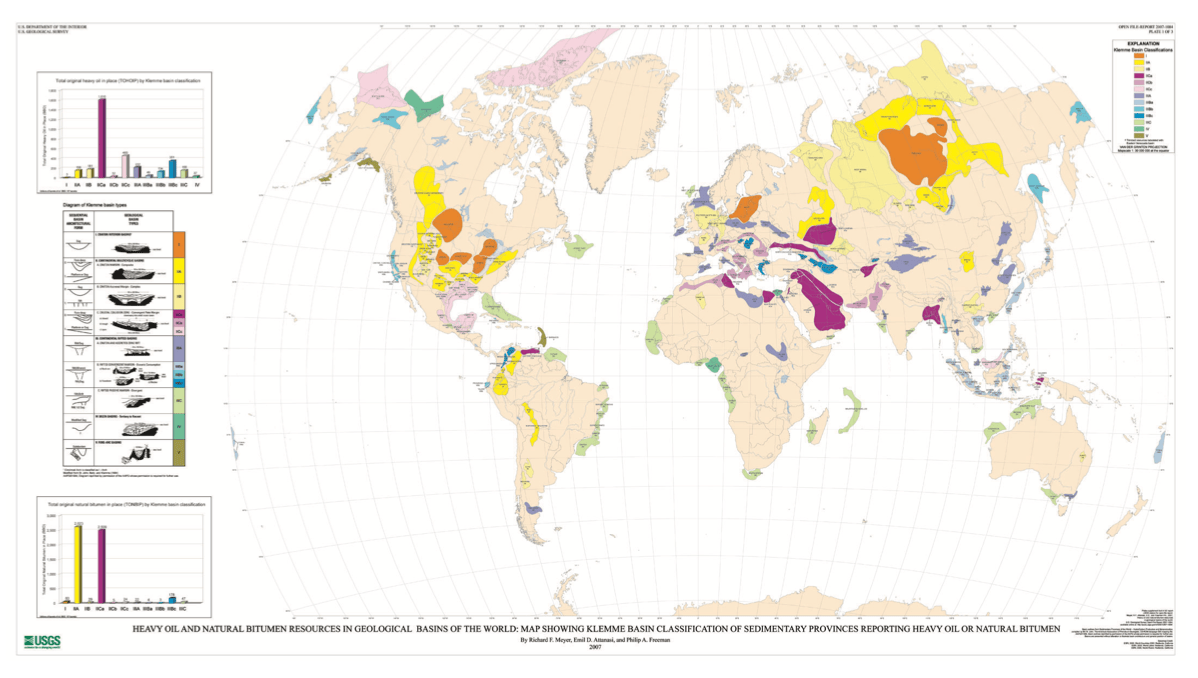
The United States Geological Services provides maps of available heavy oil and bitumen deposits. Figure 6 indicates that heavy oil is widely available in North America, Europe, Russia, and the Middle East.
In 2015, the International Energy Agency published a report indicating that in its view, there were huge deposits of extra heavy oil and bitumen (EHOB) that could be accessed if the price of oil rose high enough for long enough (Figure 7). The same exhibit shows somewhat smaller availability of tight oil from shale. In fact, the US has been able to access a substantial amount of tight oil from shale in recent years.

In my opinion, in order to access the EHOB, the prices of diesel and jet fuel need to rise to a high level over the long term; the prices of gasoline and even lighter products don’t necessarily need to rise. If the prices of diesel and jet fuel rise high enough, for long enough, the price signal should work its way back to oil and gas companies, suggesting that they need to make investments in the direction of adding more extraction from EHOB. If this succeeds, it could perhaps relieve the problem of inadequate supply of diesel and jet fuel.
The prices of diesel and jet fuel are high now, but this is at least partly due to higher insurance costs and partly due to the extra costs related to shipping oil longer distances to avoid blocked straits. These extra costs don’t get back to oil companies in a way that encourages countries to extract more heavy oil. What is needed are permanently higher prices for diesel and jet fuel, relative to the price of gasoline, even if the problems with respect to the straits of Hormuz and of Bab al-Mandab, disappear.
[6] Today’s conflicts in the Middle East and Russia/Ukraine seem to relate to inadequate supplies of diesel and jet fuel for buyers of these fuels, and inadequate prices for sellers of the heavy/sour oils yielding these products.
Figure 3, above, shows that the total supply of diesel plus jet fuel has been low, especially since 2020. One issue that has arisen recently is “Who gets the supply of diesel plus jet fuel that is available?” Figure 8 shows that increasingly, it has been the poorer countries of the world who obtain the diesel and jet fuel that is available. Note that total consumption of the Other than Advanced Countries has exceeded that of the Advanced Countries since 2020.
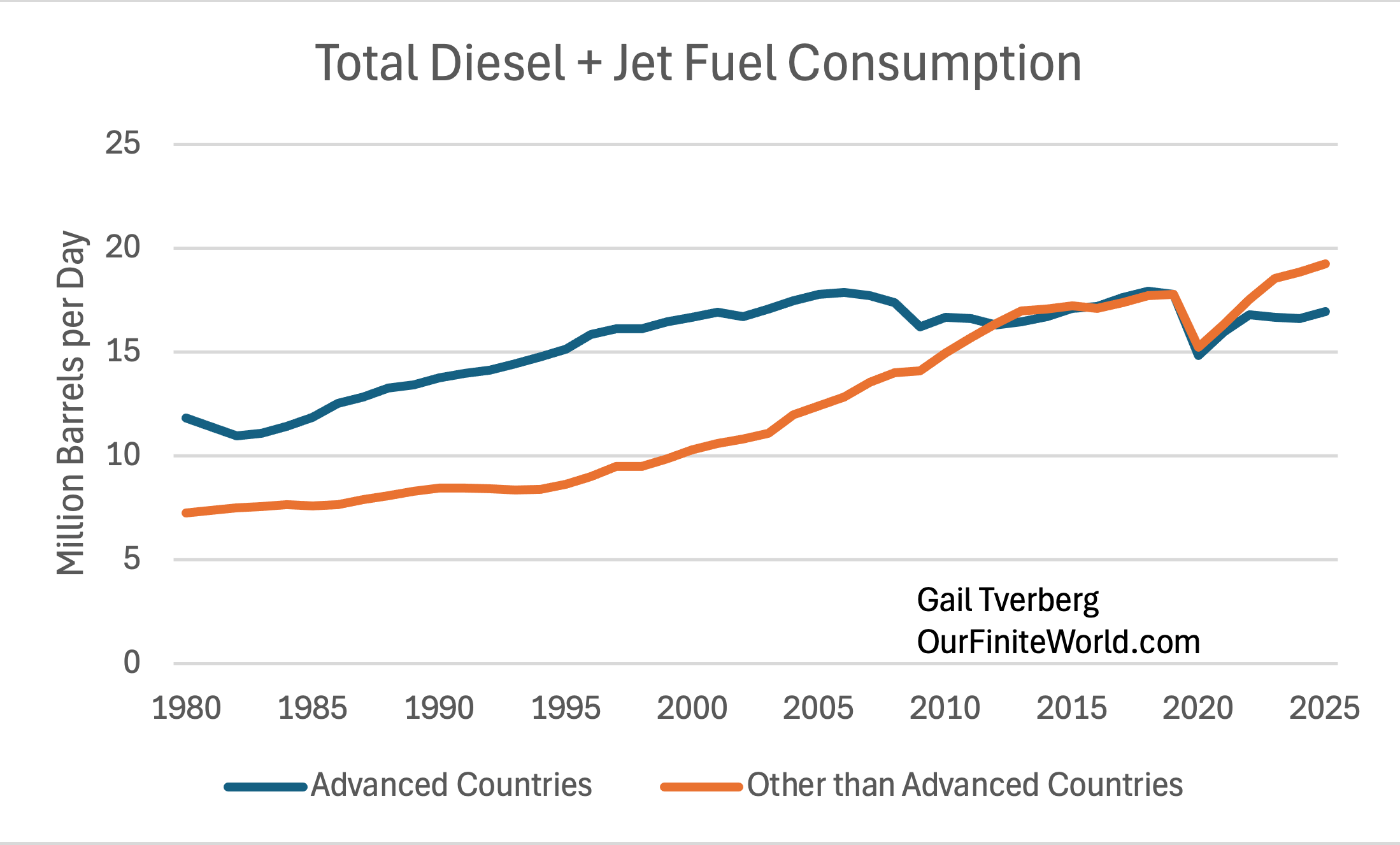
Figure 9 shows that for the Advanced Economies, per capita consumption of diesel plus jet fuel has been declining since about 2005–the time of peak conventional crude oil. The same figure shows that per capita consumption of diesel plus jet fuel has plateaued since 2013 for Other than Advanced Countries. I think of 2013 as the year that China first started encountering major limits on coal extraction (somewhat like the year 1970 in the US for oil extraction). In recent years, China has been able to raise coal extraction somewhat, but at a higher cost.

I would expect that countries in both groups would be dismayed by the situation shown in Figure 9. The per capita consumption of diesel plus jet fuel for the Advanced Countries has been falling for a long time. Partly this is the result of the economies changing to service economies. As service economies, the need for diesel by industry has been lessened. Wages tend to be less for many of these service jobs, making workers unhappy.
In Figure 9, people in the Other than Advanced Countries would tend to be dismayed by the continued wide gap between the standard of living of their own economy, and the standards of living in the Advanced Countries. Many of these countries export extracted resources that are ultimately sold as goods to people living in Advanced Countries. If the selling prices of these commodities were higher, workers in these countries could perhaps afford to have cars and air conditioning, like workers in the Advanced Countries. They would also be dismayed by the poor progress in raising their own per-capita consumption of diesel and jet fuel since 2013.
[7] Is there any possibility of greatly ramping up heavy oil production? Could it power a society like the one we have today?
We know that heavy oil production began long ago. For example, the first recorded production of heavy oil began in the Kern River Basin in California in the 1860s, and commercial production began there in 1899. The first production in the Canadian Oil Sands began in 1921, and commercial production there began in 1967.
The extent to which the oil that is heavy and often sour can be ramped up in the future remains to be seen. Extraction techniques have gradually been improving, and I would expect that they can continue to improve. But the cost of extraction and processing will likely remain somewhat high because of all the energy-intensive steps that are needed to provide diesel and jet fuel.
I expect that society itself will need to change in order to make use of this higher-cost oil. These are a few ideas I have:
(a) Oil exporting countries will need to change in ways that reduce their need for tax revenue. This is an issue especially in the Middle East, which has a huge population, in a hot, dry climate. The population will likely need to fall (for example, many migrants and guest workers may need to move back to their country of origin), and make-work projects will need to be discontinued.
(b) Another issue is that total diesel and jet fuel usage will likely need to be reduced because it is likely to take several years before production of heavy oil can be ramped up. Society will need to be reorganized in a way that uses less diesel and jet fuel. One idea would be to shorten supply chains whenever possible. Figure 10 illustrates one idea how this might be done.

(c) I expect that if such a change can be made, economies will need to gradually change in ways that are hard for us to understand now. The focus may need to be on essentials, including food and clothing. Governments may need to be smaller and provide fewer services. Communities may need to be smaller and more walkable. The total population may need to be lower.
[8] Conclusion
It seems to me that the self-organizing nature of economies will gradually push them in the directions they need to go if the world is to start incorporating a significant quantity of expensive products made from heavy oil into its energy mix.
We cannot yet imagine what all the changes will look like. In some ways they may resemble a recession, but there will likely still be an interest in greater complexity and in working to improve people’s lives.


Putin the wolf is at the door!
The plague is back!
Power grid emergency declared!
Man falls off roller coaster!
ArE yOu SCARED YET?
Better not have any kids!!!
(sorry, it’s just too easy) lol
things are not looking good I totally agree with you look at Bali for example they’re running out of petrol lineups of 1.5 KMS to the gas station saw a good YouTube video buy a guy called planet Jonesy which sums up perfectly that Bali is looking extremely precarious,and this is just two weeks before their peak tourist season.
While global yields are surging… China’s are plunging.
China can now borrow ~60% cheaper than the US.
And through Panda bonds, foreign nations and corporations can access China’s cheap yuan funding.
Brazil is preparing its first Panda bond… the largest-ever debut by a foreign sovereign.
Issuers can raise yuan and use it directly to buy Chinese goods and fund operations in China instead of first raising USD.
Every transaction funded directly in yuan reduces the need for dollars at the margin…
And by extension, chips away at marginal demand for USTs.
https://x.com/ekwufinance/status/2110067818343399709/photo/1
The US can’t afford higher rates… Warsh knows that. – In the next 12 months, ~$10T of USTs need to be rolled. – The average coupon is ~3.3%. – The US10y yield is ~5.3%. Rolling that $10T at today’s US10y level would add $200B in annual interest costs, and that’s before you factor in the interest burden on an ongoing $2T annual deficit.
The falling interest rate in China is not a vote of confidence in the Chinese economy. It is a sign the economy is not doing very well. Outsiders won’t want to invest in the country.
The West has had many generations of affluency, and just now we’re relearning what it is to lose the freedom that money and modern ammenities gives us. That’s why, also, it is so hard for most of the population to believe that things will go down: things going down is just a distant memory, a time no one alive today lived in.
But not to the chinese. They managed, in a singular generation, to go from maximum poverty to maximum affluency, and most of the chinese alive remember very well how it is to be poor.
And they’re seeing it happen right before their eyes, something just as extraordinary as their rise, their own downfall.
Since before the war, close to when Covid happened, due to the normal oil problems we all know, we saw many industries but specially commerce closing up in droves there. China is cooking its numbers, and that’s no surprise now, they’ve been doing that for years, but people chose to believe because it was rising so spetacularly.
And there’s no solution or fix. The chinese are seeing what’s happening and they know what’s coming, it’s too close to home gor them, and they’re simply stop spending, they’re hoarding, and their real state bubble bursting left them speechless, vulnerable and dreading with uncertainties.
China is like one of those old MOPAR. Big, expansive, powerful, but also gas hungry. When the 70s crisis came, everybody ditched them.
FREIGHT FOR RUSSIAN URALS TO INDIA HITS A RECORD: $27–30M PER SUEZMAX VOYAGE FROM THE BLACK SEA. UP FROM $19M IN SEPTEMBER That works out to about $30/bbl or more, according to traders’ figures and calculations. The drivers are higher risk in the Black Sea and a global tanker rally that has pushed shipping costs to records. Most Russian crude leaves from western ports and has to travel the long way to India and China. The higher freight eats into what Russia earns from high oil prices. Source: Reuters
When the end of oil comes, it will happen quickly..
NEXTA on X: ” Bali has suddenly run out of gasoline The island has turned into one massive traffic jam. Many gas stations have closed, while drivers are forced to wait for hours to get into those that remain open. Denpasar, Kuta, Badung and Jembrana have been particularly hard hit. In https://t.co/u1k9yxREiB” / X
We need to start looking at small examples, like this.
Sri Lanka? Haiti?
the UK.
Maybe so
Bali was one of the islands who resisted Holland to the last, and although there were attempts to develop the island for tourism in the 1930s, since it was so far away no serious attempt had been made until 1961, when a volcano forced the unruly natives into ‘designated zones’ and the better parts of the island were seized and developed for tourism and international tourists, mostly from Asia, got richer and found some place which they found interesting.
Fast Eddy lived there, and there were quite a lot of killing there, but since the Indonesians are not a people who leave records, no one really knows how many died.
Bali is just reverting back to its old self , like the rest of third world.
US bureaucrats who never left the East Coast granted independence to peoples who had no business running a modern country,
And that’s the result of their mindless decisions.
the Civilisational Curse of Kulm is starting to work, it seems 😅
It is not really a curse, it is just things reverting back to the natural way.
If Bali remained under Holland , as intended by Queen Wilhelmina (who resigned after Washington forced Holland to give up Dutch East Indies, one of the most stupid decisions ever) it would have looked like this
Curacao, where Holland’s baseball players tend to come from
Charlie Chaplin at Bali , 1930s
Bali now, after 80 years of Javanese rule
I’ve been to Bali twice so far it is a very safe tropical area and the people are only concerned about working because during the tourist season they can make some good money during the tourist seasonthey will sell their services in any shape or form.
when the tourist season is not on they are living on their land raising pigs and raising crops they are just trying to survive like us.
The WSJ is reporting:
https://www.wsj.com/world/middle-east/iran-is-fortifying-nuclear-sites-and-rallying-its-people-for-a-return-to-fighting-c4cc3c28
Iran Fortifying Nuclear Sites and Rallying Its People for Return to Fighting
Regime, convinced the U.S. is ready to attack again, sees preparations as deterrent
The efforts by both sides to shore up their fighting capacity underscore how, more than seven months into the war, neither side feels compelled to give up a fight that is largely deadlocked.
Instead, both are trying to break the logjam in their favor. The U.S. has ramped up its economic pressure campaign and is guiding tankers through the Strait of Hormuz with increasing success. [My comment: Really, or is this WSJ view?] . .
Iranian officials are touting their efforts. The country’s airports, seaports and power plants “have prepared for wartime conditions,” installing shelters and backup supplies to continue operating in a crisis, Brig. Gen. Gholamreza Jalali, the official in charge of the country’s contingency plans, told reporters at the end of September.
Hmmmm. Since I live in northeast NC and the Dominion Power company is through PJM, maybe getting a few extra batteries, inverters, charge controllers wasn’t such far out paranoia after all. Time will tell.
https://www.zerohedge.com/energy/energy-department-orders-pjm-dispatch-units-backup-power-through-mid-october
Our debt based fractional reserve fiat currency system doesn’t create more energy, it only determines which people will be able to afford, and therefore have access to, it when the shortages arrive.
I can’t figure out what the huge problem is. Washington DC temperatures are supposed to rise to 89 degrees on Oct. 14. Is that what is causing the problem? It is not an unusual temperature for the area. It is high for this time of year, however.
This link says:
The emergency order, Order No. 202-26-50, also authorizes PJM to direct backup generation resources ahead of declaring an Energy Emergency Alert 3 or during one. PJM may call on its transmission owners and electric distribution companies to carry out the order. The grid operator serves more than 65 million people across 13 states and the District of Columbia.
PJM filed the application on Oct. 11, forecasting demand “at or around 111,500 MW (or higher)” for Oct. 13. The company said the system would sit within 900 MW of its reserve margin on Oct. 14.
Anticipated generation outages were put at 61,591 MW, with the most acute pressure predicted to be in the BGE, PEPCO, and Dominion zones, which primarily serve Maryland, Virginia, North Carolina, and the Washington, D.C. metropolitan area.
Secretary of Energy Chris Wright determined a statutory emergency existed, citing a sudden increase in demand, a shortage of electric energy, or the facilities needed for its generation or transmission. The order lasts from Oct. 13 through Oct. 16, when temperatures are expected to relent.
Where are we going from here? Most people think that as soon as these wars end oil will go back down and we can get on with things the way they were. I think things are fundamentally changed now and we will start to see the break down of the stock market in 2027. I could be wrong 🤷🏻♂️
“if you want to be wrong, then follow the masses.” -Socrates
For humans there’s plenty of ways to be mislead. By the flock, by the leaders, by our own dreams. Most people was born to follow, in 500AC as today.
Then there’s the unhappy few, the skepticals and miscreants, but what do these get with their use of logic and critical thinking? Ostracism and loneliness, i would say, besides the little pride of not being a moron. The greatest obstacle of a Truth-Seeker (R) is that s/he’s pursuing something with almost zero market value. because what made us human was our yearning for comforting dreams and lies, not for truths.
I am afraid you are right. People want a “happy-ever-after story.” They don’t want to know that the economy has always been cyclical. Occasionally, young actuaries ask me how they can make money doing what I am doing, and I tell them that figuring what is really happening doesn’t have much market value.
I think things will change in 2027. Dr. Pape of the University of Chicago said that Iran is hoping that the Democrats will win big majorities in both houses of congress. If so, they can perhaps pass legislation in 2027 stopping funding for the current conflict. If their majorities are great enough, the legislation will be veto proof. That would stop the war completely.
“Once again Karl W. Miller has put numbers to a problem that most of the commentariat still treats as a temporary price spike. His latest forward outlook, “The Five-Year Global Energy Crisis,” dated October 3, makes an argument that should alarm every finance ministry from Berlin to Jakarta. The war’s damage to Gulf energy infrastructure is not a disruption that ends when the shooting stops. It is a reconstruction problem measured in years and trillions of dollars, and while it is solved, the world will be short of the fuels that run its economy.“?
https://larrycjohnson.substack.com/p/the-five-year-fuel-crisis-why-the
This is a very fine analysis. It looks at a lot of the details. Rebuilding will be a problem, even if a country theoretically has some funds, but not enough. The country will look after food needs first.
And Europe looks as if it has almost enough refineries to produce the diesel it needs, if it has the crude oil that these refineries are built for. But this crude oil is mostly not available. Importing diesel might work, but it cannot be stored as long as crude oil. Biodiesel has a particularly short stable life span. Even regular diesel blended with biodiesel can be stored for only six months.
Head of the winemakers’ association on falling wine consumption: People are going back to three-euro wines, whilst young people are turning to chemical drugs
https://eubrief.sme.sk/ekonomika-a-euro/c/sefka-vinarov-o-klesajucej-spotrebe-vina-ludia-sa-vracaju-k-trojeurovym-vinam-mladi-prechadzaju-na-chemicke-drogy
According to the Maximum Stoning Principle, people in a collapse will watch their precious pennies and switch to cost effective drugs. Beer or vodka would have been a more effective (than wine) way to cope with the rising complexity, but China-made fentanyl is cheaper and more effective.
There are quite a few in the US running into somewhat similar situations, I am afraid.
The WSJ has a major post:
https://www.wsj.com/world/china-economy-gen-z-f9058941
China’s Weakening Economy Is Creating a Lost Generation
Young people were taught hard work guaranteed a bright future. They feel burned out and betrayed as good jobs become harder to get and the milestones of adulthood slip away.
For months, Ma Yongjian didn’t tell his parents where he was.
Halfway through a master’s degree in computer science, the 27-year-old stopped going to class last year. Software engineering used to be a safe career choice, but the rise of artificial intelligence and a wave of layoffs at Chinese tech companies left Ma convinced he wouldn’t be able to land a good job. He no longer saw the point of studying.
It’s all about survival. You realize that you’re just a part of a system that keeps running faster and faster, yet you achieve nothing. So you either disconnect yourself from it or let the system leave you behind.
Trump bringing back public execution.
I wonder what Jesus would think of that?
Kulm can probably tell us. I expect that public executions have been the norm in many parts of the world, for a long time. The Bible tells us the Jesus was killed in a public execution.
These executions are cheap. I understand that Saudi Arabia still has them. Iran does not.
Saudi Arabia. North Korea.
It makes people numb to violence and accept whatever the government forces on.
We need to know which country you’re living in, Mr. K. so that we can persuade Trump to nuke it. 😉
More and more I’m thinking, it’s rather about social coherency and about keeping the deplorables in check (more or less). What is more efficient (for the money), than well-scripted, scheduled in advance public execution on a beautiful, sunny October day, for example?
Nobody is going to talk about it, but beside didactic value, well-scripted, scheduled and completed public execution provides enormous entertaining – going way deeper in the animal parts of the brain, then, say, lousy football game (Hello – late Jim Morrison!) or a sporadic/unpredictable subhuman brawl at a ghetto Wal-Mart…
Klum, Chucky ancestor had a movie made …Munster Go Home…
Great Scott…the Earl of Munster…hope you enjoy
Strange that The Munsters didn’t get sued for ripping off The Addams Family back in the 1960s. Both funny series, though. I loved them as a boy back in the 1960s. Now, which one did you reckon kulamity most resembled? 😉
I am afraid Chucky’s grandma died before movies were invented
https://en.wikipedia.org/wiki/Dorothea_Jordan
Also Munster sounds like very Irish (and German – why Munster is in Ireland, I don’t know.)
Here in the UK we are edging closer to blackouts…
On Tuesday, 6 days into the Winter 26-27 season, we NESO issued an Electricity Margin Notice (“EMN”). Despite NESO repeatedly telling the market that EMNs are “routine tools” that do not signify a blackout, the following facts are notable:
…
But the interconnectors alone were not enough. At the same time, NESO was forced to pay high prices in the Balancing Mechanism (“BM”). Several units were bid up at prices approaching £1,000 /MWh against a day-ahead price of £275 /MWh in the peak.
…
Unless ministers address these problems, Britain risks reaching a point where electricity demand cannot reliably be met during periods of cold, still weather. At that stage, the question won’t be how much it costs to keep the lights on, but which consumers will have to be disconnected to prevent the system from failing.
Early winter ENM rings alarm bells – Watt-Logic
I agree; this is indeed a worrying situation. The UK does not have an adequate way of addressing electricity needs in times when wind levels are low, and the sun isn’t shining. It either needs a whole lot of natural gas in storage, and gas turbines to turn this natural gas into electricity, or an incredible amount of battery supply to bridge the gap. Depending upon electricity coming through transmission from France is extremely iffy. It, and the rest of Europe, is likely to be dealing with approximately the same issues that the UK is.
Winter season? It is winter when I can no longer make my breakfast stark naked (apart from boots, my feet are dreadfully sensitive).
This is still early Autumn!
Looks as though other Brits will have to toughen up.
This guy is/was living in the UK and is covering the EU breakdown pretty well.
Thanks for posting this. It is indeed strange to think that EU leader should think that the most important thing to do now, with inadequate diesel supply, is to punish Russia–for Ukraine to continue to destroy its refineries. Also, they are concerned that they were not consulted about any peace deal (which may have been fictitious to begin with).
I used to watch him during the Brexit era. He is still stuck there.