
|
Getting your Trinity Audio player ready...
|
The nature of the shortage of diesel and jet fuel is more complex than most people realize. Based on my analysis, a shortfall has existed since at least 2020. The shortage is not simply the result of the closure of the Strait of Hormuz.
In this post, I will provide background information regarding the nature of the shortfall and the international conflict it is leading to. I will also share my thoughts on how, over the long term, the situation might be mitigated. I doubt whether a solution will be available in the short term, but I can at least give readers an idea of one direction in which a possible workaround might be available.
My idea is that the economy needs to transform itself in a way that uses diesel and jet fuel (grouped together on some reports as “middle distillates”) more sparingly. At the same time, research on extracting heavy oil and bitumen at lower cost is needed. If this is done, it may be possible to use additional heavy oil to increase the supply of diesel and jet fuel.
One thing that will probably need to change is the price of diesel relative to gasoline. The price difference will likely need to be even greater than it has been in the recent past because heavy oil is inherently more difficult to extract, refine, process, and transport.
[1] The interconnected nature of the economy means that inexpensive energy products are extremely important to the economy.
Energy supply and the economy are a great deal more interconnected than most people realize. For example, if the price of diesel rises, the price of food also tends to rise because diesel is used in food production and transportation. Similarly, if the price of gasoline rises, the additional cost also tends to squeeze budgets. Politicians see these price increases and say to themselves, “These increases will make voters unhappy. Let’s raise interest rates and see if we can get oil prices back down.”
Higher interest rates don’t affect everyone immediately, but they particularly impact people purchasing a vehicle or a home, and businesses seeking a loan.

Clearly, raising interest rates at the same time as energy prices are rising is “playing with fire.” If the economy is really overstimulated and growing too quickly, this type of approach makes sense. But if the underlying problem is that diesel and jet fuel prices are high because of inadequate world production, what is really needed is higher oil prices, especially for the heavier crude oils that provide a disproportionate share of diesel and jet fuel.
Consumers and oil producers have two different needs for prices:
- Consumers want diesel and jet fuel prices low because high prices wreck their budgets. Diesel is used in growing food and transporting it to market. Jet fuel is used in transporting some kinds of foods. In fact, industries of all kinds (including mining, road building, and construction) use diesel and jet fuel. Higher prices of these fuels tend to make practically any kind of goods or services more expensive.
- Oil producers want diesel and jet fuel prices high, to incentivize investment in new wells. Without additional investment, the quantity of heavy oil extracted and made into these fuels will tend to decrease because of depletion issues.
While prices for diesel and jet fuel are higher this fall, quite a bit of the extra charges relate to extra transport and insurance costs. The high prices need to stay, and perhaps even increase, even if the immediate issues disappear, in order to incentivize greater long-term production. It is these rising prices that are likely to continue to squeeze budgets and push economies toward recession.
[2] What we call “oil” can vary quite widely from well to well. The trend over time has been toward lighter crude oils.
Most people assume that all oil is equivalent, but this is not the case. Petroleum is a mixture of hydrocarbon molecules. The lightest ones are gases are room temperature, the medium weight ones are liquids, and the heaviest ones tend to be quite viscous. Some are even solids. Some oils, especially heavy oils, have sulfur or metal inclusions. Crude oil that contains sulfur is called “sour oil.”
Heavier oils are ones that disproportionately produce diesel and jet fuel. Lighter oils tend to produce more gasoline, along with products like solvents, and the feedstocks for plastics.
In my view, a major reason why there tends to be a shortfall in diesel and jet fuel production (even apart from the current Middle East blockages) is that the type of oil needed tends to be more expensive to extract, refine, and transport than light oil. Furthermore, oil with sulfur tends to be quite corrosive, and removing the sulfur adds another layer of costs. The primary issue I see is that it is hard to pass on the higher production costs of heavy and sour oils to customers.
In theory, to cover all the costs involved related to heavy and sour oils, diesel and jet fuel prices should be quite a bit higher than gasoline prices for the same volume (liter or gallon). But if this were the case, the price of food would also increase, since diesel is extensively used in food production and transportation.
Figure 2 shows end products from the production process. We know, however, that lighter end products tend to come from lighter crude oils, so we can deduce that the crude oil mixture has been getting lighter over time. The amounts in Figure 2 include natural gas liquids, which are very light and growing in quantity.

The earliest oil that was extracted tended to be “medium oil,” which tended to have a mixture of heavier and lighter molecules. As the medium oil depleted, new production tended to be lighter. In particular, US tight oil from shale is quite light. The increasing production of US tight oil from shale is adding to the Very Light layer, as well as the Gasoline layer.
[3] The world had a diesel and jet fuel shortage long before 2026.
Because of the need for diesel and jet fuel in industry and transportation, a person would expect per-capita diesel and jet fuel consumption to grow as industry and international trade grows.

Figure 3 shows that per capita consumption of diesel and jet fuel stopped growing about 2005. The year 2005 seems to be the time that the world’s output of “conventional” (easy to extract) oil reached a peak. Figure 3 also shows that per capita consumption then plateaued until about 2019. It fell 16% in 2020, and it has not been able to fully recover since. The historical data on this chart is only through 2025, but the big Middle East cutbacks in 2026 will clearly send diesel and jet fuel consumption down from the 2025 level in 2026, as indicated by the red arrow.
At least in part, what is happening is that recent oil prices have not been high enough for countries producing somewhat heavy, sour oil. This is especially the case for oil exporting countries that depend on oil revenue to support their economies. They need more revenue than just enough to cover the cost of extraction, plus a reasonable return for shareholders. They also need money to fund the development of make-work projects to employ their citizens and to fund subsidized imported food for their population.
In the peak oil community, there seems to be the view that Middle East oil is always cheap to extract and refine. At one time, this may have been true, but most analyses overlook the tax needs of oil exporting countries. Tax needs are high in countries with exploding populations who need subsidized imported food. Huge make-work projects to provide employment possibilities, such as Saudi Arabia’s construction of the city Neom, add to the need for higher tax revenue. Middle Eastern oil costs may also be rising because of depletion issues, such as wells yielding relatively more water in the oil/water mixture extracted.
[4] For oil exporters, one symptom of chronically inadequate prices for heavy/sour oil (including the need for high tax revenue) is the willingness to engage in war.
If a person looks through my suggested list of heavy/sour oil producers shown on Figure 4, all the countries seem at least somewhat war-like. Even Canada tends to be war-like. Canadian leaders would be much happier if the price of crude oil exported to the US were considerably higher, and it would be less inclined to seek export partners in Asia and Europe.

If the oil production of the heavy/sour countries and country groups found on Figure 4 is added together, the result is as shown in Figure 5. The total production of these countries exceeds the production of the rest of the world.
Notice that the countries of the Middle East tend to be quite price sensitive. Their production dropped steeply in 2020 when oil prices fell. Likewise, their production rose in 2022 when oil prices were temporarily higher, related to the start of the Ukraine-Russia conflict.

[5] Authorities claim that there would be plenty of heavy oil to refine if prices were to rise high enough for long enough.
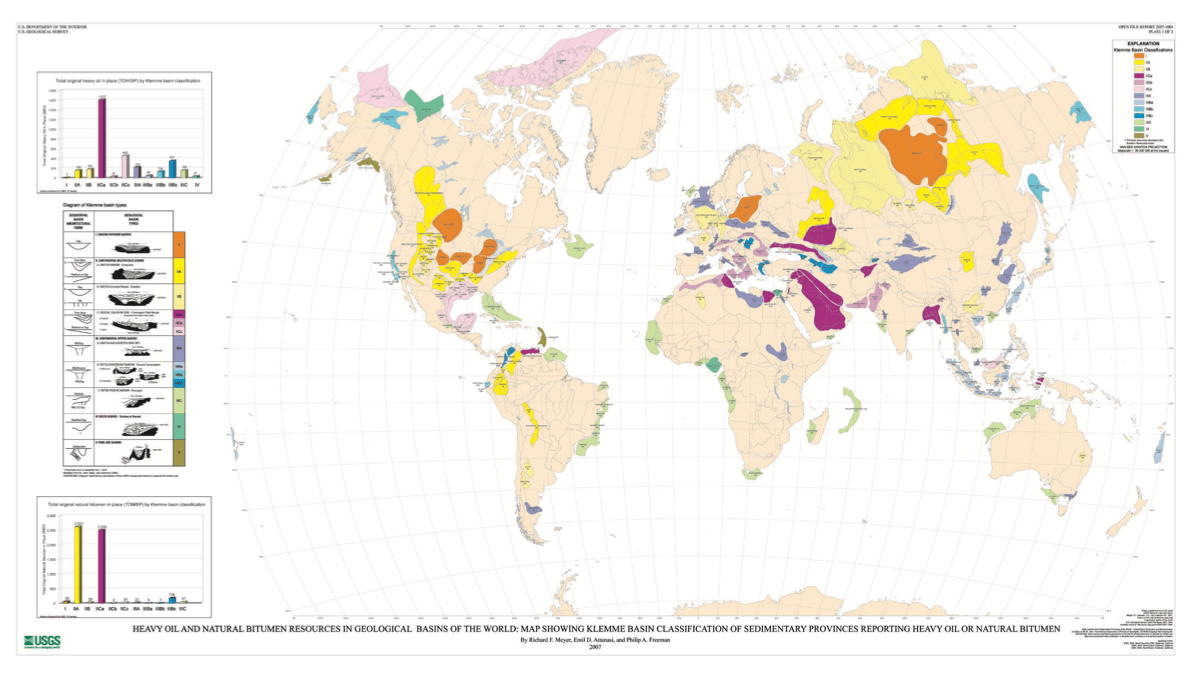
The United States Geological Services provides maps of available heavy oil and bitumen deposits. Figure 6 indicates that heavy oil is widely available in North America, Europe, Russia, and the Middle East.
In 2015, the International Energy Agency published a report indicating that in its view, there were huge deposits of extra heavy oil and bitumen (EHOB) that could be accessed if the price of oil rose high enough for long enough (Figure 7). The same exhibit shows somewhat smaller availability of tight oil from shale. In fact, the US has been able to access a substantial amount of tight oil from shale in recent years.

In my opinion, in order to access the EHOB, the prices of diesel and jet fuel need to rise to a high level over the long term; the prices of gasoline and even lighter products don’t necessarily need to rise. If the prices of diesel and jet fuel rise high enough, for long enough, the price signal should work its way back to oil and gas companies, suggesting that they need to make investments in the direction of adding more extraction from EHOB. If this succeeds, it could perhaps relieve the problem of inadequate supply of diesel and jet fuel.
The prices of diesel and jet fuel are high now, but this is at least partly due to higher insurance costs and partly due to the extra costs related to shipping oil longer distances to avoid blocked straits. These extra costs don’t get back to oil companies in a way that encourages countries to extract more heavy oil. What is needed are permanently higher prices for diesel and jet fuel, relative to the price of gasoline, even if the problems with respect to the straits of Hormuz and of Bab al-Mandab, disappear.
[6] Today’s conflicts in the Middle East and Russia/Ukraine seem to relate to inadequate supplies of diesel and jet fuel for buyers of these fuels, and inadequate prices for sellers of the heavy/sour oils yielding these products.
Figure 3, above, shows that the total supply of diesel plus jet fuel has been low, especially since 2020. One issue that has arisen recently is “Who gets the supply of diesel plus jet fuel that is available?” Figure 8 shows that increasingly, it has been the poorer countries of the world who obtain the diesel and jet fuel that is available. Note that total consumption of the Other than Advanced Countries has exceeded that of the Advanced Countries since 2020.
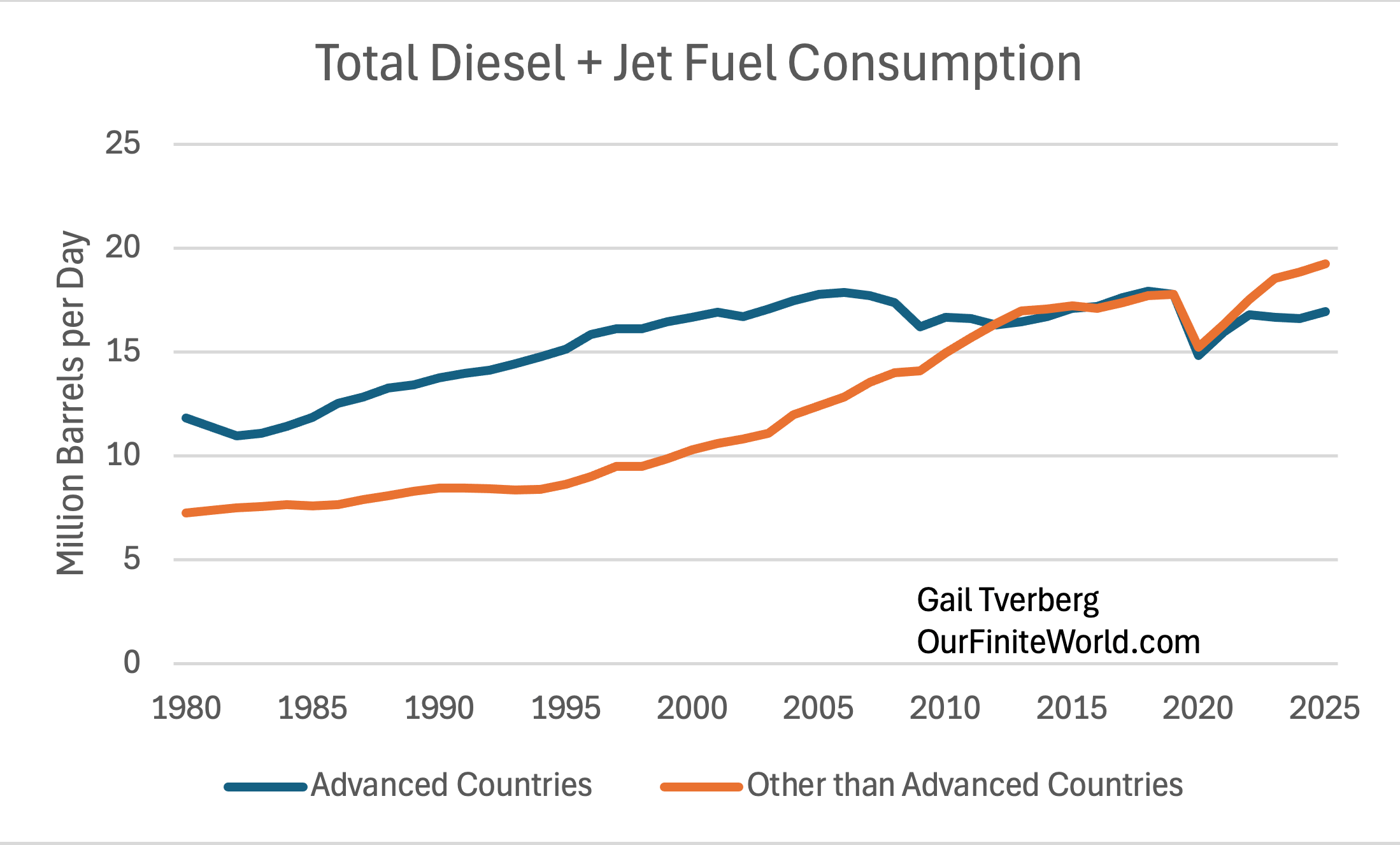
Figure 9 shows that for the Advanced Economies, per capita consumption of diesel plus jet fuel has been declining since about 2005–the time of peak conventional crude oil. The same figure shows that per capita consumption of diesel plus jet fuel has plateaued since 2013 for Other than Advanced Countries. I think of 2013 as the year that China first started encountering major limits on coal extraction (somewhat like the year 1970 in the US for oil extraction). In recent years, China has been able to raise coal extraction somewhat, but at a higher cost.

I would expect that countries in both groups would be dismayed by the situation shown in Figure 9. The per capita consumption of diesel plus jet fuel for the Advanced Countries has been falling for a long time. Partly this is the result of the economies changing to service economies. As service economies, the need for diesel by industry has been lessened. Wages tend to be less for many of these service jobs, making workers unhappy.
In Figure 9, people in the Other than Advanced Countries would tend to be dismayed by the continued wide gap between the standard of living of their own economy, and the standards of living in the Advanced Countries. Many of these countries export extracted resources that are ultimately sold as goods to people living in Advanced Countries. If the selling prices of these commodities were higher, workers in these countries could perhaps afford to have cars and air conditioning, like workers in the Advanced Countries. They would also be dismayed by the poor progress in raising their own per-capita consumption of diesel and jet fuel since 2013.
[7] Is there any possibility of greatly ramping up heavy oil production? Could it power a society like the one we have today?
We know that heavy oil production began long ago. For example, the first recorded production of heavy oil began in the Kern River Basin in California in the 1860s, and commercial production began there in 1899. The first production in the Canadian Oil Sands began in 1921, and commercial production there began in 1967.
The extent to which the oil that is heavy and often sour can be ramped up in the future remains to be seen. Extraction techniques have gradually been improving, and I would expect that they can continue to improve. But the cost of extraction and processing will likely remain somewhat high because of all the energy-intensive steps that are needed to provide diesel and jet fuel.
I expect that society itself will need to change in order to make use of this higher-cost oil. These are a few ideas I have:
(a) Oil exporting countries will need to change in ways that reduce their need for tax revenue. This is an issue especially in the Middle East, which has a huge population, in a hot, dry climate. The population will likely need to fall (for example, many migrants and guest workers may need to move back to their country of origin), and make-work projects will need to be discontinued.
(b) Another issue is that total diesel and jet fuel usage will likely need to be reduced because it is likely to take several years before production of heavy oil can be ramped up. Society will need to be reorganized in a way that uses less diesel and jet fuel. One idea would be to shorten supply chains whenever possible. Figure 10 illustrates one idea how this might be done.

(c) I expect that if such a change can be made, economies will need to gradually change in ways that are hard for us to understand now. The focus may need to be on essentials, including food and clothing. Governments may need to be smaller and provide fewer services. Communities may need to be smaller and more walkable. The total population may need to be lower.
[8] Conclusion
It seems to me that the self-organizing nature of economies will gradually push them in the directions they need to go if the world is to start incorporating a significant quantity of expensive products made from heavy oil into its energy mix.
We cannot yet imagine what all the changes will look like. In some ways they may resemble a recession, but there will likely still be an interest in greater complexity and in working to improve people’s lives.


I’m just blown away…
That’s a good one, ain’t it?
https://energyskeptic.com/
When I look back at 2005, I see it as a milestone in my life. That was when I first started to feel that something was wrong with my work. This feeling was confirmed in the spring of 2008, shortly before the actual crash in the autumn. At the time, I had no idea that energy, and oil in particular, was the culprit. I just sensed the implosion coming.
Today, the situation is much worse. The bubble of unsustainability has grown even bigger. There are more lies everywhere, repeated over and over again. People don’t believe you because there are now more people who have never known what normality looks like. They grew up immersed in the lies of so-called social networks, where the crowd effect on individuals masks the underlying atomization of society.
The year 2005 was the year that oil limits hit the press, in the US. Oil prices were high. I started looking into oil limits in 2005. There were books out in the bookstore, at that time, including Jeremey Leggett’s, “The Empty Tank, which was the first book I ran across.
The US depends on China for many things. More export curbs from China:
https://www.zerohedge.com/geopolitical/china-imposes-export-curbs-drones-heavy-machinery
China said on Monday it would expand curbs on drone exports and restrict the sales of some heavy machinery to “sensitive countries” with which the communist regime has disputes.
Exporters will need a license to ship certain types of drones, such as those capable of traveling more than 300 km (186 miles) or flying beyond the natural line of sight, China’s Ministry of Commerce said in an Oct. 19 statement, citing national security grounds. The drones’ engines, operating systems, and technologies used for manufacturing will also be subjected to controls.
Other affected products include some tunnel-boring machines, walking excavators, and high-altitude concrete-spraying machines – all sophisticated machinery for building railway and road tunnels through mountains, according to a separate press release.
Decades of investment have helped China become the world’s major supplier of tunnel-boring machines. Chinese media have long touted that the country makes 70 percent of such machines around the globe. Among the leading manufacturers are state-owned China Railway Engineering Equipment Group, whose website said its machines are delivered to overseas projects in 36 countries, including Italy, Australia, and Peru.
Separately, the regime’s commerce ministry announced export restrictions on key components of dredgers, including heavy-duty pumps used to scoop up mud and sand from the seabed.
Hmm, interesting to hear….wonder why all this concentration occurred? Oh, that’s right, remember hearing or reading that the Chinese leadership was willing to sacrifice a generation or two to fast track development as an industrial superpower on the world stage.
Obviously, it worked and now it’s flexing or flaunting it’s muscles 💪.
Like it wasn’t obvious to anyone with a pulse it’s intentions…but suppose making all that return on 8nvestment was too irresistible.
By developing China, and opening the best universities to their graduates, the West let the genie out of the bottle.
They should have read the old legends: the imprisoned genie promises to do one’s bidding, but is apt to play tricks and please himself when released….
https://www.wsj.com/politics/policy/trump-says-data-centers-must-provide-their-own-electricity-c843ed56
Trump Says Data Centers Must Provide Their Own Electricity
In a social-media post, the president asked companies to pay communities a dividend to make the facilities more popular
President Trump said he is requiring companies that build large data centers in the U.S. to provide their own electricity and suggested they pay communities hosting facilities a dividend, his latest steps to address widespread opposition to the artificial-intelligence boom ahead of the midterm elections.
“New and large, in some cases gigantic, data [c]enters are mandated by me to make their own electricity, and give or sell any excess back to the local community, or grid,” Trump wrote in a post on Truth Social early Wednesday.
GEERT VANDEN BOSSCHE—remember him?—has announced that he is stepping away from the fight to wake people up.
At the end of this month, I will stop posting new contributions on my website. By then, Voice for Science and Solidarity (VSS) will have existed for more than five years and, throughout that time, has served as my outlet for bringing my scientific objections to C-19 mass vaccination to the attention of my peers and the wider public. The website now contains numerous articles in which I describe, often in considerable detail, what I believe to be the detrimental immunological consequences of this, in my view, insane large-scale intervention in public health.
However, Geert isn’t slipping away quietly. He is leaving us with a final warning about what he calls the ongoing “Inescapable Immune Escape Pandemic”. I know some of you think the pandemic’s over, some of you think it never began, and some of you think that viruses a bogeyman invented to scare us all into taking vaccines. Well, if you want to believe that, you are welcome to believe that and disregard Geert’s message. But for those who want to know his current thinking, the following is the gist:
What strikes me in this regard is that countless efforts are being made to retrospectively map various behaviors of both the virus and the immune system while hardly any effort is devoted to investigating how collective immunity promotes the selection of spectacular ‘saltation’ variants.
Yet I firmly believe that the outcome of precisely this contest will determine which side ultimately prevails. My position remains that the virus holds the stronger cards because it can adapt far more drastically and rapidly than the adaptive immune system of most of the (highly vaccinated) host population, especially with regard to its replication and transmission capacity.
For that reason, I maintain that a sustainable equilibrium can only be restored when those segments of the population that depend entirely on high concentrations of antibodies (Abs) to halt infection and transmission of the virus have disappeared from the scene. By this I mean, in particular, individuals with high titers of suboptimally functioning neutralizing Abs. According to my hypothesis, such Abs promote the formation of immune complexes and thereby prevent the innate immune system from becoming sufficiently epigenetically ‘trained’, leaving these individuals largely dependent on their adaptive immunity for protection. If a coronavirus lineage is eventually selected that is resistant to these Abs present at high concentrations, the innate immune system will, according to this hypothesis, be unable to take over the task of rapidly eliminating the virus at its portal of entry. This is simply because the innate immune system of these individuals has not been sufficiently trained to perform that function. I’ve argued this from the very beginning of my criticism of the mass C-19 vaccination program and discussed it extensively in my book.
In fact, this amounts to a prediction that few dare to make: that, in my conviction, this evolution will lead to substantial mortality in highly C-19-vaccinated populations, particularly among vaccinated individuals. This is not a black-and-white judgment. Biology never is. I nevertheless remain convinced that those who’ve not been vaccinated, who do not suffer from particularly serious underlying illnesses, and who lead a healthy lifestyle will not succumb to ‘Hi-Vi-Cron’.
https://voiceforscienceandsolidarity.substack.com/p/the-virus-stays-the-virologist-leaves
He had a weird cult following sorta like Jordan Peterson. (confidence artist or con)
As for Jordan, benzos broke his brain sometime around 2018, making it very difficult for him to remain in his role of active public intellectual. Hence his somewhat erratic behavior during the plandemic years, including “losing composure” in public involve him becoming visibly choked up or crying. I asked Google AI about this, because quite frankly I can’t remember all the details of Jordan’s life that well.
Google AI:
Jordan Peterson‘s tendency to become choked up or openly weep in public is primarily a feature of the past decade, specifically becoming a highly prominent and frequent characteristic from 2021 onward.
When Peterson first rose to global prominence between 2016 and 2019 (following his opposition to Canada’s Bill C-16 and the subsequent release of his 2018 book 12 Rules for Life), his public persona was drastically different.
During this era, commentators and profile writers typically described him as sharp, hyper-intellectual, precise, and professionally even-keeled.
Even when subjected to intense journalistic pressure—such as his 2018 viral interview with Cathy Newman—he remained physically rigid and emotionally detached, focusing entirely on a flat, methodical presentation of facts and psychological arguments.
The frequent, deep emotional displays observed today emerged prominently after his re-emergence into public life in 2021. This followed a severe, multi-year health crisis involving a strict medical regimen, a severe autoimmune reaction, and a medically induced coma in Russia for benzodiazepine withdrawal.
Upon returning to promote his follow-up book, Beyond Order: 12 More Rules for Life, media outlets and audiences noticed a profound change in his baseline demeanor.
His tears are almost always triggered by specific, recurring themes: the profound existential despair of young men who feel abandoned by modern society, the crushing weight of individual responsibility, or overwhelming gratitude when discussing religious themes and the figure of Jesus.
his behavior became a predictable staple of his media appearances, notably occurring during multiple sit-downs on Piers Morgan Uncensored, where Morgan openly asked him about becoming a “surrogate dad” to millions of lost young men, causing Peterson to completely break down.
This shift has divided observers. Critics often pointer to his frequent weeping as a sign of post-medical emotional instability. However, prominent media peers have publicly defended him; on a 2024 episode of the Joe Rogan Experience, host Joe Rogan defended Peterson’s emotional displays, arguing that they are entirely authentic, stemming from a genuine, unperformed empathy for the massive influx of broken and desperate people Peterson meets while touring the world.
The covid issue seems to be coming back very locally here.
My church had quite a few cases of covid last week, particularly among the choir and the praise team. Both of these groups practice a couple hours a week, singing in close quarters. The pastor decided to ask leaders to cancel all events for the week. I chose not to cancel “Ladies Night Out,” planned for eating in a local restaurant. We had a good time last night, with a smaller than usual group. Most of us had been going to appointments as usual. Nothing else around here is closed.
How coveeeeeeenient.
Philipat’s commentary on Meryl Nass’s is spot on.
https://merylnass.substack.com/p/who-needs-more-time-to-get-its-climate?utm_source=post-email-title&publication_id=746368&post_id=221471164&utm_campaign=email-post-title&isFreemail=true&r=16win7&triedRedirect=true&utm_medium=email
philipat
philipat10m
In fact, MSM has suddenly, strangely gone quiet on “climate change”. IMHO, the reason for this AND the WHO slowing things down? Data Centers and AI, for which renewables can never provide enough power so there must be huge investments in fossil fuel and nuclear. generation. The globalist cabal have decided that their completion of the global surveillance prison has a higher priority than “climate change” which is simply one tactical leg or a multi-pronged strategy (including immigration, economic decay, political division, Russia etc. which can, at least temporarily, be downplayed. as the overall push towards social and cultural collapse as a precursor to the reset and NWO continues with the other tactical initiatives. When it all breaks down, their digital prisons will be essential for maintaining control prior to the “solution” of the NWO.
Liked (2)Reply (1)
Leaders have to pick one or the other. A growing supply of dispatch able electricity is needed. Intermittent energy doesn’t give this.
One comment awaiting approval.
It is really strange, no bad words.
Thanks for clarify what could be the issue.
I don’t see anything waiting approval. Try again.
It has now appeared below.
It is the one about vax consequences.
After I typed my text, it appeared to me something like that:
‘this is only a preview, your comment is awaiting approval’.
Do you know what can be the word or the argument that caused that block?
Many thanks
I don’t know.
I am having trouble with the new editor being a bit unstable. Perhaps a little more beta testing would help.
You can’t make this stuff up! But at least this sermon will go viral!
An Ecuadorian Catholic priest died over the weekend while giving a sermon about the fleeting nature of life during a livestreamed Mass.
According to the Ecuadorian newspaper El Universo, in the final moments before the accident, Father Sánchez Molinari reflected, “one day, all of us here will die,” and referred to Jesus Christ’s words to “render therefore unto Caesar the things that are Caesar’s, and unto God the things that are God’s” before calling upon the faithful to reflect that, “In our lives, sometimes we do not give that time, that space to God.”
“God is who comes first, before money, before work, and before the activities of our family and our home,” the priest said, before pointing out that sometimes, people spend hours “entertained” with phones, movies, and other activities and “do [not remember] the Lord.”
“One day, all of us here will die as well, and sometimes the time we’ve spent on other things doesn’t make as much sense as the time we spend on God,” the priest reflected. “The quality time we devote to God, to our brothers and sisters, to our husband or wife, to our children, and to our family, that time is time well spent.”
“That is why the Lord says, ‘Give to Caesar what is Caesar’s, and to God what is God’s’, that we may give God that time, that space, and that He may always be present in every moment of our lives. May God be with us, help us throughout this week, and bless all our activities,” he continued.
Father Sánchez Molinari then called upon the gathered faithful to recite the Apostles’ Creed, which they were halfway through reciting when the crucifix fell. Desperate screams and calls for an ambulance could be heard in the footage.
More proof that Mr. God is not a Christian. 🙁
We don’t know all the details. Maybe he had it coming. Though God surely whacked him good. I had to double check that it was not Slovakia.
Maybe tropical climate rotted either the anchors or the wood.
God would never catch our Norman like that, as Norman would not go within a mile of a crucifix, let alone a church.
But this seems more a case of dodgy Central American fixtures and fittings installation. By the look of it, they didn’t even bother to use rawlplugs. Their crucifix erection technique was no more advanced than that of the Romans. Just bang in a few nails.
Boy was that unexpected.
As the apostle Paul wrote to the Thessalonians, “For yourselves know perfectly that the day of the Lord so cometh as a thief in the night.”
“Little children, guard yourselves from idols”
1 John 5:21
RIP
He died reminding them of the eternal verities.
One can conceive of no better way to go.
Only perhaps if he’d drawn their attention to the fact that if they accept any more mRNA shots the might also be rejoining him sooner than they think….
If heaven is better than life on earth, perhaps the result is not bad.
In the “developed” countries, we have an army of older people in nursing homes. Economies cannot afford to pay for the huge amount of health care given to this population. It is particularly bad in the US. Dying quickly, at an age at which a person’s children are grown, is not all bad. Assuming this is a Catholic priest, he would not have any children. Many Lutheran clergy wear identical robes.
During hearings at Covid Commission, scientists highlighted the clear presence of synthetic mRNA in human sperm of Covid-vaccinated people.
With various studies presented.
It had previously emerged that this type of mRNA had also been clearly detected in the ovaries.
Don’t worry, Covid Commission is a special committee of the Italian Senate, set up to shed light on the pandemic, but – as is usually the case in Italy – it will achieve absolutely nothing.
The scientific evidence for all of us, however, remains…
https://www.radioradio.it/2026/10/commissione-covid-giovanni-frajese-audizione/
This vaccine doesn’t prevent infection; at best, it gives a lighter case. Plus lots of bad side effects.
Translation:
Covid Commission, Giovanni Frajese’s hearing ▷ “MRNA found in semen: this is very bad news”
From mandatory vaccination “to prevent infection” to the biodistribution of mRNA, the Foro Italico endocrinologist brings scientific literature to the Covid commission: “What I present are not opinions.”
A law that required a drug to do something it had never been authorized for. Legislative Decree No. 44 of April 1, 2021, containing urgent provisions for the prevention of SARS-CoV-2 infection, mandated vaccination for doctors and healthcare workers precisely “for the prevention of infection.” From there, the Green Pass and all that followed would emerge. Five years later, the EMA clarifies in its responses published recently that COVID-19 vaccines have never been authorized to prevent person-to-person transmission: not in 2020, not in 2021, not today. This short circuit was the focus of today’s session of the parliamentary commission of inquiry on COVID-19, the
full excerpt of which can be found at the bottom of the article .
Giovanni Frajese , a technical member of the commission and a first-time speaker , highlights this:
“Risk and benefit are two words that became popular during the Covid era. They were used by everyone to imply that any risk was minimal and the benefit incredibly high. This narrative was repeated so many times that it became etched in stone, and anyone who tried to say anything different was ridiculed. It’s a shame that science doesn’t speak with dogma, but with data. . . .
The first promised benefit , the one everyone perceived, was a halt to infections: “It was a gigantic lie. The law called for preventing infection, while the EMA explains very clearly that these vaccines were not authorized to prevent transmission.
Similarly, the Chief Science Officer of the UK, Patrick Valance, after calling the AZ vaxx a ‘miracle’ went on to say ‘We don’t know yet whether it will prevent infection’.
The Govt. then went on to claim that it did, and use that claim as the basis for mandatory vaxxing of care workers, and planned to do the same to all health workers and the general public.
Vallance did nothing to contradict them.
Vallance is now a lord….
Never forget the Lies and the Murders.
Some are things we already know, but the issue about synthetic mRNA present in human semen due to Covid vax is new and frightening.
https://oilprice.com/Latest-Energy-News/World-News/Japans-Electricity-Prices-Surge-25-as-LNG-and-Coal-Costs-Soar.html
Japan’s average power prices jumped by over 25% at the start of this week from the previous week amid soaring LNG and higher coal prices.
The nationwide power price rose by over 25% week-to-week to $0.19 (31.15 Japanese yen) per kilowatt-hour (kWh) on Monday, Bloomberg reported, citing data from Japan Electric Power Exchange.
Japan, one of the world’s biggest LNG importers, this summer reduced gas-fired generation in favor of coal as the price of liquefied natural gas remained elevated.
Japan has been burning more coal and less gas for power generation since the war in the Middle East started, and it is not the only one. All Asian countries have made the switch from gas to coal on affordability and availability grounds.
Gail, since the Iran war started, things have been pretty slow, and specially because everyone’s been releasing their strategic reserves.
But things sped up a lot in the last couple weeks.
My question is, what mathematical function is governing this? It’s an exponential curve? Where are we in this curve, right now?
It can not be exponential. Once it ends, it ends. SPRs of different countries will end at different times, but for a single entity like Cushing, perhaps the curve is \sqrt{a^2-t^2}, with consumption going to zero for t>a.
A few of these SPRs are in bad shape. They cannot be refilled. And the ones that are available have “sludge” in the bottom. So we don’t know quite how close to the bottom we are.
The SPR’s are drained out . The last ones are in EU which was/is aware of its predicament and did not release any barrels from it’s SPR from March-September . It was the threat from Trump that is forcing their hand . These will be the last dregs . Enjoy it while it lasts .
And we don’t have any information on how much China has in storage.
U.S. TAPS EMERGENCY DIESEL RESERVE AS PRICES HIT $6.32 The Trump administration will release 315,000 barrels from the Northeast’s 1 million-barrel heating oil reserve as diesel prices surge ahead of the midterm elections. Diesel now averages $6.32 per gallon, according to AAA, amid disruptions linked to the Iran war. Deliveries are expected by November 13. The key takeaway: Washington is tapping emergency fuel supplies to ease pressure from soaring energy costs.
China reserves :
China’s SPR is for Chinese refineries , unlike the US which sold it’s reserves to traders who then resold it to the highest bidder . China did draw down it’s reserves in the intial months but is now in the market and picking up all cargo . China has lost 500,000 mbpd of VZ oil and also 2.5 mbpd of Iranian oil . It has to get new suppliers for this amount MINIMUM .
The source of the first statement seems to be here, published today. https://stockhub.kr/en/news/news_3d92683912eb
There are people in the northeast who depend on heating oil for winter heat. Diesel is backup for natural gas heat, also. I don’t know if this diesel is precisely the same as “heating oil.” They are close.
China’s “Malaysian” oil is running out.
China’s customs data shows crude imports from Malaysia down to about 0.3m b/d, from a peak near 2m. Malaysia pumps nowhere near that much.
Analysts have long read most of it as Iranian crude with new paperwork.
That supply is now drying up.
Iran loaded no crude onto tankers in September under the US blockade.
Iran’s crude export revenue could hit zero by mid-December, which would be a first.
China has reported zero imports from Iran all along.
https://x.com/jackprandelli/status/2113052662832759135/photo/1
I don’t think we know very well. There was a WSJ article put up yesterday that claimed:
https://www.wsj.com/world/middle-east/more-oil-is-now-coming-out-of-the-persian-gulf-than-before-the-iran-war-6a6d1670
This seems ridiculous to me.
And, of course, it doesn’t apply to finished diesel supply. Diesel supply is short, partly because of the short supply from Russia, and partly because the fuel that is of the right type to give diesel is not near refineries of the right type, and too many ships are tied up in the Middle East, and in long distance travel to avoid the Middle East.
” I don’t think we know very well ” . Says who ?
I have been exposing the lies since a long time . This article is BS . 24 mbpd ? From where ? Before the war the total export from SoH was 18mbpd max . Now 24 mpbd ? Give ma break . Oh yes there is not only an Iranian blockade but a US blockade which restricts the flow of Iranian oil . Iran was shipping 3.5 mbpd through SoH before the war . Hey , why is the price of dated Brent at $ 122 and rising if so much oil is flowing out . I guess ” Common sense ” is not so common . 😉
As I said, regarding the article, “This seems ridiculous to me.”
Amazon has bought a huge number of chips that it cannot really plug in because the data centers that are planned do not have electricity yet. In fact, it has a contract for many more chips, but no way to get the grid support plus power for these proposed completed data centers. Sorry, behind a paywall.
https://www.zerohedge.com/markets/billions-nvidia-chips-collecting-dust-amazon-warehouses-ais-paperweight-problem-goes
Billions In Nvidia Chips Collecting Dust In Amazon Warehouses As AI’s “Paperweight” Problem Goes Mainstream
For much of the past year, we have been pounding the table on what is probably the most underappreciated problem in the AI capex boom.
It goes like this: hyperscalers order hundreds of billions in Nvidia silicon, the chips get built, shipped and delivered on schedule… and then they sit in crates, because the data center they were meant for has no power, no transformers, or no roof. Until those chips are plugged in, they earn nothing, they depreciate anyway, and the scarcity they leave behind keeps the price of every GPU-hour that is online sky-high. In other words, a stockpile of unlit chips is the world’s most expensive, and very inflationary, paperweight.
Now we have confirmation from inside the biggest cloud of them all.
According to a Business Insider report based on internal Amazon documents and a recording of an AWS staff meeting, Nvidia’s newest GB300 racks, arriving at a clip of billions of dollars a month, have been staged at “intermediary warehouses” because the AWS sites they were meant for “had room for more racks but not enough available power to turn them on.”
Mal-investment palooza.
The economy that is coming is partially based on liquidation and recycling. The chips will be bought by someone else at firesale prices, perhaps by the Chinese themselves.
You may be right.
A expect that electricity generation capability that has been put in place could be helpful for manufacturing.
We read earlier that perhaps farmers wouldn’t harvest crops, if diesel prices were too high. This seems to be a workaround.
https://www.wsj.com/politics/policy/trump-plans-8-billion-in-payments-to-farmers-1cec5851
Trump Plans $8 Billion Bailout for Farmers
President announces new Agriculture Department program offering payments to cover losses from rising fuel and input costs
The planned payments under a U.S. Agriculture Department program come as America’s farmers are struggling with higher fuel prices from Trump’s war in Iran. Higher fertilizer costs and a recent drop in selling prices for corn are expected to drag on farmers’ profits. Diesel prices have surged to more than $6 a gallon on average, hurting farmers running equipment such as combines and tractors. . .
Farmers have broadly struggled for years with rising expenses and several years of bumper crops. Corn and soybeans had one of the largest harvests in history last year and are on pace for another large crop this year, according to the USDA. The government unexpectedly raised its harvest forecast earlier this month, sending crop prices down.
The large harvests have fueled a grain glut, pushing commodity prices and farm income down. Corn growers are estimated to lose about $79 an acre this year, according to a September report from the American Farm Bureau Federation, the largest farmer trade group.
Reality be damned — until new lenders can’t be found to re-purchase the debt, as the bonds mature?
Two things. One is obvious, how can corn prices be possibly suppressed with famine expected in 2027? The other is that a farmer bailout is 8B, but we have had a few trillion dollars bailouts for bankers in the last 17 years.
Because too many people can’t afford corn. I suggest they go to the movies, since corn is Hollywood’s main product. 😉
Foreign buyers are not buying our corn in sufficient numbers. Shipping costs are high.
People who are used to eating rice will not be interested in buying corn, I expect. Also, the corn grown in the US is mostly “field corn,” used to feed animals and to make ethanol. It doesn’t taste very good. What is needed is more pigs worldwide eating corn. Also, more chickens and more cattle, being forced to eat some corn as part of their diets. Making more ethanol might also be helpful.
I expect that the folks predicting famine soon didn’t think about how much fertilizer was already in the supply lines. Corn is a heavy user of fertilizer.
Most Slovak families are under financial strain
“Nearly one in two households had to dip into their savings to cover everyday expenses over the past year.”
https://www.sme.sk/index/c/vacsina-slovenskych-rodin-zije-pod-financnym-tlakom
Never a dull moment in Slovakia!
I would say that trying to find a way out of trouble is, first and foremost, exhausting.
I was surprised to read stats published recently that 40% of Polish population is officially living below the poverty line. Economic stats still ‘look’ good, so it must be another one of those K shaped economies. I am quite comfortable out in my little village getting by on my Social Security payments from USA. I guess I am above the poverty line.
Payment discipline among German companies is deteriorating; a record percentage of businesses are reporting late payments
According to the survey, the main cause of late payments was customers’ financial difficulties.
Payment behavior among companies in Germany is not improving and reflects the complex economic situation both in the country and globally. As many as 82 percent of companies reported late payments in the past 12 months, the highest level since 2019.
https://hnonline.sk/finweb/zahranicna-ekonomika/96308914-platobna-disciplina-nemeckych-firiem-sa-zhorsuje-meskajuce-uhrady-hlasi-rekordne-percento-podnikov
Riots in France (2019) late payments the highest since 2019. Expect some unexpected crisis to “lockdown” the global economy. They’ll wait until winter (Feb/March) to implement based on prior exp.
October Surprise!
Gas Station in Omaha is Experiencing Shortages
Omaha drivers report gas station supply issues across the metro; Pillen signs EO to help
We need boots on the ground if they can’t keep up. Along with limits for purchasing.
This is a site that claims to track shortages of diesel, petrol (=gasoline) and jet fuel around the world. It doesn’t mention Oklahoma, at least yet. You can click on close ups of different parts of the world.
https://global-energy-flow.com/shortages/
Trump is getting increasingly desperate as the midterms are approaching.
The desperation is becoming impossible to hide.
Agreed!
Why do you say thiose deals are fake?
Maybe you can provide info that the deals are true, effective and working . I don’t see any signs beyond media statements and ” he said” ” sources close too ” etc . Trump’s posts do not count as deals .
What the actual fux is this world coming to?!
Putin is mediating peace talks between Iran and the United States;
Trump is mediating peace talks between Russia and Ukraine;
Iran is mediating peace talks between Saudi Arabia and the Houthis;
Pakistan is mediating peace talks between Iran and the United States;
The United States is mediating peace talks between Pakistan and India.
And they’re all calling on both sides to exercise restraint!!!
Erin ; be well.
NOW: With rumors of a “deal” between the U.S. and Iran circulating, let’s make one thing VERY clear:
The only POSSIBLE way in which Iran would agree to a deal before the U.S. midterms is if they received SO MUCH money in an irreversible manner that it would make the U.S. strategy of economic warfare a total joke (even more than it already is).
This is because Iran is well aware that Trump is HIGHLY likely to return to all-out war after the midterms.
Therefore, Iran would only agree to a pre-midterm deal that could save Trump politically in the elections IF it is paid out in an irreversible and overwhelming manner.
That’s not a $6B payout, that’s a $60B payout.
That’s not happening.
What you say seems quite possible.
Zerohedge is reporting:
https://www.zerohedge.com/geopolitical/two-tankers-fire-oman-irgc-boasts-naval-mine-warfare
Iran Rejects Report That Deal Is ‘Close’ After Qatar, Pakistan Push ‘Compromise Proposal’ To End War
The somewhat expected quick rejection is coming from the Iranians via newswires:
And Israeli media: “At least once, the US Trump administration was ‘very close’ to approving an attack on Iran” i24 Stein’s reports citing sources. Oil bouncing back on the Iranian rejection headlines, and despite.[ chart]
Someone should tell Donald Trump that if you wanted to make a deal with the Iranians, you should never have blown up their supreme leader.
Germany ( EU ) for the moment .
Pharmacy Die-Off in Germany! Every Second Online Mail-Order Provider Has Already Vanished from the Market.
#Apotheken #ShopApotheke #Insolvenzen #Deutschland
Dramatic Devastation: In 2021, there were still 324 mail-order pharmacies in Germany. Today, there are only 162. Within five years, every second provider has disappeared. Even well-known names like Apo-Rot, Medpex, and Eurapon were wound down after takeovers. Sanicare and Disapo are reportedly in insolvency proceedings, according to APOTHEKE ADHOC. A Disaster on the Ground as Well: The number of brick-and-mortar pharmacies dropped from 18,500 to 16,500 within five years. That’s a 14 percent decline, according to the report. In mail-order retail, Shop Apotheke and DocMorris now dominate. Consulting firm Prosoom anticipates further consolidation due to new purchasing options at Amazon and Google. The German pharmacy market is being radically thinned out, while fewer and fewer providers vie for customers!
Next
Radical Cost-Cutting Measures: Volkswagen Is Considering Freezing the Salaries of Its More Than 660,000 Employees Worldwide at the 2026 Level Until 2030. According to Internal Documents, No More Contractual Increases Are to Be Planned in the Future. Bonuses and Special Benefits Could Also Be Cut. The Works Council Fears a Loss of Purchasing Power of at Least Ten Percent. However, the Worldwide Salary Freeze Has Not Yet Been Decided. Career on Hold: In Germany, Volkswagen Employs Around 275,000 People. For Parts of the Workforce, Promotions and Reassignments Have Already Been Suspended. Thousands of Employees Could Be Affected. At the Same Time, More Than 100,000 Jobs Across the Group Are on the Line by the End of the Decade. IG Metall Is Currently Demanding a Five Percent Salary Increase Within Twelve Months. At Volkswagen, It’s No Longer Just About Job Cuts—It Could Be About a Years-Long Stagnation in Salaries!
Next
Job-Clearcutting in Karlsruhe! Every third industrial company wants to lay off employees. Hardly anyone wants to hire! The IHK autumn surveys are likely to be catastrophic. Karlsruhe will kick things off. Friedrich Merz won’t care
. #Karlsruhe #Industrie #Arbeitsplätze #Wirtschaftskrise
Alarming Figures: The current autumn survey by the IHK Karlsruhe reveals a dramatic development in the regional job market. Every third industrial company plans to cut jobs. In contrast, just 6.8 percent of industrial firms want to hire additional employees. This means far more companies are facing staff reductions than new hires. Job Market Under Pressure: The IHK results show just how severely employment prospects in industry have darkened. While numerous companies want to downsize their workforce, hardly any new job opportunities are emerging. Especially worrying is the ratio: For every industrial firm with hiring plans, there are nearly five that want to reduce staff, by the numbers. Karlsruhe’s Industry Sends an Unmistakable Warning Signal: Job cuts instead of job growth!
So, the Western World Economic Depression is bedding in. 🙁
Gemany has had it easy for decades, this will be quite a shock.
No promotions? Oh dear my heart bleeds for them. Not.
They should count themselves lucky if still employed and able to afford potatoes and have a bucket to relieve themselves in!
Serves them right for losing WWI, and failing to take civilisation to Type 1!
KULM II
All because of Chucky extending WW1 by four years
Blast from Mechanical Engineering – 117 Years of German Industrial History and Now Insolvency! Traditional Machine Builder Vollmer Now Fighting for Survival.
#Vollmer #Insolvenz #Maschinenbau #Industriekrise
Shock in Baden-Württemberg: The machine builder Vollmer, founded in 1909 in Biberach, has filed for insolvency. Around 450 employees at the German headquarters are affected. Worldwide, the specialist for grinding, erosion, and laser processing machines employs about 1,200 people. The restructuring is to take place under self-administration. Business operations continue, and the coming six months are already financed, according to insolvency experts. Russia Business Gone, Costs Exploded: Before the Ukraine war, Vollmer generated around ten percent of its revenue in Russia. The loss of this business, rising costs, supply problems, and weak demand burdened the company. A new plant originally planned with 100 million euros escalated to around 150 million euros and was halted in 2023. As early as 2025, Vollmer announced the elimination of about 15 percent of jobs at the headquarters. After 117 years, a German industrial traditional company must fight for survival, and the future remains uncertain for hundreds of employees!
This is another sad situation. Without inexpensive energy of the right kinds to power the plant, the company, and the jobs, cannot exist.
“Volkswagen Is Considering Freezing the Salaries of Its More Than 660,000 Employees Worldwide at the 2026 Level Until 2030.”
Wow! That is a long time! And, around the world!
Given the current inflation situation/outlook, that ought to do wonders for employee morale
But at least the Bundeswehr is hiring.
A major reason for making war–the military can hire the unemployed.
The IMF just released their new paper “The Coming Great Repression”.
The Coming Great Repression? New Measures and a Century of Evidence, WP/26/160, July 2026
I’m not a financial man. So maybe Gail or others can read and explain for people like me? Please and thank you. I guess it talks about “Capital Controls”
Just looking at the beginning of the article, it is about “Financial Repression”–holding down government borrowing costs by forcing certain groups to do their required funding by buying government bonds. This would be primarily banks, insurance companies, and pension plans. I suppose it could be extended to IRAs. (We will swap out what you have, and insert our low paying debt.) But I haven’t read most of the article.
Alex Krainer joins Pascal to discuss the financial interests behind geopolitical conflict. Drawing on his hedge fund background and research for Grand Deception, Krainer challenges Bill Browder’s account of Russia and examines post-Soviet privatization, debt and oligarchic power. They explore Russia’s relations with the West, diplomacy and historical ties between Russia and nineteenth-century America. Krainer argues that British imperial influence persists through financial networks, connecting his “undead empire” thesis to sovereignty, contemporary wars and the mechanics of wealth extraction.
More like Anglo Indian Empire as the Hindus are everywhere
It’s the mushlimbs ya gotta worry about. There are already far too many of them in Asia, Arabia, and North Africa. 🙁
This video is called “Looting Russia: Why the British Empire Never Died | Alex Krainer“
There is a group pushing the West toward war against Russia. Alex Krainer wrote a book called “Grand Deception” published by the Red Pill Publishing Co. The book has been banned.
Changing from Communism to Capitalism was the biggest looting of Russian wealth in history. The thieves took it out of Russia. The rule of Seven Bankers began at the time Putin came to power. Putin laid down new rules, which are described. You get to keep the loot, but you must pay taxes and stay out of politics. [First 15 minutes of video.]
The blurb about the video says:
Alex Krainer joins Pascal to discuss the financial interests behind geopolitical conflict. Drawing on his hedge fund background and research for Grand Deception, Krainer challenges Bill Browder’s account of Russia and examines post-Soviet privatization, debt and oligarchic power. They explore Russia’s relations with the West, diplomacy and historical ties between Russia and nineteenth-century America. Krainer argues that British imperial influence persists through financial networks, connecting his “undead empire” thesis to sovereignty, contemporary wars and the mechanics of wealth extraction.
Time stamps:
00:00 Alex Krainer, Bill Browder and Grand Deception
12:04 Russia’s privatization and the oligarchs
19:33 Resources, debt and financial power
27:30 Jeffrey Sachs and Russia’s economic transition
33:16 Russian diplomacy: naivety or strategy?
41:15 Russia, America and the Civil War
46:15 The “undead empire” and British influence
01:00:04 Empire as a system and the struggle for sovereignty
Could this be the beginning of the US attack?
Ode to Scot Ritter
Scott Ritter
Is apt to be bitter
About being banned from Twitter
And compared to Garry Glitter
All because he’s a hard hitter
Who goes on and on; he’s not a quitter
Just like a maestro on the zitter
Subjecting his critics to shakes and jitters
Sending them to the babysitter
Because he claims Russia is fitter
And the streets of Moscow have less litter
He eats his meat with fries and fritters
Which has audience in titters!
A man prone to dither
Just couldn’t spell “zither”
So he spelt it as “zitter”
The silly old critter. 😉
I checked in advance
Gave it more than a glance
I can’t understand why you’re yellin’
Don’t just look askance
Or do a mad dance
It’s just an alternative spellin’
Unlike a sitar
Which is not like a guitar
You play it like Ravi Shankar
A zitter is a zither
As to slide is to slither
You silly old merchant banker 🙂
Young Aislinn in Appalachia built her very own zitter when she was seven years old, an age when most kids have not even started their careers as zitters in the sense of people who squeeze their zits.
https://www.nogy.net/aislinn/zitter1/index.html
Neat thing lesson of the day – The fretted zither was an almost universally used instrument throughout central and northern Europe from at least the early 1400’s. Only one instrument from period is known to still exist – it is from 1547 and is Icelandic. The fretted zither is known by many names – Epinette (France), Langspil or Langeliek (Iceland), Hommel (the Netherlands and low Dutch), Scheitholz (Alpine and German) and even in this country as the Mountain Dulcimer, but it is generically known as ‘zitter’. It is a descendant of the monochord, a device used to teach music theory in ancient times. The Appalachian Mountain Dulcimer is a direct descendant of the German settlers zitters.
I’m gonna hafter bail out here, and agree with Sir Les Patterson that “only poofs write poetry”. I’m drawn to the conclusion that Tim is now possessed by the spirit of former commenter Poorman Gadget and is driven to write excruciating poetry. It is also known that after being given a surgical transplant, of somebody’s heart or liver, the recipient can take on some of the characteristics of the donor. One such recipient did indeed end up obsessively writing doggerel as a result.
Thank goodness for small mercies!
And I hope you don’t get your chute in a twist.
Fortunately for me
I don’t write poetry
Just doggerel you see
Les Patterson would agree
I write it on the hoof
Which means I’m not a poof
And if you want the truth
I find poetry aloof
Using carefully crafted imagery
To express with subtlety
Poetry rises to an art
Putting the horse before the cart
With measured rhythm and well chosen words
Like beasts that congregate in herds
To convey deep emotions or ideas
Passions, wonderments or fears
While doggerel, conversely
Is a type of verse that’s tersely
Marked by loose or irregular rhythms
Forced rhymes, and trivial witticisms
Tinkered in the garden shed on the sly
Like a piece of clumsy DIY
Usually written for cheap laughs
But often met with deep sighs or barfs
Believe me, I am not taking the piss
Even Solomon in all his glory didn’t write verse like this!
So which AI bot wrote that for you, Tim? 😉
That was 100% Grovesie brain material, I’m afraid. No doubt, AI could have written something along the same lines. But no AI can do it this roughly.
It’s like the difference between bland industrialized bread sold by the million in supermarkets as identical loaves and exciting home-baked bread made with carefully selected ingredients, kneaded with bare knuckles while kneeling on one’s kneecaps and individually baked to imperfection, which is an essential part of the culinary ecstasy of cooking for yourself.
Do you bake your own, Dothkie? Or do you subsist on Mother’s Pride?
“Do you bake your own, Dothkie? Or do you subsist on Mother’s Pride?”
No, I neither bake nor eat bread. I gave it up in 2018 and lost 10 pounds in weight within a year.
And now hang your head in shame for spewing all that doggerel, you dreadful rhymester – the William McGonagall of Japan!
William was one of Scotland’s finest!
An hour long, but worth a view.
The homebuilding industry in the US is not doing well:
https://www.zerohedge.com/personal-finance/us-homebuilder-confidence-crashes-14-year-low-blame-mortgage-rates-immigration
US Homebuilder Confidence Crashes To 14 Year Low, Blame Mortgage Rates & Immigration
The latest HMI survey found that 43% of builders cut prices in October, the highest share during the 2020-2026 period.
However, as ugly as the data was, builder confidence has a long way to go before it catches down to homebuyer confidence…
The gap between current mortgage rates (7.5%) and the average mortgage across all of American homeowners (4.33%) is extreme to say the least, trapping sellers and buyers…
I am shocked – shocked to find that the average person evidently cannot afford a $393,700 (median US price) house.
Ravi, any updates on India? BAU?
Update , India .
After the New Delhi lock down failed the government has gone into ” policy paralysis ” stage . The Modi govt is in power but has lost control a la Macron . The Prime Minister and the Home Minister who are media hogs have gone into ” silent” mode , not seen or heard . The government which controls the media is disturbed because on social media emerged videos of policemen questioning the extraordinary use of force and talking of a revolt . No bureaucrat is following any verbal orders of the ministers anymore , all orders must be in writing as bureaucrats fear a backlash in case of a regime change . The problem is that the protests are being led by girls and women . Law demands that women protesters be handled by women police only . Some male policemen went overboard and are suspended as reports of sexual assault were lodged against them . Further the law states that if no charges are filed against women then she cannot be detained beyond sunset . The women protesters are detained by women police shoved into buses — these buses drive around Delhi till sunset and then the protesters are released — they then return to protest the next day — rinse, repeat . The problem is now compounded because the protest has taken now extended to farmers and lawyers who are demanding the resignation of the Chief Justice who is biased . The govt is now using extra judicial methods to curb the protests but has failed . The basic problem is that the full system has collapsed with 70% youth unemployment , 10% -15% food price inflation it is a “survival” crisis . The protests will continue and there is for the first time murmurs of regime change even within the ruling party . The protests are huge and fortunately “Gandhian thought ” prevails so no deaths , arson or looting .
Thanks
This is a summary of the underlying crisis:
“The basic problem is that the full system has collapsed with 70% youth unemployment , 10% -15% food price inflation it is a “survival” crisis .“
The problem in trying to quell the protests was this:
The problem is that the protests are being led by girls and women . Law demands that women protesters be handled by women police only . Some male policemen went overboard and are suspended as reports of sexual assault were lodged against them . . .
They had to let the women go at sunset. They could restart the next day.
Modi has no power as Rubio breaks protocol .
Rubio is in India but he is not visiting Delhi — he is in Bombay and meeting Ambani directly to discuss business . The Foreign Minister requested Rubio to visit Delhi but Rubio told him off — result the Minister will fly to Bombay and arrange a meeting . The protests are getting a lot of mileage in MSM in USA portraying Modi as clueless . New Delhi was important to Washington to counter Beijing but after seeing the power play by Xi it has arrived that it is a useless pawn so Washington is now ignoring/bypassing New Delhi .
India: UN experts alarmed by fresh crackdown on protests and rights violations .
https://www.ohchr.org/en/press-releases/2026/10/india-un-experts-alarmed-fresh-crackdown-protests-and-rights-violations
Modi spends millions to boost his image , it’s gone . He spent 12 years comparing himself with Nehru . Down the tube .
This link is titled:
India: UN experts alarmed by fresh crackdown on protests and rights violations
Alarmed by a repeatedly heavy-handed police response to peaceful youth-led demonstrations in New Delhi and other parts of the country over the past three months, UN experts* today called on Indian authorities to respect, protect and fulfil the right to peacefully protest, and ensure justice for human rights violations reported during these and previous protests.
“This crackdown reflects a broader, troubling pattern,” the experts said. “We have repeatedly alerted the Indian authorities to undue restrictions on peaceful assembly, excessive use of force, arbitrary detentions, enforced disappearances, and the targeting of student activists, amongst others.”
Interesting. India is now a useless pawn in the world. Lots of people, but not much power.
https://www.cnn.com/2026/10/19/middleeast/iran-us-conflict-warning-intl
‘The world will be amazed:’ Iran’s commanders prepare for further war
https://archive.ph/npcsv
From the article:
Iranian officials have threatened to broaden their targets if the conflict resumes, floating options that include cutting undersea internet cables, striking AI data centers, and attacking regional oil and gas facilities. . .
Farzin Nadimi, a senior fellow with The Washington Institute think tank focused on US foreign policy in the region, said if an emboldened Tehran decided to try its new long-range missiles against Europe in an attack, targets might include US forces based at airbases in England, or the logistic hub in Ramstein, Germany, the largest US military installation outside of the US.
“However, Iran would likely reserve that possibility to a very top level of escalation,” Nadimi said.
A rioter in Paris holds a placard reading: ‘Six years of education, one diploma, 9 rejections a day’ Credit: Reuters/Abdul Saboor
There are many people around the world who have been educated, but now find that there really not enough jobs that pay reasonably well, for any level of education. The more education a person has, the worse it seems to be.
Girls don’t necessarily like nerds who flash their diplomas on the first date!
‘Abdul Sabior’
That is all we need to know about this photo
Migrants no doubt add to reported GDP, but some aspects are likely not to go over well:
https://www.zerohedge.com/political/dutch-minister-young-locals-can-just-live-their-parents-migrants-get-houses-first
Dutch Housing Minister Elanor Boekholt-O’Sullivan drew sharp criticism this week after defending priority access to scarce social housing for recognized refugees, arguing that many young Dutch first-time home seekers “can still live with their parents.”
In an interview with De Telegraaf, the D66 minister was asked why status holders – asylum seekers granted residence permits – should receive preference for social rental homes while Dutch “starters” face long waiting lists and delayed independence. She responded that “we see that a lot of starters can still, or are allowed to, live with their parents.” . . .
A report released this week by the Economic Institute for Construction (EIB) found that migration accounted for about 60 percent of additional housing demand between 2015 and 2024. Migrants who arrived in that period occupied roughly 435,000 homes by 2024, out of nearly 700,000 homes added to the stock.
and they want to go to war with Russia…
Well of course, it is the solution to their political problems. All the mismanagement and difficulty can be attributed to Russia, not decades of disastrous political decisions.
Or to the natural, inevitable, ineluctable, remorseless, pitiless, cruel and implacable, unfolding of COLLAPSE…..
😀
Housing Minister Boekholt-O’Sullivan. Now there’s a name to conjure with. The “oe” in Dutch is pronounced “oo” in English, as in the words “shoe” and “canoe”, whose spellings were provided to us by the Dutch.
Then there was Bernardo O’Higgins, the old Chilean hero with some Irish ancestry. 🙂
https://www.worldofcoins.eu/forum/index.php?action=dlattach;attach=32108;preview
https://www.worldofcoins.eu/forum/index.php/topic,20045.0.html
First Drought, Then Thieves – Crop Theft in Bavaria’s Fields
https://youtu.be/e6JstAtd8lA?si=5kHlEyxJNcT1QWkt
This is the main reason I will not attempt an outdoor garden or chickens, etc., until after the crunch which I still think is a ways off. Money and time better spent on canning and dry food storage with O2 absorbers, mylar bags etc.
Yep, indoor chickens is definitely the way to go.
A kitchen garden is practical, as you have some fresh food during the season and you do not have to travel shopping every day.
As I have mentioned many times, there are all kinds of animals that want our crops. We are used to a situation with plenty of fences, netting, and insect killer. We also expect to have fertilizer and weed killer. You don’t need human thieves to have a problem.
Animals that steal food. Humans that steal food. Animals that eat and kill other animals. It’s all very unChristian. It’s obvious that Mr. God Himself is not a Christian, otherwise He would not have created such creatures. We’d have been better off having a Mrs. God. I’m sure She wouldn’t have done things like that.
Worst of all, the Christians never seem to notice Mr. God’s unChristian faults and endlessly claim how good He is. Just like Trump’s supporters, who see no evil in him. Spot the connection. 🙁
Lives go on in France, amid the demonstrations. My sister Lois was in Israel some years ago at a time of open conflict with Palestine, and she reported that most people’s lives went on as before. People really want BAU.
https://www.zerohedge.com/geopolitical/perhaps-most-dystopian-thing-ever
France’s streets burned, shops were looted and stripped bare and a historic town hall collapsed under arson. Yet the most striking images from Saturday night were not the fires. They were the people who carried on as if nothing was happening.
One woman jogged straight through thick black smoke past a burning barricade, treating the chaos like an outdoor treadmill session.
Groups of French boomers kept dancing while buildings were torched around them, and a tour guide was filmed continuing her routine for visitors, smiling and pointing out landmarks while flames literally engulfed the city right in front of tourists.
I would expect UK nationals would be unhappy.
https://www.zerohedge.com/economics/80-new-uk-payroll-jobs-2014-went-foreign-nationals-think-tank-finds
80% Of New UK Payroll Jobs Since 2014 Went To Foreign Nationals, Think Tank Finds
Just one in five of the roughly 3.7 million jobs added to UK payrolls from 2014 through the end of 2025 went to British nationals. Non-EU nationals took about 2.5 million of them, roughly two-thirds, and EU nationals another 408,000, leaving Britons with 734,000, according to a Centre for Social Justice (CSJ) analysis of HMRC data.
The center-right think tank released the figures Tuesday in State of Dependency, a 250-page report launching its Welfare 2030 inquiry. Former Work and Pensions Secretary Sir Iain Duncan Smith chairs the inquiry.
The CSJ’s rounded components add to about 3.64 million against its “approximately 3.7 million” total, soforeign nationals took close to 80% of the growth and Britons about 20%. Britons still hold most of the jobs that exist: HMRC data show 25.6 million Britons among 32 million payrolled workers in December 2025, the Press Association reported.
He was living life at high speed and ended up shooting himself.
Today I found out that the neighbor who lived two houses down from me had shot himself dead. I’d watched him rush through life. He’d married into a local family, and they’d built a bungalow in a field by the creek, beyond the house where his wife had grown up. He was around forty, and I’d heard he worked as a prison guard. He had three kids and used to take a drag from his e-cigarette to give his brain a boost.
The silence coming from over there lately had struck me as suspicious.
Work as a prison guard would be pretty awful, I expect. I feel sorry for his wife and children.
I agree. Prison guards do not live in the fast lane. Maybe Amazon drivers? Or McDonald’s burger flippers?
It depends. When you have a family and lots of people around you, you may be exposed to too many stimuli, and the pressure at work can add to the burden. The resulting complexity can become overwhelming.
A reasonable amount of solitude can be beneficial.
Who knows what factors contributed to his state of mind.
ok, he could not cope with the complexity (HCNCWTC).
Nice acronym!
I can’t cope with the complexity either. But Google AI is very helpful on that score.
I don’t have the whole story on this poor guy, but perhaps he could not cope with the financial problems of always living in the red? Or with the nagging wife? Or with the pressures inside the prison? Or with the demands being made on him by someone outside the family—a mistress, a gangster, a gambling acquaintance, his mates at the lodge?— that he was involved with?
I’m looking forward to future updates from MG—my go-to source for Slovakian news and current events!
Yeah baby, Go Slovakia, wild and crazy guys with hot chicks
Being aware of reality helps us avoid illusions.
In the past, my brother told me that I had few friends because of the way I am. Now he sees that I was right all along.
Sometimes we want to move faster, but the laws of physics prevent us from doing so—or from moving at all.
Sometimes we envy other people their stable jobs, steady incomes, large social circles, and useful contacts, only to discover that the reality of their lives is quite different from what we imagined.
On youtube you can find collections of tiktok videos of people here in the USA who are at the edge. Most seem to be Gen Z and Millenials but I get the sense a lot of older people are also struggling but are not on Tiktok. Its very concerning.
At this point you are a product of your choices. Many people didnt’ realize when they should have that the life they’ve been told is “normal” is anything but. I’ve lived a very different life then most of my peers, but then i took the meaning of 2008 as something completely different then they did. As JMG has said for quite some time “collapse now and avoid the rush”. I’ve done this, and i’m not struggling at all (minus how my peers react to my lifestyle). I think what will end up claiming the most lives when this all comes down is the mental task of being able to deal with it. Most will not be able to.
The funniest observation on my ‘lifestyle’ from a friend – ambitious, dissatisfied, very wealthy and not particularly happy in their marriage (lazy wife who won’t cook) was that they supposed all I could do was ‘be resigned’ to my quietish life and smallish house.
Resigned?! I love it!
My few friends are true and trusted, the nice people in my village always seem happy to see me in the street (although I have a few feuds going, as is normal) and I consider myself immensely grateful to have a decent roof over my head, unlike many millions.
Resigned to as much unexciting happiness as anyone could ever possibly deserve? Yes!
I even managed to get rid of a rather lazy, spoiled wife, which my friend can never do as for a rich man divorce is far too expensive to contemplate.
Most common reason for suicide is mental disorder,,either depression, bi-polar ir anxiety. The fact that he would give his brain a boost suggests depression. But could have been a number of different reason. Financial pressure, health, work of family problems. Better not to judge too quickly.
A friend has a cottage in the Engish countryside: he and his wife were very shocked to her that the man (about 60, well-off) living nearby had hanged himself and was discovered by his wife.
My friend had spoken to him only the day before.
But the truly dreadful thing is that it may have been caused by a recent change of medication for some condition, I forget what. Or so the wife suspect.
Another Slovak soap opera
Banks in France could collapse because ‘widening riots can cause deposit flight,’ analysts warn | Fortune
‘France, truly, is on the brink’ and days away from a make-or-break moment in its debt crisis | Fortune
The big French banks (BNP Paribas, Credit Agricole, Societe Generale) have been insolvent for many years. It is just getting to be impossible to hide the fact now.
I am afraid that governments everywhere have promised more than the system is able to provide. This is a major underlying problem.
From first link:
“The thing that is true throughout history is anything that is not built for the long run won’t endure for the long run,” Porat said. She noted that Alphabet’s capex is itself a payoff from a strategy devised years ago, starting with Google’s 2016 pivot from “mobile first” to “AI first.”
The second starts out:
Nationwide protests over the high cost of living roiled France on Saturday, adding to turmoil over public spending and debt ahead of a critical vote in the National Assembly.
In the middle of a French bond crisis, a Japanese fund sold every French government bond it owned. On Thursday, Japan publishes the first data showing whether it was alone.
In the 2024 yen shock, Bitcoin (BTC) and Ethereum (ETH) fell as much as 20%, which suggests the stakes this week may extend well beyond Paris.
This story is about 3 weeks old now.
https://finance.yahoo.com/markets/crypto/articles/french-bond-crisis-japans-october-175934599.html?guccounter=1&guce_referrer=aHR0cHM6Ly93d3cuZ29vZ2xlLmNvbS8&guce_referrer_sig=AQAAAIL82ephiaMQAyUkfwc3LTmOjIbNBwU_M3vt6mcX9_SXXl9W5pO3KyIPMmeTZKyZMuuvhXmjhfLwRba-m6wuL0KqXPVKgkPVgriWFXlz8GgOby3RldOwWGHlFYCEdA70-fHnm5PV5-TGDfQcK-KJSZGgCWf38Nw85CShePnrsFs2
Discusses China’s political divisions and the Middle East.
From the video:
There are multiple competing threads. One is that Mau’s influence leads toward supporting Palestine, and the need to have peace in the Middle East. The view is that if the Middle East doesn’t have peace, no one does. The second is that Daoist tradition tells the Chinese to support foreign policy that will support trade. A third influence is all of the investment around the world that has been made under President Xi.
The outline given is as follows:
00:00 China’s competing foreign-policy traditions
04:43 Xi Jinping and the Middle East
06:37 Gaza and Chinese public opinion
13:43 Trade with Israel and the Haifa dilemma 15:48 Iran, Gulf trade and diplomatic tensions
18:54 War and China’s reassessment of Iran
28:57 Discussion: boycotts, Gaza and Gulf investment
44:11 Energy, younger generations and strategic patience
WSJ is reporting:
https://www.wsj.com/world/russia/putin-floats-a-summit-with-trump-and-xi-to-decide-ukraines-fate-1cf6acc1
Putin Floats a Summit With Trump and Xi to Discuss Ukraine Deal
Ukraine’s Zelensky would not be included in the proposed talks, as Russia’s leader seeks to negotiate an end to the conflict that favors Moscow
Russian President Vladimir Putin has proposed that he, President Trump and Chinese leader Xi Jinping meet next month to talk about Ukraine in an attempt to negotiate an end to the four-year conflict that would favor Moscow, said people familiar with the discussions.
The plan represents an effort by Putin to capitalize on warming ties between Trump and the Russian leader that have alarmed Ukraine and its allies in Washington and Europe. Such a summit—one without the involvement of Ukrainian President Volodymyr Zelensky—would be unprecedented and send alarm bells ringing in European capitals and beyond.
Putin floated the idea in an Oct. 9 phone call with Trump, said a former Russian intelligence officer briefed on the matter. That conversation also produced a deal for the U.S. to buy Russian diesel fuel and facilitate its sale on the global market.
Also in WSJ:
https://www.wsj.com/politics/policy/trumps-overtures-to-putin-put-republican-candidates-in-hot-seat-3ac6ffc8
GOP politicians in a number of tight races are breaking with Trump on Russia policy ahead of midterms
Too little too late. Most voters will vote on their own best interest. Trump ran a good campaign saying the democrats are for they we are for you. This election the democrats flipped the script. Expect a blowout
Europe will stay almost in silence, being aware of its low importance, but UK will go crazy about that.
They cannot accept to be marginal and they are ready to make any sabotage as possible.
With all the pessimism just a little bit of optimism . Two weeks for the US midterms . Hangout there friends .
Disclaimers ;
Welcome to the new boss , same as the old boss .
The more things change the more they remain the same .
There is nothing new under the sun .
I for one look forward to restoration of DEI quotas and unfettered immigration and lawlessness. Embrace and revel in the madness.
There seems to be the need for a zig-zag approach to see what works. We go for a while in the direction of DEI and unfettered immigration. Then we recklessly try to get control of more of the world’s energy resources.
Meanwhile, citizens everywhere feel that most people can afford, at most, a very meek standard of living. Young people can’t find career paths that will be rewarding, especially when the cost of education is considered. Somewhat older young people find it impossible to afford a home, given prices and interest rates. The oldest grouping seems to do best, but they are very dependent on government programs to provide both income and medical care. The cost of these programs is becoming unaffordable.
Without armies of undocumented immigrants, the economy cannot expand. They are way helps provide demand for apartments, and later homes. In some sense, they are essential for the economy to repay debt with interest. But resources are constrained. We don’t have enough resources for even the population we have. Adding undocumented immigrants makes the situation worse.
What you call a “zig-zag” approach I have seen likened to someone trying to swamp a boat. First a violent shove down on the left side, then a violent shove down on the right. Keep repeating.
ivan
“There is nothing more vulgar than a petty bourgeois life with its halfpence, its victuals, its futile talk, and its useless conventional virtue; my heart aches from the consciousness that I am working for money, and money is the centre of all I do.”
—Anton Chekhov
Your pearls are lost on this here swine.
Thanks for sharing. Taking a break from money work, I have been planting nut seeds and trees in our forest looking forward to enjoying the new growth for years to come. Some of the trees wont produce nuts until I’m well into my 70s. This weekend I direct seeded 2 ziploc bags of nuts including dwarf chinkapin, white and chestnut oaks in the dead Ash gaps.
I thought he was very good in Star Trek. 🙂
The powers -that-be control leaders, which ever party they belong to. This ensures that a whole lot of outcomes are the same, regardless of which party is elected. But a few things can be different. If both houses of congress are controlled by democrats, there a possibility that they will cut off funding for the current Iran war, in a way that Trump cannot veto.
Trump’s team has proposed resuming Russian gas imports to Europe; according to them, this is part of a peace plan
According to The New York Times, envoys of U.S. President Donald Trump have proposed that Ukraine resume the transit of Russian gas to Europe.
The administration of U.S. President Donald Trump has proposed that European countries resume purchases of Russian natural gas, thereby helping to end the war between Russia and Ukraine.
https://hnonline.sk/finweb/zahranicna-ekonomika/96308506-trumpov-tim-navrhol-obnovenie-dovozu-ruskeho-plynu-do-europy-je-to-podla-nich-sucast-mieroveho-riesenia
I haven’t translated this, but I remember in the past that there were many arguments between Ukraine and Russia when natural gas flowed through Ukraine to Russia. How much was Ukraine allowed to charge for this service, for example? How much should European’s pay for this imported natural gas? Is this more than European’s can really afford to pay.
Russia has made new export arrangements with China, and old natural gas fields may be declining, at this point. We don’t know if Russia even has sufficient natural gas available to export in the Western part of Russia.
Photos of chaos and looting in France:
https://www.postoj.sk/201860/vo-francuzsku-zadrzali-pocas-protestov-1200-ludi
These are disturbing photos.
I see a news story in my feed saying, “Macron says, ‘The rioters must pay for this damage.'”
I wonder how he thinks that can be enforced.
From the pics I gather that the core of the rebellion is Muslim. Not black and not white. I remember living in France in the 1980s and thinking that they were not treating their emigrants right (back then they were mostly algerians and moroccans). and here we are. Macron has a very tough nut to crack and will have to scale back his dreams of grandeur. Apparently he is not Napoleon and Trump is not Genghis Khan.
There is quite a recent precedent for this kind of thing in French and North African history. It happened in my lifetime.
Pied-noir (plural: pieds-noirs, literally “black foot”) is a term used for French citizens of European descent who lived in French Algeria (and occasionally other parts of French North Africa like Tunisia and Morocco) up until the end of the Algerian War of Independence in 1962.
Origins: While heavily of French extraction, the pieds-noirs community also included large numbers of people from Spain, Italy, Malta, Germany, and Sephardic Jewish populations who lived under French rule.
Presence: They lived in Algeria for generations following the French invasion in 1830.
Exodus: In 1962, following Algeria’s independence, more than a million pieds-noirs fled or were evacuated to mainland France in a massive, chaotic displacement.
I am quite sure the French haven’t forgotten the expulsion of the pieds-niors. They have long memories and are still grumbling about Agincourt and Crécy.
I see this X comment:
>> Imagine how things will be in 20 years
What a thought!
Malouf is an Arab name. Is he for or against what is going on?
Could quite likely be a Lebanese Christian.
Paging Charles “The Hammer” Martel. Pick up the white courtesy phone, please.
Charles Martel (from Wikipedia)
Frankish military and political leader (c. 688–741)
Charles Martel, Martel being an Old French sobriquet meaning “The Hammer”, was a Frankish political and military leader who, as Duke and Prince of the Franks and Mayor of the Palace, was the de facto ruler of the Franks from 718 until his death. He was a son of the Frankish statesman Pepin of Herstal and a noblewoman named Alpaida. Charles successfully asserted his claims to power as successor to his father as the power behind the throne in Frankish politics. Continuing and building on his father’s work, he restored centralized government in Francia and began a series of military campaigns that re-established the Franks as the undisputed masters of all Gaul.
He is credited with driving the Moslems (Moors) out of France.
And it is quite interesting how the Wikipedia entry omits any mention of that.
Instead of Charles Martel they have a degenerate midget who wound up married to one of his high school teachers. As Kulm would say, they are getting what they deserve.
A little bit after Martel, the Spanish had Rodrigo Díaz de Vivar—a Castilian knight and ruler who fought with both Christian and Muslim armies during his lifetime, earning the Arabic honorific as-Sayyid, which would evolve into El Çid, and the Spanish honorific El Campeador.
He bore a striking resemblance to Charton Heston!
A tidbit about Italy. Not about the empty shelves in Southern Italy, for which I have no direct info. Not only Paris is burning, but also Milano, Torino and Bologna, all in the North. So people have unconsciously figured out there is a diesel crisis, although no rationing has started.
They are not connecting their problems with the diesel crisis are they? No one ever says “shortage,” for example.
Yes, not directly. They say things about fascism and such.
I hope they don’t touch Bergamo!
People think all good things come from the government. (Governments print money, for example, and money magically makes all of the goods they want or need.)
So, when things go wrong, they blame the government. No one tells them about the need for a growing supply of cheap energy to provide them with the goods they want or need.
The best analysis one can find about Italian protests and disorders (two different things), in my view, one can find it – at the moment – inside Prof. Andrea Zhok’s Telegram channel and also some commentators of his channel are intresting.
Some people I know directly very well also write there… 🙂
7 dead in CFB Wainwright ‘disaster’ in Alberta: sources
First responders witnessed ‘things that you would pray you never see’: Wainwright mayor
Multiple people dead, injured in ‘disaster’ at Alberta military base training area
What in the world?
Werewolves of London (again)
They held a “live fire” training exercise in an area traversed by gas pipelines.
I find it hard to believe that anyone could be that stupid.
And they seem eager to go to war with Russia, so maybe they are.
This is a local news report:
https://globalnews.ca/news/12106709/cfb-wainwright-fire/
Multiple military sources told Global News that at least seven people were killed and dozens injured. Local social media accounts claim over 100 injured. According to the same sources, a live-fire exercise struck a gas line or gas well on the range, triggering the blast. The base has had gas wells and pipelines running through its training area since the late 1980s. Strong winds pushed the fire past the base fence into the surrounding countryside, and NASA satellites picked up a line of hotspots across the range. Wainwright’s hospital was overwhelmed, and Edmonton hospitals declared a “code orange” disaster protocol as the wounded were flown in. Defence Minister David McGuinty confirmed deaths and injuries but gave no numbers or cause, saying he could not recall anything like it in recent memory.
One of the comments says,
“MacKay said CFB Wainwright is an incredibly important base for training military members across the country. He said ground operations during these training exercises can often involve live fire and heavy armaments, which he described as a “high-danger, high-risk environment.”
He added that there are gas fields located throughout the base, which could also create added hazards for members training on the ground.
MacKay urged people to avoid speculation as the circumstances around the tragedy are investigated. The priority now must be informing the families of those who were killed and caring for those who are injured.”
Well, I guess they would like to say “If we weren’t preparing along with the EU to go to war with Russia, this wouldn’t have happened. So it’s Russia’s fault.”
Zero accountability for their never-ending moronic decisions.
Interesting point!
Democracy is incompatible with Civilization, and in the older days democracy meant only those with properties could vote so its ravages were limited.
Most of the people here tend to be on the older side so they tend to side with the pensioners, but I think pension will be where democracy will go to die at.
There are more older people than younger people, and the older people will fight tooth and nail to keep their benefits, younger generations be damned.
What will happen is there would be some kind of strongman who will seize power with the youth, and significantly water down the pensions to nothing, There can be many ways to cheat pension from older people who ceased to be useful.
Older people will go berserk, but that will only lead to a generational war.
I saw on twitter that John Adams and many founders thought it unwise to have non-land-owners participate in voting. The others won.
And the circle will turn around rather quickly in near future
Luckily it is fairly well understood that democracy does not work, so no country in the world uses it in practice.
“Democracy is two wolves and a lamb voting on what to have for lunch.”
— Benjamin Franklin
The money quotes:
if elections could really change anything, they would be illegal (Twain)
In elections the power is not with those who vote, it’s with those who count the votes (Stalin)
We believe that Maximum Power Principle needs to hold. This involves a compromise between the two extremes, as far as I can see:
Those with wealth will to some extent, look after the poor.
But if there are those who are no longer contributing to the society, somehow society must somehow lead them to exit from the group. Spending many, many dollars and resources on people who are clearly going to die in the near term, regardless of what is done, is not acceptable.
Politicians found it useful to give away far more benefits to older people than today’s young people can afford (directly or through taxes). Somehow, this needs to end. Actuaries put together models without understanding that the nature of the economy would change materially in the future. There would be many fewer young people, and those young people would be much poorer.
As we go past peak oil, the situation is likely to become even more exaggerated. Society will become poorer. It will become harder and harder to support a huge army of old, sick people.
Mother Of Absurd B$$$$$$T .
” The stupidity of this hurts.
Exclusive: US considering using ‘mother of all bombs’ against Iran, sources say – CNN, Oct 16 2026
The GBU-43/B Massive Ordnance Air Blast (MOAB) is a ten metric tons heavy surface bomb. Pickaxe Mountain is near the city of Natanz, in the middle of Iran.
The U.S. military does not have a bomber that can carry a MOAB. To drop such a bomb a C-130 type transport plane will have to carry it directly over the target and drop it from its loading ramp with the help of a drogue parachute.
A slow flying C-130 will hardly make it to the middle of the well defended Iranian airspace. This would be a suicide mission.
Pickaxe Mountain is said to have deep tunnels under thick granite. All a MOAB could do is to close some entries to the tunnels. Something an excavator could reverse in a day or two.
Anyone in the U.S. military who suggested the use of the MOAB for this purpose is incompetent and should be immediately fired. “
Moon Of Alabama
I see you do not appreciate the visual effects. Ukraine drones, I assume, also do not float your boat.
I suppose that the US is desperate. It will try anything that might work. The C-130 is a truly old turbo prop plane.
https://en.wikipedia.org/wiki/Lockheed_C-130_Hercules
C-130 Hercules
Number built 2,700+ (as of June 2024)[1]
Introduction date December 1956[2]
First flightAugust 23, 1954; 72 years ago
The Lockheed C-130 Hercules is an American, four-engined, turboprop, military transport aircraft designed and built by Lockheed(now Lockheed Martin). Capable of using unprepared runways for takeoffs and landings, the C-130 was designed as a troop, medical evacuation, and cargo transport aircraft.
The B-52 is even older.
The last one rolled off the Boeing production line in the early 1960’s.
Jeff Snyder reports that the census bureau has revised historical US purchasing data down by 5%. This is on top of a 2% downward revision a year ago. This means that when the US economy has been said to be growing, it really has not been. This has confused people looking at the way overly optimistic month to month data.
Well, I knew it. In fact, I said it here.
But the justification for such was that people were spending their savings now.
I really doubted that, because no one has savings anymore, only the very rich.
I asked ChatGPT to analyse the expression on Jeff Snyder’s face. It said: He looks startled or alarmed. His eyes are wide, eyebrows raised, and mouth slightly open, as if he has just noticed something surprising. There’s also a hint of uncertainty or concern in his expression.
I asked Claude. It said: He who smelt it dealt it!
I remember hearing that something similar to this was bringing immigrants from around the world to the US, during the Biden administration.
The blurb says:
REPLACING EUROPE is a full investigative documentary on the illegal immigration route from West Africa to the United Kingdom, and the governments, NGOs and smugglers who profit from it. We spent two months following the world’s deadliest migration route: from Mauritania to Spain’s Canary Islands, across Spain and France, to Calais and the English Channel. In this documentary, you’ll see:
We were violently attacked and nearly arrested for exposing it.
It is a kind of *reverse colonialism.*
The ‘West’, instead of going ‘out, far away’ and ‘occupying’ foreign lands, forcing the natives to submit and obey to the ‘superior’ (arms etc.) foreign invader, controller, changes strategy.
Invading and controlling on the spot is costly, the invaders have to install themselves, some infrastructure, defend themselves, set up control, profits have to be max to pay for all that, it may be easy for a time, but…this old style colonisalism .. had to change strategy.
A new model emerged (say, post 1960 > roughly, depending on country, etc. ) in which cheap labor is imported and granted advantages (housing etc.) because workers are more easily controlled on home ground (ex. France), but the main reason is that the imported guys and gals (over 18) have been brought up, fed, housed, and educated by other countries, and arrive as finished products (that sounds horrible but I’m using those words on purpose) all paid up by foreign countries, their parents, family, the schools, the State, etc.
Kadafi was obnoxious but at least he kept Libya out from Africans.
Sarkozy’s fuckup will let Europe engulfed by Africa.
Understand that sarkozy is not a native Frenchman. He is part of a powerful small tribe where a large majority want to destroy the white race. Harping about Chucky makes you look so silly. Chucky did not start mass replacement, did not start central banking, did not start wars with energy suppliers. It was always that tribe. Your intellectual level is similar to Trmp accusing Zelensky of being th cause of high diesel prices.
It’s quite possible that, in a previous incarnation, kulamity WAS Chucky!
Could this have been kulamity in a previous incarnation?
https://shinymetaldisc.wordpress.com/wp-content/uploads/2017/02/codreanuwedding1925_zps7b729ba4.jpg
The FT presents the view from Europe. The world has moved on, but Europe wants it to stay the same. ‘Peace’ is when the USA is willing to fight other major powers for them and not when it is not. Obviously the European state view is ‘all things good and holy.’
No territories really ‘belong’ to anyone; it is merely changeable legal convention. States take and are able to hold territories (in whatever manner) until they are not. All claims are aggressive, and ‘defence’ is no less aggressive than ‘attack’.
European states are middle and small powers and their interests lie in international stability and open trade routes. It is fair enough if they push for an international order that suits themselves. No one would expect them to do otherwise.
The major powers have to consider what suits themselves too, and the answer might well be regional spheres of influence with fewer self-imposed constraints. The USA seems to be caught between that view and the old ways of service of others.
https://archive.ph/4hsCW
Are we sleepwalking into World War III?
As regional conflicts rage and revisionist powers challenge the established order, warnings of a new global conflagration are growing louder
… So what is driving this surge in conflict and bloodshed?
One important factor is a shift in the global balance of power that is encouraging revisionist powers to challenge the global dominance of the US and its allies. In 1989, the year of the fall of the Berlin Wall, the G7 nations — the US, UK, Germany, France, Italy, Canada and Japan — accounted for around two-thirds of global economic output and about the same percentage of international military spending. By 2022, the G7 represented about 43 per cent of global GDP and about half of global military spending. [PPP image from elsewhere]
The relative decline in the power of the western alliance has created an opening for revisionist powers that are unhappy with the current world order. So too has the growth of anti-war sentiment in the US, driven by disillusionment with the outcomes of the wars in Afghanistan and Iraq. Successive American presidents — Obama, Trump in his first term and Biden — promised to be peacemakers who would end forever wars.
This change in the international balance of power encouraged Russia, Iran and China to take more risks. Russia’s all-out invasion of Ukraine did not emerge from nowhere; it was preceded by Russian military aggression against Georgia in 2008, as well as the annexation of Crimea in 2014 and military intervention in Syria in 2015. China meanwhile has constructed military bases on artificial islands it created in the South China Sea — and pushed the Philippines out of Scarborough Shoal, which is much closer to the Filipino coast than to China.
The emergence of a new generation of strongman leaders has contributed to this new atmosphere of international insecurity. Leaders such as Putin, Xi, Trump and Benjamin Netanyahu are nationalists and self-styled men of destiny. Asked from whom Putin was taking advice in the run-up to the full-scale invasion of Ukraine, Russian foreign minister Sergei Lavrov reportedly replied: “Ivan the Terrible, Peter the Great and Catherine the Great.”
In different ways, all these strongman leaders have embraced the idea of a “might makes right” world — and turned their back on the idea of a rules-based international order. Stephen Miller, Trump’s deputy chief of staff, gave a chilling summary of this view when he told an interviewer, “you can talk all you want about international niceties and everything else. But we live in a world, in the real world . . . that is governed by strength, that is governed by force, that is governed by power.”
Perhaps the most important international rule — or “nicety”, to use Miller’s term — is the prohibition on the forcible annexation of another nation’s territory through invasion. This was the principle that the western alliance rallied around after Saddam Hussein’s invasion of Kuwait in 1990 — and again after Putin’s attack on Ukraine in 2022.
But the second Trump administration has itself embraced the idea of US territorial expansion — even at the expense of its allies. Early in his second term, the US president laid claim to Greenland, an autonomous territory of Denmark. The Danes took the threat sufficiently seriously to mine the main runways on the island as protection against a possible US invasion.
Trump’s repeated aspirations to turn Canada into the US’s 51st state may be dismissed as mere trolling by some. But the Canadian government and people have reoriented their country’s foreign and economic policies in response — and let it be known that they have drawn up plans to fight a war against the US if it comes to it.
The embrace of the idea of territorial annexation by the world’s major powers — alongside the gleeful embrace of a “might makes right” philosophy — clearly increases the risk of international conflict.
There is a theory of peace, nonetheless, that lies behind some of Trump’s proclamations — as well as the territorial aspirations of Putin and Xi. This is the idea that great powers should be allowed to dominate a “sphere of influence” in their immediate neighbourhoods. Their smaller neighbours — such as Ukraine, Taiwan, Canada or Cuba — must accept the domination of the regional hegemon. What is more, if all great powers respect each other’s spheres of influence, then global peace can be maintained.
According to the theory, it is this kind of brutal realpolitik — rather than some imaginary rules-based order — that is the best guarantee of world peace. This idea may sound superficially plausible but it does not really withstand scrutiny. It ignores the views and interests of neighbouring countries. Must Canada meekly submit to the will of Trump? Is it inevitable and right that democratic Taiwan must simply submit to China’s one-party state? As Russia has discovered in Ukraine, smaller countries have rights and agency and can put up a fight.
Even when only the interests of the so-called “great powers” are considered, a world divided into spheres of influence cannot guarantee peace. The US is unlikely to accept the absorption of Taiwan into China, as long as the Taiwanese produce 90 per cent of the world’s most advanced semiconductors. The EU will never accept that member states such as Poland or Romania should be returned to Moscow’s orbit.
If the Trump-Putin vision of a world order based on spheres of influence does not work, other methods to keep the peace are needed. Since the late 1940s and the foundation of Nato, the US and its allies have relied on military deterrence. The idea is that any country that is tempted to expand its territory through military aggression must know that it will be met with a united and forceful response.
By and large, deterrence — underpinned by the fear of nuclear war — worked. Direct conflict between the US and the USSR was avoided throughout the cold war — despite some near-misses, notably during the Cuban missile crisis of 1962. But Trump is clearly attracted to the idea that the US should retreat from its security commitments to its allies — whom, at various times, he has denounced as freeloaders and cowards.
If it came to it, would Trump’s America fight to defend the Baltic states? Or Poland? Or Japan or Britain? Nobody can be sure of the answer to those questions any more…
This article helps understand the geopolitics of post 1940, however, it doesn’t explain overshoot and resource limitations particularly cheap energy. I think the faster we can achieve new balances of power, the better off we’ll be in terms of some kind of world stability. My biggest takeaway from this article I quote: “There is a theory of peace, nonetheless, that lies behind some of Trump’s proclamations — as well as the territorial aspirations of Putin and Xi. This is the idea that great powers should be allowed to dominate a “sphere of influence” in their immediate neighbourhoods. Their smaller neighbours — such as Ukraine, Taiwan, Canada or Cuba — must accept the domination of the regional hegemon. What is more, if all great powers respect each other’s spheres of influence, then global peace can be maintained”.
I agree with you.
We are in a different world now. The world cannot afford long supply lines around the world. The situation must change; My guess is that trade across the Atlantic and Pacific must fall greatly.
I am not sure that European occupation of territories was all bad. My farther grew up in Madagascar at the time it was French territory. He had a good recollection of that time (but he left when he was a teenager, to attend high school in the US.)
He always wanted to go back, perhaps as a medical person there. My mother said, “No.”
They went back with a group of my cousins sometime in the 1990s. My father felt that conditions had significantly deteriorated. I expect that part of the problem was that the population was a whole lot higher at that time, compared to what it was in the 1920s and 1930s. The missionaries had taught hygiene, and that allowed many more babies to live to adulthood.
The concept of the ‘sphere of influence’, rightly pertaining to a Great Power was a fundamental element in what used to be called the Old Diplomacy.
It was logical, reasonable, and if the smaller powers – not really ‘powers’ at all – were frustrated by it, they had to put up and shut up. Only the collapse of a major power could give them a chance of more freedom.
The equality of sovereign states was not recognised in this conception of global politics. It is, after all, a nonsense.
The Great Powers thought they had the right to dispose of lesser states as they pleased.
When I was a student, I met one of the British diplomats who had been involved with the negotiations with Hitler over Czechoslovakia (later he met Stalin): he recalled walking into a room and the French ‘high representative’ saying to his boss ‘Of course, you are going to give him (Hitler) Czechoslovakia, aren’t you?’
Whether this was over brandy and cigars, or more formal, I do not know.
The self-organizing system seems to lead to “castes” in poor countries, or some way in which poor people will have a group that is like themselves. The self-organizing system seems to lead to slaves, in many places without fossil fuels.
Not every part of the system can be equal. If there is not enough energy supply to go around, for optimal results, it seems as if some parts of the system must get more, and other parts must get less. There need to be business owners, and people who work in businesses, for example.
At that time, there were about 6.5 millions Czechs in Czechoslovakia; a bit over 3 million ethnic Germans; and a bit over 2 million Slovaks. So you see the problem. Czechoslovakia should have been called Czechogermanoslovakia. However, once Hitler was given the Sudetenland, that should have solved the problem. But he then encouraged the Slovaks to secede from Czechoslovakia, and he forced President Hacha of Czechoslovakia to allow the Nazis to occupy “Bohemia and Moravia” – the Czech lands.
Apparently quite a few ordinary Nazi Party members tore up their Party cards after that, as Hitler had gone far beyond mere German nationalism in aggressing against the Czechs.
National states are quite recent. National sentiment can reinforce (or not so much) the ‘legitimacy’ of mere parliamentary procedure in a demythologised world. So it can play roles.
Multi-ethnic empires have been the norm throughout the past 5000 years of human history since civilisation first arose because of the strategic benefits of scale.
Europe was dominated by such dynastic and state empires until ww1, the German, the Austro-Hungarian, the Ottoman, the Russian, the British naval empire.
France, Sweden, Spain, Poland-Lithuania and others also had a go at empire on the continent, and other powers like Portugal, Holland, Denmark had a go oversees.
In fact ‘nations’ like France or Spain formed through the expansion of kingdoms to the point of universal local empire. The process goes way back in England and France.
Other ‘nations’ gestated as ‘ethnicities’ within empires. It is only in the 19th c. that national ideology became a thing as empires deteriorated culminating post-ww1.
The major Europe powers sought a ‘balance of power’ after Westphalia/ Utrecht and that wasn’t anti-imperial but it prevented the rise of any more broadly universal empire in Europe.
So Europe ended up massively shattered and fragmented into ‘national’ polities after ww1 and that became the ideological norm. We are socialised to think in those terms.
The major/ emergent powers today are places where empire succeeded on a larger scale, USA, China, India, Russia, maybe Brazil. That is no coincidence.
They have land, population, resources, and political coherence – all the strategic benefits of scale. Europe is shattered into incoherent national polities, and the EU tries to compensate.
So anyway, what I am getting at is that the national state is not a transhistorical or natural political organisation. We are socialised to think, even ‘legally’, in those terms.
But the actual norm in human history for the past 5000 years is multi-ethnic empires. Expansion and incorporation are part of that. It is not ‘illegal’ in a transhistorical sense.
The world can look pretty stable but it remains true that polities come and go throughout human history. The world is a dynamic place that doesn’t respect ideology.
No ‘cold war’?
“All modern technology, including modern military technology, depends on the use of computers. To make any progress in weapons systems the Soviets have to utilize modern high-speed computers. These computers and the necessary computer technology have come from the West and still come from the West, almost exclusively from the United States. This conclusion parallels that of Professor Judy at the University of Toronto, who states that “virtually all” Soviet computer technology is of Western origin. Judy provides no examples of Soviet-origin computer technology, nor has the present writer been able to discover any computers of Soviet origin. [Stanislaw Wasowski, East-West Trade and the Technology Gap (New York: Praeger, 1970.] . . .
American firms and engineers also played an intimate role in the establishment of Soviet military industries. “?
https://alor.org/Storage/Library/PDF/Sutton_AC_national_suicide.pdf
“I was told
1:58 in no uncertain terms not to make any more speeches like that and that this information should not be made public
2:05 this was the information that we were giving the Soviet Union the technology to develop its War potential “?
https://www.cnn.com/2026/10/17/economy/us-iran-war-shipping-trade-hormuz-bab-el-mandab-strait-intl-vis
How the US-Iran war upended two critical global trade routes
This article features nice charts. Whether we believe them or not depends on whether we believe Kpler data. This is a chart of how much oil made it through the two straits that have been constrained, through mid September.
Later, the report points out that most Saudi Arabian oil gets exported to Southeast Asia.
Saudi crude is fueling AsiaSaudi Arabia exported over $180 billion worth of crude oil in 2024 — 32% of global crude oil supply. Asian countries are its biggest trade partner receiving 80% of Saudi exports. The largest importers — China, South Korea, Japan and India — together accounted for 66% of crude exports in 2024.
In France with 10% of the population poor people with no cultural attachment to society there is unhappiness and striking out.
A US solution build many jails put most of the young in jail.
A middle east solution snipe them in the streets until they are gone.
The French solution???
Reconquer Algeria?
Algeria’s war of independence (1954-62) destabilised the French state and almost brought it down. In desperation, de Gaulle was brought out of retirement.
Yes, great idea to restart that conflict … [sarc.]
I salute your proactive approach.
US CAPITAL POLICE
The U.S. Capitol Police on X: “EXERCISE: On Sunday, October 18, 2026, we will have a routine training exercise on the grounds of the U.S. Capitol. Please do not be alarmed if you see emergency vehicles, low flying helicopters, and hear the simulated sound of gunfire. https://t.co/UuwK7V3SS3” / X
This is strange!
The elections are coming on November 3. It sounds like they are expecting disruptions if the results are not to the liking of one party or the other.
Today I attended a small rally to protest and get out the vote in a “NoKings Day”, many throughout the nation and several in my area. A crowd mainly of aging middle class boomers and about 150 for 2 hours …the last one several months ago at a different event attracted a very large crowd of my robust people.
Lots of passing cars beeping and giving thumbs up
Looks like robust support is being generated for war with Russia starting 2030.
Here in the UK we are being told that it will be war with Russia (ignoring the fact we are already killing Russians covertly) in ‘a couple of years’ ie 2027-9.
The head of the Army has just said that a ‘serious conversation’ has to take place about fighting Russia and conscription. Damn him.
I really do wonder how they can spin this out?
If they were to mount a false flag ‘nuclear’ attack on the Baltics, no one here would care one bit. Who would even notice were those states to disappear ?
On Poland , Germany, France, the UK?
They would need more effective censorship than at present to make that one run.
Yes, in our area the “No Kings” supported the installation of Biden, and anointment of Kamala without even a primary! Go figure!
Would we be in this mess if Biden or Kamala were in sitting in the oval office…
“Would we be in this mess if Biden or Kamala were in sitting in the oval office…”
Yes. If you haven’t realized that voting changes nothing, you are the problem.
Lidia I agree! I would never be a member of a group that would have me as a member! The democrats were terrible and now the republicans are terrible! Trump could wreck a steel ball! Biden had dementia so bad!
I can tell that Gail and others are “tied” to a team by their comments and that’s too bad I think it blinds them a little bit to what is happening. We’ll see.
At least the Straits of Hormuz was free and clear…suppose we need to wait a few more weeks…after the mid terms…ha!
Sorry to be pedantic, but there was only one Straight of Hormuz last time I looked.
Prof. Pape has a number of videos right now talking about political violence here in the US and his fear of the coming elections particularly when the votes get counted. I believe he mentioned that 30 percent of Americans now support political violence both on the Left and the Right. That’s a pretty shocking percentage.
I think I saw the survey earlier saying that 30% of Americans now support political violence, both on the Left and the Right. I agree that that is a shocking percentage.
If Democrats win both chambers with enough of a margin, it is possible that they could close down the war completely, in January. The US would effectively, lose, in this case. I am not sure that a different result is possible, regardless of the outcome. But I expect that this might be a worry.
I am always amazed by Dr. Pape’s memory of lots of details.
I get the sense the democrats are going to continue the wars as both parties are the same when it comes to geopolitics. Also most of the time Prof Pape is realistic particularly with geopolitics but I find him a little unrealistic in terms of what are political system can achieve here in the USA. I think we are headed to some really big changes as things are becoming so unsustainable it seems? Yes I love his attention to detail and have learned so much history from him.
RFK goes into the swamp!
ZeeeMediaOfficial on X: “Oh. My. Gosh. RFK Jr. now claims the measles “outbreak” is occurring because so many people went unvaccinated during COVID, and cites Fauci as having predicted this. This is possibly the most unbelievable thing he’s said thus far apart from Warpspeed. https://t.co/QaK0qAkaNk” / X
A comment at the link you gave was, “He said unvaccinated (measles vax) b/c the pharmaceuticals stopped producing measles vaccinations during Covid.”
This sounds more believable.
Rather interesting, as he is on record as saying that the measles vaccines are at least as dangerous as the disease itself.
RFK jnr, the great betrayer.
I wonder, what They have o him?
Indeed.
Do you realize this may cause Norman to start cheerleading for him?
He’s a Kennedy. He lives surrounded by so many handlers he might as well be starring in The Truman Show.
Brent is consistently over $100, but shortages are not so much about market sentiment but about real world impacts to the global economy. Attacks on ships in the Strait are now at their highest level, and the potential remains high for massive further disruption in Hormuz and Bab.
https://www.independent.co.uk/news/world/middle-east/strait-of-hormuz-iran-war-ships-oil-b3067351.html
… Oil settles at $100 a barrel
When the price of oil first hit $100 a barrel, it sparked headlines worldwide. Experts warned of a global energy crisis that would have a knock-on effect for economies, the cost-of-living, and everything from food to medicine.
On 27 February, the price of Brent Crude averaged around $65 to $70, according to the US Energy Information Administration. Once fighting broke out, this surged to over $100, and even briefly reached as high as $120. Despite a brief respite in July following an interim peace agreement that later collapsed, the price of oil has remained at over $100 for much of the last quarter.
“The fact that oil has settled around $100 per barrel should not be mistaken for stability,” says Dr Neil Quilliam, an energy policy, geopolitics and foreign affairs specialist, at Chatham House.
“Markets have absorbed a degree of unpredictability, but the underlying risks remain significant.
“Saudi energy infrastructure remains exposed, and there is ample precedent for attacks causing serious and immediate damage to major installations with global repercussions.”
According to Kpler, oil flows out of the region had reached an average of 15.5 million barrels a day last month, their highest level since the war began. But they have plummeted once again amid new strikes, with only 2.9 million barrels passing on 11 October, their lowest numbers this month.
“The return of oil flows should be seen as temporary relief rather than a durable solution, given the extensive military resources required to secure shipping, the large number of vessels involved, and the high insurance and operating costs,” says Dr Quilliam.
”The real concern now is less about market sentiment and more about physical supply. As long as the risks to Hormuz and Bab al-Mandab persist, there remains a credible threat to Gulf exports.
“That is significant not only for the region but also for the global economy, which remains highly sensitive to disruptions in one of the world’s most important energy corridors.”
Attacks in Hormuz reach an all-time high
According to analysis conducted by the Financial Times, 24 ships were hit in the two weeks to 11 October, the most intense period of attacks in the entirety of the war. It is almost double the second worst period, when in the first two weeks of the war in March, 13 ships were hit.
“Iran may be developing its anti-ship missile capabilities to improve its ability to target vessels,” the Institute for the Study of War said.
Dr Quilliam says that the nature of attacks around the waterway has “evolved over time”.
“They have become more frequent, more geographically dispersed and more diverse in their tactics. Alongside missile and drone strikes, there are growing concerns about the use of mines, small boats for reconnaissance and targeting, and other methods designed to compensate for damaged surveillance and radar capabilities.
“One constant throughout has been Iran’s willingness to follow through on its threats, which means markets cannot easily dismiss the risk of escalation.”
The route has become so treacherous that ship captains are reportedly being paid $100,000 a month to transit. At least 25 seafarers have been killed near the strait, with families left struggling for compensation, according to the New York Times…
I agree that the situation is terrible in the Strait of Hormuz, but there are no headlines on US news reports about this. The US seems to have a major three-day attack planned, but beliefs differ on how well the US will do. I am afraid that there is a lot of “home front advantage.” Everyone knows that US ships are coming, and an attack is planned. Aren’t the ships just sitting ducks for attacks?
If they published articles about it, people might start looking at oil prices and they would have noticed that WTI has been going up for over a week, while Brent and Murban held(that changed two days ago and now they are all rising at the same pace). There’s a risk that they might start asking questions.
Looked to me like prices have gone back to the usual balance, just at the new higher price(is the percentage difference about what it used to be over the last decade?). The US offered another 17m barrels and the price continues to rise.
Another supertanker hit a mine last night(burning brightly now), so if this continues over the weekend, Monday could see some markets panic.
Did they really say 3 days again? Surely someone mentioned that same announcement in February.
The ships are as good as sunk, if Iran so chooses. They have already tested an unstoppable missile over US vessels and hit ships in the Gulf of Oman(we shouldn’t forget their almost silent subs, that can sit completely silent on the seabed), so whoever orders them forward is well aware of where all those sailers, pilots and marines will end up. I hope people remember that, when finger pointing time arrives.
Am I the only one that sees Iran forcing the situation?
Ratcheting up the incidents almost daily, to no reply apart from words and threats of the largest bombs just get brushed aside.
https://en.mehrnews.com/news/248635/Iranian-missiles-not-US-bombs-determine-equation
This is one thing that concerns me:
“The ships are as good as sunk, if Iran so chooses.”
Why in the world are we doing this, except that if we just turn around and go home, we lose this war. Iran likely becomes the world’s fourth major power, and the US likely loses its role as the holder of the reserve currency. No one admires the US for its hegemony. any more.
https://www.zerohedge.com/geopolitical/qatars-government-revenue-plunges-42-first-half-iran-war-knocks-out-gas-exports
Qatar’s Government Revenue Plunges 42% In First Half As Iran War Knocks Out Gas Exports
Qatar’s government revenue fell 42% in the first half of 2026, Emir Sheikh Tamim bin Hamad Al Thani told the Shura Council on Tuesday, October 13. . .
Seven months into the conflict, however, very little gas is leaving the country. Qatar exported 1.6 million tons of LNG in September–its highest monthly total since the war began, but still less than a quarter of its pre-war average, with about a third of that staying inside the Gulf for Kuwait. Data firm Kpler projected on October 12 that October shipments would drop to just 0.6 million tons, according to Reuters.
WSJ claims
https://www.wsj.com/politics/policy/trump-waives-most-russia-sanctions-passed-by-congress-4c36bc93
Trump Waives Most Russia Sanctions Passed by Congress
The president signed an executive order to exempt Russia from most parts of a law he signed last month
The law, which was championed by and named for the late Sen. Lindsey Graham (R., S.C.), targeted certain Russian officials and institutions and would have allowed for tariffs of up to 100% on countries that import Russian oil.
In the executive order, Trump stated that waiving implementation of most aspects of the law was “in the national interests of the United States.”
The decision follows Trump’s surprise announcement to buy Russian diesel fuel after striking a deal with Russian President Vladimir Putin and comes as he continues to pressure Ukraine and its president, Volodymyr Zelensky, to end the war that started when Russia invaded.
Now follow up with sanctions reversal against banks, please 🙂
Good idea
Italy now “running out” of oil – Ice age Farmer
Southern Italy’s supermarkets went from normal to stripped bare in just four days. What started as diesel-price protests and a refinery blockade quickly cut fuel deliveries, then grocery deliveries, before the shelves emptied.
In the Foggia area and nearby towns, people posted empty meat cases, bare bread aisles, and missing staples as panic buying depleted supplies.
UNSHADOWED (formerly IceAgeFarmer) on X: “South Italy Stripped of Food, Fuel in 4 Days as Diesel Protests Block Deliveries Southern Italy’s supermarkets went from normal to stripped bare in just four days. What started as diesel-price protests and a refinery blockade quickly cut fuel deliveries, then grocery https://t.co/p8vDH6vn9B” / X
Unfortunately, we are awfully close to the edge. Some places end up without enough diesel. Protests over high prices quickly lead to no fuel for groceries, and empty stores. Ouch!
All roads lead to Rome. (Not when they’re blocked by protesters) lol
Sorry, can’t leave em hanging
I will start getting worked up when student reports. this is potentially just due to the refinery blockade.
Hey Elon, can we get the Tesla semi rolling to help with the diesel prices?
“best I can do is hovercar”