
|
Getting your Trinity Audio player ready...
|
The nature of the shortage of diesel and jet fuel is more complex than most people realize. Based on my analysis, a shortfall has existed since at least 2020. The shortage is not simply the result of the closure of the Strait of Hormuz.
In this post, I will provide background information regarding the nature of the shortfall and the international conflict it is leading to. I will also share my thoughts on how, over the long term, the situation might be mitigated. I doubt whether a solution will be available in the short term, but I can at least give readers an idea of one direction in which a possible workaround might be available.
My idea is that the economy needs to transform itself in a way that uses diesel and jet fuel (grouped together on some reports as “middle distillates”) more sparingly. At the same time, research on extracting heavy oil and bitumen at lower cost is needed. If this is done, it may be possible to use additional heavy oil to increase the supply of diesel and jet fuel.
One thing that will probably need to change is the price of diesel relative to gasoline. The price difference will likely need to be even greater than it has been in the recent past because heavy oil is inherently more difficult to extract, refine, process, and transport.
[1] The interconnected nature of the economy means that inexpensive energy products are extremely important to the economy.
Energy supply and the economy are a great deal more interconnected than most people realize. For example, if the price of diesel rises, the price of food also tends to rise because diesel is used in food production and transportation. Similarly, if the price of gasoline rises, the additional cost also tends to squeeze budgets. Politicians see these price increases and say to themselves, “These increases will make voters unhappy. Let’s raise interest rates and see if we can get oil prices back down.”
Higher interest rates don’t affect everyone immediately, but they particularly impact people purchasing a vehicle or a home, and businesses seeking a loan.

Clearly, raising interest rates at the same time as energy prices are rising is “playing with fire.” If the economy is really overstimulated and growing too quickly, this type of approach makes sense. But if the underlying problem is that diesel and jet fuel prices are high because of inadequate world production, what is really needed is higher oil prices, especially for the heavier crude oils that provide a disproportionate share of diesel and jet fuel.
Consumers and oil producers have two different needs for prices:
- Consumers want diesel and jet fuel prices low because high prices wreck their budgets. Diesel is used in growing food and transporting it to market. Jet fuel is used in transporting some kinds of foods. In fact, industries of all kinds (including mining, road building, and construction) use diesel and jet fuel. Higher prices of these fuels tend to make practically any kind of goods or services more expensive.
- Oil producers want diesel and jet fuel prices high, to incentivize investment in new wells. Without additional investment, the quantity of heavy oil extracted and made into these fuels will tend to decrease because of depletion issues.
While prices for diesel and jet fuel are higher this fall, quite a bit of the extra charges relate to extra transport and insurance costs. The high prices need to stay, and perhaps even increase, even if the immediate issues disappear, in order to incentivize greater long-term production. It is these rising prices that are likely to continue to squeeze budgets and push economies toward recession.
[2] What we call “oil” can vary quite widely from well to well. The trend over time has been toward lighter crude oils.
Most people assume that all oil is equivalent, but this is not the case. Petroleum is a mixture of hydrocarbon molecules. The lightest ones are gases are room temperature, the medium weight ones are liquids, and the heaviest ones tend to be quite viscous. Some are even solids. Some oils, especially heavy oils, have sulfur or metal inclusions. Crude oil that contains sulfur is called “sour oil.”
Heavier oils are ones that disproportionately produce diesel and jet fuel. Lighter oils tend to produce more gasoline, along with products like solvents, and the feedstocks for plastics.
In my view, a major reason why there tends to be a shortfall in diesel and jet fuel production (even apart from the current Middle East blockages) is that the type of oil needed tends to be more expensive to extract, refine, and transport than light oil. Furthermore, oil with sulfur tends to be quite corrosive, and removing the sulfur adds another layer of costs. The primary issue I see is that it is hard to pass on the higher production costs of heavy and sour oils to customers.
In theory, to cover all the costs involved related to heavy and sour oils, diesel and jet fuel prices should be quite a bit higher than gasoline prices for the same volume (liter or gallon). But if this were the case, the price of food would also increase, since diesel is extensively used in food production and transportation.
Figure 2 shows end products from the production process. We know, however, that lighter end products tend to come from lighter crude oils, so we can deduce that the crude oil mixture has been getting lighter over time. The amounts in Figure 2 include natural gas liquids, which are very light and growing in quantity.

The earliest oil that was extracted tended to be “medium oil,” which tended to have a mixture of heavier and lighter molecules. As the medium oil depleted, new production tended to be lighter. In particular, US tight oil from shale is quite light. The increasing production of US tight oil from shale is adding to the Very Light layer, as well as the Gasoline layer.
[3] The world had a diesel and jet fuel shortage long before 2026.
Because of the need for diesel and jet fuel in industry and transportation, a person would expect per-capita diesel and jet fuel consumption to grow as industry and international trade grows.

Figure 3 shows that per capita consumption of diesel and jet fuel stopped growing about 2005. The year 2005 seems to be the time that the world’s output of “conventional” (easy to extract) oil reached a peak. Figure 3 also shows that per capita consumption then plateaued until about 2019. It fell 16% in 2020, and it has not been able to fully recover since. The historical data on this chart is only through 2025, but the big Middle East cutbacks in 2026 will clearly send diesel and jet fuel consumption down from the 2025 level in 2026, as indicated by the red arrow.
At least in part, what is happening is that recent oil prices have not been high enough for countries producing somewhat heavy, sour oil. This is especially the case for oil exporting countries that depend on oil revenue to support their economies. They need more revenue than just enough to cover the cost of extraction, plus a reasonable return for shareholders. They also need money to fund the development of make-work projects to employ their citizens and to fund subsidized imported food for their population.
In the peak oil community, there seems to be the view that Middle East oil is always cheap to extract and refine. At one time, this may have been true, but most analyses overlook the tax needs of oil exporting countries. Tax needs are high in countries with exploding populations who need subsidized imported food. Huge make-work projects to provide employment possibilities, such as Saudi Arabia’s construction of the city Neom, add to the need for higher tax revenue. Middle Eastern oil costs may also be rising because of depletion issues, such as wells yielding relatively more water in the oil/water mixture extracted.
[4] For oil exporters, one symptom of chronically inadequate prices for heavy/sour oil (including the need for high tax revenue) is the willingness to engage in war.
If a person looks through my suggested list of heavy/sour oil producers shown on Figure 4, all the countries seem at least somewhat war-like. Even Canada tends to be war-like. Canadian leaders would be much happier if the price of crude oil exported to the US were considerably higher, and it would be less inclined to seek export partners in Asia and Europe.

If the oil production of the heavy/sour countries and country groups found on Figure 4 is added together, the result is as shown in Figure 5. The total production of these countries exceeds the production of the rest of the world.
Notice that the countries of the Middle East tend to be quite price sensitive. Their production dropped steeply in 2020 when oil prices fell. Likewise, their production rose in 2022 when oil prices were temporarily higher, related to the start of the Ukraine-Russia conflict.

[5] Authorities claim that there would be plenty of heavy oil to refine if prices were to rise high enough for long enough.
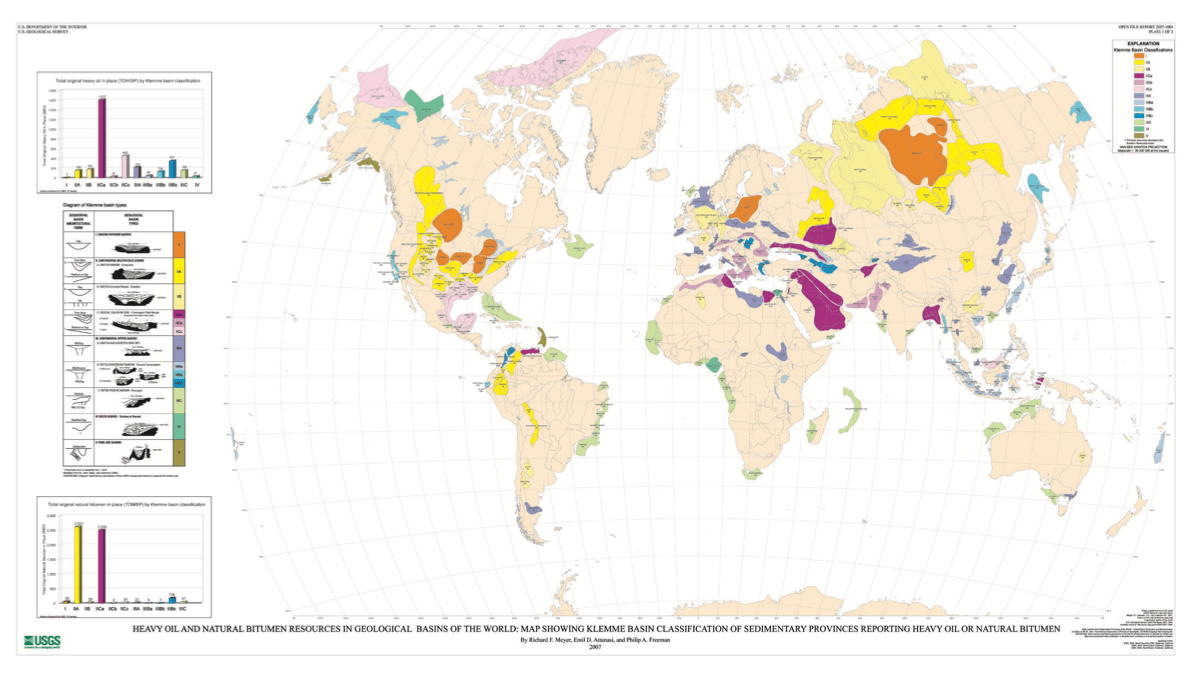
The United States Geological Services provides maps of available heavy oil and bitumen deposits. Figure 6 indicates that heavy oil is widely available in North America, Europe, Russia, and the Middle East.
In 2015, the International Energy Agency published a report indicating that in its view, there were huge deposits of extra heavy oil and bitumen (EHOB) that could be accessed if the price of oil rose high enough for long enough (Figure 7). The same exhibit shows somewhat smaller availability of tight oil from shale. In fact, the US has been able to access a substantial amount of tight oil from shale in recent years.

In my opinion, in order to access the EHOB, the prices of diesel and jet fuel need to rise to a high level over the long term; the prices of gasoline and even lighter products don’t necessarily need to rise. If the prices of diesel and jet fuel rise high enough, for long enough, the price signal should work its way back to oil and gas companies, suggesting that they need to make investments in the direction of adding more extraction from EHOB. If this succeeds, it could perhaps relieve the problem of inadequate supply of diesel and jet fuel.
The prices of diesel and jet fuel are high now, but this is at least partly due to higher insurance costs and partly due to the extra costs related to shipping oil longer distances to avoid blocked straits. These extra costs don’t get back to oil companies in a way that encourages countries to extract more heavy oil. What is needed are permanently higher prices for diesel and jet fuel, relative to the price of gasoline, even if the problems with respect to the straits of Hormuz and of Bab al-Mandab, disappear.
[6] Today’s conflicts in the Middle East and Russia/Ukraine seem to relate to inadequate supplies of diesel and jet fuel for buyers of these fuels, and inadequate prices for sellers of the heavy/sour oils yielding these products.
Figure 3, above, shows that the total supply of diesel plus jet fuel has been low, especially since 2020. One issue that has arisen recently is “Who gets the supply of diesel plus jet fuel that is available?” Figure 8 shows that increasingly, it has been the poorer countries of the world who obtain the diesel and jet fuel that is available. Note that total consumption of the Other than Advanced Countries has exceeded that of the Advanced Countries since 2020.
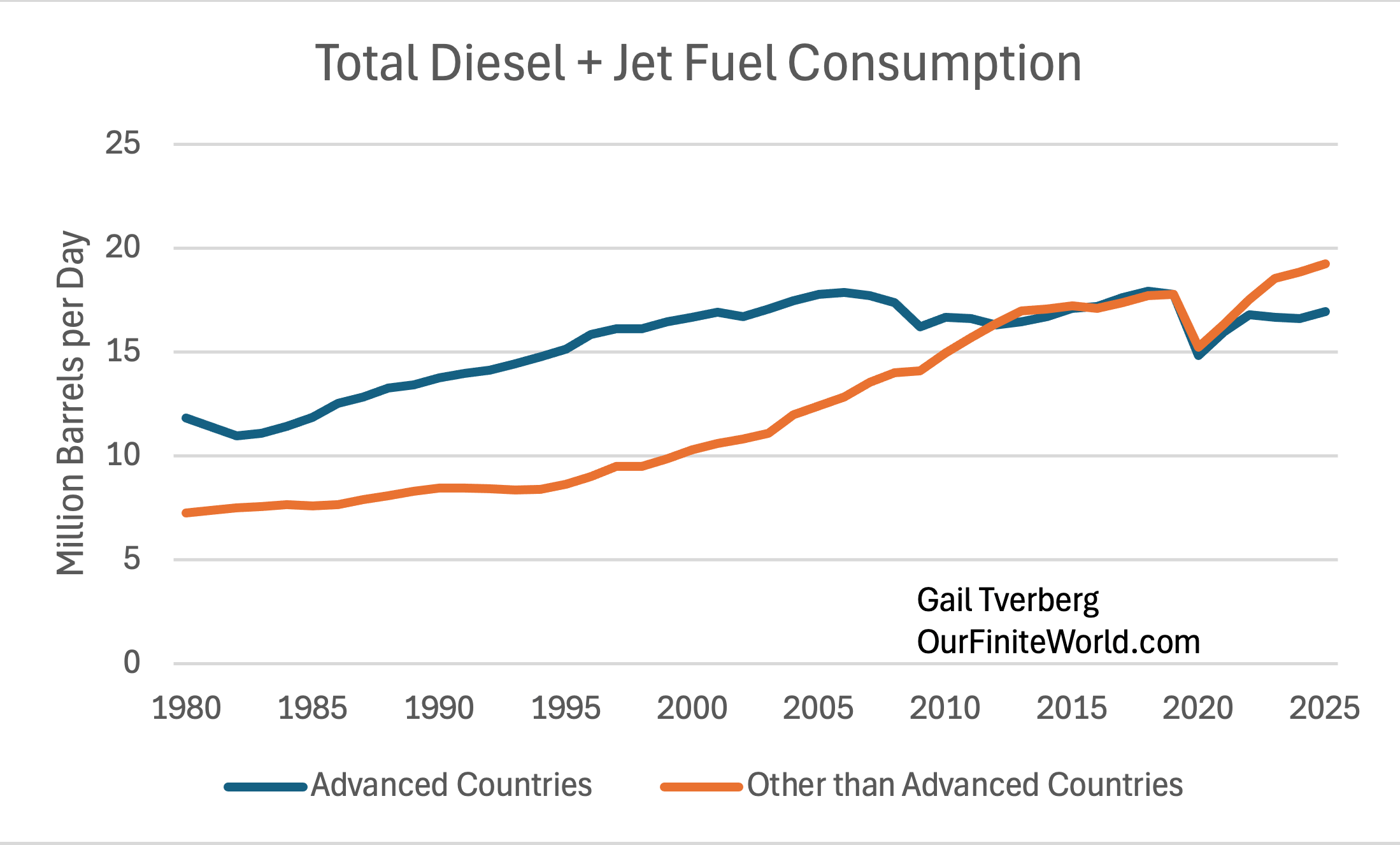
Figure 9 shows that for the Advanced Economies, per capita consumption of diesel plus jet fuel has been declining since about 2005–the time of peak conventional crude oil. The same figure shows that per capita consumption of diesel plus jet fuel has plateaued since 2013 for Other than Advanced Countries. I think of 2013 as the year that China first started encountering major limits on coal extraction (somewhat like the year 1970 in the US for oil extraction). In recent years, China has been able to raise coal extraction somewhat, but at a higher cost.

I would expect that countries in both groups would be dismayed by the situation shown in Figure 9. The per capita consumption of diesel plus jet fuel for the Advanced Countries has been falling for a long time. Partly this is the result of the economies changing to service economies. As service economies, the need for diesel by industry has been lessened. Wages tend to be less for many of these service jobs, making workers unhappy.
In Figure 9, people in the Other than Advanced Countries would tend to be dismayed by the continued wide gap between the standard of living of their own economy, and the standards of living in the Advanced Countries. Many of these countries export extracted resources that are ultimately sold as goods to people living in Advanced Countries. If the selling prices of these commodities were higher, workers in these countries could perhaps afford to have cars and air conditioning, like workers in the Advanced Countries. They would also be dismayed by the poor progress in raising their own per-capita consumption of diesel and jet fuel since 2013.
[7] Is there any possibility of greatly ramping up heavy oil production? Could it power a society like the one we have today?
We know that heavy oil production began long ago. For example, the first recorded production of heavy oil began in the Kern River Basin in California in the 1860s, and commercial production began there in 1899. The first production in the Canadian Oil Sands began in 1921, and commercial production there began in 1967.
The extent to which the oil that is heavy and often sour can be ramped up in the future remains to be seen. Extraction techniques have gradually been improving, and I would expect that they can continue to improve. But the cost of extraction and processing will likely remain somewhat high because of all the energy-intensive steps that are needed to provide diesel and jet fuel.
I expect that society itself will need to change in order to make use of this higher-cost oil. These are a few ideas I have:
(a) Oil exporting countries will need to change in ways that reduce their need for tax revenue. This is an issue especially in the Middle East, which has a huge population, in a hot, dry climate. The population will likely need to fall (for example, many migrants and guest workers may need to move back to their country of origin), and make-work projects will need to be discontinued.
(b) Another issue is that total diesel and jet fuel usage will likely need to be reduced because it is likely to take several years before production of heavy oil can be ramped up. Society will need to be reorganized in a way that uses less diesel and jet fuel. One idea would be to shorten supply chains whenever possible. Figure 10 illustrates one idea how this might be done.

(c) I expect that if such a change can be made, economies will need to gradually change in ways that are hard for us to understand now. The focus may need to be on essentials, including food and clothing. Governments may need to be smaller and provide fewer services. Communities may need to be smaller and more walkable. The total population may need to be lower.
[8] Conclusion
It seems to me that the self-organizing nature of economies will gradually push them in the directions they need to go if the world is to start incorporating a significant quantity of expensive products made from heavy oil into its energy mix.
We cannot yet imagine what all the changes will look like. In some ways they may resemble a recession, but there will likely still be an interest in greater complexity and in working to improve people’s lives.


Nasdaq is sliding again. The problem is Oracle today.
https://www.zerohedge.com/markets/5-days-later-oracle-slides-after-blowing-through-entire-four-year-hard-cap-one-morning-20bn
Another day, another hyperscaler scrambling to raise capital. . .
Last Wednesday, at its investor day, Oracle told the market it would limit additional capital raises to $20 billion for all of FY27 through FY30, split $10 billion equity and $10 billion gross debt. The stock soared 10% on the news. Five days later, Oracle is selling… $10 billion in bonds. Put differently, the entire four-year debt allowance is gone before the ink on the investor day slides is dry.
And then, just as we were writing this, the other shoe dropped:
So that’s $10 billion in bonds plus $10 billion in stock, or the full $20 billion “cap” for FY27 through FY30 raised in a single morning. . . . That’s FOUR YEARS OF FUNDING IN FIVE DAYS!
We have had ORCL, GOOG, and META announcing over $60B in debt issuance in the last 24 hours. Meanwhile more circular finance deals between Broadcom and Anthropic were annonced. Im sure everything i fine.
Traditional schooling in Denmark is increasingly losing its ability to accommodate diversity.
Children often prefer meaningful, practical activities around the home, in the garden, or looking after chickens rather than spending their days in large, highly structured school groups.
https://youtu.be/WHYAXgG-BUU?si=EWZFoxTksVeiLY37
Boys and men especially like being active and accomplishing something they can see. Sitting at a dest all day is not good for a person.
We have transferred a lot of active jobs to fossil fuels. Now, we may need to start transferring active jobs back to humans. Learning how to do the jobs with less or no fossil fuels would be helpful.
Home schooling is legal in the UK and USA. I looked online and it appears to be a constitutional right in Denmark.
The UK has a charity called Education Otherwise, set up >40 years ago. It helps parents and others who find themselves in a dilemma because ‘school’ wouldn’t suit their children. I’m considering leaving money to EO, although I have no children myself.
In more authoritarian countries like Germany, home schooling is forbidden. Awful (in my view).
The major threat to Western economic dominance is that the BRICS+ countries are orienting themselves away from the US and the US dollar, while simultaneously sitting on other material resources that are critical to the economy.
If we look at the ratio between total debt per capita and diesel availability per capita between East and West, it becomes obvious that biophysics wins the war over money as the future steering mechanism for the economy.
This is a chart I posted a while ago.
If a person considers resources in Canada and Venezuela, the Americas has an advantage in future diesel fuel (assuming that we can put together resources to allow the production of the very heavy oil). The Americas likely has an advantage in arable land per capita. The Americas tends to have more fresh water per capita, as well.
Gail… don’t you think this war on Iran was inevitable even if the US were to lose? At least the disruption would buy time for the West to reorganize their economies based on a world with much fewer resources. In this way, the West continues destroying supply chains, infrastructure, etc which prevents the East from growing further? Also that’s why the war against Russia still rages. Both wars are linked (East Vs West). I think that’s why these wars on going to continue much longer. And like you pointed out, there will be more cyberattacks, etc. as these are more economical. I find Prof Robert Pape informative however, he still lives in the old world. He sees this war as started by Trump and his administration, however, I see it more like Trump is working for several groups of Elites who are trying to do what the Romans did when they moved their capital from Rome to Constantinople? The difference is now there is nowhere to go but build “Fortress America”. Just to be clear, I have become non-political. I used to be on the Left until Bernie lost to Hillary and that’s when I woke up. Soon after this, I discovered your work and the way I looked at the world all changed.
If we think of East and West being the two hemispheres I showed previously, you are right. The system cannot “afford” all of the diesel and jet fuel to continue sending goods and services across the Atlantic and Pacific. Somehow, a change must be made. The self-organizing system somehow picks out a way that will at least somewhat work. If the US loses the war, it will have bought time, and it will have a better chance of having at least a little fossil fuel energy per capita.
Europe will be abandoned, as will Japan, Australia, and New Zealand, except to the extent they can provide goods and services to the West.
In April, I wrote this article:
https://ourfiniteworld.com/2026/04/02/losing-the-iran-war-may-be-the-best-outcome-for-the-world/
In May, I wrote this article:
https://ourfiniteworld.com/2026/05/12/china-and-us-trade-talks-a-solution-for-oil-shortages/
thank you… I’m going to re-read those with the events that have happened since then.
The physical (oil coal, minerals, fresh water, fertilizer ) and the fiat (debt, derivatives, phantom collateral) are both ends of the candle analogy of our IC (industrial civilization.) Either one alone is enough to consume the candle, but when they are both burning they meet in the middle that much more quickly. But how fast does the candle burn? IDK.
General-purpose money burns oil to grow; without fiat debt, the economy would have crashed back in the 1970s. Without oil, industrial society would have collapsed a century ago.
As long as there are resources suitable for human life to continue, there will likely be some human life continuing. Humans lived for many years as hunter-gatherers, using their control of fire plus gathered sticks to cook part of their food. In theory, there is the possibility that a small number of humans could go back to such a lifestyle. We would hope that the situation would not regress that far, however.
Following the collapse of industrial society, we could have a flourishing, innovative, and active local scrap economy, with scrap serving as a form of currency alongside other biophysical currencies in the barter market.
So, looking at all the destruction unfolding in Europe, I think it’s fair to say that this was the intended goal of the immigration policy adopted by the elites there—with one caveat: it wasn’t supposed to happen just yet.
I suspect they wanted the war in Ukraine to drag on longer, with the ultimate aim of winning and seizing Russian resources; however, the conflict involving Iran has accelerated the timeline.
The import of the biological weapon of mass immigration was meant to continue for many more years, and the resulting protests and destruction—now even extending to the shutting down of freezers—were intended to be more extensive and definitive, bringing about the total collapse of the energy-intensive European way of life.
What we are witnessing now is a smaller-scale version of this, occurring while the demographic profile still remains relatively favorable to Europeans, and with the possibility of setbacks—as we have seen in Poland.
I don’t think we have ever seen the global elites wield so much power, while simultaneously appearing so desperate and fragile.
Towards what ends and by whom / for whom?
The endgoal is in the text:
“bringing about the total collapse of the energy-intensive European way of life.”
You cannot return the first world peoples back to middle age conditions by telling them the truth, there is the need of a catastrophic event to be blamed on.
Just imagine being ignorant about any energy-related matter, and then one day your leader tells you: fun is over, we ran out of gas, so we’ll now return to the middle ages.
What would you do? What you the people do? There would be widespread chaos, people would quit their jobs, spend all of their money, crime would be rampant, children would abandon school, utilities would stop working, people would burn their furniture for heat and there would be civil war and people would fights for scraps of food.
People mustn’t know the truth until the very end, or society collapses much earlier than it should.
I am trying to refine my view of the world power and decision-making architecture, both to understand and to increase prediction accuracy. So my questions were in that vein. It seems you ascribe more decision-making authority to European “leaders” than I do. I think they do what they’re told, but I still wonder who is providing the directions. I don’t have a clear answer – bankers and intelligence services is my hand-wavy guess, but that is still too non-specific for my satisfaction.
As for the “not telling the peons”, yes we’ve discussed this here many times, for example climate change CO2 reduction is a cover story for figuring out ways to reduce hydrocarbons consumption.
If I can enumerate:
The latter one is of course a weak attempt, with Ursula running into the arms of Carney, which should provide some fossil fuels at the expense of further cracking the West. But the first two are baked in the cake.
I agree with all this, but it’s overly vague for me. I’m still trying to resolve which groups are in command vs taking directions:
I’m not asking for an answer, just itemizing my thoughts.
These people have always been as factional as they are genocidal. Most of the time these factions can be accommodated somehow, look at the alternance of globalist and zionist US presidents. But there are internal dynamics which can be exploited by adversaries.
I remain of the opinion that il capo di tutti i capi is the Rothschild family, and I see no reason why at least Western banking families should not always have participated. It has been very profitable for centuries now. To wit, if banking families were to decide to fire a politician, or close the CIA, or abandon Israel, would they not be able to do it, by generating a huge media storm?
Yes, great way of thinking.
Basically, everyone looking deep and long enough at some point reaches this above enlisted level of understanding. However, I doubt we can go into much granular detail from our mere mortals vantage point.
The easy one first, Pentagon has been subdued decades ago already. It’s clearly being administered from layer above the generals and admirals of the day, and these staffers are three letter agencies – contractors – recycled material.. answering to $_layer.
The question about the true [ old money ] pecking order is the most complicated, while there are indeed books on the topic. Not following up the details, simply don’t know.
The issue we could have witnessed in recent decades though, is the relative power-weakness of the recently(past decades) elevated tech tri/billionaire class, simply their actual hands on network influence into the levers of the system is limited vs. the old money, that’s evident.
It’s definitely a quasi top-down structure.
The chaos as per MSM is just the d-d/y-y adjustments to events. Also there is some evident crapification of the over-all elite performance at play over the decades/centuries so that then produces most of the mishaps vs reality, simply a slow decay process..
Control over legislators is such a tight (perennial systemic oversight) that said proverbial “apple cart” can’t be derailed, realistically most of them are just following seniority pecking order rules etc. So, effectively almost 100% yet soft-control, hard control as per direct blackmail (files/records) on almost everybody exists but not needed to be exercised in daily fashion. You can see it on various committees per scandals of the day, in the end it’s always re-directed safely by the few key bosses (2-3decades at helm) to nowhere..
Obviously MSM plays large part in corralling this show..
“WHO’S RUNNING CHINA, REALLY? IT’S THE CITY OF LONDON, THE BANKS, THE DAVOS CROWD, THE BLOODLINES, THE GRAY MAN, THESE GLOBALISTA ORGANIZATIONS COORDINATING THEIR EFFORTS TO TAKE CONTROL OF THE WORLD”?
https://forbiddennews.substack.com/p/martial-law
Spot on.
As Ch.Martenson likes to say, no surprise as they are only/merely the 1% after-all..
Onto the subject (and fragility) more specifically, they over-played their hand in recent round (decade) by elevating up front (for rushing the agenda) such over-tragicomic figures such as Ursula, Kaja, Merz, Macron etc. These people are management D-/F category.. absolute rock bottom failures, and actually more over self-destructive as sheer ridicule-honey pot / targets.. in the open; plus they have it solidified even directly in their bloodlines DNA (as Ursula&Merz even come from previous round WWII failed Nazi/SS high command circle families)..
As any historian can allude you could fail in capacity as leader to profound degree, but when it comes to the unmasked ridicule phase, you are suddenly done for, even for the common ~uneducated masses..
That being said, they will likely have to turn to some last resort ” cornered rat ” tricks, like trying unleash utter chaos in terms of food and energy instability. And that to some extent already occurred – severing the energy link to RU – which is now seriously rerouting energy flow deals even to Africa all of places lol. So, the cutting Europe to size retribution is real, will continue, could be halted at some point, but say goodby to former status-opulence, this won’t return, that historical train left the station for good with the UKR-thing engagement attempt..
On the immigration angle, few dayz ago Alice Weidel the opposition leader (well top party in DE now) said it full open to msm, that come they in power next election, the eviction of ” ~5M ” of migrants out of the country is on the table. That means the very recent round of incoming migratory flows from Syria, Afghan, NAfrica, ..
That would be absolutely FORBIDDEN TOPIC NOT MENTIONING THE ACTION PROPOSAL just few months/yrs ago!
And obviously I don’t doubt various practicality deployment setbacks to it are/will be immense indeed..
Obviously the previous (decades) rounds of incoming migration “SHE” can’t touch now, Turks, Balkans, .. several dozens million now, but they are obviously assimilated inside a bit better comparatively speaking.
Also in terms of energy I doubt SHE/or any future DE govs could re-start all of these 17x closed NPPs etc. Simply, the damaged has been done to large extent already.
I will go out on a limb and predict that Weidel will reverse course if she comes to power, that she is a false savior. I don’t know this and it’s just a gut intuition, but essentially I predict a lesbian married to an African immigrant will not take the action necessary to deport said population, just as Vance cannot be trusted to deport when his wife is Indian and kids are mixed. So I lean towards her being controlled opposition that intends to betray the nation, like Trump.
I hear you – indeed it’s a possibility.
But the Trump thing is reflecting more of the US slow-mo deterioration path. While the migration flux to Germany was a rapid shock (and recent) phenomenon.. So, the antibodies among original public to it are still flowing strong..
As I’ve seen it in per my own eyes ~year ago, basically most of the young-ish migrants are not attending language or job/re-training programs during the day. Instead, they are ” occupying ” various city center parts be it parks, plazas and enjoying themselves (loud activities, low level fights, .. ) etc. The locals are trying to not enter/cross these areas or spent minimum time if directly in their neighborhood, say just going to empty their trash can.
Recalling once asking in such area a local guy as returning w. groceries for a direction, at first the dude was absolutely terrified and defensively tucked from the situation plus now stranger speaking to him, then he calmed down a bit realizing I’m not part of that omni-present mob in front of his house..
Weidl is just the friendly face, the necessary one to win elections. There is something much deeper and darker running through Germany and all of Europe. Philanthropy is a byproduct of abundance.
Alice Weidel’s partner is from Sri Lanka, originally. She is Asian, not African.
The AFD in Germany has two co-chairs. Alice Weidel, who speaks to the ‘W’ part.
She lives in Switzerland with her Sri-Lankan F spouse, + 2 children via surrogates — while paying taxes at a ‘legal’ address in Germany, which, in many countries would disqualify her from being politically active in, as not residing in X Country, Germany in this case.
Weidel supports Zio – Isr aggro, Isr. has the right to defend itself, yes, endlessly, etc.
The other co-chair is Tino Chrupalla who speaks more to the East, makes statements etc. in favor of Russia.
Both are opposed to continuing German support (money, arms, lending, etc.) to UKR.
https://www.dw.com/en/tino-chrupalla/t-60592646
I wonder whether the elites thought the situation through as well as you have.
It seems to me that the big concern of the elites was having enough young workers to support the growing number of citizens who would soon be on pensions. They may not have though through the fact that peoples from different cultures can be quite different and because of this, difficult to assimilate.
Elites in Europe saw that immigration in the US seemed to be going pretty well. Immigration from many European countries seemed to work out OK. Even immigration from Mexico and many Central and South American countries seemed to work out OK. The new people seemed to be hard working. The people seemed to integrate into the economy pretty well.
The catch was that the Central and South American immigrants were from people with values not too different from the US population. The majority were from backgrounds that were pretty much Christian. The majority of their ancestors were from European countries. While there were some American Indians in the mix, they tended to amount to a small share of the total.
The mix of immigrants Europe has encountered have come from very different cultures. They may also have very different abilities. Many of them don’t mix in well. At some point, European nations discover that they cannot live with the current mix in the schools, especially if funding for schools is already stretched. They discover that the welfare state is all too appealing to people who did not come from a culture where “getting ahead” was valued.
That is in fact the reason they say they’re doing it. But we can see that these are not the results. Immigrants are not only a net drain on finances and don’t work, making the pensions argument fall flat, but society is being forcibly changed to cater to them and their beliefs, and this is all to create social disruption, friction and hate.
I still believe this was not conceived by the immigrants themselves, but that they’re being used as scapegoats by the elites.
And indeed, elites didn’t manage to think that far. Until the 2014 crisis, none of that was happening, and it suddenly turned a violent shift into turbo immigration and several other ideologies, so it’s a very recent decision, probably because they saw no other way out. Around that time, Maidan happened in Ukraine, so it’s all connected.
Yes, they are juggling so many scenario balls, it’s interesting to watch their re-balancing acts throughout the ages/decades.
For one thing, the CHNs are now building ~2x nuclear subs per year. Apart from some specific outliers, they are manufacturing everything on par to the former western production. The RU will have soon star-link like comm. sat constellation of their own, although with fewer deployed units, but perhaps good enough for their purposes, etc.
So, the opportunity window ” to action ” shrinks each day so to speak..
What is interesting is the looming pecking order :
US+CHN+RU, and EU demoted to way lesser status..
And that’s perhaps for immediate ~now, while for the next 5-15yrs the CHNs are slowly preparing their economy for ~3.5workday week only ! Eh?
Basically, the “old commie” vision to be realized, pop fully saturated and having space to enjoy themselves.
But that’s obviously w.out major war etc.
‘But this is evasion and deception. The mass immigration of the past decade wasn’t caused just by the absence of transitional controls on new EU member states. It was the result of a policy of encouraging immigration to generate economic growth – a policy NuLab copied from Bill Clinton’s America. In a
speech about the policy, then Home Office minister Barbara Roche said:
‘The evidence shows that economically driven migration can bring substantial overall benefits both for growth and the economy. In the United States, as Federal Reserve Chairman Alan Greenspan has commented, the huge recent inflow of migrants – 11 million in the 1990s – has been key to sustaining America’s longest-ever economic boom.’”
http://www.lobster-magazine.co.uk/free/lobster68/lob68-view-from-the-bridge.pdf
You guys put any stock in this? Apparently the Rabbi is a prominent speaker.
>> This is the Yemenite Children Affair (1950s) : Thousands of babies from poor Yemeni Jewish families “disappeared” right after birth in Israeli transit camps and hospitals. Parents were told their newborns had “suddenly died.” Many were reportedly kidnapped and either: 1. Sold for adoption to childless Ashkenazi families (in Israel and abroad), or 2. Used in medical experiments. Over 1,000 cases are officially documented. Some estimates go up to 4,500. In 2016, Netanyahu publicly acknowledged the state took “hundreds” of children without consent.
I’d never heard this story before. Mind you, that’s not surprising. The Jooze were back then the sacred victims who were above criticism.
“SEPTEMBER 10, 2026
United States on track for record crude oil production in 2026
U.S. crude oil production (Jan 2022-Dec 2026)
Data source: U.S. Energy Information Administration, Short-Term Energy Outlook, September 2026
Note: 1H2026=first half of 2026
We forecast U.S. crude oil production will average 13.8 million barrels per day (b/d) in 2026, surpassing the previous record of 13.7 million b/d set in 2025, in our latest Short-Term Energy Outlook (STEO).
In the first half of 2026 (1H26), crude oil production averaged 13.7 million b/d, 2% (0.3 million b/d) more than the same period in 2025. Most of this expansion is concentrated in the Permian region in Texas and New Mexico and the Federal Gulf of America.”?
https://www.eia.gov/todayinenergy/detail.php?id=68125
Is this just a high price effect? Of course there is little diesel in those 13.8 Mb/d.
According to the EIA analysis, higher oil prices are a big part of the higher oil production. The other reason for the higher production has to do with abnormally low hurricane activity. When hurricanes shut in the gulf coast and refineries on the gulf coast, it indirectly affects all US oil production, as well as imported crude from elsewhere. It is not just Gulf of America production that is shut down; it is all types of operations that are shut down.
According to the link:
Permian. We forecast Permian oil production will average 6.8 million b/d in 2026, 3% more than in 2025. Production growth in the Permian region is driven by higher crude oil prices.
Federal Gulf of America. Crude oil production increased by 0.2 million b/d (10%) in 1H26 compared with 1H25. We forecast oil production will increase 3% (0.1 million b/d) in 2026.
[Less hurricane disruption than usual] The latest forecast from Colorado State University expects that the 2026 Atlantic Basin hurricane season, which lasts from June through November, will have below-normal activity due to El Niño conditions.
” Chris Martenson
There’s a lot of confusion out there, including with Trump, that the US has lots of oil to sell to the world. We do not. We’re a net importer of crude (~+3 Mb/d). The EIA reports that fact in great detail every week. The confusion stems from using the term “petroleum exports” which includes the bodacious amounts of natural gas liquids (NGL) that come from our wet gas plays. That stuff isn’t “oil” and it is exported because it’s wildly overproduced compared to our needs. Yes, the US is a net exporter of “petroleum,” but it’s also a net IMPORTER of crude oil. In other words, the US has none to sell. There’s more complexity to why we export 3M b/d of crude (it’s the wrong kind for our refineries) and also import 6.4 M b/d of crude (which is the right kind). ” ?
https://twitter.com/chrismartenson/status/2039523704061772239?s=20
The construction industry is facing a challenging period; experts warn of a rise in insolvencies and pressure on margins
“This increase is already noticeable, to a greater or lesser extent, throughout the Central European region. The lower a company’s position in the supply chain, the greater the pressure on its margins. In addition, payment behavior in the sector is showing a negative trend—larger companies are hoarding cash, and smaller ones are then running into problems meeting their own obligations,” the expert said.
Translated with DeepL.
https://hnonline.sk/finweb/ekonomika/96311216-stavebnictvo-caka-narocne-obdobie-odbornici-varuju-pred-rastom-insolvencii-aj-tlakom-na-marze
The U.S. has proposed resuming Russian gas sales to the EU via Ukraine, with the proceeds to be deposited into a special account
“Revenues from resumed gas sales to Europe would be deposited into a special account in a third country so that Russia could not use the money to finance its aggression against Ukraine, the newspaper reported.”
Translated with DeepL.
https://hnonline.sk/finweb/zahranicna-ekonomika/96311154-usa-navrhli-obnovit-predaj-ruskeho-plynu-do-eu-cez-ukrajinu-vynosy-by-plynuli-na-specialny-ucet
Translation:
‘We,your enemies, who have been attacking you for years, causing enormous loss of life, and who have already stolen your assets which were within our jurisdictions, desperately need you to supply us with vital resources so that we might avoid collapse, at no profit to yourselves, and no less liable to be stolen with ease. ‘
As Gail says, strange world!
I do not understand your point. Russia invaded Czechoslovakia in 1968. A very cold country like Russia is energy deficient.
Soviets invaded CZE after several rounds (yr+) strongly issued warning they are slacking/lagging as in NOT full-filing their signed obligations in terms of mil. defense spending, chiefly in various AA infrastructure. Mind you CZE was country shaped as longish noodle from W.Germany upto Soviet/UKR borders.
Instead the CZE govs engaged in various internal schemes, which political faction takes over. Obviously, the ascendants quasi-liberals where supported in Western msm.. as heroes and mavericks.
Again, from simply cold-war logic the CZE clearly provoked the invasion on themselves..
The fact your parents assuming in SK or mass media don’t tell you these very basic hist. facts up to now is NOT our problem..
You are entitled to your opinion, but the historical experiences of people in Central Europe, including the 1956 Hungarian uprising, tell a different story. So your statement remains just that – an opinion, not a reflection of the reality of pro-Russian repression experienced by ordinary people.
Maybe MG could not cope with the complexity and slapped a concocted western narrative into his consciousness.
You are talking nonsense because you never had to worship Russian communist gods at school, at work, or during political demonstrations, as ordinary people in Central and Eastern Europe were forced to do.
Opinion hah??
No, merely historical facts, as presented-recalled by direct participant in that affair. It was featured in some history-vid on the topic. Basically, inner member of the CZE govs recalling all the ongoing complexities w. the Soviets at the time ( 1960s tail-end ), stressing this factor of (them Soviets) suddenly facing prospect of having ~1000km deep security cut into their defensive lines.. because of brewing ~coup in formerly allied country ( no bases there then ).
You are mixing apples w. orchestras on the HU-thing as well. As Magyar were direct participants of that coalition attacking the Soviets ~decade earlier ( 1956 ), completely different dynamics.
On the “pro-Russian repression” – double lol.
The Soviets were ” so evil ” during the WWII after-math yrs as issuing food support to the CEE region, while obviously still impoverished at home. Not mentioning the supplies of oil and gas in following decades well bellow world market prices.
Besides, for some strange reason Russians did have long term (cultural) affinity for Czechs/Slovaks, despite that during WWII they worked in factories producing armaments against them, with very little resistance movement participation, comparatively speaking. And if I’m not mistaken Slovaks even dispatched some smaller units to actually fight or support the invasion on the Eastern front.
Most likely, the bottom line remains.
Czechs have been for past +1kyrs always in some capacity under vassalage terms to Germans proper, which gave them some relatively ~solid consumption status in exchange.
Hence most of these people saw (internalized) that crushed ~1968 rebellion as the despicable Soviet intrusion into their old proven historical ~well being setup. Basically, in the lingo of OFW, the Soviets denied! Czechs their desired full MPP levels which the West enjoyed during the 1960/70/80s comparatively. That’s the ultimate sin of such hatred up to this point.
The fact 150k Soviets died delivering them freedom/survival from the nazi occupation has been pushed aside as unimportant old dusty ~irrelevant factoid.
Not nice, but evidently an human trait.
Not to defend the Soviet Union, but those troops were sent to quell the so called “Prague Spring”
The Soviet Union and its Warsaw Pact allies crushed the Prague Spring in August 1968 to prevent political and economic liberalization from dismantling Communist Party monopoly control and destabilizing the Eastern Bloc. [1, 2, 3]
Just like the situation we find ourselves today with Russia and Ukraine with NATO.
By the way, the West promised Ukraine would not join NATO if it became independent…hmmm.
Czechoslovakia was a key transit route for Soviet resources flowing to the West, so Moscow had a strategic interest in keeping it under its control.
Now Russia has lost control over Ukraine, and the consequences are obvious.
My guess is that actions such as this are probably not even crimes.
https://www.zerohedge.com/political/npr-reveals-democrat-scheme-rig-ais-deceiving-voters
NPR Reveals Democrat Scheme To Rig AIs Into Deceiving Voters
Democrats love to decry misinformation, and they do so for a very specific reason: to distract from the fact that misinformation and Narrative™ control are the most powerful tools in their toolbox.
Ahead of the midterms, some voters are turning to ChatGPT to help them decide who to vote for. When asked for information about candidates in some highly competitive races, NPR found that OpenAI’s AI chatbot cited a set of websites that are thinly veiled political ads made to look like reporting from local news outlets. . .
The genius of these sites is that they are not meant to be read by humans at all. They are designed to optimize for web crawlers and cross-link so the network appears far larger and more credible than it actually is. It’s the same principle used in academic journals, where citations serve as a form of credibility checking (“peers take this work seriously”), which has led to junk papers actually getting more citations because they create a web of cites that make them appear influential. . . .
What’s truly remarkable is how quickly these sites poisoned the information landscape, showing how sophisticated the operation is. The sites showed up in mid-September and almost instantly became authoritative sources in AIs that people use to choose which candidate to vote for.
I’ve been asking many things to AI lately, in order to have a clear idea of how is working.
I’ve experienced that if you ask about Sport it replies to you in a very reliable way, but if one makes questions about economics, society, geopolitics and so on, it is like to ask things to western mainstream in person.
So, if one needs to ask for something that doesn’t raise strategic issues relating to politics, society, the economy, finance, energy, national security and similar matters, it can go quite well; otherwise, it’s like asking the editorial team of a leading national television channel for something.
Basically, Wikipedia with a very grating voiceover?
I will continue to refrain from either.
https://www.theguardian.com/world/2026/nov/01/negotiators-braced-for-worst-over-us-iran-talks-to-reopen-strait-of-hormuz
Negotiators ‘braced for worst’ over US-Iran talks to reopen strait of Hormuz
Third day of indirect talks as Qatar tries to negotiate release of $6bn in Iranian assets that could lead to waterway’s reopening
We have heard a similar story many times before. It becomes difficult to believe what is claimed by either side.
https://senecaeffect.substack.com/p/confession-of-a-repentant-hydrogenist
Hydrogen cars: Zombies that Refuse to die.
A Ugo Bardi post on why fuel cell vehicles operating on hydrogen are extraordinarily difficult to make at a reasonable price. First published 20 years ago, it is still relevant today.
Some quotes:
Already in 1980, at Berkeley, we realized what the main problem with fuel cells was: the catalyst. . .
Today, after a good quarter century of work by many people, we face the same problem. PEMs still require platinum, and a latest-generation PEM requires something like $1,000 per kW of platinum alone; a fuel cell vehicle would have to contain platinum for a cost greater than the vehicle itself! Added to this are the fact that the membrane costs a lot, that platinum is easily poisoned, that the electrodes fail for a variety of reasons, and many other problems. PEM is still a long way from being able to save the planet like the heroic Geoffrey Ballard was said to be able to do.
But the problem isn’t just the cost; it’s the quantity of platinum. There isn’t enough platinum on this planet to build enough PEM cells to replace current road vehicles and realize the idea of a “hydrogen economy.” We knew this back in 1980, and it hasn’t changed much since then.
Sure, it can be worked on, but it’s not easy. When I look at the state of PEM research today, I’m somewhat amazed to see people still working on the same things we were working on at Berkeley in the 1980s, apparently with not much more success.
Yes, let me add, even if we were to somehow find a cubic mile of the stuff, we would still have the poisoning problem to solve.
IMPORTANT : The oil delivery system is now shifted another gear down . Now that the reserves are almost exhausted it is down running on commercial inventory . This like your savings account is empty and now you are paying your bills from your current account .
” Refineries hold the least crude in at least 6 years. Global crude stocks at refineries fell to about 1.71bn barrels on 26 October, per Kpler data. That’s about 55m barrels gone in 5 weeks, and roughly 115m below the 2020-25 average. This is the buffer the world was running on. Since the Iran war began, refiners have been drawing down their own tanks to keep running while Gulf crude couldn’t get out. From late September that draw turned into a dive. Saudi Aramco’s CEO said last month that more than 1bn barrels have been released from stocks since the crisis began. He added that only about 10% of what’s left is actually usable.
The US emergency reserve is at its lowest since 1982. When refinery tanks run this low, every late cargo shows up as a run cut, and then as a higher diesel price. That’s why Brent is back $115+ and oil companies are printing money as I explained here:
https://x.com/jackprandelli/status/2116923229453627634/photo/1
Using up the commercial inventories does sound like a problem. The fact that there are these different level of inventories makes figuring out what wrong will happen, when, almost impossible.
So Gail, the wise will prepare for the very worst to happen tomorrow, but, if the sun is shining today, go out to enjoy it.
The stray kittens Fatso and Gremlin are fat, happy, and ready for new homes.
They might end up on barbecue skewers in the next few years, but at the moment they are very much alive in the present!
A good example to follow (if we can trick our complex brains a bit).
I had marked 1st Nov as the date of a massive protest in New Delhi . As I write it is 6.30 pm there . Crowd was 500,000 minimum as per reports . Here are some clips .
https://www.youtube.com/results?search_query=massive+protest+in+delhi
Wow!
Cockroach 🪳 Party protest over the failure of education..or something like that with the young people…oh my…
You mean to tell me getting an education ain’t a ticket to success?
I remember reading a long while ago a Doctor had a father who was an architect during the Great Depression and was not employable and urged his son whatever you do don’t get a degree in architecture
Me and buddy went to Waters “The Wall” opening show in USA back in 2010. (Chicago, United Center).
It was incredible, best show I’ve ever seen. I remember that part where planes are dropping bombs and turn into corporate logos like Mercedes. And then changed into the star of david dropping. And people in the crowd, gasps. (like damn, he went there)
So the media claims the military is preparing bases to run without power for 90 days.
Why?
I think there’s going to be a massive oil and gas shortage. And the government needs to lead by example and try to cut their own consumption down. Same reason the EXXON and Chevron CEO’s just canceled their trips overseas. This is also why governments are warning people to stock up on groceries. And on side note. I live where it snows 80 plus inches a year. And whenever a huge snowstorm comes people mob the grocery stores. Since you usually have 3 or so days of warning ahead of time. (just in case their snowed in or can’t go very far due to the road conditions). Which would be very similar to gasoline shortages.
So that’s what I think is coming..
Another possibility is that they plan a large attack on Iran and assess that Iran, Russia, or China may retaliate with cyber-attacks that result in power or banking outages or worse.
I would agree with the possibility of cyber attacks. Now, with AI widely available, we don’t even need an attack by Iran, China or Russia. It could simply be an attack by some computer nerd who has figured out how to use a version of Chinese AI for this purpose. It doesn’t have guard rails to prevent this kind of thing.
Who knows?
It doesn’t really matter what They are planning, we should just take care to look after ourselves (and any nice neighbours and family).
The three days of food which govts are generally recommending isn’t even a fart in the wind, to use a vulgar but vivid expression. Worthless in a serious emergency.
I know two classes of people: the very rich, and average people – neither group is taking this official advice, or even discussing it, anyway. The only exception being a former soldier.
The Iran and Russia wars, and the implications thereof, haven’t impinged on their consciousness one bit – incredible, but true! Don’t even think about Peak Oil and Peak Everything. ….
They are just background noise to kids, vacations, work and house decoration. They live in a collective delusion of perpetual normality.
It is very pitiful, but also somewhat contemptible, in people who are supposed to be mature and capable.
But do fish ever imagine that the ocean could disappear one day?
So one shouldn’t be too hard on them, I suppose.
As a practical matter, it is difficult for everyone to keep a large amount of supplies on hand. Water and some method of cooking are needed, for longer than a very short emergency. If available water is not pure, there needs to be a way to filter and boil it. These details are difficult for someone in an apartment to manage.
How do you fight a war with a global oil shortage happening?
First, airstrikes don’t materially impact global oil consumption. Second, I increasingly fall into the Michael Yon camp: the oil shortage is the goal, not the unanticipated consequence. Under this paradigm, Trump isn’t making decisions and the domestic economy is not the top priority.
If there is a global oil shortage, there is an incentive to use AI to take down the electric grid or the water supply of an opponent. AI approaches seem to require less direct use of fossil fuels than sending soldiers to attack a country.
And the oil shortage would make repairs to the damage caused by a cyber attack so much slower, or even effectively impossible.
We’ve come a long way since the first man was killed by a sharpened stick…..
Linux servers are vulnerable to remote root access (i.e. full machine takeover by malicious actor) exploit via TCP connections. TCP is fundamental – in other words, this is really really bad. AI is revealing vulnerabilities and flaws in software at a rapid pace. Our hardware and software is too complicated to guarantee secure.
>> Linux’s October 2026 TCP Use-After-Free: CVE-2026-98432
>> CVE-2026-98432 is a CVSS 9.8 remote use-after-free in Linux’s IPv4 TCP handshake, fixed upstream Oct 15. Ubuntu and RHEL haven’t shipped a fixed kernel yet.
Imagine “investing” your money in some random digital token run by who-knows? And then the fake money goes poof. A fool and his money are quickly parted.
@solidintel_x
INTEL: Bitcoin staking protocol b14g hit by exploit as 97 million CORE tokens are drained
Oil Refineries Become Prime Targets as Global Fuel Shortage Worsens
By Irina Slav – Oct 28, 2026, 6:00 PM CDT
The global refining crisis is worsening, as war damage to Middle Eastern refineries and Ukrainian drone strikes on Russian facilities severely restrict fuel supplies
Russia is gradually restoring refining capacity, but shortages persist, with Trump’s proposed diesel deal offering only limited relief to tight global markets.
https://oilprice.com/Energy/Energy-General/Oil-Refineries-Become-Prime-Targets-as-Global-Fuel-Shortage-Worsens.amp.html
https://www.axios.com/2026/10/31/irans-supreme-leader-maximum-response-us-attack
Iran’s supreme leader orders “maximum” response to any U.S. attack
This article displayed from this address (but not from the link above):
https://news.google.com/read/CBMihwFBVV95cUxOcklRbXFqZnZtWHlsU2NLNVdnY2l5ZXlHQzZtYmFiMWFWOWlPbzFVME1YU092WjV5RjlRLWdzanVfOG1nbUpsUWxuT1hLeGRLZ0dQZmlOOGNveklydEdmWkVzRE82eDdpQ2VzRUhYZmFHSjNmWm5VV3hzaEZ5VkxlWGE0dEt0aW8?hl=en-US&gl=US&ceid=US%3Aen
Sorry, link doesn’t work
This link should work and you won’t get any of the misrepresentation that corporate media are well known for.
https://www.tasnimnews.ir/en/news/2026/10/31/3736710/leader-orders-iran-s-armed-forces-to-swiftly-counter-any-threat.
Brigadier General Hossein Mohebbi has also reminded people of what comes next.
https://en.mehrnews.com/news/249070/Renewed-war-with-US-to-have-no-geographical-limits-IRGC-spox
In Britian, our armed forces have now been designated as a terrorist group and our ss as hostile actors. I’m not sure why the ss aren’t designated as terrorists, given the obvious history of terror that follows them wherever they go, because the Iranians would be well aware of that bloody trail.
If/when it kicks off again expect the Diego Garcia, Oman and Cyprus bases to get hit hard.
We don’t know if attacks could be made on Britain or even the US. Attacks might not be of the usual type. They might be attacks on infrastructure through the use of AI, for example.
I believe those attacks will come from within and I would think Russia gets the blame, but that’s from a UK perspective.
Could work in the US, but again, from within.
Will people fall for it?
Absolutely, would be a safe bet.
Iran wants it’s region free from western interference and so will be very kinetic in its actions and those actions will all be in service of their ultimate goal. Iran does not attack civilians, so I don’t see them being interested in attacking civilian infrastructure thousands of miles away, when those very civilians are against the war. Who might want those civilians to change their minds?
Kurt Cobb .
https://resourceinsights.blogspot.com/
Comment by Kurt Cobb .
Trump will almost certainly not have a Republican House which is where all spending bills originate. As for the Fed, you may very well be right as every major dip in AI stocks gets a response from the Fed to keep the party going. I’m guessing that the gravity of useless data centers unable to pay their bondholders, the lack of any actually profitable use cases for AI in most businesses except perhaps surveillance, weapons and hacking (Is hacking really a business?) and a crack in investor confidence will overpower the central banks. If the central bankers are so good at preventing bear markets, how did we get the tech bust in 2000 and the great financial crisis in 2008? Central banks are not all powerful. I think we’ll find that out once again before too long.
>> If the central bankers are so good at preventing bear markets, how did we get the tech bust in 2000
well the fed hadn’t yet blown up its balance sheet. they will try again in the next crisis and unleash a tidal wave of inflation or outright fast devaluation, is my guess
This will be the catalyst for the gold price to eventually “go nuts”. In the meantime, it will likely continue a slow grind lower, discouraging speculative investors.
A plausible scenario
I am afraid that Kurt Cobb is right.
https://www.zerohedge.com/economics/frances-debt-alarm-gets-louder-fitch-cuts-outlook-negative-surprise-warning
France’s Debt Alarm Gets Louder: Fitch Cuts Outlook To Negative In Surprise Warning
One week after Moody’s maintained France’s Aa3 sovereign credit rating with a negative outlook, Fitch Ratings revised its outlook to negative in what Bloomberg described as an “unscheduled move,” citing softer economic growth, rising borrowing costs, a widening budget deficit, political fragmentation, and a challenging social backdrop.
“The Negative Outlook reflects a deterioration since our August 2026 review comprising weaker growth, higher borrowing costs and a wider deficit. Taken together, these worsen debt dynamics from an already weak starting point. Persistent political fragmentation and a challenging social backdrop increase the difficulty of delivering sustained fiscal consolidation,” the ratings agency wrote in a statement on Friday evening.
The Real Reason Why Europe Is Collapsing: Top Economist Explains.
Steve Keen. Oct 2026 Vid 15 mins
https://shorturl.at/aWHId
Against ne0-liberalism, say (?) Euro currency to be abolished. Keen points out that France’s private debt is double the Gvmt. debt, amongst other points.
As of November 2026, the convergence of chronic biophysical limits and acute geopolitical events has pushed the global economy into an unprecedented systemic crisis. Unlike past shocks, this is not a temporary supply bottleneck but a structural collapse driven by physical energy scarcity and over-leveraged financial plumbing.Part I: The baseline of this systemic crisis rests on five critical, compounding problems that paralyze the global energy architecture:
Deprived of sufficient net energy, the global economy is forced into an inescapable physical contraction. Because this crisis is structural, chronic, and protracted, it dwarfs the politically driven embargoes of the 1970s.
Part-2: That’s a possibility that came to mind; I think it might happen from, but I can’t be sure, of course.
As the physical energy shortage bites, the shock transmits rapidly into the international monetary system through the Eurodollar and foreign exchange swap markets.
When import-dependent European economies face structural fuel starvation, industrial giants and core sovereign borrowers—typified by France—reach the breaking point. France enters this environment with high sovereign debt, structural deficits, and a total reliance on imported liquid hydrocarbons for heavy transport, agriculture, and manufacturing. A soaring energy import bill combined with a plunging Euro pushes French sovereign debt and commercial banking solvency over the edge.
When French industrial companies go bankrupt due to energy starvation and French sovereign debt collapses, French commercial banks lose their collateral base and are cut off from short-term dollar funding.
When core allies like France, Italy, Japan, and developing nations reach the brink of dollar insolvency as the crisis progresses, the foundation of the global U.S. dollar standard shatters through three distinct, irreversible channels:
Thank you… very helpful to better understand all the complexities of our global system.
Diesel is a thing of the past; cars won’t get any cheaper. For 200 euros, we’ll start paying for them on a flat-rate subscription basis.
An era of operating leases lies ahead, predicts journalist Peter Kálmán.
https://www.sme.sk/closer/c/nafta-vymrela-auta-budu-drahsie-cena-lizing-netflix-expert
Good one, MG, and apparently it is correct. Actually, we are in a period of transition in regard to private transportation….car ownership is becoming a thing of the past with median price of a new car at $50,000 not including insurance and gasoline expense.
For my car now the insurance rates are intolerable and keep raising,
Yes, the younger generation now is opting out of car ownership altogether itself. Physics is dictating how we live our lives…one step at a time. It’s becoming a different world.
My Generation of Boomers were the lucky ones
Death in an “electric” hotel pool in India
“Two men, one from Slovakia, died in a hotel pool in India
The police have cordoned off the scene and are awaiting the results of the forensic examination and autopsy, which should help clarify the exact circumstances of the accident.
On Friday evening in Bengaluru, India, a 45-year-old Slovak man and a 57-year-old German man died in the pool of a five-star hotel, apparently after being electrocuted.
Two other men who tried to rescue them were injured and taken to the hospital. Police are currently investigating the cause of the accident. The Indian daily The Indian Express reports this on its website.
Police have cordoned off the scene and are awaiting the results of forensic examinations and autopsies, which should help clarify the exact circumstances of the accident.
According to media reports, the Slovak man worked for the technology company IBM, while the German man was a crew member of Lufthansa. The injured included an American staying at the hotel and a lifeguard. Both have since been released from the hospital.
According to sources at the hotel, both men were struck by an electric current after entering the pool. When two other people noticed them struggling for their lives in the water, they tried to help them. However, they were injured during the rescue, a police official added.
Translated with DeepL.com (free version)
https://hnonline.sk/svet/96310983-v-hotelovom-bazene-v-indii-zahynuli-dvaja-muzi-jeden-zo-slovenska
Euros in South Asia do the damnedest things. If, on top of that, a Slovak was involved there is no telling what may happen.
https://www.independent.co.uk/asia/india/bengaluru-hotel-pool-electrocution-lufthansa-b3076780.html
I guess that, with infrastructure deteriorating, the future of electricity supply isn’t particularly bright.
MG, I just spent a day trip visiting Chicago here in the United States. I was looking out for deteriorating infrastructure and saw many examples in roads, and especially bridges and ironworks rail for the above ground subway tracks. Lots of work crews out replacing, fixing parts …Like most cities in the North East Central much was put together over a half century or more ago…Don’t know how we will deal with it
Shocking!
Shocking ? Not at all . Such accidents such as electrocutions , drownings , bricks falling on predesterions , stampedes etc are dime a dozen in India daily . The only difference is that now it a European involved .
My comment was actually an allusion to a quote from a similar scene in the James Bond film “Dr. No”.
What, you expect me to talk?
No, I expect you to die, Mister Bond…
You beat me to it.
The Binance hackers are allegedly NK. That would mean NK is hacking China, who is something of a partner now. Seems dubious. This then calls into question prior attributions to this group.
You do not need a big organization to execute this heist. It could have been anyone.
A single individual could even have done this.
I read that the destination wallets were allegedly the same as used in hacks previously attributed to Lazarus / NK.
This sounds like a turning point:
https://www.wsj.com/finance/the-new-bottleneck-in-americas-ai-build-out-a-shortage-of-cheap-money-0c14c84d
Wall Street Is Starting to Call the Shots in America’s AI Build-Out
Lenders and investors are getting choosier about their bets and demanding stricter terms, as the AI build-out enters a new phase
A new day, a new leak in the AI boat. It can’t be long now, specially with USrael contemplating nukes in Iran.
The IPO is getting shaky .
” Blackstone warns Anthropic will stay junk grade after IPO, curbing funding hopes “
https://biz.chosun.com/en/en-it/2026/10/31/J27HP45J3JBSBJQWAXJXAPVR34/
Related things that are expected in the near term. The IPO seems unlikely to do well:
Some institutional investors, including large insurers and pension funds, restrict large-scale investments in speculative-grade borrowers. In that case, Anthropic may have to accept higher borrowing rates to raise funds or rely on guarantees from high-rated suppliers such as Broadcom and Nvidia. . .
Anthropic, the developer of Claude, is pushing for a Nasdaq listing in November, aiming to be valued at up to $2 trillion (about 2,700 trillion won). If large-scale fundraising proceeds as Anthropic expects, observers say it would be the largest IPO on record.
So now we will have companies worth $1+ trillion whose bonds are rated as “junk”.
Toto, we are not in Kansas anymore.
I agree!
Another headline today:
https://www.wsj.com/tech/ai/openai-raises-less-than-half-of-30-billion-target-in-latest-round-91aecdc5
OpenAI Raises Less Than Half of $30 Billion Target in Latest Round
The ChatGPT maker’s latest funding round values it at $1.25 trillion, less than its $1.4 trillion target
OpenAI has raised less than half of the $30 billion it had initially targeted for its latest funding round, with market jitters over the AI trade dampening investor appetite for one of the industry’s biggest names.
After receiving tepid interest from some large investors, OpenAI has so far secured roughly $11 billion in commitments for the new financing, according to people familiar with the matter.
Russia to extend diesel export ban until late January 2027 — Novak The Russian government is preparing to extend its diesel export ban until the end of January 2027, with certain exceptions for global markets, Deputy Prime Minister Alexander Novak told reporters. “Yes, a government decree is currently being drafted to extend the ban on diesel shipments until the end of January next year – effectively for three months. However, as before, specific exceptions will be made for supplies to global markets,” Novak said. Novak told TASS that Russia was beginning to lift its diesel export ban ahead of schedule. He noted that Russia had already dispatched three tankers carrying Russian diesel to the United States, with a fourth scheduled to depart on October 29. Russian companies may export 500,000 tonnes of diesel in October under agreements to supply the US and global markets. (TASS)
An analyst wrote on the middle distillate problem .
1/3 rd is SoH
1/3 rd is refining capacity
1/3 rd is Ukraine war
So no solutions . FUBAR .
Official .
The Government has extended the temporary ban on the export of certain fuels by producers
Decree on extension of the ban on diesel exports signed and marine fuel, as well as gas oils exported from the territory of Russia direct producers, until January 31, 2027 inclusive.
The decision is taken to maintain a stable situation on the internal fuel market.
The general ban on fuel exports is valid in Russia until January 31 2027. At the same time for direct producers of diesel and marine Fuel and gas oils the restriction was imposed on October 31, 2026.
It is pleasant to think that the problems will be fixed by January 31, 2027.
SoH = Strait of Hormuz
The farce called Poland is dying in front of our own eyes.
Woody Wilson, who never visited Europe before 1919, refused to recognize the Brest Litovsk treaty, which would have shorn everything from Reval (later called Tallinn) to Yuzovka (now called Donetsk) to the central powers, so the Poles and Czechs could have their own countries
I wrote about Czechia a few times so won’t repeat again, but Poland is a medieval institution , even now, and it is being shown.
Despite of the writings of Sienkiewicz, who did not bother to live in there, Poland never really left the middle ages. I cited the example of the book Chlopi (peasant), written by a Wladyslav Raymont, who actually lived there, where peasants in 1905 still behaved like it was like 1605.
Nathaniel Hawthorne wrote a book called the House of 7 Gables. Tl, dr, a guy is executed for witch trials so a powerful judge could steal that guy’s house and his son, under another name, manages to steal a land title, as big as a New England state, as a revenge. At the end of the book, as the judge’s last descendant perishes, the executed guy’s descendant reveals the document, now worthless, and says the Judge bartered the house of the guy for a New England state.
Woody Wilson bartered the entire central europe for two good-for-nothing countries.
But you will agree that its ending is somewhat similar to the farces named UK and France. The latter two were once great powers, but resource depletion does not look at details like culture.
A good bird’s eye view of the crisis .
https://www.moonofalabama.org/2026/10/a-not-very-elegant-coup-in-poland.html#comments
Someone asked me if i would share the meat of my dog in an emergency situation. My answer was, i don’t know. But bring your own cutlery.
More importantly, would you share Grandma too?
Fast Eddy would like that joke!
FastEddy where are you?
Maybe Norman would know…or Tim perhaps?
Fast Eddy went on a road-trip through the Australian outback and got eaten by aboriginees. No posts since April.
https://fasteddynz.substack.com/
ivan, thank you for this; maybe he’s on a walk-about with the Aborigines seeking enlightenment.
That would be nice.
Reports of his demise are somewhat exaggerated.
He’s popped up on other SSs recently, one about COVID-shot cancers.
Also, he appeared in John Campbell’s recent SS article on mysterious white clots, where he blasphemed against the Father and the Son, and mocked believers.
I am posting the link here so we can all avert our eyes!
https://johninengland.substack.com/p/unusual-white-blood-clots/comments?utm_source=substack&utm_medium=web&utm_campaign=post_viewer
It’s not the dog that gets eaten.
You may be right.
Since it hasn’t been posted yet, supposedly a coup attempt is underway in Poland. Seems nuts – didn’t realize Poland was having problems. Apparently Tusk “suspended the President”.
WTF is he doing going to Senegal anyway?
Ukraine is on the verge of total collapse which will send millions more refugees westward into Poland and he’s traveling to Senegal?
If he’s pro-EU, probably planning how to import migrants 😉
I see that also RT reports it. Crickets in the italian press, with numerous new demonstrations now basically all over the peninsula. It is late now but tomorrow morning news will be interesting. This Poland thing is potentially huge.
Who is paying for it?
You and me.
So kulamity is Italian?
Who controls the army?
This is an article I find:
https://www.timesnownews.com/world/europe/poland-coup-what-is-happening-donald-tusk-karol-nawrocki-constitutional-tribunal-crisis-police-raid-article-156438230
Coup Claims Rock Poland: Police Storm Constitutional Tribunal As Tusk-Nawrocki Showdown Explodes
Poland has descended into a fresh constitutional crisis after police cordoned off the Constitutional Tribunal in Warsaw amid a bitter power struggle between PM Donald Tusk and President Karol Nawrocki.
The confrontation escalated after Korwin-Piotrowska suspended Constitutional Tribunal President Bogdan Święczkowski and his deputy, Bartłomiej Sochański, for one month, temporarily taking charge of the institution herself.
According to reports by Poland’s official news agency PAP, the suspensions were linked to allegations that the two officials had improperly discharged their duties and prevented legally appointed judges, including Korwin-Piotrowska, from joining the Tribunal’s work.
Another article:
https://apnews.com/article/poland-european-union-justice-protests-police-tribunal-67eda2e3a151e00038d85a5e894a2a72
Police secure Poland’s Constitutional Tribunal as protests erupt over court chief’s suspension
The pro-European government of Donald Tusk came to power in 2023 with a promise to restore the independence of the judiciary. Since then, the government’s efforts have been blocked by veto by two successive presidents aligned with PiS, including Nawrocki.
The information about the suspension of the president of the Constitutional Tribunal, Bogdan Święczkowski, was published on the website of the court around 6 p.m. local time. The website of the Tribunal went down soon after so The Associated Press could not independently verify the official reasons given for his suspension.
This year marks the one hundredth anniversary, or centennial, or centenary as we say in the UK, of the May 1926 coup that brought an end to democratic rule in the Second Polish Republic that had been founded in June 1919.
I expect Kulm will have something provocative to say about the latest development demonstrating that Poland is not a proper country.
Nothing is happening here. Just more jockeying for position. Life continues as normal. I’ll let you know if anything interesting occurs.
Thanks . Keep us updated .
Cheers!
As long as the Twining’s Tea manufacturing and packing plant in Swarzędz continues to operate, I’ll assume things are normal.
I can’t live without authentic English tea, picked in India, Ceylon or China, and blended, processed and packed in Poland.
According to the blurb,
The War on Iran, and the subsequent closure of the Strait of Hormuz, forced energy buyers to source crude oil and refined products from the United States. But US exports of crude to Asia have since collapsed, and are plumbing multiyear lows. Oil transport costs have skyrocketed, making American oil shipments to Asia non-competitive. Industry insiders strongly suspect that the increased oil flows through the Persian Gulf are a result of oil suppliers quietly paying Iran for safe passage through the Hormuz. Middle East suppliers are also selling oil on a “delivered basis” to buyers in China and India, thereby assuming all the transport costs and insurance risks.
According to Kevin Walmsley, the US is no longer exporting as much crude oil and products to Asian markets as it did early in the war, in spite of US oil prices seeming to be much lower than prices of oil from Middle Eastern countries. The reason this can be happening is because the quoted prices are on a different basis: The Middle Eastern countries quote a higher price, which includes shipping, insurance, and any tolls paid to Iran. Middle Eastern shippers seem to be willing to pay the tolls to keep their oil safe. They do not worry about US sanctions.
The US price is only for the oil–the buyer has to deal with shipping costs, insurance, and paying off Iran. Fewer ships are available because many ships are tied up on the longer routes and use of ship to ship transfer. The oil is less safe. The cost of transport including insurance is high, if ships are available. US sanctions seem to prohibit paying tolls to Iran.
Iran is happy with the current situation because it is making 10% to 20% of the value of the oil in transit fees. Even if Iran’s oil is not getting out, it is getting paid well for oil from other Middle Eastern oil that is getting out, according to Walmsley’s view.
I would observe that under this theory, it is possible that quite a lot of oil is getting out of the Middle East, essentially by paying tolls to Iran that are hidden in the cost of oil. This keeps the world economy operating much better than cutting off the oil completely. If his theory is true, the US “escort service” and the US blockade don’t seem to be very effective. For that matter, the new way of isolating Iran doesn’t seem to be working well either.
Intel s’achemine vers sa pire journée de son histoire, provoquant une chute mondiale des cours des puces électroniques
https://www.boursorama.com/bourse/actualites/intel-s-achemine-vers-sa-pire-journee-de-son-histoire-provoquant-une-chute-mondiale-des-cours-des-puces-electroniques-e85dfd645c3b94d905c98684898a56ac
Translation:
Intel is heading for its worst day ever, triggering a global plunge in chip prices.
Friday’s fall followed a spectacular rally in Intel’s stock, which had more than doubled in value this year, making it the darling of Wall Street and building on gains of more than 80% recorded last year.
The soaring demand for central processors that power responses from AI agents and chatbots has made Intel the big winner of this boom after years of lagging behind, while its efforts to become a leading custom chip manufacturer are also gaining momentum.
But the expenses required to develop its manufacturing business are straining its cash flow, and supply disruptions have limited its ability to capitalize on the growing demand for data center chips.
Intel’s PC chip business, which accounted for about half of its revenue in the third quarter, is also feeling the pressure of soaring memory prices, as suppliers shift production towards high-bandwidth chips used in AI systems.
Jay Goldberg, an analyst at Seaport Research Partners, said Friday’s selling spree reflected “a loss of confidence in management’s credibility.”
“Intel is producing too many chips for consumer PCs while the PC market is experiencing its worst period in 15 years, while it is not manufacturing enough for AI servers while the semiconductor industry is experiencing its biggest growth cycle ever. Poor planning is the cause.”
Intel is a money-losing dinosaur whose stock price rose from $15 to over $140 in less than a year for no valid reason that I can think of.
A good reminder never to short; you might be right in the end, but the path can leave you margin-called and broke.
$8.9 billion
US government equity stakes in Intel?
$8.9 billion later and they are still a money-losing dinosaur.
I guess that fact has suddenly dawned on everyone.
B has a very fine article, putting together a large number of non-oil pieces that have been disrupted by the Middle East conflict.
https://thehonestsorcerer.substack.com/p/the-persian-polycrisis-unfolds
The Persian Polycrisis Unfolds
One cannot hit a hole this big on global trade and expect to get away with it
Some excerpts:
Over the past eight months of the Iran war the initial supply shock has slowly morphed into a protracted and ever worsening global shipping crisis. Even as oil flows through Hormuz were recovering up to 75% of their pre-war levels by early autumn, the rest of world energy, sulfur, helium, fertilizer etc. trade has not moved a notch upwards. What’s worse, the war seems to have been stuck in a stalemate which could easily last a year or more to come, with no nuclear deal and no return to pre-war Hormuz shipping either. . .
This, now steadily worsening, situation has led to a number of pretty unusual anomalies. As the war has been limiting the availability of very large crude carriers (VLCCs) for the other global key oil trade routes—such as the US Gulf Coast to Asia—surplus heavy crude is being left in the Americas, even as Asian and European refiners are struggling to secure supplies. Again, a $150 delivered cost could not be offset even by record refined fuel prices… This situation has caused the prices of South American heavy crude and Persian Gulf oil to drop by $10 plus, compared to other, much closer to market grades. Physical oil prices thus began to fall, as Bloomberg reported, boosting premiums for nearby crude while forcing US and African producers to offer steep discounts. The price gap between Brent (a benchmark for Europe) and West Texas Intermediate (WTI) has never been wider. In Japan the volume of petroleum imports fell by 21%, while their value surged by 26%. India’s crude oil import bill over Q3 increased by almost $29 billion from 2025. That is anything but a return to normal operations. . .
Across Asia the lack of LNG has led to a return to coal, which in turn has created
shortages at coal fired power plants. In India, for example, small factories and households face blackouts as electricity demand soared amid warmer weather and much lower hydropower output. . .
Now GDP is made with added debt. This only works if interest rates are low enough and systems stay together well enough. This is, at best, a temporary band aid. The end of this system doesn’t seem far away.
https://edition.cnn.com/2026/10/30/tech/binance-crypto-heist-hnk-intl
There is talk in all the media of an enormous hack of Binance, which could amount to billions of dollars. The cryptocurrency market has responded with sharp falls in the face of what could be the biggest theft in history, or one of the biggest.
It looks like a suspected compromise in the custody or in the signature authorization process of Binance’s hot wallets.
This is the explanation I read in another forum.
The attacker gained access to the private key or to the automated signing system of the hot wallet “Binance 14.” They did not break Ethereum’s mathematics; rather, they stole/compromised the key in some way (a custody or internal infrastructure flaw).
The attacker used a “machine-gun” or “spray” signing technique to guess the exact transaction number (nonce) of the hot wallets.
Another example of using AI brute force to break things…
In Ethereum, every transaction from a wallet requires a unique sequential number called a nonce. Since Binance’s hot wallet is gigantic and is constantly sending user withdrawals, its nonce changes thousands of times per minute.
The attacker wanted to use the new EIP-7702 feature (introduced in Ethereum to temporarily grant smart-contract superpowers to a normal wallet). This delegation allows a third party to persistently drain the account without needing individual signatures for each token.
Since the hacker did not know which exact nonce number would be free due to the burst of legitimate Binance transactions, they generated and packaged 50 authorizations signed with Binance’s key into a single transaction (targeting a range of 50 consecutive nonces).
Only one of the 50 signatures “hit” the live number in that millisecond. That was enough to install a “sweeper contract” inside Binance’s wallet. Three minutes later, the attacker executed the contract externally and drained more than USD 3.5 billion in Ethereum and stablecoins in one go, without requiring any additional signature.
Binance co-CEO Yi He and former CEO Changpeng Zhao confirmed that user funds are covered by the SAFU insurance fund (which acts as a backstop in extreme situations), so the losses will be assumed internally.
Because this is a persistent EIP-7702 delegation, the hacker technically “keeps the door open” to continue stealing until the malicious contract is revoked. For this reason, Binance has frozen withdrawals preventively in order to rotate keys and clean up its node configuration.
The problem is not so much the magnitude of the event as the general distrust of the system that it could generate. This could lead to an exodus—perhaps controlled, perhaps not—of investors from this market. If the fear spreads to blockchain technology in general, we are facing a disruptive event of the first order.
Excellent post. Telegraphic summary:; hot wallets are evil. Cold wallets always, and get in and out of the internet as fast as possible.
>> The problem is not so much the magnitude of the event as the general distrust of the system that it could generate.
I disagree. The problem is the technology itself, or at least its implementation in the real world. That a bank transaction can be rolled back or frozen is a good thing when fraud or dispute is at hand. An average Joe cannot and shouldn’t have to know about private keys or Tor exit nodes and VPNs and hot and cold wallets etc. It’s all gibberish. Joe Shmoe needs to be able to walk into a bank, rember a pin, and everything else the bank deals with.
Aside, our software security model is also terrible. The complexity of these systems is way too high. And we’ve got backdoors galore. Humans are just not set up for this. We have a ton of 80 IQ people running around the world and we need a system that everyone can navigate, not just IQ 135+.
Also, you forgot to mention the alleged source, Lazarus hacking group, based on destination wallets.
@zapmethod
>be North Korea >1974: order 1,000 Volvos from Sweden >refuse to pay for them >2016: attempt to steal $951M from Bangladesh Bank >2022: steal $625M from Ronin Network >2024: steal $308M from DMM Bitcoin >2024: steal $235M from WazirX >2025: steal $1.5B from Bybit >yesterday: steal $6.3B from Binance >crypto hacks now make up 1/3 of the north korea’s foreign currency revenue >literally boosting the national economy by hacking our dumb ahh industry >national economy is just #gta and crypto #Hacks
I understand that Chinese AI such as DeepSeek lacks guard rails that might prevent the use of AI for hacking. US AI has built-in guard rails to keep programmers away from trying to do harm. (One of my sons has run into these guard rails, trying to use Claude to write a video game that involved steering a rocket.)
Without these guard rails, it would seem to be a moderately simple task to use AI to hack financial institutions, electricity distribution systems, or water systems. This would seem to be a big concern arising out of the theft from Binance.
I have long maintained that all the these ridiculous cryptocurrencies are in reality nothing more than inflation sinks.
At a time of our overlords’ choosing, all this “money” will suddenly disappear and be blamed on a Russian/Chinese/N. Korean (take your pick) hack or cyberattack, thus generating the required popular consent for all-out war with the alleged perpetrator(s).
You may be right.
“Inflation sinks” – that sounds interesting.
Imagine what our current inflation rate would be if all the money tied up in these cryptocurrencies was chasing actual goods and services instead.
Good point!
As I think about the situation, producing cryptocurrency does help the economy in some ways:
2. People working in the cryptocurrency field earn salaries. These add to world demand for products.
3. The availability of cryptocurrency allows people to evade some laws that they choose not to obey. For example, if people are forbidden to take large amounts of currency out of a country to buy homes or businesses in another country, cryptocurrency may help them work around this issue. It thus helps raise world GDP (assuming illegal activity is considered part of GDP).
4. I understand that cryptocurrency has generally been following Nasdaq up. As long as this happens, it acts like added debt, indirectly pushing the world economic system along. People feel richer. They can use the higher values to buy things they want. They can borrow against their values.
5. Of course debt bubbles tend to pop, and when this happens, the supposed value tends to disappear. This is what causes demand to drop. Cryptocurrency will tend to disappear, at the same time as stock market prices fall, and at the same time as home prices fall. Of course, derivative prices will fall at the same time.
6. The world economy is skating on thin ice today. Governments around the world have made way too many promises to their citizens for things like schools, paved roads, pension plans, and health care. We have reached limits with respect to the cheap fossil fuels and uranium needed to actually provide these things. Growing population and depleting resources of many kinds (including energy supplies) are both issues that prevent governments from providing the services that they have promised.
7. Central banks can try to bail the system out, but I doubt they can succeed. What is needed is much smaller governments, and probably much smaller population. International trade will likely need to fall, also.
This also adds to GDP.
A huge percentage of what we are currently counting as GDP is worthless garbage.
Agreed.
So, how’s gonna be this winter? The story matches with what we know, but will it happen?
https://pbs.twimg.com/media/HV1DvAPagAAu44r?format=jpg&name=large
Also, a very cold winter…
https://www.zerohedge.com/weather/uncharted-territory-arctic-vortex-could-break-earliest-record
EU energy policy has now been reduced to “Pray for a mild winter”.
LOL!
Scarcity is the best teacher.
The arctic vortex article does seem to suggest that cold weather could be ahead. We will have to wait and see.
The world economy is in terrible shape right now, with pretty much every rich country overextended. Governments have promised way too many benefits relative to what they can actually provide. They have been adding more and more debt, but this approach seems to lead to collapse of governments.
The global oil shortage is so bad EXXON and CHEVRON CEO”s wont even fly to ME.
Exxon, Chevron Executives Cancel Gulf Visit Over Security Concerns | OilPrice.com
Why?; they might not get paid and if they do, the cheque may bounce.
The gravy train is over for those BS ME Kingdoms…Uncle Sam ain’t going to be the Godfather for them anymore
Captain Picard has been beamed up for the last time. He was 86. Will Captain Kirk be at the funeral, I wonder?
We announce with great sorrow the passing of Sir Patrick Stewart yesterday at his home in Los Angeles, in the loving care of his beloved wife Sunny, following a brief and poignant journey with Alzheimer’s Disease and Lewy Body Dementia,” said a statement from Stewart’s rep. “He has been held in the warm embrace of family and friends, surrounded by live music, prayer, tears, laughter, and the kind of profound emotion that only he could inspire after a lifetime of devotion to us all.
“A brief and poignant journey with Alzheimer’s Disease and Lewy Body Dementia”?
I knew something was up in 2017 when the old luvvie went totally woke and entered the US political fray with a tweet mocking DJT: “Had the worst sleep of my life last night. But I was sleeping less than 300 yds from where Donald Trump sleeps. Could there be a connection?” He will be more remembered for that joke than for his totally convincing performance as Sejanus, the Roman dictator who ruled for a time under the Emperor Tiberius, in I Claudius.
I’m happy to say he was a great animal welfare advocate and a great dog lover. However, very sensibly, he was neither a vegan nor a vegetarian. In a breakdown of his lifestyle and wellness routine, he shared that his dietary staples included oily fish like sardines and salmon alongside eggs, olive oil, and leafy greens.
With a diet like that, he should have lived forever. Who would have thought he’d end up taking a brief and poignant journey with Alzheimer’s Disease and Lewy Body Dementia?
Here’s a BBC report on his life and death:
https://www.bbc.com/news/live/cq23dve8dgv9t
Following Google’s worst day in history.
Bloodbath for tomw!
Nasdaq 100 Futures Live Chart — NQ Futures — TradingView
That Nasdaq index is up precisely 500% over the past ten years.
It has a long way to fall.
Binance hacked for $6.3 billion –
This is what Wendy Webb just made a video last month predicting. They’ll steal everyone’s money and blame it on “the hack”.
The great taking!
Nasdaq now down over 3% for the day.
Fuel shortages now in Iowa
Iowa truckers face long delays for diesel at Magellan terminals – KCCI
Cythagoras on X: “@Jewelmama5 We ran out of gas and diesel in our southwest Iowa community earlier this week. Caseys can’t get trucks on normal schedule anymore. Nothing like making it to the next town with 2 miles till empty…” / X
Dearborn, Michigan stockpiles fuel to keep city services running
The city of Dearborn is preparing to maintain supplies to fuel muncipal services in the event of global supply disruptions.
The city is planning to “top off fuel reserves … to maintain and sustain municipal services in response to growing vulnerabilities in global supply chains and potential instability,” the city said in a news release Wednesday, Oct. 28.
The cost to stock fuel reserves would be up to $50,000 in emergency funds, the release said.
The goal will be to supply city vehicles and buildings, and sustain services in the event of a grid failure, fuel rationing or disruptions in fuel supplies, the release said. Examples of services the city would aim to keep providing include emergency services, transit, snow removal and “critical municipal infrastructure.”
Dearborn stockpiles fuel to keep city services running
Trump cancels all rallies this weekend.
Vance cancels all rallies this weekend.
EXXON and CHEVRON CEOS cancel trips to ME.
They all know the oil is “running out”.
Dearborn is where all the muslims live by detroit. Bet they got the “heads up” ahead of time. Also, you don’t stockpile fuel at current high prices unless you seriously think it’s absolutely necessary.
Of course, stockpiling leaves less oil for others. Not very many can stockpile. The system expect people will wait until they have used up their current supply, before purchasing again.
Problem is with quantity of supply coming to Magellan, together with high demand for diesel at harvest time:
As a midstream service provider, ONEOK transports and handles fuel and does not control the amount of supply entering the market. We continue to work closely with our customers, monitor market conditions and make operational adjustments as supply becomes available, while also looking for opportunities to increase our system capacity to meet supply demands. Product may also be available to customers at ONEOK terminals in surrounding areas.
Brandon WeicherInteresting (and frightening) video.
The host is Brandon Wiechert, who is an associate of Mario Nawfal, interviewing Mike Adams.
It seems that Pete Hegseth has recently announced an initiative requiring US military bases to figure out how to operate completely independently of the US electric grid, water, and sewer for 90 days. The concern seems to be that with the new powers of AI, especially Chinese AI models which have no common sense overrides regarding what users can do, attacks on the civilian electric grid, or on water, sewer, natural gas, or whatever are now very easy. Thus, civilian infrastructure can now easily be attacked through the internet by whoever wants to.
The US grid is already under stress. We are very dependent on China for repairs. If we are at war, someone one the other side could easily use cyber attacks against us. Or they could explode a nuclear bomb up high, causing an EMP issue.
Sulfur….thats one of the critical ingredients to worry about he spoke on, without it no modern life is possible..
The WSJ is claiming (perhaps falsely):
https://www.wsj.com/world/ukraine-pauses-strikes-on-russian-refineries-after-pressure-from-u-s-a9e512f8
Ukraine Pauses Strikes on Russian Refineries After Pressure From U.S.
Kyiv has temporarily halted one of its most effective operations against Moscow after complaints from Trump
Ukraine’s military has paused its strikes against Russian oil refineries, people with knowledge of the operations said, after weeks of pressure from President Trump shook Kyiv’s confidence in U.S. support.
The unofficial pause, which is expected to last until after the U.S. midterm elections but potentially deeper into November, began early last week at the height of a crisis in U.S.-Ukrainian relations, the people said. . .
Ukraine’s government hasn’t announced a pause in refinery strikes. . .
But Russia is continuing to escalate its missile and drone attacks on Ukraine’s energy infrastructure and its cities, inflicting a mounting civilian death toll.
Not surprisingly, Zerohedge is saying this morning.:
https://www.zerohedge.com/energy/ukraine-shatters-strike-pause-major-drone-attack-russian-oil-refinery-defying-trump
Ukraine Shatters Strike Pause With Major Drone Attack On Russian Oil Refinery, Defying Trump
Cuba is drowning in its own sewage. Hunger and disease are spreading across the island.
Approximately 3.5 million people lack access to running water.
https://www.sme.sk/svet/c/kuba-sa-topi-vo-vlastnych-splaskoch-ostrovom-sa-siria-hlad-aj-choroby
When my husband and I visited Cuba in 2015, the country already had a serious sewage problem. A person could never flush toilet paper, for example. The sewer pipelines had been built too small for the population.
A malfunctioning sewage system is a nightmare. The house I inherited from my parents had old cast-iron drainpipes clogged with calcium deposits. Replacing them was the first thing I had to do. I switched to larger-diameter plastic drainpipes.
It takes a lot of energy to dig up old pipes, often under streets. More energy and other materials are needed to make new pipes, and bury them. A poor country cannot afford to fix a way-too-small system.
This one is a good one
How Much Metal Does the World Mine in a Year?Key Takeaways
https://www.visualcapitalist.com/all-the-metals-the-world-mines-in-a-year-visualized/
All the metals the world mines in a year…and we live in a finite world
Perhaps this link will show the visual capitalist image.
Ironic, isn’t it?
More, more, is the cry of a mistaken soul…Tim,who said that? Hint..it may have been your buddy..Norman
Iron continues to be extremely important to the world economy. Norman nailed that one.
Iron. Nailed. Well done, Gail!
He will also be proven broadly correct, I think, in his prediction that as energy supplies dwindle, we will waste and destroy precious resources in fighting over what’s left.
Norman the Great
Norman is only 90 Mike. There’s still time for surprises at that age.
https://substack.com/@musicspeakss/note/c-363340158?utm_source=notes-share-action&r=7c6fx
https://www.zerohedge.com/economics/luxury-hotel-one-americas-wokest-cities-sells-shocking-94-loss
A luxury hotel in downtown Portland has sold for 93.6% less than its previous purchase price, according to the Portland Business Journal. . .
The steep markdown comes as downtown Portland continues to grapple with the fallout from years of rampant drug use, crime and deteriorating street conditions. . .
Portland isn’t the only city where a Royal Sonesta hotel has suffered a massive decline in its sale price.
A 360-room Royal Sonesta hotel in Minneapolis recently sold for just $5 million, a roughly 93% discount from its previous purchase price.
At a deeper structural level, however, Portland’s trajectory was also driven by macroeconomic contraction and a persistent decline in real disposable incomes. The 93% plunge in distressed downtown property values and the proliferation of street addiction were not merely reactions to lax law enforcement; they were the culmination of an economic squeeze that eroded household purchasing power, displaced lower-income earners, and hollowed out the urban commercial core. Therefore, while the coercive legal authority of the state is indispensable for reclaiming the streets from cartels, only active public economic stewardship can resolve the income precarity that set this crisis in motion.
The notion that “the market knows best” has collapsed into social and economic suicide in Portland, where unconstrained market forces have ignored the massive negative externalities of addiction, rising crime, and urban decay. While cartels profited by imposing a brutal order through raw supply and demand, the market, far from correcting this wreckage, undermined its own foundation—driving capital away and crashing select downtown commercial property values by 93%. Portland thus stands as vivid proof that a libertarian system surrendered to the “invisible hand,” without the coercive legal authority of the state, inevitably produces systemic social collapse.
First Stuttgart and now Wolfsburg .
” Volkswagen has just announced that the Group recorded a net loss of 5.82 billion euros from July to September. Volkswagen announced this on Thursday morning.”
” The golden goose Volkswagen is no longer shitting gold, and now the financial drama begins for the city!
Volkswagen released its figures today. From January to September, the corporation was left with just 100 million euros in profit.
The former golden goose, which supplied Wolfsburg with tax revenue for decades, is now faltering dramatically.
For the city, this could turn into a financial nightmare. Already, there’s a budget shortfall of 132 million euros.
If the drop in trade tax revenue persists, in my estimation, the deficit could explode toward 500 million euros.
Wolfsburg down! When the golden goose stops shitting gold, the bitter bill comes due for an entire city.
In the US, city tax revenue goes to pave streets and keep schools operating.
I don’t know what the direct effects are in Germany, but they can’t be good.
India’s biggest airline posts $ 200 million loss in last quarter . Half year total loss is $ 425 million . They are the largest buyers from Airbus .
Airbus Orders
Terrible for Airbus!
It is quite likely that Airbus’ market will be eaten up by the much cheaper Ilyushin (narrow and wide bodies) and the Chinese C-919 and 929.
Remember my dates — 27th Oct ; 1 st Nov ; 3rd Nov and now add 16th Nov .
1st Nov an opposition rally against Modi in India .
16 th Nov , IPO of Anthropic which will decide the AI bubble . My guess is that NYSE will find an excuse to stop this IPO . The risk if this fails is too high for the system .
https://indi.ca/anthropic-scam/
The Anthropic Scam
Anthropic is trying to IPO in November, before they have to disclose Q3 numbers that show the music slowing, and certainly before December, when the music stops. What does IPO really mean? . . . Initial Public Offering means offering the human public to inhuman corporations, providing fresh meat for the high priests of modern finance to exit, liquidly. The public provides the offering and the priests mutter some incantations and feast. Thus, today, ‘retail’ investors are being invited to buy into half-a-trillion in looming debt which depends on Americans spending as much as food on AI, and/or losing their jobs to pay. What could go wrong? What could go right is the real question here.
. . .
Do you see what’s happening here? A bunch of companies insider trading amongs each other ask you to book their gains and ignore their losses.
. . . It’s like investing money in a car wash, then running a bunch of your own cars through the car wash, and selling the business to some sucker who thinks it’s a real business.
As Ed Zitron says, Anthropic doesn’t mention its Q3 revenues (widely reported as down, while compute went up), amount of payments due on a yearly basis, amount of payments due in the next 12 months, its current (ie Q3) cash position, or its run rate.
. . .
White AI isn’t a growth engine that’s going to restart White Empire. It’s simply terminal cancer. AI simply hasn’t changed the world in the way these world-beaters need it to.
Sam Altman resents the fact that users are hogging all the chips in their PCs.
I cannot see how the IPO will go through as planned.
November is the most energy-deprived month, as the Sun retreats from the Northern Hemisphere.
Here in Central Europe, the collapse of the Soviet Empire began to unfold in November 1989, symbolised by the fall of the Berlin Wall.
I’m afraid AI is no Messiah born on Christmas Day, in the depths of darkness.
AI can reveal the truth about our limits, but it cannot abolish them.
Oh my, another bites the dust…
How many of these top military positions have been replaced now?
Come on, Tim, give us a count…or you do you need more fingers?
I’ll probably have to ask Norman; he’ll know for sure, he’s the smart one.
WHAT TO KNOW
These are links to Fox News articles. Other organizations likely have different views.
I don’t know what you are rambling on about this time, Mike.
Could it be that either you are suffering from Lewy Body Dementia or I am? There’s a lot of it about, especially since Covid.
A bit of context would be very helpful. Not providing sufficient context when making statements and asking questions is one of the classic first signs of Old Timer’s Syndrome.
The General Staff is being replaced by lap dogs, Tim
U.S. firms don’t want to take on the risks that would come with buying diesel from the Russians, in part because congressional Democrats say that Trump’s order violates sanctions laws, industry officials and energy analysts told The Washington Sun.
As the Russian ships approach the United States, the stage is set for a showdown between the private sector, the administration and Democrats. It represents a key test of the president’s unilateral authority with significant consequences for national foreign policy.
https://www.washingtonsun.com/whitehouse/trump-aides-leaning-us-firms-accept-russian-diesel
Actually, America is already indirectly buying from Russia anyway. Well then, what is the meaning of all this? Is it an olive branch to Russia, or perhaps another deception? https://energyandcleanair.org/publication/sanctions-hypocrisy-g7-imports-eur-1-8-bn-of-turkish-oil-products-made-from-russian-crude/
According to the article:
Imports of refined oil products from Turkey’s STAR Refinery, Tupras Izmit Refinery, and the Tupras Aliaga Izmir Refinery have generated an estimated EUR 750 mn in tax revenues for the Kremlin to finance its brutal war on Ukraine.
The Russian oil and gas sector is a crucial revenue stream for the Kremlin, contributing 32% to the federal budget in 2023, a decrease from 42% in 2022. Furthermore, the Kremlin allocated a third of all 2024 spending on the military.
The tax revenue received from imports by sanctioning countries of Turkish oil products made from Russian crude would enable Russia to recruit over 6,200 soldiers every month even after the new sign on benefits they are offering to those willing to fight in Ukraine.
“How the next eurozone crisis happens – French collapse is contagious…
“Once interest rates exceed a certain threshold, a doom loop sets in. Higher interest rates raise debt servicing costs, which drives up the budget deficit, which drives up borrowing, and which again drives up interest rates… Debt serves as collateral for the money the banking system gets from the ECB. If a country defaults on its debt, the banking system inevitably freezes up.” https://unherd.com/2026/10/how-the-next-eurozone-crisis-happens/
What Should France Do?
1. Separate Bank Collateral from Speculation (Managed Debt Restructuring): The banking system and daily commercial transactions cannot be allowed to collapse due to speculative interest rate spikes and sovereign “doom loops.” The state must establish a protective shield by forcing the ECB to accept French government bonds in repo and liquidity operations at par value (fixed nominal value) rather than fluctuating market prices. While international bondholder claims and speculative derivatives are restructured or frozen, the daily credit machinery that keeps supermarkets, pharmacies, and payrolls functioning must be kept alive at all costs.
2. Implement “Physical Energy Rationing and Sectoral Triage” Instead of Money Printing: Cutting interest rates and printing unbacked currency does not create a single drop of diesel or jet fuel in the physical world; it merely collapses the euro exchange rate, spikes imported energy costs, and accelerates destructive demand destruction. Instead of broad monetary stimulus, scarce diesel and nuclear electricity must be deliberately diverted away from luxury consumption, aviation, tourism, and financial services, and explicitly rationed toward agriculture, food processing, water sanitation, and basic freight logistics.
3. Launch a Pre-Collapse Localization Mobilization Against the “Cuba Syndrome”: If financial systems and global supply chains freeze suddenly, urban populations in Paris, Lyon, or Marseille—entirely dependent on global logistics—will be left utterly defenseless. Just as Cuba did during its Special Period, France must urgently establish local agricultural cooperatives around city perimeters, foster urban food production, and retrain the population in essential survival skills, food security, ecological agriculture and mechanical maintenance before a sudden crash hits.
4. Replace Austerity with a “Material Solidarity Pact” to Prevent Civil Unrest: Raising the retirement age or slashing social safety nets simply drives a population already crushed by energy inflation straight into the streets. When the net-energy pie shrinks, social peace cannot be maintained by dumping the burden onto the working class. The state must heavily tax and curtail private jets, luxury consumption, and capital flights, while guaranteeing every household a basic quota of heating, food, and electricity as a non-negotiable right to survival.
5. Abandon Geopolitical Hubris and Foreign Adventurism Immediately: France no longer has the luxury of masking internal economic decay by escalating foreign tensions. It possesses neither the financial budget nor the energetic surplus to sustain large-scale conventional military ambitions. Paris must pivot away from ideological foreign policies that cut it off from affordable pipeline gas and diesel, returning instead to pragmatic, long-term, direct energy and commodity procurement agreements.
6. Initiate a Revolutionary Shift in Education and Thought (Preparing for a Long-Term Crisis): We must openly confront the reality that we are not facing a temporary cyclical downturn, but a permanent, long-term thermodynamic and systemic contraction. Consequently, our educational paradigm must undergo a profound intellectual revolution. The modern obsession with mass university education—churning out millions of graduates for an over-financialized, service-sector economy that will no longer exist—must be fundamentally dismantled. Instead of funneling generations into white-collar credentials that lose their value in a low-energy world, society must pivot sharply toward practical, survival-critical skills. Young people must be systematically trained in regenerative agriculture, food preservation, soil science, mechanical engineering, plumbing, carpentry, and decentralized energy maintenance. Education must shift from abstract credentialism to hands-on, localized self-reliance, ensuring that the next generation possesses the actual physical competencies required to keep civilization functioning in a simpler, post-globalized reality.
This is really helpful… thank you for sharing.
You can force the ECB to accept marked-down French bonds as repo collateral at original face value, but you cannot stop the borrower from defaulting on the overnight loan and saying “The (over-valued) collateral is now yours.”
In a systemic collapse and hyperinflationary environment, banks face the risk of total asset annihilation, rendering traditional market rules entirely obsolete and forcing them to submit to any radical state intervention just to survive.
By “entirely,” I am referring to the situation described here, rather than all market rules in general.
In systemic collapse, the state must orchestrate a triage, letting secondary financial structures fail so that primary physical survival mechanisms can be preserved.
I am doubtful that this is sufficient. I expect that the European Central Bank (ECB) may fail. In fact, the life expectancy of the Eurozone is pretty low. France needs to figure out how it can get along on its own. Somehow, total governmental spending needs to be cut way back if the France is to continue.
People will need to prepare for situations in the future with much less heating and with perhaps weeks- or months-long electricity outages. Warmer indoor clothing will be needed. Methods of cooking will be needed that are not electricity dependent.
Leaders need to understand that taxes on luxury items won’t do much to fix the situation. Restrictions on travel may be needed to make the best use of what little oil is available.
Yes, you are right. But I think that transition must be gradual, stage by stage. I wrote down what needs to happen in the first phase. If we do everything all at once, it would be like someone from great depths suddenly surfacing—in such situations, the bends occur. In economics, the equivalent of that is a sudden collapse or similar outcomes, meaning the collapse could accelerate and spin out of control. That is why I think the transition should happen step by step.
There is also this: after a certain point, making the change might become extremely difficult, or certain things simply won’t be doable anymore. Perhaps in such a situation, living in big cities will become very difficult, even impossible. We understand this more or less from what Cuba has experienced: it is not merely a failure of the power grid, but a cascading breakdown of everything that sustains daily life—from water supply, sewage, and waste collection to transit networks, decaying infrastructure, healthcare, and schooling. What we are witnessing there is the complete unraveling of modern industrial society.
Actually, the probability of successfully navigating the first stage is extremely low, simply because we no longer have the net physical energy or the time required for such a transition. Consequently, once the illusion of printing money wears off, we will inevitably enter the second stage: a cascade of bankruptcies, widespread factory closures, and horrific, ever-rising unemployment. Unfortunately, because we lack the real energetic resources to overcome this bottleneck, the collapse will steadily accelerate, leaving the vast majority of people without adequate food, electricity, or basic necessities. Having failed to prepare adequately during the first stage, we will be unable to prevent widespread starvation and, tragically, mass fatalities. This phase will be brutally difficult; the state may soon find itself unable to pay adequate wages to anyone outside the security forces—and after a certain point, it may not even be able to pay them either. Beyond that point, I cannot even bear to think about what follows.
Christine Lagarde to leave the ECB on February 7, 2027!! Early departure by 8 months Official term until end of October 2027 . Read why ?
Her 2014 ‘We can do it!’ speech remains a mystery.
She knows the Eurozone is “dead man walking” and France is going to need a bailout followed by Italy . Rats leaving the sinking ship .
Rats fleeing a sinking ship.
Did you actually see her? She has bandages all over her face.
Do you have a link to a photo with bandages?
her official X
Christine Lagarde on X: “I have just informed my colleagues that I will step down as @ECB President on 7 February 2027. It has been a source of great pride to serve this institution. I thank all of those who have supported me on this journey over the past seven years. https://t.co/eSLLTaDAej” / X
“Just to avoid any social media chatter: the plasters on my face are due to a small surgery earlier in the week.”
She may have been scratched by her pet cat.
Or perhaps this is how the Rothschilds dismiss their staff.
But we should avoid any social media chatter, I suppose.
It just looks like bandages. Her skin looks like elephant hide.
Bad face lift?
Getting ready for the new identity?
I couldn’t find any bandages, but she is looking her age in recent photos. Mainly because she’s lost all her puppy fat and is looking bony around the cheeks and jaw. Or could it be too much Botox? Or the enormous stresses of Eurobanking? She’s 70, by the way, so she isn’t doing too badly for her age.
Probably skin cancer removal with how sun-damaged her skin looks in general.