
|
Getting your Trinity Audio player ready...
|
The nature of the shortage of diesel and jet fuel is more complex than most people realize. Based on my analysis, a shortfall has existed since at least 2020. The shortage is not simply the result of the closure of the Strait of Hormuz.
In this post, I will provide background information regarding the nature of the shortfall and the international conflict it is leading to. I will also share my thoughts on how, over the long term, the situation might be mitigated. I doubt whether a solution will be available in the short term, but I can at least give readers an idea of one direction in which a possible workaround might be available.
My idea is that the economy needs to transform itself in a way that uses diesel and jet fuel (grouped together on some reports as “middle distillates”) more sparingly. At the same time, research on extracting heavy oil and bitumen at lower cost is needed. If this is done, it may be possible to use additional heavy oil to increase the supply of diesel and jet fuel.
One thing that will probably need to change is the price of diesel relative to gasoline. The price difference will likely need to be even greater than it has been in the recent past because heavy oil is inherently more difficult to extract, refine, process, and transport.
[1] The interconnected nature of the economy means that inexpensive energy products are extremely important to the economy.
Energy supply and the economy are a great deal more interconnected than most people realize. For example, if the price of diesel rises, the price of food also tends to rise because diesel is used in food production and transportation. Similarly, if the price of gasoline rises, the additional cost also tends to squeeze budgets. Politicians see these price increases and say to themselves, “These increases will make voters unhappy. Let’s raise interest rates and see if we can get oil prices back down.”
Higher interest rates don’t affect everyone immediately, but they particularly impact people purchasing a vehicle or a home, and businesses seeking a loan.

Clearly, raising interest rates at the same time as energy prices are rising is “playing with fire.” If the economy is really overstimulated and growing too quickly, this type of approach makes sense. But if the underlying problem is that diesel and jet fuel prices are high because of inadequate world production, what is really needed is higher oil prices, especially for the heavier crude oils that provide a disproportionate share of diesel and jet fuel.
Consumers and oil producers have two different needs for prices:
- Consumers want diesel and jet fuel prices low because high prices wreck their budgets. Diesel is used in growing food and transporting it to market. Jet fuel is used in transporting some kinds of foods. In fact, industries of all kinds (including mining, road building, and construction) use diesel and jet fuel. Higher prices of these fuels tend to make practically any kind of goods or services more expensive.
- Oil producers want diesel and jet fuel prices high, to incentivize investment in new wells. Without additional investment, the quantity of heavy oil extracted and made into these fuels will tend to decrease because of depletion issues.
While prices for diesel and jet fuel are higher this fall, quite a bit of the extra charges relate to extra transport and insurance costs. The high prices need to stay, and perhaps even increase, even if the immediate issues disappear, in order to incentivize greater long-term production. It is these rising prices that are likely to continue to squeeze budgets and push economies toward recession.
[2] What we call “oil” can vary quite widely from well to well. The trend over time has been toward lighter crude oils.
Most people assume that all oil is equivalent, but this is not the case. Petroleum is a mixture of hydrocarbon molecules. The lightest ones are gases are room temperature, the medium weight ones are liquids, and the heaviest ones tend to be quite viscous. Some are even solids. Some oils, especially heavy oils, have sulfur or metal inclusions. Crude oil that contains sulfur is called “sour oil.”
Heavier oils are ones that disproportionately produce diesel and jet fuel. Lighter oils tend to produce more gasoline, along with products like solvents, and the feedstocks for plastics.
In my view, a major reason why there tends to be a shortfall in diesel and jet fuel production (even apart from the current Middle East blockages) is that the type of oil needed tends to be more expensive to extract, refine, and transport than light oil. Furthermore, oil with sulfur tends to be quite corrosive, and removing the sulfur adds another layer of costs. The primary issue I see is that it is hard to pass on the higher production costs of heavy and sour oils to customers.
In theory, to cover all the costs involved related to heavy and sour oils, diesel and jet fuel prices should be quite a bit higher than gasoline prices for the same volume (liter or gallon). But if this were the case, the price of food would also increase, since diesel is extensively used in food production and transportation.
Figure 2 shows end products from the production process. We know, however, that lighter end products tend to come from lighter crude oils, so we can deduce that the crude oil mixture has been getting lighter over time. The amounts in Figure 2 include natural gas liquids, which are very light and growing in quantity.

The earliest oil that was extracted tended to be “medium oil,” which tended to have a mixture of heavier and lighter molecules. As the medium oil depleted, new production tended to be lighter. In particular, US tight oil from shale is quite light. The increasing production of US tight oil from shale is adding to the Very Light layer, as well as the Gasoline layer.
[3] The world had a diesel and jet fuel shortage long before 2026.
Because of the need for diesel and jet fuel in industry and transportation, a person would expect per-capita diesel and jet fuel consumption to grow as industry and international trade grows.

Figure 3 shows that per capita consumption of diesel and jet fuel stopped growing about 2005. The year 2005 seems to be the time that the world’s output of “conventional” (easy to extract) oil reached a peak. Figure 3 also shows that per capita consumption then plateaued until about 2019. It fell 16% in 2020, and it has not been able to fully recover since. The historical data on this chart is only through 2025, but the big Middle East cutbacks in 2026 will clearly send diesel and jet fuel consumption down from the 2025 level in 2026, as indicated by the red arrow.
At least in part, what is happening is that recent oil prices have not been high enough for countries producing somewhat heavy, sour oil. This is especially the case for oil exporting countries that depend on oil revenue to support their economies. They need more revenue than just enough to cover the cost of extraction, plus a reasonable return for shareholders. They also need money to fund the development of make-work projects to employ their citizens and to fund subsidized imported food for their population.
In the peak oil community, there seems to be the view that Middle East oil is always cheap to extract and refine. At one time, this may have been true, but most analyses overlook the tax needs of oil exporting countries. Tax needs are high in countries with exploding populations who need subsidized imported food. Huge make-work projects to provide employment possibilities, such as Saudi Arabia’s construction of the city Neom, add to the need for higher tax revenue. Middle Eastern oil costs may also be rising because of depletion issues, such as wells yielding relatively more water in the oil/water mixture extracted.
[4] For oil exporters, one symptom of chronically inadequate prices for heavy/sour oil (including the need for high tax revenue) is the willingness to engage in war.
If a person looks through my suggested list of heavy/sour oil producers shown on Figure 4, all the countries seem at least somewhat war-like. Even Canada tends to be war-like. Canadian leaders would be much happier if the price of crude oil exported to the US were considerably higher, and it would be less inclined to seek export partners in Asia and Europe.

If the oil production of the heavy/sour countries and country groups found on Figure 4 is added together, the result is as shown in Figure 5. The total production of these countries exceeds the production of the rest of the world.
Notice that the countries of the Middle East tend to be quite price sensitive. Their production dropped steeply in 2020 when oil prices fell. Likewise, their production rose in 2022 when oil prices were temporarily higher, related to the start of the Ukraine-Russia conflict.

[5] Authorities claim that there would be plenty of heavy oil to refine if prices were to rise high enough for long enough.
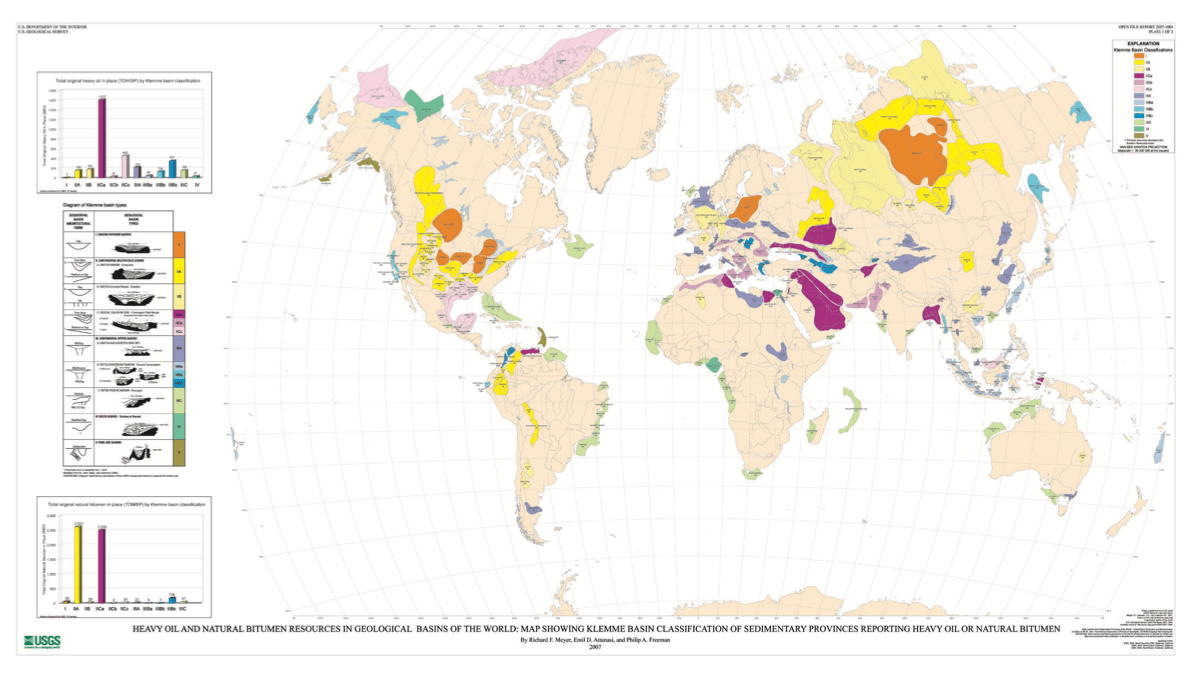
The United States Geological Services provides maps of available heavy oil and bitumen deposits. Figure 6 indicates that heavy oil is widely available in North America, Europe, Russia, and the Middle East.
In 2015, the International Energy Agency published a report indicating that in its view, there were huge deposits of extra heavy oil and bitumen (EHOB) that could be accessed if the price of oil rose high enough for long enough (Figure 7). The same exhibit shows somewhat smaller availability of tight oil from shale. In fact, the US has been able to access a substantial amount of tight oil from shale in recent years.

In my opinion, in order to access the EHOB, the prices of diesel and jet fuel need to rise to a high level over the long term; the prices of gasoline and even lighter products don’t necessarily need to rise. If the prices of diesel and jet fuel rise high enough, for long enough, the price signal should work its way back to oil and gas companies, suggesting that they need to make investments in the direction of adding more extraction from EHOB. If this succeeds, it could perhaps relieve the problem of inadequate supply of diesel and jet fuel.
The prices of diesel and jet fuel are high now, but this is at least partly due to higher insurance costs and partly due to the extra costs related to shipping oil longer distances to avoid blocked straits. These extra costs don’t get back to oil companies in a way that encourages countries to extract more heavy oil. What is needed are permanently higher prices for diesel and jet fuel, relative to the price of gasoline, even if the problems with respect to the straits of Hormuz and of Bab al-Mandab, disappear.
[6] Today’s conflicts in the Middle East and Russia/Ukraine seem to relate to inadequate supplies of diesel and jet fuel for buyers of these fuels, and inadequate prices for sellers of the heavy/sour oils yielding these products.
Figure 3, above, shows that the total supply of diesel plus jet fuel has been low, especially since 2020. One issue that has arisen recently is “Who gets the supply of diesel plus jet fuel that is available?” Figure 8 shows that increasingly, it has been the poorer countries of the world who obtain the diesel and jet fuel that is available. Note that total consumption of the Other than Advanced Countries has exceeded that of the Advanced Countries since 2020.
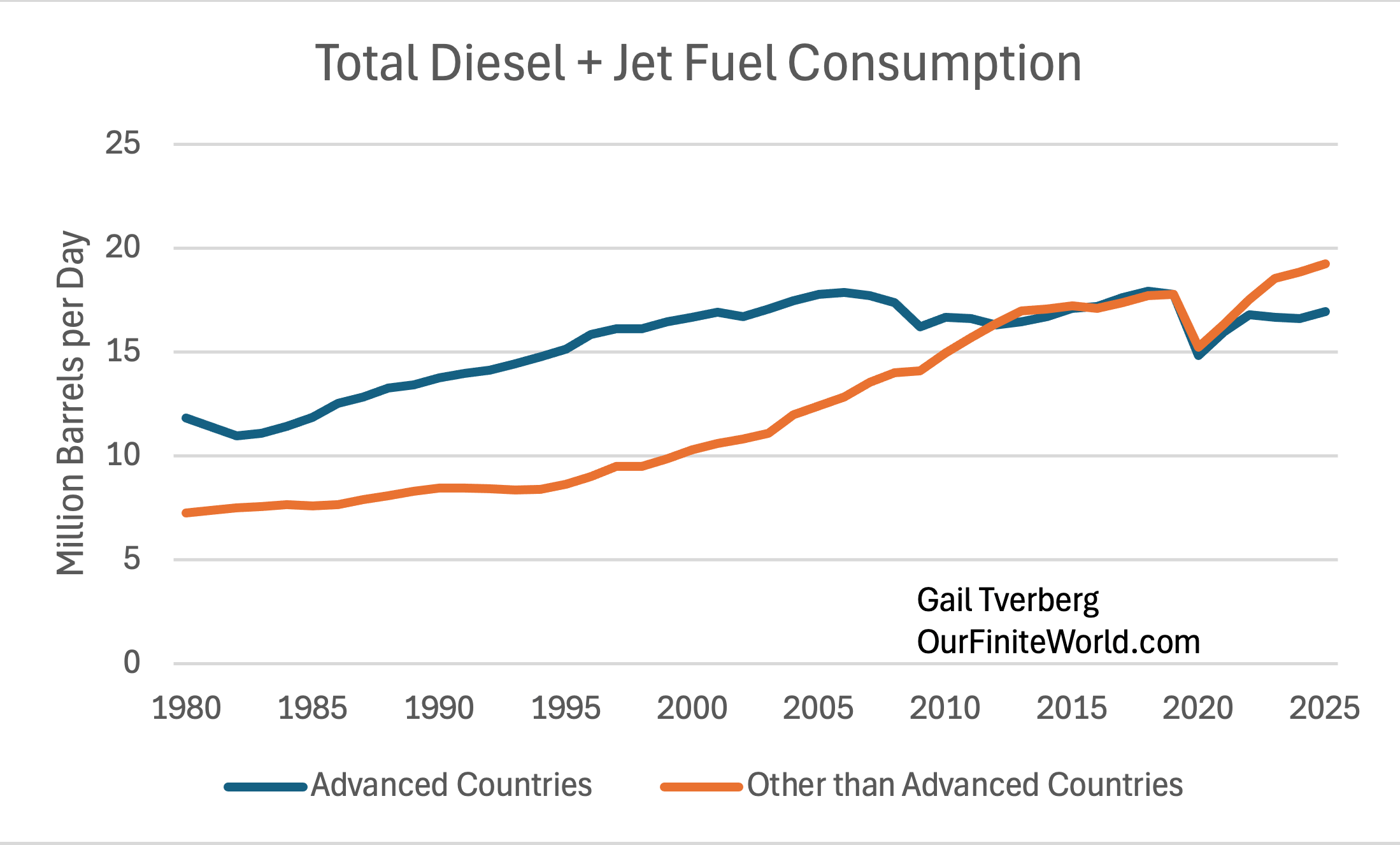
Figure 9 shows that for the Advanced Economies, per capita consumption of diesel plus jet fuel has been declining since about 2005–the time of peak conventional crude oil. The same figure shows that per capita consumption of diesel plus jet fuel has plateaued since 2013 for Other than Advanced Countries. I think of 2013 as the year that China first started encountering major limits on coal extraction (somewhat like the year 1970 in the US for oil extraction). In recent years, China has been able to raise coal extraction somewhat, but at a higher cost.

I would expect that countries in both groups would be dismayed by the situation shown in Figure 9. The per capita consumption of diesel plus jet fuel for the Advanced Countries has been falling for a long time. Partly this is the result of the economies changing to service economies. As service economies, the need for diesel by industry has been lessened. Wages tend to be less for many of these service jobs, making workers unhappy.
In Figure 9, people in the Other than Advanced Countries would tend to be dismayed by the continued wide gap between the standard of living of their own economy, and the standards of living in the Advanced Countries. Many of these countries export extracted resources that are ultimately sold as goods to people living in Advanced Countries. If the selling prices of these commodities were higher, workers in these countries could perhaps afford to have cars and air conditioning, like workers in the Advanced Countries. They would also be dismayed by the poor progress in raising their own per-capita consumption of diesel and jet fuel since 2013.
[7] Is there any possibility of greatly ramping up heavy oil production? Could it power a society like the one we have today?
We know that heavy oil production began long ago. For example, the first recorded production of heavy oil began in the Kern River Basin in California in the 1860s, and commercial production began there in 1899. The first production in the Canadian Oil Sands began in 1921, and commercial production there began in 1967.
The extent to which the oil that is heavy and often sour can be ramped up in the future remains to be seen. Extraction techniques have gradually been improving, and I would expect that they can continue to improve. But the cost of extraction and processing will likely remain somewhat high because of all the energy-intensive steps that are needed to provide diesel and jet fuel.
I expect that society itself will need to change in order to make use of this higher-cost oil. These are a few ideas I have:
(a) Oil exporting countries will need to change in ways that reduce their need for tax revenue. This is an issue especially in the Middle East, which has a huge population, in a hot, dry climate. The population will likely need to fall (for example, many migrants and guest workers may need to move back to their country of origin), and make-work projects will need to be discontinued.
(b) Another issue is that total diesel and jet fuel usage will likely need to be reduced because it is likely to take several years before production of heavy oil can be ramped up. Society will need to be reorganized in a way that uses less diesel and jet fuel. One idea would be to shorten supply chains whenever possible. Figure 10 illustrates one idea how this might be done.

(c) I expect that if such a change can be made, economies will need to gradually change in ways that are hard for us to understand now. The focus may need to be on essentials, including food and clothing. Governments may need to be smaller and provide fewer services. Communities may need to be smaller and more walkable. The total population may need to be lower.
[8] Conclusion
It seems to me that the self-organizing nature of economies will gradually push them in the directions they need to go if the world is to start incorporating a significant quantity of expensive products made from heavy oil into its energy mix.
We cannot yet imagine what all the changes will look like. In some ways they may resemble a recession, but there will likely still be an interest in greater complexity and in working to improve people’s lives.


Western Civilisation Collapse
This is a conversation between three people: John Campbell, Neil Oliver and Dr Tim Kelly. The blurb says:
In this wide-ranging, three-way discussion, I sat down with two guests who come at the big questions from very different directions. Neil Oliver trained as an archaeologist and is widely known as a broadcaster and author. Many people still stop him in the street as “the Coast guy”. Dr Tim Kelly is a medical doctor, computer scientist and systems analyst. My own background is 28 years as a nurse teacher, with a long-standing interest in science, research and writing.
The conversation started from a worry I’ve had for some time. With artificial intelligence, demographic change and growing social strain all arriving at once, could we be heading into a kind of dystopian dark age?
From there we covered a lot of ground. We talked about how civilisations collapse and forget, how fragile digital knowledge is, the limits of what we really know about the ancient world, the puzzle of consciousness, how complex systems go wrong (with medicine as the main example), fear as a tool of power, the cost of dissent, and whether this moment is just another turn of history’s wheel or something new.
This is a summary of the main arguments. The views are the speakers’ own.
Do civilisations survive their crises?
I opened by asking how earlier civilisations faced existential crises. Neil’s answer was blunt: none of them responded successfully, because they are all gone. Ancient Egypt, Greece, Mesopotamia, Babylonia, the Akkadians, the Assyrians, the Romans and the British Empire all rose and fell.
Whether or not they saw the threat coming, they didn’t survive it. He compared this to the boom-and-bust cycle in economics. Growth breeds confidence, which breeds more growth, until inflation and loss of confidence bring recession and collapse. He thinks civilisations follow a similar pattern.
Neil cited two classical models of this cycle. The first is Polybius’s anacyclosis.
A good king is followed by a weaker heir, and monarchy decays into aristocracy, then oligarchy. The people overthrow that and create democracy, which degenerates into mob rule. A demagogue rises and falls, a good king returns, and the cycle begins again. The second is the eighteenth-century philosopher Giambattista Vico’s four ages. In the age of gods, fearful people think the thunder speaks to them. In the age of heroes, knights fight the common people. In the age of men, you get republics and democracy. Then comes chaos, and the cycle repeats.
The “great forgetting”
Neil’s own contribution was the idea of a deliberate forgetting, which he called a “great forgetting” or a kind of great reset. Humanity keeps rediscovering things it already knew. He recalled a university field trip to Stonehenge, where he asked a lecturer: who forgot what this was for? For centuries everyone must have known what you did at Stonehenge, just as we know what a cathedral is for even if we no longer go. The same goes for the pyramids. At some point a generation simply stopped knowing.
He doesn’t think this is accidental. He pointed to the Library of Alexandria, a cosmopolitan centre of learning that held the works of Euclid, Archimedes, Ptolemy and others, and was burned more than once. He also pointed to the lost knowledge of other great civilisations, and to centuries of book burning, including in the Holy Roman Empire long before the Nazis. His view is that those in power at a given moment decide it would be better if people forgot certain things, and that this drives the cycle.
The fragility of digital knowledge
Neil argued the danger is sharper today than ever. When a library was burned in the past, other copies usually survived in private hands or other collections, so it was very hard to wipe out a work completely. Now so much is held centrally and streamed: books on Audible, films on Netflix. Whoever owns that platform could delete a title, whether To Kill a Mockingbird or the Bible, and if nobody owns a physical copy, it is gone for good.
Tim said his bigger concern was censorship rather than a technical failure.
Knowledge doesn’t need to be taken offline; a small change to an algorithm can make a position hard to find, so people only see a skewed picture. He also pointed out that AI companies are buying up huge numbers of second-hand books, cutting off the spines and scanning the pages, which destroys the originals. Tim has stopped throwing books out, and Neil regularly urges people on social media to buy old books and keep them. If he were rich, he joked, he would fill climate-controlled aircraft hangars with them.
This came up in my YouTube feed, and I like these three speakers, so I will try to watch it when I get some time.
I think our current civilizations and societies are doomed to collapse, or if not, then doomed to evolve so rapidly into something new that we would not recognize them as ours.
I have about five thousand books at home, but when I’m gone, will anybody want to take them? At least, I am good friends with the guy who runs the local bookshop cafe, and he’s 25 years my junior and a book nerd with a strong interest in art and French literature, so at least I have someone to leave my books to in bulk.
In the meantime, I need to focus on discarding any books that would be too embarrassing to my posthumous reputation if they were found in my collection. Imagine if it came out that I had a copy of Atlas Shrugged or the complete works of Jeffrey Archer?
But let’s face it, folks, in general, nobody wants other people’s old stuff these days, including your old books. It’s a buyer’s market for those few who still like to buy second hand.
Yes, old books survived because they were preserved. Many collections will simply be lost to mold or bookworms, or the very acid their pages contain, as we didn’t use to make books with good paper.
Also, most people collect several useless books, mostly fiction or modern art, photography, etc.
200 years from now, also, who says the language won’t change enough so that people can’t read current books anymore? Who knows if they’ll even know how to read, or decipher these letters, words and sounds. Who says society will develop enough in the future for it to have its own archaeologists, philologists or historians as well? It needs a high level of complexity to reach that, and I don’t think future generations will have abundant and cheap resources available to them anymore to reach that.
We’re going for a reset for sure.
As an antiquarian book binder and restorer, taught by a great craftsman at the end of his life, this is a painful situation for me, but I must learn to let go.
I used to pride myself on the fact that my books would last 500 years or so due to the quality of materials, but we live in an Age of Endings.
When the time comes, I shall take my tools and cast them into the nearby lake, as an offering to the gods, rather than that they should be dishonoured as mere scrap metal.
Well, Yes and No. I do volunteer work to save books (Switz. – for a big charity) and we are doing fine and better evry year. Your collection (without transport costs) would be very welcome, can’t be done of course. Our aim is to sell ‘ordinary’ books v. cheaply, specially children’s books, classic literature, popular books in good condition, learning XYZ, crafts, etc. I can’t say much more, confidentiality etc. *specially not about finance* but here in CH the second-hand book market is doing great.
In the heart-land of Europe Atlas Shrugged still sells a little, and Jeffrey Archer remains very popular.
It is very heartening to read that second-hand books still have a future in Switzerland.
What might save them long term might be an economic collapse that puts the internet, smartphones, and electronic media in general out of most people’s reach.
The Swiss have also done a wonderful job preserving the mechanical watch industry, which is a remarkable achievement considering the industry almost disappeared when digital watches became trendy.
We can all imagine books continuing indefinitely as a niche market, but here in Japan it has become rare to see someone reading one on a train. Even manga comics, which used to be ubiquitous among school children, have been replaced by smartphone screens, and page turning has given way to scrolling.
Same problem here: thousands of books, 95 per cent of which I’ll never read again, and no one to pass them on to. The solution I came up with, a few years ago, was to start selling them on the Portuguese equivalent of eBay. What I discovered was that interest in subjects such as literature, history or sociology is even lower than I’d suspected, and in six years I’ve probably not managed to sell more than 500 books. The final solution will be of course to use them as kindling.
So, you are going to use your poor fellow Portugeezics as kindling, in “a final solution”, of all things, just because they were kept down and deprived of culture under your old dictator Salazar? Shame on you, JMS! However, I do note that it is Guy Fawkes Night in England soon, and I’m looking for a catholic to put on my bonfire, as is traditional. Any thoughts? Are you volunteering? 😉
Although I’m not Catholic, I’d be more than happy to be burnt on Guy Fawkes Night, but unfortunately I’ve already got a busy schedule for that day. Can we arrange it for carnival?
Thank you, JMS, for your kind offer. However, I must admit I actually like you too much to carry it out. Here’s a nice song about carnival instead.
No apologies for posting this one again because it’s a classic.
I’m dedicating it this time to the hard-working employees of Volkswagen, Audi, BMW, and Mercedes-Benz, Now you know what former generations of workers at British carmakers like Rover, Austin, Wolseley, Morris, and Triumph went through.
I’ve been sacrificed in the name of the company
I’ve been victimized for the sake of economy
I had a big house, a big car
Expense account and credit cards
But now look what they’ve done to me
They’re making massive reductions
It’s all mass production and assembly lines
They’re making massive reductions
Massive reductions
They’re laying me off all because of inflation
I’m losing my job and my reputation
Good-bye my big house, my big car
Now it’s all up to welfare
I hear that everybody’s going there
They’re making massive reductions
Massive reductions to stay alive
Whoa, they’re making massive reductions
Good-bye my big house, my big car
Now it’s all up to welfare
I hear that everybody’s going there
They’re making massive reductions
Massive reductions to stay alive
Whoa, they’re making massive reductions
It might well be the poem of our times, Tim!
Speaking of Egos…
“The project is one of several that Trump has undertaken in an effort to leave an architectural legacy in Washington. He demolished the White House East Wing in 2025 to build a ballroom, which Solicitor General John Sauer told the Supreme Court was part of an “integrated military complex” necessary for the protection of the president and national secrets.”
“Israel’s leadership seeks domination over the Middle East, and the United States seeks to preserve its domination over the world. Simply to state these aims is to underscore that both governments are operating in a world of delusion.”
Tim, I’m spoon feeding you now, buddy, or does Norman have to spell it out for you
Thank you, Mike, for clarifying that you were referring to Trump and Netanyahu as the two egos in question.
I read Norman’s take on Trump in detail yesterday. It’s one of my little eccentricities; I like to read and absorb the arguments people write before I attempt to criticize them.
Do you believe everything you read in the newspapers or hear and see on the TV news, Mike?
Actually, don’t bother to answer that question. I am sure you don’t. But I expect you believe some of it, right? But the question is, how much?
For instance, do you believe that the current Middle East situation depends mainly on Trump’s ego and Netanyahu’s ego? If they were not in their respective positions, do you think the ME would be a safer and more peaceful place in which to do business?
I don’t think it would. Although maybe it would. A lot of people seem to think it would. I think it wouldn’t be safer or more peaceful without those two leaders because I don’t think those two leaders are in charge. I think they are actors of the theatrical type, or in other words front men for organizations that determine the policies they implement.
I don’t think the war against Iran is something that Netanyahu and Trump could order on their own initiative. That is simply not credible to me. I think Trump has been honest to the extent of admitting that the US has been at war with Iran since 1979, and I think that Israel has been at war with Iran for the same amount of time. But for much of the time it’s been a standoff, not a cold war, a bit hotter than that, but a bit like a wild west gunfight scene in which the gunmen are staring each other out and waiting for each other to make a move.
I also don’t think that Trump could knock down a wing of the White House and build a new ballroom and security shelter without the permission of his superiors. Whether or not the idea to build it was his is beside the point. He doesn’t have the power to decide on that sort of thing on his own.
I also don’t think ICE is the Don’s pretorian guard, as Norman spelled out, or that the Don is going to resist leaving the White House in January 2029, as Norman further spelled out. But if he does remain in power with ICE as his goon squad, it will be because the people above him ordered that, not Trump himself.
I could go on expanding on the same theme, but I the above is enough for one post.
No, you’re wrong there ….. if you thought this poem was written by me about Norman. Close, but no cigar!
It’s an unfinished poem that Schopenhauer dedicated to Kant.
But I do miss Norman’s contributions here so much that I occasionally like to check up on him. He hasn’t penned a Substack article since August 10, but he pops up in the comments of other stacks here and there, mostly to declare Trump a dictator and ICE his praetorian guard, and to ponder over whether the Don will agree to leave the White House in 2029.
When you get to Norman’s age, if you want to continue surviving, it’s important to maintain regular habits and keep ploughing ahead.
https://hartmannreport.com/p/how-trump-paxton-can-overturn-the-051/comment/371707914
Norman wins, he identified one of the egos point blank…you still can too, Tim…its not too late to point out the other…
I know you have me penned as “the smarty one” Mike, but I am dumb enough to keep taking to you despite the fact that you won’t simply answer a simple question about a subject you yourself raised. Why do you need to add layers of mystification?
What you think is so bloody obvious that Stevie Wonder could see it may not be quite so bloody obvious to people who are not in your camp or side, or who may not even be native speakers. But be our guest, just keep on spewing innuendo that only the cognoscenti will pick up on.
Lastly, but not leastly, if Norman wins by identifying one of the egos point blank, then surely by your own standard you lose by not identifying either of them?
😆
“But I do miss poor man Normal’s contributions here so much that I occasionally like to check up on him.”
Blergh! So cloying, man. Just when I thought we’d heard the last of him. And after you labelled him a “m1dw1t”, too. Why does this remind me of a certain cartoon? “I will love you, I will hug you, I will call you George!”
You are in luck, Dothk. Because I think Hugo the Abominable Snowman is adorable and don’t in the least mind being compared with, equated with, or otherwise associated in your thoughts with him. We are both big guys, both white, both rather dumb, and both lovers of rabbits and heavy petting.
The character of Hugo was directly based on totally misnamed Lennie Small from John Steinbeck’s novella Of Mice and Men, which in my school we had to study in third-year English class along with To Kill A Mockingbird and Catcher in the Rye.
The trope of the well-meaning, giant character who accidentally crushes small animals or people by petting them too hard was a recurring pop-culture parody in classic animation (pioneered earlier by Tex Avery in cartoons like Of Fox and Hounds).
Yes, I called Norman a midwit, which I think he is. Your memory does you credit there. But I only pointed it out to him because he insisted in pontificating as if he was further to the right on the IQ bell curve than he actually is.
A midwit is a person of average or slightly above-average intelligence who dramatically overestimates their own intelligence. Rather than possessing deep, independent critical thinking, a midwit tends to (1) overcomplicate things, (2) rely on superficial or trendy ideologies, and (3) mistake mainstream groupthink or verbose analysis for profound wisdom. Norman may not do much of 1 or 2, but he constantly does 3. We encounter a lot of midwits online, but I’ll mention no names here, suffice to say that neither you nor I fits the definition. We know our place in the intellectual order.
But I do miss Norman’s presence in this comment section, irritating as his comments could sometimes be. Just as I miss Fast Eddy’s and Reante’s. I also missed Xabier’s during his long absence.
John Donne comes to mind here;
No man is an island, entire of itself;
every man is a piece of the continent, a part of the main.
If a clod be washed away by the sea, Europe is the less,
as well as if a promontory were,
as well as if a manor of thy friend’s or of thine own were;
any man’s death diminishes me,
because I am involved in mankind,
and therefore never send to know for whom the bell tolls;
it tolls for thee.
Norman was a rather large clod around here, don’t you agree? Although he wasn’t quite the White Cliffs of Dover, he’s sadly missed.
I think I know why he no longer posts on OFW. It’s not because I called him a midwit. It’s because his opinions didn’t get much traction around here but were met with stiff opposition that he couldn’t or didn’t want to rebut. It’s obvious to me that he only wants to preach to the already converted and so he mostly comments in places where the host and commentators are in basic agreement with him. That way, his rhetoric achieves a resounding echo, echo, echo.
Yep. Poorman is definitely a victim of the Dunning-Kruger effect. And he was the only commenter who didn’t understand that 9/11 was a scam. Nor did he understand modern technology, nor how it came be used to help perpetrate false flags – holography, etc.
Nah, I don’t miss m1dw1ts who leave. They’re time-wasters. Back in my lurking days, I noticed one brief commenter tell Poorman, “You tend to dominate round here”. Gone are the days, thankfully. Probably it’s Ravid Upimself who “tends to dominate” these days. Recently I was reading about the re-release of Hammer’s 1958 “Dracula” film, when I noticed your comment about Poorman shying away from the crucifix, which made me laugh. Is it even possible to get to the age of 90 without drinking the blood of virgins? 😉
In the cartoon I posted above, surprisingly Bugs and Daffy were pals for once, and Daffy was occasionally the clever one, telling Bugs how to pronounce “Himalayas” properly.
From a cartoon giant, to a giant of popular music, here’s a stunningly raunchy performance from the late Tina Turner.
My favorite Tina Turner line is: “But he’s just a raggedy man!”
On the other hand, I think we ought to give Norman his due. After all, he is the Iron Man of Shropshire.
I was thinking recently about age and technology. My Japanese former boss at the ad company I used to work for four decades ago is now 89 years old, not much younger that Norman. He remained in business until his wife developed dementia two years ago, although the business had dwindled to a loss-making hobby after he turned 80.
Talking with another former colleague at the company who continued to work with this boss until quite recently, I heard that our old boss worked with a computer for 30 years and a smartphone for over ten years, but he could never work efficiently with either and he couldn’t fix them when they went wrong. The smartphone, in particular, continued to baffle him.
Reminds me of that Groucho Marx joke: “Clear? Why a four-year-old child could understand this report…… Run out and find me a four-year-old child, I can’t make head or tail of it.”
For myself, the internet helped me learn a lot, and recently AI is helping me learn more. But the internet is something that has only helped me since about 30 years ago when I was in my late 30s, and AI has only be helping me for a couple of years at most, meaning in my mid 60s. If I had had access to these things from a younger age, I would have been able to make much more use of them.
Someone like Reante, who is about 15 or 16 years younger than I am, had access to the internet from his college days, giving him an unfair advantage over you and I. But you and I have an unfair advantage over Norman, who, no matter what you may think of him, is smarter than the average nonagenarian. And latest batch of digital natives who are growing up with AI are going to have an unfair advantage over Reante, because they will have access incredible amounts of knowledge, facts, and information as children.
You gotta make way for the Homo Superior.
This obsession with Norman is childish and pathetic.
I don’t agree. We need a range of opinions on Our Finite World. Norman knows a lot about the UK history of industrialization, among other things, also.
“After all, he is the Iron Man of Shropshire.” Iron? He got rusty long ago, then.
Never heard that Groucho joke. It reminds me of the Sony VTR advert of the early 1980s, in which John Cleese claimed it was so simple to use, even the cat could operate it. I remember saying to my dad, “We’ll have to buy Mum a cat!”
Apparently AH was a big fan of technology, because he believed that using it improved the race. Leftie Otto Strasser used to argue with him about it. “Were Goethe’s poems any the worse because he never had the radio in his day?”
As for me, I didn’t get the internet at home until 1998. Having it earlier would have widened my knowledge and interests, but I don’t feel any the worse off for that, even though I’m an addict nowadays.
Nice piano’ing by Bowie in that video. His singing seems deliberately out of tune, though. I am a big fan of Bowie in that era, however.
Disagree about AI. It’ll make for a less intelligent population less able to reason and think for themselves. Like children using computers instead of pen and paper where far more complex brain activity is needed.
Gail, was your comment address to me? I liked Norm’s contributions. I’m referring to this weird bashing of the guy now that he’s moved on to greener pastures.
Diogenes, you sly old dog! Gail was not addressing you. Probably me. And possibly Dothk, or both of us.
Although she may agree with the gist of your comment, she is less quick to shame other people on the basis of their obsessions.
In any case, it’s OK to disagree.
But to reiterate which means to say it again — I welcome Norman’s contributions even though I often disagree with them. I think Gail and I are in agreement on that point.
Mark, I absolutely agree that there is a good case to be made AI will make for a less intelligent population overall who will be less able to reason and think for themselves.
But in my opinion, that’s primarily because most people are not very intelligent in any case—or intellectually lazy might be a better way of putting it.
Recall how stupid the average person was before AI came along, and reflect that half of them were even more stupid than that!
With the advent of AI, midwits, in particular, will become even more grandiose in their claims to genius, thanks to the extra plausibility AI will give their efforts at presenting themselves as geniuses.
On the other hand, because AI will make it much easier to gather, analyze, and collate information, authentically smart people will be able to capitalize on their innate smartness.
AI is just another waystation on the road to ruin. Think back to television. Did that raise or lower the average intelligence, or did it merely make people’s innate intelligence level more obvious?
How about the three “R”s—reading writing and arithmetic? Did they make people smarter or dumber? I’ve heard the argument that reading and writing destroyed people’s memories.Hardly anyone can narrate the Iliad from memory anymore.
It goes back even further. Once we discovered the stick, and invented the club, the hammer, and the boomerang, we began losing our muscles and stamina. And once we began to wear clothes, we began to lose our tolerance of cold weather.
All in all, AI is just another brick in the wall of our evolution from what we used to be to what we may become.
“Recall how stupid the average person was before AI came along”
If only we could raise their intelligence back to those highs(or mainly lows). Alas, the screen already owns them and so cognitive dexterity will continue to disappear as if by design, which is of course the point.
“But what I’m certain of is that the subsequent developments, the platforms, the twitterification of content, the dominance of short-form video, the erosion of memory and attention span, and, last but not least, the so-called AI-technologies, are making the situation incalculably worse.
https://shadowrunners.substack.com/p/transcript-from-my-talk-at-the-neutrality
Diogenes wrote: “I’m referring to this weird bashing of the guy now that he’s moved on to greener pastures.”
But there are NO greener pastures than OFW! It’s an outrageous suggestion. Diogenes deserves to be banned, made into a pie, and fed to Fast Eddy’s dog Hoolio.
A short clip of Mario Newfal interviewing Jeff Snyder with respect to the drop off in world and China’s growth since 2008.
He puts all of his chips at “there’s no demand for Chinese products because of the economic downturn since 2008”.
But then, why such crisis? That’s where most people stop. They look at graphs and say “oh! it’s because people can’t afford things anymore!”, why, though? “because of inflation!”, why, though? “because the government keeps printing money!”, well, what can be done? The more produce is done, the more money (and debt) is created, if not, we would be having massive deflation. “oh, that’s not true!”.
And then they stop.
Not knowing inflation is a decrease in the profitability of energy products, due to energy itself becoming more expensive.
Also, before 2008, what roads did China have to keep? How much was the country’s energy bill to keep the lights on? What about public transportation? Water?
This all have a cost just to exist, not even accounting growth.
The whole nature of world economic growth became much more debt-based after 2008. I know that US growth became very dependent on a huge increase in debt (especially government debt, but other debt, as well) after 2008. The artificially low interest rates allowed all kinds of non-sense investments.
And China hit peak inexpensive coal in 2013. And then the property bubble started to deflate not long after that.
Jeff Snyder doesn’t put together all of the pieces, I agree, but he offers a different perspective with respect to some problems that affect today’s economy. I can fill in the pieces I know, which are different from his.
Why China’s stimulus keeps missing the mark
HONG KONG, Oct 26 (Reuters) – China’s economy has split in two: high-tech exports are surging, while domestic consumption and job creation are stalling. Now that major trading partners are seeking to put up more barriers, Beijing may need to rethink its cautious approach to direct household stimulus. https://www.reuters.com/commentary/reuters-open-interest/why-chinas-stimulus-keeps-missing-mark-manishi-raychaudhuri-2026-10-25/
The official GDP figures reveal but also substantially mask the K-shaped nature of the Chinese economy. Chinese GDP growth rate since 2012 is the weakest ever since China’s economic reforms in 1978 and for the years since 2020, the official GDP releases have been widely questioned by independent analysts. For example, while the official GDP growth rates were reported at 5.2% for 2023 and 5% for 2024, the Rhodium Group puts the real figures closer to 1.5% and 2.8%. A Chinese economist, Gao Shanwen, came up with similar estimates. Debt has climbed to roughly 294% of GDP, nearly triple its pre-2008 level. Real estate, which at its peak was about 30% of the entire economy, is still reeling. Youth unemployment reached 20.4% in 2023, the highest since the series began — after which the number briefly stopped being published; one unofficial estimate put the true figure near 46%. The retail sales have consistently underperformed against overall GDP growth. https://yashenghuang.substack.com/p/chinas-k-shaped-economy-and-its-k
You have to somehow justify the high levels of debt by making GDP growth look strong enough to support them.
Thanks for the additional information.
Actually, I am the one who should thank you; although I haven’t had much time lately due to intensive mathematical and physical studies, I try to look into these topics.
Exaggeration but still 1.5 billion works out to 7.5 mbpd . Prewar was 18 mbpd .
https://oilprice.com/Latest-Energy-News/World-News/US-Army-Says-It-Has-Helped-15-Billion-Barrels-of-Oil-Out-of-Hormuz.html
WTI is at 102.81. Not great!
U.S. Army Says It Has Helped 1.5 Billion Barrels of Oil Out of Hormuz
U.S. forces have helped Persian Gulf producers move more than 1.5 billion barrels out of the Strait of Hormuz since the Iran war began, Adm. Brad Cooper, the commander of U.S. Central Command (CENTCOM), said during a visit to the Strait of Hormuz on Sunday.
More than 3,000 commercial vessels have successfully transited the Strait of Hormuz with support from CENTCOM forces over the last six months, the U.S. military said.
“We continue to stand shoulder to shoulder with our Gulf partners and the shipping industry,” said Cooper.
Stuttgart in Financial Freefall! Germany’s Once Prosperous Metropolis Must Incur Hundreds of Millions of Euros in New Debt.
#Stuttgart #MercedesBenz #Porsche #Haushaltskrise
Trade Tax Plummets Dramatically: In 2024, Stuttgart Still Collected 1.3 Billion Euros in Trade Tax. For 2025, the City Is Only Projecting 750 Million Euros. A Drop of Around 42%! The Crisis in the Automotive Industry Is Hitting the Home of Mercedes-Benz and Porsche with Full Force. At the Same Time, the Double Budget for 2026/2027 Amounts to a Staggering 10.6 Billion Euros. 848 Million Euros in New Debt: For 2026, Stuttgart Plans to Take Out Loans of 484.5 Million Euros, and for 2027, Another 363.5 Million Euros. And This, After the Core Budget Had Been Debt-Free Since 2018! Rising Mandatory Expenditures, Declining Tax Revenues, and High Investment Costs Are Forcing Drastic Savings. The City Council Approved the Austerity Budget on December 19, 2025. Projects Are Being Postponed, Subsidies Cut, and Taxes Raised. The City, Which Lived Off the Success of Its Industry for Decades, Now Has to Buy Its Financial Leeway with New Debt!
And how will Stuttgart pay off this debt, plus interest? What growth industries are there?
That’s what Russian assets are used for.
Some think this is one reason Europe can’t allow Ukraine to lose and sanctions to end; the money has already been used.
I know they have used the interest accrued as collateral to issue bonds and finance Zelensky .
Yes, this is public. What some claim (eg. Duran) is that Macron, for example, accessed and spent most of the money.
(the principal, not just interest)
Norway– so far Johan Sverdrup oilfield’s production declined by 11% , NEXT year you should expect a bigger rate of decline – Equinor CFO
Ouch!
Better hurry up and take over Russia ASAP
I wonder how much of Norway’s sovereign wealth fund is invested in the AI bubble.
US Tells Ships to Avoid Unnecessary Transits Through Hormuz
The US military said vessels that have no need to move between ports in the Gulf of Oman and the Strait of Hormuz should stay away, as tensions ratchet up in the region.
“Due to the current geopolitical situation, vessels which do not need to transit the area are advised to remain well clear to avoid unnecessary delays to their voyage,” the US Naval Forces Central Command said in an advisory on Wednesday issued via the Joint Maritime Information Center.
“Vessels transiting this area are advised to plan additional transit time to allow for increased traffic density and military blockade enforcement operations,” the notice said. (Reuters)
Avoiding transits through Hormuz would seem like a pretty obvious strategy.
This is a Zerohedge article purporting to tell how Russian oil exports have changed with sanctions. The EU is getting less:
https://www.zerohedge.com/energy/whos-buying-russian-oil-ubs-has-answer
UBS chief economist Arend Kapteyn published new data tracking Russian oil exports. Before reading the note, the assumption would have been that Western sanctions and Ukraine’s efforts to cripple Russia’s export capacity had delivered a massive blow. In fact, Moscow simply reconfigured its supply chain to send crude and energy products east.
Kapteyn titled the note “Who Is Buying Russia’s Oil?”
He said, “The most visible effect of the restrictions on Russia’s oil exports seems to have been to redistribute the global supply of oil.”
The biggest shift in Moscow’s exports has been in their destinations. The EU’s share of Russian crude exports collapsed from 48% before the war in Ukraine to just 4% by September, while the combined share purchased by China, India and Turkey jumped from 29% to 77%. . .
The immediate takeaway is that Western sanctions and Ukrainian drone strikes have disrupted Russia’s energy sector without crippling its crude exports.
Moscow’s pivot toward Asian buyers and reliance on a shadow fleet of tankers have allowed it to continue business as usual, exposing the limits of Western financial warfare and kinetic warfare.
Turkey imports crude oil and fuel from Russia, processes and refines it at domestic facilities (such as the STAR Refinery and Tüpraş refineries), and then exports the resulting refined oil products—such as diesel and jet fuel—primarily to European Union (EU) and G7+ countries https://energyandcleanair.org/publication/sanctions-hypocrisy-g7-imports-eur-1-8-bn-of-turkish-oil-products-made-from-russian-crude/
It would be easy to miss the export of these products in counting the exports to Europe.
Maybe the reduction is not as great as was originally thought.
Exactly, Gail. The volume and pricing data in the CREA report completely expose this hypocrisy without any need for complex metaphors. It is a straightforward demonstration of physical necessity overriding political dictates.
First, regarding volumes, the reduction in Western consumption of Russian oil is largely a statistical illusion. While direct seaborne crude imports to the West were banned, the physical supply chain simply rerouted the energy through third-country intermediaries. Russia shifted its crude exports to Turkey, which expanded its reliance on Russian seaborne crude from 34% to a staggering 70% in the first half of 2024. G7+ countries then increased their refined product purchases from these Turkish refineries by 62% year-on-year. In terms of actual barrels and thermal calories, Western demand for Russian-origin energy has not significantly dropped; the system just added a processing step to alter the shipping labels.
Second, regarding costs, this loophole makes the energy significantly cheaper for the West rather than more expensive. Because Russian Urals crude is sanctioned, it trades at a continuous $5 to $20 per barrel discount. Turkish refineries saved up to EUR 3.1 billion by purchasing this cheap feedstock, allowing them to export gasoline to the EU at a price 10% cheaper than Saudi Arabian alternatives, and diesel at 7% cheaper.
Western corporations and governments are fully aware of this and choose to look the other way. This backdoor allows the industrial base to maintain its vital net energy inputs at a discounted rate, using the abstract metric of “sanctions compliance” to completely mask the physical reality of continuous consumption.
Qatar has extended its force majeure. This means Europe and Asia will not receive any contracted LNG until the end of 2026
Qatar is no longer an untouchable LNG superpower, and Doha’s export shutdown is reshaping the global energy architecture .
https://x.com/Frank_Stones/status/2115399789583933881/photo/1
Ouch! Of course, at one time, a surplus of LNG in 2026 and 2027 was forecast.
The WSJ is reporting:
https://www.wsj.com/world/americas/flavio-bolsonaro-fled-brazil-to-argentina-boarded-flight-to-ecuador-6a0e9da0
Bolsonaro Fled Brazil to Argentina and Boarded Flight En Route to MiamiThe defeated presidential candidate faces two criminal investigations in his home country, which had canceled his passports
Bolsonaro was due to land in Miami at 9:18 a.m. on Wednesday after a stop in Ecuador earlier, according to flight-tracking data for a plane Argentine officials confirmed he boarded. The Trump administration has said it would issue visas to Bolsonaro and his family to allow them legal entry upon arrival.
This is a link to Zerohedge’s article on the subject:
https://www.zerohedge.com/geopolitical/flavio-bolsonaro-lands-miami-after-lulas-totalitarian-crackdown-threatens-political
zerohedge is unhinged. Of course the first step in any quest for sovereignty starts by kicking out the NGOs and left behind cadres.
🙂
Trump calls for making 29 million Venezuelans United States citizens.
These are the same people saying Democrats will flood America with immigrants from third world shit holes if Republicans don’t win. Unreal.
Acyn on X: “Trump on Venezuela: Let’s make it the 51st state. Instead of a president, we will have an election for a governor. https://t.co/nIVGdV2SCc” / X
Saw a funny headline: “ICE accidentally sends Nicolas Maduro back to Venezuela.”
It is difficult to tell which quotes are from the Onion now, and which are intended to be correct.
Disaster – it would seem that high oil prices can affect the rich:
Luxury cruise passengers stranded in Cambodia due to soaring fuel costs
https://www.bbc.co.uk/news/articles/cwj342k62exyo
“A luxury cruise ship on a years-long voyage around the world said it suspended operations due to extraordinarily high fuel costs, leaving passengers stranded in Cambodia.
…Global fuel prices have soared since the Iran war started earlier this year. The ship’s operator said the monthly fuel cost per cabin in parts of Asia has risen to as much as $8,000 (£6,000) from $1,800…”
These people are in the top 3% in the West. They got a leg up on understanding that the current plan makes no provisions for them. Top 0.001% only.
My husband and I discovered when we went on some cruises that there are some elderly people who spend all of their time traveling on cruise boats. The places are a little like “Independent Living” apartments, with food offered three times a day, plus various kinds of entertainment. For people with few relatives, not too many outside interests, and a fair amount of money, this approach makes sense.
It is these folks who are especially targeted.
But I would expect that cruise operators will find it increasingly difficult to make affordable cruises.
It sounds like being trapped in a luxury prison. I’d be bored rigid and would hate it. Apart from anything else, I have no “sea legs”. Twice I have been in minor sea storms that left me horribly nauseous. The experience of nausea is my top hate. I haven’t travelled by sea for 45 years. These days I do not leave the country, and I travel by train for long journeys, as coach journeys would also be liable to give me travel sickness.
Or, Gail, have plenty of relations but they can’t be bothered with them; wish to escape their grown children who only seem to want money from them; don’t want to get stuck baby sitting grandchildren; are utterly sick of domestic chores; and who want SUN, SUN, SUN!
‘We’re cruising’ is the perfect alibi for escaping all of that.
We can be sure that if those people will not go cruising and, on the contrary, they will decide to stay at home, they will be asked to be vaxxed for flu + combined with new ‘phantom’ Covid variant.
At least, it is what is happening here in Italy, I received various feedback, including from our residents’ meeting.
They are all du.b and vaxxed.
People over 65-70 are still living in Covid propaganda mindset.
Few are those who have understood, among them.
A longstanding customer of mine, 85, fell off a ladder in his library and is now in a nursing home in a very pitiful condition.
He is no doubt getting injected for COVID twice a year, but I say nothing as quite frankly the sooner his life ends the better.
I just visit his wife, help in the garden and listen sympathetically.
This age group are simply impervious to the truth.
But I have also found this with those in their 20s.
Me and my wife were going to have another kid but now that war with Russia seems certain. I guess, we’ll have to hold off.
This is how you control the birth rates. (covertly)
“This is how you control the birth rates. (covertly)”
Or you tell everyone being gay is great and give them a leg up in the job market. Or you tell women they don’t need men and also give them a leg up in the job market.
I think the trend toward gay relationships is partly because fewer children are needed. It may also be because families with only one child, or none at all, are more affordable. A third issue is that many men are not considered good spouse material: autistic, don’t have a good job, addicted to drugs or alcohol.
Larry Johnson on the oil spill near the Strait of Hormuz:
https://sonar21.com/relax-its-only-an-exxon-valdez-on-steroids/
Relax, It’s Only an Exxon Valdez on Steroids
The Exxon Valdez spilled about 257,000 barrels of oil into Prince William Sound in 1989, and Americans are still talking about it. A single VLCC carries about two million barrels. So every supertanker sitting in the Gulf is roughly eight Exxon Valdezes waiting for a drone. And the Gulf is a shallow, nearly enclosed bathtub with lousy circulation. Whatever goes in, stays in. Steroids, indeed.
We’re already enjoying the preview. This week the UAE closed the beaches of Umm Al Quwain after a slick more than 22 miles long and more than 60 square miles in area washed ashore on the Khor Al Beidah peninsula. The UAE said, with admirable understatement, that the oil was “likely coming from a VLCC struck earlier in the month.” Fishermen have been advised to stay away from the fish.
Down the coast, Oman is hosting the Caroline Bezengi, a tanker carrying about 800,000 barrels that suffered a mysterious explosion on June 8, was abandoned by its crew and then drifted aground in, of all places, a marine nature reserve near Qibliyah Island, home to humpback whales and Socotra cormorants. It started leaking at the end of June. By August the slick covered hundreds of square miles. The whales were not consulted. Across the water, Iran is mopping up its own crude spill off Qeshm Island. Everyone gets a souvenir.
But who needs drinking water?
Here’s the fun part that the war planners seem to have skipped. The Arab Gulf states don’t just pump oil out of the sea. They drink the sea. Desalination supplies about 99 percent of Qatar’s drinking water, more than 90 percent of Bahrain’s, about 90 percent of Kuwait’s, 86 percent of Oman’s, 70 percent of Saudi Arabia’s and 42 percent of the UAE’s, according to figures compiled by CSIS and the Atlantic Council. The six Gulf states run about 3,400 desalination plants, a third of the world’s capacity, and more than 90 percent of the Gulf’s desalinated water comes from just 56 of them. What could possibly go wrong?
Desalination plants have a small design quirk: they need clean seawater. When an oil slick reaches an intake, the plant has to shut down or risk wrecking its membranes and filters. . . .
Supertankers: now priced like space travel
. . .
And the winner is…
When the smoke clears, the country sitting prettiest on the water will be Russia. For years, while Washington and Brussels were busy sanctioning Russian oil, Moscow and its friends were quietly buying up tankers, mostly older midsize ships, to build the so-called shadow fleet. . . So the shadow fleet is both Russia’s trump card and a floating environmental time bomb that nobody is accountable for. Naturally, the bill for that lands on the beaches of Oman and the UAE, not in Moscow.
This is unbelievable and once the milk is spilled it’s under the bridge.
Those creatures that will die because of a couple of egomaniacs stroking their socalled legacy…Damn
Which particular egomaniacs were you thinking of, Mike? There are a lot of them about.
You‘re the smartie one Tim, take your pick…
It’s your story Mike, not mine. And I really have no idea which two egomaniacs you were blaming for this ecological disaster.
Also, since we don’t know why the tanker exploded, it seems a bit early for me to start apportioning blame. I wouldn’t want to jump the gun by casting aspersions on political leaders who have a thankless job to do when the explosion could have been caused by a member of the crew carelessly tossing a match aside after lighting a cigarette.
Oh, well name some then and I’ll text you on it…
… the Caroline Bezengi, a tanker carrying about 800,000 barrels that suffered a mysterious explosion on June 8 in a war zone …
There, fixed it for them.
The article claims Russia will emerge as the winner—but how could Russia possibly win? Far from sitting pretty, Moscow is actually trapped in a deeply precarious, even perilous position. First, its refineries have suffered devastating damage; most are crippled, and many may no longer be operational at all. Second, under such conditions, who will Russia actually sell its oil to—China, the United States, or someone else? In a world where oil remains the ultimate lifeblood, global competition will turn terrifyingly fierce. While the United States wields the formidable leverage of the petrodollar, China counters with its own colossal economic might, setting the stage for a ruthless collision between the two titans. Caught in the middle, if Russia sides with Washington, it will provoke Beijing’s fury—especially after years of deep alignment with China. Yet alienating the United States is no safer, as Washington’s retaliation would create a massive crisis of its own. Above all, Moscow has every reason to fear an overly dominant China. Why wouldn’t an all-powerful Beijing soon demand concessions from water-rich Russia—or simply discard Moscow once its usefulness fades? Ideally, Russia’s smartest move would be to strike a delicate balance between both giants, but in today’s polarized reality, that is nearly impossible—like a woman trying to stay married to two men at the exact same time.
There is plenty of diesel now. Just yesterday a wholesaler called me (I could not recognize her because it had been so long) and diesel with all paperwork is down to 64 rubles a liter. I bought 1900 liters of dodgy diesel last month at 65 (there was also a 53 rubles purchase, also dodgy, but that is never going to happen again). The Yaroslavl refinery has been stopped and restarted 16 times. They are keeping gasoline rationed but I think 6 months after the war is over there will be no memory of this crisis. Pipes are still abundant and distillation tower get patched all the time.
Yes, as you mentioned, it might be the case that there is currently no severe crisis in domestic consumption. However, the news reports I have read stated that Russia’s petroleum production was significantly impacted as a result of these attacks. For instance,: https://www.reuters.com/business/energy/russia-extends-ban-diesel-exports-until-september-30-2026-08-29/
Ukrainian drones hit a Russian refinery every three days on average in the first eight months of 2026, and in June Russian refining fell to 3.8 million barrels a day, its lowest level in more than 20 years. 19 October 2026 https://www.geopoliticalmonitor.com/ukraine-refinery-strikes-russia/
The Russian government has extended through 31 October 2026 a temporary ban on diesel, marine fuel and gasoil exports by their direct producers. According to the government, the measure is intended to preserve stability in the domestic fuel market, amid stronger motor-fuel demand during the agricultural harvest season. A broader ban on fuel exports remains in place until 31 January 2027. The restriction specifically targeting direct producers had initially been due to expire on 30 September 2027.
Russia has experienced fuel shortages following Ukrainian drone attacks on oil refineries and other energy infrastructure, which have disrupted domestic supplies. Russia was subsequently forced to import fuel from India, one of the largest buyers of its crude, to help alleviate the shortfall.https://www.enerdata.net/publications/daily-energy-news/russia-extends-diesel-export-ban-direct-producers-amid-global-supply-concerns.html
The crude for export does not go through refineries.
It is hard for me to believe anyone falls for these narratives anymore. Where do you go for news?
You raise interesting points. As long as there is not enough to go around, it is hard for Russia to figure out how it can fit into the overall picture. It is easy for other countries to marginalize it.
Levent , I use to read about Sergei Glazyev on the blog ” The Saker ” about 10-15 years ago when he was entrusted by Putin to give alternative to the USD system . He is the actual brain behind the current strategy that has saved Russia from the ill effects of the sanctions . He is mentor of the current Russian Central Bank governor . I was surprised to see him back . Here is his video just a week ago which will help you understand Russian economy .
Transcript ;
https://www.theautomaticearth.com/forums/topic/debt-rattle-october-27-2026/#post-254239
I am thinking about what Glazyev says, but this caught my attention: it seems that Russia hasn’t fully adopted his ideas after all. If I get the chance, I will also comment on Glazyev’s remarks.
I agree with Glazyev that the U.S. and Western systems might collapse in the near future, and the petrodollar system could collapse along with them. America’s strategic petroleum reserves are already at historical lows; once those are gone, I think the final whistle will blow. As far as I know, Europe doesn’t have massive reserves either. However, what happens next is what I don’t know. Yes, Russia could gain a major advantage from this, but I have no idea what kind of new world order would be established.
I expect that the world economy will become much less interconnected. The world has way too little diesel and jet fuel to keep sending goods back and forth across the major oceans. We will need to learn to make goods (including food) closer to home.
Gail, I don’t know if we can do this. I mean, there are actually countries that have collapsed due to the energy crisis. But as far as I can see, life is very difficult there, too. For example, I think Cuba is one of them. This could be very difficult, or even impossible. Because it will be a very sudden change. And people are neither accustomed to it nor have any knowledge about it.
In such a world, wars could increase even further, because under such difficult circumstances, it might seem easier to them. However, since there is neither the economy nor the power left to fight, there is a separate dilemma here as well. Perhaps there could be different types of warfare, rebellions, and so on
Glazyev’s following view is also noteworthy:
Radhika Desai: Wow.
Sergey Glazyev: And if oil prices are going up…
Radhika Desai: So a quadrillion is a thousand trillion, is that right?
Sergey Glazyev: A thousand trillion, yes. So if oil prices are going up, it means that interest rates will go up. To fight inflation, central banks will have to increase interest rates, and it will lead to the collapse of credit default swaps and finally the collapse of the whole financial system. I think we are moving in this direction.
If Glazyev had read Gail Tverberg, perhaps he wouldn’t have written it exactly this way. Because after a certain point, rising oil prices will also trigger a collapse in demand. In other words, resource scarcity can lead to demand destruction and may even cause prices to drop. Under these circumstances, the Fed wouldn’t be able to hike interest rates; in fact, the Fed might occasionally be forced to do the exact opposite, such as cutting interest rates.
>> He is mentor of the current Russian Central Bank governor
Where do you get this idea? From shows I’ve seen (eg. Duran), Elvira and Glazyev are usually at odds over policy; she is more Western-oriented in her policy making and theory.
Ivan , this is what I followed from readings 10-15 years ago at ” The Saker” . I had forgotten that he even existed and now suddenly he turns up . He is a theorist and Elvira is in the hot seat so they could be at odds . Nothing abnormal . Glazyev himself says .
“The role of sanctions is maybe 15%, and 80% is the negative role of central bank policy.” in his interview .
All this doom, this gloom! Are your senses working overtime?
Above, a blast from the past. The only good thing about this program was the zany theme tune. And look at this, the presenter brazenly smokes a cigarette on TV. Truly the past is a foreign country. 🙁
It’s like a comedians’ version of University Challenge. Only without Bamber Gas Coin. I have never seen this show before. Clearly, I’ve led a sheltered life.
Bubbles
The blurb says:
In this talk, Mike Maloney walks through one of the clearest long-term warning signals in market history: the CAPE ratio sitting at levels only seen near the peaks of the biggest equity bubbles on record. He breaks down why today’s combination of elevated stock valuations, real-estate prices, and currency debasement is historically unusual, what typically follows these setups, and where capital has tended to move when confidence in paper assets starts to crack.
The discussion ties monetary history, current data, and the practical case for sound money (gold and silver) as the cycle turns. Mike Maloney is the creator of the Hidden Secrets of Money series, author of the bestselling Guide to Investing in Gold and Silver, and founder of the Freedom Farms project focused on regenerative agriculture and real self-reliance.
Topics covered include:
The CAPE ratio and how current readings compare with 1929, the late 1990s, and other major peaks
Why stocks and real estate can correct together after simultaneous bubbles
The role of currency creation and loss of purchasing power
Where gold and silver fit as the monetary system is stress-tested
Practical implications for protecting and growing real wealth
Political world full of action. Israel elections outcome is still uncertain, but Bolsonaro fled Brazil without his passport, and there was a meeting in Tehran. Although it is difficult not to think that Lula is on thin ice. The rest of the Americas has basically been conquered.
The lead article in the WSJ is
https://www.wsj.com/world/americas/brazil-cancels-bolsonaros-passports-as-questions-swirl-about-his-location-9e8561fe
U.S. to Issue Visa for Brazil’s Flávio Bolsonaro as Questions Swirl About His Location
Bolsonaro, under Supreme Court investigation for alleged financial crimes that he denies, was barred from leaving Brazil after his election loss.
President Trump and many of his allies have been vocal supporters of the Bolsonaro family. The president welcomed Flávio Bolsonaro into the Oval Office in May and praised him as a “smart young man who loves his country.” On Sunday, he questioned the election results, saying it “looked like another rigged election.”.
The Bolsonaros have long accused de Moraes and the Supreme Court of conducting a political witch hunt against the family, repeatedly turning to Trump for support in their battles with Brazil’s judiciary. A U.S.-based adviser to the Bolsonaro family said it wouldn’t be irrational for Flávio Bolsonaro to flee the country, as he faces the prospect of jail time.
. . .
Over recent months, Flávio Bolsonaro has cultivated close ties with Argentine President Javier Milei, whose radical spending cuts he embraced as a model for Brazil.
I bet he’s afraid he’ll get Kirk’d
He just wants to leave the good life in Miami with his billions in Cayman supporting him. He is no Kirk, more like Hunter Biden or Kuschner.
SAY HELLO TO FLAVIO GUAIDO The full force of the US government – with help from Argentine vassals, complete with a decoy Gulfstream in Puerto Iguazu airport – was thoroughly implicated in the extraction of losing presidential candidate Flavio Bolsonaro. Bolsonaro crossed the Brazil-Argentina border on foot in the middle of the night, carrying only his Brazilian ID. He had been deprived of his Brazilian passports and considered a flight risk as the subject of a serious ongoing investigation for money laundering. The extraction was Plan B in case of losing the election. Approved at the very top of the Empire of Piracy. The infernal machine will never give up. The Mother of all Hybrid Wars continues.
Flavio Guaido, a.k.a. Maria Corina Bolsonaro will certainly have one hell of a time posing as the lead coward of the Brazilian opposition-in-exile .
Pepe Escobar
The human world, with its ever-increasing complexity and the unsettling emergence of more and more unknown mechanisms, both functional and dysfunctional, has become a nightmare.
The History of Burnout
https://youtu.be/s4fNq1-wmW8?si=OpRnWi7p9TU6YAYo
This video is not available in the US.
The detailed summary generated by Gemini:
1. Introduction: Is Modern Life the Most Exhausting?
2. Burnout (1970s – Present)
3. Neurasthenia (Late 19th Century)
4. Melancholia & Scholar’s Melancholy (Renaissance & Antiquity)
5. Acedia (The Middle Ages)
6. Globalization and Export of Western Diagnoses (India)
Conclusion
The documentary concludes that while human beings across every epoch have experienced profound exhaustion, the terminology shifts depending on culture, time, and power structures. Whereas melancholy and neurasthenia were viewed as unavoidable reactions to the world’s demands, burnout is frequently perceived in modern capitalist societies as a sign of personal failure [22:12].
“Today, over a third of employees in Europe report experiencing burnout symptoms…”
Yes, that thirty five hour workweek and the 5 weeks of paid vacation certainly take their toll.
India’s commerce minister asks European business to employ Indians .
It’s not just about the number of working hours per week, but also about the pace of work and the complexity of the tasks.
This look like an AI summary?
There is a meeting in Moscow today. I am uncertain whether this video represents all of the meeting or just part of it. It talks about cooperation among what otherwise seem to be warring countries with respect to natural gas production and exports.
Yesterday afternoon, Zerohedge was claiming:
Iran Signals Rare Flexibility Toward US In Talks With Mecca Pact Representatives
Somewhat surprisingly, Iran appears ready to be flexible concerning its conditions and matters of the timeline related to the Hormuz crisis and standoff with US forces:
In Tehran on Monday, Iran informed delegates from Saudi Arabia, Turkey, and Pakistan that it is willing to reopen the Strait of Hormuz in four to seven days if the US lifts its blockade.
Reuters has cited a senior Iranian official who says the meeting was initiated by Pakistan.
Over the weekend, just prior to the Mecca Pact countries’ delegations going to Tehran, Qatari mediators were also once again in the Iranian capital to “de-escalate regional tensions.“
Today, Zerohedge is reporting:
https://www.zerohedge.com/markets/futures-rise-oil-slides-irans-supreme-leader-talks-peace-and-shrugs-ras-tanura-attack-0
Futures Rise, Oil Slides As Iran’s Supreme Leader Talks Peace And Shrugs Off Ras Tanura Attack
US futures are higher as hopes for a diplomatic end to the Iran war got a fresh boost after Monday’s Mecca Pact talks in Tehran, with Supreme Leader Mojtaba Khamenei calling for pursuing the conditions set out by Iranian officials to end the war and an Iranian ambassador floating a seven-day plan to reopen Hormuz, which more than offset a Houthi missile attack on Saudi Arabia’s Ras Tanura refinery;. . .
” In Tehran on Monday, Iran informed delegates from Saudi Arabia, Turkey, and Pakistan that it is willing to reopen the Strait of Hormuz in four to seven days if the US lifts its blockade.
Reuters has cited a senior Iranian official who says the meeting was initiated by Pakistan. “
Crap as usual . Reuters talked to someone from Pakistan . They could have called me up . 🤣. Lifting the blockade means acknowledging defeat by DJT . As to the markets ” the lesser said the better ” .
“They could have called me up .”
Ravi rates Ravi. Who do YOU rate? 🙂
It feels as if a recession has already begun in many countries, including the US, but they are somehow keeping it hidden. And by raising interest rates, they are going to damage the economy even further. Normally, raising interest rates in a recession economy doesn’t make any sense at all. But I think their goal might not be to fix things—quite the contrary, it’s to strangle the economy, and this is happening all over the world. To strangle it. Because there is a lack of energy—meaning, since there isn’t enough energy—they perhaps have no other choice, but I suspect they are trying to do it in a controlled manner. However, the problem is that beyond a certain point, this could get out of control.
Most analysts don’t think the Federal Reserve will increase interest rates this week. They think that they will wait until December and decide then whether to raise rates. They may not increase them in December, if the economy seems to be stumbling.
Currently, the distortion caused by all of the AI buildout in the US makes it look like the US is massively expanding. One estimate I have heard is that the AI buildout adds 4% growth to GDP. And US oil and gas has benefited from the loss of production in the Middle East. Now we see that Audi is laying off workers in Germany and adding them in the US. The “growth” in the US is uneven; programmers in particular are having difficulty finding jobs in the US.
The US is trying to stay ahead of other countries. I agree that other countries are doing badly. Once the growth from AI disappears from the calculation, US GDP growth will be much lower.
War is another thing that boosts GDP growth, both for the US and for other countries around the world. There is great temptation to hire unemployed workers as soldiers whenever there is severe recession. This helps GDP, and gives unhappy young people something to do besides trying to overthrow the government.
Soldiers are also subject to mandatory vaccination, on the ‘Don’t dare ask what it is, just roll up your sleeve!’ principal.
That, too, could be useful.
They can be subjected to intensive propaganda, and alienated from the civilian population.
Lots of nice juicy commissions to earn on contracts for supplying the expanded military with uniforms, food, accommodation, etc.
But all of this must, obviously, be subject to energy and resource decline.
Yes. The first good ex. of mandatory vax in *recent* times is the Anthrax Vx., Biothrax. It was pushed by the US inside the US as a defense against EVIL bio-terrorist attacks. The US military had some kind of ‘mandated’ program for military personnel. It was multi-dose, Idk how many doses on how many ppl, etc.
The pro-vax push was a reaction to the Amerithrax story, those mailed letters with white powder in them (anthrax bacillus) right after 9/11 to up the scare level, pretty much (imho) some kind of fakey blown-up happening.
The general public was not nudged into getting the vax, it was the milit., lab workers (why? Aren’t US labs safe?) and maybe a very few others.
Subsequently, vax. expansion accelerated, thru various mechanisms.
The following does a good job of connecting the dots on this.. “All Roads Lead to Dark Winter” by Whitney Webb and Diego.
This is a four part series. This is a link to Part I of this series:
https://www.thelastamericanvagabond.com/all-roads-lead-dark-winter/
This is Part II
https://www.thelastamericanvagabond.com/killer-enterprise-how-big-pharmas-most-corrupt-companies-plans-corner-covid-19-cure-market/
This is Part III
https://www.thelastamericanvagabond.com/head-hydra-rise-robert-kadlec/
This is Part IIII (not Part IV)
https://www.thelastamericanvagabond.com/engineering-contagion-upmc-corona-thrax-darkest-winter/
Perhaps because they have raised interest rates enough, they might not feel the need for any more. As for whether the economy is growing more than necessary, I think about how meaningful that really is right now for a system built on growth and debt. In other words, you have to grow; you cannot stop. Therefore, the colossal scale and debt that have been reached are perhaps forcing this growth. Otherwise, stopping might mean collapsing. But if there is no energy, there is no growth either; what I mean is that they are caught in a dilemma and do not know what to do.
Where the bond market stands today interest rates have to be raised . Too much competition for the same fixed pool of funds . Keep them low and the paper will go bid-less .
Let’s apply what you mentioned to countries like Turkey, for example. Turkey has been borrowing at terribly high interest rates for three years now, with rates remaining for quite a long time—around 40 percent for a while. The economy is, in a way, choked. But how on earth is Turkey going to repay borrowing at such high interest rates? I suppose they promised global investors to keep the currency pegged to the dollar, or promised not to let it rise too much. But after a while, these investors will take their money and leave, because it may no longer be possible for Turkey to roll over this debt burden any further. And if those investors do pull out, it creates another massive problem: nobody knows where the exchange rate—meaning the dollar and other major currencies—will soar or spiral to. Think about this alongside rising oil prices as well. I think there are quite a few countries in a similar situation.
That is an interesting point.
The explosive surge in certain stocks—often presented as ‘growth’—can and perhaps should be questioned. Aren’t these essentially hyper-speculative forms of growth that may lack any real underlying value, or if they do, possess a problematic one? By definition, they are bubbles and the like—unstable growth that is easily prone to collapse.
Elections
Rising prices are eroding purchasing power, while rising unemployment is destroying it. Together, they undermine the demand that keeps the economy running.
This combination is a major concern.
When you’re out of energy, cutting interest rates and printing money means nothing. You’re basically trying to pump air into a shredded tire. Look at the Weimar Republic after World War I—instead of fixing the mess, flooding the system with cash just made everything crash harder and faster. Frankly, I think we’re right on the verge of repeating that.
On the flip side, raising interest rates isn’t a silver bullet either; in practice, it acts just like a brutal, crushing tax hike imposed directly on the productive class. It reminds me of the late Roman Empire during its collapse, when crushing taxes forced peasants to abandon their lands entirely (Agri Deserti). People grew so destitute that many were driven to sell their own children into slavery just to survive. Shifting the entire burden of scarcity onto the working population and producers through systemic strangulation is just another path to total collapse.
As for what the people in charge will actually do next? I don’t know. Looking at history gives us some clues, sure, but there’s no guarantee our leaders will stick to the script.
U.S. Army practicing and training DIGGING MASS GRAVES
https://x.com/ArmyTimes/status/2114796985496572305?ref_src=twsrc%5Etfw%7Ctwcamp%5Etweetembed%7Ctwterm%5E2114796985496572305%7Ctwgr%5E2d5163b4bcdeef7d4a0ef1e23645516d877ecd66%7Ctwcon%5Es1_&ref_url=http%3A%2F%2Fwww.godlikeproductions.com%2Fforum1%2Fmessage6218022%2Fpg1
The US plans ahead.
At this point, reported deaths have been very small. But this could change.
Propaganda.
Nothing more.
It recalls the ‘leak’ that the authorities in the UK were planning, in 2020, on erecting open-air morgues to deal with the anticipated immense flood of corpses from COVID.
The over-flow hospitals, which were created, were also never used – although I know someone who made a lot of money from that. In fact they retired on it!
They did the same thing here. They set up Seattle’s NFL stadium as make shift hospital.
Both those were just practice for the next pandemic.
Japan Minister Hosono: urgently calls on all citizens to prepare food, water, and toilets
Appearing on Fuji TV’s online program ‘News Extension Begins,’ Minister Hosono stated that on November 2, the day the Disaster Management Agency is established, an ’emergency request’ will be issued to central government ministries, all prefectures, and all citizens to advance disaster preparedness.
Minister Hosono urgently calls on all citizens to prepare food, water, and toilets | FNN Prime Online
We get a lot of natural disasters in Japan, including typhoons with heavy rain and flooding, volcanic eruptions, earthquakes, and tsunamis. Also, there are a lot more old people these days and not as many young ones. Mr. Hosono is asking people to be more aware or conscious and to prepare for natural disasters by improving their evacuation infrastructure and planning at the local authority level and by being a smart little prepper at the individual level, such as keeping at least a week’s worth of food and water on hand.
We do get a “big one” every few decades, so his recommendations make sense.
Here’s the interview (in Japanese) and the accompanying blurb in English.
An exclusive interview with Goshi Hosono, Minister in Charge of Disaster Prevention, whose political career began with the Prime Minister’s response to the Great East Japan Earthquake and the Great Hanshin-Awaji Earthquake!
From the full scope of the newly established “Disaster Prevention Agency” to “a different level of preparation” for the Nankai Trough and Tokyo Inland Earthquake, and the “true preparation” required of each and every one of us, he spoke frankly about everything.
📌 Highlights and Points of Interest in This Video
it’s because you’re going to have fuel shortages soon and you won’t be able to get to the store.
At least no worries about Iran have nuclear weapons of mass destruction….
They claim they are only trying to go nuclear for electricity.
Pakistan and India said the same thing and then..
“They claim they are only trying to go nuclear for electricity”
Whoever told you that is lying to you. Iran already has and continues use nuclear tech in more than one field and will continue to do so(over 70 radiopharmaceuticals that they have developed being one example that they are very proud about, which is understandable as the US sanctioned medical supplies long ago). If they choose to make weapons, which they have been capable of for decades, they will, but they have always said that they don’t want or need them. Recent events would appear to have proven them correct.
Energy is of course a large and important aspect. Them and the Russians are expanding that.
https://en.mehrnews.com/news/245036/Iran-Russia-advance-largest-joint-atomic-project-envoy
Public transportation is heavily used in Japan. Even it could be cut off.
Very possibly true. You seem to be pretty confident that you know how things will play out. From my perspective, I can’t see the future very clearly, but let me note something I think is interestin’.
The average pump prices of diesel in the US, UK, and Japan, converted to US dollars, are:
UK: $2.67 per liter (equivalent to roughly $10.09 per US gallon).
US: $1.66 per liter (equivalent to a national average of $6.28 per US gallon).
Japan: $1.01 per liter
(equivalent to roughly $3.82 per US gallon).
In 2008, global oil prices experienced dramatic volatility, sending retail diesel prices to what were then historic highs before crashing late in the year. The annual average pump prices for diesel in 2008, converted to 2008 US dollars, were:
UK: $2.44 per liter (equivalent to roughly $9.24 per US gallon).
US: $0.86 per liter (equivalent to a national average of $3.25 per US gallon).
Japan: $1.30 per liter (equivalent to roughly $4.92 per US gallon).
Please bear in mind that between 2008 and 2026, the US dollar has depreciated by approximately 36.1% in terms of its real purchasing power against everyday consumer goods. This means a dollar bill today buys what roughly 64 cents could buy in 2008.
To look at it another way, because of a cumulative inflation rate of roughly 56.5% over this 18-year span, you now need about $1.56 to purchase the exact same basket of goods that cost a flat $1.00 in 2008.
What the diesel figures show is that in the UK, the price of diesel was very high in 2008 and is very high now. In the US, it was very low and has almost doubled in dollar terms and risen by significantly more than the US inflation rate if the dollar’s depreciation is factored in. While in Japan, the price of diesel has fallen in dollar terms by 30% even as the yen has fallen by against the dollar from an average exchange rate of 103.39 Japanese Yen per US dollar in 2008 to around 157.82 Japanese Yen per US dollar today.
Japanese prices at the pump for gasoline and diesel were historically much higher—double or triple—US prices. When the yen appreciated against the dollar following the Plaza Accords and into the 1990s, the differential closed, but these fuels were still always cheaper in the US (over 30% cheaper in 2008.) How can it be that in 2026, with a much lower yen/dollar exchange rate and US diesel prices at double the 2008 rate in dollars, that diesel can be so cheap in Japan?
I scratch my head wondering about this. And I wonder how long diesel can be so available and so cheap in an island country that is dependent on imports for over 90% of its oil supplies.
Still, at the same time, the Japanese do have to deal with huge natural disasters from time to time. Regardless of whether they run out of fuel or not, Japan will almost certainly be hit by a huge earthquake and or tsunami some time within the next two or three decades, like the ones that killed over 5,000 people in Kobe in 1995 and over 20,00o0 people in Tohoku in 2011.
I would guess that there are no diesel powered private passenger auto vehicles in Japan. I would expect that the diesel in Japan is nearly all for commercial and agricultural purposes. If this is the case, the government of Japan might choose not to tax diesel highly. It might even subsidize it. Taxes make up a big portion of oil prices, especially in Europe. Road maintenance is a huge cost. Someone needs to pay for it. Taxes are a major part of the difference in costs.
Your guess is correct. Diesel powers 5 to 8% of private cars in Japan, but 80 to 90% of commercial trucks and machines used in agriculture, construction, etc. So it is a key fuel for keeping the economy running.
But isn’t the situation much the same in the US and the UK? I haven’t checked the figures, but for heavy trucks machinery, diesel is still irreplaceable, and the higher cost of diesel, especially in the UK, acts as a brake on physical economic activity.
People are thinking about shortages or the resource running out, and that is understandable, but the UK’s high diesel prices and similar policies throughout the EU, are deliberate government policies executed for decades and designed to throttle back economic activity, regardless of what else they are designed to do.
Cold floors in 20,000 evacuation centres are unacceptable.
Does the minister own an underfloor heating supplier by any chance?
If not, that’s lovely attention to detail.
You hit the nail on the head with that observation. There is a lot of what I would describe as “unnecessary public spending” in Japan. One can’t help wondering whether an element of corruption or bribery is sometimes involved. But think of all the Keynesian economic stimulation all that spending produces. Lots of busy people working hard and paying taxes. And all for such a modest increase in the already astronomical national debt.
Similar…Several EU countries have been publishing ‘advisories’ to citizens about stocking up on water-food-essentials and so on, because of threats of various kinds: Disruption (? not specified ..), Russia Evil, War to Go Hot, Immigrants murderous, Uprisings, Cyber Attacks, Terrorists, Breakdown of communications, and so on.
We warned you !! Prepare!
Basically, not enough to go around.
Much of it may simply be a question of trying to give substance to the incessant, implausible, ‘Russia is poised to attack W. Europe’ propaganda – which has no more real substance than a ghost.
Although, given some of the hauntings that I’ve experienced, I’d actually say it has less substance!
Look at this S-rbian anti-masonic stamp set from 1941.
NATO conducted a 78-day aerial bombing campaign against the Federal Republic of Yugoslavia (primarily S-rbia and Montenegro) from March 24, 1999, to June 10, 1999. Look now at all the former Soviet bloc and communist countries being pulled into the EU. Bulgaria adopted the euro just this year. Will Sr-bia capitulate to the EU next?
Serbia at a crossroads, by Biljana Vankovska of North Macedonia (a former Yugoslav Republic).
https://biljanavankovska.substack.com/p/serbia-at-a-crossroads-what-comes
What seems almost certain is that a new government, if one emerges, will resemble the typical “pro-EU model”: pro-European and turning its back on Serbia’s existing partners, Russia and China. Given Serbia’s geoeconomic and geopolitical position, this would mark a significant turning point and bring joy to Brussels. Serbia would become a “normal” country, falling into line with Europe’s militaristic and corporate ranks. Even its policy of military neutrality would be probably called into question.
What is my point? From the very beginning of the plenums in Serbia, I recognized a situation reminiscent of the one that led to a color revolution in my own country. It did indeed remove the “dictator”, only to replace him with an idiot who, to please his Western masters, agreed to changes to our name, identity, and Constitution. In return, he received several peace awards (and even a Nobel Peace Prize nomination), while we got membership in a military alliance and now spend 4 per cent of GDP on military purposes. And a lot of corruption too…
Yes that is the concern. No one knows what this party is – thus it can represent all things to all people for now. Now they have to govern and hopefully people become disillusioned quickly if they do things that go against the national sentiment.
What even is national sentiment these days? Electorates are split down the middle, or else totally fractured. In the 52% voted for Brexit. It was easy to see that that slim majority could easily be lost if the wind changed. And now the opinion polls say that 53% or 54% of Brits want to rejoin the EU. Ridiculous.
That’s just like their opinion man!
The complete title of this video is “Chip Wars Update: China blows up ASML’s supply chain for EUV machines.”
After pressure during the first Trump Administration, the Netherlands restricted ASML’s exports of EUV machines to China. The Chinese developed a domestic industry to manufacture EUV and DUV equipment, and have recently achieved breakthroughs in prototypes and tools for both. But China also moved against ASML’s supply chains for the EUV devices. They discovered that a German company relied on Chinese rare earth materials to make coating materials for ASML, and put that company on its own export controls lists.
Without rare earth materials from China, ASML cannot make its products. Thus, ASML, the supplier to the US and Europe, looks like it will go out of business.
Two points.
Some Russophiles believe the Soviet propaganda that Stalin beat the 3rd Reich by itself.
They tend to forget that there was something called Lend Lease. tl, dr, USA fed and clothed the entire Soviet population during the war, and gave trucks, ammunition, radio, etc in virtually unlimited quantities.
In 1990s there would be no USA to shower material to the dying Russia. China? It would been quite happy to swallow Siberia from Russia instead.
So a plan to collapse Russia would have worked if the planners were not afraid of the aging nukes of former USSR.
Russia was so poor that it did not finish ‘modernizing’ its nukes till around 2015. An attempt to collapse it before then would hvae succeeded.
And which country or countries would have been stupid enough to attempt to “collapse” massive Russia? Especially since, in any war, all sides find allies to help them. Likewise the USA couldn’t have “won” World War 2 if it HADN’T paid the Russians for their military manpower.
Without USSR western material strength would still have prevailed in the end although it would have taken a few more years and nukes
And Russia in 1990s had few allies and quite a lot of factions who would have loved to settle long standing scores with Mosvow
But AH was not far away from developing nukes, and knowing AH, he would not have hesitated to use them against the West.
AH wouldn’t have dared. Because AH was up against England’s finest.
I like Austrian Painter instead of AH:
https://youtu.be/NmjrfXO0mdk?si=dOIdsQfJl8T5j-qG
MetzGer wrote:
“I like Austrian Painter instead of AH”
Funny video. The kitschy backing muzak was deliberately chosen to be absolutely incongruous with the bombast of AH, which is satirically mimicked in the fake AH’s commentary.
The population of Japan, Korea, China, Russia, EU, NA, SA will decline by 10% over then next 15 years. Will it matter?
Overhead becomes a larger share of costs, when the number of buyers falls. There is much less need for new schools, with a declining population. The need for new teachers falls. The ratio of people on pensions to workers becomes even more unsustainably high.
It is hard to keep the current financial system operating.
Actually more accurately around 25%, since the increase mostly comes from peoples residing in these country but coming from the third world
Like Messi bathing the “Spanish” child Yamal
Replace the word “population” with the words “tax base” and you will realize that those governments will have to radically downsize to avoid defaulting on their debts (Russia excluded).
What an earthquake – AI revolution at Microsoft! 60,000 employees receive severance offers! More than one in four workers could leave the software giant! Now the job market is turning blood red! The AI revolution is beginning to claim its victims, and the great job massacre has only just begun!
#Microsoft #KünstlicheIntelligenz #Stellenabbau #Digitalisierung
60,000 employees affected: Microsoft is offering voluntary severance programs to around 60,000 of its 223,000 employees worldwide. That’s nearly 27 percent of the entire workforce! Affected are selected corporate divisions in the USA, Canada, India, and the UK. The program also targets executives up to certain management levels. Excluded are, among others, parts of sales, marketing, and data centers. Billions for AI instead of previous personnel structures: Microsoft is investing massively in artificial intelligence and the necessary infrastructure. At the same time, the cost structure is to be adjusted. Already in July, more than 30 percent of around 8,750 eligible employees accepted a separate early retirement offer. Important: The current 60,000 employees are receiving voluntary offers. This is not about 60,000 decided layoffs. Microsoft expects a significantly lower acceptance rate this time. The AI revolution is now changing the personnel structures of the world’s largest tech companies themselves, and Microsoft is showing what massive upheavals could lie ahead!
60,000 of its 223,000 employees is about 27% of its employees. Wow!
This is literally the most significant development of the entire war. The Defence Minister of Saudi Arabia, a royal, a member of the Al Saud family and the younger brother of MBS, is in Tehran trying to create a potential scenario for peace with the Ansrallah Houthis and the Iranian governments. This is being done for two main reasons I see. 1. It is being done because the Ansrallah Houthis have caused significant damage to oil exports and have the potential to cause further damage to Saudi Arabia’s economy, numerous sectors and potential to destroy significant critical infrastructure across the kingdom, especially if the war continues with USA. 2. This is likely being pulled as Trump’s last ditch effort to create an Off-Ramp for America and the Saudi’s benefit from this approach as well and they are doing this to try to create a new reality.
Very important meeting today between representatives of the Mecca Pact (KSA, Pakistan, and Turkey) and Iran in Tehran. But an invitation for Tehran to join the pact was not on the agenda. Rather, an emergency session in which the three are requesting Iran’s help to end the conflict with Ansarollah, which is threatening to destabilize Saudi Arabia. From the Iranian perspective, KSA has committed the same mistake as Trump: Starting a war that it cannot control or end. Tehran is willing to help, a source in Iran tells me, but Ansarullah’s condition for KSA to lift the air blockade on Yemen before any fighting ends is unchanging. (Ansarullah is focused on the air blockade, not the sea blockade) Still, this meeting reflects something even more important, and something we and other restrainers have pointed out for years: As the US pulls back militarily, contrary to Washington’s conventional wisdom, regional states are showing greater agency and taking responsibility for the region’s security themselves. This does not mean all problems will be resolved or that conflict and chaos will be avoided, but it will be their conflicts, their chaos, and their responsibility, not the US’s.
All roads lead to Tehran .
BREAKING: Aramco, one of the most valuable companies in the world, is now seeking loans from the World Bank, per Bloomberg
Saudi Arabian state-backed oil company Aramco is nearing agreement with international banks on a $10 billion loan that would bolster its finances after just a few months of a war that engulfed Saudi Arabia .
The quote should be “world banks” rather than “the World Bank,” I believe. The World Bank is sort of a last resort.
https://www.bloomberg.com/news/articles/2026-10-26/saudi-aramco-nears-signing-of-10-billion-loan-with-global-banks
Saudi Aramco Nears Signing of $10 Billion Loan With Global Banks
The revolving credit facility that is set to be signed in the coming weeks will be provided by banks including Bank of China Ltd., Citigroup Inc., HSBC Holdings Plc, Industrial & Commercial Bank of China Ltd., JPMorgan Chase & Co. and Mitsubishi UFJ Financial Group, according to people with knowledge of the matter. . .
Gulf energy companies have been looking to tap debt markets for large-scale financing. QatarEnergy raised a $3 billion loan this month largely from a roster of Chinese banks. Saudi Energy Co. also raised a 15.8 billion riyal ($4.1 billion) Shariah-compliant murabaha financing in July, with a group of seven Gulf banks providing the facility.
Aramco signed its previous revolving credit facility in 2024.
The fall of a dictatorship that chops peoples heads off is cause for celebration.
Major General Rezaei: Iran, Saudi Arabia, Turkey and Pakistan Agree on Regional Security WITHOUT Foreign Interference Following today’s Summit, Major General Rezaei, outlined key outcomes: • REGIONAL SECURITY must be built by regional countries themselves, without foreign interference. • ISRAEL must withdraw from Gaza, the West Bank, southern Lebanon and southern Syria. • “If our four countries sit together, many of the region’s problems can be resolved.” • “Despite all the American threats, three major countries came to Iran. That alone is VERY SIGNIFICANT.” Major General Rezaei said the summit could mark the beginning of REAL, PRACTICAL cooperation among the four countries.
My POV . Not feasible until USA does a 180 degree capitulation . The war will go in till all will collapse . Seneca Cliff or Shark Fin collapse ? Take a pick .
Furthermore, the Arrab and mushlimb birth rates are way too high, and they pose a clear and present danger to the world’s health. So the Hand requires this threat to be somewhat eliminated. Therefore their wars must continue indefinitely.
The collapse of ability has already infected the US and so I’ll go for one last throw of the dice before they scurry away, as the next round will unleash devastation on all their assets within a thousand miles, which will never be replaced. They won’t admit defeat and will undoubtedly still attempt to financially hamstring Iran, but the world will continue to trade with Iran more and more openly.
The list of those taking the begging bowl on a tour of Tehran is amusing, but Saud has hit 117 civilian targets in the last 24hrs, so probably sending the wrong message to AnsarAllah.
I thought there would be more bidders😁
https://fountainbridge.substack.com/p/saudi-up-for-auction?r=7c6fx&utm_campaign=post&utm_medium=web
Wow! The near-collapse of Saudi Arabia uas been quick. Now everyone else wants a piece of what might be available.
I’ve just been reading up on developmens and the pictures tell the story very well. The Pakistani, Turkish and Saudi reps look like 3 boys that have been told to remain after class and to their horror, the headmaster (Mohsen Rezaei) walks in, flanked his number 2(Masoud Pezeshkian) and number 3(Abbas Araghchi).
Just observe the looks that Khalid bin Salman Al Saud is receiving(first picture).
https://en.mehrnews.com/news/248938/Iran-Pakistan-Turkey-and-Saudi-Arabia-meeting-underway
Despite all that has transpired, Iran in their statements are still leaving an exit(and future) for these people and in timely fashion Omani Foreign Minister Sayyid Badr al-Busaid has stated that the region can not have security without irans full participation(basically, do as you’re told).
If this is all some plan to leave the region in tatters whilst exiting, it looks doomed to failure(long way to go yet admittedly).
Perhaps it is a step in the right direction.
Perhaps something can be made to work. But it is still very “iffy”.
Les prix des tankers pétroliers explosent
https://2000watts.org/index.php/energies-fossiles/petrole/prix-petrole/1494-les-prix-des-tankers-petroliers-explosent.html
Translation:
Oil tanker prices are skyrocketing
Oil tanker prices have increased tenfold from the US Gulf Coast to Asia. . . .
Logically [Because of this high cost], Chinese and Asian orders have fallen by 50%, which could push November shipments to their lowest level in seven years. Only 25 million barrels will be shipped from the US to Asia, according to Bloomberg.
The conflict and attempts by Middle Eastern producers to ship their oil around the Strait of Hormuz have disrupted the global market for tankers and added a shipping crisis to the oil and fuel supply crises. . .
This surge in freight costs is causing serious disruptions in global crude oil pricing, as refiners seek to source their supplies from sources closer to home and sellers are forced to offer discounts on the price per barrel to compensate for these freight costs.
There is virtually no sulfur coming out of the Persian Gulf. The world’s above-ground sulfur supply is dwindling as a result (Canada has massive stockpiles but they are not infinite). Without sulfur, you can’t make rubber tires for cares because sulfur is the critical element in VULCANIZATION which does not refer to Spock from planet Vulcan, but rather the process by which liquid rubber is formed into a stiff, durable polymer with tough chemical cross-links. This makes rubber (a latex liquid from trees) turn into tires, essentially. No sulfur = no tires. No tires = total global collapse of industry and transportation and farming, and so on. Mass global collapse of human civilization at nearly an Extinction Level Event scale. The Persian Gulf isn’t the only place to get sulfur (Venezuela is another), but it’s the primary source and it has been almost completely cut off.
The Fertilizer Crisis Has a New Chokepoint: SULFUR — And India Could Pay the Price! Fertilizer shipments through the Strait of Hormuz reportedly fell to ZERO in September and October. Before the war, the strait handled around 20% of globally traded nitrogen fertilizer, while the Gulf supplies roughly half of the world’s traded sulfur. But here’s the twist: urea may not be the biggest problem anymore. Sulfur is emerging as the more dangerous bottleneck. The numbers are alarming:
• Sulfur prices have more than doubled to above $1,000/tonne.
• Phosphate fertilizer prices are up 25–30%.
• China increased nitrogen fertilizer exports by around 47%, while US exports rose about 60%.
• Urea prices had returned to January levels by the end of August, according to IFPRI data.
• Mosaic has idled two Louisiana plants.
• India’s fertilizer subsidy bill could exceed ₹3 trillion, against a budget allocation of ₹1.71 trillion.
Why does sulfur matter so much? Sulfur is a critical raw material for producing phosphoric acid, which is used to manufacture phosphate fertilizers such as DAP. Even if urea supplies recover, a sulfur shortage can disrupt phosphate production and keep fertilizer costs elevated.
What this means for India: India’s exposure goes beyond nitrogen. Higher sulfur and phosphate costs could increase import bills, intensify pressure on fertilizer subsidies and complicate the economics of DAP and other phosphate fertilizers. For agriculture, the risk is serious: expensive or delayed fertilizer supplies can squeeze farm margins and potentially affect nutrient application decisions and crop yields. Oil found alternative routes out of the Gulf. Sulfur has proved much harder to replace. The real question now: if this disruption persists, how will global phosphate supply—and India’s fertilizer economics—cope?
Source: World Visualized; figures attributed in the original post to Fertilizer Daily and IFPRI.
https://x.com/gaurav_kochar/status/2114620310565851599/photo/1
I tried to see what alternatives there are to adding sulfur to rubber from trees.
https://global-recycling.info/archives/3758
Recycling is being worked on.
Tire Recycling: Breaking the Sulfur-to-Sulfur Bonds
“The chemistry of the tire is very complex and does not lend itself to degradation – for good reason,” argues Michael A. Brook, a professor in the Chemistry Department at McMaster University in Hamilton, Canada. “The properties that make tires so durable and stable on the road also make them exceptionally difficult to break down and recycle.” But he and his research group have found a solution.
The article ends:
The researchers suspect some limitations of the treatment technique applied at an industrial scale. Amongst others, the efficient reduction of rubber requires relatively large quantities of the BCF catalyst, and a trial with Soxhlet extraction could neither increase the rate nor yield a reduction. “We’re working on it,” says Brook.
Another article is:
https://rnrtires.com/tips-guides/exploring-the-shift-to-bio-based-materials-in-modern-tires/
This article talks about alternatives to natural rubber, such as soybean oil, but it doses’t mention the sulfur issue at all.
“We’re working on it,” says Brook.
Thank you Mr Brook . As the iconic Johnnie Walker ad says ” Keep Walking ” . 🤣🤣
“Recycling”, “sustainability” and other humanitarian drivel are purposefully, by the very design, avoid the simple and basic question – where will you, hand- (and other limbs) wavers, get quality, low-entropy (as in Gibbs and Helmholtz sense) energy?
There will be no roads, no cars and no tires. Railways will make a (limited) comeback. All these tale-stories are designed to keep stupid, car-addicted ‘Murcans docile, until it is too late…
The UK army chief of staff, Roly Walker, born in Kenya but his mother later marrying the 7th Marquess of Coyningham so thereby sneaking into the upper class, said the Britons have to make ‘sacrifices’ to prepare for war (against Russia, I presume)
https://www.the-independent.com/news/uk/home-news/uk-defence-britons-war-army-chief-roly-walker-b3068103.html
The thing is , the ne’erdowells who will ‘do their duty’ and still think Britannia rules the waves now tend to be over 60, still remembering the afterglow of the empire.
I don’t think the newer arrivals will find a compelling reasons to ‘do their duty’ for the sake of the kings, the nobles and the landowners.
At least they will not repeat the fkups created by people like Chucky and his 200/400 Worcestershires, who were no less guilty.
Even by the 1960s, this sort of appeal to do one’s duty and make sacrifices was old hat.
It’s last outing was the Falklands war; even then, most of the soldiers were determined to win because they’d come so far, not any high-flown sentiments.
General Roly, even though a soldier, can’t possibly be as stupid as all that: he’s simply reading from a script.
I hope that, when he finishes, he has a stiff drink to get the taste of lies out of his mouth.
Very important if true. We’ve off-and-on discussed Arabs access to their money, whether they can sell Treasurys, Neom, etc. This guy claims the US directly controls Arab use of their US funds.
The key text: If an Arab ruler wanted to spend his billions on new factories, shipyards, and new strategic industrial projects, America would refuse to give him permission.
But if the Arab ruler wanted to spend his billions on new music concerts, tennis tournaments, and luxurious hotels, then America would give him permission to spend the money.
Full text:
Qatari officials ADMITTED that America forces the Arab nations to spend their money on useless projects and lavish sports tournaments.
Arab money is held in US banks, and the Arabs have to ask permission from the Americans whenever they wish to withdraw and spend their own money. They’re like a 16-year-old kid asking their Dad for permission to use his credit card.
If an Arab ruler wanted to spend his billions on new factories, shipyards, and new strategic industrial projects, America would refuse to give him permission.
But if the Arab ruler wanted to spend his billions on new music concerts, tennis tournaments, and luxurious hotels, then America would give him permission to spend the money.
America doesn’t want you to be strategically independent of them, because they would lose their leverage and control over you. They want these small, divided, and weak Arab states to be dependent on the US forever.
America uses modern industry and comfort to hold you hostage. These golden handcuffs ensure that you will never defy the Americans. Your electrical grid, antibiotics, refrigerators, and machinery are all dependent on US supply chains. If you dare defy America, they will shut off your imports and your people will starve.
It’s not like the people in Riyadh and Doha know how to farm. They live in skyscrapers and they buy their food from local grocery stores which rely on modern equipment and global imports.
Breaking this cycle of dependence relies on breaking the very supply chains which keep millions of people fed and housed.
In a perverse way, being developed makes you more dependent. That’s why nations like Afghanistan and Yemen are more able to defy America, simply because they’re less developed and less reliant on imports.
I have been saying this for a long time.
One of the comments below the post is pasted below. I know so little about the Middle East, I can’t judge:
I swear to God, I haven’t seen anyone stupider than the Muslims in East Asia and South Asia, and I haven’t seen anyone stupider or more spiteful than the Arab and Middle Eastern Muslims and the immigrant Asians in Europe and America. The disaster is that everyone in the comments believes it. And this despicable guy and his channel and those who work with them are spiteful toward the Gulf countries, and there are those who stand behind them. May God’s wrath be upon them. Does this lying guest and his lowly host know that Qatar’s revenues from the World Cup were 17 billion dollars? And does this lying guest know that King Abdullah University of Science and Technology was founded in Jeddah in 2009, and it specializes in research and technology? And does this lying guest know that Saudi Arabia has approximately 311 military industrial facilities, and the oldest of them was established in 1949? I don’t blame you for your constant and ongoing lies and deceptions against the Gulf countries, for your followers are like cattle—nay, they are even more astray.
They are aware of their predicament. Neom, as posted elsewhere, was a supposedly frivolous project that would allow some money laundering. Into what? Th king has his fans, as he tried to modernize the Kingdom, with some results. But it is as clear as day that several trillions in US banks are as good as gone.
I’d suggest that the comment is from someone that knows nothing of the region(at best, a holiday or spent some time in an “expat community” with community meaning, we drink in the same bar and chat occasionally). We can discuss who is potentially the most stupid(anyone that says the Iranians would be a safe bet), but if you want spite there’s nowhere like the west and no one like the western middle-class(the rich in various colonies can be just as nauseating).
I’ve mentioned before, my blonde haired, blue eyed daughter, was at her safest when I was among these communities(I’ve been stopped and questioned when walking with a young relative, as the young man knew her, but not me, so crossed the street to check(he was painfully polite)).
They have potential bad people just like us, but they still have family and community(even in the cities) so oddities and the unacceptable, don’t often go unchallenged. It’s a simple formula, that we willingly gave away for the promise of…
I’m not really sure what. Confirmation of idiocy, I suppose.
I am not certain that it is the US that needs to give permission. It is more that the self-organizing system has to give permission for what is added.
Adding factories means that supply lines of many kinds must be in place. Workers must be available to work in these factories. There must be buyers for these goods, either locally or around the world. Inexpensive transport is needed for these goods. In fact, the cost of the whole supply chain must be low, to compete in world markets. The US has not been adding many factories for this reasons.
Adding tourist attractions is, in some ways, much easier. Every island around the world does this. The Middle East can do this also, without very much in the way of preparation. There always seem to be a few rich people who want to visit a new area. I am not sure about Noem. It is too “over the top” to find buyers who could afford their share of the complex.
Excellent is the only word I can find for this article on the SPR . Read comments also .
Just a snippet from comments
” The mechanics here explain something the policy argument usually skips. A single-cycle cavern is a one-time option, so the reserve’s real size is not 714 million barrels, it is the number of times you can still sell into a crisis. Add the dismantled degasification facility and the barrels deliverable in a warm month are fewer than the barrels owned, which is a delivery risk a refiner prices into its bid rather than a headline inventory number. Below 300 million now, roughly 120 million released, and every drawdown makes the next one physically worse. That is a depleting asset, not a buffer. “
https://www.construction-physics.com/p/how-the-strategic-petroleum-reserve
Interesting history lesson and the 15% bit was shocking. Thanks.
This is a long explanation of how the SPR works. I think of it as sort of an ongoing experiment, started in 1977. Not everything is known. These are a few pieces of text:
At a high level, the way the SPR works is relatively simple. Each cavern in the SPR is filled up with oil, which sits on top of a heavier layer of brine beneath it. To remove oil from a cavern, water is pumped down into it, which forces oil out the top. To fill the cavern back up with oil, oil is pumped in as brine is pumped out. The caverns are thus always completely full of liquid; the only thing that changes is where the oil-brine boundary is. [Illustration] . . .
We think of physical infrastructure as something relatively static and unchanging, but in the SPR various forces are constantly reshaping the caverns.
One of these forces is cavern creep. The SPR caverns are thousands of feet below ground, and the weight of the ground constantly squeezes the sides of the caverns, compressing and shrinking them over time. . . The SPR loses up to 2.4 million barrels (~0.33%) of storage capacity each year due to the effects of cavern creep, depending in part on the number and length of workovers required.
In the other direction, removing oil from the caverns requires water to be pumped into them. And when fresh water is pumped into the caverns, it dissolves some of the salt from the walls of the caverns. Every 100 barrels of water pumped in dissolves around 15 barrels of salt; removing all the oil from an SPR cavern thus increases its size by about 15%.
Because of this, SPR caverns have a finite lifespan. After enough drawdowns, the walls of the cavern become too thin to use it for storage; they can no longer withstand the stresses and may begin to leak oil into surrounding caverns or outside the salt dome itself.
. . .because of the aging SPR infrastructure as well as the downtime needed for repairing that infrastructure, not all the oil in the SPR is available for drawdown at any given point.
. . . the SPR has a huge maintenance backlog and has been described as being held together with “band aids.”
Oh well, no worries. We are near the end of the oil age in any case and probably will not be able to refill those caverns for a strategic reserve.
Thank you for the excellent overview explanation of these and gives a very clear picture of their temporary nature.
Given that, not surprised those in this Administration care not about the long term view. It’s always about the next election cycle or quarterly financials that matter.
This civilization is not interested in saving itself
Thanks Gail . Bullseye .
Gail,why would they not pump in Salt water instead of fresh water. It seems this would partially alleviate the dissolving salt problem
Jesse from the comments
” Regular water, not saturated brine. They built the caverns for emergency drawdown, not frequent cycling, and brine does actually cost money. “
Chaos in Germany . US chairman of Audi announces a $ 4 billion new plant –4500 jobs at Trump rally . Audi Germany HQ says that they have no knowledge about this . ” Boycott Audi” starts in Germany .🤣
What I am now reading on the audi.com website is this:
https://www.audi.com/en/press-releases/audi-to-establish-first-us-production-site-in-georgia-investing-4-billion-and-creating-4500-jobs-18420
Media release date 10/25/2026 (Sunday–yesterday)
Audi is taking a major step in its global growth strategy with plans to establish its first U.S. production site in Georgia. The company intends to invest around $4 billion and create approximately 4,500 jobs. Construction of the plant, designed for an annual production capacity of up to 200,000 vehicles, is scheduled to begin in 2027, with production planned to start in the early 2030s. With premium SUVs tailored to North American customers and manufactured locally, Audi aims to unlock significant growth potential in one of the world’s most important premium markets. The planned investment intends to mark a long-term commitment to the United States and to establish North America as a third major pillar of Audi’s global production network alongside Europe and China.
I don’t care what Audi HQ says . I care about what the chief of IG Metall , the most powerful union in the EU says and the public sentiment says , ” Boycott Audi” . Anyway what else can be expected from Wolfs burg ? They have to support their own . Just like we are wining in Ukraine and Iran .
“Student List” party wins in Serbia. I’m not sure to what extent it’s just a mixture of Western NGOs. Probably more of a referendum on Vucic, but maybe just a case of “out of the frying pan, into the fire”.
Philip Pilkington
>> Serbia now in a very unusual position where it’s not fully clear who the government is. It’s a bunch of random people on a slightly vague list. If it helps with stability in the Balkans hats off to them.
One comment at the Philip Pilkington sit says:
“AfD co-leader Alice Weidel presented a plan in Strasbourg to turn the EU into a loose federation of sovereign nations, and said Germans should vote on leaving if the changes aren’t made.”
This may be a different aspect of what is being considered in the area. Current EU government is expensive and not working well. The view is to get rid of it, as well, at least by some.
They don’t actually have candidates for the leadership positions. Now this party that won needs to figure that out. Sounds nuts.
Terrible. It is a one way street to EU fascism for at least a decade, or until the EU completely collapses.
Vucic is a piece of you know what. No Serbs like him, but in the past Serbs disliked the opposition even more. I like to think that selling ammunition to NATO was a significant factor in undermining his political future. There is also a foolish minority of people, governed by self-interest, who think EU integration will benefit them and don’t give a damn about history or morality. I suppose in any country, people vote their wallets; maybe I’m being too harsh. I don’t expect anything good, but if there is any hope, perhaps it is that turmoil will eventually result in some real political reformation down the road. However, with the global energy situation as it is, I imagine things will get worse for the foreseeable future in Serbia as elsewhere.
There are various US articles about the outcome of the election:
https://www.msn.com/en-au/news/other/vucic-defeated-in-historic-serbia-election-after-student-protests/ar-AA2g4VHo
Serbia’s long-standing strongman leader, Aleksandar Vucic, admitted defeat on Sunday following an election against a broad, student-led opposition movement that had demonstrated against his government for two years.
This represents a major political transformation in the Balkan nation, where Vucic held near-total authority for 14 years. Endorsed by Russian President Vladimir Putin, Vucic had condemned the student protesters, framing their campaign as a foreign plot to remove him.
Thunderfoot (real physicist) destroys Musk garbage.
How Mark Knopfler evolved. A song about a lost relationship, false promises, and the improbability of reconciliation. “You and me babe (the US), how about it?”
How did Emmylou Harris get into that title? I didn’t catch sight or sound of her on the stage.
Ah, here she comes!
How China Is Postponing Collapse of Growth Under the Weight of Debt
“China is keeping its factories afloat. The pressure is spilling over into Europe
State-owned banks are helping Beijing put off addressing its debt problems. Production continues, but domestic customers aren’t enough. Growing dependence on exports is deepening the conflict with European industry.
Chinese real estate investment fell by more than a fifth in the first nine months of the year, and September retail sales rose by only 1.1 percent. Exports, however, jumped by 36.3 percent in September. China is finding overseas markets to offset the weak domestic demand. For trading partners, this means stiffer competition precisely in the sectors where Beijing has been channeling funds for years.
The Chinese economy relies on investment and manufacturing, while household consumption remains weak. This imbalance has taken on a scale that extends beyond the country’s borders. The trade surplus for January through September reached $938 billion. Foreign customers are helping to sustain economic growth, but their domestic producers face mounting pressure from Chinese goods.
Debt Keeps Production Going
According to the Bank for International Settlements, the debt of Chinese households, non-financial corporations, and the government exceeded 300 percent of GDP last year. Compared to the end of 2019, it increased by approximately 60 percentage points. Years of financing housing, infrastructure, and factories have left the economy saddled with large liabilities and projects that do not generate enough revenue to comfortably repay them.
Beijing has the tools to postpone addressing losses. The state controls a significant portion of the banking system, a large share of the debt is financed by domestic savings, and liabilities are predominantly denominated in the domestic currency. Banks can extend financing, so borrowers do not have to immediately sell assets or shut down operations.
This approach mitigates the threat of a sudden financial shock. At the same time, however, it ties up money in projects with low returns. Camille Boullenois of the Rhodium Group told The Wall Street Journal that the most likely scenario is a gradual weakening of the financial system and its ability to generate growth.
In the industrial sector, postponing the resolution of problems also has a direct impact on competition. Jacob Gunter of the MERICS Institute pointed out to the WSJ that local governments support loss-making companies even though these companies do not generate tax revenue due to their losses. This allows a company to continue production even when it would otherwise have to scale back operations without such support.
Debt, therefore, is not merely a matter of the stability of Chinese banks. The way the country deals with it also affects how much output remains on the market and what price pressures other producers face.
Customers Must Come from Abroad
Chinese households cannot replace the previous engine of investment. A weak real estate market is weighing on the economy, and consumers are spending cautiously. Total investment in fixed assets from January through September fell by 7.2 percent. For manufacturers with extensive production capacity, the importance of foreign sales is therefore growing.
Their expansion is also driven by lower prices. In a January analysis, Capital Economics noted that Chinese export prices have fallen by about one-fifth since 2021. According to its estimate, the country’s share of global export volume rose from about 12 percent in 2020 to 18 percent.
At the same time, Chinese companies are able to offer products for which there is strong demand. In the case of cars and batteries, large production capacities are combined with competitive pricing. Weaker domestic sales are motivating them to seek additional customers abroad, where pressure on prices and margins for local manufacturers is mounting.
For Europe, China’s domestic imbalance is thus turning into a trade conflict. European industry must compete with manufacturers whose expansion has been fueled by massive investments—and some of whom can continue operating even with low profitability. Import restrictions protect European factories, but at the same time limit customers’ access to cheaper options.
Cars Reveal the Limits of Tariffs
In the fall of 2024, the European Union imposed additional countervailing duties on Chinese battery-electric vehicles. Chinese automakers subsequently ramped up exports of hybrids, which are not subject to these additional duties. Protecting one segment thus did not halt their expansion into the European market.
Brussels has therefore begun addressing hybrids as well. Following negotiations in Beijing on October 9, European Commissioner Maroš Šefčovič announced an agreement aimed at reducing their exports to the EU by more than half over four years compared to a business-as-usual scenario. He did not disclose details of its implementation at the time of the announcement.
For Slovak automakers, Chinese expansion poses a problem in two markets. In China, domestic brands are crowding out imported vehicles. In Europe—the destination for most of Slovakia’s automotive production—those same manufacturers are gaining additional customers. Competition is thus intensifying both in the traditional export market and in the main sales market for Slovak automakers.
Tariffs and export restriction agreements address where this pressure is felt. Its source remains in China: large production capacities, weak consumption, and government support that allows some companies to continue operating despite low returns. As long as Beijing continues to prioritize maintaining production over stimulating domestic demand, the dispute over sales will resurface with other products. Chinese banks are able to defer payments. European factories, however, are already feeling the competitive pressure today.”
Translated with DeepL.com (free version)
https://www.trend.sk/ekonomika/cina-drzi-tovarne-nad-vodou-tlak-sa-prenasa-do-europy?itm_modul=najcitanejsie_24h&itm_brand=trend&itm_template=hp&itm_position=4
I am afraid that this article is pretty much correct. China keeps operating on a high level of debt. Its workforce pretty much at peak, I believe, because of the one-child family policy. Falling prices for real estates are a real issue.
Somehow, it can manage on an incredibly high level of debt. It would seem as if the system should fail, but with China’s high level of central control, it continues to do at least somewhat well.
Depleting resources will affect China even more than other countries, I expect. At some point, it will stumble, like other countries.
Wait?! What country isn’t in this position?!
Oh no, not again…the saving account is almost gone, baby, gone.
The U.S. Department of Energy (DOE) authorized an emergency exchange of up to 400,000 barrels of crude oil from the Strategic Petroleum Reserve (SPR) to address a supply disruption affecting the Phillips 66 Lake Charles refinery in Louisiana. [1, 2]
Yeah, must of been posted here already …but we are in dire straits
https://m.youtube.com/watch?v=wTP2RUD_cL0&list=RDwTP2RUD_cL0&start_radio=1&pp=ygUMRGlyZSBzdHJhaXRzoAcB
This link says something similar. The refinery is supposed to return it, with a premium, since it is only a loan.
https://www.marketwatch.com/story/energy-department-authorizes-spr-release-to-deal-with-supply-issues-at-phillips-66-lake-charles-refinery-opis-3920948b
At whatever the cost the”SPICE” MUST BE OBTAINED..
BAU demands it….even DJT has said it
“ . . . the US has only taken a trickle every week out of its strategic
11:00 petroleum reserve. And the reason is because if it takes any more out, there is a serious risk that the salt wall
11:08 caves will collapse. And that will lead to a gigantic panic because then you won’t even be able to get the little
11:15 bitty trickles out. And the reason for that, Purdor, is because we use water to pump out the oil. And the caves, these
11:25 60 caverns are made of salt walls. And so you mix salt and water. We all know what happens and that’s the problem. So
11:34 this is not this is not a a will this is a physical limit we are now pushing with this. So that’s why the uh the leverage was always on a predictable time frame.
11:45 So I’ve had chart after chart predicting the leverage showing this and so that’s issue number one and that’s not changing
11:54 um for about the next year and a half at fastest. If the war ended today, it would take us about a year and a half to
12:02 refill the reserves. That’s the problem here. So between now and then, we are on a knife’s edge of supply and demand
12:10 here. And so um any little disruption to supply will have disproportionate impact
12:17 on the economy. “?
1,000 days 😵💫. That’s the dumbest thing I’ve heard lately. That’s 3 years from now. Britain will have collapsed by then.
British propaganda in WW2 was first-class.
This is simply embarrassing.
Well, the legend of a would be queen who lasted that long seems to be still going strong
The contrarian long view: AI, bonds, and oil
https://resourceinsights.blogspot.com/2026/10/the-contrarian-long-view-ai-bonds-and.html#more
I think Kurt Cobb is correct. Interest rates are probably heading down, generally, for the near term because the economy is heading into recession. He takes as a marker for tops of markets the exact opposite of what the Economist predicts. The Economist is now predicting a rise in interest rates. This is a good sign rates are headed down.
EW: Michigan SENATE winner odds:
Abdul El-Sayed 69%
Mike Rogers 31% Per Kalshi.
This site shows the two candidates to be close to even, with Abdul El-Sayed slightly ahead.
https://www.pollsmax.com/senate/michigan/#google_vignette
But Kalshi does give much greater odds to Abdul El-Sayed.
https://kalshi.com/markets/senatemi/michigan-senate-race/senatemi-26
real clear politics (average all polls) shows Sayed with about 3.9% lead. (47.9 vs 46) = 3.9% =1.9% points
2026 Michigan Senate – Rogers vs. El-Sayed | RealClearPolling
If Lula wins southern Brazil, it’s richest area, will break away and join Uruguay where Peter Thiel has ser up shop.
The loss of the rich region could be a major problem. Things don’t seem to be going well after the election.
https://www.zerohedge.com/political/brazil-stocks-crater-bolsonaro-seeks-annul-runoff-after-socialist-lulas-shock-victory
Brazilian assets crashed after President Luiz Inácio Lula da Silva’s surprise runoff victory over Flávio Bolsonaro unraveled bullish bets across local stocks and the real. A controversial last-minute, two-hour voting extension has prompted Bolsonaro to call for the runoff to be annulled.
I highly doubt that the south will be going anywhere.
Why don’t they explain the extension?
Did one side go to great lengths in an attempt to stop people voting, even disrupting transportation and cutting power. Yes, they did and so the courts allowed extra time for those people to get to the required place and vote.
Maybe enough Brazilians remember the poverty, or just watched this
https://substack.com/@bmier/note/c-361249595?utm_source=notes-share-action&r=7c6fx
The US is pictured looting other countries.
Lula wins Brazil elections .
Protesters storm Colosseum .
Terrorists storm colosseum.
FTFY
Bolsonaro’s people already control the congress
Lula is old. He will be as relevant as Biden
Looks like your prediction was totally wrong (again).
Oh well, just move the goal posts and start again.
When did I say Lula would lose?
I just said he would be like Biden
Bolsobaro’s sude already controls the congress there
BBC says:
https://www.bbc.com/news/live/cmgelnrd4r3jt
Brazil’s left-wing President Lula elected for fourth term, beating Flávio Bolsonaro in knife-edge vote
Lula, 80, had said the election was a matter of “sovereignty” and people faced a choice between someone who kissed the Brazilian flag and someone who kissed the American flag.
With 99.81% of votes counted, Lula has secured 51.76% of the vote, compared to Flávio Bolsonaro’s 48.24%.
I would say age 80 is old to be starting a new term.
I warned you all last month that this election could go either way. The rulers have ways of ensuring the official count goes the way they want it to.
I suppose this means riots, an insurrection, and no early release from jail for Papa Bolsonaro.
Unless Trump decides to send in a Seal Team.
The UK government is telling us to get ready for war with Russia within 1000 days.
Now they are saying that the Russian war economy and forces might well be strong enough to ‘attack’ Britain by then.
Funny seeing as we keep being told that the Russia military is pathetic and exhausted, the economy is about to collapse, and the soldiers are basically all dead now.
Anyway, we the public are to start stocking up now with tinned food and water for the coming war with Russia.
Don’t forget your torch and the wind-up FM radio. Whatever.
https://www.independent.co.uk/news/uk/home-news/uk-war-russia-government-stockpile-wes-streeting-b3072811.html
Britain must be ready for war in 1,000 days, Wes Streeting warns
Wes Streeting has warned that Britain’s adversaries will be ready to attack UK by 2030
Defence secretary Wes Streeting has said that Britain must be ready for war in 1,000 days as the government tells Britons to stock up with tinned food and bottles of water.
Writing in The Telegraph, Mr Streeting warns Britain’s adversaries could be ready to attack the UK in 2030.
He wrote: “Our adversaries’ willingness to harm us is not new. What has changed is there capacity. By 2030 their force strength and war economy could put them in a position to attack.
“That gives us a little over 1,000 days to complete our mission: to be ready with our allies to fight and win.”
Referencing the potential of Russian aggression, he added: ‘To prevent the worst, we have to prepare for it”.
His comments come amid a government campaign to ready Britons for a potential break-down in essential services.
er critical emergency.
Mr Streeting has said the Britain should be ready for “state-sponsored terrorism” from Russia.
Explaining the ‘Be Ready’ campaign, he said: “In the face of those threats, which are not hypothetical but real, and not somewhere else but increasingly here, we have to step up and take seriously our national resilience as well as our national defence.
“It’s really important that we ask households and businesses are they prepared?”.
People have also been told to keep a supply of blankets, cash, a first-aid kit, a torch with batteries, and a wind-up FM radio.
Prime minister Andy Burnham has also advised people to stock up on food and water in case of emergencies. He told the BBC: “It’s not about panicking…It’s about just taking sensible measures to have enough in the house to tide you over should there be a difficult situation”.
Earlier this month, MI5 director general Sir Ken McCallum called for a “whole-of-society effort” to face threats to national infrastructure, warning that hacks could disable banking services, drones could disrupt flights, and cyber attacks on hospitals could have an adverse impact on health treatment.
Asked whether Britain would be able to get back to a less fractious time, Sir Ken said: “Our planning assumption is not that this is a temporary blip and we will all be back to normal by next Christmas.
“We are planning on the basis that, in effect, the period of comparative geopolitical stability following the end of the Cold War has sadly ended and we are back in a more contested era now. We are planning on the basis that these risks will endure.”
Translation: power-cuts are inevitable in Britain.
Nothing to do with Putin at all.
What kind of a Christian name is Wes?! Appropriate for a drunk tourist who falls off a balcony on the Costa del Sol…..
Wesley, after John Wesley, a 18th century preacher.
After John Wesley came John Wesley Harding, who was “a friend to the poor.”
… as they do all the time.
Wes, Des, and Les all sound like working class blokes down the pub, although I am surprised to see that Wesley is a lot more popular than Leslie these days as a boy’s name.
The best known bloke called Leslie these days is Les Miserables, so that probably puts parents off.
I have an English edition of Victor Hugo’s novel under the title, The Wretched.
Wikipedia informs us that “In the English-speaking world, the novel is usually referred to by its original French title. However, several alternatives have been used, including The Miserables, The Wretched, The Miserable Ones, The Poor Ones, The Wretched Poor, The Victims, and The Dispossessed.”
When I hear the name Les, I always think of Les Dawson.
And when I watch this video, I wonder, did they all have dentures (apart from Cilla) on BBC variety shows?
There was a fictional character in a Rudyard Kipling short story, who was nicknamed “Click” by his friends, because of his ill-fitting dentures.
This is a sad situation for the UK.
UK — Liebig law and Jevons Paradox — a deadly combination.
https://consciousnessofsheep.co.uk/2026/09/22/beware-the-jevons-liebig-trap/
This is a post written on Sept. 22. Near the end, Tim Watkins says,
In effect, we are in the early stage of rationing by price. This is a form of what economists call ‘demand destruction’ – as prices increase, so households and businesses are forced to cut their spending, ultimately causing demand to fall. The problem is that this form of rationing can be grossly unfair and potentially dangerous. At £2.00 per litre, little Tarquin and Charlotte’s mummy can still ferry them to school in the diesel-powered armoured people carrier they call ‘the family car.’ . . .
Sooner or later, government will be forced to implement rationing by necessity. This means releasing what remains of the national reserve while diverting fuel to where it is most needed to maintain emergency services and the supply of food. For most of us, there will be a limit on the amount of fuel which we can buy – which may be a problem for trades people and care workers who are unlikely to be afforded essential status.
Logically, given that there is no end to the growing shortage in sight, resisting the pressure to cut tax and duty while introducing early rationing by necessity would be the least damaging course of action. Unfortunately, it would also be the least popular for the politicians who have to take the decision. In practice, until the wider electorate is already materially impacted by diesel shortages, politicians will follow the path of least resistance and cut taxes on fuel. This is the Jevons horn of the government’s dilemma. The other is that, by the time the politicians make the decision to ration, some of the many inputs to our way of life will already be missing. This is the Liebig horn of the dilemma… we will only close the gate after the proverbial horse has bolted. At which point we will learn one of the crucial lessons of physics – without energy, things break down… mostly unpredictably.
——
I think rationing will come through travel restrictions. It will likely look sort of like 2020 restrictions. But cuts in taxes, to prevent rationing by price, are implemented early on. This is what politicians prefer.