
|
Getting your Trinity Audio player ready...
|
Changing leaders won’t fix the underlying problems
Why are people around the world unhappy? Voters in the US have called for change. Rioters in Europe, India, and Bangladesh are also seeking change. I believe that the underlying issue is that the world economy has hit what has been called Limits to Growth. There are too many people for available resources, particularly extractable energy resources. While it may seem as if there are enough resources, they are not sufficiently affordable to the many poor people in the world. Resources in short supply include fresh water and many types of minerals, besides fossil fuels.

Hitting Limits to Growth leads to a world without enough finished goods and services, such as food and affordable vehicles, to go around. It is easy to imagine many related outcomes:
- More fighting among countries
- More difficulty repaying debt with interest
- More governments needing to cut back on promised benefits, such as pensions
- Too few jobs that pay well
- A desire for new governments that will fix these problems
This concerning situation has been forecast to hit about now, since the 1970s.
In this post, I will try to explain the situation. I will show evidence that limits are being hit about now. Hitting limits leads to not-enough-to-go around and conflict. In the future, these wars may be fought in ways that use less fossil fuel resources, but the underlying issues will not go away. The wars are likely to be fought until they are resolved, in one way or another.
[1] The economy is tightly interconnected in ways that are difficult for most observers to understand.
Our leaders would like us to believe that they are all-powerful, but unfortunately, their actions are limited by the resources that they have at their disposal. These resources include various types of energy resources, which unfortunately cannot easily be substituted for one another.
For example, today’s farming equipment typically uses diesel. A farmer using a shovel could perhaps provide the same services, but the farmer’s output per hour would be much lower using a shovel compared to using a diesel-powered tractor. Farmers and other workers are paid based on their output. It is no surprise that farmers prefer using diesel-powered tractors to produce food, rather than using their own manual labor plus shovels. Manual labor is, of course, another type of energy.
Figure 2 shows a chart illustrating the way I see the economy working. Fossil fuels, especially oil, are essential for the operation of today’s economy.

Economies tend to grow as population rises, and as an increase in available resources makes possible a greater quantity of finished goods and services. Each new entrepreneur surveys the needs of his or her community and figures out what goods or services can be provided at an affordable cost. Governments gradually provide laws and public services to meet the needs of an expanding economy.
When certain types of goods are no longer needed, they tend to disappear from the market. For example, people no longer use horses for transportation. For this reason, buggy whips are no longer made at large scale. Also, the number of horses, relative to the human population, is much lower. It is not possible to resume using horses instead of cars because the situation has changed: Cities are much larger, there are few horses, and there are no services to remove manure from city streets. Because the system is always adapting to new situations, the system cannot simply go backwards.
Humans are the top predators in the world today. As long as there is sufficient food, water, and other needed supplies, the human population can grow, year after year. However, things tend to go wrong. If gathered wood is used for heat energy, nearby woods quickly get cut down, leading to a need to get wood from farther away, at a significant cost. If irrigation is used, the gradual accumulation of salts in the soil tends to reduce the harvest of barley and wheat. People living in close proximity tend to catch illnesses from each other, leading to epidemics. And the weather/climate tends to fluctuate.
Because of these and many other issues, economies are temporary. They tend to grow for a while. Then some combination of things goes wrong, causing them to collapse. Researchers have concluded that economies are self-organizing systems, powered by energy. They are subject to the laws of physics. They are not too different from plants and animals that grow for a while. Both may enjoy a stable existence for a while, before they decline and die.
Ultimately, economies that can no longer adapt to a changing situation are replaced by other economies that are better adapted to work with the available resources. We are now in the transition period between the integrated world economy of recent decades and the necessary replacement of that economy by one or more economies that are better adapted to declining fossil fuel availability.
[2] There seems to be a widespread belief that new leaders can somehow fix the world’s resource problems.
In my view, the belief that new leaders can fix the situation is false.


What is needed are more inexpensive resources with which to make goods and services. There seem to be more resources available in the ground, but they are generally expensive-to-extract resources. The resources that were inexpensive to extract and transport were removed first and sold.
Adding money created through debt-based promises is no longer sufficient after a certain point. Instead, governments tend to collapse, or they are overthrown. They tend to be replaced by governments providing fewer services such as armies, schools, roads, and pensions.
[3] Some people seem to believe that the world’s energy problems are “only” a fossil fuel problem. They assume that these problems will disappear with the transition to renewables.
There are at least two problems with this belief.
- So-called renewables are, in fact, manufactured and maintained using fossil fuels. If we lose fossil fuels, we also lose renewables. We also lose nuclear power because building and maintaining nuclear power plants depends upon fossil fuels.
- So far, “renewables” have had a limited impact on total energy supply. They mostly “top-up” the fossil fuel supply.

Based on data of the 2026 Statistical Review of World Energy, the world trend in energy consumption by type is as shown in Figure 7, below.

On Figure 7, nuclear provides the largest share of non-fossil fuel energy of the types shown, 5.2% in 2025. The various types of renewable energy shown, including hydroelectric, add up to 8.6% in 2025.
Wind and solar energy together amounted to 3.3% of the energy consumed in 2025. Their intermittency limits their usage. Solar energy is close to useless for providing heat for homes in winter, and not even wind can be depended upon in winter. This is why Europe, with its higher use of wind and solar energy, is dependent upon imported natural gas in winter.
Figure 7 shows that dips in fossil fuel consumption occurred in 2008-2009 and in 2020. When there is a major recession, or when people are ordered to stay at home, fossil fuel consumption (especially oil) tends to temporarily fall.
[4] A more recent recalibration of the 1972 Limits to Growth analysis suggests that limits to growth are hitting about now.
Figure 8 shows the summary chart from a paper titled, “Recalibration of limits to growth: An update of the World3 model,” by Arjuna Nebel and others, published in 2023.

Figure 8 indicates that we are currently experiencing the expected impacts of the Limits to Growth. The level of conflict is likely higher. It is not surprising the citizens are often unhappy with their current governments. Economies are on the edge of shifting toward contraction, rather than growth.
[5] Relative to world population, the quantity of steel produced, the quantity of cement produced, and the number of cars sold has been falling in recent years.

Figure 9 shows that crude steel output since 2019 has been basically flat. World population has been rising during this time period. Thus, steel production per capita has been falling since 2019. This means that since 2019, there probably have been fewer cars manufactured and fewer home appliances made relative to the growing population.
Similarly, Our World in Data shows basically flat cement production since 2013.
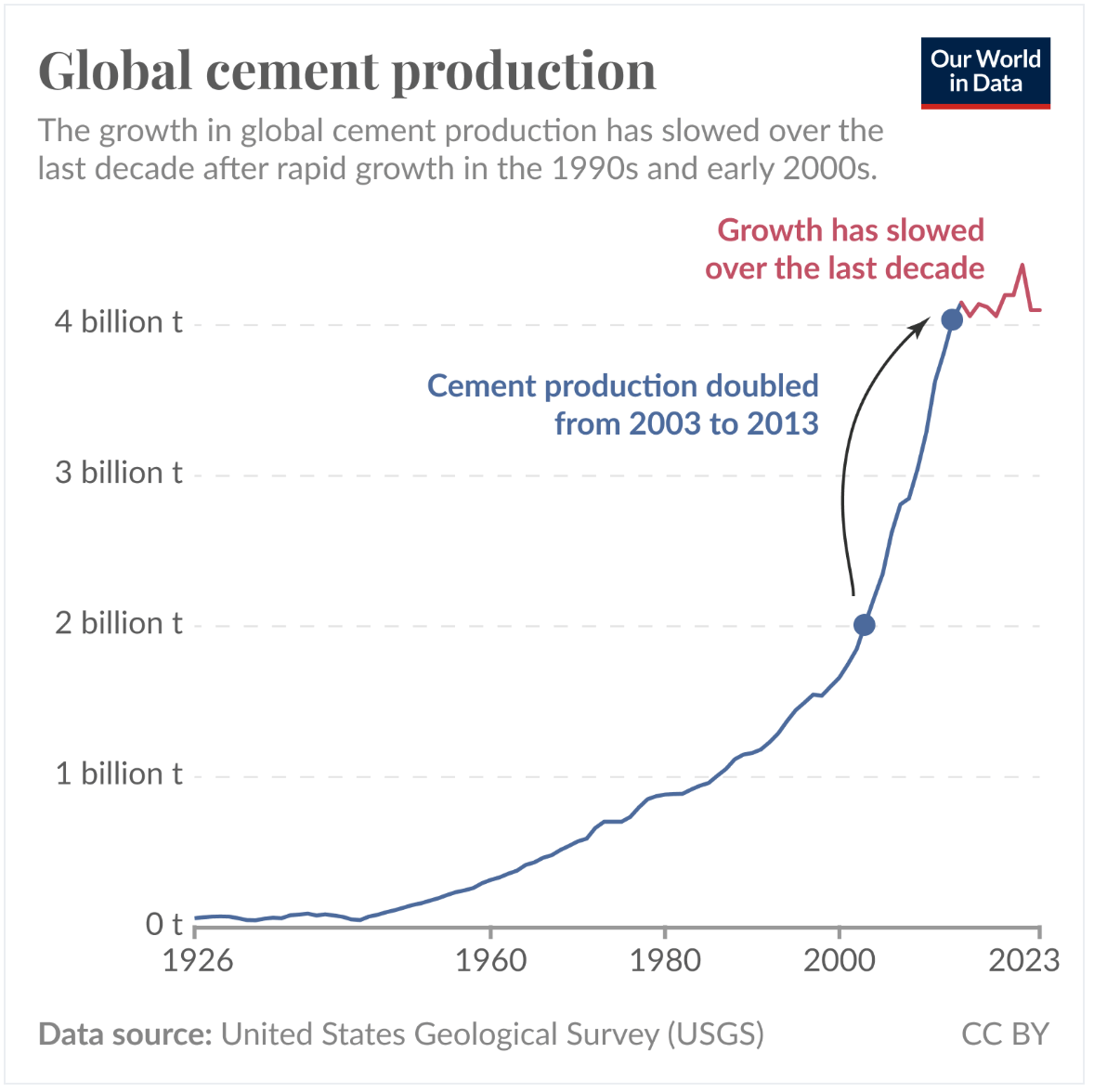
We know that world population has been growing since 2013, so clearly the amount of concrete produced, per person, has been falling. Thus, finished output, such as new concrete roads and buildings per person, has been falling.
Similarly, the number of new cars sold stopped growing after 2017. New cars were becoming too expensive for potential buyers.

The number of cars sold is not as high in 2024 and 2025, as it was in 2017, despite rising population.
It is tempting to blame leaders for the problem: Better laws are needed. It seems like the rich with their high incomes are taking too much of what is available.
But the underlying problem is that there are not as many goods to go around as there used to be. Strangely enough, the way this works out in our tightly interconnected economy is that the wages of younger people are becoming lower, relative to the wages of their parents. They cannot afford to get married, have a home, and raise a family. What is missing is jobs that pay well, as well as the inexpensive energy of the right type that makes such jobs possible.
[6] One type of war being fought today is the type being fought by the military.
Today’s military wars seem to be fought by countries with flat to falling energy consumption per capita, against countries that, through 2025, saw rising energy consumption per capita. Figure 12 and 13 show comparisons that may be surprising:


It is striking how in both Figures 12 and 13, nearby countries are observing opposite trends in energy consumption per capita. More energy consumption per capita tends to indicate a country that is doing better, economically.
Figure 12 shows that Russia’s energy consumption per capita has been growing, while Ukraine’s has been falling behind. It is almost as if one country’s increased consumption means decreased energy consumption for its neighbor. Figure 13 shows that Iran’s energy consumption per capita has been growing, while Israel’s has been falling behind. It is easy to imagine that competition for resources of all kinds underlies both conflicts.
China is not a direct competitor in the Iran conflict, but China and the US are competitors for resources of all kinds, (and, indirectly, jobs that pay well), in a kind of cold war. Here again, we observe the pattern of rising energy consumption per capita in China, and falling energy consumption per capita in the US.

To the extent that China gets more of the resources, the US tends to get less. This is another conflict that can’t easily be resolved. There fundamentally aren’t enough minerals like antimony and nickel for every country to purchase what it would like. Moreover, copper is in too short supply for all nations to ramp up electricity usage at once.
Because of the problem of “not enough goods and services to go around,” it is difficult to see a solution to the conflicts in Iran and in Ukraine-Russia. However, the wars may take different forms. For example, it may be tempting for Iran to strike back against aggressors using AI to disrupt the internet, electricity, or fresh water supplies. Europe has already seen bomb threats against airliners. There may be assassination attempts against leaders. These are lower-energy types of wars. It is possible that the two wars will merge to become a hidden World War III. In fact, China may also join in a way that allows the conflict to become a true world war.
[7] A second type of war relates to the share of a country’s income that should go to benefits provided by the government and the share left for the individual citizen to spend.
If countries are growing rapidly, thanks to a very rapidly growing supply of inexpensive energy, it can temporarily look like governments can afford very generous programs of many kinds for their people. For example, it will look like governments can support pensions, healthcare programs, unemployment programs, educational programs, and road repairs, without a very high tax level. This was the situation in the years following WWII in many countries.
Unfortunately, as Limits to Growth modeling shows, things change. Gradually, fossil fuel energy supplies deplete and population grows. Available oil supply becomes more expensive and grows less rapidly. This combination means that major program cutbacks are needed to make whatever services are provided to the citizens also affordable by them. Before fossil fuels became available, pensions for common citizens were unknown.
Newly elected leaders would like to change their economies in a way that will maintain (or even increase) promised programs but, because of Limits to Growth, we are reaching a point where this becomes impossible. Debt levels are already too high to support much additional borrowing. If a new leader tried to significantly reduce current programs, citizens would likely revolt. Unfortunately, even a revolution won’t create the physical goods and services needed to allow promised programs to continue. Raising taxes to provide all the benefits citizens expect would leave the people with virtually no income for daily living after taxes.
What history shows is likely to happen is that at some point, either (a) the financial system of a country with excessive promises will collapse, or (b) the country will lose at war. At some point, a new economy will arise, with many fewer promises. For example, if the EU were to collapse, the individual countries of the EU might take on additional roles. If an individual country such as France were to collapse, the regional governments might take on additional responsibilities. But they are unlikely to provide nearly as broad a package of benefits as before the collapse.
To keep resource needs down, the new governments are likely to have many fewer employees. In many cases, the new leaders will not be elected. The new leaders might be winners at war, or they might be self-appointed.
[8] A third type of war relates to the level of complexity an economy should have. This tends to lead to internal warfare.
Complexity can be good. For example, it can give consumers useful devices at low prices. It can sometimes lead to reduced energy consumption in a particular device.
But complexity can have unintended bad side effects. One issue is wage disparity. With greater complexity, businesses tend to become larger and more hierarchical. The top people tend to be paid much more than those at the bottom. Competition is often against low-wage countries. Such competition tends to bring down the wages of unskilled workers. The use of AI can sometimes eliminate jobs completely.
Another issue of added complexity is that it tends to lead to wealth disparity. Those with higher wages can afford to buy homes and shares of stock. If prices of homes and shares of stock increase over time, those who are already rich tend to become even richer. Eventually, these high home prices become unaffordable by the many less-wealthy people.
At some point, poor people become frustrated with the situation. They want to fix it. They riot. They start burning cars and buildings. Instead of fighting against other countries, the problem becomes internal conflict.
The economies of countries whose governments collapse generally fall back to a lower level of complexity than they had previously. Taxes then become lower. This can be good. But resource problems don’t go away by themselves. Some types of new solutions, probably with added complexity, are needed to work around resource problems, if this is possible.
[9] Conclusion
No one tells us that, at some point, the economy is likely to take a turn for the worse, but that seems to be the situation we are reaching. There now seem to be too few physical resources for the current number of people in the world to live at the standards of living that they are accustomed to. Renewables haven’t solved the problem, and more debt by governments cannot solve this problem.
Many people hope that electing new leaders will fix the situation. Because the underlying problem is really a resource problem, this cannot really help. Eventually, many governments are likely to collapse, unless solutions to our resource problems are found.
Quite likely, international fighting will continue, and it may even spread to become World War III. However, because of resource limits, this war will be fought in a less resource intensive way than it has been to date.
It does not look like complexity can be sustained in the way that it has been adopted to date. If this is the case, in its next stage, the world economy is likely to fall back to a lower level of complexity than exists today. The big plus of lower complexity is that taxes are likely to be lower. However, the change will require adaptation.


Hurray Jensen is back.
What happens when a commodity price falls?
https://www.zerohedge.com/commodities/congo-halts-cobalt-exports-price-collapse-fuels-resource-nationalism
Congo Halts Cobalt Exports As Price Collapse Fuels Resource Nationalism
The Democratic Republic of Congo is using its dominance in cobalt production to restrict exports in an interventionist move to reverse the collapse in global prices.
Bloomberg reports that ARECOMS, the country’s strategic minerals regulator, has imposed a ban on cobalt exports that will take effect at the end of November to combat plunging prices for the metal, which is widely used in EV batteries.
ARECOMS said the decision is intended “to address the oversupply in the international market and to promote a sustainable rebalancing of the market.”
The “Streetwise” commenter at WSJ writes:
Jensen Is Back. But AI’s Problems Haven’t Gone Away.
Nvidia CEO’s return is bad on multiple levels, and doesn’t remove serious challenges facing the AI ecosystem in general or the company in particular
The question is whether the market reaction will turn out to be an epic version of what traders call a dead cat bounce, when a plunging market temporarily rebounds.
Traders focused on the short term, and in the short term it’s all good. . .
In the long run, Huang’s return is bad on multiple levels and doesn’t remove serious challenges facing the AI ecosystem in general or Nvidia in particular. In no particular order:
Corporate governance. Is President Trump now the shadow chairman of the Nvidia board? If not, he might as well be. . .
Capital spending. . . Nvidia can finance its customers to buy its chips for a while, but it needs outside investors to have faith to supply the trillions of dollars forecast for data centers.
Competition. Nvidia faces intense competition from other chip suppliers, including AMD, Broadcom and Alphabet, and even Amazon. . .
Congress. China hawks in both parties are likely to keep pushing investigations into Nvidia and Huang. If they find anything embarrassing, Nvidia can no longer pass the blame to its former CEO.
Capitalism. . . Opponents of unfettered capitalism have a powerful new marketing tool, and he wears a leather jacket.
Then again the folks at OpenAI are same tribe.
Clearly, the treasurer, who was the very temporary interim CEO was very Jewish, and tied to Israeli companies.
Massive L means “massive failure”
https://www.zerohedge.com/political/castros-daughter-warns-new-yorkers-mamdanis-socialism-her-worst-deja-vu-nightmare
Castro’s Daughter Warns New Yorkers That Mamdani’s Socialism Is Her ‘Worst Déjà Vu Nightmare’
Speaking on Newsmax, Fernández said listening to Mayor Zohran Mamdani and other Democratic Socialists produced “the worst nightmare of déjà vu I ever had.”
She called the language “absolutely the same” scheme her father used. The word that stood out was “nationalization.”
“It’s seizing your assets, seizing your property. The government does it and it is administered by the state and it’s totally inefficient,” she said.
“It takes money from wherever it can until it ends up with everything. Before you know it you’re in line for food. We were in line for food two years after all these ideas of Marxism.”
Unfortunately, food has become expensive, while profits are steadily shrinking.
Who can put an end to this race to the bottom?
Governments claim that they can provide enough for everyone, but they can’t. If they put in government subsidized grocery stores, they drive all of the other grocery stores out of business. But their ability to buy in the international markets falls. Farmers become less and less able to adequately produce food. Somehow, this form of government fails.
They plan to build a new €150 million factory producing hundreds of tonnes of frozen, bake-off bakery products every day, while creating just 130 jobs in Slovakia. This, of course, puts smaller bakeries out of business or replaces them altogether:
https://www.sme.sk/domov/c/babisov-agrofert-chce-pri-trnave-vyrabat-mrazene-pecivo-vo-velkom-v-cesku-sa-jeho-penam-sudi-pre-dotacnu-kauzu
That’s how the business empire of current Czech Prime Minister Andrej Babiš operates.
Efficiency keeps the costs down. It doesn’t provide jobs, however.
That is because the government tskes sll the fatm land. Farmers have no incentive to produce well and run the farms efficiently. Without a market system based on orofit, oroducts drips and the store become emotyZ Not s difficukt thing to understand.
Not a huge problem as all the most successful world economies are mixed, state owned and privately owned. The real problem is that americans seem unable to do anything right.
But the US has managed to be the world’s hegemon, since World War II. A lot of people have done very well, financially, in the US.
Unable to do anything right.
Ridiculous!
We have done pretty well. Better than anyone else, I would say.
That was then, this is now.
“Britain’s photonic chip, built on indium phosphide at Daresbury Science and Innovation Campus in Cheshire, can carry out artificial intelligence inference at up to one hundred times the power efficiency of the best graphics processing unit NVIDIA currently makes—not a simulation, but a figure grounded in measurements on working optical circuits. “?
I really can’t stand this information-sparse AI slop writing and presenter. The internet is becoming unusable.
PS, with 17k views even at only $0.01, that’s 170 bucks. At $0.05 per view, 850. So the maker is making money assuming Youtube pays out at historical rates.
Sorry for the disinfo, it’s more like $1-5 per 1k views, so only 17-85 dollars.
Does it make sense ?
” Anthropic Committed to Spend $900 Billion. Wall Street Expects Its Debt to Be Junk. “
https://www.wsj.com/finance/investing/anthropic-committed-to-spend-900-billion-wall-street-expects-its-debt-to-be-junk-5514d55d?mod=e2tw
The debt is “junk”, but the equity that sits BENEATH it in the capital structure is worth $trillions.
Makes sense yo me.
/s
Debt pays out first, I expect.
World Energy Outlook 2026: Si cierras los ojos y lo deseas muy fuerte, no pasa nada. (Antonio Turiel)
https://crashoil.blogspot.com/2026/11/world-energy-outlook-2026-si-cierras.html
Regarding the first link, Turiel writes:
World Energy Outlook 2026: If you close your eyes and wish hard enough, nothing happens
The word “peak” appears only 21 times, mostly in connection with “demand” or “emissions” (CO2). However, there are a few instances where it appears alongside “supply”—though it is immediately followed by the word “loss.” “Peak supply loss”—as if that moment were already in the past, and as if the all-powerful, redemptive capacity of the markets could simply resolve any supply issues. (This, at a time when hostilities in the Strait of Hormuz have intensified, with oil tankers being damaged day after day; if this pace continues, we will face a physical challenge in transporting oil.) The other major, shameful omission in the WEOs—the word “uranium”—appears only once in the 2026 WEO, and in a very unremarkable context (just as supply issues are becoming increasingly pressing, and France is preparing to invade Niger to regain access to the mines that once provided 40% of its consumption—mines from which it was ousted following the coup in August 2023). In short, given this foundation, it is clear that one should not expect much from this WEO.
Turiel shows many charts (in English) from the report. He remarks,
In all scenarios—including the NZE (Net Zero Emissions) scenario—net energy demand rises; although, in the NZE scenario, this is supposedly achieved more efficiently (and perhaps even magically), resulting in a decrease in primary energy consumption. In all other scenarios, everything increases.
The second link is to the same post, on a different website.
BREAKING
This morning (November 23), Monday, Asian stock markets staged a deeply ironic “market-rescue stress test”— To keep a U.S. stock market crash from spreading, Asian regulators nearly emptied their entire toolbox over the weekend: mainland China announced a cut in the margin financing ratio from 100% back to 80% and rolled out a package of fee cuts; Taiwan went straight to five tough measures starting today, banning short selling below the previous close outright and raising the margin requirement for securities borrowing to 150%; South Korea even put its stock market stabilization fund on standby—a fund that has been activated only three times since 2008. But when the market opened at 9:30, it showed no mercy: the Shanghai Composite opened 0.86% lower, the Shenzhen Component opened 0.98% lower, and the Hang Seng Tech Index plunged 1.92%, while South Korea’s KOSPI fell another 3%, with Samsung and SK Hynix taking another beating. The only Asian stock market to escape a crash today was, surprisingly, Japan—not because its fundamentals were so strong, but because Tokyo was closed today for Labor Thanksgiving Day (SoftBank had just plunged 14.5% in a single day last Friday, and is now down 67% from its high). The facts show that, when foreign investors indiscriminately pull out their money, Asia’s best market-rescue tool isn’t a short-selling ban at all—it’s simply closing the market for a holiday. With U.S. stock index futures rebounding 2% while Asia keeps bleeding, would you dare buy the dip in Asia-Pacific assets today, or wait until tonight’s U.S. cash-market session to see what really happens?
https://www.zerohedge.com/markets/south-korea-readies-first-market-rescue-fund-deployment-2008
https://www.zerohedge.com/markets/taiwan-kills-shorts-blanket-ban-stock-lending-freeze-and-15-billion-rescue-fund-after
Ravi,
They really love adding those adjectives.
“breaking” news
“rare” cancer”
“Beloved” mother of 3
23 year “old” man
NVIDIA Board Reinstates Jensen Huang as President, CEO and Board Director
November 23, 2026
https://nvidianews.nvidia.com/news/nvidia-board-reinstates-jensen-huang-as-president-ceo-and-board-director
One headline says, “Nasdaq jumps 6.8%.”
NVDA up like 28% at the moment, hah. Odds were like 10% on polymarket at some point, could have made some quick cash with the right bet.
WSJ headline says,
Nvidia Board Reinstates Jensen Huang as CEO
Company says board ‘received input from senior levels of the United States government’
It is “share and share alike” for the Maximum Power Principle to hold. If we want scarce resources from China, we have to share our best chips with them. Sharing works among countries in the same way that it does among people.
Zerohedge says
https://www.zerohedge.com/political/trump-demands-nvidia-rehire-jensen-huang-hours-after-nyt-ties-his-mistress-chinas-spy
Trump “Believes His Intervention Was Important” In Nvidia Reinstating Huang As CEO; “Losing Jensen Was Tremendous Threat”
President Trump reportedly joined an Nvidia board meeting by phone to advocate for Jensen Huang’s reinstatement as CEO, according to Semafor’s Rohan Goswami, citing a source familiar with the matter.
The White House confirmed Trump’s involvement.
I don’t know the background, but political games make sense, given all that has gone on over the last decade. The below makes some claims about political motives and given the Trump angle might have some validity.
https://cloudwoods1.substack.com/p/nvidia-thinker-tanker-teacher-spy
What mine is mine, and what yours is negotiable..
Maximum power principle prime directive
There needs to be a balance, however.
This is the reason for the zig-zag path the economy follows, however. The stock market tends to use the same zig-zag approach.
The passive bid in stocks from retirement funds is still in place. When stock markets go back up it doesn’t mean anything has been fixed. It just means retirement funds are buying regardless if anything has been fixed or not.
Just saying the dip is going to get bought.
You could be right. As long as there are retirement funds that need to buy, it will tend to support stock market prices.
I believe that formula worked in the past but if there is a big dip or large unemployment numbers etc the bulls are going to panic and retirement funds will have to jump too or go to zero. I don’t think that they have the stomach for that. Did they buy the dip in 2008? Not until the government propped everything up. Also you have the largest group drawing down said retirement revenues. We”ll see
Interesting points.
Young people are much less likely to have private pension benefits than older people, also.
Government sponsored Social Security is pay as you go. So is Medicare. Pay as you go is the way the real economy works. If workers get a bigger share of total output, retirees necessarily will get less.
Yes, the passive bid is there as the default state. But when people panic, you get active flows. Also, the market gains have been against a backdrop of increasing leverage ~debt/gdp, which I imagine can’t go on forever with the rise of China/Asia (best shown, IMO, by energy consumption graphs over the last 50 years comparing global regions) that may change global investment flows. Plus boomer retirement and death. Plus general USA non-competitiveness in industrial goods while digital services (where we still dominate) should be commoditized by AI. All seems to undermine the USA thesis, pointing to a country more like Brazil than historical USA.
I am guessing that COP31 will be the last of the climate summits.
https://www.zerohedge.com/geopolitical/un-climate-summit-collapses-chaos-and-it-all-came-down-two-words
UN Climate Summit Collapses Into Chaos – And It All Came Down To Two Words
The United Nations climate summit in Antalya, Turkey, died with a whimper on Sunday with no final agreement, after a bloc of oil producers led by Saudi Arabia refused to let the words “fossil fuels” into the deal, acausing Europe and several ‘vulnerable nations’ to rage-quit without signing anything.
We can only hope.
At least the CO2 produced by sending 100s of delegates to Antalya will be saved however. The EU, I think, is also implementing a 400 euros per ton of cargo tax for all ships docking in a EU port. Stupid does not begin to describe them.
Hope for what. Tim?