
|
Getting your Trinity Audio player ready...
|
Changing leaders won’t fix the underlying problems
Why are people around the world unhappy? Voters in the US have called for change. Rioters in Europe, India, and Bangladesh are also seeking change. I believe that the underlying issue is that the world economy has hit what has been called Limits to Growth. There are too many people for available resources, particularly extractable energy resources. While it may seem as if there are enough resources, they are not sufficiently affordable to the many poor people in the world. Resources in short supply include fresh water and many types of minerals, besides fossil fuels.

Hitting Limits to Growth leads to a world without enough finished goods and services, such as food and affordable vehicles, to go around. It is easy to imagine many related outcomes:
- More fighting among countries
- More difficulty repaying debt with interest
- More governments needing to cut back on promised benefits, such as pensions
- Too few jobs that pay well
- A desire for new governments that will fix these problems
This concerning situation has been forecast to hit about now, since the 1970s.
In this post, I will try to explain the situation. I will show evidence that limits are being hit about now. Hitting limits leads to not-enough-to-go around and conflict. In the future, these wars may be fought in ways that use less fossil fuel resources, but the underlying issues will not go away. The wars are likely to be fought until they are resolved, in one way or another.
[1] The economy is tightly interconnected in ways that are difficult for most observers to understand.
Our leaders would like us to believe that they are all-powerful, but unfortunately, their actions are limited by the resources that they have at their disposal. These resources include various types of energy resources, which unfortunately cannot easily be substituted for one another.
For example, today’s farming equipment typically uses diesel. A farmer using a shovel could perhaps provide the same services, but the farmer’s output per hour would be much lower using a shovel compared to using a diesel-powered tractor. Farmers and other workers are paid based on their output. It is no surprise that farmers prefer using diesel-powered tractors to produce food, rather than using their own manual labor plus shovels. Manual labor is, of course, another type of energy.
Figure 2 shows a chart illustrating the way I see the economy working. Fossil fuels, especially oil, are essential for the operation of today’s economy.

Economies tend to grow as population rises, and as an increase in available resources makes possible a greater quantity of finished goods and services. Each new entrepreneur surveys the needs of his or her community and figures out what goods or services can be provided at an affordable cost. Governments gradually provide laws and public services to meet the needs of an expanding economy.
When certain types of goods are no longer needed, they tend to disappear from the market. For example, people no longer use horses for transportation. For this reason, buggy whips are no longer made at large scale. Also, the number of horses, relative to the human population, is much lower. It is not possible to resume using horses instead of cars because the situation has changed: Cities are much larger, there are few horses, and there are no services to remove manure from city streets. Because the system is always adapting to new situations, the system cannot simply go backwards.
Humans are the top predators in the world today. As long as there is sufficient food, water, and other needed supplies, the human population can grow, year after year. However, things tend to go wrong. If gathered wood is used for heat energy, nearby woods quickly get cut down, leading to a need to get wood from farther away, at a significant cost. If irrigation is used, the gradual accumulation of salts in the soil tends to reduce the harvest of barley and wheat. People living in close proximity tend to catch illnesses from each other, leading to epidemics. And the weather/climate tends to fluctuate.
Because of these and many other issues, economies are temporary. They tend to grow for a while. Then some combination of things goes wrong, causing them to collapse. Researchers have concluded that economies are self-organizing systems, powered by energy. They are subject to the laws of physics. They are not too different from plants and animals that grow for a while. Both may enjoy a stable existence for a while, before they decline and die.
Ultimately, economies that can no longer adapt to a changing situation are replaced by other economies that are better adapted to work with the available resources. We are now in the transition period between the integrated world economy of recent decades and the necessary replacement of that economy by one or more economies that are better adapted to declining fossil fuel availability.
[2] There seems to be a widespread belief that new leaders can somehow fix the world’s resource problems.
In my view, the belief that new leaders can fix the situation is false.


What is needed are more inexpensive resources with which to make goods and services. There seem to be more resources available in the ground, but they are generally expensive-to-extract resources. The resources that were inexpensive to extract and transport were removed first and sold.
Adding money created through debt-based promises is no longer sufficient after a certain point. Instead, governments tend to collapse, or they are overthrown. They tend to be replaced by governments providing fewer services such as armies, schools, roads, and pensions.
[3] Some people seem to believe that the world’s energy problems are “only” a fossil fuel problem. They assume that these problems will disappear with the transition to renewables.
There are at least two problems with this belief.
- So-called renewables are, in fact, manufactured and maintained using fossil fuels. If we lose fossil fuels, we also lose renewables. We also lose nuclear power because building and maintaining nuclear power plants depends upon fossil fuels.
- So far, “renewables” have had a limited impact on total energy supply. They mostly “top-up” the fossil fuel supply.

Based on data of the 2026 Statistical Review of World Energy, the world trend in energy consumption by type is as shown in Figure 7, below.

On Figure 7, nuclear provides the largest share of non-fossil fuel energy of the types shown, 5.2% in 2025. The various types of renewable energy shown, including hydroelectric, add up to 8.6% in 2025.
Wind and solar energy together amounted to 3.3% of the energy consumed in 2025. Their intermittency limits their usage. Solar energy is close to useless for providing heat for homes in winter, and not even wind cannot be depended upon in winter. This is why Europe, with its higher use of wind and solar energy, is dependent upon imported natural gas in winter.
Figure 7 shows that dips in fossil fuel consumption occurred in 2008-2009 and in 2020. When there is a major recession, or when people are ordered to stay at home, fossil fuel consumption (especially oil) tends to temporarily fall.
[4] A more recent recalibration of the 1972 Limits to Growth analysis suggests that limits to growth are hitting about now.
Figure 8 shows the summary chart from a paper titled, “Recalibration of limits to growth: An update of the World3 model,” by Arjuna Nebel and others, published in 2023.

Figure 8 indicates that we are currently experiencing the expected impacts of the Limits to Growth. The level of conflict is likely higher. It is not surprising the citizens are often unhappy with their current governments. Economies are on the edge of shifting toward contraction, rather than growth.
[5] Relative to world population, the quantity of steel produced, the quantity of cement produced, and the number of cars sold has been falling in recent years.

Figure 9 shows that crude steel output since 2019 has been basically flat. World population has been rising during this time period. Thus, steel production per capita has been falling since 2019. This means that since 2019, there probably have been fewer cars manufactured and fewer home appliances made relative to the growing population.
Similarly, Our World in Data shows basically flat cement production since 2013.
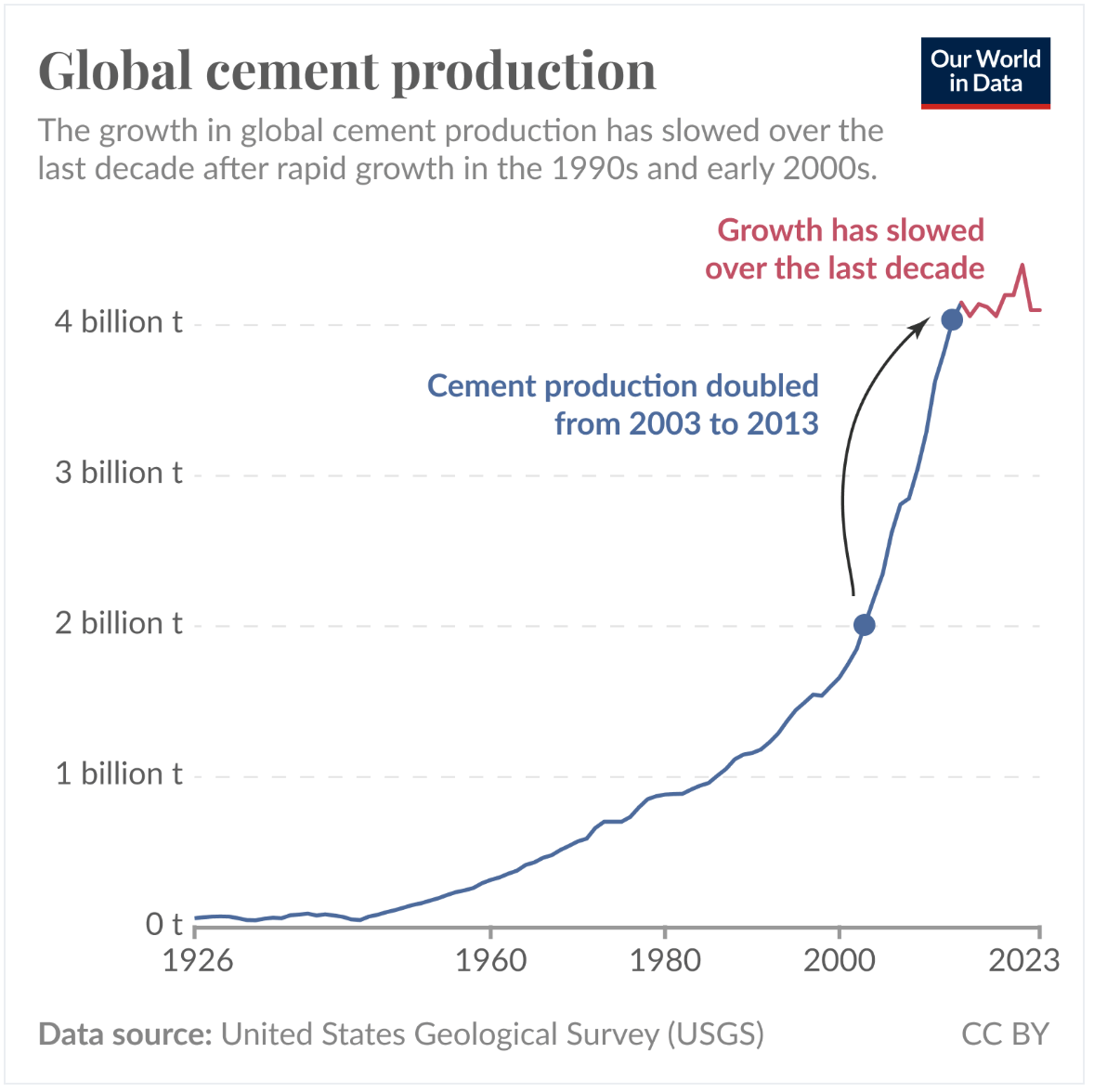
We know that world population has been growing since 2013, so clearly the amount of concrete produced, per person, has been falling. Thus, finished output, such as new concrete roads and buildings per person, has been falling.
Similarly, the number of new cars sold stopped growing after 2017. New cars were becoming too expensive for potential buyers.

The number of cars sold is not as high in 2024 and 2025, as it was in 2017, despite rising population.
It is tempting to blame leaders for the problem: Better laws are needed. It seems like the rich with their high incomes are taking too much of what is available.
But the underlying problem is that there are not as many goods to go around as there used to be. Strangely enough, the way this works out in our tightly interconnected economy is that the wages of younger people are becoming lower, relative to the wages of their parents. They cannot afford to get married, have a home, and raise a family. What is missing is jobs that pay well, as well as the inexpensive energy of the right type that makes such jobs possible.
[6] One type of war being fought today is the type being fought by the military.
Today’s military wars seem to be fought by countries with flat to falling energy consumption per capita, against countries that, through 2025, saw rising energy consumption per capita. Figure 12 and 13 show comparisons that may be surprising:


It is striking how in both Figures 12 and 13, nearby countries are observing opposite trends in energy consumption per capita. More energy consumption per capita tends to indicate a country that is doing better, economically.
Figure 12 shows that Russia’s energy consumption per capita has been growing, while Ukraine’s has been falling behind. It is almost as if one country’s increased consumption means decreased energy consumption for its neighbor. Figure 13 shows that Iran’s energy consumption per capita has been growing, while Israel’s has been falling behind. It is easy to imagine that competition for resources of all kinds underlies both conflicts.
China is not a direct competitor in the Iran conflict, but China and the US are competitors for resources of all kinds, (and, indirectly, jobs that pay well), in a kind of cold war. Here again, we observe the pattern of rising energy consumption per capita in China, and falling energy consumption per capita in the US.

To the extent that China gets more of the resources, the US tends to get less. This is another conflict that can’t easily be resolved. There fundamentally aren’t enough minerals like antimony and nickel for every country to purchase what it would like. Moreover, copper is in too short supply for all nations to ramp up electricity usage at once.
Because of the problem of “not enough goods and services to go around,” it is difficult to see a solution to the conflicts in Iran and in Ukraine-Russia. However, the wars may take different forms. For example, it may be tempting for Iran to strike back against aggressors using AI to disrupt the internet, electricity, or fresh water supplies. Europe has already seen bomb threats against airliners. There may be assassination attempts against leaders. These are lower-energy types of wars. It is possible that the two wars will merge to become a hidden World War III. In fact, China may also join in a way that allows the conflict to become a true world war.
[7] A second type of war relates to the share of a country’s income that should go to benefits provided by the government and the share left for the individual citizen to spend.
If countries are growing rapidly, thanks to a very rapidly growing supply of inexpensive energy, it can temporarily look like governments can afford very generous programs of many kinds for their people. For example, it will look like governments can support pensions, healthcare programs, unemployment programs, educational programs, and road repairs, without a very high tax level. This was the situation in the years following WWII in many countries.
Unfortunately, as Limits to Growth modeling shows, things change. Gradually, fossil fuel energy supplies deplete and population grows. Available oil supply becomes more expensive and grows less rapidly. This combination means that major program cutbacks are needed to make whatever services are provided to the citizens also affordable by them. Before fossil fuels became available, pensions for common citizens were unknown.
Newly elected leaders would like to change their economies in a way that will maintain (or even increase) promised programs but, because of Limits to Growth, we are reaching a point where this becomes impossible. Debt levels are already too high to support much additional borrowing. If a new leader tried to significantly reduce current programs, citizens would likely revolt. Unfortunately, even a revolution won’t create the physical goods and services needed to allow promised programs to continue. Raising taxes to provide all the benefits citizens expect would leave the people with virtually no income for daily living after taxes.
What history shows is likely to happen is that at some point, either (a) the financial system of a country with excessive promises will collapse, or (b) the country will lose at war. At some point, a new economy will arise, with many fewer promises. For example, if the EU were to collapse, the individual countries of the EU might take on additional roles. If an individual country such as France were to collapse, the regional governments might take on additional responsibilities. But they are unlikely to provide nearly as broad a package of benefits as before the collapse.
To keep resource needs down, the new governments are likely to have many fewer employees. In many cases, the new leaders will not be elected. The new leaders might be winners at war, or they might be self-appointed.
[8] A third type of war relates to the level of complexity an economy should have. This tends to lead to internal warfare.
Complexity can be good. For example, it can give consumers useful devices at low prices. It can sometimes lead to reduced energy consumption in a particular device.
But complexity can have unintended bad side effects. One issue is wage disparity. With greater complexity, businesses tend to become larger and more hierarchical. The top people tend to be paid much more than those at the bottom. Competition is often against low-wage countries. Such competition tends to bring down the wages of unskilled workers. The use of AI can sometimes eliminate jobs completely.
Another issue of added complexity is that it tends to lead to wealth disparity. Those with higher wages can afford to buy homes and shares of stock. If prices of homes and shares of stock increase over time, those who are already rich tend to become even richer. Eventually, these high home prices become unaffordable by the many less-wealthy people.
At some point, poor people become frustrated with the situation. They want to fix it. They riot. They start burning cars and buildings. Instead of fighting against other countries, the problem becomes internal conflict.
The economies of countries whose governments collapse generally fall back to a lower level of complexity than they had previously. Taxes then become lower. This can be good. But resource problems don’t go away by themselves. Some types of new solutions, probably with added complexity, are needed to work around resource problems, if this is possible.
[9] Conclusion
No one tells us that, at some point, the economy is likely to take a turn for the worse, but that seems to be the situation we are reaching. There now seem to be too few physical resources for the current number of people in the world to live at the standards of living that they are accustomed to. Renewables haven’t solved the problem, and more debt by governments cannot solve this problem.
Many people hope that electing new leaders will fix the situation. Because the underlying problem is really a resource problem, this cannot really help. Eventually, many governments are likely to collapse, unless solutions to our resource problems are found.
Quite likely, international fighting will continue, and it may even spread to become World War III. However, because of resource limits, this war will be fought in a less resource intensive way than it has been to date.
It does not look like complexity can be sustained in the way that it has been adopted to date. If this is the case, in its next stage, the world economy is likely to fall back to a lower level of complexity than exists today. The big plus of lower complexity is that taxes are likely to be lower. However, the change will require adaptation.


Thanks for this new post — reality tends to come in through the window, if we close the door on it.
Wasn’t it Norman Pagitt (spelling?) who said here, that they’d be fighting over the resources, as they decline?
“Changing leaders won’t fix the underlying problems”
Yes, but having democratic socialists manage the decline would be way better than fascist narcissists.
The only way that will be “way better” is that the “crash and burn” will happen way faster.
I am sure that there are different opinions. We have a zig-zag approach to economic policies because no matter what we do, it doesn’t work very well.
For Australian readers: I monitor diesel supplies weekly as new data come out:
16/11/26
Australian onshore diesel stock in September 2026 was lower than the minimum stock holding obligation
https://crudeoilpeak.info/australian-onshore-diesel-stock-in-september-2026-was-lower-than-the-minimum-stock-holding-obligation
In a counterproductive response to resource limitations Australia increased immigration to keep the GDP from falling into a recession. The result is a housing shortage and a new ant-immigration party, One-Nation.
Your graph on peaking sales of cars is interesting. More than 10 years ago I wrote this article:
27 May 2013
World car production grows 3 times faster than global oil supplies
http://crudeoilpeak.info/world-car-production-grows-3-times-faster-than-global-oil-supplies