
Most people expect that our signal of an impending reduction in world oil or coal production will be high prices. Looking at historical data (for example, this post and this post), this is precisely the opposite of the correct price signal. Oil and coal supplies decline because prices fall too low for producers. These producers make voluntary cutbacks because the prices they receive fall below their cost of production. There often are supply gluts at the same time.
This strange situation arises because prices must be high enough for the producers at the same time that goods and services made by oil (and other energy products) are inexpensive enough for consumers to afford. There is a two way battle taking place:
(1) Prices producers require tend to rise over time, because of depletion. The easiest to extract portion of any resource (such as oil, coal, copper, or lithium) tends to be removed first. What is left tends to be deeper, lower quality, or otherwise more difficult to extract cheaply.
(2) Prices consumers can afford for discretionary goods (such as cell phones and automobiles) tend to fall for a combination of reasons:
- Wages of many workers fall because of competition from lower cost labor in other countries.
- Some jobs are eliminated through the use of computers or robots.
- Young people are increasingly being required to pay for higher education (beyond that which is provided free), leaving many with loans to repay, reducing their discretionary income.
- Changes to US healthcare law (mostly starting January 1, 2014) lead to required health insurance premiums. While some citizens find cost savings in this approach, healthy young people often experience cutbacks in discretionary income as a result.
- Rents and home prices keep rising faster than incomes.
When the discretionary income of the many non-elite workers of the world falls, they buy fewer finished goods and services. Finished goods and services are manufactured using commodities of many kinds, including oil, coal, copper, iron ore, and fresh water. When discretionary demand falls, commodity prices tend to fall. This is the problem we are encountering now. It tends to cause the prices of many commodities to fall below the cost of production. Eventually, producers decide to quit because production is no longer profitable. This is the issue that leads to peak oil, coal or copper.

Figure 1. Illustration showing why falling affordability creates a conflict between supply and demand.
If the Affordability Price Clash Mostly Affects Non-Elite Workers, Does It Matter?
When I talk about non-elite workers, I am talking about workers who are in the bottom 90% of the wage distribution. Elite workers will always have enough income for the necessities of life. There are so many non-elite workers in the world that they, indeed, do make a difference.
Also, the forces that adversely affect non-elite workers tend to have several effects:
- They tend to send a larger share of wages to elite workers, as the economy becomes more complex and more specialized.
- They tend to send more unearned income to elite workers, through capital appreciation, because elite workers can afford to buy shares of stock and expensive homes.
- The wealthy spend their income differently from non-elite workers. Non-elite workers tend to spend the bulk of their discretionary income on devices made using commodities, such as cell phones and automobiles. The wealthy are likely to spend their discretionary income in less energy intensive ways, such as investing in shares of stock and buying services such as private college education for their children.
History shows that economies tend to collapse when wage and wealth disparity becomes too great. Collapse can take various forms, including revolutions by the disgruntled underclass, increased susceptibility to epidemics, or the financial collapse of governments. Wars become more likely, as one country tries to aid its citizens at the expense of citizens of other countries.
The world today seems to be approaching a crisis point with respect to wage and wealth disparity. Young people in particular are adversely affected. Figure 2 shows a chart indicating that wage disparity seems to be back to the level it was at the time of the Great Depression of the 1930s. This was also a time of low commodity prices and gluts of food and oil.

Figure 2. U. S. Income Shares of Top 1% and Top 0.1%, Wikipedia exhibit by Piketty and Saez.
Gluts tend to occur because commodity prices rise to a level where devices made with these commodities (such as cell phones and automobiles) become too expensive for non-elite workers to afford. Elite workers can still afford the devices, but there are not enough elite workers to make up for the shortfall in non-elite buyers of these devices, so industrial output per capita tends to fall.
Figure 3 shows the important role that the wages of non-elite workers play in generating adequate demand. If their wages are high enough, they can buy enough goods and services made with commodities to keep commodity prices high. With sufficiently high commodity prices, production can continue.

Figure 3: Chart showing the important role that the wages of non-elite workers play in maintaining energy demand. With adequate demand, prices can remain high enough for production to continue.
Why the Peak in World Oil Production Likely Occurred in 2018
If we look at recent oil data, we see a pattern of growing gluts in supply, as indicated by the red bars in Figure 4. Even in the most recent week, the week ending February 15, 2019, after all of the cuts begun by OPEC and other oil exporters, US crude oil stocks continue to build. This is not the impact a person would expect, if the production cuts are truly effective!

Figure 4. Brent average quarterly oil price (in January 2019$), with an indication of quarters when world crude oil inventories are building. Oil prices are Brent spot oil prices, adjusted using the CPI-Urban to January 2019 prices levels. World inventory build quarters are based on indications shown in US Short Term Energy Outlook reports of various publication dates.
This is precisely the kind of signal we would expect, if products made with oil (and using oil in their operation) are becoming increasingly unaffordable for the non-elite workers of the world. Note that these bars are becoming more frequent and are occurring at lower prices. This is the expected outcome of a clash between the falling discretionary income of non-elite workers and the rising costs of oil producers.
When prices fall too low, producers cut back production. OPEC reports its view of the effect of recent production cutbacks in Figure 5.

Figure 5. OPEC and world oil supply, in chart from OPEC Monthly Oil Market Report for February 2019.
Given the nearly worldwide problem of falling affordability of goods by non-elite workers, we should not be surprised if the peaks in oil production in October and November 2018 ultimately prove to be the maximum production ever recorded. In fact, it seems quite likely that the year 2018 will prove to be the year with the highest-ever oil production.
The cutback in production will appear to be voluntary. Once cutbacks start, they will tend to feed upon themselves. Unless oil prices really spike following the cutbacks (say, to $90 per barrel), exporting countries will find themselves worse off after the cutbacks, for a combination of reasons:
-
- The cutback in production will reduce the number of workers directly and indirectly employed by the oil industry. Their reduced spending will lead to a need for expanded government programs.
- Housing prices will fall in oil exporting countries. This is likely to ultimately lead to debt defaults.
- Tax revenue that governments of oil exporters can collect on the smaller amount of oil will be lower, even though the needs of the economy will be greater.
Ultimately, it seems likely that at least some governments of oil exporting countries will be overthrown, depressing oil production further. If the breakeven price for most OPEC members, including necessary tax revenue, was over $100 per barrel in 2014, it is hard to see how exporters can get along with much less today.
World Coal Production: Following a Similar Pattern to Oil?
One thing that most people don’t realize is that coal prices follow a very similar pattern to those of oil.

Figure 6. Sample world coal prices, based on information from 2018 BP Statistical Review of World Energy.
In Figure 6, coal prices experience a major peak in 2008, followed by a lower peak in the 2011 period, which peters out by 2013. Prices recently are much lower than in the 2008 period, or in the 2011 to 2013 period. This pattern is very similar to the recent pattern in oil prices.
The similarity in the patterns of coal prices and oil prices makes perfect sense if prices of both oil and coal are based primarily on affordability, and this affordability depends heavily on the wages of non-elite workers. When countries, such as China, ramp up their debt, more non-elite workers can be hired at higher wages. These workers can make more computers, automobiles, steel ingots, and many other goods. They can also afford to buy more output of the world economy. This ramped up demand tends to raise the prices of both coal and oil.
For many commodities, China’s demand represents close to half of the world demand. China has become the world’s number one manufacturer of goods. China needs growing energy consumption to maintain its growth of manufactured goods because it takes energy to operate machines, even computers. It even takes energy to keep the lights on.
Unfortunately, with the recent lower prices for coal and oil, China is experiencing lower production of both coal and oil (Figure 7). Without growing energy supplies, China cannot meet the world’s growing need for manufactured goods.

Figure 7. China energy production by fuel, based on 2018 BP Statistical Review of World Energy data.
The reason why China has recently reduced production of both coal and oil is the usual one: the rising cost of production conflicts with the low prices available in the marketplace, making production unprofitable for a growing share of producers.
How about China’s total energy consumption? Do imports make up for China’s lack of local production?

Figure 8. China energy production by fuel, with a line added to indicated it total energy consumption, including imports. Based on BP Statistical Review of World Energy 2018 data.
Not really. China is the world’s largest importer of coal, oil and natural gas. It is also the number one user of wind and solar (included in the tiny orange “Other Renewables” portion of the chart). Even with these huge additions to China’s energy production, its annual growth in the quantity of energy it consumes (including imports) has plummeted (Figure 9).

Figure 9. China annual growth in total energy consumption. Based on 2018 BP Statistical Review of World Energy data.
China reports that its real GDP growth rate is still very high (over 6%, net of inflation), but many observers are skeptical of this claim. Certainly, going forward, its coal and oil production cannot continue to decline, or the economy will encounter huge problems. The amount of goods China will be able to manufacture will fall, as will the number of new homes it can build. Without continued growth, China is likely to run into debt default problems. China is such a large country that its problems can be expected to adversely affect the world economy as a whole.
Figure 10 shows that China produces nearly half of the world’s total coal. If China’s coal production declines, world production is also likely to decline.

Figure 10. World coal production, divided into China and Non-China, based on 2018 BP Statistical Review of World Energy data.
The only way to prop up coal production, for either China or the rest of the world, is higher prices, indirectly coming from higher demand from non-elite workers. Businesses can perhaps use rising debt to hire these non-elite workers but, if there is not a sufficient supply of buyers who can afford the additional goods and services made by these workers, the final outcome will be debt defaults.
The Fundamental Problem Is a Physics Problem
The fundamental problem is that the economy grows for the same reason that hurricanes, ecosystems, stars, and plants and animals grow. They are dissipative structures that grow in the presence of energy flows. In the case of hurricanes, the energy comes from the heat in the warm ocean. In the case of the economy, the energy flows are of many different types, including (among others), human energy, energy of draft animals, solar energy, fossil fuels, and wind energy.
One key characteristic of dissipative structures is that they are not permanent. Permanent growth in a finite system is not possible. The laws of physics sets up the system in such a way that dissipative structures grow and eventually collapse. Over time, new dissipative structures form, each varying in a random way from previous dissipative structures. Those best adapted to the ever-changing circumstances tend to last the longest. This is the way that the evolution of economies takes place, just as the evolution of plants and animals takes place.
One characteristic of economies is that physics determines how much energy is needed to manufacture and transport a particular product. It also determines how much the mix of buyers can afford to pay for finished products using this energy. Thus, physics determines the potential profitability of a particular manufacturing process, with lower energy costs tending to make production more profitable. As energy costs rise because of diminishing returns, the system eventually reaches a point where it must collapse. The cost of production rises so high, relative to wages, that many non-elite workers cannot afford the finished goods and services made by the system.
The laws of physics also determine what wage distributions must look like, given the availability of energy and other resources. In general, if there are not enough resources to go around, some members of the economy tend to get “frozen out” by low wages. In addition, in a low-energy per capita situation, the energy that is available tends to rise to the top, to the high-earners of the economy, somewhat like heating water transforms it to its gas phase (steam), which rises to the top. With this structure, even with a severe energy shortfall, some members of the economy can be survivors.
With today’s worldwide economy, the survivors might be some humans and businesses within the world economy. The system would need to start over, building up smaller economies from pieces that managed to stay intact, but the system, as a whole, would not die out, unless the energy shortfall were to be severe.
Modeling the World Economy
One issue with academic research today is that it tends to be divided into many academic “silos.” Researchers tend to know more and more about their own field, but less and less about other fields that might be peripherally related. For example, economists tend not to keep up with the physics of self-organizing networked systems. Geophysicists understand the physics that governs the extraction of fuels, but they have no insight into the fact that the laws of physics might also affect prices and wage distributions.
Without understanding the forces that are causing the results that are being observed, it is very easy to create a model that is more misleading than helpful. For example, a simple model of the earth is the one each of us can see as we look around us.

Figure 11. Source: Edrawsoft.com
The model shown in Figure 11 is a flat map. This is a perfectly good representation of what the earth looks like, if a person is not concerned about what happens at a distance. Of course, to extend the map out, a person really needs to convert the model into a globe. A globe is a very different model.
Economic researchers tend to have some of the same modeling issues as illustrated by the flat map model. Economists favor fitting curves to past data to forecast the future patterns. Curve fitting tends not to be good for determining turning points. When dealing with energy and other resources, we are really interested in when a turning point will happen, forcing production of energy products and resources of many kinds downward.
Another model favored by economists is the standard two-dimensional supply and demand model (Figure 12). This model ignores the special role that energy products play because of the operation of the laws of physics. Energy products, as they work through the networked economy, affect both the supply and demand of finished goods and services, making the two dimensional model shown inappropriate.

Figure 12. This standard model does not consider the special role energy plays in the economy under the laws of physics, so is not appropriate for energy products.
With neither curve fitting nor the standard supply and demand model sounding an alarm with respect to energy prices not being able to rise forever, economists have tended to overlook this issue.

Figure 13. Economic models tend to give a false sense of security because they forecast that the future will be a continuation of the past.
Of course, policymakers are happy to hear happily-ever-after endings. Few policymakers question the reasonableness of the models. They do not consider the possibility that the falling discretionary income of non-elite workers around the world might choke off demand for goods made with energy products.
Even geophysicists who have looked at the problem tend to get the story only half right. They understand underground physics, but they tend not to understand that prices cannot rise indefinitely. This is a different, related issue, also associated with the physics of the situation.
“Climate Change Is Our Biggest Problem” Is a Corollary to Bad Modeling
If a person truly believes that energy prices can and will rise forever, then it is an easy corollary to assume that all fossil fuels that we can identify within the earth’s crust will eventually become extractable. There are no limits except for the limits imposed by climate change.
Of course, if we are really hitting price limits here and now, the situation is likely to be very different. These price limits will cause a very near-term decline in energy supply, which we essentially have no control over. Financial systems are likely to collapse; international trade will be scaled way back; world population is likely to fall. CO2 levels will, in time, adjust to this radically changed world.
I showed earlier (in How the Peak Oil story could be “close,” but not quite right) that the models used to “prove” that wind and solar can be helpful to the system greatly overstate their benefit to the system. As a result, we don’t really have evidence that wind and solar are even helpful to the system.
Consequently, we really have two false models working together to give an illusion that we have a huge problem which is fixable, if we just exert enough effort. Physics puts a cap on our efforts, however. The physics of the system makes the system collapse before policymakers can hope to even make a small fix.
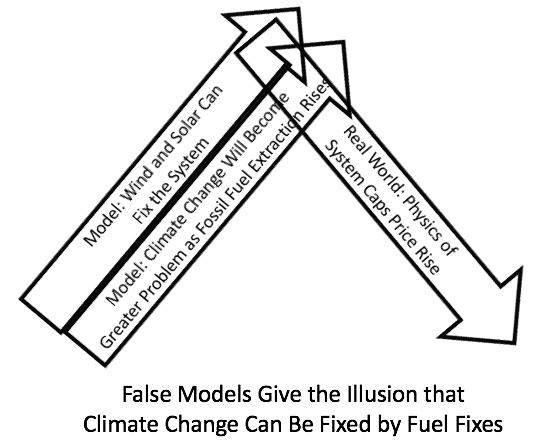
Figure 14. Two false models work together to give the illusion that climate change is the greatest problem that humans have and that we can fix the problem with fixes to the fuel system.
The unfortunate problem is that policymakers are not really in charge: the laws of physics are in charge. Energy and other resources are no longer inexpensive enough to extract to allow the system to work. The proposed solutions (wind and solar) are not cheap enough to save the system either. We can temporarily hide the problem with more debt (indirect promises of future energy) at lower interest rates, but this does not fix the system.
Conclusion
Many of the problems the world economy is facing today seem to be the result of reaching the limits of energy extraction. Very few researchers understand how a self-organized networked economy really operates. As a result, the symptoms of economic health and economic illness have been confused. It looks quite possible that we have reached both Peak Oil and Peak Coal, approximately simultaneously. This is a frightening situation, because it could be an indication of collapse in the next few years. This would likely be much worse than the Depression of the 1930s.
Of course, even with these observations, we do not know precisely what lies ahead. Somehow, multicellular animals have lived on this earth for a very long time. Amazing coincidences have happened and may continue to happen, allowing economies to flourish. We humans do not have as much control over the current situation as we would like to think that we have. Fortunately, we cannot rule out the possibility of more amazing coincidences, perhaps even caused by a literal Higher Power behind the energy flows. Thus, the result may be different from what our models seem to suggest.


1991 — Meet Officer Friendly?: LA Police savagely beat Rodney King — captured on amateur video. “What you need to remember about cops is that they are just another kind of criminal, with power.”
Police tape: ‘You just had a big-time use of force’
1:12 a.m. From Powell & Wind to the foot patrol officer: “….ooops.”
1:12 a.m. From the foot patrol to Powell & Wind: “oops, what?”
1:13 a.m. From Powell & Wind to the foot patrol: “I haven’t beaten anyone this bad in a long time.”
1:15 a.m. From the foot patrol to Powell & Winds: “Oh not again….Why for you do that….I thought you agreed to chill out for awhile….What did he do….”
1:16 a.m. From Powell & Wind to the foot patrol: “I think he was dusted…many broken bones later….After the pursuit….”
Well Martin’s dream has become Rodney’s worst nightmare.
Can’t walk the streets, to them we are fair game,
our lives don’t mean a thing.
https://youtu.be/HWYX8f9Qot4
1953 — Guatemala: Jacobo Arbenz declares the nationalization of idle lands held by the United Fruit Company; United Fruit & US both go bananas? US-backed terrorism & genocide — under the catch phrase “defending freedom & democracy” — follow for the next 30 years.
The WTI 50MA just crossed the 200MA again. When it did that before (cyan circles), the WTI fell to the bottom trendline (now at USD 21).
The herd is about to run off the cliff?
https://pbs.twimg.com/media/D0muU4pWsAAK0ea?format=jpg&name=small
Gail, I don’t know how the world would react to a collapse in oil, copper, gold, silver and equity prices.
I guess the prices would bounce after they hit bottom. And I also guess the central banks would step in and start another round of QE and ZIRP to try to raise prices.
If governments and central banks fail to raise prices, then I think that things will deteriorate and lead to conflict.
prices for raw materials can only bounce back up if there’s a use for them
which means having the necessary energy resources for those uses
The global economy seems to signal that those energy resources are dwindling, but not entirely depleted.
Governments through fiscal stimulus and central banks through QE and ZIRP can still create enough demand to rise prices to extract the remaining energy reserves?
it ‘s a diminishing returns problem
if you’re thirsty and get water from a well, its ok to haul it up a few feet
but if the water is hundreds of feet down, you generate a bigger thirst that can be satisfied with the water you pull up
The water is still down there, but at the same time out of reach
(Farmers in India have this problem right now)
Most of the fossil fuels in the earth’s crust will remain down there, out of reach.
The world energy mix still has positive EROEI. If it didn’t, there would be no modern industrial economy today. The EROEI is declining though.
The question is just how to adjust the economy and monetary policy to the decline…and what is politically possible.
Nearly 50 per cent of India facing drought as groundwater depletion increases – “We are not enhancing groundwater recharge, and drought conditions are making us extract more and more water”
https://desdemonadespair.net/2019/03/nearly-50-per-cent-of-india-facing-drought-as-groundwater-depletion-increases-we-are-not-enhancing-groundwater-recharge-and-drought-conditions-are-making-us-extract-more-and-more-w.html
“if the water is hundreds of feet down, you generate a bigger thirst that can be satisfied with the water you pull up”
It would seem likely that as areas of India become uninhabitable due to water source depletion, those people will move to other areas, but that will put more strain on remaining water sources and eventually population density will reach a point of becoming extremely stressful. The lesson is don’t overpopulate to the point of exceeding water carrying capacity. But now they already have, it’s a ticking population time bomb.
thats the point i was making
And Iran: the government itself stated that they will be unable to utilise 40% of their agricultural land before 2030 due to water depletion.
Attempts to address the situation are bedeviled by corruption leading to inappropriate projects which pay the connected and influential well but are likely to exacerbate the problem.
So many Doom Clocks ticking globally, their hands steadily approaching the Chimes of Midnight, the music of the graveyard…….
yup
you can find ”alternatives” to most things
nobody mentions alternative water
Good point!
What’s politically possible?
Showing my age here, remember old time U.S. Rep Claude Pepper of Miami that was a fiixture here in South Florida.
In his later years recall the two words he utter every time on the TV…”Social Security”,
Old Claude, bless his heart, held steadfast to the mantra it was in good hands while he was watching over it in the Congress.
Got him reelected over and over and over and over, ECT…
https://m.youtube.com/watch?v=chRTQ-D1Pac
“In the early 1970s, Pepper chaired the Joint House–Senate Committee on Crime; then, in 1977, he became chair of the new House Select Committee on Aging, which became his base as he emerged as the nation’s foremost spokesman for the elderly, especially regarding Social Security programs. He succeeded in strengthening Medicare.[citation needed] In 1980 the committee under Pepper’s leadership initiated what became a four-year investigation into health care scams that preyed on older people; the report, published in 1984 and commonly called “The Pepper Report”, was entitled “Quackery, a $10 Billion Scandal”.[48]
In the 1980s he worked with Alan Greenspan in a major reform of the Social Security system that maintained its solvency by slowly raising the retirement age, thus cutting benefits for workers retiring in their mid-60s, and in 1986 he obtained the passage of a federal law that abolished most mandatory retirement age”.wikipedia.
More likely a major crisis will occur and change will be forced on the citizens of our great Republic…God Bless American
I don’t know if this is real or will go anywhere, but low-cost superconductor leads to some strange places. It might allow power to be moved long distances at a lower cost. It also offers storage in big inductors. It is the kind of thing that could make a difference on the scale Gail worries about.
Right out of left field.
https://phys.org/news/2019-02-navy-patent-room-temperature-superconductor.html
“I don’t know if this is real or will go anywhere…”
until it’s real, it’s not real…
and until is goes somewhere, it has not gone anywhere…
the cost will likely be absurdly high…
and even if the cost is reasonable, it will surely be no antidote for the ever increasing cost of all global resource extraction ie diminishing returns…
More importantly it’s not needed, when we have ~1000yrs of fission material ready (existing depleted fuel stock) for breeders. To sum it up, if there is no WW3/4 soonish the end game is as follows other countries end up bending a knee before Asia, “..pretty please dear galaxy overlords build some of your magic NPPs for us as well for tribute of your choosing..” lolz
“More importantly it’s not needed, ”
Storage and transmission are different from generation.
There could be either “purist” base-load biased system or some mix with storage or complete decentralized no base-load storage + in situ generation.. So, three options.
We need a whole portfolio of cheap to produce resources that will fit with today’s infrastructure. It is hard for electricity to bridge this gap because we can’t today build roads with electricity; we can’t build concrete buildings with electricity; we can’t cross oceans with the world’s internationally traded goods using electricity.
Electricity is an add-on to an economy built with coal and some oil. My mother used to tell me about a gasoline powered washing machine her aunt had before electricity become generally available. And my father used to tell me about riding a motorcycle, with his father, to get to the boarding school he attended in Madagascar, long before electricity was available. Oil products can be used with little permanent infrastructure, making then an easy choice of developing areas. Coal, also, does not require much permanent infrastructure, other than roads, carts, and small boats that would be available for other purposes.
Electricity depends on being able to maintain transmission lines. These in turn depend on being able to maintain roads and helicopter service used to fix these transmission lines. I expect international trade is also needed, to keep the system going, because at least some of the parts will require raw materials from around the world.
Natural gas is not a substitute for coal or oil because it needs to be delivered in pipelines or suitable pressurized containers, door to door. This requires a lot more infrastructure.
“We need a whole portfolio ”
Gail, not being into engineering, I think you overstate the problems with substituting electricity for other kinds of energy.
Electric power can replace all other sources of energy. If the power is cheap, the substitutes will be cheap too.
We have an awfully lot of machines running on diesel today. If a person doesn’t have a way of converting them easily to electricity, and storing sufficient electricity to operate this vehicles, this is a problem. Alternatively, diesel needs to operate these vehicles. Ships, in particular need to operate in a way that they can easily handle. The cost and time of adaptation is another hurdle.
Railroads are one example where we certainly could convert to electric power. Ships are an interesting case. They could run on F/T wax slightly heated. But the more interesting is to attach a StratoSolar platform and run them directly on electric power.
The big objection is that not enough work is being done on the problems.
We can’t build suitable tracks for the trains using electricity, however, and maintaining the infrastructure to keep the electricity distributed is a huge headache.
“We can’t build suitable tracks for the trains using electricity,”
I don’t know why. Electric trains are standard in Europe and the northeast corner of the US.
If we did power trains off the grid, it would be a relatively small load.
I am not taking about the operating the trains. I am talking about building and maintaining the tracks. This takes moving dirt, and laying rail in the right configuration. Also adding the electric wiring. All of this takes fossil fuels. I expect that building the train also takes fossil fuels. Operating the train can indeed be done with electricity, but this is a different issue.
“I am talking about building and maintaining the tracks.”
The tracks are in place, some of them have been there for over 100 years. Putting up the wiring would cost and take FF to do it, though the amount in comparison to what a train locomotive uses is negligible. The tanks under a locomotive are several thousand gallons.
The railroads burn so much fuel going up over the hills to the east of LA that people have done studies of adding electric power lines so the trains going down can power part of the load from those going up.
It’s worth watching this for a background on trains. https://www.youtube.com/watch?v=9poImReDFeY
You can buy an entire town in Georgia for the cost of a typical home in San Francisco
https://www.marketwatch.com/story/you-can-buy-an-entire-town-in-georgia-for-the-cost-of-one-home-in-san-francisco-2019-03-01?link=sfmw_fb&fbclid=IwAR2UpNfedvy0JOCxzUZy0qXsdAOB06NvJg-dGyl5a3D4CIZWF2EWINy6v-E
And yet I would bet when TSHTF I bet those places in Georgia may far outlast San Francisco.
It depends on what kind of s hits the fan. SF is rarely hot, so in a world with rising temps if that becomes an increasing big problem, SF could be a great location. I remember riding with my family up from LA and it was really hot, then reaching the fog shrouded Bay Area and it was quite a relief.
The least of humanity’s concerns will be “rising temps” unless you mean some kind of nuclear war meltdown.
I’ve been in some areas in North Georgia that I think would be a great place to ride it. Of course, it would help to have been there for a while – part of the community.
Bernstein: US in a ‘cold civil war’ Trump may ignite
https://www.cnn.com/videos/politics/2019/03/02/carl-bernstein-trump-cold-civil-war-sot-cpt-vpx.cnn
Found this at http://www.antipope.org/charlie/blog-static/fiction/toast/toast.html Since it is rather on target, I thought I would share it
*****
Until about the third millennium BC, there was no noticeable change in social patterns on any time scale measured in less than centuries. Around that time, the first permanent settlements that we’d recognize as towns arose, facilitated by the discovery of agriculture. With them appeared writing and codified law and the rudiments of government.
From that time on, there was no turning back. An agricultural civilization can support far more people in a given area than a hunter-gatherer lifestyle—but the transition from a hunter-gatherer society to agriculture is strictly a one-way process. If you try to reverse it, most of your people will starve to death: they simply won’t be able to acquire enough food. This was the first of many such one-way processes in the historical record. Arguably, it’s the existence of these one-way transitions that gives rise to the appearance of inexorable historical progress; it’s not that reversals are impossible, it’s simply that after a reversal there’ll be nobody left to keep a written record of it.
The twentieth century was riddled with one-way technological changes . . .
That’s an interesting point. Just even imagine the loss of the internet. Would the modern US economy survive it’s loss?
Probably the US economy would survive. The disruption would be impressive, but people might not die in large numbers. There would be a massive effort to get the Internet back up.
I disagree as so many businesses now rely on internet sales. It would reduce business into a deep recession and with so many people living paycheck to paycheck I don’t see how something like that wouldn’t knock out the us economy.
You do realize you’re now arguing against your original post, that certain changes make it difficult if not improbable to go in reverse? Remember, you wrote, “The twentieth century was riddled with one-way technological changes . . .”
” Remember, you wrote”
Sorry, that’s from Charles Stross, not me.
That is a good point about the changes that have been made being non-reversible.
It is sort of like the growth of a human being. We can’t go back to being a baby. We can’t even go back to being a young adult, worrying about dates with the opposite sex. We can’t go back to being a young mother, although medicine tries its best to allow us to freeze and implant eggs, to make the impossible, possible again.
https://www.nytimes.com/2019/03/02/world/middleeast/saudi-arabia-torture-american-citizen.html
https://oilprice.com/Energy/Crude-Oil/China-Says-Massive-Shale-Oil-Reserves-Found-In-North.html
‘China Says Massive Shale Oil Reserves Found In North’
“The shale boom in China, however, would be just a fraction of the U.S. shale revolution—Morgan Stanley expects Chinese shale oil production could be 100,000 bpd-200,000 bpd by 2025, which is nothing compared to the millions of barrels of oil pumped in the U.S. every day.”
How does Morgan Stanley know how much shale oil there is in China?
They ask a geologist who has access to the maps of the area. Given the volume of shale, you can make a reasonable guess at how much oil or gas you can get out of it.
The people who did this with the shale in the US knew how much there was (a lot). Taking that volume and the gas content, they came up with a really large amount of gas they expected could be extracted.
One of the big issues in China is lack of water for fracking. Another is the dense population in practically every area that has easy access. This big population would need to be moved elsewhere, and new occupations/jobs found for the many displaced people. A third issue is the fact that China would need to add a whole lot of infrastructure to transport this shale oil to refineries.
There is a good reason that oil from shale hasn’t been exploited so far. I don’t expect it to happen in the future. I have been a co-author of several Chinese energy supply articles. I think this one touches on oil from shale.
https://gailtheactuary.files.wordpress.com/2016/09/chinas-unconventional-oil_-a-review-of-its-resources-and-outlook-for-long-term-production.pdf
If Trump doesn’t win in 2020, SDNY will “be waiting with cuffs” when he leaves White House, says legal analyst
https://www.newsweek.com/donald-trump-2020-sdny-investigation-1349868
“I’m beginning to think the biggest problem on the right is simple arrested development. They are literally toddlers refusing to eat their broccoli.”
Some of our commenters even at this late stage still cling to old silly conflicts. I suppose it is in a way comforting to argue over trivialities in the shadow of the tsunami.
Brings to mind a quote from Salman Rushdie (paraphrasing): So this is how it all ends… in a sea of obesity and trivia.
also “If Trump doesn’t win in 2020…”
the Ds will be celebrating for months… at least until the spring of 2021…
about when the reality will kick in that they are now in charge of the (insurmountable) problems of the country…
of course, they may never come to realize that the problems are insurmountable… they will just be struggling with the problems for 4 or 8 years and continually thinking that when their Green New Deal types of changes kick in, all will be well… ha ha ha ha ha…
so they will blame those problems on Trump…
when it’s merely diminishing returns…
should be lots of fun!
Also lots of fun if Trump wins, which I think he will. Either way, life is good in the doomosphere.
Good points! At this point, I see the cloud of Democrats fighting amongst themselves. Also, at least one independent candidate. If there really is a normal election, I would expect Trump to win.
if the don doesn’t win
there’ll be fingernail grooves in the oval office carpet as he’s dragged out kicking and screaming for Bolsonaro to invade the USA to re instate him
if he does win, by 2024 the country will have collapsed so far into economic chaos there could be widespread civil disorder necessitating military dictatorship
and yes–the army would back him because soldiers need wages like everybody else
Trump has already won 2020.
And I say this after having predicted his 2016 win before the Republican primaries.
I guess the Dems and the SDNY will have to wait until 2024 to pick up that orange scalp.
On the other hand, Madame Oven Mitt going to be indicted and there will be a run on popcorn in 1919.
Or 2019.
Your prediction could be correct in the end, on the condition the upcoming recession will be shallower vs ROW, hence panicky flows of money into the US at least on some relative basis, which is plausible scenario. Also the longevity of boomers and older generation sort of places cap on the power of millennials signing up for that Sanders’ ‘regime change’ plan at the moment. The 2016 was easy I predicted that as well, but won’t call 2020 one yet..
1997 — US: Earth First! activist Judi Bari (b.1949) dies.
“Ten jurors got a good, hard look at the FBI & they didn’t like what they saw.”
Judi’s estate received a $4.4 million in a false-arrest lawsuit, against Oakland police & the FBI for trying to frame them (they were arrested for bombing their own car while they were in it…), after a federal jury unanimously finds FBI & OPD defendants framed her & Darryl Cherney in an effort to crush Earth First!
Ah, the Good Olde Days….sarcasm…
https://m.youtube.com/watch?v=6pWhTOaKfv8
Judi Baris’s work lives on…. unfortunately…
FORESTS FOREVER is HIRING ACTIVISTS
HIRING IMMEDIATELY
FOR OUTREACH ORGANIZERS!
Forests Forever was founded in 1989 during the historic campaign to save the Headwaters ancient redwood forest in Humboldt County, California.
http://www.forestsforever.org/jobs.html
Yep, my old neighborhood.
Bari’s work helped stop the mass destruction by greedy money addicted sociopaths.
And they screwed their workers.
You really needed to be there.
This is just a very temporary situation, Duncan.
Sociopaths are still screwing their workers all over the world. It’s one of the defining traits of the breed.
But the good news is, come the big human population crash, those old growth forests will grow back as new growth forests even bigger than before thanks to the high cee oh two level.
And millions of buffalo or something similar will roam the prairies.
I know it was nostalgic and all that, but you’re making a fuss about nothing.
It doesn’t add up to a hill of beans.
I agree Duncan…. unfortunately BAU FULL THROTTLE lives on pedal to the metal.
These actions just delay the ultimate destruction of wilderness.
Ms. Bari was correct the workers in the forest industry were cutting themselves out of their jobs. Once the Redwoods were clear-cutted, the trees themselves took 50 plus years to grow to be “harvested” again. Of course, mechanization of clear cutting instead of selective harvesting did away with a lot of jobs. Pacific lumber had a leverage takeover because of accounting. The assets of the trees were determined by selective harvest and Charles Hurwitz and Maxxum company determined it was undervalued in terms of value if a cut and run process was put in place! The corporation would just move on leaving the community resource base bankrupt. Actually, that in fact happened if my memory serves me right.
The company was transformed into a wholly owned subsidiary of Maxxam, Inc for its two final decades. In January 2007 the company filed for bankruptcy protection. On July 29, 2008, the “Final Order” from US Bankruptcy attorney, Judge Richard Schmidt, led to the transfer of the assets of the bankrupt PALCO and all its subsidiaries to the Mendocino Redwood Company and the town of Scotia to Marathon Structured Finance. After 145 years as PALCO, the new company is known as the Humboldt Redwood Company.
Afterwards, the high speed process Mills were dismantled and moved to other parts of the world to continue this “efficient” operation sarcasm, such as, Mexico!
The rules of Capitalism to maximize short term profits literally cut our own throats.
The concern for the Seventh Generation has no place in their fantasy.
1877 — US: Crime Pays; despite an apparent Democratic victory at the polls, the Electoral College, swayed by Republican bribery, selects Rutherford B. Hayes, a Republican, as President. Supporters of Democrat Samuel Tilden claim a stolen election. Bush-league.
I love AOC but I am a sucker for a good meme..
https://imgur.com/a/L51Vfhw
The U.S. drops to 35th place in a ranking of the world’s healthiest countries. That’s lower than Cuba:
https://twitter.com/business/status/1101822296954564609
US has dropped to 35th because America has bought into the idea that a person can consume anything they want (like a daily intake of pizza, instead of it being an occasional treat) and if it develops into a problem the Dr. will provide a prescription for something to counter balance all the built up of plaque in one’s arteries. The Dr. will never broach the topic of what’s healthy to eat because that industry makes billions from people’s ill health. Just take statins and blood pressure medicine or end up in ER for bypass surgery. The illusion is that people no longer need live food, like vegetables in salads or fruit.
People bought into that like they bought into the idea of trickle down. It’s amazing what people can be convinced of that is not in their best interest.
Naw– ‘Merikins are just fat, short and not very bright.
Some just basic imagination would help most of this.
https://www.newyorker.com/magazine/2004/04/05/the-height-gap
Please don’t troll us with that AOC joke, she is just yet another pre-manufactured stunt of the (left)centrist facade (PR machine) of the overall establishment, she is rehashed Sanders-ova (jr.) in essence..
True socialists-commies even as public representatives still give away their own money (substantial part) to whatever causes of their hearth, while Bernie is buying lake front properties, and she is only stuffing her flat with posh wardrobe so far.. go figure.
So AOC is now the new villain of the R party – lol. Hillary steps off and AOC steps up, but it’s not anything against women having the right to spout off about matters some people would rather not have addressed. I like her. She’s refreshing and street tough. Finally the Dems have someone with a backbone. The illusion that has been instilled by the right that ‘The People’ don’t deserve anything has a counter puncher in AOC. I’m loving the angst from the right at her gall.
You don’t get it.. is not about villain at all.. angst? are you serious?
R-party, libertarians, and even large part of the center left are just beyond stunned, besides having such comedy field each successive day.. Well, if she eventually progresses through the ranks to some of the levers of power (available to mere politician anyway), the world would be a better place outside the former-US.. very soon.. hah..
Peking and Moscow /approved/ her message.
ps in terms of actual backbone, as being evidently Sanders’ protege for the moment (2020 potus campaign) that’s one unreasonable projection to begin with, just wait for the next voting on bombs, coups or support for certain peculiar enclave in the E Mediterranean, .. lolz
https://youtu.be/6Yg9MfgdbRg?t=2819
It starts around 47min mark, if he somehow wins, he would Gorbi it to the ground well before 2025.. Too many irrational promises, goals and hidden allegiances ..
The traders were exited yesterday, some of them even wetted their pants. Gold and silver broke down from their trendlines from the GFC in 2008.
Here comes deflation and depression! Gold ond silver prices will fall. Oil and copper prices will fall. Equities will fall. The dollar will rise against all other currencies.
https://pbs.twimg.com/media/D0lvEtTW0AASqRv?format=jpg&name=large
Yep, most people here still don’t appreciate the simple observable truth, that the actionable resources (money, capital) commanding real surplus resources (people, energy carriers, biosphere mining) are neck tied to the perceived top alpha dog performance. In other words, global money and people talent keep flowing into the US unless the following materializes: either the US has reached the stage of serious visible energy problems and or some sort of inner regime change realignment occurs first, which is mostly impossible order of sequencing.
Hence we are back to the energy question vector, that’s where first gen peak oilers were correct but botched the evaluation of system’s propensity to print in overdrive to lift alt/tight oils out of the ground and keep competitors at bay or kick their ankles (abrupt switch from free trading into trade wars, coup – color revolutions increasingly played only as deny access to adversary /realm destruction/ and or force unprintable expenses on his side).
Gail’s analysis will come into full force (sort of revelation – unmasking of trend) in the next stage, when the unilateral system folds, not sooner.
You may be right. The US may be able to go on longer than other parts of the world.
The US will have a lot of hurdles to overcome, however, because its systems depend on a continued inflow of raw materials and manufactured goods (such as computers) from the rest of the world. Also, the US has made an inordinate number of promises. Probably the most vulnerable of these are the derivatives that have been issued. Pension plans are way up there in terms of vulnerability as well. The international financial system is no doubt connected together as well, through derivatives, if nothing else. And asset prices (such as homes, shares of stock, farm prices) are vulnerable on the downside, making debt defaults likely. It will take a lot of fast footwork to get around these problems.
We will have to see whether this is a permanent trend change. If gold and silver prices fall, it does seem like other commodity prices will fall. This issue will disadvantage energy exporters. At some point, it will lead to falling production of oil and other commodities.
I am not as sure as you are about how this all works out. Does it lead to war? Collapsing intergovernmental organizations, such as the EU and the IMF? Collapsing financial systems in some parts of the world, but not others?
At the recent Sustainable living festival in Melbourne Australia, I attended a forum where four students spoke about the reasons they became involved with the global students strike for action on climate change, inspired by 15 year old Greta Thunberg.
Speaking with some of the students afterwards, it became clear that some of them have joined the dots between debt fuelled economic growth, growing carbon emissions and climate change.
One student spoke about, what she called untruths, articulated by teachers, such as the idea of decoupling emissions from GDP and that infinite exponential GDP growth won’t harm the biosphere.
It’s also clear that students are keen to find the source of the misinformation that has lead to the market failure now manifesting as, not just climate change and resource depletion, but also the growing burden of debt experienced by many of their families.
For many, there is a growing sense that, even though the field of economics plays an important role in our well-being, when it comes to climate change, the buck stops with economists in academia and the economics experts who advise policy makers in government.
This is a clear shift from blaming politicians to blaming the advisors of politicians.
As you say Gail, almost all economic activity requires energy use which creates carbon emissions. The correlation between global CO2 emissions and global GDP is very close, but economists continue to insist we can decouple emissions growth from GDP growth when we now know this is only possible at a regional level, not globally.
Do you think its reasonable for students to hold economists to account for climate disruption and the growing burden of debt on young people?
Some younger folks indeed start connecting the dots. For example these two westernized Asian-Americans have in many respects finger on the pulse of the times from special perspective. Although it usually starts with their core preoccupation with the ongoing societal realignment from lefty to alt-right paradigms, they often venture into the hard stuff in the end. In this installment they discuss the cycle of relapsing into prior stages on the collapse cycle wurlitzer.
The real culprit in the growing of debt and the growing CO2 problem is, of course, the laws of physics, and the way that the economy as a dissipative structure grows. A human being can plateau in size, but an economy cannot, unless it is part of a larger economy that is in fact growing.
A big part of the problem is all of the promises that have been made. Many of them are called debt, but other promises regarding ever-rising output of the system come in other ways (such as inflationary growth of share prices, land prices, and home prices; government promises such as Social Security and Medicare; rising population and its growing needs for homes and food).
Offsetting this need for growth are diminishing returns felt in many ways (such as need for more food per acre of arable land; the rising investment needs of deeper mines and more expensive oil wells; the more front-ended resource cost of so-called renewables; diminishing returns from rising complexity, including more specialization and more international trade).
Physics determines that wealth/wages are not shared equally, especially when resources per capita are inadequate.
Economists, of course, missed all of these issues when they put together their models. In a way, it is a step ahead to blame the economists who advised the politicians. On the other hand, if the economists had somehow figured out how the system really works, the politicians would have fired them, and hired someone who gave them the answers that the preferred.
When FF use was ramping up. 1850 to 1950. Social sciences including economists thought society could be rationally planned to be a better place.
Models were built using those years as the baseline, so those years of extraordinary economic and energy growth was the baseline to be kept indefinitely. The idea was, that economic growth, or growth in general, was considered progress. And all things that was progress were good. As the old ways were.. NOT progress.. or.. bad..
The paradigm shift that we will experience, will be in the magnitude of an agrarian society transforming to an industrialized society with cities. The next paradigm shift will again have a new set laws.. like progress was once the baseline to be pursued.. and economists the high priests of that industrialized society.. and the high priests of that old world order will have to fall..
The agrarian society had its own beliefs, laws, customs, what was considered.. good.. we are now living in the short interrim period.. but shortly we will be having a completely new culture with new beliefs, new laws, new customs.. and new high priests..
You make a good point about the high priests of the old culture needing to fall. The question now is about the shape of the new culture and what type of high priests it will have. Will they be hunter gatherers with especially good skills, for example? We don’t have a good solution right now.
I think there is a plan Gail it is hidden in the climate change plans the plan is the sustainable development goals if you read what they are saying it looks like a de-growth world is our collective future for evermore. They have been working on this for at least 50 years .
Yep, the preponderance of evidence is on your side of the argument. I think it is settled by now that climate change = de-growth agenda. Even the prof. Werner, who we discussed very recently and who likely helps draft new CB rules (for the world after GFCv2) clearly states personal consumption (credit) should be eliminated from the banking sector operation in the future. Personal consumption to be linked with grants only, i.e. UBI and other handouts, possibly a bit extra from gig economy few hours per week jobs etc..
what is your thoughts on peak diesel and the new rules for maritime sulfur regulations set to kick in Jan 2020.
I would have to look at it in more detail. I noticed that China will have a lot of diesel to export, because of its slowing demand for the product. This may make the situation different from what most people think.
Also, carbon taxes in Europe make diesel unaffordable for vehicles. This tends to drop demand for diesel. Thus, these carbon taxes tend to hold the price of diesel down, discouraging diesel production from rising. If prices for heavy oil were higher, it would encourage the production of oil from Alberta and Venezuela, for example.
Peter Zeihan came out of that Stratfor Intelligence school which I think Trump was studying, as were a lot of other CEO types. Always bullish about American exceptionalism; Peter is dramatically more forboding about the entire world and preaches doom and gloom for everyone … except the good old USA.
In the video above, he mentions that the world population will peak before 8.5 Gigapeople due to food crises, which I never heard his ilk mention before.
Us Canadians have it in for him for making the strong case for Alberta to join the US and naturally flow into their energy infrastructure. Jackass.
Anyway, as a paranoid Canadian, I have a theory that I should marry American. Hows that for prepping!
Hedge your bets, marry an American Latina with Mexican roots and learn Spanish if you don’t already know it. How can you lose? Michael Greer would be proud and approve of your understanding of history.
Dennis L.
Actually, I just moved back to the States from Mexico.
The ideas about Mexico are humorous to say the least.
“Hedge your bets, marry an American Latina with Mexican roots and learn Spanish if you don’t already know it.”
Sounds like good advice. Right now I can’t even get my English speaking caucasian wife to cook us a meal. It’s each one of us for ourselves. A Latina with Mexican roots would probably make a heck of a meal. Afterwards, I’d smile and give her a bouquet of flowers.
You could try giving you wife a big smile, a big bouquet of flowers, a big box of her favorite chocolates, and a big recipe book.
Not just Hispanics: Germanic women love cooking for their men. So do Iranians and Turks.
Move Alberta into the US is sort of the opposite of “help pay off the US debt by selling Montana to the Canadians.”
I hadn’t run into Peter Zeihan or the Stratfor Intelligence school before. I can see that this version of half-truth might sell well to quite a few people. “We are running into limits to growth, but they are limits for someone else, not us.”
I’m not a fan of think tank wonks, but he gave a good presentation. I think he packaged it in a very glossy manner to his audience and probably make some major distortions in places, but he’s done a lot more research than I would ever bother to do. I can’t believe half of the flattering-to-Trump narratives about geopolitics that he made.
Ultimately, USA has advantages as being the eternal safe-haven for global finance, business-friendly, a relatively trustworthy ally, the number 1 destination for exports, and a trustworthy exporter of high quality as well. Our disadvantages, IMHO, are the insane and unhealthy rat-race economy, being overly business-friendly, severe economic disparity, too many criminals, too many weasels in Washington DC trying to make a name for themselves as the next freedumb exporter to ‘hostile regime X’, and other things.
USA just takes too much energy to operate, and we’re hopelessly locked into the short-term. Granted, it’s a univeral problem, but it’s rapidly sending modern civilization to its doom.
“Anyway, as a paranoid Canadian, I have a theory that I should marry American. Hows that for prepping!”
Why bother? Canada is already like America’s 51st state, more or less. I like to think of Canada as “Frozen California”.
In America, talk turns to something unspoken for 150 years: Civil war
https://www.washingtonpost.com/politics/in-america-talk-turns-to-something-unspoken-for-150-years-civil-war/2019/02/28/b3733af8-3ae4-11e9-a2cd-307b06d0257b_story.html?noredirect=on&utm_term=.b2f79731fffa
We’re headed towards a civil war!
What else do you think the right intends to do with all that hate?
Tariff talk preceded the US Civil War back in the 1860s. It was a time of collapsing commodity prices as well.
Low agricultural prices are likely to push a lot of countries toward civil war. India, with food prices too low for farmers to make a living, for example, is at risk of uprisings and unrest.
I seem to see a lot of hate from the left.
Me too. I have seen and felt a lot of vicious raw rabid animal ferocity from the collectivist camp. The tinpot totalitarians have been having a total meltdown for the past two years. Although sometimes it’s hard to tell whether this is just performance art or they have really taken leave of their senses.
https://youtu.be/1zNr8Pf1QkY
It’s not left-right paradigm shift, it’s ethnic cultural division ultimately.
Lets have FUSA loose union consisting of several more homogeneous societies within separate state borders. It’s coming one day but later then envisioned now..
Where I live (outside Atlanta) the area is sufficiently mixed that it would be hard to have a very homogeneous society. I suppose if we had chosen a more upscale suburb, the area would be more homogeneous. Or a rural area would have its own different kind of homogeneity.
It seems to me that homogeneous areas would have to be smaller than at the state level. I am assuming that FUSA means “former USA”.
When words turn into bullets, mixed areas become homogeneous in a hurry. History is littered with such examples, but a couple of good ones include the collapse of the Ottoman Empire, and the partition of colonial India (Muslim/Hindu). I witnessed this myself with some of my relatives when the former Yugoslavia collapsed in the 90s.
“What else do you think the right intends to do with all that hate?”
People have figured out which way the wind blows and it’s not for the majority of them. The system relies on campaign donations from the rich, so the rich are the one’s catered to by the politicians. It’s also a system that’s been corrupted with lobbying and politicians becoming lobbyists. The original system did not have that corruption.
As an example of that who got the huge tax cut? The super wealthy (campaign donors). We need campaign finance reform. We the people would be far better off paying out of our taxes for their campaigns. Then maybe they’d be more interested in us instead of the few.
Hmm,
It will be interesting to see how this turns out with China. If it is a win for Trump, it is consistent with the above lecture, Trump seems to be doing pretty well by this, this is a guess that is prospective and can be followed and scored.
https://www.zerohedge.com/news/2019-03-01/trump-asks-china-immediately-remove-all-tariffs-agricultural-products.
Dennis L.
Actually, Ag tariffs hurt the US more.
We shall see the intention of the Chinese.
A ignorant leader of the US is sometimes an asset to them– and that is Trump.
Duncan,
The idea of the tariffs is to have them removed on agricultural products, Zeihan’s lecture is very interesting and if accurate Trump has done well in negotiations with various nations as in Mexico.
Again, Zeihan’s lecture goes into demographics and they seem at first glance positive for the US. A good solution if the wall or lack thereof is a concern, take Spanish.
Dennis L.
Trump may be a better negotiator than we expect. It doesn’t hurt to ask to get rid of all agricultural tariffs. See what happens, then try something else if need be. Of course, all of China’s debt is a big problem.
Well, he did do well with his 6 bankruptcies——
Any investors will not touch him with a 10 foot pole.
Note: Being able to rip people off is not necessarily a bad thing with late stage capitalism.
And how many private jets do you own, bro?
Any thoughts on this?
https://www.youtube.com/watch?v=BHr999RGPQw
Dennis L.
I looked up Peter Zeihan. He is a geopolitical strategist. He is able to talk fast, and seems to know quite a bit about a wide range of subjects. He seems to try to be a keynote speaker at conferences.
He does seem to have quite a few interesting points. He points out the US exports are vey low compared to other counties. Other countries are often much smaller, so I am not sure the comparison is quite right. But it is interesting to think about.
He talks about how the US dominates very large naval ships. But will future fighting really take place on the high seas? I doubt it.
Interesting comments about Brazil–how it’s land needs huge amounts of fertilizers, pesticides, and very difficult to transport to the coast. Only one road available to take everything.to the coast.
I hadn’t thought about the advantage that the US best from having lower natural gas prices than many other places in the world. The Middle East usually sells its natural gas very cheaply too, so it is in a position more like the US with respect to chemicals made from natural gas.
Ziehan observes that China has way too much credit flowing through its system. Capital flight is now toward the US, in part because the US has the ability to expand, but most of the rest of the world does not.
Interesting map of which countries need to import food, versus the few countries who are exporters.
I hadn’t thought about Canada having a lot of crises right now. Certainly the low oil pries are part of its problem.
Two predictions that we should have answers for soon:
1. Economic depression in Britain secondary to Brexit
2. Moving of financial center from London to NYC.
These are two of Zeihan’s predictions which should be easy to identify and agree on in the reasonably near future. Were these two to happen, his ideas would be worthy of further study.
My guess, things will muddle along until they can’t and then fade into obscurity.
Dennis L.
Those changes are things to watch, I agree. I hadn’t thought about moving the financial center from London to NYC. Perhaps just more of London withering away as NYC expands.
London is history, Brexit was just the final blow.
NYC? We shall see (one of my favorite places, but it is not Frankfurt).
If we lower standards a bit, NYC would work. Just need to keep the scum out of the process.
The City of London has just gained clearance to continue derivatives trading as normal with the US, regardless of Brexit’s outcome, and the Bank of England has agreed a deal with the European Security and Markets Authority to continue BAU with the EU.
The City of London will do fine. The ‘real’ UK economy is very vulnerable though.
We shall see—
I think London is history—
But I have been wrong before.
You may find that Chapter 6 in my book puts Brexit into context, although at this time nobody can say what the outcome will be. I have always contended from the outset that TPTB will never allow UK to exit the EU – there’s too much money and vested interests at stake.
Therefore a 2nd referendum should scotch the whole idea and make sure the UK plebs get back in line! Expect a long extension to Art 50 and a 2nd vote to keep UK in the EU. Tony Blair et al, the EU Commission and Council are working hard on this at present. I never underestimate the power of money and the elite.
He basically said the US has unlimited NG and shale oil therefore the land owners in the mid west are the best placed in the world.
He also intimated that the US could easily survive a world depression and keep on going as if nothing had happened.
He has no idea about energy limits, nor any understanding of money flows and debt. He also has no idea about how interconnected the whole world is, as if the US could live in isolation to collapse everywhere else.
I think you are correct. I was having some trouble following every word of what he was saying. I would need to listen a second time. But what you are saying fits in with the part I heard and understood. He doesn’t understand the energy limits part of our problem, or the interconnectedness. He can talk fast, and gives a message people like to hear.
That’s the secret of being a spruiker, tell the audience what they want to hear, then sell them something they really don’t need or want.
When it comes to investments, these (usually) guys are very slick. What they say seems to make so much sense until you do some detailed research and find that what they say has no basis in reality.
In this guy’s case, Brazil has way more than one road from the Ag hub to the ports, a quick look on Google maps confirms this.
How many people in his audience would even know where to look for Brazil or bother to check??
The “Limits to Growth” postulates a decrease in population, so you think it and GDP destruction will be even?
If it is not what happens to per capita oil consumption?
Regarding carriers: Aren’t carriers accompanied by one or two submarines? If so, would it be unreasonable to receive a nuclear device in return as a form of mutual assured destruction? Is it reasonable to assume that given diplomatic discussions were held over MAD in the cold war years perhaps such discussions have been held regarding carriers?
Why does everyone assume the US will fail? So far, so good.
If London declines as a financial center and New York advances, does that solve the debt problem for a number of years? A percent or so off the top of a trillion dollars is a few dollars, annualized for a number of years and it covers many issues.
Having lived on the Mississippi for many years, it is a heck of a transportation system and the heavy stuff goes down stream aided by the current, the empties come back up at less energy cost. The mountains of Brazil look to be a real challenge, in the US a look at the elevation of the planes vs the Mississippi River, again shows the trip is all down hill. Looks like a heck of an advantage to me.
Dennis L.
“The “Limits to Growth” postulates a decrease in population, so you think it and GDP destruction will be even?
If it is not what happens to per capita oil consumption?”
I’m guessing GDP drops (due to global diminishing returns) while population continues to rise… I don’t see why a drop in GDP would stop men and women from being men and women…
at first… eventually there will be a population crash… guaranteed…
per capita oil consumption is guaranteed to follow GDP downward…
I haven’t looked at “Limits to Growth” in some time so I don’t know which comes first, I assume decrease in GDP. Which part of GDP consumption appears necessary for current economies to run, are there alternatives? Also, see Calhoun’s experiment with rats, population does interesting things as the crowding occurs, rats are not rats in that case.
Guaranteeing things is always somewhat risky, it seems to assume a certitude which is somewhat unsettling. Things seem to happen.
If say Venezuela’s internal oil consumption declines and production increases due to say a more favorable political climate, that would seem to make more oil available for an overall smaller number of per captia, especially if one per capita had an aircraft carrier or two. Maybe all one has to do to save the carrier is pay off the other guy to not sink it. Isn’t there some political discussion in that country regarding who is president and humanitarian aid?
As I recall, Japan had designs on Indonesian oil and in the end they had two substantial holes in the ground in two major cities. Stuff happens, their oil consumption decreased and probably they found a reliable supplier in an Exxon. Seems to be a tough game.
Dennis L.
GDP is not modeled in Limit to Growth. There is no financial system in Limits to Growth and no debt.
In LTG, what falls is industrial output per capita. Food output per capita also falls, although the timing of the change relative to industrial output per capita, is not clear. The 1972 version of LTG has the two limits occurring more or less simultaneously, a result I see as reasonable, because industrial output is used to power farms. The 30 year update has food per capita falling quite a few years earlier, starting in the 1990s, if I remember correctly. I find the 30 year update result bizarre. I think this is the result of poorly thought out additions to the model by a skeleton team, 30 years later. Also, it is not clear what the drop in food output per capita means. It could simply mean less meat per person, the way food per capita is defined.
I might note that industrial output per capita is measured in units such as pounds or kilograms. Thus, producing video games or even small phones would not provide very great benefit. Downsizing TVs from CRT to LED screens would also work to provide a reduction in this measure. I do not have numbers on physical industrial output per person. It may have started falling earlier than I thought.
David, here is a great article from Chris Hamilton who specialises in population statistics. It explains that although populations are increasing overall, it is the wrong generations that are expanding – the oldies. The worker cohorts are declining and have been since 1988:
https://econimica.blogspot.com/2018/07/global-population-growth-ceased-in.html
Hopefully, as the finance side of things fails, unbalanced populations will revert to a healthier balance between generations, as lives are no longer over-extended into the nightmare territory of extreme debility and dependence which we see now.
Here, here – I hope so too!
the USA (along with all industrialised nations) must collapse due to its weight of debt
we’ve had a century of exponential growth based on the single factor of cheap energy surplus availability/input.
As far as the USA is concerned this surplus peaked in 1970. Since then, things have been kept afloat by ever-increasing rates of borrowing
that borrowing is against a future promise (as is all debt) but that future promise can only materialise if there is an infinite amount of surplus, cheap energy available to feed the industrial system (ie keep you in employment)
All money is a token of energy exchange and conversion.
(you take fossil fuel and convert it into something else)
But on that conversion process rides your pension (future commitment) and the million other things that allow your life to function
This isn’t anyone’s ”opinion”—just a statement of facts as they stand right now.
If in 20 years time, our fossil fuels are no longer available, or too expensive to get hold of (more likely) then the money system propped up by oil will be worthless.
There will be violent denial of it, (pray harder and all will be well). But the end result will be economic and civil chaos.
The USA will not be granted exemption
Other nations will not continue to sell their lifeblood to keep the USA from having a heart attack
Uhm, the last sentence/paragraph has not been correct since mid 1970s at all, unless you meant it like after several long decades of outgoing blood donations these countries abruptly stop sending it to the core right around the time of final heart attack, not sooner. And more precisely, ‘these donating countries’ in actuality means top elites of these countries, people who measures their level of provided subservience by that same mirage of energy consumption opulence at the importing center, It’s a loop of confidence essentially, more on that in post at the bottom of this comment page.
From that follows other industrialized and resource endowed countries not having such loop at all or more precisely not having it so much leveraged could continue in some rearranged capacity, that’s the general reference to Byzantium_v2.. we have had over here so many times before.
Hence universal (synchro) collapse of all industrialized centers (IC) is not given, unless we acknowledge the probability of fallen former hegemonic power pressing for nuclear war and or his prior chaos inducing action leading to global pandemics, now very likely could occur and spread from Ukraine, not just usual suspects like Africa or Asia.
Collapsing states as a kind of Devil’s Kitchen for the generation of pandemics is an interesting perspective, combined with increasingly stressed and poorly-nourished populations in the failing core economies exposed to large migrations.
They sneezed, and sneezed, and all fell down, as in the old English nursery rhyme….
There is an outgoing outbreak of measles out of Ukraine in recent week bound into EU.
As the state has fallen from highly industrialized level to poorest on the continent, even leapfrogging the proverbial case of Albania.. Obviously, large part of the skilled guys (doctors, nurses, lab staffers,.. ) already left to Russia or EU, so any outbreak there can’t be facilitated effectively as previously in any other IC-ish country.
In their great wisdom EU chief charlatans allowed free movement to workers from Ukraine, apart from construction jobs, they often take occupation as resupplying personnel in supermarkets etc.. juck.. Also they often travel back home and back increasing the infection contagion. It’s a nice example of clusterf-u-k..
All of the travel does facilitate spreading infections, I agree. If a population is weakened to begin with, the people become more vulnerable.
If we were following rules, you would be right Norm.
But the rulebook is out the window at this point.
The central banks have reported that they are going to hold government debt in their books, at value zero.. indefinitely. What that means is central banks are now in the business of printing money to buy government debts. Thats right. We are now in the territory of the weimar republic and the like. With QE, Central Banks have been buying huge amounts of debts. But now it seems they are NOT going to collect on that debt. But instead sweeping huge amounts of debts from the system by holding it indefinitely at value zero.
What this means is we will see the system crash only when raw materials and food run out.. Money will not be the problem. By printing endless amounts of Trillions. And holding such Trillions at value zero.. indefinitely.. The problem will only manifest at the point when coal, oil, goods and resources will not arrive when paid for..
All of this looks to me we are going to get perhaps 12 to 18 more months of BAU..
YAY
I was thinking this too Van Kent and that is why a good hedge against hyper-inflation are precious metals prices have come down
Gap, Victoria’s Secret and even Tesla: 4,300 store closures already announced this year
https://www.cnbc.com/2019/03/01/gap-victorias-secret-tesla-store-closures-hit-malls-in-the-middle.html?__source=facebook%7Cmain&fbclid=IwAR0Kk1UVh9OyoBbMiSfz3wOqDG-z695hjwrWgcMMDEXA7iJRsmyS4T2G7Ns
I think Tesla is done, shuttering stores, laying off, getting reduced subsidies. Plus the “golden ness” of EVs is waning. At least in some locals. In Alabama the state gov is mulling an increase in the gas tax to pay for roads. Additionally, EVs will have to pay a yearly $250 fee and hybrids $125. EVs will not get away with not paying for roads in the future.
I heard a talk show host that nailed it.
He said “They are trying to tax us whether we burn oil or coal in our cars”
Someone has to pay for the roads. Their cost is surprisingly high.
This article is a good read for anyone still buying the pseudoscience used to promote vegetarianism and veganism:
https://medium.com/@kevinmpm/we-are-carnivores-3b06bff8cfb0
For the TL;DR crowd:
*Simply looking at all of our herbivoros traits compared to complete carnivores is not meaningful. Instead, we should compare our characteristics to the primates that we evolved from, in order to get a sense of our ‘evolutionary trajectory’. All of our ‘herbivorous’ traits have declined since we began evolving from primates 2.5 millions years ago, and without the intervention of modern agriculture, we would have continued to evolve into full carnivory. In this paper I will argue why we are highly carnivorous, and why our bodies are not designed for eating plant-based diets.*
*To understand what our body is designed to consume, we must study our ancestor’s dietary patterns to see how our body evolved into the modern human. Apes did, and continue to, eat a diet of mostly plants. There must have been some change in our diet and behaviour that lead to us evolving away from them. Feces fossils (coprolites) of our ancestors contain small bird/fish bones, feathers, egg shells, but no plant fibre or seeds [1]. This is surprising, considering seeds were designed to survive an animals digestive system. If they were consumed, we should be able to observe them.*
*Humans have many small fat cells like all carnivores. ‘Pond and Mattacks compared the structure of fat cells in various types of animals. Carnivores were found to have a higher number of smaller fat cells and omnivores a smaller number of larger fat cells. Humans were found to be at the top of the carnivorous pattern. Pond and Mattacks conclude: “These figures suggest that the energy metabolism of humans is adapted to a diet in which lipids and proteins rather than carbohydrates, make a major contribution to the energy supply.”’
Humans have the stomach acidity of a unique carnivore. ‘Humans had a high level of acidity of 1.5 that lies between that of obligate and facultative scavengers. Producing acidity, and retaining the stomach walls to contain that acidity, is energetically expensive, so would presumably only evolve if the level of pathogens in the human diet was high.’ Note that herbivoros primates have a stomach pH varying from around 4 to 6 [17]. Most omnivores are between 2 and 4 [17].
As previously noted, humans have a reduced energy extraction capacity from plants. ‘Our large intestine, where fiber is processed to energy, is 77% smaller by volume than that of a chimpanzee our size … The size and our small intestine, where -macronutrients are absorbed is 62% larger than that of a chimpanzee our size … the gut morphology adaptations both improved animal food exploitation and at the same time hindered the full exploitation of fibrous plant foods’*
We eat a lot of cooked plant food, which makes us different from other primates.
I have been primarily vegetarian for about 25 years (some dairy and some fish and a little meat for flavoring in soups). The combination has worked well for me, health wise. My blood pressure was 100/60 the last time I had it checked at the doctor’s office, and that is without drugs. My BMI is 22. I don’t have any signs of heart disease that I am aware of.
I checked some life expectancy studies, and they seem to indicate that mortality follows a J shaped pattern. Beyond a certain level, too low BMI is not good, as is too high a BMI. I think that on a vegan diet, there is a danger of too low a BMI, especially for people doing a lot of outside work. So somehow, a person needs to find a food mixture that works for themselves. Generally, people in high income countries have tended to go overboard on rich (energy dense) foods of many kinds. This includes processed foods as well as oils and meats. There is a problem with inflammatory diseases of all kinds, when a person’s diet is not right.
Pingback: We Forgot that God is JUST – OmegaShock.com
“Turkey’s foreign trade deficit shrank by an annual 72.5 percent to $2.5 billion in January, indicating that the country’s economic downturn is set to continue…
“Turkish economic activity has slowed markedly since a currency crisis peaked in August, paring demand for imports. The economy contracted a quarterly 1.1 percent in the third quarter of 2018 despite government tax cuts and other incentives.”
https://ahvalnews.com/economic-crisis/turkey-foreign-trade-gap-narrows-72-percent-economic-downturn-persists
“The administration of Mauricio Macri [Argentina] is facing yet another economic crisis. During 2018, the economy fell by 2.6% and the private sector lost 191,300 jobs.
“This situation confirms what is readily perceived on Argentine streets: shops that close their doors, companies that are merging or leaving the country, and a loss of jobs. The economic situation of those who can continue to operate and those who maintain employment is not good. Profit margins are shrinking…”
https://panampost.com/marcelo-duclos/2019/02/28/argentina-economy-falls-and-unemployment-rises-at-start-of-2019/?cn-reloaded=1
lol
sounds just like home
It does a bit. Poor old not-very-United Kingdom.
I am wondering at what point this global slowdown becomes self-reinforcing…
Given that it took four years for the oil price crash of 2014 to result in a (probable) peak of oil production, as per Gail’s article, my hope is that the wheels of collapse continue to turn very slowly.
Turning slowly, grinding fine………
Given the counter weights pulling (recessions, GFCs, demographic slump in Asia, no ceiling synthetic debts, technology, .. ) even the formerly laughable BAU extension scenarios say upto ~2035 and beyond are increasingly gaining %probability.
I suspect we shall be amazed (and relieved) to see how far extend and pretend can go -‘laughable BAU extension’.
Once everyone colludes in saying the weary old Emperor has a very fine suit on, lo and behold! he is indeed clad in Savile Row’s finest…..
We hope that the collapse is slow. But it does tend to become self-reinforcing. Low prices lead to fewer buyers, especially in commodity producing countries. Also, housing prices start falling, leading to debt defaults.
Yes, but lets macro zoom out, and look at this with ~2025/35 eyes, by that time France is probably governed by mil junta, EU dissolved, Germany and satellites enjoy healthy rate of unemployment ~20%, US starts to visibly balkanize-rupture on the ethnic grounds (also Ford and Chrysler bankrupt), … but still the overall hard metrics is roughly in ‘shallow’ disequilibrium only, say -15% per capita energy growth in some places, others doing better just few negative percent.
Is it the end of the world? NO, not yet, mere pre-collapse proper wobbling, increasing poverty and political chaos around..
“Yes, but lets macro zoom out, and look at this with ~2025/35 eyes…”
yes, but if this scenario plays out on the early side… 2025… then how poor is the scenario for 2035?
Money will not be the problem. The supply of energy resources, oil, coal, NG, raw materials and food, will be the problem. To put it more clearly.. when you buy a shipping container filled with goods from China.. will it arrive.. or not
But during the next two years.. before the concept of “money” breaks down globally, we should see a few “booms”..
There are too many elderly people with pensions.. something is going to break.. some new infrastructure must be built for these elderly people and their failing pensions
The national smart grid must be built using whatever means necessary. Wind and solar can not be used on a mass scale, without an smart grid
Energy R&D must be pursued, to get to the new energy resources we need
These mini-booms of investment from the governments of the world, will give us more jobs and a semi-stable economy
But the main problem is of course that there is no amount of innovation, inrastructure or institutions or technology that would save us.. this predicament is a terminal disease for billions of people, cities and FF-use in general.
Slow collapse.. fast collapse.. well.. For us not to have a fast collapse scenario.. we would have to stop global trade..
As long as we drive our cars to shopping malls, wallmarts and asdas.. use credit cards.. blog on the internet.. if you can see these actions taking place.. these are indications that when the fat lady finally sings.. the end will be a rapid and sudden one.. or a fast collapse..
I don’t think that electricity transmission lines can be kept up, with or without a smart grid. This is one of the weak links in the system.
We have known about our energy problem for a very long time, but we haven’t been able to come up with cheap enough solutions, adaptable to what we are doing now, so we don’t have to redo everything (using huge amounts of depleting energy supplies and other resources). I am afraid more research won’t get us where we need to be in a reasonable time frame.
“Things are bad in Algeria, and they will likely get far worse. “[…] crunch point is approaching fast,” states a recent report from London-based financial analysis firm Capital Economics.
“The problems stem from a multitude of factors including a weak oil price and rotten economic policies, which are both exacerbated by recent mass protests… In other words, Algeria is heading for something close to an economic Armageddon.”
https://www.forbes.com/sites/simonconstable/2019/02/28/economic-disaster-threatens-algeria/#3436d2a72e6b
“The worst economic crisis in modern Latin American history has gotten “even worse” than expected as new U.S. sanctions exacerbate pain on Venezuela, according to the International Monetary Fund.
“There’s more downside risk in the region after the Trump administration slapped a de facto oil ban on Venezuela and tightened restrictions on state oil giant PDVSA, said the IMF’s Western Hemisphere Director Alejandro Werner.”
https://www.bloomberg.com/news/articles/2019-02-28/imf-says-venezuela-crisis-worse-than-expected-as-sanctions-burn
Algeria: weak oil price—– Algeria is heading for something close to an economic Armageddon.
The country got use to a certain profit margin on X # of oil barrels and now it’s not there, the squeeze is on. Fits with everything we discuss on this website.
Algeria lives of natgas exports not oil anymore as they used to decades ago.
Are they getting hammered yes, but hardly an Armageddon.
Natural gas prices in Europe tend to follow a somewhat similar pattern to those of oil prices. If oil is unaffordable by consumers, natural gas is likely unaffordable as well.
Algeria has social unrest, low GDP growth thanks to low oil prices. Not at all surprising!
They have had simmering social unrest for quite some time, ~two decades, basically since the oil revenue started to fall due to depletion. Unlike Gulfies or Norway not much funds-investments elsewhere for the rainy days, most of the wealth was eaten out by the pop and gov-elite corruption schemes.
Also their population has swollen from circa 30 million to more than 40 million this century.
https://professorwerner.org/shifting-from-central-planning-to-a-decentralised-economy/
Various paper’s by Werner circulated in the blogosphere in the past (I forgot about him), but it seems this Uni of Oxford guy is increasingly stepping up his critique of the central banking model, actually he now hints which vectors could end it relatively soon.. Found that linked at Surplus recently, so thanks.
Werner is very sound. Here is a 20 min video from RT with him discussing the failings of our current money systems:
https://www.rt.com/shows/renegade-inc/379579-uk-finance-curse-suffer/
And if you want to know how it is all controlled by the cabal in the City of London:
“Werner is very sound. Here is a 20 min video from RT with him discussing the failings of our current money systems:
https://www.rt.com/shows/renegade-inc/379579-uk-finance-curse-suffer/”
The reality check truth bombs start to pummeling from ~16:50 time mark..
Looking at part of the video, one thing I would point out is that a bank cannot simply lend for “productive” purposes, because we have a networked system. The buyer has to have a way to purchase the goods, before the buyer has actually saved up to buy them. If the buyer has to wait until he has saved up money for a car, or to purchase a “used” house, the buyer will likely have to wait a very long time. The economy will not grow; debt is needed to pull the economy forward.
Another thing I would point out is a corollary to what Werner says shortly after 16:50. He talks about depositors really being people who lend money to banks money. Those who take out loans are people that the bank has effectively purchased securities from (in other words, promise to pay back the loans with such and such terms). The thing that I would point out is that if the bank runs into difficulty in getting repaid on the loans it has made, or for that matter, on securities it has bought, such as debt issued by a Greek or Italian bank, individual “depositors” may have difficulty getting funds back. There is nothing to say that they will be at the front of the line in getting repaid, except government guarantees, which may not really hold (except with more money created from nowhere).
Interesting. Richard D Hall of “Rich Planet” mentioned The Spider’s Web video in his four part video series investigating the death of British MP Jo Cox. The first two parts are slow but necessary. The most interesting revelations (regarding his suspicions) come in the final two parts.
Exit From Brexit, The Jo Cox Departure
Thanks Raul – I will check it out. It certainly is a web of deceit one way or another.
Hm, looked at some of his recent appearances at conferences etc, he indeed predicts:
– massive GFCvXY before ~2023
– asset bubble crash
– in response to it power grab by CBs
implemented via UBI and digital crypto money, cash ban
So, as we can see there is a convergence of these trends spotted by so many both insider and outsider analyst into some sort of ~2025 threshold barrier.
“– massive GFCvXY before ~2023”
related to my post above, IF “they” can hold off a 2019/2020 global recession, then that would increase the chance of it coming circa 2023…
unrecoverable recessions are coming no matter what…
the physics of global diminishing returns guarantees it…
Bravo, exactly my view and I agree with all you say.
Yep, but again what are the unrecoverable recession’s features vs the current make believe reality since ~2007 ? What is the key difference, only more chaos, less int trade, more unemployment? Simply in my book unrecoverable recession is just another can kicking stage before the big one. And by big one I mean conditions like base-load grid failure to operate beyond regional disintegration split up, long term non availability of food and transport fuels, certainly not mere occasional disruptions as per unrecoverable recessions.
Your point is exactly right; as you say, the big one is a final GFC2 when the infrastructure upon which we all depend will implode leaving us in an initial situation much akin to that of the 19th century.
My book explains how all this can come about and paints a senario much in line with your projections. I will forward a pdf of my manuscript on request to: peter@underco.co.uk
I should be most interested in your kind of knowledgeable feedback as to the realistic nature of the projections. No need to read the whole thing, as Chapter 13 – The New Emergent Economy – would be enough.
Looking through Werner’s paper, he completely leaves out for the need for growth of cheap-to-produce energy products. He also missed the problem of diminishing returns.
He is in the unrestrained permanent growth camp, only focuses on the CB vs decentralized bank reform interplay. Supposedly advised govs in the Asia region for past two decades, incl Japan, and ‘Bernank’ allegedly took inspiration from him on sterilizing that 2007/8 mess onto FEDs balance sheet instead of some other possible more painful vehicles. Actually still advocates such moves if done correctly as the way forward, not having any negative effects.
Not sure what to make of him, the fact he popularized the notion (discovery) that money is indeed created in banking sector ex nihilo (from key strokes not from deposits) could be just a late stage ploy how gaining expert credibility at further instances (e.g. GFCv2) enabling other agenda, as discussed previously above.
“Dutch factories haven’t escaped the global slowdown… Factory output in Italy has fallen at the fastest rate since 2013, as new orders continue to shrink…. Not good for Italy’s hopes of escaping recession soon… Ouch! Spain’s manufacturing sector has suffered its first contraction in five years…
“The slowdown in China appears to be a key factor…
“Poland’s factories had a very rough February, with growth shrinking at the fastest rate since the financial crisis… Russia’s factory sector came close to contracting last month…
https://www.theguardian.com/business/live/2019/mar/01/manufacturing-china-japan-uk-eurozone-growth-trade-war-brexit-business-live
“In many cases, business conditions were the worst Asian companies have faced since 2016, with demand weakening not only in China but globally.
“Japan’s factory gauge fell at the sharpest pace in 2-1/2 years as slumping orders prompted plants to cut production, while separate data from South Korea showed its exports plummeted.”
https://uk.reuters.com/article/uk-global-economy/growing-china-downdraft-chills-asia-factory-activity-idUKKCN1QI3KD
“India’s economy slowed further in the latest quarter, official data showed on Thursday, as the world’s largest democracy prepares for a national election and border clashes with rival Pakistan…
“The numbers boded poorly for Prime Minister Narendra Modi, who steamrolled to power in 2014 promising to create millions of jobs and spur economic growth, but must call a general election, due in April and May.”
https://www.aljazeera.com/news/2019/02/india-economy-slows-national-election-190228174920124.html
Pretty much everyone is doing poorly! More debt growth at lower interest rates needed to get wages and energy prices up higher!
Housing market downturn now extending across Australia. Every market losing steam;
Property price downturn extending beyond Sydney and Melbourne
https://www.abc.net.au/news/image/6858806-3×2-700×467.jpg
Australian home prices fell a further 0.7 per cent last month and are now down nearly 7 per cent from their peak, as the downturn extends beyond Sydney and Melbourne
Sydney and Melbourne have still suffered the worst fall over the past year, down 10.4 and 9.1 per cent respectively.
Key points:
Sydney (-10.4pc) and Melbourne (9.1pc) have had the biggest prices falls over the past year
Five of the eight capital cities have had falling prices over the past year, as has regional Australia
CoreLogic’s Tim Lawless says widespread price falls are an indicator that lending restraints are dampening the market
The latest February figures from CoreLogic show Darwin and Perth are once again leading the monthly declines in prices, slumping 1.7 and 1.5 per cent respectively…
So there is a slump on the west coast and up north, as well as the east coast, it sounds like.
Another article on the looming storm clouds approaching the Australian economy.
“Falling company profits point to an economy slowing down with jobs on the line”
https://www.abc.net.au/news/2019-03-01/reporting-season-points-to-slowing-economy-with-jobs-on-the-line/10860682?section=business
I see the Saudi potentates are bullish on their future oil potential.
SAUDI ARAMCO has raised the recovery rate at its Abqaiq oil field, one of the kingdom’s oldest fields, to 68 per cent and plans to start applying a carbon dioxide (CO2) injection programme soon that will help boost oil recovery rates to 70 per cent across the kingdom, a senior oil source says.
Abqaiq, discovered before Saudi Aramco took over stewardship of the kingdom’s oil industry from the company’s US ancestors, is currently producing 300,000-400,000 bpd of crude oil even though the US company that was then known as the Arabian American Oil Company or Aramco had predicted that the field would have run out of oil by now.
Saudi Aramco expects that with CO2 injection and its knowledge of reservoirs it will be able to raise recovery rates to 70 per cent versus a global average of 50 per cent, the source says.
Asked why Aramco had cut its proven reserve estimates in its latest annual report to under 260 billion barrels, the source says this was because most of the state-owned company’s expenditures were now going into gas rather than oil because of the kingdom’s need to step up gas exploration and production.
However, there was no need to worry about reserves since Aramco is adopting a long-term view and is relying on its upstream technology to maximise its output, replace and even boost its reserve base, he says.
The kingdom’s reserves of oil originally in place are estimated at 760 billion barrels, of which 100 billion have been produced already, based on a 50 per cent recovery factor.
Saudi Arabia’s recoverable reserve figure of around 260 billion barrels is also based on a recovery factor of 50 per cent and will rise as recovery rates are boosted, the source says, giving Abqaiq as an example.
This might explain why Saudi Arabia has says repeatedly that while it could easily raise its total production capacity to 15 mbpd from 12.5 mbpd currently, it sees no immediate need to do so at this time.
Saudi Arabian Oil Minister Ali Al Naimi says that it had not been proved that there was any need for his country to invest in additional crude production facilities.
“I believe that demand in the future will peak before supply so whether Saudi Arabia needs more than 12.5 million bpd capacity is yet to be demonstrated,” Al Naimi says.
http://www.oilandgasnewsworldwide.com/Article/33756/Abqaiq_recovery_rate_enhanced
dontcha just love ”upstream technology”?
It’s a bit crazy to discuss issues they brought up at face value.
So lets rather focus on their visible action: it has been recently more about natgas wars than oil wars; social and demographic global trends hint self restrained energy consumption footprint (growth) into the future.
Serial surplus/depletion resource worriers like us simply botched the timelines and sequencing question megatrends for past two decades as it all unfolds waaay slower and differently anyway.
“Serial surplus/depletion resource worriers like us simply botched the timelines and sequencing question megatrends for past two decades as it all unfolds waaay slower and differently anyway.”
though I usually tend to very much agree with you about quasi-BAU extending to 2030…
I will take an opposing view here and say that just because the “past two decades” have unfolded with a reality waaay slower than many would have guessed does not mean that this slow pace must continue through the 2020s…
there may be a strong discontinuity coming in 2019/2020 with the high probability (in my opinion) of a severe global recession…
in which case, the possibility of reaching a critical tipping point grows much larger…
Agree, but my point is more or less of sequencing order like severe recession due first, however still managed to a degree by global effort debt lift-athlon again, hence another GFC (the major focus of posters here) pushed back towards the mid/late 2020s, .. only then the overall system fully cascades towards autarky leaning block arrangement in terms of trade, security, money, .. obviously some countries won’t make it, left by the wayside to decompose..
Recession or collapse comes to one person at a time. It all depends on which rung of the ladder you are at. The top rungs are living larger than ever, the middle rungs are starting to feel the squeeze and shopping at cheaper stores and brands and taking less fancy vacations, the lower rungs have been in recession since GFC1, even lower rungs barely have roof over their heads…
I think what we are seeing daily is the collapse in motion. Ever declining prosperity across the board, sprinkled with natural disasters that leaves areas uninhabitable, brownouts and prohibitive utility costs (turning down the thermostat, less showers), nuclear power plant accidents due to poor maintenance, peripheral infrastructure left to rot, food scarcity due to overexploitation and claymate chains, more pathogens due to water scarcity and poor sanitation and hygiene. And one last thing: demographics. At least in my area of the world, my on the ground hunch is that birth numbers are collapsing. I guess this is both due to falling prosperity and increased social anxiety due to everyone interacting through their screens, creating an extra barrier for intimate relationships taking place.
I’m not so sure we will in hindsight be able to decide which year it all went down the drain, there will be many small events cascading in to each other in my opinion.
before 1970, the USA had a surplus of cheap oil
after 1970 the USA went into cheap oil deficit
that’s why median living standards have remained static since then, money has had to be constantly borrowed to make up the shortfall
That has affected the global economic system because the $ is the reserve currency for world trade
I think you are right.
With respect to the collapsing birth numbers, I have no grandchildren. In fact, only one of my six siblings has any grandchildren. I think that the well-educated are especially under-represented in getting married and having children.
As in the “case study” in this wonderful movie:
https://m.youtube.com/watch?v=YwZ0ZUy7P3E
Slow Paul,
There is no reply button, but the video is cute (and not terribly long). Explains sort of what is happening. Women who are trying to advance in the business world often don’t want more than one child, because it would take too much time away from their career. Women (and men) try one career, and then another, going back for more education in between, because nothing seems to work out as well as hoped for.
Yes, demand (affordability) already seems to have peaked. Prices won’t stay high enough. This is what puts an end to production.
The popular vote could decide the 2020 presidential election, if these states get their way
https://www.chicagotribune.com/news/nationworld/politics/ct-popular-vote-2020-presidential-election-20190228-story.html
Huge Repug opposition—
This would put election results in the hands of voters—
“This would put election results in the hands of voters—“
And result in mob rule, especially by fraudulent voting states like California….eventually threatening the union of states, built and lasting this far on the premise of states constitutionally proportioned rights to control the election of the President.
The electoral college was an expertise in genius.
We need food and resources available from low population states. Somehow, the low population states need to be adequately represented.
a clever scheme… good for the Ds if they can get enough states to sign on, which seems unlikely…
but if they can, bring it on!
the D woman who wins will have this to look forward to for 4 or 8 years in office:
failure is the only option…
“About one in five millennials say that student loan debt is holding them back from homeownership, according to a survey commissioned by Bankrate.com. But, maybe that’s not such a bad thing because a majority of new home purchases come with regrets.
Almost two-thirds of millennial homeowners (ages 23-38) have buyers remorse over their home purchase. The most common regret among millennials is that they did not adequately anticipate unexpected maintenance costs.
“Repairs and maintenance costs are something all homeowners face. Consumers should expect to set aside 1% of their home’s purchase price each year to keep in a savings account to cover these expenses,” said Bankrate analyst, Deborah Kearns.
Other complaints included homeowners taking on a larger mortgage payment than they can handle and buying a house that is too small, too big or in a bad area.”
https://www.bloomberg.com/news/articles/2019-02-28/student-loans-prevent-nearly-20-of-millennials-from-home-buying?srnd=markets-vp
And another
Seniors turning to renting would be good news for younger Americans looking to buy, who are largely responsible for the post-recession rebound in the country’s homeownership rate.
A recent study from Freddie Mac FMCC argued that senior citizens are largely to blame for the country’s current housing shortage. Some 1.4 million homes are being “held off the market” by owners born between 1931 and 1947, many of whom are choosing to go the age-in-place route rather than downsize. And seniors still represent the demographic that is most likely to be a homeowner, according to the Census’ recent data.
But if RentCafe’s predictions are true, and more of these seniors do eventually decide to switch to renting, those extra units would go a long way toward addressing the current housing shortfall, which Freddie Mac previously calculated to be around 2.5 million units nationwide
https://www.marketwatch.com/amp/story/guid/6A40BE76-3B81-11E9-8499-434730CA90CC
And an odd one
A Texas man is planning to spend his retirement years at Holiday Inns nationwide instead of moving into a nursing home, in an effort to cut costs, ABC affiliate WSET reported.
Terry Robinson of Spring, Texas, listed his reasons for spending his golden years as a customer of the hotel chain in a viral post on Facebook earlier this month.
While the average cost of a nursing home can amount to $188.00 per day, Robinson wrote in the post that reservations at the Holiday Inn cost $59.23 per night with a “combined long term stay discount and senior discount.
Seniors have figured out that downsizing to a smaller house tends to be more expensive (smaller, newer home costs more), so stay where they are if they can. If the mortgage is paid off, it doesn’t cost too much to have someone come and mow the lawn once in a while.
+++++++
Tesla is closing stores, shifting all sales online
Tesla CEO Elon Musk said Thursday the company will be reducing headcount in sales, and closing most of its stores.
https://www.cnbc.com/2019/02/28/tesla-shifts-sales-to-online-only.html
There is a WSJ article
https://www.wsj.com/articles/the-scary-side-of-teslas-big-reveal-11551400304
The Scary Side of Tesla’s Big Reveal:
Tesla’s Model 3 sedan for $35,000 raises unsettling issues about its finances and customer demand
Tesla represents too much complexity for too little gain, with governments papering over the discrepancy:
“Tesla benefited from $713 million in U.S. subsidies in the third quarter 2018, not counting anything from its considerable international sales. Of those subsidies, $189 million arrived visibly on Tesla’s own books, whereas $524 million ($7,500 x 69,925 cars) benefited Tesla indirectly.
“This all compares to Tesla reporting a $312 million profit for the third quarter. Subtract the $713 million in U.S. subsidies, and Tesla’s results would be far weaker. Add in the international subsidies received from countries such as Norway, Sweden, The Netherlands and the U.K., and the situation would look even worse.
“How much is this on a per-car basis? Divide $713 million by the 69,925 cars Tesla sold in the U.S. in the third quarter, and you get $10,197 per car.”
https://realmoney.thestreet.com/investing/stocks/tesla-s-main-product-isn-t-cars-it-s-subsidies-14769263
But now that Tesla has hit 200,000 sales in the US, those US subsidies are being rolled back:
“For the first six months of 2019, new Teslas will be eligible for a tax credit of $3,750; for the final half of 2019, that drops to just $1,875. Any new Tesla delivered in 2020 and beyond will be ineligible for the federal tax credit.”
https://arstechnica.com/cars/2018/07/tesla-sold-200000-cars-in-the-us-so-the-7500-tax-credit-is-going-away/
This can’t be helping their financials. Gail, your article may say as much but I have maxed out my subscription.
Tesla is eating sales out of other upper-middle/luxury market segment.
Tesla is ~7yrs ahead of their direct competition in the overall package efficiency, that’s impossible to replicate near term. Not mentioning VW, their closest competitor on quality and technology won’t be scaling up beyond current low volume production cars for several years, so the gap will be closing slooowwwllyyy.
Upper middle/luxury segment (say 1/10th of the overall car market) – these people buy stuff no matter what, great depression, fine so lets postpone the new car purchase one year, that’s how it rolls..
It’s a growth sub story in overall bumpy plateau of no growth environment, that’s why the founders made ~200x gains on the pre IPO stock price.. and probably more through some other betting financial instruments.
But the only way Tesla can sell these cars is with lots of subsidies. They got a big hunk of their followers in the initial 400,000 sign up. Soon they have support the cost of building their cars in their pricing, like everyone else.
The causal link to subsidies is not there..
People simply buy Tesla because it’s the best EV (+charging network) out there at the moment. It’s not for everyone buying cars or cheaper EVs but their market share is not saturated by a long shot.
We will see over the next year or so.
Well, as said before TSLA might well go to the brink of bankruptcy next year.
But it doesn’t matter much as others will gladly pick it up and provide further cash injections.
Ok, so if Tesla is not doing well, how are other car companies doing with EV’s, like Nissan’s Leaf? The bigger question; is the business model of making EV’s unprofitable, or is it just Tesla’s business model that is failing to produce a sufficient profit margin? Is an EV as being profitable or not in question, or is it simply a bad business model by Musk?
I wonder if Musk with his lofty goals bit off more than he could chew, essentially pioneering mass EV production, but not having the mass production experience the other auto manuf. have, and the result was huge losses that cannot be made up with enough short term sales to avoid bankruptcy at some future date.
The question is important because either EV production can be proven to be profitable and viable long term to eventually replace ICE’s or there is some inherent reason why it can’t.
Experts say it’s the most difficult biz out there, way more than aerospace.
As alluded before Tesla is uniquely positioned vs their peers as vertically integrated company tooled for exponential (Gfactory model) NOT linear growth as other legacy car companies. True, mistakes cost huge money, they sorted most of the production scaling errors by now.
Nissan Leaf is not direct competitor.
The car itself targets different price point and clientele, technically it’s lagging Tesla several generations on batteries, powertrain, charging, .., performance, almost everything..
I think part of the problem is the technology to produce an EV that is true parity to an ICE car isn’t there (lack of range, long charging times, low/unknown battery life). Second, the marginal technology that is there is hugely expensive. So realistically your looking at a car that is only marginally practical compared to an ICE car and probably twice as expensive. That just isn’t a recipe for profits.
These are the reasons that they have needed subsidies so far. Also, the owner needs to have a place to charge the car at home, leaving out most renters.
A big part of the cost savings is the taxes that countries put on oil products. The catch is that these taxes are needed for road repair. Somehow, someone will have to pay for these. Also, if many fast charging stations are needed, this will add another layer of costs.
? Charging times are <40min for 300km of range, 95% people have to take a rest of similar duration after such trip anyway. Again you are making the same error, it's not hugely expensive product in ITS category of ~50-80k cars. It competes against Audi, Benz, BMW and alike which have atrocious service & maintenance costs at brand dealerships.
People are snapping stupid sedan (not liftback) Model 3 now because there is no model Y yet.. which is going to smash over the German offerings across several upper price segments, as way more pricier car of only slightly bigger dimension is not necessary.
Affordable EVs (<$25k) is yet another chapter, mid 2020s depending on the mass manufacturing in million copies happening or not.
It seems in the US a very large share of the mortgage market is now dominated by “non-bank lenders,” known as “shadow banks.” An example is Quicken Loans.
Wolf Richter rights about this in Shadow Banks” Dominate Mortgage Lending by Piling on Risks. Federal Housing Administration (FHA) on the Hook
But it gets stranger than this. An article a little over the year old by Alex J. Pollock describes the massive guarantees of mortgages that the US government has put into place. What have the massive guarantees of mortgages by the U.S. government achieved?
Part of this government guaranteed mortgage debt is held by the Federal Reserve. It is this debt that the Federal Reserve wants to get off its balance sheet as part of sale of QE securities. If it does this, it will likely raise mortgage rates.
https://wolfstreet.com/2019/02/28/gdp-rose-by-1-0-trillion-in-2018-us-gross-national-debt-by-1-3-trillion/
GDP Rose by $1.0 Trillion in 2018, as US Gov. Debt Rose by $1.3 Trillion
Where would GDP growth be without federal borrow-and-spend?
I agree entirely Gail and would go on to quote John Williams at http://www.shadowstats.com/alternate_data/gross-domestic-product-charts which shows GDP negative ever since 2000. This conforms to all the other data and general feelings of people experiencing a depression.
How valid to you think JW is in his revised stats – sure fits the partern of current events – inflation, unemployment etc.
“Most of the additional borrowing of $1.3 trillion was added to GDP and therefore to GDP growth. But GDP growth in current dollars totaled just $1.0 trillion. Without that additional federal borrow-and-spend, GDP growth would have been negative.”
Wow, good post, Gail! That’s the tale of the tape. It tells us the US at this point is unable to generate GDP without some kind of stimulus, whether that’s increased debt, QE, huge tax cuts (for the already well to do), cash for clunkers, whatever, something needs to be added. It can’t run on it’s own and produce GDP growth like it did at one time.
The only question is; how long can this charade keep going?
Good question. There is a school of thought extant these days called Modern Monetary Theory (MMT) https://www.investopedia.com/modern-monetary-theory-mmt-4588060 and promoted by the Democrats. It basically says that debt doesn’t matter because governments can print as much money as they need to pay all the bills – governments can’t go bankrupt – but they can destroy their economies which is equivalent. The downside is that it causes inflation and eventually corrupts the currency leading to hyperinflation, like Venezuela today and many other examples in the past.
This will not end well. I have written a book about all this and more – a free pdf copy of my manuscript is available on request to: peter@underco.co.uk
While banks can print money, they cannot print cheap to extract resources. It is possible to obscure the problem for a while, though.
Israel’s Netanyahu to be indicted for ‘bribery, fraud’
https://www.aljazeera.com/news/2019/02/israeli-tv-prime-minister-indicted-bribery-fraud-190228155936467.html
https://imgur.com/a/jKyaJSs
https://i.redd.it/b46plkxhc7j21.jpg
I don’t know which is scarier, the fact that she has no clue what a complete fool she really is or the idiot voters who elected her.
From bartender to socio-economic-political- environmental- physics whiz kid in one election.
Come on. Admit it………you are a misogynist. Admit it whiz kid.
I like her spunk. Usually all the Dems do is take it from the R’s, but she at least has something to say back – she’s got guts – a street sense of how to come back verbally. Ok, so the Green Deal is DOA, but maybe it begins a serious discussion of things that can be done, like what California did, i.e. all new construction must have solar. Why not the whole country?
subsidies for the whole country to build solar for all new construction or maybe it should be the homeowner that pays all costs have you not been listening renewable energy is a ‘zero sum game’ the only hope we have is for the world to become self-sufficient and take the necessary safety measures to safely store the spent fuel rods and use all our remaining fossil fuels and what little time we have left of our ‘growth economy’ to accomplish this.There will probably be a major contraction in population but for survival of part of the human race this is I believe our only option.
You can tell—-
She really pi$$ off wingnuts.
“… she has no clue what a complete foool she really is…”
this is not misogyny…
many dozens of politicians have signed on with their approval of the Green New Deal, and many of these are men…
“Ed Markey (D-MA) and Alexandria Ocasio-Cortez (D-NY) introduced a Green New Deal resolution that lays out the goals, aspirations, and…” blah blah blah of cluueless people who have not even a basic elementary understanding of the physics behind the prosperity of modern society…
shouldn’t we judge these ideas on their own (total lack of) merits?
Pls. don’t talk her down so badly, you apparently forgot to include another virtue the modeling shots in ~$4k outfit with Blahnik’s shoes.. lolz
It’s a Brave New World..
https://i.redd.it/levahirjy7j21.jpg
Saw that—-
Great shot!
per BD’s caption, yes, those women are brave…
yet, consider this… it’s highly probable that none of them have even a tiny clue about the FF basis of BAU… that it is net (surplus) energy that leverages human labor and gives IC it’s high amount of prosperity…
the rise of powerful women will be met in the coming years by the powerlessness of humanity against the ever creeping global diminishing returns that are overtaking almost all human activities…
good luck to the woman who wins the POTUS 2020 election…
failure is the only option…
If you haven’t read it:
H.Res.109 – Recognizing the duty of the Federal Government to create a Green New Deal.
https://www.congress.gov/bill/116th-congress/house-resolution/109/text
Green New Deal is based on Mark Jacobson’s unrealistic work. It’s been debunked in various places. I think by Gail’s standards, it’s the worst proposal around. On economic grounds alone, it is very unlikely to happen.
You are right, but it does have the advantage of greatly ramping up debt, and attempting to paper over the problem with debt a little longer. Certainly can’t work for very long.
That AOC fluff green deal is an unworkable press stunt kind of bad joke targeting preschooler’s mental capacity near brain dead kind of US marginal voter..
If anything is bound to be materialized in some sort of gov crash program (and stimulating the economy) it’s the completely opposite stuff to such intermittent fantasies, instead it’s about return of the grid base load via Bill Gates and or Russian Academy of Sciences both talking about and actually doing it on the ground as we speak..
“… near brain dead kind of US marginal voter…”
a few days ago, I read that only 14% of Americans are aware of the Green New Deal…
Pretty much folks are unaware because their innate sense tells them it’s really too late to change the course we are on.
And…
Study: Perception of Intelligence Matters More Than Intelligence Itself
February 11, 2015
How students perceive intelligence may matter more than intelligence itself.
In research conducted by social psychologist Carol Dweck, students who believe that intelligence is innate and fixed are more likely to pass up future learning opportunities and avoid challenges.
But here’s the good news: students’ beliefs of their intelligence can be changed and influenced in ways that empower them to take opportunities to learn something new.
Dweck came to this conclusion in a study with fifth-grade students. After randomly divided students into two groups, she presented them with a paragraph to read. One group received a passage illustrating how famous individuals such as Helen Keller and Albert Einstein developed intelligence that allowed them to succeed. The other group received a passage that attributed Keller and Einstein’s successes to innate qualities.
Later in the study, students chose an activity to do. Two of the choices were designed to make students look smart, allowing them to avoid making mistakes and perform the task well. The other activity gave students a challenge, presenting an opportunity to learn something new. Students who read the paragraph demonstrating innate intelligence were more likely to choose an activity that made them look smart, while those who read the passage demonstrating acquired intelligence were more likely to take up a challenge.
https://www.reasoningmind.org/blog/2015/02/11/carol-dweck-theories-intelligence/
Harsh words indeed, but when perennial creepy personalities like Feinstein or Pelosi must step up on reasoned grounds against some real nation threatening nonsense, we know the another threshold of gullibility in public has been (b)reached..
I suggest people play some clips with AOC’s adviser on the matter, it’s beyond bizarre, not mere MonthyPython material anymore, perhaps space aliens intervened, or the age of utmost st-oo-pid self destructive urge has finally landed.
O brave new world, That has such people in’t!
https://youtu.be/wbtcgiH6MnQ
Well written and logical article, thank you. I am not surprised that TPTB in our political fields have no idea what they are doing – there are so many examples every day; just witness the UK mess over Brexit. Do you think this lot really know what they are doing? They couldn’t negotiate themselves out of a paper bag!
But as I am sure you will know, it is not about these pathetic political morons that purport to run the global systems because we all know that it is the ‘Deep State’. banksters and multinational corporations that actually influence the world and they are full of high-rolling psychopaths that know exactly what they are doing.
Of course, none of this matters, because unknown to most, the propaganda that convinces the 95% falsely claims that they can actually make a difference in this world. Fortunately, they can’t – it is a golden rule of nature that her complex adaptive systems will evolve in their own way according to the myriad feedback loops which define our complex world.
I have written a book about all this and the global crisis to come, why it is happening and the likely outcome which is imminent. A free pdf of my manuscript is available on request to: peter@underco.co.uk
“This was yet another photo op on the road to nowhere with our reality show presidency. As Conway Twitty sang, “it’s only make believe.”
The path to “normalisation” with NK winds through SK.”
Now for China—–
“… complex adaptive systems will evolve in their own way according to the myriad feedback loops which define our complex world.”
yes, and the possible outcomes are infinite… at least in the short run… which makes this into a fun game, a challenging sport, to stay on top of the latest news and commentary (here at OFW, of course)…
while acknowledging that we can’t know how it will unfold…
but guessing is highly entertaining…
my guess is a severe global recession in 2019 (which means it has already started), followed by no recovery, then perhaps a few years until another severe recession, and after this repeats one time too often, then The Collapse… 2030-ish…
“my guess is a severe global recession in 2019 (which means it has already started), followed by no recovery, then perhaps a few years until another severe recession, and after this repeats one time too often, then The Collapse… 2030-ish…”
Excellent senario David, thanks and conforms to my projections described in Chapter 13 of my book: The New Emergent Economy”
I agree that USA is already in recession (and has been ever since 2000 – just check out GDP figures published by John Williams at: http://www.shadowstats.com/alternate_data/gross-domestic-product-charts which is why the 95% are suffering a severe depression but the elite are fudging the stats and SNAP etc avoids the food queues.
My timing is rather more restricted to the 2020s because EROEI is driving the global economy to slow down quicker than you surmise. Yes it is fun to monitor progress as I do each day and pick up the alternative news from site like this:
https://ourfiniteworld.com/2019/02/22/have-we-already-passed-world-peak-oil-and-world-peak-coal/
A free pdf of my book is available on request to: peter@underco.co.uk
As you say, highly entertaining, and being retired, I look forward to every day as the events unfold but I can’t really see a WW3 in the cards yet, more a boiling frog type gradual decline in living standards over many years.
I was struck by the words of one of the best commenters and writers on Wolfstreet, who has business dealings with China – polymer mouldings.
He says that ‘it feels like a horse which is being flogged to death but has no more breath in it.’
He notes lots of problems with order fulfilment – ‘lost in transit’, ‘factory fires’, etc. Although he has had no problem with compensation, so far.
A horse in nutritional deficit, strung-out on performance-enhancing stimulus and about to keel over with a stonking heart attack, leaving those who ride it to fall painfully to the ground, I fear.
Like Egyptian peasants, we are still beating the poor old, staggering, beast because, without it, we die……
you guys are beating a dead horse…
I knew a bloke who was into bestiality, necrophilia and flagellation….
“Australian private sector credit growth remains anaemic, especially for housing and personal purposes. In January, housing credit grew by the smallest amount since 1984. Over the year, growth was the weakest on record. The weakness in housing credit reflects a steep slowdown in both investor and owner-occupier categories.”
https://www.businessinsider.com.au/australia-property-market-home-loans-credit-2019-2
“UK house price growth remained sluggish in February, as property experts warned the housing market is “on its knees”…prices actually slumped month on month, falling 0.1 per cent from January to an average of £211,304, down from £211,966, Nationwide’s house price index found.”
http://www.cityam.com/273928/uk-house-prices-housing-market-its-knees-amid-brexit
“Chinese factories have suffering the swiftest drop in export orders since the financial crisis a decade ago, fuelling concerns that the country’s economy has weakened.
“Fresh economic data show that manufacturing activity in China shrank in February, for the third month running, at the fastest rate in three years.
“This dragged the official manufacturing purchasing managers index (PMI) down to just 49.2, from 49.5 in January (any figure below 50 shows a contraction).”
https://www.theguardian.com/business/live/2019/feb/28/chinese-factory-slowdown-trade-war-us-gdp-growth-business-live?page=with:block-5c778839e4b02ea1bd8e59c3#block-5c778839e4b02ea1bd8e59c3
“The US economy is slowing and the rest of the world is highly exposed, meaning a serious slump could spread quickly to other nations, economists have warned. At the same time China has little room to launch any major stimulus, as it did in the financial crisis, and other leading economies are unlikely to help. Analysts at Citi have chopped their forecasts for the world’s largest economy…”
https://www.telegraph.co.uk/business/2019/02/27/world-economy-vulnerable-us-slump-can-expect-little-help-china/
The fourth quarter of 2018 still reflects the impact of the tax cut. Also, stocking up before the expected increase in taxes on goods from China. Even the first quarter may have some of these benefits. But what happens later?
“Growth in disposable income slowed in China last year while living costs rose, highlighting the increasing strains Chinese households are facing as the economy cools. Beijing is counting on the nation’s vast consumer base to cushion the broader slowdown. But as the outlook grows more clouded Chinese are tightening their belts…”
https://www.businessinsider.com/chinese-economy-current-state-and-affects-on-households-2019-2?r=US&IR=T
“The plunge in auto sales in China has made its way to the US heartland. Nearly 1,400 autoworkers in Belvidere, Illinois, will lose their jobs as a result of weak demand in China for the Jeep Cherokee… The company also cut its sales outlook for 2019 because of the slowdown in the Chinese auto market.”
https://edition.cnn.com/2019/02/27/business/fiat-chrysler-layoffs-china/index.html
“British car production declined by 18.2% in the first month of 2019, sparked by a significant fall in demand from China and Europe… It is the eighth consecutive month in which production has declined in the UK… the bulk of the decline came from the export market, which fell by 21.4%. Demand for British-built cars in China declined by 72.3%…”
https://www.autocar.co.uk/car-news/industry/uk-car-production-falls-due-slump-overseas-demand
I would like to see more detail on the China shortfall. I wonder if the situation is even worse than being reported. Where does all of the interest on all of the debt end up, for example?
Pingback: Have We Already Passed World Peak Oil And World Peak Coal? – The Conservative Insider
Pingback: Today’s News 28th February 2019 | The One Hundredth Monkey
Has the Business cycle reached peak?
I hear some yelling, I mean Yellen.
Tech stocks take a beating after hours on disappointing earnings reports
Box tanked 24 percent after falling short of estimates.
HP, Square, Fitbit and Booking also tanked.
Earlier in the day, Fed Chairman Jay Powell pointed to worsening financial conditions.
Wednesday was a bad day to report tech earnings.
HP, Box, Square and Booking all plummeted in extended trading after providing quarterly numbers or forecasts that disappointed investors. Box BOX led the declines, dropping as much as 24 percent on weaker-than-expected guidance . Fitbit FIT was down 13 percent as it gave a dim forecast for earnings and revenue
https://finance.yahoo.com/news/tech-stocks-beating-hours-disappointing-220135583.html
Yellen warns of corporate distress, economic fallout
Joy Wiltermuth, Kristen Haunss
NEW YORK (LPC/IFR) – Former Federal Reserve (Fed) Chair Janet Yellen warned on Tuesday that America’s corporate debt binge could end up sparking a deeper recession when the next downturn hits
Rock-bottom rates and easy lending standards have allowed US companies to pile on record levels of debt, sparking concern from regulators about the risk the credit markets may pose to the U.S. economy.
When asked about asset bubbles and potential fallout when the current US economic expansion cools down, Yellen singled out high corporate debt levels as a worry, according to a recording obtained by LPC/IFR, divisions of Refinitiv.
Now SHE WARNS US!!! Thanks Janet….little late…duh.
James DeLuze thinks he can do it. see: http://www.fusionenergysolutions.net
DeLuzional…
Pingback: Have We Already Passed World Peak Oil And World Peak Coal? – aroundworld24.com
Pingback: Have we already passed World Peak Oil and the World Peak Coal? • Fantastic Insurance | Fantastic Insurance
Pingback: Have We Already Passed World Peak Oil And World Peak Coal? – Forex news forex trade