
Most people expect that our signal of an impending reduction in world oil or coal production will be high prices. Looking at historical data (for example, this post and this post), this is precisely the opposite of the correct price signal. Oil and coal supplies decline because prices fall too low for producers. These producers make voluntary cutbacks because the prices they receive fall below their cost of production. There often are supply gluts at the same time.
This strange situation arises because prices must be high enough for the producers at the same time that goods and services made by oil (and other energy products) are inexpensive enough for consumers to afford. There is a two way battle taking place:
(1) Prices producers require tend to rise over time, because of depletion. The easiest to extract portion of any resource (such as oil, coal, copper, or lithium) tends to be removed first. What is left tends to be deeper, lower quality, or otherwise more difficult to extract cheaply.
(2) Prices consumers can afford for discretionary goods (such as cell phones and automobiles) tend to fall for a combination of reasons:
- Wages of many workers fall because of competition from lower cost labor in other countries.
- Some jobs are eliminated through the use of computers or robots.
- Young people are increasingly being required to pay for higher education (beyond that which is provided free), leaving many with loans to repay, reducing their discretionary income.
- Changes to US healthcare law (mostly starting January 1, 2014) lead to required health insurance premiums. While some citizens find cost savings in this approach, healthy young people often experience cutbacks in discretionary income as a result.
- Rents and home prices keep rising faster than incomes.
When the discretionary income of the many non-elite workers of the world falls, they buy fewer finished goods and services. Finished goods and services are manufactured using commodities of many kinds, including oil, coal, copper, iron ore, and fresh water. When discretionary demand falls, commodity prices tend to fall. This is the problem we are encountering now. It tends to cause the prices of many commodities to fall below the cost of production. Eventually, producers decide to quit because production is no longer profitable. This is the issue that leads to peak oil, coal or copper.

Figure 1. Illustration showing why falling affordability creates a conflict between supply and demand.
If the Affordability Price Clash Mostly Affects Non-Elite Workers, Does It Matter?
When I talk about non-elite workers, I am talking about workers who are in the bottom 90% of the wage distribution. Elite workers will always have enough income for the necessities of life. There are so many non-elite workers in the world that they, indeed, do make a difference.
Also, the forces that adversely affect non-elite workers tend to have several effects:
- They tend to send a larger share of wages to elite workers, as the economy becomes more complex and more specialized.
- They tend to send more unearned income to elite workers, through capital appreciation, because elite workers can afford to buy shares of stock and expensive homes.
- The wealthy spend their income differently from non-elite workers. Non-elite workers tend to spend the bulk of their discretionary income on devices made using commodities, such as cell phones and automobiles. The wealthy are likely to spend their discretionary income in less energy intensive ways, such as investing in shares of stock and buying services such as private college education for their children.
History shows that economies tend to collapse when wage and wealth disparity becomes too great. Collapse can take various forms, including revolutions by the disgruntled underclass, increased susceptibility to epidemics, or the financial collapse of governments. Wars become more likely, as one country tries to aid its citizens at the expense of citizens of other countries.
The world today seems to be approaching a crisis point with respect to wage and wealth disparity. Young people in particular are adversely affected. Figure 2 shows a chart indicating that wage disparity seems to be back to the level it was at the time of the Great Depression of the 1930s. This was also a time of low commodity prices and gluts of food and oil.

Figure 2. U. S. Income Shares of Top 1% and Top 0.1%, Wikipedia exhibit by Piketty and Saez.
Gluts tend to occur because commodity prices rise to a level where devices made with these commodities (such as cell phones and automobiles) become too expensive for non-elite workers to afford. Elite workers can still afford the devices, but there are not enough elite workers to make up for the shortfall in non-elite buyers of these devices, so industrial output per capita tends to fall.
Figure 3 shows the important role that the wages of non-elite workers play in generating adequate demand. If their wages are high enough, they can buy enough goods and services made with commodities to keep commodity prices high. With sufficiently high commodity prices, production can continue.

Figure 3: Chart showing the important role that the wages of non-elite workers play in maintaining energy demand. With adequate demand, prices can remain high enough for production to continue.
Why the Peak in World Oil Production Likely Occurred in 2018
If we look at recent oil data, we see a pattern of growing gluts in supply, as indicated by the red bars in Figure 4. Even in the most recent week, the week ending February 15, 2019, after all of the cuts begun by OPEC and other oil exporters, US crude oil stocks continue to build. This is not the impact a person would expect, if the production cuts are truly effective!

Figure 4. Brent average quarterly oil price (in January 2019$), with an indication of quarters when world crude oil inventories are building. Oil prices are Brent spot oil prices, adjusted using the CPI-Urban to January 2019 prices levels. World inventory build quarters are based on indications shown in US Short Term Energy Outlook reports of various publication dates.
This is precisely the kind of signal we would expect, if products made with oil (and using oil in their operation) are becoming increasingly unaffordable for the non-elite workers of the world. Note that these bars are becoming more frequent and are occurring at lower prices. This is the expected outcome of a clash between the falling discretionary income of non-elite workers and the rising costs of oil producers.
When prices fall too low, producers cut back production. OPEC reports its view of the effect of recent production cutbacks in Figure 5.

Figure 5. OPEC and world oil supply, in chart from OPEC Monthly Oil Market Report for February 2019.
Given the nearly worldwide problem of falling affordability of goods by non-elite workers, we should not be surprised if the peaks in oil production in October and November 2018 ultimately prove to be the maximum production ever recorded. In fact, it seems quite likely that the year 2018 will prove to be the year with the highest-ever oil production.
The cutback in production will appear to be voluntary. Once cutbacks start, they will tend to feed upon themselves. Unless oil prices really spike following the cutbacks (say, to $90 per barrel), exporting countries will find themselves worse off after the cutbacks, for a combination of reasons:
-
- The cutback in production will reduce the number of workers directly and indirectly employed by the oil industry. Their reduced spending will lead to a need for expanded government programs.
- Housing prices will fall in oil exporting countries. This is likely to ultimately lead to debt defaults.
- Tax revenue that governments of oil exporters can collect on the smaller amount of oil will be lower, even though the needs of the economy will be greater.
Ultimately, it seems likely that at least some governments of oil exporting countries will be overthrown, depressing oil production further. If the breakeven price for most OPEC members, including necessary tax revenue, was over $100 per barrel in 2014, it is hard to see how exporters can get along with much less today.
World Coal Production: Following a Similar Pattern to Oil?
One thing that most people don’t realize is that coal prices follow a very similar pattern to those of oil.

Figure 6. Sample world coal prices, based on information from 2018 BP Statistical Review of World Energy.
In Figure 6, coal prices experience a major peak in 2008, followed by a lower peak in the 2011 period, which peters out by 2013. Prices recently are much lower than in the 2008 period, or in the 2011 to 2013 period. This pattern is very similar to the recent pattern in oil prices.
The similarity in the patterns of coal prices and oil prices makes perfect sense if prices of both oil and coal are based primarily on affordability, and this affordability depends heavily on the wages of non-elite workers. When countries, such as China, ramp up their debt, more non-elite workers can be hired at higher wages. These workers can make more computers, automobiles, steel ingots, and many other goods. They can also afford to buy more output of the world economy. This ramped up demand tends to raise the prices of both coal and oil.
For many commodities, China’s demand represents close to half of the world demand. China has become the world’s number one manufacturer of goods. China needs growing energy consumption to maintain its growth of manufactured goods because it takes energy to operate machines, even computers. It even takes energy to keep the lights on.
Unfortunately, with the recent lower prices for coal and oil, China is experiencing lower production of both coal and oil (Figure 7). Without growing energy supplies, China cannot meet the world’s growing need for manufactured goods.

Figure 7. China energy production by fuel, based on 2018 BP Statistical Review of World Energy data.
The reason why China has recently reduced production of both coal and oil is the usual one: the rising cost of production conflicts with the low prices available in the marketplace, making production unprofitable for a growing share of producers.
How about China’s total energy consumption? Do imports make up for China’s lack of local production?

Figure 8. China energy production by fuel, with a line added to indicated it total energy consumption, including imports. Based on BP Statistical Review of World Energy 2018 data.
Not really. China is the world’s largest importer of coal, oil and natural gas. It is also the number one user of wind and solar (included in the tiny orange “Other Renewables” portion of the chart). Even with these huge additions to China’s energy production, its annual growth in the quantity of energy it consumes (including imports) has plummeted (Figure 9).

Figure 9. China annual growth in total energy consumption. Based on 2018 BP Statistical Review of World Energy data.
China reports that its real GDP growth rate is still very high (over 6%, net of inflation), but many observers are skeptical of this claim. Certainly, going forward, its coal and oil production cannot continue to decline, or the economy will encounter huge problems. The amount of goods China will be able to manufacture will fall, as will the number of new homes it can build. Without continued growth, China is likely to run into debt default problems. China is such a large country that its problems can be expected to adversely affect the world economy as a whole.
Figure 10 shows that China produces nearly half of the world’s total coal. If China’s coal production declines, world production is also likely to decline.

Figure 10. World coal production, divided into China and Non-China, based on 2018 BP Statistical Review of World Energy data.
The only way to prop up coal production, for either China or the rest of the world, is higher prices, indirectly coming from higher demand from non-elite workers. Businesses can perhaps use rising debt to hire these non-elite workers but, if there is not a sufficient supply of buyers who can afford the additional goods and services made by these workers, the final outcome will be debt defaults.
The Fundamental Problem Is a Physics Problem
The fundamental problem is that the economy grows for the same reason that hurricanes, ecosystems, stars, and plants and animals grow. They are dissipative structures that grow in the presence of energy flows. In the case of hurricanes, the energy comes from the heat in the warm ocean. In the case of the economy, the energy flows are of many different types, including (among others), human energy, energy of draft animals, solar energy, fossil fuels, and wind energy.
One key characteristic of dissipative structures is that they are not permanent. Permanent growth in a finite system is not possible. The laws of physics sets up the system in such a way that dissipative structures grow and eventually collapse. Over time, new dissipative structures form, each varying in a random way from previous dissipative structures. Those best adapted to the ever-changing circumstances tend to last the longest. This is the way that the evolution of economies takes place, just as the evolution of plants and animals takes place.
One characteristic of economies is that physics determines how much energy is needed to manufacture and transport a particular product. It also determines how much the mix of buyers can afford to pay for finished products using this energy. Thus, physics determines the potential profitability of a particular manufacturing process, with lower energy costs tending to make production more profitable. As energy costs rise because of diminishing returns, the system eventually reaches a point where it must collapse. The cost of production rises so high, relative to wages, that many non-elite workers cannot afford the finished goods and services made by the system.
The laws of physics also determine what wage distributions must look like, given the availability of energy and other resources. In general, if there are not enough resources to go around, some members of the economy tend to get “frozen out” by low wages. In addition, in a low-energy per capita situation, the energy that is available tends to rise to the top, to the high-earners of the economy, somewhat like heating water transforms it to its gas phase (steam), which rises to the top. With this structure, even with a severe energy shortfall, some members of the economy can be survivors.
With today’s worldwide economy, the survivors might be some humans and businesses within the world economy. The system would need to start over, building up smaller economies from pieces that managed to stay intact, but the system, as a whole, would not die out, unless the energy shortfall were to be severe.
Modeling the World Economy
One issue with academic research today is that it tends to be divided into many academic “silos.” Researchers tend to know more and more about their own field, but less and less about other fields that might be peripherally related. For example, economists tend not to keep up with the physics of self-organizing networked systems. Geophysicists understand the physics that governs the extraction of fuels, but they have no insight into the fact that the laws of physics might also affect prices and wage distributions.
Without understanding the forces that are causing the results that are being observed, it is very easy to create a model that is more misleading than helpful. For example, a simple model of the earth is the one each of us can see as we look around us.

Figure 11. Source: Edrawsoft.com
The model shown in Figure 11 is a flat map. This is a perfectly good representation of what the earth looks like, if a person is not concerned about what happens at a distance. Of course, to extend the map out, a person really needs to convert the model into a globe. A globe is a very different model.
Economic researchers tend to have some of the same modeling issues as illustrated by the flat map model. Economists favor fitting curves to past data to forecast the future patterns. Curve fitting tends not to be good for determining turning points. When dealing with energy and other resources, we are really interested in when a turning point will happen, forcing production of energy products and resources of many kinds downward.
Another model favored by economists is the standard two-dimensional supply and demand model (Figure 12). This model ignores the special role that energy products play because of the operation of the laws of physics. Energy products, as they work through the networked economy, affect both the supply and demand of finished goods and services, making the two dimensional model shown inappropriate.

Figure 12. This standard model does not consider the special role energy plays in the economy under the laws of physics, so is not appropriate for energy products.
With neither curve fitting nor the standard supply and demand model sounding an alarm with respect to energy prices not being able to rise forever, economists have tended to overlook this issue.

Figure 13. Economic models tend to give a false sense of security because they forecast that the future will be a continuation of the past.
Of course, policymakers are happy to hear happily-ever-after endings. Few policymakers question the reasonableness of the models. They do not consider the possibility that the falling discretionary income of non-elite workers around the world might choke off demand for goods made with energy products.
Even geophysicists who have looked at the problem tend to get the story only half right. They understand underground physics, but they tend not to understand that prices cannot rise indefinitely. This is a different, related issue, also associated with the physics of the situation.
“Climate Change Is Our Biggest Problem” Is a Corollary to Bad Modeling
If a person truly believes that energy prices can and will rise forever, then it is an easy corollary to assume that all fossil fuels that we can identify within the earth’s crust will eventually become extractable. There are no limits except for the limits imposed by climate change.
Of course, if we are really hitting price limits here and now, the situation is likely to be very different. These price limits will cause a very near-term decline in energy supply, which we essentially have no control over. Financial systems are likely to collapse; international trade will be scaled way back; world population is likely to fall. CO2 levels will, in time, adjust to this radically changed world.
I showed earlier (in How the Peak Oil story could be “close,” but not quite right) that the models used to “prove” that wind and solar can be helpful to the system greatly overstate their benefit to the system. As a result, we don’t really have evidence that wind and solar are even helpful to the system.
Consequently, we really have two false models working together to give an illusion that we have a huge problem which is fixable, if we just exert enough effort. Physics puts a cap on our efforts, however. The physics of the system makes the system collapse before policymakers can hope to even make a small fix.
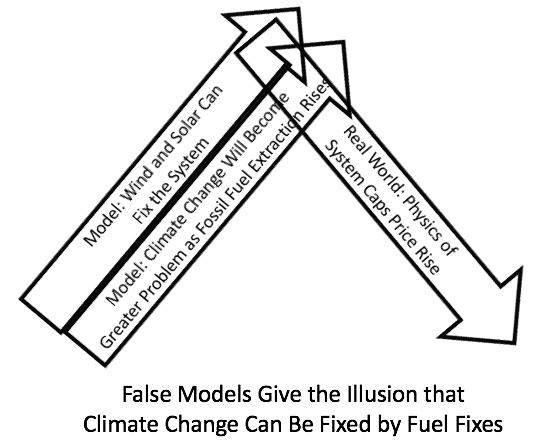
Figure 14. Two false models work together to give the illusion that climate change is the greatest problem that humans have and that we can fix the problem with fixes to the fuel system.
The unfortunate problem is that policymakers are not really in charge: the laws of physics are in charge. Energy and other resources are no longer inexpensive enough to extract to allow the system to work. The proposed solutions (wind and solar) are not cheap enough to save the system either. We can temporarily hide the problem with more debt (indirect promises of future energy) at lower interest rates, but this does not fix the system.
Conclusion
Many of the problems the world economy is facing today seem to be the result of reaching the limits of energy extraction. Very few researchers understand how a self-organized networked economy really operates. As a result, the symptoms of economic health and economic illness have been confused. It looks quite possible that we have reached both Peak Oil and Peak Coal, approximately simultaneously. This is a frightening situation, because it could be an indication of collapse in the next few years. This would likely be much worse than the Depression of the 1930s.
Of course, even with these observations, we do not know precisely what lies ahead. Somehow, multicellular animals have lived on this earth for a very long time. Amazing coincidences have happened and may continue to happen, allowing economies to flourish. We humans do not have as much control over the current situation as we would like to think that we have. Fortunately, we cannot rule out the possibility of more amazing coincidences, perhaps even caused by a literal Higher Power behind the energy flows. Thus, the result may be different from what our models seem to suggest.


Interesting aspect of the international art market: at the recent sale at Sotheby’s of ‘Modern and Contemporary’: no less than 40% of the lots were ‘guaranteed’ by the auctioneers. This means that even without bids in the auction room, the vendor would come out in the black,
These were the most expensive lots, of course, by big names.
Without the guarantees, the auction house wouldn’t get the business, Those lots which were not thus guaranteed fared not so well. The next big auction is at Christie’s.
So when one reads that the art market at the highest level is still holding up, it can be taken with a pinch of salt. In other words, the only good news, is fake news.
Recently a flamboyant ‘expert’ departed an auction house (sacked?) and it is rumoured that he was a bit too generous with his guarantees. He is now working to save the world on an ecological project, his ‘passion’. Sure.
Now I feel like former Brit PM Cameron: ‘I only want good news!’
Over to you, Sir Harry! 😉
Interesting!
“The Next Major Flashpoint For U.S. Shale. Colorado is overhauling the laws governing how the oil and gas industry operates in the state.”
https://oilprice.com/Energy/Crude-Oil/The-Next-Major-Flashpoint-For-US-Shale.html
Heavy cancellations hammer Airbus net orders.
I follow aviation quite closely as I come from an aviation family but everything I read has been rather positive as opposed to the rest of global economic news with aircraft of the future, new airports being built & the expected growth in air travel so I’ve been waiting for the first downturn to appear with airframers………………………….Maybe this is the beginning?
https://www.flightglobal.com/news/articles/heavy-cancellations-hammer-airbus-net-orders-456439/
As I reported yesterday, the shipping industry is running into a similar (or worse) problem with building big ships. They anticipated more goods would be shipped internationally. Now the cutback in oil shipments is hammering them too. Also, add to this the higher cost of the less polluting fuel that the ships need to start using effective January 1, 2020, and they have a real problem.
Has anyone calculated the feasibility of transporting anything in space? Wouldn’t the actual travel be free? But then there is the cost of getting anything into orbit and back down.
“Has anyone calculated”
Oh yes. The minimum cost per kg is whatever 15 kWh costs. That’s using the entirely hypothetical space elevator and taking the cargo to GEO. An interesting footnote is that such a lift is a little more than 100% efficient because some of the energy is taken from the rotating earth.
I don’t think space elevators are possible. Material strength ultimately depends on molecular bonds and there is nothing close to strong enough.
For rockets and spaceplanes, the cost can probably be reduced to $100/kg to LEO. At that cost, power satellites make economic sense.
Moving from one orbit to another always costs.
My idea of space is merely to get a free ride. I would want to know if all calculations re orbits could be made on earth (so no energy is needed in space to change orbits). This would be strictly about earth. I’m probably the least technical and mathematically adept person that ever lived. I can’t and never even use power tools. So I don’t understand technical language or measurements at all. I’m sure you explained it with all these acronyms, but I was thinking in terms of rocket launchers close to the edge launching satellites into space to transport micro technology the size of a fist. Or, assuming that large rockets launch MOL routinely to monitor the Intl Space Station, etc., have them scheduled to discharge those tiny satellites at the the appropriate time, space, altitude, etc…
An interesting footnote is that such a lift is a little more than 100% efficient because some of the energy is taken from the rotating earth.
Now you’ve done it.
That will be just one more thing to keep me up all night worrying about.
And the more energy taken from the rotating earth, the longer those sleepless nights are going to be.
Actually, it depends if more mass is going up or going down. More going up, the elevator leans back against the earth’s rotation. If more is coming down, then the elevator leans in the direction of earth’s rotation and speeds it up. Even for large systems, the effect is down in the nanoseconds. Still, it does allow some public interest group to use the slogan “Conserve Angular Momentum!”
Yes, the Baltic Dry Index has fallen dramatically.
How are the sales of private business jets? I thought they were going strong.
FE/TM approved this message 🙂
Interesting article using energy consumption in Venezuela as a metric for economic activity:
“People are not driving around anymore in Venezuela. To make things worse, 90% of buses were reportedly out of action by mid-2018. This is a society that just doesn’t go out for work or travel. Businesses are also using less transportation, since they produce fewer goods than they used to – including food.
“The last implication is terrifying, and can easily be missed when solely looking at numbers. It is possible to survive without a car, but not without food. A litre of milk can now easily cost a tenth of a monthly salary.”
https://theconversation.com/venezuelas-economic-collapse-is-laid-bare-when-you-look-at-how-little-energy-the-country-is-consuming-112990
“Libya’s parallel government in the east has sold bonds worth more than $23 billion to fund its wage bill, bypassing the central bank in Tripoli and creating a potential financial black hole if the country reunifies, bankers and diplomats said. The debt has been piling up since 2014, when the country split into two administrations – one in Tripoli and the other in the east – as a result of the power struggle that followed the fall of Muammar Gaddafi in 2011.”
https://uk.reuters.com/article/uk-libya-economy-insight/debts-pile-up-as-rival-libyan-governments-struggle-for-power-idUKKCN1QN1W3
Venezuela’s demand is, of course, part of world demand. I would expect that other countries that are doing poorly (Argentina, Turkey, plus some of the oil exporters) will be seeing falling consumption as well.
As you probably now Venezuela’s income stream, properties, accounts, reserves have been blocked-confiscated abroad by the US/UK. So, that’s a bit nuanced difference vs. Turkey which is in a bit different situation, while it recently secured good long term energy deals for its industries, it is facing tough competition on the Gulfies/+wider ME/Asian markets, where Indians and Bangladeshis work for way less money.. Turkey also exports goods (not only food) to the EU, but for instance Fiat car plant there is not selling much despite reasonable quality.. as people on the low end simply by Romanian-Russian cars and upscale market is in German hands, middle increasingly taken by Korea and so on.
know, buy – sorry for typos..
There’s a network of drugs/moneylaundering fronts here: general stores, barber shops, , restaurants, kebab joints.
It’s really expanded over the last 5 years: small business for sale? The new owners will often be Turkish.
An enterprising people, the Turks.
Yes, they apparently are, but they somewhat fail to upgrade into higher level, point being Qatar money /project management/ + Bangladeshi workers = higher ROI, or South Korean technology + already established presence as desirable product vendor on global markets = higher ROI ..
I am trying to sort out what is going on in Venezuela, as I am not a political scientist or an economist. Is this guy Florida Marquis telling it like it is?
Try this:
https://www.moonofalabama.org/2019/03/venezuela-guaid%C3%B3-planned-to-use-arms-frustration-over-stalemate-sets-in.html
(a little left for our wingpawn friends)
MSM is obviously wrong, as Maduro was to be gone a long time ago.
He is still the elected leader.
If you are really interested:
https://journal-neo.org/2019/02/17/what-s-not-being-said-about-the-venezuela-oil-war/
This second article is especially interesting. There is additional oil, besides the heavy oil, in a disputed area along the border with Columbia. As things stand now, a combination of Exxon Mobil and the Chinese company CNOOC would get this oil. Venezuela owes China some $61 billion, according to this article. So part of the change in leadership is an attempt to get both the heavy oil and this disputed oil for the US. The article has more details.
Moreover, if they manage to stabilize the country in midterm horizon, it’s possible they will come with some scheme what to do with that extra heavy (stranded) stuff, I gather some form of extra cooking is at play. Otherwise why bother, it’s not just about the “airfield” close to the US mainland thing..
Not expert on Venezuela, but there seem to be only three plays:
– Maracaibo to the East (small and depleted)
– Orinoco heavy oil belt (very large and depleted-pricey conventional)
– Western sea shelf (gas-field ?)
But there has been some talk about large potential for the unconventional in the original Orinoco heavy belt, perhaps there is some specific suitable method just right for their conditions.
ooops error obviously meant the eastern sea shelf in that third option
How great a misfortune, to be born poor in a land which has something the US desires……
Gail, the article is about that old Guyana-Suriname story (known since mid 2000s), that’s to the south-east of Venezuela not west (Columbia). But it’s doubtful to be huge in the greater scheme of things (estimate 15bbl) – I’d bet the true story is somehow cooking the unconventional Orinoco belt again, that could be ~ 20x bigger..
World–
I hold your views.
Not Colombia, Guyana, a former British colony,
Oops!
Excellent article, Duncan, thank you. I have emailed link to my contacts in Venezuela to see what they know about this aspect.
“The European Central Bank will slash growth forecasts on Thursday and is likely to send its strongest signal yet that fresh stimulus is coming in the form of more cheap loans, hoping to stop an unexpected slowdown from becoming a downturn.”
https://uk.reuters.com/article/us-ecb-policy/ecb-seen-taking-tentative-step-to-prop-up-ailing-euro-zone-idUKKCN1QO0MH
“The eurozone is beginning to resemble Japan with its low-growth and low-inflation environment, coupled with still very loose monetary policy, according to economists at ING.
“This raises questions about the European Central Bank’s tool kit and firing power. Interest rates haven’t gone up in either the eurozone or Japan since the aftermath of the global financial crisis.”
https://www.marketwatch.com/story/beware-the-japanification-of-europe-warn-ing-economists-2019-03-06
“ECB SAYS A NEW SERIES OF QUARTERLY TARGETED LONGER-TERM REFINANCING OPERATIONS (TLTRO-III) WILL BE LAUNCHED, STARTING IN SEPTEMBER 2019 AND ENDING IN MARCH 2021, EACH WITH A MATURITY OF TWO YEARS”
September? The ECB is betting that we are still around in September.
ECB ‘firing power’ = shooting blanks.
Getting rid of carbon taxes would be on form of stimulus that theoretically could be tried. Adding carbon taxes clearly damp down a local economy.
Here, ‘Green’ policies are killing the local retail economy. Huge fees for parking, etc.
“Almost every major economy is slowing down as the global economic squeeze tightens, the Organisation for Economic Cooperation and Development (OECD) has warned. The analysts slashed their forecast for GDP as slowing trade growth, political tensions, and higher interest rates have all knocked the economy…”
https://www.telegraph.co.uk/business/2019/03/06/oecd-slashes-growth-outlook-major-economies-slowdown-worsens/
Of course, world growth rates will be inflated if reported GDP rates of individual countries are inflated. There is a recent Brookings Institution report saying that China’s reported GDP growth rate in the years ending with 2016 were overstated by two points, on average. We don’t know how much they are overstated more recently. The PPP weighting scheme used in determining world GDP growth gives China, India, and other developing countries disproportionate weight. I expect that India’s GDP growth rate is also overstated.
The world economy is rapidly approaching stall speed. With population growth at something like 1% per year, there is not much room for per capital growth.
https://peakoil.com/generalideas/lock-your-doors-load-your-guns-and-get-you-a-barking-biting-dog
This article is what many on this site see as the future.
“Before making a wave of cutbacks across his department, Martin County (Kentucky) Sheriff John Kirk delivered a grim warning to residents of this hardscrabble Appalachian community.”
“Law enforcement as we have known for the last four years will not exist,” he posted on Facebook last month. “WE ARE BROKE… LOCK YOUR DOORS, LOAD YOUR GUNS AND GET YOU A BARKING, BITING DOG. If the Sheriff’s office can’t protect you, WHO WILL?”
That’s an ongoing process, interestingly it could be leveraged up by bigger players and macro situation. For example, one could assume ‘the inevitability’ of one day splinter group/faction of UK military taking over Norway, setting up there nice bolthole around existing infrastructure. Because there is not much about Ireland or Scotland (royals would move there anyway) beyond peasant economy, several of the big cities in England will eventually form a caliphate union, so what’s there for legacy British lad to do while the ‘war equipment’ is still in somewhat working order..?
Some famous theorist said the only choice a nation has is war now or war latter. If you are falling faster than your potential victim than war now. If they are falling faster just wait until they are weaker.
By way of comparison, we see the police presence retreating in – an increasingly uncivilised – Britain, and hardly any (10%) of reported crimes ending in convictions, but God forbid that a public official should recommend that citizens take such sensible steps for self-protection.
You would likely be prosecuted even for voicing such sentiments.
God bless Kentucky! is all I can say.
Gail, in respect of the China slow down this article says it all:
https://mises.org/wire/chinas-slowdown-exposing-cracks-global-economy?utm_source=Mises+Institute+Subscriptions&utm_campaign=2e2b8387cf-EMAIL_CAMPAIGN_9_21_2018_9_59_COPY_01&utm_medium=email&utm_term=0_8b52b2e1c0-2e2b8387cf-228270721
“China’s exports likely contracted in February after a surprise bounce in January, while imports fell for a third straight month, a Reuters poll showed, heightening anxiety over whether Washington and Beijing can resolve deep differences over trade.”
https://uk.reuters.com/article/uk-china-economy-trade/chinas-february-exports-seen-falling-most-in-2-years-imports-down-again-reuters-poll-idUKKCN1QN16S
“Hyundai Motor Co is considering plans to suspend production at its oldest plant in China as it reels from tumbling sales and massive overcapacity in its biggest market. The move by Hyundai, which together with affiliate Kia Motors was the No.3 automaker in China until 2016, highlights the reversal of fortunes in the world’s biggest auto market that suffered its first contraction in decades last year.”
https://uk.reuters.com/article/uk-hyundai-motor-china/hyundai-may-suspend-production-at-oldest-china-plant-as-slowdown-bites-idUKKCN1QN152
China crude oil imports:
Feb imports 9.15M
Jan 9.36M
Dec 10.31M
Ouch!
The article says,
This is the chart it shows:
https://gailtheactuary.files.wordpress.com/2019/03/china-debt-to-gdp-iif-financial-times.png
It misses the point that China’s lack of growth in the debt to GDP ratio is going to be a problem going forward. In fact, its slowing growth is likely part of what caused recent issues. Also, China’s 2013 peak in coal production is a big part of its problems. US trade problems are just a symptom.
Thanks for clarifying, Gail, I hadn’t thought about that. This subject has lots of twists and turns!
I think Harry McGibbs is having an easy time extracting “bad news” from MSM. With everything slowing down, it is kind of hard to find anything that is positive. I believe we are at the stage where positive spin means lying and many people can see through it.
It’s shooting fish in a barrel these days, CTG.
2017 was much tougher, with the bogus ‘synchronise global growth’ narrative in full swing.
Or we might recall La Lagarde’s ‘2014 is the year when we can do it’ : what the Hell was that all about? I am still mystified by that speech.
Now at least we can face the stinking, sulphurous, doom-laden, breath of The Beast…..
For a bit of historical perspective on the workings of the British economy, and indeed any other economy, I would like to present this olde English folk song Hard Times of Old England for general edification and enjoyment.
The video and lyrics are from the 1975 Steeleye Span version, but this little ditty has been crooned since the 18th century. Language evolves over time, and when times turn hard today we might say: what’s a non-elite worker and their family to do?
Come all brother tradesmen that travel along
O pray come and tell me where the trade is all gone
Long time have I travelled and I cannot find none
Chorus (repeated after each verse):
And sing, Oh the hard times of old England
In old England very hard times
Provisions you buy at the shop it is true
But if you’ve no money there’s none there for you
So what’s a poor man and his family to do
You must go to the shop and you’ll ask for a job
They’ll answer you there with a shake and a nod
Well that’s enough to make a man turn out and rob.
You will see the poor tradesmen a walking the street
From morning till night for employment to seek
And scarce have they got any shoes on their feet
Our soldiers and sailors have just come from war
Been fighting for Queen and country this year
Come home to be starved better stayed where they were
And now to conclude and to finish my song
Let us hope that these hard times they will not last long
I hope soon to have occasion to alter my song
And sing, Oh the good times of old England
In old England jolly good times
https://youtu.be/6QynGUt-J8c
I like the naughty Olde Englishe songs too: ‘Here’s the tinker come, to stop up your holes and fill up your cracks.’ Nudge nudge, wink wink. 🙂
But for sheer beautiful melancholy, the Irish take the prize; for instance ‘The Unquiet Grave’….
“It must be particularly frustrating for Elliot Abrams. It’s hard to get a massacre going. Even the Colombians chickened out. Does Donald have something against desath squads?”
So, how us the news on Venezuela?
https://www.businessinsider.com/general-motors-layoffs-lordstown-ohio-plant-idling-2019-4
Workers and politicians are slamming GM for slashing 1,700 jobs at its idled Lordstown, Ohio.
In a capitalistic country, if a business is not making a profit or needs to scale back to help the bottom, that should be understandable, however politicians and workers seem to think its being done as a personal affront. If this was a communist country, the government could force businesses like GM to keep this plant operating at a loss, but since when do Americans want communism?
George Seldes
Official History ~= Lies Agreed Upon
US Foreign corespondent on myths in historical events, media power and so on..
1917-1939 interviewed or had seen in person: WWI movers, Lenin, Mussolini, Hitler, Spanish Civil War, ..
https://www.youtube.com/watch?v=J_xWlP7UMzk
ps in the spirit of ‘fourth turnings’ when he was a kid, Napoleon’s relatives were still around
He is an interesting man to listen to.
Now, we are entering another period that is in many ways similar to the 1920s-1930s. We should not be surprised by many factions and many lies.
Yes, many factions. It is just so unclear who they are and what they fight for. I don’t get the memos nor get invited to the club.
Relics business was a big one in the old days.
The Japanese island of Shikoku, which doesn’t really have anything going on even 1,000 years ago, invented the 88 temple pilgrimage course. A famous monk born from that island supposedly consecrated 88 temples in there, so the pilgrimage course was advertised all over Japan and is still being run today.
Similar ideas about Buddha’s bones, tooth, etc in various temples throughout Asia. Later, since there can only be so much parts of Buddha’s bones, the bones and robes of famous monks began to serve as relics as well.
one day i’ll be a relic and get rich
Better start working on the saintly lifestyle, Norman……….
My favourite Dark Age saints are the mad Celtic ones who dug pits and stood in them all the time praying: worth a try?
youve watched life of brian too often
Funny is my ,97 year old Mother receives in the mail many requests for religious donations and one that stood out was a holy relic! She, of course, took it more serious. When I traveled in Europe in many towns and such there were on display at the church a mummified body part of a Saint or vile of dried blood, lock of hair or nail clippings. Apparently, it was a show stopper during that period of Ecclesiastical excess.
This one stands out in Munich Germany, worth visiting
1557, Duke Wilhelm V was officially granted the right to collect relics by the Pope. He amassed a notable collection of human remains of unknown provenance. Many are probably “catacomb saints,” the bones of unknown ancients from Roman catacombs that were given new life as the bones of Saints by the Catholic Church. Duke Wilhelm’s son Maximilian I enlarged his father’s collection. For centuries, the collection was housed in the Rich Chapel, the family’s opulent private place of worship. Today, another room at the museum houses around 60 reliquaries, many finely crafted in rich gold and silver.
https://www.atlasobscura.com/places/the-relics-of-munich-residenz-munich-germany
Most famous among these objects is a heavily decorated cranium said to belong to John the Baptist. This head is one of four supposedly belonging to the Christian prophet. (The other heads reside in Amiens Cathedral in France, San Silvestro Church in Rome, and Umayyad Mosque in Syria.) The collection also includes what is claimed to be the head of Pope Eleuterus, who died in 189 AD.
These relics were considered the court’s most prized possessions, until the 19th century when the history of the dubious “catacomb saints” became common knowledge. Today, they are macabre and beautifully decorated relics that are reminders of another time, when a fragment of bone or skin was thought to possess powers of the divine
You are right. I did hear about the 88 pilgrimage course in Japan. I also saw a lot of churches with relics in them in Europe. All these things seem kind of strange today.
Pilgrimage routes, based on a ‘ universal’ religion, rather than a tribal one, also provided a legitimate way for people to travel in very dangerous times, when the usual response to any outsiders by lords and peasants, let alone full-time bandits, was ‘How can we rob them?’.
Robbery mostly gave way to trade along those routes, as in the Santiago pilgrimage in Northern Spain along which numerous wealthy towns grew up such as Estella, a now forgotten centre of international commerce 1000 to 1400 (every year now Japanese pilgrims to Santiago, of all people, have to be rescued -and occasionally die – despite the best efforts of the locals, not being properly prepared for Pyrennean storms).
Today, Estella is a slightly depressing rural backwater, full of welfare claimants and gypsies, never having found a modern role but with some very lovely 12th century architecture from its glory days.
Good points.
Religions are self-organized. There is a great deal of cross pollination among religions of the world. Religions, governments, and culture very much overlap. They are all self-organized and change over time.
As populations grew, there was a need for more order and sharing among different subgroups. Religions, governments, and culture all helped in this way. Our recent idea of allowing immigration of large numbers of people from very different cultures works in the opposite direction. So does wide wage/wealth disparity.
The people who cannot afford to properly take care of their children send their children to the same public schools that the people who can take care of their children do. The teachers cannot handle classes with such a mix group of students. Parents who can afford to send their children elsewhere, or keep their children at home. This adds to widening differences among different groups.
Very sound overview thanks Gail, and I entirely agree. Controlled immigration is essential for the success of the society in question in order to prosper and remain cohesive.
https://www.bbc.com/news/business-47472282
‘Trump dealt blow as US trade deficit jumps’
“New data shows that the trade gap between the US and China widened last year by $43.6bn to $419.2bn as exports of American products and services fell, but imports from China rose.”
The difference is likely due to China’s response to tariffs by not buying as much Soy bean for one.
https://qz.com/1506641/us-soybean-exports-to-china-dropped-to-zero-in-november/
“The USDA has promised $12 billion in aid to US farmers hurt by the tariffs. Still, using money that could be better spent elsewhere is a short-term fix for an avoidable problem. Farmers “want to trade. They want to sell their products,” said senator Heidi Heitkamp (D-ND) over the summer. “They don’t want to just get a check from the government.”
http://www.chicagotribune.com/business/ct-biz-soybean-crop-china-trade-war-20181127-story.html
‘U.S. farmers store record soybean crop as China dispute slashes exports’
“Farmers produced a record U.S. harvest of 4.6 billion bushels this year, but the USDA reports exports to China are down 94 percent from a year ago since Chinese companies were ordered to stop buying American soybeans and find other suppliers.”
Hopefully a new trade agreement with China will have made this situation worthwhile, however so far there has only been a willingness on China’s part to agree to a memorandum of understanding.
Deaths by suicide, drugs and alcohol reached an all-time high last year
https://www.axios.com/deaths-suicide-drugs-alcohol-mortality-rate-epidemic-18971e4f-760f-415d-910d-046de83c967c.html
CANADA RANKED HEALTHIEST COUNTRY IN THE WORLD
“The analysis, compiled by Letter One investment firm and called the Global Wellness Index, gave Canada the top spot over 151 nations. he U.S. ranked 37, while South Africa took the last place. The index considered a series of metrics, including healthcare and exercise. A separate analysis conducted by Bloomberg in February awarded Spain the top spot and placed Canada in the 16th spot. Overall, Canada earned a good score for blood pressure rates and life expectancy as well as high happiness levels. The U.S. lost points for obesity, depression and inactivity.
“Deaths by suicide, drugs and alcohol reached an all-time high last year…”
so is that good news? it should help the problem of world overpopulation…
“Life expectancy has already fallen in the U.S. three years in a row largely due to these trends, while the global average life expectancy continues to rise.”
oops… global average is rising…
at least the USA has that positive trend for lower life expectancy… the Social Security program may have enough money after all…
I see that Britain is experiencing a slowdown in the growth of life expectancies:
https://www.theguardian.com/society/2018/aug/07/increase-in-uk-life-spans-stalling-at-one-of-fastest-rates-among-20-leading-economies
The World Health Organization says,
Trump’s tariff war pushes US trade deficit to 10-year high
https://www.theguardian.com/business/2019/mar/06/us-trade-deficit-hits-10-year-high-as-trump-trade-wars-backfire
Come now comrades– Donnie has been bankrupt 6 times.
yup
to bankrupt the world would be a grand finale before he gets taken to the ex-billionaire’s sunshine home
A resource bankruptcy manifesting itself as a financial bankruptcy.
Right! That is the way the scene plays out. There is not enough return on investment (whether college education or building new ships to transport oil or coal), making the whole system collapse. With low enough interest rates and lax enough lending standards, we can overbuild everything (colleges for far more college grads than we possibly have jobs for, boats for more ore than we can possibly ever ship, more homes in China that workers there ever will be able to afford, more roads in Japan than the cars there will ever fill).
GEPower describes itself as “a world leader in power generation and water technologies for utilities, independent power producers and industrial applications.” CEO of Lawrence Cup said Tuesday that he sees the company as having negative industrial free cash flow this year as a result of its underperforming power unit. Analyst Stephen Tusa at JPMorgan thinks that the cash burn will extend into 2021. Tusa says GE can tumble to zero if its negative free cash flow is priced in. https://markets.businessinsider.com/news/stocks/general-electric-stock-price-burning-cash-for-years-jpmorgan-says-2019-3-1028008969
So General Electric may be another financial bankruptcy, related to inadequate returns–here in the power industry. And people think electricity will be our salvation!
Yep, the fun about ROI conundrum is that people want everything in one package and that’s hard, near impossible to get. So, in terms of energy you can easily get ultra fast ROIs, but in turn you have disregard or actively strip the safety & environmental protection of that project. Alternatively if a bit lower yet somewhat decent ROI and protection combo is demanded it follows that complexity must be leveraged another level/s, so the longevity of the project is increased by several factors to ease the payment on these additional enviro protections and so on.
But here is the catch, you can climb the complexity curve only within “antsy” vertically integrated society with inherent and understood stability, not in outsourcing and stock jockeying casino mafiosi gang land.
That’s exactly why we see now the ‘surprising’ divergence among nations and economies these days.
Hopefully, Seven is his lucky number!
7 Insane Reasons Why Lucky 7 Is Such A Mysterious Number
https://m.youtube.com/watch?v=jd2NemJQzP8
It must be divine Providence!
this is comment number 1,077…
We need an expert in running up debt, and Trump has the required expertise. It is debt that pulls the economy forward. As long as the debt bubble can grow, the economy can more or less continue to operate. Cutting taxes and raising spending at the same time allowed the US to come out ahead!
We need an expert in running up debt, and Trump has the required expertise.
http://4.bp.blogspot.com/-c1U3QpkTrYU/VUBnE-KcwtI/AAAAAAAAJL4/-xRJmAgq9I8/s1600/dunce.png
Is that a MSM anchor? Sorry, I coiuldn’t help myself. LOL
Could be—–
A bit close for MSM—-
“Cutting taxes and raising spending at the same time allowed the US to come out ahead!”
Tally ho, raise the mizzen, trim the jib. We’re headed into strong winds. The strategy is working, BAU sails on without a hitch (in spite of needing artificial wind and until it hits the doldrums – lol).
1836 — US: Phoenix Next?: Battle of the Alamo is fought (it falls). Among the casualties is Davy Crockett. Mexican troops defend their country’s abolitionist constitution, & defeat foreign (US) slaveholders in San Antonio, Texass. Remember the Alamo?
That’s not the John Wayne version that I remember, Duncan.
Woops, Gail is correct….when utilities fail we be in big trouble…looks like we are….
Whatever it takes, folks…hold on tight to your wallet… they’re coming to take it…
(Bloomberg) — A federal judge is requiring PG&E Corp. to abide by rules governing how the utility operates its power lines in California, seeking to reform what he described as “dismal” management that led to a series of destructive fires over the past two years.
U.S. District Judge William Alsup gave PG&E a March 22 deadline to present any arguments as to why his orders shouldn’t be implemented. One requires the bankrupt company to suspend issuing any dividends until it is in compliance with state laws that require it to trim or remove trees and branches growing within specified distances of its power lines.
“The record demonstrates that PG&E’s performance with respect to vegetation management has been dismal,” Alsup wrote in his order issued late Tuesday. If complying with state or federal laws is too strict, he added “PG&E’s remedy would be to seek the relaxation of such laws through its well-oiled lobbying efforts.”
PG&E didn’t immediately respond to an email and call seeking comment
Wow, pension funds that invest won’t get their dividends to pay out to their retirees?
Stock up on the Meow mix.
https://finance.yahoo.com/news/pg-e-ordered-suspend-dividend-070558375.html
Revisited summary on Fukushima, it was first gen wreck (co?)-designed by GE in late 1960s*, even no flood control done at ground level with generators and other equipment of the plant what so ever, moreover dug deeper/lower into the cliff by the sea, which made it even more flood hazardous.. After ~6yrs of the event, still at early stage of decommissioning budget almost $.2T, fuel replacement cost for the grid $.15T, indirect cost pop and environment unknown..
Now, coming to the main point, the US nuclear industry background presenter also said, US still has got most of the spent fuel located at their sites, not in casks off site like EU/RU/.. or some long term granite site repository. And the project of updating analogue controls to digital is ongoing, well far from finished. Few days ago Gail raised supposed concerns about standards of this very industry in so called no OECD countries, lolz, I’m afraid Americans are into many nasty surprises about what have actually not been purchased instead of these astronomic mil. and meddling budgets around the globe..
—
* just for comparison only few years younger and different inherently more safe PWR design built domestically in E Germany consisting of 6x reactors was shut down on political grounds in the early months of 1990, while it could serve electricity and district heating with some updates easily another two decades, but no the revengeful task of forcing submission and humilation prevailed instead
https://www.spglobal.com/platts/en/market-insights/latest-news/coal/030619-supply-of-domestic-coal-to-tighten-as-china-orders-more-open-pit-mines-to-shut-sources
Supply of domestic coal to tighten as China orders more open-pit mines to shut
According to the article, ” 130 million tons of production” will be shut in. This amounts to 3.7% of total production. They seem to be having trouble with fires in open pit mines in one area.
According to the article,
I imagine one of the purposes of these actions is to try to raise the price of coal internally. China is facing peak coal. If it can shut out some less desirable coal, perhaps it can get the price up enough so that more of the remaining mines can be profitable.
Everything will be fine.
The non elite workers, reduced to a life of wandering from gig to gig, never having enough to raise family, settle down, or have a peace of mind, will be irrelevant.
But the consumption of the landowners, the rentiers, the stock owners, etc will be more than enough to offset the consumption of the poor.
Financialization will fuel more economic growth, until we reach the space.
Also, glad to see Keith back. How is your space power station doing?
I am afraid I don’t see the elite workers as taking care of themselves. They can’t do subsistence level gardening/farming using only local inputs, for example. They cannot gather enough fresh water for their own use. They cannot gather enough firewood to boil the fresh water to kill pathogens. Firewood is also needed to cook the food that is grown with local inputs. We are in much worse shape than when Rome collapsed, many years ago. We have lost sight of what is needed to keep the system going. A few solar panels and wind turbines don’t do much to keep roads maintained, international trade going, or banks open.
Very true, Gail.
We have to imagine ‘Rome’ – its markets, industries, cities, great rural villas, armies, navies and international trade system – as a superstructure built over a human foundation of peasants, foresters, fishermen, and a natural base of good topsoil, seas and rivers still teeming with fish, etc.
With the collapse, the civilised superstructure either disappeared completely (like the small industrial town near my home) or transformed (for instance, a city became more or less a village, like Rome itself) but the age-old activities of rural and coastal life went on, except where the pressure of civilisation had destroyed soil fertility and woodland.
Last summer, which was very hot and dry here, I read reports of the topsoil blowing off the fields in the neighbouring counties in huge clouds; vast fields with no hedges (all cut down by the 1970’s to accommodate huge tractors and save money on maintenance) and very little woodland. EV’s and solar panel fantasies, wind turbines, are no solution to that!
“EV’s and solar panel fantasies, wind turbines, are no solution to that!” – Right!
Evolution at work. The non elite workers will perish on the road, on the flophouse (a word which had not been used since around 1910), on the tent, etc. After enough of them perish, a kind of equilibrium will be reached by those who own a stake on civilization and those who have some kind of high-demand skills.
Yup.
You are so right Gail, the elites have no idea how to survive, although some may make it for a while in their bunkers. But far from the plebs becoming the marauders, it will be the elites, when they run out of supplies in their bunkers, who come in-country killing and laying waste with their weapons.
In fact, not much different from today actually, witness Venezuela, Yemen, Syria et al. Human nature never changes. As part of my studies of human behaviour under stress conditions, a recent book comes to mind:
https://www.google.com/search?client=firefox-b-dq=amazonuk+book+survivng+the+sword++brian+macAurthur
To quote part of the review:
“The diaries tell of inhumanity and degradation, but there are also inspirational stories of courage, comradeship and compassion. When men have unwillingly plumbed the depths of human misery, said one prisoner, the artist Ronald Searle, they form a silent understanding of what solidarity, friendship and kindness to others can mean. The diaries and interviews with surviving prisoners drawn on in SURVIVING THE SWORD will tell a new generation about that solidarity, friendship and kindness.”
I think Mad Max is a fictional illusion; when the isht hits the fan we will all pull together (OK apart from a small faction of sociopaths).
The truth about survival in such situations is that one has to mix, as circumstances dictate, both altruism and selfishness.
So, in the Japanese work camps, one would both steal from others and give away surplus according to how things were going. Hence the guilt that many survivors feel, because they did things they don’t dare to admit… I’ve heard this first hand.
See also Primo Levi on the German camps, both before and after ‘Liberation’.
At one point, having found – heroically – food and fuel for the people in his section of the barracks, he had to lock out many others whom he could not feed: sharing equally -‘solidarity’ – would have been the death of all of them.
The first pathetic meal they had, he was voted an extra share of bread in thanks for saving them all. As it was, it was Russian food that really saved them.
Primo Levi is also very good on the prisoner ‘economy’ which self-organised in the work camps while the Germans were still in charge.
No solidarity, except among the Marxists: however, they didn’t care for anyone who wasn’t a Marxist (surprise surprise!) So essentially they operated as a tribe. If you weren’t a Marxist, why would they want you to be around in the future?
Interestingly, the Greeks were known as clever thieves and traders, but they didn’t murder other prisoners directly.
The worst were the criminal class people, psychopathic to start with.
Many committed suicide very early on, when they realised that not only the Germans were their enemies, but the other inmates as well.
Primo Levi is perhaps one of the best primers in real human nature in acute danger and stress anyone could read. RIP.
Remember, the issue ultimately was not enough resources (including food) to go around. Who should be voted off the island, in television terms.
Excellent observation. Yes I agree, there were many instances of less than good behaviour. There will always be those that are tempted in time of stress (witness drug addicts of today). But in general I have a belief in the great majority conforming to disciplined, altruistic behaviour borne of a good upbringing as being mutually beneficial to survival of all.
My extensive travels throughout the world confirm to me that strangers are generally extremely nice, generous and helpful. “A stranger is a friend I have not yet met”
I assume you jest?
Come now Norman, one can see the delusion of our comrades (and racism).
On another note:
US trade deficit hits 10-year high as Trump trade wars backfire
https://www.theguardian.com/business/2019/mar/06/us-trade-deficit-hits-10-year-high-as-trump-trade-wars-backfire
“Also, glad to see Keith back. How is your space power station doing?”
Can’t complain. Recent news.
https://www.dezeen.com/2019/03/04/china-space-solar-power-station/
https://www.fastcompany.com/90314759/chinas-solar-power-plant-could-beat-u-s-s-new-green-deal
https://www.cnn.com/2019/03/03/asia/china-plans-solar-power-in-space-intl/index.html
There has been a growing appreciation of the economics involved. For reasonable numbers, the cost of lifting parts to LEO has to get down to $100/kg for the selling price of electricity to get down to 3 cents/kWh–a maximum by Gail’s considerations. Also, the need for an equatorial launch site right on the equator seems to be gaining a consensus.
There are some other ideas, building in LEO followed by self-powering to GEO. That was ruled out by Boeing decades ago due to space junk. But active defense and good tracking may allow it. Fast construction and/or orbital reboost seem to be requirements for construction in LEO.
You can follow developments on the Google Group Power Satellite Economics.
“Of concern to investors and rating agencies should be that emerging market companies’ debt in foreign currency has exploded in the last decade. From to 2008 until about now, foreign currency debt has risen almost 100%.”
https://www.forbes.com/sites/mayrarodriguezvalladares/2019/03/05/emerging-market-borrowing-is-breaking-records/#36a606573220
Interesting article! I know that I have read about this issue from the opposite perspective before–local banks get tapped out for loans (because of low deposits and reserve requirements), so those who want to invest are forced to go outside of the system. This article talks about how enticing going abroad has been in the last decade, with the low interest rates. In fact, some 9 trillion dollars of lending (not all to emerging markets) has been done at below zero interest rates. Many familiar names show up on the list, including Argentina, Turkey, India, and Mexico.
Obviously, as local currencies drop against the dollar, this debt becomes harder to repay. (I don’t remember this article pointing this out.) I have read in the past about buying derivatives to protect about this problem. Thus, I would expect two different problems, as these loans default: (1) Problems with the derivatives, supposedly guaranteeing against fluctuations and (2) Direct problems with default.
Agreed, your prognosis is sound IMHO. Turkey recently suffered this but was saved by Germany and the lira stabilised.
“China is slashing business taxes as it tries to stop its economy from slowing down too sharply. The Chinese government on Tuesday predicted economic growth of between 6% and 6.5% in 2019. That’s a decline from last year’s 6.6% rate of expansion, which was already China’s weakest performance in three decades.”
https://edition.cnn.com/2019/03/04/business/china-economy-growth-2019/index.html
“Bank of Japan board member Yutaka Harada said on Wednesday the central bank would need to step up stimulus “without delay” if risks to the economy threatened its efforts to hit its inflation target…
“He noted the growing risks Japan faced, such as slowing demand in China, simmering trade tensions, volatile stock price moves and weak private consumption.”
https://uk.reuters.com/article/uk-japan-economy-boj/boj-board-member-calls-for-more-stimulus-if-economy-sinks-idUKKCN1QN089
How does Japan step up stimulus, when it is already going all out? Drop its currency relative to the dollar, so it can sell more widgets to the US?
I wonder what China’s true rate of growth will be. Will it even be greater than zero?
It is hard to square a 6/6.5% GDP figure with those plummeting car sales, which don’t fit in at all with China’s plan to become a more consumer-driven economy.
“The company billed as China’s answer to Tesla has freaked out investors by warning that demand for its electric vehicles has failed to live up to expectations.
Shanghai-based Nio’s (NIO) stock plummeted 18% in after-hours trading in New York after it reported late Tuesday that sales have been sluggish so far this year. It also scrapped plans to build a factory in China.”
https://edition.cnn.com/2019/03/06/business/nio-china-electric-cars-stock/index.html
Q3/2018 Forbes article, claims Nio is just among other start up challengers.. out of ~500 EV car companies out there.. The actual production top list is as follows:
China’s Best-Selling EVs in 2017
#1 – Beijing Auto EC 180
#2 – Geely ZhiDou D2
#3 – BYD Song DM
#4 – Chery eQ
#5 – BYD E5
So, Nio was perhaps just some marketing – investor stunt.. so far ..
Ooops rather Q1/2018 article.. but you get the picture it’s nowhere on the list..
As opposed to the Tesla, VW, Kia/Hyundai, Nissan fighting each other on Euro(american) or global markets..
Nio – low volume production despite ~ $2B IPO, the Chinese market is almost 1M EVs..
https://www.greencarcongress.com/2018/08/20180814-nio.html
https://bioage.typepad.com/.a/6a00d8341c4fbe53ef022ad388be52200d-800wi
I think, Gail, you have hit on a key metric. China’s stats leave a lot to be desired as far as accuracy goes. There is a massive shadow banking sector and large tranches of loans are hidden and off balance sheet.
China’s massive declared debt is enough to have your eyes watering so goodness knows what the real tally is. China bailed out the world in 2008 in collusion with the Fed, ECB and BoJ but I don’t think it will work this time around. GDP as measured by current standards is false anyway and probably deliberately so; The tru position IMHO is that the USA has been at depression levels ever since 2008 – QE/ZIRP never worked in the real economy.
http://www.alt-market.com/articles/3469-globalists-are-telling-us-exactly-what-disasters-theyre-planning-for-the-economy
QE nipped mass unemployment in the bud, and allowed a pseudo -recovery from 2009-10, but did nothing to slow the steady erosion of real prosperity among the mass of the population.
Now the sticking plaster is grubby and falling off, and we can see what’s festering underneath, unhealed and incurable.
Agreed, but the unemployment numbers, in USA anyway, are fudged. QE in fact did nothing to offer worthwhile and rewarding middle class jobs – just zero hours gig economy ones at minimu wage, insufficient to live on.
I contend that USA is already in recession (and has been ever since 2000 – just check out GDP and unemployment figures published by John Williams at: http://www.shadowstats.com/alternate_data/gross-domestic-product-charts which is why the 95% are suffering a severe depression but the elite are fudging the stats and SNAP etc avoids the food queues.
My timing is rather more restricted to the 2020s because EROEI is driving the global economy to slow down quicker than expected.
I have written a book about all this and more; a free pdf of my book is available on request to: peter@underco.co.uk, I look forward to every day as the events unfold but I can’t really see a WW3 in the cards yet, more a boiling frog type gradual decline in living standards over many years.
I think that this is enough advertising of your book.
QE/ZIRP did get fuel prices up to the place where producers could live with them, at least for a while. Then, in 2014, both coal prices and oil prices stated becoming far too low for many producers. Renewables look better, but only because of their huge subsidies.
Low prices are why we are reaching peak oil and peak coal.
I wonder the same. You have used electric usage as a proxy in China. How is China electtric usage doing?
“Germany’s finance ministry has defended its so-called “bail-in” rules that cover failing banks the country’s finance ministry said when asked about a Bank of Italy official’s comment that they were damaging and virtually impossible to apply… Designed after the global financial crisis to shield taxpayers from costly bank bailouts, bail-in rules require investors in a bank to bear losses before public funds can be tapped.”
https://www.neweurope.eu/article/germany-defends-bail-in-banking-clause/
“Even for those who haven’t been following the vicissitudes of European banks blow by blow, the latest wave of money-laundering allegations to hit some of the region’s lenders is reason to look away in despair.
“Firms from Swedbank AB to Raiffeisen Bank International are alleged to have handled a broad range of suspicious transactions involving Russian money.”
https://www.bloomberg.com/opinion/articles/2019-03-05/russia-money-laundering-allegations-roil-europe-s-safest-banks
I’ve always thought ‘money-laundering’ to be the essence of banking, or at least one of the foundational pillars of any decent bank.
After all, what money is ever ‘clean’? It always has some poor devil’s sweat and life-blood at its root.
It’s just factions cat fighting, the City boyz are simply jealous they were not on the scheme/game, so suddenly everything not pre-approved by their cartel is severe money-laundering, what a bunch of whining l-oo-sers.
When the oligarchs juiced out the state to mere banana republic skeleton during the darkest days of ~1993-1999 via off shore – City banking schemes it was all jolly good and honest imperial capitalism, lolz.
Apart from being the tool to whip euro-southerners to adhere to fin discipline..
Yep, that seems to be in line with the Prof. Werner material discussed recently, should the next GFC (squared) come they could eventually let the big ones go under and in parallel recapitalize the system via their small banking sector, which is liquid and has got relatively clean balance sheet. This is obviously the ‘nuclear option’ so unleashed only at the utmost crisis inflection point (from their perspective). So should the Eurostructure go down at some point the next Deutsch Mark could spike up to be too strong for exports, another consideration they are aware of and must always pre calculate and navigate through.
According to this article, Germany’s big lender in trouble now is NordLB, located in Hanover. This has to do with overbuilding of big boats to do shipping, just as world shipping is no longer growing by much. Reduction in crude oil transport is has a big impact on rates, sending them down. This is a chart I found showing the distribution of goods shipped by boat, measured as weight, not dollar value. Dry bulk refers to things shipped in an unwrapped state, such as iron ore or grain. Containers contain manufactured goods, also (on the return trip), materials intended for recycling, if a country will accept them. China has cut way back on what it will accept for recycling.
https://gailtheactuary.files.wordpress.com/2019/03/waterborne-sea-trade-from-jp-morgan-copied-by-the-daily-shot.png
The cutbacks in oil shipments can be expected to have a big impact on revenue. In fact, they seem to be having a big impact already.
https://gailtheactuary.files.wordpress.com/2019/03/baltic-exchange-capesize-index-large-sized-tankers-the-daily-shot-1.png
“Britain is paralysed by Brexit uncertainty, the Eurozone – including its seemingly invincible German powerhouse – is stuttering, and China is experiencing its slowest economic growth since 1990.
“Even the US, which had been performing well of late, is seeing a slowdown as the sugar rush of Trump’s tax cuts wears off.
“The IMF frets about “a shadow over global economic prospects” while the World Bank warns ominously of “darkening skies”.”
http://www.cityam.com/274174/buckle-your-seatbelts-next-global-recession-world-not
“The UK economy came close to flatlining last month as Brexit uncertainty intensified and the global economy weakened, with employment levels falling at the fastest pace in almost nine years.”
https://www.theguardian.com/business/2019/mar/05/uk-economy-brexit-employment
“Europe’s financial system faces “potential risks” to its stability arising from a no-deal Brexit, the Bank of England warned on Tuesday, as it extended its weekly lending facilities to include euros.
“With just 24 days to go until Britain is set to leave the European Union, the BoE said businesses and households across Britain and the EU were vulnerable.”
https://gulfnews.com/business/banking/uks-bank-of-england-warns-of-europe-wide-finance-risks-on-brexit-1.62469643
Employment rates seem to be a “lagging indicator.” By the time that employment levels are falling, the economy is already doing very poorly.
http://www.usdebtclock.org/
You remember just a couple weeks ago the national debt surpassed 22T, well it’s already at 22T +107 Billion. Only 89.3% from surpassing 23T. Got to have more debt to keep BAU going – pile it on!
A trillion here, a couple of quadrillions there, pretty soon you are talking about real money.
Mike Bloomberg:
https://www.cnbc.com/2019/03/05/mike-bloomberg-says-green-new-deal-stands-no-chance.html
“Michael Bloomberg says Rep. Alexandria Ocasio-Cortez’s Green New Deal stands no chance of passing the Senate in the next two years.
The former New York City Mayor says he’ll launch an initiative to transition the U.S. to 100-percent clean energy as soon as possible.”
oh, boy, I can’t wait!!!!!!!!!!!!!!!!!!!!!!!!!!!!!!!!!!!!!
I’m sure his plan will be better than AOC’s!
Ugo Bardi has an interesting post up on Cassandra Legacy. It is called What can we Learn From the Middle Ages About Collapse? The Great Challenge of the Seneca Bottleneck
Ugo’s contention is that after the Roman Empire fell, the civilization collapsed back to what they had in the Middle Ages. In his view, maybe we could too. (Of course, at the end he mentions that the thinks renewables will somehow help us.) Some of the things he says about the Middle Ages are these:
Wonder what our sacred relics of the future will be? Better yet, our places to go for pilgrimage!? Any ideas?
https://m.youtube.com/watch?v=i2gVXd7FzhQ
That seems likely, yes…functional oil refinery with oil!
Relics? For the present generation an apple iPhone!🦄
Why the Tesla Model wotever…we were so close to techno utopia…if only we had preyed a little harder….sacrificed a little more….worshipped….u get it..
Intriguing to think, if Ugo is correct, that even what appear to be purely devotional practices may have self-organised to fulfil economic imperatives.
I know one of the pastors at our church talked about the economic benefit of the sale of indulgences 500 years ago. I am trying to remember the details now. Their sale was, in a way, a way to ramp up donations to the church. These donations could be used for many purposes: hire local people (without adequate employment opportunities elsewhere) to work on building cathedrals, for example. This money would recirculate through the economy, ramping up demand and thus prices of commodities, helping farmers.
Of course, the church was a big employer of “excess children” who survived to maturity, but couldn’t inherit the farm. Requiring poverty and celibacy allowed the church to serve more people in this way. The last thing that was needed was more children. Having nunneries separate from monasteries tended to keep the birth rate down.
These are interesting musings by Ugo, but he clearly overplayed these fringe aspects of it. The (proto) feudalistic societies of ~6-11th centuries certainly did not run their finances or credit on saint’s relics. Simply, they came up with a bit different, rearranged, novel scheme how to leverage ‘sedentary’ peasant’s work (surplus) from the biosphere around the nobility and king’s interest per relatively small geographic domain, realm in which they ruled and competed against other smallish players. As opposed to prior Antiquity approach of continuous long distance slave labor (and resettling), commodity trade throughout much larger area encompassing: ClubMed+NAfrica+Eastern ME + ..
This feudal model has been upgraded after the crusades, improved maritime/navy skills and first merchant banking in medieval Italian cities and from then on it was just slow process of capitalism taking over.. firstly in parallel with feudal absolutism and later hidden after the facade of CBs, tax heavens and what have you.. till now..
I was wondering how accurate Ugo’s view was.
I know that in David Graeber’s book, Debt: The First 5,000 Years, he makes the remark that debt seems to have almost preceded currency. He also remarks that sometimes coins were called in and reissued. Thus, the economy could even get along without coin currency, at least for a time.
The way Graeber described the situation, temples acted as a central clearinghouse for a lot of kinds of labor and trading. People brought good and services to trade at a temple. Temple employees figured out values in some unit, such as “bushels of wheat.” Those bringing goods to sell could even sometimes get advance credit, in order to purchase other goods and services through the temple.
The churches were very strong in the Middle Ages. I would presume that they could continue to provide some of these kinds of functions, with or without coins to use as a method of barter. What would be difficult would be trade between an independent shop keeper and those who wanted to buy from him. But as long as official channels could be followed (through the kings or nobility, trading in some common units), the facilitated barter system could go on.
I wonder, too, if one of the “gifts” of a high energy society is the ability for church and state to be two different organizations. As long as resources are very constrained, it doesn’t make sense to have multiple sets of laws and multiple sets of administrators. The USA, with its abundant land per person, could talk about separating church and state.
Australia’s economy just entered recession on a per capita basis
https://www.abc.net.au/news/2019-03-06/gdp-q4-2018/10874592
“Removing the impact of population growth from fourth quarter GDP figures, the economy declined by 0.2 per cent in the three months to the end of the year, following a 0.1 per cent decline in the three months to September.”
so Q3 and Q4 of 2018 were in per capita recession…
as now reported on March 6, 2019…
this is typical statistical delay…
supposedly, even with modern high quality computing, it takes this long to deliver the reality…
at least they didn’t say it was “Surprising!”…
this type of story about countries in recession will be published many more times throughout this year…
to all readers: your country may already be in recession…
The last time Australia had a recession it started in the September quarter of 1990 and lasted until the September quarter of 1991. During the recession, GDP fell 1.7 per cent, employment by 3.4 per cent and the unemployment rate rose to 10.8 per cent. Like all recessions, it was a period of disruption and economic distress.
https://www.benzinga.com/general/education/19/02/13122332/is-europe-on-the-brink-of-recession
That’s an article suggesting Europe is on the brink of recession.
Falling car sales a big part of Australia’s slowdown:
“…the nation’s car dealers are bearing the brunt. Industry figures show new car sales in February were down a whopping 9.3 per cent on the same month last year. That backs up a 7.4 per cent slide in January, a 14.9 per cent slump in December and a 3 per cent fall over 2018 as a whole.”
https://www.abc.net.au/news/2019-03-06/car-dealers-bearing-the-brunt-of-australian-economic-slowdown/10875580
Wow! And we have seen articles about the falling home prices across Australia.
U.S. Government debt interest spending to hit $1T per year and may outpace U.S. defense spending in a few years:
“Expect interest on the debt to keep rising, especially if the Fed reverts to its tightening trajectory, and hit $1 trillion per year in a few years, making it one of the biggest spending categories, and on pace to surpass total US defense spending (roughly $950BN per year) in dollar terms in just a few years.”
https://www.zerohedge.com/news/2019-03-05/us-budget-deficit-soars-77-interest-expense-hits-record-high
Money schhmoney…we been in MMT (for elites/banks) for so long…interest costs will be capitalised and derived and rehypothecated and discounted and distributed and..and..its gone!
“Sacred cows make the best hamburgers”
~ Abbie Hoffman
“U.S. Government debt interest spending to hit $1T per year and may outpace U.S. defense spending in a few years:”
When it does, I predict the R’s will enact the biggest tax cut in US history for the top .01, eliminating their federal taxes completely and giving them each 100b a year, claiming it will generate more tax revenue than it reduces by the act. It won’t make any sense but it will pass and politicians will smile broadly as it gets signed into law. A couple weeks later they will vote to make it permanent. A year later it will be reported in the news that that tax cut has increased the deficit by and additional 2T a year, but no politician will say a word about it and no effort will be undertaken to do anything about it.
The Democratic Party is more concerned with defeating the far left of its own party than in defeating Trump.
And yes, the 1% will get their tax cut.
Or more likely, expect the interest rate to fall (due, perhaps to more QE and lower short term interest rates), so that interest expense does not become outrageous. No one is dumb enough to shoot themselves in the foot this way!
Gail,
I see you’ve decided to turn your web site into a watering hole for Leftist Yahoos. Too bad. It used to be worth one’s time to check in and read about important important ideas and critical data.
I think that one part of the problem is that people today don’t understand that the issues we are facing today are really energy issues. I found this article in Business Insider about the biggest problems that the world is facing today according to millennials.
1. Climate change / destruction of nature (48.8%)
2. Large scale conflict / wars (38.9%)
3. Inequality (income, discrimination) (30.8%)
4. Poverty (29.2%)
5. Religious conflicts (23.9%)
6. Government accountability and transparency / corruption (22.7%)
7. Food and water security (18.2%)
8. Lack of education (15.9%)
9. Safety / security / well being (14.1%)
10. Lack of economic opportunity and unemployment (12.1%)
Energy problems are really behind these issues. The climate change models are, in a sense, a denial of the near-term collapse issue approaching, substituting instead fear of a longer term problem that we likely won’t be around to observed.
The other issue, besides not being aware of the energy issues, is the fact that Peak Oilers may be less than happy with what I have been writing recently. They have a very specific view of how things are supposed to turn out. Somehow, oil prices will rise, and their views will be vindicated. The world will once again be focused on Peak Oil, and all their hard work will be rewarded. My writing doesn’t support this view. My writing doesn’t even support following closely how much oil (or coal or natural gas) countries think that they can produce in the future. The issue isn’t that we run out of these products; the issue is that the “return” is too low, and non-elite workers can no longer afford these products. Heinberg and others have hoped that solar panels and wind turbines would save us. I have not given much support for this view either.
If you have important ideas and critical data to report, I would be happy if you post links. I try to look up appropriate data to support or refute some of the articles commenters put up.
You can see how much peak oil is a subject that has declined in interest since its peak in 2005.
https://gailtheactuary.files.wordpress.com/2019/03/peak-oil-interest-based-on-google-trends.png
As a contrast, climate change has grown in interest.
https://gailtheactuary.files.wordpress.com/2019/03/climate-change-and-peak-oil-fequency-trends-over-time.png
And how do you know that “non-elite workers can no longer afford these products”? Maybe some evidence? Your logic is sound, but I don’t see evidences that it is happening now. World economy is growing as in recent decades.
Young people around the world are having difficulty finding jobs that pay well enough to support a family on. They are living with their parents longer, or going to school longer. Many have college debt to repay, once they do get jobs.
Also, many of our goods are made by workers in China, India, and other low wage countries. The workers in these low wage countries cannot afford to buy very much. If wages amount to only $20 or $30 per month, people can only buy the basic minimum food, little else. This is why auto sales are sinking around the world. Smart phone sales are falling.
Asia is still growing rapidly, and Asia is 4.5 billion people.
Our civlization will start to collapse, when oil consumption rate will start to drop. So far it’s rising, but when tight oil in the US will start to decline, then whole World output will decline, and consumption rate will start to drop.
“World economy is growing as in recent decades.” Yes, but how cooked are those statistics? How much growth is low-wage jobs? What about those working two jobs (where in the 60’s one man working could be enough to support the family and save money). What about inflation rates of the costs of education, medical care, food, housing? What about the record numbers of children on food assistance? The drop in home ownership rates? What about the ghost cities in China? Is that growth that no one can afford? You have to be blind not to see the evidence.
“World economy is growing as in recent decades.” Yes, but how cooked are those statistics?
Exactly. Cooked by juicing the economy with QE, super low interest rates and trillions of borrowed money. That isn’t growth from cheap energy, that’s growth from leveraging people’s built up confidence in currency, the economy. Once that fiscal game is played too long or too much and confidence subsides, look out!
Well spoken, Crome
Yes Greg, the Stats are cooked to an extreme by window dressing for the plebs:
The fact is that growth has stopped and has been negative if you believe John Williams at http://www.shadowstats.com/alternate_data which conforms to my projections described in Chapter 13 of my book: The New Emergent Economy”.
I propose that USA is already in recession (and has been ever since 2000) – just check out GDP figures published by John Williams at: http://www.shadowstats.com/alternate_data/gross-domestic-product-charts which is why the 95% are suffering a severe depression but the elite are fudging the stats and SNAP etc avoids the food queues. My timing is restricted to the 2020s because EROEI is driving the global economy to slow down quicker than expected.
A free pdf of my book is available on request to: peter@underco.co.uk
if you’re a non-elite worker, (or any kind of worker) and lose your job, then lose your home and find yourself living in your car, your problem is one of energy-shortage/collapse
you dont have access to enough surplus energy to keep a roof over your head (a roof is embodied surplus energy, it just doesn’t look like it, but that’s what it is)
your ex employer doesn’t have enough surplus energy to keep you in employment
there isnt enough surplus energy in your national system to sustain his business in full capacity—so you get to be unlucky.
you may not be able to understand why such misfortune has happened to you, you probably blame politicians and whatnot. You may have believed them when they said you could have it all—forever.
but ultimately it’s an energy depletion problem–and you dont have any money to buy ”stuff” to keep the economic ball rolling.
circumstances might change, energy input boosted to re employ you, but chances are the same thing will happen again unless you can keep one step ahead of the game—keep changing jobs etc
But nations run like individuals–faster –slow–then slower–then stop.
you don’t see the above happening because it isn’t happening to you—yet.
the national economic system appears to be ”buzzing” because everyone is paying wages out of borrowed money while pretending its profits—military hardware is a typical example—the government takes your money and effectively sets fire to it, while calling it ‘wages and GDP’—nothing of the sort. This is why politicians want to keep military factories running at full stretch–whatever the cost —theyll even start a war to do it even though it just burns taxpayers money
The world is effectively in oil deficit—we are borrowing money against a future where we are supposed to get ourselves into oil credit again
so we borrow at an ever faster rate because we know no different–but energy supplies get tighter and tighter—and everyone gets squeezed eventually
I agree Norm. at the most fundamental level we have an energy deficit problem. Energy gives the dollar its value. The balance between energy and money is at debt levels never seen in human history. And, we printing money today with the promise of even more energy in the future (which may well not be there or too expensive to extract). But, there is still faith in petro-dollar model. Thankfully.
Excellent summary Norman, and I agree with all you say. The stats are fudged to fool the 95% plebs into believing that the world is fine – it’s all BS and the elites know exactly what they are doing. We should all prepare for much reduced living standards going forward. I am too old to worry but my kids and grandchildren need to know which is why I wrote my book.
“World economy is growing as in recent decades”
You have only been ‘told’ that the global economies are growing. The reverse is the case:
The fact is that growth has stopped and has been negative if you believe John Williams at http://www.shadowstats.com/alternate_data which conforms to my projections described in Chapter 13 of my book: The New Emergent Economy”.
I propose that USA is already in recession (and has been ever since 2000) – just check out GDP figures published by John Williams at: http://www.shadowstats.com/alternate_data/gross-domestic-product-charts which is why the 95% are suffering a severe depression but the elite are fudging the stats and SNAP etc avoids the food queues. My timing is restricted to the 2020s because EROEI is driving the global economy to slow down quicker than expected.
A free pdf of my book is available on request to: peter@underco.co.uk
As someone well into their 50’s – here is my top ten list:
1. The lack of understanding of the exponential function – complacency and panic
2. Government corruption / corporate welfare / lobbying / two-party system
3. Resource prices falling below cost of production – leading to financial crisis
4. Debt levels leading to financial crisis 2.0
5. War or major conflict breaking out over conventional oil and resources
6. Food security
7. Low incomes
8. Lack of affordable housing/homelessness
9. Drug resistant disease outbreak
10. Falling quality of drinking water
These two at least might be negotiated.
3. Resource prices falling below cost of production – leading to financial crisis
Even before you get to a level of exploitation, refugees, if trained, would work for less, possibly making production less expensive. Also, CEOs and shareholders could live well on a tiny fraction of what they now demand.
8. Lack of affordable housing/homelessness
Homelessness is entirely avoidable. Zoning laws and plain nuttiness are making that impossible.
I don’t consider myself a “Leftist Yahoo”. And I find Gail’s blog insightful and thought provoking. Gail has her theories, just as others have their own theories. The truth is none of us knows what will happen in the coming decade. But, in my opinion Gail’s reasoning has stood the test of time more so than any of the other blogs I have read.
Critical data? What more do you need to know than the cost to extract energy products is higher than the sale price of said energy products? This is counter to the peak oil narrative that energy prices can keep rising. Gail put forth this idea many years ago….and that is what we are seeing now.
Well said Gregory, Gail’s analyis is insightful and on target – it’s nothing to do with politics (the bane of our life). If we would only let engineers run things and decide our futures and leave politicians to argue among themselves in isolate unions well away from human settlements where they can do nothing, we would get along fine!
New electric car claims to recharge in under 5 minutes to a range of 300+ miles. Now I’d hate to be anywhere near the charging cable when its charging up! Imagine the current flowing into that car for 5 minutes! I can’t imagine the voltage would be high. Maybe 24V I don’t know. But, the amperage would have to be through the roof. I would guess it would take a battery capacity of about 100Kwh to propel this 2-ton car 311 miles. So, to charge a battery to 100Kwh in 5 minutes assuming no losses would take (100 * 12) 1200KW of power for a period of 5 minutes. That is one million, two hundred thousand watts of power flowing though a charging cable for 5 minutes. AND the article says the batteries don’t get hot! What about the cable? If the voltage is low (24V) the current through the cable would be an astonishing 50,000 amps! Fifty thousand amps! The maximum capacity of the average household is 200 amps before the main breaker blows. That is an incredible amount of current. At 24V if the cable were copper and 6 feet in length to the main transformer that drops the voltage, the cable would need to be about 6 inches thick to carry the current without undue electrical resistance. Could anyone even lift that charging cable off the ground? If the voltage is too high, arcing would be problematic so I can’t imagine this thing charging with 1000s of volts. It all seems rather skeptical to me.
https://www.caranddriver.com/news/a26627914/piech-mark-zero-photos-info/
I dug a little deeper and discovered the cars architecture is 920V. So, that would put the current at 1300A. Still a lot of amps. The charging cable would need to be 2 inch thick copper and would weigh about 100lbs. Still very scary numbers. This is enough to power 200+ homes (each using 50A of power continuously) flowing through a cable into your car for 5 minutes. Two hundred homes!
I wonder what the infrastructure to provide a number of these hookups would have to look like. More importantly, what would it cost, both in dollars and in resources needed to build and maintain the system? It seems like the cost would be prohibitive. They would almost need their own gas fired electricity generating plant to support a bunch of these charging stations.
I looked up the capacity of utility scale wind turbines. It looks like they produce about 1.5MWh. So one turbine at max current output could charge one car. In our city of 100k people we have 40 gas stations. At any given time there looks to be about 2 cars fueling up. So, say there are very conservatively 80 cars continuously fueling during the daytime here in our city of 100k people. You would therefore need 80 wind turbines each located near each charging station. Each turbine cost 1.5 to 2.2 million dollars. So that would be somewhere around 150 milllion dollars in wind turbine investment. That for a city of 100K people. Assuming 4 persons per houshold would be about $6000 per household. But, there is the problem too of intermittency. But, lets just assume there is not charging losses and the wind always blows and there is no maintenance needed. This is the least amount it could cost.
This confirms to me that TPTB have no intention releasing EVs at scale – the grids alone couldn’t cope. The plan is (in my assessment) that the 95% plebs won’t be able to buy cars as they will be too expensive and the industry will be very specialised and small supplying the elite only who can afford them. They are planning this now. The plebs will have to use Uber et al and personalised transport will be a thing of the past. It is in fact so inefficient and a luxury that the future can never allow.
“the grids alone couldn’t cope.”
The power companies say they can with minimal transformer replacement in a few locations.
Not sure if this applies to all countries? Which one did your note allude to?
In South Africa they suffer load shedding all the time because they can’t cope with the demand and this is true IMO in many countries. Even in UK we are at max demand.
Not enough supply to go around. Cost of electricity is too high, because cost of fuels is high.
I expect that electricity will show problems before oil many places. It was last to be added, first to disappear.
“Which one”
The US.
That’s perhaps a little bit extreme example for high performance sports cars, this is NOT targeted for every stand. So, lets say you have a fast charging place in Norway with ~15 Tesla chargers, and only one or two will be dedicated for these 800-900V super cars.
The existing and spreading infrastructure for mass adoption is roughly 50-150kW only, and most cars are and will be complying with the lower end of this spectrum anyway.
Sure it isn’t targeted to every stand. But the power to push it 311 miles applies to all cars.
It may well take even more KWh capacity to push an electric SUV 311 miles due to aerodynamics. To push a Tesla to its 285 miles range takes a 85Kwh battery. to charge these large batteries in under 5 minutes is a feat. You have to admit that it would take an immense amount of current to charge an 85+Kwh battery in under 5 minutes. That is simply never going to scale up.
I hear you but today’s most predominant infrastructure is designed for ~25-40min fast charging of up to 400V cars out there, and usually only first 50-60% of the battery at that, afterwards it starts to throttle down the charging current hence getting lower kW output of charging.. so people are instructed to make short charge ups (not blocking the stand) for their 200-300km leg of traveled distance..
Therefore if they ever launch even extra faster specimen of charges for the upcoming Tesla Roadster and VW(/Audi/Porsche) and other ~800-900V super cars it will be surely reflected in even higher price for such faster charging session option.
That is true. However, for mass adoption your going to need parity to refueling an ICE car – a 5 minute recharge. You need at least 200 miles or range or more for parity, A/C, heater, and a price under 30K. The recharge rate and range has been the Achilles-Heel of EV’s for may years. I am just trying to be realistic as to what the average person is going to accept. There simply is no way EV’s are going to scale in their current form beyond a niche for the wealthy.
I am not convinced (anymore) that is it possible to replace the power of fossil fuels with a source that is much less energy dense (solar and wind). Second, I don’t see the advantage to the EV. They consume fossil fuels to build and power just as an ICE vehicle do. They are also expensive at a time when consumers have less and less income.
The bottom line to me is that EV’s are really just fossil fuels in disguise. If they and solar panels, wind turbines and batteries were so revolutionary, they would have displaced fossil fuels by now. The big oil corporations would have split with expensive oil and invested in profitable batteries. But, that has not happened. One has to really wonder just how critically important fossil fuels are that companies and investors are willing to lose money to produce it. Even wars are fought over it.
The refueling parity time-wise (as necessity) is a myth for most consumers.
For most who tried it the current gen is enough already, meaning 300-400km range per manuf/gov specification, therefore 200+ km range real life derated for winter tires, cold temp, wet road, wind, heating, batt shallow discharge, etc.. The only problem is now mass production and price. It might happen or not. Perhaps at best it might get stuck at certain impassable barrier like $25k cars or slightly above for SUVs class.
But due to other factors, the ownership of cars (%population) is likely to slide in the future anyway.
I agree that EVs are just users of fossil fuels in disguise.
Furthermore, it is a myth that oil will become ever-more-expensive so we can’t afford it. Instead, the whole economy is likely to have problems. Banks may collapse, and pensions are likely to disappear. Electricity is likely to have at least as many problems as oil.
There is no reason to substitute electricity for oil; it is just a myth that we will have plenty of electricity, but not oil. Peak oilers did not get the story right.
An interesting number is to consider fueling rates with gasoline. At one time I read an analysis that said the refueling rate was around 20 MW.
OPEC+ pricing scheme/quota continues, Lavrov just toured the Gulfies (Saudi, Qatar)..
Will be interesting to watch how it plays with the ‘triangle of doom’ of expected lower lows and lower highs for oil in the future and the interplay of additional effect of likely recession.
Also possible wars. Doom comes in many different ways.
Be Wary Of Unrealistic Shale Growth Expectations
U.S. shale drillers are facing a serious problem: Their wells are not producing as much oil and gas as they had anticipated.
When facing shareholder scrutiny, shale drillers have countlessly hyped the litany of technological breakthroughs, efficiency gains and innovative drilling techniques. Indeed, production from U.S. E&Ps has skyrocketed over the past decade, save for interruption during the 2014-2016 bust. But even then, shale executives argued that the downturn made them lean and mean, and that they would use their newfound frugality to ramp up production and profits.
But the hype has slammed into reality on a few fronts. First, after years of bankrolling the shale industry in hopes of juicy profits, Wall Street is starting to lose patience. Some companies turn a profit, but the industry on the whole has been losing money since its inception in the mid-2000s. Executives are once again promising that enormous profits are just around the corner, but you could forgive the skeptics for questioning whether that will turn out to be the case.
A second – and no less damning – development is starting to occur on the operational side of things. Shale companies are finding that the returns on pushing their drilling practices to evermore intense frontiers are beginning to fizzle. For years, drillers increased the length of their laterals, injected more and more sand and water underground, and packed wells closer and closer together. These techniques of intensification promised to produce more oil and gas for less money.
Suddenly, there is evidence that the industry is running into a wall. The Wall Street Journal reported that shale wells placed too close together are starting to report unexpectedly disappointing results. The thinking is that the wells are interfering with each other. Adding more wells seems to be reducing the productivity of all the wells situated in close proximity. This so-called “parent-child” well problem, in which additional wells (the “child” wells) undercut the performance of the original well (the “parent”), may be the beginning of a larger problem with the shale industry.
The WSJ says that some of the newer wells are producing as much as 50 percent less than the parent wells. Ultimately, when all is said and done, adding more wells may actually result in less oil and gas recovered since the pressure drops and the reservoir suffers damage. Not only are child wells less productive than the parent, but they actually cannibalize production from the parent wells by sapping reservoir pressure and in some cases flooding the parent well with fracking fluids from the child well.
There are enormous ramifications for this problem. The valuation of shale E&Ps is based on forecasts for long-term production. As the WSJ reported in January, many of the rosy production forecasts from shale drillers over the past few years have not come to fruition.
But the implications stretch beyond the share prices of individual companies. Medium- and long-term oil market forecasts depend very heavily on robust U.S. shale growth. In other words, global supply 5 and 10 years from now will be affected by the parent-child well problems. A study by Wood Mackenzie found that the Permian could undershoot expected growth by 1.5 million barrels per day.
https://oilprice.com/Energy/Crude-Oil/Be-Wary-Of-Unrealistic-Shale-Growth-Expectations.html
I would expect that if oil producers are going to underproduce, natural gas producers will as well. This gets interesting when there are 30 year contracts for sale in place, which is what I think China wanted.
And this time….. you will keep voting until you get it right!
“Trump seems to me to be the most accurate and realistic representative of the American People to occupy the White House in quite some time; that is to say he has a large and fragile ego with an unearned claim to preeminence, much like the people he is supposed to be representing the interests of.”
BBC interviewed the founder of Huawei, interesting stuff: the company is private not stock exchange listed (allowing to reach world’s top5 in R&D reinvestment), the founder’s kids as not engineers are not expected to preside over the company in the future, despite that know fact US-Canada kidnapped founder’s CFO daughter, because of the following int scandal massive global PR then paradoxically increased their sales in contrast to assumed action when singling out the daughter/CFO, founder is going to focus on legal effort, company not harmed..
So, few weeks/months after and evidently this salvo in sanction/tariff war doesn’t work, what a cunning plan, bravo lolz.
Don The Con is going to get buried on this one, as usual (6 bankruptcies- good at ripping people off, but a clueless failure of actually making things work).
We shall see – deeper water will drown the Con.
I have on occasion wondered what Trump’s true net worth really is if broken down and analyzed carefully with GAAP etc. In fact, he might well be penniless in which case seeking the Presidency would be a backstop, even if he is paid a salary of one dollar.
As you suggest, it may not be the Art of the Deal, but rather the Art of the Con.
Deutsche Bank may be propping him up. His past tax returns might even reveal his true net worth if carefully analyzed, and that may be his skeleton in the closet. Admittedly, just wild speculation, but it would be an explanation of why he is so reluctant to release his tax returns.
I think the Russians cater to him with a smile.
It must be a bit amusing———
But Stratfor dude said everything Trump has done is 4D chess
Huawei sells network infrastructure that is NSA-proof (encrypted, no backdoors), and it’s gaining massive amounts of market share, especially in places like LatAm, Africa, and the poorer parts of Asia. That’s what this is about, plain and simple. If the US is keen on maintaining global dominance in the intelligence space, then from the realpolitik point of view, the Trump admin targeting Huawei as an adversary is the right thing for them to do. Note I didn’t say ethically correct, or that arresting the executive in Canada was an effective way to accomplish the goal.
Correct. The USA is keeping tabs of everyone with the existing hardware. The cunning Chinese have produced much faster and cheaper hardware (Huawei 5G) that is not passing on the information to China. That is totally unacceptable. 🙂
I just wish our elected officials would put at least half the effort into investigating ALL government corruption, fraud, and abuse as they do into trying to oust President Trump.
Not much effort involved.
If Trump is speaking, he is probably lying.
Wingpawn’s love it!
Trump and friends are not nearly as destructive as the Bush Regime.
He joins a long line of dishonourable others; I think P Obama was the most consummate liar of them all…but The Don looks like he’ll have another few years to get there.
Its part of the job description don’t you know!
I must agree—
Self selective.
Look on the bright side, Hillary says she isn’t running, but at least Americans have a chance to vote for Bernie again. How’s that for freedom of choice?
https://youtu.be/kg5RGigrEFY
I would reply to Tim, but there is no reply button. Bernie Sanders is now 77 years old. Do we want to depend on a president who is over 80 years old?
Bernie Sanders’ Fundraising Is Crushing All the Other Democratic Presidential Candidates
https://finance.yahoo.com/news/bernie-sanders-apos-fundraising-crushing-202744906.html?ncid=facebook_yfsocialfa_wje3x23a50w
(No worries comrades- the Dims would rather nominate Trump than Sanders)
Well, the ‘Bernie’ effect of 2020 campaign is going to have a lasting effect in any case, that’s why I linked the kick-off speech from the time mark, so people can get the gist of it easily under 15mins.
He will get the publicity, and the message would resonate irrespective of nomination or the vote itself. It’s pretty radical for the US audience ears kept under protection of msm for decades: dozens of million of new well paid jobs, closing access to tax heavens for corps, return to 1930s taxation rate for the rich, .. plus lot of public projects and gov supportive expense promises..
Doesn’t matter that it can’t be done, or that he is reaching age of 80, or that boomers still have more votes in the electoral college system, the bottom line of it all remains this will be very ‘poisonous’ for the social climate in the country forwards.
Dream Team Ticket…Bernie Sanders and Ralph Nader (85 years old). Prophets of the FUTURE! Maybe AOC can join them as a cabinet member.
I’m for turning the political process over to the women.
They couldn’t screw it more up, and probably an improvement.
“The corporate-owned and corporate-advertiser-funded media of this country are the biggest barriers between Bernie Sanders and the Oval Office.”
http://consortiumnews.com/2019/03/05/this-time-the-big-obstacle-for-bernie-isnt-dnc-rigging/
(Confession: I know Norman Solomon reasonably well)
1999 F-117A shootdown
https://en.wikipedia.org/wiki/1999_F-117A_shootdown
Micro dose our Repug Friends?
Psychedelic microdosing in rats shows beneficial effects
https://www.eurekalert.org/pub_releases/2019-03/uoc–pmi022519.php
It’s worth a try.
Scientists find magic mushrooms could help fight fascism
https://bigthink.com/paul-ratner/scientists-find-magic-mushrooms-could-help-fight-fascism
European Fascism used mass events – highly emotional music and symbols, uniforms,repetitious chants, slow build to a climax – to alter the minds of participants.
Well worth watching ‘Triumph of the Will’ to see it in action.
The video by the twerking singer posted earlier ‘Party in the USA’ has many of the same basic elements, culminating in the huge national flag; perhaps with more sex appeal than Hitler, but opinion will no doubt be divided about that……. 🙂
“And it seems to me perfectly in the cards that there will be within the next generation or so a pharmacological method of making people love their servitude, and producing…a kind of painless concentration camp for entire societies, so that people will in fact have their liberties taken away from them but will rather enjoy it, because they will be distracted from any desire to rebel by propaganda, brainwashing, or brainwashing enhanced by pharmacological methods.” Aldous Huxley, 1959
Through clever and constant application of propaganda people can be made to see paradise as hell, and also the other way around, to consider the most wretched sort of life as paradise. A. H.
I would recommend: “Understanding the F-Word: American Fascism and the Politics of Illusion.” by David McGowan)
And don`t get McGowan wrong. He is not talking about Trump. He died way before the Don came to “power”. I view Trump as an anomaly in this process called American Fascism because the Don is sometimes kind of out of tune with the ruling party, called the Republicrats.
Taking drugs as a strategy to make one happier and smarter…how Progressive of you!
Well, aside from pre contact eskimos and a few very isolated Pacific Islanders, all human societies take drugs.
So, are you human?
Man, you really flipped the script on me there! Now I feel obligated to play into your false dichotomy and prove to you I’m a real, normal human being by going out and buying an 8-ball!
Naw—
Some cannabis might help a bit.
The 8 ball is conscious restricting drug.
But, to each his own.
Daily Dose Of Cannabis May Protect And Heal The Brain From Effects Of Aging
https://www.forbes.com/sites/janetwburns/2017/05/08/daily-dose-of-cannabis-may-protect-and-heal-the-brain-from-effects-of-aging/?fbclid=IwAR3kOqcdEk5FiyQQSg_ZSPCXxChsiEnRuzZfLva2tuqYfME9VomT_Ekuhhc#3ac6b2a82e44
The only thing a daily dose of cannabis will lead to is an elevated risk of psychosis and schizophrenia: https://imprimis.hillsdale.edu/marijuana-mental-illness-violence/
Sounds like what today’s drug users are doing to themselves.
Yeah, let’s get Republicans taking drugs that will mellow them out and maybe even get them to feel compassion for their fellow compatriots, fauna, flora and other cultures.
Has grain production peaked?
If so, is this due to climate change or to economic costs of farming, i.e., debt burden by farmers, costs of fuel etc. which DuByne may overlook?
Everyone seems to be stuck in their own little storyline with no cross-reference to other disciplines.
I listen to DuByne because he focuses on food production. At this point, I do not accept his thesis, but neither do I reject it.
Sounds like he is selling seeds.
We should expect grain production to peak about the same time as industrial output per capita peaks. The problem is low prices, both for fossil fuels and for food. Farmers quit planting as much, in an attempt to get prices up. India has been mentioned as having way too low food prices, relative to what farmers need.
There is also a connection the other way. With less availability of industrial output (new machines, fuels for these machines, fertilizer, herbicides, pesticides) somehow agriculture has to be impacted.
My wife has gotten me hooked on collared greens. Wash a leaf which are big, then put some hummis down the middle, add sliced cucumber, black olives, red cabbage, romaine lettuce, wrap it up and eat it like a burrito. All live food. Very good for you. There is something about those collared greens – you’ll feel a boost.
Our time is better used making money to buy the stuff, but later on if the equation changes, we’ll certainly grow the stuff.
Carpocalypse now: Lyft’s founders are right — we’re in the endgame for cars
https://www.businessinsider.nl/carpocalypse-cars-automobile-sales-data-us-europe-2019-3/
Lots of data in that..
That will have an even bigger impact on the industries that support car ownership from mechanics to auto accessories. I had a discussion with an individual who is a PR person for the Indy 500 and he believes that the days of auto racing are numbered, why? Because auto racing is based on car ownership, if you don’t on a car you either won’t relate or care.
According to one of the charts, US car registrations seem to have peaked in 2015. Car registrations per capita probably peaked even earlier than that.
I am not sure if it is Lyft, or a combination of many factors, including the ride-sharing services.
…or maybe just maybe people can’t afford to own cars anymore, (payments+insurance costs) and insurance companies for decades have based their rates on the persons credit score which IMO is one of the biggest scams. But most of the cars sales are geared to the younger generation between 22-35 yrs. When they are saddled with student debt, working a low wage job and living in their parents basement that could hamper car sales for the younger gen.
The roads and bridges are another problem to fund if a significant number of people shun cars.
Most people can’t remotely afford a new car today. We could do with far, far more generous and reliable repair services than our sloppy, cut throat economic system enables. We need to bring back gas guzzling old wrecks and keep them running with meticulous care. (They are nowhere as reliable as newer cars, but a wiorkaround to compensate for that may be possible.)
Funny as it seems the older models were fixable by backyard mechanics. I owned Ford Falcons, 200 cubic in straight line 6 cylinders with C4 transmissions….circa 1976.
No problem changing water pumps, starters, alternators, master cylinders, carburators, radiator, or basic tune ups with plugs, points and condenser. New and rebuilt parts were at the local auto parts store.
Everything was accessable and affordable! The used car market for them was around an
around 500 dollars, about $2,000 in today’s money.
These were built solid and took a beating. Took leaded gasoline and no cad converter.
Ahh, the good old days,..boy was I lucky!
Guys one repair I did and will never attempt again is exhaust system! Once was enough without a lift.
Jay Leno shows off one of his favorite cars 1963 Ford Falcon Sprint!
Choice….!
https://m.youtube.com/watch?v=SYhTQx-NxAU
Mine was a 1964 with an air-conditioning add on unit bolted underneath the dash that was ice cold…
I also did so serious Falcon time.
Good to hear. There might be a future for some of those sorry outliers in junkyards. Hard to find parts anymore, but one could learn from Cuba there.
yep, that’s the trade-off, modern car sips ~1/4 of the fuel but it’s not diy repair compatible
My Ford was a 6 banger and got great gas mileage….like the car I own now!
had a 63 Ranchero that I restored. The 144 90 hp was up to 1964, 63 and up was the 170 straight 6. In 1961 the 170 beacme an option, and was simply a stroked 144. My 170 105 hp was with a 4 speed stick and I regularly got 28 and 32 on trips. Those drum brakes were unsafe in wet weather, get them wet and you have no brakes until they dried out. I have a picture of the engine on mine
Read more: http://www.city-data.com/forum/ford-lincoln/1544718-1963-ford-falcon.html#ixzz5hJyz8jeY
Of course, leaded gas is a poison and bad emissions
I was cheaper, translation, a poor boy going to a Community College….my friends owned the muscle cars, but to me it didn’t matter at all. I got to speed in theirs and help soup up projects with Holly Carburators, Edelbrock manifolds, Richmond Gears, Moroso Chrome and braded fuel lines, electric fuel pump, ect.
Boy, the young Guys are missing something. Well, maybe not, I owned a 1995 Hatchback Honda Civic DX and sold it to a nice young man that wanted to upgrade it. Had many of these young guys stop and pleading me to sell it to them🐯.Some things never change in BAU…
“Most of the vehicles Autogator sells are “salvaged”, meaning they either came from an insurance company that deemed it a total loss or went through a paperwork process that changed it to a salvage history. The fact that an insurance company considered the vehicle a total loss doesn’t mean that its not a great vehicle and can’t be put back on the road after some repairs, it just means their numbers didn’t work if they paid a body shop to fix it. Buying a repairable vehicle from Autogator can save you thousands of dollars. For an explanation of how a vehicle becomes salvaged, please check out this page.”
Sounds as though the “not penciling out” could often be a matter of aesthetics. The car simply didn’t look good enough for people to buy it. That could be where an opportunity might lie. If you can rule out the aesthetics and focus only on performance, how much could you save? For the average person the price of a car has to be only a tiny fraction of the price of a new car now.
https://www.autogator.com/salvagecarsforsale.php
I see individuals adapting. I know more people are biking and walking, even in the Minnesota winter.
I don’t know how bicycle sales are faring so far, but there is a lot of rolling stock out there underused so that’s a place where demand can increase greatly without touching production.
How all this impacts the overall economy is something that I don’t have a clear handle on, but Gail has been right way more often than I have in the 15 years I’ve been following her work so I’m suspecting her analysis here is sound.
Exactly, also these ‘~no maintenance’ all season bicycles although a bit on the expensive side ($2-4k), still within a range of most/large part of NAmerican people’s budget.. given the other crap they spent on otherwise.
“… we’re in the endgame for cars…”
which means we’re in the endgame of economic growth and prosperity…
the next decade or so will be a series of recessions without recoveries…
Let me blow your mind… hybrid solar-electric bicycles. In space!
I absolutely agree with this. My book describes how personalised transport is going to be phased out over the next 20 years as very expensive electric cars are produced with the IC engine for personal vehicles being dropped. Only the rich will be able to afford personal transport in the coming years, the rest will need to rely on Uber et al.
This is not an unreasonable senario because most private cars are only in use some 5% of the time. (Average mileage = 12,000, average speed = 30 mph: = 400 hours or 4.6% of the time on average)
My book has more to say about all this: free pdf on request to: peter@underco,co.uk
while the theory of phase-out of IC engines is good—in “theory”– you fail to grasp the bigger picture, and look at that aspect of our lifestyle in isolation
Our entire lifestyle is not just based on oil, it is based on cheap surplus oil
we use the explosive forces of oil to make our world go round, in every sense.
remove oil from cars, and replace the motive power with batteries—sounds good to me too
until you realise that everything around you is based on fossil fuels. The oil base for transport makes everything else viable. You can’t keep an oil based system running just to support plastics, or hospitals, or tarmac roads, or aircraft (and no–planes are never going to be battery powered). It would make oil too expensive to use on anything.
there is no part of your existence that doesn’t have a component of oil coal or gas locked into it. Take out the IC engine from a car, and the rest of it couldn’t be produced without oil (including the battery itself)
It’s our consumption of oil fuels that makes those uses cheap and viable. (at least for now)
I tried the link for your book pdf but it didn’t work
this is the struggle we’re engaged in:
https://medium.com/@End_of_More/we-must-keep-our-wheels-turning-15feb17d4624
Excellent points Norman, thank you, and I do cover these aspects in my book. EROEI is the critical factor and as you rightly say our whole modern infrastructure is based on oil products; so ostensibly sustainable sources of energy like wind or solar still require a great deal of fossil fuel inputs to manufacture and maintain.
I did get your email thanks and a reply is in the post!
i didn’t get that book ref–but no real matter.
I read the Harrogate link—became wary of ‘demands’ as if they can be magicked out of thin air irrespective of what’s happening elsewhere
most people can’t accept that ”governments” have little to do with ”progress” and stuff—if the net energy growth input remained art a steady rate, (it was 7% for much of the 2oth c, a troup of monkeys could have run governments and no one would have noticed much
trouble starts when energy input starts to decline in real terms—like now,
no one has the courage to say “the partys over folks”
We no longer have our cheap surplus energy—governments get us and themselves into trouble when they borrow money to pretend we’re still all rich—like now
You are so right Norman, and agree all you say. Big governments and central banks are causing our main problems and our Harrogate Agenda is setting the scene for a new paradigm of localised and limited government along the lines of the Chartists of yesteryear:
The Chartists’ six main demands were:
votes for all men;
equal electoral districts;
abolition of the requirement that Members of Parliament be property owners;
payment for M.P.s;
annual general elections; and.
the secret ballot.
We finally achieved all these but it took several generations – which might be the case now, except that communications are much faster and maybe necessity will demand changes come earlier.
The book link is here – well worth a look at the write-up:
https://www.amazon.co.uk/Road-Ruin-Global-Elites-Financial/dp/1591848083
It is really the whole portfolio of energy products, which together must provide enough return to society. They must be cheap enough and abundant enough, to make our current system work. Shrinkage tends to lead to collapse. Before collapse, it leads to wage disparity, and that wage disparity can be a major factor in collapse.
“Only the rich will be able to afford personal transport in the coming years, the rest will need to rely on Uber et al.” – I doubt that will last for very long. Without the masses consuming and paying the taxes to support the infrastructure the roads and bridges will fall into disrepair. Without economies of scale, the production of automobiles and all there complex parts, will cease.
Maintaining the roads is a huge cost. It is difficult to do this with fewer vehicles to spread the cost among.
We can’t afford the new cars. With a system put in place to replace them, we might wrecked cars. Ideally, the only deficit of the wrecks would be rust and dents; otherwise they might be made to run like new. Tires are hugely expensive today, but we could afford them with some effort. If the choice is between new (unaffordable) cars and no cars at all, it seems that using old (made cheap-enough to repair and maintain) cars would still be out there, contributing to taxes.
If fuel is available. In the New Economy it is likely that fuel will be rationed which will negate the use of diesel for cars IMHO.
I agree with your logic and you are right that without mass use of personalised transport is a need for sustaining all the infrastructure, but also there needs to be energy inputs too. I believe that the whole point of a New Emergent Economy following the coming GFC2 is that all our parameters of the current unsustainable organisation will collapse into a completely new paradigm, possibly return us to the levels of the 19th century.
My book explains all this and much more – I would be pleased to send you a pdf of the manuscript on request to peter@underco.co.uk
Our website explains how a localised, accountable regional government might emerge within a much reduced economic system and much lower living standards. I don’t believe that we can carry on at our current rate – something radical has to change if we are to survive.
They are as children, playing with their toys in a house on fire.
—Gautama Buddha
BEA: February Vehicles Sales at 16.6 Million SAAR
Read more at https://www.calculatedriskblog.com/2019/03/bea-february-vehicles-sales-at-166.html#Gl6quCEtObX7aP5V.99
https://www.calculatedriskblog.com/2019/03/bea-february-vehicles-sales-at-166.html
Lots of car stock still to be drawn down. People just don’t want to buy brand new in this economic environment.
If the grid goes down, the area around nuclear power plants will be a radioactive mess if the cooling water stops circulating too soon, and the cores melt down. Not that will be the greatest threat because nearly all of us would starve without electricity, since petroleum refineries need electric pumps to refine oil. No fuel = no food after two or three weeks. Nearly everything grinds to a halt without gasoline and diesel. Jets are useless without kerosene. Electric pumps can’t pump fuel without electricity. Most phones don’t work after 3 days without power. Cell towers run off the grid.
Without functioning banks not much happens either. Treasury Secretary, Hank Paulson, prayed during the 2008 financial crisis because he said they didn’t know if they could put the banks back together if they failed. He said, “Nobody knew how to do that.”
So basically, if the grid, the refineries, or the banks go down, you won’t last much more than a month. After a week without food, you can’t do much work. And sure, some people will survive, but the vast majority of us won’t.
It depends on what countries and timeliness are you talking about.
In terms on NPPs in general, all the contemporary stuff which is now under construction or just freshly completed, meaning 3gen+ has got several passive safety features (so no active operator input or no grid needed), the reactor simply powers down on its own or at worst instance the core melts down into prepared containment chamber bellow within the overall containment skeleton, additionally the most active nuclear oxides released are gravity sprinkled immediately into fast decay, no harm. The same general approach also applies for 4gen reactors be it the pebble fuel design, breeders, and various hybrids of thereof now in pilot or early fleet construction, it’s all designed as passively safe.. yes martian space beams can still sabotage it..
If the industrial civilization soldiers on another decade+ most of the dangerous reactors (graphite) will be decommissioned already, if it lasts another 2-3decades most of the less dangerous (water cooled with few passive safeties or any such upgrades) variety would be out as well.. Besides, it’s very likely that countries with high %of NPPs such as France have got accelerated power down procedures (biased towards the oldest ones) in place for time of war or any big crises.
The culture in the worst offender Japan (“..we don’t need any stinking accident-crisis planing in here, this is Japan after-all, don’t you know!..) hopefully changed after Fukushima as well..
I’m NO expert at all, but if I recall FE’s evidence, it’s not the reactors so much, as it is the pools outside that they keep the spent fuel temporarily. They can only go without BAU for a couple of weeks. Then they will be burning away out in the open, and there is like 400 NPPs in the northern hemisphere. Yay!
As I tried to explain, the actual design changes quite a lot across various successive generations of NPPs. The trend is to get rid of the oldest stuff asap, and phase in the new passively safe models, it’s also a question of overall efficiency since the latest ones obviously have bigger reactors, more efficient turbines, generators, fuel pellets etc..
This also applies for the “wet” spent fuel issue you asked, depending on site and design it is anything between 3-5-10yrs.. Only ultra fast collapse scenario would render such time long enough as prohibitive to some mitigation/triage action to allocate meager resources to deal with this issue, e.g. global not regional nuclear war, large scale global or continental wide natural disaster, giga pandemics, ..
The world doesn’t get rid of the old design nuclear power plants until they are retired, does it? Clearly, Fukushima had not been retired. France’s nuclear power plants are still the original inexpensive design, I believe.
Also, there is a question of what standards new plants are being built to. In many of the advanced countries, costs have escalated pretty much uncontrollably, to try to make the plants sufficiently safe. (Not sure about the spent fuel, after the fact.) Most reactors being added today are in less advanced countries that need to keep costs low.
This is a chart showing the top ten countries in terms of nuclear reactors under construction. OECD countries are underrepresented.
https://gailtheactuary.files.wordpress.com/2019/03/nuclear-reactors-under-construction-world-nuclear-association.png
Yes, that’s correct and it’s still in the line what I suggested above.
Many of the OECD pool decommissioned the oldest designs (VVER/PWR) usually ‘small sized’ reactors ~.5GW of that era, and with some exceptions failed to or halted new build up to replace and or compensate. The future in this field is not shaped by laggards such as UK, France, US or Japan anymore. Unfortunately, the French-German 1.65GW gen3 was the last hurrah, their reactor foundry (and likely many subsidiaries) stopped the shop etc.
But the ‘developing world’ is not building some old crap, but the most advanced mass produced at the moment gen3+ ~1.2GW per reactor (~$5-7B), i.e. the newest ‘conventional’ stuff with ~60-90yrs longevity for the key components. Simply the time flies fast, many of the 1.5-2-3rd world countries are reaching the end of life (and or it’s getting closer) at their ~1975-90s smaller VVER/PWR sites, these were good only for ~30-50yrs longevity (old design, weaker steel chemistry properties etc).
Plus the spent waste fuel is now ready to be recycled so there is a buy back program, the capacity is at ~200-400t of fuel per year just in one factory bldg.
Another nuance at play, China announced that after Fukushima wants to build new ones only in the hinterland, and accelerate retirement of the oldest ones where possible in the coastal areas, which is kind of odd, since that’s exactly where most of them are. So this perhaps also ties with their subsidized development push of highways to nowhere etc.
Excellent senario, Bill, and you have taken the words from me. My book explains all this and much more. Free pdf on request to: peter@underco.co.uk
You may not learn much more but at least you will know that you have a fellow traveller trying to get people to understand how fragile our present existence is thanks to the fraudulent and corrupt system.
@Gail thanks for the article. It’s great that you’re tackling the more specific issues around collapse.
In the vein of the post by BD above and the current topic, here’s an article by Richard Heinberg via the energyskeptic blog:
http://energyskeptic.com/2019/richard-heinberg-our-bonus-decade/
“Richard Heinberg: Our bonus decade
Posted on March 1, 2019 by energyskeptic
Preface. Because of the bonus oil and gas fracking brought us starting in 2005, Heinberg says “I’ve titled this essay “Our Bonus Decade” because the past ten years were an unexpected (by us peakists, anyway) extra—like a bonus added to a paycheck. But bonus is a borrowed Latin word meaning “good.” In retrospect, whatever good we humans derived from the last ten years of reprieve may ultimately be outweighed by the bad effects of our collective failure to change course. During those ten years we emitted more carbon into the atmosphere than in any previous decade. We depleted more of Earth’s resources than in any previous decade. And humanity did next-to-nothing to reconfigure its dominant economic and financial systems. In short, we (that is, the big We—though not all equally) used our extra time about as foolishly as could be imagined. Our bonus round of economic growth and relative normalcy will assuredly end at some point due to the combined action of these factors (energy, environment, economy, and equity).”
Heinberg doesn’t venture a date when oil will peak in production globally since “one can imagine a scenario in which governments and central banks again print immense amounts of money in order to keep drillers and frackers busy”.
But Heinberg and many others can forsee an end to the fracking bubble as early as 2020 since drillers are running out of sweet spots, and fracked oil and gas declines 85% within 3 years after, so the decline will be fast indeed, and it is the one bright spot, the main reason, that oil production was elevated very slightly above the 2005 plateau.”
Yo, we Partied like it was 1999….thank you so much Obama….now I know what you meant by HOPE and CHANGE….forget about CC….
So funny…
https://m.youtube.com/watch?v=NbqtAuT4zbk
Think it beats out the Prince…
But again Let’s keep the PARTY Going …at least in the USA….that’s what I’m talking about!
https://m.youtube.com/watch?v=M11SvDtPBhA
Love that GIRL….only in America…God Bless this Greatest Nation on EARTH.
Mr Heinsberg has been seeing collapse in just a few years for a few decades now, and he’s not ashamed to make predictions. Some of them might have even come true if he hadn’t been blindsided to the development of shale oil, which curiously, he didn’t see coming in his crystal ball.
In The Party’s Over (2003), Heinberg writes:
US natural gas production has been in decline for years….
The public got its first hint of a natural gas supply problem in the latter months of 2000, when the wellhead price shot up by 400%. This was a more dramatic energy price increase than even the oil spikes of the 1970s…
There are disturbing signs that rates of natural gas extraction in North America will soon start on an inexorable downhill slope perhaps within a few months or at most a few years. When that happens we may well see a fairly rapid crash in production rather than the slow ramp-down anticipated for oil.
Then in Powerdown (2004), he writes:
The nub of the issue is that North America has passed its peak in natural gas production. US production peaked in 1971, but the country managed to maintain a fairly flat production curve until the end of the 1990s by steeply increasing investment in exploration and recovery. By 2002, the US was importing 15% of its gas from Canada; meanwhile, Mexico- which had been exporting gas north of the border- had begun importing gas from the US. In 2003 it became clear that Canada’s production was also in decline.
The moral of this story is that it is much easier to make predictions of future energy availability than to have the pan out the way you predicted.
Tim
https://imgur.com/a/m5pDuDY
Jupipiv, thanks for the pointer to Richard Heinberg’s article. I always like to go back to the original source (partly because people often link to copies of my articles, rather than the OFW version). This is a link to the original version of the article. http://richardheinberg.com/museletter-317-our-bonus-decade
It was published in October 2018. Heinberg publishes one article a month.
In the article, he says,
If we look behind the link to the circular economy, we find:
Clearly Heinberg doesn’t understand how economies work. He doesn’t understand who is in charge of the economy, either. The Laws of Physics are in charge.
Heinberg has some absurd posts since October 0218. Museltter #320 is Sooner or Later, We Have to Stop Economic Growth – and We’ll Be Better for it.
His most recent post is on the Green New Deal. He concludes it by saying:
Regarding “one can imagine a scenario in which governments and central banks again print immense amounts of money in order to keep drillers and frackers busy,” I don’t think that Heinberg realizes that there are many kinds of commodity producers around the world who are not making enough money on the commodities that they are trying to sell. Exporters need fairly high levels of tax revenue to keep up their systems. How can the central banks of the world pump up prices enough to help all of the commodities in the world? They haven’t been able to do so, so far. This is non-sense, unless a person doesn’t understand what he is saying.
In the link we can also read:
«The model distinguishes between technical and biological cycles. Consumption happens only in biological cycles, where food and biologically-based materials (such as cotton or wood) are designed to feed back into the system through processes like composting and anaerobic digestion. These cycles regenerate living systems, such as soil, which provide renewable resources for the economy. Technical cycles recover and restore products, components, and materials through strategies like reuse, repair, remanufacture or (in the last resort) recycling.
Origins of the circular economy concept
The notion of circularity has deep historical and philosophical origins. The idea of feedback, of cycles in real-world systems, is ancient and has echoes in various schools of philosophy. It enjoyed a revival in industrialised countries after World War II when the advent of computer-based studies of non-linear systems unambiguously revealed the complex, interrelated, and therefore unpredictable nature of the world we live in – more akin to a metabolism than a machine. With current advances, digital technology has the power to support the transition to a circular economy by radically increasing virtualisation, de-materialisation, transparency, and feedback-driven intelligence.» Then the article goes on talking about The different school of thoughts that have contributed. I have never heard of them. Would be interesting to know if someone is familiar with some of these ideas?
Sven: My book explains much about what you are questioning. The key is that the global economy and financial system is a complex adaptive system and will conform to chaos theory and complexity theory as it evolves much like ants are organised. The elites try to convince us that they can control all the moving parts, but they can’t, no manmade system can. In fact the more they try the worse it gets – witness the Fed today trying to unravel their QE disaster.
Jim Rickards exlains this very well in ‘The Road to Ruin’ well worth a read:
https://www.amazon.co.uk/Road-Ruin-Global-Elites-Financial/dp/1591848083
AND
Free pdf of my manuscript on request to peter@underco.co.uk
A big issue with all of these ideas is the fact that dematerialization is adding complexity. It is itself a source of diminishing returns. It tends to lead to wage and wealth disparity, similar to other forms of adding complexity.
We know that the reuse of minerals is a very energy intensive process. Recycling loses a large share of the recycled materials very quickly. A big part of the problem is collecting all of the waste materials together to be processed. Sorting becomes an issue, too. In modern technology, items such as computers use a wide range of materials, nearly all in very tiny amounts. It is hard to make any of these recycling efforts cheaper than simply going out and finding new ores, and extracting the minerals from the ores. What happens when recycling efforts are done is subsidies are generally needed; these subsidies help buy the oil and other energy products needed to allow recycling. But less energy would have been needed, if the minerals had simply been extracted as previously.
One of the researchers whom I have heard speak on this subject is Alicia Valero, in Spain. This is a link to a presentation she gave in 2014. She is a co-author of a book on the subject, as well.
https://gailtheactuary.files.wordpress.com/2019/03/alicia-valero_gaia_thanatia_barbastro_2014.pdf
Excellent critque Gail, thank you. I agree entirely.
Shale Companies, Adding Ever More Wells, Threaten Future of U.S. Oil Boom
Shale companies’ strategy to supercharge oil and gas production by drilling thousands of new wells more closely together is turning out to be a bust. What’s more, the approach is hurting the performance of older existing wells, threatening the U.S. oil boom and forcing the maturing industry to rethink its future.
To maintain America’s status as an energy powerhouse, shale companies in recent years have touted bunching wells in close proximity, greatly increasing the number of wells drawing on a promising reservoir. The added wells would produce as much as older ones, many drillers believed, allowing them to extract more oil overall while maintaining strong returns from each well.
Those rosy forecasts helped fuel investor interest in shale companies, which raised nearly $57 billion from equity and debt financing in 2016, according to Dealogic, even as oil prices dipped below $30 a barrel. That was up from nearly $34 billion five years earlier, when oil topped $110 a barrel.
Now the results are coming in, and they are disappointing.
Newer shale wells drilled close to older wells are generally pumping less oil and gas than the older wells, according to early corporate results. Engineers warn the new wells could produce as much as 50% less in some circumstances.
The newer shale wells often interfere with the output of older wells, because blasting too many holes in dense rock formations can damage nearby wells and lower the overall pressure, making it harder for oil to seep out. The moves could potentially cause permanent damage and lower the overall amount recovered from a reservoir.
Known in the industry as the “parent-child” well problem, the issue is surfacing in shale hot spots across the U.S. as companies ramp up production. Most of the tens of thousands of planned new wells will be child wells—wells drilled close to an already producing well.
It is one of the primary reasons why thousands of shale wells drilled in the past five years are producing less oil and gas than companies forecast to investors, a Wall Street Journal examination of drilling data has found.
Shale producers across the country are finding “you can get a lot of interference, one well to the other,” said billionaire Harold Hamm, who founded shale driller Continental Resources Inc., in an interview last year. “Laying out a whole lot of wells can get you in trouble,” he said. Mr. Hamm was discussing other companies, not Continental.
Many of the largest shale producers, including Devon Energy Corp. , EOG Resources Inc. and Concho Resources Inc., have disclosed they are facing the problem. Some have begun drilling wells farther apart to get around it, which means they have fewer total wells to drill on their land.
Shale companies face the equivalent of an industrywide write-down if they are forced to downsize the estimates of drill sites they have touted to investors, some of which promised decades’ worth of choice spots. That raises questions about the high costs shale companies paid to secure drilling sites from Texas to North Dakota, and the true worth of their land positions, one of the primary ways they are valued.
Companies continue to test the balance between making a single well as productive as possible and maximizing returns from a cluster of wells. Some say it still makes sense in many cases to place wells closer together to extract as much oil as possible from a reservoir and realize the best returns per acre. Others have acknowledged wells should be drilled farther apart.
Two years ago, Laredo Petroleum Inc. had a market value of more than $3 billion and was thought to have some of the best land in the epicenter of U.S. drilling, the Permian Basin in West Texas and New Mexico. It was also a strong proponent of packing wells close together to wring more oil out of its land and make logistics more efficient, reducing costs.
Founder and Chief Executive Randy Foutch said a year ago that Laredo could likely drill 32 wells per drilling unit, usually about 2 square miles or more, with each well likely producing an average of 1.3 million barrels of oil and gas. Such spacing had scarcely been attempted before in the area on a large scale. Mr. Foutch said that gave Laredo at least 25 years’ worth of wells to drill.
In November, Laredo disclosed that wells it fracked in 2018 were producing 11% less oil than projected, in part due to parent-child issues. It now plans to space wells farther apart, to 16 to 24 wells per unit. One of its biggest investors, SailingStone Capital Partners LLC, argued in a letter last month that Laredo’s decision to drill too closely, among other choices, had “come at a significant cost to shareholders.”
Laredo’s market value has fallen more than 75% to about $800 million since the end of 2016.
“We tightened spacing during 2017 and 2018 to increase location inventory and resource recovery in our highest-return formations, and we achieved this goal,” said Laredo spokesman Ron Hagood. He said the company moved to wider spacing to increase individual well rates of return.
Shale companies are learning as they rapidly roll out thousands of wells, using fracking and horizontal drilling techniques that have only been deployed on a wide scale over the past decade. The technology has helped raise American oil production to all-time highs of about 12 million barrels a day, according to the Energy Department.
The problems that have been revealed so far mean some of the more optimistic projections for production from shale regions may have to be lowered. In the Permian Basin, parent-child issues threaten more than 1.5 million barrels a day of projected growth, according to a 2018 study by energy consulting firm Wood Mackenzie. That’s more than the daily output of Libya, and the equivalent of more than $30.55 billion annually at current prices.
“Unless there is a massive technological breakthrough, those child wells are going to be smaller,” said Robert Clarke, research director at Wood Mackenzie.
The number of child wells in the Permian now makes up 50% of all wells there and will grow steadily, according to Schlumberger Ltd. , the world’s largest oil field services company. In other basins there are already more child wells than parent wells, Schlumberger estimates.
A January 2018 study published by the Society of Petroleum Engineers found there is a 70% to 80% chance that a child well will produce less than a parent well per foot drilled. A September 2018 study published by the group found child wells could produce between 15% and 50% less in the Permian basin, depending on how close the wells are and other factors.
Child wells also frequently cannibalize parent wells as they compete for the same resources and deplete the pressure of reservoirs more quickly. A 2018 study by Rystad Energy AS, an energy consulting firm, found that parent wells in the Permian basin will produce 10% to 12% less oil and gas on average when a child well is drilled nearby.
In the early days of the shale boom, producers drilled single wells widely to test the potential of different areas and lock down land leases. After companies identified sweet spots, many told investors they could repeat their promising results by using advances in technology to drill many more wells around them, packing them into tighter spaces.
Chesapeake Energy Corp. began aggressively testing tighter spacing in the Eagle Ford region in South Texas more than five years ago. On a call with investors in 2013, Chesapeake said it had begun drilling wells 350 feet apart, down from 500 feet, a practice known as downspacing.
More than a dozen large drillers in the Eagle Ford were downspacing by 2015 to 350 feet between wells or less. That same year the number of child wells surpassed parent wells in the Eagle Ford, according to Schlumberger, and oil production there reached an all-time high, topping 1.7 million barrels a day, federal data show.
But in a 2017 technical paper, two researchers for Norwegian oil giant Statoil AS A, now called Equinor ASA, found in a simulation that as wells in the Eagle Ford got closer together, they interfered with one another. One well’s fracking, or fracturing of rock formations deep underground to help release trapped oil and gas, could affect the productivity of the one next to it.
For wells spaced 375 feet apart, the interference could cause a 28% loss in production over the well’s life, compared with wells spaced 600 feet apart. For wells spaced 275 feet it could be as much as 40%, according to the study. In some cases, water and chemicals used to frack a child well could flood the parent through connected fractures, significantly impacting oil production in the older well.
By the end of 2017, Chesapeake was discussing “upspacing” as the best way to maximize a well’s value, even though doing so meant recovering less oil and gas overall. The company later cut its production forecast by 327 million barrels of oil and gas in part due to spacing issues in the Eagle Ford, regulatory filings show.
Chesapeake declined to comment. Tim Beard, a Chesapeake vice president, said in a December interview that the company was quick to respond when problems surfaced by increasing the space between its wells. “You’ve seen a lot of people destroy a lot of value in plays across the U.S.,” Mr. Beard said, referring to other companies.
Across U.S. shale basins, producers have begun drilling wells farther apart to solve the parent-child riddle. But it comes at a cost: It means they have fewer wells to drill. Many companies haven’t publicly adjusted their inventory estimates as they revise their well spacing assumptions, but many have stopped touting how many potential wells they have. Analysts say new investments may have to be made to purchase new land.
Oil currently trades around $55 a barrel, forcing shale companies to pay closer attention to how much it costs to extract resources.
Some companies and industry analysts believe that shale drillers will innovate their way out of the parent-child problem. Many producers have drilled longer child wells and pumped more sand and water into them in response. Such techniques can help child wells extract as much oil as the parent, but come at a higher financial cost. Some companies are also fracking wells simultaneously, which they say avoids the pressure drops seen when drilling a parent well and subsequently adding child wells.
Some shale executives privately admit that if they can’t fix the parent-child problem or turn out to have far fewer wells to drill, their companies will likely be worth far less. Wall Street has already lowered its valuation of some companies’ assets.
In 2018, shale companies paid $40,000 or more per acre to lease land for drilling in the Permian Basin. Oil and gas data firm Drillinginfo recently analyzed 11 Permian-focused shale companies and found the untapped portion of their acreage was now worth only around $10,000 per acre, on average. Based on production so far, the land’s value should only have declined 10%, according to Drillinginfo.
RSP Permian Inc. grew from an upstart to one of the largest drillers in West Texas, and it consistently touted thousands of “high-return” well locations in the Midland area of the Permian basin.
The company said in February 2016 it had at least 2,591 drilling spots there, and could have 67% more, or 4,328 wells, according to an investor presentation. Zane Arrott, the company’s co-founder and chief operating officer, told investors on a call that month that it had “a lot of confidence” in its midlevel projection of 3,392 wells.
In February 2018, RSP lowered its estimate of drilling spots in the area to 2,440 wells. The company said it had found that spacing wells closer than 400 feet hurt production, and it had come to believe that 450 feet was the optimum spacing in the Midland area.
A month later, in March 2018, Concho Resources acquired RSP for $9.5 billion, or about $75,000 per acre, creating a Permian giant. In a presentation announcing the deal to investors, Concho estimated RSP’s total inventory of drilling sites, which includes areas outside Midland, was about 30% lower than RSP’s previous estimate.
A Concho spokeswoman declined to comment. The company has previously said it would drill wells 660 feet apart in the Midland area and that synergies created by the merger will save money and allow it to go into a “manufacturing mode” of large-scale drilling projects.
When the deal closed in July, the combined market cap of Concho and RSP was nearly $30 billion. The current value of the combined company is $22 billion.
https://www.wsj.com/articles/shale-companies-adding-ever-more-wells-threaten-future-of-u-s-oil-boom-11551655588
This is an important article. Thanks!
..meanwhile on the other side of the world:
– TurkStream undersea pipeline done upto EU border already; Italy, Balkans and CEE interested to connect into it, essentially bypassing both Germany as hub and Ukraine (as transit route) from both sides north and southeast, that capacity needs TurkStream2 line, to be constructed in parallel 2019 under the sea and on the ground (would take few more yrs)
– NordStream2 to be finalized in months
– new arctic terminals dispatching LNG tankers every 33hrs already (mostly westward bound via NorthSea), and for uninterrupted all season operation (incl. the Asian bound route) new fleet of vessels has been developed, be it combo LNG vessel-icebreaker now in operation (first in the world), or revamped fleet of older atomic icebrakers, plus ordered new gen of nuclear icebreakers..
– and more in store towards Asian markets
Update: it seems the Arctic situation recently evolved into another model, now having fewer orders of the gargantuan LNG-ice breaker vessels in favor of more numerous fleet of smaller LNG tankers for dedicated ice-braker leading ‘caravan’ option..
Reason: ?less ice there, perhaps more agile nimble fleet for marginal-smaller customers, more importantly faster deployment and domestic yard manufacturing as opposed to SKorean shipyards..
Update: Power-of-Siberia pipeline to start natgas delivery in China by Q4/19
The new natural gas capacity will raise China’s consumption of natural gas by about 16%, relative to 2017 amounts. Relative to US natural gas consumption in 2017, the amount of capacity being added is equivalent to about 5% of US consumption of natural gas.
It is a step up, but compared to its coal consumption, it is still small–equivalent to less than 2% of China’s annual coal consumption.
It’s just the beginning from Siberia(pipelines)&Arctic(several LNG terminals), also bear in mind the “war situation” around the ME (what kind of projects were essentially blocked), hence Gulfies would be pressed to forget about Europe and focus mainly on Asia/China bound exports..
Both China and India have a lot of financial problems. We all know about Japan’s high debt levels as well. Shipping as LNG tends to be expensive, too.
Europe will have trouble affording much natural gas, but China and the rest of Asia may not be a whole lot better off. China has seasonal needs for natural gas; putting together sufficient storage may be an issue as well. China, in theory, has its own natural gas it could exploit. China’s system is not really set up for natural gas at this point, so any transition will require quite a bit of investment.
W Europe is dead without natgas since they tweaked their grid to combo of renewables + natgas power plants too much already. So, first stage was sable rattling, this is showing limits already, next will follow some more finance shenanigans, this will also fail, the end stage is capitulation and assets sell off of any kind to keep the lights on (be it remaining IP, arts, perhaps even people talent and unspoiled food,..)
I found some other information about production on The Daily Shot (Behind the WSJ Paywall).
Recent US rig counts are down, even though people are expecting production to rise.
https://gailtheactuary.files.wordpress.com/2019/03/baker-hughes-rig-count-the-daily-shot.png
Also, Bloomberg has an estimate of how much OPEC production has fallen. Close to half of the recent drop in production is the result of US sanctions, according to the article. I might argue that some of the Venezuelan portion was baked into the cake.
https://gailtheactuary.files.wordpress.com/2019/03/opec-oil-output-and-share-from-sanctions-the-daily-shot.png
The shipping cost for large-sized tankers is now very low (below the cost of fuel to operate these ships?), almost certainly because of the lack of crude oil to ship.
https://gailtheactuary.files.wordpress.com/2019/03/baltic-exchange-capesize-index-large-sized-tankers-the-daily-shot.png
“In the ensuing dogfight, the first between India and Pakistan since the 1971 War, Wing Commander Varthaman in his Soviet-era jet managed to acquire a lock on one of the F-16s, shooting it down with a short-range Vympel R-73 air to air missile. Although he couldn’t see the outcome of the short 15-minute high-altitude dogfight, Varthaman radioed to base the words “R-73 selected”. Seconds later he was himself shot down.
Being the first recorded F-16 kill in history, you’d think it would send ripples across the world of aviation.”
Things have been a bit quiet, as a 1950’s Mig-21 shoots down a F-16—-
But they do have those Russian Missiles–
Oh yeah, Pakistan received and probably still receives US military aid. I wonder why they’re so fracked up? To be fair though, India doesn’t look any better. The recent hostilities between them don’t bode well for either.
Interesting observation about 1950’s Mig-21 shoots down F-16, developed later. According to Wikipedia, production on the F-16s was started in 1976. Over 4,500 have been produced since then. As of 2015, it was the world’s most numerous fixed wing aircraft in military service. It is no longer being purchased by the US Air Forces, but improved versions are being built for export customers.
This should never, ever happen, lol. On paper a F-16 outclasses a MiG-21 in every possible way. It would be like your local varsity high school football team beating the Steelers…I wonder how competent the F-16 pilot must have been?
The fact is that the majority of us, even in a best case collapse scenario, will just drop dead. Let’s say you escape the gun violence, and the nuclear hotspots, and the barren areas, and find a nice suitable place to fish/hunt/farm (which is already incredibly unlikely). You are still almost guaranteed to die..
I would expect that 100% of us will die, with or without collapse. We have been able to live unusually long lives, thanks to fossil fuels. As fossil fuels deplete, changes occur (including collapse), bringing life expectancy back down again.
The most likely cause of death if collapse occurs is probably communicable disease. Epidemics tend to strike weakened populations; history shows that large die-offs in the past came as the result of epidemics. Without abundant, cheap fossil fuels, it becomes impossible to treat even diseases that have been easily treatable in the past. Bacteria and viruses keep mutating, so that the protections we have developed in the past work less well. We will need to contend with these new diseases, plus old diseases.
Without fossil fuels, we will no longer have the luxury of getting water that is safe to drink from the taps our homes. Many people in the world do not have this luxury now; they have to boil their water before drinking or run a high risk of getting diseases from drinking the water. We lose sight of how important the availability of safe drinking water is, in maintaining population levels.
I on the other hand think there will be a partial
die-off as things we take for granted start disappearing
no more meat for example no more jobs suicide will be no. 1
contributor
around here, as soon as the regular trash pickups stop, things will go sideways. if the water pumps stop, getting fresh water will be paramount. next would be available food.
Lack of regular trash pickups could have a bigger impact than we usually think about. Inability to run sewage treatment plants could lead to a different set of problems, as well.
Fortunately, there seems to be a reasonable chance that the whole system stops at once, not piecemeal. If it stops at once, we don’t have a huge quantity of garbage going into the system each day that we can’t really handle. Of course, the human and animal made pollution tends to stay close to where it is made. If there weren’t so many of us in cities (and even in the countryside, near the cities), this would be a blessing in terms of fertilizing the land. But with dense population, diseases seem likely to multiply.
if there’s not a huge quantity of waste being produced
it will mean that a lot of us aren’t eating
there’s a thought
Not only will we lose trash pick up & sewage treatment, we also lose piped in clean water, food deliveries, health care, police “protection,” fire protection, transportation, electricity,(solar panels & wind turbines cannot support the grid!) no fuel deliveries, cuts in our limited social services & millions of frightened, angry people looking for a way OUT.
I suspect the system will fail apart one peice at a time, floods of illegal migrants, rolling blackouts, temporary fuel, food & water shortages, cuts in social services, growing poverty & homelessness, more people dying for lack of affordable health care or shelter.
Have you seen the videos of the HOMELESS MESS in our large cities with poop & pee all over the place? It’s a NIGHTMARE!
Our rulers will try to paper this over of course, “those people” are lazy, drug addicts, criminals etc so “they” aren’t worthy of help but the rich are of course.
The militarized, armed to the teeth, police will become more brazen in murdering poor, mentally ill, sick & people of color & they will continue to go unpunished as usual.
In the mean time, I read comments on YouTube on how “renewables” will allow us to transition from fossil RESOURCES to a TECHNOLOGY that wouldn’t even exist without those same resources, our oil reserves are “GROWING”, “we have plenty of oil, enough to last hundreds of years”, we will discover a energy/fuel source even better than oil, “we are finding more oil every year” & endless worthless technofixes etc etc etc!
Just WHERE are they getting this nonsense?
One of the links I gave them was “ourfiniteworld.com” as a good source of our real energy situation & to STOP believing what the main stream CORPORATE media is telling you because they have been LYING TO US!
BTW Gail, cannabis is NOT a “drug”, it’s a PLANT! It has green leaves, a stem, flowers & roots & it’s a green living, growing thing, drugs have none of that therefore it’s not a “drug”.
No one calls Foxglove a “drug” even though it contains the drug digitalis but to frighten the ignorant, they call cannabis the plant, a “drug”.
Please don’t fall for our corporate media LIES!
might as well just quote all of it:
“The fact is that the majority of us, even in a best case collapse scenario, will just drop dead. Let’s say you escape the gun violence, and the nuclear hotspots, and the barren areas, and find a nice suitable place to fish/hunt/farm (which is already incredibly unlikely). You are still almost guaranteed to die…”
yes, BD… I agree 100%… which is quite unusual for me, as I seem to find at least something in your posts that I can poke with a metaphorical sharp stick…
so, this calls for, without further ado:
BAU tonight, baby!
and, why not double up?
BAU FULL THROTTLE, pedal to the metal, baby!
Quite possibly like all those millions of South American Indians who kicked the bucket without having even seen a rampaging Spaniard: lucky for them in a way, they didn’t live to see their culture collapse……
Here again, mostly from illnesses. This seems to have happened surprisingly often.
It seems like humans have been consistently winning the war against disease for a long time (say decades) and these diseases are mutating and trying their best to overcome our efforts. And despite our best efforts now, we are beginning to loose the microbial battle (even at peak fossil fuels). So, if we were to loose our energy support base quickly, it seems logical to assume that these now hardened diseases wouldn’t just creep back, they would come back roaring, swinging and taking names.
Not just diseases, what about all those women who have pelvises too small to give normal birth? Now they can get surgery & pass on those small pelvis genes but in our future, we won’t have that surgery.
Then there are drug dependent folks like diabetics, folks with heart disease, cystic fibrosis & other drug dependent people who would sicken & die without their drugs & more women & their infants will be dying in childbirth.
Most people just have no idea of the diseases, genetic defects & paracites we suffer from, for them, ignorance is bliss, reality will be a shock to those people.
I got tired of those right to life people who claim that “we were “made” in the image of a “god” & they demand that every heartbeat be saved & allowed to be born & cared for.
I then posted a bunch of shocking images of infants with severe genetic deformities & asked them, “is this the image of your “god”? Are these children you would want to love & care for?
Fortunately, all those infants died! But some can suffer on for hours or even years like those infants born with undeveloped lungs, they suffer horribly for hours before their small hearts finally give out. Cystic fibrosis victims can suffer for decades before finally dying of lung infections & heart failure.
The surviving population, if any, will be much healthier than many of us are.
“lose” as in lose a game, not “loose” as in loose fitting sweater…
we hold the bugs at bay only so long as our healthcare fortress walls remain intact
when the oil stops, those walls collapse and the bugs return
we have little immunity against them because we’ve had no exposure to them
https://i.redd.it/25k6kucx2tj21.jpg
Unfortunately, the Dims would rather have Trump than Bernie.
While a bit different on sub themes (women’s rights, etc), they are capitalists to the core, and on major themes, Pepsi, and Pepsi Lite,
BD, are you opposed to a woman being the D nominee in 2020?
Bernie is!
he has entered the POTUS race with the absolute desire to defeat every D woman who is running against him for the D nomination…
just like Obama in 2008…
he entered the race with the direct purpose of defeating the D woman who was running for POTUS (that would be Hellery Clinton, remember?)…
(I don’t recall the MSM ever stating that… I wonder why?)
so, what’s up?
are you for or against the D women?
Although not an American, I’m for AOC 2020! Bring on an underage woman president armed with a green new deal while GFC2 hits the fan. It’s about time all of us, including the feral Trumplings, confronted reality.
sadly, she will not be of age until the 2028 election year. I find her endlessly entertaining like Donald.
https://pics.ballmemes.com/help-us-bernie-sanders-youre-our-only-hope-memes-com-14274822.png
he does have a following…
This is not an opinion to me but a fact. The Social Security Office has sent me a statement of future benefits. There is a footnote in fine print that a reduction of 25% will occur if nothing is done to bolster the program. That was many. Years ago.
Opinion: Massive cuts to Social Security: This is the ‘wall’ Americans should worry about
By Brett Arends
https://www.marketwatch.com/story/this-is-the-wall-americans-really-need-to-worry-about-2019-02-25
It’s the wall that Social Security is due to run into in just 15 years.
That’s when, say Social Security’s trustees, the program’s trust fund is scheduled to run out of money. If nothing else is done, they say, after 2034 Social Security’s annual income will only be enough to pay “about three-quarters of scheduled benefits.”
According to Fed data, at most one quarter of people currently nearing retirement are going to be able to shrug off any cuts at all in Social Security. Actually, it’s probably considerably less than one quarter.
And everyone else will be in serious trouble. Half of those nearing retirement will end up in dire straits. That’s because most of them have little or nothing in private retirement plans.
The country’s 401(k)s and individual retirement accounts? The old-fashioned company pension plans? Most of these assets are owned by the wealthiest 25% of the country, the Fed calculates. Between 83% and 85% of the total balance is in the hands of the highest-earning one-fourth
For everyone else? It’s down to Social Security or bust. And that’s especially so for the bottom half of the income distribution. “Social Security is the key to understanding retirement resources for most families,” says the Fed.
Looks like many folks won’t retire at all….that’s too bad😛
PS Got to give credit to Automic Earth…that’s where it was posted👩👦👍
I think that the problem comes even before 15 years. The 15 years estimate comes assuming that we could really have BAU go on for another 15 years, without any energy limits (playing out as inadequate wages, so that they are hard to see). There are many pieces of the system that work together to tend toward collapse or war far before that, I expect.
Gail-
Social Security is not even going to be in the top ten in 15 years.
agree, agree…
Brett Arends seems to be clueless about the real “walls” that we are heading towards much sooner than 2034…
how must it be to live so clueless?
They aren’t even trying to hide it anymore..
https://i.redd.it/a0tusq6b2sj21.png
Or as Gerald Celente likes to call it “Duh-mocracy and Free-dumb”.
Anything John Bolton is involved with is toxic and destructive.
(Abrams and Bolton are sociopaths masquerading as human beings)
Here’s a CC “Greenie” who faces the truth head on: “After AOC suggested in late February that she was “in charge” until someone comes up with a better plan, Moore fired back, tweeting: “Pompous little twit. You don’t have a plan to grow food for 8 billion people without fossil fuels, or get the food into the cities. Horses? If fossil fuels were banned every tree in the world would be cut down for fuel for cooking and heating. You would bring about mass death.”
https://www.zerohedge.com/news/2019-03-03/greenpeace-co-founder-rips-pompous-little-twit-ocasio-cortez-garden-variety
in some ways, it’s nice to have AOC leading with her chin into the hard wall of reality. makes for nice discussion.
She does push the buttons of our wingpawn friends:
https://www.theguardian.com/environment/2019/feb/15/the-beginning-of-great-change-greta-thunberg-hails-school-climate-strikes
it will come as quite a shock to those students when they realize that renewables won’t replace what we’re all enjoying now.
Come now– the delusions are everywhere.
They at least acknowledge them.
The delusion here is often a bit humorous.
though a bit annoying at times, the public presence of AOC and Greta is mostly good…
I think that what they are saying may seem reasonable on the surface, but some closer examination and a little bit of thinking may well turn the public discussion to the conclusion that FF is the power behind prosperity…
so, in a roundabout way, it’s good that they are spouting uninformed nonnsense about IC…
it will lead to more people understanding the energy basis of BAU…
so, let’s applaud AOC and Greta for their (futile) efforts…
LOL!
https://www.youtube.com/watch?v=r5LtFnmPruU
Jane Goodall mentioned finite resources vs growth, otherwise taxation-redistribution and UBI, and public humiliation of Silicon Valley investor were the hot topics discussed.. Actually at one point degrowth was linked with climate change. .. again.
ps FE/TM would approve the opening remark about private jets lolz