
|
Getting your Trinity Audio player ready...
|
Changing leaders won’t fix the underlying problems
Why are people around the world unhappy? Voters in the US have called for change. Rioters in Europe, India, and Bangladesh are also seeking change. I believe that the underlying issue is that the world economy has hit what has been called Limits to Growth. There are too many people for available resources, particularly extractable energy resources. While it may seem as if there are enough resources, they are not sufficiently affordable to the many poor people in the world. Resources in short supply include fresh water and many types of minerals, besides fossil fuels.

Hitting Limits to Growth leads to a world without enough finished goods and services, such as food and affordable vehicles, to go around. It is easy to imagine many related outcomes:
- More fighting among countries
- More difficulty repaying debt with interest
- More governments needing to cut back on promised benefits, such as pensions
- Too few jobs that pay well
- A desire for new governments that will fix these problems
This concerning situation has been forecast to hit about now, since the 1970s.
In this post, I will try to explain the situation. I will show evidence that limits are being hit about now. Hitting limits leads to not-enough-to-go around and conflict. In the future, these wars may be fought in ways that use less fossil fuel resources, but the underlying issues will not go away. The wars are likely to be fought until they are resolved, in one way or another.
[1] The economy is tightly interconnected in ways that are difficult for most observers to understand.
Our leaders would like us to believe that they are all-powerful, but unfortunately, their actions are limited by the resources that they have at their disposal. These resources include various types of energy resources, which unfortunately cannot easily be substituted for one another.
For example, today’s farming equipment typically uses diesel. A farmer using a shovel could perhaps provide the same services, but the farmer’s output per hour would be much lower using a shovel compared to using a diesel-powered tractor. Farmers and other workers are paid based on their output. It is no surprise that farmers prefer using diesel-powered tractors to produce food, rather than using their own manual labor plus shovels. Manual labor is, of course, another type of energy.
Figure 2 shows a chart illustrating the way I see the economy working. Fossil fuels, especially oil, are essential for the operation of today’s economy.

Economies tend to grow as population rises, and as an increase in available resources makes possible a greater quantity of finished goods and services. Each new entrepreneur surveys the needs of his or her community and figures out what goods or services can be provided at an affordable cost. Governments gradually provide laws and public services to meet the needs of an expanding economy.
When certain types of goods are no longer needed, they tend to disappear from the market. For example, people no longer use horses for transportation. For this reason, buggy whips are no longer made at large scale. Also, the number of horses, relative to the human population, is much lower. It is not possible to resume using horses instead of cars because the situation has changed: Cities are much larger, there are few horses, and there are no services to remove manure from city streets. Because the system is always adapting to new situations, the system cannot simply go backwards.
Humans are the top predators in the world today. As long as there is sufficient food, water, and other needed supplies, the human population can grow, year after year. However, things tend to go wrong. If gathered wood is used for heat energy, nearby woods quickly get cut down, leading to a need to get wood from farther away, at a significant cost. If irrigation is used, the gradual accumulation of salts in the soil tends to reduce the harvest of barley and wheat. People living in close proximity tend to catch illnesses from each other, leading to epidemics. And the weather/climate tends to fluctuate.
Because of these and many other issues, economies are temporary. They tend to grow for a while. Then some combination of things goes wrong, causing them to collapse. Researchers have concluded that economies are self-organizing systems, powered by energy. They are subject to the laws of physics. They are not too different from plants and animals that grow for a while. Both may enjoy a stable existence for a while, before they decline and die.
Ultimately, economies that can no longer adapt to a changing situation are replaced by other economies that are better adapted to work with the available resources. We are now in the transition period between the integrated world economy of recent decades and the necessary replacement of that economy by one or more economies that are better adapted to declining fossil fuel availability.
[2] There seems to be a widespread belief that new leaders can somehow fix the world’s resource problems.
In my view, the belief that new leaders can fix the situation is false.


What is needed are more inexpensive resources with which to make goods and services. There seem to be more resources available in the ground, but they are generally expensive-to-extract resources. The resources that were inexpensive to extract and transport were removed first and sold.
Adding money created through debt-based promises is no longer sufficient after a certain point. Instead, governments tend to collapse, or they are overthrown. They tend to be replaced by governments providing fewer services such as armies, schools, roads, and pensions.
[3] Some people seem to believe that the world’s energy problems are “only” a fossil fuel problem. They assume that these problems will disappear with the transition to renewables.
There are at least two problems with this belief.
- So-called renewables are, in fact, manufactured and maintained using fossil fuels. If we lose fossil fuels, we also lose renewables. We also lose nuclear power because building and maintaining nuclear power plants depends upon fossil fuels.
- So far, “renewables” have had a limited impact on total energy supply. They mostly “top-up” the fossil fuel supply.

Based on data of the 2026 Statistical Review of World Energy, the world trend in energy consumption by type is as shown in Figure 7, below.

On Figure 7, nuclear provides the largest share of non-fossil fuel energy of the types shown, 5.2% in 2025. The various types of renewable energy shown, including hydroelectric, add up to 8.6% in 2025.
Wind and solar energy together amounted to 3.3% of the energy consumed in 2025. Their intermittency limits their usage. Solar energy is close to useless for providing heat for homes in winter, and not even wind cannot be depended upon in winter. This is why Europe, with its higher use of wind and solar energy, is dependent upon imported natural gas in winter.
Figure 7 shows that dips in fossil fuel consumption occurred in 2008-2009 and in 2020. When there is a major recession, or when people are ordered to stay at home, fossil fuel consumption (especially oil) tends to temporarily fall.
[4] A more recent recalibration of the 1972 Limits to Growth analysis suggests that limits to growth are hitting about now.
Figure 8 shows the summary chart from a paper titled, “Recalibration of limits to growth: An update of the World3 model,” by Arjuna Nebel and others, published in 2023.

Figure 8 indicates that we are currently experiencing the expected impacts of the Limits to Growth. The level of conflict is likely higher. It is not surprising the citizens are often unhappy with their current governments. Economies are on the edge of shifting toward contraction, rather than growth.
[5] Relative to world population, the quantity of steel produced, the quantity of cement produced, and the number of cars sold has been falling in recent years.

Figure 9 shows that crude steel output since 2019 has been basically flat. World population has been rising during this time period. Thus, steel production per capita has been falling since 2019. This means that since 2019, there probably have been fewer cars manufactured and fewer home appliances made relative to the growing population.
Similarly, Our World in Data shows basically flat cement production since 2013.
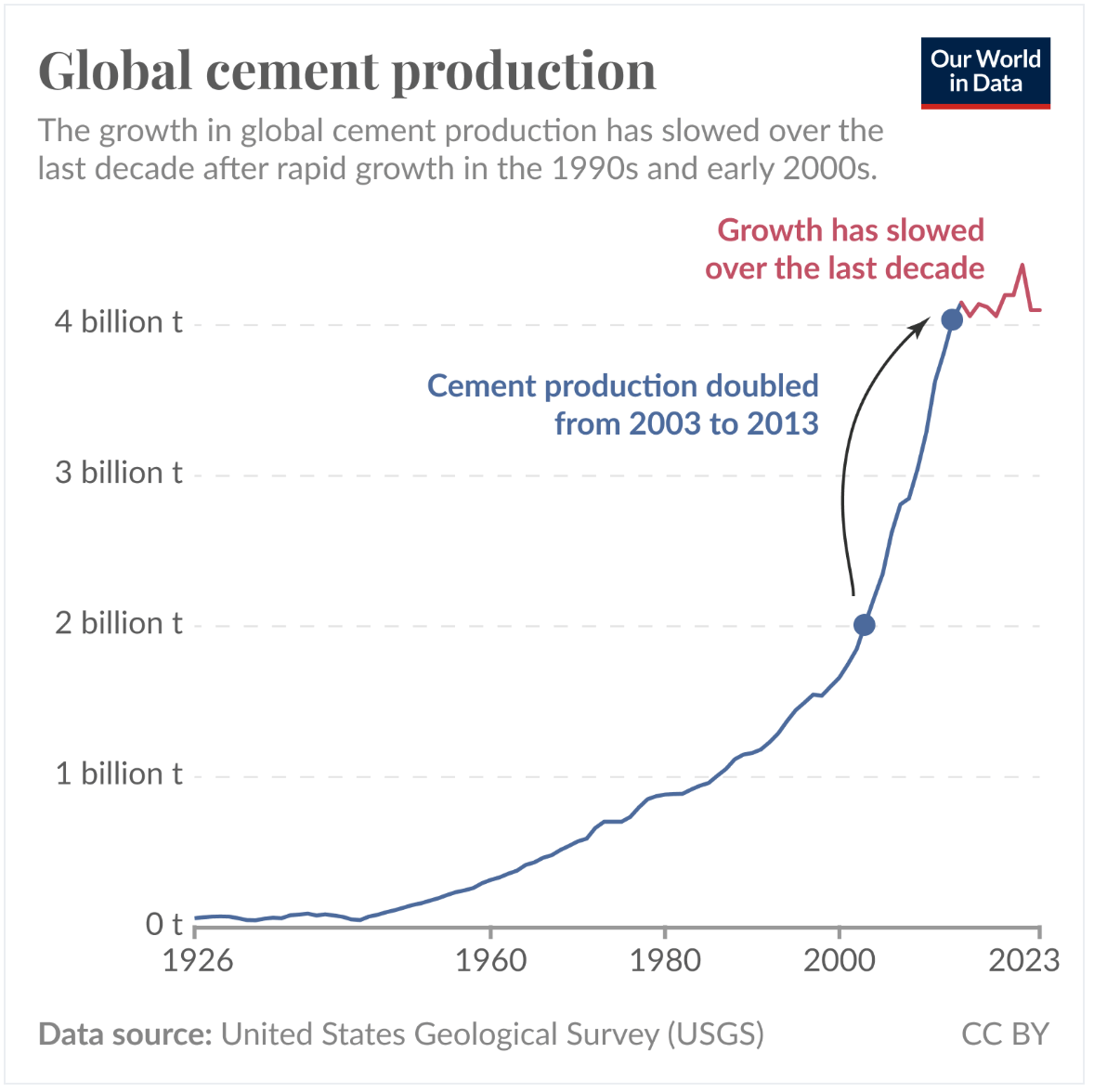
We know that world population has been growing since 2013, so clearly the amount of concrete produced, per person, has been falling. Thus, finished output, such as new concrete roads and buildings per person, has been falling.
Similarly, the number of new cars sold stopped growing after 2017. New cars were becoming too expensive for potential buyers.

The number of cars sold is not as high in 2024 and 2025, as it was in 2017, despite rising population.
It is tempting to blame leaders for the problem: Better laws are needed. It seems like the rich with their high incomes are taking too much of what is available.
But the underlying problem is that there are not as many goods to go around as there used to be. Strangely enough, the way this works out in our tightly interconnected economy is that the wages of younger people are becoming lower, relative to the wages of their parents. They cannot afford to get married, have a home, and raise a family. What is missing is jobs that pay well, as well as the inexpensive energy of the right type that makes such jobs possible.
[6] One type of war being fought today is the type being fought by the military.
Today’s military wars seem to be fought by countries with flat to falling energy consumption per capita, against countries that, through 2025, saw rising energy consumption per capita. Figure 12 and 13 show comparisons that may be surprising:


It is striking how in both Figures 12 and 13, nearby countries are observing opposite trends in energy consumption per capita. More energy consumption per capita tends to indicate a country that is doing better, economically.
Figure 12 shows that Russia’s energy consumption per capita has been growing, while Ukraine’s has been falling behind. It is almost as if one country’s increased consumption means decreased energy consumption for its neighbor. Figure 13 shows that Iran’s energy consumption per capita has been growing, while Israel’s has been falling behind. It is easy to imagine that competition for resources of all kinds underlies both conflicts.
China is not a direct competitor in the Iran conflict, but China and the US are competitors for resources of all kinds, (and, indirectly, jobs that pay well), in a kind of cold war. Here again, we observe the pattern of rising energy consumption per capita in China, and falling energy consumption per capita in the US.

To the extent that China gets more of the resources, the US tends to get less. This is another conflict that can’t easily be resolved. There fundamentally aren’t enough minerals like antimony and nickel for every country to purchase what it would like. Moreover, copper is in too short supply for all nations to ramp up electricity usage at once.
Because of the problem of “not enough goods and services to go around,” it is difficult to see a solution to the conflicts in Iran and in Ukraine-Russia. However, the wars may take different forms. For example, it may be tempting for Iran to strike back against aggressors using AI to disrupt the internet, electricity, or fresh water supplies. Europe has already seen bomb threats against airliners. There may be assassination attempts against leaders. These are lower-energy types of wars. It is possible that the two wars will merge to become a hidden World War III. In fact, China may also join in a way that allows the conflict to become a true world war.
[7] A second type of war relates to the share of a country’s income that should go to benefits provided by the government and the share left for the individual citizen to spend.
If countries are growing rapidly, thanks to a very rapidly growing supply of inexpensive energy, it can temporarily look like governments can afford very generous programs of many kinds for their people. For example, it will look like governments can support pensions, healthcare programs, unemployment programs, educational programs, and road repairs, without a very high tax level. This was the situation in the years following WWII in many countries.
Unfortunately, as Limits to Growth modeling shows, things change. Gradually, fossil fuel energy supplies deplete and population grows. Available oil supply becomes more expensive and grows less rapidly. This combination means that major program cutbacks are needed to make whatever services are provided to the citizens also affordable by them. Before fossil fuels became available, pensions for common citizens were unknown.
Newly elected leaders would like to change their economies in a way that will maintain (or even increase) promised programs but, because of Limits to Growth, we are reaching a point where this becomes impossible. Debt levels are already too high to support much additional borrowing. If a new leader tried to significantly reduce current programs, citizens would likely revolt. Unfortunately, even a revolution won’t create the physical goods and services needed to allow promised programs to continue. Raising taxes to provide all the benefits citizens expect would leave the people with virtually no income for daily living after taxes.
What history shows is likely to happen is that at some point, either (a) the financial system of a country with excessive promises will collapse, or (b) the country will lose at war. At some point, a new economy will arise, with many fewer promises. For example, if the EU were to collapse, the individual countries of the EU might take on additional roles. If an individual country such as France were to collapse, the regional governments might take on additional responsibilities. But they are unlikely to provide nearly as broad a package of benefits as before the collapse.
To keep resource needs down, the new governments are likely to have many fewer employees. In many cases, the new leaders will not be elected. The new leaders might be winners at war, or they might be self-appointed.
[8] A third type of war relates to the level of complexity an economy should have. This tends to lead to internal warfare.
Complexity can be good. For example, it can give consumers useful devices at low prices. It can sometimes lead to reduced energy consumption in a particular device.
But complexity can have unintended bad side effects. One issue is wage disparity. With greater complexity, businesses tend to become larger and more hierarchical. The top people tend to be paid much more than those at the bottom. Competition is often against low-wage countries. Such competition tends to bring down the wages of unskilled workers. The use of AI can sometimes eliminate jobs completely.
Another issue of added complexity is that it tends to lead to wealth disparity. Those with higher wages can afford to buy homes and shares of stock. If prices of homes and shares of stock increase over time, those who are already rich tend to become even richer. Eventually, these high home prices become unaffordable by the many less-wealthy people.
At some point, poor people become frustrated with the situation. They want to fix it. They riot. They start burning cars and buildings. Instead of fighting against other countries, the problem becomes internal conflict.
The economies of countries whose governments collapse generally fall back to a lower level of complexity than they had previously. Taxes then become lower. This can be good. But resource problems don’t go away by themselves. Some types of new solutions, probably with added complexity, are needed to work around resource problems, if this is possible.
[9] Conclusion
No one tells us that, at some point, the economy is likely to take a turn for the worse, but that seems to be the situation we are reaching. There now seem to be too few physical resources for the current number of people in the world to live at the standards of living that they are accustomed to. Renewables haven’t solved the problem, and more debt by governments cannot solve this problem.
Many people hope that electing new leaders will fix the situation. Because the underlying problem is really a resource problem, this cannot really help. Eventually, many governments are likely to collapse, unless solutions to our resource problems are found.
Quite likely, international fighting will continue, and it may even spread to become World War III. However, because of resource limits, this war will be fought in a less resource intensive way than it has been to date.
It does not look like complexity can be sustained in the way that it has been adopted to date. If this is the case, in its next stage, the world economy is likely to fall back to a lower level of complexity than exists today. The big plus of lower complexity is that taxes are likely to be lower. However, the change will require adaptation.


https://fortune.com/2026/11/17/trump-administration-ai-outages-mullin-gary-marcus-banks-airlines/
The Trump White House is starting to admit that your bank account and airline tickets are under attack from rogue AI
https://www.zerohedge.com/ai/first-domino-falls-us-ai-chip-crackdown-freezes-480-loan-linked-chinas-bytedance
First Domino Falls: US AI Chip Crackdown Freezes $480MM Loan Linked To China’s ByteDance
As we discussed earlier, the Trump administration’s move to tighten export controls on AI chips outside the US to ultimately restrict Chinese firms’ access was met with anger and threats of retaliation from Beijing.
The fallout is already underway and is now hitting financing: the new curbs have frozen work on a $480 million loan to fund Nvidia AI chips intended for ByteDance, Bloomberg reported this morning.
US attack starting?
https://www.zerohedge.com/geopolitical/pentagon-says-irgc-missiles-bahrain-airbase-intercepted-more-tankers-flames
Iran Confirms US Attack On Qeshm Island, As IRGC Assaults Up To Four Tankers
Update(11:14ET): There’s been some active fighting on Tuesday as the US and Iran continue to square off for control of the Strait of Hormuz. Iran has confirmed a fresh US bombing attack on its Qeshm Island.
And Iranian official says the US attack did not damage the vital infrastructure and services of Qeshm, reports Tasnim.
Also, there have been more tanker attacks reported in the strait Tuesday – as the Iranian Navy has claimed a third oil tanker struck a naval mine and caught fire in the eastern Strait of Hormuz, IRNA reports.
This is another idea for electricity production:
https://www.wsj.com/business/energy-oil/google-embraces-geothermal-technology-to-vaporize-rock-for-clean-power-dbd66d05
Google Embraces Geothermal Technology to Vaporize Rock for Clean Power
The company is securing electricity from startup Quaise, which uses a gyrotron—essentially a giant microwave—to drill 3 miles beneath the Earth’s surface
Quaise said the project will cost about $350 million and be the world’s first to produce electricity by tapping in to rock with temperatures greater than 572 degrees Fahrenheit.
Google will purchase the electricity from the Quaise site in Oregon, beginning as early as 2030. Quaise will initially use conventional drilling tools to dig a well to a depth of about 2.5 miles. It will then switch to a gyrotron—essentially a giant microwave—that beams millimeter waves capable of vaporizing rock to reach 3 miles.
It plans to inject water down wells to be heated by rocks, collect the liquid and use the steam it generates to produce electricity.
Duh . I was at a geo thermal project in Belgium which was funded by the EU . The manager confessed it was nothing but a ” create some jobs ” project because I told him about my understanding of energy matters and warned him about fibbing . Loss making from day 1 .
The source needs to be really hot. In Belgium, that is not possible. Three miles down, maybe, but the cost of the whole project and maintaining it may be too hight.
We can expect a lot less vacation travel with prices this high. This will reduce income (and jobs) in what historically have been travel spots.
There are many posts on cyberattacks but I can’t be sure but when Chris Martenson says something then it is serious .
“BREAKING: Navy Federal Credit Union (the largest US credit union, with about 14 million members) had a long overnight outage of its mobile app and online banking.
“Once is an accident, twice is a coincidence, but three times is enemy action.”
What’s 57 times?
Exclusive: Highly classified US national security communications network goes down, sources say
https://edition.cnn.com/2026/11/17/politics/highly-classified-national-security-communications-network-goes-down
Equinor Detects Cyberattack on IT Systems, Operations Unaffected.
The company confirmed the ongoing incident and mobilized resources to neutralize it, with no signs of data theft and all oil and gas operations continuing uninterrupted. Staff might face hiccups in internal apps, and Equinor has alerted Norway’s police security service and other authorities. As one of Europe’s top natural gas suppliers, the company noted this amid a heightened national cyber risk level, but has not named attackers or details yet and plans further updates.
NOW: APPLE services are now suffering an OUTAGE, including Apple PAY, users report
iCloud and the App Store are also impacted
Users say they’re being signed out of iCloud on iPhone and Mac without warning and can’t sign back in
Apple’s own status page still shows nearly EVERYTHING AVAILABLE, and the company has yet to acknowledge the broader disruption
Just another addition to the FLURRY of outages in recent days
No more reporting on this issue .
The story is, “Nothing to see here, folks.”
This link says,
“The network, called NSANet, allows employees to communicate classified information internally. At this point there is no evidence of a cyberattack, sources said.”
We seem to be getting daily problems, with no evidence of a cyberattack.
I suppose that, after closing the Kerch Bridge today, the gloves are off in the hidden war. It is going to be some meeting next week in China.
Zerohedge has a report about the various outages:
https://www.zerohedge.com/markets/nsas-spy-network-reportedly-goes-dark-sending-stocks-sliding
NSA, Apple, Equinor Hit By Disruptions; FBI Warns Of State-Aligned Hackers As Feds Test Emergency System
After the list of outages it says:
The growing list of disruptions and outages of critical systems, whether used by companies or the government, over the last five days is awfully suspicious and being blamed on software problems.
Topping this off, Axios reports: “Stay calm — the government is just testing the emergency alert system today.”
Also in this Zerohedge article:
FBI Issues FLASH Advisory Warning
While companies and government agencies have pointed to critical-system disruptions and outages linked to software issues rather than cyberattacks, the FBI warned on X earlier this morning that it issued a FLASH advisory warning that cybercriminals and state-aligned hackers are using ARTEX, a “super intelligence-powered” framework, to automate attacks against businesses and organizations worldwide.
FBI wrote on X:
Delusional musings of a senile would be farmer aside, it seems Trump is going to be handled quite a platter in China.
Trump went to China for an Asia-Pacific summit, which is expected to feature Putin, and obviously the Eastern faction is negotiating from a position of strength.
it is all because the lower class people in UK wanted to live in peace that the continental powers were weakened beyond recovery, and Russia is harder to stop now.
Trump will be denigrated even more, while the East will rise higher. All because the ordinary people of UK wanted to live in peace , which lasted 80 years, the world will fall into Eastern domination.
Trump is chucky level?
More like Guy de Lusignan, the last king of Jerusalem, who was the last Western ruler in there till 20th century, a culmination of a 100 year retreat from the entire domination of the world by the West.
Electricity generation pe capita in the UK, curve uppy then sharp down.
https://ourworldindata.org/data-insights/electricity-generation-per-person-in-the-united-kingdom-has-fallen-by-a-third-from-its-early-2000s-peak
UK electricity consumption per capita UK 2003 -> *2014*, rolling off a mountain. (De-industralisation, other.)
https://www.ceicdata.com/en/united-kingdom/energy-production-and-consumption/uk-electric-power-consumption-per-capita
UK electricity energy (overall, territory) rises from 1950 to about 2007, then keeps declining (to 2023) why, is asked?
https://davidtoke.substack.com/p/why-does-uk-electricity-consumption
Not! a complete overview. Just electricity, not a primary energy, produced from other sources (for now humans don’t capture lightning) – so doesn’t give an overall picture (Note electricity has been boosted as ‘clean’ energy etc.) but this form of energy has been adapted to domestic use for say 150 years, in the UK and elsewhere.
This is a chart I made a year or so ago:
It shows a very similar pattern in several other “advanced” economies. The UK has a more pronounced trend down recently, perhaps because so many more poor people have been moving to the UK. Their wages are still low in the UK, so they don’t buy as many goods as others.
If the price of electricity rises, it is easy to substitute away. Businesses can move to another country, where electricity prices are lower. Some appliances can be made to use less electricity. Getting rid of cathode ray tubes for TVs and computer screens was a big help in reducing electricity use.
Well, with all this gloom, perhaps a positive.
Starship was caught, the booster had issues but they are working on it.
There is for all practical purposes plenty of “stuff” in space and earth is a gravity well.
Robotics is coming along nicely, AI is also growing nicely. Mine it in space, make it in space use it on earth and leave all the pollution behind.
Bet against progress and what do you win? Probably doom and perhaps extreme envy and frustration over having bet on failure when the future works; it always has.
Bets are really easy when the choice is failure and at least some success.
AgOpenGPS is making great progress, an international community. Yes, I know all the satellites will fall down; think of it as tomorrow’s challenge. Great possibilities for capital usage in agriculture. Swarms rather than one huge tractor.
Dennis L.
” but they are working on it ” . Yes , like they are at nuclear fusion and the Halidon Collider . Best of luck . ” Keep walking ” is an ad for Johnnie Walker whiskey . Please keep drinking .
” Work is the ruin of the drinking glasses . ”
Good to see you again .
Perhaps. The path of economies, and of everything else, over the long run is toward greater complexity. We can never see “around the corner” regarding what is ahead.
“Share and share alike” works everywhere. Maybe AI stock prices won’t go straight downward with the Nvidia problems. If China needs the chips to keep their industry going, perhaps a way will be made available for this to happen. One current WSJ article says,
https://www.wsj.com/tech/jensen-huang-statement-nvidia-ceo-9dedca36
Jensen Huang Breaks Silence, Signals Willingness to Return as Nvidia CEO
Outpouring of support from friends and colleagues has been overwhelming, Huang says
I think when you mentioned this in your conclusion, you were being a bit generous: the world economy is likely to fall back to a lower level of complexity than exists today.
Probably so. I didn’t want to scare readers too badly.
Is this a foretaste of things to come with oil and with other commodities? Scrambling for physical supplies of aluminum to fulfill contracts:
https://www.zerohedge.com/commodities/trafigura-scrambles-aluminum-backwardation-steepest-years-amid-draining-stockpiles
Trafigura Scrambles For Aluminum As Backwardation Steepest In Years Amid Draining Stockpiles
The scramble for physical aluminum continues to intensify this fall, with commodities giant Trafigura snapping up the industrial metal on the London Metal Exchange to capitalize on a very lucrative arbitrage trade in China, where stockpiles are dwindling.
Bloomberg says Trafigura has accumulated large LME positions as it seeks to sell the metal in China for a handsome profit. The report cited people familiar with the matter who requested anonymity.
LME data identified several large holders of November aluminum contracts ahead of next Wednesday’s expiry. Their combined positions exceed the exchange’s entire 224,150 tons of inventory, the lowest since 1990, as global warehouse inventories slide.
Aluminum is one of the things not coming out of Hormuz, as both UAE and Arabia produce more of it than the USA. Or perhaps I should say used to produce.
Good point! Making automobiles lighter, using more aluminum, won’t work without a good source of aluminum.
Perhaps the cold war with China is heating up.
https://www.zerohedge.com/ai/china-ai-stocks-sink-us-tightens-chip-curbs-nvidia-forms-export-committee-after-jensens-exit
China Threatens Retaliation Over US AI Chip Curbs: What Will Beijing Target Next?
Beijing Angered
Beijing’s Ministry of Commerce expressed discontent with the proposed tightening of US chip controls that would make it harder for Chinese data centers to obtain advanced AI chips from Nvidia and other US suppliers or access them remotely through overseas data centers. . .
The proposed US restrictions battered Chinese AI stocks overnight, with Alibaba down about 5% in Hong Kong and Baidu down nearly 6% to a record low. Model developers MiniMax Group and Zhipu sank 5%, while robot maker Yushu Technology plunged 12%. The Hang Seng Tech Index declined 1.1%.
Meanwhile in the real world
https://consciousnessofsheep.co.uk/2026/11/16/meanwhile-in-the-real-world/
The role of money supply in inflation (following an increase in the cost of oil) and how that is affecting the UK now. The same issue will hit the US, if it either increases interest rates, or if it increases taxes to pay for the new greater government spending favored by Democrats and Socialists. The following is from the post:
————
Frank Shostak from the Mises Institute 2017 explanation:
“If the price of oil goes up and if people continue to use the same amount of oil as before then this means that people are now forced to allocate more money for oil. If people’s money stock remains unchanged then this means that less money is available for other goods and services, all other things being equal. This of course implies that the average price of other goods and services must come off.
“Note that the overall money spent on goods does not change. Only the composition of spending has altered here, with more on oil and less on other goods. Hence, the average price of goods or money per unit of good remains unchanged.”
Oil prices are not inflationary unless they are accompanied by widespread money creation – either through government spending or bank lending… something the luminaries at the Bank of England seem oblivious to. Indeed, as bank lending has fallen, so government has put even more pressure on SME businesses and households via tax increases. And the grim consequence is a general slowdown in the real economy as everyone is forced to balance their spending.
Is this really true? The internet is becoming less and less useful because so much of it is nonsense.
https://www.zerohedge.com/technology/massive-cyberattack-turned-178-worlds-biggest-websites-against-their-own-visitors
Massive Cyberattack Turned 178 Of The World’s Biggest Websites Against Their Own Visitors
Hackers spent most of Monday serving malware to visitors of 178 major organizations, including Zoom, CNN, Fox News, the BBC, HSBC, Equifax, Salesforce and IKEA, by hijacking a website-testing service those companies had all trusted with their pages.
The malicious code rode in through Optimizely, a platform companies use to try out changes to their websites. According to Report URI, the security firm run by researcher Scott Helme that found it, the attacker planted JavaScript in the “Project JavaScript” field of Optimizely customer projects, so the poison was delivered from Optimizely’s own servers – a domain the affected sites had already approved to run code in their visitors’ browsers. . .
Anyone who sent crypto on Monday should check that it reached the intended wallet, anyone who entered a card on one of the listed sites should watch their statements, and iPhone and iPad users should update.
Helme called the episode “a near miss, and far too close for comfort.” “You wouldn’t dream of deploying unreviewed, unmonitored code to your production servers, yet we routinely allow third parties to do exactly that in our visitors’ browsers,” he wrote on Tuesday.
This has been my gut impression; that the internet has become a double-edged sword where disinformation now outweighs its benefits. Even in the most favorable light, its complexity consumes the productivity it purports to achieve.
I get more information just by communicating with people in person. The problem is, here in small town costal NC, there is no one to talk to. Their eyes glaze over. At the regional telecast “Biggest little football game in America” last week in Durham, NC, I got the chance to schmooze with alums of both competing schools. One was an OB-GYN fellow who talked to my daughter who is also interested in a medical career- if she can get into medical school- iffy. I sat next to a Harvard PhD immunologist from my college who had been laid off from her position in a restructuring and was now stuck with a low 2% mortgage on her home, which meant relocating and taking on a new mortgage at 7% would kill her. It seems that productive people are victims of the parasitic financialization of our economy. Same way physicians have given away their profession to health care insurance and hospital corporations. I was hanging on every word she said about COVID etc. And then I had a long discussion with an alum from my rival school who graduated the same year I did- 1976. He is a bullion dealer- deals with Au sales in metric tons and allowed me a peek at his orders on his cell phone: Super wealthy elites and central banks, sovereign entities buying up gold like crazy, especially with the recent dip in prices. orders from entities in Saudi Arabia, Dubai, Switzerland. They purchase it at 9% discount to spot and pay a 3% sales commission.
Meanwhile, in my lowly ham shack, the only use I have found for AI is troubleshooting software bugs on my digital radios and the Windows 11 and Linux operating systems these digital modes depend on. Morse code (Continuous Wave or CW as it is known), is the most dependable form of communication in many ways, even if archaic. It would seem even though information via cell phone or internet can travel billions of time faster, it’s great while they work, but there will be hell to pay if they ever suddenly don’t.
Thanks for your observations. Lots of people running into different types of difficulties.
At least 50% of the e-mails and phone calls I now get are scams and fraud.
This rubbish probably accounts for a not insignificant percentage of US GDP.
Pingback: 436, The Industrial Era Is Over | Chatting about Localism
At some point, I would think that this issue is going to start hurting banks, insurance companies, and pension funds:
https://www.wsj.com/real-estate/commercial/why-big-investors-are-burning-lenders-on-apartment-loans-7129d849
Why Big Investors Are Burning Lenders on Apartment Loans
Deep-pocketed landlords like Brookfield may be the most willing to cut their losses on troubled properties
Large and creditworthy borrowers don’t normally keep real estate lenders awake at night. But a set of keys handed back by Brookfield BN is a wake-up call. Big investors are pragmatic about walking away from bad apartment deals.
Rents at the Beaudry never rose as much as Brookfield expected, . . . Refinancing the Beaudry’s $357 million mortgage may have required a fresh cash injection. . .
The consequences of handing the keys to the lender are also less severe for an institutional investor than a small owner who would have difficulty accessing capital in the future if they burn their lender.
New Economist cover. Maybe someone can decode it:
https://pbs.twimg.com/media/HXTya4XWMAAbIj7?format=jpg&name=large
The cover seems to have a lot of concerns that we do. Out at the perimeter, it juxtaposes the very advanced (space exploration) with people living off of nature, both in the Middle East and in the US Southwest. It shows a lot of war-like images. The center shows a lot of images related to high-complexity advances–electric vehicles, AI, medical advances.
I am afraid that something has to “give,” and so is the cover.
I see: a humanoid robot running away with loot, revolution in the Eurozone, broken pipelines, boot stomping on democracy (boot on ballot box), injections, depreciating currency or stock market,
All in satanic colors.
If I am not mistaken it is a Rothschild-owned publication, after all.
The story about Jensen Huang and his mistress Alice Huang (no relationship, there are very few last names in China) is getting more and more bizarre. Yesterday, the story was that Alice’s husband had introduced her to Jensen Huang. Now the story is that her husband’s business (backed by the Chinese government) benefited from Nvidia’s chips.
https://www.wsj.com/world/china/alice-huangs-husband-built-a-data-center-empire-backed-by-the-chinese-state-78389c9a
Alice Huang’s Husband Built a Data-Center Empire Backed by the Chinese State
Kang Wei developed the business while his wife was involved with Nvidia’s then-CEO
Alice Huang and her husband, Kang Wei, operated on two tracks pointed at the same goal of vaulting China’s artificial-intelligence capabilities ahead of the U.S.
Her job: cultivating a relationship—one that turned romantic—with Nvidia’s then-CEO Jensen Huang and securing a pipeline of the company’s advanced-computing chips that Washington has sought to keep from China. His job: building a sprawling network of government-backed data centers across China, a review of Chinese public records shows.
The scale of Kang’s data-center business was striking. From 2021 to 2024, the proposed investments tied to Kang’s network topped $9 billion, all built with government backing. Chinese government officials hailed Kang’s projects as part of China’s national push to ramp up computing power across the country.
I see Mr Wei is a very pragmatic character.
America is descending into one big open air prison.
Without woman to have families and keep the peace. All the races will tribe up. Whites will form Nazi gangs. Blacks will tribe up. Muslims, Hispanics, etc. Just like in Prison. Hell they’ve already broken people into this with lockdowns, wearing muzzles, etc. Camera’s everywhere. “THIS CALL MAYBE MONITORED” etc.etc
Sorry, trans woman won’t replace real woman just like solar and wind won’t replace ff’s. And considering pretty much all LGBT people took shots I don”t they’re going to be around much longer. Which leaves us with nothing but dudes. Just like in Prison.
Ah, resource limits, scarcity, man vs. man, extraction, control, The City Of London. It’ll be nice to see it die and the American system take over.
The American system requires more energy than the European one, so how could it take over the City of London?
We are about to get conquered by the Nigerians!
A country 90% vaxxed is not taking over anything besides the graveyards.
3 years left..
The natural gas situation in Europe gets worse every year. I guess we will manage this winter. But unfortunately there will be more winters to come. So next year we will face the same problems again.
And even if we beg Gazprom, they will not help us out anymore.
In the Netherlands we are ven more dependent on natural gas for electricity. When there is no wind in november, december or january, up to 70% of the electricity comes from gaspowered installations.
I am afraid you are right. Solar is pretty much useless in winter, and wind may or may not be available. Europe is therefore dependent on imported natural gas to fill in the gap, usually liquefied natural gas (LNG).
One of the problems is that a lot of other countries need LNG also. Another problem is that the cost of making and transporting LNG s terribly high. Buying lots of LNG is a financial problem. A third issue is that we don’t know how long even expensive LNG exports will be available. Natural gas tends to deplete.
Natural gasproduction in Norway is going to decline. US exports of LNG to Europe cannot grow and cannot last another decade. Third parties could try to disrupt the LNG-transport to Europe, just like someone blew up Nordstream
The party is coming to an end. Who will pay for the unrealistic expectations?
President Trump promised a golden age; tech giants promised record profits. The bill for their ambitions is already coming due
“During his September presentation on superintelligence, D. Trump relied on the generosity of tech giants. Local communities were supposed to benefit from partnerships, jobs, and prosperity, but voters began demanding guarantees even before the promises could be turned into new construction projects. Investors are now making a similar demand. They want to see revenue, cash, and manageable liabilities. Tech companies remain strong, but they have already committed an increasing share of their future earnings to suppliers, landlords, and creditors.”
Translated with DeepL.
https://www.trend.sk/trend-archiv/party-sa-konci-kto-zaplati-za-prehnane-ocakavania?itm_modul=react_trend_financie&itm_brand=trend&itm_template=hp&itm_position=3&itm_cb_position=mid_main_1
I think most of us who have been following the AI story can see that the AI debt bubble is gradually being let out. Growth in the future is likely to be a lot less than now. There is a little AI that is helpful, but much of it has been over-promised, relative to the value to the ultimate customers. What the economy needs is complexity that adds jobs that pay well. AI is used as an excuse to cut jobs.
Young doctors in Britain: low pay and burnout
Junge Ärzte in Großbritannien: Unterbezahlt und ausgebrannt I auslandsjournal
“Currently, junior doctors—that is, doctors who have not yet completed their residency—earn the equivalent of about 16 euros per hour. Nearly half of all doctors in the United Kingdom are junior doctors. The workload in hospitals is high, and there is a shortage of staff. Hospitals, staff, and the healthcare system in the United Kingdom are overburdened. Many young doctors want to leave the profession because the workload is heavy and the pay is poor.”
Translated with DeepL.com (free version)
https://youtu.be/OnRLHz7__wc?si=FvBg0b7u-y173R2L
I have a hard time believing that half of all doctors in the UK are doctors who have not yet completed their residency. In the US, these doctors are only at this stage of their career for a year or two, out of their whole careers.
In the US, pay for doctors in residency training per hour has been low, and their hours have been long. A few years ago, there were protests about the situation. It seems like some changes were made then–limiting hours, for example, so these doctors in training would not be too tired to be doing the work required of them.
And most are from the Subcontinent anyways
Are there non Slovak drs in there? (not including people who could pass for Slovaks, like Czechs or Hungarians – the doctor who found out the long held Hungarian prisoner of war in Russia, Andras Toma who was held for 53 years was a Slovak who knew Hungarian)
French honour guards collapsing during official visits:
On St Martin’s Day, the Slovak president visited France – and two French honour guards fainted during the welcoming ceremony.
https://youtu.be/ShZ_dX_DzSw?si=eH_HMLJcWTl8XKvv
I used to be a platoon leader in the Old Guard (the US Army’s official ceremonial unit and escort to the president).
It is not that uncommon for these soldiers to faint during a ceremony – especially if they have been standing in the same position for a long time and the weather is hot. We always had “supernumeraries” on hand to take their place.
Statistics full of shit. Every generation throughout Human History has its fair share of wars.
Talk about “we look to Los Angeles for the language we use”!
I’m translating something into English on football today, and I’ve come across the word “assist”—which I can’t recall ever having heard the word spoken at White Heart Lane, Highbury, or Stamford Bridge.
Complaining to Google about why and how this frankly pooffy word could end up desecrating the noble game, I got back the following response:
Your memory is spot-on. Half a century ago in the UK, “assist” was not a football term at all, and “making” a goal was actually the standard phrase used by British commentators and journalists.
The word “assist” officially entered British football vocabulary in 1994. It crossed over from American sports—specifically ice hockey and basketball—during the 1994 FIFA World Cup hosted in the United States.
How the Shift Happened
Today, you will still occasionally hear older British pundits say a player “made the goal,” though “assist” is now universal across the UK and the rest of the English-speaking football world.
Whadda ya think of that Dothk? Is there any chance Nigel Farage will bring back goal making when he gets in?
In Italy things are the same. Once things change we will make foreign languages illegal, Zelensky style.
Thanks, Gail, for the new article. You are a steady presence.
You are welcome. I am happy about continued good health.
Waste is a huge factor in resource depletion. GDP growth is built on waste with over consumption by rich nations reducing consumption in poor nations while contributing to climate problems that are already creating famine and crop destruction. Thank you again for another well reasoned argument.
One person’s “waste” creates another person’s job, however.
Big banquets have huge food waste, for example. And fancy buffets for colleges likely have quite a bit of food waste. Some people don’t eat left-over food; we call them “planned-overs.”
In the US, many people wash clothes after every wearing and take a shower daily. Much of this is not needed. It wears out clothes quickly. But worn out clothes provide demand for new clothes.
I don’t know if I agree with you Gail on this one. There is a thing called mal investment. If the money was spent in another way more efficiently it would create jobs and opportunities as well. Look at the United States and China. One country pursued infrastructure and staying out of war the other country told the individual to go shopping on frivolous things. Americans drive two ton trucks to get their groceries. Yes China has its problems too but China didn’t have the reserve currency and lots of natural resources. Yes in the end the outcome is the same but that’s like telling a child to take up drinking and smoking and eating poorly because you are going to die.
It is really difficult to draw the line on what is mal-investment. It seems to change over time.
When resources were more plentiful, encouraging international travel seemed like a good idea. Practically every place around the world could benefit from this. Encouraging parties and the use of fancy clothes for events of many kinds seemed good. The party goods like flower arrangements and fancy clothes came from otherwise poor countries.
But as resources are more limited, international travel and international trade to support supply lines will need to become more limited. This will be a problem everywhere, but it will especially be a hardship for poor countries.
>> while contributing to climate problems
Thomas, the consensus here is that the “climate change” hoax, previously the “global warming” hoax until that didn’t pan out, is a cover-story narrative provided to prompt action to mitigate the effects of energy depletion. Reducing CO2 means reducing dependence and use of hydrocarbons, which is necessary because they are depleting. It also motivates the imposition of supra-national organizations and treaties, desired by globalists. They don’t want to say, “The core pillar of our entire civilization is being quickly exhausted” because there would be serious negative effects from doing so, of economic and geopolitical nature.
The challenge is to stabilize the financial markets in beginning degrowth, before CBDCs are introduced. I suppose that is achieved by excessive governmental spendings Unfortunately, a large group of citicens understand their governments meanwhile as enemies, which opens a second level of distress. I am afraid we will see growing excess mortality.
There are a lot of ways how governments could do better in such difficult times. They could reduce regulation and support local groups of homesteading and sharing or providing mutual care of ill or old people – or caring for the kids.
I don’t know whether Central Bank Digital Currencies will ever be introduced. Countries would like to do this, but whether that “stick together” well enough to do this remains to be seen.
I agree. In the last year we have seen how vulnerable digital infrastructure is, especially when connected to the internet. People around me are returning to paying in cash, despite the convenience of paying electronically…. but maybe I’m just getting old
My credit and debit cards were recently blocked due to fraud. The fraud occurred despite both cards being stored safely in my wallet. While I waited for new cards to arrive I could only pay by cheque or cash.
Shops don’t accept cheques nowadays, although individuals and electricity suppliers do. So to purchase food, it was cash … or cash.
The governments are only interested in making money as every individual also is .
But based on what’s happening in Ukraine the powers that be are probably planning something big which will involve the spent fuel pools which means time is short so the governments will probably do what you’re saying Jan when the difficult times become even more difficult
Le Pen bends the knee
Le Pen says France will keep giving Ukraine aid if she is elected
I imagine that Le Pen doesn’t want to be boycotted or go to prison before playing her chance to be elected.
Jan, my impression is that in the EU CBDCs will be introduced in July 2027. True or false?
In 2013 Thomas Piketty explained in Le Capital au XXIe siècle that degrowth is not compatible with capitalism as noone lends out capital to someone who has less tomorrow than today.
Degrowth can occur as a consequence of population reduction or ressource restriction or under the climate agenda. It is characterized by a long permanent recession. Piketty lists a number of measures the states can react with, among them negative interest rates, high unflation, high taxation, confiscations. We are seeing all these already.
The advantage of CBDCs are, that negative interest rates can be imposed on money excluding a monthly allowance.
Capitalism has been so successful, that it reached the limits of its resource basis. To keep it as a form of self organizing structure the owner of capital must loose more money without than with an investment – which in degrowth also looses money.
If the state imposes inflation all contracts have to be adapted monthly. The advantage of CBDCs is, that items necessary for participating in society can be excluded from the loss of value. The disadvantage is a high technologic complexity and regulation and the possibility of control of the citizens.
In the moment CBDCs are implemented, states can actively reduce their populations to adapt the resource by head ratio, without crashing their economies. States have already mandated a poisinous injection which reduces the obligations of paying for elderly people. We have known for centuries that once the babyboomers reach pension age their lives are worth nothing.
Today, all these problems add up with some esoteric agenda, claiming evil times are necessary to enable the good times. We see this in the Epstein cult.
I believe, we must now get closer together as societies and nations, scale down complexity and produce food, education and health care in much less complex ways but keep up important chemical and metallurgic industries and knowledge as much as international trade and a strong defense at the borders.
It does not seem as this will put into action so soon. And the causes are mainly shifts of power towards the resource states and reactions of the states loosing influence.
Jan
Bet they usher CBDC after “The Hack” as Whitney says
Wide Awake Media on X: “Citing Klaus Schwab’s predictions of an impending “cyber pandemic”, Whitney Webb warns that a major cyber attack on the banking system could accelerate the rollout of CBDCs. She argues that customers could be coerced into accepting programmable digital currencies as the only https://t.co/yXYusASho5” / X
that is probable and thanks for sharing this
The Gulag on X: “Bill Gates says a giant cyberattack might be necessary so that the people give in to “experts” like him and his friends He is literally wearing an Agenda 2030 logo while saying it https://t.co/dXr62tu1H8” / X
thanks also for that.
He’s looking more and more like Kermit the Frog, topped with epstein-sauce of course
Bank stocks have been getting hammered recently.
Goldman Sachs down by more than $50 in just the past week.
Could be related to “cyber pandemic” fear, among other things.
Thanks for this new post — reality tends to come in through the window, if we close the door on it.
Wasn’t it Norman Pagitt (spelling?) who said here, that they’d be fighting over the resources, as they decline?
It is Norman Pagett, and I think he did say that.
Yes, we must give credit where it is due. Norman nailed that one.
From Amazon;
“Our oil age will not end through lack of it, but by fighting over what’s left” is a core thesis by British author and commentator Norman Pagett. He explores this concept in his book The End of More: Infinite Demand on Finite Resources Is Making Humankind Unsustainable“
AI Summary:
Pagett argues that modern industrial civilization does not collapse when the very last drop of oil is pumped from the ground. Instead, social and economic breakdown begins as soon as supply can no longer keep pace with endless demand.
And our Norman said and wrote all that in 2013, making him prescient. As my grandad would have put it, you were right there, Norman.
Footnote: I nominate Tim Groves as President of Norman Pagett fan club, since he’s done all the background homework and obviously misses him so much from these pages.
Provided I can get a 10% commission on all End of More and Ironmen of Shropshire merch, I’m in!
Has he lost his mind?
Can he see, or is he blind?
Can he walk at all?
Or if he moves, will he fall?
Is he alive or dead?
Has he thoughts within his head?
We’ll just pass him there
Why should we even care?
Tim, looks as if you read the book by Trump, “The Art of the Deal”.
Unfortunately, this post holds no reward other than being in communion with Norman and being the liaison with his followers.
I regret you need a side hustle to make ends meet as a retiree. Inflation is a big problem for us fixed income class
Agreed!
“Changing leaders won’t fix the underlying problems”
Yes, but having democratic socialists manage the decline would be way better than fascist narcissists.
The only way that will be “way better” is that the “crash and burn” will happen way faster.
I am sure that there are different opinions. We have a zig-zag approach to economic policies because no matter what we do, it doesn’t work very well.
Our “democratic socialists” in Canada have been busy murdering thousands of taxpayers (including their base) via the Convid fake pandemic, lockdowns, iatragenocide, criminal gene-therapy mandates and MAID. This ongoing depopulation solution (Operation Warp Speed) fits perfectly with our resource scarcity/affordability meets overpopulation crises. The fake 2-party paradigm continues to be quite successful at distracting the masses from understanding that wars and “pandemics” are effective ways to reduce the human population.
Your “democratic socialists” in Canada sound a lot like fascist narcissists in drag.
No, on second thoughts, all in all, I would much prefer being governed by common or garden fascist narcissists to being oppressed, repressed, incarcerated and terminated by genocidal and democidal maniacs who assure us they are killing us off “for your own good, you understand.”
Makes you wonder why canadas population keeps rising
Indians.
Correct Edpell .
Something comes to mind about lies, damn lies and statistics. The “experts” churning out those statistics are also those who perpetuated the fake virus and fake pandemic. We all know many people who were injured and/or killed by the Convid protocols. However, controlled immigration serves to replenish those killed.
Our “democratic socialists” in Canada have been busy eliminating the multitudes (including their own base) via the Convid lockdowns enabling business closures, bankruptcies, suicides, overdoses, iatragenocide, criminal gene-therapy mandates and MAID. This ongoing depopulation solution (Operation Warp Speed) fits perfectly with our resource scarcity/affordability and overpopulation crises. This is textbook Diaster Capitalism using MKULTRA shock therapy for asset-stripping of the citizens whose jobs, benefits and pensions have been conveniently eliminated. This was done while the Liberals held power. The fake 2-party paradigm is very successful at keeping the masses from understanding that wars and “pandemics” are effective ways to reduce the human population.
For Australian readers: I monitor diesel supplies weekly as new data come out:
16/11/26
Australian onshore diesel stock in September 2026 was lower than the minimum stock holding obligation
https://crudeoilpeak.info/australian-onshore-diesel-stock-in-september-2026-was-lower-than-the-minimum-stock-holding-obligation
In a counterproductive response to resource limitations Australia increased immigration to keep the GDP from falling into a recession. The result is a housing shortage and a new ant-immigration party, One-Nation.
Your graph on peaking sales of cars is interesting. More than 10 years ago I wrote this article:
27 May 2013
World car production grows 3 times faster than global oil supplies
http://crudeoilpeak.info/world-car-production-grows-3-times-faster-than-global-oil-supplies
Yes, you talked about car production in Australia early. It looks from your exhibit that peak production of cars in Australia was 2003. After that, production fell and profitability fell. Now I expect that all vehicles sold in Australia are imported.