
|
Getting your Trinity Audio player ready...
|
The nature of the shortage of diesel and jet fuel is more complex than most people realize. Based on my analysis, a shortfall has existed since at least 2020. The shortage is not simply the result of the closure of the Strait of Hormuz.
In this post, I will provide background information regarding the nature of the shortfall and the international conflict it is leading to. I will also share my thoughts on how, over the long term, the situation might be mitigated. I doubt whether a solution will be available in the short term, but I can at least give readers an idea of one direction in which a possible workaround might be available.
My idea is that the economy needs to transform itself in a way that uses diesel and jet fuel (grouped together on some reports as “middle distillates”) more sparingly. At the same time, research on extracting heavy oil and bitumen at lower cost is needed. If this is done, it may be possible to use additional heavy oil to increase the supply of diesel and jet fuel.
One thing that will probably need to change is the price of diesel relative to gasoline. The price difference will likely need to be even greater than it has been in the recent past because heavy oil is inherently more difficult to extract, refine, process, and transport.
[1] The interconnected nature of the economy means that inexpensive energy products are extremely important to the economy.
Energy supply and the economy are a great deal more interconnected than most people realize. For example, if the price of diesel rises, the price of food also tends to rise because diesel is used in food production and transportation. Similarly, if the price of gasoline rises, the additional cost also tends to squeeze budgets. Politicians see these price increases and say to themselves, “These increases will make voters unhappy. Let’s raise interest rates and see if we can get oil prices back down.”
Higher interest rates don’t affect everyone immediately, but they particularly impact people purchasing a vehicle or a home, and businesses seeking a loan.

Clearly, raising interest rates at the same time as energy prices are rising is “playing with fire.” If the economy is really overstimulated and growing too quickly, this type of approach makes sense. But if the underlying problem is that diesel and jet fuel prices are high because of inadequate world production, what is really needed is higher oil prices, especially for the heavier crude oils that provide a disproportionate share of diesel and jet fuel.
Consumers and oil producers have two different needs for prices:
- Consumers want diesel and jet fuel prices low because high prices wreck their budgets. Diesel is used in growing food and transporting it to market. Jet fuel is used in transporting some kinds of foods. In fact, industries of all kinds (including mining, road building, and construction) use diesel and jet fuel. Higher prices of these fuels tend to make practically any kind of goods or services more expensive.
- Oil producers want diesel and jet fuel prices high, to incentivize investment in new wells. Without additional investment, the quantity of heavy oil extracted and made into these fuels will tend to decrease because of depletion issues.
While prices for diesel and jet fuel are higher this fall, quite a bit of the extra charges relate to extra transport and insurance costs. The high prices need to stay, and perhaps even increase, even if the immediate issues disappear, in order to incentivize greater long-term production. It is these rising prices that are likely to continue to squeeze budgets and push economies toward recession.
[2] What we call “oil” can vary quite widely from well to well. The trend over time has been toward lighter crude oils.
Most people assume that all oil is equivalent, but this is not the case. Petroleum is a mixture of hydrocarbon molecules. The lightest ones are gases are room temperature, the medium weight ones are liquids, and the heaviest ones tend to be quite viscous. Some are even solids. Some oils, especially heavy oils, have sulfur or metal inclusions. Crude oil that contains sulfur is called “sour oil.”
Heavier oils are ones that disproportionately produce diesel and jet fuel. Lighter oils tend to produce more gasoline, along with products like solvents, and the feedstocks for plastics.
In my view, a major reason why there tends to be a shortfall in diesel and jet fuel production (even apart from the current Middle East blockages) is that the type of oil needed tends to be more expensive to extract, refine, and transport than light oil. Furthermore, oil with sulfur tends to be quite corrosive, and removing the sulfur adds another layer of costs. The primary issue I see is that it is hard to pass on the higher production costs of heavy and sour oils to customers.
In theory, to cover all the costs involved related to heavy and sour oils, diesel and jet fuel prices should be quite a bit higher than gasoline prices for the same volume (liter or gallon). But if this were the case, the price of food would also increase, since diesel is extensively used in food production and transportation.
Figure 2 shows end products from the production process. We know, however, that lighter end products tend to come from lighter crude oils, so we can deduce that the crude oil mixture has been getting lighter over time. The amounts in Figure 2 include natural gas liquids, which are very light and growing in quantity.

The earliest oil that was extracted tended to be “medium oil,” which tended to have a mixture of heavier and lighter molecules. As the medium oil depleted, new production tended to be lighter. In particular, US tight oil from shale is quite light. The increasing production of US tight oil from shale is adding to the Very Light layer, as well as the Gasoline layer.
[3] The world had a diesel and jet fuel shortage long before 2026.
Because of the need for diesel and jet fuel in industry and transportation, a person would expect per-capita diesel and jet fuel consumption to grow as industry and international trade grows.

Figure 3 shows that per capita consumption of diesel and jet fuel stopped growing about 2005. The year 2005 seems to be the time that the world’s output of “conventional” (easy to extract) oil reached a peak. Figure 3 also shows that per capita consumption then plateaued until about 2019. It fell 16% in 2020, and it has not been able to fully recover since. The historical data on this chart is only through 2025, but the big Middle East cutbacks in 2026 will clearly send diesel and jet fuel consumption down from the 2025 level in 2026, as indicated by the red arrow.
At least in part, what is happening is that recent oil prices have not been high enough for countries producing somewhat heavy, sour oil. This is especially the case for oil exporting countries that depend on oil revenue to support their economies. They need more revenue than just enough to cover the cost of extraction, plus a reasonable return for shareholders. They also need money to fund the development of make-work projects to employ their citizens and to fund subsidized imported food for their population.
In the peak oil community, there seems to be the view that Middle East oil is always cheap to extract and refine. At one time, this may have been true, but most analyses overlook the tax needs of oil exporting countries. Tax needs are high in countries with exploding populations who need subsidized imported food. Huge make-work projects to provide employment possibilities, such as Saudi Arabia’s construction of the city Neom, add to the need for higher tax revenue. Middle Eastern oil costs may also be rising because of depletion issues, such as wells yielding relatively more water in the oil/water mixture extracted.
[4] For oil exporters, one symptom of chronically inadequate prices for heavy/sour oil (including the need for high tax revenue) is the willingness to engage in war.
If a person looks through my suggested list of heavy/sour oil producers shown on Figure 4, all the countries seem at least somewhat war-like. Even Canada tends to be war-like. Canadian leaders would be much happier if the price of crude oil exported to the US were considerably higher, and it would be less inclined to seek export partners in Asia and Europe.

If the oil production of the heavy/sour countries and country groups found on Figure 4 is added together, the result is as shown in Figure 5. The total production of these countries exceeds the production of the rest of the world.
Notice that the countries of the Middle East tend to be quite price sensitive. Their production dropped steeply in 2020 when oil prices fell. Likewise, their production rose in 2022 when oil prices were temporarily higher, related to the start of the Ukraine-Russia conflict.

[5] Authorities claim that there would be plenty of heavy oil to refine if prices were to rise high enough for long enough.
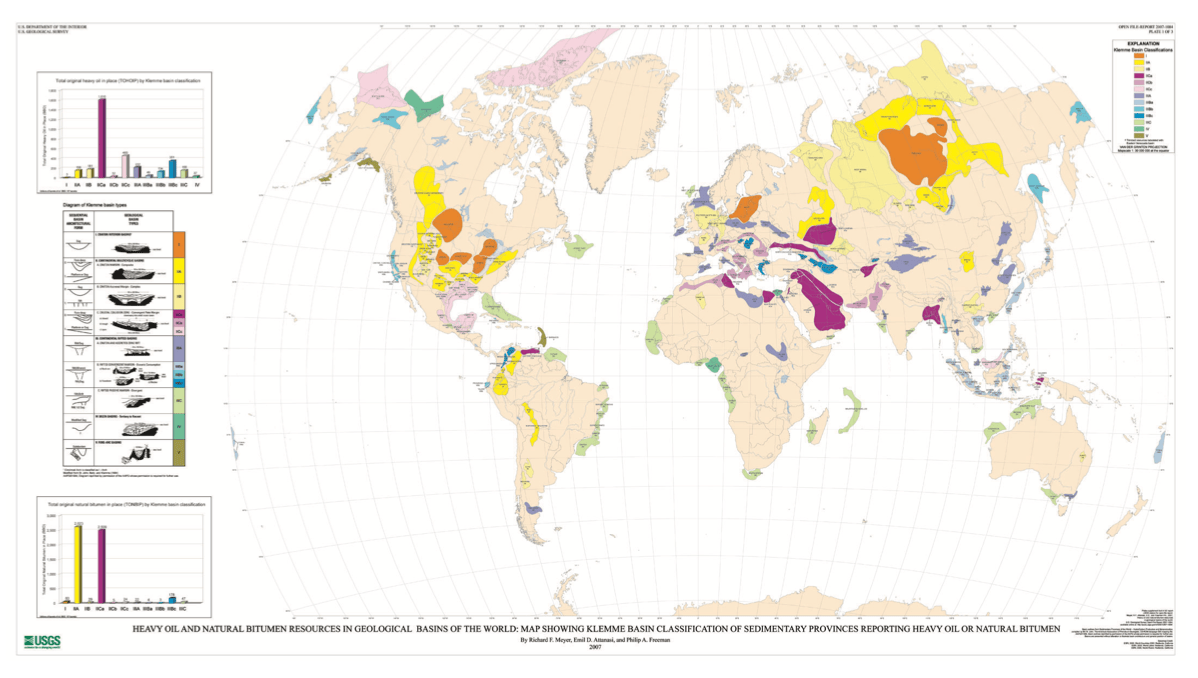
The United States Geological Services provides maps of available heavy oil and bitumen deposits. Figure 6 indicates that heavy oil is widely available in North America, Europe, Russia, and the Middle East.
In 2015, the International Energy Agency published a report indicating that in its view, there were huge deposits of extra heavy oil and bitumen (EHOB) that could be accessed if the price of oil rose high enough for long enough (Figure 7). The same exhibit shows somewhat smaller availability of tight oil from shale. In fact, the US has been able to access a substantial amount of tight oil from shale in recent years.

In my opinion, in order to access the EHOB, the prices of diesel and jet fuel need to rise to a high level over the long term; the prices of gasoline and even lighter products don’t necessarily need to rise. If the prices of diesel and jet fuel rise high enough, for long enough, the price signal should work its way back to oil and gas companies, suggesting that they need to make investments in the direction of adding more extraction from EHOB. If this succeeds, it could perhaps relieve the problem of inadequate supply of diesel and jet fuel.
The prices of diesel and jet fuel are high now, but this is at least partly due to higher insurance costs and partly due to the extra costs related to shipping oil longer distances to avoid blocked straits. These extra costs don’t get back to oil companies in a way that encourages countries to extract more heavy oil. What is needed are permanently higher prices for diesel and jet fuel, relative to the price of gasoline, even if the problems with respect to the straits of Hormuz and of Bab al-Mandab, disappear.
[6] Today’s conflicts in the Middle East and Russia/Ukraine seem to relate to inadequate supplies of diesel and jet fuel for buyers of these fuels, and inadequate prices for sellers of the heavy/sour oils yielding these products.
Figure 3, above, shows that the total supply of diesel plus jet fuel has been low, especially since 2020. One issue that has arisen recently is “Who gets the supply of diesel plus jet fuel that is available?” Figure 8 shows that increasingly, it has been the poorer countries of the world who obtain the diesel and jet fuel that is available. Note that total consumption of the Other than Advanced Countries has exceeded that of the Advanced Countries since 2020.
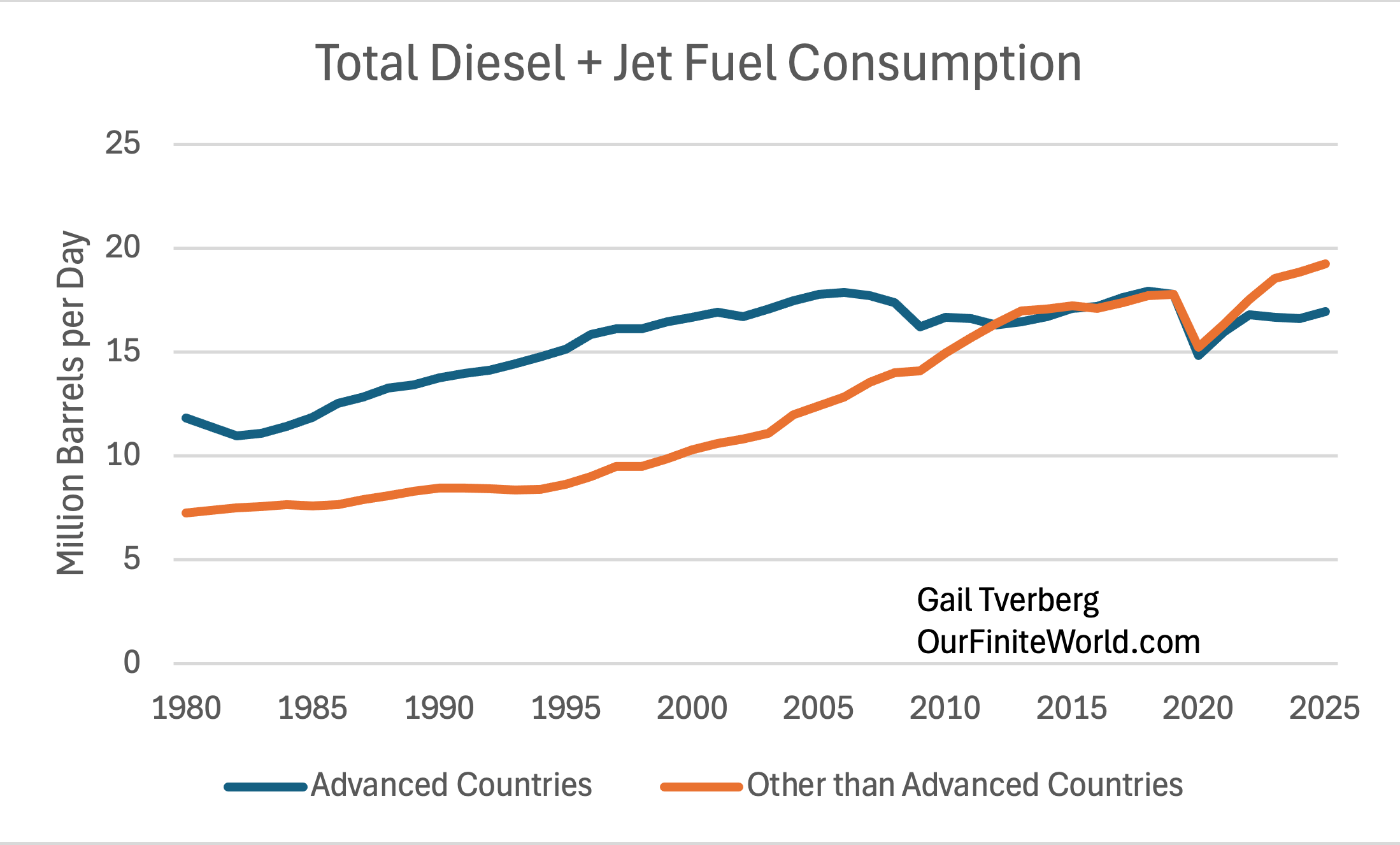
Figure 9 shows that for the Advanced Economies, per capita consumption of diesel plus jet fuel has been declining since about 2005–the time of peak conventional crude oil. The same figure shows that per capita consumption of diesel plus jet fuel has plateaued since 2013 for Other than Advanced Countries. I think of 2013 as the year that China first started encountering major limits on coal extraction (somewhat like the year 1970 in the US for oil extraction). In recent years, China has been able to raise coal extraction somewhat, but at a higher cost.

I would expect that countries in both groups would be dismayed by the situation shown in Figure 9. The per capita consumption of diesel plus jet fuel for the Advanced Countries has been falling for a long time. Partly this is the result of the economies changing to service economies. As service economies, the need for diesel by industry has been lessened. Wages tend to be less for many of these service jobs, making workers unhappy.
In Figure 9, people in the Other than Advanced Countries would tend to be dismayed by the continued wide gap between the standard of living of their own economy, and the standards of living in the Advanced Countries. Many of these countries export extracted resources that are ultimately sold as goods to people living in Advanced Countries. If the selling prices of these commodities were higher, workers in these countries could perhaps afford to have cars and air conditioning, like workers in the Advanced Countries. They would also be dismayed by the poor progress in raising their own per-capita consumption of diesel and jet fuel since 2013.
[7] Is there any possibility of greatly ramping up heavy oil production? Could it power a society like the one we have today?
We know that heavy oil production began long ago. For example, the first recorded production of heavy oil began in the Kern River Basin in California in the 1860s, and commercial production began there in 1899. The first production in the Canadian Oil Sands began in 1921, and commercial production there began in 1967.
The extent to which the oil that is heavy and often sour can be ramped up in the future remains to be seen. Extraction techniques have gradually been improving, and I would expect that they can continue to improve. But the cost of extraction and processing will likely remain somewhat high because of all the energy-intensive steps that are needed to provide diesel and jet fuel.
I expect that society itself will need to change in order to make use of this higher-cost oil. These are a few ideas I have:
(a) Oil exporting countries will need to change in ways that reduce their need for tax revenue. This is an issue especially in the Middle East, which has a huge population, in a hot, dry climate. The population will likely need to fall (for example, many migrants and guest workers may need to move back to their country of origin), and make-work projects will need to be discontinued.
(b) Another issue is that total diesel and jet fuel usage will likely need to be reduced because it is likely to take several years before production of heavy oil can be ramped up. Society will need to be reorganized in a way that uses less diesel and jet fuel. One idea would be to shorten supply chains whenever possible. Figure 10 illustrates one idea how this might be done.

(c) I expect that if such a change can be made, economies will need to gradually change in ways that are hard for us to understand now. The focus may need to be on essentials, including food and clothing. Governments may need to be smaller and provide fewer services. Communities may need to be smaller and more walkable. The total population may need to be lower.
[8] Conclusion
It seems to me that the self-organizing nature of economies will gradually push them in the directions they need to go if the world is to start incorporating a significant quantity of expensive products made from heavy oil into its energy mix.
We cannot yet imagine what all the changes will look like. In some ways they may resemble a recession, but there will likely still be an interest in greater complexity and in working to improve people’s lives.


I’m friends with a Russian chick on twitter. And during covid she said “the difference in American men and Russian men. American men don’t like lockdowns, they go and protest the lockdowns. Russian men, they just don’t follow the rules.”.
I suppose people start learning how the system works. This may be true in both Russia and the US.
After the 2020 lockdowns, the response the next time around may be different.
Putin strikes again!
https://x.com/911NewsBreaks/status/2108631526824968589
>> @911NewsBreaks
>> BREAKING: Putin agrees to supply Diesel to The United States.
Iran will be quite unhappy about this. Trump is probably better for Russia than whatever the alternative, while the opposite is true for Iran.
The resilience of the NATO people has grown alongside Nato’s environment, and whilst devastating, Putins’ revenge reflected a powerful capacity for recovery both in the lands and in its peoples.
According to official declarations, they are talking of a progressive release of around 5 million tons of Russian diesel, not only towards USA, but worldwide.
The entire world consumes around 100 millions tons per month.
It means that the world has been saved for less than 2 days.
100/30 = 3,33X2 = 6,66 million tons.
>> It means that the world has been saved for less than 2 days.
(1) Only ~10mbpd is lost, so that means 20 days
(2) To the broader point, I’m actually not at all sure that Russia will actually do anything different than they were doing already; the Trump administration is desperate for anything that will move the price, so if they can reframe what Russia is already doing as a concession, they will.
Energy industry analysts, however, say the agreement — which sparked anger in Ukraine — isn’t likely to lower diesel prices in any meaningful way.
…
“We are talking PERHAPS a 5-6% increase in supply between now and year end,” Dan Pickering, founder and chief investment officer at Pickering Energy Partners, said about the the president’s announcement in an email.“Bottom line — this is helpful but not a needle mover for global diesel markets,” Pickering said. “Sidenote — there is a reason Trump talked about volumes in tons instead of barrels. The tons number looks bigger to a general observer. This is more politics than a game changer.”
https://www.cnn.com/2026/10/09/politics/trump-putin-russian-diesel
China’s Food Silk Road:
https://youtu.be/VDoqTx3v0To?si=6PuafM0PceGTxyal
This video is called,
How China plans to never go hungry again | Mapped Out
This is a video about how China is working on food security, right now. China is training people from the city how to farm. This is a major effort. Even President Xi is involved.
Part of the blurb:
Xi and the CCP have been pushing to grow staples like rice at home, increase China’s food reserves and also secure imports from abroad. Brazil has replaced the US as China’s biggest soybean supplier, as China expands in Latin America. And Xi’s infrastructure megaproject, the Belt and Road Initiative (BRI), serves as a “Food Silk Road” to help imports reach China without the risk of getting stuck in chokepoints.
00:00 China’s food and farming hype
1:15 Why food is national security for Xi Jinping
1:48 China’s farmland problem and how it compares to the US
2:48 China’s dark history of famines
3:52 Why rice is key to Xi Jinping’s food supply plan
4:38 How China struggles with demographics, land and climate change
5:30 China’s boom: From rural poverty to superpower
6:41 China’s new appetite for pork
7:23 Donald Trump’s tariffs: How the US lost China as a customer
8:29 Soybeans from Brazil, not the US
9:55 China’s dilemma: The Malacca Strait and Taiwan 11:13 Why Beijing wants a railway across Latin America
12:36 How the war in Ukraine affected sunflower oil exports
13:21 China’s overland routes: The Middle Corridor through Kazakhstan 15:00 How China’s food security recipe is coming together
The resilience of the NATO people has grown alongside Nato’s environment, and whilst devastating, Putins’ revenge reflected a powerful capacity for recovery both in the lands and in its peoples.
A useful insight regarding what is going wrong with respect to AI ramp up.
The Myth Of AI’s Miracle: Albert Edwards Spots The Same Fatal Flaw That Sank Asia In 1997
[In the US] gross business investment may be rising briskly because of AI, but net business investment is moving sideways once the BEA deducts “‘proper’ depreciation, not the conveniently lengthening depreciation schedules that companies are using.”
The nominal chart is more striking than most AI bulls would like. Gross business investment is running at roughly 14% of GDP, below the peaks of 1980, 1985 and 2000, while net investment has been stuck around 3% of GDP for a decade (both read off the chart, so approximate).
Another observation:
. . .give every worker a second monitor (or a $40,000 GPU) and output per hour goes up, but that doesn’t make the company any smarter. The AI boom, in Slok’s words, “is clearly visible in investment data and in equity valuations, but it is not yet visible in the productivity statistics,” which means the payoff “remains a forecast rather than an observation.”
It’s never too late to go back to school and learn to clean toilets.
Is that former commenter, ranter?
I’ve noticed over several decades of reading online comments that the commentators break down into three basic types: those who use their own name, those who use a pseudonym or alias, and those who use more than one pseudonym or alias.
I notice that you go by several different user names. That is easy to do, if you don’t mind your comments being in moderation, most of the time.
Another interesting article by B, the Honest Sorcerer.
EV sales in the rest of the world outside US are increasing but this may be a statistical aberration only because sales of ICE powered cars are decreasing world wide. Accordibng to the graph in the US, EV slaes are declining. But it is till the number of EVs that are currently in use, not just the rate of sales. It’s like public health where one has to distinguish the incidence (new occurrences) vs. the prevalence ( the already existing cases) of a disease.
Less demand for gasoline impacts the amount of refining of diesel unless you burn off left over gas, like they were flaring NG off the earlier shale wells. Lower gasoline prices due to replacement of passenger cars by EVs means lower demand for gasoline, lower prices and this disrupts refineries, all the while, the diesel production problems mount.
https://thehonestsorcerer.substack.com/p/electrification-will-make-the-diesel
This article is titled:
Electrification Will Make The Diesel Crisis Worse
How today’s diesel crisis could become structural and more ingrained than ever
The major issue seems to be that we need private passenger automobiles to burn the gasoline that is present in the mix of hydrocarbons we get out of oil wells. The whole system needs to work. Buyers are needed for every part of the crude oil barrel. Eliminating the gasoline part isn’t very helpful. We need enough buyers for the whole barrel.
Softbank’s portfolio is full of BS companies that he calls ” Unicorns ” with overvalued valuations . I think he is running out of road . Asking Gulf countries for a loan of $ 100 billion . Doesn’t he know there is a war going on ? F°°°°°g idiot . 🤣
” Masa Passes The Hat: SoftBank Seeks $100 Billion From The Gulf After Maxing Out Junk Bonds, Margin Loans And Japanese Retail “
https://www.zerohedge.com/markets/masa-passes-hat-softbank-seeks-100-billion-gulf-after-maxing-out-junk-bonds-margin-loans
According to Wikipedia,
https://en.wikipedia.org/wiki/SoftBank_Group
<i>SoftBank Group Corp. (ソフトバンクグループ株式会社, SofutoBanku Gurūpu Kabushiki gaisha) is a Japanese multinational investment holding companyheadquartered in Minato, Tokyo, that focuses on investment management.[3] The group primarily invests in companies operating in technology that offer goods and services to customers in a multitude of markets and industries ranging from the internet to automation.[4] With over $100 billion in capital at its onset, SoftBank’s Vision Fund is the world’s largest technology-focused venture capital fund. Fund investors included sovereign wealth funds from countries in the Middle East.[5][6][7]
The company is known for the leadership of its controversial[8][9][10][11] founder and largest shareholder Masayoshi Son.[12][13][14] Its investee companies, subsidiaries and divisions, including several unprofitable unicorns,[15][16] operate in robotics, artificial intelligence, software, logistics, transportation, biotechnology, robotic process automation, proptech, real estate, hospitality, broadband, fixed-line telecommunications, e-commerce, information technology, finance, media and marketing, and other areas. . .
SoftBank is ranked in the 2026 Forbes Global 2000 list as the 54th largest public company in the world.</i>
I would expect this is an organization that could fail, if things go badly for AI. The price of its stock is up a lot in the last two years.
https://finance.yahoo.com/quote/SFTBY/
I see that WordPress copies all links now, whether you want them or not.
You can use the feature ‘paste as simple text’.
Links will not appear.
Son Masayoshi’s dad ran a pachinko parlor, the Japanese equivalent of slot machines
Gambling runs in that family
He certainly has plenty of balls!
Oh no, this is very bad for my tinnitus.
https://www.zerohedge.com/ai/why-texas-making-data-centers-wait
This article is about a change that Texas made in August 2026.
What began as directions for data centers to pay for their own grid upgrades has since escalated to a freeze on all new permits.
A major problem is that the grid is already stretched thin. Almost any need for additional electricity availability will require an addition to the electrical grid.
Stand alone supply is a lot more difficult than it might seem. One comment the article points out:
In the meantime, pairing on-site assets with even a partial connection is smart for the same reasons we built a grid in the first place. When one plant trips, the rest of ERCOT’s 1,460-plus generating units cover for it, but an islanded load (cut off from the grid) doesn’t have that luxury. The grid also provides things we take for granted, like inertia, fault current, steady voltage, and black start. An island has to supply all of that itself – power systems folks know how hard this can be.
In addition, the stand alone power needs to pass environmental requirements.
But Texas is not even permitting even data centers with their own stand alone power, until the state can figure out how such stand-alone systems might work. The author seems optimistic that things can be worked out, with lots more batteries, etc. I would point out that supply lines run through China. Even without added demand from data centers, there are multiple-year waits for essential parts of the grid. The whole scheme cannot work.
It’s not hard, it’s just the competence to do this doesn’t reside in the United States anymore, it’s in Asia.
Hiring US-to-China Oil Tanker Costs More Than Launching a Space Rocket.
https://archive.vn/pvXzE#selection-1221.0-1221.70
The eye-watering prices are the result of a global tanker shortage that is getting worse with every additional barrel of oil flowing through the Strait of Hormuz. For weeks now, supertanker markets have been in the middle of a boom the likes of which industry veterans have never seen. Brokerage SSY says that, even after adjusting for inflation, rates are now the highest since the first supertankers hit the world’s oceans in the 1960s — surpassing the tanker wars of the 1980s, when Iran and Iraq attacked commercial shipping in the Persian Gulf.
“There’s really not quite enough shipping to go around,”
Google’s Ai’s synthesized this today
“The comparison between corporate AI spending and past DEI (Diversity, Equity, and Inclusion) mandates highlights a major shift in how activist investors and institutional asset managers enforce corporate governance.
By late 2026, Wall Street’s powerhouse institutional investors have quietly pivoted, treating a company’s AI readiness and digital labor strategy with the same aggressive, checklist-driven compliance once reserved for social governance metrics.
The New Governance Checklist: From DEI to AI
During the peak of the ESG and DEI movements, large institutional asset managers used their massive voting blocks to pressure boards into compliance, threatening to vote out directors if companies failed to meet specific diversity criteria. Today, activist investors and proxy advisory firms are using an identical playbook to force AI adoption.
How Activist Investors Enforce Compliance
Activist hedge funds are capitalizing on the market’s AI obsession to launch proxy battles against companies that choose to prioritize traditional capital expenditures over tech infrastructure.
This is worrying!
“This creates an environment where boards feel forced to rubber-stamp massive AI initiatives—even without guaranteed near-term returns—simply to protect themselves from activist campaigns. Compliance with the AI trend has effectively become a defensive corporate strategy.”
This is like forcing conversion to a religion, but no one gets any nearer to Heaven…
Microsoft, Infosys, Tata, Wipro, Cognizant, HCL and Capgemini hit by US H-1B, Green Card crackdown .
The Indian tech sector was already under pressure due to AI .
https://indianexpress.com/article/world/us-news/us-suspends-microsoft-h1b-green-card-programme-vance-fraud-10912971/
Foreign investors sold $ 1.5 billion worth of securities on the news . Racing to the fire exits . Last person out please switch off the lights . 🤣
According to one of the comments:
There has been no company in the United States, unfortunately, that has abused this system more than Microsoft.”
Microsoft laid off 6,000 American workers in 2025 after certifying that it could not find qualified American employees — yet the company was approved for more than 6,000 H-1Bs and filed 3,682 PERM applications, including nearly 1,000 applications for the same positions as the laid off American workers.
We know that US programmers have been having a terrible time finding jobs. India is now feeling the indirect impact of this. The US can’t keep importing Indian programmers, when it doesn’t have enough jobs for itself.
This is all for show .Halting hb-1s will not change the demographics of Microsoft. Indians have a strong in group preference so , as long as Trump’s in power, they will just shift from hiring hb-1s to 2nd or 3rd generation legal Indians. Combine that with a big push for automation, no flyover country white americans will be hired.
This article indicates that the US used to produce drones for sale to Ukraine, but has stopped. (I suspect that lack of minerals from China is the real cause, but the article mentions lack of funding.) Iran continues to produce drones for use by Russia.
https://www.zerohedge.com/military/ranked-worlds-biggest-military-drone-exporters
These Are The World’s Biggest Military Drone Exporters
The U.S. and Iran supplied 86% of the 16,822 military drones exported worldwide from 2022 to 2025, according to SIPRI’s arms-transfer data: 7,593 from the U.S. and 6,800 from Iran, out of 14 exporting countries.
. . .
Nearly all went to a single war: 95% of U.S. drones went to Ukraine, while 99% of Iran’s went to Russia.
U.S. Military Drone Exports Fell Sharply in 2025
Drone export patterns for the two largest suppliers shifted sharply in 2025. U.S. exports climbed from 1,010 in 2022 to 3,219 in 2024, then fell to 402 in 2025, the same year new U.S. military aid to Ukraine came to a halt.
Iran, meanwhile, continued delivering about 2,000 drones a year from 2023 through 2025, making it the largest exporter in 2025 by a wide margin.
Nato nuclear military drill in Italy on the 13rd of October 2026.
Kids will play with Daddy’s toys…
https://tg24.sky.it/mondo/2026/10/08/esercitazione-nato-italia
At least it doesn’t sound like they will be using real nuclear weapons. But they are certainly trying to put the capability in place.
“Steadfast Noon”: What we know about the NATO nuclear exercise taking place in Italy
Italy is preparing to host “Steadfast Noon,” NATO’s major nuclear exercise, amid geopolitical tensions and a nascent clash over government transparency. Starting October 13, the skies above the peninsula and the Tyrrhenian Sea will become the theater of a large-scale simulation evoking scenarios of nuclear war. The event has sparked an immediate reaction from the opposition and triggered a brief communication short-circuit between Rome and the Atlantic Alliance’s leadership regarding the true nature of the operations.
NATO: “A full-fledged nuclear exercise.”
The Italian Air Force attempted to downplay the event, calling it “ordinary and routine programming,” aimed only at testing safety procedures without actual weapons. However, NATO partially refuted Rome’s position. Nassima Barrows, head of the Alliance’s nuclear policy, confirmed to ANSA that “Steadfast Noon is, in all respects, a nuclear exercise,” specifying that the Air Force is fully in agreement with Italy, despite the government’s statement.
The use of real weapons during the exercises is not foreseen
Colonel David Bull reiterated the absolute importance of this strategic training for collective defense. The exercise simulates the most dramatic moment: the preparation and delivery of US tactical nuclear bombs (stored in the bunkers at Aviano and Ghedi) to Allied supersonic fighters. For security reasons, the real bombs will not leave the underground fortresses; the aircraft will take off equipped with simple mock-ups.
Saudi Arabia can’t use Mecca Pact to make up for its lack of its own military:
https://www.middleeasteye.net/news/turkey-rules-out-launching-attacks-yemen-saudi-arabia
Turkey rules out launching attacks on Yemen from Saudi Arabia
Turkish foreign minister says Mecca pact is strictly defensive, as Ankara mulls deploying forces and equipment to Saudi Arabia against Houthi attacks
Turkey will not send troops to Saudi Arabia to launch attacks on Yemen under the Mecca defence pact, Turkish Foreign Minister Hakan Fidan said on Thursday.
“This is not an offensive agreement. Turkey will not send troops to another country’s territory to launch an attack there,” he said during a live press conference in Ankara. Fidan added that possible Turkish deployments to Saudi Arabia would be only defensive in nature.
The US’s ultraprocessed food is a long-term lab experiment. The long-term effects of all of the scans and nearly all of the medicines that are being peddled are unknown.
We know that life expectancies in the United States are way below those of other industrialized countries. We also know that people in the US spend more of their years in disability, than elsewhere.
We also know that America’s lack of exercise is contributing to all of these problems.
But we can work around most of these issue ourselves. Figure out for yourself what makes sense, and do it.
Gut health is trending a lot these days. It seems that two things are driving everything:
– Seed oils (unsaturated fats)
– Gut dysbiosis
The dysbiosis modulates everything in the body, and what you said is 100% related to it.
This is generally correct. 95%+ is those two things (omega3 fats are just as bad as omega6). Gail says that it is a long term experiment and I agree. Epigenetics will propagate the effects of the current diet for another 5 generations or so.
I am reading through a large collection of old proverbs with great delight. Not a few relate to the doctors of old, and the folly of consulting them.
Some might well apply today, to our ‘trusted medical professionals’, eg:
‘I was well, but I sought to be even better: I consulted a physician, and now I’m dead’.
‘If the doctor seems to cure you, he proclaims it in the daylight: and if he kills you, silently buries you under the earth’.
‘When you come to a strange town, no need to ask where the physician lives: he’ll be in a big house by the churchyard, keeping near his customers’.
We could do with that kind of scepticism today!
“The majority of lab animals die without knowing they were part of an experiment. That is half of America right now. They have no idea.”
https://x.com/DPrello/status/2107969460481175554
Interesting point.
I would say we are all lab animals now.
The researchers are studying us on an ongoing basis to see when and whether we eat various bits of cheese.
I have question for you Tim about Japan that I was curious about.
And I don’t really know much about other countries. I’ve never left the states.
I find it very interesting that Japan is a super conformist country and super creative. Usually, those two things don’t mix. I mean look at all the video games and tech stuff they create. Just like places Seattle or San Francisco. But Japan seems much more i guess you could say “conservative” at least socially. I mean very well mannered and (similar to the UK).
How have they been able to mix those two things together so well? In your opinion
Japan is what psychoanalysts and Fraudians would call “repressed”. There are lots of restrictions on how Japanese people can behave. Entertainment and “tech” stuff is sometimes an outlet or release valve for a high stakes, conformist society such as Japan’s. The authorities permit this to an extent.
In the West, primarily, especially white countries, the opposite is the case. Art and tech stuff is subject to regulation by committees. These committees are risk adverse not just because they want to avoid financial loss but because they are trying to keep a very heterogeneous population from in-fighting.
In most parts of the world, there are lots of restrictions on what humans are allowed to create and how they can behave. Those limits, along with differences in cognitive capacity explain why Japan is different.
A great part of the Covid ‘vaccine’ crime was the splendid opportunity to get data on every race, age, sex, etc. Even on those still in the womb.
Without the frustration having to halt the trials when someone inconveniently dies or ends up in a wheelchair – that sort of thing does rather get in the way of Science and Progress, you know!
There were no trials. If science worked as advertised, great achievements like new cures for diseases would be the subject of reality tv shows.
And who wouldn’t want to see Russians and Americans work together at the international space station ? Think of all the drama and ratings potential. But, alas, science does not work as advertised.