
I was recently asked to give a talk called, “The Approaching US Energy-Economic Crisis.” In other words, how might the United States encounter problems that lead to a crisis? As we will see, many of the problems that could lead to a crisis (such as increased wage disparity and difficulty in collecting enough taxes) are issues that we are already beginning to encounter.
In this talk, I first discuss the connection between energy and the economy. Without this connection, it doesn’t make sense to talk about a crisis arising with respect to energy and the economy. I then discuss seven issues that could lead to a US energy-economic crisis.
Economic Growth Is Closely Tied to Energy Consumption
If we look at world data, it is clear that there is a close tie between energy consumption and economic growth.

Slide 2
On an individual country basis, there can be the belief that we have reached a new situation where a particular country doesn’t really need growing energy supply for economic growth.

Slide 3
For example, on Slide 3, the recent nearly vertical line for the US suggests that the US economy can grow with almost no increase in annual energy consumption. This rather strange situation arises because the standard calculation misses energy embodied in imported goods. Thus, if the United States wants to outsource a great deal of its manufacturing to China, the energy consumption used in making these goods will appear in China’s data, not in the United States’ data. This makes the country that has outsourced manufacturing look very good, both with respect to energy consumption and CO2 emissions.
Buying imported crude oil from elsewhere (such as Saudi Arabia) is also helpful in keeping down energy consumption, because it takes energy of various types to extract oil. If oil extraction takes place in Saudi Arabia, using steel pipes from China, the energy used in extraction will appear in the data of China and Saudi Arabia. Neither China nor Saudi Arabia obtains as much economic growth, relative to its energy expenditures, as does the US. In order to make sense of what is happening, we need to look at the world total.

Slide 4
We see that the pattern of world energy consumption growth follows a pattern not terribly different from that of China. Its growth is not “straight up.” It does take growing energy supply to create additional goods and services. We are getting a little more efficient in this process over time, but energy is very much needed in many areas of the economy:
- By businesses, to create goods, such as food, and services, such as vacation travel;
- By governments, to create roads, schools, and other public services;
- By individual citizens, to cook food, to heat homes, and for transportation.
The World Economy Is Organized Based on the Laws of Physics
There are many self-organized systems that seem to grow of their own accord in the presence of available energy supplies (that is, in thermodynamically open systems). Plants and animals are examples of growing self-organized systems. Hurricanes, ecosystems, and stars are also such systems. Economies also seem to be such systems. The name given to such a system is a dissipative system.

Slide 5 – Source: http://www.rinusroelofs.nl/structure/davinci-sticks/gallery/gallery-01.html
I visualize the world economy as being somewhat like a child’s building toy. It consists of many different elements, a few of which are listed on Slide 5. An economy is self-organized in that new businesses are formed when some entrepreneur sees an opportunity. Consumers decide which product to buy based on which product best serves their needs and based on price. Governments decide on changes to laws and tax levels, depending upon how the economy is functioning at a given time.
This system gradually grows over time, as more businesses and customers are added. As new products and new businesses are added, products and businesses that are no longer needed are taken away. For example, when the private passenger automobile was invented, there was no longer a need to feed and house a large number of horses to be used for transportation purposes. Thus, the system self-organized to eliminate the services needed to care for the many horses used for transportation.
Even if we wanted to get rid of cars and go back to horses, we really could not do so now. In some sense, the structure shown on Slide 5 is hollow, because prior capabilities that are no longer needed tend to disappear. The hollow nature of the economy makes it almost impossible to go backward if we somehow lose our existing capabilities–not enough oil, or an electricity problem, or an international trade problem, or a financial problem. Instead, we will need to build new systems that will function in the new context: depleted resources, a very high population level, high pollution levels, and degraded soils. The existing self-organized system is likely to collapse back to only the part that can be sustained.

Slide 6
Slide 6 is a preview of where this presentation is headed.

Slide 7
Slide 7 describes the issue most people are concerned about: oil prices will rise too high for consumers. In fact, we clearly have had problems with high prices in the recent past. The high prices in 2007 and early 2008 seem to have punctured the debt bubble that existed at that time, as I discuss in an academic article, Oil Supply Limits and the Continuing Financial Crisis.
Shortly before oil prices started to turn back up again in late 2008, the United States instituted a policy of Quantitative Easing (QE), in an attempt to bring interest rates down and thus encourage more debt. Additional debt at low interest rates can “pump up” the economy in several different ways:
[1] Some of this low interest debt can be used by governments to provide funding for unemployment benefits and projects such as road building.
[2] Some of this low interest debt can be used by businesses to open new factories, and thus hire more workers.
[3] Some of this low interest debt can be used by individual citizens to purchase a home, a car, or a college education.
It is the pumping up of the economy with low interest debt that seems to stimulate the economy in a way that raises oil prices. When the US discontinued its third and last phase of QE in late 2014 (shown as “End US QE3” in Slide 7), the pumping up action began to disappear, and oil prices again fell.

Slide 8
The figure in Slide 8 may seem a little exaggerated, but I wanted to make a point. Our wages can roughly be divided into three pieces:
[1] Essential goods whose prices are very much influenced by the price of oil, such as food and gasoline. Besides food and gasoline, the cost of replacing a road, particularly with asphalt, very much depends on the price of oil. Higher costs for roads will be reflected in taxes that we are required to pay. Almost any kind of product that is shipped is affected by the price of oil, because oil is the usual transport fuel. Oil is typically used in the extraction of metal ores, so the price of metals used in making cars, appliances, and other goods is affected by the price of oil. Thus, an oil price increase indirectly leads to inflation in the cost of a wide range of essential goods and services.
To make matters worse, fluctuations in the price of oil can be very large. Between 2000 and 2008, we saw monthly average oil price fluctuate from under $20 per barrel to over $130 per barrel. Thus, while the growth in the food and gasoline segment is somewhat exaggerated, the impact of price changes is much larger than a person might expect, looking only at the impact of higher gasoline prices for a consumer’s vehicle.
[2] Repayment of loans, such as mortgage payments and auto payments. Loan repayments of these types tend to make up a large portion of most people’s spending. If people don’t own their own home, they have rent payments to make. These rent payments are in some ways similar to loan payments, because they indirectly cover the cost of someone else’s mortgage. These costs tend to be fixed, even if the price of oil goes up.
[3] Everything else. These are the non-essential items that we cut back on when budgets are too tight. Examples include charitable contributions, visits to restaurants, and vacation trips.
Looking at Slide 8, it becomes clear that if a government wants to “counteract” high oil prices, it needs to lower interest rates. This will tend to make car payments, mortgage payments, educational loans, and even rents somewhat more affordable, at least for people whose loans are affected by the new low interest rates. Often, homeowners are allowed to refinance, to take advantage of the new lower interest rates.
The plan this year is to raise, rather than lower, interest rates. Needless to say, this has the opposite effect; it tends to reduce the size of the “everything else” segment of our income. This effect tends to be recessionary.

Slide 9
Monarch Air is a British airline that failed recently. It boasted very low fares. One of the problems leading to its failure was a falling pound relative to the US dollar, raising both the price of oil and the price of new airplanes.
Today, the price that oil producers need, including adequate funds for (a) reinvestment and (b) the high taxes that governments need to continue their programs, is likely $100 per barrel or more. Such a price would likely cause recession, because purchases in the “Everything Else” category on Slide 8 would be squeezed.

Slide 10
Most people don’t think about the possibility of oil prices falling too low for producers, but this is a major problem today. When prices are too low, oil companies need to borrow money to continue to operate. They are likely to cut back on developing new extraction sites. With low prices, the tax revenue that the governments of oil-exporting countries are able to collect tends to fall too low, leading to cutbacks in government programs and a need for more debt. Saudi Arabia is running into this difficulty.
The problems that arise from low oil prices can be hidden for quite a while, because investors are likely to see the low prices as a great opportunity. They think, “Surely, oil prices will rise again.” So investors are eager to buy more shares of stock, and banks are willing to issue more debt. At some point, the situation becomes unsustainable, and no more loans are offered.
It has now been about three years since prices fell to a level that is clearly too low for oil producers. It cannot be many more years before something has to “break.” Venezuela is an oil exporter that cannot collect enough revenue from oil exports to afford needed goods, such as food. Other oil exporters may eventually encounter similar problems.

Slide 11
A major reason for falling oil prices is growing wage disparity and the resulting loss in purchasing power for the bottom 90% of workers. In the United States, the bottom 90% obtained about 62% of total income as recently as 1992. In a 2016 Federal Reserve survey, only 49.7% of total income went to the bottom 90%.
The reason why wage disparity is important is because the wealthiest 1% (or even the wealthiest 10%) can’t purchase very much of the goods created using oil. The wealthiest 1% can’t eat very much more food than everyone else. They can only drive one car at a time. In order to have adequate demand for oil, the bottom 90% must have adequate purchasing power for goods such as homes and cars. If young people live with their parents longer, and aren’t able to afford homes, this holds down demand for oil. So does transferring manufacturing to countries where wages are so low that few people can afford cars and other manufactured goods.

Slide 12
Slide 12 shows the Federal Reserve’s graph of the share of families who own (as opposed to rent) their primary residence. There has been a drop in homeownership from 69% in 2004 to less than 64% in 2016. This is a period when wage disparity has been increasing.

Slide 13
Wind and solar are intermittent sources of electricity. They work adequately well in applications where intermittency is no problem, such as charging a cell phone that has a battery, or powering a desalination plant that is not expected to operate around the clock. Most analyses of the benefit of wind and solar are suitable only for these limited situations, because they omit any estimate of the cost of mitigating intermittency.
Intermittency becomes a major problem when wind and solar are added to the electric grid. Wholesale electricity prices may drop to very low levels when both wind and solar electricity are available. At times, prices may become negative. Electricity generation that is designed to be used most of the time (such as coal, nuclear, and even some types of natural gas generation) cannot survive without subsidies to offset the artificially low prices the system produces. The need for subsidies for backup electricity providers is really an indirect cost of adding intermittent types of electricity to the grid, but today’s pricing does not reflect this.
A different workaround for intermittency is to add a large amount of battery backup or other type of storage. In theory, batteries could be used to store electricity generated in the summer for use in the winter, when heating needs are greatest.
Another approach to intermittency is to greatly overbuild intermittent renewables, with the idea of using only that portion of electricity generation that is really needed at any point in time. Yet another approach is adding extra (lightly used) long distance transmission, to try to smooth out fluctuations.
Any of these approaches tends to be expensive. Academic papers estimating the benefit of wind and solar nearly always overlook the cost of mitigating intermittency. Thus, they suggest wind and solar can be solutions, when, in fact, their high cost is likely to lead to the same damaging economic effects as high oil prices. (See Slide 8.)

Slide 14
The dotted line on Slide 14 shows the downward trend in German wholesale electricity prices, as more and more intermittent electricity has been added to the grid. At the same time, total residential electricity prices have risen to higher and higher levels. The countries with the greatest use of wind and solar tend to have the highest retail rates, as shown in Figure 1 below (not in presentation).

Figure 1. Figure by Euan Mearns showing relationship between installed wind + solar capacity and European electricity rates. Source Energy Matters. (Image not part of presentation.)

Slide 15
As we discussed earlier, the “standard” workaround for high oil prices is low interest rates, because of the relationship shown in Slide 8. At some point, however, interest rates fall about as low as they can go.

Slide 16
The interest rates shown on Slide 16 are those for 10-year treasuries. These typically underlie mortgage rates. These rates have been falling since 1981, helping to prop up prices for homes, land, farmland, and other assets purchased with long-term debt. Low interest rates make monthly payments more affordable than high interest rates, so more people can afford to buy such assets. With greater demand, asset prices tend to rise.
Also, with all of the talk about the US continuing to raise interest rates, those owning bonds realize that rising interest rates will cause the selling price of bonds they hold in their portfolio to fall. Thus, pension funds and other organizations that are making a choice between buying bonds (which are certain to fall in selling price, as interest rates rise) and buying stocks, will choose to “overweight” stocks in new purchases for their portfolios. This will tend to push the price of stocks higher, regardless of the earnings potential of the underlying companies.
One thing I didn’t mention in the presentation, but is probably worth pointing out here: Short-term interest rates have been rising since late 2014, even as 10-year treasuries have been holding fairly steady (Figure 2, below). These shorter-term interest rates affect payments on other types of transactions–adjustable rate mortgages and auto loans, for example.

Figure 2. Chart showing 3-month, 1-year, and 2-year interest rates. Chart created by St. Louis Federal Reserve.
These short-term interest rates have been creeping upward, indirectly making certain types of goods less affordable. The increase in short-term interest rates will, by itself, push the economy in the direction of recession.
Eventually, the bubble in asset prices can be expected to collapse, as it did in 2008. Perhaps this will happen when corporate profits fall too low; perhaps this will happen when the economy hits recession. The prices of many types of assets, including shares of stock, prices of homes, and prices of businesses can be expected to fall. There are likely to be many debt defaults in the governmental, business, and personal sectors of the economy. In such a situation, banks may fail.

Slide 17
The goods and services that are delivered each year require the use of physical resources such as oil, coal, natural gas, metals from ores, and wood. In the past, the quantity of these physical resources has grown, year after year, as illustrated in Scenario 1.
In a finite world, we cannot expect the amount of physical resources to grow, indefinitely. At some point something will go wrong, and the amount of resources extracted each year will start becoming smaller, as in Scenario 2. In a sense, the people of the world can expect to become poorer, because the quantity of goods and services that can be made with these resources grows smaller, instead of larger, and each person’s share of the world output becomes smaller.
Standard economic theory says that resource prices will rise, as the quantity of resources falls, but this view does not take into account the way a networked economy really works.
A more likely scenario is that as the quantity of resources falls, wage disparity will increase. As a result, the incomes of many of the lower-wage workers can be expected to fall. The problem is that jobs that pay well require the use of resources; if there is a decrease in resources available, some jobs are likely to be eliminated. Today, such job elimination may come through added technology, eliminating what were previously low-paid jobs. Studies of past collapses support the view that falling wages for the working class played a major role in these collapses. (See Secular Cycles by Peter Turchin and Surgey Nefedov.)
With greater wage disparity, a smaller share of people will be able to afford to buy homes and cars. Scenario 2 in Slide 17 will occur, not because we “run out,” but because too few people can afford to buy goods made with oil, gas, coal, metals and wood. Market prices will fall below the cost of extracting the necessary resources, and companies in these businesses will fail. Governments of oil exporters may collapse, because they cannot collect sufficient tax revenue at the low price available on world markets.

Slide 18
If there are physically less goods and services available, who will get the benefit of these goods and services? I see the situation as almost like musical chairs. Will it be pensioners who lose out, as bonds held by commercial pension programs default, and also as governmental plans are cut back? Or will it be the wages of the less skilled workers that are cut, as more processes are automated, and only managers and highly skilled workers are needed? If this happens, won’t commodity prices fall even further? We really need to have adequate wage levels for a wide range of workers, if we expect to have enough buyers for the goods produced.
Historically, when collapses have occurred, governments have lost out in the game of musical chairs because they could not collect enough tax revenue. The problem was that the bottom 90% of workers became poorer and poorer, and so less able to pay taxes. This brings us to our next potential US problem area.

Slide 19
In January 2017, the US Congressional Budget Office made a projection of how federal debt held by the public would grow, based upon the information available at that time. Their forecast was that the debt would grow to amount to nearly 150% of GDP. This would be a much higher level than during World War II, World War I, or the Civil War (Slide 19).

Slide 20
Since January 2017, more information has become available. We now know about three hurricanes, plus fires in California. Citizens affected by these events need financial support.
We also know about proposed legislation to reduce taxes, especially for businesses and high-income individuals. These proposals are likely to increase after-tax wage disparity, and increase the amount of the deficit. If corporations choose to return any of the benefit of the tax cut, it will likely be through dividends to those who are already wealthy. With respect to corporate tax rates, we are only trying to catch up with tax havens, so it is difficult to believe that the tax change will result in much more US investment.
Slide 21
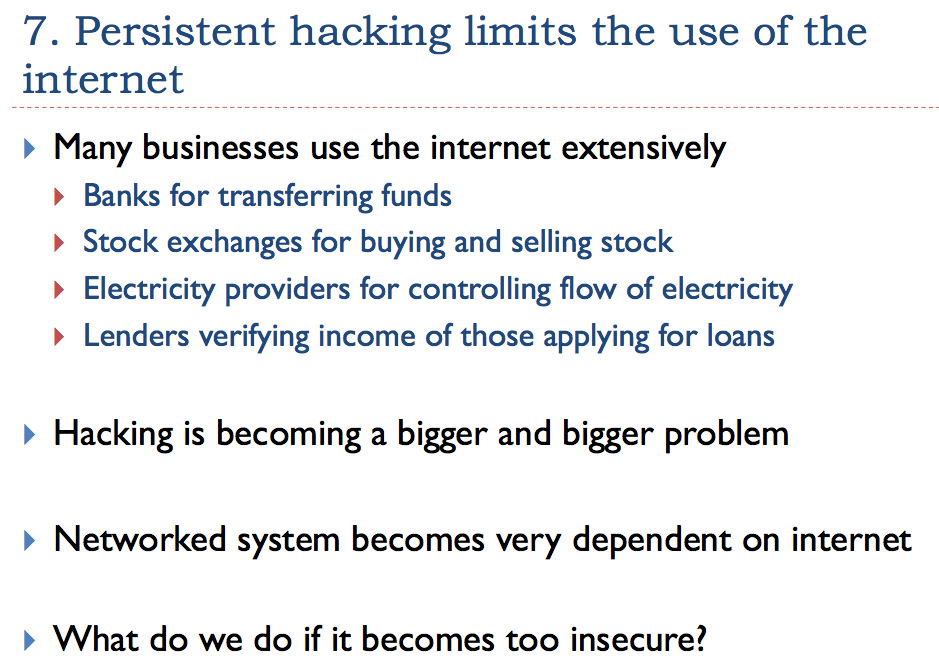
We don’t think about the internet as being important, but it has become an essential part of our interconnected world economy. The internet helps facilitate all of the just-in-time deliveries needed to operate today’s economy. All of the fancy workarounds for the use of intermittent electricity on the electric grid assume that the internet will be available to transmit information back and forth quickly. Banks make use of the internet to get information to approve loans and to clear checks with other banks.
In the United States, we seem to hear one story after another about the internet being hacked. The most recent story involves a major hack of the data collected by Equifax for the purpose of determining the credit-worthiness of individuals in the US. If this data gets into the wrong hands, it can be used for “Identity Theft.” An impostor can apply for a new loan in the name of someone else, or can steal an income tax refund intended for someone else.
A different hacking situation in the Atlanta area recently led to the theft of a large number of checks intended for direct deposit in teachers’ bank accounts being stolen. They were instead direct deposited to an impostor’s account.
If the internet is truly not secure, no matter what we do, this by itself could cause major problems for the system we now have in place. We don’t have a “Plan B” available, either. Trying to start over with “snail mail,” for example, would be a problem. This is another illustration of the difficulty involved in going back to an earlier technology.
——–
Clearly this list of potential problems is not complete. Hopefully, this list gives an idea of the wide range of issues we are facing.


JFK Files: CIA Plotted To Kill Castro, Stage Bombings In Miami -CBS Miami
http://miami.cbslocal.com/2017/10/27/jfk-files-cia-plotted-kill-castro-stage-bombings-miami/
Terrorism is the ultimate political weapon because nothing gets a rise out of people like the fear of sudden death.
-Adolph Hitler
And people are just finding this out now…wow
Why 3% GDP growth is unlikely to last – Yahoo Finance
https://finance.yahoo.com/news/3-gdp-growth-unlikely-last-163507249.html?utm_content=bufferde2e8&utm_medium=social&utm_source=twitter.com&utm_campaign=buffer
https://news.google.com/news/u/0/headlines?hl=en
Exxon & Chevron profits up on higher oil price.
Brent over $60
WTI $54.19
that’s an 8-month high… sounds impressive…
but that means it was this high 8 months ago.
profits are good if they push future production higher…
will 2018 production top 2017?
we shall see very soon.
I’m very curious to see the impact of higher oil prices on the economy. Presumably as price continues to slowly rise the impact on the consumer will have a feedback on the economy, reducing consumption at some price point and supply & demand will balance out. What an interesting experiment!
And raise interest rates at the same time! Great experiment!
The FED, in spite of claims of plans to further raise rates hasn’t done much in that regard for a while. Weren’t there only 2 rate hikes of 1/4% each and since then no rate hikes even though there are claims in the last qtr. of 3% GDP? Our experiment may only be higher oil price, but if the FED do start raising rates again, that will certainly make for a major added ingredient to this impending experiment. My eyes are widening, respiration rising…
Short term interest rates have been rising, however.
https://gailtheactuary.files.wordpress.com/2017/10/1-year-2-year-and-3-month-treasury-interest-rates.png
Okay, lets see if I can just post this link:https://apnews.com/664a16182cbc4e3e9a26957f3cddc927 (and leave out the references to kliimate khange.)
https://apnews.com/664a16182cbc4e3e9a26957f3cddc927
It will be interesting to see how a changing climate affects growth of plants, length of season, and success of various crops. My experience has been the same: a growing season that begins weeks earlier and ends weeks later.
For now things are growing OK here. Things that don’t grow well have far more to do with my inadequacies than with climate. Some people think that the end of fossil fuels (human survival aside) will rebalance the climate. Guy McPherson thinks there are so many positive feedback loops involved that nothing can rebalance the climate now.
Guy McPherson is not really a climate expert.
The other issue is that rebalancing climate is probably not something we can do from the positive side. We can do it from the negative side, for example, by cutting down our trees, as we have been doing since we were hunters and gatherers.
If by cutting down trees we can balance the climate negatively, then why, by not cutting down trees (or allowing more of therm to grow naturally) wouldn’t we be at least NOT balancing the climate negatively? I didn’t buy Guy McPherson’s take on that.
We have not been able to raise the percentage of land area covered by trees. Also, the extent to which the area under the tree cover is increasingly “carved out.”
This is a chart by Euan Mearns that I showed earlier.
https://gailtheactuary.files.wordpress.com/2014/07/euan-mearns-forest_co2.png
I read recently that the most recent year showed the biggest drop in forest cover ever.
I know my province is clear cutting. But I had the understanding that the US tree canopy was recovering.
It is low income countries that are being deforested. The try canopy is recovering in the highest income countries. I was told that instead of using our trees for paper, it is more economical to clear cut original forests from Indonesia, for example. That way we can use our trees for other things, like making wood chips.
Last summer we barely had a growing season at all — the summer was extremely cool — and wet… for instance we had 50+ pumpkins the year before … and last year we had less than 10
And this spring has been incredibly wet…. and cool.
Where is this waaaarming that is meant to be happening? Maybe the gods could send some this way!
I urge everyone to Burn More Coal Now – we are only half way there….
https://www.theguardian.com/environment/2009/apr/29/fossil-fuels-trillion-tonnes-burned
Meanwhile in Spain we’ve hardly had any rain this year…
But then… the rain in Spain does fall mainly on the plain.
Pumpkins doing fine in NS. In fact they grow so big we hollow them out and make boats out of them.
http://www.worldsbiggestpumpkins.com/
Meanwhile in Japan we’ve had a wetter than usual year, although our climate is precisely the same as is is every year—it’s still Humid Subtropical in the Köppen Classification.
Incidentally, Eddy, I beat you on the pumpkin count with about 35 of them. 🙂 But then again, NZ doesn’t really have summers worth writing home about. You could use some global warming down there I bet.
A lot better than Canada though…. winter on the north of the south is similar to summer in northern ontario 🙂
hey Chuck…
your assertion of “incompetence everywhere” implies that you are incompetent.
meanwhile, where I am, there are no incompetent persons.
ROFL? I suggest you stop rolling on your dirty floor, get up, clean yourself and change your clothing.
ps: BAU tonight, baby!
huh.
magic disappearing trolls!
I keep trying to delete. I will look into other approaches as well.
I clicked on a setting, “Commenter must have a previously approved comment to appear.”
If I understand it correctly, any new commenter must be approved.
increasing complexity!
when will it all end?
I found several posts from the troll caught in the “must be approved filter.”
Big improvement.
Nikolai Nekrasov, the equivalent of John Lennon during 19th century Russia, wrote a poem called the Railway in 1864. In short, serfs were used to build a railroad between Petersburg and Moscow, which were not intended to be ridden by lower class. After the serfs finish building the railroad, the contractor deducts the amenities they used during the build from their wages, and dismiss the serfs without paying anything. They have to walk back to their towns without a penny, but who cares about them?
That was how BAU was maintained in the old age.
If we have to do this to maintain BAU
https://mydailyartdisplay.files.wordpress.com/2012/07/volga-boatmen-by-ilia-efimovich-repin-1873.jpg?w=768
It will be done. (The painter, Ilya Repin, hung around with the likes of Count Lev Tolstoy, who was extremely rich. Of course Repin had no sympathy for these people, like all civilized people in Russia were. And don’t get started on the Revolution again – it’s all Princip’s fault.)
Once BAU unravels wealthy people won’t stay wealthy. Wealth, today comes from global trade. If a rich person doesn’t have access to global markets, he will become a hobo overnight. There will be very few rich people to employ or enslave poor people in a world with a lot less global trade.
I’m not even going to get into detail of the impossibility of a functional railroad system in any country without BAU.
I don’t know why you idolize the upper classes so much. They are not all wealthy due to merit. Therefore, they are not all pillars of human fitness.
Without trade, some kind of order quickly arises. Trust me, humans are quite resilient. And, those who own land tend to employ loyal and well-armed retainers, who will quieten any unrest in the town and there would be enough ‘law-abiding’ citizens to keep the riff raff out. Japan made a lot of movies, set in the samurai era, during 1950s and 1960s following the chaos of defeat in 1945. The wealthy still stayed wealthy, the landowners still stayed comfortable, and it was, as always, the propertyless who got the short end of the stick.
If you watch this 1956 Japanese movie, which means “The insane fruit” (about two rich siblings fighting to get a married woman), you would not notice that WWII and all the destruction had taken place among those at the top.
If you want depressing movies about the poor in Japan, both pre- and postwar, then Naruse is your man. Widows who can’t afford food and medicine for the kids, whores an geisha in debt to loan sharks, men enslaved by gambling, drink or yakuza connections… Naruse’s movies were unrelentingly bleak. They leave the viewer happy to have escaped the predicaments of their protagonists.
Mikio Naruse (成瀬 巳喜男 Naruse Mikio, August 20, 1905 – July 2, 1969) was a Japanese filmmaker, screenwriter, and producer who directed some 89 films spanning the period 1930 (towards the end of the silent period in Japan) to 1967.
Naruse is known for imbuing his films with a bleak and pessimistic outlook. He made primarily shomin-geki (working-class drama) films with female protagonists, portrayed by actresses such as Hideko Takamine, Kinuyo Tanaka, and Setsuko Hara. Because of his focus on family drama and the intersection of traditional and modern Japanese culture, his films are frequently compared with the works of Yasujirō Ozu. His reputation is just behind Akira Kurosawa, Kenji Mizoguchi, and Ozu in Japan and internationally; his work remains less well known outside Japan than theirs.
Among Naruse’s most revered films are Late Chrysanthemums (1954), Floating Clouds (1955), and When a Woman Ascends the Stairs (1960). Akira Kurosawa called Naruse’s style of melodrama, “like a great river with a calm surface and a raging current in its depths”.
https://en.wikipedia.org/wiki/Mikio_Naruse
yes. Lots and lots of them. Japan’s cinema was arguably much better during 1950s and 60s than now.
Lots of bleak Samurai movies were made too. Such as the horror movie Onibaba (monster old woman) in 1963, transforming the horrors of the postwar situation to the samurai era. The truth was that life for the downtrodden was a day-to-day horror story, people doing whatever they could to survive.
But, as seen in the above move, such hard fate was none of the concern for the well-heeled.
Come on serfs, put your backs into it! I think that’s the g o p message to the middle class hard working masses. Work your tails off harder but fall farther behind so our party can give a massive tax cut to the top o n e p e r c e n t at your expense. Think of it this way people, some tiny part of those billions may actually trickle down, so pull harder!
I thought if I changed a few things it might post without moderation, but alas it was not to be.
Hey, it actually did work!!!!!!!!!!!!!!!
Are you trying to make the claim that increasing spending on video-gaming content is evidence against my hypothesis?
Who are you replying to?
US oil majors lose money on home oil and gas production – Financial Times
ExxonMobil and Chevron, the two largest US oil and gas groups, are continuing to lose money on oil and gas production in their home country, in spite of the rise in commodity prices since last year. Reporting earnings for the third quarter, Exxon said it lost $238m on oil and gas production in the US, while Chevron lost $26m.
https://www.ft.com/content/c43b55c4-bb2d-11e7-8c12-5661783e5589
This is after cutting back on investment in new developments.
http://www.hellenicshippingnews.com/oil-prices-will-stay-lower-for-longer-banks-warn/
Oil prices will stay lower for longer, banks warn
Somehow, I am having a hard time believing this part of the article:
And even if shale can grow, oil from the Gulf of Mexico cannot. Saudi Arabia and the many oil exporters cannot live on these low oil prices.
it’s surprising, they indeed say “low price” but their conclusion is “its all fine”
It is a conflicted article for sure. Some of the paragraphs are rather dubious as Gail points out.
You can’t see the peak when you’re at the peak! It’s going to take 5-10 years of declines: slow or rapid in order to see it clearly. That’s when SHTF in my opinion.
yes!!!!!!!!!!!!!!!!!!!!!!!!
that sounds so very reasonable!
5 to 10 years more of BAU.
and even now…
BAU tonight, baby!
How Many Barrels Of Oil Are Needed To Mine One Bitcoin?
https://oilprice.com/Energy/Crude-Oil/How-Many-Barrels-Of-Oil-Are-Needed-To-Mine-One-Bitcoin.html
A commodity? Bitcoin? Seriously?
Lol…
I did not check the calculation all the way through, but my calculation of the energy equivalent would be something like 2.63 times as high as what James Stafford’s cost, assuming that he has the right number of bit coins in his calculation. This is because he is looking at the electricity from the point of view of say, how much water the electricity could boil. I am looking at if from the point of view of how much fossil fuels it would require to burn to create the electricity, then it takes something like 2.63 times as much, using the EIA’s assumed efficiency factor of .38. To sell for 2 cents a kWh, the cost of fossil fuel energy would have to equate to something like $12.91 per barrel equivalent (and that cost assumes that the 2 cents is only for fuel–not for transmission, or building the plant).
It seems like a waste of energy. In a sense, though, it is enabling more purchasing power, because is acts like a promise for future goods and serves. Thus, it helps keep up buying power in the countries where it is used. It acts like more debt.
Of course, these fossil fuels would rarely be oil; they most likely would be coal or natural gas. This is a chart of the world distribution of world distribution of electricity generation by source, created by the IEA.
ZH must be watching
http://www.zerohedge.com/news/2017-10-28/how-many-barrels-oil-are-needed-mine-one-bitcoin
We don’t need higher wages. Again, for the umpteenth time, I say that the world worked well in 1913 when most people were poor and only upper and upper-middle class, less than 5% of the Western World, lived well but the greatest advances in science and tech occurred at that time.
I won’t even get started on Human BioDiversity.
Most of the world’s pop are useless. Only the top 2% or so in intelligence will cut it anyways. Wealth will flow to them in an increasing rate, and they will become transhumans.
And , with only 2% of pop remaining, the resources will last for a much longer period of time.
Smite is right, and Gail is losing. Humanoids are on the way out. Nothing will stop them.
If a top 2% survive, as might occur in when the animal kingdom hits a bottleneck, the top 2% won’t be determined by intelligence, I expect. It will be determined by who is at the top of the pecking order, based on the skills/wealth/physical strength/intelligence needed at that time. It obviously needs to include some young people, or there cannot be any offspring. Wealth at this time seems to be concentrating among the relatively old people, but if the 2% is mostly made up of the 70 year old plus group, a new group based on today’s wealth can go nowhere.
/luck
Yes. In the coming dieoff, luck will be the number 1 determinant of immediate survival. And probably dumb luck at that. Wealth, status, or power, will count for nothing. These things may only be important again after the population has finished crashing and found some equilibrium with the environment.
Of course, humans having overshot and degraded the planet so terribly, there is always the possibility of outright extinction. Which is what happens to hyper-plague species that cause such extreme damage to their habitat, when the crash comes.
http://images.slideplayer.com/16/5025385/slides/slide_7.jpg
All that foresight and preps can do during the outset of dieoff is give you a bit of a head start on the great unwashed. You will probably still succumb, and pretty quickly, to disease or infection, even if other vectors of mortality, like violence and starvation, are avoided.
My opinion is disease has the most potential to wipe out large numbers of people fairly quickly. We are loosing the antibacterial war.
Yes, disease has best track record.
War has really bad track record. Earlier we killed each other for God and king, but now? Even if Progress is the new world religion I have a hard time seeing people going to war over EV, LBTQ and CO2 quotas.
our hospitals and laboratories are energy driven factories, so pandemics will not kick in until industry has collapsed.–ie nothing to stop them
if you check the last ”unstoppable” pandemic, the flu of 1918, that didnt dent the population growth, ww1 and 2 killed far more, that didnt dent it either—so it will have to be far bigger than that.
something to knock off 5bn, because taking out 100m doesn’t stop people breeding.
so what does stop people breeding?
one word—starvation
all species stop growth when food runs out—that is the one inflexible law of survival. we in our planet sized petri dish will not be exempt.
so then the next question arises–what will starve 5bn people?
climate change, and I’m guessing methane release as something that could do it in the necessary short time period.
Already AGW is becoming more and more obvious.
Don’t be so worried Norman… the Bible of Green says it’s not an issue
To avoid dangerous kkkkllllimate channnnnge of 2C, the world can only burn another half a trillion tonnnnnes of carrrrbon, cliiiiiimate channnnnnge EXPERTS warn
https://www.theguardian.com/environment/2009/apr/29/fossil-fuels-trillion-tonnes-burned
True, people had learnt a lot about disease transfer between black death and spanish flu.
Maybe ebola is really in the same league but was easily stopped by internet communication and isolating patients.
What if today’s well off (Jamie Dimon, Bill Gates, Warren Buffet etc.) were the only types to survive a massive die off. That would be an interesting scenario. Lets assume they bunkered with food and water of sufficient quantity to survive say a couple of years. I don’t think this group would last long at all once the supplies ran out. It would be an interesting psychological study as well. If the wealthy are addicted to money or power they may well turn on each other and even kill each other before supplies ran out. They are ill-prepared physically and mentally for life outside of the industrial world (as are most of us). While their positions, intellect and skills served them well in the industrial age, they have no real skills to survive in the natural world.
However, what if a group of the hardest 2% of criminal in our prison system were given the same opportunity as the wealthy in the above scenario? Same two year food and water supply. What would happen? I think the same thing would happen. They would probably kill each other.
To me the top 2% and bottom 2% represent unnatural extremes of human behavior that wouldn’t normally have survived evolution. I think the humans with the best chances for survival in times of extreme die-off are those regular folks that just happen to have good genes that work together and cooperate.
Soon (faster than the blue collar criminals) after collapse all those geniuses would realize they would die when supplies run out and start fighting over the supplies.
You might be right about “regular folks” being the best to survive.
I will go out on a limb and say the people around 100 IQ and fit will do best.
The guards will make sure the top 2% of criminals won’t get out alive.
https://en.wikipedia.org/wiki/Bodo_League_massacre
In 1950, when South Korea was one of the world’s poorest countries with few infrastructure, North Korea overrun most of it. But the South Korean prison officials managed to kill all of the prisoners (most of them commies) ahead of the NKs. They were often buried alive or drowned, but the deed was done without the help of BAU.
If you kill of the extremes … don’t you just get new extremes?
For instance — I would have liked to play in the NHL — I would have done just about anything to get to that level when I was young ….. I was nowhere near good enough …
Let’s say we killed off 90% of all the ice hockey players on the planet in 1985 … that would have given me my chance…
There are plenty of wanna be kings in the general population ….
Humans are drawn to power and corrupted by it, like moths to a flame.
I volunteer to be the next dictator. I would enjoy that.
No.. No.. No. I would do a much better job. Get out of my way… subject.
I’m kinda liking this title… whatchathink…
“The feet of the Greatest Lord who is on the heads (of his subjects)”
A person who is: (a) a British citizen, a British Overseas Territories citizen, a British National (Overseas) or a British Overseas citizen; or. (b) a person who under the British Nationality Act 1981 is a British subject; or. (c) a British protected person (within the meaning of that Act).
British subject – Wikipedia
https://en.wikipedia.org/wiki/British_subject
Without a stable-enough society that can produce a continuing high level of nuclear technologists, how can anyone at all survive the inevitable crash of nuclear systems around the world?
The world has survived hundreds of nukes having been detonated around the world. It didn’t do good to the people around Bikini island, remote parts of Nevada and the denizens of some kazakh city, but the rest of the world has been relatively unaffected. So unless someone lives in a 50 mile radius of a nuclear facility there is nothing to worry.
And, because of years of selective breeding and all that, plus crispr and all the genetic advances which are already here, collapse or not, the genes of the top 2% tend to be fairly intelligent, and are more advanced than the rest of pop.
All the genetic engineering, crispr which would eliminate genetic disease from older mothers, and artificial womb mean age is not a matter if only older people survive. After all, G-d something to 99-years-old Sarah so she could conceive. (I take bible somewhat seriously – the supernatural parts might be the tale of some lost civilization)
If the 2% is made up by older people, they will invent something. Guaranteed.
Technology is a big consumer of resources. Replacing humans with robots means that it will be machines that will face energy and resource shortages.
the amount of physical usable resources in the world is fixed
if a small proportion of the population grab a bigger share then everything is thrown out of balance if we try to lead our lives in what we imagine to be a ‘modern’ existence
in pre industrial times, this imbalance existed, but then the lord/king/high priest owned everything and the rest of us serfs/slaves worked for them, bred more slaves and died at 50.
it was a system that worked for 000s of years.
now we know better—and that will be the source of violent disorder
I agree Norm, it is easier to deal with having no material wealth if you or your family have never had it. However, once a society is accustomed to modern “necessities,” it is difficult to roll that back without causing violent reactions.
that is exactly the point i keep trying to make over at resilience—where the standard nonsense is that we will all go back to basket weaving and beekeeping, and ”leave all our machinery behind’—then i get slagged off for pointing out the obvious—as you’ve stated too.
http://www.resilience.org/stories/2017-10-26/world-made-hand-2/
makes me want to scream–just read the comments section
people will not give up their wheels without a fight—and it will be bloody
I bet nobody over there has taken the FE Challenge….
Best to leave them in their delusional state…
https://thumbs.dreamstime.com/z/delusional-flabby-balding-man-sees-himself-as-being-very-good-shape-mirror-50994380.jpg
“the amount of physical usable resources in the world is fixed”
This sounds a lot like Peak Oil theory. It is only “sort of” fixed. It depends on complexity (specialization, technology advances, new and better “tools”). It depends on the rising debt levels, to keep the system going. It depends on the system as a whole hanging together. If the system falls apart, then even the resources that looked fairly accessible can no longer be reached. In theory, a new system could be created later that could again access them.
but even if a ”new” extraction/usage system is created, it doesnt increase the volume of resources available—fuels, minerals—all the ”stuff” we use to keep our system viable.
it just burns more, with less and less return on energy input.
thus we still reach the point where extraction/use is uneconomic, then we need yet another ”new system” to get hold of more—ad infinitum.
all technology depends on increasing energy input—which in turn is a product of the finite resources the ”technology” is trying to access.—the dragon eating its own tail so to speak
eventually we must run out of options and ideas.
pre industrial revolution, material had to be grown—food animal products, trees and so on.
mineral extraction was slow and laborious, processing was cumbersome, and those at the top of the social tree held on to their resources, while the rest had to work for them
Not so if we can get energy and resources from the space, which becomes possible with less people and more stuff to make BAU last longer.
Technology=energy.
energy has allowed us to have sophisticated technology
i’m afraid it doesn’t work the other way round
+++++++++++
The economy is the production and exchange or goods and services through the application of energy to resources and activities. Whatever system of political economy you prefer – you cannot change that fact. One enduring facet of capitalism that deserves attention is that it produces more growth. The main reason it does this is that it can allow faster consumption of resources.
Totally agree with your point made elsewhere that authoritarian government will be a more immediate issue. My personal prediction is that this will break down into warlordism once centralized power becomes untenable, since that seems to be the way it goes in MENA when foreign aid/meddling aren’t factors. I think splintering into warlordism will coincide with the slide into starvation.
authoritarian governments arise when depleting energy resources create widespread civil unrest
the difficulty of getting that across is beyond belief
Or, more likely, a feudal order with those who control tech having everything and the rest reduced to manual work?
in theory yes
but remember that post collapse tech won’t exist in the sense that you mean it
tech is like fuel supplies—it depends on the input/energy availability of all of us
You mean Orlov’s communities of two hundred people won’t be able to make solar panels? Hmm… that’s good to know.
The latest tech really is at the top of an unsustainable heap. I’m just wondering how many rungs or support columns you can kick away from industrial civ and still manufacture a microchip or even a toothbrush?
Imagine one system where you have to cater to the needs of billions of humans and their vanities. Well… we don’t have to imagine.
And now imagine a system that only caters to the needs of its most essential machinery to survive and adapt. Strip away human needs and this system would function more like an insect colony. All the players pulling in the same direction, very efficient, very little waste.
In other words… no more need to manufacture and transport and advertise millions of toothbrushes. No more human soldiers. No more rabble. Only a dwindeling elite class until they too are subsumed by the One Machine.
When BAU goes down — because of the lack of cheap to extract energy —- the fossil fuels that are in the ground at that time … will remain in the ground forever…. because the system that allowed for their extraction (BAU) will be finished.
And without that system in place — there will be no energy — save trees — and we have demonstrated in the pre-coal period … how quickly even rudimentary industrial processes … can decimate the forests….
In any event we will not get to see that scenario play out – because of :
http://www.ansnuclearcafe.org/wp-content/uploads/2014/06/spent-fuel-pool.jpg
Not if there are much less people survive. If pop falls to 1/50 of what we have now, everyone can use 10 times more energy as now yet the rate of consumption would still be 1/5 of now.
1/50th of the population won’t have the physical capability to drill oilwells,, extract minerals, build windfarms etc—there simply won’t be the manpower to do it
But the robots will do everything you mention. Or there will be only solarpowered transhumans (wonder which bathroom those should use).
Solar powered and radioresistant!
All together now… big middle finger to 4000 raging spent fuel ponds!
How about we have corporations sponsor a fuel pond…. they get naming rights as they do with stadiums.
And those funds can be banked and used to maintain the ponds once BAU collapses!!!!
Radioresistance is the level of ionizing radiation that organisms are able to withstand. Ionizing-radiation-resistant organisms (IRRO) were defined as organisms for which the dose of acute ionizing radiation (IR) required to achieve 90% reduction (D10) is greater than 1000 gray (Gy)
Radioresistance – Wikipedia
https://en.wikipedia.org/wiki/Radioresistance
Transhumans will be machines with humanoid qualities, so they don’t go to bathrooms.
They obviously don’t eat. They need to be powered by something, and that something likely gives off CO2.
So far I have only seen robots walk around in carefully climate controlled labs or showrooms. Working an oil rig is something else. Of course their will be environmentally hardened robots. These would be the military robots. But isn’t a military helicopter a human assisted robot. Look at the service requirements to keep them flying. Huge amounts of service hrs. Everything mechanical breaks. Yea, I know, the robots will repair themselves…adinfinitum.
They will use the one a Jiffy-lube
Manpower…
http://i0.kym-cdn.com/entries/icons/original/000/022/362/MjcyMjY1NA.jpg
ah—of course
perpetual motion machines
i hadnt thought of perpetual motion machines
Nope… they take breaks to recharge their batteries using solar panels. Then… back to it!
If you were around when some bright spark invented the wheel, you would have said the same thing.
Ah… of course… that thing just goes round and round.
You mean like the moon round the earth and the earth round the sun and the sun round… yeah… like that.
It’s proportional. One power station instead of thousands. Expensive custom made parts instead of cheap mass produced ones.
nope
the whole point of our integrated system is it’s cheapness of component parts—the millions of tiny things that make thing work.
You want a generator and electricity.
Do a mental exercise:
imagine one man on a lathe making finely tolerant parts that have to fit together—-
to make electricity those parts have to turn fast.
An exercise bike maybe??
Then you have to transmit the power. By what means?
Wire?
OK–now make your wire–and dont forget to insulate it, or its useless.
You want a lightbulb?—Better take glassblowing lessons quick. Have you ever examined a lightbulb?, then thought of the cost of making, say, a few hundred rather than millions?
If you have 1 man making a generator, it would take maybe a week. (or more–I don’t know) You have to support that man for a week in all his needs—food, clothing. housing and so on.
1/50th of our population would not have the physical means to provide that support, or create all the ancilliary stuff to maintain that support.
I could go on, but I think you get my drift here.
Actually I can blow glass. So that’s one thing off the list.
Thousands of light bulbs were custom made before they were mass produced. The same could be said for most products throughout history.
But we’re not talking about the past… we’re talking about future methods of production – basic cheap materials to produce whatever is needed, custom 3d printing, and programmable matter https://en.wikipedia.org/wiki/Programmable_matter and only for what is necessary.
We are already witnessing a return to custom made, build on demand manufacturing in many sectors in our just in time economy.
A lot of the methods and materials we currently use will become obsolete as they are replaced by others as has happened at every stage of our development.
How much further this process of change can go I don’t know but these guys don’t give up at the first sign of trouble… they adapt… they evolve
https://www.siemens.com/global/en/home/company/topic-areas/future-of-manufacturing.html
You need energy to manufacture. There will be no energy except wood. And that will be used up rather quickly…. and then there will be nothing….
Not like 200 years ago when faced with peak forests… we turned to coal… then oil….
Of course I am pretending that starvation, disease, violence and spent fuel ponds do not extinct humans…
Of course they will…
Nobody survives 56M Hiroshimas of radiation… unless their mother was a
https://media.newyorker.com/photos/59096fbe8b51cf59fc422447/4:3/w_960,c_limit/Twilley-In-Defense-of-the-Cockroach.jpg
ty Eddy
saved me the trouble of pointing that out
“Most of the world’s pop are useless. Only the top 2% or so in intelligence will cut it anyways” – Who is going to do the work to build and maintain the machinery and infrastructure. They will need an education. The 2% are not going to want to do the dirty work. Money isn’t food or water. You can’t eat money or drink it. Money cannot buy anything if there is nothing being produced to buy. .
You claim that most of the population is useless, I disagree. It is the large populations that have allow economies and industries of scale that produce all the high tech gadgets we enjoy today. There necessarily has to be a very large higher education system in place to train people to build and maintain them.
I think it’s been said before. If the top 1% survived. That group would quickly form a new top 10 and bottom 90….
Correct. It will quickly turn like that. Always that way, always will be.
Seems so to me. And where did nuclear management disappear to as needing education and industrial civ to continue?
If Brigadier Chuck Fitzclarence did not order that stupid charge at Gheluvalt in Oct 28, 1914, Germans take the Channel Ports, Great War ends by Christmas 1914, the large armies disbanded and there would have been no need to educate and try to bring back the colonials to civilization. It was his stupid act which prolonged the war by 4 years, made the bodies of the colonials (75% of the world’s pop – at that time Japan was the only nonwhite independent nation, China having been divided into spheres of influence) necessary, and
eventually led to the independence and overconsumption or resources by these billions which led us to where we are now.
Even now, tech is developed in the countries which were technically dominant around 1900. Russia has not done anything for a long time, and most “Chinese” and a lot of “Japanese” scientists who actually did something did most of their work in an English-speaking country.
In fact, if we eliminate everything in the world except the coasts of US (and some parts of Canada), Japan, the part of Western Europe containing roughly the areas of London – Paris – northern Italy – Switzerland – Western Germany-Low countries, and the two important areas of China (around Shanghai and Guangzhou/HK)
we won’t really lose anything on our ability to advance tech.
Unfortunately, the world doesn’t work like your PC’s file system – you can move, create, copy or delete people, nations, technologies etc according to your convenience.
Even the swift end of WWI wouldn’t have prevented colonies from gaining independence and eventually industrialising, or indeed further conflict between colonial powers. But let us assume it would do those things – what then? How do you manage to prevent population explosion of the Europeans in the colonies, since increasingly more of them would have to go there to keep the natives in check. Who produces the goods and resources required to match the growing demands of consumption, industry and new technologies? Colonial systems simply couldn’t have survived the industrial revolution for long.
Why agricultural regions of the developed countries are so prone to depopulation. Even more than industrial regions on decline?
As we need more and more machines for reaching harder to achieve resources and more and more demanding goals in the food production, the agriculture can not keep its production levels and continue its existence without the industry…
Agriculture has become an industry of huge machinery and complex supply lines. Farmers need big lines of credit. It is not exactly sustainable, I agree.
It has always been expensive. Now it is expensive x10 The self driving tractors are the cats meow as long as the farmer can fix them.
In my back woods part of the world we even have robotic barns and milkers. Farmer is now a tech.
Complexity as used in these parts refers to solving a problem through the application of resources and energy to activities. Solving problems is desirable, but the process of problem solving is subject to diminishing marginal returns as more resources and energy are applied to more problems.
More on Mattell:
The company behind brands such as Barbie and Fisher-Price on Thursday reported that worldwide net sales sank 13 percent in the latest quarter compared to a year earlier. In North America, sales tumbled 22 percent, with about half of that decline related to the Toys “R” Us bankruptcy.
https://www.bloomberg.com/gadfly/articles/2017-10-26/mattel-earnings-fresh-eyes-big-mess
Wow….
Throw in restaurants… and autos …. and the picture is
https://i.pinimg.com/236x/49/52/eb/4952ebd6db3652b8c49058952b05fb44–ugly-faces-scary-faces.jpg
Maybe the kids just play Xbox now?
X-Box and games on their mom’s cell phones. Don’t need toys from the store any more.
It’s insane what “poor” people pay for their electronic gadgets and various connectivity plans..
Yes, the reshuffle in consumer preferences is big, perhaps the biggest part of this particular case. And it won’t stop there, as other sectors are on the chopping block as well, namely the auto industry, “low cost” airliners and hotel chains, various retails for the working classes etc.
The monthly expenses (that weren’t there before) certainly do pile up. Bloated mortgage, car hire/purchase, phone/internet bills, gym payments, yoga classes, multiple tvs and consoles and pcs and smartphones per home. A monthly video game bill is extortionate on its own when compared to previous forms of entertainment.
Even poorer households manage to stack up these bills possibly foregoing some essentials much like junkies do with their habits.
I don’t care that all this activity somehow props up the economy – whatever it takes – it doesn’t make any sense when looked at with cold logic. Buy as much stuff as you can and replace it as often as you can is not a goal.
Sadly…. TINA is all we have…
https://i.pinimg.com/736x/94/01/a9/9401a9681e0551cbf03e07f52d061ffb.jpg
http://1000uglypeople.com/wp-content/uploads/Hooters-2.jpg
I’m sorry… my pattern recognition systems are blowing a fuse… There is nothing in my data files that matches the above image.
Gaming has been around for years… that would not account for a 22% drop in sales for Mattel.
Anecdotal I know, but I have observed that one of Mattel’s biggest toy product lines in the past, Hot Wheels, just sit on the shelves these days. Today’s kids are just not into collecting or playing with toy cars anymore.
When you can “collect” and customise hundreds of virtual vehicles in games with near photo realism and the ability to take them for a spin around extremely realistic virtual cities and other environments or go racing with your buddies then it’s no surprise that the old days of collecting physical toys is in decline.
https://www.youtube.com/watch?v=qqtuqtTSUKc
Most physical toys had a short life span anyway before they were trashed or stored. Only collectors would make shrines to them… still boxed.
That said.. there’s a very profitable business in plastic figures and statues – models of comic book, movie and tv show characters – fuelled by adult buyers. They are the demographic with money to burn on such “hobbies” sometimes at the expense of other purchases.
https://www.eaglemoss.com/uploads/145312112053431/original.png
Possibly just cheaper smartphones. Replaces the tv as artificial comforter.
My nephews grew up just before the switch. They were probably the last generation of massive toy collectors… you know… where you have to have every single version of every power ranger or your collection is simply not… complete.
There is a generation of nerds that is fuelling a billion dollar business in plastic figures but those manufacturers obviously operate independently of big stores through direct selling online.
https://store.skybound.com/collections/toys-collectibles
There is that … but 22% in a single year….
Something more at play….
I am again watching some NFL highlights and huge swathes of empty seats at many of the games. The most popular sport in America and so many empty seats?
Note the fall in restaurant and retail traffic… and falling auto sales
All symptoms of a very sick consumer overcome with a debt virus
Nah… alien abductions have been on the rise for some time now.
Better get some Alien Abduction Insurance…
https://en.wikipedia.org/wiki/Alien_abduction_insurance
Alien abduction insurance is an insurance policy issued against alien abduction. The insurance policy is redeemed if the insured person can prove they were abducted by aliens and returned to Earth. GEICO insurance (which does not sell alien insurance policies) and The Daily Telegraph report that one English company has sold over 30,000 policies.[1][2] Some companies offer policies for alien pregnancy, alien examinations and death caused by aliens.
Correlation is not causation.
One black mans POV on empty seats
https://www.youtube.com/watch?v=uXY5K8wLJ-k
Just the price of a pop and a hot dog is enough to scare me away.
Therein lies the problem….
http://www.epi.org/publication/charting-wage-stagnation/
Discretionary purchases are being impacted ….
http://www.businessinsider.com/restaurant-industry-sales-traffic-worst-recession-2017-5?IR=T
A significant number of people have decided they will forgo the football match…. and use that cash for something like…. groceries?
The local bars around here practically stuff you with tapas when you order a drink. The bars are doing great and all compete with each other on the “free” tapas front. They obviously make up the money at the weekends and all the extra trade.
If you’re hungry you can get your daily calories and drinks for a few euros – cheaper than a meal. Pleasant way to consume too.
Or you could just call the changing trend deflationary – since the production of apps compared to the production of objects reduces the demand for labor in comparison to changes in productivity.
But … I thought that Toyrus was killed because people were buying their toys online from Amazon … one would think that this would not affect Mattell at all .. sell through toyrus or sell through Amazon….
If so then why this?
Even before the dividend cut news, the company was poised for a tumble: net sales fell 13% to $1.56 billion in Q3, a huge miss to consensus estimates of $1.81bn, hurt by weak demand across its core categories such as Barbie, Hot Wheels, Thomas & Friends and Monster High.
Meanwhile, after the Toys”R”Us bankruptcy, the bottom fell out of the company’s operations, and Mattel posted a net loss of $603.3 million, or $1.75 per share, in Q3 compared with a profit of $236.3 million, or 68 cents per share, a year ago.
http://www.zerohedge.com/news/2017-10-26/shares-worlds-biggest-toymaker-crater-after-it-suspends-dividend
https://i.ytimg.com/vi/Z6i33kX72YI/maxresdefault.jpg
Something smells funny for sure. Retail must really be imploding.
It appears that the consumer is losing the means to consume….
Swap the mint for debt…. just a few dollars more loaded onto the groaning consumer…. and:
Maybe the market really is saturated. Folks are out of money and have lost their appetite for consumerism.
Unable to shop … they turn to Oxycontin…. to numb the disappointment with their now pointless lives…
http://www.spruethmagers.com/bilder/works/kruger_00128.jpg
Kids want smartphones from an early age. All in one toy.
Broke Americans (and Brits) should perhaps re-train to improve their public-speaking skills.
It works for Obama.
And retail is imploding over here, certainly. Stagnant wages, excessive household debt, inflation from the weaker £ and post-Brexit uncertainty all weighing:
“British retail sales plummeted in October at the fastest pace since early 2009 when the country was last in recession, according to a survey that could deepen economists’ doubts about the wisdom of raising interest rates next week.”
https://uk.reuters.com/article/uk-britain-economy-retail/uk-retail-sales-plunge-at-fastest-rate-since-2009-cbi-idUKKBN1CV19U
I see that layoffs are happening as well.
The whole idea of raising interest rates and cutting QE bond buying (or actual selling) is crazy. If interest rates go up around the world, the whole party is will quickly come to a halt.
And… “More and more UK companies have started to issue profit warnings in recent months, suggesting that some sort of downturn may be on its way.”
http://uk.businessinsider.com/deutsche-bank-the-mood-music-in-the-markets-is-starting-to-change-2017-10
The UK is the canary in the coal mine of core countries. Up until now we’ve only seen collapse unfolding in peripheral places like Venezuela, Greece and the Ukraine, to name three examples. But sooner or later, and the UK is looking like the prime candidate at this point, entropy will bag a really big prize.
From the chart, Q2 2017 looks like the anomalous one, in terms of profit warnings. 2017 YTD is probably still down, relative to a year ago.
http://static6.businessinsider.com/image/59f1acf9e92e2c1ee44e0b97-1260/profit%20warnings.png
Increase immigration will fix that…or so my friends on the left tell me
It’s no surprise that the UK is hitting the buffers: in this town, 10 years ago, a shop worker could have rented a whole 3-bed house in a village (sub-letting at least one bedroom, too, if they liked) just on the outskirts, for what is now the cost of merely a room in shared house.
Together with huge rises in the cost of heating, food, etc, in relation to wages, there has been a substantial decline in discretionary spending power and the standard of living for the majority.
This is a ‘growth hub’,so the property situation is particularly acute, just as in London, but everywhere wages have stagnated against very steady rises in the cost of living.
If renting or buying a property is still affordable, it’s generally because the area is most undesirable, in an economically backward or isolated region (I’ve been looking in case I need to down-size to something cheaper).
One can’t really see much room for improvement in the situation, but plenty of ways in which it could deteriorate further.
Yep, real inflation rate is at least ~4-7% y/y depending on your spending habits, wealth structure and so one.. That’s ~30% gone in 5yrs..
The next squeeze would be worrisome, good idea to look for options ahead of time as you suggested..
http://www.baldingsworld.com/wp-content/uploads/2017/10/Slide3.jpg
Goodness gracious!
These are a couple of related articles from the same website:
http://www.baldingsworld.com/2017/10/23/everything-we-think-we-know-about-chinese-finances-is-wrong/
http://www.baldingsworld.com/2017/10/26/technical-follow-up-to-hidden-chinese-debt/
CV of Christopher Balding http://www.baldingsworld.com/wp-content/uploads/2012/12/Balding-CV-052113.pdf
This story is more extreme than Enron. I was reading the text of the report it comes from, found at this site.
http://www.baldingsworld.com/2017/10/23/everything-we-think-we-know-about-chinese-finances-is-wrong/
The problem is way, way more off balance sheet debt than anyone assumed was the case. Balding says,
This book states that the point of no return is as debt approaches 100%…
https://www.goodreads.com/book/show/6372440-this-time-is-different
Not in the new normal though….
The 100% relates to government debt, relative to GDP, not total debt.
The few people that I know with young kids are spending the toy money on vid games phones and tech stuff.
I was short.
Gail is always saying we are going to run out of everything. We haven’t yet, and won’t. Maybe gail should start living like an indigenous Brazilian in the jungle and not “use” anything. However, I’m sure she thinks these people are damaging the planet somehow.
She should do the 5 acre self sustaining farm and make her own goods and clothes from plants and sheep, make her own hut/house from the mud and trees on her farm, eat her own crops, then she wouldn’t be an accomplice in the destruction of our resources. Think about the amount of resources she uses – car, electric, clothes, cell phone, home, foods that are grown with machinery and shipped, heating and cooling, couch, bed, pots, pans, etc..
“… – car, electric, clothes, cell phone, home, foods that are grown with machinery and shipped, heating and cooling, couch, bed, pots, pans, etc…”
which of these do you use?
hint: all of them.
so, Chuck…
could you briefly give us your credentials…
education, work experience, etc…
thanks.
I’m dying to know the name of the institution where Dr. Chuck was told that oil fields refill themselves.
Just do 10 minutes of research. Even the state of Texas knows this fact.
Please tell what the state of Texas knows. The Eagle Ford has already peaked and is going into declining production. the same fate awaits the Permian Basin. Now what does Texas know?
You can find research results to support any belief on the internet or in academia.
I can find “research” that supports the idea that water is an energy source. That doesn’t mean water is an energy source.
I can also find “research” that claims vaccinations lead to autism. That doesn’t mean vaccinations lead to autism.
Separating fact from belief is the hallmark of an informed educated person.
10 minutes of research will only tell you what people want to believe.
I heard he was teaching typewriter maintenance at the Rocco Clubo School for Women.
He is probably referring to the abiotic oil theory. The idea is that oil is something the Earth produces naturally, and thus it is a renewable resource. Of course so are trees, and you can run out of them. Just ask the ghosts of Easter Islanders.
Chuck is arguing in bad faith, though. That is why he does not make argument, but rather asserts things and expects to be taken seriously.
I use them all moron. Just think preachers who claim a moral superiority and want us all to live like nomads should practice what they preach.
Listen,non-moron, can you actually post where Gail herself claimed moral superiority?
If it were possible for billions of people to live like normads, then they would have done so. It’s pretty obvious you have no clue why or how we got to where we are.
You are the living embodiment of ignorance.
You haven’t read anything and you’re already accusing people here of being limousine liberals.
http://poster.keepcalmandposters.com/5694572.jpg
Gail never said we are going to “run out”. she said “resources could become so costly to acquire that our economy will collapse” or prices could become so that production of vital inputs stops.
Gail doesn’t feel guilty about anything. It’s you who feels the guilt.
I suppose it’s you who’s been posting those silly PROBLEM? posts under a pen-name, calling various people here Communists and aspies (claiming people on here have autism?)
*prices could become so low that production of vital inputs stops.
Don’t feed the troll(s)
yes.
same troll, many names.
I’m still waiting for “Chuck” to give us his educational and business credentials.
he claims superiority, so his list should be impressive.
indeed.
Yes, I’m sure he’s a legend in his own lunchbox.
the lunchbox he carries to work…
written on it, it must say PROBLEM.
either that, or CHUCK.
hey, Chuck!
still waiting to hear your superior credentials.
please.
thanks in advance.
and Chuck…
please stop by tomorrow night…
and for a few more days and weeks…
you know, many of us are trying to learn what we can, using OFW as one major resource.
feel free to disagree with anything…
but expect pushback…
give and take, you know?
you got the avocados to stand up to disagreement?
and remember…
BAU tonight, baby!
Yes, we need time to digest all of his golden nuggets of information.
Find a place where I say we are going to run out of something–anything. I talk about growing wage disparity and falling commodity prices; producers go bankrupt because of low prices. That is not the same as “running out.”
I have tried having a garden and decided that the chances that I could feed my family from it would be nil. Too little return for the work involved. Location is not the best. Without modern conveniences, a person could not count on getting much in the way of crops on a regular basis.
It is hard to get the yield but can be done with fruit and nut trees+potatoes+chickens+rabbits+fish and an input of seaweed.
We are lucky the fish come in on the tide and are plentiful and with only a population 100 shellfish should last…oh and no predators
So we won’t run out of anything…funny, everywhere I look we are running out of things. Like water. Healthy food. Low cost electricity. High grade coal. Easy to get oil. Fertile farmland that can grow food without intensive and expensive petrochemical inputs. Bees. Fish. Just to name a few.
Good points. We so far have substitutes. Desalinated (high cost) water. Unhealthy food. High cost electricity, and so on.
“Gail is always saying we are going to run out of everything” – that is funny. I know you have not been reading her posts. Gail’s point (especially on oil) is we won’t run out, it will become uneconomic to produce things that do not provide some profit or return on investment. When we reach that point those unprofitable ventures will cease.
Seems like we’ve already reached this point on many levels, and only the creation of gazillions in funny money has forestalled the consequences of uneconomic activity. Which is just about everything nowadays. Once the money spigot of debt creation breaks, that’s it. What will break our complexity (a.k.a Industrial Civilisation)?
Perhaps something within the human economy will take down complexity, which is riddled with ever increasing contradictions. Like it almost did back in 2008 with the GFC, or nearly did so again at the beginning of 2016, when the Chinese debt bomb was primed to explode. Or perhaps it will be some natural limit to growth? There’s plenty of those. One way, or the other the farmer is eventually coming for the turkey.
https://ps682taots.files.wordpress.com/2014/11/turkey.jpg
1) There is so much oil we will never run out.
2) Dry oil wells are full again.
3) Oil is not a fossil fuel.
4) Nuclear energy is growing rapidly around the world.
5) Solar is growing.
6) Electric cars are rapidly growing.
7) Electricity masts are still everywhere and are getting bigger.
8) Still have trillions of tons of coal.
9) Hydro power still exists.
10) Wind power is growing.
11) Necessity leads to invention.
12) Gail is a fear monger. Her view can/will only happen if our slave masters decide to let it happen.
hi Chuck.
all the available data points to you entering the nothingness of eternal death very soon, certainly in this century.
but…
is that also “fear mongering”?
my sincere apologies if you consider it so.
and Chuck…
repeat with me:
BAU tonight, baby!
When the oil shortages hit the world economy in a few years. The tide will go out and we’ll see if Chuck is wearing his bathing suit…
If oil will never run out and coal will never run out, why did you bother mentioning renewables and nuclear?
If there is no problem, why did you list fake solutions to problems that don’t ,according to you, exist?
I write about growing wage disparity, and too many people with low paid jobs. Those are not on your list. You must be looking at peak oil sites.
Whatever is irrelevant about the JFK assassination will be released, whatever leads to suspicions about the official story will be withheld…forever.
Whatever you believe about 9/11 and the events following, the same thing applies.
If there was a deliberate release of information that would implicate the CIA or other government agencies with the killings of JFK or 9/11 then, look out! It wouild be like Donald Rumsfeld announcing on 9/10 that the Pentagon lost track of $2T. Then, the next day all hell would break loose. I would be very concerned if there was any kind of truth/information released to the American people. The end would surely be nigh.
Why don’t wikileaks or snowden types ever get their hands on the real goods?
How about smoking guns re: shooting down the Malaysian Airliner… or perhaps how the CIA gassed women and children in Syria?
Instead we get releases about how Merkel was called a fat sow by other politicians….
JFK release…. nice way to keep the masses distracted… I can imagine they have been waiting excitedly all week for this…. and they will be chattering on non-stop about it…. and nothing will happen
https://www.washingtonpost.com/local/trump-expected-to-release-remaining-jfk-assassination-documents-thursday/2017/10/25/52c8f71a-b9b7-11e7-a908-a3470754bbb9_story.html
Trump IS NOT releasing the JFK assassination documents bowing to security concerns. See how manipulative that was – he had everybody thinking he was a great guy for releasing them and then waited until the day of release and said NO. What a creep. He just loves to toy with people.
I’m sorta disappointed.
but isn’t the latest that the release is 2,800 documents tonight?
but the “best” ones will not be released?
http://www.npr.org/2017/10/26/560328903/new-kennedy-documents-say-fbi-was-tipped-off-oswald-was-in-danger-after-arrest
Yeah, David, this link indicates it was the FBI & CIA that requested ‘certain’ documents be withheld, but of course those must be the one’s they are most concerned about. But even in the documents that were released is the revelation that the FBI was tipped off by a call after the arrest that Oswald was in danger – they in turn contacted the Dallas Police, but the police did not protect him as needed.
I’ve watched video’s and read information and the whole thing reeks of a conspiracy. CIA agents walking at the front corners of the limosine walk away moments before the shooting. Police motorcycle radio recordings pick up voice stating something on the order of target now available after they make that slow left hand turn, then after the shootings says some kind of jargon to indicate target no longer available. Zapruder heard a shot come from his right, a location with a wall of cinder blocks with openings in them and a door opening in the back – this was just above the grassy knoll where people reported seeing smoke after the head shot. It looks like Oswald got off some shots, but the final fatal shot to the head was a 2nd shooter. I have a stepmother from Oklahoma City (just north of Dallas) and she said it was common knowledge amongst most people down that way that VP Johnson, the CIA & FBI knew in advance this was all going to take place.
the best by far was the episode of red dwarf—brilliant writing—where the crew get caught in a time warp, encounter kennedy—kennedy realises he’s going to be impeached, so positions himself on the grassy knoll—and shoots himself
makes perfect sense to to me
beats all the other conspiracy theories
One of the greatest shows ever right there.
Gail, some of these new people are getting very tiresome.
What? The elimination of trolls is a…
https://i1.wp.com/i0.kym-cdn.com/photos/images/newsfeed/000/096/044/trollface.jpg?zoom=2
Elon Musk Picks Up Fifth Multi-Million Dollar mansion in Bel Air
http://variety.com/2016/dirt/real-estalker/elon-musk-bel-air-mansion-1201888308/
Why would anyone want five mansions in the same area?
Weird. Elon is a weird guy. He seems to act like someone who just won the lottery.
Elon … saving the planet … one mansion at a time….
He is clearly concerned about ggggeeeeballl warrrrrrmmmmmming
source of OFW trolls
http://www.huffingtonpost.co.uk/entry/robot-trolled-elon-musk-and-gently-threatened-the-human-race_uk_59f1af83e4b07d838d324941?jdh&utm_hp_ref=uk-homepage
hi Norman…
sure looks like ONE troll changing his name to a few variants.
but please…
don’t feed the trolls.
after all, it’s BAU tonight, baby!
The trolling is really bad. The scrolling past the BS is tiresome.
You forget to mention that Fast Eddy gets an exemption.
How can one wreck DelusiSTANIS with one’s arms tied behind one’s back….
https://www.bloomberg.com/energy
Brent up .93 to $59.37
Only 63 pennies short of $60 bucks a barrel. The glut has been partially drained so we are in a time period of rising oil price. Should be interesting to see how the world economy responds. But what about the h i l l s Gr. E t p model which predicts a 44 dollar a barrel price for 2018 is looking way off. So much for a more intuned understanding of the laws of thermodynamics – what a laugh!
Or….
Are the el ders massaging the price higher so that big oil does not collapse?
https://srsroccoreport.com/worlds-largest-oil-companies-deep-trouble-as-profits-vaporize-while-debts-skyrocket/
But not high enough to collapse the economy?
Remember, we are short supply now, or we wouldn’t be drawing down inventories.
If inventories dry up and we do have shortages, I wonder how long it will take to spin up operations again?
The plan is to keep the price high enough for those in the insolvent oil patch from going under, and prevent total collapse, so that more debt can be lent and repaid by the insolvent.
I know, it sounds bizarre. But that’s the plan. The only plan…
That should read *leant to and repaid by the insolvent.
It’s a good plan. A nice plan. Maybe even the best plan. I like this plan
Yeah. But then there’s the challenge of the two-legged stool…
https://media.licdn.com/mpr/mpr/AAEAAQAAAAAAAAMiAAAAJDkxNmRlY2JmLWI1NWUtNDljOS04MmU0LTk2YzVkNzJmMzgzZA.jpg
We go off the WTI price, which is still stuck at $52.
fresh 6 month high of $52.69…
but I sorta agree with the (your?) view that WTI is still in a upper 40’s low 50’s range.
what $ would you consider to be a “breakout” higher?
Yes. It’s been rangebound for some time now. Price moving and holding above $55 would be considered a breakout.
thanks.
when I saw the headline “fresh 6 month high”: I thought – oh, no big deal, it was this high 6 months ago.
I don’t think it will go much higher again, as price and momentum have been diverging, which indicates possible buying weakness.
https://medium.com/insurge-intelligence/100-renewables-wishful-thinking-or-an-imperative-goal-9879a8947d1b
Solar utopia, Footnote 3: 3. We assumed an EROEI (energy return over energy invested) ratio of 20. This ratio has increased for all three technologies, namely photovoltaics, concentrated solar power and wind turbines (especially offshore) and further increases, including revolutionary developments in thin-film photovoltaics and high altitude collection of wind power are very plausible in the coming decade. A very useful critique of arguments for low wind/solar EROEI ratios compared to that of fossil fuels (e.g., Charles Hall) is available at this blog: http://bountifulenergy.blogspot.com/2015/05/six-errors-in-eroei-calculations.html.
An EROEI of 20:1 for solar is ridiculous! Also, it is not a stand alone problem. Adding batteries and other necessary adjustments brings it way down from 5:1 to probably more like 1:1.
HA, yes 20:1 for solar. HAHA that’s a good one. 1:1 is indeed more like the real world number for solar PV.
Of course it’s crazy, but I guess it’s on calculations like this that the green movement is basing the promise of a bright, new future for everyone
You think I’m crazy?
http://www.zerohedge.com/news/2017-10-26/saudi-arabia-first-country-grant-citizenship-advanced-humanoid-robot
Slacktivist LOL, Haven’t heard that one, even the trolls have a creative intellect here.
The trolls have most likely deteriorated into sociopaths, or they were before they began. They have forced themselves to exist in a continual state of cognitive dissonance for so long that they are now mentally deranged. It would take an unbalanced mind to compose reams of disconnected gibberish day after day. Their intent is to propagate destructiveness. The only problem is that such mental disorders are contagious, and they seem to have spread widely throughout society. If the social controls that now help to contain these behaviors ever break down we are likely to be facing a very violent, and self serving horde of animals.
hey—you called me that—I’m not into sharing insults with anybody!!!
whoa…
are there trolls in here?
I’m leaning towards saying to let them stay.
of course…
it could be just ONE troll…
because as we all know…
we can change our name each time we post…
ha!
YOU know who you are!
and, by the way…
BAU tonight, baby!
knot me
i am the measure by which all other innocent bystanders are judged
My impression was the personal insults have been on the wane lately.
You are incorrigible.
Oh, BTW …
When ocean temperatures reach 35C, costal land areas can have a wet bulb temperature of 35C or higher. People (and any other large mammal) exposed to 35C wet bulb temps die within about 20 minutes. There were several cases of 32C and 33C wet bulb temps last year that I noticed. Liquid water on the planets surface is no indication that life can continue.
When…
When is that going to happen?
Never… https://www.theguardian.com/environment/2009/apr/29/fossil-fuels-trillion-tonnes-burned
You need to channel this negative energy to more healthy pursuits… each time you think of broiling to death … go for a walk …
And keep in mind each time you post on FW — you use a bit of coal — and just thinking about that no doubt drives you closer to the edge of despair … but don’t worry too much about that … half a trillion tonnes of coal is a LOT!
http://poster.keepcalmandposters.com/165638.png
oh well
there goes my nobel prize for literature
Electric Cars in China Are On Track for a Record Year
https://www.greentechmedia.com/articles/read/electric-cars-in-china-are-on-track-for-a-record-year
According to an industry group, automakers are predicted to sell 700,000 of them in the country.
Yup. That’s the response I expected Ticks box… predictable.
By the way… you’re not lookin too good. I’d see a doctor.
Wow! 700,000 EV’s in a country with 1.379 billion people. At that rate everyone in China can have an EV in one thousand nine hundred and seventy years.
So China will be even smoggier in 2018… given their reliance on coal to charge these vehicles….
Electric vehicles in Hong Kong could be adding “20 per cent more” carbon to the atmosphere than regular petrol ones over the same distance after factoring in the city’s coal-dominated energy mix and battery manufacture, a new research report found.
Investment research firm Bernstein also claimed that by subsidising electric vehicle purchases, the government was effectively “harming rather than helping the environment” at the expense of the taxpayer.
“The policy is to encourage drivers to be green, but they are actually subsidising vehicles that create more emissions of CO2 and particulates from power plants,” said Bernstein senior analyst Neil Beveridge.
http://www.scmp.com/news/hong-kong/health-environment/article/1935817/electric-shock-tesla-cars-hong-kong-more-polluting
“Whilst the electric vehicles and lithium batteries manufactured by these two companies do indeed help to reduce direct CO2 emissions from vehicles, electricity is needed to power them,” Morgan Stanley wrote. “And with their primary markets still largely weighted towards fossil-fuel power (72% in the U.S. and 75% in China) the CO2 emissions from this electricity generation are still material.”
In other words, “the carbon emissions generated by the electricity required for electric vehicles are greater than those saved by cutting out direct vehicle emissions.”
http://www.zerohedge.com/news/2017-08-18/inconvenient-fact-morgan-stanley-says-electric-cars-create-more-co2-they-save
http://www.quickmeme.com/img/14/14c0f057abec6dabfc5be48cbbd0d904fef889a8781eee667984089207daf998.jpg
Can I trouble you to use the same username … that makes it easier for me to mass delete your posts without reading them
Much obliged
Considering EV’s are relatively new to the auto/china market, I’d say 700k is a lot! With lots of room for increasing those numbers in multiples it’s definitely worth watching how that progresses. China is a manufacturing machine!
Electric bicycles, mopeds and motorcycles are ubiquitous in large parts of Asia, Mainland China included.
In this interview Dr. Hanson gives a very conservative and “hopeful” view of future global warming. I prefer the intellectual honesty displayed by our host who sees an insoluble problem, and says so.
[youtube https://www.youtube.com/watch?v=zt8EUMu6S7c&w=520&h=368%5D
If you are interested in the earths past climate, I recommend:
Bender, Michael L.. Paleoclimate (Princeton Primers in Climate) Princeton University Press. Kindle Edition.
Dr. Bender has a chapter on “The Faint Young Sun”, but we are facing what will probably look more like the PETM than any period in the dim past.
With 76% of flying insects gone and all the species that use to feed on them like birds, bats and amphibians going bye bye, I’d say g w just took a backseat to species extinction. My wife and I (who live in the country) moved some things to a 2nd unit on our property last evening and there wasn’t even 1 moth. We had outside lights on, carried lanterns but saw none. Today, no sound of any birds. I think the birds use to feed in the morning on dead moths and now they’re gone, they’re dying off. I hadn’t really thought the 6th mass extinction event was happening that quickly, but now realize it’s happening on a scale and speed that is absolutely shocking. I guess people really don’t give a rats — because it doesn’t directly affect them, at least not yet, but it seems to me like a catastrophe. Guess I’m just weird, eh, appreciating wildlife.
Blame Putin … or Trump
All the insect in my state are still here. I’ve been here for 43 years. And my parents have been here for 75. No insects have gone extinct here.
Around where I live there’s been a noticeable decline in the number of bird species, which anecdotally points to a crash in insect numbers, which is there primary food source. Certainly the butterflies, flying ants, midges, caterpillars and even worms around here seem to have virtually disappeared during the past 20 years.
James Hansen is a quack scientist. He has been arrested several times for protesting for global warming.
Hopeful?
You cannot get more hopeful than this
https://www.theguardian.com/environment/2009/apr/29/fossil-fuels-trillion-tonnes-burned
an ouchie moment for the rest of us
http://www.independent.co.uk/environment/china-foreign-waste-ban-recycling-a8011801.html
i’ve been wondering when this would happen
That will leave ‘Green Europe’ with a problem!
People who advocate a futuristic, Green, industrial ‘circular economy’, imitating Nature as closely as possible (Ugo Bardi for instance -one of his blindspots as he gets so much else right) miss the point that our ‘recycling’, unlike Nature’s, is a globalised industrial process in itself and therefore dependent on financial – and in this instance political – factors, credit availability and market prices. If they don’t all align, the circular economy doesn’t happen.
I live in a place which has been settled for thousands of years, at the very least since Rome ruled here. There are probably over 10,000 burials in the churchyard.
What remains of them?
Hardly anything – the church itself, about 900 years old, much repaired. The base of an old stone cross from the Dark Ages, and a couple of 15th-16th century farmhouses. A dozen 19th century cottages for labourers. Most of the rest has been built post-WW2.
Their world of wood, leather, wool, mud and dung (lots of it!) just melted away, absorbed back into Nature (and fertilising it).
Even when we try to recycle, the return isn’t very good. In part, it takes a whole lot of energy to collect all of the stuff to be recycled, take it to a place for recycling, and then do the recycling.
Now, China says it won’t take any more foreign garbage.
Quite a bit of the circular economy seems to be waste (paper and plastic) that is burned as fuel. Europe does a lot of this.
It is very hard to reverse irreversible processes.
Oh, I very much enjoy spending some alone time every weekend by packing the diesel SUV full of sorted waste and drive to the recycling station. I make sure to put some metal in the wellpapp, glass in the plastic, but I know they just pour it into a big pile anyway.
I absolutely sort the batteries. After all, I’m not an environmental criminal.
We’re provided with giant plastic containers from the council – with our house number on them — they get hauled out onto the corner filled to the brim with plastic for the recycling truck to pick up…
Meanwhile all other waste must be place in council bags that cost around 2 bucks apiece — the theory being that if you have to pay for the bags you will throw less stuff out? buy less stuff? save money on bags and chuck the rubbish in the creek?
Meanwhile … no fees associated with the plastic filled bins….
Did I mention that when we lived in Bali…. that we asked a villager who worked for us to dispose of the garbage by bringing it by motorbike to wherever it gets disposed of…
It turned out that he was bringing it home and burning it … plastic and all….
The alternative was to toss it into one of the rivers… where it gets recycle into new islands …
http://3.bp.blogspot.com/-95AUPqlWtBg/U_8uH_cUBQI/AAAAAAAAGcY/dZiQ9-d0LtM/s1600/plastic3.jpg
Scotland seems to be leading the way in zany ‘green’ energy projects:
“Scotland’s first hydrogen-powered taxi has been launched in Aberdeen. It follows the city pioneering hydrogen buses and car club vehicles.
“Aberdeen Taxis will run a one-year trial of the Hyundai ix35 hydrogen fuel cell car after the city council granted it a private hire taxi licence last month.
“A further nine hydrogen cars and four vans are operated in Aberdeen by the city council, NHS, Scottish Environment Protection Agency and social enterprise organisation Scarf.
“Council communities, housing and infrastructure convener Yvonne Allan said: “As the first city in Scotland to have its own hydrogen taxi, this is an exciting opportunity for Aberdeen.
“”Use of this vehicle as a private hire taxi will also allow citizens of Aberdeen the opportunity to travel in a hydrogen vehicle and broaden the understanding of the technology.
““The car, which emits only water vapour, is zero emission and can play a part in improving the air quality of our city.””
http://www.scotsman.com/news/transport/aberdeen-launches-scotland-s-first-hydrogen-powered-taxi-1-4596311
Tempted, Yorchichan? 😀
Water vapor – the very nasty sounding H2O – is a greenhouse gas and will be prohibited as an emission by the year 2020.
Public service announcement
If there are some predominantly female colleges in Aberdeen and the hydrogen car is prone to breaking down in the inclement Scottish weather, I might indeed be tempted 😉
Aberdeen females are quite tough, I hear, so I wouldn’t try it….
My great-grandmother raised four boys, one being my grandfather, on a shoe-string in Aberdeen after her husband died prematurely of peritonitis. She was a formidable lady and would have given a saucy cabby very short shrift, lol.
I’ve never tried anything. My passengers however…
Improving local air quality would be a major reason for considering electric vehicles. They also make good golf carts. If we want to use up our battery materials quickly, they are a good way of doing that.
Ownage is the new Elon! Now put a wind turbine on that and really get some EROEI.
Try Ambilify…I hear it works well!
Hydrogen, wind turbines, batteries, solar panels – when you can’t get the good stuff (oil) you just smoke or huff anything you can find.
https://assets.bwbx.io/images/users/iqjWHBFdfxIU/icbkDFACM4iA/v2/800x-1.png
For the first time in history that the price fell so much that producers have stopped exploration and development. CapEx through 2020 has been cut by $1 trillion. They literally don’t have the money to replace their reserves.
That is a very good graphic FE. When you back out and look at the bigger picture of oil discoveries it is hard not to see we face headwinds with respect to oil extraction. However, if you are like most folks and just look at tiny time scales (or cherry pick data) you could take the year 1949 from your graphic and compare it to 2015. Then one could say there has been no change in oil discoveries in 66 years. Your statement would be factual but very misleading. And that is what the MSM does to people. People believe misleading stories.
Only a parasite problem.
https://i.imgur.com/qWKsql0.png
I wonder if Melania gets it on with the plumber….
https://i.redd.it/n5d8p3q240uz.jpg
And your point is?
Saudi Aramco CEO warns of imminent World Oil Shortages Coming – Oilprice
https://oilprice.com/Energy/Energy-General/Aramco-CEO-Warns-Of-Imminent-Oil-Supply-Crunch.html
German Government (leaked) Peak Oil study concludes: oil is used directly or indirectly in the production of 90% of all manufactured products, so a shortage of oil would collapse the world economy & world governments.
https://www.permaculture.org.au/files/Peak%20Oil_Study%20EN.pdf
Fearmongering.
From the study: Studies show that set backs in economic growth can lead to votes for nationalistic and extremest political leaders.
Yes they correctly predicted the rise of nationalism and Trump back in 2010…Any more doubts?
I know what kind of person you are Rob Bell.
One to ignore.
U.S. Deepwater Offshore Oil Industry Trainwreck Approaching
https://srsroccoreport.com/u-s-deep-water-offshore-oil-industry-trainwreck-approaching/
I know that Seadrill (specializes in deep sea drilling) went bankrupt. No one is claiming any great improvement in efficiency for these rigs. If a well was already in place, they are continuing to collect oil from it, but it is hard to justify drilling more at today’s prices.
I had been wondering if there was a viable way to rely only on existing wells wherever, and doing without new ones.
Funny thing about this graph…. I have passed it to a few people… you would think this would ring the alarm bells…
But they make no comment — show no concern…
Perhaps they think that prices will rise and lead to more discoveries…
Not for very long. They deplete very quickly. It is in some ways like sticking a straw into a glass, except that water and oil are produced together. You get a gradually changing mixture of oil and water out, with the oil floating on top. It takes energy to separate the oil from the water. Once the “water cut” gets to 99%, the well is pretty much worthless. Also, the processing plant has to be set up for the oil and water combination–this sets a limit on how much can be processed at a time.
There are some wells today that can maximize the amount of oil relative to water, for quite a while. I know that Saudi Arabia uses these. It is possible to go from a reasonable water cut to too high a water cut, very quickly with these.
Thanks. Of course, when there is such a problem you have to change all the variable around it (rather than digging the same hole deeper). Maybe prioritize water separation over other things or figure out new ways to work that match the uncertainty of oil supply? One ridiculous idea I had is the need to imagine keeping the built world exactly the way it is for hundreds of years (even where things were built to go obsolete in 50 years). Entailing an economy of constant, daily repair….
It is worse than that. Oil wells constantly deplete. Mines yield lower and lower quality ore. And, as you point out, everything breaks. So you need more and more resources to stand still.
Oldie … goodie….
That reminds me. My last visit to my parents place near Austin has a lot of oil wells. Old wells (30+years). They just slumber along at 5 to 10 barrels per day for the most part. Well, something is going on because after years of neglect they are pulling the pipes out of these old wells and putting in new pump seals. Maybe they are trying to get more out of their legacy wells. Bang for the buck perhaps?
Useful info. Thanks for posting it. Do you go back there regularly? If so, any chance to ask how the technology is working?
These are “stripper wells.” They depend on very favorable taxation to keep operating. They are also mostly mechanized. If the price drops far enough, even with low taxes it won’t make sense to maintain them.
More good analysis from Steve… good thing that he has a sack of gold … to see him through to the reset…
What is amazing is that… these rigs chase after oil that is 6+ miles below the ocean surface…
Surely the fact that we are bothering to go after oil under those conditions…. should fire the red flags up the pole with the average MORE on…. who mocks anyone who suggests peak oil is now an issue…
And what about tars sands — we are steaming oil out of asphalt for all intents and purposes… yet no red flags there… that’s just normal ….
The ability of humans to be stuuuupid beyond believe…. never ceases to amaze me
If people do not understand how easy of access oil and coal were in the beginning, they can’t hope to grasp what extreme lengths we are having to go to now.
And no one is doing anything to enlighten them, for obvious reasons.
Similar story with soil fertility and depth, and the loss of wild animals: no basis of comparison and leading unreal disconnected lives, even in rural areas.
People don’t know where they come from, or where they are going to…….
Exactly, Xabier. Our life span is too short to see the big picture. It amazes me when I see an old oak tree near a power line. I think to myself: “I bet that tree was there before the power line was built”. Then I think further: “I bet that tree will still be there after the electricity stop flowing”.
Our generations of human lives are on all to brief a time scale to see what we are really doing: converting finite resources into waste products on a global scale.
The Oil Drum ran some good articles. There are still some good articles here and there, but it takes more effort to find them.
Daimler AG plans to spend $1 billion to start production of Mercedes-Benz electric vehicles at its Alabama factory, setting the world’s largest luxury-car maker up to battle with battery-car specialist Tesla Inc. on its home turf.
http://www.zerohedge.com/news/2017-10-25/daimler-one-ups-elon-again-reveals-electric-semi-truck-weeks-tesla
‘The final numbers are in. After what was widely considered a disappointing year for EV sales in 2015 (down about 6%) – 2016 was the year of the comeback. Just over 159,000 new EVs hit the road in 2016’ https://www.fleetcarma.com/ev-sales-usa-2016-final/
A battle over a few crumbs…. keeping in mind each EV sold loses thousands of dollars…
Yes … quite the battle…. a battle of wits between two re t ards…. or two 95 year old bag ladies over a can of cat food…. or between two paraplegics over a wheel chair….
Like a battle between Pinata and Adonis…. Adonis vs Smite… Smite vs Pinata….
This gets more ridiculous by the day….
I admire your fortitude and resilience in the face of lunacy so I thought I would take it upon myself to investigate further on your behalf and in so doing provide you with ample ammunition in the field.
Thing is… I screwed up the Google query for “when will ev’s be profitable” and instead got a list for “when will ever be profitable” but I’m more than chufffed with the results…
Can Uber ever make money? – Financial Times
https://www.ft.com/content/09278d4e-579a-11e7-80b6-9bfa4c1f83d2?mhq5j=e7
Jun 22, 2017 – “There is no clear pathway I can see for Uber to go from a high-revenue growth company to a profitable company,” says Aswath Damodaran, …
Will Snap Ever Become Profitable? – Snap Inc. (NYSE:SNAP …
https://seekingalpha.com/article/4102173-will-snap-ever-become-profitable
Aug 27, 2017 – The second quarter saw significant improvements in gross margin, but this doesn’t mean hosting costs are under control. Snap faces all the risk …
Will Snap ever be profitable?
http://www.slate.com/blogs/moneybox/2017/03/02/will_snap_ever_be_profitable.html
Mar 2, 2017 – A Snap Inc. banner covers the façade of the New York Stock Exchange on Thursday. … Snap Inc., the parent company behind Snapchat, went public Thursday. … Snap doesn’t make a profit, isn’t sure when it will, and the shares it sold Thursday don’t carry any voting power.
Uber lost $2.8 billion in 2016. Will it ever become profitable? – Vox
https://www.vox.com/new-money/2017/1/9/…/uber-lost-22-billion-9-months
Jan 9, 2017 – But if Uber never becomes profitable, that will suggest a different interpretation: that Uber hasn’t really transformed the transportation market at …
Do you think Uber will ever be profitable? – Quora
https://www.quora.com/Do-you-think-Uber-will-ever-be-profitable
They are not looking for profit. They’re looking for company valuation. The total investment in Uber is about 8 billion USD and the company is values above …
Will Tesla Ever Earn a Profit? 1 Analyst Thinks So — The Motley Fool
https://www.fool.com/investing/…/will-tesla-ever-earn-a-profit-1-analyst-thinks-so.asp…
Aug 8, 2017 – How long will investors have to wait for Tesla to report a profit? Argus thinks at least “breakeven” profits will arrive two quarters sooner than …
Will Twitter Inc Ever Be Profitable? — The Motley Fool
https://www.fool.com/investing/general/2015/…/will-twitter-inc-ever-be-profitable.asp…
Apr 11, 2015 – Let’s take a look at where Twitter currently stands compared to where it plans to be, and we will see if Twitter can ever turn a real profit.
Will Amazon ever be profitable? – Telegraph
http://www.telegraph.co.uk › Finance › News by Sector › Retail and Consumer
Jul 25, 2014 – Jeff Bezos has built Amazon into the biggest online retailer in the world, but investors are becoming frustrated at the lack of profits.
Will Asteroid Mining Ever Be Profitable? – Forbes
https://www.forbes.com/sites/quora/2017/01/…/will-asteroid-mining-ever-be-profitabl…
Jan 27, 2017 – So let’s talk about satellites requiring propellant. Satellite lifespans are determined in large part by the amount of fuel they carry onboard.
Why Uber Is Losing Money Faster Than Any Tech Company Ever
https://gizmodo.com/why-uber-is-losing-money-faster-than-any-tech-company-e-178…
Aug 25, 2016 – The critical part that Uber omits is how it will earn a profit if it continues to lose most of its money to drivers. The answer is seems pretty obvious …
It takes time for old-fashioned companies like Daimler to ‘get it’….
They have looked at the Tesla share price climb higher in inverse correlation to the number of billions they lose…
They saw Tesla’s value exceed GMs for a short period.
They looked at this – initially – and said — this is not right – this makes no sense….
But alas… they came to their senses… they are now finally embracing the new normal … and following Tesla down the rat hole….
They now understand — by observing Tesla and Uber and Twitter and Snap…. that profits are bad – losses are good – profits are bad losses are good…. investors love losses — as long as they are coupled with a good story….
So now they are pouring big dollars into EVs knowing that there is no demand …. but knowing that the MSM is pumping out a nice story … knowing that entire nations are claiming they will ban EVs in a decade or two….
The obvious response is… get on the bandwagon … run with the bulls…. reality does not matter… all that matters is investors are buying the story …. and heaven help a car company that does not follow the lead of Tesla….
https://upload.wikimedia.org/wikipedia/en/7/73/Slim-pickens_riding-the-bomb_enh-lores.jpg
Whatever happened to living within your means?
You need money to make money.
If you don’t have enough money, someone lends you money so you can start.
So you need to cover costs for a month or two until your first paycheck… beyond that point I really don’t know what you’re talking about.
If you don’t have enough money, someone lends you money so you can start.
Start a business? Most business attempts fail within the first year… and the the rest within the first five years. Today, an online business is by far the least risk approach and doesn’t require much up front capital and then only progress when you have amassed adequate funds. Unlike the overly funded artificial tech companies that are now looking like imploding into their own footprint.
The way it has been working is for companies to function almost entirely using debt and that is as fantasy as it gets.
We will see. You seem to be new to this; perhaps you don’t really understand.
It is a race to the bottom FE! Hmmm, I think one of Mercedes-Benz’s solgans is “the best or nothing”. I guess nothing comes next! HAHAHA!
The Narendra Modi government has unveiled a grand plan to lead India’s banking sector out of its acute toxic-loan mess.
Public sector banks, which command a lion’s share of the loans and deposits in the Indian banking system, will receive Rs2.11 lakh crore ($32.43 billion) over the next two years to improve their capital position. Out of this, Rs1.35 lakh crore will be provided through recapitalisation bonds—government instruments subscribed to by banks. The remaining Rs76,000 crore will either be provided by the government, or the banks will tap the financial markets.
The move could provide respite to a sector whose total gross non-performing assets (NPAs) in March 2017 stood at about Rs7.29 lakh crore, equivalent to 5% of the country’s GDP. NPAs are loans on which borrowers have stopped repaying either the principal or the interest. These toxic loans have put banks’ balance sheets under pressure as they need to make higher provisions to cover for possible defaults. In all, public sector lenders needed between Rs1.4 lakh crore and Rs1.7 lakh crore by March 31, 2019, to meet regulatory requirements for their capital positions, according to a report by rating agency CRISIL
this after even demonetization show economy is in serious trouble
https://qz.com/1110438/the-modi-governments-32-billion-recapitalisation-plan-for-public-sector-banks-is-missing-the-fine-print/
and funny thing is gov is gonna celebrated
demonetization as anti-black money day on first anniversary
http://www.business-standard.com/article/politics/bjp-to-celebrate-demonetisation-anniversary-as-anti-black-money-day-fm-117102500827_1.html
I agree, that is a very funny thing to celebrate. I would agree with it being the “most ill-conceived and hasty decision” by the NDA government.
Thanks for the link. India is supposed to be one of the countries pulling the world economy forward, if we listen to organizations like the IMF. Yet India doesn’t seem to be doing all that well, when a person starts looking at individual situations.
Do you think it is possible for India to overcome its cultural issues?
Is India’s lack of toilets a cultural problem?
http://www.bbc.com/news/world-asia-india-17377895
Is anybody really surprised that nearly half of India’s 1.2 billion people have no toilet at home?
Not really. The India Human Development report has been saying this for a while. The situation is worse in the villages, where two-thirds of the homes don’t have toilets. Open defecation is rife, and remains a major impediment in achieving millennium development goals which include reducing by half the proportion of people without access to basic sanitation by 2015.
If a nation is this far behind in basic necessities and still have not caught up in the past fifty years then I would have to assume that there is not much hope of it changing now.
The very wealthy are doing just fine but unless modern day cultural values extend to the whole population India will not make it to the next level.
That said… the human animal is the only one that spends trillions on removal of its collective waste. We have to design and manufacture sophisticated equipment and sell untold amounts of toilet paper and related products in order to defecate.
There is natural… and then there is what we do.
It is more than just human sewage you forgot there is industrial pollution too. Fortunately for the USA, we can export some of the nasty toxic waste of manufacturing to other countries to deal with by having them manufacture junk for us Likewise, we can have African slave labor do the mining and “recycling” too. Then when this junk is used up, it becomes more pollution that then goes into landfills.
We live in a finite world. And there are limits to how much pollution can be absorbed by the Earth. At some point out waste products (mercury, lead, arsenic etc) will begin to show up in our supply side. Like Flint’s water crisis. Or, mercury levels in fish. You see, we are like yeast in a jar drowning in alcohol.
Good point!
I didn’t forget anything.
I put the poop front and center where it belongs.
Tell the rest of your spiel to someone who doesn’t know all that crap already. The repetition on this site is beyond belief.
That article is from 2012, but I am sure lack of toilets is still an issue. I am fairly sure that even when there are toilets, there isn’t much done in the way of treatment of sewage, so most of it ends up in streams and rivers anyhow.
China has, for a very long time, collected human waste and used it as fertilizer on crops. Same for Japan. At this late date, there is such a problem with pollution that I doubt that human waste collected could really be used for fertilizer. I know that contamination of sewage is an issue in the US.
India is a very poor country. I am not sure how much they really could do. People are not going to rebuild their homes, to add a bathroom. They generally do not have running water, so this is an issue. Often, water is collected once a day at a central location. At most, they could add “out houses.”
Photo I took in 2012, when I visited India, of a woman carrying water back to her home. Water was available only for a short time each day, at a central location.
My mother and almost everyone she knew used to carry milk like that and other heavy goods on their heads over the hills to the nearest town for sale.
They didn’t have toilets either.
Then she migrated, worked as a nurse and pocketed a nice pension. She retired to the place where she was born. Now every house here is modernised and sanitised to the latest construction standards.
That was in northern Spain last century.
I would expect the same kind of process to occur in India but it seems like there is something holding them back… possibly the caste system or rampant government corruption?
Lack of cheap energy is one big thing holding India back. India imports something like 80% of its oil, 25% of its coal, and a third of its natural gas. These percentages seem to increase each year. India constantly imports more than it exports, in dollar terms as well.
When India buys energy from outside, it doesn’t get the benefit of the wages and taxes that go to the country producing these energy products. The cost tends to be higher, too, because of shipping charges. It makes it had to be competitive in the world market.
as i keep sayin
if you dont have enough energy to pump fresh water in, and wastes out, your civilisation goes nowhere.
Which is why India is living a fantasy
To Norman and Gail
We’re talking about purchasing a toilet for an outhouse, possibly shared, hiring a very cheap plumber and digging a hole. This tiny investment would last for decades with minimal maintenance.
You make it sound like the most impossible thing in the world. And yet billions of toilets have been manufactured, transported and installed elsewhere.
You don’t need a complex sewage system or pumped water. Gravity fed water will do. So why no shitters in India?
https://www.technologyreview.com/s/607932/why-india-keeps-making-grand-claims-about-its-energy-future/
In December, India released its 10-year national electricity plan (PDF), which included the goal of lowering coal and natural gas to a combined 43 percent of the country’s energy capacity by 2027, with a total of 275 gigawatts of installed renewables in the same time frame.
trouble with gravity fed water is that there’s almost always somebody upstream and downstream of you
Norman
“trouble with gravity fed water is that there’s almost always somebody upstream and downstream of you”
Are you for real?
Apple co-founder Steve Wozniak: There’s ‘way too much hype’ around Elon Musk’s Tesla
“And if [Tesla says] something is going to happen, don’t quite count on it,” says Wozniak.
https://www.cnbc.com/2017/10/25/steve-wozniak-theres-way-too-much-hype-around-elon-musks-tesla.html
Apple vs Tesla is the hipster Civil War I’ve been waiting for.
Isn’t Apple about to launch an EV….
It’ll be white, not allow you to get in, and cost three times as much as competitors.
They can scald each other with their soy frappuccinos.
(organic, fair-trade)
And yet… Stevie boy owns a Tesla!
Maybe that is how Steve knows they are hype?
He could have just test driven one.
Or read hundreds of reviews.
No… he had to put down wads of cash and own it. And of course he loves it but he’s batting for the other team.
His concerns mostly lie with the ridiculous marketing of Tesla autopilot features and the naming thereof.
I personally think it’s borderline criminal to allow customers to even entertain the idea that their Tesla can drive itself from A to B. At most, what they have is advanced driver assist technology and should be advertised as such.
There is nothing else particularly hypey about EVs. The problem is battery cost and that’s pretty much it. If battery cost comes down EVs will be profitable. And then we can worry about the price of electricity for the next few decades.
Maybe he is just wealthy and bored with life and decided to buy a Tesla based on hype. Then, after seeing what a fool he was to believe the hype, decided to lash out. But, the fool and his money had already parted ways.
Just waiting on the first massive law suit to be announced when a Tesla owner activates the self drive option — and slams into an 18 wheeler head on….
They probably took some subsides and ran with it…but so far they haven’t produced anything…Details are sketchy. Here is the most recent update.”Hundreds of people on the Titan team have either left on their own, or been reassigned or cut, sources told Bloomberg. The remaining staff have allegedly been given a late 2017 deadline to prove the practicality of the self-driving technology”
http://appleinsider.com/articles/16/10/17/apple-car-project-to-choose-new-direction-in-late-2017—report
https://www.cnbc.com/2016/10/17/apple-executives-to-decide-fate-of-self-driving-car-by-late-2017-report.html
The people working on the Apple car have yet to prove it is profitable and possible to develop a self-driving car. The fact that this project hasn’t been killed proves that the electric, self-driving push is largely about ideology and more troublingly, that many educated people do not understand that electric cars and self-driving cars are unprofitable and don’t really work.
Tell that to the Chinese and the Europeans.
https://www.ft.com/content/18afe28e-a1d2-11e7-8d56-98a09be71849
“Few countries have done more than China to push towards an electric future for the car industry. Beijing announced last month that it was looking at when to implement a ban on petrol and diesel cars, following announcements by France and Britain, which said they would ban traditional fuel vehicles by 2040, and Germany’s parliament, which has called for a ban by 2030.”
“China’s national grid is investing in EV charging stations. It expects to put Rmb25bn into charging stations by 2020; there are already 171,000 nationwide according to Xinhua, China’s official news service. This compares with 45,000 charging outlets and 16,000 electric stations in the US, according to official data.
“
Now, the problem becomes (1) Customers being able to afford the cars, and (2) Finding the scarce minerals for all of the batteries.
Also, I expect that there will be more than a few problems with charging–length of wait, length of time charging, fast charges wearing down batteries too quickly, charges for using charging stations being too high for drivers.
The ideology of hopium….
It’s a combination of hope and stupordity.
https://medium.com/insurge-intelligence/are-you-ready-for-another-round-of-mass-exterminations-ed9773816fa9. Looks like Ugo predicts that new mass cull of humans is under way.
Thanks! As I understand the situation, our current number of deaths from wars and intentional actions of governments against groups of people is very low compared to past times.
https://cdn-images-1.medium.com/max/1400/1*ZfUBy2FnKzZyKqwEh5Rv2g.png
Ugo says that these deaths follow the power law. This seems to happen whenever the laws of physics determine any kind of event, such as forest fires, avalanches, and earthquakes.
If it is laws of physics, I think quite a bit of it has to do with fighting over resources. There are closely related issues–increased wage disparity, because of inadequate resources, and difficulty collecting enough taxes for current programs.
Life is certainly getting much appreciably harder for marginal populations and regions in the advanced economies,resulting in higher rates of illness and ‘premature’ death (still much longer-lived than was common until recently). The Guardian not long ago published an interesting map of poverty in the UK.
While, simultaneously. migrants from Africa an Asia are being pumped like crazy into the more prosperous zones of these economies, as cheap labour and ready consumers ( I am convinced that maintaining consumption is the real aim, rather than work, as so many are un-skilled and useless as labour – and I’ve come across instances of very highly-skilled and theoretically desirable people being ejected for no good reason).
‘appreciably much harder’ 🙂
The ones we have in my city are useless they need more work and help than even the snowflakes cant even make money off them if they worked for free.
Taxi drivers have proven to be sex perverts and get fired we even had to start a company with all female drivers.
Asia is not a word we use because some countries are good workers and some have a higher IQ than our native population. A good rule of thumb if the country ends in stan are untouchable.
“I am convinced that maintaining consumption is the real aim, rather than work”
This is the fundamental contradiction in the worldview/s of socialist doomers. Equitable and democratic waste is just as wasteful as elitist and authoritarian waste. And yet they believe that it is possible to establish a social democracy in a post-collapse world, without ever explaining how that would function without the conditions (capacity for wastage) that allow such governments to function today.
If I have a machine that produces everything I need for a comfortable life (like a retiree) and all I have to do is push a button or say the word… then I see no value whatsoever in unnecessary work.
Work is not the goal. Employed humans is not the goal. Taxes are not the goal.
We are building a machine – a superorganism if you will – that will cater to the needs of “retired” humans. The technicians will still get their rocks off doing the techy stuff because that’s what they like to do and they shall be handsomely rewarded for their efforts. Everyone else will live a simple comfortable “retired” life.
Governments are irrelevant. Corporations rule the world. Corporations are evolving into something else. Something that does not require growth or endless profit. The rulers of corporations will be satisfied with their dominant role shaping the new playground.
Mate, they already did that show. it was called…
http://www.landscapeandurbanism.com/wp-content/uploads/2016/12/974c49d0730989659cf6f0268d01afd5.jpg
Zombie
Irony is always difficult to put across online—I’m never quite sure if your comments are a windup or not
Psile
Fantasy is my fuel!
If fantasy be the food of life, play on;
Give me excess of it, that, surfeiting,
The appetite may sicken, and so die.
That strain again! it had a dying fall:
O, it came o’er my ear like the sweet sound,
That breathes upon a bank of violets,
Stealing and giving odour! Enough; no more:
‘Tis not so sweet now as it was before.
O spirit of fantasy! how quick and fresh art thou,
That, notwithstanding thy capacity
Receiveth as the sea, nought enters there,
Of what validity and pitch soe’er,
But falls into abatement and low price,
Even in a minute: so full of shapes is fancy
That it alone is high fantastical.
By that Guy… butchered by Me.
Norman
Brainfarts… there’s probably an artform in there somewhere…
Are brainfarts ambiguous by nature? Probably… although not necessarily deliberately so. Further studies required.
As far as I can tell, this resembles a conversation – although admittedly an extremely one sided one – and conversations should flow and be open ended and are usually more productive if conclusions are not preconceived.
And as with all good fireside chats, we have the provocative – thankyou FE – and the level headed – thanks go to yourself Norman and Tim etc.
And some of us like to plunge a stick into the hornets nest to see what happens… see if anything interesting pops up. Sometimes it does, sometimes it just leads to kneejerk defensive reactions which don’t amount to much. I ignore those.
So.. to clarify (without resorting to sarc tags or maybe a disclaimer of sorts) yes I do “insult” the audience here with “Visions of the Future” knowing full well that they seem more than mildly ridiculous given our current predicament.
My subconcious reasoning? This is the Voice of the Technocrat. This is the Voice of the subset of the global elite that thinks they’re better at chess than the other subsets of the global elite. The techno subset thinks that it has already won and are staring into a glorious future of Robotics, AI, Nanotech, Genetics etc etc and that these techologies will save us… or them if they don’t feel like sharing.
That Voice is heavily derided here but I don’t think it should be discounted entirely as we simply don’t know what comes next or when.
I enjoy the narrative. I don’t necessarily ascribe to it. And I wont place bets. Plus I have a deep suspicion that there’s much more going on here than meets the eye.
“Governments are irrelevant. Corporations rule the world. Corporations are evolving into something else. Something that does not require growth or endless profit. The rulers of corporations will be satisfied with their dominant role shaping the new playground.” -You can no longer distinguish between the US government and corporations.” – Good luck getting gov’t and corporations to change much less relinquish their power to machines.
Greg… I see it all as one big machine. We are mere cogs within.
When we look at industrial civilisation and the natural world where are the boundaries? Where would you draw them? I don’t see any but that’s just the way I’m wired.
An asteroid with bacteria trapped in its ice travels light years through deep space eventually colliding with a planet and gets the ball rolling for evolution. A species succeeds in spreading some of itself to another planet and so on… or it dies out.
These are very open systems if you ask me and the only question I have is how did the first organism come about and when will the last one cease to be?
Z.I.S. I wanted to reply to one of your below posts, but it seems the forum has a limit to the number of sub replies so i picked this post to respond.
Was particularly interested to read your response (initially addressed to Norman) about the “fireside chats” & ” Vision of technocratic subelite”.
Although i rarely try to apply any advanced prodding on internetforums; i’m sure intrigued by people who do.
Would you mind clarifying what you meant with “Plus I have a deep suspicion that there’s much more going on here than meets the eye”. Do you mean there is something not quite right about this forum / website ? or did you mean more generally current world events and the broadly “doomsy” interpretation this forum assigns to it ?
T.Y.
These topics are not popular here so I’ll be brief…
Whether people like to accept it or not there are circles within the circles of power that we are not privvy too. Some people here post pictures of Trump because they see the pinnacle of the power structure in the USA. I see a powerless actor playing a role… nothing more.
The true powerbrokers of this world are hidden and move their pawns as on a global chessboard. The only decisions that matter are made behind closed doors. Plans are drawn up with hundreds of years in mind. The individuals and elite family dynasties involved understand their role is transitory and bow down to greater long term goals in the name of their belief system.
When people here accuse the upper echelons of incompetence and stupidity I shake my head in disbelief. How can people still be so naive? The literature and text books of the elite are littered with antihuman depopulation rhetoric. The systems of enslavement have been so thoroughly outlined and recorded that it is imposible to say all of this has not been planned.
Our economic system was set up to reach this conclusion. There was no other outcome possible. In some of their writings they talk of deliberately manipulating the economy to this point so that it can be replaced with something else. But depopulation is a big part of that. That’s why it’s at the core of all these movements.
The think tanks that spew all this nonsense and get others involved in the propaganda machine are often secret society operatives with a very clear agenda in mind. If you dig deep enough you will find all these connections. Most all nation states are under this spell and not really operating in their best interests but playing a role on the global stage that furthers the agenda of the globalists.
When people reference the club of rome or limits to growth or any othe think tank paraphernalia it makes my skin scrawl… there is nothing much to be taken seriously out of these think tanks and their formation and connections are extremely dubious.
Therefore anyone referencing these groups or associating with them are not to be taken too seriously either. Like I said… the true knowledge and decisions that will be made based on that knowledge are beyond our reach. What happens here is pure speculation and biased opinion.
I think that there is at least a little truth in what you are saying.
Think tanks tend to get biased toward putting out a particular kind of product that will appeal to the those who fund their work. Academic groups publish papers carrying forward what are often a lot of not-quite-right assumptions and conclusions.
‘When people here accuse the upper echelons of incompetence and stupidity I shake my head in disbelief’
Absolutely.
To think that people in control are not aware of the fact that the end of cheap oil is upon us — and causing massive upheavals in the global economy is ludicrous.
These are the same people who war game every possible outcome … they are smart – they are powerful – they are THOROUGH.
They have been monitoring and managing the situation since the industrial revolution … there is no such thing as a free market on the macro scale — everything is planned… everything manipulated.
The are not incompetent or venal. How ridiculous. The run the world – no need for corruption.
And you don’t get to run the world by being stupid or incompetent.
We see the tip of the ice berg at best — even those of us who recognize that the world presented to us is fake – a matrix…
We can only guess at what ‘reality’ is.’
Take a 100 news stories. Are 10% of them real – 2% – 0% — we do not know.
Did man land on the moon — possibly – but certainly? I have no idea.
https://cdn-images-1.medium.com/max/1819/1*ekxLnZoSewL3p7pVUrMEhQ.jpeg
Gail
Precisely. I prefer not to drink from contaminated wells. But find me one that isn’t.
Z.I.S.
Thanks for elaborating.
Kr
262 million in the last century? The Inner Party needs to get rid of that many useless eaters each year if they want to preserve a livable world for their grand kids. At that rate it will take 20 years to get down to a reasonable human population. I don’t think they will string it out that long. The logistics of the cadavers is staggering. We are in a tug of war between the techies that want to use a virus and a vaccine and the old school that wants to break out the fire and steel.
What good is an H-Bomb if you don’t use it? Make atomic bombs great again.
Allowing women to get abortions is one of several possible ways to stabilize population pending some clearer idea about the role of population.
Did WW2 even halt population growth?
the black death took out a third of population in the 1340s, nothing else has come close.
Apart from the Toba event? Theoretically down to about tens of thousands?
https://en.wikipedia.org/wiki/Population_bottleneck
The controversial Toba catastrophe theory, presented in the late 1990s to early 2000s, suggested that a bottleneck of the human population occurred c. 70,000 years ago, proposing that the human population was reduced to perhaps 10,000–30,000 individuals[8] when the Toba supervolcano in Indonesia erupted and triggered a major environmental change.
i really meant known history
otherwise one could go back 65m years to the asteroid strike
Nope!
And the first eruption could happen at any moment.
http://www.truth-out.org/news/item/39957-release-of-arctic-methane-may-be-apocalyptic-study-warns
“This, Shakhova said, means that methane releases from decaying frozen hydrates could result in emission rates that “could change in order of magnitude in a matter of minutes,” and that there would be nothing “smooth, gradual or controlled” about it. She described it as a “kind of a release [that] is like the unsealing of an over-pressurized pipeline.”
What’s needed here is a 2nd scientific team to do their independent study to either agree with or contrast with Shakhova. That’s the only way we can know for sure that her work doesn’t have any oversights.
Another way to test the Siberian arctic shelf is to drag a big ship’s anchor like a farmer would a plow and see if disturbing the bottom releases large amounts of methane, and then based on the area disturbed calculate just how much could release if the whole shelf gave way. I like this method because it tests two things; 1) just how sensitive the shelf is to a disturbance and 2) how much does in fact get released. I suggest dragging the anchor for 1 mile. Of course the risk is the dragging anchor could act like a zipper opening up the entire shelf to release it’s methane. But people are big risk takers when it comes to testing what this planet can handle, so why not?
It is worth noting here that methane & H2S are generated almost everywhere in nearshore marine sediments to varying degrees & at varying depth, but generally starting as early as the top few cm to maybe 10-20 meter below seabed. Many coastal zones have high primary production & because of the relatively low water depth much organic detritus makes it to the seabed. Regular bacterial decomposition requires oxygen, but because sediment pore water only very slowly exchanges with overlying water, it quickly becomes anoxic. At that point anoxic bacteria take over, which use other less effective final electron acceptors for their oxidation (in lay terms; “they burn their food slightly differently”). H2S is a product of burning stuff with S, another such product (in deeper layers because less efficient) there is Methane.
Recommended reading “Marine Geochemistry” from Springer.
It might be possible to differentiate the methane from hydrates using isotope analysis, but i’m not sure
This sounds like the problem when the area behind hydroelectric dams is flooded. The underwater vegetation causes methane release (or perhaps H2S).
Indeed. Exactly the same. Seawater has some dissolved SO4 in it, whereas freshwater almost none. So in principle in freshwater anoxic breakdown skips H2S and goes straight to methane. Usually this is no issue because if any methane makes it back into oxygenated waters it is quickly used by aerobic bacteria. Since methane isn’t such a great electron acceptor as O2 there is some “energy left to burn”. Sometimes however the organic detritus accumulates so fast on the seabed that big amounts of methane are released, or if the seabed is disturbed the release is accelerated and might exceed capacity of aerobic bacteria.
Perhaps it could. I clicked on the link given to the “US department of fossil fuels.” It said
So if the methane doesn’t come out of its own accord, the US is working on getting the methane out.
you can replace the methane in hydrate with carbon dioxide. win-win.
Do you have a link to prove that CO2 can replace methane in hydrate?
i collaborate with Korean (South, the good guys) geoscientists who relate to me what their engineer colleagues have planned. In situ CO2 replacement of CH4 is one of those plans. i don’t know of a published account, but i can ask.
It sounds very preliminary, if it hasn’t even been published.
“Korea” and “good” do not belong to the same sentence.
That aside, South Korea is now ruled by a North-leaning leftist. It is increasingly becoming less ‘good’ to the West.
I don’t think you can do much of anything with methane hydrates.
Chinese and Japanese projects are already underway offshore as pilot programs. There have been some news releases recently.
China claims breakthrough in mining ‘flammable ice’
http://www.bbc.com/news/world-asia-china-39971667
While indeed a breakthrough, China’s success is still only one step on a long journey, Prof Linga explains.
“It is the first time that production rates actually seem promising,” he says. “But it’s thought that only by 2025 at the earliest we might be able to look at realistic commercial options.”
An average of 16,000 cubic meters of gas with high purity have been extracted per day in the Shenhu area of the South China Sea, according to Chinese media.
But Mr Linga also cautions that any exploitation of the reserves must be done with the utmost care because of environmental concerns.
The potential threat is that methane can escape, which would have serious consequences for global warming. It is a gas that has a much higher potential to impact climate change than carbon dioxide.
So the trick is to extract the gas without any of it slipping out.
Couldn’t help chuckling at the last line.
I see the date on the report is May 2017, so it is a fairly recently (partial) breakthrough.
https://www.theatlantic.com/politics/archive/2013/12/is-methane-hydrate-the-energy-source-of-the-future/444258/
Boswell insists, however, that the potential for unintended methane gas release is no higher with methane hydrates than with shale rock formations.
“That’s a common misconception,” he commented. “But the risks associated with hydrates are very similar to the risks that are dealt with and managed every day by the oil and gas industry in the process of drilling for natural gas in shale.”
Don’t expect natural gas production from hydrates to get off the ground in the U.S. anytime soon, however. As long as shale gas remains so readily available, there is no real incentive to commercialize the technology.
“At the end of the day, producing natural gas from hydrates is still much more expensive than shale gas or other conventional methods,” Flemings said.
But the costs incurred to extract shale gas have dropped dramatically over the past decade, and so, too, could the price of technology needed to grab gas from methane hydrates. If that day comes, a tidal wave of fossil fuels will flood the American energy landscape.
Our problem is that we cannot get the affordable cost of energy products up. If methane from hydrates is not affordable, it will never be extracted.
Yes! Perhaps we can add strip mining of the ocean floor to our bag of monkey tricks before nature’s hammer hits the gavel? If the price is right!
https://i.ytimg.com/vi/i9VrlwstzM0/hqdefault.jpg
I think we pressed the “START” button on “Total Carnage” in the early 80s’. I think we are needing the “RESET” button now.
Ya I remember when I used to be in DelusisTAN … I used to believe that the tundra permafrost was going to rapidly thaw out ‘any day now’ and release astronomical amounts of methane and we’d instantly fry…
I read that in the MSM … probably the guardian…
And it never happened.. and never happened.. and never happened…
But I continued to believe it was going to happen — any day now….
But then I did my research and saw that Al Gore was buying beach front property … and flying in private jets… and was a carbon glutton …
And I realized the methane release… just is not going to happen
Because this is the mother of all hoaxes… bigger than the JFK thing
Yup. Al G and his pet Li’l Leo don’t make any sense whatsoever. Living large while telling the shmucks that they should wash in a bucket of cold water to save mother earth. Bunch of shmucks.
Yes saving resources just means your saving it for someone else to use up. Then, when you need the resource…its gone. Schmucks indeed!
There’s the agenda… convince everyone to rinse with buckets of cold water…. so that you can bogart that energy and fly around in private jets… and live in mega mansions
Hang on …. isn’t this what leaders do when they attend kkklllimate CON-ferences? Where they dine in style and drink the finest wines?
So that’s the game …. gerbbeel werrrmmming has been invented to try to convince us to live small … while those telling us to live small … are living HUGE!!!
This is NOT about distracting the masses from the end of the world (that is imminent)…. it is all about keeping the meek down… while the few get what’s left…
I knew it!
I am not having it – I am going to turn on the hot water and let it run for a few hours…. to deprive Al Gore and Leo …
I have a strobe light for earth hour. Neighbor…so I take it your not a believer Me…I saw you were in the dark just wanted to help.
They can’t acknowledge their hypocrisy. Being privileged means living large – always. Conservation is for others.
I am not aware of anyone who is conserving….
Because absolutely no one is conserving…. oh sure they dutifully bring their own organic hemp bags … to the grocery store…. in the back of their 3000lb SUV….
But take the bus? Come on now …. don’t be ridiculous!
A cold shower —- hahahahahahahahaha
Maybe deep down the masses recognize that this gggggwwww is a hoax…. their actions betray their true beliefs
Check out Sears in Canada..Holy Shit
https://imgur.com/a/5nlws
Amazing how little it takes to make consumer “stuff” look like garbage despite being brand new. Perhaps Sears should start selling EV’s, batteries and solar panels?
Yep – when the merchandisers are fired and the cleaners are left to set up the displays…. the department store quickly resembles a yard sale… and the shiny new stuff loses its cachet… even though it remains shiny and new….
Funny that…
The last time I was in they were even selling the fixtures. They are bankrupt.
Buy shares in shale — or netflix…. what’s the difference?
https://wolfstreet.com/2017/10/24/what-junk-rated-netflix-just-said-about-the-bond-market/
Whatever gives us hope!
why is there a global warming hoax . because of this https://nextgrandminimum.wordpress.com/2017/05/08/a-global-cooldown-will-usher-in-a-100-year-mini-ice-age/
I don’t think that the Daily Star is a good place to get climate information.
At the same time, I think that there may very well be feedback loops that we don’t fully understand that act to correct temperatures that are overly high. We are dealing with a self-regulating self-organized system, something that climate modelers don’t understand. (They don’t even understand that we cannot extract all of the fossil fuels we can see, without world economies collapsing!) If it weren’t for this self-regulation, life on earth could not have continued for as long as it has. Somehow, the world has remained in a habitable zone for life for a very long time. According to Ugo Bardi in Extracted:
Bardi goes on to talk about some theories about how this could have happened. I find this by itself quite amazing. What was going on?
He also talks about the general theory (copied from the book–numbering is mine). This seems to me to be far beyond what climate modelers are attempting to model today.
1. The heat flow from the core of the Earth is fundamental for shaping the world we have today. This flow is small, amounting to only about one-tenth of a watt per square meter; but measured across the whole of the Earth, that energy amounts to 44 terawatts, significantly more than the energy generated by humans beings today, mainly by fossil fuels. . .Heat flowing from the core creates convective movements in the viscous, semi-molten mantle. These movements are the source of most geological activity, from volcanoes to earthquakes, experienced at the surface of the planet.
2. The cycles generated by place tectonics are fundamental for the maintenance of the biosphere. Liquid water is needed in order to have living beings and, to have that, planetary temperatures must be maintained within a relatively narrow range. Those temperatures are regulated not by Earth’s core but by the sun, and they are strongly affected by the greenhouse effect; that is, by the capability of some atmospheric gases to trap heat emitted by Earth’s surface. Without these greenhouse gases–comprising mainly water vapor, but also carbon dioxide and methane–Earth’s temperature would be too low to maintain liquid water at the surface.
3. The most important cycle generated by plate tectonics is the geological carbon cycle, also called the “silicate withering cycle.” Carbon dioxide, which is slightly acidic, reacts with silicates to form carbonate rock. The reaction is very slow by human standards, but not by geological standards, and it gradually consumes atmospheric CO2. . .Carbonates tend to end up in the ocean, as carbonates ions that may reform as solid carbonates in the shells of marine animals. . . The ocean’s conveyor belt transports these carbonates to subduction zones, where they are pushed inside the mantle. There, at great depths, the high temperatures of the mantle decompose the carbonates, releasing CO2 that will return to the atmospheres as the result of volcanic activity. This geological carbon cycle is believed to be the fundamental mechanism for maintaining sufficient carbon dioxide in the atmosphere for plant photosynthesis, without which life on earth would disappear.
4. The speed of the cycle depends on surface temperatures. When Earth cools down, volcanic emissions predominate over the removal of by silicate weathering and the CO2 concentration increases, generating a warming effect. The opposite takes place when the Earth warms up. So the cycle operates as the true “knob of the thermostat” that has kept Earth’s temperature within the limits necessary to maintain liquid water on the surface for billions of years, despite the gradual increase in solar irradiation over the past geological eras.
5. There are other factors that may affect Earth’s temperature over long time spans. In particular, the gradual sedimentation of organic carbon in the form of compounds such as coal, petroleum, and gas (and their precursor, called kerogen) has removed large amounts of carbon from the atmosphere, with an overall cooling effect that has contrasted the rise in solar irradiation.
6. CO2 is not the only known planetary thermostat. There are other greenhouse gases, and there are factors affecting temperature that are not related to the greenhouse effect–clouds and vegetation cover for instance. Ice cover, too, can generate climatic effects, reflecting heat, cooling the planet, and thus generating more ice as did when ice covered the earth for tens or perhaps hundreds of years. But ice doesn’t stop volcanoes from pumping CO2 into the atmosphere and heating it up again . . .
@Gail, self-regulating doesn’t mean make habitable for humans. In fact it doesn’t mean much of anything since ‘regulation’ in this context can amount to anything whatsoever. The forms of life that existed for the vast majority of the time that life existed on earth cannot be compared to human beings in terms of adaptability or survivability. Some of those life forms are still around – consider the viruses of the field – and probably will be long after humans or even the dominion of animalia is gone.
Agreed. We are the product of these conditions… not the reason for them. And when the conditions change beyond our adaptation range we will perish as a species as have most others that ever existed. Some extremophiles may survive but they mostly remain in their extreme environment where no other life survives. and I don’t see how they got there in the first place or how they can adapt away from it. Strange catch 22 if you ask me. Kind of like boxing yourself into a corner.
Also, just because something is self regulating doesn’t mean that it’s permanently in a state of equilibrium. The changing inputs and outputs can lead to destabilize the system so that it breaks apart or collapses at any given time even after a long period of apparent cyclical stability.
I agree that there’s an overdose of drama flapping going on here. But then… I love a bit of drama. Gets the blood racing. Nothing worse than cubicle mundanity.
I’ve said this before but I’d love to bring together 10,000 of humanity’s genius level minds in a stadium up against a handful of Finite Worlders with Gail leading the charge just to see what happens. I’d buy a ticket.
We don’t have that here… we have a bubble… a walled garden… I’ve hung around these micro communities before… it never ends well… becomes kooky… self agrandising… we are the chosen ones… we are the only ones who know… the other seven billion plus people on the planet are maggots to be squished by our superior intellect and insight
The reality? Most of the posters are not exactly what you’d call experts on these topics. And they may as well be mystics waiving their hands over crystal balls. They’d have a better prediction rate.
Sound familiar?
Yeah… I’ve seen it before… happens every time. This isn’t a criticism tho… it’s an observation based on previous experience.
And when I say consult with others… I don’t mean The Club of Effing Rome for effs sake… or the odd kook that waltzes by sometimes with their particular fave super solution to the energy crisis – space based solar etc.
I’d like to see other parties state their case. Independent forward looking thinkers that have not already made their minds up about what happens next. Capiche.
All paths lead to FW…. for the curious…. for those who realize that the matrix exists… I am unaware of any other options….
The heat flow from the core of the Earth is fundamental for shaping the world we have today. This flow is small, amounting to only about one-tenth of a watt per square meter; but measured across the whole of the Earth, that energy amounts to 44 terawatts, significantly more than the energy generated by humans beings today, mainly by fossil fuels. . .
We need to point the solar panels at the earth… we have it all wrong….
How about we tap the steam from yellowstone and move all the humans to good old USA where everone wants to live anyway?
Then we won’t need to build the wall. Penny saved etc
Have you been to the “core”?
Has anyone been to the “core”?
The furthest anyone has ever dug into the ground is about 7.5 miles. The Kola ultradeep dug that hole.
It’s all scientism religion and cartoon pictures in religious science books in the “schools”
Chuck — I have always wondered what it would be like to go through life as a mental re ta rd.
And now I have you to explain what it is like…
Please tell us what a day in the life of Chuck looks like…. are you able to make breakfast for yourself?
Never rely on models… for anything.
And Bardi uses “must have been” “believed to have been” “perhaps” etc as all must do when commenting on the past because they don’t really know so resort to assumptions.
If other trades relied on so many guesses they’d be shut down as irresponsible and possibly dangerous. Because guessing almost inevitably leads to wrong conclusions.
Some balance is required…
Negative reviews
The report has been criticized by academics, economists and businessmen.[21][22] Critics claimed that history proved the projections to be incorrect, which was specifically based on the popular belief that The Limits to Growth predicted resource depletion and associated economic collapse by the end of the 20th century.[23] The Limits to Growth faced ridicule as early as the 1970s.[24][25] Attacks were made on the methodology, the computer, the conclusions, the rhetoric and the people behind the project.[26] Yale economist Henry C. Wallich agreed that growth could not continue indefinitely, but that a natural end to growth was preferable to intervention. Wallich stated that technology could solve all the problems the report was concerned about, but only if growth continued apace. By stopping growth too soon, Wallich warned, the world would be “consigning billions to permanent poverty”.[26]
Robert Solow from MIT argued that prediction in The Limits to Growth was based on a weak foundation of data (Newsweek, March 13, 1972, p. 103). Allen Kneese and Ronald Riker of Resources for the Future (RFF) stated:
The authors load their case by letting some things grow exponentially and others not. Population, capital and pollution grow exponentially in all models, but technologies for expanding resources and controlling pollution are permitted to grow, if at all, only in discrete increments.[27]
Critics also argue that the authors of the report claimed to accept that the then-known resources of minerals and energy could, and would, grow in the future, and consumption growth rates could also decline. The theoretical expiry time for each resource would therefore need to be updated as new discoveries, technologies and trends came to light.
Dear Ms Tverberg;
Thank you for your thoughtful comments of 10/25/17 @10:36. I will assume that you are interested in a response, and do the best I can to be informative. Please do not imagine that I am “arguing” some case here, I am just clarifying my understanding of how the climate works.
You say:
“… I think that there may very well be feedback loops that we don’t fully understand that act to correct temperatures that are overly high. … If it weren’t for this self-regulation, life on earth could not have continued for as long as it has.”
Those self-regulating feedbacks exist, and are actually pretty well understood. Unfortunately, the geological record shows many times where those feedbacks have been completely swamped by stronger forcing. There have been periods in the Earths past where the entire planet was covered with ice, and periods when the planet was 12-18 degrees centigrade warmer than the present. When those extremes occurred 90% or more of all life was extinguished, but geologic time is long, and life is tenacious, and so the planet still has life, and will continue to have life long after humanity is gone.
Later in your comment you quote Bardi extensively. I will not reproduce his ideas again, but refer to those paragraph numbers.
“1. The heat flow from the core of the Earth is fundamental for shaping the world we have today. …” and 2. “… plate tectonics …”
All true, but meaningless in a discussion of AGW because obviously the heat flow and plate tectonics explained is a geological feature of the planet and could not have changed much in the last 150 years.
“3. The most important cycle generated by plate tectonics is the geological carbon cycle, …”
Yup.
“4. The speed of the cycle depends on surface temperatures. …”
This paragraph is kinda, sorta true, but again, I must refer you to Paleoclimate by Bender. Mr. Bardi’s paragraph is misleading for a lot of reasons, but the really bad idea presented is “… kept Earth’s temperature within the limits necessary to maintain liquid water on the surface for billions of years …” First, liquid water can exist at 200F oceans at that temperature would be hardly conducive to the support of human civilization. More importantly, there were periods within billions of years of the present when there was no liquid water exposed on the surface of the planet since it was covered by ice.
“5. There are other factors …”
Yup
“6. CO2 is not the only known planetary thermostat …”
Yup.
It occurred to me while re-reading your comment that perhaps you think Mr. Bardi has presented a series of facts that professional climatologists do not understand. That would be silly. For a complete, though very concise, explanation of our understanding of Earth’s climate system I refer you to Bender chapter one “Earth’s Climate System”. (I wonder if Mr. Bardi summarized that chapter for his talking points on this subject, or whether he summarized a similar text book.)
Sincerely,
Pintada
I hadn’t run across this particular kind of summary about the way the system worked. I presumed that Bardi was looking at someone’s textbook.
I suppose I was interested in whether others thought what Bardi was saying was correct. I wasn’t disagreeing with him.
KKKKlimate countdown: Half a trillion tonnes of carbon left to burn
https://www.theguardian.com/environment/2009/apr/29/fossil-fuels-trillion-tonnes-burned
HSBC: Brace for the oil, food and financial crash of 2018
80% of the world’s oil has peaked, and the resulting oil crunch will flatten the economy
https://medium.com/insurge-intelligence/brace-for-the-financial-crash-of-2018-b2f81f85686b#.z9uwvj2gd
Allo bonjour …. look see … look see…. don’t squeeze the avocados….
i was watching this 38 minute movie starring m king hubbert and at about the 35 minute mark king hubbert states a predicted vision of the future if things do not go to plan i believe the elders are now following that vision they know that a cull in population numbers is necessary to enable the transition to the approaching future reality https://www.youtube.com/watch?v=j6vXHPZ0GQU
He talks about a planned scenario 2 and a catastrophic scenario 3. With growing population everywhere how is “the elders” culling population in a planned manner.
Their plan obviously hasn’t been working very well since it was instigated. There’s always global famine if all else fails. Economic collapse would surely lead to famine relatively quickly. Then just stand back.
There are so many issues with depopulation plans – most of which have been debunked to death in this forum. The ability of any group or groups intending to survive being one of them. And surviving with any level of modern technology in place. That’s the real kicker.
I’m sure this has all been game theoried by the upper echelons and I can’t see how they could come to a different conclusion than the ones here. Any survival system would be inherently dependent on the vast supply chain that created it. Ooops!
Also you would have to strategically gather and protect all the known geniuses in existence as they would be the only guarantee for further discoveries. Lesser humans simply don’t meet the grade however hard they try.
Hint – there aren’t that many geniuses knocking around at any given tiime. They are a scarce commodity. Wipe them out – no more discovery or “progress.”
Maybe “progress” isn’t all its cracked up to be.
I was pond scum once. Now I get to stare at screens all day and transform minerals into toxic waste.
What’s not to like?
!!!!!!!!!!!!!!!!!!!!
My purpose is wrecking DelusiSTANIS…. I am fulfilled….