
|
Getting your Trinity Audio player ready...
|
Recently, I explained the key role played by diesel and jet fuel. In this post, I try to explain the energy bottleneck the world is facing because of an inadequate supply of these types of fuels, and the effects such a bottleneck may have. The world’s self-organizing economy tends to squeeze out what may be considered non-essential parts when bottlenecks are hit. Strangely, it appears to me that some central governments may be squeezed out. Countries that are rich enough to have big pension programs for their citizens seem to be especially vulnerable to having their governments collapse.

This squeezing out of non-essential parts of the economy can happen by war, but it can also happen because of financial problems brought about by “not sufficient actual goods and services to go around.” An underlying problem is that governments can print money, but they cannot print the actual resources needed to produce finished goods and services. I think that in the current situation, a squeezing out for financial reasons, or because legislators can’t agree, is at least as likely as another world war.
For example, the US is having trouble electing a Speaker of the House of Representatives because legislators disagree about funding plans. I can imagine a long shutdown occurring because of this impasse. Perhaps not this time around, but sometime in the next few years, such a disagreement may lead to a permanent shutdown of the US central government, leaving the individual states on their own. Programs of the US central government, such as Social Security and Medicare, would likely disappear. It would be up to the individual states to sponsor whatever replacement programs they are able to afford.
[1] An overview of the problem
In my view, we are in the midst of a great “squeezing out.” The economy, and in fact the entire universe, is a physics-based system that constantly evolves. Every part of the economy requires energy of the right types. Humans and animals eat food. Today’s economy requires many forms of fossil fuels, plus human labor. This evolution is in the direction of ever-greater complexity and ever-greater efficiency.
Right now, there is a bottleneck in energy supply caused by too much population relative to the amount of oil of the type used to make diesel and jet fuel (Figure 1). My concern is that many governments and businesses will collapse in response to what I call the Second Squeezing Out. In 1991, the central government of the Soviet Union collapsed, following a long downward slide starting about 1982.
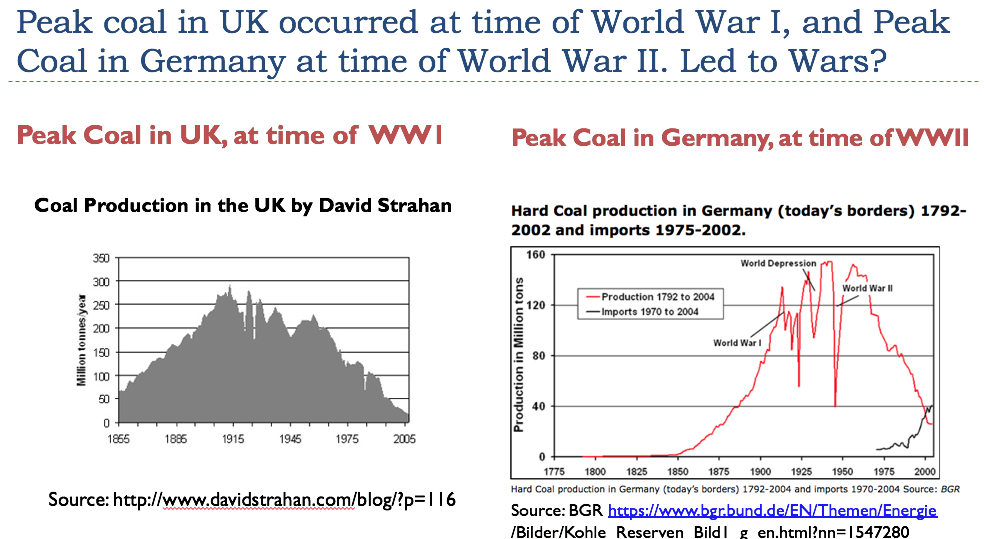
All parts of economies, including government organizations and businesses, constantly evolve. They grow for a while, but when limits are hit, they are likely to shrink and may collapse. The current energy bottleneck is sufficiently dire that some observers worry about another world war taking place. Such a war could change national boundaries and reduce import capabilities of parts of the world. This would be a type of squeezing out of major parts of the world economy. In fact, shortages of coal seem to have set the stage for both World War I and World War II.
Each squeezing out is different. When there are physically not enough goods and services to go around, some inefficient parts of the economy must be squeezed out. Payments to pensioners seem to me to be particularly inefficient because pensioners are not themselves creating finished goods and services.
World leaders would like us to believe that they are in charge of what happens in the world economy. But what these leaders can accomplish is limited by the actual resources that can be extracted and the finished goods and services that can be produced with these resources. When there are not enough goods and services to go around, unplanned changes to the economy tend to take place. These changes work in the direction of allowing parts of the system to go forward, without being burdened by the less efficient portions.
[2] The importance of diesel and jet fuel
Diesel and jet fuel are important to today’s industrial economy because they fuel nearly all long-distance transportation of goods, whether by ship, train, large truck, or airplane. Diesel also powers most of today’s modern agricultural equipment. Without the use of modern agricultural equipment, overall food production would decline drastically.
Without diesel, there would also be many other problems besides reduced food production. Diesel is used to power many of the specialized vehicles used in road maintenance. Without the ability to use these vehicles, it would become difficult to keep roads repaired.
Without diesel and jet fuel, there would also be an electricity problem because transmission lines are maintained using a combination of land-based vehicles powered by diesel and helicopters powered by jet fuel. Without electricity transmission, homes and offices without their own solar panels and batteries wouldn’t be able to keep the lights on. Gasoline pumps require electricity to operate, so they wouldn’t operate either. Without diesel and electricity, the list of problems is endless.
[3] Green energy is itself a dead end, but subsidizing green energy can temporarily hide other problems.
Green energy sounds appealing, but it is terribly limited in what it can do. Green energy cannot operate agricultural machinery. It cannot make new wind turbines or solar panels. Green energy cannot exist without fossil fuels. It is simply an add-on to the current system.
The reason why we hear so much about green energy is because making people believe that a green revolution is possible provides many temporary benefits. For example:
- The extra debt needed to subsidize green energy indirectly increases GDP. (GDP calculations ignore whether added debt was used to produce the added goods and services counted as GDP.)
- Manufacturers can pretend that their products (such as vehicles) will operate as they do today for years and years.
- The educational system is given many more areas to provide courses in.
- Citizens are given the hope that the economy will grow endlessly.
- Young people are given hope for the future.
- Politicians look like they are doing something for voters.
Unfortunately, by the time that the debt comes due to pay for subsidized green energy, it will be apparent that the return on this technology is far too low. The overall system will tend to collapse. Green energy is only a temporary Band-Aid to hide a very disturbing problem. Its impact is tiny and short-lived. And it cannot prevent climate change.
[4] Energy bottlenecks are a frequent problem.
Energy bottlenecks are a frequent problem partly because the human population has tended to increase ever since early humans learned to control fire. At the same time, resources, such as arable land, fresh water supply, and minerals of all kinds, are in limited supply. Extraction becomes increasingly difficult over time (requiring more inputs to produce the same output) because the easiest-to-produce resources tend to be exploited first. Extracting more fossil fuels to meet the energy needs of a growing economy may look like it would be easy, but, in practice, it is not.
As a result of energy bottlenecks, civilizations often collapse. Sometimes war with another group is involved. In such a case, the population of the losing civilization falls.
[5] The standard supply and demand model of economics makes it look like prices will rise in response to fossil fuel shortages. The discussion in Section [4] shows that energy supply bottlenecks often occur. When they do occur, the response is very different.

The model of many economists is far too simple. Based on the model shown on Figure 2, it is easy to get the idea that a shortage of oil will lead to a rise in prices. As a result, more oil will be produced, and the problem will be solved. Or perhaps efficiency changes, or substitution for a different type of fuel, will fix the problem.
When bottlenecks appear, the real situation is quite different. For example, increases in oil prices tend to cause food prices to rise, and thus increase inflation. Politicians know that citizens don’t like inflation and therefore will not vote for them. As a result, politicians tend to hold down prices. The resulting prices tend to fall too low for producers, and they start producing less, rather than more.
Energy products of the right kinds are essential for making every part of GDP. If there is not enough of the right kinds of energy products to go around, what I call some kind of “squeezing out” is likely to take place. Early on, there may be changes that reduce energy consumption, such as cutbacks in international trade. More businesses may fail. Eventually, some parts of the world economy may disappear, such as the central government of the Soviet Union in 1991. Or war may take place.
[6] When there is not enough energy of the right kinds to go around, spreading what little is available “thinner” doesn’t work.
As an example, if people need to eat 2,000 kilocalories per day, and if the food supply that is available would only supply 500 kilocalories per day (on average), giving everyone the same quantity would lead to everyone starving. Similarly, if a communist government gives every worker the same wage, lateness and “slacking off” become huge problems. Experience in many places has shown that equal pay for all, regardless of native abilities, responsibilities, or effort, simply doesn’t work. Somehow, diligent work and greater responsibility needs to be rewarded.
When an energy bottleneck occurs (leading to too little finished goods and services in total being produced), what I call a “squeezing out” takes place. Such a squeezing out may be initiated in many ways, including a war, angry citizens overturning a government, financial problems, or a shift in climate. The winners in a squeezing out end up ahead; the losers see collapsing institutions of many kinds, including failing businesses and disappearing government organizations.
[7] Most people do not understand the interconnected nature of the world economy, and the way the whole system tends to evolve.
The Universe is made up of many temporary structures, each of which needs to “dissipate” energy to stay away from a cold, dead state. We are all aware that plants and animals behave in this manner, but businesses of all kinds and government organizations also require energy of the right kinds to grow. They get much of their energy from financial payments that act as temporary placeholders for goods and services that will be made in the future using various types of energy, including human labor.
Strangely enough, because of the physics of the situation, business and government organizations are also temporary in nature, and in some sense, they also evolve. In physics terms, all these structures are dissipative structures. Physicist Francois Roddier writes about this broader kind of evolution in his book, The Thermodynamics of Evolution. In fact, economies themselves are dissipative structures. I have written about the economy as a self-organizing system powered by energy many times, including here, here, and here. All these self-organizing structures eventually come to an end.
History is full of records of economies that have collapsed. The book Secular Cycles by Peter Turchin and Serjey Nefedov analyzes eight of these failed economies. Populations tend to grow after a new resource is found or is acquired through war. Once population growth hits what Turchin calls carrying capacity, these economies hit a period of stagflation. This period lasted 50 to 60 years in the sample of eight economies analyzed. Stagflation was followed by a major contraction, typically with failing or overturned governments and declining overall population.
[8] Logic and some calculations suggest that the world economy is likely to be reaching a major downturn, about now.
One way of estimating when a major contraction (or squeezing out) would occur would be to look at oil supply. We know that US oil production hit a peak and started to decline in 1970, changing the dynamics of the world economy. This started a period of stagflation for many of the wealthier economies of the world. Adding 50 to 60 years to 1970 suggests that a major downturn would take place in the 2020 to 2030 timeframe. Since it was the wealthier economies that first entered stagflation, it would not be surprising if these economies tend to collapse first.
There have been several studies computing estimates of when the extraction of fossil fuels would become unaffordable. Back in 1957, Rear Admiral Hyman Rickover of the US Navy gave a speech in which he talked about the connection of the level of fossil fuel supply to the standard of living of an economy, and to the ability of its military to defend the country. With respect to the timing of limits to affordable supply, he said, “. . .total fossil fuel reserves recoverable at not over twice today’s unit cost are likely to run out at some time between the years 2000 and 2050, if present standards of living and population growth rates are taken into account.”
Confusion arises because some people would like to believe that fossil fuel prices can rise to extraordinarily high levels, and this will somehow permit more fossil fuels to be extracted. However, as I discussed in Section [5], the problem is really a two-sided one. Politicians want to hold fossil fuel prices down to prevent inflation, while oil producers (such as those in OPEC+) choose to reduce production if prices are not sufficiently high to meet their needs.
An easily missed point is that tax revenue from the sale of oil is often a large share of the total tax revenue of oil exporting countries. Because of this issue, in order for prices of oil to be adequate for oil exporters, they must include a wide margin for payment of taxes. These taxes are used to support the rest of the economy. For example, in Saudi Arabia, taxes provide support for huge building programs that provide jobs for citizens, but are of questionable long term value. These projects keep citizens happy, at least temporarily. Without adequate subsidy from tax revenue, citizens would want to overturn governments–a form of collapse.
[9] Energy problems are easily hidden because “scientific models” are considered to be important in forecasting the future. These models tend to be misleading because they leave out important elements regarding how the economy really works.
The easiest models to make are the ones that seem to say, “the future will be very similar to the recent past.” These models miss turning points. They assume that growth will continue even though resource extraction can be expected to become more difficult. Some examples of overly simple models include the following:
- Money is a store of value. (Not if the economy has stopped functioning properly because insufficient energy resources are available.)
- Forecasts of Social Security payments recipients will be able to receive in the future are overstated. (It takes energy of the right kinds to produce the goods and services that the elderly require. If the economy is not producing enough goods and services because of energy extraction limits, the share that pensioners can receive will need to fall so that workers can be paid adequately. Inflation-adjusted benefits to the elderly must be much lower or disappear completely.)
- Climate models give high estimates. (These models miss the real-world difficulty of extracting fossil fuels. They also assume the economy can grow indefinitely, greatly overstating future CO2.)
- Future energy supply based on “Reserve to Production” ratios give high estimates. (Reserve amounts are often puffed-up numbers to make an oil exporting country look wealthy.)
- Energy Return on Energy Invested models greatly overestimate the value of intermittent wind and solar energy. (It is easy to assume that all types of energy are equivalent, but intermittent wind and solar cannot replace diesel and jet fuel.)
[10] Added complexity is not a solution to our energy problems.
Many people believe that if we can just be smarter, we can solve our energy problem. We can add more fuel-efficient engines, more advanced education, and more international trade, for example. Unfortunately, many things go wrong, leading to an upward energy complexity spiral. Difficulties include:
- The complexity changes with the best payback tend to be discovered and implemented very early.
- Added complexity may lead to higher energy consumption if cost savings result. For example, more vehicles may be sold if reduced fuel consumption makes their operation more affordable to a wider number of users.
- Wage disparity results because the wages paid to highly educated employees and those in managerial positions leave little funding available to pay less-skilled workers.
- Less-skilled workers indirectly compete with similarly skilled workers in low-wage countries, further holding their wages down.
It is clear that we are now moving past the limits of complexity. For example, international trade as a percentage of GDP has been falling for the world, the US, and China.

Countries are now actively trying to bring supply lines back closer to home. Trips for goods across the Atlantic and the Pacific Oceans are being reduced, saving diesel and jet fuel.
[11] Repayment of debt with interest acts like a Ponzi Scheme if there is inadequate growth in the energy supply.
Most people today do not realize the extent to which the entire financial system is dependent on growing inexpensive-to-produce energy supply of the right kinds. It takes physical resources of the right kinds to produce goods and services. Resources such as fresh water, copper, lithium, and fossil fuels require more and more energy consumption to produce the same amount of supply because the easiest-to-extract resources are extracted first.
When the economy is far from limits, adding more debt (or other types of promises, such as shares of stock) does seem to increase “demand” for finished goods and services, and this, in turn, tends to increase the production of fossil fuels and other commodities. Thus, for a while, increased debt does indeed increase energy supply.
But when we start reaching extraction limits, instead of producing more fossil fuels and other commodities, higher debt tends to produce inflation. (In other words, more money plus practically the same amount of finished goods and services tends to lead to inflation.) This is the issue central banks are up against today. Central banks raise interest rates in response to the higher level of inflation, partly to compensate lenders for the inflation that is taking place, and partly to make their own economies more competitive in the world economy. The combination of higher interest rates and higher inflation is problematic in many ways:
(a) Ordinary citizens find that they must cut back on discretionary goods and services to balance their budgets. This tends to push economies in the direction of recession and debt defaults. Some citizens find they need to apply for government assistance programs for the first time.
(b) Businesses find it more difficult to operate profitably with higher interest rates and inflation. Businesses increasingly expand in programs supported by government subsidies, such as those for electric cars and batteries, as it becomes increasingly difficult to make a profit without a subsidy. In the US, defaults seem especially likely on commercial real estate loans.
(c) Governments become especially squeezed. Many of them find that their own tax revenue is falling at precisely the time when citizens need their programs most. Governments also find that with higher interest rates, interest costs on their own debt rises. Subsidized programs increasingly seem to be needed to keep the economy operating. The number of retirees also grows year after year. Government debt levels spiral upward, as shown for the US on Figure 6.
With all these issues, the world becomes increasingly prone to war. Political parties, and even groups within political parties, find it increasingly difficult to agree on solutions to problems. The stage seems to be set for an array of worrisome outcomes, including major debt defaults, failing governments, and even widespread war.
[12] The world economy was able to grow rapidly in the 1950 to 1980 period because of a rapid rise in energy consumption. Now, there is an energy bottleneck. The recent increases in interest rates seem likely to burst debt bubbles. They may even squeeze out some major economies with pension programs for their citizens.

On Figure 4, the significant increases in interest rates up until 1981 corresponded to a huge increase in world energy consumption in the 1950 to 1980 period (Figure 5).
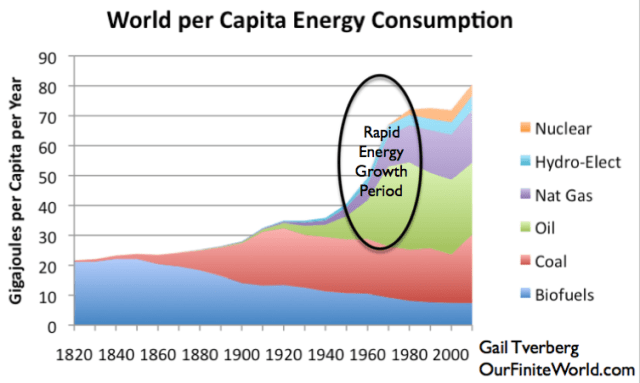
The rapid rise in fossil fuel consumption in Figure 5 was the reason why the economy was able to grow as rapidly as it did in the 1950 to 1980 period. Raising interest rates acted like brakes on the economy and lowered oil prices. The Soviet Union was the economy most harmed by these low oil prices. It also had a communist form of government that did not work well, compared to capitalism. Ultimately, the central government of the Soviet Union collapsed in 1991.
Now, the rise in interest rates during 2022 and 2023 on Figure 4 correspond to a very different situation. Extraction of fossil fuels, and in particular the heavy oil used to produce diesel and jet fuel, is no longer growing rapidly. Instead, what has been growing is debt, especially government debt. Figure 6 shows US government debt through April 2023. US government debt spurted upward in 2020 and is still rising rapidly.

The business closures in 2020 and interruptions in travel reduced oil prices and provided a good excuse for more government debt. All this debt added buying power, but it didn’t actually produce very many goods and services. Instead, it added a debt bubble. Similarly, investing in close-to-useless green energy temporarily added GDP, but it mostly added a huge debt bubble. Raising interest rates is likely to burst these debt bubbles.
The US and other rich countries have also put in place pension plans for the elderly. These are not treated as debt, but they depend upon resources of all kinds being available to feed, clothe, and provide shelter to a growing army of retirees. If there is not enough diesel to allow as many goods and services to be produced as are produced today, there is likely to be a huge problem if payouts to pensioners aren’t significantly reduced. Other citizens will be unhappy if retirees get a disproportionately large share of the reduced supply of goods and services. Some will say, “Why work if retirees on pensions get more than those of us who are still working?”
Thus, the world seems to be increasingly in a situation where more squeezing out will take place. Major governments, especially those with pension plans for their citizens, seem especially vulnerable. No one understood that there had been a temporary rapid rise in energy consumption per capita in the 1950 to 1980 period (Figure 5) that led to a temporary spurt in interest rates on bonds. This temporary rise in interest rates made pension programs look far more feasible than they really are for the longterm.
[13] How does the problem resolve itself?
It seems to me that the problem of debt bubbles and of unaffordably generous pension plans is very widespread. Analysts of all kinds have missed the hidden brakes on economies caused by inadequate energy resources of the right kinds, relative to rising populations. Collapse of at least some central governments seems possible. Perhaps some of these collapses can be postponed by rollbacks in government-sponsored programs, particularly those for the elderly and for those who are not working.
But even aside from the pension problem, there is a problem with many debts not being repayable in an economy that is forced to slow, as described in Section [11]. Many other promises become iffy as well. For instance, derivatives may not be able to pay as planned.
If there are problems with inadequate supply of essential materials, they are likely to spill over to asset values. For example, a farm that cannot purchase fuel for its agricultural equipment is, in some sense, not worth very much, since workers with simple tools like shovels cannot produce very much food. Likewise, a factory with permanently broken supply lines is not worth much.
I wish I could provide a happy-ever-after ending. The closest I can come to such an ending is to say that it appears to me that there is a literal Higher Power that is somehow providing an enormous amount of energy in a way that allows the Universe to continually expand. This literal Higher Power is, in some way, influencing the world today, through the self-organizing nature of the economy. The book Rare Earth: Why Complex Life Is Uncommon in the Universe, by Ward and Brownlee, explains that life could not have happened on the Earth, as quickly as it did, by chance alone. Perhaps things will turn out differently than we expect.


Dear Gail,
First and foremost, I express my deepest appreciation for the very thorough observations and analyses you share with us. They always provoke thought, though unfortunately, they don’t make me particularly happy.
I wonder if your analyses take into account what are called autogenic happiness hormones that influence human behavior. In my surroundings, I see that people continue to seek stimuli that trigger these hormonal effects, such as compulsively going on distant vacations, making impulsive purchases, and almost compulsive buying behavior influenced by advertising and social surroundings. I even get the impression that the general decline of economic and material civilization prompts people to indulge in purchases or expenditures that provide a momentary surge of happiness hormones.
I would appreciate it if you could share something on this topic.
Best regards,
Koen
OFW and these comments are great stimuli.
I try to indulge daily, so perhaps I am addicted.
WW3, the Collapse, human extinction…
a lot of energizing stimulating ideas here.
the best action in the Universe might be on Earth.
The God of this world likes to make things interesting……it feeds on fear, pain and anxiety.
Of course its a lesser God and its hoeing a row it is supposed too!
I wonder what we are here for exactly?
When I look online to read about autogenic happiness hormones, I see articles about exercise and being out in the sunshine being helpful. Also, eating the right diet. I know that smiling makes me feel happy, and it also helps generate these hormones. My husband is one who likes to look at cartoons, tell jokes, and entertain. The laughter he generates adds to the hormones.
I am sure that buying a fancy car, or nice clothes, generates some feel-good hormones as well. With items like this, there is also the issue of status seeking. No one wants to be at the “bottom of the pecking order.”
The total amount of expenditures on clothing is way down, now. There are fewer new cars being sold; the ones that are being sold now are more expensive, making them less affordable. I understand that travel was quite a bit higher this summer.
I’m afraid I don’t have a good way to judge whether more of the excess buying behavior is taking place or not. Judging by the total amount of clothing and cars being bought, I don’t think so, but maybe people are making up for lost time now on vacations.
I think many people were traumatized by the events of 2000. Some took up more alcohol drinking, or more drug taking. It seems like this kind of reaction was probably more likely than excess spending, but there probably many different actions.
Our home insurance premium just increased by 20%…. that does not make me smile
El Salvadoran judo champion and 2008 Olympic bronze medal winner Franklin Cisneros, 39, died suddenly and unexpectedly AT HOME in Florida on October 28th.
Former child actor Evan Ellingson, 35, who starred in CSI: Miami, My Sister’s Keeper, and 24, died suddenly and unexpectedly in bed AT HOME on Sunday in Fontana, California.
Indie band Night Cafe’s lead singer Sean Martin, 26, died suddenly and unexpectedly this weekend.
Former president of IMG Models and “Fashion Titan” Ivan Bart, 60, died this weekend “after a short illness.” Ivan’s “short illness” remains shrouded in mystery. Supermodels Cindy Crawford, Gigi Hadid, Hailey Bieber and Ashley Graham all posted shocked and saddened tributes following the news of Ivan’s death.
https://www.coffeeandcovid.com/p/revenge-plots-tuesday-november-7
The banality of SCHAD.. at a certain point there is so much SCHAD … that the endorphins don’t surge…
The nightmare never stops….
https://geoffpain.substack.com/p/covid19-jab-pancreas-damage-link
The most vital task of western propaganda is not manufacturing consent, it’s manufacturing doubt. It’s asking so many stupid questions and taking up so much time that people either get confused or forget about it. It’s setting up a debate with ‘both sides’, like gladiators in a Colosseum, so the status quo of Empire can carry on undisturbed above. Or to put it more simply as Trump adviser Steve Bannon did, they simply ‘flood the zone with shit’. They bury the bodies twice, once in concrete rubble and then in abstract rubbish.
https://indi.ca/how-they-kill-palestinians-twice/
“My biggest fear is there’s one more geopolitical escalation and there’s a market event,” Deutsche Bank AG Chief Executive Officer Christian Sewing said at the Global Financial Leaders’ Investment Summit in Hong Kong on Tuesday.
https://finance.yahoo.com/news/wall-street-bosses-hong-kong-065246853.html?fr=yhssrp_catchall
No kidding! With the amount of debt in the world, and the rising interest rates, its is a miracle nothing has collapsed so far.
Interestingly, if we take Col. McGregor rule of thumb for collapse (debt is 240% of GDP) the USA will be gone in 2030. This is assuming that the debt trend started in 2020 continues unchanged. A the very least that is when it will abandon most overseas bases. Of course I think diesel supplies are what matters, and therefore it could be later.
It really is strange is it not?
I am somewhat aghast at how things do keep chugging long into massive headwinds coming in from economic, social and environmental directions.
The magazine cover for the US print version of the Economist magazine has this image this week. If it is behind a paywall, I can upload it to OFW. A person gets the idea that economists think that the situation cannot continue without something going wrong.
https://www.economist.com/img/b/1280/1280/90/media-assets/image/20231104_DE_SQ_US.jpg
Copy catting Wiley E Coyote…….lol
Exactly! For once, we can all agree.
We need for the affordable energy depletion situation to get to a tipping point … we are not quite there yet… physics will determine when we are about to go over the cliff…
And then the folks running UEP… will release the cannisters.
Impossible to know when that moment will arrive
Why would BIS, IMF, etc plan CBDCs and meat/other food/resource rationing if they expect a virus to be released to make the jabbed very ill and end it all? I see multiple conflicting groups, not a coherent plan.
Perhaps they are not planning meat rationing … nor will 15 minute cities ever happen … because they want to D-moralize the MORENS … making them more accepting of extermination …
When life sucks… extermination is a way out
No, it’s a protracted 2-4% mortality rate per year depending on the age group.
1. You need to make sure the chaos is controlled
2. You need to kill people slowly
3. After sending in the hooligans (refugumes) to kill the population, increase welfare expenditures, reduce land costs, make ”high IQ” flight, reduce consumption levels — then you get to seize land under martial law
4. Also no next generation to develop infrastructure b/c common core curriculum
5. You ration resources because you will expect a ”military” order where everyone goes to bootcamp land
6. You isolate and kill, or prevent people from eating, by sectors
7. Homes need energy standards, or you are forced to sell your stuff
8. Make energy costly, living expenses costly
9. Reduce population to 1 billion
If they just nuked the planet, there’s no rebuilding phase.
You also need people to build the AI digital prison, and the technocrats in the mean time to transition over to LifeInDigiPod so they can behaviorally accumulate data and glean into bioinformatic insights to spawn AI ”minds”/”robots”
China will be touted as the new ”leader” or Russia whereas the west will be seen as ‘corrupt’ so they can bring in the NWO. It’s not multiple conflicting groups. The British Monarchy/Black/Grey Pope/European Nobility are in charge (Black Nobility).
(Jerusalem Post)
Can a Democracy belong to only one ethnic group and not to the other people living in the same nation there?
Tv news repeats that Israel is a Democracy.
But Israeli laws make it clear that the Country is a Democracy for the Jewish people, but the minorities living there are not included.
It would be like if, in the United States, only people coming from generations of American ancestors can live in a Democracy and the others not.
The issue came today from a JP news about the Druze ethnic group living in Israel who face discriminations and don’t have the same rights.
“The Basic Law: Israel as the Nation-State of the Jewish People was a controversial law that was passed in 2018. The law sought to anchor Israel’s identity as a Jewish state in legislation as the only other document that did so was the Declaration of Independence which is not considered a legal document.
The controversy came from the law’s lack of guarantee of rights, especially for minorities”
https://www.jpost.com/israel-news/politics-and-diplomacy/article-772092
There are precedents. The US had to gradually change the voting system to include other than white males.
And imagine that Apartheid in South Africa ended only in 1990 !
https://www.britannica.com/topic/apartheid/Opposition-to-apartheid
With all eyes on the arrival of a BRICS currency, an agreement is nearing as consensus on the development grows. Specifically, in a recent interview, a former Russian minister noted that only China and India are left to agree on the terms for the creation of the new alternative tender.
The discussion of an alternative currency has dominated the overall BRICS establishment over the past year. From talks of a digitized version to potential pegging the asset to gold, the rumors have persisted. Subsequently, with the 2024 summit set to take place in Russia, many have predicted an announcement arriving then akin to the 2023 summit announcement of expansion.
Indeed, a BRICS currency agreement could be nearing consensus within the bloc. Specifically, a former Russian minister has discussed the countries that are still to give their consent to its establishment. Subsequently, only two nations have yet to approve the project.
To launch this currency, we need the political consent of the BRICS countries, three of which have already expressed their support for the idea,” Sergey Galzyev stated. “We are waiting for the reaction of China and India.”
https://watcher.guru/news/brics-currency-agreement-nearing-as-consensus-is-close
Looks as if these two are holding out as a bargaining chip to get what they want.
Wonder what that might be?
China and India are huge countries compared to many of the other members of BRICS. Without them, the currency cannot go very far.
BRICS can hold its cards pretty close to its chest.
Everyone was taken by surprise when India backed the expansion of BRICS this year.
It may be that China and India are simply not indicating their agreement to a new currency until the very day comes for its announcement.
The windmill saga brought back memories.
Otherpower had a wonderful website in CO some years back, also presented MREA on DYI turbines.
Turbines were supported on telescoped pipe, don’t recall dia maybe 8-12″ at bottom, and it was guyed after being winched from the horizontal not a problem until one goes over vertical, have to watch the trip down. These were furling turbines, so they could have a “snap” in a wind gust, exciting; run out and furl to avoid a new DYI experience in repair. One built the generators with Neo magnets. Have a couple of boxes of those things, handle with care, spontaneous movement is exciting.
MREA has an old windturbine, generator was mounted vertically, in tower. Tower still stands, they removed generator, it lies on the ground, keep emailing them offering to purchase it, no response, turbines are not easy things to find.
Have a silo with a blown top, purchased a bunch of industrial shelving, thought I would build a staircase/support system in silo, put the turbine on a pole and winch it up and down for repairs. One needs to plan ahead.
Blades are a challenge, some plane them with hand planes, thought I would build a bench and use a router on rails; purchased for less than $100 four 12″x12″x8′ square tubing, 1/2″ walls, feet on one side from industrial concern, used to align large things. Transportation is interesting, can move them easily, but steel is very heavy. Think rented pickup, a wise person makes several trips.
Turbines are not for the faint of heart, maintenance is the problem, fear of heights is not recommended. Chief problem is gravity, all that stuff is up there.
So, have a turbine, skip going to an amusement park.
Just saying, if you know, then you know.
Dennis L.
“have a turbine, skip going to an amusement park.”
Interesting points.
One person in the repair field told me that wind turbines run on replacement parts. I know that building them often requires roads to be widened.
Earlier I commented about RE values in Rochester, MN. Rochester is healthcare, about 50% of Mayo income from various government programs, Medicare comes to mine. This is based on previous, real world numbers in healthcare.
“The goal, according to the plan, was “long-term solvency” for the program. But it also included cuts to Medicare and Social Security.”
https://www.msn.com/en-us/news/politics/will-mike-johnson-try-to-cut-social-security-or-medicare-here-s-where-the-new-speaker-stands/ar-AA1jw9Ok?ocid=msedgntp&cvid=4c78d0795506435bcf4b27665e1e7542&ei=14
Sometime the government runs out of ways to print money, it is a trickledown effect; good to look out a bit and not get crushed by the rush.
Have no opinion only know change is coming. Try and look forward see how things may affect me and if any adaptions are possible. Real world stuff, ie. it affects me and that is as real as it gets.
Dennis L.
US Debt Interest Bill Rockets Past a Cool $1 Trillion a Year
Amount of annual interest payments has doubled in 19 months
Rise in issuance from 2020 will also need to be refinanced:
Bloomberg
US Treasuries may face renewed selling pressure into the new year if the nation’s swelling debt repayment bill is any guide.
Estimated annualized interest payments on the US government debt pile climbed past $1 trillion at the end of last month, Bloomberg analysis shows. That amount has doubled in the past 19 months, and is equivalent to 15.9% of the entire Federal budget for fiscal year 2022.
That sums it all nicely..we in a heap of trouble brother and since they won’t default…option number 2
Thanks, always nice to have real, approximate numbers.
Wonder if stock market is holding up as it is better than nothing.
Dennis L.
It is really Medicare plus the portion of Medicaid that is used to cover Nursing Home Care for the elderly that is way underfunded.
Having so many old people in poor health isn’t working well.
Also, the disconnected form of US healthcare doesn’t work well at all. As you have said, these providers have little incentive to make a person well. They often want to maximize income. And the poor sick people go from provider to provider, trying to guess what services they should be using. Everyone has services to sell!
If old people are bored, going to the doctor seems to be a popular activity.
Imagine living your life … then as you age getting dumped in a hell hole reeking of stale urine and shit… waiting to die…
Gail,
I suspect it is not the “funding” which is a problem, it is the maturity of the debt and a cashflow problem. Liquidity is never easy.
Dennis L.
You are right. Liquidity makes a difference as well.
The reduction of the government is a part of the agenda of Javier Milei in the ongoing general election in Argentina:
https://youtube.com/shorts/0VuQXSpPQQw?si=ntlpfjZODTV4mQCk
Well, it seemed like a good safe investment.
https://www.msn.com/en-us/money/markets/orsted-wants-out-of-300m-forfeiture-for-scrapped-new-jersey-offshore-wind-farms/ar-AA1ju2k2?ocid=msedgntp&cvid=6bd355326e5c43deb0b53107208921de&ei=9
$300m is loose change anymore, time to move on.
Dennis L.
Offshore wind was enabled by a combination of wishful thinking, very low interest rates, lack of actual experience with repair needs, and government subsidies. Those things are now unwinding.
Twisting in the wind so to speak.
Dennis L.
Maybe this has a chance to replace the bulky mess:
https://www.rechargenews.com/wind/bill-gates-backed-tracks-and-wings-bid-to-shrink-wind-power-for-ever/2-1-1549556
Interesting! I read earlier about a different configuration that people thought might be helpful.
At this point, an awfully lot of windy locations for turbines have already been taken. Will this be a problem?
How long do they last? I imagine they are as intermittent as the old kind, so again they mostly replace fuel, not dispatch able electricity. We still have the need to relieve the intermittency.
What materials do they take? Do they kill animals? Do they make an awful sound?
That has been around for a long time: Darrieus.
Was into building my own turbine, farm, real soon now. Horizontal work, Darreus never has been efficient. Otherpower Youtube used to be very active with horizontal turbines, they held a workshop at MREA some years back, interesting people, enjoyed the scotch afterwards, made the work seem all worthwhile.
There is another guy in Scotland I think, have his book, builds horizontal turbines, may be the link below, scroll down and see the batteries, nonrenewable you think?
https://www.bbc.com/future/article/20170329-the-extraordinary-electricity-of-the-scottish-island-of-eigg
There is no easy way except perhaps small scale hydro, department of natural resources has some things to say about all that, they like fish more than power.
Hugh Piggott was the author, don’t think I ever met him, “DYI 400 watt Wind Turbine” appears to be the book. Would like to have gone and studied with him, good variety of scotch I should think. Thank bing for the author, using bing more and more, great for coding, beats the heck out of paging through books.
Dennis L.
“A slow wait for the right set of mutations to come along isn’t an option during a catastrophic event. Instead, the flexible responses of individual organisms probably produced an abundance of novel variation, on which selection could act.”
People are struggling to frame how climate change should be understood in evolutionary terms. Climate change is often framed as a ‘catastrophe’ and that lends itself to the frame of ‘catastrophic evolution’ although that may not actually fit what is actually liable to happen.
‘Catastrophic evolution’ was first proposed by the French philosopher Charles Bonnet back in the 18th c. though with some superstition chucked in.
“He responded to fossil evidence of extinct species with La Palingénésie philosophique (1769; “The Philosophical Revival”), in which he theorized that Earth periodically suffers universal catastrophes, destroying most life, and that the survivors move up a notch on the evolutionary scale. Bonnet was the first to use the term evolution in a biological context.” https://www.britannica.com/biography/Charles-Bonnet
This present essay (extracts here provided) gives a more recent account of the theory that evolution is majorly driven by periodic catastrophes (massive environmental disruption and mass extinctions.) (I note that catastrophic and gradual evolution may both be true in their own place.)
https://aeon.co/essays/catastrophe-drives-evolution-but-life-resides-in-the-pauses
> Catastrophes and calms
Evolution is extraordinarily creative in the wake of a cataclysm. How does life keep steadily ticking over in between?
….. While dinosaurs get most of the attention, they weren’t the only ones to disappear. More than half of all life on Earth – from plankton to pterosaurs – perished following the impact of the Chicxulub asteroid that created a 150 km-wide crater in the Yucatán peninsula. It took 30,000 years for life to re-emerge in the fossil record, and another 4 to 9 million years to return to pre-impact levels.
…. This postapocalyptic period was characterised by novelty. New genetic combinations resulting from crossbreeding would have added to an array of anomalies caused by developing in a stressful environment. The first generation of the new world order wouldn’t copy the habits that had enabled their lineages’ survival for aeons; instead, they would copy habits their parents had improvised out of the necessity of the moment. Emerging from the ashes, the biotic world looked nothing like the one before the asteroid struck. It would take millions of years for pre-impact levels of species diversity to rebound and for ecosystems to stabilise.
When things did settle back down, the pace of evolution would return to a virtual standstill. That’s the pattern we observe in the fossil record: disruption, change and then long periods of stasis. However, it took many years for scientists to accept this pattern.
…. Fortunately for the Darwinian paradigm, geological time gives evolution millions and billions of years to work with. Yet in the 1970s, the American palaeontologists Stephen Jay Gould and Niles Eldredge proposed that the pattern of stasis and disruption might be something more than just imperfections in the fossil record. This punctuated equilibrium, as they called it, might reflect the uneven way that evolution actually unfolds. If Gould and Eldridge were right, then natural selection on random mutation suddenly had a much shorter timescale in which to accomplish major evolutionary changes. Because of this, punctuated equilibrium was initially met with scepticism.
However, there’s been a growing acceptance of this pattern among evolutionary biologists and theorists over the years, as new studies and techniques reveal it again and again across diverse organisms.
…. It’s striking to note that the million-year wait Arnold and colleagues observed for evolutionary changes in body size corresponds roughly to the lifespan of most species. One implication is that evolutionary changes that are persistent enough to appear in the fossil record might occur only with a major, usually catastrophic event that pushes entire communities out of their equilibrium.
Such events are rare and occur only every million years or more – but when they do, the system must either change or cease to function. In evolutionary terms, that means it must evolve or go extinct. This suggests that macroevolutionary patterns can’t be understood by simply adding up microevolutionary changes over a long period of time because catastrophic events, such as the Chicxulub meteor, don’t occur on a constant gradual basis. In fact, all the evidence suggests that major evolutionary changes can occur in a blink of a geological eye and persist only when systems suffer a major disruption and are forced to massively reorganise.
…. Evolutionary biologists have documented countless examples of rapid evolutionary change in the past few decades. Most of these are in species that are experiencing some sort of extreme environmental disturbance, such as invaders that have been released into a novel habitat or plants that rapidly adapt to the toxic soil of mine tailings. All of these examples show us that substantial evolutionary change can happen rapidly. They suggest that natural selection, rather than being a slow and gradual shaper of species, is most evident in brief bursts of change following major disruption.
When the Chicxulub meteor hit Earth 66 million years ago, billions of organisms perished, and the survivors were forced to flexibly respond and form novel systems of interactions that were ‘good enough’ to survive. During this reorganisation, natural selection no doubt sorted rapidly between traits and strategies that functioned and those that did not. But where did novelty come from?
A slow wait for the right set of mutations to come along isn’t an option during a catastrophic event. Instead, the flexible responses of individual organisms probably produced an abundance of novel variation, on which selection could act. These flexible responses would have ranged from innovative behavioural strategies, to new associations between various organisms, to novel phenotypes produced from developmental stress or hybridisation. If they were capable of being inherited, these new variants would have provided the basis for rapid evolutionary changes that eventually led to a new stable state. The result was groups of species, traits and interactions completely distinct from those that reigned during the era of the dinosaurs.
The pattern of evolutionary stasis dominates the history of life on Earth. Yet, too often, we’re more focused on explaining change instead of understanding how things stay the same. The irony here is that the key to both of these problems might be the same. A better understanding of how populations remain stable – the feedbacks and feedforwards, the built-in flexibility and responsiveness of the system, the redundancies and mechanisms of resiliency – might enable us not only to better understand evolutionary stasis, but also allow us to predict how organisms change when their stable state is disrupted.
Most importantly, viewing evolution through a systems lens fundamentally changes how we view the story of life on Earth. It’s not a story of the constant struggle for existence. Rather, it’s a story that resides in the pauses – the uneventful interludes, where components of the systems maintain the status quo, and change necessarily comes with painful and extreme disruption.
You make a good point.
In fact, every part of the way the economy works seems to involve a similar problem, of tiny changes/problems, eventually culminating in huge changes, and somehow the overall system changing to accommodate all of these things.
For example, we have small floods of rivers. If we add dams, we can prevent some of this flooding, but then we have less frequent big floods. Even without our dams, there is a pattern of very small with occasional very big.
We have small groups of debt defaults, which we kick down the road by adding more governmental debt. But at some point, something more major has to happen.
We have fairly frequent earthquakes of small magnitude, and occasional ones of major magnitude. The continents seem to have split apart at some point.
The self-organizing ecosystem is set up to handle these changes. In fact, the bottlenecks are good in terms of forcing rapid evolution.
Endlessly preaching that we can prevent these changes is rather pointless. It is what it is. We see to be living near a time of rapid change.
Fractals, Mandelbrot.
Dennis L.
🙂
Great point!
I first read Mandelbrot’s book “The Misbehavior of Markets” back when it came out, in 2005, or perhaps an early reprint in 2006. That was about the time I got interested in energy issues.
Nearly all “scientific” models ignore the fractal nature of patterns in the real world. It is much easier to assume “the future will be like the past.” We like to assume that we humans will be in charge, also.
“Most importantly, viewing evolution through a systems lens fundamentally changes how we view the story of life on Earth. It’s not a story of the constant struggle for existence. Rather, it’s a story that resides in the pauses – the uneventful interludes, where components of the systems maintain the status quo, and change necessarily comes with painful and extreme disruption.”
Agree more or less: Fabric of the universe guy, in general think an entity tries various ides of its time line(billions and billions of years), what works goes forward, what does not ends. Somewhere there is intelligent design, Darwin was basically chance, perhaps part of enlightenment and death of God, etc.
We are going forward, time does not seem to run backward.
World is under some stress right now, if there is a greater being and man’s problems are messing with the grand design, things will be snubbed before serious damage occurs. Always the optimist.
Dennis L.
Two further examples of how climate ‘catastrophe’ was linked to a major shift in the course of evolution (in addition to that of the Chicxulub asteroid discussed above.)
So that is three cases of ‘catastrophic evolution’ with very grand consequences.
1. For all of our grand self-estimation, there is no chance that our impact on the planet and the course of life and of planetary evolution will come even close to the impact of green algae (cyanobacteria) that completely changed the course of life through the Great Oxidation Event.
Our planetary importance is almost certainly less than that of green algae.
The Great Oxidation Event is an example of how climate ‘catastrophe’ was linked to a radical redirection of evolution – indeed the rise of multicellularity – and none of the present multicellular species would otherwise be here.
https://asm.org/Articles/2022/February/The-Great-Oxidation-Event-How-Cyanobacteria-Change
> The Great Oxidation Event was an epochal moment in the evolutionary timeline and had several grave consequences, not only on Earth’s climate (indirectly), but also on the adaptation and evolution of living organisms.
…. Since life was totally anaerobic 2.7 billion years ago when cyanobacteria evolved, it is believed that oxygen acted as a poison and wiped out much of anaerobic life, creating an extinction event.
…. The release of oxygen by cyanobacteria was thus responsible for changes in the earth’s atmospheric composition, the rise of aerobic metabolism and, ultimately, the evolution of multicellularity. Oxygen is the primary molecule that makes Earth what it is today, far more hospitable and beautiful than the early earth. It is certainly no exaggeration to say that we owe our existence in present form to cyanobacteria.
2. Also check out plankton. Our planetary significance does not come even close to the humble plankton. (I have mentioned this case before.)
A ‘catastrophic’ climate disruption (volcanic) wiped out most species in the oceans and on land, but it led to the introduction of a new negative feedback loop that regulates the pH of the oceans and that then allowed for the development of new life on the largely novel basis, in the oceans, of the ‘red queen’ process.
The newly emerged calcifying plankton stabilised (and still do) the pH of the oceans, which allowed species to then compete on an interspecies basis of an ongoing adaption to keep up with the new adaptations of other species.
So again, catastrophic disruptions can radically alter the evolutionary process. The oceans and their life were completely transformed in that way.
Likewise major climate change, if it happens now, would not simply be a ‘bad’ thing, it would be just another ‘natural’ episode in the long history of the planet. The ultimate consequences would be simply whatever they are and likely not nearly on the scale of algae or plankton. It is a case of ‘it is whatever it is’.
https://www.quantamagazine.org/how-jurassic-plankton-stole-control-of-the-oceans-chemistry-20191001/
> About 250 million years ago, at the end of the Permian period, life on Earth suffered an unprecedented blow. Something — massive volcanic activity in what are now the Siberian Traps is the likeliest culprit — devastated the global ecosystem and eliminated 90% or more of all marine species and upward of 70% of those on land. The nearly cleaned slate marked the dawn of a new era: the Mesozoic.
…. Making the oceans more stable didn’t just benefit the calcifying critters. With so many species less likely to become extinct at the planet’s whim, all marine species were able to relax and take the time to evolve complex relationships with others. That’s why life became bigger, faster and more aggressive: What had been a struggle against the planet became a struggle between organisms.
I should go back and reread Rare Earth: Why Complex Life Is Uncommon in the Universe by Ward and Brownlee. It has a long list of seemingly non-random events that have enabled humans to live on earth.
Here’s one for FE.
Boris Johnson may not believe in it, but long Covid is real – and underfunded
https://www.theguardian.com/commentisfree/2023/nov/07/boris-johnson-may-not-believe-in-it-but-long-covid-is-real-and-underfunded
There is no evidence long covid exists.
My aunt had it. She also had several injections first. “But she didn’t get the booster” my mother explains.
What was the evidence she had it?
Symptoms: exhaustion, brain fog, etc.
Whether one wants to attribute it to Covid is of course up for debate. To be clear, I’m not saying it was Long Covid, I’m simply relaying her own assessment.
It’s a more palatable name for a Rat Juice injury
A sort of pathology or better a suffering condition (with a variety of symptoms) that has been defined as ‘Long Covid’ is something happening in the Western world.
Wester world seems to call this pathology like that because it is thought to be related to Covid-19.
But there is NO Long Covid in Russia, in China, in Africa, in South America and in many Middle East Countries.
Another interesting point is that in Western Countries, Long Covid is something experienced by people vaccinated against Covid…
Stop the mRNA vaccination, stop the long covid?
Possibly, stop 5G EM transmission, stop long Covid?
++++++
But there are also vaccine injuries in places without 5G…
Long covid (vax injury)… means it’s working!!! (as in killing the vaxxers haha)
https://i.ytimg.com/vi/6oT0ZDF7I-E/hqdefault.jpg
Out two guests after a couple of glasses of wine .. divulged vax injuries… one is losing her hair and has serious brain fog that is impacted her ability to concentrate and get work done as a professor (tasks are taking much longer)… the other with the VAIDS ‘has not felt right’ since the jab and has a racing heart beat from time to time.
Both admit the cause is the jab.
Both also indicated they know many people with problems – the most common is the racing heart beat.
https://drkevinstillwagon.substack.com/p/do-viruses-exist
“132:48 next slide please this is
132:52 what source code v2 looks like and if
132:54 and i will i will send you the video so
132:55 you can show it
132:57 of the side on the right shows it goes
132:59 up and down and you can see the actual
133:01 source corona
133:02 cov2 virus uh with its spiked proteins
133:06 in its corona shape i’ll send that to
133:08 you so you can play that
133:10 it’s it’s incredibly important because
133:13 there are people out there that are
133:14 actually of the opinion that
133:16 sars cov2 doesn’t exist and has not been
133:19 isolated
133:20 these individuals not only have
133:22 demonstrated they don’t understand
133:23 viruses
133:24 but they interfere with the with the
133:26 serious discussion going on with this
133:28 virus “ ?
Right! The virus does exist.
Sorry, but no. All the genetic evidence is “in silico”, computer generated. No one has ever isolated and purified a virus from the fluids of a sick person and then extracted DNA from that virus. What virologists do is all smoke and mirrors.
https://drsambailey.com/a-farewell-to-virology-expert-edition/
F. Fail.
https://drkevinstillwagon.substack.com/p/do-viruses-exist
Don’t waste your time, Gumtoo. Most people here can question almost everything, from JFK’s death to the pandemic narrative, but germ theory and allopathy are taboo for them. It’s a kind of mental block that I’ve given up trying to understand.
Actually, I followed the line of reasoning well because I have some knowledge on biology and am aware of the overusage of falsified scientific fraud in computer modelling, whether it be 9/11 simulations or Climate Change simulations. Phase separation of components plus isolation is necessary to proof causation after inoculating such agents into people, testing for symptoms and replicating the process.
The Secrets that only the Inner Elites know is a good read
http://wlym.com/archive/campaigner/7806.pdf
describes the neo-Aristotelian, anti-humanist, monetarist, zero-growth, anti-science policies of the black guelph/british monarchists/black nobility in power.
I’d prefer the Platonic view of an idealist society of Kantian rationals, discussion, discourse and elevation of man to reason but a glance at Chinamen poisoning each other, Africans poopooing and Americans fatfating into realitysport shows makes me sympathize that much harder with the subjugation of human race into zoological status with the one-eye mind AI control thing, whatever anyways.
The human mind is what it is, therefore it is not worth wasting time on Enlightenment dreams.
And physical reality is also what it is. Humans are in deeply overshoot, and there were only two options: a fast uncontrolled collapse, or an attempt to correct the course.
I don’t root for anyone, plebs or planners, bt surely I would prefer a world without humans to a world of technofeudal domination in which people would be divided in robots (99%) and pharaohs (1%).
how cool is THIS!! Very good SCHAD https://twitter.com/i/status/1718685933086613731
Apparently the Treasury Borrowing Advisory Committee has figured out the obvious: the high level of US borrowing will force interest rates up. US spending consistently at a level far above tax collections is part of the problem. This is even the case when employment is quite high. This is not sustainable.
The problem was hidden before by Fed purchases of Debt (QT).
I would conclude that the TBAC will likely have to do more QT, to try to keep things operating normally, and push the problem down the road again. Likely to lead to hyperinflation.
And to collapse … like this https://twitter.com/ronaldmorgan_/status/1718685933086613731
Notice how the match continued for some time before anyone noticed
Belgian, Dutch & Danish cyclists quit with heart disease; Dutch, Slovak & Italian footballers collapse mid-game; NZ gymnast, harness racing driver diagnosed with cancer
And another Italian footballer is rushed to hospital with “sudden illness,” while an Italian hoopster’s life is “hanging by a thread”
https://markcrispinmiller.substack.com/p/belgian-dutch-and-danish-cyclists
Cyclists… heart disease??? WTF yo yo yo
So much cancer https://markcrispinmiller.substack.com/p/uk-comics-rhod-gilbert-and-mark-steel
Neighbour’s uncle died suddenly yesterday — the family is in shock
The People United Will Never Be Defeated!
History teaches the united people are often defeated. That’s the norm. Witness the palestinians.
yes true but I like that music.
United people do a lot better than those who are not united, however. See Communities that Abide by Dmitry Orlov and others published in 2014. They tend to have a strong leader and are united in common beliefs. A little persecution tends to hold the group together.
every musical instrument I’ve ever played was invented and constructed by other people.
and to me, much of the music created by humans far surpasses the sounds of nature.
every piece of delicious bittersweet dark chocolate which I’ve devoured is thanks to many other people.
the language I speak was invented by others, and every word contained therein.
except PSYCHOWOKETARD, yes I indeed invented that one.
if all people are boring, then it’s amazing what ideas these boring people have come up with.
onward to the stars! but probably human extinction.
The fabric of the universe has too much work in humans to allow extinction. But bad ideas, those which do not work are thrown in the dustbin of history.
Dennis L.
“The fabric of the universe has too much work in humans to allow extinction.”
I tend to think this way as well. There have been too many coincidences allowing us to get where we are today. We did not get to where we are by chance alone. There has to be a Higher Power giving order to the Universe, helping it along on its way.
Sorry, Gail, but maybe the universe’s “plan” is for humans to create an depleted low-grade energy differential wasteland sludge that enables a new form of bacteria to evolve, and all other “higher” animals to go extinct after humans poison and degrade the current form of nature.
Maybe those colonies of bacterial will develop some form of collective consciousness that surpasses human so-called “intelligence. ”
Who knows? Maybe humans are just useful idiots.
What’s the universe’s scorecard? If it’s longevity of the species, we are pretty far down the ladder.
Just sayin.’
The issue is that the system keeps evolving toward more complexity and higher energy density, according to Eric Chaisson. Even if there is a temporary dip to a lower level, a higher level will likely arise again. Of course the timeframe will likely exceed our lifetimes.
Most people don’t make music, not even bad music.
Most people don’t have ideas, not even stupid or dangerous ideas.
Then there are the exceptions.
But exceptions are not enough to redeem the species.
I vote for extinction.
Your wish will soon come true 🙂
The wicked species… (one might argue that humans are The Devil — based on their behaviour)… is about to come true.
The Devil … will finally be vanquished.
hahahahahaha look in the mirror to see The Devil… he is in all of us
Maybe or maybe not!
I remain hopeful in a righteous and necessary outcome
In recent times, I have been struck by the feeling of how boring and tedious all of this is being, this slow motion collapse, the controlled demolition process, with the pandemic and vaccine and military bullshit and all the other propagandistic tales to manipulate the perception and feelings of sheep… boring, boring, boring.
IOW what should I dedicate my attention to when everything is devoid of meaning or intelligence, when in human productions and creations what i see is mostly fatuity and narrow-mindedness or irrelevance? Montaigne and Tolstoy are incredible, sure, but what relevance can their dated concerns have for us today? Not much I’m afraid. And I’ve already read them anyway. What is left? Beauty is what remains. Natural beauty, i mean, since even that produced by men tastes musty to me today. What do I do with Rembrandt or Cézanne, when I see more beautiful things simply by opening the window and looking at the forest around? What is Rembrandt’s “Slaughtered Ox” worth compared to a living, mooing cow?
Art is boring, literature is boring, and even the truth rabbit hole becomes boring after you get the essentials. And people, damn, those are the worst, they always have been, truly mind-killers. An hour with them is all i can handle, once a week.
I AM TIRED
I am tired, that is clear,
Because, at certain stage, people have to be tired.
Of what I am tired, I don’t know:
It would not serve me at all to know
Since the tiredness stays just the same.
The wound hurts as it hurts
And not in function of the cause that produced it.
Yes, I am tired,
And ever so slightly smiling
At the tiredness being only this –
In the body a wish for sleep,
In the soul a desire for not thinking
And, to crown all, a luminous transparency
Of the retrospective understanding…
And the one luxury of not now having hopes?
I am intelligent: that’s all.
I have seen much and understood much of what I
have seen.
And there is a certain pleasure even in tiredness
this brings us,
That in the end the head does still serve for
something.
Fernando Pessoa
faster horses, younger women. older whiskey…….and more marten pelts……
All else is a waste of time….
Cars are boring, women are boring, and the more so the younger they are.
Whiskey is fine, as are dogs or music.
Everything else is boring boring boring.
I really meant horses. I am partial to big draft cross roping horses but get yourself on a thoroughbred sometime and give that animal its head…….makes even 1970 muscle cars seem pathetic.
I don’t expect to spend much time talking to younger women…..they should never have been allowed to vote and Elites have used their generally lower IQs to engineer the now collapsing western societies.
But if you can get them to stop talking, they have their uses…..they can even cook occasionally.
Whiskey is the only thing grain should ever have been grown for.
Marten pelts have been traded for a hell of a lot longer than even gold……and I have a lot marten pelts….
People really need to channel their inner caveman….the world is clearer if you do.
Ooga Booga…..
Sorry I thought you meant speedy means of transportation. Horses are awesome of course, as all animals except ticks, mosquitoes and centipedes.
Younger woman should be relegated to the pole.
The pole can mean so many things…..one made of chrome steel and usually illuminated by garish lighting, one made of wood, usually rather sharp at one end, the last one is distinctly more mammalian and can cause the former two in many ways.
Are there other options?
Shiny … gold in colour … mounted on a stage
A mature woman has much in common with fine wine.
Dennis L.
Indeed – meant to be kept in a dark cool place hidden from view
Have one that can cook and scratch my back. Comforting at the end of the day.
Frustration: she cancels out my vote. Ah, equity, one plus -one equals zero.
Dennis L.
life is as boring as you allow it to be JMS
up to you to go out and make it unboring—not difficult, but you have to make the effort
i can guarantee that life isnt going to come to you and ask to be entertained.
if you decide it isn’t worth the effort, life will decide that you dont want to know.
at that point your mental and physical decline will start.
if you let things go that far, you might as well book your place in the nearest sunshine home right now.
You end up in Dennis’s 80% that is expendable, with respect to the 80%-20% split in nature.
It’s not so much life that is boring, but the overwhelming majority of people alive, 95.7% of them if my estimate is correct.
Life is not boring as long as there is music and nature and needs and memories.
i like your precise estimate jms
>> This is a 2 hour and 12 month video
Well, he is a bit long winded.
Anyway, he spent the last several years studying why we can’t dig up enough metals for a full month of battery storage, and then in this video claims that thorium reactors could be a solution. Well obviously nuclear can make electricity – we never needed solar or wind to begin with! Why did he spend years studying something that was nonsense on its face and had an obvious solution? … The primary problems that exist are downstream of all the other energy and materials consumption, not electricity.
My guess: he received a visit by two gentlemen who told him to tone it down or he would be Mullised.
>> And people, damn, those are the worst, they always have been, truly mind-killers. An hour with them is all i can handle, once a week.
Amen
The exception are funny clever people.
As Jimmy Savile might have said: “Necrophilia is dead boring. Incest is only relatively boring.”
Apologies for the utter bad taste of that joke, but I was unable to desist from typing it.
In case my wife reads this, I want to make it perfectly clear that she is totally not boring. In fact she’s 100% awesome, despite cooking even worse than me.
Thank you for the laughs, Tim!
We have been having beautiful fall weather around here. Nice when a person goes for a walk.
Quite often I encounter people I know, and I visit with them. I don’t find them boring. Perhaps because I know them, and I know the struggles that have been going through. I ask about things that I know are likely of concern. There are also neighborhood issues to discuss.
Nature is wonderful in all its manifestations, I completely approve of it.
People are pitiful and boring. Their concerns, even when they are not too petty or stupid, are too common to be interesting.
But i’m just a nihilist (which is also too common and boring).
“In recent times, I have been struck by the feeling of how boring and tedious all of this is being, this slow motion collapse…”
yes, now that OFW (and others like SEE, in the years since LtG) has very much figured out the reality of the recent past, the present, and the possible near futures, with the big picture of the energy/finance/debt economy mostly fully painted with much of the details also added…
now what?
I suppose it continues with more and newer details and nuances.
there are no alt histories, this full understanding of energy economics didn’t have to emerge two or three decades before the wobbling of IC results in a splatter across the face of the Earth, but it did emerge far before Collapse.
so now we discuss details and nuances.
though WW3 might just speed things up.
I agree. The internet is now devoid of content for me. Even OFW, the rate of dumb posts is 90%. I find excuses not to call family in the West. Consider moving to Russia. One of the things that happen is that life starts making sense. You will also work like a dog for the future.
In recent times, I have been struck by the feeling of how boring and tedious all of this is being, this slow motion collapse, the controlled demolition process, with the pandemic and vaccine and military bullshit and all the other propagandistic tales to manipulate the perception and feelings of sheep… boring, boring, boring.
“How did you go bankrupt?” Bill asked. “Two ways,” Mike said. “Gradually and then suddenly.”
The sudden part will be the very opposite of boring… it will be like being in a disaster movie — only it will be real!!!
There will be no sudden part. That’s all the planners want to avoid, since it would be too risky for them.
The process has to be relatively slow, since if the temperature rises too quickly in the pan, the frogs would escape from it and could even, god forbid, attack the chefs.
Then what will happen is a slow and inexorable deterioration in purchasing power, freedom and birth rates, and a huge increse in mortality, in an attempt to lower the population and the use of resources to a more sustainable level. If per capita energy drops and its production cannot increase, the obvious solution is to reduce the number of capitas.
IOW a sinifcation of the West is what’s goin on. When this demolition program is completed, 15 or 20 years from now, the 2 billion humans who escape the bottleneck will be serfs in a techno-feudal world.
At least that’s the plan, avowed by the planners themselves.
Watch what happens when they release the pathogen… if will be very sudden
Alas, poor JMS. We OFW should commenters crowd-fund the building of the first Swiss clinic in Portugal, so that we can put him out of his misery. Sorted! Respect due. 🙂
Not misery, just boredom. And I suspect that death is even more boring than life. So it’s no solution.
An hour with them is all i can handle, once a week. Some groups/people are boring; stretch, find different groups.
Dennis L.
Do you have children JMS? Even if you don’t, you are alive so do your duty and then take a rest. This is all that matters.
And let me tell you that people are not boring if you stop walking and listen to them. I mean ordinary people, the ones you usually don’t want to see, the the most modest, lost and insignificant people. They have a lot to tell you.
If you still feel like Mallarmé when he wrote “la chair est triste hélas et j’ai lu tous les livres”, know that it was all about a poet’s posture, but a beautiful one nonetheless :
The flesh is sad, alas! and all the books are read.
Flight, only flight! I feel that birds are wild to tread
The floor of unknown foam, and to attain the skies!
Nought, neither ancient gardens mirrored in the eyes,
Shall hold this heart that bathes in waters its delight,
O nights! nor yet my waking lamp, whose lonely light
Shadows the vacant paper, whiteness profits best,
Nor the young wife who rocks her baby on her breast.
I will depart! O steamer, swaying rope and spar,
Lift anchor for exotic lands that lie afar!
A weariness, outworn by cruel hopes, still clings
To the last farewell handkerchief’s last beckonings!
And are not these, the masts inviting storms, not these
That an awakening wind bends over wrecking seas,
Lost, not a sail, a sail, a flowering isle, ere long?
But, O my heart, hear thou, hear thou, the sailors’ song!
I was too pessimistic and misanthropic even at twenty to consider the possibility of having children. So no children, Thierry.
Mallarmé’s ennui defines pretty much how I feel.
I agree that humble people can be a little less boring than educated ones. In fact I find it less difficult to talk to my shepherd neighbor (about goats and football exclusively) than to my friends with PhDs in physics or biology, who despite all their supposed intelligence failed to understand how stupid it was to let themselves be injected with bigpharma poison.
Which they surely had to know had not been tested for long term impacts on health.
Hahahahahaha
D.unces
A few points:
– It’s true that diesel powers agricultural machinery, but biodiesel is a possibility and the crops needed to make biodiesel can be close to the machinery.
– Where it comes to diesel used for vehicles involved in basic infrastructure maintenance operations, clearly that can and should be prioritized.
– Factories that make wind turbines and solar panels need electricity to run, but there is no reason why that electricity couldn’t be a combination of renewable and nuclear.
– It’s true that the EROEI of renewable energy is lower than fossil fuels, but collapse isn’t inevitable, assuming sensible policies are applied. Admittedly, that can be a bold assumption in a number of Western countries.
– The intermittency of wind and solar can be compensated with hydro or gravity batteries (not actual batteries, but mechanisms that make use of gravity potential energy).
– Hoping for some new alternative source of energy is very naive, if any such new source of energy was anywhere close to commercially available, we would know about it by now. However, it’s rather possible that there are more reserves of nuclear fuel than has been admitted (Russia seems pretty coy on the issue), and also, that nuclear fuel can be used significantly more efficiently than in most modern reactors (as in, breeder reactors).
LMAO
If you said ox carts, walled villages and horse barbarians I would have agreed
but you lost me at ‘biodiesel”……
and collapse is a feature not a bug…..really surprised folks can’t get that.
“collapse is a feature not a bug” this is something that should be typed on top of every page.
Understandably, people don’t want to accept it emotionally but the population is a dependent variable. Just look at the graphs of fossil fuel use vs population: they track each other exactly.
I have not reached acceptance yet either but at least I am not in denial anymore.
I identify your name as a quote from the movie Withnail & I
This is a video I found explaining one way of making biodiesel. It is not easy. They don’t tell the amount of farmland required to grow the rapeseed or other feedstock going into the biofuel. Also, where they will get all of the other ingredients. It is easy to believe that it is expensive fuel to make.
D. for Delusional thinking.
F. for Fail
One thing I would like to know, though, is how far you can stretch light oil by adding biodiesel. Normally diesel has an average chain length of 10 carbon atoms, but biodiesel is almost entirely 16. Gasoline, I think has an average of 6 but naphtha (used for plastics) has an average of 8. A simple minded calculation suggests half and half. But what if some bitumen (20 chains) is dissolved in? and shale still has some 8 and 10 chains.
Diesel average chain is 12, sorry.
Factories that make wind turbines and solar panels need electricity to run, but there is no reason why that electricity couldn’t be a combination of renewable and nuclear.
Building dozens or hundreds of new nuclear power stations is already beyond us. Building all the new electrical infrastructure needed if we did is beyond us. And if by some miracle we managed to do all that ( we won’t) we would have the ongoing problem of fuelling the reactors.
It’s too late for fantasy solutions involving the expenditure of huge amounts of energy that we don’t have.
Clueless has chosen an appropriate name
If we introduced a total AI-ruled, extremely efficient, extremely cruel and merciless , totalitarian system to concentrate everything to the most able, most intelligent and most willing by the year 2010, or 2015 we would have crossed the Border and would have been able to make the Leap to the Next Level of Civ.
But, after Nov 2016, anything we do is now in vain as the Hordes have become too powerful.
It is impossible for the Hordes to make the Leap. It is like asking a 5’5″ person to play in the NBA.
A totalitarian system and Singularity, etc, cannot be separated. All resources have to be husbanded (a word which died after PC became rampant) and concentrated on making the Leap. No dissent allowed.
More on wind cancellations, a repeat of previous posts, but perhaps more informative.
https://www.msn.com/en-us/money/savingandinvesting/us-offshore-wind-is-holed-and-sinking/ar-AA1jtKHN?ocid=msedgntp&cvid=057683ff34684bb2bd68227acca13a5e&ei=10
Renewable projects are sunk capital, more importantly, sunk legacy fossil fuels, the fuels have been used and are gone. There is no return, non growth with a vengeance and no green disposal, bummer.
Note on Starship. Starship is probably financed in part by those purchasing Tesla vehicles, so it is a subsidy of choice. Starship is also financed by reusable rockets which make money shooting stuff into space.
If Starship can bring not minerals but metals back to earth, then it brings embedded energy or energy that would not have been embedded in ores through the whole process of mining and refining. Skip smelting, make the stuff with fusion in stars, super novas, collect it raw, stored in vacuum for billions and billions of years, only a bit of cosmic dust on the surface.
It is fairly well agreed here many non renewable resources are close to exhaustion. What is lacking is imagination to see all the “stuff” above us.
One could see Elon advertising a quadrillion of nickel, multiple quadrillions of platinum, gold almost free, perhaps many multiple quadrillions of rhodium, the list is almost endless. Steel would be so yesterday, titanium metal on demand, alloys refined with pure, solar energy, direct from the fusion energy source. All dropped in the purchasing company’s parking lot, non polluting delivery, down the chute so to speak.
Science fiction can be so doom and gloom with regards to space, think Alien, etc. We need Starship to launch and make orbit.
TINA, the answer is not blowing in the wind.
Dennis L.
I agree!
This article is from what I think of as the liberal paper, “The Telegraph.” The article starts out:
The article then goes on to name the big write-offs taken by major companies, with explanations regarding why. It is really the offshore wind part of the industry that is imploding right now. I haven’t seen a recent analysis of onshore wind.
I didn’t realize that they even rope around maintaning the blades of those things (https://www.google.com/search?q=wind+turbine+repair&sca_esv=579932655&source=hp&ei=umpJZf-IE93JkPIP2eKzwAs&iflsig=AO6bgOgAAAAAZUl4yjpSYIn4AeJkRbB1-6welpCxli6z&oq=wind+turbine+repair&gs_lp=Egdnd3Mtd2l6IhN3aW5kIHR1cmJpbmUgcmVwYWlyKgIIATIFEAAYgAQyBRAAGIAEMgUQABiABDIFEAAYgAQyBRAAGIAEMgUQABiABDIFEAAYgAQyBRAAGIAEMgUQABiABDIFEAAYgARIjboBUABY3oYBcAF4AJABAJgBwQKgAacaqgEIMC4xNS4zLjK4AQHIAQD4AQHCAgsQABiABBixAxiDAcICERAuGIAEGLEDGIMBGMcBGNEDwgIIEAAYgAQYsQPCAgsQLhiKBRixAxiDAcICCxAuGIAEGLEDGIMBwgIIEC4YgAQYsQPCAg4QABiABBixAxiDARjJA8ICCBAAGIoFGJIDwgIOEC4YgAQYsQMYxwEY0QPCAgsQABiKBRixAxiDAcICCxAuGIMBGLEDGIAEwgILEC4YgAQYxwEYrwHCAhQQLhiABBixAxjHARivARiYBRiZBcICBRAuGIAEwgIFEAAYogQ&sclient=gws-wiz) — imagine doing that over water, & the effects of the salt air!
I understand that helicopters are sometimes used, especially over water.
Sorry, time has run out.
The Hordes will crash into the gates next year
No one will have time to think about Starlink when they have to struggle for mere survival every day
https://www.youtube.com/watch?v=X4E_rlxwzDI
Look at this!
This is a 2 hour and 12 month video, including a presentation by Simon Michaux on “The Great Transition Will Not Go As Planned.” The work he is reporting on is not yet complete, so we cannot expect to find a copy of his finished report yet on the Web. As I understand it, a major problem would be that it would take way too much materials. The biofuels requirement would not leave enough land area for food for humans.
Michaux has some ideas regarding what might work better. I didn’t watch long enough to figure out what these ideas were.
At the beginning, the Crown Prince of Saudi Arabia talks for a while. Subtitle translations are given. He talks about US oil production dropping very low by 2030; also production from Russia. (He doesn’t mention Saudi oil supply.) While many people see demand for oil falling over a long period (say, to 2070), he believes that oil supply will fall much more quickly.
Virgin Atlantic has been granted a permit to fly from London to New York with 100% sustainable aviation fuel, which can be made from algae, hydrogen waste or from directly capturing carbon dioxide.
https://www.caa.co.uk/newsroom/news/virgin-atlantic-granted-permit-to-fly-for-historic-transatlantic-100-sustainable-aviation-fuel-flight/
Hmm, remember listening to a Public Radio program on NPR he’s in the States about this very thing many years ago…
To be scaled up to an industrial level the limiting factor would be phosphate..if I recall correctly..
But this headline gives the public hope that BAU will adapt like the auto industry is doing now…
Gas stations will be slowly disappearing,” he added. “It’s just weird.”
Rivian, which has high-end SUVs in the R1T and the R1S on the market, has sold 42,000 EVs since 2021. With shifts in consumer attitudes, positive policy decisions regarding EVs worldwide, and improved drivability, Scaringe told Heatmap that the increased interest and uptake in EVs is “awesome to see.”
“If you’d told me just a few years ago,” Scaringe went on, “that Europe would be committing to 100% of new vehicles being electric … that California would be making that commitment in the same way, that the United States, through EPA regulations, is going to be 60% EV of new sales by 2030, I don’t think I would have believed it.”
While Heatmap reported Rivian has been dealing with scaling issues in recent years, Scaringe is hopeful for the future and expects to deliver its R2 model at the start of 2026.
‘I don’t think I’d have believed it’.
Well, it’s late 2023 and I still don’t. Someone who owns a small /medium 10-12 year old European diesel car (1-1.5 tonnes) would be better off keeping it another 15 years via good maintenance /servicing than buying a 2 tonne BEV that wears out roads 5-10x faster and takes 6-8 years to repay its initial GHG emissions. Note: road wear rises as the 4th. power of the axle weight.
Synthetic e-fuels, like the methanol Carbon Recycling International (Iceland) has made for 15 years might supply a small proportion of today’s petrol to run unchanged (or smaller) vehicles. Indeed EU petrol today is 3% methanol. But to make all of it seems a pipedream.
That leaves … walking, cycling, trams, electric trains and maybe some buses running on e-fuels. No batteries needed or minimal ones, e.g. in elec scooters.
I suppose this chap would regard the Luton airport fire, probably caused by a lithium battery, as ‘awesome to see’.
The Luton airport fire, said to be caused by a diesel car?
‘Diesel car’ was the immediate response by ‘the authorities’. It seems fairly likely it was a diesel hybrid whose battery started the fire.
If so, it was lying by omission. Very common in government and commerce.
We will see to what extent this actually takes place. I wonder how much the true cost of these flights will turn out to be.
The energy used to make such concoction did not come from renewable sources
Next.
Is this the advancement of civilization that seems to a topic here?
The Department of Defense (DOD) announced last week that it was developing a new variant of the B61 gravity bomb, which was among a series of weapons first produced in the 1960s during the Cold War nuclear arms race between the U.S. and the Soviet Union.
The B61-13 is intended to “strengthen deterrence of adversaries and assurance of allies” by providing the Biden administration “with additional options against certain harder and large-area military targets,” the Pentagon said in a statement
While it is far from the most powerful nuclear bomb in America’s arsenal, modelling of the impact it would have on major cities shows it would still bring widespread death and destruction if ever detonated.
Newsweek
Glad to read about my government tax monies put to use assuring my safety and security…very certain it will be effective like the vaccine
Just recently we were demonstrating that our tax dollars are well spent on the nuclear deterrent:
https://www.msn.com/en-us/news/world/minuteman-missile-failure-draws-russian-mockery-of-us-nuclear-arsenal
I wonder what could go wrong.
1960s tech
Putting lipstick to an old pig
Pingback: Today’s Contemplation: Collapse Cometh CLXI–A Self-Sufficient Community — Better Than Precious Metals or Fiat/Digital Currencies – Olduvai.ca
Find on Sardinia among the “most important coin discoveries”
https://greekreporter.com/2023/11/06/tens-of-thousands-of-ancient-coins-found-off-sardinia/
“All the coins were in an excellent and rare state of preservation,” the ministry said. The few coins that were damaged still had legible inscriptions, it said.
“The treasure found in the waters off Arzachena represents one of the most important coin discoveries,” in recent years, said Luigi La Rocca, a Sardinian archaeology department official, per Associated Press.
Exactly how many coins have been retrieved hasn’t been determined yet, as they are being sorted. A ministry statement estimated that there are at least about 30,000 and possibly as many as 50,000, given their collective weight.
The bronze coins dating from the first half of the fourth century were found nestled in the seagrass, a stone’s throw away from the Mediterranean island’s coast near the town of Arzachena
La Rocca added in a statement that the find is “further evidence of the richness and importance of the archaeological heritage that the seabed of our seas, crossed by men and goods from the most ancient of epochs, still keep and preserve.”
During this period of Roman history coins were basically copper with a silver wash applied for appearance…during the years they became reduced in weight and size as the emperor’s ministry attempted to balance its budget…they could not run deficits as we see here in the United States…but the same end result is inflation..
Eventually, that’s what happened…hyperinflation
Today on the collectors coin market these ancient bronze coins are very common
Hyperinflation. Sounds like something we could be headed for.
Or hyper deflation… again you need people to have jobs for hyperinflation. And the true numbers are not going to be good . Besides the people that hold the power would rather see that happen. It kicks the can down further.
During this period of Roman history coins were basically copper with a silver wash applied for appearance…during the years they became reduced in weight and size as the emperor’s ministry attempted to balance its budget…they could not run deficits as we see here in the United States…but the same end result is inflation..
So-called coin hoards, I think more accurately abandoned coins, are very common from this period.
They became essentially worthless because you couldn’t buy goods with them and the government would no longer accept them as payment for taxes either. The government began to demand actual food and goods instead of money.
Depends on what coin you are referring to…general term was the follis or nummis….in numismatic terms..
Diocletian reformed the monetary system and created the follis, a bronze silvered coin with the what is thought to be a value mark on the reverse. He also introduced a gold and silver denomination. Unfortunately, there was an imbalance in the exchange markets, not enough silver to go around, gold was mainly used by the exclusive wealthy class. So more and more follis coanywayins were flooded into the economy driving up inflation.
Diocletian was one of the first to issue price controls and even listed every item and trade in a decree…
Anyhoot, After a bloody mess of civil wars Constantine came to power…wars are expensive as we know, and the poor follis was eventually reduced in size and numismatists just name them Ae1, or 2, 3 or 4…being the tiniest. Anyway, Constantine converted to Christianity and proceeded to raid pagan temples of their precious metals…that provided a means to create a new denominations the gold solidus…lasted for centuries and was the reserve currency of the time…and silver siliqua..
The nummis was for the common folk in their daily transactions…and at the mercy of the government needs
yes i know all that. it’s usually presented as being the debased coins that caused the problem.
in fact the problem was the collapsed economy due to exhausted farmland, deforestation and lack of high quality metal ores.
The coins were an attempt at money printing but obviously that never works if the problems are shortages of actual food and goods.
You don’t have to lecture me about Roman history. I’m pretty familiar with it.
Nope, we all don’t know that..just to clarify and explain ..it wasn’t just for YOU…it was for the novice readership here..not everyone has studied ancient Roman History Economy
You all are welcomed
Your potted history lesson gives the impression the economic problems were caused by the coins.
That’s why I mentioned civil wars are expensive and too many emperor’s are expensive too
That’s why I mentioned civil wars are expensive and too many emperor’s are expensive too
These are all symptoms not causes. You’re just reciting the wikipedia version of history.
Thank you Doctor, next
We all can’t measure up to your standards.
Got to go…some other interesting archaeological finds need my attention.
Don’t it feel right like this?
All the pieces fall to his wish
“Sucker for that quick reward, boy
Sucker for that quick reward”, they say
Hi Gael, Thanks for another great article.
I’ll dispute some of your views on pensioners.
Prior to my retirement, I signed up to be coached on retiring. The session began with a question : “How many of you have planned what you will do when you retire?”
Around one third of those in the room raised their hands.
She continued : “I guarantee that those who surround you have already made plans for you when you retire”.
I have known those who returned to work rather than provide unpaid and unappreciated childcare for their grandchildren.
I have also realised that grandparents provide an intergenerational homeschooling for their progeny that the State system is incapable of delivering.
It’s not just about seeing the elderly as useless eaters, it’s more about devaluing a unique resource.
In my view it depends of which part of the world we want to talk about.
Not in every part of the world grandparents take care of their grandchildren.
For instance, as far as I know, in Europe it happens more often than in US and inside Europe it happens more often in States like Spain, Italy and so on, than in others like Netherlands or Denmark.
But that is only a general consideration, the point is not this.
In my view, the point is that in current States, especially belonging to the Western world which follow the so-called ‘great-reset’ principles (but, in my view, also in China), States are not interested that grandparents take care of their grandchildren and give them an education or any kind of values.
Current States are not even interested that parents give an education to children, because they want that children and teenagers are educated by institutions, governments and possibly ‘Apps’ (no matter if not good) and respond directly to institutions, governments and Apps in the future.
There must be a ‘vertical’ control made of ‘Apps’ and not an ‘horizontal’ control, made of communities, families, moral values and so on.
The family is an obstacle to the direct control of the individual.
For current States, grandparents must get out of the way.
Yes,
Dennis L.
I agree with you that older people can and do provide valuable resources to the rest of their families. I expect that to the extent that there are sufficient resources to go around, families would tend to share with these helpful individuals.
Some of them also work well beyond what most people would consider retirement age. These individuals would be helped by their work.
A big issue now, in the US, is the huge amount of medical care given to people near the ends of their lives. These costs are part of what sends costs for the over 65 group way up. People who are in good health, and continue to contribute to the economy, would seem to have a better chance at continuing to have their needs met. Somehow, the care given to people with multiple conditions, any one of which could easily end their lives, needs to be cut back, if there are not enough resources to go around. Perhaps prescription pill shortages because of supply line problems will do this for the economy.
We have a sickness system, not a wellness system. There is no or little money in wellness, money is in procedures. Taxes are a factor, trainers are not deductible from fed tax, procedures are. Don’t prevent, treat. Silver Slippers recently discontinued paying for trainer encounters, reason given not enough people used it, apparently no study done on overall cost to WPS, the insurer.
Simple solution is outcomes based medicine – it has been done and can be coded by initial dx and the evaluation of treatments used and associated outcomes.
I did this in a public health dental setting for 8 years, the extractions/restorations/encounter decreased, regular hygiene visits increased. The bummer, income/encounter decreased the better the outcomes which were measured. You do not get paid for successful prevention. Not a rant, a careful following of the data. This is also one of the driving factors behind esthetic dentistry in my opinion, disclaimer, I could do it very well, not sour grapes; but there weren’t enough cases with the other factor, money to pay for such processes.
One needs to be a very careful consumer to use the US health system, it is rigged for procedures.
Dennis L.
Agreed! Get as little US healthcare as possible. Emphasize healthy eating and lots of exercise. Also, get enough sleep.
I covered this a bit earlier. Outcome based treatment, man this is not going to be equitable; some group may get lucky and get less treatment.
Seems to me in one of the doctors’ strikes, deaths declined during the strike.
Health care is wonderful, but too much of a good thing is a bad thing.
Dennis l.
a timeless classic in verse for you dennis
“It’s not just about seeing the elderly as useless eaters,”
US – due to its imperial riches – “advanced” the most in this direction.
Both children and old people are considered no better than useless pets, to be kept in a cage or euthanized if the family moves or simply gets bored.
That’s why we have so many parents eager to castrate their children (because it’s fashionable) or dump their parents in old folks home.
Even more, I have yet to meet a family member of a person that was killed by the state (either in the Covid response or by the jab) that is actually angry about it.
These are the same people that will kill their pets because they want a new one or they want to move or they are simply bored. So is there any wonder they treat their family the same way?
I bet that is the reason those New Yorkers loved their genocidal mayor and governor: they got rid of so many “useless” old people during Covid.
BTW, next year we might have a reprise so now it’s the time to decide if you want to keep your parents or children. If you don’t, just send them to a state owned school or “care” facility.
Hunter gatherers were said to move on without an older person, if he/she could not longer keep up with the group. They had no way of taking care of such a person.
Yes. The Bakhtiari people are an example of this, or at least those of them who are still nomadic.
They were usually murdered by a tribal member. Someone engaged them in conversation while someone else came up from behind and hit them with a club.
It is humane and as honest as the environments would allow.
I hope that things have deteriorated enough that when I can no longer rope, ride or at least advise lucidly that one of my boys can brain me and feed a wolf pack or a bear or a lion.
Who wants to die as a burden in some old folks home or a hospital bed……it strikes me as a metaphor for the cowardice of the modern west…….not even the courage to leave the simulation with head up but rather scraping and pleading and whining to the end.
Revolting.
I like this concept.
I reckon when people reach a certain age… they need to pass a medical .. if they fail… they get fed to the pigs…. The Moloch Solution
They get to be reincarnated as bacon.
Gail, we don’t know enough about original HG culture to say that. Current day HGs are an anomaly, left over groups that only survive at the edges, in poor country not fit for humans.
There is also archeological evidence from paleolithic of old people being taken care of by their tribe (including people with broken legs that were healed).
Why not look back at the times we know of? Most city states starting 5000 years ago respected elders which could do things around the house, help with children and teach.
Only the very rich (and spoiled) civilizations treated them as useless after the state took over the care of young.
Your larger point is correct: people will use whatever evolutionary strategy works. The oligarchs are big believers in that so killing a couple of billions with turbo-cancers seems like the right solution. Who am I to disagree?
there is a lot of archaelogical record, showing skeletons from 0000s of years which have bones that have been broken and healed
injuries that would have incapacitated someone for weeks, meaning those individuals had to be supported during that time.
so it would appear that groups did care for each other insofar as they could
I suppose that even then they could tell the difference between temporary problems of someone who might be a useful member of the group, and permanent incapacity.
that is also true
The elderly should be ground up and fed to the pigs.
Kurt Cobb on AI and energy requirement .
https://resourceinsights.blogspot.com/2023/11/ai-information-economy-becomes-ever.html#more
From the article;
“The one thing that AI will almost certainly NOT do is bring about a fair, orderly and dramatic reduction in resource use by human society—an absolute necessity if we are going to avoid the seemingly inevitable society-wide collapse in store for us as we continue our exponential economic growth and the resource depletion and climate change that will accompany it.”
I really respect Kurt’s work, but I respectfully disagree. I think this is the real goal behind everything. They can create “Carbon Allowances” that can limit purchases for pretty much everything that is sold via merchants. And all they really have to do is take over or regulate the CC companies or banks. Since everything will be purchased electronically. (At least everything that pretty much matters). Hence the logic behind a CBDC. And base the allowances via household sizes. And this would encourage downsizing via incentives without banning or using force.
Just my .02 cents
fine
but if you restrict commercial transactions
the businesses such as amazon will collapse—as will most others
we are geared for infinite growth—go figure
Retail has been collapsing since 2000 when “Mall Attendance” peaked. And Amazon has swallowed up the merchants and ballooned.
Same thing for Wal-Mart, and now we see with Exxon.
So eventually the problem you’re suggesting will be solved automatically.
My point is that you still can have thriving commence, you just can’t have as much and as many choices.
Everything will have to be consolidated.
Interesting!
I think of 2000 as the last year of really low oil prices.
It is also the year of US female peak participation in the labor force, as a % of total female population.
https://fred.stlouisfed.org/series/LNS11300002
When oil costs too much, people don’t drive in the mall as much. Women with low wages choose to stay home because commuting costs become too high.
From IATM,
Again, the fabric of the universe is not fair, it is an 80/20 system which works very well. Chose your parents wisely, avoid the 80% at all costs.
Dennis L.
Pingback: Tverberg: Today’s Energy Bottleneck May Bring Down Major Governments – Bugaluu – News
Pingback: Tverberg: Today’s Energy Bottleneck May Bring Down Major Governments | Entrepreneur Canada
To finish this topic with a cherry on top. TSMC of Taiwan is the world leader in high end chip packaging. I do not mean taking a 10 cent chip and putting it inside of black plastic at a cost of 0.5 pennies. I mean taking 30 high end chip at 200 dollars a piece packing them within 3in by 3in by 2in at full high speed with a package cost of 1500 dollars. They are number one with no near competitors. Let’s hope they are moving to the mainland.
do you have a chip on your shoulder?
People in the US say AI is an existential risk to humankind. I wonder what is the risk due to human competitors using AI to out compete ones power block?
Maybe the US desire to bomb China is about denying China the resources to make advanced AI chips?
Where has Intel built its latest chip fabs? Israel. Are they in danger of being bombed in the fog of war?
Do they have enough water? Electricity?
Why would they build there? Seems like intentional technology transfer.
With not enough energy to go around, the big issue becomes optimal allocation. I suppose that AI could be used in this direction. If the world cannot support 8 billion people, how many people (and which ones) can it support.
We also have Bill Gates’ idea of implanted chips, controlling what people do.
If one has an industrial base, say the US, that needs 150 million human workers, can it make do with 50 million robot workers? Workers that do not need food, education, medical care, retirement, housing, commuting? Will it be cheaper for the owning class. No need or less need for shopping centers, sports fields, cars, roads, office buildings, parks, police, jails, courts, politicians, etc.. Surely there is a cost savings for the owners.
not just cost savings but resource extension for oil, nat gas, coal, metal ore, etc.
They will have to fight for charging time at the charging station with EV. We are fortunate though that there are unlimited FF for electricity. Also the grid never fails.
Gail, you keep asking the wrong questions.
How many people can Earth support?
If by “people” you mean kids earning their living by searching the dumps of New Delhi (or Nairobi or…) then the answer is probably a trillion.
If you mean an obese american suburbanite driving a 3 ton tank to the mall, then 1 million.
Of course this question is irrelevant anyway. Population is a dependent variable – so the nature will take care of it.
Of course BillG would prefer the people to be obedient, unthinking and amoral so they can satisfy his every desire. One more optional condition would be young. From his perspective (and any other oligarch) the old people are no use to them. Of course they and their family should live forever but the slaves – why not kill them at 40? Ideally with fast cancers or a heart attack. I know, conspiracy theory.
I agree that “How many people can the Earth support?” depends on the standard of living of those individuals. It also depends on many other things, including
1. The availability of cheap to extract fossil fuels.
2. The extent of degradation of minerals and soil, and the extent of overconsumption of fresh water aquifers.
3. The built up economic infrastructure that must be maintained, if goods and services are to be delivered. If too much complexity has been added, it will become impossible to maintain as the economy tries to contract. For example, the economy has become dependent on banks, paved roads, and many types of transportation vehicles.
Check out The Truth https://www.headsupster.com/forumthread?shortId=220
A trillion people surviving on what they can find discarded by others requires more than a trillion discarding enough for those others to survive. So the standard of living is not so important as the environmental damage done overall and the rate of resource consumption overall.
But, yes, nature will take care of it. It always does. Usually by increasing the mortality rate.
Gail, don’t give them any ideas. First of all I am sure AI is being used to figure out the next step (another pandemic? another war?), second I doubt that AI would ever be used for benign purposes.
Pingback: Tverberg: Today's Energy Bottleneck May Bring Down Major Governments - Celestial Chronicle
Using 100% Chinese tools China leads the world for memory chip!!!!
Pingback: Tverberg: Today's Energy Bottleneck May Bring Down Major Governments | ZeroHedge
Pingback: Tverberg: Today's Energy Bottleneck May Bring Down Major Governments - Investing Book Deals
Pingback: Tverberg: Today's Energy Bottleneck May Bring Down Major Governments – UltraMAGAPatriots
Pingback: Tverberg: Today’s Energy Bottleneck May Bring Down Major Governments – Victory MAGA
Pingback: Tverberg: Today's Energy Bottleneck May Bring Down Major Governments - AlltopCash.com
Pingback: Tverberg: Today’s Energy Bottleneck May Bring Down Major Governments – altnews.org
Pingback: Tverberg: Today’s Energy Bottleneck May Bring Down Major Governments – iftttwall
Pingback: Tverberg: Today's Energy Bottleneck May Bring Down Major Governments - TXON
China has been hiring retired IBM lithographers for the last ten years. China has just cancelled a 24 billion dollar order for ASML litho machines. China is using a better light source for EUV than ASML. They are using particle accelerators and wigglers to make extreme ultra violet light of high intensity higher than the molten tin droplets hit by lasers. GO CHINA!
This may allow them to lead in AI chips, CPU chips, memory chips. Joe Biden keep working on limiting AI /sarc.
And in other news, In China : the God battery cometh:
https://insideevs.com/news/682066/catl-debuts-fast-charging-lfp-battery-adds-248-miles-10-minutes/
I suppose old electric vehicles with slow charging batteries will suddenly see their resale value drop to close to zero.
Fake news… just like the India moon thing
China working with Russia will be able to produce some awesome battlefield bots and drones.
and factory worker bots
China does 1nm chip hot dog!
No Joe tech companies do not pay 10% to the big guy. LOL LMAO
This is from back in March 2022.
https://www.asiafinancial.com/chinas-rd-revolution-leaving-us-in-its-wake
China’s Rapid R&D Revolution is Leaving the US in its Wake
A big issue seems to be governments’ willingness to subsize research.
The article also talks specifically about nanotechnology.
The phrase “China aims to dominate the world on the tech front” seems misleading to me. China IS dominating R&D, pure and applied research for new technology. I still hear people say that “China just steals all our technology”. They may do that but they also are dominant in tech papers published.
I tell this to people, In advanced technology journals, the authors are mostly Asian, and mostly Chinese.
They don’t worry if mathematics is whiteness….
The West is fading. Asia will leave them behind.
Asians seems to do well at everything that they try. It shouldn’t be a shock if Asia comes out ahead in technology.
“Asians seems to do well…”
This is such a stupid thing to say (no offense, it happens to any racist).
A hundred years ago everyone in the west thought asians are subhuman, now you portray them as superhuman. In reality of course, it’s not about race but about money, energy and opportunity. That’s why US was successful for a while (it wasn’t american exceptionalism) and that’s why China is getting its day in the sun.
But of course most people have no idea of history so they prefer simplistic racialist explanations.
Asians tend to do well on international math scores. Asians also do well on unemployment rates in the US. They seem to have more family cohesion than we do in the US.
Let’s not forget to redefine intelligence… intelligence = self/species destructive behaviours leading to extinction aka Stooopidity
Why?
Dennis L.
because asian peoples, in broad general terms, seem to have more incliniation than we do, to focus actions for the common good
doesnt always work of course, but more often than no it does
Figuring out orderly solutions seems to be part of the Chinese way, and also the Japanese way.
I understand that historically, promotion has been based seniority, and on being able to conform to the orderly way society has worked in the past.
It takes relatively less energy to operate an economy in which individual thinking is discouraged, and everyone is encouraged to look and act the same. Dealing with a lot of new ideas is difficult. Dealing with a classroom of students from all kinds of different backgrounds and abilities is much more difficult than dealing with ones coming from a uniform background.
The US, with relatively more energy, has encouraged more diversity. The question now is whether the diversity is getting out of control, especially in big cities with a lot of immigrants to try to assimilate. It takes energy to accommodate diversity. Teachers are feeling more and more stretched, trying to deal with diverse class rooms of students.
“simplistic racialist explanations.”
At the end of the paper on the genetic selection for wealth Clark notes that the intensity of selection in China was not as extreme as it was in the UK, but it went on longer.
“In China and Japan also, while richer groups had more
reproductive success in the pre-industrial era, that advantage was
more muted than in England. Figure 17, for example, shows the
total fertility rate for the Qing imperial lineage in China
in 1644-1840. This is the number of births per man living to age
45. The royal lineage, which had access to imperial subsidies and
allowances that made them wealthy, was more successful repro-
ductively than the average Chinese man. But in most decades the
advantage was modest – not anything like as dramatic as in pre-
industrial England.
But these advantages cumulated in China over millennia
perhaps explain why it is no real surprise that China, despite nearly
a generation of extreme forms of Communism between 1949 and
1978, emerged unchanged as a society individualist and capitalist
to its core. The effects of the thousands of years of operation of a
society under the selective pressures of the Malthusian regime
could not be uprooted by utopian dreamers”
genetic selection for wealth
You’re doing it again, Keith. Pontificating without explaining. Moving us past the sale just like good salesman.
Which specific genes are you and Mr. Clark referring to?
“specific genes
We don’t know . . . yet.
But let us consider an analogy, the tame Russian foxes. We know that the psychology of those foxes is quite different from the wild ones There is a fair amount of detail known about which genes were selected, many of them have to do with the dopamine pathway.
If you can agree that the fox genes are different because of selection, why do you have a problem with human genes being different over 400 years of selection that was as intense as that applied to the foxes?
specific genes? causality, maybe not but stephen hsu is working on that. just need data.
also they already are doing linear algebra with additive variance for your… costco chickens and cow milk with maximizing observed variance and selecting it 30 or more standard deviations from the ancestral populations for traits … err animal dysgenics.
you know… dna’s structures and mechanisms have so much conserved sequences and isomorphisms to other organisms that the anti-human bias to humans being reduced to a set of sequences that could dramatically change behavior like FOXO2 genes or MAOA genes is not that hard to imagine. reason most variants are additive is because of compression space (1000-d vector) in the energetic ”constrained landscape” of micro-evolution, rather than any hard like ”999.999 magnitude” effect gene that totally changes the structure of a chaperone protein because… micro-evolution selects out extremely deleterious and fast-evolving un-optimized structures.. you know a concave-convex multi-dimensional optimization problem where you minimize the surface area… you converge locally pretty rapidly so… humans somehow turning into banana-heads from a few gene switches is highly unlikely as you need to change the genetic architecture completely from large swaps of macro-genome sections. and this usually requires more m-ya or k-ya of human evolution or a ‘bottleneck’ event
Effectively this takes away for the US a “Samson” chip. Invade taiwan, we will bomb TSMC. Well, now TSMC is replicated in China proper.
This is entirely correct. I know personally an expert in radio frequency cavities (essential for the accelerators) who got a job with the Chinese after retiring. Was paid much more than the small italian research salaries, and was in China 4-5 times a year. Cheap and effective way to transfer technology.
Micron is supposed to build four super large chip fabs in Syracuse New York. They use huge amounts of water and energy and labor. What are the chances BAU will be in place at the end of 2024 when fab building is to begin? and 2027 when production begins?
Not terribly good.
A chip fabrication center in Syracuse NY would seem to have more possibility than one in Arizona, however, given the need for water.
” given the need for water.”
While fabs use a lot of water for washing off the wafers, they can recycle virtually all the water. The amount lost is small.
Recycling is not free. It costs more energy.
“It costs more energy.”
True. But the energy cost to recover water is very low compared to the energy involved in making chips. As I recall it is a few cents per cubit meter.
I have no idea what the current numbers are, but at one time I ran into an estimate of 10 kWh per square cm of silicon. Of course, that’s trivial compared to the lifetime consumption of power for computation.
Last summer Taiwan had a drought and they had to decide…chips or rice. THe farmers lost out and they made chips, but grew no rice.
Obviously, they are not recapturing all their water otherwise there would have been no water crisis.
Pingback: Tverberg: Today's Energy Bottleneck May Bring Down Major Governments - ZubuBrothers.com
Pingback: Tverberg: Today’s Energy Bottleneck May Bring Down Major Governments | NewsLinks.net
A bit of music to cheer us up. Who remembers this?
Lou Bega – Mambo No 5.